Cambridge A Level Mathematics 9709 — 2007 May/June Paper 1 · Variant 1
9709/11/M/J/07 · 11 questions · 75 marks · ≈84 min
The question paper and its mark scheme, free to read here and free to download. This is Cambridge’s own paper, exactly as it was sat.
Question paper4 pages
Mark scheme6 pages
Answers below. Sit the paper first if you are practising.
Questions as text
Q1 · Find the value of the constant c for which the line y = 2x + c is a tangent to the curve…
1 Find the value of the constant c for which the line y = 2x + c is a tangent to the curve y2 = 4x. [4]
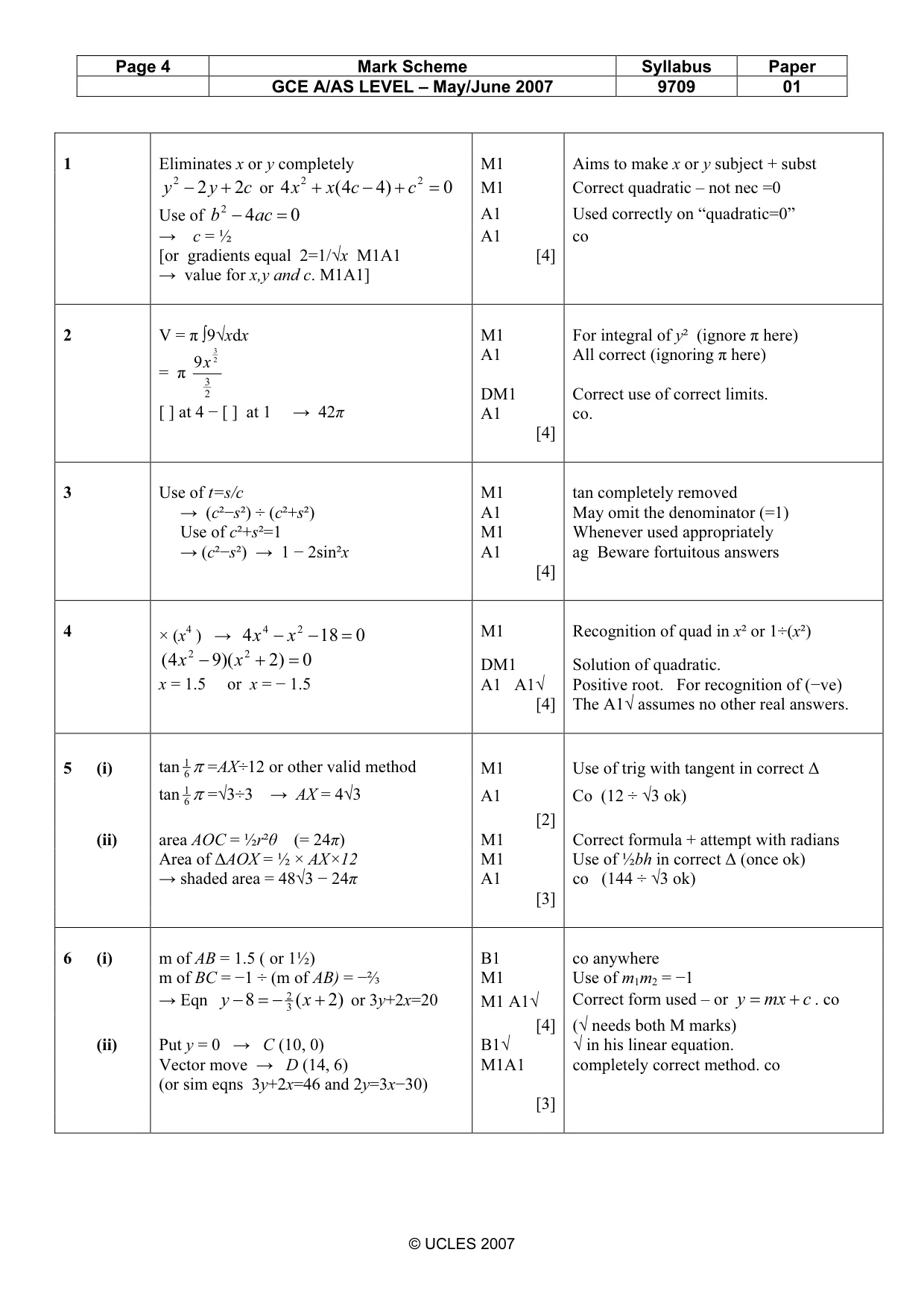
Mark scheme: 1 Eliminates x or y completely M1 Aims to make x or y subject + subst y 2 − 2 y + 2c or 4 x 2 + x ( 4c − 4) + c 2 = 0 M1 Correct quadratic – not nec =0 Use of b 2 −ac4 = 0 A1 Used correctly on “quadratic=0” → c = ½ A1 co [or gradients equal 2=1/√x M1A1 [4] → value for x,y and c. M1A1] ∫√
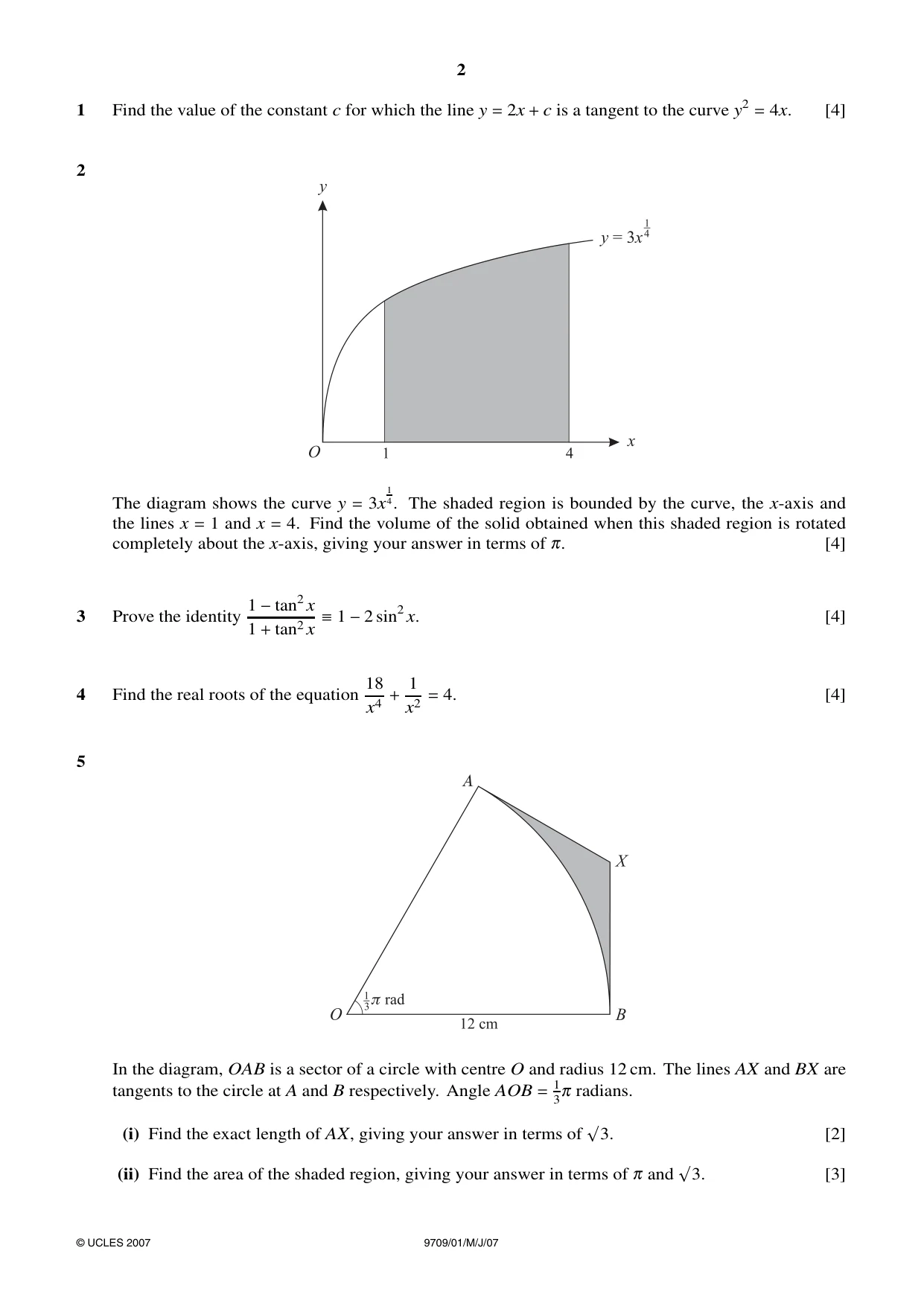
Q2 · 1 The diagram shows the curve y = 3x 4
2 1 The diagram shows the curve y = 3x 4. The shaded region is bounded by the curve, the x-axis and the lines x = 1 and x = 4. Find the volume of the solid obtained when this shaded region is rotated completely about the x-axis, giving your answer in terms of π. [4]
Mark scheme: 2 V = π ∫9√xdx M1 For integral of y² (ignore π here) 3 2 A1 All correct (ignoring π here) 9x = π 3 2 DM1 Correct use of correct limits. [ ] at 4 − [ ] at 1 → 42π A1 co. [4]
Q3 · −tan2x 3 Prove the identity ≡1 −2 sin2x
1 −tan2x 3 Prove the identity ≡1 −2 sin2x. [4] 1 + tan2x
Mark scheme: 3 Use of t=s/c M1 tan completely removed → (c²−s²) ÷ (c²+s²) A1 May omit the denominator (=1) Use of c²+s²=1 M1 Whenever used appropriately → (c²−s²) → 1 − 2sin²x A1 ag Beware fortuitous answers [4]
Q4 · 1 4 Find the real roots of the equation + = 4
18 1 4 Find the real roots of the equation + = 4. [4] x4 x2
Mark scheme: 4 × (x4 ) → 4 x 4 −x 2 − 18 = 0 M1 Recognition of quad in x² or 1÷(x²) ( 4 x 2 − 9)( x 2 + 2) = 0 DM1 Solution of quadratic. x = 1.5 or x = − 1.5 A1 A1√ Positive root. For recognition of (−ve) [4] The A1√ assumes no other real answers. 1
Q5 · In the diagram, OAB is a sector of a circle with centre O and radius 12 cm
5 In the diagram, OAB is a sector of a circle with centre O and radius 12 cm. The lines AX and BX are tangents to the circle at A and B respectively. Angle AOB = 13π radians. (i) Find the exact length of AX, giving your answer in terms of √3. [2] (ii) Find the area of the shaded region, giving your answer in terms of π and √3. [3]
Mark scheme: 5 (i) tan 16 π =AX÷12 or other valid method M1 Use of trig with tangent in correct ∆ tan 16 π =√3÷3 → AX = 4√3 A1 Co (12 ÷ √3 ok) [2] (ii) area AOC = ½r²θ (= 24π) M1 Correct formula + attempt with radians Area of ∆AOX = ½ × AX×12 M1 Use of ½bh in correct ∆ (once ok) → shaded area = 48√3 − 24π A1 co (144 ÷ √3 ok) [3]
Q6 · The diagram shows a rectangle ABCD
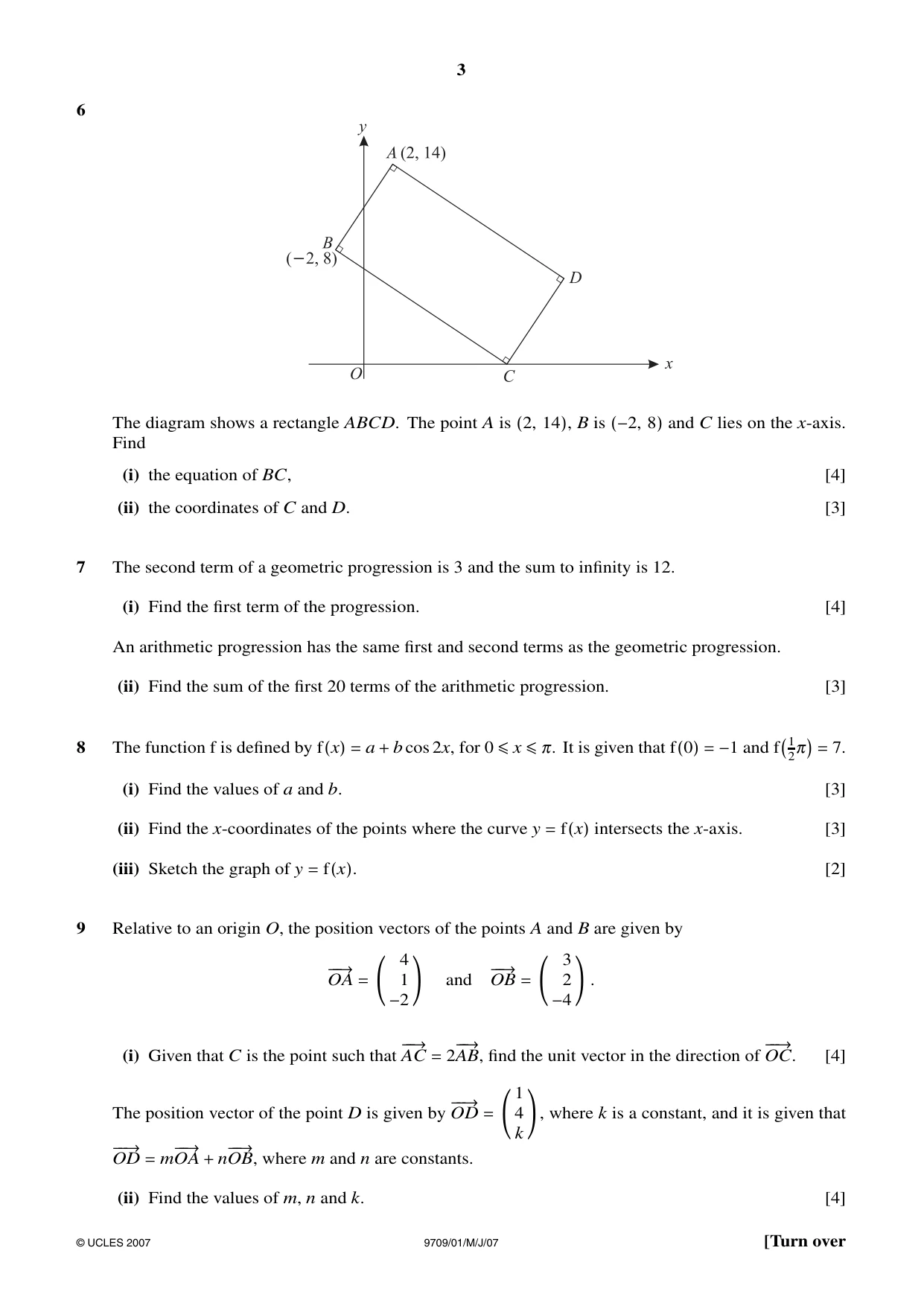
6 The diagram shows a rectangle ABCD. The point A is (2, 14), B is (−2, 8) and C lies on the x-axis. Find (i) the equation of BC, [4] (ii) the coordinates of C and D. [3]
Mark scheme: 6 (i) m of AB = 1.5 ( or 1½) B1 co anywhere m of BC = −1 ÷ (m of AB) = −⅔ M1 Use of m1m2 = −1 → Eqn y − 8 = − 23 ( x + 2) or 3y+2x=20 M1 A1√ Correct form used – or y = mx + c . co [4] (√ needs both M marks) (ii) Put y = 0 → C (10, 0) B1√ √ in his linear equation. Vector move → D (14, 6) M1A1 completely correct method. co (or sim eqns 3y+2x=46 and 2y=3x−30) [3] GCE A/AS LEVEL – May/June 2007 9709 01 a
Q7 · The second term of a geometric progression is 3 and the sum to infinity is 12
7 The second term of a geometric progression is 3 and the sum to infinity is 12. (i) Find the first term of the progression. [4] An arithmetic progression has the same first and second terms as the geometric progression. (ii) Find the sum of the first 20 terms of the arithmetic progression. [3]
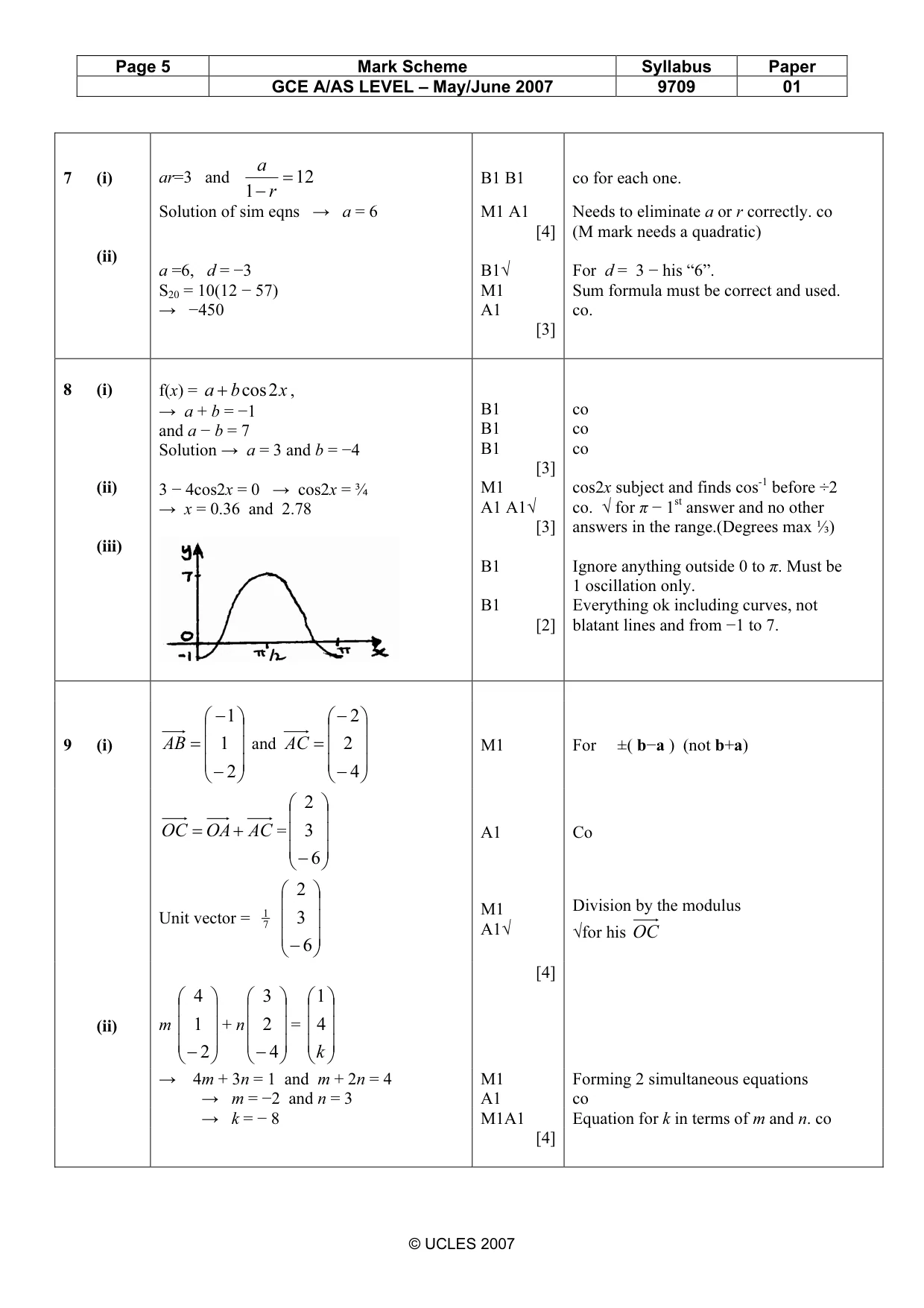
Mark scheme: a 7 (i) ar=3 and = 12 B1 B1 co for each one. 1 −r Solution of sim eqns → a = 6 M1 A1 Needs to eliminate a or r correctly. co [4] (M mark needs a quadratic) (ii) a =6, d = −3 B1√ For d = 3 − his “6”. S20 = 10(12 − 57) M1 Sum formula must be correct and used. → −450 A1 co. [3]
Q8 · The function f is defined by f(x) = a + b cos 2x, for 0 ≤x ≤π
8 The function f is defined by f(x) = a + b cos 2x, for 0 ≤x ≤π. It is given that f(0) = −1 and f 12π = 7. (i) Find the values of a and b. [3] (ii) Find the x-coordinates of the points where the curve y = f(x) intersects the x-axis. [3] (iii) Sketch the graph of y = f(x). [2]
Mark scheme: 8 (i) f(x) = a + b cos 2 x , → a + b = −1 B1 co and a − b = 7 B1 co Solution → a = 3 and b = −4 B1 co [3] (ii) 3 − 4cos2x = 0 → cos2x = ¾ M1 cos2x subject and finds cos-1 before ÷2 → x = 0.36 and 2.78 A1 A1√ co. √ for π − 1st answer and no other [3] answers in the range.(Degrees max ⅓) (iii) B1 Ignore anything outside 0 to π. Must be 1 oscillation only. B1 Everything ok including curves, not [2] blatant lines and from −1 to 7. − 1 − 2 AB 1 AC 2
Q9 · Relative to an origin O, the position vectors of the points A and B are given by 4 3 −−→…
9 Relative to an origin O, the position vectors of the points A and B are given by 4 3 −−→ −−→ OA = 1 and OB = 2 . −2 −4 −−→ −−→ (i) Given that C is the point such that AC = 2−−→AB, find the unit vector in the direction of OC. [4] 1 −−→ The position vector of the point D is given by OD = 4 , where k is a constant, and it is given that k −−→ OD = m−−→OA + n−−→OB, where m and n are constants. (ii) Find the values of m, n and k. [4]
Mark scheme: 9 (i) AB = 1 and AC = 2 M1 For ±( b−a ) (not b+a) − 2 − 4 2 OC = OA + AC = 3 A1 Co −6 2 M1 Division by the modulus 1 Unit vector = 7 3 A1√ √for his OC −6 [4] 4 3 1 m (ii) 1 + n 2 = 4 −2 −4 k → 4m + 3n = 1 and m + 2n = 4 M1 Forming 2 simultaneous equations → m = −2 and n = 3 A1 co → k = − 8 M1A1 Equation for k in terms of m and n. co [4] GCE A/AS LEVEL – May/June 2007 9709 01 dy 16 3 /
Q10 · 10 The equation of a curve is y = 2x + x2
8 10 The equation of a curve is y = 2x + x2. dy d2y (i) Obtain expressions for and . [3] dx dx2 (ii) Find the coordinates of the stationary point on the curve and determine the nature of the stationary point. [3] (iii) Show that the normal to the curve at the point (−2, −2) intersects the x-axis at the point (−10, 0). [3] (iv) Find the area of the region enclosed by the curve, the x-axis and the lines x = 1 and x = 2. [3]
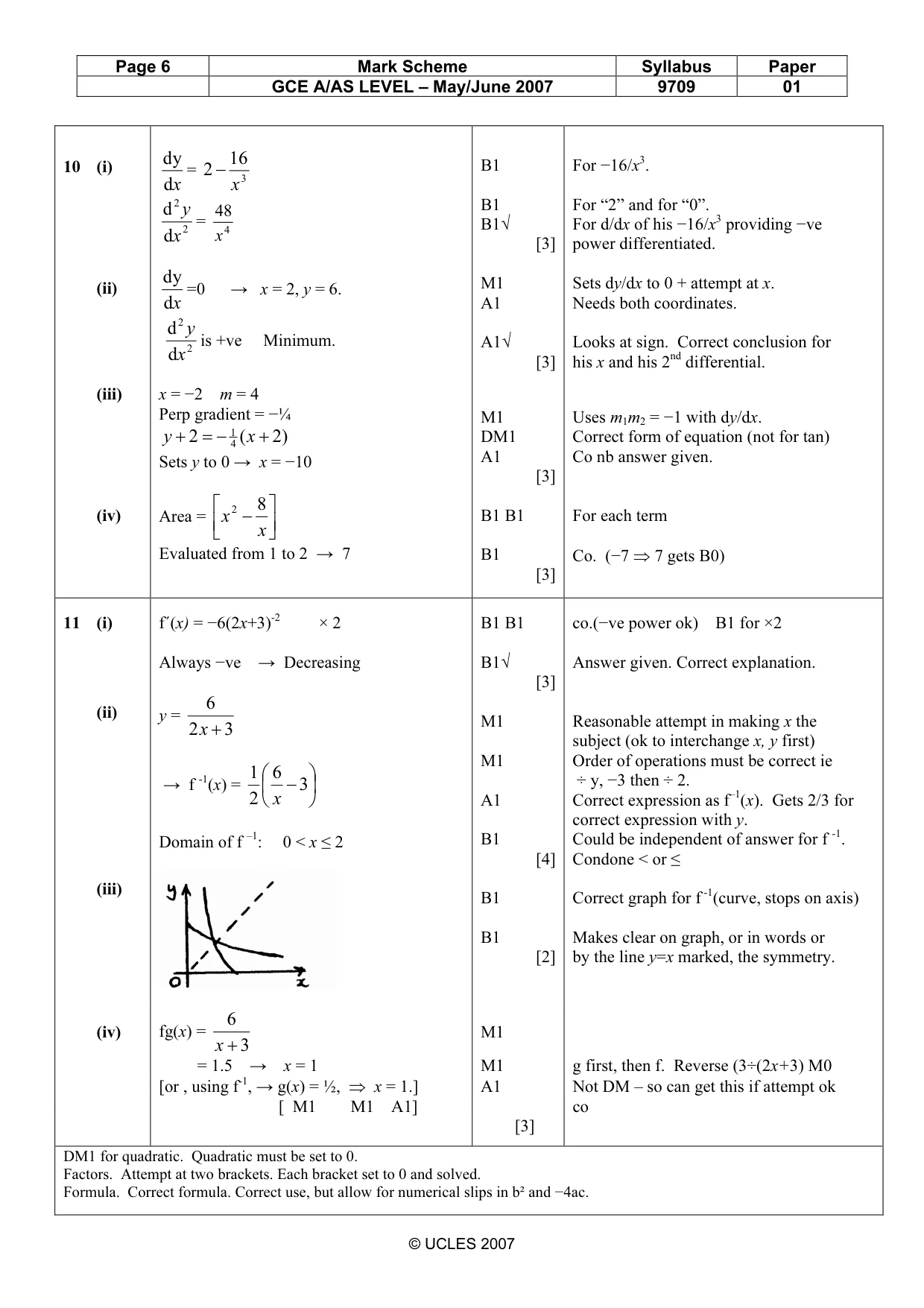
Mark scheme: dy 16 −16/x3.10 (i) = 2 − 3 B1 For dx x d 2 y 48 B1 For “2” and for “0”. 2 = 4 B1√ For d/dx of his −16/x3 providing −ve dx x [3] power differentiated. dy (ii) =0 → x = 2, y = 6. M1 Sets dy/dx to 0 + attempt at x. dx A1 Needs both coordinates. d 2 y 2 is +ve Minimum. A1√ Looks at sign. Correct conclusion for dx [3] his x and his 2nd differential. (iii) x = −2 m = 4 Perp gradient = −¼ M1 Uses m1m2 = −1 with dy/dx. y + 2 = − 14 ( x + 2) DM1 Correct form of equation (not for tan) Sets y to 0 → x = −10 A1 Co nb answer given. [3] 2 8 (iv) Area = x −x B1 B1 For each term Evaluated from 1 to 2 → 7 B1 Co. (−7 ⇒ 7 gets B0) [3] 2
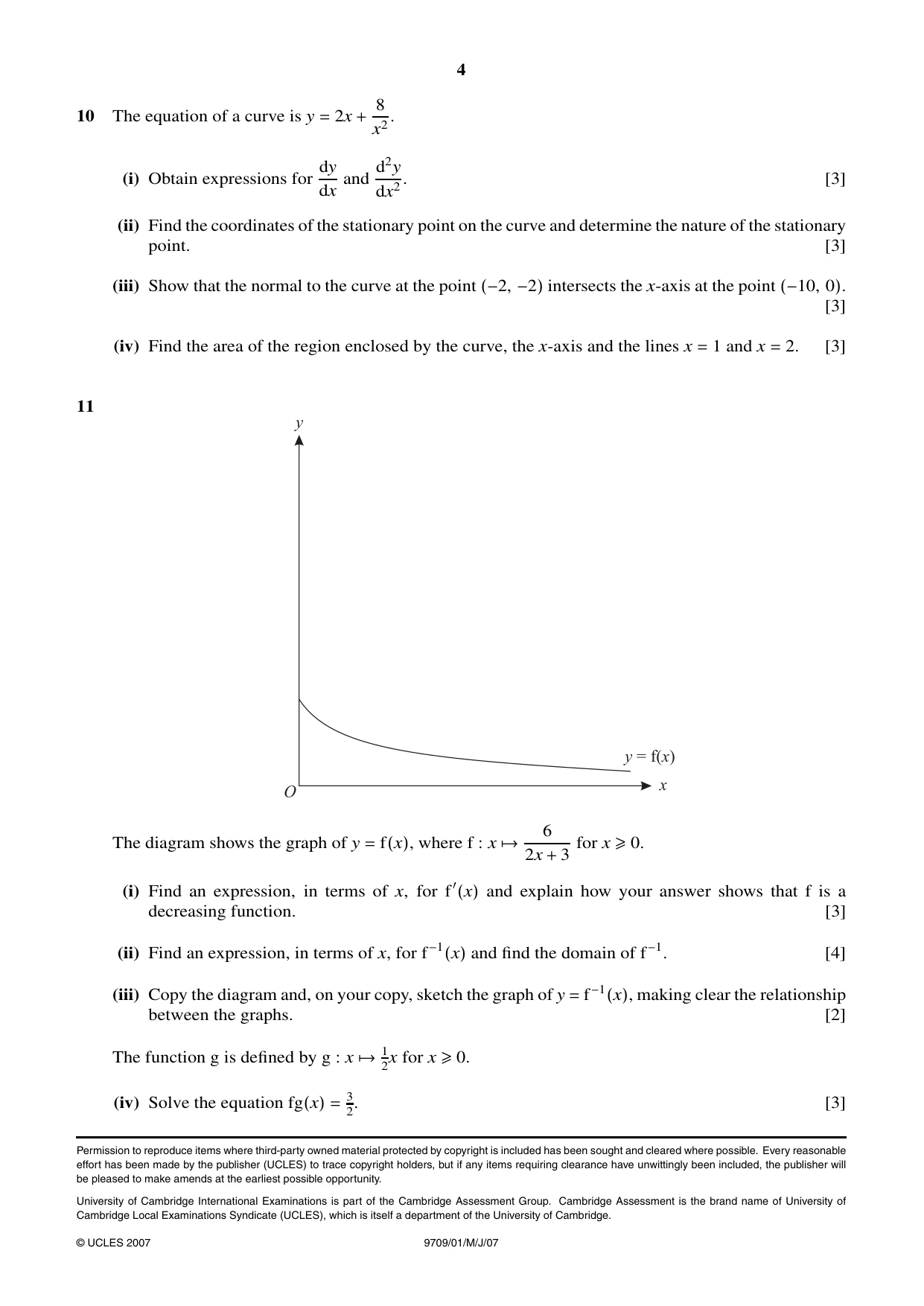
Q11 · 6 The diagram shows the graph of y = f(x), where f : x → for x ≥0
11 6 The diagram shows the graph of y = f(x), where f : x → for x ≥0. 2x + 3 (i) Find an expression, in terms of x, for f′(x) and explain how your answer shows that f is a decreasing function. [3] (ii) Find an expression, in terms of x, for f−1(x) and find the domain of f−1. [4] (iii) Copy the diagram and, on your copy, sketch the graph of y = f−1(x), making clear the relationship between the graphs. [2] The function g is defined by g : x →12x for x ≥0. (iv) Solve the equation fg(x) = 32. [3]
Mark scheme: 11 (i) f´(x) = −6(2x+3)-2 × 2 B1 B1 co.(−ve power ok) B1 for ×2 Always −ve → Decreasing B1√ Answer given. Correct explanation. [3] 6 (ii) y = M1 Reasonable attempt in making x the 2 x + 3 subject (ok to interchange x, y first) M1 Order of operations must be correct ie 1 6 → f -1(x) = −3 ÷ y, −3 then ÷ 2. 2 x A1 Correct expression as f–1(x). Gets 2/3 for correct expression with y. Domain of f –1: 0 < x ≤ 2 B1 Could be independent of answer for f -1. [4] Condone < or ≤ (iii) B1 Correct graph for f -1(curve, stops on axis) B1 Makes clear on graph, or in words or [2] by the line y=x marked, the symmetry. 6 (iv) fg(x) = M1 x + 3 = 1.5 → x = 1 M1 g first, then f. Reverse (3÷(2x+3) M0 [or , using f-1, → g(x) = ½, ⇒ x = 1.] A1 Not DM – so can get this if attempt ok [ M1 M1 A1] co [3] DM1 for quadratic. Quadratic must be set to 0. Factors. Attempt at two brackets. Each bracket set to 0 and solved. Formula. Correct formula. Correct use, but allow for numerical slips in b² and −4ac.
What was in this paper
The subtopics covered by these 11 questions, and how many questions each got. Open one in a new tab to see every Cambridge question on it.
What you needed in this session
Cambridge’s own grade thresholds for 2007 May/June, Paper 1 · Variant 1. A higher threshold means an easier paper — the bar moves with how the cohort did.