Cambridge A Level Mathematics 9709 — 2016 Oct/Nov Paper 1 · Variant 2
9709/12/O/N/16 · 4 questions · 75 marks · ≈84 min
The question paper and its mark scheme, free to read here and free to download. This is Cambridge’s own paper, exactly as it was sat.
Question paper4 pages
Mark scheme8 pages
Answers below. Sit the paper first if you are practising.
Questions as text
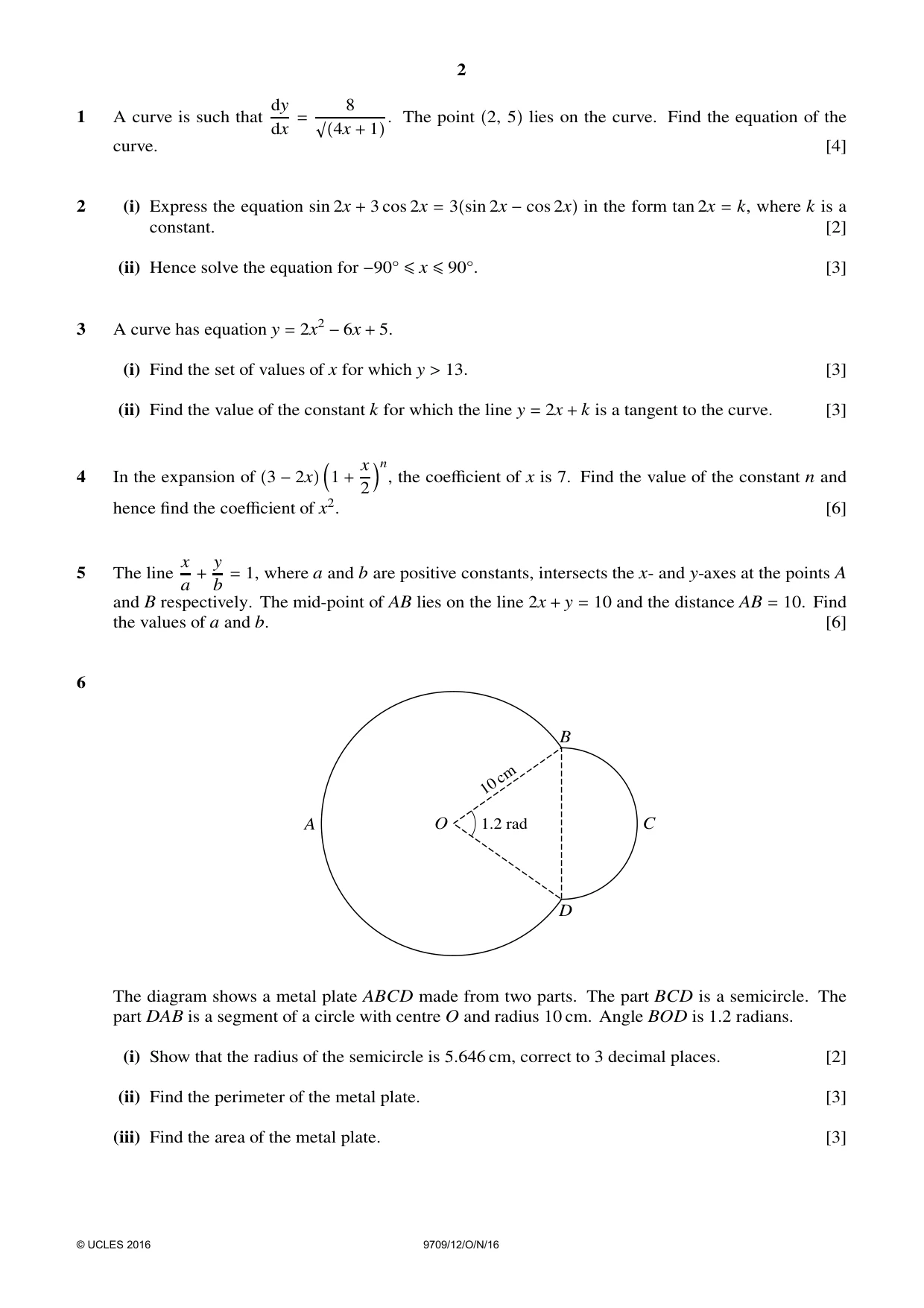
Q6 · B cm 10 A O 1.2 rad C D The diagram shows a metal plate ABCD made from two parts
6 B cm 10 A O 1.2 rad C D The diagram shows a metal plate ABCD made from two parts. The part BCD is a semicircle. The part DAB is a segment of a circle with centre O and radius 10 cm. Angle BOD is 1.2 radians. (i) Show that the radius of the semicircle is 5.646 cm, correct to 3 decimal places. [2] (ii) Find the perimeter of the metal plate. [3] (iii) Find the area of the metal plate. [3]
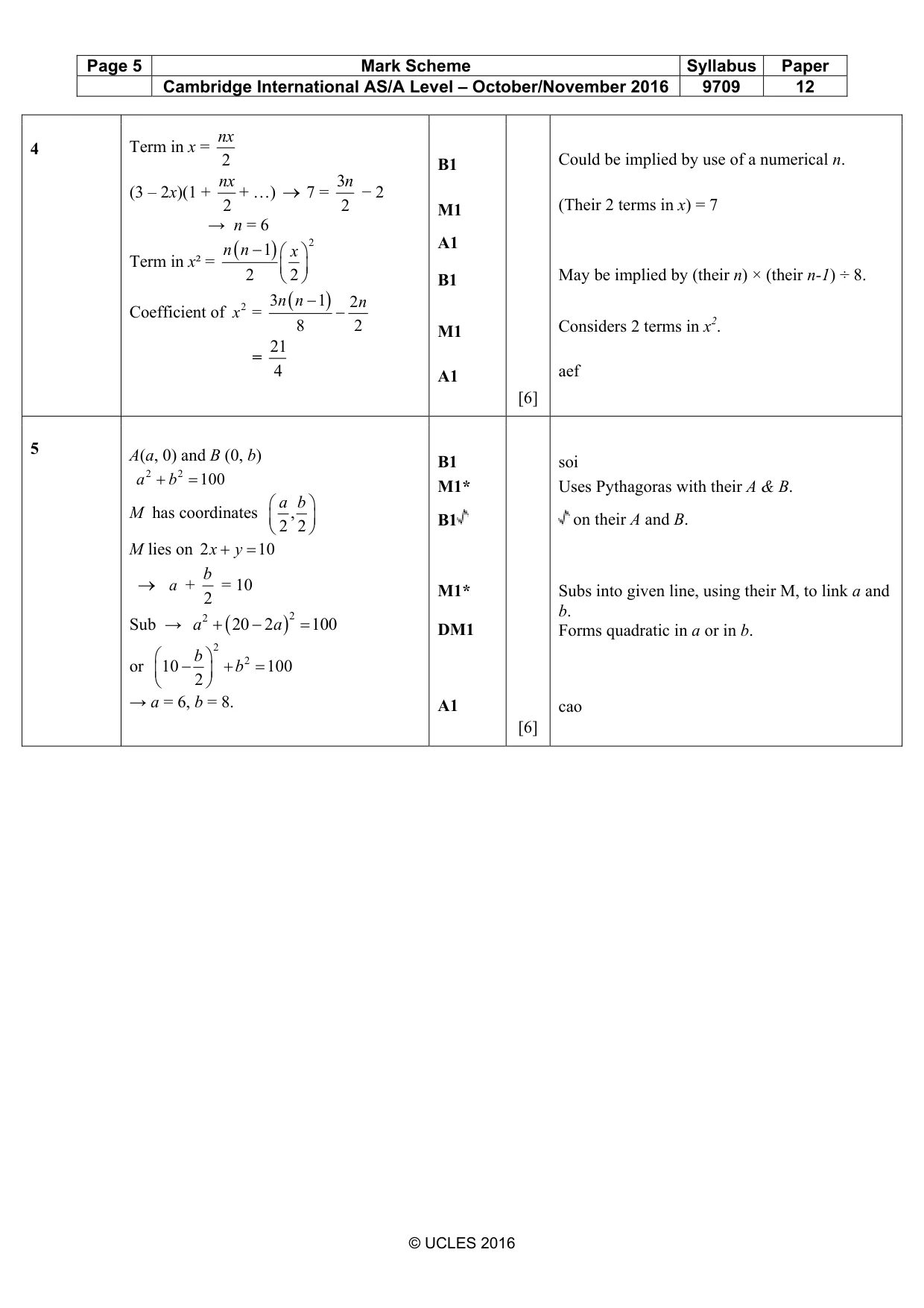
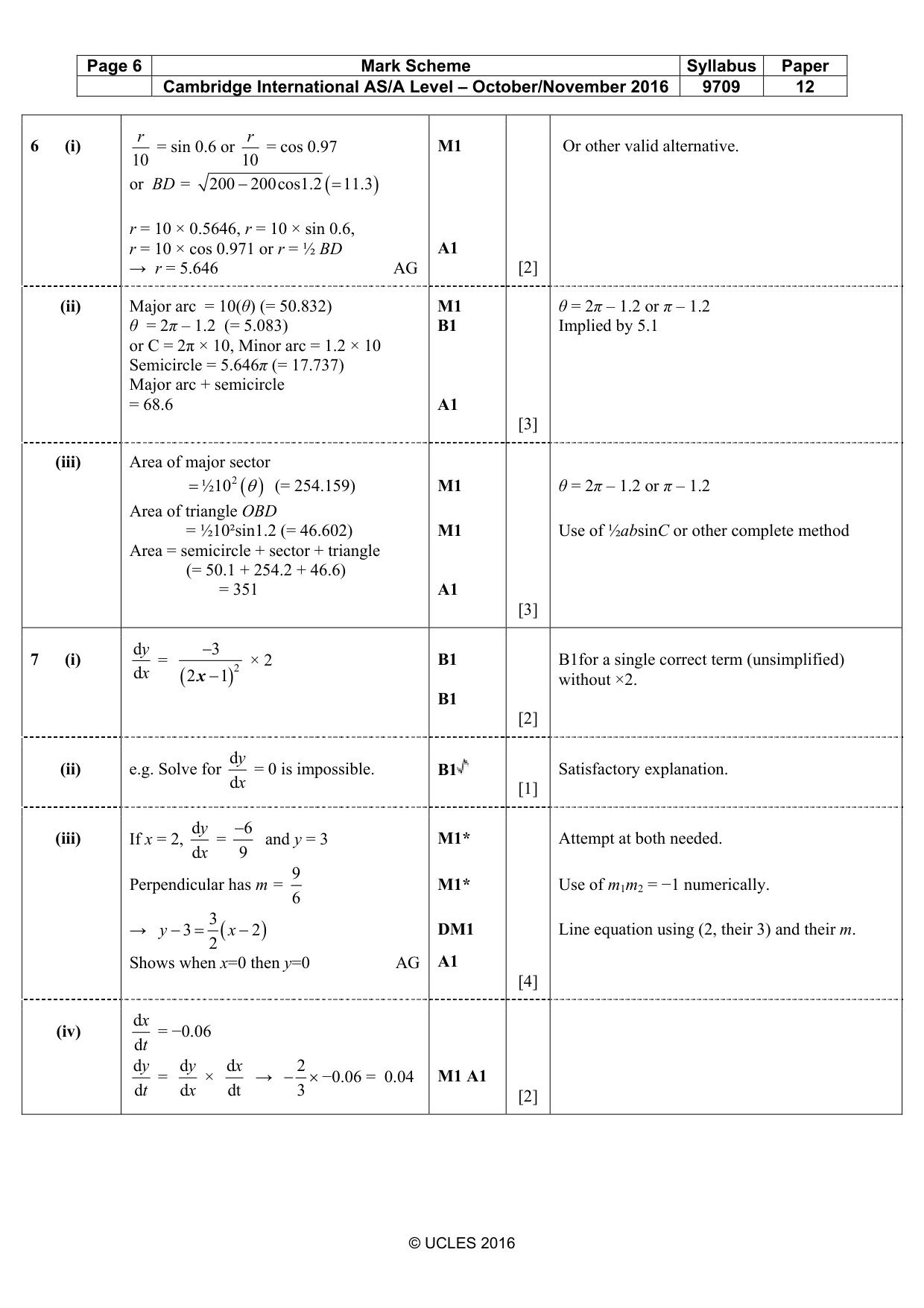
Mark scheme: r r 6 (i) = sin 0.6 or = cos 0.97 M1 Or other valid alternative. 10 10 or BD = 200 − 200cos1.2 ( = 11.3 ) r = 10 × 0.5646, r = 10 × sin 0.6, r = 10 × cos 0.971 or r = ½ BD A1 → r = 5.646 AG [2] (ii) Major arc = 10(θ) (= 50.832) M1 θ = 2π – 1.2 or π – 1.2 θ = 2π – 1.2 (= 5.083) B1 Implied by 5.1 or C = 2π × 10, Minor arc = 1.2 × 10 Semicircle = 5.646π (= 17.737) Major arc + semicircle = 68.6 A1 [3] (iii) Area of major sector = ½10 2 (θ) (= 254.159) M1 θ = 2π – 1.2 or π – 1.2 Area of triangle OBD = ½10²sin1.2 (= 46.602) M1 Use of ½absinC or other complete method Area = semicircle + sector + triangle (= 50.1 + 254.2 + 46.6) = 351 A1 [3] dy −3
Q7 · 7 The equation of a curve is y = 2 + 2x −1
3 7 The equation of a curve is y = 2 + 2x −1. dy (i) Obtain an expression for dx. [2] (ii) Explain why the curve has no stationary points. [1] At the point P on the curve, x = 2. (iii) Show that the normal to the curve at P passes through the origin. [4] (iv) A point moves along the curve in such a way that its x-coordinate is decreasing at a constant rate of 0.06 units per second. Find the rate of change of the y-coordinate as the point passes through P. [2]
Mark scheme: dy −3 7 (i) = × 2 B1 B1for a single correct term (unsimplified) dx ( 2 x − 1) 2 without ×2. B1 [2] dy (ii) e.g. Solve for = 0 is impossible. B1 Satisfactory explanation. dx [1] dy −6 (iii) If x = 2, = and y = 3 M1* Attempt at both needed. dx 9 9 Perpendicular has m = M1* Use of m1m2 = −1 numerically. 6 3 → y − 3 = ( x − 2 ) DM1 Line equation using (2, their 3) and their m. 2 Shows when x=0 then y=0 AG A1 [4] dx (iv) = −0.06 dt dy dy dx 2 = × → − × −0.06 = 0.04 M1 A1 dt dx dt 3 [2]
Q8 · A cyclist completes a long-distance charity event across Africa
8 (a) A cyclist completes a long-distance charity event across Africa. The total distance is 3050 km. He starts the event on May 1st and cycles 200 km on that day. On each subsequent day he reduces the distance cycled by 5 km. (i) How far will he travel on May 15th? [2] (ii) On what date will he finish the event? [3] (b) A geometric progression is such that the third term is 8 times the sixth term, and the sum of the first six terms is 3112. Find (i) the first term of the progression, [4] (ii) the sum to infinity of the progression. [1]
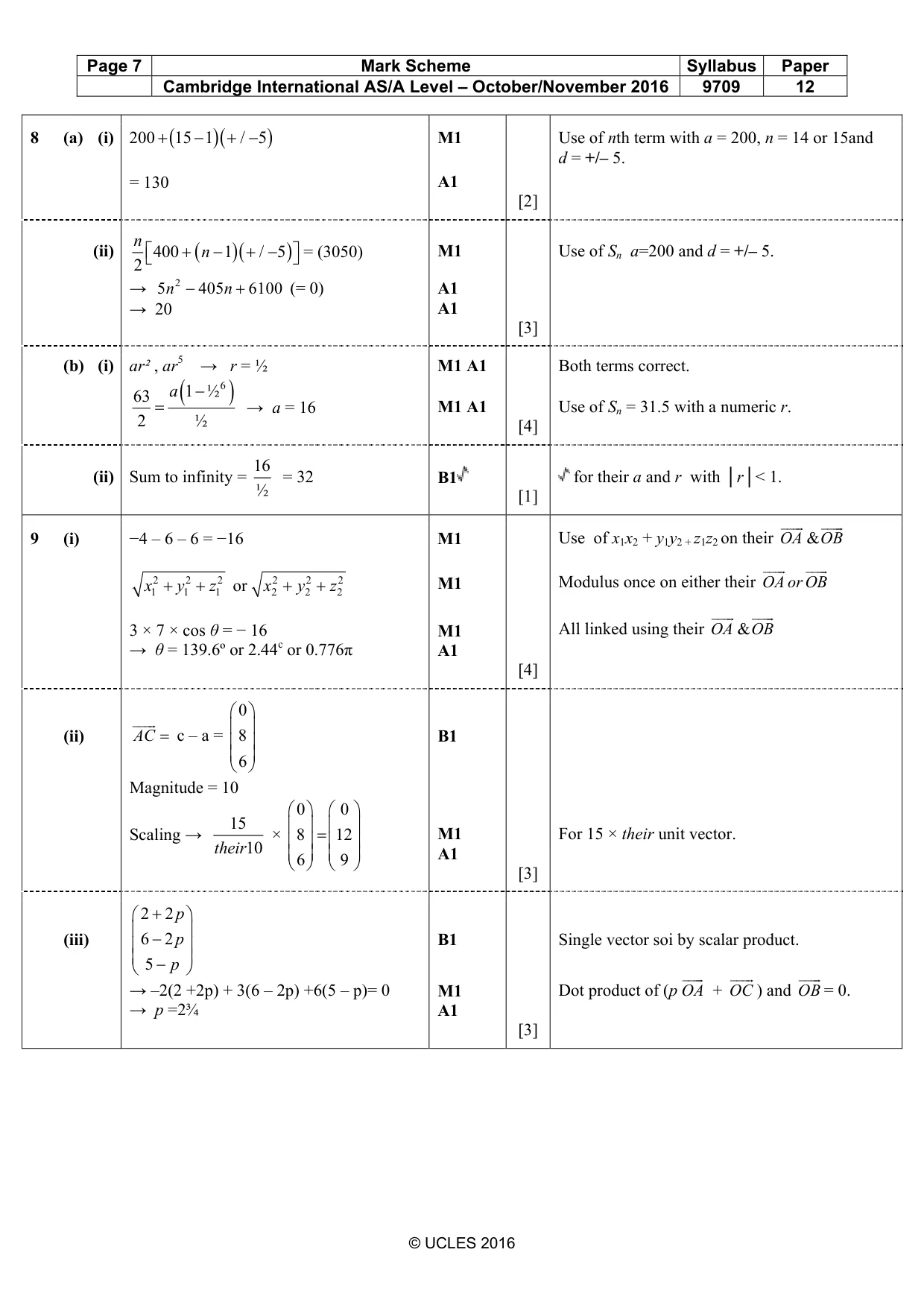
Mark scheme: 8 (a) (i) 200 + (15 − 1)( + / −5 ) M1 Use of nth term with a = 200, n = 14 or 15and d = +/– 5. = 130 A1 [2] n (ii) (3050) M1 Use of Sn a=200 and d = +/– 5. 400 + ( n − 1)( + / −5 ) = 2 → 5 n 2 − 405 n + 6100 (= 0) A1 → 20 A1 [3] (b) (i) ar² , ar5 → r = ½ M1 A1 Both terms correct. a 1 − ½ 6 63 ( ) = → a = 16 M1 A1 Use of Sn = 31.5 with a numeric r. 2 ½ [4] 16 (ii) Sum to infinity = = 32 B1 for their a and r with │r│< 1. ½ [1] JJJG JJJG
Q9 · Relative to an origin O, the position vectors of the points A, B and C are given by ` a a…
9 Relative to an origin O, the position vectors of the points A, B and C are given by ` a a ` a 2 `−2 2 −−→ −−→ −−→ OA = −2 , OB = 3 and OC = 6 . −1 6 5 (i) Use a scalar product to find angle AOB. [4] −−→ (ii) Find the vector which is in the same direction as AC and of magnitude 15 units. [3] −−→ −−→ (iii) Find the value of the constant p for which p−−→OA + OC is perpendicular to OB. [3]
Mark scheme: JJJG JJJG 9 (i) −4 – 6 – 6 = −16 M1 Use of x1x2 + y1y2 + z1z2 on their OA & OB JJJG JJJG x12 + y12 + z12 or x22 + y 22 + z 22 M1 Modulus once on either their OA or OB JJJG JJJG 3 × 7 × cos θ = − 16 M1 All linked using their OA & OB → θ = 139.6º or 2.44c or 0.776π A1 [4] 0 JJJG (ii) AC = c – a = 8 B1 6 Magnitude = 10 0 0 15 Scaling → × 8 = 12 M1 For 15 × their unit vector. their10 A1 6 9 [3] 2 + 2 p (iii) 6 − 2 p B1 Single vector soi by scalar product. 5 − p JJJG JJJG JJJG → –2(2 +2p) + 3(6 – 2p) +6(5 – p)= 0 M1 Dot product of (p OA + OC ) and OB = 0. → p =2¾ A1 [3]
What was in this paper
The subtopics covered by these 4 questions, and how many questions each got. Open one in a new tab to see every Cambridge question on it.
What you needed in this session
Cambridge’s own grade thresholds for 2016 Oct/Nov, Paper 1 · Variant 2. A higher threshold means an easier paper — the bar moves with how the cohort did.