Cambridge A Level Mathematics 9709 — 2009 Oct/Nov Paper 1 · Variant 2
9709/12/O/N/09 · 6 questions · 75 marks · ≈84 min
The question paper and its mark scheme, free to read here and free to download. This is Cambridge’s own paper, exactly as it was sat.
Question paper4 pages
Mark scheme7 pages
Answers below. Sit the paper first if you are practising.
Questions as text
Q5 · Prove the identity (sin x + cos x)(1 −sin x cos x) ≡sin3x + cos3x
5 (i) Prove the identity (sin x + cos x)(1 −sin x cos x) ≡sin3x + cos3x. [3] (ii) Solve the equation (sin x + cos x)(1 −sin x cos x) = 9 sin3x for 0◦≤x ≤360◦. [3]
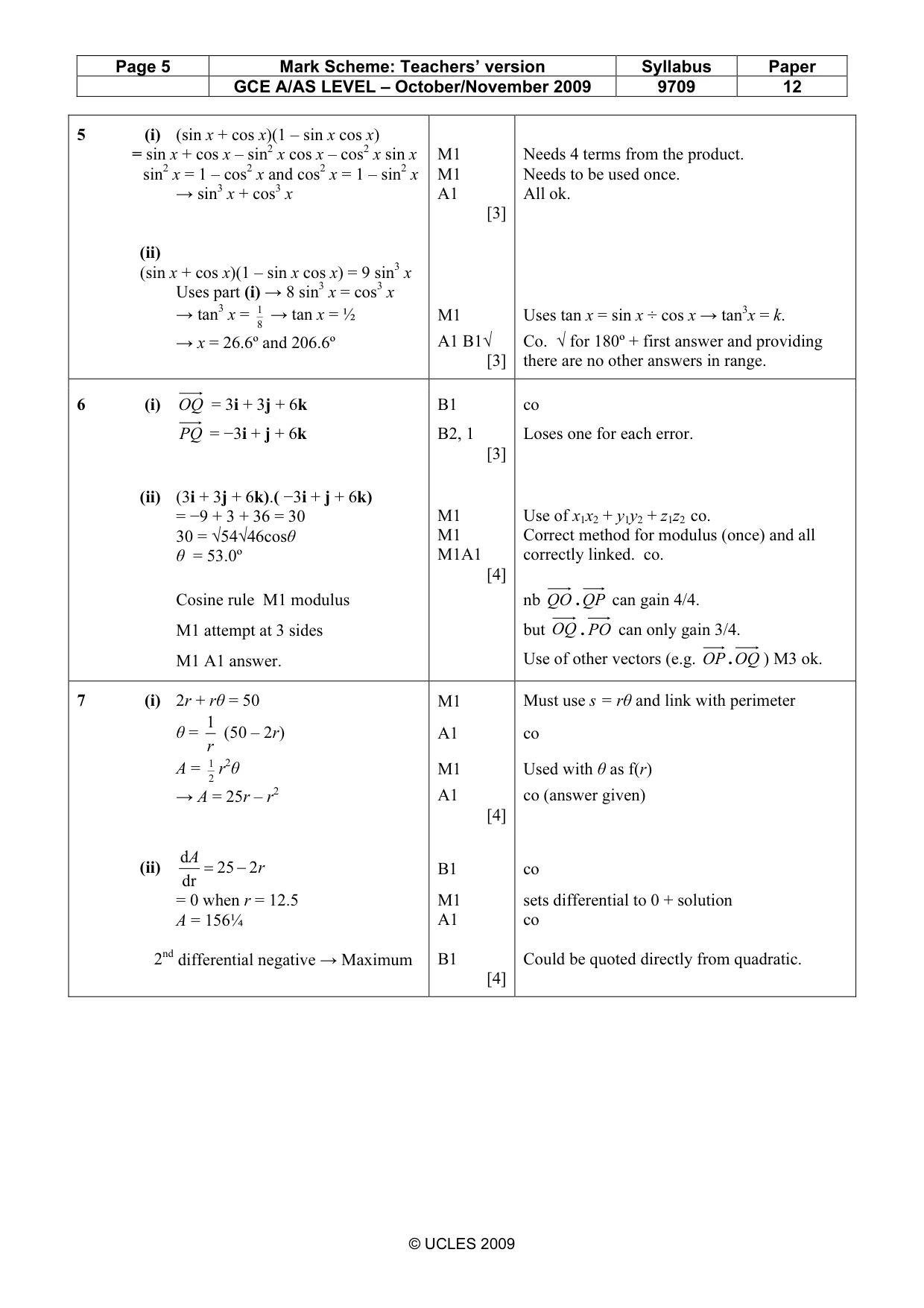
Mark scheme: 5 (i) (sin x + cos x)(1 – sin x cos x) = sin x + cos x – sin2 x cos x – cos2 x sin x M1 Needs 4 terms from the product. sin2 x = 1 – cos2 x and cos2 x = 1 – sin2 x M1 Needs to be used once. → sin3 x + cos3 x A1 All ok. [3] (ii) (sin x + cos x)(1 – sin x cos x) = 9 sin3 x Uses part (i) → 8 sin3 x = cos3 x → tan3 x = 1 → tan x = ½ M1 Uses tan x = sin x ÷ cos x → tan3x = k. 8 → x = 26.6º and 206.6º A1 B1√ Co. √ for 180º + first answer and providing [3] there are no other answers in range.
Q6 · G F Q D E C B k j P O A i In the diagram, OABCDEFG is a cube in which each side has…
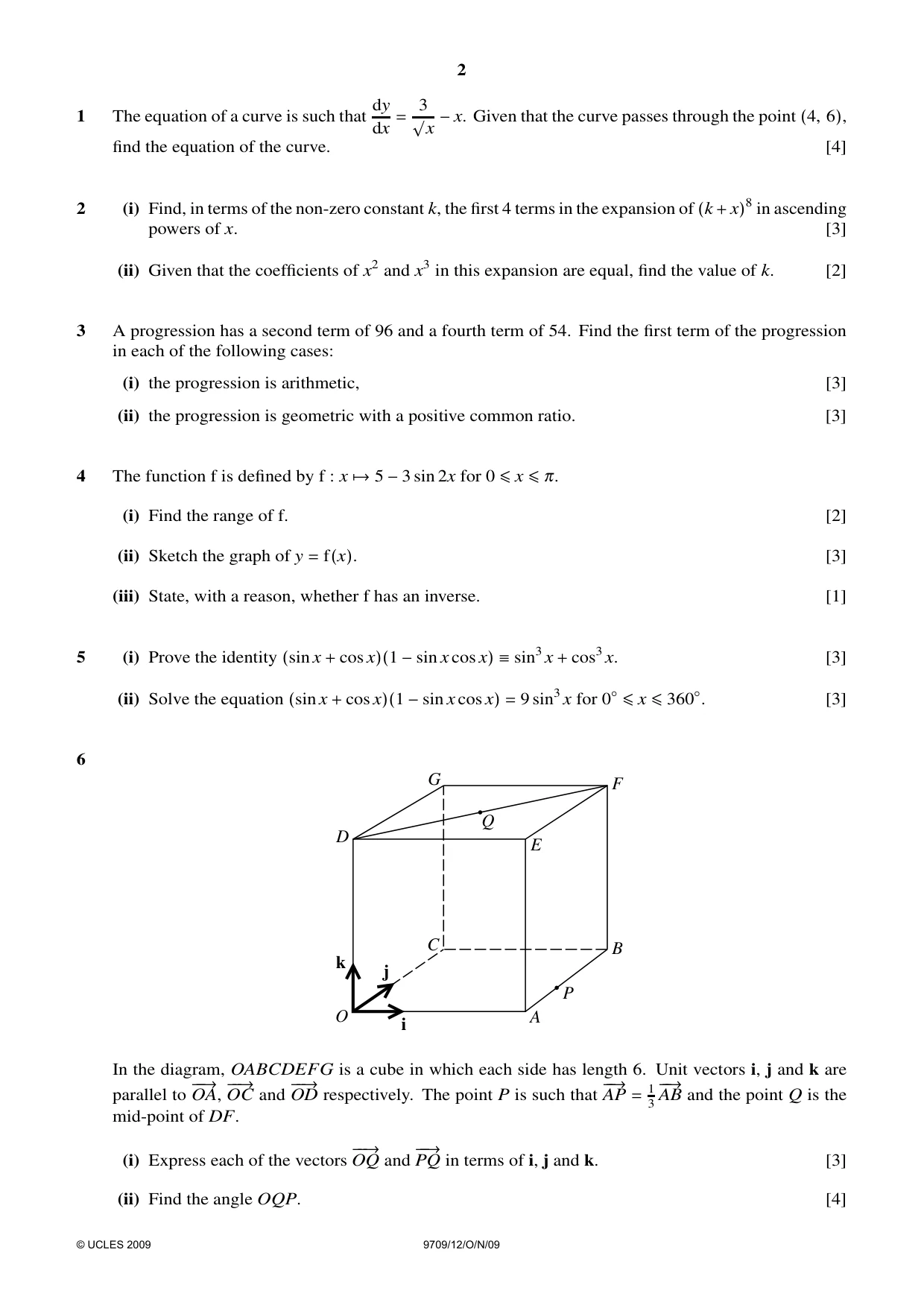
6 G F Q D E C B k j P O A i In the diagram, OABCDEFG is a cube in which each side has length 6. Unit vectors i, j and k are parallel to −−→OA, −−→OC and −−→OD respectively. The point P is such that −−→AP 1 −−→AB and the point Q is the = 3 mid-point of DF. (i) Express each of the vectors −−→OQ and −−→PQ in terms of i, j and k. [3] (ii) Find the angle OQP. [4]
Mark scheme: 6 (i) OQ = 3i + 3j + 6k B1 co PQ = −3i + j + 6k B2, 1 Loses one for each error. [3] (ii) (3i + 3j + 6k).( −3i + j + 6k) = −9 + 3 + 36 = 30 M1 Use of x1x2 + y1y2 + z1z2 co. 30 = √54√46cosθ M1 Correct method for modulus (once) and all θ = 53.0º M1A1 correctly linked. co. [4] Cosine rule M1 modulus nb QO .QP can gain 4/4. M1 attempt at 3 sides but OQ . PO can only gain 3/4. M1 A1 answer. Use of other vectors (e.g. OP .OQ ) M3 ok.
Q7 · P r cm q rad O Q A piece of wire of length 50 cm is bent to form the perimeter of a…
7 P r cm q rad O Q A piece of wire of length 50 cm is bent to form the perimeter of a sector POQ of a circle. The radius of the circle is r cm and the angle POQ is θ radians (see diagram). (i) Express θ in terms of r and show that the area, A cm2, of the sector is given by A = 25r −r2. [4] (ii) Given that r can vary, find the stationary value of A and determine its nature. [4]
Mark scheme: 7 (i) 2r + rθ = 50 M1 Must use s = rθ and link with perimeter 1 θ = (50 – 2r) A1 co r A = 1 r2θ M1 Used with θ as f(r) 2 → A = 25r – r2 A1 co (answer given) [4] d A (ii) = 25 − 2 r B1 co dr = 0 when r = 12.5 M1 sets differential to 0 + solution A = 156¼ A1 co 2nd differential negative → Maximum B1 Could be quoted directly from quadratic. [4] GCE A/AS LEVEL – October/November 2009 9709 12 3
Q8 · 8 The function f is such that f(x) = 2x 5 for x ∈>, x ≠−2.5
3 8 The function f is such that f(x) = 2x 5 for x ∈>, x ≠−2.5. + (i) Obtain an expression for f ′(x) and explain why f is a decreasing function. [3] (ii) Obtain an expression for f −1(x). [2] (iii) A curve has the equation y = f(x). Find the volume obtained when the region bounded by the curve, the coordinate axes and the line x = 2 is rotated through 360◦about the x-axis. [4]
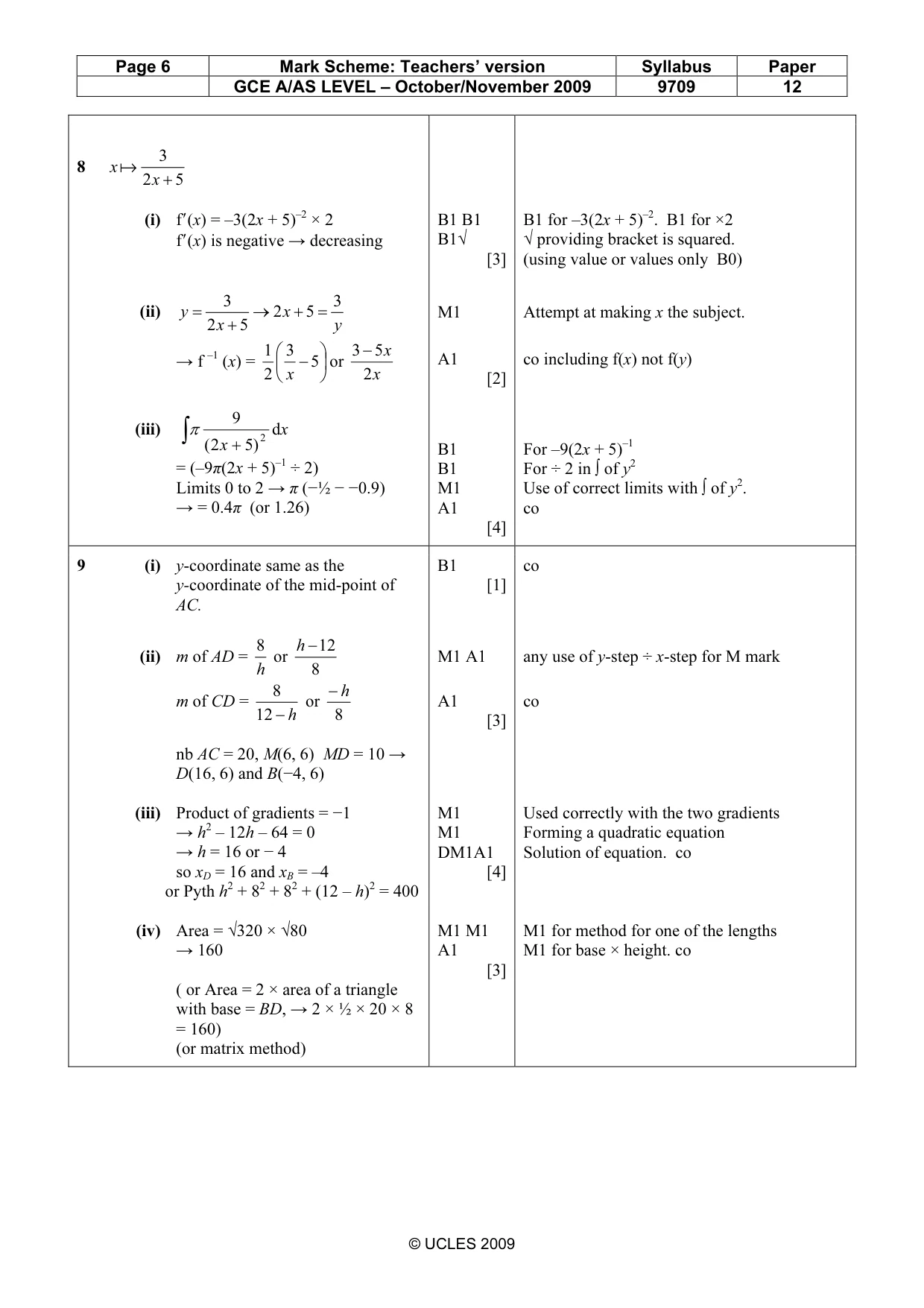
Mark scheme: 3 8 x a 2 x + 5 (i) fV(x) = –3(2x + 5)–2 × 2 B1 B1 B1 for –3(2x + 5)–2. B1 for ×2 fV(x) is negative → decreasing B1√ √ providing bracket is squared. [3] (using value or values only B0) 3 3 (ii) y = → 2 x + 5 = M1 Attempt at making x the subject. 2 x + 5 y –1 1 3 3− 5 x → f (x) = −5 or A1 co including f(x) not f(y) 2 x 2 x [2] 9 2 (iii) ∫ π ( 2 x + 5) dx B1 For –9(2x + 5)–1 = (–9π(2x + 5)–1 ÷ 2) B1 For ÷ 2 in ∫ of y2 Limits 0 to 2 → π (−½ − −0.9) M1 Use of correct limits with ∫ of y2. → = 0.4π (or 1.26) A1 co [4]
Q9 · Y C (12, 14) B D O x A (0, –2) The diagram shows a rectangle ABCD
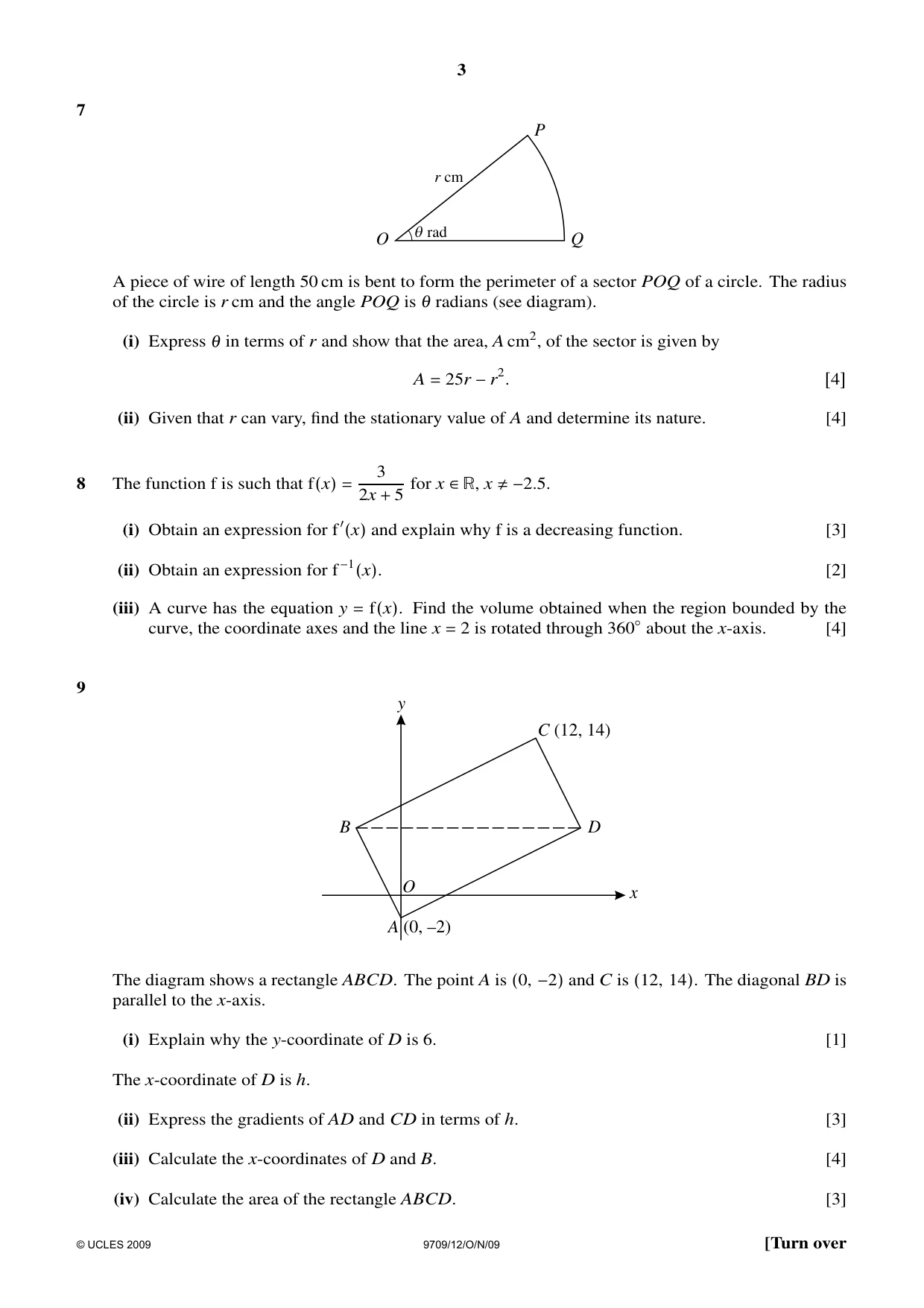
9 y C (12, 14) B D O x A (0, –2) The diagram shows a rectangle ABCD. The point A is (0, −2) and C is (12, 14). The diagonal BD is parallel to the x-axis. (i) Explain why the y-coordinate of D is 6. [1] The x-coordinate of D is h. (ii) Express the gradients of AD and CD in terms of h. [3] (iii) Calculate the x-coordinates of D and B. [4] (iv) Calculate the area of the rectangle ABCD. [3]
Mark scheme: 9 (i) y-coordinate same as the B1 co y-coordinate of the mid-point of [1] AC. 8 h − 12 (ii) m of AD = or M1 A1 any use of y-step ÷ x-step for M mark h 8 8 − h m of CD = or A1 co 12 − h 8 [3] nb AC = 20, M(6, 6) MD = 10 → D(16, 6) and B(−4, 6) (iii) Product of gradients = −1 M1 Used correctly with the two gradients → h2 – 12h – 64 = 0 M1 Forming a quadratic equation → h = 16 or − 4 DM1A1 Solution of equation. co so xD = 16 and xB = –4 [4] or Pyth h2 + 82 + 82 + (12 – h)2 = 400 (iv) Area = √320 × √80 M1 M1 M1 for method for one of the lengths → 160 A1 M1 for base × height. co [3] ( or Area = 2 × area of a triangle with base = BD, → 2 × ½ × 20 × 8 = 160) (or matrix method) GCE A/AS LEVEL – October/November 2009 9709 12 2
Q10 · Y y = x 2 – 4x + 7 2y = x + 5 B A x O (i) The diagram shows the line 2y x 5 and the curve…
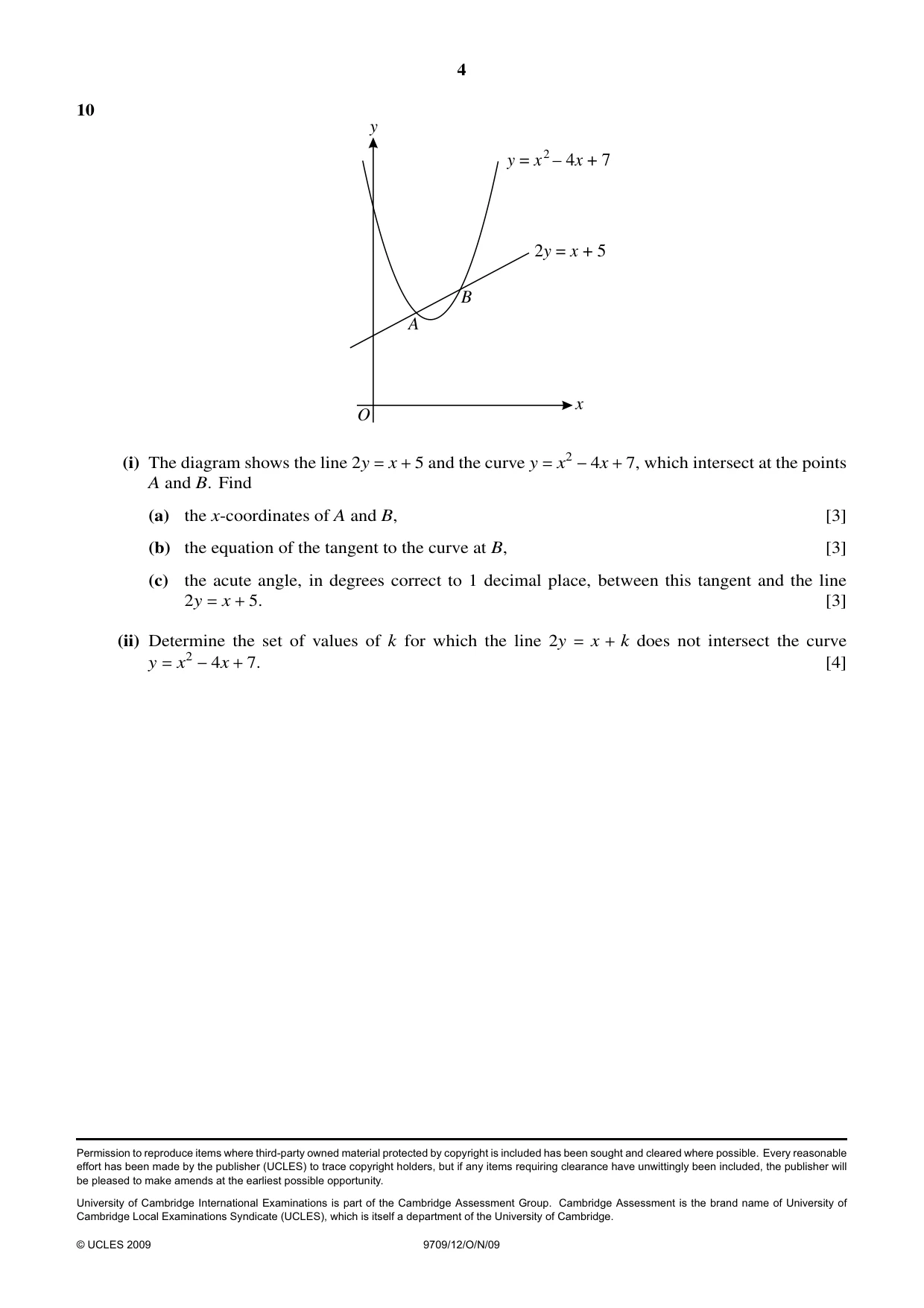
10 y y = x 2 – 4x + 7 2y = x + 5 B A x O (i) The diagram shows the line 2y x 5 and the curve y x2 7, which intersect at the points = + = −4x + A and B. Find (a) the x-coordinates of A and B, [3] (b) the equation of the tangent to the curve at B, [3] (c) the acute angle, in degrees correct to 1 decimal place, between this tangent and the line 2y = x + 5. [3] (ii) Determine the set of values of k for which the line 2y = x + k does not intersect the curve y x2 7. [4] = −4x +
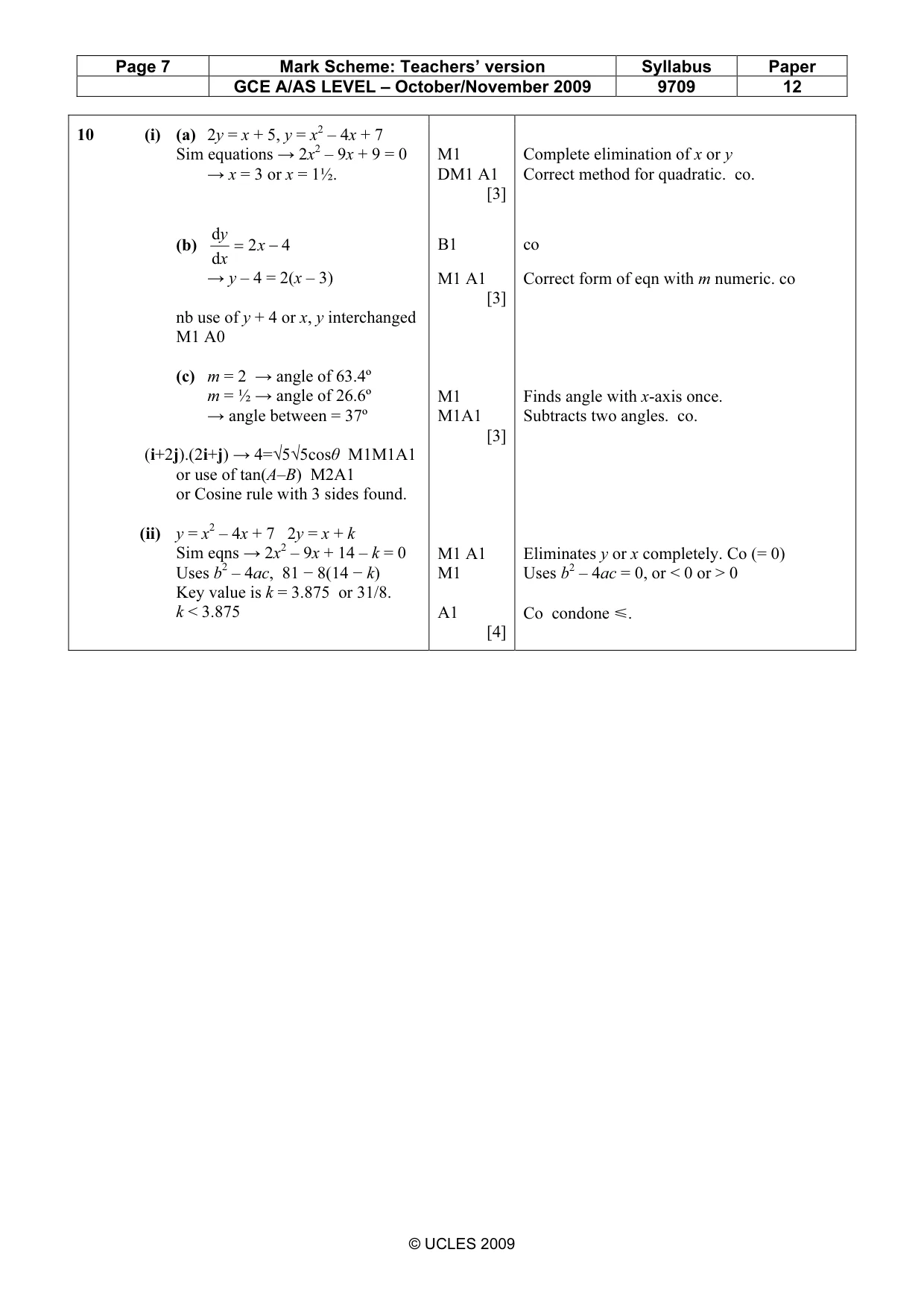
Mark scheme: 10 (i) (a) 2y = x + 5, y = x2 – 4x + 7 Sim equations → 2x2 – 9x + 9 = 0 M1 Complete elimination of x or y → x = 3 or x = 1½. DM1 A1 Correct method for quadratic. co. [3] dy (b) = 2 x − 4 B1 co dx → y – 4 = 2(x – 3) M1 A1 Correct form of eqn with m numeric. co [3] nb use of y + 4 or x, y interchanged M1 A0 (c) m = 2 → angle of 63.4º m = ½ → angle of 26.6º M1 Finds angle with x-axis once. → angle between = 37º M1A1 Subtracts two angles. co. [3] (i+2j).(2i+j) → 4=√5√5cosθ M1M1A1 or use of tan(A–B) M2A1 or Cosine rule with 3 sides found. (ii) y = x2 – 4x + 7 2y = x + k Sim eqns → 2x2 – 9x + 14 – k = 0 M1 A1 Eliminates y or x completely. Co (= 0) Uses b2 – 4ac, 81 − 8(14 − k) M1 Uses b2 – 4ac = 0, or < 0 or > 0 Key value is k = 3.875 or 31/8. k < 3.875 A1 Co condone Y. [4]
What was in this paper
The subtopics covered by these 6 questions, and how many questions each got. Open one in a new tab to see every Cambridge question on it.
What you needed in this session
Cambridge’s own grade thresholds for 2009 Oct/Nov, Paper 1 · Variant 2. A higher threshold means an easier paper — the bar moves with how the cohort did.