Cambridge A Level Mathematics 9709 — 2014 Oct/Nov Paper 1 · Variant 3
9709/13/O/N/14 · 10 questions · 75 marks · ≈84 min
The question paper and its mark scheme, free to read here and free to download. This is Cambridge’s own paper, exactly as it was sat.
Question paper4 pages
Mark scheme7 pages
Answers below. Sit the paper first if you are practising.
Questions as text
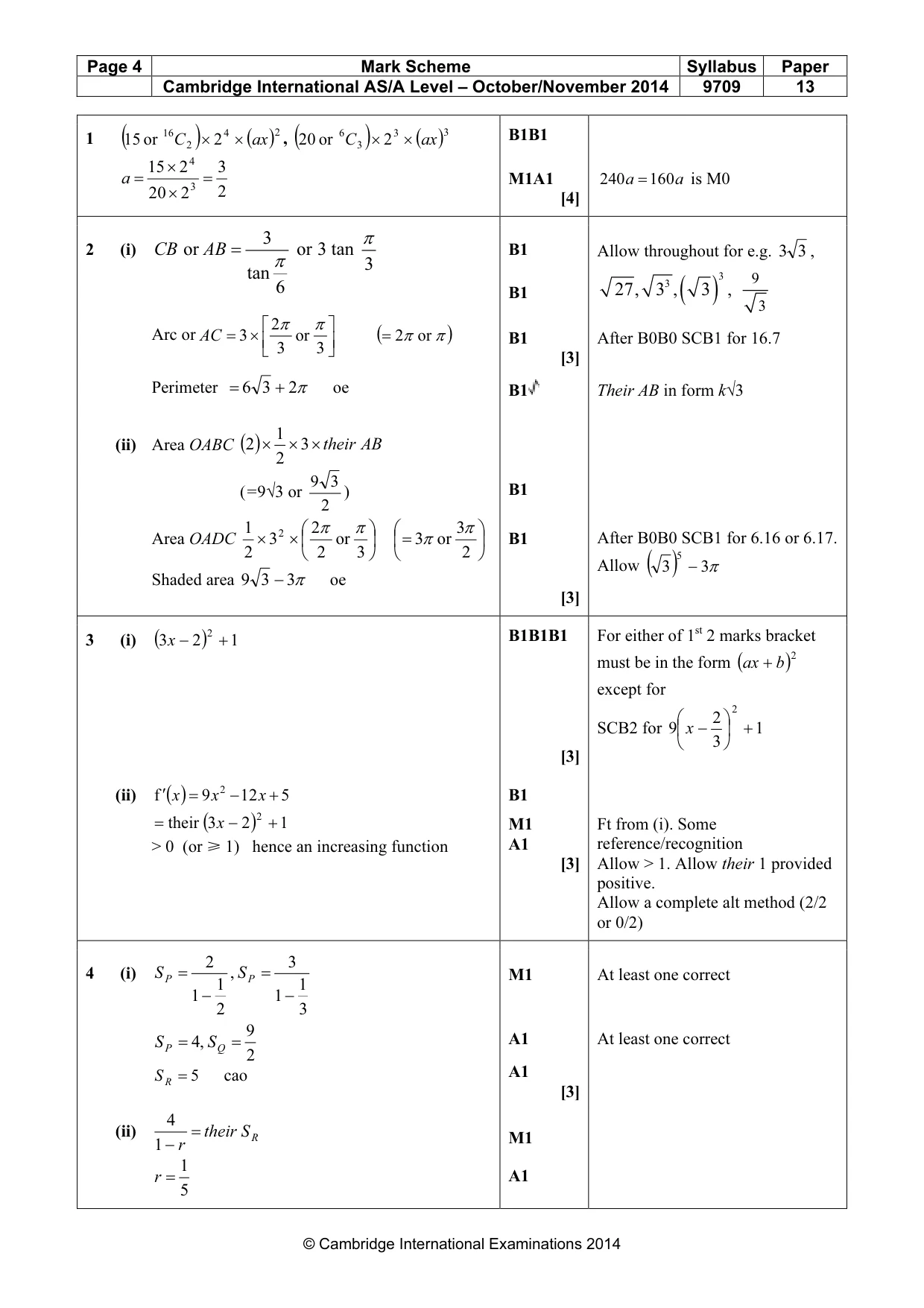
Q1 · In the expansion of 2 + ax 6, the coefficient of x2 is equal to the coefficient of x3
1 In the expansion of 2 + ax 6, the coefficient of x2 is equal to the coefficient of x3. Find the value of the non-zero constant a. [4]
Mark scheme: 3 × (ax )3 B1B11 (15 or 4 × (ax )2 , (20 or 16 C 2 ) × 2 6 C 3 ) × 2 15 × 2 4 3 a = = M1A1 240 a = 160 a is M0 3 20 × 2 2 [4] 3 π
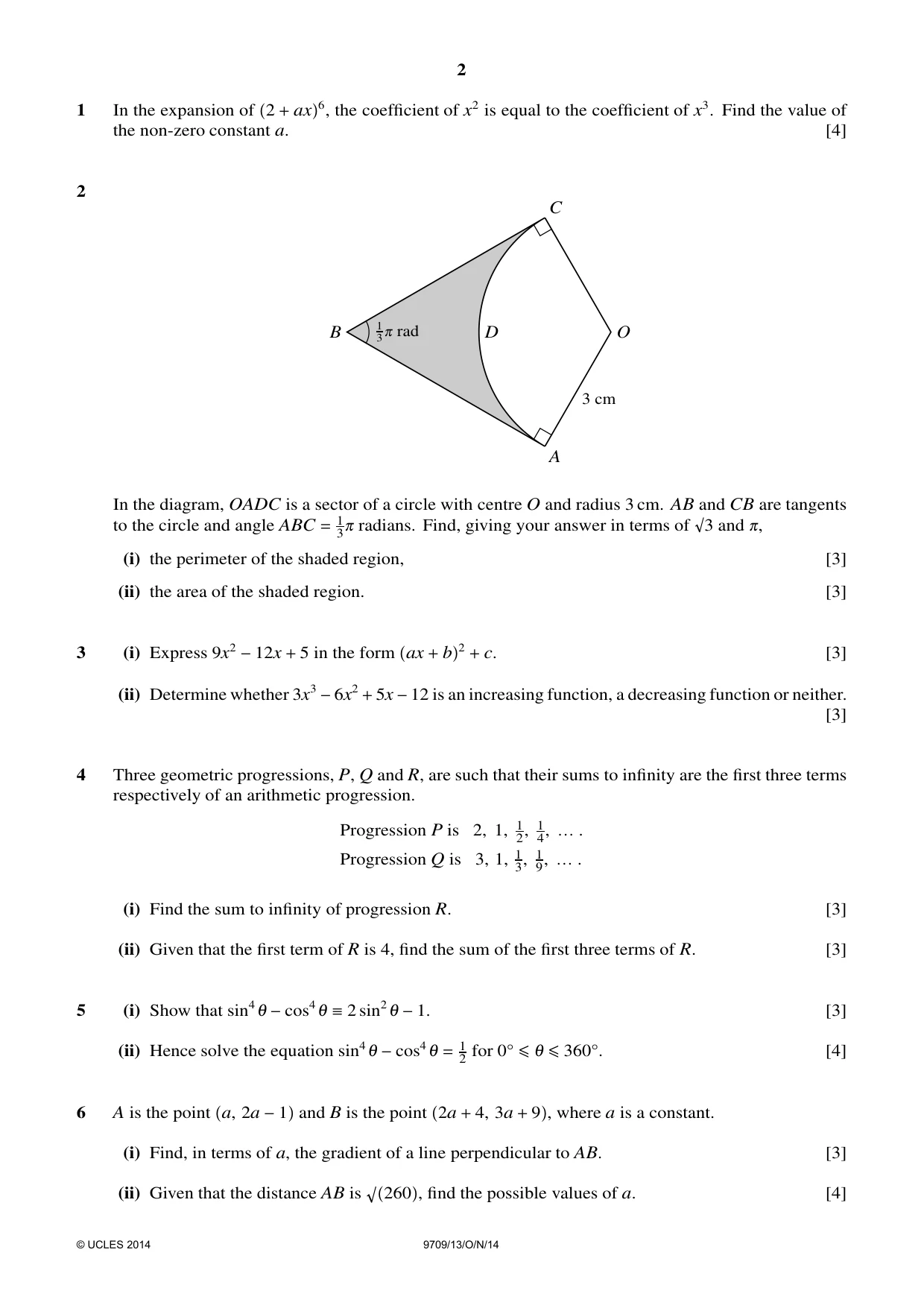
Q2 · C 1 rad B 3 D O 3 cm A In the diagram, OADC is a sector of a circle with centre O and…
2 C 1 rad B 3 D O 3 cm A In the diagram, OADC is a sector of a circle with centre O and radius 3 cm. AB and CB are tangents to the circle and angle ABC = 1 radians. Find, giving your answer in terms of 3 and , 3 (i) the perimeter of the shaded region, [3] (ii) the area of the shaded region. [3]
Mark scheme: 3 π 2 (i) CB or AB = or 3 tan B1 Allow throughout for e.g. 3 3 , π 3 tan 3 9 3 6 3 , B1 27, 3 , ( ) 3 2π π Arc or AC = 3 × or (= 2π or π ) B1 After B0B0 SCB1 for 16.7 3 3 [3] Perimeter = 6 3 + 2π oe B1 Their AB in form k√3 1 (ii) Area OABC (2 ) × × 3 × their AB 2 9 3 (=9√3 or ) B1 2 1 2 2π π 3π Area OADC × 3 × or = 3π or B1 After B0B0 SCB1 for 6.16 or 6.17. 2 2 3 2 5 Allow ( 3 ) − 3π Shaded area 9 3 − 3π oe [3] ( )2 B1B1B1 F ith f 1st 2 k b k t
Q3 · Express 9x2 −12x + 5 in the form ax + b 2 + c
3 (i) Express 9x2 −12x + 5 in the form ax + b 2 + c. [3] (ii) Determine whether 3x3 −6x2 + 5x −12 is an increasing function, a decreasing function or neither. [3]
Mark scheme: 3 (i) (3 x − 2 ) 2 + 1 B1B1B1 For either of 1st 2 marks bracket must be in the form (ax + b )2 except for 2 2 SCB2 for 9 x − + 1 3 [3] (ii) f ′( x ) = 9 x 2 − 12 x + 5 B1 = their (3 x − 2 ) 2 + 1 M1 Ft from (i). Some > 0 (or > 1) hence an increasing function A1 reference/recognition [3] Allow > 1. Allow their 1 provided positive. Allow a complete alt method (2/2 or 0/2) 2 3
Q4 · Three geometric progressions, P, Q and R, are such that their sums to infinity are the…
4 Three geometric progressions, P, Q and R, are such that their sums to infinity are the first three terms respectively of an arithmetic progression. Progression P is 2, 1, 12, 14, . Progression Q is 3, 1, 13, 19, . (i) Find the sum to infinity of progression R. [3] (ii) Given that the first term of R is 4, find the sum of the first three terms of R. [3]
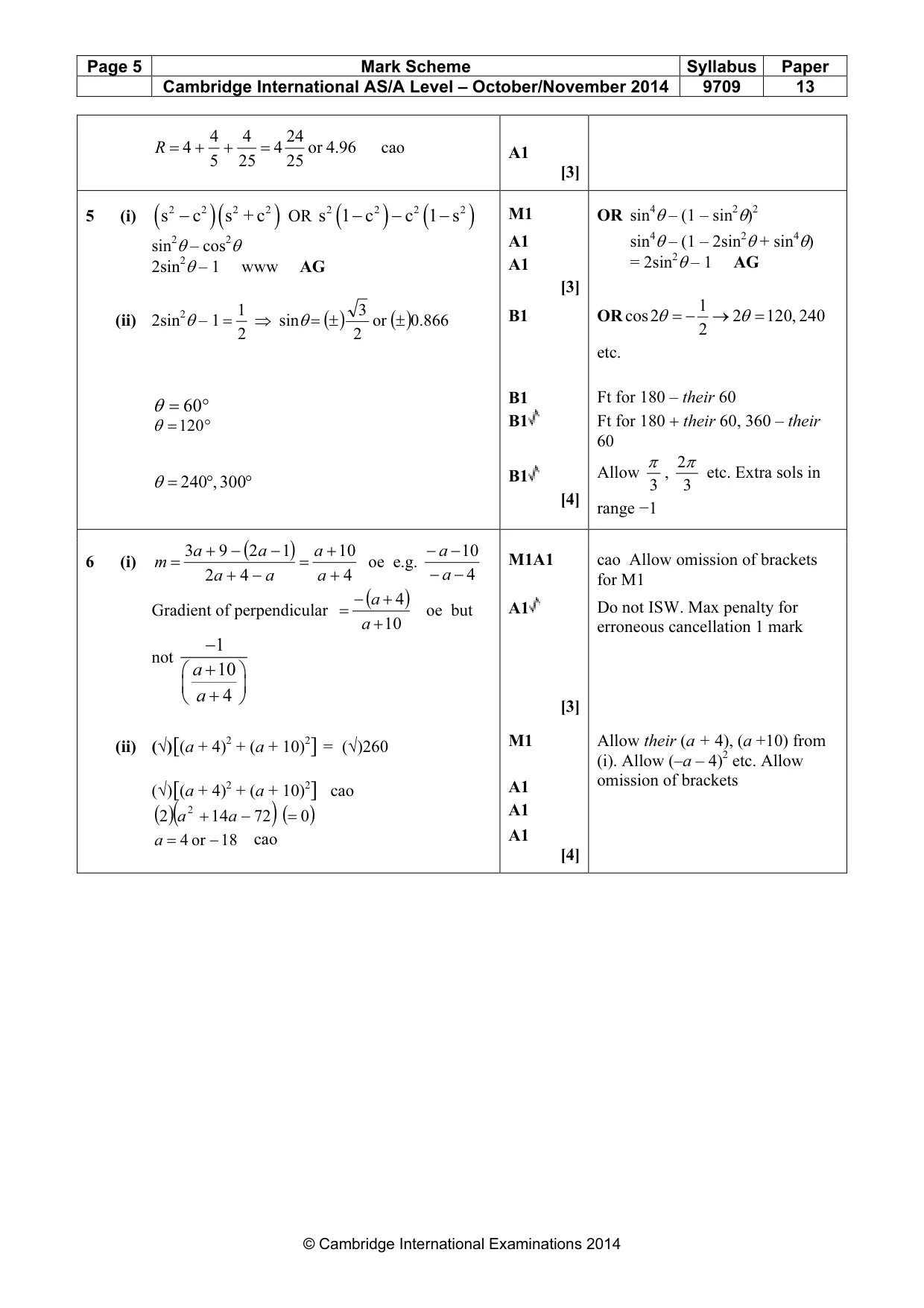
Mark scheme: 2 3 4 (i) S P = , S P = M1 At least one correct 1 1 1 − 1 − 2 3 9 S P = ,4 S Q = A1 At least one correct 2 S R = 5 cao A1 [3] 4 (ii) = their S R M1 1 − r 1 r = A1 5 4 4 24 R = 4 + + = 4 or .496 cao A1 5 25 25 [3] ( 2 2 )( 2 2 ) 2 ( 2 ) 2 ( 2 ) 4 2 2
Q5 · Show that sin4 −cos4 2 sin2 −1
5 (i) Show that sin4 −cos4 2 sin2 −1. [3] (ii) Hence solve the equation sin4 −cos4 = 1 for 0 ≤ ≤360 . [4] 2
Mark scheme: M1 OR sin4θ – (1 – sin2θ)25 (i) ( s 2 − c 2 )( s 2 + c 2 ) OR s 2 (1 − c 2 ) − c 2 (1 − s 2 ) sin2θ – cos2θ A1 sin4θ – (1 – 2sin2θ + sin4θ) 2sin2θ – 1 www AG A1 = 2sin2θ – 1 AG [3] 1 3 1 (ii) 2sin2θ – 1 = ⇒ sinθ = (± ) or (± ).0 866 B1 OR cos 2θ = − → 2θ = 120, 240 2 2 2 etc. B1 Ft for 180 – their 60 θ = 60 ° B1 Ft for 180 + their 60, 360 – their θ =120 ° 60 π 2π B1 Allow , etc. Extra sols in θ = 240°, 300° 3 3 [4] range −1 3a + 9 − (2 a − 1) a + 10 −a − 10 ll i i f b k
Q6 · A is the point a, 2a −1 and B is the point 2a + 4, 3a + 9 , where a is a constant
6 A is the point a, 2a −1 and B is the point 2a + 4, 3a + 9 , where a is a constant. (i) Find, in terms of a, the gradient of a line perpendicular to AB. [3] (ii) Given that the distance AB is 260 , find the possible values of a. [4]
Mark scheme: 3a + 9 (2 a 1) a + 10 a 10 6 (i) m = = oe e.g. M1A1 cao Allow omission of brackets 2 a + 4 − a a + 4 −a − 4 for M1 − (a + 4 ) Gradient of perpendicular = oe but A1 Do not ISW. Max penalty for a + 10 erroneous cancellation 1 mark − 1 not a + 10 a + 4 [3] (ii) (√)[(a + 4)2 + (a + 10)2] = (√)260 M1 Allow their (a + 4), (a +10) from (i). Allow (–a – 4)2 etc. Allow omission of brackets (√)[(a + 4)2 + (a + 10)2] cao A1 (2 )(a 2 + 14 a − 72 ) (= 0 ) A1 A1 a = 4 or − 18 cao [4] 2
Q7 · −−→ −−→ 7 Three points, O, A and B, are such that OA = i + 3j + pk and OB = −7i + 1 −p j…
−−→ −−→ 7 Three points, O, A and B, are such that OA = i + 3j + pk and OB = −7i + 1 −p j + pk, where p is a constant. −−→ −−→ (i) Find the values of p for which OA is perpendicular to OB. [3] −−→ −−→ (ii) The magnitudes of OA and OB are a and b respectively. Find the value of p for which b2 = 2a2. [2] −−→ (iii) Find the unit vector in the direction of AB when p = −8. [3]
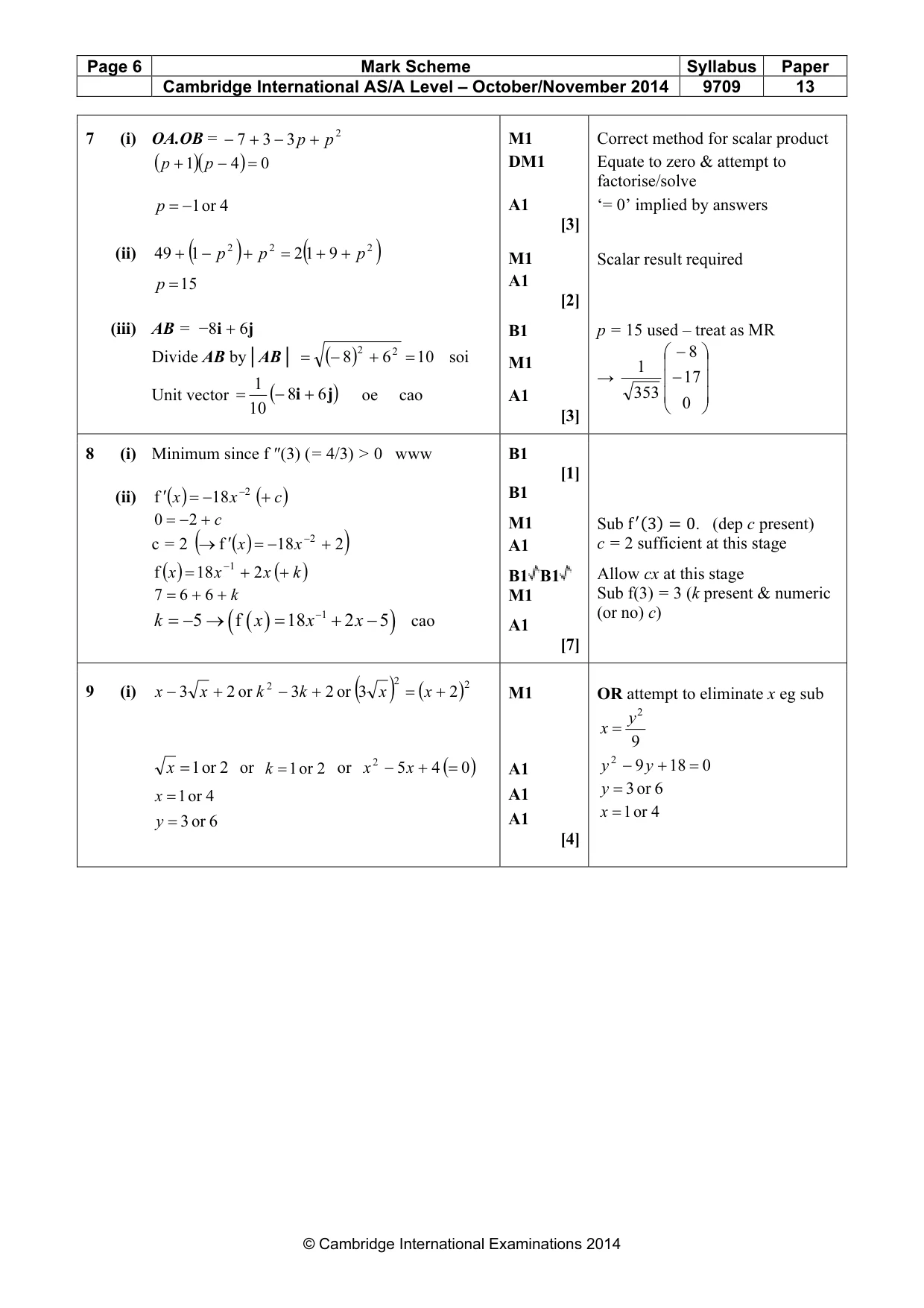
Mark scheme: 7 (i) OA.OB = − 7 + 3 − 3 p + p 2 M1 Correct method for scalar product ( p + 1)( p − 4 ) = 0 DM1 Equate to zero & attempt to factorise/solve p = −1 or 4 A1 ‘= 0’ implied by answers [3] 2 2 (ii) 49 + (1 − p ) + p 2 = 2 (1 + 9 + p ) M1 Scalar result required p = 15 A1 [2] (iii) AB = −8i + 6j B1 p = 15 used – treat as MR Divide AB by│AB│ = (− 8 ) 2 + 6 2 = 10 soi − 8 M1 1 → − 17 1 Unit vector = (− 8i + 6 )j oe cao A1 353 0 10 [3]
Q8 · A curve y = f x has a stationary point at 3, 7 and is such that f ′′ x = 36x−3
8 A curve y = f x has a stationary point at 3, 7 and is such that f ′′ x = 36x−3. (i) State, with a reason, whether this stationary point is a maximum or a minimum. [1] (ii) Find f ′ x and f x . [7]
Mark scheme: 8 (i) Minimum since f ″(3) (= 4/3) > 0 www B1 [1] (ii) f ′( x ) = −18 x − 2 (+ c ) B1 0 = − 2 + c M1 Sub f 3 0. (dep c present) c = 2 (→ f ′( x ) = − 18 x − 2 + 2 ) A1 c = 2 sufficient at this stage f ( x ) = 18 x −1 + 2 x (+ k ) B1 B1 Allow cx at this stage 7 = 6 + 6 + k M1 Sub f(3) = 3 (k present & numeric −1 (or no) c) k = −→5 ( f ( x ) = 18 x + 2 x − 5 ) cao A1 [7] 2 2 ( ) ( )2
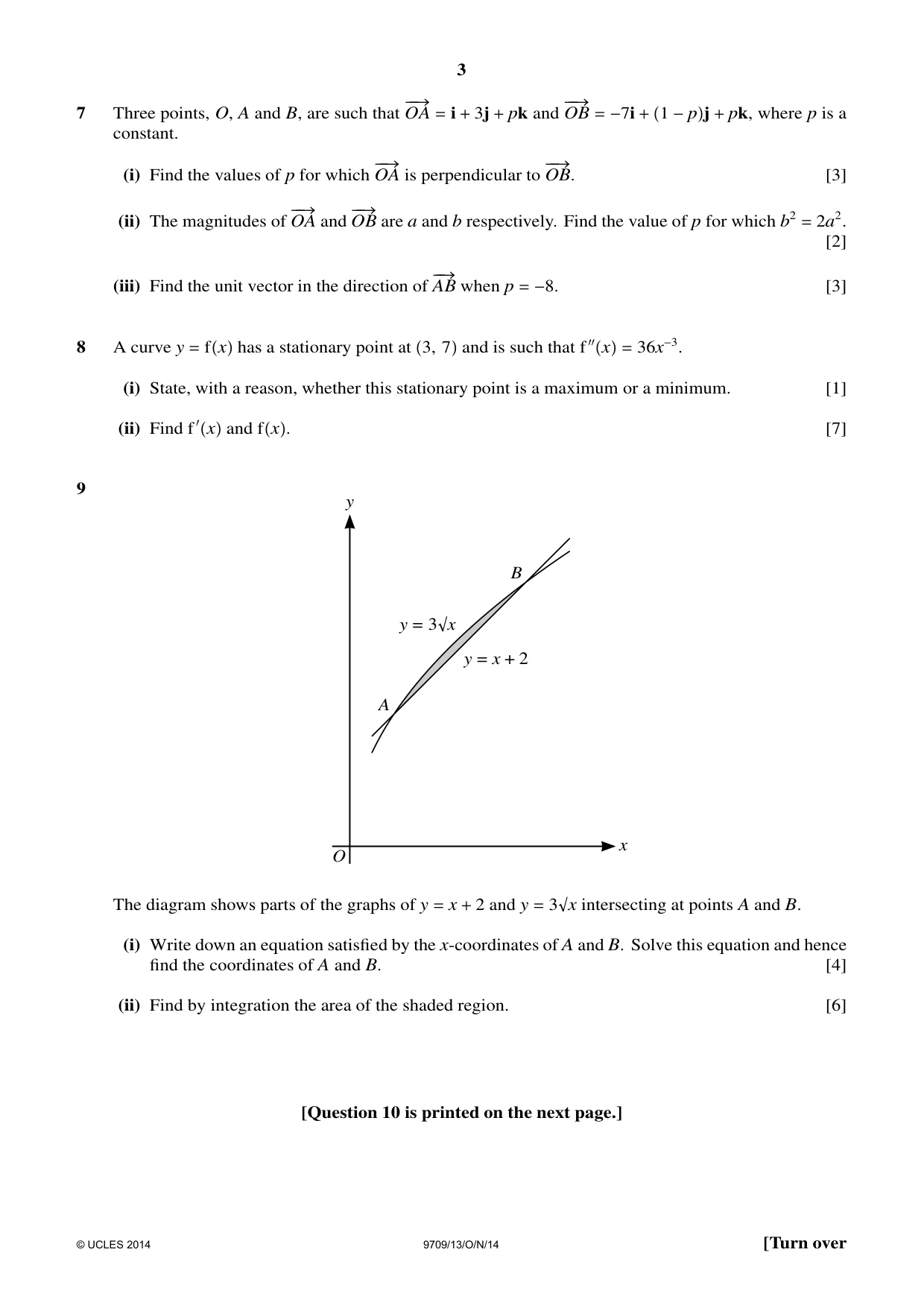
Q9 · Y B y = 3 x y = x + 2 A x O The diagram shows parts of the graphs of y = x + 2 and y = 3…
9 y B y = 3 x y = x + 2 A x O The diagram shows parts of the graphs of y = x + 2 and y = 3 x intersecting at points A and B. (i) Write down an equation satisfied by the x-coordinates of A and B. Solve this equation and hence find the coordinates of A and B. [4] (ii) Find by integration the area of the shaded region. [6] [Question 10 is printed on the next page.]
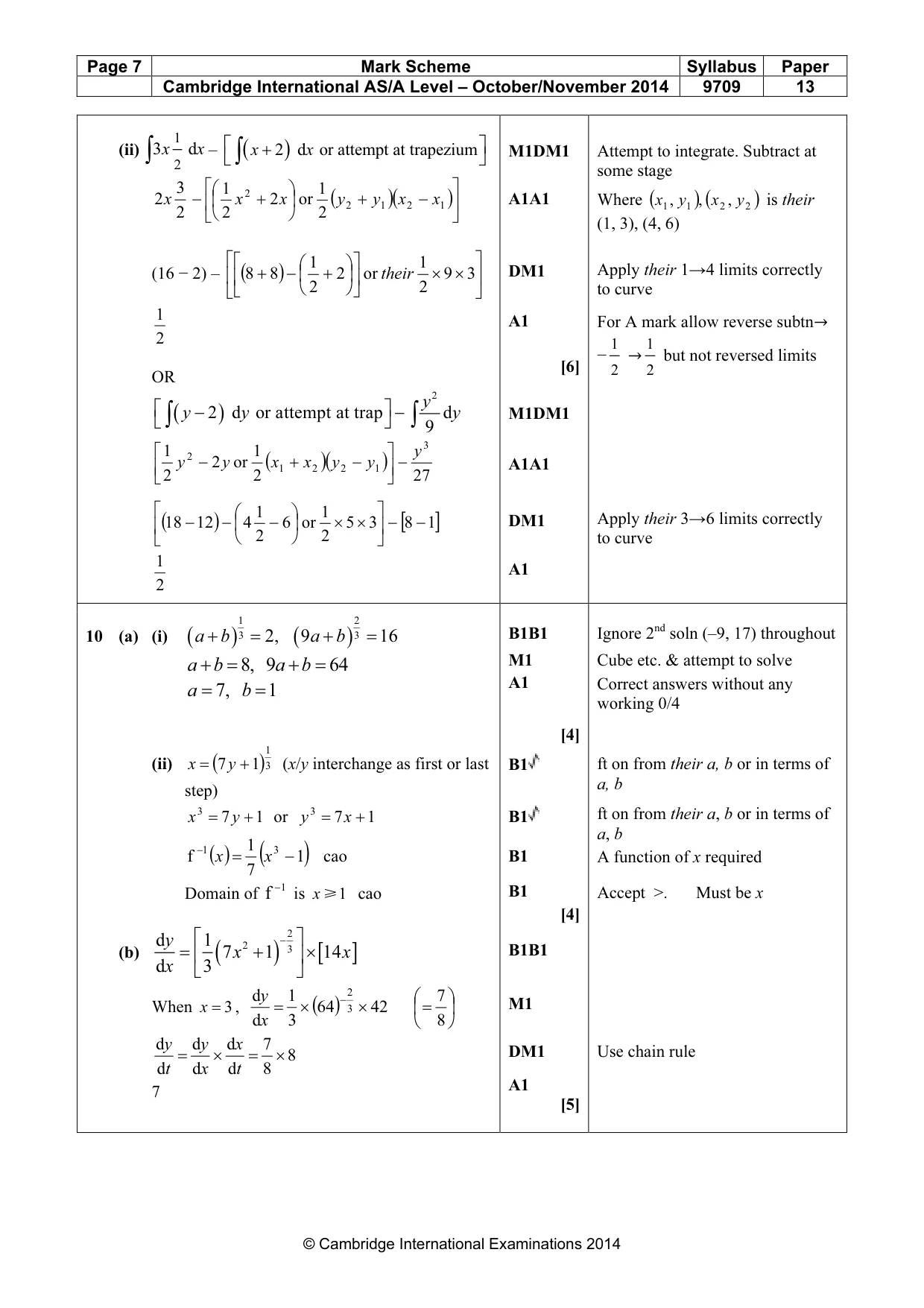
Mark scheme: 2 9 (i) x − 3 x + 2 or k 2 − 3k + 2 or (3 x ) = ( x + 2 )2 M1 OR attempt to eliminate x eg sub y 2 x = 9 x = 1 or 2 or k = 1 or 2 or x 2 −x5 + 4 (= 0 ) A1 y 2 − 9 y + 18 = 0 y = 3 or 6 x = 1 or 4 A1 x = 1 or 4 y = 3 or 6 A1 [4] 1 dx – M1DM1 Attempt to integrate. Subtract at (ii) ∫ 3 x ∫ ( x + 2 ) dx or attempt at trapezium 2 some stage 3 1 2 1 2x − x + 2 x or ( y 2 + y1 )( x 2 − x1 A1A1 Where ( x1 , y 1 ), ( x 2 , y 2 ) is their 2 2 2 ) (1, 3), (4, 6) 1 1 (16 − 2) – (8 + 8 ) − + 2 or their × 9 × 3 DM1 Apply their 1→4 limits correctly 2 2 to curve 1 A1 For A mark allow reverse subtn→ 2 −1 →1 but not reversed limits [6] 2 2 OR y 2 M1DM1 ∫ ( y − 2 ) d y or attempt at trap − ∫ 9 d y 1 2 1 y 3 y − 2 y or ( x1 + x 2 )( y 2 − y1 ) − A1A1 2 2 27 1 1 (18 − 12 ) − 4 − 6 or × 5 × 3 − [8 − ]1 DM1 Apply their 3→6 limits correctly 2 2 to curve 1 A1 2 1 2
Q10 · The functions f and g are defined for x ≥0 by 1 f : x → ax + b 3, where a and b are…
10 (a) The functions f and g are defined for x ≥0 by 1 f : x → ax + b 3, where a and b are positive constants, g : x →x2. Given that fg 1 = 2 and gf 9 = 16, (i) calculate the values of a and b, [4] (ii) obtain an expression for f −1 x and state the domain of f −1. [4] 1 (b) A point P travels along the curve y = 7x2 + 1 3 in such a way that the x-coordinate of P at time t minutes is increasing at a constant rate of 8 units per minute. Find the rate of increase of the y-coordinate of P at the instant when P is at the point 3, 4 . [5]
Mark scheme: 1 2 3 = 16 B1B1 Ignore 2nd soln (–9, 17) throughout10 (a) (i) ( a + b ) 3 = 2, ( 9 a + b ) a + b = 8, 9a + b = 64 M1 Cube etc. & attempt to solve A1 Correct answers without any a = 7, b = 1 working 0/4 [4] 1 (ii) x = (7 y + 1)3 (x/y interchange as first or last B1 ft on from their a, b or in terms of a, b step) x 3 = 7 y + 1 or y 3 = 7 x + 1 B1 ft on from their a, b or in terms of a, b −1 1 3 f ( x ) = (x − )1 cao B1 A function of x required 7 Domain of f − 1 is x > 1 cao B1 Accept >. Must be x [4] 2 1 dy 3 (b) = × [14 x ] B1B1 ( 7 x 2 + 1) − d x 3 dy 1 − 2 7 When x = 3 , = × (64 ) 3 × 42 = M1 dx 3 8 dy dy dx 7 = × = × 8 DM1 Use chain rule dt dx dt 8 A1 7 [5]
What was in this paper
The subtopics covered by these 10 questions, and how many questions each got. Open one in a new tab to see every Cambridge question on it.
What you needed in this session
Cambridge’s own grade thresholds for 2014 Oct/Nov, Paper 1 · Variant 3. A higher threshold means an easier paper — the bar moves with how the cohort did.