Cambridge A Level Mathematics 9709 — 2013 Oct/Nov Paper 1 · Variant 3
9709/13/O/N/13 · 7 questions · 75 marks · ≈84 min
The question paper and its mark scheme, free to read here and free to download. This is Cambridge’s own paper, exactly as it was sat.
Question paper4 pages
Mark scheme6 pages
Answers below. Sit the paper first if you are practising.
Questions as text
Q1 · Solve the inequality x2 −x −2 > 0
1 Solve the inequality x2 −x −2 > 0. [3]
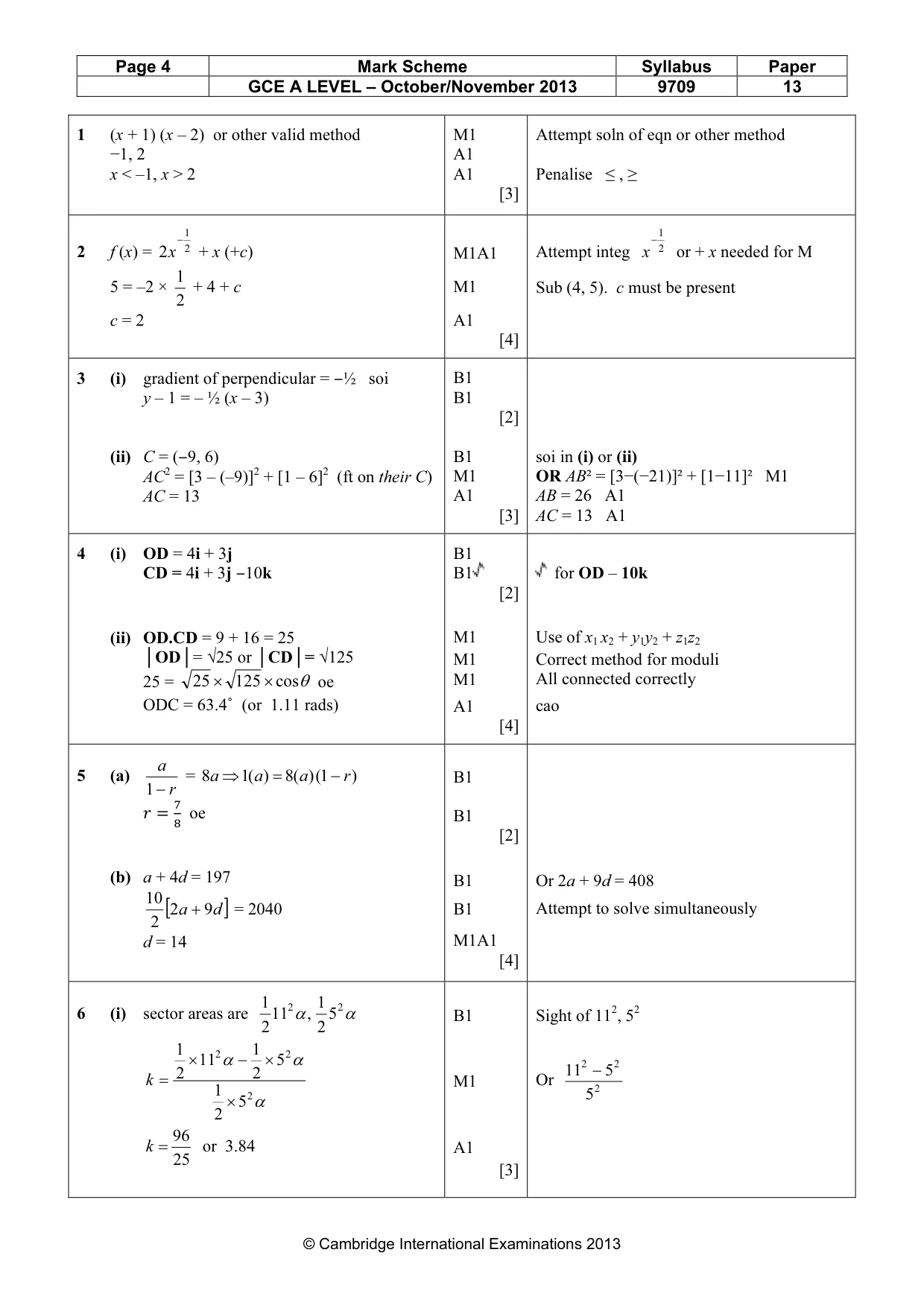
Mark scheme: 1 (x + 1) (x – 2) or other valid method M1 Attempt soln of eqn or other method −1, 2 A1 x < –1, x > 2 A1 Penalise ≤ , ≥ [3] 1 1 − −
Q3 · The point A has coordinates 3, 1 and the point B has coordinates −21, 11
3 The point A has coordinates 3, 1 and the point B has coordinates −21, 11 . The point C is the mid-point of AB. (i) Find the equation of the line through A that is perpendicular to y = 2x −7. [2] (ii) Find the distance AC. [3]
Mark scheme: 3 (i) gradient of perpendicular = ‒½ soi B1 y – 1 = – ½ (x – 3) B1 [2] (ii) C = (‒9, 6) B1 soi in (i) or (ii) AC2 = [3 – (–9)]2 + [1 – 6]2 (ft on their C) M1 OR AB² = [3−(−21)]² + [1−11]² M1 AC = 13 A1 AB = 26 A1 [3] AC = 13 A1
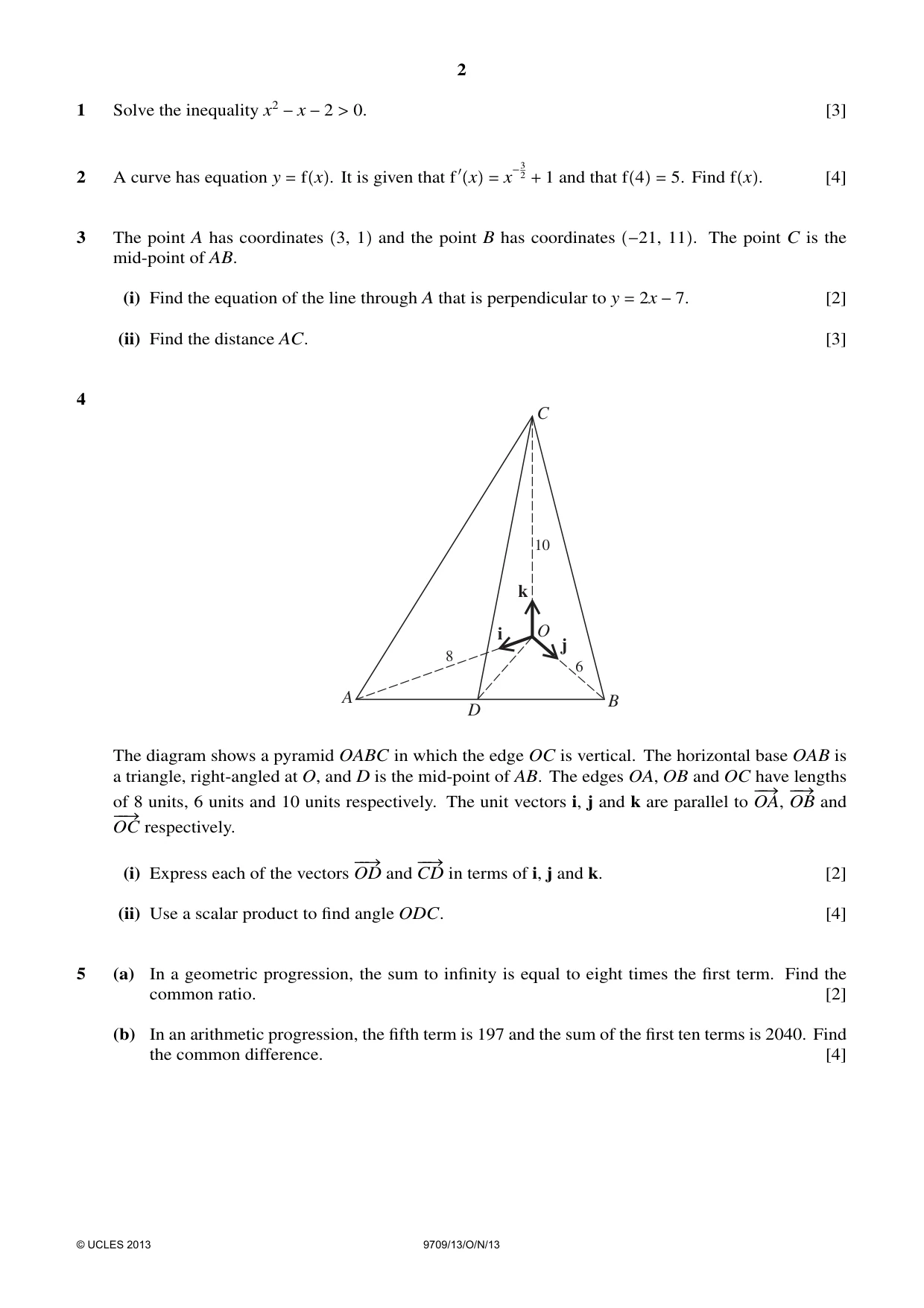
Q4 · C 10 k i O j 8 6 A B D The diagram shows a pyramid OABC in which the edge OC is vertical
4 C 10 k i O j 8 6 A B D The diagram shows a pyramid OABC in which the edge OC is vertical. The horizontal base OAB is a triangle, right-angled at O, and D is the mid-point of AB. The edges OA, OB and OC have lengths −−→ −−→ of 8 units, 6 units and 10 units respectively. The unit vectors i, j and k are parallel to OA, OB and −−→ OC respectively. −−→ −−→ (i) Express each of the vectors OD and CD in terms of i, j and k. [2] (ii) Use a scalar product to find angle ODC. [4]
Mark scheme: 4 (i) OD = 4i + 3j B1 CD = 4i + 3j ‒10k B1 for OD – 10k [2] (ii) OD.CD = 9 + 16 = 25 M1 Use of x1 x2 + y1y2 + z1z2 │OD│= √25 or │CD│= √125 M1 Correct method for moduli 25 = 25 × 125 × cos θ oe M1 All connected correctly ODC = 63.4˚ (or 1.11 rads) A1 cao [4] a
Q5 · In a geometric progression, the sum to infinity is equal to eight times the first term
5 (a) In a geometric progression, the sum to infinity is equal to eight times the first term. Find the common ratio. [2] (b) In an arithmetic progression, the fifth term is 197 and the sum of the first ten terms is 2040. Find the common difference. [4]
Mark scheme: a 5 (a) = 8a ⇒ (1 a ) = 8( a 1() − r ) B1 1 − r oe B1 [2] (b) a + 4d = 197 B1 Or 2a + 9d = 408 10 [2 a + 9 d ] = 2040 B1 Attempt to solve simultaneously 2 d = 14 M1A1 [4] 1 2 1 2
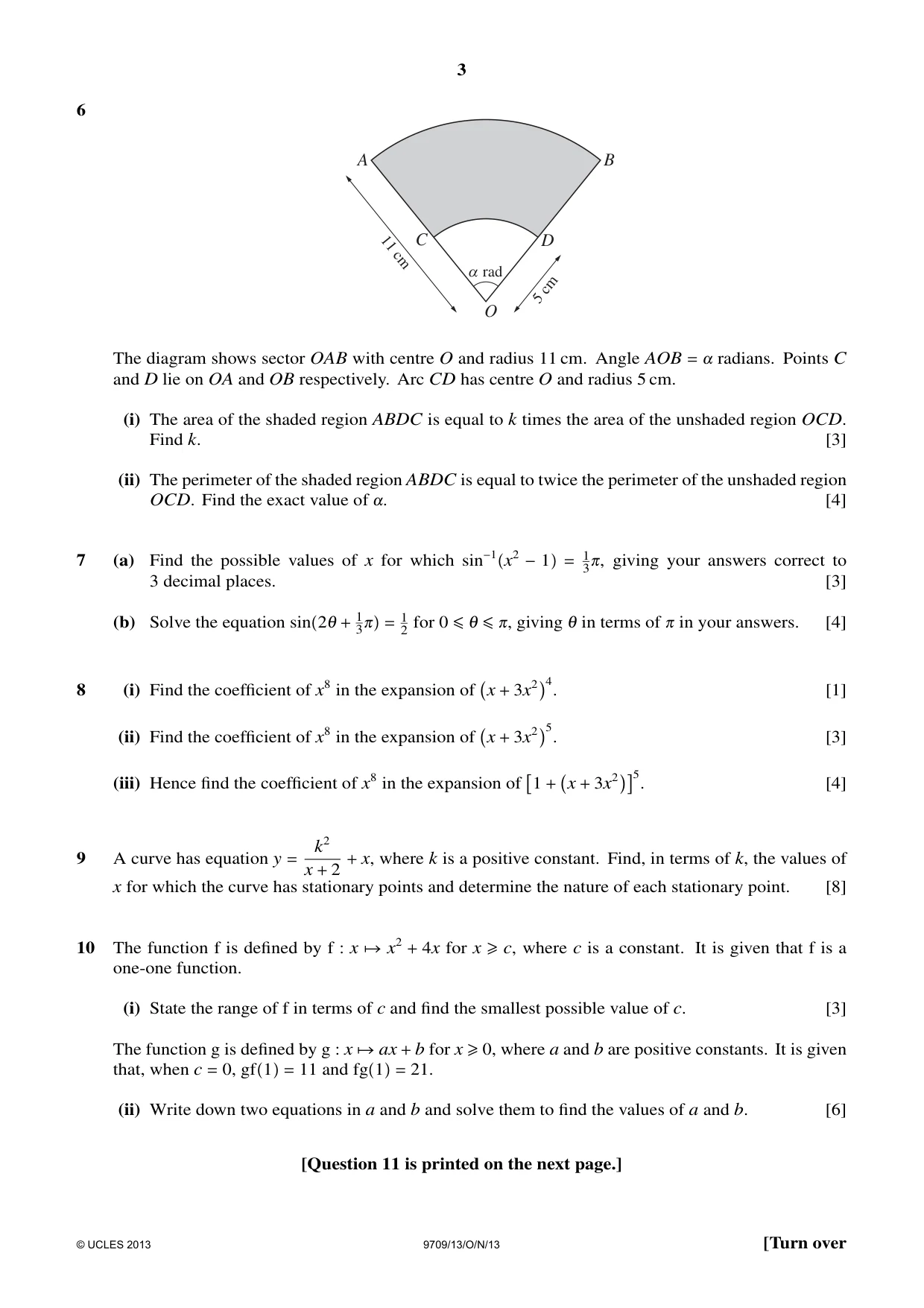
Q6 · A B 11 C D cm a rad cm 5 O The diagram shows sector OAB with centre O and radius 11 cm
6 A B 11 C D cm a rad cm 5 O The diagram shows sector OAB with centre O and radius 11 cm. Angle AOB = ! radians. Points C and D lie on OA and OB respectively. Arc CD has centre O and radius 5 cm. (i) The area of the shaded region ABDC is equal to k times the area of the unshaded region OCD. Find k. [3] (ii) The perimeter of the shaded region ABDC is equal to twice the perimeter of the unshaded region OCD. Find the exact value of !. [4]
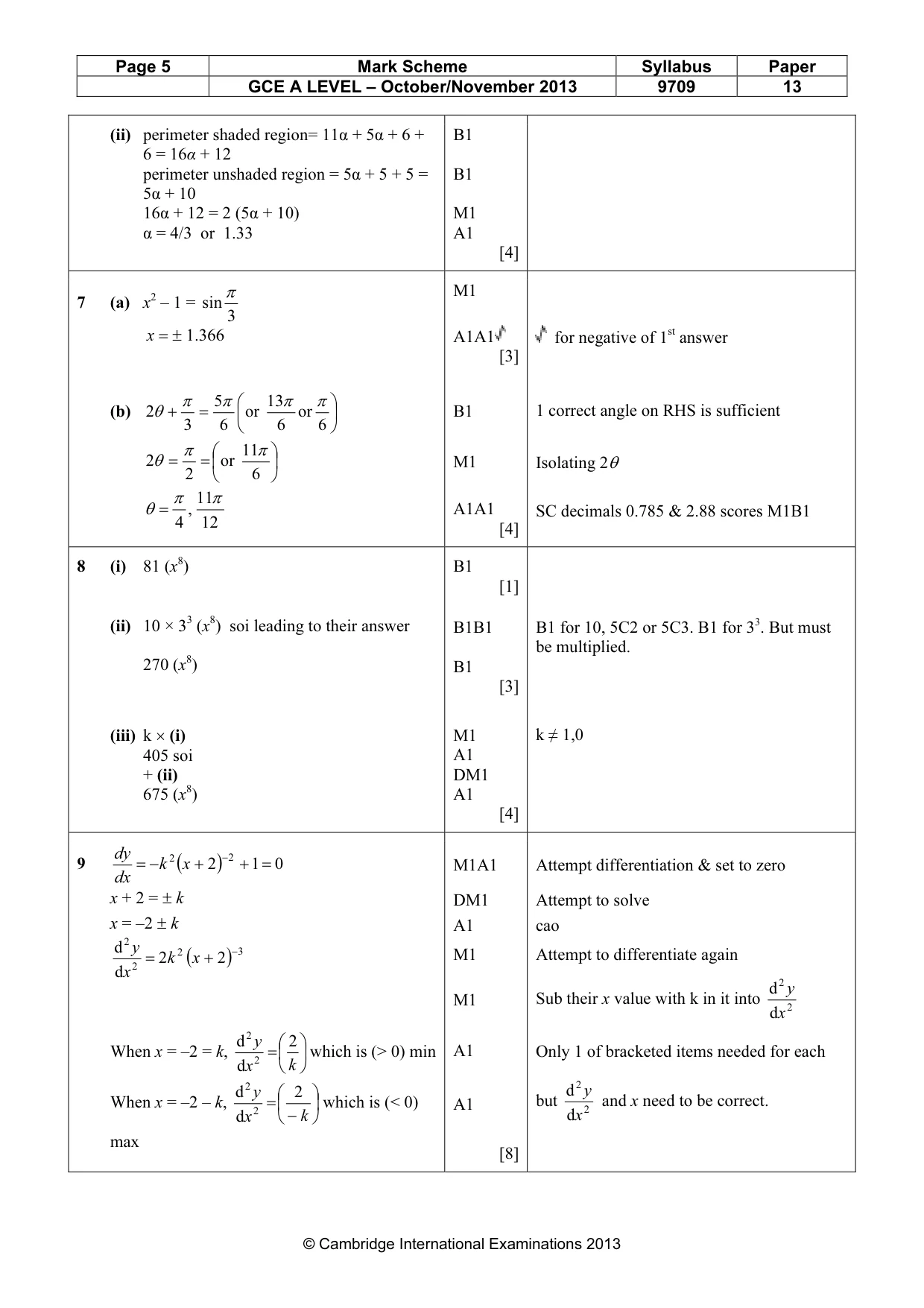
Mark scheme: 1 2 1 2 6 (i) sector areas are 11 α , 5 α B1 Sight of 112, 52 2 2 1 2 1 2 × 11 α − × 5 α 2 2 2 2 11 − 5 k = M1 Or 2 1 2 5 × 5 α 2 96 k = or 3.84 A1 25 [3] GCE A LEVEL – October/November 2013 9709 13 (ii) perimeter shaded region= 11α + 5α + 6 + B1 6 = 16α + 12 perimeter unshaded region = 5α + 5 + 5 = B1 5α + 10 16α + 12 = 2 (5α + 10) M1 α = 4/3 or 1.33 A1 [4] 2 π M1
Q8 · Find the coefficient of x8 in the expansion of x + 3x2 4
8 (i) Find the coefficient of x8 in the expansion of x + 3x2 4. [1] (ii) Find the coefficient of x8 in the expansion of x + 3x2 5. [3] (iii) Hence find the coefficient of x8 in the expansion of 1 + x + 3x2 5. [4]
Mark scheme: 8 (i) 81 (x8) B1 [1] (ii) 10 × 33 (x8) soi leading to their answer B1B1 B1 for 10, 5C2 or 5C3. B1 for 33. But must be multiplied. 270 (x8) B1 [3] (iii) k × (i) M1 k ≠ 1,0 405 soi A1 + (ii) DM1 675 (x8) A1 [4] dy 2 ( ) 2
Q9 · K2 9 A curve has equation y = + x, where k is a positive constant
k2 9 A curve has equation y = + x, where k is a positive constant. Find, in terms of k, the values of x + 2 x for which the curve has stationary points and determine the nature of each stationary point. [8]
Mark scheme: dy 9 = − k 2 ( x + 2 )− 2 + 1 = 0 M1A1 Attempt differentiation & set to zero dx x + 2 = ± k DM1 Attempt to solve x = –2 ± k A1 cao d 2 y 2 − 3 = 2 k ( x + 2 ) M1 Attempt to differentiate again 2 d x d 2 y M1 Sub their x value with k in it into 2 d x d 2 y 2 When x = –2 = k, 2 = which is (> 0) min A1 Only 1 of bracketed items needed for each d x k d d 2 2 y 2 y = When x = –2 – k, which is (< 0) A1 but 2 and x need to be correct. 2 d x k d x − max [8] GCE A LEVEL – October/November 2013 9709 13
What was in this paper
The subtopics covered by these 7 questions, and how many questions each got. Open one in a new tab to see every Cambridge question on it.
What you needed in this session
Cambridge’s own grade thresholds for 2013 Oct/Nov, Paper 1 · Variant 3. A higher threshold means an easier paper — the bar moves with how the cohort did.