Cambridge A Level Mathematics 9709 — 2009 May/June Paper 1 · Variant 1
9709/11/M/J/09 · 11 questions · 75 marks · ≈84 min
The question paper and its mark scheme, free to read here and free to download. This is Cambridge’s own paper, exactly as it was sat.
Question paper4 pages
Mark scheme6 pages
Answers below. Sit the paper first if you are practising.
Questions as text
Q1 · Sin x sin x 1 Prove the identity − ≡2 tan2x
sin x sin x 1 Prove the identity − ≡2 tan2x. [3] 1 −sin x 1 + sin x
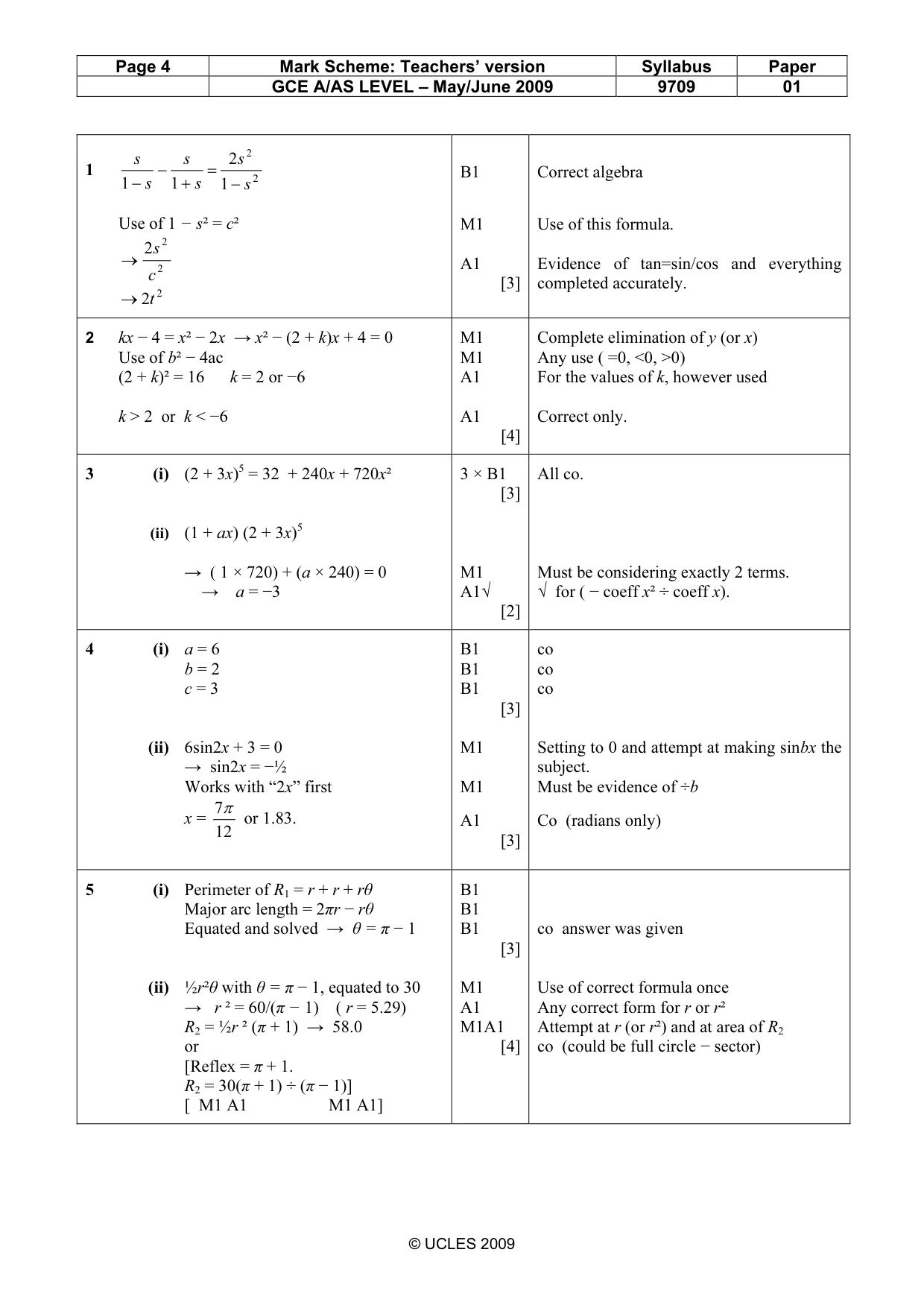
Mark scheme: s s 2 s 1 − = 2 B1 Correct algebra 1 − s 1 + s 1 − s Use of 1 − s² = c² M1 Use of this formula. 2 s 2 → 2 A1 Evidence of tan=sin/cos and everything c [3] completed accurately. → 2t 2
Q2 · Find the set of values of k for which the line y = kx −4 intersects the curve y = x2 −2x…
2 Find the set of values of k for which the line y = kx −4 intersects the curve y = x2 −2x at two distinct points. [4]
Mark scheme: 2 kx − 4 = x² − 2x → x² − (2 + k)x + 4 = 0 M1 Complete elimination of y (or x) Use of b² − 4ac M1 Any use ( =0, <0, >0) (2 + k)² = 16 k = 2 or −6 A1 For the values of k, however used k > 2 or k < −6 A1 Correct only. [4] 5
Q3 · Find the first 3 terms in the expansion of (2 + 3x)5 in ascending powers of x
3 (i) Find the first 3 terms in the expansion of (2 + 3x)5 in ascending powers of x. [3] (ii) Hence find the value of the constant a for which there is no term in x2 in the expansion of (1 + ax)(2 + 3x)5. [2]
Mark scheme: 3 (i) (2 + 3x)5 = 32 + 240x + 720x² 3 × B1 All co. [3] (ii) (1 + ax) (2 + 3x)5 → ( 1 × 720) + (a × 240) = 0 M1 Must be considering exactly 2 terms. → a = −3 A1√ √ for ( − coeff x² ÷ coeff x). [2]
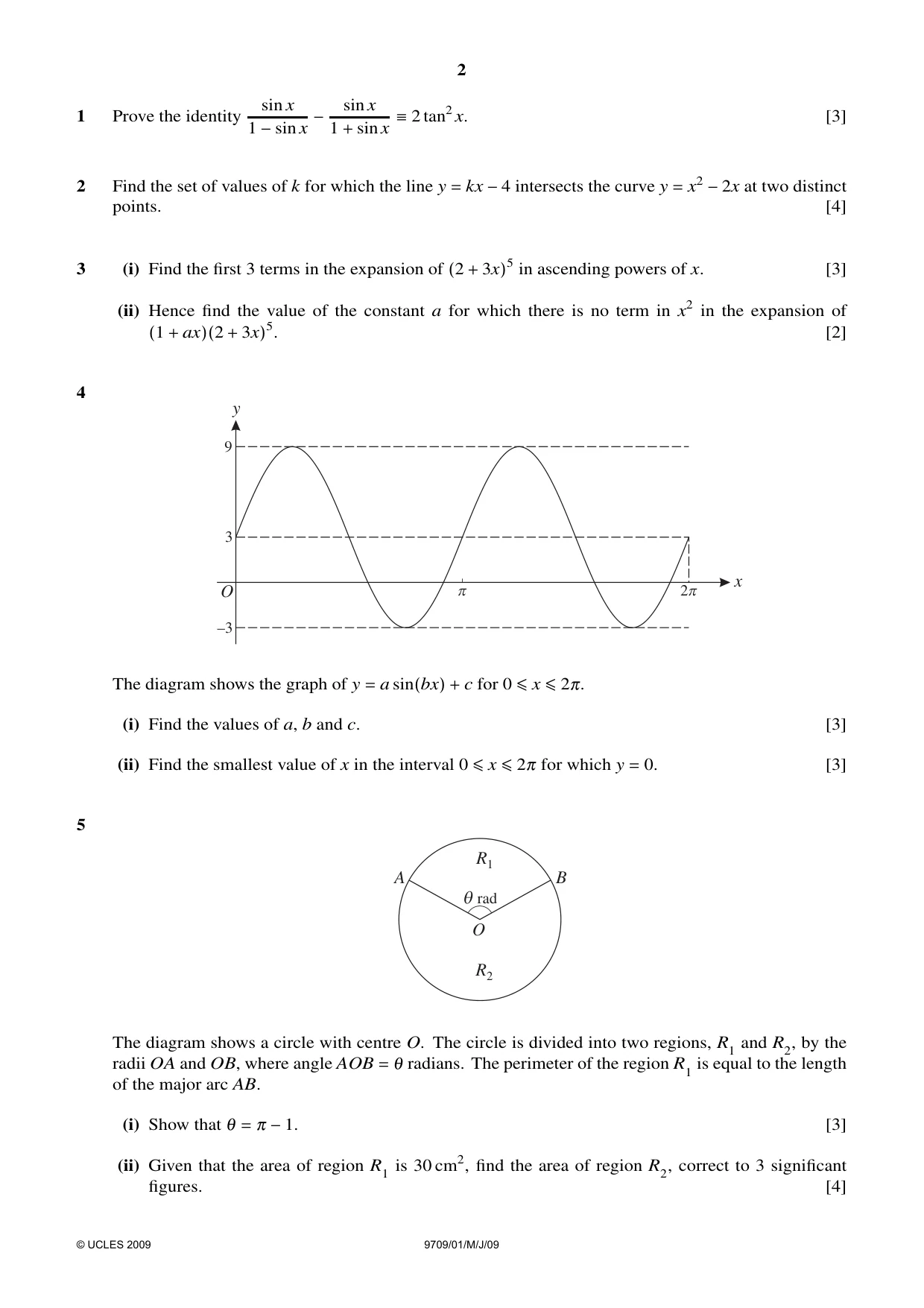
Q4 · Y 9 3 x O p 2p –3 The diagram shows the graph of y = a sin(bx) + c for 0 ≤x ≤2π
4 y 9 3 x O p 2p –3 The diagram shows the graph of y = a sin(bx) + c for 0 ≤x ≤2π. (i) Find the values of a, b and c. [3] (ii) Find the smallest value of x in the interval 0 ≤x ≤2π for which y = 0. [3]
Mark scheme: 4 (i) a = 6 B1 co b = 2 B1 co c = 3 B1 co [3] (ii) 6sin2x + 3 = 0 M1 Setting to 0 and attempt at making sinbx the → sin2x = −½ subject. Works with “2x” first M1 Must be evidence of ÷b 7π x = or 1.83. A1 Co (radians only) 12 [3]
Q5 · R1 A B q rad O R2 The diagram shows a circle with centre O
5 R1 A B q rad O R2 The diagram shows a circle with centre O. The circle is divided into two regions, R1 and R2, by the radii OA and OB, where angle AOB = θ radians. The perimeter of the region R1 is equal to the length of the major arc AB. (i) Show that θ = π −1. [3] (ii) Given that the area of region R1 is 30 cm2, find the area of region R2, correct to 3 significant figures. [4]
Mark scheme: 5 (i) Perimeter of R1 = r + r + rθ B1 Major arc length = 2πr − rθ B1 Equated and solved → θ = π − 1 B1 co answer was given [3] (ii) ½r²θ with θ = π − 1, equated to 30 M1 Use of correct formula once → r ² = 60/(π − 1) ( r = 5.29) A1 Any correct form for r or r² R2 = ½r ² (π + 1) → 58.0 M1A1 Attempt at r (or r²) and at area of R2 or [4] co (could be full circle − sector) [Reflex = π + 1. R2 = 30(π + 1) ÷ (π − 1)] [ M1 A1 M1 A1] GCE A/AS LEVEL – May/June 2009 9709 01
Q6 · Relative to an origin O, the position vectors of the points A and B are given by −−→ −−→…
6 Relative to an origin O, the position vectors of the points A and B are given by −−→ −−→ OA = 2i −8j + 4k and OB = 7i + 2j −k. −−→ (i) Find the value of OA.−−→OB and hence state whether angle AOB is acute, obtuse or a right angle. [3] −−→ 2 −−→ (ii) The point X is such that AX = AB. Find the unit vector in the direction of OX. [4] 5
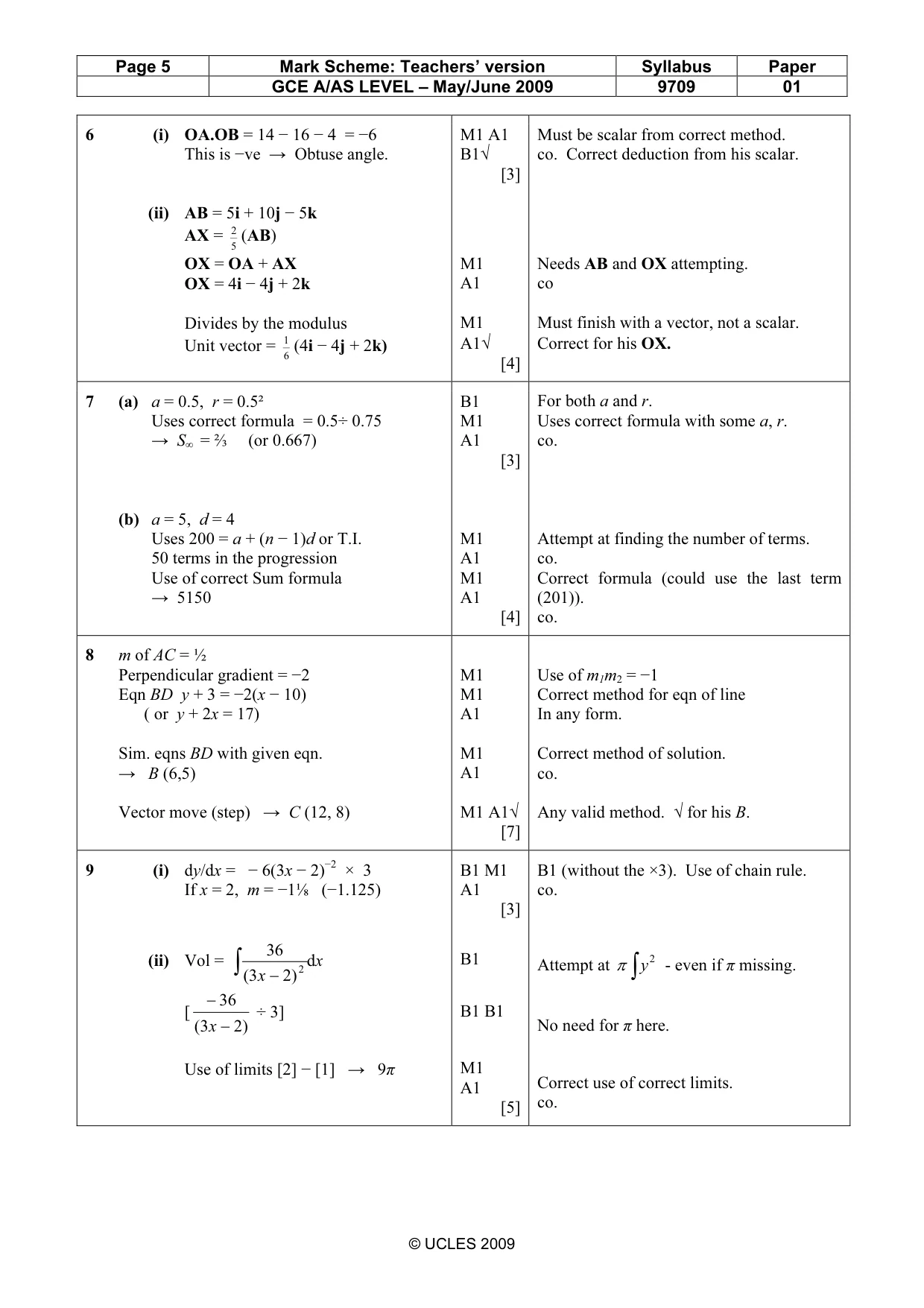
Mark scheme: 6 (i) OA.OB = 14 − 16 − 4 = −6 M1 A1 Must be scalar from correct method. This is −ve → Obtuse angle. B1√ co. Correct deduction from his scalar. [3] (ii) AB = 5i + 10j − 5k AX = 2 (AB) 5 OX = OA + AX M1 Needs AB and OX attempting. OX = 4i − 4j + 2k A1 co Divides by the modulus M1 Must finish with a vector, not a scalar. Unit vector = 1 (4i − 4j + 2k) A1√ Correct for his OX. 6 [4]
Q7 · Find the sum to infinity of the geometric progression with first three terms 0.5, 0.53 and…
7 (a) Find the sum to infinity of the geometric progression with first three terms 0.5, 0.53 and 0.55. [3] (b) The first two terms in an arithmetic progression are 5 and 9. The last term in the progression is the only term which is greater than 200. Find the sum of all the terms in the progression. [4]
Mark scheme: 7 (a) a = 0.5, r = 0.5² B1 For both a and r. Uses correct formula = 0.5÷ 0.75 M1 Uses correct formula with some a, r. → S∞ = ⅔ (or 0.667) A1 co. [3] (b) a = 5, d = 4 Uses 200 = a + (n − 1)d or T.I. M1 Attempt at finding the number of terms. 50 terms in the progression A1 co. Use of correct Sum formula M1 Correct formula (could use the last term → 5150 A1 (201)). [4] co.
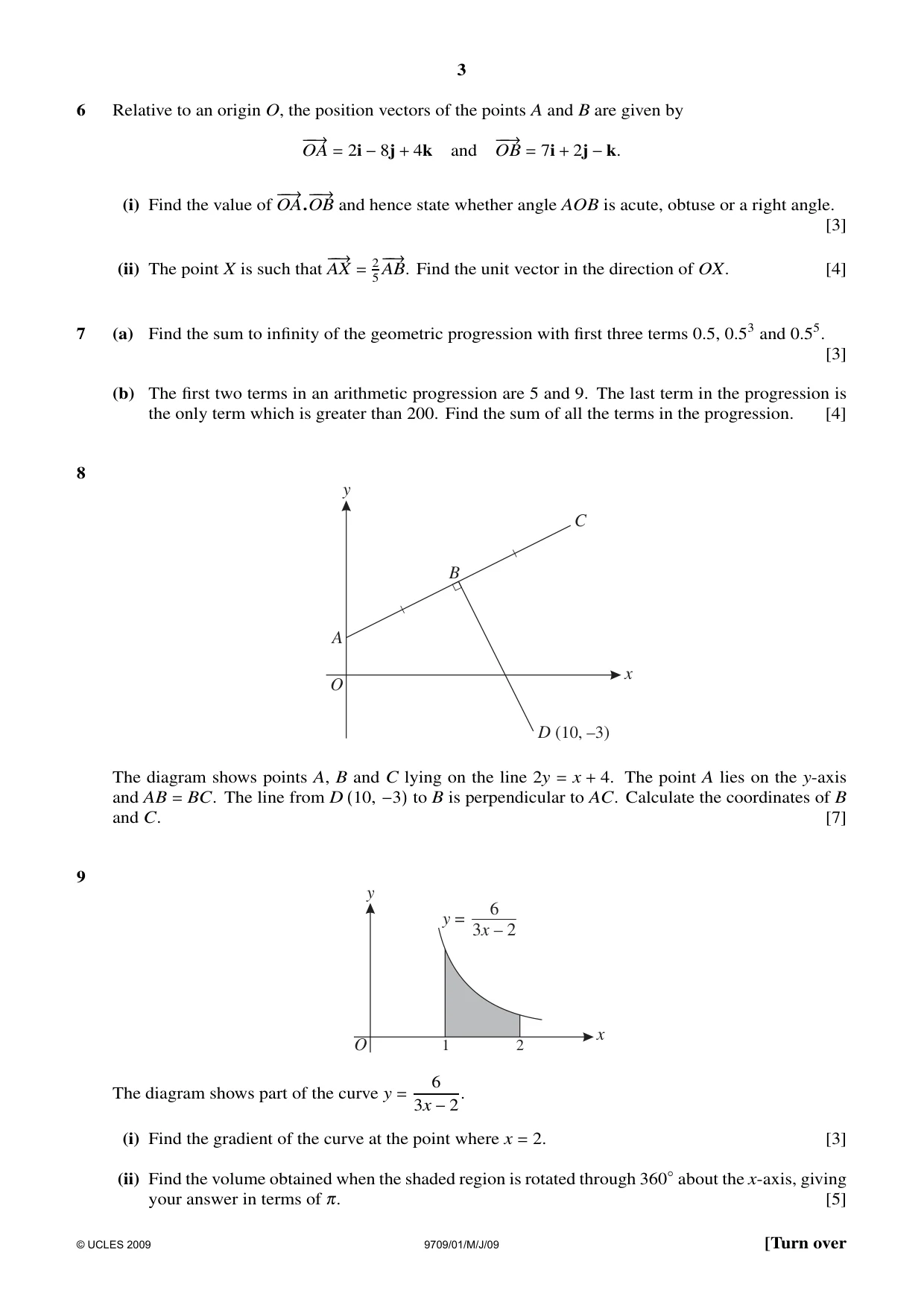
Q8 · Y C B A x O D (10, –3) The diagram shows points A, B and C lying on the line 2y = x + 4
8 y C B A x O D (10, –3) The diagram shows points A, B and C lying on the line 2y = x + 4. The point A lies on the y-axis and AB = BC. The line from D (10, −3) to B is perpendicular to AC. Calculate the coordinates of B and C. [7]
Mark scheme: 8 m of AC = ½ Perpendicular gradient = −2 M1 Use of m1m2 = −1 Eqn BD y + 3 = −2(x − 10) M1 Correct method for eqn of line ( or y + 2x = 17) A1 In any form. Sim. eqns BD with given eqn. M1 Correct method of solution. → B (6,5) A1 co. Vector move (step) → C (12, 8) M1 A1√ Any valid method. √ for his B. [7] 2
Q9 · Y 6 y = 3x – 2 x O 1 2 6 The diagram shows part of the curve y = 3x −2
9 y 6 y = 3x – 2 x O 1 2 6 The diagram shows part of the curve y = 3x −2. (i) Find the gradient of the curve at the point where x = 2. [3] (ii) Find the volume obtained when the shaded region is rotated through 360◦about the x-axis, giving your answer in terms of π. [5]
Mark scheme: 9 (i) dy/dx = − 6(3x − 2)−2 × 3 B1 M1 B1 (without the ×3). Use of chain rule. If x = 2, m = −1⅛ (−1.125) A1 co. [3] 36 d x B1 2 Attempt at π ∫ y 2 - even if π missing. (ii) Vol = ∫ (3 x − 2 ) − 36 [ ÷ 3] B1 B1 (3 x − 2) No need for π here. Use of limits [2] − [1] → 9π M1 Correct use of correct limits. A1 co. [5] GCE A/AS LEVEL – May/June 2009 9709 01
Q10 · The function f is defined by f : x →2x2 −12x + 13 for 0 ≤x ≤A, where A is a constant
10 The function f is defined by f : x →2x2 −12x + 13 for 0 ≤x ≤A, where A is a constant. (i) Express f(x) in the form a(x + b)2 + c, where a, b and c are constants. [3] (ii) State the value of A for which the graph of y = f(x) has a line of symmetry. [1] (iii) When A has this value, find the range of f. [2] The function g is defined by g : x →2x2 −12x + 13 for x ≥4. (iv) Explain why g has an inverse. [1] (v) Obtain an expression, in terms of x, for g−1(x). [3]
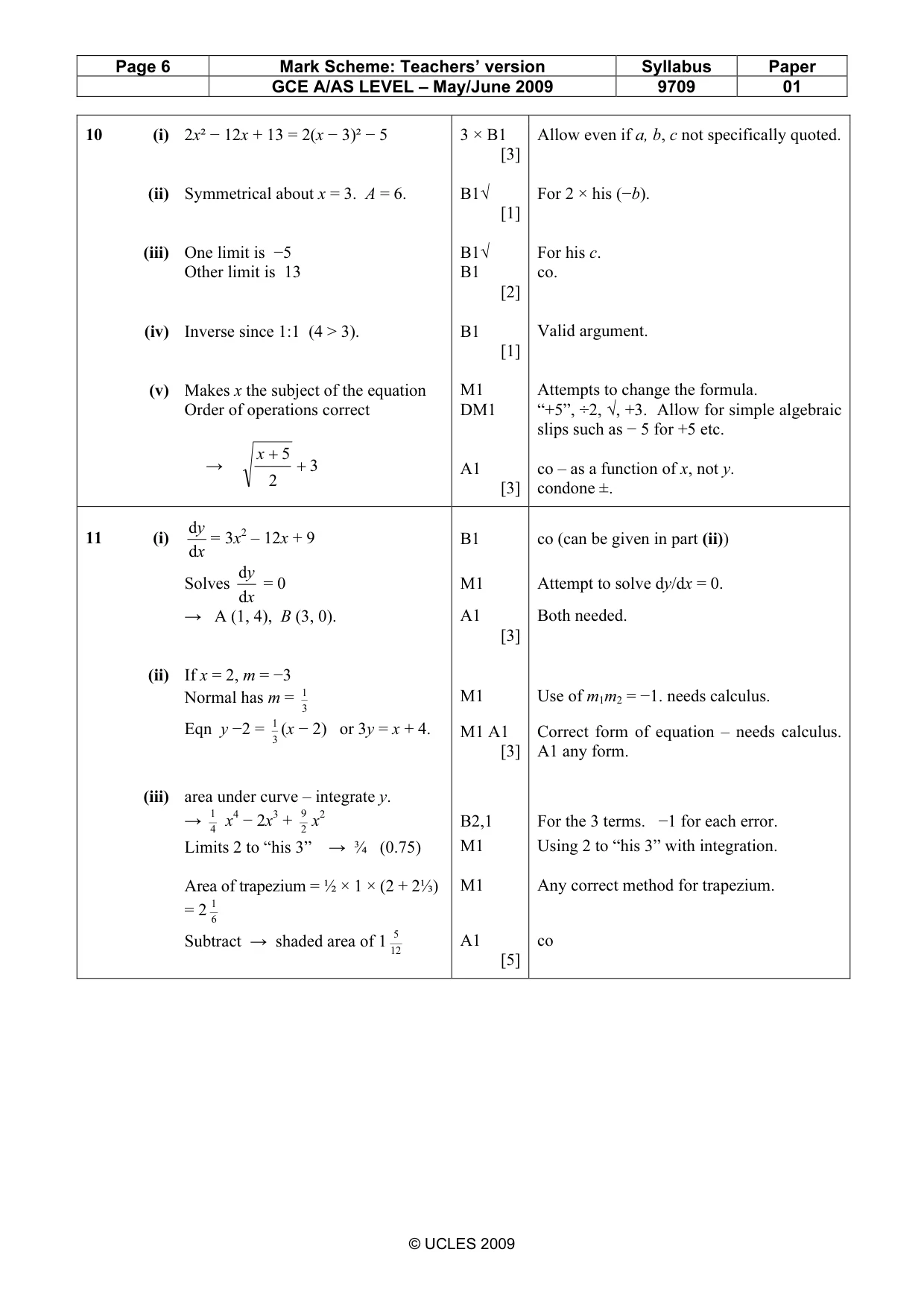
Mark scheme: 10 (i) 2x² − 12x + 13 = 2(x − 3)² − 5 3 × B1 Allow even if a, b, c not specifically quoted. [3] (ii) Symmetrical about x = 3. A = 6. B1√ For 2 × his (−b). [1] (iii) One limit is −5 B1√ For his c. Other limit is 13 B1 co. [2] (iv) Inverse since 1:1 (4 > 3). B1 Valid argument. [1] (v) Makes x the subject of the equation M1 Attempts to change the formula. Order of operations correct DM1 “+5”, ÷2, √, +3. Allow for simple algebraic slips such as − 5 for +5 etc. x + 5 → + 3 A1 co – as a function of x, not y. 2 [3] condone ±. dy 2
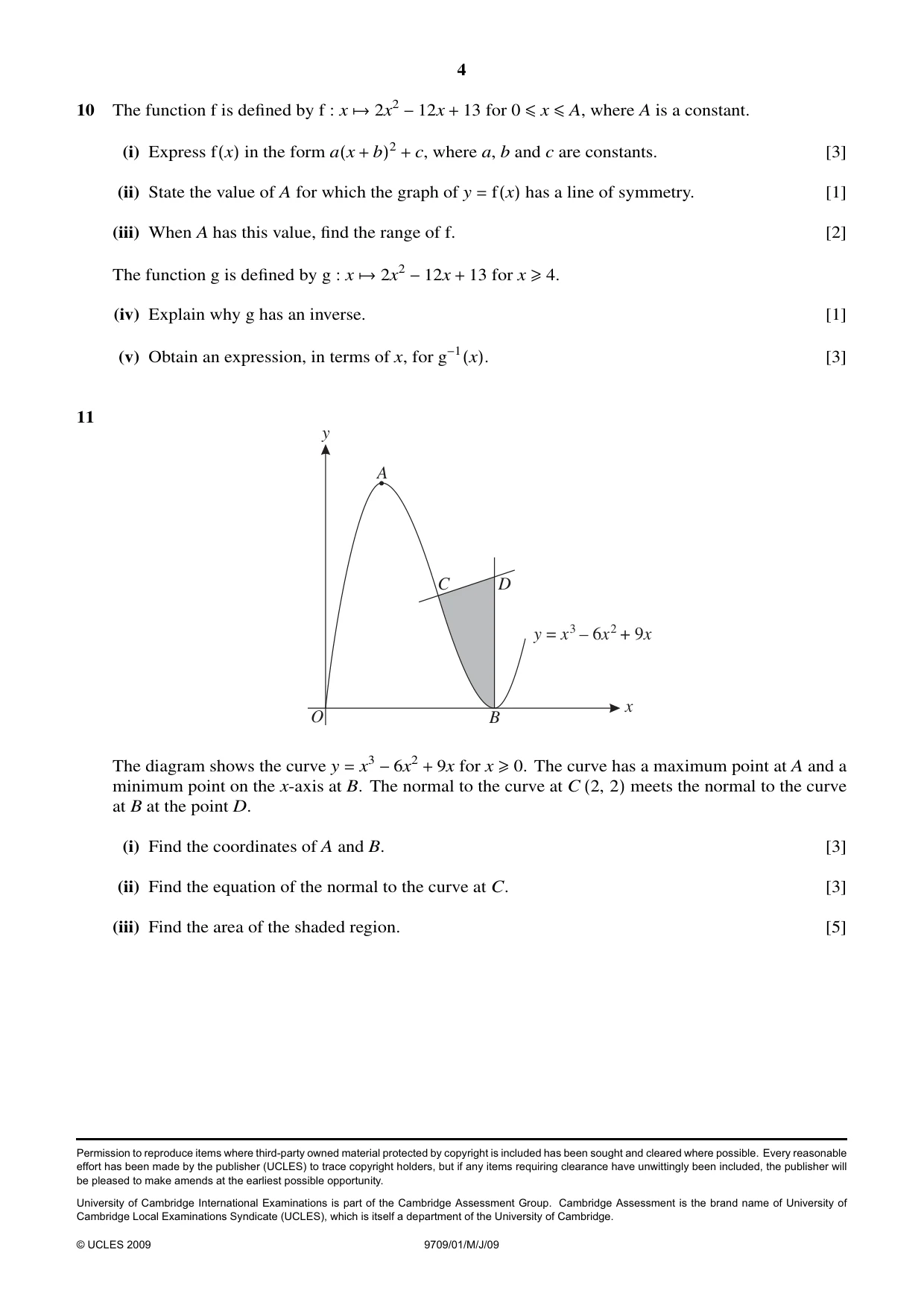
Q11 · Y A C D y = x 3 – 6x 2 + 9x x O B The diagram shows the curve y = x3 −6x2 + 9x for x ≥0
11 y A C D y = x 3 – 6x 2 + 9x x O B The diagram shows the curve y = x3 −6x2 + 9x for x ≥0. The curve has a maximum point at A and a minimum point on the x-axis at B. The normal to the curve at C (2, 2) meets the normal to the curve at B at the point D. (i) Find the coordinates of A and B. [3] (ii) Find the equation of the normal to the curve at C. [3] (iii) Find the area of the shaded region. [5]
Mark scheme: dy 11 (i) = 3x2 – 12x + 9 B1 co (can be given in part (ii)) dx dy Solves = 0 M1 Attempt to solve dy/dx = 0. dx → A (1, 4), B (3, 0). A1 Both needed. [3] (ii) If x = 2, m = −3 Normal has m = 1 M1 Use of m1m2 = −1. needs calculus. 3 Eqn y −2 = 1 (x − 2) or 3y = x + 4. M1 A1 Correct form of equation – needs calculus. 3 [3] A1 any form. (iii) area under curve – integrate y. x2 → 1 x4 − 2x3 + 9 B2,1 For the 3 terms. −1 for each error. 4 2 Limits 2 to “his 3” → ¾ (0.75) M1 Using 2 to “his 3” with integration. Area of trapezium = ½ × 1 × (2 + 2⅓) M1 Any correct method for trapezium. = 2 1 6 Subtract → shaded area of 1 5 A1 co 12 [5]
What was in this paper
The subtopics covered by these 11 questions, and how many questions each got. Open one in a new tab to see every Cambridge question on it.
What you needed in this session
Cambridge’s own grade thresholds for 2009 May/June, Paper 1 · Variant 1. A higher threshold means an easier paper — the bar moves with how the cohort did.