Cambridge A Level Mathematics 9709 — 2011 Oct/Nov Paper 1 · Variant 2
9709/12/O/N/11 · 9 questions · 75 marks · ≈84 min
The question paper and its mark scheme, free to read here and free to download. This is Cambridge’s own paper, exactly as it was sat.
Question paper4 pages
Mark scheme6 pages
Answers below. Sit the paper first if you are practising.
Questions as text
Q2 · The functions f and g are defined for x ∈> by f : x →3x + a, g : x →b −2x, where a and b…
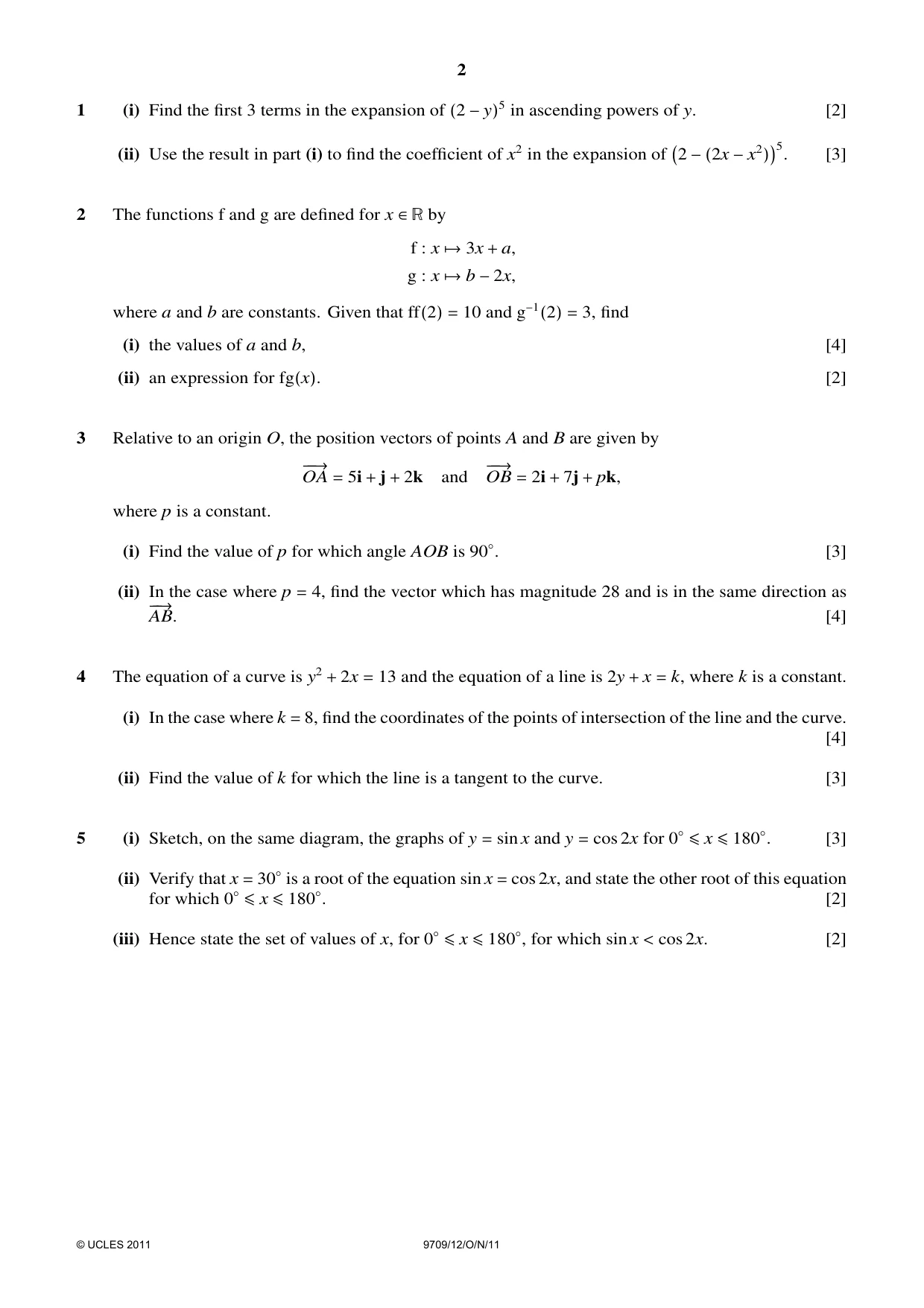
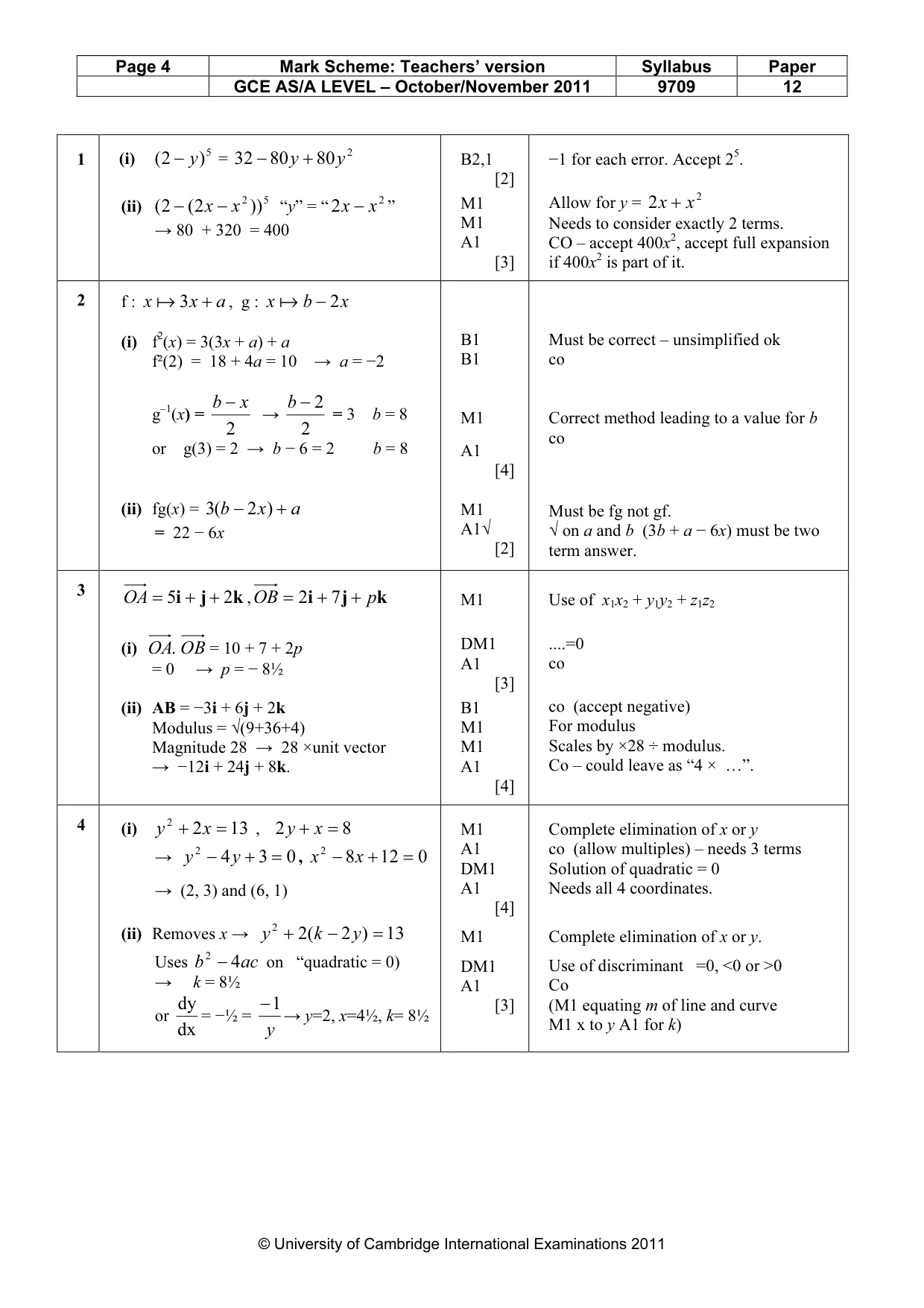
2 The functions f and g are defined for x ∈> by f : x →3x + a, g : x →b −2x, where a and b are constants. Given that ff(2) = 10 and g−1(2) = 3, find (i) the values of a and b, [4] (ii) an expression for fg(x). [2]
Mark scheme: 2 f : x 3 x + a , g : x b − 2 x (i) f2(x) = 3(3x + a) + a B1 Must be correct – unsimplified ok f²(2) = 18 + 4a = 10 → a = −2 B1 co b − x b − 2 g–1(x) = → = 3 b = 8 M1 Correct method leading to a value for b 2 2 co or g(3) = 2 → b − 6 = 2 b = 8 A1 [4] (ii) fg(x) = 3(b − 2 x ) + a M1 Must be fg not gf. = 22 − 6x A1√ √ on a and b (3b + a − 6x) must be two [2] term answer.
Q3 · Relative to an origin O, the position vectors of points A and B are given by −−→OA 5i j…
3 Relative to an origin O, the position vectors of points A and B are given by −−→OA 5i j 2k and −−→OB 2i 7j pk, = + + = + + where p is a constant. (i) Find the value of p for which angle AOB is 90◦. [3] (ii) In the case where p = 4, find the vector which has magnitude 28 and is in the same direction as −−→AB. [4]
Mark scheme: 3 OA = 5i + j + 2k , OB = 2 i + 7 j + pk M1 Use of x1x2 + y1y2 + z1z2 (i) OA. OB = 10 + 7 + 2p DM1 ....=0 = 0 → p = − 8½ A1 co [3] (ii) AB = −3i + 6j + 2k B1 co (accept negative) Modulus = √(9+36+4) M1 For modulus Magnitude 28 → 28 ×unit vector M1 Scales by ×28 ÷ modulus. → −12i + 24j + 8k. A1 Co – could leave as “4 × …”. [4]
Q4 · The equation of a curve is y2 + 2x = 13 and the equation of a line is 2y + x = k, where k…
4 The equation of a curve is y2 + 2x = 13 and the equation of a line is 2y + x = k, where k is a constant. (i) In the case where k = 8, find the coordinates of the points of intersection of the line and the curve. [4] (ii) Find the value of k for which the line is a tangent to the curve. [3]
Mark scheme: 4 (i) y 2 + 2 x = 13 , 2 y + x = 8 M1 Complete elimination of x or y 2 2 A1 co (allow multiples) – needs 3 terms → y − 4 y + 3 = 0 , x −x8 + 12 = 0 DM1 Solution of quadratic = 0 → (2, 3) and (6, 1) A1 Needs all 4 coordinates. [4] (ii) Removes x → y 2 + 2( k − 2 y ) = 13 M1 Complete elimination of x or y. Uses b 2 − 4 ac on “quadratic = 0) DM1 Use of discriminant =0, <0 or >0 → k = 8½ A1 Co dy 1 [3] (M1 equating m of line and curve or = −½ = −→ y=2, x=4½, k= 8½ dx y M1 x to y A1 for k) GCE AS/A LEVEL – October/November 2011 9709 12
Q5 · Sketch, on the same diagram, the graphs of y = sin x and y = cos 2x for 0◦≤x ≤180◦
5 (i) Sketch, on the same diagram, the graphs of y = sin x and y = cos 2x for 0◦≤x ≤180◦. [3] (ii) Verify that x = 30◦is a root of the equation sin x = cos 2x, and state the other root of this equation for which 0◦≤x ≤180◦. [2] (iii) Hence state the set of values of x, for 0◦≤x ≤180◦, for which sin x < cos 2x. [2]
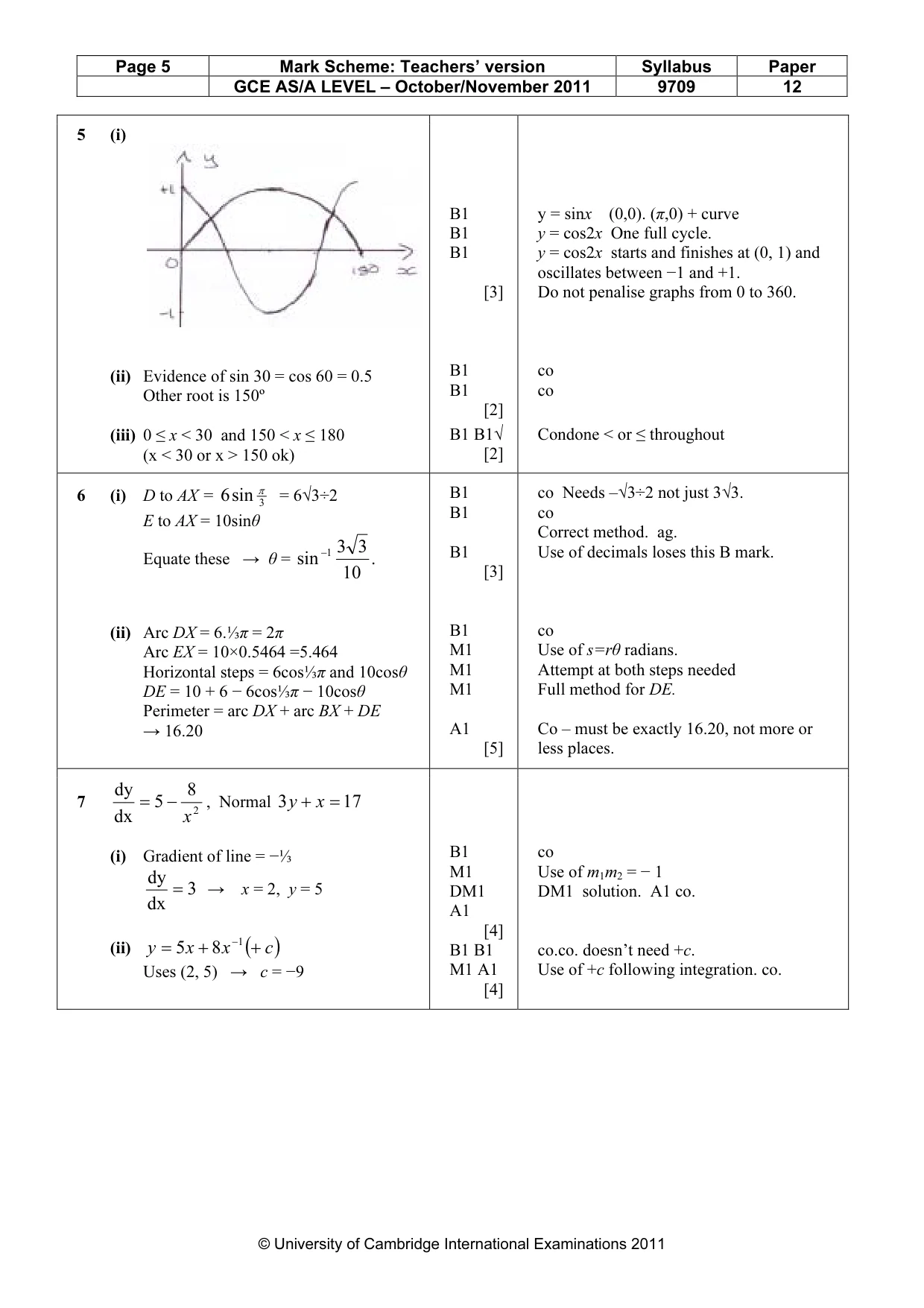
Mark scheme: 5 (i) B1 y = sinx (0,0). (π,0) + curve B1 y = cos2x One full cycle. B1 y = cos2x starts and finishes at (0, 1) and oscillates between −1 and +1. [3] Do not penalise graphs from 0 to 360. B1 co (ii) Evidence of sin 30 = cos 60 = 0.5 B1 co Other root is 150º [2] (iii) 0 ≤ x < 30 and 150 < x ≤ 180 B1 B1√ Condone < or ≤ throughout (x < 30 or x > 150 ok) [2] √ B1 N d √3 2 j 3√3
Q6 · C2 D E C1 6 cm 10 cm 3p1 q A B X The diagram shows a circle C1 touching a circle C2 at a…
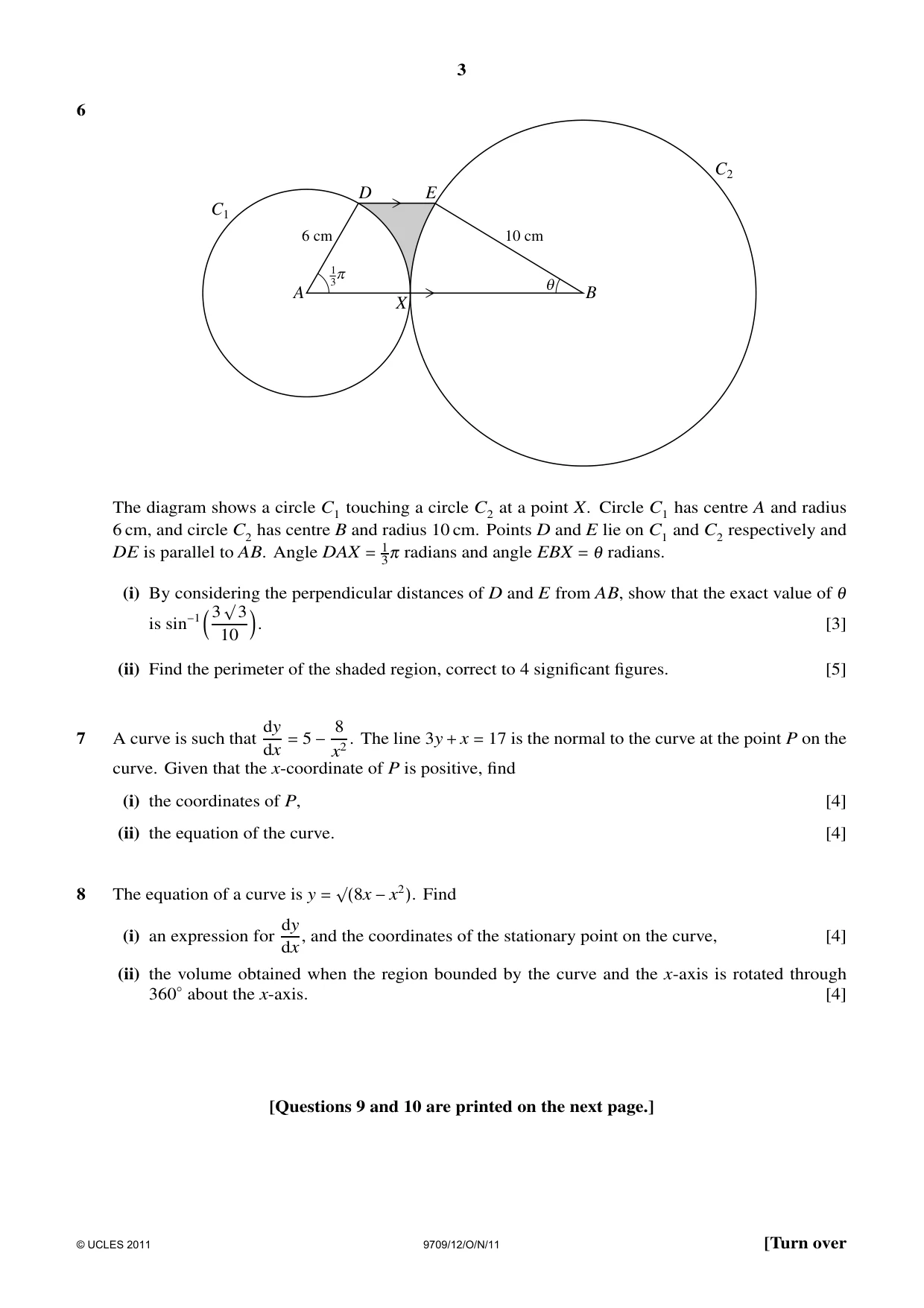
6 C2 D E C1 6 cm 10 cm 3p1 q A B X The diagram shows a circle C1 touching a circle C2 at a point X. Circle C1 has centre A and radius 6 cm, and circle C2 has centre B and radius 10 cm. Points D and E lie on C1 and C2 respectively and DE is parallel to AB. Angle DAX = 13π radians and angle EBX = θ radians. (i) By considering the perpendicular distances of D and E from AB, show that the exact value of θ 3 √3 is sin−1 . [3] 10 (ii) Find the perimeter of the shaded region, correct to 4 significant figures. [5]
Mark scheme: 6 (i) D to AX = 6 sin π3 = 6√3÷2 B1 co Needs –√3÷2 not just 3√3. E to AX = 10sinθ B1 co Correct method. ag. 3 3 B1 Use of decimals loses this B mark. . Equate these → θ = sin −1 10 [3] (ii) Arc DX = 6.⅓π = 2π B1 co Arc EX = 10×0.5464 =5.464 M1 Use of s=rθ radians. Horizontal steps = 6cos⅓π and 10cosθ M1 Attempt at both steps needed DE = 10 + 6 − 6cos⅓π − 10cosθ M1 Full method for DE. Perimeter = arc DX + arc BX + DE → 16.20 A1 Co – must be exactly 16.20, not more or [5] less places. dy 8
Q7 · Dy 7 A curve is such that
dy 7 A curve is such that . The line 3y + x = 17 is the normal to the curve at the point P on the dx = 5 −8x2 curve. Given that the x-coordinate of P is positive, find (i) the coordinates of P, [4] (ii) the equation of the curve. [4]
Mark scheme: dy 8 7 = 5 − 2 , Normal 3 y + x = 17 dx x (i) Gradient of line = −⅓ B1 co dy M1 Use of m1m2 = − 1 = 3 → x = 2, y = 5 DM1 DM1 solution. A1 co. dx A1 [4] (ii) y = 5 x + 8 x −1 (+ c ) B1 B1 co.co. doesn’t need +c. Uses (2, 5) → c = −9 M1 A1 Use of +c following integration. co. [4] GCE AS/A LEVEL – October/November 2011 9709 12 2
Q8 · Find8 The equation of a curve is y = √(8x −x2)
Find8 The equation of a curve is y = √(8x −x2). dy (i) an expression for dx, and the coordinates of the stationary point on the curve, [4] (ii) the volume obtained when the region bounded by the curve and the x-axis is rotated through 360◦about the x-axis. [4] [Questions 9 and 10 are printed on the next page.]
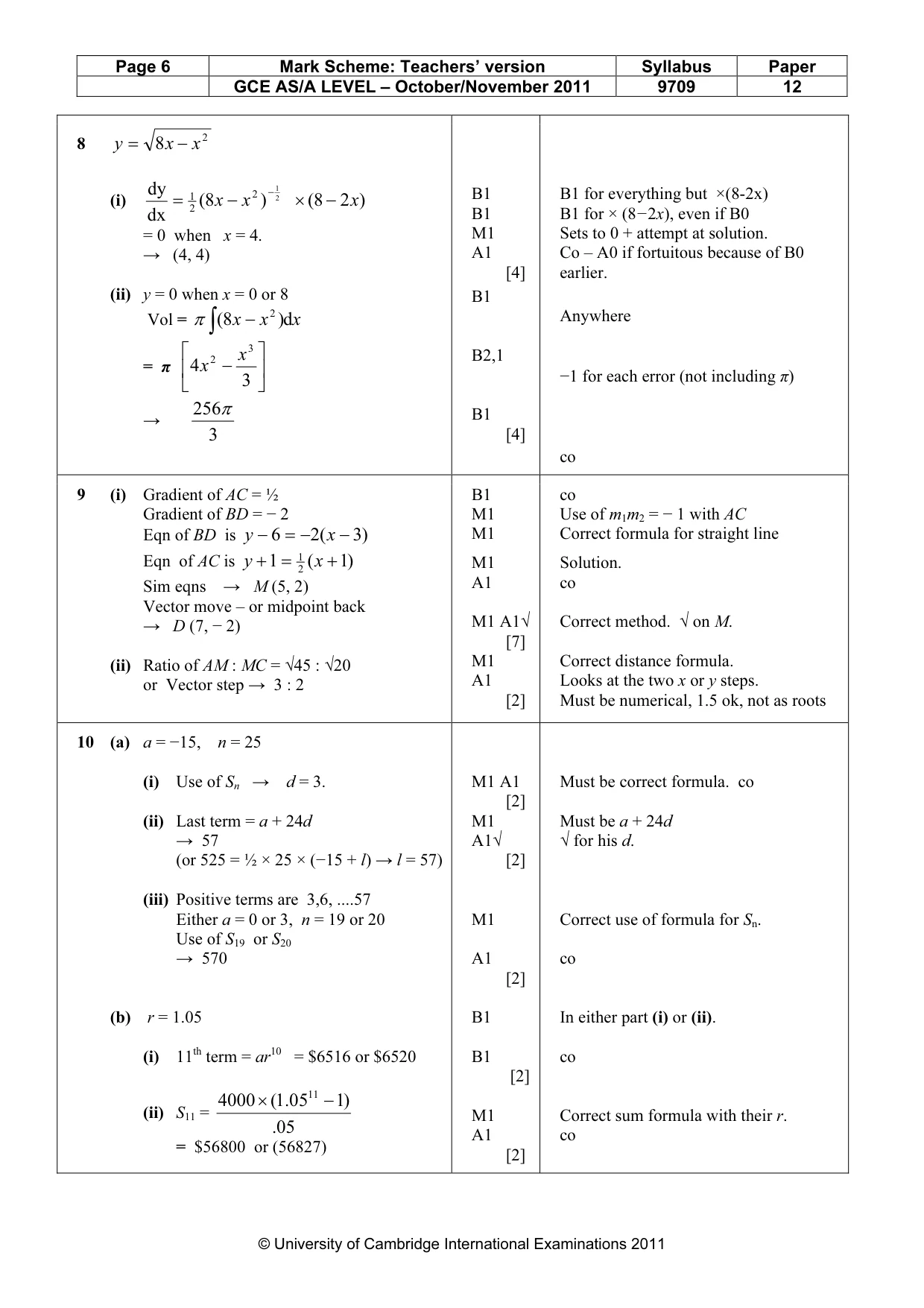
Mark scheme: 8 y = 8 x − x 2 dy (i) 2 × (8 − 2 x ) B1 B1 for everything but ×(8-2x) = 12 (8 x − x 2 ) − 1 dx B1 B1 for × (8−2x), even if B0 = 0 when x = 4. M1 Sets to 0 + attempt at solution. → (4, 4) A1 Co – A0 if fortuitous because of B0 [4] earlier. (ii) y = 0 when x = 0 or 8 B1 Vol = π ∫ (8 x − x 2 d)x Anywhere 2 x 3 B2,1 = π 4 x −1 for each error (not including π) −3 256π B1 → 3 [4] co
Q9 · Y B (3, 6) C (9, 4) M O x A (–1, –1) D The diagram shows a quadrilateral ABCD in which…
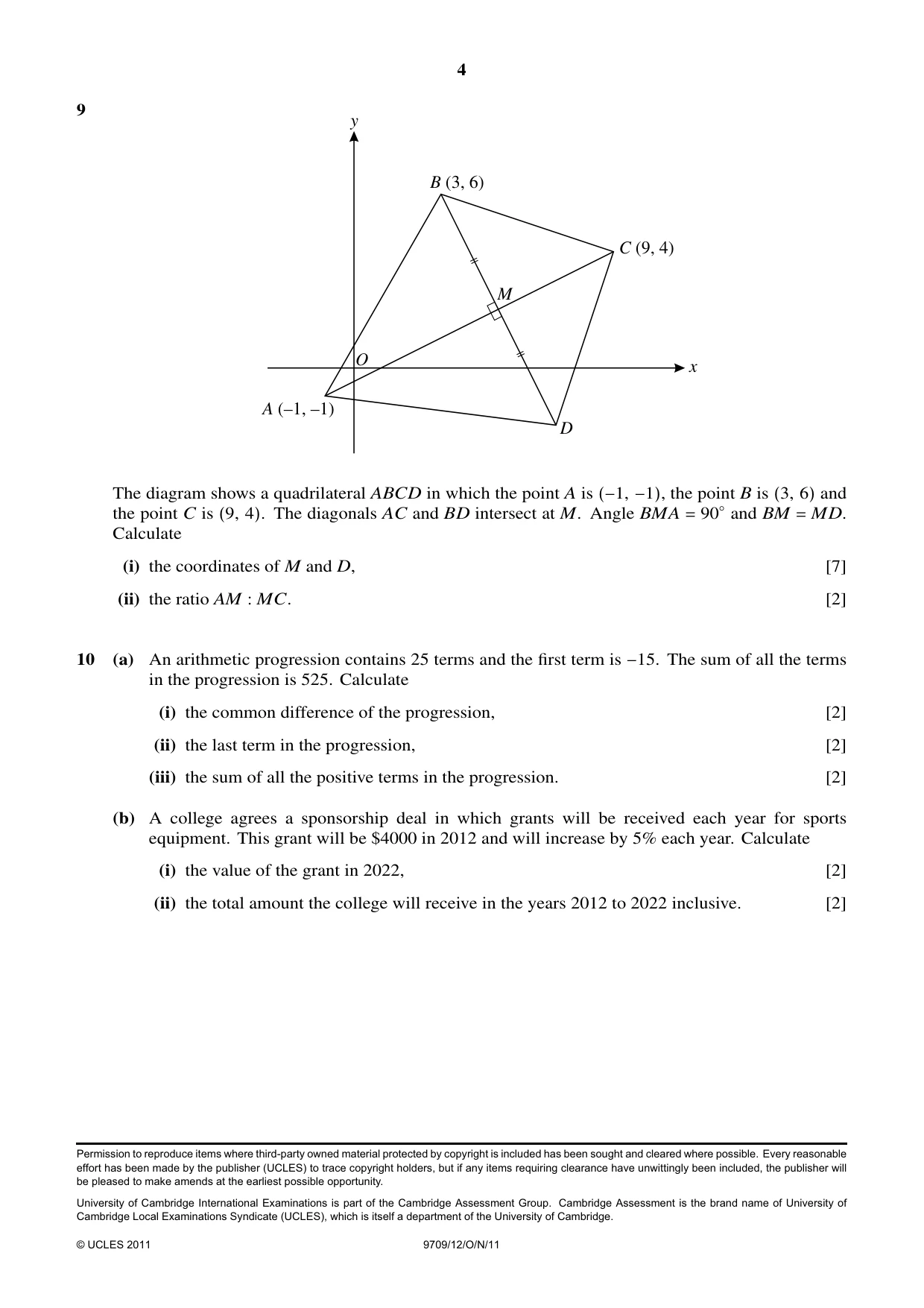
9 y B (3, 6) C (9, 4) M O x A (–1, –1) D The diagram shows a quadrilateral ABCD in which the point A is (−1, −1), the point B is (3, 6) and the point C is (9, 4). The diagonals AC and BD intersect at M. Angle BMA = 90◦and BM = MD. Calculate (i) the coordinates of M and D, [7] (ii) the ratio AM : MC. [2]
Mark scheme: 9 (i) Gradient of AC = ½ B1 co Gradient of BD = − 2 M1 Use of m1m2 = − 1 with AC Eqn of BD is y − 6 = − 2( x − 3) M1 Correct formula for straight line Eqn of AC is y + 1 = 12 ( x + )1 M1 Solution. Sim eqns → M (5, 2) A1 co Vector move – or midpoint back → D (7, − 2) M1 A1√ Correct method. √ on M. [7] (ii) Ratio of AM : MC = √45 : √20 M1 Correct distance formula. or Vector step → 3 : 2 A1 Looks at the two x or y steps. [2] Must be numerical, 1.5 ok, not as roots
Q10 · An arithmetic progression contains 25 terms and the first term is −15
10 (a) An arithmetic progression contains 25 terms and the first term is −15. The sum of all the terms in the progression is 525. Calculate (i) the common difference of the progression, [2] (ii) the last term in the progression, [2] (iii) the sum of all the positive terms in the progression. [2] (b) A college agrees a sponsorship deal in which grants will be received each year for sports equipment. This grant will be $4000 in 2012 and will increase by 5% each year. Calculate (i) the value of the grant in 2022, [2] (ii) the total amount the college will receive in the years 2012 to 2022 inclusive. [2]
Mark scheme: 10 (a) a = −15, n = 25 (i) Use of Sn → d = 3. M1 A1 Must be correct formula. co [2] (ii) Last term = a + 24d M1 Must be a + 24d → 57 A1√ √ for his d. (or 525 = ½ × 25 × (−15 + l) → l = 57) [2] (iii) Positive terms are 3,6, ....57 Either a = 0 or 3, n = 19 or 20 M1 Correct use of formula for Sn. Use of S19 or S20 → 570 A1 co [2] (b) r = 1.05 B1 In either part (i) or (ii). (i) 11th term = ar10 = $6516 or $6520 B1 co [2] 4000 × .1( 0511 − )1 (ii) S11 = M1 Correct sum formula with their r. . 05 A1 co = $56800 or (56827) [2]
What was in this paper
The subtopics covered by these 9 questions, and how many questions each got. Open one in a new tab to see every Cambridge question on it.
What you needed in this session
Cambridge’s own grade thresholds for 2011 Oct/Nov, Paper 1 · Variant 2. A higher threshold means an easier paper — the bar moves with how the cohort did.