Cambridge A Level Mathematics 9709 — 2014 Oct/Nov Paper 1 · Variant 2
9709/12/O/N/14 · 9 questions · 75 marks · ≈84 min
The question paper and its mark scheme, free to read here and free to download. This is Cambridge’s own paper, exactly as it was sat.
Question paper4 pages
Mark scheme7 pages
Answers below. Sit the paper first if you are practising.
Questions as text
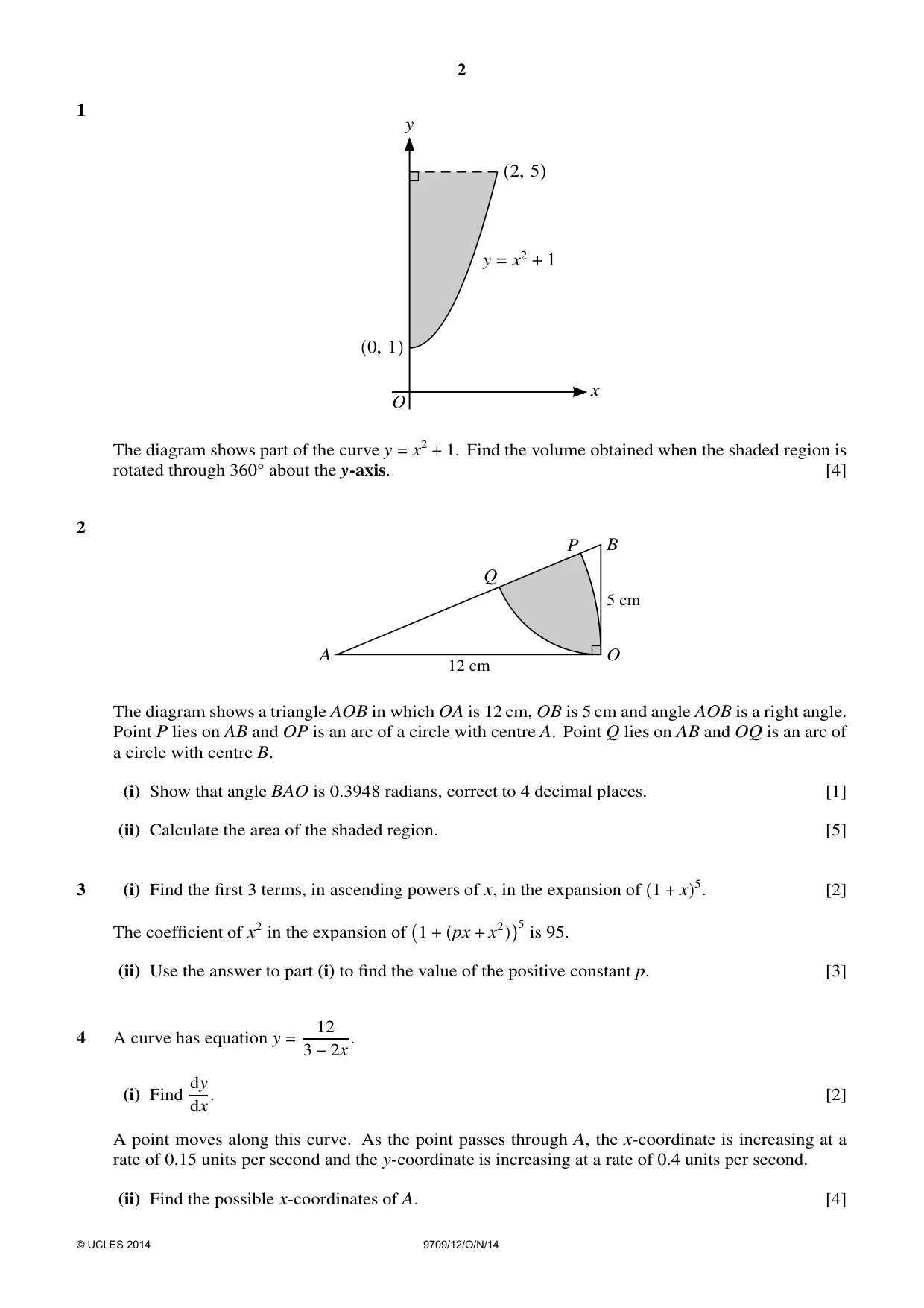
Q1 · Y 2, 5 y = x2 + 1 0, 1 x O The diagram shows part of the curve y = x2 + 1
1 y 2, 5 y = x2 + 1 0, 1 x O The diagram shows part of the curve y = x2 + 1. Find the volume obtained when the shaded region is rotated through 360 about the y-axis. [4]
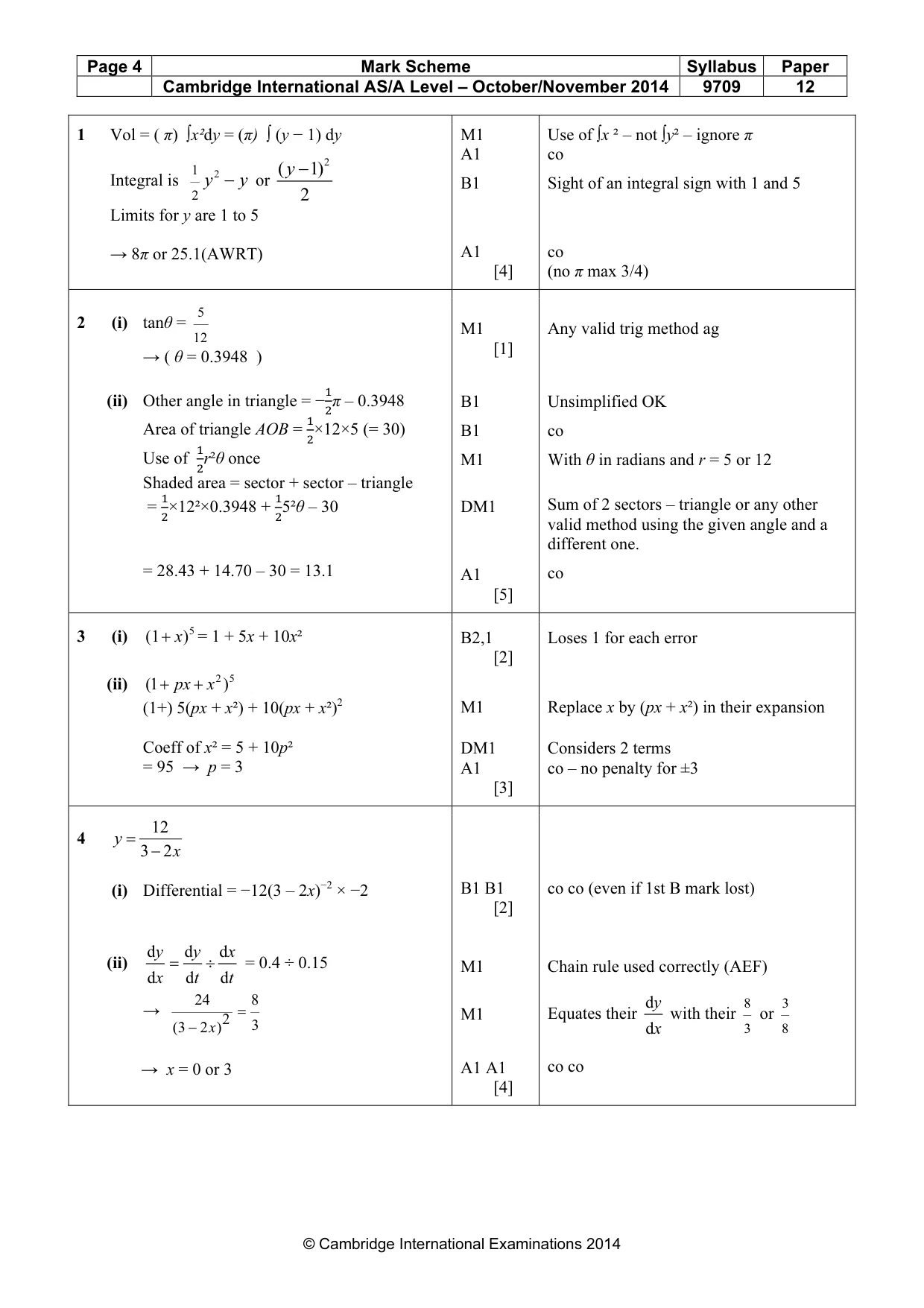
Mark scheme: 1 Vol = ( π) ∫x²dy = (π) ∫ (y − 1) dy M1 Use of ∫x ² – not ∫y² – ignore π 2 A1 co 1 2 ( y − 1) Integral is y − y or B1 Sight of an integral sign with 1 and 5 2 2 Limits for y are 1 to 5 → 8π or 25.1(AWRT) A1 co [4] (no π max 3/4) 5
Q2 · P B Q 5 cm A O 12 cm The diagram shows a triangle AOB in which OA is 12 cm, OB is 5 cm…
2 P B Q 5 cm A O 12 cm The diagram shows a triangle AOB in which OA is 12 cm, OB is 5 cm and angle AOB is a right angle. Point P lies on AB and OP is an arc of a circle with centre A. Point Q lies on AB and OQ is an arc of a circle with centre B. (i) Show that angle BAO is 0.3948 radians, correct to 4 decimal places. [1] (ii) Calculate the area of the shaded region. [5]
Mark scheme: 5 2 (i) tanθ = M1 Any valid trig method ag 12 → ( θ = 0.3948 ) [1] (ii) Other angle in triangle = − π – 0.3948 B1 Unsimplified OK Area of triangle AOB = ×12×5 (= 30) B1 co Use of r²θ once M1 With θ in radians and r = 5 or 12 Shaded area = sector + sector – triangle = ×12²×0.3948 + 5²θ – 30 DM1 Sum of 2 sectors – triangle or any other valid method using the given angle and a different one. = 28.43 + 14.70 – 30 = 13.1 A1 co [5] 5
Q3 · Find the first 3 terms, in ascending powers of x, in the expansion of 1 + x 5
3 (i) Find the first 3 terms, in ascending powers of x, in the expansion of 1 + x 5. [2] 5 The coefficient of x2 in the expansion of 1 + px + x2 is 95. (ii) Use the answer to part (i) to find the value of the positive constant p. [3]
Mark scheme: 3 (i) (1 + x 5) = 1 + 5x + 10x² B2,1 Loses 1 for each error [2] (ii) 1( + px + x 2) 5 (1+) 5(px + x²) + 10(px + x²)2 M1 Replace x by (px + x²) in their expansion Coeff of x² = 5 + 10p² DM1 Considers 2 terms = 95 → p = 3 A1 co – no penalty for ±3 [3] 12
Q4 · 4 A curve has equation y = 3 −2x
12 4 A curve has equation y = 3 −2x. dy (i) Find dx. [2] A point moves along this curve. As the point passes through A, the x-coordinate is increasing at a rate of 0.15 units per second and the y-coordinate is increasing at a rate of 0.4 units per second. (ii) Find the possible x-coordinates of A. [4]
Mark scheme: 12 4 y = 3 − 2 x (i) Differential = −12(3 – 2x)−2 × −2 B1 B1 co co (even if 1st B mark lost) [2] d y d y d x (ii) = ÷ = 0.4 ÷ 0.15 M1 Chain rule used correctly (AEF) d x d t d t 24 8 dy 8 3 → = M1 Equates their with their or 2 (3 − 2 x ) 3 dx 3 8 → x = 0 or 3 A1 A1 co co [4]
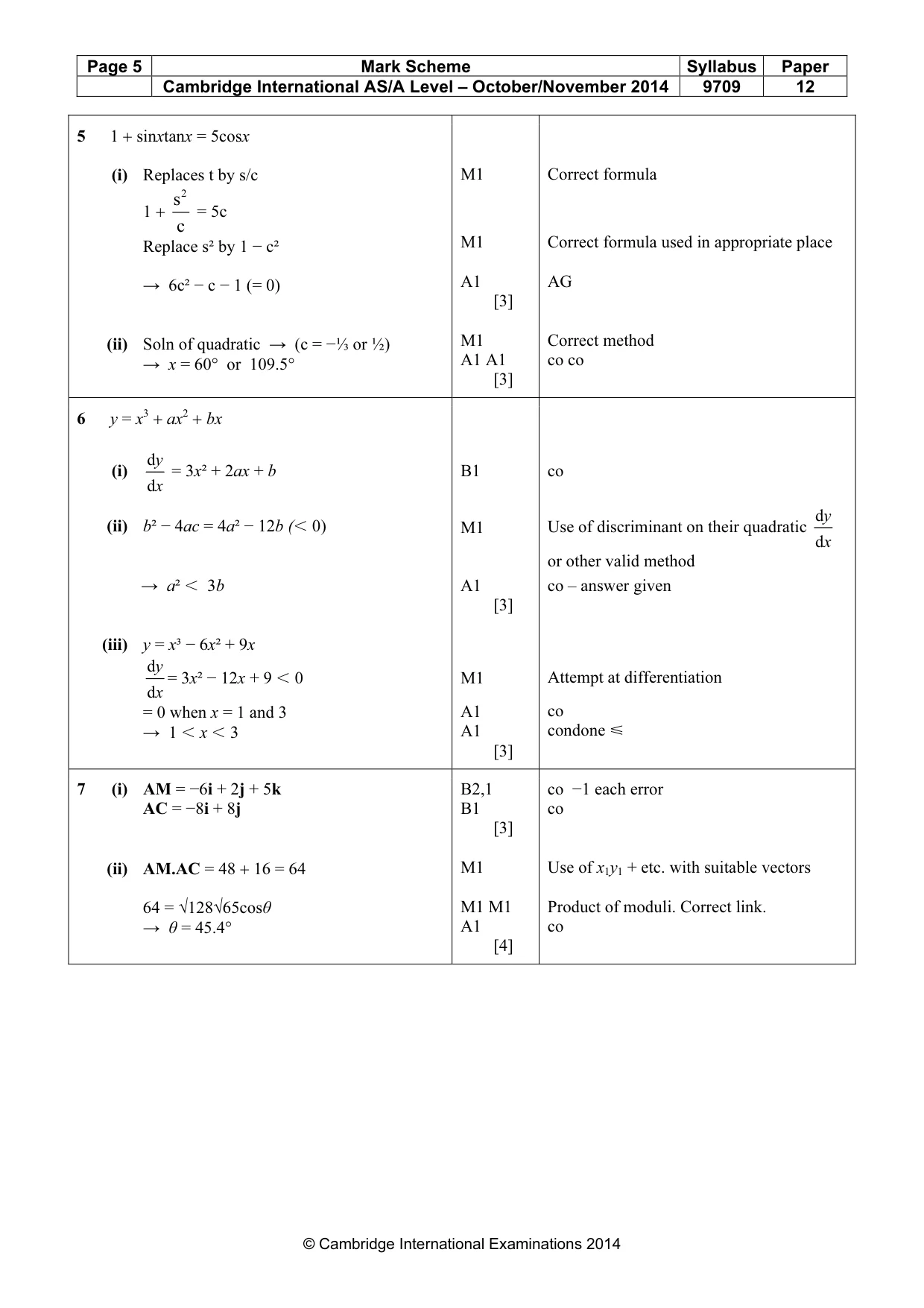
Q5 · Show that the equation 1 + sin x tan x = 5 cosx can be expressed as 6 cos2x −cosx −1 = 0
5 (i) Show that the equation 1 + sin x tan x = 5 cosx can be expressed as 6 cos2x −cosx −1 = 0. (ii) Hence solve the equation 1 + sin x tan x = 5 cosx for 0 ≤x ≤180 . [3]
Mark scheme: 5 1 + sinxtanx = 5cosx (i) Replaces t by s/c M1 Correct formula 2s 1 + = 5c c Replace s² by 1 − c² M1 Correct formula used in appropriate place → 6c² − c − 1 (= 0) A1 AG [3] (ii) Soln of quadratic → (c = −⅓ or ½) M1 Correct method → x = 60° or 109.5° A1 A1 co co [3] 3 2
Q6 · The equation of a curve is y = x3 + ax2 + bx, where a and b are constants
6 The equation of a curve is y = x3 + ax2 + bx, where a and b are constants. (i) In the case where the curve has no stationary point, show that a2 < 3b. [3] (ii) In the case where a = −6 and b = 9, find the set of values of x for which y is a decreasing function of x. [3]
Mark scheme: 6 y = x3 + ax2 + bx dy (i) = 3x² + 2ax + b B1 co dx dy (ii) b² − 4ac = 4a² − 12b (I 0) M1 Use of discriminant on their quadratic dx or other valid method → a² I= 3b A1 co – answer given [3] (iii) y = x³ − 6x² + 9x dy = 3x² − 12x + 9 I 0 M1 Attempt at differentiation dx = 0 when x = 1 and 3 A1 co → 1 I x I 3 A1 condone < [3]
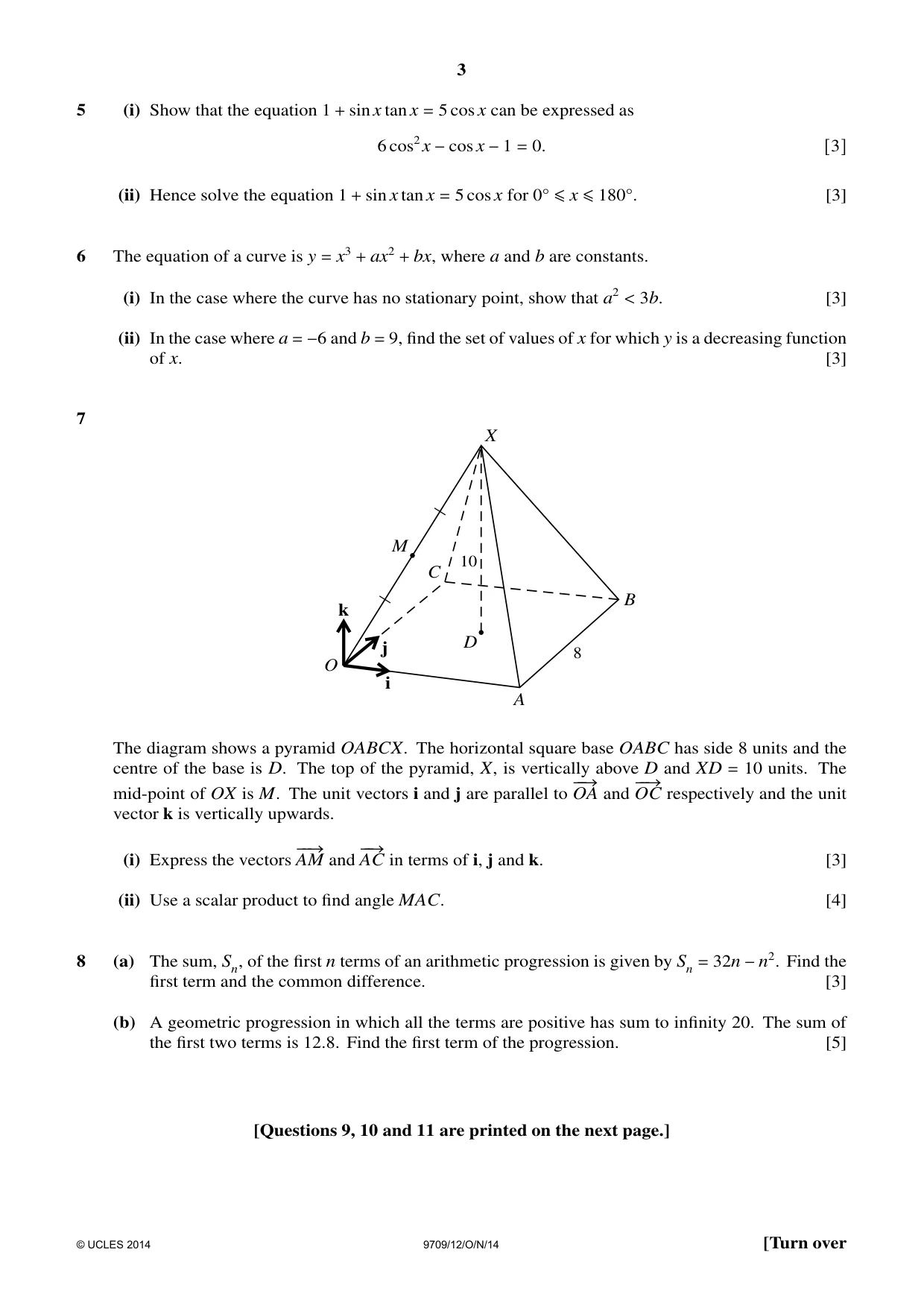
Q7 · X M 10 C B k D j 8 O i A The diagram shows a pyramid OABCX
7 X M 10 C B k D j 8 O i A The diagram shows a pyramid OABCX. The horizontal square base OABC has side 8 units and the centre of the base is D. The top of the pyramid, X, is vertically above D and XD = 10 units. The −−→ −−→ mid-point of OX is M. The unit vectors i and j are parallel to OA and OC respectively and the unit vector k is vertically upwards. −−→ −−→ (i) Express the vectors AM and AC in terms of i, j and k. [3] (ii) Use a scalar product to find angle MAC. [4]
Mark scheme: 7 (i) AM = −6i + 2j + 5k B2,1 co −1 each error AC = −8i + 8j B1 co [3] (ii) AM.AC = 48 + 16 = 64 M1 Use of x1y1 + etc. with suitable vectors 64 = √128√65cosθ M1 M1 Product of moduli. Correct link. → θ = 45.4° A1 co [4]
Q8 · The sum, Sn, of the first n terms of an arithmetic progression is given by Sn = 32n −n2
8 (a) The sum, Sn, of the first n terms of an arithmetic progression is given by Sn = 32n −n2. Find the first term and the common difference. [3] (b) A geometric progression in which all the terms are positive has sum to infinity 20. The sum of the first two terms is 12.8. Find the first term of the progression. [5] [Questions 9, 10 and 11 are printed on the next page.]
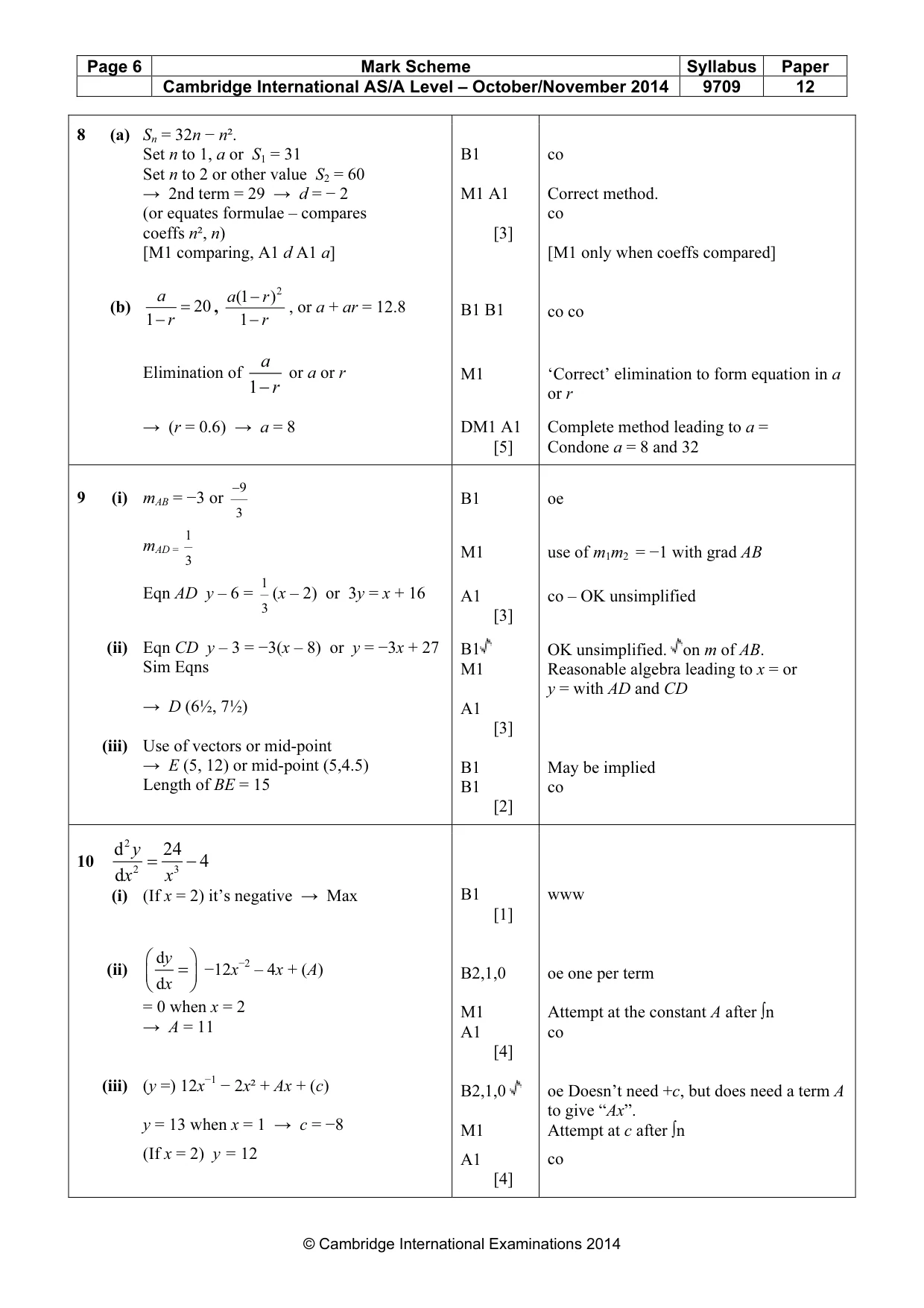
Mark scheme: 8 (a) Sn = 32n − n². Set n to 1, a or S1 = 31 B1 co Set n to 2 or other value S2 = 60 → 2nd term = 29 → d = − 2 M1 A1 Correct method. (or equates formulae – compares co coeffs n², n) [3] [M1 comparing, A1 d A1 a] [M1 only when coeffs compared] a a 1( − r ) 2 (b) = 20 , , or a + ar = 12.8 B1 B1 co co 1 −r 1 − r a Elimination of or a or r M1 ‘Correct’ elimination to form equation in a 1 − r or r → (r = 0.6) → a = 8 DM1 A1 Complete method leading to a = [5] Condone a = 8 and 32 − 9
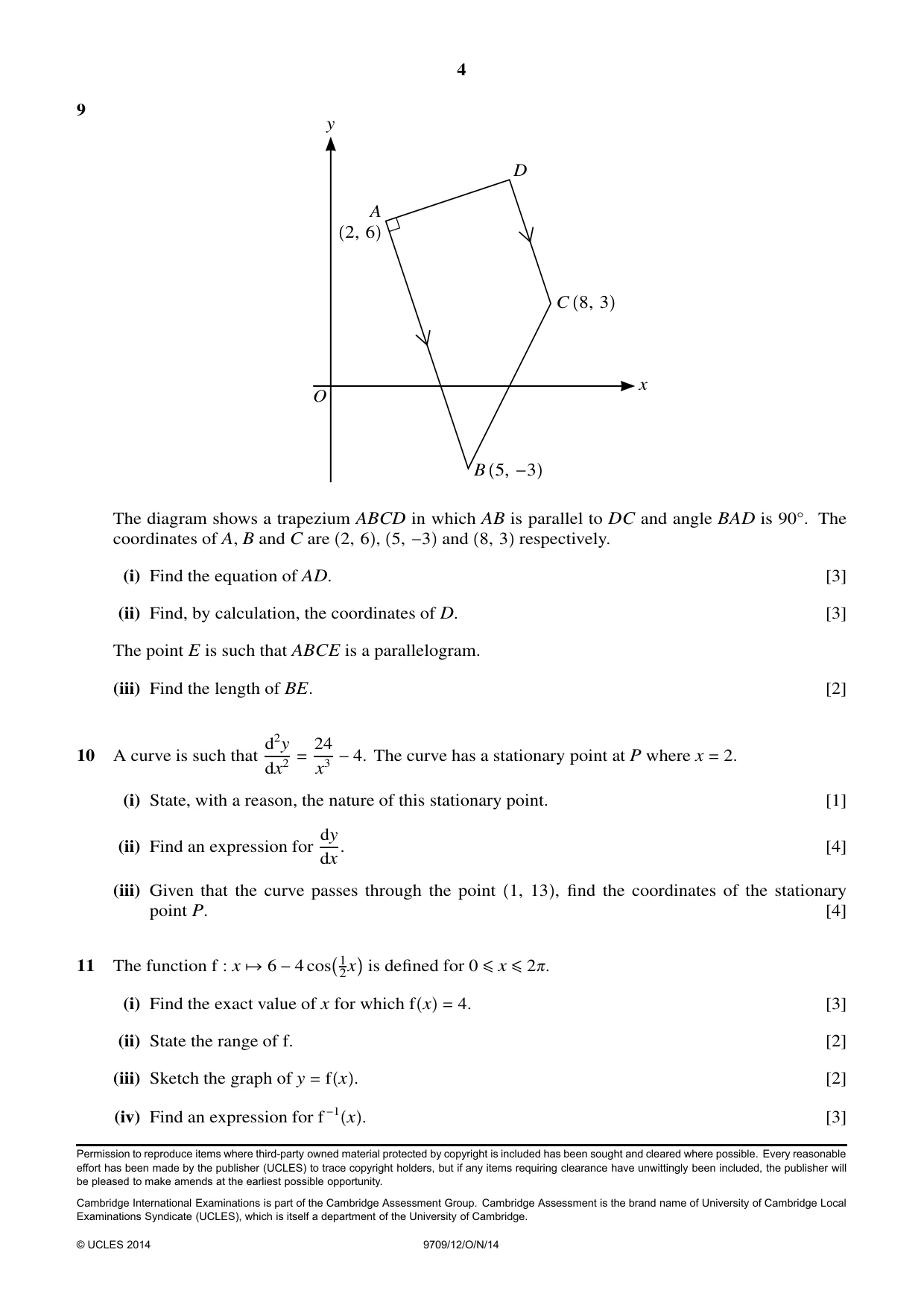
Q9 · Y D A 2, 6 C 8, 3 x O B 5, −3 The diagram shows a trapezium ABCD in which AB is parallel…
9 y D A 2, 6 C 8, 3 x O B 5, −3 The diagram shows a trapezium ABCD in which AB is parallel to DC and angle BAD is 90 . The coordinates of A, B and C are 2, 6 , 5, −3 and 8, 3 respectively. (i) Find the equation of AD. [3] (ii) Find, by calculation, the coordinates of D. [3] The point E is such that ABCE is a parallelogram. (iii) Find the length of BE. [2]
Mark scheme: 9 9 (i) mAB = −3 or B1 oe 3 1 mAD = M1 use of m1m2 = −1 with grad AB 3 1 Eqn AD y – 6 = (x – 2) or 3y = x + 16 A1 co – OK unsimplified 3 [3] (ii) Eqn CD y – 3 = −3(x – 8) or y = −3x + 27 B1 OK unsimplified. on m of AB. Sim Eqns M1 Reasonable algebra leading to x = or y = with AD and CD → D (6½, 7½) A1 [3] (iii) Use of vectors or mid-point → E (5, 12) or mid-point (5,4.5) B1 May be implied Length of BE = 15 B1 co [2] d 2 y 24
What was in this paper
The subtopics covered by these 9 questions, and how many questions each got. Open one in a new tab to see every Cambridge question on it.
What you needed in this session
Cambridge’s own grade thresholds for 2014 Oct/Nov, Paper 1 · Variant 2. A higher threshold means an easier paper — the bar moves with how the cohort did.