Cambridge A Level Mathematics 9709 — 2016 May/June Paper 1 · Variant 3
9709/13/M/J/16 · 7 questions · 75 marks · ≈84 min
The question paper and its mark scheme, free to read here and free to download. This is Cambridge’s own paper, exactly as it was sat.
Question paper4 pages
Mark scheme7 pages
Answers below. Sit the paper first if you are practising.
Questions as text
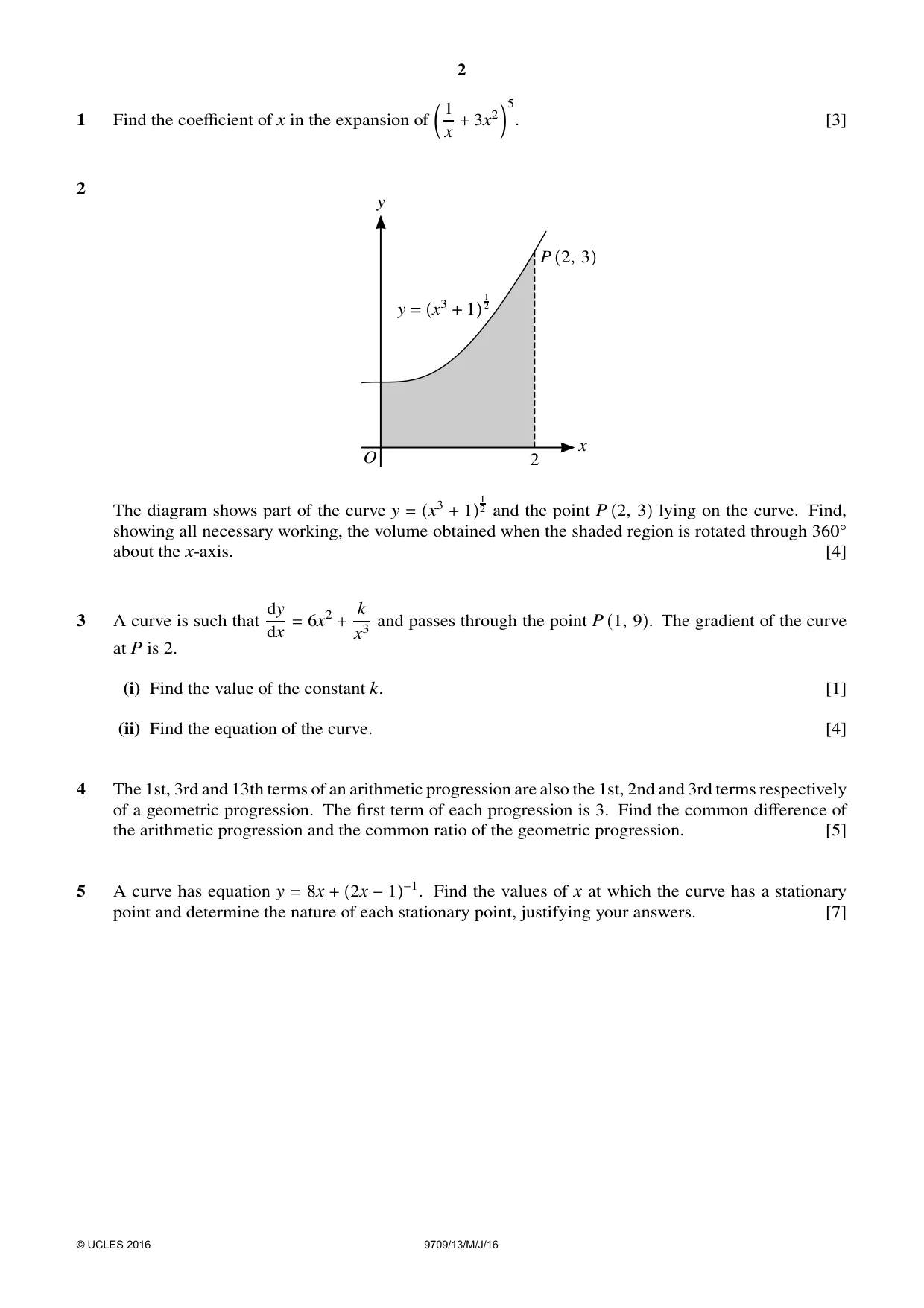
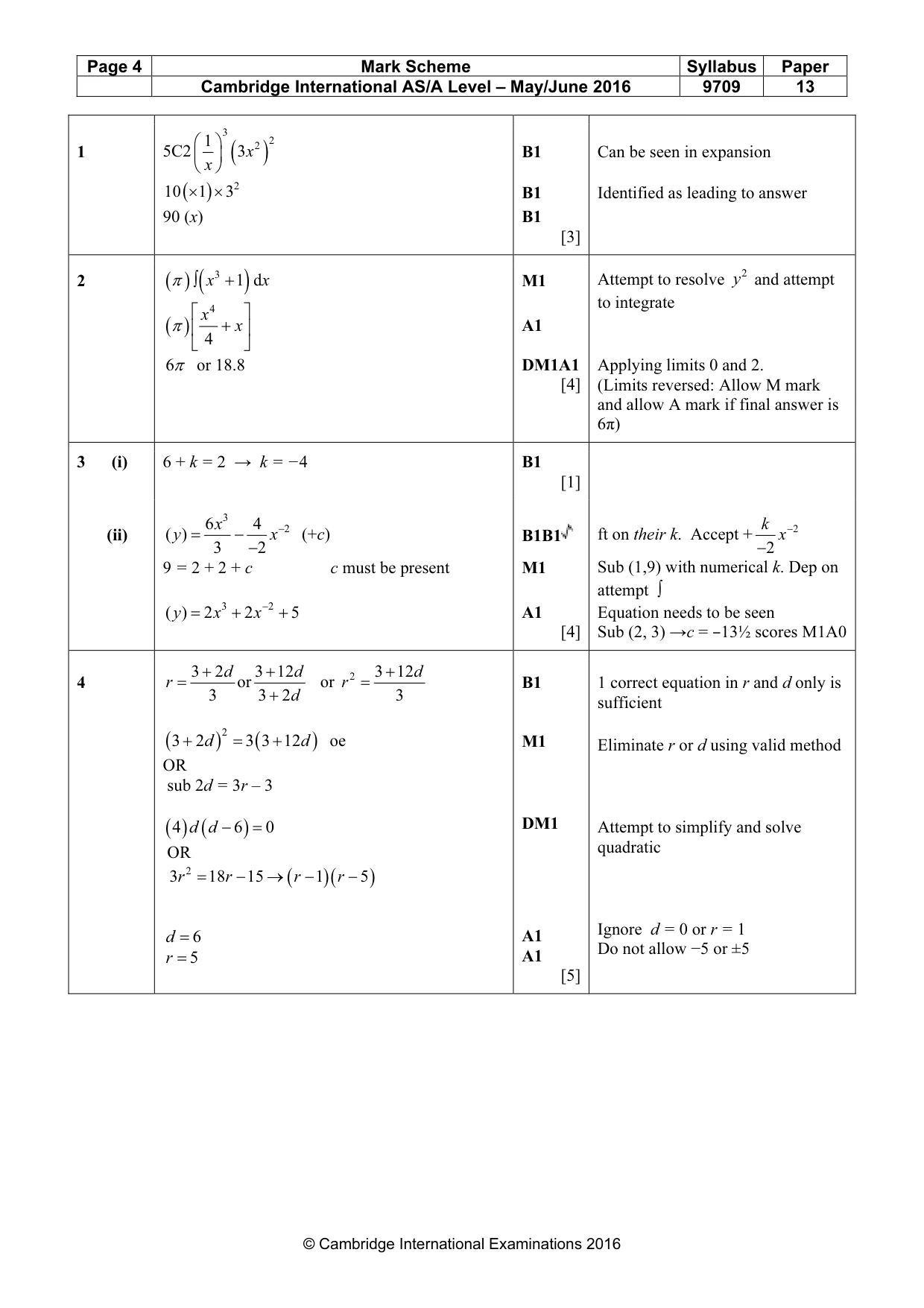
Q1 · @1 A5 1 Find the coefficient of x in the expansion of + 3x2
@1 A5 1 Find the coefficient of x in the expansion of + 3x2 . [3] x
Mark scheme: 1 2 2 3x1 5C2 ( ) B1 Can be seen in expansion x 10 ( × 1) × 3 2 B1 Identified as leading to answer 90 (x) B1 [3] ( ) ∫ ( 3 ) 2
Q3 · Dy k 3 A curve is such that = 6x2 + and passes through the point P 1, 9
dy k 3 A curve is such that = 6x2 + and passes through the point P 1, 9 . The gradient of the curve dx x3 at P is 2. (i) Find the value of the constant k. [1] (ii) Find the equation of the curve. [4]
Mark scheme: 3 (i) 6 + k = 2 → k = −4 B1 [1] 6 x 3 4 2 k 2 (ii) ( y ) = x− (+c) B1B1 ft on their k. Accept + x− 3 −−2 − 2 9 = 2 + 2 + c c must be present M1 Sub (1,9) with numerical k. Dep on attempt ∫ ( y ) = 2 x 3 + 2 x−2 + 5 A1 Equation needs to be seen [4] Sub (2, 3) →c = –13½ scores M1A0 3 + 2 d 3 + 12 d 2 3 + 12 d
Q4 · The 1st, 3rd and 13th terms of an arithmetic progression are also the 1st, 2nd and 3rd…
4 The 1st, 3rd and 13th terms of an arithmetic progression are also the 1st, 2nd and 3rd terms respectively of a geometric progression. The first term of each progression is 3. Find the common difference of the arithmetic progression and the common ratio of the geometric progression. [5]
Mark scheme: 3 + 2 d 3 + 12 d 2 3 + 12 d4 r = or or r = B1 1 correct equation in r and d only is 3 3 + 2 d 3 sufficient ( 3 + 2 d ) 2 = 3 ( 3 + 12 d ) oe M1 Eliminate r or d using valid method OR sub 2d = 3r – 3 ( 4 ) d ( d − 6 ) = 0 DM1 Attempt to simplify and solve quadratic OR 3r 2 = 18 r − 15 → ( r − 1)( r − 5 ) d = 6 A1 Ignore d = 0 or r = 1 Do not allow −5 or ±5 r = 5 A1 [5] dy −2 ( )
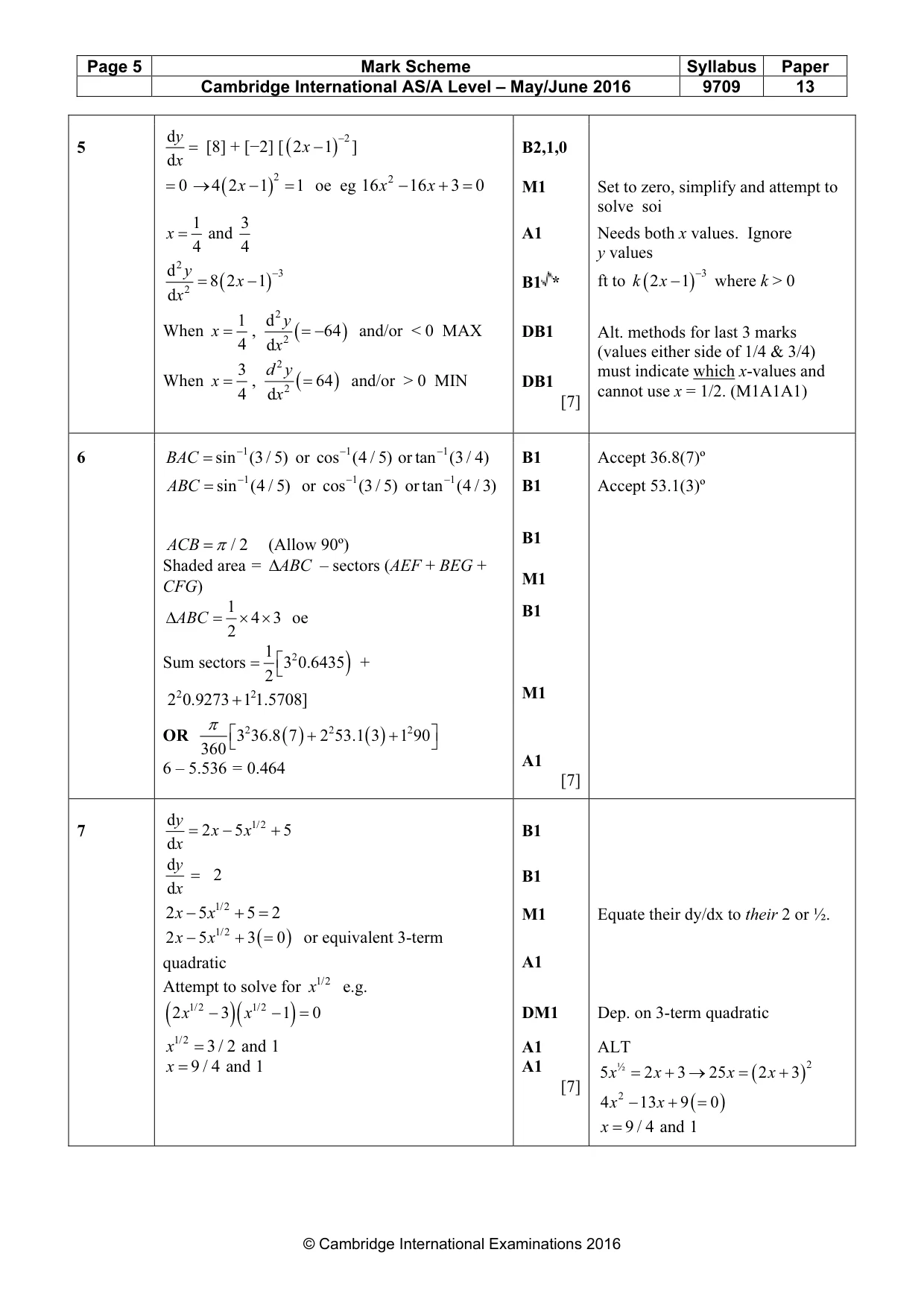
Q6 · 3 E 2 A B 3 2 F G 1 1 C The diagram shows triangle ABC where AB = 5 cm, AC = 4 cm and BC…
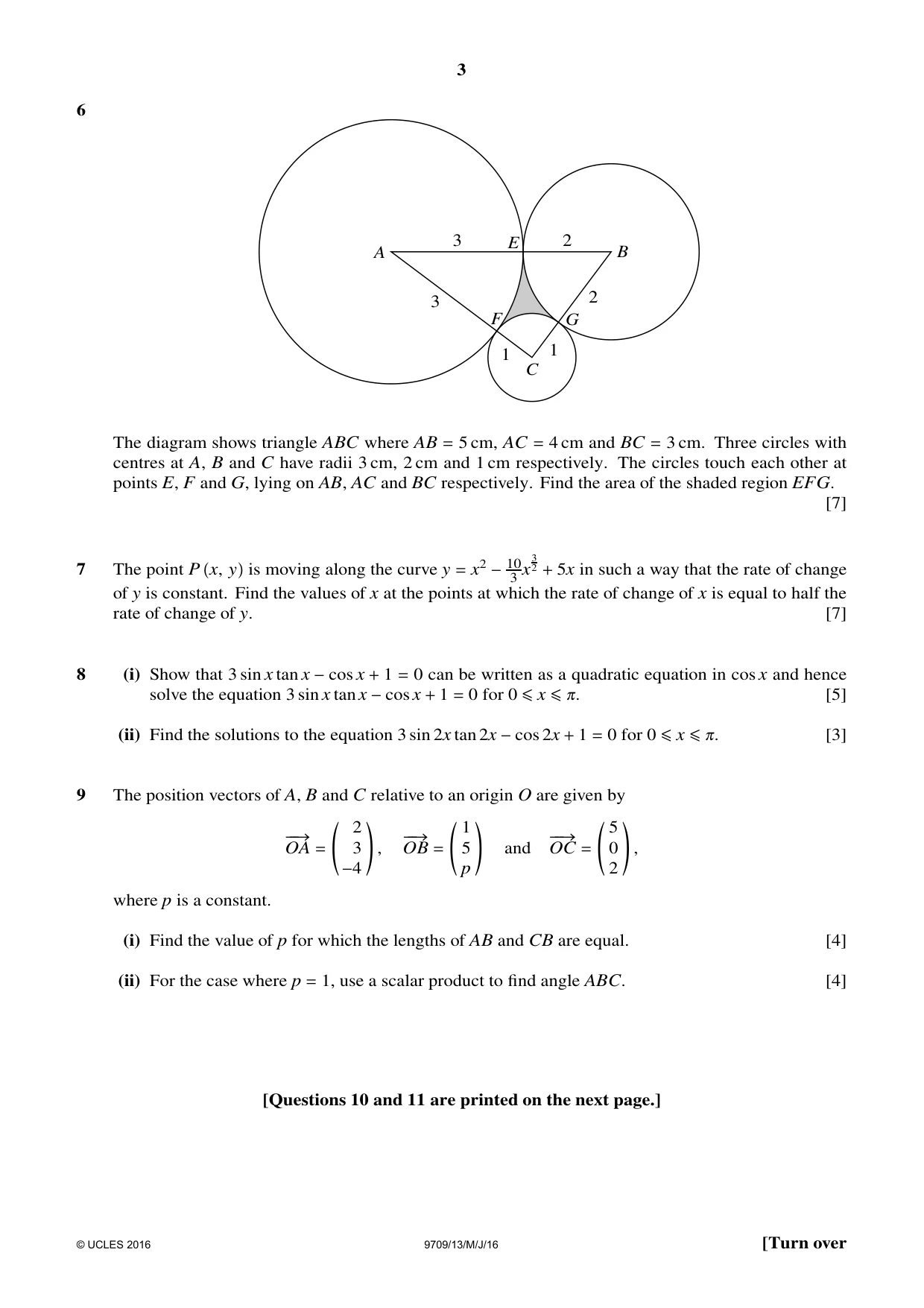
6 3 E 2 A B 3 2 F G 1 1 C The diagram shows triangle ABC where AB = 5 cm, AC = 4 cm and BC = 3 cm. Three circles with centres at A, B and C have radii 3 cm, 2 cm and 1 cm respectively. The circles touch each other at points E, F and G, lying on AB, AC and BC respectively. Find the area of the shaded region EFG. [7]
Mark scheme: 6 BAC = sin −1 (3 / 5) or cos −1 (4 / 5) or tan −1 (3 / 4) B1 Accept 36.8(7)º ABC = sin −1 (4 / 5) or cos −1 (3 / 5) or tan −1 (4 / 3) B1 Accept 53.1(3)º B1 ACB = π / 2 (Allow 90º) Shaded area = ∆ABC – sectors (AEF + BEG + M1 CFG) 1 B1 ∆ABC = × 4 × 3 oe 2 1 2 3 0.6435 Sum sectors = ) + 2 2 2 M1 2 0.9273 + 1 1.5708] π 2 2 2 OR 3 36.8 ( 7 ) + 2 53.1 ( 3 ) + 1 90 360 A1 6 – 5.536 = 0.464 [7] dy 1/2
Q8 · Show that 3 sin x tan x −cos x + 1 = 0 can be written as a quadratic equation in cos x…
8 (i) Show that 3 sin x tan x −cos x + 1 = 0 can be written as a quadratic equation in cos x and hence solve the equation 3 sin x tanx −cosx + 1 = 0 for 0 ≤x ≤0. [5] (ii) Find the solutions to the equation 3 sin 2x tan2x −cos 2x + 1 = 0 for 0 ≤x ≤0. [3]
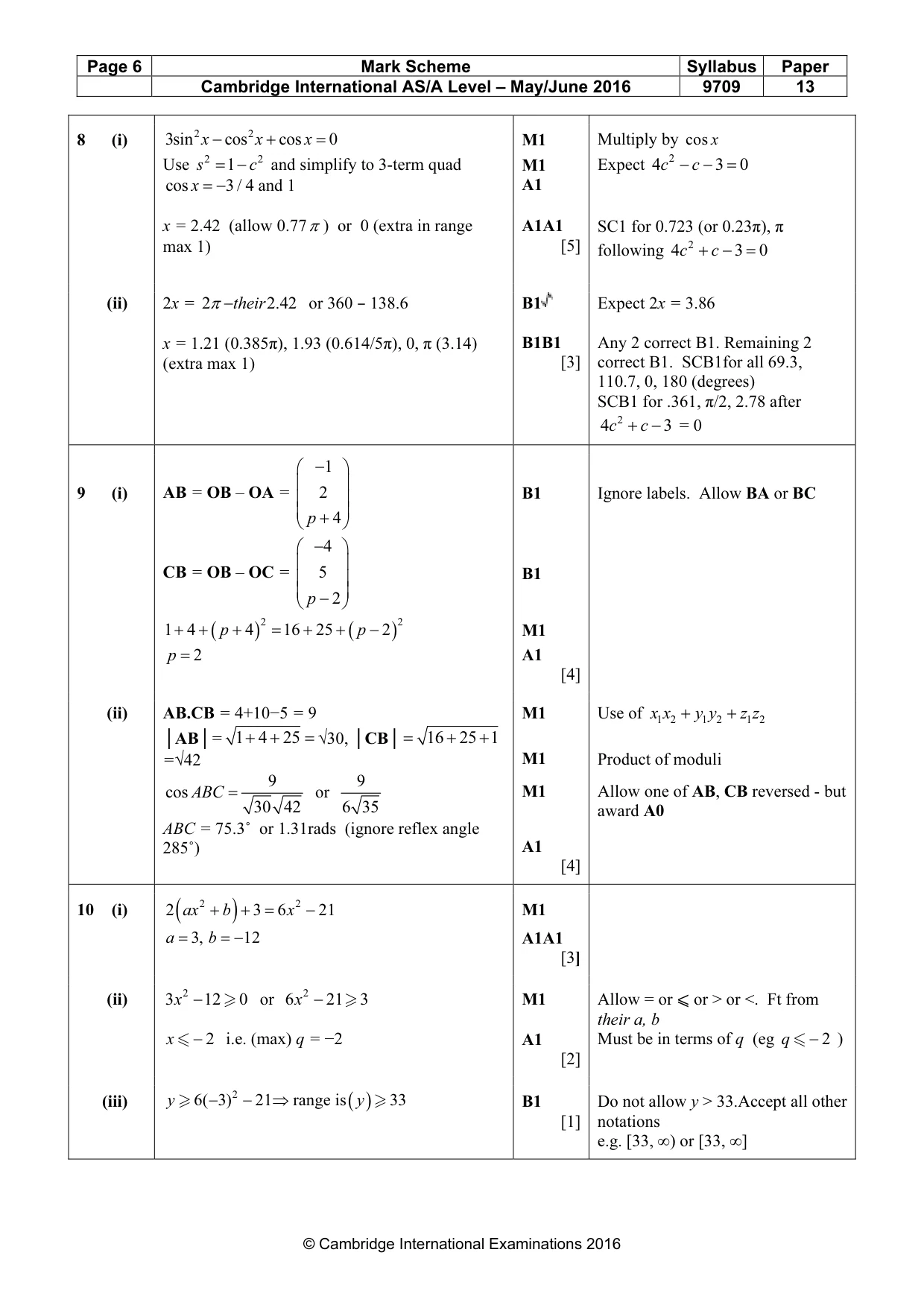
Mark scheme: 8 (i) 3sin 2 x − cos 2 x + cos x = 0 M1 Multiply by cos x Use s 2 = 1 − c 2 and simplify to 3-term quad M1 Expect 4c 2 −−c 3 = 0 cos x = −3 / 4 and 1 A1 x = 2.42 (allow 0.77π ) or 0 (extra in range A1A1 SC1 for 0.723 (or 0.23π), π max 1) [5] following 4c 2 + c − 3 = 0 (ii) 2x = 2π −their 2.42 or 360 – 138.6 B1 Expect 2x = 3.86 x = 1.21 (0.385π), 1.93 (0.614/5π), 0, π (3.14) B1B1 Any 2 correct B1. Remaining 2 (extra max 1) [3] correct B1. SCB1for all 69.3, 110.7, 0, 180 (degrees) SCB1 for .361, π/2, 2.78 after 4c 2 + c − 3 = 0 −1
Q9 · The position vectors of A, B and C relative to an origin O are given by ` a ` a ` a 2 1 5…
9 The position vectors of A, B and C relative to an origin O are given by ` a ` a ` a 2 1 5 −−→ −−→ −−→ OA = 3 , OB = 5 and OC = 0 , −4 p 2 where p is a constant. (i) Find the value of p for which the lengths of AB and CB are equal. [4] (ii) For the case where p = 1, use a scalar product to find angle ABC. [4] [Questions 10 and 11 are printed on the next page.]
Mark scheme: 9 (i) AB = OB – OA = 2 B1 Ignore labels. Allow BA or BC p + 4 −4 CB = OB – OC = 5 B1 p − 2 2 2 1 + 4 + ( p + 4 ) = 16 + 25 + ( p − 2 ) M1 p = 2 A1 [4] (ii) AB.CB = 4+10−5 = 9 M1 Use of x1 x2 + y1 y2 + z1 z 2 │AB│= 1 + 4 + 25 = √30, │CB│ = 16 + 25 + 1 =√42 M1 Product of moduli 9 9 cos ABC = or M1 Allow one of AB, CB reversed - but 30 42 6 35 award A0 ABC = 75.3˚ or 1.31rads (ignore reflex angle 285˚) A1 [4] ( 2 ) 2
Q11 · Triangle ABC has vertices at A −2, −1 , B 4, 6 and C 6, −3
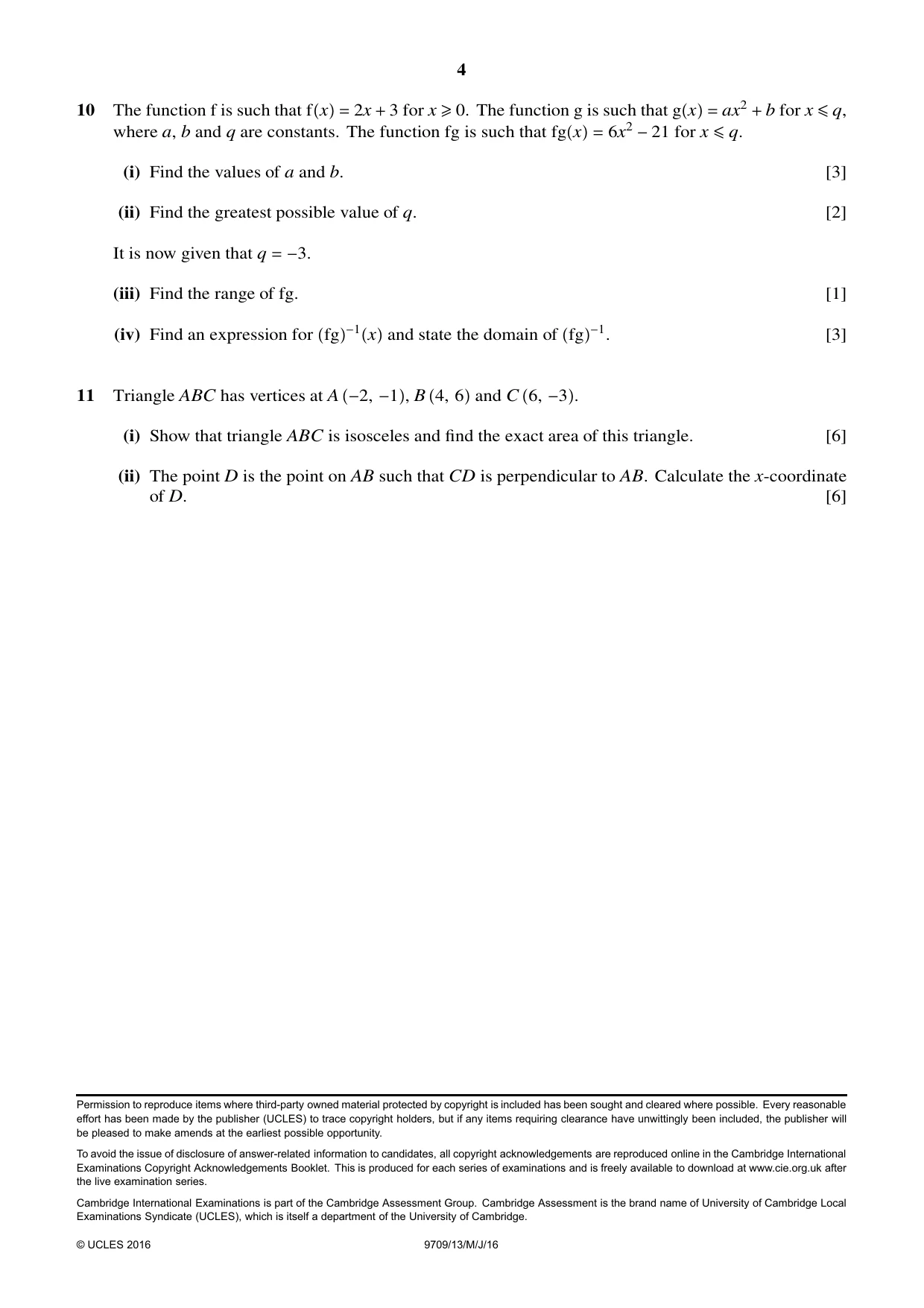
11 Triangle ABC has vertices at A −2, −1 , B 4, 6 and C 6, −3 . (i) Show that triangle ABC is isosceles and find the exact area of this triangle. [6] (ii) The point D is the point on AB such that CD is perpendicular to AB. Calculate the x-coordinate of D. [6]
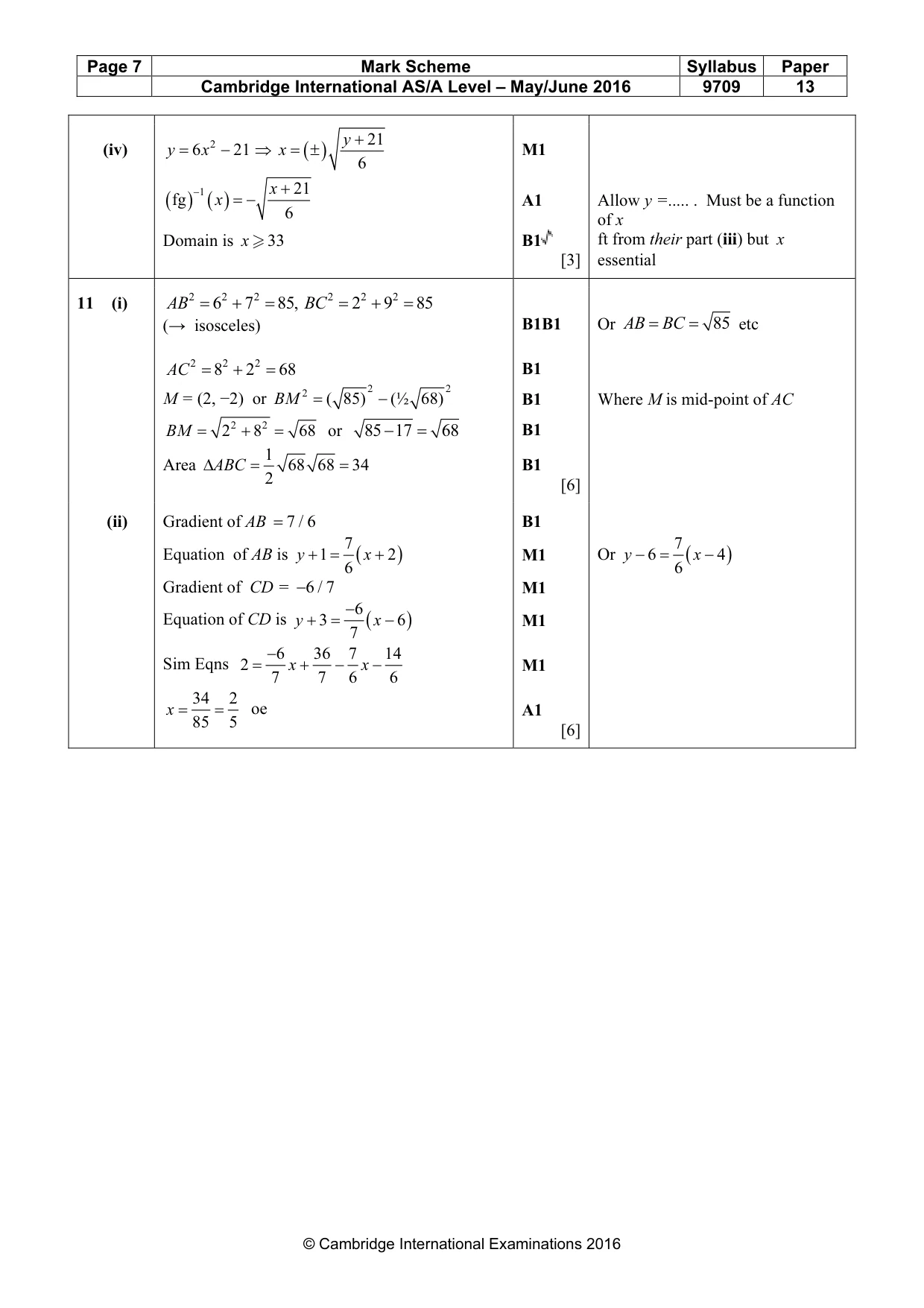
Mark scheme: 11 (i) AB 2 = 6 2 + 7 2 = 85, BC 2 = 2 2 + 9 2 = 85 (→ isosceles) B1B1 Or AB = BC = 85 etc AC 2 = 82 + 2 2 = 68 B1 2 2 2 M = (2, −2) or BM = ( 85) − (½ 68) B1 Where M is mid-point of AC BM = 2 2 + 8 2 = 68 or 85 − 17 = 68 B1 1 Area ∆ABC = 68 68 = 34 B1 2 [6] (ii) Gradient of AB = 7 / 6 B1 7 7 Equation of AB is y + 1 = ( x + 2 ) M1 Or y − 6 = ( x − 4 ) 6 6 Gradient of CD = −6 / 7 M1 − 6 Equation of CD is y + 3 = ( x − 6 ) M1 7 − 6 36 7 14 Sim Eqns 2 = x + − x − M1 7 7 6 6 34 2 x = = oe A1 85 5 [6]
What was in this paper
The subtopics covered by these 7 questions, and how many questions each got. Open one in a new tab to see every Cambridge question on it.
What you needed in this session
Cambridge’s own grade thresholds for 2016 May/June, Paper 1 · Variant 3. A higher threshold means an easier paper — the bar moves with how the cohort did.