Cambridge A Level Mathematics 9709 — 2015 May/June Paper 1 · Variant 3
9709/13/M/J/15 · 6 questions · 75 marks · ≈84 min
The question paper and its mark scheme, free to read here and free to download. This is Cambridge’s own paper, exactly as it was sat.
Question paper4 pages
Mark scheme7 pages
Answers below. Sit the paper first if you are practising.
Questions as text
Q4 · Express the equation 3 sin 1 = cos 1 in the form tan 1 = k and solve the equation for 0Å…
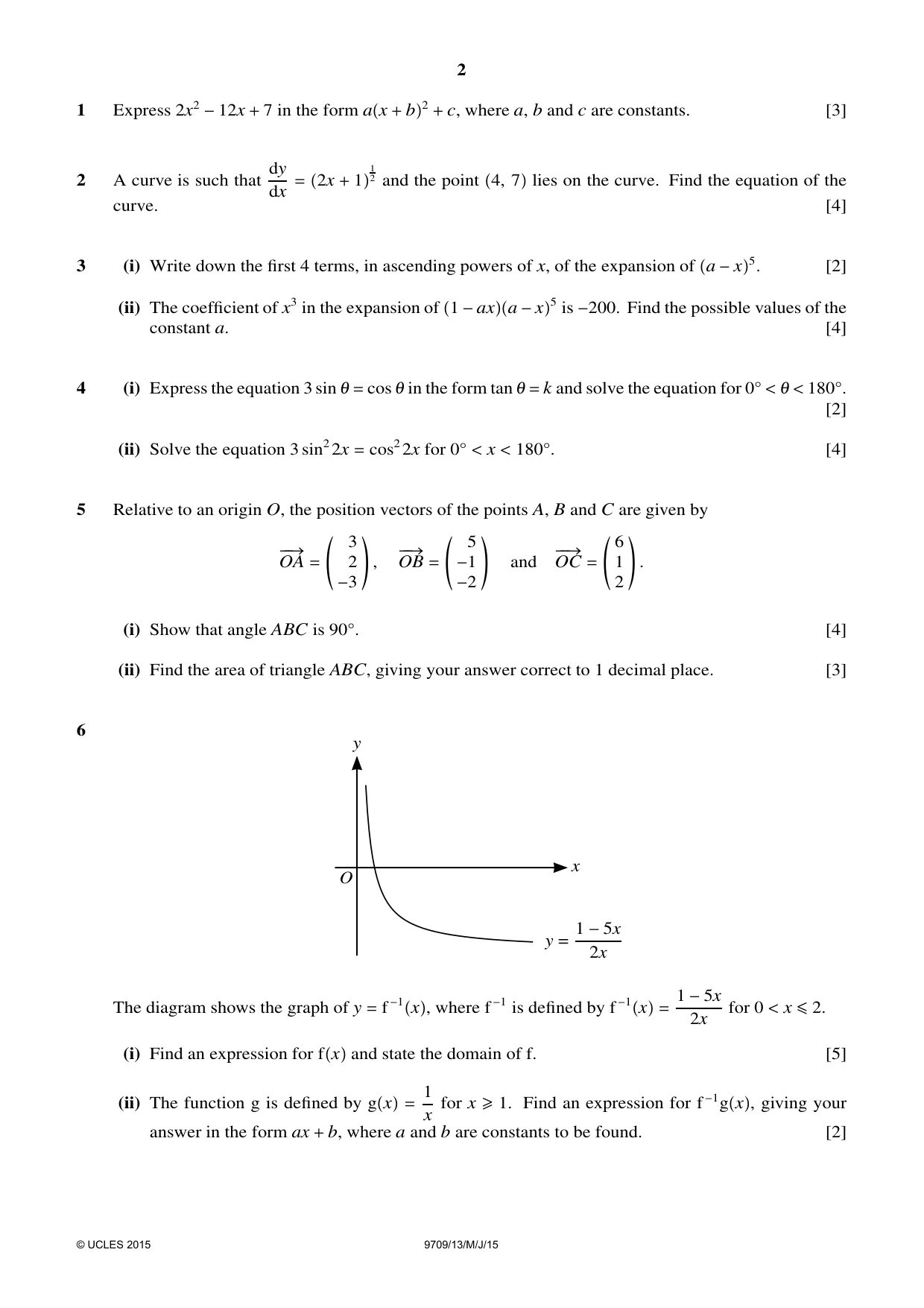
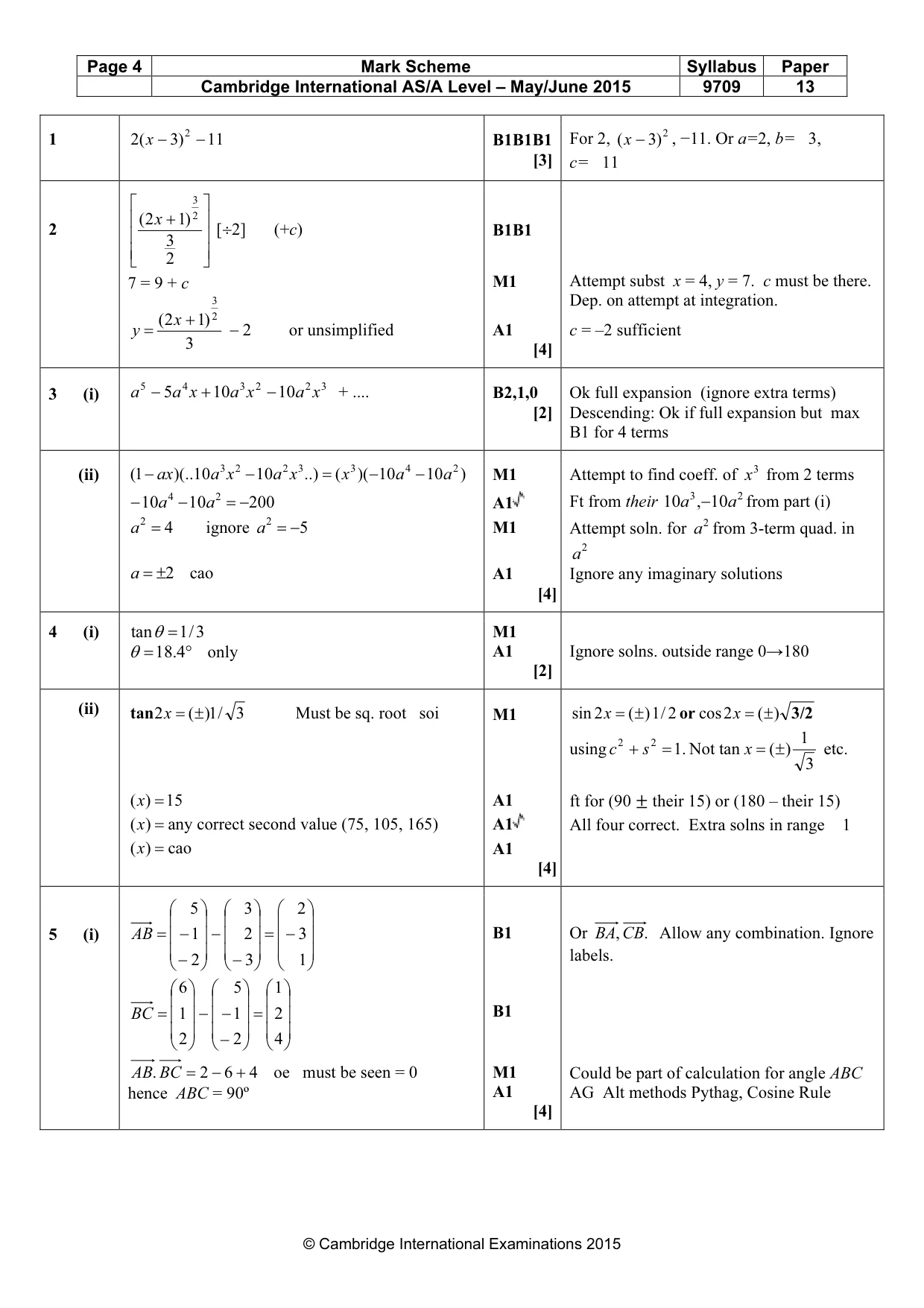
4 (i) Express the equation 3 sin 1 = cos 1 in the form tan 1 = k and solve the equation for 0Å < 1 < 180Å. [2] (ii) Solve the equation 3 sin22x = cos22x for 0Å < x < 180Å. [4]
Mark scheme: 4 (i) tan θ = 1 / 3 M1 θ = 184.° only A1 Ignore solns. outside range 0→180 [2] (ii) tan 2 x = ( ± 1) / 3 Must be sq. root soi M1 sin 2 x = ( ± ) 1 / 2 or cos 2 x = ( ± ) 3/2 2 2 1 using c + s = .1 Not tan x = ( ± ) etc. 3 ( x ) = 15 A1 ft for (90 their 15) or (180 – their 15) (x ) = any correct second value (75, 105, 165) A1 All four correct. Extra solns in range 1 (x ) = cao A1 [4] 5 3 2
Q5 · Relative to an origin O, the position vectors of the points A, B and C are given by ` a `…
5 Relative to an origin O, the position vectors of the points A, B and C are given by ` a ` a ` a 3 5 6 −−→ −−→ −−→ OA = 2 , OB = −1 and OC = 1 . −3 −2 2 (i) Show that angle ABC is 90Å. [4] (ii) Find the area of triangle ABC, giving your answer correct to 1 decimal place. [3]
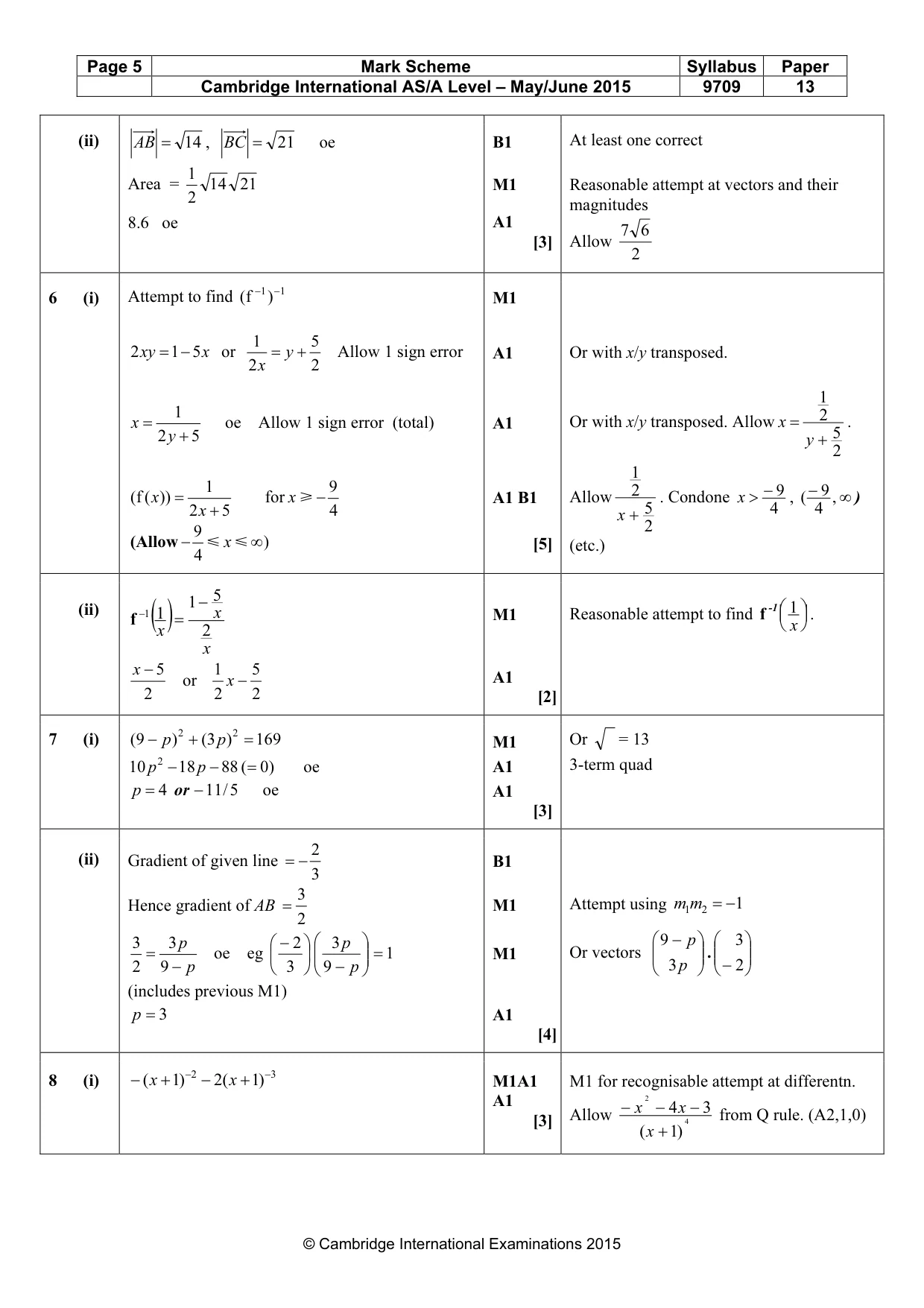
Mark scheme: 5 (i) AB = − 1 − 2 = − 3 B1 Or BA, CB . Allow any combination. Ignore labels. 2 3 1 − − 6 5 1 BC = 1 − − 1 = 2 B1 2 − 2 4 AB. BC = 2 − 6 + 4 oe must be seen = 0 M1 Could be part of calculation for angle ABC hence ABC = 90º A1 AG Alt methods Pythag, Cosine Rule [4] (ii) AB = 14 , BC = 21 oe B1 At least one correct 1 Area = 14 21 M1 Reasonable attempt at vectors and their 2 magnitudes 8.6 oe A1 7 6 [3] Allow 2 1 1
Q7 · The point A has coordinates p, 1 and the point B has coordinates 9, 3p + 1 , where p is a…
7 The point A has coordinates p, 1 and the point B has coordinates 9, 3p + 1 , where p is a constant. (i) For the case where the distance AB is 13 units, find the possible values of p. [3] (ii) For the case in which the line with equation 2x + 3y = 9 is perpendicular to AB, find the value of p. [4]
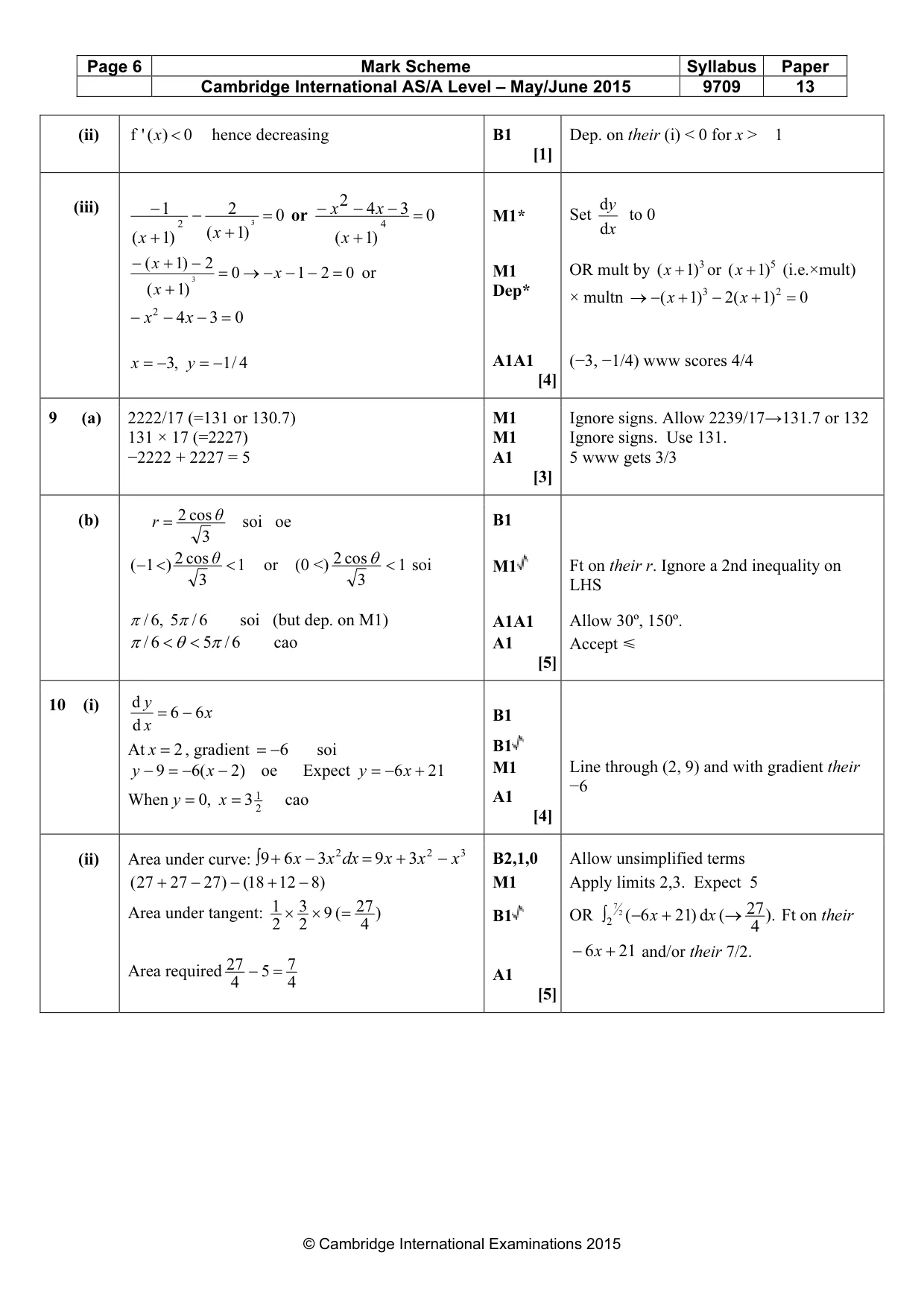
Mark scheme: 7 (i) (9 − p ) 2 + (3 p ) 2 = 169 M1 Or = 13 10 p 2 − 18 p − 88 ( = 0 ) oe A1 3-term quad p = 4 or − 11 / 5 oe A1 [3] 2 (ii) Gradient of given line = − B1 3 3 Hence gradient of AB = M1 Attempt using m1m2 = −1 2 3 3 p − 2 3 p −9 p 3 = oe eg = 1 M1 Or vectors . 2 9 − p 3 9 − p 3 p − 2 (includes previous M1) p = 3 A1 [4] 2 3
Q9 · The first term of an arithmetic progression is −2222 and the common difference is 17
9 (a) The first term of an arithmetic progression is −2222 and the common difference is 17. Find the value of the first positive term. [3] (b) The first term of a geometric progression is ï3 and the second term is 2 cos 1, where 0 < 1 < 0. Find the set of values of 1 for which the progression is convergent. [5]
Mark scheme: 9 (a) 2222/17 (=131 or 130.7) M1 Ignore signs. Allow 2239/17→131.7 or 132 131 × 17 (=2227) M1 Ignore signs. Use 131. −2222 + 2227 = 5 A1 5 www gets 3/3 [3] 2 cos θ (b) r = soi oe B1 3 2 cos θ 2 cos θ ( − 1 < ) < 1 or (0 <) < 1 soi M1 Ft on their r. Ignore a 2nd inequality on 3 3 LHS π / ,6 5π / 6 soi (but dep. on M1) A1A1 Allow 30º, 150º. π / 6 < θ < 5π / 6 cao A1 Accept Y [5] d
Q10 · Y A 2, 9 y = 9 + 6x −3x2 x O B C 3, 0 Points A 2, 9 and B 3, 0 lie on the curve y = 9 +…
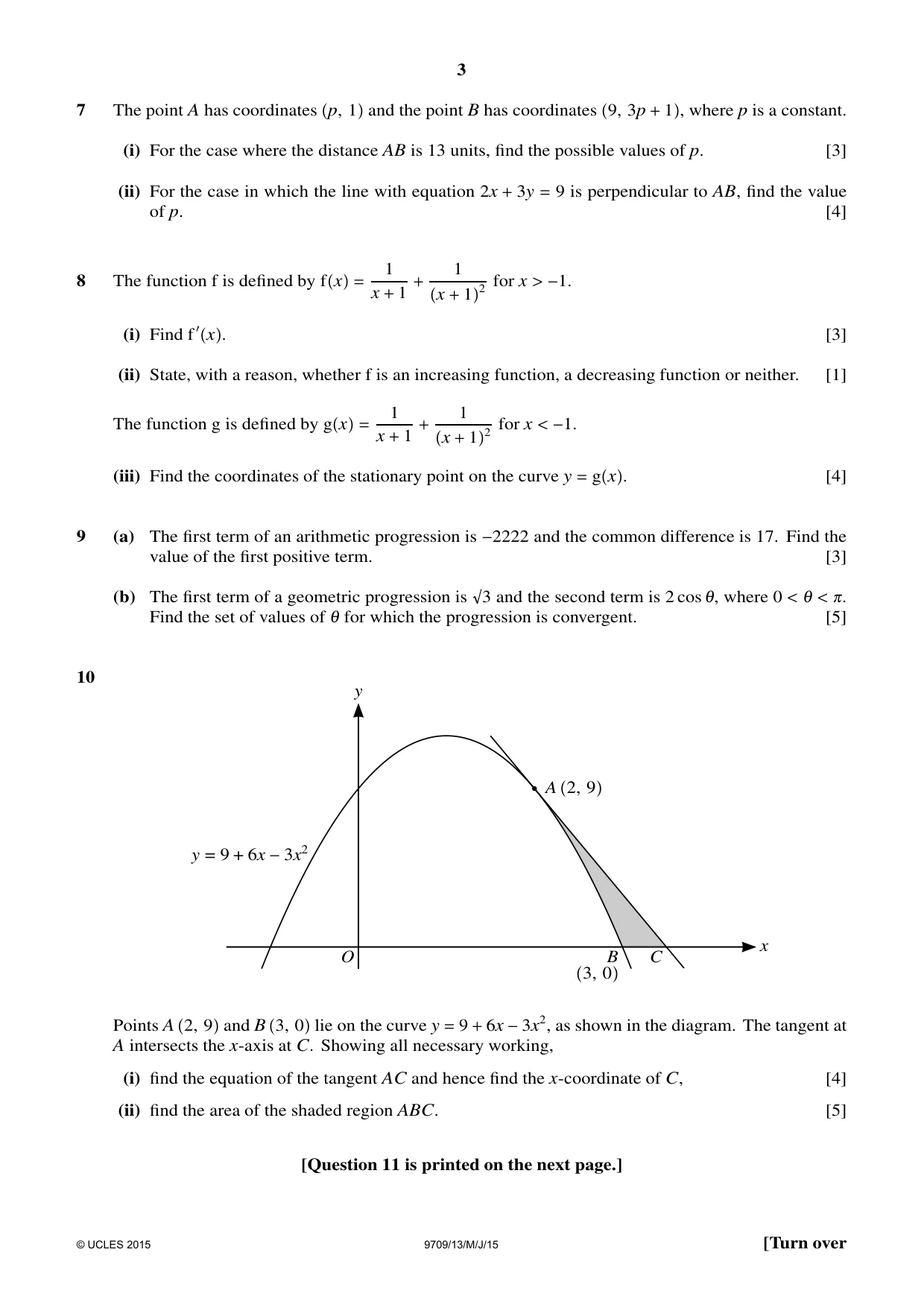
10 y A 2, 9 y = 9 + 6x −3x2 x O B C 3, 0 Points A 2, 9 and B 3, 0 lie on the curve y = 9 + 6x −3x2, as shown in the diagram. The tangent at A intersects the x-axis at C. Showing all necessary working, (i) find the equation of the tangent AC and hence find the x-coordinate of C, [4] (ii) find the area of the shaded region ABC. [5] [Question 11 is printed on the next page.]
Mark scheme: d y10 (i) = 6 − 6 x B1 d x At x = 2 , gradient = −6 soi B1 y − 9 = −6 ( x − 2 ) oe Expect y = −6 x + 21 M1 Line through (2, 9) and with gradient their −6 When y = ,0 x = 3 12 cao A1 [4] (ii) Area under curve: ∫ 9 + 6 x − 3 x 2 dx = 9 x + 3 x 2 − x 3 B2,1,0 Allow unsimplified terms ( 27 + 27 − 27 ) − (18 + 12 − 8) M1 Apply limits 2,3. Expect 5 27 3 27 1 × × 9 ( = Area under tangent: 2 ( −6 x + 21) dx ( → ). Ft on their ) B1 OR ∫ 2 7 2 2 4 4 −x6 + 21 and/or their 7/2. 27 7 Area required − 5 = A1 4 4 [5]
Q11 · A r O !
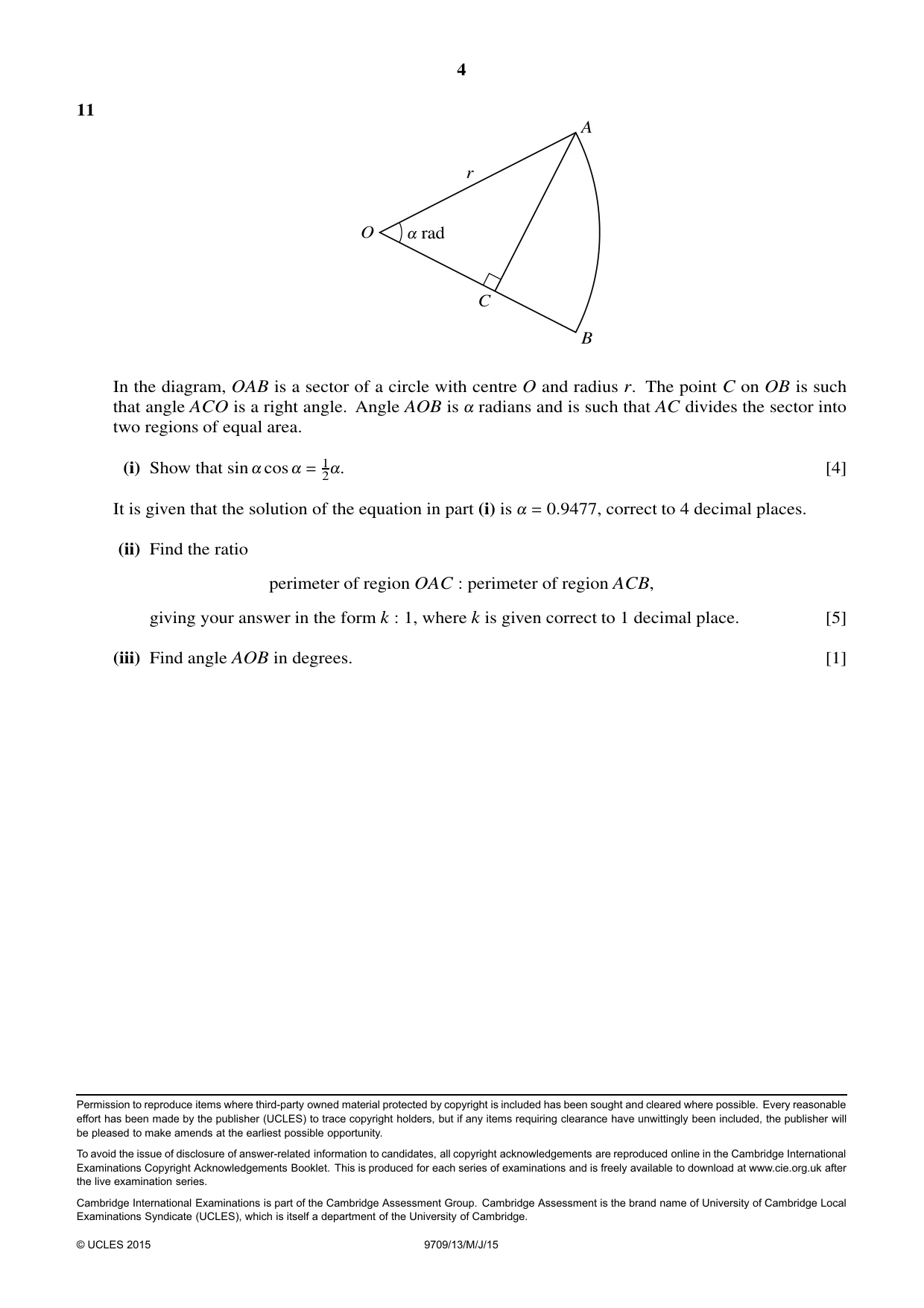
11 A r O ! rad C B In the diagram, OAB is a sector of a circle with centre O and radius r. The point C on OB is such that angle ACO is a right angle. Angle AOB is ! radians and is such that AC divides the sector into two regions of equal area. (i) Show that sin ! cos ! = 12!. [4] It is given that the solution of the equation in part (i) is ! = 0.9477, correct to 4 decimal places. (ii) Find the ratio perimeter of region OAC : perimeter of region ACB, giving your answer in the form k : 1, where k is given correct to 1 decimal place. [5] (iii) Find angle AOB in degrees. [1]
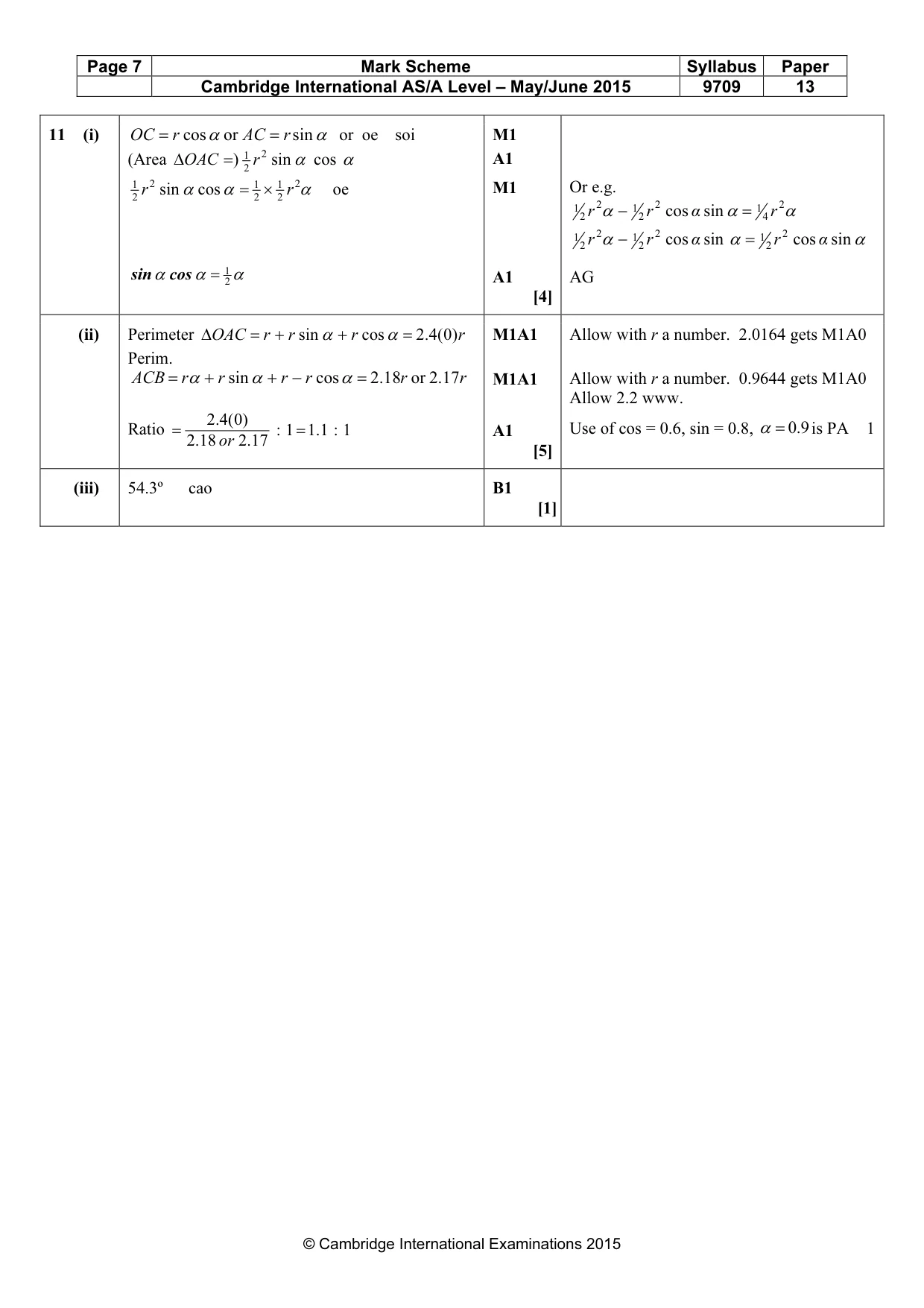
Mark scheme: 11 (i) OC = r cos α or AC = r sin α or oe soi M1 (Area ∆OAC = ) 12 r 2 sin α cos α A1 1 r 2 sin α cos α = 1 × 1 r 2α oe M1 Or e.g. 2 2 2 1 2 r 2α − 1 2 r 2 cos α sin α = 1 4 r 2α 1 2 r 2α − 1 2 r 2 cos α sin α = 1 2 r 2 cos α sin α sin α cos α = 12 α A1 AG [4] (ii) Perimeter ∆OAC = r + r sin α + r cos α = 4.2 ( 0 ) r M1A1 Allow with r a number. 2.0164 gets M1A0 Perim. ACB = rα + r sin α + r − r cos α = 2.18r or 2.17r M1A1 Allow with r a number. 0.9644 gets M1A0 Allow 2.2 www. 4.2 ( 0 ) Ratio = : 1 = 1.1 : 1 A1 Use of cos = 0.6, sin = 0.8, α = 9.0 is PA 1 .2 18 or .2 17 [5] (iii) 54.3º cao B1 [1]
What was in this paper
The subtopics covered by these 6 questions, and how many questions each got. Open one in a new tab to see every Cambridge question on it.
What you needed in this session
Cambridge’s own grade thresholds for 2015 May/June, Paper 1 · Variant 3. A higher threshold means an easier paper — the bar moves with how the cohort did.