Cambridge A Level Mathematics 9709 — 2013 May/June Paper 1 · Variant 3
9709/13/M/J/13 · 6 questions · 75 marks · ≈84 min
The question paper and its mark scheme, free to read here and free to download. This is Cambridge’s own paper, exactly as it was sat.
Question paper4 pages
Mark scheme7 pages
Answers below. Sit the paper first if you are practising.
Questions as text
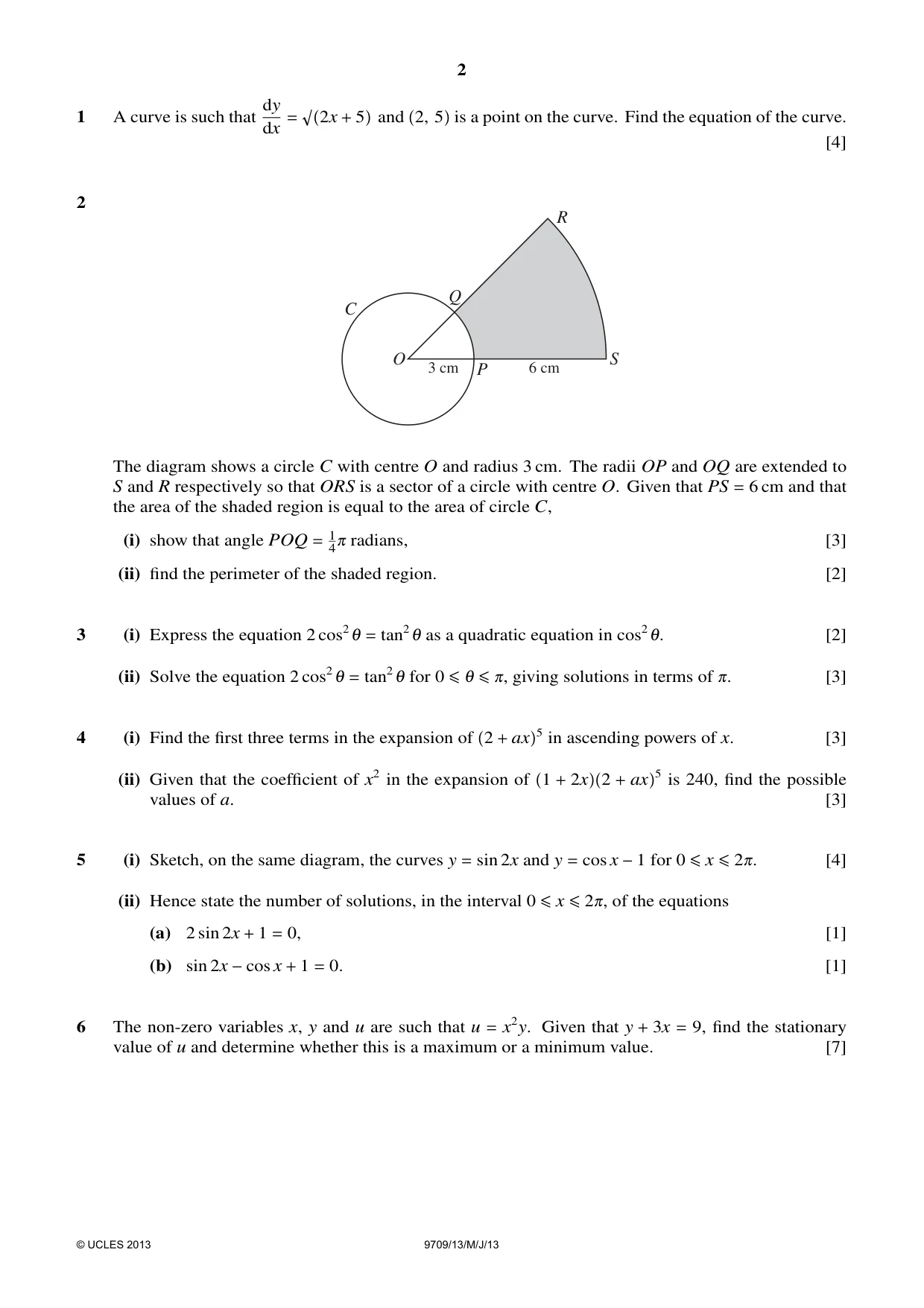
Q2 · R Q C O S 3 cm P 6 cm The diagram shows a circle C with centre O and radius 3 cm
2 R Q C O S 3 cm P 6 cm The diagram shows a circle C with centre O and radius 3 cm. The radii OP and OQ are extended to S and R respectively so that ORS is a sector of a circle with centre O. Given that PS = 6 cm and that the area of the shaded region is equal to the area of circle C, (i) show that angle POQ = 140 radians, [3] (ii) find the perimeter of the shaded region. [2]
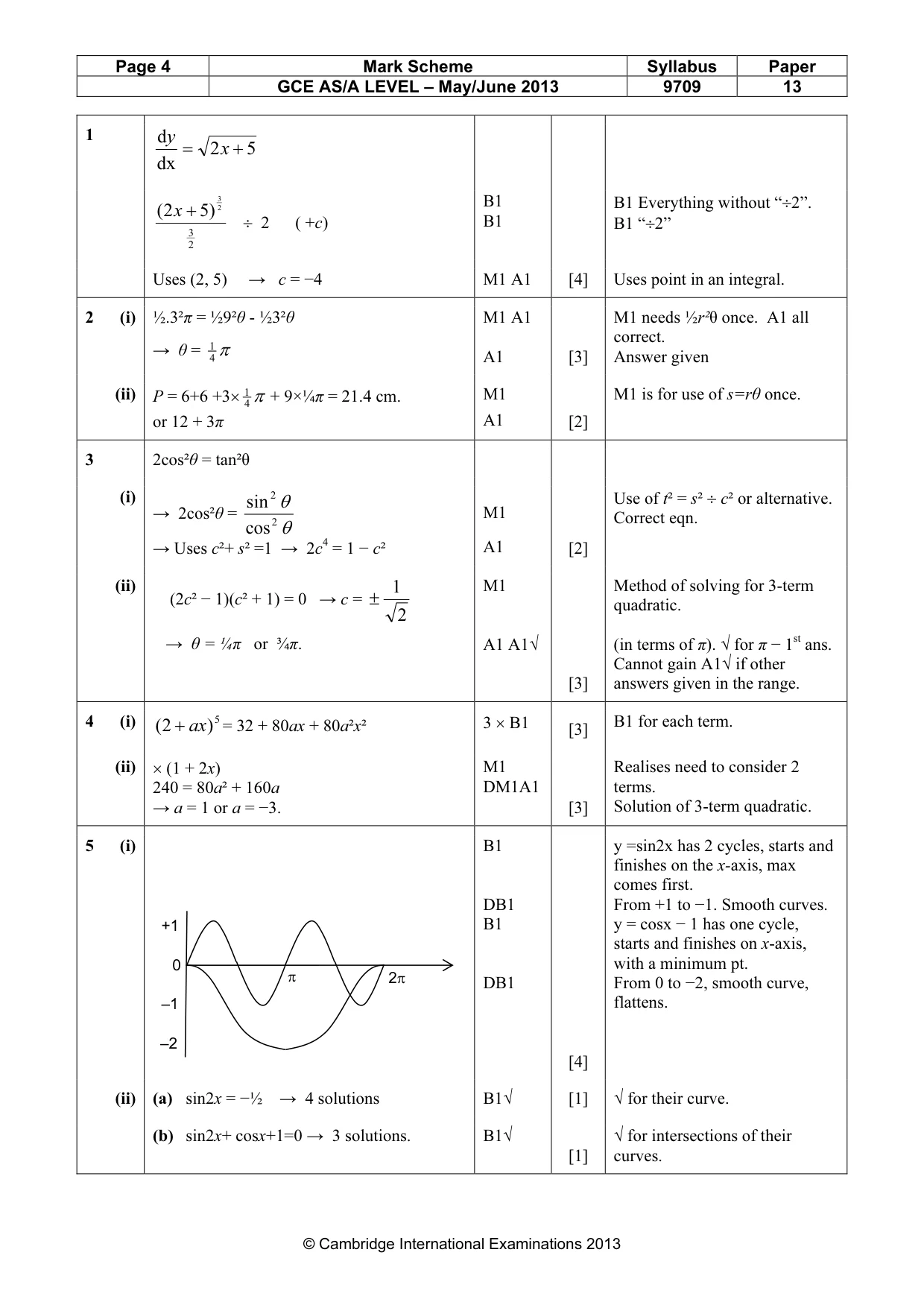
Mark scheme: 1 dy = 2 x + 5 dx
Q3 · Express the equation 2 cos21 = tan21 as a quadratic equation in cos21
3 (i) Express the equation 2 cos21 = tan21 as a quadratic equation in cos21. [2] (ii) Solve the equation 2 cos21 = tan21 for 0 ≤1 ≤0, giving solutions in terms of 0. [3]
Mark scheme: 3 B1 B1 Everything without “÷2”
Q6 · The non-zero variables x, y and u are such that u = x2y
6 The non-zero variables x, y and u are such that u = x2y. Given that y + 3x = 9, find the stationary value of u and determine whether this is a maximum or a minimum value. [7]
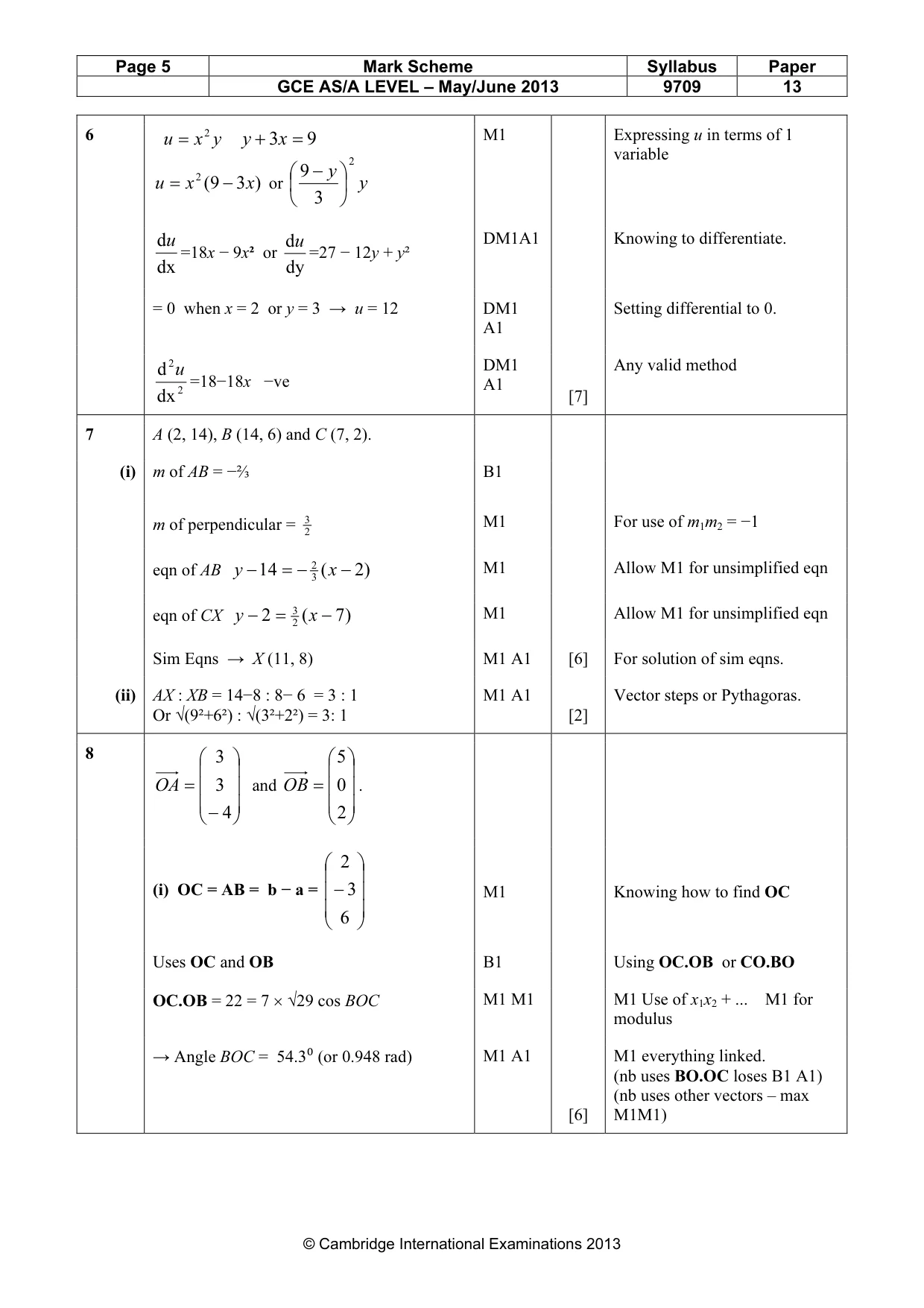
Mark scheme: 6 u = x 2 y y + 3 x = 9 M1 Expressing u in terms of 1 2 variable 2 9 − y u = x (9 − 3 x ) or y 3 du du DM1A1 Knowing to differentiate. =18x − 9x² or =27 − 12y + y² dx dy = 0 when x = 2 or y = 3 → u = 12 DM1 Setting differential to 0. A1 d 2 u DM1 Any valid method 2 =18−18x −ve A1 dx [7]
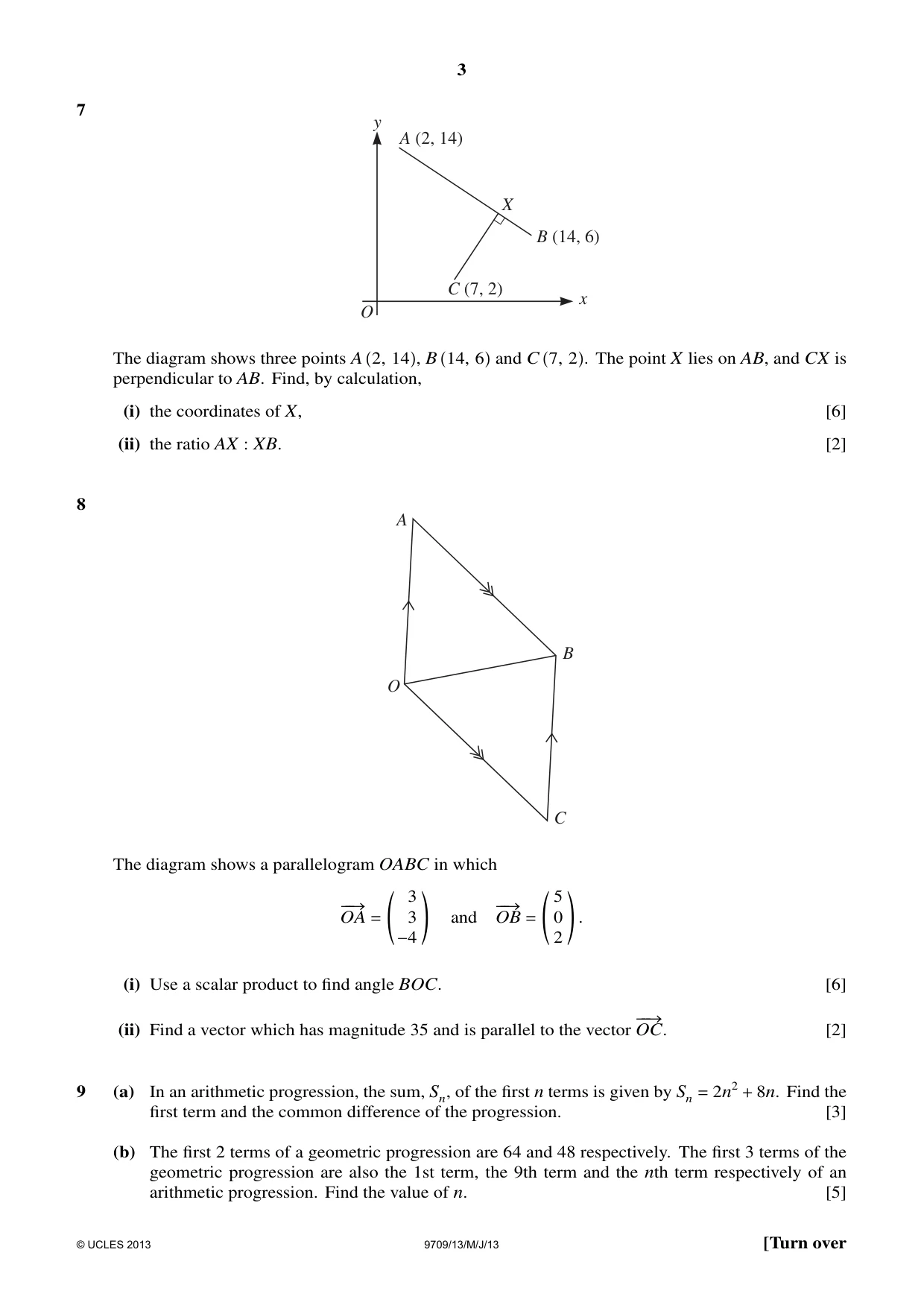
Q7 · Y A (2, 14) X B (14, 6) C (7, 2) x O The diagram shows three points A 2, 14 , B 14, 6 and…
7 y A (2, 14) X B (14, 6) C (7, 2) x O The diagram shows three points A 2, 14 , B 14, 6 and C 7, 2 . The point X lies on AB, and CX is perpendicular to AB. Find, by calculation, (i) the coordinates of X, [6] (ii) the ratio AX : XB. [2]
Mark scheme: 7 A (2, 14), B (14, 6) and C (7, 2). (i) m of AB = −⅔ B1 m of perpendicular = 32 M1 For use of m1m2 = −1 eqn of AB y − 14 = − 23 ( x − 2) M1 Allow M1 for unsimplified eqn eqn of CX y − 2 = 32 ( x − 7 ) M1 Allow M1 for unsimplified eqn Sim Eqns → X (11, 8) M1 A1 [6] For solution of sim eqns. (ii) AX : XB = 14−8 : 8− 6 = 3 : 1 M1 A1 Vector steps or Pythagoras. Or √(9²+6²) : √(3²+2²) = 3: 1 [2]
Q8 · A B O C The diagram shows a parallelogram OABC in which ` a ` a 3 5 −−→ −−→ OA = 3 and OB…
8 A B O C The diagram shows a parallelogram OABC in which ` a ` a 3 5 −−→ −−→ OA = 3 and OB = 0 . −4 2 (i) Use a scalar product to find angle BOC. [6] −−→ (ii) Find a vector which has magnitude 35 and is parallel to the vector OC. [2]
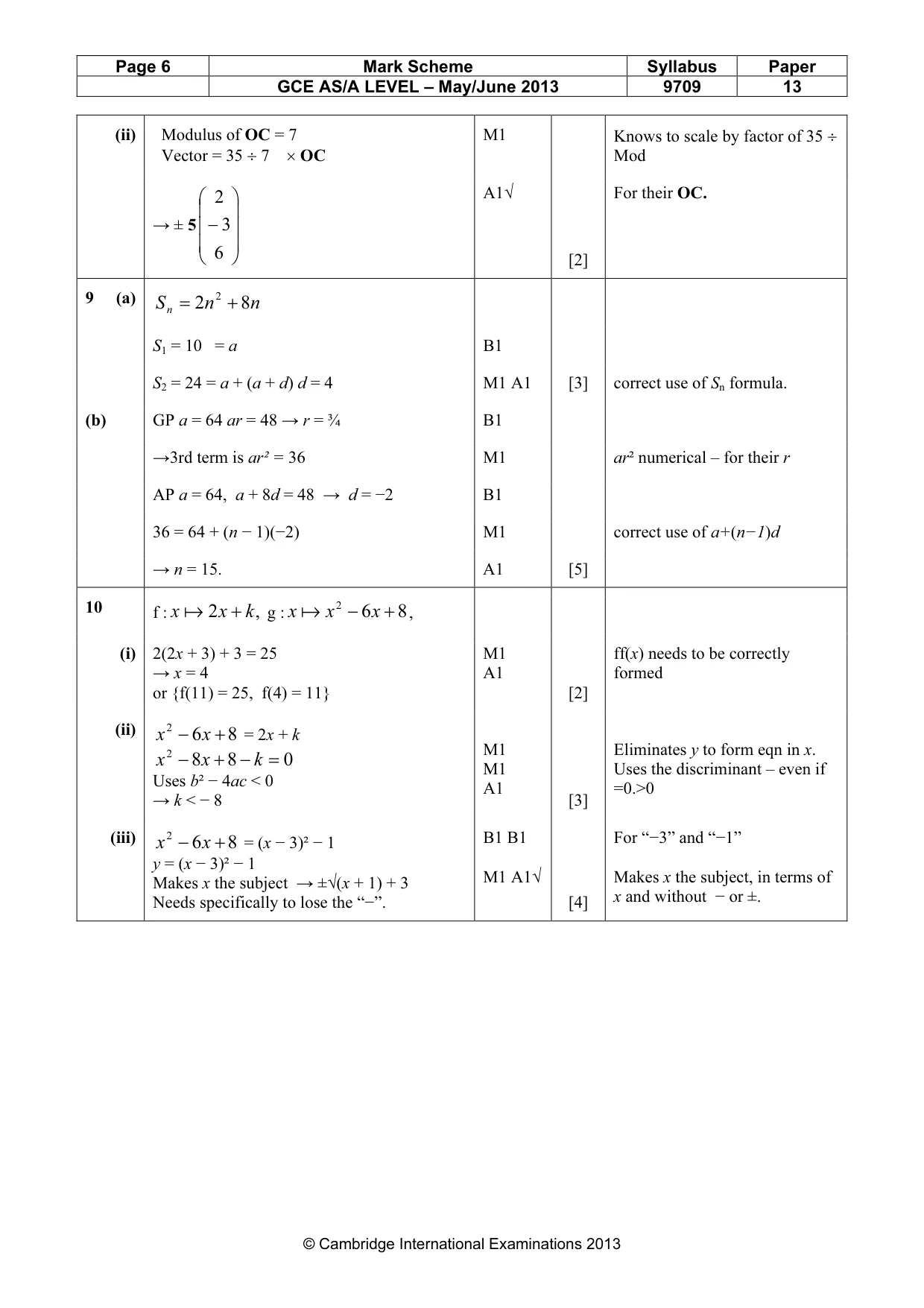
Mark scheme: 8 3 5 OA = 3 and OB = 0 . − 4 2 2 (i) OC = AB = b − a = − 3 M1 Knowing how to find OC 6 Uses OC and OB B1 Using OC.OB or CO.BO OC.OB = 22 = 7 × √29 cos BOC M1 M1 M1 Use of x1x2 + ... M1 for modulus → Angle BOC = 54.3⁰ (or 0.948 rad) M1 A1 M1 everything linked. (nb uses BO.OC loses B1 A1) (nb uses other vectors – max [6] M1M1) GCE AS/A LEVEL – May/June 2013 9709 13 (ii) Modulus of OC = 7 M1 Knows to scale by factor of 35 ÷ Vector = 35 ÷ 7 × OC Mod 2 A1√ For their OC. → ± 5 − 3 6 [2]
Q9 · In an arithmetic progression, the sum, Sn, of the first n terms is given by Sn = 2n2 + 8n
9 (a) In an arithmetic progression, the sum, Sn, of the first n terms is given by Sn = 2n2 + 8n. Find the first term and the common difference of the progression. [3] (b) The first 2 terms of a geometric progression are 64 and 48 respectively. The first 3 terms of the geometric progression are also the 1st term, the 9th term and the nth term respectively of an arithmetic progression. Find the value of n. [5]
Mark scheme: 9 (a) Sn = 2 n 2 + 8n S1 = 10 = a B1 S2 = 24 = a + (a + d) d = 4 M1 A1 [3] correct use of Sn formula. (b) GP a = 64 ar = 48 → r = ¾ B1 →3rd term is ar² = 36 M1 ar² numerical – for their r AP a = 64, a + 8d = 48 → d = −2 B1 36 = 64 + (n − 1)(−2) M1 correct use of a+(n−1)d → n = 15. A1 [5]
What was in this paper
The subtopics covered by these 6 questions, and how many questions each got. Open one in a new tab to see every Cambridge question on it.
What you needed in this session
Cambridge’s own grade thresholds for 2013 May/June, Paper 1 · Variant 3. A higher threshold means an easier paper — the bar moves with how the cohort did.