Questions as text
Q1 · The parametric equations of a curve are x a sin3t, = a cos3t, y = where a is a positive… 9709/31 May/June 2009
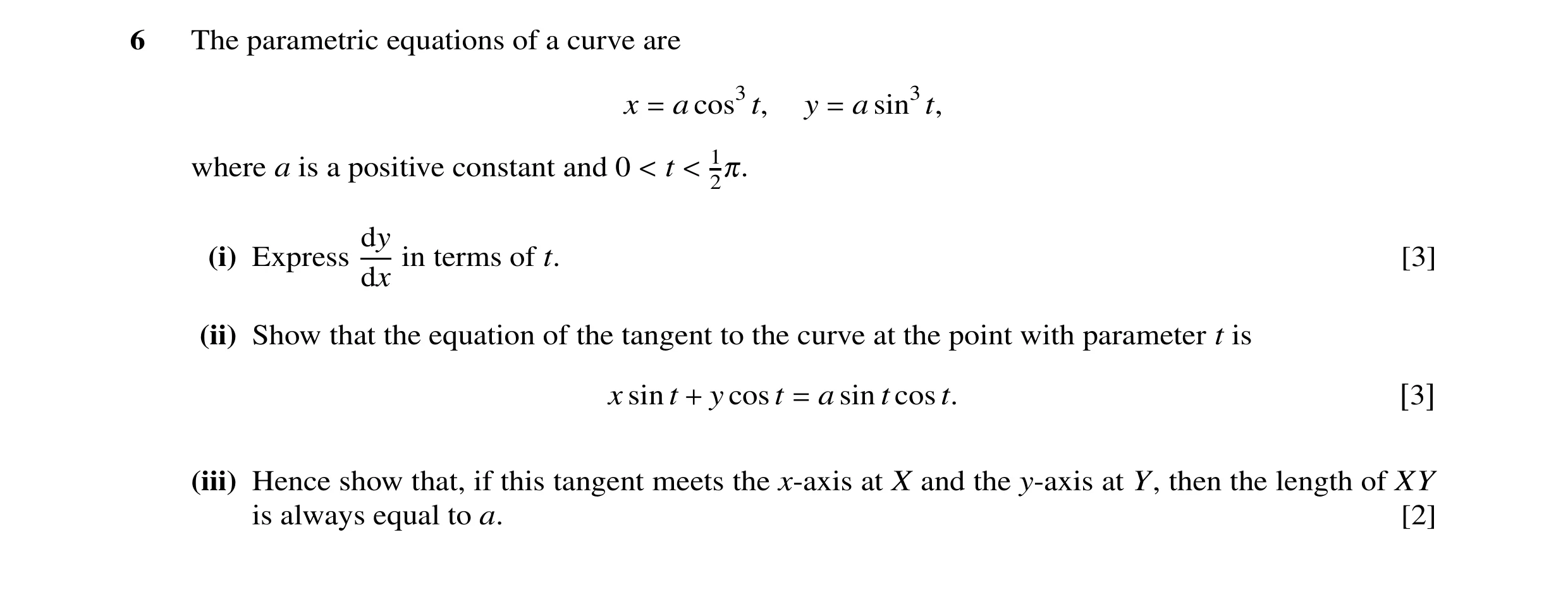
6 The parametric equations of a curve are x a sin3t, = a cos3t, y = where a is a positive constant and 0 t 12π. < < dy (i) Express in terms of t. [3] dx (ii) Show that the equation of the tangent to the curve at the point with parameter t is x sin t y cos t a sin t cos t. + = [3] (iii) Hence show that, if this tangent meets the x-axis at X and the y-axis at Y, then the length of XY is always equal to a. [2]
8 marks
Mark scheme: dx 2 dy 2 6 (i) EITHER State = −3a cos t sin t or = 3a sin t cos t , or equivalent B1 d t d t dy dy dx Use = ÷ M1 dx dt dt 2 − 13 2 − 13 23 23 OR State 3 x d x or 3 y d y as differentials of x or y respectively, or equivalent B1 dy Obtain in terms of t, having taken the differential of a constant to be zero M1 dx dy Obtain in any correct form A1 3 dx (ii) Form the equation of the tangent M1 Obtain the equation in any correct form A1 Obtain the given answer A1 3 (iii) State the x-coordinate of X or the y-coordinate of Y in any correct form B1 Obtain the given answer with no errors seen B1 2 GCE A/AS LEVEL – May/June 2009 9709 03
This question in 9709/31 May/June 2009
Q2 · The complex number i is denoted by u 9709/31 Oct/Nov 2009
7 The complex number i is denoted by u. −2 + (i) Given that u is a root of the equation x3 0, where k is real, find the value of k. [3] −11x −k = (ii) Write down the other complex root of this equation. [1] (iii) Find the modulus and argument of u. [2] (iv) Sketch an Argand diagram showing the point representing u. Shade the region whose points represent the complex numbers satisfying both the inequalities ß and 0 |ß| < |ß −2| < arg(ß −u) < 14π. [4]
10 marks
Mark scheme: 7 (i) Substitute x = –2 + i in the equation and attempt expansion of (–2 + i)3 M1 Use i2 = –1 correctly at least once and solve for k M1 Obtain k = 20 A1 [3] (ii) State that the other complex root is –2 – i B1 [1] GCE A/AS LEVEL – October/November 2009 9709 31 (iii) Obtain modulus 5 B1 Obtain argument 153.4° or 2.68 radians B1 [2] (iv) Show point representing u in relatively correct position in an Argand diagram B1 Show vertical line through z = 1 B1 Show the correct half-lines from u of gradient zero and 1 B1 Shade the relevant region B1 [4] [SR: For parts (i) and (ii) allow the following alternative method: State that the other complex root is –2 – i B1 State quadratic factor x2 + 4x + 5 B1 Divide cubic by 3-term quadratic, equate remainder to zero and solve for k, or, using 3-term quadratic, factorise cubic and obtain k M1 Obtain k = 20 A1] A B C
This question in 9709/31 Oct/Nov 2009
Q3 · The plane p has equation 2x 16 9709/32 Oct/Nov 2009
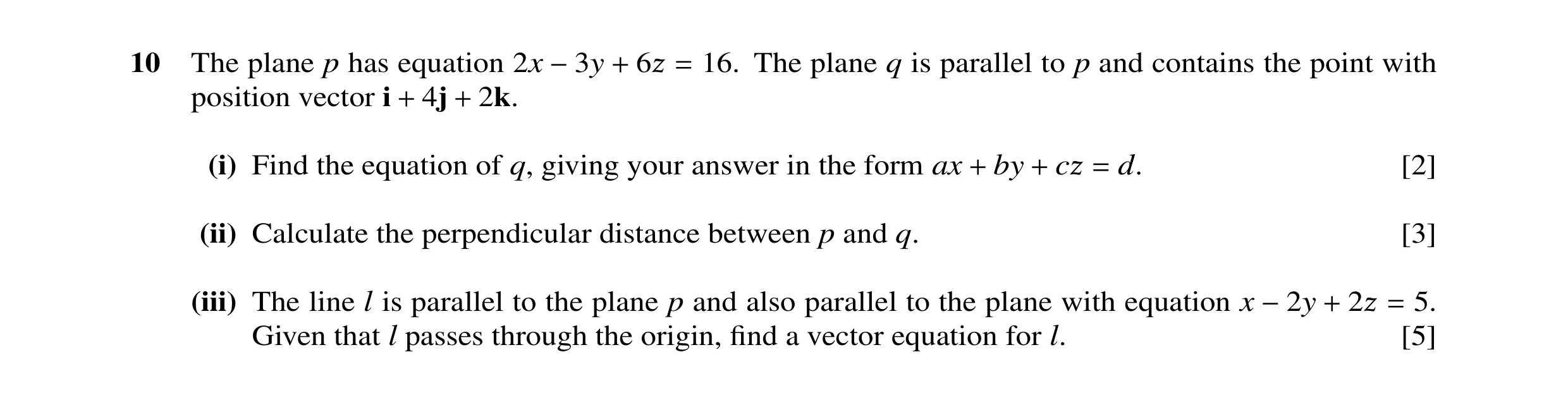
10 The plane p has equation 2x 16. The plane q is parallel to p and contains the point with position vector i 4j 2k. −3y + 6ß = + + (i) Find the equation of q, giving your answer in the form ax by d. [2] + + cß = (ii) Calculate the perpendicular distance between p and q. [3] (iii) The line l is parallel to the plane p and also parallel to the plane with equation x 5. Given that l passes through the origin, find a vector equation for l. −2y + 2ß =[5]
10 marks
Mark scheme: 10 (i) Substitute coordinates (1, 4, 2) in 2x – 3y + 6z = d M1 Obtain plane equation 2x – 3y + 6z = 2, or equivalent A1 [2] (ii) EITHER: Attempt to use plane perpendicular formula to find perpendicular from (1, 4, 2) to p M1 2 − 3( 4) + 6( 2) − 16 Obtain a correct unsimplified expression, e.g. A1 ( 2 2 + ( −3) 2 + 6 2 ) Obtain answer 2 A1 OR1: State or imply perpendicular from O to p is 16 , or from O to q is 2 , or 7 7 equivalent B1 Find difference in perpendiculars M1 Obtain answer 2 A1 OR2: Obtain correct parameter value, or position vector or coordinates of foot of perpendicular from (1, 4, 2) to p (µ = ± 2 ; ( 11 , 22 , 26 )) B1 7 7 7 7 Calculate the length of the perpendicular M1 Obtain answer 2 A1 GCE A/AS LEVEL – October/November 2009 9709 32 OR3: Carry out correct method for finding the projection onto a normal vector of a line segment joining a point on p, e.g. (8, 0, 0) and a point on q, e.g. (1, 4, 2) M1 2(8 − )1 − (3 −4) + 6( −2) Obtain a correct unsimplified expression, e.g. A1 ( 2 2 + ( −3) 2 + 6 2 ) Obtain answer 2 A1 [3] (iii) EITHER: Calling the direction vector ai + bj + ck, use scalar product to obtain a relevant equation in a, b and c M1* Obtain two correct equations, e.g. 2a – 3b + 6c = 0, a – 2b + 2c = 0 A1 Solve for one ratio, e.g. a : b M1(dep*) Obtain a : b : c = 6 : 2 : –1, or equivalent A1 State answer r = λ(6i + 2j – k) or equivalent A1√ OR: Attempt to calculate vector product of two normals, e.g. (i – 2j + 2k) × (2i – 3j + 6k) M2 Obtain two correct components A1 Obtain –6i –2j + k, or equivalent A1 State answer r = λ(–6i – 2j + k), or equivalent A1√ [5]
This question in 9709/32 Oct/Nov 2009
Q4 · The lines l and m have vector equations r i j k and r 4i 6j k 2j = + + + s(i −j + 2k) = +… 9709/31 May/June 2010
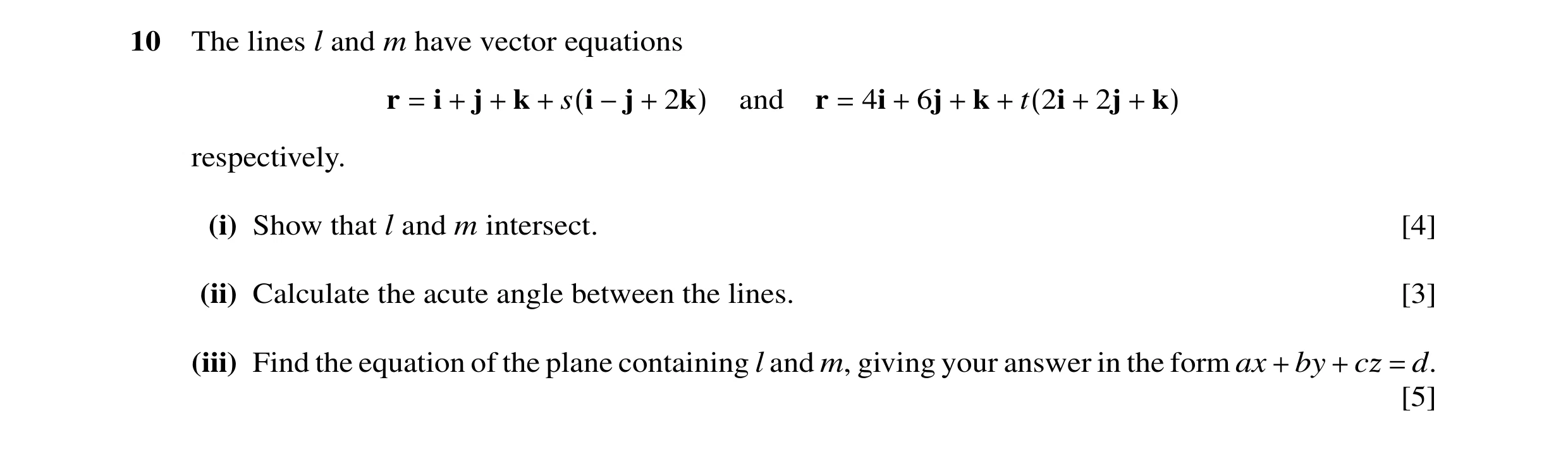
10 The lines l and m have vector equations r i j k and r 4i 6j k 2j = + + + s(i −j + 2k) = + + + t(2i + + k) respectively. (i) Show that l and m intersect. [4] (ii) Calculate the acute angle between the lines. [3] (iii) Find the equation of the plane containing l and m, giving your answer in the form ax by d. + + cß =[5]
12 marks
Mark scheme: 10 (i) Express general point of l or m in component form, e.g. (1 + s, 1 – s, 1 + 2s) or (4 + 2t, 6 + 2t, 1 + t) B1 Equate at least two corresponding pairs of components and solve for s or t M1 Obtain s = −1 or t = −2 A1 Verify that all three component equations are satisfied A1 [4] (ii) Carry out correct process for evaluating the scalar product of the direction vectors of l and m M1 Using the correct process for the moduli, divide the scalar product by the product of the moduli and evaluate the inverse cosine of the result M1 Obtain answer 74.2° (or 1.30 radians) A1 [3] (iii) EITHER: Use scalar product to obtain a – b + 2c = 0 and 2a + 2b + c = 0 B1 Solve and obtain one ratio, e.g. a : b M1 Obtain a : b : c = 5 : −3 : −4, or equivalent A1 Substitute coordinates of a relevant point and values for a, b and c in general equation of plane and evaluate d M1 Obtain answer 5x – 3y – 4z = −2, or equivalent A1 OR 1: Using two points on l and one on m, or vice versa, state three equations in a, b, c and d B1 Solve and obtain one ratio, e.g. a : b M1 Obtain a ratio of three of the unknowns, e.g. a : b : c = −5 : 3 : 4 A1 Use coordinates of a relevant point and found ratio to find the fourth unknown, e.g. d M1 Obtain answer –5x + 3y + 4z = 2, or equivalent A1 OR 2: Form a correct 2-parameter equation for the plane, e.g. r = i + j + k + λ(i – j + 2k) + µ(2i + 2j + k) B1 State three equations in x, y, z, λ and µ M1 State three correct equations A1 Eliminate λ and µ M1 Obtain answer 5x – 3y – 4z = −2, or equivalent A1 OR 3: Attempt to calculate vector product of direction vectors of l and m M1 Obtain two correct components of the product A1 Obtain correct product, e.g. –5i + 3j + 4k A1 Form a plane equation and use coordinates of a relevant point to calculate d M1 Obtain answer –5x + 3y + 4z = 2, or equivalent A1 [5]
This question in 9709/31 May/June 2010
Q5 · The equation of a curve is x ln y 2x 1 9709/32 May/June 2010
6 The equation of a curve is x ln y 2x 1. = + dy (i) Show that [4] dx = −yx2. (ii) Find the equation of the tangent to the curve at the point where y 1, giving your answer in the form ax by c 0. = [4] + + =
8 marks
Mark scheme: 1 dy 6 (i) EITHER: State or imply as derivative of ln y B1 y dx x dy State correct derivative of LHS, e.g. ln y + B1 y dx dy Differentiate RHS and obtain an expression for M1 dx Obtain given answer A1 2 x + 1 OR 1: State ln y = , or equivalent, and differentiate both sides M1 x 1 dy State correct derivative of LHS, e.g. B1 y dx State correct derivative of RHS, e.g. − 1 / x 2 B1 Rearrange and obtain given answer A1 OR 2: State y = exp( 2 + 1 / x ) , or equivalent, and attempt differentiation by chain rule M1 State correct derivative of RHS, e.g. − exp(2 + 1 / x /) x 2 B1 + B1 Obtain given answer A1 [4] [The B marks are for the exponential term and its multiplier.] (ii) State or imply x = − 12 when y = 1 B1 Substitute and obtain gradient of −4 B1√ Correctly form equation of tangent M1 Obtain final answer y + 4x + 1 = 0, or equivalent A1 [4]
This question in 9709/32 May/June 2010
Q6 · By sketching suitable graphs, show that the equation 4x2 cotx −1 = has only one root in… 9709/32 Oct/Nov 2010
4 (i) By sketching suitable graphs, show that the equation 4x2 cotx −1 = has only one root in the interval 0 x 12π. [2] < < (ii) Verify by calculation that this root lies between 0.6 and 1. [2] (iii) Use the iterative formula 1 2 xn+1 = √(1 + cotxn) to determine the root correct to 2 decimal places. Give the result of each iteration to 4 decimal places. [3]
7 marks
Mark scheme: 4 (i) Make recognisable sketch of a relevant graph over the given range B1 Sketch the other relevant graph on the same diagram and justify the given statement B1 [2] (ii) Consider sign of 4x2 – 1 – cot x at x = 0.6 and x = 1, or equivalent M1 Complete the argument correctly with correct calculated values A1 [2] (iii) Use the iterative formula correctly at least once M1 Obtain final answer 0.73 A1 Show sufficient iterations to at least 4 d.p. to justify its accuracy to 2 d.p., or show there is a sign change in the interval (0.725, 0.735) A1 [3] GCE A/AS LEVEL – October/November 2010 9709 32 dx
This question in 9709/32 Oct/Nov 2010
Q7 · Two planes have equations x + 2y −2ß = 7 and 2x + y + 3ß = 5 9709/32 May/June 2011
9 Two planes have equations x + 2y −2ß = 7 and 2x + y + 3ß = 5. (i) Calculate the acute angle between the planes. [4] (ii) Find a vector equation for the line of intersection of the planes. [6]
10 marks
Mark scheme: 9 (i) State or imply a correct normal vector to either plane, e.g. i + 2j –2k or 2i + j + 3k B1 Carry out correct process for evaluating the scalar product of the two normals M1 Using the correct process for the moduli, divide the scalar product by the product of the moduli and evaluate the inverse cosine of the result M1 Obtain the final answer 79.7° (or 1.39 radians) A1 [4] (ii) EITHER: Carry out a method for finding a point on the line M1 Obtain such a point, e.g. (1, 3, 0) A1 EITHER: State two correct equations for the direction vector (a, b, c) of the line, e.g. a + 2b – 2c = 0 and 2a + b + 3c = 0 B1 Solve for one ratio, e.g. a : b M1 Obtain a : b : c = 8 : –7 : –3, or equivalent A1 State a correct final answer, e.g. r = i + 3j + λ(8i – 7j – 3k) A1√ 31 3 OR1: Obtain a second point on the line, e.g. ,0 , A1 8 8 Subtract position vectors to find a direction vector M1 7 3 Obtain i − j − k, or equivalent A1 8 8 7 3 State a correct final answer, e.g. r = i + 3j + λ(i − j − k) A1√ 8 8 OR2: Attempt to calculate the vector product of two normals M1 Obtain two correct components A1 Obtain 8i – 7j – 3k, or equivalent A1 State a correct final answer, e.g. r = i + 3j + λ(8i – 7j – 3k) A1√ OR3: Express one variable in terms of a second M1 Obtain a correct simplified expression, e.g. x = (31 – 8y) / 7 A1 Express the first variable in terms of a third M1 Obtain a correct simplified expression, e.g. x = (3 – 8z) / 3 A1 Form a vector equation of the line M1 31 3 State a correct final answer, e.g. r = j + k + λ(8i – 7j – 3k) A1√ 8 8 OR4: Express one variable in terms of a second M1 Obtain a correct simplified expression, e.g. y = (31 – 7x) / 7 A1 Express the third variable in terms of the second M1 Obtain a correct simplified expression, e.g. z = (3 – 3x) / 8 A1 Form a vector equation of the line M1 31 3 State a correct final answer, e.g. r = j + k + λ(– 8i + 7j + 3k) A1√ [6] 8 8 [The f.t. is dependent on all M marks having been earned.] GCE AS/A LEVEL – May/June 2011 9709 32 2 ∫
This question in 9709/32 May/June 2011
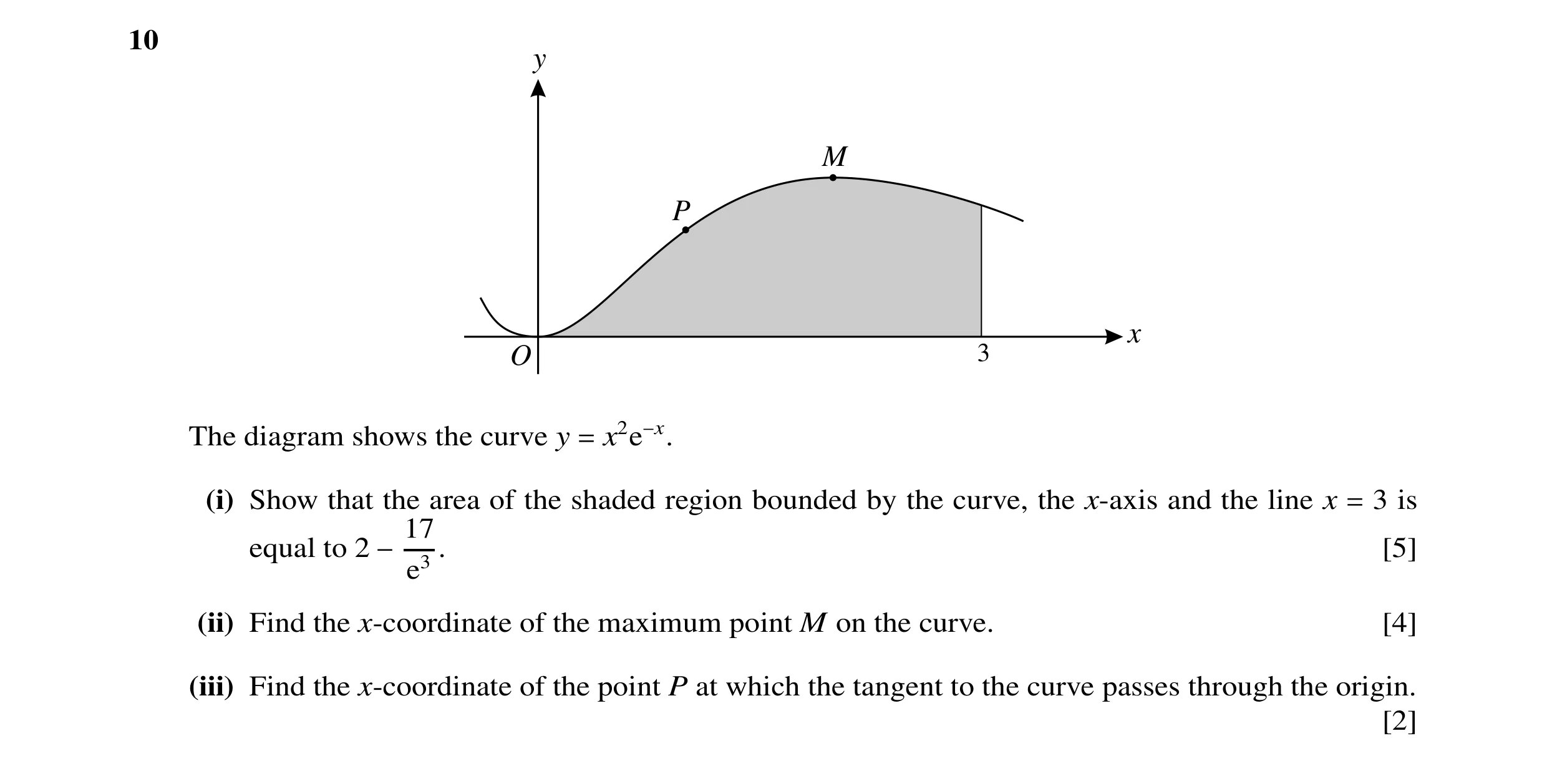
Q8 · Y M P x O 3 The diagram shows the curve y = x2e−x 9709/32 May/June 2011
10 y M P x O 3 The diagram shows the curve y = x2e−x. (i) Show that the area of the shaded region bounded by the curve, the x-axis and the line x = 3 is equal to 2 −17 . [5] e3 (ii) Find the x-coordinate of the maximum point M on the curve. [4] (iii) Find the x-coordinate of the point P at which the tangent to the curve passes through the origin. [2]
11 marks
Mark scheme: 10 (i) Attempt integration by parts and reach ± x 2 e −±x ∫ 2 xe − x dx M1* Obtain − x 2 e −+x ∫ 2 xe − x d x , or equivalent A1 Integrate and obtain –x2e–x – 2xe–x – 2e–x, or equivalent A1 Use limits x = 0 and x = 3, having integrated by parts twice M1(dep*) Obtain the given answer correctly A1 [5] (ii) Use correct product or quotient rule M1 Obtain correct derivative in any form A1 Equate derivative to zero and solve for non-zero x M1 Obtain x = 2 with no errors send A1 [4] (iii) Carry out a complete method for finding the x-coordinate of P M1 Obtain answer x =1 A1 [2]
This question in 9709/32 May/June 2011
Q9 · The parametric equations of a curve are x = t −tan t, y = ln cost , for −120 < t < 120 9709/32 May/June 2014
4 The parametric equations of a curve are x = t −tan t, y = ln cost , for −120 < t < 120. dy (i) Show that = cott. [5] dx (ii) Hence find the x-coordinate of the point on the curve at which the gradient is equal to 2. Give your answer correct to 3 significant figures. [2]
7 marks
Mark scheme: dx 24 (i) State = 1 − sec t , or equivalent B1 dt Use chain rule M1 dy sin t Obtain = − , or equivalent A1 dt cos t dy dy dx Use = ÷ M1 dx dt dt Obtain the given answer correctly. A1 5 (ii) State or imply t = tan −1 ( 12 ) B1 Obtain answer x = −0.0364 B1 2 GCE A LEVEL – May/June 2014 9709 32 2
This question in 9709/32 May/June 2014
Q10 · The parametric equations of a curve are 1 x , y tan3t, = cos3t = where 0 1 ≤t < 20 9709/31 Oct/Nov 2014
4 The parametric equations of a curve are 1 x , y tan3t, = cos3t = where 0 1 ≤t < 20. dy (i) Show that sin t. [4] dx = (ii) Hence show that the equation of the tangent to the curve at the point with parameter t is y x sint t. [3] = −tan
7 marks
Mark scheme: 4 (i) Use chain rule correctly at least once M1 dx 3sint dy 2 2 Obtain either = 4 or = 3tan t sec t , or equivalent A1 d t cos t dt dy dy dx Use = ÷ M1 dx dt dt Obtain the given answer A1 [4] (ii) State a correct equation for the tangent in any form B1 Use Pythagoras M1 Obtain the given answer A1 [3] 1 + 2i
This question in 9709/31 Oct/Nov 2014
Q11 · The parametric equations of a curve are 1 x , y tan3t, = cos3t = where 0 1 ≤t < 20 9709/32 Oct/Nov 2014
4 The parametric equations of a curve are 1 x , y tan3t, = cos3t = where 0 1 ≤t < 20. dy (i) Show that sin t. [4] dx = (ii) Hence show that the equation of the tangent to the curve at the point with parameter t is y x sint t. [3] = −tan
7 marks
Mark scheme: 4 (i) Use chain rule correctly at least once M1 dx 3sint dy 2 2 Obtain either = 4 or = 3tan t sec t , or equivalent A1 d t cos t dt dy dy dx Use = ÷ M1 dx dt dt Obtain the given answer A1 [4] (ii) State a correct equation for the tangent in any form B1 Use Pythagoras M1 Obtain the given answer A1 [3] 1 + 2i
This question in 9709/32 Oct/Nov 2014
Q12 · The parametric equations of a curve are x a cos4t, y a sin4t, = = where a is a positive… 9709/33 May/June 2015
5 The parametric equations of a curve are x a cos4t, y a sin4t, = = where a is a positive constant. dy (i) Express in terms of t. [3] dx (ii) Show that the equation of the tangent to the curve at the point with parameter t is x sin2t y cos2t a sin2t cos2t. + = (iii) Hence show that if the tangent meets the x-axis at P and the y-axis at Q, then OP OQ a, + = where O is the origin. [2]
5 marks
Mark scheme: d x 3 d y 35 (i) State = − 4 a cos t sin t , or = 4 a sin t cos t B1 d t d t d y d y d x Use = ÷ M1 d x d t d t d y Obtain correct expression for in a simplified form A1 3 d x (ii) Form the equation of the tangent M1 Obtain a correct equation in any form A1 Obtain the given answer A1 3 (iii) State the x-coordinate of P or the y-coordinate of Q in any form B1 Obtain the given result correctly B1 2 ∫
This question in 9709/33 May/June 2015
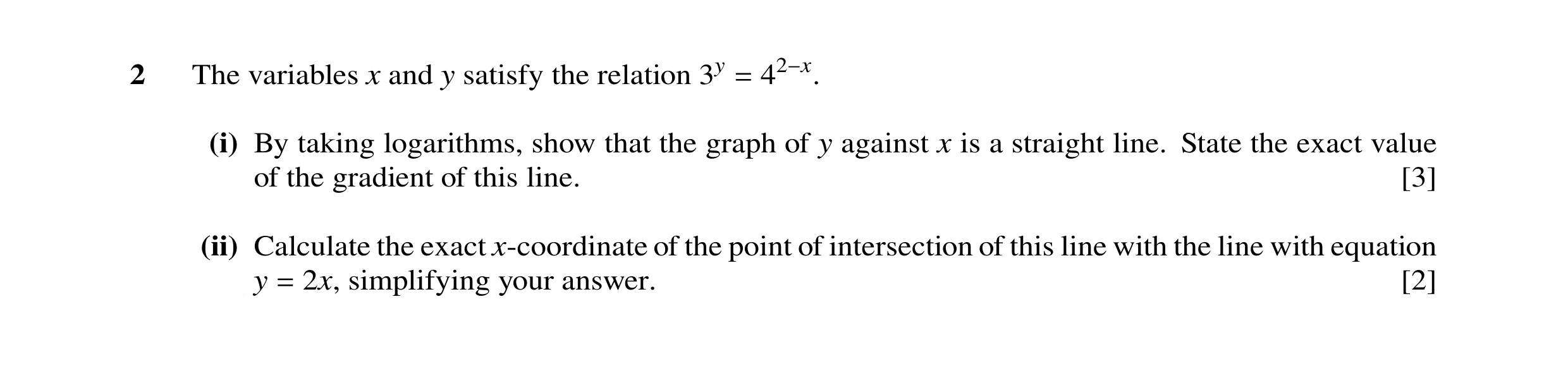
Q13 · The variables x and y satisfy the relation 3y = 42−x 9709/33 May/June 2016
2 The variables x and y satisfy the relation 3y = 42−x. (i) By taking logarithms, show that the graph of y against x is a straight line. State the exact value of the gradient of this line. [3] (ii) Calculate the exact x-coordinate of the point of intersection of this line with the line with equation y 2x, simplifying your answer. [2] =
5 marks
Mark scheme: 2 (i) State or imply y ln3 = (2 − x )ln 4 B1 State that this is of the form ay = bx + c and thus a straight line, or equivalent B1 ln4 State gradient is − , or exact equivalent B1 ln3 [3] (ii) Substitute y = 2x and solve for x, using a log law correctly at least once M1 Obtain answer x = ln 4 / ln6 , or exact equivalent A1 [2]
This question in 9709/33 May/June 2016
Q14 · The plane with equation 2x 2y 5 is denoted by m 9709/31 May/June 2017
6 The plane with equation 2x 2y 5 is denoted by m. Relative to the origin O, the points A and B + −z = have coordinates 3, 4, 0 and 0, 2 respectively. −1, (i) Show that the plane m bisects AB at right angles. [5] … … … … … … … … … … … … … … … … … … … … … … … … A second plane p is parallel to m and nearer to O. The perpendicular distance between the planes is 1. (ii) Find the equation of p, giving your answer in the form ax by cz d. [3] + + = … … … … … … … … … … … … … … … … … … … … … … … …
8 marks
Mark scheme: 6(i) State or obtain coordinates (1, 2, 1) for the mid-point of AB B1 Verify that the midpoint lies on m B1 State or imply a correct normal vector to the plane, e.g. 2i + 2 j − k B1 State or imply a direction vector for the segment AB, e.g. − 4 i − 4 j + 2k B1 Confirm that m is perpendicular to AB B1 Total: 5 6(ii) State or imply that the perpendicular distance of m from the origin is 53 , or B1 unsimplified equivalent State or imply that n has an equation of the form 2 x + 2 y − z = k B1 Obtain answer 2 x + 2 y − z = 2 B1 Total: 3
This question in 9709/31 May/June 2017
Q15 · The parametric equations of a curve are x t2 1, y 4t ln 2t 9709/32 May/June 2017
4 The parametric equations of a curve are x t2 1, y 4t ln 2t . = + = + −1 dy (i) Express in terms of t. [3] dx … … … … … … … … … … … … … … … … … … … … … … … (ii) Find the equation of the normal to the curve at the point where t 1. Give your answer in the form ax by c 0. = [3] + + = … … … … … … … … … … … … … … … … … … … … … … … … …
6 marks
Mark scheme: 4(i) dy 2 B1 State = 4 + dt 2t − 1 dy dy dx M1 Use = ÷ dx dt dt dy 8t − 2 2 2 A1 Obtain answer = , or equivalent e.g. + dx 2t (2t − 1) t 2 4t − 2t Total: 3 4(ii) Use correct method to find the gradient of the normal at t = 1 M1 Use a correct method to form an equation for the normal at t = 1 M1 Obtain final answer x + 3 y − 14 = 0 , or horizontal equivalent A1 Total: 3
This question in 9709/32 May/June 2017
Q16 · Sketch the graph of y x 9709/32 Feb/March 2020
1 (a) Sketch the graph of y x . [1] = −2 (b) Solve the inequality x 3x [3] −2 < −4. … … … … … … … … … … … … … … … …
4 marks
Mark scheme: 1(a) Make a recognisable sketch graph of 2 = − y x B1 1 1(b) Find x-coordinate of intersection with y = 3x – 4 M1 Obtain 3 2 = x A1 State final answer 3 2 > x only A1 Alternative method for question 1(b) Solve the linear inequality 3 4 2 −> − x x , or corresponding equation M1 Obtain critical value 3 2 = x A1 State final answer 3 2 > x only A1 Alternative method for question 1(b) Solve the quadratic inequality ( ) ( ) 2 2 2 3 4 − < − x x , or corresponding equation M1 Obtain critical value 3 2 = x A1 State final answer 3 2 > x only A1 3
This question in 9709/32 Feb/March 2020
Q17 · Two lines have equations r 3 s and r 1 t 9709/32 Feb/March 2021
7 Two lines have equations r 3 s and r 1 t . = + −1 = + −1 2 3 4 4 (a) Show that the lines are skew. [5] … … … … … … … … … … … … … … … … … … … … … … … (b) Find the acute angle between the directions of the two lines. [3] … … … … … … … … … … … … … … … … … … … … … … … … …
8 marks
Mark scheme: 7(a) Express general point of a line in component form, e.g. (1 + 2s, 3 – s, 2 + 3s) or (2 + t, 1 – t, 4 + 4t) B1 Equate at least two pairs of components and solve for s or for t M1 Obtain correct answer for s or for t (possible answers are –1, 6, 2 5 for s and –3, 4, 1 5 − for t ) A1 Verify that all three component equations are not satisfied A1 Show that the lines are not parallel and are thus skew A1 5 7(b) Carry out correct process for evaluating the scalar product of the direction vectors M1 Using the correct process for the moduli, divide the scalar product by the product of the moduli and evaluate the inverse cosine of the result M1 Obtain answer 19.1° or 0.333 radians A1 3
This question in 9709/32 Feb/March 2021
Q18 · 16 The parametric equations of a curve are x y ln tan t, where 0 t = cos t, = < < 2π 9709/33 May/June 2022
1 16 The parametric equations of a curve are x y ln tan t, where 0 t = cos t, = < < 2π. dy cos t (a) Show that [5] dx = sin2t. … … … … … … … … … … … … … … … … … … … … … … … (b) Find the equation of the tangent to the curve at the point where y 0. [3] = … … … … … … … … … … … … … … … … … … … … … … … … …
8 marks
Mark scheme: 6(a) Use chain rule at least once M1 Needs d 1 d (tan ) d tan d y t t t t or d d x t = ( 1) 2 d (cos ) (cos ) d t t t . BOD if + and ( 1) ( 1) not seen. d d x t = sec t tan t (from List of Formulae MF19) M1 A1. If d d x t = sec t tan t M1 A0. Obtain d d x t = sec tan t t A1 OE e.g. sin t (cos t)–2 . If e.g. d d x t = sec tan x x or sec tan or sec tan t x , condone recovery on next line. Obtain d d y t = 2 sec tan t t A1 OE e.g. 1 sin cos t t . If e.g. d d y t = 2 sec tan x x or 2 sec tan , condone recovery on next line. Only penalise notation errors once in d d x t and d d y t if no recovery. Use d d y x = d d y t ÷ d d x t M1 Allow even if previous M0 scored, but must be using derivatives. Obtain given answer 2 cos sin t t A1 AG After d d y x = d d y t ÷ d d x t used, any notation error A0. Must cancel cos t correctly. 5 Question Answer Marks Guidance 6(b) State or imply t = 1 π 4 when y = 0 B1 Form the equation of the tangent at y = 0 or find c M1 x = 2 , d d y x = 2 and y = 0, their coordinates and gradient used in y = mx + c. Obtain answer 2 2 y x A1 OE e.g. 2 ( 2 y x ) ISW. Allow y = 1.41x 2[.00] or 1.41(x 1.41). 3
This question in 9709/33 May/June 2022
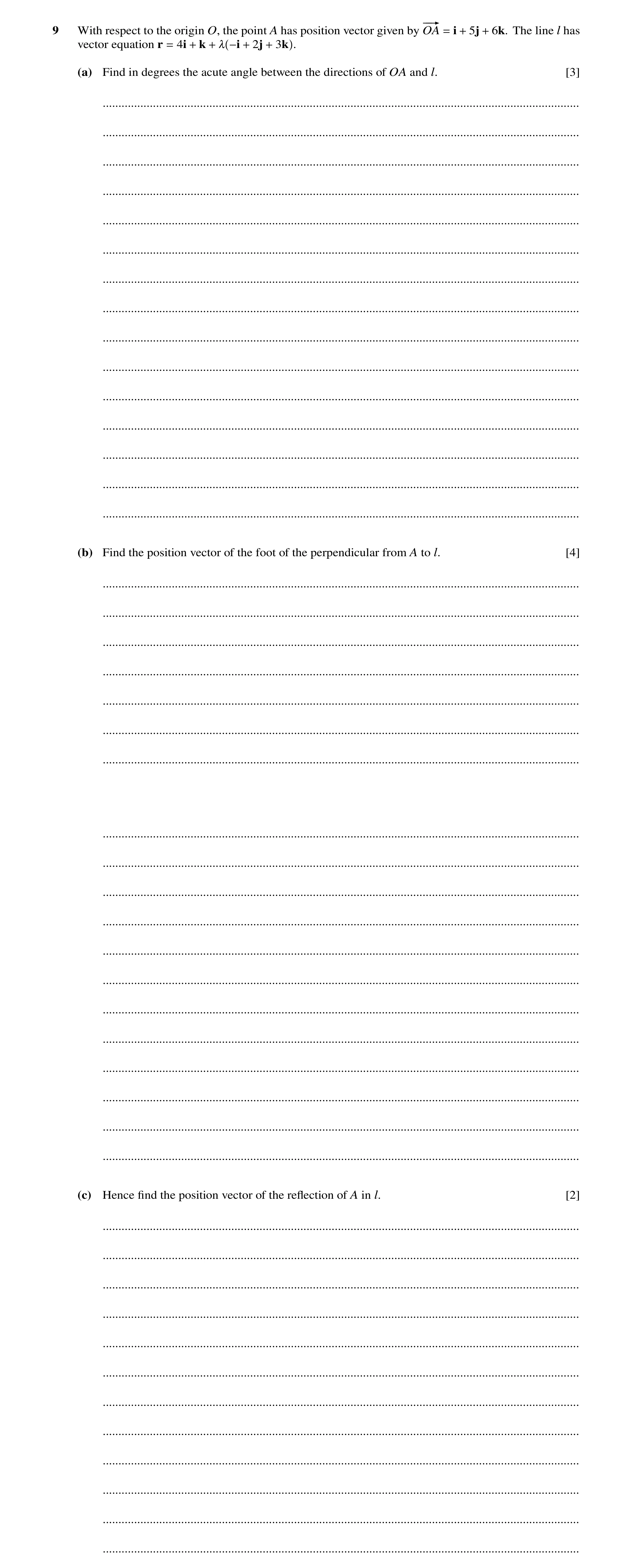
Q19 · With respect to the origin O, the point A has position vector given by −−¿OA i 5j 6k 9709/33 May/June 2022
9 With respect to the origin O, the point A has position vector given by −−¿OA i 5j 6k. The line l has = + + vector equation r 4i k 2j 3k . = + + , −i + + (a) Find in degrees the acute angle between the directions of OA and l. [3] … … … … … … … … … … … … … … … (b) Find the position vector of the foot of the perpendicular from A to l. [4] … … … … … … … … … … … … … … … … … … … (c) Hence find the position vector of the reflection of A in l. [2] … … … … … … … … … … … …
9 marks
Mark scheme: 9(a) Using the correct process find the scalar product of direction vectors of l and OA Using the correct process for the moduli, divide the scalar product by the product of the moduli and find the inverse cosine of the result M1 Their scalar product ÷ [(12 + 52 + 62)((1)2 + 22 + 32)]. Angle = 1 27 cos 62 14 . Obtain answer 23.6°. A1 AWRT 23.6°. 23.5889°. Radians 0.412 scores A0 (0.4117…). 3 9(b) Taking a general point P on l, state AP (or PA) in component form, e.g. (3 – λ, – 5 + 2λ, – 5 + 3λ) B1 Note: (4, 1, 0) or (4, 1, 1), for 4i + k is not MR, but M1 possible. Either equate scalar product of AP and direction vector of l to zero and solve for λ or use Pythagoras in a relevant triangle and solve for λ M1 (3 – λ, – 5 + 2λ, – 5 + 3λ).( 1, 2, 3) = 0 3 10 15 + λ + 4 λ + 9 λ = 0 or let OQ = (4, 0, 1) so AQ = (3, 5, 5), QP = (– λ, 2λ, 3λ), AP = (3 – λ, –5 + 2λ, –5 + 3λ) hence 32 + (5)2 + (5)2 = (3 – λ)2 + (–5 + 2λ)2 + (–5 + 3λ)2 + (–λ)2 + (2λ)2 + (3λ)2 Other alternative approaches are possible, e.g. minimise AP or AP2, either by completing the square or by differentiating. Obtain λ = 2 A1 λ = 2 State that the position vector OP* of the foot is 2i + 4j + 7k A1 OE Condone coordinates. 4 Question Answer Marks Guidance 9(c) Set up a correct method for finding the position vector of the reflection of A in l M1 For all methods, allow a sign error in one component only: OA′ = OP* (OP* OA) 2, 4, 7 2, 4, 7 1, 5, 6 their their or OA′ = OP* (OA OP*) 2, 4, 7 1, 5, 6 2, 4, 7 their their or OA′ = OA + 2(OP* OA) 1 2 2 1 5 2 4 5 6 2 7 6 their their their or midpoint OP* = (OA + OA′)/2 with their λ value substituted. 1 2 2 x their 5 4 2 y their 6 7 2 z their Obtain answer 3i + 3j + 8k or 8 3 3 i j A1 OE Condone coordinates 3, 3, 8 x y z A1. No method shown and correct answer 2/2. 2
This question in 9709/33 May/June 2022
Q20 · Sketch the graph of y = 2 x - 3 9709/31 May/June 2025
1 (a) Sketch the graph of y = 2 x - 3 . [1] (b) Solve the inequality 3x - 1 1 2 x - 3 . [2] … … … … … … … … … … … … …
3 marks
Mark scheme: Question Answer Marks Guidance 1(a) y B1 Symmetrical. In correct position. Condone if no complete scale shown, but must see 3 and 32 marked. 3 Needs to exist for negative x. Must be intending straight lines. Ignore y = 3 x − 1 if seen. x O 3 2 1 1(b) Obtain critical value 54 from 3x −=1 3 − 2 x B1 State final answer x 54 B1 Alternative Method for Question 1(b) 4 2 2 B1 Ignore x = − 2 if seen. Obtain critical value 5 from ( 3 x − 1) = ( 3 − 2 x ) State final answer x 54 B1 2
This question in 9709/31 May/June 2025
Q21 · With respect to the origin O, the points A, B and C have position vectors given by 1 - 2… 9709/32 May/June 2025
9 With respect to the origin O, the points A, B and C have position vectors given by 1 - 2 2 OA = f- 4p, OB = f 1p and OC = f 3 p. 2 3 5 (a) Find a vector equation for the line through A and B. [2] … … … … … … … … … … (b) Using a scalar product, find the exact value of cos BAC. [4] … … … … … … … … … … … … … (c) Hence find the exact area of triangle ABC. [3] … … … … … … … … … … … … … … … … … … … … … … … … … … …
9 marks
Mark scheme: 9(a) Carry out a correct method for finding a vector equation for the line through A M1 A complete method. and B Can be working from any point on AB. 1 −3 A1 OE Must have r = … not l = …. Obtain r = −4 + 5 Accept rAB = ... 2 1 Accept R = …. 2 9(b) 1 B1 OE Obtain a direction vector for AC = 7 Or CA. 3 M1 −+3 1 5 7 + 1 =3 35 Carry out correct process for evaluating the scalar product of AB and AC or Allow for correct answer and no working seen. BA and CA Using the correct process for the moduli, divide their scalar product by the M1 Independent M0M1 is possible. product of the moduli ISW finding the angle. 35 A1 From correct working. The answer needs to come Obtain (cos BAC =) or exact simplified equivalent from using a scalar product. 59 35 35 2065 Accept or or 2065 35 59 59 = cos −1 5935 without a statement of cos BAC scores A0. ISW finding the angle. 4 9(c) 1 M1 For “hence”, must be using the angle at A. Use area = AB AC sin BAC with their AB AC Need not substitute for the trigonometry. 2 Accept any equivalent form for their sin BAC. 2 M1 NB: These two M marks are independent. Use sin x = 1 − cos x or an equivalent exact method with their cos x (< 1) to Might not quote the formula. Could draw a triangle obtain an exact value for sin x and use Pythagoras, which is equivalent. 24 sin x = 2 59 1 35 1 840 35 59 1 − = 35 59 1 35 is allowed for the first M1, but not 2 35 59 2 35 59 sin ( cos− 59 ) for the second. Obtain answer 210 from correct working A1 Accept simplified equivalent exact forms, e.g. 1 2 840. Watch out for fortuitous answers from negative value of the cosine. Do not accept an answer coming from −1 35 sin cos with no evidence of the method of 59 evaluation. The answer needs to come from using angle BAC. 3
This question in 9709/32 May/June 2025
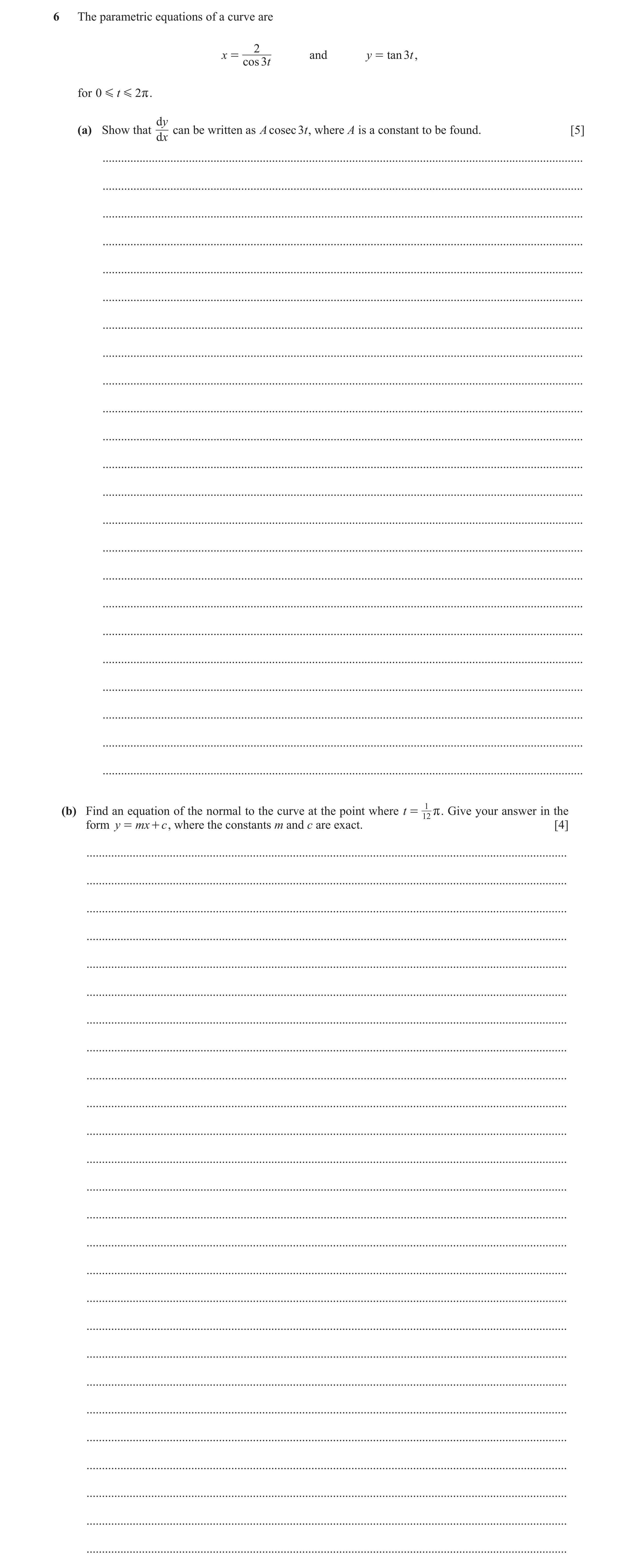
Q22 · The parametric equations of a curve are 2 x = and y = tan t3 , cos t3 for 0 G t G 2r 9709/35 May/June 2025
6 The parametric equations of a curve are 2 x = and y = tan t3 , cos t3 for 0 G t G 2r . dy (a) Show that can be written as A cosec t3 , where A is a constant to be found. [5] dx … … … … … … … … … … … … … … … … … … … … … … … (b) Find an equation of the normal to the curve at the point where t = 1 r . Give your answer in the 12 form y = mx + c , where the constants m and c are exact. [4] … … … … … … … … … … … … … … … … … … … … … … … … … …
9 marks
Mark scheme: 6(a) dy 2 B1 OE Obtain = 3sec 3t dt −1 d x M1 dx −2 d Attempt chain rule on 2 ( cos3t ) for or attempt to differentiate 2sec 3t Attempt = −2 ( cos3t ) ( cos3t ) with their derivative. d t dt dt d x A1 −2 cos3t ) sin3t . Obtain = 6sec 3t tan 3t OE, e.g. 6 ( d t Allow unsimplified, e.g. (−1) 2 (−1) 3 for 6. dy dy dt dy dt M1 2 1 Use = with their and their Expect, for example, 3sec 3t dx dt dx dt dx 6sec 3t tan 3t 2 1 or 3sec 3t −2 if correct. 6 ( cos3t ) sin 3t dy 1 A1 WWW Obtain = cosec3t Must be in this form of answer given in the question. dx 2 Not required to state A = 12 . d y d x d y Allow slips in notation for , and . d t d t d x 6(a) Alternative Method for Question 6(a) 2 B1 2 x Convert to Cartesian form e.g. 1 + y = 4 d 2 d y B1 Correct use of implicit differentiation e.g. y = 2 y d y d x dy x B1 OE Obtain 2 y = dx 2 dy 2sec3t M1 Convert to parametric form e.g. 2tan3t = dx 2 dy 1 A1 WWW Obtain = cosec3t Must be in this form of answer given in the question. dx 2 5 6(b) 1 B1 Must be exact. Obtain x = 2 2 and y = 1 when t = 12 π 1 dy M1 Expect gradient of normal = − 2 if correct. Substitute t = 12 π into −1 their dx Allow if in decimals. Allow a small slip, but not with their coefficient A If their coefficient A is dealt with incorrectly M0, but allow second M1. 2 M1 E.g. y – 1 = − 2 x − 2 2 if correct or find c in equation Form equation of the normal with their (x, y), found using x = and ( ) cos3t of line. dy y = tan 3t , and −1 their Allow M1 even if decimals. dx M0 if using gradient of tangent. A1 CAO Obtain equation of normal y = − 2 x + 5 Require y = mx + c and exact m and c 2 Accept y = − x + 5. 2 4
This question in 9709/35 May/June 2025
Q23 · Sketch the graph of y = x + 3a , where a is a positive constant 9709/32 Oct/Nov 2025
1 (a) Sketch the graph of y = x + 3a , where a is a positive constant. [1] (b) Hence or otherwise solve the inequality x + 3a 2 a - 2 x . [2] … … … … … … … … … … … …
3 marks
Mark scheme: Question Answer Marks Guidance 1(a) y B1 Roughly symmetrical. Condone some inaccuracy, but needs to look as if they intended symmetry and straight lines. If not, then B0. Needs to be in the correct position. 3a Needs to have two solid line segments. Needs to exist in both quadrants above the axis. Ignore dotted lines below the axis. Solid line below the axis is B0. -3a O x Condone if no scale shown, but need to see 3a and -3a marked. Ignore y = a − 2 x if seen. 1 1(b) Obtain critical value − 23a from x + 3a = a − 2x B1 Ignore x = 4a if seen. State final answer x − 23a B1 Need a clear conclusion – must imply rejection of x = 4a. B0 if using ⩾. Alternative Method for Question 1(b) Obtain critical value − 23a from ( x + 3a ) 2 = ( a − 2 x ) 2 B1 Ignore x = 4a if seen. State final answer x − 23a B1 Need a clear conclusion – must imply rejection of x = 4a. B0 if using ⩾. 2
This question in 9709/32 Oct/Nov 2025
![Question 2: The complex number i is denoted by u. −2 + (i) Given that u is a root of the equation x3 0, where k is real, find the value of k. [3] −11x −…](https://img.pastlit.com/crops/2a04340e-e118-4900-bca2-4404ab2fc10d/q7.webp)
 1 / 20
![Question 5: The equation of a curve is x ln y 2x 1. = + dy (i) Show that [4] dx = −yx2. (ii) Find the equation of the tangent to the curve at the point…](https://img.pastlit.com/crops/4b6a0cec-1ba2-4bef-9188-ba0b98f122d3/q6.webp)
![Question 6: (i) By sketching suitable graphs, show that the equation 4x2 cotx −1 = has only one root in the interval 0 x 12π. [2] < < (ii) Verify by ca…](https://img.pastlit.com/crops/658e5349-2f08-4903-881d-6443720f3016/q4.webp)
![Question 7: Two planes have equations x + 2y −2ß = 7 and 2x + y + 3ß = 5. (i) Calculate the acute angle between the planes. [4] (ii) Find a vector equa…](https://img.pastlit.com/crops/4bf8f599-bb44-417c-8dac-7e136b851345/q9.webp)
 2 / 20
![Question 9: The parametric equations of a curve are x = t −tan t, y = ln cost , for −120 < t < 120. dy (i) Show that = cott. [5] dx (ii) Hence find the …](https://img.pastlit.com/crops/b68229ca-15f1-4244-90c8-9375b0f8a343/q4.webp)
![Question 10: The parametric equations of a curve are 1 x , y tan3t, = cos3t = where 0 1 ≤t < 20. dy (i) Show that sin t. [4] dx = (ii) Hence show that t…](https://img.pastlit.com/crops/73d395a1-71ab-4073-ad96-d8b8b818a909/q4.webp)
![Question 11: The parametric equations of a curve are 1 x , y tan3t, = cos3t = where 0 1 ≤t < 20. dy (i) Show that sin t. [4] dx = (ii) Hence show that t…](https://img.pastlit.com/crops/53949090-32d5-4f1d-b8a7-f79ed9e07a35/q4.webp) 3 / 20
3 / 20![Question 12: The parametric equations of a curve are x a cos4t, y a sin4t, = = where a is a positive constant. dy (i) Express in terms of t. [3] dx (ii)…](https://img.pastlit.com/crops/af344e17-464c-42e4-b905-2acf2efee49b/q5.webp)
 4 / 20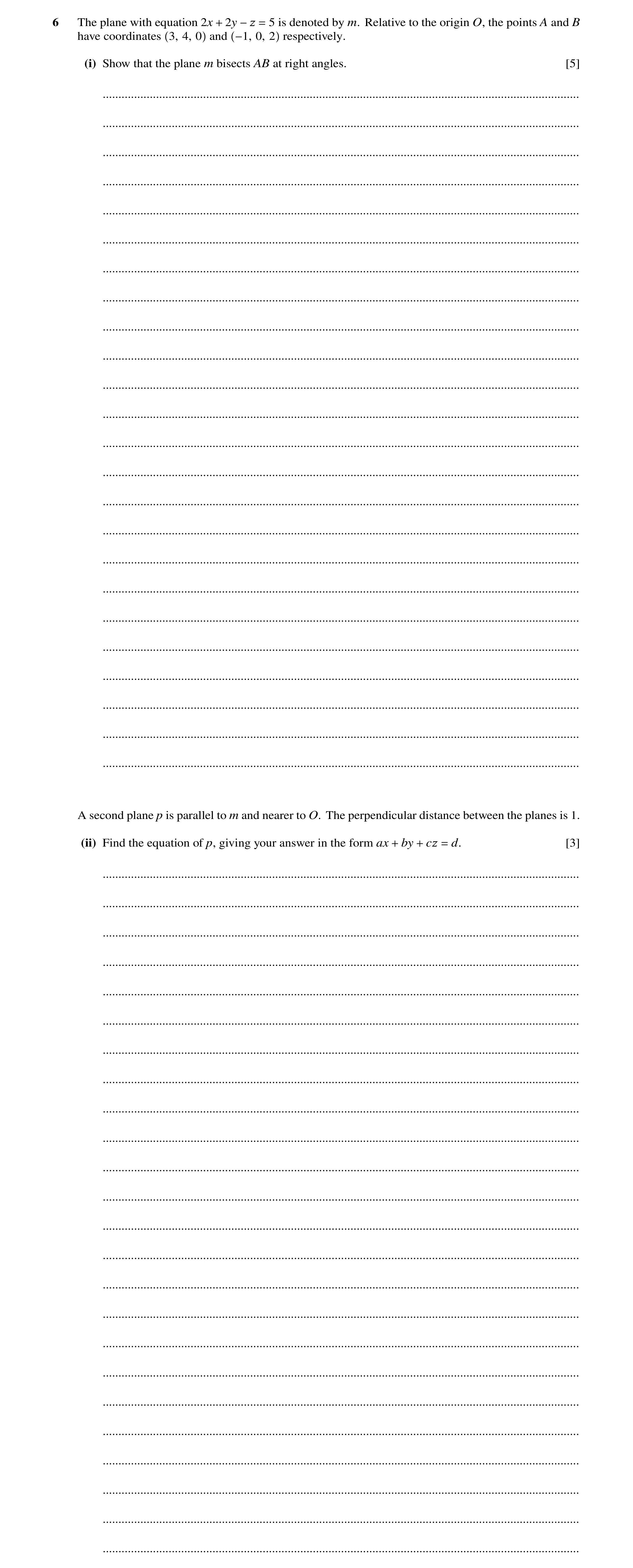
![Question 15: The parametric equations of a curve are x t2 1, y 4t ln 2t . = + = + −1 dy (i) Express in terms of t. [3] dx ..............................…](https://img.pastlit.com/crops/2cbf4649-4746-4bba-8000-8f6d6647fdb0/q4.webp)
![Question 16: (a) Sketch the graph of y x . [1] = −2 (b) Solve the inequality x 3x [3] −2 < −4. .........................................................…](https://img.pastlit.com/crops/f58e7cec-5e84-4f3c-8892-a7e9286804b3/q1.webp) 8 / 20
8 / 20![Question 17: Two lines have equations r 3 s and r 1 t . = + −1 = + −1 2 3 4 4 (a) Show that the lines are skew. [5] ....................................…](https://img.pastlit.com/crops/a47490d4-2781-4a7d-9cf7-9e09686e82ba/q7.webp)
![Question 18: 16 The parametric equations of a curve are x y ln tan t, where 0 t = cos t, = < < 2π. dy cos t (a) Show that [5] dx = sin2t. ..............…](https://img.pastlit.com/crops/c8e31760-c2e2-4c66-9b71-c0d0526fa670/q6.webp)
![Question 20: (a) Sketch the graph of y = 2 x - 3 . [1] (b) Solve the inequality 3x - 1 1 2 x - 3 . [2] .................................................…](https://img.pastlit.com/crops/35ad073c-3fe6-49fc-b398-3784f6257656/q1.webp) 15 / 20
15 / 20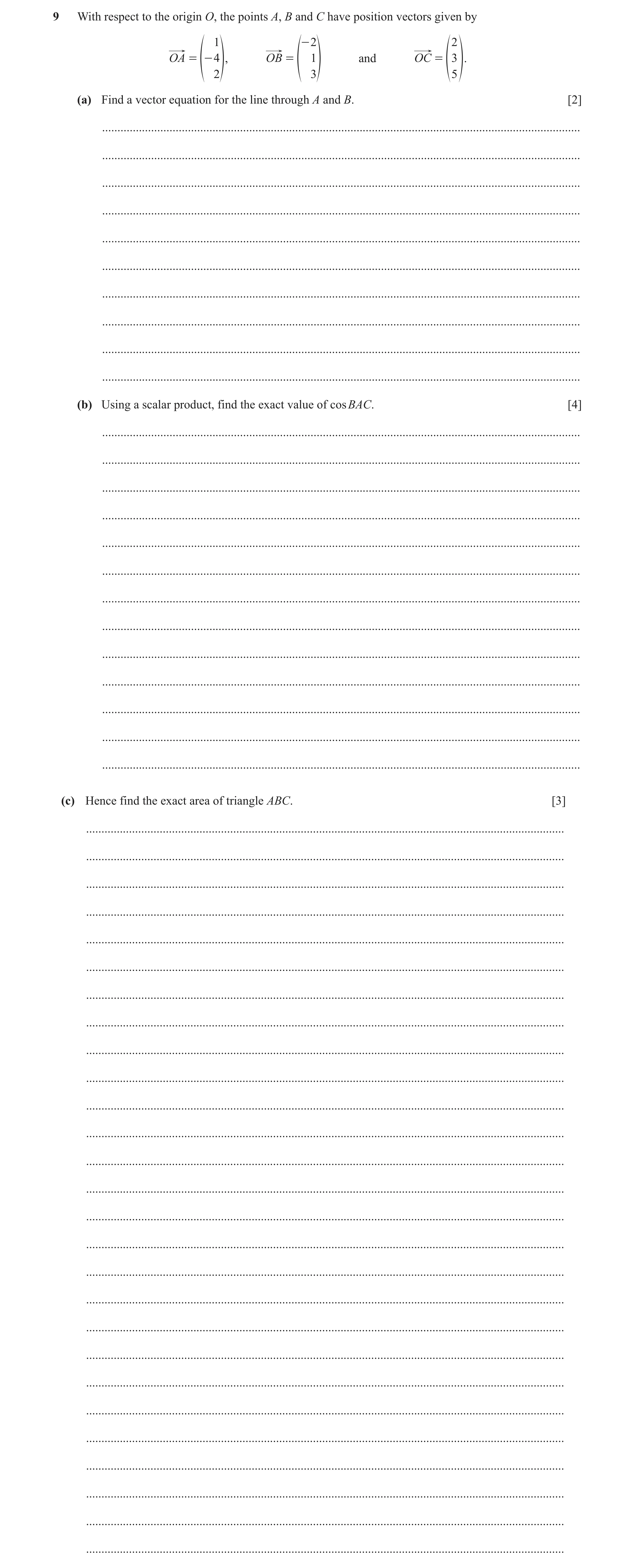
![Question 23: (a) Sketch the graph of y = x + 3a , where a is a positive constant. [1] (b) Hence or otherwise solve the inequality x + 3a 2 a - 2 x . [2]…](https://img.pastlit.com/crops/f5e004ff-26c4-46a2-a338-e8ed2bf9d1b6/q1.webp) 20 / 20
20 / 20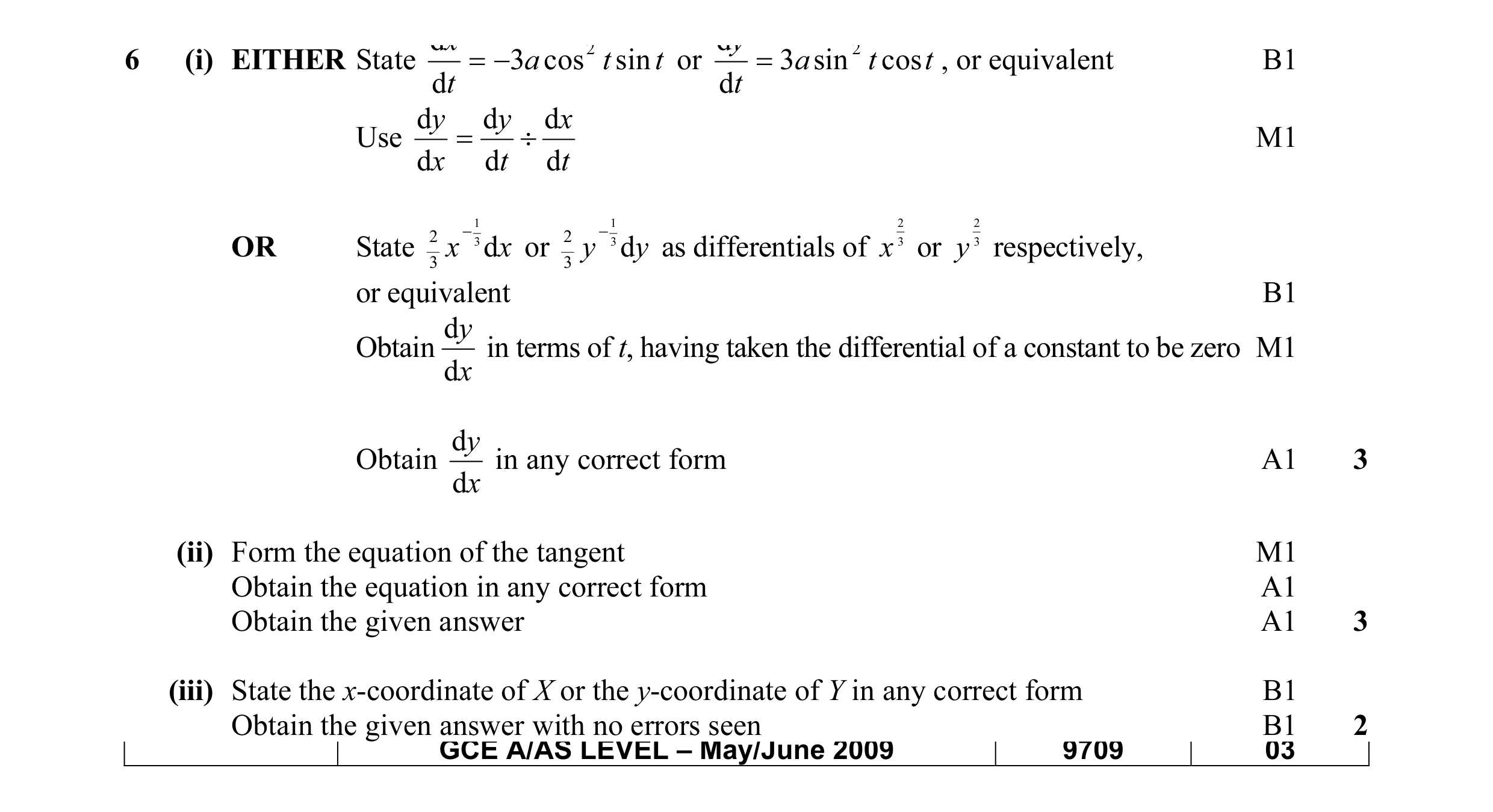 8
8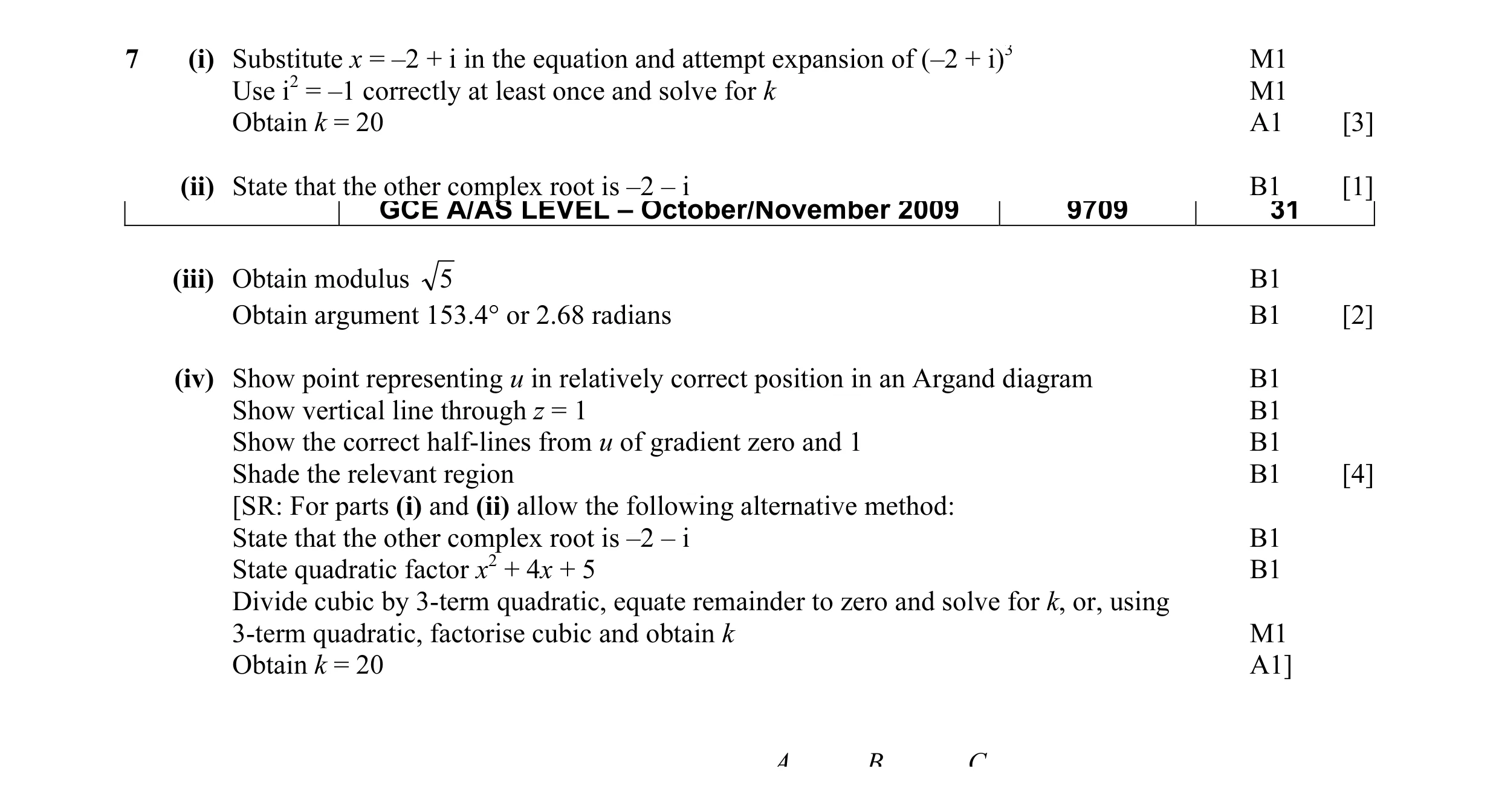 10
10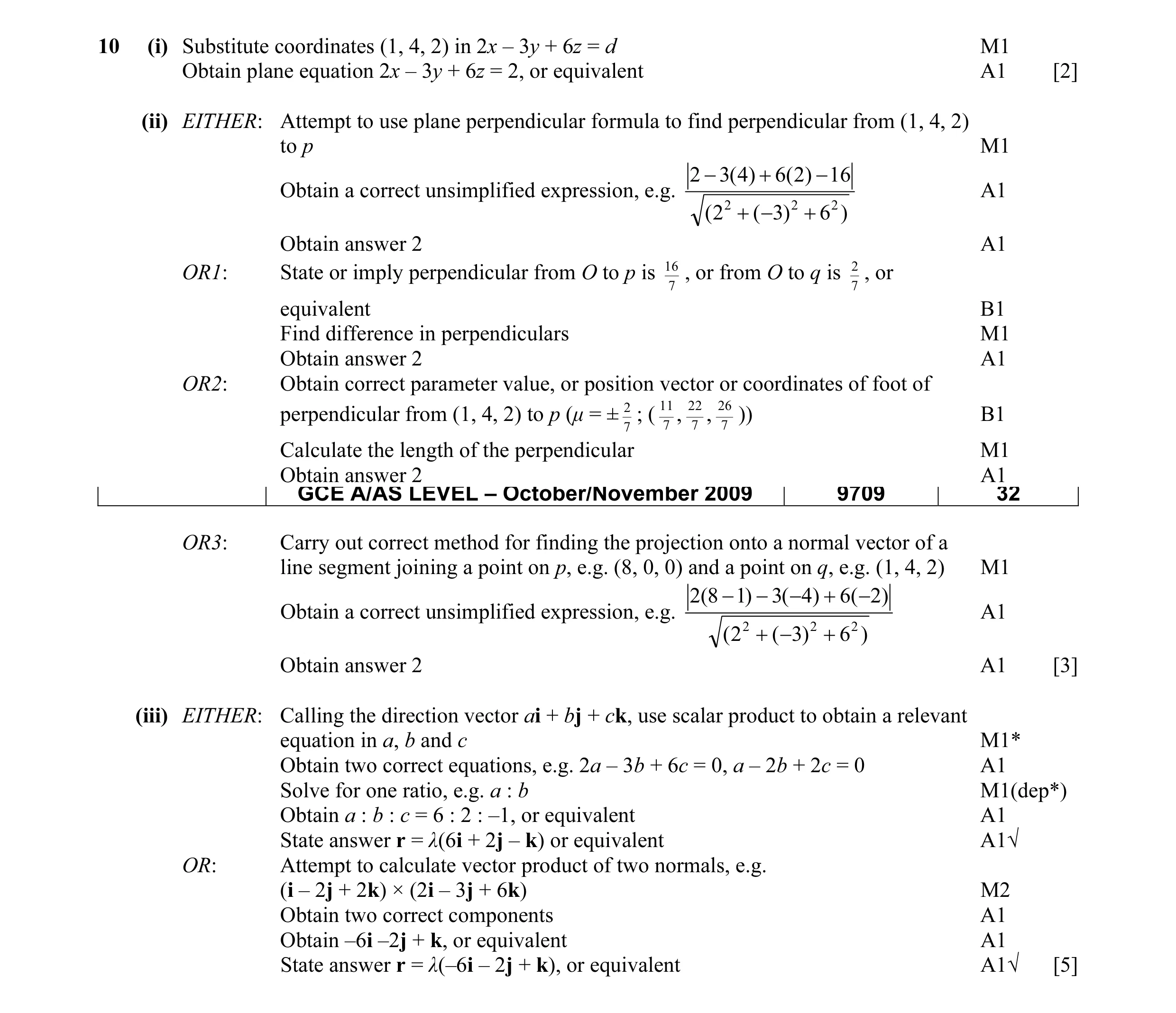 10
10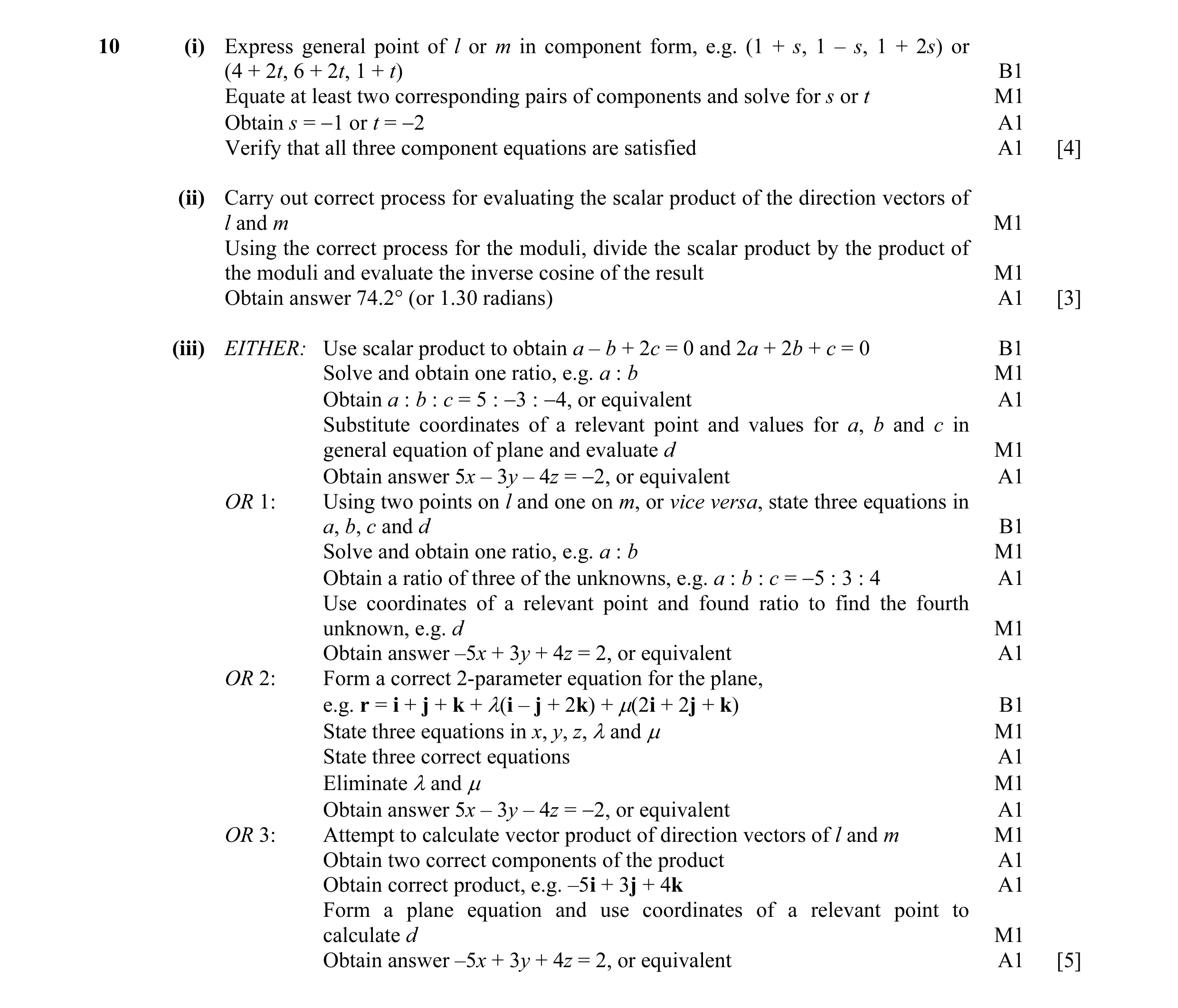 12
12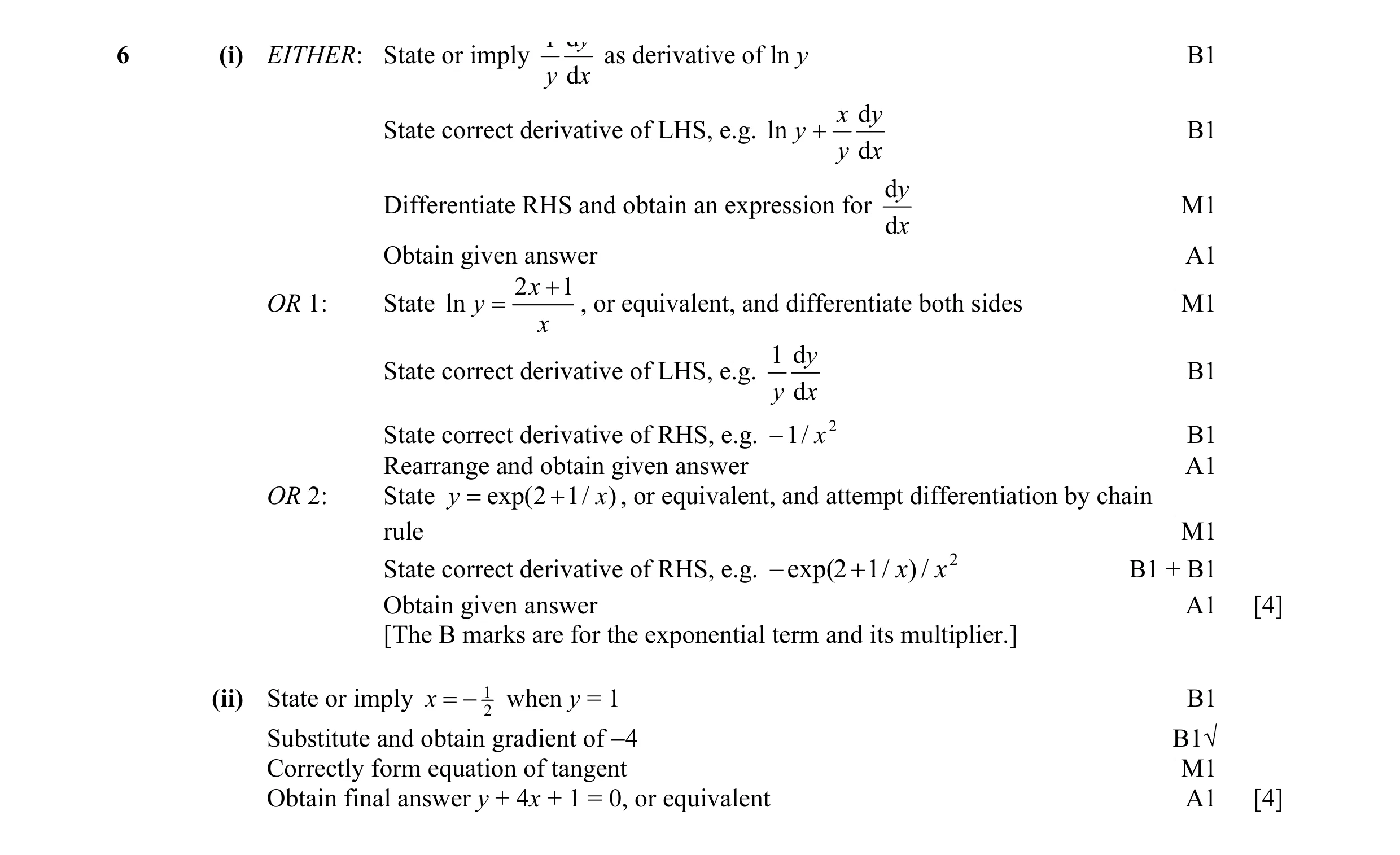 8
8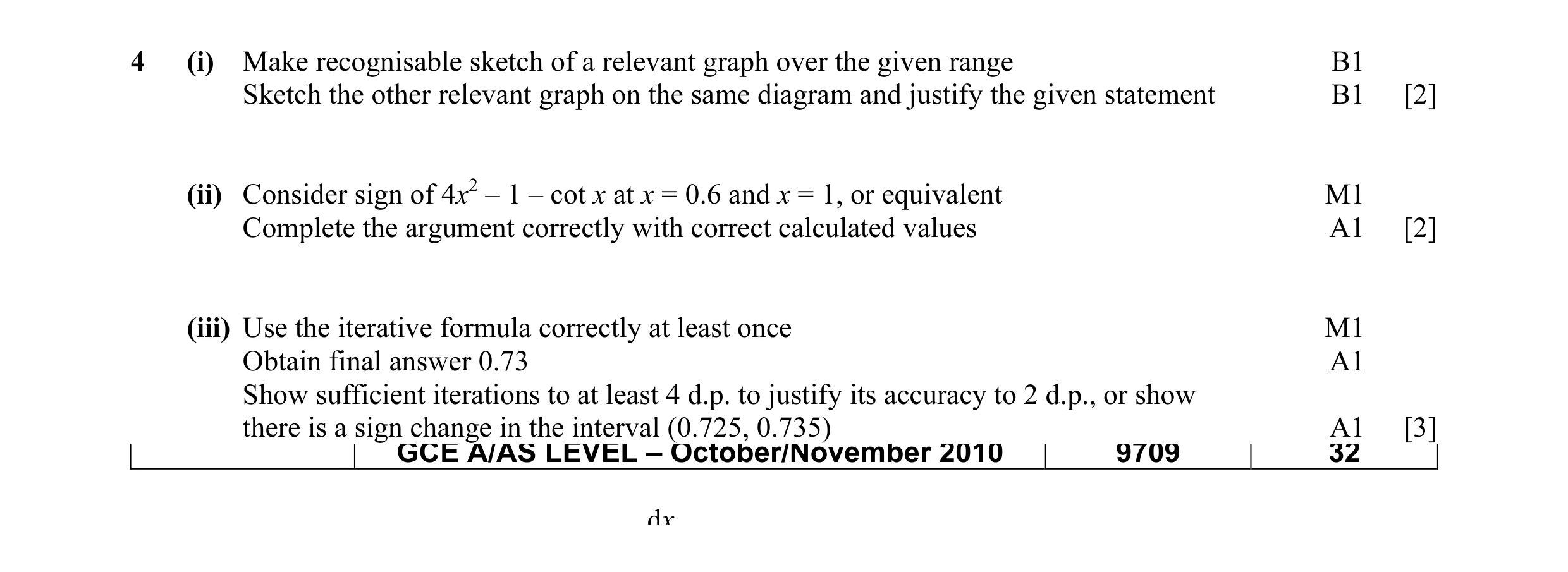 7
7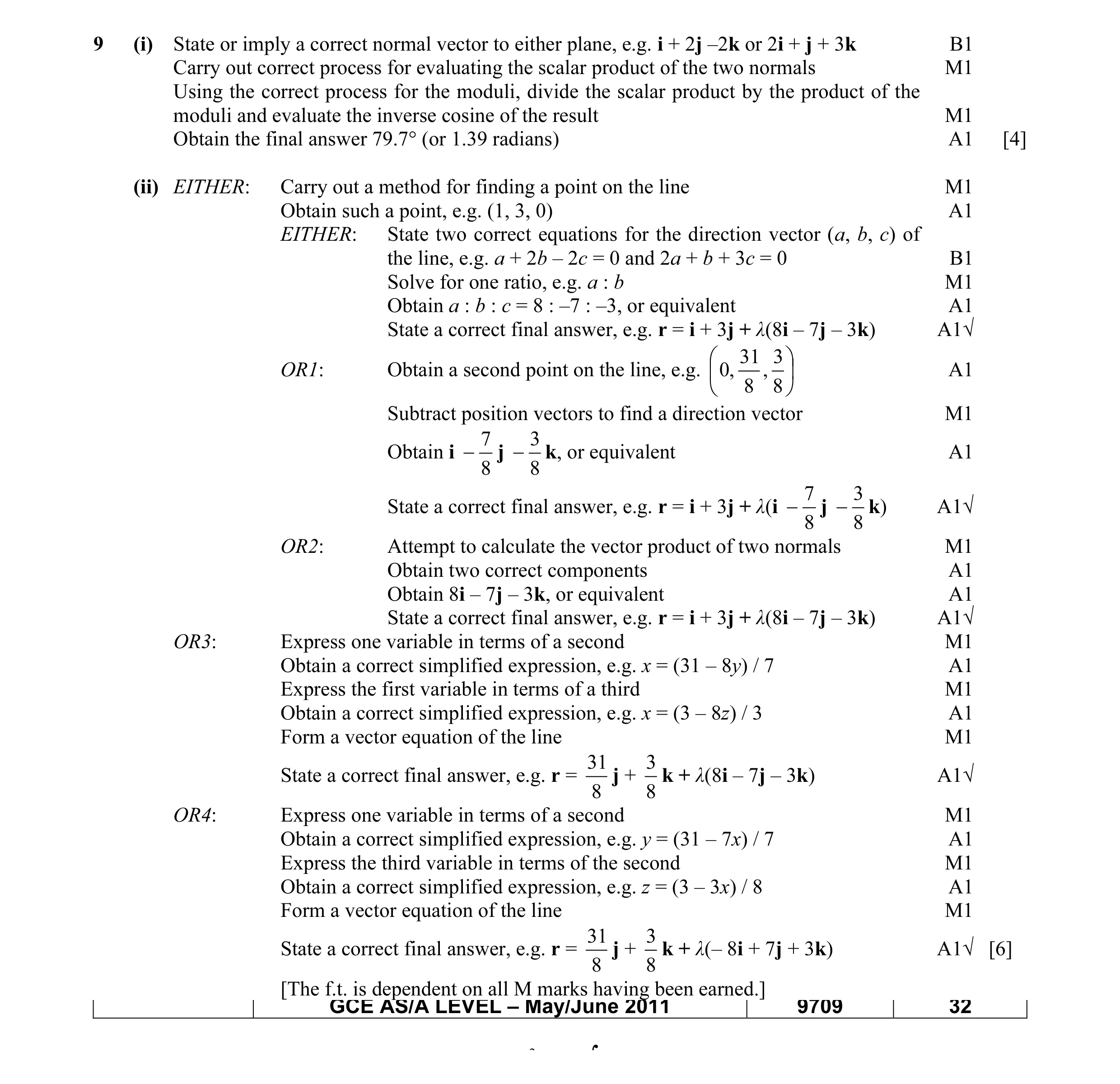 10
10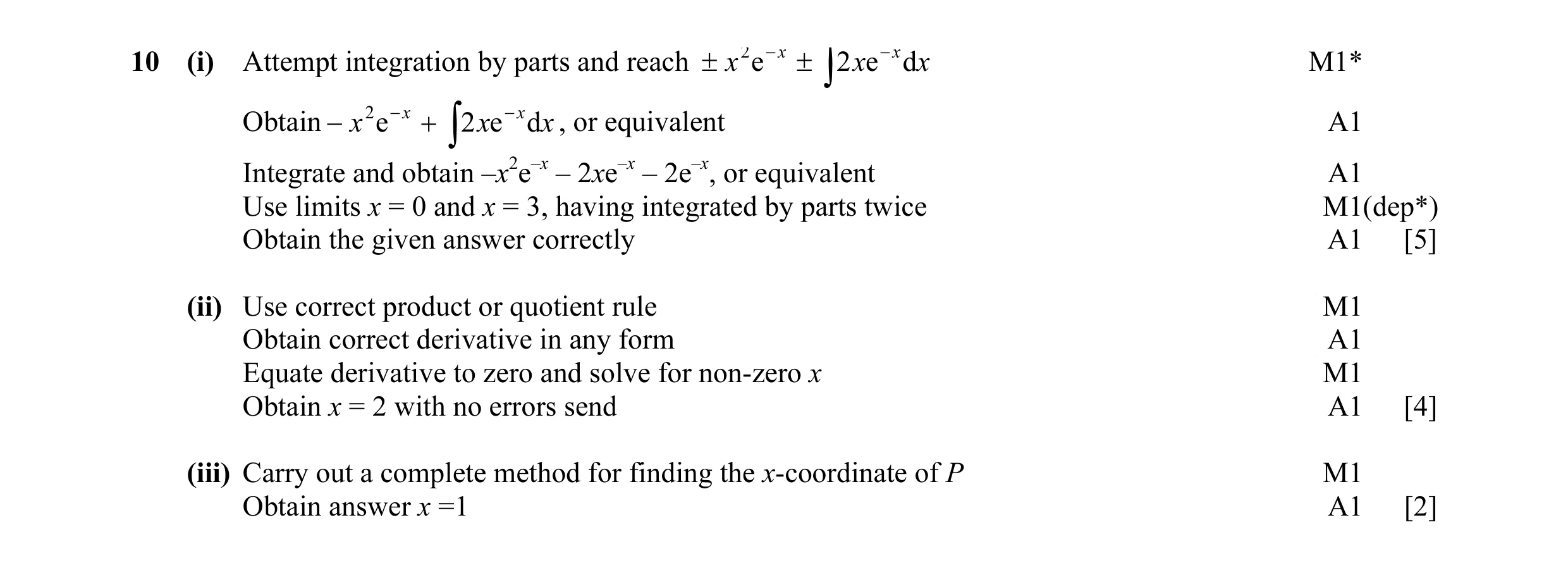 11
11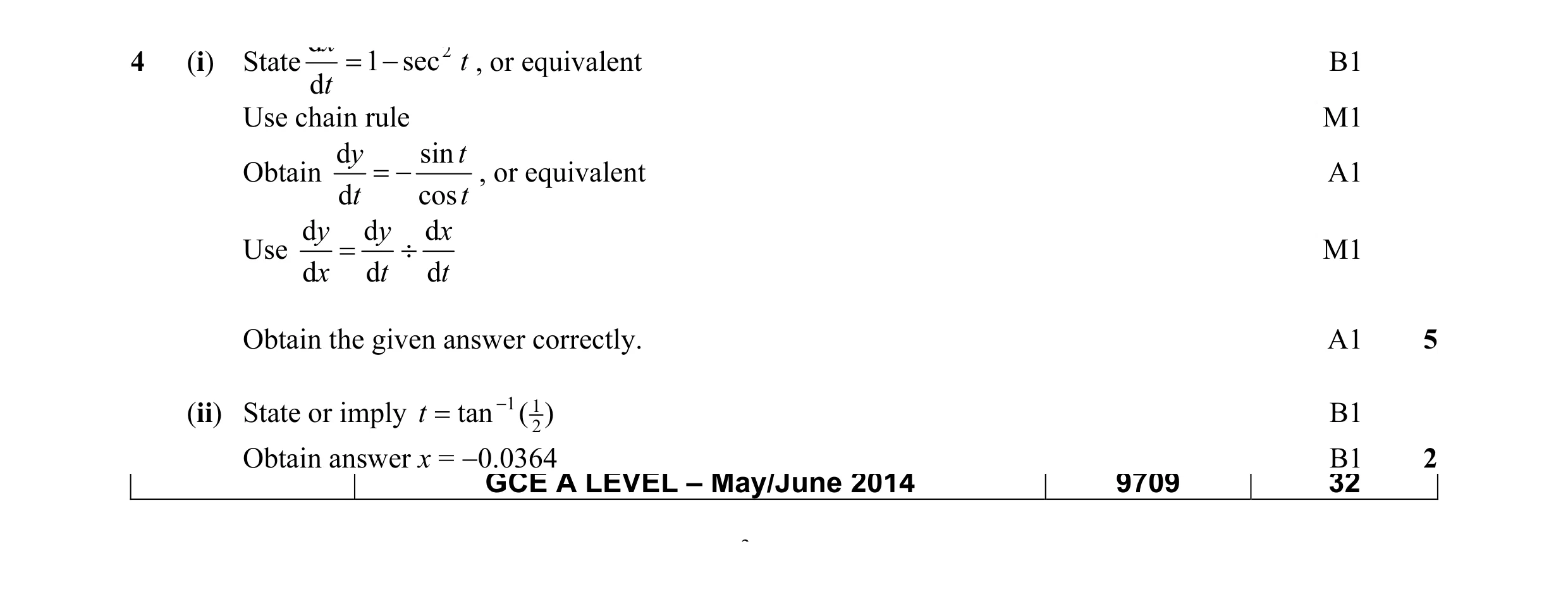 7
7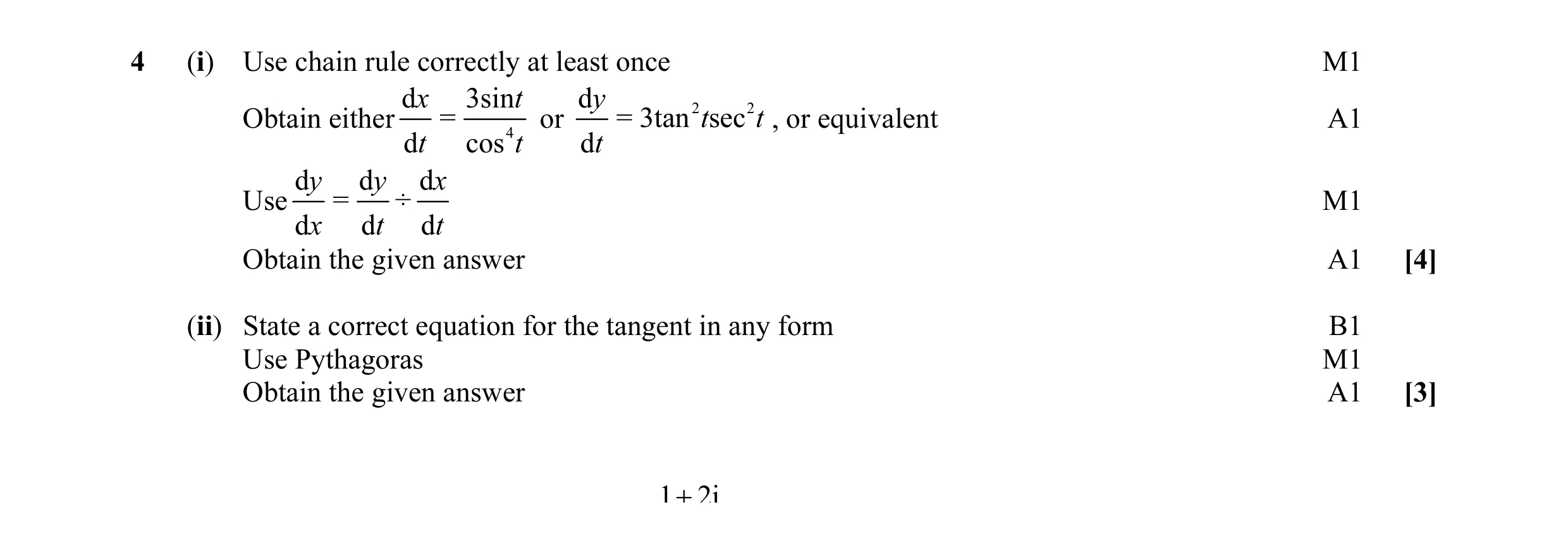 7
7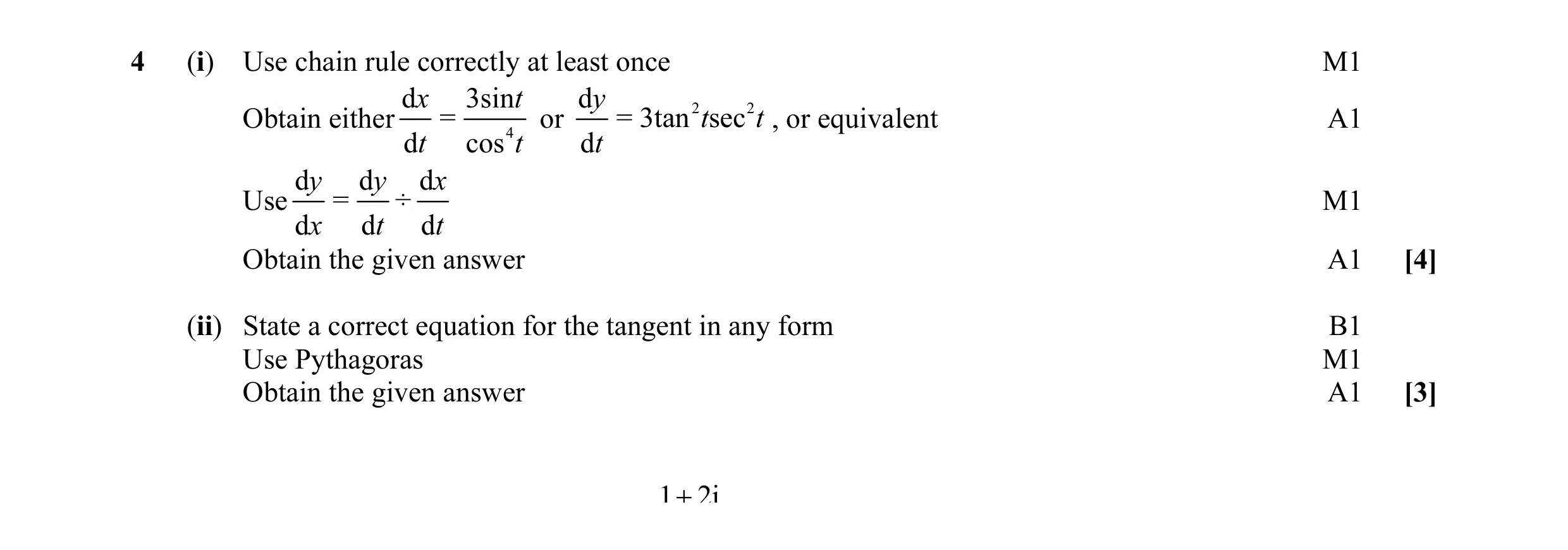 7
7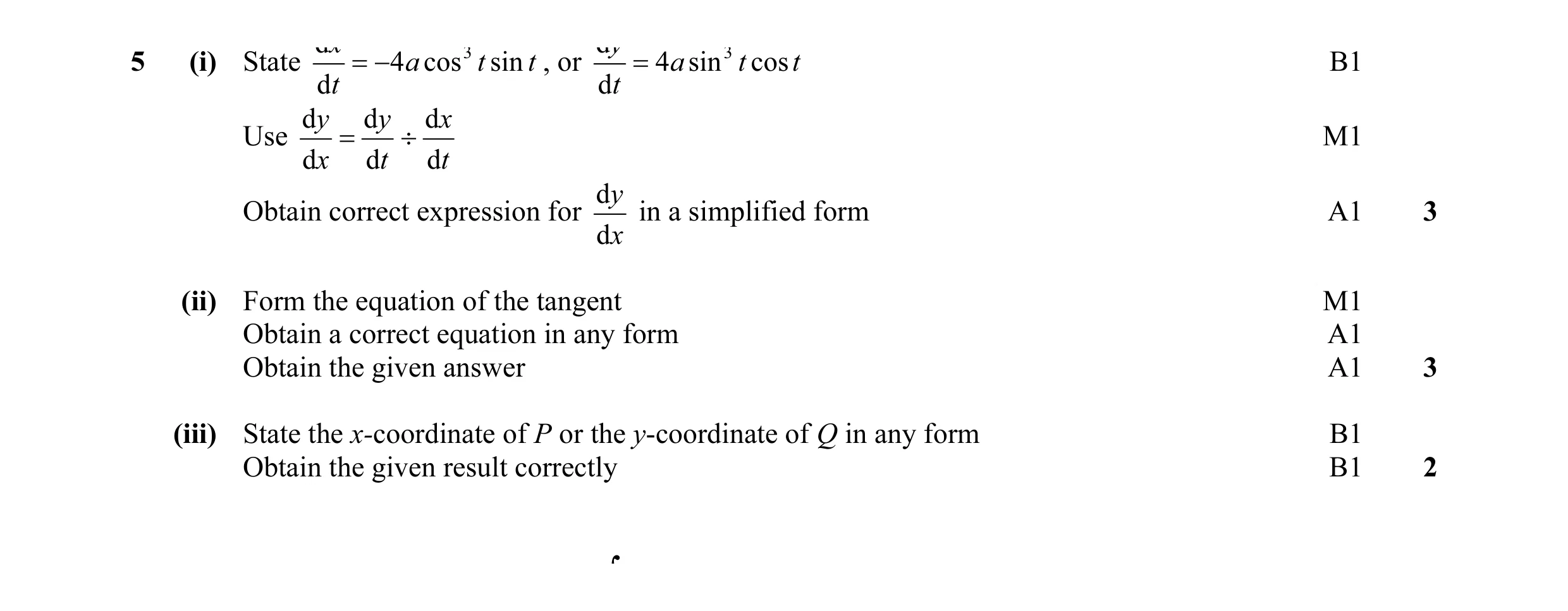 5
5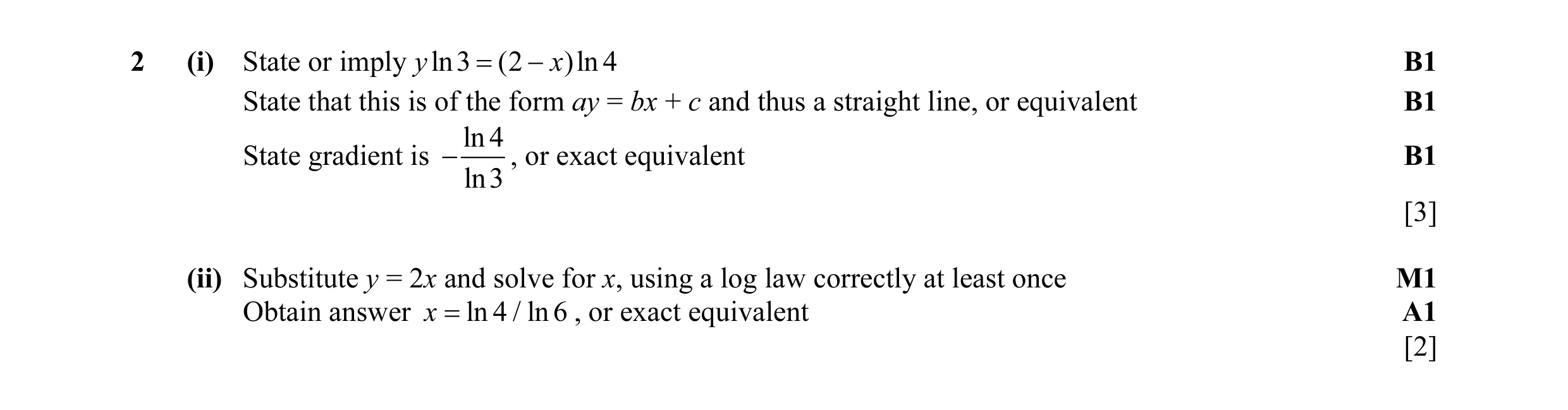 5
5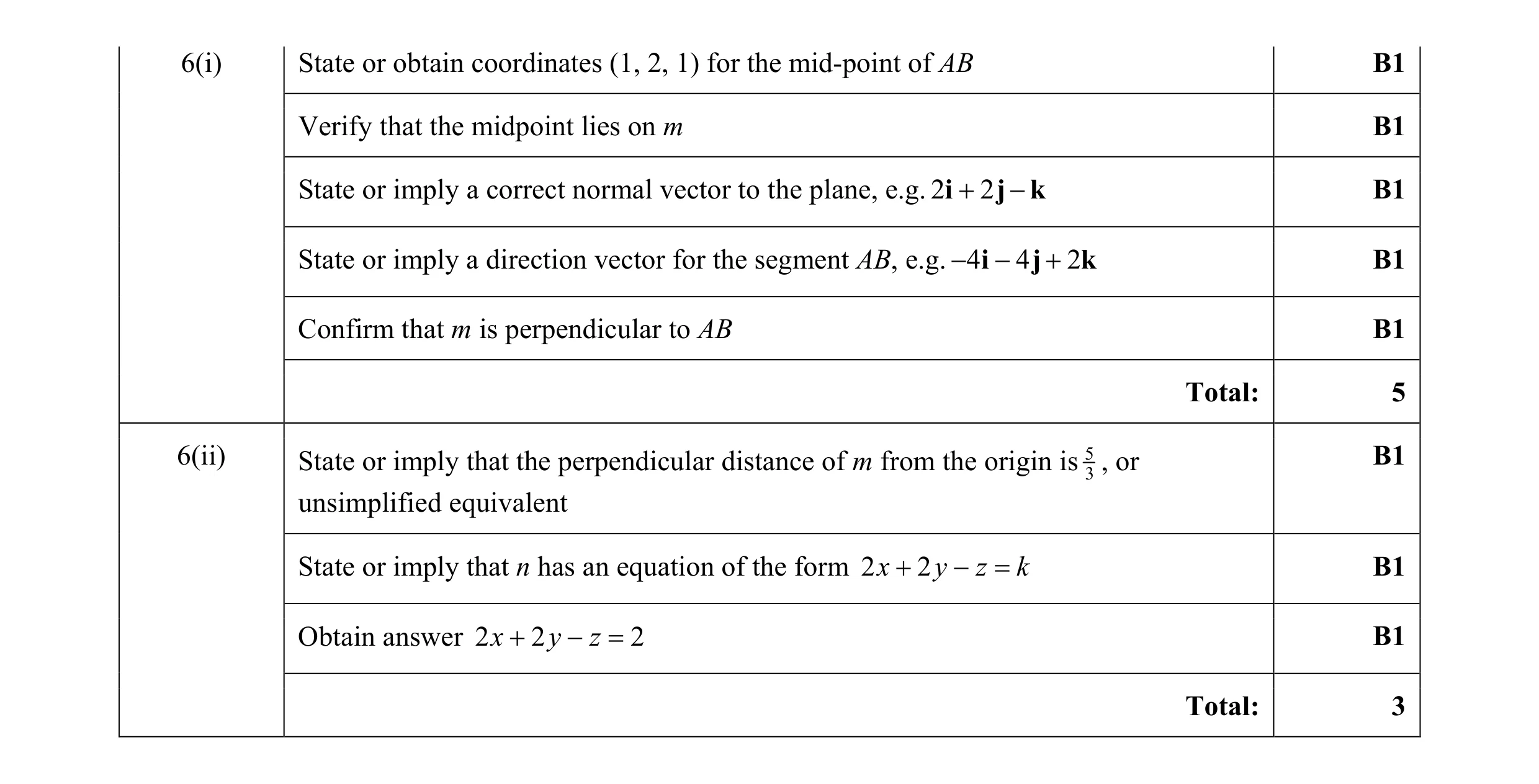 8
8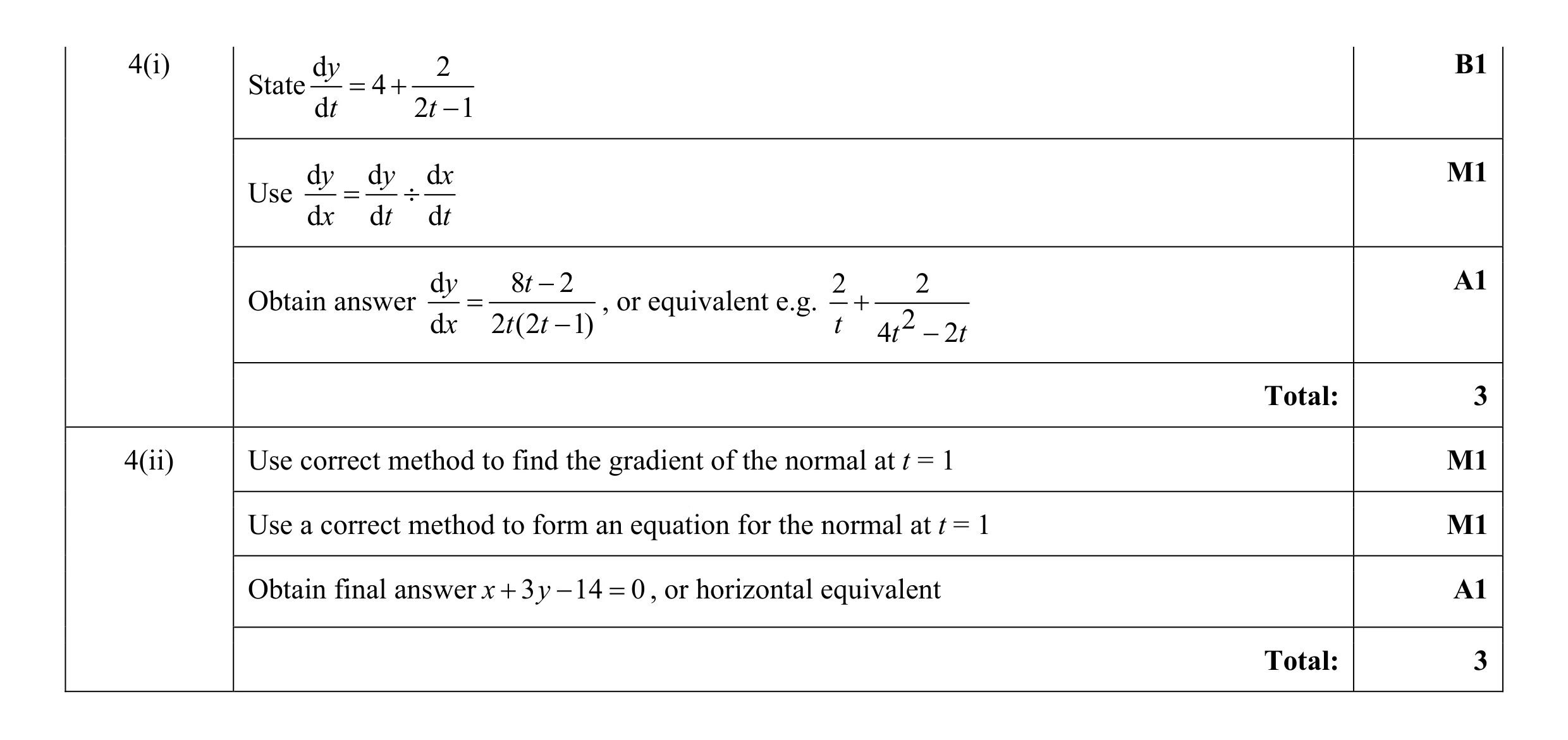 6
6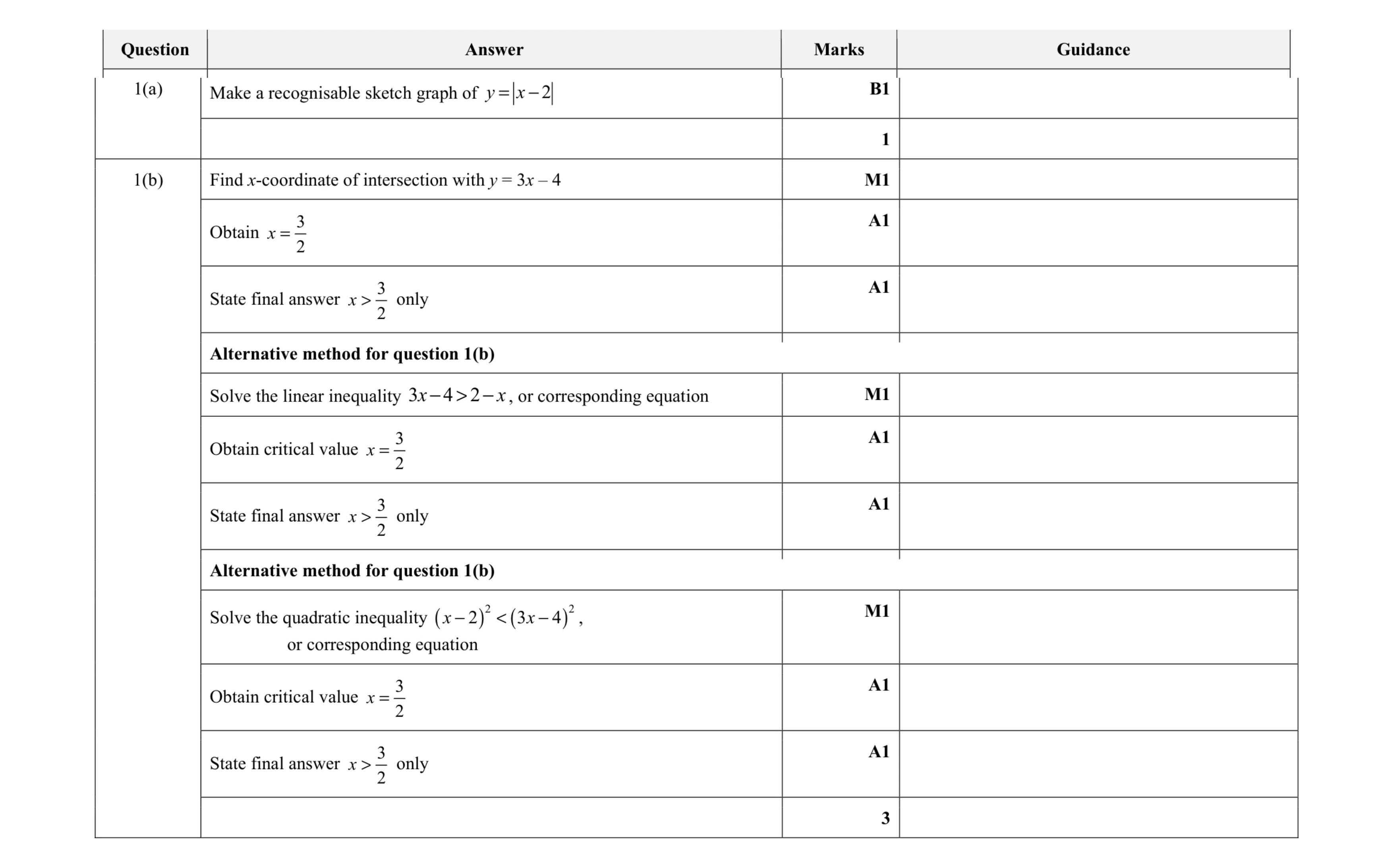 4
4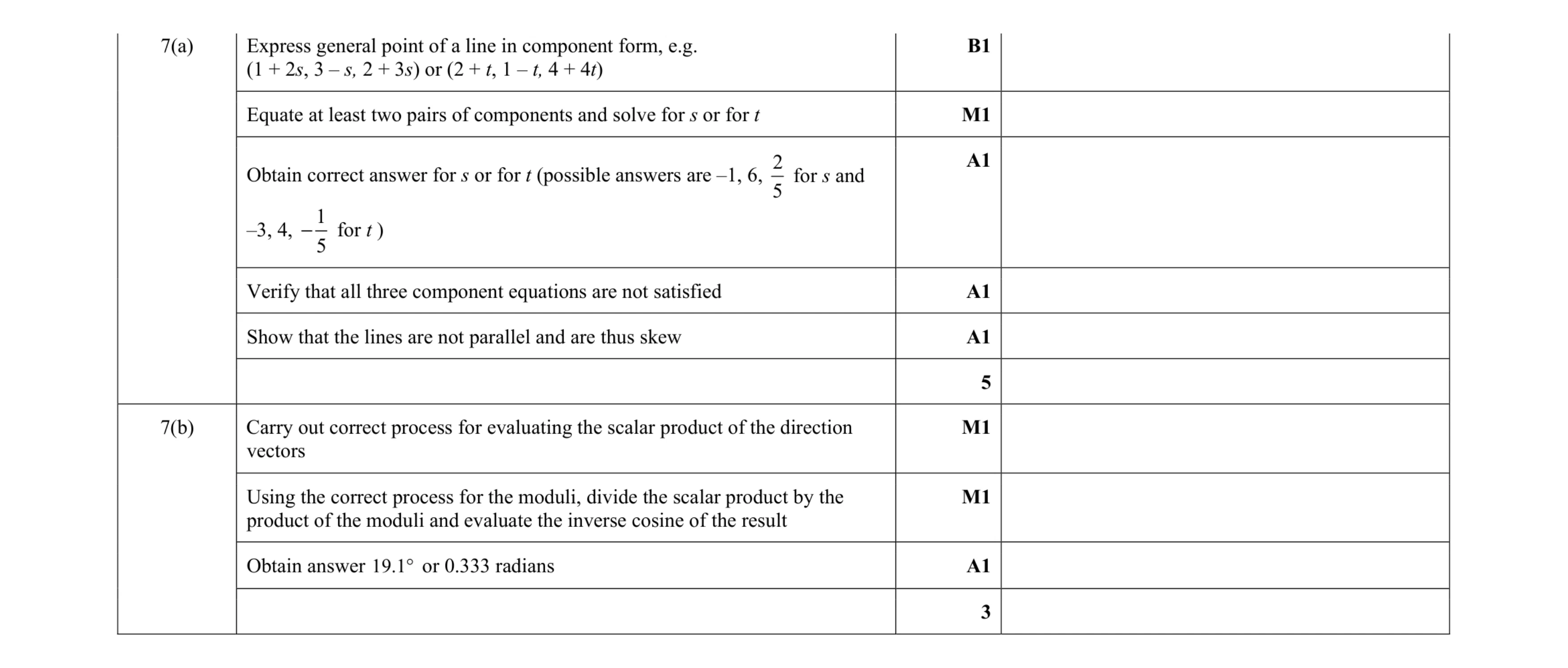 8
8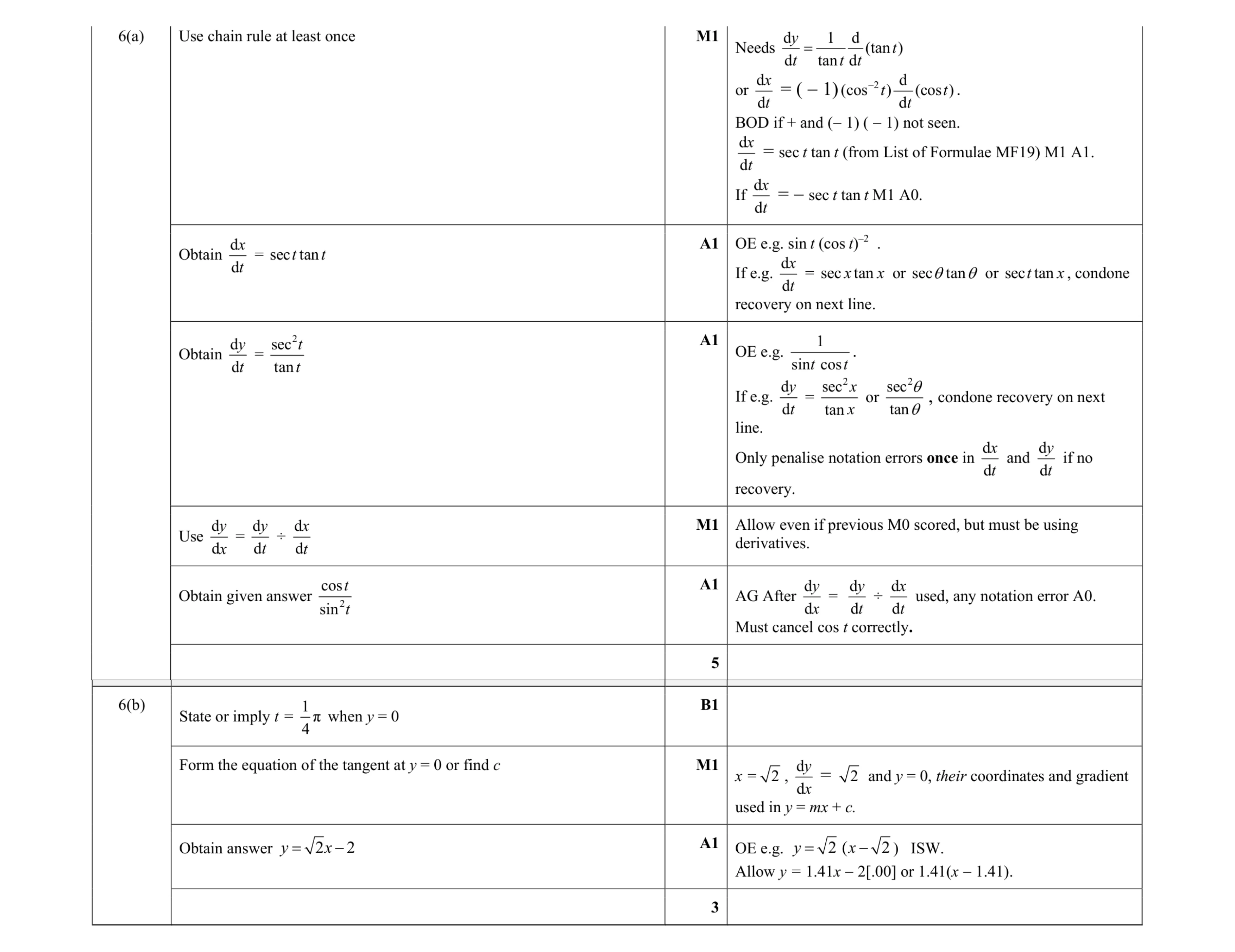 8
8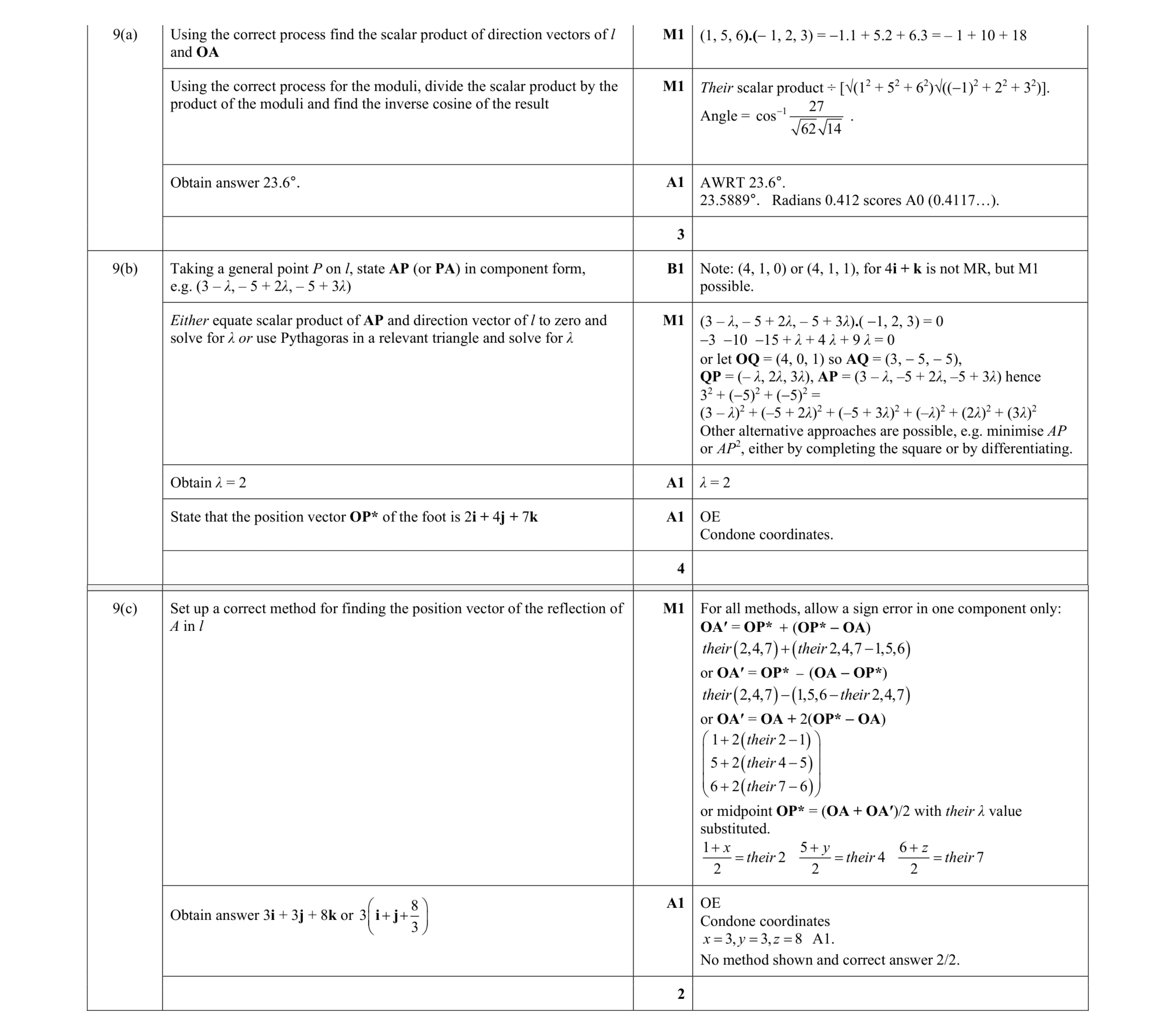 9
9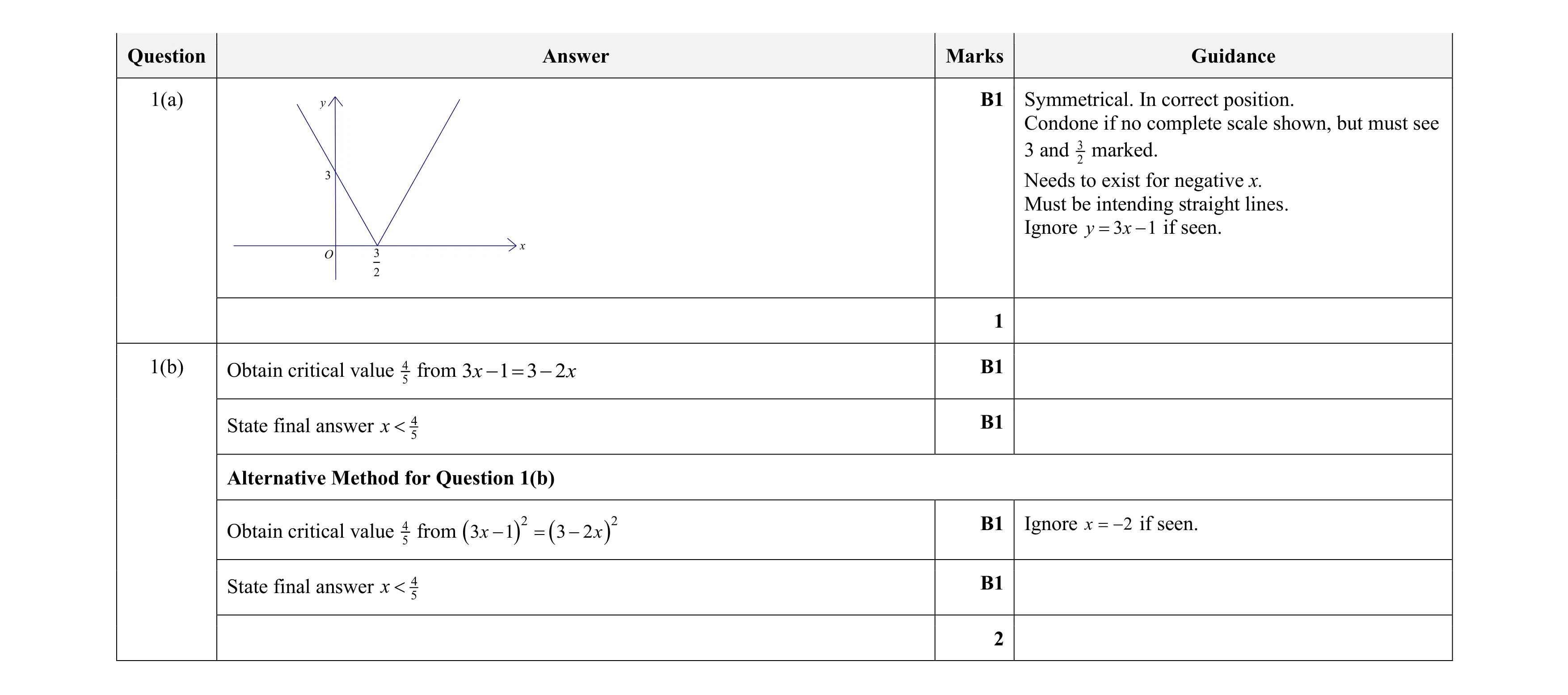 3
3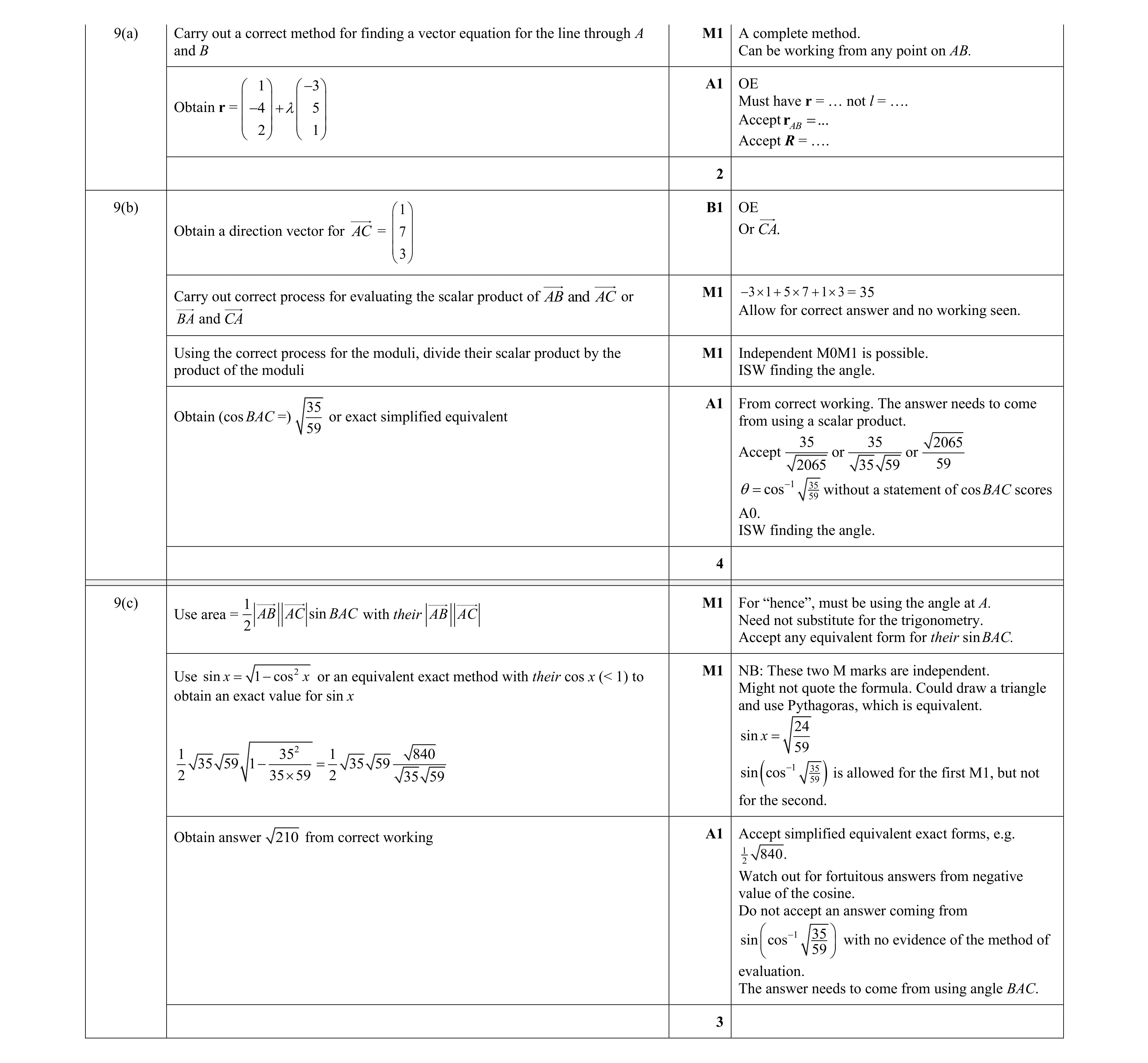 9
9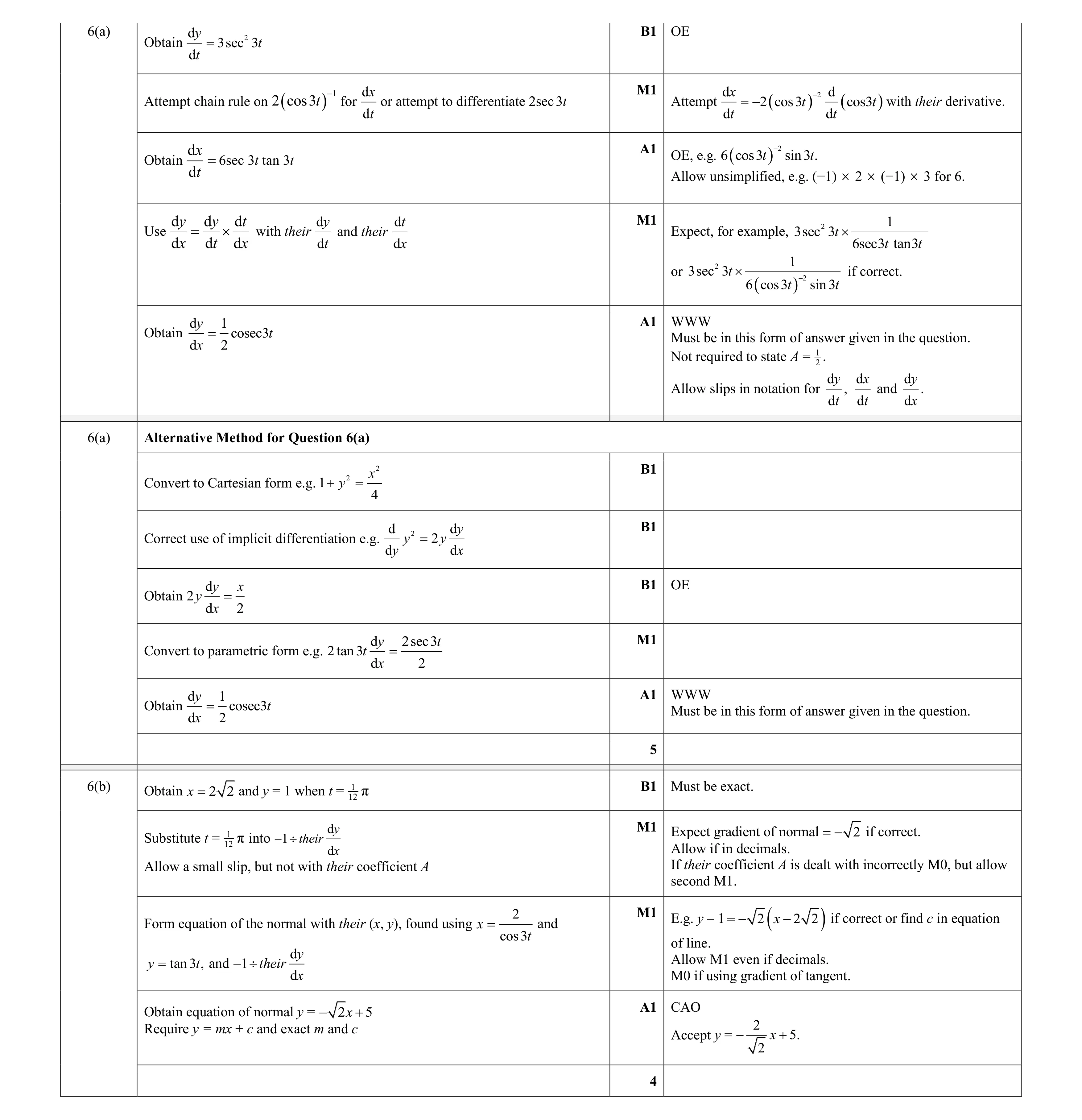 9
9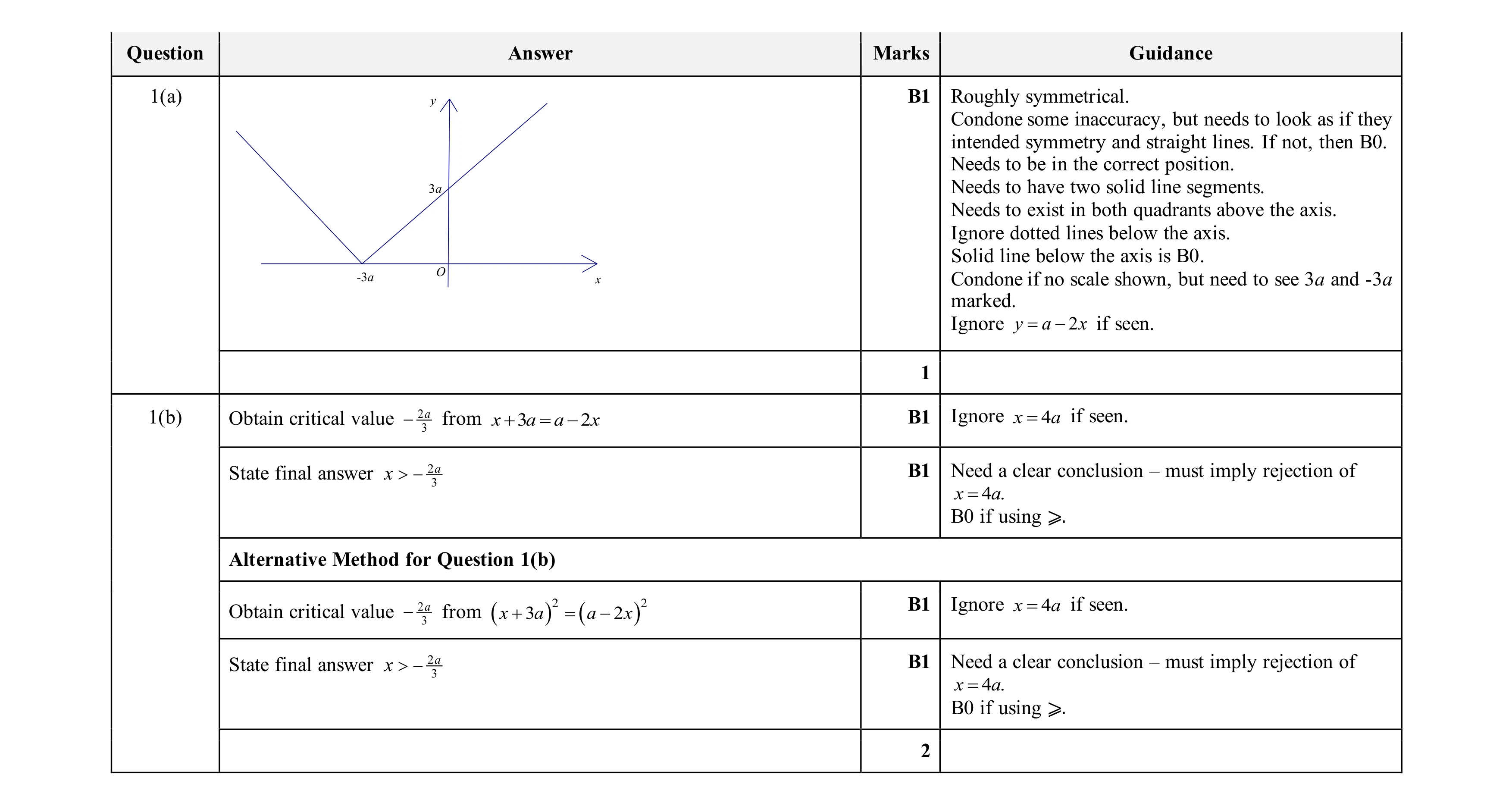 3
3