Cambridge A Level Mathematics 9709 — 2010 May/June Paper 1 · Variant 2
9709/12/M/J/10 · 4 questions · 75 marks · ≈84 min
The question paper and its mark scheme, free to read here and free to download. This is Cambridge’s own paper, exactly as it was sat.
Question paper4 pages
Mark scheme6 pages
Answers below. Sit the paper first if you are practising.
Questions as text
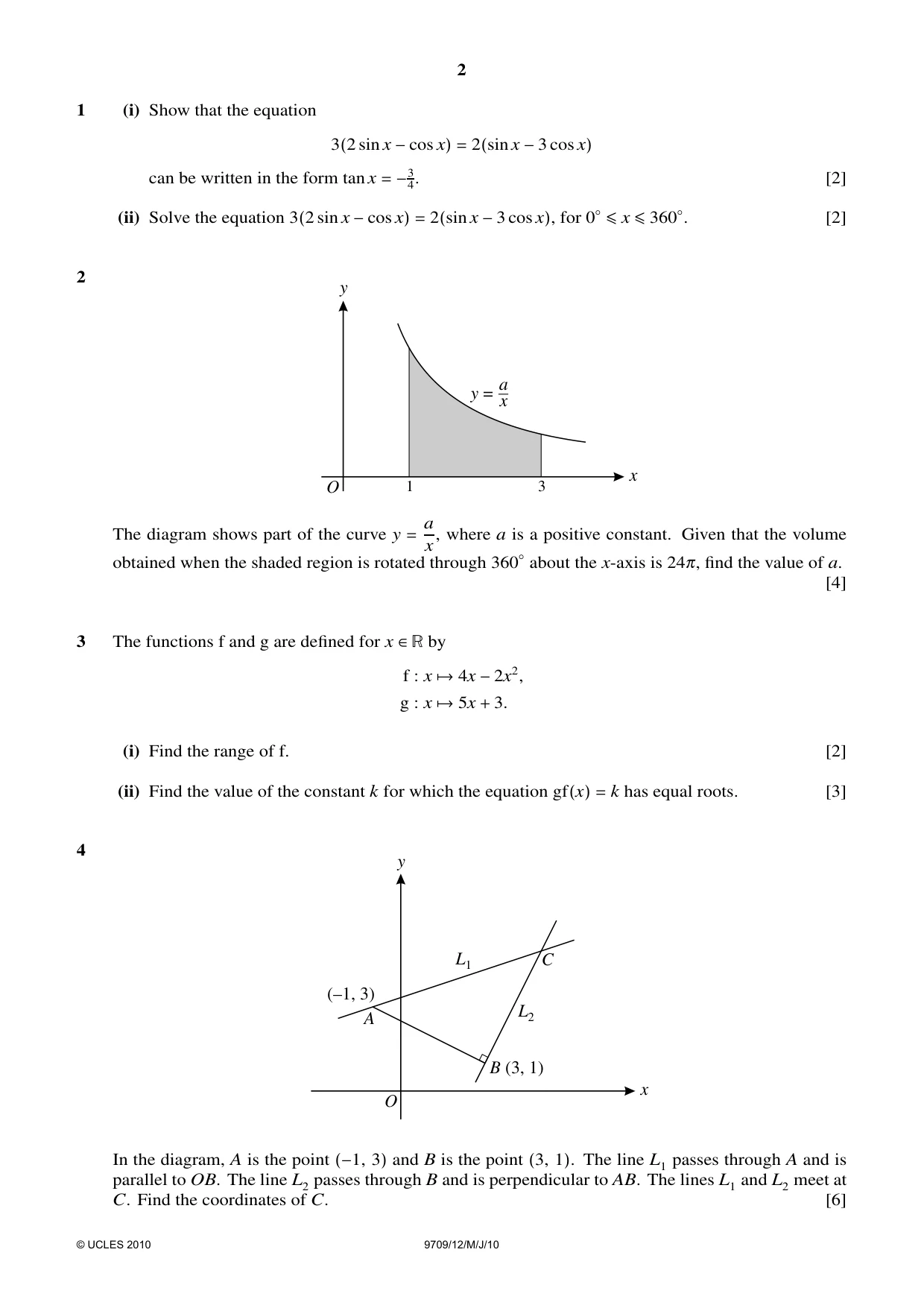
Q2 · Y a y = x x O 1 3 a The diagram shows part of the curve y = x, where a is a positive…
2 y a y = x x O 1 3 a The diagram shows part of the curve y = x, where a is a positive constant. Given that the volume obtained when the shaded region is rotated through 360◦about the x-axis is 24π, find the value of a. [4]
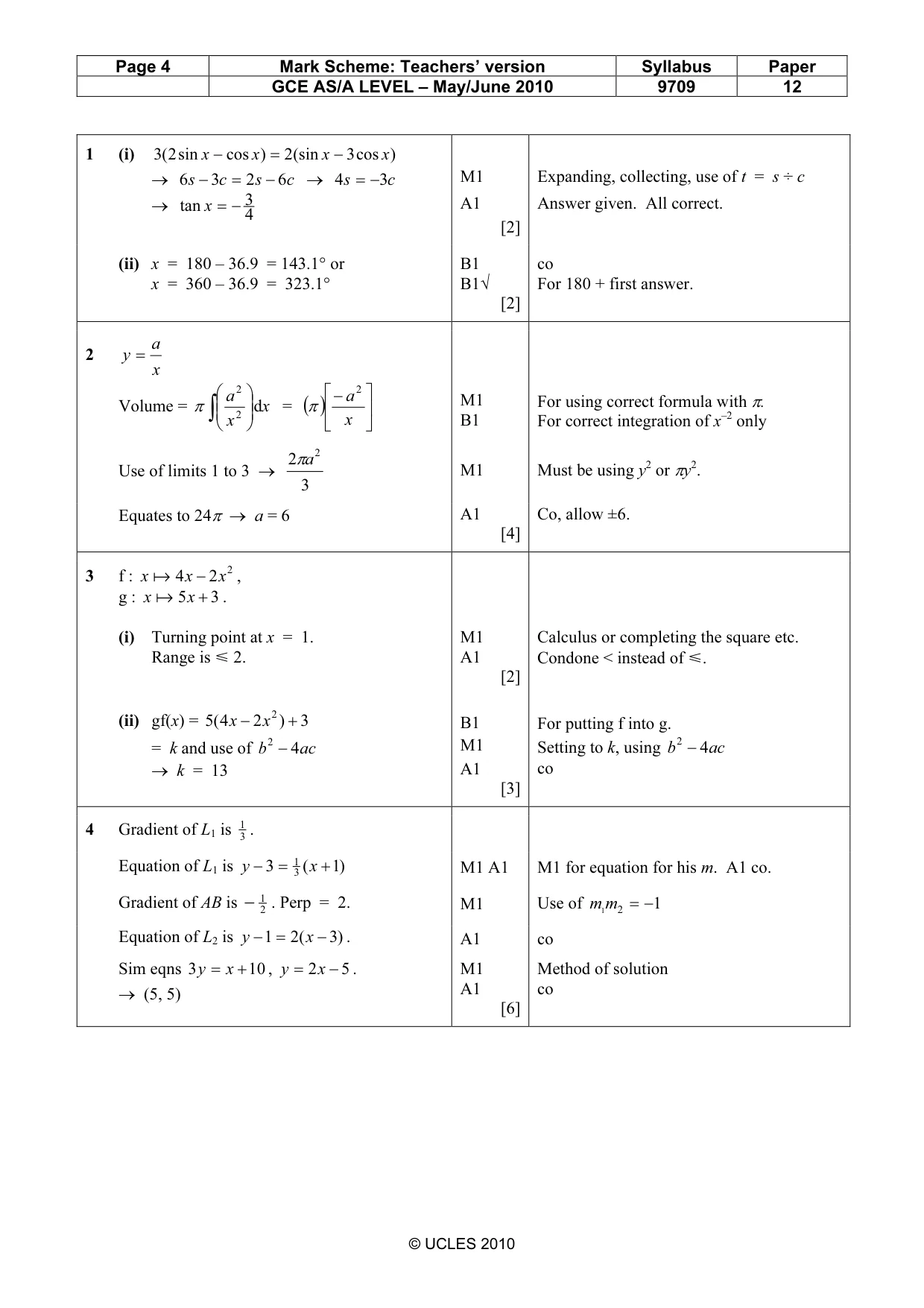
Mark scheme: 1 (i) 3( 2 sin x − cos x ) = 2 (sin x − 3 cos x ) M1 E di ll i f
Q4 · Y L1 C (–1, 3) L2 A B (3, 1) x O In the diagram, A is the point (−1, 3) and B is the…
4 y L1 C (–1, 3) L2 A B (3, 1) x O In the diagram, A is the point (−1, 3) and B is the point (3, 1). The line L1 passes through A and is parallel to OB. The line L2 passes through B and is perpendicular to AB. The lines L1 and L2 meet at C. Find the coordinates of C. [6]
Mark scheme: 3 f : x a 4 x − 2 x 2 ,
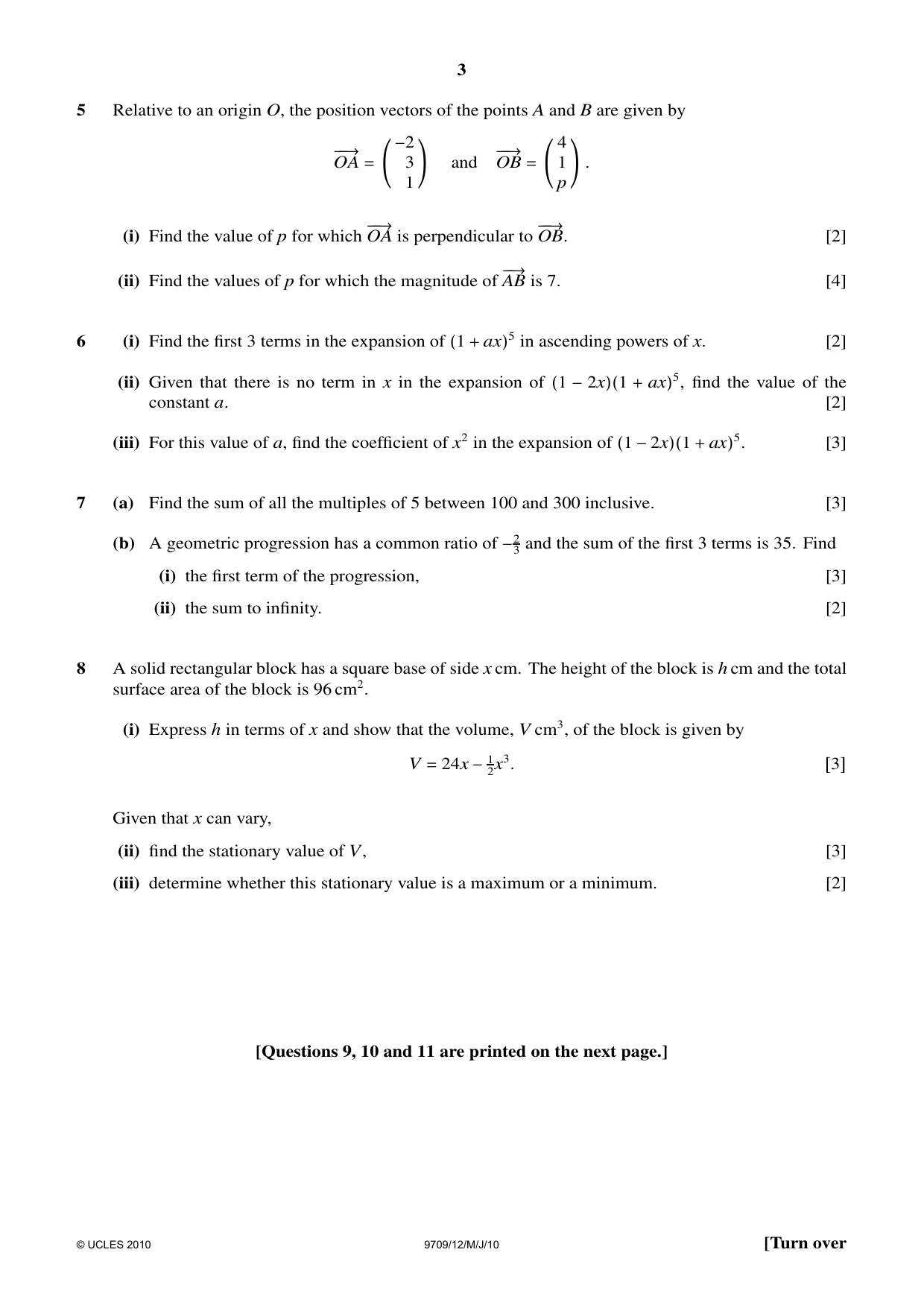
Q5 · Relative to an origin O, the position vectors of the points A and B are given by −2 4 −−→…
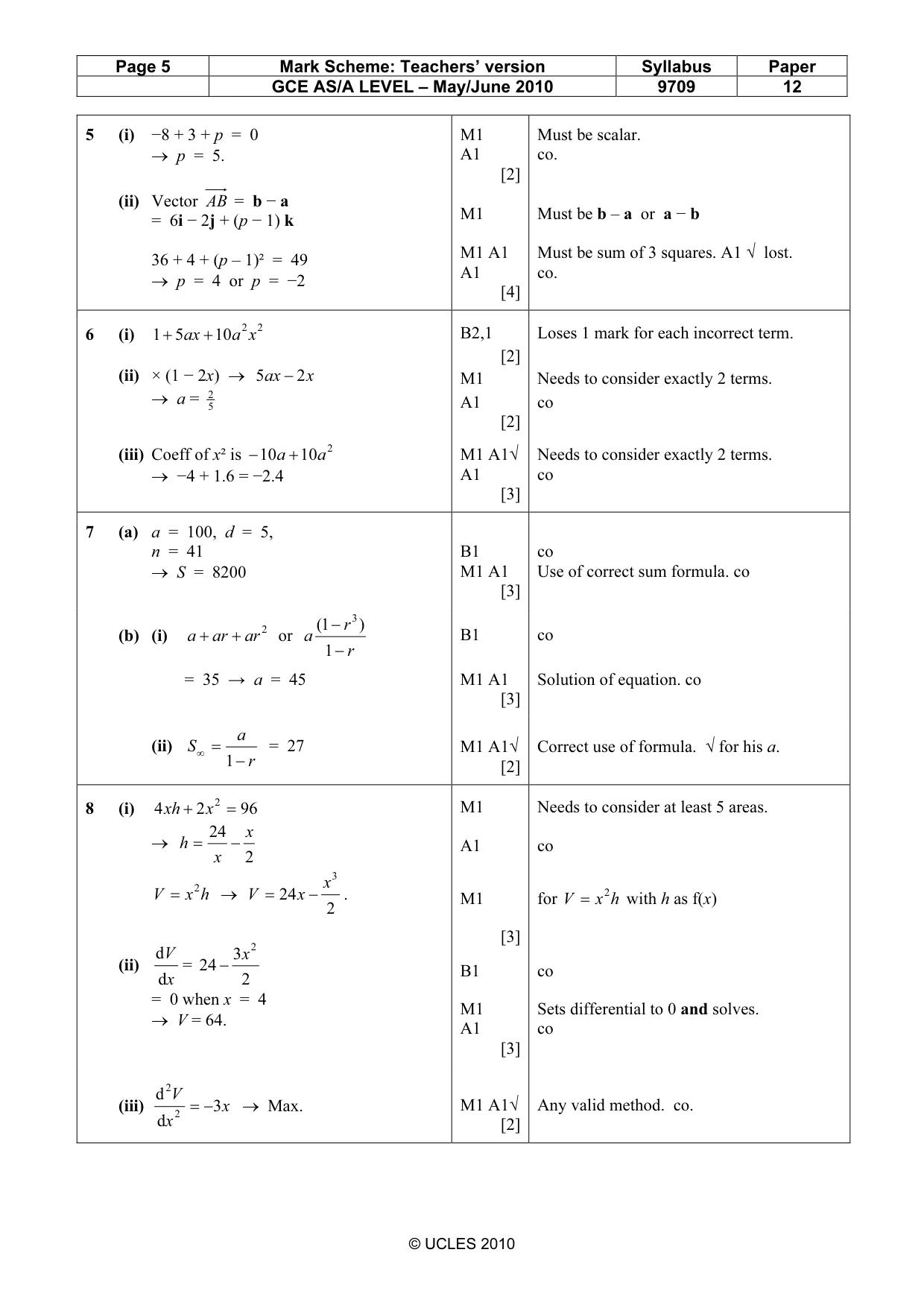
5 Relative to an origin O, the position vectors of the points A and B are given by −2 4 −−→ −−→ OA = 3 and OB = 1 . 1 ! p ! −−→ −−→ (i) Find the value of p for which OA is perpendicular to OB. [2] −−→ (ii) Find the values of p for which the magnitude of AB is 7. [4]
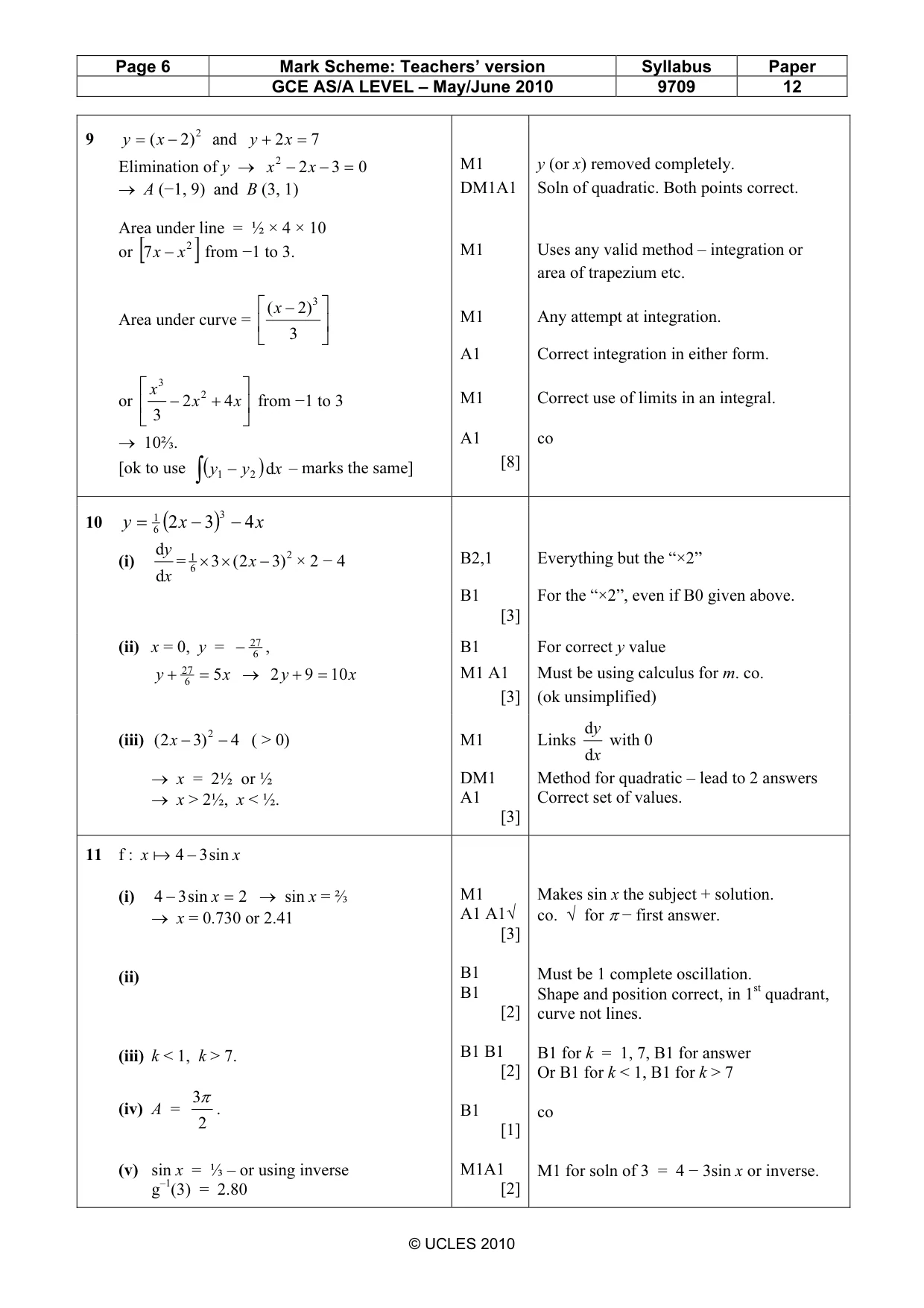
Mark scheme: g : x a 5 x + 3 . (i) Turning point at x = 1. M1 Calculus or completing the square etc. Range is Y 2. A1 Condone < instead of Y. [2] (ii) gf(x) = 5( 4 x −x2 2 ) + 3 B1 For putting f into g. = k and use of b 2 − 4 ac M1 Setting to k, using b 2 − 4 ac → k = 13 A1 co [3] 4 Gradient of L1 is 13 . Equation of L1 is y − 3 = 13 ( x + )1 M1 A1 M1 for equation for his m. A1 co. Gradient of AB is − 12 . Perp = 2. M1 Use of m1 m2 = −1 Equation of L2 is y − 1 = 2 ( x − 3) . A1 co
Q6 · Find the first 3 terms in the expansion of (1 + ax)5 in ascending powers of x
6 (i) Find the first 3 terms in the expansion of (1 + ax)5 in ascending powers of x. [2] (ii) Given that there is no term in x in the expansion of (1 −2x)(1 + ax)5, find the value of the constant a. [2] (iii) For this value of a, find the coefficient of x2 in the expansion of (1 −2x)(1 + ax)5. [3]
Mark scheme: → 6 s − 3c = 2 s − 6 c → 4 s = −3c M1 Expanding, collecting, use of t = s ÷ c 3 A1 Answer given. All correct. → tan x = − 4 [2] (ii) x = 180 – 36.9 = 143.1° or B1 co x = 360 – 36.9 = 323.1° B1√ For 180 + first answer. [2] a 2 y = x a 2 − a2 M1 π. For using correct formula with dx = (π ) Volume = π ∫ x B1 only For correct integration of x–2 x 2 2πa 2 Use of limits 1 to 3 → M1 Must be using y2 or πy2. 3 Equates to 24π → a = 6 A1 Co, allow ±6. [4] 2
What was in this paper
The subtopics covered by these 4 questions, and how many questions each got. Open one in a new tab to see every Cambridge question on it.
What you needed in this session
Cambridge’s own grade thresholds for 2010 May/June, Paper 1 · Variant 2. A higher threshold means an easier paper — the bar moves with how the cohort did.