Cambridge A Level Mathematics 9709 — 2016 Oct/Nov Paper 1 · Variant 1
9709/11/O/N/16 · 8 questions · 75 marks · ≈84 min
The question paper and its mark scheme, free to read here and free to download. This is Cambridge’s own paper, exactly as it was sat.
Question paper4 pages
Mark scheme6 pages
Answers below. Sit the paper first if you are practising.
Questions as text
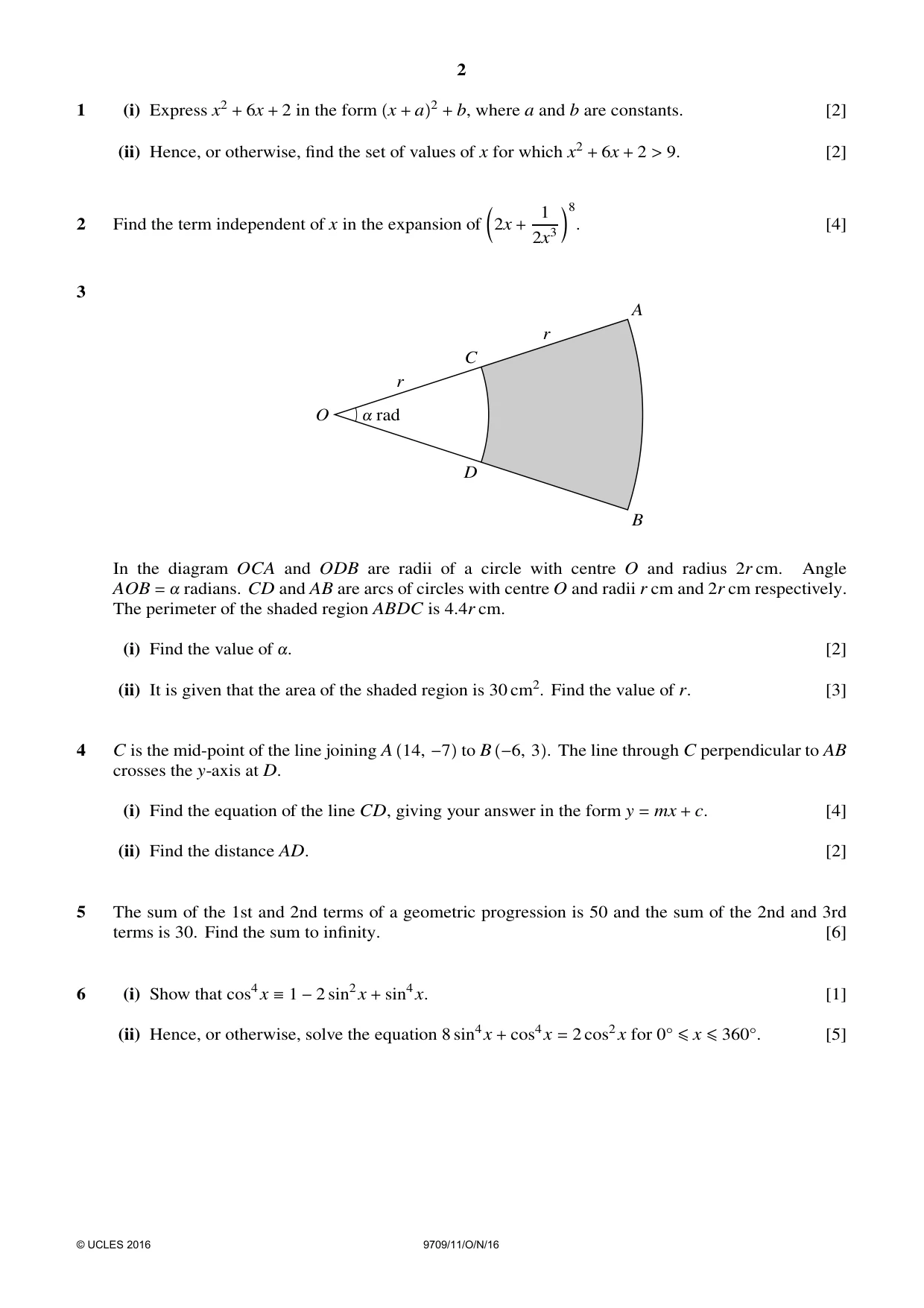
Q2 · 8 2 Find the term independent of x in the expansion of 2x +
1 8 2 Find the term independent of x in the expansion of 2x + . [4] 2x3
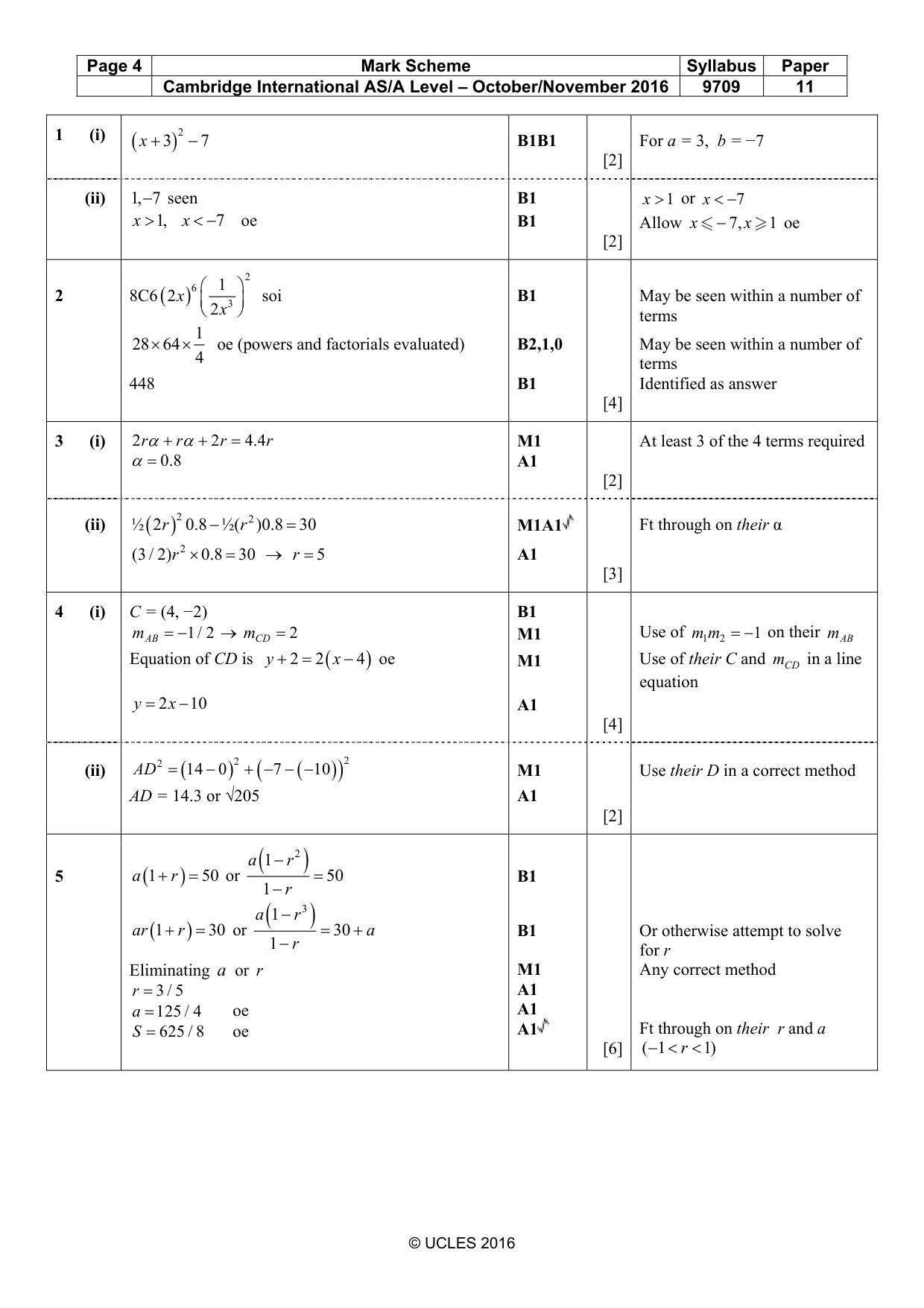
Mark scheme: 6 1 soi B1 May be seen within a number of2 8C6( 2 x ) 3 2 x terms 1 28 × 64 × oe (powers and factorials evaluated) B2,1,0 May be seen within a number of 4 terms 448 B1 Identified as answer [4]
Q3 · A r C r O !
3 A r C r O ! rad D B In the diagram OCA and ODB are radii of a circle with centre O and radius 2r cm. Angle AOB = ! radians. CD and AB are arcs of circles with centre O and radii r cm and 2r cm respectively. The perimeter of the shaded region ABDC is 4.4r cm. (i) Find the value of !. [2] (ii) It is given that the area of the shaded region is 30 cm2. Find the value of r. [3]
Mark scheme: 3 (i) 2 rα+ rα+ 2 r = 4.4 r M1 At least 3 of the 4 terms required α = 0.8 A1 [2] 2 2 (ii) ½ ( 2 r ) 0.8 − ½( r )0.8 = 30 M1A1 Ft through on their α (3 / 2) r 2 × 0.8 = 30 → r = 5 A1 [3]
Q4 · C is the mid-point of the line joining A 14, −7 to B −6, 3
4 C is the mid-point of the line joining A 14, −7 to B −6, 3 . The line through C perpendicular to AB crosses the y-axis at D. (i) Find the equation of the line CD, giving your answer in the form y = mx + c. [4] (ii) Find the distance AD. [2]
Mark scheme: 4 (i) C = (4, −2) B1 m AB = − 1/ 2 → mCD = 2 M1 Use of m1 m2 = − 1 on their m AB Equation of CD is y + 2 = 2 ( x − 4 ) oe M1 Use of their C and mCD in a line equation y = 2 x − 10 A1 [4] 2 2 2 (ii) AD = (14 − 0 ) + ( −−−7 ( 10 ) ) M1 Use their D in a correct method AD = 14.3 or √205 A1 [2] a 1− r 2 ( )
Q5 · The sum of the 1st and 2nd terms of a geometric progression is 50 and the sum of the 2nd…
5 The sum of the 1st and 2nd terms of a geometric progression is 50 and the sum of the 2nd and 3rd terms is 30. Find the sum to infinity. [6]
Mark scheme: ( )5 a (1 + r ) = 50 or = 50 B1 1 −r a 1 − r 3 ( ) ar (1 + r ) = 30 or = 30 + a B1 Or otherwise attempt to solve 1 − r for r Eliminating a or r M1 Any correct method r = 3 / 5 A1 a = 125 / 4 oe A1 S = 625 / 8 oe A1 Ft through on their r and a [6] ( −<1 r < 1) 2 4 2 2 4 ( )
Q6 · Show that cos4x 1 −2 sin2x + sin4x
6 (i) Show that cos4x 1 −2 sin2x + sin4x. [1] (ii) Hence, or otherwise, solve the equation 8 sin4x + cos4x = 2 cos2x for 0Å ≤x ≤360Å. [5]
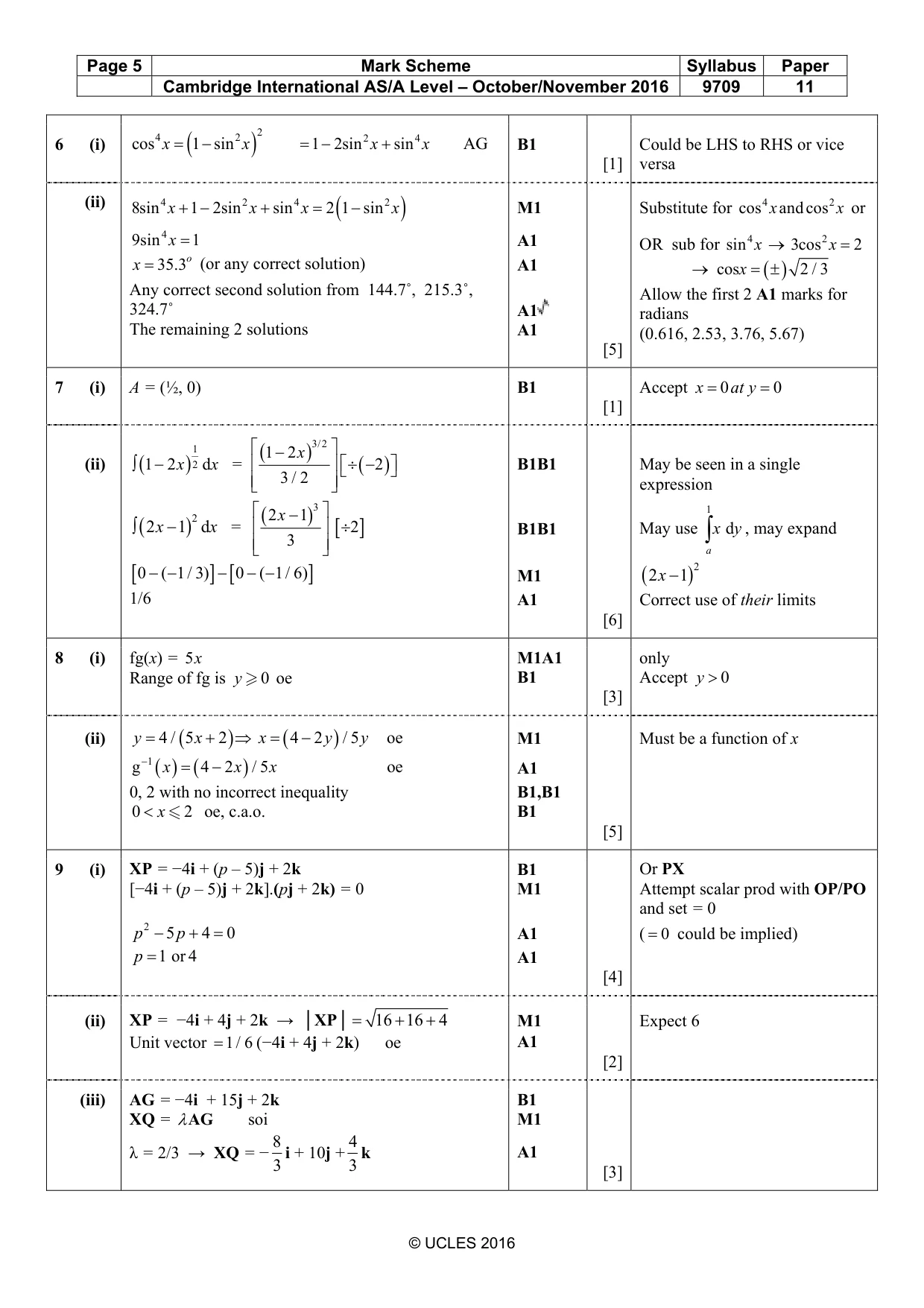
Mark scheme: 2 1 − sin 2 x = 1 − 2sin 2 x + sin 4 x AG B1 Could be LHS to RHS or vice6 (i) cos 4 x = ( ) [1] versa (ii) 4 2 4 2 4 2 8sin x + 1 − 2sin x + sin x = 2 1 − sin x M1 Substitute for cos x and cos x or ( ) 9sin 4 x = 1 A1 OR sub for sin 4 x → 3cos 2 x = 2 x = 35.3o (or any correct solution) A1 → cos x = ( ± ) 2 / 3 Any correct second solution from 144.7˚, 215.3˚, Allow the first 2 A1 marks for 324.7˚ A1 radians The remaining 2 solutions A1 (0.616, 2.53, 3.76, 5.67) [5]
Q7 · Y y = 2x −1 2 B x O A y2 = 1 −2x The diagram shows parts of the curves y = 2x −1 2 and y2…
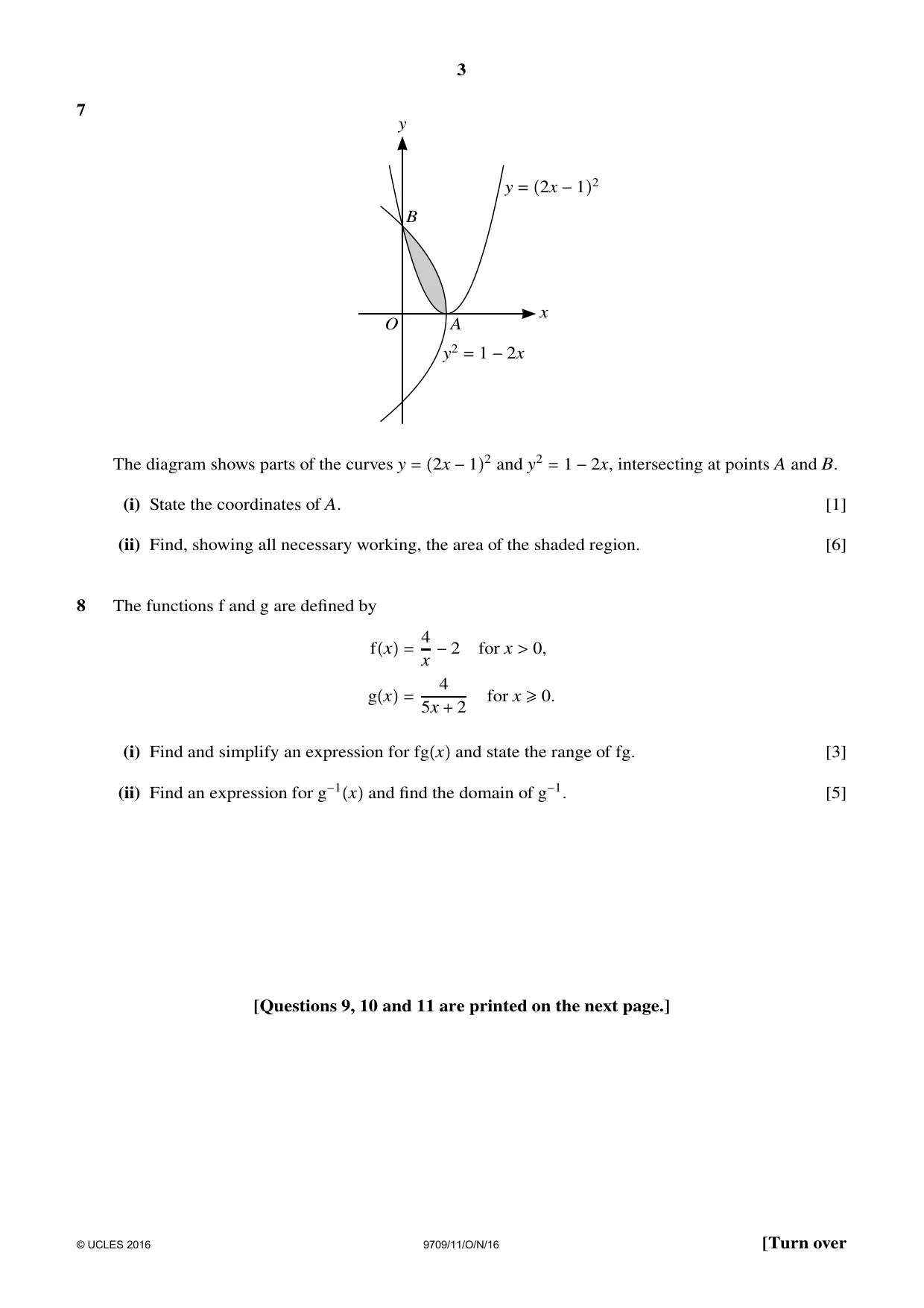
7 y y = 2x −1 2 B x O A y2 = 1 −2x The diagram shows parts of the curves y = 2x −1 2 and y2 = 1 −2x, intersecting at points A and B. (i) State the coordinates of A. [1] (ii) Find, showing all necessary working, the area of the shaded region. [6]
Mark scheme: 7 (i) A = (½, 0) B1 Accept x = 0 at y = 0 [1] 3/2 1 (1 − 2 x ) 2 d x = ÷ B1B1 May be seen in a single (ii) ∫ (1 −x2 ) ( − 2 ) 3 / 2 expression 2 ( 2 x − 1) 3 1 ÷ x dy , may expand ∫ ( 2 x − 1) d x = [ 2 ] B1B1 May use ∫ 3 a [ 0 −−( 1/ 3) ] − [ 0 −−( 1/ 6) ] M1 ( 2 x − 1) 2 1/6 A1 Correct use of their limits [6]
Q9 · G P F p cm C D B 2 cm k E 10 cm j X O i 5 cm 4 cm A The diagram shows a cuboid OABCDEFG…
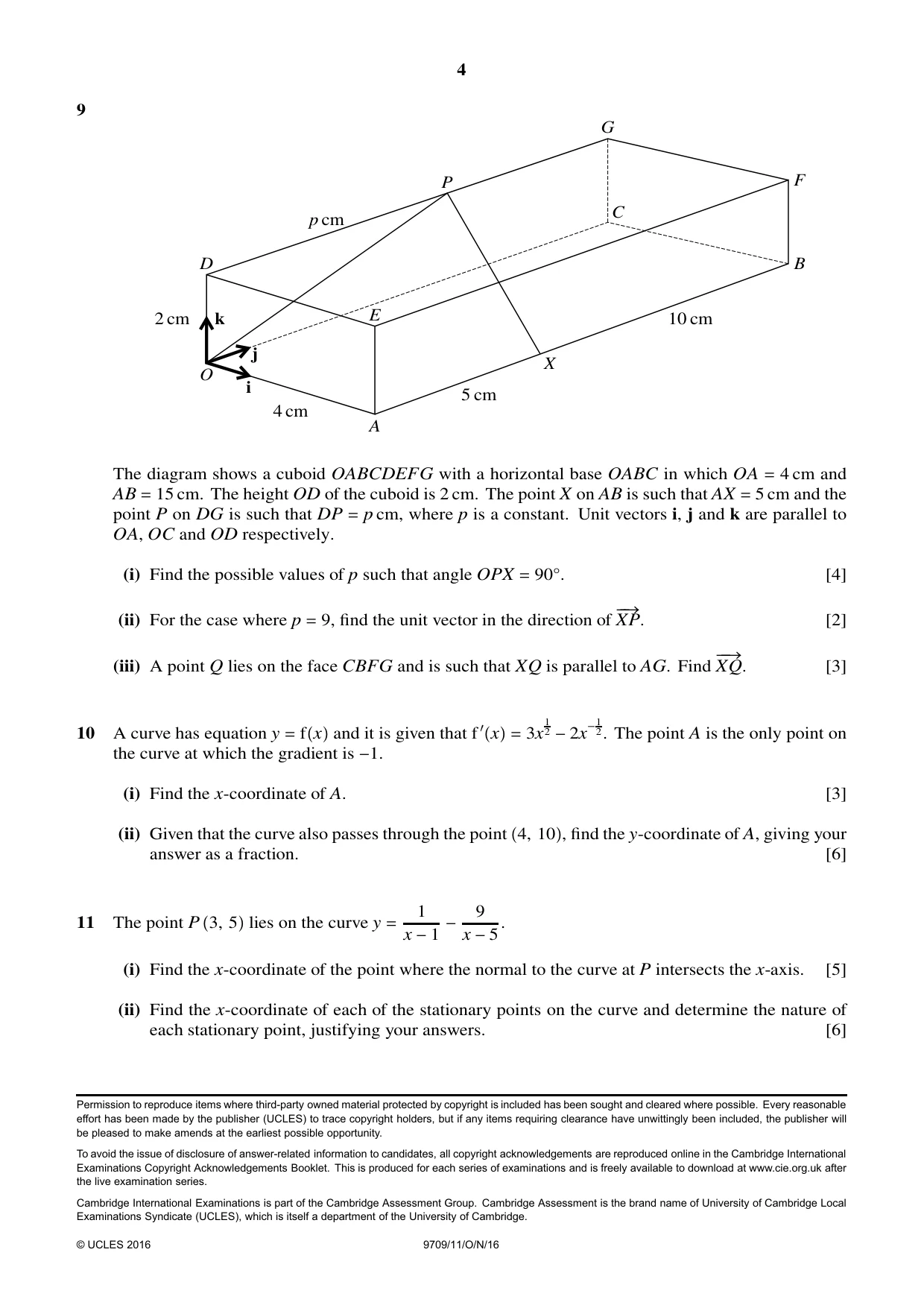
9 G P F p cm C D B 2 cm k E 10 cm j X O i 5 cm 4 cm A The diagram shows a cuboid OABCDEFG with a horizontal base OABC in which OA = 4 cm and AB = 15 cm. The height OD of the cuboid is 2 cm. The point X on AB is such that AX = 5 cm and the point P on DG is such that DP = p cm, where p is a constant. Unit vectors i, j and k are parallel to OA, OC and OD respectively. (i) Find the possible values of p such that angle OPX = 90Å. [4] −−→ (ii) For the case where p = 9, find the unit vector in the direction of XP. [2] −−→ (iii) A point Q lies on the face CBFG and is such that XQ is parallel to AG. Find XQ. [3]
Mark scheme: 9 (i) XP = −4i + (p – 5)j + 2k B1 Or PX [−4i + (p – 5)j + 2k].(pj + 2k) = 0 M1 Attempt scalar prod with OP/PO and set = 0 p 2 − 5 p + 4 = 0 A1 ( = 0 could be implied) p = 1 or 4 A1 [4] (ii) XP = −4i + 4j + 2k → │XP│ = 16 + 16 + 4 M1 Expect 6 Unit vector = 1/ 6 (−4i + 4j + 2k) oe A1 [2] (iii) AG = −4i + 15j + 2k B1 XQ = λAG soi M1 4 λ = 2/3 → XQ = −8 i + 10j + k A1 3 3 [3] 2 2
Q11 · 9 11 The point P 3, 5 lies on the curve y = − x −1 x −5
1 9 11 The point P 3, 5 lies on the curve y = − x −1 x −5. (i) Find the x-coordinate of the point where the normal to the curve at P intersects the x-axis. [5] (ii) Find the x-coordinate of each of the stationary points on the curve and determine the nature of each stationary point, justifying your answers. [6]
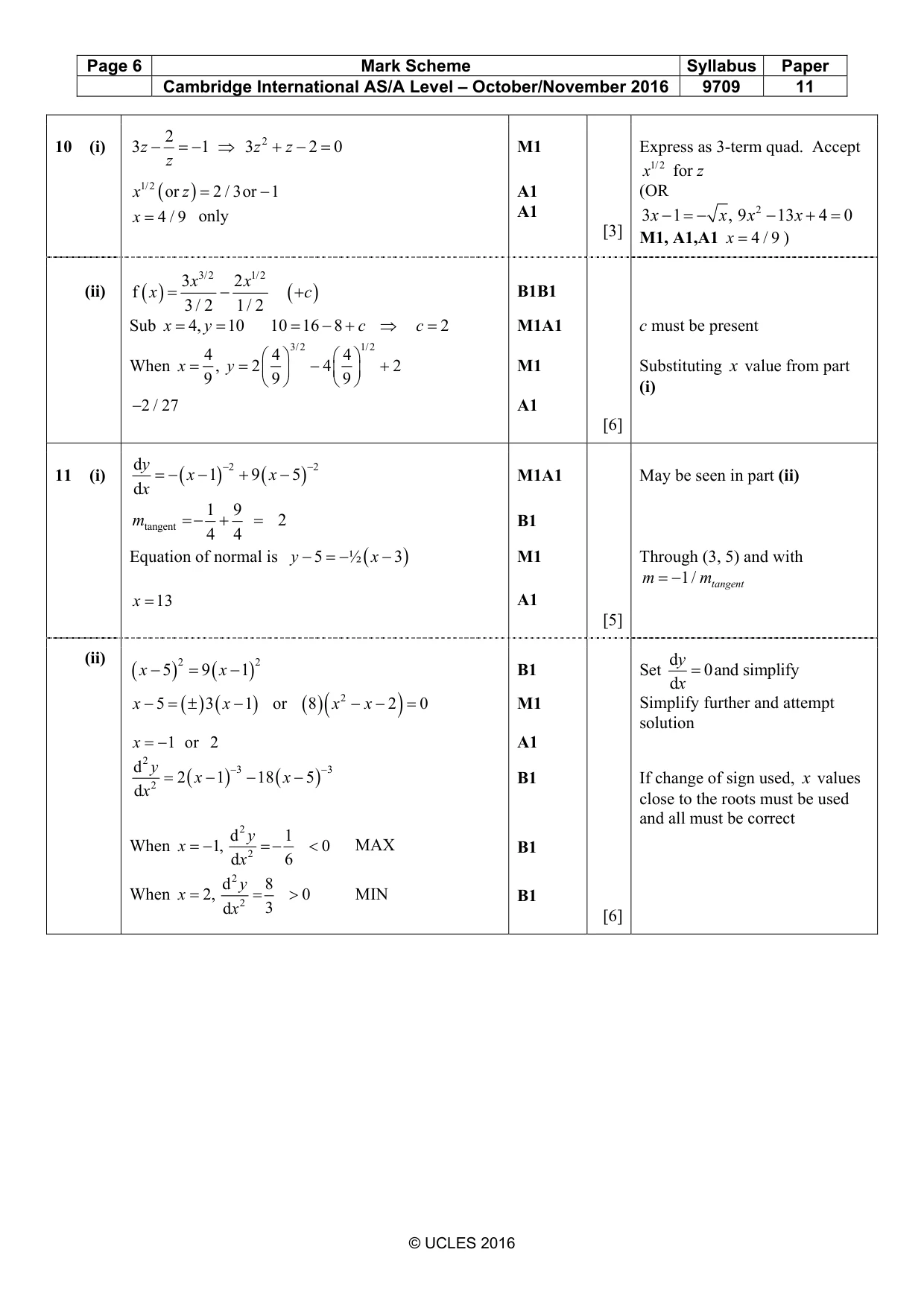
Mark scheme: dy −2 −211 (i) = − ( x − 1) + 9 ( x − 5 ) M1A1 May be seen in part (ii) dx 1 9 mtangent =− + = 2 B1 4 4 Equation of normal is y − 5 = −½ ( x − 3 ) M1 Through (3, 5) and with m = −1/ mtangent x = 13 A1 [5] (ii) 2 2 dy ( x − 5 ) = 9 ( x − 1) B1 Set = 0 and simplify dx x 2 − x − 2 = 0 M1 Simplify further and attempt x − 5 = ( ± ) 3 ( x − 1) or ( 8 )( ) solution x = − 1 or 2 A1 d 2 y − 3 − 3 = 2 ( x − 1) − 18 ( x − 5 ) B1 If change of sign used, x values 2 d x close to the roots must be used and all must be correct d 2 y 1 When x = − 1, =− < 0 MAX B1 2 d x 6 d 2 y 8 When x = 2, = > 0 MIN B1 2 d x 3 [6]
What was in this paper
The subtopics covered by these 8 questions, and how many questions each got. Open one in a new tab to see every Cambridge question on it.
What you needed in this session
Cambridge’s own grade thresholds for 2016 Oct/Nov, Paper 1 · Variant 1. A higher threshold means an easier paper — the bar moves with how the cohort did.