Cambridge A Level Mathematics 9709 — 2010 May/June Paper 1 · Variant 3
9709/13/M/J/10 · 6 questions · 75 marks · ≈84 min
The question paper and its mark scheme, free to read here and free to download. This is Cambridge’s own paper, exactly as it was sat.
Question paper4 pages
Mark scheme6 pages
Answers below. Sit the paper first if you are practising.
Questions as text
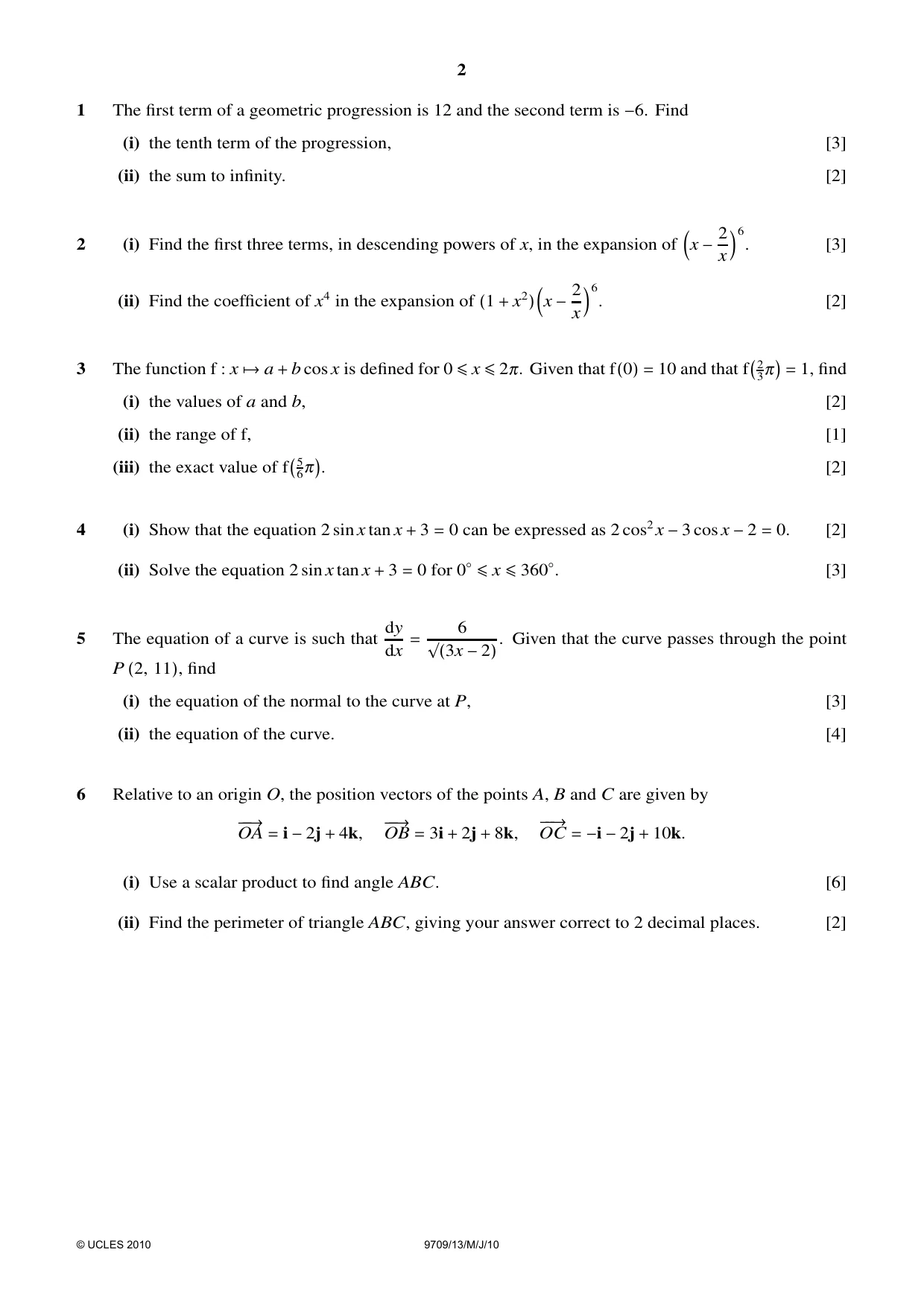
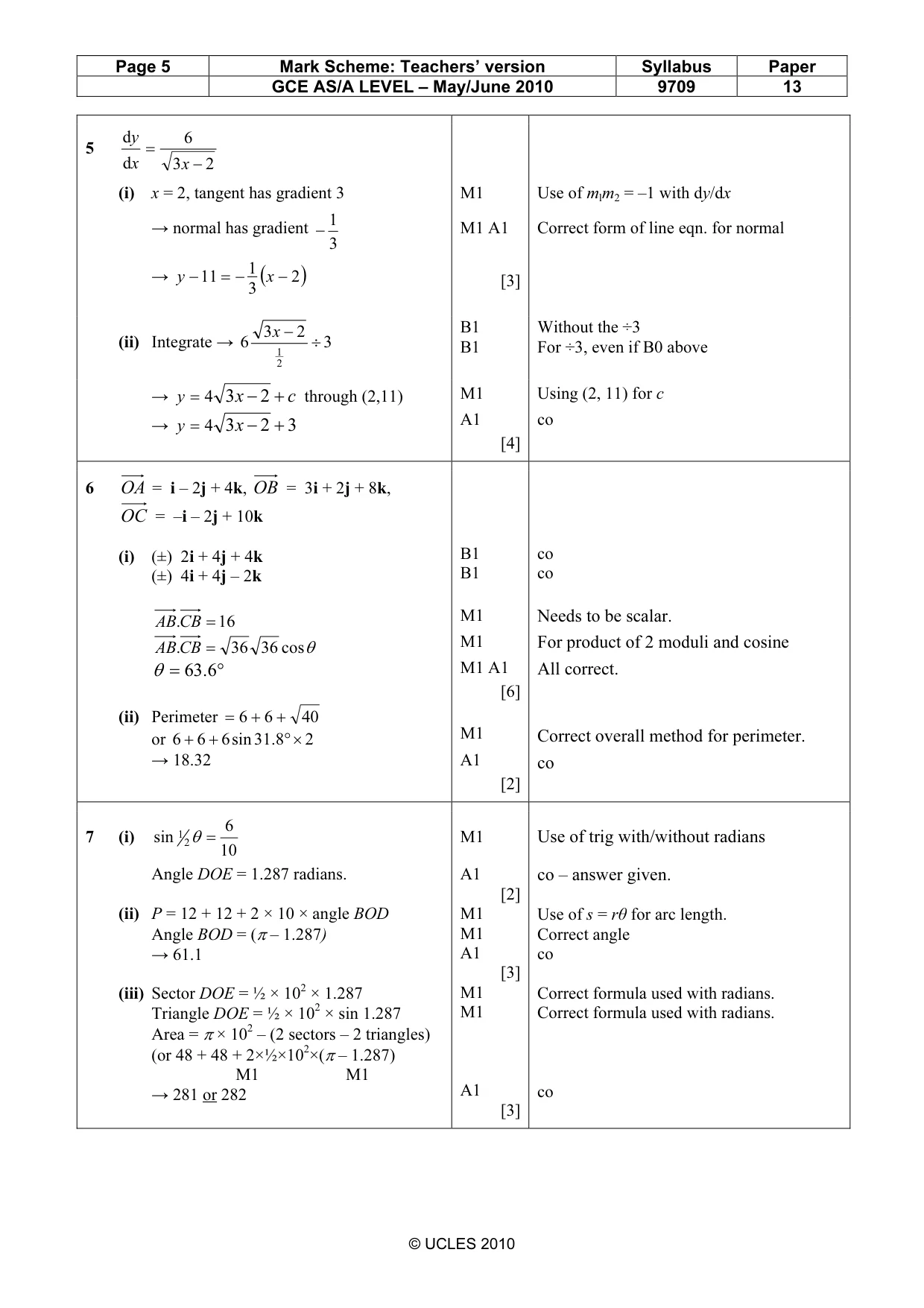
Q5 · Dy 6 5 The equation of a curve is such that dx = √(3x −2)
dy 6 5 The equation of a curve is such that dx = √(3x −2). Given that the curve passes through the point P (2, 11), find (i) the equation of the normal to the curve at P, [3] (ii) the equation of the curve. [4]
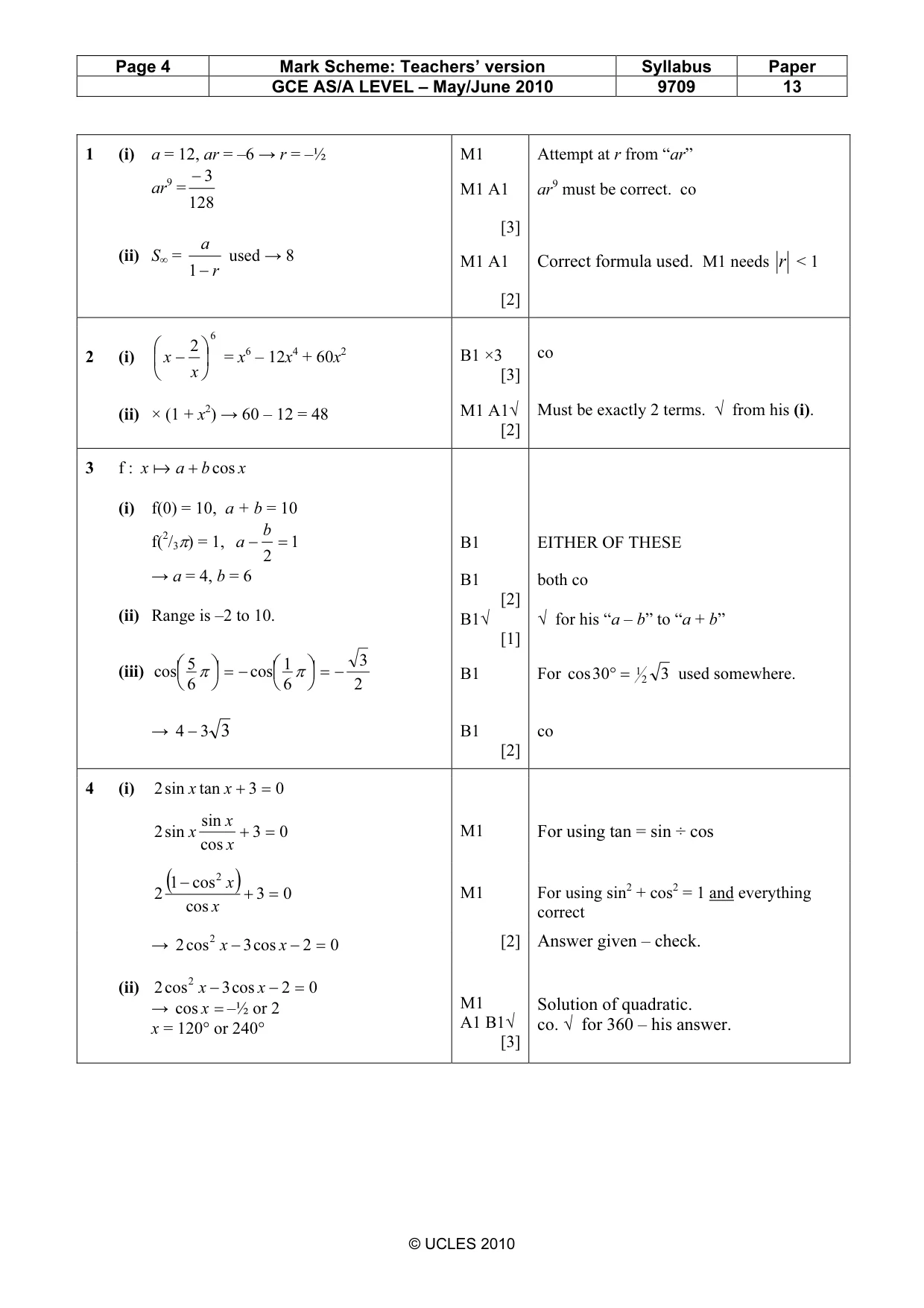
Mark scheme: dy 6 5 = dx 3 x − 2 (i) x = 2, tangent has gradient 3 M1 Use of mlm2 = –1 with dy/dx 1 → normal has gradient − M1 A1 Correct form of line eqn. for normal 3 1 → y − 11 = − ( x − 2 ) [3] 3 3 x − 2 B1 Without the ÷3 ÷ 3 (ii) Integrate → 6 B1 For ÷3, even if B0 above 1 2 → y = 4 3 x − 2 + c through (2,11) M1 Using (2, 11) for c A1 co → y = 4 3 x − 2 + 3 [4]
Q6 · Relative to an origin O, the position vectors of the points A, B and C are given by −−→OA…
6 Relative to an origin O, the position vectors of the points A, B and C are given by −−→OA i 4k, −−→OB 3i 2j 8k, −−→OC 10k. = −2j + = + + = −i −2j + (i) Use a scalar product to find angle ABC. [6] (ii) Find the perimeter of triangle ABC, giving your answer correct to 2 decimal places. [2]
Mark scheme: 6 OA = i – 2j + 4k, OB = 3i + 2j + 8k, OC = –i – 2j + 10k (i) (±) 2i + 4j + 4k B1 co (±) 4i + 4j – 2k B1 co M1 Needs to be scalar. AB.CB = 16 M1 For product of 2 moduli and cosine AB.CB = 36 36 cos θ θ = 63 6. ° M1 A1 All correct. [6] (ii) Perimeter = 6 + 6 + 40 M1 Correct overall method for perimeter. or 6 + 6 + 6 sin 318.° × 2 → 18.32 A1 co [2] 6
Q7 · C B D 10 cm O 12 cm A E F The diagram shows a metal plate ABCDEF which has been made by…
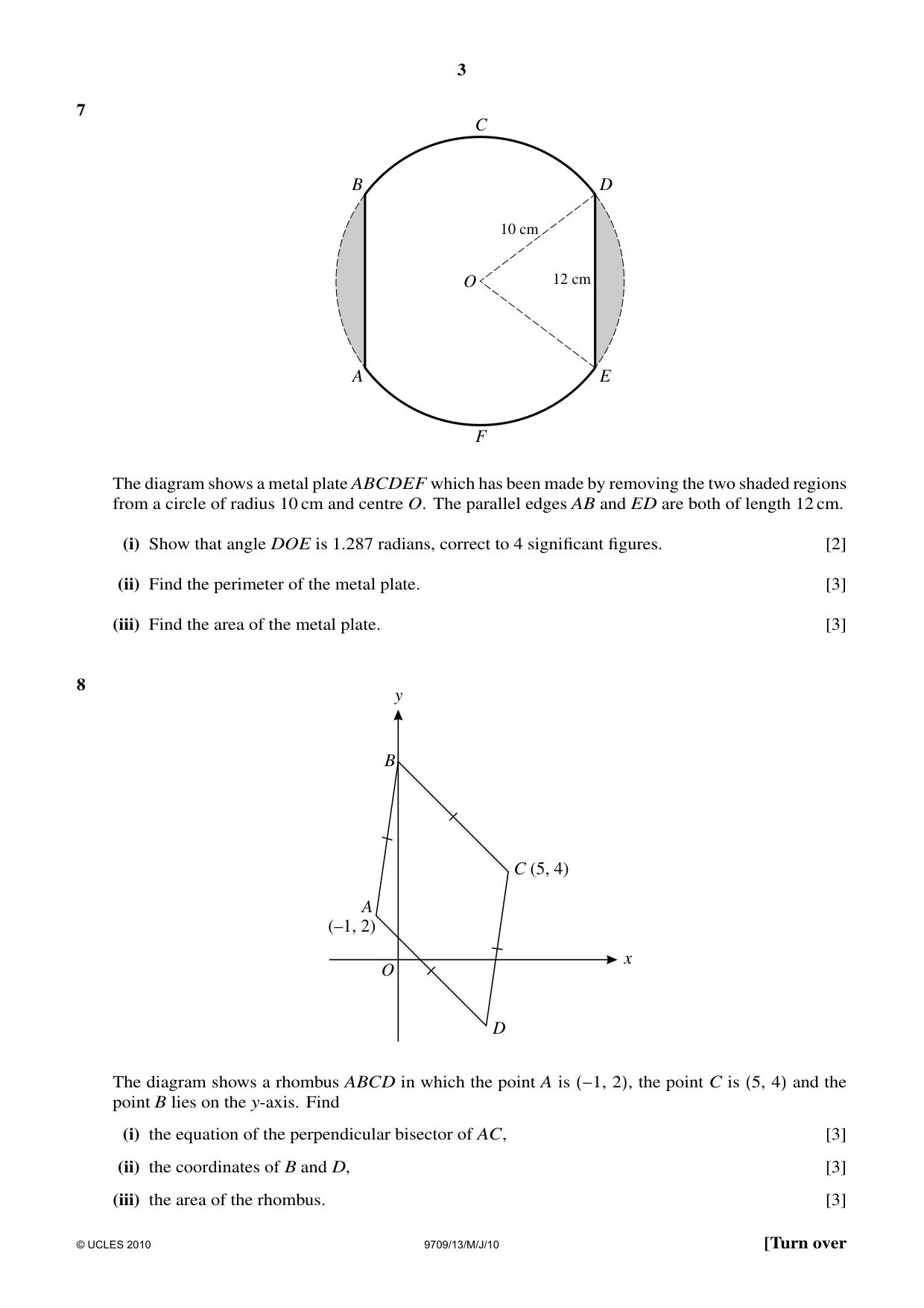
7 C B D 10 cm O 12 cm A E F The diagram shows a metal plate ABCDEF which has been made by removing the two shaded regions from a circle of radius 10 cm and centre O. The parallel edges AB and ED are both of length 12 cm. (i) Show that angle DOE is 1.287 radians, correct to 4 significant figures. [2] (ii) Find the perimeter of the metal plate. [3] (iii) Find the area of the metal plate. [3]
Mark scheme: 6 7 (i) sin 1 2 θ = M1 Use of trig with/without radians 10 Angle DOE = 1.287 radians. A1 co – answer given. [2] (ii) P = 12 + 12 + 2 × 10 × angle BOD M1 Use of s = rθ for arc length. Angle BOD = (π – 1.287) M1 Correct angle → 61.1 A1 co [3] (iii) Sector DOE = ½ × 102 × 1.287 M1 Correct formula used with radians. Triangle DOE = ½ × 102 × sin 1.287 M1 Correct formula used with radians. Area = π × 102 – (2 sectors – 2 triangles) (or 48 + 48 + 2×½×102×(π – 1.287) M1 M1 → 281 or 282 A1 co [3] GCE AS/A LEVEL – May/June 2010 9709 13
Q8 · Y B C (5, 4) A (–1, 2) x O D The diagram shows a rhombus ABCD in which the point A is…
8 y B C (5, 4) A (–1, 2) x O D The diagram shows a rhombus ABCD in which the point A is (−1, 2), the point C is (5, 4) and the point B lies on the y-axis. Find (i) the equation of the perpendicular bisector of AC, [3] (ii) the coordinates of B and D, [3] (iii) the area of the rhombus. [3]
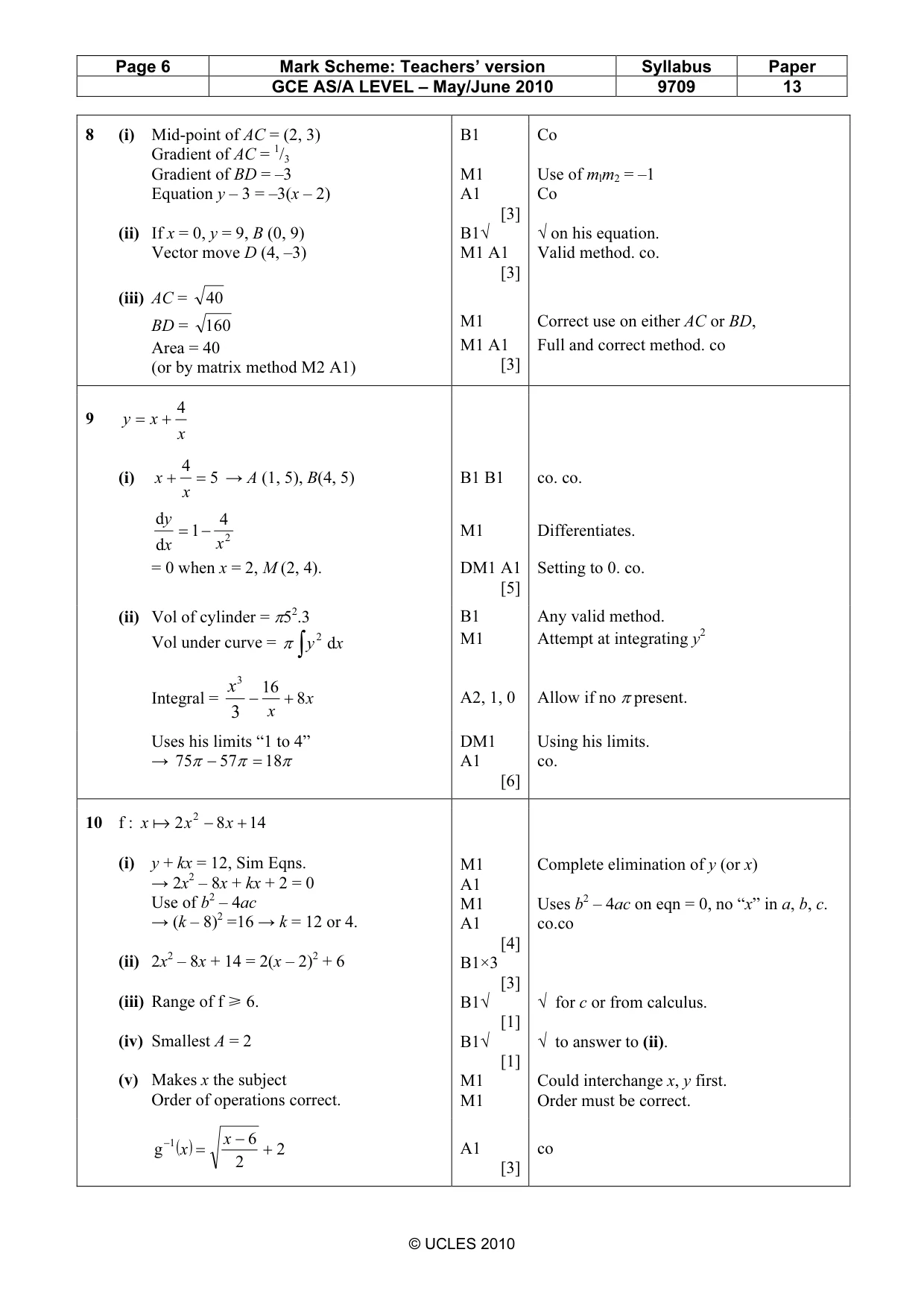
Mark scheme: 8 (i) Mid-point of AC = (2, 3) B1 Co Gradient of AC = 1/3 Gradient of BD = –3 M1 Use of mlm2 = –1 Equation y – 3 = –3(x – 2) A1 Co [3] (ii) If x = 0, y = 9, B (0, 9) B1√ √ on his equation. Vector move D (4, –3) M1 A1 Valid method. co. [3] (iii) AC = 40 BD = 160 M1 Correct use on either AC or BD, Area = 40 M1 A1 Full and correct method. co (or by matrix method M2 A1) [3] 4
Q9 · Y 4 y = x + x y = 5 A B M x O 4 The diagram shows part of the curve y = x + x which has a…
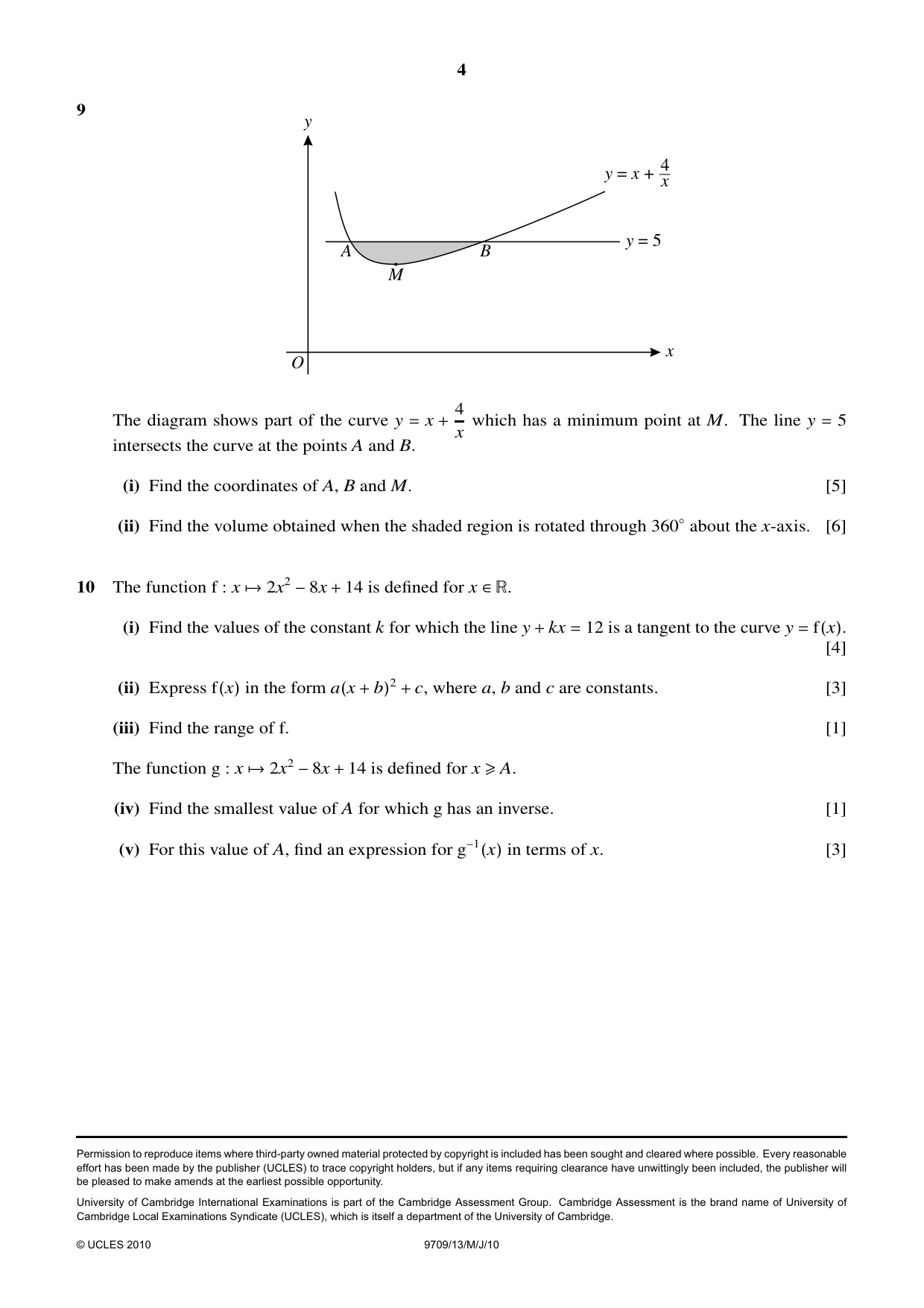
9 y 4 y = x + x y = 5 A B M x O 4 The diagram shows part of the curve y = x + x which has a minimum point at M. The line y = 5 intersects the curve at the points A and B. (i) Find the coordinates of A, B and M. [5] (ii) Find the volume obtained when the shaded region is rotated through 360◦about the x-axis. [6]
Mark scheme: 4 9 y = x + x 4 (i) x + = 5 → A (1, 5), B(4, 5) B1 B1 co. co. x dy 4 = 1 − 2 M1 Differentiates. dx x = 0 when x = 2, M (2, 4). DM1 A1 Setting to 0. co. [5] (ii) Vol of cylinder = π52.3 B1 Any valid method. Vol under curve = π y 2 dx M1 Attempt at integrating y2 ∫ x 3 16 Integral = − + 8 x A2, 1, 0 Allow if no π present. 3 x Uses his limits “1 to 4” DM1 Using his limits. → 75π − 57π = 18π A1 co. [6] 2
Q10 · The function f : x →2x2 −8x + 14 is defined for x ∈>
10 The function f : x →2x2 −8x + 14 is defined for x ∈>. (i) Find the values of the constant k for which the line y + kx = 12 is a tangent to the curve y = f(x). [4] (ii) Express f(x) in the form a(x + b)2 + c, where a, b and c are constants. [3] (iii) Find the range of f. [1] The function g : x →2x2 −8x + 14 is defined for x ≥A. (iv) Find the smallest value of A for which g has an inverse. [1] (v) For this value of A, find an expression for g−1(x) in terms of x. [3]
Mark scheme: 10 f : x a 2 x 2 −x8 + 14 (i) y + kx = 12, Sim Eqns. M1 Complete elimination of y (or x) → 2x2 – 8x + kx + 2 = 0 A1 Use of b2 – 4ac M1 Uses b2 – 4ac on eqn = 0, no “x” in a, b, c. → (k – 8)2 =16 → k = 12 or 4. A1 co.co [4] (ii) 2x2 – 8x + 14 = 2(x – 2)2 + 6 B1×3 [3] (iii) Range of f [ 6. B1√ √ for c or from calculus. [1] (iv) Smallest A = 2 B1√ √ to answer to (ii). [1] (v) Makes x the subject M1 Could interchange x, y first. Order of operations correct. M1 Order must be correct. −1 x − 6 g ( x ) = + 2 A1 co 2 [3]
What was in this paper
The subtopics covered by these 6 questions, and how many questions each got. Open one in a new tab to see every Cambridge question on it.
What you needed in this session
Cambridge’s own grade thresholds for 2010 May/June, Paper 1 · Variant 3. A higher threshold means an easier paper — the bar moves with how the cohort did.