Cambridge A Level Mathematics 9709 — 2015 Oct/Nov Paper 1 · Variant 2
9709/12/O/N/15 · 3 questions · 75 marks · ≈84 min
The question paper and its mark scheme, free to read here and free to download. This is Cambridge’s own paper, exactly as it was sat.
Question paper4 pages
Mark scheme7 pages
Answers below. Sit the paper first if you are practising.
Questions as text
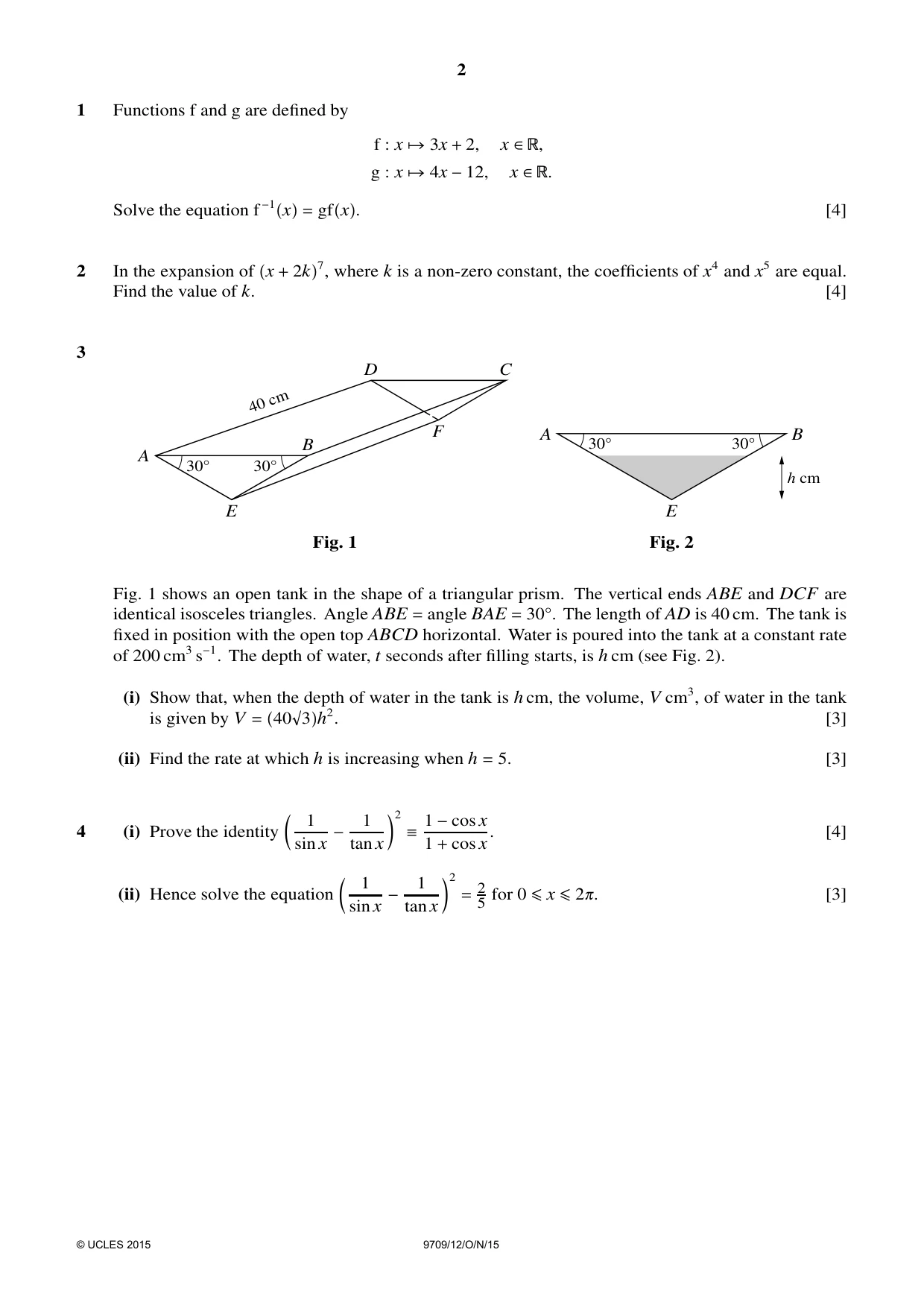
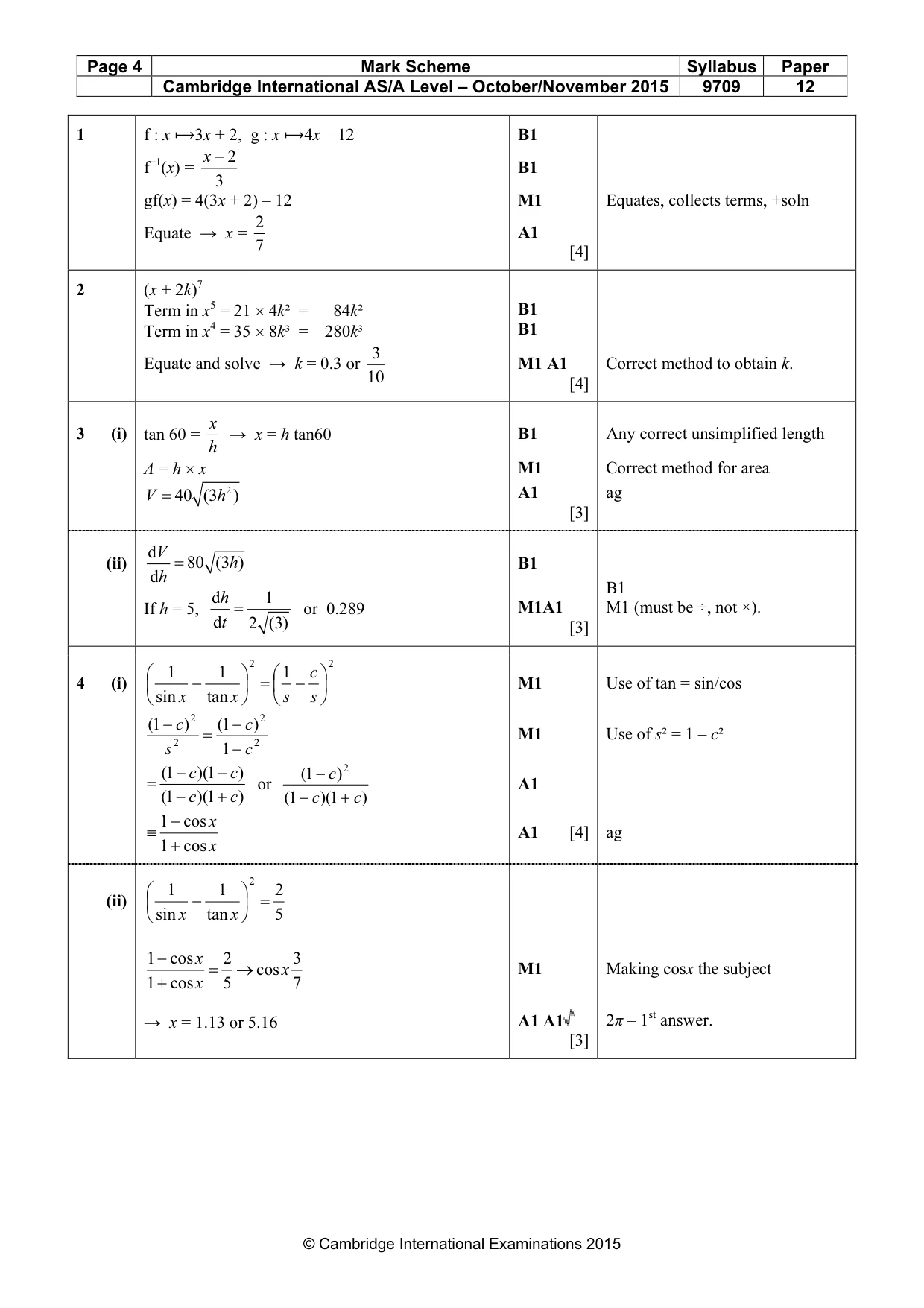
Q4 · @ A2 1 1 1 −cosx 4 (i) Prove the identity − [4] sin x tan x 1 + cosx
@ A2 1 1 1 −cosx 4 (i) Prove the identity − [4] sin x tan x 1 + cosx. @ A2 1 1 2 (ii) Hence solve the equation − = for 0 ≤x ≤20. [3] sin x tan x 5
Mark scheme: 1 1 1 c 4 (i) − = − M1 Use of tan = sin/cos sin x tan x s s 1( − c ) 2 1( − c ) 2 = M1 Use of s² = 1 – c² s 2 1 − c 2 1( − c )(1 − c ) 1( − c ) 2 = or A1 1( − c )(1 + c ) 1( − c )(1 + c ) 1 − cos x ≡ A1 [4] ag 1 + cos x 2 1 1 2 (ii) − = sin x tan x 5 1 − cos x 2 3 = → cos x M1 Making cosx the subject 1 + cos x 5 7 → x = 1.13 or 5.16 A1 A1 2π – 1st answer. [3] 6
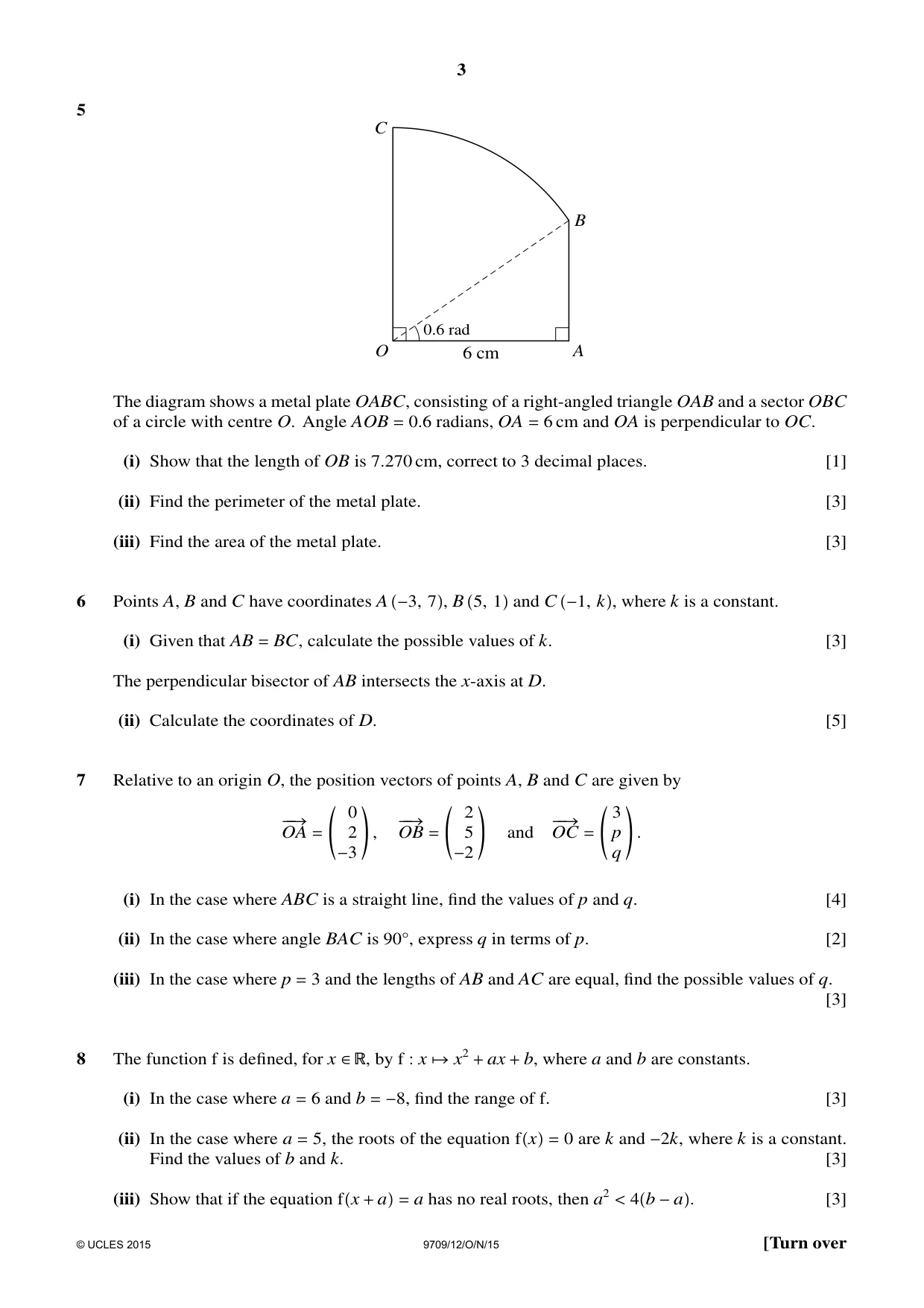
Q5 · C B 0.6 rad O 6 cm A The diagram shows a metal plate OABC, consisting of a right-angled…
5 C B 0.6 rad O 6 cm A The diagram shows a metal plate OABC, consisting of a right-angled triangle OAB and a sector OBC of a circle with centre O. Angle AOB = 0.6 radians, OA = 6 cm and OA is perpendicular to OC. (i) Show that the length of OB is 7.270 cm, correct to 3 decimal places. [1] (ii) Find the perimeter of the metal plate. [3] (iii) Find the area of the metal plate. [3]
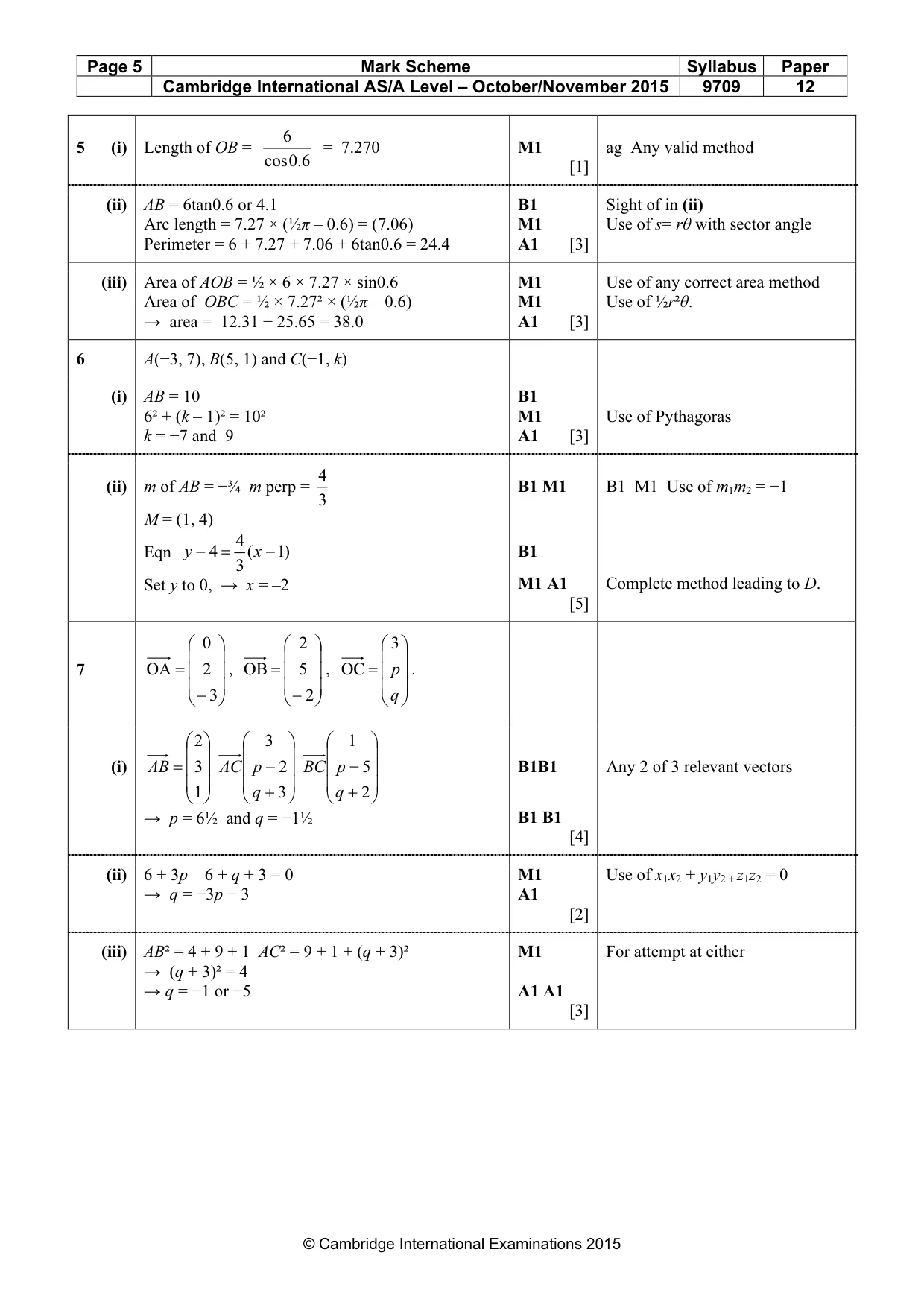
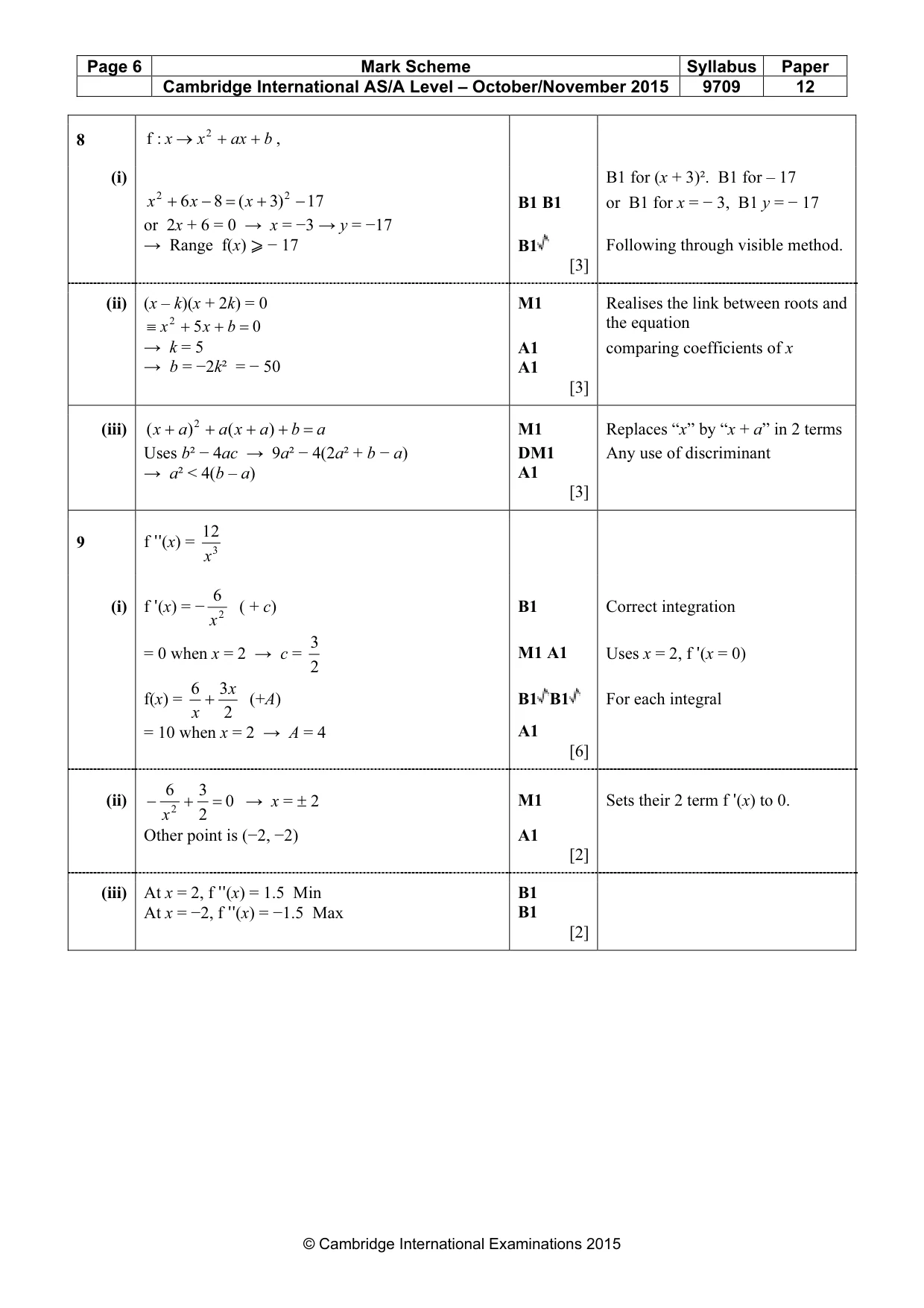
Mark scheme: 6 5 (i) Length of OB = = 7.270 M1 ag Any valid method cos 6.0 [1] (ii) AB = 6tan0.6 or 4.1 B1 Sight of in (ii) Arc length = 7.27 × (½π – 0.6) = (7.06) M1 Use of s= rθ with sector angle Perimeter = 6 + 7.27 + 7.06 + 6tan0.6 = 24.4 A1 [3] (iii) Area of AOB = ½ × 6 × 7.27 × sin0.6 M1 Use of any correct area method Area of OBC = ½ × 7.27² × (½π – 0.6) M1 Use of ½r²θ. → area = 12.31 + 25.65 = 38.0 A1 [3]
Q6 · Points A, B and C have coordinates A −3, 7 , B 5, 1 and C −1, k , where k is a constant
6 Points A, B and C have coordinates A −3, 7 , B 5, 1 and C −1, k , where k is a constant. (i) Given that AB = BC, calculate the possible values of k. [3] The perpendicular bisector of AB intersects the x-axis at D. (ii) Calculate the coordinates of D. [5]
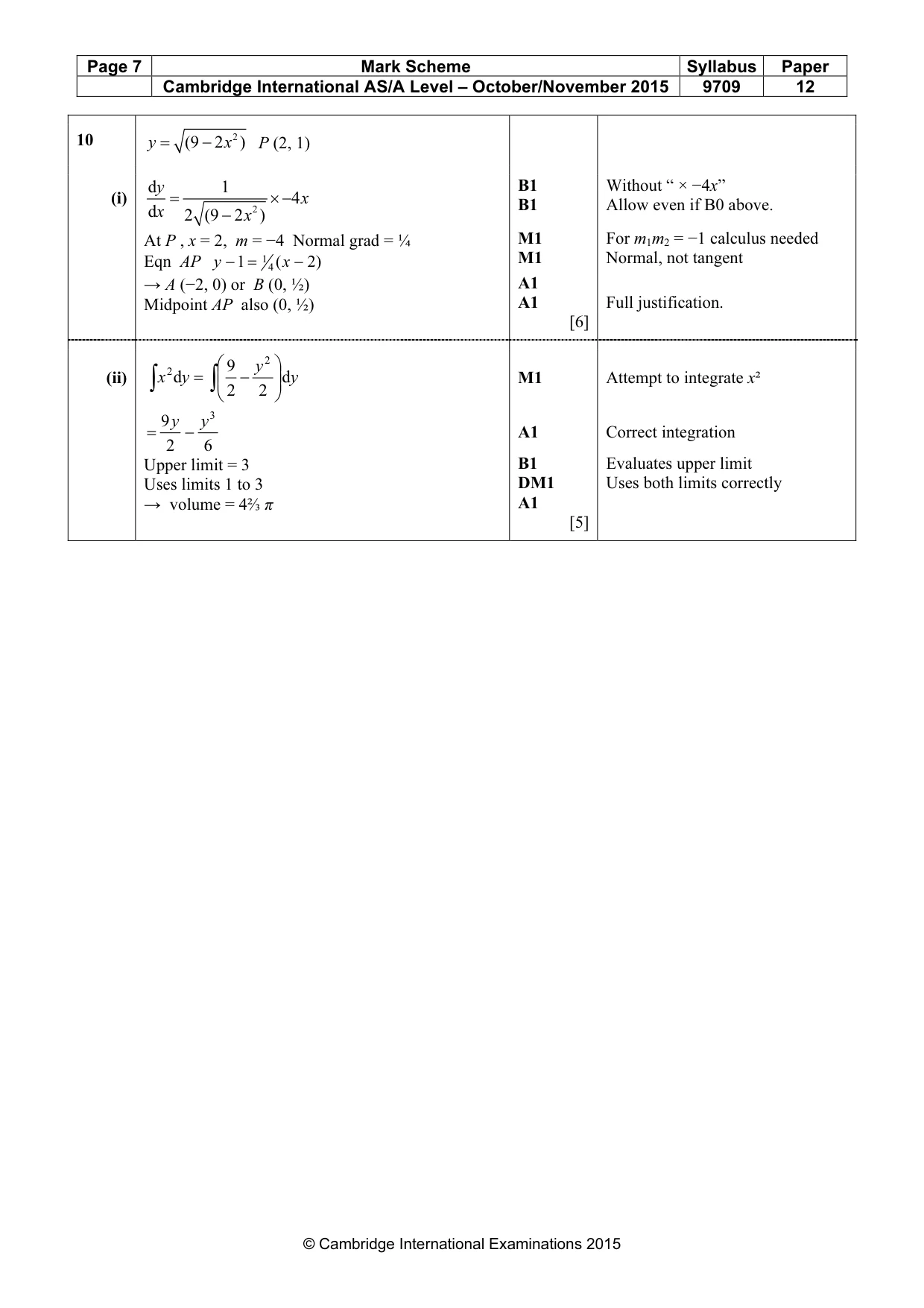
Mark scheme: 6 A(−3, 7), B(5, 1) and C(−1, k) (i) AB = 10 B1 6² + (k – 1)² = 10² M1 Use of Pythagoras k = −7 and 9 A1 [3] 4 (ii) m of AB = −¾ m perp = B1 M1 B1 M1 Use of m1m2 = −1 3 M = (1, 4) 4 Eqn y − 4 = ( x − )1 B1 3 Set y to 0, → x = –2 M1 A1 Complete method leading to D. [5] 0 2 3
What was in this paper
The subtopics covered by these 3 questions, and how many questions each got. Open one in a new tab to see every Cambridge question on it.
What you needed in this session
Cambridge’s own grade thresholds for 2015 Oct/Nov, Paper 1 · Variant 2. A higher threshold means an easier paper — the bar moves with how the cohort did.