Cambridge A Level Mathematics 9709 — 2010 Oct/Nov Paper 1 · Variant 1
9709/11/O/N/10 · 4 questions · 75 marks · ≈84 min
The question paper and its mark scheme, free to read here and free to download. This is Cambridge’s own paper, exactly as it was sat.
Question paper4 pages
Mark scheme7 pages
Answers below. Sit the paper first if you are practising.
Questions as text
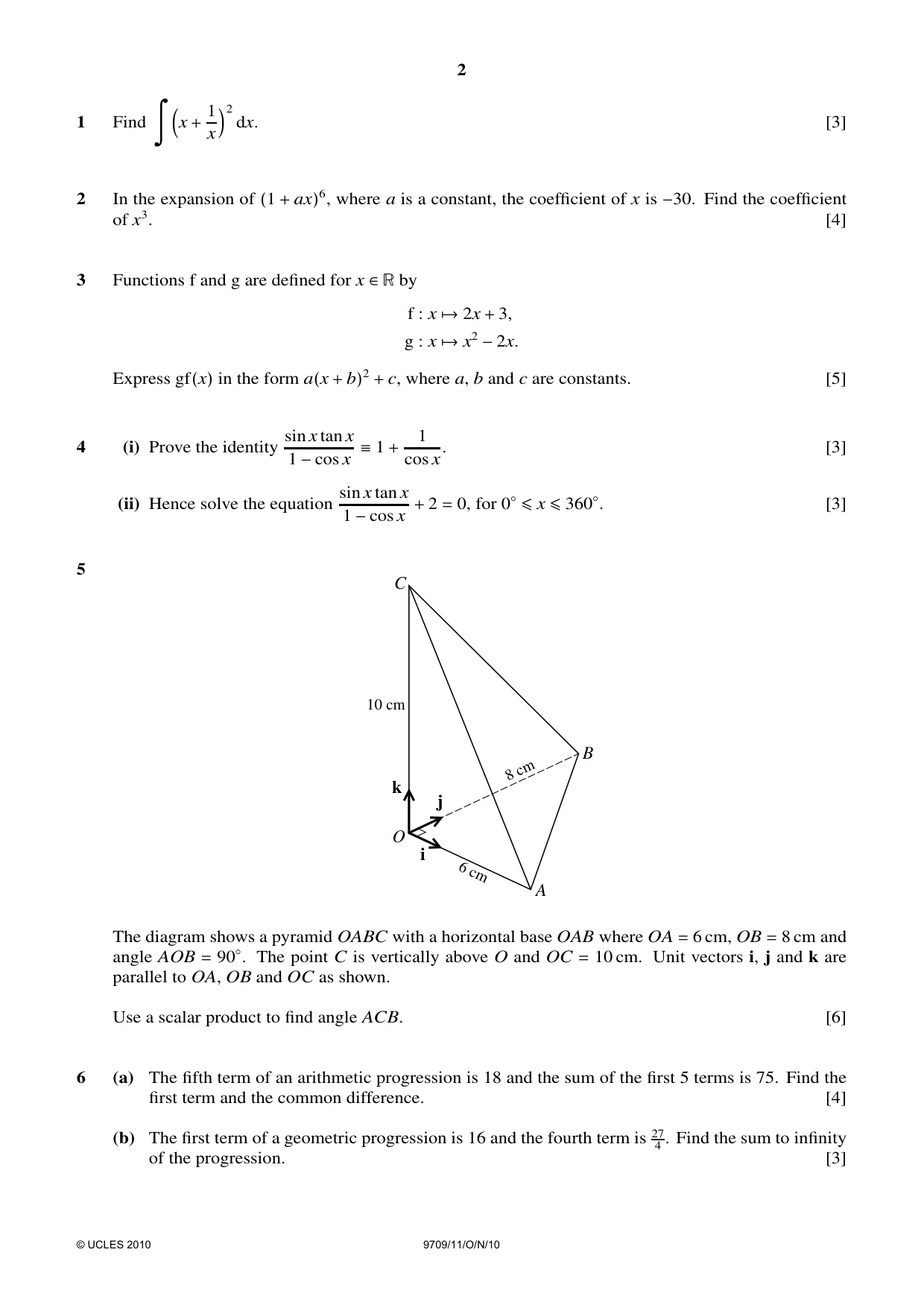
Q6 · The fifth term of an arithmetic progression is 18 and the sum of the first 5 terms is 75
6 (a) The fifth term of an arithmetic progression is 18 and the sum of the first 5 terms is 75. Find the first term and the common difference. [4] (b) The first term of a geometric progression is 16 and the fourth term is 274 . Find the sum to infinity of the progression. [3]
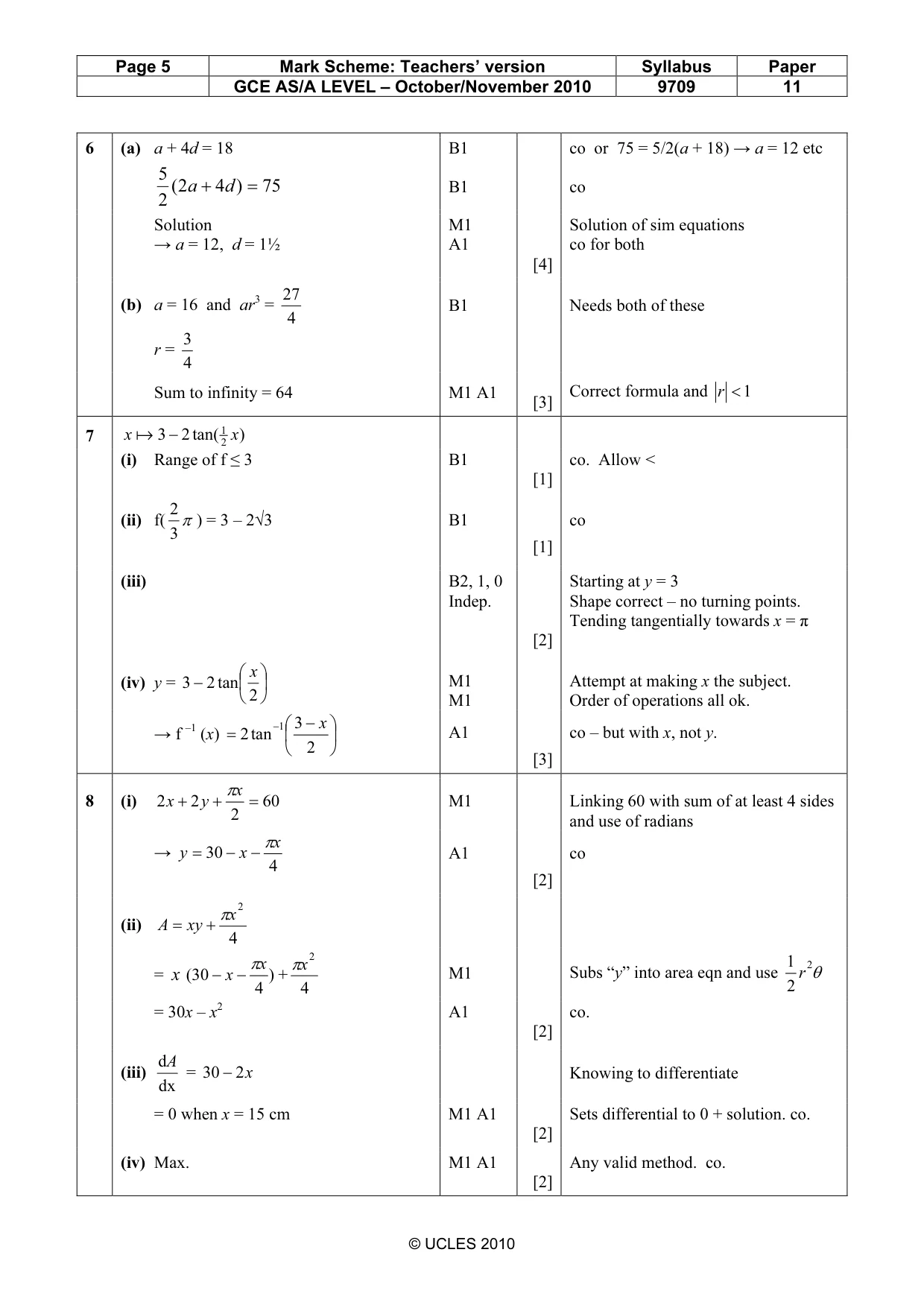
Mark scheme: 6 (a) a + 4d = 18 B1 co or 75 = 5/2(a + 18) → a = 12 etc 5 ( 2 a + 4 d ) = 75 B1 co 2 Solution M1 Solution of sim equations → a = 12, d = 1½ A1 co for both [4] 27 (b) a = 16 and ar3 = B1 Needs both of these 4 3 r = 4 Sum to infinity = 64 M1 A1 Correct formula and r < 1 [3] 1
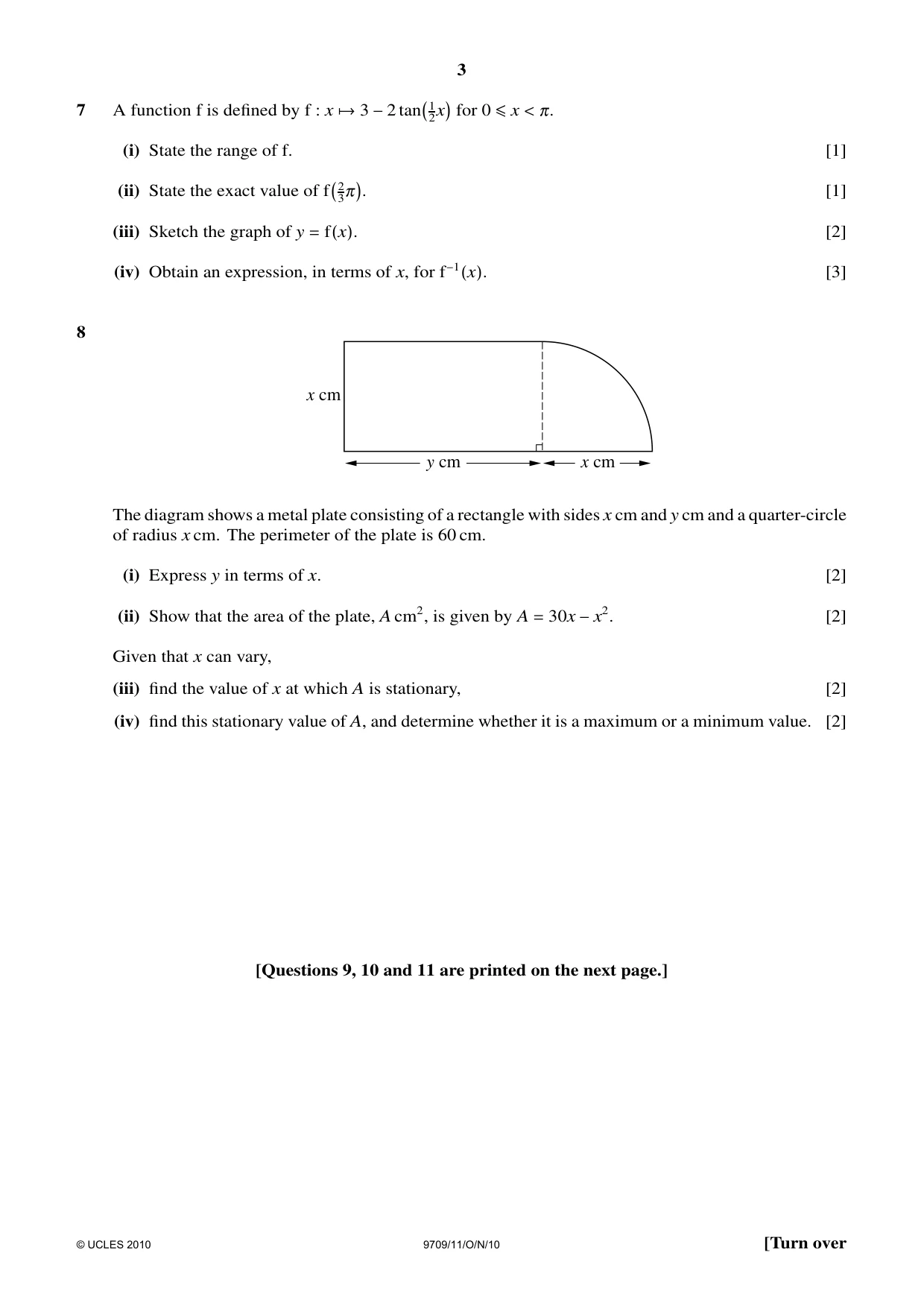
Q8 · X cm y cm x cm The diagram shows a metal plate consisting of a rectangle with sides x cm…
8 x cm y cm x cm The diagram shows a metal plate consisting of a rectangle with sides x cm and y cm and a quarter-circle of radius x cm. The perimeter of the plate is 60 cm. (i) Express y in terms of x. [2] (ii) Show that the area of the plate, A cm2, is given by A 30x [2] = −x2. Given that x can vary, (iii) find the value of x at which A is stationary, [2] (iv) find this stationary value of A, and determine whether it is a maximum or a minimum value. [2] [Questions 9, 10 and 11 are printed on the next page.]
Mark scheme: πx 8 (i) 2 x + 2 y + = 60 M1 Linking 60 with sum of at least 4 sides 2 and use of radians πx → y = 30 − x − A1 co 4 [2] πx 2 (ii) A = xy + 4 πx πx 2 1 2 = x (30 − x − ) + M1 Subs “y” into area eqn and use r θ 4 4 2 = 30x – x2 A1 co. [2] dA (iii) = 30 − 2 x Knowing to differentiate dx = 0 when x = 15 cm M1 A1 Sets differential to 0 + solution. co. [2] (iv) Max. M1 A1 Any valid method. co. [2] GCE AS/A LEVEL – October/November 2010 9709 11
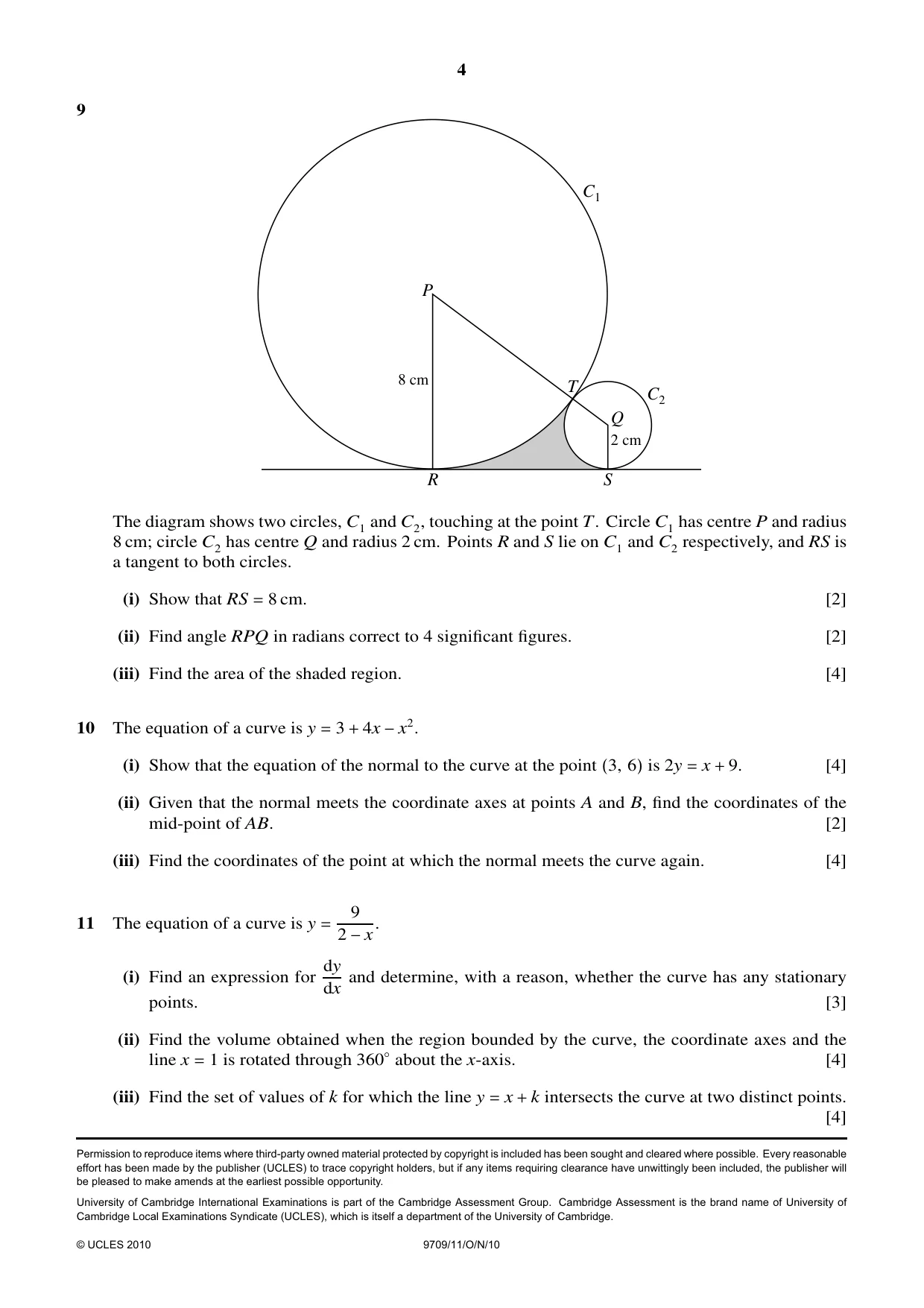
Q9 · C1 P 8 cm T C2 Q 2 cm R S The diagram shows two circles, C1 and C2, touching at the point…
9 C1 P 8 cm T C2 Q 2 cm R S The diagram shows two circles, C1 and C2, touching at the point T. Circle C1 has centre P and radius 8 cm; circle C2 has centre Q and radius 2 cm. Points R and S lie on C1 and C2 respectively, and RS is a tangent to both circles. (i) Show that RS 8 cm. [2] = (ii) Find angle RPQ in radians correct to 4 significant figures. [2] (iii) Find the area of the shaded region. [4]
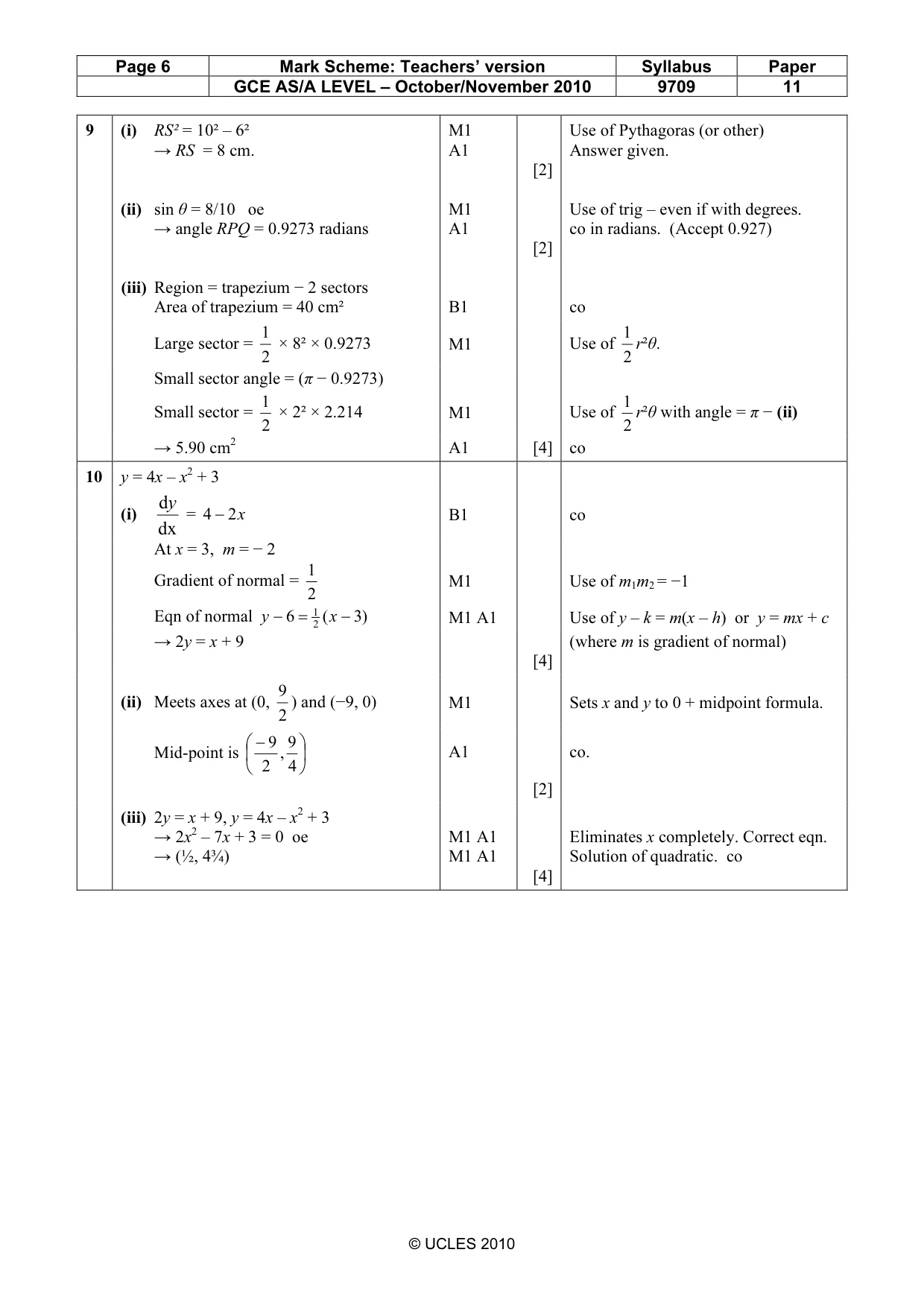
Mark scheme: 9 (i) RS² = 10² – 6² M1 Use of Pythagoras (or other) → RS = 8 cm. A1 Answer given. [2] (ii) sin θ = 8/10 oe M1 Use of trig – even if with degrees. → angle RPQ = 0.9273 radians A1 co in radians. (Accept 0.927) [2] (iii) Region = trapezium − 2 sectors Area of trapezium = 40 cm² B1 co 1 1 Large sector = × 8² × 0.9273 M1 Use of r²θ. 2 2 Small sector angle = (π − 0.9273) 1 1 Small sector = × 2² × 2.214 M1 Use of r²θ with angle = π − (ii) 2 2 → 5.90 cm2 A1 [4] co 2
Q10 · The equation of a curve is y 3 4x = + −x2
10 The equation of a curve is y 3 4x = + −x2. (i) Show that the equation of the normal to the curve at the point is 2y x 9. [4] (3, 6) = + (ii) Given that the normal meets the coordinate axes at points A and B, find the coordinates of the mid-point of AB. [2] (iii) Find the coordinates of the point at which the normal meets the curve again. [4]
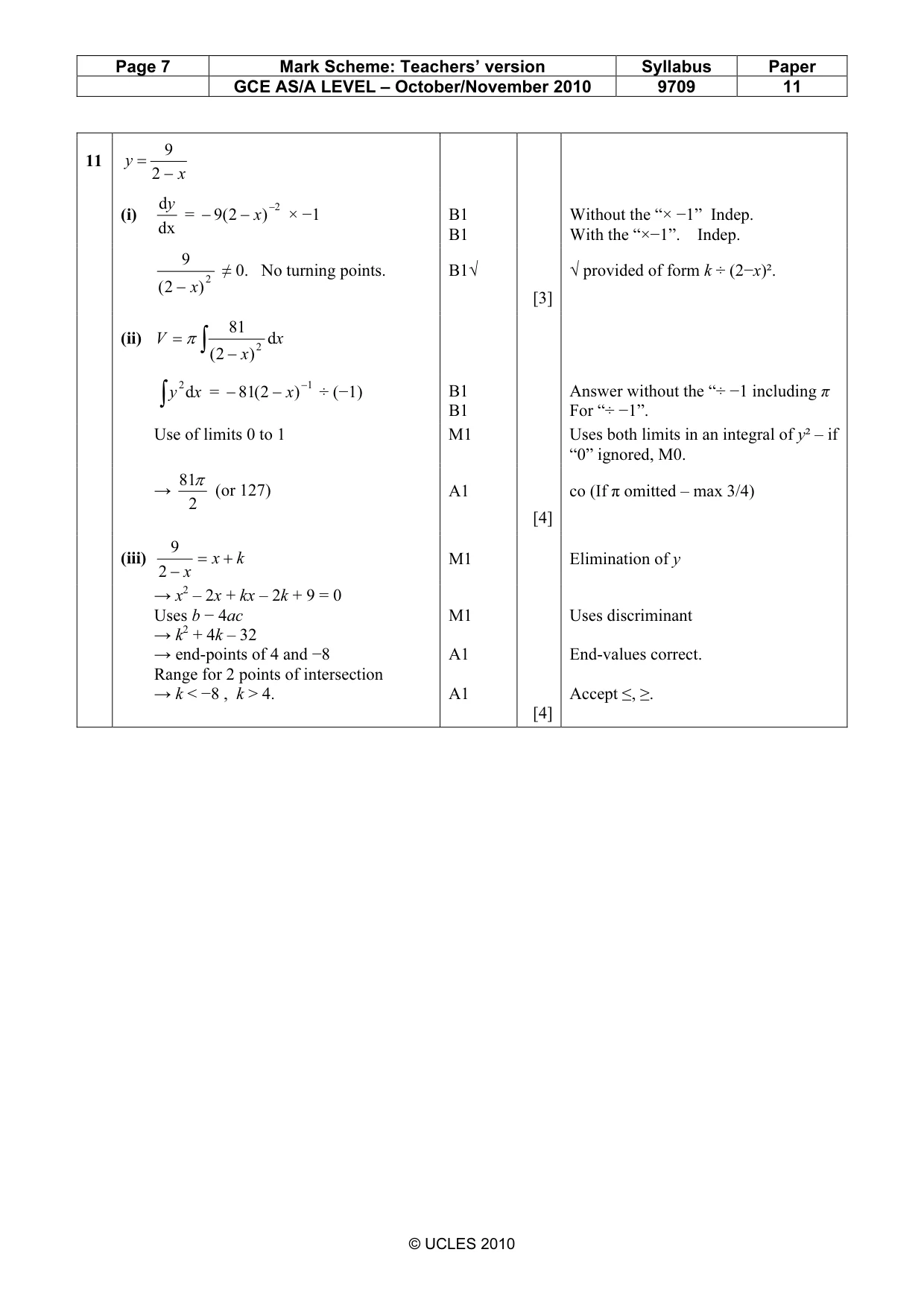
Mark scheme: 10 y = 4x – x2 + 3 dy (i) = 4 − 2 x B1 co dx At x = 3, m = − 2 1 Gradient of normal = M1 Use of m1m2 = −1 2 Eqn of normal y − 6 = 12 ( x − 3) M1 A1 Use of y – k = m(x – h) or y = mx + c → 2y = x + 9 (where m is gradient of normal) [4] 9 (ii) Meets axes at (0, ) and (−9, 0) M1 Sets x and y to 0 + midpoint formula. 2 − 9 9 Mid-point is , A1 co. 2 4 [2] (iii) 2y = x + 9, y = 4x – x2 + 3 → 2x2 – 7x + 3 = 0 oe M1 A1 Eliminates x completely. Correct eqn. → (½, 4¾) M1 A1 Solution of quadratic. co [4] GCE AS/A LEVEL – October/November 2010 9709 11 9 11 y = 2 − x dy 2
What was in this paper
The subtopics covered by these 4 questions, and how many questions each got. Open one in a new tab to see every Cambridge question on it.
What you needed in this session
Cambridge’s own grade thresholds for 2010 Oct/Nov, Paper 1 · Variant 1. A higher threshold means an easier paper — the bar moves with how the cohort did.