Cambridge A Level Mathematics 9709 — 2014 Oct/Nov Paper 1 · Variant 1
9709/11/O/N/14 · 9 questions · 75 marks · ≈84 min
The question paper and its mark scheme, free to read here and free to download. This is Cambridge’s own paper, exactly as it was sat.
Question paper4 pages
Mark scheme6 pages
Answers below. Sit the paper first if you are practising.
Questions as text
Q1 · In the expansion of 2 + ax 7, the coefficient of x is equal to the coefficient of x2
1 In the expansion of 2 + ax 7, the coefficient of x is equal to the coefficient of x2. Find the value of the non-zero constant a. [3]
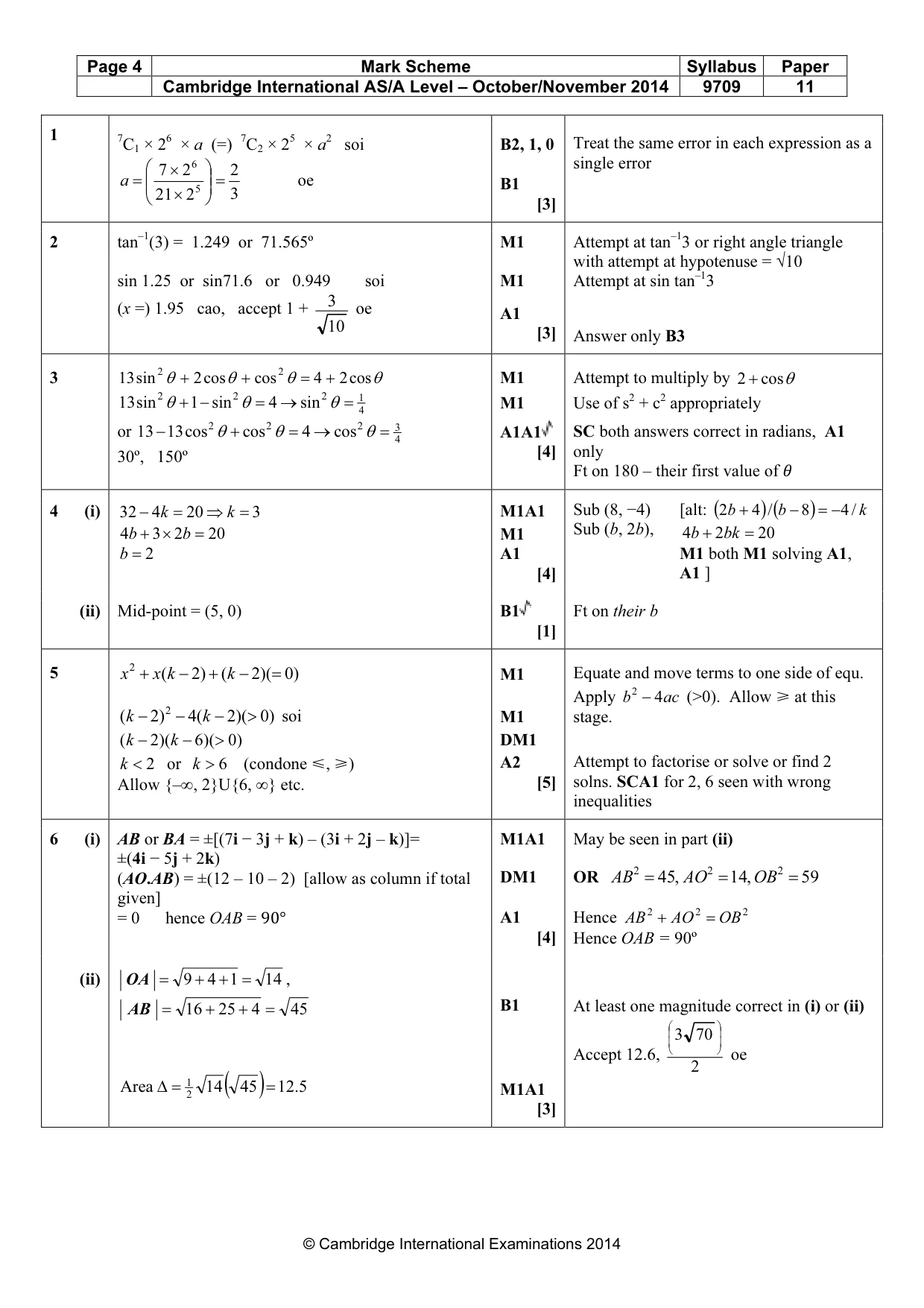
Mark scheme: 1 7C1 × 26 × a (=) 7C2 × 25 × a2 soi B2, 1, 0 Treat the same error in each expression as a 7 × 2 6 2 single error a = 5 = oe B1 21 × 2 3 [3] 1 1
Q2 · Find the value of x satisfying the equation sin−1 x −1 = tan−1 3
2 Find the value of x satisfying the equation sin−1 x −1 = tan−1 3 . [3]
Mark scheme: 2 tan–1(3) = 1.249 or 71.565º M1 Attempt at tan–13 or right angle triangle with attempt at hypotenuse = √10 sin 1.25 or sin71.6 or 0.949 soi M1 Attempt at sin tan–13 3 (x =) 1.95 cao, accept 1 + oe A1 10 [3] Answer only B3 2 2
Q3 · Sin2 3 Solve the equation + cos = 2 for 0 ≤ ≤180
13 sin2 3 Solve the equation + cos = 2 for 0 ≤ ≤180 . [4] 2 + cos
Mark scheme: 3 13 sin 2 θ + 2 cos θ + cos 2 θ = 4 + 2 cos θ M1 Attempt to multiply by 2 + cos θ 13 sin 2 θ + 1 − sin 2 θ = 4 → sin 2 θ = 1 4 M1 Use of s2 + c2 appropriately or 13 − 13 cos 2 θ + cos 2 θ = 4 → cos 2 θ = 34 A1A1 SC both answers correct in radians, A1 [4] only 30º, 150º Ft on 180 – their first value of ( ) ( )
Q4 · The line 4x + ky = 20 passes through the points A 8, −4 and B b, 2b , where k and b are…
4 The line 4x + ky = 20 passes through the points A 8, −4 and B b, 2b , where k and b are constants. (i) Find the values of k and b. [4] (ii) Find the coordinates of the mid-point of AB. [1]
Mark scheme: 4 (i) 32 − 4 k = 20 ⇒ k = 3 M1A1 Sub (8, −4) [alt: (2b + 4 ) / (b − 8 ) = − 4 / k 4b + 3 × 2b = 20 M1 Sub (b, 2b), 4b + 2bk = 20 b = 2 A1 M1 both M1 solving A1, [4] A1 ] (ii) Mid-point = (5, 0) B1 Ft on their b [1] 2
Q5 · Find the set of values of k for which the line y = 2x −k meets the curve y = x2 + kx −2…
5 Find the set of values of k for which the line y = 2x −k meets the curve y = x2 + kx −2 at two distinct points. [5]
Mark scheme: 5 x 2 + x ( k − 2) + ( k − 2)( = 0) M1 Equate and move terms to one side of equ. Apply b 2 − 4 ac (>0). Allow [ at this ( k − 2) 2 − 4( k − 2)( > 0) soi M1 stage. ( k − 2 )( k − 6 )( > 0 ) DM1 k < 2 or k > 6 (condone Y, [) A2 Attempt to factorise or solve or find 2 Allow {–∞, 2}U{6, ∞} etc. [5] solns. SCA1 for 2, 6 seen with wrong inequalities
Q6 · Relative to an origin O, the position vector of A is 3i + 2j −k and the position vector…
6 Relative to an origin O, the position vector of A is 3i + 2j −k and the position vector of B is 7i −3j + k. (i) Show that angle OAB is a right angle. [4] (ii) Find the area of triangle OAB. [3]
Mark scheme: 6 (i) AB or BA = ±[(7i − 3j + k) – (3i + 2j – k)]= M1A1 May be seen in part (ii) ±(4i − 5j + 2k) (AO.AB) = ±(12 – 10 – 2) [allow as column if total DM1 OR AB 2 = 45, AO 2 = 14, OB 2 = 59 given] = 0 hence OAB = 90° A1 Hence AB 2 + AO 2 = OB 2 [4] Hence OAB = 90º (ii) OA = 9 + 4 + 1 = 14 , AB = 16 + 25 + 4 = 45 B1 At least one magnitude correct in (i) or (ii) 3 70 Accept 12.6, oe 2 Area ∆ = 1 14 ( 45 ) = 12 5. M1A1 2 [3] a a a S 3 S A l 3 S
Q7 · A geometric progression has first term a (a ≠0), common ratio r and sum to infinity S
7 (i) A geometric progression has first term a (a ≠0), common ratio r and sum to infinity S. A second geometric progression has first term a, common ratio 2r and sum to infinity 3S. Find the value of r. [3] (ii) An arithmetic progression has first term 7. The nth term is 84 and the (3n)th term is 245. Find the value of n. [4]
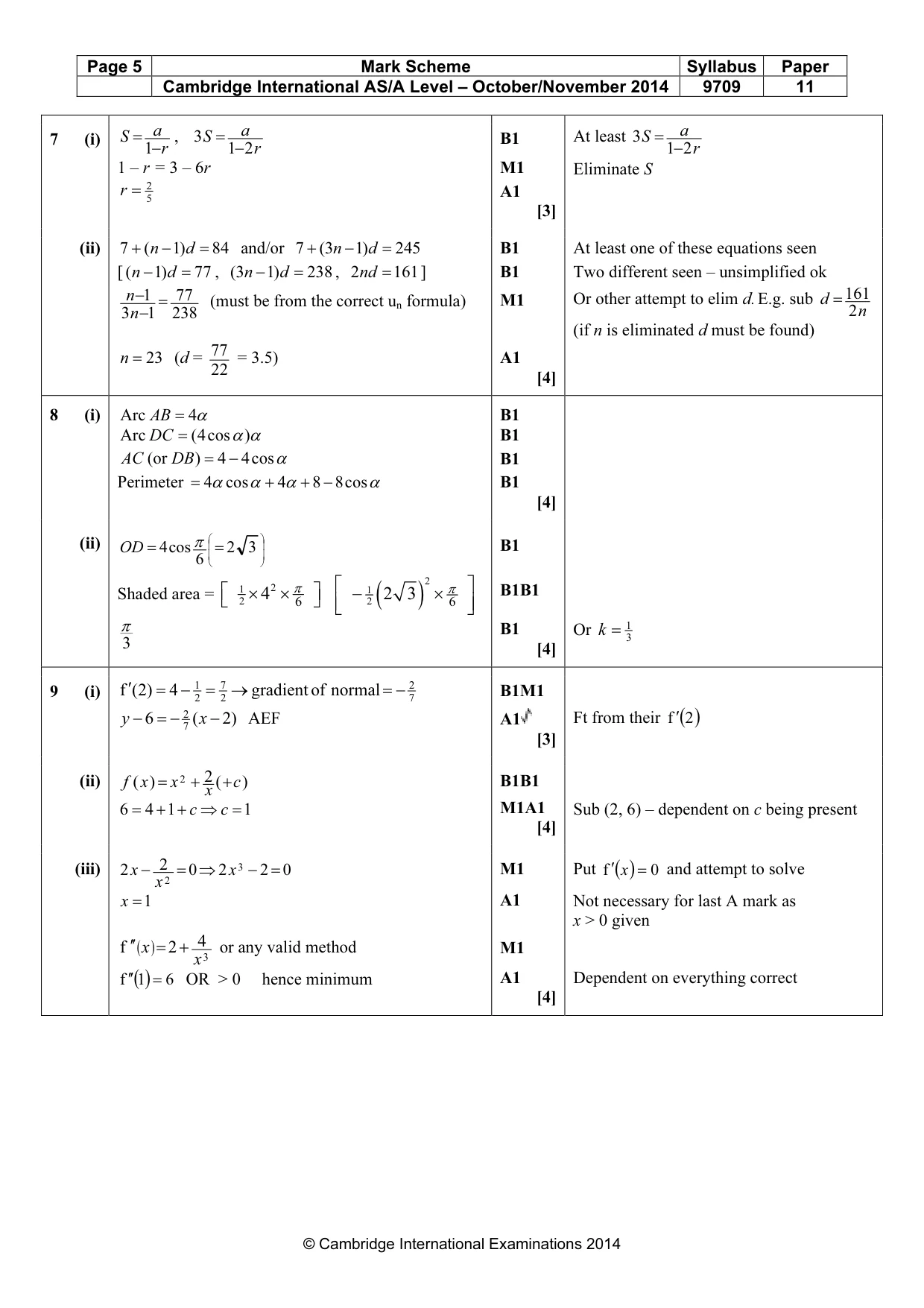
Mark scheme: a a a 7 (i) S =1− r , 3 S = 1− 2 r B1 At least 3 S = 1− 2 r 1 – r = 3 – 6r M1 Eliminate S r = 2 A1 5 [3] (ii) 7 + ( n − )1 d = 84 and/or 7 + (3n − )1 d = 245 B1 At least one of these equations seen [ ( n − )1 d = 77 , (3n − )1 d = 238 , 2 nd = 161 ] B1 Two different seen – unsimplified ok 77 n −1 = (must be from the correct un formula) M1 Or other attempt to elim d. E.g. sub d = 161 3 n −1 238 2 n (if n is eliminated d must be found) 77 n = 23 (d = = 3.5) A1 22 [4]
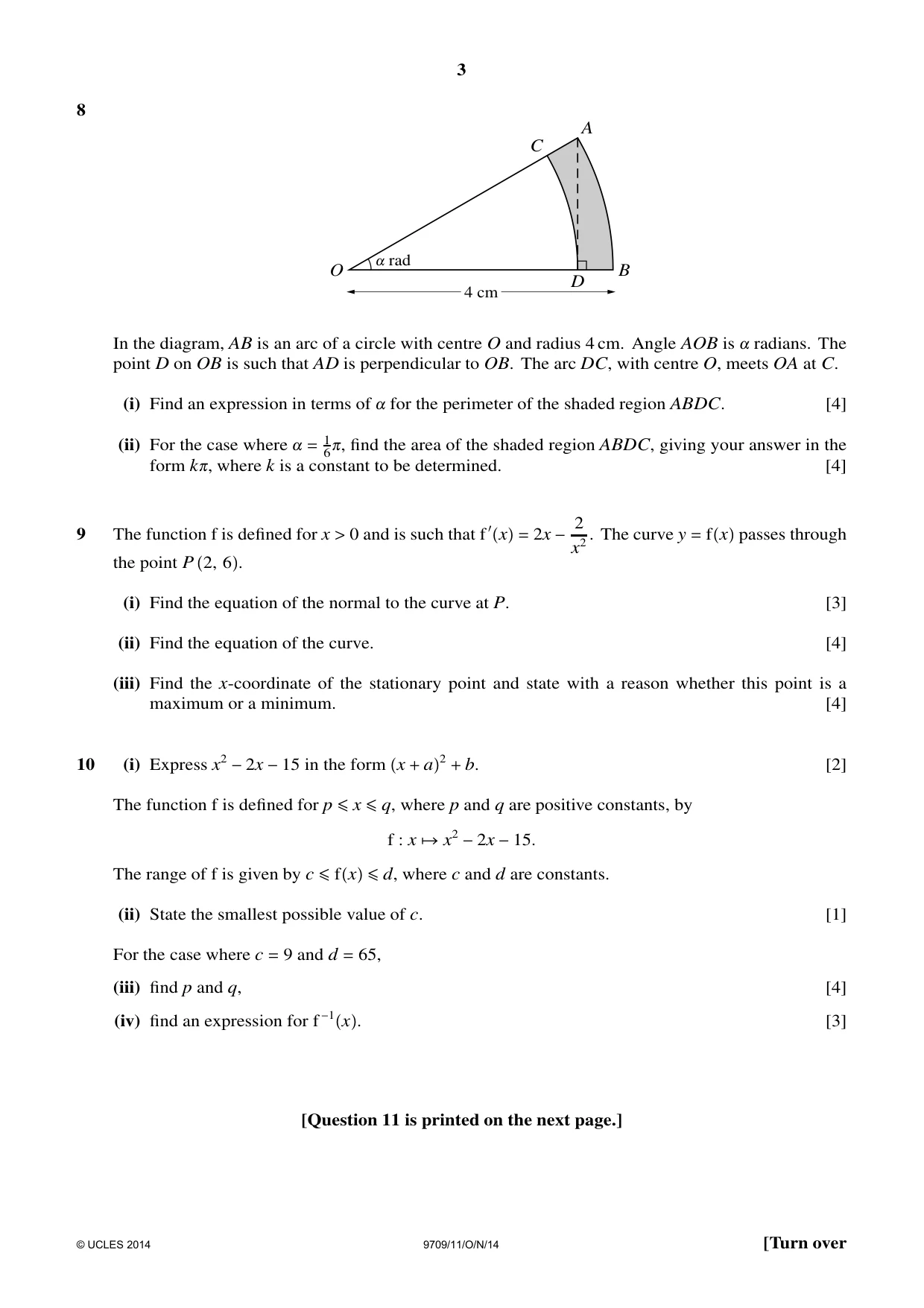
Q8 · A C rad O B D 4 cm In the diagram, AB is an arc of a circle with centre O and radius 4 cm
8 A C rad O B D 4 cm In the diagram, AB is an arc of a circle with centre O and radius 4 cm. Angle AOB is radians. The point D on OB is such that AD is perpendicular to OB. The arc DC, with centre O, meets OA at C. (i) Find an expression in terms of for the perimeter of the shaded region ABDC. [4] (ii) For the case where = 1 , find the area of the shaded region ABDC, giving your answer in the 6 form k , where k is a constant to be determined. [4]
Mark scheme: 8 (i) Arc AB = 4α B1 Arc DC = ( 4 cos α)α B1 AC (or DB ) = 4 − 4 cos α B1 Perimeter = 4α cos α + 4α + 8 − 8 cos α B1 [4] (ii) OD = 4 cos π = 2 3 B1 6 2 1 B1B1 Shaded area = 2 3 × π 6 − 12 ( ) 2 × 4 2 × π6 π B1 Or k = 13 3 [4] ′ 1 7 2
Q9 · The function f is defined for x > 0 and is such that f ′ x = 2x −2
9 The function f is defined for x > 0 and is such that f ′ x = 2x −2 . The curve y = f x passes through x2 the point P 2, 6 . (i) Find the equation of the normal to the curve at P. [3] (ii) Find the equation of the curve. [4] (iii) Find the x-coordinate of the stationary point and state with a reason whether this point is a maximum or a minimum. [4]
Mark scheme: 9 (i) f ′( 2) = 4 − 12 = 72 → gradient of normal = − 72 B1M1 y − 6 = − 2 ( x − 2) AEF A1 Ft from their f ′(2 ) 7 [3] (ii) f ( x ) = x 2 + 2 ( + c ) B1B1 x 6 = 4 + 1 + c ⇒ c = 1 M1A1 Sub (2, 6) – dependent on c being present [4] (iii) 2 x − 2 = 0 ⇒ 2 x 3 − 2 = 0 M1 Put f ′( x ) = 0 and attempt to solve x 2 x = 1 A1 Not necessary for last A mark as x > 0 given 4 f ′′ ( x ) = 2 + or any valid method M1 x 3 f ′′(1) = 6 OR > 0 hence minimum A1 Dependent on everything correct [4] 2
What was in this paper
The subtopics covered by these 9 questions, and how many questions each got. Open one in a new tab to see every Cambridge question on it.
What you needed in this session
Cambridge’s own grade thresholds for 2014 Oct/Nov, Paper 1 · Variant 1. A higher threshold means an easier paper — the bar moves with how the cohort did.