Cambridge A Level Mathematics 9709 — 2010 Oct/Nov Paper 1 · Variant 2
9709/12/O/N/10 · 11 questions · 75 marks · ≈84 min
The question paper and its mark scheme, free to read here and free to download. This is Cambridge’s own paper, exactly as it was sat.
Question paper8 pages
Mark scheme6 pages
Answers below. Sit the paper first if you are practising.
Questions as text
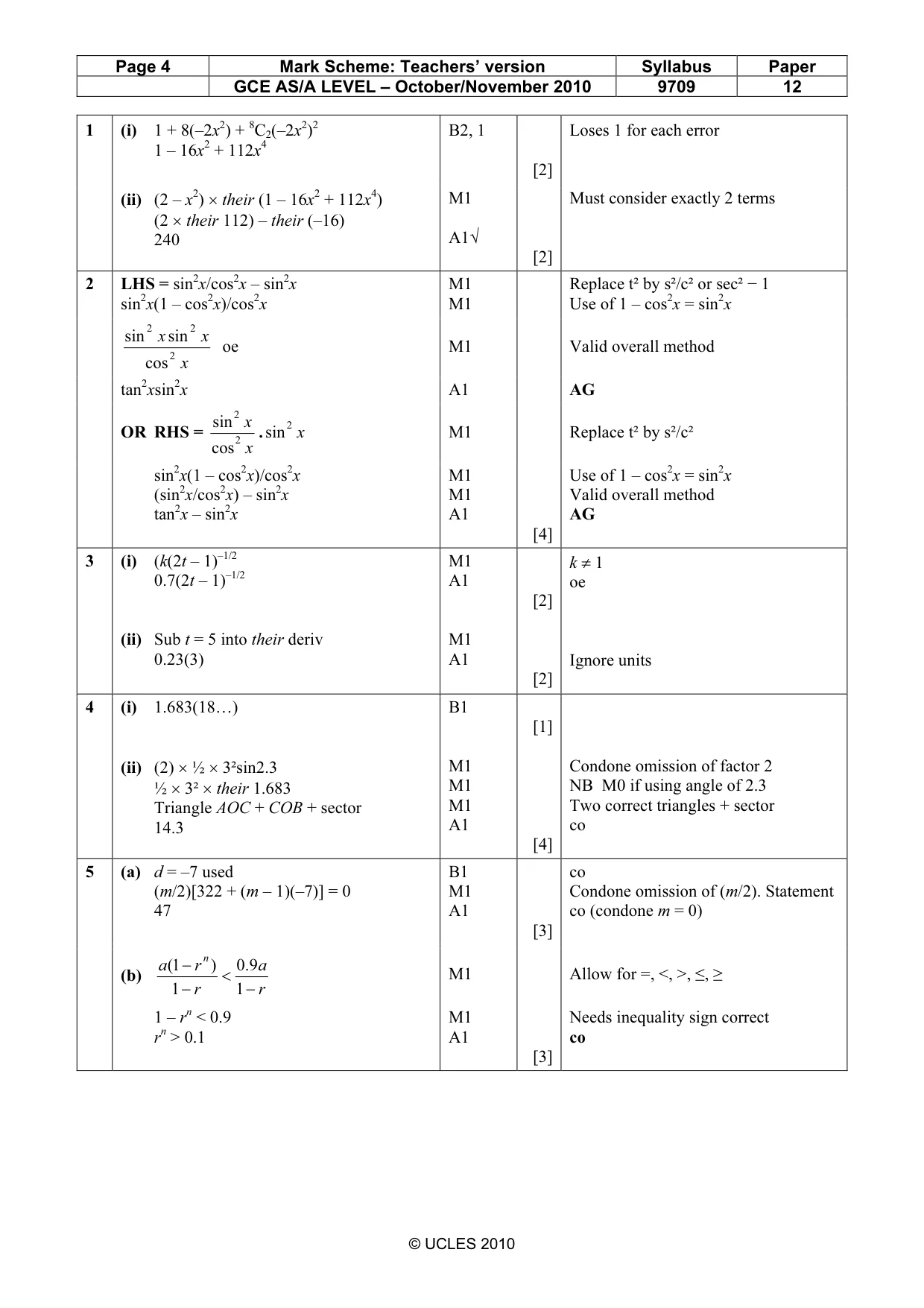
Q1 · Find the first 3 terms in the expansion, in ascending powers of x, of (1 −2x2)8
1 (i) Find the first 3 terms in the expansion, in ascending powers of x, of (1 −2x2)8. [2] (ii) Find the coefficient of x4 in the expansion of (2 −x2)(1 −2x2)8. [2]
Mark scheme: 1 (i) 1 + 8(–2x2) + 8C2(–2x2)2 B2, 1 Loses 1 for each error 1 – 16x2 + 112x4 [2] (ii) (2 – x2) × their (1 – 16x2 + 112x4) M1 Must consider exactly 2 terms (2 × their 112) – their (–16) 240 A1√ [2] 2 2 2
Q2 · Prove the identity tan2x −sin2x ≡tan2x sin2x
2 Prove the identity tan2x −sin2x ≡tan2x sin2x. [4]
Mark scheme: 2 LHS = sin2x/cos2x – sin2x M1 Replace t² by s²/c² or sec² − 1 sin2x(1 – cos2x)/cos2x M1 Use of 1 – cos2x = sin2x sin 2 x sin 2 x oe M1 Valid overall method cos 2 x tan2xsin2x A1 AG sin 2 x 2 OR RHS = . sin x M1 Replace t² by s²/c² 2 cos x sin2x(1 – cos2x)/cos2x M1 Use of 1 – cos2x = sin2x (sin2x/cos2x) – sin2x M1 Valid overall method tan2x – sin2x A1 AG [4] 1/2
Q3 · The length, x metres, of a Green Anaconda snake which is t years old is given…
3 The length, x metres, of a Green Anaconda snake which is t years old is given approximately by the formula x = 0.7 √(2t −1), where 1 ≤t ≤10. Using this formula, find dx (i) , [2] dt (ii) the rate of growth of a Green Anaconda snake which is 5 years old. [2]
Mark scheme: 3 (i) (k(2t – 1)–1/2 M1 k ≠ 1 0.7(2t – 1)–1/2 A1 oe [2] (ii) Sub t = 5 into their deriv M1 0.23(3) A1 Ignore units [2]
Q4 · C 3 cm 2.3 rad 2.3 rad O 3 cm 3 cm A B P The diagram shows points A, C, B, P on the…
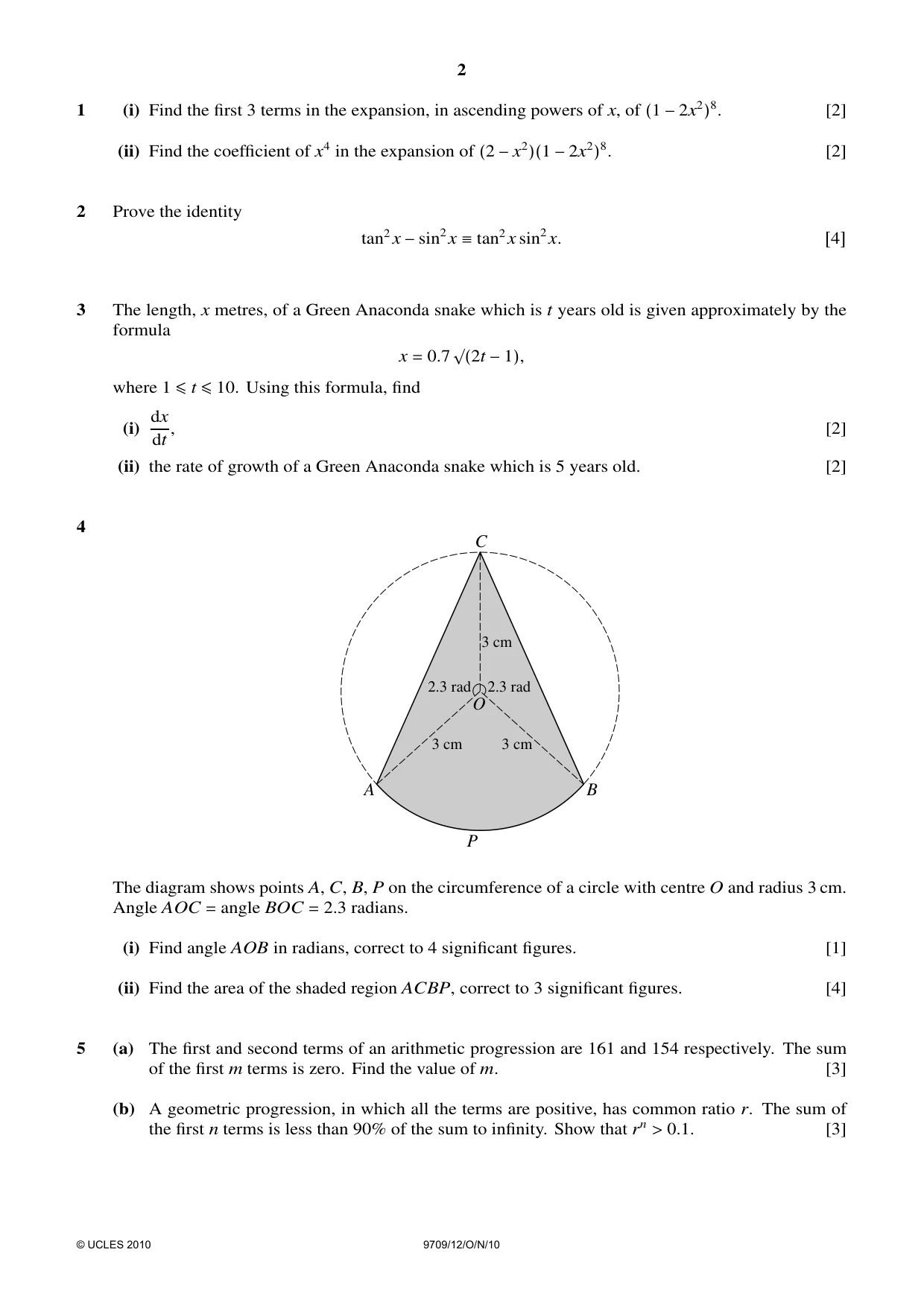
4 C 3 cm 2.3 rad 2.3 rad O 3 cm 3 cm A B P The diagram shows points A, C, B, P on the circumference of a circle with centre O and radius 3 cm. Angle AOC = angle BOC = 2.3 radians. (i) Find angle AOB in radians, correct to 4 significant figures. [1] (ii) Find the area of the shaded region ACBP, correct to 3 significant figures. [4]
Mark scheme: 4 (i) 1.683(18…) B1 [1] (ii) (2) × ½ × 3²sin2.3 M1 Condone omission of factor 2 ½ × 3² × their 1.683 M1 NB M0 if using angle of 2.3 Triangle AOC + COB + sector M1 Two correct triangles + sector 14.3 A1 co [4]
Q5 · The first and second terms of an arithmetic progression are 161 and 154 respectively
5 (a) The first and second terms of an arithmetic progression are 161 and 154 respectively. The sum of the first m terms is zero. Find the value of m. [3] (b) A geometric progression, in which all the terms are positive, has common ratio r. The sum of the first n terms is less than 90% of the sum to infinity. Show that rn > 0.1. [3]
Mark scheme: 5 (a) d = –7 used B1 co (m/2)[322 + (m – 1)(–7)] = 0 M1 Condone omission of (m/2). Statement 47 A1 co (condone m = 0) [3] a 1( − r n ) 9.0 a (b) < M1 Allow for =, <, >, ≤, ≥ 1 − r 1 − r 1 – rn < 0.9 M1 Needs inequality sign correct rn > 0.1 A1 co [3] GCE AS/A LEVEL – October/November 2010 9709 12 2
Q6 · A curve has equation y = kx2 + 1 and a line has equation y = kx, where k is a non-zero…
6 A curve has equation y = kx2 + 1 and a line has equation y = kx, where k is a non-zero constant. (i) Find the set of values of k for which the curve and the line have no common points. [3] (ii) State the value of k for which the line is a tangent to the curve and, for this case, find the coordinates of the point where the line touches the curve. [4]
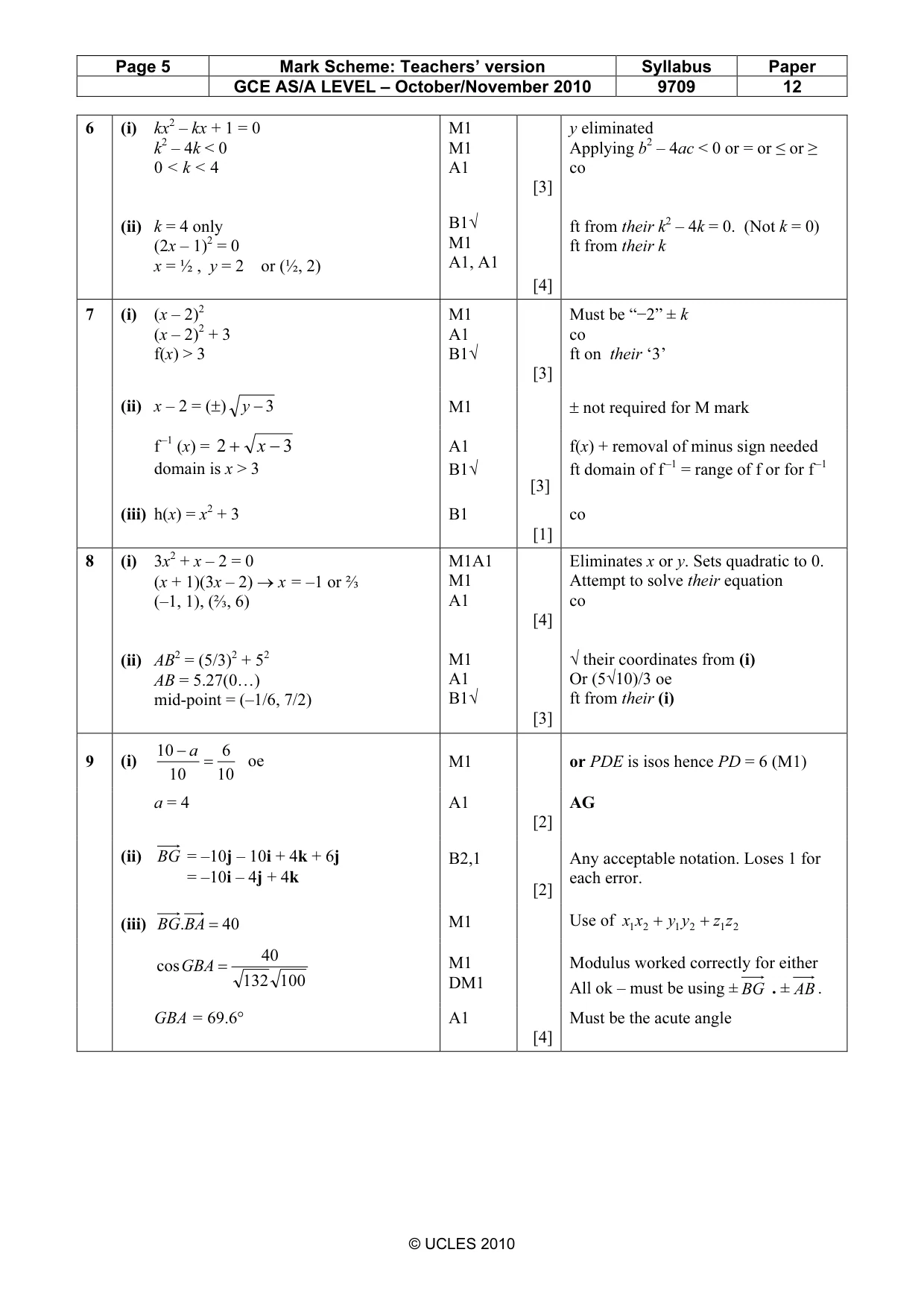
Mark scheme: 6 (i) kx2 – kx + 1 = 0 M1 y eliminated k2 – 4k < 0 M1 Applying b2 – 4ac < 0 or = or ≤ or ≥ 0 < k < 4 A1 co [3] (ii) k = 4 only B1√ ft from their k2 – 4k = 0. (Not k = 0) (2x – 1)2 = 0 M1 ft from their k x = ½ , y = 2 or (½, 2) A1, A1 [4] 2
Q7 · The function f is defined by f(x) = x2 −4x + 7 for x > 2
7 The function f is defined by f(x) = x2 −4x + 7 for x > 2. (i) Express f(x) in the form (x −a)2 + b and hence state the range of f. [3] (ii) Obtain an expression for f−1(x) and state the domain of f−1. [3] The function g is defined by g(x) = x −2 for x > 2. The function h is such that f = hg and the domain of h is x > 0. (iii) Obtain an expression for h(x). [1]
Mark scheme: 7 (i) (x – 2)2 M1 Must be “−2” ± k (x – 2)2 + 3 A1 co f(x) > 3 B1√ ft on their ‘3’ [3] (ii) x – 2 = (±) y − 3 M1 ± not required for M mark f –1 (x) = 2 + x − 3 A1 f(x) + removal of minus sign needed domain is x > 3 B1√ ft domain of f –1 = range of f or for f –1 [3] (iii) h(x) = x2 + 3 B1 co [1] 2
Q8 · Y 2 y = 1 – x y = 3 x + 4 B A x O 2 The diagram shows part of the curve y = 1 and the…
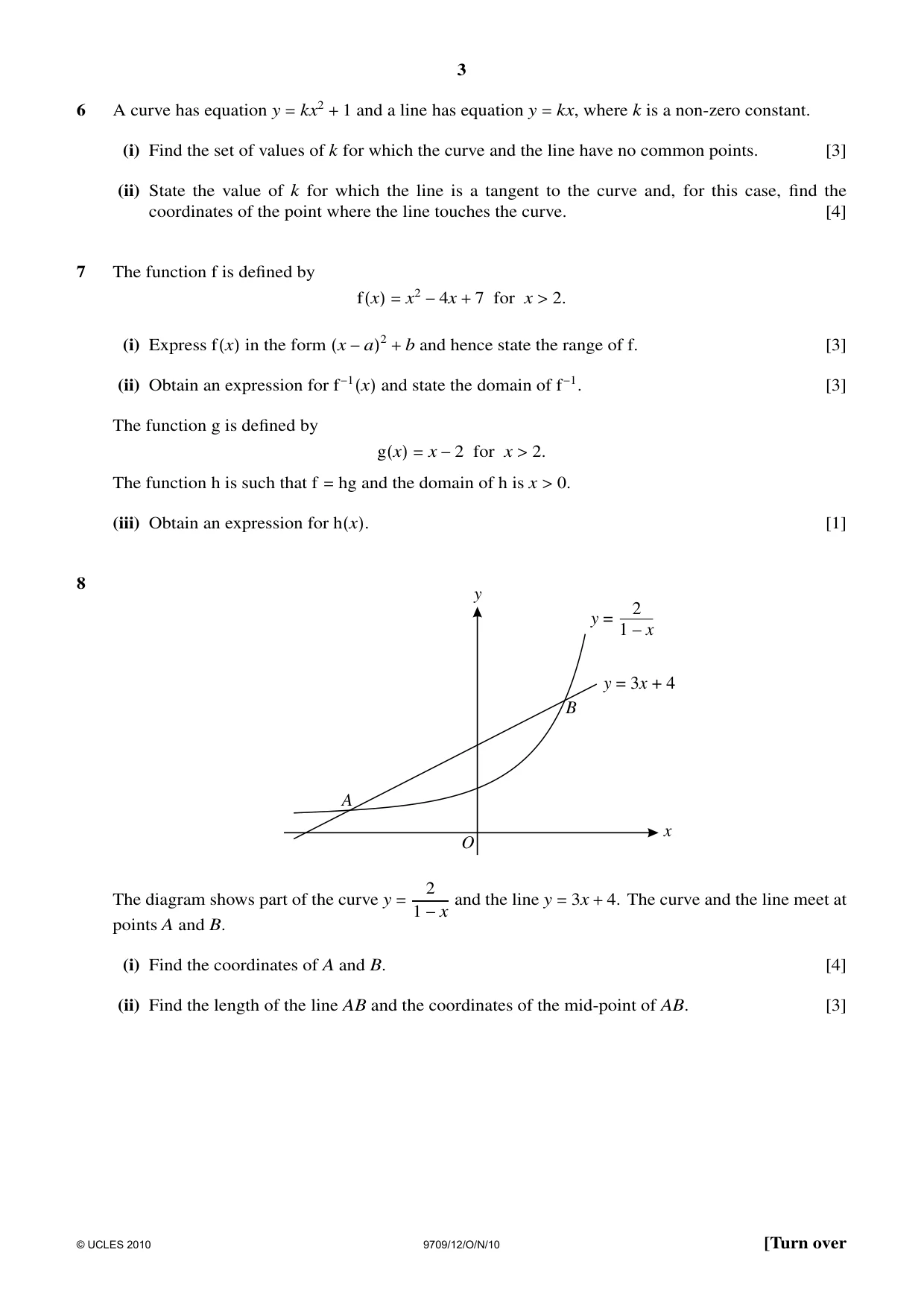
8 y 2 y = 1 – x y = 3 x + 4 B A x O 2 The diagram shows part of the curve y = 1 and the line y = 3x + 4. The curve and the line meet at points A and B. −x (i) Find the coordinates of A and B. [4] (ii) Find the length of the line AB and the coordinates of the mid-point of AB. [3]
Mark scheme: 8 (i) 3x2 + x – 2 = 0 M1A1 Eliminates x or y. Sets quadratic to 0. (x + 1)(3x – 2) → x = –1 or ⅔ M1 Attempt to solve their equation (–1, 1), (⅔, 6) A1 co [4] (ii) AB2 = (5/3)2 + 52 M1 √ their coordinates from (i) AB = 5.27(0…) A1 Or (5√10)/3 oe mid-point = (–1/6, 7/2) B1√ ft from their (i) [3] 10 −a 6
Q9 · P G F 10 cm 6 cm 6 cm D C E B a cm k j 10 cm O i 10 cm A The diagram shows a pyramid…
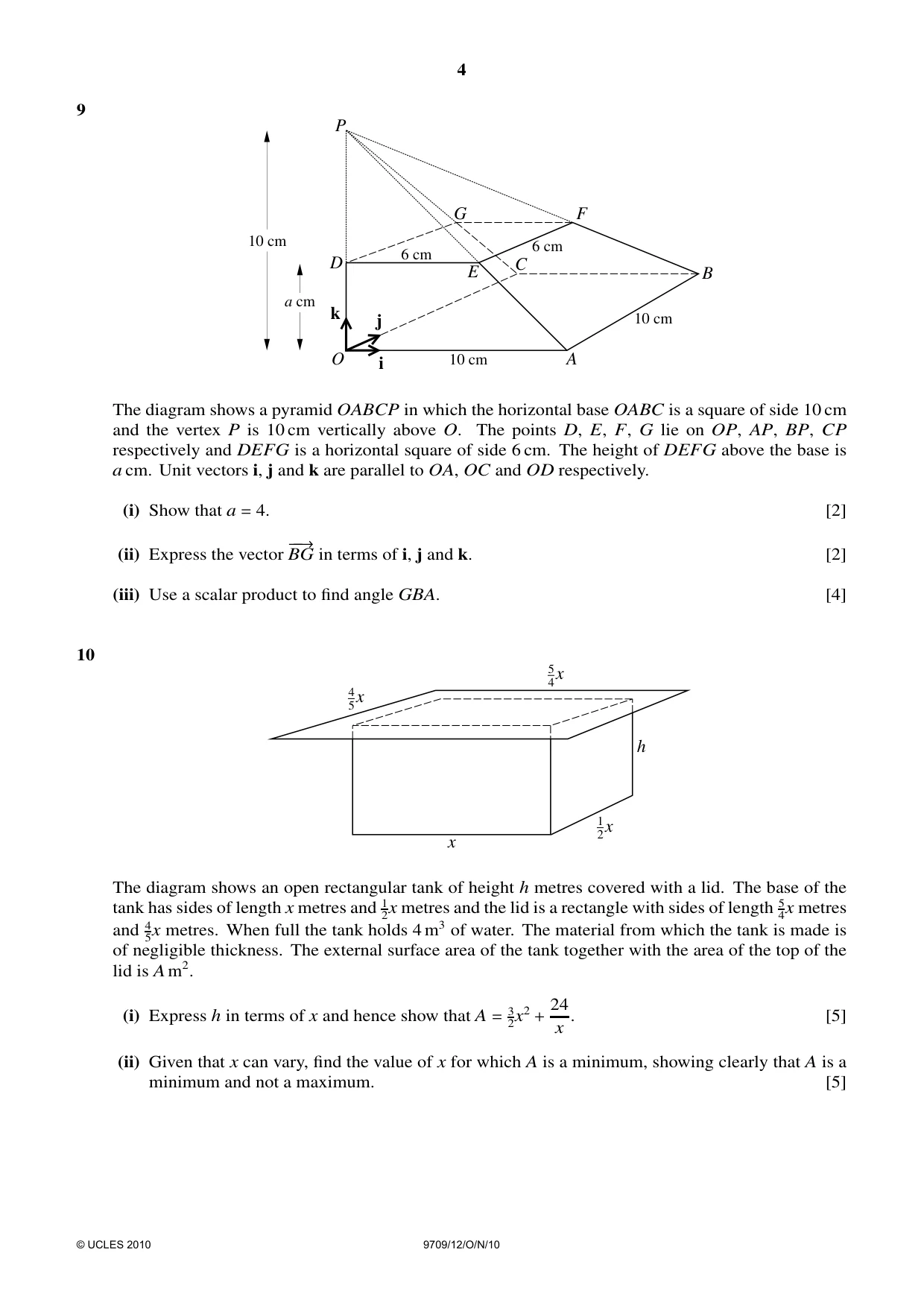
9 P G F 10 cm 6 cm 6 cm D C E B a cm k j 10 cm O i 10 cm A The diagram shows a pyramid OABCP in which the horizontal base OABC is a square of side 10 cm and the vertex P is 10 cm vertically above O. The points D, E, F, G lie on OP, AP, BP, CP respectively and DEFG is a horizontal square of side 6 cm. The height of DEFG above the base is a cm. Unit vectors i, j and k are parallel to OA, OC and OD respectively. (i) Show that a = 4. [2] (ii) Express the vector −−→BG in terms of i, j and k. [2] (iii) Use a scalar product to find angle GBA. [4]
Mark scheme: 10 a 6 9 (i) = oe M1 or PDE is isos hence PD = 6 (M1) 10 10 a = 4 A1 AG [2] (ii) BG = –10j – 10i + 4k + 6j B2,1 Any acceptable notation. Loses 1 for = –10i – 4j + 4k each error. [2] (iii) BG.BA = 40 M1 Use of x1 x 2 + y1 y 2 + z1 z 2 40 cos GBA = M1 Modulus worked correctly for either 132 100 DM1 All ok – must be using ± BG . ± AB . GBA = 69.6° A1 Must be the acute angle [4] GCE AS/A LEVEL – October/November 2010 9709 12 8
Q10 · 5 x 4 4 x 5 h 1 x 2 x The diagram shows an open rectangular tank of height h metres…
10 5 x 4 4 x 5 h 1 x 2 x The diagram shows an open rectangular tank of height h metres covered with a lid. The base of the tank has sides of length x metres and 2x1 metres and the lid is a rectangle with sides of length 4x5 metres and 5x4 metres. When full the tank holds 4 m3 of water. The material from which the tank is made is of negligible thickness. The external surface area of the tank together with the area of the top of the lid is A m2. 3 24 (i) Express h in terms of x and hence show that A = 2x2 + x . [5] (ii) Given that x can vary, find the value of x for which A is a minimum, showing clearly that A is a minimum and not a maximum. [5]
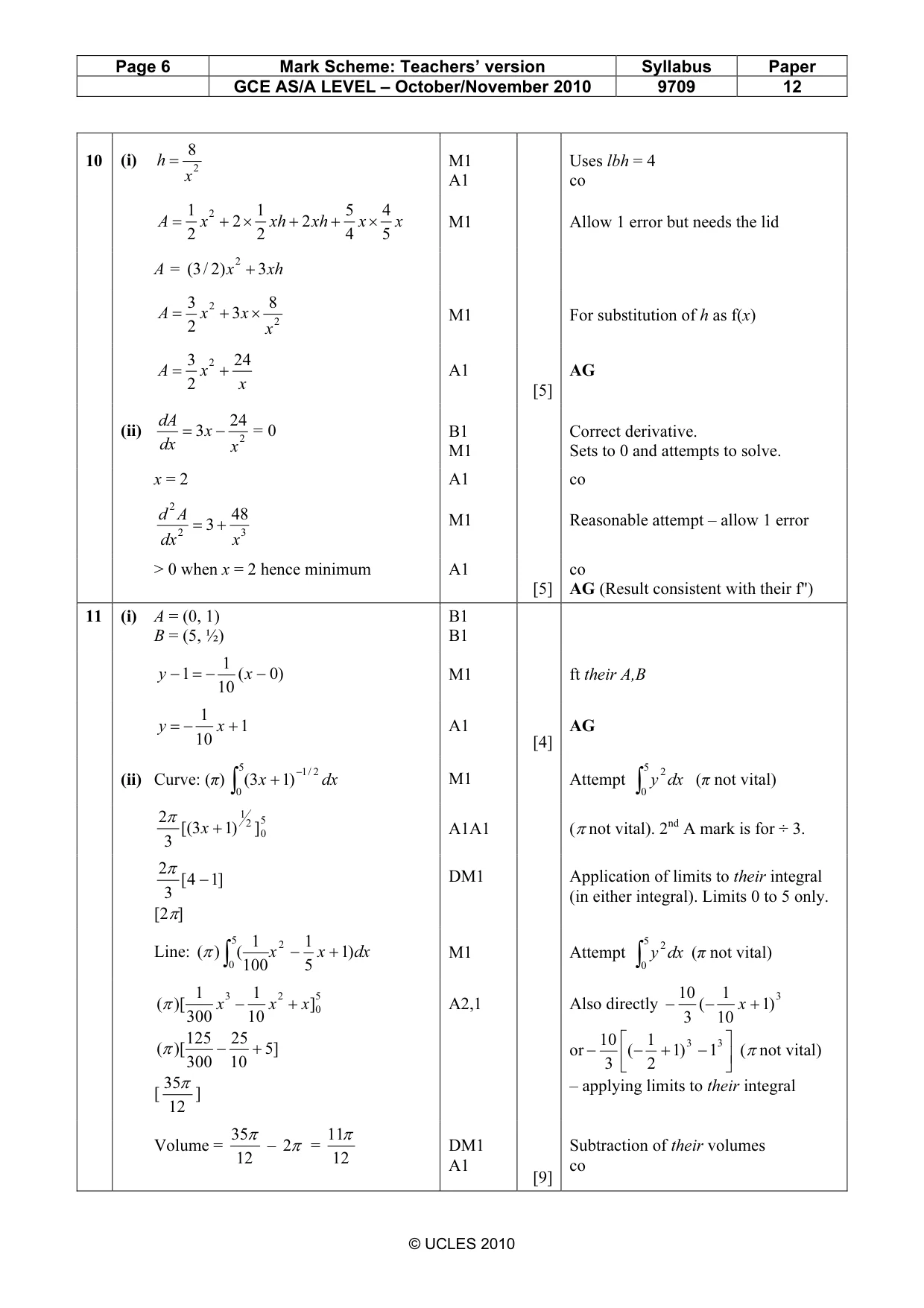
Mark scheme: 8 10 (i) h = 2 M1 Uses lbh = 4 x A1 co 1 2 1 5 4 A = x + 2 × xh + 2 xh + x × x M1 Allow 1 error but needs the lid 2 2 4 5 A = (3 / 2 ) x 2 + 3 xh 3 2 8 A = x + 3 x × 2 M1 For substitution of h as f(x) 2 x 3 2 24 A = x + A1 AG 2 x [5] dA 24 (ii) = 3 x − = 0 B1 Correct derivative. 2 dx x M1 Sets to 0 and attempts to solve. x = 2 A1 co d 2 A 48 = 3 + M1 Reasonable attempt – allow 1 error dx 2 x 3 > 0 when x = 2 hence minimum A1 co [5] AG (Result consistent with their f'')
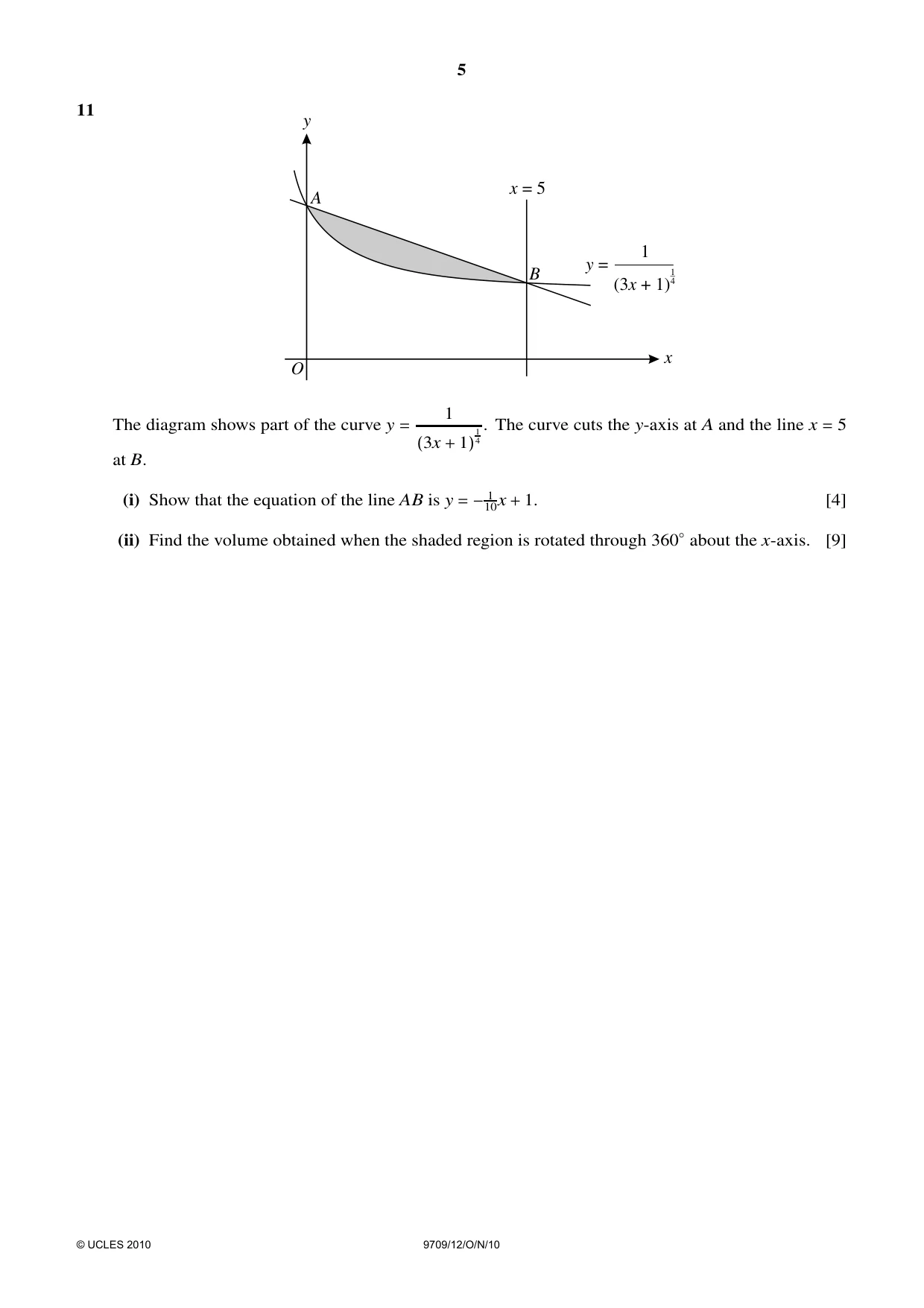
Q11 · Y x = 5 A 1 y = 1 B 4 (3x + 1) x O 1 1 The diagram shows part of the curve y =
11 y x = 5 A 1 y = 1 B 4 (3x + 1) x O 1 1 The diagram shows part of the curve y = . The curve cuts the y-axis at A and the line x = 5 4 (3x + 1) at B. (i) Show that the equation of the line AB is y = −110x + 1. [4] (ii) Find the volume obtained when the shaded region is rotated through 360◦about the x-axis. [9]
Mark scheme: 11 (i) A = (0, 1) B1 B = (5, ½) B1 1 y − 1 = − ( x − 0) M1 ft their A,B 10 1 y = − x + 1 A1 AG 10 [4] 5 −1 / 2 5 2 (ii) Curve: (π)∫ 0 (3 x + )1 dx M1 Attempt ∫ 0 y dx (π not vital) 2π 1 2 5 [(3 x + )1 ] 0 A1A1 (π not vital). 2nd A mark is for ÷ 3. 3 2π [ 4 − ]1 DM1 Application of limits to their integral 3 (in either integral). Limits 0 to 5 only. [2π] 5 1 2 1 5 2 M1 Attempt ∫ 0 y dx (π not vital) Line: (π ) ∫ 0 ( 100 x − 5 x + )1 dx 1 3 1 2 5 10 1 (π )[ x − x + x ]0 A2,1 Also directly − ( − x + 3)1 300 10 3 10 125 25 10 1 3 3 (π )[ − + 5] or − ( − + )1 − 1 (π not vital) 300 10 3 2 35π – applying limits to their integral [ ] 12 35π 11π Volume = – 2π = DM1 Subtraction of their volumes 12 12 A1 co [9]
What was in this paper
The subtopics covered by these 11 questions, and how many questions each got. Open one in a new tab to see every Cambridge question on it.
What you needed in this session
Cambridge’s own grade thresholds for 2010 Oct/Nov, Paper 1 · Variant 2. A higher threshold means an easier paper — the bar moves with how the cohort did.