Cambridge A Level Mathematics 9709 — 2015 Oct/Nov Paper 1 · Variant 3
9709/13/O/N/15 · 5 questions · 75 marks · ≈84 min
The question paper and its mark scheme, free to read here and free to download. This is Cambridge’s own paper, exactly as it was sat.
Question paper4 pages
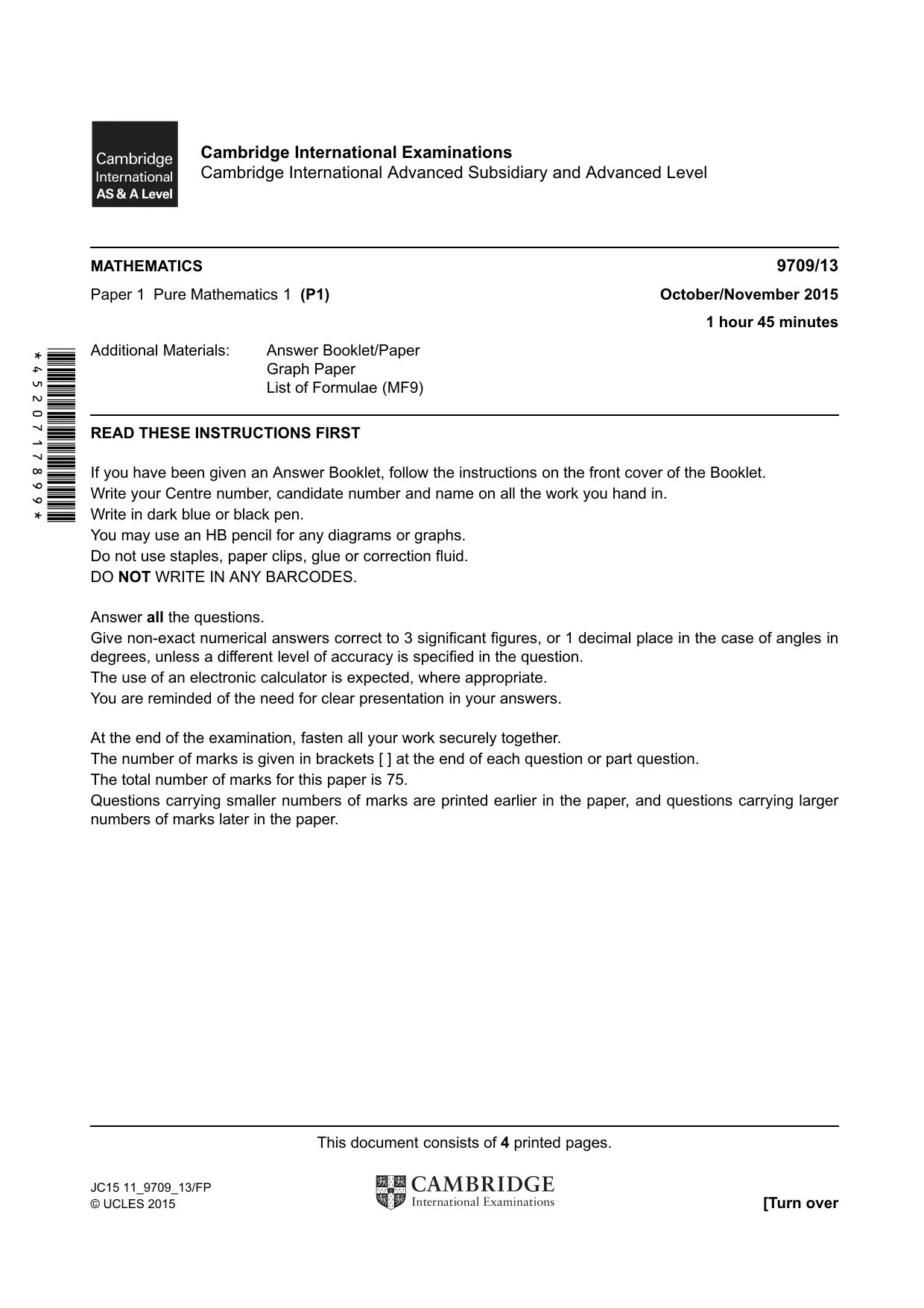
Mark scheme7 pages
Answers below. Sit the paper first if you are practising.
Questions as text
Q1 · A line has equation y = 2x −7 and a curve has equation y = x2 −4x + c, where c is a…
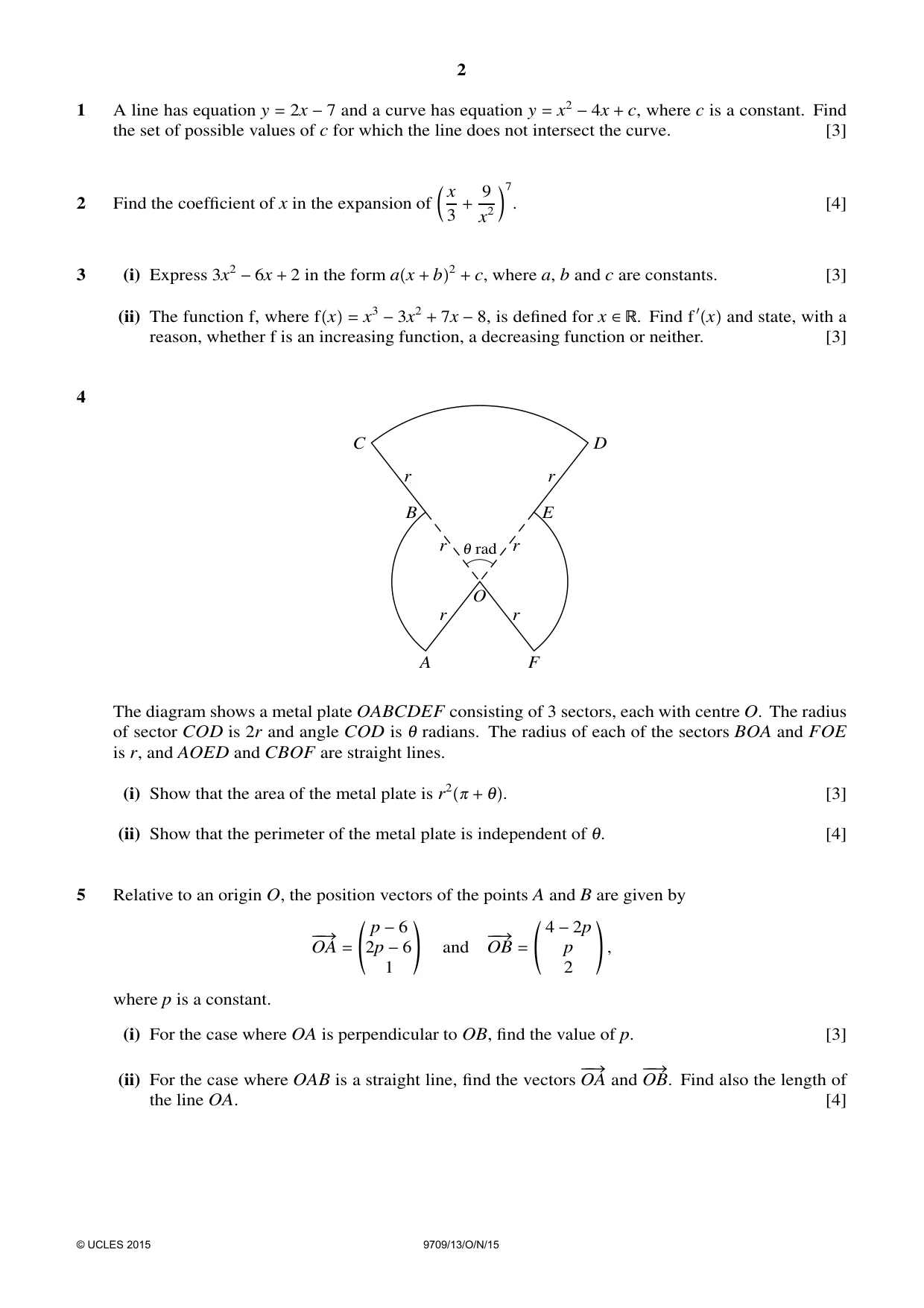
1 A line has equation y = 2x −7 and a curve has equation y = x2 −4x + c, where c is a constant. Find the set of possible values of c for which the line does not intersect the curve. [3]
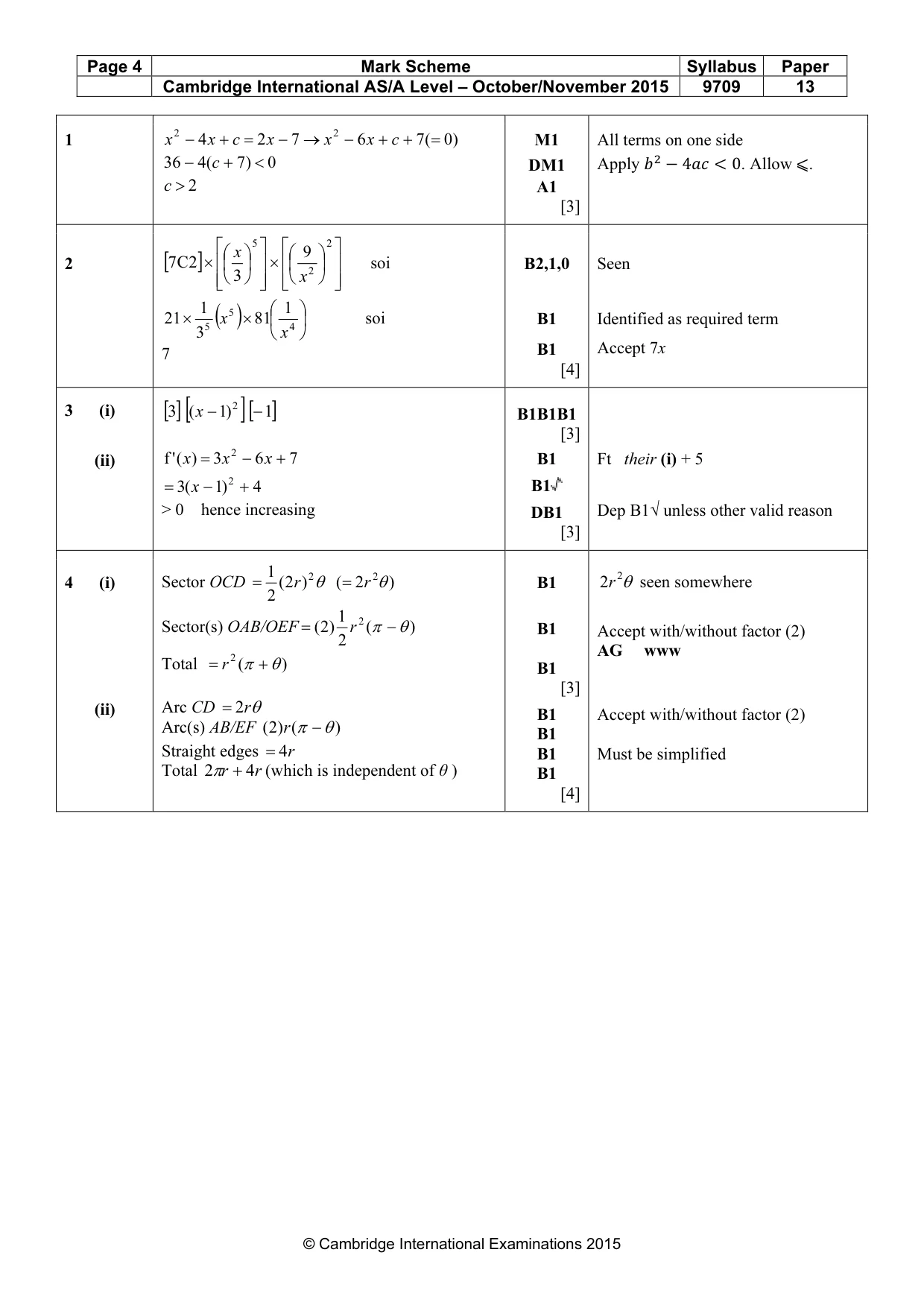
Mark scheme: 1 x 2 − 4 x + c = 2 x − 7 → x 2 − 6 x + c + 7 ( = 0 ) M1 All terms on one side 36 − 4 ( c + 7 ) < 0 DM1 Apply 4 0. Allow ⩽. c > 2 A1 [3] x 5 9 2 [ ]
Q2 · @x 9 A7 2 Find the coefficient of x in the expansion of +
@x 9 A7 2 Find the coefficient of x in the expansion of + . [4] 3 x2
Mark scheme: x 9 2 [7 C 2 ] × × 2 soi B2,1,0 Seen 3 x 1 5 1 21 × 5 ( x ) × 81 4 soi B1 Identified as required term 3 x B1 Accept 7x 7 [4] 2 [ ] [ ] [ ]
Q5 · Relative to an origin O, the position vectors of the points A and B are given by ` a ` a…
5 Relative to an origin O, the position vectors of the points A and B are given by ` a ` a p −6 4 −2p −−→ −−→ OA = 2p −6 and OB = p , 1 2 where p is a constant. (i) For the case where OA is perpendicular to OB, find the value of p. [3] −−→ −−→ (ii) For the case where OAB is a straight line, find the vectors OA and OB. Find also the length of the line OA. [4]
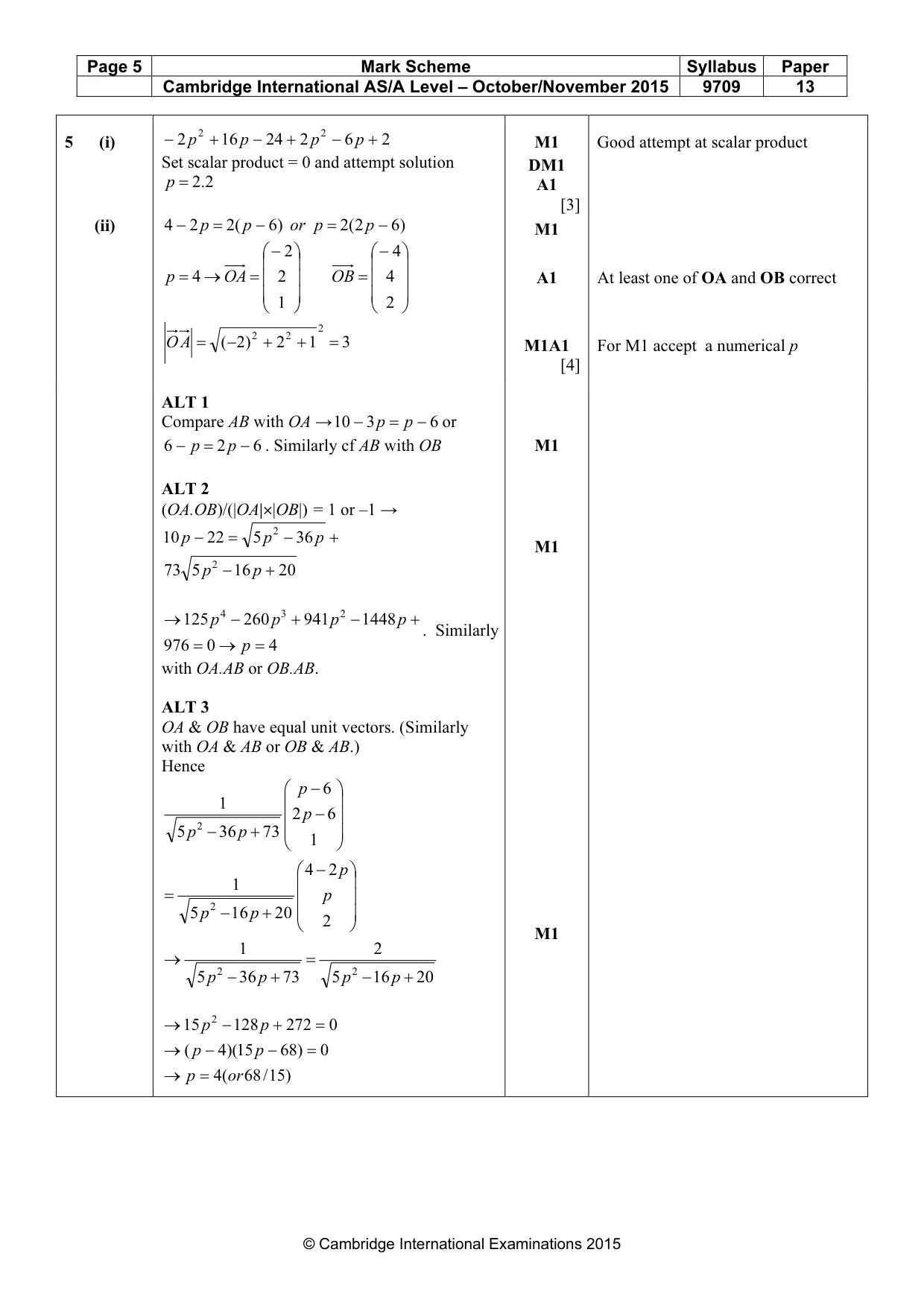
Mark scheme: 5 (i) − 2 p 2 + 16 p − 24 + 2 p 2 − 6 p + 2 M1 Good attempt at scalar product Set scalar product = 0 and attempt solution DM1 p = 2.2 A1 [3] (ii) 4 − 2 p = 2 ( p − 6 ) or p = 2 ( 2 p − 6 ) M1 − 2 − 4 p = 4 → OA = 2 OB = 4 A1 At least one of OA and OB correct 1 2 2 O A = ( − 2 ) 2 + 2 2 + 1 = 3 M1A1 For M1 accept a numerical p [4] ALT 1 Compare AB with OA → 10 − 3 p = p − 6 or 6 − p = 2 p − 6 . Similarly cf AB with OB M1 ALT 2 (OA.OB)/(|OA|×|OB|) = 1 or –1 → 10 p − 22 = 5 p 2 − 36 p + M1 73 5 p 2 − 16 p + 20 → 125 p 4 − 260 p 3 + 941 p 2 − 1448 p + . Similarly 976 = 0 → p = 4 with OA.AB or OB.AB. ALT 3 OA & OB have equal unit vectors. (Similarly with OA & AB or OB & AB.) Hence p − 6 1 2 p − 6 5 p 2 − 36 p + 73 1 −4 2 p 1 = p 5 p 2 − 16 p + 20 2 M1 1 2 → = 5 p 2 − 36 p + 73 5 p 2 − 16 p + 20 → 15 p 2 − 128 p + 272 = 0 → ( p − 4)(15 p − 68) = 0 → p = 4( or 68 / 15)
Q6 · A ball is such that when it is dropped from a height of 1 metre it bounces vertically…
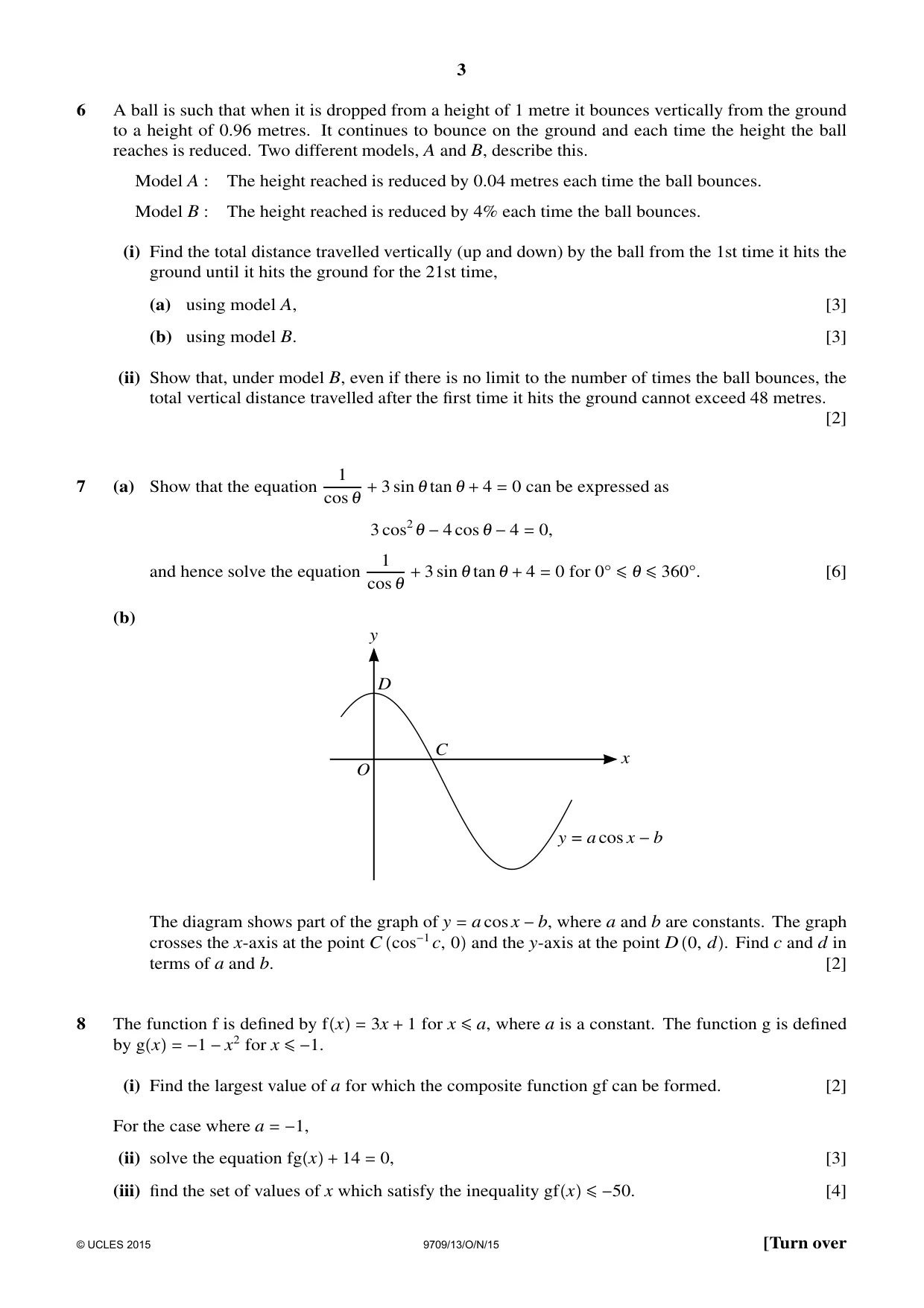
6 A ball is such that when it is dropped from a height of 1 metre it bounces vertically from the ground to a height of 0.96 metres. It continues to bounce on the ground and each time the height the ball reaches is reduced. Two different models, A and B, describe this. Model A : The height reached is reduced by 0.04 metres each time the ball bounces. Model B : The height reached is reduced by 4% each time the ball bounces. (i) Find the total distance travelled vertically (up and down) by the ball from the 1st time it hits the ground until it hits the ground for the 21st time, (a) using model A, [3] (b) using model B. [3] (ii) Show that, under model B, even if there is no limit to the number of times the ball bounces, the total vertical distance travelled after the first time it hits the ground cannot exceed 48 metres. [2]
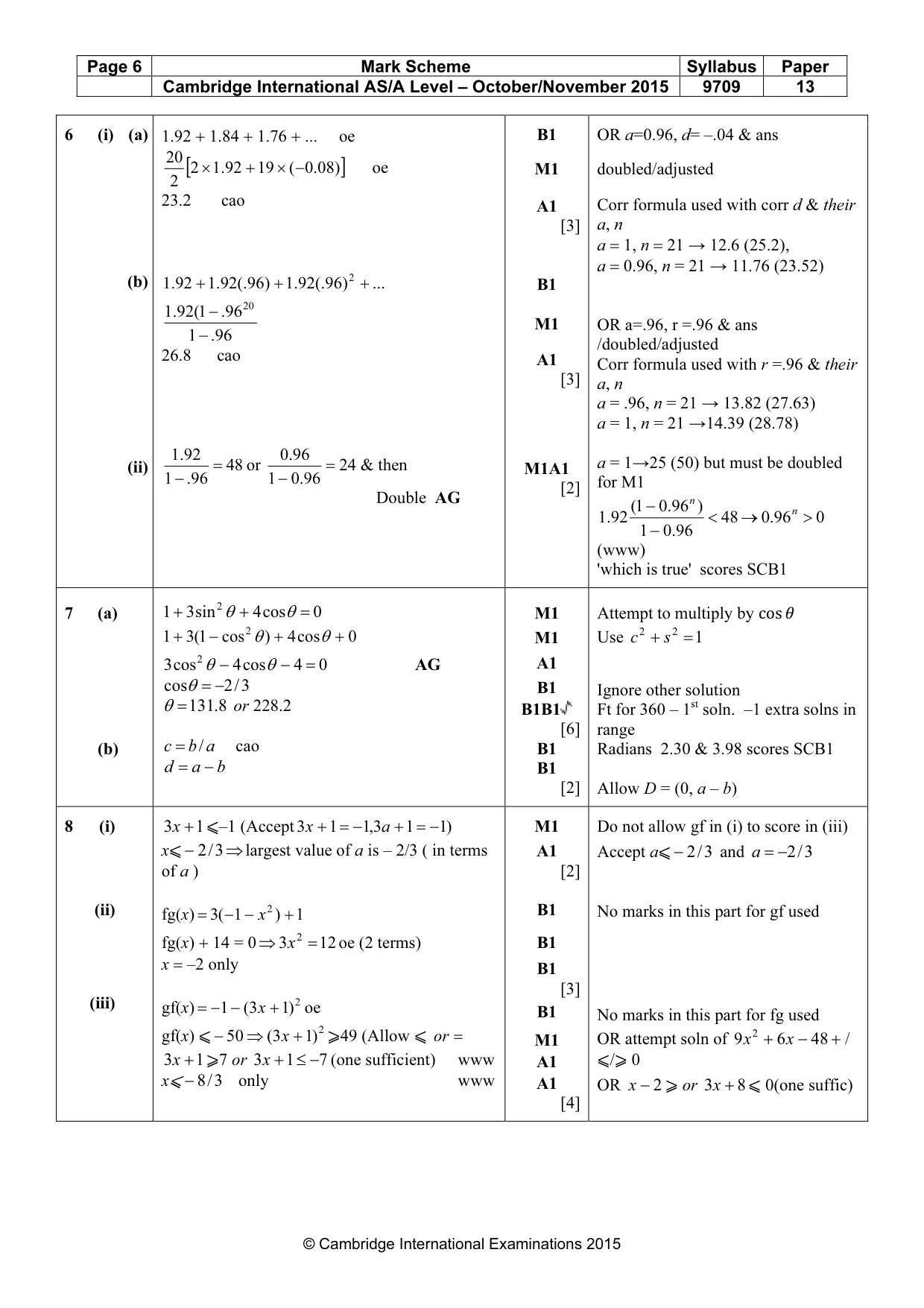
Mark scheme: 6 (i) (a) 1.92 + 1.84 + 1.76 + ... oe B1 OR a=0.96, d= –.04 & ans 20 [2 × .1 92 + 19 × ( − .0 08]) oe M1 doubled/adjusted 2 23.2 cao A1 Corr formula used with corr d & their [3] a, n a = 1, n = 21 → 12.6 (25.2), a = 0.96, n = 21 → 11.76 (23.52) (b) .1 92 + .1 92 (.96 ) + .1 92 (.96 ) 2 + ... B1 .1 921( − . 96 20 M1 OR a=.96, r =.96 & ans 1 − . 96 /doubled/adjusted 26.8 cao A1 Corr formula used with r =.96 & their [3] a, n a = .96, n = 21 → 13.82 (27.63) a = 1, n = 21 →14.39 (28.78) .1 92 .0 96 a = 1→25 (50) but must be doubled = 48 or (ii) = 24 & then M1A1 1 − . 96 1 − .0 96 for M1 [2] Double AG n 1( − .0 96 ) n .1 92 < 48 → .0 96 > 0 1 − .0 96 (www) 'which is true' scores SCB1 2
Q9 · Dy −1 9 A curve passes through the point A 4, 6 and is such that = 1 + 2x 2
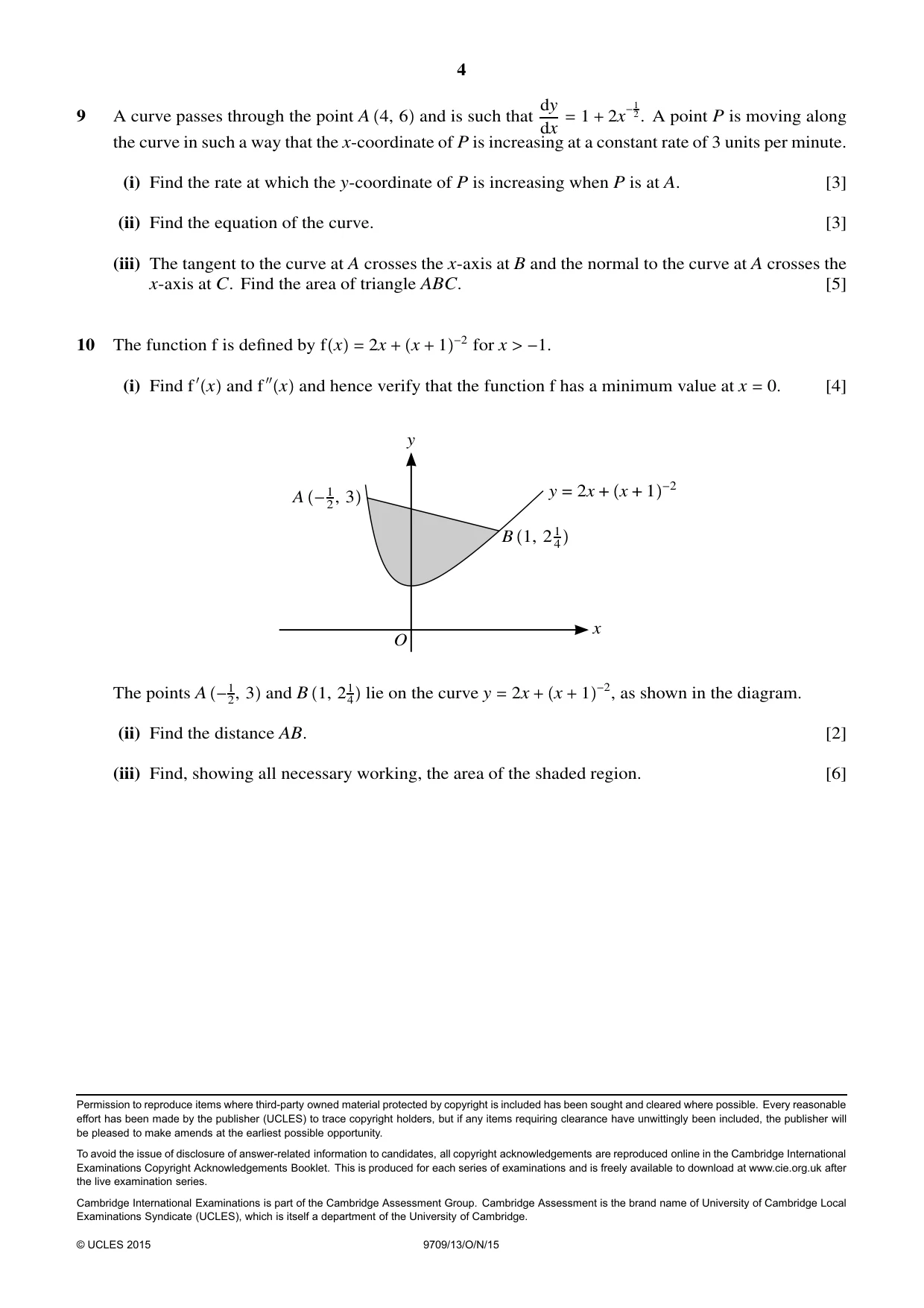
dy −1 9 A curve passes through the point A 4, 6 and is such that = 1 + 2x 2. A point P is moving along dx the curve in such a way that the x-coordinate of P is increasing at a constant rate of 3 units per minute. (i) Find the rate at which the y-coordinate of P is increasing when P is at A. [3] (ii) Find the equation of the curve. [3] (iii) The tangent to the curve at A crosses the x-axis at B and the normal to the curve at A crosses the x-axis at C. Find the area of triangle ABC. [5]
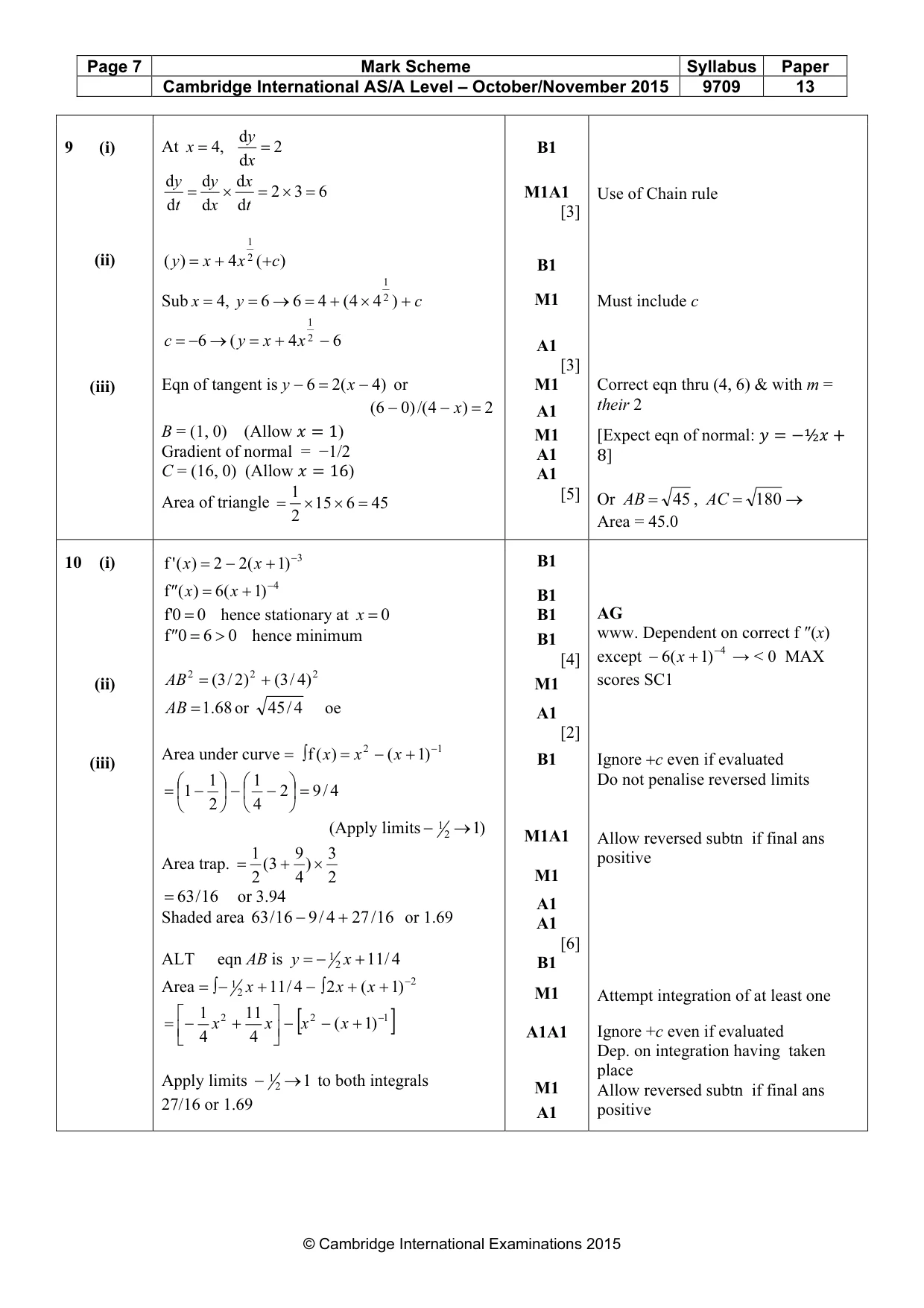
Mark scheme: dy 9 (i) At x = ,4 = 2 B1 dx d y dy d x = × = 2 × 3 = 6 M1A1 Use of Chain rule d t d x d t [3] 1 (ii) ( y ) = x + 4 x 2 ( + c ) B1 1 Sub x = ,4 y = 6 → 6 = 4 + ( 4 × 4 2 ) + c M1 Must include c 1 c = − 6 → ( y = x + 4 x 2 − 6 A1 [3] (iii) Eqn of tangent is y − 6 = 2 ( x − 4 ) or M1 Correct eqn thru (4, 6) & with m = ( 6 − 0 ) /( 4 − x ) = 2 A1 their 2 B = (1, 0) (Allow 1) M1 [Expect eqn of normal: ½ Gradient of normal = −1/2 A1 8] C = (16, 0) (Allow 16) A1 1 [5] Area of triangle = × 15 × 6 = 45 Or AB = 45 , AC = 180 → 2 Area = 45.0 3
What was in this paper
The subtopics covered by these 5 questions, and how many questions each got. Open one in a new tab to see every Cambridge question on it.
What you needed in this session
Cambridge’s own grade thresholds for 2015 Oct/Nov, Paper 1 · Variant 3. A higher threshold means an easier paper — the bar moves with how the cohort did.