Cambridge A Level Mathematics 9709 — 2011 Oct/Nov Paper 1 · Variant 1
9709/11/O/N/11 · 9 questions · 75 marks · ≈84 min
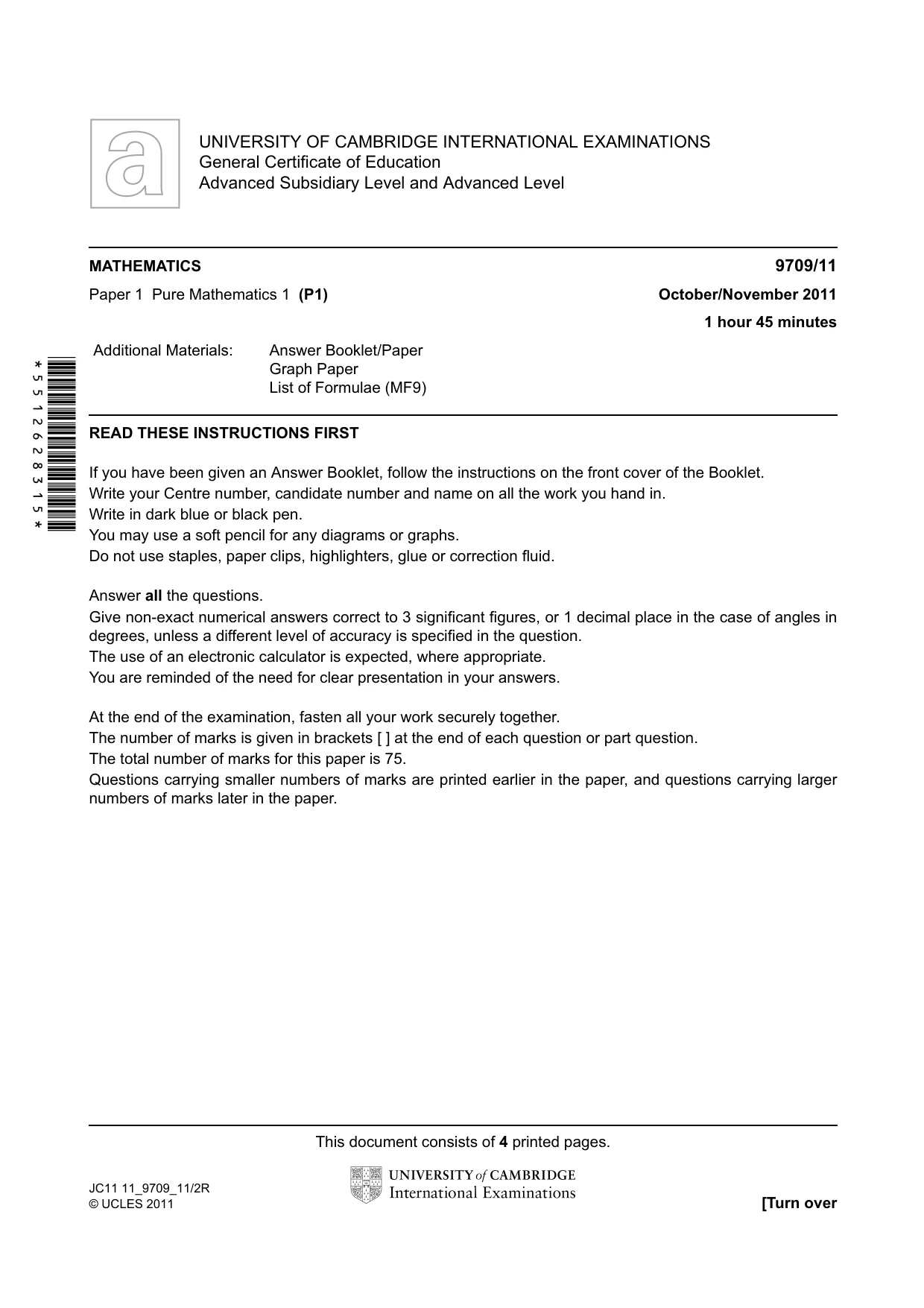
The question paper and its mark scheme, free to read here and free to download. This is Cambridge’s own paper, exactly as it was sat.
Question paper4 pages
Mark scheme7 pages
Answers below. Sit the paper first if you are practising.
Questions as text
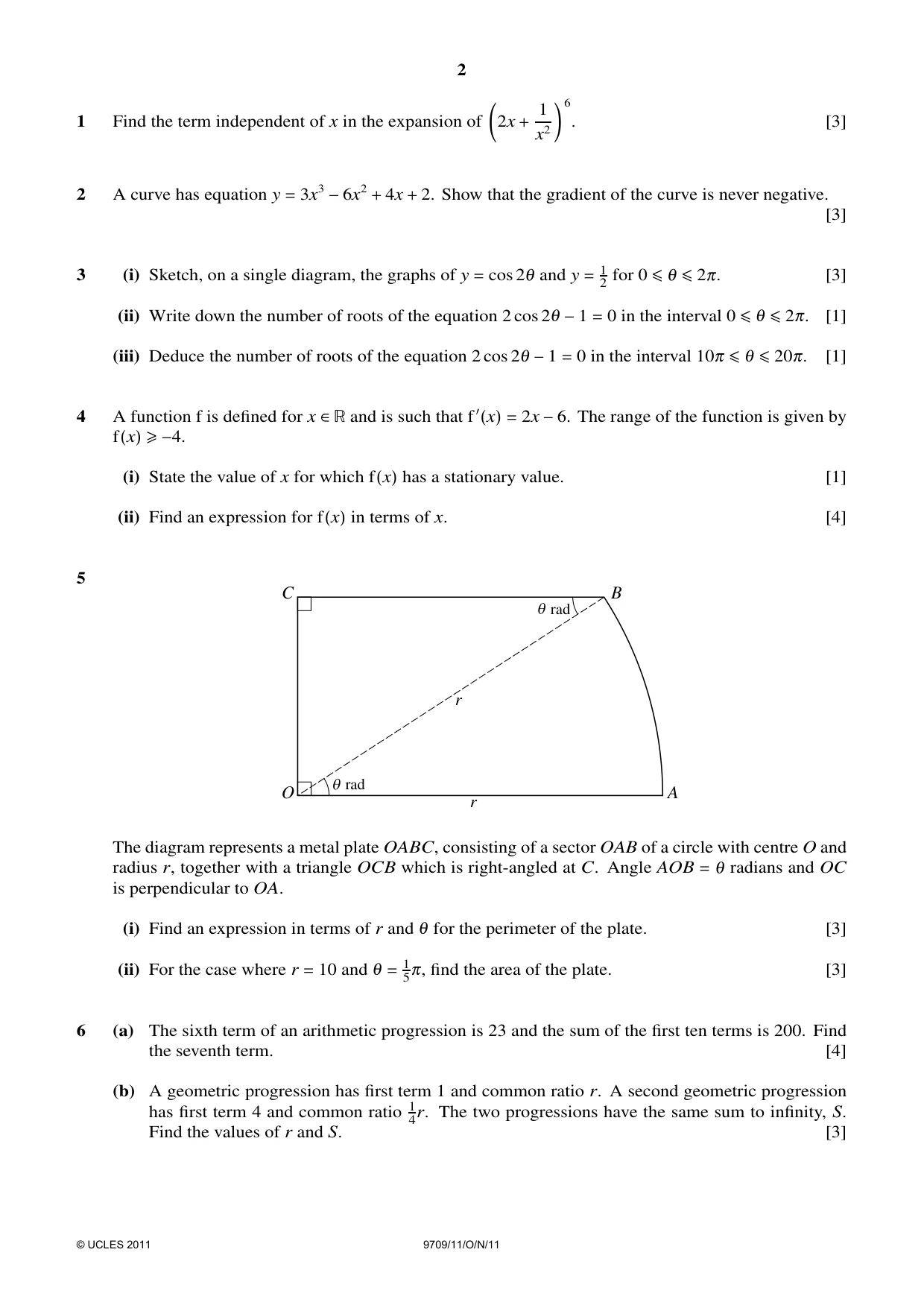
Q1 · 6 1 Find the term independent of x in the expansion of 2x + x2
1 6 1 Find the term independent of x in the expansion of 2x + x2 . [3]
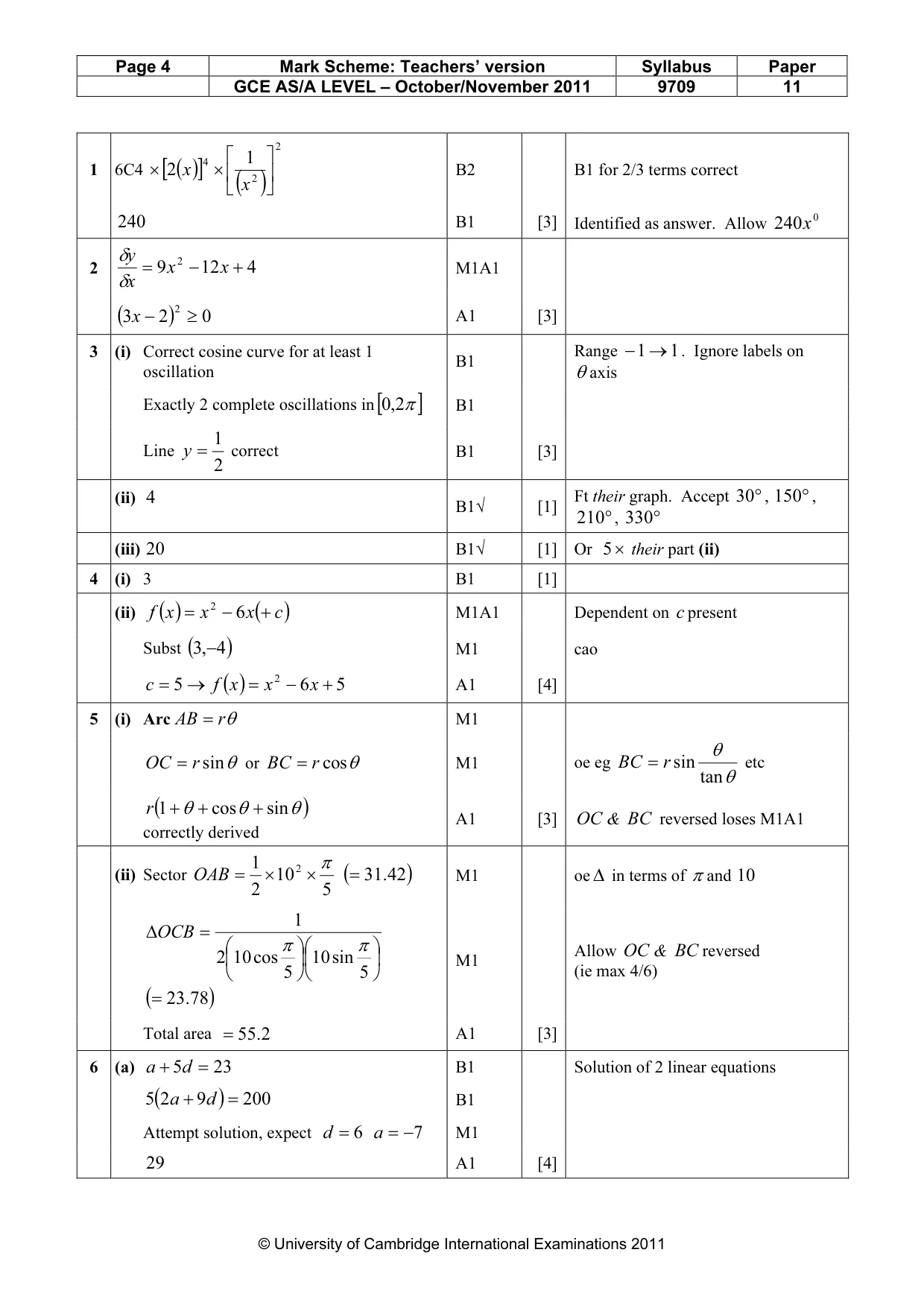
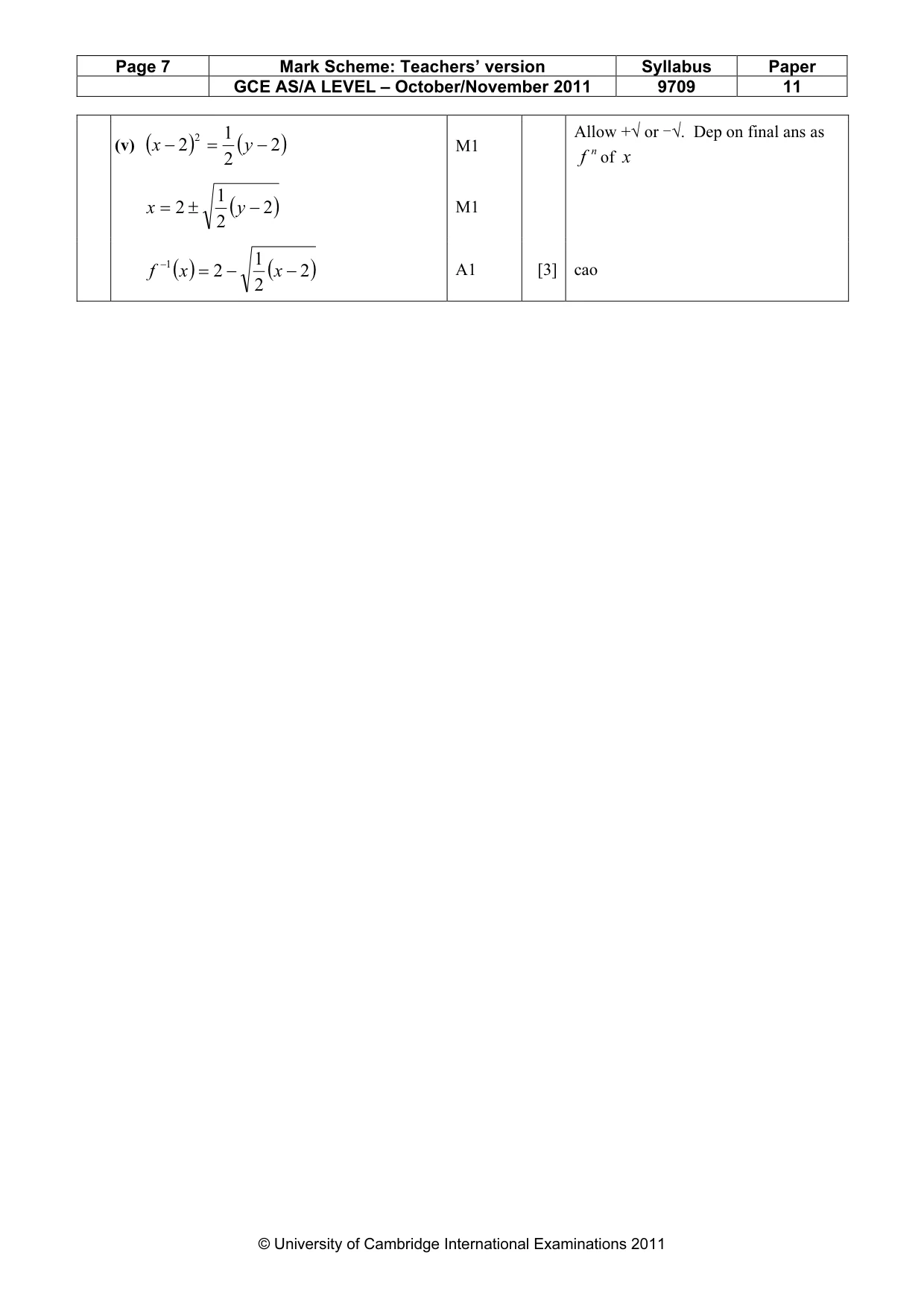
Mark scheme: −1 1f ( x ) = 2 − ( x − 2 ) A1 [3] cao 2
Q2 · A curve has equation y = 3x3 −6x2 + 4x + 2
2 A curve has equation y = 3x3 −6x2 + 4x + 2. Show that the gradient of the curve is never negative. [3]
Mark scheme: 2 1 Allow +√ or √. Dep on final ans as (v) ( x − 2 ) = ( y − 2 ) M1 n 2 f of x 1 x = 2 ± ( y − 2 ) M1 2 1 ( ) ( )
Q3 · Sketch, on a single diagram, the graphs of y cos 2θ and y 1 for 0 [3] 2 = = ≤θ ≤2π
3 (i) Sketch, on a single diagram, the graphs of y cos 2θ and y 1 for 0 [3] 2 = = ≤θ ≤2π. (ii) Write down the number of roots of the equation 2 cos 2θ −1 = 0 in the interval 0 ≤θ ≤2π. [1] (iii) Deduce the number of roots of the equation 2 cos 2θ −1 = 0 in the interval 10π ≤θ ≤20π. [1]
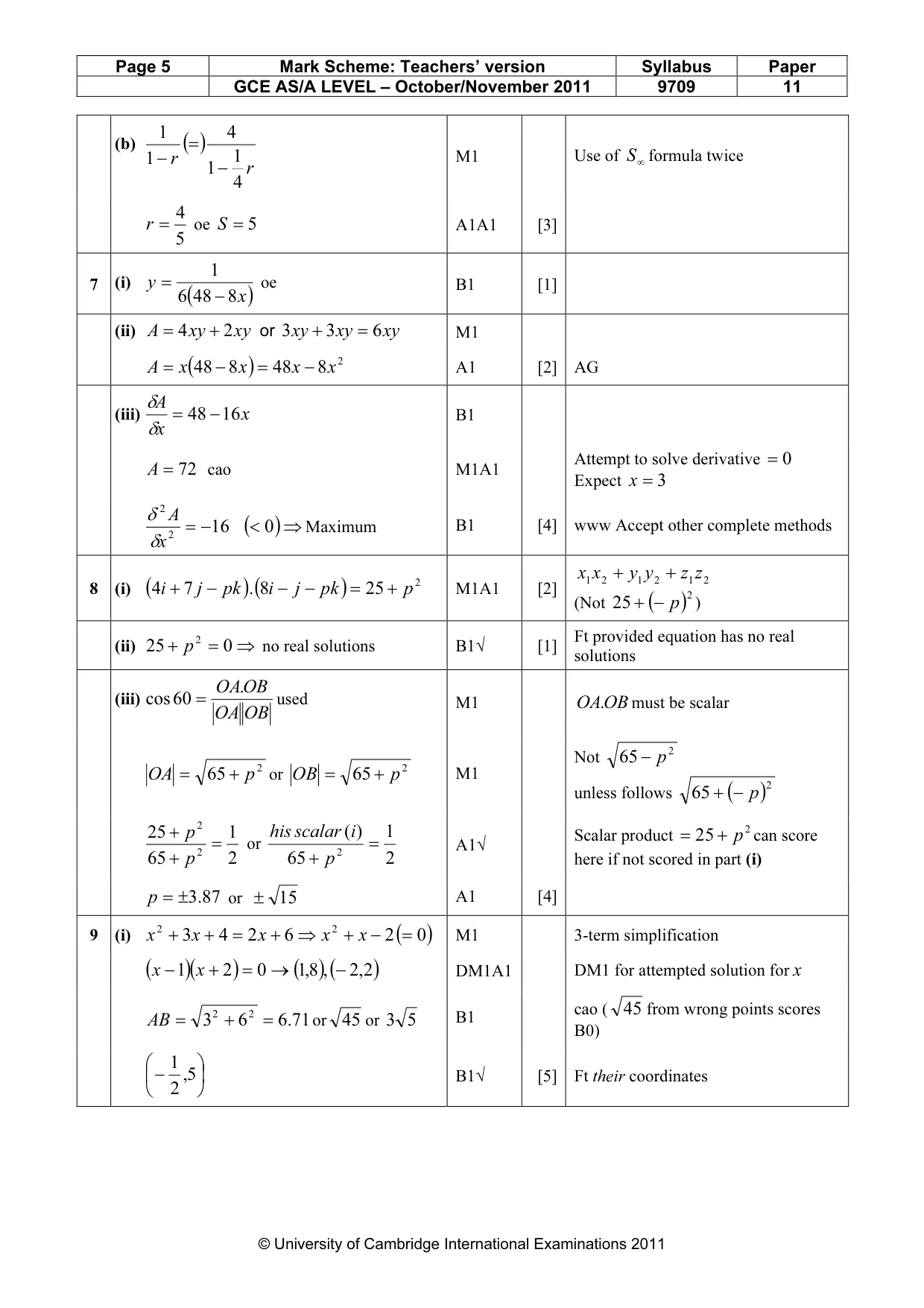
Mark scheme: (3 x − 2 ) 2 ≥ 0 A1 [3] 3 (i) Correct cosine curve for at least 1 Range − 1 → 1 . Ignore labels on B1 oscillation θ axis Exactly 2 complete oscillations in[2,0π ] B1 1 Line y = correct B1 [3] 2 (ii) 4 Ft their graph. Accept 30 ° , 150 ° , B1√ [1] 210 ° , 330 ° (iii) 20 B1√ [1] Or 5 × their part (ii) 4 (i) 3 B1 [1] (ii) f ( x ) = x 2 − 6 x (+ c ) M1A1 Dependent on c present Subst (,3 −4 ) M1 cao c = 5 → f ( x ) = x 2 − 6 x + 5 A1 [4] 5 (i) Arc AB = r θ M1 θ OC = r sin θ or BC = r cos θ M1 oe eg BC = r sin etc tan θ r (1 + θ + cos θ + sin θ ) A1 [3] OC & BC reversed loses M1A1 correctly derived 1 2 π (ii) Sector OAB = × 10 × (= 31 .42 ) M1 oe ∆ in terms of π and 10 2 5 1 ∆OCB = π π Allow OC & BC reversed 2 10 cos 10 sin M1 5 5 (ie max 4/6) (= 23.78 ) Total area = 55 2. A1 [3] 6 (a) a + 5 d = 23 B1 Solution of 2 linear equations ( )
Q5 · C B q rad r q rad O A r The diagram represents a metal plate OABC, consisting of a sector…
5 C B q rad r q rad O A r The diagram represents a metal plate OABC, consisting of a sector OAB of a circle with centre O and radius r, together with a triangle OCB which is right-angled at C. Angle AOB = θ radians and OC is perpendicular to OA. (i) Find an expression in terms of r and θ for the perimeter of the plate. [3] (ii) For the case where r = 10 and θ = 15π, find the area of the plate. [3]
Mark scheme: 5(2 a + 9 d ) = 200 B1 Attempt solution, expect d = 6 a = −7 M1
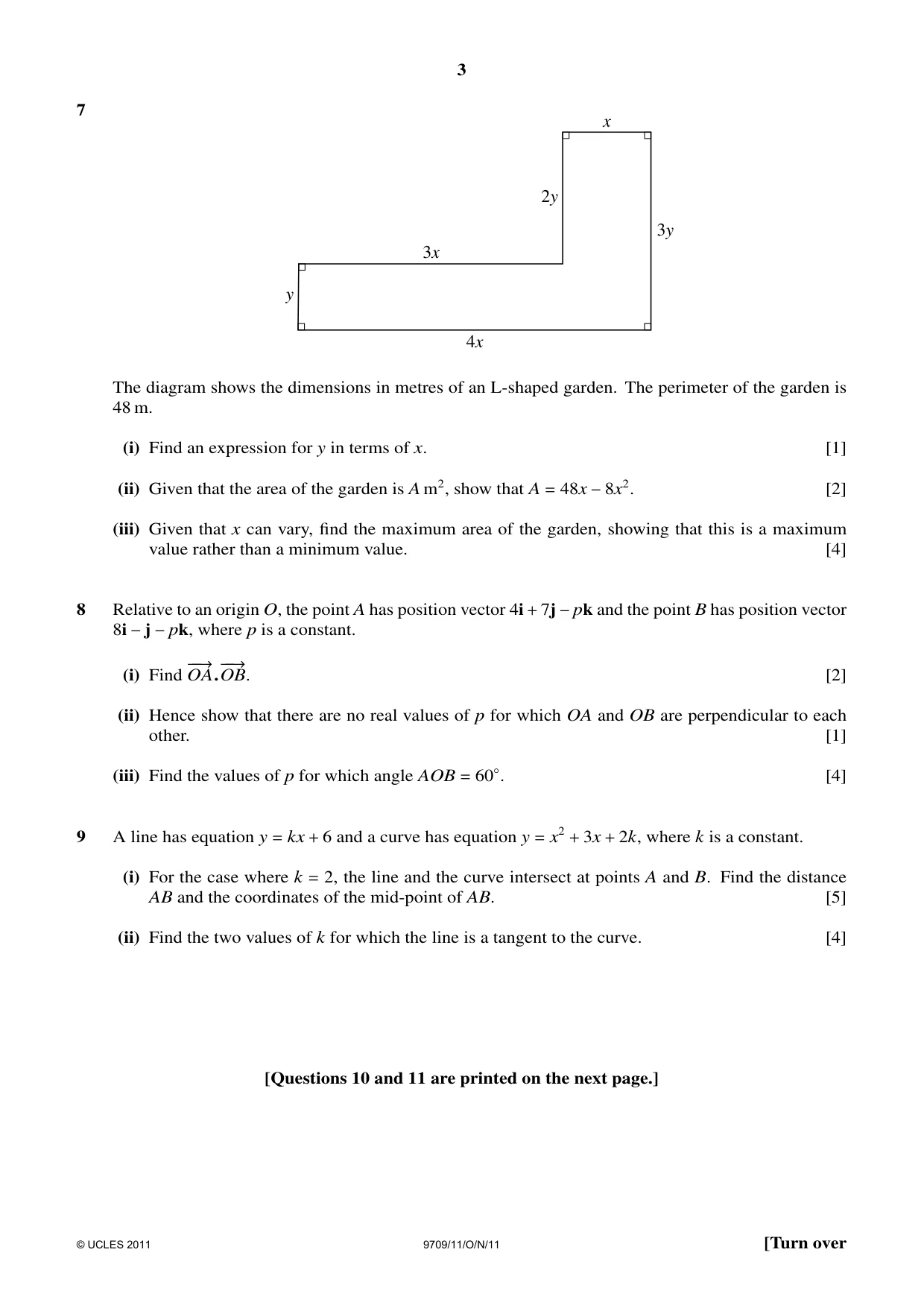
Q7 · X 2y 3y 3x y 4x The diagram shows the dimensions in metres of an L-shaped garden
7 x 2y 3y 3x y 4x The diagram shows the dimensions in metres of an L-shaped garden. The perimeter of the garden is 48 m. (i) Find an expression for y in terms of x. [1] (ii) Given that the area of the garden is A m2, show that A = 48x −8x2. [2] (iii) Given that x can vary, find the maximum area of the garden, showing that this is a maximum value rather than a minimum value. [4]
Mark scheme: 1 7 (i) y = oe B1 [1] 6(48 − 8 x ) (ii) A = 4 xy + 2 xy or 3 xy + 3 xy = 6 xy M1 A = x (48 − 8 x ) = 48 x − 8 x 2 A1 [2] AG δA (iii) = 48 − 16 x B1 δx Attempt to solve derivative = 0 A = 72 cao M1A1 Expect x = 3 δ 2 A = − 16 (< 0 ) ⇒ Maximum B1 [4] www Accept other complete methods 2 δx x x + y y + z z
Q8 · Relative to an origin O, the point A has position vector 4i + 7j −pk and the point B has…
8 Relative to an origin O, the point A has position vector 4i + 7j −pk and the point B has position vector 8i −j −pk, where p is a constant. (i) Find −−→OA.−−→OB. [2] (ii) Hence show that there are no real values of p for which OA and OB are perpendicular to each other. [1] (iii) Find the values of p for which angle AOB = 60◦. [4]
Mark scheme: x1 x 2 + y1 y 2 + z1 z 2 28 (i) (4i + 7 j − pk ). (8i − j − pk ) = 25 + p M1A1 [2] 2 (Not 25 + (− p ) ) 2 Ft provided equation has no real (ii) 25 + p = 0 ⇒ no real solutions B1√ [1] solutions OA.OB (iii) cos 60 = used M1 OA.OB must be scalar OA OB Not 65 − p 2 OA = 65 + p 2 or OB = 65 + p 2 M1 unless follows 65 + (− p ) 2 25 + p 2 1 his scalar (i ) 1 Scalar product = 25 + p 2 can score = or = A1√ 2 2 65 + p 2 65 + p 2 here if not scored in part (i) p = ± .387 or ± 15 A1 [4] 2 2 ( )
Q9 · A line has equation y = kx + 6 and a curve has equation y = x2 + 3x + 2k, where k is a…
9 A line has equation y = kx + 6 and a curve has equation y = x2 + 3x + 2k, where k is a constant. (i) For the case where k = 2, the line and the curve intersect at points A and B. Find the distance AB and the coordinates of the mid-point of AB. [5] (ii) Find the two values of k for which the line is a tangent to the curve. [4] [Questions 10 and 11 are printed on the next page.]
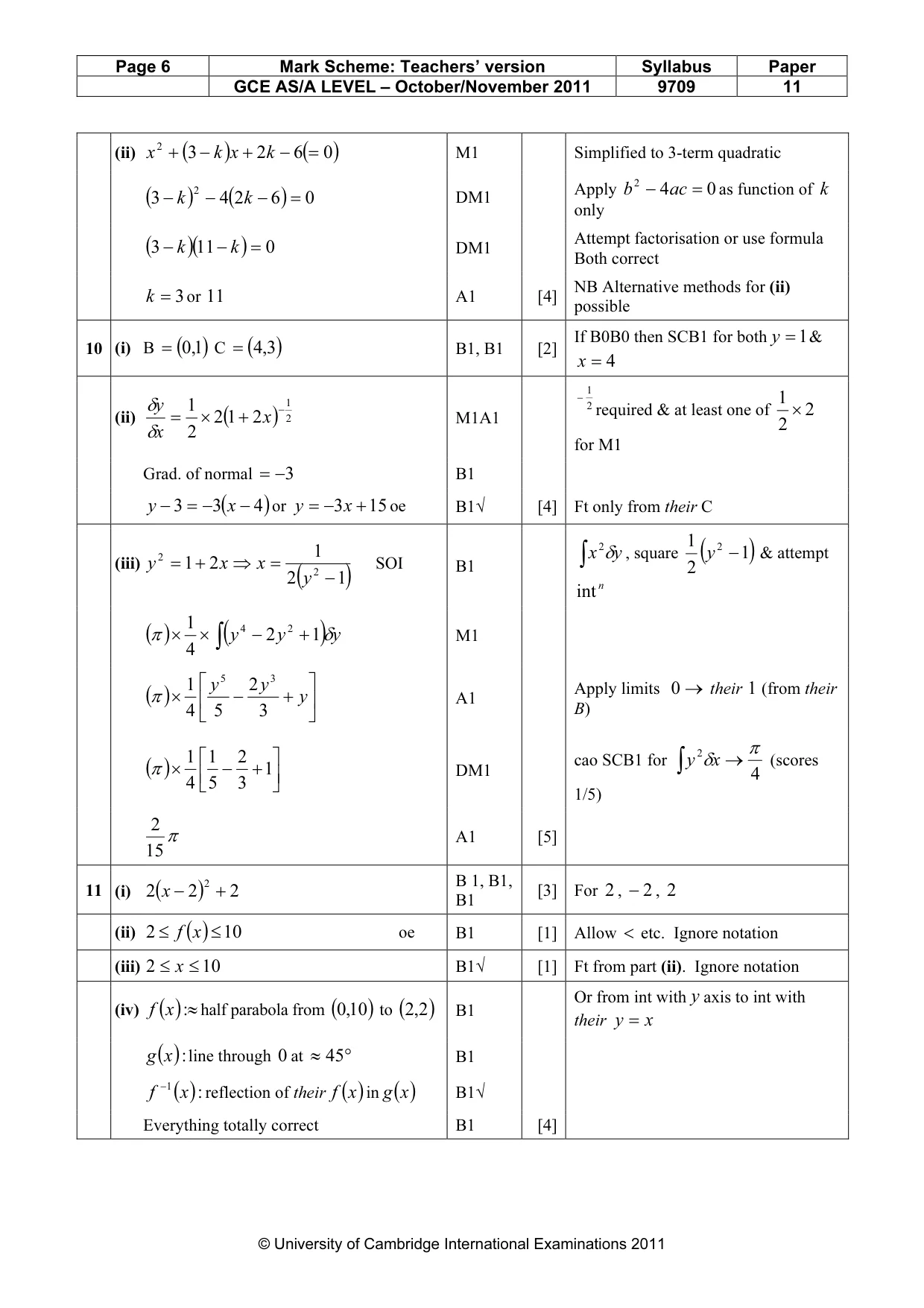
Mark scheme: 9 (i) x 2 + 3 x + 4 = 2 x + 6 ⇒ x 2 + x − 2 (= 0 ) M1 3-term simplification ( x − 1)( x + 2 ) = 0 → (8,1 ), (− 2,2 ) DM1A1 DM1 for attempted solution for x 2 2 cao ( 45 from wrong points scores AB = 3 + 6 = .6 71 or 45 or 3 5 B1 B0) − 1 5, B1√ [5] Ft their coordinates 2 GCE AS/A LEVEL – October/November 2011 9709 11 (ii) x 2 + (3 − k )x + 2 k − 6(= 0 ) M1 Simplified to 3-term quadratic 2 (3 − k ) 2 − 4(2 k − 6 ) = 0 DM1 Apply b −ac4 = 0 as function of k only (3 − k )(11 − k ) = 0 DM1 Attempt factorisation or use formula Both correct NB Alternative methods for (ii) k = 3 or 11 A1 [4] possible If B0B0 then SCB1 for both y = 1 & ( ) ( )
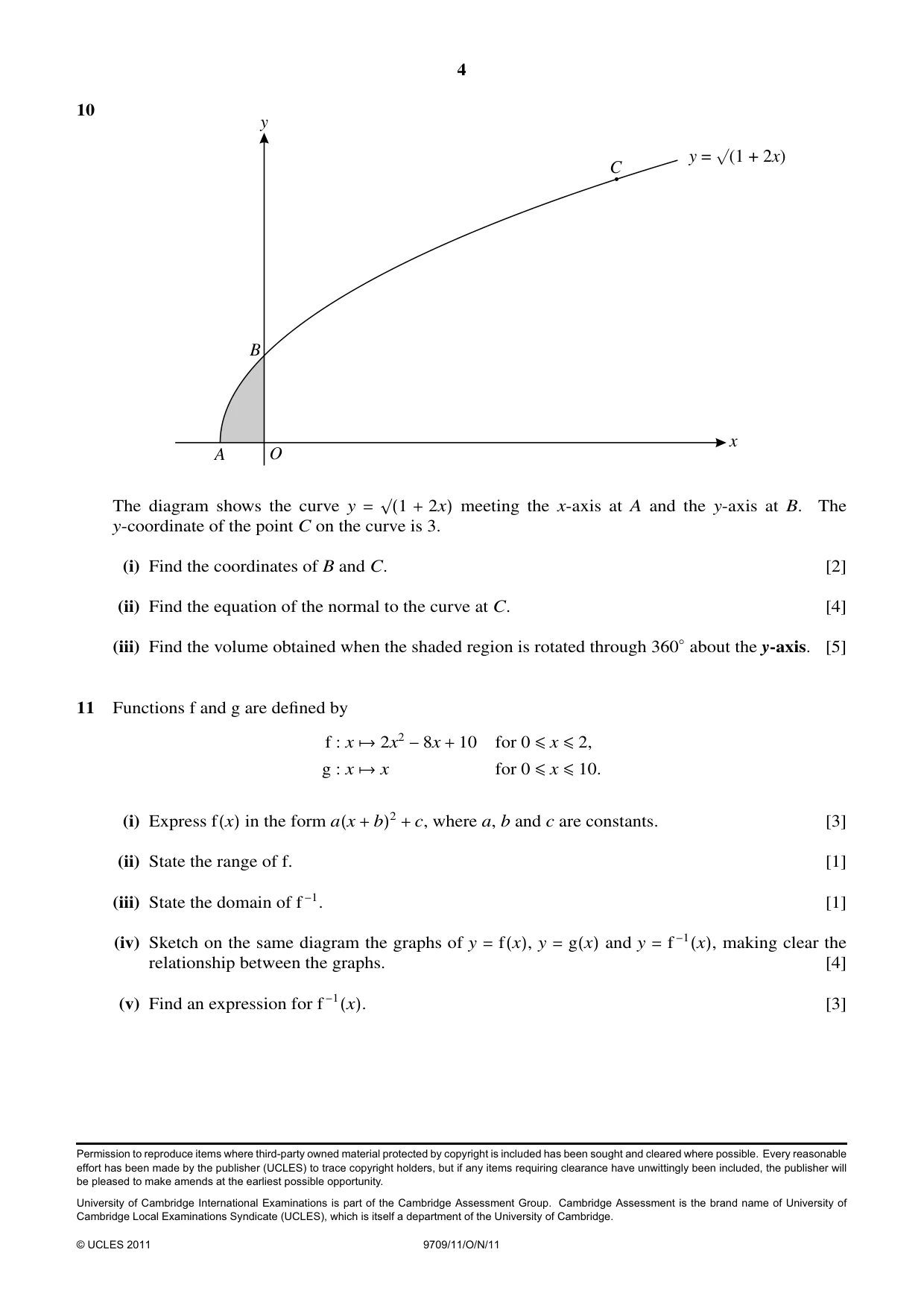
Q10 · Y y = Ö(1 + 2x ) C B x A O meeting the x-axis at A and the y-axis at B
10 y y = Ö(1 + 2x ) C B x A O meeting the x-axis at A and the y-axis at B. The The diagram shows the curve y = √(1 + 2x) y-coordinate of the point C on the curve is 3. (i) Find the coordinates of B and C. [2] (ii) Find the equation of the normal to the curve at C. [4] (iii) Find the volume obtained when the shaded region is rotated through 360◦about the y-axis. [5]
Mark scheme: If B0B0 then SCB1 for both y 1 & 10 (i) B = ()1,0 C = (3,4) B1, B1 [2] x = 4 1 δy 1 − 1 − 2 required & at least one of 1 × 2 (ii) = × 2(1 + 2 x ) 2 M1A1 2 δx 2 for M1 Grad. of normal = −3 B1 y − 3 = −3( x − 4 ) or y = −3 x + 15 oe B1√ [4] Ft only from their C 2 1 2 2 1 x δy , square ( y − )1 & attempt ∫ (iii) y = 1 + 2 x ⇒ x = SOI B1 2 2 2 ( y − )1 n int 1 4 2 (π ) × × ( y − 2 y + 1)δy M1 ∫ 4 1 y 5 2 y 3 Apply limits 0 → their 1 (from their (π ) × − + y A1 B) 4 5 3 2 π 2 1 1 − + 1 (π ) × DM1 cao SCB1 for ∫ y δx →4 (scores 4 5 3 1/5) 2 π A1 [5] 15 ( ) 2 B 1 B1
Q11 · Functions f and g are defined by f : x →2x2 −8x + 10 for 0 ≤x ≤2, g : x →x for 0 ≤x ≤10
11 Functions f and g are defined by f : x →2x2 −8x + 10 for 0 ≤x ≤2, g : x →x for 0 ≤x ≤10. (i) Express f(x) in the form a(x + b)2 + c, where a, b and c are constants. [3] (ii) State the range of f. [1] (iii) State the domain of f −1. [1] (iv) Sketch on the same diagram the graphs of y = f(x), y = g(x) and y = f −1(x), making clear the relationship between the graphs. [4] (v) Find an expression for f −1(x). [3]
Mark scheme: 2 B 1, B1,11 (i) 2( x − 2 ) + 2 [3] For 2 , − 2 , 2 B1 (ii) 2 ≤ f ( x ) ≤ 10 oe B1 [1] Allow < etc. Ignore notation (iii) 2 ≤x ≤ 10 B1√ [1] Ft from part (ii). Ignore notation Or from int with y axis to int with (iv) f ( x ) ≈: half parabola from (,010 ) to (2,2 ) B1 their y = x g ( x ): line through 0 at ≈45 ° B1 f −1 ( x ): reflection of their f ( x ) in g ( x ) B1√ Everything totally correct B1 [4] GCE AS/A LEVEL – October/November 2011 9709 11 2 1 Allow +√or ‒√Dep on final ans as ( ) ( )
What was in this paper
The subtopics covered by these 9 questions, and how many questions each got. Open one in a new tab to see every Cambridge question on it.
What you needed in this session
Cambridge’s own grade thresholds for 2011 Oct/Nov, Paper 1 · Variant 1. A higher threshold means an easier paper — the bar moves with how the cohort did.