Questions as text
Q1 · Information on the label attached to a television 0654/32 May/June 2017
10 (a) Fig. 10.1 shows information on the label attached to a television. 240 V 720 W Fig. 10.1 State the name of the unit whose symbol is W. … [1] (b) (i) There is a fuse in the electrical supply to the television. Describe how a fuse works. … … … [2] (ii) The fuse in the electrical supply to the television has to be replaced. The current through the television when in use is 3 A. Three fuses with different current ratings are available. 3 A 5 A 13 A Explain why only the 5 A fuse should be used. … … … [2] (c) (i) Radio waves are used in television communication. Draw lines to link other waves in the electromagnetic spectrum to their uses. electromagnetic wave use γ-radiation airport security scanners microwaves mobile phone (cell phone) communication X-rays radioactive medical tracers [2] (ii) Name the electromagnetic wave used in a television remote control. … [1] (d) Two speakers in the television, each with a resistance of 8 Ω, are connected in series. Calculate their combined resistance. Show your working. resistance = … Ω [2]
10 marks
Mark scheme: 10(a) watt ; 1 10(b)(i) melts ; when too much current passes through ; 2 10(b)(ii) must be higher than 3A / not 3A fuse or else it will blow with normal current ; not 13A fuse as too much current could pass through / damage TV / be a fire risk ; 2 10(c)(i) gamma to medical tracers microwaves to mobile phone communication X rays to airport security scanners ;; 2 10(c)(ii) infra-red ; 1 10(d) formula or 8 + 8 ; = 16 (Ω) ; 2
This question in 0654/32 May/June 2017
Q2 · Five different types of power station are shown 0654/31 Oct/Nov 2017
3 (a) Five different types of power station are shown. A geothermal B hydroelectric C gas-fired D nuclear E oil-fired (i) State the letters of the two types of power station for which the Sun is not the source of energy. … and … [1] (ii) State the letter of one type of power station that uses a renewable energy source. … [1] (iii) State the letters of the two types of power station that produce carbon dioxide when generating power. … and … [1] (b) (i) Overhead power cables supply electrical energy to a town. It is suggested that less energy is lost during transmission if the resistance of the cables is reduced. Suggest one way in which the cables could be changed to lower their resistance. … [1] (ii) Overhead power cables are hung from pylons. Fig. 3.1 shows cables hanging between two pylons. Fig. 3.1 Explain why the cables are hung loosely between the two pylons when they are erected during hot weather. … … … [2] (c) In a nuclear power station, nuclear fission of uranium-235 atoms takes place. Describe what happens to the nuclei of atoms of uranium-235 during nuclear fission. … … [1] (d) In a nuclear power station, there are many radioactive isotopes. These sources emit α-particles, β-particles and γ-rays. (i) One of these radiations is part of the electromagnetic spectrum. Write the name of this radiation in the correct position in the incomplete electromagnetic spectrum on Fig. 3.2. visible X-rays infra-red light Fig. 3.2 [2] (ii) Place the three radiations, α-particles, β-particles and γ-rays, in order of their ionising effect. … … … [1] most ionising least ionising
10 marks
Mark scheme: 3(a)(i) A an 3(a)(ii) A or 3(a)(iii) C an 3(b)(i) incre 3(b)(ii) cont dam 3(c) nucl 3(d)(i) γ / ga writte 3(d)(ii) nd D ; B ; nd E ; ease CSA / diam tract in cold wea mage cables / pylo ei split ; amma ; en in left hand b α meter ; ather ; ons ; box ; β γ ; 1 1 1 1 2 1 2 1
This question in 0654/31 Oct/Nov 2017
Q3 · Many houses in colder countries are designed to conserve thermal energy 0654/31 Oct/Nov 2017
6 (a) Many houses in colder countries are designed to conserve thermal energy. The houses are built with walls that have two layers of bricks. Polymer foam sheets containing many trapped air bubbles are placed between the layers of bricks. This is shown in Fig. 6.1. polymer foam sheet outside wall inside wall Fig. 6.1 Describe how polymer foam sheets reduce the heat lost by conduction and by convection. conduction … … convection … … [2] (b) A house has an electric doorbell. (i) Draw a circuit diagram to show a doorbell connected in series with a switch and a battery. Use the circuit symbol, , for an electric doorbell. [2] (ii) The bell produces a sound when a metal hammer strikes the bell. Describe how this action produces a sound. … … [1] (iii) The bell emits a loud sound with a high pitch. Describe the sound in terms of the amplitude of the sound wave and the frequency of the sound wave. amplitude … frequency … [2] (c) Fig. 6.2 shows the circuit diagram for a lamp in a room in the house. Switches A and B are 2-way switches. lamp 1 1 2 2 A B Fig. 6.2 Complete Table 6.1 to show whether the lamp is on or off for each of the switch positions. Table 6.1 position of switch A position of switch B lamp on or off 1 1 1 2 2 1 2 2 [2]
9 marks
Mark scheme: 6(a) conduction – polymer / foam / air is a poor heat conductor / is an insulator ; convection – (trapped) air is unable to move by convection ; 2 6(b)(i) all symbols correct ; circuit correctly connected ; 2 6(b)(ii) something vibrates ; 1 6(b)(iii) large amplitude ; high frequency ; 2 6(c) on off off on 2 or 3 correct ; 4 correct ; 2
This question in 0654/31 Oct/Nov 2017
Q4 · Two headlamps on a truck are connected in parallel with a battery 0654/32 Oct/Nov 2018
6 Two headlamps on a truck are connected in parallel with a battery. (a) The circuit also contains: • one switch that controls both headlamps • one fuse that protects both headlamps. Draw a circuit diagram for this circuit using electrical circuit symbols. [4] (b) The battery has a voltage of 12 V and supplies a current of 16 A to each lamp. Calculate the resistance in each lamp when lit. State the formula you use, show your working and give the unit of your answer. formula working resistance = … unit … [3] (c) The truck accelerates up a hill. Apart from thermal energy, state two forms of energy gained by the truck as it accelerates up the hill. 1 … energy 2 … energy [2] (d) The truck has rear view mirrors to help the driver see behind the truck. The truck driver sees a taxi in his mirror as shown in Fig. 6.1. TAXI TAXI Fig. 6.1 Use Fig. 6.1 to describe two characteristics of an image seen in a plane mirror apart from size. 1 … … 2 … … [2] (e) The bodywork of the truck is painted using an electrostatic paint spray gun. The paint droplets leave the spray gun with a negative electric charge. The bodywork is given a positive electric charge. Fig. 6.2 shows part of the process. negatively charged paint droplets positively charged paint bodywork spray gun Fig. 6.2 (i) Explain why the negative charges on the paint droplets and positive charges on the bodywork ensure that most of the paint reaches the bodywork. … … [1] (ii) Explain why the negative charges on the paint droplets ensure that the paint is spread evenly. … … [1]
13 marks
Mark scheme: 6(a) all symbols correct; lamps in parallel; switch in correct place; fuse in correct place; 4 6(b) R = V / I or 12 / 16; = 0.75; Ω; 3 6(c) kinetic; gravitational (potential); 2 6(d) upright; laterally inverted; 2 6(e)(i) opposite charges attract; 1 6(e)(ii) like charges repel; 1
This question in 0654/32 Oct/Nov 2018
Q5 · An electric kettle, an electric fan and a torch (flashlight) all transform electrical… 0654/33 Oct/Nov 2018
3 (a) An electric kettle, an electric fan and a torch (flashlight) all transform electrical energy into other forms of energy. Fig. 3.1 shows a kettle, a fan and a torch. Fig. 3.1 Draw one line from each device to the most useful form of energy that it produces. device most useful energy produced chemical fan kinetic kettle light torch thermal [3] (b) A torch contains two cells, a lamp and a switch connected in series. Draw a circuit diagram for the torch using electrical circuit symbols. [2] (c) The current in the lamp is 0.6 A when the potential difference across it is 3.0 V. Calculate the resistance of the lamp. State the formula you use and show your working. formula working resistance = … Ω [2] (d) Fig. 3.2 shows a single ray from the torch shining on a mirror. X Fig. 3.2 (i) Name the effect that occurs at point X. … [1] (ii) On Fig. 3.2, label the angle of incidence with the letter i. [1] (e) Torches sometimes use rechargeable cells. Solar energy can be used to recharge these cells. Solar energy is a renewable energy source. (i) State one other renewable energy source. … [1] (ii) State one non-renewable energy source. … [1]
11 marks
Mark scheme: 3(a) fan to kinetic ; kettle to thermal ; torch to light ; 3 3(b) symbols correct ; two cells, lamp and switch all in series ; 2 3(c) r = V / I or 3.0 / 0.6 ; 5 (Ω) ; 2 3(d)(i) reflection ; 1 3(d)(ii) angle of incidence (i) correctly labelled ; 1 3(e)(i) wind / waves / HEP / geothermal / tides ; 1 3(e)(ii) oil / coal / natural gas / peat ; 1
This question in 0654/33 Oct/Nov 2018
Q6 · Some ice has been made by freezing water 0654/33 Oct/Nov 2018
12 (a) Some ice has been made by freezing water. (i) Fig. 12.1 shows the arrangement of the molecules in a solid and in a liquid. A B Fig. 12.1 Complete the statements below. Diagram A shows a solid because the molecules are 1 … 2 … . Diagram B shows a liquid because the molecules are 1 … 2 … . [2] (ii) Choose words or numbers from the list to complete the sentences which describe the formation of ice from water. Each word or number may be used once, more than once or not at all. boiling condensation melting solidification 0 100 When water turns to ice, … occurs. This change happens at … °C which is the … point of ice. [2] (b) Fig. 12.2 shows a refrigerator with a freezing compartment at the top. freezing compartment Fig. 12.2 The freezing compartment at the top cools all the air in the refrigerator. State the main method of heat transfer used in this process. … [1] (c) The refrigerator contains two lamps connected in series. Lamp A has a resistance of 3000 Ω and lamp B has a resistance of 6000 Ω. Calculate the combined resistance of the two lamps in series. Show your working. resistance = … Ω [1] (d) In another refrigerator, the 3000 Ω lamp and the 6000 Ω lamp are connected in parallel. (i) Put a circle around the most likely value of the combined resistance of the lamps in this parallel circuit. 2000 Ω 3000 Ω 4500 Ω 6000 Ω 9000 Ω [1] (ii) Give a reason for your choice in (d)(i). … … [1]
8 marks
Mark scheme: 12(a)(i) Solid: close-packed regular arrangement Liquid: close-packed irregular arrangement 2 or 3 correct ; 4 correct ; 2 12(a)(ii) solidification 0 Melting 2 correct ; 3 correct ; 2 12(b) convection ; 1 12(c) = 9000 (Ω) ; 1 12(d)(i) 2000 Ω ; 1 12(d)(ii) combined resistance in parallel is less than resistance of either resistance ; 1
This question in 0654/33 Oct/Nov 2018
Q7 · A shower is connected to an electrical pump to increase the flow of water 0654/31 May/June 2019
3 (a) A shower is connected to an electrical pump to increase the flow of water. Fig. 3.1 shows an incomplete circuit diagram for the shower pump. (i) Complete Fig. 3.1 by adding a switch and two resistors all in series with the power supply and motor. a.c. power supply M motor Fig. 3.1 [3] (ii) The two resistors in the pump circuit have values of 4 Ω and 6 Ω. Calculate the combined resistance of the two resistors in series. resistance = … Ω [1] (iii) The potential difference across the resistors is 50 volts. Use your answer to (a)(ii) to calculate the current in the circuit. Show your working. current = … A [2] (iv) An electrician measures the current in the circuit. Describe how the ammeter is connected to measure the current. … … [1] (v) Draw the symbol for an ammeter. [1] (b) A boy combs his hair while looking in a plane mirror. He notices the reflection of a spider in the mirror. (i) Write the letter X on Fig. 3.2 to show the position of the image of the spider. Fig. 3.2 [1] (ii) Circle the two correct words or phrases that describe the image of the spider in the mirror. diminished enlarged laterally inverted same size upside down [2] (iii) On Fig. 3.2, draw the path of a ray of light from the spider to show how the student can see the spider in the mirror. [2] [Total: 13]
13 marks
Mark scheme: 3(a)(i) symbol for resistor ; symbol for switch ; two resistors, switch, supply and motor all in series ; 3 3(a)(ii) (4 + 6) = 10 (Ω) ; 1 3(a)(iii) I = V / R or 50 / 10 ; 5 (A) ; 2 3(a)(iv) connected in series ; 1 3(a)(v) correct symbol for ammeter ; 1 3(b)(i) image of spider at same level and distance from mirror ; 1 3(b)(ii) laterally inverted ; same size ; 2 3(b)(iii) ray from spider in the room, reflected in mirror to eye ; angle of incidence equal to angle of reflection ; 2
This question in 0654/31 May/June 2019
Q8 · Four different parts of a cyclist’s journey 0654/32 May/June 2019
3 (a) Fig. 3.1 shows four different parts of a cyclist’s journey. 1. eating food 2. riding along a flat road 3. riding up a hill 4. riding down a hill Fig. 3.1 Complete the sentences about useful energy transformations using words or phrases from the list. You may use each word or phrase once, more than once or not at all. chemical potential gravitational potential kinetic sound thermal The cyclist starts his day by eating food. This provides a store of … energy within the cyclist’s body. This energy in the cyclist’s body is transferred to … energy as the cyclist rides along the flat road. The cyclist rides up a hill and some of the energy is transferred to … energy. When the cyclist rides down a hill he does not need to pedal. The cyclist gains speed as the … energy is transferred to kinetic energy. [3] (b) The cyclist rides the bicycle for a total of 0.5 hours and then stops. The journey was 12 km. Calculate the average speed of the cyclist. Show your working. average speed = … km / h [2] (c) Fig. 3.2 shows the speed-time graph for part of the cyclist’s journey. speed time Fig. 3.2 (i) Label with an X a point where the cyclist is at rest. [1] (ii) Label with a Y a point where the cyclist is moving with changing speed. [1] (iii) Label with a Z a point where the cyclist is moving with constant speed. [1] (d) The cyclist uses a bicycle light. The bicycle light circuit contains a cell, a switch and a lamp. (i) Draw a circuit diagram for the bicycle light. [2] (ii) The potential difference across the lamp is 1.5 V. The current flowing in the circuit is 0.75 A. Calculate the resistance of the lamp. Show your working. resistance = … Ω [2] [Total: 12]
12 marks
Mark scheme: 3(a) chemical potential kinetic gravitational potential gravitational potential 1 correct ; 2 or 3 correct ; all 4 correct ; 3 3(b) speed = distance/time, 12 / 0.5 ; 24 (km/h) ; 2 3(c)(i) X at start or end of the graph ; 1 3(c)(ii) Y on up or down diagonal sections ; 1 3(c)(iii) Z along horizontal flat section ; 1 3(d)(i) symbols correct ; cell, switch and lamp in series ; 2 3(d)(ii) R = V / I or 1.5 / 0.75 ; 2.0 (Ω) ; 2
This question in 0654/32 May/June 2019
Q9 · Four different parts of a cyclist’s journey 0654/33 May/June 2019
3 (a) Fig. 3.1 shows four different parts of a cyclist’s journey. 1. eating food 2. riding along a flat road 3. riding up a hill 4. riding down a hill Fig. 3.1 Complete the sentences about useful energy transformations using words or phrases from the list. You may use each word or phrase once, more than once or not at all. chemical potential gravitational potential kinetic sound thermal The cyclist starts his day by eating food. This provides a store of … energy within the cyclist’s body. This energy in the cyclist’s body is transferred to … energy as the cyclist rides along the flat road. The cyclist rides up a hill and some of the energy is transferred to … energy. When the cyclist rides down a hill he does not need to pedal. The cyclist gains speed as the … energy is transferred to kinetic energy. [3] (b) The cyclist rides the bicycle for a total of 0.5 hours and then stops. The journey was 12 km. Calculate the average speed of the cyclist. Show your working. average speed = … km / h [2] (c) Fig. 3.2 shows the speed-time graph for part of the cyclist’s journey. speed time Fig. 3.2 (i) Label with an X a point where the cyclist is at rest. [1] (ii) Label with a Y a point where the cyclist is moving with changing speed. [1] (iii) Label with a Z a point where the cyclist is moving with constant speed. [1] (d) The cyclist uses a bicycle light. The bicycle light circuit contains a cell, a switch and a lamp. (i) Draw a circuit diagram for the bicycle light. [2] (ii) The potential difference across the lamp is 1.5 V. The current flowing in the circuit is 0.75 A. Calculate the resistance of the lamp. Show your working. resistance = … Ω [2] [Total: 12]
12 marks
Mark scheme: 3(a) chemical potential kinetic gravitational potential gravitational potential 1 correct ; 2 or 3 correct ; all 4 correct ; 3 3(b) speed = distance/time, 12 / 0.5 ; 24 (km/h) ; 2 3(c)(i) X at start or end of the graph ; 1 3(c)(ii) Y on up or down diagonal sections ; 1 3(c)(iii) Z along horizontal flat section ; 1 3(d)(i) symbols correct ; cell, switch and lamp in series ; 2 3(d)(ii) R = V / I or 1.5 / 0.75 ; 2.0 (Ω) ; 2
This question in 0654/33 May/June 2019
Q10 · A girl runs around a 400 m athletics track 0654/32 Oct/Nov 2019
3 (a) A girl runs around a 400 m athletics track. State a device she could use to measure precisely the time this takes. … [1] (b) Fig. 3.1 shows the speed-time graph for her run around the track. 5 4 speed m / s 3 2 1 0 0 10 20 30 40 50 60 70 80 90 100 110 120 time / s Fig. 3.1 (i) Label with the letter X a point on the graph when the girl is running at constant speed. [1] (ii) Label with the letter Y a point on the graph when the girl is at rest. [1] (iii) The girl’s deceleration is greater than her acceleration. Describe the evidence for this from the graph. … … [1] (iv) Calculate the distance travelled by the girl in the first 15 seconds of her run. distance = … m [2] (c) When she returns home, the girl rings the doorbell. The electric circuit for the doorbell contains a cell, a switch and an electric bell all connected in series. is the symbol for an electric bell. (i) Complete the circuit diagram for the doorbell. [2] (ii) The potential difference across the electric bell is 6 V. The resistance of the electric bell is 2 Ω. Calculate the current in the circuit. current = … A [2] (iii) The girl hears the bell clearly. State the approximate range of audible frequencies that the girl is able to hear with healthy hearing. from … Hz to … Hz [1] [Total: 11]
11 marks
Mark scheme: 3(a) stopwatch ; 1 3(b)(i) X anywhere on horizontal section ; 1 3(b)(ii) at t = 0 s or t = 110 s ; 1 3(b)(iii) as the gradient is steeper / changed speed in a shorter period of time ; 1 3(b)(iv) use of area under graph or 0.5 × 15 × 4 ; = 30 (m) ; 2 3(c)(i) correct symbols for cell and switch ; all connected in series ; 2 3(c)(ii) V = IR, I = V / R, 6 / 2 ; 3 (A) ; 2 3(c)(iii) 20 (Hz) to 20 000 (Hz) ; 1
This question in 0654/32 Oct/Nov 2019
Q11 · An electric heater containing three heating elements 0654/33 Oct/Nov 2019
12 (a) Fig. 12.1 shows an electric heater containing three heating elements. Fig. 12.2 shows how a heating element is made of metal wire wound around a ceramic rod. metal wire heating element ceramic rod Fig. 12.1 Fig. 12.2 (i) Describe what happens to the motion of the atoms in the solid metal wire as it increases in temperature. … [1] (ii) Explain why the metal wire is wound around a ceramic rod and not around a metal rod. … … [1] (iii) State two methods of thermal energy transfer from the heater to a person in the room. 1 … 2 … [2] (b) The heater is plugged into an extension socket along with other appliances. Fig. 12.3 shows the extension socket plugged into a single socket which is connected to the mains supply. to electric to cooker to kettle heater Fig. 12.3 (i) Identify two electrical hazards in Fig. 12.3. 1 … 2 … [2] (ii) The plug for the heater requires a new fuse. The current through the heater is 10 A in normal use. Four different fuse ratings are available. 3 A 10 A 13 A 30 A State the most appropriate fuse rating. … A [1] (iii) State the purpose of a fuse in an electrical appliance. … [1] (c) The heater emits visible light and infrared radiation. (i) Place visible light and infrared in their correct positions in the incomplete electromagnetic spectrum in Fig. 12.4. gamma rays radio waves Fig. 12.4 [2] (ii) Each part of the electromagnetic spectrum has a different frequency. In terms of waves, state the meaning of the term frequency. … [1] (d) Two heating elements are connected in series. Each heating element has an electrical resistance of 6 Ω. Calculate the combined resistance of the two heating elements. resistance = … Ω [1] [Total: 12]
12 marks
Mark scheme: 12(a)(i) vibrate faster; 1 12(a)(ii) a metal rod would cause a short circuit / it is an electrical conductor; or ceramic rod would prevent short circuit / as it is an insulator ; max 1 1 12(a)(iii) convection; radiation; 2 12(b)(i) damaged cable / insulation (on cable to electric heater); overloaded socket / overheating of cables / overheating of plug (to mains socket); 2 12(b)(ii) 13; 1 12(b)(iii) to protect the electrical circuit, to provide electrical safety to the user; 1 12(c)(i) visible in middle box; infrared in 5th box; 2 12(c)(ii) number of waves (passing a point) per unit time; 1 12(d) 12 (Ω); 1
This question in 0654/33 Oct/Nov 2019
Q12 · A circuit containing a battery of 4 cells 0654/31 May/June 2020
12 (a) Fig. 12.1 shows a circuit containing a battery of 4 cells. A2 A1 P V Q Fig. 12.1 (i) Name the components P and Q. component P … component Q … [2] (ii) The battery is a source of electromotive force (e.m.f.). State the unit of e.m.f. unit = … [1] (iii) The switch is closed and both lamps light up. Readings are recorded on ammeters A1 and A2. Describe the difference, if any, in the readings of A1 and A2. Explain your answer. difference … explanation … … [2] (b) Fig. 12.2 shows a mains operated d.c. power source. + AC-DC – transformer Fig. 12.2 Identify one electrical hazard on Fig. 12.2. … [1] (c) Argon gas is used in some types of lamp. An argon atom has the chemical symbol 41 8Ar.0 State the composition of the nucleus of an atom of Argon. … … … [2] (d) A sample of radioactive rock was tested to see if it emitted α-particles. (i) Describe how a radiation detector could be used to show that α-particles were being emitted. … … … … [2] (ii) When the sample of radioactive rock is removed from the detector, the detector continues to record some radiation. Explain this observation. … … [1] [Total: 11]
11 marks
Mark scheme: 12(a)(i) P – variable resistor; Q – voltmeter; 2 Question Answer Marks 12(a)(ii) volt; 1 12(a)(iii) ammeter 1 will be lower than ammeter 2; current from the source is larger than the current in each branch; 2 12(b) damaged cable, insulation damaged; 1 12(c) 18 protons ; 22 neutrons; 2 12(d)(i) counts recorded (without paper); put paper in front of sample to see if counts reduce ; 2 12(d)(ii) background radiation; 1
This question in 0654/31 May/June 2020
Question 13 0654/32 May/June 2020
12 (a) Fig. 12.1 shows an electric circuit. A2 2 Ω 4 Ω A1 Fig. 12.1 (i) With the switch closed, ammeter A1 shows a reading of 0.5 A. State the reading on ammeter A2. … A [1] (ii) A boy measures the potential difference across a resistor in the circuit. Name the instrument the boy uses to measure the potential difference. … [1] (b) Fig. 12.2 shows a circuit with two resistors in parallel. 4 Ω 4 Ω Fig. 12.2 Identify, from the list, the most likely value of the combined resistance of the resistors in parallel. Explain your answer. 2 Ω 4 Ω 8 Ω 16 Ω value … Ω explanation … … [2] (c) Complete the sentences using the words in the list. You can use each word once, more than once or not at all. current potential difference e.m.f. resistance The flow of charge in a circuit is called the … . … is a measure of the difficulty for a charge to flow in an electrical circuit. [2] (d) One of the wires in the circuit was investigated to see the pattern of the magnetic field around it. On Fig. 12.3 draw the expected pattern and direction of the magnetic field on the square piece of card. wire current flow card Fig. 12.3 [3] [Total: 9]
9 marks
Mark scheme: 12(a)(i) 0.5 (A); 1 12(a)(ii) voltmeter; 1 12(b) 2 (Ω); the combined resistance of two resistors in parallel is less than that of either resistor by itself; 2 12(c) current; resistance; 2 12(d) concentric circles around the wire; correct ‘spacing’ of circles; correct direction ; 3
This question in 0654/32 May/June 2020
Question 14 0654/33 May/June 2020
12 (a) Fig. 12.1 shows an electric circuit. A2 2 Ω 4 Ω A1 Fig. 12.1 (i) With the switch closed, ammeter A1 shows a reading of 0.5 A. State the reading on ammeter A2. … A [1] (ii) A boy measures the potential difference across a resistor in the circuit. Name the instrument the boy uses to measure the potential difference. … [1] (b) Fig. 12.2 shows a circuit with two resistors in parallel. 4 Ω 4 Ω Fig. 12.2 Identify, from the list, the most likely value of the combined resistance of the resistors in parallel. Explain your answer. 2 Ω 4 Ω 8 Ω 16 Ω value … Ω explanation … … [2] (c) Complete the sentences using the words in the list. You can use each word once, more than once or not at all. current potential difference e.m.f. resistance The flow of charge in a circuit is called the … . … is a measure of the difficulty for a charge to flow in an electrical circuit. [2] (d) One of the wires in the circuit was investigated to see the pattern of the magnetic field around it. On Fig. 12.3 draw the expected pattern and direction of the magnetic field on the square piece of card. wire current flow card Fig. 12.3 [3] [Total: 9]
9 marks
Mark scheme: 12(a)(i) 0.5 (A); 1 12(a)(ii) voltmeter; 1 12(b) 2 (Ω); the combined resistance of two resistors in parallel is less than that of either resistor by itself; 2 12(c) current; resistance; 2 12(d) concentric circles around the wire; correct ‘spacing’ of circles; correct direction ; 3
This question in 0654/33 May/June 2020
Q15 · A torch (flash light) contains a cell, a switch and a lamp connected in series 0654/32 Oct/Nov 2020
6 (a) A torch (flash light) contains a cell, a switch and a lamp connected in series. (i) Complete the circuit diagram in Fig. 6.1. The lamp has been drawn for you. Fig. 6.1 [2] (ii) The cell is a store of chemical energy. Complete the sentences to describe the energy transfers when the circuit is switched on and the lamp is lit. In the cell … energy is transferred to electrical energy in the circuit. Electrical energy in the circuit is transferred to … energy and … energy emitted from the lamp. [2] (iii) The lamp has a resistance of 8.0 Ω and the potential difference (p.d.) across the lamp is 12 V. Calculate the current in the lamp. current = … A [2] (b) (i) Name the instrument used to measure current in a circuit. … [1] (ii) The wires in the circuit are made of copper. State the name of the particles that flow when there is a current in the wires. … [1] (c) A student connects a 3 Ω and a 4 Ω resistor in series. Calculate the combined resistance of these two resistors in series. resistance = … Ω [1] [Total: 9]
9 marks
Mark scheme: 6(a)(i) correct symbol for cell and switch ; all connected in series; 2 6(a)(ii) chemical; light and thermal; 1 1 6(a)(iii) I = V/R or 12/8; (I =)1.5(A) 2 6(b)(i) ammeter; 1 6(b)(ii) electrons; 1 6(c) 3 + 4 = 7; 1
This question in 0654/32 Oct/Nov 2020
Q16 · An information booklet about an electric oven states that the weight of the oven is 50 kg 0654/32 Feb/March 2021
6 (a) An information booklet about an electric oven states that the weight of the oven is 50 kg. Explain why this statement is incorrect. … … [1] (b) The oven contains two lamps connected in parallel. One lamp has a resistance of 600 Ω and the other lamp has a resistance of 1200 Ω. Circle the correct value for the combined resistance of the two lamps connected in parallel. 400 Ω 600 Ω 900 Ω 1200 Ω 1800 Ω Explain your answer. … … [2] (c) The oven contains a fan driven by an electric motor. Fig. 6.1 shows a simple d.c. electric motor. coil N S electric current split-ring commutator d.c. power brushes supply Fig. 6.1 State two ways of increasing the turning effect on the coil. 1 … 2 … [2] (d) Fig. 6.2 shows a metal saucepan filled with water being heated. gas hob Fig. 6.2 (i) The arrow shows the start of a convection current. Draw more arrows on Fig. 6.2 to show the convection current in water. [2] (ii) When the base of the metal saucepan is heated, the metal expands. State one example where the thermal expansion of a metal is a problem. … … [1] (e) When the water is heated in the saucepan, some of the water evaporates. Eventually the temperature of the water reaches boiling point. (i) State the boiling point of water. boiling point = … °C [1] (ii) State the meaning of the term boiling point. … … [1] [Total: 10]
10 marks
Mark scheme: 6(a) mass is measured in kg / weight is measured in Newtons ; 1 6(b) 400 Ω; combined resistances of two resistors in parallel is less than the resistance of either of them; 2 6(c) larger current through coil; greater magnetic field; more turns; max 2 2 6(d)(i) arrow(s) to the right and or left; arrow(s) moving downwards ; 2 6(d)(ii) railway tracks / bridges; 1 6(e)(i) 100 (°C) ; 1 6(e)(ii) the temperature at which a liquid changes into a gas ; 1
This question in 0654/32 Feb/March 2021
Q17 · A bicycle has a front lamp, X, and a rear lamp, Y, connected in parallel across a battery 0654/32 Feb/March 2021
12 (a) A bicycle has a front lamp, X, and a rear lamp, Y, connected in parallel across a battery. Both lamps are controlled by a single switch. (i) Draw a circuit diagram using standard electrical symbols showing two lamps connected in parallel across a battery. Include the switch in the diagram. [3] (ii) When the switch is closed, lamp X has a resistance of 6.0 Ω. The potential difference across the lamp is 3.0 V. Calculate the current in lamp X. current = … A [2] (b) Bicycle frames can be made from either steel or aluminium. (i) Suggest and explain a simple way of deciding whether the frame of the bicycle is made from steel or aluminium. … … [1] (ii) A bicycle frame is made from aluminium. A block of aluminium has a mass 8100 g and a volume of 3000 cm3. Calculate the density of aluminium. density = … g / cm3 [2] (c) The bicycle has a mirror to help the cyclist see behind him. The cyclist sees a police car in his mirror. This is shown in Fig. 12.1. Fig. 12.1 Use Fig. 12.1 to describe two characteristics of an image seen in a plane mirror apart from size. 1 … … 2 … … [2] [Total: 10]
10 marks
Mark scheme: 12(a)(i) all symbols correct; lamps in parallel; switch in correct place and all else correct; 3 12(a)(ii) I = V / R or 3.0 / 6.0 ; = 0.5 (A) ; 2 12(b)(i) use a magnet – steel is magnetic, aluminium is not magnetic; 1 12(b)(ii) density = mass / volume or 8100 / 3000; = 2.7 (g / cm3); 2 12(c) upright ; laterally inverted; 2
This question in 0654/32 Feb/March 2021
Q18 · A car has two identical headlamps 0654/31 May/June 2021
6 (a) A car has two identical headlamps. The lamps are connected in parallel across a 12 V battery. A single switch is used to turn on both lamps. (i) Draw a circuit diagram for this circuit using standard electrical symbols. [3] (ii) The resistance of each lamp is 3.0 Ω. Calculate the current in each lamp when lit. current = … A [2] (iii) State one reason why the lamps are connected in parallel and not in series. … … [1] (b) A lamp consists of a glass bulb, which contains a thin metal filament attached to a metal base. The glass bulb is filled with nitrogen gas. When electricity passes through the lamp, the filament is at a very high temperature. Fig. 6.1 shows a lamp. glass bulb metal filament nitrogen gas metal base Fig. 6.1 Thermal energy is transferred from the hot filament through the nitrogen gas and through the glass bulb. State the method by which thermal energy is transferred: (i) by the nitrogen gas to the glass bulb … [1] (ii) through the glass bulb. … [1] (c) On a journey, a car becomes electrostatically charged. Describe what happens to cause the car to become charged. … … … [2] (d) Fig. 6.2 shows how damage to a steel door of the car has been repaired with a plastic filler. The filler has been painted over and cannot be seen. paint layer plastic filler paint layer gap steel steel steel normal damaged repaired bodywork bodywork bodywork Fig. 6.2 Suggest how the owner of the car uses a magnet to detect the repair to the bodywork. … … … [1] [Total: 11]
11 marks
Mark scheme: 6(a)(i) all symbols correct ; lamps in parallel ; switch controls both lamps ; 3 6(a)(ii) current = voltage / resistance or 12 / 3 ; = 4 (A) ; 2 6(a)(iii) if one lamp fails the other will still light / so both lamps get the full battery emf ; 1 6(b)(i) convection ; 1 6(b)(ii) conduction; 1 6(c) friction ; electron transfer ; 2 6(d) less attraction over filled area ; 1
This question in 0654/31 May/June 2021
Q19 · A student constructs a circuit containing two lamps in parallel connected across two… 0654/31 Oct/Nov 2021
3 (a) A student constructs a circuit containing two lamps in parallel connected across two cells in series. Each lamp is controlled by a separate switch. (i) Draw a circuit diagram for this circuit using standard electrical symbols. [3] (ii) State one advantage of connecting the lamps in parallel rather than in series. … … [1] (b) Fig. 3.1 shows a filament lamp. glass bulb, filled with gas filament metal base Fig. 3.1 (i) When the lamp is switched on, thermal energy is transferred from the filament through the metal base. Name the process that transfers the thermal energy. … [1] (ii) Suggest one part of the electromagnetic spectrum emitted by the lamp. … [1] (c) Fig. 3.2 shows a ray of light from the lamp passing through a rectangular glass block. Fig. 3.2 (i) On Fig. 3.2, label the angle of incidence with the letter i and the angle of refraction with the letter r. [2] (ii) Explain why the ray of light changes direction as it is refracted through the glass block. … … [1] [Total: 9]
9 marks
Mark scheme: 3(a)(i) all symbols correct ; lamps in parallel ; both switches in correct place ; 3 3(a)(ii) if one lamp fails the other will still light / so both lamps get the full battery voltage ; 1 3(b)(i) conduction ; 1 3(b)(ii) visible light / infrared ; 1 3(c)(i) i positioned between incident ray and normal ; r positioned between refracted ray and normal ; 2 3(c)(ii) change of speed ; 1
This question in 0654/31 Oct/Nov 2021
Question 20 0654/31 Oct/Nov 2021
9 Fig. 9.1 shows a refrigerator. freezing compartment Fig. 9.1 (a) The freezing compartment at the top of the refrigerator cools all the air in the refrigerator. State the main method of thermal energy transfer used in this cooling process. … [1] (b) The volume of air in the refrigerator is 210 000 cm3. The density of air is 0.00126 g / cm3. Calculate the mass of air in the refrigerator. Show your working. mass = … g [2] (c) A liquid-in-glass thermometer is placed inside the freezing compartment to measure a temperature of –20 °C. (i) Name a suitable liquid to use in the thermometer. … [1] (ii) State the physical property of the liquid that varies with temperature in a liquid-in-glass thermometer. … [1] (d) The refrigerator emits a quiet sound with a low pitch. (i) Describe the amplitude and frequency of this sound. amplitude … frequency … [2] (ii) State the unit of frequency. … [1] (e) The refrigerator contains two lamps connected in series. Lamp A has a resistance of 4000 Ω and lamp B has a resistance of 5000 Ω. (i) Calculate the combined resistance of the two lamps connected in series. resistance = … Ω [1] (ii) The potential difference across the lamps is 240 V. Use your answer to (e)(i) to calculate the current in the lamps. Show your working. current = … A [2] [Total: 11]
11 marks
Mark scheme: 9(a) convection ; 1 9(b) mass = density × volume or 0.00126 × 210 000 ; = 265 g ; 2 9(c)(i) mercury / alcohol ; 1 9(c)(ii) volume ; 1 9(d)(i) small amplitude ; low frequency ; 2 9(d)(ii) hertz ; 1 9(e)(i) 9000 Ω ; 1 Question Answer Marks 9(e)(ii) current = voltage / resistance or 240 / 9000 ; 0.027 (A) ; 2
This question in 0654/31 Oct/Nov 2021
Q21 · An electric heater containing two heating elements 0654/32 Oct/Nov 2021
6 (a) Fig. 6.1 shows an electric heater containing two heating elements. heating element Fig. 6.1 (i) The two heating elements are connected in series. Each heating element has a resistance of 8 Ω. Calculate the combined resistance of the two heating elements. resistance = … Ω [1] (ii) A different heater has the two heating elements connected in parallel. State which value could be the combined resistance of the two heating elements connected in parallel. Explain your answer. 4 Ω 8 Ω 16 Ω 32 Ω combined resistance in parallel = … Ω explanation … … … [2] (iii) Complete the circuit diagram for the two heating elements (resistors) connected in parallel to an a.c. power supply. The circuit should contain one switch to operate both heating elements. The symbol for a heating element is [2] (b) Fig. 6.2 shows the heater on a wall in a room. ceiling wall heater floor Fig. 6.2 When the heater is switched on, the air around the heater is warmed. (i) On Fig. 6.2 draw four arrows to show how the warm air circulates around the room. [2] (ii) Name the process which circulates the warm air. … [1] (c) A man walks on the floor in the room. As he walks he gains a negative charge. Describe how the man gains this charge. Use ideas about charged particles in your answer. … … … … [3] [Total: 11]
11 marks
Mark scheme: 6(a)(i) 16 (Ω) ; 1 6(a)(ii) 4 (Ω) ; combined resistance is less than either individual resistance ; 2 6(a)(iii) heaters (resistors) in parallel ; switch controls both heaters with correct symbol and all else correct ; 2 6(b)(i) two arrow: upwards near heater and arrow downwards to the right of heater ; two horizontal arrows: from left to right near ceiling and from right to left near floor ; 2 6(b)(ii) convection ; 1 6(c) friction ; electrons transferred ; from floor to man ; 3
This question in 0654/32 Oct/Nov 2021
Question 22 0654/32 Feb/March 2022
9 Fig. 9.1 shows a refrigerator. freezing compartment Fig. 9.1 (a) The air inside the refrigerator is cooled by the freezing compartment. On Fig. 9.1, draw one straight arrow to show the movement of the air cooled by the freezing compartment. [1] (b) Some ice is made from water in the freezing compartment. Fig. 9.2 represents the arrangement of particles in a liquid and in a solid. liquid solid Fig. 9.2 Describe two differences between the particle arrangement in a liquid and in a solid as shown in Fig. 9.2. 1 … … 2 … … [2] (c) There is a lamp inside the refrigerator. The supply voltage is 240 V. The current through the lamp is 0.04 A. (i) Show that the resistance of the lamp is 6000 Ω. [1] (ii) Two lamps, each with a resistance of 6000 Ω, are connected in parallel. The combined resistance of the two lamps is one of the following values. 3000 Ω 6000 Ω 12 000 Ω 24 000 Ω State the correct value for the combined resistance. Explain your answer. resistance = … Ω explanation … … [2] (d) The refrigerator has a d.c. motor. The turning effect of the motor can be increased by increasing the strength of the magnetic field. State two other ways to increase the turning effect of the motor. 1 … 2 … [2] [Total: 8]
8 marks
Mark scheme: 9(a) vertical arrow downwards; 1 9(b) solid has regular arrangement / liquid has irregular arrangement; particles are further apart in a liquid; 2 9(c)(i) (R = V / I =) 240 / 0.04 ; 1 9(c)(ii) 3000 Ω; combined resistance of two resistors in parallel is less than that of either resistor by itself; 2 9(d) increase current; increase number of turns on coil; 2
This question in 0654/32 Feb/March 2022
Q23 · A student uses her laptop computer 0654/31 May/June 2022
3 A student uses her laptop computer. (a) The laptop screen acts as a plane mirror. Fig. 3.1 shows a ray of light reflected by the laptop screen. Y laptop screen ray of light X Fig. 3.1 (i) Name the line labelled XY. … [1] (ii) Label the angle of incidence with the letter i. [1] (iii) The angle of incidence is 40°. State the angle of reflection. … ° [1] (b) The laptop contains two speakers each with a resistance of 8 Ω. (i) The current in one speaker is 3 A. Calculate the potential difference (p.d.) across this speaker. p.d. = … V [2] (ii) The two speakers are connected in parallel. The combined resistance of the two speakers is one of the following values. 4 Ω 8 Ω 16 Ω 64 Ω State the correct value of the combined resistance. Explain your answer. resistance = … Ω explanation … … [2] (iii) Fig. 3.2 shows circuit symbols for four electrical components found in the laptop. Identify the four electrical components. symbol component … … … … Fig. 3.2 [2] (c) Fig. 3.3 shows the laptop being closed. 12 N 24 cm pivot Fig. 3.3 Calculate the moment of the force about the pivot in Nm. moment = … Nm [3] [Total: 12]
12 marks
Mark scheme: 3(a)(i) normal ; 1 3(a)(ii) angle of incidence correctly labelled; 1 3(a)(iii) 40o ; 1 3(b)(i) V= IR or V = 3 8; 24 (V); 2 3(b)(ii) 4 (); the combined resistance of two resistors in parallel is less than that of either resistor by itself; 2 3(b)(iii) cell variable resistor lamp switch 2 or 3 correct ; 4 correct ; 2 3(c) 24cm = 0.24 m ; moment = force distance or 12 0.24 ; 2.9 (Nm); 3
This question in 0654/31 May/June 2022
Q24 · During a journey, a car becomes positively charged with static electricity 0654/32 May/June 2022
12 (a) During a journey, a car becomes positively charged with static electricity. State the name of the charged particles that have been removed from the car. … [1] (b) The car has two headlamps powered by the car battery. The lamps are connected in parallel. Complete the circuit diagram in Fig. 12.1 to show two lamps connected in parallel both controlled by one switch. The battery has been drawn for you. Fig. 12.1 [2] (c) The driver of the car changes a wheel. Fig. 12.2 shows a wheel nut being loosened by a spanner. 1200 N wheel nut spanner 55 cm Fig. 12.2 The driver uses a force of 1200 N on the spanner. Calculate the moment of this force on the wheel nut in Nm. moment = … Nm [3] (d) The car driver uses a mirror to see behind the car. Fig. 12.3 shows the driver looking into a plane mirror. He can see the reflection of a street lamp. X mirror driver incident ray Y street lamp Fig. 12.3 (i) State the name of the line labelled XY. … [1] (ii) On Fig. 12.3, label the angle of incidence with the letter i. [1] (iii) Circle two words or phrases that correctly describe the image of the street lamp seen in the mirror. larger laterally inverted same size smaller upside down [2] [Total: 10]
10 marks
Mark scheme: 12(a) electrons; 1 12(b) all symbols correct; lamps in parallel and switch in correct place; 2 12(c) 55 cm = 0.55 m; moment = force distance or 1200 0.55 or 1200 55; moment = 660 (Nm) ; 3 12(d)(i) normal; 1 12(d)(ii) angle of incidence identified; 1 12(d)(iii) same size; laterally inverted; 2
This question in 0654/32 May/June 2022
Q25 · During a journey, a car becomes positively charged with static electricity 0654/33 May/June 2022
12 (a) During a journey, a car becomes positively charged with static electricity. State the name of the charged particles that have been removed from the car. … [1] (b) The car has two headlamps powered by the car battery. The lamps are connected in parallel. Complete the circuit diagram in Fig. 12.1 to show two lamps connected in parallel both controlled by one switch. The battery has been drawn for you. Fig. 12.1 [2] (c) The driver of the car changes a wheel. Fig. 12.2 shows a wheel nut being loosened by a spanner. 1200 N wheel nut spanner 55 cm Fig. 12.2 The driver uses a force of 1200 N on the spanner. Calculate the moment of this force on the wheel nut in Nm. moment = … Nm [3] (d) The car driver uses a mirror to see behind the car. Fig. 12.3 shows the driver looking into a plane mirror. He can see the reflection of a street lamp. X mirror driver incident ray Y street lamp Fig. 12.3 (i) State the name of the line labelled XY. … [1] (ii) On Fig. 12.3, label the angle of incidence with the letter i. [1] (iii) Circle two words or phrases that correctly describe the image of the street lamp seen in the mirror. larger laterally inverted same size smaller upside down [2] [Total: 10]
10 marks
Mark scheme: 12(a) electrons; 1 12(b) all symbols correct; lamps in parallel and switch in correct place; 2 12(c) 55 cm = 0.55 m; moment = force distance or 1200 0.55 or 1200 55; moment = 660 (Nm) ; 3 12(d)(i) normal; 1 12(d)(ii) angle of incidence identified; 1 12(d)(iii) same size; laterally inverted; 2
This question in 0654/33 May/June 2022
Q26 · A car has two headlamps, connected in parallel, across a 12 V battery 0654/31 Oct/Nov 2022
9 (a) A car has two headlamps, connected in parallel, across a 12 V battery. There is one switch in the circuit which controls both lamps. (i) Complete the circuit diagram in Fig. 9.1 to show how the two lamps and the switch are connected to the battery. 12 V Fig. 9.1 [3] (ii) The current passing through each lamp is 4.0 A. The potential difference across each lamp is 12 V. Calculate the resistance of each lamp. State the unit of your answer. resistance = … unit … [3] (b) The car is crossing a long bridge. Fig. 9.2 shows a gap in the road surface in the middle of the bridge. gap Fig. 9.2 On a hot day the temperature of the road surface increases. (i) State what happens to the gap as the temperature increases. … [1] (ii) Explain why the gap is needed. … … [1] (c) The driver of the car notices that the sound from the engine is louder and has a higher pitch when the car accelerates up a hill. (i) State how the amplitude of the sound wave changes when the car accelerates up the hill. … [1] (ii) State how the frequency of the sound wave changes when the car accelerates up the hill. … [1] (iii) The car gains thermal energy as it accelerates up the hill. State two other forms of energy gained by the car as it accelerates up the hill. 1 … 2 … [2] [Total: 12]
12 marks
Mark scheme: 9(a)(i) all symbols correct ; 3 two lamps in parallel with battery ; switch to control both lamps ; 9(a)(ii) R = V / I (in any form symbols or words) or 12 / 4 ; 3 = 3 ; ohms / ; 9(b)(i) gap is smaller / closes ; 1 9(b)(ii) road/bridge needs to expand on hot day / 1 road/bridge could be damaged by expansion ; 9(c)(i) amplitude increases ; 1 9(c)(ii) frequency increases ; 1 9(c)(iii) kinetic (energy); 2 gravitational potential (energy) ;
This question in 0654/31 Oct/Nov 2022
Q27 · An electric heater is used to heat a classroom in a school 0654/32 Oct/Nov 2022
12 (a) An electric heater is used to heat a classroom in a school. The arrows on Fig. 12.1 show the circulation of air around the classroom. P and Q are two positions within the air circulation. ceiling Q P electric heater floor Fig. 12.1 Complete the sentences using words from the list. conduction convection cooled radiation warmed Position P shows … air. Position Q shows … air. This method of thermal energy transfer is called … . [1] (b) In the classroom, a student draws diagrams to represent the three states of matter. Fig. 12.2 shows the diagrams drawn. Box X shows the arrangement of particles in a solid. Box Y shows the arrangement of particles in a liquid. X Y Z Fig. 12.2 (i) In box Z, draw the arrangement of particles in a gas. [1] (ii) Complete the sentences below using only the words solid, liquid and gas. Solidification occurs when a … turns into a … . Condensation occurs when a … turns into a … . [2] (iii) State the melting point and the boiling point of water at standard atmospheric pressure. melting point = … °C boiling point = … °C [1] (c) In another lesson, the student builds an electric circuit. Fig. 12.3 shows the circuit diagram. A V Fig. 12.3 (i) State the name of the components represented by the symbols in Table 12.1. Table 12.1 symbol component A V [2] (ii) When there is a potential difference of 6 V across the lamp, a current of 0.3 A passes through the lamp. Calculate the resistance of the lamp. resistance = … Ω [2] [Total: 9]
9 marks
Mark scheme: 12(a) cooled ; 1 warmed ; convection ; all correct ; 12(b)(i) 1 random arrangement and widely spaced ; 12(b)(ii) liquid and 2 solid ; gas and liquid ; 12(b)(iii) 0 °C and 100 °C ; 1 12(c)(i) ammeter ; 2 voltmeter ; 12(c)(ii) R = V ÷ I (symbols or words) or 6 ÷ 0.3 ; 2 R = 20 () ;
This question in 0654/32 Oct/Nov 2022
Question 28 0654/32 May/June 2023
9 (a) Fig. 9.1 shows an electric circuit. A1 A2 filament filament lamp X lamp Y Fig. 9.1 (i) When the switch is closed, ammeter A2 shows a reading of 0.6 A. State the reading on ammeter A1. … A [1] (ii) On Fig. 9.1, draw a voltmeter to measure the potential difference across lamp Y. [2] (b) Lamp X has a resistance of 2 Ω and lamp Y has a resistance of 4 Ω. Calculate the potential difference across lamp Y. State the unit of your answer. potential difference = … unit … [3] (c) An electric current transfers energy from the battery to the lamps. (i) State two forms of energy emitted by filament lamps. 1 … 2 … [2] (ii) State the energy store in the battery (cells) that is decreasing when the circuit is switched on. … [1] [Total: 9]
9 marks
Mark scheme: 9(a)(i) 0.6(A) ; 1 9(a)(ii) correct symbol ; across lamp Y ; 2 9(b) PD = current x resistance (in any form) or 0.6 4 ; = 2.4 ; volts / V ; 3 9(c)(i) light ; thermal ; (in either order) 2 Question Answer Marks 9(c)(ii) chemical (potential) ; 1
This question in 0654/32 May/June 2023
Question 29 0654/33 May/June 2023
9 (a) Fig. 9.1 shows an electric circuit. A1 A2 filament filament lamp X lamp Y Fig. 9.1 (i) When the switch is closed, ammeter A2 shows a reading of 0.6 A. State the reading on ammeter A1. … A [1] (ii) On Fig. 9.1, draw a voltmeter to measure the potential difference across lamp Y. [2] (b) Lamp X has a resistance of 2 Ω and lamp Y has a resistance of 4 Ω. Calculate the potential difference across lamp Y. State the unit of your answer. potential difference = … unit … [3] (c) An electric current transfers energy from the battery to the lamps. (i) State two forms of energy emitted by filament lamps. 1 … 2 … [2] (ii) State the energy store in the battery (cells) that is decreasing when the circuit is switched on. … [1] [Total: 9]
9 marks
Mark scheme: 9(a)(i) 0.6(A) ; 1 9(a)(ii) correct symbol ; across lamp Y ; 2 9(b) PD = current x resistance (in any form) or 0.6 4 ; = 2.4 ; volts / V ; 3 9(c)(i) light ; thermal ; (in either order) 2 Question Answer Marks 9(c)(ii) chemical (potential) ; 1
This question in 0654/33 May/June 2023
Q30 · An incomplete circuit diagram 0654/31 Oct/Nov 2023
6 (a) Fig. 6.1 shows an incomplete circuit diagram. lamp A component X lamp B Fig. 6.1 (i) Complete the circuit diagram in Fig. 6.1 by: • adding an ammeter to measure the current in lamp A • adding a voltmeter to measure the potential difference across lamp A. [3] (ii) Identify component X. … [1] (b) Lamp A has a resistance of 6.0 Ω and lamp B has a resistance of 4.0 Ω. The current in lamp A is 1.2 A. (i) Calculate the potential difference across lamp A. potential difference = … V [2] (ii) Calculate the combined resistance of the two lamps connected in series. resistance = … Ω [1] (iii) The two lamps are now connected in parallel. Their combined resistance is different. Fig. 6.2 Identify from the list the combined resistance of the two lamps connected in parallel. Explain your answer. 2.4 Ω 4.0 Ω 6.0 Ω 10 Ω 24 Ω combined resistance … explanation … … [2] (c) In lighting circuits in houses, lamps are connected in parallel. State two advantages of using lamps connected in parallel rather than in series. 1 … … 2 … … [2] [Total: 11]
11 marks
Mark scheme: 6(a)(i) ammeter in series with lamp A completing the circuit ; 3 voltmeter across lamp A ; both symbols correct ; 6(a)(ii) variable resistor ; 1 6(b)(i) p.d. = current resistance (in any form) or 1.2 6.0 ; 2 = 7.2 (V) ; 6(b)(ii) 10.0 () ; 1 6(b)(iii) 2.4 () ; 2 resistance is less than the value of either individual resistance ; 6(c) any two from: 2 if one fails the other will still light ; both lamps get full mains voltage ; independent switching ;
This question in 0654/31 Oct/Nov 2023
Question 31 0654/32 Oct/Nov 2023
12 Fig. 12.1 shows a refrigerator. freezing compartment Fig. 12.1 (a) (i) The refrigerator uses electrical energy to: • power the electric motor which operates the cooler • light the lamp inside the refrigerator. The electric motor and the lamp are connected in parallel. The circuit symbol for a motor is M Complete the circuit diagram for the refrigerator shown in Fig. 12.2. X 240 V a.c. Fig. 12.2 [2] (ii) State the name of component X. … [1] (iii) State the purpose of component X in this circuit. … … [1] (b) Food is kept in a refrigerator so that it stays fresh for longer. Another way to preserve food is to treat it with γ-radiation. γ-radiation is a form of ionising radiation. State the name of one other form of ionising radiation. … [1] (c) The volume of air in the refrigerator is 0.25 m3. The density of the air is 1.28 kg / m3. Calculate the mass of the air in the refrigerator in grams. mass = … g [3] (d) Fig. 12.3 shows a liquid-in-glass thermometer. liquid Fig. 12.3 The thermometer is used to measure the temperature inside the freezing compartment of the refrigerator. This temperature is –18 °C. Table 12.1 gives some information about four liquids. Table 12.1 liquid melting point / °C boiling point / °C ethanol –114 +78 mercury –39 +367 methanol –98 +65 water 0 +100 (i) Identify all the liquids from Table 12.1 that are suitable for use in this thermometer. … [1] (ii) State the physical property of the liquid in the thermometer that varies with temperature. … [1] [Total: 10]
10 marks
Mark scheme: 12(a)(i) correct symbol for lamp ; 2 lamp and motor in parallel ; 12(a)(ii) fuse ; 1 12(a)(iii) protect circuit ; 1 12(b) alpha / beta / X-rays ; 1 12(c) mass = density volume (in any form) / 1.28 0.25 ; 3 evidence of conversion of mass to grams ; = 320 (g) ; 12(d)(i) ethanol, mercury and methanol ; 1 12(d)(ii) density / volume ; 1
This question in 0654/32 Oct/Nov 2023
Q32 · A double electric hotplate used to heat food 0654/33 Oct/Nov 2023
6 (a) Fig. 6.1 shows a double electric hotplate used to heat food. hotplate A hotplate B Fig. 6.1 Fig. 6.2 shows the circuit diagram for the hotplates. 240 V a.c. hotplate A hotplate B Fig. 6.2 Hotplate A and hotplate B are identical and are connected to a 240 V a.c. supply. Each hotplate has a resistance of 40 Ω. (i) Calculate the current in hotplate A. current = … A [2] (ii) State the term used for the circuit arrangement of the hotplates in Fig. 6.2. … [1] (iii) Circle the correct value for the combined resistance of the two hotplates connected as shown in Fig. 6.2. 20 Ω 40 Ω 80 Ω 1600 Ω Explain your answer. explanation … … [2] (b) A steel saucepan containing water is placed on one of the hotplates as shown in Fig. 6.3. steel saucepan water hotplate Fig. 6.3 (i) State the method by which thermal energy is transferred through the base of the steel saucepan. … [1] (ii) The water at the bottom of the saucepan is heated. All the water in the saucepan is warmed by convection. On Fig. 6.3, draw arrows to show how the heated water circulates around the saucepan. One arrow has been drawn for you. [1] (iii) As the water in the saucepan is heated, some of the water evaporates. Choose words from the list to complete the sentences to describe evaporation. bottom density energy mass middle surface Water molecules escape from the … of the liquid. Only the water molecules with the greatest … escape. [2] (iv) Eventually the water boils as it reaches the boiling point of water. State the boiling point of water. boiling point of water = … °C [1] (v) While the water boils, the hotplate continues to heat the water in the saucepan. State what happens to the temperature of the water when it is boiling. … [1] [Total: 11]
11 marks
Mark scheme: 6(a)(i) current = voltage resistance (in any form) / 240 40 ; 2 = 6 (A) ; 6(a)(ii) parallel ; 1 6(a)(iii) 20 () ; 2 combined resistance is less than either individual resistor ; 6(b)(i) conduction ; 1 6(b)(ii) arrows continue upwards and then go to left and / or right and then down ; 1 6(b)(iii) surface ; 2 energy ; 6(b)(iv) 100 (C) ; 1 6(b)(v) no change in temperature ; 1
This question in 0654/33 Oct/Nov 2023
Q33 · A torch (flashlight) contains two cells, a lamp and a switch connected in series 0654/31 May/June 2024
3 (a) A torch (flashlight) contains two cells, a lamp and a switch connected in series. Fig. 3.1 shows an incomplete circuit diagram for the torch. (i) Complete the circuit diagram in Fig. 3.1 for the torch using electrical symbols. Fig. 3.1 [2] (ii) A voltmeter is connected to measure the potential difference across the lamp. Add a voltmeter to your circuit diagram in Fig. 3.1 using the correct electrical symbol. [2] (iii) Fig. 3.2 shows a cell and lamp used in the torch. 1.5 V 3.0 V 1.5 A Fig. 3.2 Use information from Fig. 3.2 to explain why two cells are used to light the lamp. … … [1] (iv) Use information from Fig. 3.2 to calculate the resistance of the lamp when lit. resistance = … Ω [2] (v) The cell provides an electromotive force (e.m.f.) to the circuit. Complete the sentence. The e.m.f. of an electrical source of energy is measured in … . [1] (b) Fig. 3.3 shows a single ray of light from the torch shining on a mirror. A C mirror K L B torch Fig. 3.3 (i) State the relationship between angle K and angle L. … … [1] (ii) State the name of the dotted line AB. … [1] (iii) State what happens to the ray of light at point C. … [1] [Total: 11]
11 marks
Mark scheme: 3(a)(i) correct symbols for lamp and switch ; all in series and all else correct ; 2 3(a)(ii) voltmeter connected across the lamp ; correct symbol ; 2 3(a)(iii) lamp needs 3.0 V so two 1.5 V cells ; 1 3(a)(iv) resistance = pd/current (in any form) or 3.0 / 1.5 ; = 2.0 () ; 2 3(a)(v) volts ; 1 3(b)(i) angle K equals angle L ; 1 3(b)(ii) normal ; 1 3(b)(iii) reflected / reflection ; 1
This question in 0654/31 May/June 2024
Q34 · Water in a steel saucepan being heated on an electric cooker 0654/32 May/June 2024
9 (a) Fig. 9.1 shows water in a steel saucepan being heated on an electric cooker. The water boils and some of the water changes into steam. Fig. 9.1 (i) State the main method of thermal energy transfer through: the water … the saucepan. … [2] (ii) Describe what happens to the temperature of the water while it is boiling. … … [1] (iii) State the boiling point of water. … °C [1] (iv) Steel is a solid, water is a liquid and steam is a gas. Complete Table 9.1 by placing ticks (✓) in the correct boxes to show which description describes a solid, a liquid and a gas. Table 9.1 description solid liquid gas it takes up all the space available it takes up the shape of its container and has a constant volume in an open container it has a fixed shape [1] (b) The saucepan is made from steel. Describe one difference between the magnetic properties of steel and the magnetic properties of soft iron. … … … [1] (c) The weight of the saucepan is 15 N. Calculate the mass of the saucepan in grams. The gravitational force on unit mass, g, = 10 N / kg. mass = … g [2] (d) The two hotplates on the cooker are connected in parallel so that each can be controlled by a separate switch. Complete the circuit diagram in Fig. 9.2 for the cooker hotplates. Use the circuit symbol for a heater to represent the hotplates. 240 V Fig. 9.2 [3] [Total: 11]
11 marks
Mark scheme: 9(a)(i) convection ; conduction ; 2 9(a)(ii) remains constant / remains at 100 ºC ; 1 9(a)(iii) 100 ºC ; 1 Question Answer Marks 9(a)(iv) description solid liquid gas it takes up all the space available it takes up the shape of its container and has a constant volume It has a fixed shape ; 1 9(b) steel retains its magnetism better / iron loses its magnetism more readily ; 1 9(c) m = W / g (in any form) or 15 / 10 or 1.5 ; = 1500 (g) ; 2 9(d) correct symbol for switch ; second heater connected in parallel ; each heater controlled by a separate switch ; 3
This question in 0654/32 May/June 2024
Q35 · Water in a steel saucepan being heated on an electric cooker 0654/33 May/June 2024
9 (a) Fig. 9.1 shows water in a steel saucepan being heated on an electric cooker. The water boils and some of the water changes into steam. Fig. 9.1 (i) State the main method of thermal energy transfer through: the water … the saucepan. … [2] (ii) Describe what happens to the temperature of the water while it is boiling. … … [1] (iii) State the boiling point of water. … °C [1] (iv) Steel is a solid, water is a liquid and steam is a gas. Complete Table 9.1 by placing ticks (✓) in the correct boxes to show which description describes a solid, a liquid and a gas. Table 9.1 description solid liquid gas it takes up all the space available it takes up the shape of its container and has a constant volume in an open container it has a fixed shape [1] (b) The saucepan is made from steel. Describe one difference between the magnetic properties of steel and the magnetic properties of soft iron. … … … [1] (c) The weight of the saucepan is 15 N. Calculate the mass of the saucepan in grams. The gravitational force on unit mass, g, = 10 N / kg. mass = … g [2] (d) The two hotplates on the cooker are connected in parallel so that each can be controlled by a separate switch. Complete the circuit diagram in Fig. 9.2 for the cooker hotplates. Use the circuit symbol for a heater to represent the hotplates. 240 V Fig. 9.2 [3] [Total: 11]
11 marks
Mark scheme: 9(a)(i) convection ; conduction ; 2 9(a)(ii) remains constant / remains at 100 ºC ; 1 9(a)(iii) 100 ºC ; 1 Question Answer Marks 9(a)(iv) description solid liquid gas it takes up all the space available it takes up the shape of its container and has a constant volume It has a fixed shape ; 1 9(b) steel retains its magnetism better / iron loses its magnetism more readily ; 1 9(c) m = W / g (in any form) or 15 / 10 or 1.5 ; = 1500 (g) ; 2 9(d) correct symbol for switch ; second heater connected in parallel ; each heater controlled by a separate switch ; 3
This question in 0654/33 May/June 2024
Q36 · Two horizontal forces acting on a truck as it moves forwards along a flat, level road 0654/31 Oct/Nov 2024
6 (a) Fig. 6.1 shows two horizontal forces acting on a truck as it moves forwards along a flat, level road. truck 1000 N 1500 N Fig. 6.1 (i) Calculate the magnitude of the resultant horizontal force on the truck. Draw an arrow on the diagram to show the direction of the resultant force. magnitude = … N [2] (ii) Describe the motion of the truck as the resultant force is applied. … [1] (b) The truck has two identical headlamps. The lamps are connected in parallel across a 12 V battery. One switch turns on both lamps. A fuse protects the circuit. (i) Fig. 6.2 shows an incomplete circuit diagram for this circuit. Fig. 6.2 Complete Fig. 6.2 using standard electrical symbols. [4] (ii) State one advantage of connecting the lamps in parallel. … … [1] (iii) Complete the sentences about the fuse. The purpose of a fuse is to … the circuit. A large … in the circuit causes the fuse to get hot and melt, breaking the circuit. [2] [Total: 10]
10 marks
Mark scheme: 6(a)(i) 500 (N) ; 2 arrow to the left / forwards ; 6(a)(ii) accelerates (forwards) / owtte ; 1 6(b)(i) lamp symbol correct ; 4 all other symbols correct ; lamps connected in parallel ; all else correct ; 6(b)(ii) both lamps get full voltage / if one lamp stops working, the other still works ; 1 6(b)(iii) protect ; 2 current ;
This question in 0654/31 Oct/Nov 2024
Q37 · The two boxes on the left each contain the name of an energy resource 0654/32 Oct/Nov 2024
9 (a) The two boxes on the left each contain the name of an energy resource. The four boxes on the right contain advantages or disadvantages of the energy resources. Draw two lines from each energy resource to the advantages or disadvantages of the energy resource. name of energy resource advantages or disadvantages of energy resource non-polluting coal non-renewable polluting geothermal renewable [2] (b) The statements, A to E, describe processes in a coal-burning power station. They are not in the correct order. A Coal burns to produce thermal energy. B A turbine drives a generator. C Steam is produced. D Steam turns a turbine. E Thermal energy boils water. (i) Use the letters B to E to complete the sequence to describe how the power station generates electricity. A … … … … electricity is generated [2] (ii) State the boiling point of water. … °C [1] (c) When coal is burned in a power station, the energy in the coal is transferred to the energy outputs shown in Table 9.1. The energy outputs are shown as percentages of the total energy from the coal. Table 9.1 energy output % electrical energy 25 thermal energy in gases released 15 thermal energy from the cooling tower 60 (i) Explain why Table 9.1 shows that energy is conserved in the processes in the power station. … … [1] (ii) The power station in Table 9.1 produces a lot of thermal energy. Explain why the power station is not efficient. … … [1] (d) The electricity generated from the power station is supplied to a house to power the lighting circuit. Lamps for lighting in the house are connected in a parallel circuit and not in a series circuit. (i) Complete the circuit diagrams to show the difference between a series circuit and a parallel circuit. Use two lamps in each circuit. parallel circuit series circuit 12 V 12 V [3] (ii) State one advantage of connecting lamps in parallel in a lighting circuit. … … [1] [Total: 11]
11 marks
Mark scheme: 9(a) coal to non-renewable and polluting ; 2 geothermal to renewable and non-polluting ; 9(b)(i) A → E → C → D → B 2 E and C correct ; D and B correct ; 9(b)(ii) 100 (°C) ; 1 9(c)(i) numbers add up to a hundred ; 1 9(c)(ii) thermal energy is not useful / useful energy output is only 25% ; 1 9(d)(i) correct symbol for lamp ; 3 series circuit correct ; parallel circuit correct ; 9(d)(ii) any one from : 1 all the lamps can be switched on independently all lamps get full mains voltage if one lamp fails the others can still work ;
This question in 0654/32 Oct/Nov 2024
Q38 · The two boxes on the left each contain the name of an energy resource 0654/33 Oct/Nov 2024
9 (a) The two boxes on the left each contain the name of an energy resource. The four boxes on the right contain advantages or disadvantages of the energy resources. Draw two lines from each energy resource to the advantages or disadvantages of the energy resource. name of energy resource advantages or disadvantages of energy resource non-polluting coal non-renewable polluting geothermal renewable [2] (b) The statements, A to E, describe processes in a coal-burning power station. They are not in the correct order. A Coal burns to produce thermal energy. B A turbine drives a generator. C Steam is produced. D Steam turns a turbine. E Thermal energy boils water. (i) Use the letters B to E to complete the sequence to describe how the power station generates electricity. A … … … … electricity is generated [2] (ii) State the boiling point of water. … °C [1] (c) When coal is burned in a power station, the energy in the coal is transferred to the energy outputs shown in Table 9.1. The energy outputs are shown as percentages of the total energy from the coal. Table 9.1 energy output % electrical energy 25 thermal energy in gases released 15 thermal energy from the cooling tower 60 (i) Explain why Table 9.1 shows that energy is conserved in the processes in the power station. … … [1] (ii) The power station in Table 9.1 produces a lot of thermal energy. Explain why the power station is not efficient. … … [1] (d) The electricity generated from the power station is supplied to a house to power the lighting circuit. Lamps for lighting in the house are connected in a parallel circuit and not in a series circuit. (i) Complete the circuit diagrams to show the difference between a series circuit and a parallel circuit. Use two lamps in each circuit. parallel circuit series circuit 12 V 12 V [3] (ii) State one advantage of connecting lamps in parallel in a lighting circuit. … … [1] [Total: 11]
11 marks
Mark scheme: 9(a) coal to non-renewable and polluting ; 2 geothermal to renewable and non-polluting ; 9(b)(i) A → E → C → D → B 2 E and C correct ; D and B correct ; 9(b)(ii) 100 (°C) ; 1 9(c)(i) numbers add up to a hundred ; 1 9(c)(ii) thermal energy is not useful / useful energy output is only 25% ; 1 9(d)(i) correct symbol for lamp ; 3 series circuit correct ; parallel circuit correct ; 9(d)(ii) any one from : 1 all the lamps can be switched on independently all lamps get full mains voltage if one lamp fails the others can still work ;
This question in 0654/33 Oct/Nov 2024
Question 39 0654/32 Feb/March 2025
12 Fig. 12.1 shows a refrigerator. freezing compartment Fig. 12.1 (a) The air inside the refrigerator is cooled by a freezing compartment. On Fig. 12.1 draw one straight arrow to show the movement of the cooled air inside the refrigerator. [1] (b) Some ice is made from water in the freezing compartment. (i) State the freezing point of water. freezing point = … °C [1] (ii) Complete the diagrams in Fig. 12.2 to show the arrangement of water molecules in liquid water and in solid ice. One molecule has been drawn for you in each box. Each box must contain at least 9 molecules. liquid water solid ice Fig. 12.2 [2] (c) The refrigerator uses electricity to: • power two lamps connected in series inside the refrigerator • power an electric motor connected in parallel with the two lamps. (i) Complete the circuit diagram in Fig. 12.3 for the refrigerator. Fig. 12.3 [3] (ii) One of the lamps has a resistance of 6000 Ω and the other lamp has a resistance of 3000 Ω. Calculate the combined resistance of the two lamps connected in series. combined resistance = … Ω [1] [Total: 8]
8 marks
Mark scheme: 12(a) arrow going downwards ; 1 12(b)(i) 0 (°C) ; 1 12(b)(ii) liquid – (at least) 9 particles (all) touching and random arrangement ; 2 solid – (at least) 9 particles all touching and regular arrangement ; 12(c)(i) correct symbols for motor and lamps ; 3 lamps in series with each other ; motor in parallel with lamps ; 12(c)(ii) 9000 () ; 1
This question in 0654/32 Feb/March 2025
Q40 · The Sun is the closest star to the Earth 0654/31 May/June 2025
10 (a) The Sun is the closest star to the Earth. (i) State the name of the force that keeps the Earth in orbit around the Sun. … [1] (ii) State the name of the galaxy which contains the Sun. … [1] (b) Energy from the Sun is used to power an electric car. The energy is stored in a battery in the car. The battery supplies a current of 96 A at 120 V to the motor that drives the car. (i) Calculate the electrical energy transferred to the motor in 900 s. State the unit of your answer. energy = … unit … [3] (ii) The current supplied by the battery is direct current (d.c.). Describe the difference between direct current (d.c.) and alternating current (a.c.). … … [1] (c) The car driver uses a wrench to remove a wheel from the car. The driver puts the wrench on a wheel nut as shown in Fig. 10.1. 0.40 m wheel wheel nut wrench tyre 300 N Fig. 10.1 The driver uses a force of 300 N at a distance 0.40 m from the wheel nut. (i) Calculate the moment of the force about the centre of the wheel nut. moment = … N m [2] (ii) Fig. 10.2 shows the tyre in contact with the road. road tyre Fig. 10.2 The area in contact with the road is 180 cm2. The tyre exerts a pressure of 20 N / cm2 on the road. Calculate the force exerted by the tyre on the road. force = … N [2] [Total: 10]
10 marks
Mark scheme: 10(a)(i) gravitational (attraction) ; 1 10(a)(ii) Milky Way ; 1 10(b)(i) Energy = IVt (in any form) OR 96 × 120 × 900 ; 3 10 000 000 ; J ; 10(b)(ii) d.c. (electron flow) is in one direction / a.c.(electron flow) (periodically) changes direction ; 1 10(c)(i) moment = force × distance (in any form ) or 300 × 0.4 ; 2 = 120 (Nm) ; 10(c)(ii) force = pressure × area (in any form) or force = 20 × 180 ; 2 = 3600 (N) ;
This question in 0654/31 May/June 2025
Q41 · A student uses the following equipment to determine the resistance of a lamp 0654/31 May/June 2025
11 (a) A student uses the following equipment to determine the resistance of a lamp. 2 cells ammeter connecting wires lamp switch voltmeter (i) Draw the circuit diagram for the circuit that the student makes to determine the resistance of the lamp. [4] (ii) The student writes down the readings seen on the voltmeter and ammeter. State the formula that the student uses to determine the resistance of the lamp. … [1] (b) The lamp emits visible light. Visible light is part of the electromagnetic spectrum. (i) Write visible light in the correct place in the incomplete electromagnetic spectrum in Fig. 11.1. X-rays microwaves Fig. 11.1 [1] (ii) Name the region of the electromagnetic spectrum with waves of the highest frequency. … [1] (c) Fig. 11.2 shows a ray of light of one frequency passing into a glass block. X Y air glass block Fig. 11.2 (i) State the name of the line XY. … [1] (ii) State the name of the effect shown in Fig. 11.2. … [1] (iii) On Fig. 11.2, label the angle of incidence with the letter i. [1] (iv) On Fig. 11.2, complete the diagram to show how the ray of light emerges into the air. [1] [Total: 11]
11 marks
Mark scheme: 11(a)(i) cells, switch & lamp symbols correct ; 4 ammeter and voltmeter symbols correct ; voltmeter connected in parallel with lamp ; all else correct ; E.g. for 4 marks 11(a)(ii) (resistance) = voltage ÷ current (in any form) ; 1 11(b)(i) visible light in middle box ; 1 11(b)(ii) gamma ; 1 11(c)(i) normal ; 1 11(c)(ii) refraction ; 1 11(c)(iii) angle of incidence correctly identified ; 1 i 11(c)(iv) emergent ray parallel to incident ray ; 1
This question in 0654/31 May/June 2025
Q42 · Complete Table 12.1 by drawing the circuit symbol for each electrical component 0654/31 Oct/Nov 2025
12 (a) Complete Table 12.1 by drawing the circuit symbol for each electrical component. Table 12.1 component circuit symbol motor variable resistor [2] (b) Fig. 12.1 shows a house with solar panels on the roof. The solar panels contain many solar cells. solar panels Fig. 12.1 State one advantage and one disadvantage of generating electricity using solar cells. advantage … … disadvantage … … [2] (c) A washing machine in the house uses electricity generated from the solar cells. Fig. 12.2 shows the washing machine connected to a 230 V supply. Fig. 12.2 (i) The washing machine uses 2500 W of power when switched on. Calculate the current in the washing machine. current = … A [2] (ii) The water in the washing machine is heated by a heating element. A current of 3.0 A passes through the heating element when the voltage across the heating element is 230 V. Calculate the resistance of the heating element. resistance = … Ω [2] (iii) Inside the washing machine, some of the water evaporates. During evaporation water changes state from liquid to gas. Describe the process of evaporation in terms of particles. … … … … [2] [Total: 10]
10 marks
Mark scheme: 12(a) correct symbols for: 2 • motor ; • variable resistor ; 12(b) advantage – renewable / does not produce CO2 ; 2 disadvantage – does not work at night / does not work in poor light / not always available ; 12(c)(i) P = IV (in any form) 2 OR (current =) 2500 / 230 ; 11 (A) ; 12(c)(ii) R = V / I (in any form) 2 OR (resistance =) 230 / 3 ; 77 () ; 12(c)(iii) fastest molecules / most energetic molecules ; 2 escape from surface ;
This question in 0654/31 Oct/Nov 2025
Q43 · A house has an electric doorbell 0654/32 Oct/Nov 2025
9 A house has an electric doorbell. (a) (i) Draw a circuit diagram to show a doorbell connected in series with a switch and a battery. Use the circuit symbol , , for the doorbell. [2] (ii) The battery has four 1.5 V cells in series. When the bell rings the current in the bell is 3.0 A. Calculate the resistance of the bell. resistance = … Ω [3] (b) The house is fitted with a household fire (smoke) alarm. The smoke detector in the alarm contains a radioactive isotope of americium‑241 which emits α‑particles. (i) State the composition of an α‑particle. … … [1] (ii) Americium‑241 has a half‑life of 430 years. Suggest why the long half‑life of americium‑241 is important for use in a smoke detector. … [1] (iii) Americium‑241 has the nuclide notation 24 1 9 5Am. State the number of neutrons in the nucleus of an atom of americium‑241. … [1] [Total: 8]
8 marks
Mark scheme: 9(a)(i) correct symbol for battery and switch ; 2 series connections ; 9(a)(ii) V = 4 1.5 3 OR 6.0 (seen) ; R = V / I (in any form) OR 6(.0) / 3(.0) ; 2.0 () ; 9(b)(i) helium nucleus / 2 protons and 2 neutrons ; 1 9(b)(ii) decay rate needs to remain constant / AW ; 1 9(b)(iii) 146 ; 1
This question in 0654/32 Oct/Nov 2025
Q44 · Four forces, A, B, C and D, acting on a car moving along a level road 0654/32 Oct/Nov 2025
12 (a) Fig. 12.1 shows four forces, A, B, C and D, acting on a car moving along a level road. A direction of travel D B C Fig. 12.1 (i) State which force, A, B, C or D, is partly caused by air resistance. … [1] (ii) One of the forces shown on Fig. 12.1 is the weight of the car. Explain why the definition of weight below is incorrect. weight is a measure of the quantity of matter in an object … … [1] (iii) The car is moving at constant speed. Force D is 2000 N. State the value of force B. Explain your answer. force B = … N explanation … … [1] (b) As the car slows down the sound of the engine becomes quieter and the frequency of the sound waves decreases. (i) State what happens to the amplitude of the sound waves. … [1] (ii) State what happens to the pitch of the sound. … … [1] (c) The car has two identical headlamps P and Q, connected in a parallel circuit. Fig. 12.2 shows the circuit diagram. X P Q Fig. 12.2 (i) State the name of the component in the circuit that causes a current to flow in the circuit. … [1] (ii) The current in each lamp is 4 A. State the current at point X in the circuit. Choose from the values below. 0 A 2 A 4 A 8 A Explain your answer. current at X = … A explanation … … [2] (iii) State one reason why the headlamps in the car are connected in parallel rather than in series. … … [1] (d) The driver uses a plane mirror in the car to see an image of a bus behind the car. Describe the characteristics of the image of the bus compared with the bus. … … … [2] [Total: 11]
11 marks
Mark scheme: 12(a)(i) D ; 1 12(a)(ii) weight is the gravitational force on an object that has mass / definition of mass (not weight) ; 1 12(a)(iii) 2000 (N) and (constant speed so) no resultant force ; 1 12(b)(i) decreases ; 1 12(b)(ii) decreases ; 1 12(c)(i) battery ; 1 12(c)(ii) 8 (A) ; 2 current in main part of circuit is greater than current in either branch ; 12(c)(iii) full voltage across both lamps 1 OR if one lamp fails, the other will still work / AW ; 12(d) any two from: 2 • same size ; • same distance from mirror ; • laterally inverted ;
This question in 0654/32 Oct/Nov 2025
Q45 · A house has an electric doorbell 0654/33 Oct/Nov 2025
9 A house has an electric doorbell. (a) (i) Draw a circuit diagram to show a doorbell connected in series with a switch and a battery. Use the circuit symbol , , for the doorbell. [2] (ii) The battery has four 1.5 V cells in series. When the bell rings the current in the bell is 3.0 A. Calculate the resistance of the bell. resistance = … Ω [3] (b) The house is fitted with a household fire (smoke) alarm. The smoke detector in the alarm contains a radioactive isotope of americium‑241 which emits α‑particles. (i) State the composition of an α‑particle. … … [1] (ii) Americium‑241 has a half‑life of 430 years. Suggest why the long half‑life of americium‑241 is important for use in a smoke detector. … [1] (iii) Americium‑241 has the nuclide notation 24 1 9 5Am. State the number of neutrons in the nucleus of an atom of americium‑241. … [1] [Total: 8]
8 marks
Mark scheme: 9(a)(i) correct symbol for battery and switch ; 2 series connections ; 9(a)(ii) V = 4 1.5 3 OR 6.0 (seen) ; R = V / I (in any form) OR 6(.0) / 3(.0) ; 2.0 () ; 9(b)(i) helium nucleus / 2 protons and 2 neutrons ; 1 9(b)(ii) decay rate needs to remain constant / AW ; 1 9(b)(iii) 146 ; 1
This question in 0654/33 Oct/Nov 2025
Q46 · Four forces, A, B, C and D, acting on a car moving along a level road 0654/33 Oct/Nov 2025
12 (a) Fig. 12.1 shows four forces, A, B, C and D, acting on a car moving along a level road. A direction of travel D B C Fig. 12.1 (i) State which force, A, B, C or D, is partly caused by air resistance. … [1] (ii) One of the forces shown on Fig. 12.1 is the weight of the car. Explain why the definition of weight below is incorrect. weight is a measure of the quantity of matter in an object … … [1] (iii) The car is moving at constant speed. Force D is 2000 N. State the value of force B. Explain your answer. force B = … N explanation … … [1] (b) As the car slows down the sound of the engine becomes quieter and the frequency of the sound waves decreases. (i) State what happens to the amplitude of the sound waves. … [1] (ii) State what happens to the pitch of the sound. … … [1] (c) The car has two identical headlamps P and Q, connected in a parallel circuit. Fig. 12.2 shows the circuit diagram. X P Q Fig. 12.2 (i) State the name of the component in the circuit that causes a current to flow in the circuit. … [1] (ii) The current in each lamp is 4 A. State the current at point X in the circuit. Choose from the values below. 0 A 2 A 4 A 8 A Explain your answer. current at X = … A explanation … … [2] (iii) State one reason why the headlamps in the car are connected in parallel rather than in series. … … [1] (d) The driver uses a plane mirror in the car to see an image of a bus behind the car. Describe the characteristics of the image of the bus compared with the bus. … … … [2] [Total: 11]
11 marks
Mark scheme: 12(a)(i) D ; 1 12(a)(ii) weight is the gravitational force on an object that has mass / definition of mass (not weight) ; 1 12(a)(iii) 2000 (N) and (constant speed so) no resultant force ; 1 12(b)(i) decreases ; 1 12(b)(ii) decreases ; 1 12(c)(i) battery ; 1 12(c)(ii) 8 (A) ; 2 current in main part of circuit is greater than current in either branch ; 12(c)(iii) full voltage across both lamps 1 OR if one lamp fails, the other will still work / AW ; 12(d) any two from: 2 • same size ; • same distance from mirror ; • laterally inverted ;
This question in 0654/33 Oct/Nov 2025
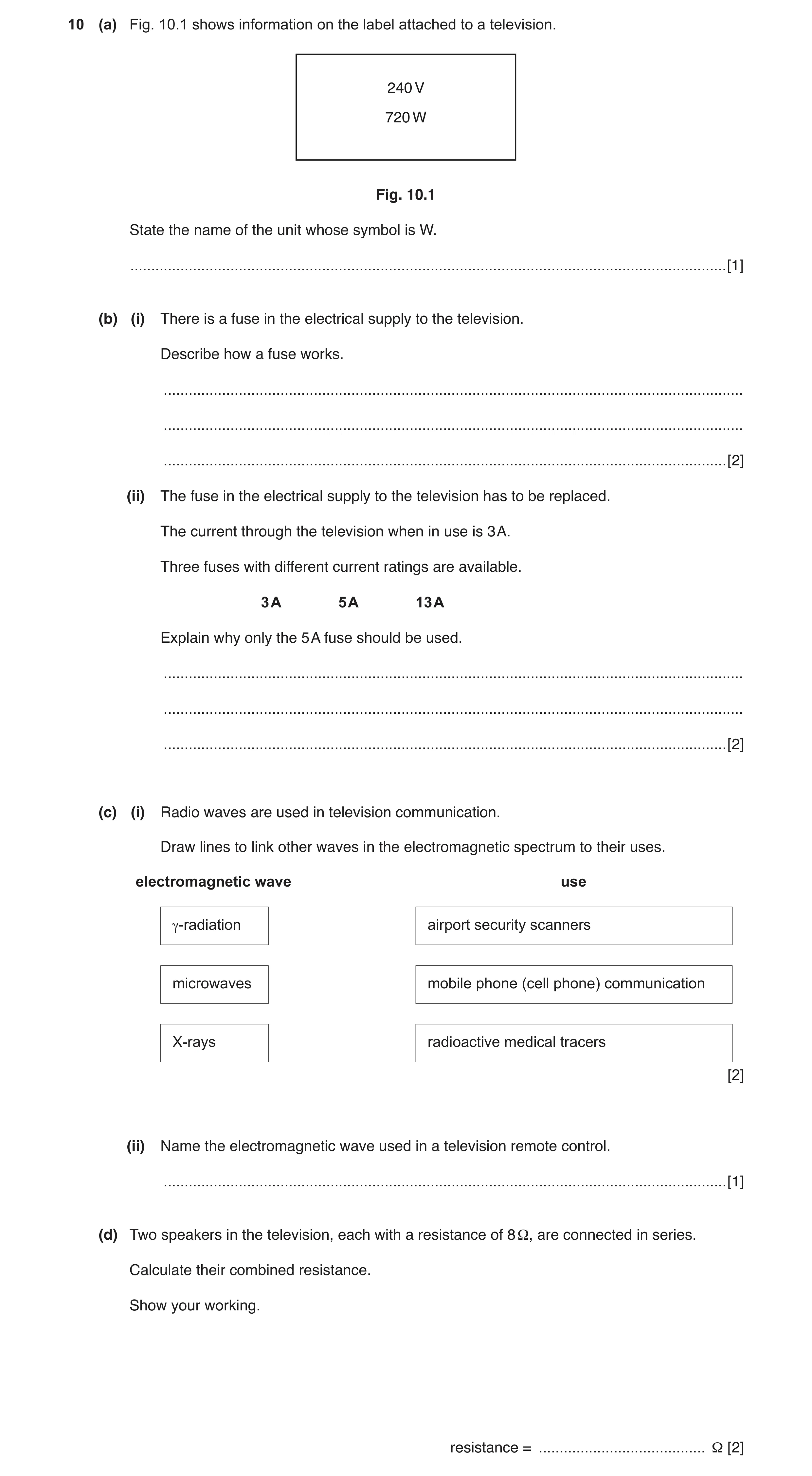
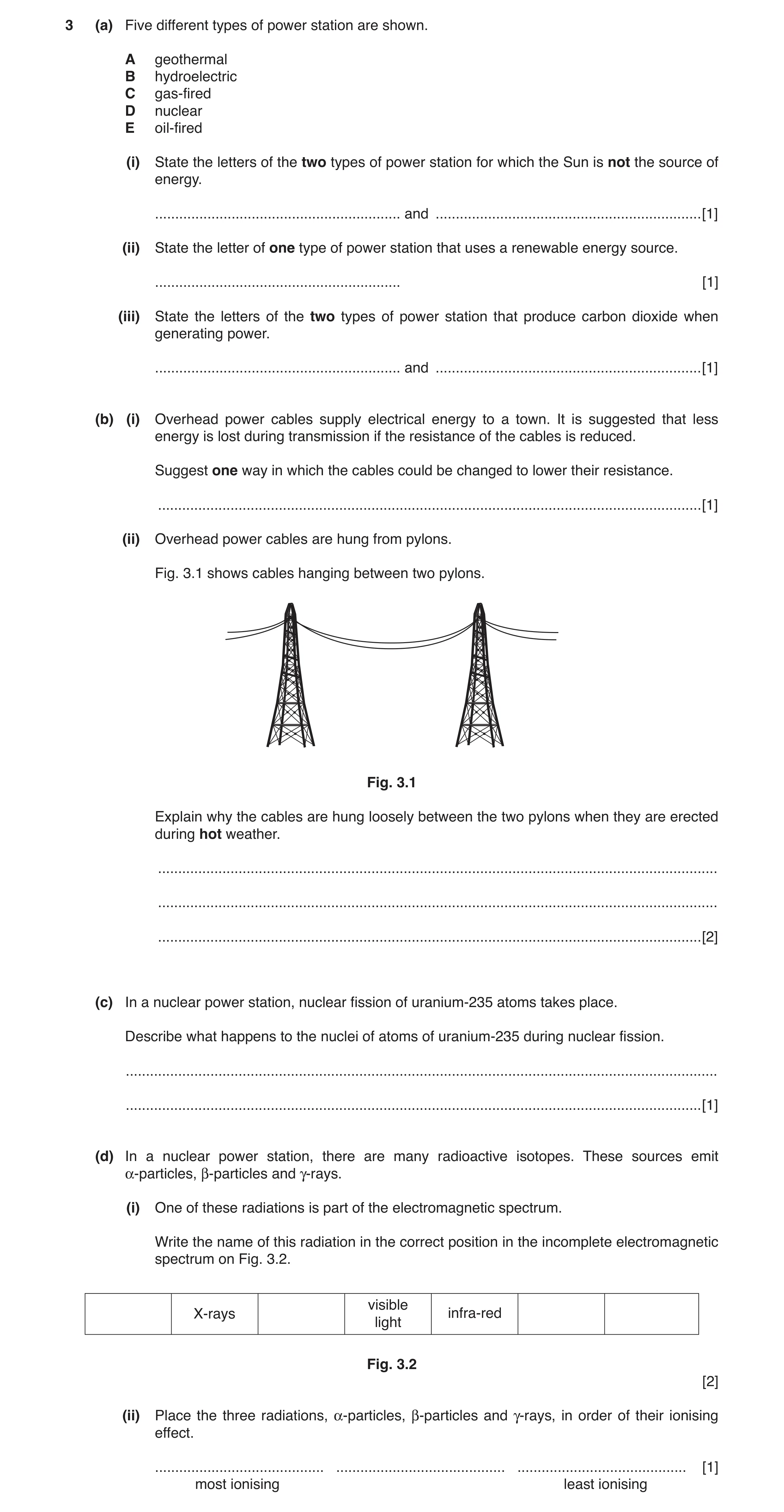
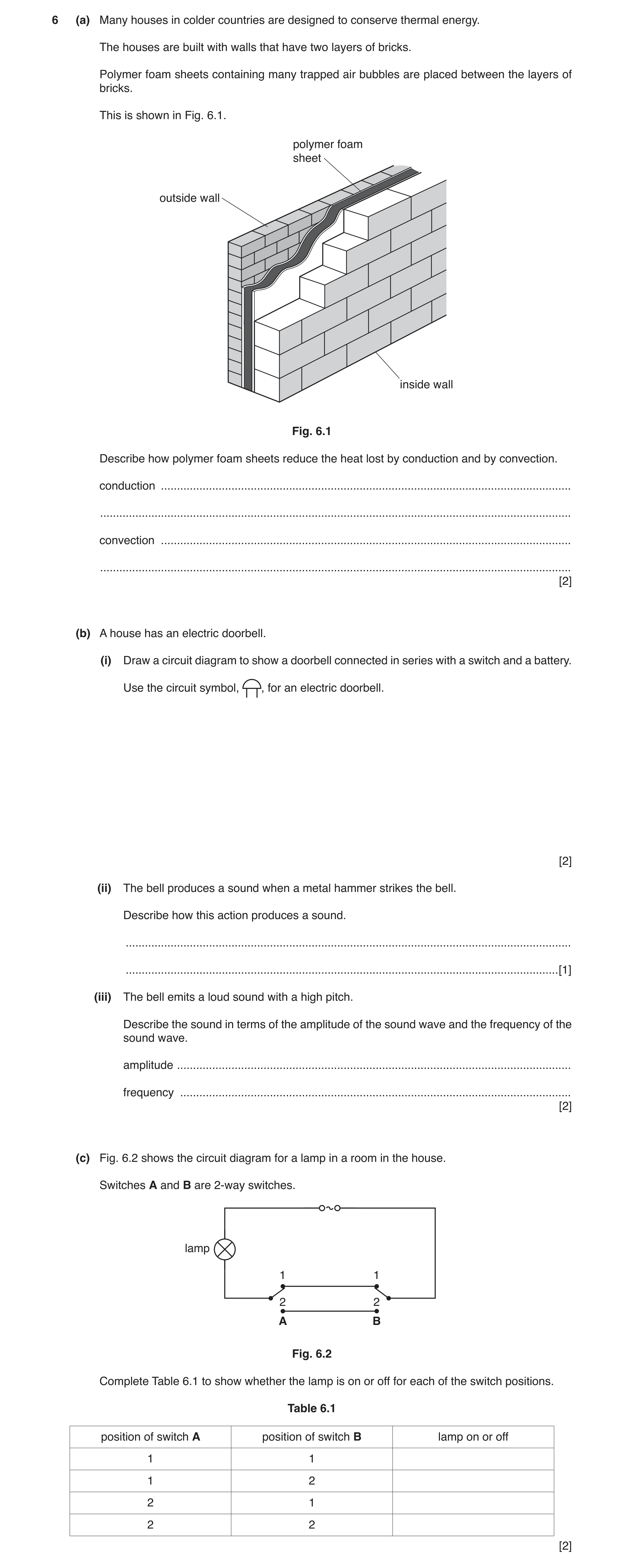
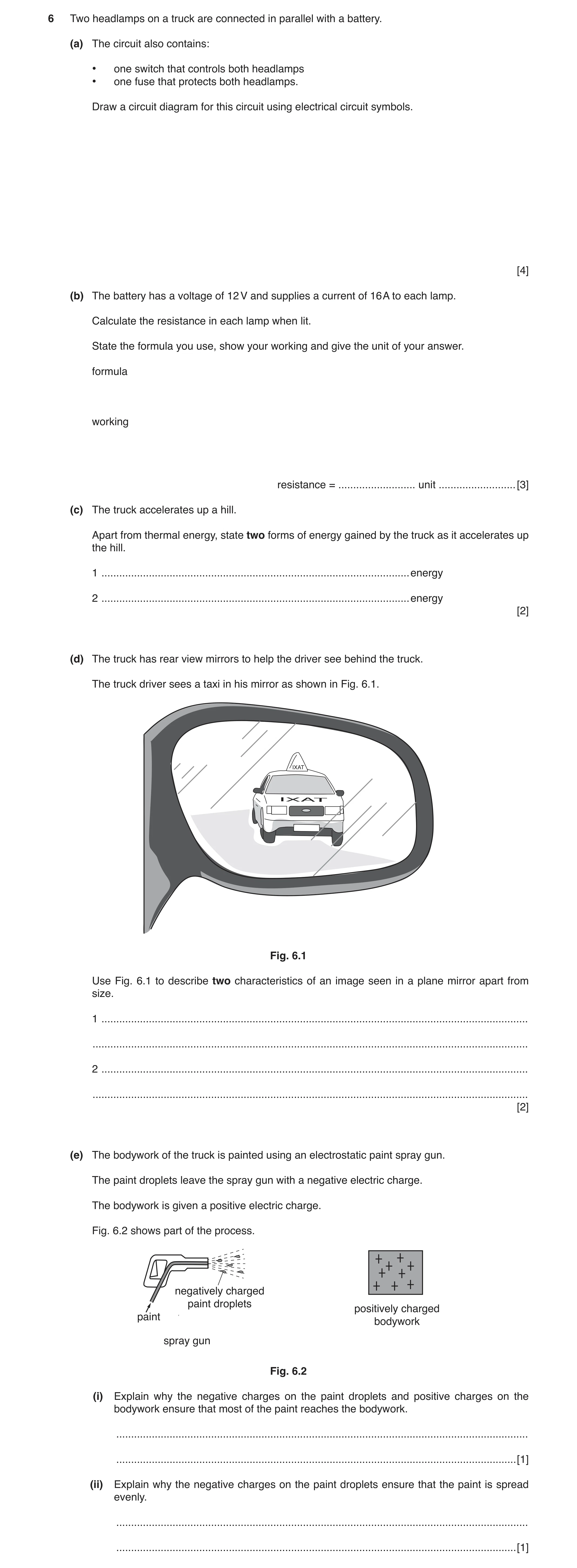
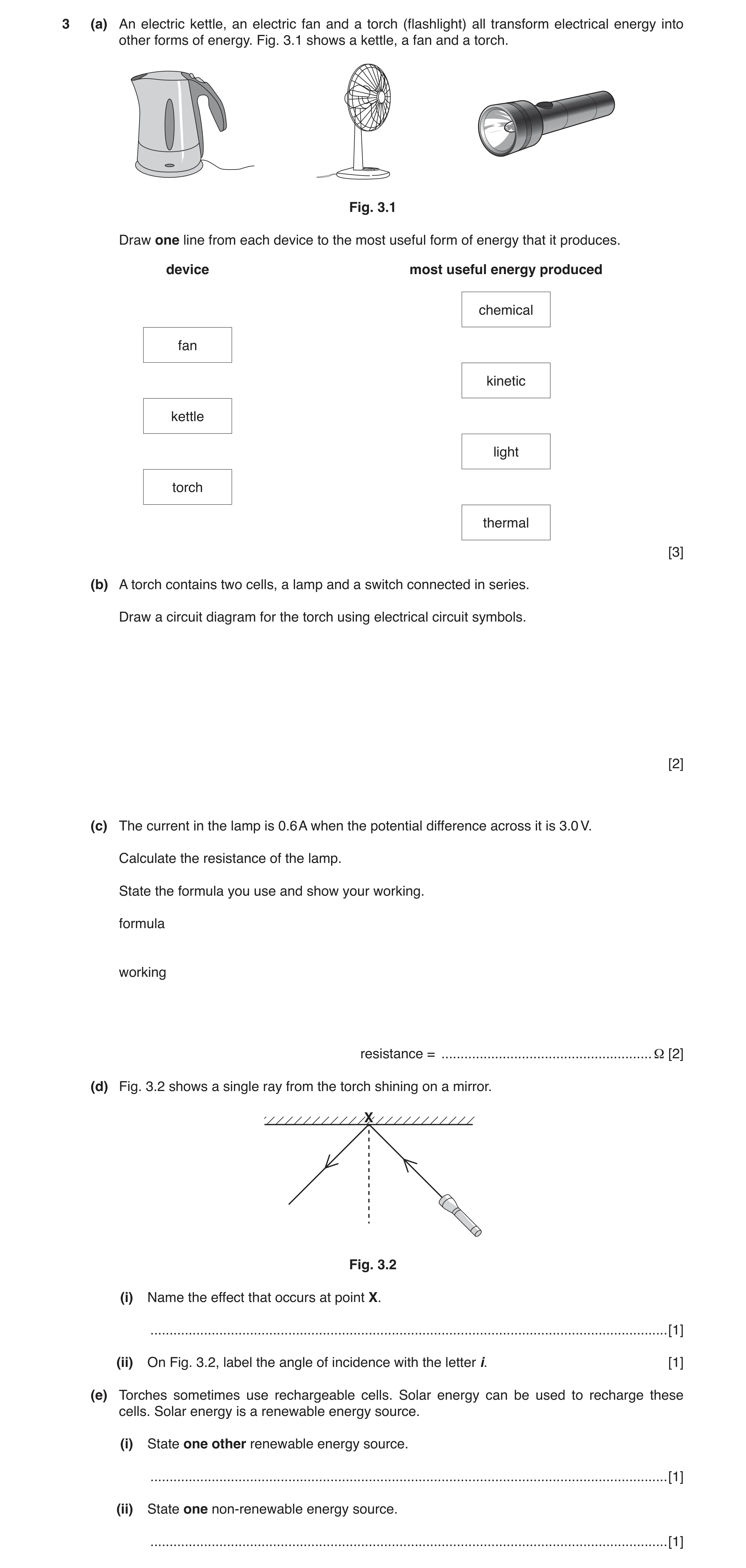
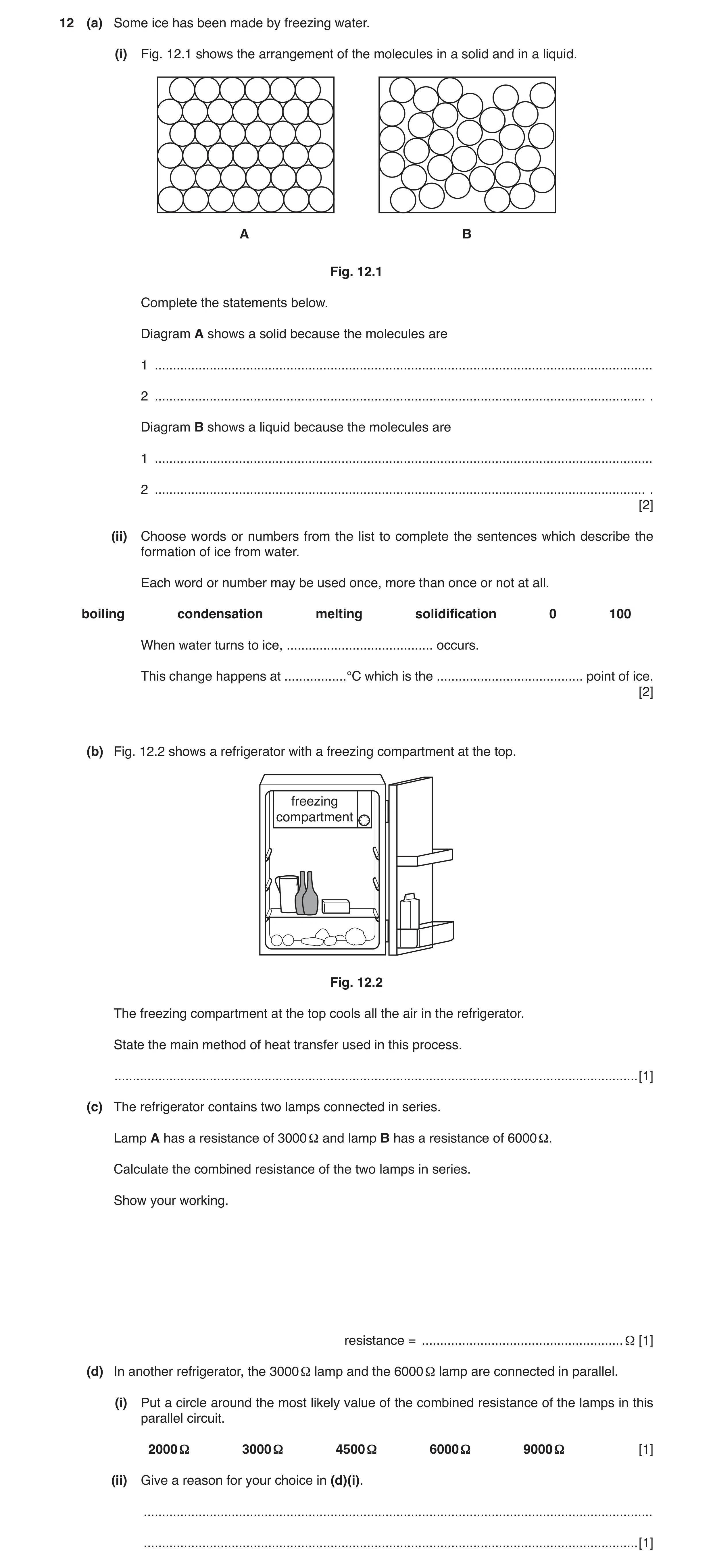
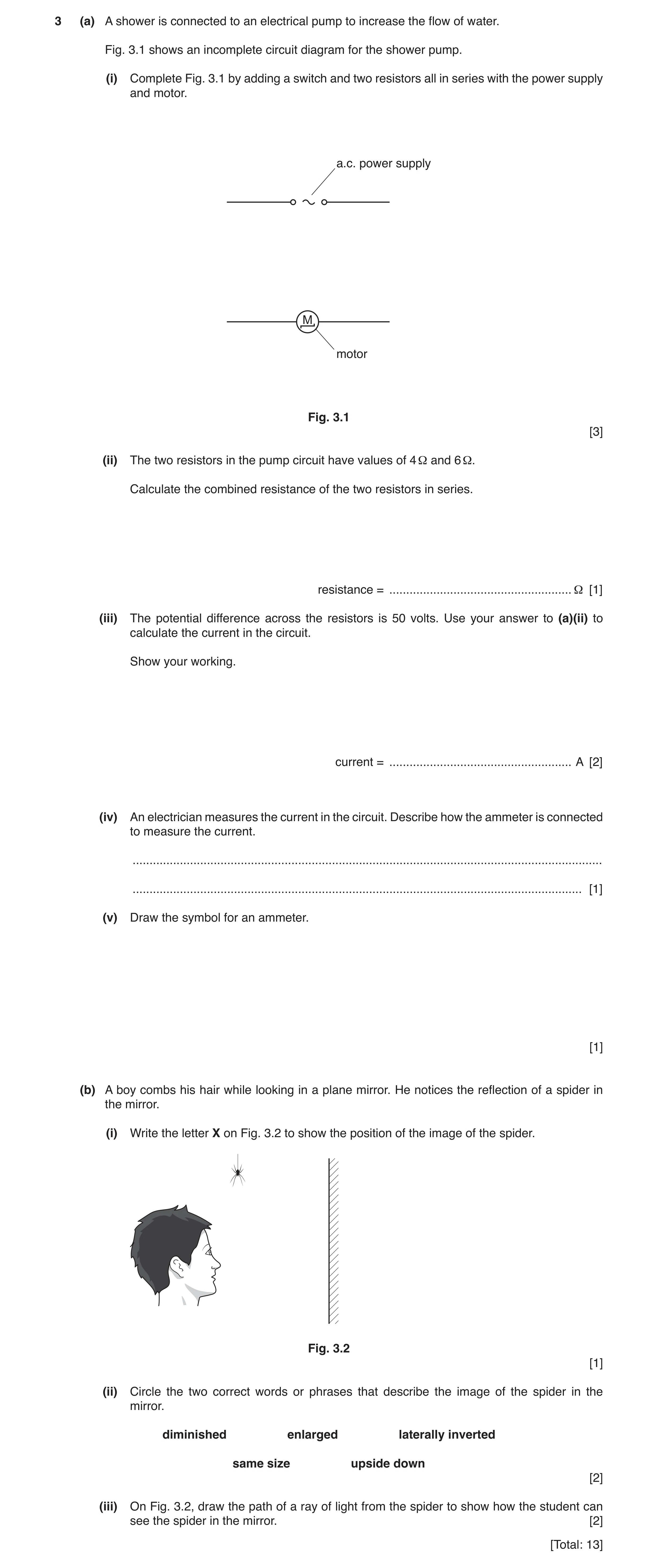
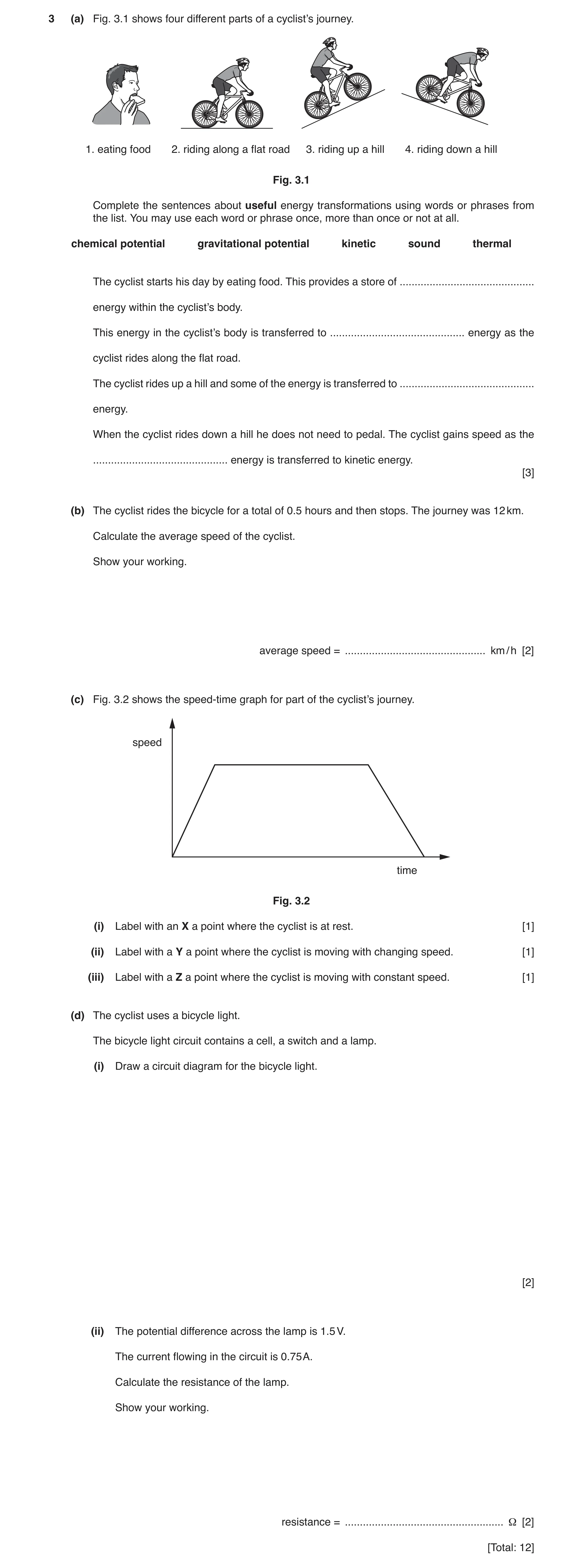
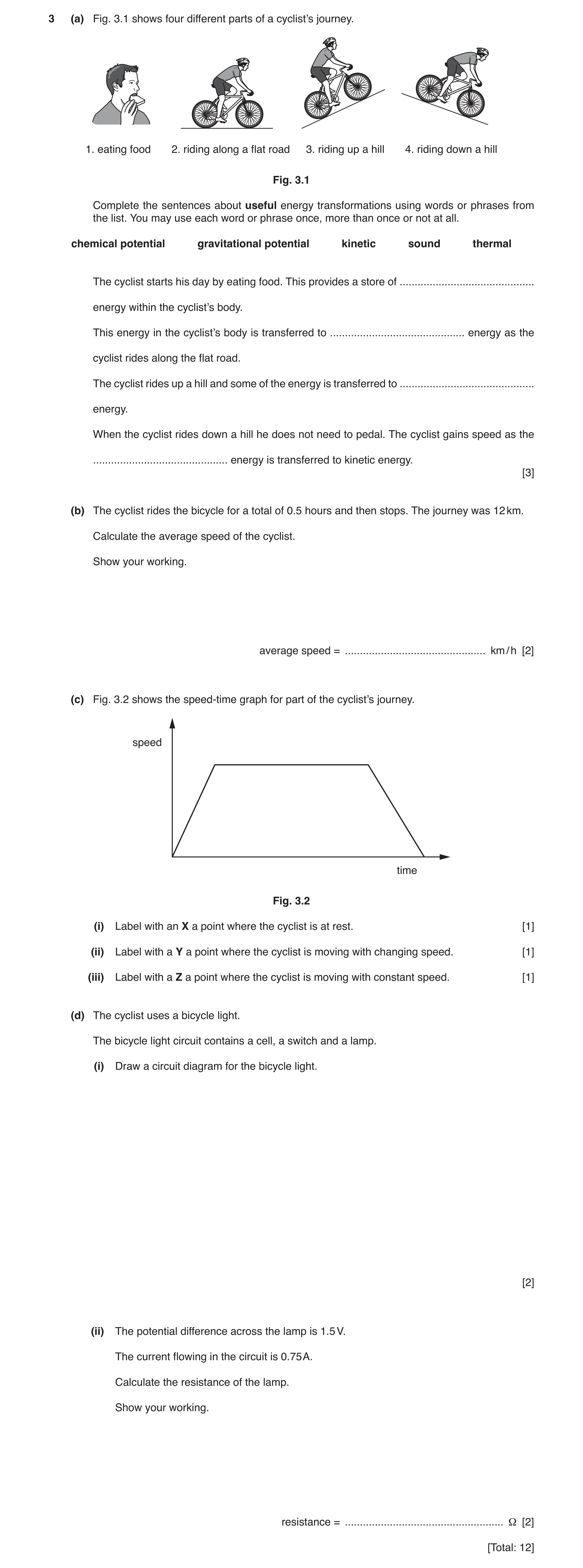
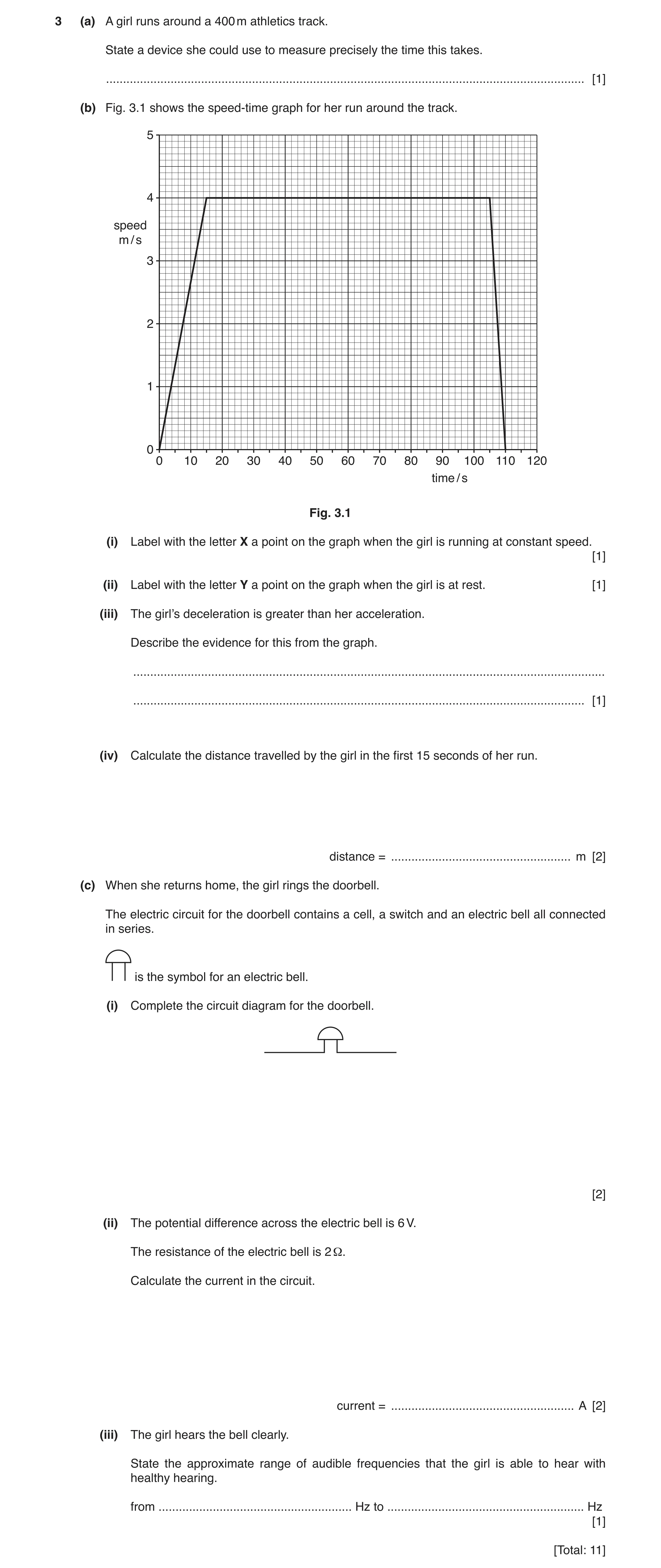
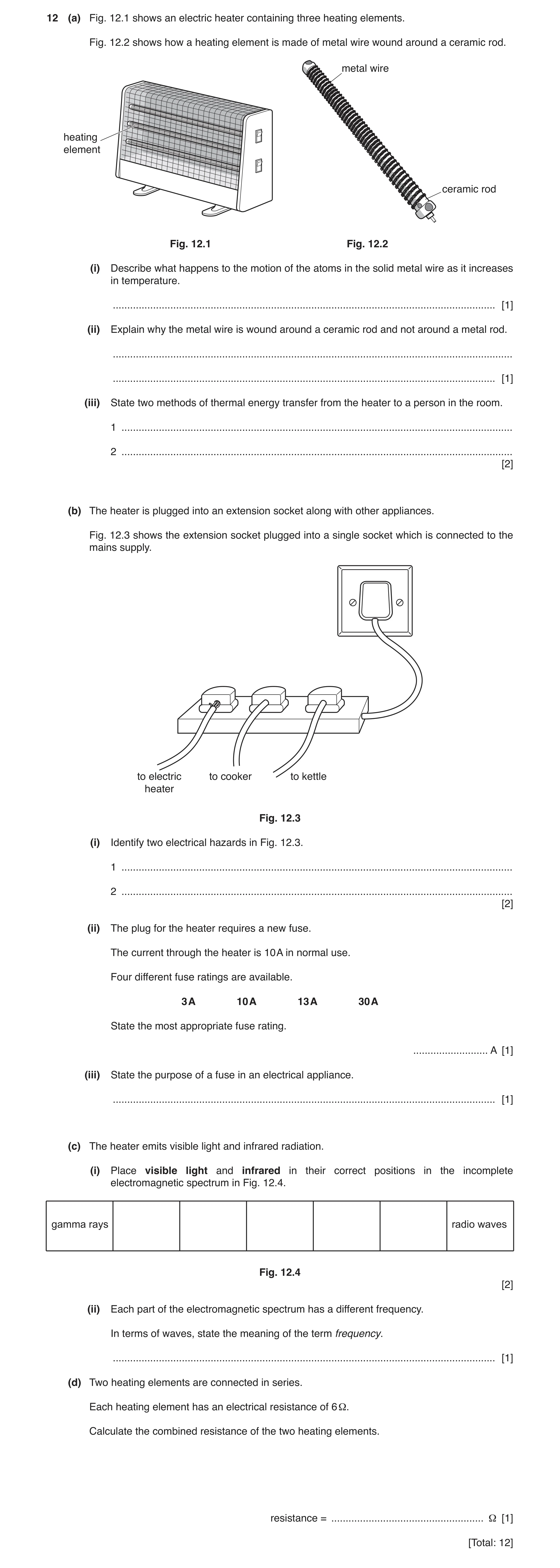
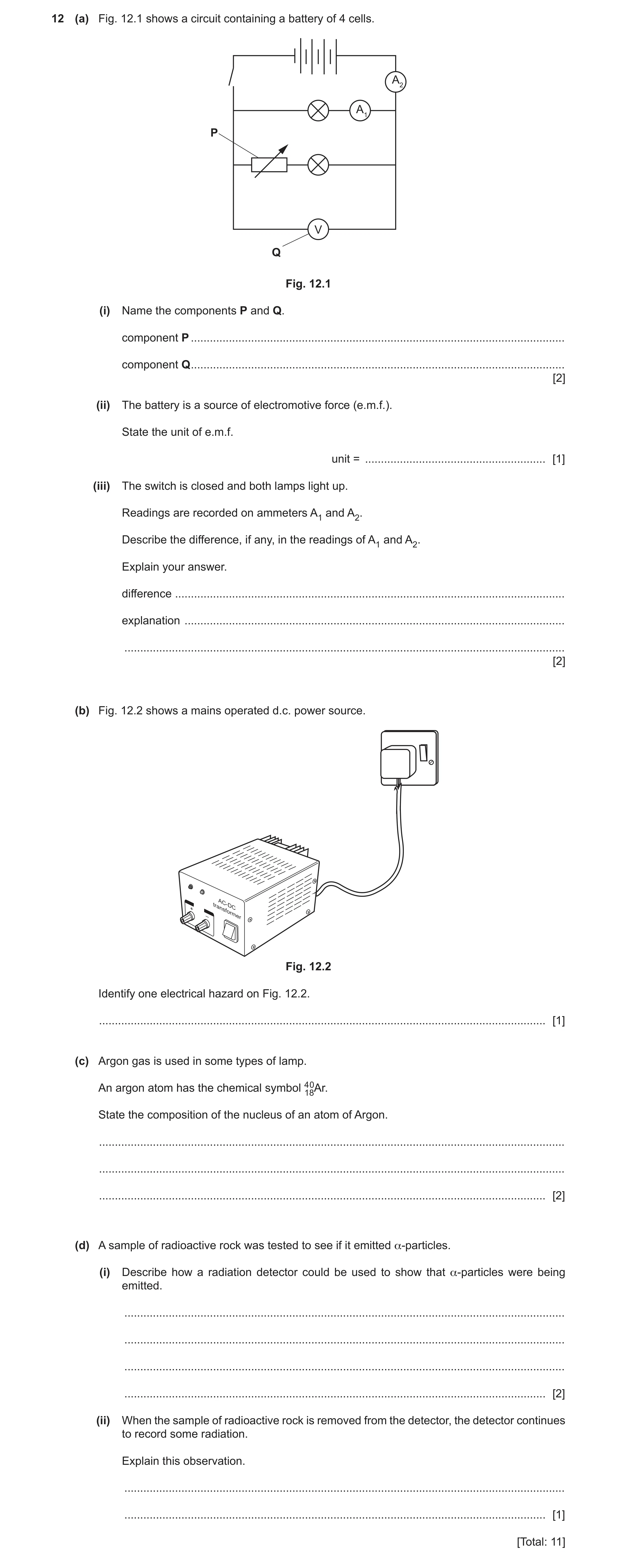
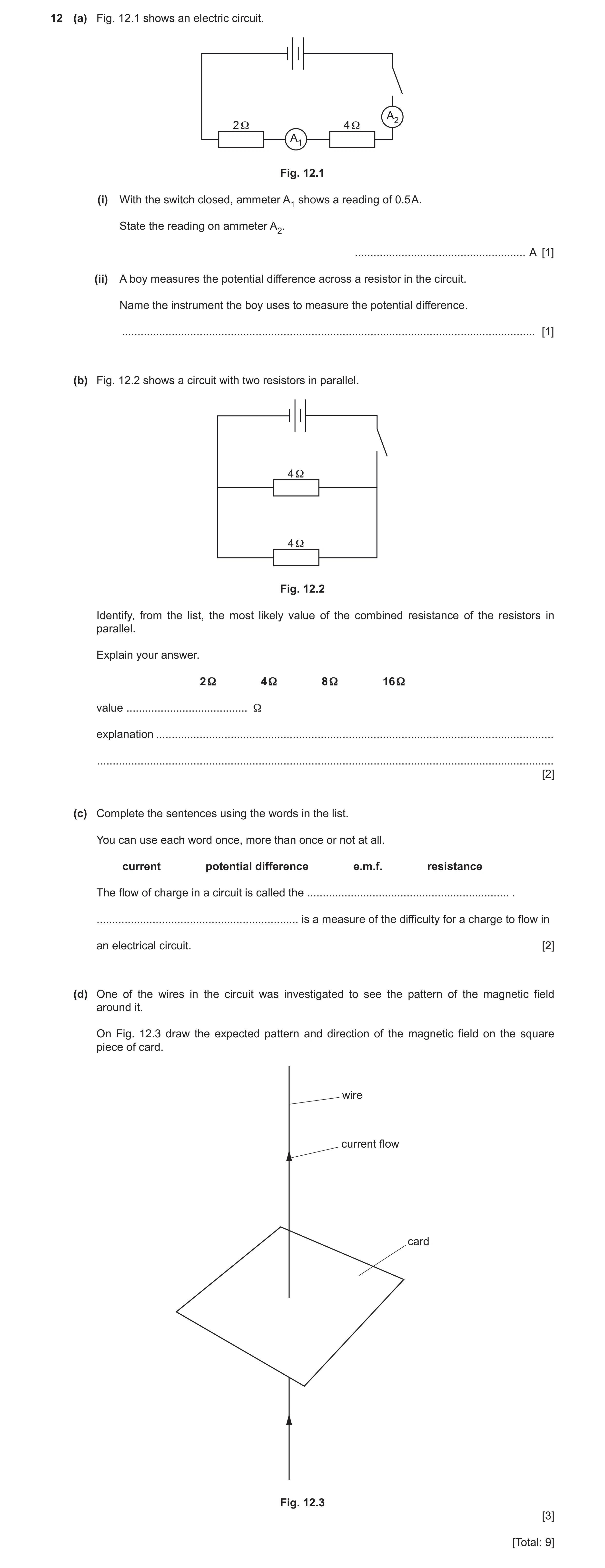
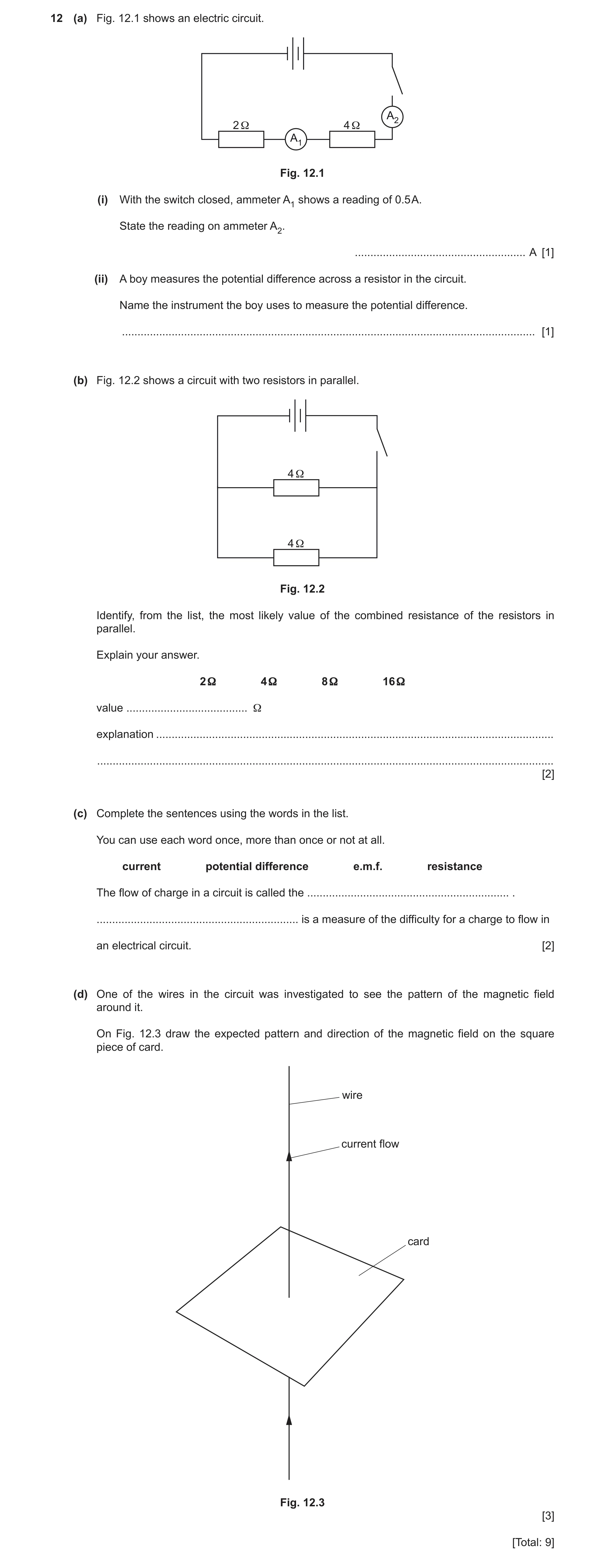
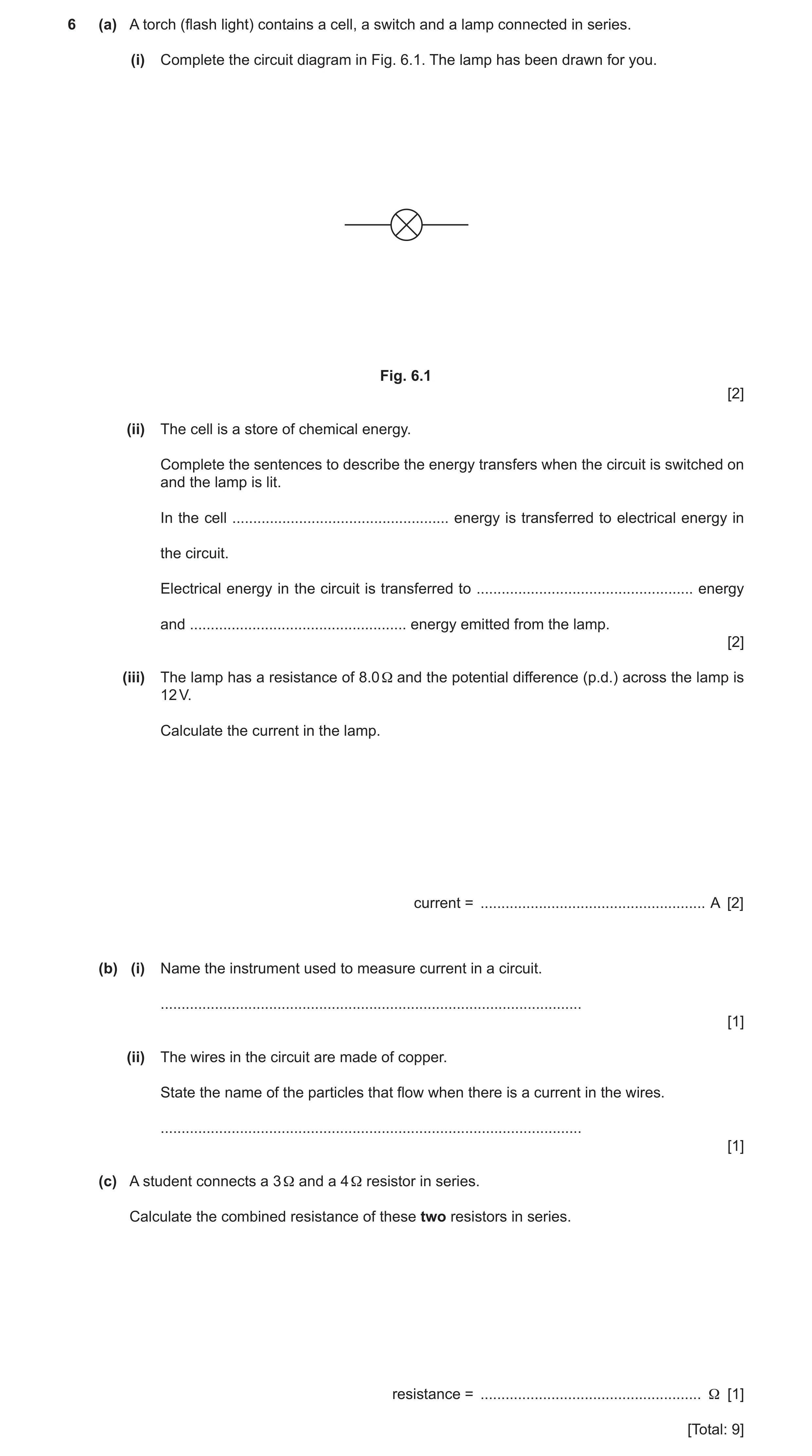
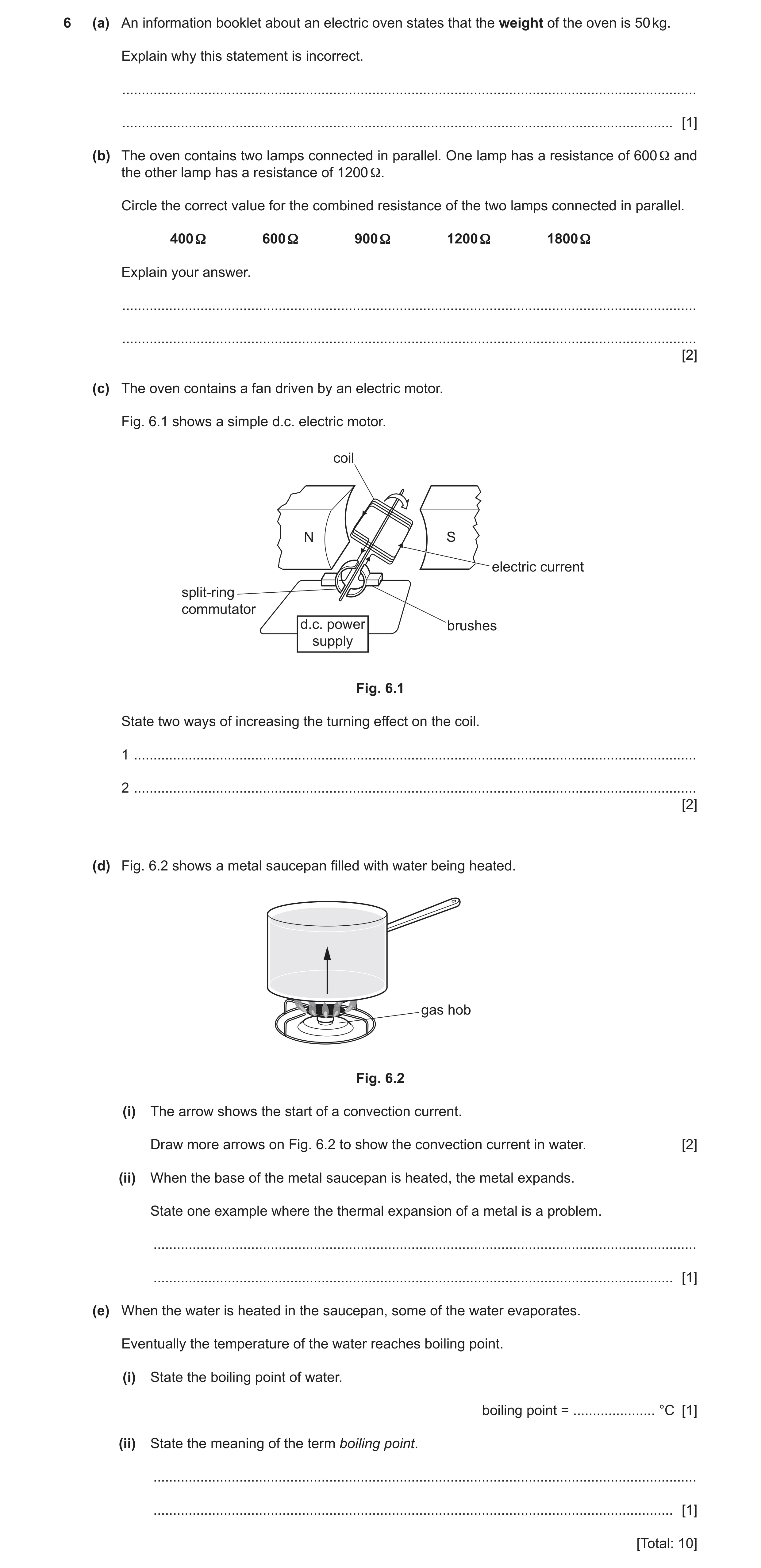
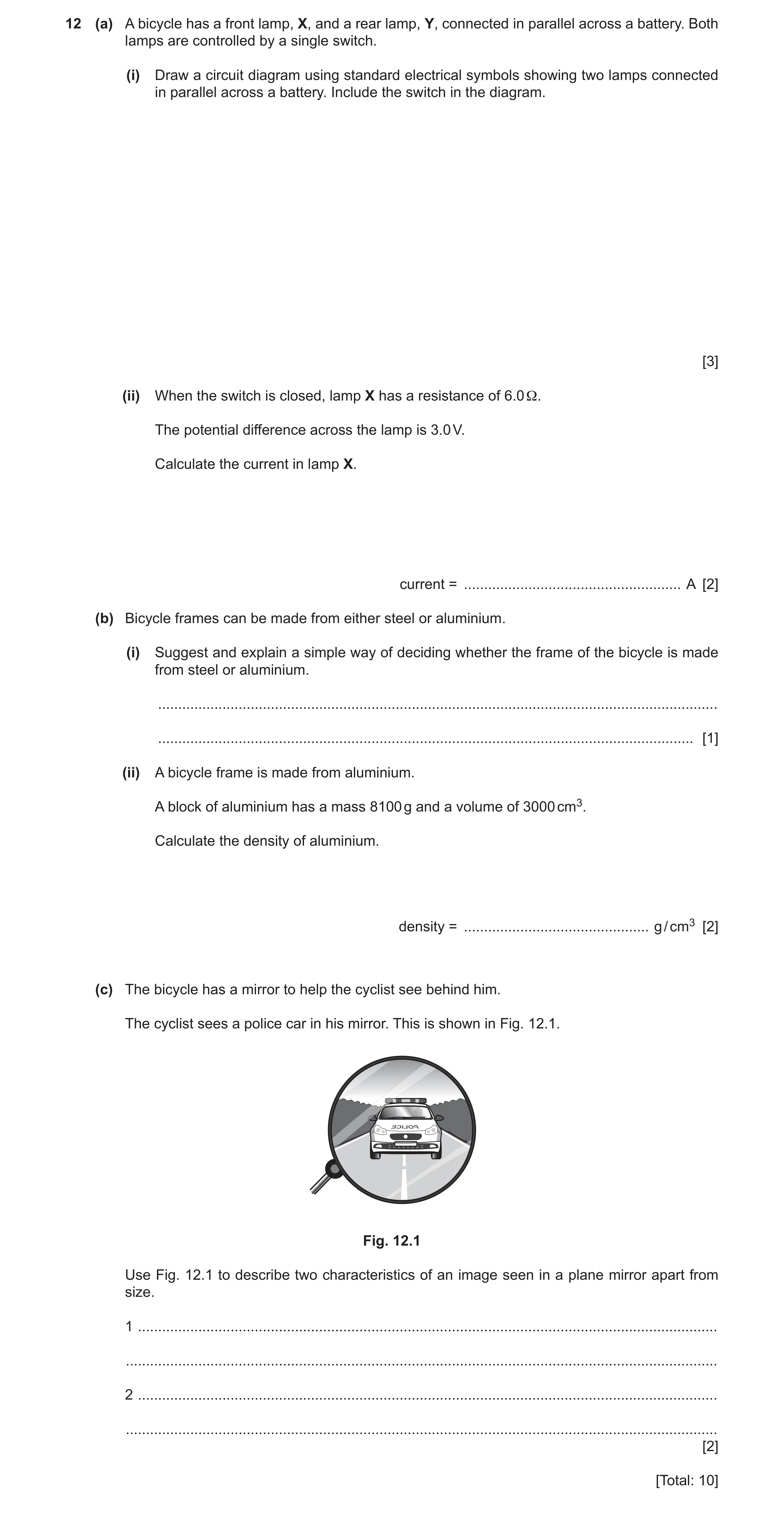
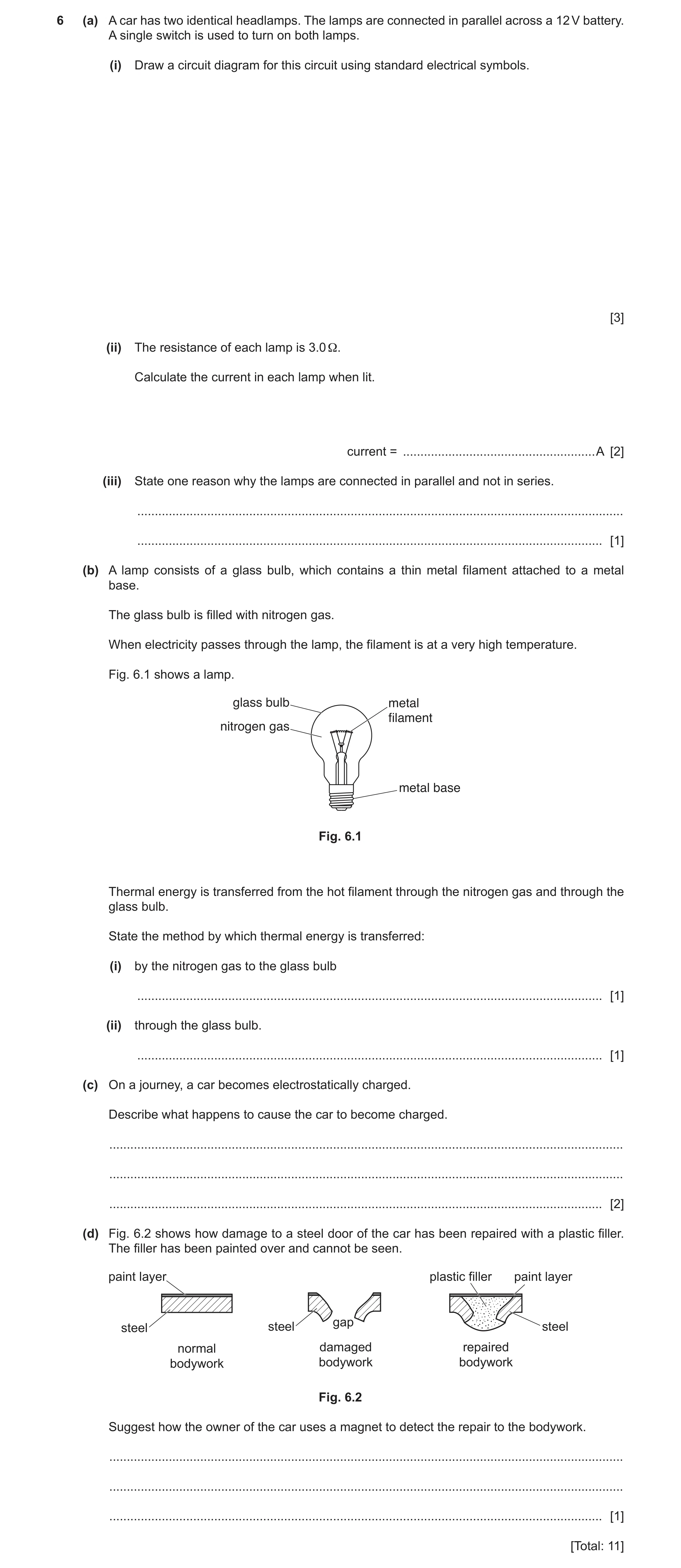
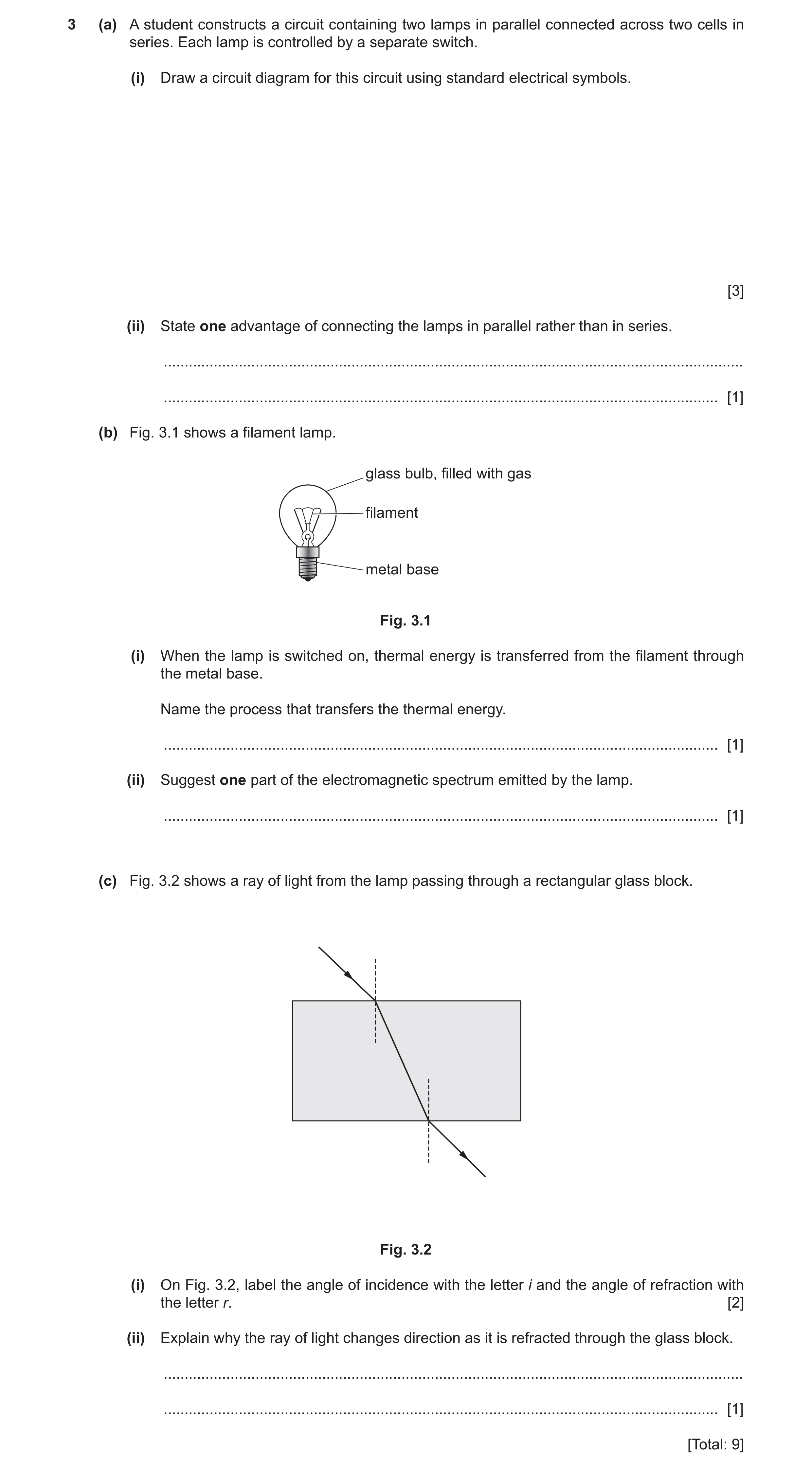
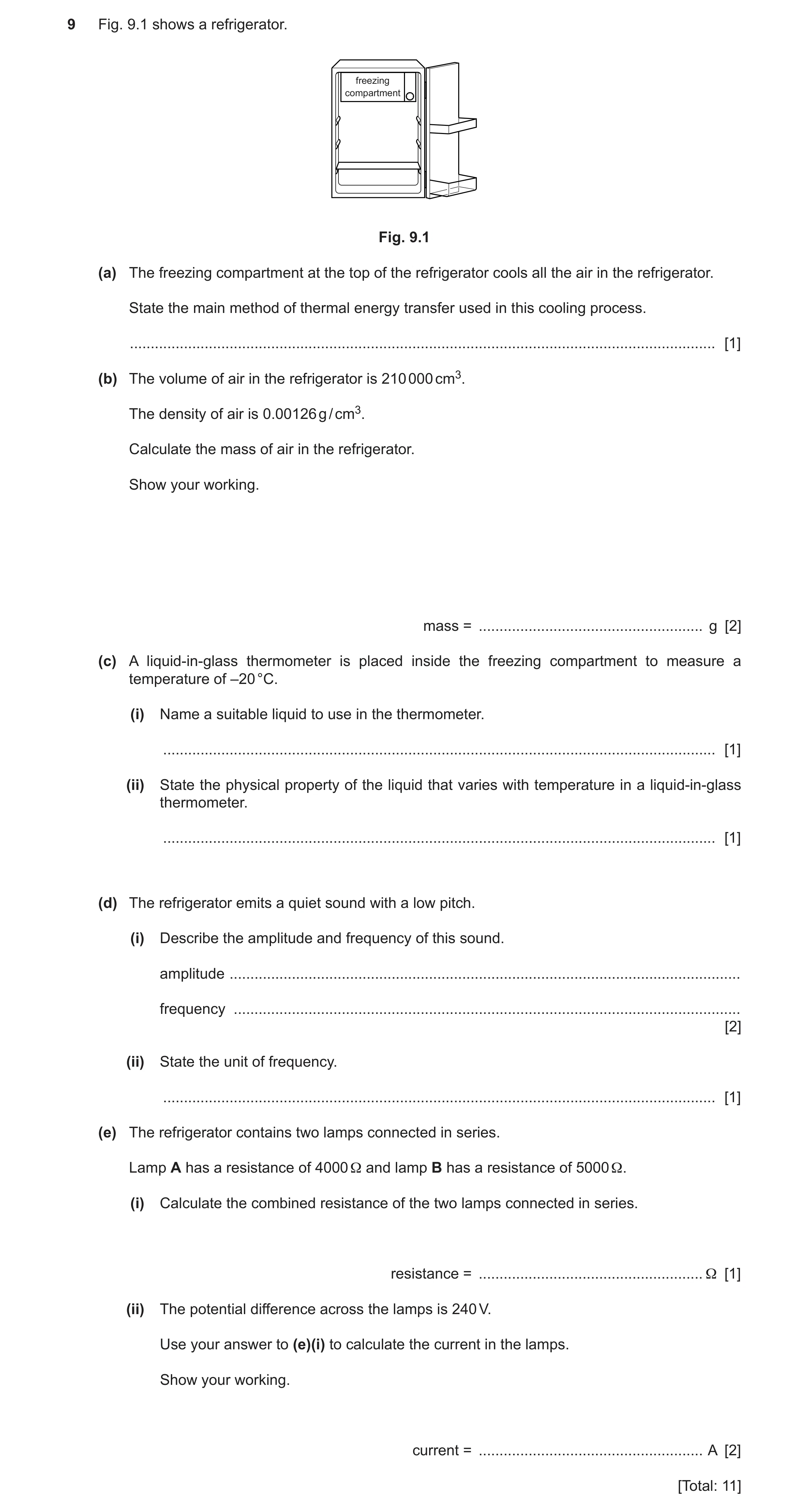
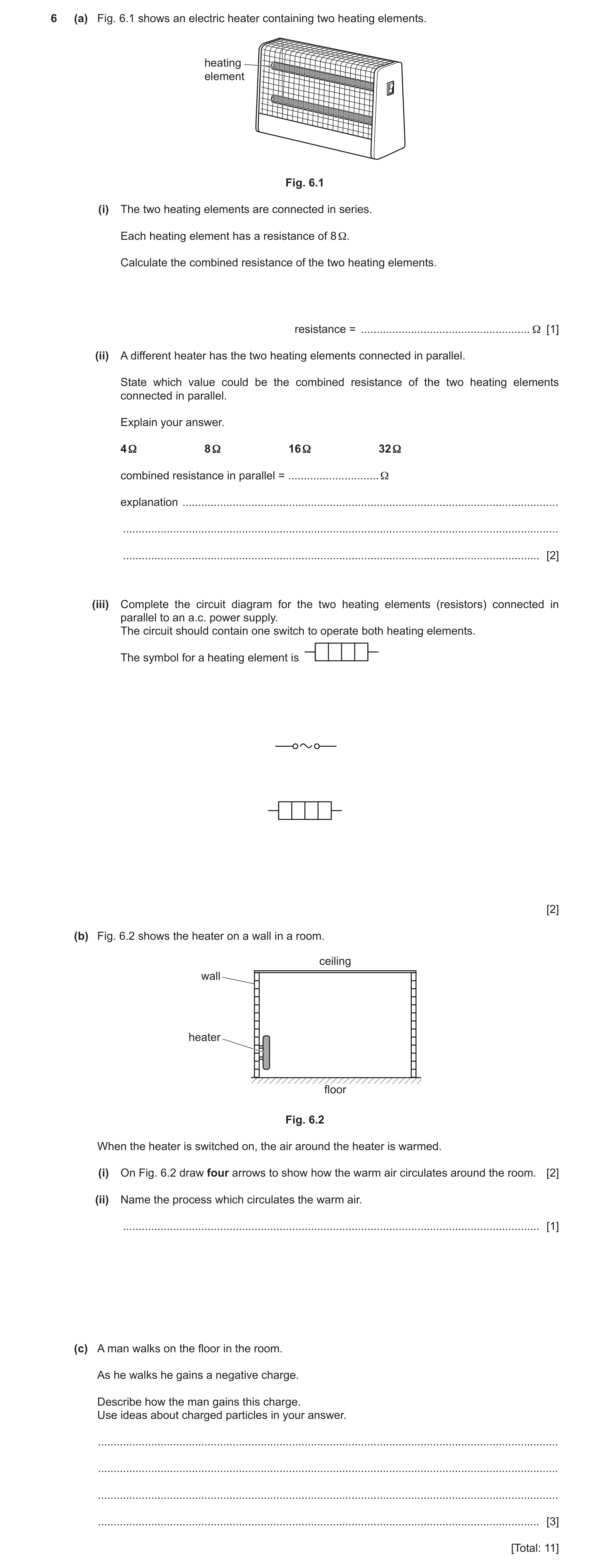
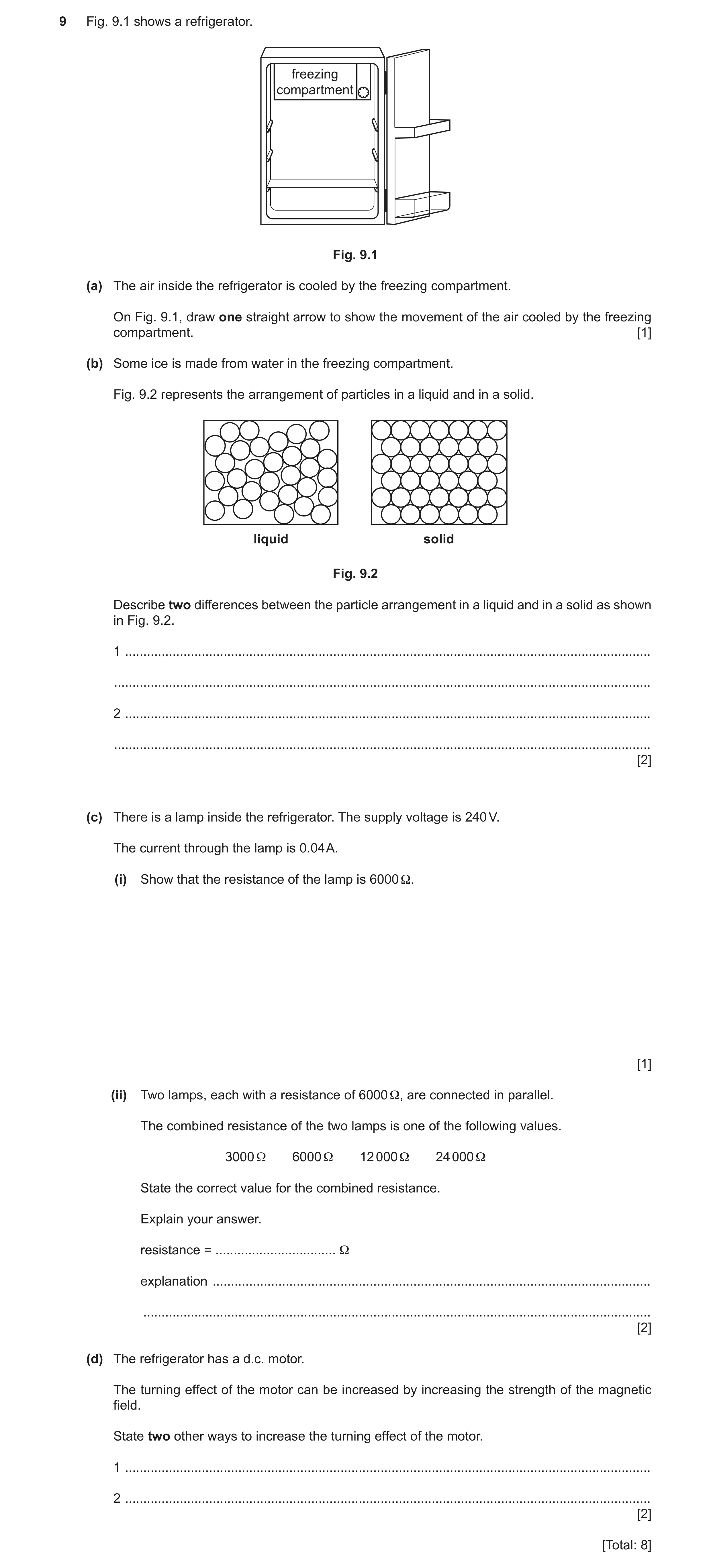
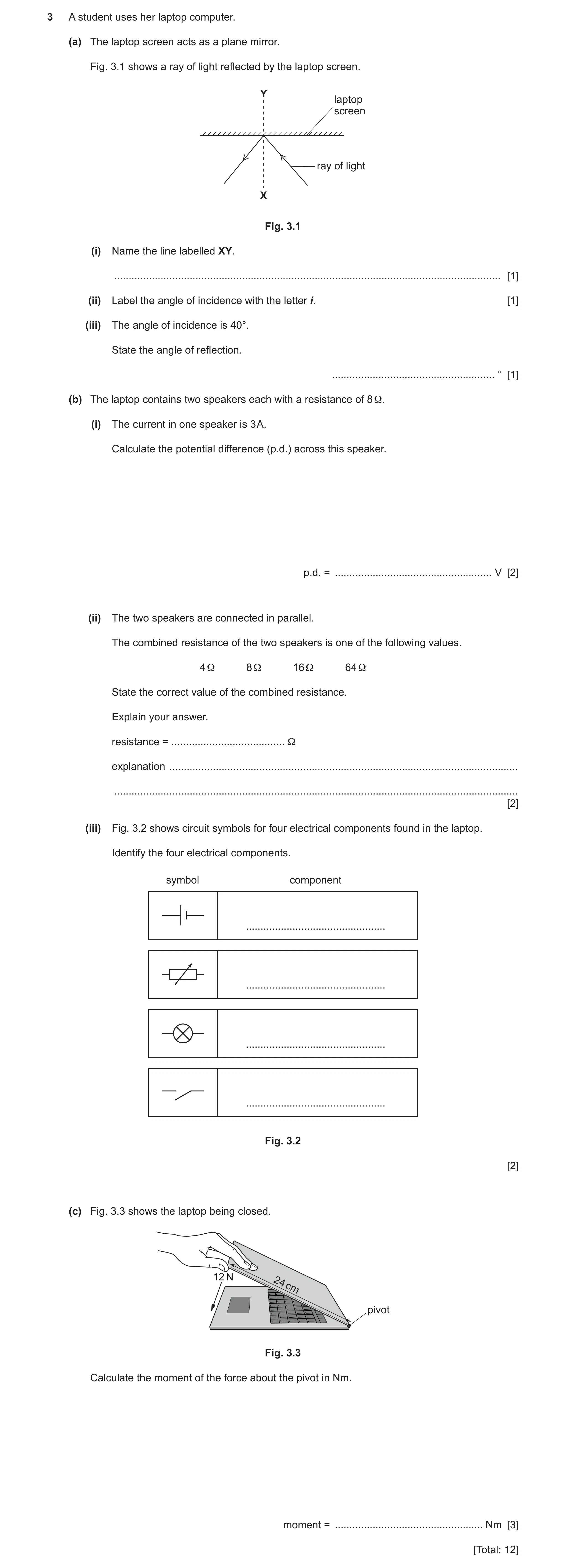
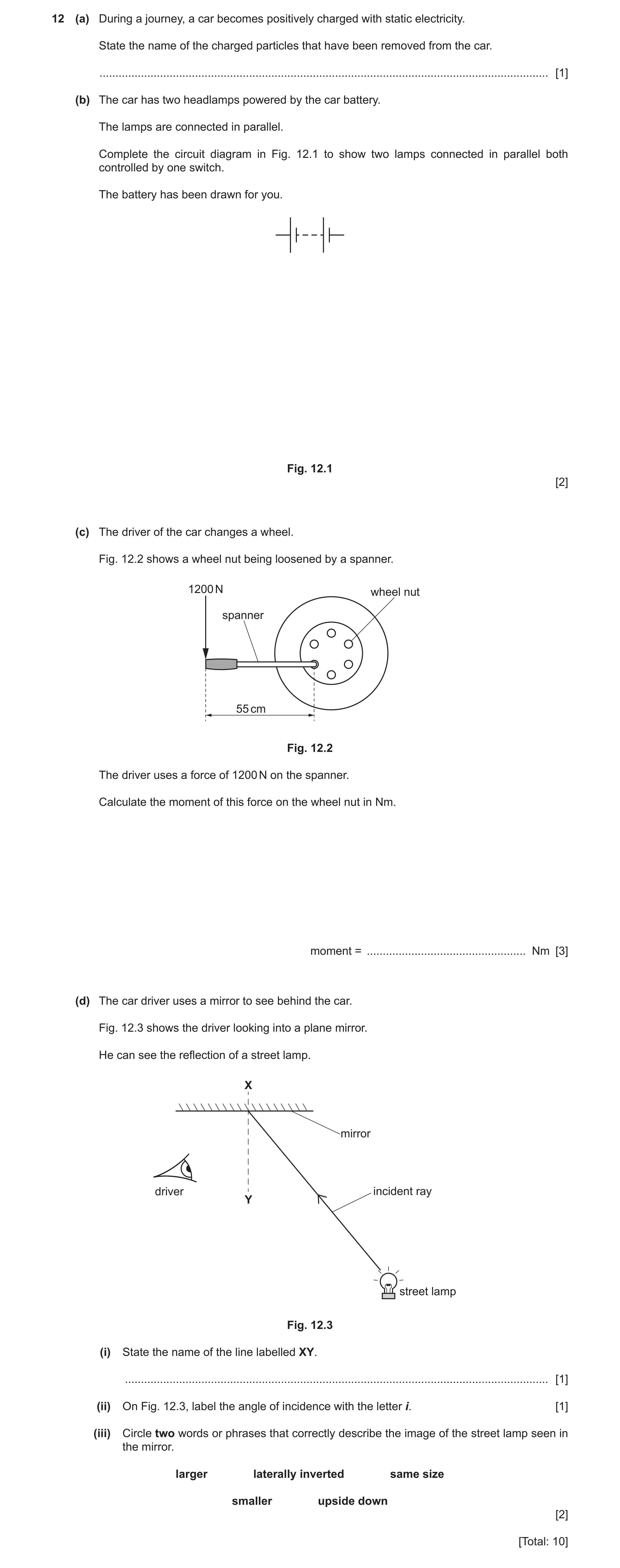
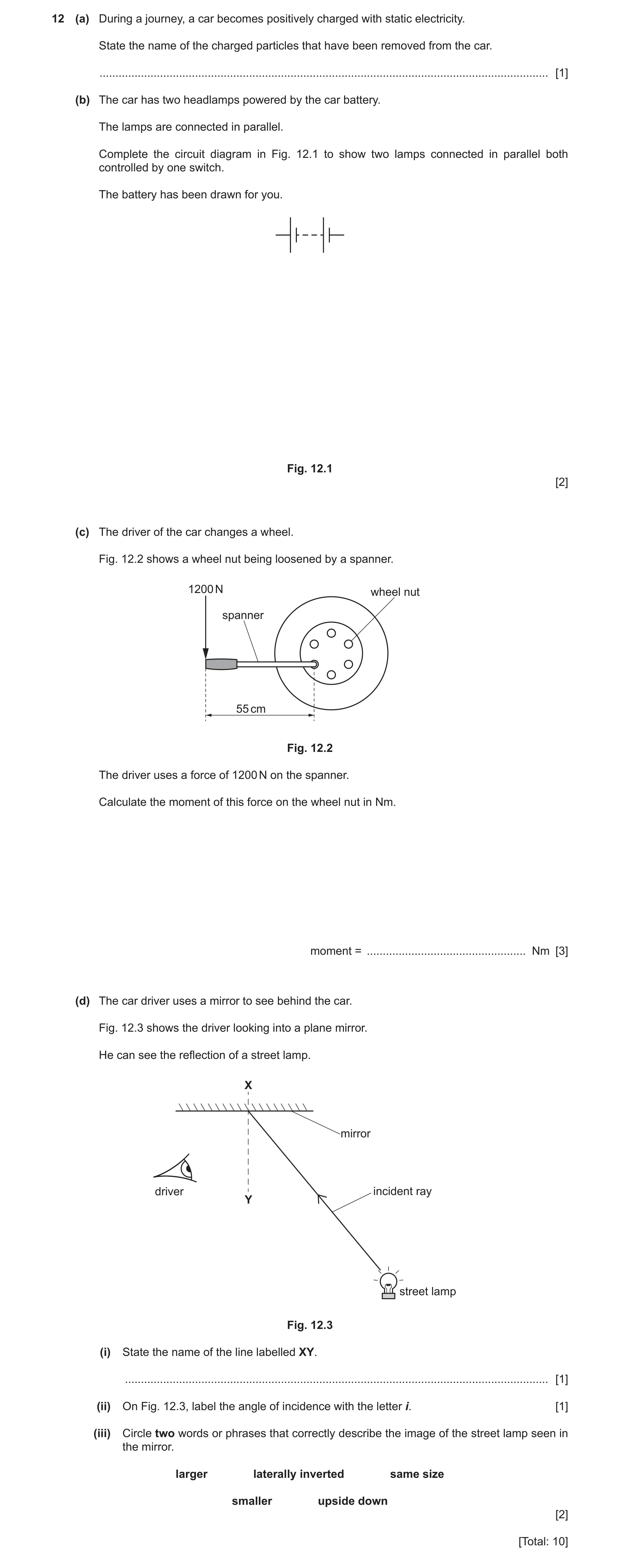
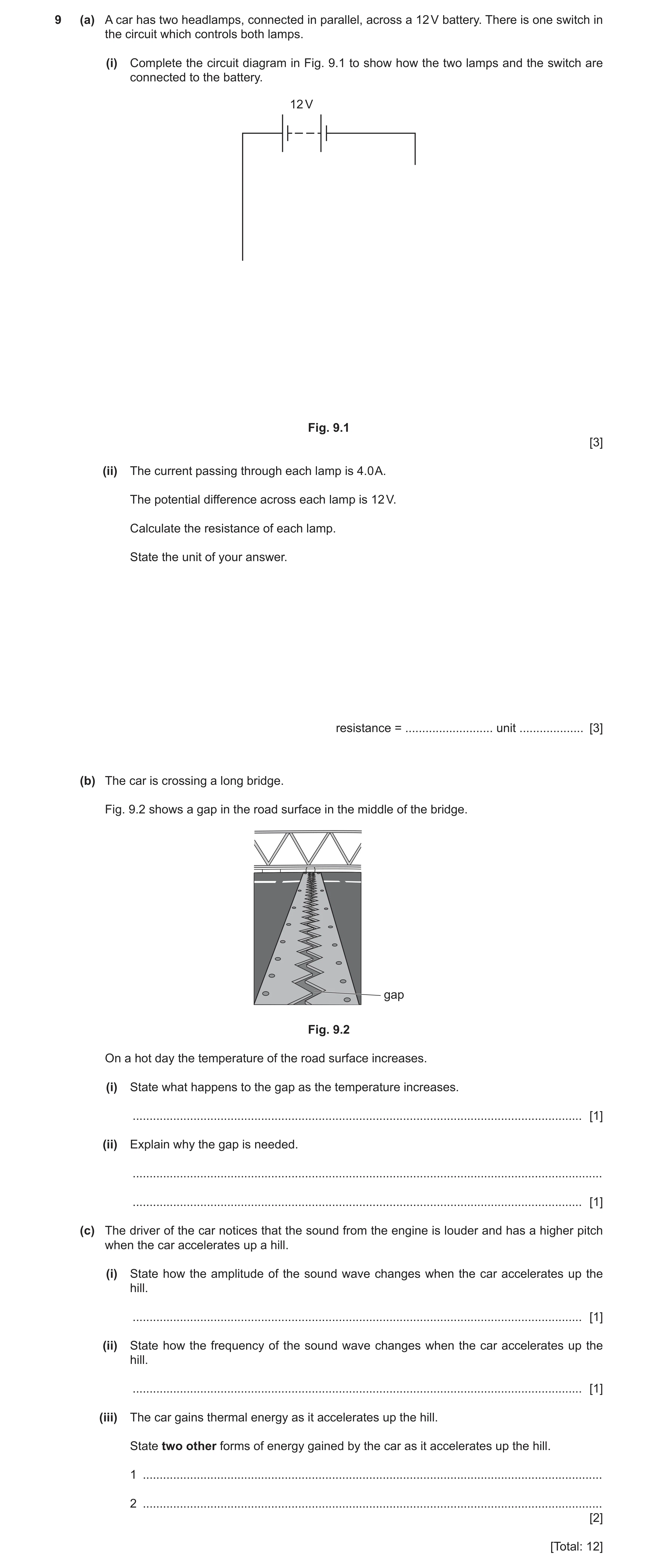
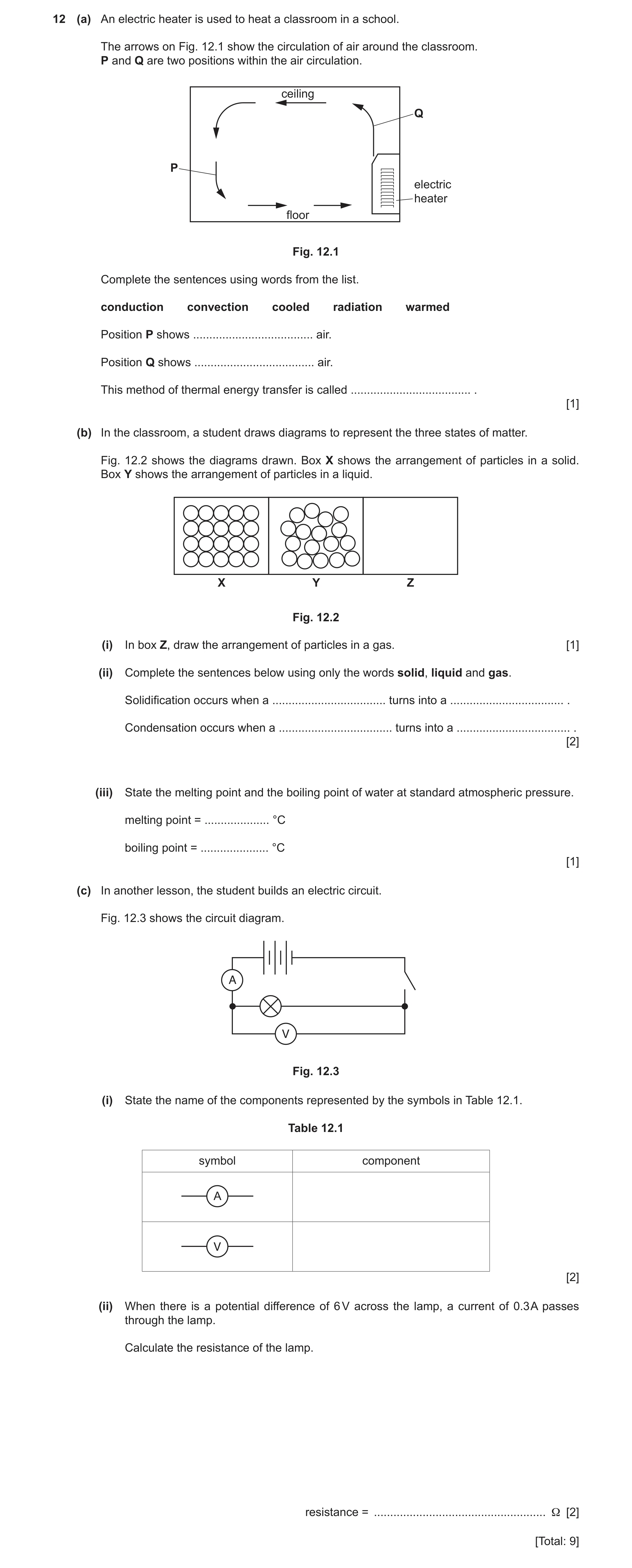
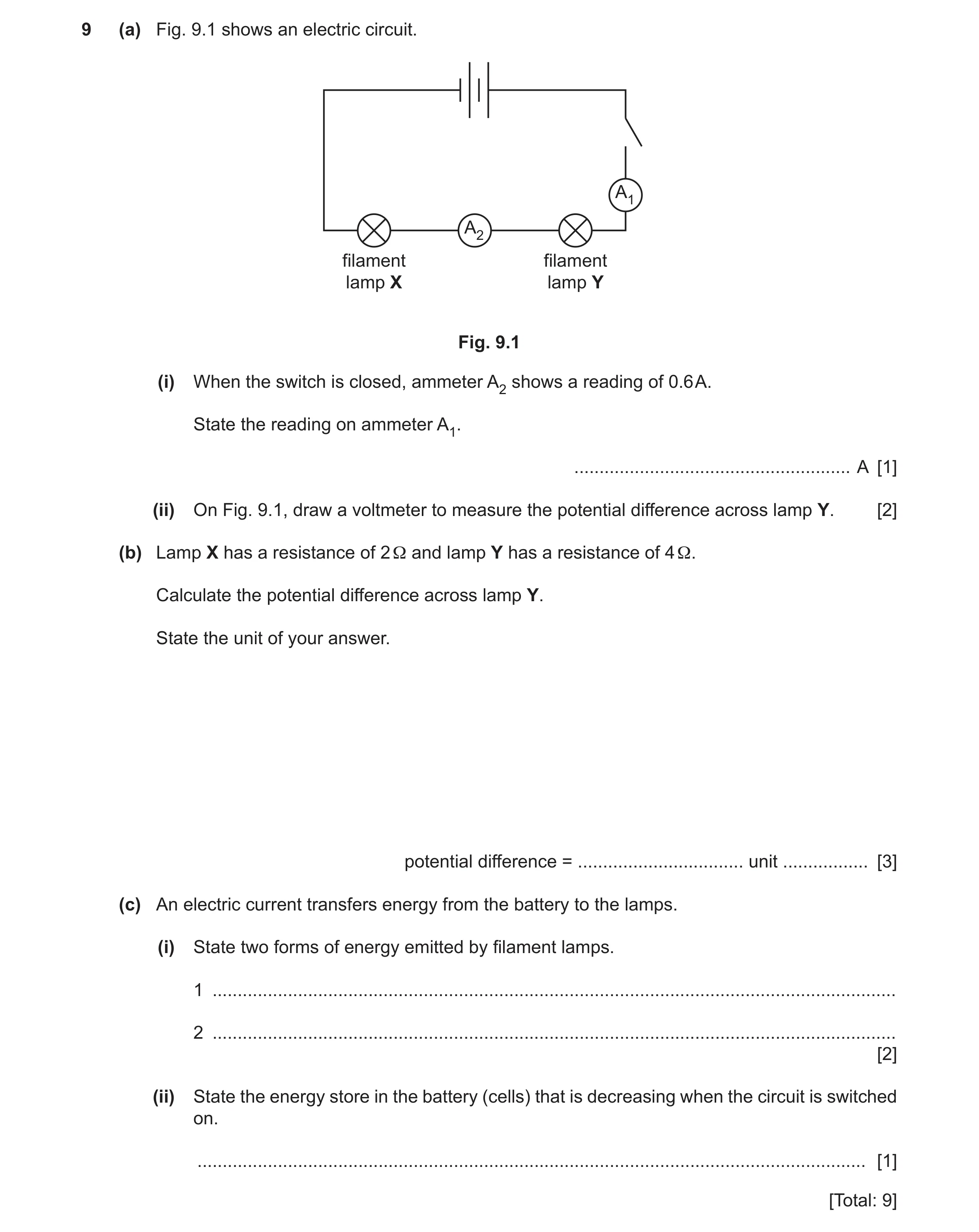 50 / 80
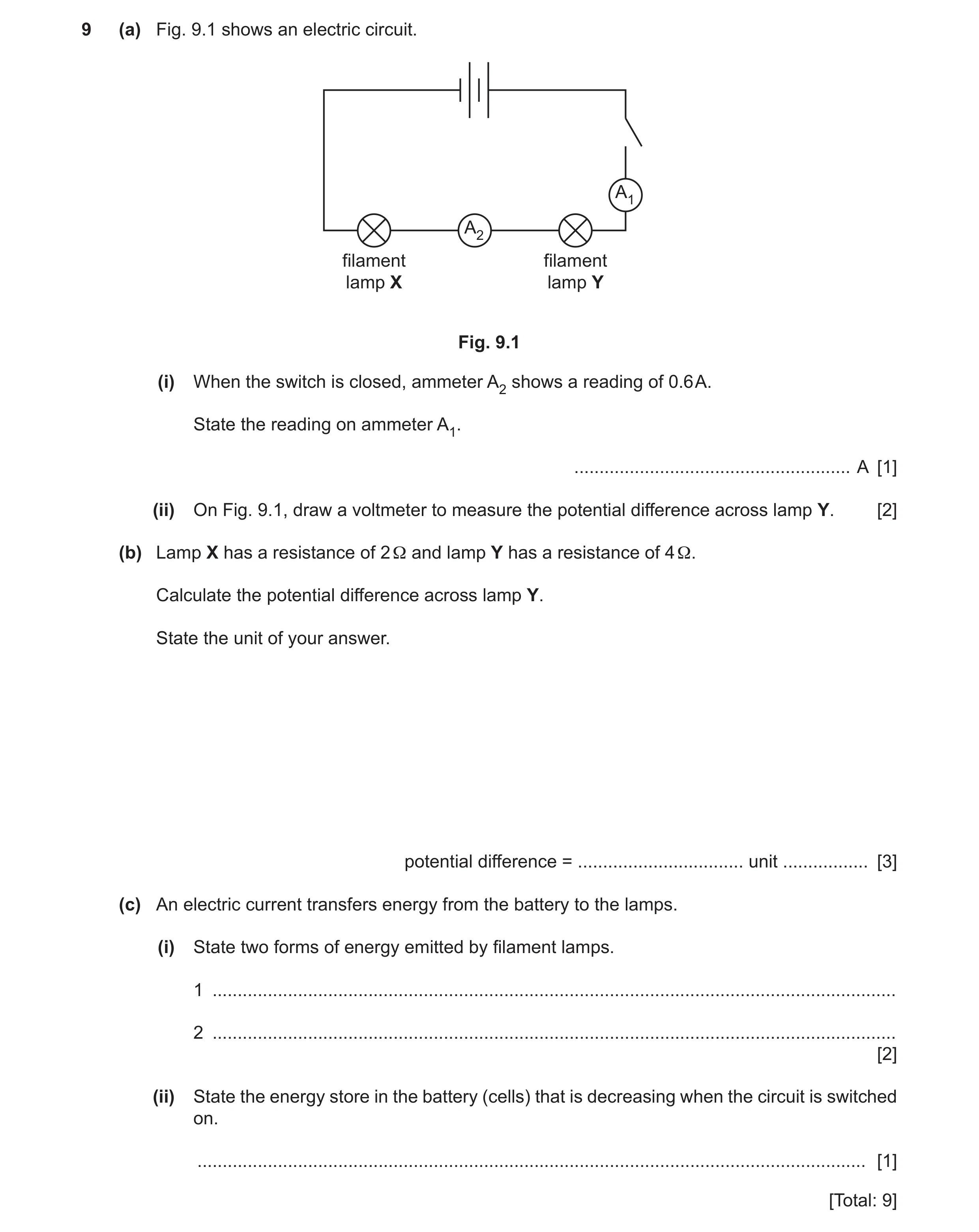 51 / 80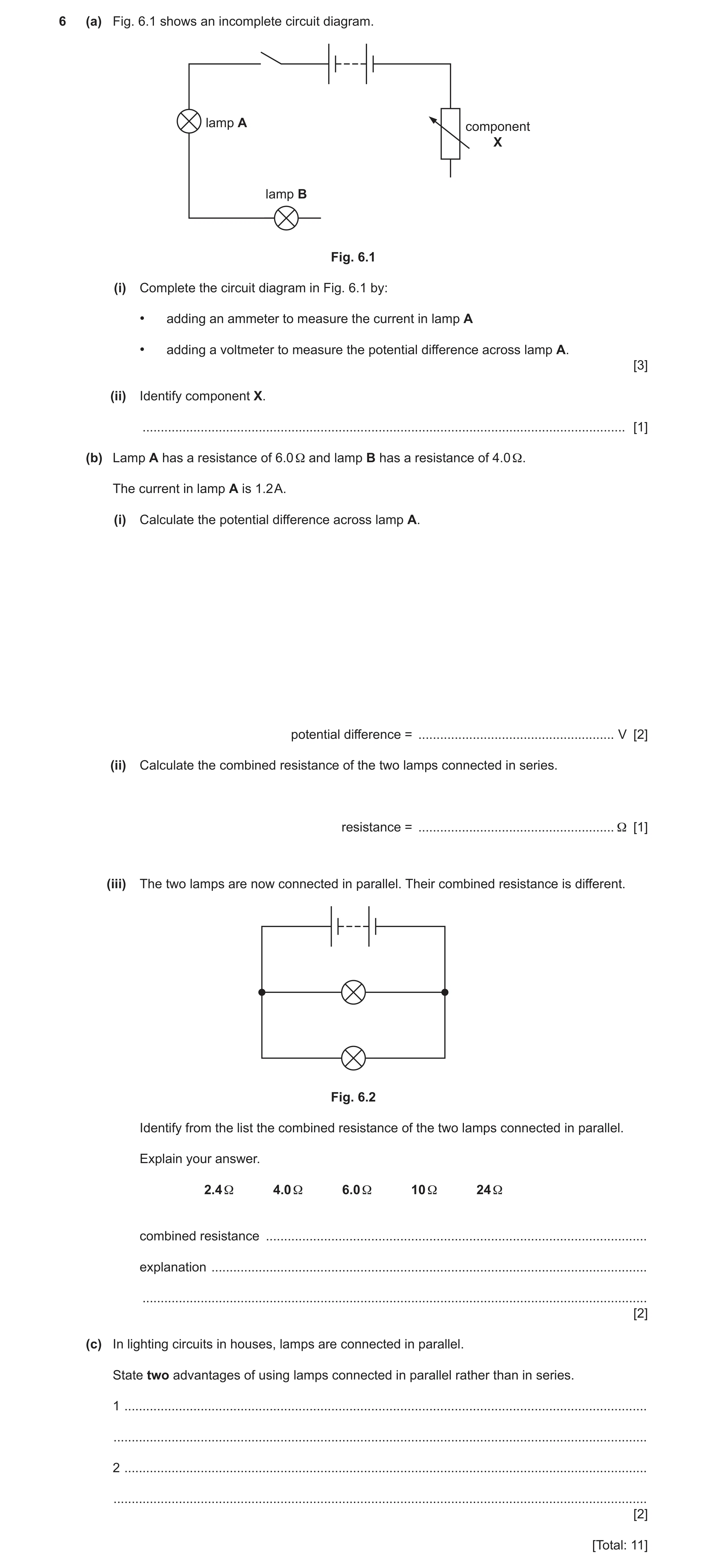
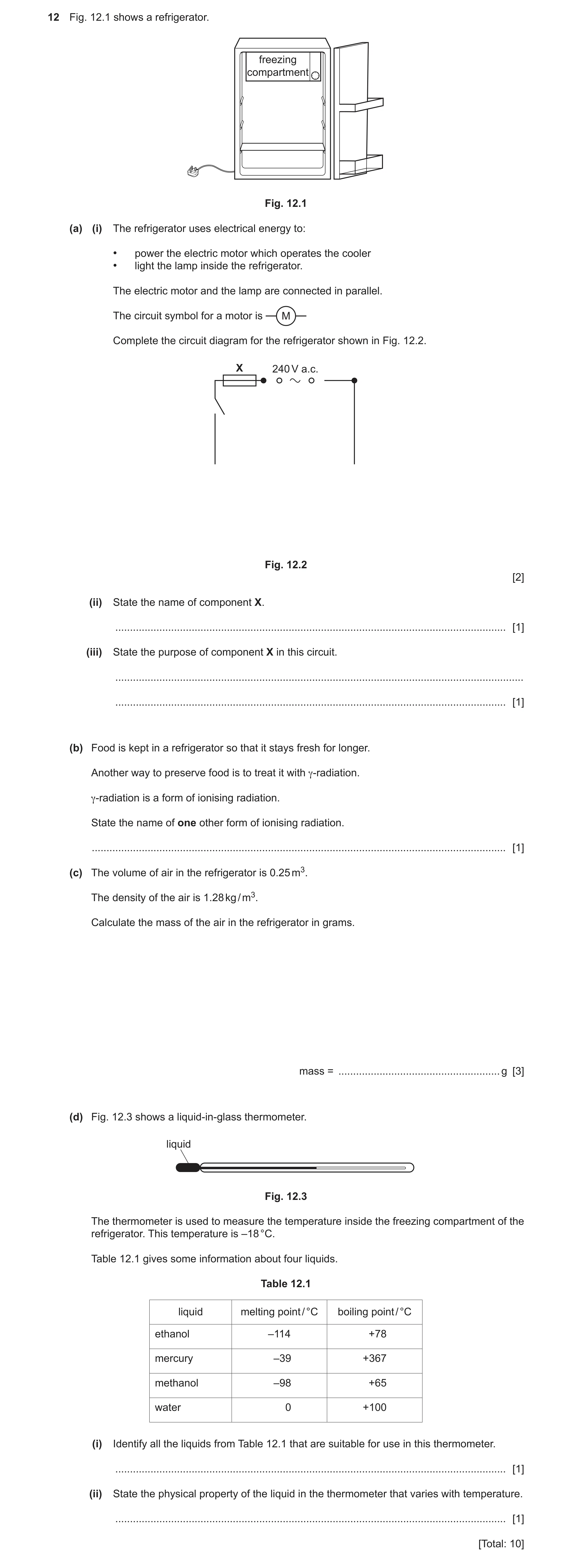
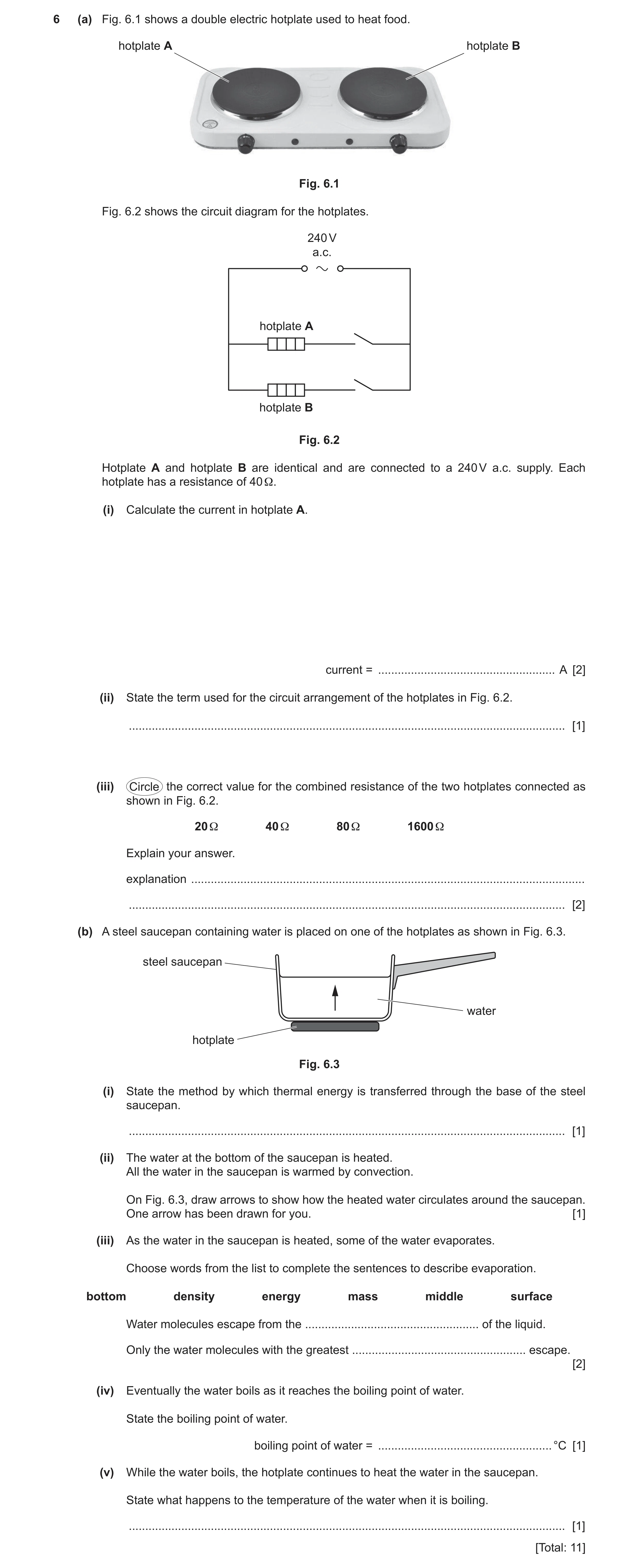
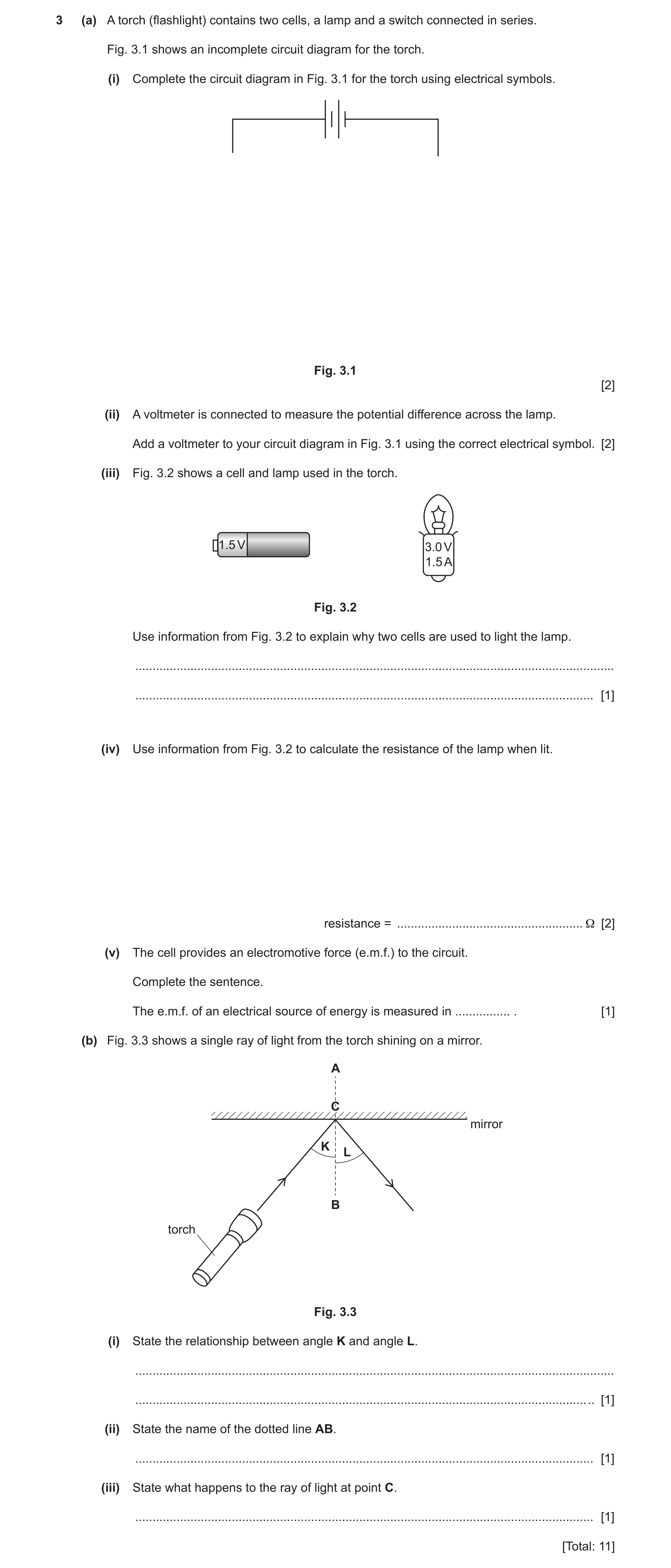
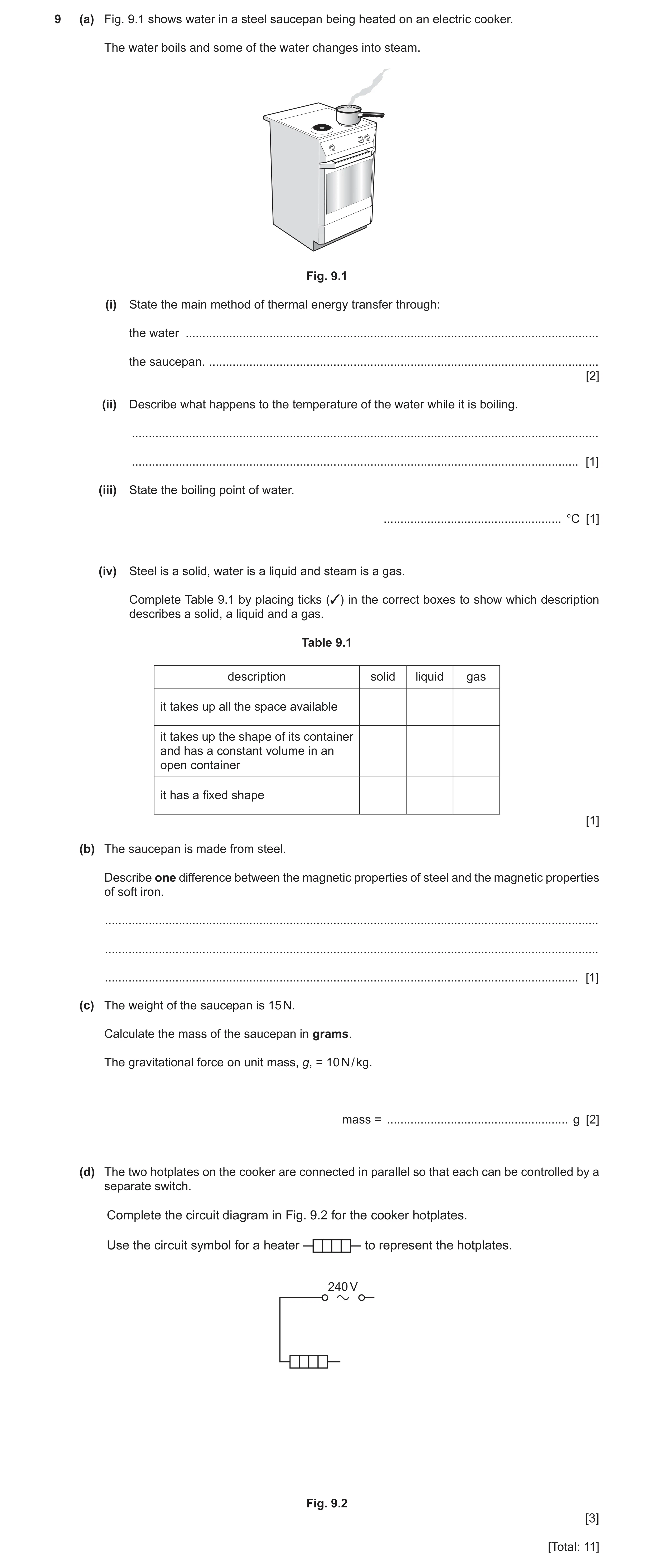
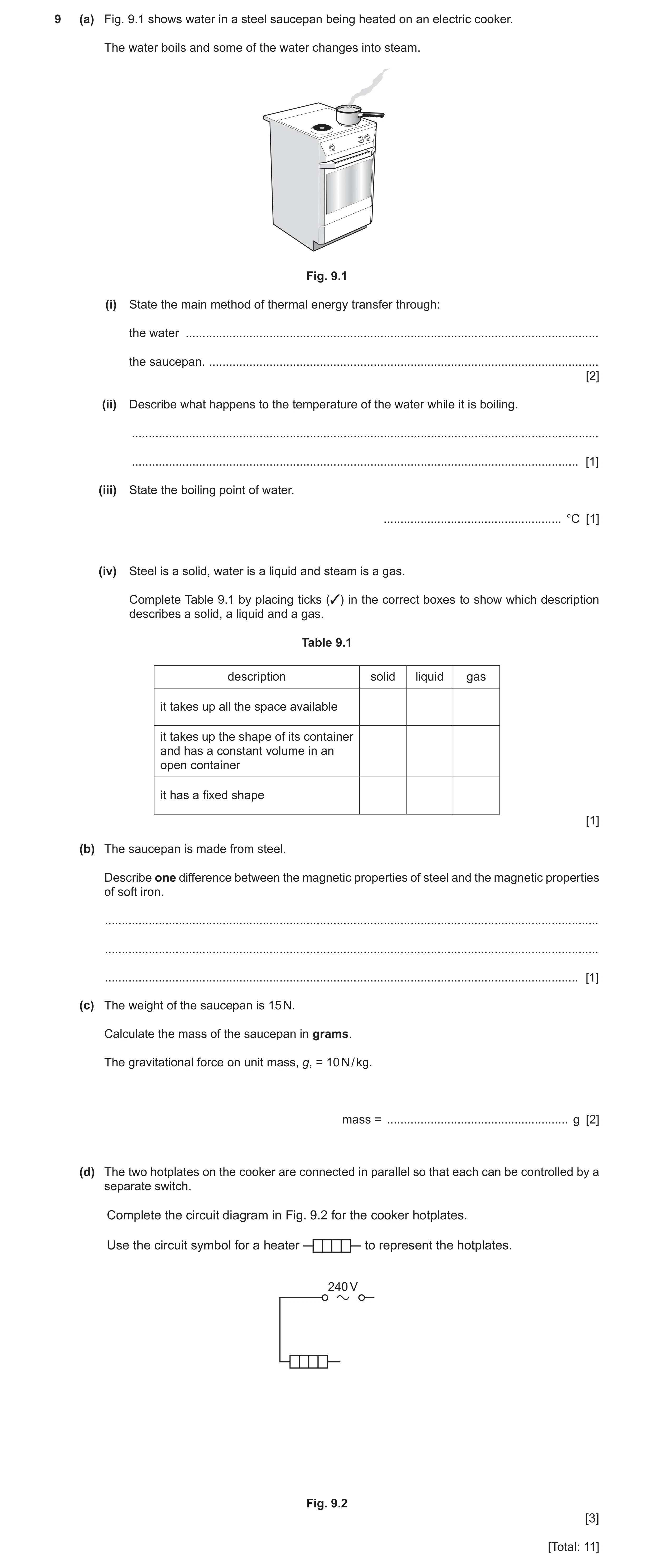
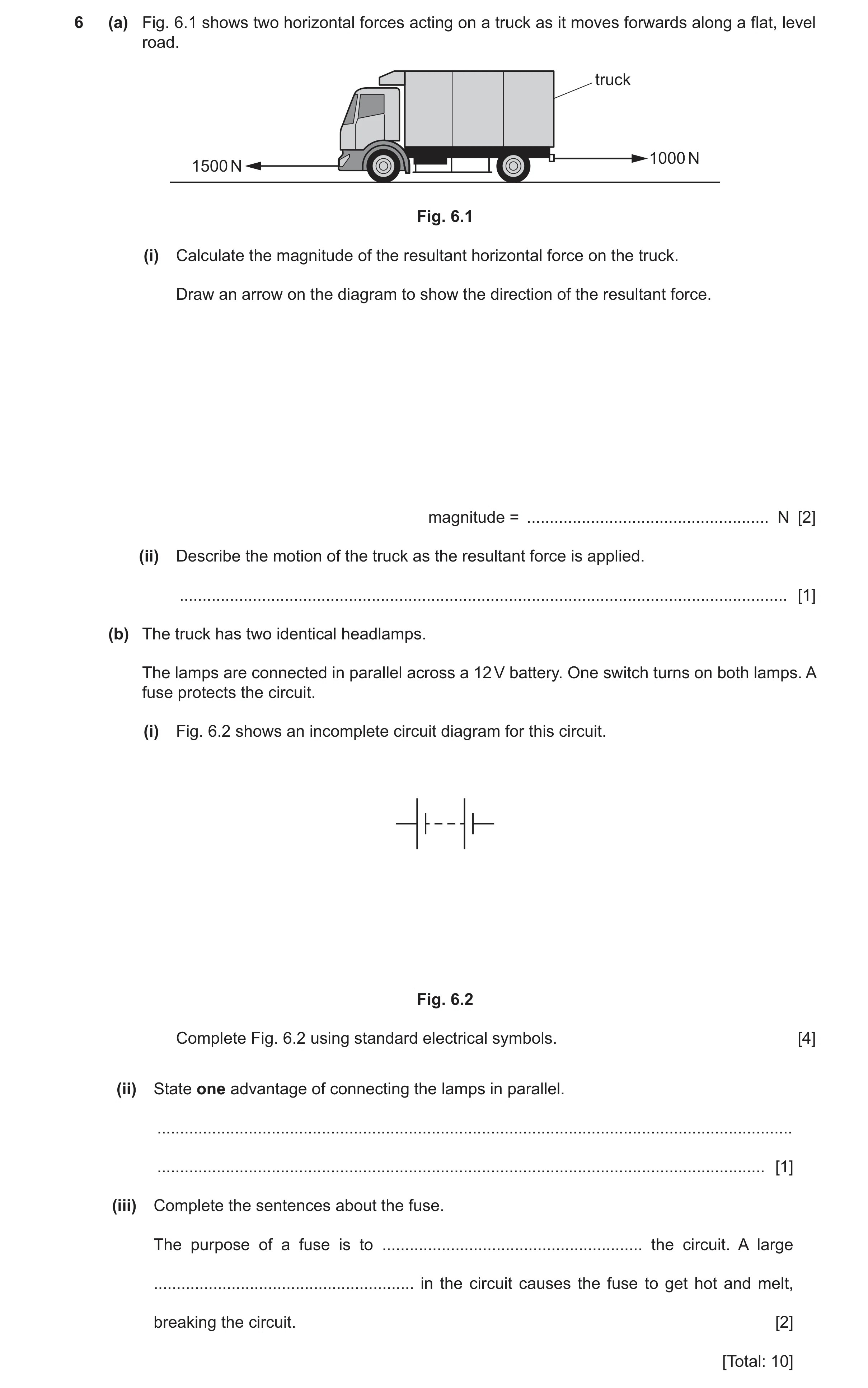
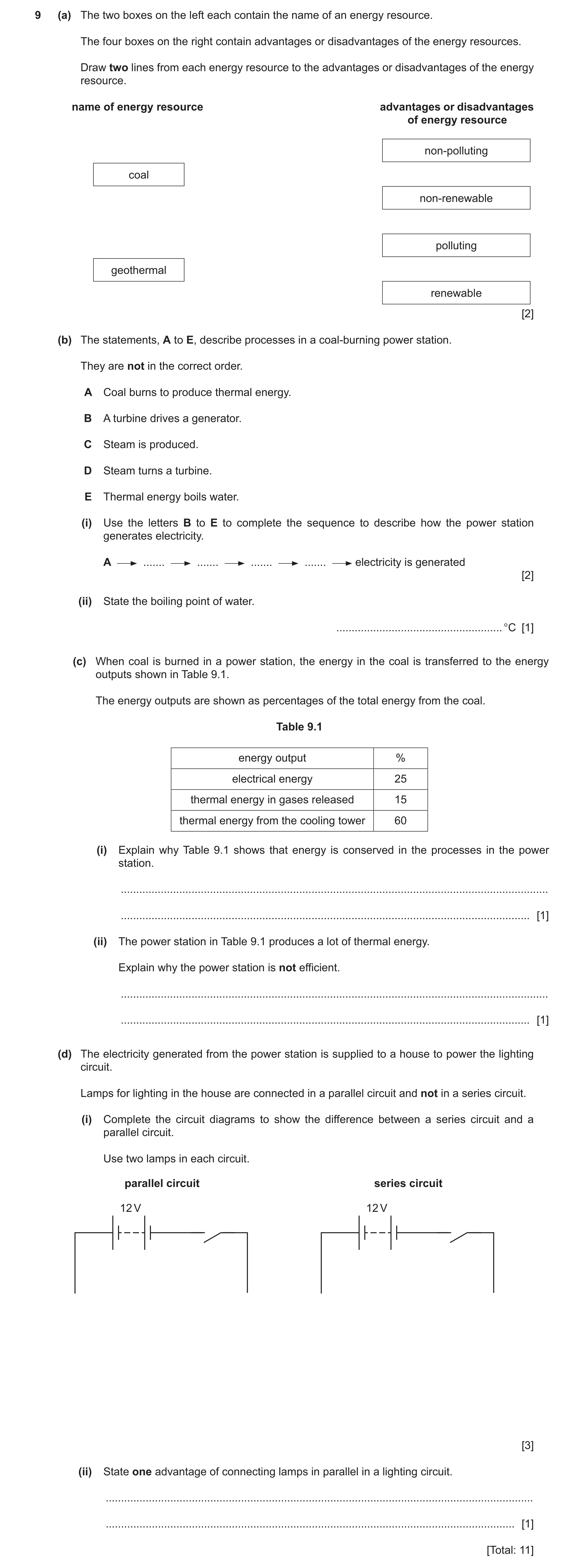
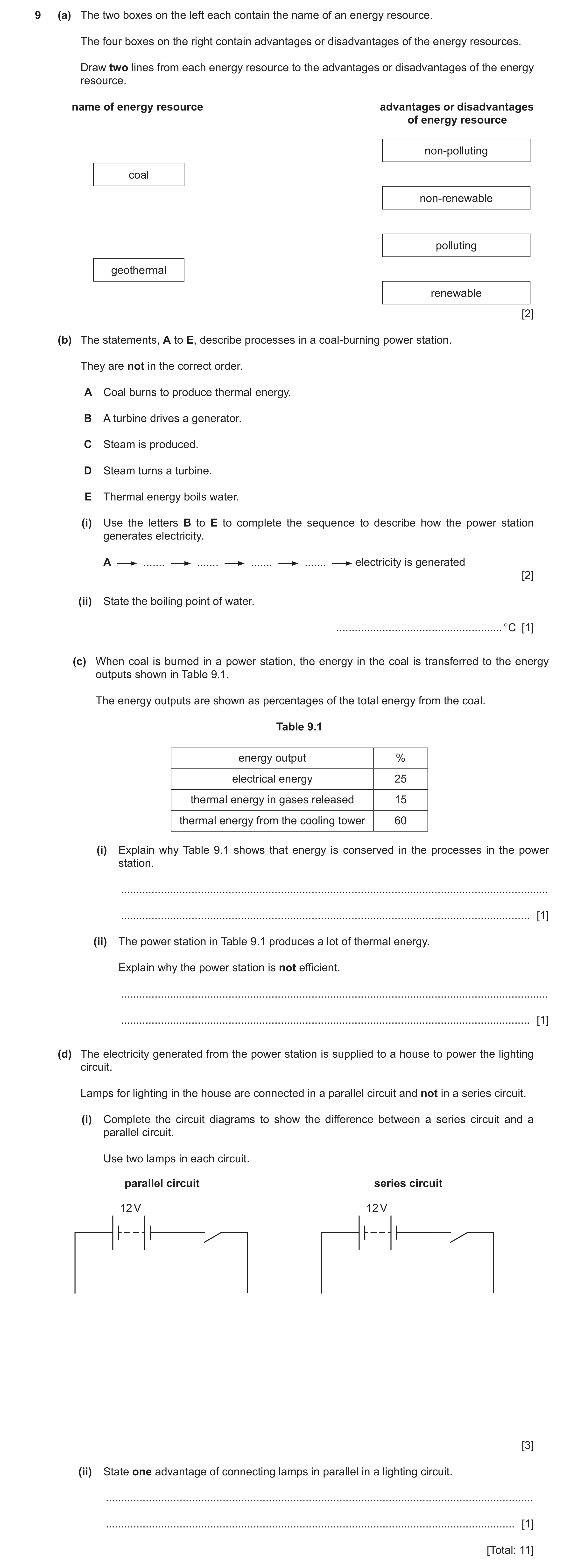
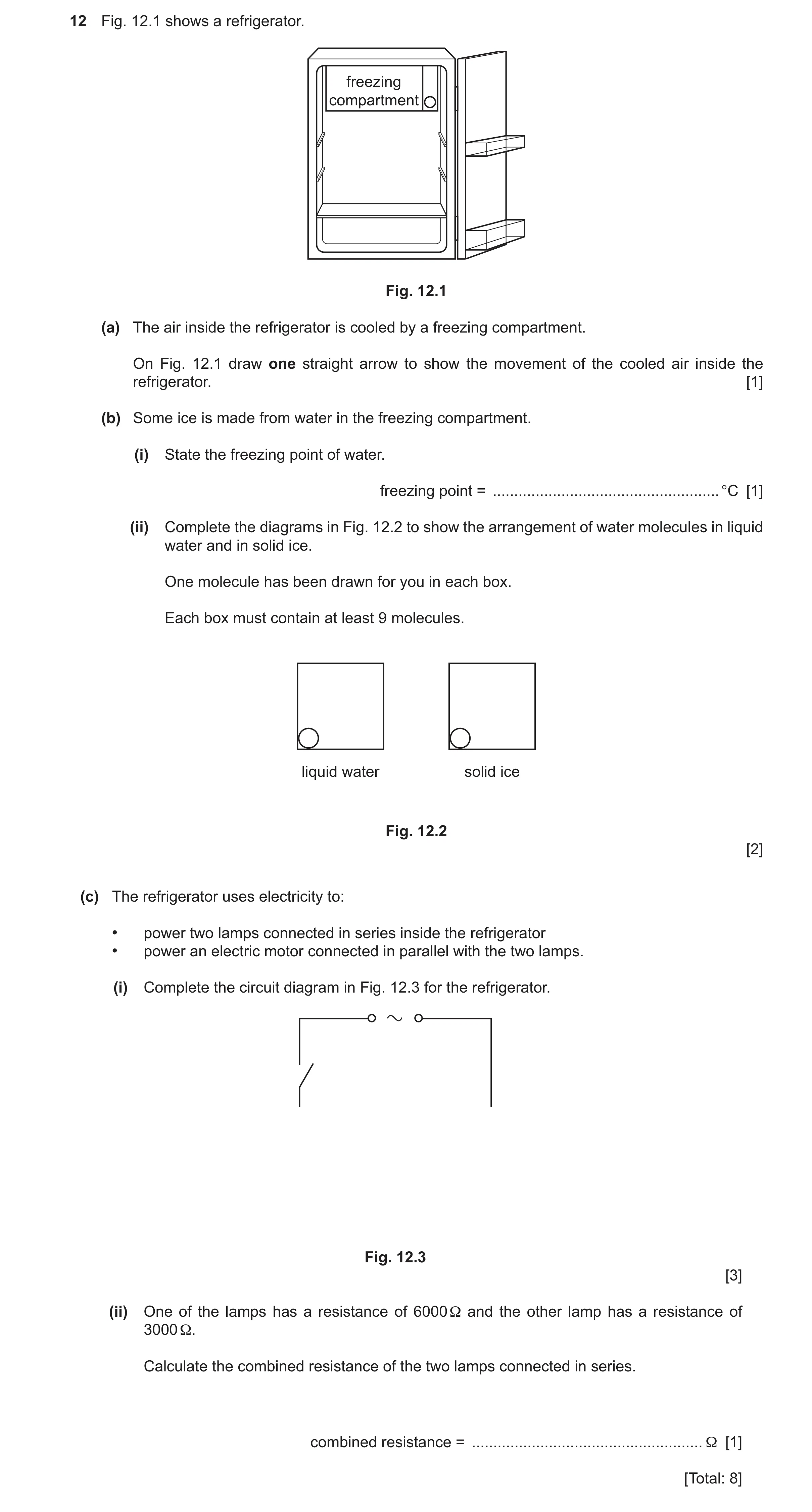
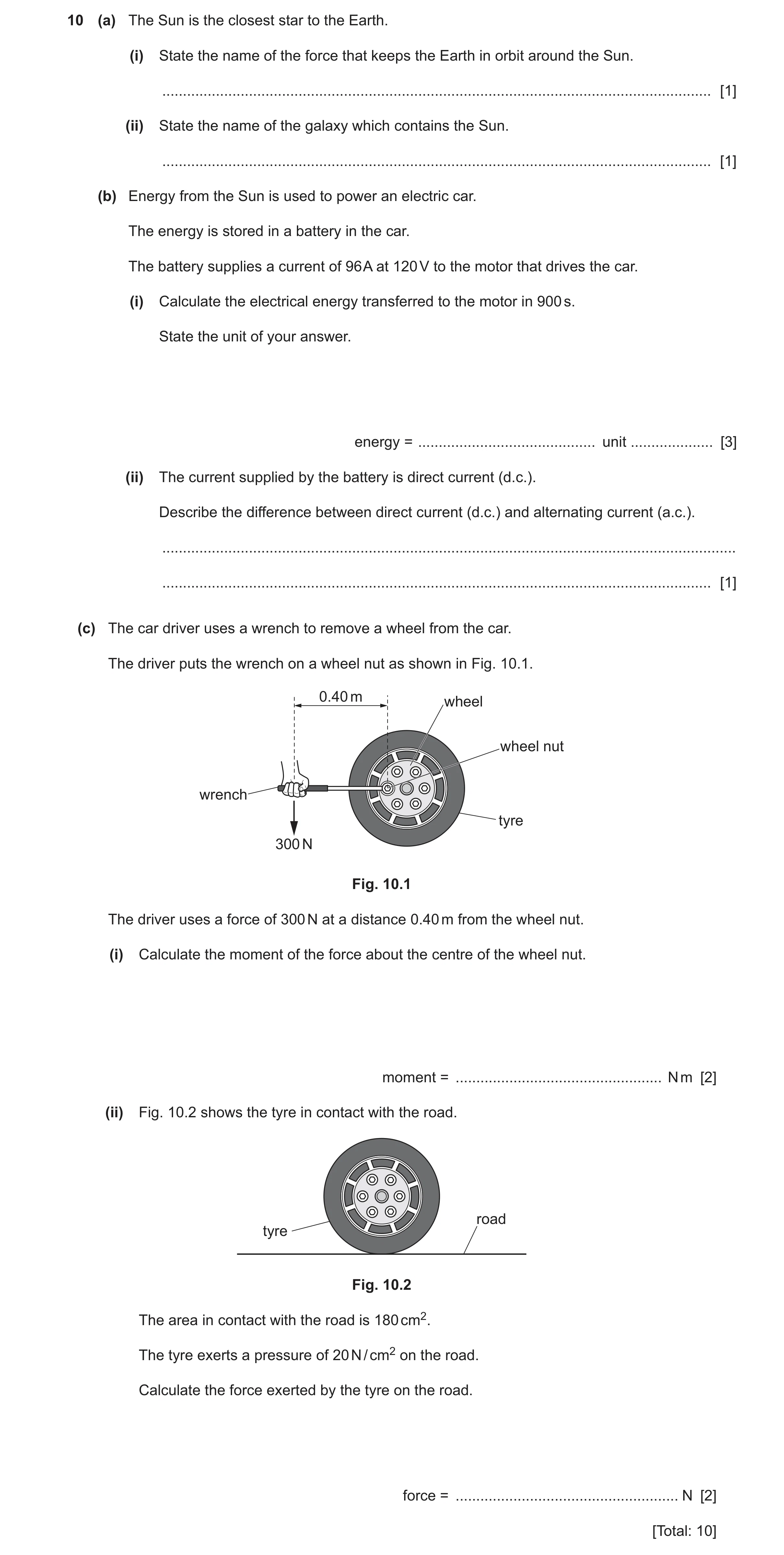
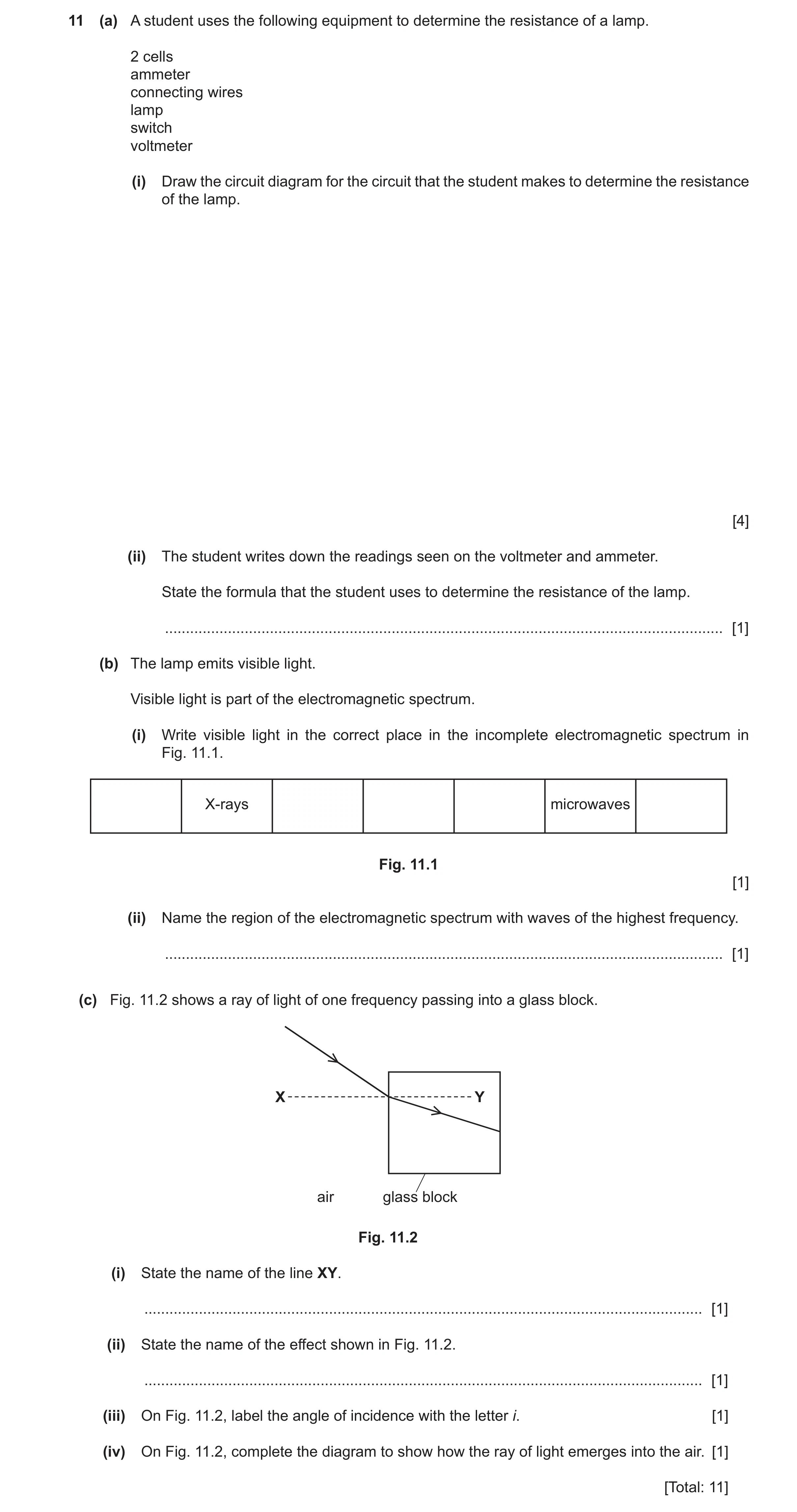
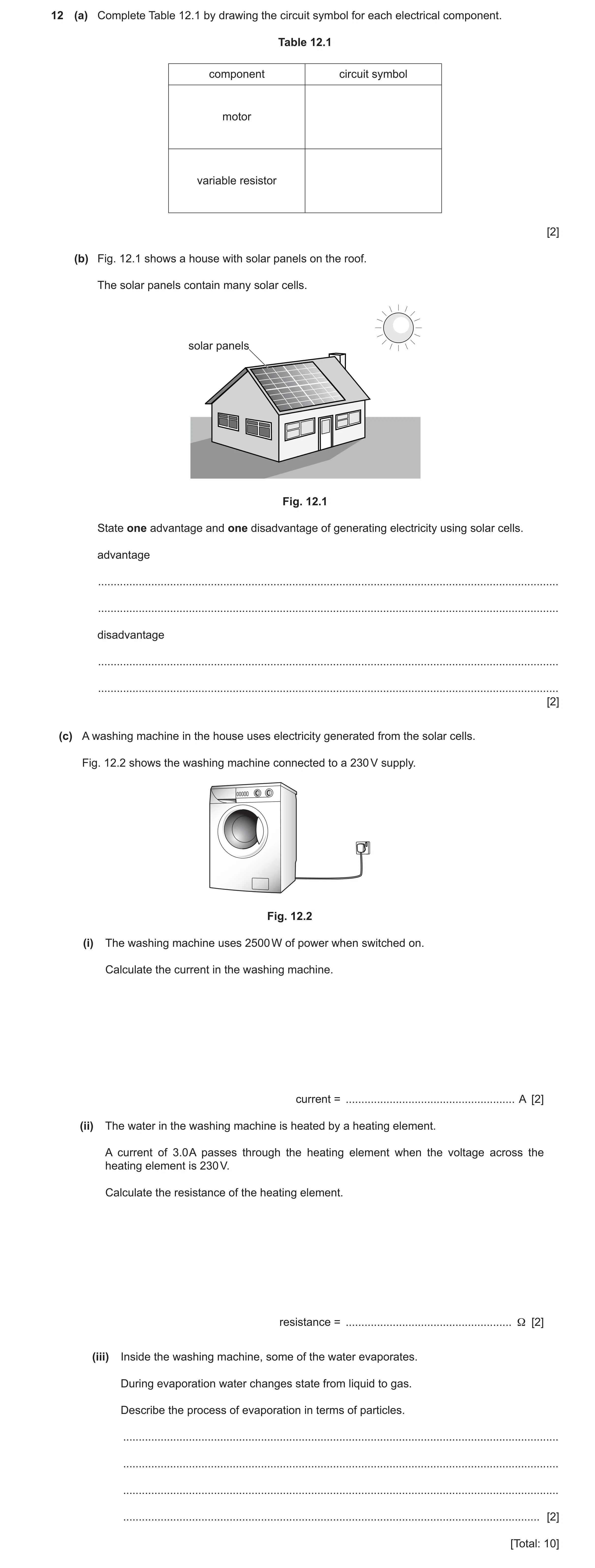
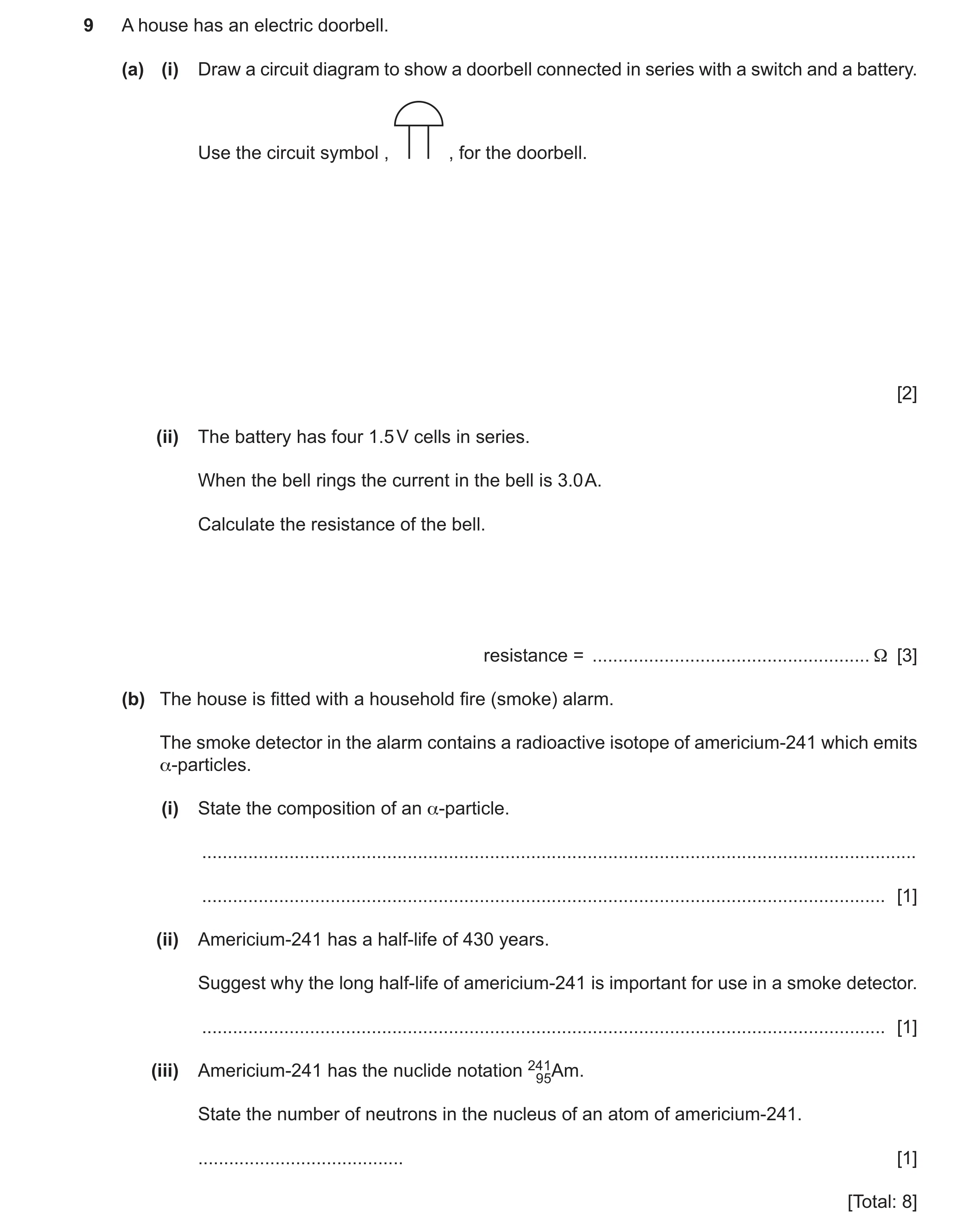 75 / 80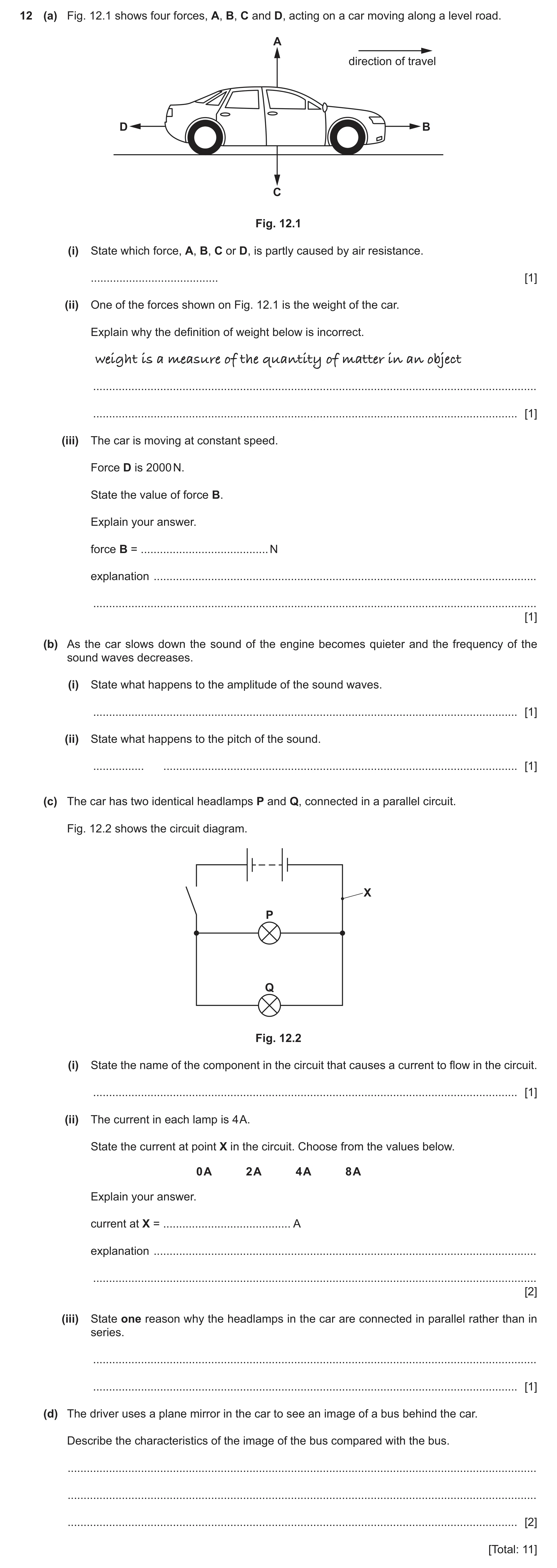
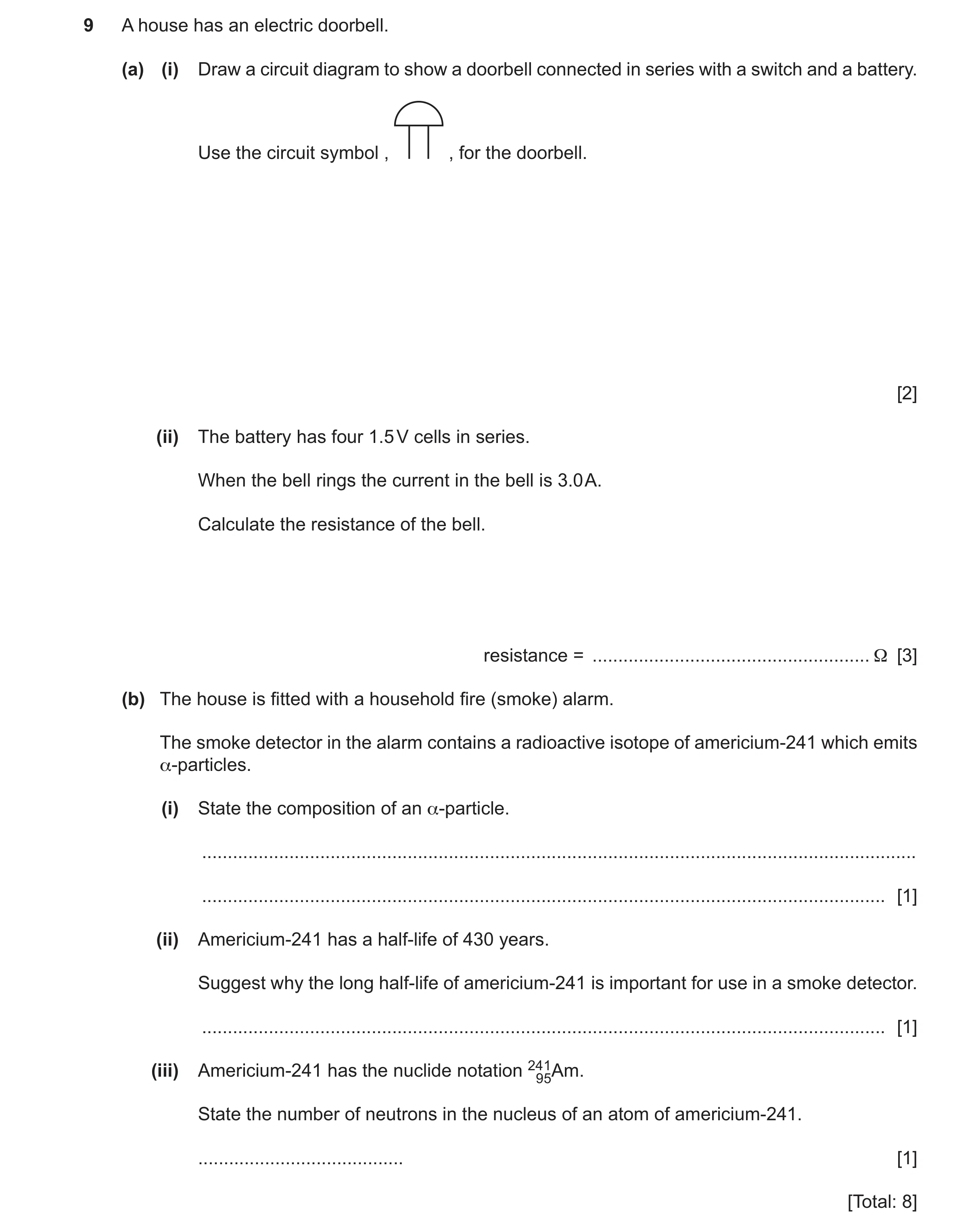 78 / 80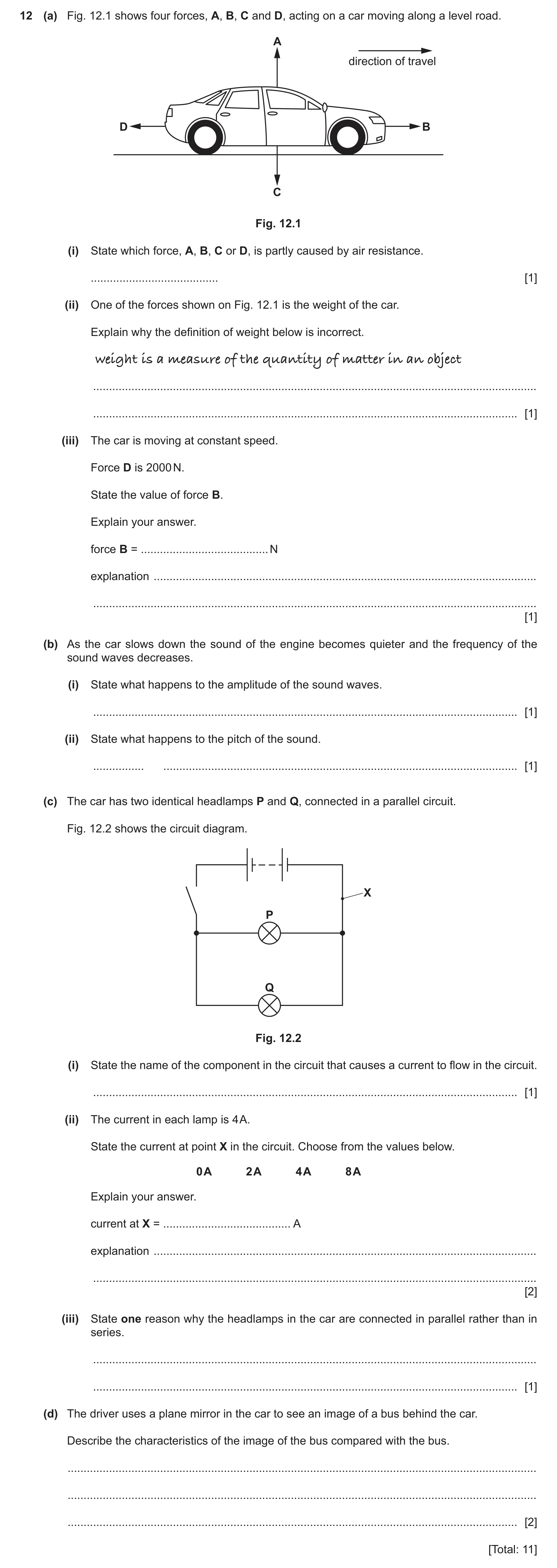
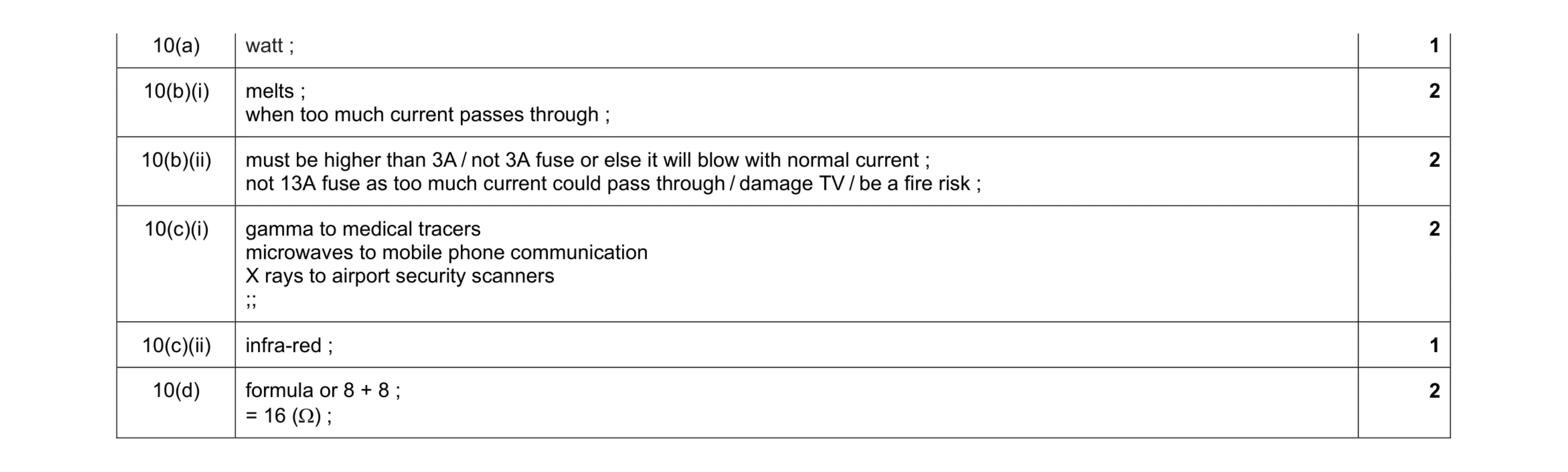 10
10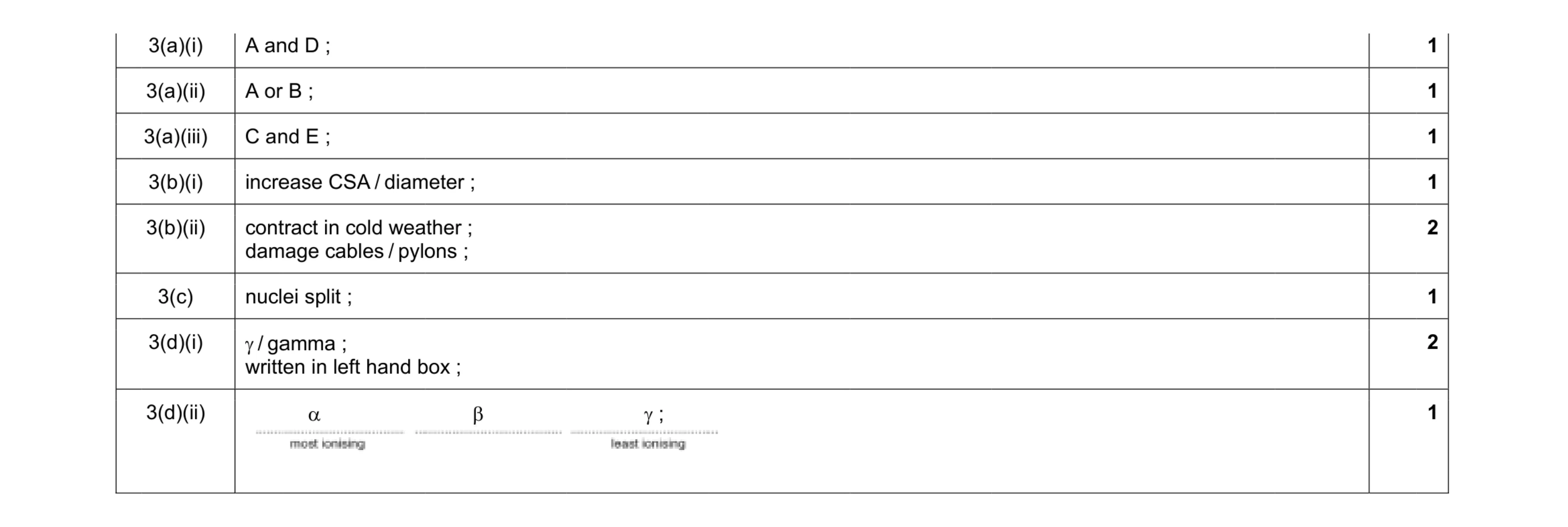 10
10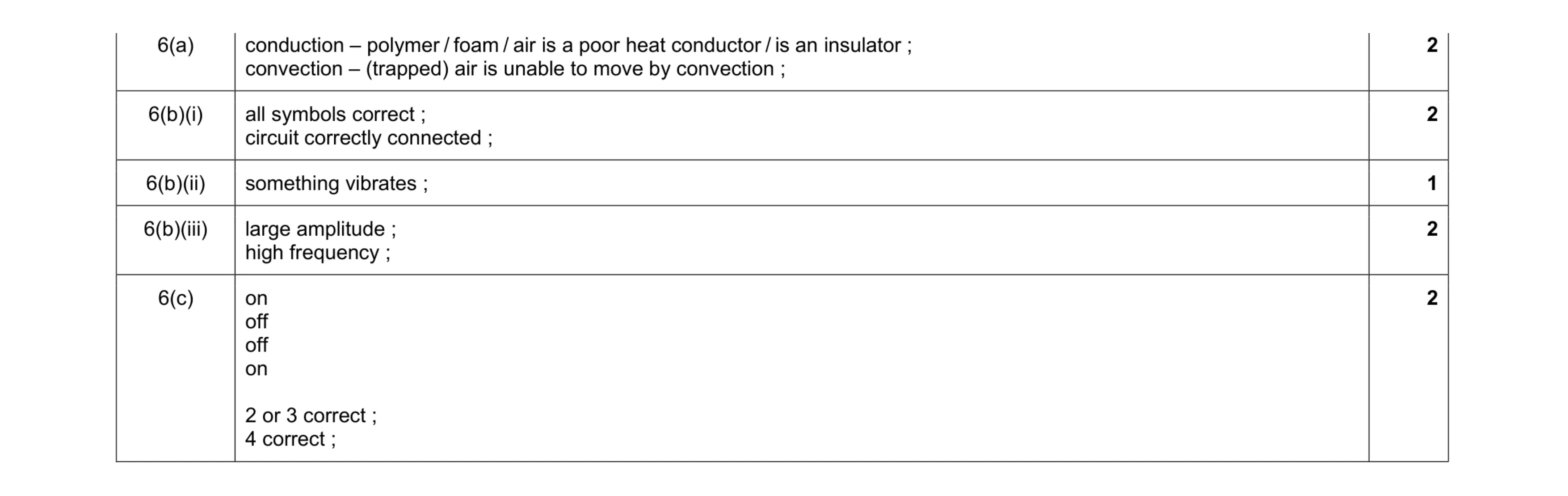 9
9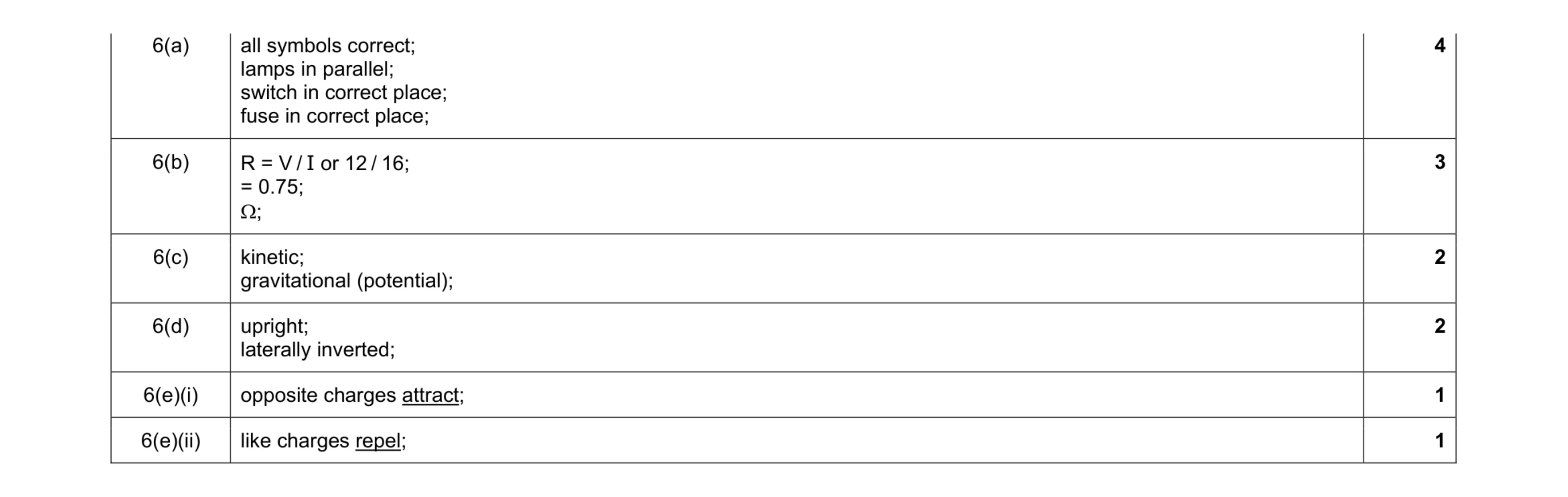 13
13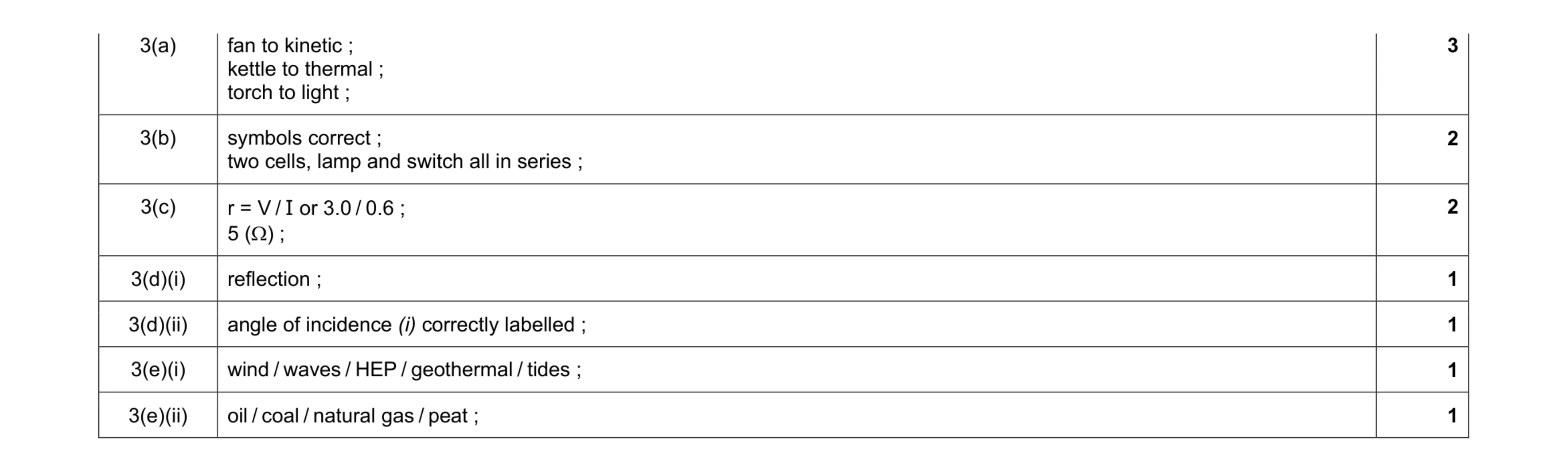 11
11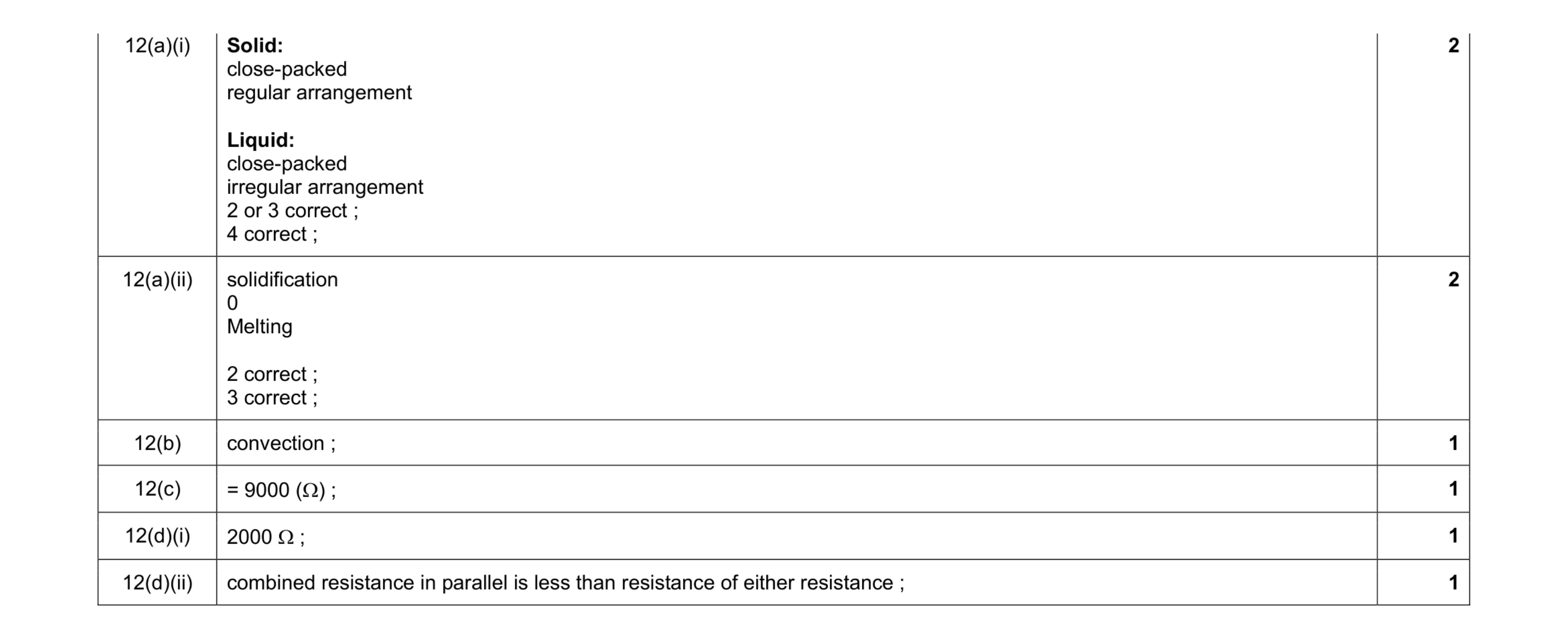 8
8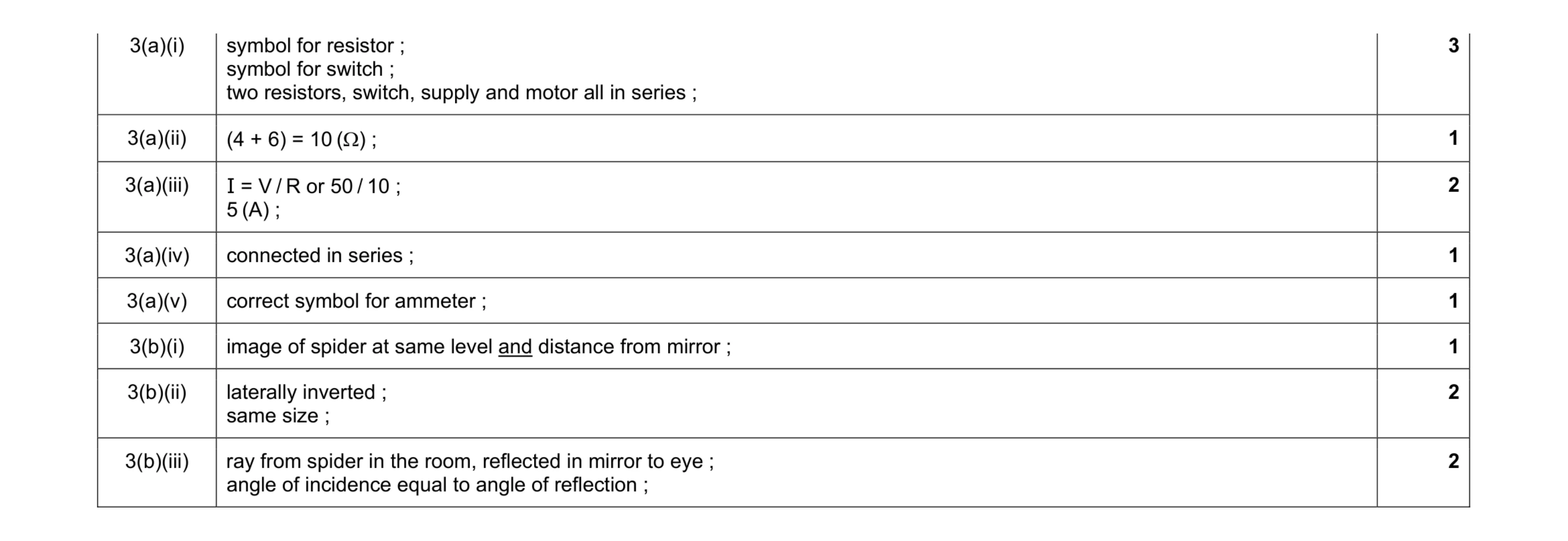 13
13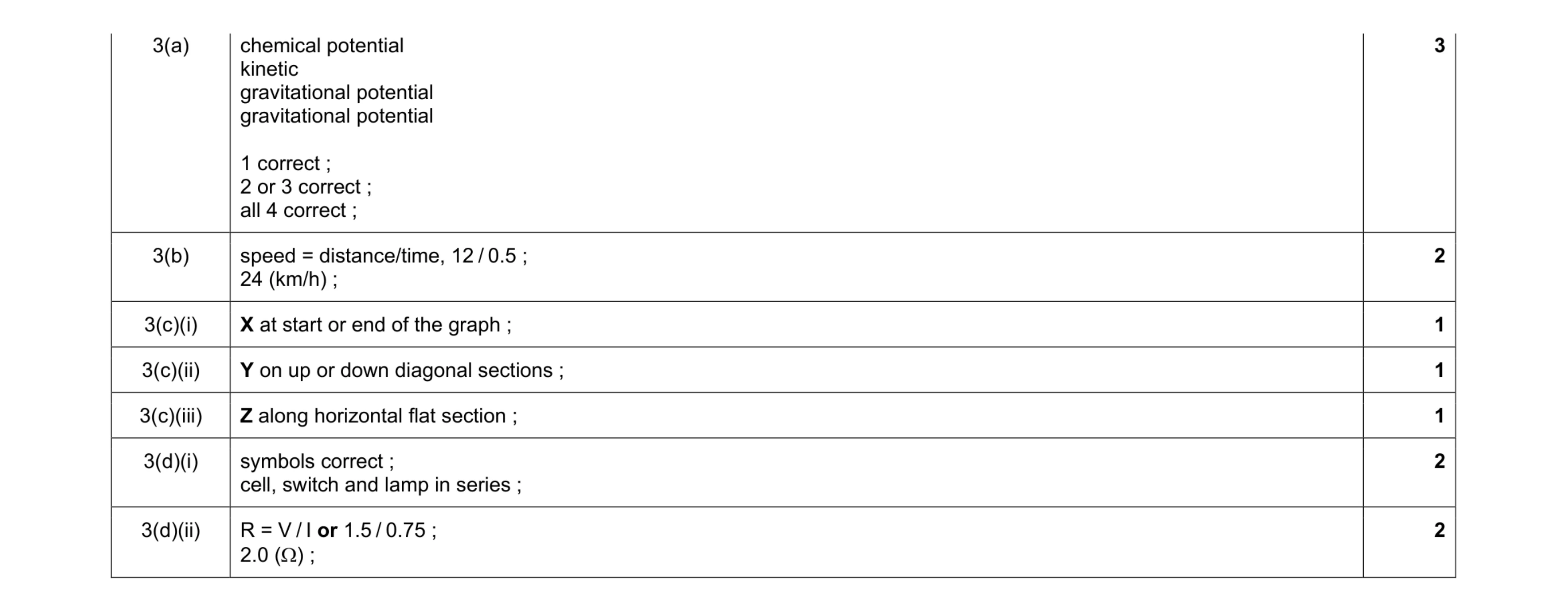 12
12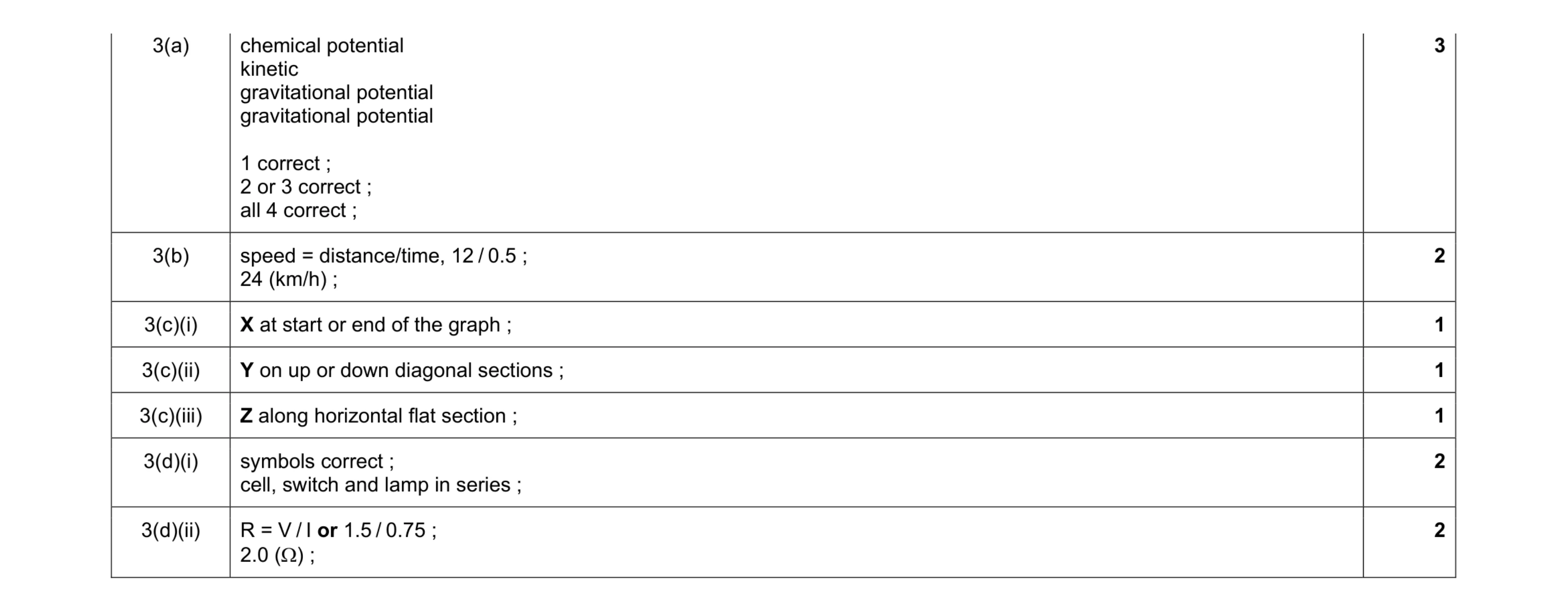 12
12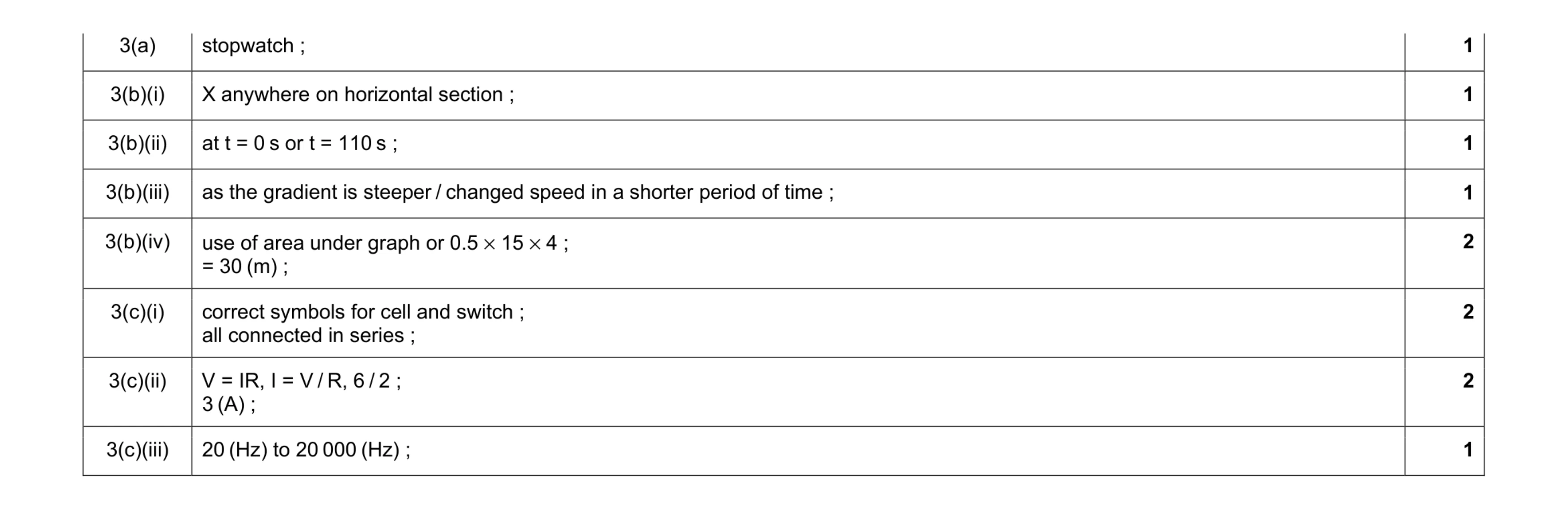 11
11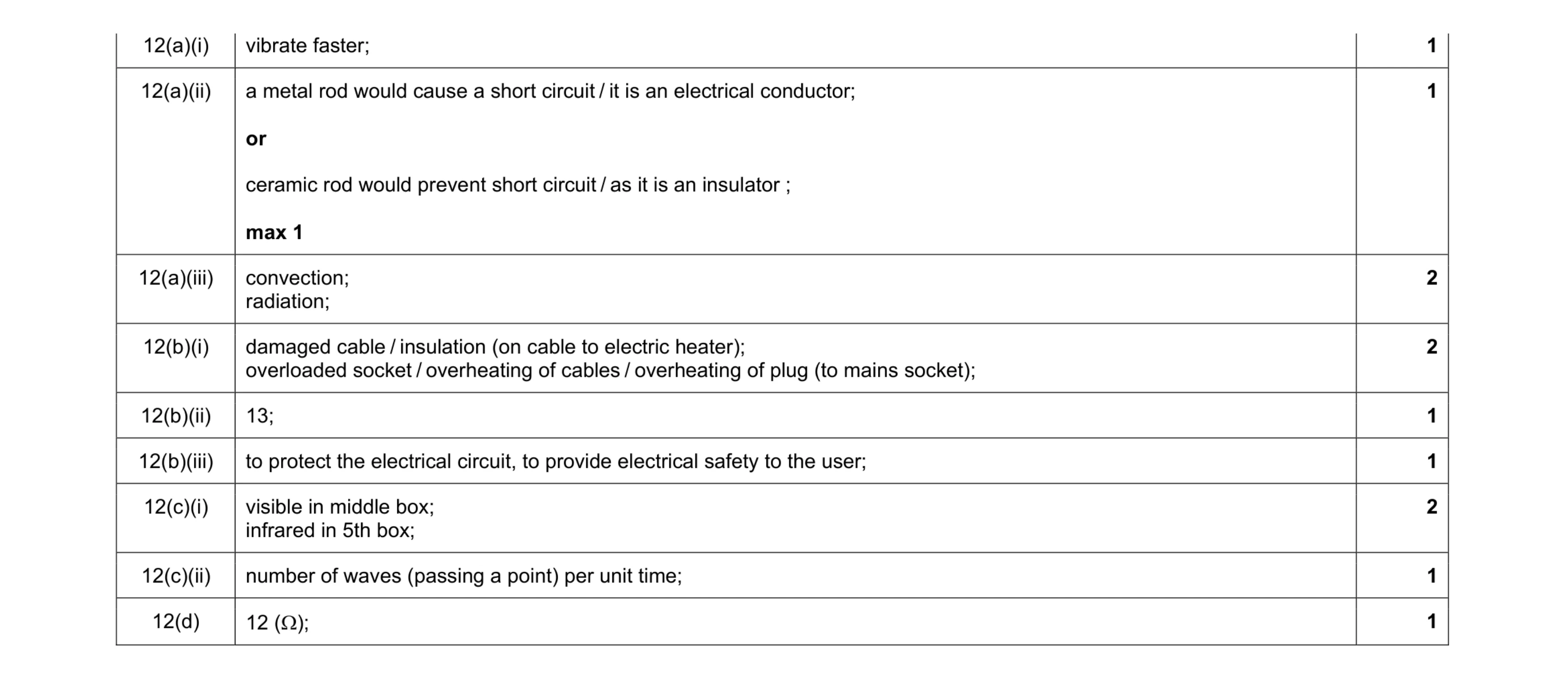 12
12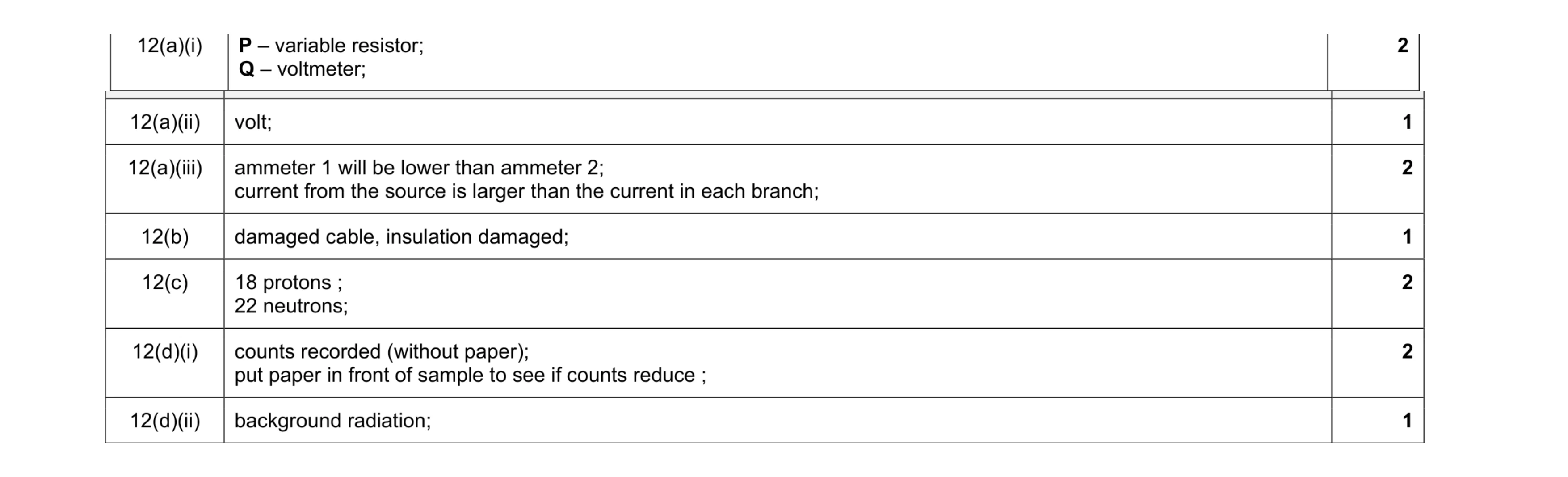 11
11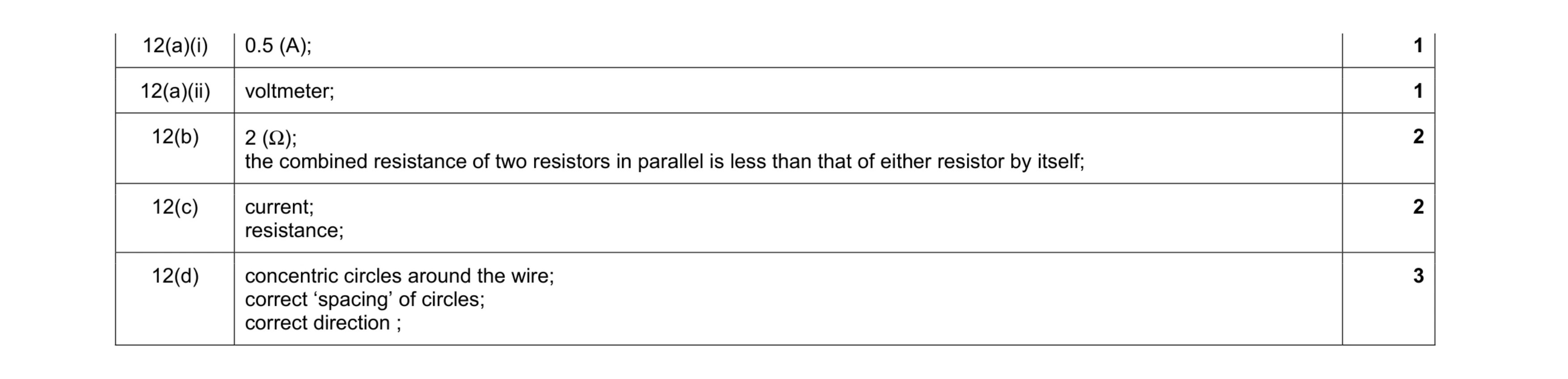 9
9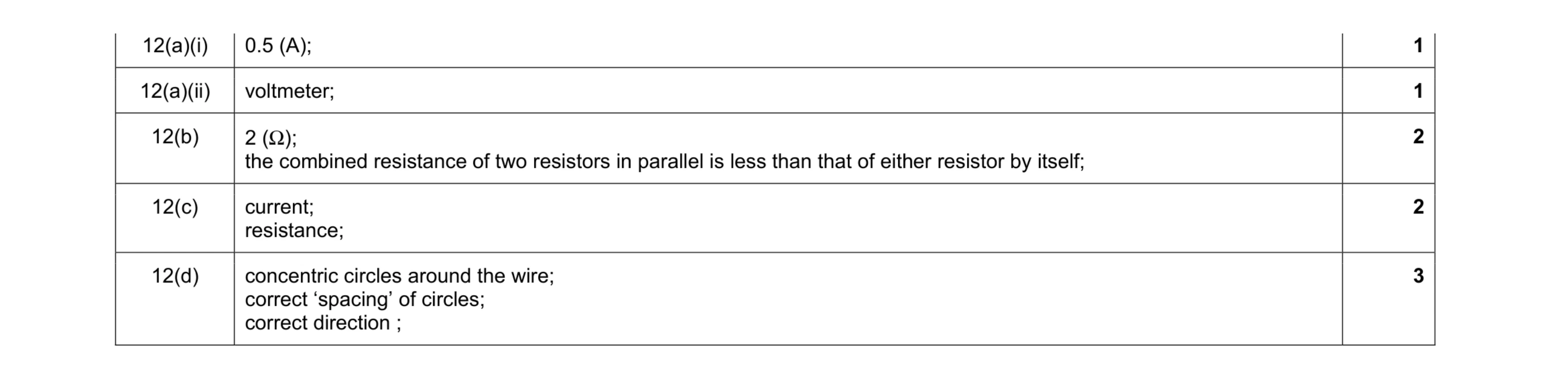 9
9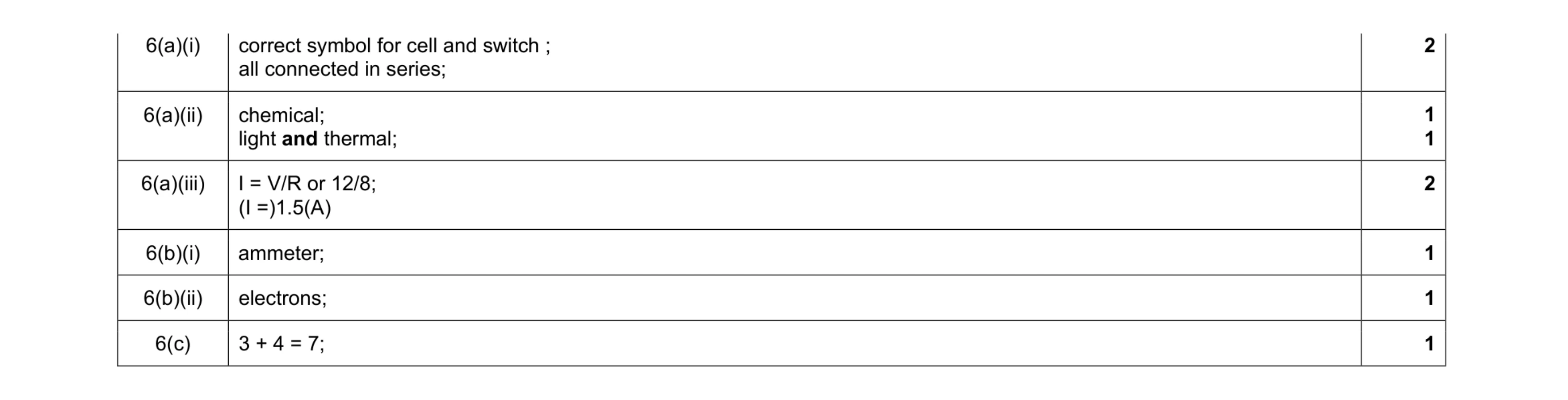 9
9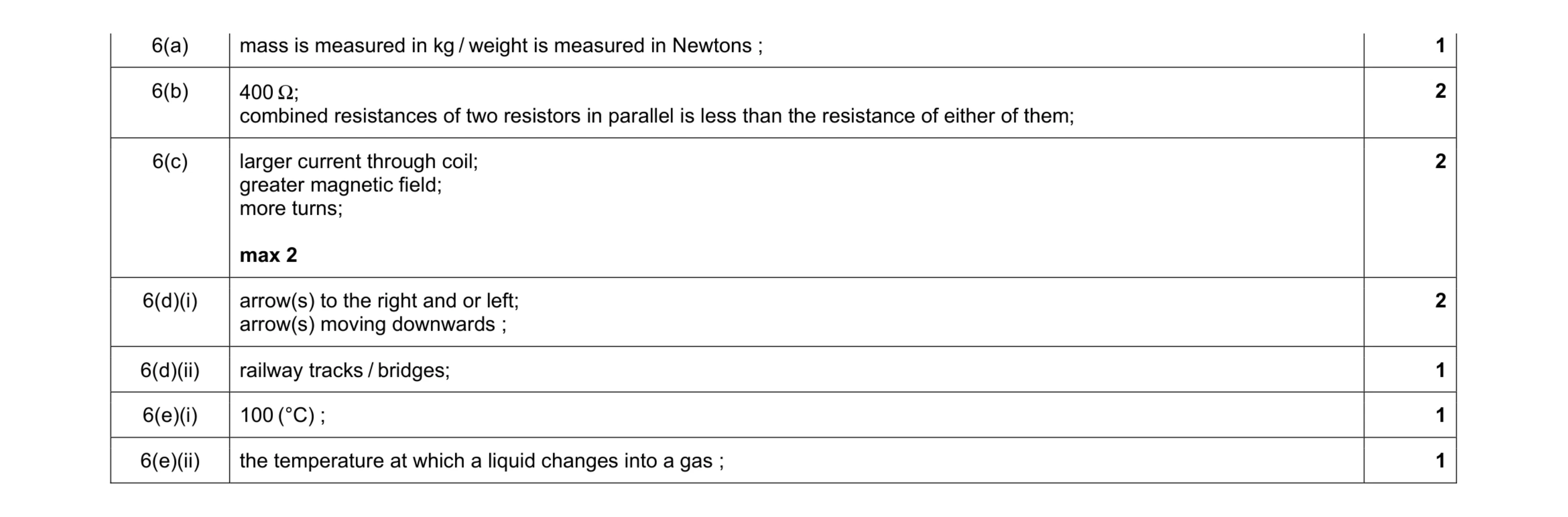 10
10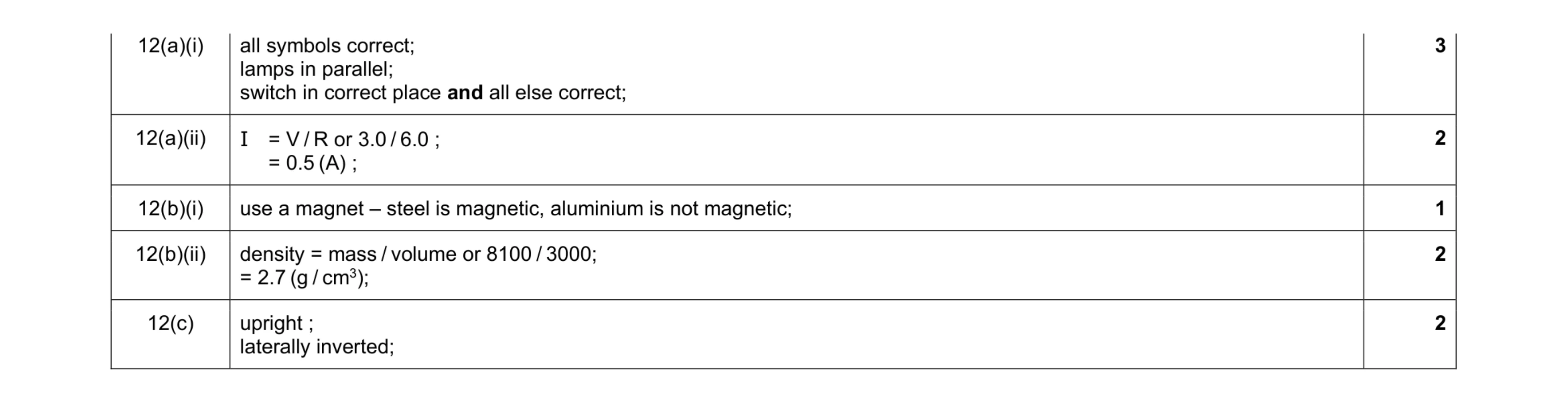 10
10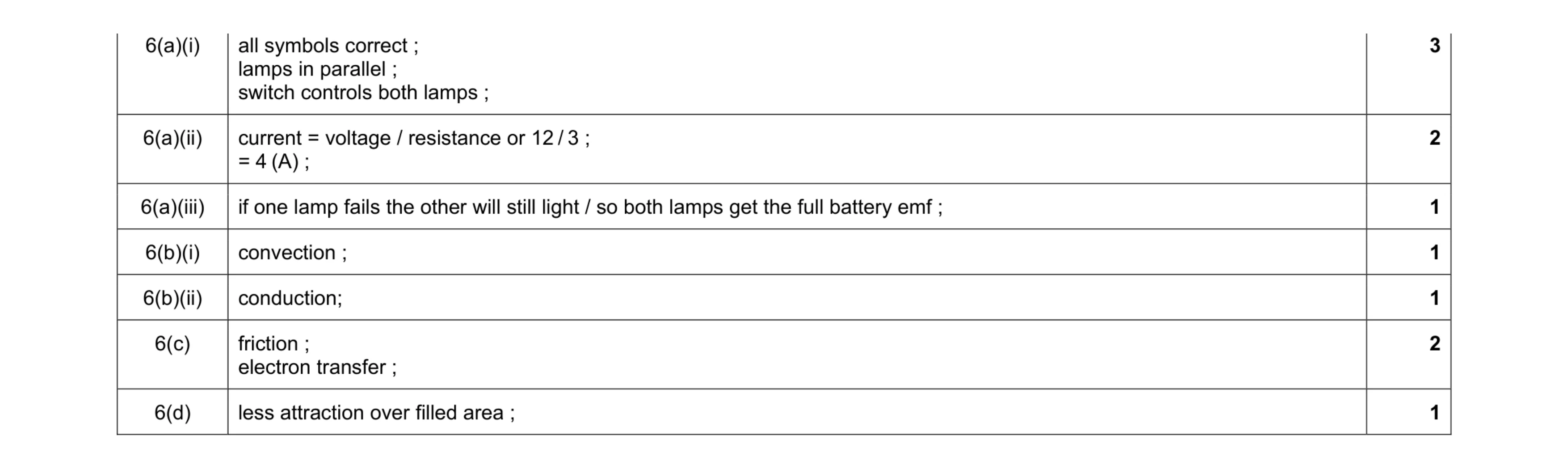 11
11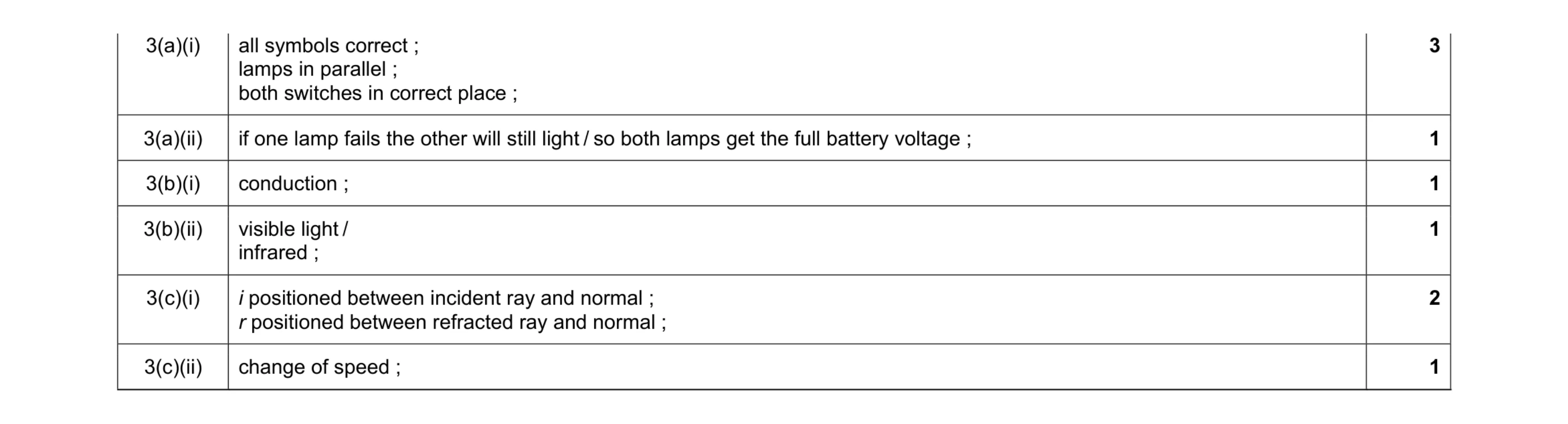 9
9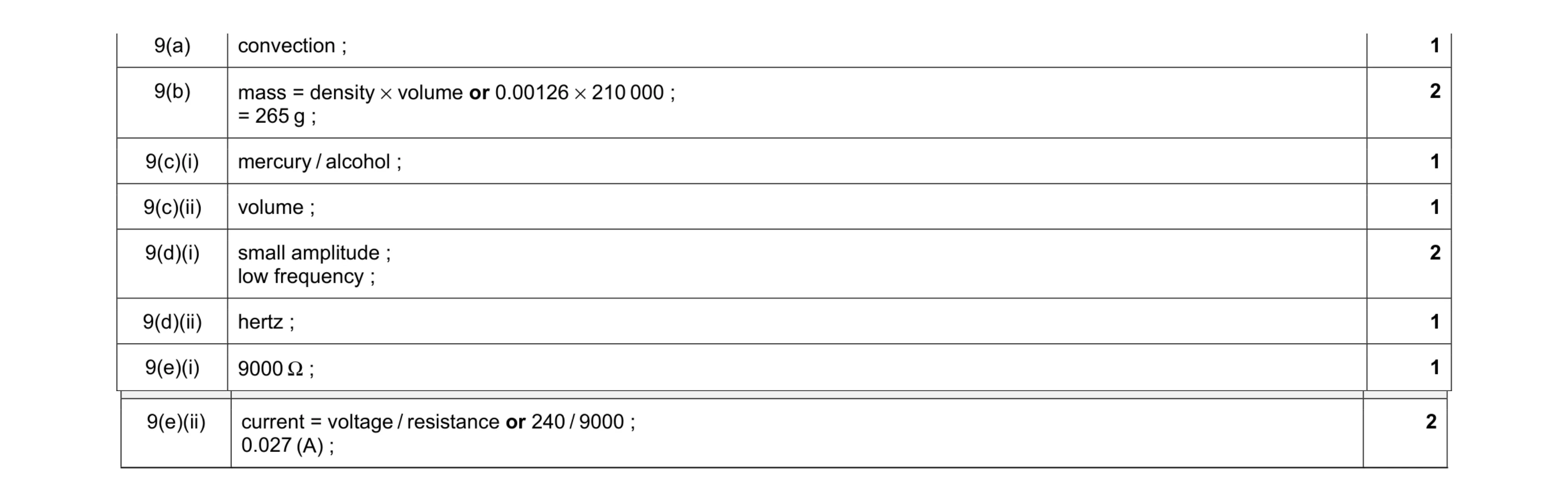 11
11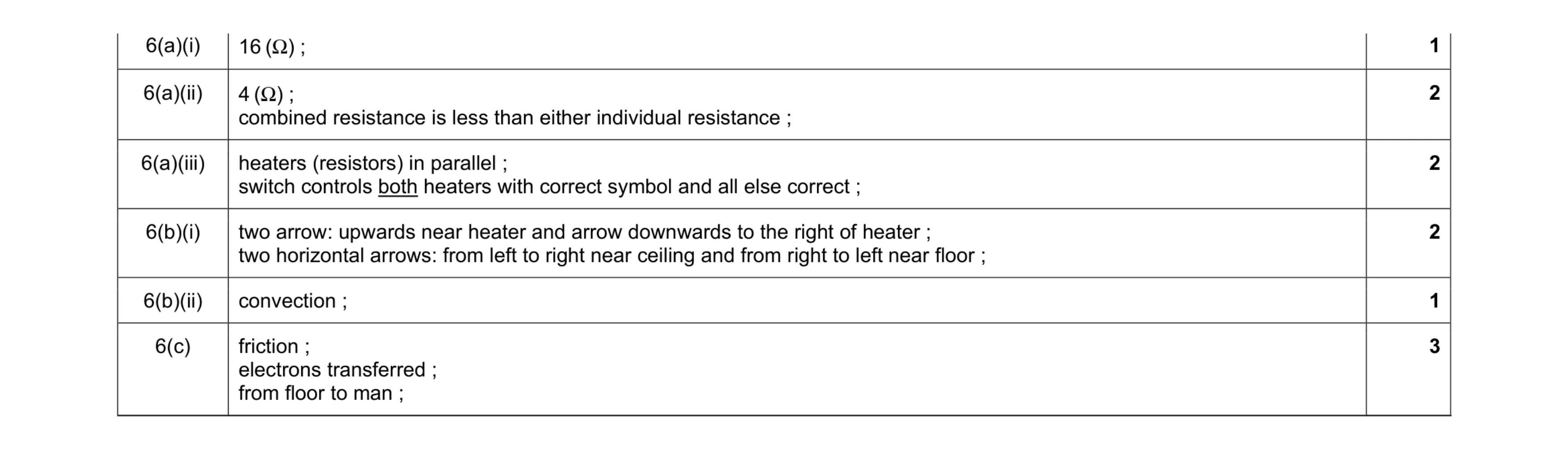 11
11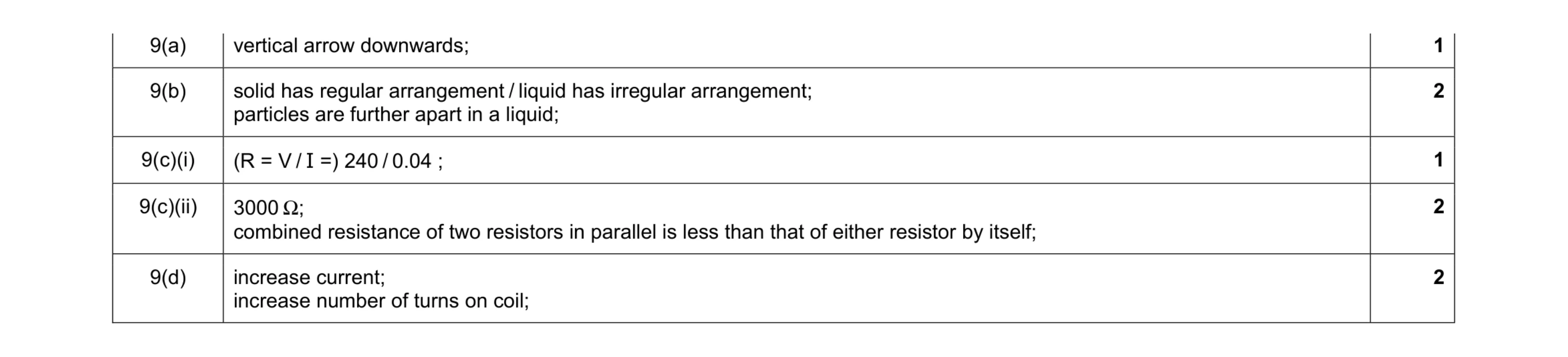 8
8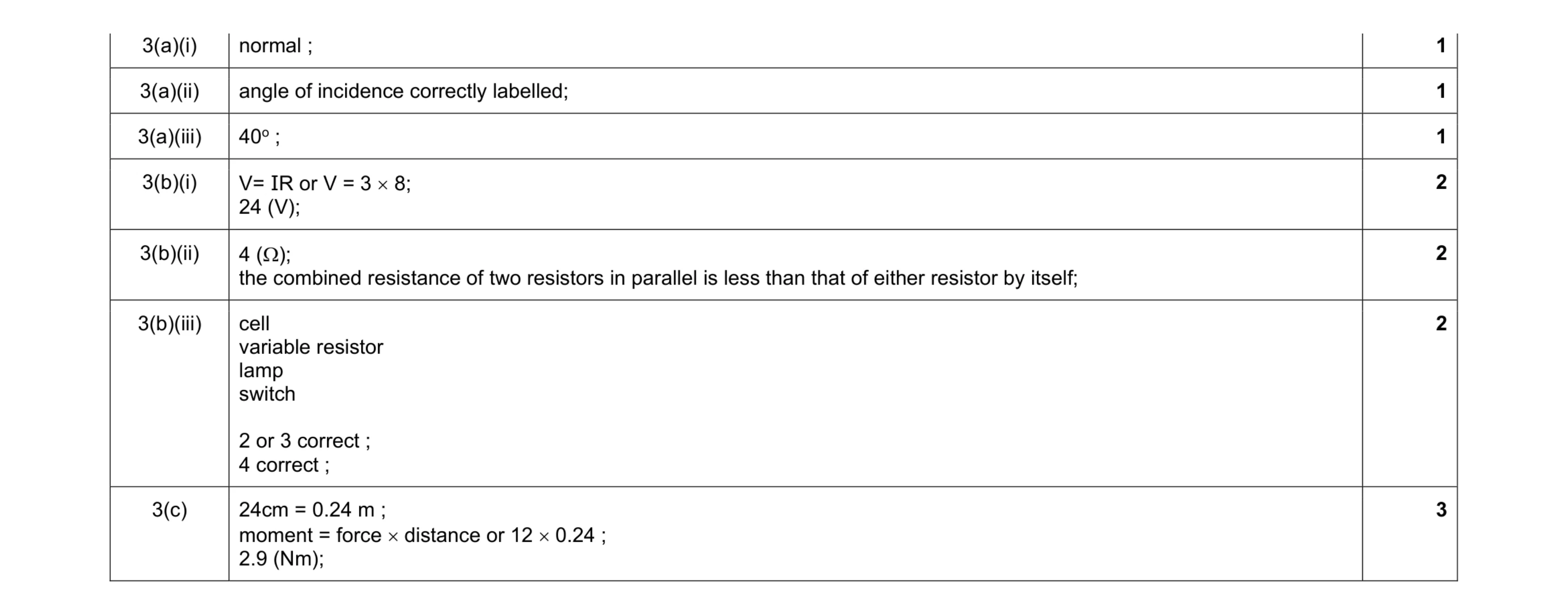 12
12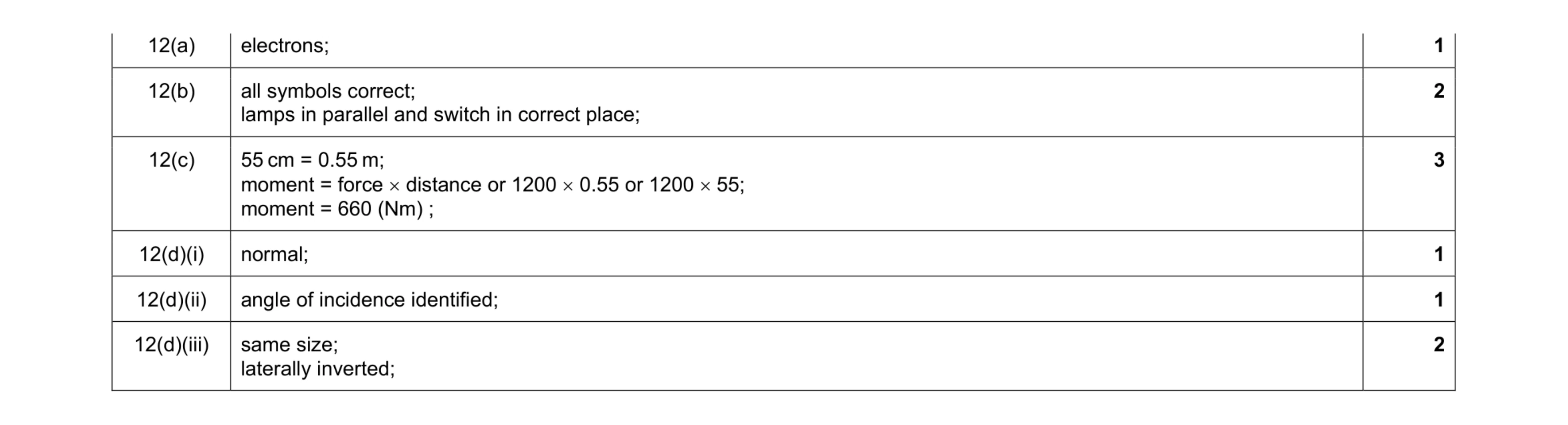 10
10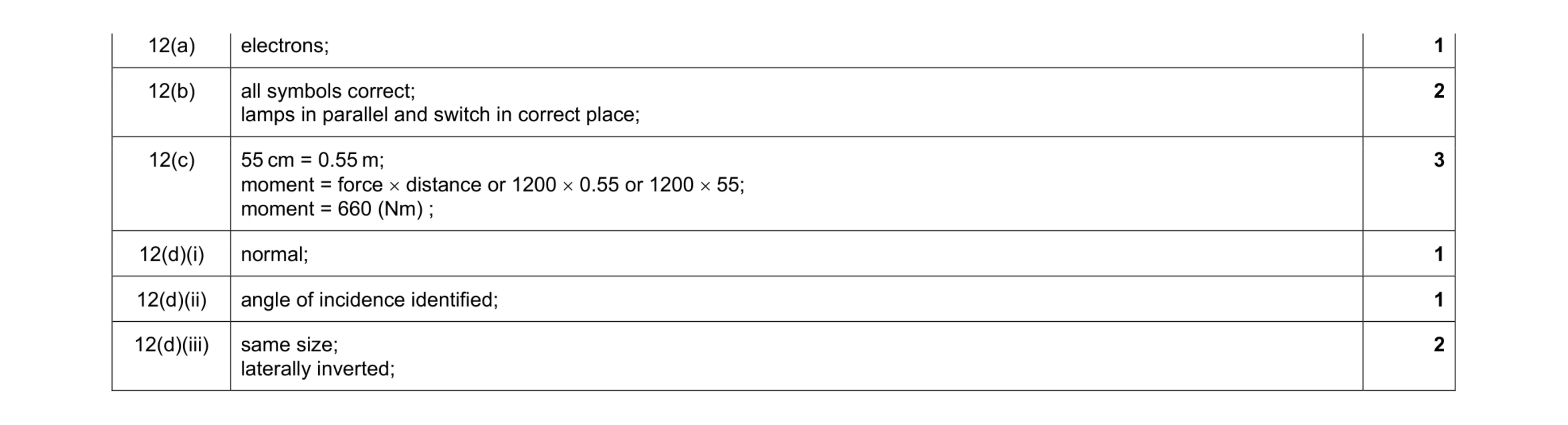 10
10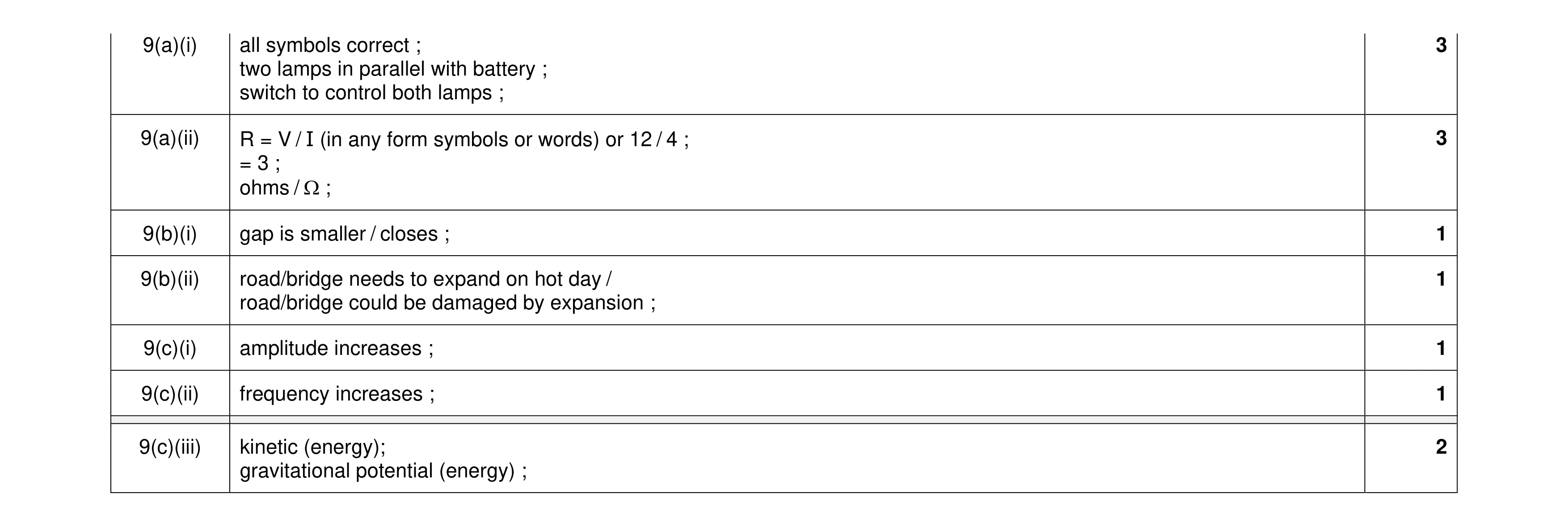 12
12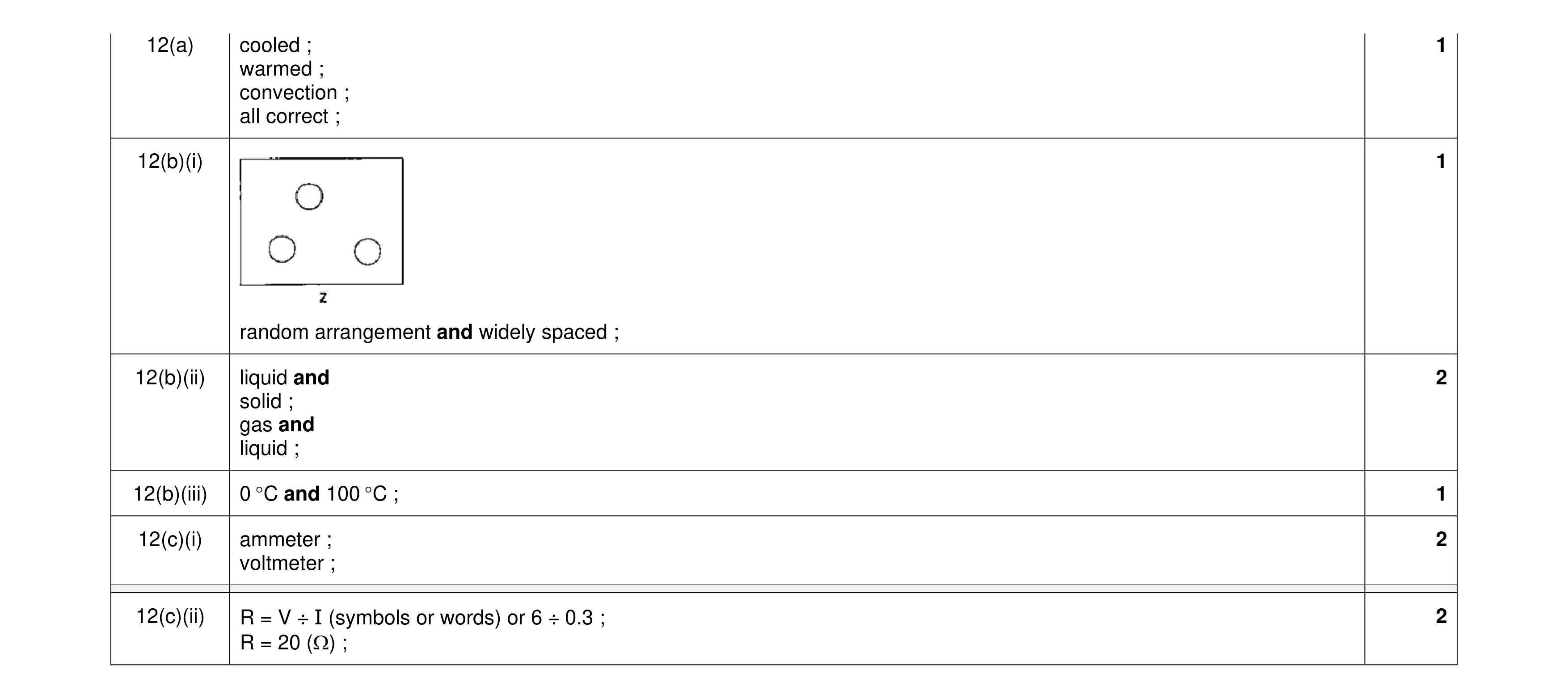 9
9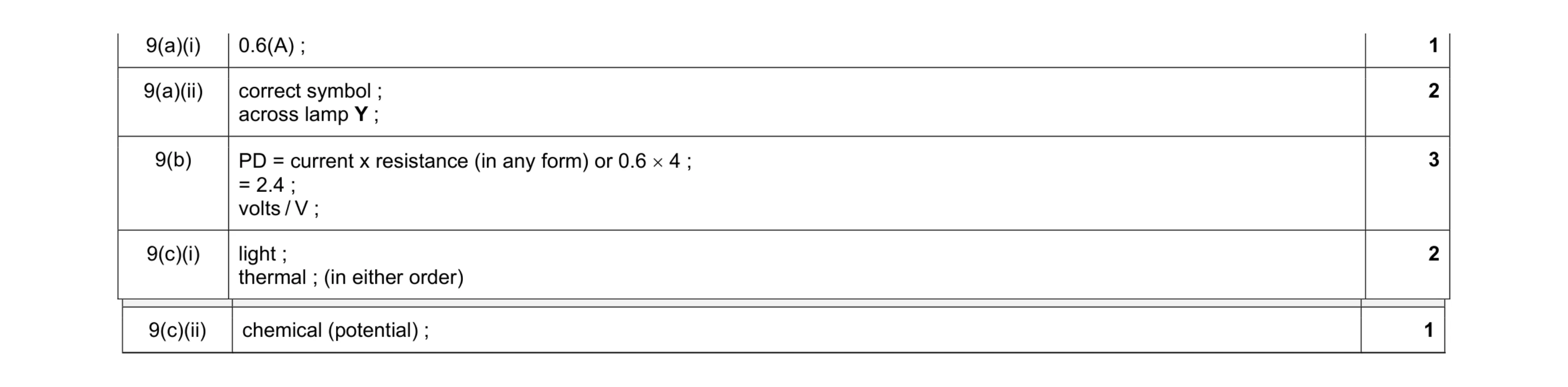 9
9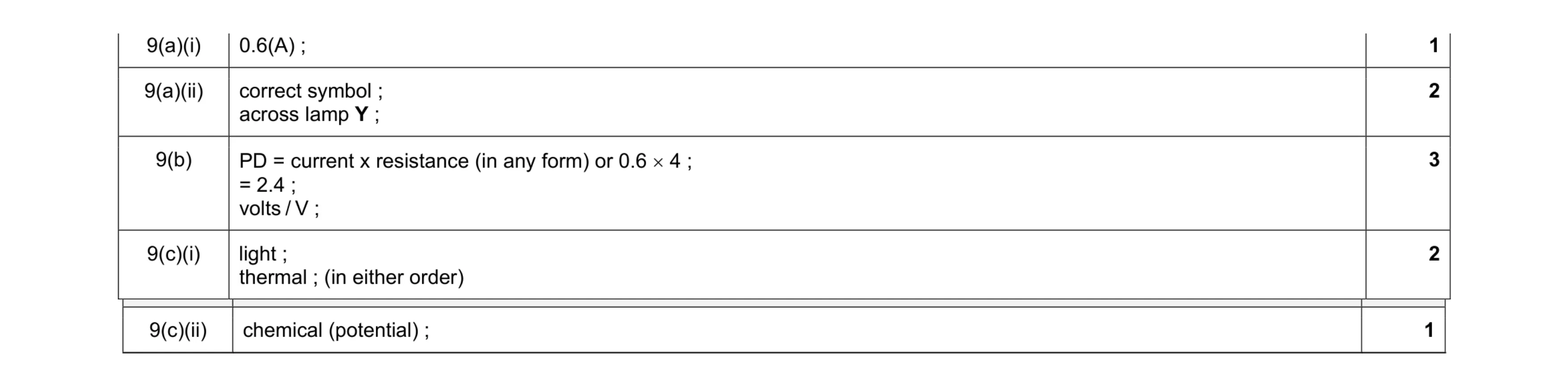 9
9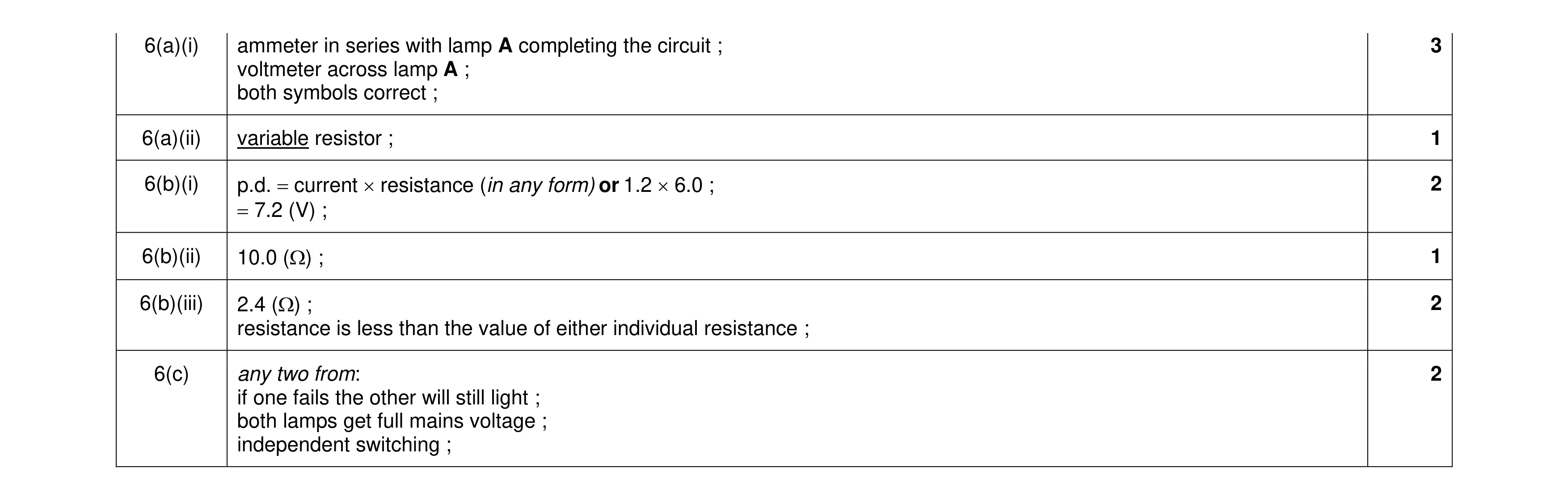 11
11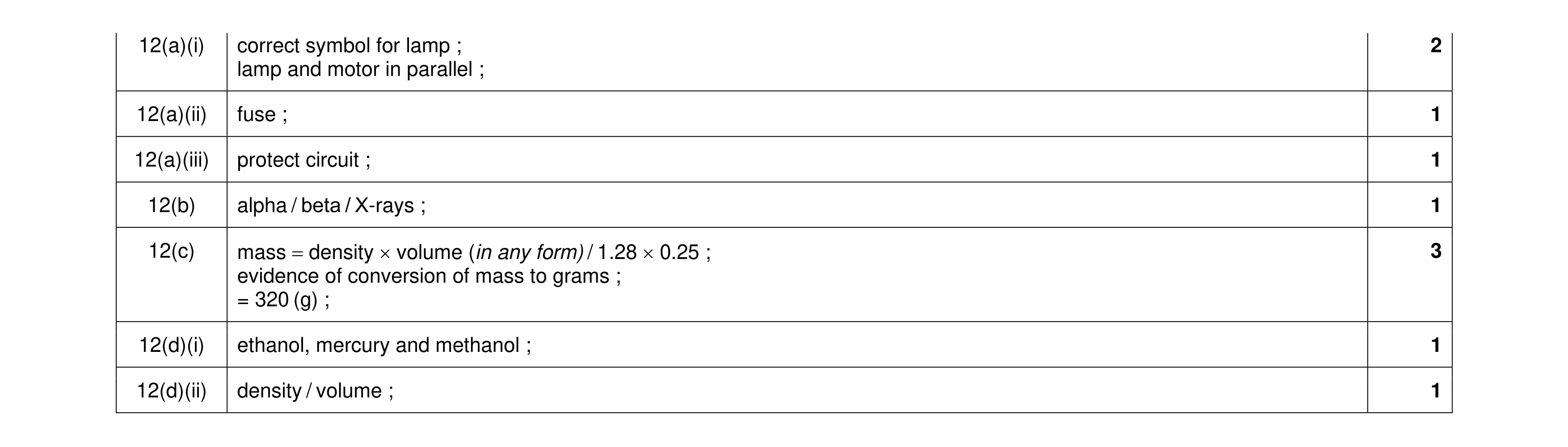 10
10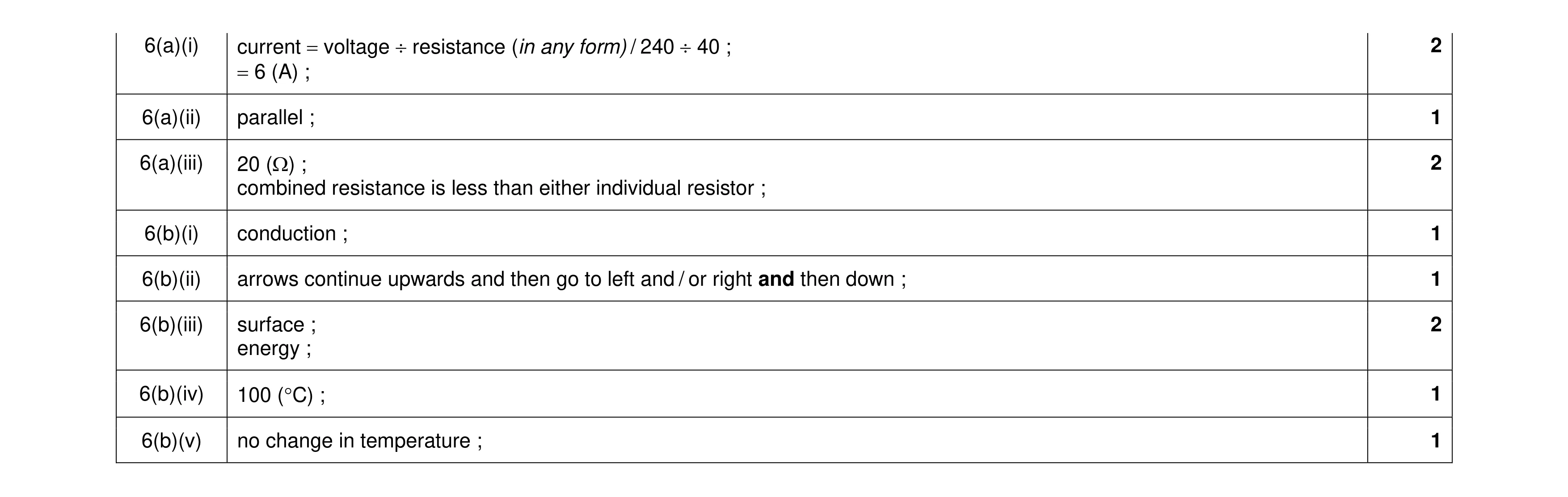 11
11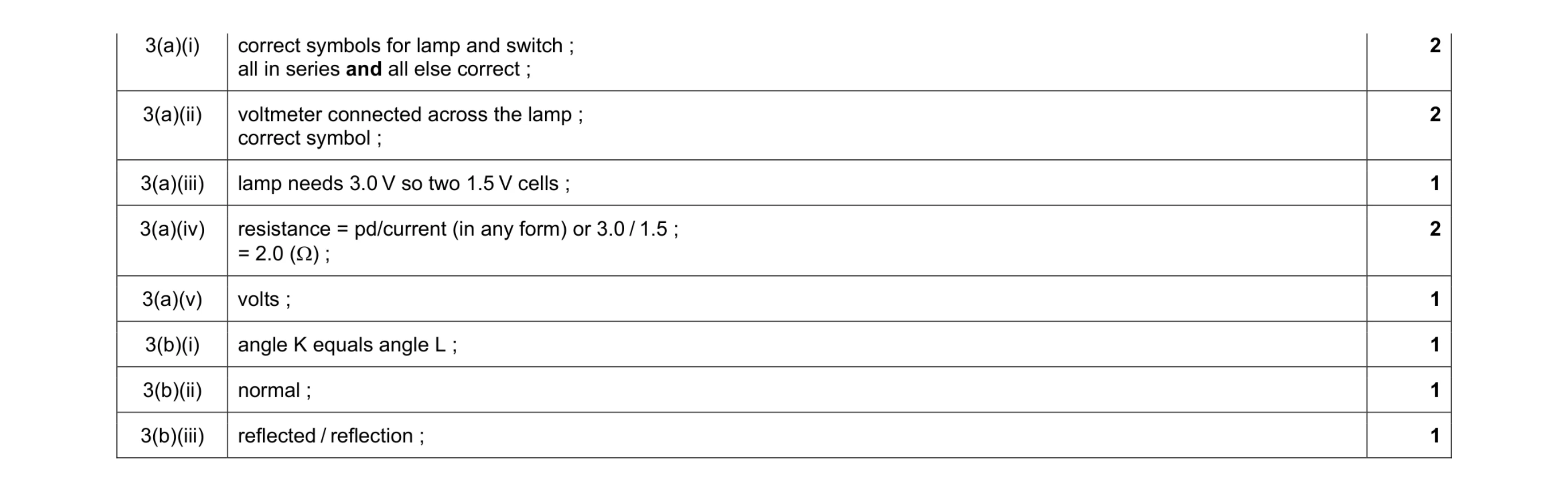 11
11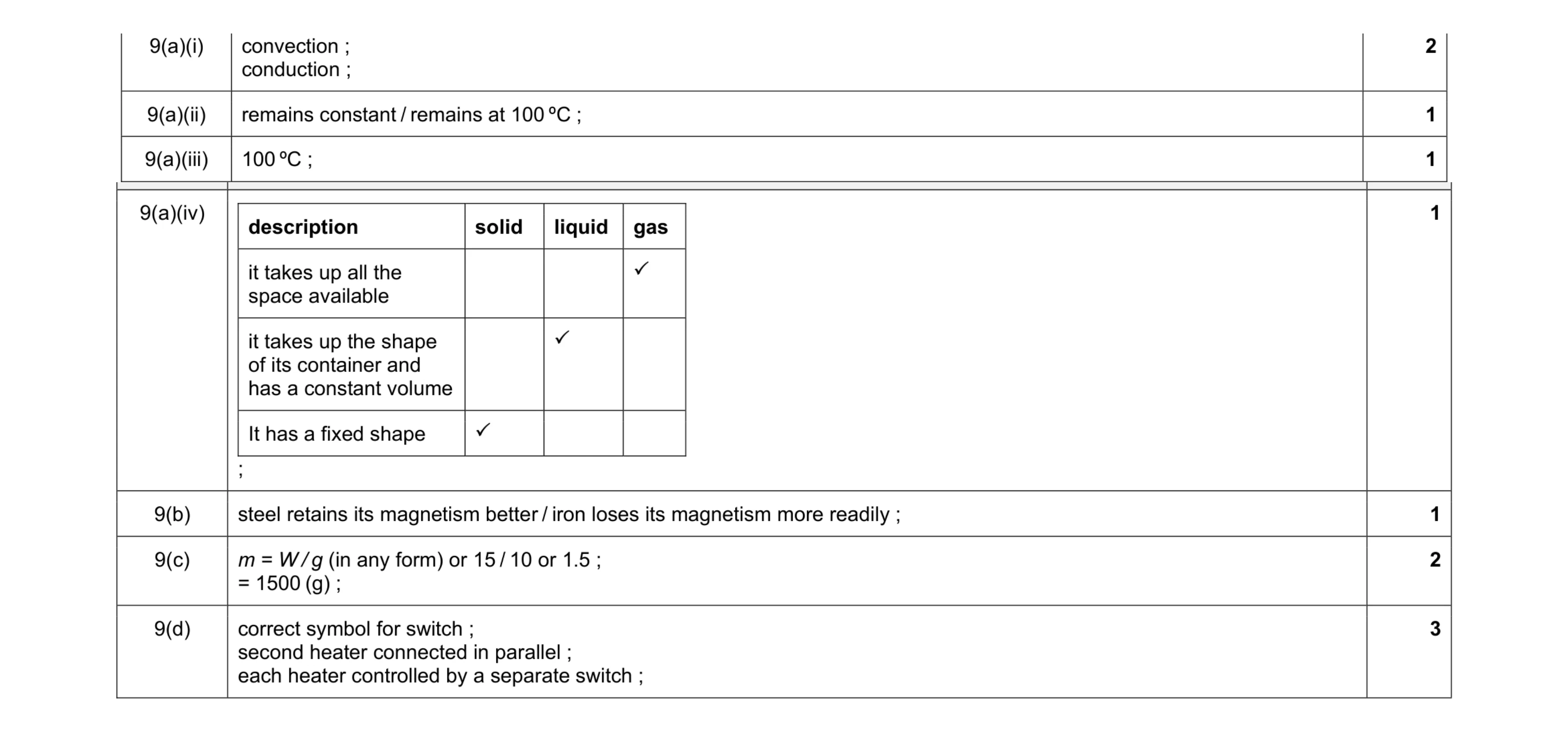 11
11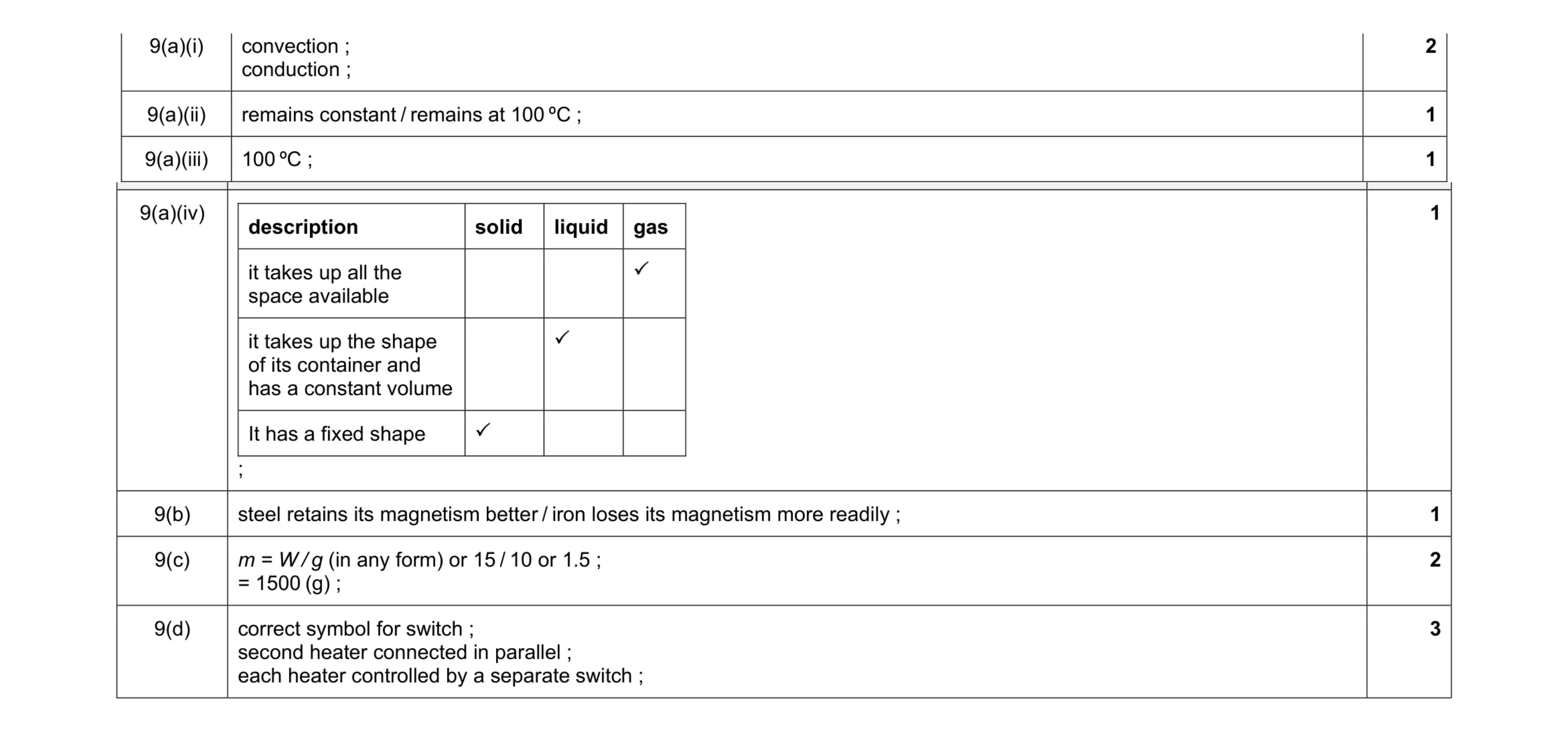 11
11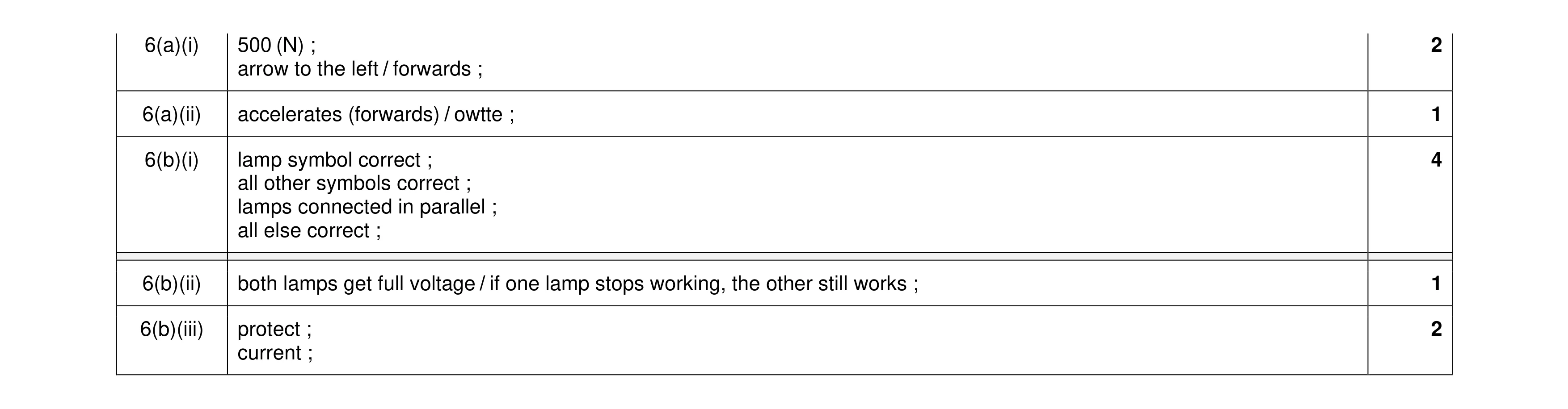 10
10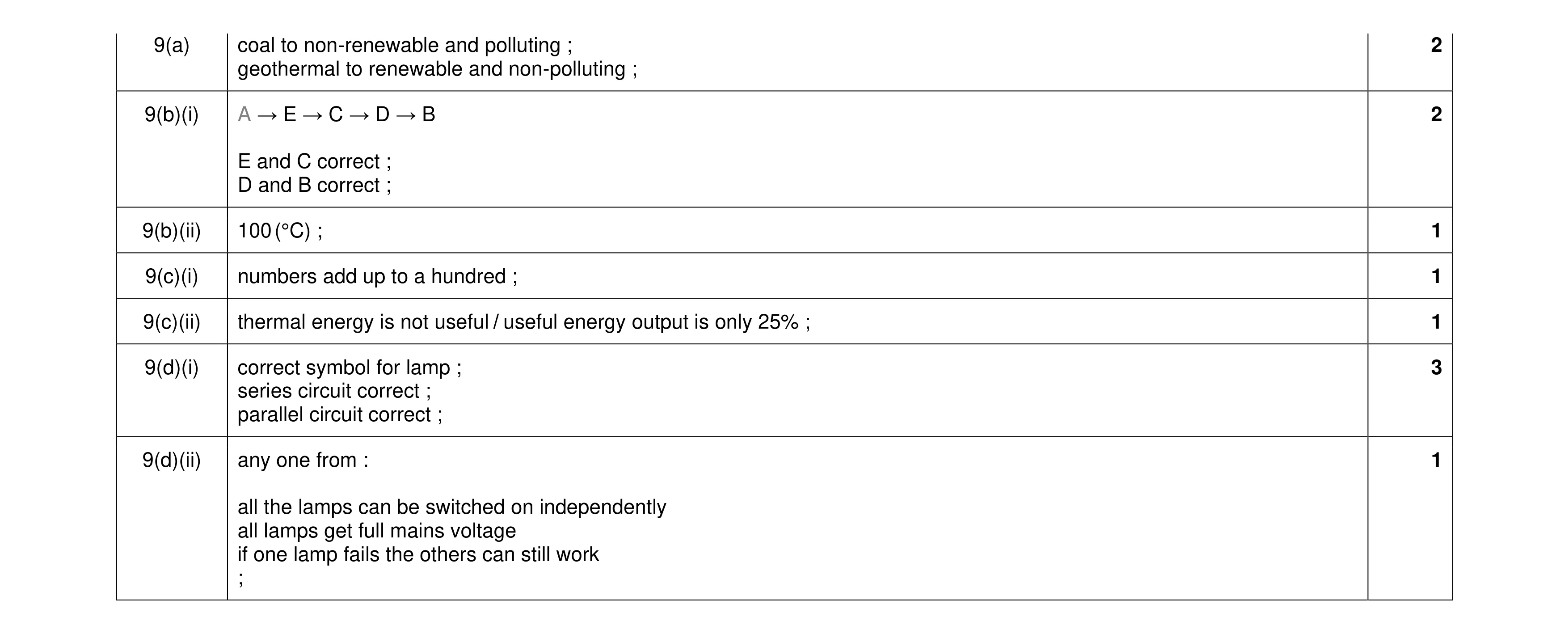 11
11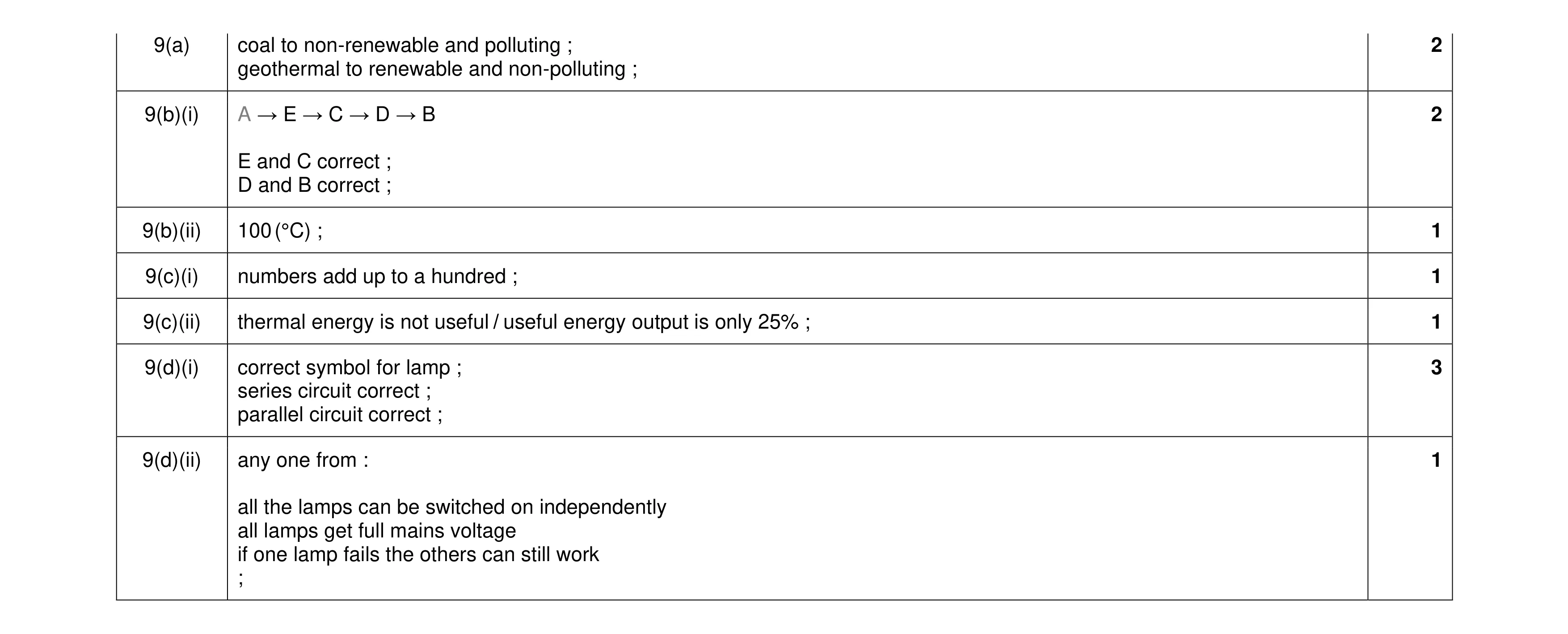 11
11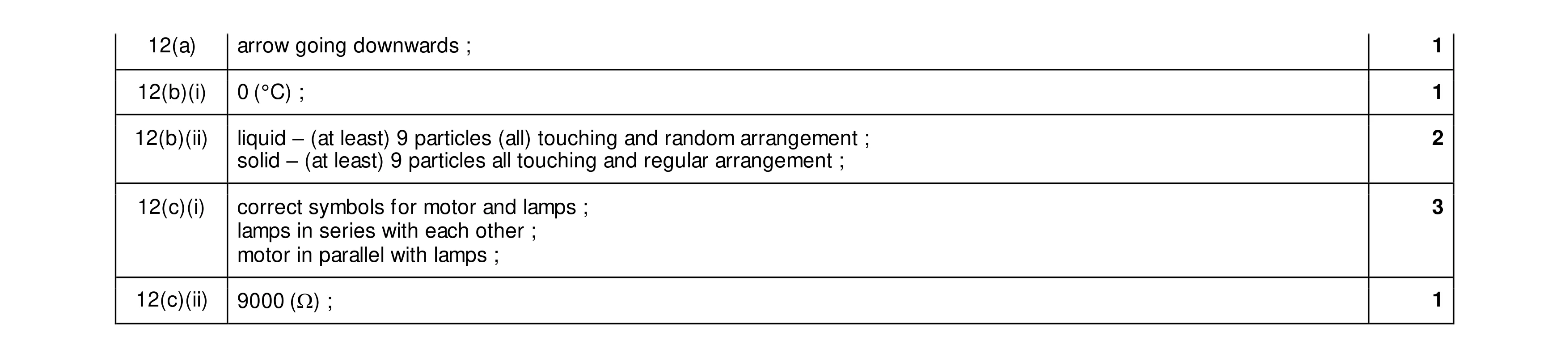 8
8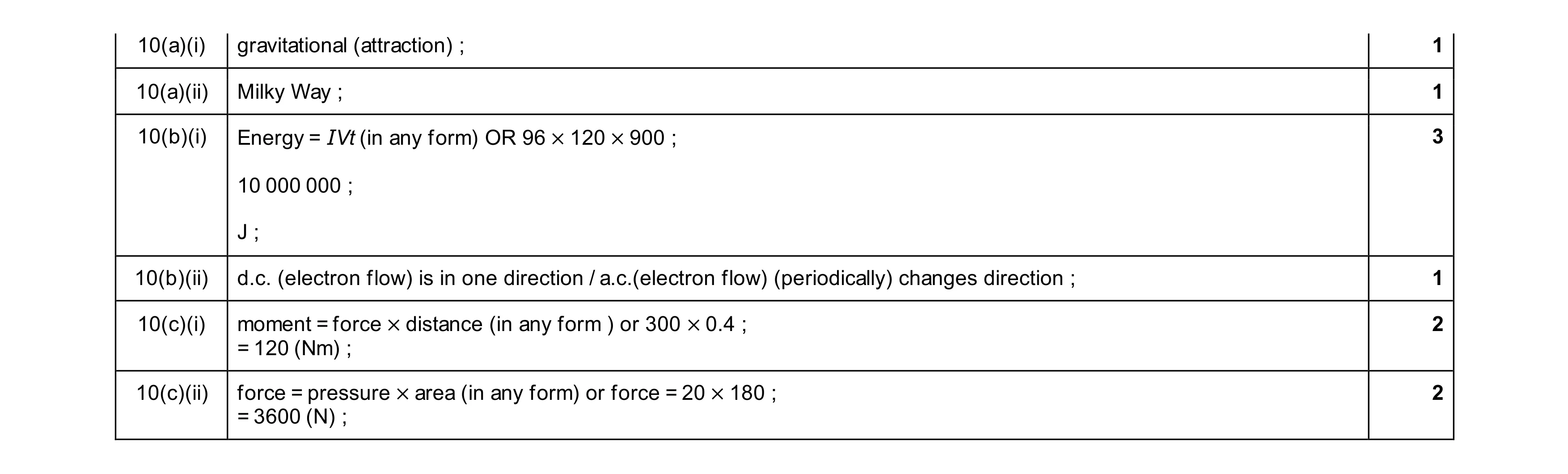 10
10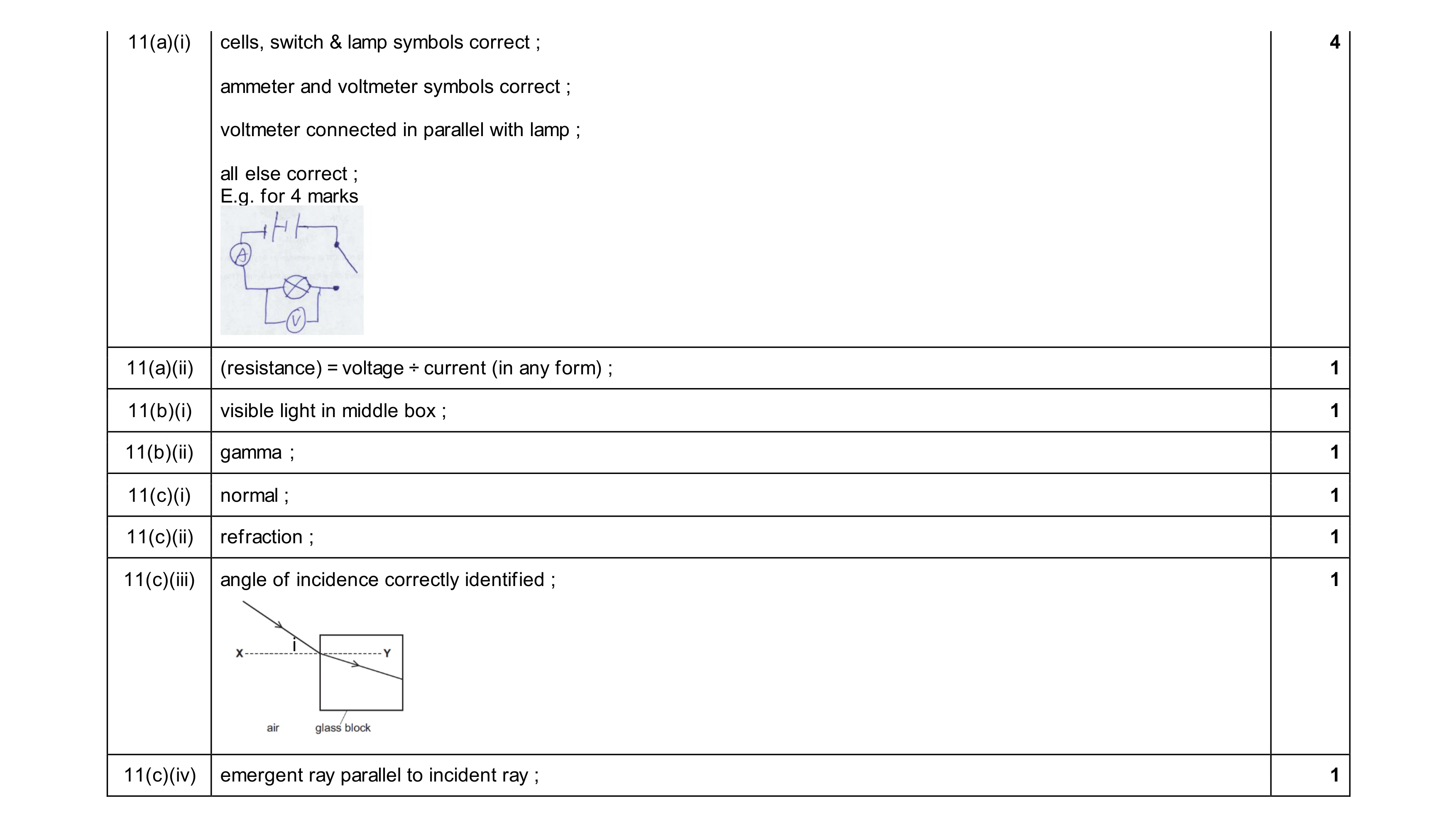 11
11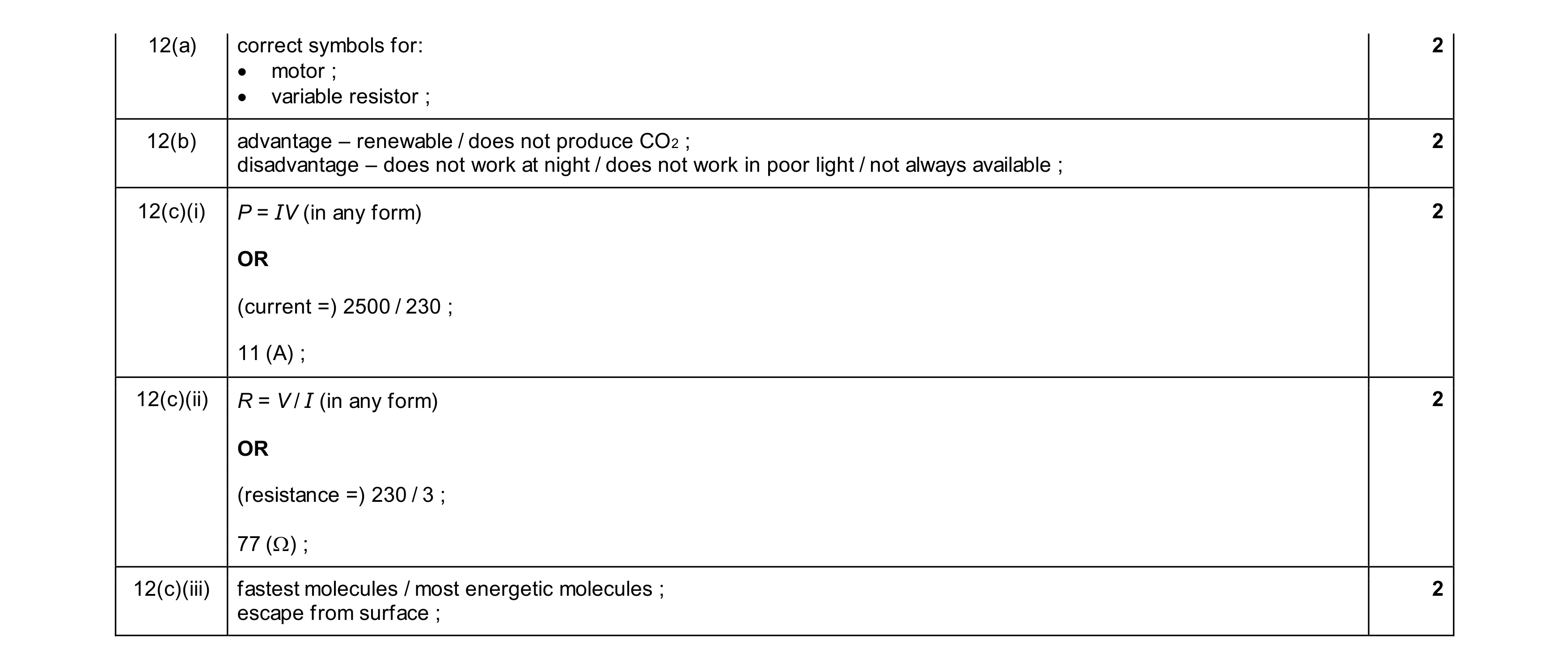 10
10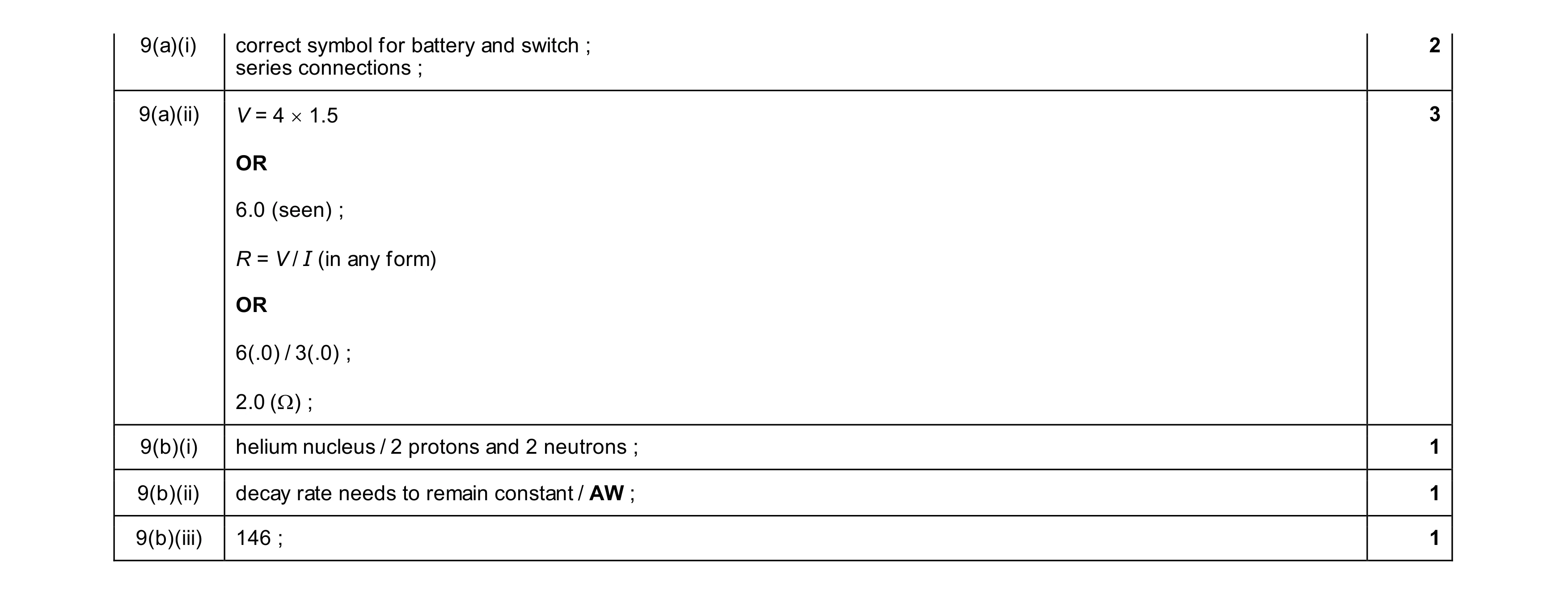 8
8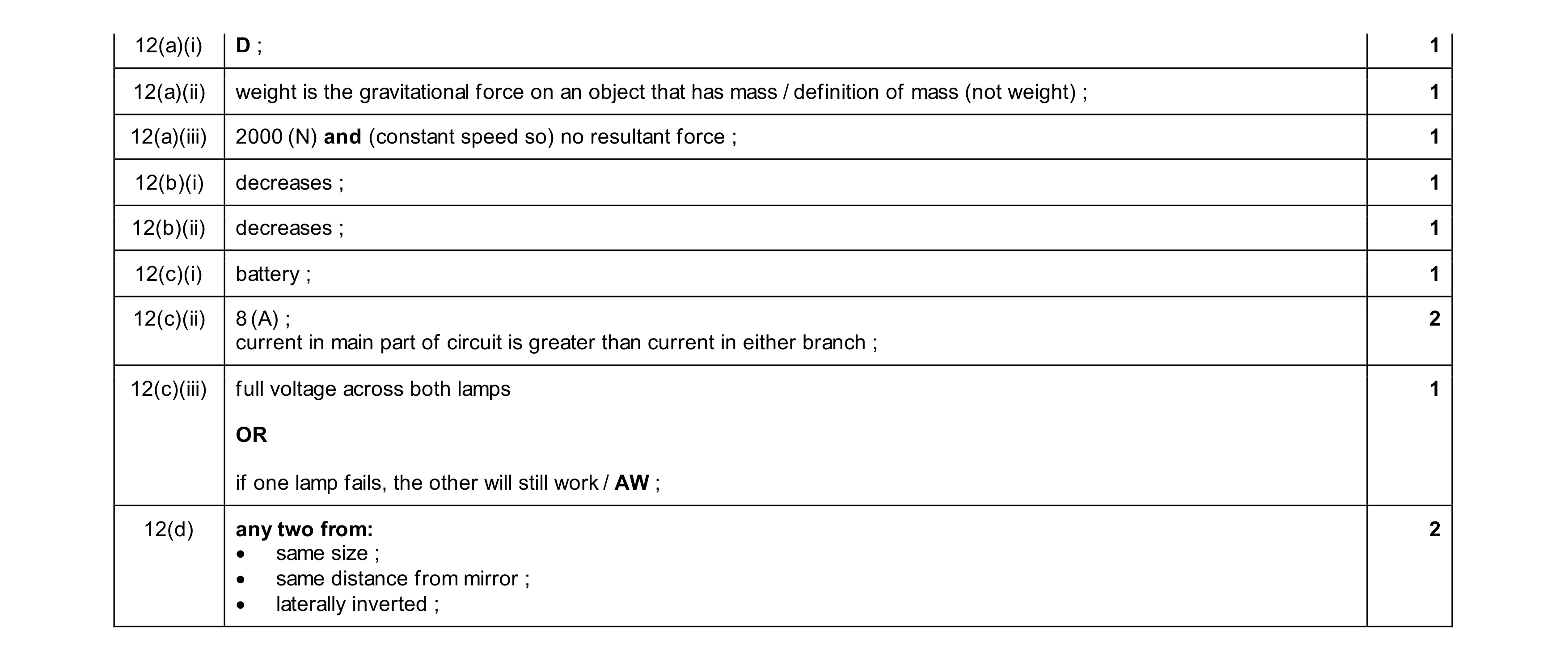 11
11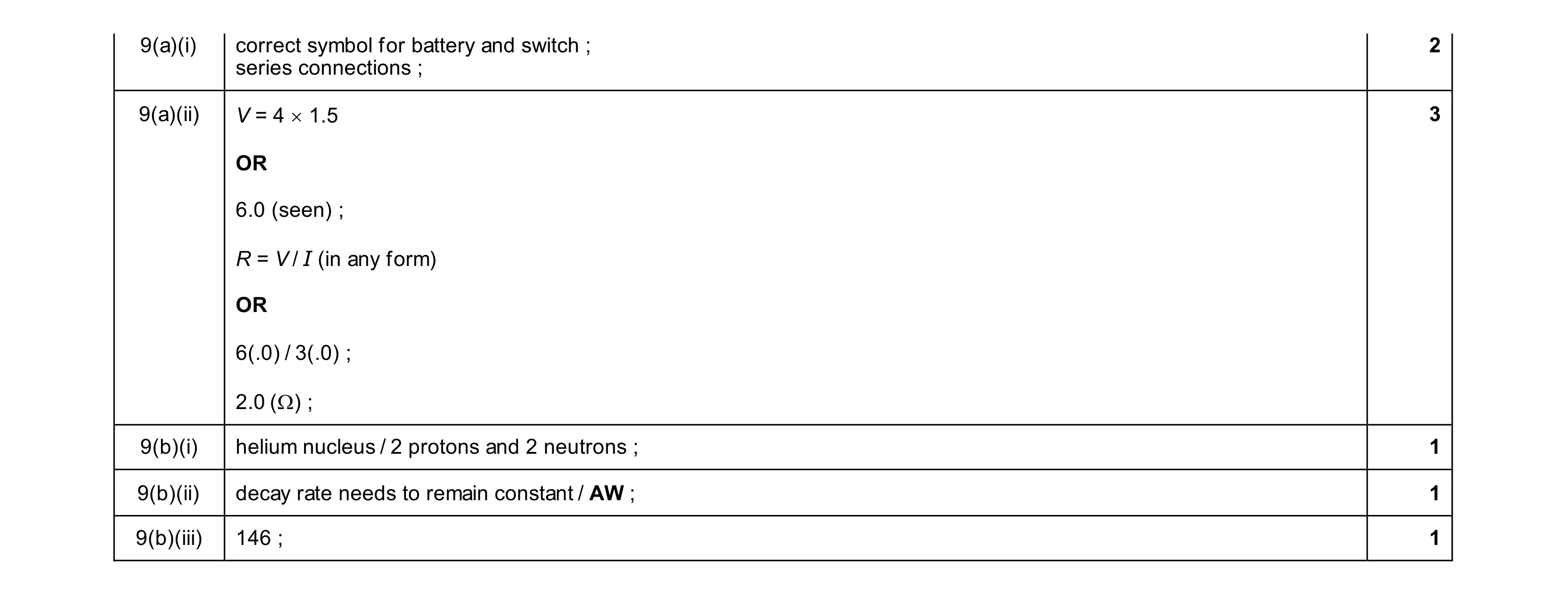 8
8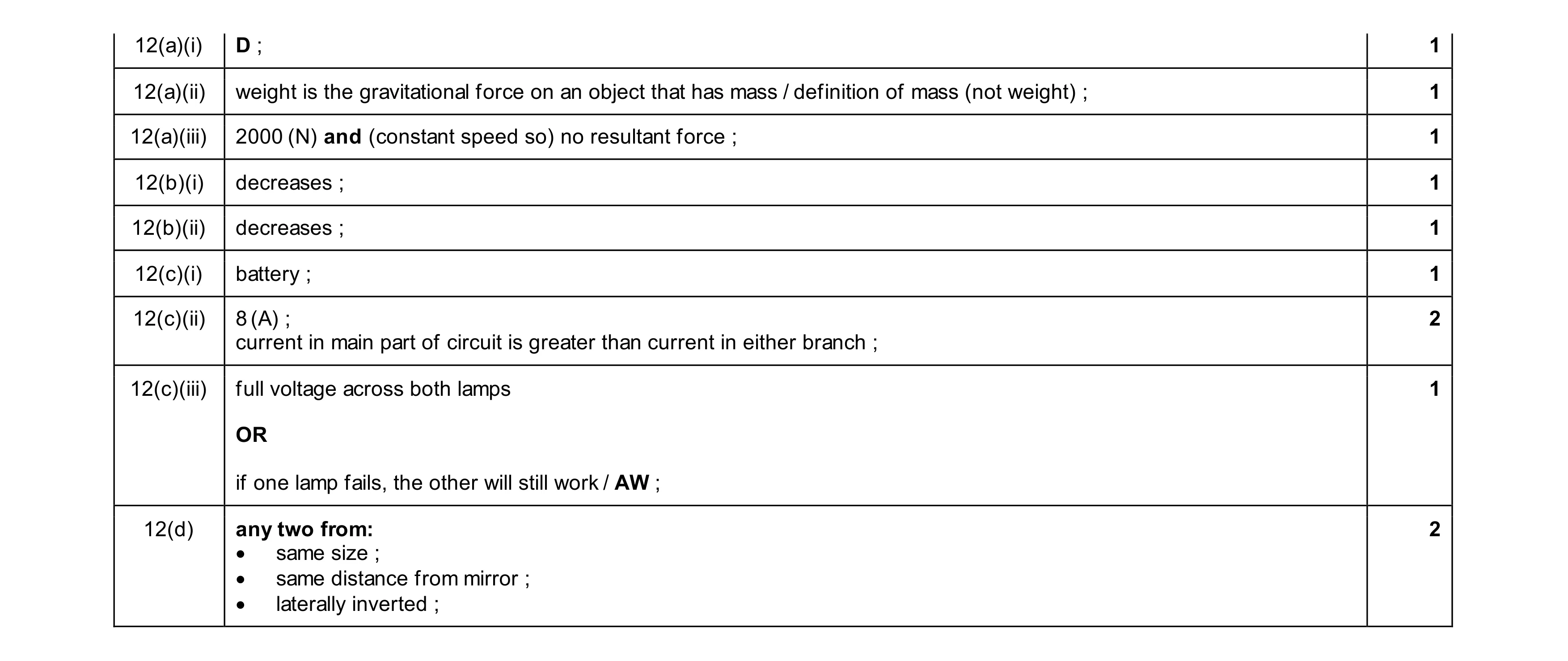 11
11