Questions as text
Q1 · Nitrogen combines with different elements to make ammonia and nitrogen oxides 0654/41 May/June 2017
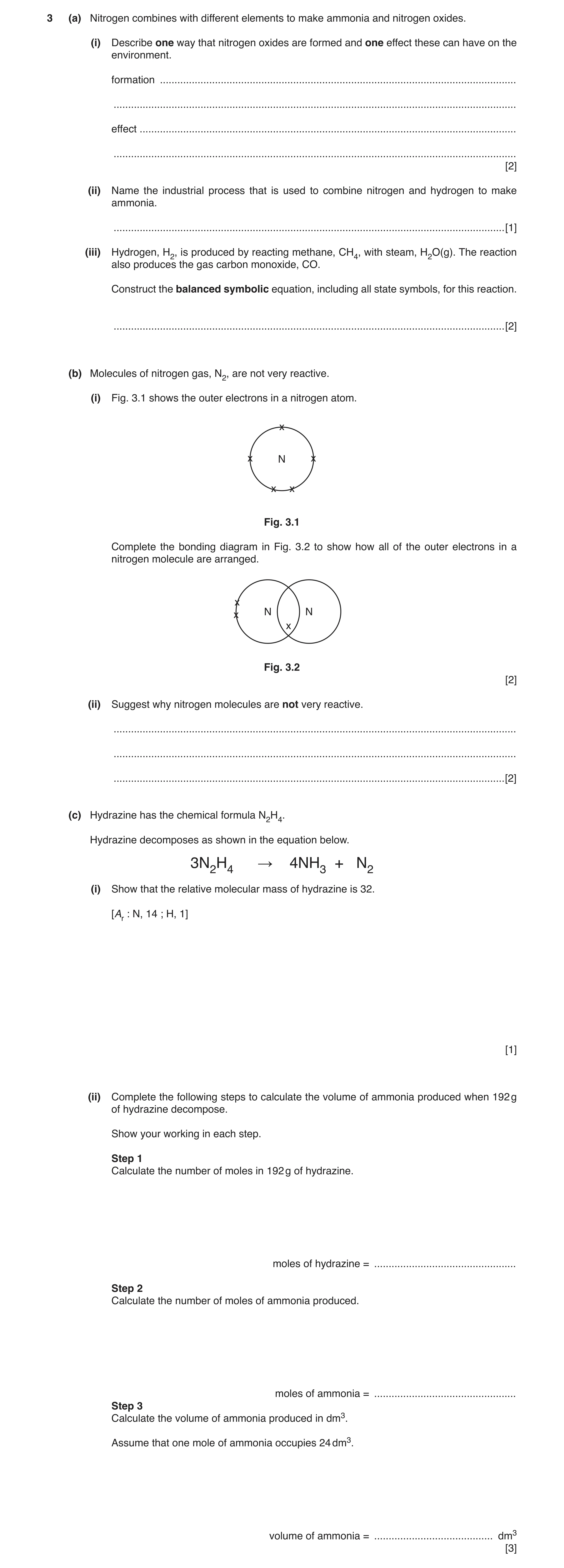
3 (a) Nitrogen combines with different elements to make ammonia and nitrogen oxides. (i) Describe one way that nitrogen oxides are formed and one effect these can have on the environment. formation … … effect … … [2] (ii) Name the industrial process that is used to combine nitrogen and hydrogen to make ammonia. … [1] (iii) Hydrogen, H2, is produced by reacting methane, CH4, with steam, H2O(g). The reaction also produces the gas carbon monoxide, CO. Construct the balanced symbolic equation, including all state symbols, for this reaction. … [2] (b) Molecules of nitrogen gas, N2, are not very reactive. (i) Fig. 3.1 shows the outer electrons in a nitrogen atom. x x N x x x Fig. 3.1 Complete the bonding diagram in Fig. 3.2 to show how all of the outer electrons in a nitrogen molecule are arranged. x x N N x Fig. 3.2 [2] (ii) Suggest why nitrogen molecules are not very reactive. … … … [2] (c) Hydrazine has the chemical formula N2H4. Hydrazine decomposes as shown in the equation below. 3N2H4 → 4NH3 + N2 (i) Show that the relative molecular mass of hydrazine is 32. [Ar : N, 14 ; H, 1] [1] (ii) Complete the following steps to calculate the volume of ammonia produced when 192 g of hydrazine decompose. Show your working in each step. Step 1 Calculate the number of moles in 192 g of hydrazine. moles of hydrazine = … Step 2 Calculate the number of moles of ammonia produced. moles of ammonia = … Step 3 Calculate the volume of ammonia produced in dm3. Assume that one mole of ammonia occupies 24 dm3. volume of ammonia = … dm3 [3]
13 marks
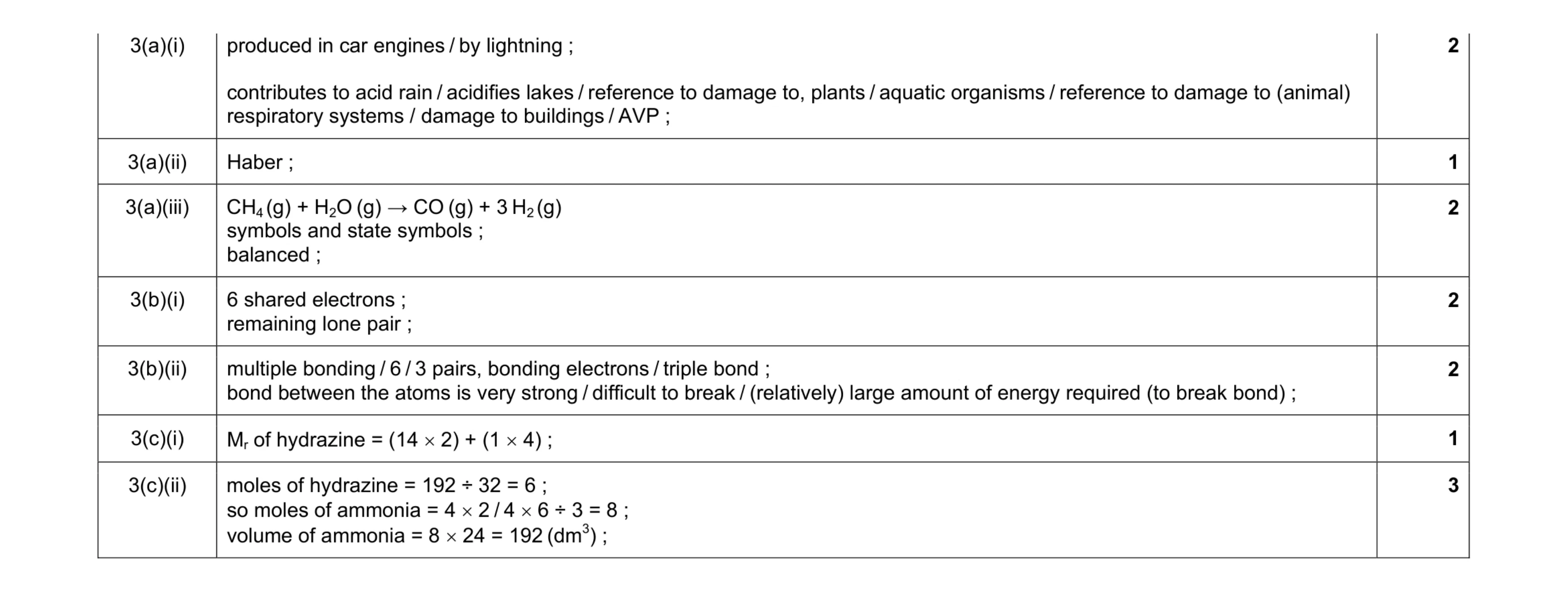
Mark scheme: 3(a)(i) produced in car engines / by lightning ; contributes to acid rain / acidifies lakes / reference to damage to, plants / aquatic organisms / reference to damage to (animal) respiratory systems / damage to buildings / AVP ; 2 3(a)(ii) Haber ; 1 3(a)(iii) CH4 (g) + H2O (g) → CO (g) + 3 H2 (g) symbols and state symbols ; balanced ; 2 3(b)(i) 6 shared electrons ; remaining lone pair ; 2 3(b)(ii) multiple bonding / 6 / 3 pairs, bonding electrons / triple bond ; bond between the atoms is very strong / difficult to break / (relatively) large amount of energy required (to break bond) ; 2 3(c)(i) Mr of hydrazine = (14 × 2) + (1 × 4) ; 1 3(c)(ii) moles of hydrazine = 192 ÷ 32 = 6 ; so moles of ammonia = 4 × 2 / 4 × 6 ÷ 3 = 8 ; volume of ammonia = 8 × 24 = 192 (dm3) ; 3
This question in 0654/41 May/June 2017
Q2 · Electrolysis occurs when an electric current passes through an electrolyte 0654/42 May/June 2017
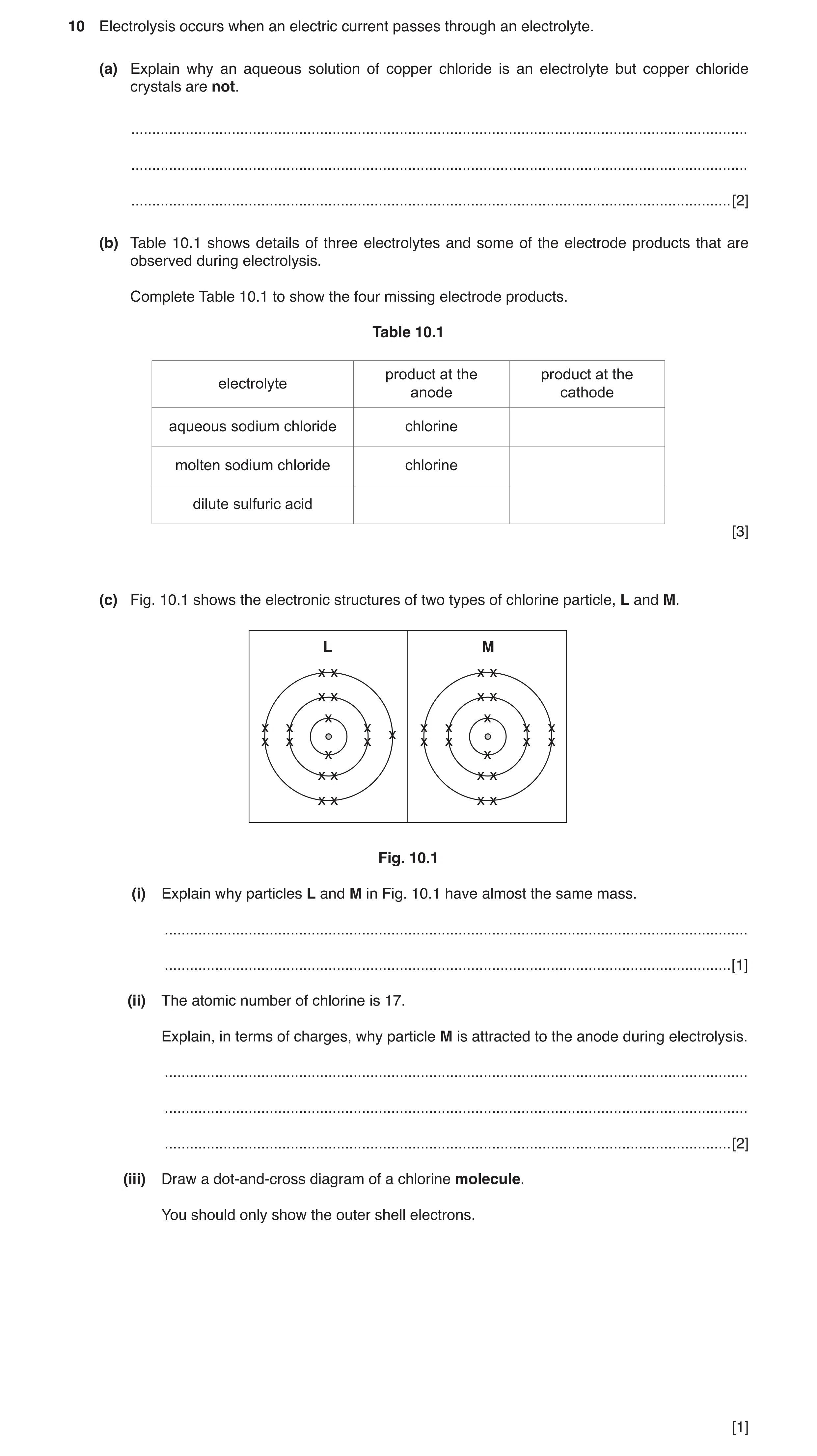
10 Electrolysis occurs when an electric current passes through an electrolyte. (a) Explain why an aqueous solution of copper chloride is an electrolyte but copper chloride crystals are not. … … … [2] (b) Table 10.1 shows details of three electrolytes and some of the electrode products that are observed during electrolysis. Complete Table 10.1 to show the four missing electrode products. Table 10.1 product at the product at the electrolyte anode cathode aqueous sodium chloride chlorine molten sodium chloride chlorine dilute sulfuric acid [3] (c) Fig. 10.1 shows the electronic structures of two types of chlorine particle, L and M. L M x x x x x x x x x x x x x x x x x x x x x x x x x x x x x x x x x x x Fig. 10.1 (i) Explain why particles L and M in Fig. 10.1 have almost the same mass. … … [1] (ii) The atomic number of chlorine is 17. Explain, in terms of charges, why particle M is attracted to the anode during electrolysis. … … … [2] (iii) Draw a dot-and-cross diagram of a chlorine molecule. You should only show the outer shell electrons. [1]
9 marks
Mark scheme: 10(a) mobile ions, carry charge / produce a current ; ions, are fixed / aren’t mobile, in a crystal ; 2 10(b) anode product cathode product sodium chloride aqueous chlorine hydrogen ; sodium chloride molten chlorine sodium ; sulfuric acid aqueous oxygen hydrogen ; 3 10(c)(i) idea that there is only an electron difference / electrons have, no / negligible, mass ; 1 10(c)(ii) chloride / particle M, has a negative charge / more electrons than protons ; so is attracted to the positive anode / idea that opposite charges attract ; 2 10(c)(iii) one shared pair and all non-bonding electrons shown ; 1
This question in 0654/42 May/June 2017
Q3 · Petroleum is a liquid fossil fuel that is a mixture containing many different hydrocarbons 0654/41 Oct/Nov 2017
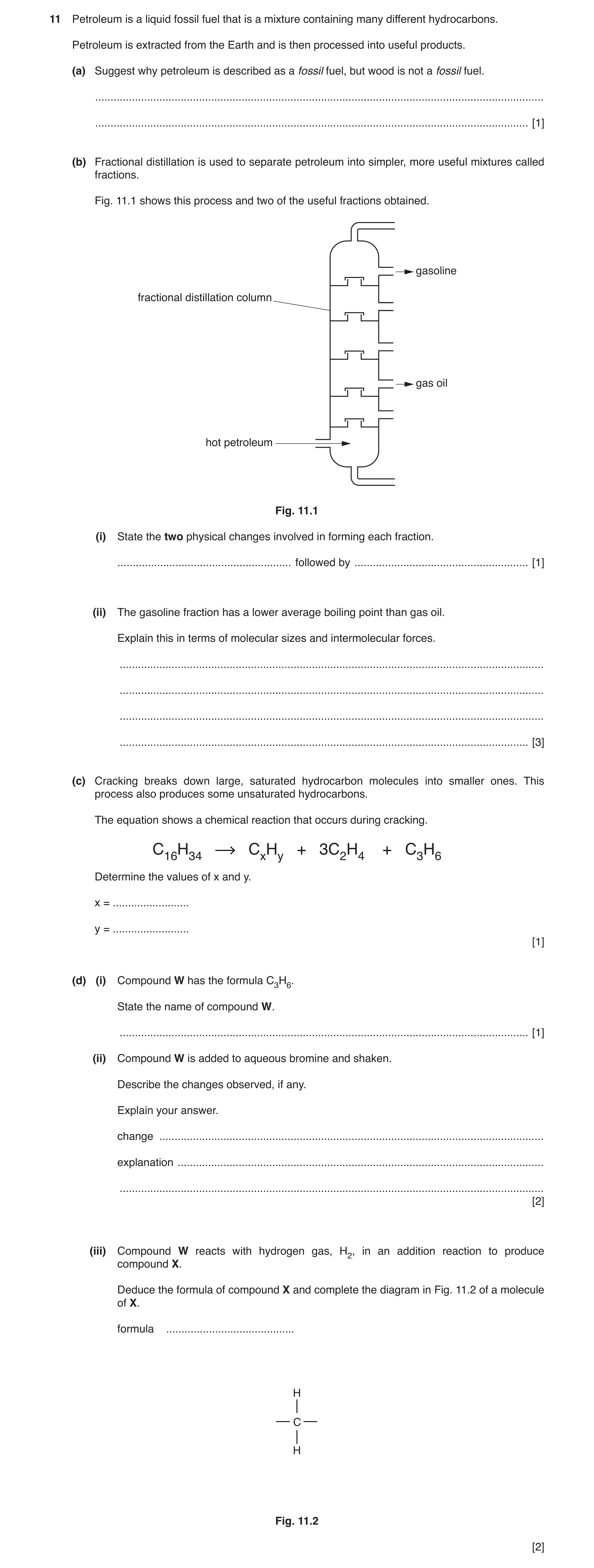
11 Petroleum is a liquid fossil fuel that is a mixture containing many different hydrocarbons. Petroleum is extracted from the Earth and is then processed into useful products. (a) Suggest why petroleum is described as a fossil fuel, but wood is not a fossil fuel. … … [1] (b) Fractional distillation is used to separate petroleum into simpler, more useful mixtures called fractions. Fig. 11.1 shows this process and two of the useful fractions obtained. gasoline fractional distillation column gas oil hot petroleum Fig. 11.1 (i) State the two physical changes involved in forming each fraction. … followed by … [1] (ii) The gasoline fraction has a lower average boiling point than gas oil. Explain this in terms of molecular sizes and intermolecular forces. … … … … [3] (c) Cracking breaks down large, saturated hydrocarbon molecules into smaller ones. This process also produces some unsaturated hydrocarbons. The equation shows a chemical reaction that occurs during cracking. C16H34 CxHy + 3C2H4 + C3H6 Determine the values of x and y. x = … y = … [1] (d) (i) Compound W has the formula C3H6. State the name of compound W. … [1] (ii) Compound W is added to aqueous bromine and shaken. Describe the changes observed, if any. Explain your answer. change … explanation … … [2] (iii) Compound W reacts with hydrogen gas, H2, in an addition reaction to produce compound X. Deduce the formula of compound X and complete the diagram in Fig. 11.2 of a molecule of X. formula … H C H Fig. 11.2 [2]
11 marks
Mark scheme: 11(a) reference to long time required to form fossil fuels / AVP ; 1 11(b)(i) evaporation followed by condensation ; 1 11(b)(ii) (average) size / surface area of molecules in gasoline is lower ; intermolecular forces / forces between molecules are lower ; lower (thermal) energy / lower temperature required to separate molecules / overcome forces ; 3 11(c) x = 7 and y = 16 ; 1 11(d) propene ; 1 11(d)(ii) bromine decolourised / orange to colourless ; propene is an alkene / is unsaturated / double bond ; 2 11(d)(iii) C3H8 ; same number of C and H as in formula and correctly bonded ; 2
This question in 0654/41 Oct/Nov 2017
Q4 · The numbers of neutrons and the electronic structures in atoms of four elements W, X, Y… 0654/43 Oct/Nov 2017
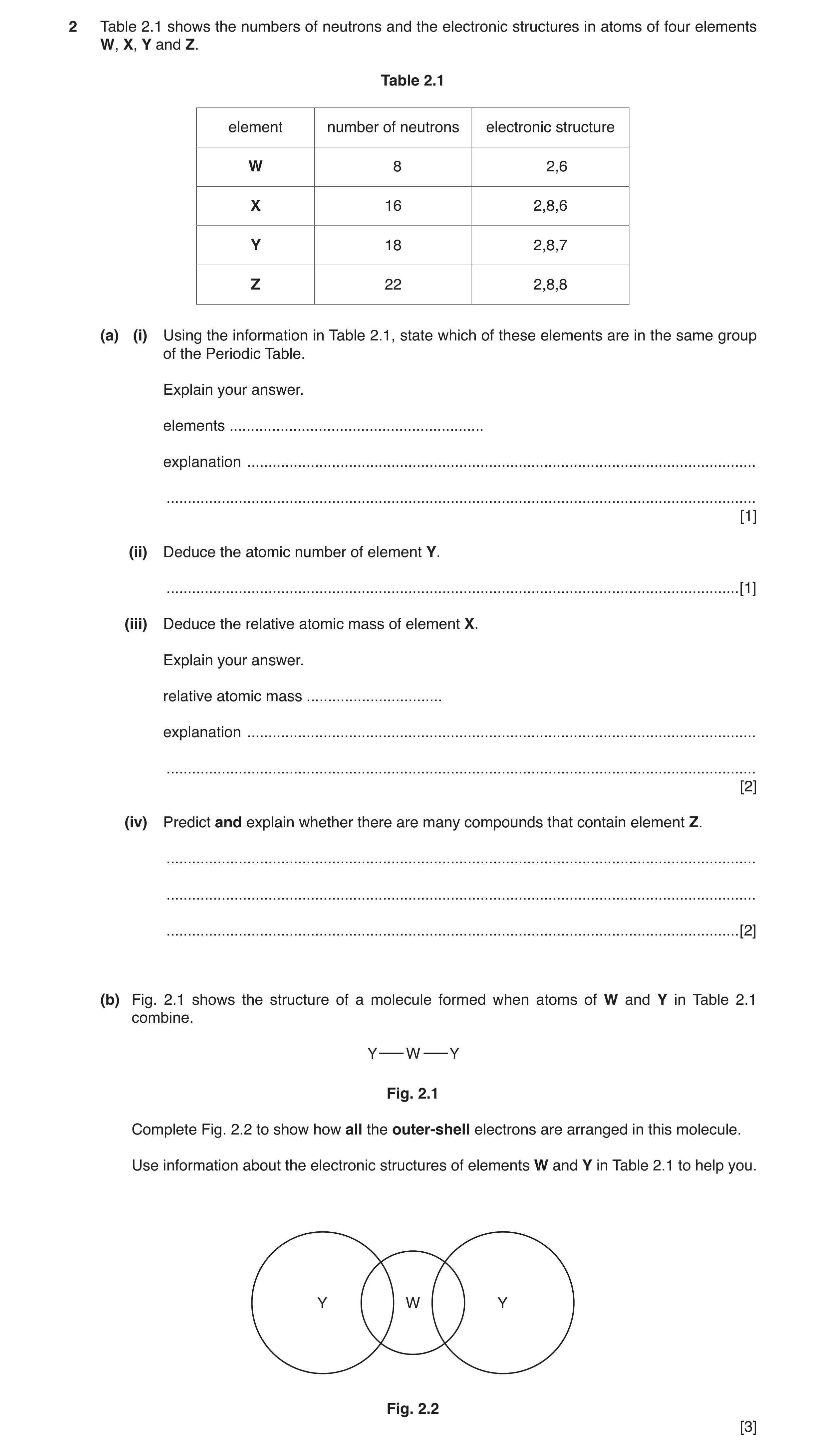
2 Table 2.1 shows the numbers of neutrons and the electronic structures in atoms of four elements W, X, Y and Z. Table 2.1 element number of neutrons electronic structure W 8 2,6 X 16 2,8,6 Y 18 2,8,7 Z 22 2,8,8 (a) (i) Using the information in Table 2.1, state which of these elements are in the same group of the Periodic Table. Explain your answer. elements … explanation … … [1] (ii) Deduce the atomic number of element Y. … [1] (iii) Deduce the relative atomic mass of element X. Explain your answer. relative atomic mass … explanation … … [2] (iv) Predict and explain whether there are many compounds that contain element Z. … … … [2] (b) Fig. 2.1 shows the structure of a molecule formed when atoms of W and Y in Table 2.1 combine. Y W Y Fig. 2.1 Complete Fig. 2.2 to show how all the outer-shell electrons are arranged in this molecule. Use information about the electronic structures of elements W and Y in Table 2.1 to help you. Y W Y Fig. 2.2 [3]
9 marks
Mark scheme: 2(a)(i) W and X AND same outer electron number ; 1 2(a)(ii) 17 ; 1 2(a)(iii) 32 ; number of electrons = number of protons / relative atomic mass OR mass number = protons + neutrons / 16 + 16 / it is S ; 2 2(a)(iv) (no) Z has a complete outer shell ; so atoms are stable / inert / do not react / do not form chemical bonds / noble gas ; 2 2(b) two shared pairs showing the covalent bonds ; four non-bonding electrons on W ; six non-bonding electrons on both Y atoms ; 3
This question in 0654/43 Oct/Nov 2017
Question 5 0654/41 Oct/Nov 2018
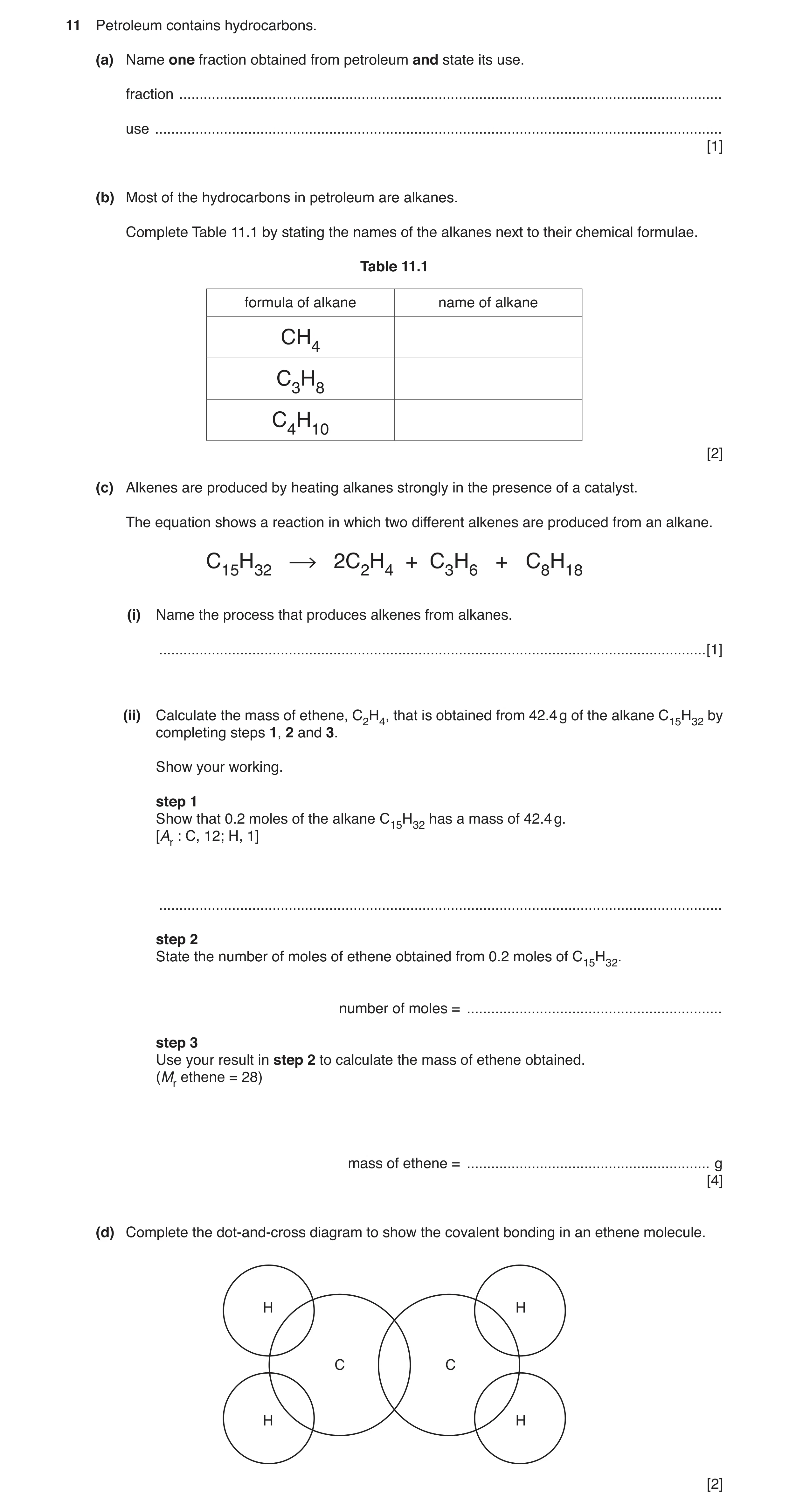
11 Petroleum contains hydrocarbons. (a) Name one fraction obtained from petroleum and state its use. fraction … use … [1] (b) Most of the hydrocarbons in petroleum are alkanes. Complete Table 11.1 by stating the names of the alkanes next to their chemical formulae. Table 11.1 formula of alkane name of alkane CH4 C3H8 C4H10 [2] (c) Alkenes are produced by heating alkanes strongly in the presence of a catalyst. The equation shows a reaction in which two different alkenes are produced from an alkane. C15H32 2C2H4 + C3H6 + C8H18 (i) Name the process that produces alkenes from alkanes. … [1] (ii) Calculate the mass of ethene, C2H4, that is obtained from 42.4 g of the alkane C15H32 by completing steps 1, 2 and 3. Show your working. step 1 Show that 0.2 moles of the alkane C15H32 has a mass of 42.4 g. [Ar : C, 12; H, 1] … step 2 State the number of moles of ethene obtained from 0.2 moles of C15H32. number of moles = … step 3 Use your result in step 2 to calculate the mass of ethene obtained. (Mr ethene = 28) mass of ethene = … g [4] (d) Complete the dot-and-cross diagram to show the covalent bonding in an ethene molecule. H H C C H H [2]
10 marks
Mark scheme: 11(a) refinery gas / gasoline / diesel / gas oil for fuel ; 1 11(b) methane propane butane 2 correct ; 3 correct ; 2 11(c)(i) (catalytic / thermal) cracking ; 1 11(c)(ii) step 1 calculate Mr (12 × 15) + (1 × 32) OR 212 ; moles = 42.4 ÷ 212 (= 0.2) / 0.2 × 212 (= 42.4) ; step 2 0.2 × 2 OR 0.4 ; step 3 0.4 × 28 = 1.2 (g) ; 4 11(d) two shared pairs between carbons ; four shared pairs between carbon and hydrogens ; 2
This question in 0654/41 Oct/Nov 2018
Q6 · Sulfur is found in compounds and as an element 0654/43 Oct/Nov 2018
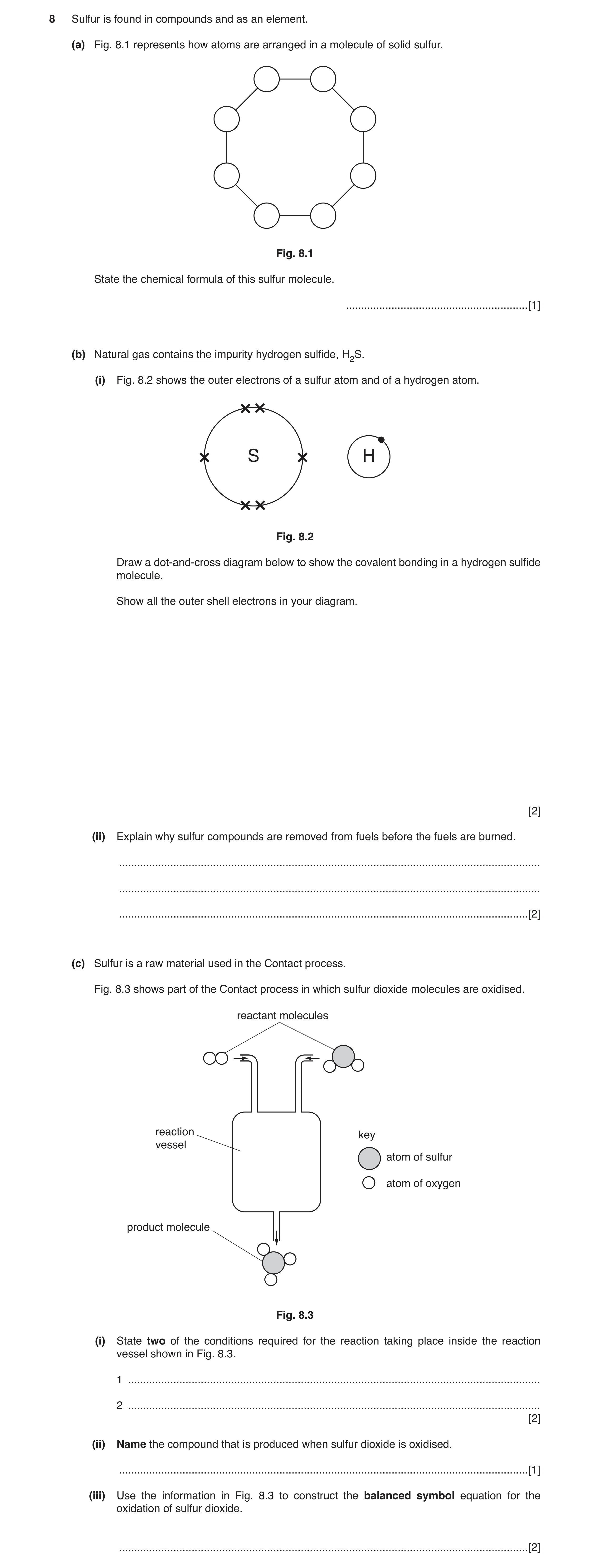
8 Sulfur is found in compounds and as an element. (a) Fig. 8.1 represents how atoms are arranged in a molecule of solid sulfur. Fig. 8.1 State the chemical formula of this sulfur molecule. … [1] (b) Natural gas contains the impurity hydrogen sulfide, H2S. (i) Fig. 8.2 shows the outer electrons of a sulfur atom and of a hydrogen atom. S H Fig. 8.2 Draw a dot-and-cross diagram below to show the covalent bonding in a hydrogen sulfide molecule. Show all the outer shell electrons in your diagram. [2] (ii) Explain why sulfur compounds are removed from fuels before the fuels are burned. … … … [2] (c) Sulfur is a raw material used in the Contact process. Fig. 8.3 shows part of the Contact process in which sulfur dioxide molecules are oxidised. reactant molecules reaction key vessel atom of sulfur atom of oxygen product molecule Fig. 8.3 (i) State two of the conditions required for the reaction taking place inside the reaction vessel shown in Fig. 8.3. 1 … 2 … [2] (ii) Name the compound that is produced when sulfur dioxide is oxidised. … [1] (iii) Use the information in Fig. 8.3 to construct the balanced symbol equation for the oxidation of sulfur dioxide. … [2]
10 marks
Mark scheme: 8(a) S8 ; 1 8(b)(i) two shared pairs ; four lone electrons on sulfur only ; 2 8(b)(ii) avoids formation of sulfur dioxide / SO2 ; reference to acid rain ; 2 8(c)(i) high / moderate temperature / (400–450 °C ) ; pressure between 1 and 2 atmospheres ; catalyst (of vanadium pentoxide) ; max 2 8(c)(ii) sulfur trioxide ; 1 8(c)(iii) 2SO2 + O2 → 2SO3 formulae ; balancing ; 2
This question in 0654/43 Oct/Nov 2018
Q7 · A pie chart which shows the composition of clean air 0654/41 Oct/Nov 2019
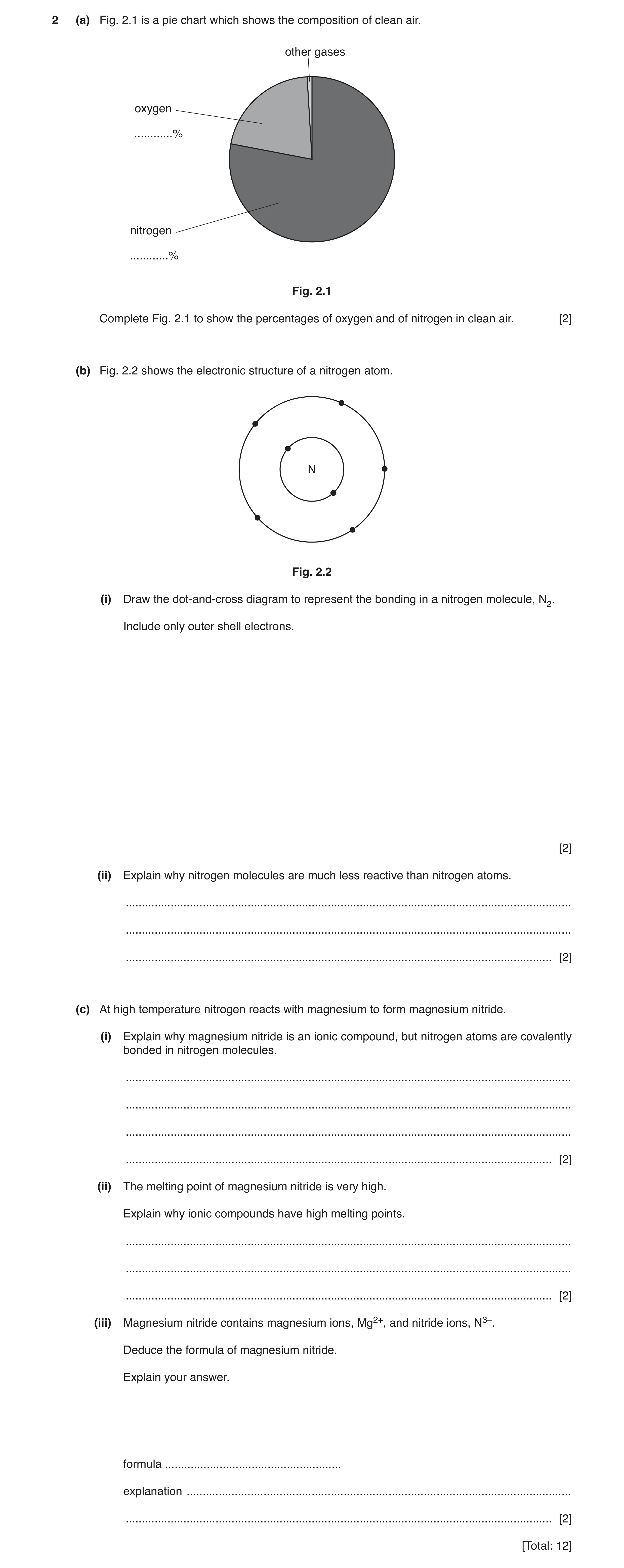
2 (a) Fig. 2.1 is a pie chart which shows the composition of clean air. other gases oxygen … % nitrogen … % Fig. 2.1 Complete Fig. 2.1 to show the percentages of oxygen and of nitrogen in clean air. [2] (b) Fig. 2.2 shows the electronic structure of a nitrogen atom. N Fig. 2.2 (i) Draw the dot-and-cross diagram to represent the bonding in a nitrogen molecule, N2. Include only outer shell electrons. [2] (ii) Explain why nitrogen molecules are much less reactive than nitrogen atoms. … … … [2] (c) At high temperature nitrogen reacts with magnesium to form magnesium nitride. (i) Explain why magnesium nitride is an ionic compound, but nitrogen atoms are covalently bonded in nitrogen molecules. … … … … [2] (ii) The melting point of magnesium nitride is very high. Explain why ionic compounds have high melting points. … … … [2] (iii) Magnesium nitride contains magnesium ions, Mg2+, and nitride ions, N3–. Deduce the formula of magnesium nitride. Explain your answer. formula … explanation … … [2] [Total: 12]
12 marks
Mark scheme: 2(a) oxygen: 21 ; nitrogen: 78 ; 2 2(b)(i) 3 bonding pairs ; 2 lone pairs, all else correct ; 2 2(b)(ii) (molecule is unreactive because of) strong (covalent) bonding between atoms / triple bond ; (atom is reactive because) atom has high tendency to gain electrons / has incomplete electron shell / does not have noble gas structure / owtte ; 2 2(c)(i) ionic bonds between metallic and non-metallic elements ; covalent bonds between non-metallic elements / nitrogen is a non-metal (so covalently bonded) ; 2 2(c)(ii) attractive force between oppositely charged ions / strong force / bonds between ions / many forces / bonds between ions ; more energy required to overcome force / break bond ; 2 2(c)(iii) Mg3N2 ; idea of balanced charges ; 2
This question in 0654/41 Oct/Nov 2019
Q8 · What happens when a teacher ignites a mixture of hydrogen and air 0654/43 Oct/Nov 2019
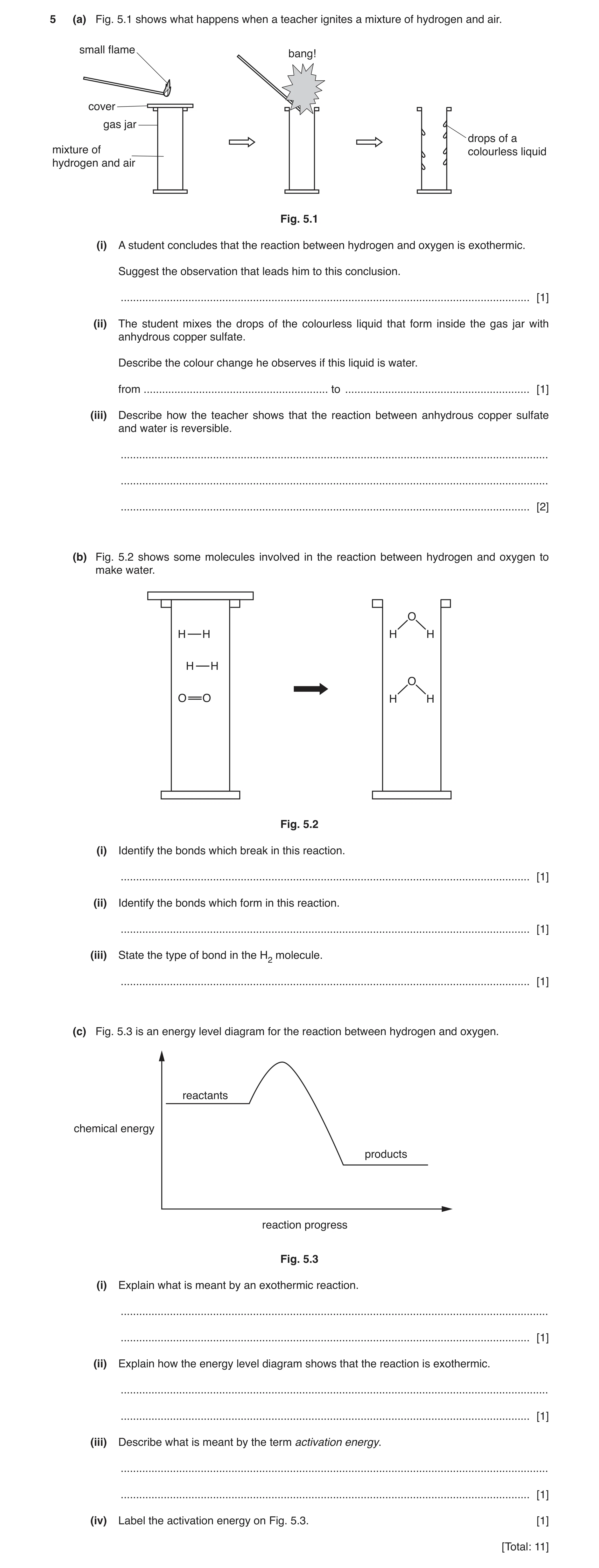
5 (a) Fig. 5.1 shows what happens when a teacher ignites a mixture of hydrogen and air. small flame bang! cover gas jar drops of a mixture of colourless liquid hydrogen and air Fig. 5.1 (i) A student concludes that the reaction between hydrogen and oxygen is exothermic. Suggest the observation that leads him to this conclusion. … [1] (ii) The student mixes the drops of the colourless liquid that form inside the gas jar with anhydrous copper sulfate. Describe the colour change he observes if this liquid is water. from … to … [1] (iii) Describe how the teacher shows that the reaction between anhydrous copper sulfate and water is reversible. … … … [2] (b) Fig. 5.2 shows some molecules involved in the reaction between hydrogen and oxygen to make water. O H H H H H H O O O H H Fig. 5.2 (i) Identify the bonds which break in this reaction. … [1] (ii) Identify the bonds which form in this reaction. … [1] (iii) State the type of bond in the H2 molecule. … [1] (c) Fig. 5.3 is an energy level diagram for the reaction between hydrogen and oxygen. reactants chemical energy products reaction progress Fig. 5.3 (i) Explain what is meant by an exothermic reaction. … … [1] (ii) Explain how the energy level diagram shows that the reaction is exothermic. … … [1] (iii) Describe what is meant by the term activation energy. … … [1] (iv) Label the activation energy on Fig. 5.3. [1] [Total: 11]
11 marks
Mark scheme: 5(a)(i) flash / (bigger) flame / explosion ; 1 5(a)(ii) white to blue ; 1 5(a)(iii) heat ; blue to white / colour change reversed ; 2 5(b)(i) H—H AND O=O ; 1 5(b)(ii) O—H / H—O ; 1 5(b)(iii) covalent ; 1 5(c)(i) thermal energy is given out ; 1 5(c)(ii) products have less (chemical) energy than reactants ; 1 5(c)(iii) minimum energy for particles / reactants to react ; 1 5(c)(iv) reactant energy to peak identified and labelled ; 1
This question in 0654/43 Oct/Nov 2019
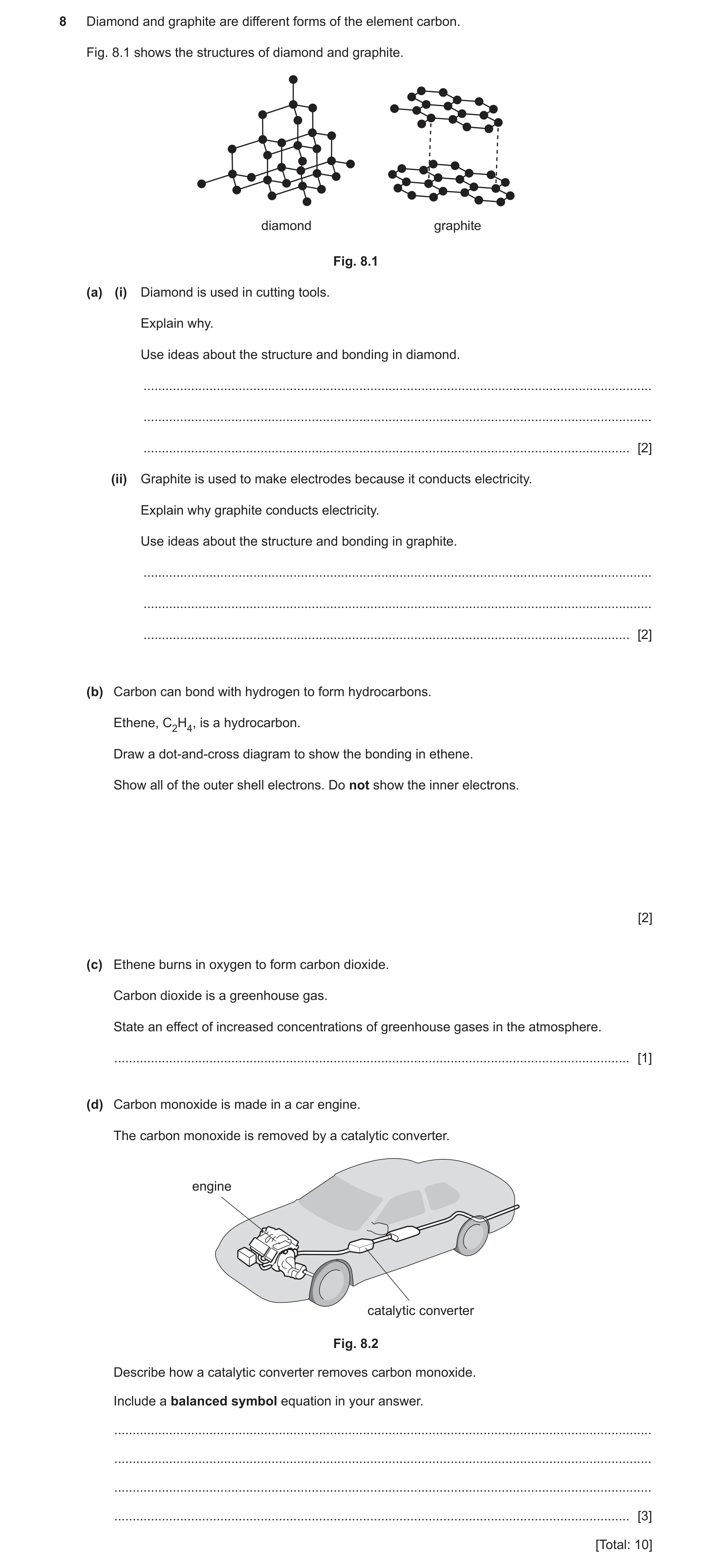
Q9 · Diamond and graphite are different forms of the element carbon 0654/42 May/June 2020
8 Diamond and graphite are different forms of the element carbon. Fig. 8.1 shows the structures of diamond and graphite. diamond graphite Fig. 8.1 (a) (i) Diamond is used in cutting tools. Explain why. Use ideas about the structure and bonding in diamond. … … … [2] (ii) Graphite is used to make electrodes because it conducts electricity. Explain why graphite conducts electricity. Use ideas about the structure and bonding in graphite. … … … [2] (b) Carbon can bond with hydrogen to form hydrocarbons. Ethene, C2H4, is a hydrocarbon. Draw a dot-and-cross diagram to show the bonding in ethene. Show all of the outer shell electrons. Do not show the inner electrons. [2] (c) Ethene burns in oxygen to form carbon dioxide. Carbon dioxide is a greenhouse gas. State an effect of increased concentrations of greenhouse gases in the atmosphere. … [1] (d) Carbon monoxide is made in a car engine. The carbon monoxide is removed by a catalytic converter. engine catalytic converter Fig. 8.2 Describe how a catalytic converter removes carbon monoxide. Include a balanced symbol equation in your answer. … … … … [3] [Total: 10]
10 marks
Mark scheme: 8(a)(i) (diamond) has many strong bonds ; bonds are covalent bonds ; (diamond) is giant molecular / macromolecular / giant tetrahedral (lattice) ; max 2 8(a)(ii) (graphite has) electrons ; that can move / that are delocalised ; 2 8(b) double bond between C atoms ; single bonds between C and H ; 2 Question Answer Marks 8(c) global warming / climate change ; 1 8(d) (catalytic converter) changes carbon monoxide into carbon dioxide ; balanced symbol equation: 2CO + O2 → 2CO2 / 2CO + 2NO → N2 + 2CO2 ;; correct formulae; correctly balanced; 3
This question in 0654/42 May/June 2020
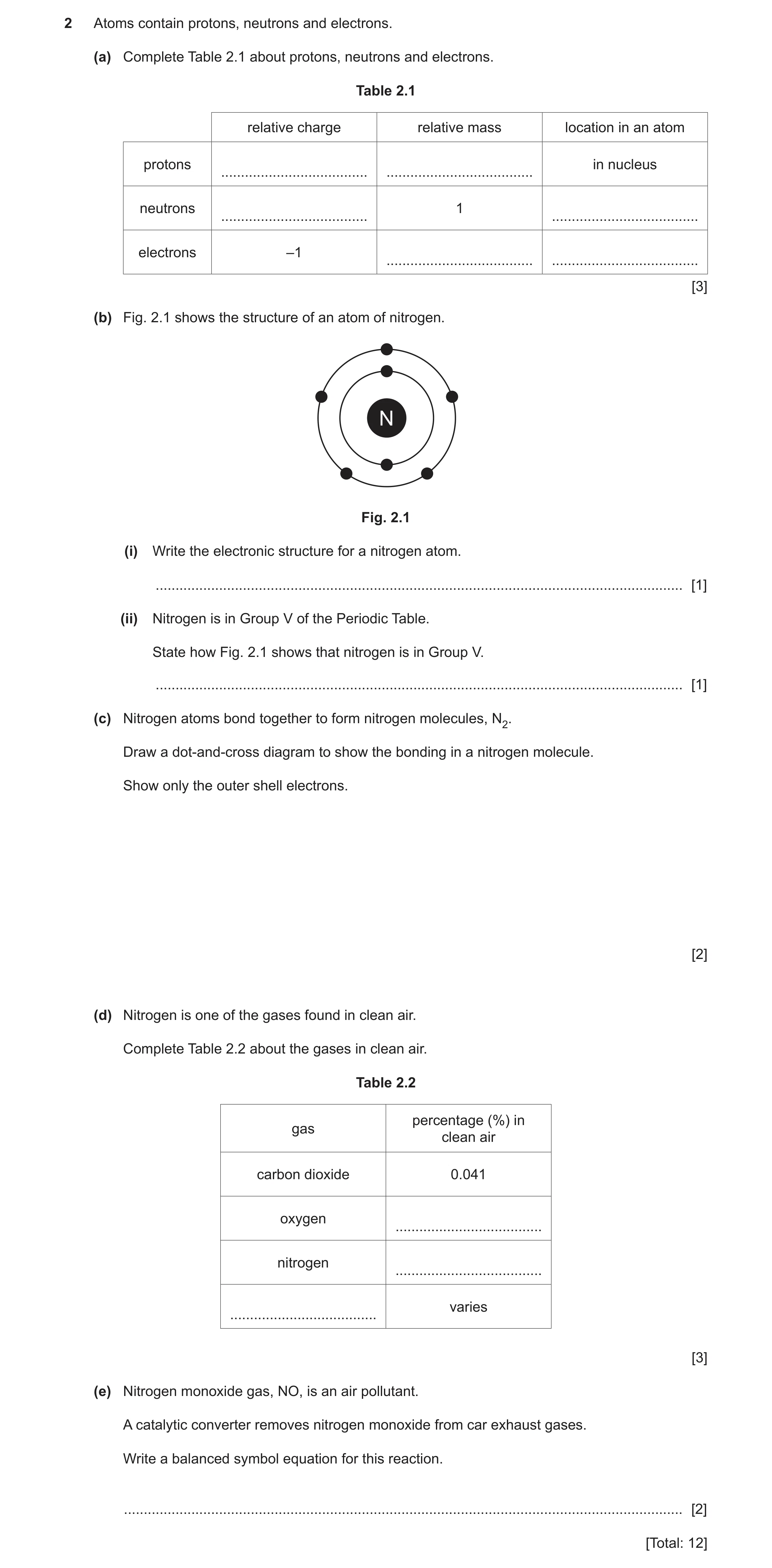
Q10 · Atoms contain protons, neutrons and electrons 0654/42 Oct/Nov 2020
2 Atoms contain protons, neutrons and electrons. (a) Complete Table 2.1 about protons, neutrons and electrons. Table 2.1 relative charge relative mass location in an atom protons in nucleus … … neutrons 1 … … electrons –1 … … [3] (b) Fig. 2.1 shows the structure of an atom of nitrogen. N Fig. 2.1 (i) Write the electronic structure for a nitrogen atom. … [1] (ii) Nitrogen is in Group V of the Periodic Table. State how Fig. 2.1 shows that nitrogen is in Group V. … [1] (c) Nitrogen atoms bond together to form nitrogen molecules, N2. Draw a dot-and-cross diagram to show the bonding in a nitrogen molecule. Show only the outer shell electrons. [2] (d) Nitrogen is one of the gases found in clean air. Complete Table 2.2 about the gases in clean air. Table 2.2 percentage (%) in gas clean air carbon dioxide 0.041 oxygen … nitrogen … varies … [3] (e) Nitrogen monoxide gas, NO, is an air pollutant. A catalytic converter removes nitrogen monoxide from car exhaust gases. Write a balanced symbol equation for this reaction. … [2] [Total: 12]
12 marks
Mark scheme: 2(a) relative charge relative mass location in an atom protons +1 / + 1 (in nucleus) neutrons 0 / no charge / neutral (1) in nucleus electrons (–1) almost 0 / negligible / 1÷1850 in shells / orbits around nucleus ;;; 3 2(b)(i) 2, 5 ; 1 2(b)(ii) (nitrogen has) five electrons in the outer shell ; 1 Question Answer Marks 2(c) ;; 2 2(d) gas percentage in clean air (%) carbon dioxide 0.035 oxygen 21 nitrogen 78 (named) noble gases / water (vapour) varies ;;; 3 2(e) 2CO + 2NO → N2 + 2CO2 / 2NO → N2 + O2 ;; 2
This question in 0654/42 Oct/Nov 2020
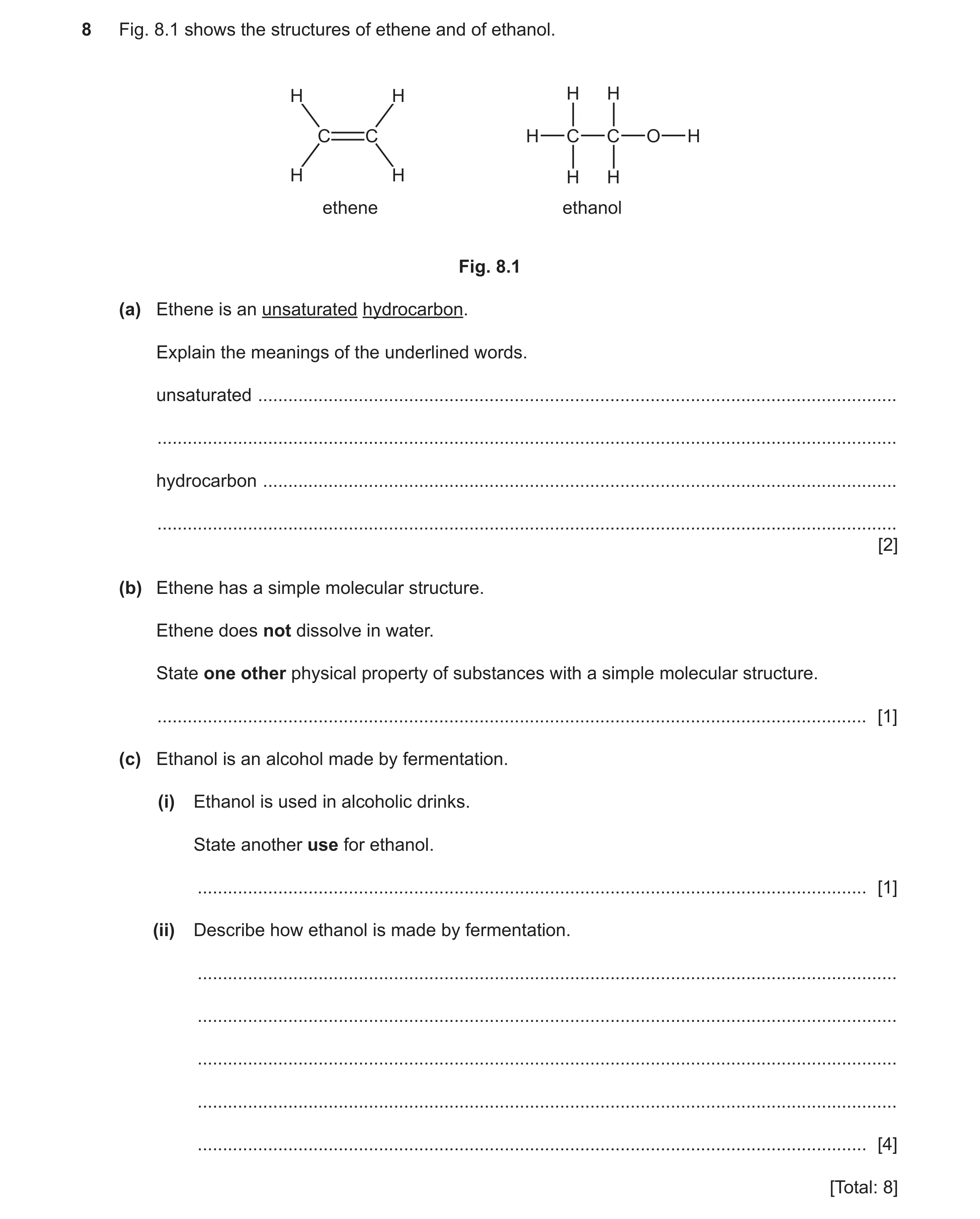
Q11 · The structures of ethene and of ethanol 0654/43 Oct/Nov 2020
8 Fig. 8.1 shows the structures of ethene and of ethanol. H H H H C C H C C O H H H H H ethene ethanol Fig. 8.1 (a) Ethene is an unsaturated hydrocarbon. Explain the meanings of the underlined words. unsaturated … … hydrocarbon … … [2] (b) Ethene has a simple molecular structure. Ethene does not dissolve in water. State one other physical property of substances with a simple molecular structure. … [1] (c) Ethanol is an alcohol made by fermentation. (i) Ethanol is used in alcoholic drinks. State another use for ethanol. … [1] (ii) Describe how ethanol is made by fermentation. … … … … … [4] [Total: 8]
8 marks
Mark scheme: 8(a) (ethene is unsaturated because) it contains a double bond between the carbon atoms ; (ethene is a hydrocarbon because) it contains carbon and hydrogen (atoms) only / AW ; 2 8(b) poor electrical conductor / low boiling point / evaporates easily / volatile ; 1 8(c)(i) solvent / fuel ; 1 8(c)(ii) fermentation requires water ; fermentation requires sugar / named sugar ; fermentation requires yeast / enzyme / zymase ; fermentation requires suitable temperature ; reference to anaerobic respiration ; max 4 4
This question in 0654/43 Oct/Nov 2020
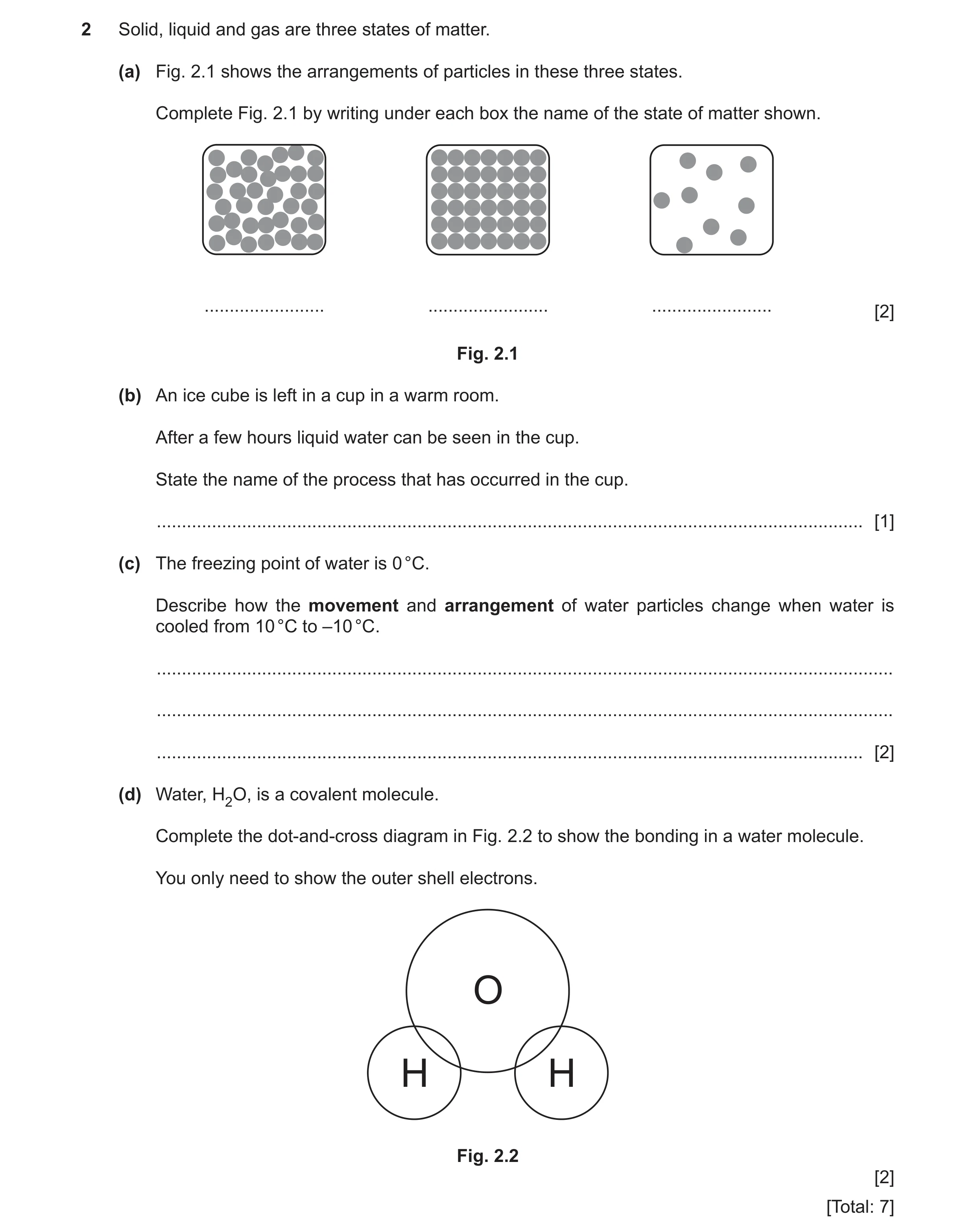
Q12 · Solid, liquid and gas are three states of matter 0654/42 May/June 2021
2 Solid, liquid and gas are three states of matter. (a) Fig. 2.1 shows the arrangements of particles in these three states. Complete Fig. 2.1 by writing under each box the name of the state of matter shown. … … … [2] Fig. 2.1 (b) An ice cube is left in a cup in a warm room. After a few hours liquid water can be seen in the cup. State the name of the process that has occurred in the cup. … [1] (c) The freezing point of water is 0 °C. Describe how the movement and arrangement of water particles change when water is cooled from 10 °C to –10 °C. … … … [2] (d) Water, H2O, is a covalent molecule. Complete the dot-and-cross diagram in Fig. 2.2 to show the bonding in a water molecule. You only need to show the outer shell electrons. O H H Fig. 2.2 [2] [Total: 7]
7 marks
Mark scheme: 2(a) liquid solid gas ;; 2 2(b) melting ; 1 Question Answer Marks 2(c) movement: idea that particles change, from moving around each other to vibrating about fixed positions ; arrangement: idea that arrangement of particles changes from random to regular ; 2 2(d) ;; 2
This question in 0654/42 May/June 2021
Q13 · An outline of the Periodic Table 0654/43 May/June 2021
11 Fig. 11.1 shows an outline of the Periodic Table. H He C O F Al Ar K Cu Br Sr Fig. 11.1 (a) Draw a line to link each element to its correct description. Use each description only once. element description an element with 8 electrons in its outer shell He an element with an electronic structure of 2 Al an element in Group 3 and Period 3 Ar an element in Group 6 and Period 3 [3] (b) Argon is a gas used in lamps. Explain why. … [1] (c) The nucleus of a carbon atom contains six protons. State the charge on a proton. … [1] (d) Potassium metal reacts with the non-metal bromine to form potassium bromide. Potassium bromide is an ionic compound. Describe how metallic and non-metallic elements form ionic bonds. … … … … [3] (e) The electronic structure of carbon is 2.4. The electronic structure of oxygen is 2.6. The atoms in a molecule of carbon dioxide, CO2, are held together by covalent bonds. Draw the dot-and-cross diagram to show the bonding in carbon dioxide. You only need to include the outer shell electrons. [2] [Total: 10]
10 marks
Mark scheme: 11(a) ;;; 11(b) (argon is) inert / unreactive ; 1 11(c) + / +1 / positive ; 1 11(d) metal (atoms) lose electrons ; non-metal (atoms) gain electrons ; metal (atoms) form positive ions and non-metal (atoms) form negative ions ; attraction between (oppositely charged) ions ; max 3 3 11(e) 2
This question in 0654/43 May/June 2021
Q14 · Ammonia, NH3, is made in the Haber process 0654/41 Oct/Nov 2021
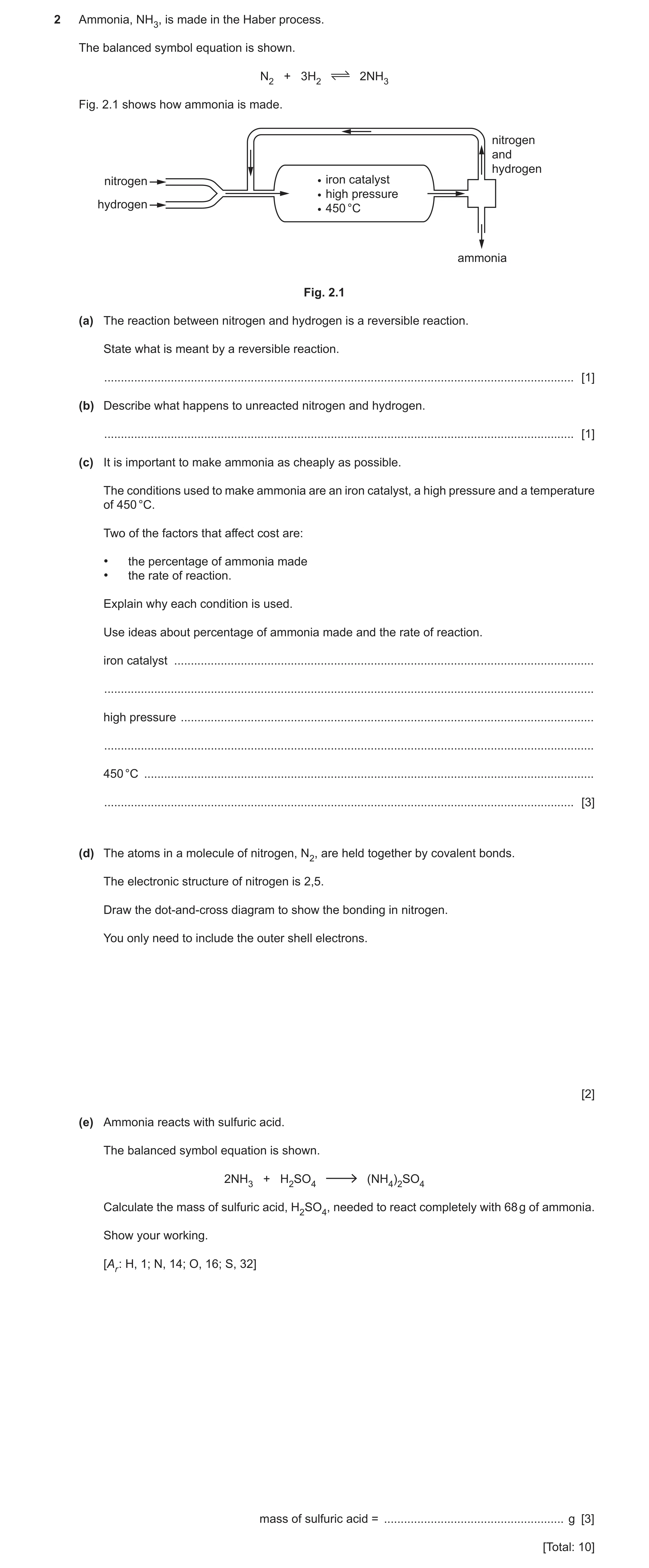
2 Ammonia, NH3, is made in the Haber process. The balanced symbol equation is shown. N2 + 3H2 2NH3 Fig. 2.1 shows how ammonia is made. nitrogen and hydrogen nitrogen • iron catalyst • high pressure hydrogen • 450 °C ammonia Fig. 2.1 (a) The reaction between nitrogen and hydrogen is a reversible reaction. State what is meant by a reversible reaction. … [1] (b) Describe what happens to unreacted nitrogen and hydrogen. … [1] (c) It is important to make ammonia as cheaply as possible. The conditions used to make ammonia are an iron catalyst, a high pressure and a temperature of 450 °C. Two of the factors that affect cost are: • the percentage of ammonia made • the rate of reaction. Explain why each condition is used. Use ideas about percentage of ammonia made and the rate of reaction. iron catalyst … … high pressure … … 450 °C … … [3] (d) The atoms in a molecule of nitrogen, N2, are held together by covalent bonds. The electronic structure of nitrogen is 2,5. Draw the dot-and-cross diagram to show the bonding in nitrogen. You only need to include the outer shell electrons. [2] (e) Ammonia reacts with sulfuric acid. The balanced symbol equation is shown. 2NH3 + H2SO4 (NH4)2SO4 Calculate the mass of sulfuric acid, H2SO4, needed to react completely with 68 g of ammonia. Show your working. [Ar : H, 1; N, 14; O, 16; S, 32] mass of sulfuric acid = … g [3] [Total: 10]
10 marks
Mark scheme: 2(a) idea of a reaction that goes both ways ; 1 2(b) recycled / owtte ; 1 2(c) iron catalyst: increases rate of reaction / owtte ; high pressure: increases the yield of ammonia / increases rate of reaction ; 450 °C: idea of compromise of temperature to give high enough rate of reaction with reasonable yield ; 3 2(d) triple bond between N atoms ; lone pairs on N atoms ; 2 2(e) Mr of NH3 = 17 and Mr H2SO4 = 98 ; 2 moles of NH3 needs 1 mole of H2SO4 ; 98 68 34 × = 196 (g) ; 3
This question in 0654/41 Oct/Nov 2021
Q15 · The apparatus that is used to electrolyse concentrated aqueous sodium chloride 0654/41 Oct/Nov 2021
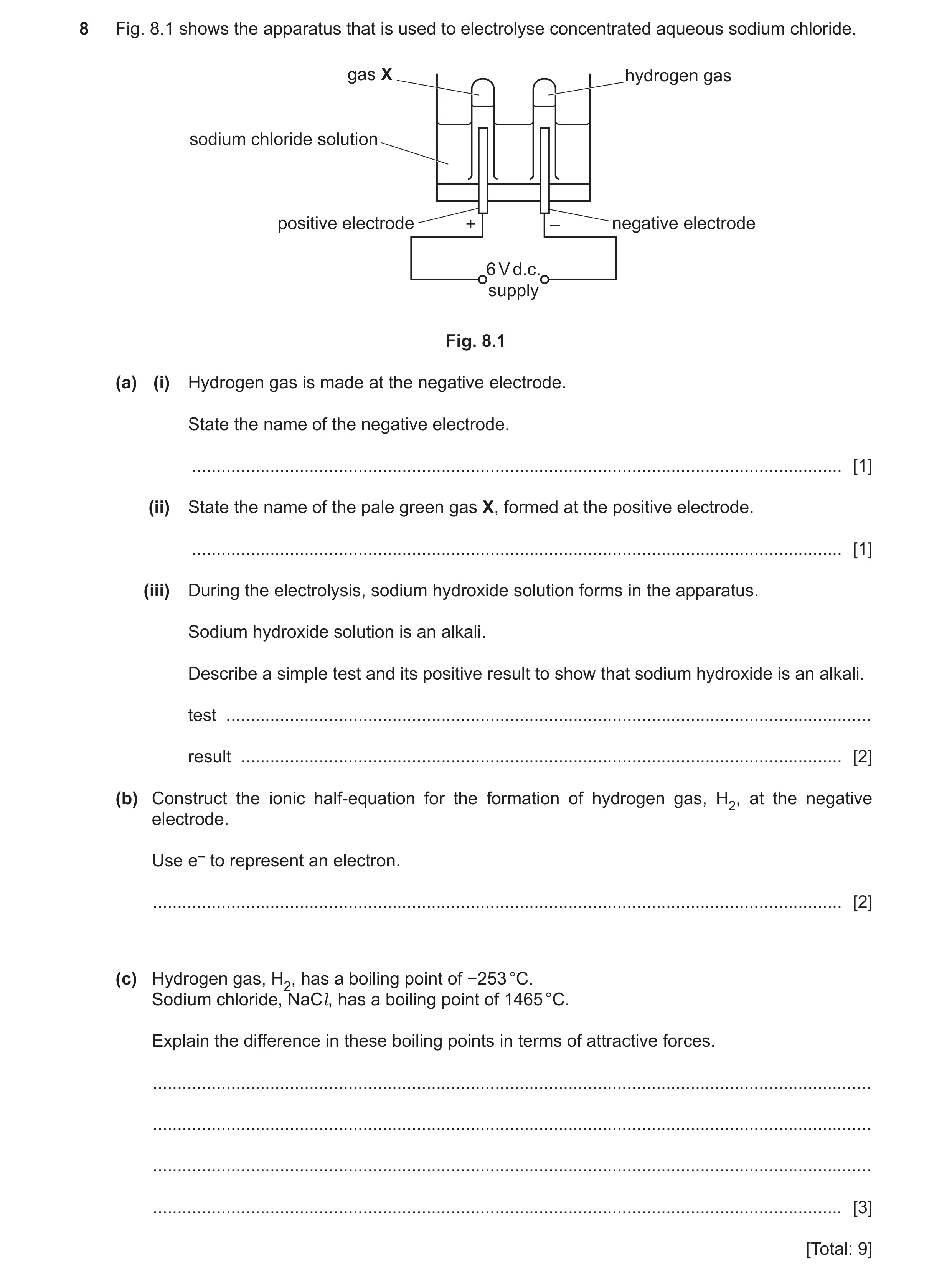
8 Fig. 8.1 shows the apparatus that is used to electrolyse concentrated aqueous sodium chloride. gas X hydrogen gas sodium chloride solution positive electrode + – negative electrode 6 V d.c. supply Fig. 8.1 (a) (i) Hydrogen gas is made at the negative electrode. State the name of the negative electrode. … [1] (ii) State the name of the pale green gas X, formed at the positive electrode. … [1] (iii) During the electrolysis, sodium hydroxide solution forms in the apparatus. Sodium hydroxide solution is an alkali. Describe a simple test and its positive result to show that sodium hydroxide is an alkali. test … result … [2] (b) Construct the ionic half-equation for the formation of hydrogen gas, H2, at the negative electrode. Use e– to represent an electron. … [2] (c) Hydrogen gas, H2, has a boiling point of −253 °C. Sodium chloride, NaCl, has a boiling point of 1465 °C. Explain the difference in these boiling points in terms of attractive forces. … … … … [3] [Total: 9]
9 marks
Mark scheme: 8(a)(i) cathode ; 1 8(a)(ii) chlorine ; 1 8(a)(iii) test: universal indicator / (red) litmus / pH meter ; result: universal indicator would turn blue or purple / pH greater than 7 / red litmus turns blue / pH meter or pH probe gives pH greater than 7 ; 2 8(b) 2H+ + 2e– → H2 correct formulae ; correct balancing ; 2 8(c) sodium chloride has strong (attractive) forces between (oppositely charged sodium ions and chloride) ions ; hydrogen has weak intermolecular forces / weak (attractive) forces between molecules ; strong (electrostatic) attractive forces take more energy to overcome than weak (intermolecular) forces / ORA ; 3
This question in 0654/41 Oct/Nov 2021
Q16 · An oxygen atom has the electronic structure 2,6 0654/42 Oct/Nov 2021
11 (a) An oxygen atom has the electronic structure 2,6. Use the electronic structure to explain which group of the Periodic Table oxygen is in. … … [2] (b) Sodium forms an ionic compound with oxygen. State the formulae of a sodium ion and an oxide ion. Use the formulae of the ions to determine the formula of the ionic compound sodium oxide. formula of a sodium ion … formula of an oxide ion … formula of sodium oxide … [3] (c) Oxygen can also form covalent bonds. Complete the dot-and-cross diagram to show the covalent bonding in a molecule of carbon dioxide. You only need to include the outer shell electrons. O C O [3] (d) Covalent compounds, such as carbon dioxide, have low melting points. State which letter, A, B, C or D, in Table 11.1 gives the correct explanation for why most covalent compounds have low melting points. Table 11.1 explanation A covalent bonds are strong B covalent bonds are weak C electrons are free to move D weak intermolecular forces of attraction … [1] (e) Calculate the relative molecular mass, Mr, of aluminium sulfate, Al2SO4. Show your working. [Ar: Al, 27; O, 16; S, 32] relative molecular mass = … [2] [Total: 11]
11 marks
Mark scheme: 11(a) group VI / group 6 ; (because) 6 electrons in the outer shell ; 2 11(b) sodium ion – Na+ ; oxide ion – O2- ; sodium oxide – Na2O ; 3 11(c) ;;; 3 11(d) D ; 1 11(e) [2 × 27] + 32 + [4 × 16] ; = 150 ; 2
This question in 0654/42 Oct/Nov 2021
Q17 · Chlorine and bromine are Group VII elements of the Periodic Table 0654/43 Oct/Nov 2021
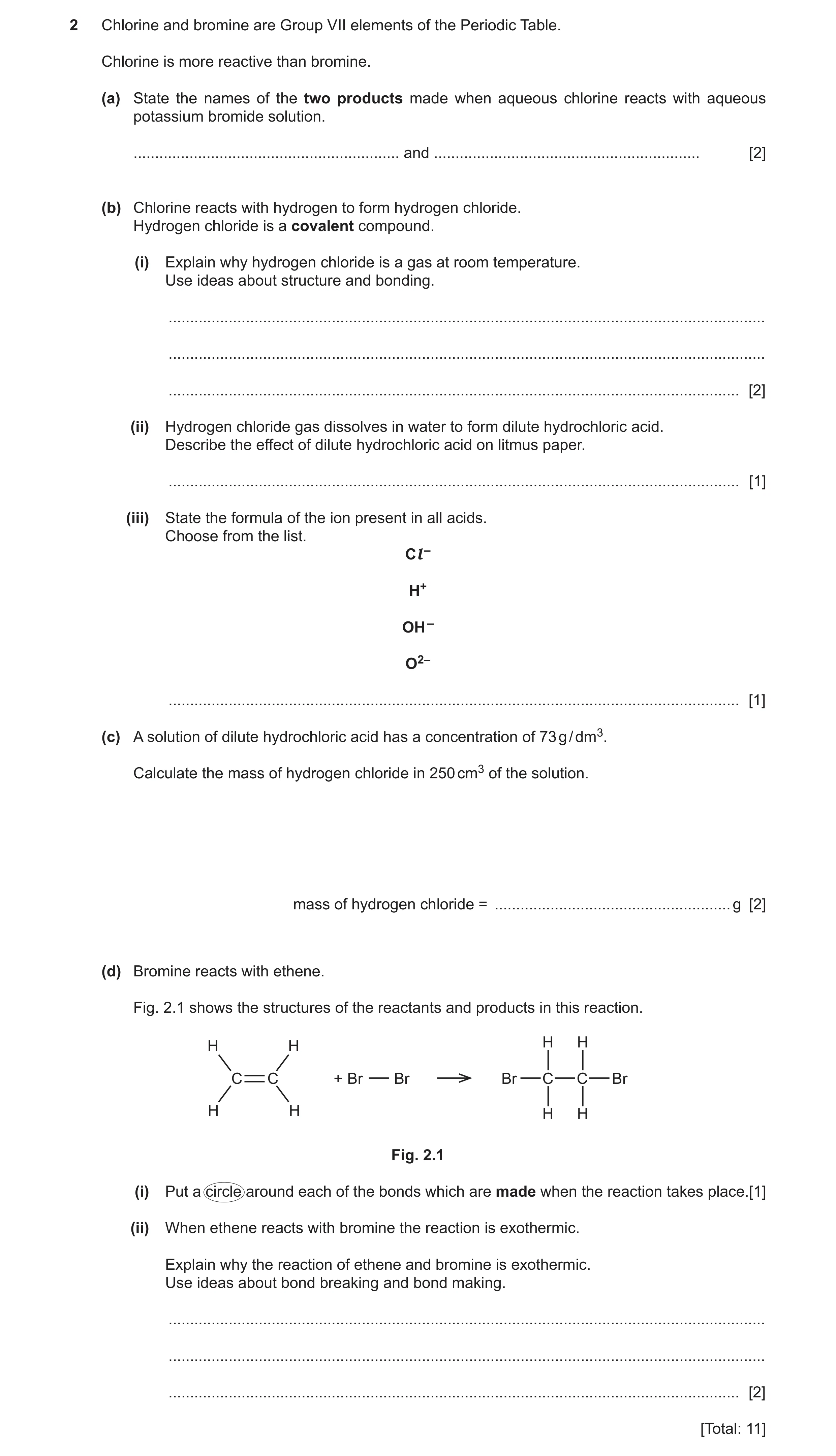
2 Chlorine and bromine are Group VII elements of the Periodic Table. Chlorine is more reactive than bromine. (a) State the names of the two products made when aqueous chlorine reacts with aqueous potassium bromide solution. … and … [2] (b) Chlorine reacts with hydrogen to form hydrogen chloride. Hydrogen chloride is a covalent compound. (i) Explain why hydrogen chloride is a gas at room temperature. Use ideas about structure and bonding. … … … [2] (ii) Hydrogen chloride gas dissolves in water to form dilute hydrochloric acid. Describe the effect of dilute hydrochloric acid on litmus paper. … [1] (iii) State the formula of the ion present in all acids. Choose from the list. Cl – H+ OH – O2– … [1] (c) A solution of dilute hydrochloric acid has a concentration of 73 g / dm3. Calculate the mass of hydrogen chloride in 250 cm3 of the solution. mass of hydrogen chloride = … g [2] (d) Bromine reacts with ethene. Fig. 2.1 shows the structures of the reactants and products in this reaction. H H H H C C + Br Br Br C C Br H H H H Fig. 2.1 (i) Put a circle around each of the bonds which are made when the reaction takes place. [1] (ii) When ethene reacts with bromine the reaction is exothermic. Explain why the reaction of ethene and bromine is exothermic. Use ideas about bond breaking and bond making. … … … [2] [Total: 11]
11 marks
Mark scheme: 2(a) potassium chloride ; bromine ; 2 2(b)(i) hydrogen chloride has weak intermolecular forces / weak attractions between (hydrogen chloride) molecules ; (weak intermolecular forces) take little energy to break / owtte ; 2 2(b)(ii) litmus paper turns red ; 1 2(b)(iii) H+ ; 1 2(c) mass of HCl in 250 cm³ = 73 250 1000 × OR 73 × 0.25 OR 73 ÷ 4 ; 18.25 (g) ; 2 2(d)(i) both C-Br bonds circled ; 1 2(d)(ii) bond breaking is endothermic / takes in energy and bond making is exothermic / gives out energy ; more energy is given out (during bond making) than is taken in (during bond breaking) / energy stored in product is less than energy stored in reactant ; 2
This question in 0654/43 Oct/Nov 2021
Q18 · Diamond and graphite are two forms of carbon shown in Fig 0654/42 Feb/March 2022
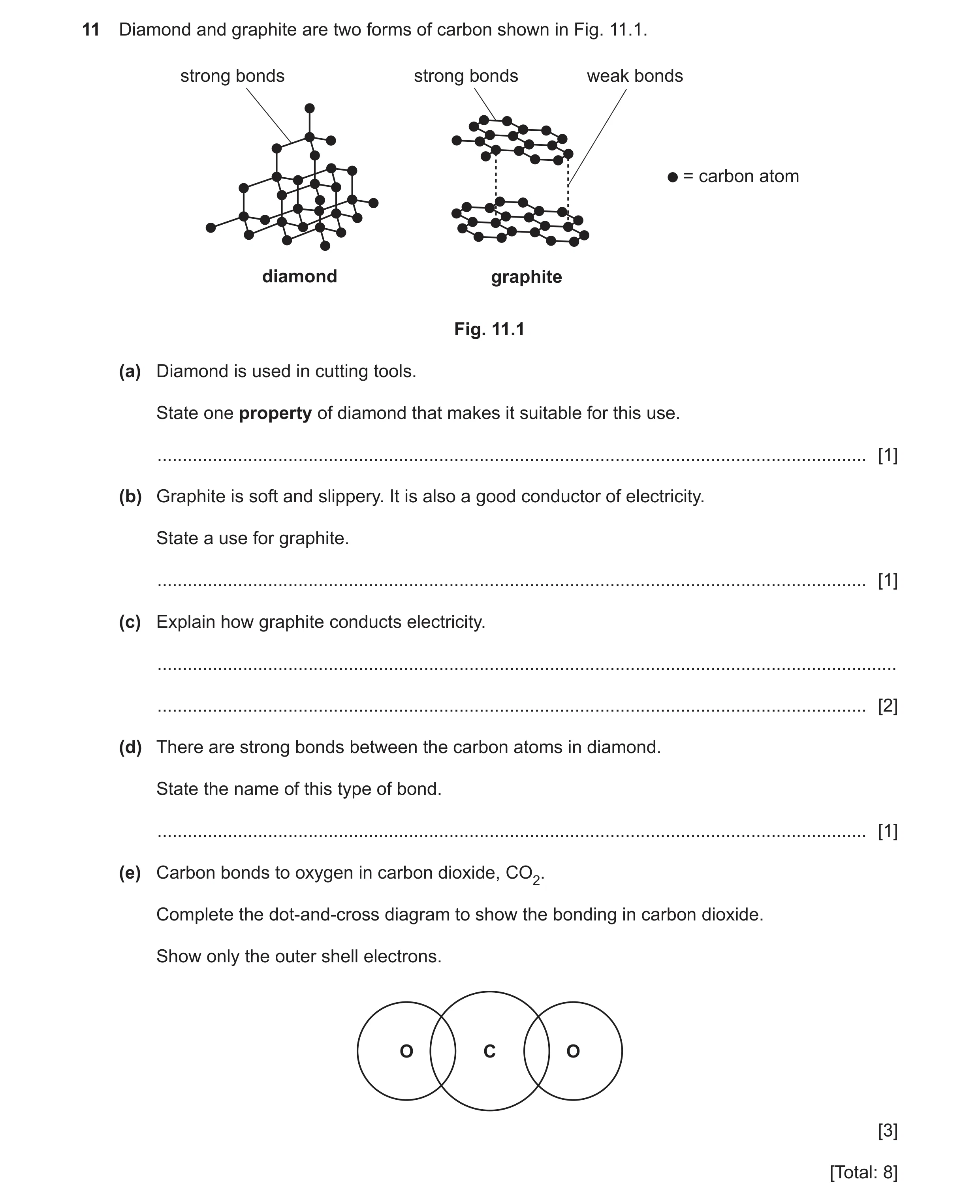
11 Diamond and graphite are two forms of carbon shown in Fig. 11.1. strong bonds strong bonds weak bonds = carbon atom diamond graphite Fig. 11.1 (a) Diamond is used in cutting tools. State one property of diamond that makes it suitable for this use. … [1] (b) Graphite is soft and slippery. It is also a good conductor of electricity. State a use for graphite. … [1] (c) Explain how graphite conducts electricity. … … [2] (d) There are strong bonds between the carbon atoms in diamond. State the name of this type of bond. … [1] (e) Carbon bonds to oxygen in carbon dioxide, CO2. Complete the dot-and-cross diagram to show the bonding in carbon dioxide. Show only the outer shell electrons. O C O [3] [Total: 8]
8 marks
Mark scheme: 11(a) hard ; 1 11(b) lubricant / pencils / electrodes ; 1 Question Answer Marks 11(c) (graphite contains) delocalised electrons / electrons can move through the structure ; movement of charge constitutes a current ; 2 11(d) covalent ; 1 11(e) ;;; 3
This question in 0654/42 Feb/March 2022
Q19 · Water must be treated so that it is safe to drink 0654/43 Oct/Nov 2022
8 (a) Water must be treated so that it is safe to drink. Draw lines to link each stage in the water treatment process to the reason why it is used. stage reason kills microbes filtration allows larger solid particles to settle out chlorination traps finer particles using sand [2] (b) Water can be tested to identify some of the chemicals in it. A scientist tests a sample of water from a river with acidified aqueous silver nitrate and also with acidified aqueous barium chloride. Table 8.1 shows the results. Table 8.1 with acidified with acidified test aqueous silver aqueous barium nitrate chloride result cream precipitate white precipitate The scientist thinks that the water contains both chloride and sulfate ions. State whether the scientist is correct. Explain your answer. … … … [2] (c) Barium chloride, BaCl 2, reacts with sodium sulfate, Na2SO4. Barium sulfate, BaSO4, and sodium chloride, NaCl, are made. Construct the balanced symbol equation for this reaction. … [2] (d) Carbon dioxide dissolves in rainwater to make the water weakly acidic. Suggest the pH of the rainwater produced. pH = … [1] (e) The atoms in carbon dioxide, CO2, are bonded by sharing electrons. Fig. 8.1 shows some dot-and-cross diagrams. O C O O C O A B O C O O C O C D Fig. 8.1 (i) State which diagram A, B, C or D, shows the arrangement of the outer shell electrons in carbon dioxide. diagram = … [1] (ii) State the name of this type of bonding that holds the atoms together in carbon dioxide. … [1] (f) Complete the following sentences about some of the problems caused by carbon dioxide. Choose words from the list. Each word or phrase may be used once, more than once or not at all. climate change greenhouse oxidation noble rusting Carbon dioxide is a … gas. Increased concentrations of carbon dioxide in the atmosphere contribute to … . [2] [Total: 11]
11 marks
Mark scheme: 8(a) filtration – traps finer particles using sand ; 2 chlorination – kills microbes ; 8(b) (no because) 2 bromide ions give a cream precipitate with silver nitrate solution / chloride ions give a white precipitate with silver nitrate solution ; idea that sample does contain sulfate ions as there is a white precipitate with barium chloride solution ; 8(c) BaCl2 + Na2SO4 → BaSO4 + 2NaCl ;; 2 8(d) any pH above 3 and less than 7 ; 1 8(e)(i) C ; 1 8(e)(ii) covalent ; 1 8(f) greenhouse ; 2 climate change ;
This question in 0654/43 Oct/Nov 2022
Q20 · This question is about chemical bonding 0654/42 Feb/March 2023
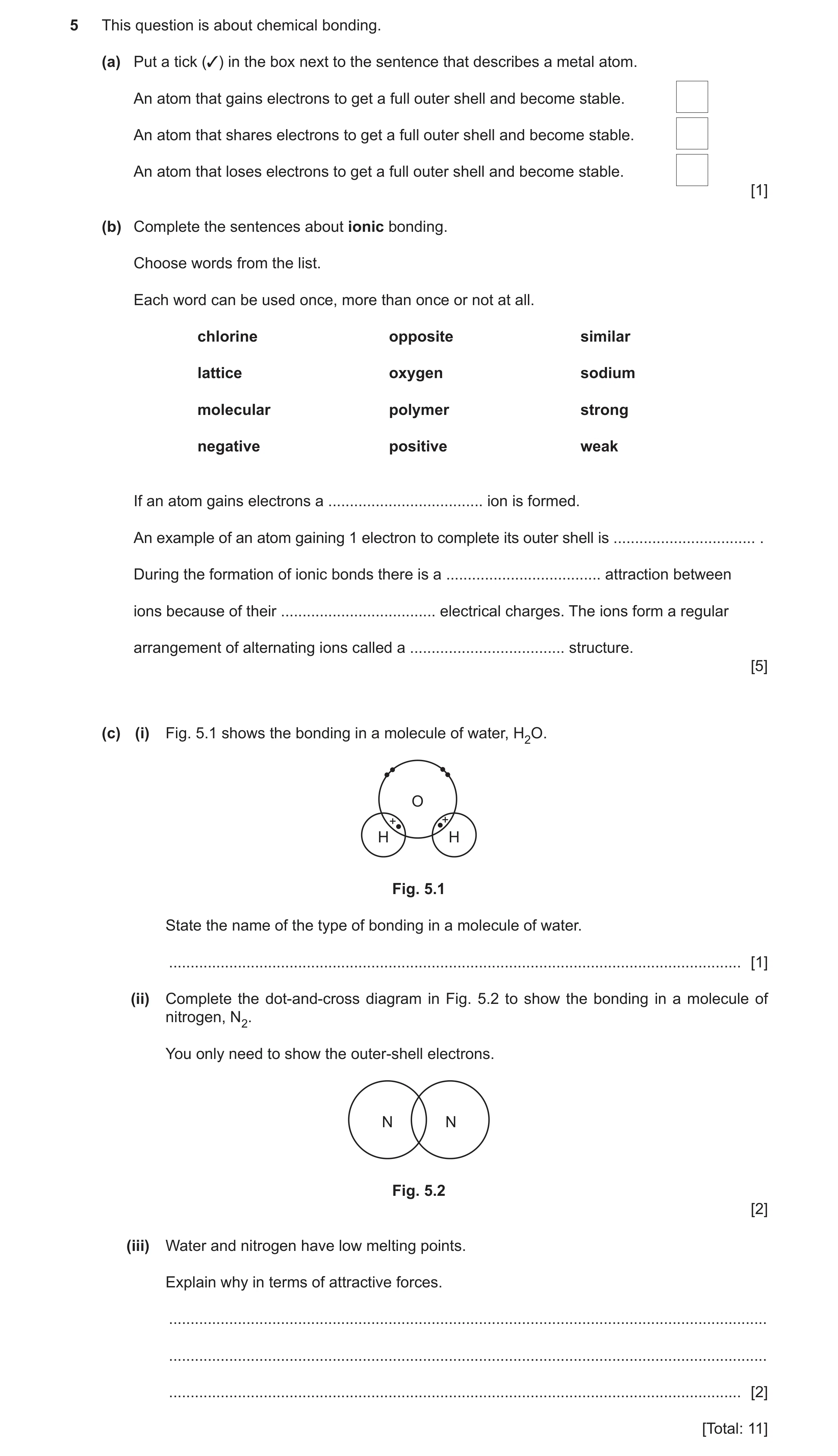
5 This question is about chemical bonding. (a) Put a tick (3) in the box next to the sentence that describes a metal atom. An atom that gains electrons to get a full outer shell and become stable. An atom that shares electrons to get a full outer shell and become stable. An atom that loses electrons to get a full outer shell and become stable. [1] (b) Complete the sentences about ionic bonding. Choose words from the list. Each word can be used once, more than once or not at all. chlorine opposite similar lattice oxygen sodium molecular polymer strong negative positive weak If an atom gains electrons a … ion is formed. An example of an atom gaining 1 electron to complete its outer shell is … . During the formation of ionic bonds there is a … attraction between ions because of their … electrical charges. The ions form a regular arrangement of alternating ions called a … structure. [5] (c) (i) Fig. 5.1 shows the bonding in a molecule of water, H2O. O H H Fig. 5.1 State the name of the type of bonding in a molecule of water. … [1] (ii) Complete the dot‑and‑cross diagram in Fig. 5.2 to show the bonding in a molecule of nitrogen, N2. You only need to show the outer‑shell electrons. N N Fig. 5.2 [2] (iii) Water and nitrogen have low melting points. Explain why in terms of attractive forces. … … … [2] [Total: 11]
11 marks
Mark scheme: 5(a) 1 an atom that gains electrons to get a full outer shell and become stable. an atom that shares electrons to get a full outer shell and become stable an atom that loses electrons to get a full outer shell and become stable. ✓ 5(b) negative ; 5 chlorine ; strong ; opposite ; lattice ; 5(c)(i) covalent ; 1 5(c)(ii) 2 5(c)(iii) (water and nitrogen) have weak intermolecular forces / weak attractions between molecules ; 2 idea that (weak intermolecular forces) take little energy to break ;
This question in 0654/42 Feb/March 2023
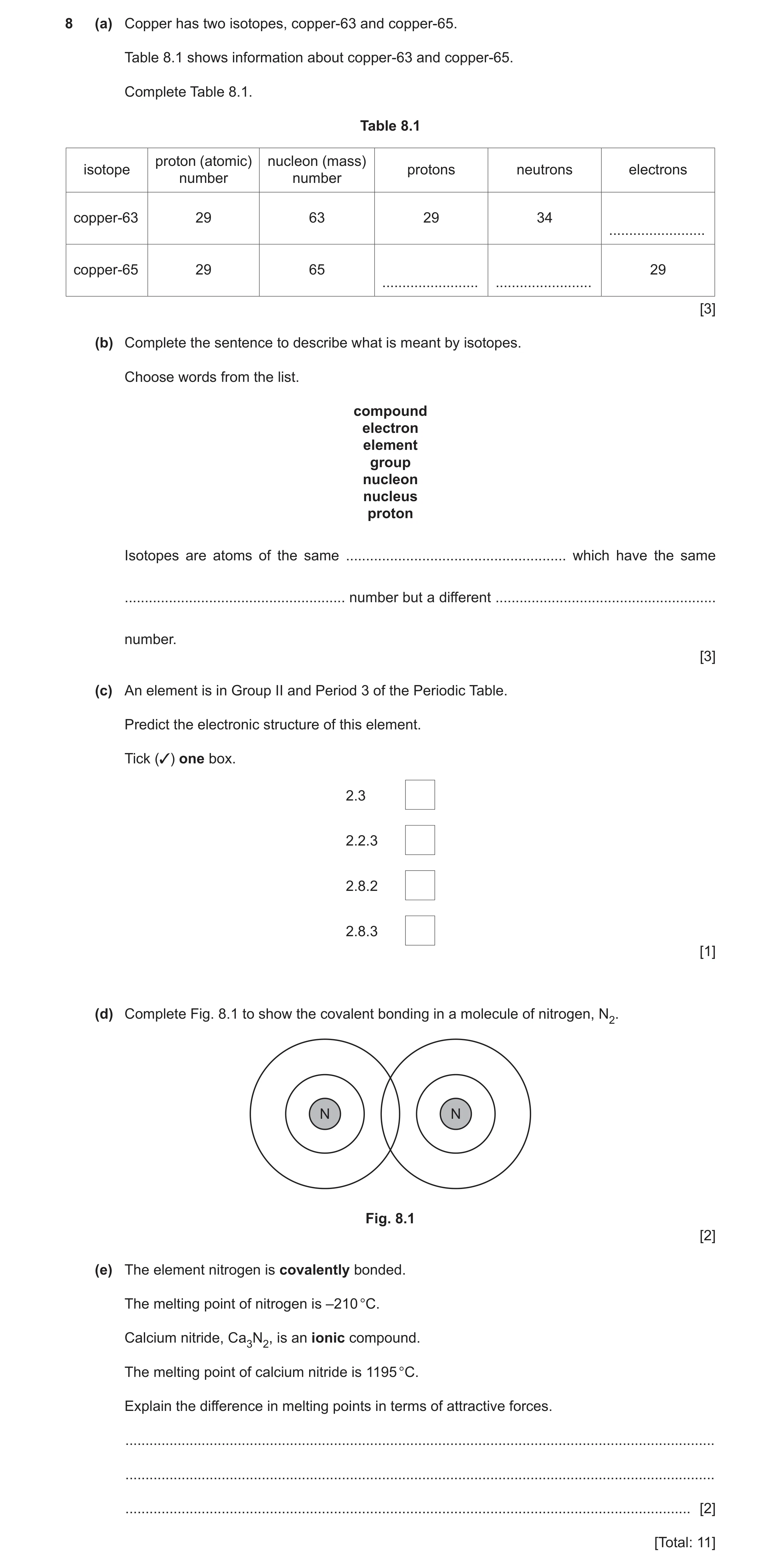
Q21 · Copper has two isotopes, copper‑63 and copper‑65 0654/42 May/June 2023
8 (a) Copper has two isotopes, copper‑63 and copper‑65. Table 8.1 shows information about copper‑63 and copper‑65. Complete Table 8.1. Table 8.1 proton (atomic) nucleon (mass) isotope protons neutrons electrons number number copper‑63 29 63 29 34 … copper‑65 29 65 29 … … [3] (b) Complete the sentence to describe what is meant by isotopes. Choose words from the list. compound electron element group nucleon nucleus proton Isotopes are atoms of the same … which have the same … number but a different … number. [3] (c) An element is in Group II and Period 3 of the Periodic Table. Predict the electronic structure of this element. Tick (3) one box. 2.3 2.2.3 2.8.2 2.8.3 [1] (d) Complete Fig. 8.1 to show the covalent bonding in a molecule of nitrogen, N2. N N Fig. 8.1 [2] (e) The element nitrogen is covalently bonded. The melting point of nitrogen is –210 °C. Calcium nitride, Ca3N2, is an ionic compound. The melting point of calcium nitride is 1195 °C. Explain the difference in melting points in terms of attractive forces. … … … [2] [Total: 11]
11 marks
Mark scheme: 8(a) isotope proton (atomic) number nucleon (mass) number protons neutrons electrons copper-63 29 63 29 34 29 copper-65 29 65 29 36 29 ;;; 3 8(b) element ; proton ; nucleon ; 3 Question Answer Marks 8(c) 2.8.2 ; 1 8(d) ;; 2 8(e) any two from: nitrogen / covalent molecules, has weak intermolecular forces / weak attractions between (nitrogen) molecules ; calcium nitride / ionic compounds, has strong (electrostatic) forces of attraction between oppositely charged ions ; higher melting point due to more energy required to overcome stronger forces / ORA ; 2
This question in 0654/42 May/June 2023
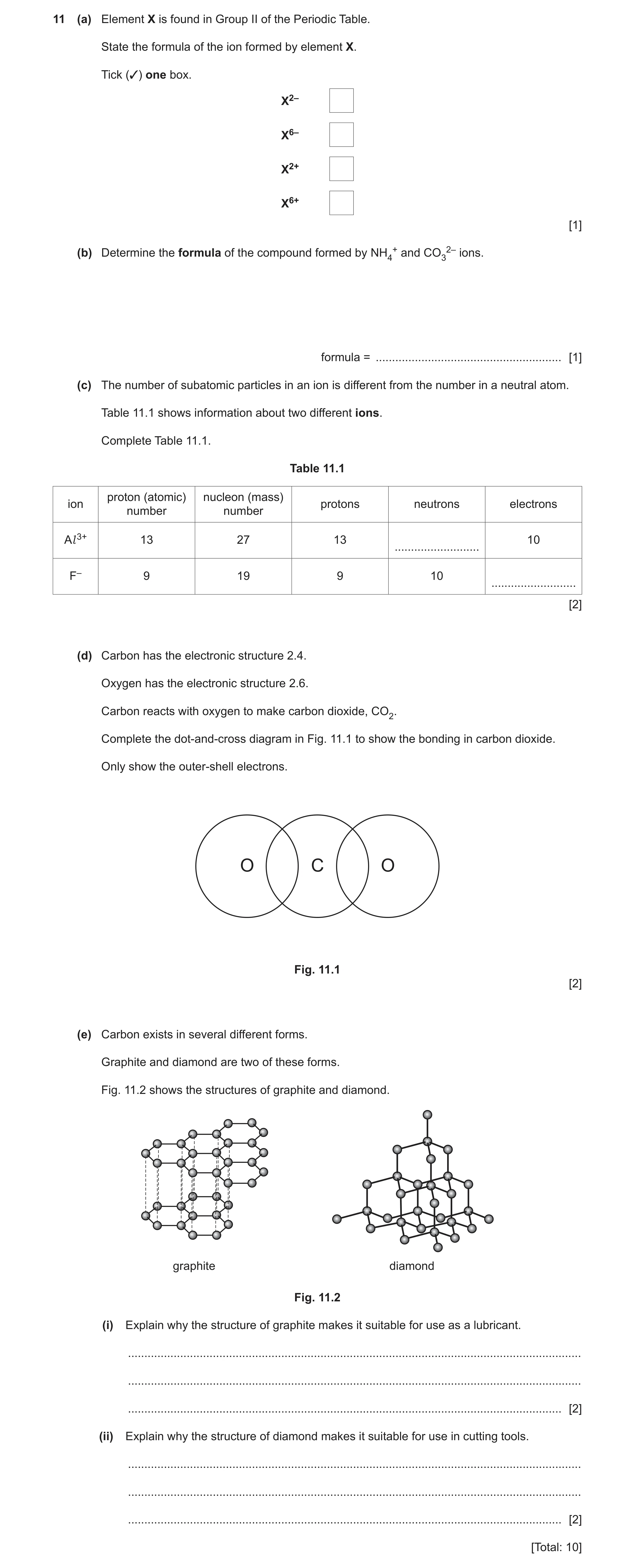
Q22 · Element X is found in Group II of the Periodic Table 0654/43 May/June 2023
11 (a) Element X is found in Group II of the Periodic Table. State the formula of the ion formed by element X. Tick (3) one box. X2– X6– X2+ X6+ [1] (b) Determine the formula of the compound formed by NH4+ and CO32– ions. formula = … [1] (c) The number of subatomic particles in an ion is different from the number in a neutral atom. Table 11.1 shows information about two different ions. Complete Table 11.1. Table 11.1 proton (atomic) nucleon (mass) ion protons neutrons electrons number number Al 3+ 13 27 13 10 … F– 9 19 9 10 … [2] (d) Carbon has the electronic structure 2.4. Oxygen has the electronic structure 2.6. Carbon reacts with oxygen to make carbon dioxide, CO2. Complete the dot‑and‑cross diagram in Fig. 11.1 to show the bonding in carbon dioxide. Only show the outer‑shell electrons. O C O Fig. 11.1 [2] (e) Carbon exists in several different forms. Graphite and diamond are two of these forms. Fig. 11.2 shows the structures of graphite and diamond. graphite diamond Fig. 11.2 (i) Explain why the structure of graphite makes it suitable for use as a lubricant. … … … [2] (ii) Explain why the structure of diamond makes it suitable for use in cutting tools. … … … [2] [Total: 10]
10 marks
Mark scheme: 11(a) X2+ ; 1 11(b) (NH4)2CO3 ; 1 11(c) ion proton (atomic) number nucleon (mass) number protons neutrons electrons Al 3+ 13 27 13 14 10 F- 9 19 9 10 10 ;; 2 Question Answer Marks 11(d) double bonds between C and O atoms ; rest of structure correct ; 2 11(e)(i) (graphite has) weak forces between the layers ; layers can slide over each other / owtte ; 2 11(e)(ii) any two from: (diamond) has many strong bonds ; bonds are covalent bonds ; (diamond has) giant molecular / macromolecular / giant tetrahedral / lattice / giant covalent, structure ; 2
This question in 0654/43 May/June 2023
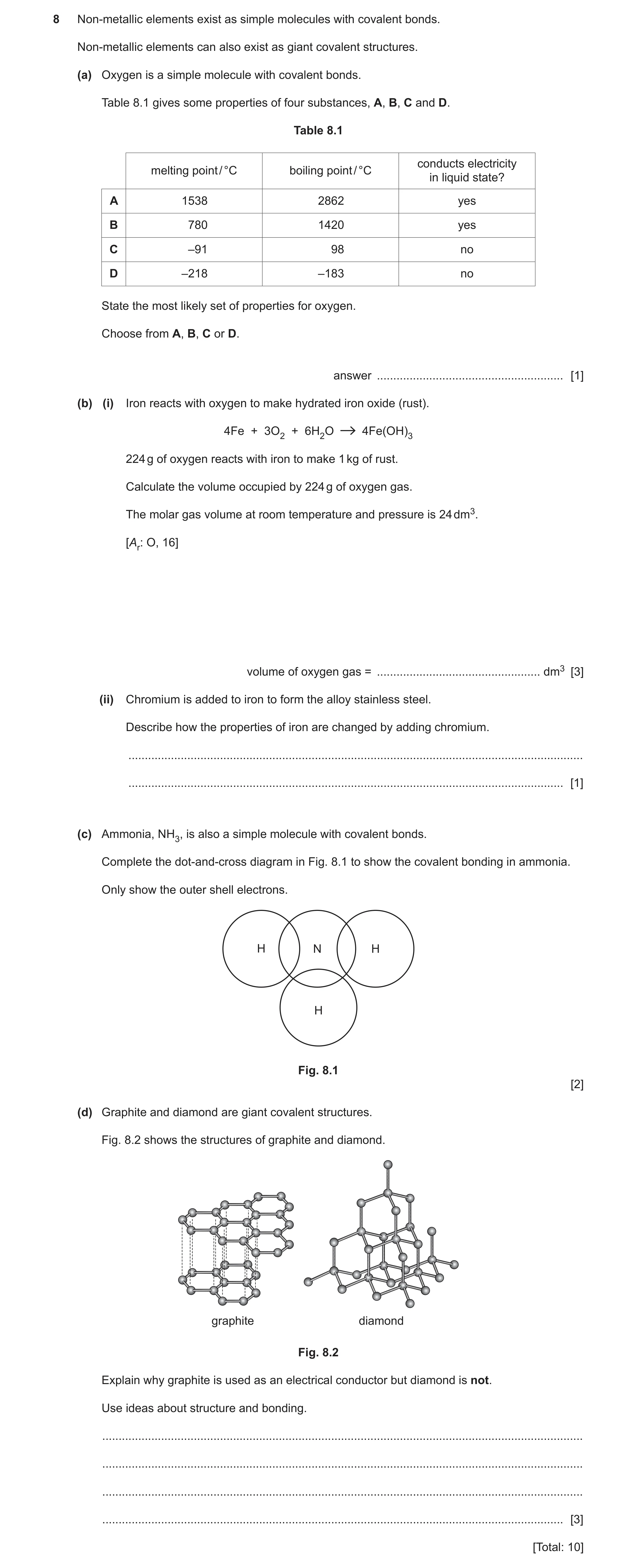
Q23 · Non-metallic elements exist as simple molecules with covalent bonds 0654/41 Oct/Nov 2023
8 Non-metallic elements exist as simple molecules with covalent bonds. Non-metallic elements can also exist as giant covalent structures. (a) Oxygen is a simple molecule with covalent bonds. Table 8.1 gives some properties of four substances, A, B, C and D. Table 8.1 conducts electricity melting point / °C boiling point / °C in liquid state? A 1538 2862 yes B 780 1420 yes C –91 98 no D –218 –183 no State the most likely set of properties for oxygen. Choose from A, B, C or D. answer … [1] (b) (i) Iron reacts with oxygen to make hydrated iron oxide (rust). 4Fe + 3O2 + 6H2O 4Fe(OH)3 224 g of oxygen reacts with iron to make 1 kg of rust. Calculate the volume occupied by 224 g of oxygen gas. The molar gas volume at room temperature and pressure is 24 dm3. [Ar: O, 16] volume of oxygen gas = … dm3 [3] (ii) Chromium is added to iron to form the alloy stainless steel. Describe how the properties of iron are changed by adding chromium. … … [1] (c) Ammonia, NH3, is also a simple molecule with covalent bonds. Complete the dot-and-cross diagram in Fig. 8.1 to show the covalent bonding in ammonia. Only show the outer shell electrons. H N H H Fig. 8.1 [2] (d) Graphite and diamond are giant covalent structures. Fig. 8.2 shows the structures of graphite and diamond. graphite diamond Fig. 8.2 Explain why graphite is used as an electrical conductor but diamond is not. Use ideas about structure and bonding. … … … … [3] [Total: 10]
10 marks
Mark scheme: 8(a) D ; 1 8(b)(i) Mr of O2 = 32 ; 3 moles of O2 = 7 ; volume of O2 (7 24) = 168 dm³ ; 8(b)(ii) any one from: 1 (stainless steel) does not rust / rusts more slowly ; (stainless steel) is stronger / harder / tougher ; change in malleability ; 8(c) 2 one covalent bond between N and H correct ; rest of structure correct ; 8(d) each carbon atom bonds to 3 other carbon atoms ; 3 delocalised / free electrons ; (electrons) move ; or in diamond each carbon atom bonds to 4 other carbon atoms ; diamond does not have delocalised / free electrons ; (electrons) cannot move / (electrons) held in covalent bonds ;
This question in 0654/41 Oct/Nov 2023
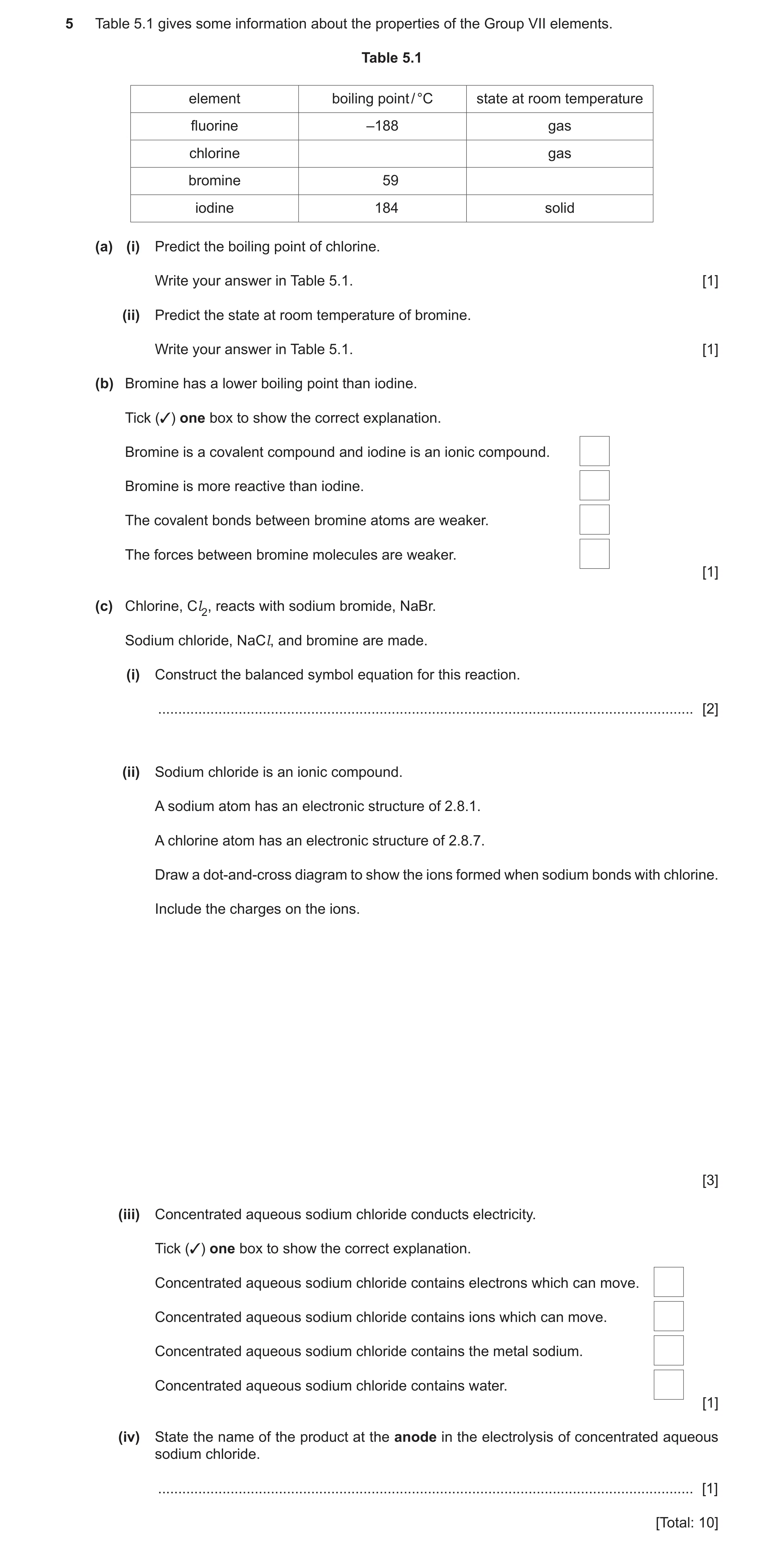
Q24 · Some information about the properties of the Group VII elements 0654/42 Oct/Nov 2023
5 Table 5.1 gives some information about the properties of the Group VII elements. Table 5.1 element boiling point / °C state at room temperature fluorine –188 gas chlorine gas bromine 59 iodine 184 solid (a) (i) Predict the boiling point of chlorine. Write your answer in Table 5.1. [1] (ii) Predict the state at room temperature of bromine. Write your answer in Table 5.1. [1] (b) Bromine has a lower boiling point than iodine. Tick (3) one box to show the correct explanation. Bromine is a covalent compound and iodine is an ionic compound. Bromine is more reactive than iodine. The covalent bonds between bromine atoms are weaker. The forces between bromine molecules are weaker. [1] (c) Chlorine, Cl2, reacts with sodium bromide, NaBr. Sodium chloride, NaCl, and bromine are made. (i) Construct the balanced symbol equation for this reaction. … [2] (ii) Sodium chloride is an ionic compound. A sodium atom has an electronic structure of 2.8.1. A chlorine atom has an electronic structure of 2.8.7. Draw a dot-and-cross diagram to show the ions formed when sodium bonds with chlorine. Include the charges on the ions. [3] (iii) Concentrated aqueous sodium chloride conducts electricity. Tick (3) one box to show the correct explanation. Concentrated aqueous sodium chloride contains electrons which can move. Concentrated aqueous sodium chloride contains ions which can move. Concentrated aqueous sodium chloride contains the metal sodium. Concentrated aqueous sodium chloride contains water. [1] (iv) State the name of the product at the anode in the electrolysis of concentrated aqueous sodium chloride. … [1] [Total: 10]
10 marks
Mark scheme: 5(a)(i) answer in the inclusive range – 122 to – 30 °C ; 1 5(a)(ii) liquid ; 1 5(b) the forces between bromine molecules are weaker ; 1 5(c)(i) Cl2 + 2NaBr → 2NaCl + Br2 2 formulae ; balancing ; 5(c)(ii) 3 electronic structure of sodium ion as 2.8 ; electronic structure of chloride ion as 2.8.8 ; sodium + (1) and chloride – (1) ; 5(c)(iii) concentrated aqueous sodium chloride contains ions which can move 1 ; 5(c)(iv) chlorine ; 1
This question in 0654/42 Oct/Nov 2023
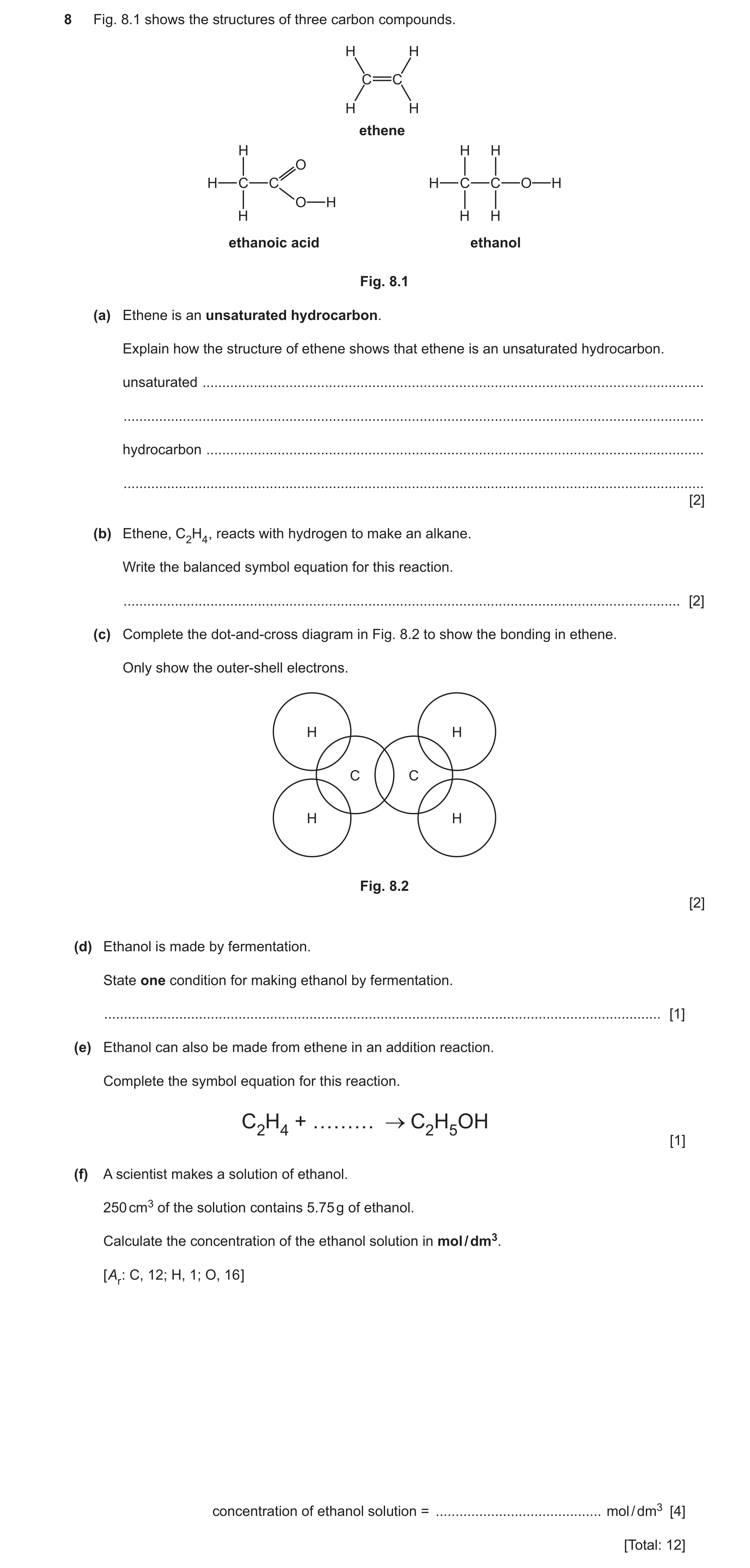
Q25 · The structures of three carbon compounds 0654/42 May/June 2024
8 Fig. 8.1 shows the structures of three carbon compounds. H H C C H H ethene H H H O H C C H C C O H O H H H H ethanoic acid ethanol Fig. 8.1 (a) Ethene is an unsaturated hydrocarbon. Explain how the structure of ethene shows that ethene is an unsaturated hydrocarbon. unsaturated … … hydrocarbon … … [2] (b) Ethene, C2H4, reacts with hydrogen to make an alkane. Write the balanced symbol equation for this reaction. … [2] (c) Complete the dot‑and‑cross diagram in Fig. 8.2 to show the bonding in ethene. Only show the outer‑shell electrons. H H C C H H Fig. 8.2 [2] (d) Ethanol is made by fermentation. State one condition for making ethanol by fermentation. … [1] (e) Ethanol can also be made from ethene in an addition reaction. Complete the symbol equation for this reaction. C2H4 + ……… C2H5OH [1] (f) A scientist makes a solution of ethanol. 250 cm3 of the solution contains 5.75 g of ethanol. Calculate the concentration of the ethanol solution in mol / dm3. [Ar: C, 12; H, 1; O, 16] concentration of ethanol solution = … mol / dm3 [4] [Total: 12]
12 marks
Mark scheme: 8(a) contains a double (carbon to carbon) bond ; contains only hydrogen and carbon (atoms) / AW ; 2 8(b) C2H4 + H2 C2H6 ;; 2 8(c) ;; 2 Question Answer Marks 8(d) absence of air / no oxygen / anaerobic / yeast / sugar or glucose / water / warm temperature ; 1 8(e) H2O ; 1 8(f) (Mr of C2H5OH) = 46 ; (moles of C2H5OH) = 5.75 ÷ 46 = 0.125 ; 250 cm3 = 250 ÷ 1000 = 0.250 dm3 ; (concentration of C2H5OH) = 0.125 ÷ 0.25 = 0.5 mol / dm³ ; 4
This question in 0654/42 May/June 2024
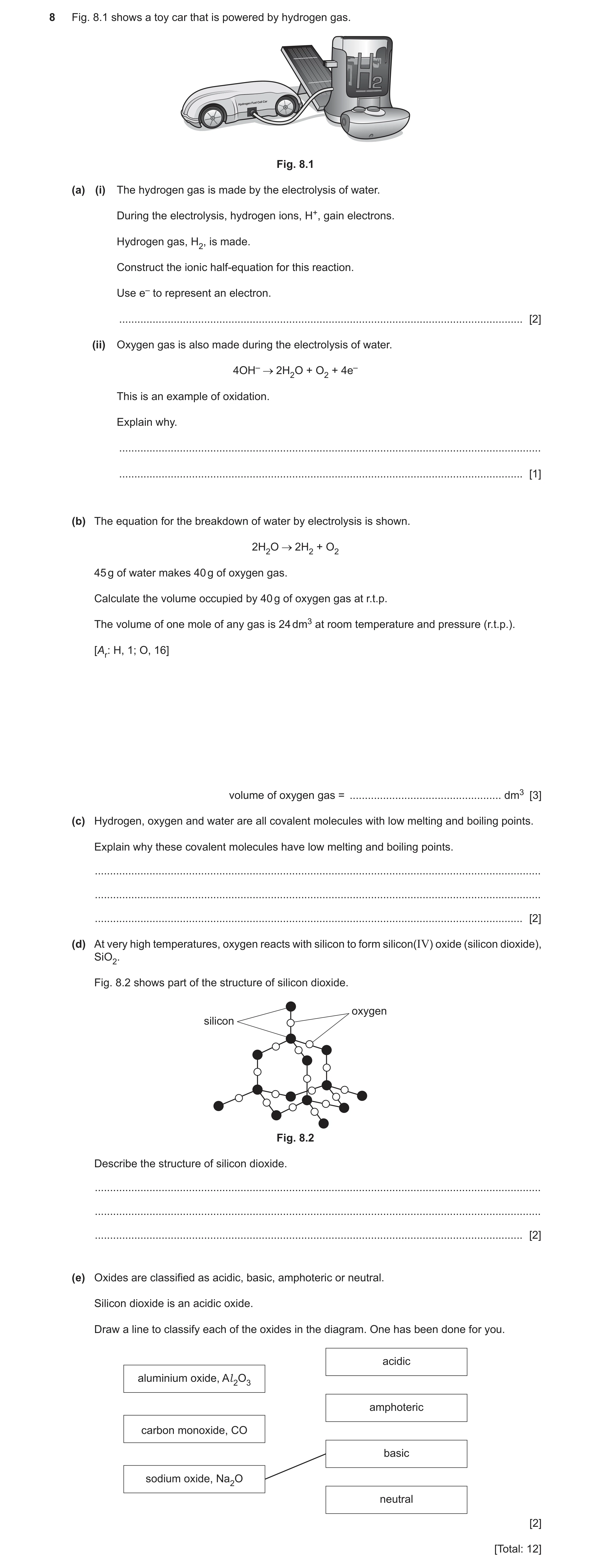
Q26 · A toy car that is powered by hydrogen gas 0654/43 May/June 2024
8 Fig. 8.1 shows a toy car that is powered by hydrogen gas. Fig. 8.1 (a) (i) The hydrogen gas is made by the electrolysis of water. During the electrolysis, hydrogen ions, H+, gain electrons. Hydrogen gas, H2, is made. Construct the ionic half-equation for this reaction. Use e– to represent an electron. … [2] (ii) Oxygen gas is also made during the electrolysis of water. 4OH– 2H2O + O2 + 4e– This is an example of oxidation. Explain why. … … [1] (b) The equation for the breakdown of water by electrolysis is shown. 2H2O 2H2 + O2 45 g of water makes 40 g of oxygen gas. Calculate the volume occupied by 40 g of oxygen gas at r.t.p. The volume of one mole of any gas is 24 dm3 at room temperature and pressure (r.t.p.). [Ar: H, 1; O, 16] volume of oxygen gas = … dm3 [3] (c) Hydrogen, oxygen and water are all covalent molecules with low melting and boiling points. Explain why these covalent molecules have low melting and boiling points. … … … [2] (d) At very high temperatures, oxygen reacts with silicon to form silicon(IV) oxide (silicon dioxide), SiO2. Fig. 8.2 shows part of the structure of silicon dioxide. oxygen silicon Fig. 8.2 Describe the structure of silicon dioxide. … … … [2] (e) Oxides are classified as acidic, basic, amphoteric or neutral. Silicon dioxide is an acidic oxide. Draw a line to classify each of the oxides in the diagram. One has been done for you. acidic aluminium oxide, Al 2O3 amphoteric carbon monoxide, CO basic sodium oxide, Na2O neutral [2] [Total: 12]
12 marks
Mark scheme: 8(a)(i) 2 8(a)(ii) loss of electrons / AW ; 1 8(b) Mr of O2 = 32 ; moles of O2 = 40 ÷ 32 = 1.25 ; volume of O2 = 1.25 24 = 30 dm³ ; 3 8(c) weak intermolecular forces / weak forces between molecules ; (weak forces) which require little energy to break ; 2 8(d) giant covalent OR covalent lattice ; each oxygen atom forms bonds with 2 silicon atoms / each silicon atoms forms bonds with 4 oxygen atoms ; 2 8(e) ;; 2
This question in 0654/43 May/June 2024
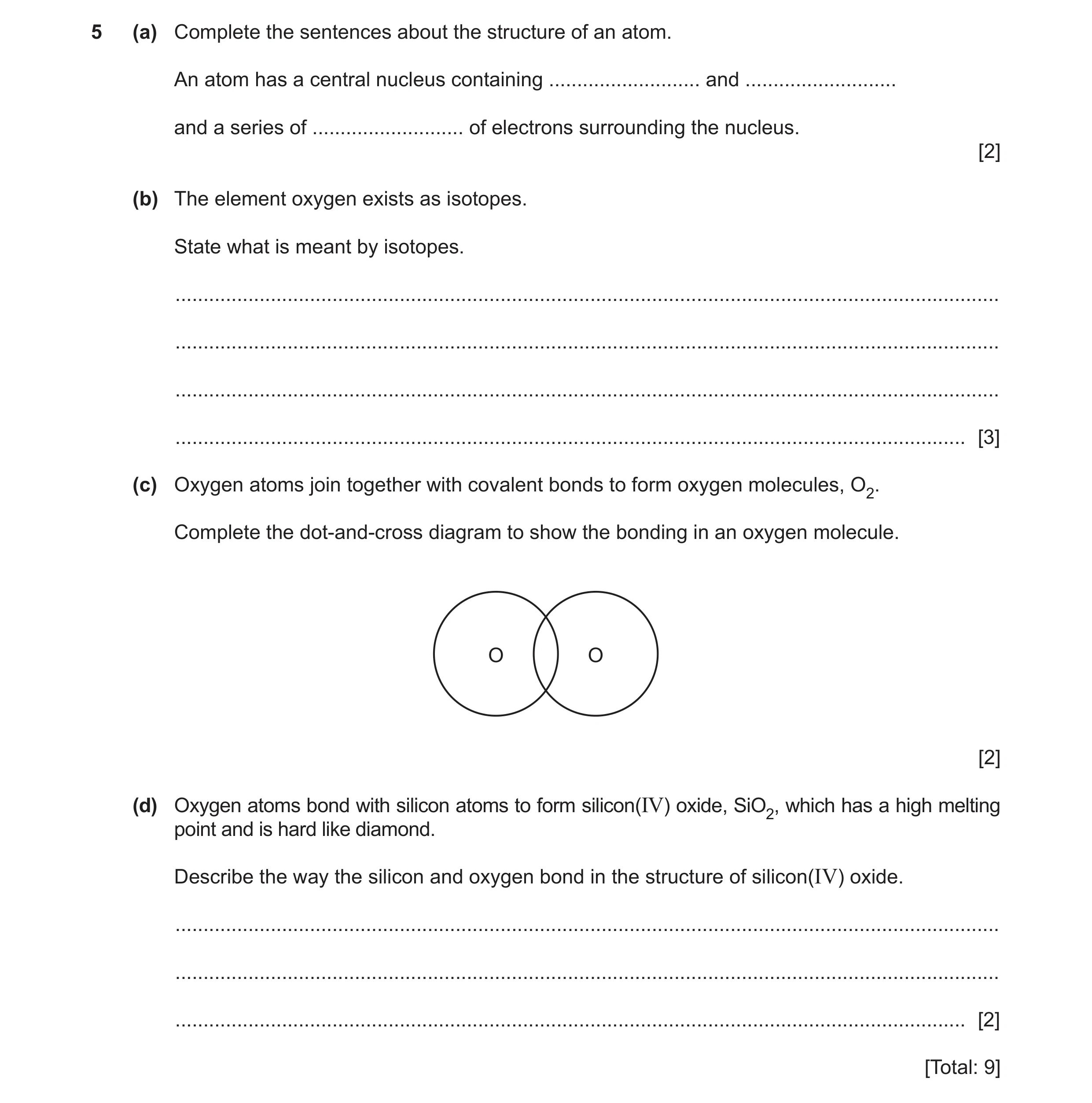
Q27 · Complete the sentences about the structure of an atom 0654/41 Oct/Nov 2024
5 (a) Complete the sentences about the structure of an atom. An atom has a central nucleus containing … and … and a series of … of electrons surrounding the nucleus. [2] (b) The element oxygen exists as isotopes. State what is meant by isotopes. … … … … [3] (c) Oxygen atoms join together with covalent bonds to form oxygen molecules, O2. Complete the dot‑and‑cross diagram to show the bonding in an oxygen molecule. O O [2] (d) Oxygen atoms bond with silicon atoms to form silicon(IV) oxide, SiO2, which has a high melting point and is hard like diamond. Describe the way the silicon and oxygen bond in the structure of silicon(IV) oxide. … … … [2] [Total: 9]
9 marks
Mark scheme: 5(a) protons (and) neutrons 2 shells one or two correct for 1 mark three correct for 2 marks ;; 5(b) (idea of) atoms of the same / an element ; 3 which have the same proton / atomic number ; but a different nucleon / mass number ; 5(c) 2 one mark for double bond between oxygen atoms one mark for rest of structure correct ;; 5(d) any two from: 2 macromolecular / (giant) lattice ; each oxygen atom bonds with 2 silicon atoms ; each silicon atom bonds with 4 oxygen atoms ; sharing of electrons / covalent bond ;
This question in 0654/41 Oct/Nov 2024
Q28 · Carbon dioxide gas is made in many chemical reactions 0654/42 Oct/Nov 2024
2 Carbon dioxide gas is made in many chemical reactions. (a) Tick (✓) the two chemical reactions that make carbon dioxide. reaction between an acid and a metal reaction between an alkali metal and water respiration thermal decomposition of calcium carbonate [2] (b) Scientists are concerned about increased concentrations of carbon dioxide in the atmosphere. Explain why. … … … … [2] (c) Oxides, such as carbon dioxide, can be classified as acidic, basic, or amphoteric. Classify carbon dioxide by putting a ring around the correct type of oxide. acidic amphoteric basic Explain your answer. … … [2] (d) Carbon dioxide, CO2, is a simple molecule. (i) State the type of chemical bonding in a molecule of carbon dioxide. … [1] (ii) Draw a dot-and-cross diagram to show the bonding in carbon dioxide. You only need to draw the outer-shell electrons. [2] [Total: 9]
9 marks
Mark scheme: 2(a) 2 reaction between an acid and a metal reaction between an alkali metal and water respiration thermal decomposition of calcium carbonate 1 mark for each correct tick ;; 2(b) (idea that) carbon dioxide is a greenhouse gas / there is an (enhanced) greenhouse effect ; 2 (increased concentrations of greenhouse gases cause) climate change ; 2(c) acidic ; 2 carbon is a non-metal ; 2(d)(i) covalent ; 1 2(d)(ii) 2 double bonds between C and O atoms correct ; rest of structure correct ;
This question in 0654/42 Oct/Nov 2024
Q29 · The electrolysis of aqueous copper sulfate using graphite electrodes 0654/42 Feb/March 2025
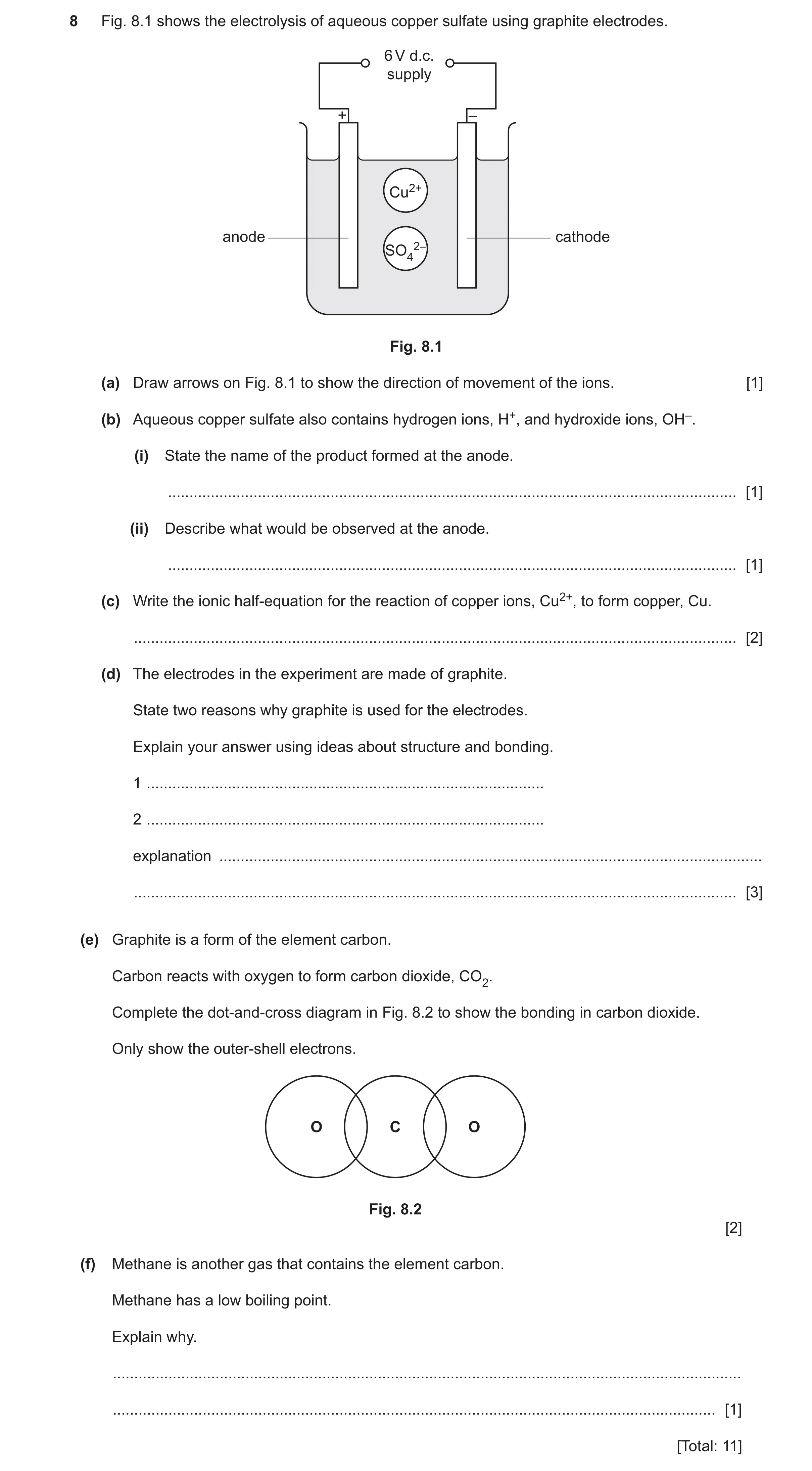
8 Fig. 8.1 shows the electrolysis of aqueous copper sulfate using graphite electrodes. 6 V d.c. supply + – Cu2+ anode cathode SO42– Fig. 8.1 (a) Draw arrows on Fig. 8.1 to show the direction of movement of the ions. [1] (b) Aqueous copper sulfate also contains hydrogen ions, H+, and hydroxide ions, OH–. (i) State the name of the product formed at the anode. … [1] (ii) Describe what would be observed at the anode. … [1] (c) Write the ionic half-equation for the reaction of copper ions, Cu2+, to form copper, Cu. … [2] (d) The electrodes in the experiment are made of graphite. State two reasons why graphite is used for the electrodes. Explain your answer using ideas about structure and bonding. 1 … 2 … explanation … … [3] (e) Graphite is a form of the element carbon. Carbon reacts with oxygen to form carbon dioxide, CO2. Complete the dot-and-cross diagram in Fig. 8.2 to show the bonding in carbon dioxide. Only show the outer-shell electrons. O C O Fig. 8.2 [2] (f) Methane is another gas that contains the element carbon. Methane has a low boiling point. Explain why. … … [1] [Total: 11]
11 marks
Mark scheme: 8(a) arrow from Cu2+ to cathode and arrow from SO42– to anode ; 1 8(b)(i) oxygen ; 1 8(b)(ii) fizzing / bubbling / effervescence ; 1 8(c) Cu2+ + 2e– → Cu ; ; 2 8(d) 1: (graphite) conducts electricity ; 3 2: (graphite) is inert ; (graphite has) delocalised electrons OR because outer shell electrons are used in bonding ; 8(e) 2 ; ; 8(f) (methane has) weak intermolecular forces ; 1
This question in 0654/42 Feb/March 2025
Q30 · Some information about the particles in atoms 0654/43 Oct/Nov 2025
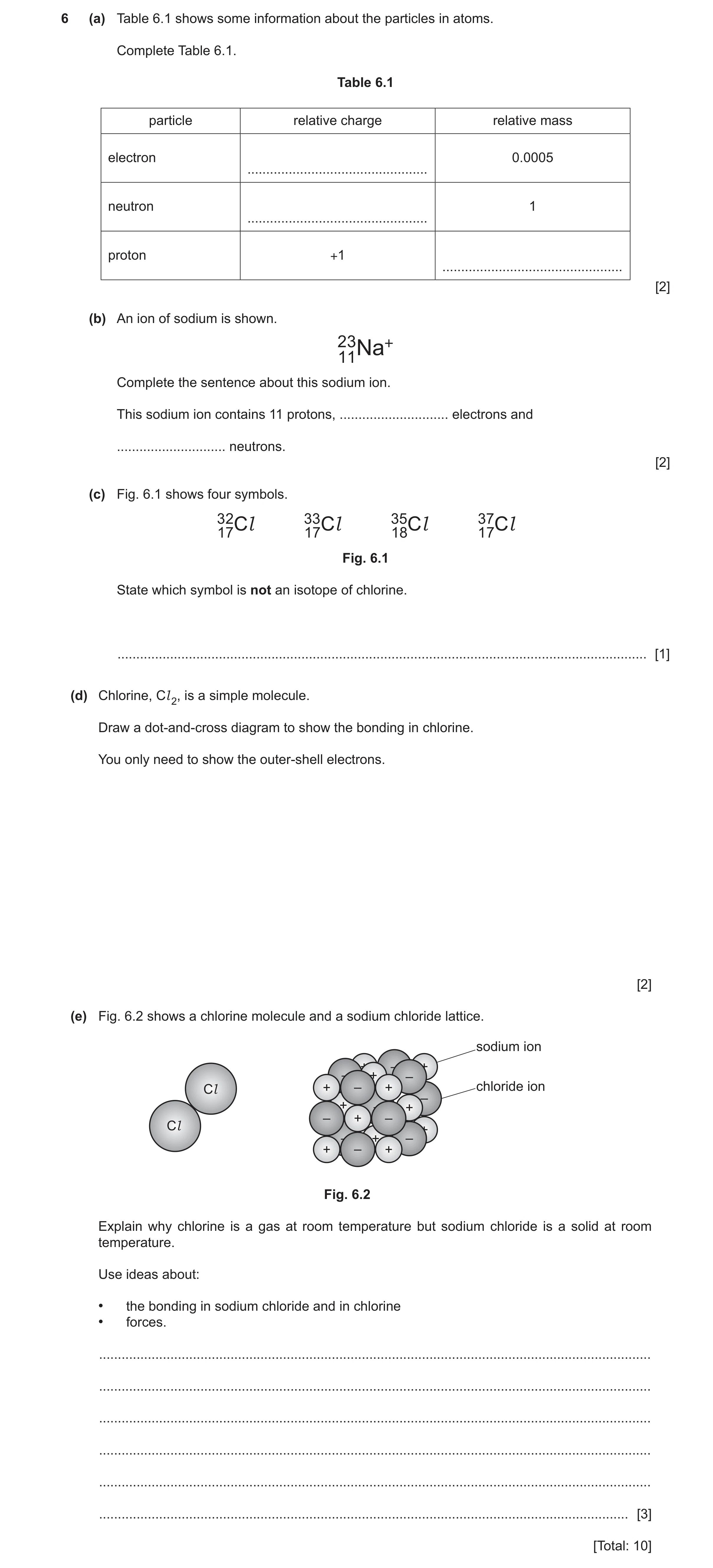
6 (a) Table 6.1 shows some information about the particles in atoms. Complete Table 6.1. Table 6.1 particle relative charge relative mass electron 0.0005 … neutron 1 … proton +1 … [2] (b) An ion of sodium is shown. 2 3 1 1Na+ Complete the sentence about this sodium ion. This sodium ion contains 11 protons, … electrons and … neutrons. [2] (c) Fig. 6.1 shows four symbols. 3 2 3 3 3 5 3 7 1 7Cl 1 7Cl 1 8Cl 1 7Cl Fig. 6.1 State which symbol is not an isotope of chlorine. … [1] (d) Chlorine, Cl 2, is a simple molecule. Draw a dot-and-cross diagram to show the bonding in chlorine. You only need to show the outer-shell electrons. [2] (e) Fig. 6.2 shows a chlorine molecule and a sodium chloride lattice. sodium ion + – + – + – Cl + – + chloride ion – + – + – + – Cl + – + – + – + Fig. 6.2 Explain why chlorine is a gas at room temperature but sodium chloride is a solid at room temperature. Use ideas about: • the bonding in sodium chloride and in chlorine • forces. … … … … … … [3] [Total: 10]
10 marks
Mark scheme: 6(a) 2 particle relative charge relative mass electron –1 0.0005 neutron 0 1 proton +1 1 3 correct for 2 marks 1 or 2 correct for 1 mark 6(b) 10 electrons ; 2 12 neutrons ; 6(c) 35Cl ; 1 18 6(d) 2 1 mark shared pair of electrons between chlorine atoms 1 mark for rest of structure correct 6(e) chlorine is covalent and sodium chloride is ionic ; 3 chlorine has weak intermolecular forces ; sodium chloride has strong electrostatic forces / sodium chloride has strong forces between oppositely charged ions ;
This question in 0654/43 Oct/Nov 2025
 19 / 48
 20 / 48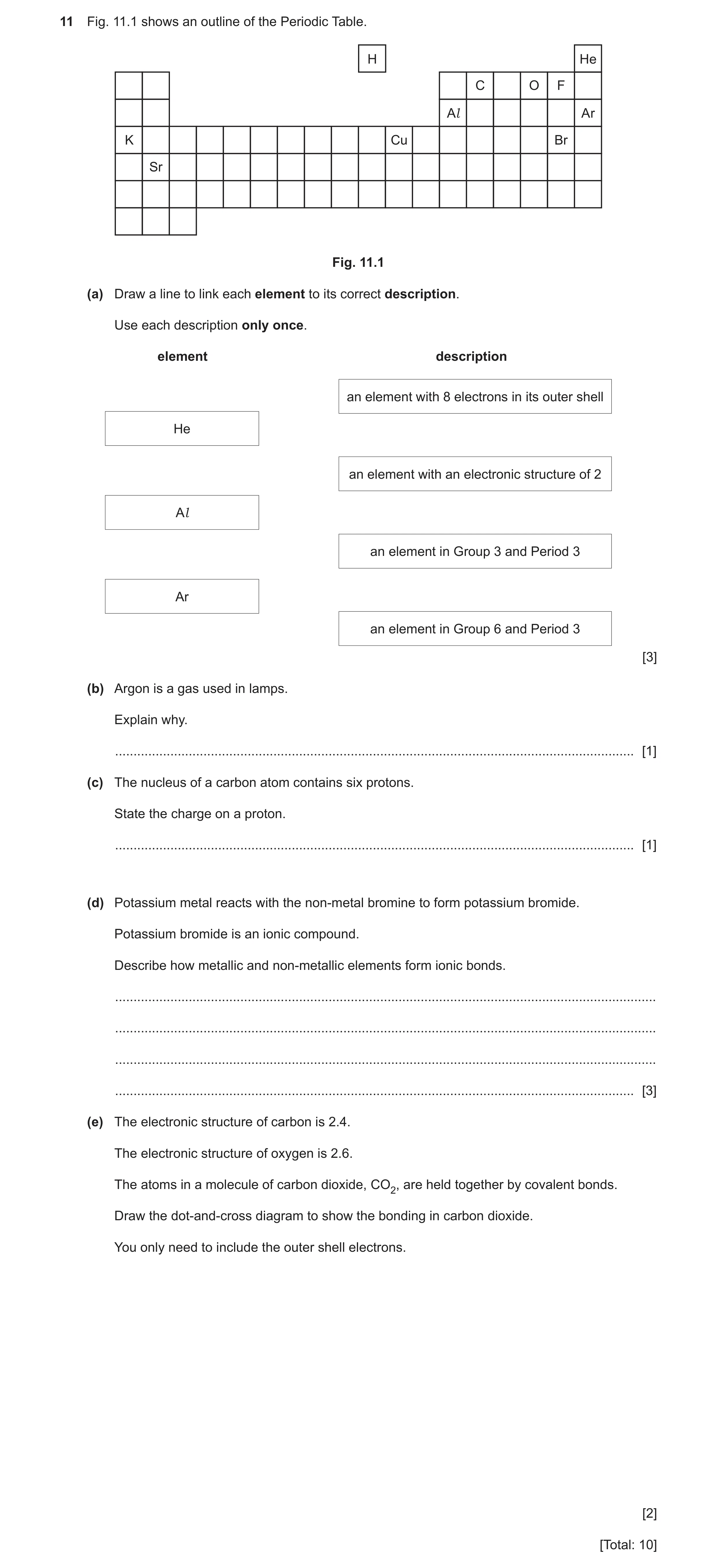
 25 / 48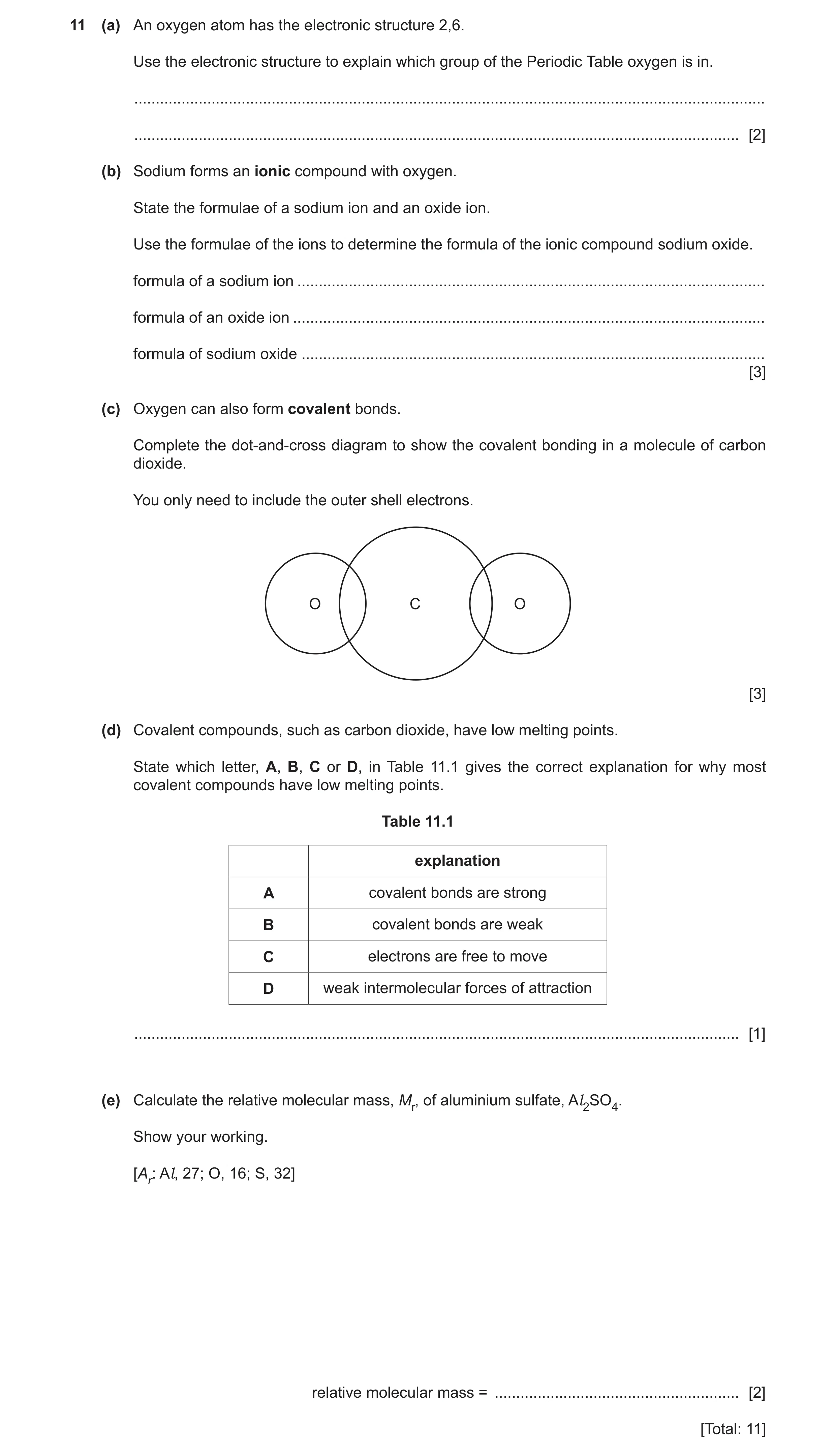
 29 / 48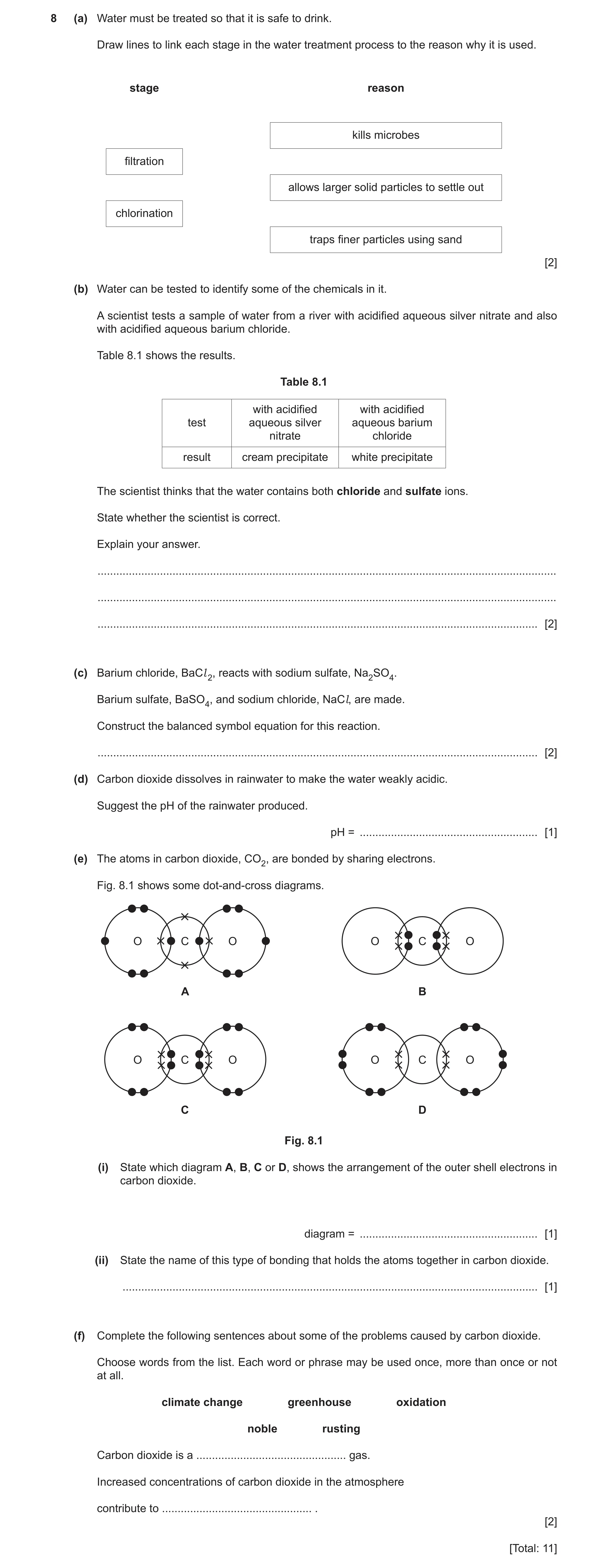
 44 / 48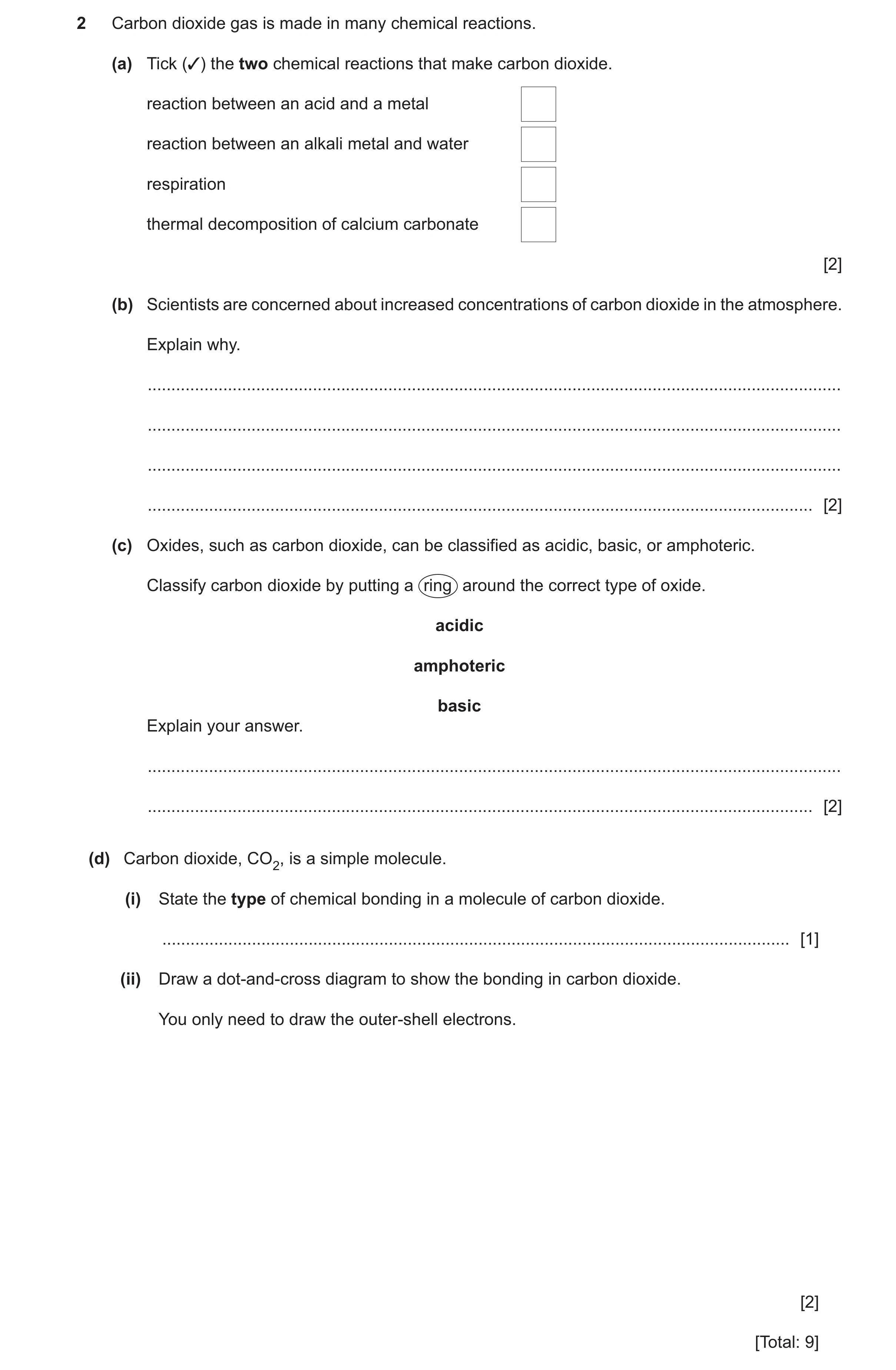
 13
13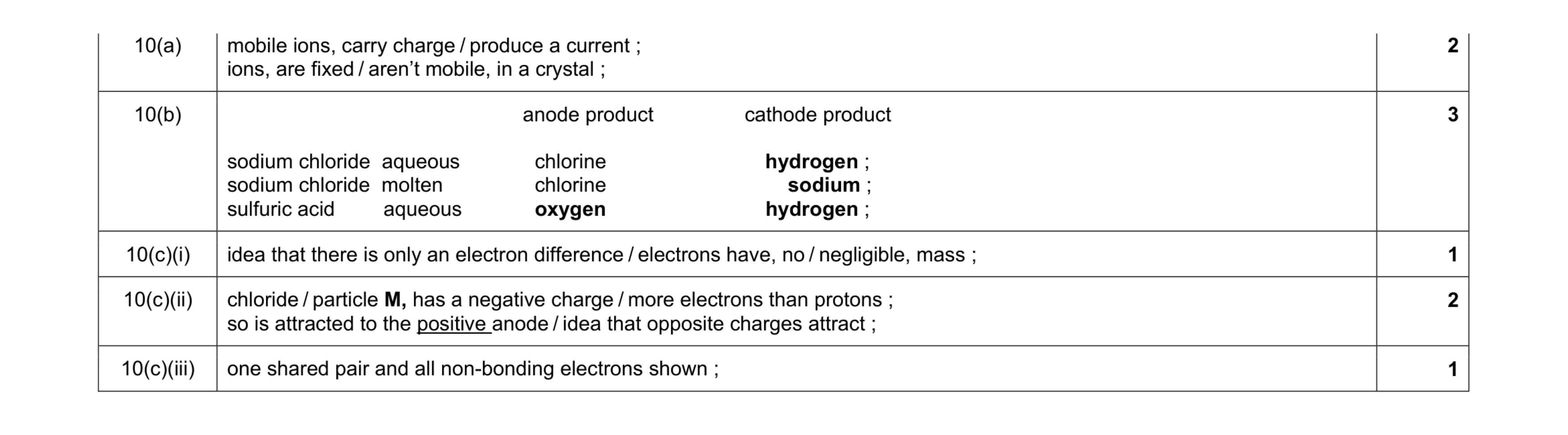 9
9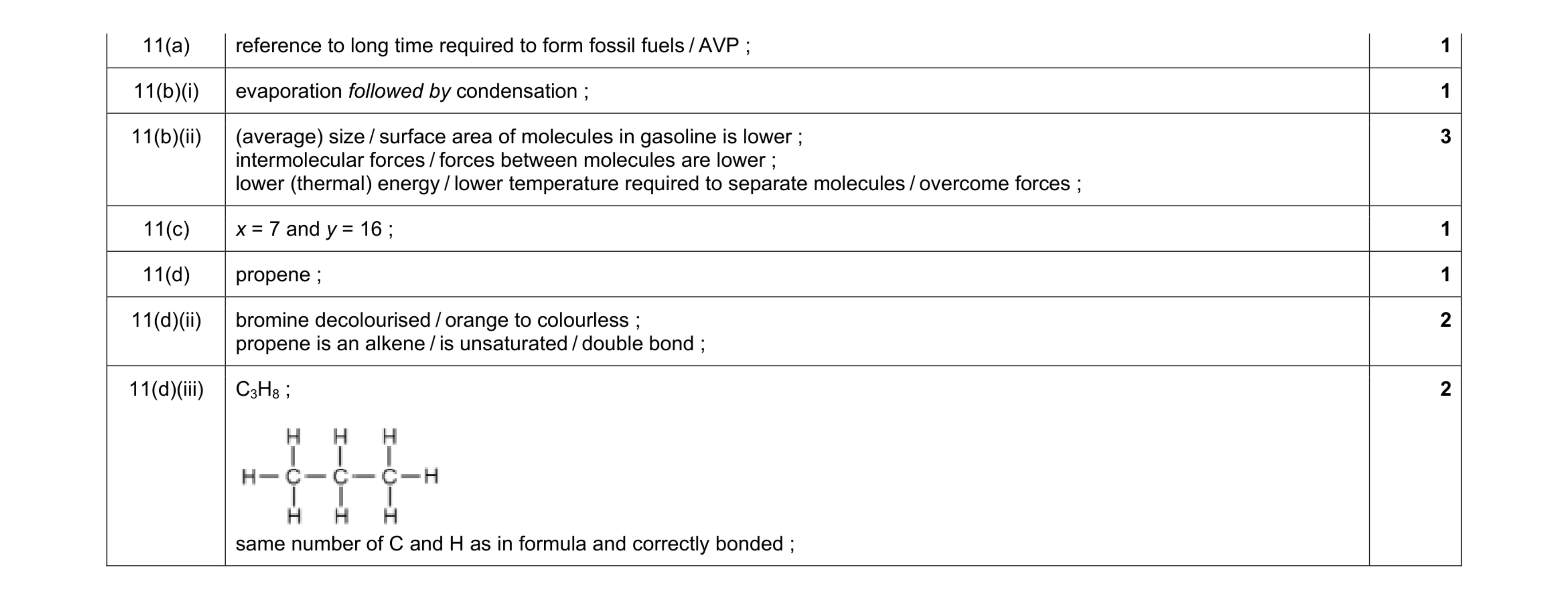 11
11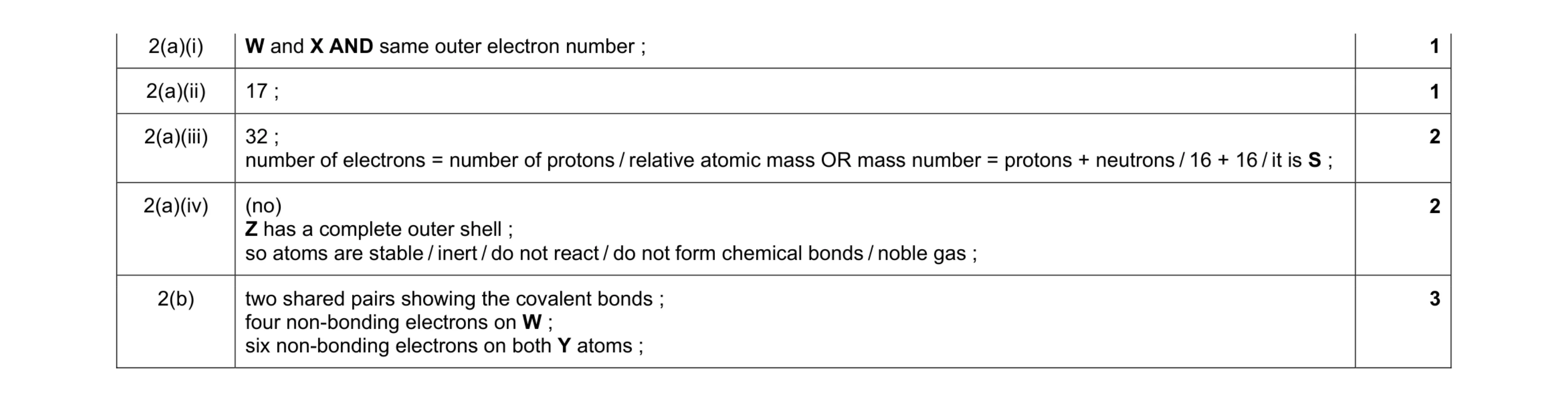 9
9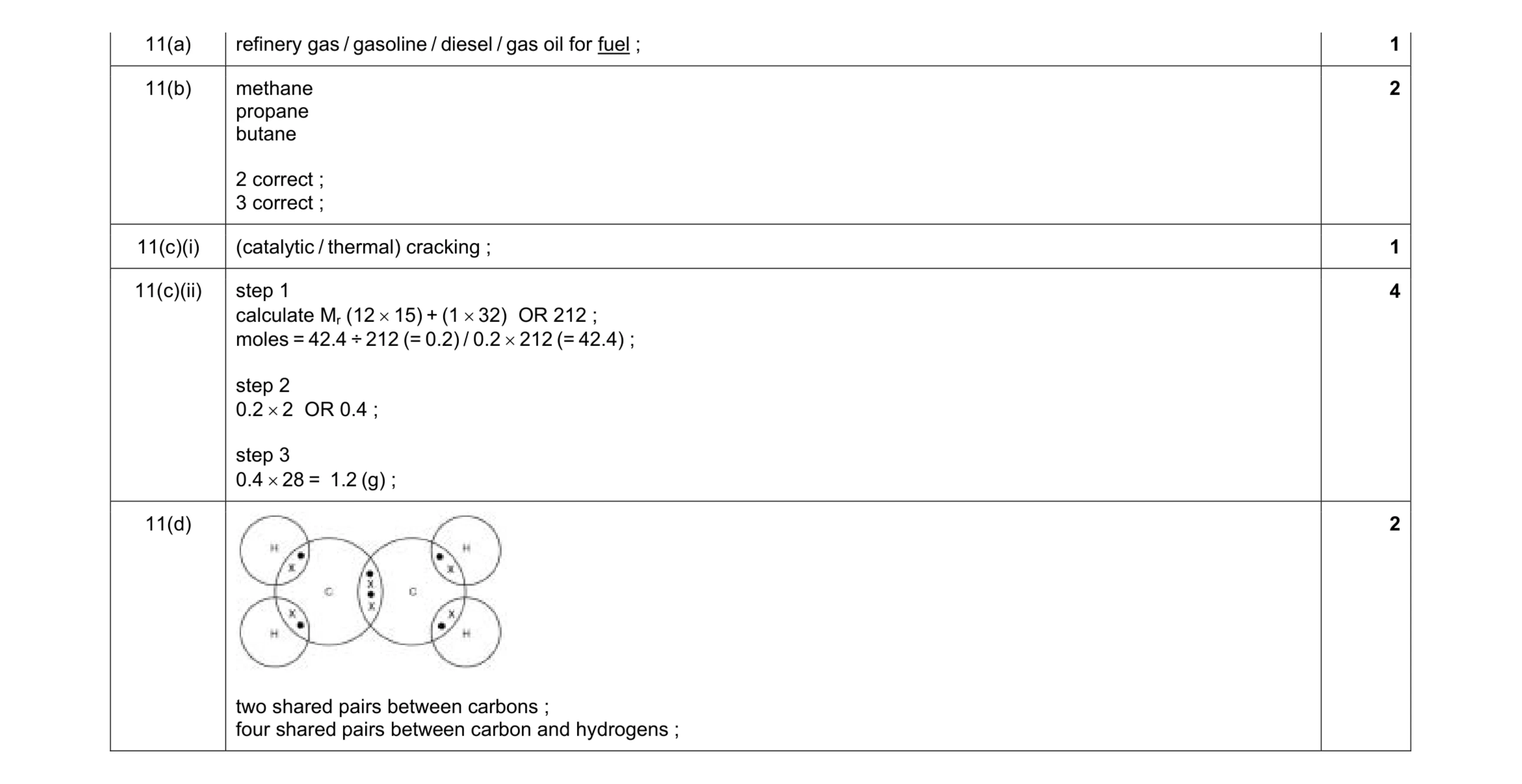 10
10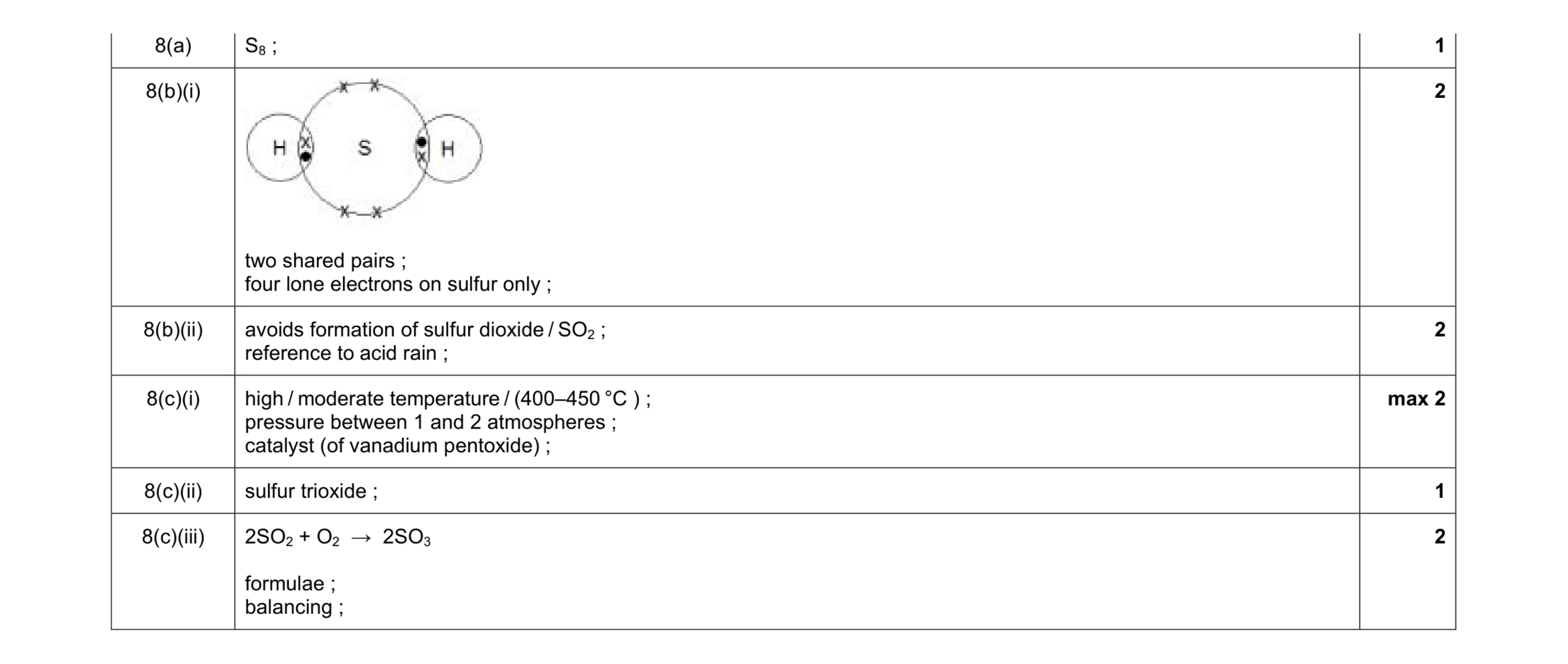 10
10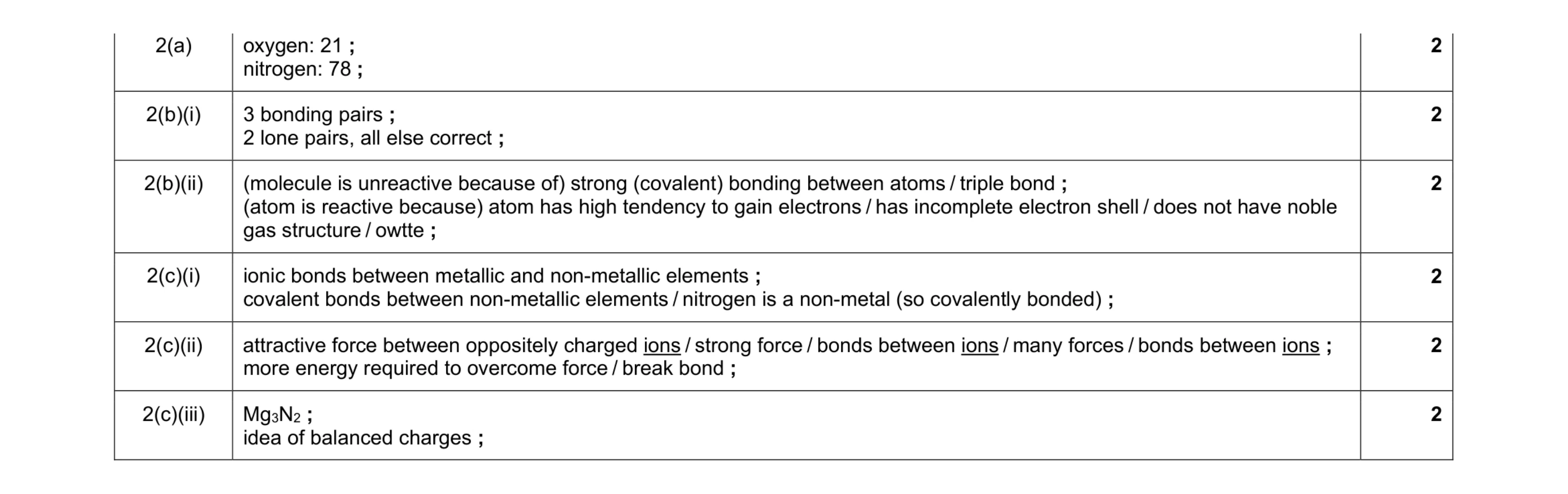 12
12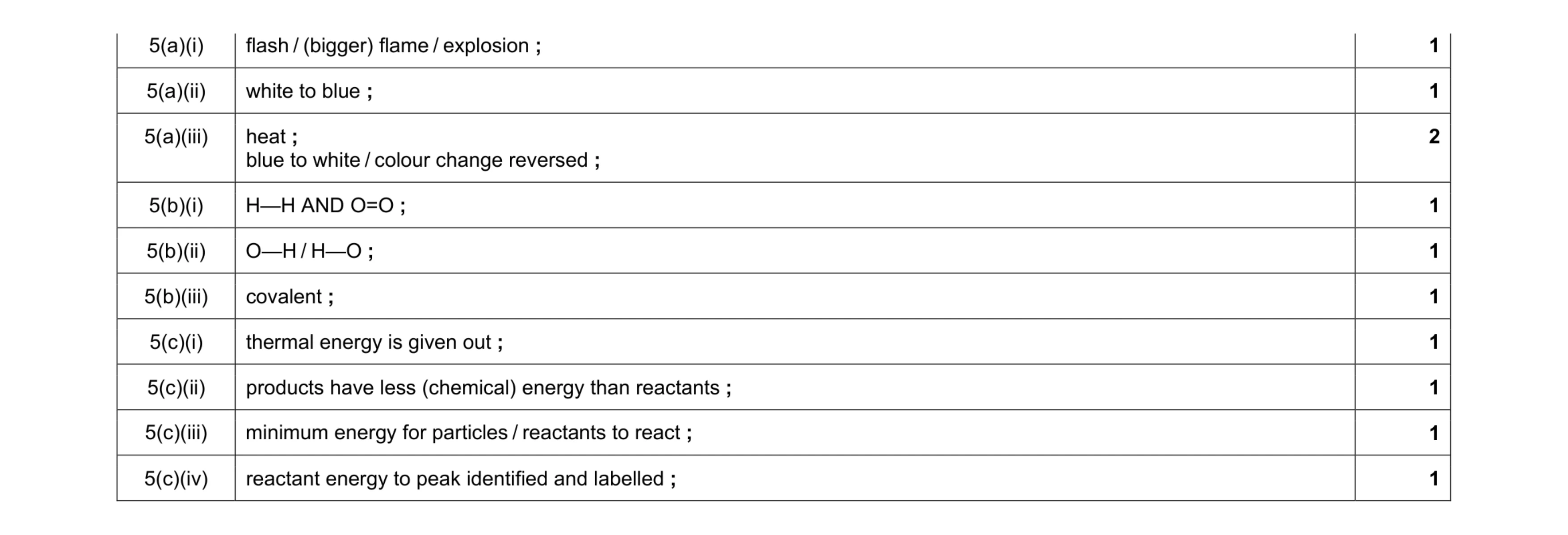 11
11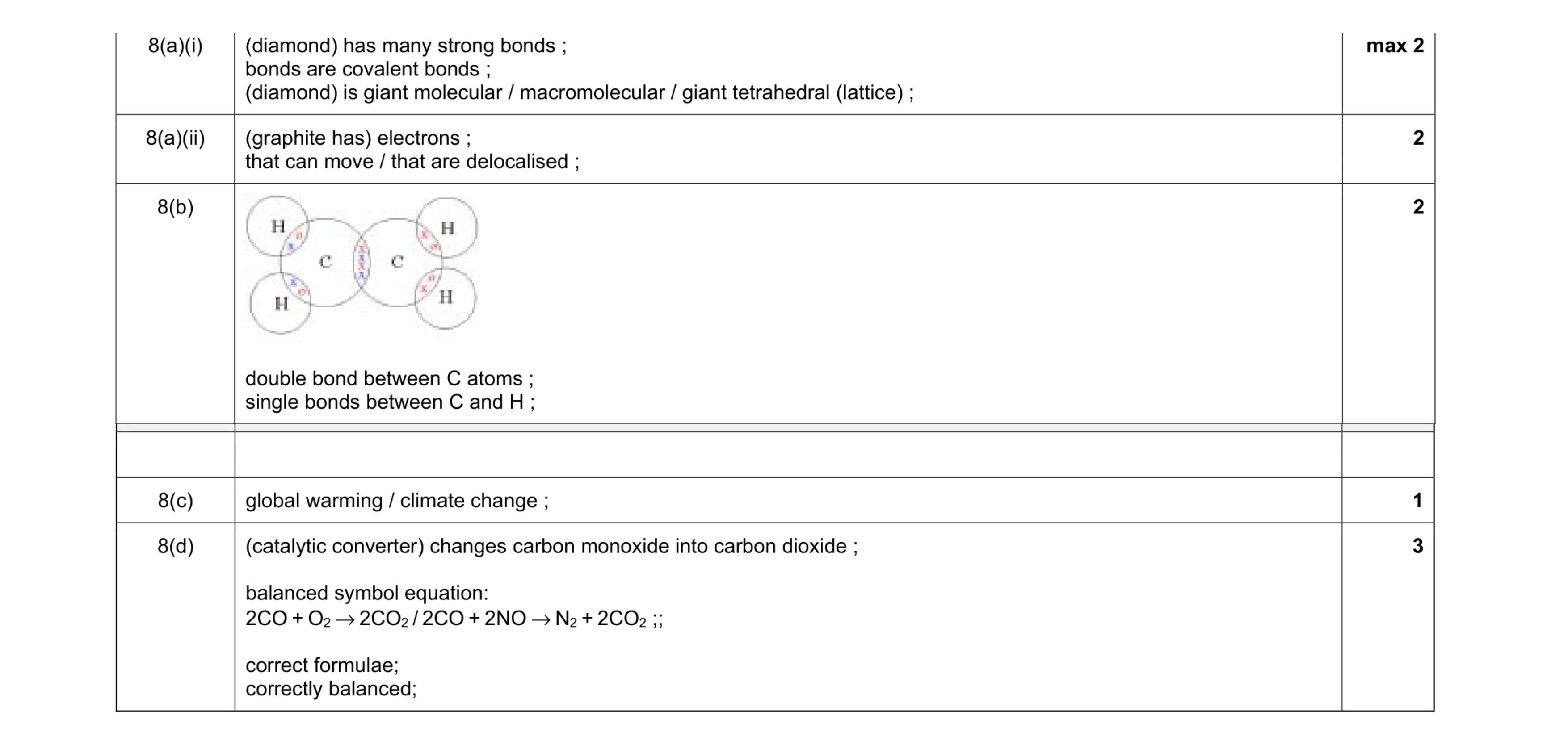 10
10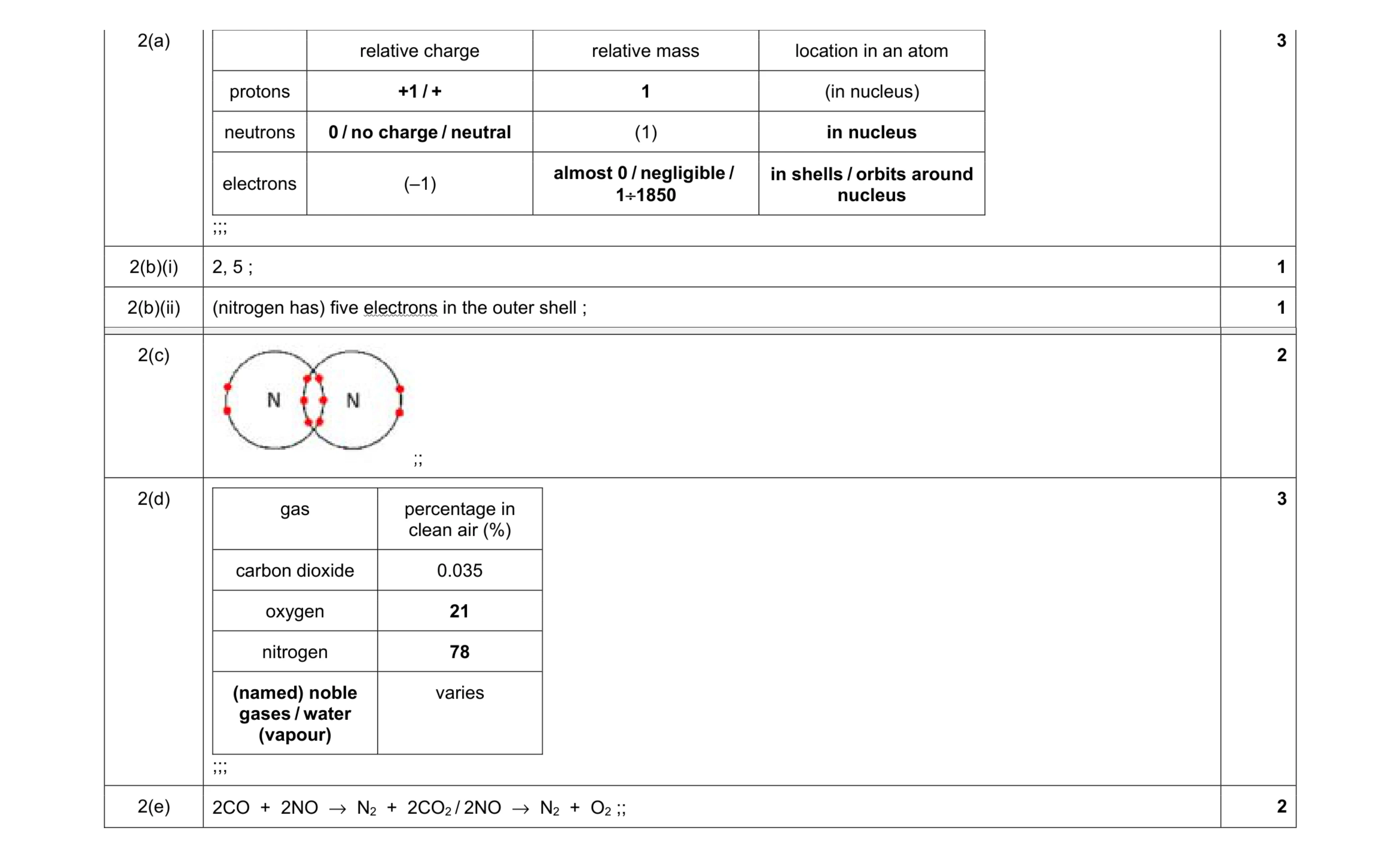 12
12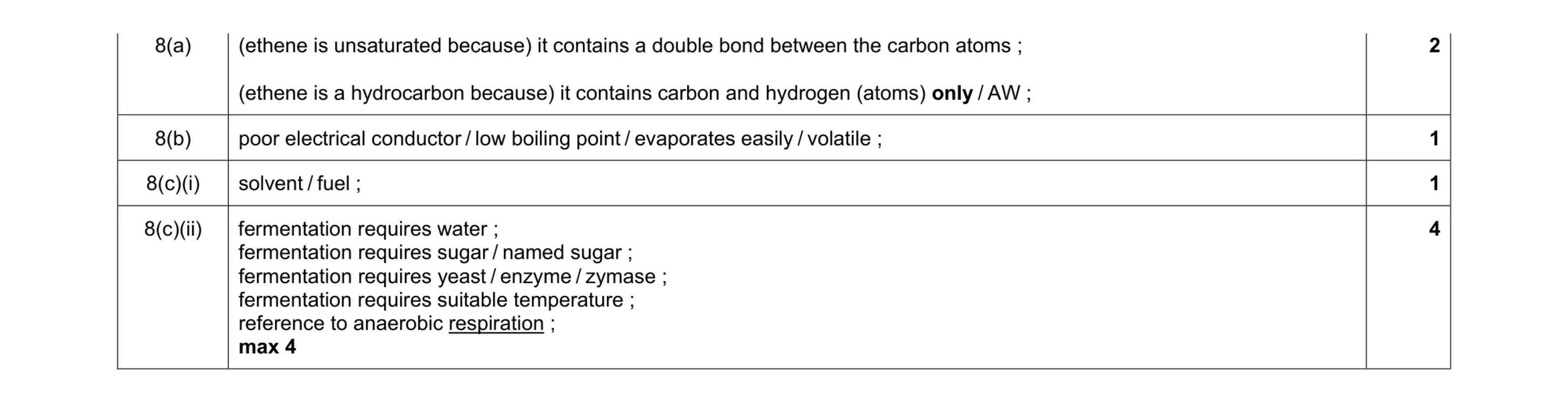 8
8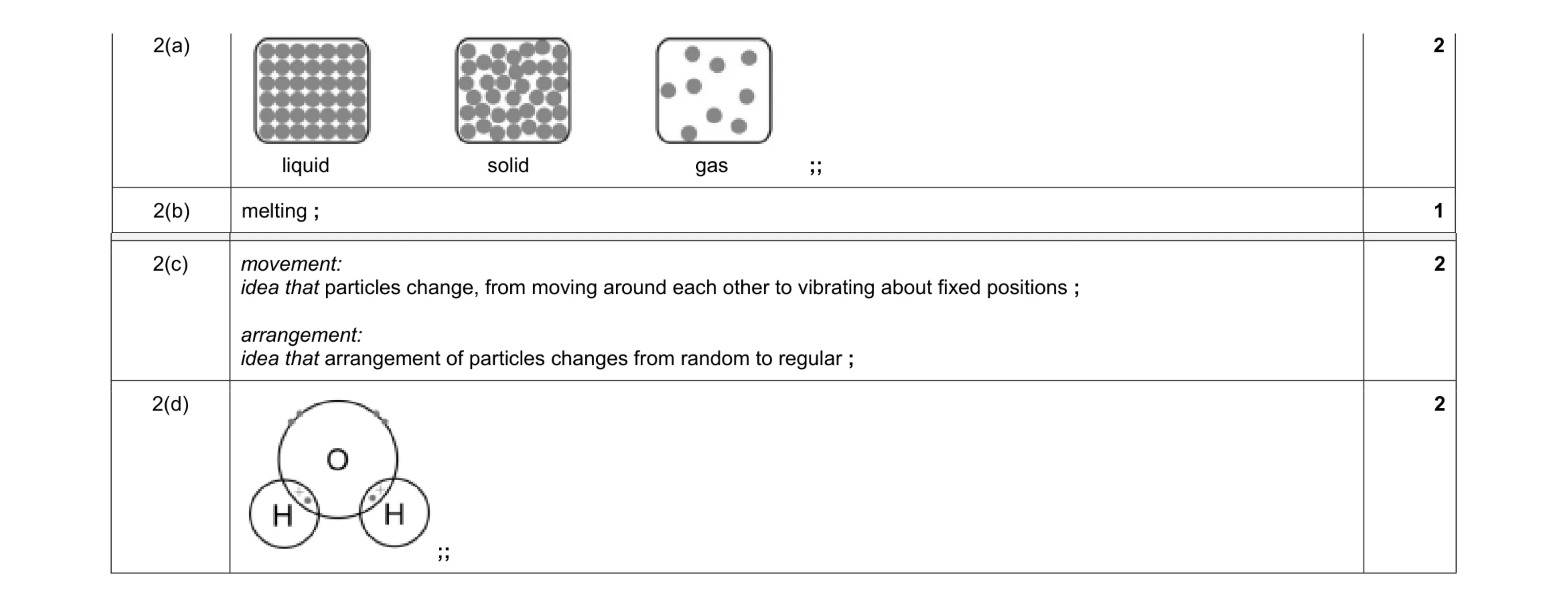 7
7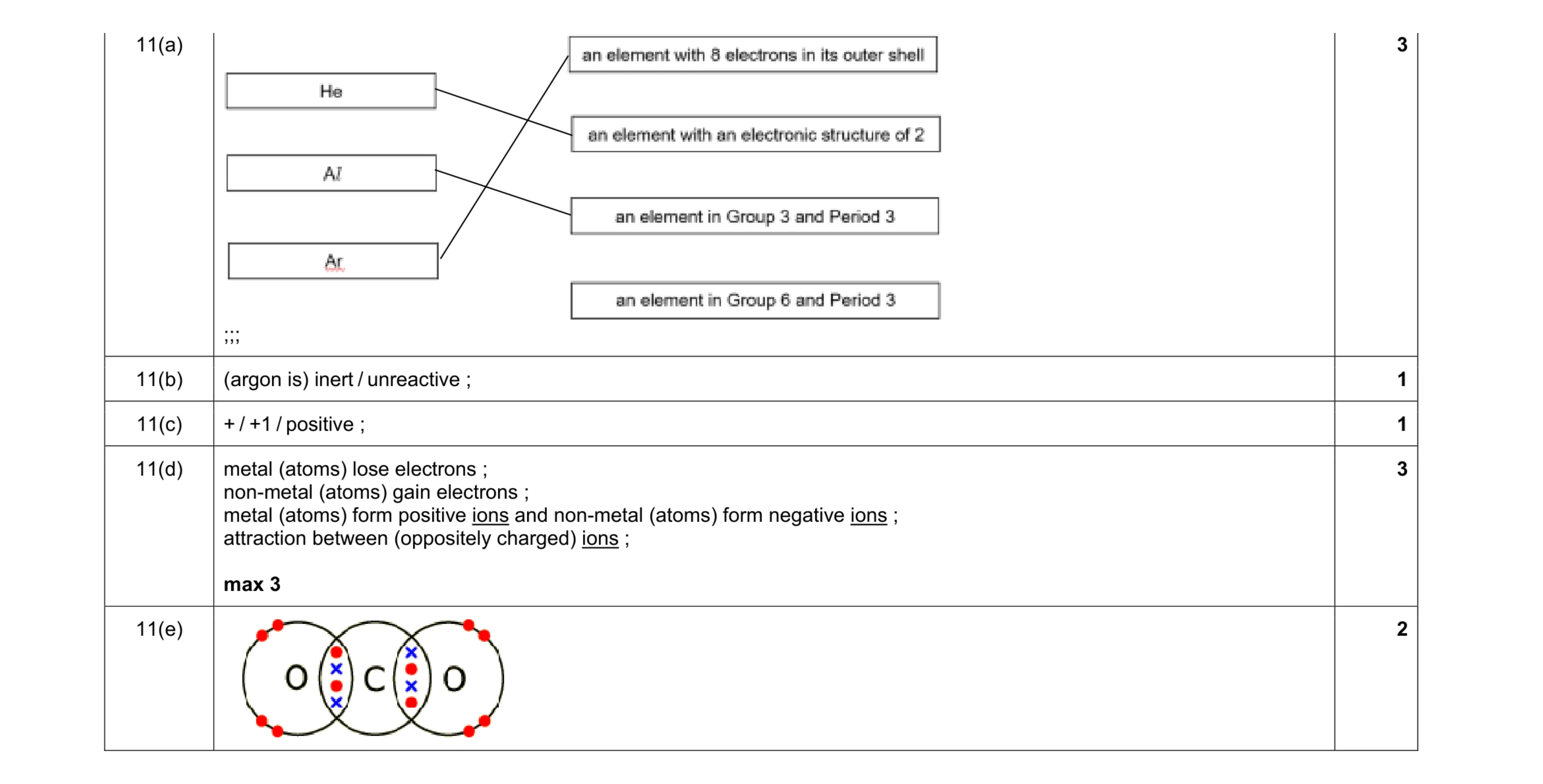 10
10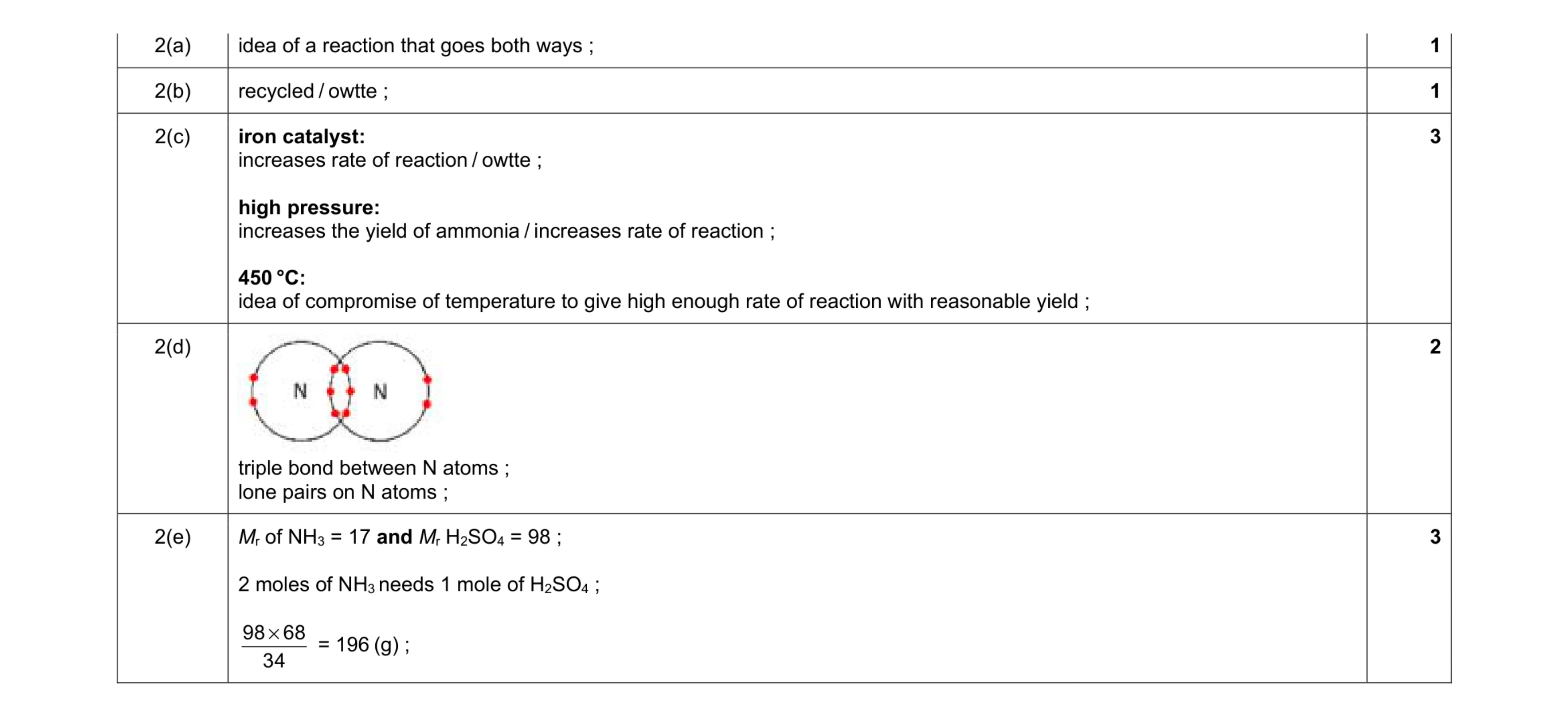 10
10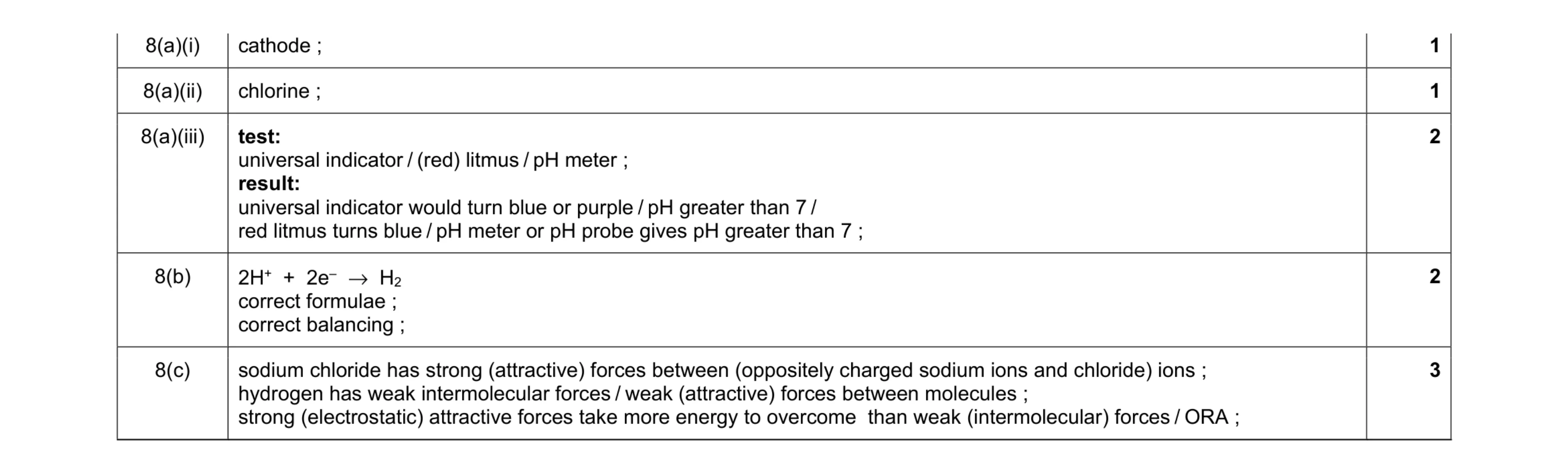 9
9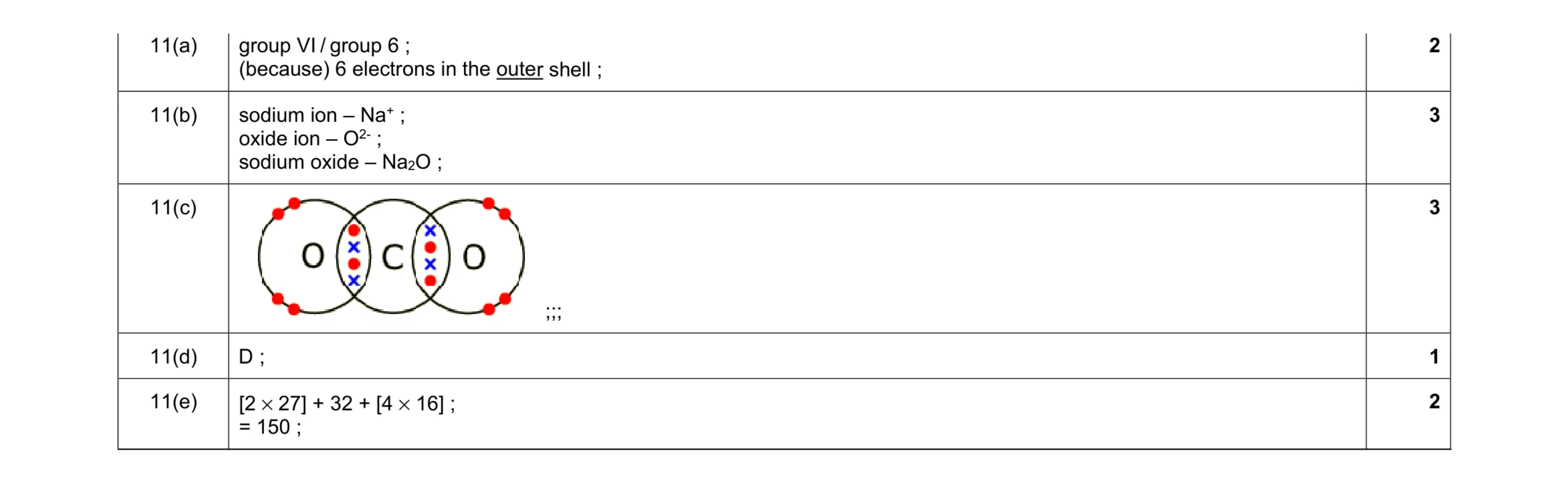 11
11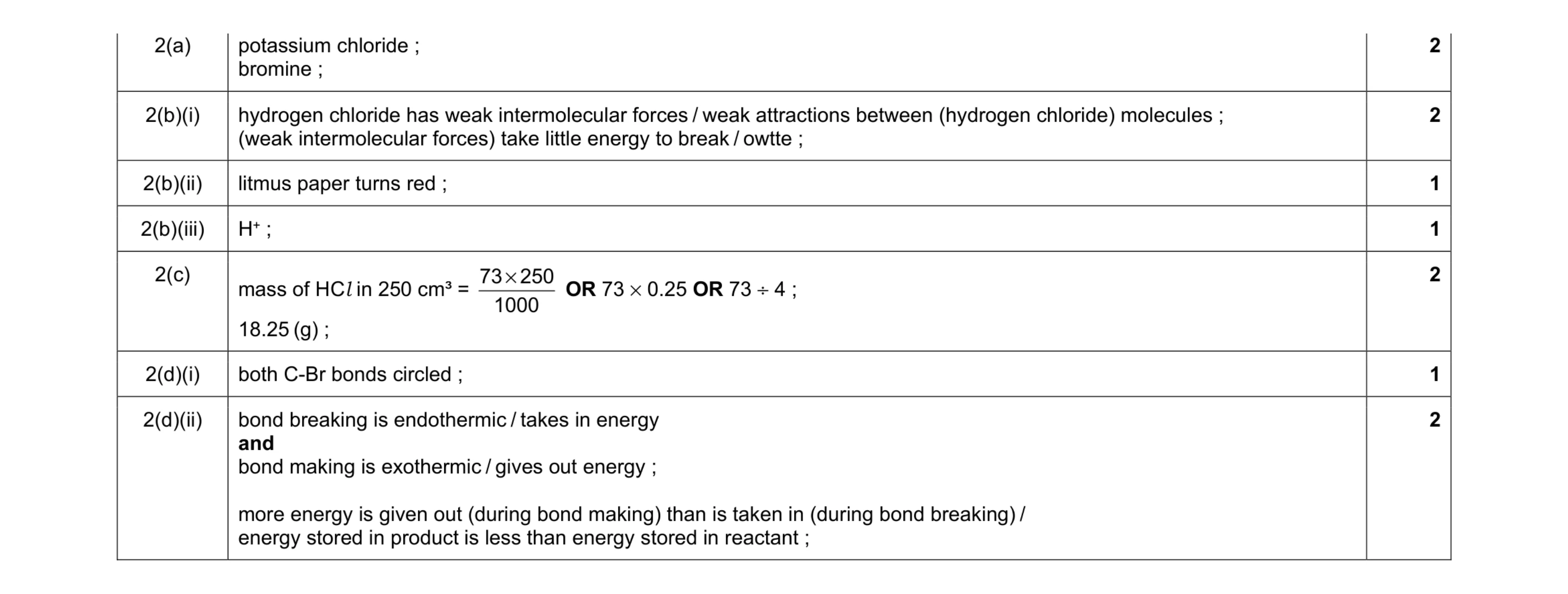 11
11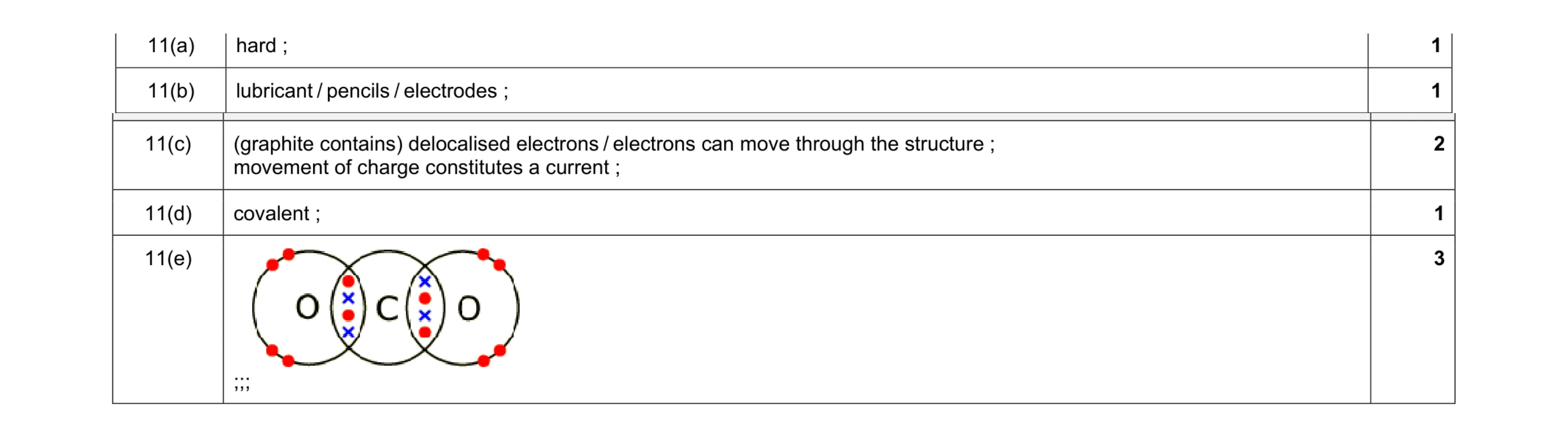 8
8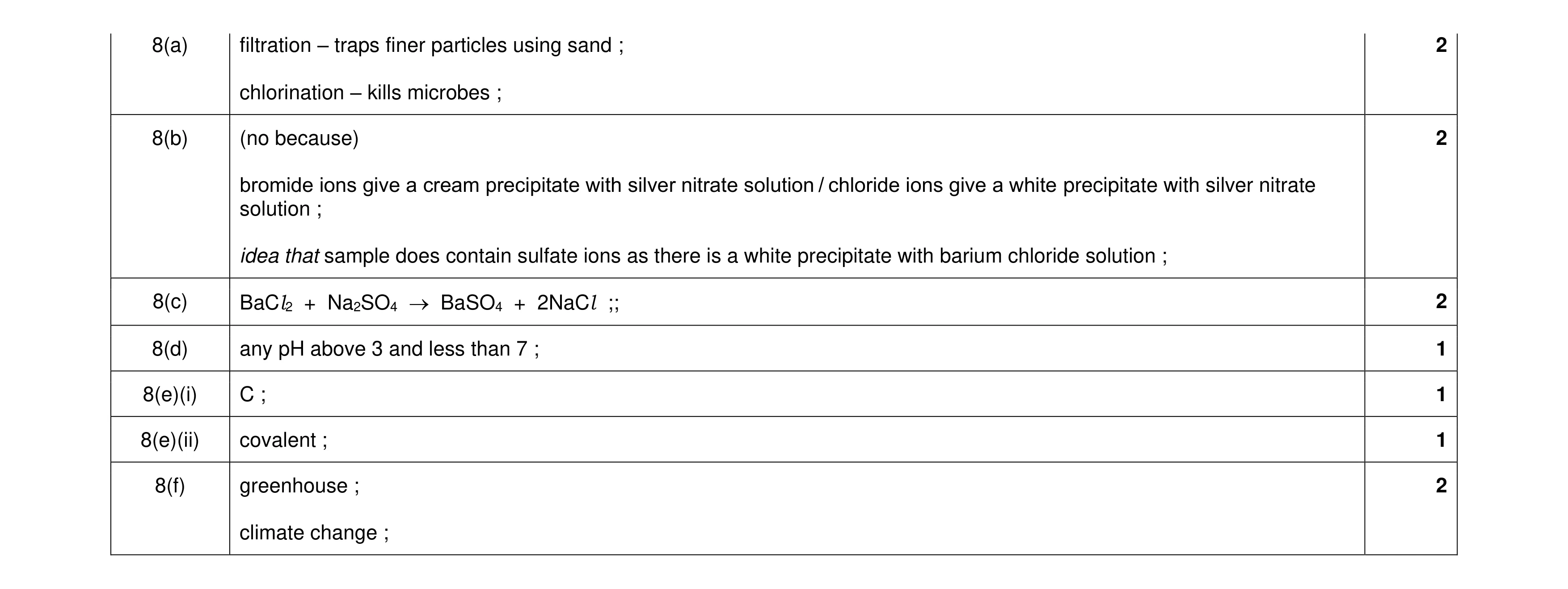 11
11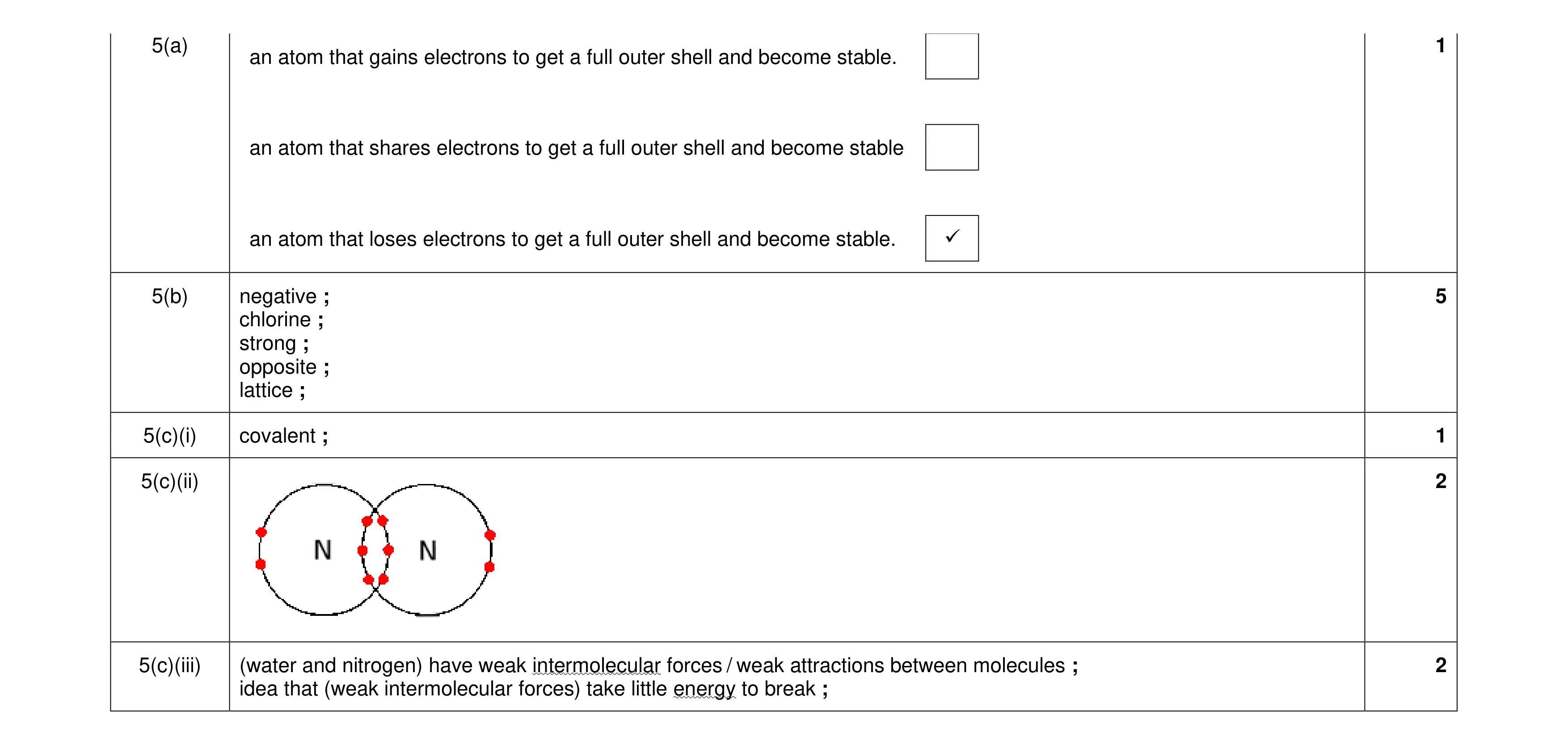 11
11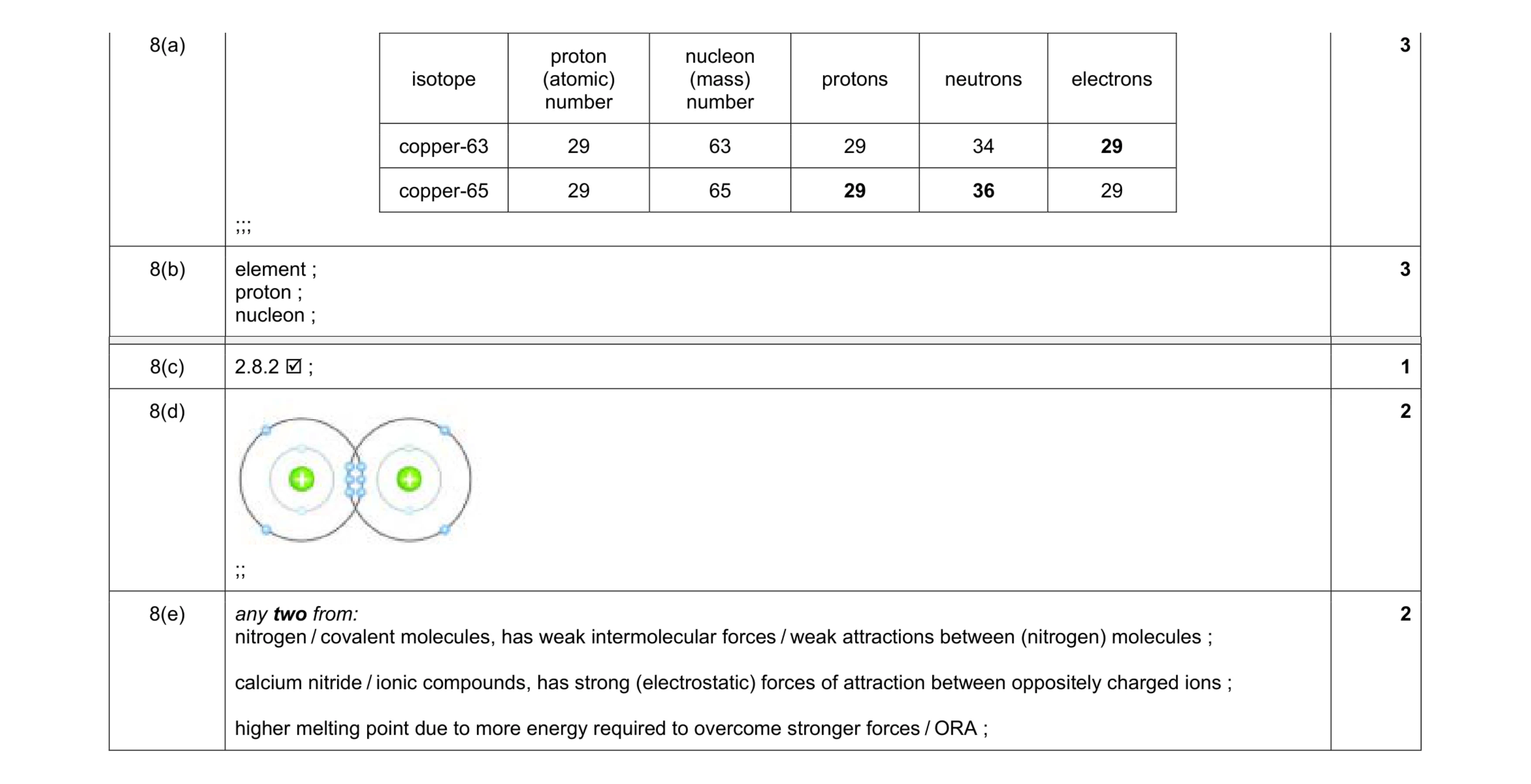 11
11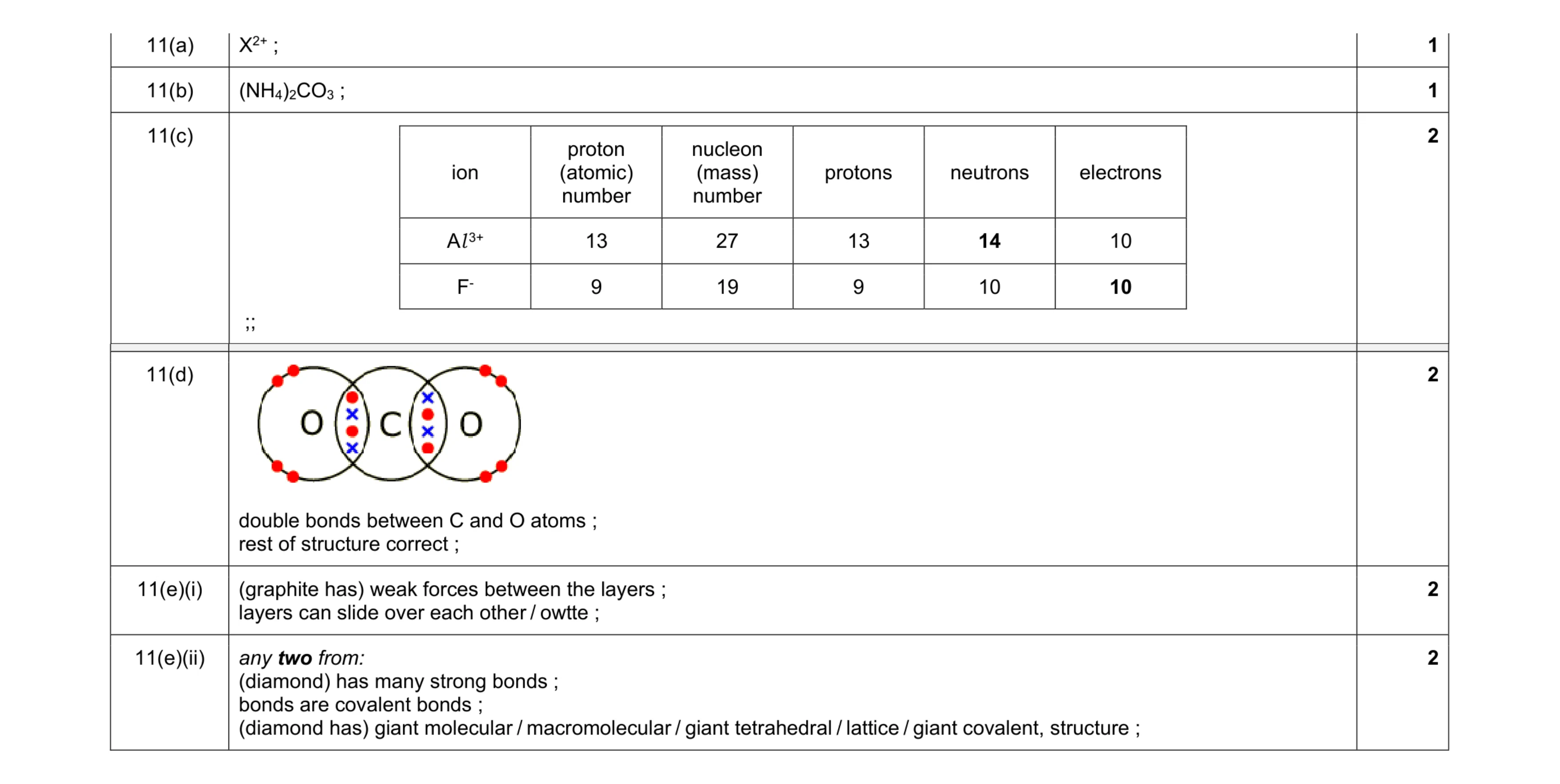 10
10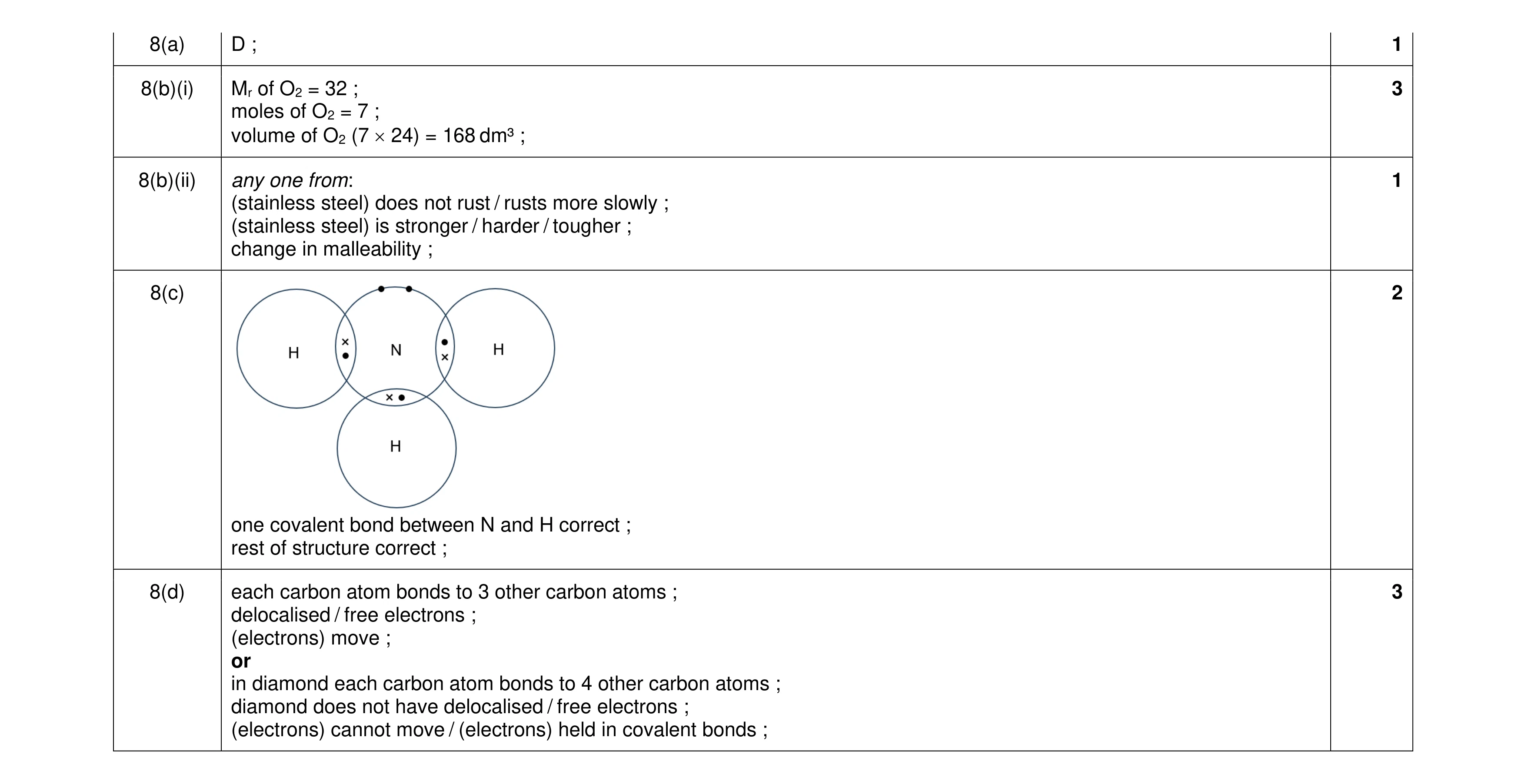 10
10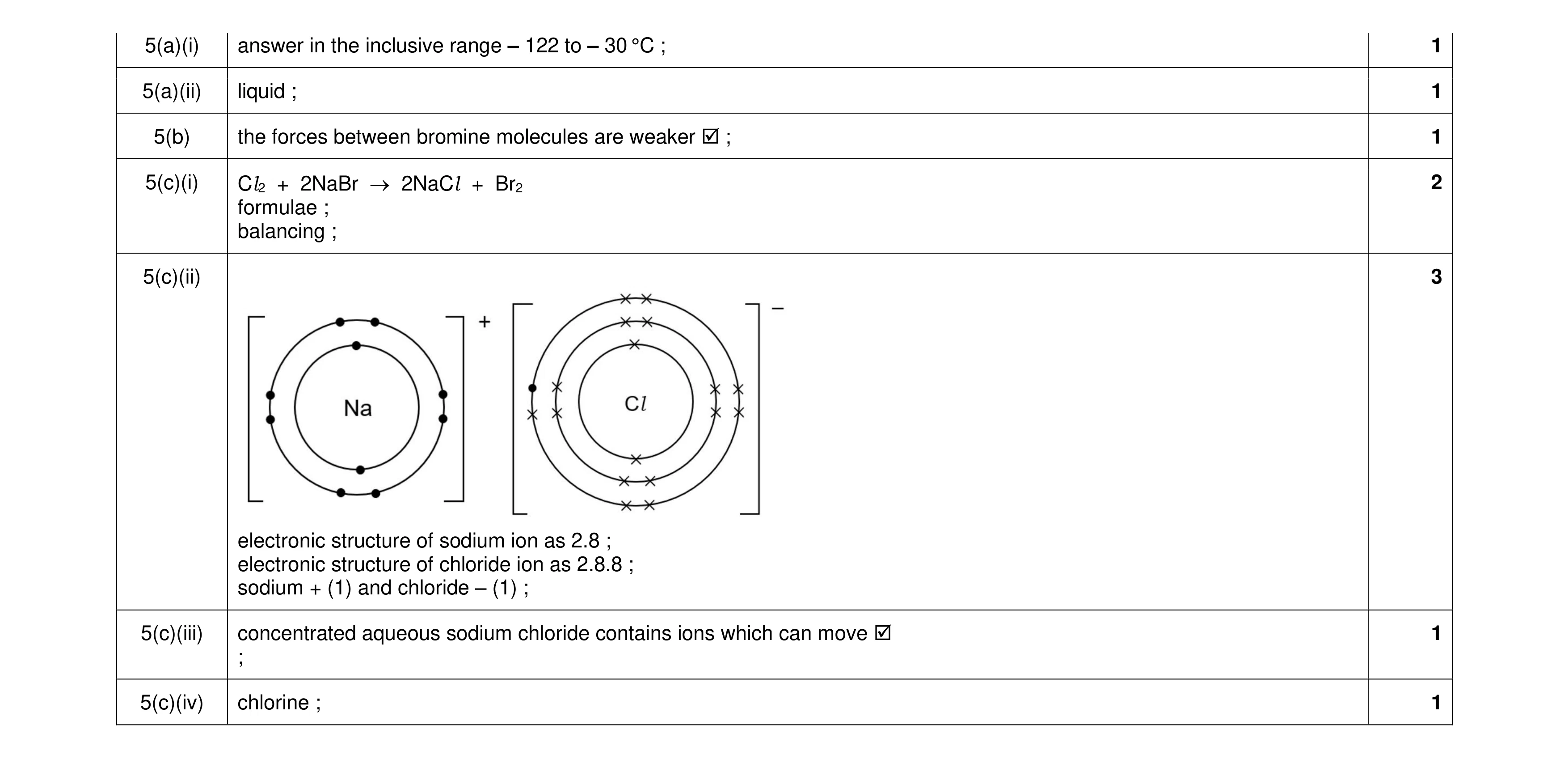 10
10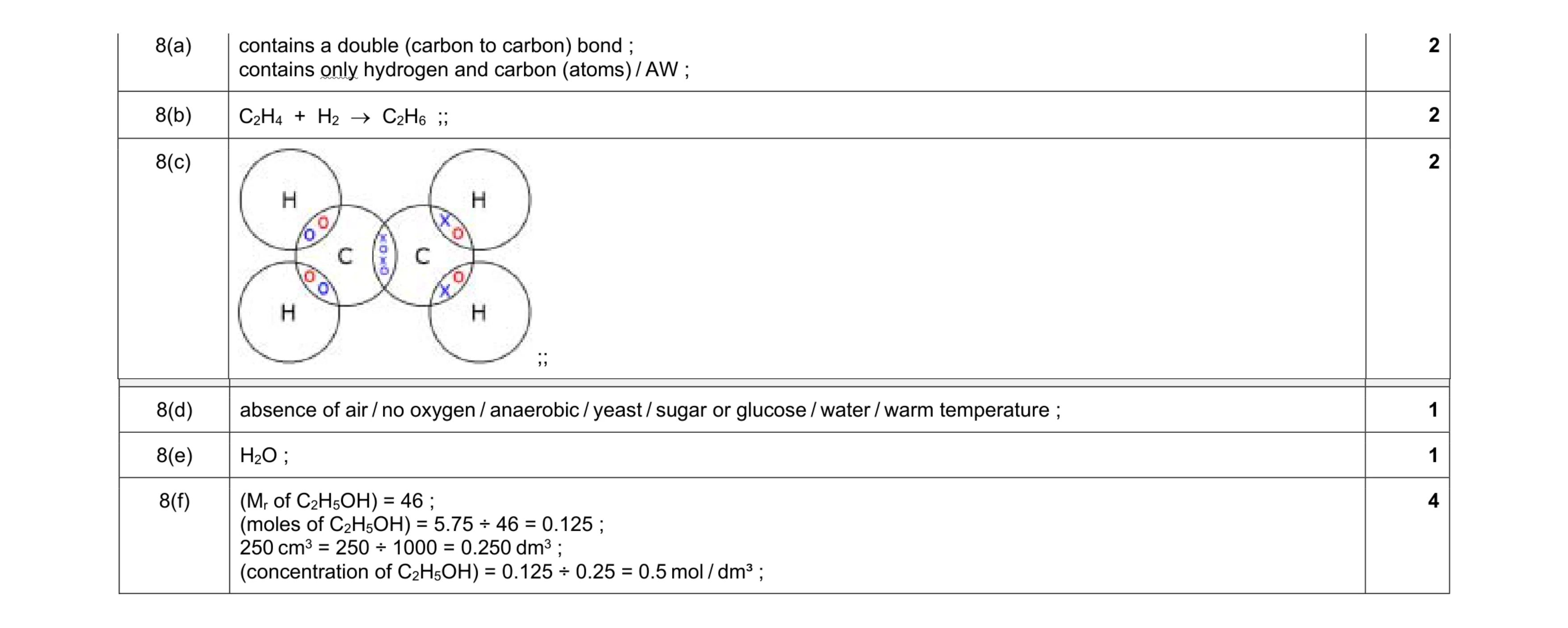 12
12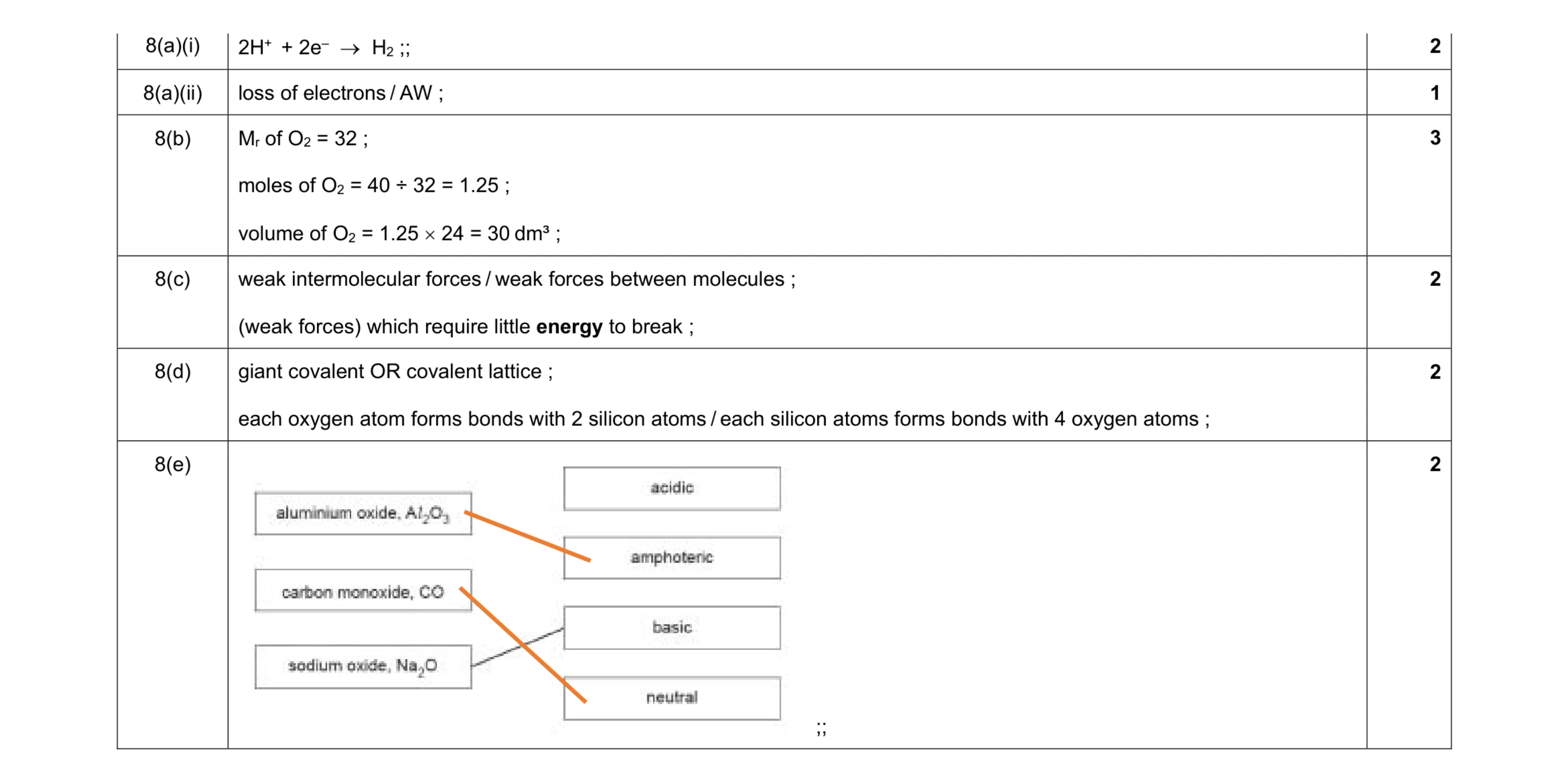 12
12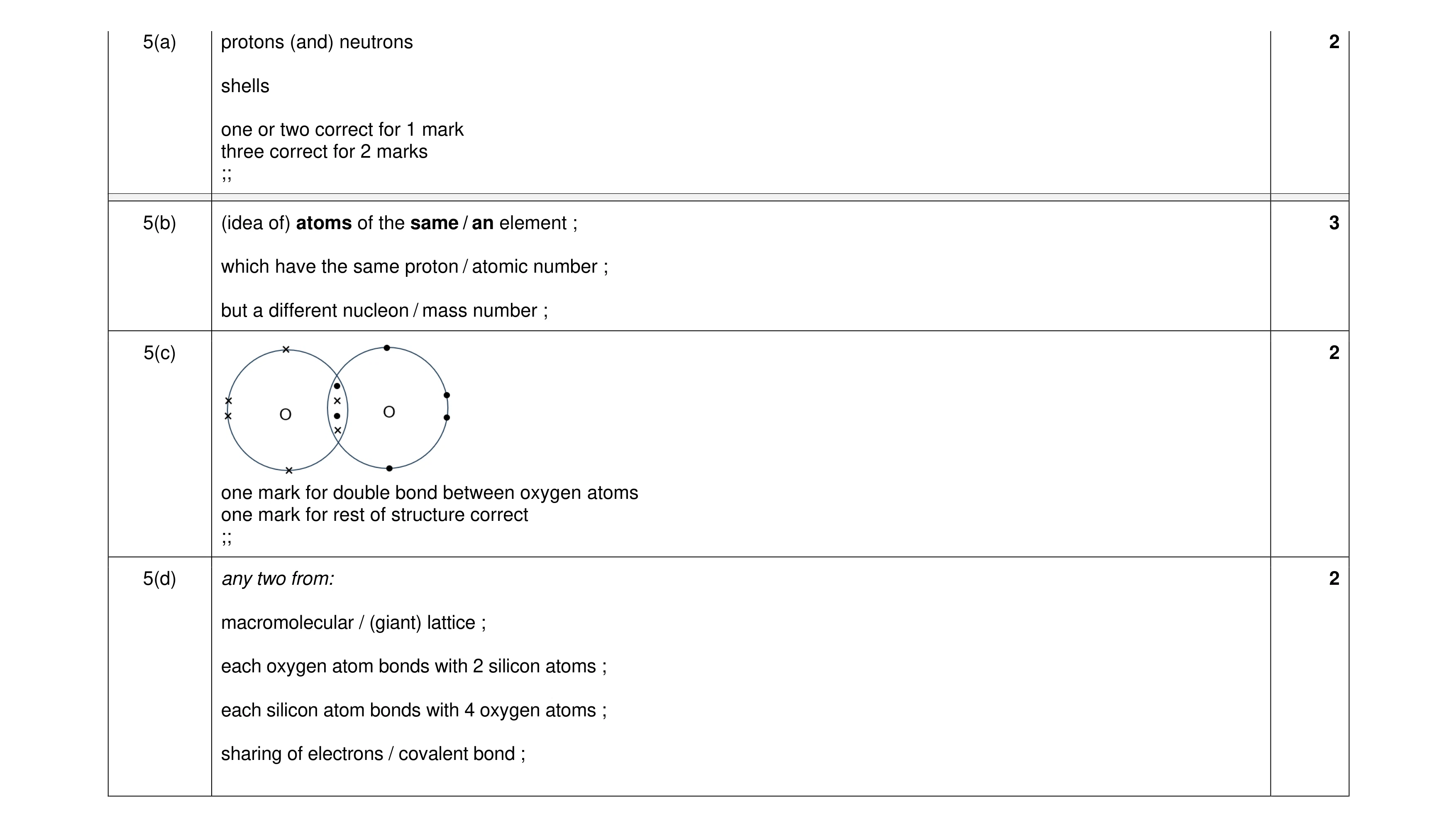 9
9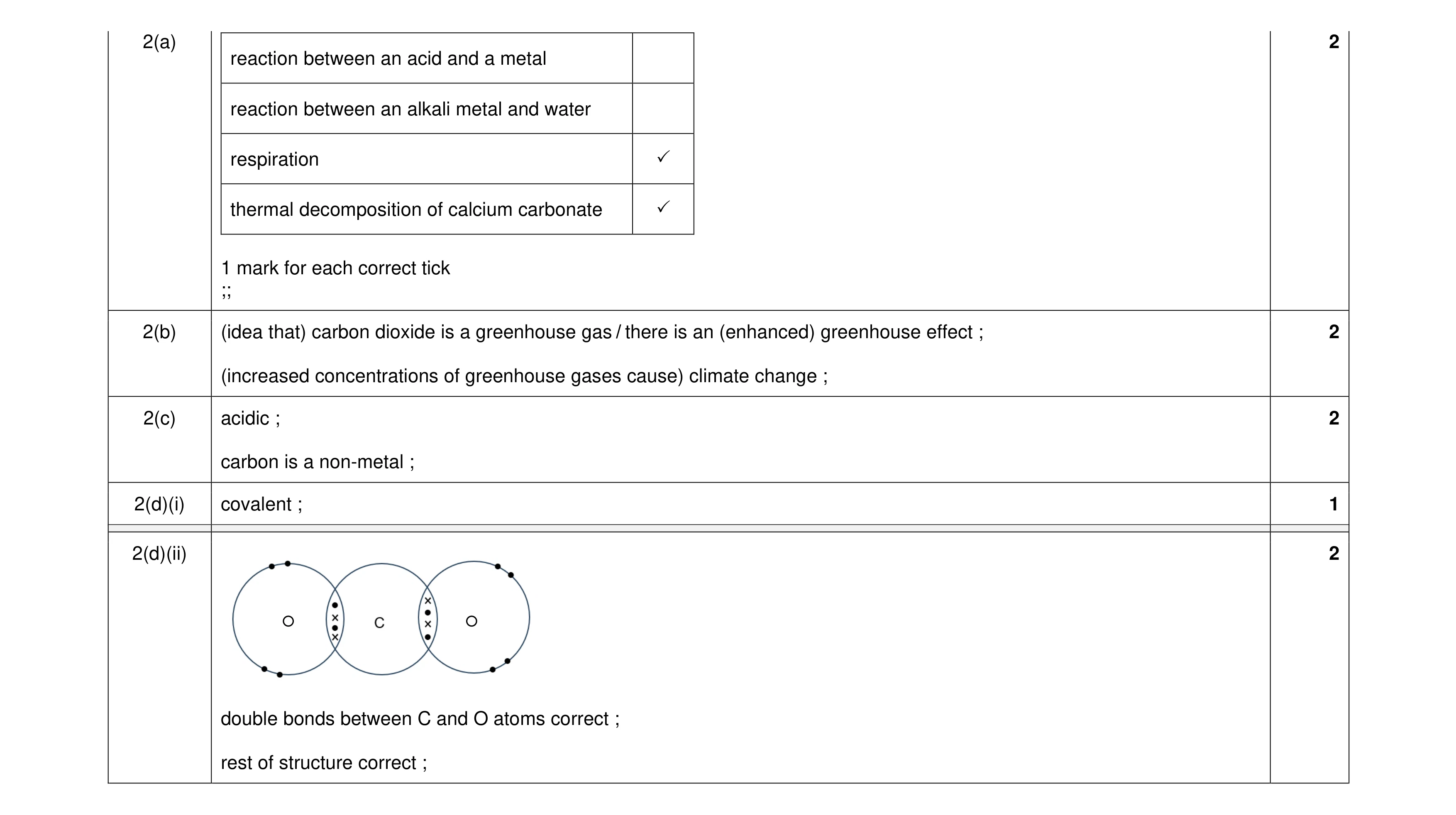 9
9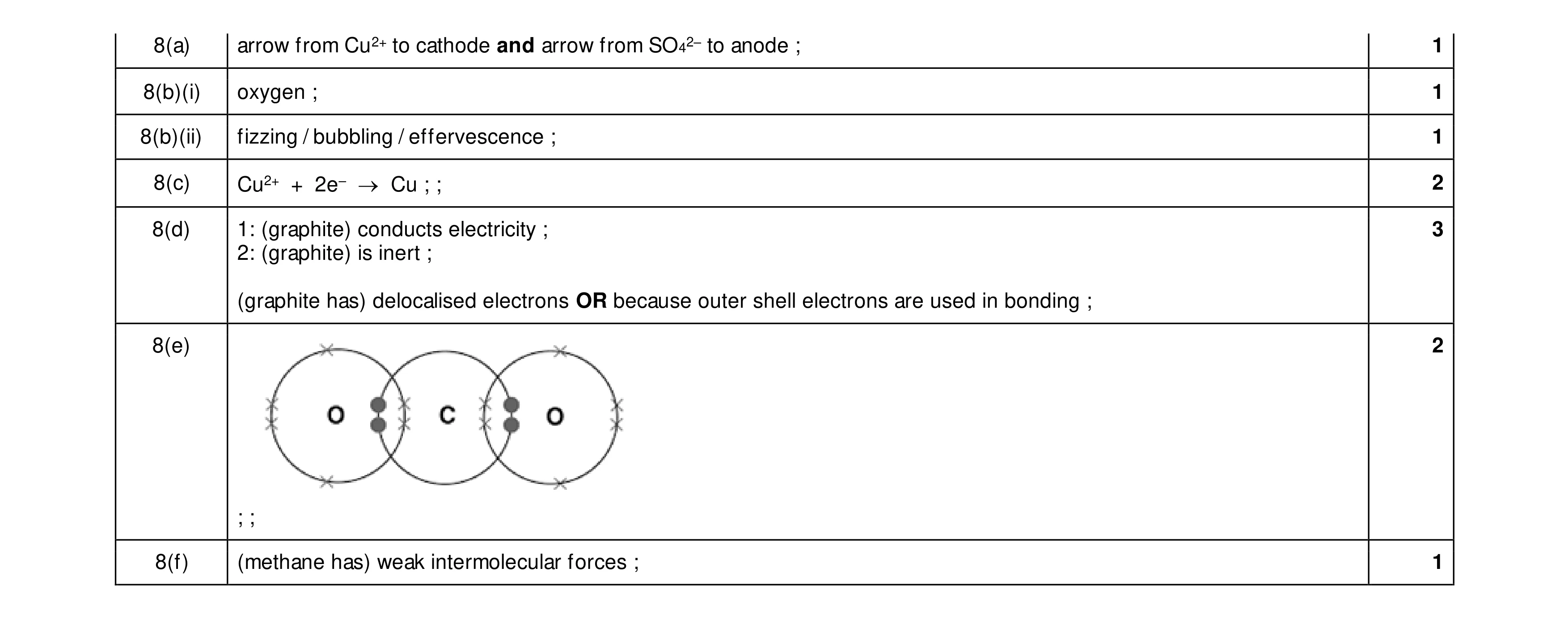 11
11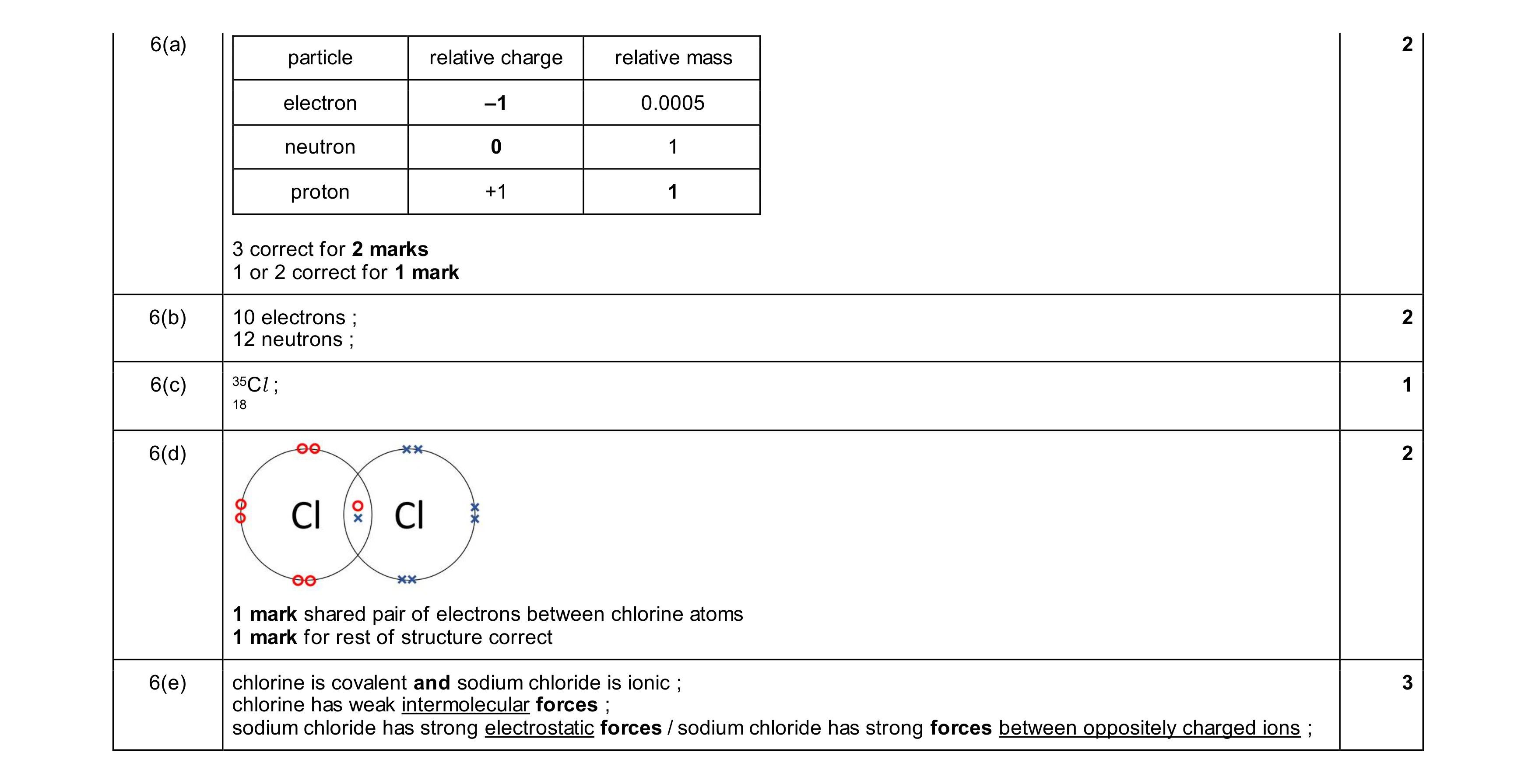 10
10