Questions as text
Q1 · State the percentages of nitrogen and oxygen in clean air 0654/31 May/June 2017
3 (a) State the percentages of nitrogen and oxygen in clean air. nitrogen … % oxygen … % [2] (b) Fig. 3.1 shows a pie chart of the composition of a sample of polluted air taken in a busy city. Large numbers of cars and trucks travel through the city every day. other gases oxygen nitrogen Fig. 3.1 The section of the chart in Fig. 3.1 labelled other gases includes carbon monoxide. (i) Suggest how carbon monoxide is formed. … [1] (ii) State one harmful effect of carbon monoxide. … … [1] (c) Polluted air also contains oxides of nitrogen. Nitrogen dioxide, NO2, is a non-metallic oxide. Some nitrogen dioxide is dissolved in water containing full-range indicator (Universal Indicator). Predict the colour change observed in the liquid when the gas dissolves. Explain your answer. colour changes from … to … explanation … … [2] (d) Nitrogen molecules react with hydrogen molecules to make ammonia. Fig. 3.2 shows diagrams of the molecules involved in this reaction. H H H H N H N N H H H H N H H H Fig. 3.2 (i) State the chemical formula of an ammonia molecule. … [1] (ii) Use the examples in Fig. 3.2 to explain the difference between a molecule of an element and a molecule of a compound. … … … [2]
9 marks
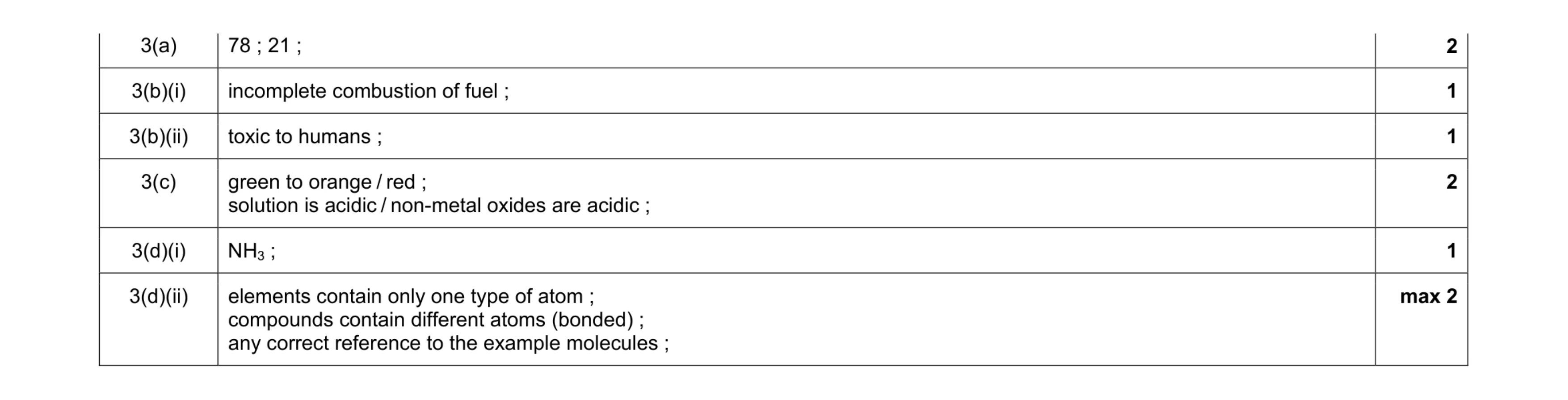
Mark scheme: 3(a) 78 ; 21 ; 2 3(b)(i) incomplete combustion of fuel ; 1 3(b)(ii) toxic to humans ; 1 3(c) green to orange / red ; solution is acidic / non-metal oxides are acidic ; 2 3(d)(i) NH3 ; 1 3(d)(ii) elements contain only one type of atom ; compounds contain different atoms (bonded) ; any correct reference to the example molecules ; max 2
This question in 0654/31 May/June 2017
Q2 · Chlorine and argon are gaseous elements in Period 3 of the Periodic Table 0654/31 May/June 2019
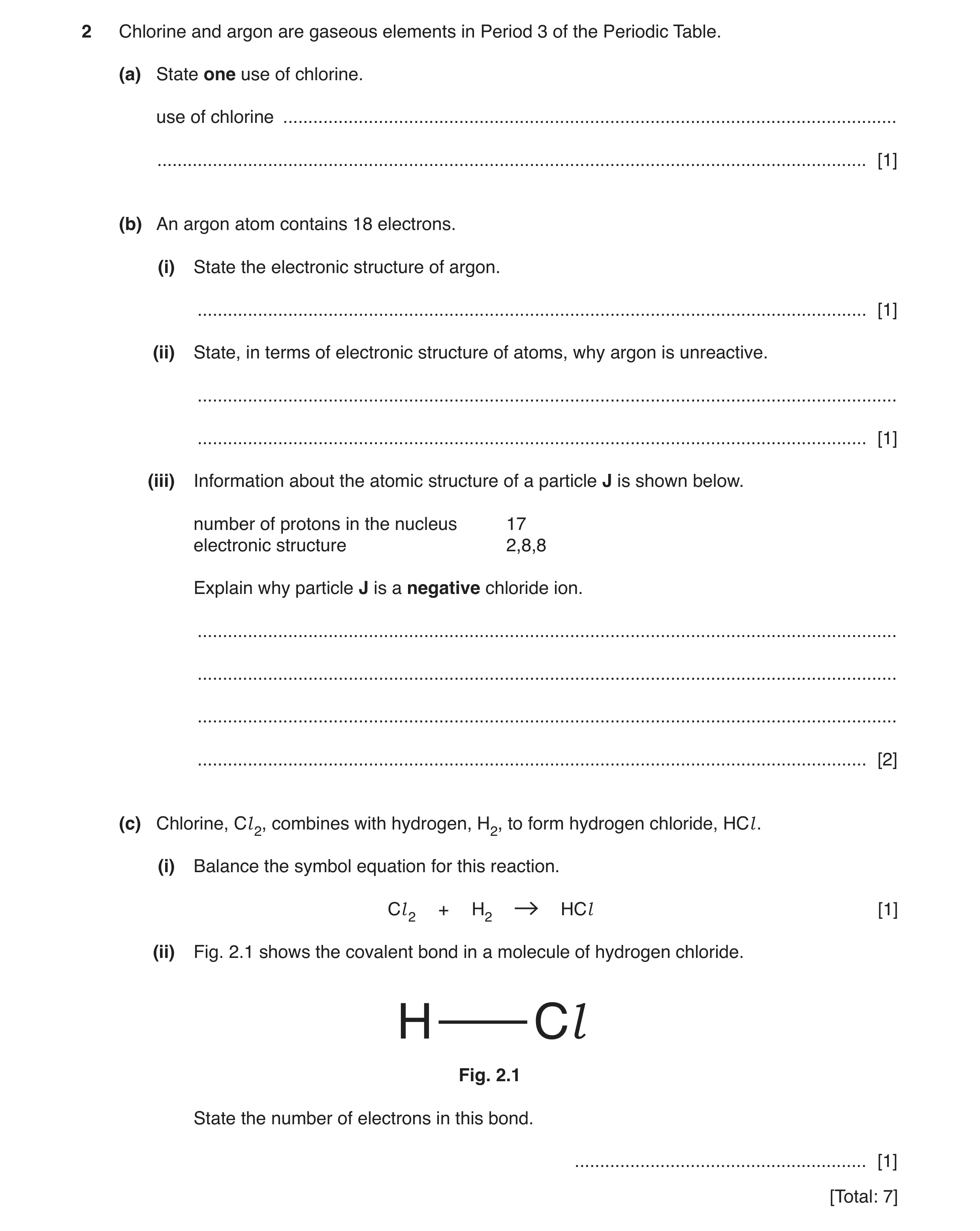
2 Chlorine and argon are gaseous elements in Period 3 of the Periodic Table. (a) State one use of chlorine. use of chlorine … … [1] (b) An argon atom contains 18 electrons. (i) State the electronic structure of argon. … [1] (ii) State, in terms of electronic structure of atoms, why argon is unreactive. … … [1] (iii) Information about the atomic structure of a particle J is shown below. number of protons in the nucleus 17 electronic structure 2,8,8 Explain why particle J is a negative chloride ion. … … … … [2] (c) Chlorine, Cl 2, combines with hydrogen, H2, to form hydrogen chloride, HCl . (i) Balance the symbol equation for this reaction. Cl 2 + H2 HCl [1] (ii) Fig. 2.1 shows the covalent bond in a molecule of hydrogen chloride. H Cl Fig. 2.1 State the number of electrons in this bond. … [1] [Total: 7]
7 marks
Mark scheme: 2(a) ref. to sterilisation of (drinking) water ; 1 2(b)(i) 2,8,8 ; 1 2(b)(ii) outer shell is full / all shells complete / the idea that electrons do not need to be lost or gained for stability ; 1 2(b)(iii) (J contains) more electrons than protons / has one extra electron/has extra electrons ; electrons are negative ; 2 2(c)(i) (Cl2 + H2 → ) 2 HCl ; 1 2(c)(ii) two / one pair ; 1
This question in 0654/31 May/June 2019
Q3 · Water is a compound of the elements hydrogen and oxygen 0654/32 May/June 2020
8 Water is a compound of the elements hydrogen and oxygen. (a) (i) State one metallic element that reacts very quickly with water releasing hydrogen gas. … [1] (ii) The reaction in (a)(i) produces an aqueous solution that has a pH greater than seven. Explain why. … [1] (b) (i) Fig. 8.1 shows what happens when a student tests a gas to check that it is hydrogen. burning splint substance on inside pop of the test-tube Fig. 8.1 Describe a chemical test the student uses to show that the substance in the test-tube is water. test … result … [2] (ii) Balance the equation for the combustion of hydrogen. … … H2 + O2 H2O [1] (c) Fig. 8.2 is a dot-and-cross diagram of a water molecule. O X X H H Fig. 8.2 State the type of chemical bonding in a water molecule. … [1] (d) A student places an aqueous solution of sodium chloride into the apparatus shown in Fig. 8.3. water out aqueous sodium chloride flask cold water in beaker heat Fig. 8.3 Water collects in the beaker. Solid sodium chloride remains in the flask. (i) State the method of separation shown in Fig. 8.3. … [1] (ii) Explain why water and sodium chloride can be separated using this method. Use ideas about the types of chemical bond in these compounds. … … … … … [2] [Total: 9]
9 marks
Mark scheme: 8(a)(i) any Group 1 element / other correct (e.g. calcium); 1 8(a)(ii) solution is alkaline / reaction produces (soluble) base / hydroxide of element in (i) ; 1 8(b)(i) cobalt chloride ; blue to pink ; OR anhydrous copper(II) sulfate ; white to blue ; 2 8(b)(ii) 2H2 + O2 → 2 H2O ; 1 8(c) covalent ; 1 8(d)(i) (simple) distillation ; 1 8(d)(ii) the idea that water boils and sodium chloride does not / water is more volatile than sodium chloride ; because covalent compounds tend to have low bpts / ionic compounds high bpts; 2
This question in 0654/32 May/June 2020
Q4 · Water is a compound of the elements hydrogen and oxygen 0654/33 May/June 2020
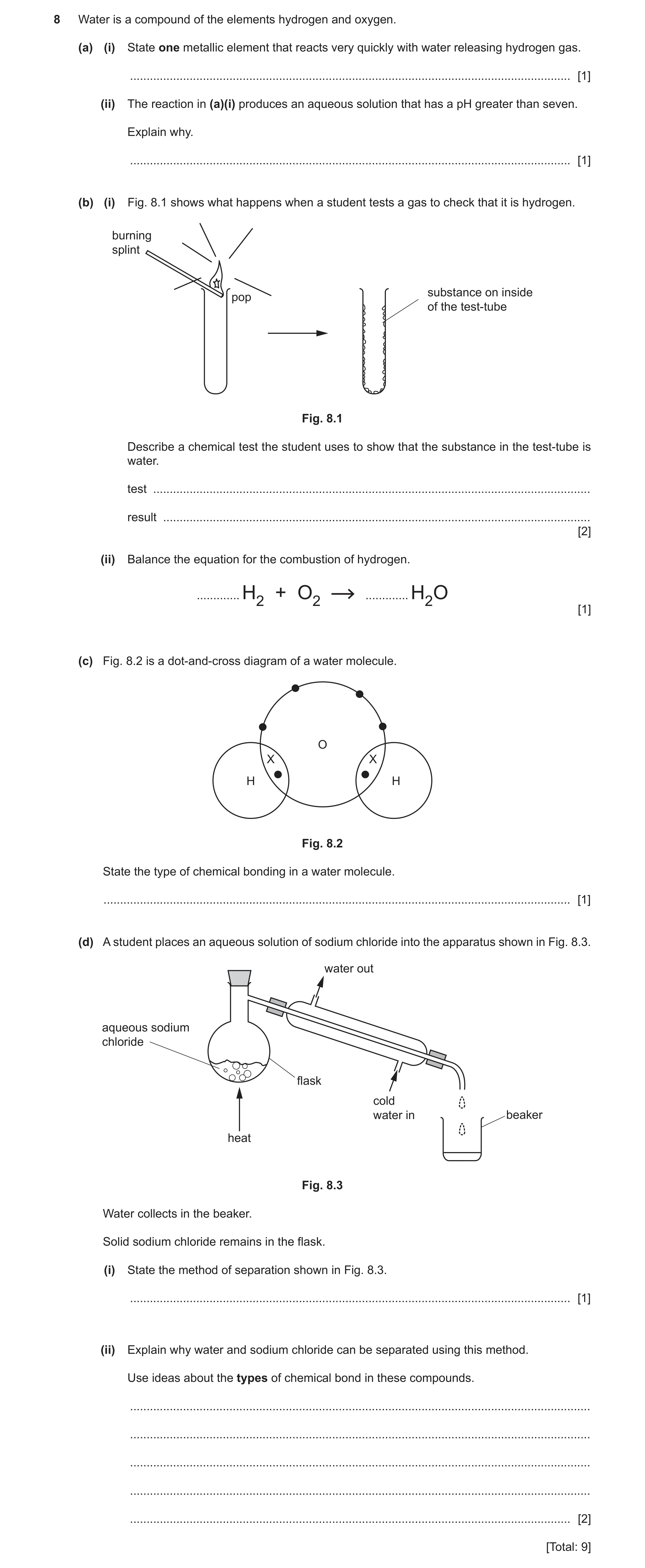
8 Water is a compound of the elements hydrogen and oxygen. (a) (i) State one metallic element that reacts very quickly with water releasing hydrogen gas. … [1] (ii) The reaction in (a)(i) produces an aqueous solution that has a pH greater than seven. Explain why. … [1] (b) (i) Fig. 8.1 shows what happens when a student tests a gas to check that it is hydrogen. burning splint substance on inside pop of the test-tube Fig. 8.1 Describe a chemical test the student uses to show that the substance in the test-tube is water. test … result … [2] (ii) Balance the equation for the combustion of hydrogen. … … H2 + O2 H2O [1] (c) Fig. 8.2 is a dot-and-cross diagram of a water molecule. O X X H H Fig. 8.2 State the type of chemical bonding in a water molecule. … [1] (d) A student places an aqueous solution of sodium chloride into the apparatus shown in Fig. 8.3. water out aqueous sodium chloride flask cold water in beaker heat Fig. 8.3 Water collects in the beaker. Solid sodium chloride remains in the flask. (i) State the method of separation shown in Fig. 8.3. … [1] (ii) Explain why water and sodium chloride can be separated using this method. Use ideas about the types of chemical bond in these compounds. … … … … … [2] [Total: 9]
9 marks
Mark scheme: 8(a)(i) any Group 1 element / other correct (e.g. calcium); 1 8(a)(ii) solution is alkaline / reaction produces (soluble) base / hydroxide of element in (i) ; 1 8(b)(i) cobalt chloride ; blue to pink ; OR anhydrous copper(II) sulfate ; white to blue ; 2 8(b)(ii) 2H2 + O2 → 2 H2O ; 1 8(c) covalent ; 1 8(d)(i) (simple) distillation ; 1 8(d)(ii) the idea that water boils and sodium chloride does not / water is more volatile than sodium chloride ; because covalent compounds tend to have low bpts / ionic compounds high bpts; 2
This question in 0654/33 May/June 2020
Q5 · Hydrogen burning in air 0654/32 Oct/Nov 2020
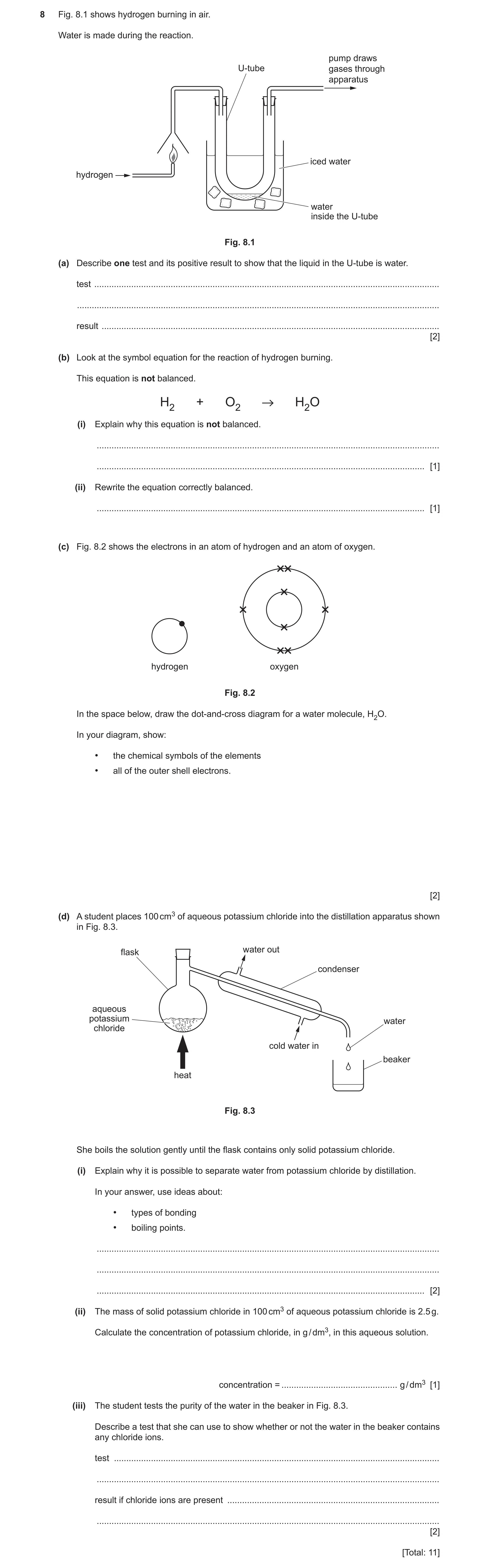
8 Fig. 8.1 shows hydrogen burning in air. Water is made during the reaction. pump draws U-tube gases through apparatus iced water hydrogen water inside the U-tube Fig. 8.1 (a) Describe one test and its positive result to show that the liquid in the U-tube is water. test … … result … [2] (b) Look at the symbol equation for the reaction of hydrogen burning. This equation is not balanced. H2 + O2 H2O (i) Explain why this equation is not balanced. … … [1] (ii) Rewrite the equation correctly balanced. … [1] (c) Fig. 8.2 shows the electrons in an atom of hydrogen and an atom of oxygen. hydrogen oxygen Fig. 8.2 In the space below, draw the dot-and-cross diagram for a water molecule, H2O. In your diagram, show: • the chemical symbols of the elements • all of the outer shell electrons. [2] (d) A student places 100 cm3 of aqueous potassium chloride into the distillation apparatus shown in Fig. 8.3. water out flask condenser aqueous potassium water chloride cold water in beaker heat Fig. 8.3 She boils the solution gently until the flask contains only solid potassium chloride. (i) Explain why it is possible to separate water from potassium chloride by distillation. In your answer, use ideas about: • types of bonding • boiling points. … … … [2] (ii) The mass of solid potassium chloride in 100 cm3 of aqueous potassium chloride is 2.5 g. Calculate the concentration of potassium chloride, in g / dm3, in this aqueous solution. concentration = … g / dm3 [1] (iii) The student tests the purity of the water in the beaker in Fig. 8.3. Describe a test that she can use to show whether or not the water in the beaker contains any chloride ions. test … … result if chloride ions are present … … [2] [Total: 11]
11 marks
Mark scheme: 8(a) cobalt chloride ; (blue to) pink ; OR anhydrous copper(II) sulfate ; (white to) blue ; 8(b)(i) different numbers of oxygen atoms on LHS and RHS / the numbers of each type of atom is not the same on both sides ; 1 8(b)(ii) 2 H2 + O2 → 2 H2O ; 1 8(c) symbols correct ; dot-and -cross diagram correct; 2 8(d)(i) the idea that water boils and potassium chloride does not / water is more volatile than potassium chloride ; because water is covalent / molecular and potassium chloride is ionic ; 2 8(d)(ii) 100 cm3 contains 2.5 g KCl so concentration is 25 (g / dm3 ) ; 1 8(d)(iii) addition of (acidified aqueous) silver nitrate ; white precipitate ; 2
This question in 0654/32 Oct/Nov 2020
Q6 · Three molecules A, B and C 0654/31 May/June 2021
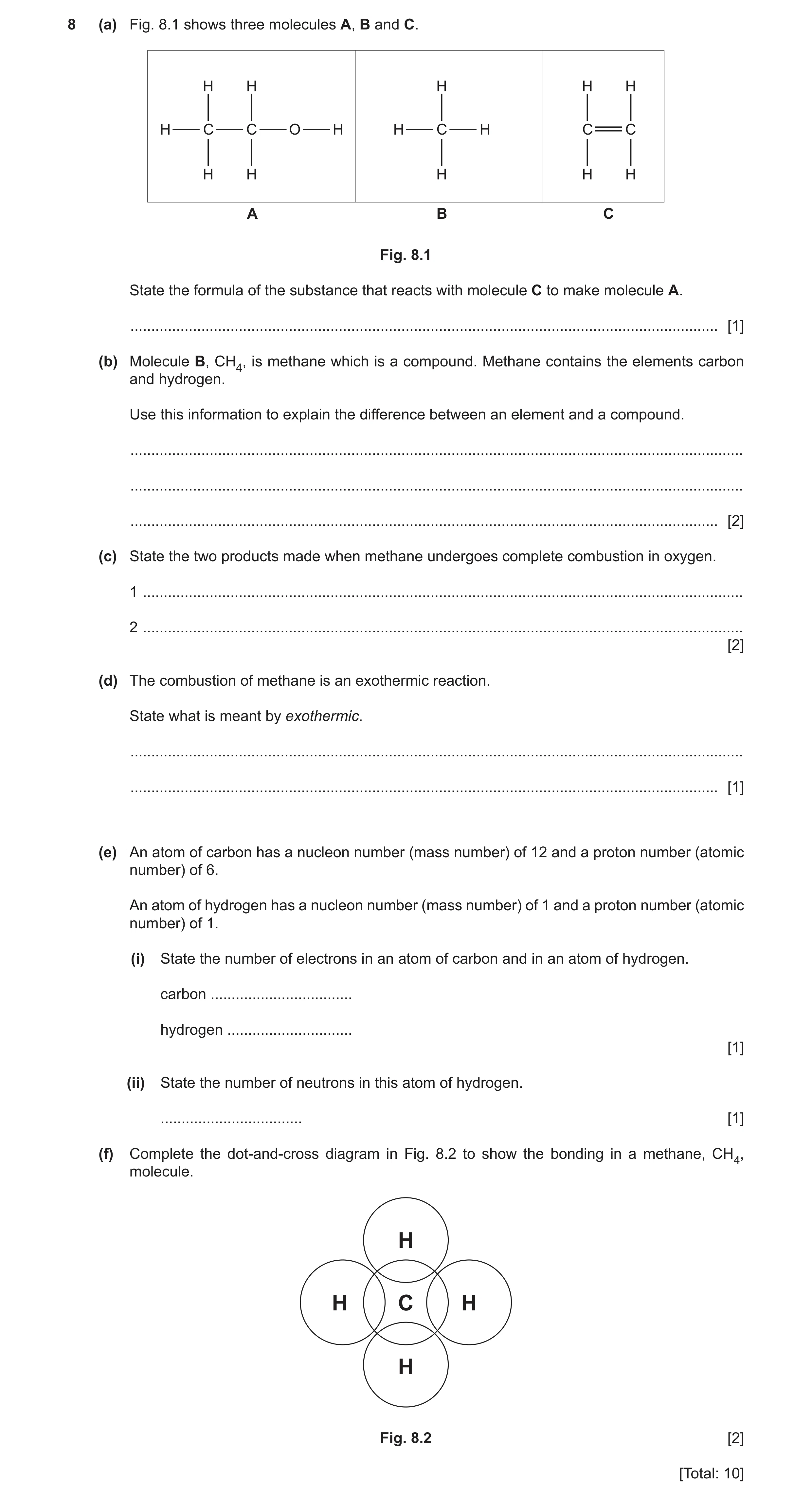
8 (a) Fig. 8.1 shows three molecules A, B and C. H H H H H H C C O H H C H C C H H H H H A B C Fig. 8.1 State the formula of the substance that reacts with molecule C to make molecule A. … [1] (b) Molecule B, CH4, is methane which is a compound. Methane contains the elements carbon and hydrogen. Use this information to explain the difference between an element and a compound. … … … [2] (c) State the two products made when methane undergoes complete combustion in oxygen. 1 … 2 … [2] (d) The combustion of methane is an exothermic reaction. State what is meant by exothermic. … … [1] (e) An atom of carbon has a nucleon number (mass number) of 12 and a proton number (atomic number) of 6. An atom of hydrogen has a nucleon number (mass number) of 1 and a proton number (atomic number) of 1. (i) State the number of electrons in an atom of carbon and in an atom of hydrogen. carbon … hydrogen … [1] (ii) State the number of neutrons in this atom of hydrogen. … [1] (f) Complete the dot‑and‑cross diagram in Fig. 8.2 to show the bonding in a methane, CH4, molecule. H H C H H Fig. 8.2 [2] [Total: 10]
10 marks
Mark scheme: 8(a) H2O ; 1 8(b) an element (e.g. carbon) contains only one type of atom ; a compound (e.g. methane) contains two or more elements / different atoms chemically combined ; 2 8(c) carbon dioxide ; water ; 2 8(d) releases thermal energy ; 1 8(e)(i) carbon 6 and hydrogen 1 ; 1 8(e)(ii) zero ; 1 Question Answer Marks 8(f) one shared pair seen ; all correct ;; 2
This question in 0654/31 May/June 2021
Q7 · Table 11.1 contains data for some elements in Group VII of the Periodic Table 0654/33 Oct/Nov 2021
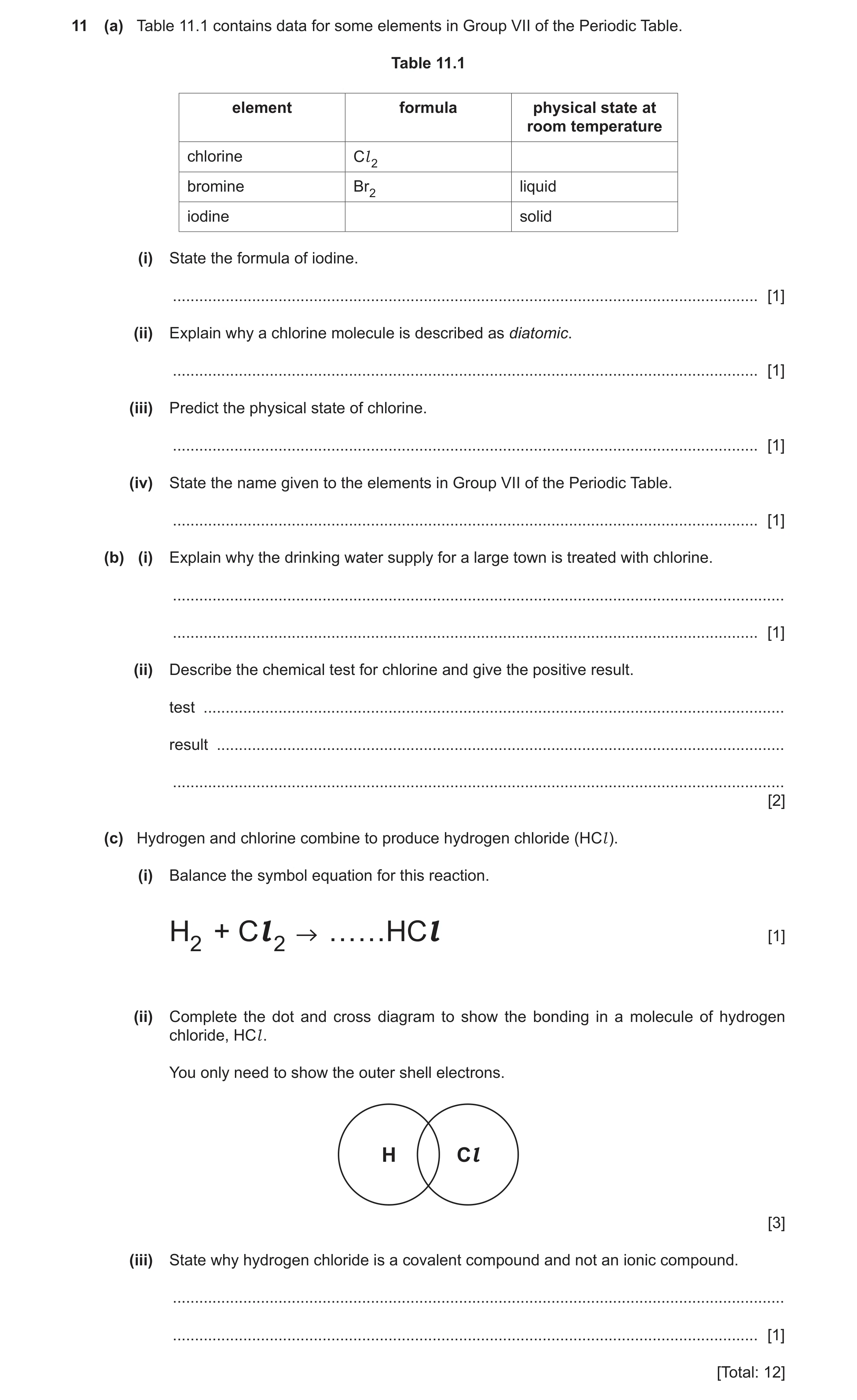
11 (a) Table 11.1 contains data for some elements in Group VII of the Periodic Table. Table 11.1 element formula physical state at room temperature chlorine Cl 2 bromine Br2 liquid iodine solid (i) State the formula of iodine. … [1] (ii) Explain why a chlorine molecule is described as diatomic. … [1] (iii) Predict the physical state of chlorine. … [1] (iv) State the name given to the elements in Group VII of the Periodic Table. … [1] (b) (i) Explain why the drinking water supply for a large town is treated with chlorine. … … [1] (ii) Describe the chemical test for chlorine and give the positive result. test … result … … [2] (c) Hydrogen and chlorine combine to produce hydrogen chloride (HCl ). (i) Balance the symbol equation for this reaction. [1] H2 + Cl 2 ……HCl (ii) Complete the dot and cross diagram to show the bonding in a molecule of hydrogen chloride, HCl . You only need to show the outer shell electrons. H Cl [3] (iii) State why hydrogen chloride is a covalent compound and not an ionic compound. … … [1] [Total: 12]
12 marks
Mark scheme: 11(a)(i) I2 ; 1 11(a)(ii) molecule contains two atoms ; 1 11(a)(iii) gas ; 1 11(a)(iv) halogens ; 1 11(b)(i) to kill microorganisms / bacteria ; 1 11(b)(ii) litmus paper etc. ; bleaches ; 2 11(c)(i) (H2 + Cl2 → ) 2 (HCl) ; 1 11(c)(ii) one bonding pair shown ; chlorine has octet ; all else correct ; 3 11(c)(iii) two non-metals bonding ; 1
This question in 0654/33 Oct/Nov 2021
Q8 · Information about some of the halogens in the Periodic Table 0654/32 May/June 2022
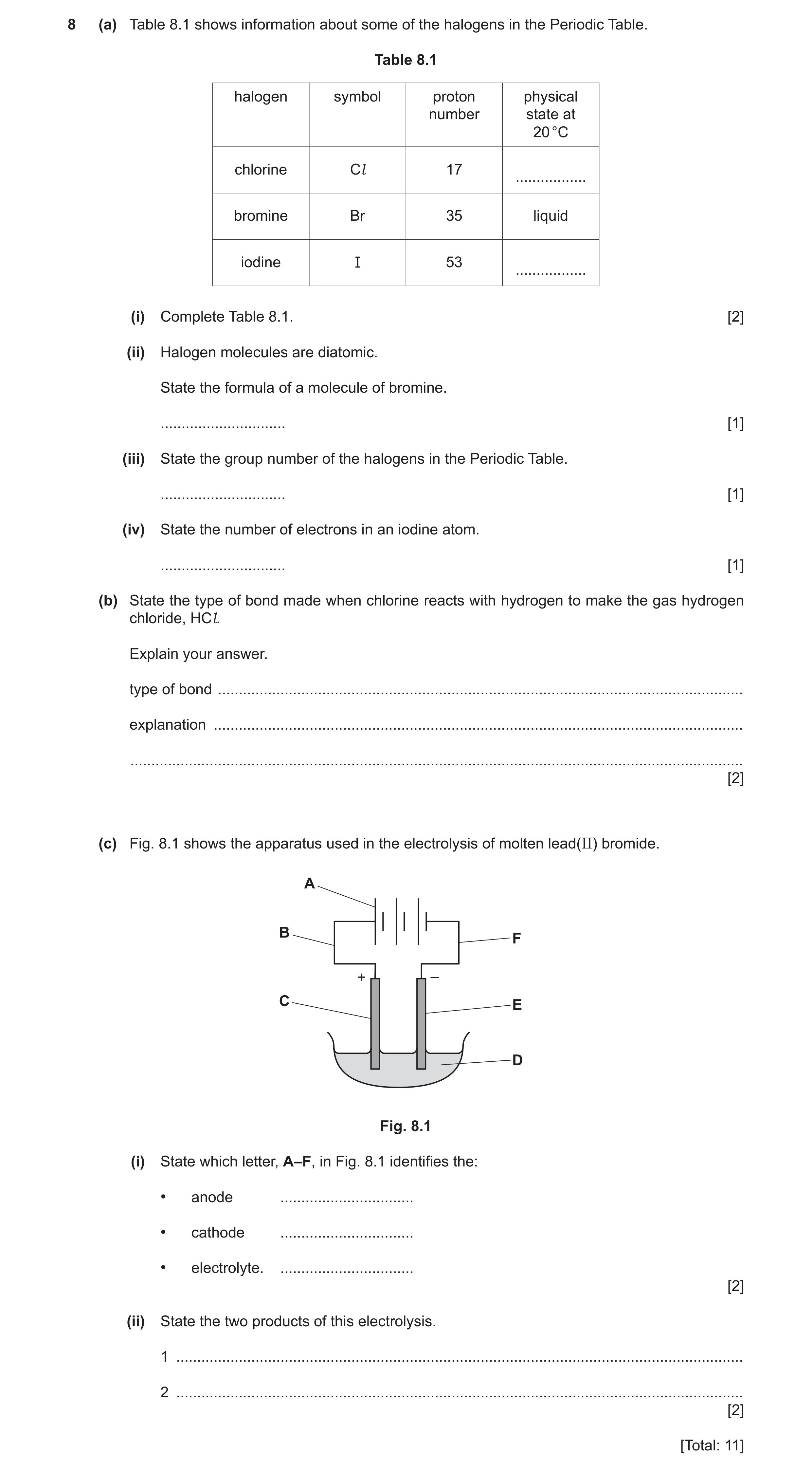
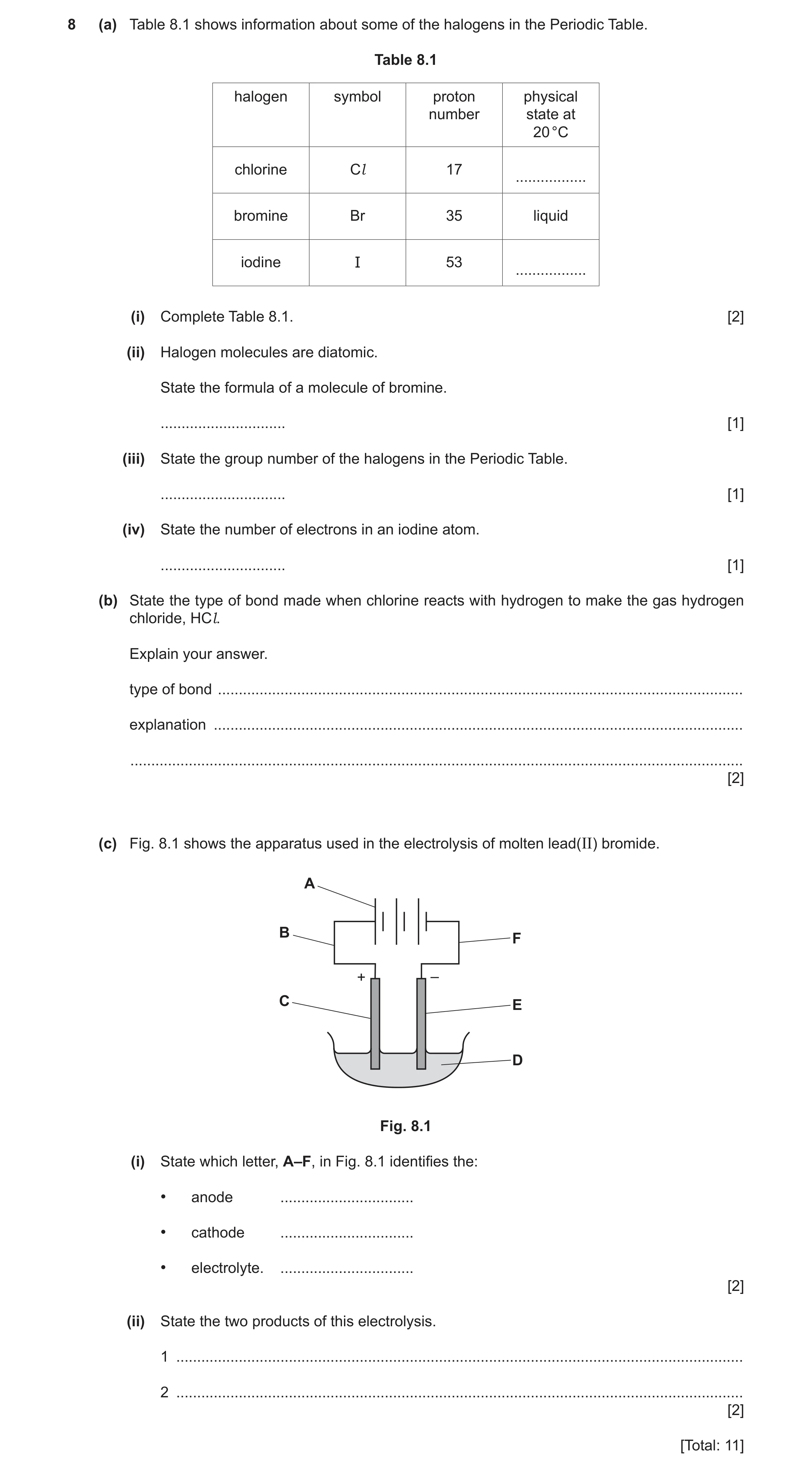
8 (a) Table 8.1 shows information about some of the halogens in the Periodic Table. Table 8.1 halogen symbol proton physical number state at 20 °C chlorine Cl 17 … bromine Br 35 liquid iodine I 53 … (i) Complete Table 8.1. [2] (ii) Halogen molecules are diatomic. State the formula of a molecule of bromine. … [1] (iii) State the group number of the halogens in the Periodic Table. … [1] (iv) State the number of electrons in an iodine atom. … [1] (b) State the type of bond made when chlorine reacts with hydrogen to make the gas hydrogen chloride, HCl. Explain your answer. type of bond … explanation … … [2] (c) Fig. 8.1 shows the apparatus used in the electrolysis of molten lead(II) bromide. A B F + – C E D Fig. 8.1 (i) State which letter, A–F, in Fig. 8.1 identifies the: • anode … • cathode … • electrolyte. … [2] (ii) State the two products of this electrolysis. 1 … 2 … [2] [Total: 11]
11 marks
Mark scheme: 8(a)(i) chlorine – gas; iodine –solid ; 2 8(a)(ii) Br2; 1 8(a)(iii) seven / VII ; 1 8(a)(iv) 53; 1 8(b) covalent ; between two non metals/electrons are shared; 2 8(c)(i) anode correctly identified (C) and cathode correctly identified (E); electrolyte correctly identified (D); 2 8(c)(ii) bromine; lead; 2
This question in 0654/32 May/June 2022
Q9 · The structures of four molecules, P, Q, R and S 0654/32 May/June 2022
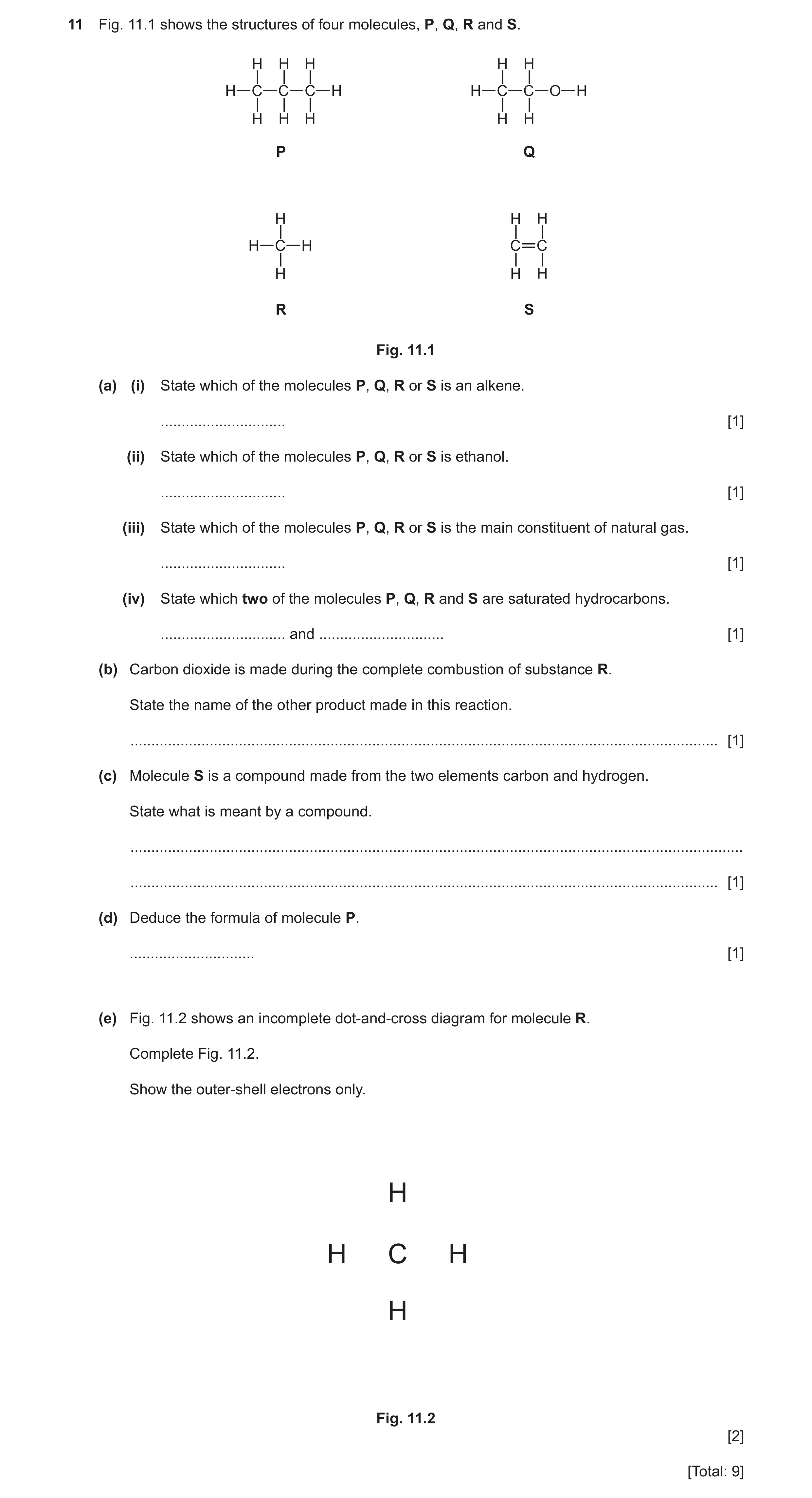
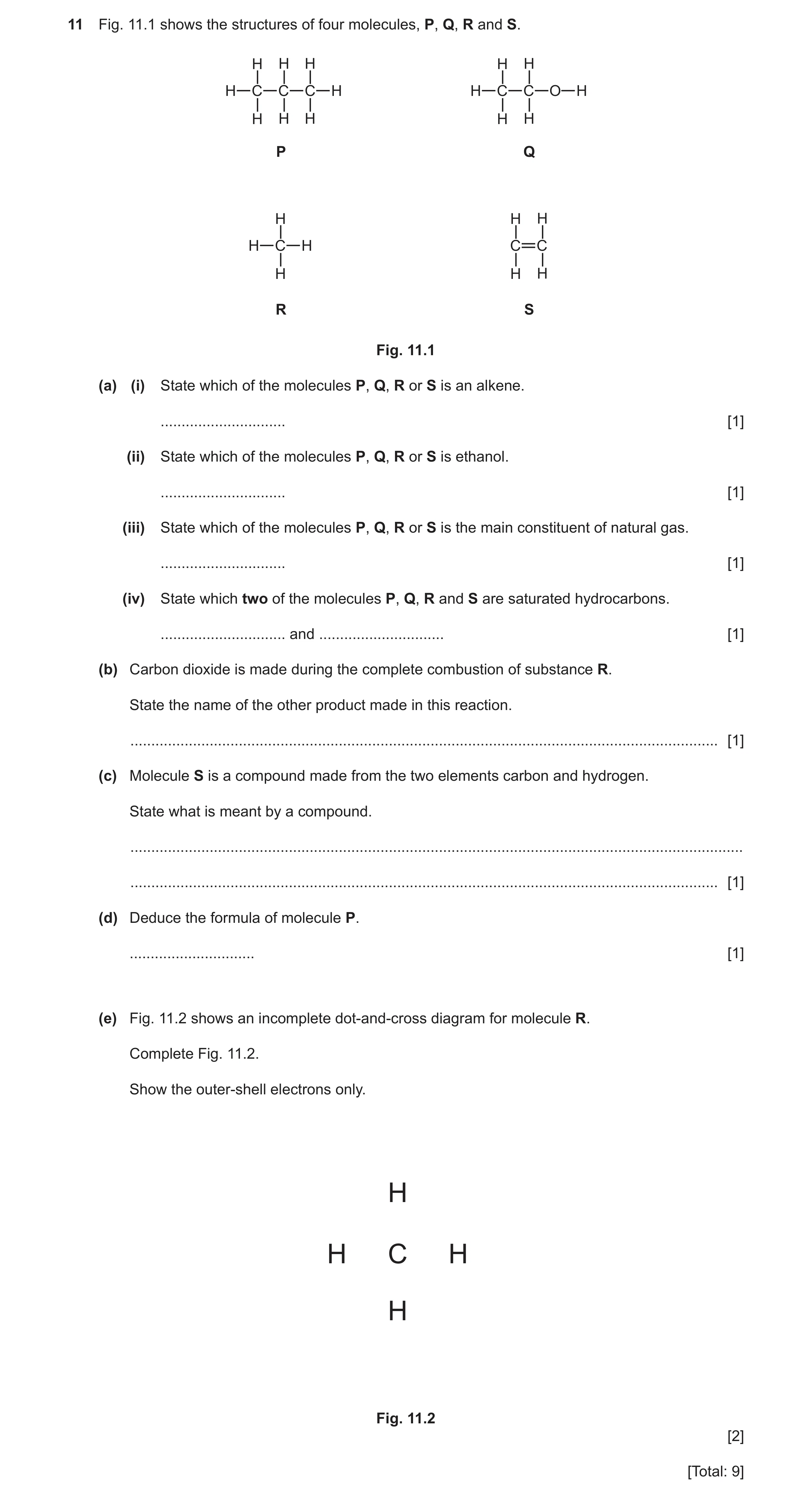
11 Fig. 11.1 shows the structures of four molecules, P, Q, R and S. H H H H H H C C C H H C C O H H H H H H P Q H H H H C H C C H H H R S Fig. 11.1 (a) (i) State which of the molecules P, Q, R or S is an alkene. … [1] (ii) State which of the molecules P, Q, R or S is ethanol. … [1] (iii) State which of the molecules P, Q, R or S is the main constituent of natural gas. … [1] (iv) State which two of the molecules P, Q, R and S are saturated hydrocarbons. … and … [1] (b) Carbon dioxide is made during the complete combustion of substance R. State the name of the other product made in this reaction. … [1] (c) Molecule S is a compound made from the two elements carbon and hydrogen. State what is meant by a compound. … … [1] (d) Deduce the formula of molecule P. … [1] (e) Fig. 11.2 shows an incomplete dot-and-cross diagram for molecule R. Complete Fig. 11.2. Show the outer-shell electrons only. H H C H H Fig. 11.2 [2] [Total: 9]
9 marks
Mark scheme: 11(a)(i) S; 1 11(a)(ii) Q; 1 11(a)(iii) R; 1 Question Answer Marks 11(a)(iv) P and R ; 1 11(b) water ; 1 11(c) a compound contains two or more elements chemically combined; 1 11(d) C3H8 ; 1 11(e) one bonding pairs; all else correct ; 2
This question in 0654/32 May/June 2022
Q10 · Information about some of the halogens in the Periodic Table 0654/33 May/June 2022
8 (a) Table 8.1 shows information about some of the halogens in the Periodic Table. Table 8.1 halogen symbol proton physical number state at 20 °C chlorine Cl 17 … bromine Br 35 liquid iodine I 53 … (i) Complete Table 8.1. [2] (ii) Halogen molecules are diatomic. State the formula of a molecule of bromine. … [1] (iii) State the group number of the halogens in the Periodic Table. … [1] (iv) State the number of electrons in an iodine atom. … [1] (b) State the type of bond made when chlorine reacts with hydrogen to make the gas hydrogen chloride, HCl. Explain your answer. type of bond … explanation … … [2] (c) Fig. 8.1 shows the apparatus used in the electrolysis of molten lead(II) bromide. A B F + – C E D Fig. 8.1 (i) State which letter, A–F, in Fig. 8.1 identifies the: • anode … • cathode … • electrolyte. … [2] (ii) State the two products of this electrolysis. 1 … 2 … [2] [Total: 11]
11 marks
Mark scheme: 8(a)(i) chlorine – gas; iodine –solid ; 2 8(a)(ii) Br2; 1 8(a)(iii) seven / VII ; 1 8(a)(iv) 53; 1 8(b) covalent ; between two non metals/electrons are shared; 2 8(c)(i) anode correctly identified (C) and cathode correctly identified (E); electrolyte correctly identified (D); 2 8(c)(ii) bromine; lead; 2
This question in 0654/33 May/June 2022
Q11 · The structures of four molecules, P, Q, R and S 0654/33 May/June 2022
11 Fig. 11.1 shows the structures of four molecules, P, Q, R and S. H H H H H H C C C H H C C O H H H H H H P Q H H H H C H C C H H H R S Fig. 11.1 (a) (i) State which of the molecules P, Q, R or S is an alkene. … [1] (ii) State which of the molecules P, Q, R or S is ethanol. … [1] (iii) State which of the molecules P, Q, R or S is the main constituent of natural gas. … [1] (iv) State which two of the molecules P, Q, R and S are saturated hydrocarbons. … and … [1] (b) Carbon dioxide is made during the complete combustion of substance R. State the name of the other product made in this reaction. … [1] (c) Molecule S is a compound made from the two elements carbon and hydrogen. State what is meant by a compound. … … [1] (d) Deduce the formula of molecule P. … [1] (e) Fig. 11.2 shows an incomplete dot-and-cross diagram for molecule R. Complete Fig. 11.2. Show the outer-shell electrons only. H H C H H Fig. 11.2 [2] [Total: 9]
9 marks
Mark scheme: 11(a)(i) S; 1 11(a)(ii) Q; 1 11(a)(iii) R; 1 Question Answer Marks 11(a)(iv) P and R ; 1 11(b) water ; 1 11(c) a compound contains two or more elements chemically combined; 1 11(d) C3H8 ; 1 11(e) one bonding pairs; all else correct ; 2
This question in 0654/33 May/June 2022
Q12 · Three hydrocarbon molecules, A, B and C 0654/31 Oct/Nov 2022
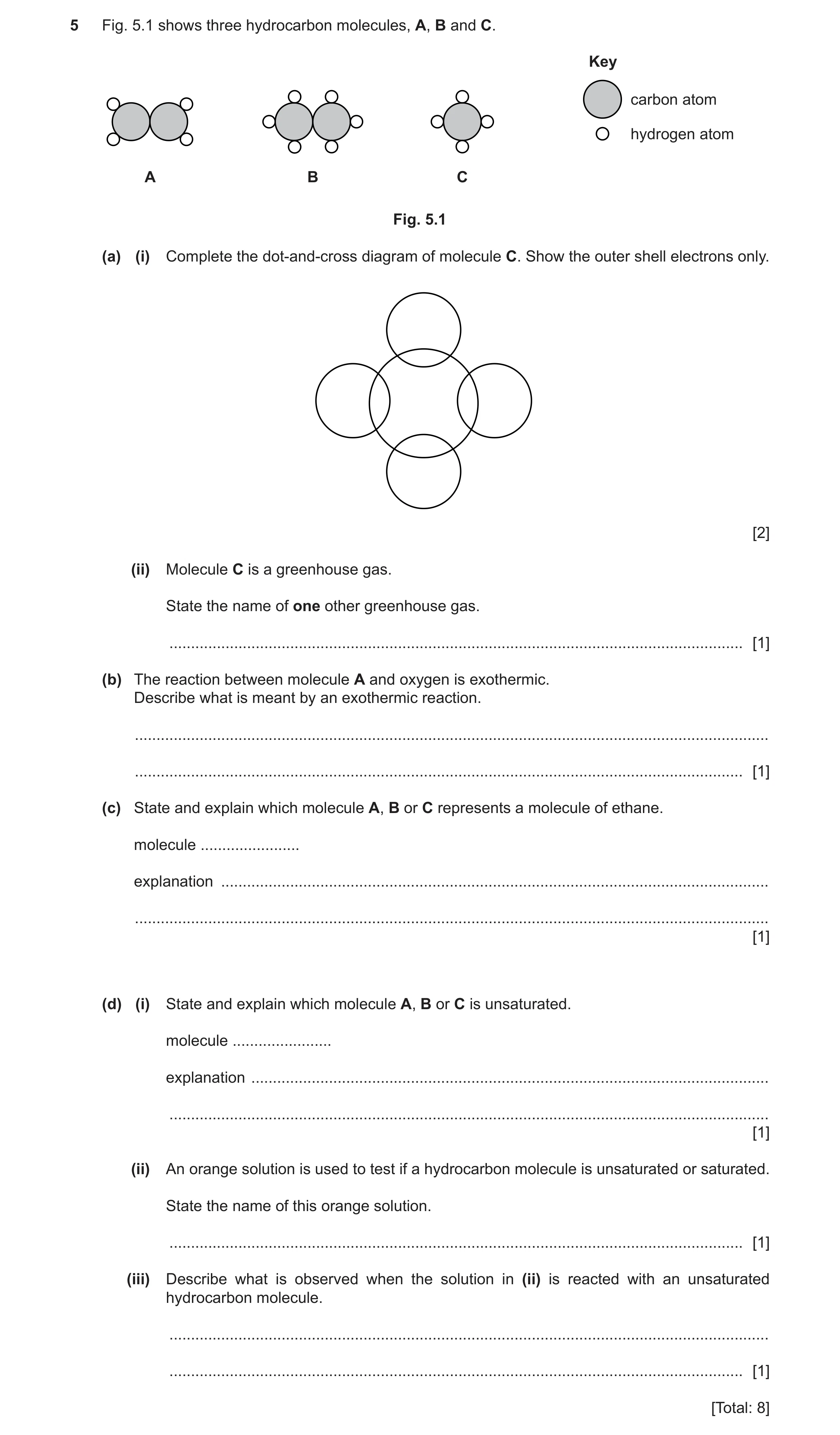
5 Fig. 5.1 shows three hydrocarbon molecules, A, B and C. Key carbon atom hydrogen atom A B C Fig. 5.1 (a) (i) Complete the dot-and-cross diagram of molecule C. Show the outer shell electrons only. [2] (ii) Molecule C is a greenhouse gas. State the name of one other greenhouse gas. … [1] (b) The reaction between molecule A and oxygen is exothermic. Describe what is meant by an exothermic reaction. … … [1] (c) State and explain which molecule A, B or C represents a molecule of ethane. molecule … explanation … … [1] (d) (i) State and explain which molecule A, B or C is unsaturated. molecule … explanation … … [1] (ii) An orange solution is used to test if a hydrocarbon molecule is unsaturated or saturated. State the name of this orange solution. … [1] (iii) Describe what is observed when the solution in (ii) is reacted with an unsaturated hydrocarbon molecule. … … [1] [Total: 8]
8 marks
Mark scheme: 5(a)(i) 1 shared pair ; 2 all else correct ; 5(a)(ii) water vapour ; carbon dioxide ; 1 5(b) (thermal) energy released ; 1 5(c) B – no mark and 1 has formula C2H6 ; 5(d)(i) A – no mark and 1 has two carbons but only four hydrogens / has general formula CnH2n ; 5(d)(ii) (aqueous) bromine ; 1 5(d)(iii) decolourises ; 1
This question in 0654/31 Oct/Nov 2022
Q13 · Sodium and chlorine are elements 0654/31 Oct/Nov 2022
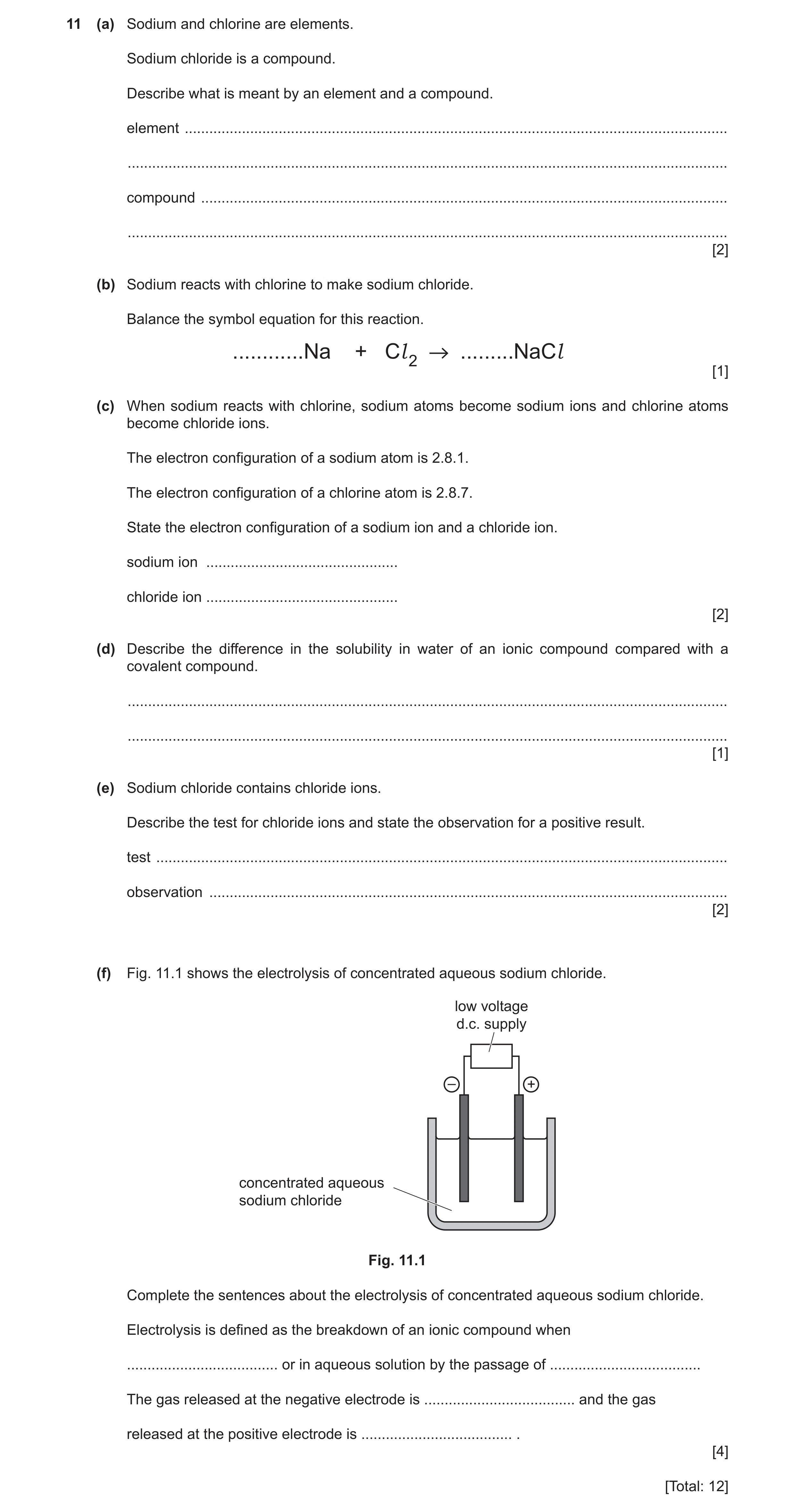
11 (a) Sodium and chlorine are elements. Sodium chloride is a compound. Describe what is meant by an element and a compound. element … … compound … … [2] (b) Sodium reacts with chlorine to make sodium chloride. Balance the symbol equation for this reaction. … Na + Cl2 … NaCl [1] (c) When sodium reacts with chlorine, sodium atoms become sodium ions and chlorine atoms become chloride ions. The electron configuration of a sodium atom is 2.8.1. The electron configuration of a chlorine atom is 2.8.7. State the electron configuration of a sodium ion and a chloride ion. sodium ion … chloride ion … [2] (d) Describe the difference in the solubility in water of an ionic compound compared with a covalent compound. … … [1] (e) Sodium chloride contains chloride ions. Describe the test for chloride ions and state the observation for a positive result. test … observation … [2] (f) Fig. 11.1 shows the electrolysis of concentrated aqueous sodium chloride. low voltage d.c. supply – + concentrated aqueous sodium chloride Fig. 11.1 Complete the sentences about the electrolysis of concentrated aqueous sodium chloride. Electrolysis is defined as the breakdown of an ionic compound when … or in aqueous solution by the passage of … The gas released at the negative electrode is … and the gas released at the positive electrode is … . [4] [Total: 12]
12 marks
Mark scheme: 11(a) element – contains only one type of atom ; 2 compound – contains two or more elements (chemically combined) ; 11(b) 2Na + Cl2 → 2NaCl ; 1 11(c) sodium ion 2.8 ; 2 chloride ion 2.8.8 ; 11(d) solubility of ionic compound is greater ; 1 11(e) add acidified aqueous silver nitrate ; 2 white precipitate ; 11(f) molten ; 4 electricity ; hydrogen ; chlorine ;
This question in 0654/31 Oct/Nov 2022
Q14 · Orange bromine gas, Br2, is put into the bottom of a gas jar which is immediately sealed 0654/32 Oct/Nov 2022
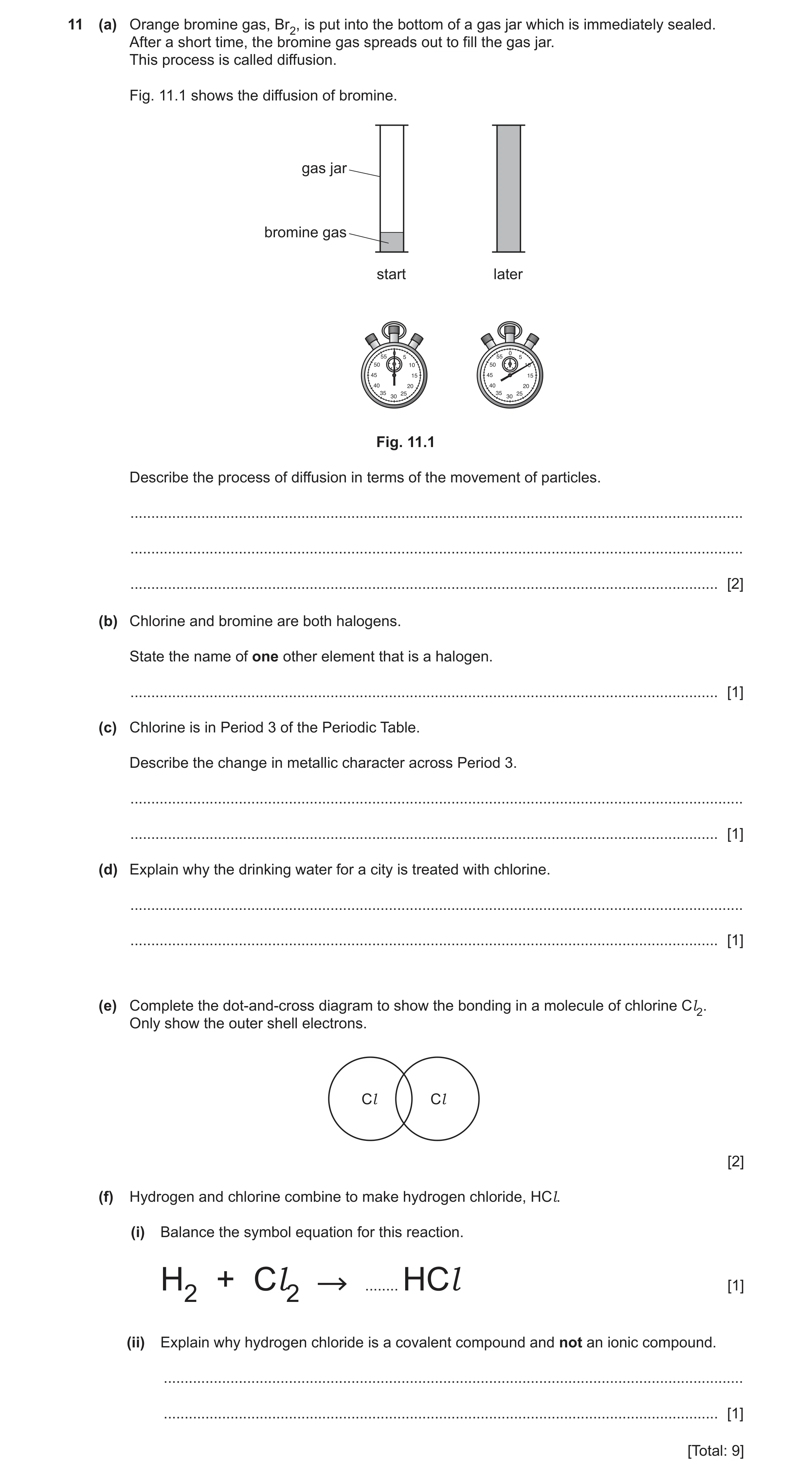
11 (a) Orange bromine gas, Br2, is put into the bottom of a gas jar which is immediately sealed. After a short time, the bromine gas spreads out to fill the gas jar. This process is called diffusion. Fig. 11.1 shows the diffusion of bromine. gas jar bromine gas start later Fig. 11.1 Describe the process of diffusion in terms of the movement of particles. … … … [2] (b) Chlorine and bromine are both halogens. State the name of one other element that is a halogen. … [1] (c) Chlorine is in Period 3 of the Periodic Table. Describe the change in metallic character across Period 3. … … [1] (d) Explain why the drinking water for a city is treated with chlorine. … … [1] (e) Complete the dot-and-cross diagram to show the bonding in a molecule of chlorine Cl2. Only show the outer shell electrons. Cl Cl [2] (f) Hydrogen and chlorine combine to make hydrogen chloride, HCl. (i) Balance the symbol equation for this reaction. … [1] H2 + Cl2 HCl (ii) Explain why hydrogen chloride is a covalent compound and not an ionic compound. … … [1] [Total: 9]
9 marks
Mark scheme: 11(a) gas particles in (constant) random motion ; 2 (particles move) from region of high concentration to region of low concentration ; 11(b) iodine / fluorine / astatine ; 1 11(c) metallic to non-metallic (from left to right) ; 1 11(d) to kill, microorganisms/bacteria/pathogens ; 1 11(e) shared pair ; 2 correct number of electrons on each atom / 14 electrons in total ; 11(f)(i) 2 HCl ; 1 11(f)(ii) two non-metals bonding / shared pair of electrons ; 1
This question in 0654/32 Oct/Nov 2022
Q15 · Methane, CH4, is a hydrocarbon 0654/32 Feb/March 2024
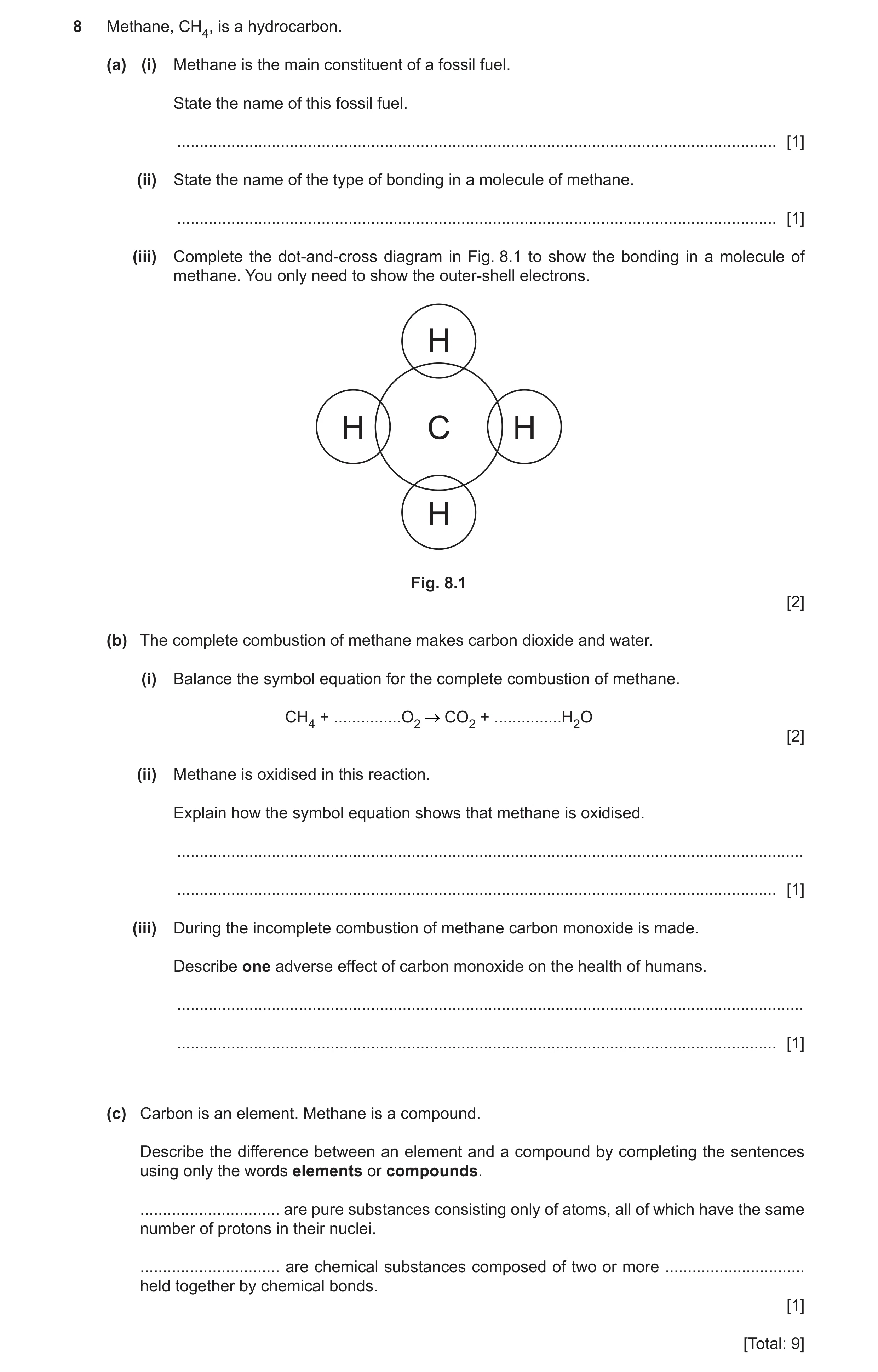
8 Methane, CH4, is a hydrocarbon. (a) (i) Methane is the main constituent of a fossil fuel. State the name of this fossil fuel. … [1] (ii) State the name of the type of bonding in a molecule of methane. … [1] (iii) Complete the dot-and-cross diagram in Fig. 8.1 to show the bonding in a molecule of methane. You only need to show the outer-shell electrons. H H C H H Fig. 8.1 [2] (b) The complete combustion of methane makes carbon dioxide and water. (i) Balance the symbol equation for the complete combustion of methane. CH4 + … O2 CO2 + … H2O [2] (ii) Methane is oxidised in this reaction. Explain how the symbol equation shows that methane is oxidised. … … [1] (iii) During the incomplete combustion of methane carbon monoxide is made. Describe one adverse effect of carbon monoxide on the health of humans. … … [1] (c) Carbon is an element. Methane is a compound. Describe the difference between an element and a compound by completing the sentences using only the words elements or compounds. … are pure substances consisting only of atoms, all of which have the same number of protons in their nuclei. … are chemical substances composed of two or more … held together by chemical bonds. [1] [Total: 9]
9 marks
Mark scheme: 8(a)(i) natural gas ; 1 8(a)(ii) covalent ; 1 8(a)(iii) one pair of shared electrons ; 2 four pairs of electrons and all else correct ; 8(b)(i) 2 O2 ; 2 2 H2O ; 8(b)(ii) gains / reacts with oxygen ; 1 8(b)(iii) toxic; 1 8(c) elements compounds elements ; 1
This question in 0654/32 Feb/March 2024
Q16 · Ice is a solid 0654/31 May/June 2024
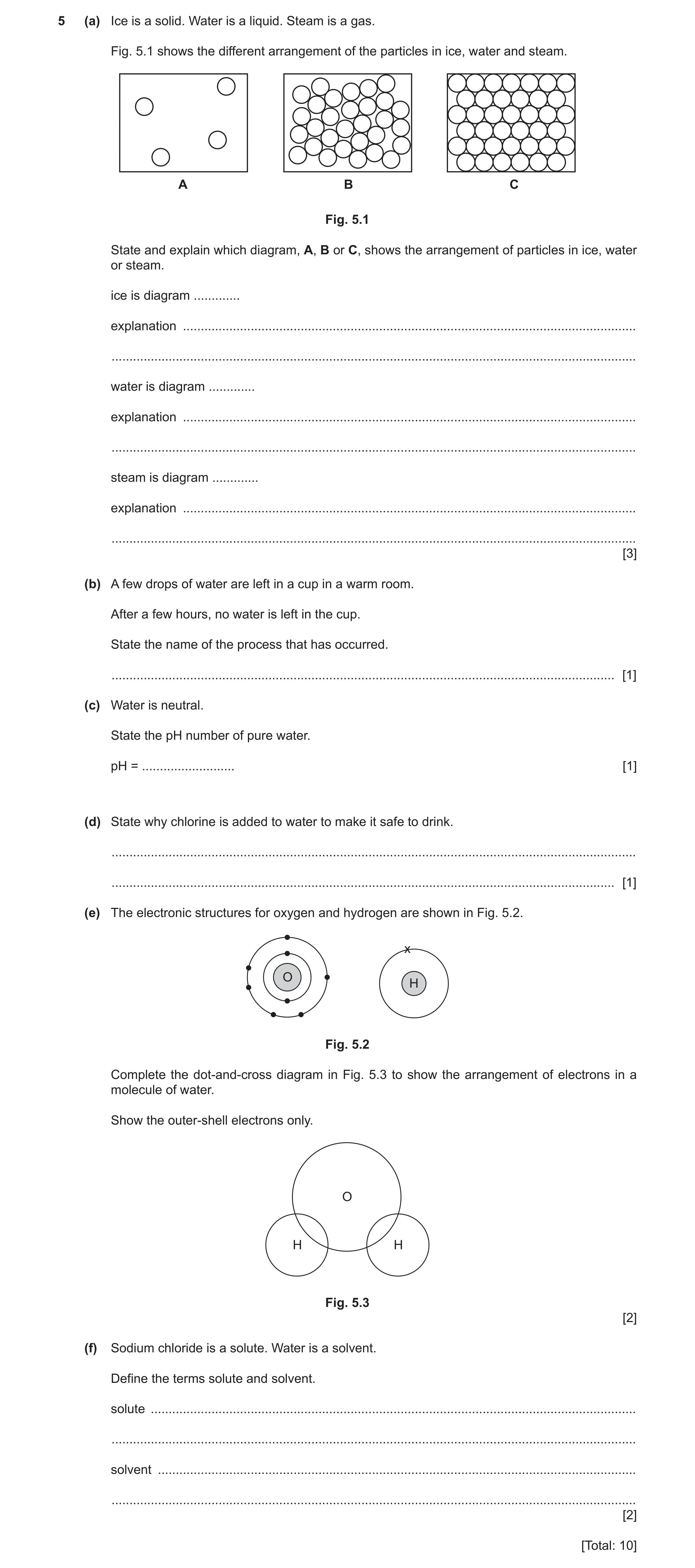
5 (a) Ice is a solid. Water is a liquid. Steam is a gas. Fig. 5.1 shows the different arrangement of the particles in ice, water and steam. A B C Fig. 5.1 State and explain which diagram, A, B or C, shows the arrangement of particles in ice, water or steam. ice is diagram … explanation … … water is diagram … explanation … … steam is diagram … explanation … … [3] (b) A few drops of water are left in a cup in a warm room. After a few hours, no water is left in the cup. State the name of the process that has occurred. … [1] (c) Water is neutral. State the pH number of pure water. pH = … [1] (d) State why chlorine is added to water to make it safe to drink. … … [1] (e) The electronic structures for oxygen and hydrogen are shown in Fig. 5.2. x O H Fig. 5.2 Complete the dot‑and‑cross diagram in Fig. 5.3 to show the arrangement of electrons in a molecule of water. Show the outer‑shell electrons only. O H H Fig. 5.3 [2] (f) Sodium chloride is a solute. Water is a solvent. Define the terms solute and solvent. solute … … solvent … … [2] [Total: 10]
10 marks
Mark scheme: 5(a) ice is C – particles are in regular arrangement water is B – particles are (mostly) touching and irregular arrangement steam is A – particles are widely spaced C B A ; one correct explanation ; three correct explanations ; 3 5(b) evaporation ; 1 5(c) 7 ; 1 5(d) kills bacteria ; 1 Question Answer Marks 5(e) 1 pair of bonding electrons ; all else correct ; 2 5(f) a solute – a substance that is dissolved in a solvent ; a solvent – a substance / liquid that dissolves a solute ; 2
This question in 0654/31 May/June 2024
Q17 · Chlorine reacts with hydrogen to make hydrogen chloride 0654/32 Oct/Nov 2024
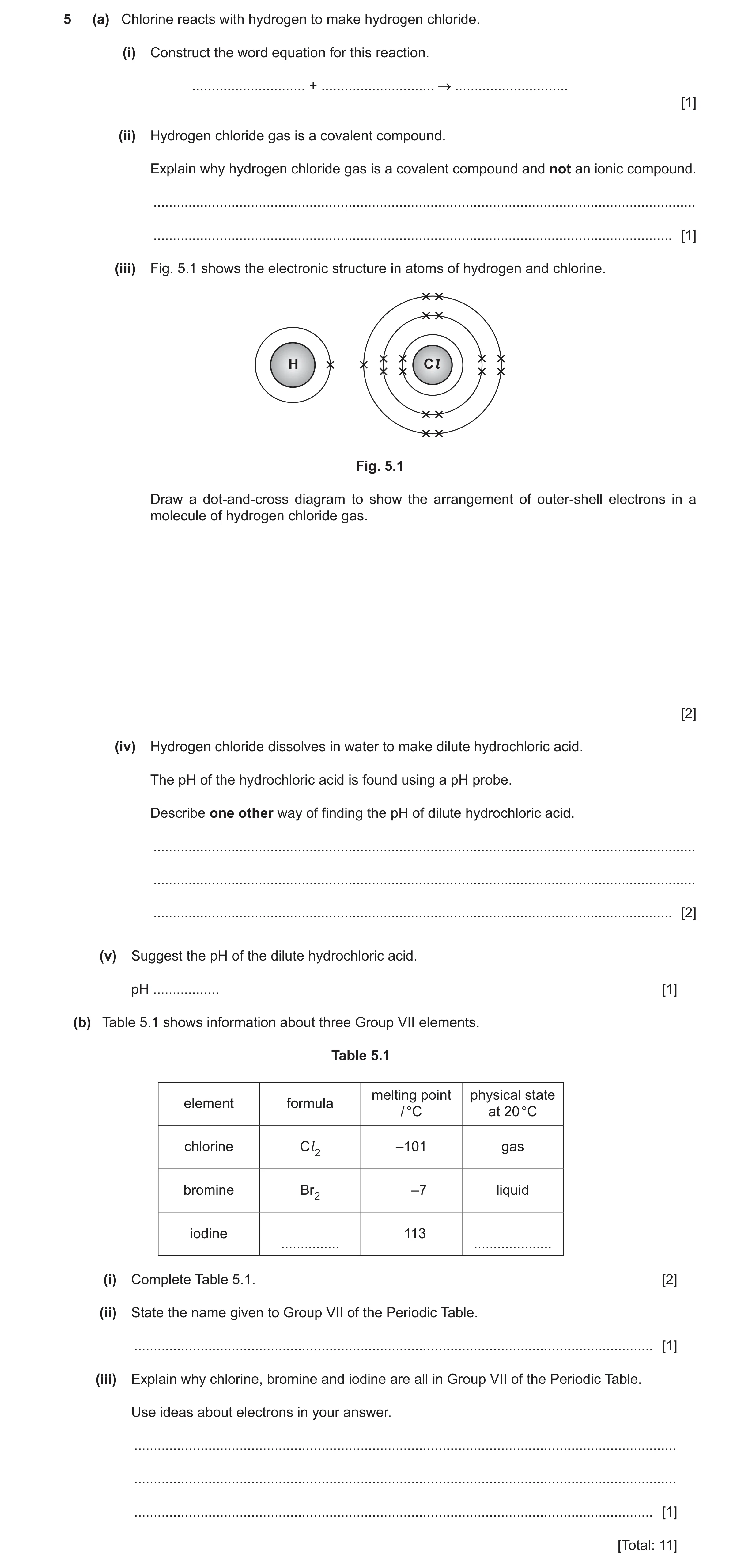
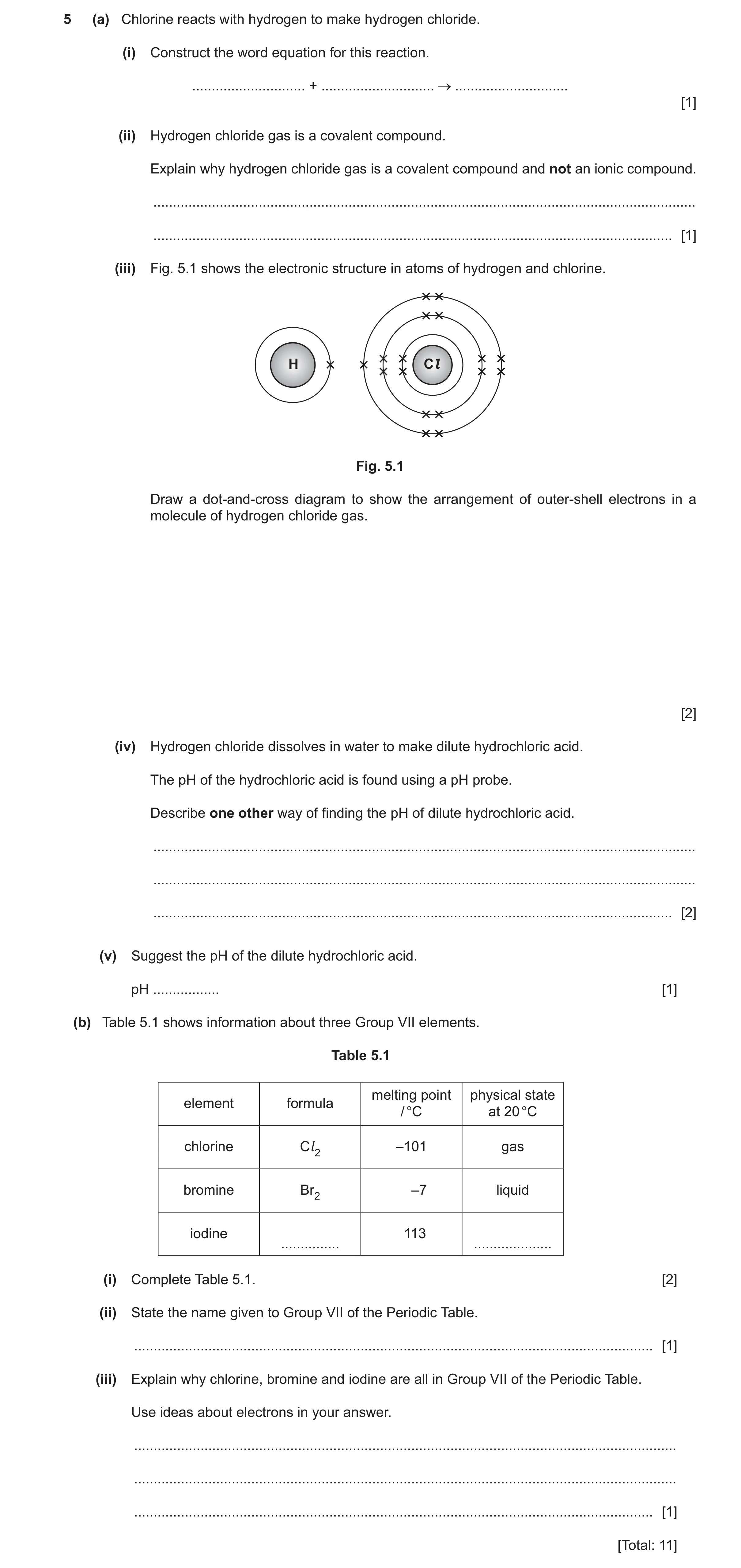
5 (a) Chlorine reacts with hydrogen to make hydrogen chloride. (i) Construct the word equation for this reaction. … + … … [1] (ii) Hydrogen chloride gas is a covalent compound. Explain why hydrogen chloride gas is a covalent compound and not an ionic compound. … … [1] (iii) Fig. 5.1 shows the electronic structure in atoms of hydrogen and chlorine. H Cl Fig. 5.1 Draw a dot-and-cross diagram to show the arrangement of outer-shell electrons in a molecule of hydrogen chloride gas. [2] (iv) Hydrogen chloride dissolves in water to make dilute hydrochloric acid. The pH of the hydrochloric acid is found using a pH probe. Describe one other way of finding the pH of dilute hydrochloric acid. … … … [2] (v) Suggest the pH of the dilute hydrochloric acid. pH … [1] (b) Table 5.1 shows information about three Group VII elements. Table 5.1 melting point physical state element formula / °C at 20 °C chlorine Cl –101 gas 2 bromine Br2 –7 liquid iodine 113 … … (i) Complete Table 5.1. [2] (ii) State the name given to Group VII of the Periodic Table. … [1] (iii) Explain why chlorine, bromine and iodine are all in Group VII of the Periodic Table. Use ideas about electrons in your answer. … … … [1] [Total: 11]
11 marks
Mark scheme: 5(a)(i) hydrogen + chlorine → hydrogen chloride ; 1 5(a)(ii) two non-metals bonding ; 1 5(a)(iii) one pair of bonding electrons ; 2 all else correct ; 5(a)(iv) use universal indicator ; 2 colour indicates the pH ; 5(a)(v) any value between 1 and 3 ; 1 5(b)(i) 2 element formula melting physical point / °C state at 20 °C chlorine Cl2 -101 gas bromine Br2 -7 liquid iodine I2 113 solid ;; 5(b)(ii) halogens ; 1 5(b)(iii) all have 7 electrons in their outer shell ; 1
This question in 0654/32 Oct/Nov 2024
Q18 · Chlorine reacts with hydrogen to make hydrogen chloride 0654/33 Oct/Nov 2024
5 (a) Chlorine reacts with hydrogen to make hydrogen chloride. (i) Construct the word equation for this reaction. … + … … [1] (ii) Hydrogen chloride gas is a covalent compound. Explain why hydrogen chloride gas is a covalent compound and not an ionic compound. … … [1] (iii) Fig. 5.1 shows the electronic structure in atoms of hydrogen and chlorine. H Cl Fig. 5.1 Draw a dot-and-cross diagram to show the arrangement of outer-shell electrons in a molecule of hydrogen chloride gas. [2] (iv) Hydrogen chloride dissolves in water to make dilute hydrochloric acid. The pH of the hydrochloric acid is found using a pH probe. Describe one other way of finding the pH of dilute hydrochloric acid. … … … [2] (v) Suggest the pH of the dilute hydrochloric acid. pH … [1] (b) Table 5.1 shows information about three Group VII elements. Table 5.1 melting point physical state element formula / °C at 20 °C chlorine Cl –101 gas 2 bromine Br2 –7 liquid iodine 113 … … (i) Complete Table 5.1. [2] (ii) State the name given to Group VII of the Periodic Table. … [1] (iii) Explain why chlorine, bromine and iodine are all in Group VII of the Periodic Table. Use ideas about electrons in your answer. … … … [1] [Total: 11]
11 marks
Mark scheme: 5(a)(i) hydrogen + chlorine → hydrogen chloride ; 1 5(a)(ii) two non-metals bonding ; 1 5(a)(iii) one pair of bonding electrons ; 2 all else correct ; 5(a)(iv) use universal indicator ; 2 colour indicates the pH ; 5(a)(v) any value between 1 and 3 ; 1 5(b)(i) 2 element formula melting physical point / °C state at 20 °C chlorine Cl2 -101 gas bromine Br2 -7 liquid iodine I2 113 solid ;; 5(b)(ii) halogens ; 1 5(b)(iii) all have 7 electrons in their outer shell ; 1
This question in 0654/33 Oct/Nov 2024
Q19 · Chlorine is an element in Group VII of the Periodic Table 0654/32 Feb/March 2025
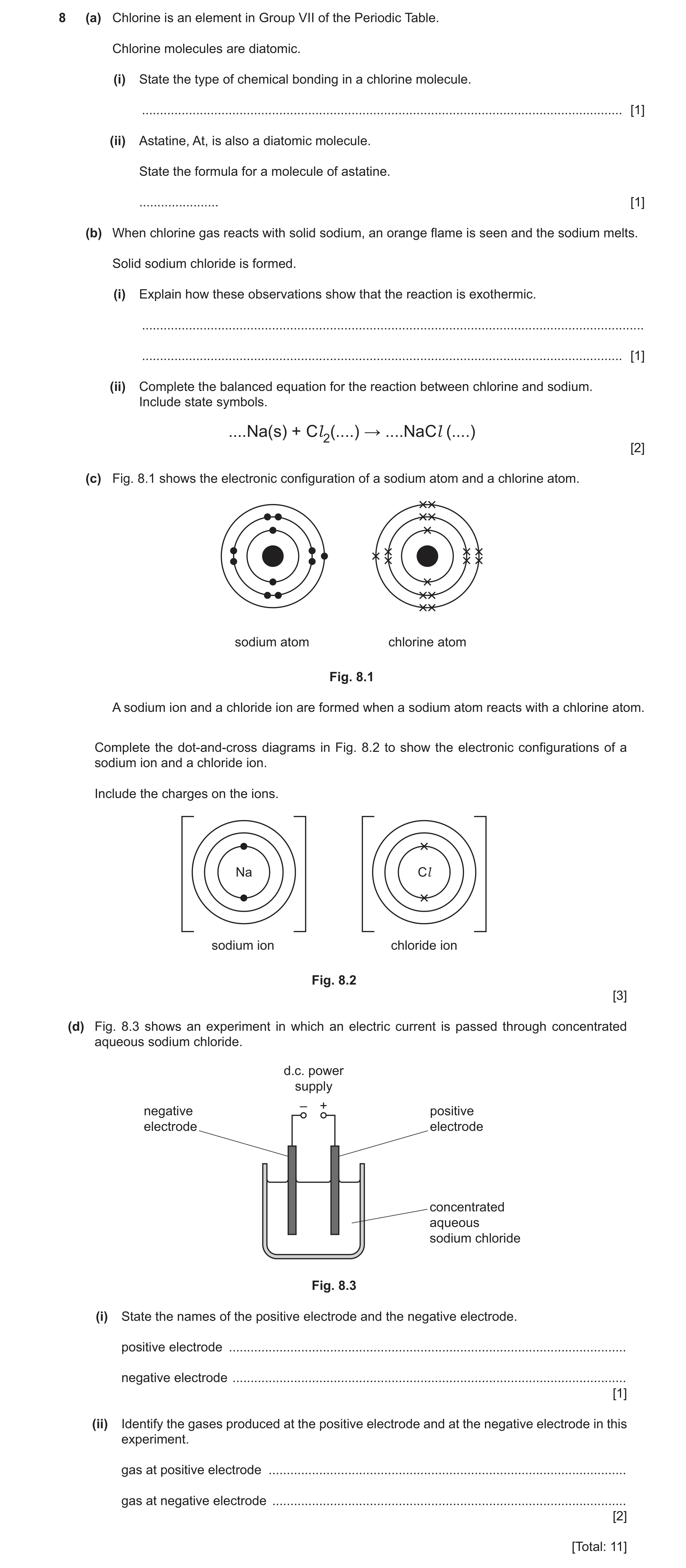
8 (a) Chlorine is an element in Group VII of the Periodic Table. Chlorine molecules are diatomic. (i) State the type of chemical bonding in a chlorine molecule. … [1] (ii) Astatine, At, is also a diatomic molecule. State the formula for a molecule of astatine. … [1] (b) When chlorine gas reacts with solid sodium, an orange flame is seen and the sodium melts. Solid sodium chloride is formed. (i) Explain how these observations show that the reaction is exothermic. … … [1] (ii) Complete the balanced equation for the reaction between chlorine and sodium. Include state symbols. … Na(s) + Cl 2( … ) → … NaCl ( … ) [2] (c) Fig. 8.1 shows the electronic configuration of a sodium atom and a chlorine atom. sodium atom chlorine atom Fig. 8.1 A sodium ion and a chloride ion are formed when a sodium atom reacts with a chlorine atom. Complete the dot-and-cross diagrams in Fig. 8.2 to show the electronic configurations of a sodium ion and a chloride ion. Include the charges on the ions. Na Cl sodium ion chloride ion Fig. 8.2 [3] (d) Fig. 8.3 shows an experiment in which an electric current is passed through concentrated aqueous sodium chloride. d.c. power supply – + negative positive electrode electrode concentrated aqueous sodium chloride Fig. 8.3 (i) State the names of the positive electrode and the negative electrode. positive electrode … negative electrode … [1] (ii) Identify the gases produced at the positive electrode and at the negative electrode in this experiment. gas at positive electrode … gas at negative electrode … [2] [Total: 11]
11 marks
Mark scheme: 8(a)(i) covalent ; 1 8(a)(ii) At2 ; 1 8(b)(i) (thermal) energy released ; 1 8(b)(ii) 2Na (s) + Cl2 ( g) → 2NaCl ( s) 2 ; ; 8(c) (the electronic configuration shown on the diagram) 3 sodium ion- 2, 8 ; chloride ion- 2, 8, 8 ; (the charge on the ions in diagram) sodium ion +1 and chloride ion -1 ; 8(d)(i) anode 1 cathode ; (in that order) 8(d)(ii) chlorine ; 2 hydrogen ; (in that order)
This question in 0654/32 Feb/March 2025
Q20 · The formulae of six gases found in the air are shown 0654/32 Oct/Nov 2025
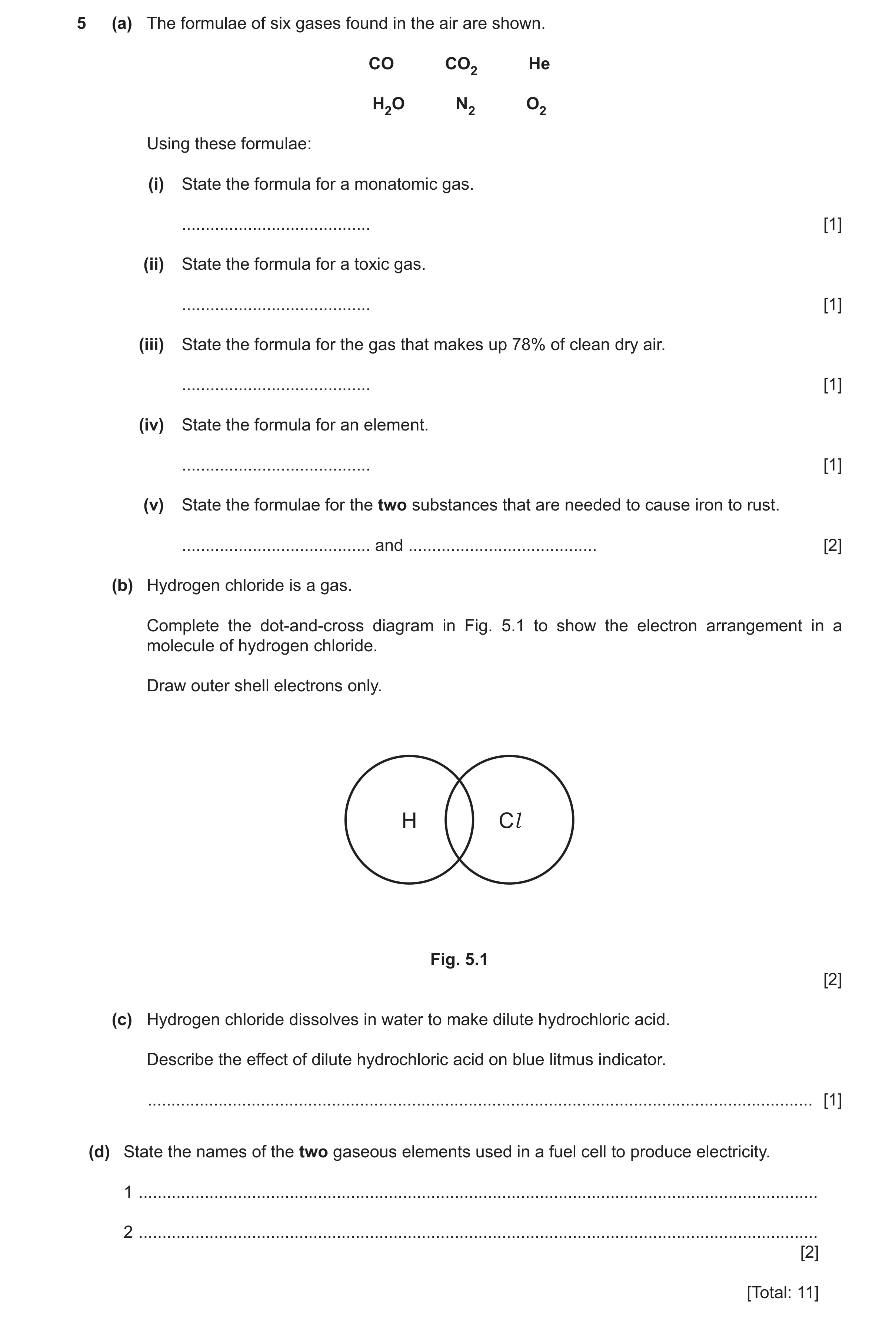
5 (a) The formulae of six gases found in the air are shown. CO CO2 He H2O N2 O2 Using these formulae: (i) State the formula for a monatomic gas. … [1] (ii) State the formula for a toxic gas. … [1] (iii) State the formula for the gas that makes up 78% of clean dry air. … [1] (iv) State the formula for an element. … [1] (v) State the formulae for the two substances that are needed to cause iron to rust. … and … [2] (b) Hydrogen chloride is a gas. Complete the dot‑and‑cross diagram in Fig. 5.1 to show the electron arrangement in a molecule of hydrogen chloride. Draw outer shell electrons only. H Cl Fig. 5.1 [2] (c) Hydrogen chloride dissolves in water to make dilute hydrochloric acid. Describe the effect of dilute hydrochloric acid on blue litmus indicator. … [1] (d) State the names of the two gaseous elements used in a fuel cell to produce electricity. 1 … 2 … [2] [Total: 11]
11 marks
Mark scheme: 5(a)(i) He ; 1 5(a)(ii) CO ; 1 5(a)(iii) N2 ; 1 5(a)(iv) He or N2 or O2 ; 1 5(a)(v) O2 ; 2 H2O ; 5(b) 2 shared pair correct ; all else correct ; 5(c) turns red ; 1 5(d) hydrogen ; 2 oxygen ;
This question in 0654/32 Oct/Nov 2025
![Question 1: (a) State the percentages of nitrogen and oxygen in clean air. nitrogen ........................% oxygen ........................% [2] (b) …](https://img.pastlit.com/crops/502faad1-fbe0-46c3-a980-bb811a2a1d10/q3.webp)
 3 / 31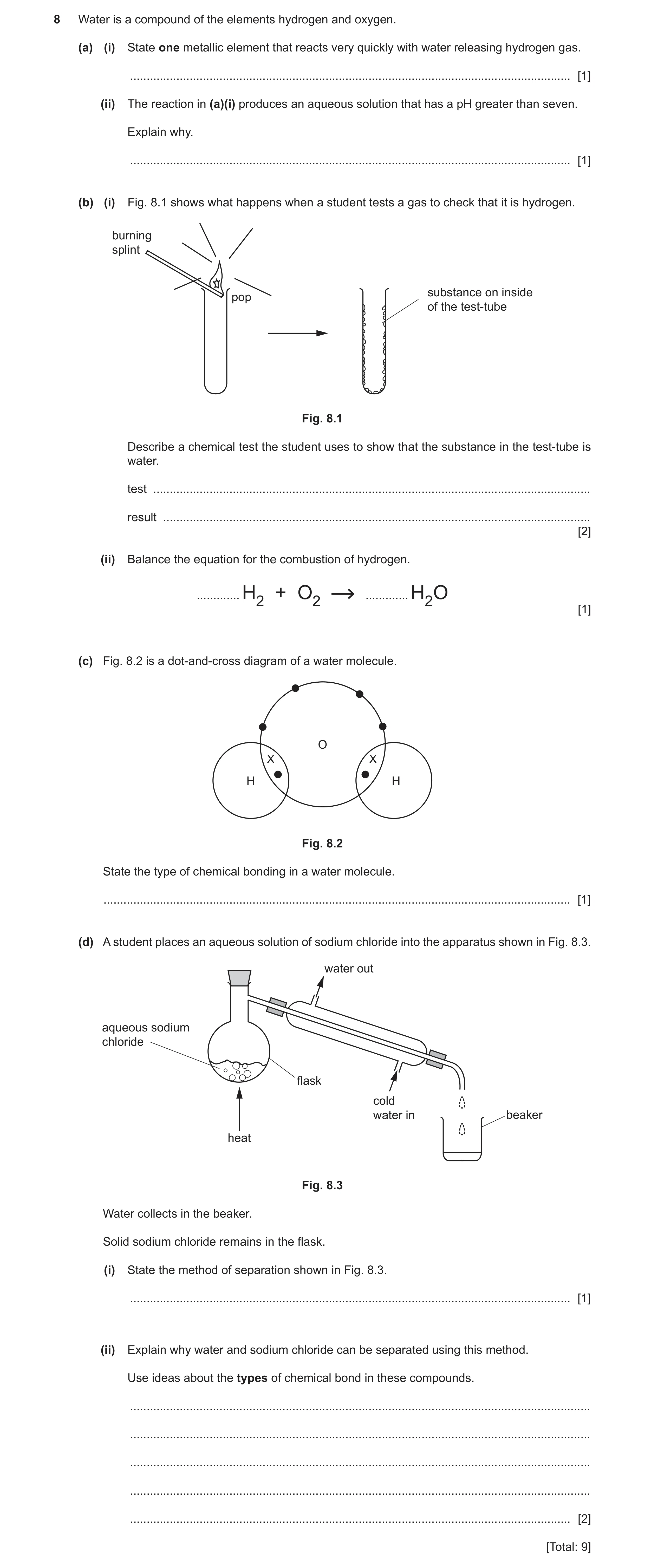
 9
9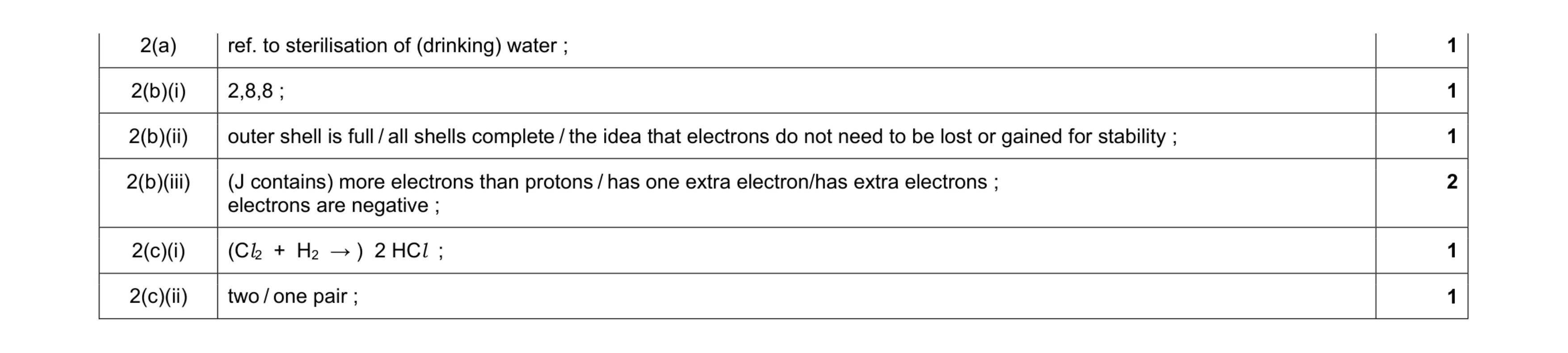 7
7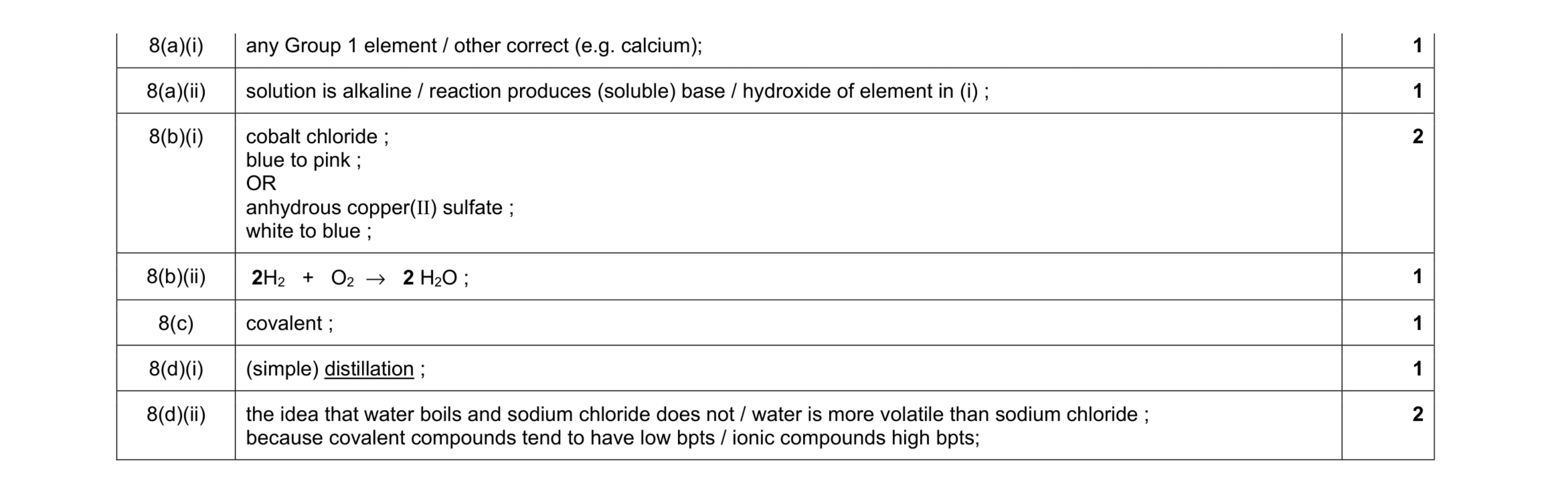 9
9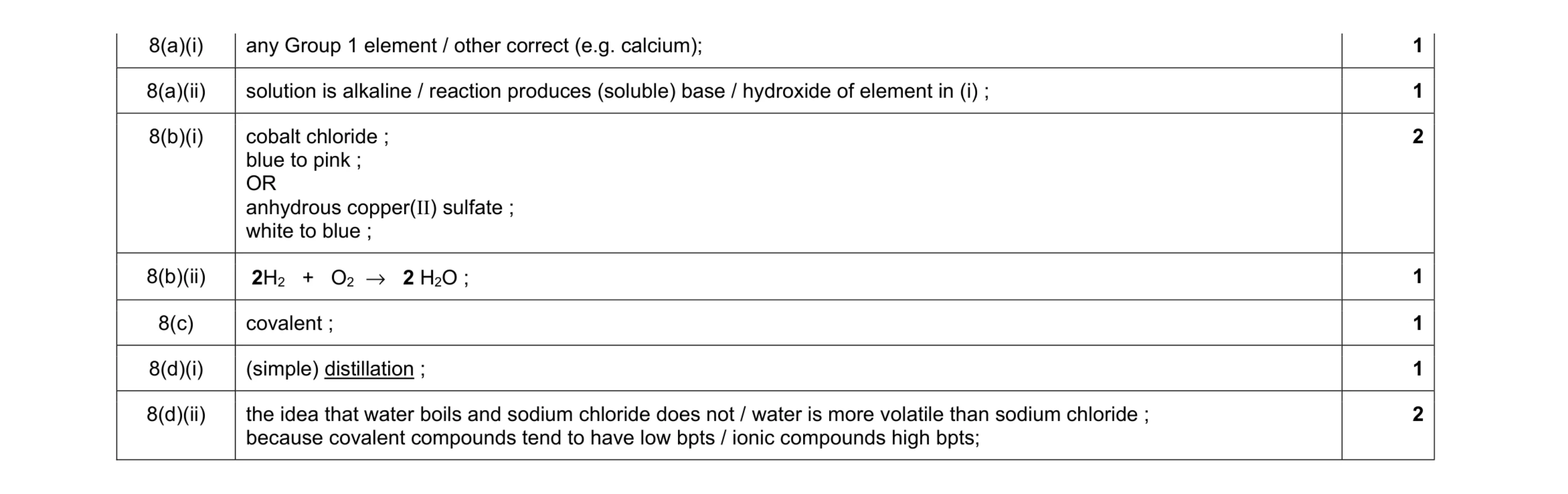 9
9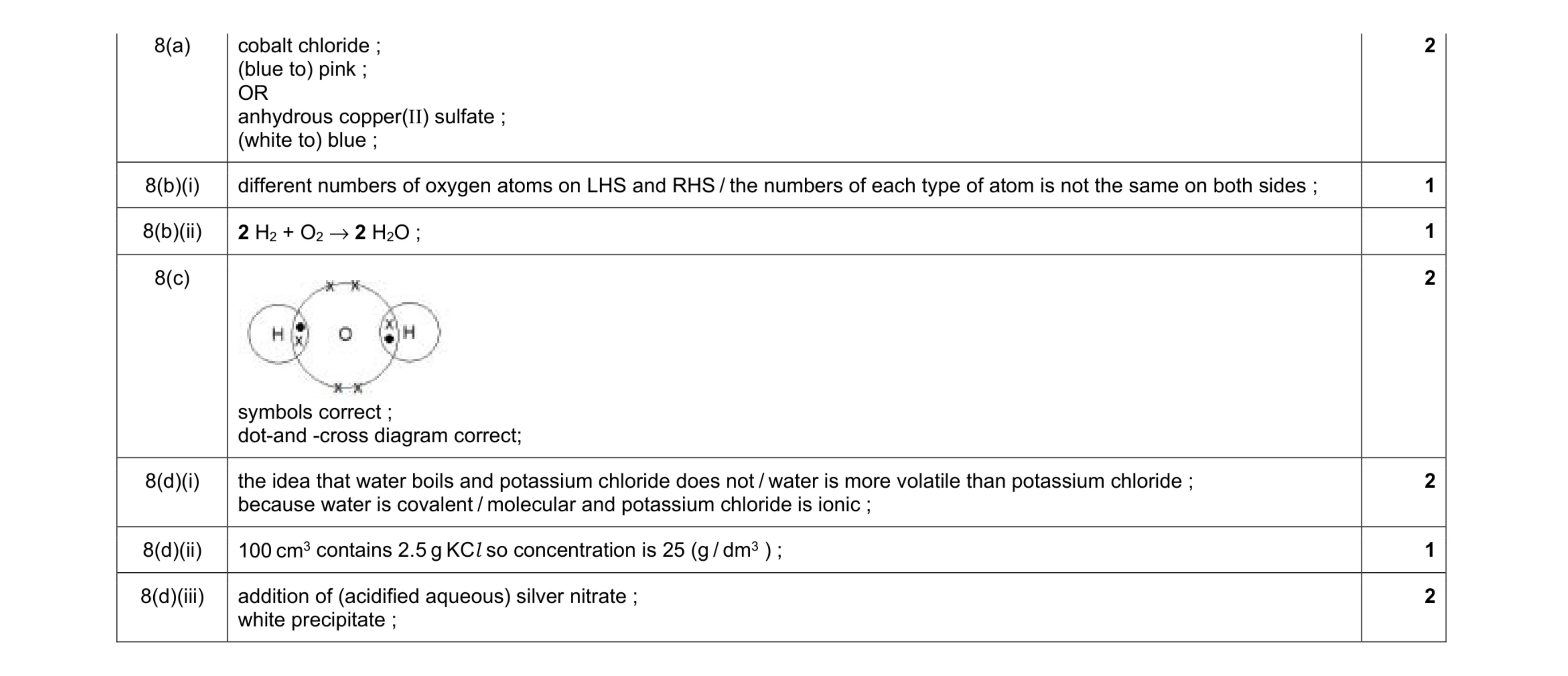 11
11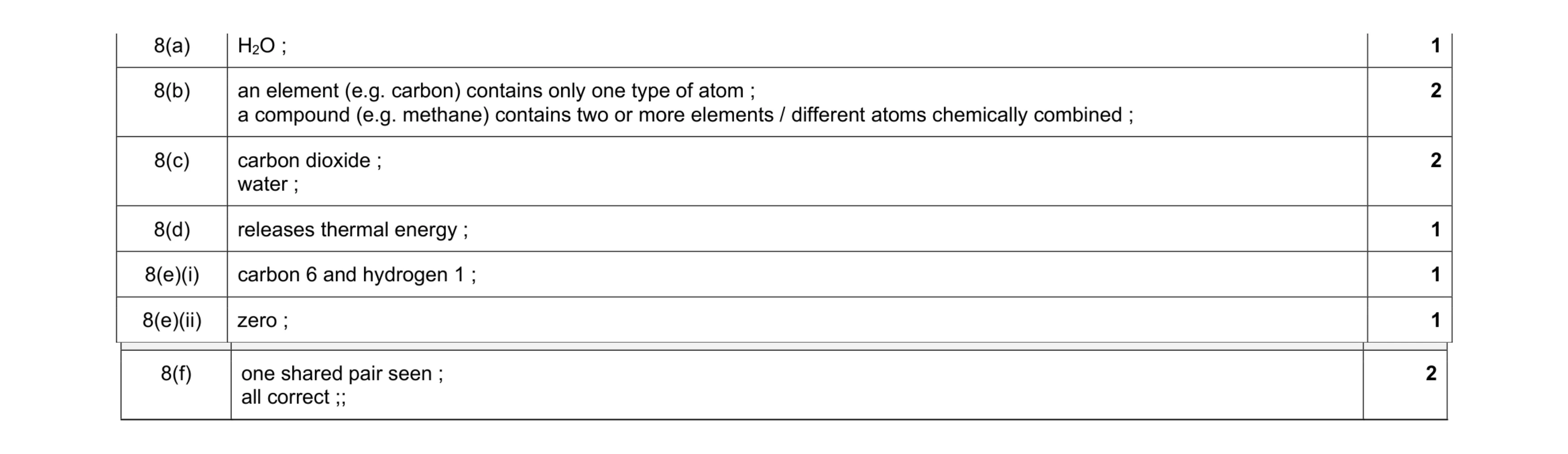 10
10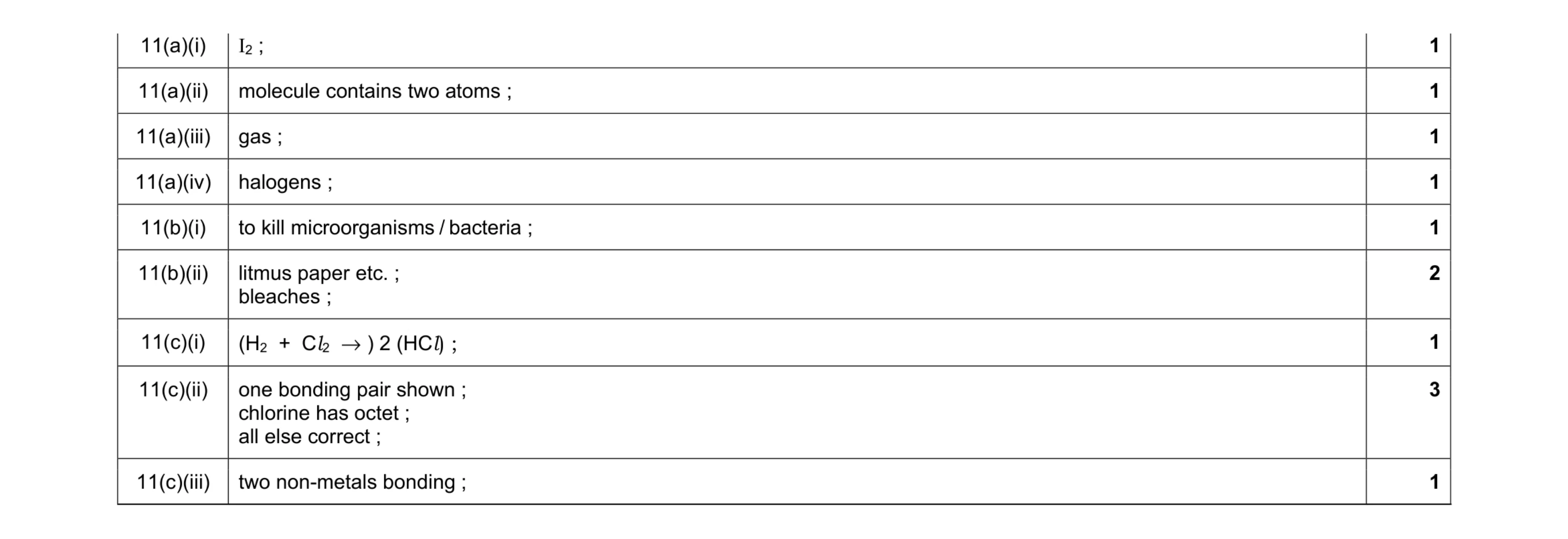 12
12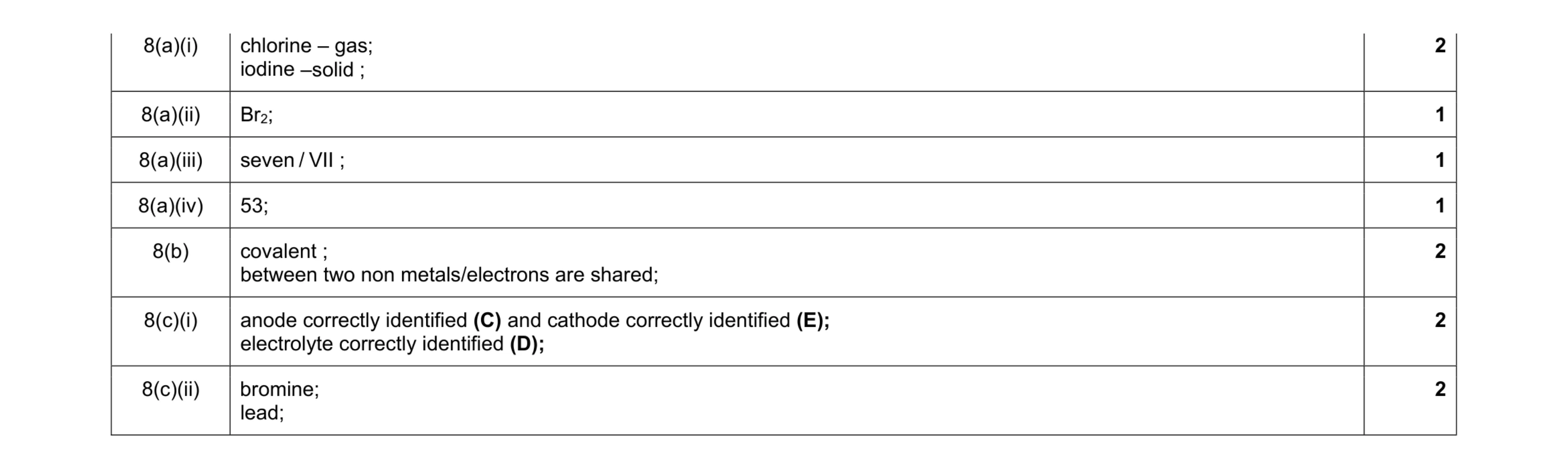 11
11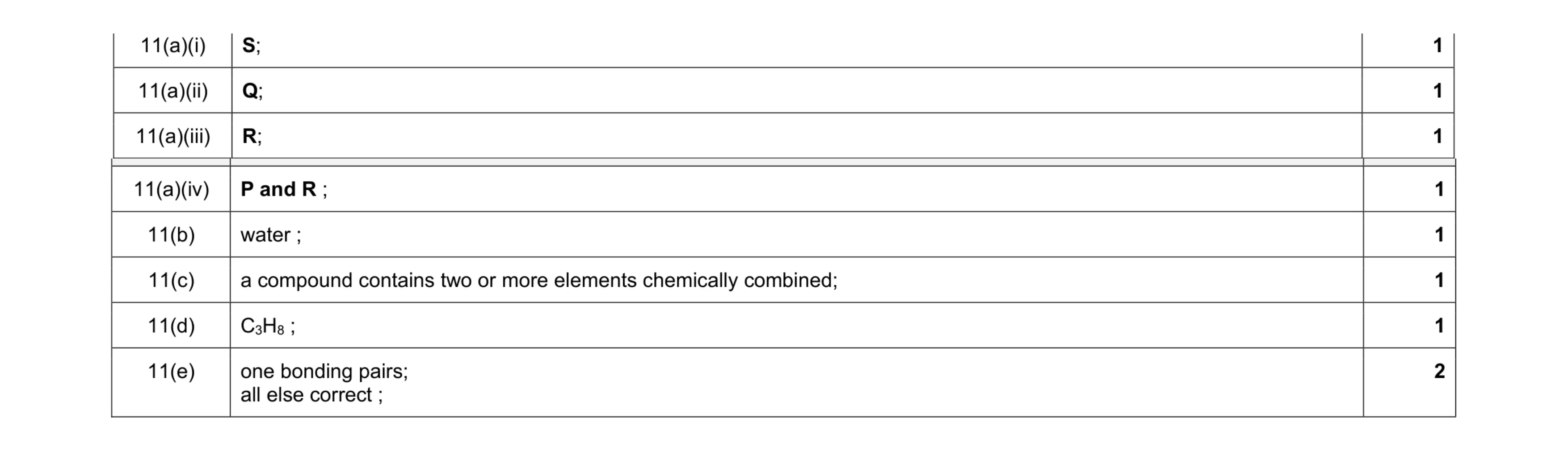 9
9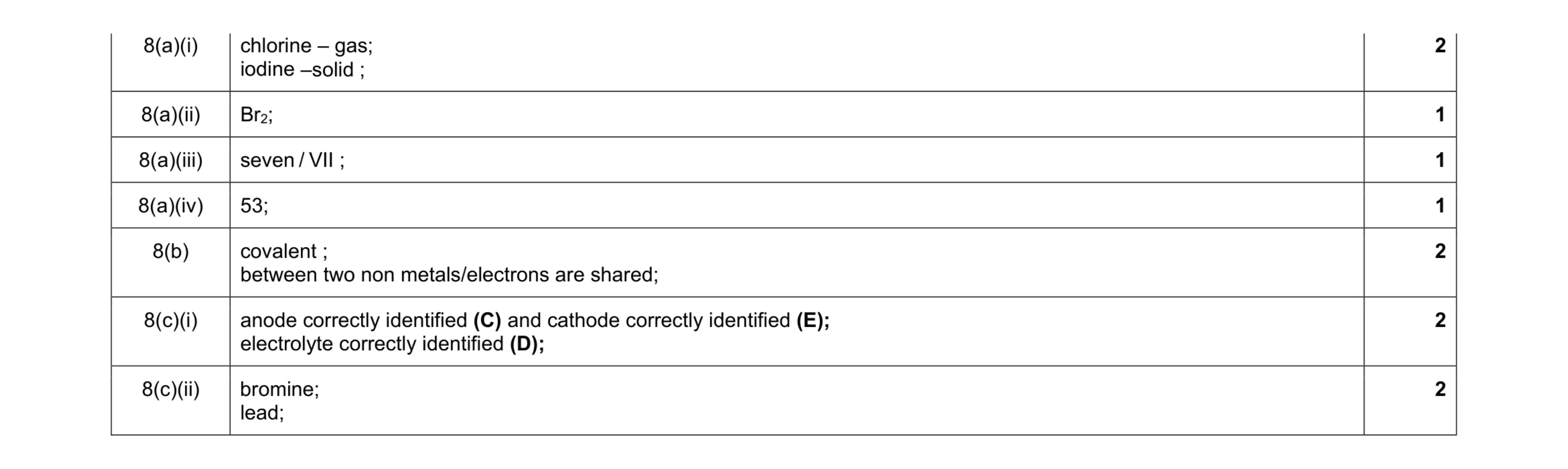 11
11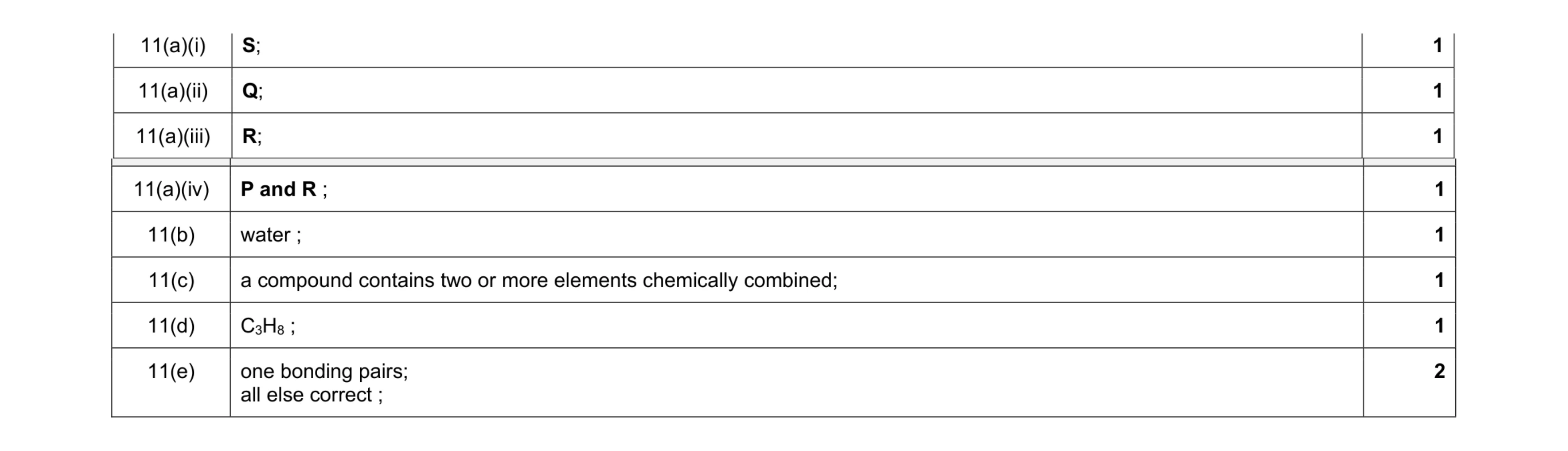 9
9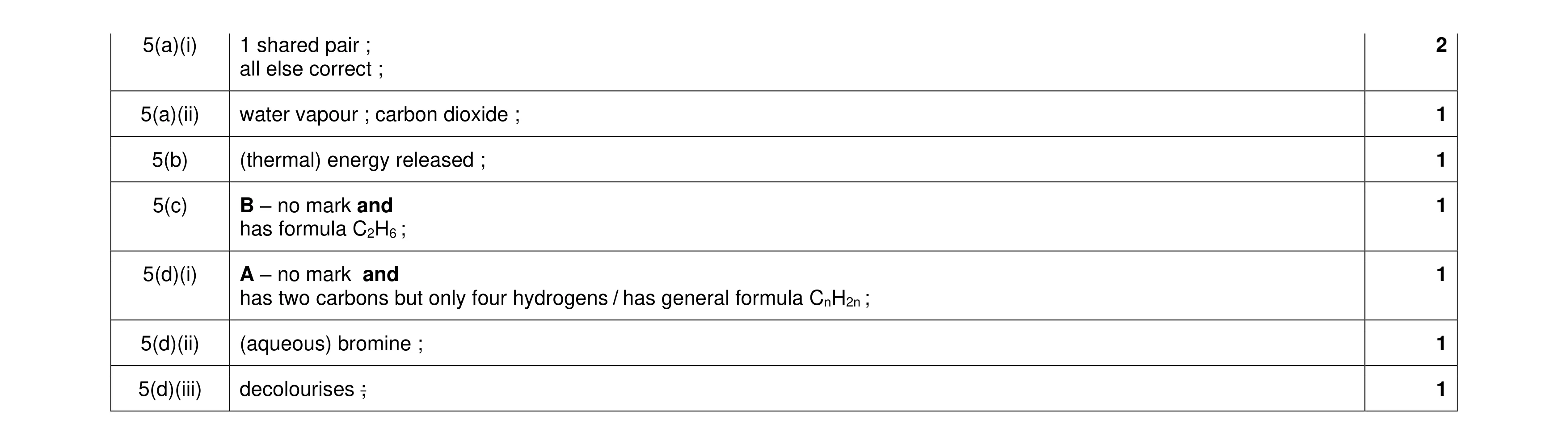 8
8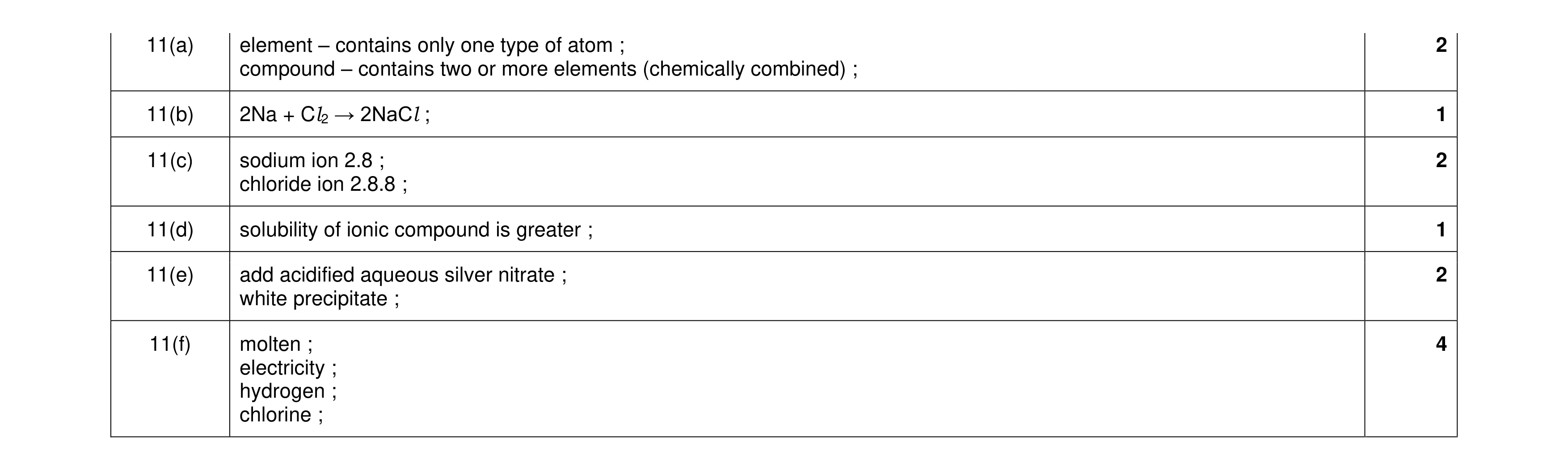 12
12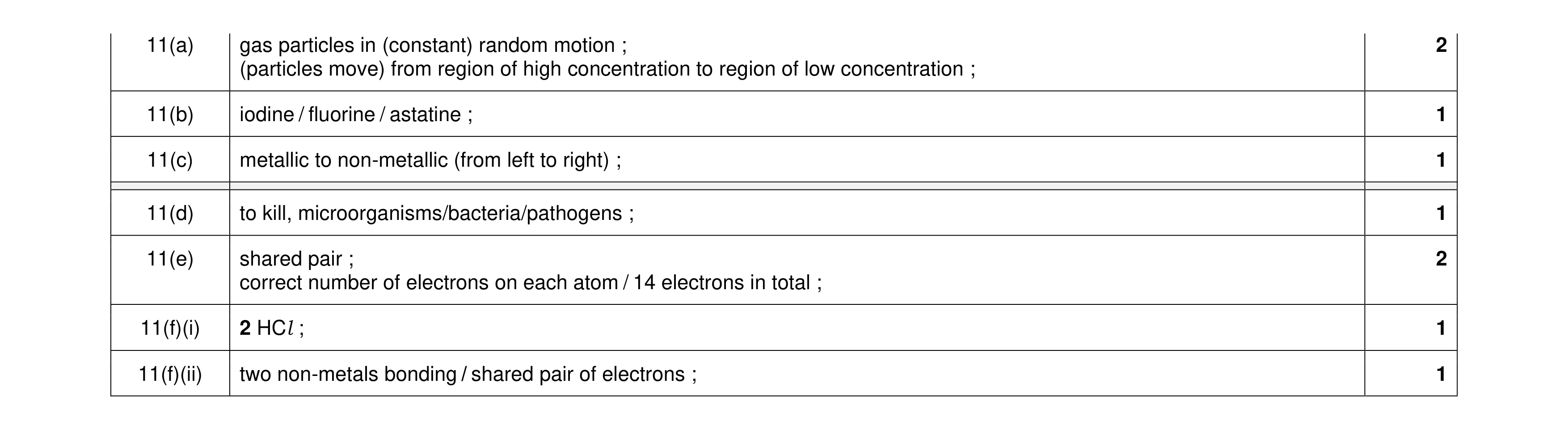 9
9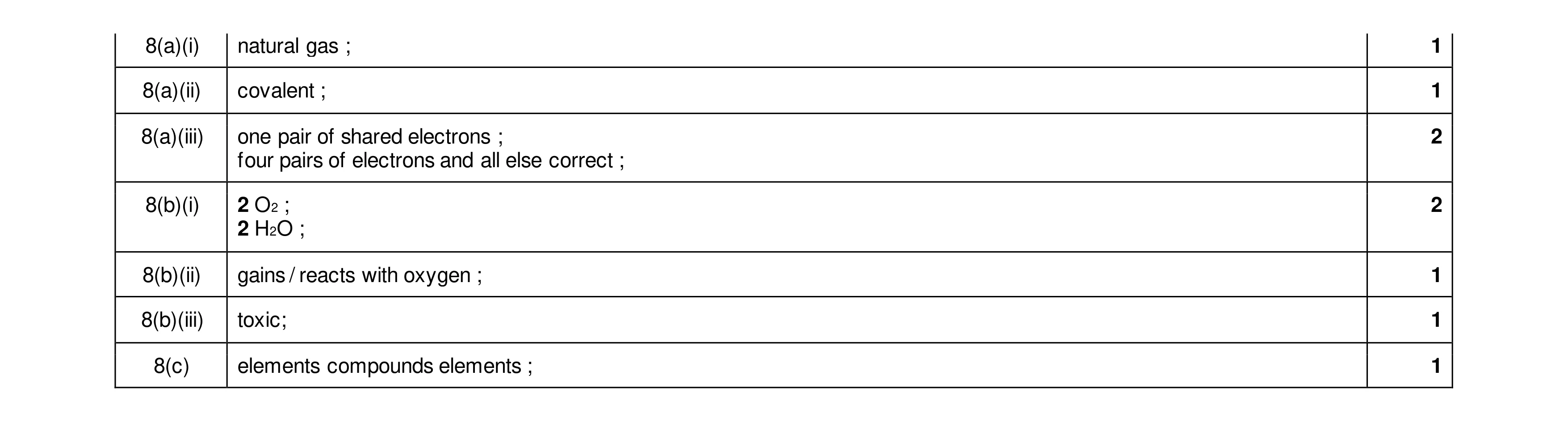 9
9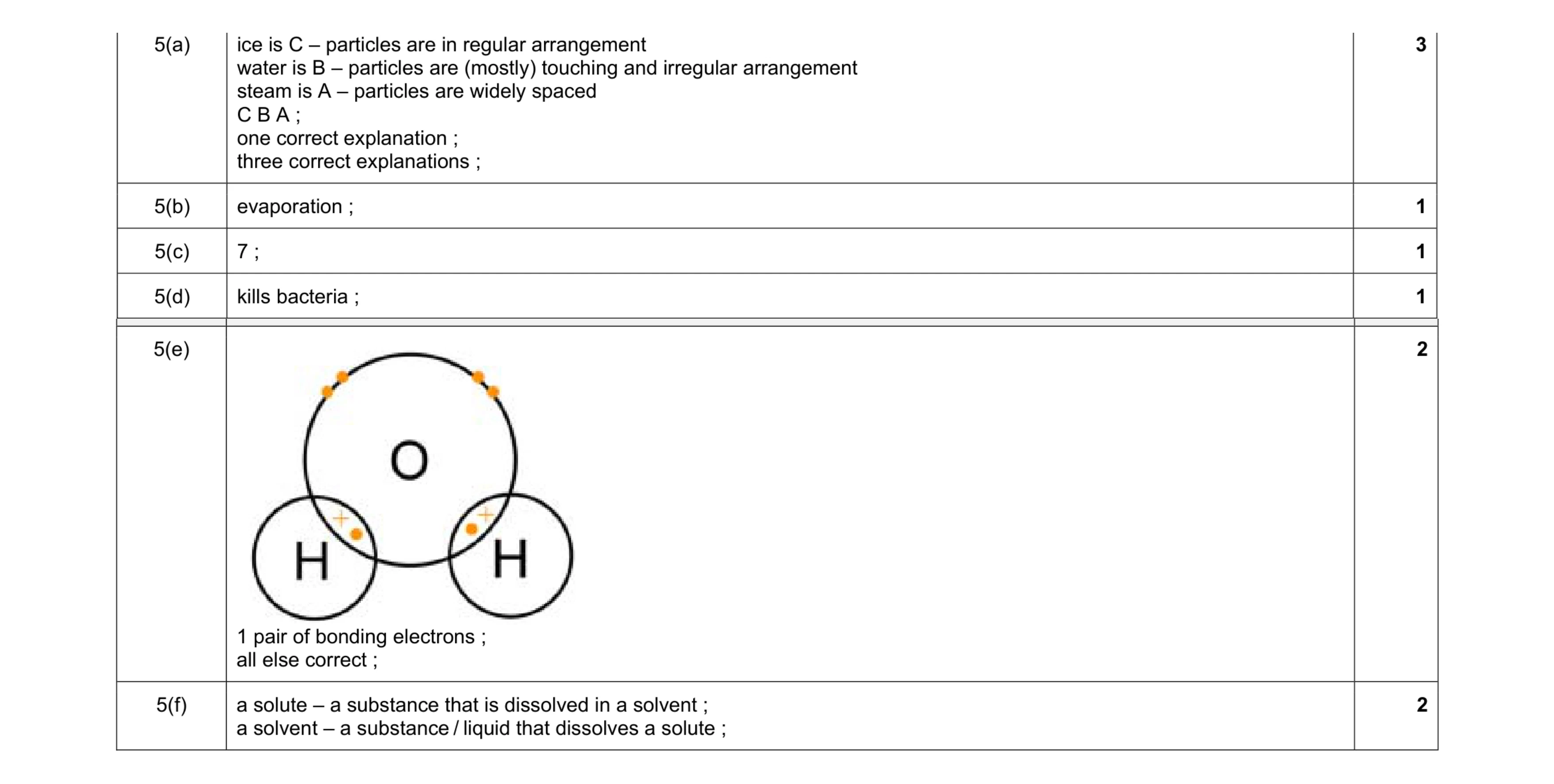 10
10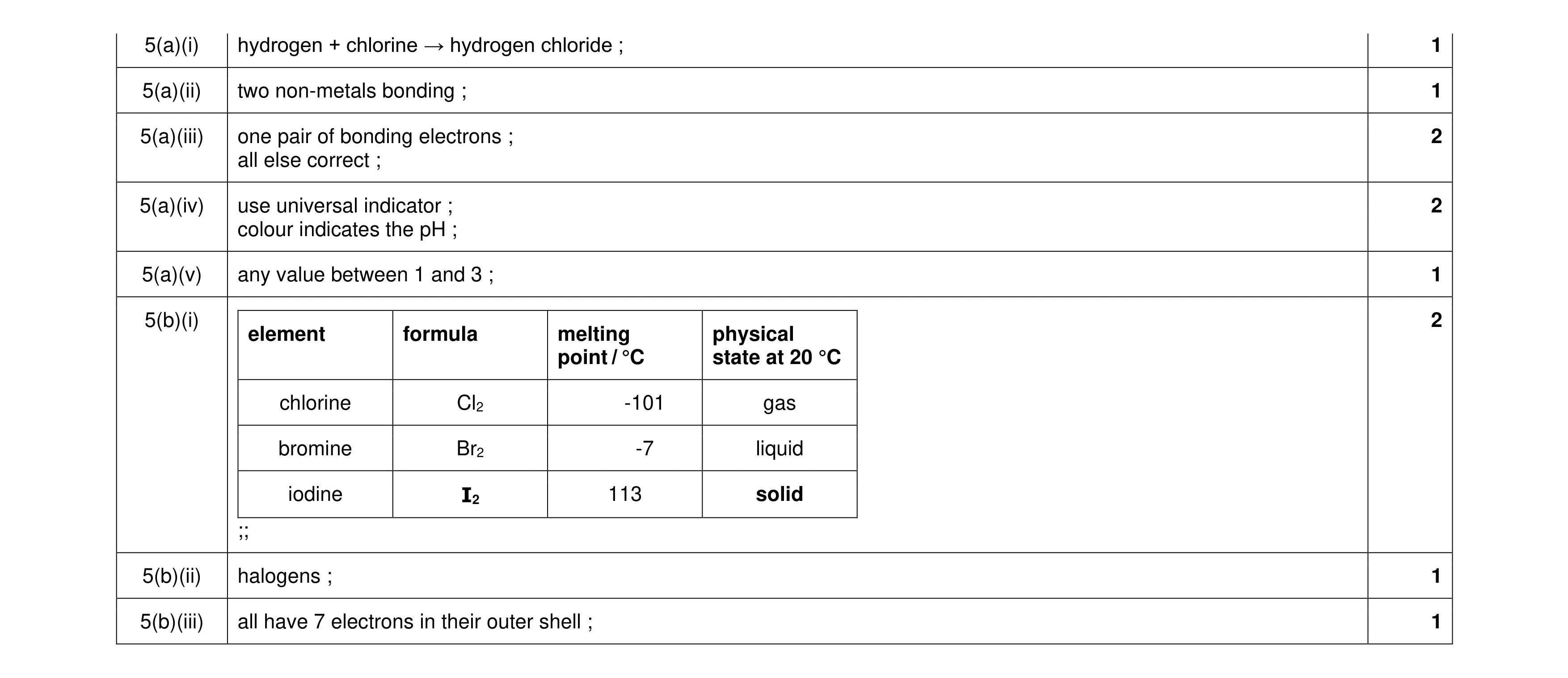 11
11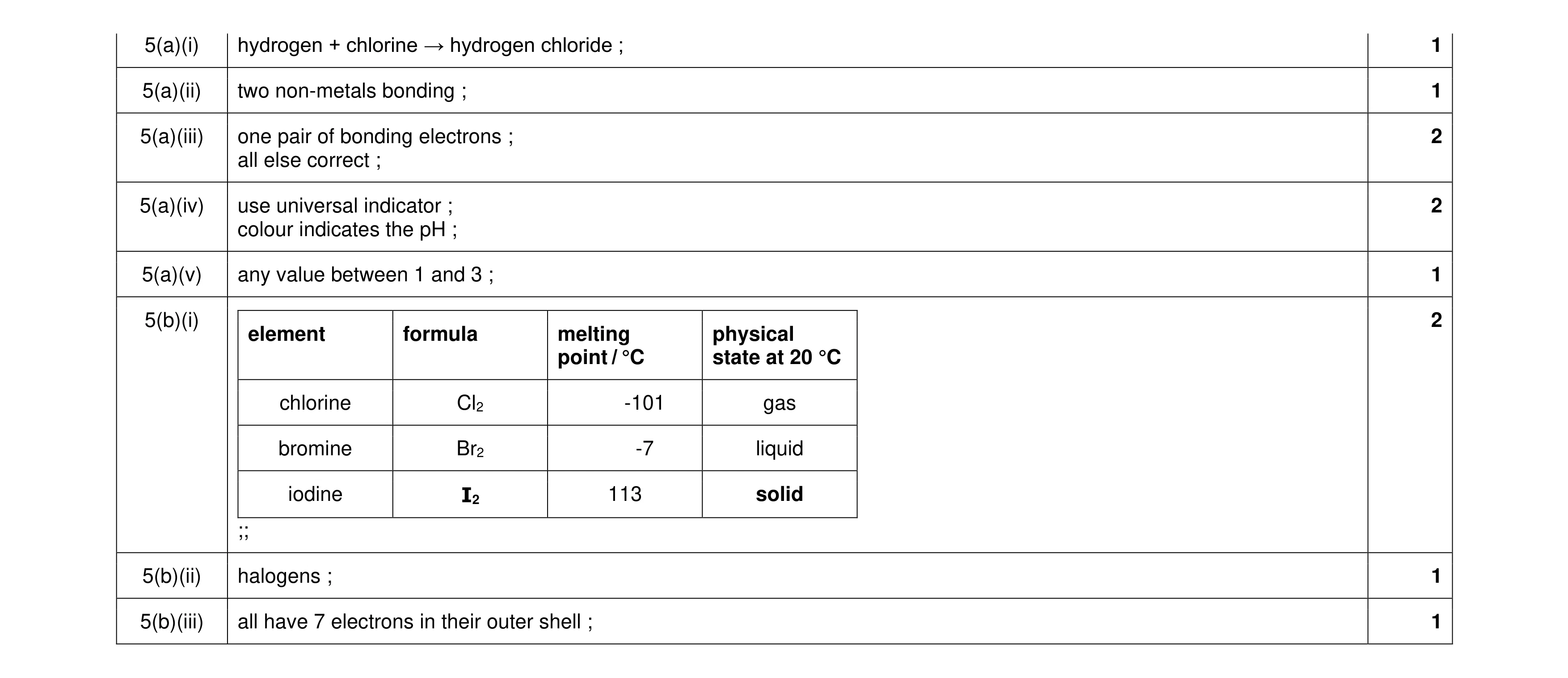 11
11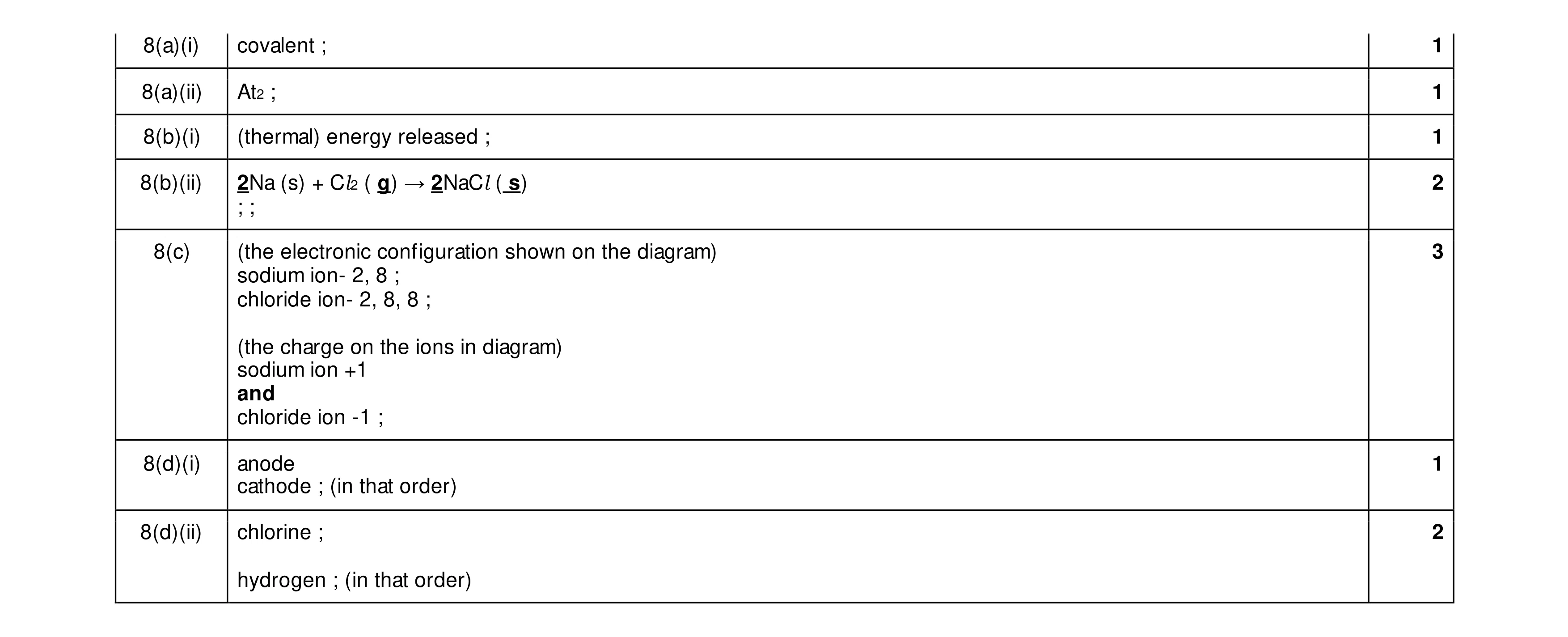 11
11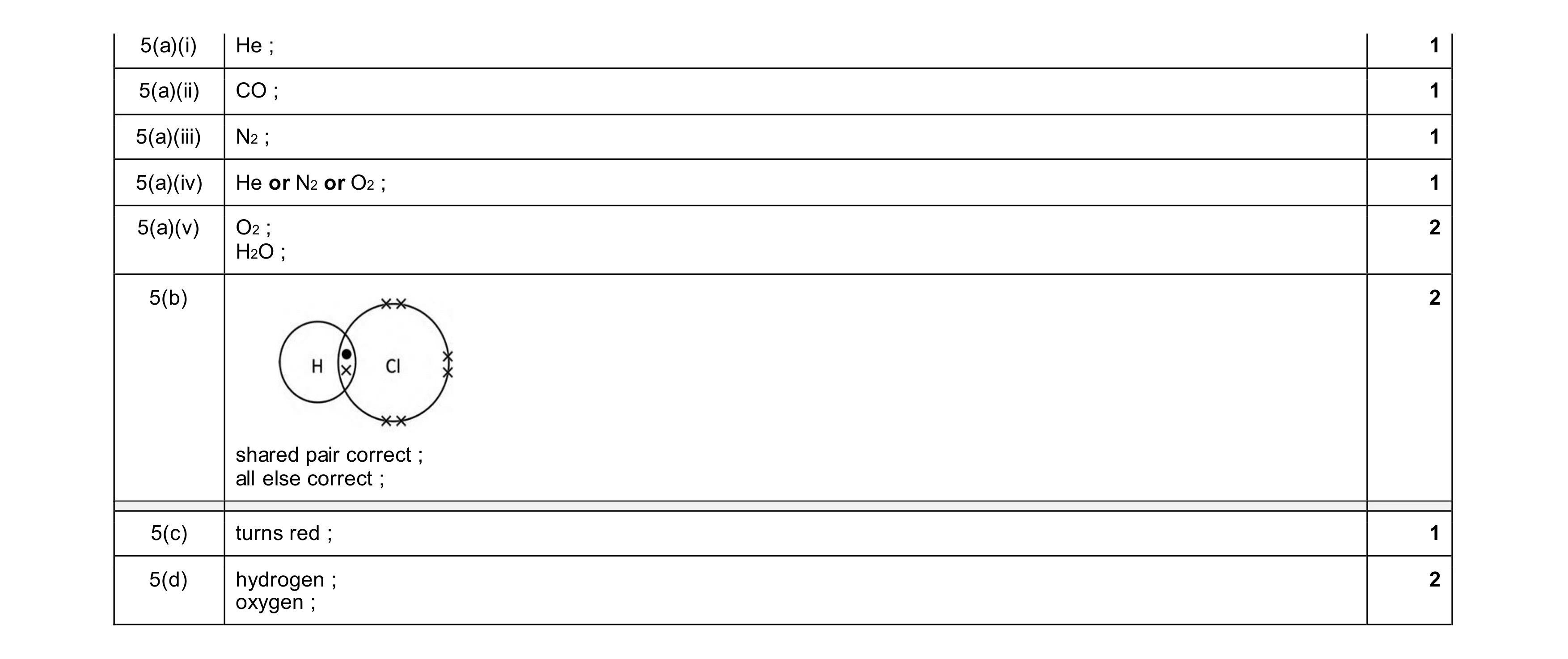 11
11