Questions as text
Q1 · Sodium reacting with chlorine gas 0654/41 May/June 2017
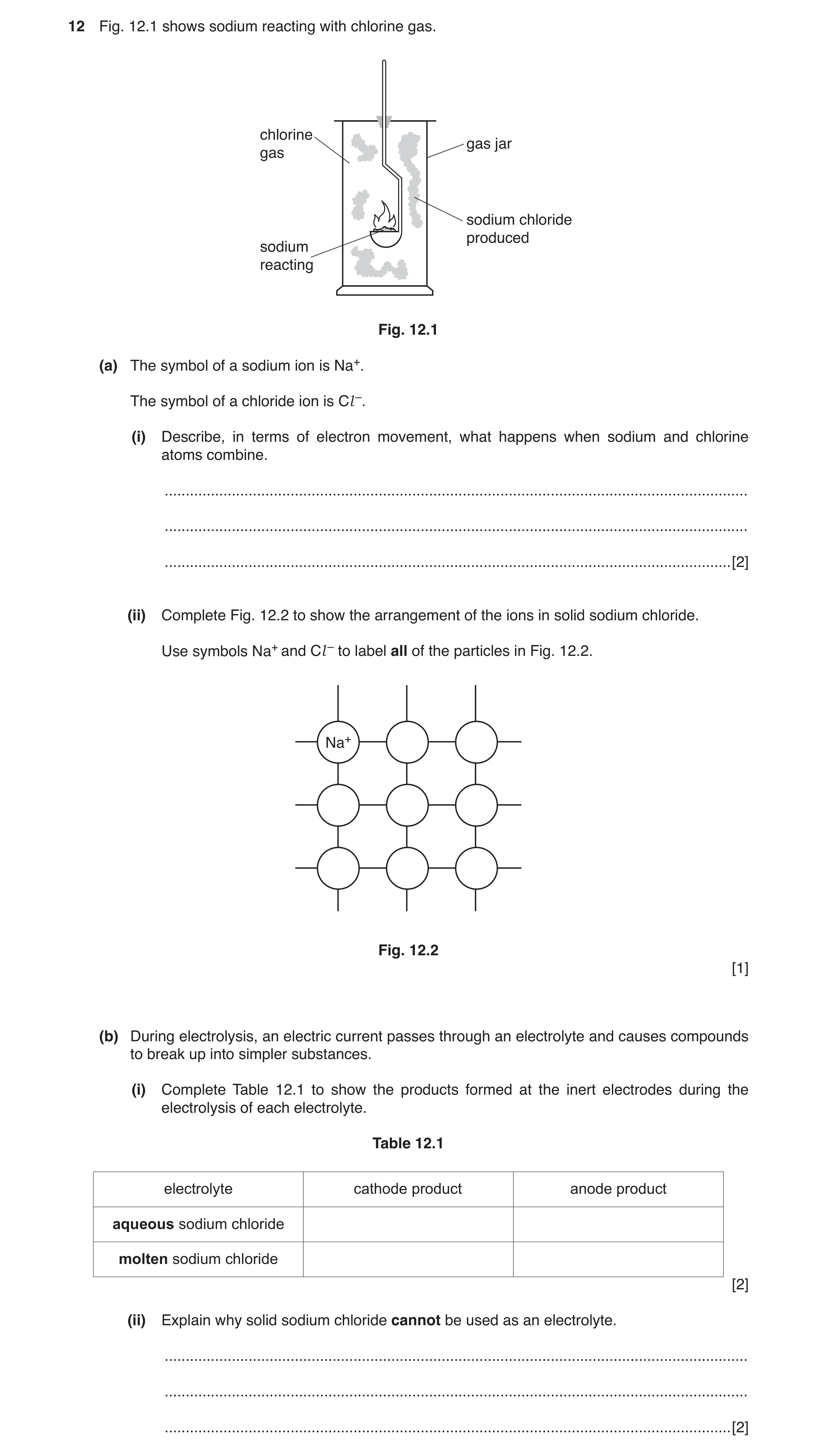
12 Fig. 12.1 shows sodium reacting with chlorine gas. chlorine gas jar gas sodium chloride produced sodium reacting Fig. 12.1 (a) The symbol of a sodium ion is Na+. The symbol of a chloride ion is Cl –. (i) Describe, in terms of electron movement, what happens when sodium and chlorine atoms combine. … … … [2] (ii) Complete Fig. 12.2 to show the arrangement of the ions in solid sodium chloride. Use symbols Na+ and Cl – to label all of the particles in Fig. 12.2. Na+ Fig. 12.2 [1] (b) During electrolysis, an electric current passes through an electrolyte and causes compounds to break up into simpler substances. (i) Complete Table 12.1 to show the products formed at the inert electrodes during the electrolysis of each electrolyte. Table 12.1 electrolyte cathode product anode product aqueous sodium chloride molten sodium chloride [2] (ii) Explain why solid sodium chloride cannot be used as an electrolyte. … … … [2]
7 marks
Mark scheme: 12(a)(i) sodium atoms lose one electron / change from 2,8,1 to 2,8 ; chlorine atoms gain one electron / change from 2,8,7 to 2,8,8 ; 2 12(a)(ii) alternating sodium and chloride ions in two directions ; 1 12(b)(i) (aqueous NaCl ) hydrogen chlorine ; (molten NaCl ) sodium chlorine ; 2 12(b)(ii) mobile ions carry charge / produce current / allow electricity to flow ; ions are not mobile / fixed in a solid ; 2
This question in 0654/41 May/June 2017
Q2 · Some particles in a mixture of gases 0654/42 Oct/Nov 2017
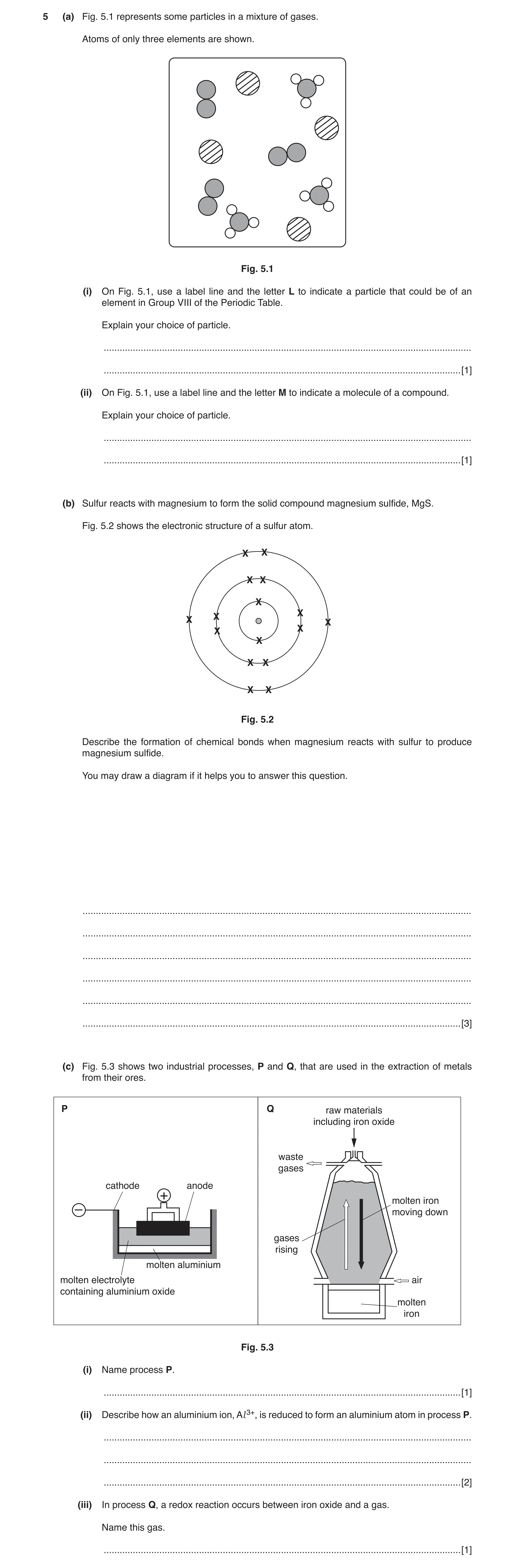
5 (a) Fig. 5.1 represents some particles in a mixture of gases. Atoms of only three elements are shown. Fig. 5.1 (i) On Fig. 5.1, use a label line and the letter L to indicate a particle that could be of an element in Group VIII of the Periodic Table. Explain your choice of particle. … … [1] (ii) On Fig. 5.1, use a label line and the letter M to indicate a molecule of a compound. Explain your choice of particle. … … [1] (b) Sulfur reacts with magnesium to form the solid compound magnesium sulfide, MgS. Fig. 5.2 shows the electronic structure of a sulfur atom. X X X X X X X X X X X X X X X X Fig. 5.2 Describe the formation of chemical bonds when magnesium reacts with sulfur to produce magnesium sulfide. You may draw a diagram if it helps you to answer this question. … … … … … … [3] (c) Fig. 5.3 shows two industrial processes, P and Q, that are used in the extraction of metals from their ores. P Q raw materials including iron oxide waste gases cathode anode + molten iron – moving down gases rising molten aluminium molten electrolyte air containing aluminium oxide molten iron Fig. 5.3 (i) Name process P. … [1] (ii) Describe how an aluminium ion, Al 3+, is reduced to form an aluminium atom in process P. … … … [2] (iii) In process Q, a redox reaction occurs between iron oxide and a gas. Name this gas. … [1]
9 marks
Mark scheme: 5(a)(i) label to the monatomic particle Group VIII atoms, are inert / do not need to bond / have complete outer shells ; 1 5(a)(ii) compound labelled compounds contain different types of atom bonded together ; 1 5(b) magnesium atom transfers electrons to sulfur atom ; idea of two electrons ; ionic bonding / ions of opposite charge attract ; 3 5(c)(i) electrolysis ; 1 5(c)(ii) it gains electrons ; each ion gains three electrons / is discharged ; 2 Question Answer Marks 5(c)(iii) carbon monoxide ; 1
This question in 0654/42 Oct/Nov 2017
Q3 · When lithium reacts with water, hydrogen and lithium hydroxide are produced 0654/43 Oct/Nov 2017
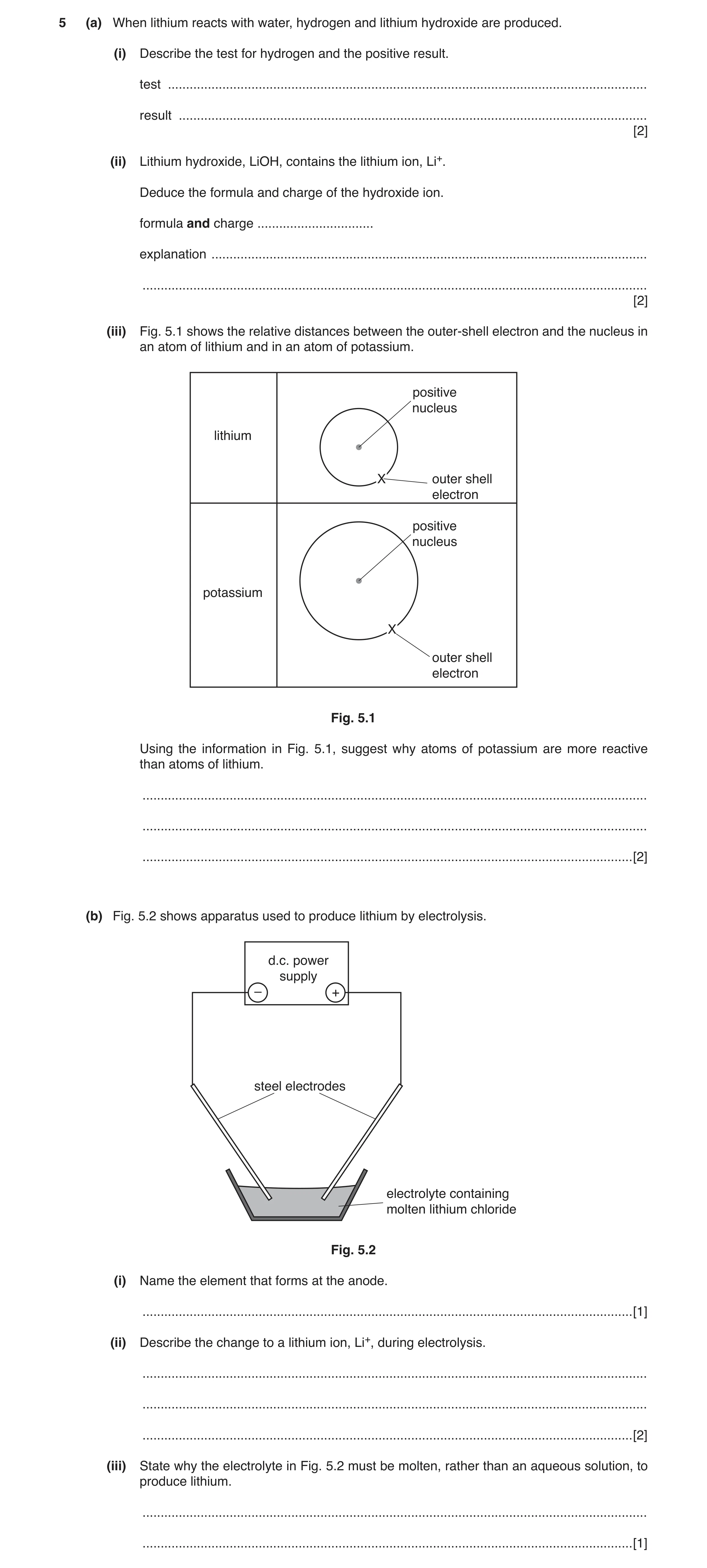
5 (a) When lithium reacts with water, hydrogen and lithium hydroxide are produced. (i) Describe the test for hydrogen and the positive result. test … result … [2] (ii) Lithium hydroxide, LiOH, contains the lithium ion, Li+. Deduce the formula and charge of the hydroxide ion. formula and charge … explanation … … [2] (iii) Fig. 5.1 shows the relative distances between the outer-shell electron and the nucleus in an atom of lithium and in an atom of potassium. positive nucleus lithium X outer shell electron positive nucleus potassium X outer shell electron Fig. 5.1 Using the information in Fig. 5.1, suggest why atoms of potassium are more reactive than atoms of lithium. … … … [2] (b) Fig. 5.2 shows apparatus used to produce lithium by electrolysis. d.c. power supply – + steel electrodes electrolyte containing molten lithium chloride Fig. 5.2 (i) Name the element that forms at the anode. … [1] (ii) Describe the change to a lithium ion, Li+, during electrolysis. … … … [2] (iii) State why the electrolyte in Fig. 5.2 must be molten, rather than an aqueous solution, to produce lithium. … … [1]
10 marks
Mark scheme: 5(a)(i) burning splint ; pops ; 2 5(a)(ii) OH– ; need for charge balance with Li+ ; 2 5(a)(iii) electron experiences a smaller force of attraction ; (positive) ions formed more easily / electrons more easily lost ; 2 5(b)(i) chlorine ; 1 5(b)(ii) it is discharged / becomes an atom ; by gaining one electron ; 2 5(b)(iii) hydrogen produced instead if aqueous electrolyte used ; 1
This question in 0654/43 Oct/Nov 2017
Q4 · Group VII of the Periodic Table contains reactive non-metallic elements 0654/43 Oct/Nov 2018
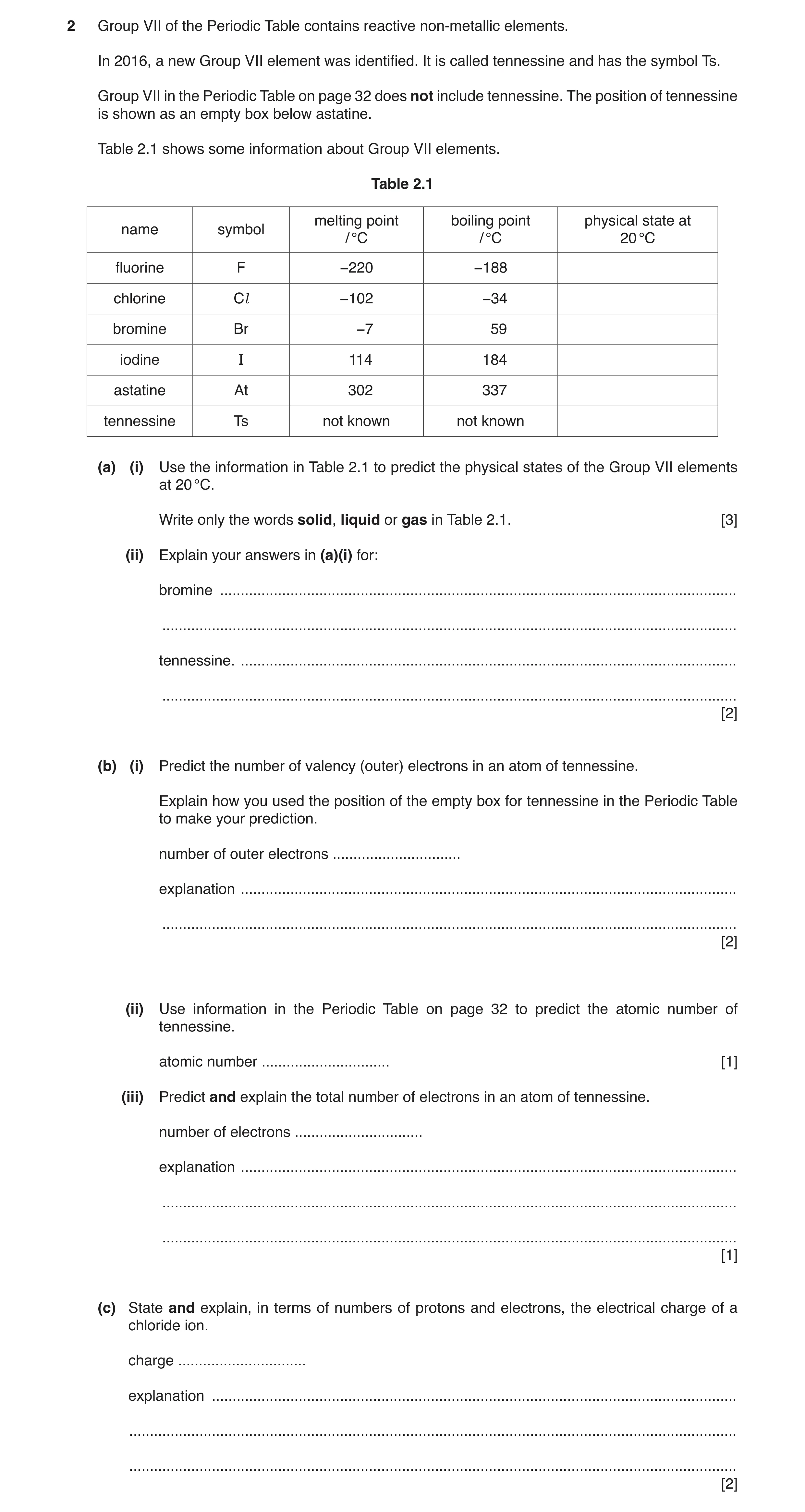
2 Group VII of the Periodic Table contains reactive non-metallic elements. In 2016, a new Group VII element was identified. It is called tennessine and has the symbol Ts. Group VII in the Periodic Table on page 32 does not include tennessine. The position of tennessine is shown as an empty box below astatine. Table 2.1 shows some information about Group VII elements. Table 2.1 melting point boiling point physical state at name symbol / °C / °C 20 °C fluorine F −220 −188 chlorine Cl −102 −34 bromine Br −7 59 iodine I 114 184 astatine At 302 337 tennessine Ts not known not known (a) (i) Use the information in Table 2.1 to predict the physical states of the Group VII elements at 20 °C. Write only the words solid, liquid or gas in Table 2.1. [3] (ii) Explain your answers in (a)(i) for: bromine … … tennessine. … … [2] (b) (i) Predict the number of valency (outer) electrons in an atom of tennessine. Explain how you used the position of the empty box for tennessine in the Periodic Table to make your prediction. number of outer electrons … explanation … … [2] (ii) Use information in the Periodic Table on page 32 to predict the atomic number of tennessine. atomic number … [1] (iii) Predict and explain the total number of electrons in an atom of tennessine. number of electrons … explanation … … … [1] (c) State and explain, in terms of numbers of protons and electrons, the electrical charge of a chloride ion. charge … explanation … … … [2]
11 marks
Mark scheme: 2(a)(i) gas gas ; liquid ; solid solid solid ; 3 2(a)(ii) bromine – m.pt. below 20 °C b.pt. above 20 °C ; tennessine – the idea that the trend will continue ; 2 2(b)(i) 7 ; number of outer electrons same as group number ; 2 2(b)(ii) 117 ; 1 2(b)(iii) 117 AND (number of electrons is) the same as number of protons / atomic number ; 1 2(c) −1 / negative ; the idea that number of electrons exceeds number of protons by one ; 2
This question in 0654/43 Oct/Nov 2018
Q5 · A student investigates the rate of reaction of calcium carbonate with dilute hydrochloric… 0654/41 May/June 2019
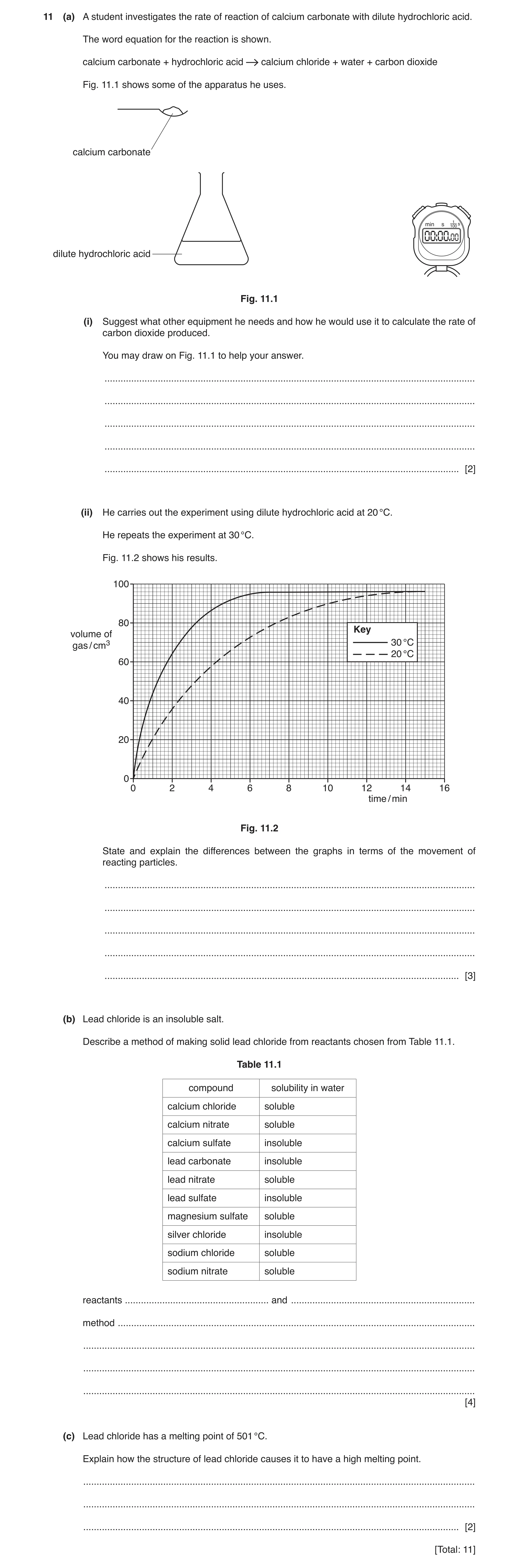
11 (a) A student investigates the rate of reaction of calcium carbonate with dilute hydrochloric acid. The word equation for the reaction is shown. calcium carbonate + hydrochloric acid calcium chloride + water + carbon dioxide Fig. 11.1 shows some of the apparatus he uses. calcium carbonate dilute hydrochloric acid Fig. 11.1 (i) Suggest what other equipment he needs and how he would use it to calculate the rate of carbon dioxide produced. You may draw on Fig. 11.1 to help your answer. … … … … … [2] (ii) He carries out the experiment using dilute hydrochloric acid at 20 °C. He repeats the experiment at 30 °C. Fig. 11.2 shows his results. 100 80 Keyvolume of 30 °Cgas / cm3 20 °C 60 40 20 0 0 2 4 6 8 10 12 14 16 time / min Fig. 11.2 State and explain the differences between the graphs in terms of the movement of reacting particles. … … … … … [3] (b) Lead chloride is an insoluble salt. Describe a method of making solid lead chloride from reactants chosen from Table 11.1. Table 11.1 compound solubility in water calcium chloride soluble calcium nitrate soluble calcium sulfate insoluble lead carbonate insoluble lead nitrate soluble lead sulfate insoluble magnesium sulfate soluble silver chloride insoluble sodium chloride soluble sodium nitrate soluble reactants … and … method … … … … [4] (c) Lead chloride has a melting point of 501 °C. Explain how the structure of lead chloride causes it to have a high melting point. … … … [2] [Total: 11]
11 marks
Mark scheme: 11(a)(i) gas syringe / measuring cylinder inverted over water ; measure volume of carbon dioxide and divide by time ; or balance ; measure loss in mass and divide by time ; 2 11(a)(ii) at higher temperature: (initial) rate of reaction / rate at which gas is collected, is higher ; more particles possess, activation energy / minimum energy to react, / there are more successful collisions ; greater frequency of collision ; 3 11(b) lead nitrate ; calcium chloride / sodium chloride ; mix solutions ; filter ; 4 11(c) Ionic lattice / giant ionic structure ; many bonds / strong bonds / strong forces / require a large amount of energy to break bonds ; 2
This question in 0654/41 May/June 2019
Q6 · Part of Group I of the Periodic Table 0654/43 May/June 2019
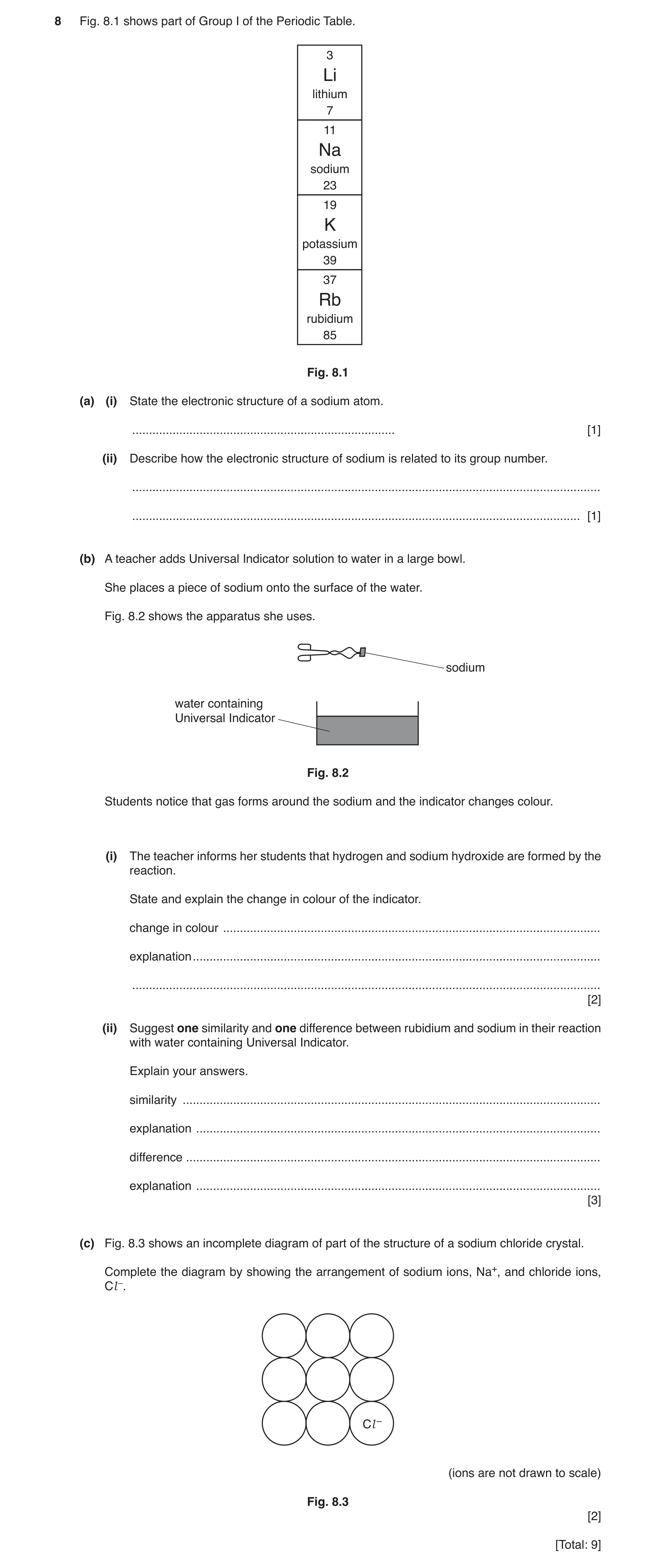
8 Fig. 8.1 shows part of Group I of the Periodic Table. 3 Li lithium 7 11 Na sodium 23 19 K potassium 39 37 Rb rubidium 85 Fig. 8.1 (a) (i) State the electronic structure of a sodium atom. … [1] (ii) Describe how the electronic structure of sodium is related to its group number. … … [1] (b) A teacher adds Universal Indicator solution to water in a large bowl. She places a piece of sodium onto the surface of the water. Fig. 8.2 shows the apparatus she uses. sodium water containing Universal Indicator Fig. 8.2 Students notice that gas forms around the sodium and the indicator changes colour. (i) The teacher informs her students that hydrogen and sodium hydroxide are formed by the reaction. State and explain the change in colour of the indicator. change in colour … explanation … … [2] (ii) Suggest one similarity and one difference between rubidium and sodium in their reaction with water containing Universal Indicator. Explain your answers. similarity … explanation … difference … explanation … [3] (c) Fig. 8.3 shows an incomplete diagram of part of the structure of a sodium chloride crystal. Complete the diagram by showing the arrangement of sodium ions, Na+, and chloride ions, Cl –. Cl – (ions are not drawn to scale) Fig. 8.3 [2] [Total: 9]
9 marks
Mark scheme: 8(a)(i) 2, 8, 1 ; 1 8(a)(ii) number of valence / outer shell, electrons equals group number or sodium has 1 outer electron so is in group 1 ; 1 8(b)(i) green to blue / violet ; (sodium hydroxide is) alkaline / pH increases / pH becomes >7 ; 2 8(b)(ii) similarity and difference: hydrogen / hydroxide / alkali also formed and more vigorous reaction ; similarity explanation: elements in same group have similar properties ; or same number/one electron in outer shell (so react similarly) ; difference explanation: trend to greater reactivity down Group I ; or outer electron more easily lost/further from nucleus (so more reactive) ; 3 8(c) Na+ and Cl – in equal numbers (+1Cl– ); alternating in both directions ; 2
This question in 0654/43 May/June 2019
Q7 · A pie chart which shows the composition of clean air 0654/41 Oct/Nov 2019
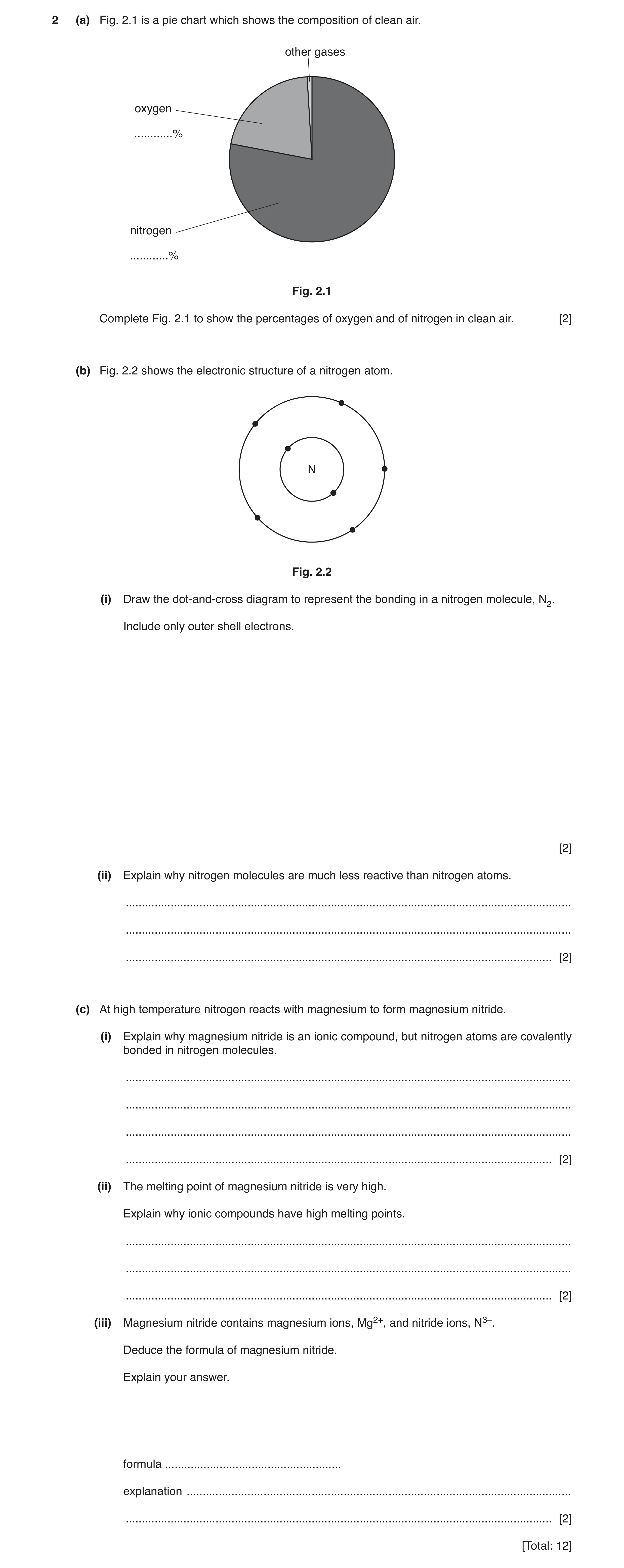
2 (a) Fig. 2.1 is a pie chart which shows the composition of clean air. other gases oxygen … % nitrogen … % Fig. 2.1 Complete Fig. 2.1 to show the percentages of oxygen and of nitrogen in clean air. [2] (b) Fig. 2.2 shows the electronic structure of a nitrogen atom. N Fig. 2.2 (i) Draw the dot-and-cross diagram to represent the bonding in a nitrogen molecule, N2. Include only outer shell electrons. [2] (ii) Explain why nitrogen molecules are much less reactive than nitrogen atoms. … … … [2] (c) At high temperature nitrogen reacts with magnesium to form magnesium nitride. (i) Explain why magnesium nitride is an ionic compound, but nitrogen atoms are covalently bonded in nitrogen molecules. … … … … [2] (ii) The melting point of magnesium nitride is very high. Explain why ionic compounds have high melting points. … … … [2] (iii) Magnesium nitride contains magnesium ions, Mg2+, and nitride ions, N3–. Deduce the formula of magnesium nitride. Explain your answer. formula … explanation … … [2] [Total: 12]
12 marks
Mark scheme: 2(a) oxygen: 21 ; nitrogen: 78 ; 2 2(b)(i) 3 bonding pairs ; 2 lone pairs, all else correct ; 2 2(b)(ii) (molecule is unreactive because of) strong (covalent) bonding between atoms / triple bond ; (atom is reactive because) atom has high tendency to gain electrons / has incomplete electron shell / does not have noble gas structure / owtte ; 2 2(c)(i) ionic bonds between metallic and non-metallic elements ; covalent bonds between non-metallic elements / nitrogen is a non-metal (so covalently bonded) ; 2 2(c)(ii) attractive force between oppositely charged ions / strong force / bonds between ions / many forces / bonds between ions ; more energy required to overcome force / break bond ; 2 2(c)(iii) Mg3N2 ; idea of balanced charges ; 2
This question in 0654/41 Oct/Nov 2019
Q8 · A student tries to draw the lattice structure of a crystal of sodium chloride 0654/42 Oct/Nov 2019
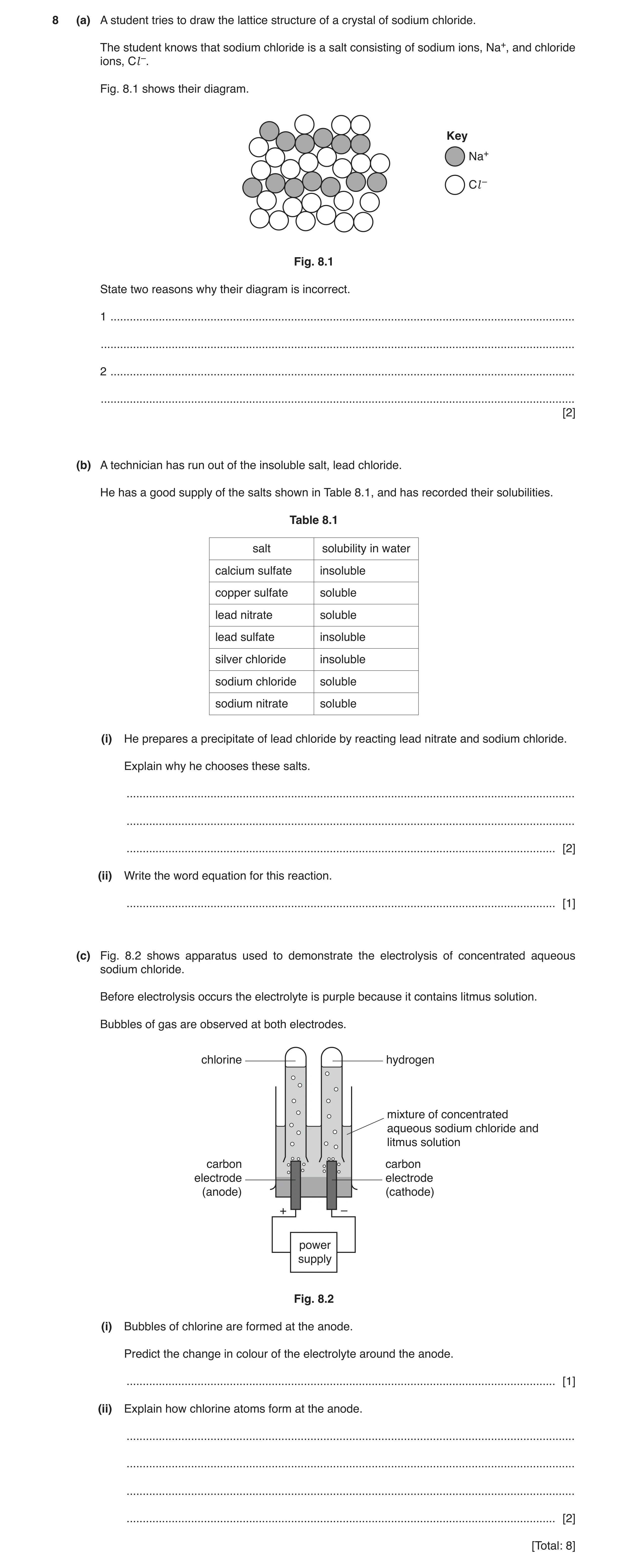
8 (a) A student tries to draw the lattice structure of a crystal of sodium chloride. The student knows that sodium chloride is a salt consisting of sodium ions, Na+, and chloride ions, Cl –. Fig. 8.1 shows their diagram. Key Na+ Cl – Fig. 8.1 State two reasons why their diagram is incorrect. 1 … … 2 … … [2] (b) A technician has run out of the insoluble salt, lead chloride. He has a good supply of the salts shown in Table 8.1, and has recorded their solubilities. Table 8.1 salt solubility in water calcium sulfate insoluble copper sulfate soluble lead nitrate soluble lead sulfate insoluble silver chloride insoluble sodium chloride soluble sodium nitrate soluble (i) He prepares a precipitate of lead chloride by reacting lead nitrate and sodium chloride. Explain why he chooses these salts. … … … [2] (ii) Write the word equation for this reaction. … [1] (c) Fig. 8.2 shows apparatus used to demonstrate the electrolysis of concentrated aqueous sodium chloride. Before electrolysis occurs the electrolyte is purple because it contains litmus solution. Bubbles of gas are observed at both electrodes. chlorine hydrogen mixture of concentrated aqueous sodium chloride and litmus solution carbon carbon electrode electrode (anode) (cathode) + – power supply Fig. 8.2 (i) Bubbles of chlorine are formed at the anode. Predict the change in colour of the electrolyte around the anode. … [1] (ii) Explain how chlorine atoms form at the anode. … … … … [2] [Total: 8]
8 marks
Mark scheme: 8(a) diagram, does not have / should have, a regular arrangement ; diagram, does not have / should have, alternating ions ; diagram, does not have / should have, equal number of Na+ and Cl – ; max 2 2 8(b)(i) reactant salts must be soluble ; to provide lead ions and chloride ions ; 2 8(b)(ii) lead nitrate + sodium chloride → sodium nitrate + lead chloride ; 1 8(c)(i) bleached / turns colourless ; 1 8(c)(ii) Cl – / chloride ions ; lose electrons / are oxidised ; 2
This question in 0654/42 Oct/Nov 2019
Q9 · Ammonium sulfate is used as a fertiliser 0654/42 May/June 2020
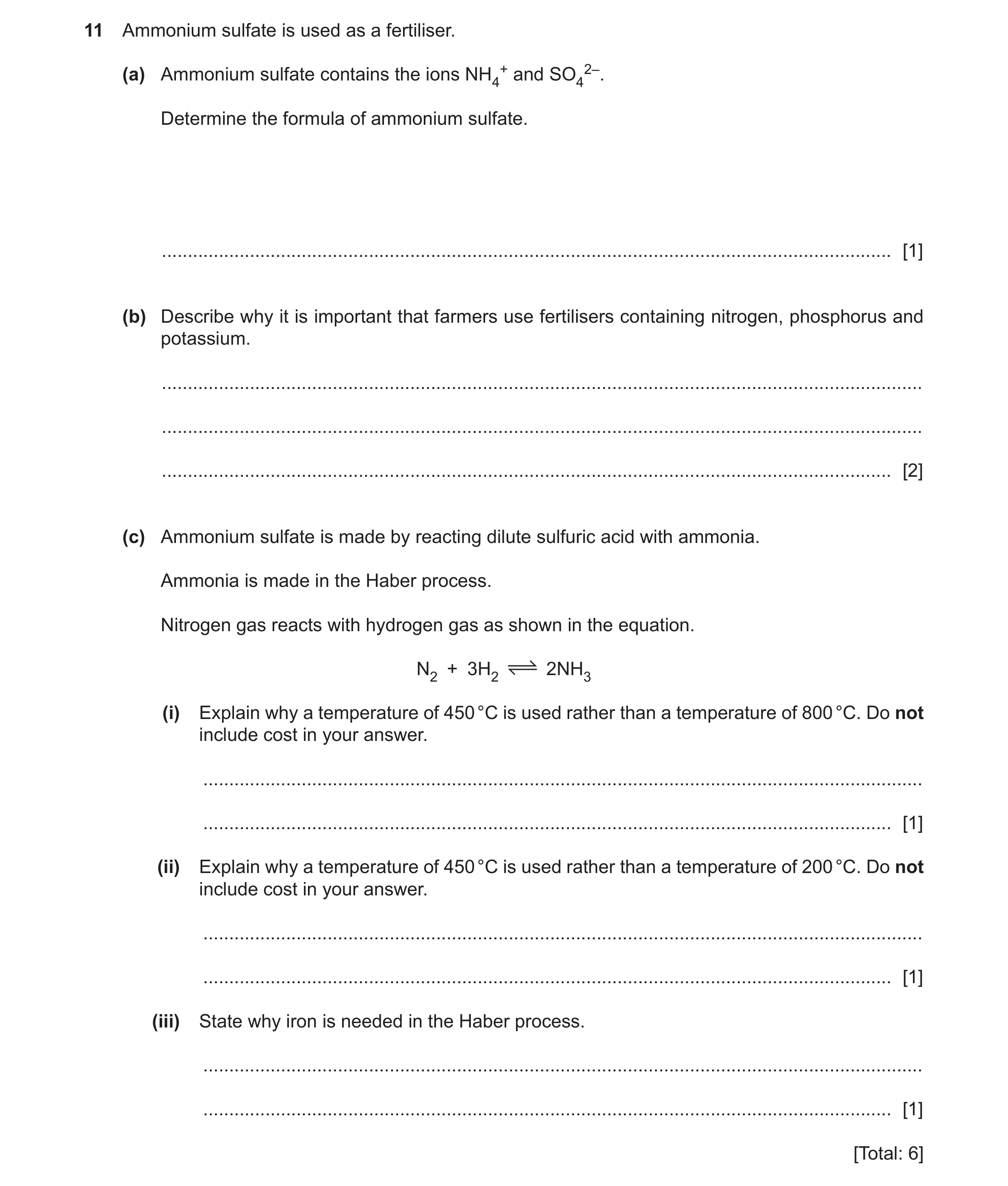
11 Ammonium sulfate is used as a fertiliser. (a) Ammonium sulfate contains the ions NH4+ and SO42–. Determine the formula of ammonium sulfate. … [1] (b) Describe why it is important that farmers use fertilisers containing nitrogen, phosphorus and potassium. … … … [2] (c) Ammonium sulfate is made by reacting dilute sulfuric acid with ammonia. Ammonia is made in the Haber process. Nitrogen gas reacts with hydrogen gas as shown in the equation. N2 + 3H2 2NH3 (i) Explain why a temperature of 450 °C is used rather than a temperature of 800 °C. Do not include cost in your answer. … … [1] (ii) Explain why a temperature of 450 °C is used rather than a temperature of 200 °C. Do not include cost in your answer. … … [1] (iii) State why iron is needed in the Haber process. … … [1] [Total: 6]
6 marks
Mark scheme: 11(a) (NH4)2SO4 ; 1 11(b) to improve crop yield / idea of producing better quality crops ; fertilisers provide the essential elements for plant growth / owtte ; plants remove NPK (from soil), which needs to be replaced / owtte ; max 2 11(c)(i) idea that 450°C gives higher yield (than 800°C) / ORA ; 1 11(c)(ii) idea that rate of reaction is faster at 450°C (than at 200°C) / ORA ; 1 11(c)(iii) iron is a catalyst / iron increases the rate of the reaction ; 1
This question in 0654/42 May/June 2020
Q10 · Concentrated aqueous sodium chloride can be electrolysed using inert electrodes 0654/41 Oct/Nov 2020
11 (a) Concentrated aqueous sodium chloride can be electrolysed using inert electrodes. Fig. 11.1 shows the electrolysis. concentrated aqueous sodium chlorine chloride in gas out – + sodium hydroxide solution Cl 2 cathode porous barrier anode Fig. 11.1 Chlorine gas is made at the anode. (i) Explain why chlorine gas is made at the anode. … … … … [2] (ii) State the name of the product at the cathode. … [1] (iii) Explain why the electrodes used must be inert electrodes. … … [1] (b) Molten sodium chloride can also be electrolysed. Sodium is made at the cathode. Write the balanced ionic half‑equation for the reaction at the cathode. Include state symbols. … [2] (c) Sodium chloride has a lattice structure. Draw a labelled diagram of the lattice structure of sodium chloride. [2] [Total: 8]
8 marks
Mark scheme: 11(a)(i) any two from: chloride ions are attracted to the (oppositely charged) anode / chloride ions are negative (so attracted to the anode) ; electron loss occurs at the anode / oxidation occurs at the anode ; chlorine atoms combine to form chlorine molecules ; max 2 11(a)(ii) hydrogen ; 1 11(a)(iii) so electrodes do not react with the products / named substance present ; 1 11(b) Na+(l) + e– → Na(l) half-equation ; state symbols ; 2 Question Answer Marks 11(c) labelled Na+ and Cl – ions ; alternating positive and negative / Na and Cl ; e.g. 2 Na+ Cl –
This question in 0654/41 Oct/Nov 2020
Q11 · Look at the list of atomic symbols 0654/43 Oct/Nov 2020
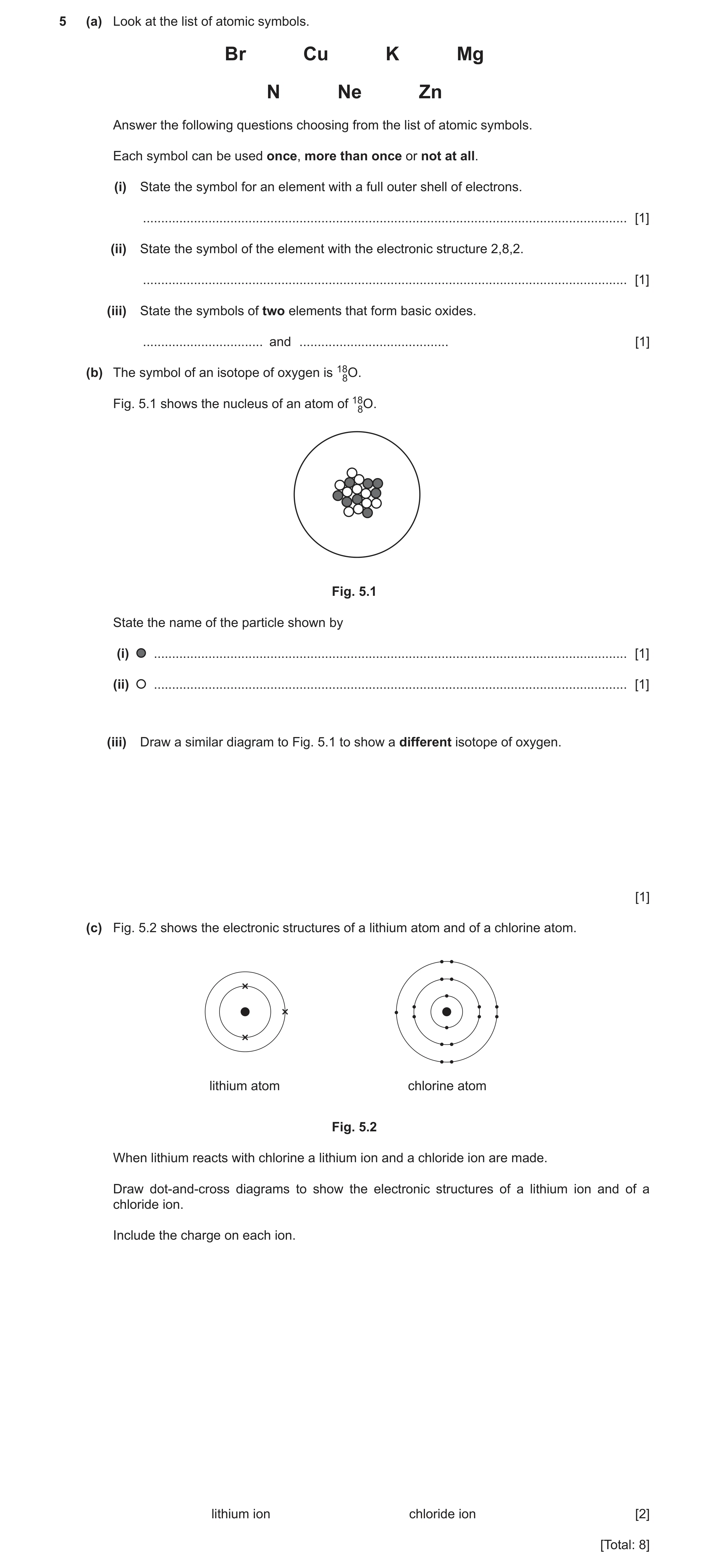
5 (a) Look at the list of atomic symbols. Br Cu K Mg N Ne Zn Answer the following questions choosing from the list of atomic symbols. Each symbol can be used once, more than once or not at all. (i) State the symbol for an element with a full outer shell of electrons. … [1] (ii) State the symbol of the element with the electronic structure 2,8,2. … [1] (iii) State the symbols of two elements that form basic oxides. … and … [1] (b) The symbol of an isotope of oxygen is 188O. Fig. 5.1 shows the nucleus of an atom of 188O. Fig. 5.1 State the name of the particle shown by (i) … [1] (ii) … [1] (iii) Draw a similar diagram to Fig. 5.1 to show a different isotope of oxygen. [1] (c) Fig. 5.2 shows the electronic structures of a lithium atom and of a chlorine atom. lithium atom chlorine atom Fig. 5.2 When lithium reacts with chlorine a lithium ion and a chloride ion are made. Draw dot-and-cross diagrams to show the electronic structures of a lithium ion and of a chloride ion. Include the charge on each ion. lithium ion chloride ion [2] [Total: 8]
8 marks
Mark scheme: 5(a)(i) Ne ; 1 5(a)(ii) Mg ; 1 5(a)(iii) any two from Cu, Zn, K, Mg ;; 1 Question Answer Marks 5(b)(i) proton ; 1 5(b)(ii) neutron ; 1 5(b)(iii) diagram with 8 protons and any number of neutrons other than 10; 1 5(c) lithium ion ; chloride ion ; 2
This question in 0654/43 Oct/Nov 2020
Q12 · Some information about the charges and relative masses of three subatomic particles 0654/42 Feb/March 2021
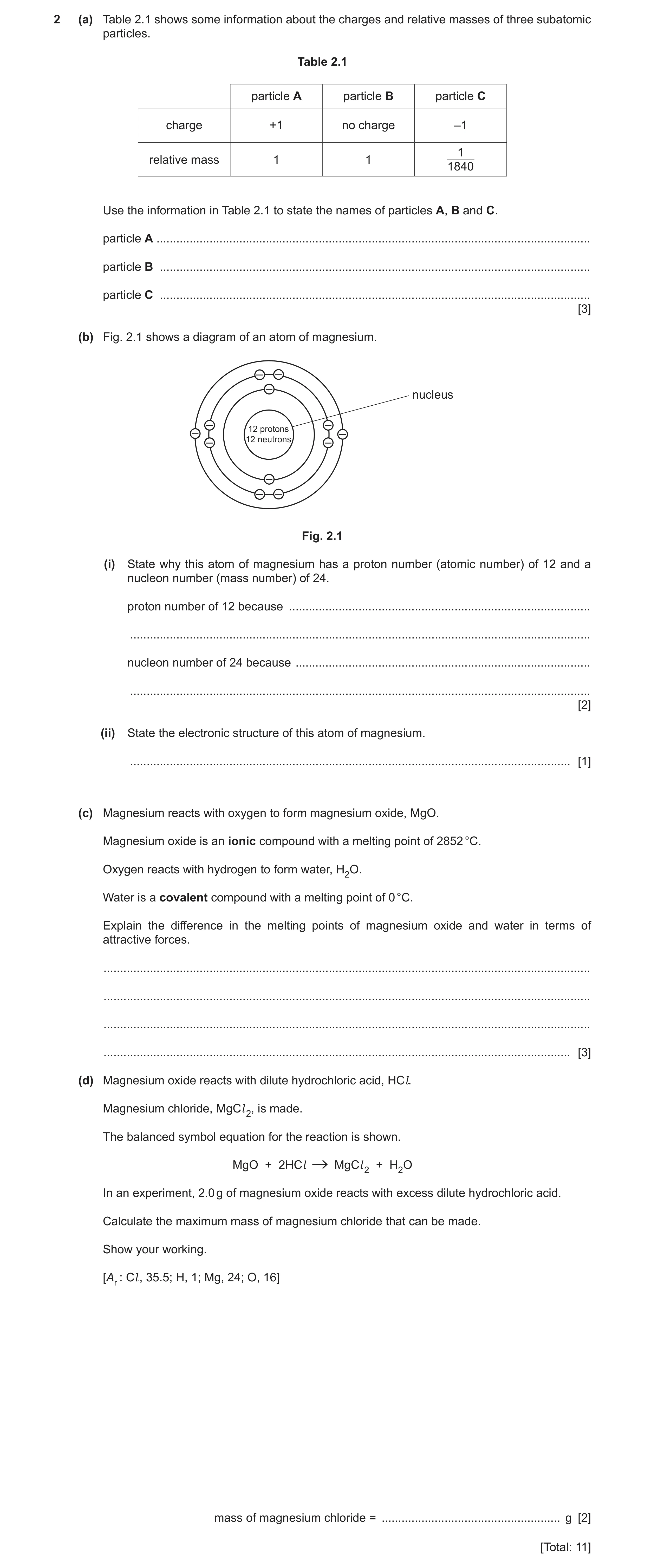
2 (a) Table 2.1 shows some information about the charges and relative masses of three subatomic particles. Table 2.1 particle A particle B particle C charge +1 no charge –1 1 relative mass 1 1 1840 Use the information in Table 2.1 to state the names of particles A, B and C. particle A … particle B … particle C … [3] (b) Fig. 2.1 shows a diagram of an atom of magnesium. – – – nucleus – 12 protons – – – – 12 neutrons – – – – Fig. 2.1 (i) State why this atom of magnesium has a proton number (atomic number) of 12 and a nucleon number (mass number) of 24. proton number of 12 because … … nucleon number of 24 because … … [2] (ii) State the electronic structure of this atom of magnesium. … [1] (c) Magnesium reacts with oxygen to form magnesium oxide, MgO. Magnesium oxide is an ionic compound with a melting point of 2852 °C. Oxygen reacts with hydrogen to form water, H2O. Water is a covalent compound with a melting point of 0 °C. Explain the difference in the melting points of magnesium oxide and water in terms of attractive forces. … … … … [3] (d) Magnesium oxide reacts with dilute hydrochloric acid, HCl. Magnesium chloride, MgCl 2, is made. The balanced symbol equation for the reaction is shown. MgO + 2HCl MgCl 2 + H2O In an experiment, 2.0 g of magnesium oxide reacts with excess dilute hydrochloric acid. Calculate the maximum mass of magnesium chloride that can be made. Show your working. [Ar : Cl , 35.5; H, 1; Mg, 24; O, 16] mass of magnesium chloride = … g [2] [Total: 11]
11 marks
Mark scheme: 2(a) (particle A) – proton ; (particle B) – neutron ; (particle C) – electron ; 3 2(b)(i) proton number of 12 because (magnesium) has 12 protons ; nucleon number of 24 because (magnesium) has 12 protons and 12 neutrons ; 2 2(b)(ii) 2.8.2 ; 1 Question Answer Marks 2(c) magnesium oxide has strong (electrostatic) forces of attraction between oppositely charged magnesium ions and oxide ions ; water has weak intermolecular forces / weak attraction between (water) molecules ; strong (electrostatic) forces of attraction take more energy to break than weak intermolecular forces / ORA ; 3 2(d) relative molecular mass of MgO = 40 and of MgCl2 = 95 ; × 2.0 95 40 or 95 20 = 4.75 (g) ; 2
This question in 0654/42 Feb/March 2021
Q13 · Sodium, Na, is an element in Group I of the Periodic Table 0654/42 Feb/March 2021
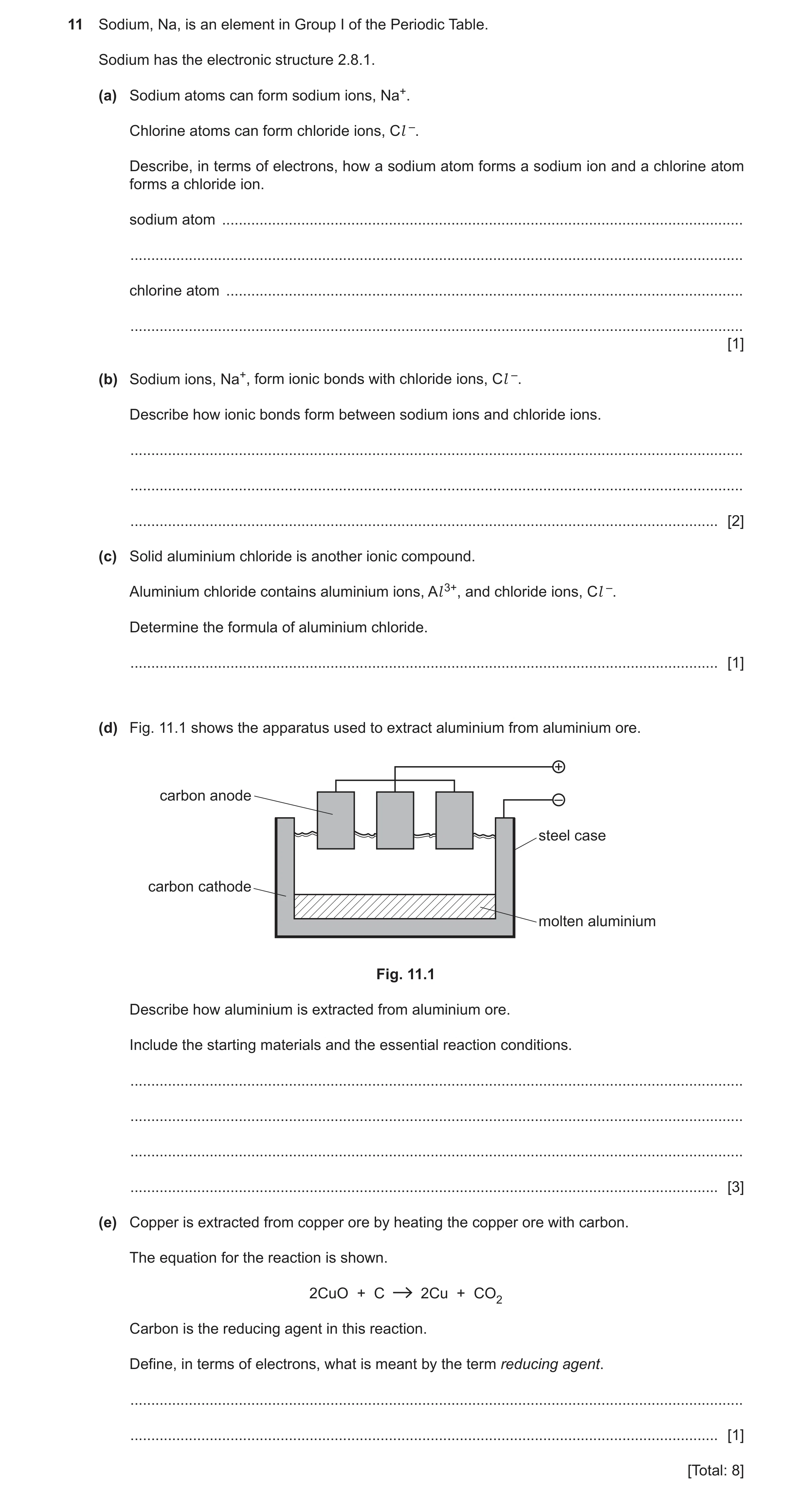
11 Sodium, Na, is an element in Group I of the Periodic Table. Sodium has the electronic structure 2.8.1. (a) Sodium atoms can form sodium ions, Na+. Chlorine atoms can form chloride ions, Cl –. Describe, in terms of electrons, how a sodium atom forms a sodium ion and a chlorine atom forms a chloride ion. sodium atom … … chlorine atom … … [1] (b) Sodium ions, Na+, form ionic bonds with chloride ions, Cl –. Describe how ionic bonds form between sodium ions and chloride ions. … … … [2] (c) Solid aluminium chloride is another ionic compound. Aluminium chloride contains aluminium ions, Al 3+, and chloride ions, Cl –. Determine the formula of aluminium chloride. … [1] (d) Fig. 11.1 shows the apparatus used to extract aluminium from aluminium ore. + carbon anode – steel case carbon cathode molten aluminium Fig. 11.1 Describe how aluminium is extracted from aluminium ore. Include the starting materials and the essential reaction conditions. … … … … [3] (e) Copper is extracted from copper ore by heating the copper ore with carbon. The equation for the reaction is shown. 2CuO + C 2Cu + CO2 Carbon is the reducing agent in this reaction. Define, in terms of electrons, what is meant by the term reducing agent. … … [1] [Total: 8]
8 marks
Mark scheme: 11(a) (sodium atom) loses one electron and (chlorine atom) gains one electron ; 1 11(b) electrostatic attraction ; between oppositely charged ions ; 2 11(c) AlCl3 ; 1 11(d) any three from: molten aluminium oxide / alumina, and cryolite ; cryolite lowers melting point of, aluminium oxide / alumina ; electrolysis / use of electricity ; high temperature to melt, aluminium oxide / alumina ; 3 11(e) (species that) loses or donates electrons ; 1
This question in 0654/42 Feb/March 2021
Q14 · An outline of the Periodic Table 0654/43 May/June 2021
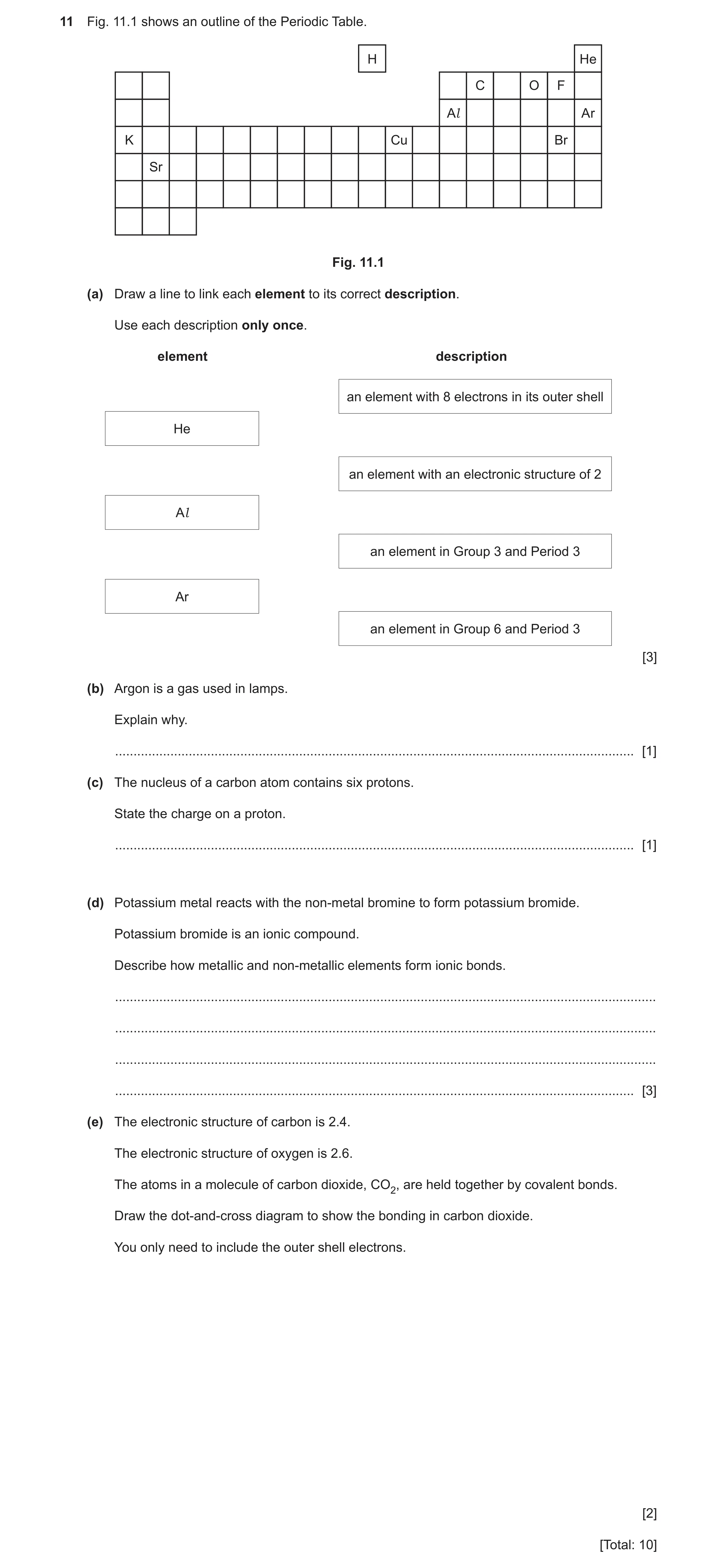
11 Fig. 11.1 shows an outline of the Periodic Table. H He C O F Al Ar K Cu Br Sr Fig. 11.1 (a) Draw a line to link each element to its correct description. Use each description only once. element description an element with 8 electrons in its outer shell He an element with an electronic structure of 2 Al an element in Group 3 and Period 3 Ar an element in Group 6 and Period 3 [3] (b) Argon is a gas used in lamps. Explain why. … [1] (c) The nucleus of a carbon atom contains six protons. State the charge on a proton. … [1] (d) Potassium metal reacts with the non-metal bromine to form potassium bromide. Potassium bromide is an ionic compound. Describe how metallic and non-metallic elements form ionic bonds. … … … … [3] (e) The electronic structure of carbon is 2.4. The electronic structure of oxygen is 2.6. The atoms in a molecule of carbon dioxide, CO2, are held together by covalent bonds. Draw the dot-and-cross diagram to show the bonding in carbon dioxide. You only need to include the outer shell electrons. [2] [Total: 10]
10 marks
Mark scheme: 11(a) ;;; 11(b) (argon is) inert / unreactive ; 1 11(c) + / +1 / positive ; 1 11(d) metal (atoms) lose electrons ; non-metal (atoms) gain electrons ; metal (atoms) form positive ions and non-metal (atoms) form negative ions ; attraction between (oppositely charged) ions ; max 3 3 11(e) 2
This question in 0654/43 May/June 2021
Q15 · This is the information given on the Periodic Table about an atom of iron 0654/41 Oct/Nov 2021
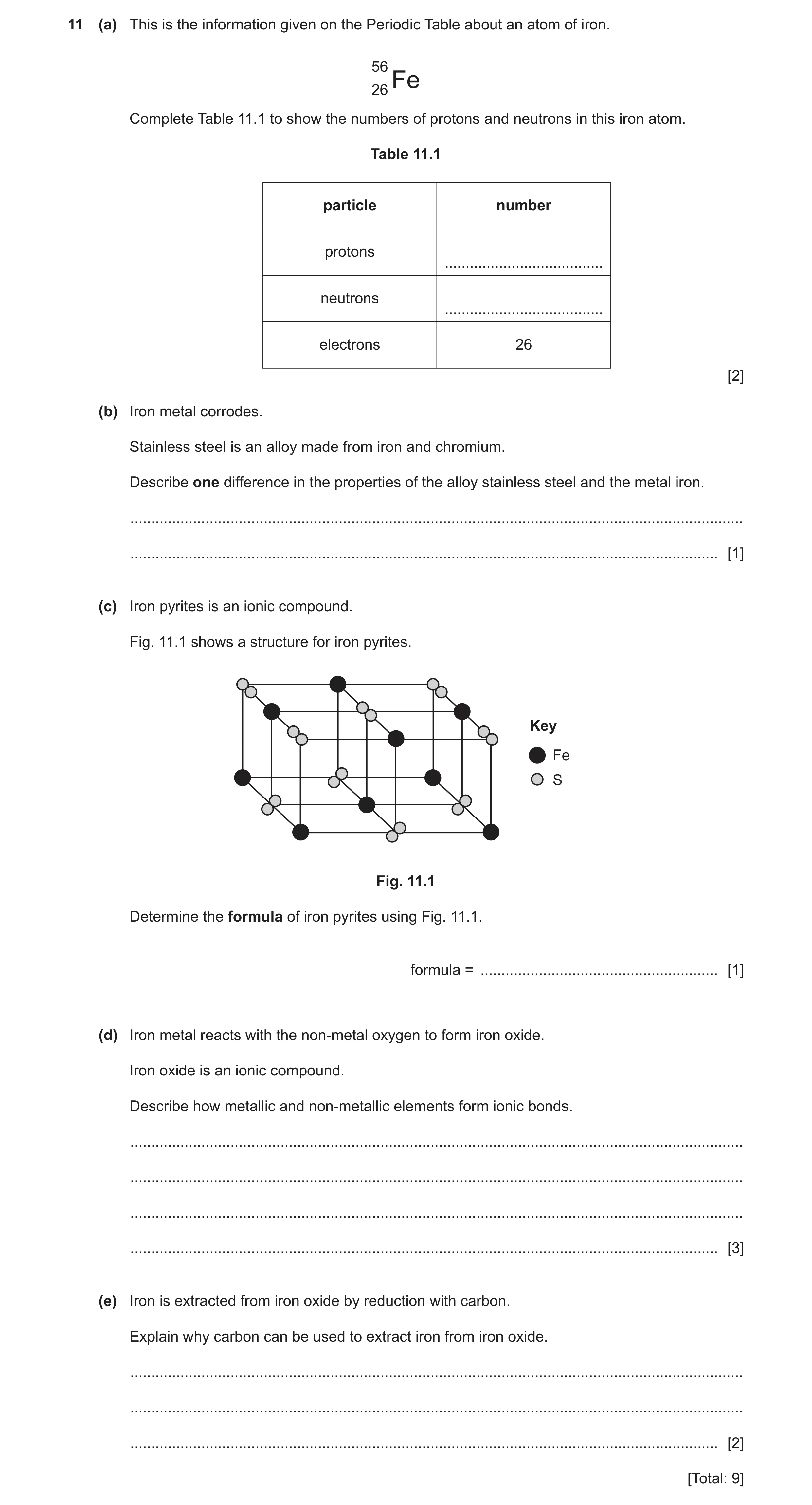
11 (a) This is the information given on the Periodic Table about an atom of iron. 56 26 Fe Complete Table 11.1 to show the numbers of protons and neutrons in this iron atom. Table 11.1 particle number protons … neutrons … electrons 26 [2] (b) Iron metal corrodes. Stainless steel is an alloy made from iron and chromium. Describe one difference in the properties of the alloy stainless steel and the metal iron. … … [1] (c) Iron pyrites is an ionic compound. Fig. 11.1 shows a structure for iron pyrites. Key Fe S Fig. 11.1 Determine the formula of iron pyrites using Fig. 11.1. formula = … [1] (d) Iron metal reacts with the non-metal oxygen to form iron oxide. Iron oxide is an ionic compound. Describe how metallic and non-metallic elements form ionic bonds. … … … … [3] (e) Iron is extracted from iron oxide by reduction with carbon. Explain why carbon can be used to extract iron from iron oxide. … … … [2] [Total: 9]
9 marks
Mark scheme: 11(a) particle number protons 26 ; neutrons 30 ; electrons 26 2 11(b) (stainless steel) is more resistant to corrosion ; 1 11(c) FeS2 ; 1 11(d) metal (atoms) lose electrons and non-metal (atoms) gain electrons ; metal (atoms) form positive ions and non-metal (atoms) form negative ions ; attraction between oppositely charged ions ; 3 11(e) carbon is more reactive than iron / ORA ; carbon displaces iron / carbon removes oxygen (from iron oxide) ; 2
This question in 0654/41 Oct/Nov 2021
Q16 · An oxygen atom has the electronic structure 2,6 0654/42 Oct/Nov 2021
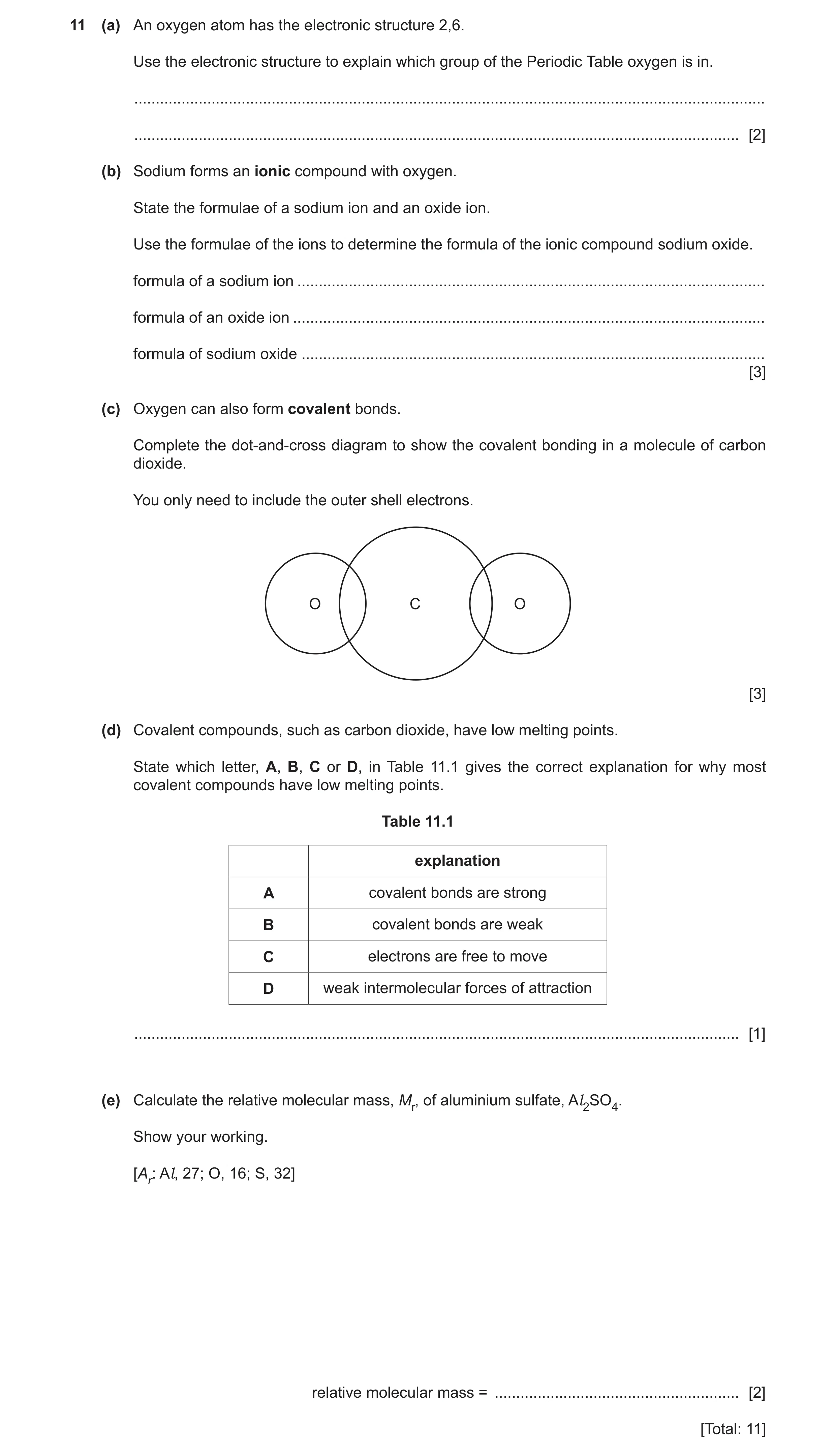
11 (a) An oxygen atom has the electronic structure 2,6. Use the electronic structure to explain which group of the Periodic Table oxygen is in. … … [2] (b) Sodium forms an ionic compound with oxygen. State the formulae of a sodium ion and an oxide ion. Use the formulae of the ions to determine the formula of the ionic compound sodium oxide. formula of a sodium ion … formula of an oxide ion … formula of sodium oxide … [3] (c) Oxygen can also form covalent bonds. Complete the dot-and-cross diagram to show the covalent bonding in a molecule of carbon dioxide. You only need to include the outer shell electrons. O C O [3] (d) Covalent compounds, such as carbon dioxide, have low melting points. State which letter, A, B, C or D, in Table 11.1 gives the correct explanation for why most covalent compounds have low melting points. Table 11.1 explanation A covalent bonds are strong B covalent bonds are weak C electrons are free to move D weak intermolecular forces of attraction … [1] (e) Calculate the relative molecular mass, Mr, of aluminium sulfate, Al2SO4. Show your working. [Ar: Al, 27; O, 16; S, 32] relative molecular mass = … [2] [Total: 11]
11 marks
Mark scheme: 11(a) group VI / group 6 ; (because) 6 electrons in the outer shell ; 2 11(b) sodium ion – Na+ ; oxide ion – O2- ; sodium oxide – Na2O ; 3 11(c) ;;; 3 11(d) D ; 1 11(e) [2 × 27] + 32 + [4 × 16] ; = 150 ; 2
This question in 0654/42 Oct/Nov 2021
Q17 · Potassium is in Group I of the Periodic Table 0654/42 Feb/March 2022
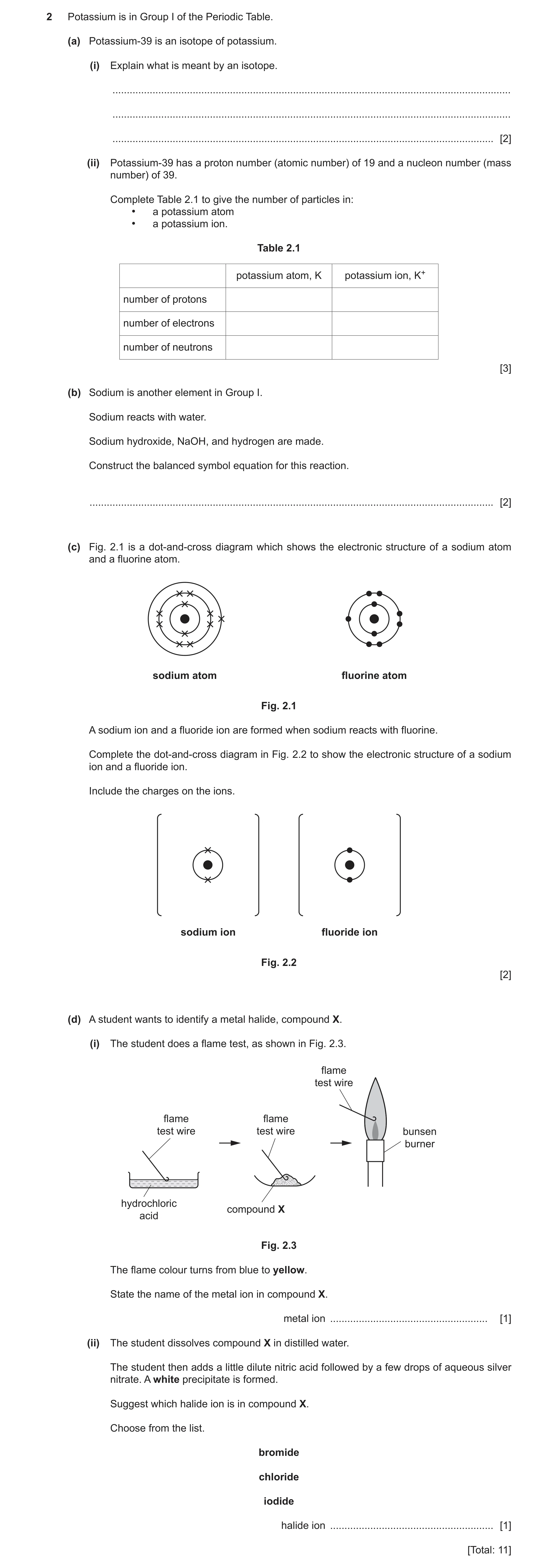
2 Potassium is in Group I of the Periodic Table. (a) Potassium-39 is an isotope of potassium. (i) Explain what is meant by an isotope. … … … [2] (ii) Potassium-39 has a proton number (atomic number) of 19 and a nucleon number (mass number) of 39. Complete Table 2.1 to give the number of particles in: • a potassium atom • a potassium ion. Table 2.1 potassium atom, K potassium ion, K+ number of protons number of electrons number of neutrons [3] (b) Sodium is another element in Group I. Sodium reacts with water. Sodium hydroxide, NaOH, and hydrogen are made. Construct the balanced symbol equation for this reaction. … [2] (c) Fig. 2.1 is a dot-and-cross diagram which shows the electronic structure of a sodium atom and a fluorine atom. sodium atom fluorine atom Fig. 2.1 A sodium ion and a fluoride ion are formed when sodium reacts with fluorine. Complete the dot-and-cross diagram in Fig. 2.2 to show the electronic structure of a sodium ion and a fluoride ion. Include the charges on the ions. sodium ion fluoride ion Fig. 2.2 [2] (d) A student wants to identify a metal halide, compound X. (i) The student does a flame test, as shown in Fig. 2.3. flame test wire flame flame test wire test wire bunsen burner hydrochloric compound X acid Fig. 2.3 The flame colour turns from blue to yellow. State the name of the metal ion in compound X. metal ion … [1] (ii) The student dissolves compound X in distilled water. The student then adds a little dilute nitric acid followed by a few drops of aqueous silver nitrate. A white precipitate is formed. Suggest which halide ion is in compound X. Choose from the list. bromide chloride iodide halide ion … [1] [Total: 11]
11 marks
Mark scheme: 2(a)(i) atoms with the same, proton or atomic number / number of protons ; (but) different, nucleon / mass number / number of neutrons ; 2 2(a)(ii) potassium atom, K potassium ion, K+ number of protons 19 19 number of electrons 19 18 number of neutrons 20 20 ;;; 3 2(b) 2Na + 2H2O → 2NaOH + H2 ;; 2 Question Answer Marks 2(c) ;; 2 2(d)(i) sodium ; 1 2(d)(ii) chloride ; 1
This question in 0654/42 Feb/March 2022
Q18 · Some information about particles found in atoms 0654/42 May/June 2022
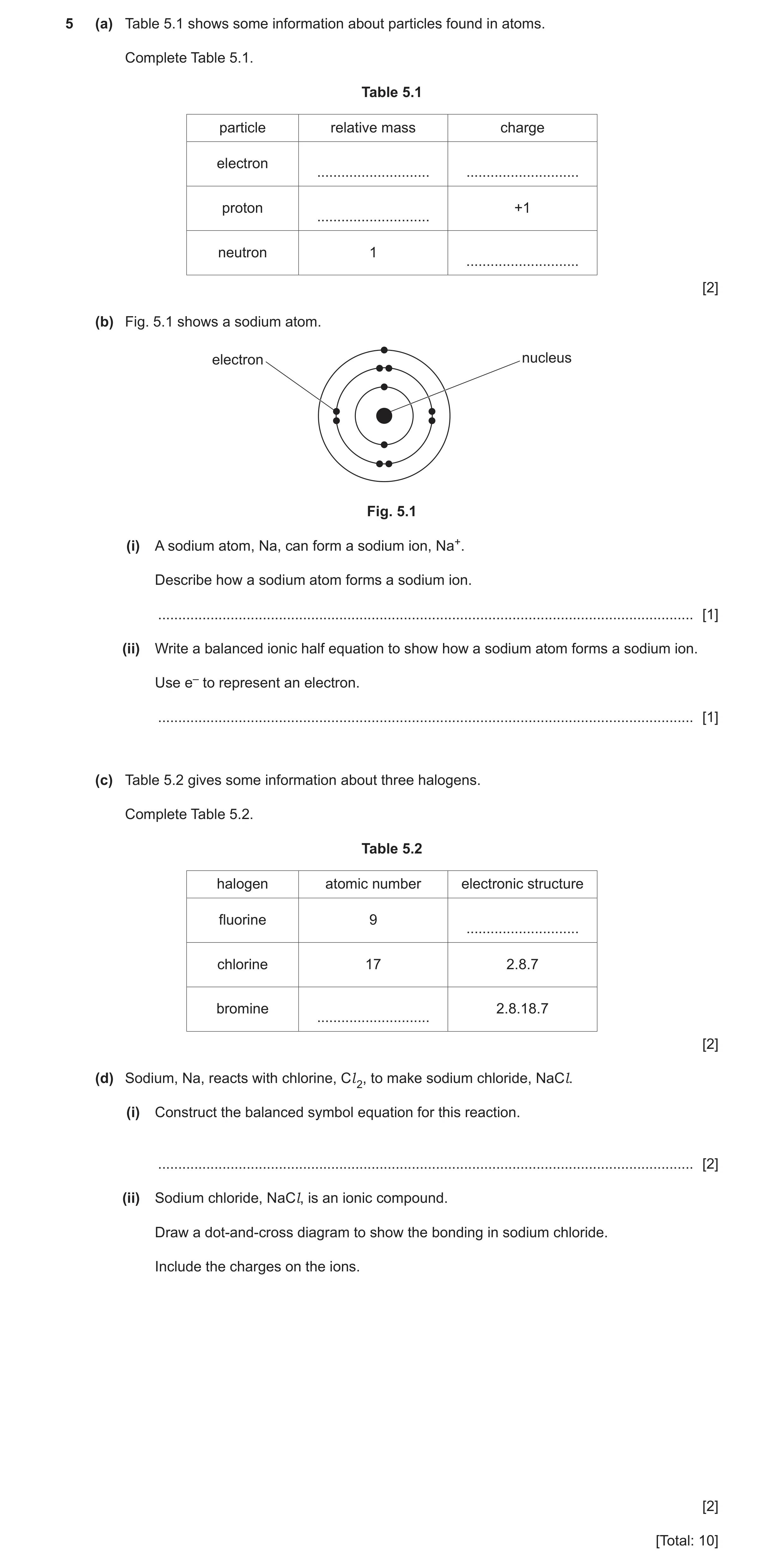
5 (a) Table 5.1 shows some information about particles found in atoms. Complete Table 5.1. Table 5.1 particle relative mass charge electron … … proton +1 … neutron 1 … [2] (b) Fig. 5.1 shows a sodium atom. electron nucleus Fig. 5.1 (i) A sodium atom, Na, can form a sodium ion, Na+. Describe how a sodium atom forms a sodium ion. … [1] (ii) Write a balanced ionic half equation to show how a sodium atom forms a sodium ion. Use e– to represent an electron. … [1] (c) Table 5.2 gives some information about three halogens. Complete Table 5.2. Table 5.2 halogen atomic number electronic structure fluorine 9 … chlorine 17 2.8.7 bromine 2.8.18.7 … [2] (d) Sodium, Na, reacts with chlorine, Cl 2, to make sodium chloride, NaCl. (i) Construct the balanced symbol equation for this reaction. … [2] (ii) Sodium chloride, NaCl, is an ionic compound. Draw a dot‑and‑cross diagram to show the bonding in sodium chloride. Include the charges on the ions. [2] [Total: 10]
10 marks
Mark scheme: 5(a) particle relative mass relative charge electron almost 0 or negligible or 1 / 1850 or 1 / 1836 –1 proton 1 +1 neutron 1 0 or no charge ;; 2 5(b)(i) loses one electron / owtte ; 1 5(b)(ii) Na Na+ + e– ; 1 Question Answer Marks 5(c) halogen atomic number electronic structure fluorine 9 2.7 ; chlorine 17 2.8.7 bromine 35 ; 2.8.18.7 2 5(d)(i) 2Na + Cl2 2 NaCl ;; 2 5(d)(ii) ;; 2
This question in 0654/42 May/June 2022
Q19 · The arrangement of ions in magnesium metal at 25°C 0654/43 May/June 2022
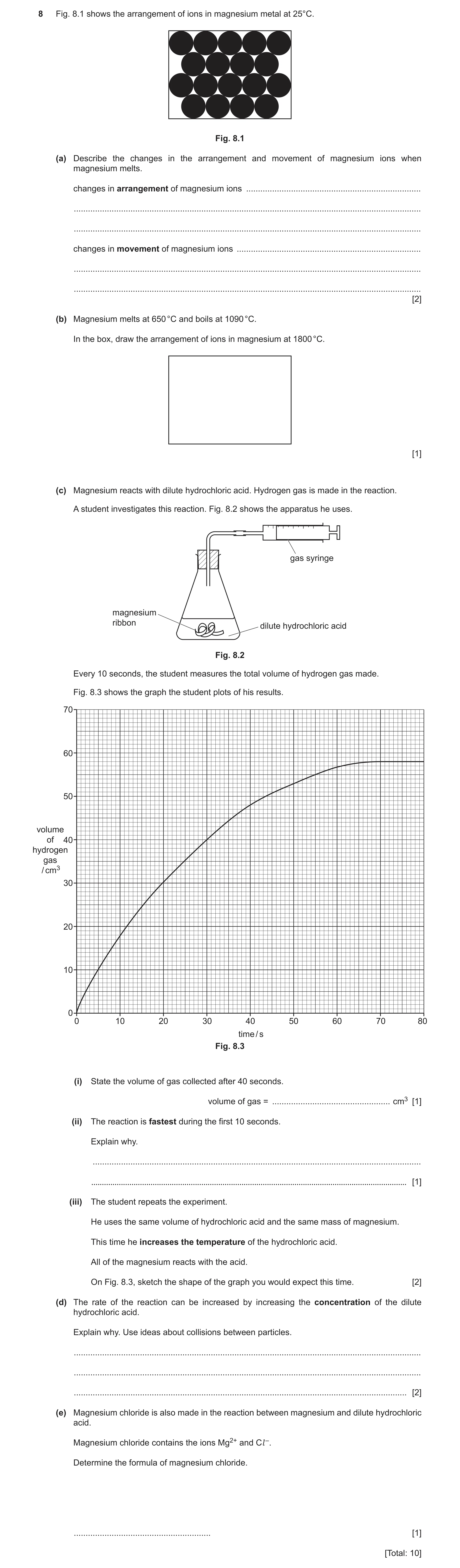
8 Fig. 8.1 shows the arrangement of ions in magnesium metal at 25°C. Fig. 8.1 (a) Describe the changes in the arrangement and movement of magnesium ions when magnesium melts. changes in arrangement of magnesium ions … … … changes in movement of magnesium ions … … … [2] (b) Magnesium melts at 650 °C and boils at 1090 °C. In the box, draw the arrangement of ions in magnesium at 1800 °C. [1] (c) Magnesium reacts with dilute hydrochloric acid. Hydrogen gas is made in the reaction. A student investigates this reaction. Fig. 8.2 shows the apparatus he uses. gas syringe magnesium ribbon dilute hydrochloric acid Fig. 8.2 Every 10 seconds, the student measures the total volume of hydrogen gas made. Fig. 8.3 shows the graph the student plots of his results. 70 60 50 volume of 40 hydrogen gas / cm3 30 20 10 0 0 10 20 30 40 50 60 70 80 time / s Fig. 8.3 (i) State the volume of gas collected after 40 seconds. volume of gas = … cm3 [1] (ii) The reaction is fastest during the first 10 seconds. Explain why. … … [1] (iii) The student repeats the experiment. He uses the same volume of hydrochloric acid and the same mass of magnesium. This time he increases the temperature of the hydrochloric acid. All of the magnesium reacts with the acid. On Fig. 8.3, sketch the shape of the graph you would expect this time. [2] (d) The rate of the reaction can be increased by increasing the concentration of the dilute hydrochloric acid. Explain why. Use ideas about collisions between particles. … … … [2] (e) Magnesium chloride is also made in the reaction between magnesium and dilute hydrochloric acid. Magnesium chloride contains the ions Mg2+ and Cl –. Determine the formula of magnesium chloride. … [1] [Total: 10]
10 marks
Mark scheme: 8(a) Changes in arrangement: idea that arrangement of particles becomes more random / becomes irregular ; Changes in movement: (idea that particles change from vibrating about fixed positions and start) moving around each other ; 8(b) randomly arranged particles not touching each other ; 1 8(c)(i) 48 (cm³) ; 1 8(c)(ii) acid is more concentrated at the start / the magnesium has a greater surface area at the start ; 1 8(c)(iii) graph steeper initially ; levels off at 58 cm³ ; 2 Question Answer Marks 8(d) more particles per unit volume / less space between particles ; increased rate of (successful) collisions ; 2 8(e) MgCl2 ; 1
This question in 0654/43 May/June 2022
Q20 · This question is about chemical bonding 0654/42 Feb/March 2023
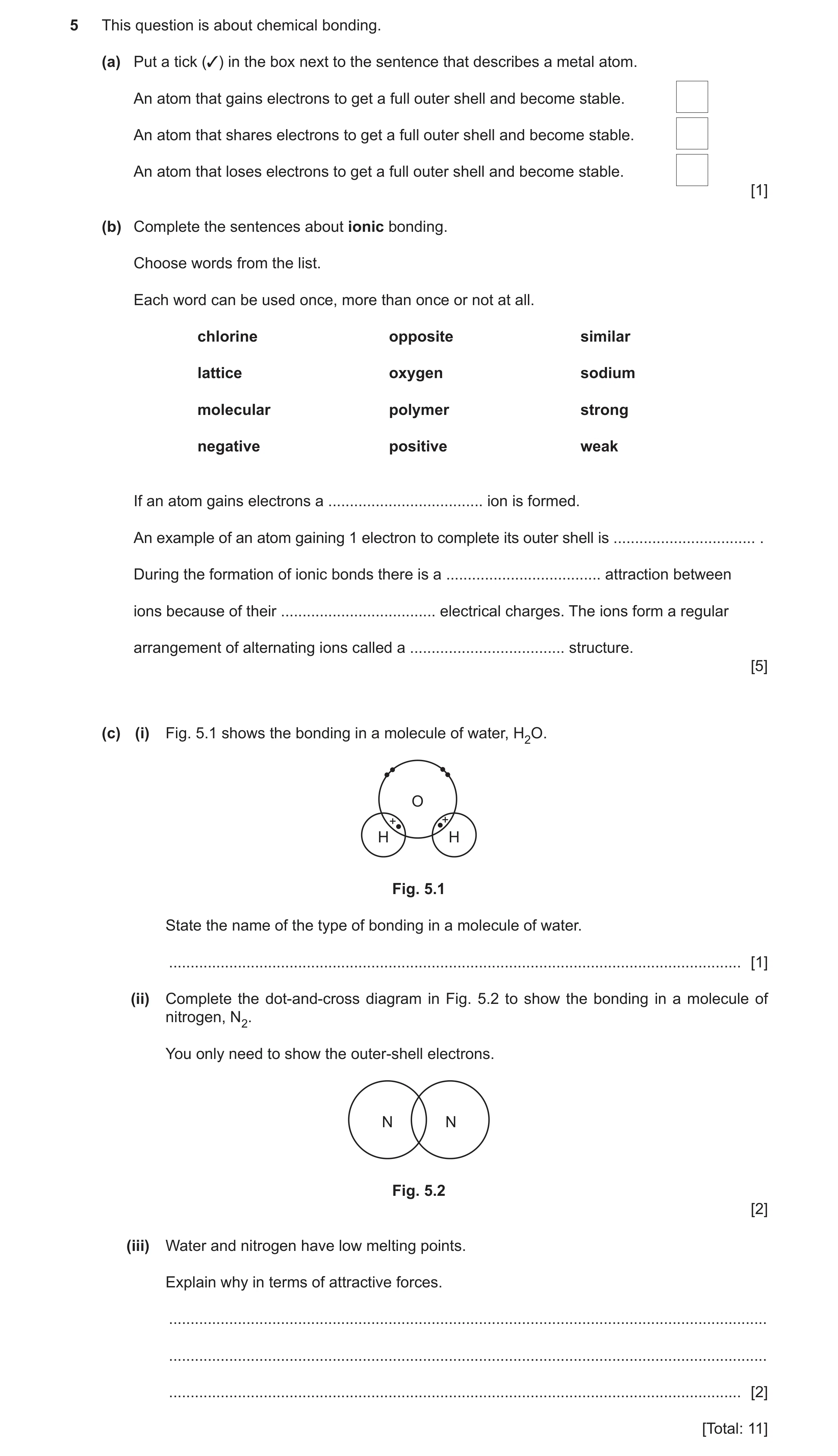
5 This question is about chemical bonding. (a) Put a tick (3) in the box next to the sentence that describes a metal atom. An atom that gains electrons to get a full outer shell and become stable. An atom that shares electrons to get a full outer shell and become stable. An atom that loses electrons to get a full outer shell and become stable. [1] (b) Complete the sentences about ionic bonding. Choose words from the list. Each word can be used once, more than once or not at all. chlorine opposite similar lattice oxygen sodium molecular polymer strong negative positive weak If an atom gains electrons a … ion is formed. An example of an atom gaining 1 electron to complete its outer shell is … . During the formation of ionic bonds there is a … attraction between ions because of their … electrical charges. The ions form a regular arrangement of alternating ions called a … structure. [5] (c) (i) Fig. 5.1 shows the bonding in a molecule of water, H2O. O H H Fig. 5.1 State the name of the type of bonding in a molecule of water. … [1] (ii) Complete the dot‑and‑cross diagram in Fig. 5.2 to show the bonding in a molecule of nitrogen, N2. You only need to show the outer‑shell electrons. N N Fig. 5.2 [2] (iii) Water and nitrogen have low melting points. Explain why in terms of attractive forces. … … … [2] [Total: 11]
11 marks
Mark scheme: 5(a) 1 an atom that gains electrons to get a full outer shell and become stable. an atom that shares electrons to get a full outer shell and become stable an atom that loses electrons to get a full outer shell and become stable. ✓ 5(b) negative ; 5 chlorine ; strong ; opposite ; lattice ; 5(c)(i) covalent ; 1 5(c)(ii) 2 5(c)(iii) (water and nitrogen) have weak intermolecular forces / weak attractions between molecules ; 2 idea that (weak intermolecular forces) take little energy to break ;
This question in 0654/42 Feb/March 2023
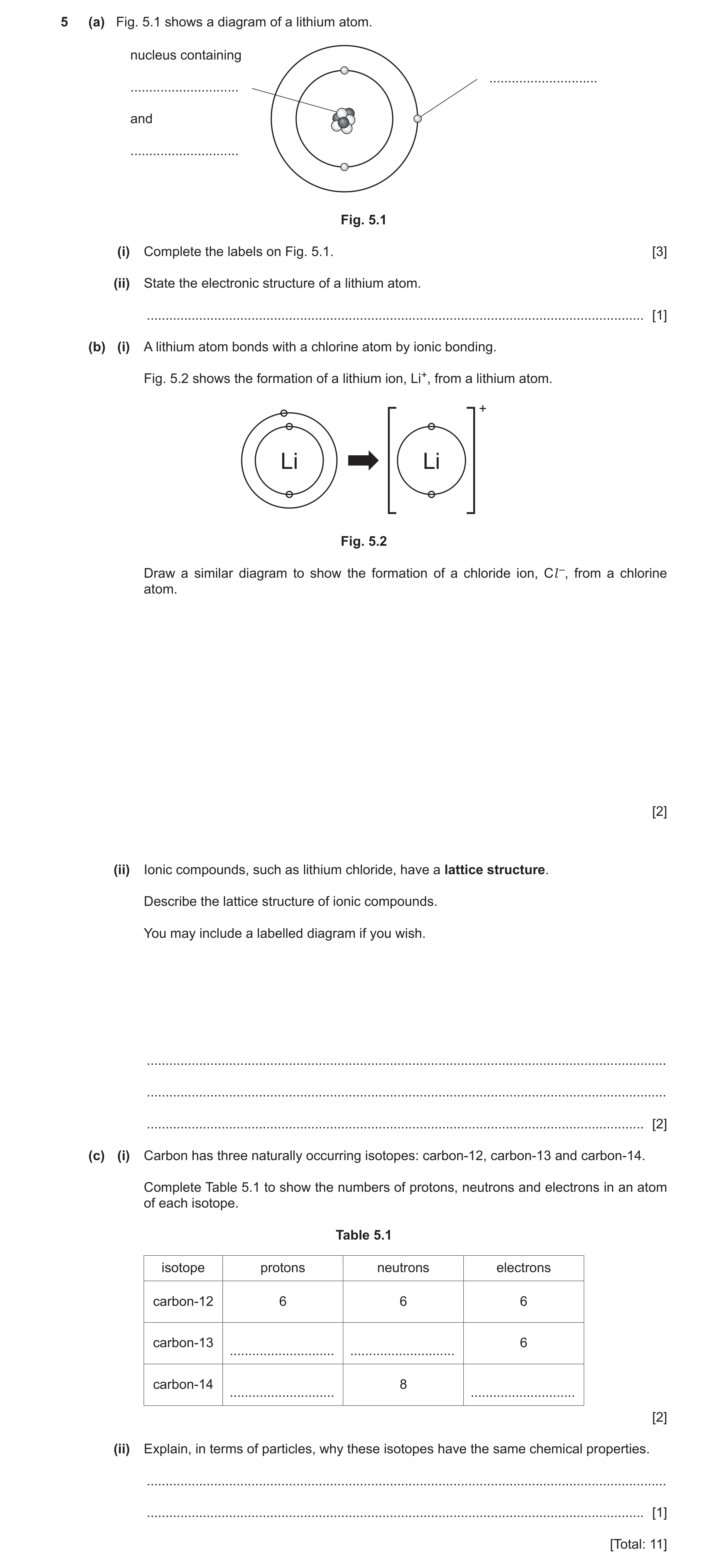
Q21 · A diagram of a lithium atom 0654/41 May/June 2023
5 (a) Fig. 5.1 shows a diagram of a lithium atom. nucleus containing … … and … Fig. 5.1 (i) Complete the labels on Fig. 5.1. [3] (ii) State the electronic structure of a lithium atom. … [1] (b) (i) A lithium atom bonds with a chlorine atom by ionic bonding. Fig. 5.2 shows the formation of a lithium ion, Li+, from a lithium atom. + Li Li Fig. 5.2 Draw a similar diagram to show the formation of a chloride ion, Cl –, from a chlorine atom. [2] (ii) Ionic compounds, such as lithium chloride, have a lattice structure. Describe the lattice structure of ionic compounds. You may include a labelled diagram if you wish. … … … [2] (c) (i) Carbon has three naturally occurring isotopes: carbon‑12, carbon‑13 and carbon‑14. Complete Table 5.1 to show the numbers of protons, neutrons and electrons in an atom of each isotope. Table 5.1 isotope protons neutrons electrons carbon‑12 6 6 6 carbon‑13 6 … … carbon‑14 8 … … [2] (ii) Explain, in terms of particles, why these isotopes have the same chemical properties. … … [1] [Total: 11]
11 marks
Mark scheme: 5(a)(i) (nucleus containing) protons ; (and) neutrons ; electron ; 5(a)(ii) 2.1 ; 1 5(b)(i) ;; 2 Question Answer Marks 5(b)(ii) regular arrangement ; of alternating positive and negative ions ; 2 5(c)(i) isotope protons neutrons electrons carbon-12 6 6 6 carbon-13 6 7 6 carbon-14 6 8 6 ;; 2 5(c)(ii) they have the same number of electrons in the outer shell ; 1
This question in 0654/41 May/June 2023
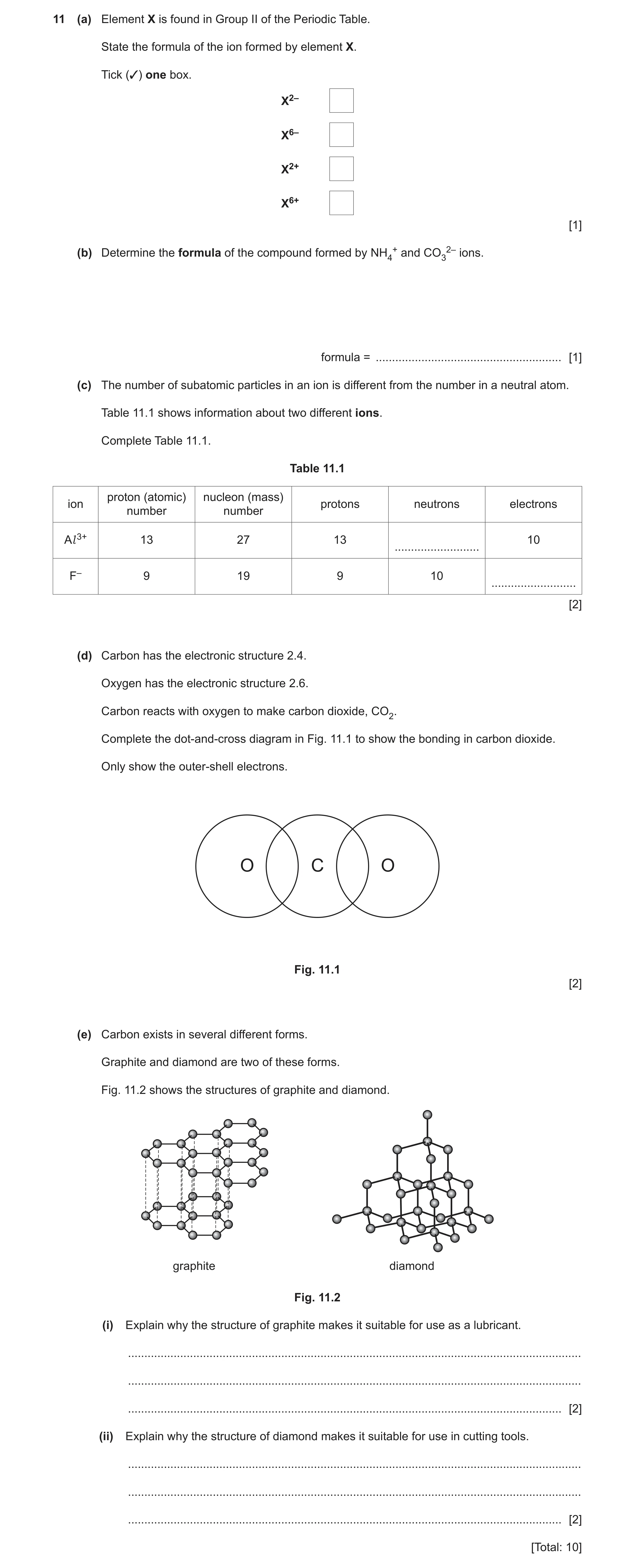
Q22 · Element X is found in Group II of the Periodic Table 0654/43 May/June 2023
11 (a) Element X is found in Group II of the Periodic Table. State the formula of the ion formed by element X. Tick (3) one box. X2– X6– X2+ X6+ [1] (b) Determine the formula of the compound formed by NH4+ and CO32– ions. formula = … [1] (c) The number of subatomic particles in an ion is different from the number in a neutral atom. Table 11.1 shows information about two different ions. Complete Table 11.1. Table 11.1 proton (atomic) nucleon (mass) ion protons neutrons electrons number number Al 3+ 13 27 13 10 … F– 9 19 9 10 … [2] (d) Carbon has the electronic structure 2.4. Oxygen has the electronic structure 2.6. Carbon reacts with oxygen to make carbon dioxide, CO2. Complete the dot‑and‑cross diagram in Fig. 11.1 to show the bonding in carbon dioxide. Only show the outer‑shell electrons. O C O Fig. 11.1 [2] (e) Carbon exists in several different forms. Graphite and diamond are two of these forms. Fig. 11.2 shows the structures of graphite and diamond. graphite diamond Fig. 11.2 (i) Explain why the structure of graphite makes it suitable for use as a lubricant. … … … [2] (ii) Explain why the structure of diamond makes it suitable for use in cutting tools. … … … [2] [Total: 10]
10 marks
Mark scheme: 11(a) X2+ ; 1 11(b) (NH4)2CO3 ; 1 11(c) ion proton (atomic) number nucleon (mass) number protons neutrons electrons Al 3+ 13 27 13 14 10 F- 9 19 9 10 10 ;; 2 Question Answer Marks 11(d) double bonds between C and O atoms ; rest of structure correct ; 2 11(e)(i) (graphite has) weak forces between the layers ; layers can slide over each other / owtte ; 2 11(e)(ii) any two from: (diamond) has many strong bonds ; bonds are covalent bonds ; (diamond has) giant molecular / macromolecular / giant tetrahedral / lattice / giant covalent, structure ; 2
This question in 0654/43 May/June 2023
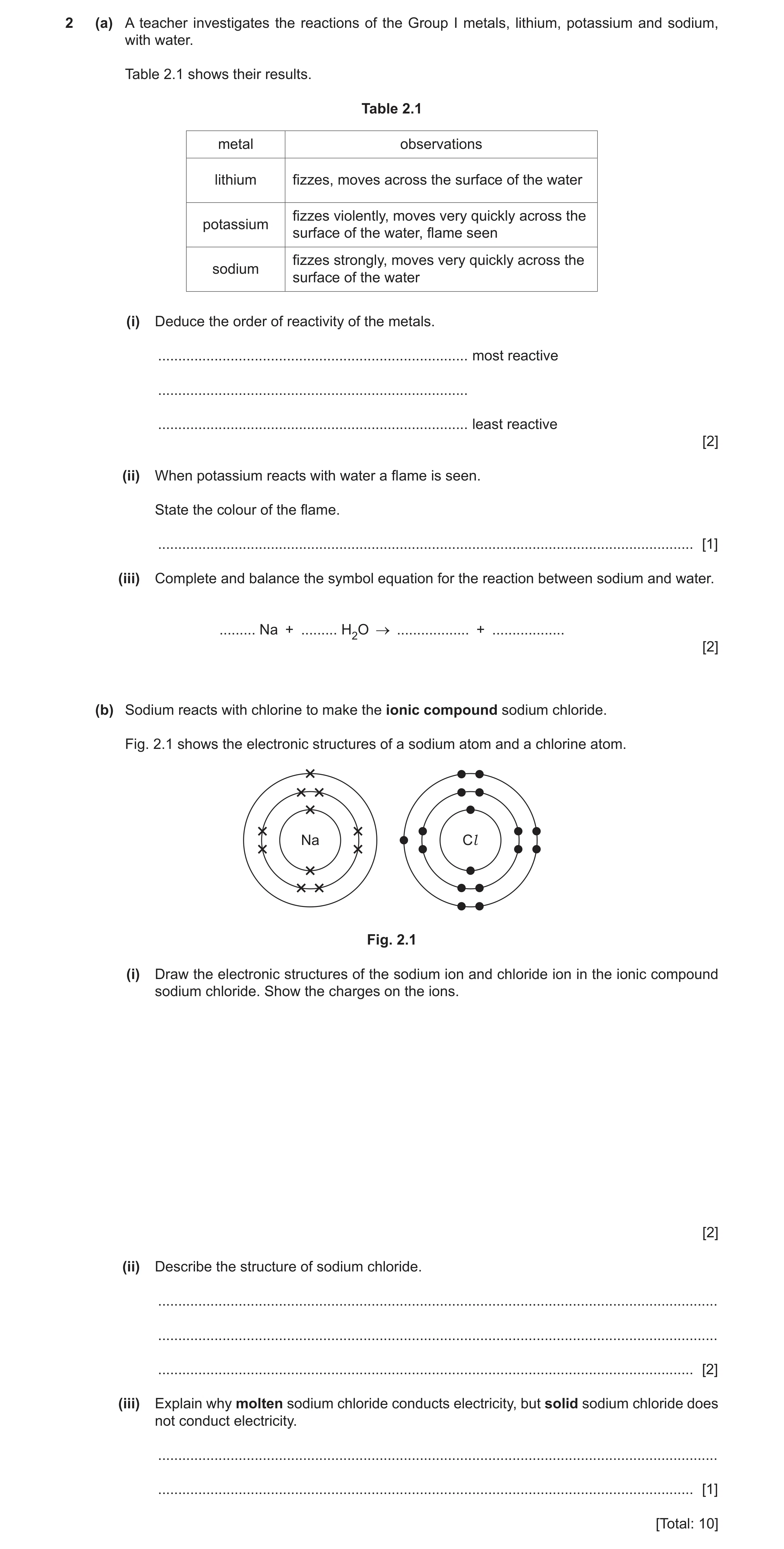
Q23 · A teacher investigates the reactions of the Group I metals, lithium, potassium and… 0654/42 Feb/March 2024
2 (a) A teacher investigates the reactions of the Group I metals, lithium, potassium and sodium, with water. Table 2.1 shows their results. Table 2.1 metal observations lithium fizzes, moves across the surface of the water fizzes violently, moves very quickly across the potassium surface of the water, flame seen fizzes strongly, moves very quickly across the sodium surface of the water (i) Deduce the order of reactivity of the metals. … most reactive … … least reactive [2] (ii) When potassium reacts with water a flame is seen. State the colour of the flame. … [1] (iii) Complete and balance the symbol equation for the reaction between sodium and water. … Na + … H2O … + … [2] (b) Sodium reacts with chlorine to make the ionic compound sodium chloride. Fig. 2.1 shows the electronic structures of a sodium atom and a chlorine atom. Na Cl Fig. 2.1 (i) Draw the electronic structures of the sodium ion and chloride ion in the ionic compound sodium chloride. Show the charges on the ions. [2] (ii) Describe the structure of sodium chloride. … … … [2] (iii) Explain why molten sodium chloride conducts electricity, but solid sodium chloride does not conduct electricity. … … [1] [Total: 10]
10 marks
Mark scheme: 2(a)(i) potassium 2 sodium lithium ;; 2(a)(ii) lilac / purple / pink ; 1 2(a)(iii) 2Na + 2H2O → 2NaOH + H2 ;; 2 2(b)(i) 2 ;; 2(b)(ii) Any two from: 2 lattice (structure) ; regular arrangement ; of alternating positive and negative ions ; 2(b)(iii) idea that ions can move in molten sodium chloride / ions cannot move in solid sodium chloride ; 1
This question in 0654/42 Feb/March 2024
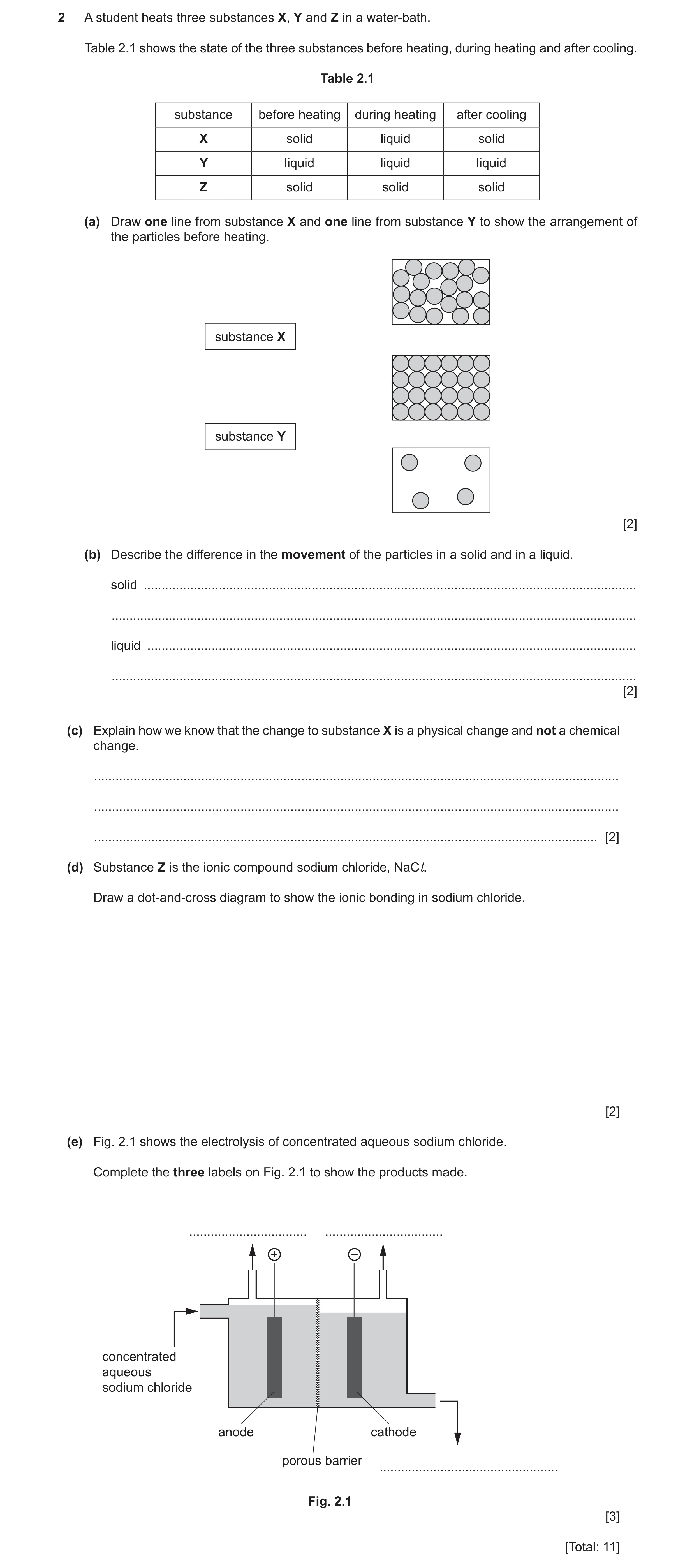
Q24 · A student heats three substances X, Y and Z in a water‑bath 0654/42 May/June 2024
2 A student heats three substances X, Y and Z in a water‑bath. Table 2.1 shows the state of the three substances before heating, during heating and after cooling. Table 2.1 substance before heating during heating after cooling X solid liquid solid Y liquid liquid liquid Z solid solid solid (a) Draw one line from substance X and one line from substance Y to show the arrangement of the particles before heating. substance X substance Y [2] (b) Describe the difference in the movement of the particles in a solid and in a liquid. solid … … liquid … … [2] (c) Explain how we know that the change to substance X is a physical change and not a chemical change. … … … [2] (d) Substance Z is the ionic compound sodium chloride, NaCl. Draw a dot‑and‑cross diagram to show the ionic bonding in sodium chloride. [2] (e) Fig. 2.1 shows the electrolysis of concentrated aqueous sodium chloride. Complete the three labels on Fig. 2.1 to show the products made. … … + – concentrated aqueous sodium chloride anode cathode porous barrier … Fig. 2.1 [3] [Total: 11]
11 marks
Mark scheme: 2(a) ; ; 2(b) (solid) idea that particles are vibrating about fixed positions ; (liquid) particles, move around / slide over, each other ; 2 2(c) it is reversible / a chemical change is irreversible ; no new substance is formed / a chemical change produces a new substance ; 2 2(d) ;; 2 Question Answer Marks 2(e) 3
This question in 0654/42 May/June 2024
Q25 · Some information about the Group VII elements 0654/43 May/June 2024
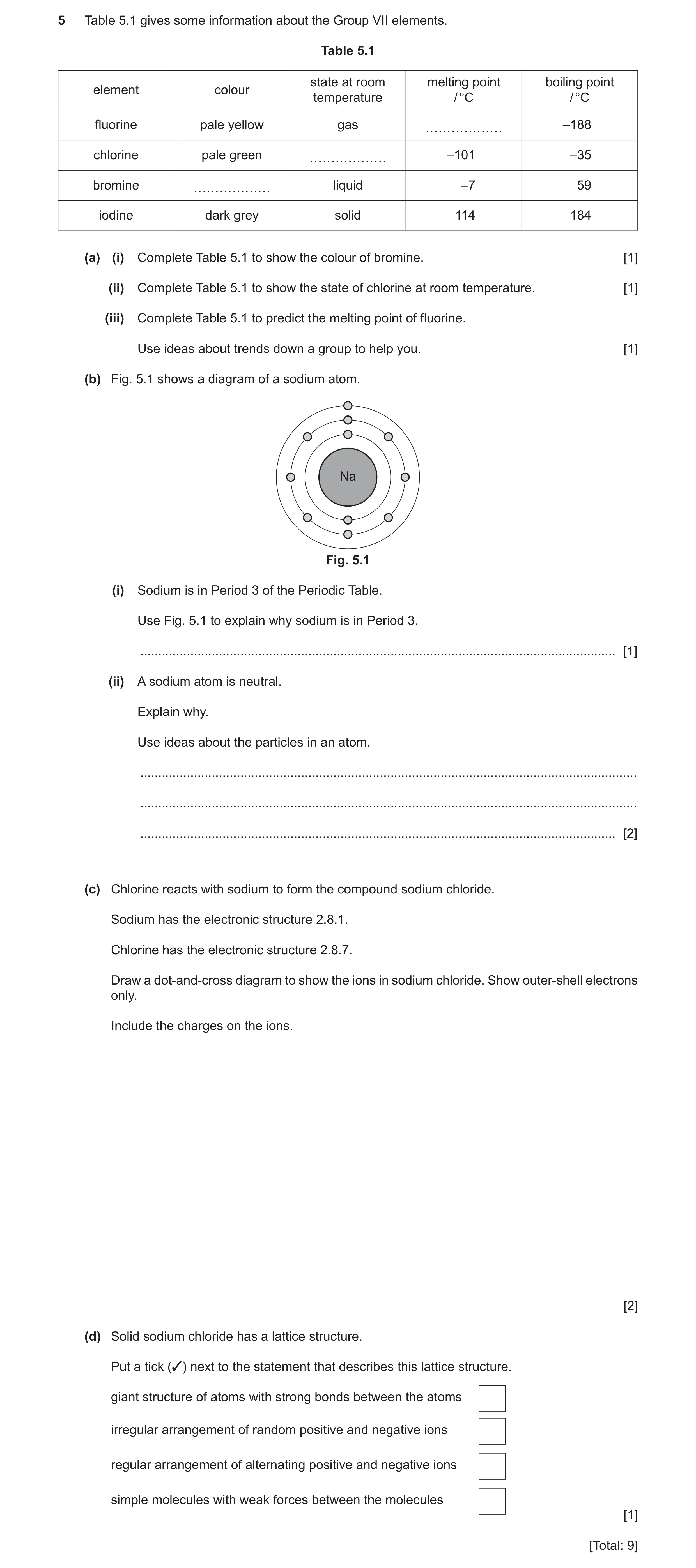
5 Table 5.1 gives some information about the Group VII elements. Table 5.1 state at room melting point boiling point element colour temperature / °C / °C fluorine pale yellow gas ……………… –188 chlorine pale green ……………… –101 –35 bromine ……………… liquid –7 59 iodine dark grey solid 114 184 (a) (i) Complete Table 5.1 to show the colour of bromine. [1] (ii) Complete Table 5.1 to show the state of chlorine at room temperature. [1] (iii) Complete Table 5.1 to predict the melting point of fluorine. Use ideas about trends down a group to help you. [1] (b) Fig. 5.1 shows a diagram of a sodium atom. Na Fig. 5.1 (i) Sodium is in Period 3 of the Periodic Table. Use Fig. 5.1 to explain why sodium is in Period 3. … [1] (ii) A sodium atom is neutral. Explain why. Use ideas about the particles in an atom. … … … [2] (c) Chlorine reacts with sodium to form the compound sodium chloride. Sodium has the electronic structure 2.8.1. Chlorine has the electronic structure 2.8.7. Draw a dot-and-cross diagram to show the ions in sodium chloride. Show outer-shell electrons only. Include the charges on the ions. [2] (d) Solid sodium chloride has a lattice structure. Put a tick (✓) next to the statement that describes this lattice structure. giant structure of atoms with strong bonds between the atoms irregular arrangement of random positive and negative ions regular arrangement of alternating positive and negative ions simple molecules with weak forces between the molecules [1] [Total: 9]
9 marks
Mark scheme: 5(a)(i) red-brown ; 1 5(a)(ii) gas ; 1 5(a)(iii) answer in range –189 to –272 ; 1 5(b)(i) (sodium) has three (occupied) electron shells ; 1 5(b)(ii) idea that protons are positive and electrons are negative ; same number of protons and electrons ; 2 Question Answer Marks 5(c) sodium ion drawn with full outer shell or an empty one and a charge of +1 ; chloride ion drawn with 8 electrons in outer shell and a charge of –1 ; 2 5(d) Regular arrangement of alternating positive and negative ions ; 1
This question in 0654/43 May/June 2024
Q26 · The electronic configuration of an aluminium atom 0654/42 Feb/March 2025
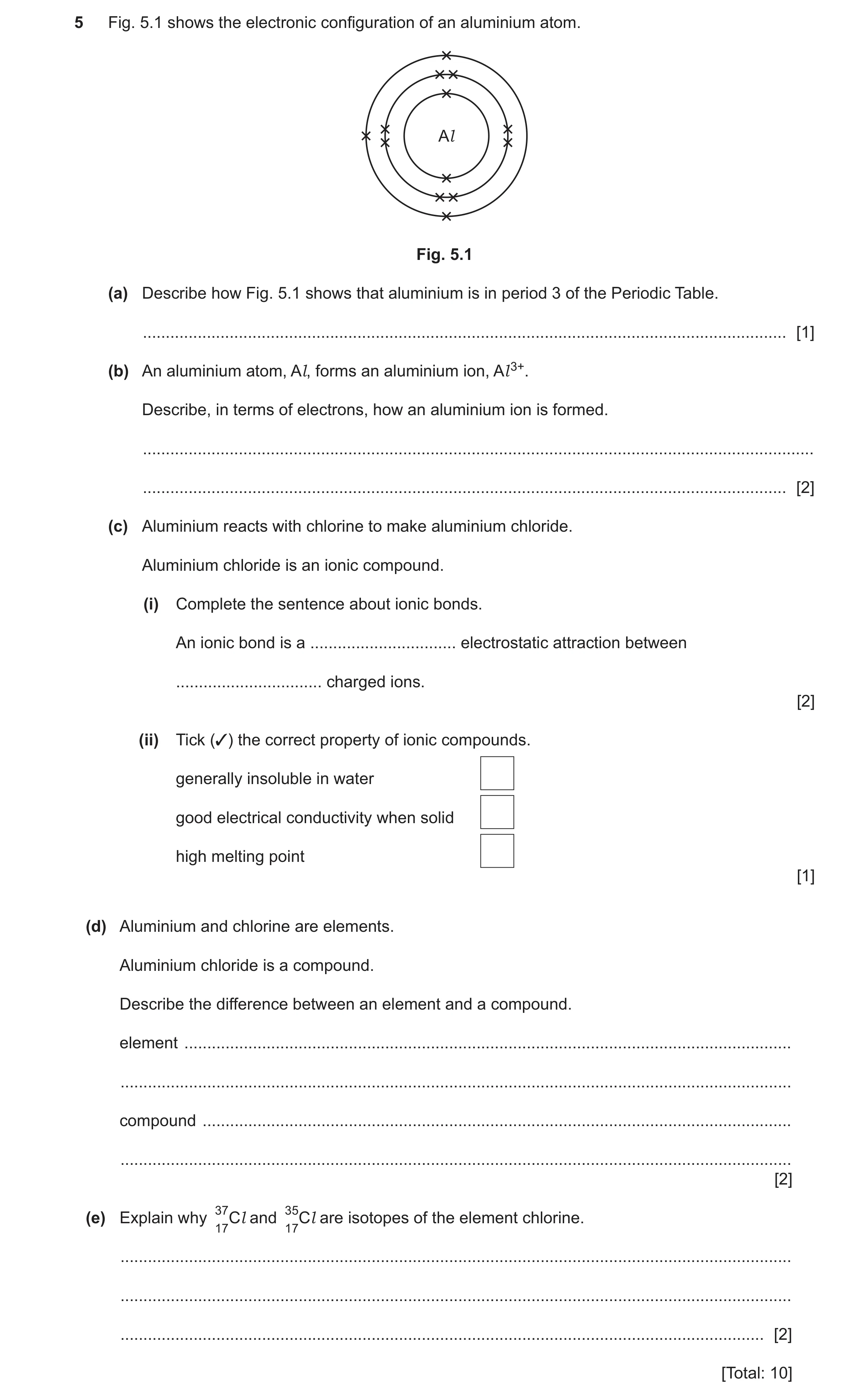
5 Fig. 5.1 shows the electronic configuration of an aluminium atom. Al Fig. 5.1 (a) Describe how Fig. 5.1 shows that aluminium is in period 3 of the Periodic Table. … [1] (b) An aluminium atom, Al, forms an aluminium ion, Al 3+. Describe, in terms of electrons, how an aluminium ion is formed. … … [2] (c) Aluminium reacts with chlorine to make aluminium chloride. Aluminium chloride is an ionic compound. (i) Complete the sentence about ionic bonds. An ionic bond is a … electrostatic attraction between … charged ions. [2] (ii) Tick (✓) the correct property of ionic compounds. generally insoluble in water good electrical conductivity when solid high melting point [1] (d) Aluminium and chlorine are elements. Aluminium chloride is a compound. Describe the difference between an element and a compound. element … … compound … … [2] 37 35 (e) Explain why 17Cl and 17Cl are isotopes of the element chlorine. … … … [2] [Total: 10]
10 marks
Mark scheme: 5(a) (aluminium has) 3 occupied electron shells ; 1 5(b) (aluminium atom) loses electrons ; 2 (aluminium atom) loses 3 electrons ; 5(c)(i) strong / owtte ; 2 oppositely / owtte ; 5(c)(ii) 1 Generally insoluble in water Good electrical conductivity when solid High melting point ✓ ; 5(d) element 2 contains only one type of atom / idea that all the atoms have the same number of protons or same atomic number ; compound substance made of two or more different elements (chemically joined) ; 5(e) same number of protons / same atomic number / both have 17 protons / both have an atomic number of 17 ; 2 different numbers of neutrons / 37Cl has 20 neutrons but 35Cl has 18 neutrons / different mass number / 37Cl has a mass number of 37 but 35Cl has a mass number of 35 ;
This question in 0654/42 Feb/March 2025
Q27 · Different substances can be elements, compounds, or mixtures 0654/41 Oct/Nov 2025
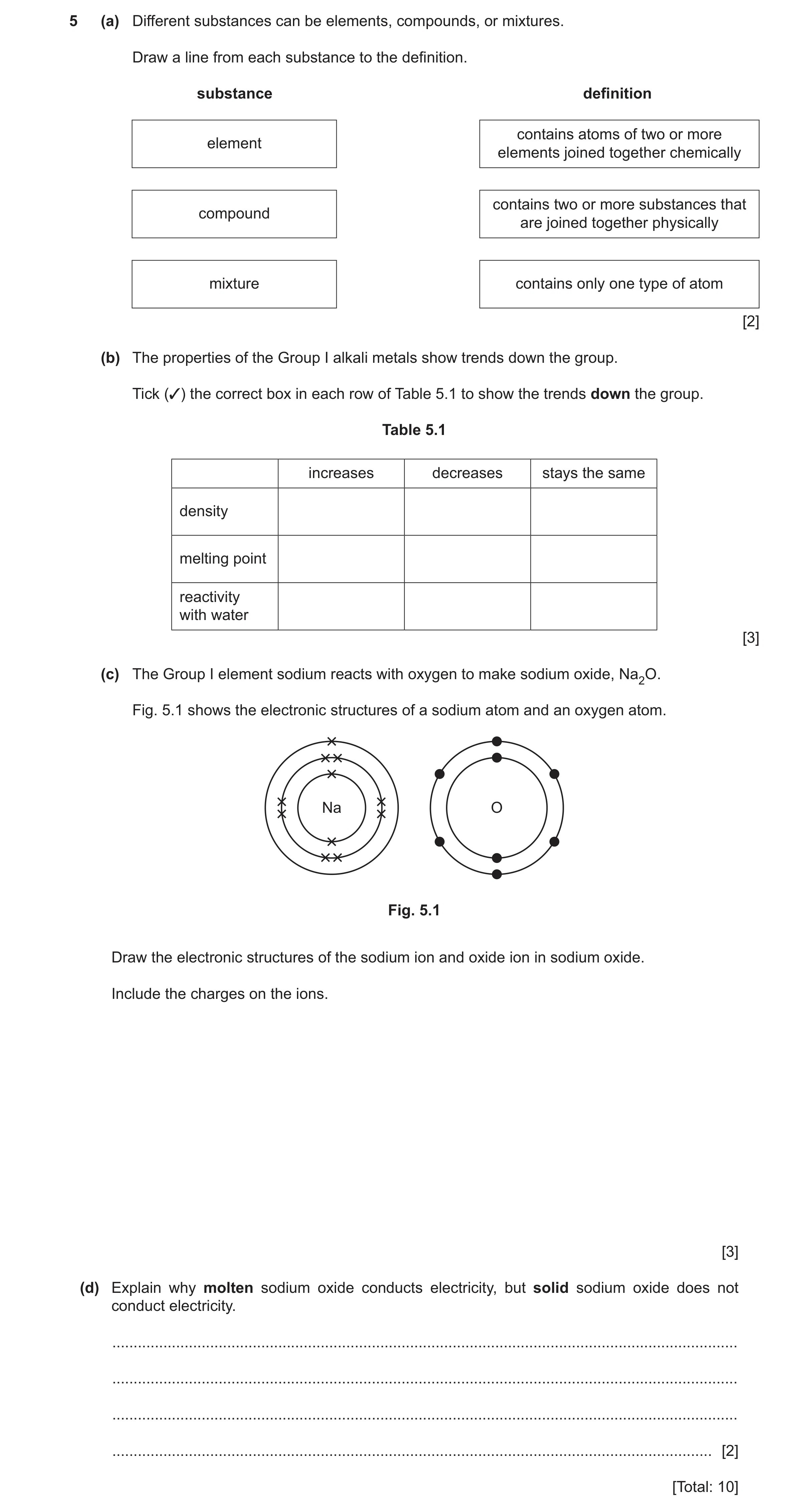
5 (a) Different substances can be elements, compounds, or mixtures. Draw a line from each substance to the definition. substance definition contains atoms of two or more element elements joined together chemically contains two or more substances that compound are joined together physically mixture contains only one type of atom [2] (b) The properties of the Group I alkali metals show trends down the group. Tick (✓) the correct box in each row of Table 5.1 to show the trends down the group. Table 5.1 increases decreases stays the same density melting point reactivity with water [3] (c) The Group I element sodium reacts with oxygen to make sodium oxide, Na2O. Fig. 5.1 shows the electronic structures of a sodium atom and an oxygen atom. Na O Fig. 5.1 Draw the electronic structures of the sodium ion and oxide ion in sodium oxide. Include the charges on the ions. [3] (d) Explain why molten sodium oxide conducts electricity, but solid sodium oxide does not conduct electricity. … … … … [2] [Total: 10]
10 marks
Mark scheme: 5(a) 2 3 correct = 2 marks 1 or 2 correct = 1 mark 5(b) 3 increases decreases stays the same density ✓ melting point ✓ reactivity with ✓ water each correct row = 1 mark 5(c) 3 correct electronic structure of sodium = 1 mark correct electronic structure of oxide ion = 1 mark correct charges = 1 mark 5(d) idea that conduction depends on movement of ions / ORA ; 2 ions cannot move in solid (state) / ions can move in molten (state) ;
This question in 0654/41 Oct/Nov 2025
Q28 · Some information about the particles in atoms 0654/43 Oct/Nov 2025
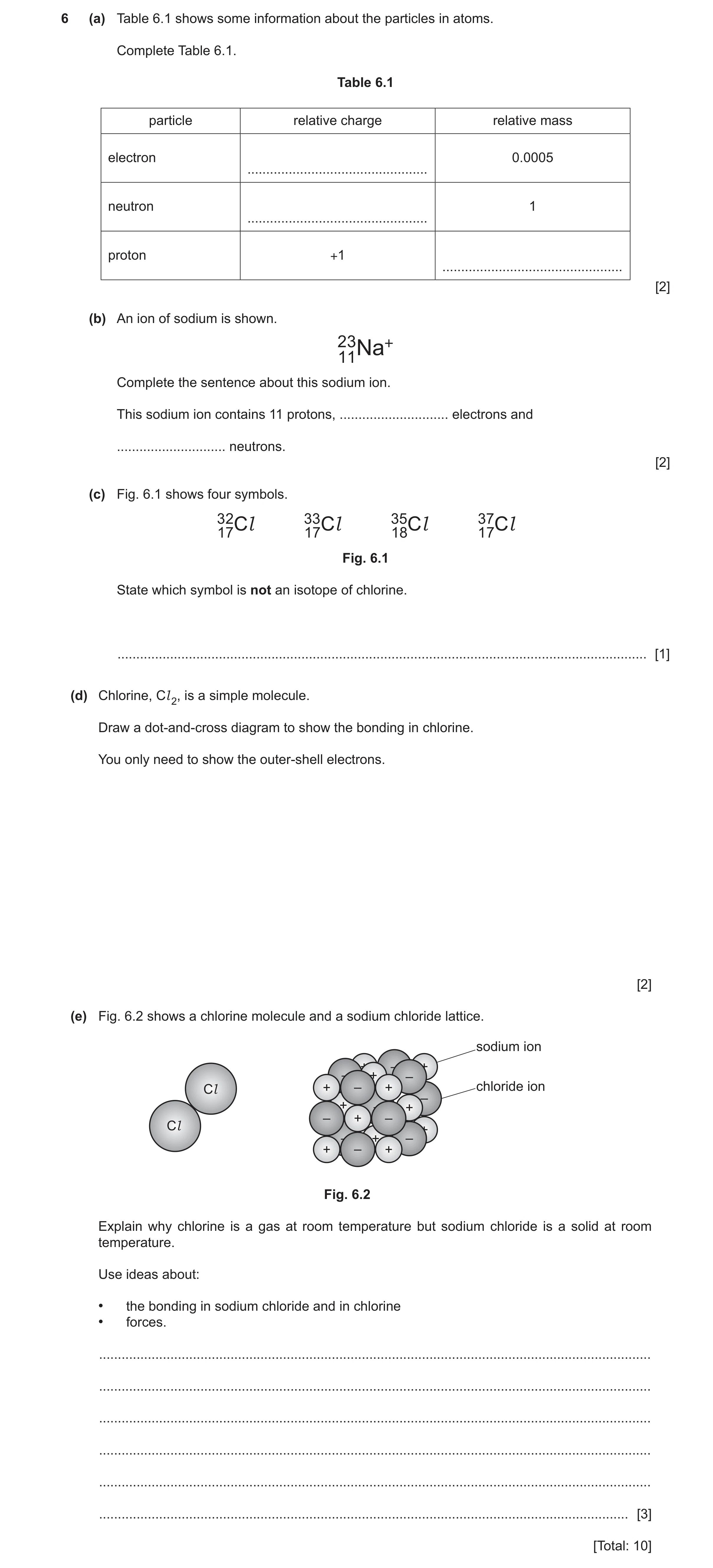
6 (a) Table 6.1 shows some information about the particles in atoms. Complete Table 6.1. Table 6.1 particle relative charge relative mass electron 0.0005 … neutron 1 … proton +1 … [2] (b) An ion of sodium is shown. 2 3 1 1Na+ Complete the sentence about this sodium ion. This sodium ion contains 11 protons, … electrons and … neutrons. [2] (c) Fig. 6.1 shows four symbols. 3 2 3 3 3 5 3 7 1 7Cl 1 7Cl 1 8Cl 1 7Cl Fig. 6.1 State which symbol is not an isotope of chlorine. … [1] (d) Chlorine, Cl 2, is a simple molecule. Draw a dot-and-cross diagram to show the bonding in chlorine. You only need to show the outer-shell electrons. [2] (e) Fig. 6.2 shows a chlorine molecule and a sodium chloride lattice. sodium ion + – + – + – Cl + – + chloride ion – + – + – + – Cl + – + – + – + Fig. 6.2 Explain why chlorine is a gas at room temperature but sodium chloride is a solid at room temperature. Use ideas about: • the bonding in sodium chloride and in chlorine • forces. … … … … … … [3] [Total: 10]
10 marks
Mark scheme: 6(a) 2 particle relative charge relative mass electron –1 0.0005 neutron 0 1 proton +1 1 3 correct for 2 marks 1 or 2 correct for 1 mark 6(b) 10 electrons ; 2 12 neutrons ; 6(c) 35Cl ; 1 18 6(d) 2 1 mark shared pair of electrons between chlorine atoms 1 mark for rest of structure correct 6(e) chlorine is covalent and sodium chloride is ionic ; 3 chlorine has weak intermolecular forces ; sodium chloride has strong electrostatic forces / sodium chloride has strong forces between oppositely charged ions ;
This question in 0654/43 Oct/Nov 2025
 16 / 49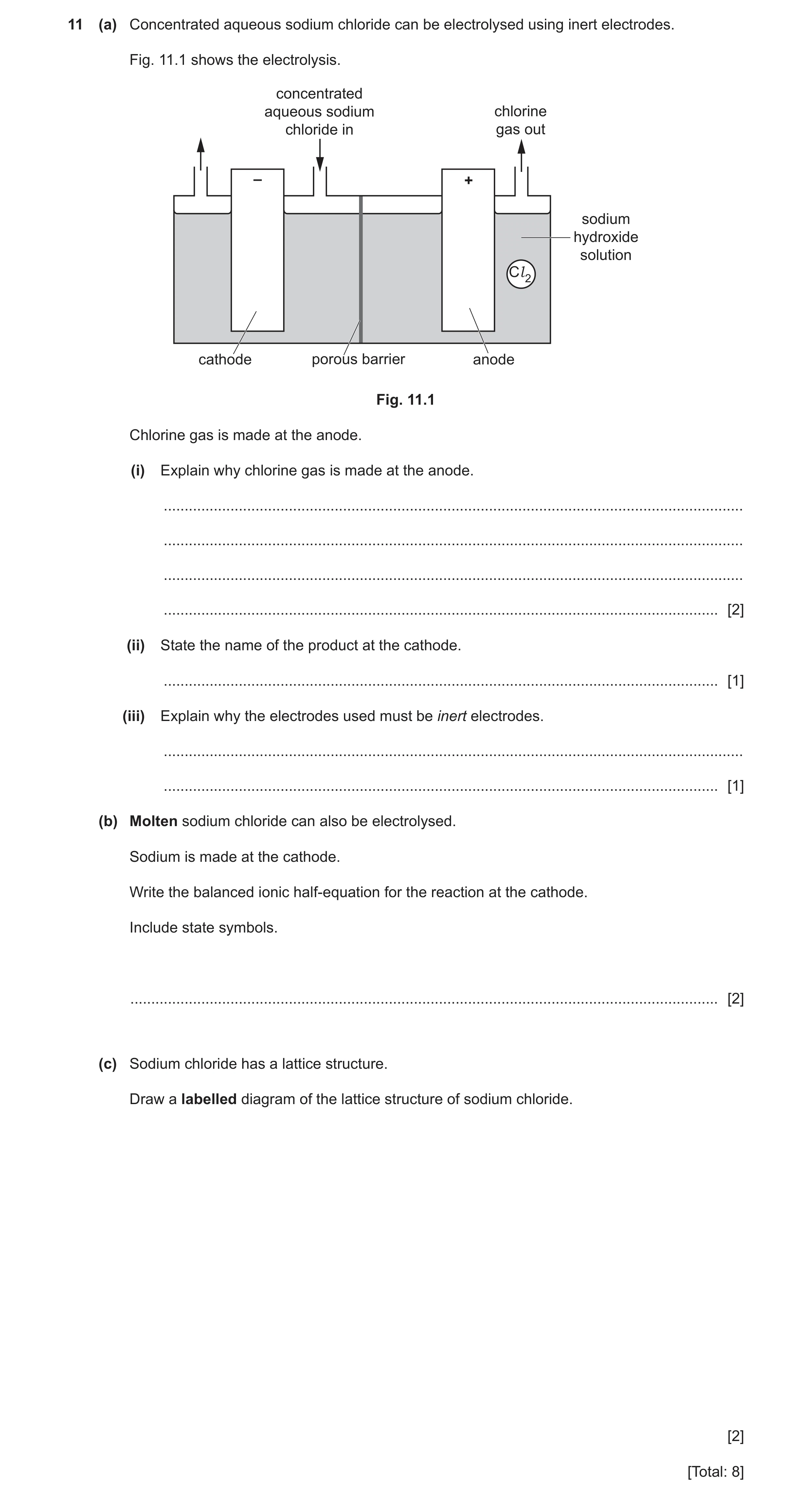
 7
7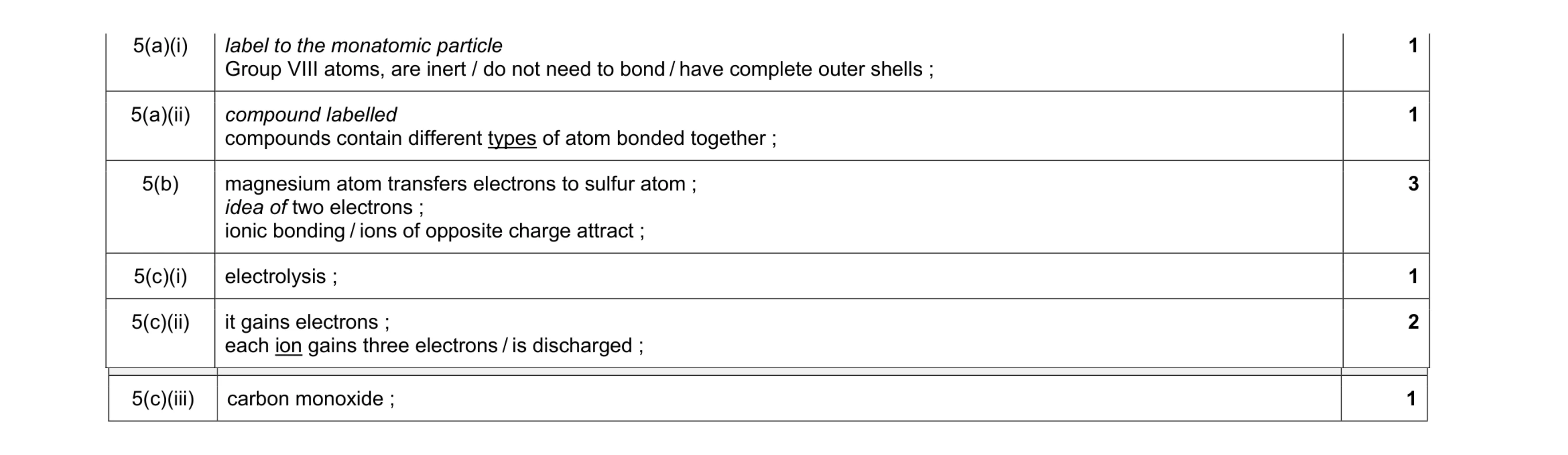 9
9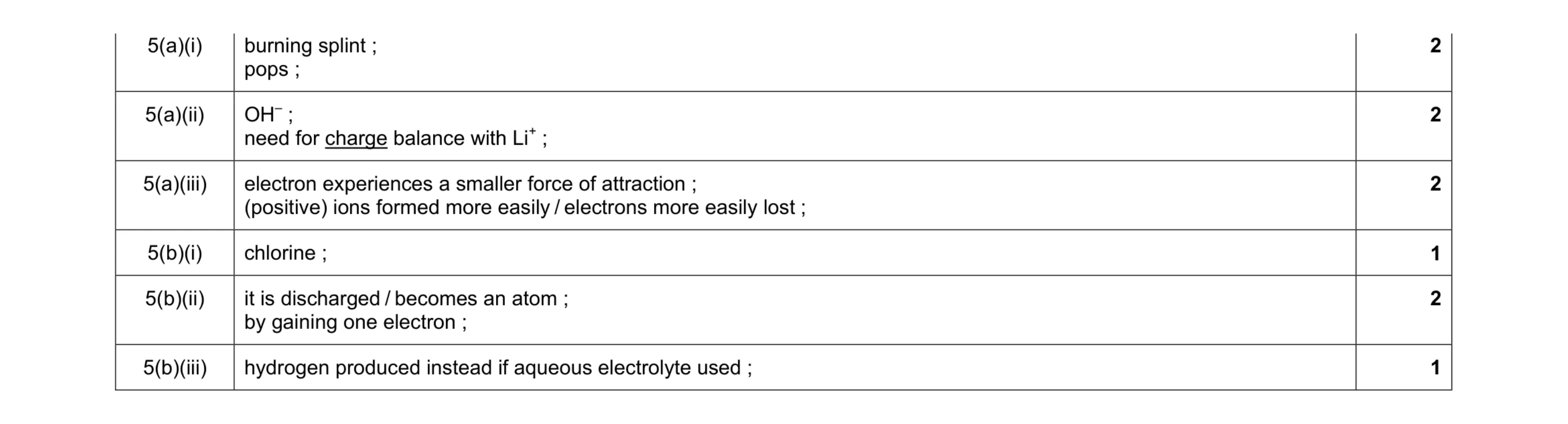 10
10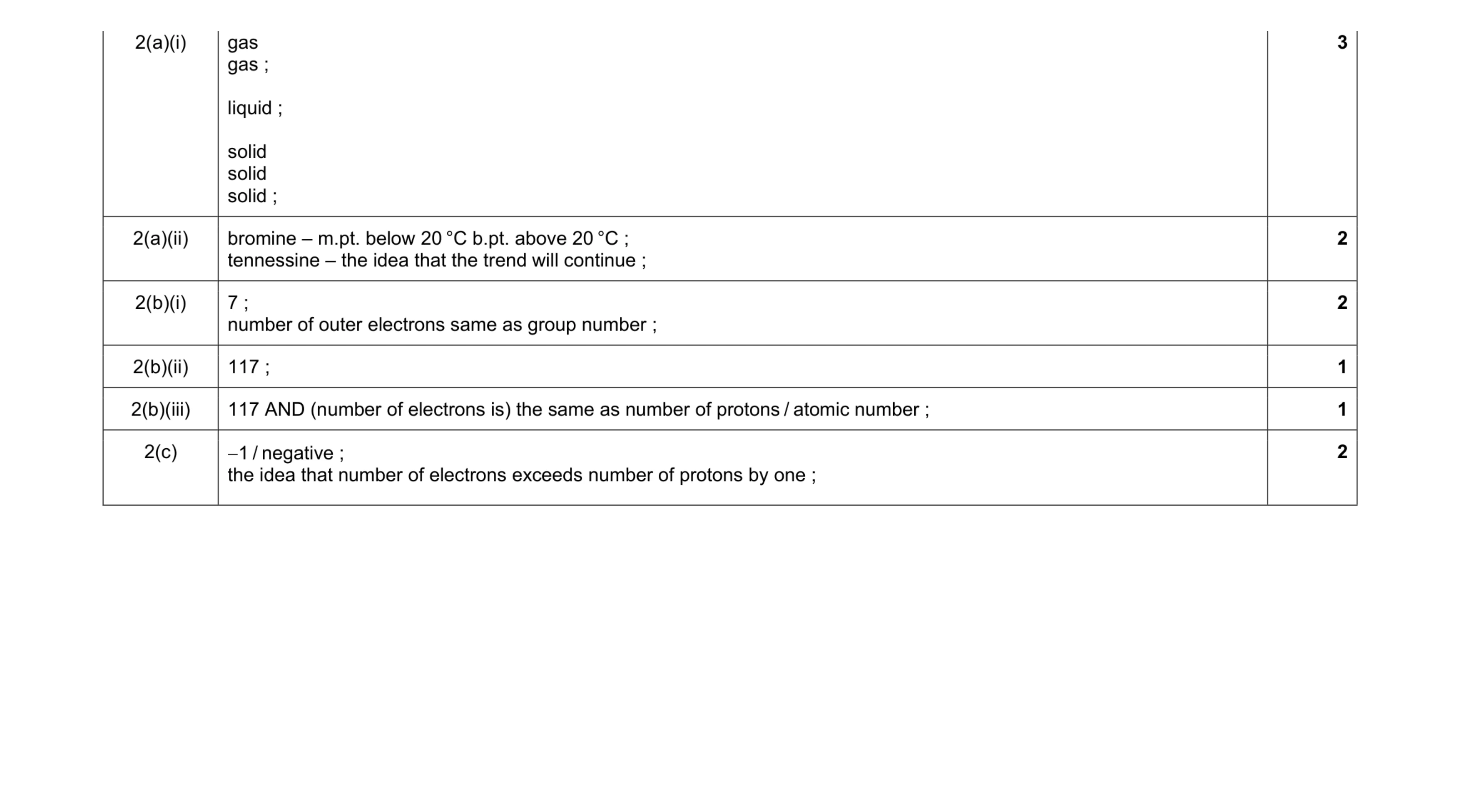 11
11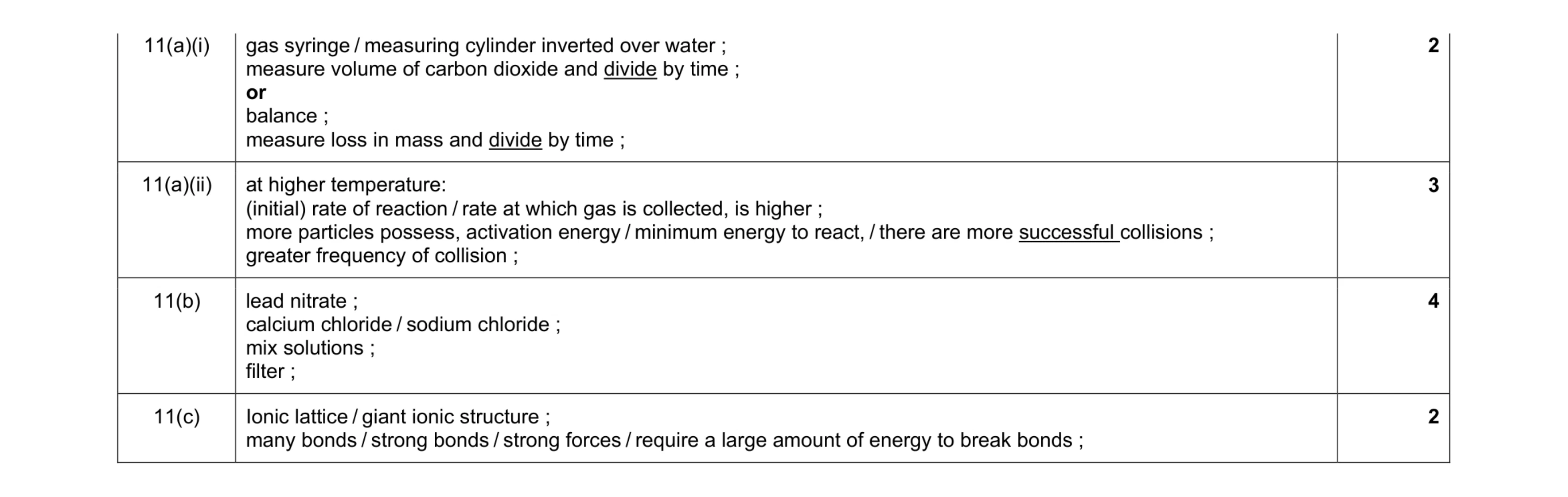 11
11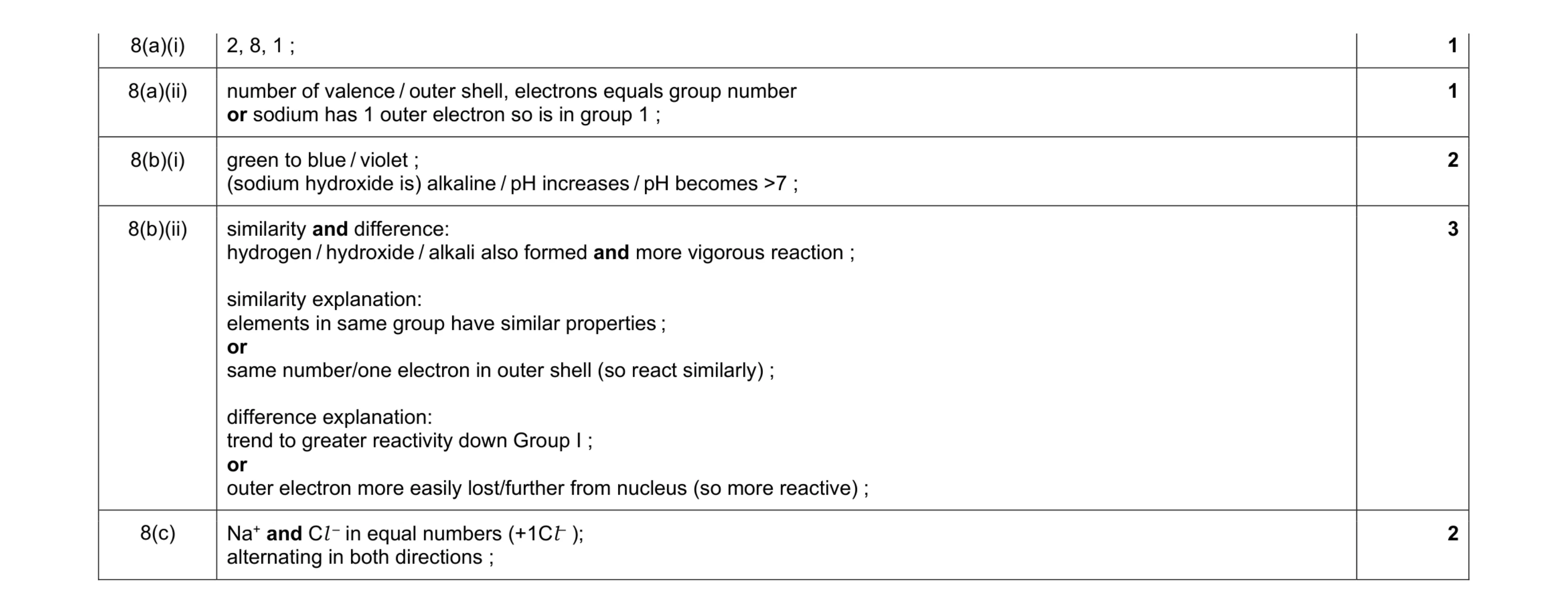 9
9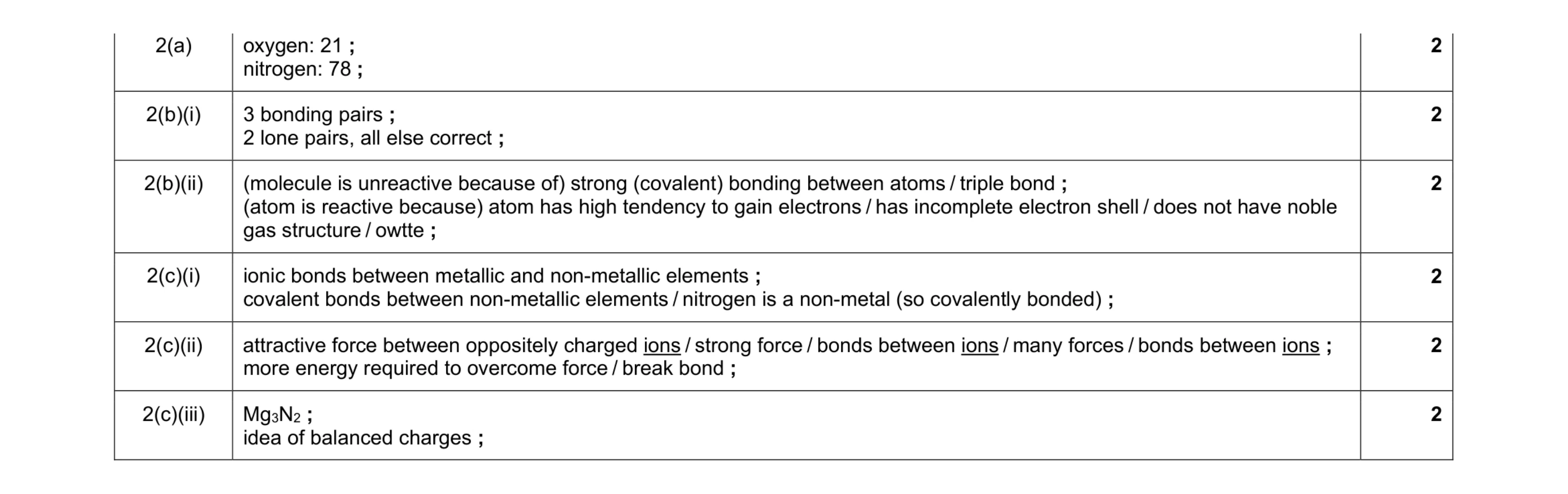 12
12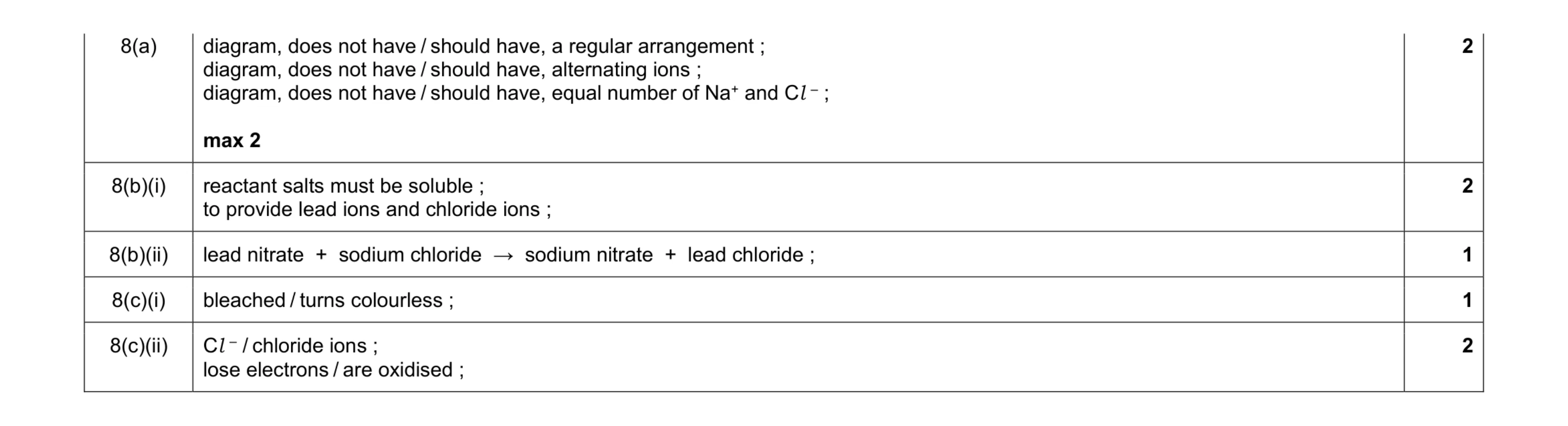 8
8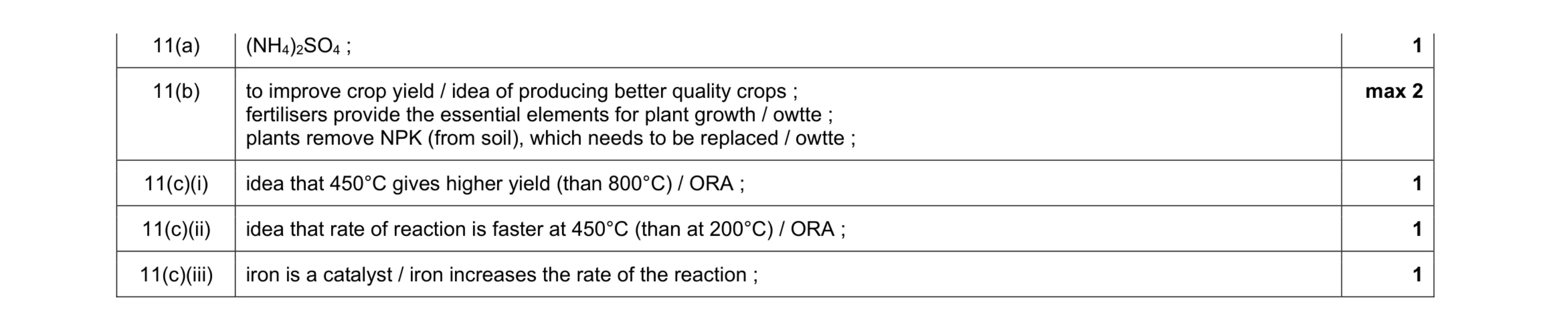 6
6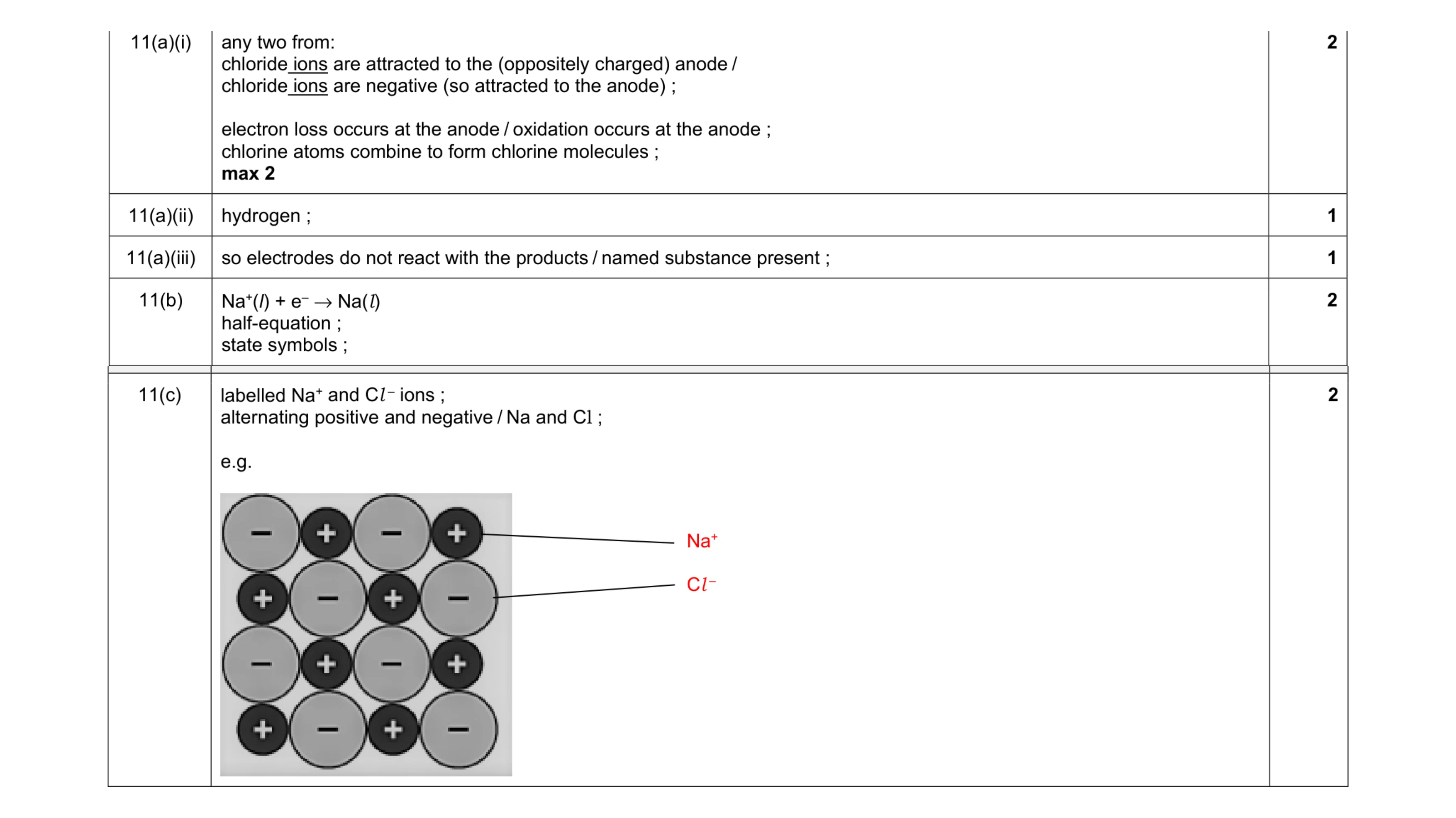 8
8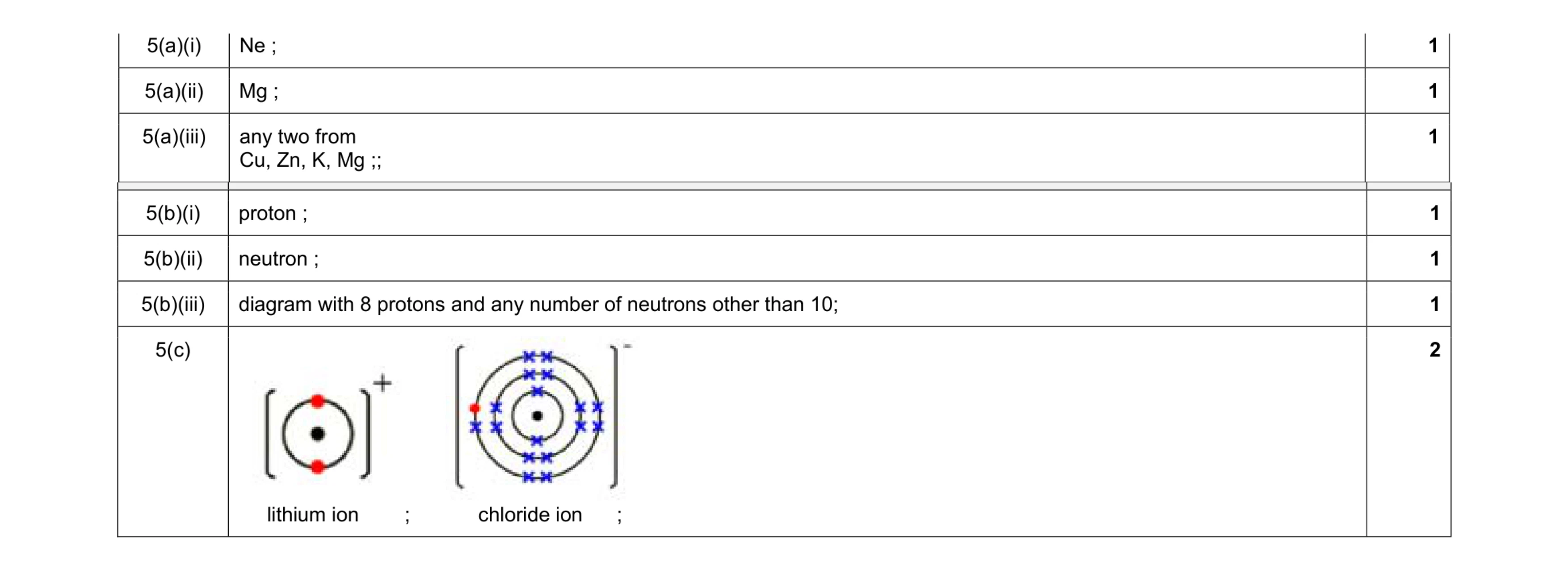 8
8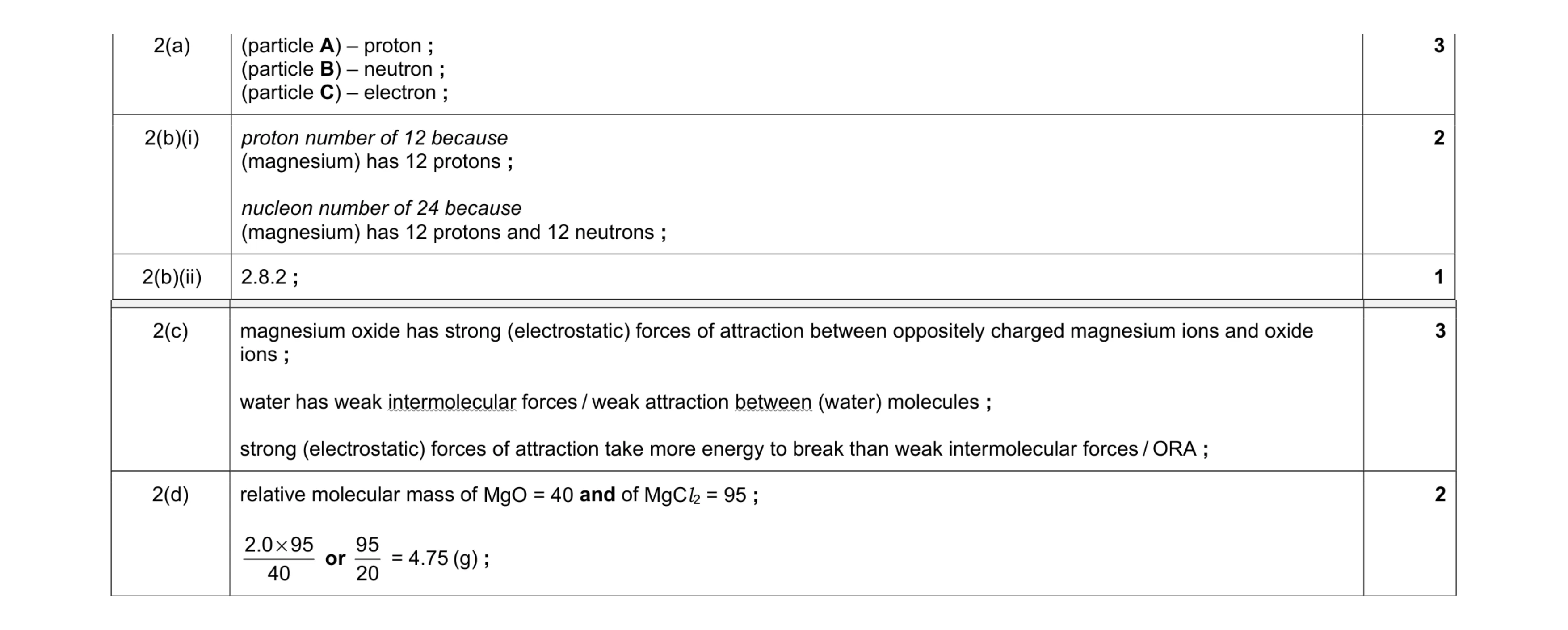 11
11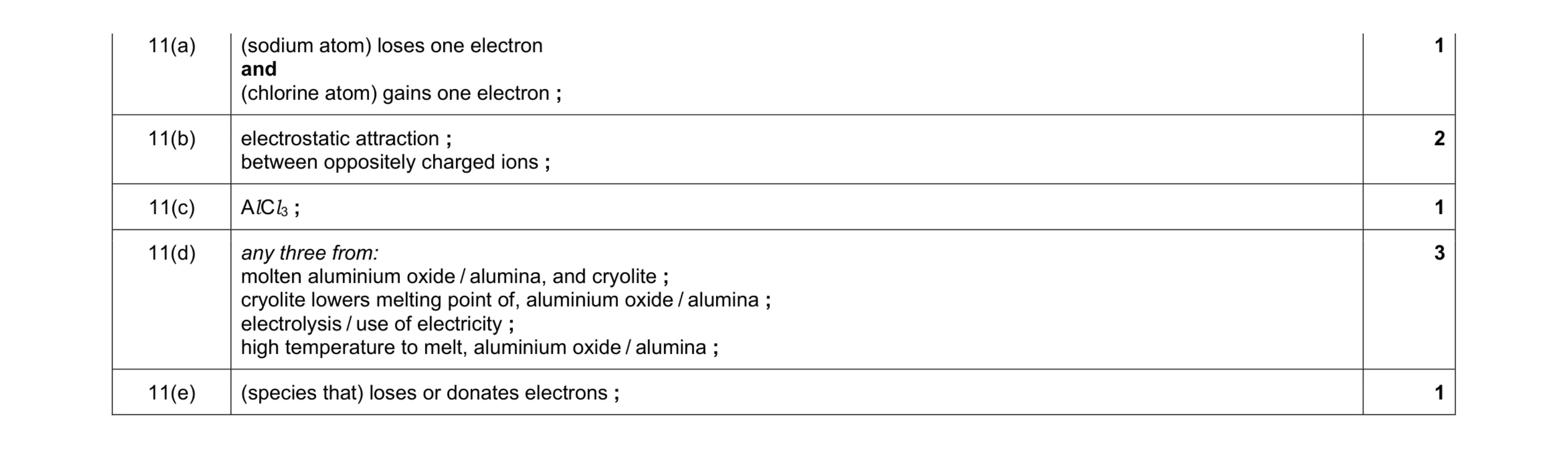 8
8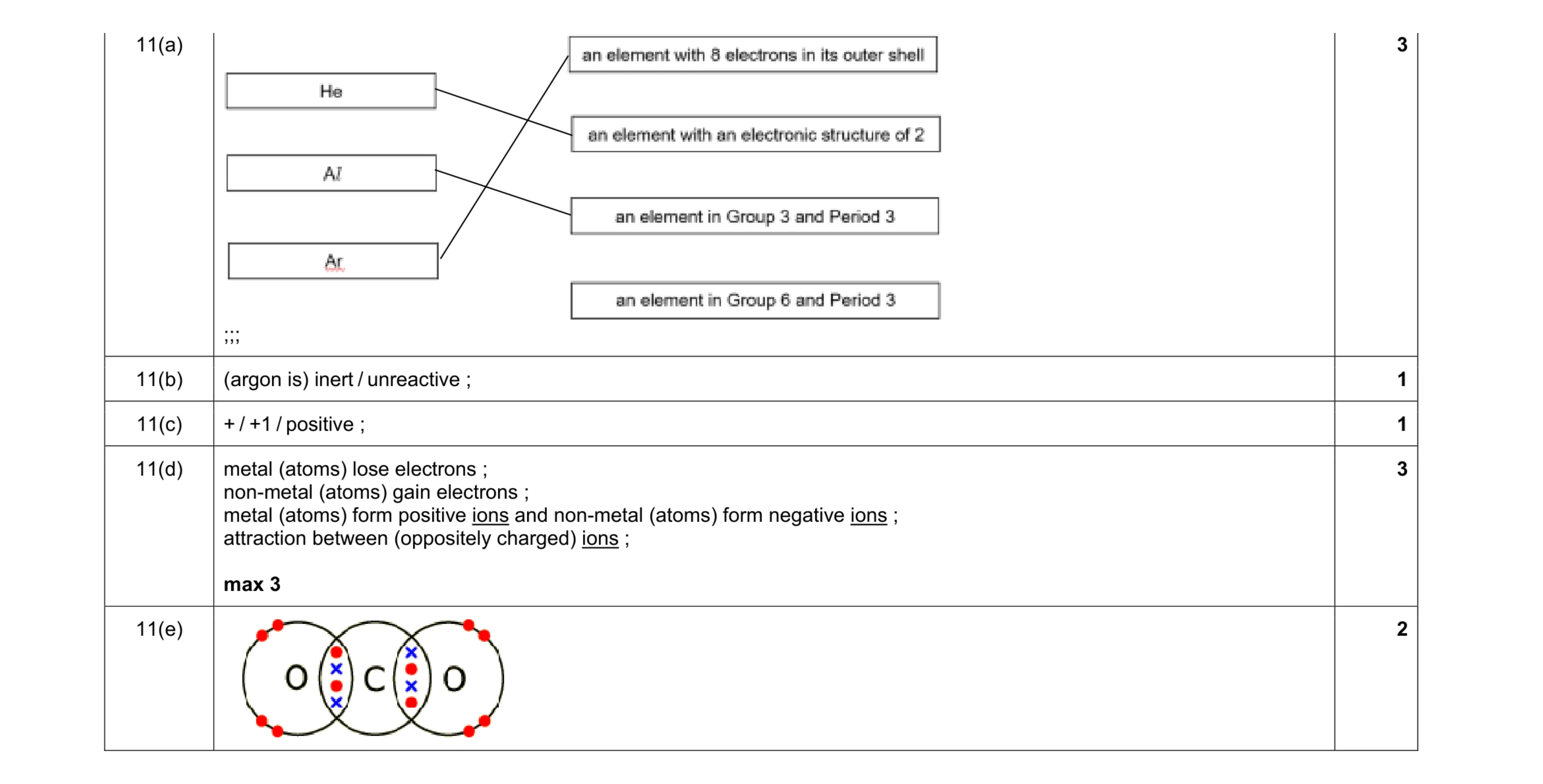 10
10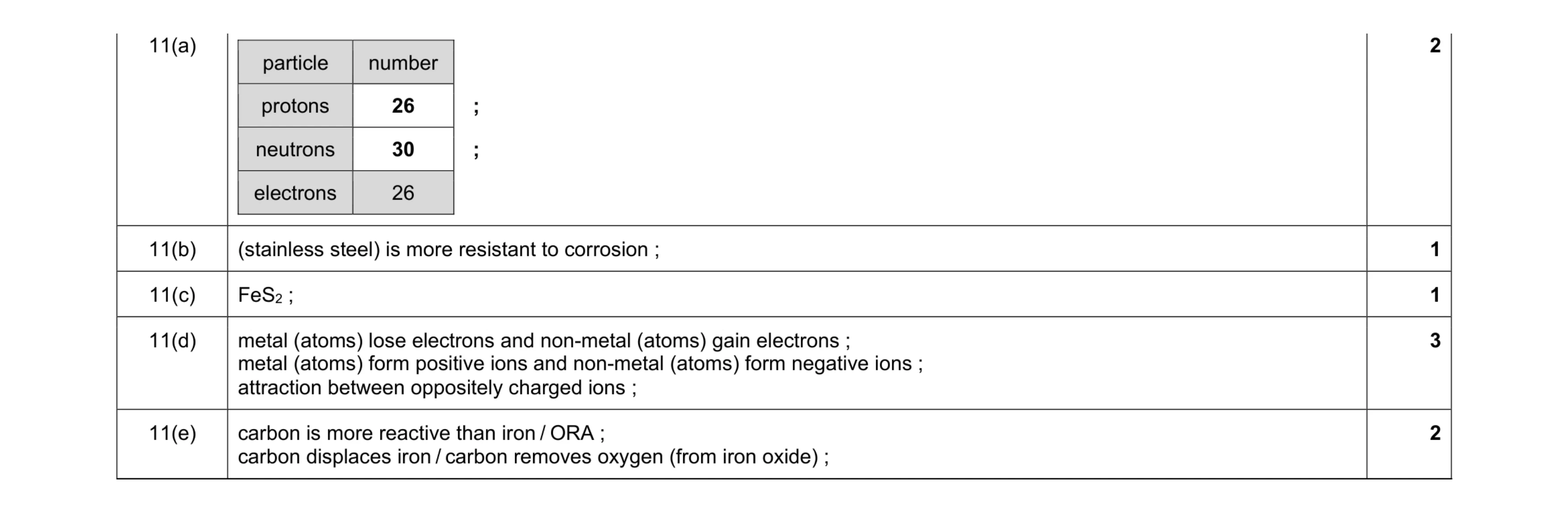 9
9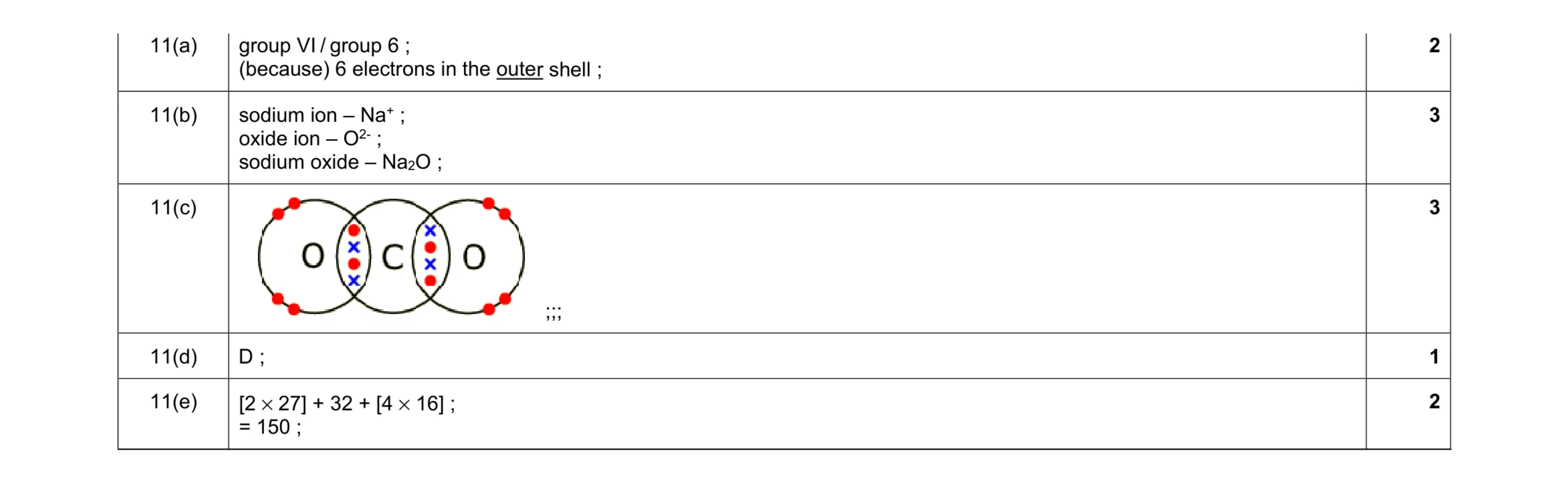 11
11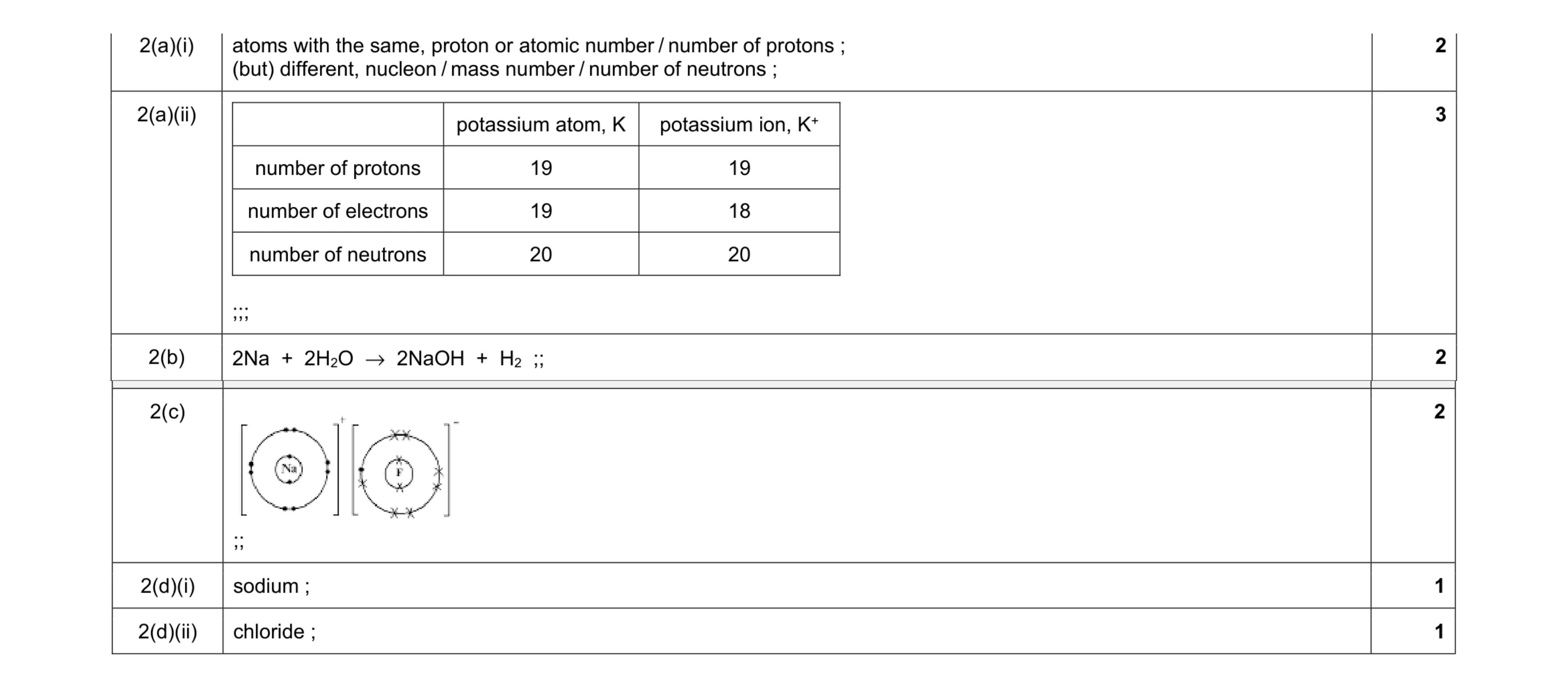 11
11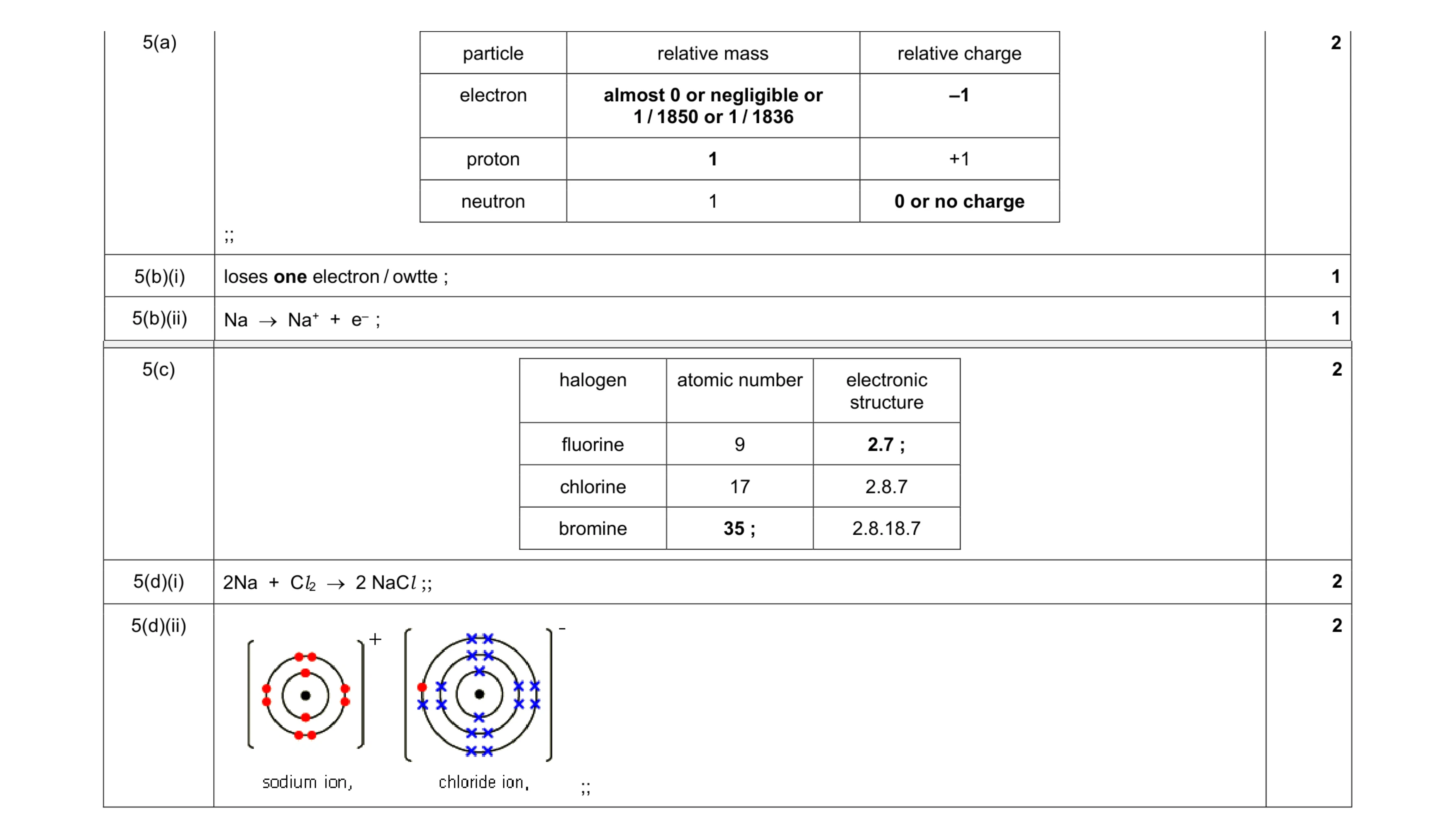 10
10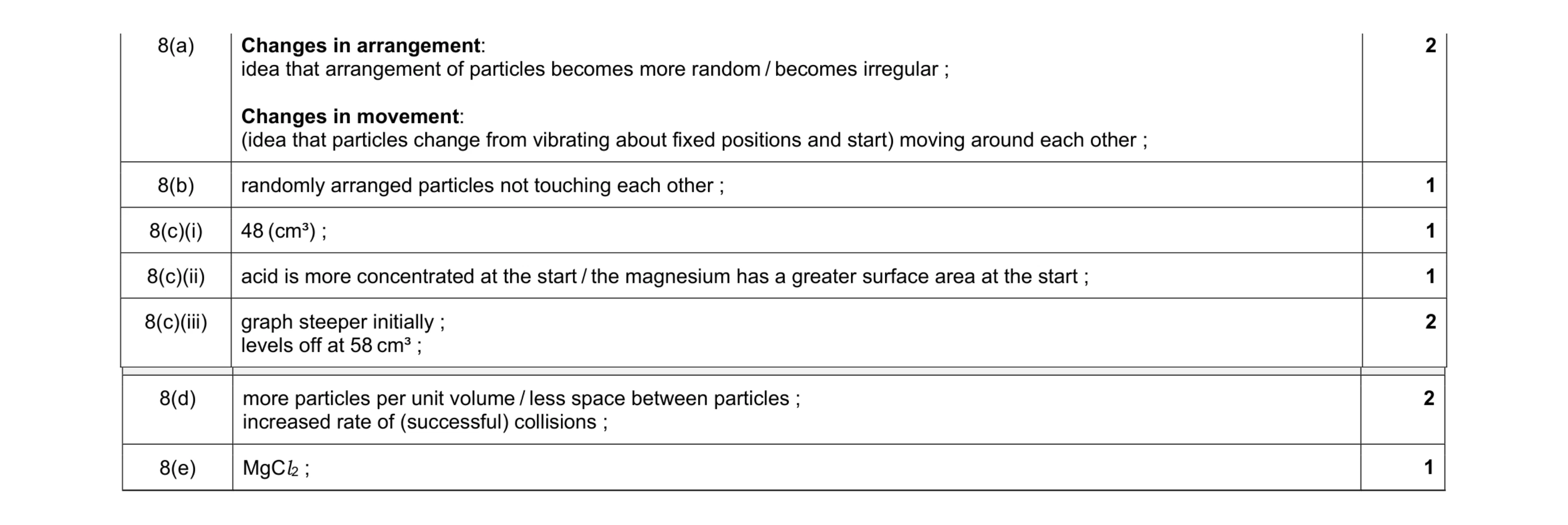 10
10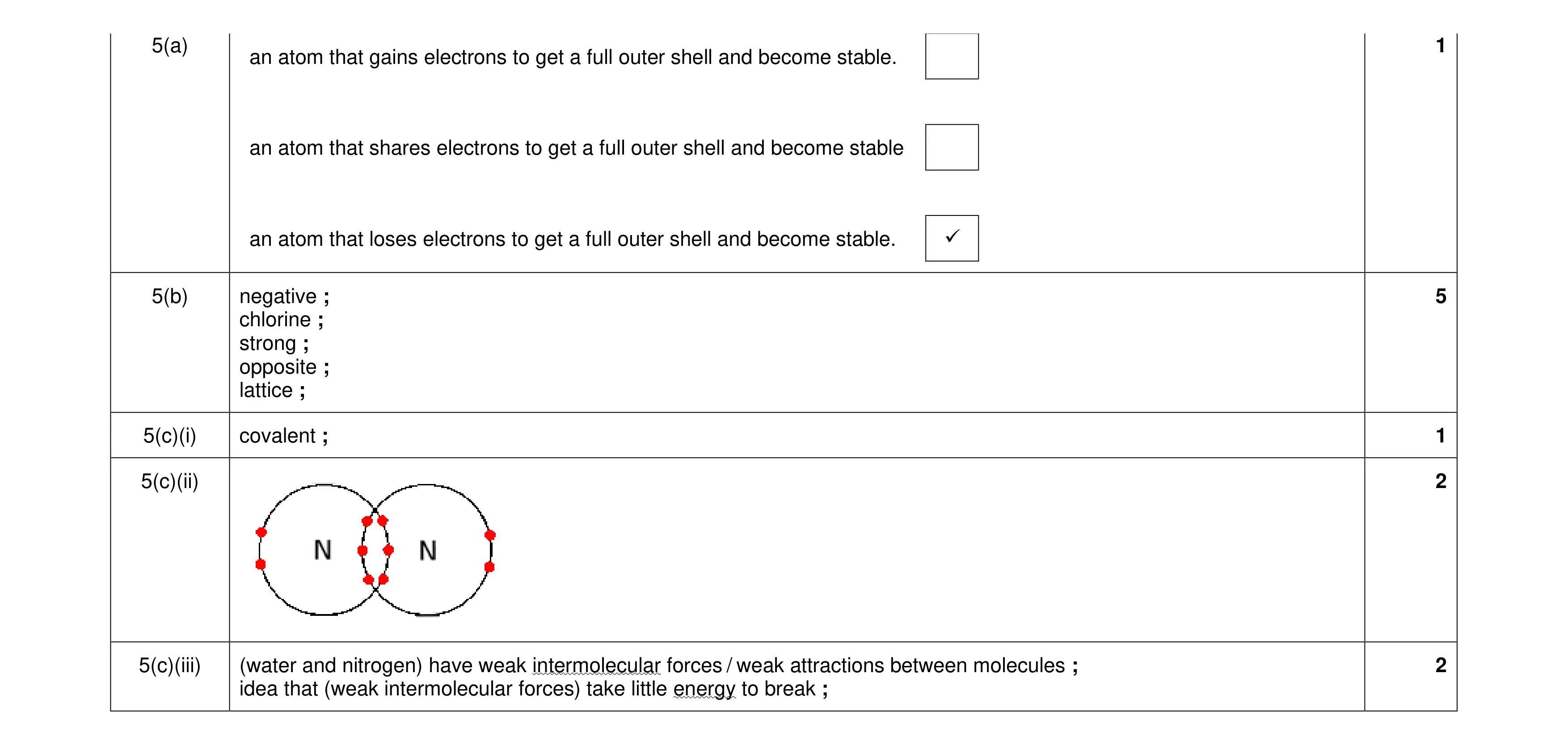 11
11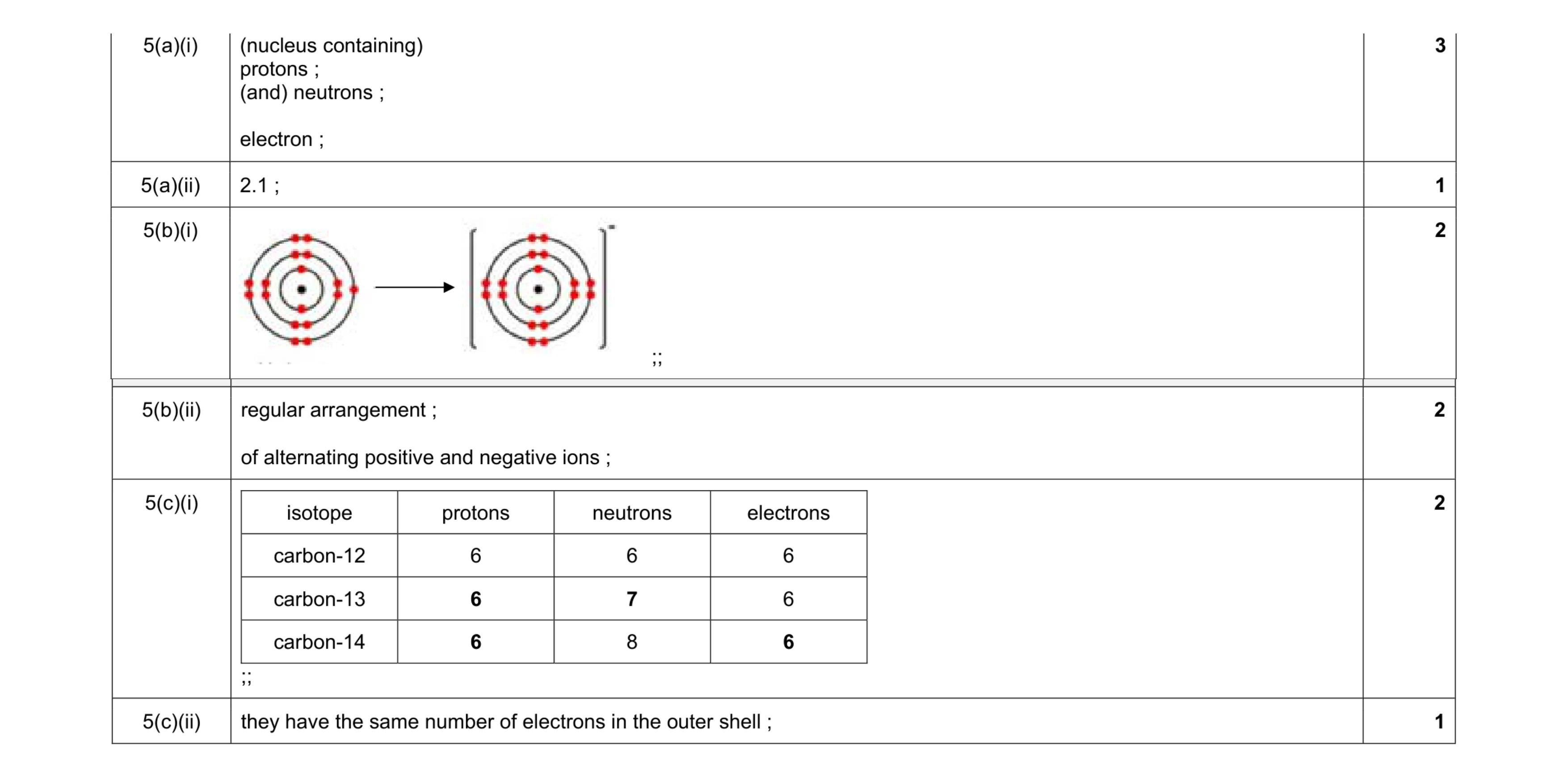 11
11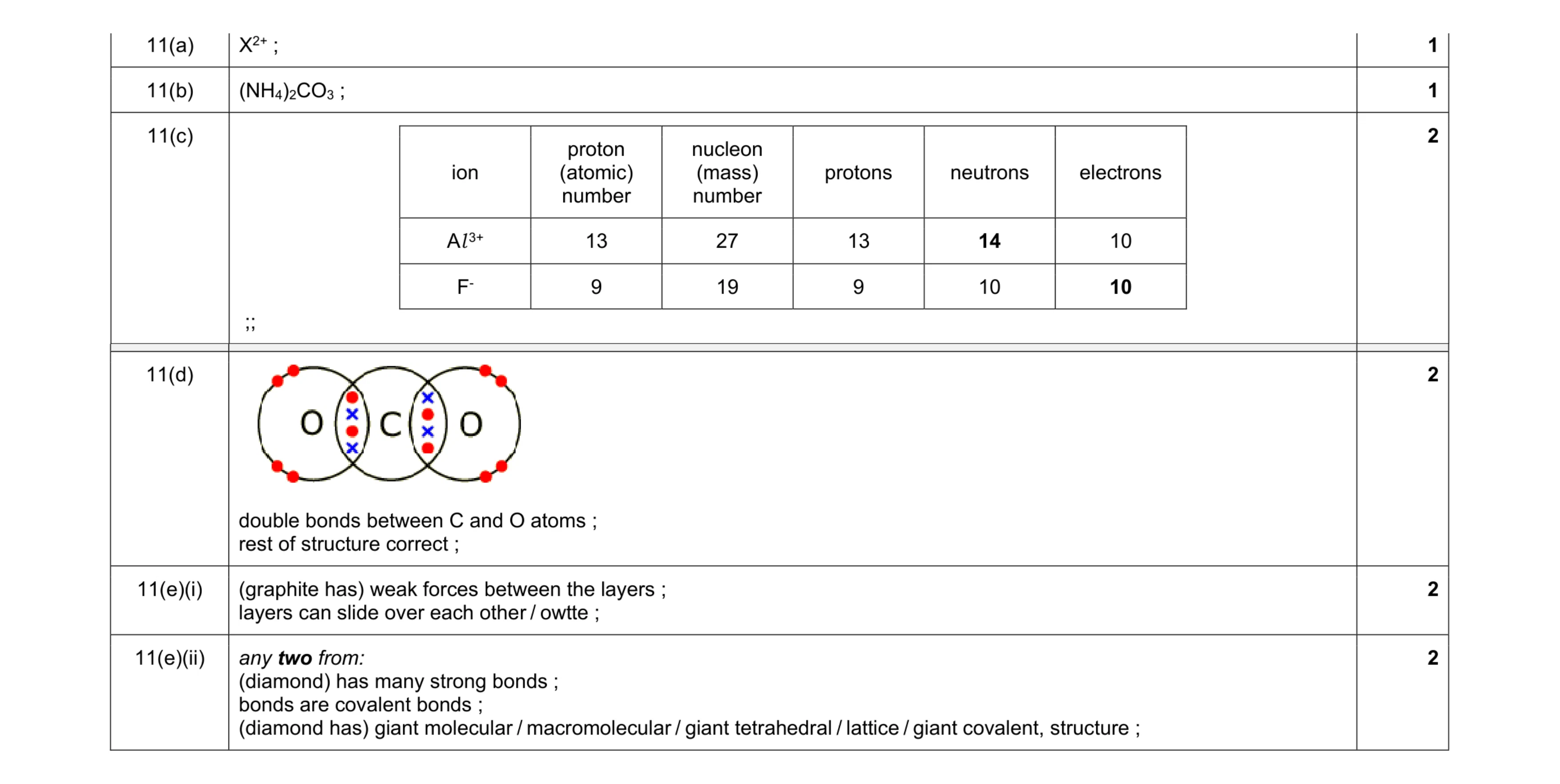 10
10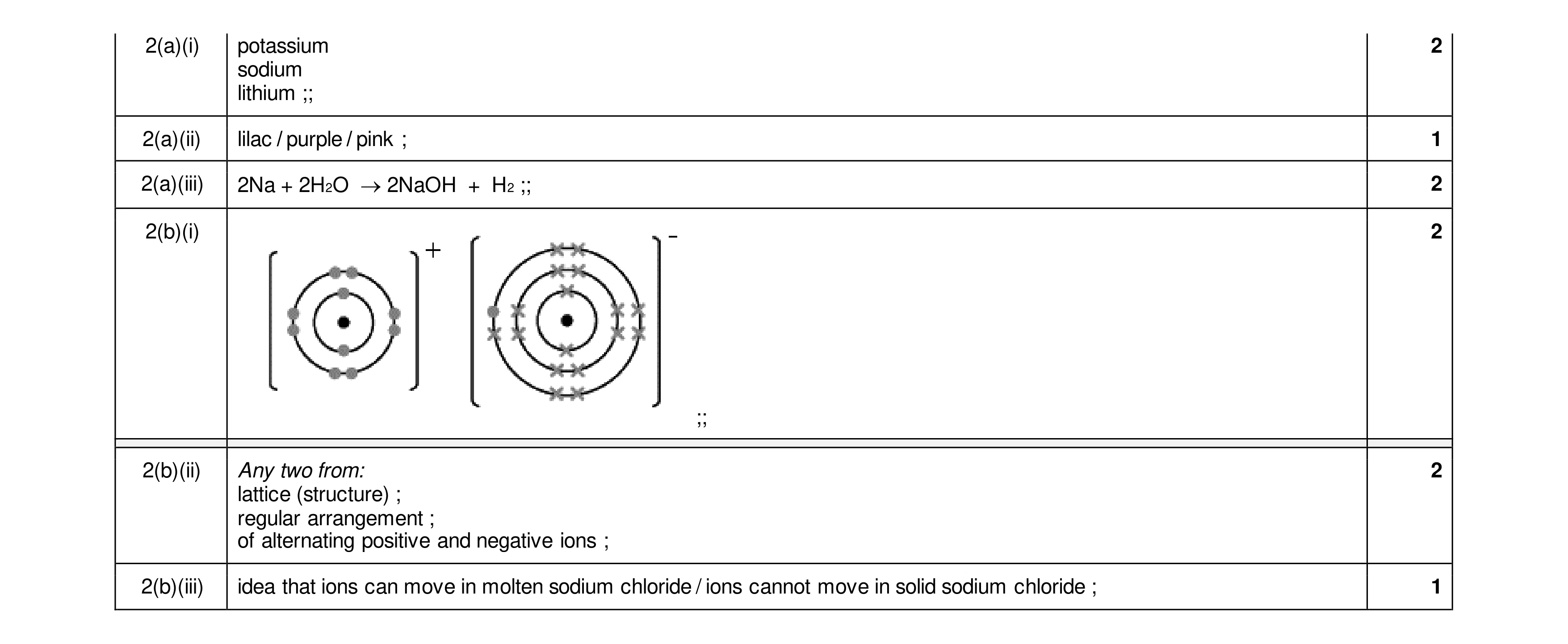 10
10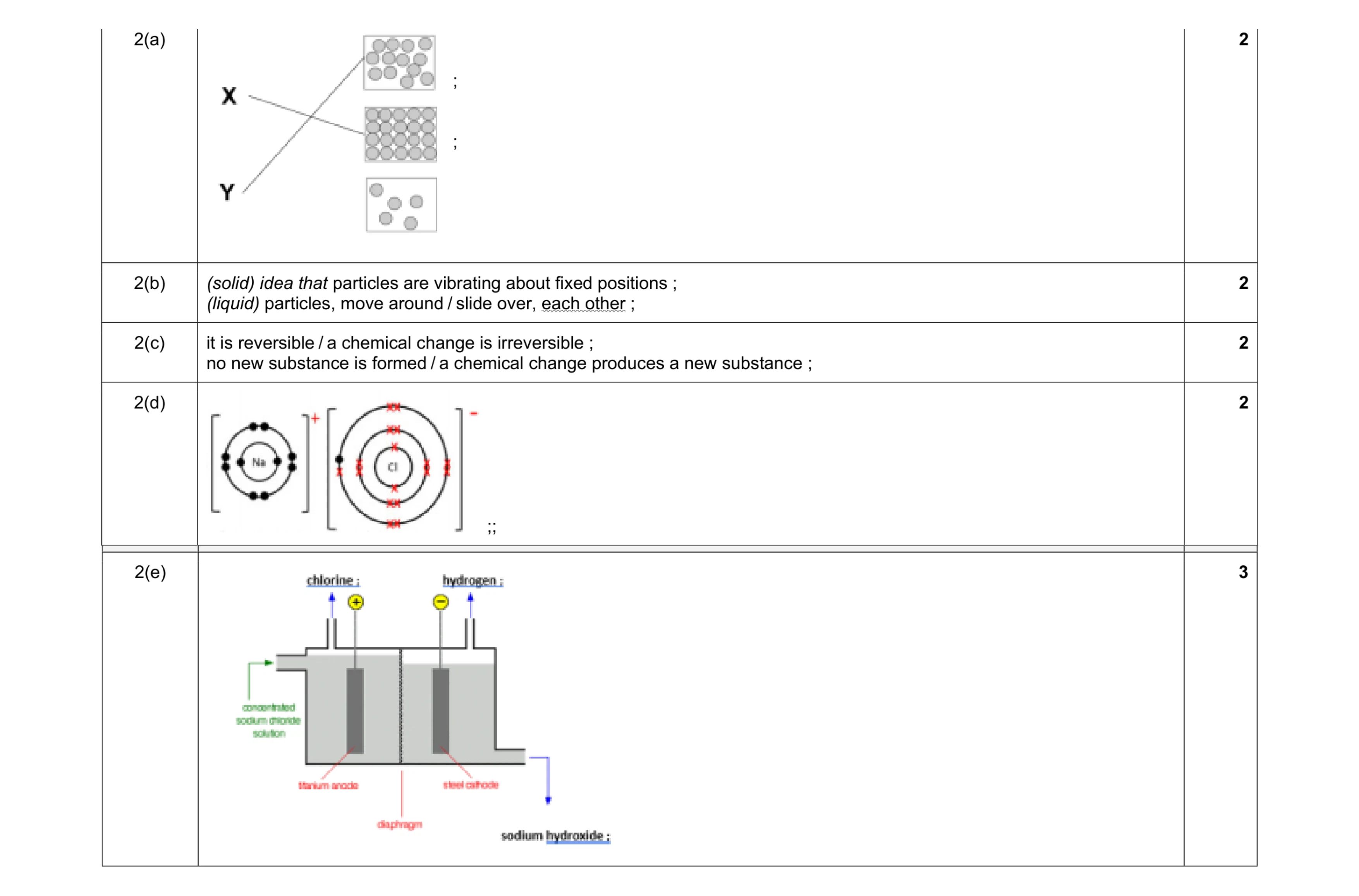 11
11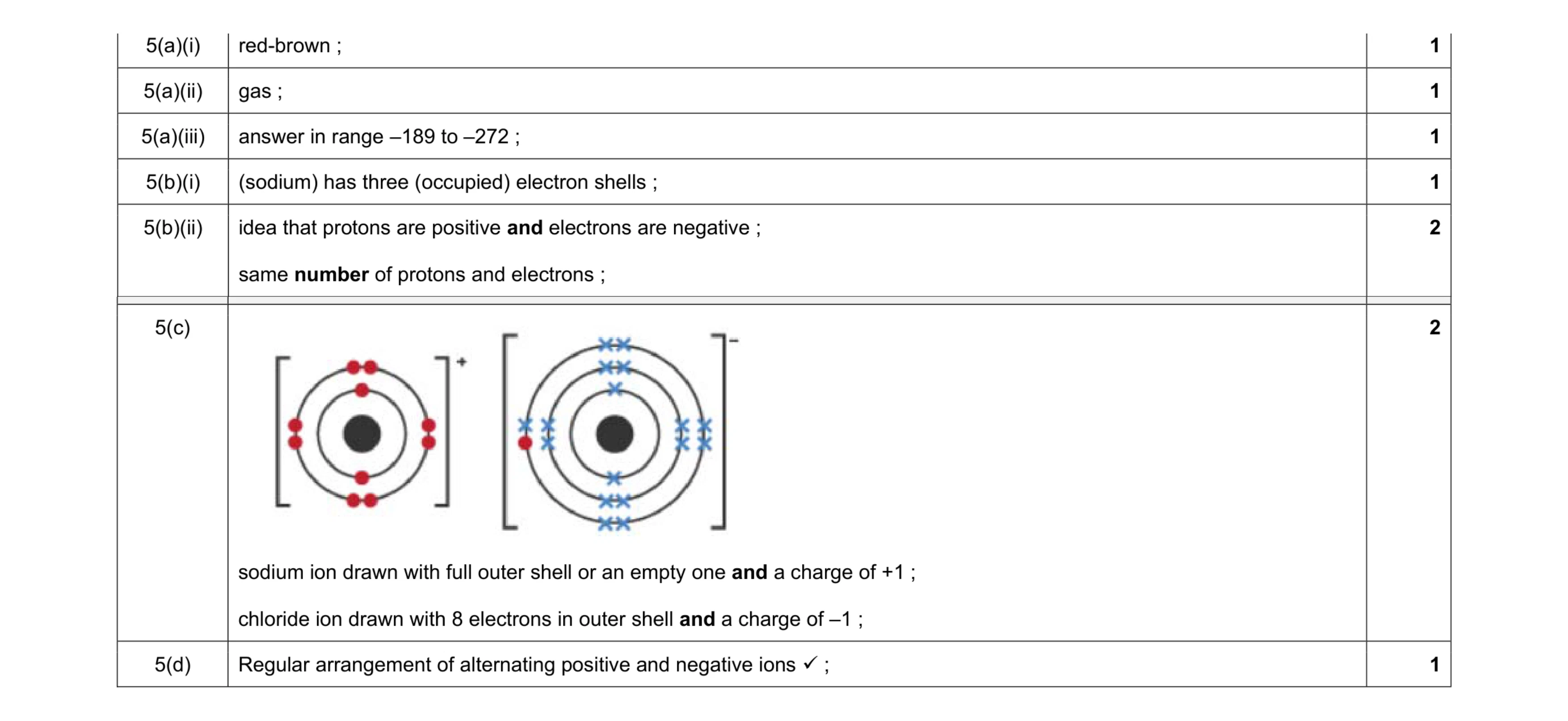 9
9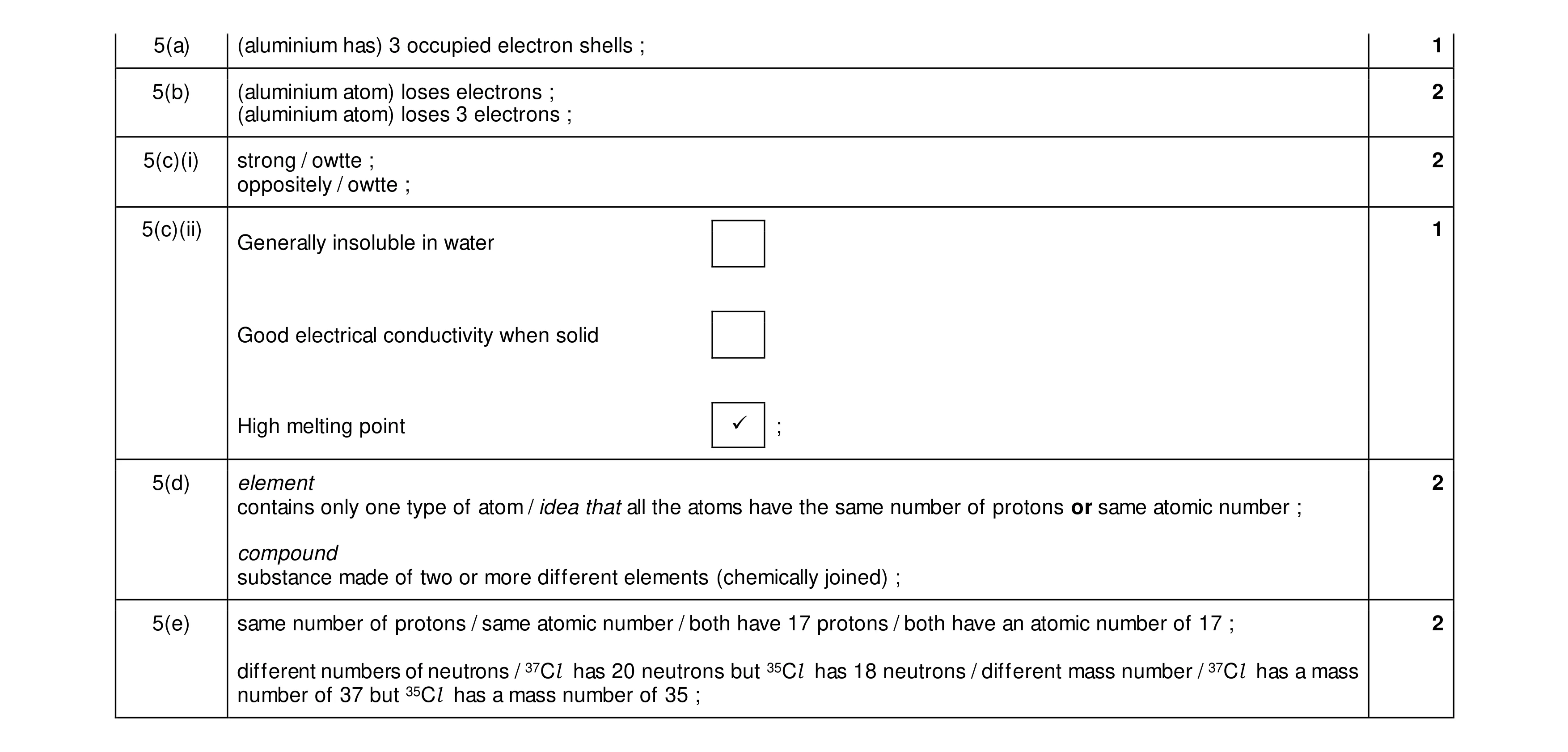 10
10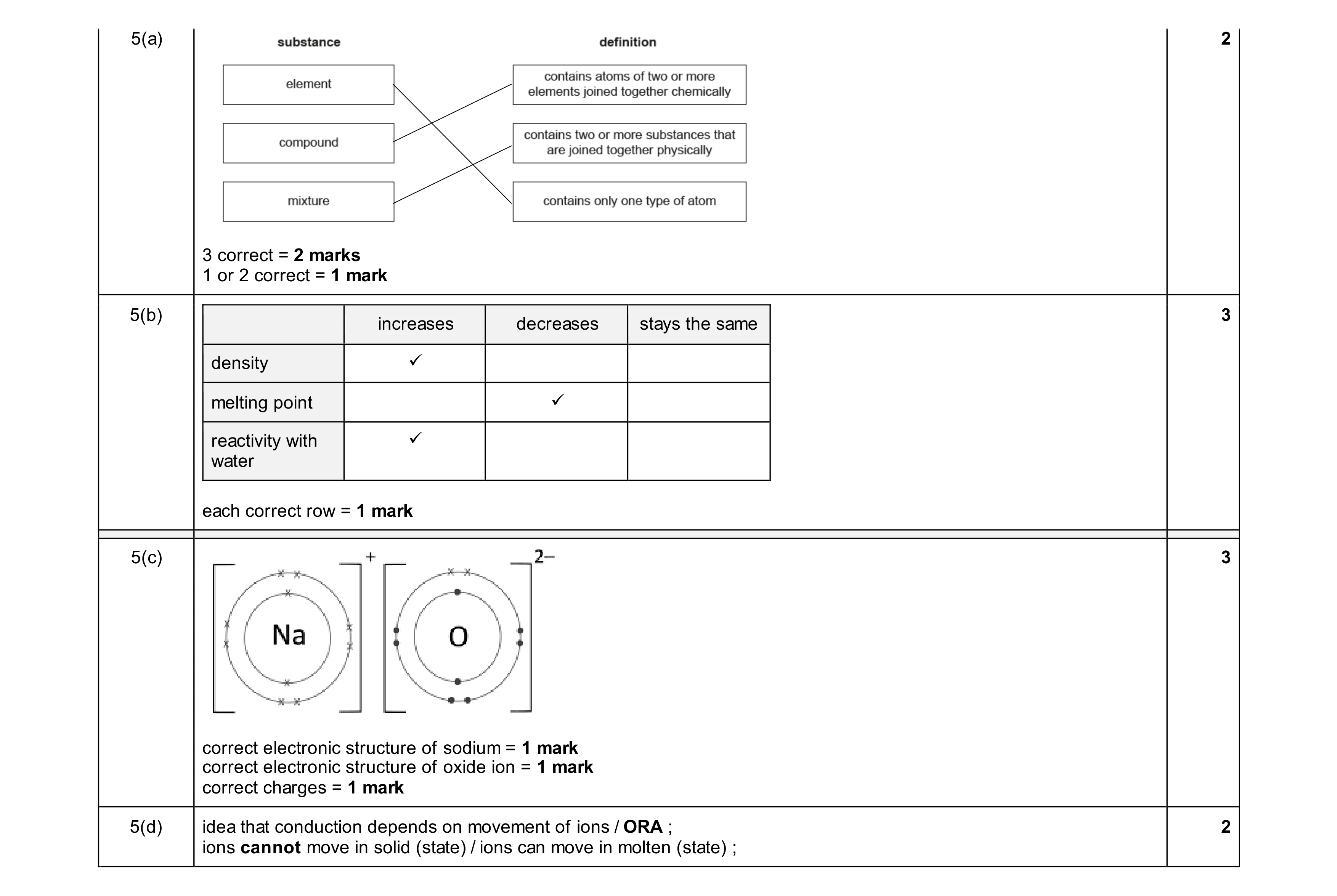 10
10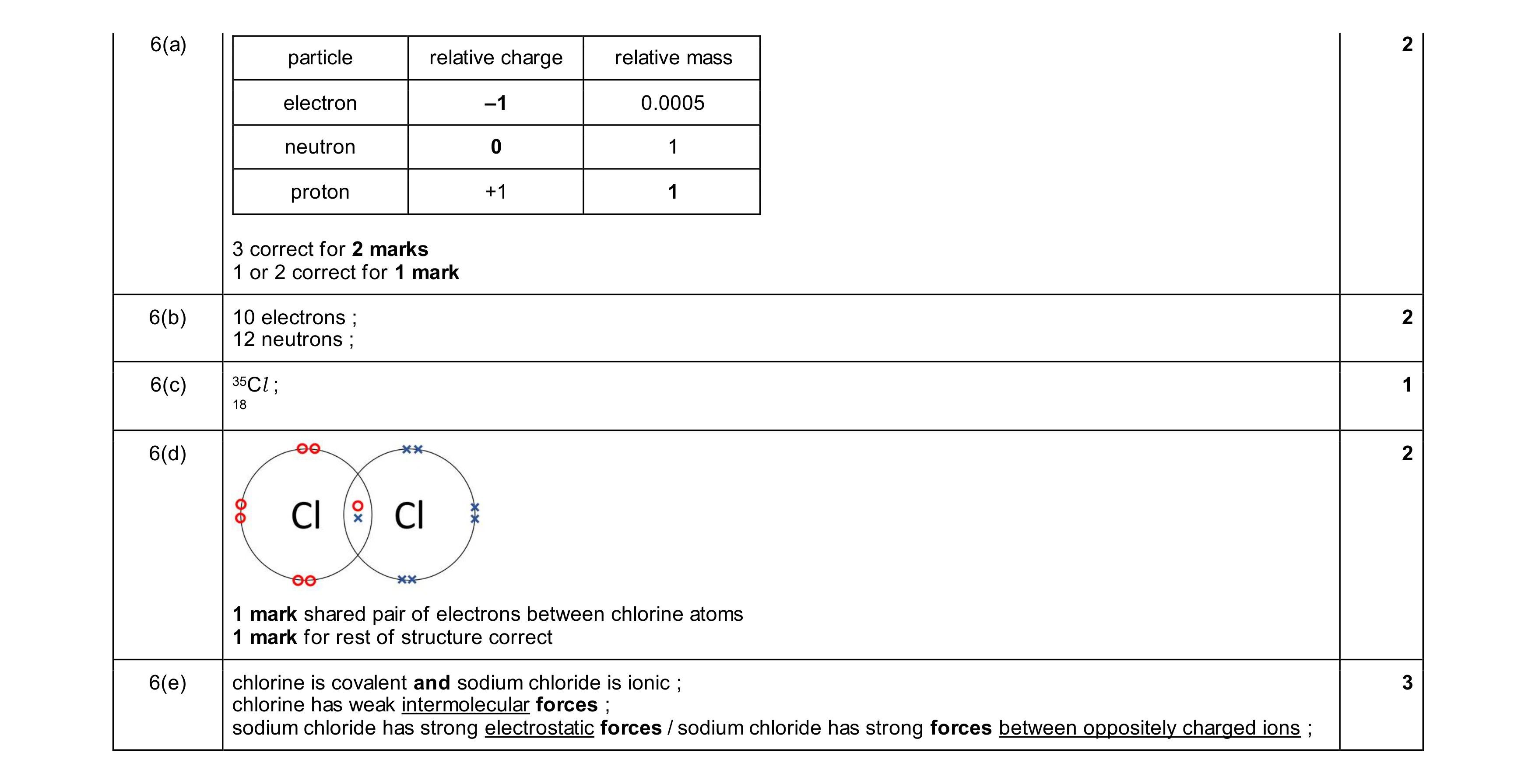 10
10