Questions as text
Q1 · The positions of four elements are shown on the outline of part of the Periodic Table 0654/11 May/June 2006
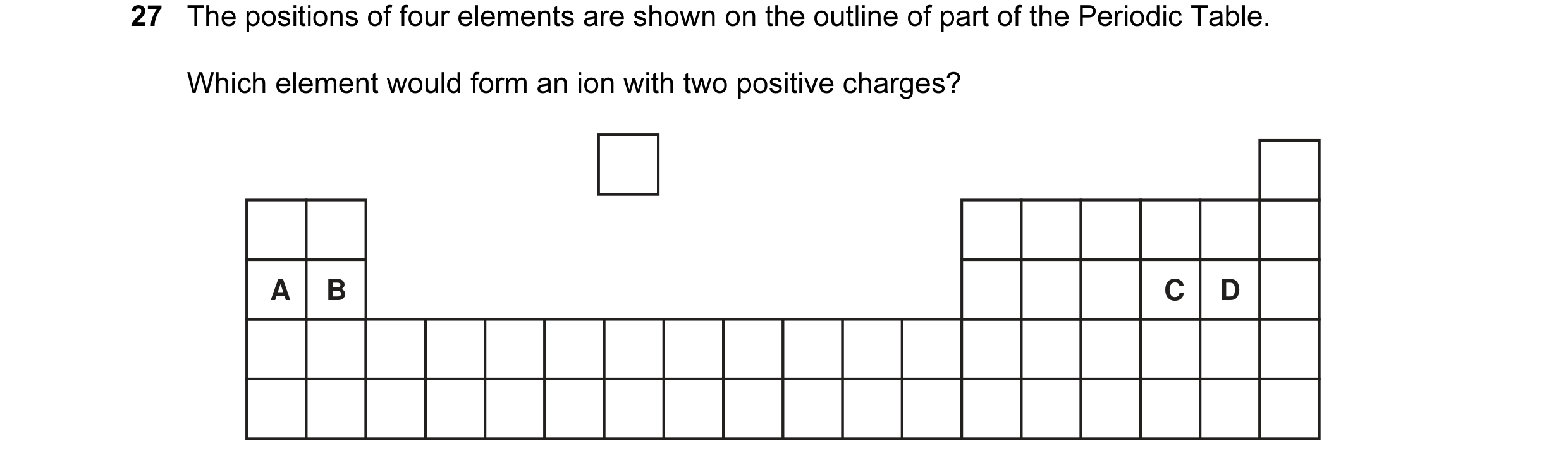
27 The positions of four elements are shown on the outline of part of the Periodic Table. Which element would form an ion with two positive charges? A B C D
1 marks
Answer: B
This question in 0654/11 May/June 2006
Q2 · Substance X is an ionic compound 0654/11 Oct/Nov 2007
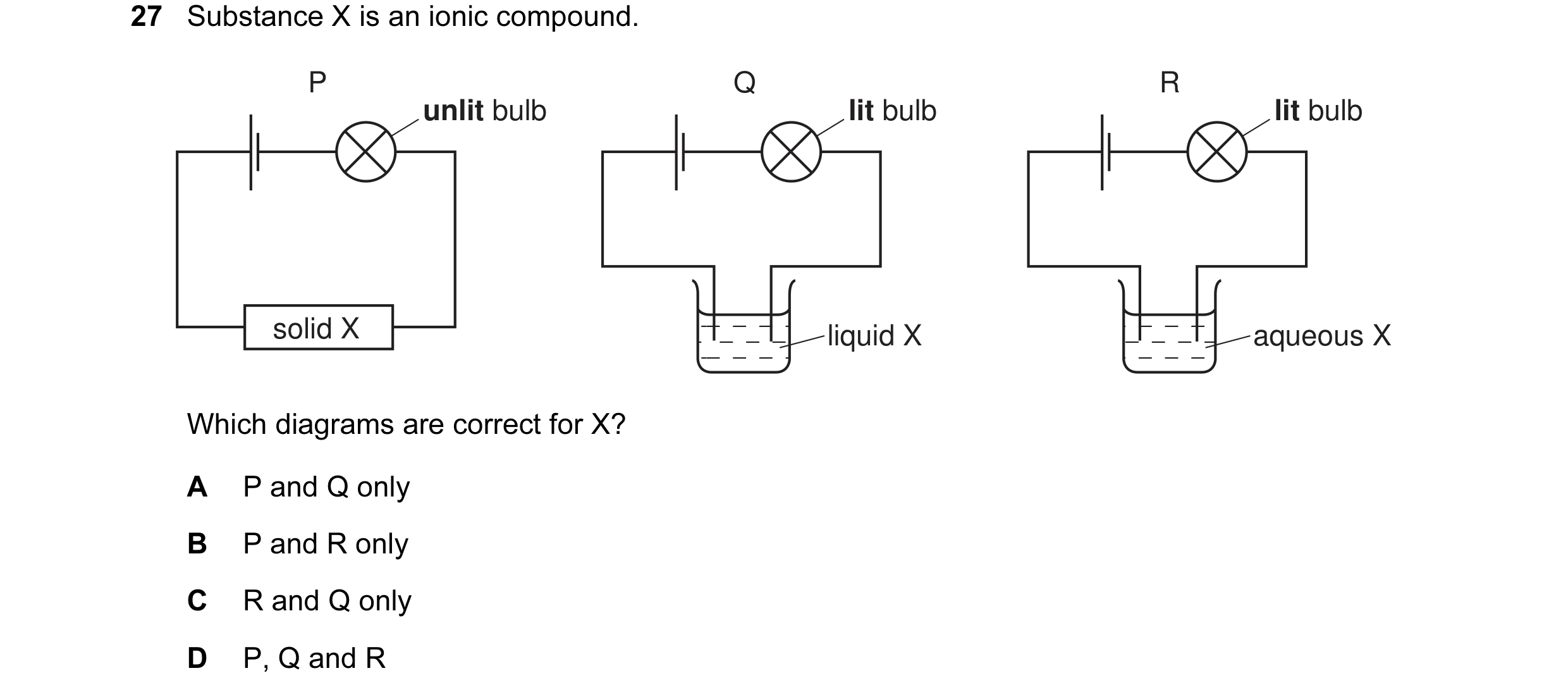
27 Substance X is an ionic compound. P Q R unlit bulb lit bulb lit bulb solid X liquid X aqueous X Which diagrams are correct for X? A P and Q only B P and R only C R and Q only D P, Q and R
1 marks
Answer: D
This question in 0654/11 Oct/Nov 2007
Q3 · When element X reacts with element Y, X donates an electron to Y 0654/11 May/June 2010
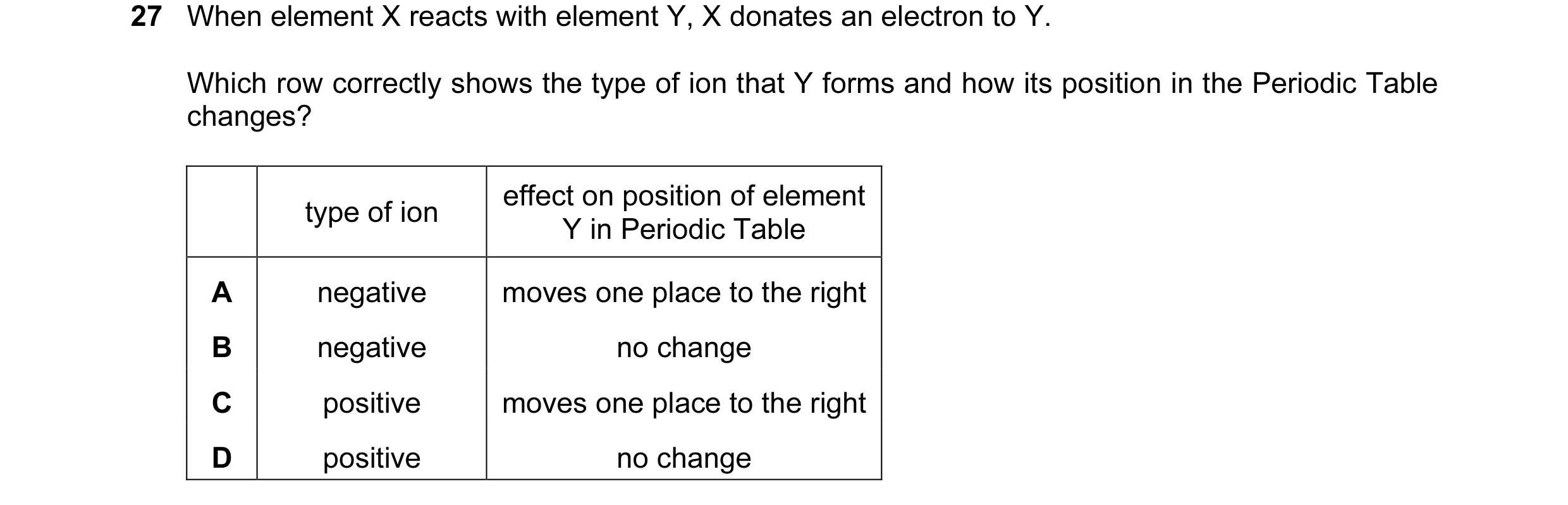
27 When element X reacts with element Y, X donates an electron to Y. Which row correctly shows the type of ion that Y forms and how its position in the Periodic Table changes? effect on position of element type of ion Y in Periodic Table A negative moves one place to the right B negative no change C positive moves one place to the right D positive no change
1 marks
Answer: B
This question in 0654/11 May/June 2010
Q4 · When element X reacts with element Y, X donates an electron to Y 0654/12 May/June 2010
15 When element X reacts with element Y, X donates an electron to Y. Which row correctly shows the type of ion that Y forms and how its position in the Periodic Table changes? effect on position of element type of ion Y in Periodic Table A negative moves one place to the right B negative no change C positive moves one place to the right D positive no change
1 marks
Answer: B
This question in 0654/12 May/June 2010
Q5 · Elements X and Y react together to form a compound 0654/11 Oct/Nov 2010
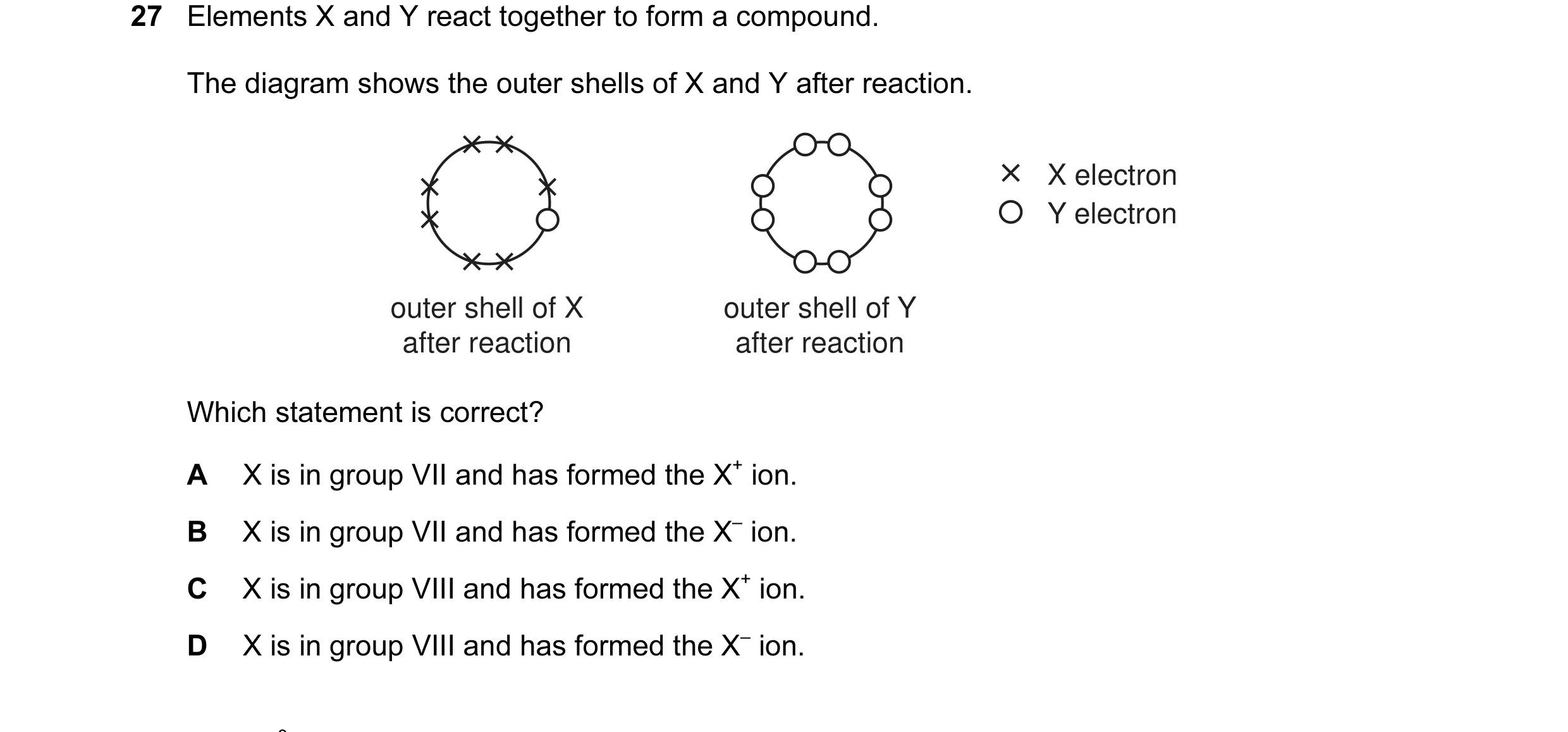
27 Elements X and Y react together to form a compound. The diagram shows the outer shells of X and Y after reaction. X electron Y electron outer shell of X outer shell of Y after reaction after reaction Which statement is correct? A X is in group VII and has formed the X+ ion. B X is in group VII and has formed the X– ion. C X is in group VIII and has formed the X+ ion. D X is in group VIII and has formed the X– ion.
1 marks
Answer: B
This question in 0654/11 Oct/Nov 2010
Q6 · Elements X and Y react together to form a compound 0654/12 Oct/Nov 2010
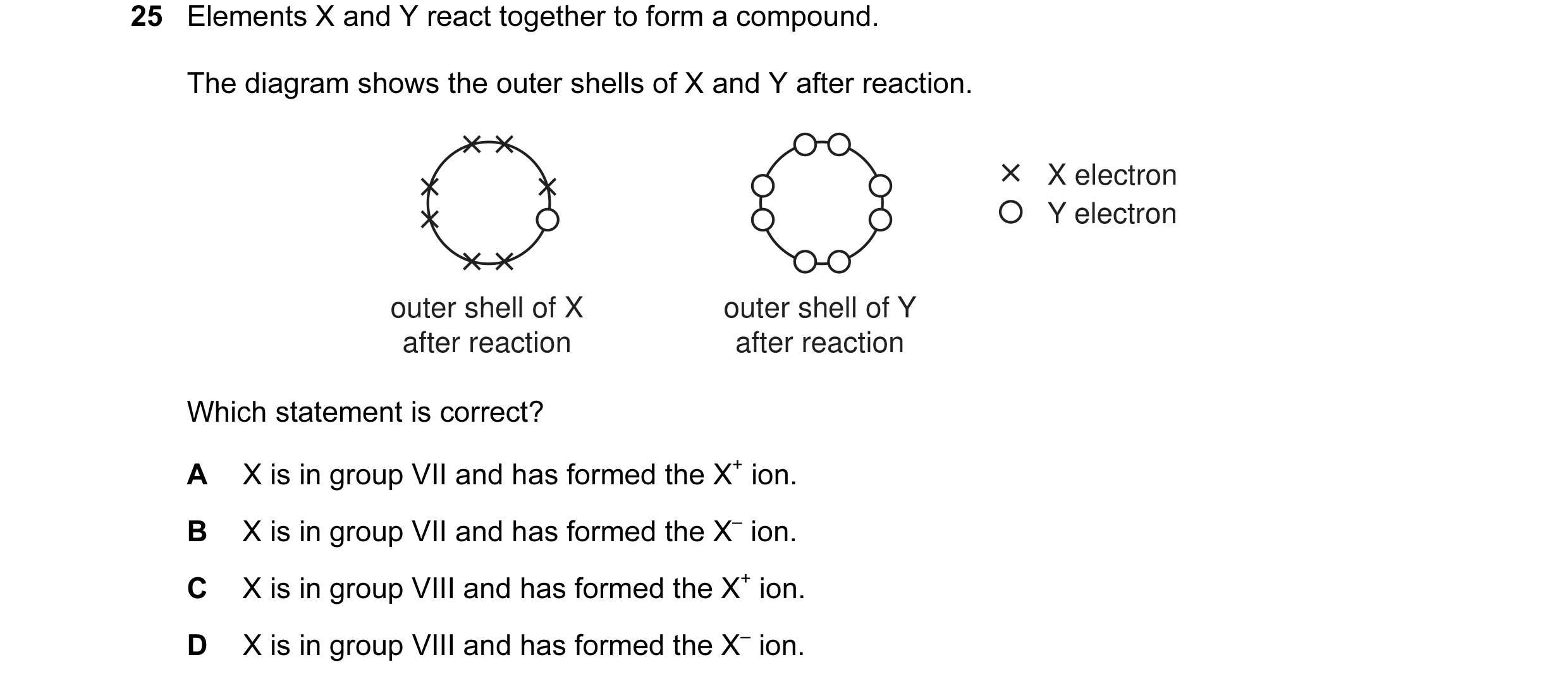
25 Elements X and Y react together to form a compound. The diagram shows the outer shells of X and Y after reaction. X electron Y electron outer shell of X outer shell of Y after reaction after reaction Which statement is correct? A X is in group VII and has formed the X+ ion. B X is in group VII and has formed the X– ion. C X is in group VIII and has formed the X+ ion. D X is in group VIII and has formed the X– ion.
1 marks
Answer: B
This question in 0654/12 Oct/Nov 2010
Q7 · Elements X and Y react together to form a compound 0654/13 Oct/Nov 2010
28 Elements X and Y react together to form a compound. The diagram shows the outer shells of X and Y after reaction. X electron Y electron outer shell of X outer shell of Y after reaction after reaction Which statement is correct? A X is in group VII and has formed the X+ ion. B X is in group VII and has formed the X– ion. C X is in group VIII and has formed the X+ ion. D X is in group VIII and has formed the X– ion.
1 marks
Answer: B
This question in 0654/13 Oct/Nov 2010
Q8 · Hydrogen can occur as an atom, an ion and a molecule 0654/11 Oct/Nov 2013
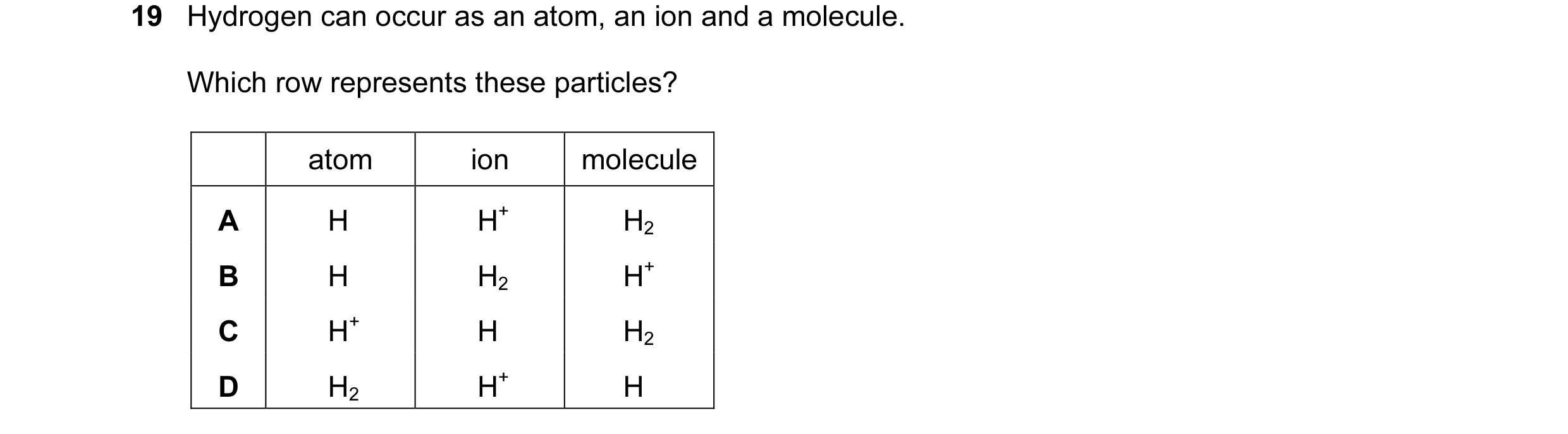
19 Hydrogen can occur as an atom, an ion and a molecule. Which row represents these particles? atom ion molecule A H H+ H2 B H H2 H+ C H+ H H2 D H2 H+ H
1 marks
Answer: A
This question in 0654/11 Oct/Nov 2013
Q9 · The experiment shown is used to investigate the properties of solid X 0654/12 Oct/Nov 2013
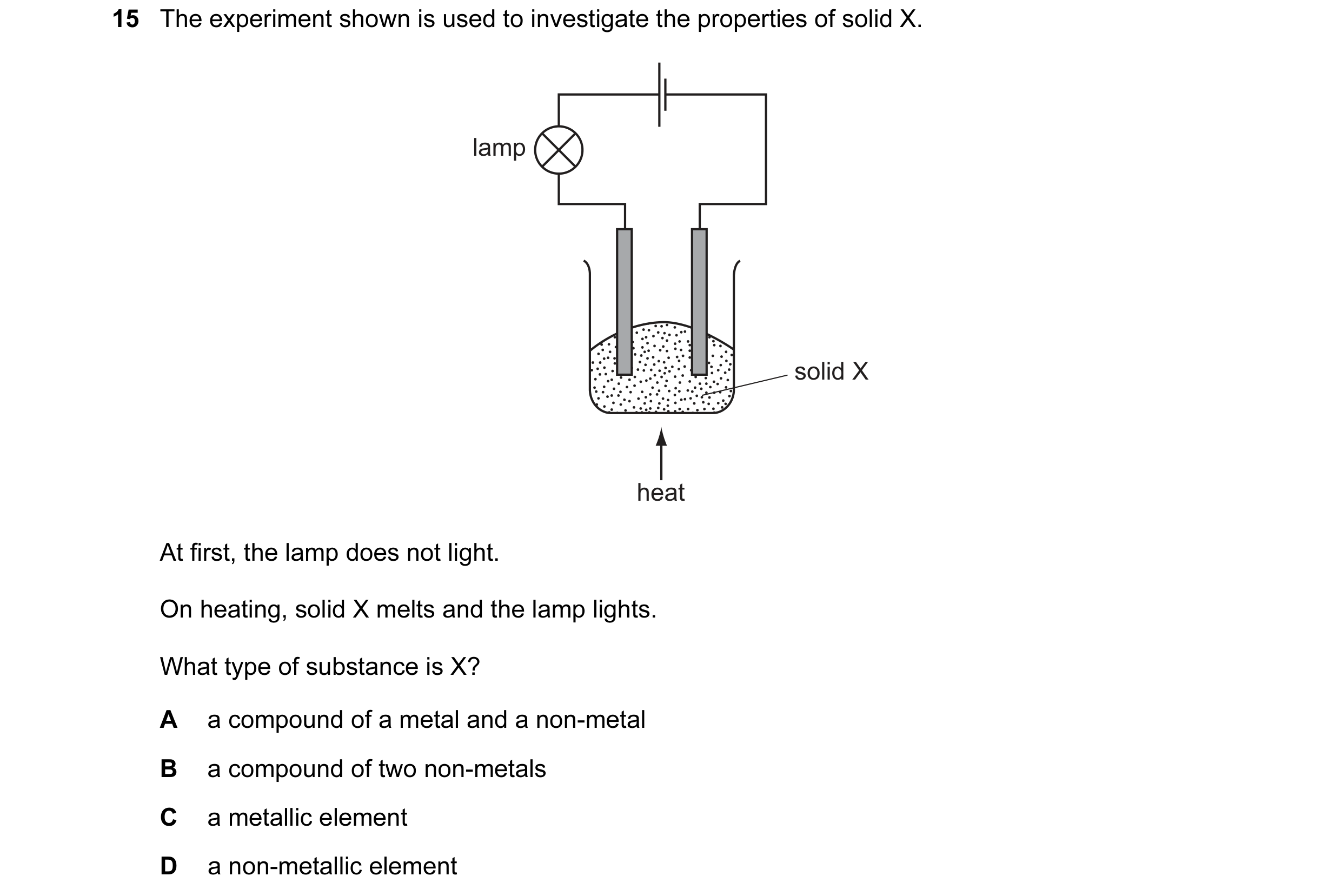
15 The experiment shown is used to investigate the properties of solid X. lamp solid X heat At first, the lamp does not light. On heating, solid X melts and the lamp lights. What type of substance is X? A a compound of a metal and a non-metal B a compound of two non-metals C a metallic element D a non-metallic element
1 marks
Answer: A
This question in 0654/12 Oct/Nov 2013
Q10 · Hydrogen can occur as an atom, an ion and a molecule 0654/12 Oct/Nov 2013
18 Hydrogen can occur as an atom, an ion and a molecule. Which row represents these particles? atom ion molecule A H H+ H2 B H H2 H+ C H+ H H2 D H2 H+ H
1 marks
Answer: A
This question in 0654/12 Oct/Nov 2013
Q11 · The experiment shown is used to investigate the properties of solid X 0654/13 Oct/Nov 2013
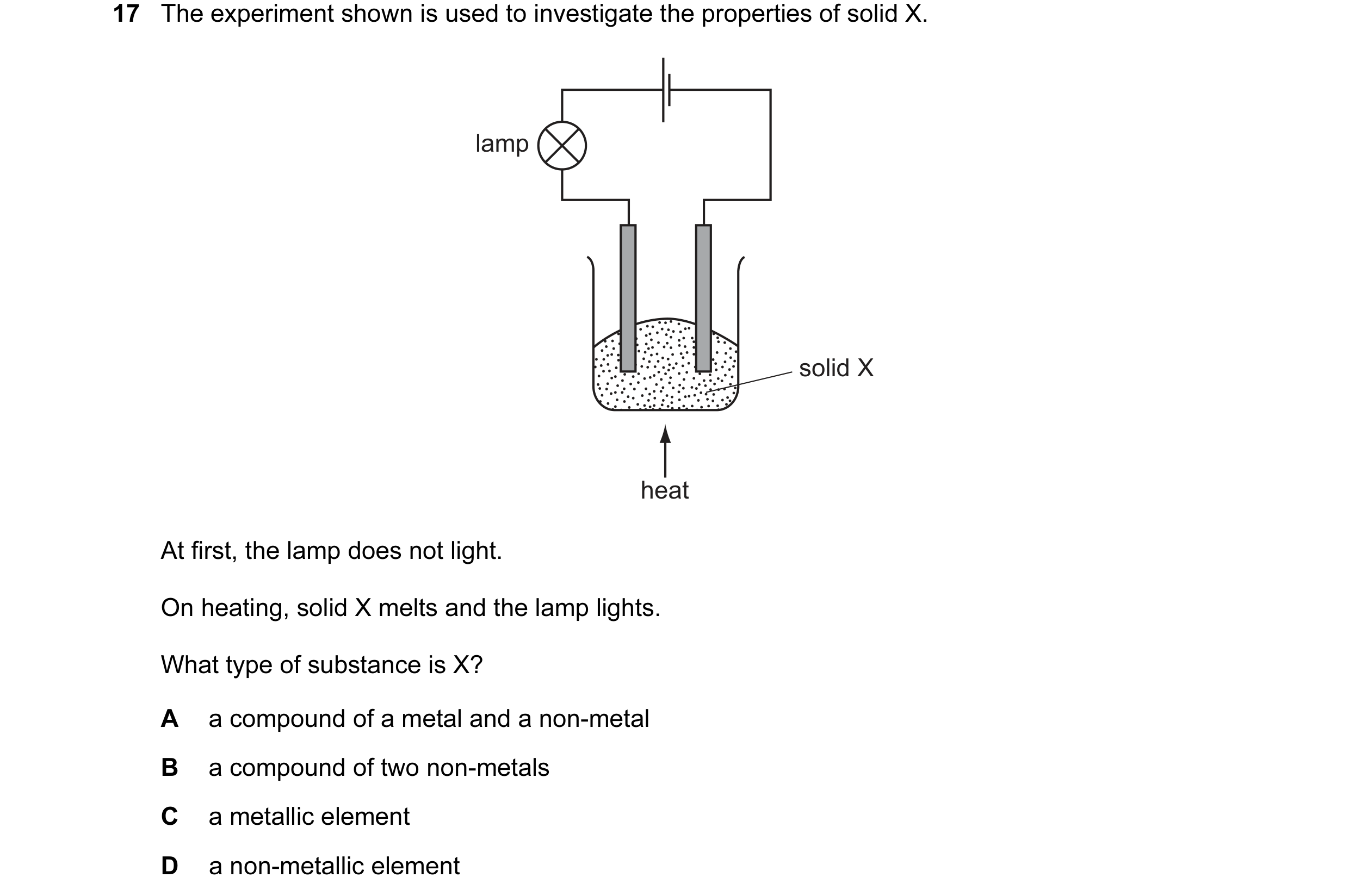
17 The experiment shown is used to investigate the properties of solid X. lamp solid X heat At first, the lamp does not light. On heating, solid X melts and the lamp lights. What type of substance is X? A a compound of a metal and a non-metal B a compound of two non-metals C a metallic element D a non-metallic element
1 marks
Answer: A
This question in 0654/13 Oct/Nov 2013
Q12 · Magnesium forms an ionic compound with chlorine 0654/11 May/June 2014
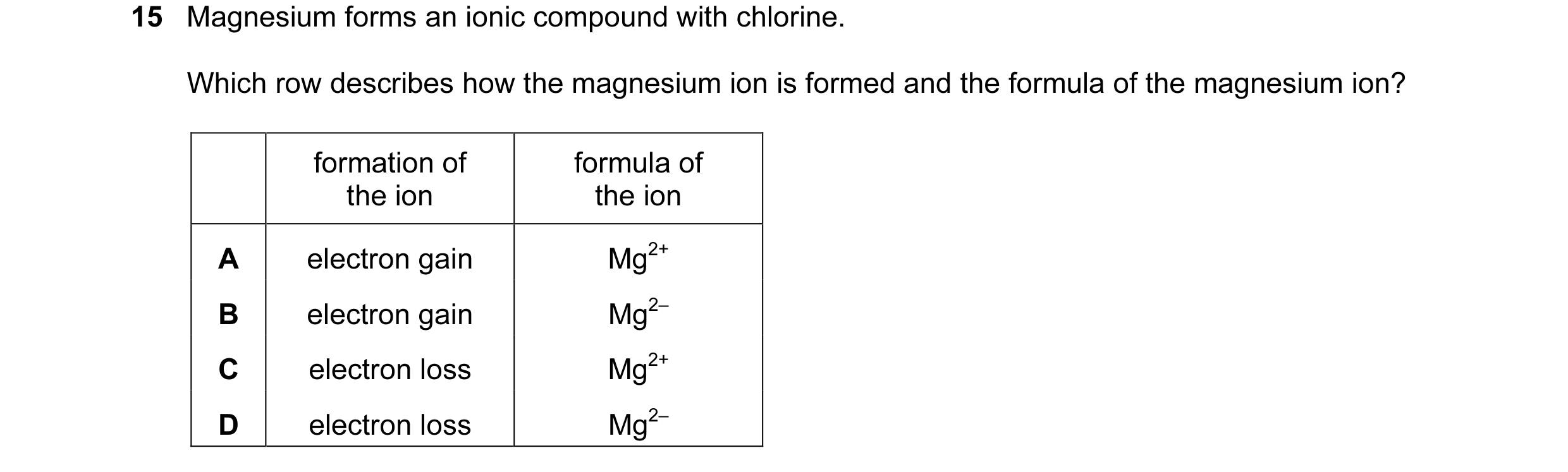
15 Magnesium forms an ionic compound with chlorine. Which row describes how the magnesium ion is formed and the formula of the magnesium ion? formation of formula of the ion the ion A electron gain Mg2+ B electron gain Mg2– C electron loss Mg2+ D electron loss Mg2–
1 marks
Answer: C
This question in 0654/11 May/June 2014
Q13 · Magnesium forms an ionic compound with chlorine 0654/13 May/June 2014
17 Magnesium forms an ionic compound with chlorine. Which row describes how the magnesium ion is formed and the formula of the magnesium ion? formation of formula of the ion the ion A electron gain Mg2+ B electron gain Mg2– C electron loss Mg2+ D electron loss Mg2–
1 marks
Answer: C
This question in 0654/13 May/June 2014
Q14 · Sodium chloride (salt) has an ionic structure 0654/11 Oct/Nov 2014
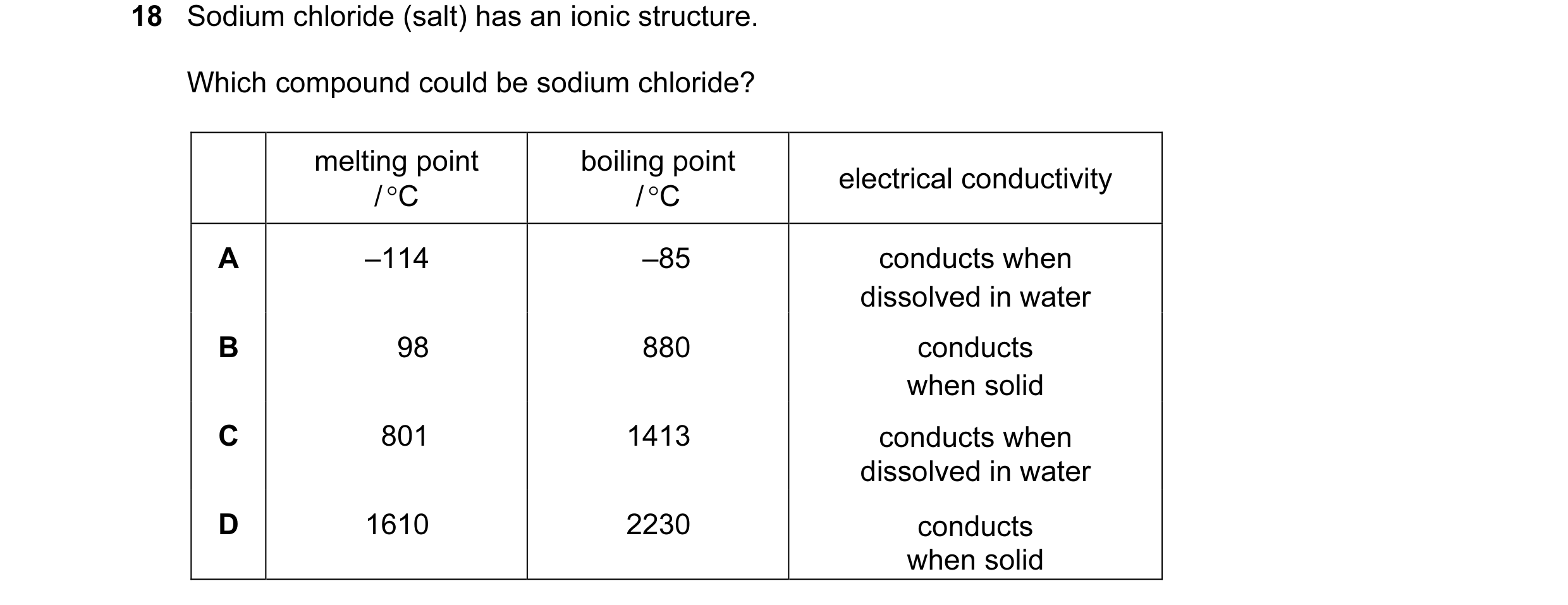
18 Sodium chloride (salt) has an ionic structure. Which compound could be sodium chloride? melting point boiling point electrical conductivity / °C / °C A –114 –85 conducts when dissolved in water B 98 880 conducts when solid C 801 1413 conducts when dissolved in water D 1610 2230 conducts when solid
1 marks
Answer: C
This question in 0654/11 Oct/Nov 2014
Q15 · Sodium chloride (salt) has an ionic structure 0654/12 Oct/Nov 2014
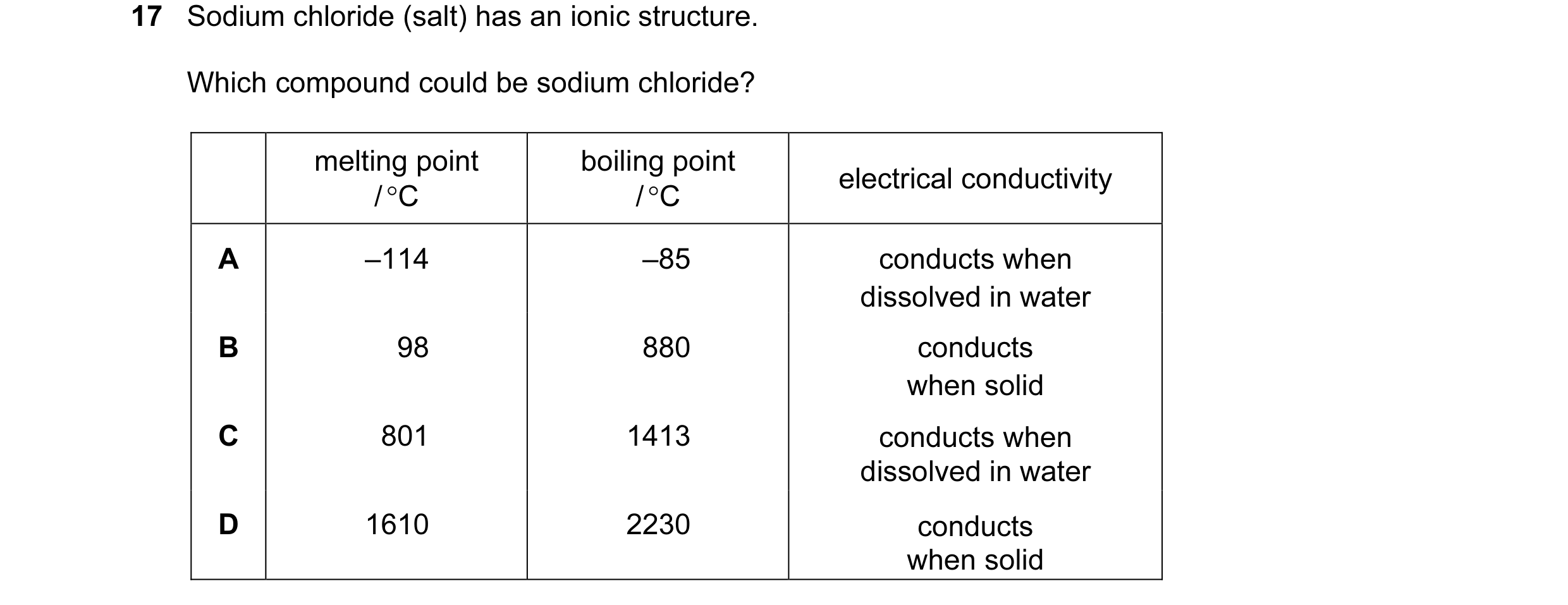
17 Sodium chloride (salt) has an ionic structure. Which compound could be sodium chloride? melting point boiling point electrical conductivity / °C / °C A –114 –85 conducts when dissolved in water B 98 880 conducts when solid C 801 1413 conducts when dissolved in water D 1610 2230 conducts when solid
1 marks
Answer: C
This question in 0654/12 Oct/Nov 2014
Q16 · Some properties of three substances are shown 0654/13 Oct/Nov 2014
19 Some properties of three substances are shown. melting point boiling point electrical conductivity substance / °C / °C when solid W 801 1413 poor X −111 −78 poor Y 1610 2230 good What are W, X and Y? metallic ionic covalent A W Y X B X W Y C Y W X D Y X W
1 marks
Answer: C
This question in 0654/13 Oct/Nov 2014
Q17 · The positions of four elements are shown on the outline of part of the Periodic Table 0654/11 May/June 2015
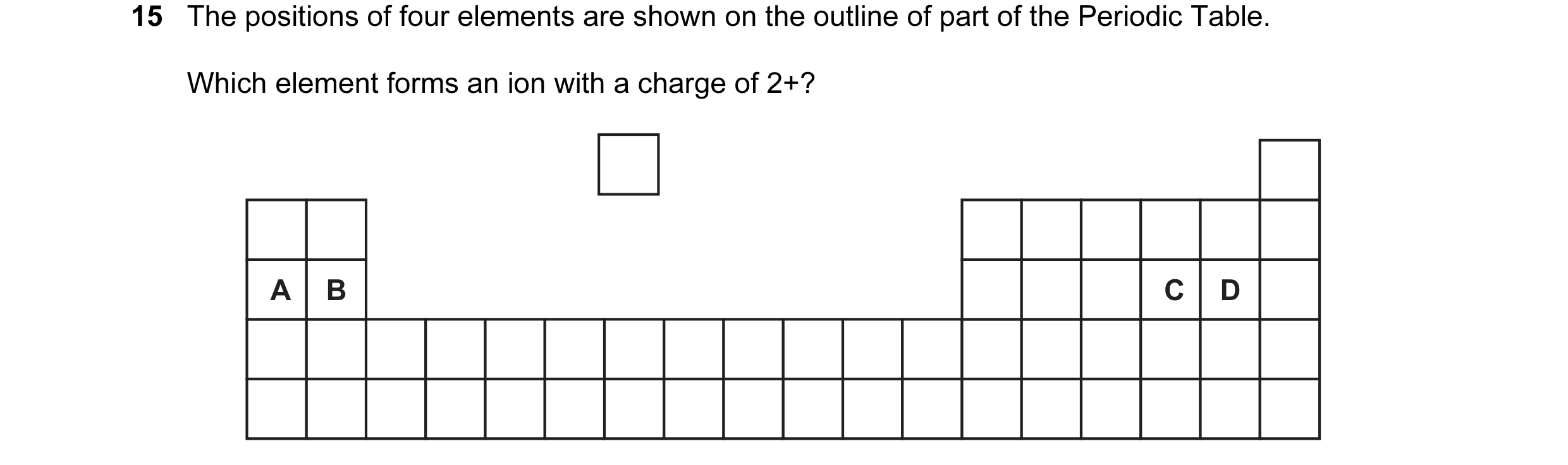
15 The positions of four elements are shown on the outline of part of the Periodic Table. Which element forms an ion with a charge of 2+? A B C D
1 marks
Answer: B
This question in 0654/11 May/June 2015
Q18 · The positions of four elements are shown on the outline of part of the Periodic Table 0654/12 May/June 2015
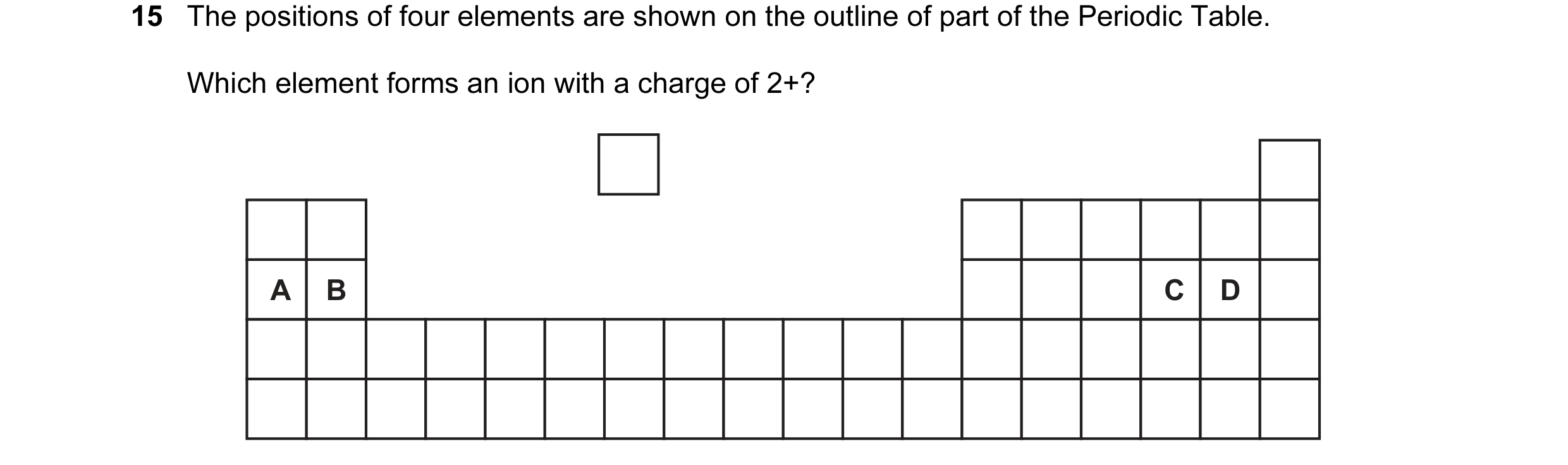
15 The positions of four elements are shown on the outline of part of the Periodic Table. Which element forms an ion with a charge of 2+? A B C D
1 marks
Answer: B
This question in 0654/12 May/June 2015
Q19 · The positions of four elements are shown on the outline of part of the Periodic Table 0654/13 May/June 2015
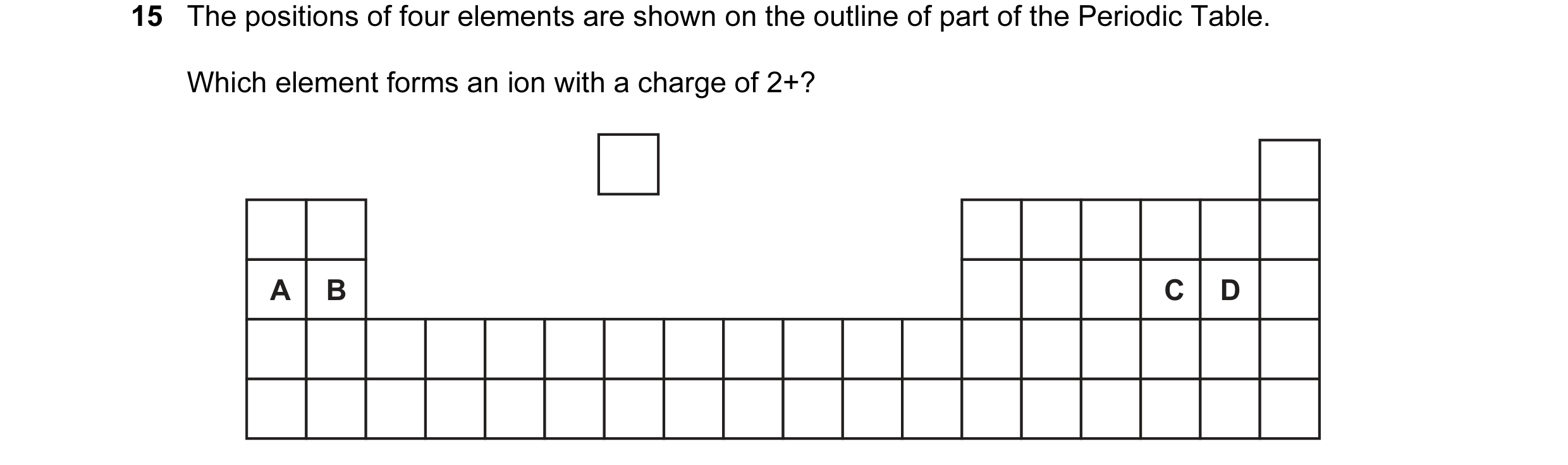
15 The positions of four elements are shown on the outline of part of the Periodic Table. Which element forms an ion with a charge of 2+? A B C D
1 marks
Answer: B
This question in 0654/13 May/June 2015
Q20 · The diagram shows the electrolysis of a dilute solution of copper(II) chloride using… 0654/13 Oct/Nov 2015
18 The diagram shows the electrolysis of a dilute solution of copper(II) chloride using inert electrodes. + – dilute copper(II) chloride solution Which row shows the products formed at each electrode and describes the bonding in copper(II) chloride? type of anode cathode bonding A chlorine copper ionic B chlorine hydrogen covalent C oxygen copper ionic D oxygen hydrogen covalent
1 marks
Answer: A
This question in 0654/13 Oct/Nov 2015
Q21 · Hexane is a covalent compound 0654/13 May/June 2016
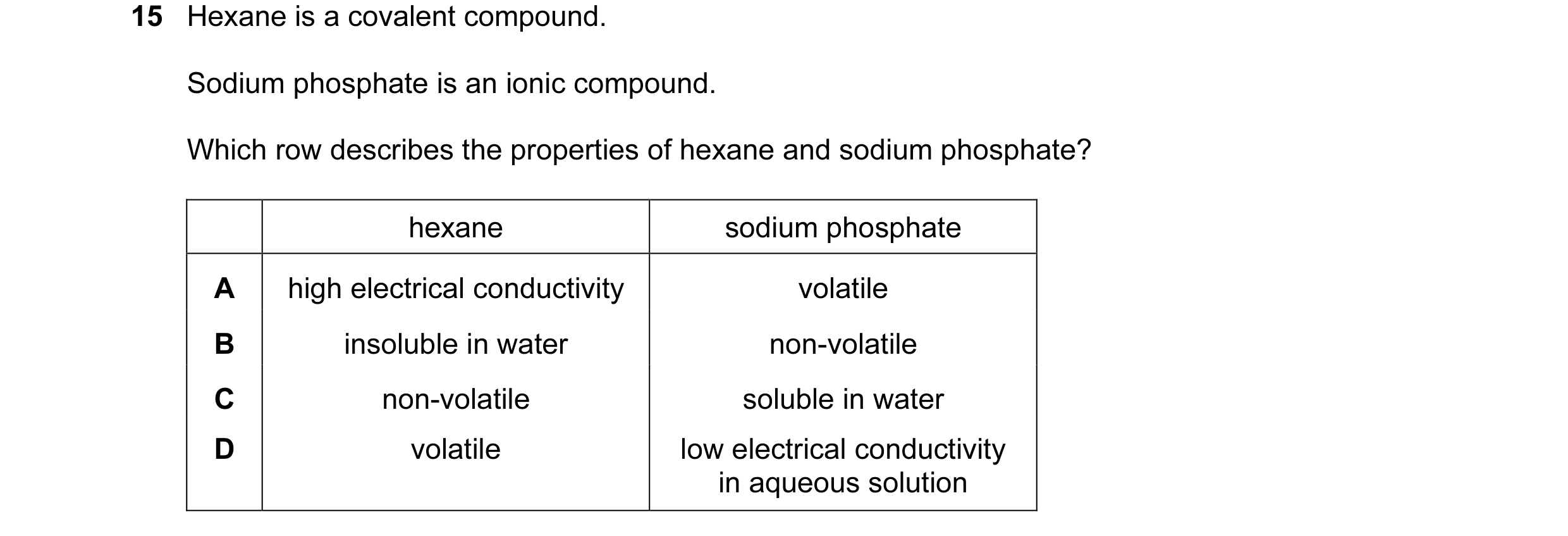
15 Hexane is a covalent compound. Sodium phosphate is an ionic compound. Which row describes the properties of hexane and sodium phosphate? hexane sodium phosphate A high electrical conductivity volatile B insoluble in water non-volatile C non-volatile soluble in water D volatile low electrical conductivity in aqueous solution
1 marks
Answer: B
This question in 0654/13 May/June 2016
Q22 · Which diagram represents a fluoride ion? 0654/12 May/June 2019
16 Which diagram represents a fluoride ion? A B + – C D + –
1 marks
Answer: D
This question in 0654/12 May/June 2019
Q23 · Which diagram represents a fluoride ion? 0654/13 May/June 2019
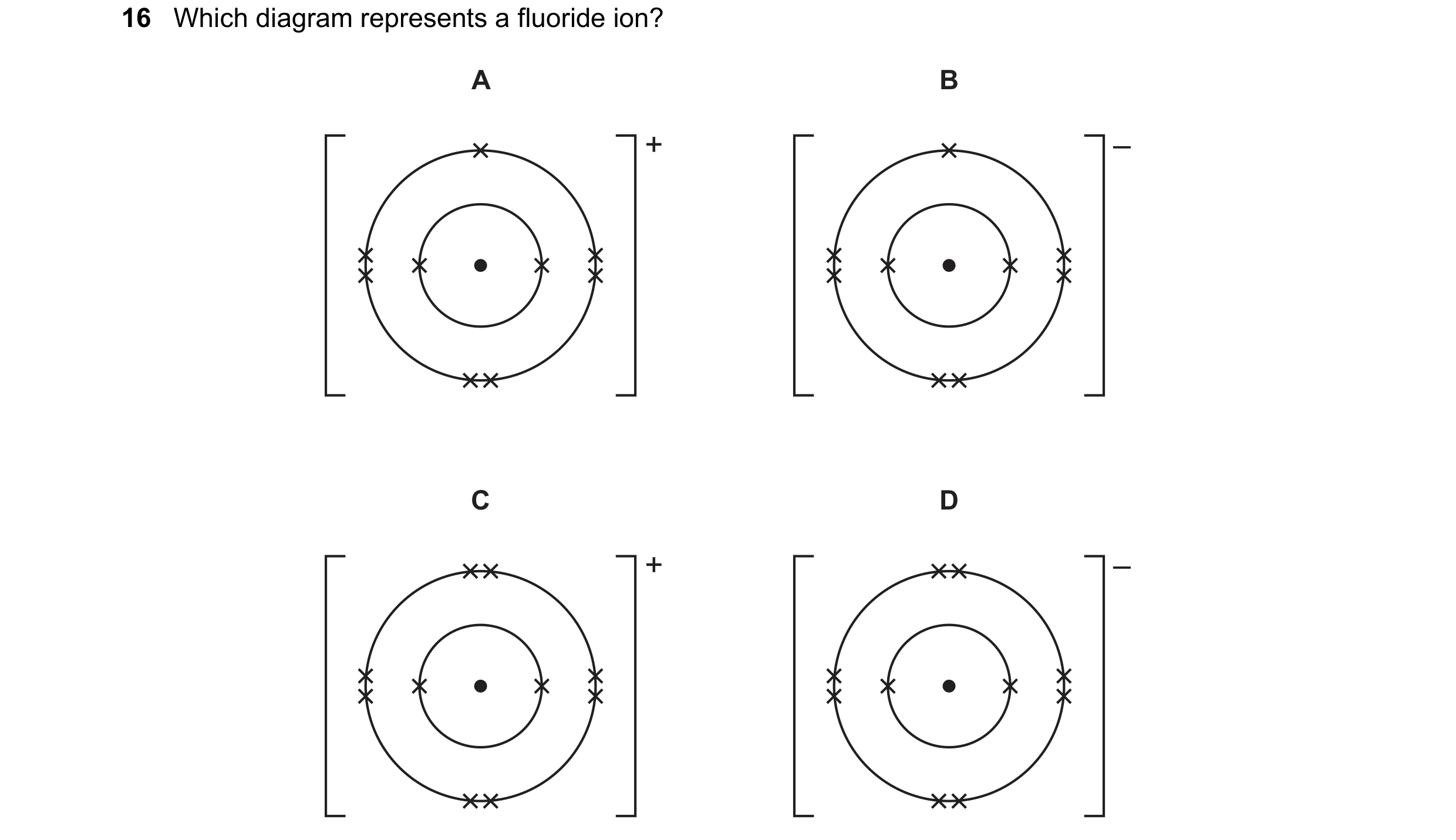
16 Which diagram represents a fluoride ion? A B + – C D + –
1 marks
Answer: D
This question in 0654/13 May/June 2019
Q24 · What happens to a tellurium atom when it forms a tellurium ion, Te2–? 0654/13 May/June 2020
16 What happens to a tellurium atom when it forms a tellurium ion, Te2–? A It gains two electrons. B It gains two protons. C It loses two electrons. D It loses two protons.
1 marks
Answer: A
This question in 0654/13 May/June 2020
Q25 · Part of the Periodic Table is shown 0654/11 Oct/Nov 2021
15 Part of the Periodic Table is shown. The letters are not the symbols of the elements in the Periodic Table. W X Y Z Which statement is not correct? A W and X are metallic elements. B W and Z form an ionic compound. C X and Y form a covalent compound. D Z is a non-metallic element.
1 marks
Answer: C
This question in 0654/11 Oct/Nov 2021
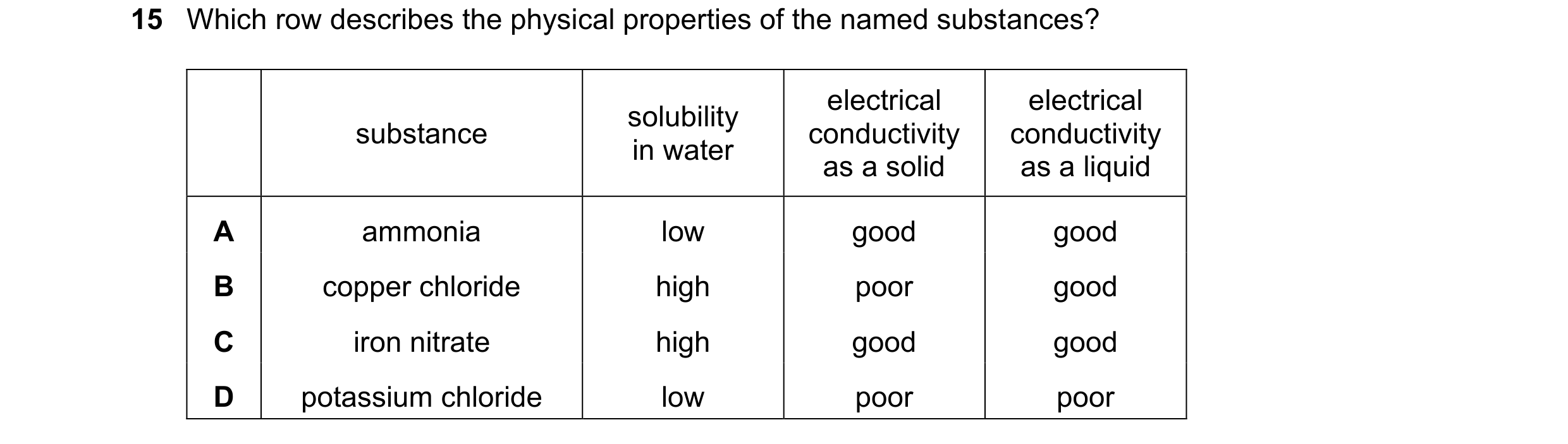
Q26 · Which row describes the physical properties of the named substances? 0654/12 Oct/Nov 2021
15 Which row describes the physical properties of the named substances? electrical electrical solubility substance conductivity conductivity in water as a solid as a liquid A ammonia low good good B copper chloride high poor good C iron nitrate high good good D potassium chloride low poor poor
1 marks
Answer: B
This question in 0654/12 Oct/Nov 2021
Q27 · Lithium is in Group I and bromine is in Group VII of the Periodic Table 0654/11 May/June 2023
17 Lithium is in Group I and bromine is in Group VII of the Periodic Table. What is the formula of lithium bromide? A LiBr B LiBr2 C Li2Br D Li2Br2
1 marks
Answer: A
This question in 0654/11 May/June 2023
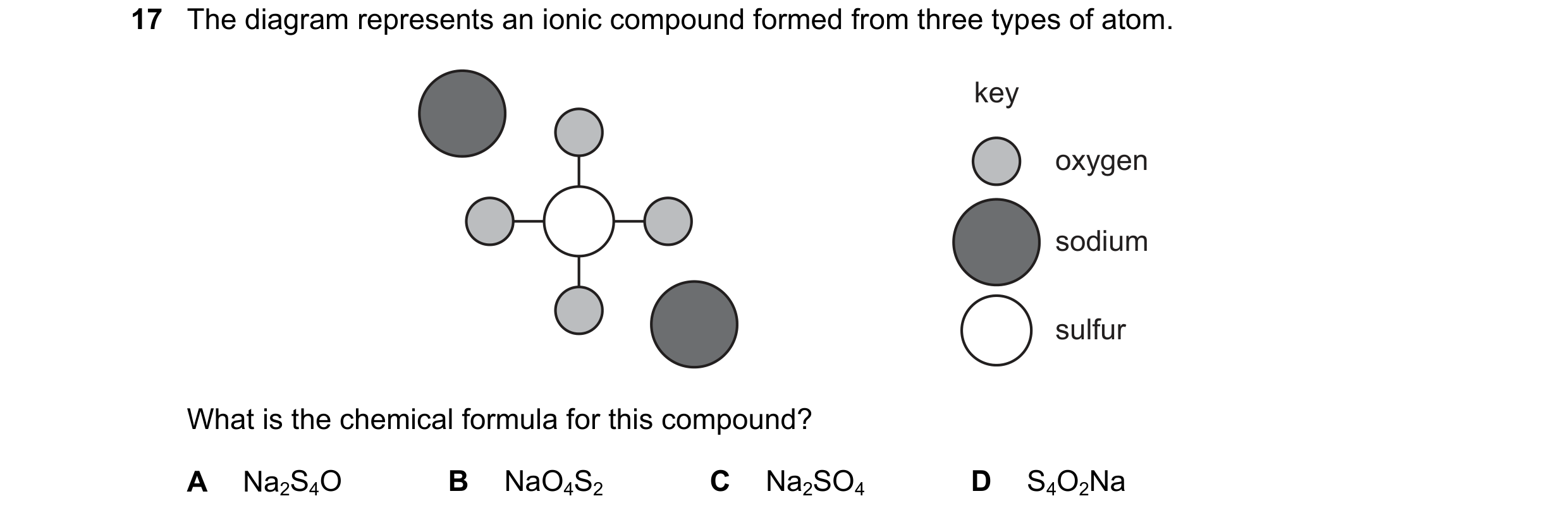
Q28 · The diagram represents an ionic compound formed from three types of atom 0654/11 Oct/Nov 2023
17 The diagram represents an ionic compound formed from three types of atom. key oxygen sodium sulfur What is the chemical formula for this compound? A Na2S4O B NaO4S2 C Na2SO4 D S4O2Na
1 marks
Answer: C
This question in 0654/11 Oct/Nov 2023
Q29 · Which elements react together to form an ionic compound? 0654/11 May/June 2024
16 Which elements react together to form an ionic compound? A carbon and oxygen B nitrogen and hydrogen C potassium and bromine D sodium and lithium
1 marks
Answer: C
This question in 0654/11 May/June 2024
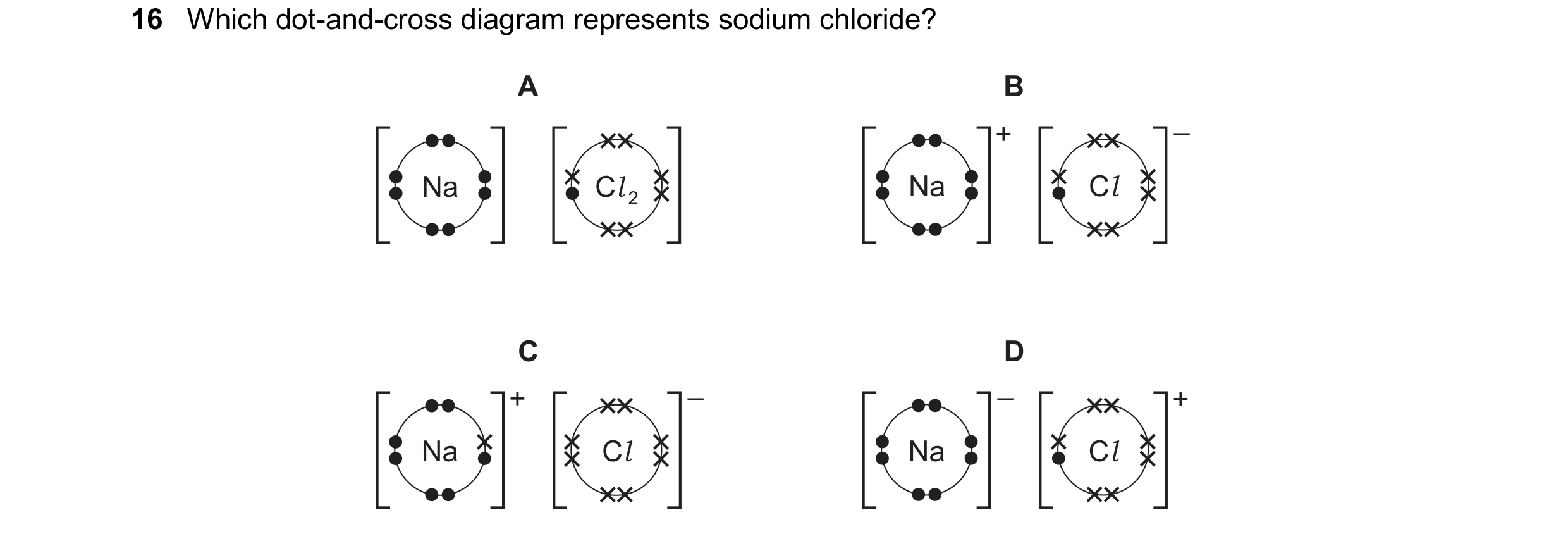
Q30 · Which dot-and-cross diagram represents sodium chloride? 0654/12 Feb/March 2025
16 Which dot-and-cross diagram represents sodium chloride? A B + – Na Cl 2 Na Cl C D + – – + Na Cl Na Cl
1 marks
Answer: B
This question in 0654/12 Feb/March 2025
Q31 · What happens to a tellurium atom when it forms a tellurium ion, Te2–? 0654/11 May/June 2025
17 What happens to a tellurium atom when it forms a tellurium ion, Te2–? A It gains two electrons. B It gains two protons. C It loses two electrons. D It loses two protons.
1 marks
Answer: A
This question in 0654/11 May/June 2025
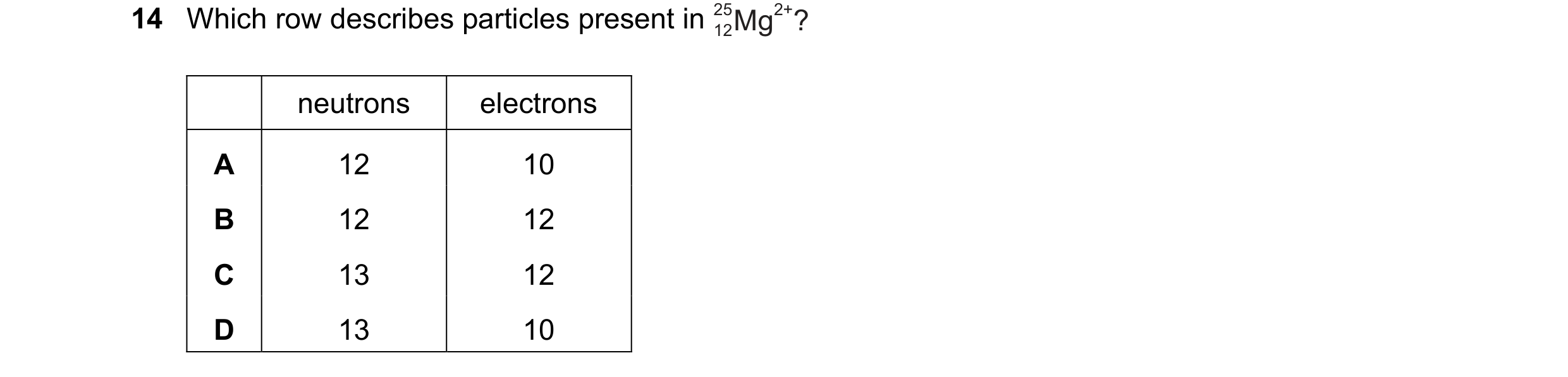
Q32 · Which row describes particles present in Mg 25 2+? 0654/12 May/June 2025
14 Which row describes particles present in Mg 25 2+? 12 neutrons electrons A 12 10 B 12 12 C 13 12 D 13 10
1 marks
Answer: D
This question in 0654/12 May/June 2025
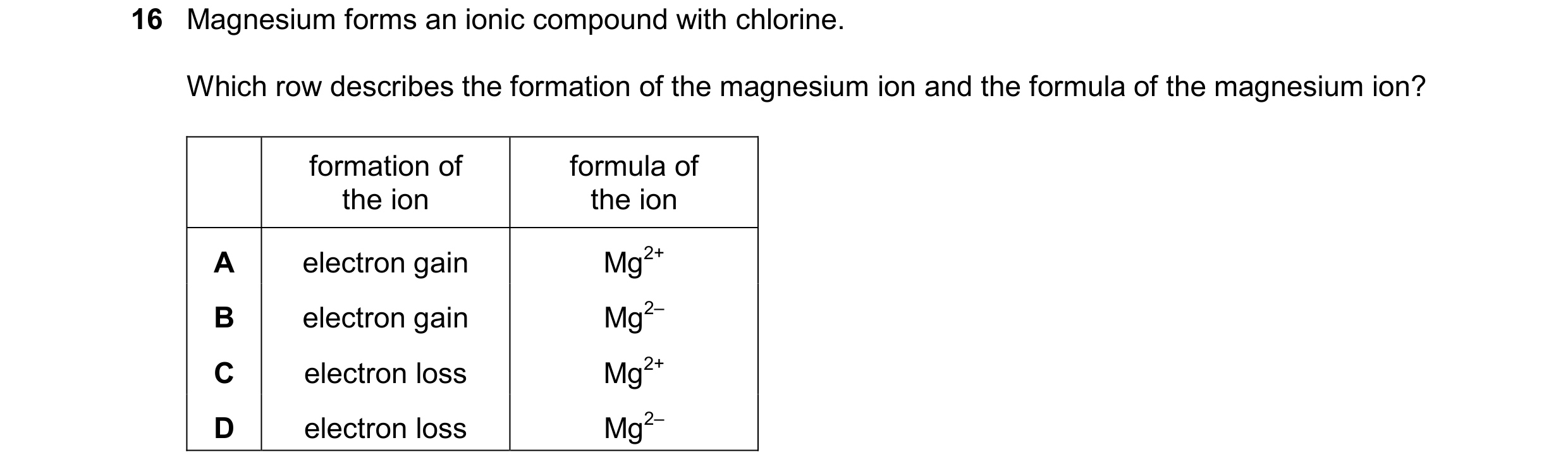
Q33 · Magnesium forms an ionic compound with chlorine 0654/11 Oct/Nov 2025
16 Magnesium forms an ionic compound with chlorine. Which row describes the formation of the magnesium ion and the formula of the magnesium ion? formation of formula of the ion the ion A electron gain Mg2+ B electron gain Mg2– C electron loss Mg2+ D electron loss Mg2–
1 marks
Answer: C
This question in 0654/11 Oct/Nov 2025
 1 / 10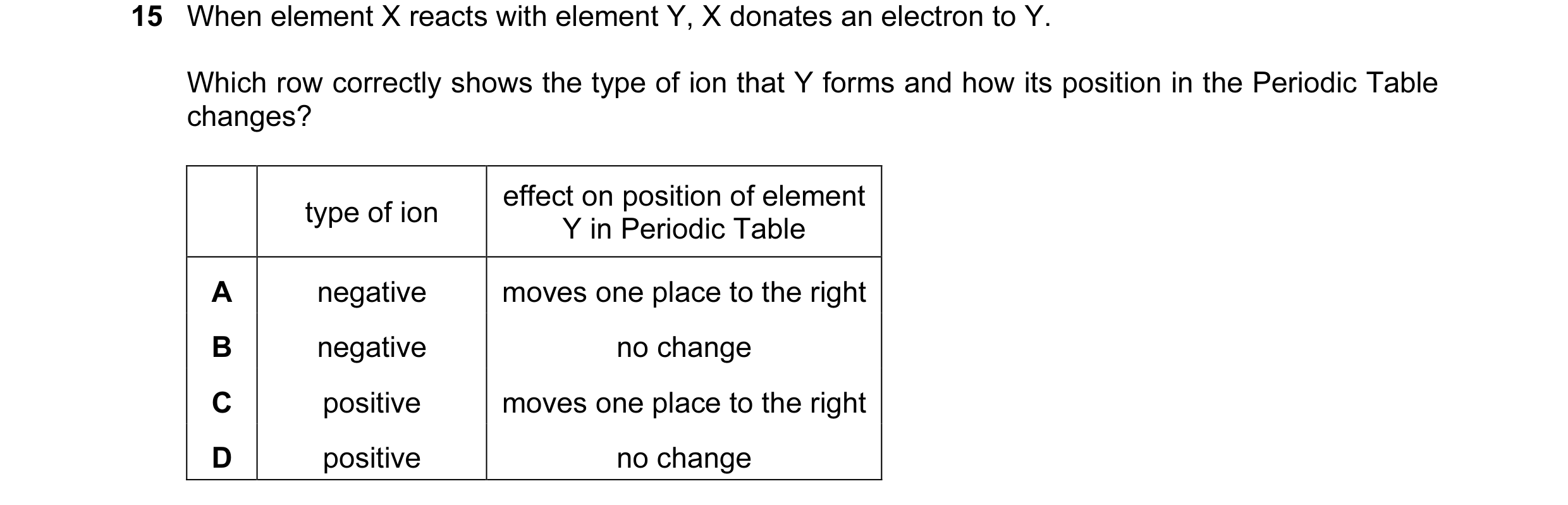
 2 / 10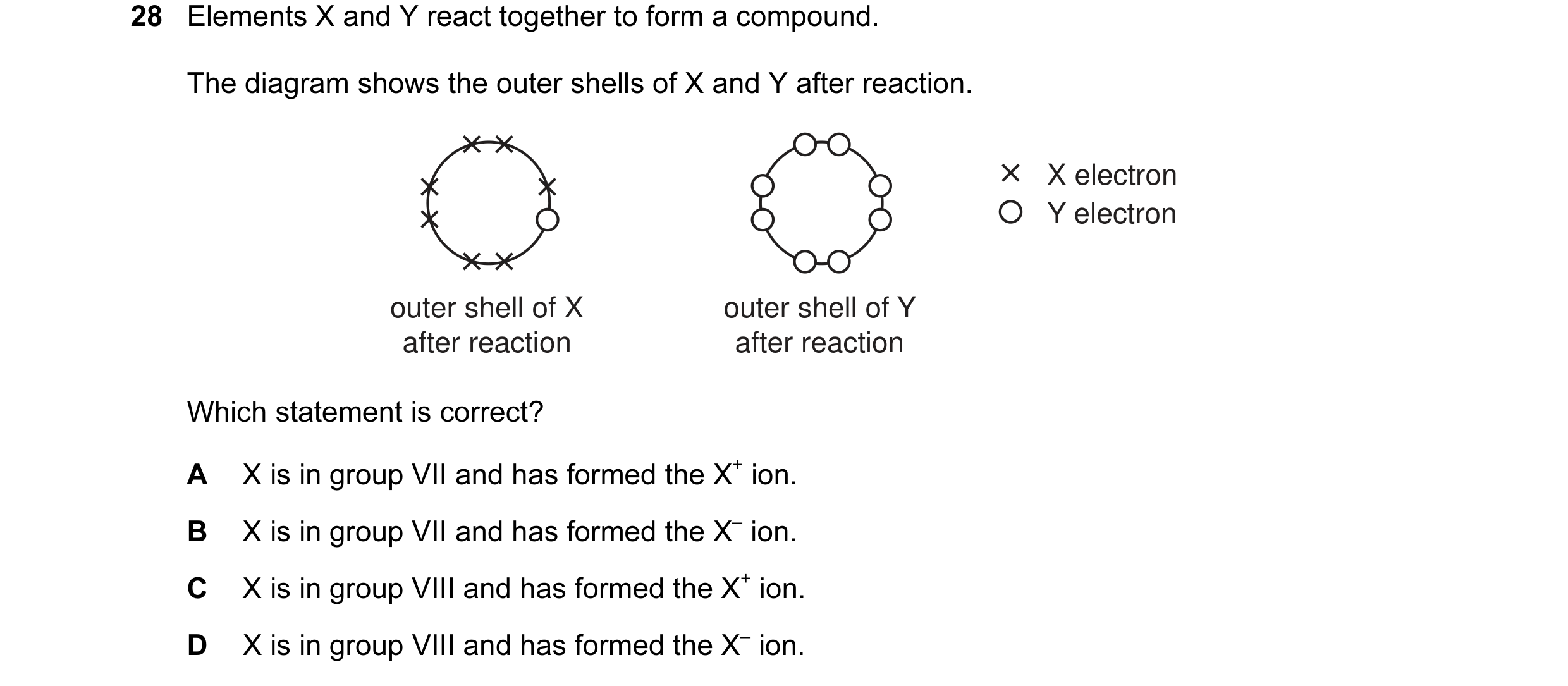
 3 / 10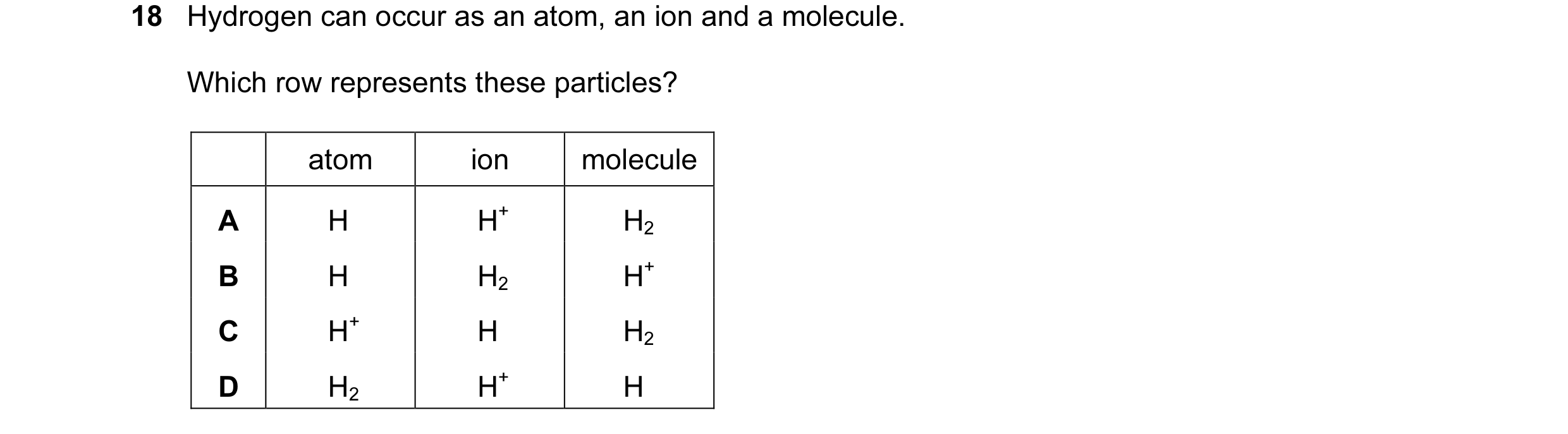
 4 / 10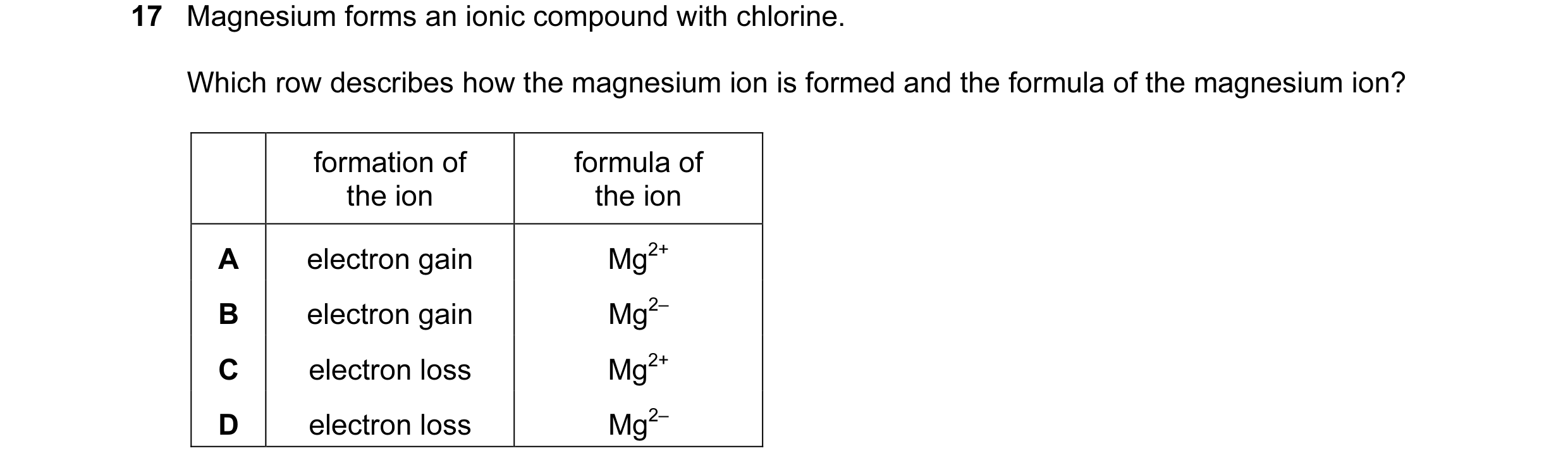
 5 / 10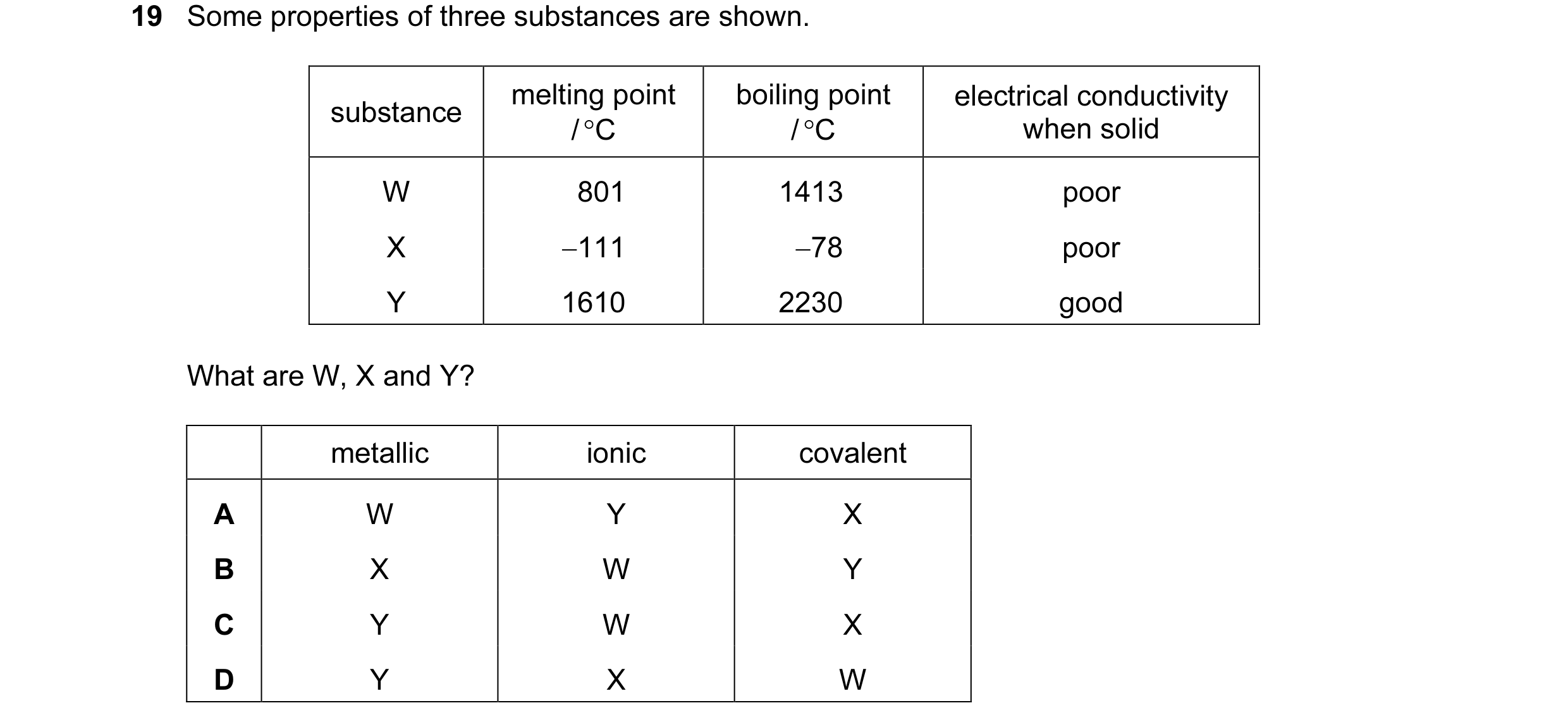
 6 / 10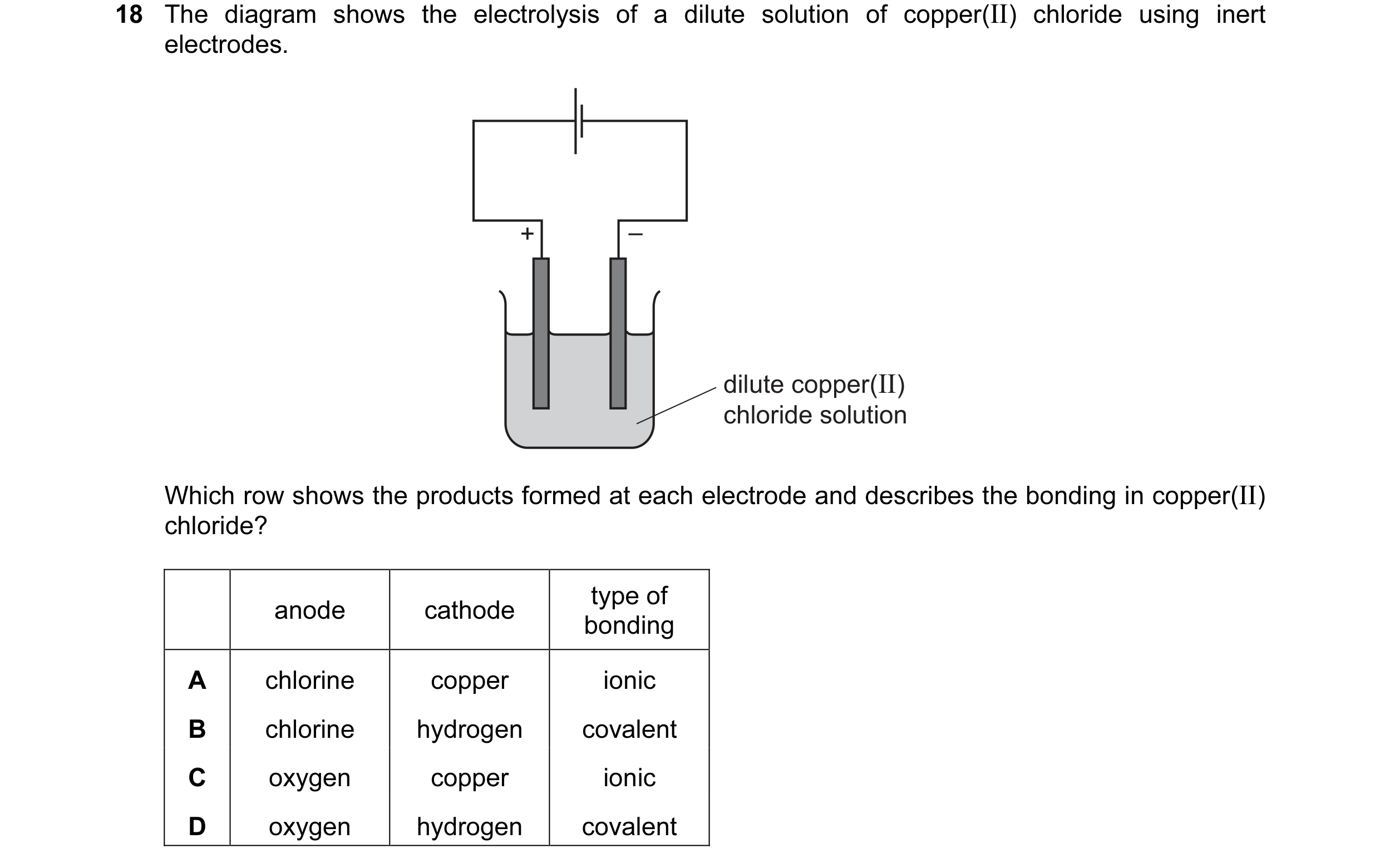
 7 / 10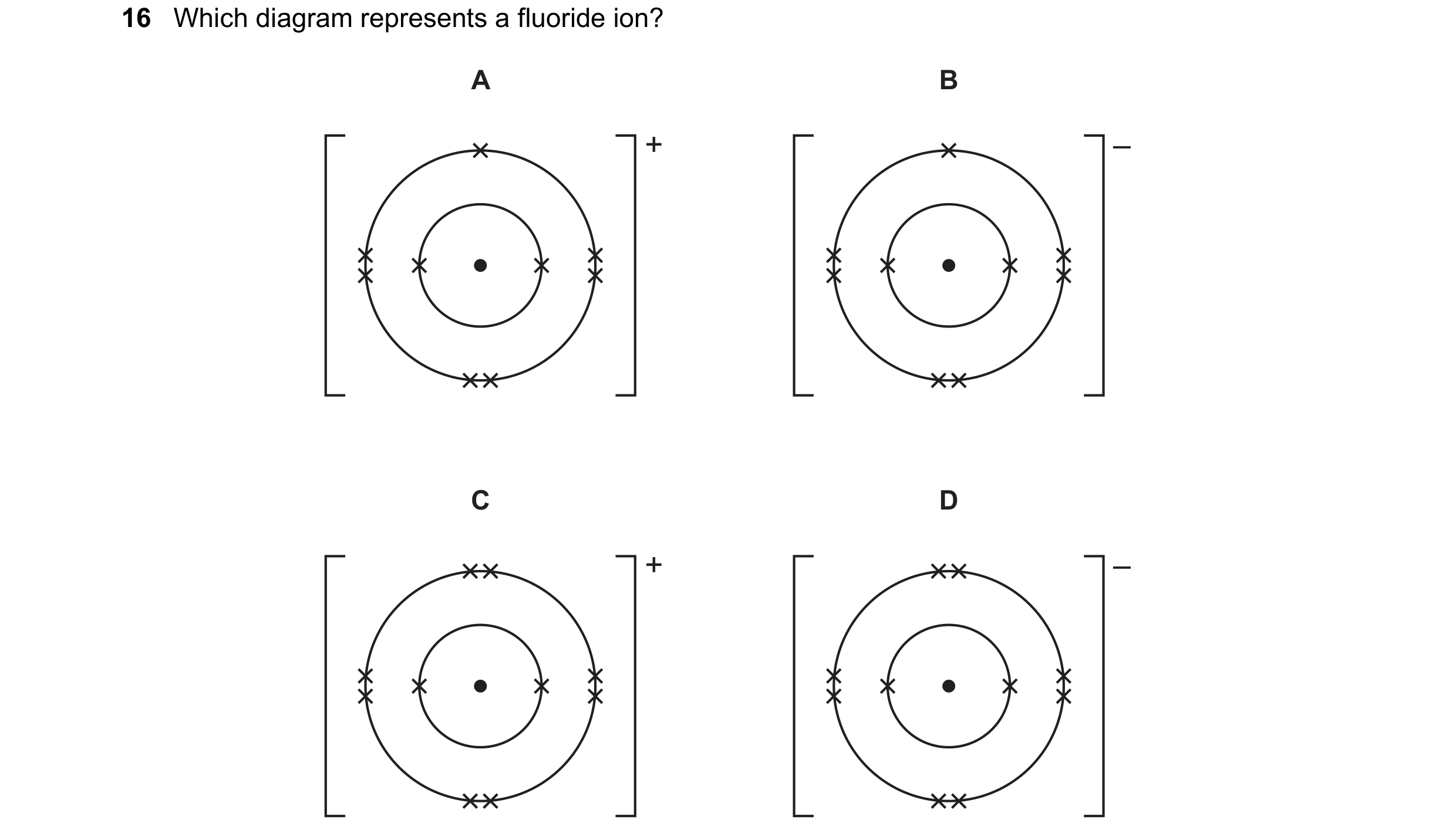
 8 / 10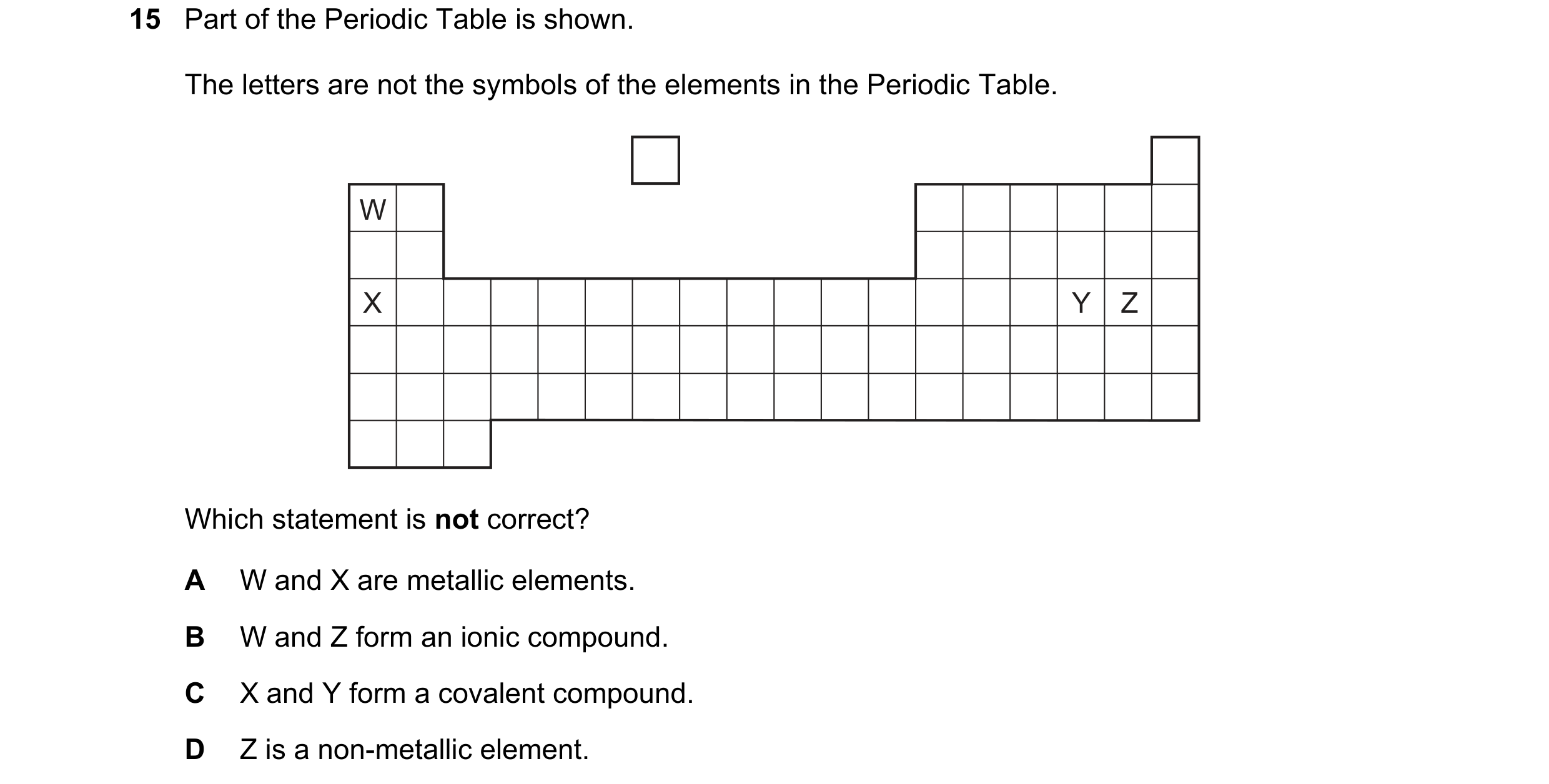

 9 / 10

 10 / 10