Questions as text
Q1 · Some physical properties of five elements, P to T 0654/31 May/June 2017
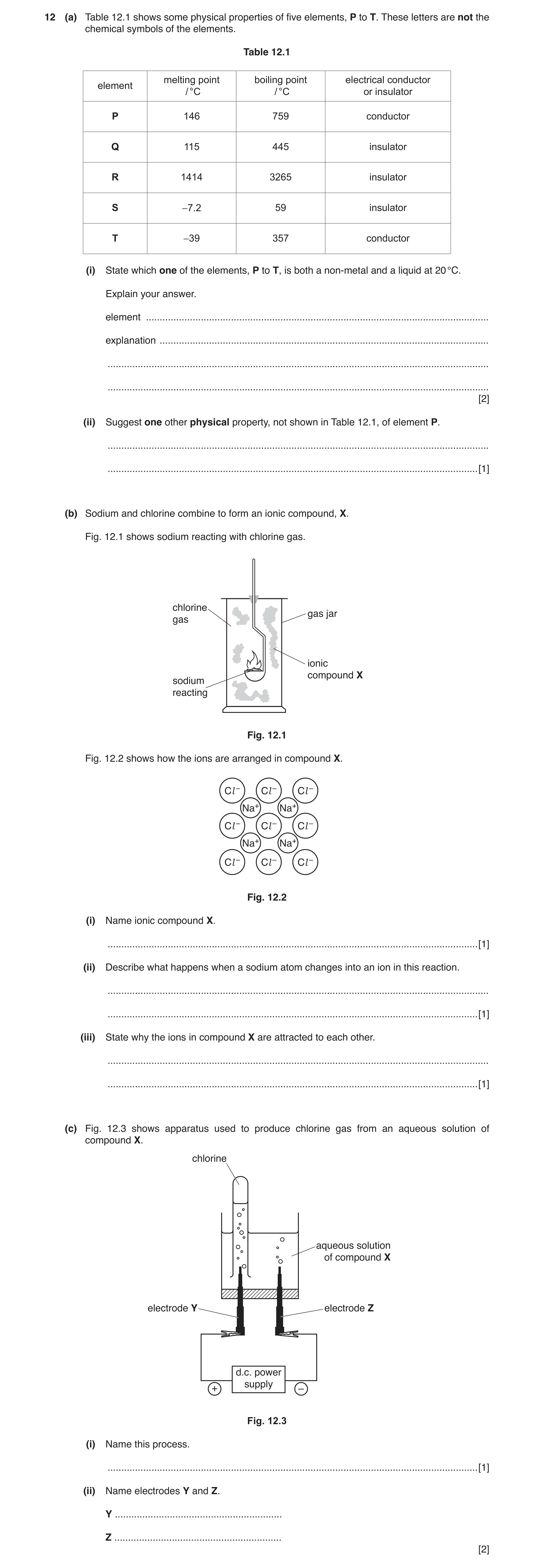
12 (a) Table 12.1 shows some physical properties of five elements, P to T. These letters are not the chemical symbols of the elements. Table 12.1 melting point boiling point electrical conductor element / °C / °C or insulator P 146 759 conductor Q 115 445 insulator R 1414 3265 insulator S −7.2 59 insulator T −39 357 conductor (i) State which one of the elements, P to T, is both a non-metal and a liquid at 20 °C. Explain your answer. element … explanation … … … [2] (ii) Suggest one other physical property, not shown in Table 12.1, of element P. … … [1] (b) Sodium and chlorine combine to form an ionic compound, X. Fig. 12.1 shows sodium reacting with chlorine gas. chlorine gas jar gas ionic compound X sodium reacting Fig. 12.1 Fig. 12.2 shows how the ions are arranged in compound X. Cl – Cl – Cl – Na+ Na+ Cl – Cl – Cl – Na+ Na+ Cl – Cl – Cl – Fig. 12.2 (i) Name ionic compound X. … [1] (ii) Describe what happens when a sodium atom changes into an ion in this reaction. … … [1] (iii) State why the ions in compound X are attracted to each other. … … [1] (c) Fig. 12.3 shows apparatus used to produce chlorine gas from an aqueous solution of compound X. chlorine aqueous solution of compound X electrode Y electrode Z d.c. power supply + – Fig. 12.3 (i) Name this process. … [1] (ii) Name electrodes Y and Z. Y … Z … [2]
9 marks
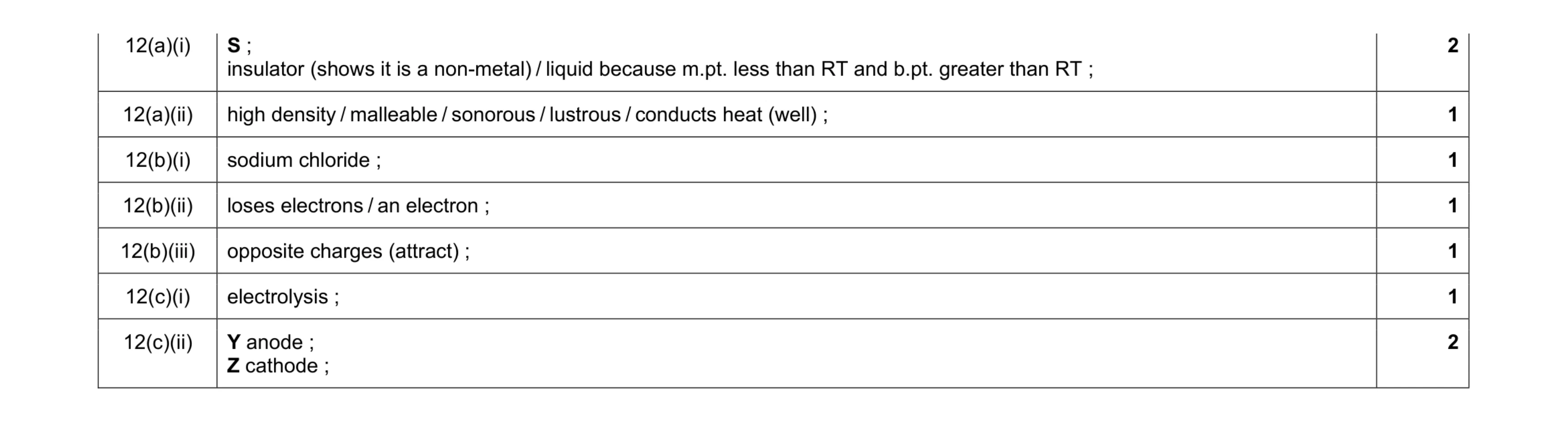
Mark scheme: 12(a)(i) S ; insulator (shows it is a non-metal) / liquid because m.pt. less than RT and b.pt. greater than RT ; 2 12(a)(ii) high density / malleable / sonorous / lustrous / conducts heat (well) ; 1 12(b)(i) sodium chloride ; 1 12(b)(ii) loses electrons / an electron ; 1 12(b)(iii) opposite charges (attract) ; 1 12(c)(i) electrolysis ; 1 12(c)(ii) Y anode ; Z cathode ; 2
This question in 0654/31 May/June 2017
Q2 · When lithium reacts with water, a gas is produced 0654/33 Oct/Nov 2017
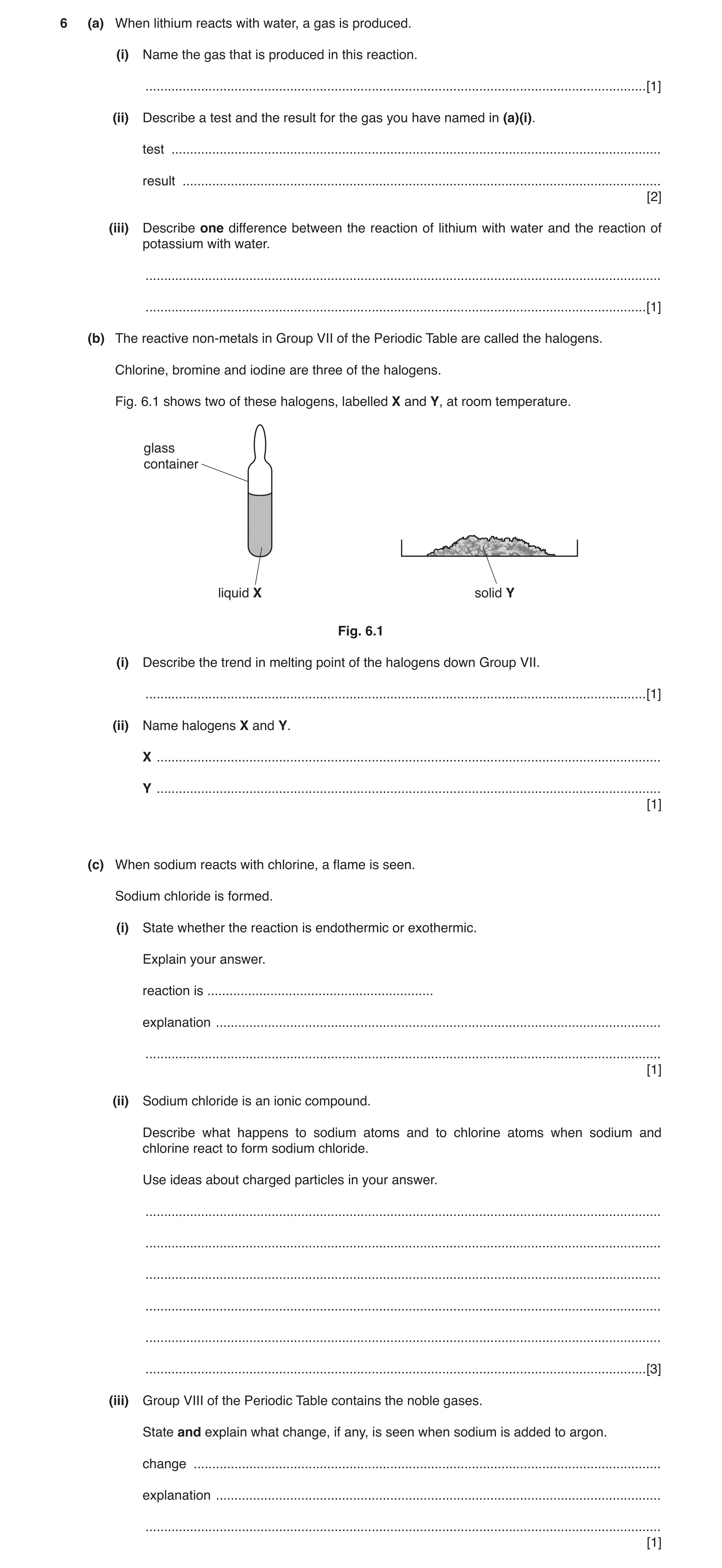
6 (a) When lithium reacts with water, a gas is produced. (i) Name the gas that is produced in this reaction. … [1] (ii) Describe a test and the result for the gas you have named in (a)(i). test … result … [2] (iii) Describe one difference between the reaction of lithium with water and the reaction of potassium with water. … … [1] (b) The reactive non-metals in Group VII of the Periodic Table are called the halogens. Chlorine, bromine and iodine are three of the halogens. Fig. 6.1 shows two of these halogens, labelled X and Y, at room temperature. glass container liquid X solid Y Fig. 6.1 (i) Describe the trend in melting point of the halogens down Group VII. … [1] (ii) Name halogens X and Y. X … Y … [1] (c) When sodium reacts with chlorine, a flame is seen. Sodium chloride is formed. (i) State whether the reaction is endothermic or exothermic. Explain your answer. reaction is … explanation … … [1] (ii) Sodium chloride is an ionic compound. Describe what happens to sodium atoms and to chlorine atoms when sodium and chlorine react to form sodium chloride. Use ideas about charged particles in your answer. … … … … … … [3] (iii) Group VIII of the Periodic Table contains the noble gases. State and explain what change, if any, is seen when sodium is added to argon. change … explanation … … [1]
11 marks
Mark scheme: 6(a)(i) hydrogen ; 1 6(a)(ii) burning lighted splint ; pops ; 2 6(a)(iii) potassium reacts more vigorously / quickly ; 1 6(b)(i) m.pt. increasing down the group ; 1 6(b)(ii) X is bromine and Y is iodine ; 1 6(c)(i) exothermic AND means heat given off / evidence is the flame ; 1 6(c)(ii) sodium atoms lose electrons and chlorine atoms gain electrons; one electron ; reference to atoms becoming charged ions ; the idea that ions of opposite charge attract ; max 3 6(c)(iii) no reaction / no change AND argon unreactive / inert / is an inert gas ; 1
This question in 0654/33 Oct/Nov 2017
Q3 · Group VII of the Periodic Table contains reactive non‑metallic elements called the… 0654/31 Oct/Nov 2018
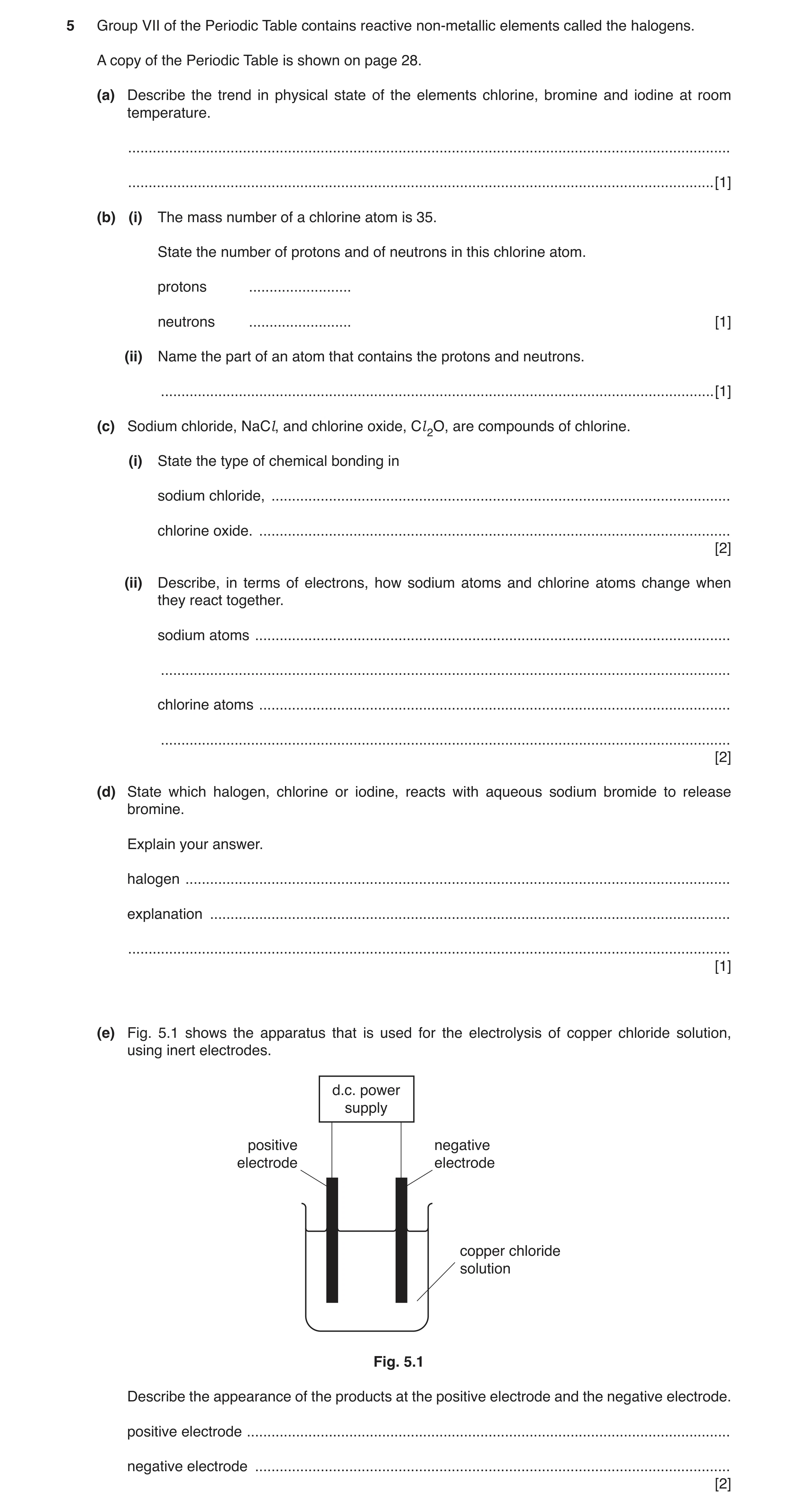
5 Group VII of the Periodic Table contains reactive non‑metallic elements called the halogens. A copy of the Periodic Table is shown on page 28. (a) Describe the trend in physical state of the elements chlorine, bromine and iodine at room temperature. … … [1] (b) (i) The mass number of a chlorine atom is 35. State the number of protons and of neutrons in this chlorine atom. protons … neutrons … [1] (ii) Name the part of an atom that contains the protons and neutrons. … [1] (c) Sodium chloride, NaCl, and chlorine oxide, Cl 2O, are compounds of chlorine. (i) State the type of chemical bonding in sodium chloride, … chlorine oxide. … [2] (ii) Describe, in terms of electrons, how sodium atoms and chlorine atoms change when they react together. sodium atoms … … chlorine atoms … … [2] (d) State which halogen, chlorine or iodine, reacts with aqueous sodium bromide to release bromine. Explain your answer. halogen … explanation … … [1] (e) Fig. 5.1 shows the apparatus that is used for the electrolysis of copper chloride solution, using inert electrodes. d.c. power supply positive negative electrode electrode copper chloride solution Fig. 5.1 Describe the appearance of the products at the positive electrode and the negative electrode. positive electrode … negative electrode … [2]
10 marks
Mark scheme: 5(a) gaseous to liquid to solid ; 1 5(b)(i) (protons) 17 (neutrons) 18 ; 1 5(b)(ii) nucleus ; 1 5(c)(i) (sodium chloride) ionic / electrovalent ; (chlorine oxide ) covalent ; 2 5(c)(ii) (sodium atoms) lose electrons ; (chlorine atoms) gain electrons ; 2 5(d) chlorine – no mark chlorine more reactive than bromine ; 1 5(e) at positive gas is released / bubbles produced ; at negative brown / copper-coloured solid (layer) ; 2
This question in 0654/31 Oct/Nov 2018
Q4 · Information about some of the elements in Group VII of the Periodic Table 0654/33 Oct/Nov 2018
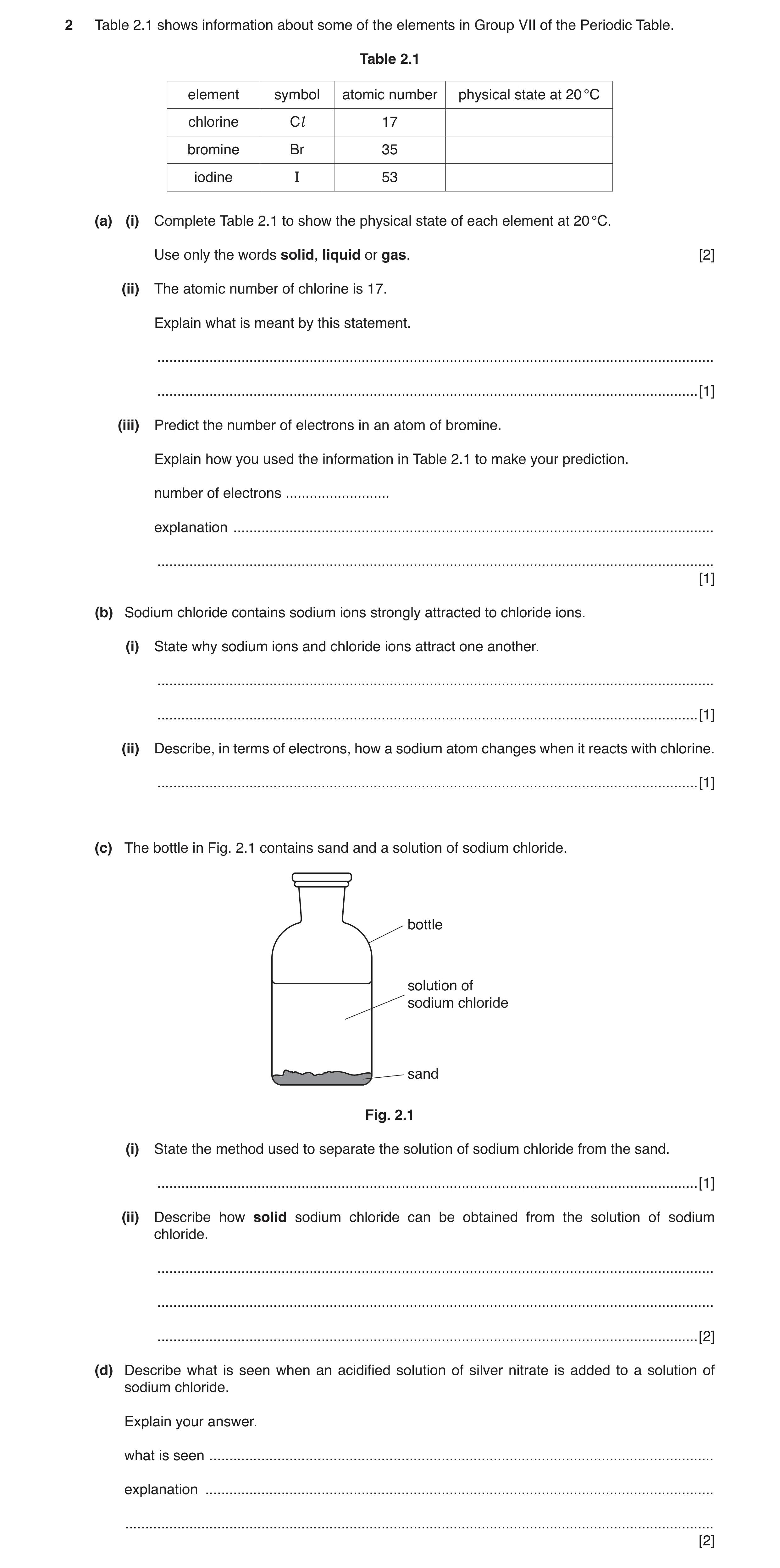
2 Table 2.1 shows information about some of the elements in Group VII of the Periodic Table. Table 2.1 element symbol atomic number physical state at 20 °C chlorine Cl 17 bromine Br 35 iodine I 53 (a) (i) Complete Table 2.1 to show the physical state of each element at 20 °C. Use only the words solid, liquid or gas. [2] (ii) The atomic number of chlorine is 17. Explain what is meant by this statement. … … [1] (iii) Predict the number of electrons in an atom of bromine. Explain how you used the information in Table 2.1 to make your prediction. number of electrons … explanation … … [1] (b) Sodium chloride contains sodium ions strongly attracted to chloride ions. (i) State why sodium ions and chloride ions attract one another. … … [1] (ii) Describe, in terms of electrons, how a sodium atom changes when it reacts with chlorine. … [1] (c) The bottle in Fig. 2.1 contains sand and a solution of sodium chloride. bottle solution of sodium chloride sand Fig. 2.1 (i) State the method used to separate the solution of sodium chloride from the sand. … [1] (ii) Describe how solid sodium chloride can be obtained from the solution of sodium chloride. … … … [2] (d) Describe what is seen when an acidified solution of silver nitrate is added to a solution of sodium chloride. Explain your answer. what is seen … explanation … … [2]
11 marks
Mark scheme: 2(a)(i) gas liquid solid 1 or 2 correct ; 3 correct ; 2 2(a)(ii) chlorine atoms contain 17 protons ; 1 2(a)(iii) (35) number of electrons equal to number of protons / atomic number ; 1 2(b)(i) they have opposite electrical charges / opposite charges attract ; 1 2(b)(ii) outer electron is lost (from sodium) / it is transferred to the chlorine atom ; 1 2(c)(i) filtration / decantation ; 1 2(c)(ii) heat (solution) ; so all water evaporates / leave to evaporate ; 2 2(d) white precipitate / goes cloudy ; solution contains chloride (anions) / this is the chloride ion test / silver chloride is insoluble ; 2
This question in 0654/33 Oct/Nov 2018
Q5 · Name the type of chemical bond between: a metallic element and a non-metallic element …… 0654/31 Oct/Nov 2019
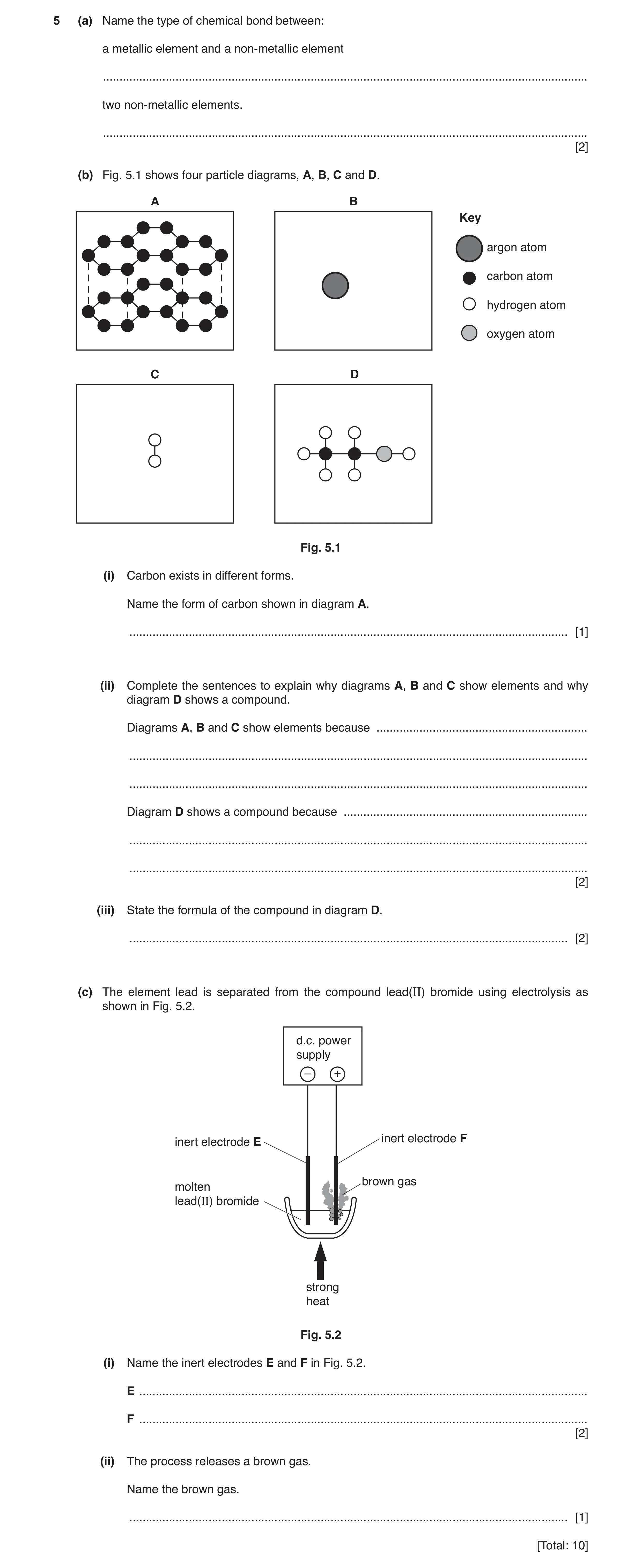
5 (a) Name the type of chemical bond between: a metallic element and a non-metallic element … two non-metallic elements. … [2] (b) Fig. 5.1 shows four particle diagrams, A, B, C and D. A B Key argon atom carbon atom hydrogen atom oxygen atom C D Fig. 5.1 (i) Carbon exists in different forms. Name the form of carbon shown in diagram A. … [1] (ii) Complete the sentences to explain why diagrams A, B and C show elements and why diagram D shows a compound. Diagrams A, B and C show elements because … … … Diagram D shows a compound because … … … [2] (iii) State the formula of the compound in diagram D. … [2] (c) The element lead is separated from the compound lead(II) bromide using electrolysis as shown in Fig. 5.2. d.c. power supply – + inert electrode F inert electrode E brown gas molten lead(II) bromide strong heat Fig. 5.2 (i) Name the inert electrodes E and F in Fig. 5.2. E … F … [2] (ii) The process releases a brown gas. Name the brown gas. … [1] [Total: 10]
10 marks
Mark scheme: 5(a) ionic / electrovalent ; covalent ; 2 5(b)(i) graphite ; 1 5(b)(ii) (A, B and C are elements because) they contain only one type of atom ; (D is compound because) it shows different types of atom bonded together ; 2 5(b)(iii) C2H6O symbols correct ; subscripts correct ; 2 5(c)(i) E – cathode ; F – anode ; 2 5(c)(ii) bromine ; 1
This question in 0654/31 Oct/Nov 2019
Q6 · Sodium is a very reactive metallic element 0654/32 Oct/Nov 2019
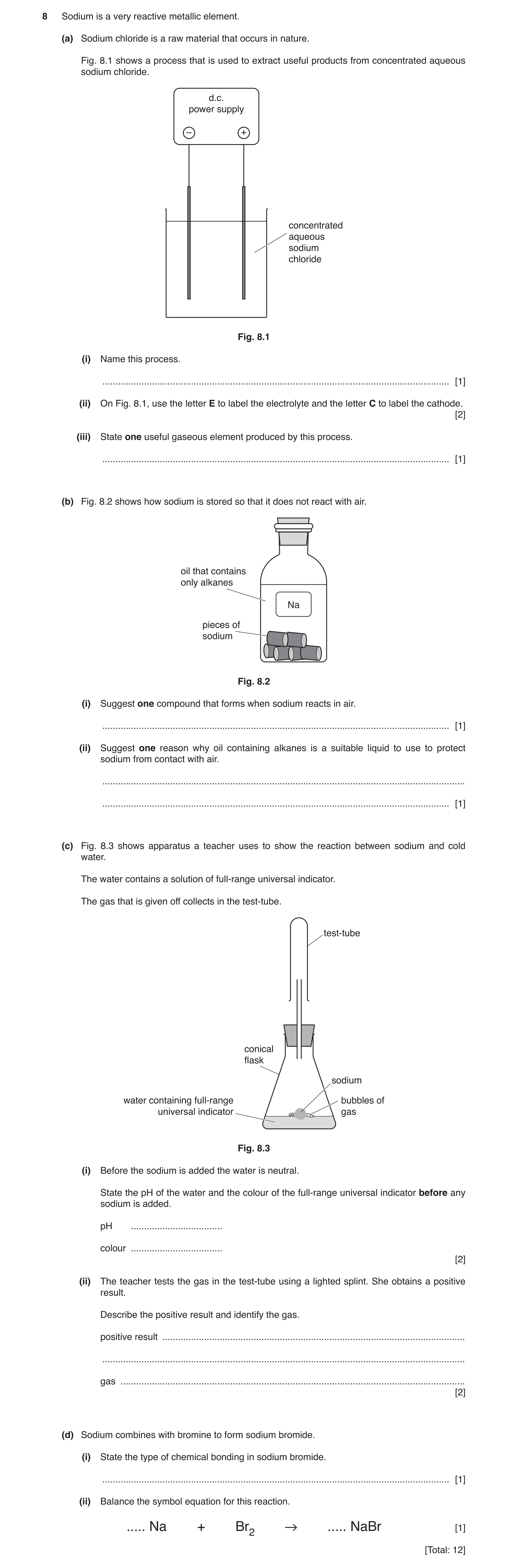
8 Sodium is a very reactive metallic element. (a) Sodium chloride is a raw material that occurs in nature. Fig. 8.1 shows a process that is used to extract useful products from concentrated aqueous sodium chloride. d.c. power supply – + concentrated aqueous sodium chloride Fig. 8.1 (i) Name this process. … [1] (ii) On Fig. 8.1, use the letter E to label the electrolyte and the letter C to label the cathode. [2] (iii) State one useful gaseous element produced by this process. … [1] (b) Fig. 8.2 shows how sodium is stored so that it does not react with air. oil that contains only alkanes Na pieces of sodium Fig. 8.2 (i) Suggest one compound that forms when sodium reacts in air. … [1] (ii) Suggest one reason why oil containing alkanes is a suitable liquid to use to protect sodium from contact with air. … … [1] (c) Fig. 8.3 shows apparatus a teacher uses to show the reaction between sodium and cold water. The water contains a solution of full-range universal indicator. The gas that is given off collects in the test-tube. test-tube conical flask sodium water containing full-range bubbles of universal indicator gas Fig. 8.3 (i) Before the sodium is added the water is neutral. State the pH of the water and the colour of the full-range universal indicator before any sodium is added. pH … colour … [2] (ii) The teacher tests the gas in the test-tube using a lighted splint. She obtains a positive result. Describe the positive result and identify the gas. positive result … … gas … [2] (d) Sodium combines with bromine to form sodium bromide. (i) State the type of chemical bonding in sodium bromide. … [1] (ii) Balance the symbol equation for this reaction. [1] … Na + Br2 … NaBr [Total: 12]
12 marks
Mark scheme: 8(a)(i) electrolysis ; 1 8(a)(ii) electrolyte labelled anywhere ; negative electrode labelled ; 2 8(a)(iii) chlorine / hydrogen ; 1 8(b)(i) sodium oxide / hydroxide / carbonate ; 1 8(b)(ii) alkanes (relatively) unreactive / alkanes do not react with sodium ; 1 8(c)(i) pH 7 ; green ; 2 8(c)(ii) squeaky pop ; hydrogen ; 2 8(d)(i) ionic / electrovalent ; 1 8(d)(ii) 2 Na + Br2 → 2 NaBr ; 1
This question in 0654/32 Oct/Nov 2019
Q7 · The symbols of six elements and six statements about these elements 0654/33 Oct/Nov 2019
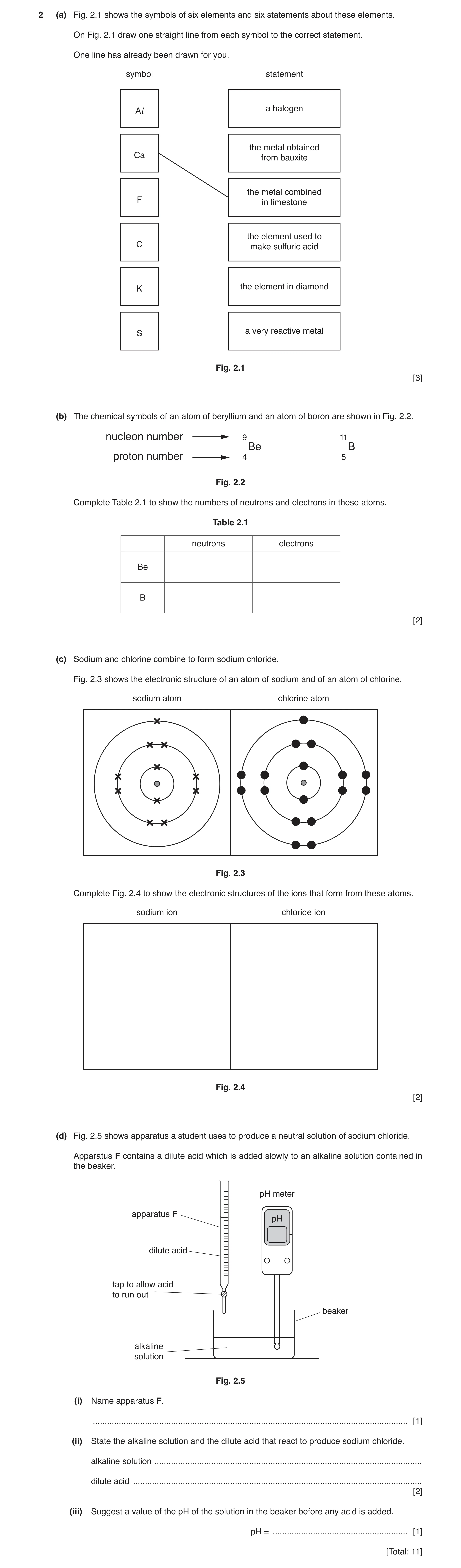
2 (a) Fig. 2.1 shows the symbols of six elements and six statements about these elements. On Fig. 2.1 draw one straight line from each symbol to the correct statement. One line has already been drawn for you. symbol statement a halogen Al the metal obtained Ca from bauxite the metal combined F in limestone the element used to C make sulfuric acid the element in diamond K a very reactive metal S Fig. 2.1 [3] (b) The chemical symbols of an atom of beryllium and an atom of boron are shown in Fig. 2.2. nucleon number 9 11 Be B proton number 4 5 Fig. 2.2 Complete Table 2.1 to show the numbers of neutrons and electrons in these atoms. Table 2.1 neutrons electrons Be B [2] (c) Sodium and chlorine combine to form sodium chloride. Fig. 2.3 shows the electronic structure of an atom of sodium and of an atom of chlorine. sodium atom chlorine atom Fig. 2.3 Complete Fig. 2.4 to show the electronic structures of the ions that form from these atoms. sodium ion chloride ion Fig. 2.4 [2] (d) Fig. 2.5 shows apparatus a student uses to produce a neutral solution of sodium chloride. Apparatus F contains a dilute acid which is added slowly to an alkaline solution contained in the beaker. pH meter apparatus F pH dilute acid tap to allow acid to run out beaker alkaline solution Fig. 2.5 (i) Name apparatus F. … [1] (ii) State the alkaline solution and the dilute acid that react to produce sodium chloride. alkaline solution … dilute acid … [2] (iii) Suggest a value of the pH of the solution in the beaker before any acid is added. pH = … [1] [Total: 11]
11 marks
Mark scheme: 2(a) 1 correct ; 3 correct ;; 5 correct ;;; 3 2(b) n e Be 5 4 B 6 5 ;; 2 2(c) sodium ion correct ; chloride ion correct ; 2 2(d)(i) burette ; 1 Question Answer Marks 2(d)(ii) sodium hydroxide ; hydrochloric (acid) ; 2 2(d)(iii) >7 up to 14 ; 1
This question in 0654/33 Oct/Nov 2019
Q8 · Non-metallic elements are placed in groups towards the right hand side of the Periodic… 0654/31 May/June 2020
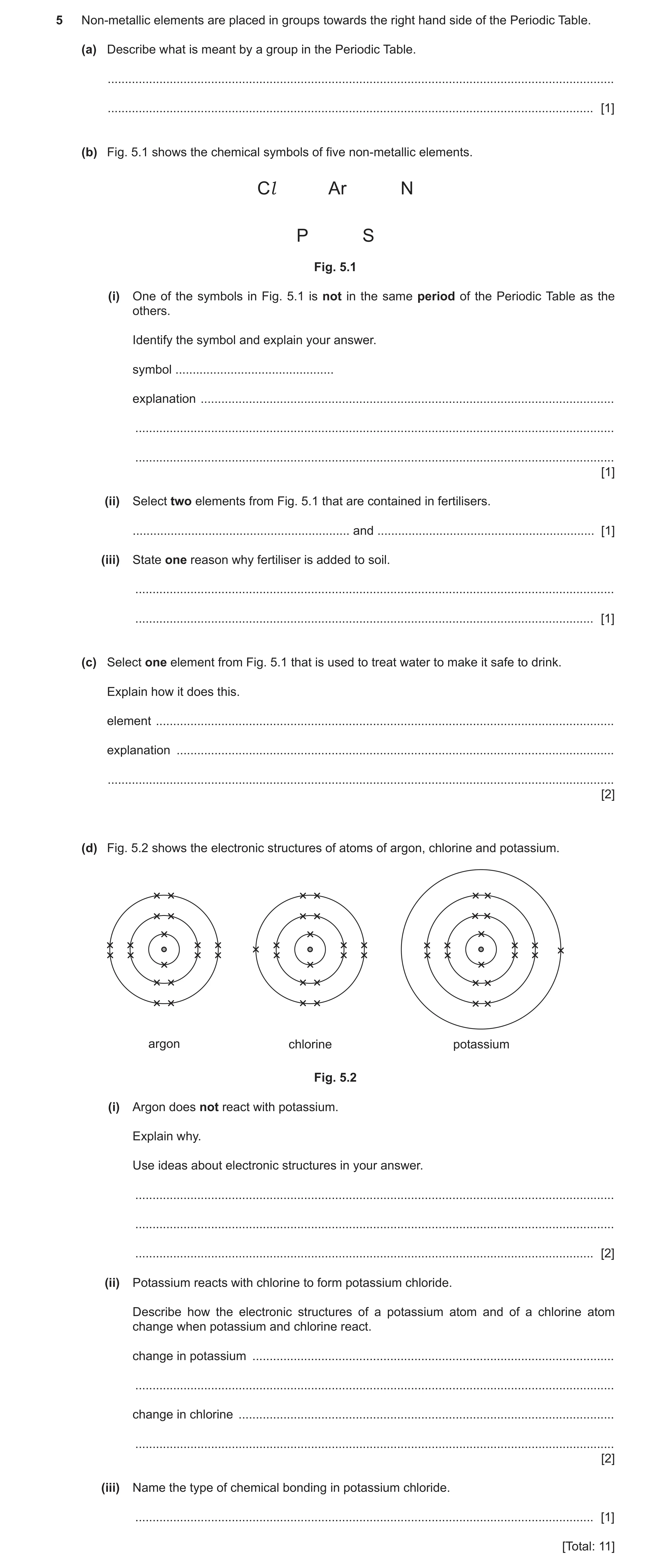
5 Non-metallic elements are placed in groups towards the right hand side of the Periodic Table. (a) Describe what is meant by a group in the Periodic Table. … … [1] (b) Fig. 5.1 shows the chemical symbols of five non-metallic elements. Cl Ar N P S Fig. 5.1 (i) One of the symbols in Fig. 5.1 is not in the same period of the Periodic Table as the others. Identify the symbol and explain your answer. symbol … explanation … … … [1] (ii) Select two elements from Fig. 5.1 that are contained in fertilisers. … and … [1] (iii) State one reason why fertiliser is added to soil. … … [1] (c) Select one element from Fig. 5.1 that is used to treat water to make it safe to drink. Explain how it does this. element … explanation … … [2] (d) Fig. 5.2 shows the electronic structures of atoms of argon, chlorine and potassium. argon chlorine potassium Fig. 5.2 (i) Argon does not react with potassium. Explain why. Use ideas about electronic structures in your answer. … … … [2] (ii) Potassium reacts with chlorine to form potassium chloride. Describe how the electronic structures of a potassium atom and of a chlorine atom change when potassium and chlorine react. change in potassium … … change in chlorine … … [2] (iii) Name the type of chemical bonding in potassium chloride. … [1] [Total: 11]
11 marks
Mark scheme: 5(a) vertical column of elements / elements whose atoms have same number of outer electrons ; 1 5(b)(i) (N) idea that the other four are in same horizontal row ; 1 Question Answer Marks 5(b)(ii) two from N / P / S ; 1 5(b)(iii) improves fertility / increases crop yield (size) / to replenish nutrients ; 1 5(c) Cl / chlorine ; sterilises the water / kills (harmful) microorganisms ; 2 5(d)(i) argon has full outer shell (of electrons) ; filled shell is stable / means argon is inert / does not lose or gain electrons to become stable ; 2 5(d)(ii) (potassium atom) loses one electron ; changes from 2.8.8.1 to 2.8.8 ; (chlorine atom ) gains one electron; changes from 2.8.7. to 2.8.8 ; 2 5(d)(iii) ionic / electrovalent ; 1
This question in 0654/31 May/June 2020
Q9 · Electrolysis is used to extract some elements from their ores 0654/31 Oct/Nov 2020
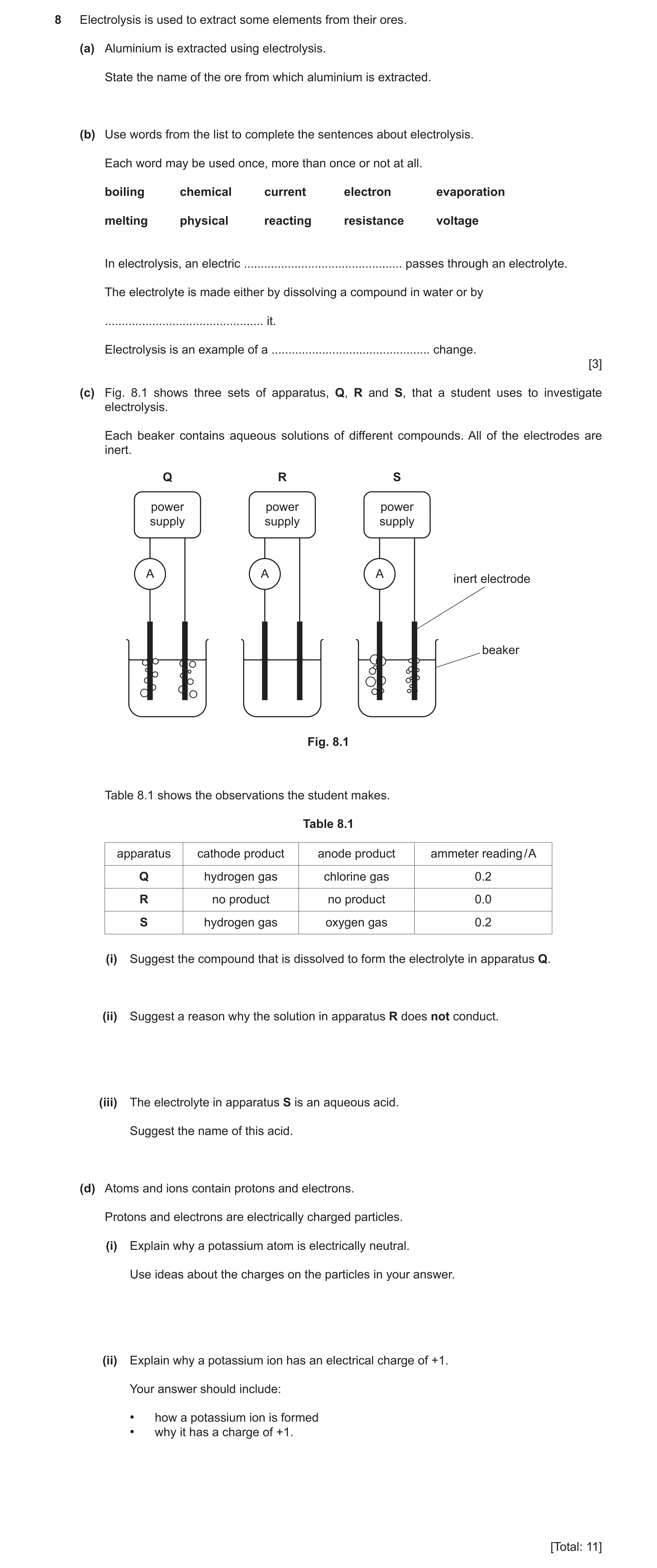
8 Electrolysis is used to extract some elements from their ores. (a) Aluminium is extracted using electrolysis. State the name of the ore from which aluminium is extracted. (b) Use words from the list to complete the sentences about electrolysis. Each word may be used once, more than once or not at all. boiling chemical current electron evaporation melting physical reacting resistance voltage In electrolysis, an electric … passes through an electrolyte. The electrolyte is made either by dissolving a compound in water or by … it. Electrolysis is an example of a … change. [3] (c) Fig. 8.1 shows three sets of apparatus, Q, R and S, that a student uses to investigate electrolysis. Each beaker contains aqueous solutions of different compounds. All of the electrodes are inert. Q R S power power power supply supply supply A A A inert electrode beaker Fig. 8.1 Table 8.1 shows the observations the student makes. Table 8.1 apparatus cathode product anode product ammeter reading / A Q hydrogen gas chlorine gas 0.2 R no product no product 0.0 S hydrogen gas oxygen gas 0.2 (i) Suggest the compound that is dissolved to form the electrolyte in apparatus Q. (ii) Suggest a reason why the solution in apparatus R does not conduct. (iii) The electrolyte in apparatus S is an aqueous acid. Suggest the name of this acid. (d) Atoms and ions contain protons and electrons. Protons and electrons are electrically charged particles. (i) Explain why a potassium atom is electrically neutral. Use ideas about the charges on the particles in your answer. (ii) Explain why a potassium ion has an electrical charge of +1. Your answer should include: • how a potassium ion is formed • why it has a charge of +1. [Total: 11]
11 marks
Mark scheme: 8(a) bauxite ; 1 8(b) current ; melting ; chemical ; 3 8(c)(i) sodium chloride / other correct ; 1 8(c)(ii) the liquid is not an electrolyte / does not contain (free) ions / the compound dissolved is not ionic ; 1 8(c)(iii) sulfuric (acid) / other correct ; 1 8(d)(i) reference to protons being positive and electrons being negative ; in atom proton and electron numbers are equal ; 2 8(d)(ii) ion forms when one electron is lost ; so in ion number of protons / positive charges is one more than electrons / number of negative charges ; 2
This question in 0654/31 Oct/Nov 2020
Q10 · The halogens chlorine, bromine and iodine are in Group VII of the Periodic Table 0654/32 Oct/Nov 2020
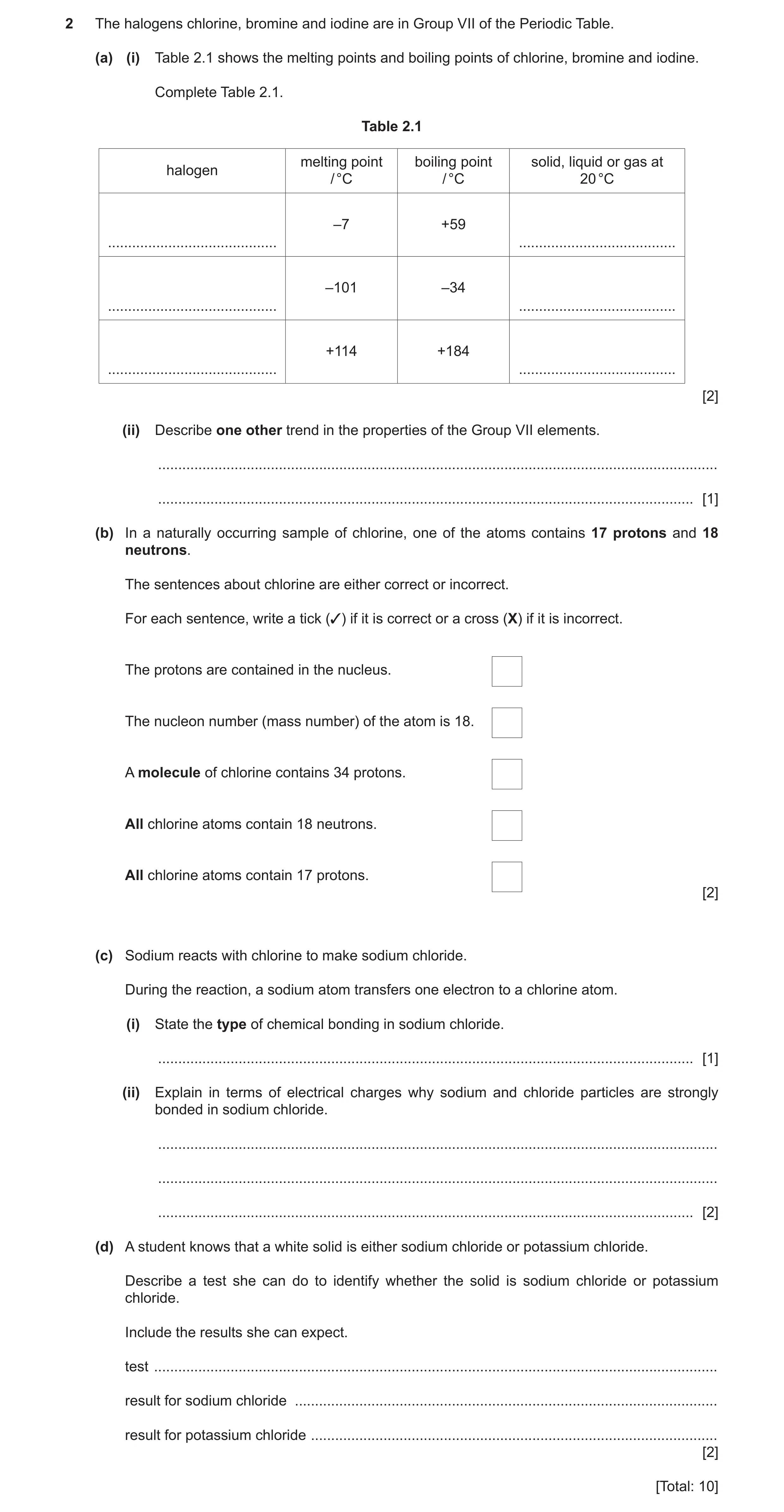
2 The halogens chlorine, bromine and iodine are in Group VII of the Periodic Table. (a) (i) Table 2.1 shows the melting points and boiling points of chlorine, bromine and iodine. Complete Table 2.1. Table 2.1 melting point boiling point solid, liquid or gas at halogen / °C / °C 20 °C –7 +59 … … –101 –34 … … +114 +184 … … [2] (ii) Describe one other trend in the properties of the Group VII elements. … … [1] (b) In a naturally occurring sample of chlorine, one of the atoms contains 17 protons and 18 neutrons. The sentences about chlorine are either correct or incorrect. For each sentence, write a tick (3) if it is correct or a cross (X) if it is incorrect. The protons are contained in the nucleus. The nucleon number (mass number) of the atom is 18. A molecule of chlorine contains 34 protons. All chlorine atoms contain 18 neutrons. All chlorine atoms contain 17 protons. [2] (c) Sodium reacts with chlorine to make sodium chloride. During the reaction, a sodium atom transfers one electron to a chlorine atom. (i) State the type of chemical bonding in sodium chloride. … [1] (ii) Explain in terms of electrical charges why sodium and chloride particles are strongly bonded in sodium chloride. … … … [2] (d) A student knows that a white solid is either sodium chloride or potassium chloride. Describe a test she can do to identify whether the solid is sodium chloride or potassium chloride. Include the results she can expect. test … result for sodium chloride … result for potassium chloride … [2] [Total: 10]
10 marks
Mark scheme: 2(a)(i) bromine and liquid chlorine and gas iodine and solid ;; 2 2(a)(ii) colour becomes darker down the group / owtte ; 1 2(b) ;; 2 2(c)(i) ionic; 1 2(c)(ii) the idea that the ions / particles of both elements have opposite electrical charges ; opposite electrical charges attract ; 2 2(d) ref to flame (test); sodium gives yellow flame / potassium gives lilac flame ;
This question in 0654/32 Oct/Nov 2020
Q11 · Electrolysis is used to extract some elements from their ores 0654/33 Oct/Nov 2020
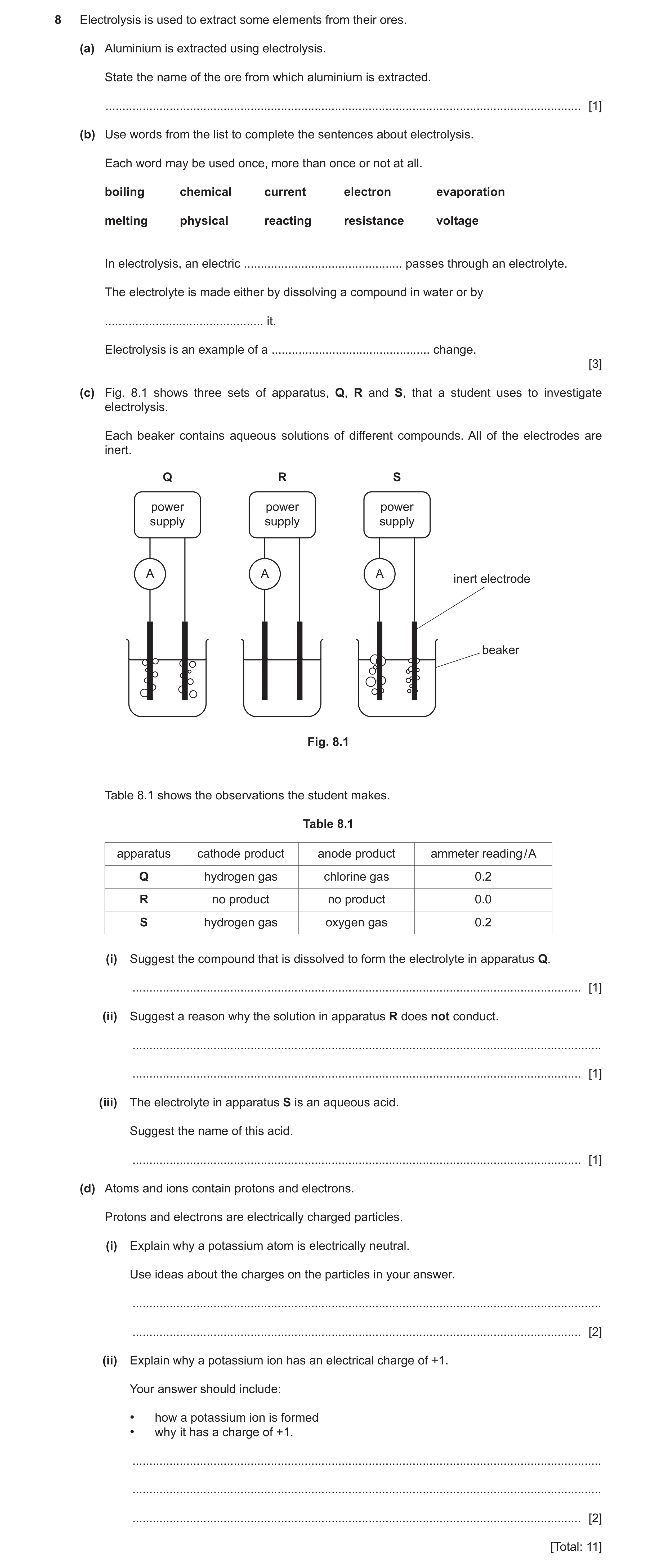
8 Electrolysis is used to extract some elements from their ores. (a) Aluminium is extracted using electrolysis. State the name of the ore from which aluminium is extracted. … [1] (b) Use words from the list to complete the sentences about electrolysis. Each word may be used once, more than once or not at all. boiling chemical current electron evaporation melting physical reacting resistance voltage In electrolysis, an electric … passes through an electrolyte. The electrolyte is made either by dissolving a compound in water or by … it. Electrolysis is an example of a … change. [3] (c) Fig. 8.1 shows three sets of apparatus, Q, R and S, that a student uses to investigate electrolysis. Each beaker contains aqueous solutions of different compounds. All of the electrodes are inert. Q R S power power power supply supply supply A A A inert electrode beaker Fig. 8.1 Table 8.1 shows the observations the student makes. Table 8.1 apparatus cathode product anode product ammeter reading / A Q hydrogen gas chlorine gas 0.2 R no product no product 0.0 S hydrogen gas oxygen gas 0.2 (i) Suggest the compound that is dissolved to form the electrolyte in apparatus Q. … [1] (ii) Suggest a reason why the solution in apparatus R does not conduct. … … [1] (iii) The electrolyte in apparatus S is an aqueous acid. Suggest the name of this acid. … [1] (d) Atoms and ions contain protons and electrons. Protons and electrons are electrically charged particles. (i) Explain why a potassium atom is electrically neutral. Use ideas about the charges on the particles in your answer. … … [2] (ii) Explain why a potassium ion has an electrical charge of +1. Your answer should include: • how a potassium ion is formed • why it has a charge of +1. … … … [2] [Total: 11]
11 marks
Mark scheme: 8(a) bauxite ; 1 8(b) current ; melting ; chemical ; 3 8(c)(i) sodium chloride / other correct ; 1 8(c)(ii) the liquid is not an electrolyte / does not contain (free) ions / the compound dissolved is not ionic ; 1 8(c)(iii) sulfuric (acid) / other correct ; 1 8(d)(i) reference to protons being positive and electrons being negative ; in atom proton and electron numbers are equal ; 2 8(d)(ii) ion forms when one electron is lost ; so in ion number of protons / positive charges is one more than electrons / number of negative charges ; 2
This question in 0654/33 Oct/Nov 2020
Q12 · Lithium, sodium and potassium are alkali metal elements in the Periodic Table 0654/32 Feb/March 2021
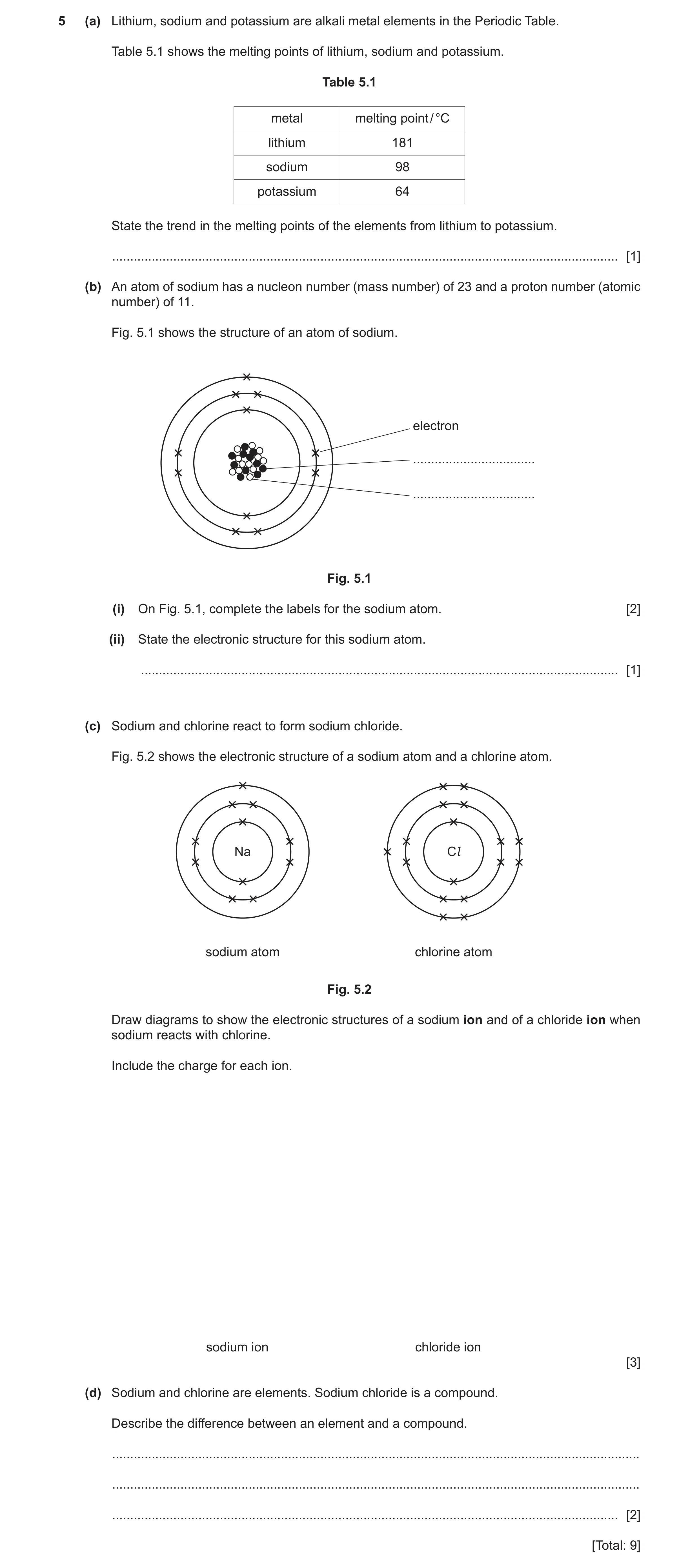
5 (a) Lithium, sodium and potassium are alkali metal elements in the Periodic Table. Table 5.1 shows the melting points of lithium, sodium and potassium. Table 5.1 metal melting point / °C lithium 181 sodium 98 potassium 64 State the trend in the melting points of the elements from lithium to potassium. … [1] (b) An atom of sodium has a nucleon number (mass number) of 23 and a proton number (atomic number) of 11. Fig. 5.1 shows the structure of an atom of sodium. electron … … Fig. 5.1 (i) On Fig. 5.1, complete the labels for the sodium atom. [2] (ii) State the electronic structure for this sodium atom. … [1] (c) Sodium and chlorine react to form sodium chloride. Fig. 5.2 shows the electronic structure of a sodium atom and a chlorine atom. Na Cl sodium atom chlorine atom Fig. 5.2 Draw diagrams to show the electronic structures of a sodium ion and of a chloride ion when sodium reacts with chlorine. Include the charge for each ion. sodium ion chloride ion [3] (d) Sodium and chlorine are elements. Sodium chloride is a compound. Describe the difference between an element and a compound. … … … [2] [Total: 9]
9 marks
Mark scheme: 5(a) melting point decreases (down group) ; 1 5(b)(i) proton; neutron; 2 Question Answer Marks 5(b)(ii) 2.8.1; 1 5(c) sodium ion 2.8 ; chloride ion 2.8.8 ; sodium has positive charge and chloride has negative charge indicated; 3 5(d) an element contains only one type of atom; a compound contains two or more elements (chemically) combined / bonded; 2
This question in 0654/32 Feb/March 2021
Q13 · The melting points of some Group I elements 0654/31 Oct/Nov 2021
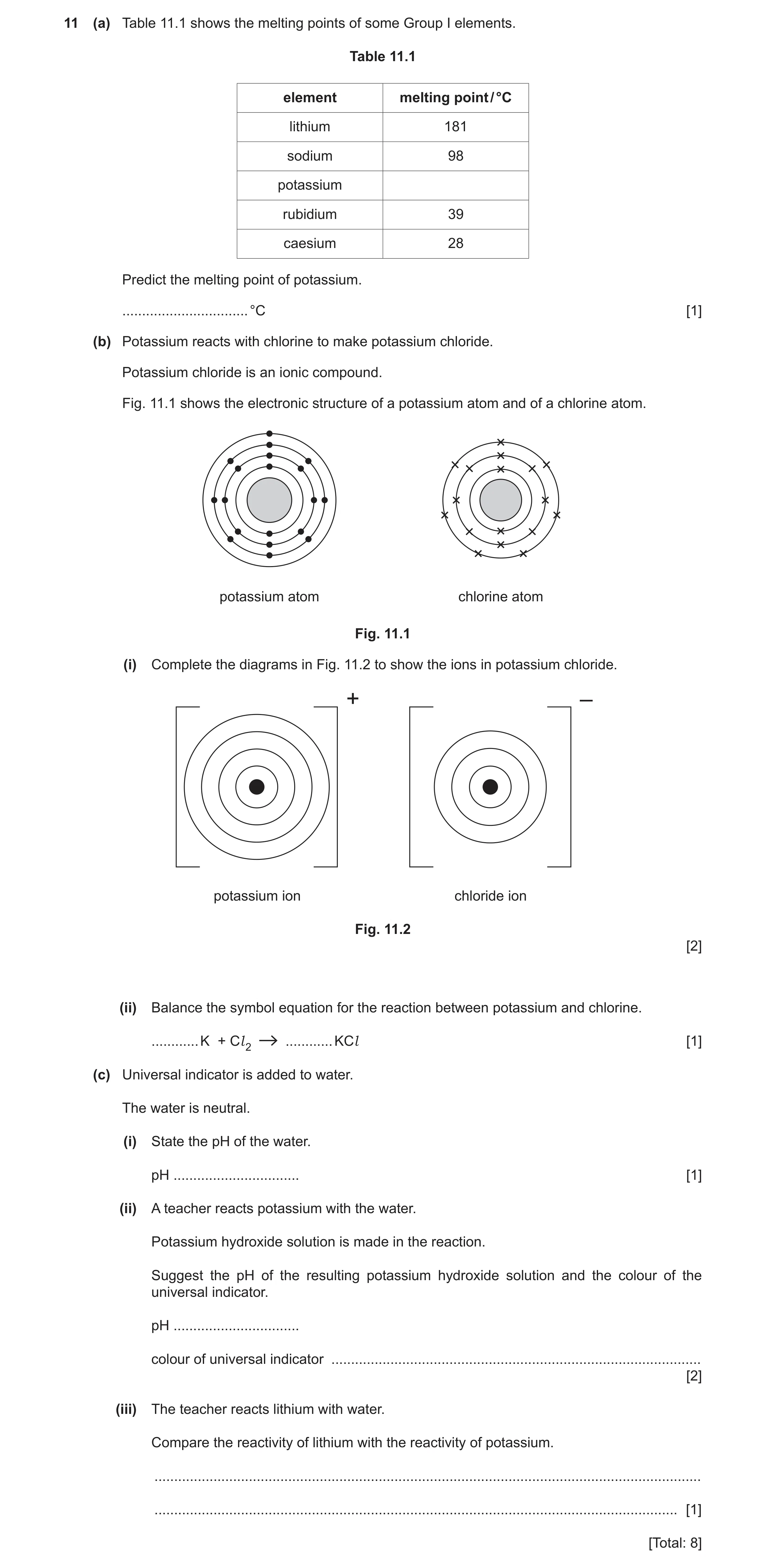
11 (a) Table 11.1 shows the melting points of some Group I elements. Table 11.1 element melting point / °C lithium 181 sodium 98 potassium rubidium 39 caesium 28 Predict the melting point of potassium. … °C [1] (b) Potassium reacts with chlorine to make potassium chloride. Potassium chloride is an ionic compound. Fig. 11.1 shows the electronic structure of a potassium atom and of a chlorine atom. potassium atom chlorine atom Fig. 11.1 (i) Complete the diagrams in Fig. 11.2 to show the ions in potassium chloride. + – potassium ion chloride ion Fig. 11.2 [2] (ii) Balance the symbol equation for the reaction between potassium and chlorine. … K + Cl2 … KCl [1] (c) Universal indicator is added to water. The water is neutral. (i) State the pH of the water. pH … [1] (ii) A teacher reacts potassium with the water. Potassium hydroxide solution is made in the reaction. Suggest the pH of the resulting potassium hydroxide solution and the colour of the universal indicator. pH … colour of universal indicator … [2] (iii) The teacher reacts lithium with water. Compare the reactivity of lithium with the reactivity of potassium. … … [1] [Total: 8]
8 marks
Mark scheme: 11(a) 45 (°C) to 90 (°C) ; 1 11(b)(i) potassium ion 2.8.8. ; chloride ion 2.8.8 ; 2 11(b)(ii) 2 (K + Cl 2 → ) 2 (KCl) ; 1 11(c)(i) 7 ; 1 11(c)(ii) any value between 7 and 14 ; purple ; 2 11(c)(iii) lithium reacts less violently / lithium is less reactive ; 1
This question in 0654/31 Oct/Nov 2021
Q14 · Sodium and chlorine are elements 0654/31 Oct/Nov 2022
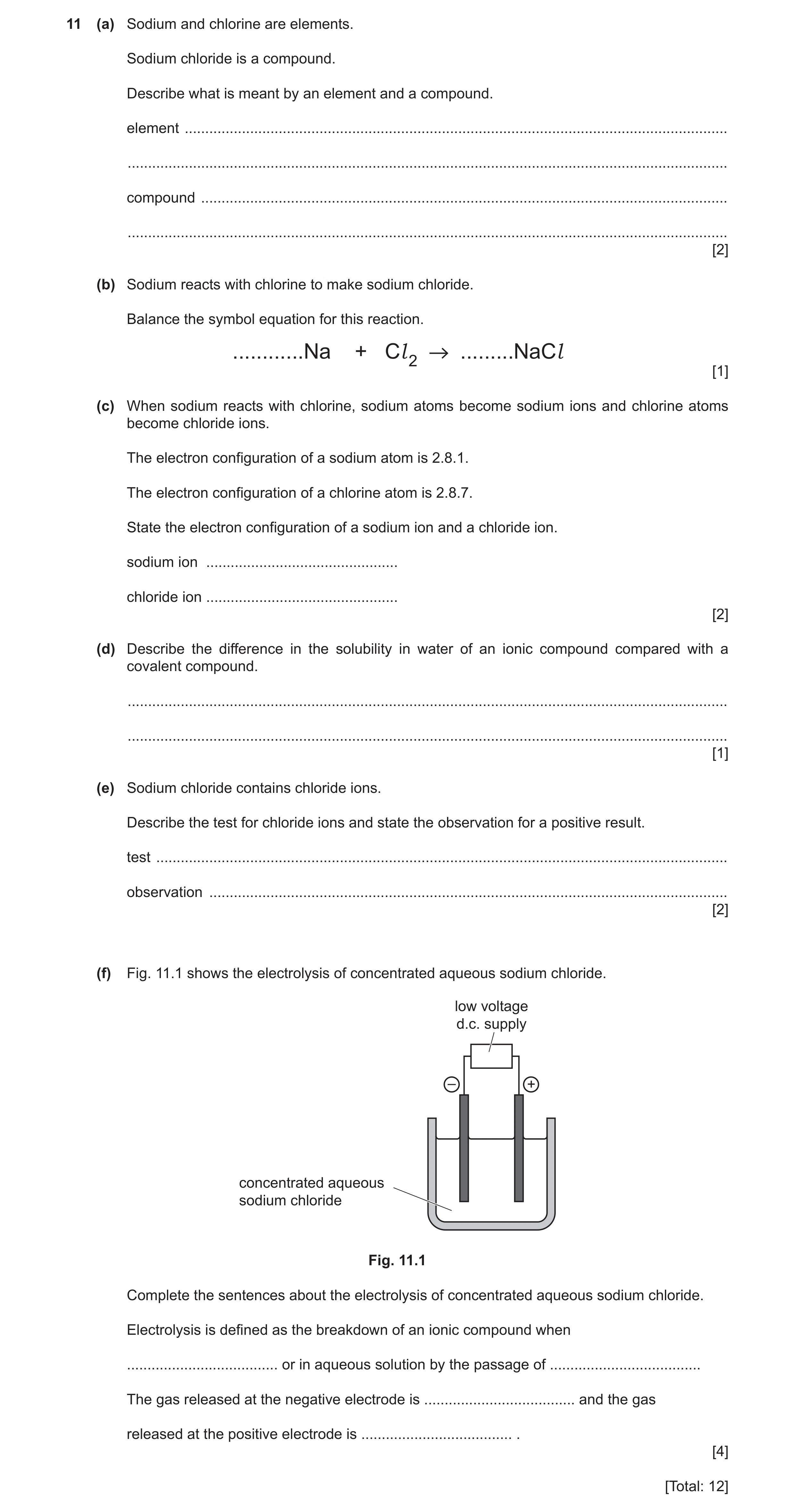
11 (a) Sodium and chlorine are elements. Sodium chloride is a compound. Describe what is meant by an element and a compound. element … … compound … … [2] (b) Sodium reacts with chlorine to make sodium chloride. Balance the symbol equation for this reaction. … Na + Cl2 … NaCl [1] (c) When sodium reacts with chlorine, sodium atoms become sodium ions and chlorine atoms become chloride ions. The electron configuration of a sodium atom is 2.8.1. The electron configuration of a chlorine atom is 2.8.7. State the electron configuration of a sodium ion and a chloride ion. sodium ion … chloride ion … [2] (d) Describe the difference in the solubility in water of an ionic compound compared with a covalent compound. … … [1] (e) Sodium chloride contains chloride ions. Describe the test for chloride ions and state the observation for a positive result. test … observation … [2] (f) Fig. 11.1 shows the electrolysis of concentrated aqueous sodium chloride. low voltage d.c. supply – + concentrated aqueous sodium chloride Fig. 11.1 Complete the sentences about the electrolysis of concentrated aqueous sodium chloride. Electrolysis is defined as the breakdown of an ionic compound when … or in aqueous solution by the passage of … The gas released at the negative electrode is … and the gas released at the positive electrode is … . [4] [Total: 12]
12 marks
Mark scheme: 11(a) element – contains only one type of atom ; 2 compound – contains two or more elements (chemically combined) ; 11(b) 2Na + Cl2 → 2NaCl ; 1 11(c) sodium ion 2.8 ; 2 chloride ion 2.8.8 ; 11(d) solubility of ionic compound is greater ; 1 11(e) add acidified aqueous silver nitrate ; 2 white precipitate ; 11(f) molten ; 4 electricity ; hydrogen ; chlorine ;
This question in 0654/31 Oct/Nov 2022
Q15 · Potassium is an element in the Periodic Table 0654/33 Oct/Nov 2022
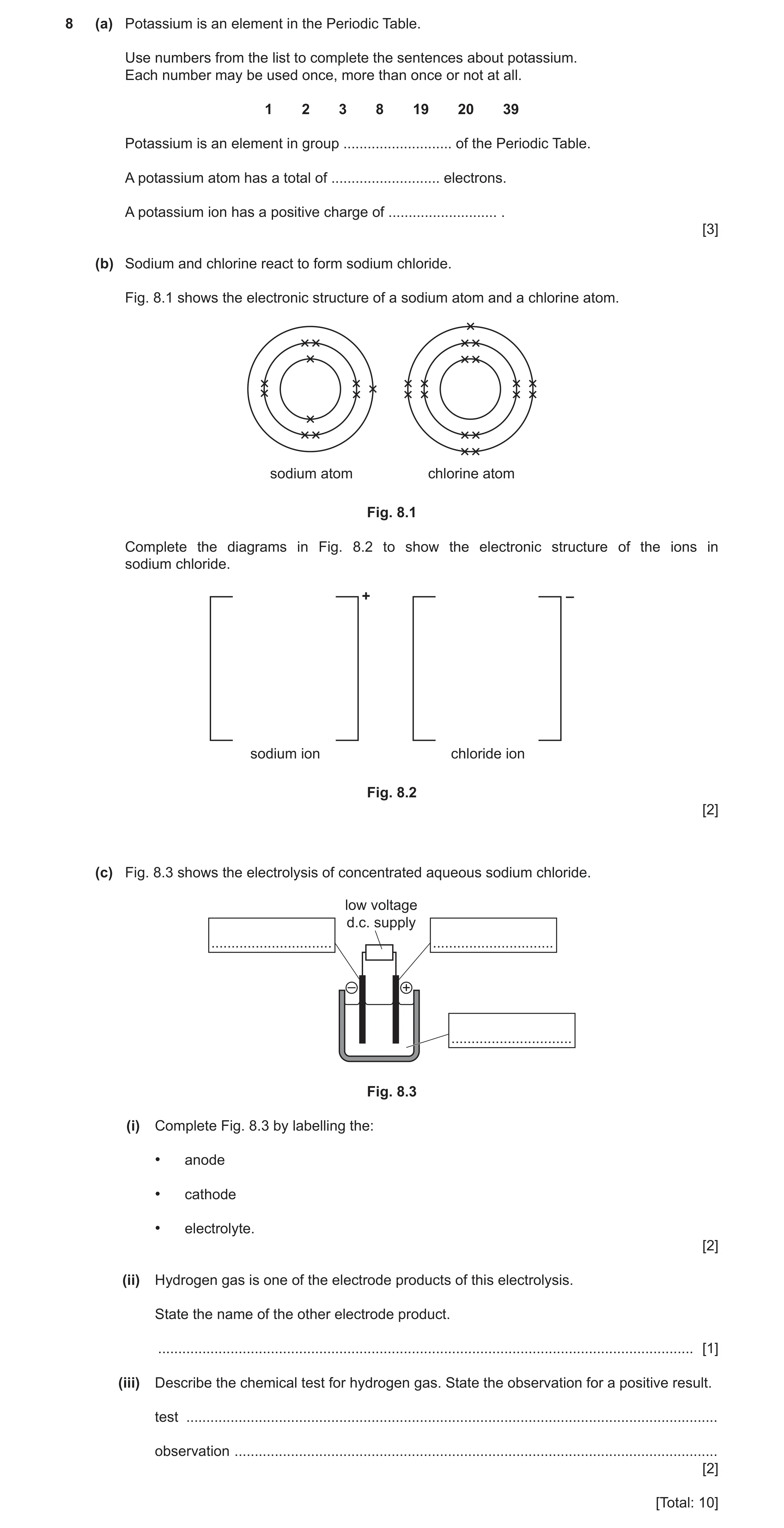
8 (a) Potassium is an element in the Periodic Table. Use numbers from the list to complete the sentences about potassium. Each number may be used once, more than once or not at all. 1 2 3 8 19 20 39 Potassium is an element in group … of the Periodic Table. A potassium atom has a total of … electrons. A potassium ion has a positive charge of … . [3] (b) Sodium and chlorine react to form sodium chloride. Fig. 8.1 shows the electronic structure of a sodium atom and a chlorine atom. sodium atom chlorine atom Fig. 8.1 Complete the diagrams in Fig. 8.2 to show the electronic structure of the ions in sodium chloride. + – sodium ion chloride ion Fig. 8.2 [2] (c) Fig. 8.3 shows the electrolysis of concentrated aqueous sodium chloride. low voltage d.c. supply … … – + … Fig. 8.3 (i) Complete Fig. 8.3 by labelling the: • anode • cathode • electrolyte. [2] (ii) Hydrogen gas is one of the electrode products of this electrolysis. State the name of the other electrode product. … [1] (iii) Describe the chemical test for hydrogen gas. State the observation for a positive result. test … observation … [2] [Total: 10]
10 marks
Mark scheme: 8(a) 1 ; 3 19 ; 1 ; 8(b) 2 sodium ion chloride ion sodium ion 2.8.; chloride ion 2.8.8 ; 8(c)(i) one correctly labelled ; 2 three correctly labelled ; 8(c)(ii) chlorine ; 1 8(c)(iii) lighted splint ; 2 goes pop ;
This question in 0654/33 Oct/Nov 2022
Q16 · An atom of calcium has 20 protons and 20 neutrons 0654/33 May/June 2023
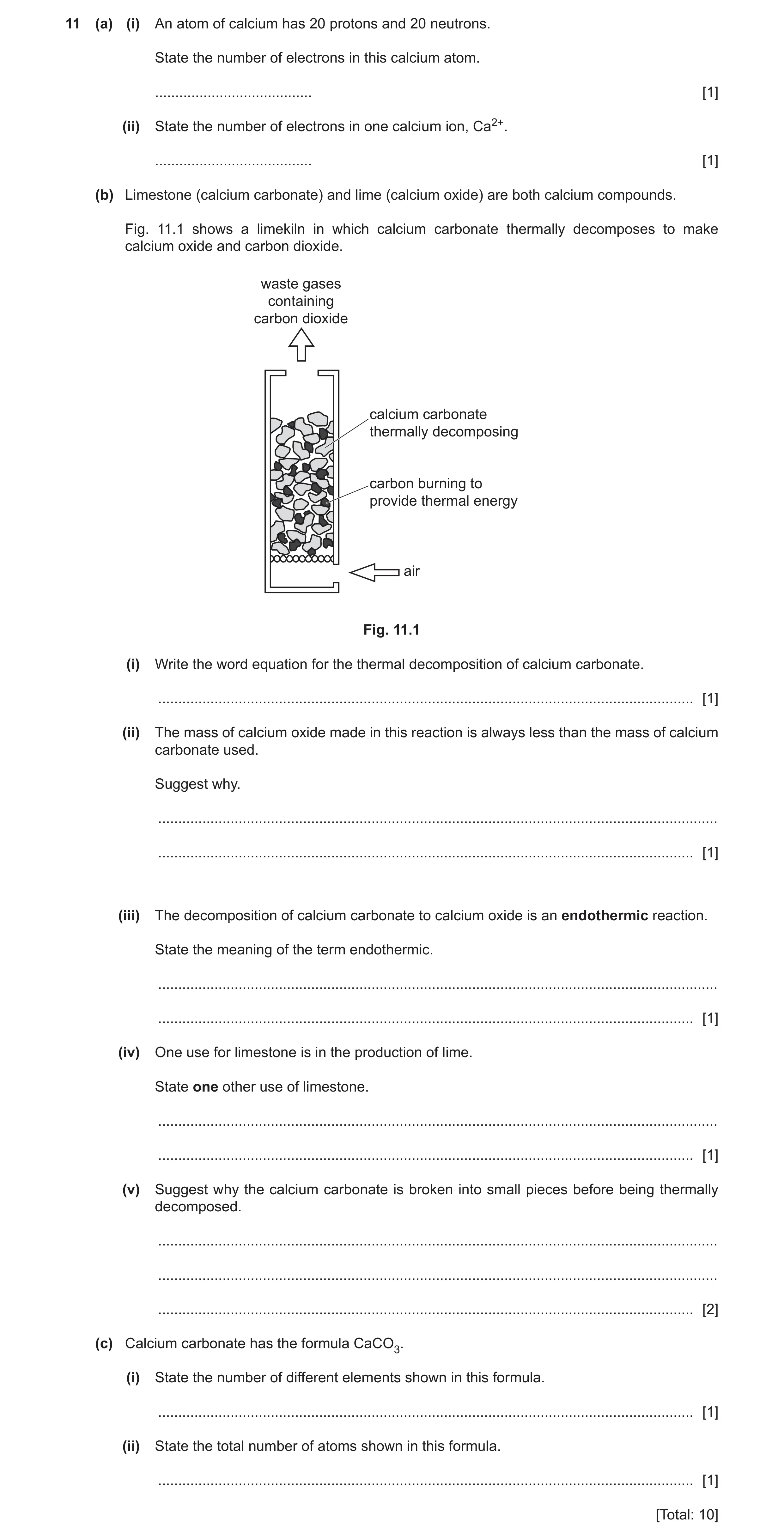
11 (a) (i) An atom of calcium has 20 protons and 20 neutrons. State the number of electrons in this calcium atom. … [1] (ii) State the number of electrons in one calcium ion, Ca2+. … [1] (b) Limestone (calcium carbonate) and lime (calcium oxide) are both calcium compounds. Fig. 11.1 shows a limekiln in which calcium carbonate thermally decomposes to make calcium oxide and carbon dioxide. waste gases containing carbon dioxide calcium carbonate thermally decomposing carbon burning to provide thermal energy air Fig. 11.1 (i) Write the word equation for the thermal decomposition of calcium carbonate. … [1] (ii) The mass of calcium oxide made in this reaction is always less than the mass of calcium carbonate used. Suggest why. … … [1] (iii) The decomposition of calcium carbonate to calcium oxide is an endothermic reaction. State the meaning of the term endothermic. … … [1] (iv) One use for limestone is in the production of lime. State one other use of limestone. … … [1] (v) Suggest why the calcium carbonate is broken into small pieces before being thermally decomposed. … … … [2] (c) Calcium carbonate has the formula CaCO3. (i) State the number of different elements shown in this formula. … [1] (ii) State the total number of atoms shown in this formula. … [1] [Total: 10]
10 marks
Mark scheme: 11(a)(i) 20 (electrons) ; 1 11(a)(ii) 18 (electrons) ; 1 11(b)(i) calcium carbonate calcium oxide carbon dioxide ; 1 11(b)(ii) carbon dioxide released ; 1 11(b)(iii) (thermal) energy taken in ; 1 11(b)(iv) neutralising acidified soil ; 1 Question Answer Marks 11(b)(v) to increase surface area ; so that reaction is faster ; 2 11(c)(i) three ; 1 11(c)(ii) five ; 1
This question in 0654/33 May/June 2023
Q17 · A calcium atom has a proton number of 20 and a nucleon number of 40 0654/31 May/June 2024
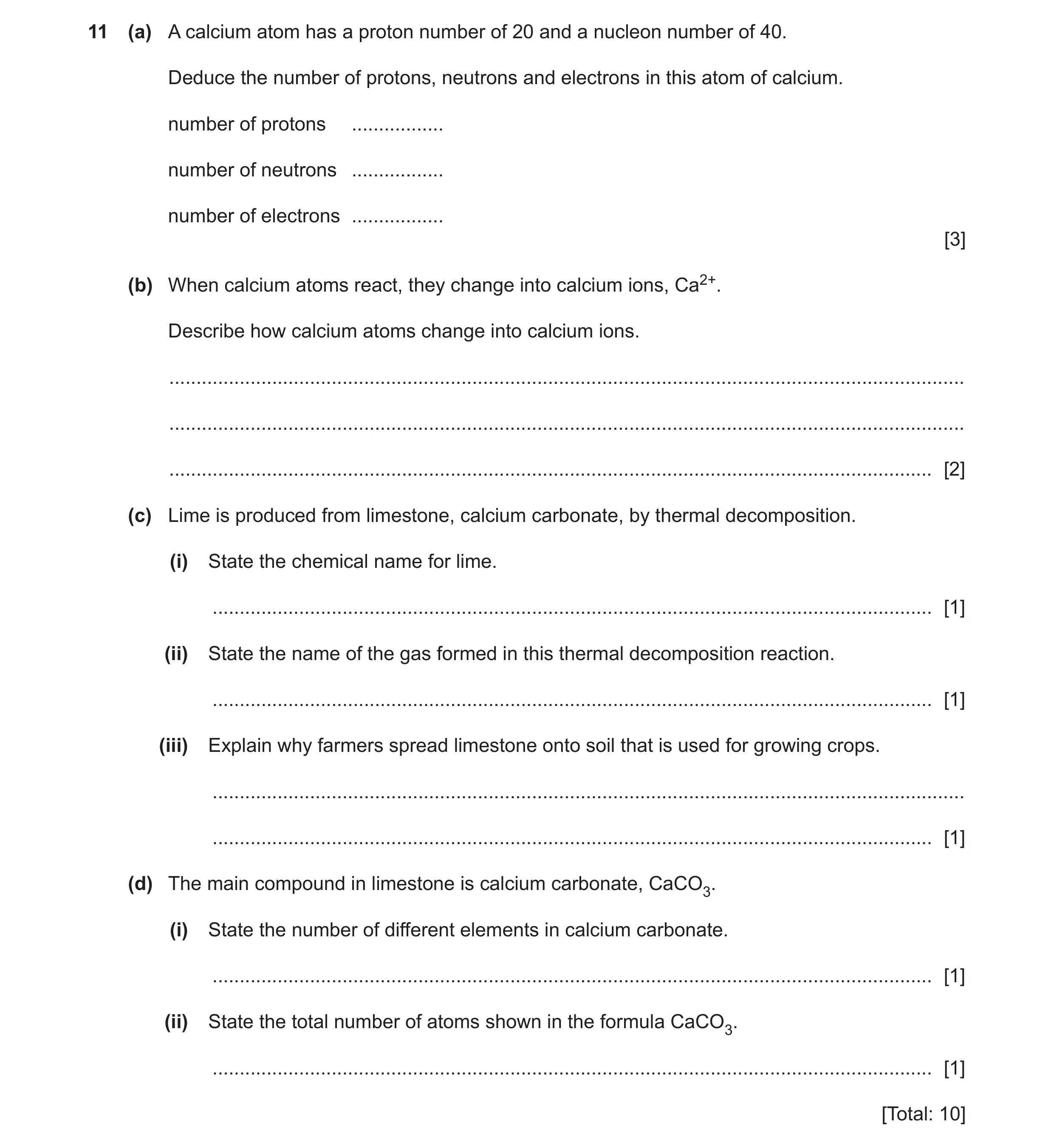
11 (a) A calcium atom has a proton number of 20 and a nucleon number of 40. Deduce the number of protons, neutrons and electrons in this atom of calcium. number of protons … number of neutrons … number of electrons … [3] (b) When calcium atoms react, they change into calcium ions, Ca2+. Describe how calcium atoms change into calcium ions. … … … [2] (c) Lime is produced from limestone, calcium carbonate, by thermal decomposition. (i) State the chemical name for lime. … [1] (ii) State the name of the gas formed in this thermal decomposition reaction. … [1] (iii) Explain why farmers spread limestone onto soil that is used for growing crops. … … [1] (d) The main compound in limestone is calcium carbonate, CaCO3. (i) State the number of different elements in calcium carbonate. … [1] (ii) State the total number of atoms shown in the formula CaCO3. … [1] [Total: 10]
10 marks
Mark scheme: 11(a) protons = 20 ; neutrons = 20 ; electrons = 20 ; 3 11(b) loses electrons ; 2 electrons ; 2 11(c)(i) calcium oxide ; 1 11(c)(ii) carbon dioxide ; 1 11(c)(iii) neutralise acidic soil ; 1 11(d)(i) 3 ; 1 11(d)(ii) 5 ; 1
This question in 0654/31 May/June 2024
Q18 · A teacher reacts sodium with water 0654/32 May/June 2024
8 A teacher reacts sodium with water. Hydrogen and aqueous sodium hydroxide are the products of the reaction. (a) Balance the symbol equation for this reaction. 2Na + … H2O … NaOH + H2 [2] (b) Before sodium is added to water, the water is neutral. Aqueous sodium hydroxide is an alkali. (i) State the pH number of pure water. pH = … [1] (ii) Suggest the pH number of the aqueous sodium hydroxide. pH = … [1] (c) The reaction between sodium and water is described as violent. Describe the reaction between potassium and water. Explain your answer. reaction … … explanation … … … [2] (d) Sodium reacts with chlorine to make sodium chloride. In this reaction, sodium atoms form sodium ions and chlorine atoms form chloride ions. • the electronic structure of a sodium atom is 2.8.1 • the electronic structure of a chlorine atom is 2.8.7 (i) Deduce the electronic structure for a sodium ion. … [1] (ii) Deduce the electronic structure for a chloride ion. … [1] (e) When concentrated aqueous sodium chloride is electrolysed, gases are released at each inert electrode. State the names of the gases released at each electrode. gas at cathode … gas at anode … [2] [Total: 10]
10 marks
Mark scheme: 8(a) 2Na + 2 H2O 2 NaOH + H2 ;; 2 8(b)(i) 7 ; 1 8(b)(ii) 8–14 ; 1 8(c) even more violent / explosive ; reactivity increases down the group / potassium is more reactive than sodium ; 2 8(d)(i) 2.8 ; 1 8(d)(ii) 2.8.8 ; 1 8(e) cathode–hydrogen ; anode–chlorine ; 2
This question in 0654/32 May/June 2024
Q19 · A teacher reacts sodium with water 0654/33 May/June 2024
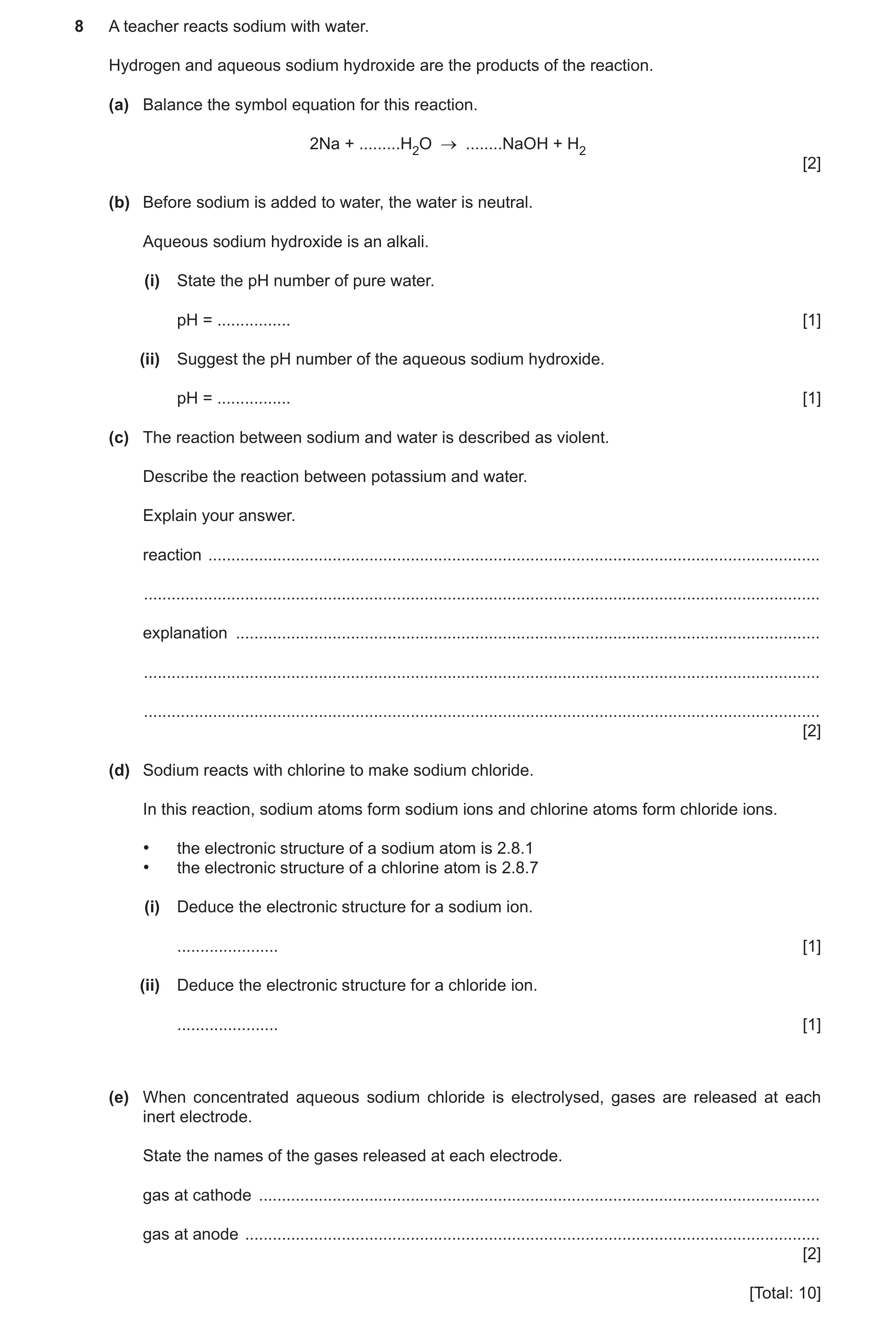
8 A teacher reacts sodium with water. Hydrogen and aqueous sodium hydroxide are the products of the reaction. (a) Balance the symbol equation for this reaction. 2Na + … H2O … NaOH + H2 [2] (b) Before sodium is added to water, the water is neutral. Aqueous sodium hydroxide is an alkali. (i) State the pH number of pure water. pH = … [1] (ii) Suggest the pH number of the aqueous sodium hydroxide. pH = … [1] (c) The reaction between sodium and water is described as violent. Describe the reaction between potassium and water. Explain your answer. reaction … … explanation … … … [2] (d) Sodium reacts with chlorine to make sodium chloride. In this reaction, sodium atoms form sodium ions and chlorine atoms form chloride ions. • the electronic structure of a sodium atom is 2.8.1 • the electronic structure of a chlorine atom is 2.8.7 (i) Deduce the electronic structure for a sodium ion. … [1] (ii) Deduce the electronic structure for a chloride ion. … [1] (e) When concentrated aqueous sodium chloride is electrolysed, gases are released at each inert electrode. State the names of the gases released at each electrode. gas at cathode … gas at anode … [2] [Total: 10]
10 marks
Mark scheme: 8(a) 2Na + 2 H2O 2 NaOH + H2 ;; 2 8(b)(i) 7 ; 1 8(b)(ii) 8–14 ; 1 8(c) even more violent / explosive ; reactivity increases down the group / potassium is more reactive than sodium ; 2 8(d)(i) 2.8 ; 1 8(d)(ii) 2.8.8 ; 1 8(e) cathode–hydrogen ; anode–chlorine ; 2
This question in 0654/33 May/June 2024
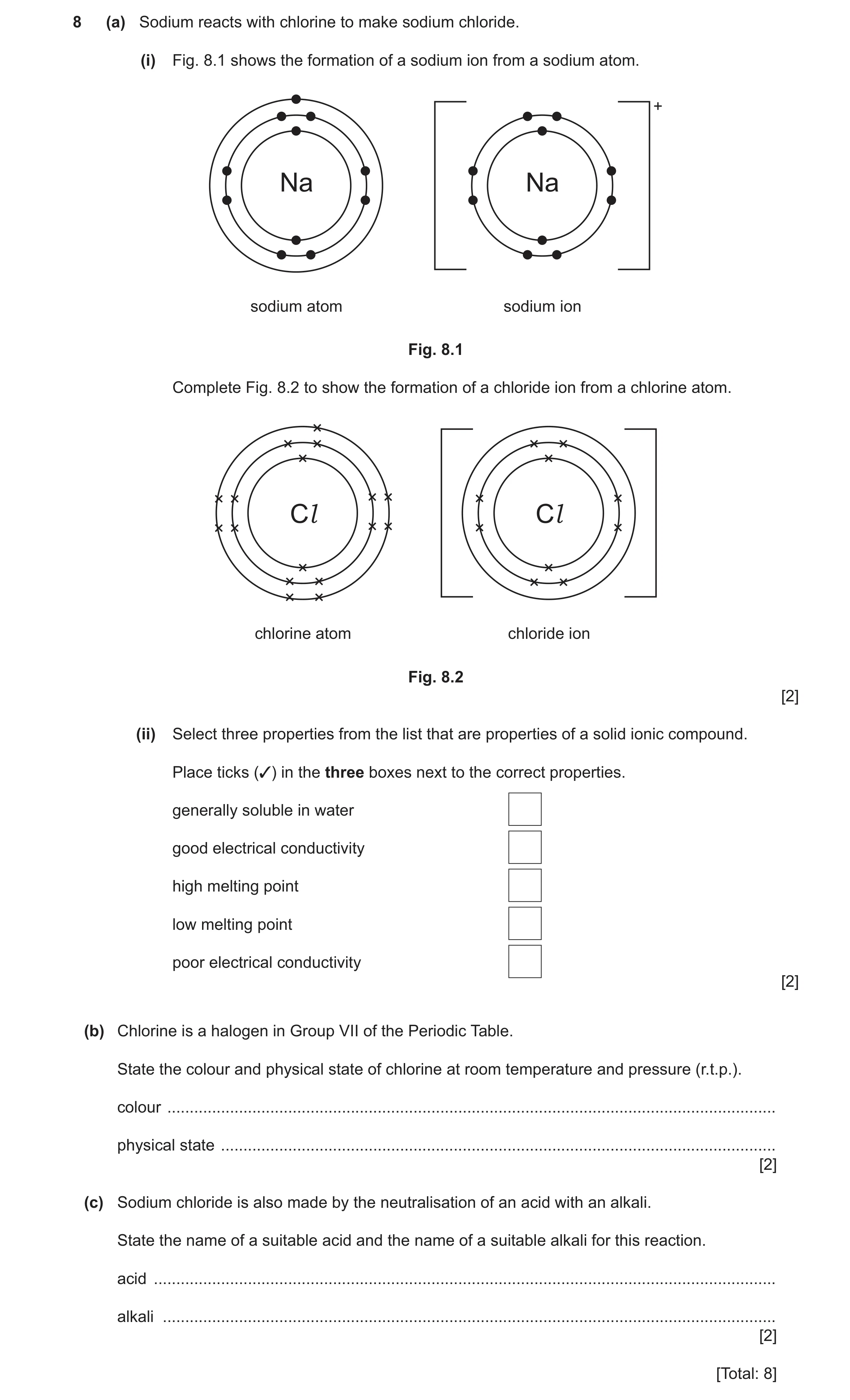
Q20 · Sodium reacts with chlorine to make sodium chloride 0654/32 Oct/Nov 2025
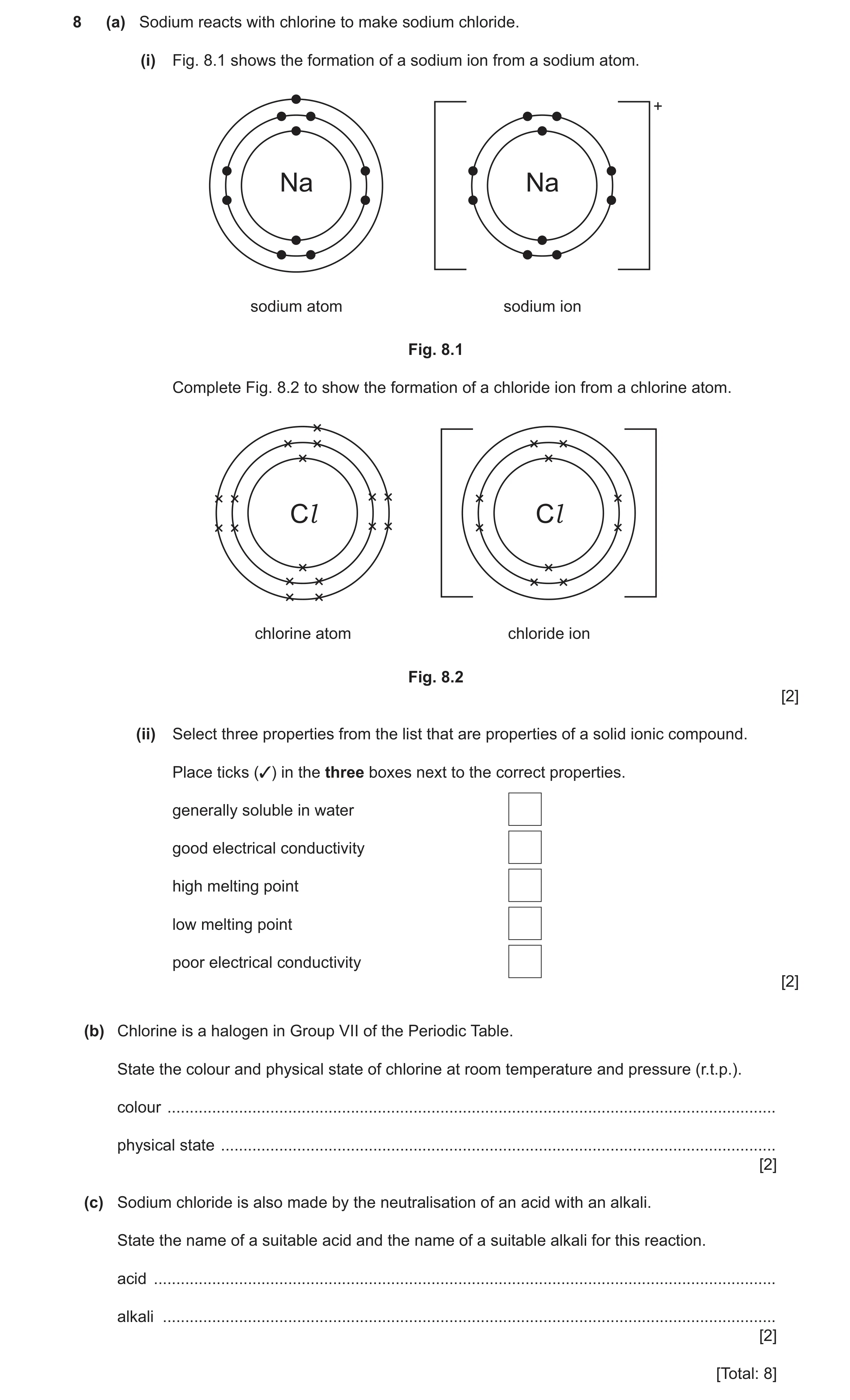
8 (a) Sodium reacts with chlorine to make sodium chloride. (i) Fig. 8.1 shows the formation of a sodium ion from a sodium atom. + Na Na sodium atom sodium ion Fig. 8.1 Complete Fig. 8.2 to show the formation of a chloride ion from a chlorine atom. Cl Cl chlorine atom chloride ion Fig. 8.2 [2] (ii) Select three properties from the list that are properties of a solid ionic compound. Place ticks (3) in the three boxes next to the correct properties. generally soluble in water good electrical conductivity high melting point low melting point poor electrical conductivity [2] (b) Chlorine is a halogen in Group VII of the Periodic Table. State the colour and physical state of chlorine at room temperature and pressure (r.t.p.). colour … physical state … [2] (c) Sodium chloride is also made by the neutralisation of an acid with an alkali. State the name of a suitable acid and the name of a suitable alkali for this reaction. acid … alkali … [2] [Total: 8]
8 marks
Mark scheme: 8(a)(i) eight electrons added to outer shell ; 2 – sign shown ; 8(a)(ii) 2 2 correct – 1 mark all 3 correct – 2 marks 8(b) (pale) yellow-green ; 2 gas ; 8(c) hydrochloric acid ; 2 sodium hydroxide ;
This question in 0654/32 Oct/Nov 2025
Q21 · Sodium reacts with chlorine to make sodium chloride 0654/33 Oct/Nov 2025
8 (a) Sodium reacts with chlorine to make sodium chloride. (i) Fig. 8.1 shows the formation of a sodium ion from a sodium atom. + Na Na sodium atom sodium ion Fig. 8.1 Complete Fig. 8.2 to show the formation of a chloride ion from a chlorine atom. Cl Cl chlorine atom chloride ion Fig. 8.2 [2] (ii) Select three properties from the list that are properties of a solid ionic compound. Place ticks (3) in the three boxes next to the correct properties. generally soluble in water good electrical conductivity high melting point low melting point poor electrical conductivity [2] (b) Chlorine is a halogen in Group VII of the Periodic Table. State the colour and physical state of chlorine at room temperature and pressure (r.t.p.). colour … physical state … [2] (c) Sodium chloride is also made by the neutralisation of an acid with an alkali. State the name of a suitable acid and the name of a suitable alkali for this reaction. acid … alkali … [2] [Total: 8]
8 marks
Mark scheme: 8(a)(i) eight electrons added to outer shell ; 2 – sign shown ; 8(a)(ii) 2 2 correct – 1 mark all 3 correct – 2 marks 8(b) (pale) yellow-green ; 2 gas ; 8(c) hydrochloric acid ; 2 sodium hydroxide ;
This question in 0654/33 Oct/Nov 2025
 30 / 35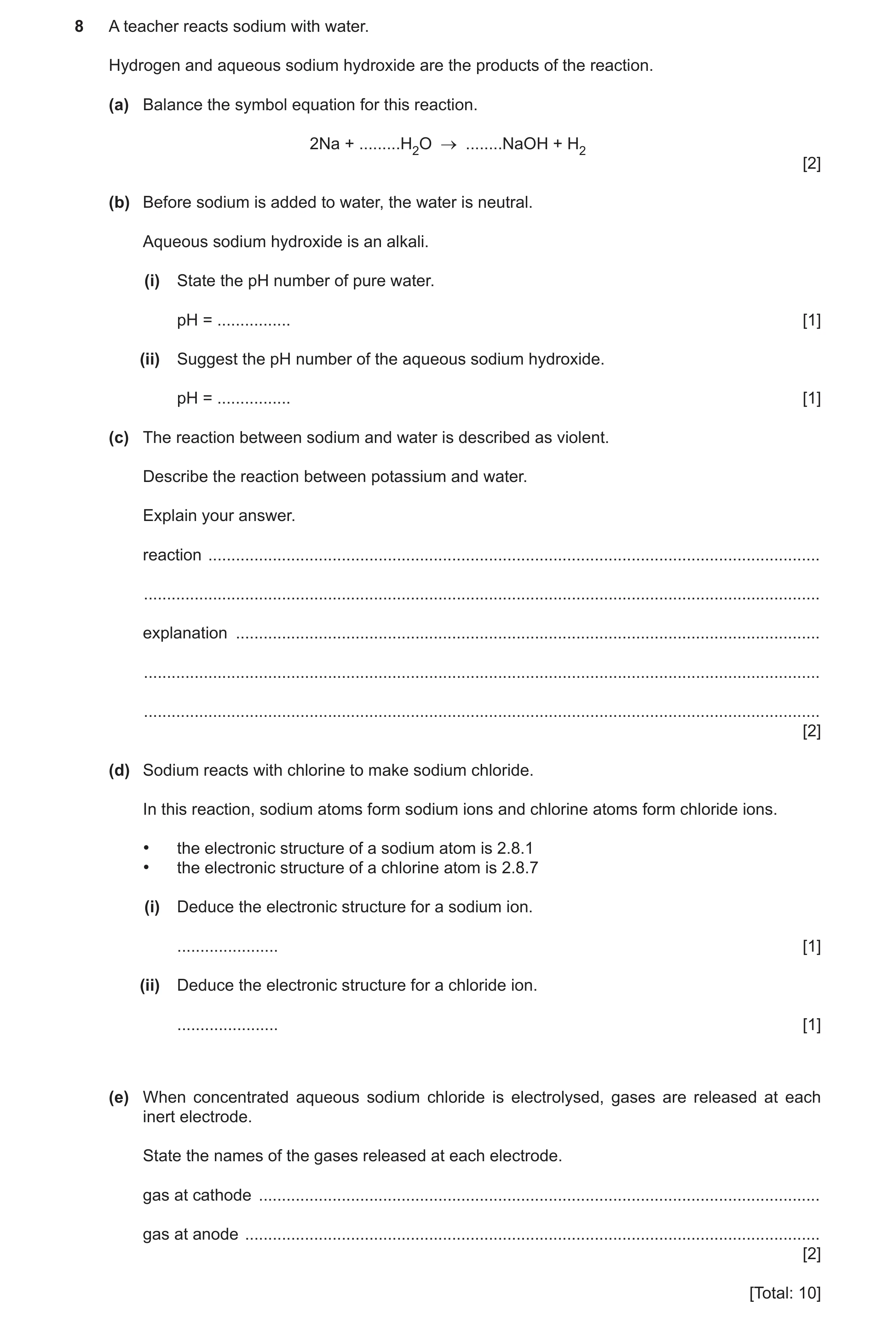
 9
9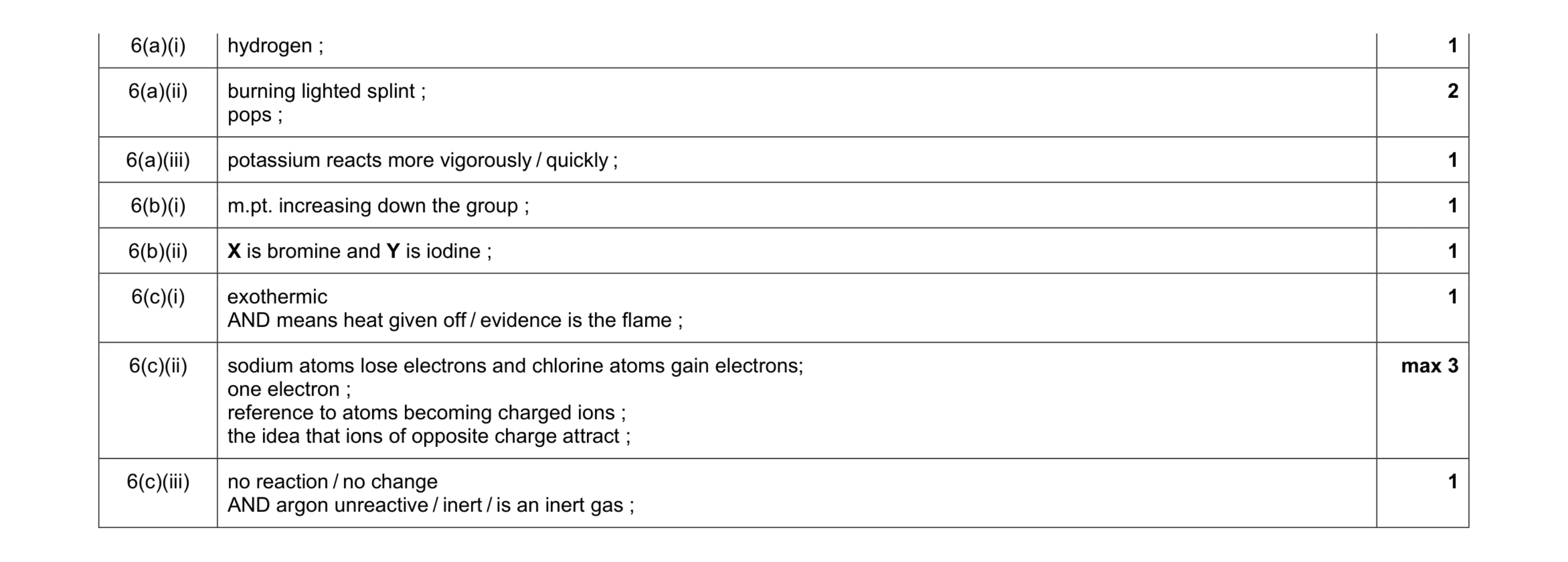 11
11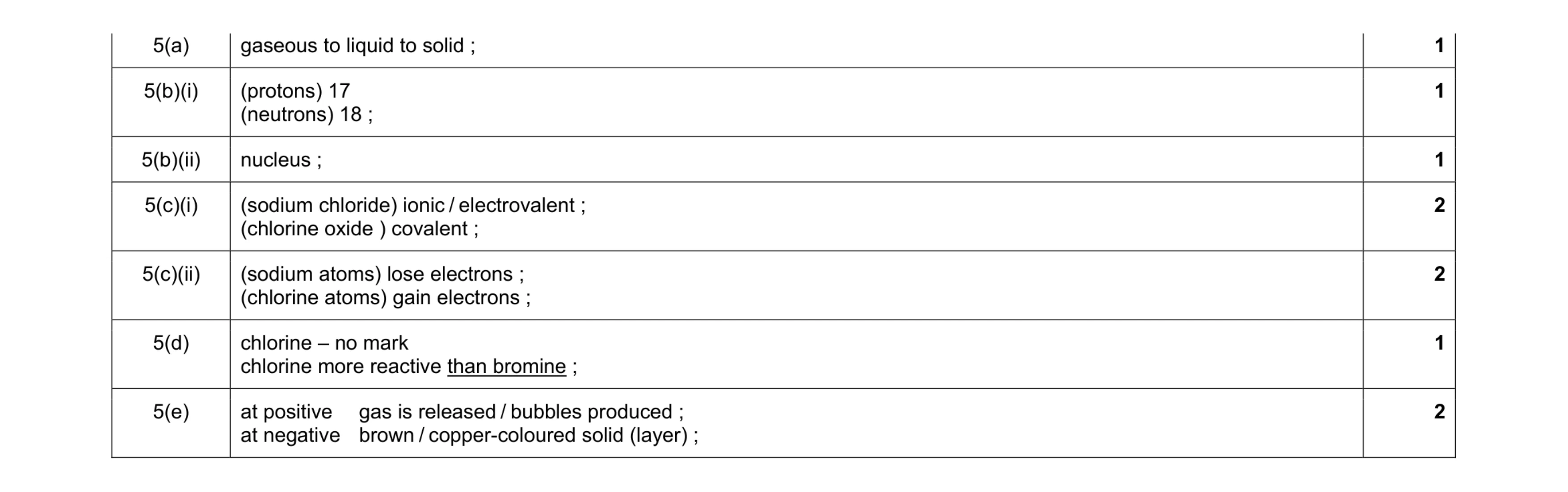 10
10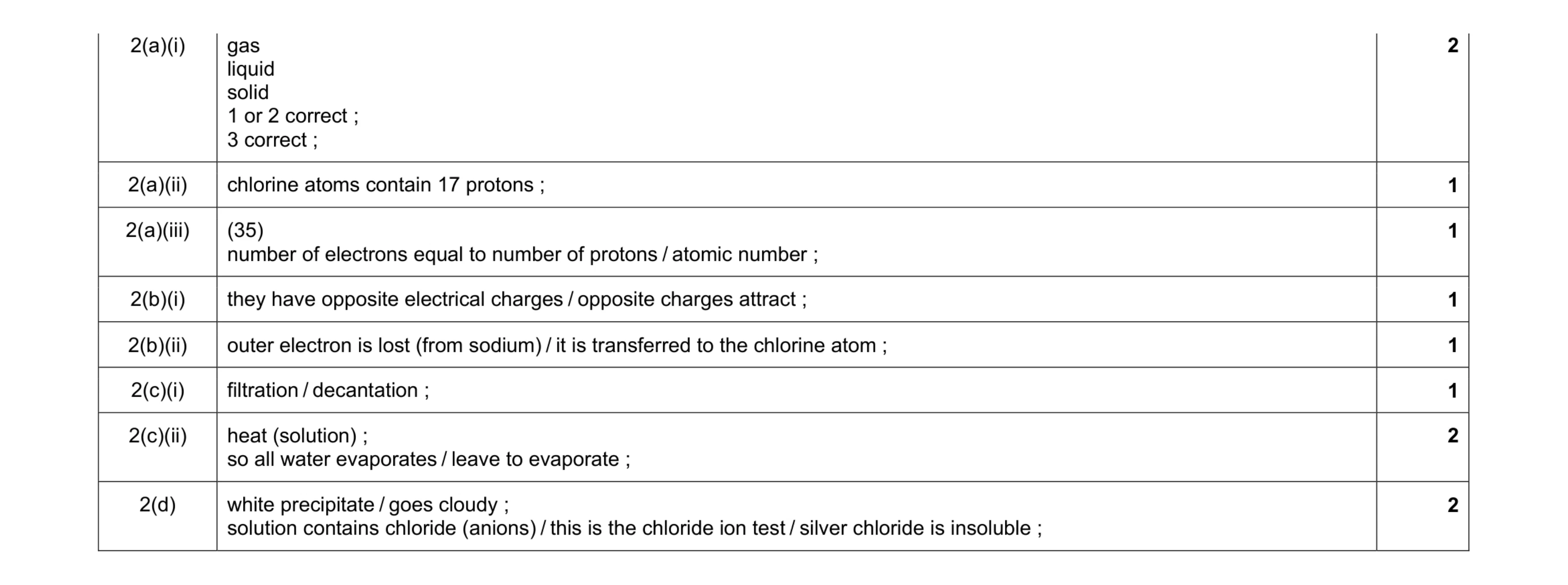 11
11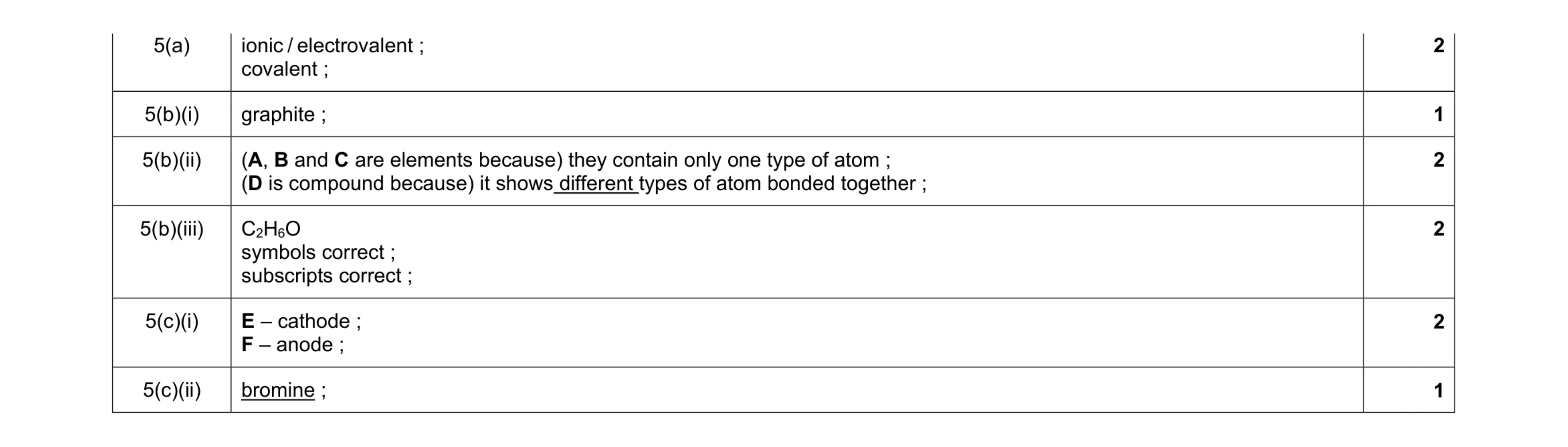 10
10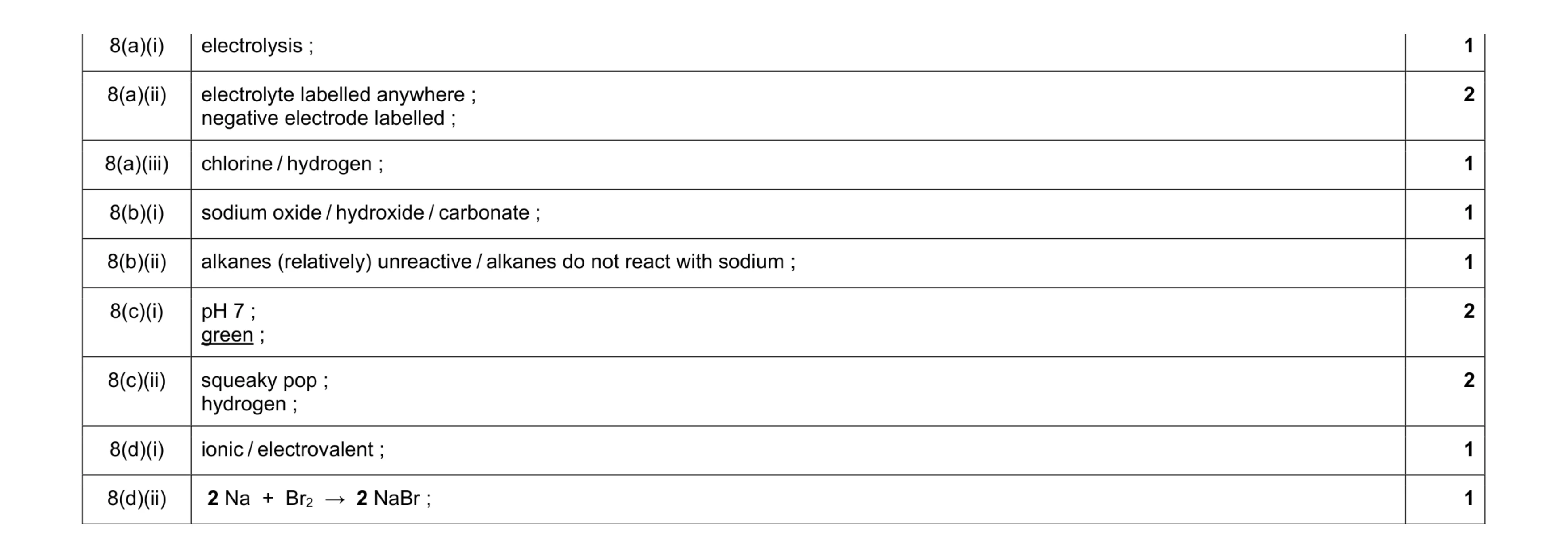 12
12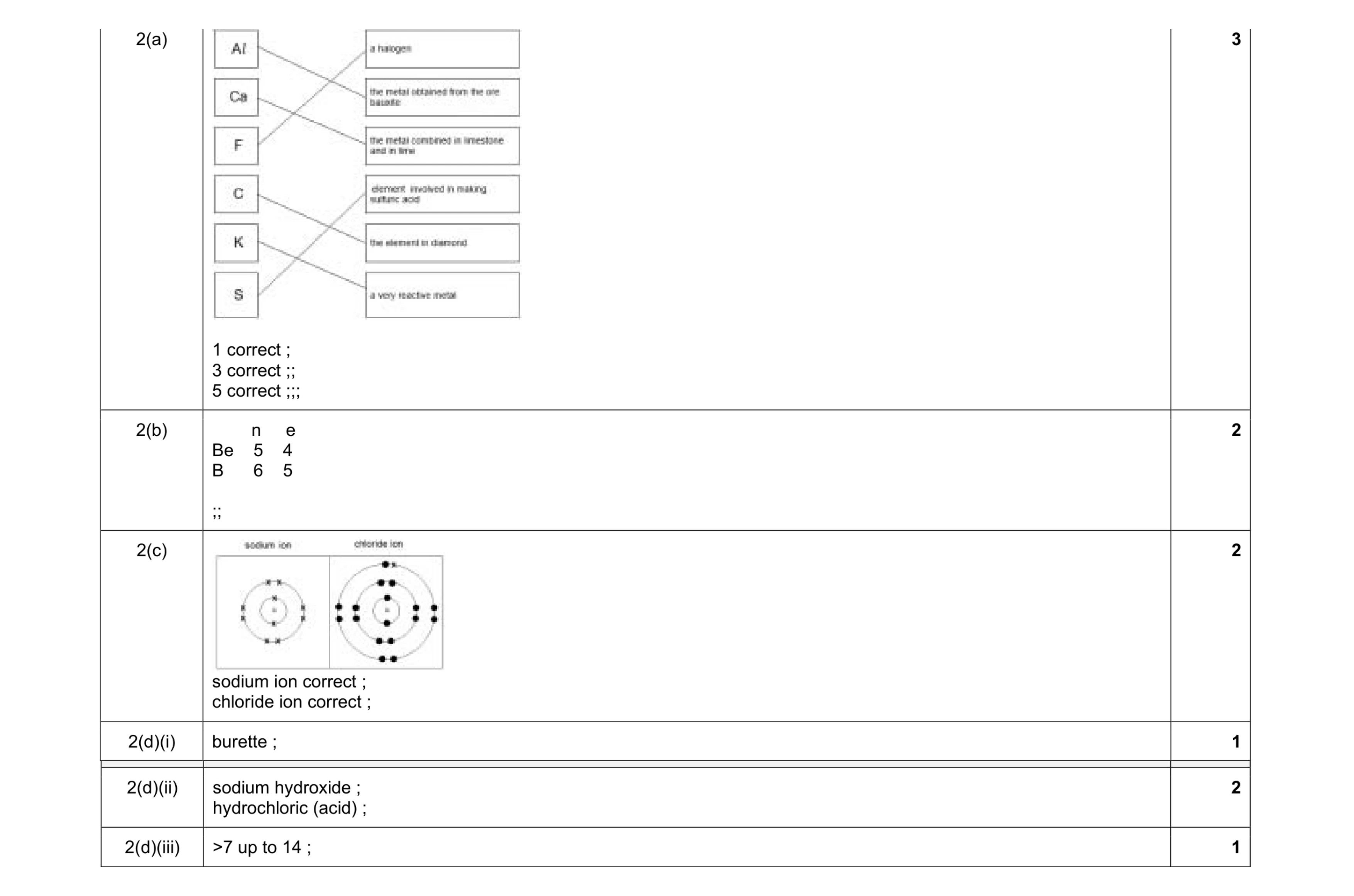 11
11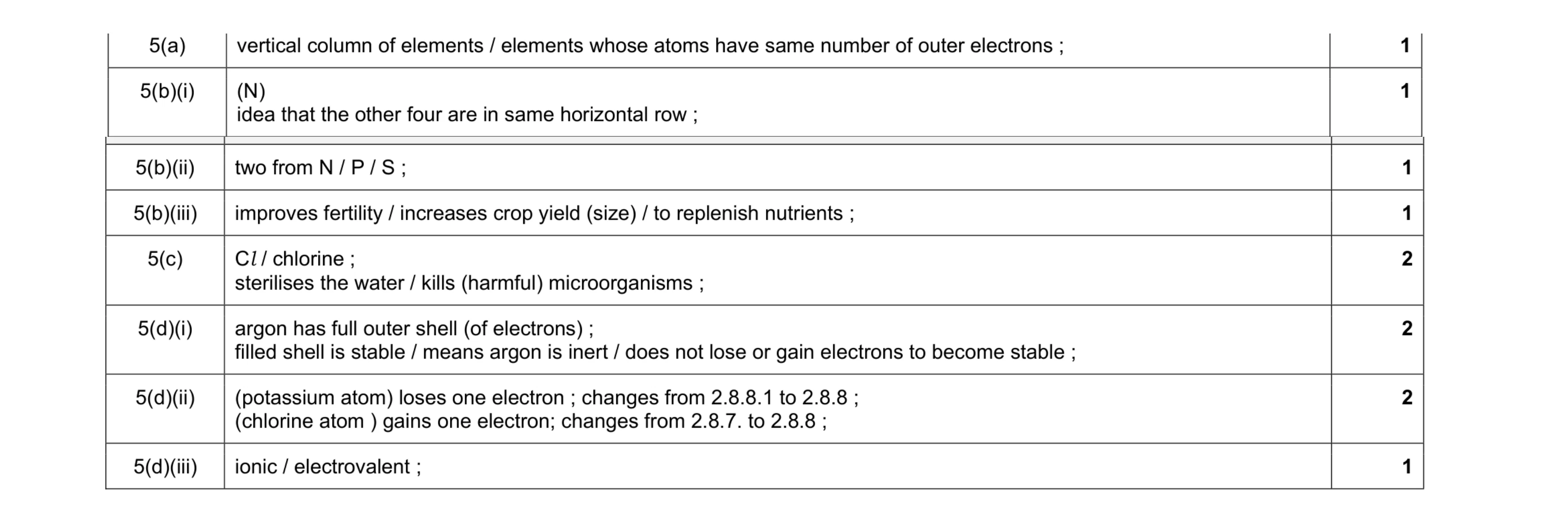 11
11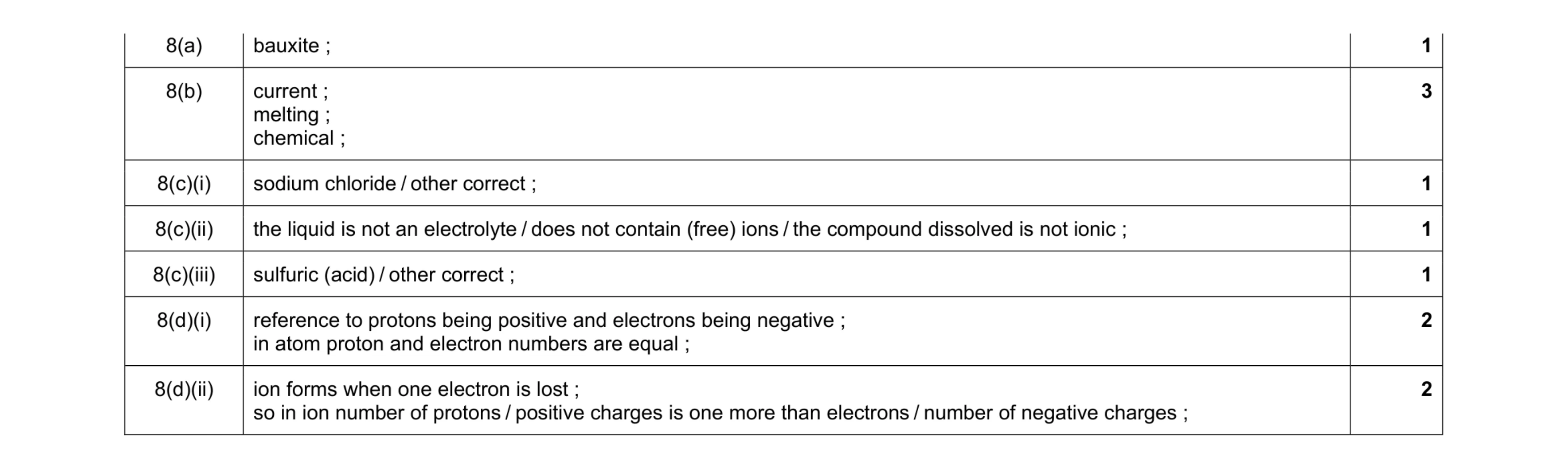 11
11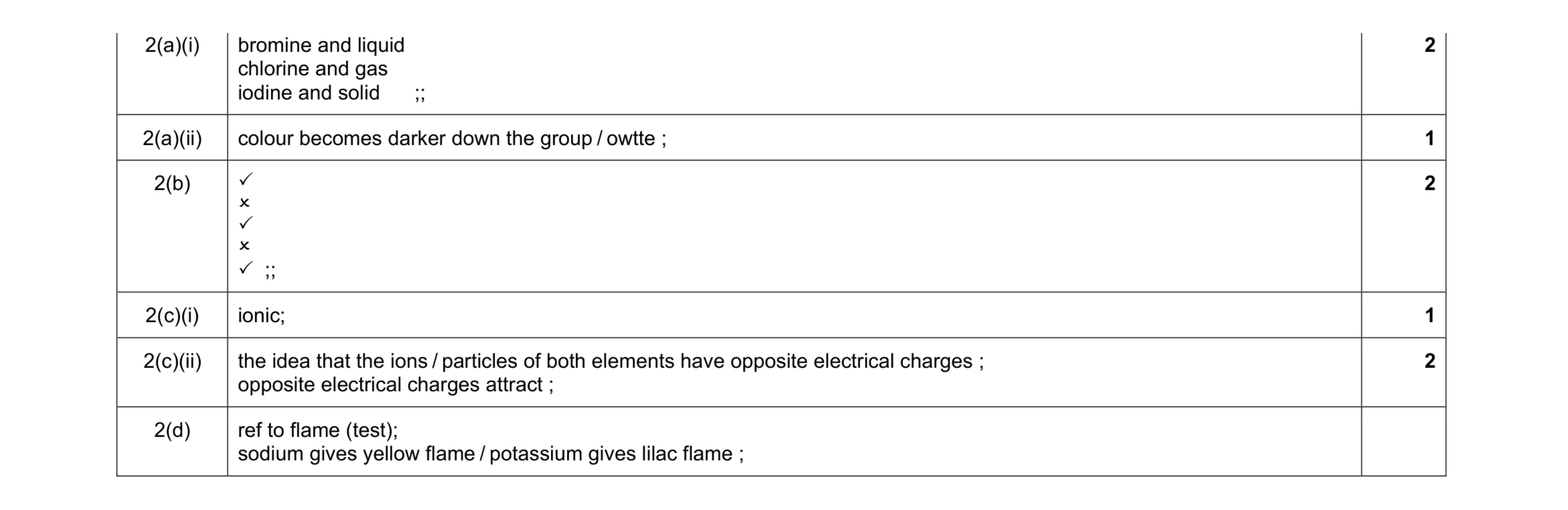 10
10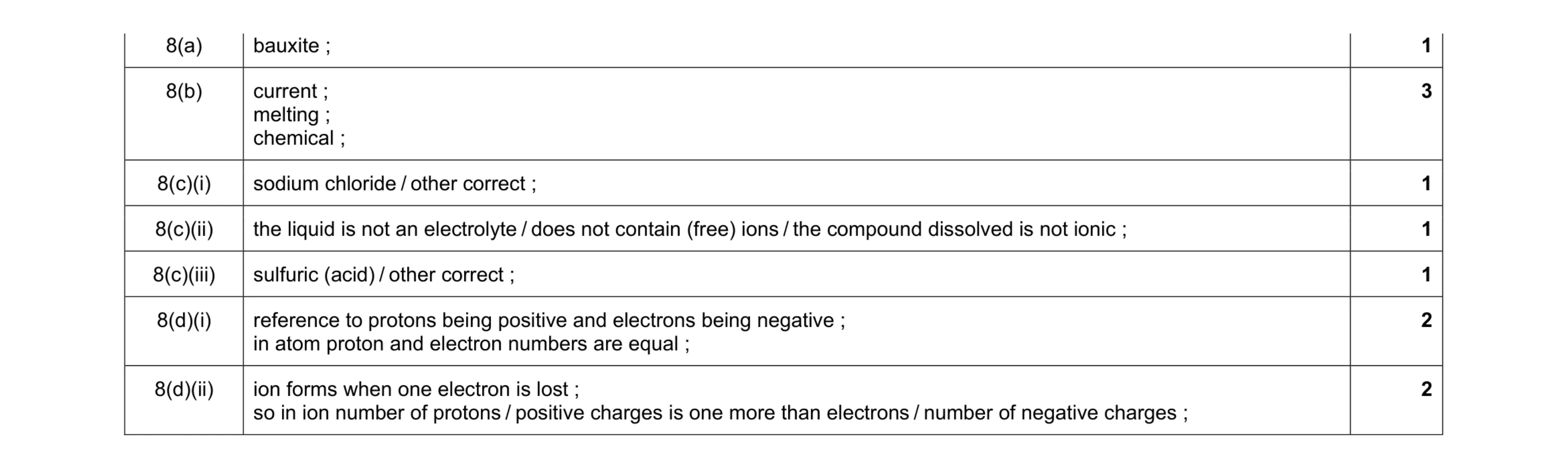 11
11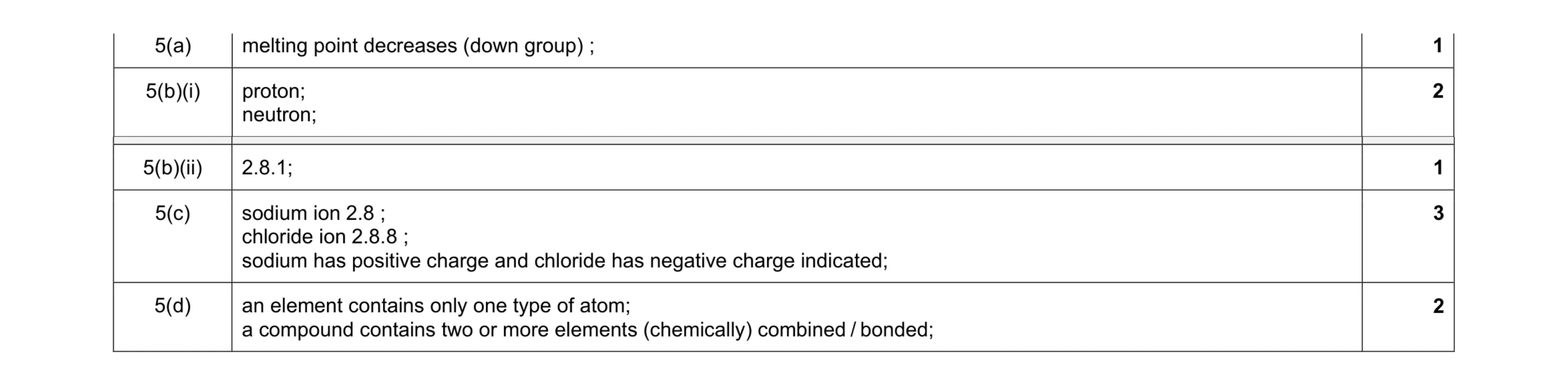 9
9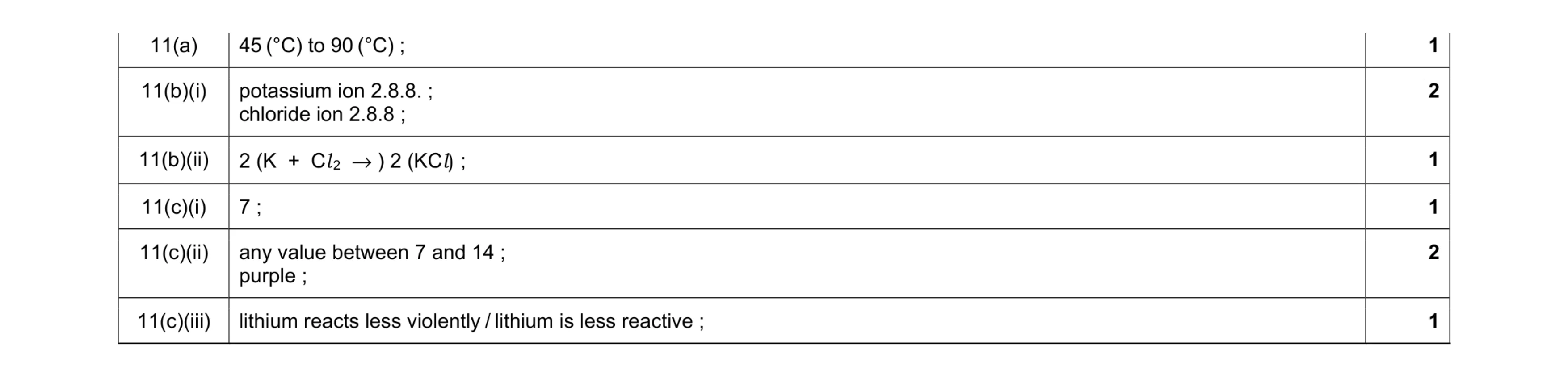 8
8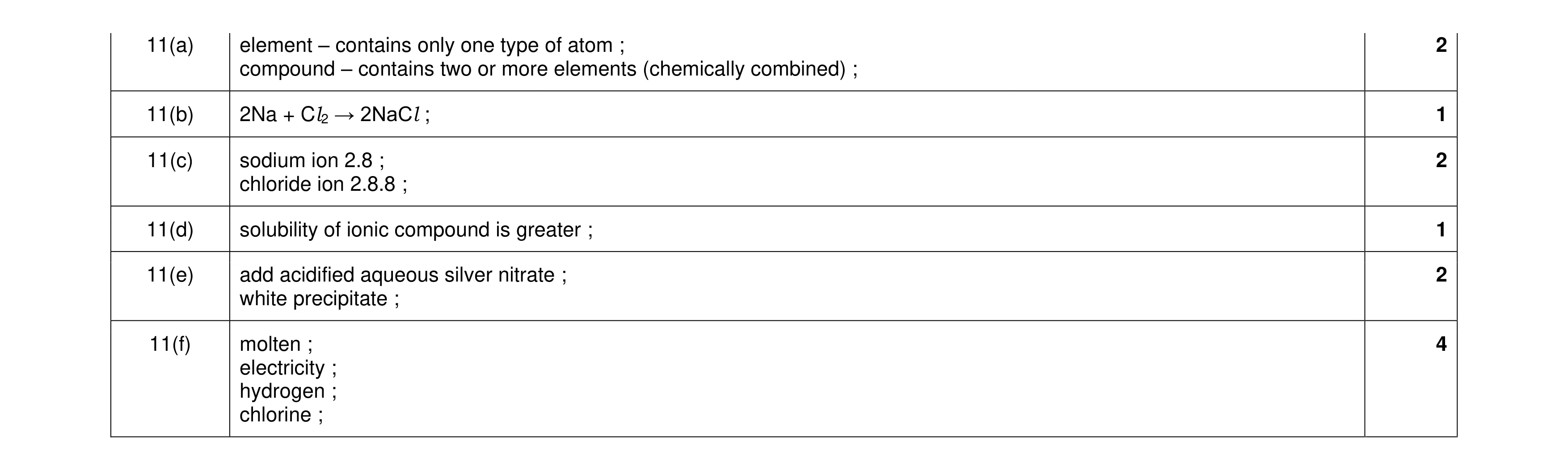 12
12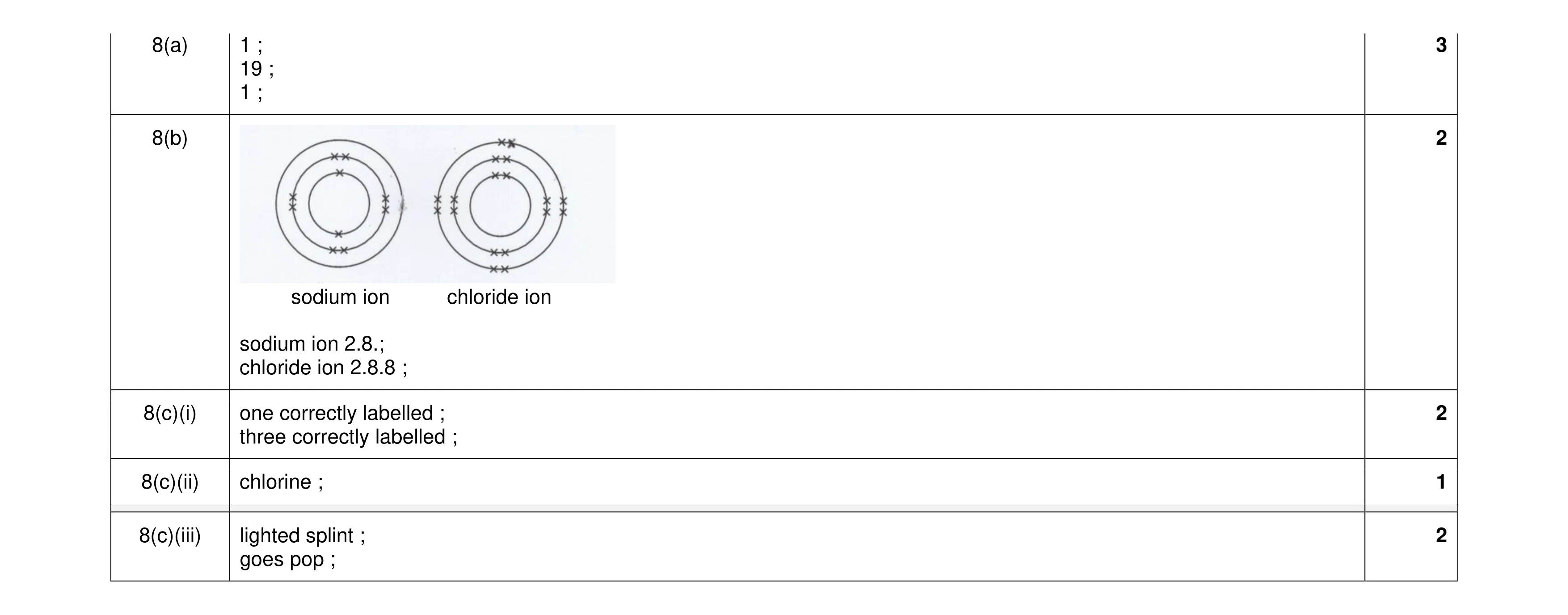 10
10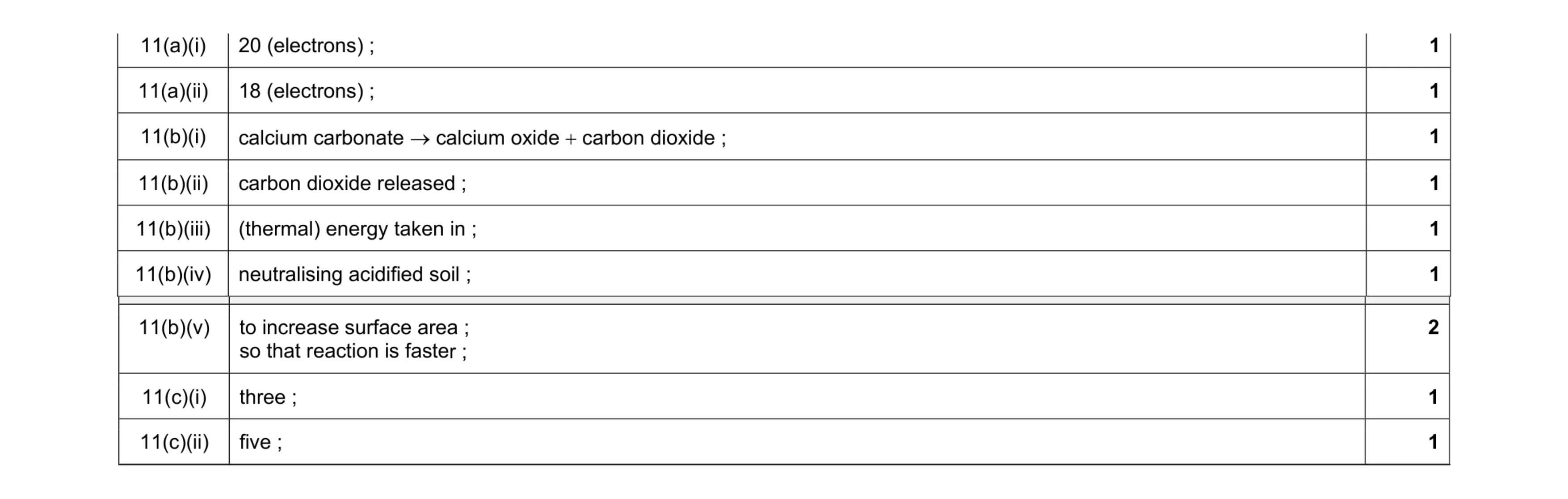 10
10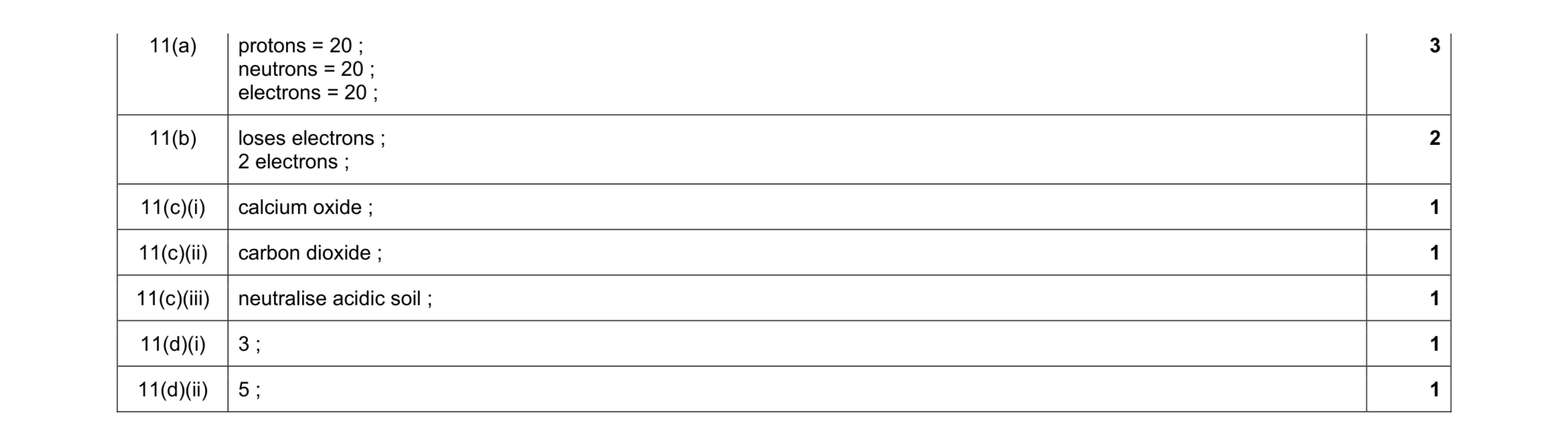 10
10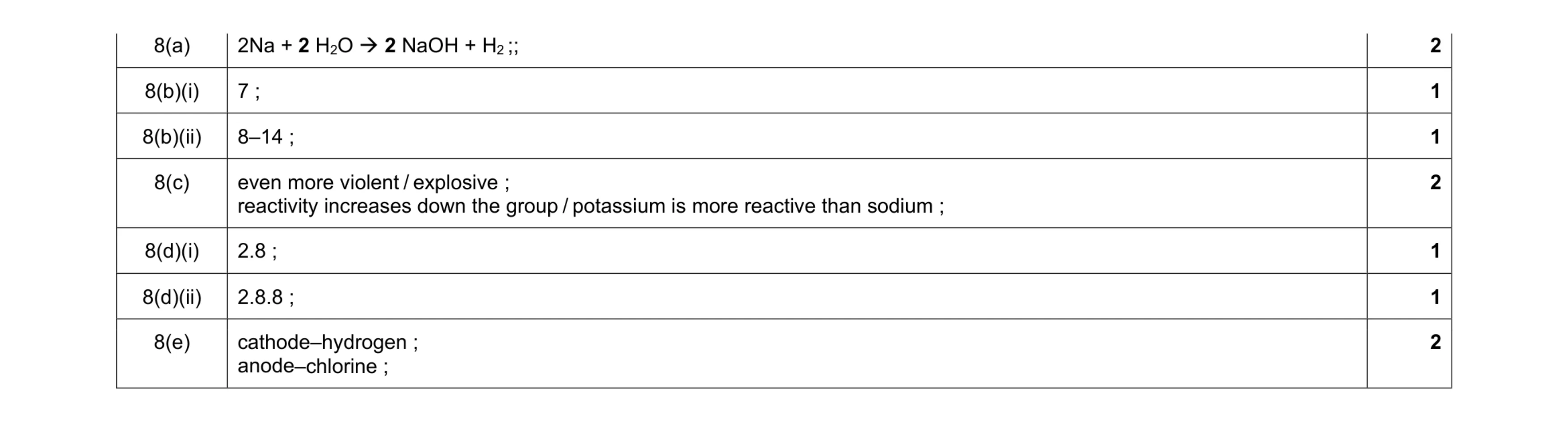 10
10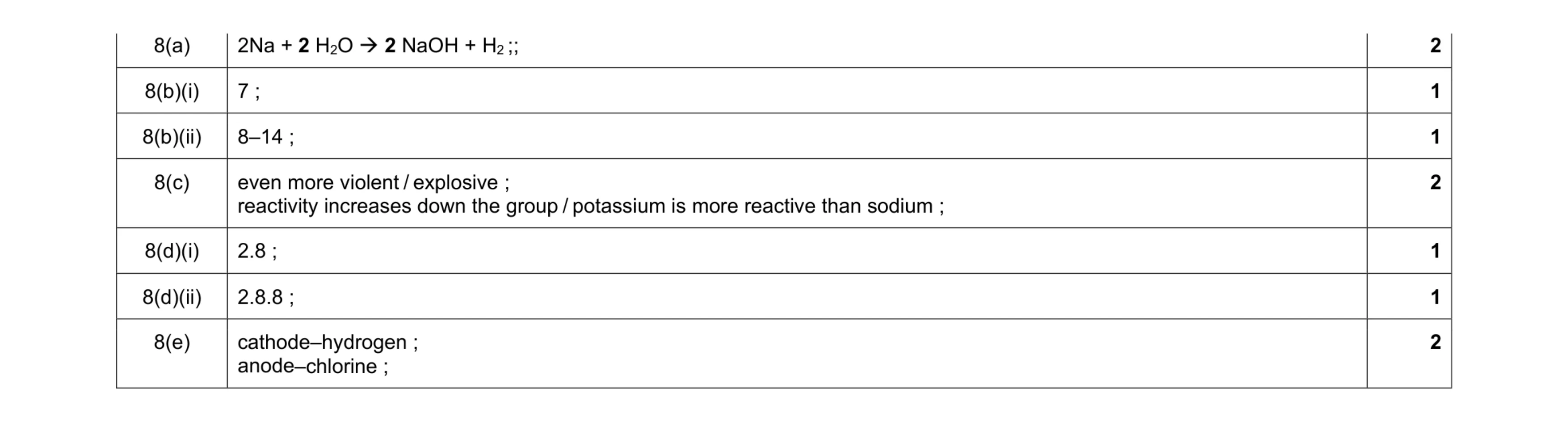 10
10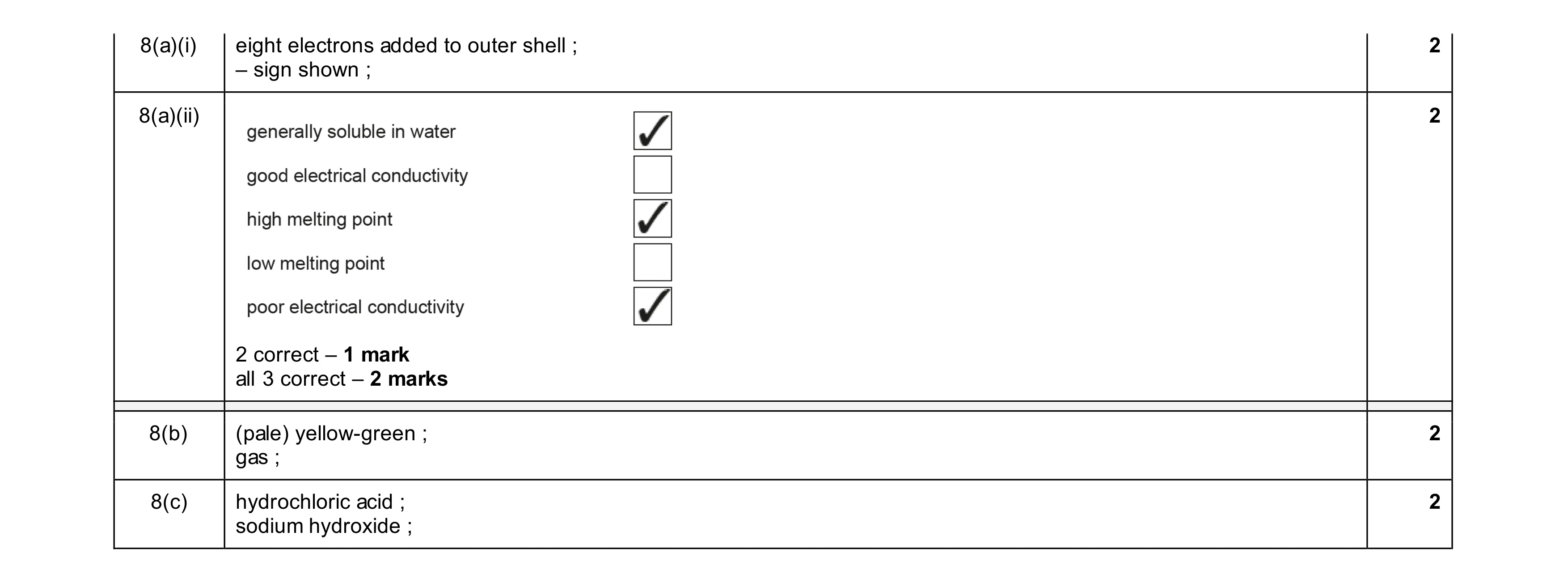 8
8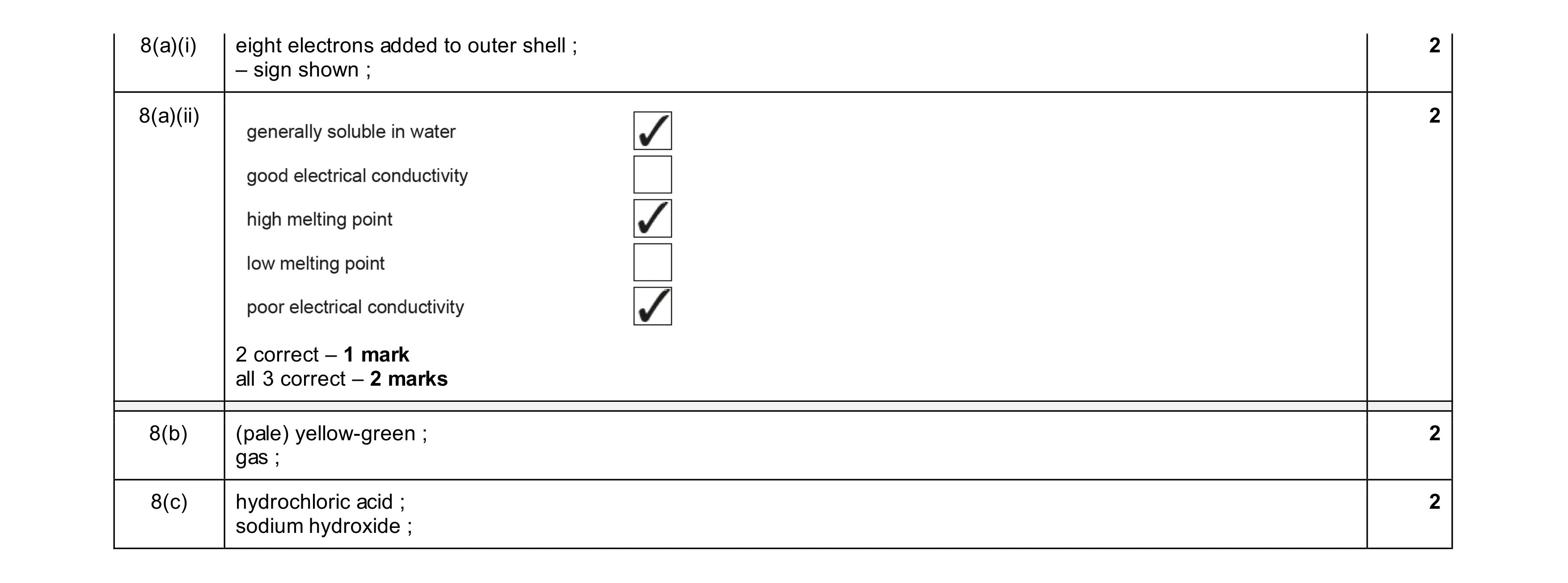 8
8