Questions as text
Q1 · Which statement describes how magnesium atoms and nitrogen atoms combine to form… 0654/21 May/June 2017
14 Which statement describes how magnesium atoms and nitrogen atoms combine to form magnesium nitride, Mg3N2? A Each magnesium atom loses three electrons and each nitrogen atom gains two electrons. B Each magnesium atom loses two electrons and each nitrogen atom gains three electrons. C Each nitrogen atom loses three electrons and each magnesium atom gains two electrons. D Each nitrogen atom loses two electrons and each magnesium atom gains three electrons.
1 marks
Answer: B
This question in 0654/21 May/June 2017
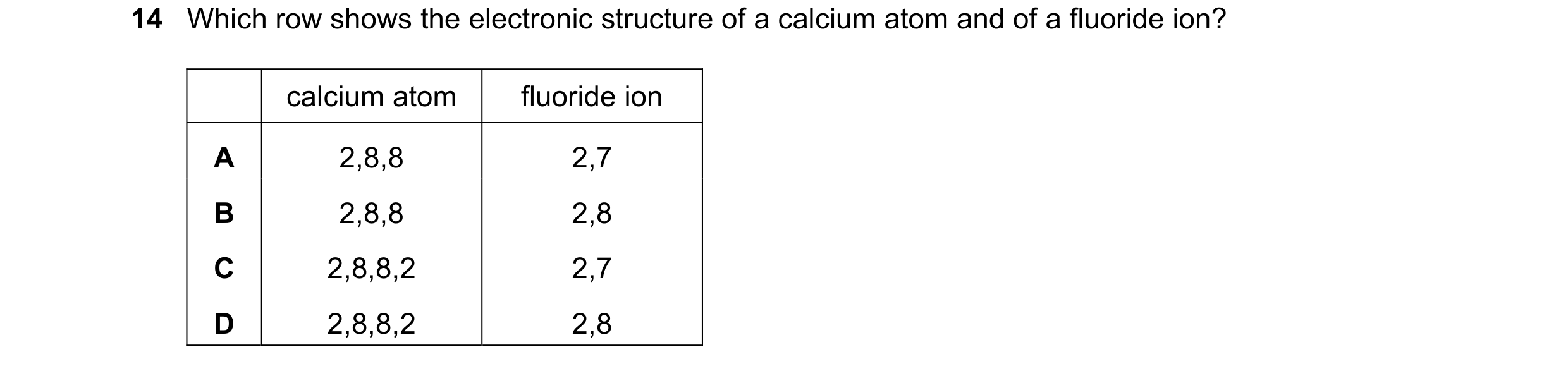
Q2 · Which row shows the electronic structure of a calcium atom and of a fluoride ion? 0654/23 May/June 2017
14 Which row shows the electronic structure of a calcium atom and of a fluoride ion? calcium atom fluoride ion A 2,8,8 2,7 B 2,8,8 2,8 C 2,8,8,2 2,7 D 2,8,8,2 2,8
1 marks
Answer: D
This question in 0654/23 May/June 2017
Q3 · Which statement describes the structure of sodium chloride? 0654/23 May/June 2017
21 Which statement describes the structure of sodium chloride? A contains alternating positive and negative ions B contains an irregular arrangement of ions C contains positive ions only D is a giant covalent structure
1 marks
Answer: A
This question in 0654/23 May/June 2017
Q4 · Element X has two outer-shell electrons 0654/23 Oct/Nov 2017
20 Element X has two outer-shell electrons. Element Y has seven outer-shell electrons. Which statement about X and Y is not correct? A Element X combines with element Y to form an ionic compound. B Element X combines with element Y to form a solid compound which conducts electricity. C Element X conducts electricity and element Y is in Group VII of the Periodic Table. D Element X is in Group II of the Periodic Table and element Y does not conduct electricity.
1 marks
Answer: B
This question in 0654/23 Oct/Nov 2017
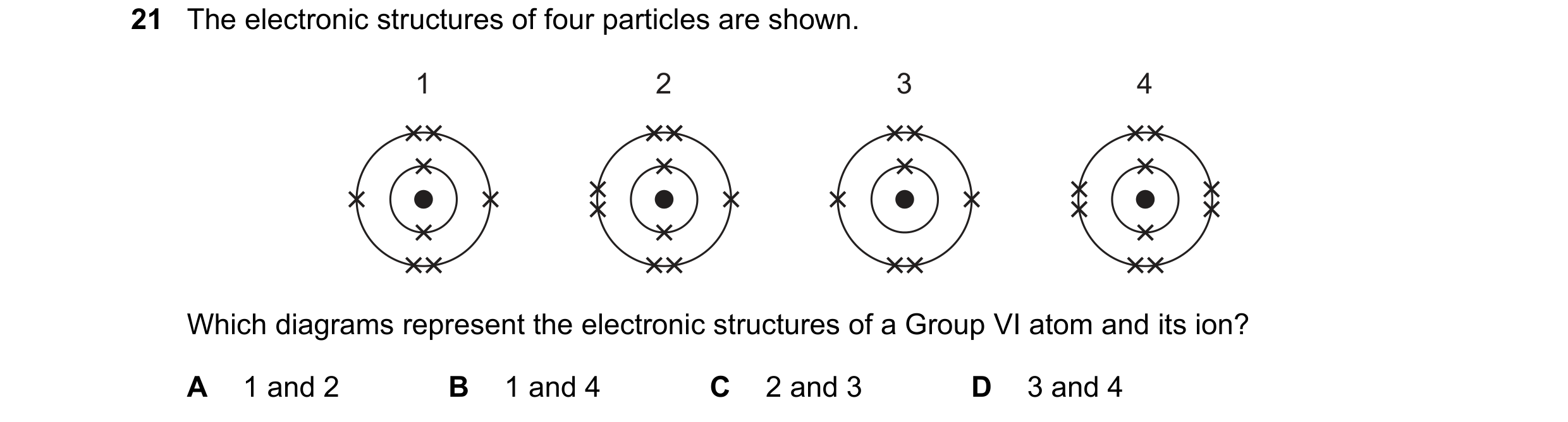
Q5 · The electronic structures of four particles are shown 0654/21 Oct/Nov 2018
21 The electronic structures of four particles are shown. 1 2 3 4 Which diagrams represent the electronic structures of a Group VI atom and its ion? A 1 and 2 B 1 and 4 C 2 and 3 D 3 and 4
1 marks
Answer: B
This question in 0654/21 Oct/Nov 2018
Q6 · Which compound is formed when one metal atom transfers two electrons to one non-metal… 0654/21 May/June 2020
15 Which compound is formed when one metal atom transfers two electrons to one non-metal atom? A calcium chloride B calcium oxide C sodium chloride D sodium oxide
1 marks
Answer: B
This question in 0654/21 May/June 2020
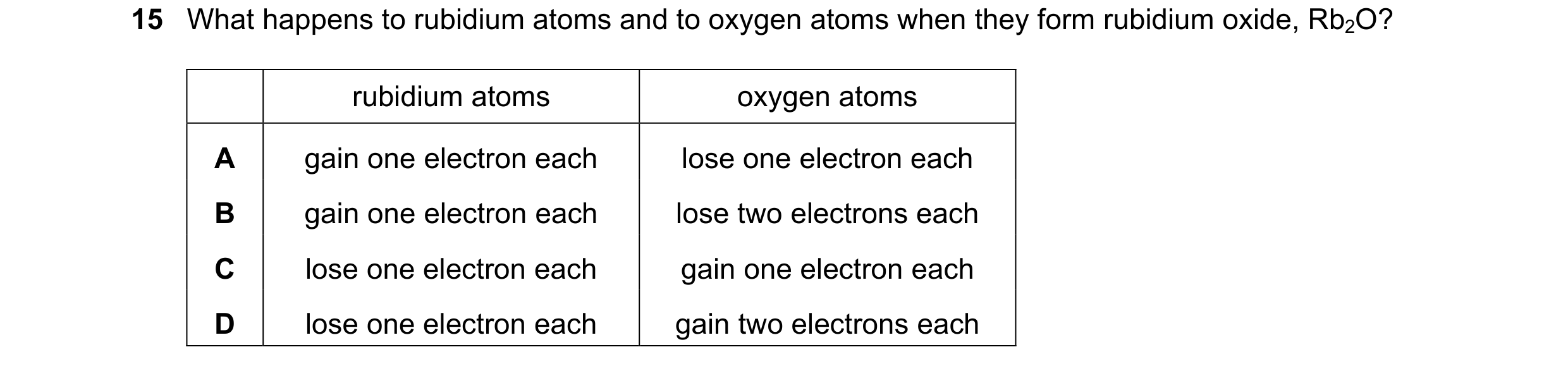
Q7 · What happens to rubidium atoms and to oxygen atoms when they form rubidium oxide, Rb2O? 0654/22 May/June 2020
15 What happens to rubidium atoms and to oxygen atoms when they form rubidium oxide, Rb2O? rubidium atoms oxygen atoms A gain one electron each lose one electron each B gain one electron each lose two electrons each C lose one electron each gain one electron each D lose one electron each gain two electrons each
1 marks
Answer: D
This question in 0654/22 May/June 2020
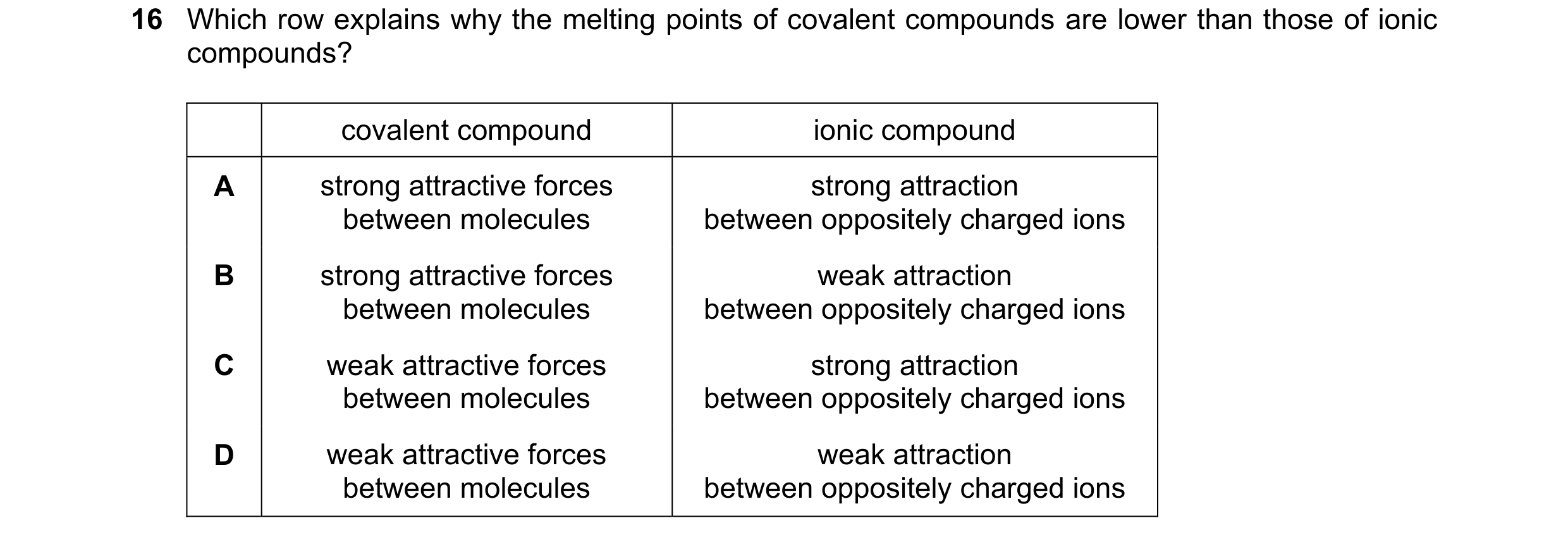
Q8 · Which row explains why the melting points of covalent compounds are lower than those of… 0654/21 May/June 2021
16 Which row explains why the melting points of covalent compounds are lower than those of ionic compounds? covalent compound ionic compound A strong attractive forces strong attraction between molecules between oppositely charged ions B strong attractive forces weak attraction between molecules between oppositely charged ions C weak attractive forces strong attraction between molecules between oppositely charged ions D weak attractive forces weak attraction between molecules between oppositely charged ions
1 marks
Answer: C
This question in 0654/21 May/June 2021
Q9 · Sodium phosphate, Na3PO4, contains sodium ions, Na+ 0654/23 May/June 2022
16 Sodium phosphate, Na3PO4, contains sodium ions, Na+. Aluminium sulfate, Al 2(SO4)3, contains sulfate ions, SO4 2–. What is the formula of aluminium phosphate? A Al PO4 B Al (PO4)2 C Al 2(PO4)3 D Al 3(PO4)2
1 marks
Answer: A
This question in 0654/23 May/June 2022
Q10 · Which statement describes the lattice structure of sodium chloride, NaCl ? 0654/21 Oct/Nov 2022
16 Which statement describes the lattice structure of sodium chloride, NaCl ? A It is a random arrangement of equal numbers of sodium atoms and chlorine atoms. B It is a random arrangement of equal numbers of sodium ions and chloride ions. C It is a regular arrangement of alternating sodium atoms and chlorine atoms. D It is a regular arrangement of alternating sodium ions and chloride ions.
1 marks
Answer: D
This question in 0654/21 Oct/Nov 2022
Q11 · Which statement about ions is not correct? 0654/23 Oct/Nov 2022
16 Which statement about ions is not correct? A Atoms form ions by gaining or losing electrons. B Ions are formed by non-metal atoms only when they lose electrons. C Ions in a solid ionic compound form a lattice structure. D Ions with opposite charges attract each other.
1 marks
Answer: B
This question in 0654/23 Oct/Nov 2022
Q12 · The formula of an ammonium ion is NH4 + 0654/21 Oct/Nov 2024
17 The formula of an ammonium ion is NH4 +. The formula of a phosphate ion is PO4 3–. What is the formula of ammonium phosphate? A (NH4)3PO4 B (NH4)2PO4 C NH4PO4 D NH4(PO4)3
1 marks
Answer: A
This question in 0654/21 Oct/Nov 2024
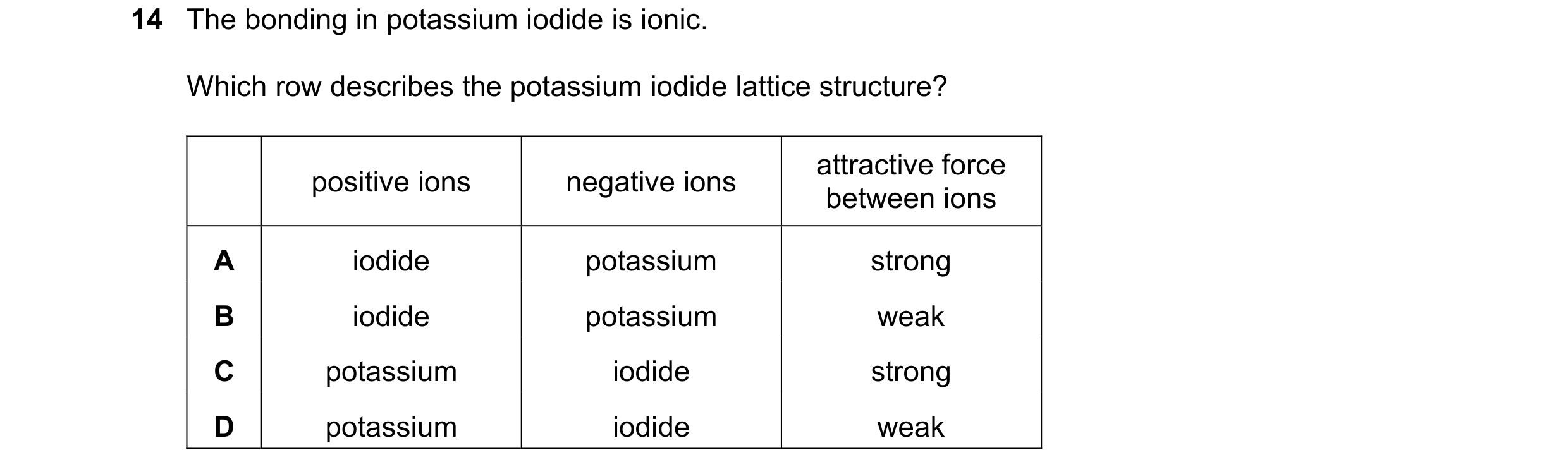
Q13 · The bonding in potassium iodide is ionic 0654/22 Oct/Nov 2024
14 The bonding in potassium iodide is ionic. Which row describes the potassium iodide lattice structure? attractive force positive ions negative ions between ions A iodide potassium strong B iodide potassium weak C potassium iodide strong D potassium iodide weak
1 marks
Answer: C
This question in 0654/22 Oct/Nov 2024
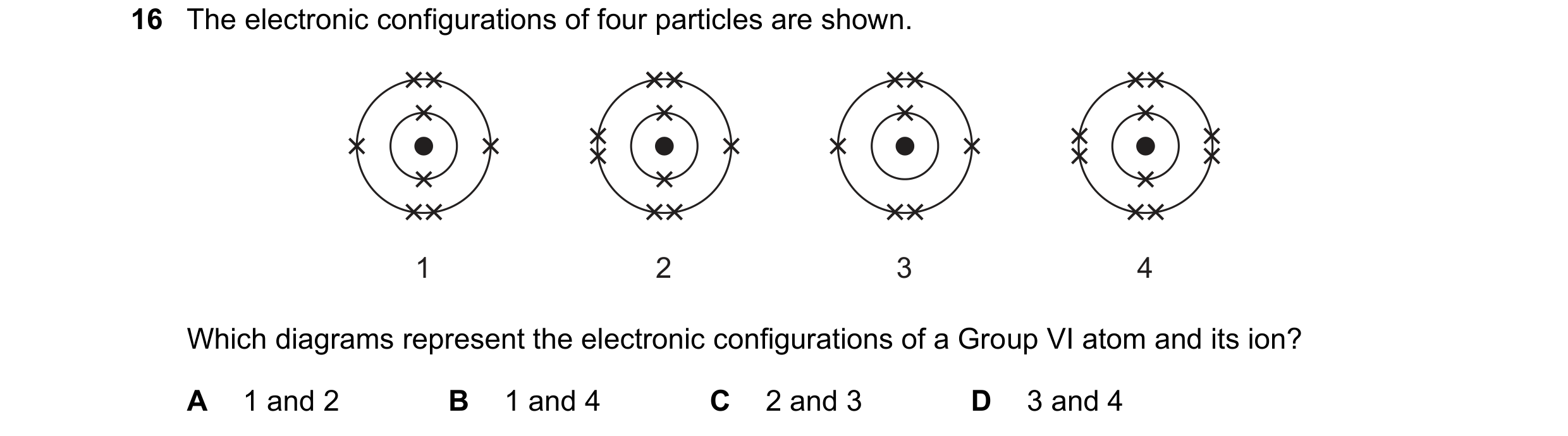
Q14 · The electronic configurations of four particles are shown 0654/21 May/June 2025
16 The electronic configurations of four particles are shown. 1 2 3 4 Which diagrams represent the electronic configurations of a Group VI atom and its ion? A 1 and 2 B 1 and 4 C 2 and 3 D 3 and 4
1 marks
Answer: B
This question in 0654/21 May/June 2025
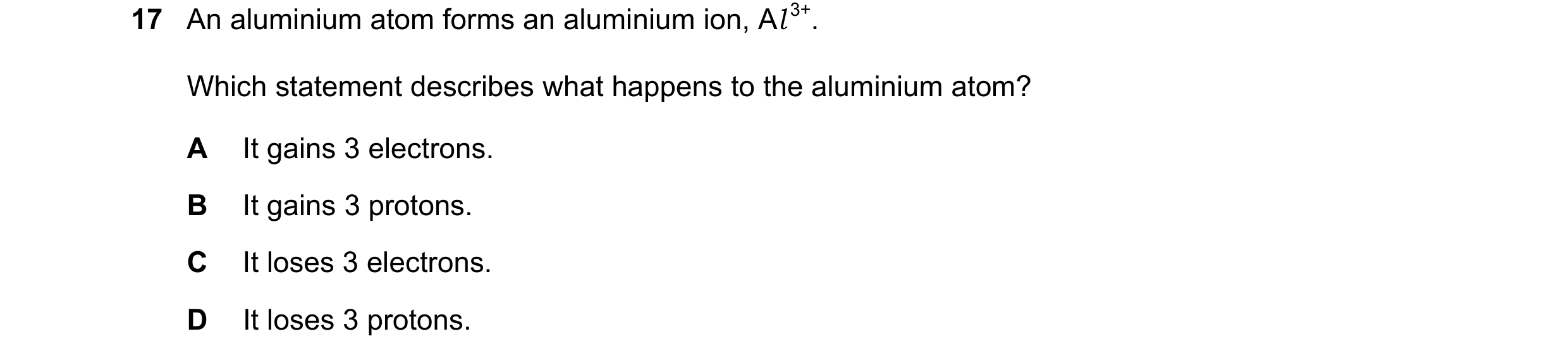
Q15 · An aluminium atom forms an aluminium ion, Al 3+ 0654/21 May/June 2025
17 An aluminium atom forms an aluminium ion, Al 3+. Which statement describes what happens to the aluminium atom? A It gains 3 electrons. B It gains 3 protons. C It loses 3 electrons. D It loses 3 protons.
1 marks
Answer: C
This question in 0654/21 May/June 2025
Q16 · Which diagram represents the structure of sodium chloride, NaCl ? 0654/23 May/June 2025
16 Which diagram represents the structure of sodium chloride, NaCl ? A B Na+ Cl – Na+ Cl – Na+ Cl – Cl – Na+ Cl – Na+ C D Cl – Na+ Na+ Na+ Na+ Cl – Na+ Na+ Na+ Cl – Cl – Cl – Cl – Na+ Cl – Cl –
1 marks
Answer: C
This question in 0654/23 May/June 2025
Q17 · Which particle has the same number of electrons in its outer shell as an atom of sodium… 0654/21 Oct/Nov 2025
14 Which particle has the same number of electrons in its outer shell as an atom of sodium, 23 Na? 11 A 23 11Na + B 23 11Na C 24 11Na D 24 12Na 2+
1 marks
Answer: C
This question in 0654/21 Oct/Nov 2025
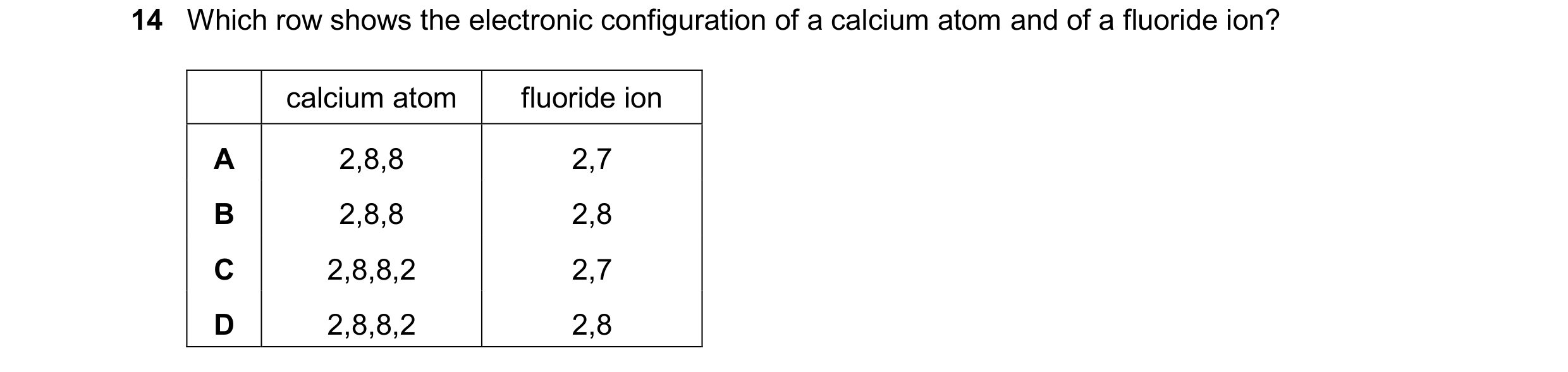
Q18 · Which row shows the electronic configuration of a calcium atom and of a fluoride ion? 0654/22 Oct/Nov 2025
14 Which row shows the electronic configuration of a calcium atom and of a fluoride ion? calcium atom fluoride ion A 2,8,8 2,7 B 2,8,8 2,8 C 2,8,8,2 2,7 D 2,8,8,2 2,8
1 marks
Answer: D
This question in 0654/22 Oct/Nov 2025
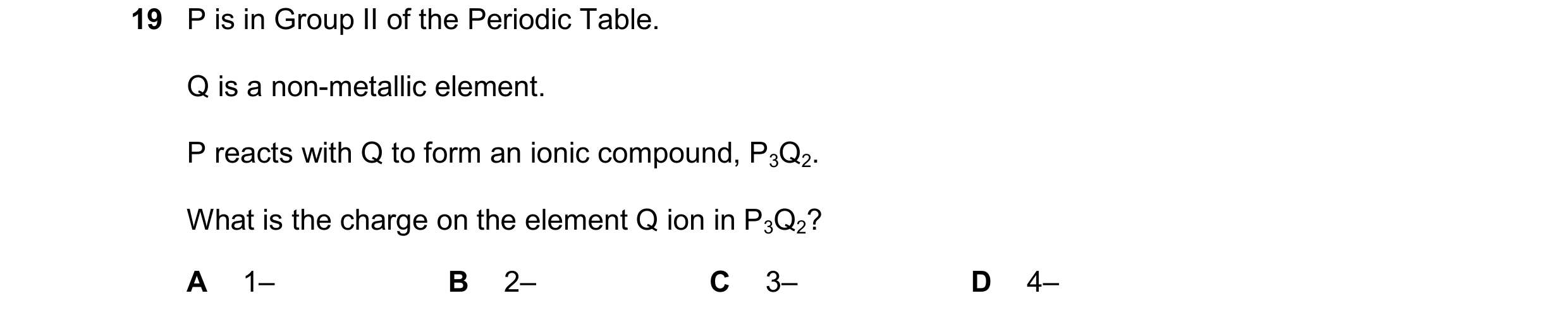
Q19 · P is in Group II of the Periodic Table 0654/22 Oct/Nov 2025
19 P is in Group II of the Periodic Table. Q is a non-metallic element. P reacts with Q to form an ionic compound, P3Q2. What is the charge on the element Q ion in P3Q2? A 1– B 2– C 3– D 4–
1 marks
Answer: C
This question in 0654/22 Oct/Nov 2025

 1 / 4
1 / 4

 2 / 4
2 / 4

 3 / 4
3 / 4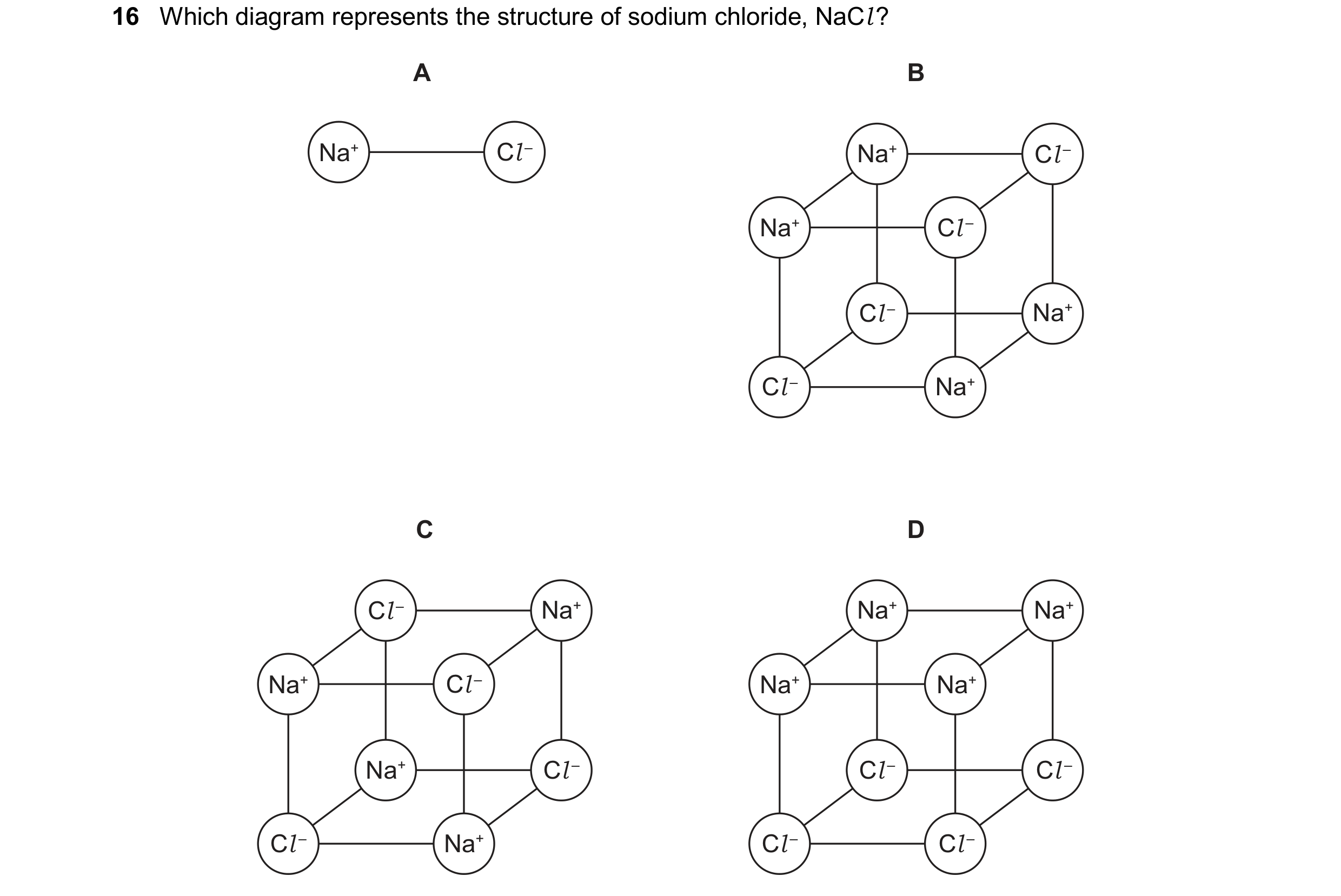

 4 / 4
4 / 4