Cambridge IGCSE Sciences - Co-ordinated (Double) 0654 — 2025 Oct/Nov Paper 4 · Variant 1
0654/41/O/N/25 · 12 questions · 120 marks · 120 min
The question paper and its mark scheme, free to read here and free to download. This is Cambridge’s own paper, exactly as it was sat.
Question paper28 pages



Mark scheme19 pages
Answers below. Sit the paper first if you are practising.
Questions as text
Q1 · Hormones are chemical substances produced in the body
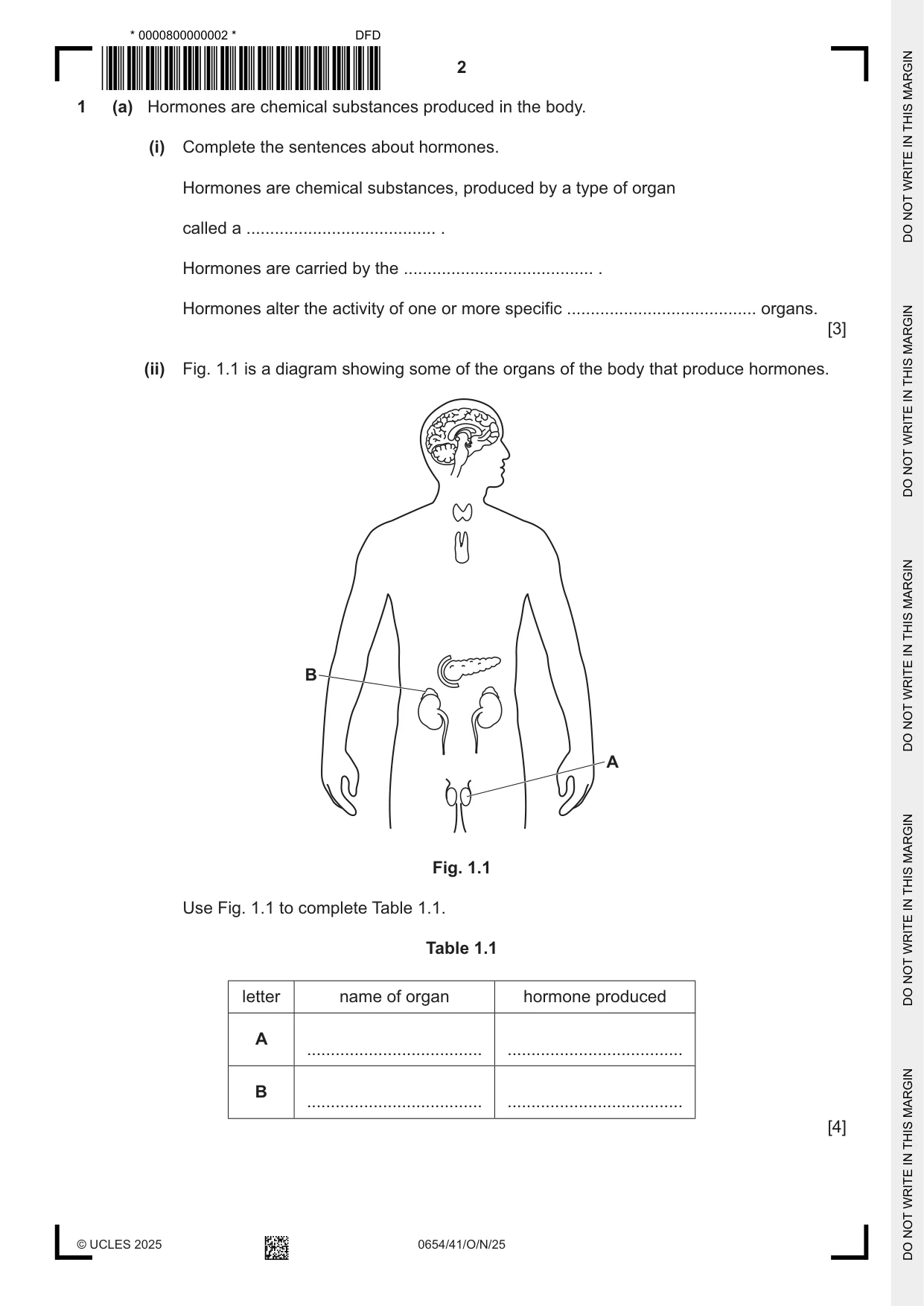
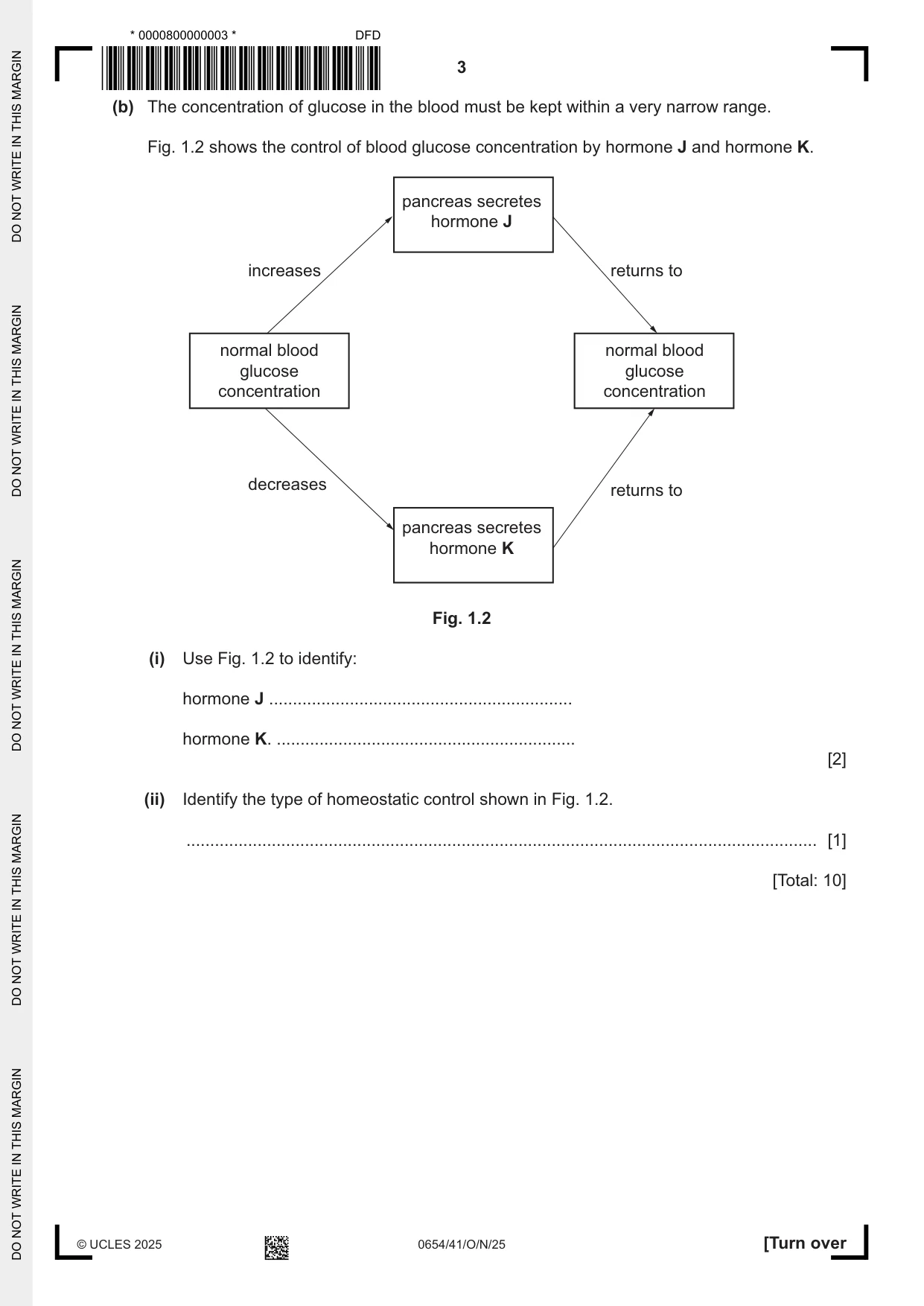
1 (a) Hormones are chemical substances produced in the body. (i) Complete the sentences about hormones. Hormones are chemical substances, produced by a type of organ called a ........................................ . Hormones are carried by the ........................................ . Hormones alter the activity of one or more specific ........................................ organs. [3] (ii) Fig. 1.1 is a diagram showing some of the organs of the body that produce hormones. B A Fig. 1.1 Use Fig. 1.1 to complete Table 1.1. Table 1.1 letter name of organ hormone produced A ..................................... ..................................... B ..................................... ..................................... [4] (b) The concentration of glucose in the blood must be kept within a very narrow range. Fig. 1.2 shows the control of blood glucose concentration by hormone J and hormone K. pancreas secretes hormone J increases returns to normal blood normal blood glucose glucose concentration concentration decreases returns to pancreas secretes hormone K Fig. 1.2 (i) Use Fig. 1.2 to identify: hormone J ................................................................ hormone K. ............................................................... [2] (ii) Identify the type of homeostatic control shown in Fig. 1.2. ..................................................................................................................................... [1] [Total: 10]
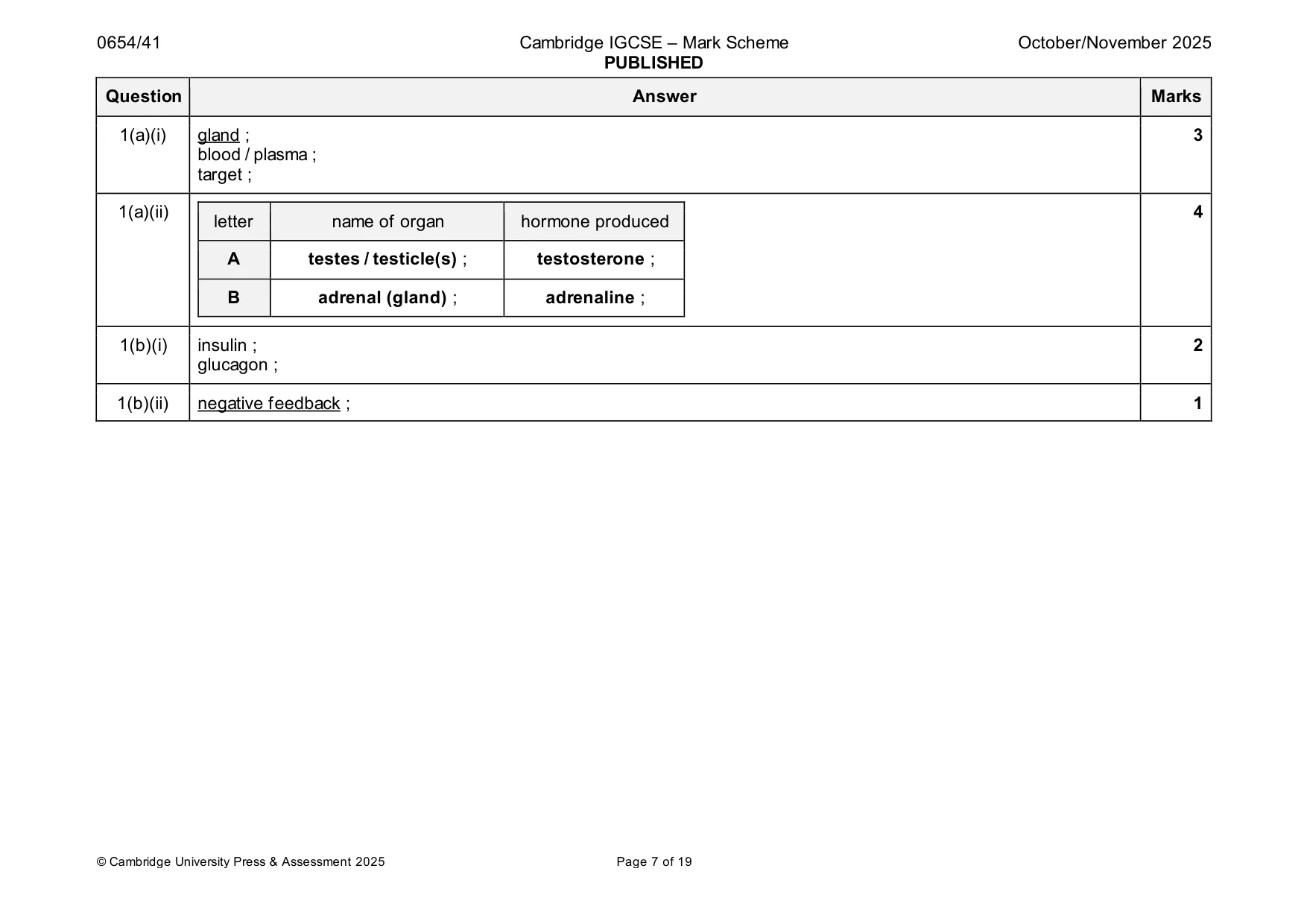
Mark scheme: Question Answer Marks 1(a)(i) gland ; 3 blood / plasma ; target ; 1(a)(ii) 4 letter name of organ hormone produced A testes / testicle(s) ; testosterone ; B adrenal (gland) ; adrenaline ; 1(b)(i) insulin ; 2 glucagon ; 1(b)(ii) negative feedback ; 1
Q2 · A diagram of the breathing system in humans
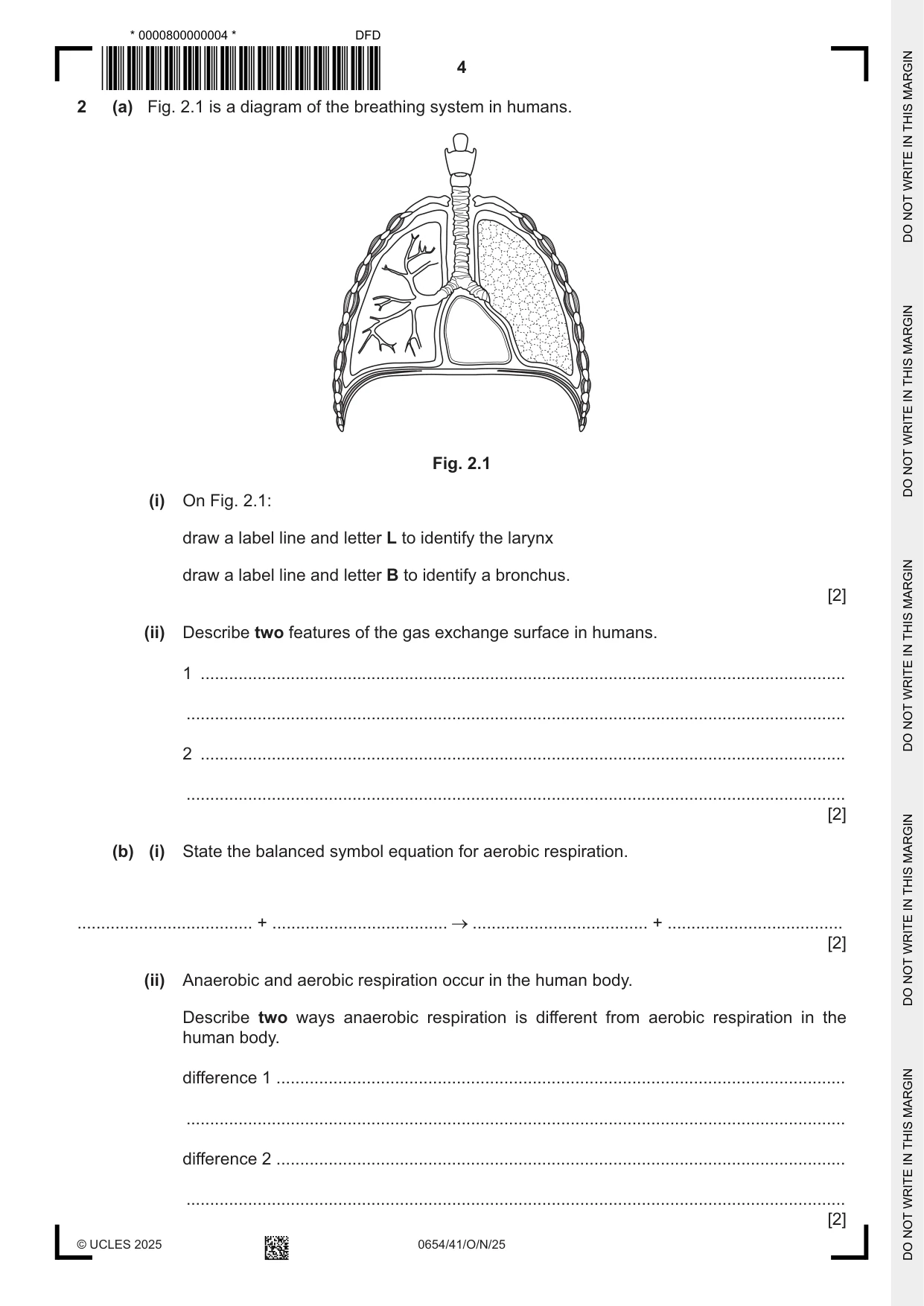
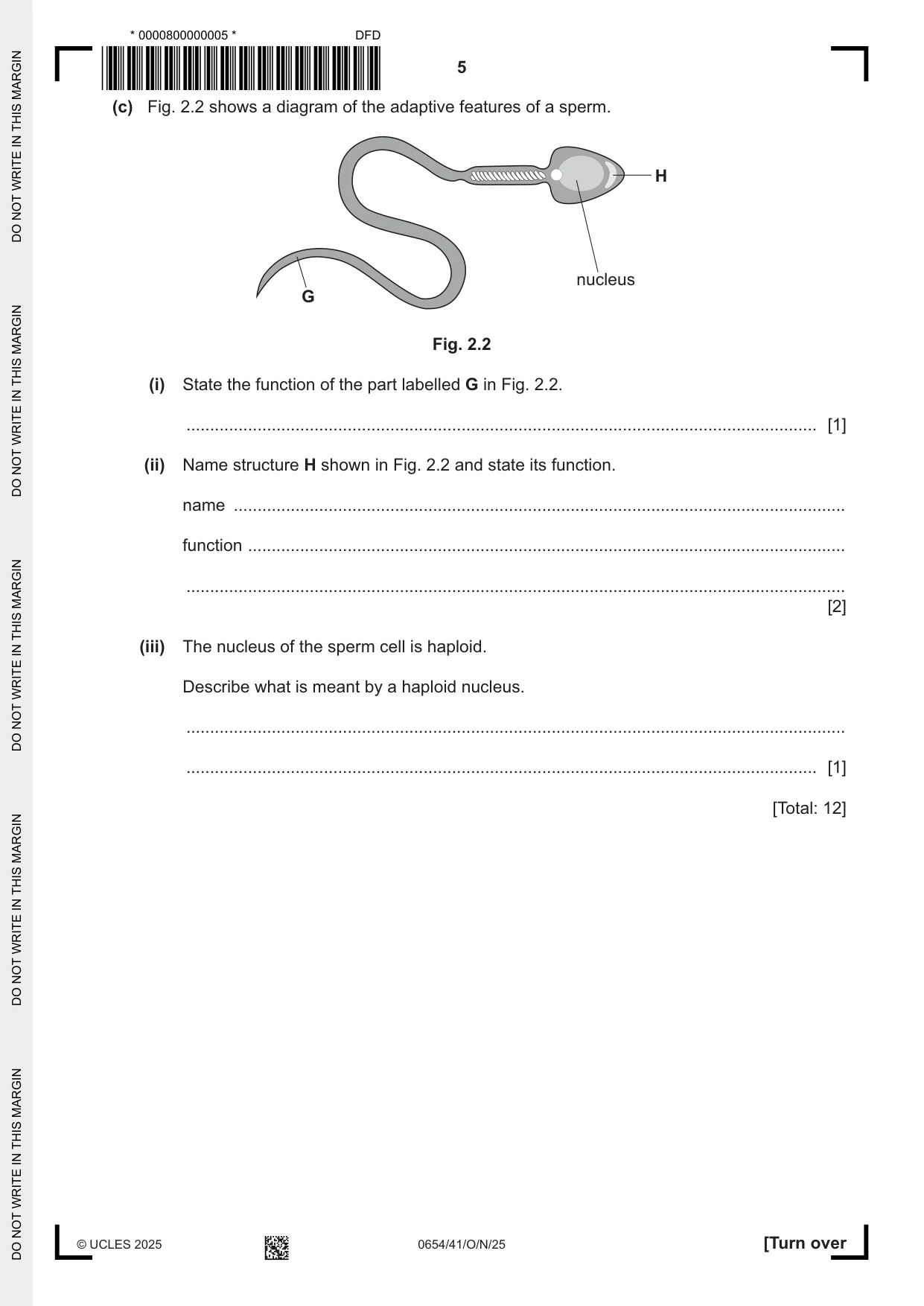
2 (a) Fig. 2.1 is a diagram of the breathing system in humans. Fig. 2.1 (i) On Fig. 2.1: draw a label line and letter L to identify the larynx draw a label line and letter B to identify a bronchus. [2] (ii) Describe two features of the gas exchange surface in humans. 1 ........................................................................................................................................ ........................................................................................................................................... 2 ........................................................................................................................................ ........................................................................................................................................... [2] (b) (i) State the balanced symbol equation for aerobic respiration. ..................................... + ..................................... ..................................... + ..................................... [2] (ii) Anaerobic and aerobic respiration occur in the human body. Describe two ways anaerobic respiration is different from aerobic respiration in the human body. difference 1 ........................................................................................................................ ........................................................................................................................................... difference 2 ........................................................................................................................ ........................................................................................................................................... [2] (c) Fig. 2.2 shows a diagram of the adaptive features of a sperm. H nucleus G Fig. 2.2 (i) State the function of the part labelled G in Fig. 2.2. ..................................................................................................................................... [1] (ii) Name structure H shown in Fig. 2.2 and state its function. name ................................................................................................................................. function .............................................................................................................................. ........................................................................................................................................... [2] (iii) The nucleus of the sperm cell is haploid. Describe what is meant by a haploid nucleus. ........................................................................................................................................... ..................................................................................................................................... [1] [Total: 12]
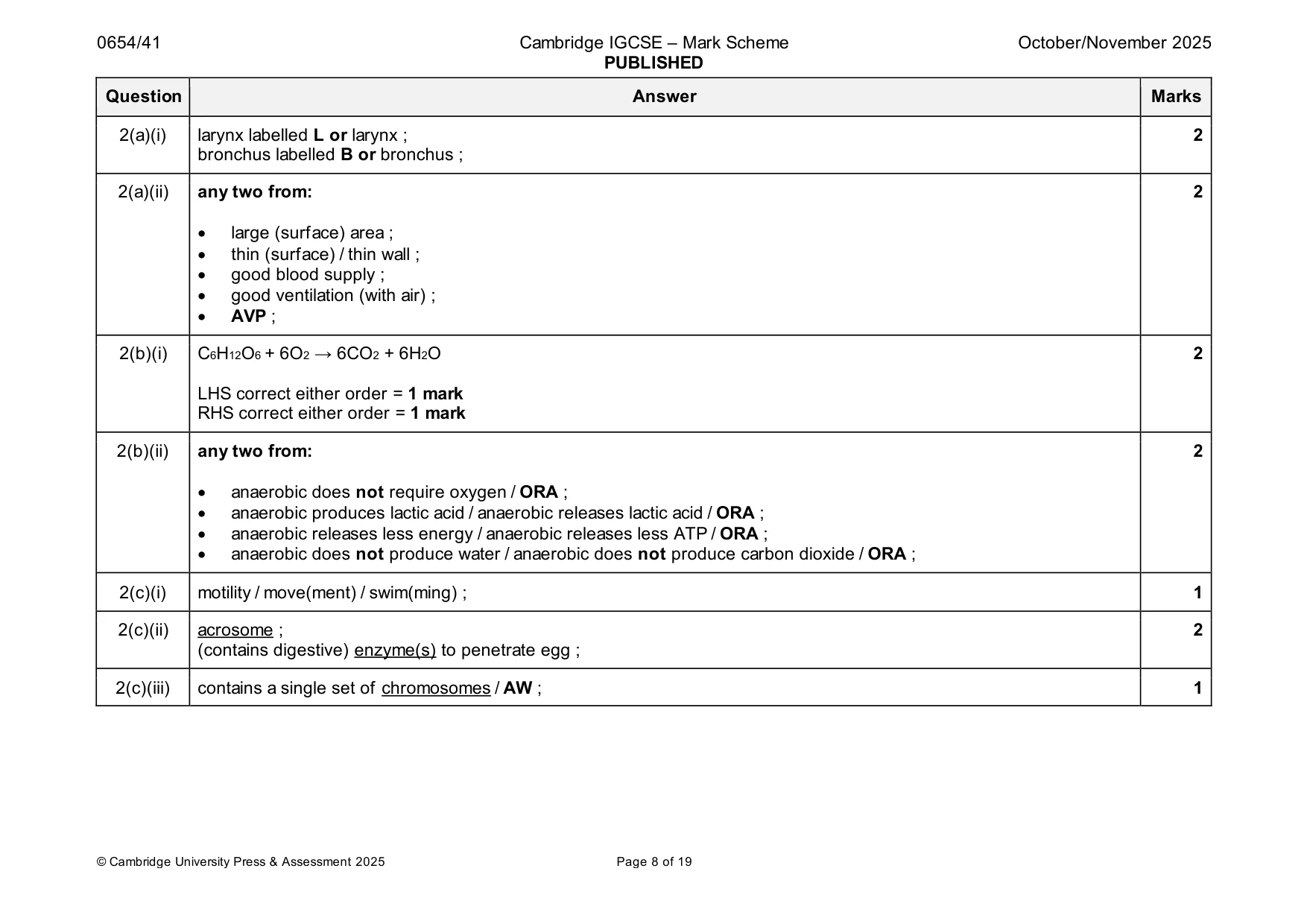
Mark scheme: 2(a)(i) larynx labelled L or larynx ; 2 bronchus labelled B or bronchus ; 2(a)(ii) any two from: 2 • large (surface) area ; • thin (surface) / thin wall ; • good blood supply ; • good ventilation (with air) ; • AVP ; 2(b)(i) C6H12O6 + 6O2 → 6CO2 + 6H2O 2 LHS correct either order = 1 mark RHS correct either order = 1 mark 2(b)(ii) any two from: 2 • anaerobic does not require oxygen / ORA ; • anaerobic produces lactic acid / anaerobic releases lactic acid / ORA ; • anaerobic releases less energy / anaerobic releases less ATP / ORA ; • anaerobic does not produce water / anaerobic does not produce carbon dioxide / ORA ; 2(c)(i) motility / move(ment) / swim(ming) ; 1 2(c)(ii) acrosome ; 2 (contains digestive) enzyme(s) to penetrate egg ; 2(c)(iii) contains a single set of chromosomes / AW ; 1
Q3 · A diagram showing some of the organisms in the Arctic ecosystem
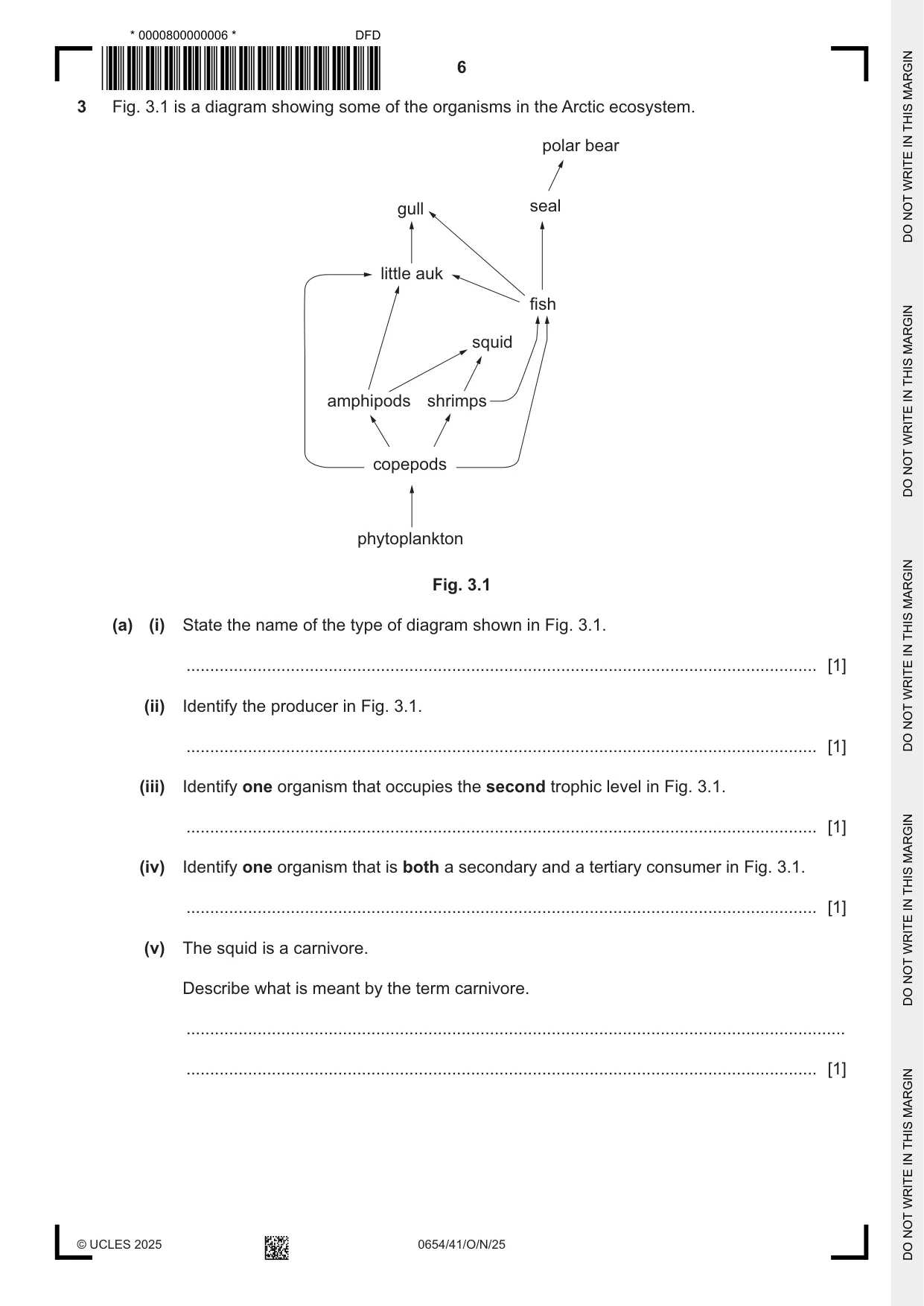
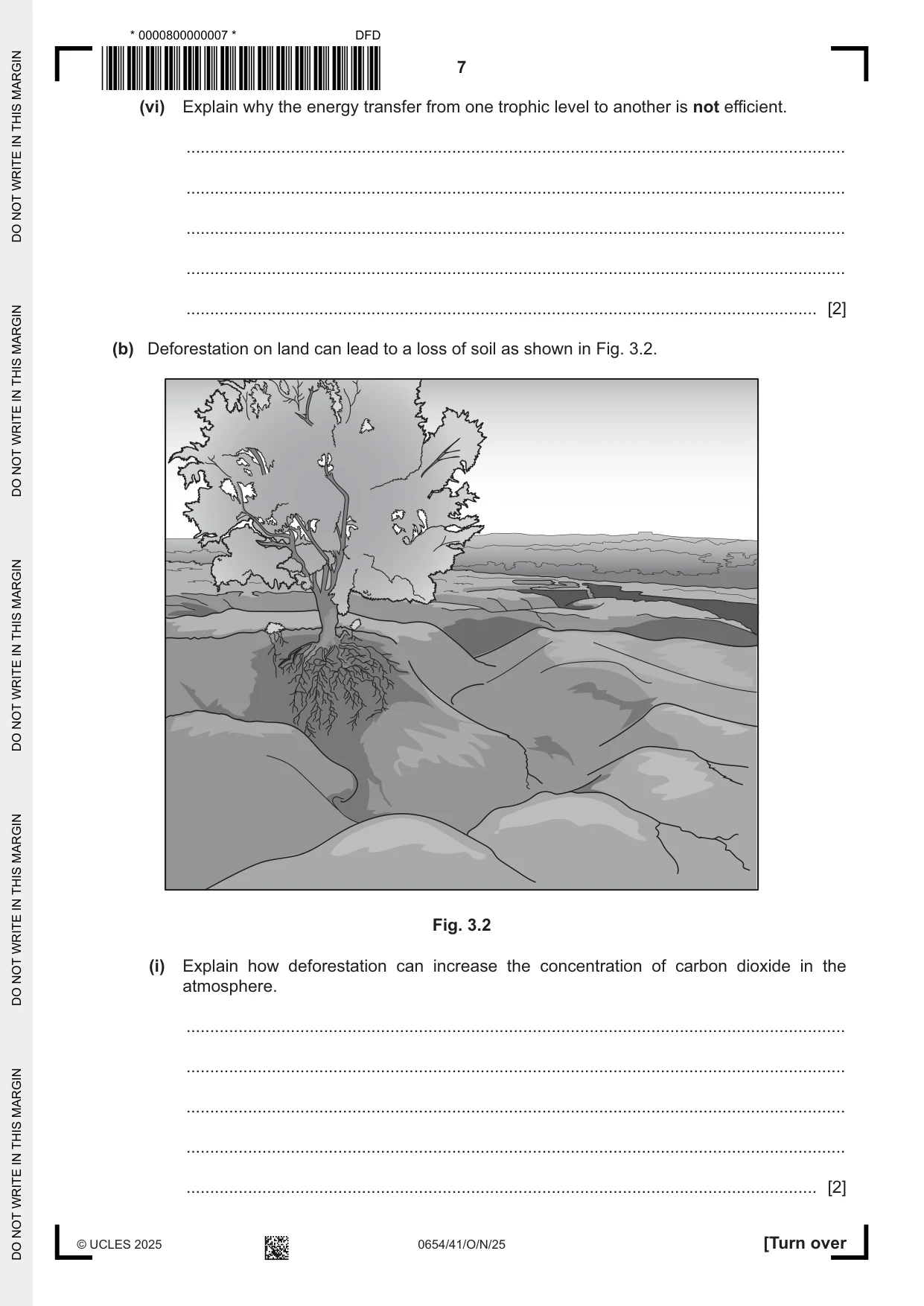
3 Fig. 3.1 is a diagram showing some of the organisms in the Arctic ecosystem. polar bear gull seal little auk fish squid amphipods shrimps copepods phytoplankton Fig. 3.1 (a) (i) State the name of the type of diagram shown in Fig. 3.1. ..................................................................................................................................... [1] (ii) Identify the producer in Fig. 3.1. ..................................................................................................................................... [1] (iii) Identify one organism that occupies the second trophic level in Fig. 3.1. ..................................................................................................................................... [1] (iv) Identify one organism that is both a secondary and a tertiary consumer in Fig. 3.1. ..................................................................................................................................... [1] (v) The squid is a carnivore. Describe what is meant by the term carnivore. ........................................................................................................................................... ..................................................................................................................................... [1] (vi) Explain why the energy transfer from one trophic level to another is not efficient. ........................................................................................................................................... ........................................................................................................................................... ........................................................................................................................................... ........................................................................................................................................... ..................................................................................................................................... [2] (b) Deforestation on land can lead to a loss of soil as shown in Fig. 3.2. Fig. 3.2 (i) Explain how deforestation can increase the concentration of carbon dioxide in the atmosphere. ........................................................................................................................................... ........................................................................................................................................... ........................................................................................................................................... ........................................................................................................................................... ..................................................................................................................................... [2] (ii) Explain how deforestation can lead to flooding. ........................................................................................................................................... ........................................................................................................................................... ........................................................................................................................................... ........................................................................................................................................... ..................................................................................................................................... [2] [Total: 11]
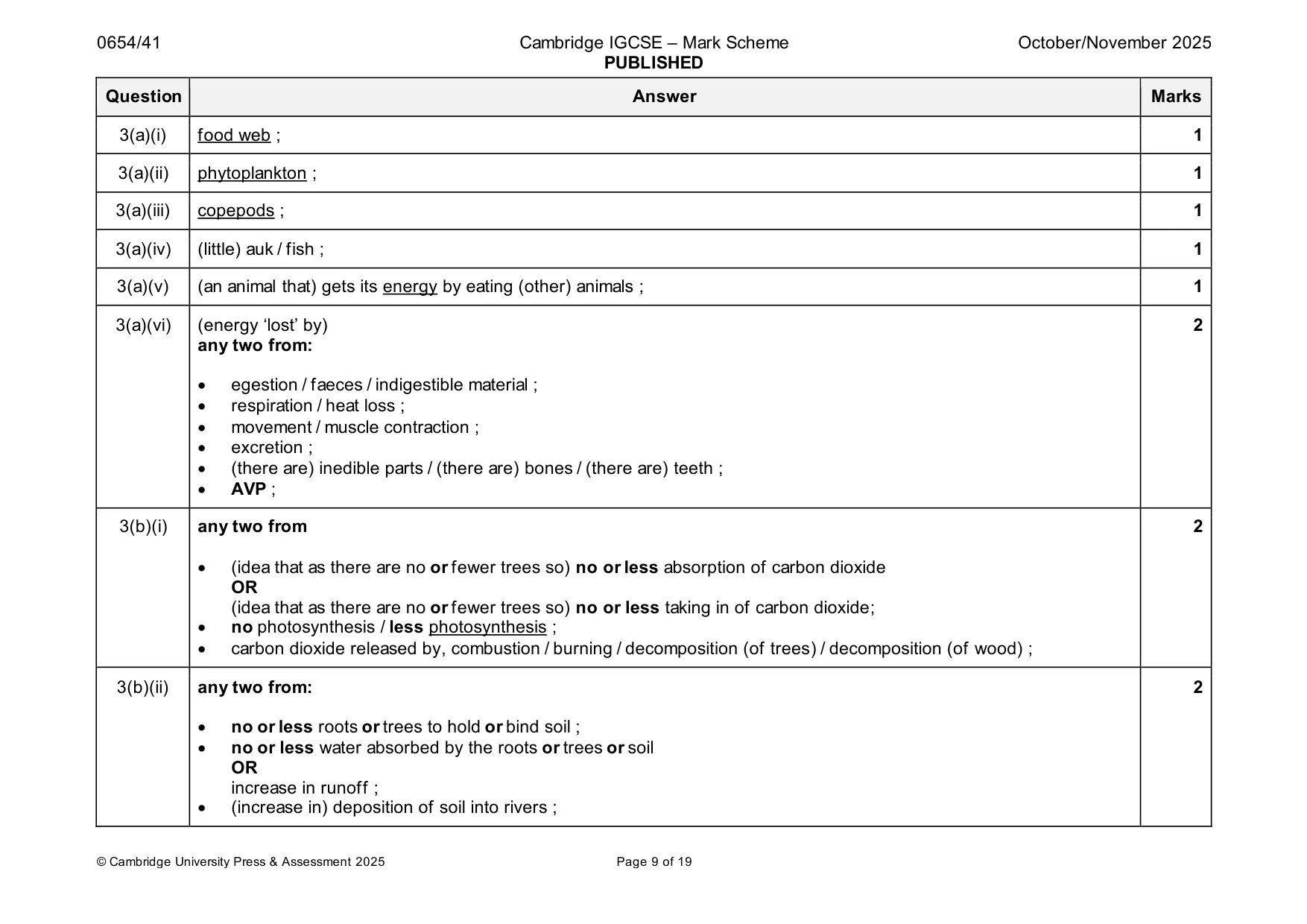
Mark scheme: 3(a)(i) food web ; 1 3(a)(ii) phytoplankton ; 1 3(a)(iii) copepods ; 1 3(a)(iv) (little) auk / fish ; 1 3(a)(v) (an animal that) gets its energy by eating (other) animals ; 1 3(a)(vi) (energy ‘lost’ by) 2 any two from: • egestion / faeces / indigestible material ; • respiration / heat loss ; • movement / muscle contraction ; • excretion ; • (there are) inedible parts / (there are) bones / (there are) teeth ; • AVP ; 3(b)(i) any two from 2 • (idea that as there are no or fewer trees so) no or less absorption of carbon dioxide OR (idea that as there are no or fewer trees so) no or less taking in of carbon dioxide; • no photosynthesis / less photosynthesis ; • carbon dioxide released by, combustion / burning / decomposition (of trees) / decomposition (of wood) ; 3(b)(ii) any two from: 2 • no or less roots or trees to hold or bind soil ; • no or less water absorbed by the roots or trees or soil OR increase in runoff ; • (increase in) deposition of soil into rivers ;
Q4 · Mitosis is a type of cell division
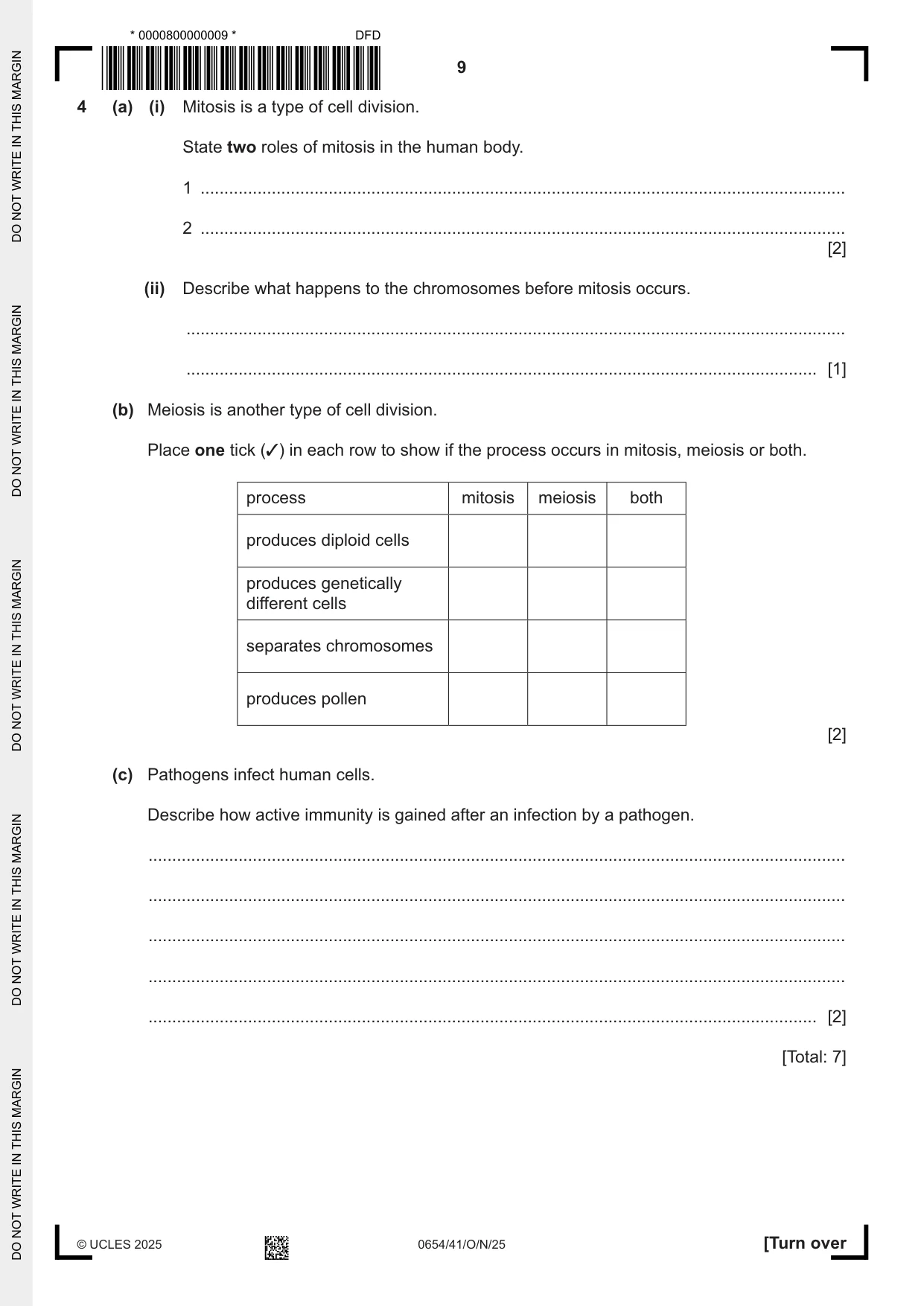
4 (a) (i) Mitosis is a type of cell division. State two roles of mitosis in the human body. 1 ........................................................................................................................................ 2 ........................................................................................................................................ [2] (ii) Describe what happens to the chromosomes before mitosis occurs. ........................................................................................................................................... ..................................................................................................................................... [1] (b) Meiosis is another type of cell division. Place one tick (✓) in each row to show if the process occurs in mitosis, meiosis or both. process mitosis meiosis both produces diploid cells produces genetically different cells separates chromosomes produces pollen [2] (c) Pathogens infect human cells. Describe how active immunity is gained after an infection by a pathogen. ................................................................................................................................................... ................................................................................................................................................... ................................................................................................................................................... ................................................................................................................................................... ............................................................................................................................................. [2] [Total: 7]
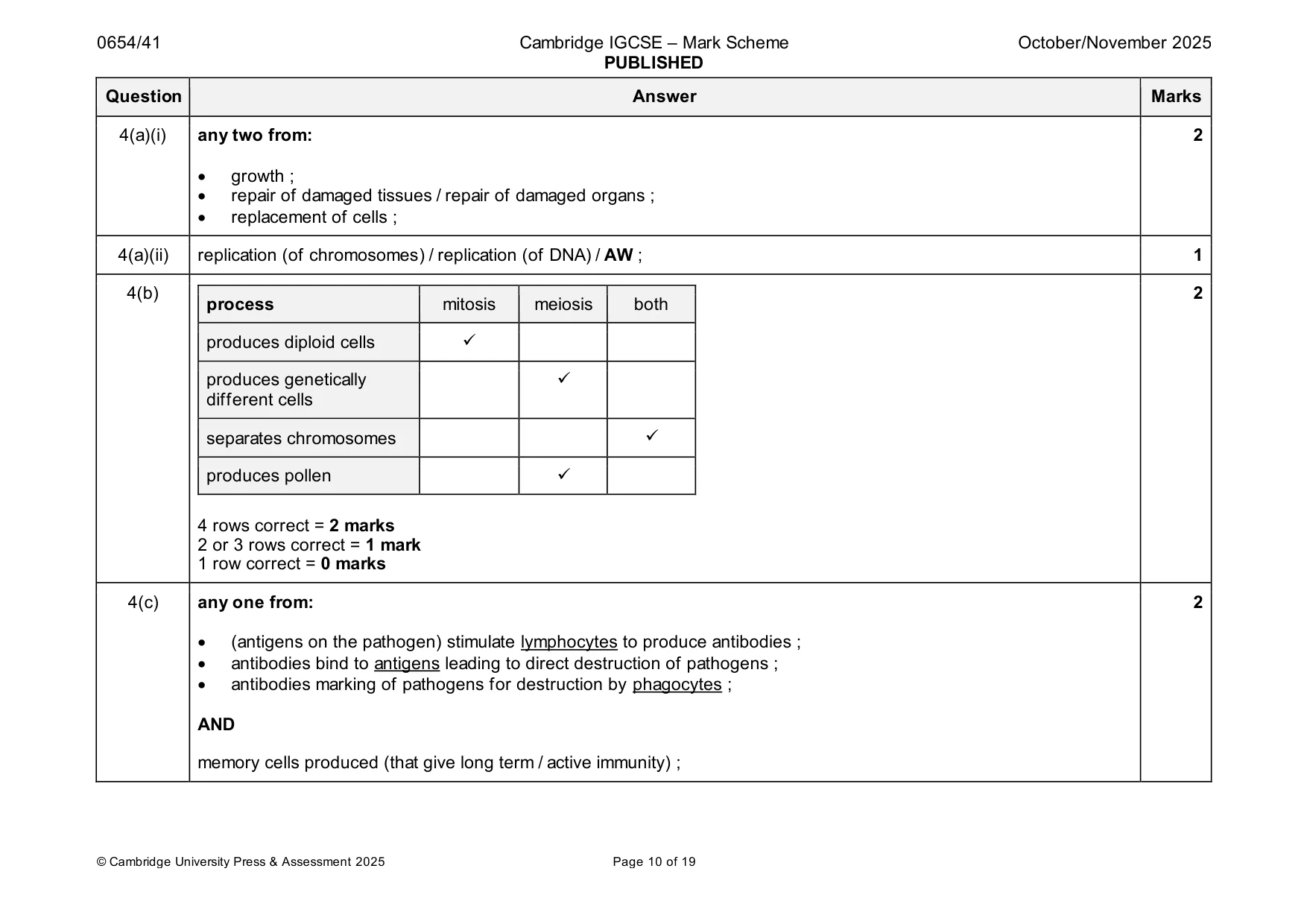
Mark scheme: 4(a)(i) any two from: 2 • growth ; • repair of damaged tissues / repair of damaged organs ; • replacement of cells ; 4(a)(ii) replication (of chromosomes) / replication (of DNA) / AW ; 1 4(b) 2 process mitosis meiosis both produces diploid cells ✓ produces genetically ✓ different cells separates chromosomes ✓ produces pollen ✓ 4 rows correct = 2 marks 2 or 3 rows correct = 1 mark 1 row correct = 0 marks 4(c) any one from: 2 • (antigens on the pathogen) stimulate lymphocytes to produce antibodies ; • antibodies bind to antigens leading to direct destruction of pathogens ; • antibodies marking of pathogens for destruction by phagocytes ; AND memory cells produced (that give long term / active immunity) ;
Q5 · Different substances can be elements, compounds, or mixtures
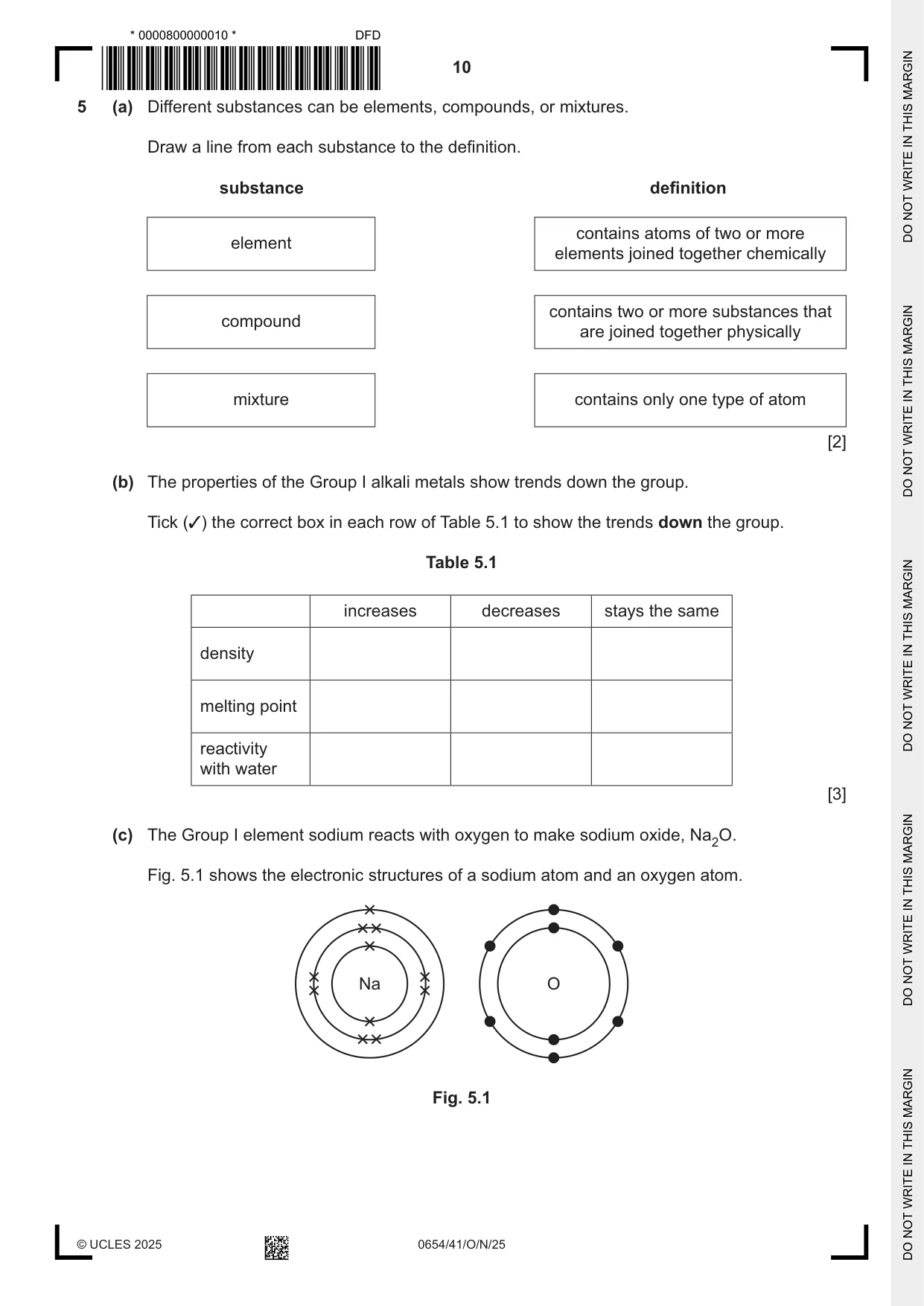
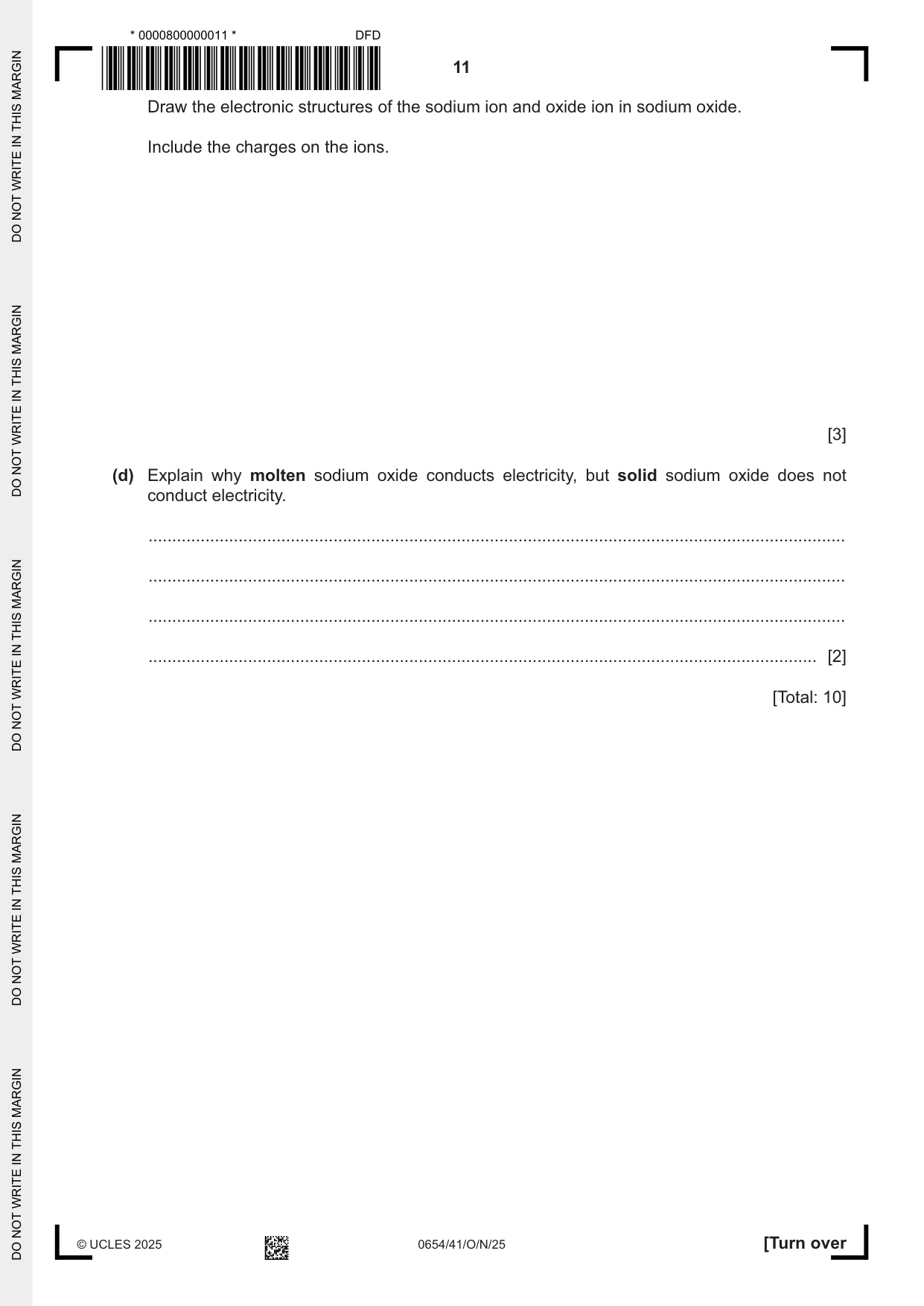
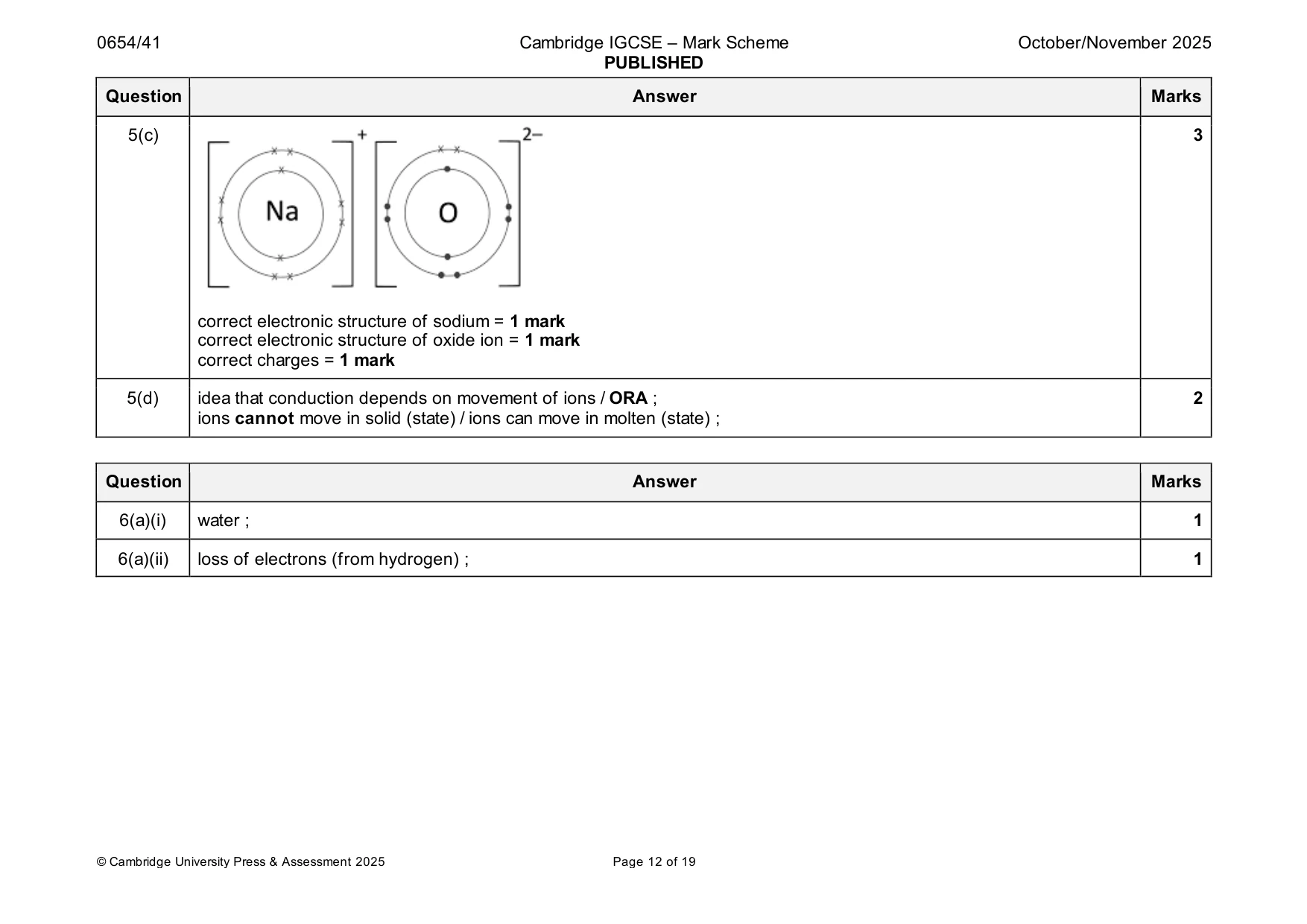
5 (a) Different substances can be elements, compounds, or mixtures. Draw a line from each substance to the definition. substance definition contains atoms of two or more element elements joined together chemically contains two or more substances that compound are joined together physically mixture contains only one type of atom [2] (b) The properties of the Group I alkali metals show trends down the group. Tick (✓) the correct box in each row of Table 5.1 to show the trends down the group. Table 5.1 increases decreases stays the same density melting point reactivity with water [3] (c) The Group I element sodium reacts with oxygen to make sodium oxide, Na2O. Fig. 5.1 shows the electronic structures of a sodium atom and an oxygen atom. Na O Fig. 5.1 Draw the electronic structures of the sodium ion and oxide ion in sodium oxide. Include the charges on the ions. [3] (d) Explain why molten sodium oxide conducts electricity, but solid sodium oxide does not conduct electricity. ................................................................................................................................................... ................................................................................................................................................... ................................................................................................................................................... ............................................................................................................................................. [2] [Total: 10]
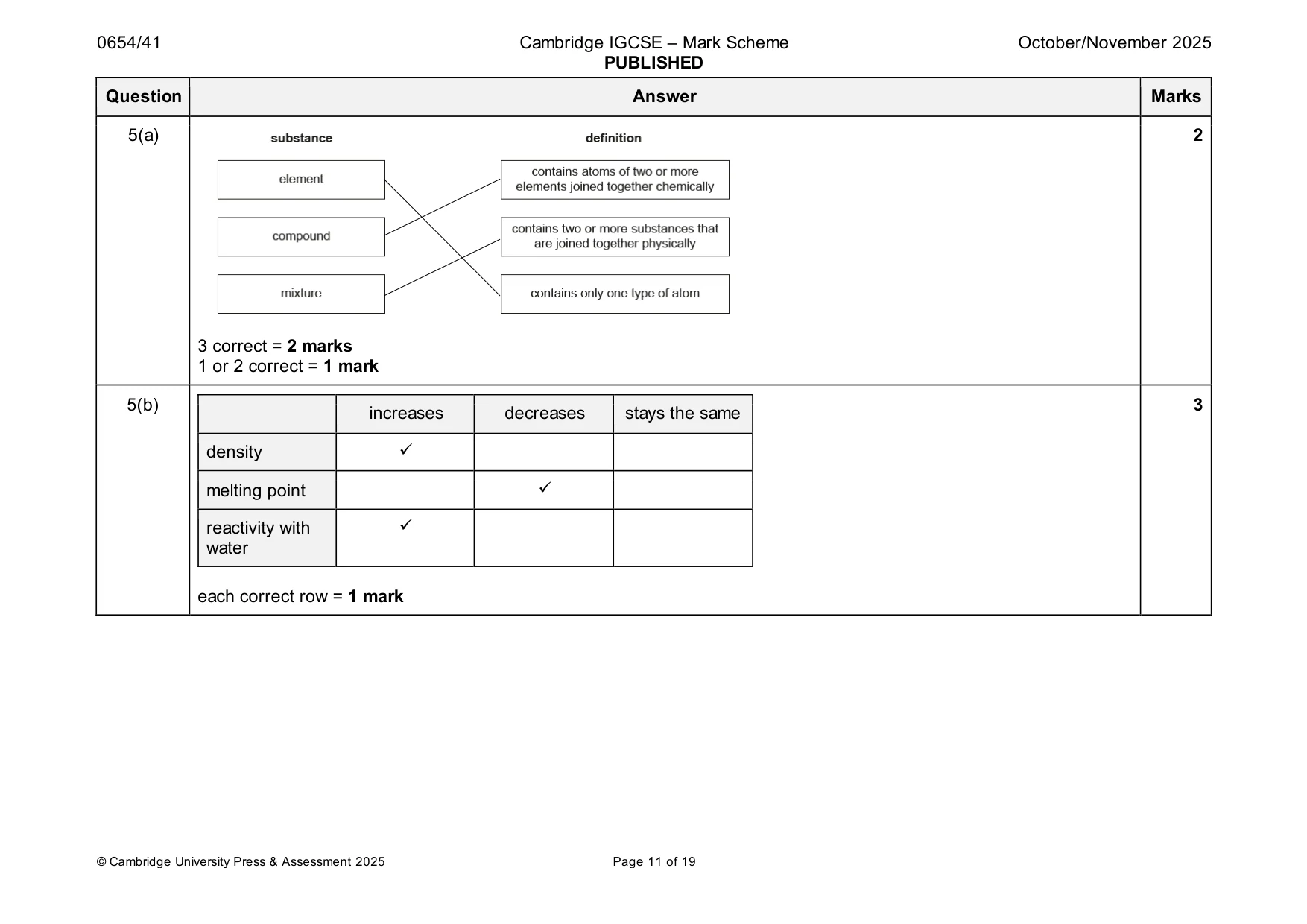
Mark scheme: 5(a) 2 3 correct = 2 marks 1 or 2 correct = 1 mark 5(b) 3 increases decreases stays the same density ✓ melting point ✓ reactivity with ✓ water each correct row = 1 mark 5(c) 3 correct electronic structure of sodium = 1 mark correct electronic structure of oxide ion = 1 mark correct charges = 1 mark 5(d) idea that conduction depends on movement of ions / ORA ; 2 ions cannot move in solid (state) / ions can move in molten (state) ;
Q6 · Hydrogen-oxygen fuel cells use hydrogen and oxygen to produce electricity
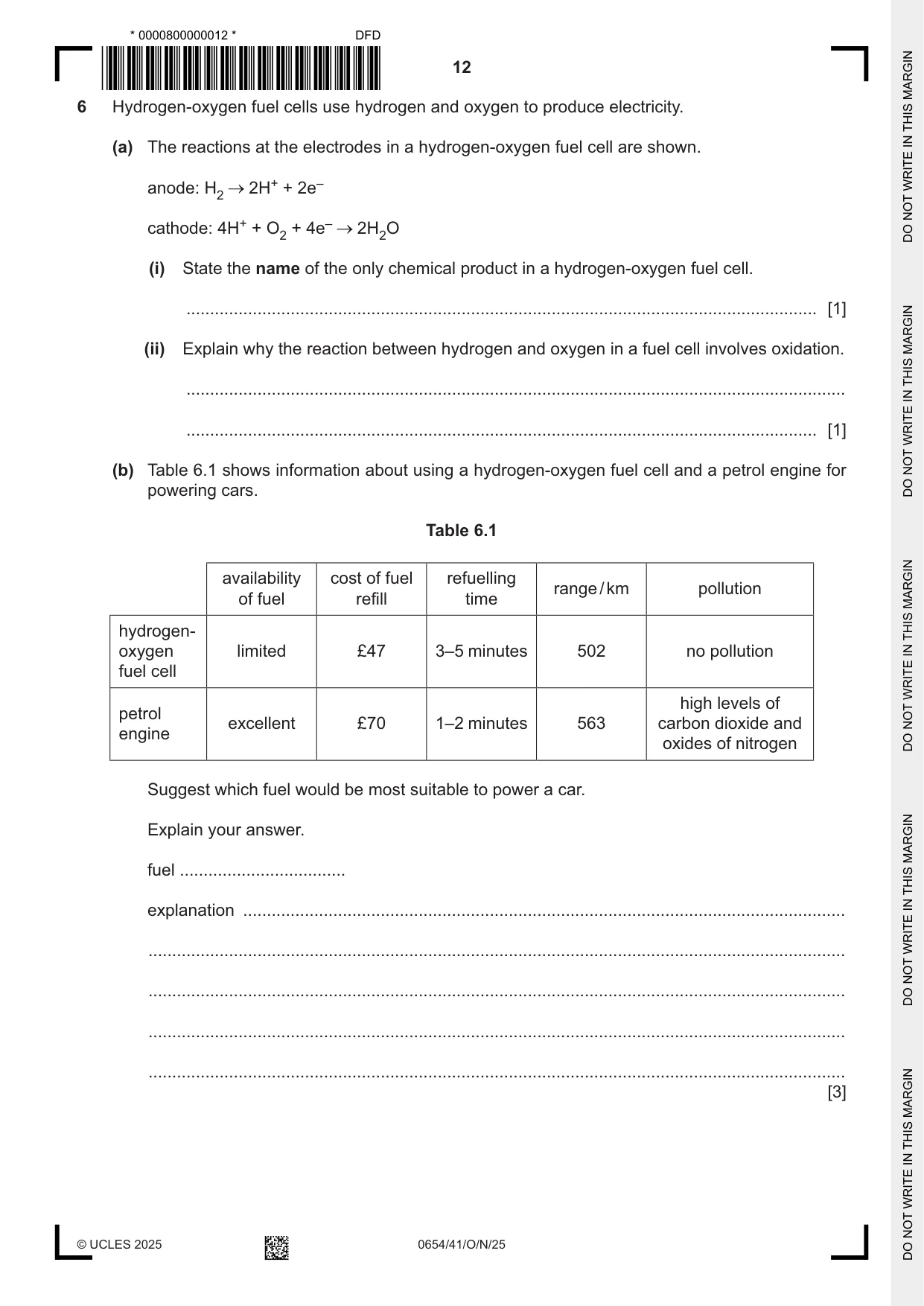
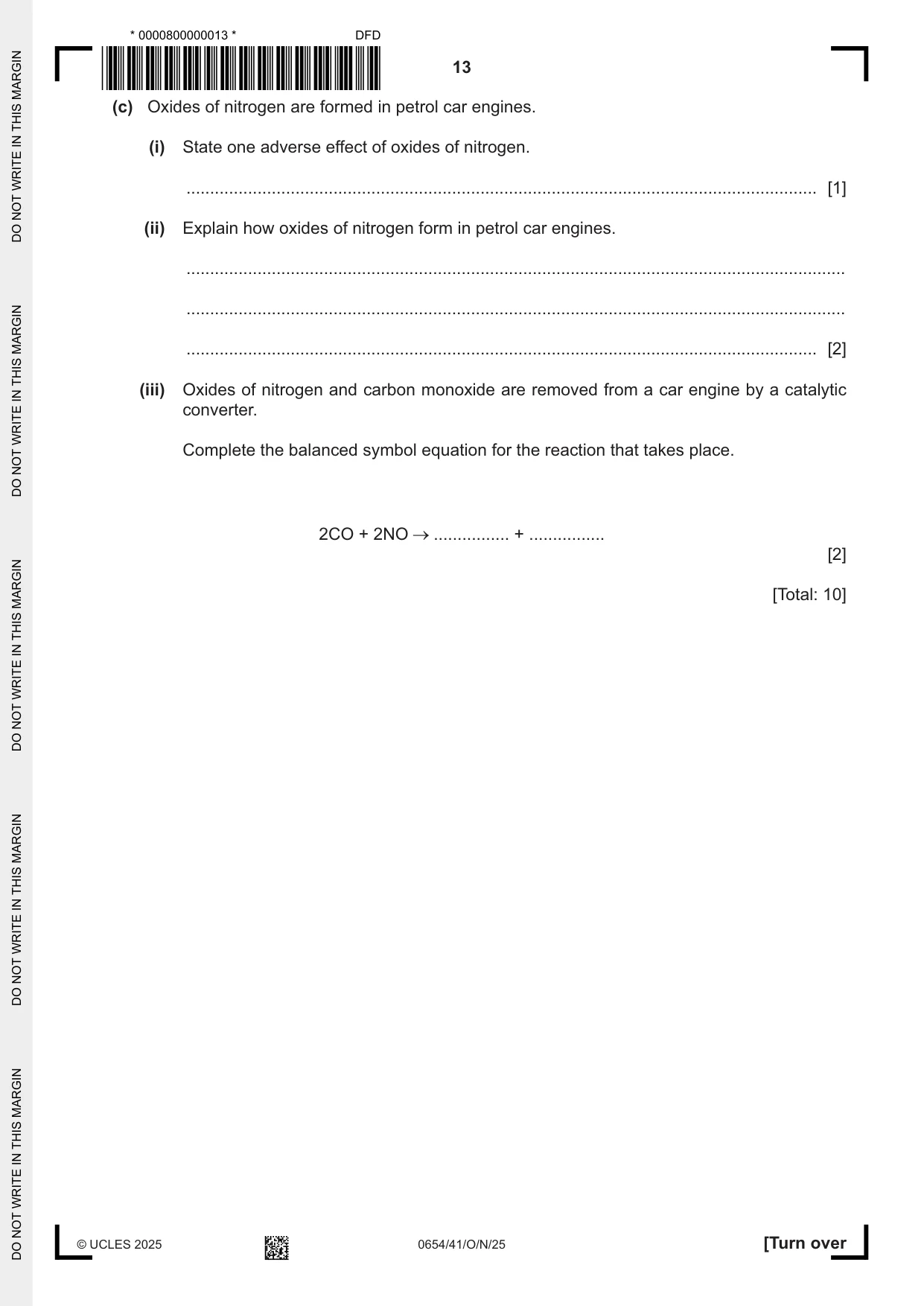
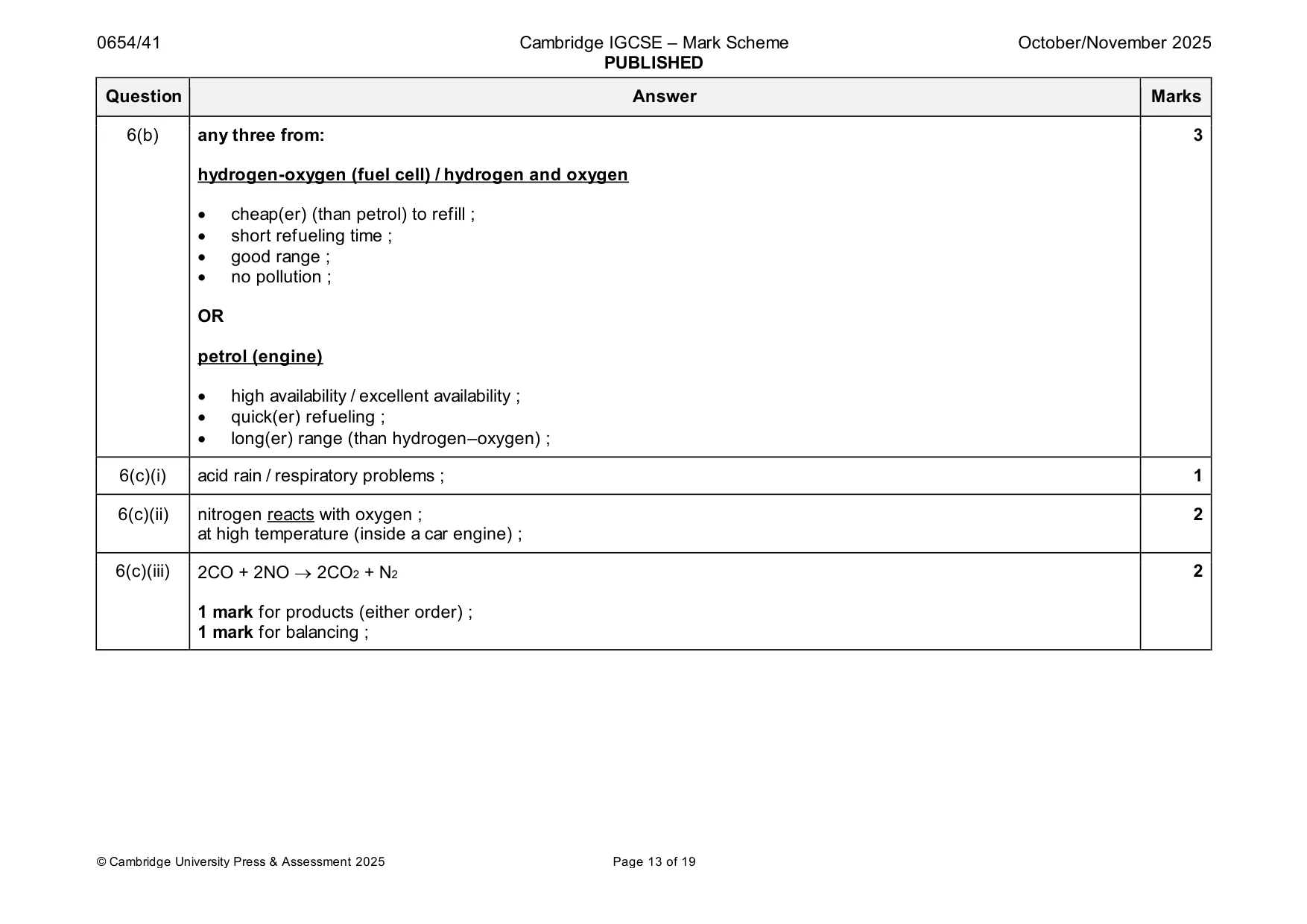
6 Hydrogen-oxygen fuel cells use hydrogen and oxygen to produce electricity. (a) The reactions at the electrodes in a hydrogen-oxygen fuel cell are shown. anode: H2 2H+ + 2e– cathode: 4H+ + O2 + 4e– 2H2O (i) State the name of the only chemical product in a hydrogen-oxygen fuel cell. ..................................................................................................................................... [1] (ii) Explain why the reaction between hydrogen and oxygen in a fuel cell involves oxidation. ........................................................................................................................................... ..................................................................................................................................... [1] (b) Table 6.1 shows information about using a hydrogen-oxygen fuel cell and a petrol engine for powering cars. Table 6.1 availability cost of fuel refuelling range / km pollution of fuel refill time hydrogen- oxygen limited £47 3–5 minutes 502 no pollution fuel cell high levels of petrol excellent £70 1–2 minutes 563 carbon dioxide and engine oxides of nitrogen Suggest which fuel would be most suitable to power a car. Explain your answer. fuel ................................... explanation ............................................................................................................................... ................................................................................................................................................... ................................................................................................................................................... ................................................................................................................................................... ................................................................................................................................................... [3] (c) Oxides of nitrogen are formed in petrol car engines. (i) State one adverse effect of oxides of nitrogen. ..................................................................................................................................... [1] (ii) Explain how oxides of nitrogen form in petrol car engines. ........................................................................................................................................... ........................................................................................................................................... ..................................................................................................................................... [2] (iii) Oxides of nitrogen and carbon monoxide are removed from a car engine by a catalytic converter. Complete the balanced symbol equation for the reaction that takes place. 2CO + 2NO ................ + ................ [2] [Total: 10]
Mark scheme: 6(a)(i) water ; 1 6(a)(ii) loss of electrons (from hydrogen) ; 1 6(b) any three from: 3 hydrogen-oxygen (fuel cell) / hydrogen and oxygen • cheap(er) (than petrol) to refill ; • short refueling time ; • good range ; • no pollution ; OR petrol (engine) • high availability / excellent availability ; • quick(er) refueling ; • long(er) range (than hydrogen–oxygen) ; 6(c)(i) acid rain / respiratory problems ; 1 6(c)(ii) nitrogen reacts with oxygen ; 2 at high temperature (inside a car engine) ; 6(c)(iii) 2CO + 2NO → 2CO2 + N2 2 1 mark for products (either order) ; 1 mark for balancing ;
Q7 · A student tests three different solutions to identify the ion in each solution
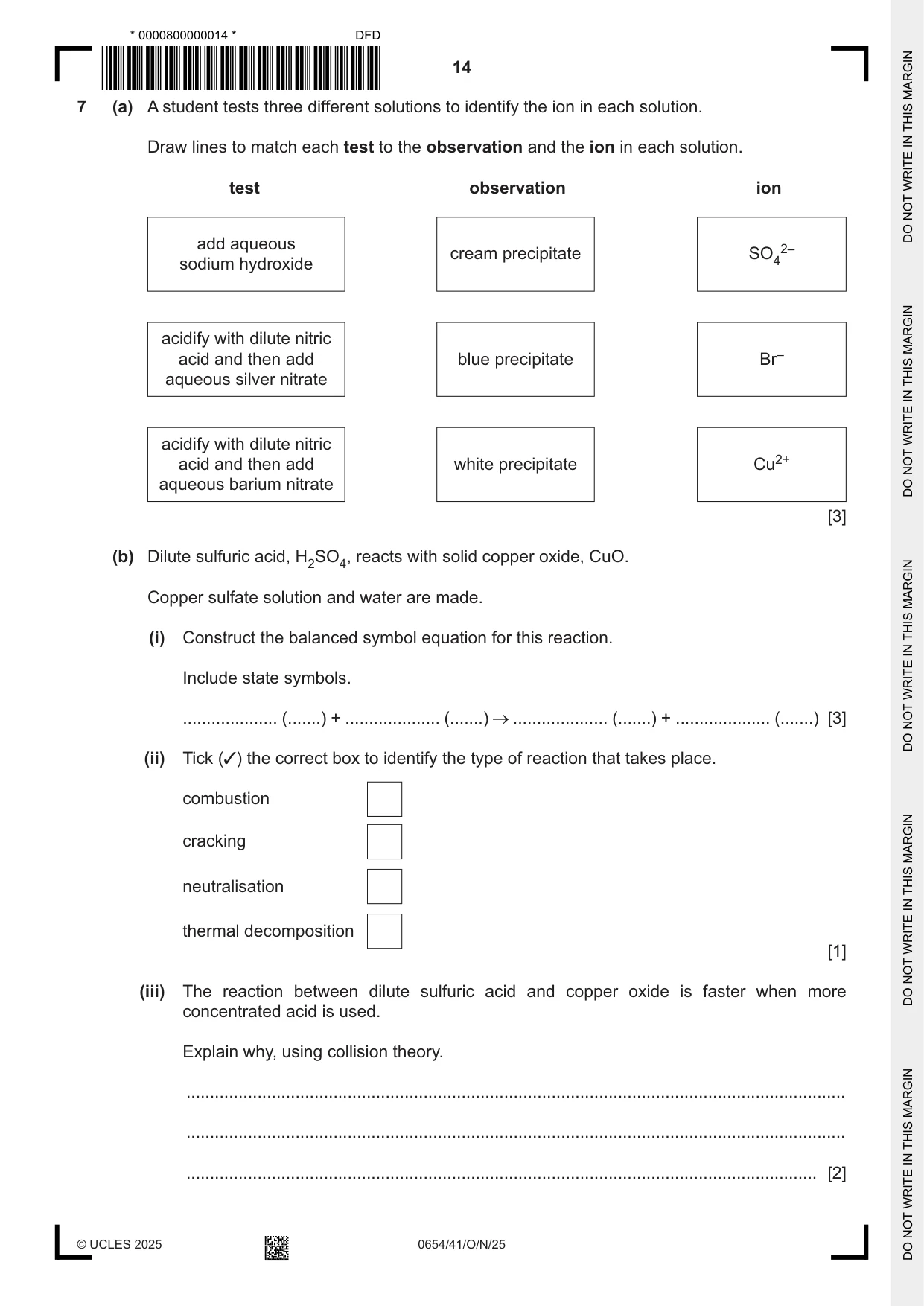
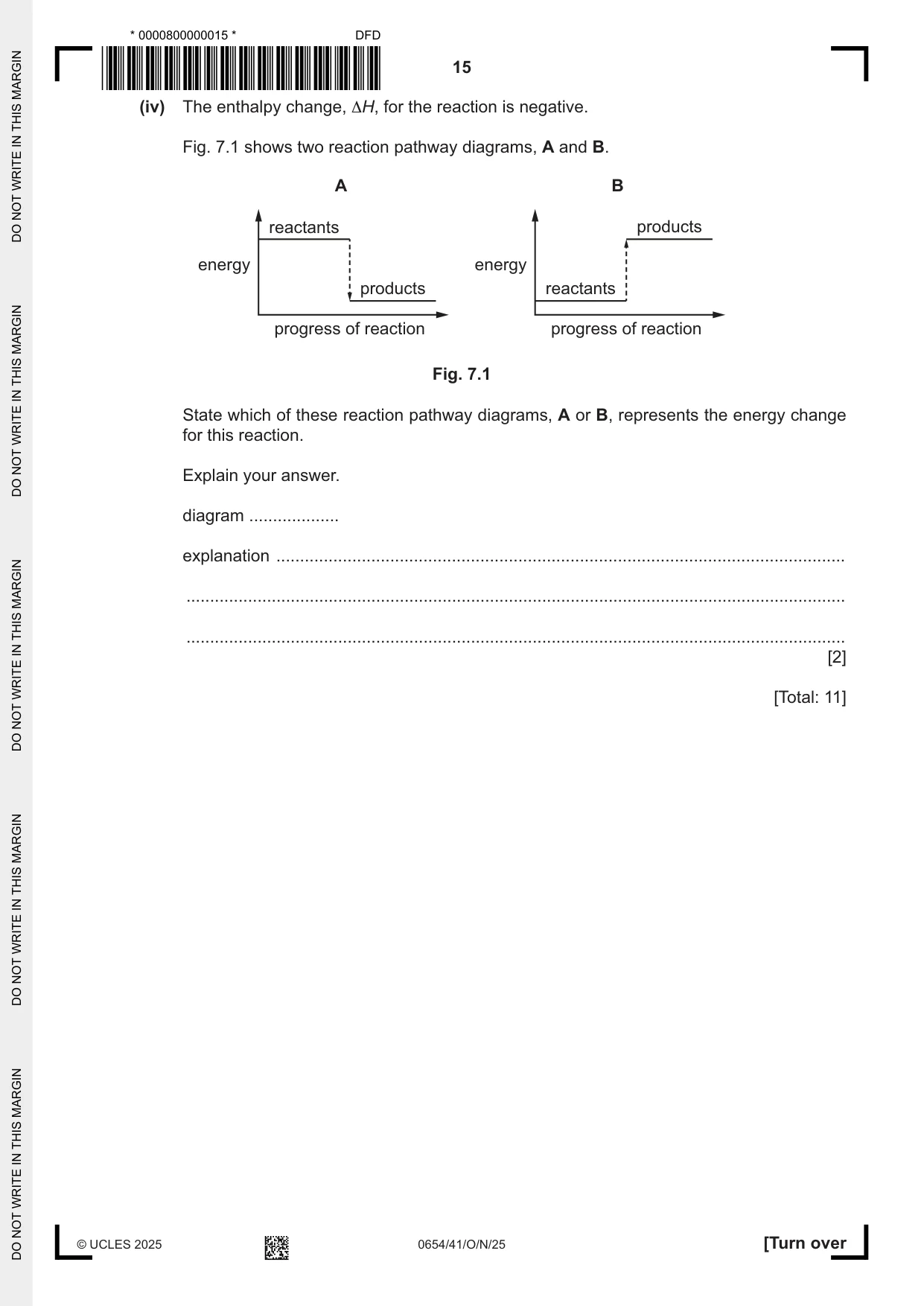
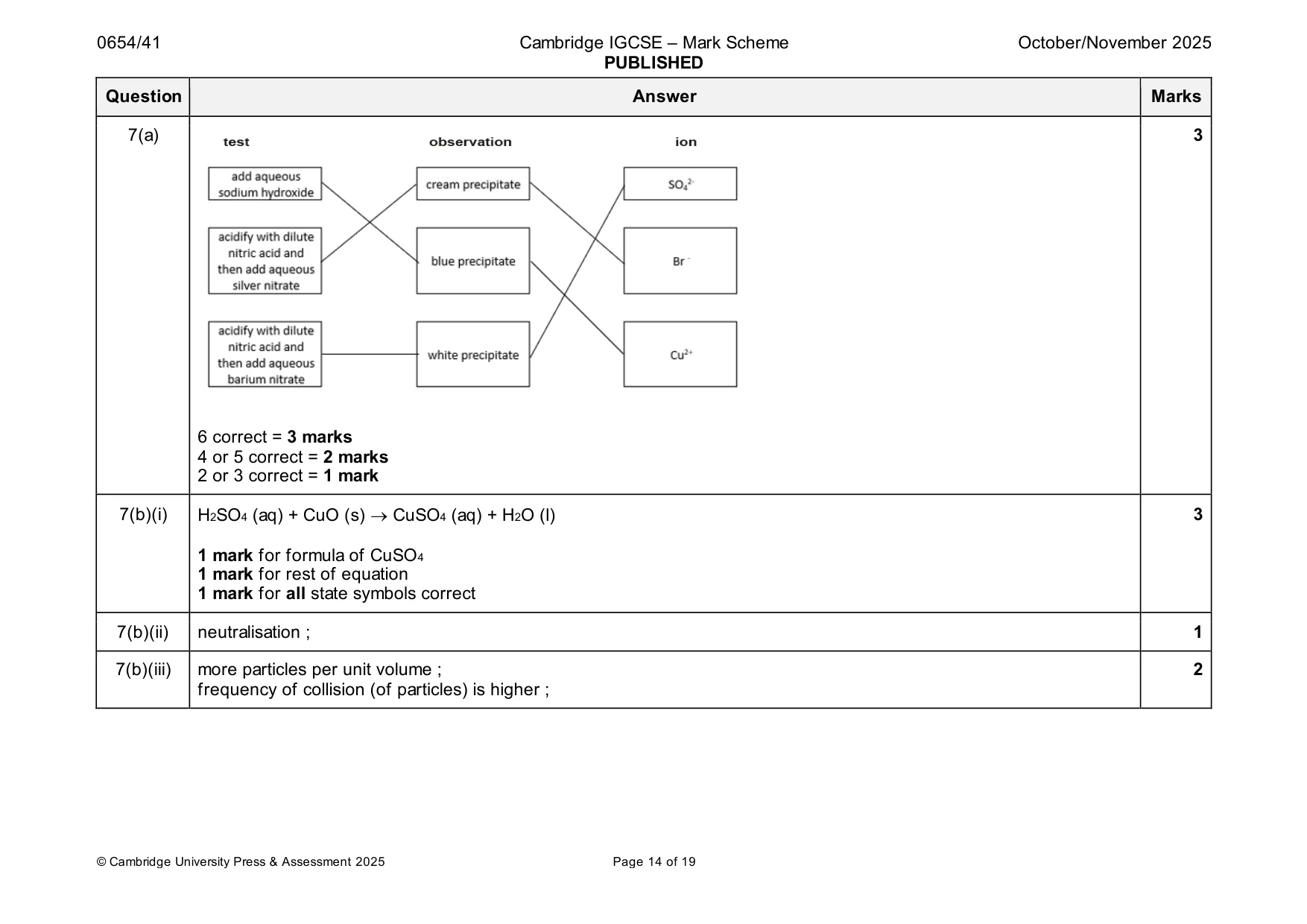
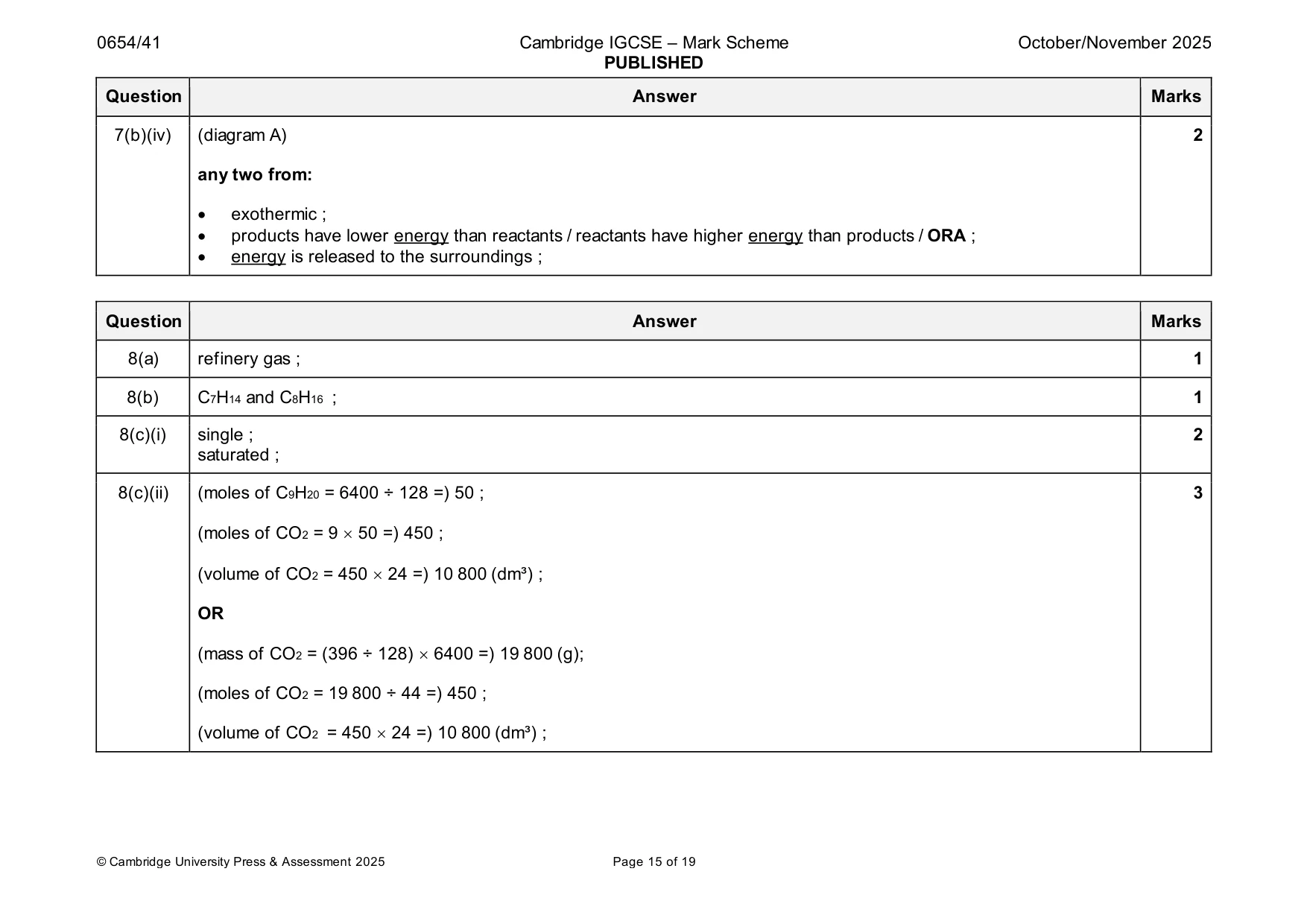
7 (a) A student tests three different solutions to identify the ion in each solution. Draw lines to match each test to the observation and the ion in each solution. test observation ion add aqueous 2– cream precipitate SO4 sodium hydroxide acidify with dilute nitric acid and then add blue precipitate Br– aqueous silver nitrate acidify with dilute nitric acid and then add white precipitate Cu2+ aqueous barium nitrate [3] (b) Dilute sulfuric acid, H2SO4, reacts with solid copper oxide, CuO. Copper sulfate solution and water are made. (i) Construct the balanced symbol equation for this reaction. Include state symbols. .................... (.......) + .................... (.......) .................... (.......) + .................... (.......) [3] (ii) Tick (✓) the correct box to identify the type of reaction that takes place. combustion cracking neutralisation thermal decomposition [1] (iii) The reaction between dilute sulfuric acid and copper oxide is faster when more concentrated acid is used. Explain why, using collision theory. ........................................................................................................................................... ........................................................................................................................................... ..................................................................................................................................... [2] (iv) The enthalpy change, ΔH, for the reaction is negative. Fig. 7.1 shows two reaction pathway diagrams, A and B. A B reactants products energy energy products reactants progress of reaction progress of reaction Fig. 7.1 State which of these reaction pathway diagrams, A or B, represents the energy change for this reaction. Explain your answer. diagram ................... explanation ........................................................................................................................ ........................................................................................................................................... ........................................................................................................................................... [2] [Total: 11]
Mark scheme: 7(a) 3 6 correct = 3 marks 4 or 5 correct = 2 marks 2 or 3 correct = 1 mark 7(b)(i) H2SO4 (aq) + CuO (s) → CuSO4 (aq) + H2O (l) 3 1 mark for formula of CuSO4 1 mark for rest of equation 1 mark for all state symbols correct 7(b)(ii) neutralisation ; 1 7(b)(iii) more particles per unit volume ; 2 frequency of collision (of particles) is higher ; 7(b)(iv) (diagram A) 2 any two from: • exothermic ; • products have lower energy than reactants / reactants have higher energy than products / ORA ; • energy is released to the surroundings ;
Q8 · Petroleum is separated into useful fractions by fractional distillation
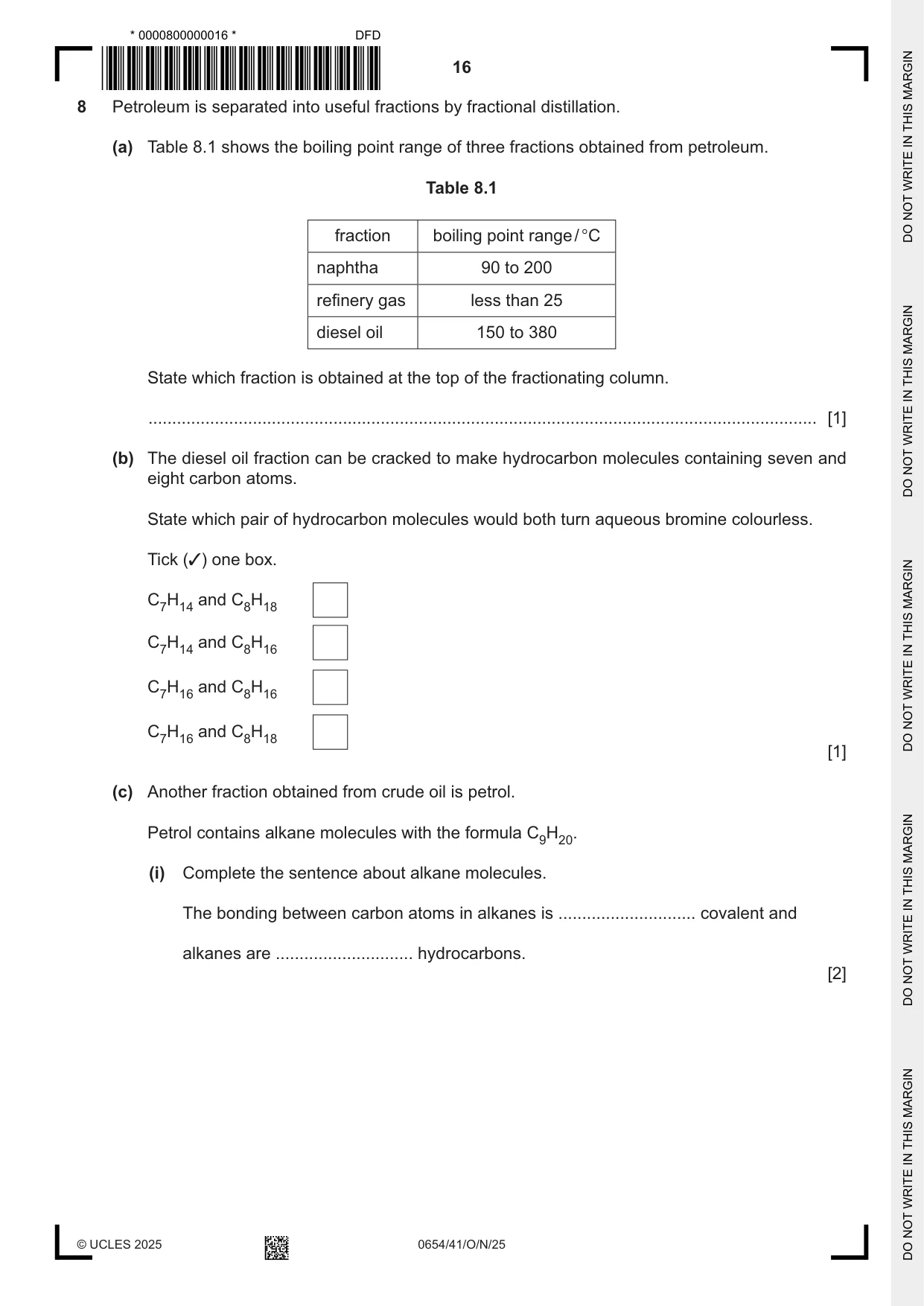
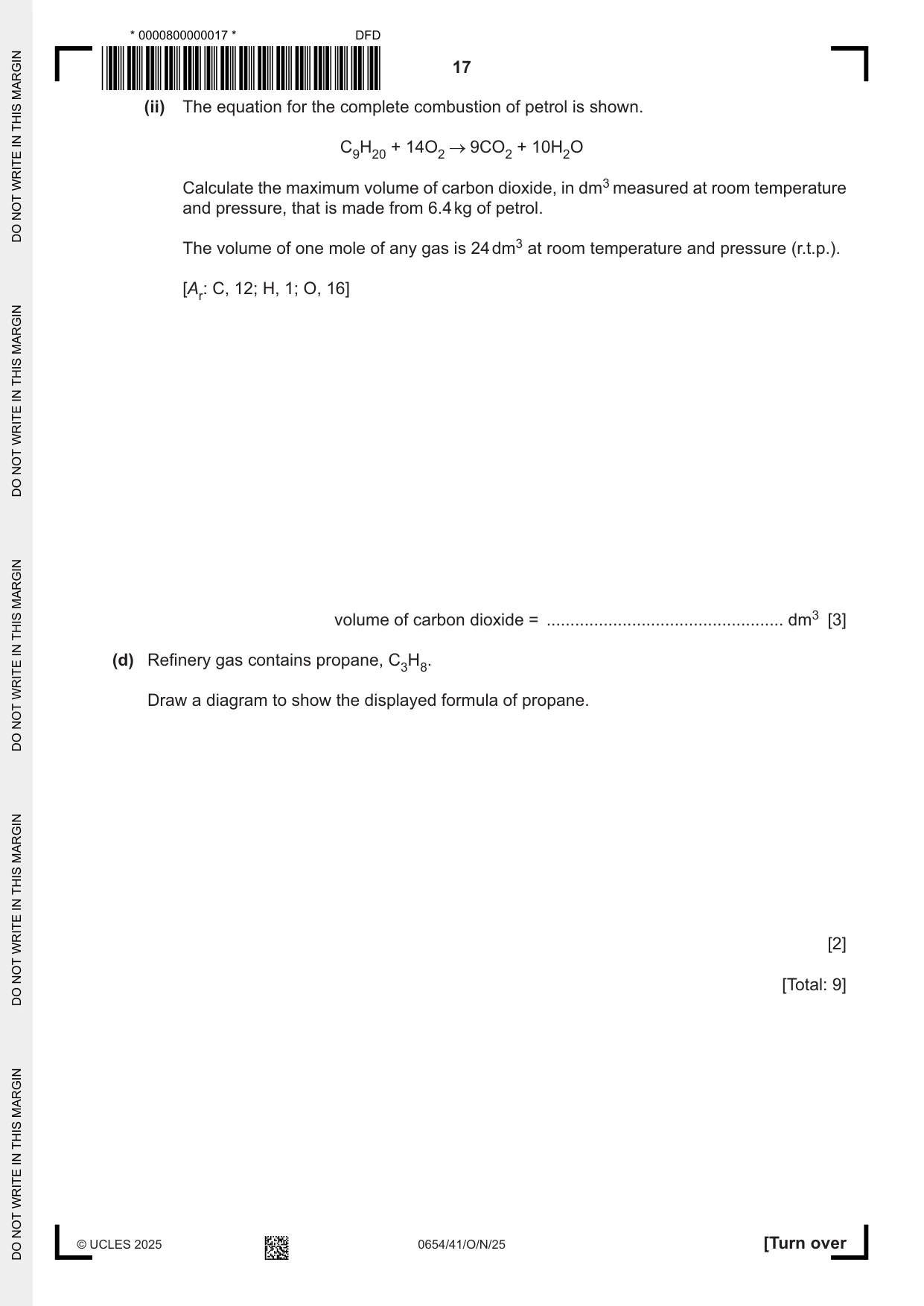
8 Petroleum is separated into useful fractions by fractional distillation. (a) Table 8.1 shows the boiling point range of three fractions obtained from petroleum. Table 8.1 fraction boiling point range / °C naphtha 90 to 200 refinery gas less than 25 diesel oil 150 to 380 State which fraction is obtained at the top of the fractionating column. ............................................................................................................................................. [1] (b) The diesel oil fraction can be cracked to make hydrocarbon molecules containing seven and eight carbon atoms. State which pair of hydrocarbon molecules would both turn aqueous bromine colourless. Tick (✓) one box. C7H14 and C8H18 C7H14 and C8H16 C7H16 and C8H16 C7H16 and C8H18 [1] (c) Another fraction obtained from crude oil is petrol. Petrol contains alkane molecules with the formula C9H20. (i) Complete the sentence about alkane molecules. The bonding between carbon atoms in alkanes is ............................. covalent and alkanes are ............................. hydrocarbons. [2] (ii) The equation for the complete combustion of petrol is shown. C9H20 + 14O2 9CO2 + 10H2O Calculate the maximum volume of carbon dioxide, in dm3 measured at room temperature and pressure, that is made from 6.4 kg of petrol. The volume of one mole of any gas is 24 dm3 at room temperature and pressure (r.t.p.). [Ar: C, 12; H, 1; O, 16] volume of carbon dioxide = .................................................. dm3 [3] (d) Refinery gas contains propane, C3H8. Draw a diagram to show the displayed formula of propane. [2] [Total: 9]
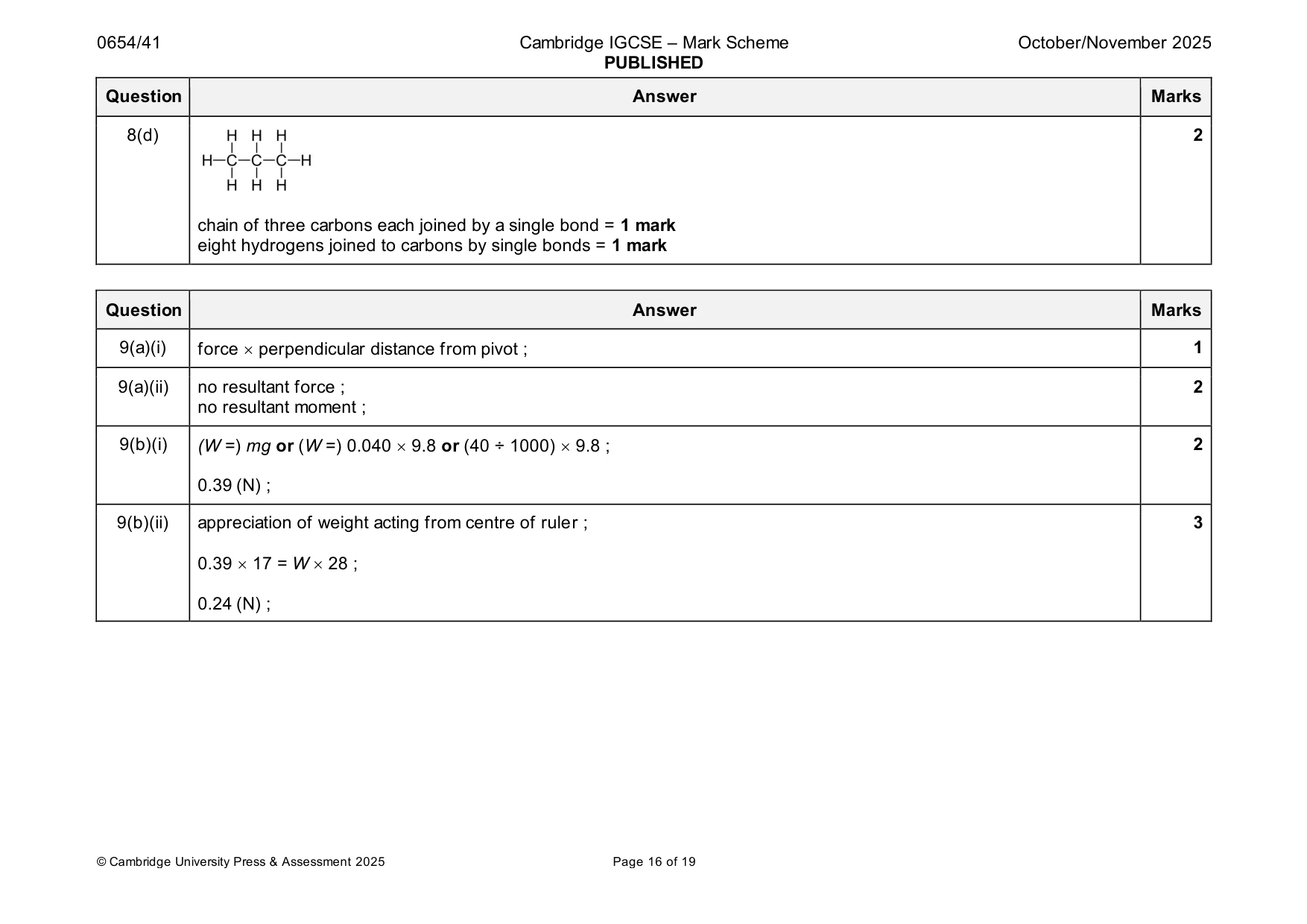
Mark scheme: 8(a) refinery gas ; 1 8(b) C7H14 and C8H16 ; 1 8(c)(i) single ; 2 saturated ; 8(c)(ii) (moles of C9H20 = 6400 ÷ 128 =) 50 ; 3 (moles of CO2 = 9 50 =) 450 ; (volume of CO2 = 450 24 =) 10 800 (dm³) ; OR (mass of CO2 = (396 ÷ 128) 6400 =) 19 800 (g); (moles of CO2 = 19 800 ÷ 44 =) 450 ; (volume of CO2 = 450 24 =) 10 800 (dm³) ; 8(d) 2 chain of three carbons each joined by a single bond = 1 mark eight hydrogens joined to carbons by single bonds = 1 mark
Q9 · Define the moment of a force
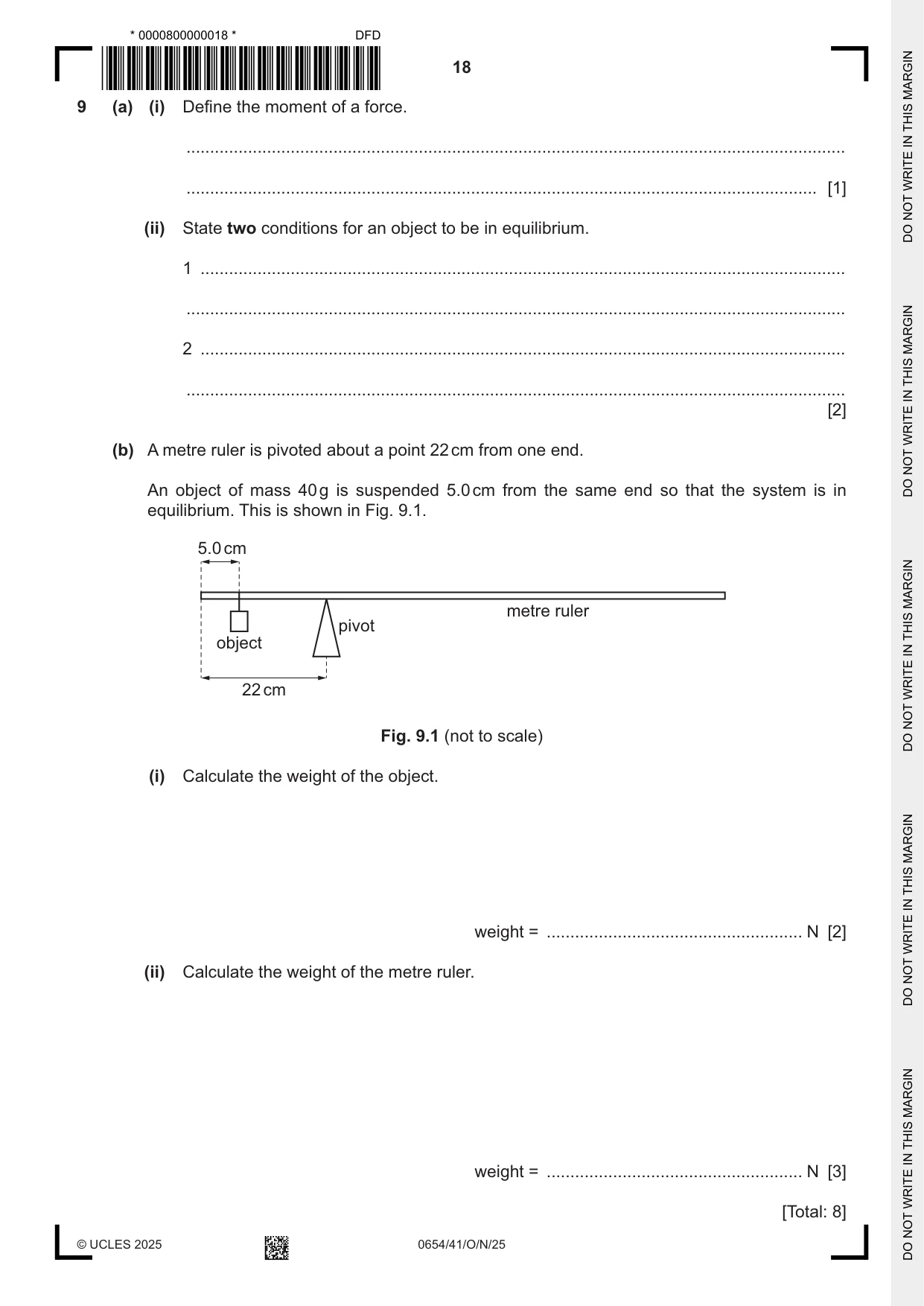
9 (a) (i) Define the moment of a force. ........................................................................................................................................... ..................................................................................................................................... [1] (ii) State two conditions for an object to be in equilibrium. 1 ........................................................................................................................................ ........................................................................................................................................... 2 ........................................................................................................................................ ........................................................................................................................................... [2] (b) A metre ruler is pivoted about a point 22 cm from one end. An object of mass 40 g is suspended 5.0 cm from the same end so that the system is in equilibrium. This is shown in Fig. 9.1. 5.0 cm metre ruler pivot object 22 cm Fig. 9.1 (not to scale) (i) Calculate the weight of the object. weight = ...................................................... N [2] (ii) Calculate the weight of the metre ruler. weight = ...................................................... N [3] [Total: 8] Question 10 starts on the next page.
Mark scheme: 9(a)(i) force perpendicular distance from pivot ; 1 9(a)(ii) no resultant force ; 2 no resultant moment ; 9(b)(i) (W =) mg or (W =) 0.040 9.8 or (40 ÷ 1000) 9.8 ; 2 0.39 (N) ; 9(b)(ii) appreciation of weight acting from centre of ruler ; 3 0.39 17 = W 28 ; 0.24 (N) ;
Q10 · A student investigates a simple d.c
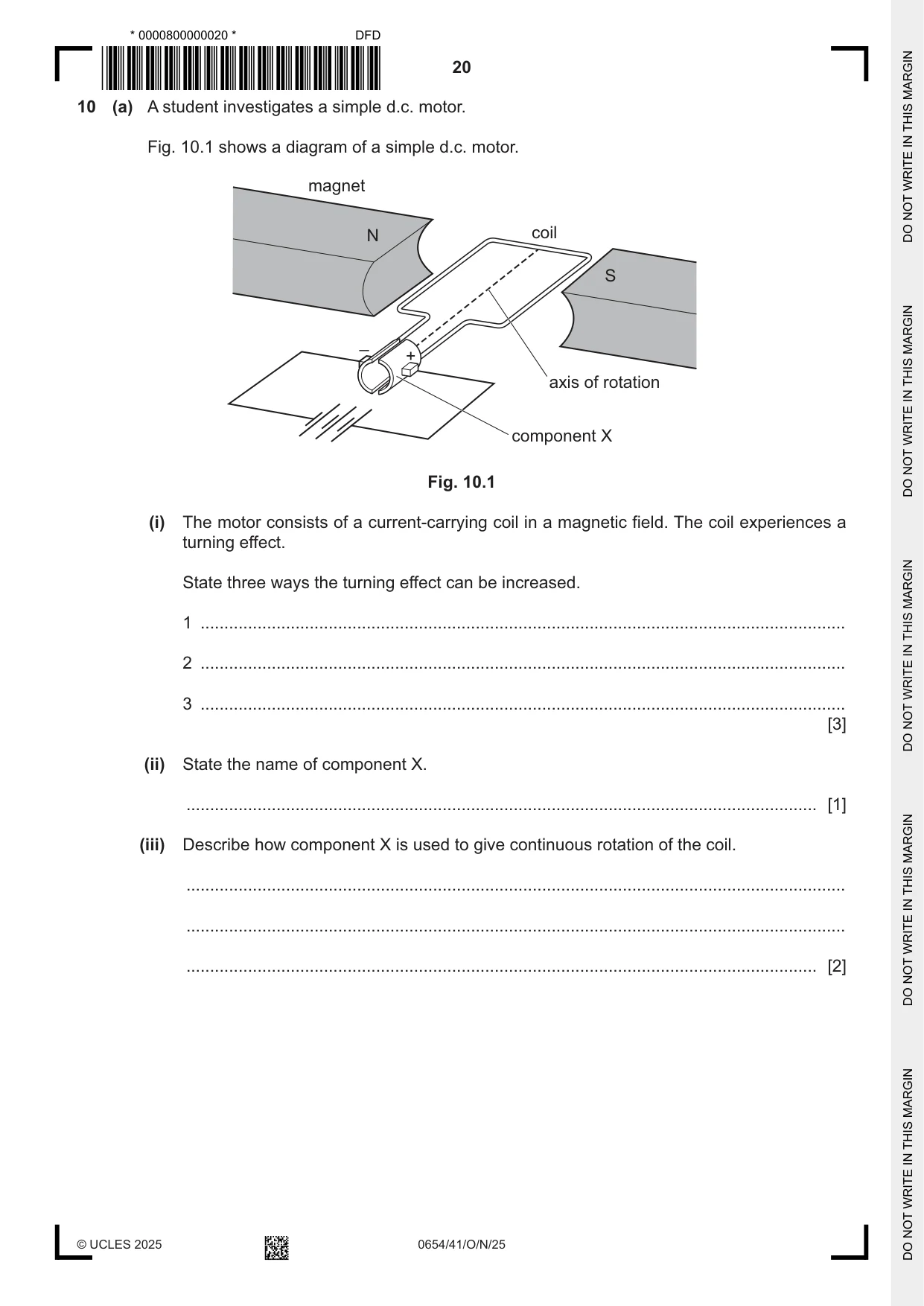
10 (a) A student investigates a simple d.c. motor. Fig. 10.1 shows a diagram of a simple d.c. motor. magnet N coil S _ + axis of rotation component X Fig. 10.1 (i) The motor consists of a current-carrying coil in a magnetic field. The coil experiences a turning effect. State three ways the turning effect can be increased. 1 ........................................................................................................................................ 2 ........................................................................................................................................ 3 ........................................................................................................................................ [3] (ii) State the name of component X. ..................................................................................................................................... [1] (iii) Describe how component X is used to give continuous rotation of the coil. ........................................................................................................................................... ........................................................................................................................................... ..................................................................................................................................... [2] (b) Transformers are used in the distribution of electricity. (i) State the type of transformer used at power stations to supply power to the electricity network. ..................................................................................................................................... [1] (ii) Explain why the use of this transformer means power losses in transmission cables are smaller. ........................................................................................................................................... ........................................................................................................................................... ..................................................................................................................................... [3] (c) A transformer is connected to a 230 V mains supply. An output of 3.6 V is required. The secondary coil has 720 turns. Calculate the number of turns on the primary coil. number of turns = ......................................................... [2] [Total: 12]
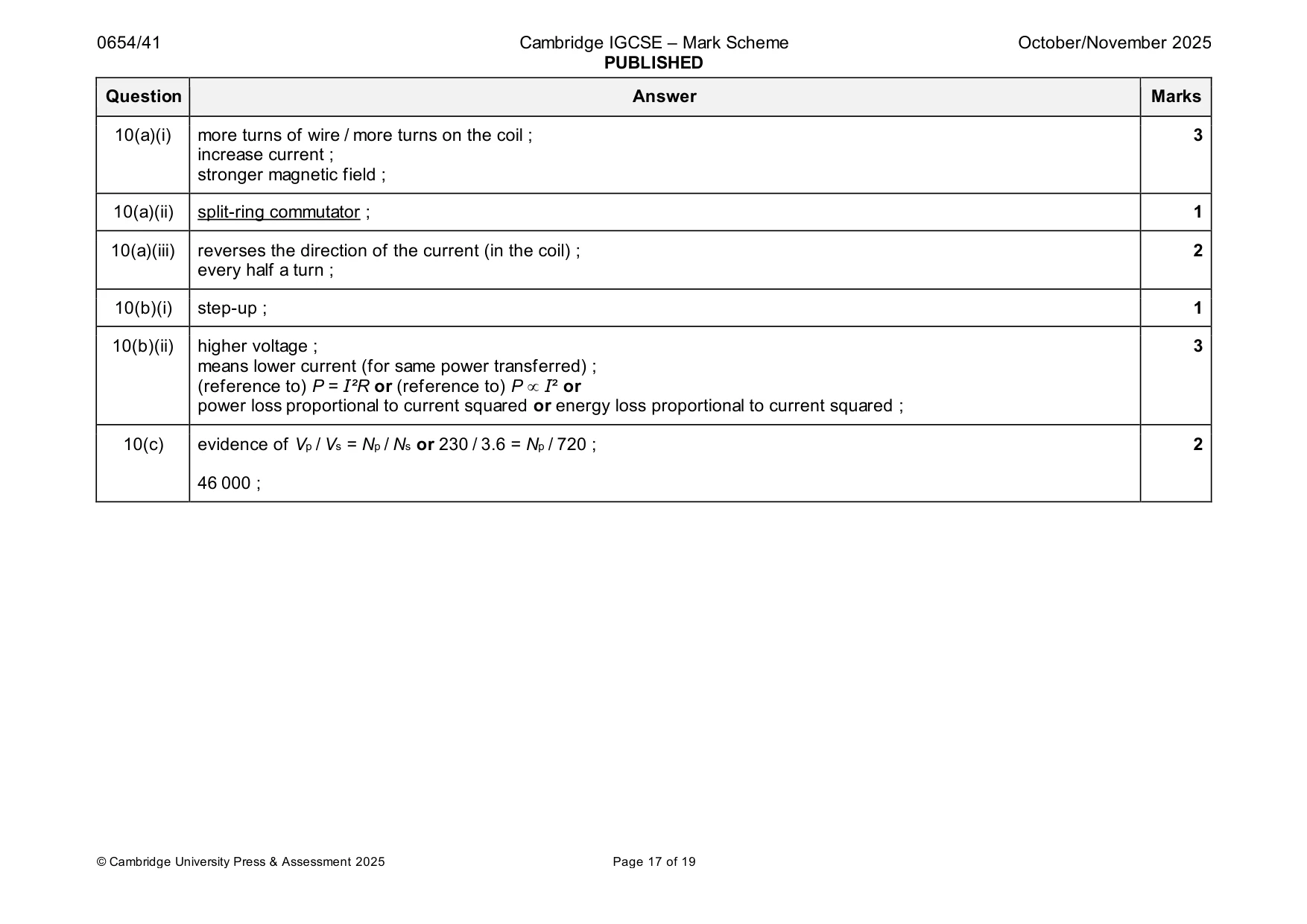
Mark scheme: 10(a)(i) more turns of wire / more turns on the coil ; 3 increase current ; stronger magnetic field ; 10(a)(ii) split-ring commutator ; 1 10(a)(iii) reverses the direction of the current (in the coil) ; 2 every half a turn ; 10(b)(i) step-up ; 1 10(b)(ii) higher voltage ; 3 means lower current (for same power transferred) ; (reference to) P = I²R or (reference to) P I² or power loss proportional to current squared or energy loss proportional to current squared ; 10(c) evidence of Vp / Vs = Np / Ns or 230 / 3.6 = Np / 720 ; 2 46 000 ;
Q11 · The isotope carbon-14 (C-14) decays to form an isotope of nitrogen (N) by emitting a beta…
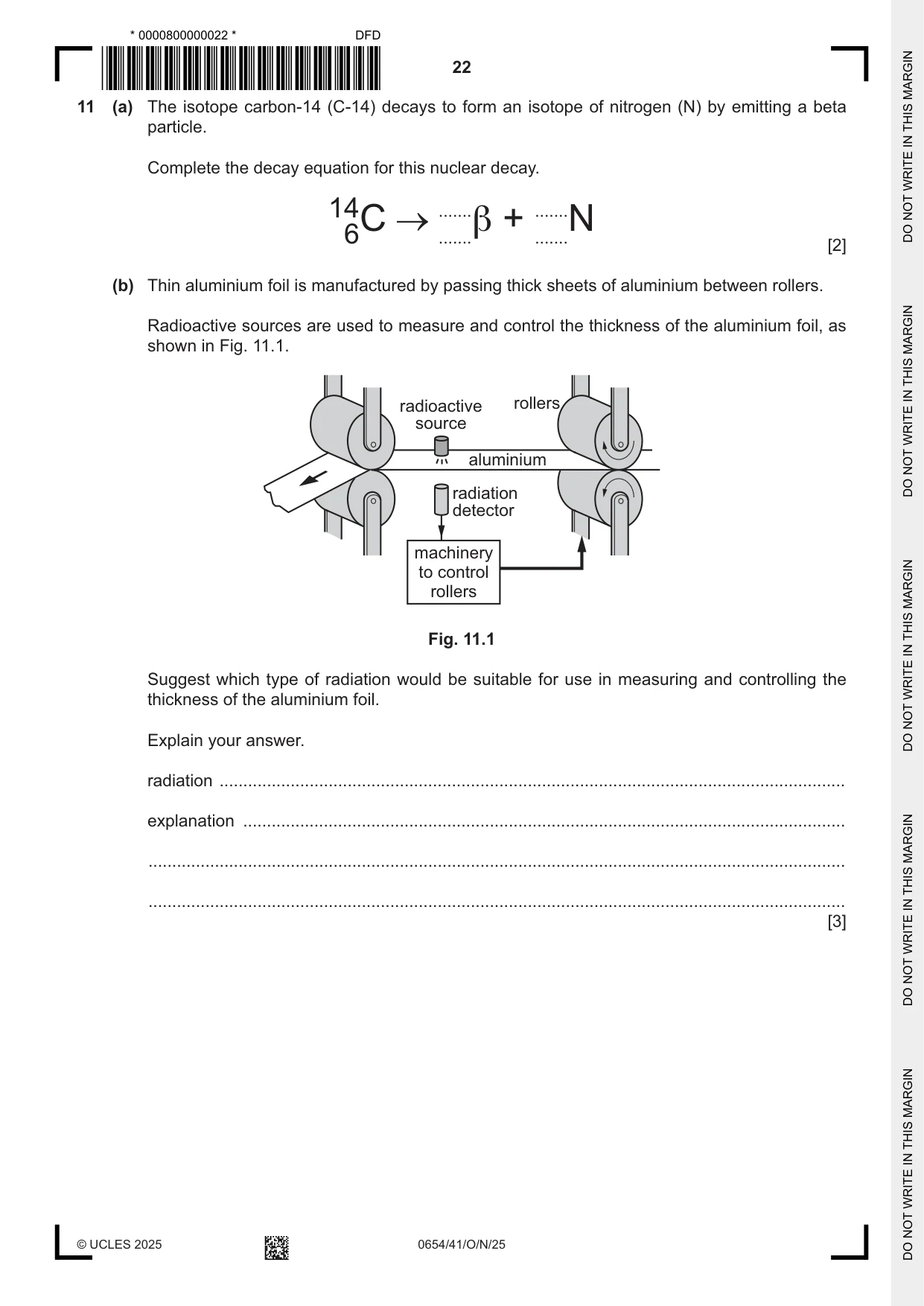
11 (a) The isotope carbon-14 (C-14) decays to form an isotope of nitrogen (N) by emitting a beta particle. Complete the decay equation for this nuclear decay. 14 ....... ....... 6C .......β + .......N [2] (b) Thin aluminium foil is manufactured by passing thick sheets of aluminium between rollers. Radioactive sources are used to measure and control the thickness of the aluminium foil, as shown in Fig. 11.1. radioactive rollers source aluminium radiation detector machinery to control rollers Fig. 11.1 Suggest which type of radiation would be suitable for use in measuring and controlling the thickness of the aluminium foil. Explain your answer. radiation .................................................................................................................................... explanation ............................................................................................................................... ................................................................................................................................................... ................................................................................................................................................... [3] (c) Carbon-14 has a half-life of 5700 years. A 5.0 g sample of wood from a living tree has an activity of 28 counts per minute due to the decay of carbon-14. A 5.0 g sample of dead wood from the hull of an ancient wooden boat has an activity of 7 counts per minute due to the decay of carbon-14. Calculate the age of the wood from the hull of the boat. age = ............................................... years [2] (d) Nuclear reactions occur in stable stars. (i) State the type of nuclear reactions that take place in a stable star. ..................................................................................................................................... [1] (ii) State what is produced in these nuclear reactions. ........................................................................................................................................... ..................................................................................................................................... [2] [Total: 10]
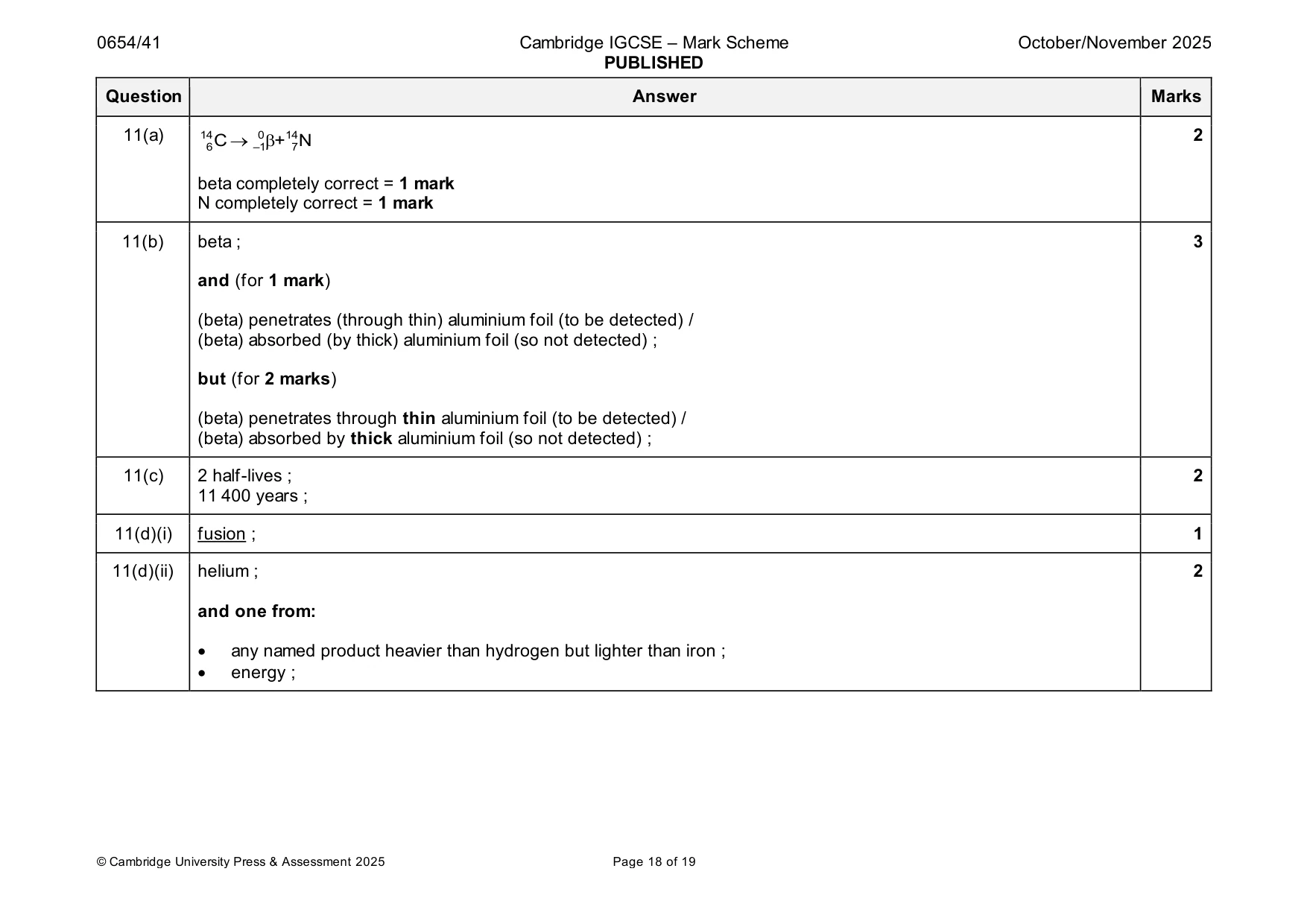
Mark scheme: 11(a) 14 0 14 2 6 C → –1+ 7 N beta completely correct = 1 mark N completely correct = 1 mark 11(b) beta ; 3 and (for 1 mark) (beta) penetrates (through thin) aluminium foil (to be detected) / (beta) absorbed (by thick) aluminium foil (so not detected) ; but (for 2 marks) (beta) penetrates through thin aluminium foil (to be detected) / (beta) absorbed by thick aluminium foil (so not detected) ; 11(c) 2 half-lives ; 2 11 400 years ; 11(d)(i) fusion ; 1 11(d)(ii) helium ; 2 and one from: • any named product heavier than hydrogen but lighter than iron ; • energy ;
Q12 · Seismic P-waves are longitudinal waves
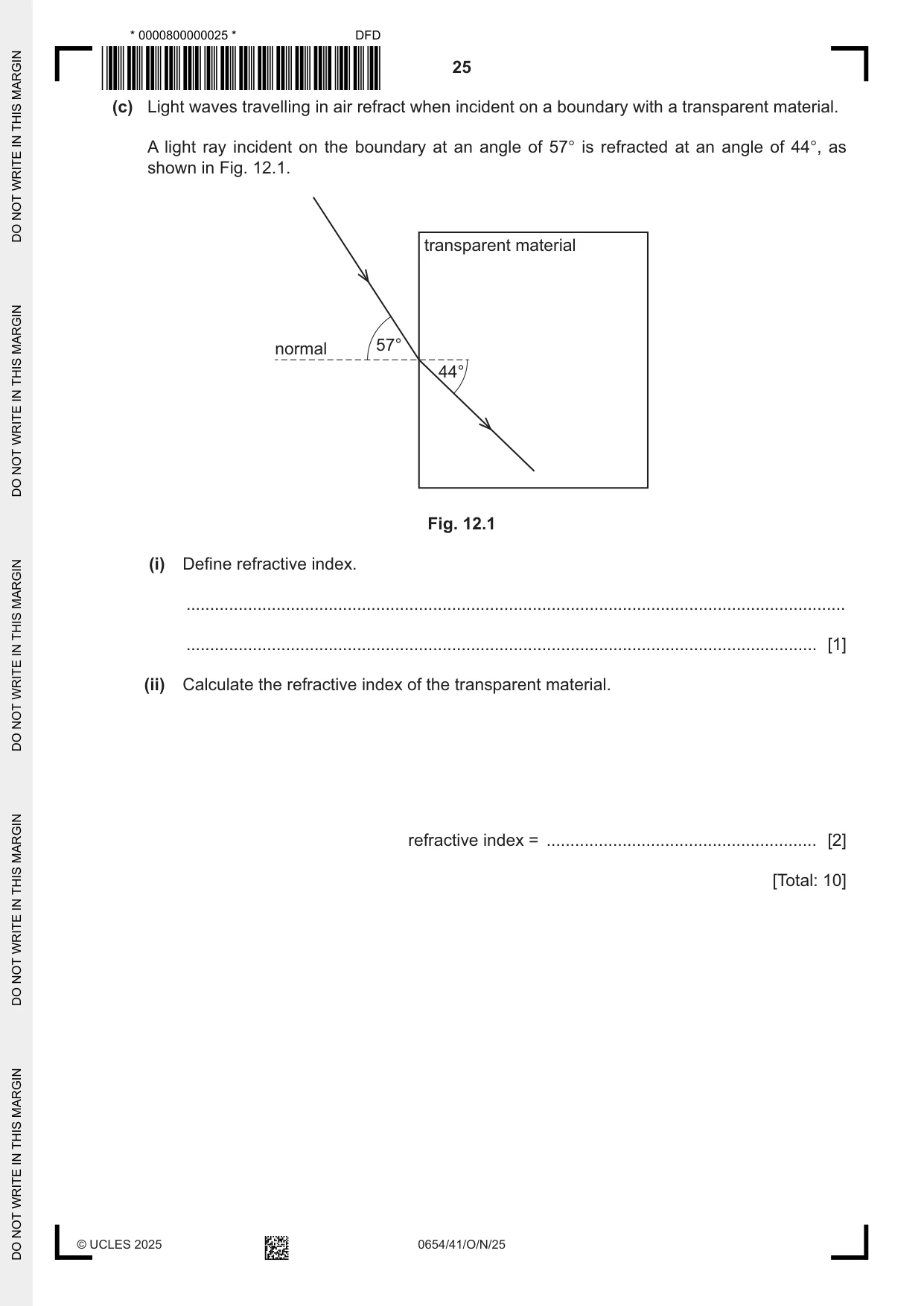
12 (a) (i) Seismic P-waves are longitudinal waves. Describe a longitudinal wave. ........................................................................................................................................... ..................................................................................................................................... [2] (ii) P-waves travel at 6200 m / s in rock. The frequency of a P-wave is 12 Hz. Calculate the wavelength of the P-wave. wavelength = ...................................................... m [2] (b) Waves spread out when they pass through a narrow gap. (i) State the name of this effect. ..................................................................................................................................... [1] (ii) Explain whether sound waves with wavelength of 1.2 m will spread out when passing through a 1.0 m wide doorway. ........................................................................................................................................... .......................................................................................................................................[1] (iii) The wavelength of red light is 700 nm. Explain why red light travels in a straight line through the doorway in (b)(ii). ........................................................................................................................................... ..................................................................................................................................... [1] (c) Light waves travelling in air refract when incident on a boundary with a transparent material. A light ray incident on the boundary at an angle of 57° is refracted at an angle of 44°, as shown in Fig. 12.1. transparent material normal 57° 44° Fig. 12.1 (i) Define refractive index. ........................................................................................................................................... ..................................................................................................................................... [1] (ii) Calculate the refractive index of the transparent material. refractive index = ......................................................... [2] [Total: 10]
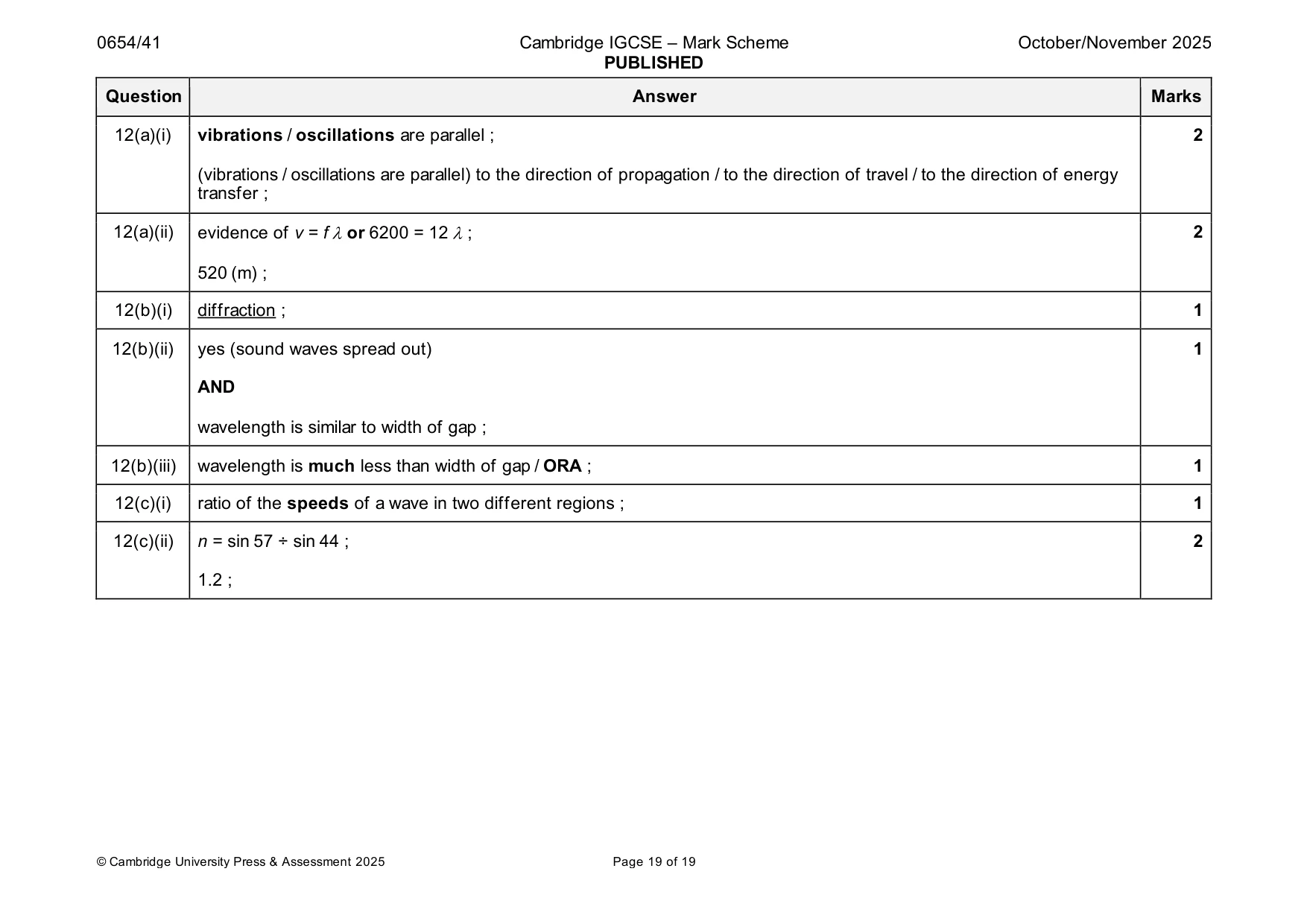
Mark scheme: 12(a)(i) vibrations / oscillations are parallel ; 2 (vibrations / oscillations are parallel) to the direction of propagation / to the direction of travel / to the direction of energy transfer ; 12(a)(ii) evidence of v = f or 6200 = 12 ; 2 520 (m) ; 12(b)(i) diffraction ; 1 12(b)(ii) yes (sound waves spread out) 1 AND wavelength is similar to width of gap ; 12(b)(iii) wavelength is much less than width of gap / ORA ; 1 12(c)(i) ratio of the speeds of a wave in two different regions ; 1 12(c)(ii) n = sin 57 ÷ sin 44 ; 2 1.2 ;
What was in this paper
The subtopics covered by these 12 questions, and how many questions each got. Open one in a new tab to see every Cambridge question on it.
What you needed in this session
Cambridge’s own grade thresholds for 2025 Oct/Nov, Paper 4 · Variant 1. A higher threshold means an easier paper — the bar moves with how the cohort did.