Questions as text
Q1 · Most of the compounds in petroleum contain only the elements carbon and hydrogen 0654/32 May/June 2017
6 (a) Most of the compounds in petroleum contain only the elements carbon and hydrogen. State which two of the terms listed below refer to compounds or types of compounds that contain only carbon and hydrogen. calcium carbonate ethanol hydrocarbon methane … and … [1] (b) Gasoline contains mainly alkanes and is used as a fuel for cars. Explain, in terms of combustion products, why running a car engine in an enclosed space is a health hazard. … … … [2] (c) (i) Name the industrial process used to produce alkenes from alkanes. … [1] (ii) Describe how poly(ethene) is formed from ethene molecules. … … [1] (iii) An aqueous bromine test is used to identify whether a hydrocarbon is saturated or unsaturated. Describe the result of this test with ethane. … … [1] (d) Polymers are used to make paint. The steel parts of car bodies are painted to prevent rusting. Fig. 6.1 shows a small area of rust on a car. area of rust Fig. 6.1 (i) Name the metallic element present in steel that reacts to form rust. … [1] (ii) Name two substances in the environment that react with the element in (d)(i) to form rust. 1 … 2 … [2] (iii) Suggest how the area of rust forms on the car in Fig. 6.1. … … [1]
10 marks
Mark scheme: 6(a) hydrocarbon and methane ; 1 6(b) reference to release / build-up of carbon dioxide / carbon monoxide ; reference to dangers of poisoning / suffocation / death ; 2 6(c)(i) (catalytic) cracking ; 1 6(c)(ii) ethene molecules join together / form (long) chains ; 1 6(c)(iii) no reaction ; no colour change / stays orange ; 1 6(d)(i) iron ; 1 6(d)(ii) air / oxygen ; water ; 2 6(d)(iii) any reasonable source of damage / cause of paint removal ; 1
This question in 0654/32 May/June 2017
Q2 · Ethanol is a colourless liquid compound that contains the elements carbon, hydrogen and… 0654/33 May/June 2017
13 Ethanol is a colourless liquid compound that contains the elements carbon, hydrogen and oxygen. (a) Complete Fig. 13.1 to show the structure of one molecule of ethanol. H H C H Fig. 13.1 [2] (b) A mixture of ethanol and water is separated using the apparatus shown in Fig. 13.2. thermometer apparatus W glass beads cold water beaker mixture of ethanol and heat water Fig. 13.2 The mixture of ethanol and water is heated and liquid collects in the beaker. (i) Name the process in Fig. 13.2. … [1] (ii) State the purpose of apparatus W. … … [1] (iii) The boiling point of water is 100 °C. Suggest why the liquid that collects first in the beaker contains mainly ethanol. … … [1] (c) Sodium reacts slowly with ethanol, and hydrogen is given off as shown in Fig. 13.3. hydrogen ethanol sodium Fig. 13.3 (i) Describe the test and the positive result for hydrogen. test … result … [2] (ii) Describe one similarity between the reactions of sodium with ethanol and sodium with water. … … [1] (iii) Describe one difference between the reactions of sodium with ethanol and sodium with water. … … [1] (d) Some cars use a mixture of ethanol and gasoline for fuel. Fig. 13.4 shows apparatus a student uses to investigate the combustion of ethanol. U-tube pump draws combustion products through the apparatus ethanol burner limewater colourless liquid cold water Fig. 13.4 Shortly after the ethanol burner is lit, the following observations are made. • A colourless liquid collects inside the U-tube. • The liquid inside the U-tube changes cobalt chloride paper from blue to pink. • The limewater becomes milky. Use the information in Fig. 13.4 and the observations to deduce the names of the two compounds that are produced when ethanol completely burns in air. Explain your answers. 1 compound … explanation … … 2 compound … explanation … … [2]
11 marks
Mark scheme: 13(a) C – C single bond / – O – H ; all else correct ; 2 13(b)(i) (fractional) distillation ; 1 13(b)(ii) it is a condenser / condenses (hot) vapours to liquid ; 1 13(b)(iii) ethanol has a lower boiling point / ethanol easier to boil than water ; 1 13(c)(i) flame ; pops ; 2 13(c)(ii) gas / hydrogen released ; 1 13(c)(iii) reaction speed higher in water ; 1 13(d) in any order water because it turns cobalt chloride from blue to pink ; carbon dioxide because it turns limewater milky ; 2
This question in 0654/33 May/June 2017
Q3 · Petroleum is a liquid fossil fuel 0654/31 Oct/Nov 2017
11 Petroleum is a liquid fossil fuel. Petroleum is a mixture containing many different hydrocarbons. Petroleum is extracted from the Earth and is then processed into useful products. (a) (i) Name a solid fossil fuel. … [1] (ii) Suggest why petroleum is described as a fossil fuel, but wood is not a fossil fuel. … … [1] (b) Fractional distillation is used to separate petroleum into simpler, more useful mixtures called fractions. Fig. 11.1 shows this process and two of the useful fractions obtained. refinery gas gas oil hot petroleum Fig. 11.1 (i) State one use for each of the fractions shown in Fig. 11.1. refinery gas … gas oil … [2] (ii) Explain why fractional distillation involves physical changes and not chemical changes. … … [1] (c) Fig. 11.2 shows the structures of four compounds, J, K, L and M. J K H H H H H C C O H H C C H H H H H L M H H H H C C C H H C H H H H Fig. 11.2 State which of the compounds are alkanes, … is ethanol, … is the main compound in natural gas, … is an unsaturated hydrocarbon. … [4] (d) Ethene, C2H4, is a hydrocarbon that reacts to form poly(ethene) in a polymerisation reaction. Plastic shopping bags are made from poly(ethene). (i) Describe how ethene molecules react to form poly(ethene) molecules. … … [1] (ii) Hydrocarbons, such as poly(ethene), are destroyed by burning in air. Suggest two compounds that are produced by burning poly(ethene). 1 … 2 … [2]
12 marks
Mark scheme: 11(a)(i) coal ; 1 11(a)(ii) reference to long time required to form fossil fuels ; 1 11(b)(i) heating / cooking ; fuel for diesel engines / fuel for named heavy vehicle ; 2 11(b)(ii) no new compounds / separation of existing compounds from a mixture ; 1 11(c) alkanes K M ; ethanol J ; natural gas M ; unsaturated L ; 4 11(d)(i) join together (in chains) / owtte ; 1 11(d)(ii) carbon dioxide ; carbon monoxide ; water ; max 2
This question in 0654/31 Oct/Nov 2017
Q4 · The structure of a molecule of an alkane 0654/32 Oct/Nov 2017
11 (a) Fig. 11.1 shows the structure of a molecule of an alkane. H H H C C H H H Fig. 11.1 (i) Name this alkane. … [1] (ii) Complete Fig. 11.2 to show the structure of a molecule of the alkene that contains only two carbon atoms. C C H Fig. 11.2 [2] (b) Fig. 11.3 shows clay pots being heated strongly in a kiln. The hydrocarbon propane, C3H8, is supplied to the gas burner. Hot gases circulate through the kiln, heating the clay pots and then leaving through the top of the kiln. gas mixture leaving the kiln kiln wall 950 ºC clay pot air propane gas burner Fig. 11.3 (i) Explain why the gas mixture leaving the kiln contains large amounts of carbon dioxide and water vapour. … … [1] (ii) Explain why the gas mixture leaving the kiln contains nitrogen and argon. … … … [2] (c) Sometimes clay pots are covered with a glaze before they go into the kiln. Glaze is a mixture of solid compounds that melt at high temperatures. It forms a coloured, shiny layer on the pots as they cool. Four compounds found in a glaze are shown. calcium carbonate, CaCO3 cobalt oxide, CoO copper oxide, CuO silicon dioxide, SiO2 (i) One of these compounds undergoes thermal decomposition in the kiln. State which compound decomposes and name one of the products of the decomposition. compound … product … [2] (ii) Predict which two compounds produce colours in the glaze layer. Explain your answer. compounds … and … explanation … … [2] Please turn over for Question 12.
10 marks
Mark scheme: 11(a)(i) ethane ; 1 11(a)(ii) double bond shown ; four hydrogen atoms – two on each carbon atom ; 2 11(b)(i) CO2 and H2O from the (complete) combustion of propane / the fuel / the hydrocarbon ; 1 11(b)(ii) nitrogen and argon from / in the air (taken in with the fuel) ; nitrogen and argon are inert / do not react / burn ; 2 11(c)(i) calcium carbonate / CaCO3 ; calcium oxide / lime / CaO / carbon dioxide / CO2 ; 2 Question Answer Marks 11(c)(ii) cobalt oxide / CoO and copper oxide / CuO ; reference to transition metals ; 2
This question in 0654/32 Oct/Nov 2017
Q5 · A man drives a car 0654/32 Oct/Nov 2017
12 (a) A man drives a car. When he gets out of the car he touches the door handle while his feet are on the ground. He experiences an electric shock. Suggest why this happens. … … … … [2] (b) A relay is needed in many electrical circuits in a car. Fig. 12.1 shows a simple relay circuit. magnetising relay iron switch coil low voltage high voltage circuit circuit Fig. 12.1 Use words or phrases from the list to complete the sentences to describe the action of a relay. You may use each word or phrase once, more than once or not at all. an electric a magnetic coil high iron switch low Electricity passes through the … voltage circuit. This causes … field to be produced around the coil. The … is closed by this field and completes the … voltage circuit. [2] (c) The gasoline (petrol) used in the car is produced from petroleum. Petroleum is a non-renewable energy source. Name one other non-renewable energy source and one renewable energy source. non-renewable energy source … renewable energy source … [2] (d) Car wheels are usually made from steel. Some cars have aluminium alloy wheels. Suggest a simple way to show that a wheel is not made from steel. Explain your answer. … … [1]
7 marks
Mark scheme: 12(a) Friction / description of friction ; transfer of electrons ; 2 12(b) low a magnetic iron switch high 2 correct ; 4 correct ; 2 12(c) coal / gas ; solar / wind / waves / tides / geothermal / hydroelectricity ; 2 12(d) use a magnet (no mark) steel is magnetic / will attract magnet or aluminium is not magnetic / will not attract magnet ; 1
This question in 0654/32 Oct/Nov 2017
Q6 · Useful products containing hydrocarbons are obtained from petroleum 0654/31 Oct/Nov 2018
11 Useful products containing hydrocarbons are obtained from petroleum. (a) Name the process used to separate petroleum into useful products. … [1] (b) One useful product obtained from petroleum is methane. The complete combustion (burning) of methane causes an increase in temperature. (i) State the term used to describe all chemical reactions that cause an increase in temperature. … [1] (ii) State two compounds that are produced when methane burns completely. 1 … 2 … [2] (c) Some hydrocarbons are called alkanes. Complete Table 11.1 about alkanes by stating the missing name and drawing the missing structure. Table 11.1 name structure H … H C H H ethane [2] (d) Alkenes such as ethene, C2H4, are produced by strongly heating alkanes in the presence of a catalyst. (i) Name this reaction which produces alkenes. … [1] (ii) State what is meant by a catalyst. … … [1] (iii) Name the compound produced when ethene reacts with steam. … [1] (e) Describe a test that is used to find out if a hydrocarbon is an alkane or an alkene. test … … result for an alkane … … result for an alkene … … [3]
12 marks
Mark scheme: 11(a) fractional distillation ; 1 11(b)(i) exothermic ; 1 11(b)(ii) carbon dioxide ; water ; 2 11(c) methane ; ; 2 11(d)(i) (catalytic / thermal) cracking ; 1 11(d)(ii) speeds up a reaction ; 1 11(d)(iii) ethanol ; 1 11(e) (react with / shake with ) bromine (solution) ; (with alkane) no change / no reaction / mixture remains orange ; (with alkene) orange to colourless ; 3
This question in 0654/31 Oct/Nov 2018
Q7 · Natural gas is used as a fuel 0654/32 Oct/Nov 2018
11 (a) Natural gas is used as a fuel. When natural gas burns, the temperature increases. (i) State the main constituent of natural gas. … [1] (ii) Name the compound that is formed in addition to carbon dioxide when natural gas is burned completely. … [1] (iii) State the term used for all chemical reactions that cause an increase in temperature. … [1] (b) Petroleum is a mixture of hydrocarbons. Table 11.1 shows information about six hydrocarbons A to F at standard temperature and pressure. Table 11.1 hydrocarbon formula boiling point / °C A C2H6 –86 B C3H8 –42 C C4H10 –1 D C5H12 36 E C6H14 69 F C7H16 99 (i) Using Table 11.1, describe the effect of the size of molecules on the boiling point of a hydrocarbon at standard temperature and pressure. … … [1] (ii) Predict and explain which of the hydrocarbons A to F are gases at 20 °C. hydrocarbons … explanation … … [2] (c) Complete the diagrams in Fig. 11.1 to show the structures of ethane and of ethene. ethane ethene H H C C C C Fig. 11.1 [3] (d) Fig. 11.2 shows apparatus a teacher uses to pass a gaseous hydrocarbon through bromine solution. gaseous hydrocarbon bromine solution Fig. 11.2 (i) State the colour of the bromine solution before any gas passes through it. … [1] (ii) The gas causes the solution to become colourless. State what this observation shows about the structure of the hydrocarbon molecules. … … [1]
11 marks
Mark scheme: 11(a)(i) methane / CH4; 1 11(a)(ii) water; 1 11(a)(iii) exothermic; 1 11(b)(i) the larger the molecules the higher the boiling point; 1 11(b)(ii) A B C; boiling point is below 20 °C / at 20 °C they will have boiled; 2 11(c) single C-C in ethane and double C=C in ethene; 6 × H and all correct in ethane; 4 × H and all correct in ethene; 3 11(d)(i) orange / brown / yellow; 1 11(d)(ii) unsaturated / contain double (C to C) bonds; 1
This question in 0654/32 Oct/Nov 2018
Q8 · Alkanes and alkenes are types of hydrocarbons 0654/33 Oct/Nov 2018
11 Alkanes and alkenes are types of hydrocarbons. Alkanes are obtained from petroleum. Some alkanes are converted into alkenes. (a) Ethene is an alkene. (i) Complete the diagram in Fig. 11.1 to show the structure of a molecule of ethene. H C Fig. 11.1 [2] (ii) Name the process used to produce alkenes from alkanes. … [1] (b) A student uses the apparatus shown in Fig. 11.2 to test a gas for the presence of unsaturated hydrocarbons. gas being tested orange bromine solution Fig. 11.2 He obtains a positive result for the presence of unsaturated hydrocarbons. (i) State the observation that shows the presence of unsaturated hydrocarbons. … … [1] (ii) The student thinks that the positive result shows that the gas being tested is pure ethene. Suggest two reasons why he may not be correct. 1 … … 2 … … [2] (c) Fig. 11.3 shows the structure of a molecule of ethanol. H H H C C O H H H Fig. 11.3 (i) Explain why ethanol is not an alkane. … … [1] (ii) State one use of ethanol. … [1] (d) Fig. 11.4 shows apparatus a student uses to investigate the combustion of ethanol. burner ethanol electronic balance Fig. 11.4 Predict the change, if any, in the reading of the electronic balance as the ethanol burns. Explain your prediction. prediction … explanation … … … [2]
10 marks
Mark scheme: 11(a)(i) carbon - carbon double bond ; 4 carbon hydrogen bonds ; 2 11(a)(ii) (catalytic / thermal) cracking ; 1 11(b)(i) (orange solution) becomes colourless ; 1 11(b)(ii) get the same result if ethene is impure ; get the same result with other alkenes ; 2 11(c)(i) alkanes contain only hydrogen and carbon / do not contain oxygen ; 1 11(c)(ii) solvent / fuel ; 1 11(d) reading decreases ; water (vapour) / carbon dioxide are released / the idea that the amount of matter in the burner reduces ; 2
This question in 0654/33 Oct/Nov 2018
Q9 · Sulfur dioxide and ammonia are gaseous compounds 0654/31 May/June 2019
5 Sulfur dioxide and ammonia are gaseous compounds. (a) Sulfur dioxide is released when fossil fuels burn. (i) Name two fossil fuels. 1 … 2 … [2] (ii) Explain why burning fossil fuels releases sulfur dioxide. … … … [2] (iii) The pH of water is 7. When sulfur dioxide dissolves in water, the pH changes to 2. Explain this observation. … … [1] (iv) Describe one way that sulfur dioxide can damage the environment. … … … [2] (b) (i) State the chemical formula of ammonia. … [1] (ii) Ammonia and sulfur dioxide are used in the production of ammonium sulfate. Explain why ammonium sulfate is added to soil used to grow crops. … … … [2] [Total: 10]
10 marks
Mark scheme: 5(a)(i) coal ; natural gas ; petroleum / crude oil ; max 2 5(a)(ii) (fossil fuels) contain sulfur / sulfur compounds ; which oxidise / combine with oxygen ; 2 5(a)(iii) solution (of sulfur dioxide) is acidic / is an acidic oxide ; 1 5(a)(iv) dissolve in / react with rain / causes acid rain ; (acid rain) reacts with buildings / damages vegetation / acidifies rivers / lakes / damages or kills aquatic life ; or pollutes or mixes with air / may be inhaled ; damages gas exchange system / triggers asthma ; 2 5(b)(i) NH3 ; 1 5(b)(ii) acts as fertiliser ; increases crop yields / crops grow faster ; supply nitrogen (compounds) / nitrate ions / mineral ions ; max 2
This question in 0654/31 May/June 2019
Q10 · Petroleum is a non-renewable energy resource used to produce electricity 0654/32 May/June 2019
9 Petroleum is a non-renewable energy resource used to produce electricity. (a) Place a tick (3) in the boxes to correctly describe each energy resource as either renewable or non-renewable. energy resource renewable non-renewable coal geothermal natural gas solar waves [2] (b) State two disadvantages of energy production using wind turbines. 1 … 2 … [2] (c) Fig. 9.1 shows supply cables from a power station supported by pylons. The cables are suspended loosely in hot weather. Fig. 9.1 Explain why the cables must be suspended loosely in hot weather. … … … [2] (d) Fig. 9.2 shows a saucepan of water being heated on an electric cooker. The water is heated to boiling point and continues to boil for 30 minutes. Fig. 9.2 (i) Describe what happens to the temperature of the water while it is boiling. … [1] (ii) The cooker is switched off and the water is allowed to cool. Before heating, the mass of the water in the saucepan was 1000 g. The mass of the water in the saucepan is now 600 g. Determine the mass of water that has been lost from the saucepan. mass of water lost from the saucepan = … g [1] (iii) State what has happened to the water that has been lost from the saucepan. … [1] [Total: 9]
9 marks
Mark scheme: 9(a) energy resource renewable non-renewable coal 9 geothermal 9 natural gas 9 solar 9 waves 9 2, 3 or 4 correct ; 5 correct ; 2 9(b) noise of blades rotating ; no wind means no electricity produced ; 2 9(c) during cold weather cables will contract ; could snap cables / damage pylons ; 2 9(d)(i) remains constant ; 1 9(d)(ii) 1000 – 600 = 400 (g) ; 1 9(d)(iii) converted to steam ; 1
This question in 0654/32 May/June 2019
Q11 · A beaker containing sand and aqueous sodium chloride 0654/32 May/June 2019
11 (a) Fig. 11.1 shows a beaker containing sand and aqueous sodium chloride. aqueous sodium chloride beaker sand Fig. 11.1 Suggest a method used to separate the sand from the aqueous sodium chloride … the water from sodium chloride. … [2] (b) Fig. 11.2 shows fractional distillation being used to separate ethanol and water. thermometer cold water out W ethanol cold water in boiling aqueous ethanol heat Fig. 11.2 (i) Suggest the purpose of the part of the apparatus labelled W. … … [1] (ii) Explain why ethanol can be separated from water by fractional distillation. … … [1] (c) Fractional distillation is used in industry to obtain useful hydrocarbons from a raw material R. (i) Identify raw material R. … [1] (ii) Ethane and ethene are hydrocarbons. The structure of an ethane molecule is shown below. Complete the diagram of an ethene molecule. ethane ethene H H H H H C C H C C H H [2] (d) Alkenes are produced when alkanes are heated in the presence of a catalyst. Fig. 11.3 shows laboratory apparatus used for this reaction. catalyst reaction products alkane vapour strong heat aqueous bromine Fig. 11.3 (i) Name the process that converts alkanes into alkenes. … [1] (ii) State the colour change which is observed in the bromine solution during the process. colour changes from … to … . [2] [Total: 10]
10 marks
Mark scheme: 11(a) filtration / decantation ; crystallisation / (heat to) evaporate the water ; 2 11(b)(i) condense ethanol vapour ; 1 11(b)(ii) liquids have different boiling points ; 1 11(c)(i) petroleum / crude oil ; 1 11(c)(ii) 1 for double bond between carbons ; 1 for four single C-H bonds ; 2 11(d)(i) (catalytic / thermal) cracking ; 1 11(d)(ii) from orange ; to colourless ; 2
This question in 0654/32 May/June 2019
Q12 · Petroleum is a non-renewable energy resource used to produce electricity 0654/33 May/June 2019
9 Petroleum is a non-renewable energy resource used to produce electricity. (a) Place a tick (3) in the boxes to correctly describe each energy resource as either renewable or non-renewable. energy resource renewable non-renewable coal geothermal natural gas solar waves [2] (b) State two disadvantages of energy production using wind turbines. 1 … 2 … [2] (c) Fig. 9.1 shows supply cables from a power station supported by pylons. The cables are suspended loosely in hot weather. Fig. 9.1 Explain why the cables must be suspended loosely in hot weather. … … … [2] (d) Fig. 9.2 shows a saucepan of water being heated on an electric cooker. The water is heated to boiling point and continues to boil for 30 minutes. Fig. 9.2 (i) Describe what happens to the temperature of the water while it is boiling. … [1] (ii) The cooker is switched off and the water is allowed to cool. Before heating, the mass of the water in the saucepan was 1000 g. The mass of the water in the saucepan is now 600 g. Determine the mass of water that has been lost from the saucepan. mass of water lost from the saucepan = … g [1] (iii) State what has happened to the water that has been lost from the saucepan. … [1] [Total: 9]
9 marks
Mark scheme: 9(a) energy resource renewable non-renewable coal 9 geothermal 9 natural gas 9 solar 9 waves 9 2, 3 or 4 correct ; 5 correct ; 2 9(b) noise of blades rotating ; no wind means no electricity produced ; 2 9(c) during cold weather cables will contract ; could snap cables / damage pylons ; 2 9(d)(i) remains constant ; 1 9(d)(ii) 1000 – 600 = 400 (g) ; 1 9(d)(iii) converted to steam ; 1
This question in 0654/33 May/June 2019
Q13 · A beaker containing sand and aqueous sodium chloride 0654/33 May/June 2019
11 (a) Fig. 11.1 shows a beaker containing sand and aqueous sodium chloride. aqueous sodium chloride beaker sand Fig. 11.1 Suggest a method used to separate the sand from the aqueous sodium chloride … the water from sodium chloride. … [2] (b) Fig. 11.2 shows fractional distillation being used to separate ethanol and water. thermometer cold water out W ethanol cold water in boiling aqueous ethanol heat Fig. 11.2 (i) Suggest the purpose of the part of the apparatus labelled W. … … [1] (ii) Explain why ethanol can be separated from water by fractional distillation. … … [1] (c) Fractional distillation is used in industry to obtain useful hydrocarbons from a raw material R. (i) Identify raw material R. … [1] (ii) Ethane and ethene are hydrocarbons. The structure of an ethane molecule is shown below. Complete the diagram of an ethene molecule. ethane ethene H H H H H C C H C C H H [2] (d) Alkenes are produced when alkanes are heated in the presence of a catalyst. Fig. 11.3 shows laboratory apparatus used for this reaction. catalyst reaction products alkane vapour strong heat aqueous bromine Fig. 11.3 (i) Name the process that converts alkanes into alkenes. … [1] (ii) State the colour change which is observed in the bromine solution during the process. colour changes from … to … . [2] [Total: 10]
10 marks
Mark scheme: 11(a) filtration / decantation ; crystallisation / (heat to) evaporate the water ; 2 11(b)(i) condense ethanol vapour ; 1 11(b)(ii) liquids have different boiling points ; 1 11(c)(i) petroleum / crude oil ; 1 11(c)(ii) 1 for double bond between carbons ; 1 for four single C-H bonds ; 2 11(d)(i) (catalytic / thermal) cracking ; 1 11(d)(ii) from orange ; to colourless ; 2
This question in 0654/33 May/June 2019
Q14 · State the names and percentages of the two main gases in air 0654/31 Oct/Nov 2019
11 (a) State the names and percentages of the two main gases in air. gas 1 … percentage … % gas 2 … percentage … % [2] (b) Fig. 11.1 shows the composition of two gas mixtures Y and Z. gas mixture Y 100 % of gas 0 methane other gases gas mixture Z 100 % of gas 0 methane carbon nitrogen dioxide Fig. 11.1 (i) Deduce which gas mixture, Y or Z, is natural gas. Explain your answer. mixture … explanation … … [1] (ii) Describe how gas mixture Z is tested to show it contains carbon dioxide. test … result … [2] (c) Methane and propane are used as fuels. (i) Fig. 11.2 shows a molecule of propane. H H H H C C C H H H H Fig. 11.2 State why propane is described as: a hydrocarbon … … a saturated compound. … … [3] (ii) Identify the compounds that are produced by the complete combustion of methane. 1 … 2 … [2] [Total: 10]
10 marks
Mark scheme: 11(a) nitrogen 78% ; oxygen 21% ; 2 11(b)(i) (Y) natural gas is mainly methane / main gas in Z is not methane / owtte ; 1 11(b)(ii) limewater ; turns milky / cloudy / white precipitate ; 2 11(c)(i) hydrocarbon compound containing hydrogen and carbon ; only (hydrogen and carbon ) ; saturated contains only C-C single bonds ; 3 11(c)(ii) carbon dioxide / CO2 ; water (vapour) / H2O ; 2
This question in 0654/31 Oct/Nov 2019
Q15 · Useful hydrocarbons are obtained from petroleum 0654/32 Oct/Nov 2019
11 Useful hydrocarbons are obtained from petroleum. (a) Fig. 11.1 shows the industrial process used to separate useful hydrocarbons from petroleum. refinery gas hot petroleum bitumen Fig. 11.1 (i) Name this process shown in Fig. 11.1. … [1] (ii) State if chemical changes or physical changes are involved when useful hydrocarbons are obtained from petroleum in this process. Explain your answer. changes … explanation … … [1] (iii) Refinery gas and bitumen are obtained from petroleum. State one use of refinery gas and one use of bitumen. refinery gas … bitumen … [2] (b) Explain why the measurement of boiling temperature can be used to find out whether a liquid is a pure alkane or a mixture of alkanes. … … [1] (c) Methane and ethane are gaseous alkanes. (i) Complete the dot-and-cross diagram of a molecule of methane. In your diagram, show: • the chemical symbols of the elements • the arrangement of the outer shell electrons. [2] (ii) State why ethane is a saturated hydrocarbon. … … [1] (iii) State the name of the unsaturated hydrocarbon that has only two carbon atoms in each of its molecules. … [1] [Total: 9]
9 marks
Mark scheme: 11(a)(i) fractional distillation ; 1 11(a)(ii) (physical) no new substances produced / only changes of state involved ; 1 11(a)(iii) refinery gas heating / cooking / other correct ; bitumen surfacing roads / water-proofing / other correct ; 2 11(b) the idea that single substances (hexane) have a single boiling point but mixtures (gasoline) boil over a temperature range ; 1 11(c)(i) 1 mark symbols correct ; 1 mark bonding pairs correct ; 2 11(c)(ii) only single bonds ; 1 11(c)(iii) ethene ; 1
This question in 0654/32 Oct/Nov 2019
Q16 · Petroleum and natural gas are extracted from the Earth 0654/31 May/June 2020
11 Petroleum and natural gas are extracted from the Earth. (a) Gasoline is a useful product made from petroleum by fractional distillation. (i) State a use for gasoline. … [1] (ii) State one other useful product made from petroleum by fractional distillation. … [1] (b) Compound G is the main constituent of natural gas. (i) State the name of compound G. … [1] (ii) Fig. 11.1 is a diagram of one molecule of compound G. key … … Fig. 11.1 On Fig. 11.1, complete the key to identify the atoms in the molecule of G. [1] (c) Alkanes are saturated compounds. Alkenes are unsaturated compounds. (i) Describe a test and its results that shows whether a compound is an alkane or an alkene. test … result with an alkane … … result with an alkene … … [2] (ii) Describe the difference in the covalent bonding in alkanes and in alkenes. … … [1] (iii) State the name of the chemical reaction that makes alkenes from alkanes. … [1] [Total: 8]
8 marks
Mark scheme: 11(a)(i) car fuel ; 1 11(a)(ii) refinery gas / naphtha / diesel (gas oil) / bitumen ; 1 11(b)(i) methane ; 1 11(b)(ii) carbon and hydrogen ; 1 11(c)(i) (aqueous) bromine ; no reaction with alkane and orange to colourless / decolourised with alkene ; 2 11(c)(ii) alkenes contain a double bond (between carbon atoms) / alkanes contain only single bonds ; 1 11(c)(iii) cracking ; 1
This question in 0654/31 May/June 2020
Q17 · Ethane, ethene and ethanol are carbon compounds 0654/32 May/June 2020
11 Ethane, ethene and ethanol are carbon compounds. (a) Complete Table 11.1. Table 11.1 molecular structure name of carbon compound H H C C … H H H H H C C O H … H H H H H C C H … H H [2] (b) Fig. 11.1 is a diagram of an industrial process to make ethanol. catalyst ethene ethanol substance X reaction vessel Fig. 11.1 (i) Identify substance X. … [1] (ii) Suggest why a catalyst is needed in the reaction vessel. … … [1] (c) Fig. 11.2 shows apparatus and materials a student uses to make ethanol in a school laboratory. mixture of yeast and sugar in water solution S Fig. 11.2 (i) State the name of this process. … [1] (ii) The student observes a gas bubbling into solution S. Solution S becomes milky. Identify the gas and solution S. gas … solution S … [2] (d) Fig. 11.3 shows apparatus the student uses to measure the change in mass when ethanol burns in air. burner ethanol balance Fig. 11.3 The mass of the burner and ethanol decreases during the experiment. Suggest why. … … … … … [3] [Total: 10]
10 marks
Mark scheme: 11(a) ethene ethanol ethane ;; one correct for 1 mark all correct for 2 marks 11(b)(i) steam / H2O ; 1 Question Answer Marks 11(b)(ii) increases rate of reaction / the idea that little ethanol produced without it ; 1 11(c)(i) fermentation ; 1 11(c)(ii) carbon dioxide ; limewater ; 2 11(d) (combustion produces) gaseous products ; which are lost (to the air) ; extra detail – products are carbon dioxide / water / carbon monoxide ; 3
This question in 0654/32 May/June 2020
Q18 · Ethane, ethene and ethanol are carbon compounds 0654/33 May/June 2020
11 Ethane, ethene and ethanol are carbon compounds. (a) Complete Table 11.1. Table 11.1 molecular structure name of carbon compound H H C C … H H H H H C C O H … H H H H H C C H … H H [2] (b) Fig. 11.1 is a diagram of an industrial process to make ethanol. catalyst ethene ethanol substance X reaction vessel Fig. 11.1 (i) Identify substance X. … [1] (ii) Suggest why a catalyst is needed in the reaction vessel. … … [1] (c) Fig. 11.2 shows apparatus and materials a student uses to make ethanol in a school laboratory. mixture of yeast and sugar in water solution S Fig. 11.2 (i) State the name of this process. … [1] (ii) The student observes a gas bubbling into solution S. Solution S becomes milky. Identify the gas and solution S. gas … solution S … [2] (d) Fig. 11.3 shows apparatus the student uses to measure the change in mass when ethanol burns in air. burner ethanol balance Fig. 11.3 The mass of the burner and ethanol decreases during the experiment. Suggest why. … … … … … [3] [Total: 10]
10 marks
Mark scheme: 11(a) ethene ethanol ethane ;; one correct for 1 mark all correct for 2 marks 11(b)(i) steam / H2O ; 1 Question Answer Marks 11(b)(ii) increases rate of reaction / the idea that little ethanol produced without it ; 1 11(c)(i) fermentation ; 1 11(c)(ii) carbon dioxide ; limewater ; 2 11(d) (combustion produces) gaseous products ; which are lost (to the air) ; extra detail – products are carbon dioxide / water / carbon monoxide ; 3
This question in 0654/33 May/June 2020
Q19 · The molecular structures of four carbon compounds, A, B, C and D 0654/32 Oct/Nov 2020
11 (a) Fig. 11.1 shows the molecular structures of four carbon compounds, A, B, C and D. A B H H H H H C C O H H C C H H H H H C D H H H C C H C H H H H Fig. 11.1 (i) State which of the compounds are alkanes. Explain your answer. compounds … explanation … … … [2] (ii) Fig. 11.2 shows two bottles, E and F, containing carbon compounds. E F heptane heptanol Fig. 11.2 State which bottle contains a hydrocarbon. Explain your answer. bottle … explanation … … [1] (b) Ethene is made when ethanol vapour passes over a heated catalyst. Fig. 11.3 shows apparatus used to produce ethene from ethanol. catalyst ethanol vapour strong heat orange solution Fig. 11.3 (i) Suggest the purpose of the catalyst in this reaction. … … [1] (ii) The ethene passes through an orange solution which becomes colourless. Identify the orange solution. … [1] (iii) An ethene molecule is described as unsaturated. Explain why. … … [1] (c) Fig. 11.4 shows an ethanol burner. The balance measures the mass of the burner and ethanol. burner ethanol balance 68.2 g Fig. 11.4 (i) Complete the word equation for the complete combustion of ethanol. ethanol + + [2] (ii) Predict how the balance reading changes while the ethanol is burning. Explain your answer. change … explanation … … [1] [Total: 9]
9 marks
Mark scheme: 11(a)(i) (B and D ) they are hydrocarbons / contain only hydrogen and carbon ; they contain only single bonds / they are saturated ; 2 11(a)(ii) (bottle E / heptane) name ending -ane denotes an alkane ; alkanes are hydrocarbons ; name ending -ol shows it is not a hydrocarbon / is an alcohol / contains oxygen ; max 1 1 11(b)(i) increases the rate (of reaction) ; 1 11(b)(ii) aqueous bromine / bromine water / bromine solution ; 1 11(b)(iii) molecules contain a double bond (between carbon atoms) / molecule does not contain the maximum possible number of hydrogen atoms ; 1 11(c)(i) + oxygen ; → carbon dioxide + water ; 2 11(c)(ii) (balance reading decreases) gases / carbon dioxide / water vapour released ; 1
This question in 0654/32 Oct/Nov 2020
Q20 · Three hydrocarbon molecules X, Y and Z 0654/32 Feb/March 2021
8 (a) Fig. 8.1 shows three hydrocarbon molecules X, Y and Z. H H H H H H H C C H C H H C C C C H H H H H H H H X Y Z Fig. 8.1 Hydrocarbon molecule X is unsaturated. (i) Explain why molecule X is unsaturated. … … [1] (ii) State the name of molecule X. … [1] (iii) An aqueous solution of element P is used to test if hydrocarbons X and Y are saturated or unsaturated. State the name of element P. … [1] (iv) Describe what, if anything, is observed when an aqueous solution of element P is mixed with hydrocarbon molecule X and with hydrocarbon molecule Y. with hydrocarbon molecule X … … with hydrocarbon molecule Y … … [2] (b) When hydrocarbon molecule Y is completely combusted in oxygen, carbon dioxide and water are made. (i) Balance the symbol equation for this reaction. CH4 + … O2 CO2 + … H2O [2] (ii) This reaction is an exothermic reaction. State what is meant by an exothermic reaction. … … [1] (c) Ethanol has the formula C2H5OH. (i) Explain why ethanol is not a hydrocarbon. … … [1] (ii) State two methods of producing ethanol. 1 … 2 … [2] [Total: 11]
11 marks
Mark scheme: 8(a)(i) has a carbon-carbon double bond; 1 8(a)(ii) ethene; 1 8(a)(iii) bromine; 1 8(a)(iv) decolourises/becomes colourless; stays orange/does not decolourise; 2 8(b)(i) CH4 + 2O2 → CO2 + 2H2O ;; 2 8(b)(ii) thermal energy released; 1 Question Answer Marks 8(c)(i) contains oxygen / does not contain only carbon and hydrogen; 1 8(c)(ii) fermentation; reaction of ethene and steam; 2
This question in 0654/32 Feb/March 2021
Q21 · Three molecules A, B and C 0654/31 May/June 2021
8 (a) Fig. 8.1 shows three molecules A, B and C. H H H H H H C C O H H C H C C H H H H H A B C Fig. 8.1 State the formula of the substance that reacts with molecule C to make molecule A. … [1] (b) Molecule B, CH4, is methane which is a compound. Methane contains the elements carbon and hydrogen. Use this information to explain the difference between an element and a compound. … … … [2] (c) State the two products made when methane undergoes complete combustion in oxygen. 1 … 2 … [2] (d) The combustion of methane is an exothermic reaction. State what is meant by exothermic. … … [1] (e) An atom of carbon has a nucleon number (mass number) of 12 and a proton number (atomic number) of 6. An atom of hydrogen has a nucleon number (mass number) of 1 and a proton number (atomic number) of 1. (i) State the number of electrons in an atom of carbon and in an atom of hydrogen. carbon … hydrogen … [1] (ii) State the number of neutrons in this atom of hydrogen. … [1] (f) Complete the dot‑and‑cross diagram in Fig. 8.2 to show the bonding in a methane, CH4, molecule. H H C H H Fig. 8.2 [2] [Total: 10]
10 marks
Mark scheme: 8(a) H2O ; 1 8(b) an element (e.g. carbon) contains only one type of atom ; a compound (e.g. methane) contains two or more elements / different atoms chemically combined ; 2 8(c) carbon dioxide ; water ; 2 8(d) releases thermal energy ; 1 8(e)(i) carbon 6 and hydrogen 1 ; 1 8(e)(ii) zero ; 1 Question Answer Marks 8(f) one shared pair seen ; all correct ;; 2
This question in 0654/31 May/June 2021
Q22 · Petroleum is a fossil fuel 0654/31 Oct/Nov 2021
8 (a) Petroleum is a fossil fuel. (i) Name one other fossil fuel. … [1] (ii) Petroleum is separated into fractions to make it more useful. Complete the sentences using words from the list. Each word may be used once, more than once or not at all. compound distillation electrolysis filtration mixture molecule Petroleum is a … of different hydrocarbons. Petroleum is separated by fractional … . [2] (iii) Gasoline is obtained from petroleum. State the two products of the complete combustion of gasoline. 1 … 2 … [2] (b) Ethane, C2H6, is an alkane. Ethene, C2H4, is an alkene. (i) Explain why ethene is described as an unsaturated hydrocarbon. … … [1] (ii) Describe the chemical test and the positive result for an unsaturated hydrocarbon. test … result … … [2] (c) Ethene molecules react together to form a polymer. (i) Describe what happens to the ethene molecules when they form a polymer. … … [1] (ii) Name the polymer made from ethene. … [1] [Total: 10]
10 marks
Mark scheme: 8(a)(i) coal / natural gas ; 1 8(a)(ii) mixture ; distillation ; 2 8(a)(iii) carbon dioxide ; water ; 2 8(b)(i) contains a (carbon – carbon) double bond ; 1 8(b)(ii) aqueous bromine ; decolourises ; 2 8(c)(i) join together (into long chains) ; 1 8(c)(ii) polyethene ; 1
This question in 0654/31 Oct/Nov 2021
Q23 · Methane is a greenhouse gas 0654/32 Oct/Nov 2021
11 (a) Methane is a greenhouse gas. Name one other greenhouse gas. … [1] (b) Methane is completely combusted in oxygen. Carbon dioxide and water are made. Balance the symbol equation for this reaction. … … CH4 + O2 CO2 + H2O [2] (c) Complete Fig. 11.1 to show the structural formula of methane. C – H Fig. 11.1 [1] (d) Methane is the main constituent of a fossil fuel. (i) Name this fossil fuel. … [1] (ii) Name one other fossil fuel. … [1] (e) Methane is an alkane. Ethene is an alkene. (i) State the difference in structure between an alkane and an alkene. … … [1] (ii) A student uses a chemical reagent to show the difference between an alkane and an alkene. Tick (3) the correct box to show the chemical reagent used. aqueous bromine limewater litmus universal indicator [1] (f) Ethene, C2H4, reacts with steam to produce ethanol, C2H5OH. Ethene is a hydrocarbon. Explain why ethanol is not a hydrocarbon. … … [1] [Total: 9]
9 marks
Mark scheme: 11(a) carbon dioxide ; 1 11(b) (CH4 +) 2 (O2 → CO2 +) 2 (H2O) ;; 2 11(c) ; 1 11(d)(i) natural gas ; 1 11(d)(ii) coal / petroleum ; 1 11(e)(i) alkane has no double bonds C-C bonds / alkene has a C-C double bond / alkane has only single bonds ; 1 11(e)(ii) aqueous bromine ; 1 11(f) contains oxygen / does not just contain hydrogen and carbon ; 1
This question in 0654/32 Oct/Nov 2021
Q24 · Petroleum is separated into useful fractions by fractional distillation 0654/33 Oct/Nov 2021
5 (a) Petroleum is separated into useful fractions by fractional distillation. Fig. 5.1 shows a simplified diagram for the fractional distillation of petroleum. fraction refinery gas 50 °C … naphtha diesel oil hot 400 °C petroleum … Fig. 5.1 (i) On Fig. 5.1 write the names of the missing fractions in their correct place. [2] (ii) State one use for the refinery gas fraction. … [1] (iii) State why the process of fractional distillation is a physical change and not a chemical change. … … [1] (b) The diesel oil fraction is used as a fuel. (i) Diesel oil is a mixture of hydrocarbons. State what is meant by the term hydrocarbon. … … … [2] (ii) State the two products of the complete combustion of a hydrocarbon. 1 … 2 … [2] (c) (i) Name the process that produces small alkene molecules from larger alkane molecules. … [1] (ii) State how the molecular structure of an alkane molecule differs from the molecular structure of an alkene molecule. … … [1] (iii) Aqueous bromine is used to test for an alkene. State the colour change when aqueous bromine reacts with an alkene. from … to … [2] [Total: 12]
12 marks
Mark scheme: 5(a)(i) gasoline ; bitumen ; 2 5(a)(ii) fuel ; 1 5(a)(iii) no new substances formed ; 1 5(b)(i) substance that contains carbon and hydrogen (atoms) ; only ; 2 5(b)(ii) carbon dioxide ; water ; 2 Question Answer Marks 5(c)(i) cracking ; 1 5(c)(ii) alkane does not contain a C-C double bond / alkene does contain a C-C double bond / contains only single bonds ; 1 5(c)(iii) orange ; to colourless ; 2
This question in 0654/33 Oct/Nov 2021
Q25 · Describe two advantages of generating electricity using nuclear fission compared to… 0654/33 Oct/Nov 2021
9 (a) Describe two advantages of generating electricity using nuclear fission compared to generating electricity using fossil fuels. 1 … … 2 … … [2] (b) One disadvantage of nuclear power is that nuclear waste is made. A sample of nuclear waste contains 2.00 g of nickel-63. (i) The half-life of nickel-63 is 100 years. Calculate the mass of nickel-63 remaining in the sample after 300 years. mass = … g [2] (ii) Suggest a safe way of storing this sample of nuclear waste at a nuclear power station. … … [1] (iii) Nuclear waste emits ionising radiation. Fig. 9.1 shows three types of ionising radiation and their descriptions. Draw lines to link each type of ionising radiation to its correct description. type of radiation description α-particle electromagnetic wave β-particle electron γ-ray helium nucleus Fig. 9.1 [2] (c) In most power stations thermal energy is released and used to heat water. The water is turned into steam. Fig. 9.2 shows the arrangement of particles in a gas, a liquid and a solid. X Y Z Fig. 9.2 State and explain why diagram Y represents a liquid and diagram Z represents a gas. Diagram Y represents a liquid because … … … Diagram Z represents a gas because … … … [2] [Total: 9]
9 marks
Mark scheme: 9(a) no CO2 emissions ; etc. fossil fuels conserved for other purposes ; 2 9(b)(i) 3 half lives ; 0.25 g remain ; 2 9(b)(ii) underground / in lead lined container ; 1 9(b)(iii) α – helium nucleus β – electron γ – electromagnetic wave ; ; 2 9(c) Y represents a liquid because particles are randomly arranged and (most are) touching ; Z represents a gas because particles are widely spaced (and randomly arranged) ; 2
This question in 0654/33 Oct/Nov 2021
Q26 · Petroleum is a fossil fuel 0654/31 May/June 2022
2 (a) Petroleum is a fossil fuel. Name two other fossil fuels. 1 … 2 … [2] (b) Complete the sentences using words or phrases from the list. Each word or phrase may be used once, more than once or not at all. bitumen chromatography filtration fractional distillation gases hydrocarbons naphtha refinery gas solids Petroleum is a mixture of … . The fractions in petroleum are separated using … . The fraction used as a feedstock for making chemicals is the … fraction. [3] (c) Octane, C8H18, is a hydrocarbon fuel. (i) State the number of different elements in one molecule of octane. … [1] (ii) State the total number of atoms in one molecule of octane. … [1] (iii) When fuels burn, the reaction produces a temperature increase. State the name given to all reactions that produce a temperature increase. … [1] (iv) State the chemical test for carbon dioxide and the observation for a positive result. test … observation … [2] [Total: 10]
10 marks
Mark scheme: 2(a) coal ; natural gas; 2 2(b) hydrocarbons; fractional distillation; naphtha; 3 2(c)(i) two ; 1 2(c)(ii) 26; 1 2(c)(iii) exothermic; 1 2(c)(iv) limewater; goes milky; 2
This question in 0654/31 May/June 2022
Q27 · The structures of four molecules, P, Q, R and S 0654/32 May/June 2022
11 Fig. 11.1 shows the structures of four molecules, P, Q, R and S. H H H H H H C C C H H C C O H H H H H H P Q H H H H C H C C H H H R S Fig. 11.1 (a) (i) State which of the molecules P, Q, R or S is an alkene. … [1] (ii) State which of the molecules P, Q, R or S is ethanol. … [1] (iii) State which of the molecules P, Q, R or S is the main constituent of natural gas. … [1] (iv) State which two of the molecules P, Q, R and S are saturated hydrocarbons. … and … [1] (b) Carbon dioxide is made during the complete combustion of substance R. State the name of the other product made in this reaction. … [1] (c) Molecule S is a compound made from the two elements carbon and hydrogen. State what is meant by a compound. … … [1] (d) Deduce the formula of molecule P. … [1] (e) Fig. 11.2 shows an incomplete dot-and-cross diagram for molecule R. Complete Fig. 11.2. Show the outer-shell electrons only. H H C H H Fig. 11.2 [2] [Total: 9]
9 marks
Mark scheme: 11(a)(i) S; 1 11(a)(ii) Q; 1 11(a)(iii) R; 1 Question Answer Marks 11(a)(iv) P and R ; 1 11(b) water ; 1 11(c) a compound contains two or more elements chemically combined; 1 11(d) C3H8 ; 1 11(e) one bonding pairs; all else correct ; 2
This question in 0654/32 May/June 2022
Q28 · The structures of four molecules, P, Q, R and S 0654/33 May/June 2022
11 Fig. 11.1 shows the structures of four molecules, P, Q, R and S. H H H H H H C C C H H C C O H H H H H H P Q H H H H C H C C H H H R S Fig. 11.1 (a) (i) State which of the molecules P, Q, R or S is an alkene. … [1] (ii) State which of the molecules P, Q, R or S is ethanol. … [1] (iii) State which of the molecules P, Q, R or S is the main constituent of natural gas. … [1] (iv) State which two of the molecules P, Q, R and S are saturated hydrocarbons. … and … [1] (b) Carbon dioxide is made during the complete combustion of substance R. State the name of the other product made in this reaction. … [1] (c) Molecule S is a compound made from the two elements carbon and hydrogen. State what is meant by a compound. … … [1] (d) Deduce the formula of molecule P. … [1] (e) Fig. 11.2 shows an incomplete dot-and-cross diagram for molecule R. Complete Fig. 11.2. Show the outer-shell electrons only. H H C H H Fig. 11.2 [2] [Total: 9]
9 marks
Mark scheme: 11(a)(i) S; 1 11(a)(ii) Q; 1 11(a)(iii) R; 1 Question Answer Marks 11(a)(iv) P and R ; 1 11(b) water ; 1 11(c) a compound contains two or more elements chemically combined; 1 11(d) C3H8 ; 1 11(e) one bonding pairs; all else correct ; 2
This question in 0654/33 May/June 2022
Q29 · The list below shows energy sources used by power stations, to generate electricity 0654/31 Oct/Nov 2022
3 (a) The list below shows energy sources used by power stations, to generate electricity. coal gas hydroelectric (HEP) nuclear petroleum (i) State the three energy sources from the list that produce carbon dioxide when generating electricity. 1 … 2 … 3 … [2] (ii) Coal is described as a non-renewable energy source. Explain what is meant by non-renewable when describing an energy source. … … [1] (iii) State one disadvantage of using nuclear fuel to generate electricity. … … [1] (b) (i) In a nuclear power station, fission of plutonium-239 nuclei takes place. Describe what happens to the nucleus of a plutonium-239 atom during nuclear fission. … [1] (ii) State a safe way of storing a small sample of radioactive material. … … [1] (c) Technetium-99 is a radioactive material. The half-life of technetium-99 is 6 hours. Calculate the percentage of technetium-99 remaining in a sample after 24 hours. percentage = … [2] [Total: 8]
8 marks
Mark scheme: 3(a)(i) any two from: 2 coal gas petroleum ;; 3(a)(ii) only existing as a finite quantity / being used up at a faster rate than it can be replaced ; 1 3(a)(iii) nuclear accidents / nuclear / dangerous / harmful waste produced ; 1 3(b)(i) (nucleus) splits ; 1 3(b)(ii) in a lead lined container ; 1 3(c) 4 half-lives / division by 16 ; 2 6.25% ;
This question in 0654/31 Oct/Nov 2022
Q30 · Petroleum is a raw material for the production of useful substances 0654/32 Oct/Nov 2022
8 Petroleum is a raw material for the production of useful substances. Fig. 8.1 shows three processes, X, Y and Z, used to make ethanol. petroleum process X diesel fraction process Y ethene process Z ethanol Fig. 8.1 (a) Identify process X and process Y. process X … process Y … [2] (b) State the substance added to ethene during process Z to make ethanol. … [1] (c) Ethene is a hydrocarbon. Explain why ethene is described as a hydrocarbon. … … [2] (d) State the two products of the complete combustion of ethene. 1 … 2 … [2] (e) Complete Fig. 8.2 to show the structure of an ethanol molecule, C2H5OH. Include all the atoms and bonds. C C Fig. 8.2 [2] [Total: 9]
9 marks
Mark scheme: 8(a) process X – fractional distillation ; 2 process Y – cracking ; 8(b) steam ; 1 8(c) contains carbon and hydrogen (atoms) ; 2 only ; 8(d) carbon dioxide ; 2 water ; 8(e) 2 O – H attached to carbon ; all else correct ;
This question in 0654/32 Oct/Nov 2022
Q31 · Petroleum is a fossil fuel 0654/33 Oct/Nov 2022
2 (a) Petroleum is a fossil fuel. State the name of one other fossil fuel. … [1] (b) Petroleum is separated into useful fractions by fractional distillation. State why fractional distillation is a physical change and not a chemical change. … … [1] (c) The fractions obtained from petroleum have different uses. On Fig. 2.1, draw one line from each fraction to its use. One line has been drawn for you. fraction use cooking fuel bitumen diesel engine fuel gas oil petrol engine fuel gasoline road surfaces Fig. 2.1 [2] (d) Ethane and ethene are both found in petroleum. Ethane, C2H6 , is an alkane. Ethene, C2H4 is an alkene. (i) Explain why ethene is described as being unsaturated. … … [1] (ii) State the chemical test used to distinguish between an alkane and an alkene. Describe the observation for an alkane and for an alkene. test … observation for alkane … … observation for alkene … … [3] (iii) State the total number of atoms in one molecule of ethene, C2H4. … [1] (iv) Complete Fig. 2.2 to show the structural formula of ethane, C2H6. C C Fig. 2.2 [2] (v) Ethene molecules react together when heated to make a polymer. State the name of the polymer made from ethene. … [1] [Total: 12]
12 marks
Mark scheme: 2(a) coal / natural gas ; 1 2(b) change is reversible / no new products formed ; 1 2(c) bitumen – road surfaces ; 2 gas oil – diesel engine fuel ; 2(d)(i) contains a carbon-carbon double bond ; 1 2(d)(ii) aqueous bromine ; 3 alkane – no change / stays orange ; alkene – decolourises ; OWTTE 2(d)(iii) six ; 1 2(d)(iv) 2 single carbon – carbon bond ; all else correct ; 2(d)(v) polyethene / polythene ; 1
This question in 0654/33 Oct/Nov 2022
Q32 · The separation of petroleum into useful fractions 0654/32 May/June 2023
8 (a) Fig. 8.1 shows the separation of petroleum into useful fractions. Only two fractions are shown. fraction refinery gas 50 °C diesel oil petroleum 400 °C Fig. 8.1 (i) Petroleum is a fossil fuel. State the name of one other fossil fuel. … [1] (ii) State the name of the process shown in Fig. 8.1. … [1] (iii) State the name of one fraction not shown in Fig. 8.1. … [1] (iv) State one use for each of the fractions shown in Fig. 8.1. refinery gas … diesel oil … [2] (b) Cracking is a process that produces small alkene molecules from larger alkane molecules. Ethane is an alkane. Ethene is an alkene. Fig. 8.2 shows the structure of ethane, C2H6. H H H C C H H H Fig. 8.2 Draw the structure of ethene, C2H4. [2] (c) Ethene is used to make a polymer. (i) State the name of the polymer that is made from ethene. … [1] (ii) State the type of polymerisation reaction that makes this polymer from ethene. … [1] [Total: 9]
9 marks
Mark scheme: 8(a)(i) coal / natural gas ; 1 8(a)(ii) fractional distillation ; 1 8(a)(iii) gasoline / naphtha / bitumen ; 1 8(a)(iv) (bottled gas for) heating and cooking ; fuel for diesel engines ; 2 8(b) carbon carbon double bond ; all else correct ; 2 8(c)(i) poly(ethene) ; 1 8(c)(ii) addition (polymerisation) ; 1
This question in 0654/32 May/June 2023
Q33 · An oil tanker is carrying petroleum 0654/32 May/June 2023
12 (a) An oil tanker is carrying petroleum. Petroleum is a non-renewable energy source. Identify the energy sources in Table 12.1 as renewable or non-renewable by placing a tick (3) for each one in the correct column. One has been done for you. Table 12.1 energy source renewable non-renewable coal hydroelectric (HEP) natural gas solar 3 tidal [2] (b) Fig. 12.1 shows a speed–time graph for the oil tanker. The graph is divided into sections P, Q, R and S. 6 S 5 4 speed 3 R m / s 2 Q 1 P 0 0 100 200 300 400 500 600 700 800 900 1000 time / s Fig. 12.1 (i) State a section of the graph (P, Q, R or S) when the oil tanker is travelling at a constant speed and state this speed. section … speed … m / s [1] (ii) State the section of the graph (P, Q, R or S) when the oil tanker has the greatest acceleration. Explain your answer. section … explanation … … [1] (iii) Calculate the distance travelled by the oil tanker during section P. distance = … m [2] (c) The captain of the oil tanker uses a telescope to look at another ship. The telescope uses a converging lens to focus the light and form an image of the other ship. Fig. 12.2 shows two parallel light rays passing through a convex lens. F Fig. 12.2 (i) Complete the light rays in Fig. 12.2 to show how the light rays are focused by the lens at point F. [1] (ii) State the name of point F. … [1] (d) Fig. 12.3 shows a wave similar to a water wave on the surface of the sea. A C D B E Fig. 12.3 (i) State which letter, A, B, C, D or E, is the amplitude of the wave. letter … [1] (ii) State which letter, A, B, C, D or E, is the wavelength of the wave. letter … [1] [Total: 10]
10 marks
Mark scheme: 12(a) energy source renewable non-renewable coal hydroelectric (HEP) natural gas solar tidal 2 or 3 correct ; 4 correct ; 12(b)(i) section Q and 1 (m / s) OR section S and 5 (m / s) ; 1 12(b)(ii) section R AND greatest gradient ; 1 12(b)(iii) area under graph or 1/2 1 300 ; 150 (m) ; 2 12(c)(i) both rays meet at F ; 1 12(c)(ii) principal focus ; 1 Question Answer Marks 12(d)(i) B ; 1 12(d)(ii) E ; 1
This question in 0654/32 May/June 2023
Q34 · The separation of petroleum into useful fractions 0654/33 May/June 2023
8 (a) Fig. 8.1 shows the separation of petroleum into useful fractions. Only two fractions are shown. fraction refinery gas 50 °C diesel oil petroleum 400 °C Fig. 8.1 (i) Petroleum is a fossil fuel. State the name of one other fossil fuel. … [1] (ii) State the name of the process shown in Fig. 8.1. … [1] (iii) State the name of one fraction not shown in Fig. 8.1. … [1] (iv) State one use for each of the fractions shown in Fig. 8.1. refinery gas … diesel oil … [2] (b) Cracking is a process that produces small alkene molecules from larger alkane molecules. Ethane is an alkane. Ethene is an alkene. Fig. 8.2 shows the structure of ethane, C2H6. H H H C C H H H Fig. 8.2 Draw the structure of ethene, C2H4. [2] (c) Ethene is used to make a polymer. (i) State the name of the polymer that is made from ethene. … [1] (ii) State the type of polymerisation reaction that makes this polymer from ethene. … [1] [Total: 9]
9 marks
Mark scheme: 8(a)(i) coal / natural gas ; 1 8(a)(ii) fractional distillation ; 1 8(a)(iii) gasoline / naphtha / bitumen ; 1 8(a)(iv) (bottled gas for) heating and cooking ; fuel for diesel engines ; 2 8(b) carbon carbon double bond ; all else correct ; 2 8(c)(i) poly(ethene) ; 1 8(c)(ii) addition (polymerisation) ; 1
This question in 0654/33 May/June 2023
Q35 · Aluminium is obtained from its ore 0654/32 Oct/Nov 2023
8 (a) Aluminium is obtained from its ore. Aluminium ore is a finite resource, so conserving aluminium is important. (i) Explain what is meant by the term finite resource. … … [1] (ii) State the name of the ore from which aluminium is extracted. … [1] (b) Aluminium is a metal. State two physical or chemical properties of aluminium that make it suitable for use as food containers. Explain your answers. 1 … explanation … 2 … explanation … … [3] (c) (i) Aluminium is often used in alloys. State the meaning of the term alloy. … … [1] (ii) Table 8.1 shows the composition of elements by mass of 100 g of an aluminium alloy. Table 8.1 element mass / g aluminium copper 1.3 iron 0.6 magnesium 1.1 nickel 2.3 silicon 10.9 Calculate the mass of aluminium in 100 g of the alloy. mass of aluminium = … g [1] (iii) Identify the three transition elements listed in Table 8.1. 1 … 2 … 3 … [2] [Total: 9]
9 marks
Mark scheme: 8(a)(i) no longer being made or made extremely slowly ; 1 8(a)(ii) bauxite ; 1 8(b) any two from: 3 unreactive / resists corrosion ; malleable ; low density ; AVP ; suitable explanation for at least one property ; 8(c)(i) Mixture of two or more metals / metal and other elements ; 1 8(c)(ii) 83.8 (g) ; 1 8(c)(iii) copper 2 iron nickel ;; 2 correct – 1 mark 3 correct – 2 marks
This question in 0654/32 Oct/Nov 2023
Q36 · Methane, CH4, is the main constituent of a fossil fuel 0654/32 Oct/Nov 2023
11 (a) Methane, CH4, is the main constituent of a fossil fuel. (i) State the name of this fossil fuel. … [1] (ii) State the name of one other fossil fuel. … [1] (iii) Methane is a greenhouse gas. State the name of one other common greenhouse gas. … [1] (b) Complete Fig. 11.1 to show the structural formula of methane. C H Fig. 11.1 [1] (c) (i) When methane is completely combusted in oxygen, carbon dioxide and water are produced. Balance the symbol equation for this reaction. CH4 + … O2 CO2 + … H2O [2] (ii) The combustion of methane is an exothermic reaction. Describe what is observed during an exothermic reaction. … … [1] (d) (i) State which diagram from Fig. 11.2 shows the structural formula of an alcohol. A B H H H H H H H C C C C H H C C C C H H H H H H H H H C D H H H H H H C C C O H C C H H H H H Fig. 11.2 … [1] (ii) Describe the chemical test that distinguishes between A and B in Fig. 11.2. test … result for A … … result for B … … [3] [Total: 11]
11 marks
Mark scheme: 11(a)(i) natural gas ; 1 11(a)(ii) coal / petroleum ; 1 11(a)(iii) carbon dioxide ; 1 11(b) 1 ; 11(c)(i) 2 (O2) ; 2 2 (H2O) ; 11(c)(ii) temperature rise ; 1 11(d)(i) C 1 11(d)(ii) test – aqueous bromine ; 3 A – no change / stays orange ; B – decolorises (from orange to colourless) ;
This question in 0654/32 Oct/Nov 2023
Q37 · Four energy sources and four descriptions of energy sources 0654/33 Oct/Nov 2023
9 (a) Fig. 9.1 shows four energy sources and four descriptions of energy sources. Draw one straight line from each energy source to the correct description of the energy source. energy source description geothermal produces dangerous waste hydroelectric (HEP) unreliable nuclear uses energy from falling water wind uses energy from inside the Earth Fig. 9.1 [3] (b) Nuclear fuels are used to generate electricity in a nuclear power station. State the name of the process by which a nuclear fuel produces heat. … [1] (c) Plutonium-239 is an example of a nuclear fuel. Plutonium-239 has the nuclide notation 23994Pu. Determine the number of neutrons in one atom of plutonium-239. … [1] (d) (i) Plutonium-239 decays by alpha emission. The decay product is uranium-235. Write the word equation for this decay process. … [1] (ii) Describe an alpha particle. … [1] (e) α-particles, β-particles, and γ-radiation are three radioactive emissions. Place the three emissions in order of their ionising ability. … … … most ionising least ionising [1] [Total: 8]
8 marks
Mark scheme: 9(a) 3 energy source description geothermal produces dangerous waste hydroelectric (HEP) unreliable nuclear uses energy from falling water wind uses energy from inside the Earth 1 correct ; 2 or 3 correct ; 4 correct ; 9(b) (nuclear) fission ; 1 9(c) 145 ; 1 9(d)(i) plutonium-239 → uranium-235 + alpha particle ; 1 9(d)(ii) helium nucleus / 2 protons and 2 neutrons 1 9(e) most ionising – alpha beta gamma – least ionising ; 1
This question in 0654/33 Oct/Nov 2023
Q38 · A list of processes is shown 0654/32 Feb/March 2024
2 (a) A list of processes is shown. chromatography combustion cracking electroplating fermentation filtration oxidation polymerisation rusting Identify, from the list, the process that is used to: (i) break down large hydrocarbon alkane molecules into smaller alkene and smaller alkane molecules. … [1] (ii) make ethanol from glucose. … [1] (iii) make long chain molecules from small monomer units. … [1] (iv) separate a mixture of dyes. … [1] (v) cover a metal with a layer of copper. … [1] (b) Sodium chloride is made by reacting an acid with a base. State the name of the acid and the base that are used. acid … base … [2] (c) An atom of sodium has 11 electrons. A sodium ion has the symbol Na+. Complete Fig. 2.1 to show the electronic structures of a sodium atom and a sodium ion. The first electron shell has been completed for you. sodium atom sodium ion Fig. 2.1 [2] (d) Sodium and chlorine are both in Period 3 of the Periodic Table. Use words from the list to complete the sentence to describe the changes in metallic nature across a period in the Periodic Table. Each word may be used once, more than once or not at all. left metallic non-metallic right Going from … to … , the elements change from … to … . [1] [Total: 10]
10 marks
Mark scheme: 2(a)(i) cracking ; 1 2(a)(ii) fermentation ; 1 2(a)(iii) polymerisation ; 1 2(a)(iv) chromatography ; 1 2(a)(v) electroplating ; 1 2(b) (dilute) hydrochloric acid ; 2 (aqueous) sodium hydroxide ; 2(c) sodium atom 2.8.1 ; 2 sodium ion 2.8 ; 2(d) left right metallic non-metallic ; 1 or right left non-metallic metallic
This question in 0654/32 Feb/March 2024
Q39 · Five different energy sources are shown in the list 0654/32 Feb/March 2024
6 (a) Five different energy sources are shown in the list. coal geothermal hydroelectric nuclear solar (i) Circle the energy source in the list that produces carbon dioxide when it is used to generate electricity in a power station. [1] (ii) State the name of one renewable energy source not shown in the list. … [1] (iii) State the form of energy stored in coal. … [1] (iv) Suggest one advantage and one disadvantage of solar power compared to nuclear power. advantage … … disadvantage … … [2] (b) In a nuclear power station, there are radioactive materials. Emissions from these materials include α-particles, β-particles and γ-rays. (i) State the emission which is part of the electromagnetic spectrum. … [1] (ii) Write the name of this emission in the correct position in the incomplete electromagnetic spectrum in Fig. 6.1. increasing frequency X-rays visible light infrared Fig. 6.1 [1] (iii) Place α-particles, β-particles and γ-rays in order of their penetrating abilities. greatest penetration … … least penetration … [1] (iv) Describe the nature of an α-particle. … … [1] (c) The nuclear fuel used in some power stations is plutonium-239. Plutonium-239 decays by α-particle emission to produce uranium-235. Plutonium-239 has a half-life of 24 000 years. (i) 100 g of plutonium-239 is sealed in a lead container and left for 96 000 years. Calculate the mass of plutonium-239 remaining after 96 000 years. mass = … g [2] (ii) Complete the word equation to show the decay of a nucleus of plutonium-239. plutonium-239 … + … [1] [Total: 12]
12 marks
Mark scheme: 6(a)(i) coal ; 1 6(a)(ii) tides / wind / waves ; 1 6(a)(iii) chemical (potential) ; 1 6(a)(iv) advantage – no nuclear waste / no nuclear accidents; 2 disadvantage – only available during the day; 6(b)(i) - rays ; 1 6(b)(ii) left hand box ; 1 6(b)(iii) - rays 1 - particles - particles ; 6(b)(iv) helium nucleus / 2 protons and 2 neutrons ; 1 6(c)(i) four half lives ; 2 6.25 (g) ; 6(c)(ii) plutonium – 239 → uranium – 235 + (particle) ; 1
This question in 0654/32 Feb/March 2024
Q40 · Methane, CH4, is a hydrocarbon 0654/32 Feb/March 2024
8 Methane, CH4, is a hydrocarbon. (a) (i) Methane is the main constituent of a fossil fuel. State the name of this fossil fuel. … [1] (ii) State the name of the type of bonding in a molecule of methane. … [1] (iii) Complete the dot-and-cross diagram in Fig. 8.1 to show the bonding in a molecule of methane. You only need to show the outer-shell electrons. H H C H H Fig. 8.1 [2] (b) The complete combustion of methane makes carbon dioxide and water. (i) Balance the symbol equation for the complete combustion of methane. CH4 + … O2 CO2 + … H2O [2] (ii) Methane is oxidised in this reaction. Explain how the symbol equation shows that methane is oxidised. … … [1] (iii) During the incomplete combustion of methane carbon monoxide is made. Describe one adverse effect of carbon monoxide on the health of humans. … … [1] (c) Carbon is an element. Methane is a compound. Describe the difference between an element and a compound by completing the sentences using only the words elements or compounds. … are pure substances consisting only of atoms, all of which have the same number of protons in their nuclei. … are chemical substances composed of two or more … held together by chemical bonds. [1] [Total: 9]
9 marks
Mark scheme: 8(a)(i) natural gas ; 1 8(a)(ii) covalent ; 1 8(a)(iii) one pair of shared electrons ; 2 four pairs of electrons and all else correct ; 8(b)(i) 2 O2 ; 2 2 H2O ; 8(b)(ii) gains / reacts with oxygen ; 1 8(b)(iii) toxic; 1 8(c) elements compounds elements ; 1
This question in 0654/32 Feb/March 2024
Q41 · Petroleum is separated into different fractions 0654/31 May/June 2024
8 (a) Petroleum is separated into different fractions. Table 8.1 shows the percentage composition of a 500 kg sample of petroleum. Table 8.1 fraction percentage X 10 gasoline (petrol) 30 naphtha 30 diesel oil 26 bitumen 4 (i) Identify fraction X. … [1] (ii) Most of the fractions are used as fuels. State one other use for the naphtha fraction. … [1] (iii) State the name of the process used to separate petroleum into different fractions. … [1] (iv) Calculate the mass of diesel oil obtained from the 500 kg sample of petroleum. mass of diesel oil = … kg [1] (v) State the two chemical elements present in the molecules of the fractions in Table 8.1. … and … [2] (b) (i) Petroleum is a fossil fuel. State the name of one other fossil fuel. … [1] (ii) When fossil fuels are burned, carbon dioxide is made. Carbon dioxide is a greenhouse gas. State the name of one other greenhouse gas. … [1] (iii) Burning fossil fuels is a chemical change. State two differences between a chemical change and a physical change. 1 … … 2 … … [2] [Total: 10]
10 marks
Mark scheme: 8(a)(i) refinery gas ; 1 8(a)(ii) feedstock for making chemicals ; 1 8(a)(iii) fractional distillation ; 1 8(a)(iv) 130 (kg) ; 1 8(a)(v) carbon ; hydrogen ; 2 Question Answer Marks 8(b)(i) coal / natural gas ; 1 8(b)(ii) methane ; 1 8(b)(iii) chemical change cannot be reversed by physical means / easily ; chemical change new substances are formed ; 2
This question in 0654/31 May/June 2024
Q42 · Visible light travels 1.5 × 10⁸ km from the Sun to the Earth 0654/31 Oct/Nov 2024
12 Visible light travels 1.5 × 10⁸ km from the Sun to the Earth. (a) The speed of light is 3.0 × 10⁸ m / s. Calculate the time taken for visible light to travel from the Sun to the Earth. time = … s [3] (b) Visible light is part of the electromagnetic spectrum. Fig. 12.1 shows an incomplete electromagnetic spectrum. increasing frequency radio J K visible ultraviolet L gamma waves light radiation Fig. 12.1 Identify regions J, K and L shown in Fig. 12.1. J … K … L … [3] (c) Explain why energy is transferred through space from the Sun to the Earth by radiation and not by conduction or convection. … … … [2] (d) Solar energy is a renewable source of energy. The list shows some renewable energy sources and some non-renewable energy sources. coal geothermal hydroelectric natural gas waves wind (i) Identify two renewable energy sources from the list. 1 … 2 … [1] (ii) Identify two non-renewable energy sources from the list. 1 … 2 … [1] [Total: 10]
10 marks
Mark scheme: 12(a) evidence of, unit conversion km to m ; 3 evidence of, time = distance ÷ speed / 1.5 1011 ÷ 3.0 108 ; 500 (s) ; 12(b) J = microwaves ; 3 K = infrared (radiation) ; L = X-rays ; 12(c) space is a vacuum ; 2 radiation does not need a medium to pass through / conduction and convection need a medium to pass through ; 12(d)(i) any two from: 1 geothermal hydroelectric waves wind ;; 12(d)(ii) coal AND natural gas ; 1
This question in 0654/31 Oct/Nov 2024
Q43 · The two boxes on the left each contain the name of an energy resource 0654/32 Oct/Nov 2024
9 (a) The two boxes on the left each contain the name of an energy resource. The four boxes on the right contain advantages or disadvantages of the energy resources. Draw two lines from each energy resource to the advantages or disadvantages of the energy resource. name of energy resource advantages or disadvantages of energy resource non-polluting coal non-renewable polluting geothermal renewable [2] (b) The statements, A to E, describe processes in a coal-burning power station. They are not in the correct order. A Coal burns to produce thermal energy. B A turbine drives a generator. C Steam is produced. D Steam turns a turbine. E Thermal energy boils water. (i) Use the letters B to E to complete the sequence to describe how the power station generates electricity. A … … … … electricity is generated [2] (ii) State the boiling point of water. … °C [1] (c) When coal is burned in a power station, the energy in the coal is transferred to the energy outputs shown in Table 9.1. The energy outputs are shown as percentages of the total energy from the coal. Table 9.1 energy output % electrical energy 25 thermal energy in gases released 15 thermal energy from the cooling tower 60 (i) Explain why Table 9.1 shows that energy is conserved in the processes in the power station. … … [1] (ii) The power station in Table 9.1 produces a lot of thermal energy. Explain why the power station is not efficient. … … [1] (d) The electricity generated from the power station is supplied to a house to power the lighting circuit. Lamps for lighting in the house are connected in a parallel circuit and not in a series circuit. (i) Complete the circuit diagrams to show the difference between a series circuit and a parallel circuit. Use two lamps in each circuit. parallel circuit series circuit 12 V 12 V [3] (ii) State one advantage of connecting lamps in parallel in a lighting circuit. … … [1] [Total: 11]
11 marks
Mark scheme: 9(a) coal to non-renewable and polluting ; 2 geothermal to renewable and non-polluting ; 9(b)(i) A → E → C → D → B 2 E and C correct ; D and B correct ; 9(b)(ii) 100 (°C) ; 1 9(c)(i) numbers add up to a hundred ; 1 9(c)(ii) thermal energy is not useful / useful energy output is only 25% ; 1 9(d)(i) correct symbol for lamp ; 3 series circuit correct ; parallel circuit correct ; 9(d)(ii) any one from : 1 all the lamps can be switched on independently all lamps get full mains voltage if one lamp fails the others can still work ;
This question in 0654/32 Oct/Nov 2024
Q44 · The proton numbers and nucleon numbers of carbon and hydrogen are shown in Table 11.1 0654/32 Oct/Nov 2024
11 (a) The proton numbers and nucleon numbers of carbon and hydrogen are shown in Table 11.1. Table 11.1 proton number nucleon number carbon 6 12 hydrogen 1 1 (i) State the number of neutrons in a carbon atom and the number of neutrons in a hydrogen atom. carbon … hydrogen … [2] (ii) State the number of electrons in a carbon atom. … [1] (b) (i) State the difference between a saturated hydrocarbon and an unsaturated hydrocarbon. … … [1] (ii) Aqueous bromine is used to show the difference between a saturated hydrocarbon and an unsaturated hydrocarbon. Describe the result of the test with a saturated hydrocarbon. … … [1] (c) Fig. 11.1 shows the apparatus used for the catalytic cracking of a saturated hydrocarbon. catalyst reaction vessel saturated mixture of saturated hydrocarbons and unsaturated hydrocarbons Fig. 11.1 (i) State the purpose of the catalyst in the cracking of a saturated hydrocarbon. … … [1] (ii) Cracking is an endothermic reaction. State what is meant by an endothermic reaction. … … … [1] (d) The complete combustion of hydrocarbons produces the greenhouse gas carbon dioxide. (i) Name one other greenhouse gas. … [1] (ii) Identify the gas in the air that reacts with hydrocarbons during combustion. … [1] (iii) Carbon dioxide is one of the gases found in clean air. State the name of the two gases found in clean air in the greatest proportions. 1 … 2 … [2] [Total: 11]
11 marks
Mark scheme: 11(a)(i) carbon = 6 ; 2 hydrogen = 0 ; 11(a)(ii) 6 ; 1 11(b)(i) unsaturated has a C=C double bond ; 1 11(b)(ii) aqueous bromine remains orange ; 1 11(c)(i) speed up the reaction ; 1 11(c)(ii) temperature decreases / thermal energy is absorbed (from the surroundings) ; 1 11(d)(i) methane ; 1 11(d)(ii) oxygen ; 1 11(d)(iii) oxygen ; 2 nitrogen ;
This question in 0654/32 Oct/Nov 2024
Q45 · The two boxes on the left each contain the name of an energy resource 0654/33 Oct/Nov 2024
9 (a) The two boxes on the left each contain the name of an energy resource. The four boxes on the right contain advantages or disadvantages of the energy resources. Draw two lines from each energy resource to the advantages or disadvantages of the energy resource. name of energy resource advantages or disadvantages of energy resource non-polluting coal non-renewable polluting geothermal renewable [2] (b) The statements, A to E, describe processes in a coal-burning power station. They are not in the correct order. A Coal burns to produce thermal energy. B A turbine drives a generator. C Steam is produced. D Steam turns a turbine. E Thermal energy boils water. (i) Use the letters B to E to complete the sequence to describe how the power station generates electricity. A … … … … electricity is generated [2] (ii) State the boiling point of water. … °C [1] (c) When coal is burned in a power station, the energy in the coal is transferred to the energy outputs shown in Table 9.1. The energy outputs are shown as percentages of the total energy from the coal. Table 9.1 energy output % electrical energy 25 thermal energy in gases released 15 thermal energy from the cooling tower 60 (i) Explain why Table 9.1 shows that energy is conserved in the processes in the power station. … … [1] (ii) The power station in Table 9.1 produces a lot of thermal energy. Explain why the power station is not efficient. … … [1] (d) The electricity generated from the power station is supplied to a house to power the lighting circuit. Lamps for lighting in the house are connected in a parallel circuit and not in a series circuit. (i) Complete the circuit diagrams to show the difference between a series circuit and a parallel circuit. Use two lamps in each circuit. parallel circuit series circuit 12 V 12 V [3] (ii) State one advantage of connecting lamps in parallel in a lighting circuit. … … [1] [Total: 11]
11 marks
Mark scheme: 9(a) coal to non-renewable and polluting ; 2 geothermal to renewable and non-polluting ; 9(b)(i) A → E → C → D → B 2 E and C correct ; D and B correct ; 9(b)(ii) 100 (°C) ; 1 9(c)(i) numbers add up to a hundred ; 1 9(c)(ii) thermal energy is not useful / useful energy output is only 25% ; 1 9(d)(i) correct symbol for lamp ; 3 series circuit correct ; parallel circuit correct ; 9(d)(ii) any one from : 1 all the lamps can be switched on independently all lamps get full mains voltage if one lamp fails the others can still work ;
This question in 0654/33 Oct/Nov 2024
Q46 · The proton numbers and nucleon numbers of carbon and hydrogen are shown in Table 11.1 0654/33 Oct/Nov 2024
11 (a) The proton numbers and nucleon numbers of carbon and hydrogen are shown in Table 11.1. Table 11.1 proton number nucleon number carbon 6 12 hydrogen 1 1 (i) State the number of neutrons in a carbon atom and the number of neutrons in a hydrogen atom. carbon … hydrogen … [2] (ii) State the number of electrons in a carbon atom. … [1] (b) (i) State the difference between a saturated hydrocarbon and an unsaturated hydrocarbon. … … [1] (ii) Aqueous bromine is used to show the difference between a saturated hydrocarbon and an unsaturated hydrocarbon. Describe the result of the test with a saturated hydrocarbon. … … [1] (c) Fig. 11.1 shows the apparatus used for the catalytic cracking of a saturated hydrocarbon. catalyst reaction vessel saturated mixture of saturated hydrocarbons and unsaturated hydrocarbons Fig. 11.1 (i) State the purpose of the catalyst in the cracking of a saturated hydrocarbon. … … [1] (ii) Cracking is an endothermic reaction. State what is meant by an endothermic reaction. … … … [1] (d) The complete combustion of hydrocarbons produces the greenhouse gas carbon dioxide. (i) Name one other greenhouse gas. … [1] (ii) Identify the gas in the air that reacts with hydrocarbons during combustion. … [1] (iii) Carbon dioxide is one of the gases found in clean air. State the name of the two gases found in clean air in the greatest proportions. 1 … 2 … [2] [Total: 11]
11 marks
Mark scheme: 11(a)(i) carbon = 6 ; 2 hydrogen = 0 ; 11(a)(ii) 6 ; 1 11(b)(i) unsaturated has a C=C double bond ; 1 11(b)(ii) aqueous bromine remains orange ; 1 11(c)(i) speed up the reaction ; 1 11(c)(ii) temperature decreases / thermal energy is absorbed (from the surroundings) ; 1 11(d)(i) methane ; 1 11(d)(ii) oxygen ; 1 11(d)(iii) oxygen ; 2 nitrogen ;
This question in 0654/33 Oct/Nov 2024
Q47 · Natural gas and petroleum are two fossil fuels 0654/31 May/June 2025
8 (a) Natural gas and petroleum are two fossil fuels. (i) State the name of one other fossil fuel. … [1] (ii) State the name of the main compound present in natural gas. … [1] (b) Fig. 8.1 shows the process used to make refinery gas, gasoline / petrol, naphtha, diesel oil / gas oil and bitumen from petroleum. refinery gas gasoline / petrol naphtha diesel oil / gas oil petroleum bitumen Fig. 8.1 (i) State the name of the process shown in Fig. 8.1. … [1] (ii) Explain why the process identified in (b)(i) is a physical change and not a chemical change. … … [1] (iii) State one use for bitumen. … [1] (c) Octane is a hydrocarbon obtained from petroleum. Fig. 8.2 shows the structure of a molecule of octane. H H H H H H H H H C C C C C C C C H H H H H H H H H octane Fig. 8.2 (i) Explain why octane is a hydrocarbon. … … [2] (ii) State the formula of octane. … [1] (iii) State the type of chemical bonding present in octane. … [1] (iv) Explain why octane is described as a saturated hydrocarbon. … … [1] (v) State the two products of the complete combustion of octane. … and … [2] [Total: 12]
12 marks
Mark scheme: 8(a)(i) coal ; 1 8(a)(ii) methane ; 1 8(b)(i) fractional distillation ; 1 8(b)(ii) no new substances made ; 1 8(b)(iii) road surfaces ; 1 8(c)(i) contains carbon and hydrogen (atoms) ; 2 only (carbon and hydrogen) ; 8(c)(ii) C8H18 ; 1 8(c)(iii) covalent ; 1 8(c)(iv) only C-C / single bonds / does not contain a C=C / double bond ; 1 8(c)(v) carbon dioxide ; 2 water ;
This question in 0654/31 May/June 2025
Q48 · Methane, CH4, is a saturated hydrocarbon 0654/31 Oct/Nov 2025
6 Methane, CH4, is a saturated hydrocarbon. (a) When hydrocarbons are completely combusted in oxygen, carbon dioxide and water are the products. (i) Write the word equation for the complete combustion of methane. methane + … … + … [1] (ii) State a different product obtained from the incomplete combustion of methane. … [1] (iii) Explain why methane is described as a saturated hydrocarbon. … … [1] (iv) Aqueous bromine is used to distinguish between a saturated hydrocarbon and an unsaturated hydrocarbon. Describe the colour change that is observed when aqueous bromine is mixed with an unsaturated hydrocarbon. … to … [1] (b) Determine the relative molecular mass, Mr , of methane, CH4. [Ar: C, 12; H, 1] relative molecular mass, Mr = … [1] (c) Complete the dot-and-cross diagram in Fig. 6.1 to show the electron arrangement of methane. Show outer electrons only. H H C H H Fig. 6.1 [2] (d) Methane is the main constituent of natural gas. Natural gas is a fossil fuel. State the name of one other fossil fuel. … [1] (e) Carbon is an element, methane is a compound. Complete the sentences below to show the difference between an element and a compound. Carbon is an element because it contains … … Methane is a compound because it contains … … that are chemically combined. [2] [Total: 10]
10 marks
Mark scheme: 6(a)(i) methane + oxygen → carbon dioxide + water ; 1 6(a)(ii) carbon monoxide / carbon ; 1 6(a)(iii) contains only single bonds ; 1 6(a)(iv) orange to colourless ; 1 6(b) 16 ; 1 6(c) one shared pair correct ; 2 all else correct ; 6(d) coal or petroleum; 1 6(e) (element) 2 only one type of atom ; (compound) two (or more) elements / two (or more) types of atom ;
This question in 0654/31 Oct/Nov 2025
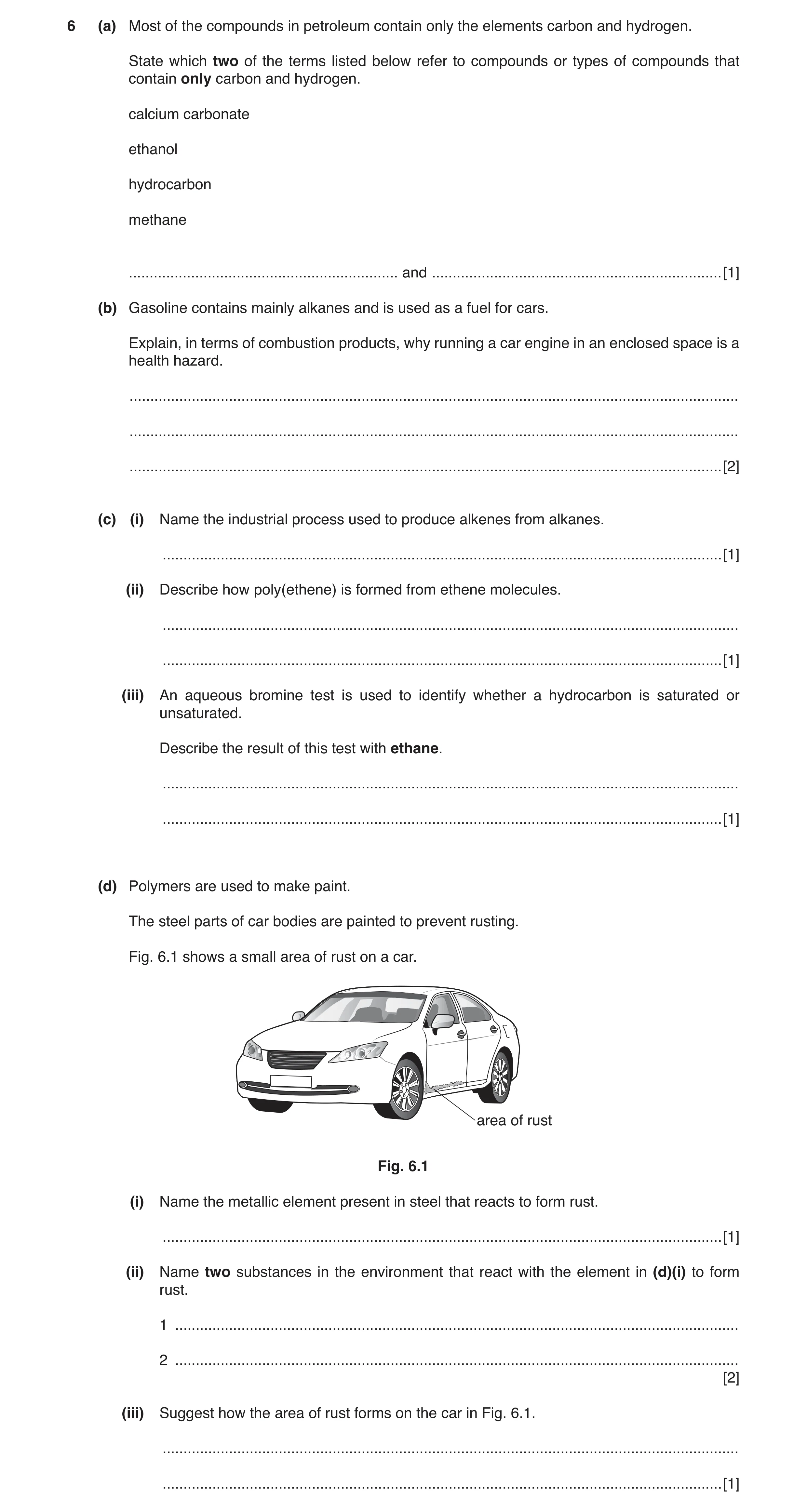
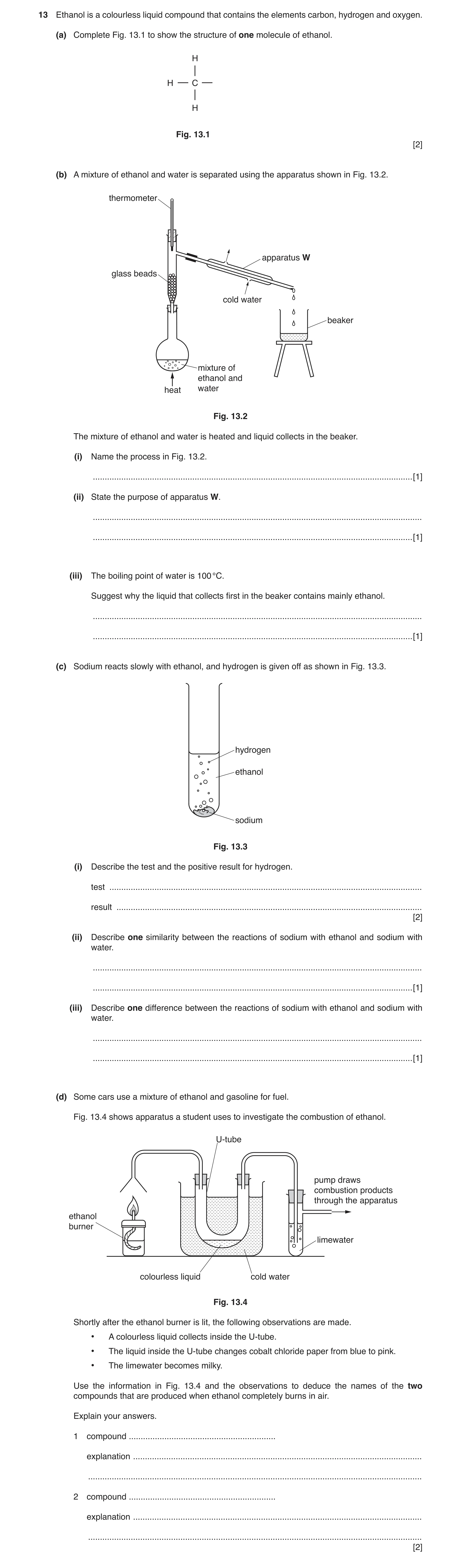
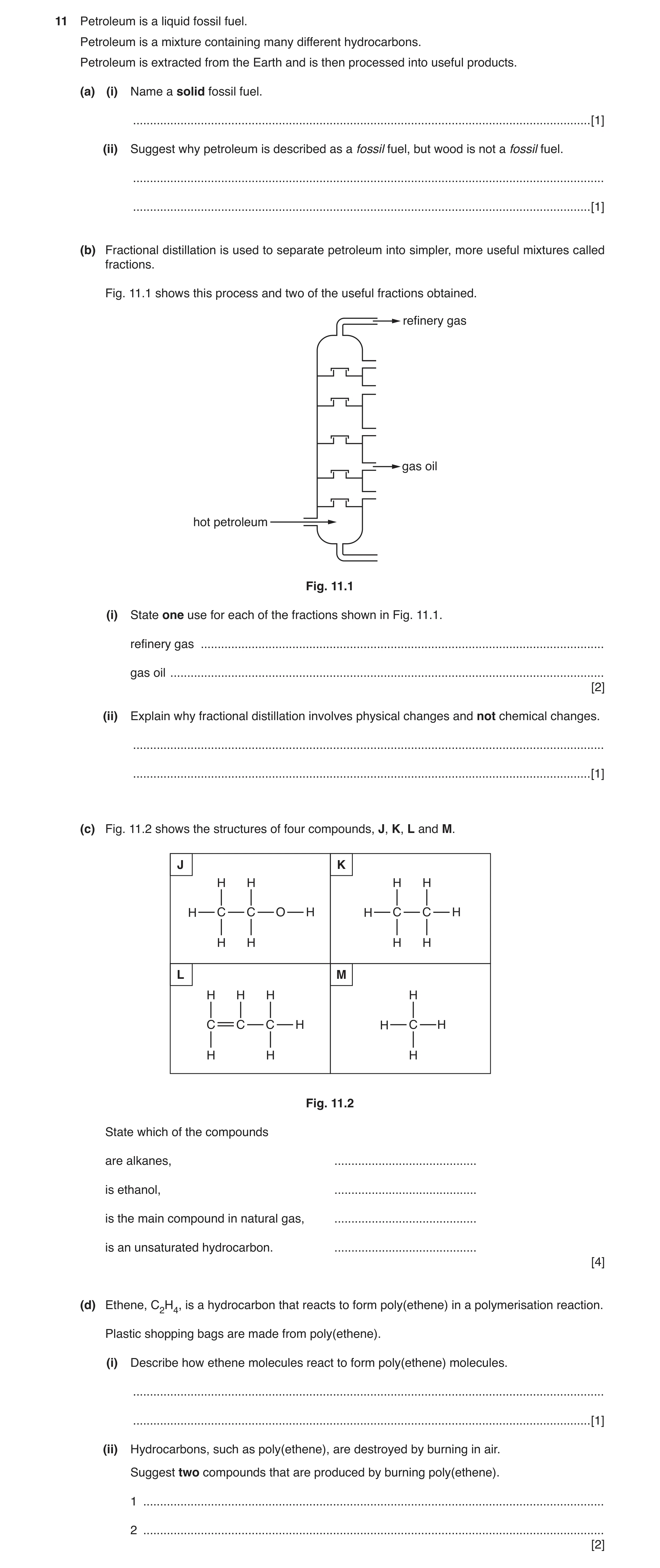
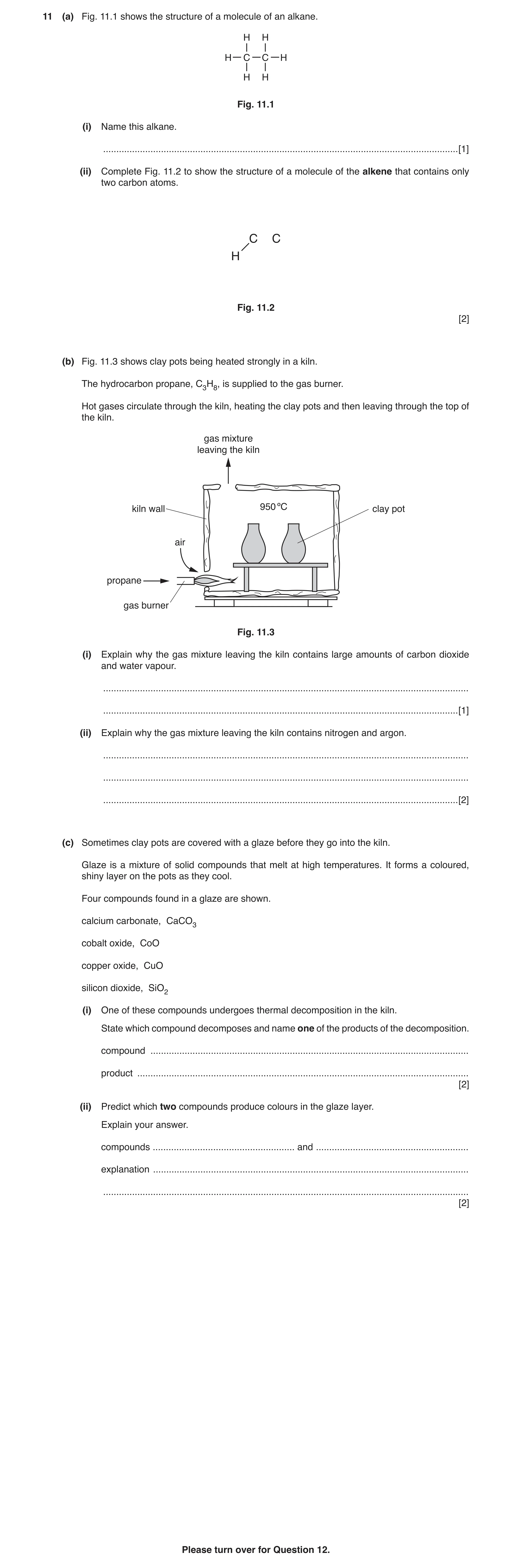
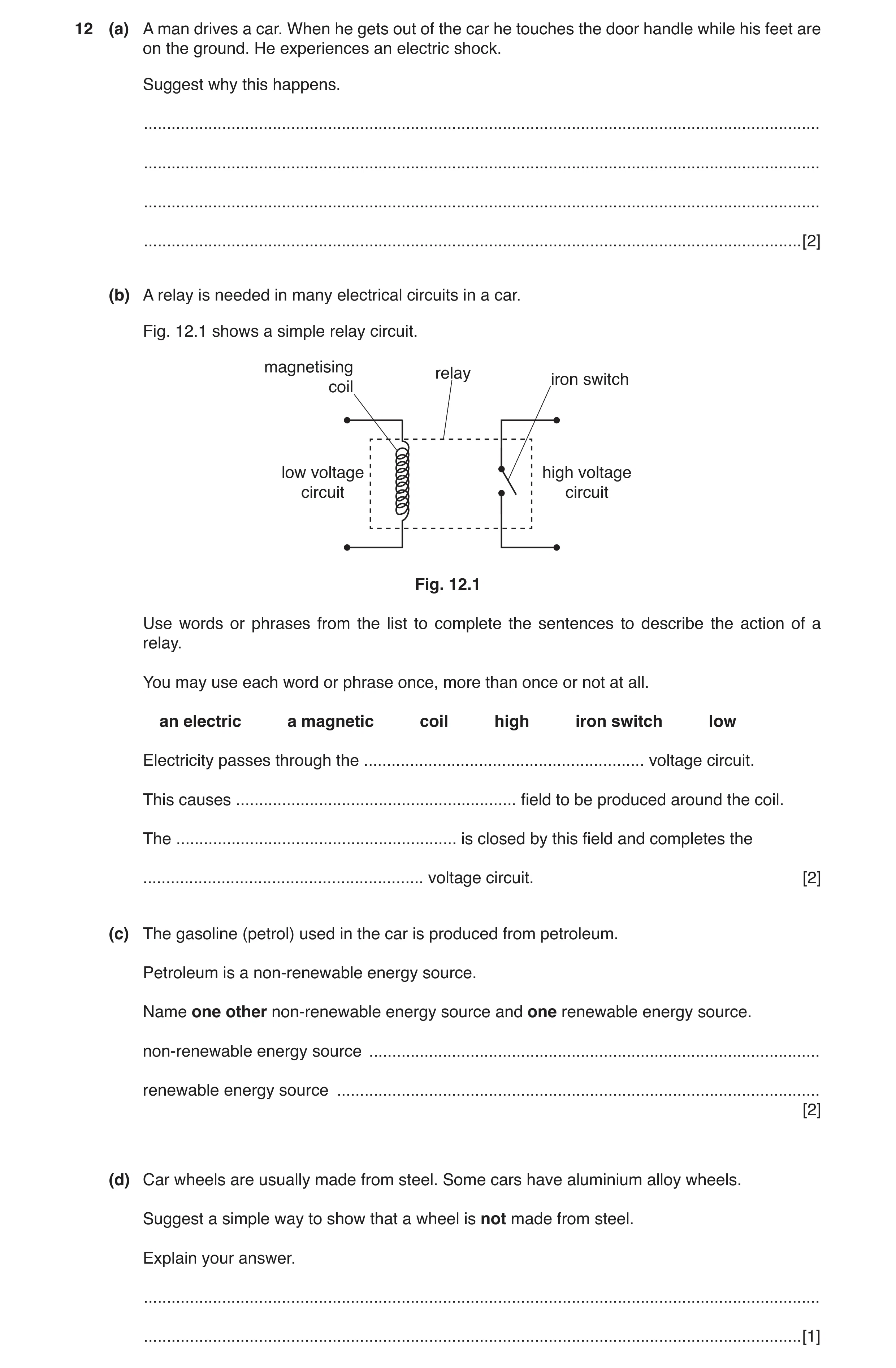
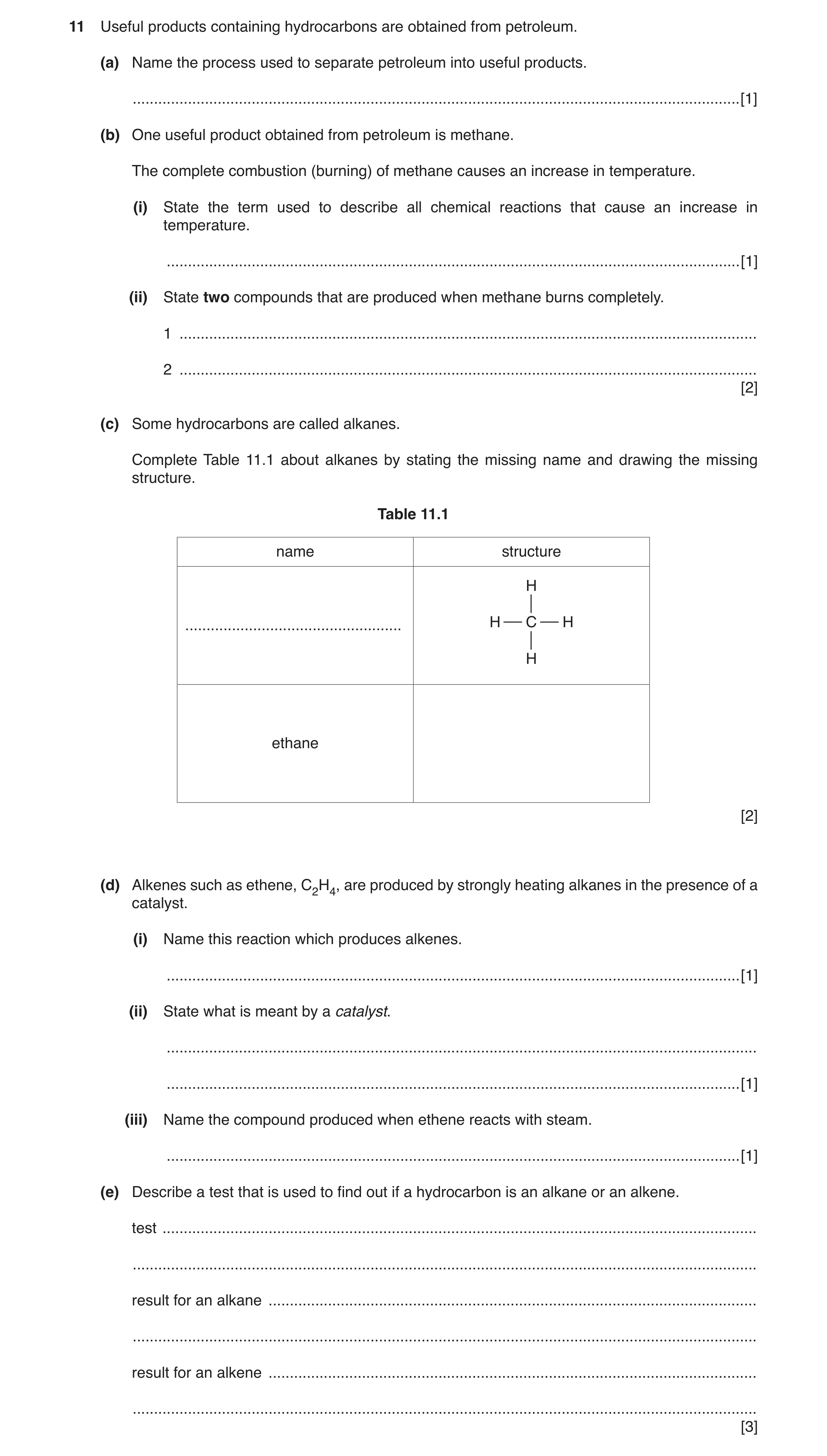
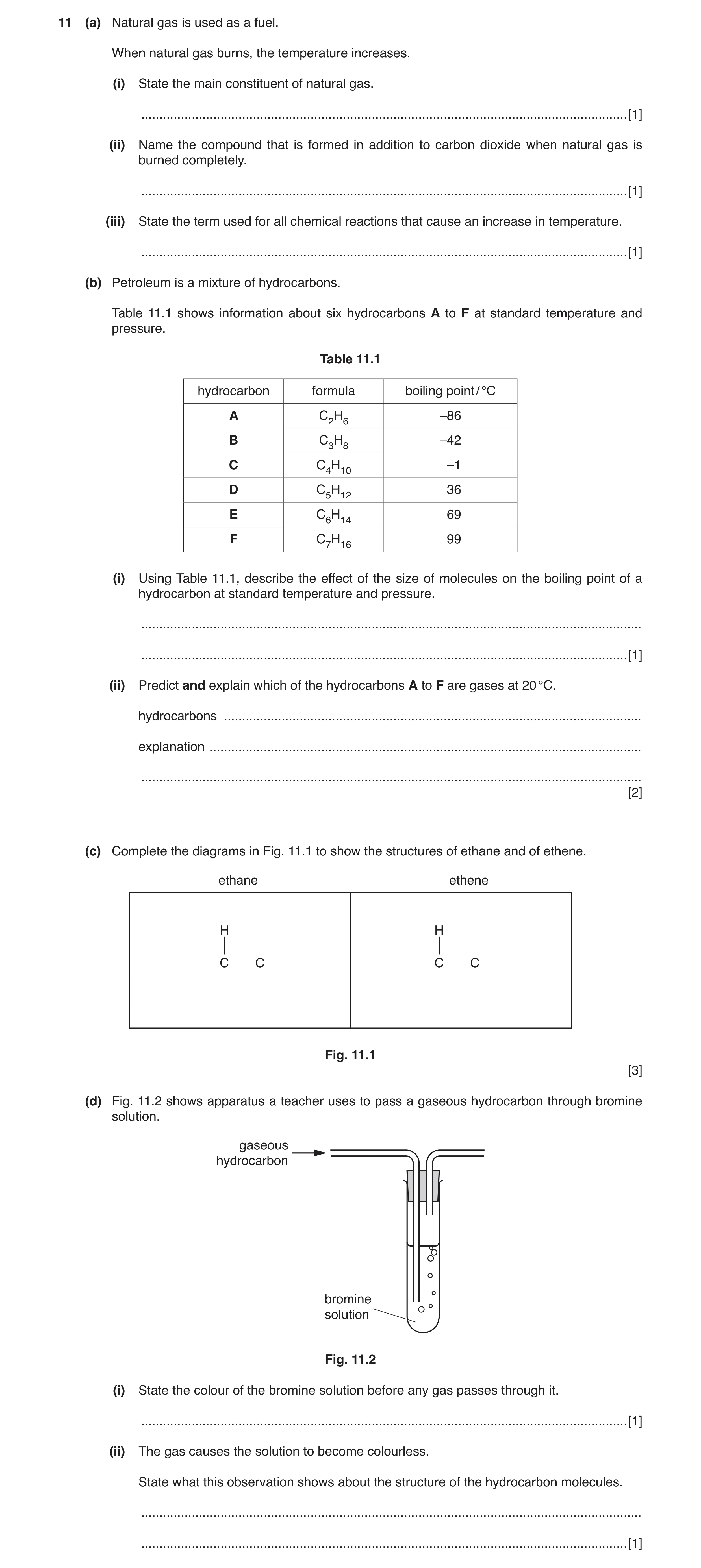
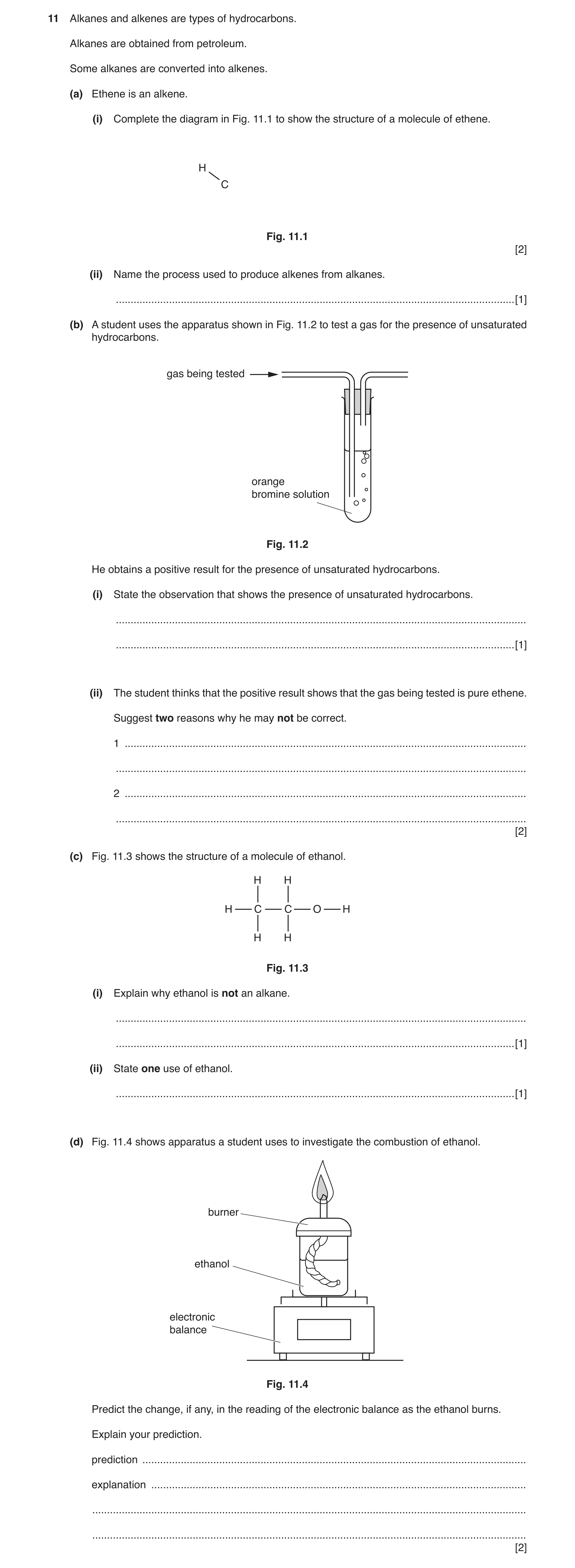
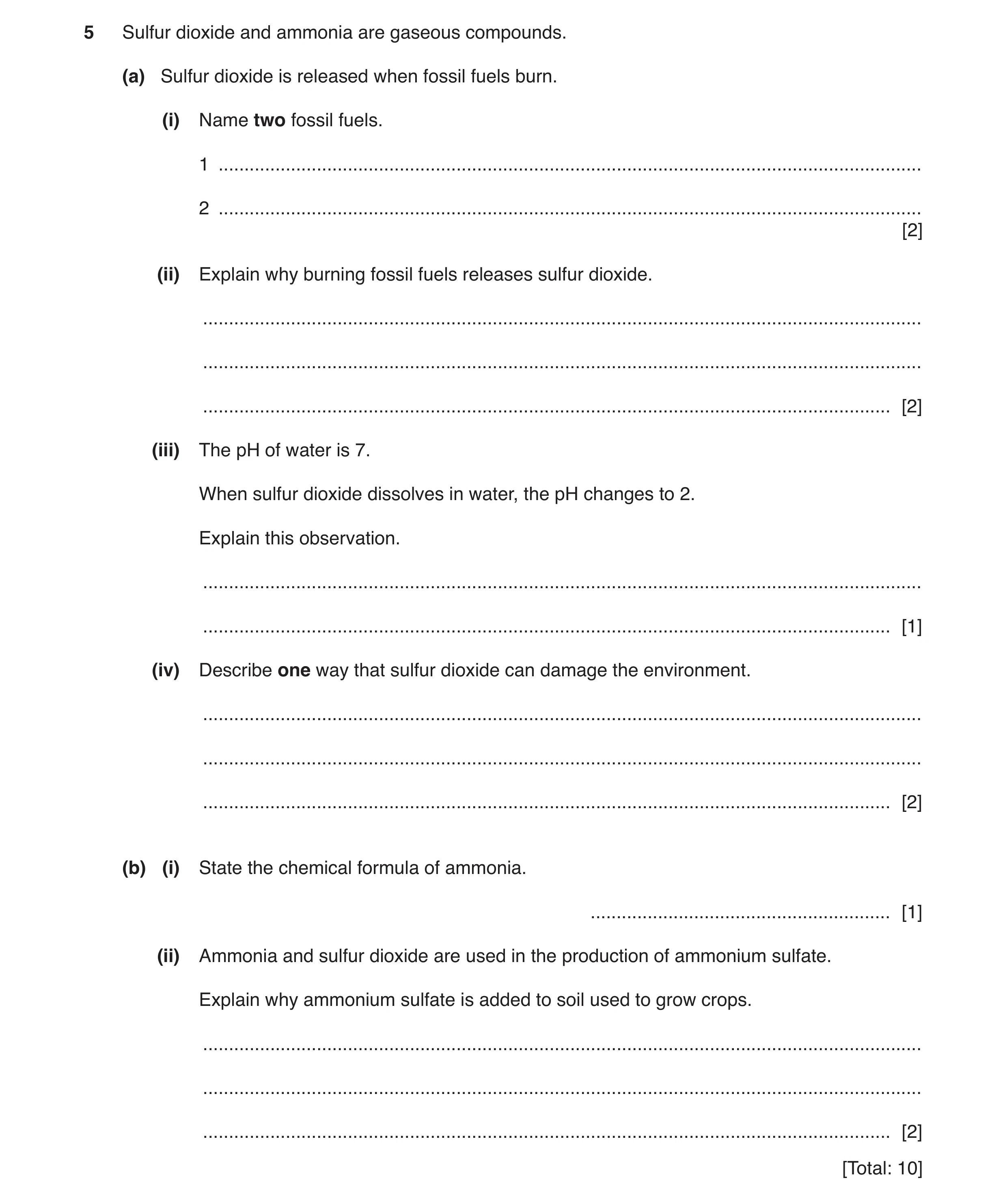 16 / 79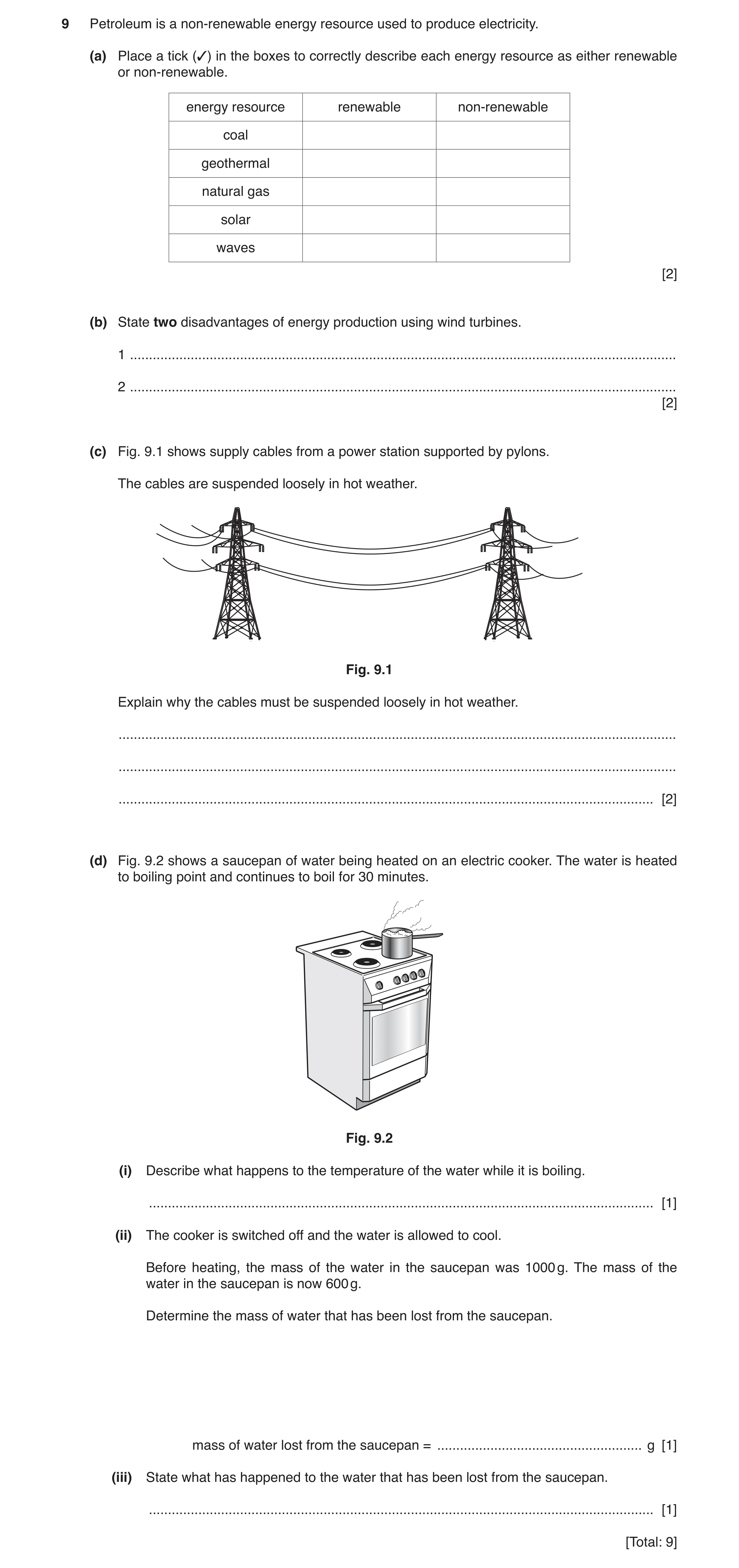
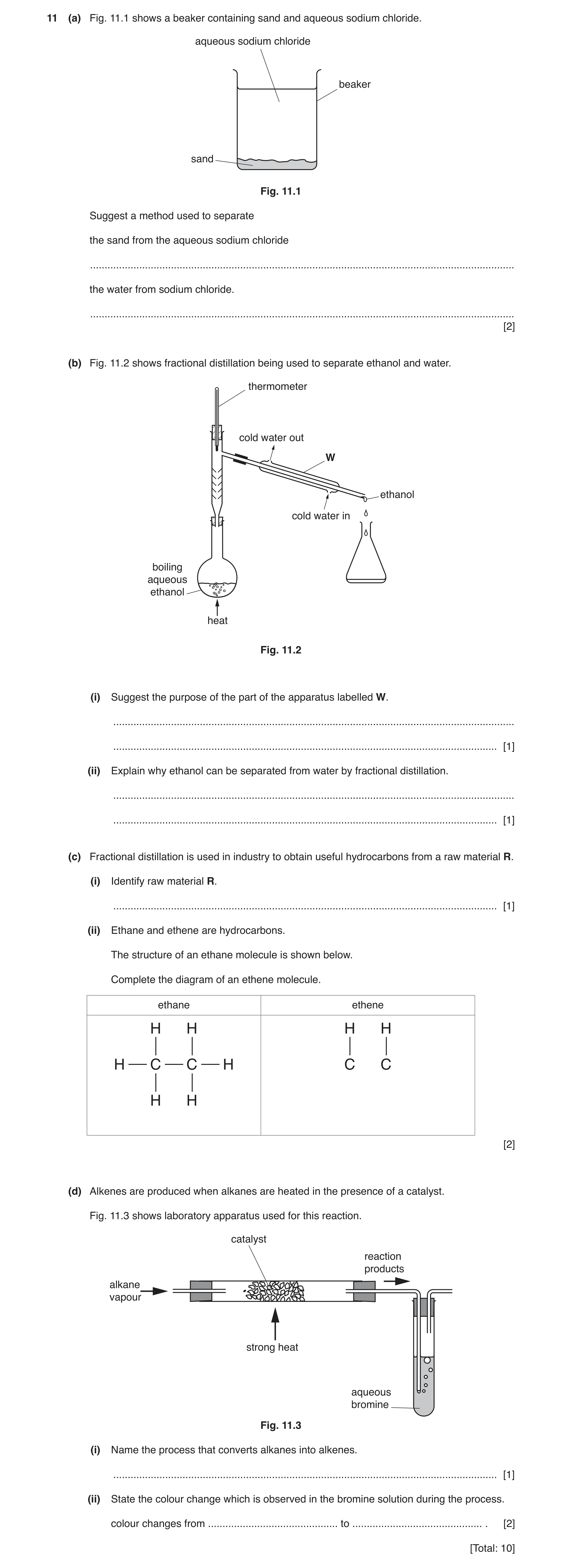
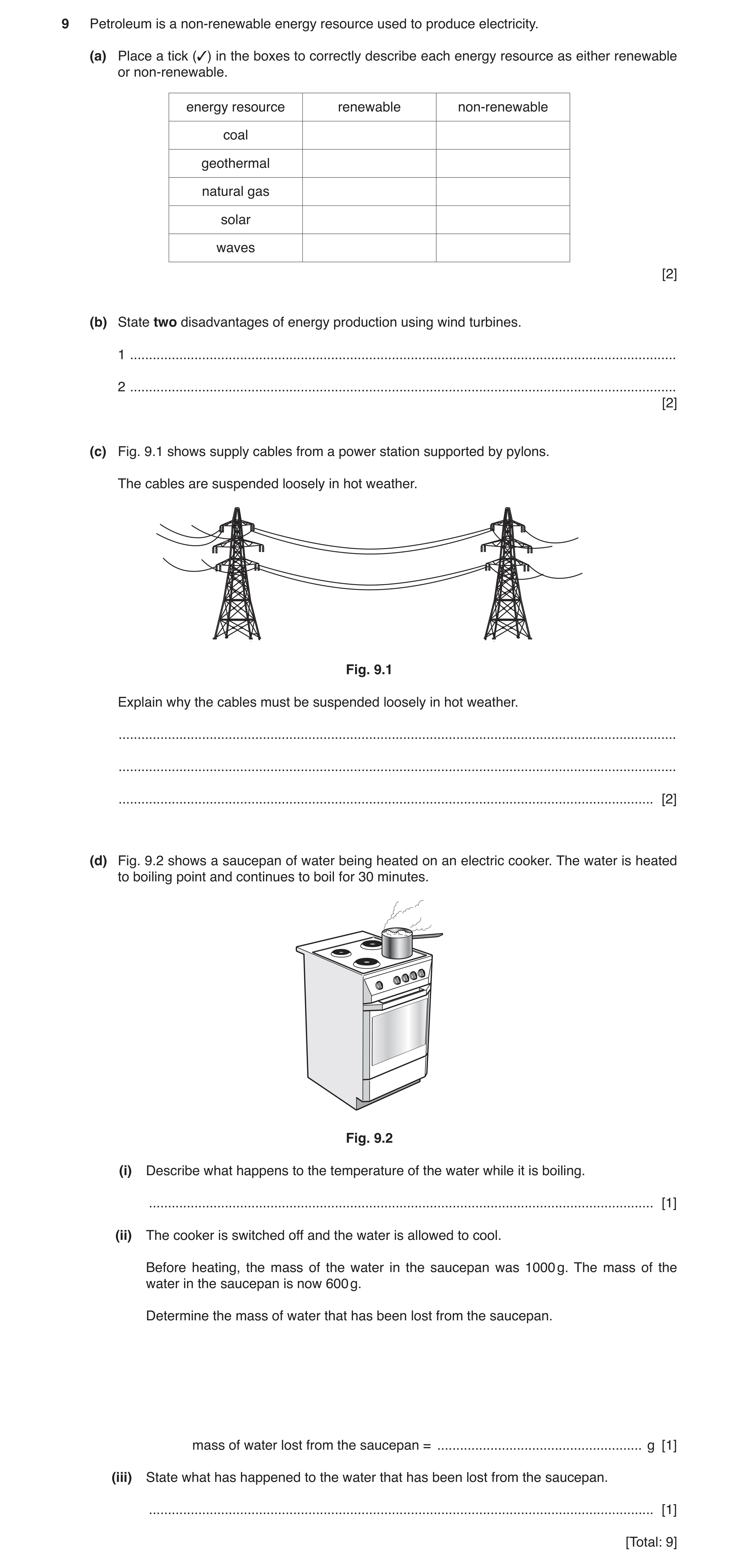
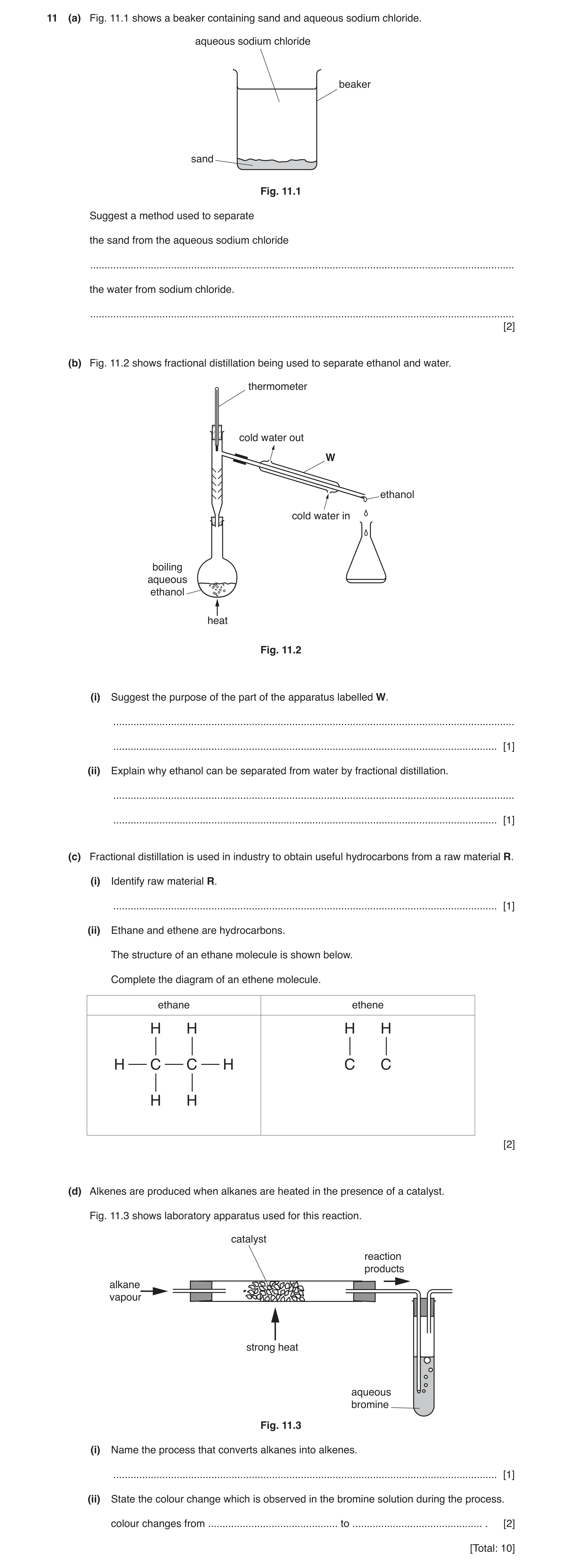
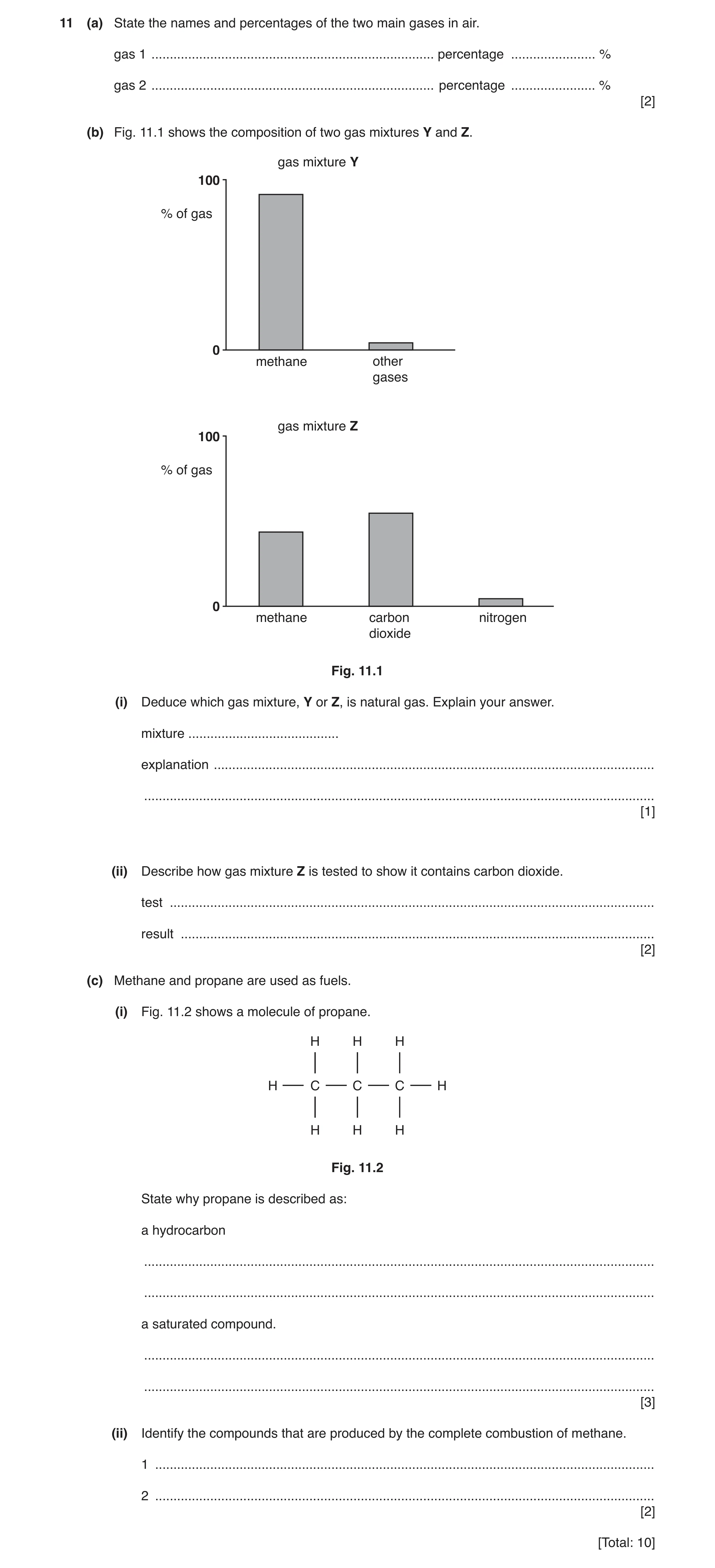
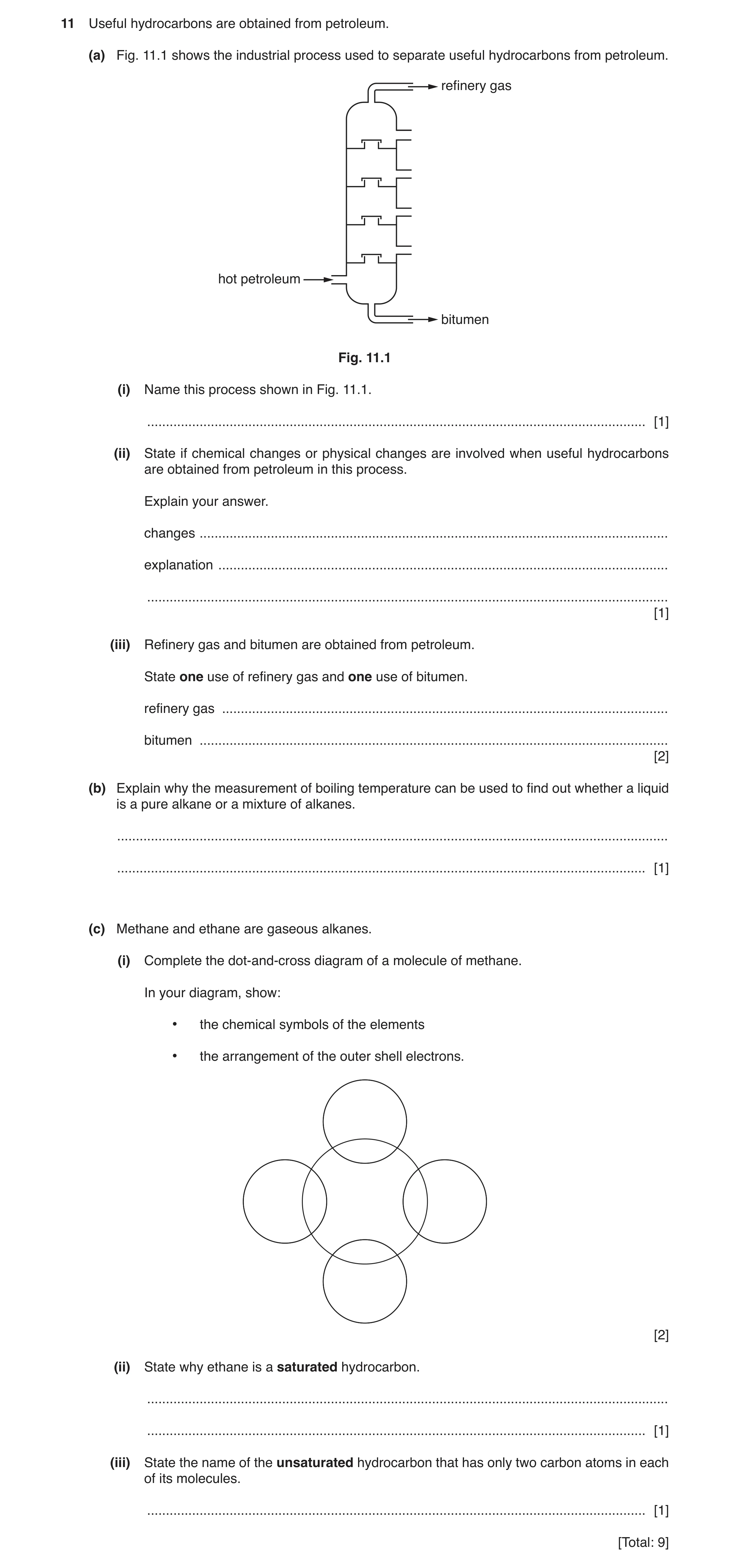
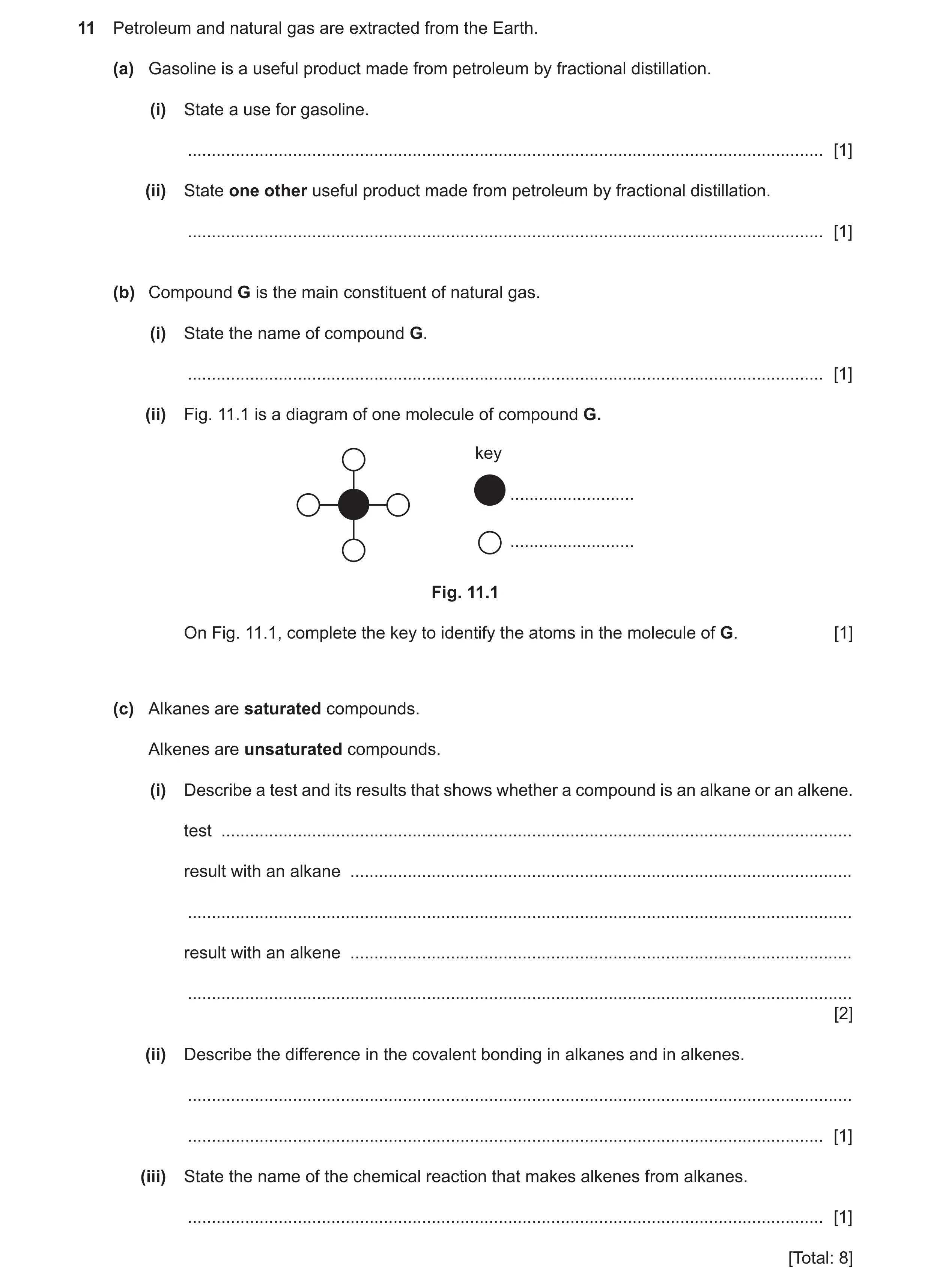 29 / 79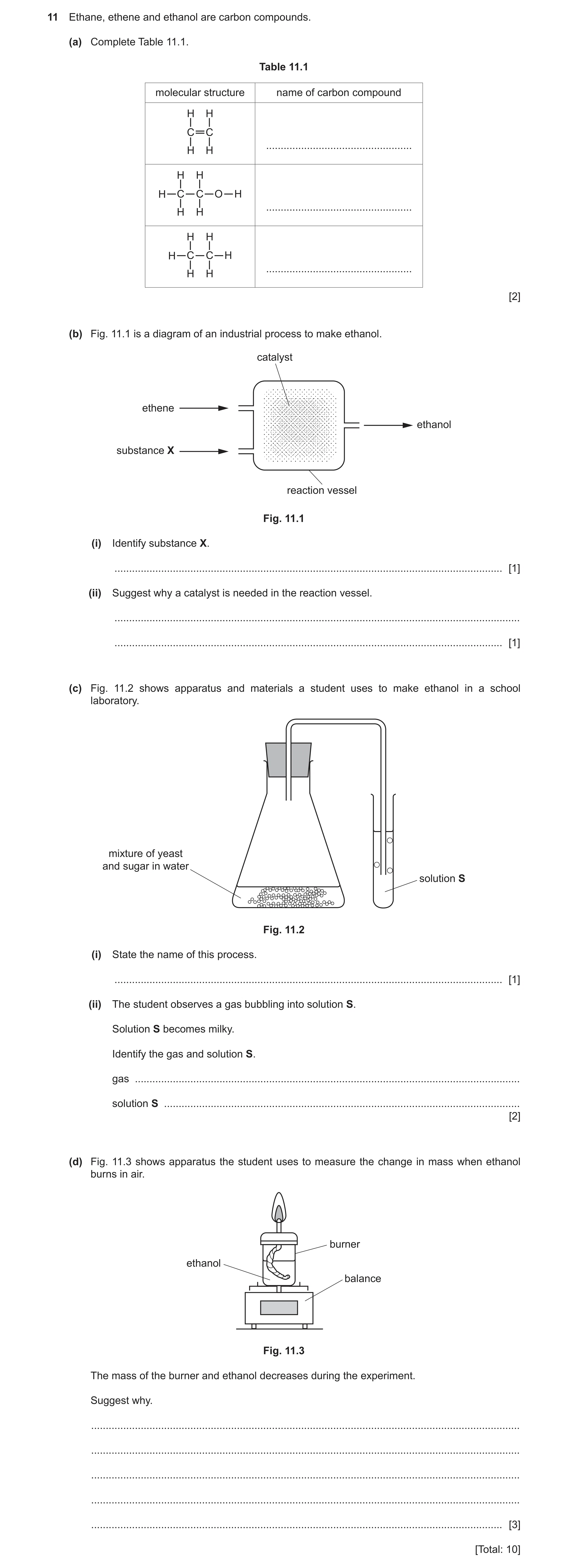
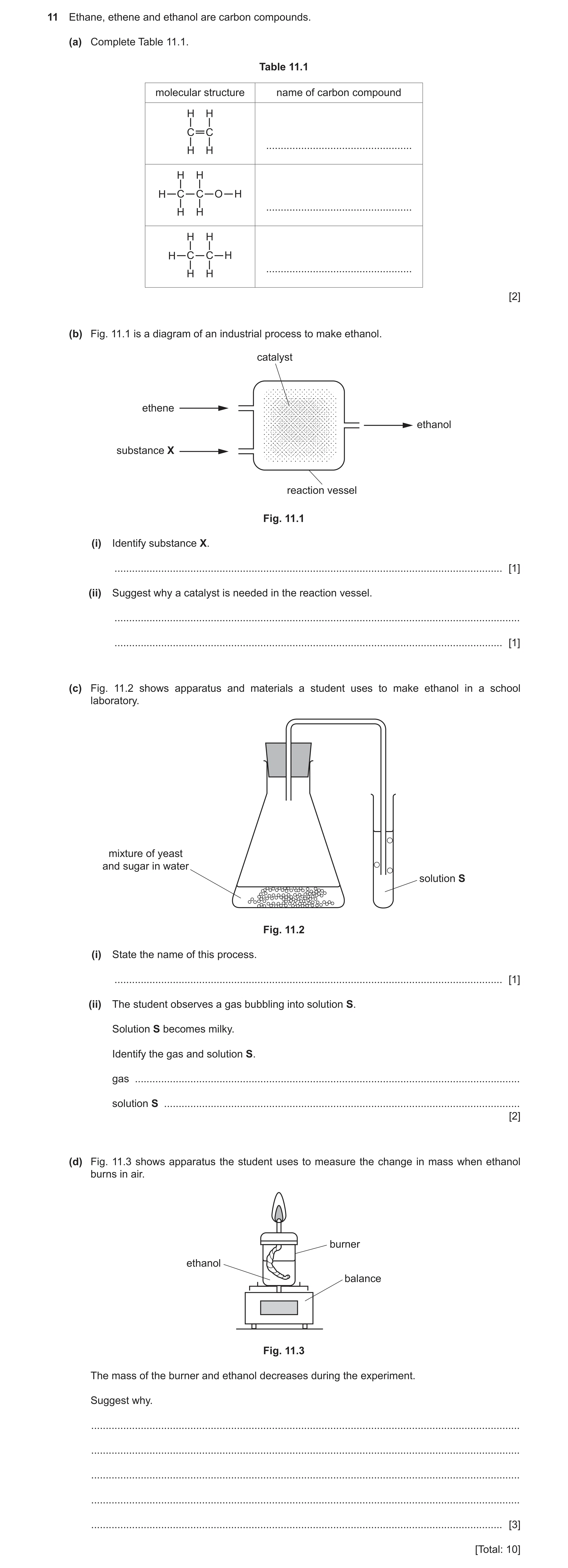
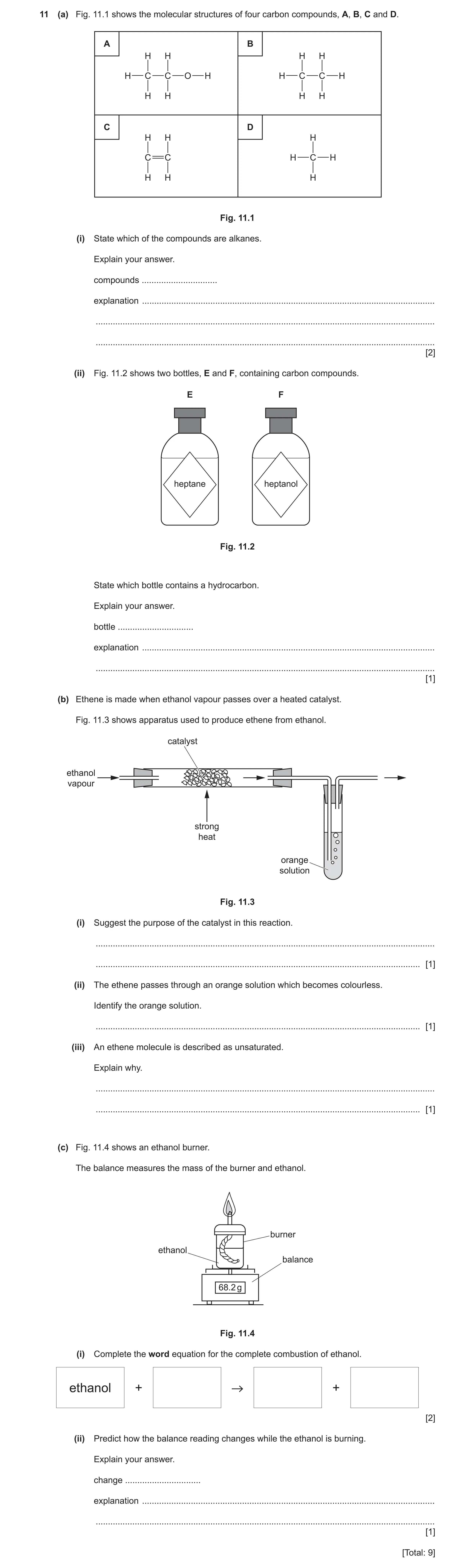
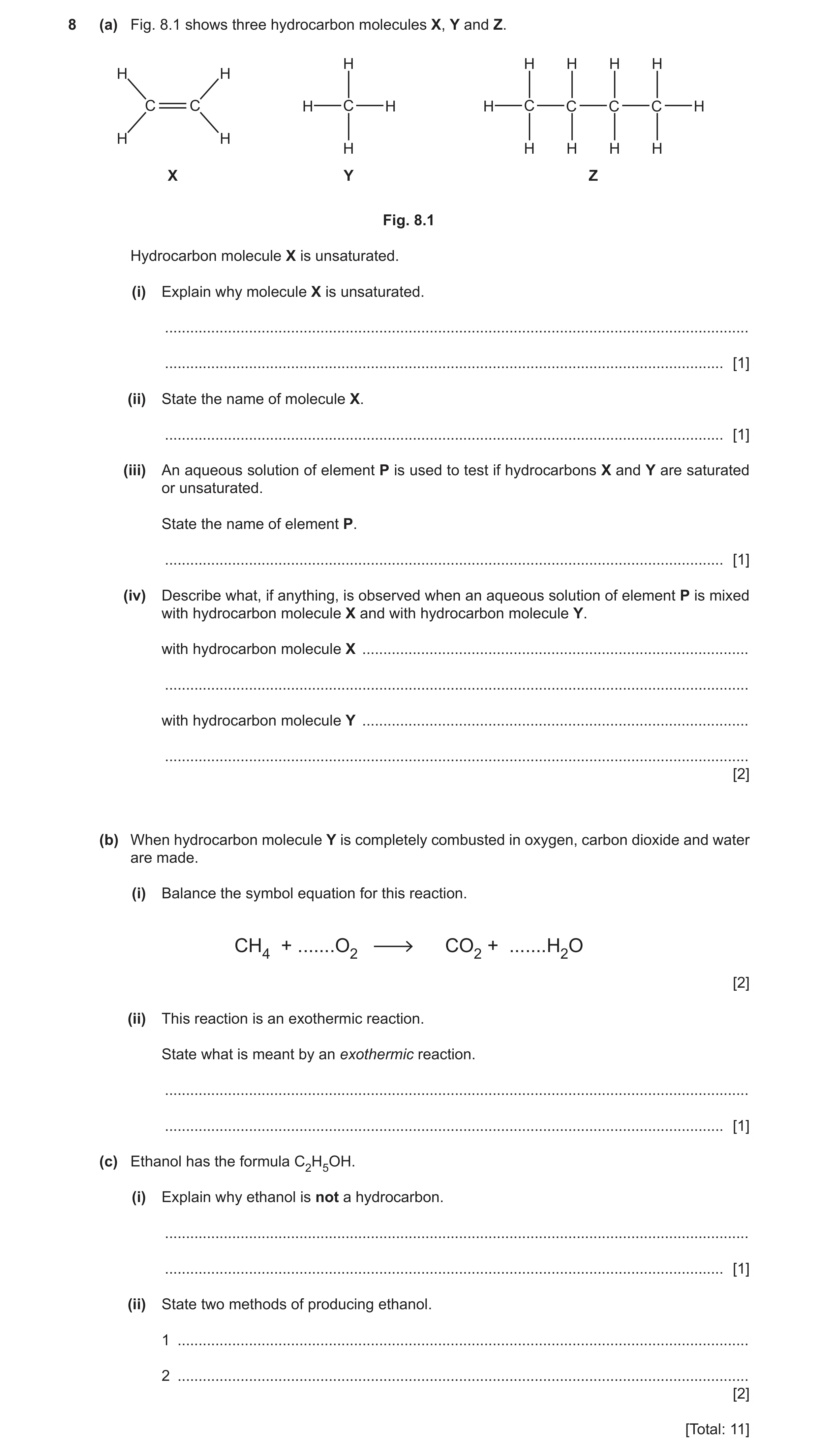
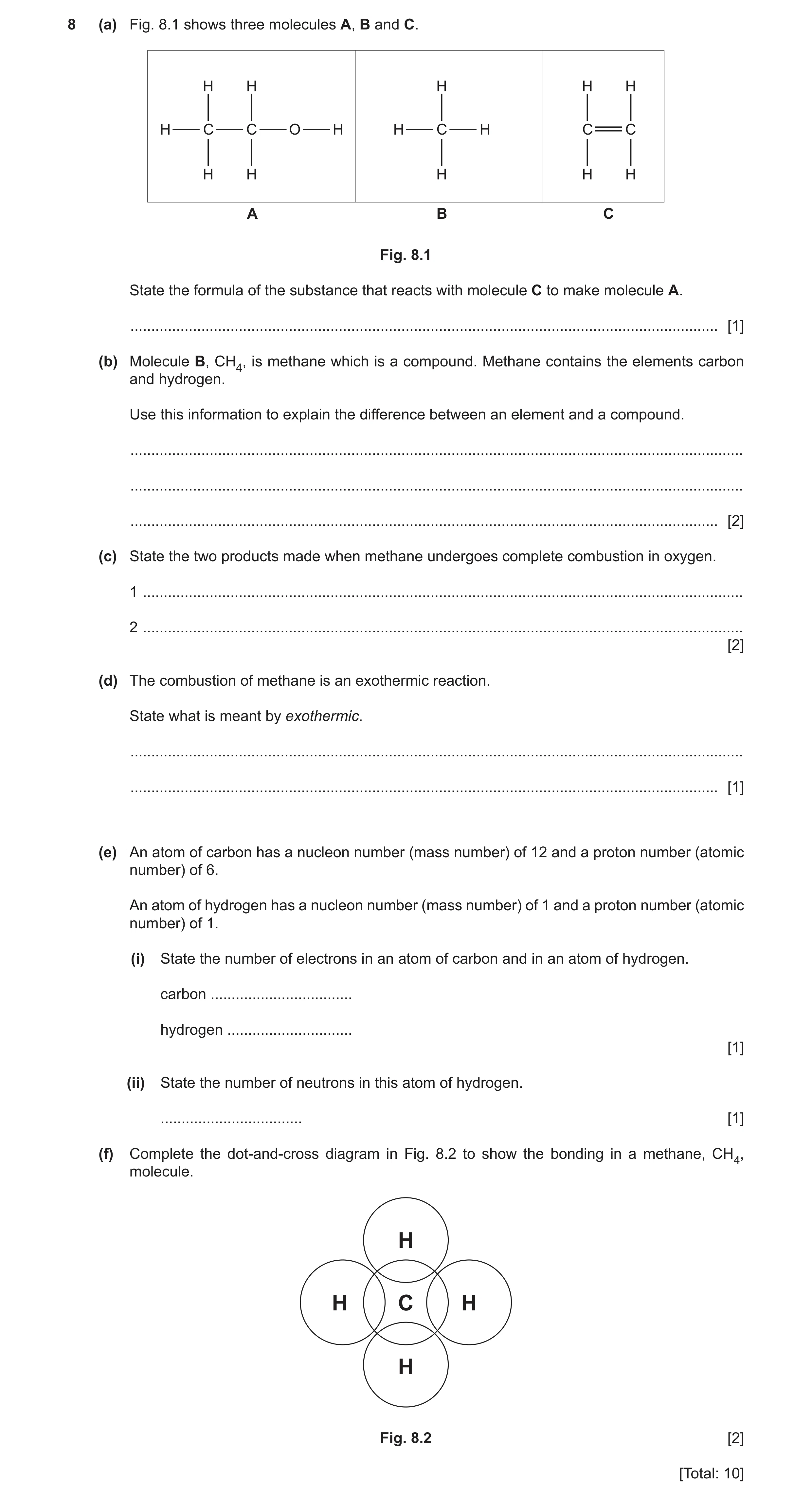
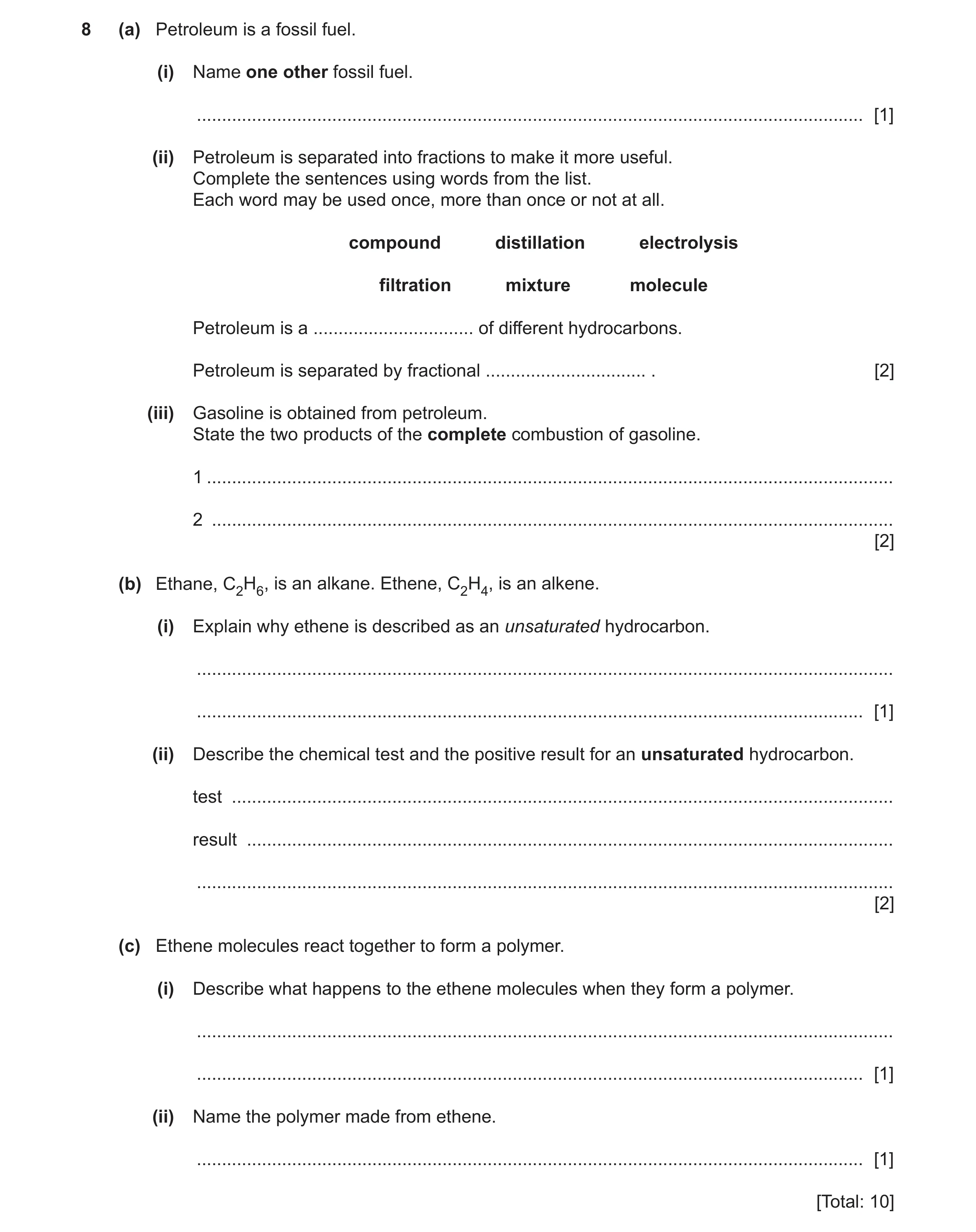 40 / 79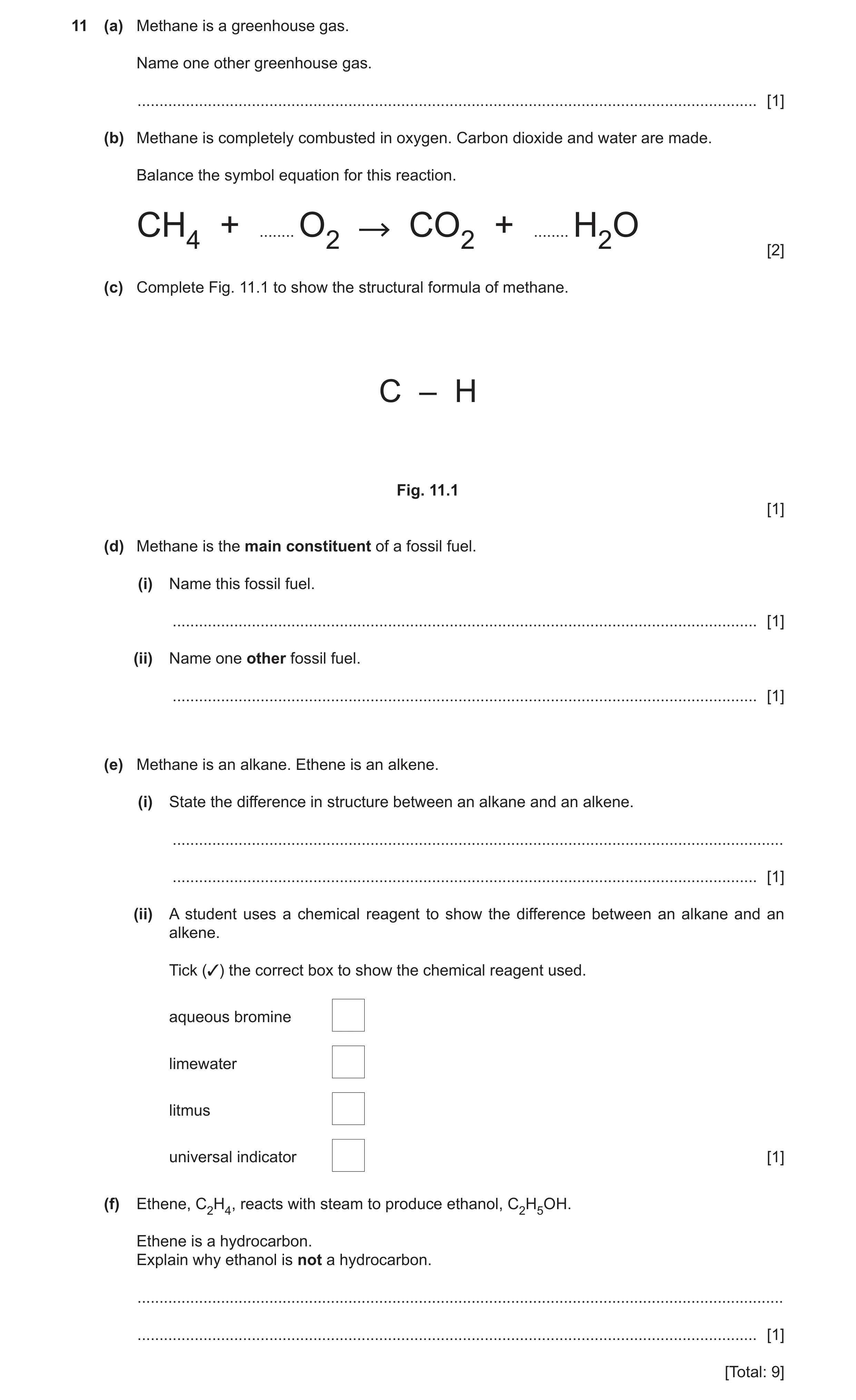
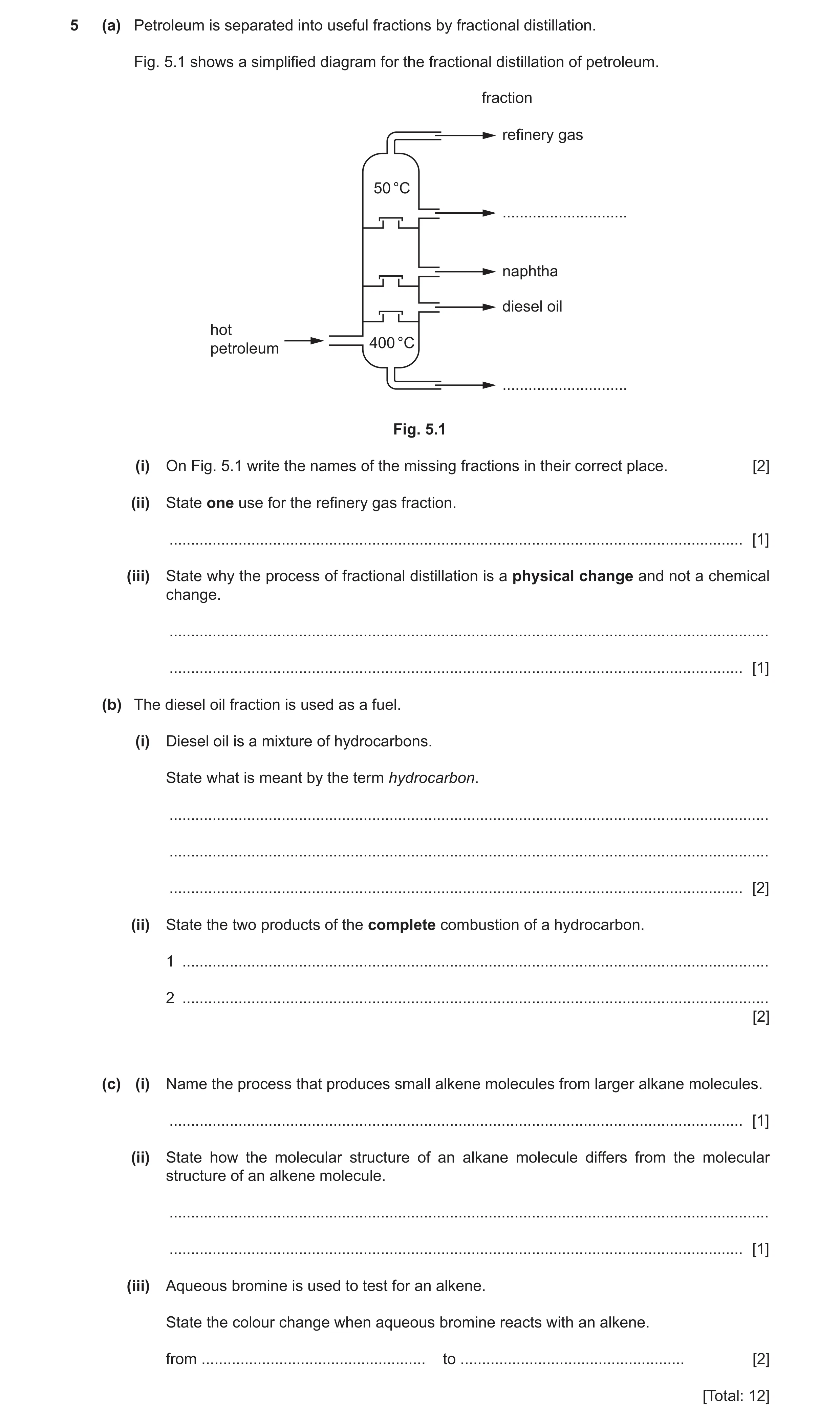
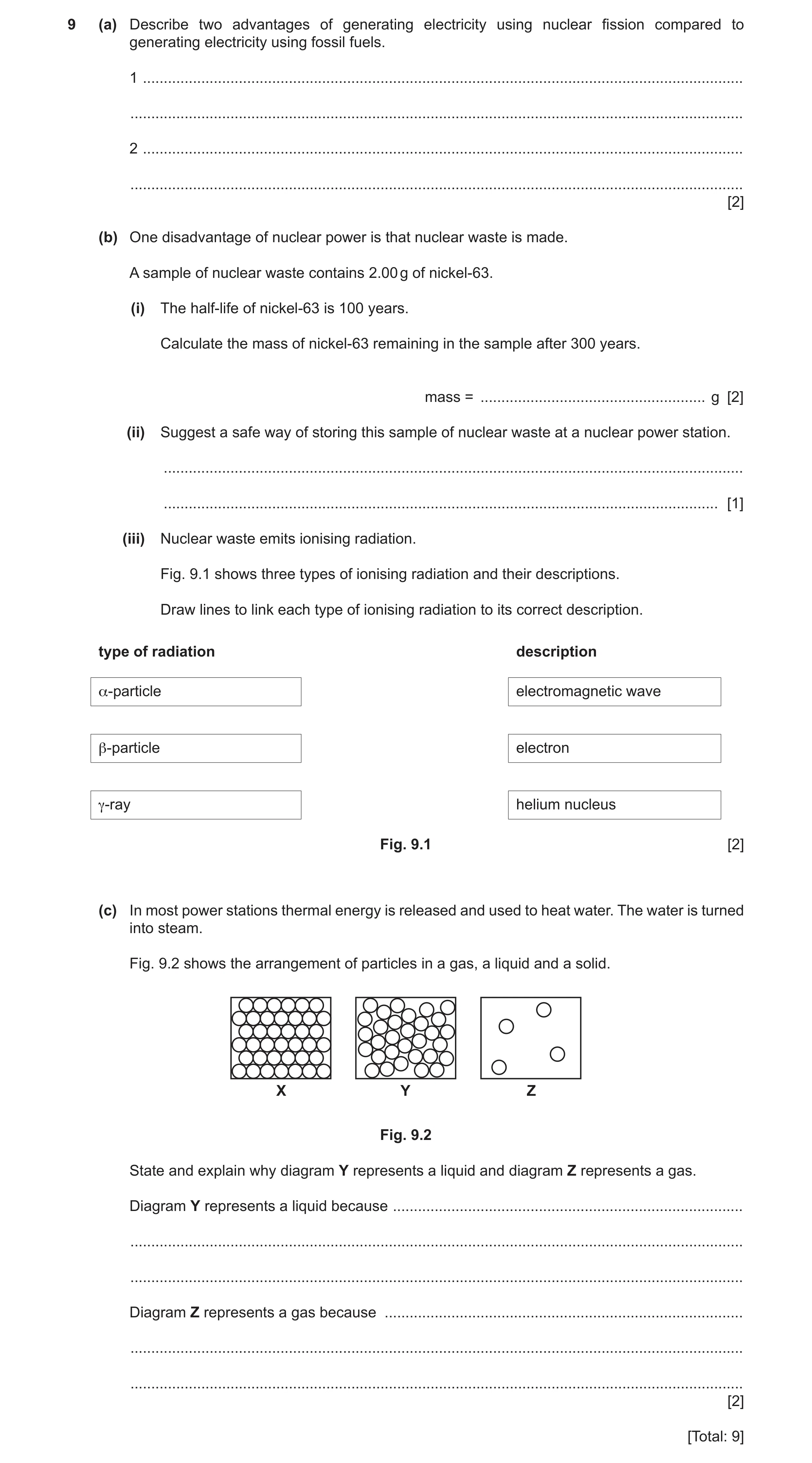
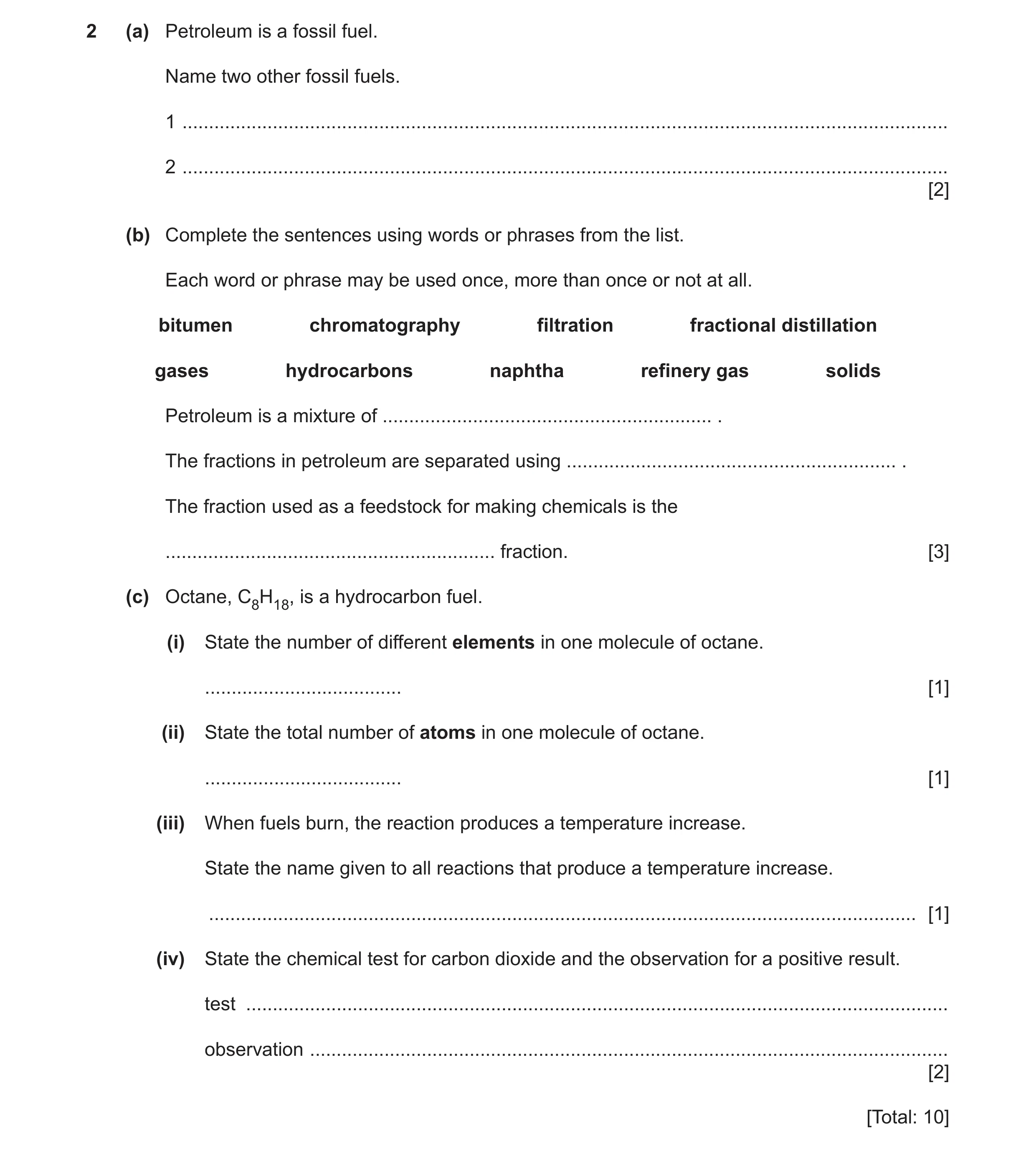 45 / 79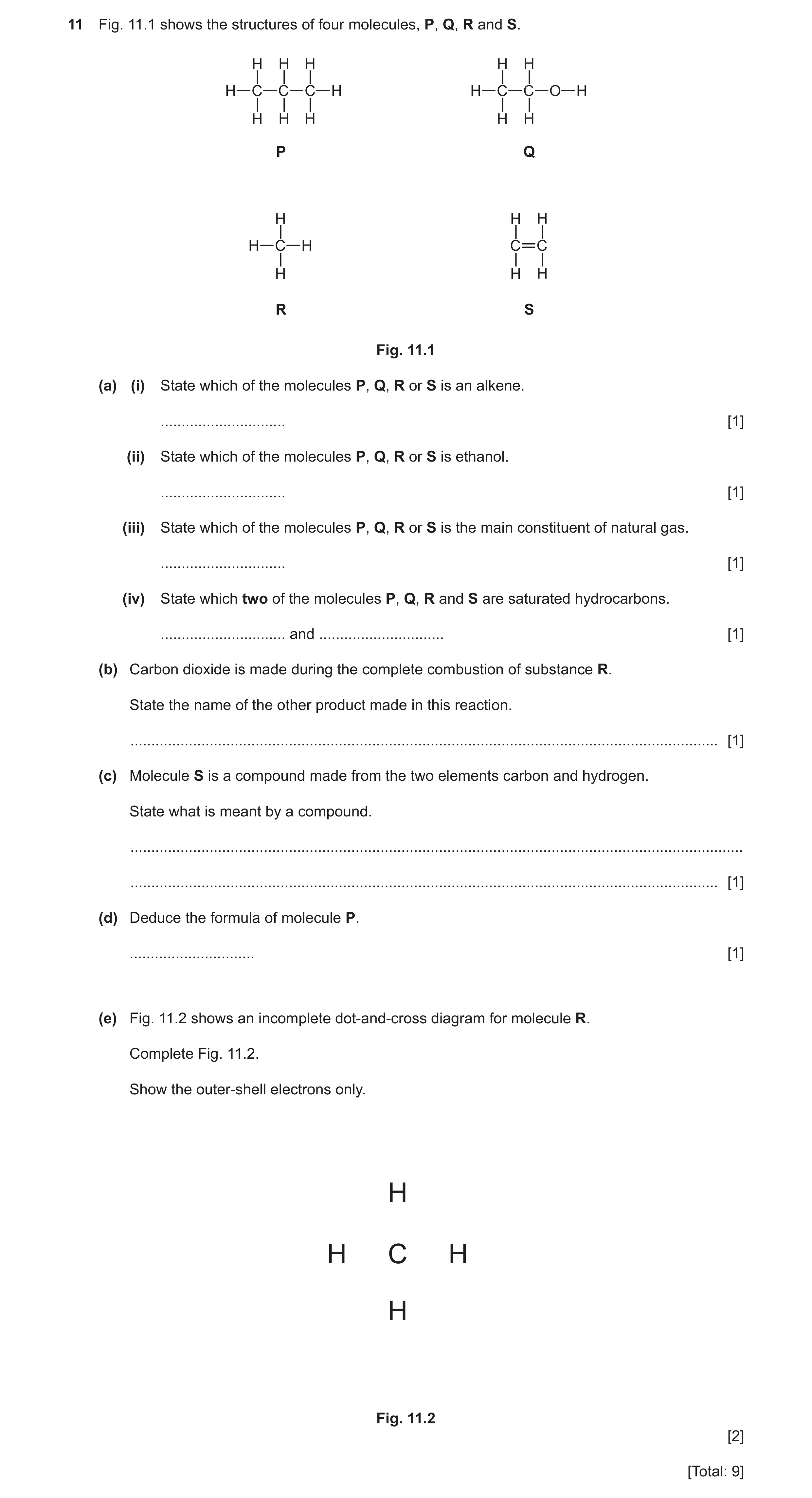
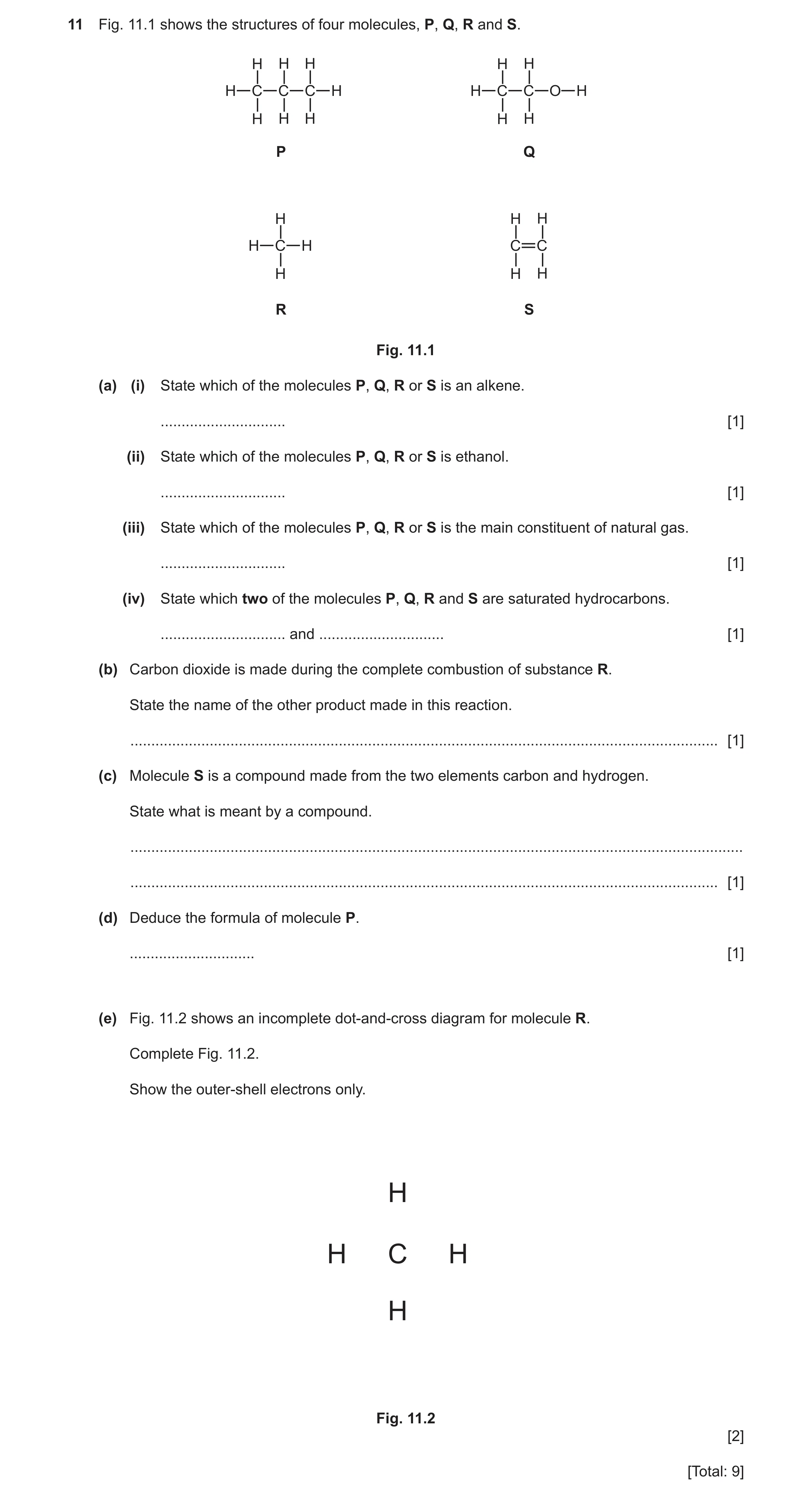
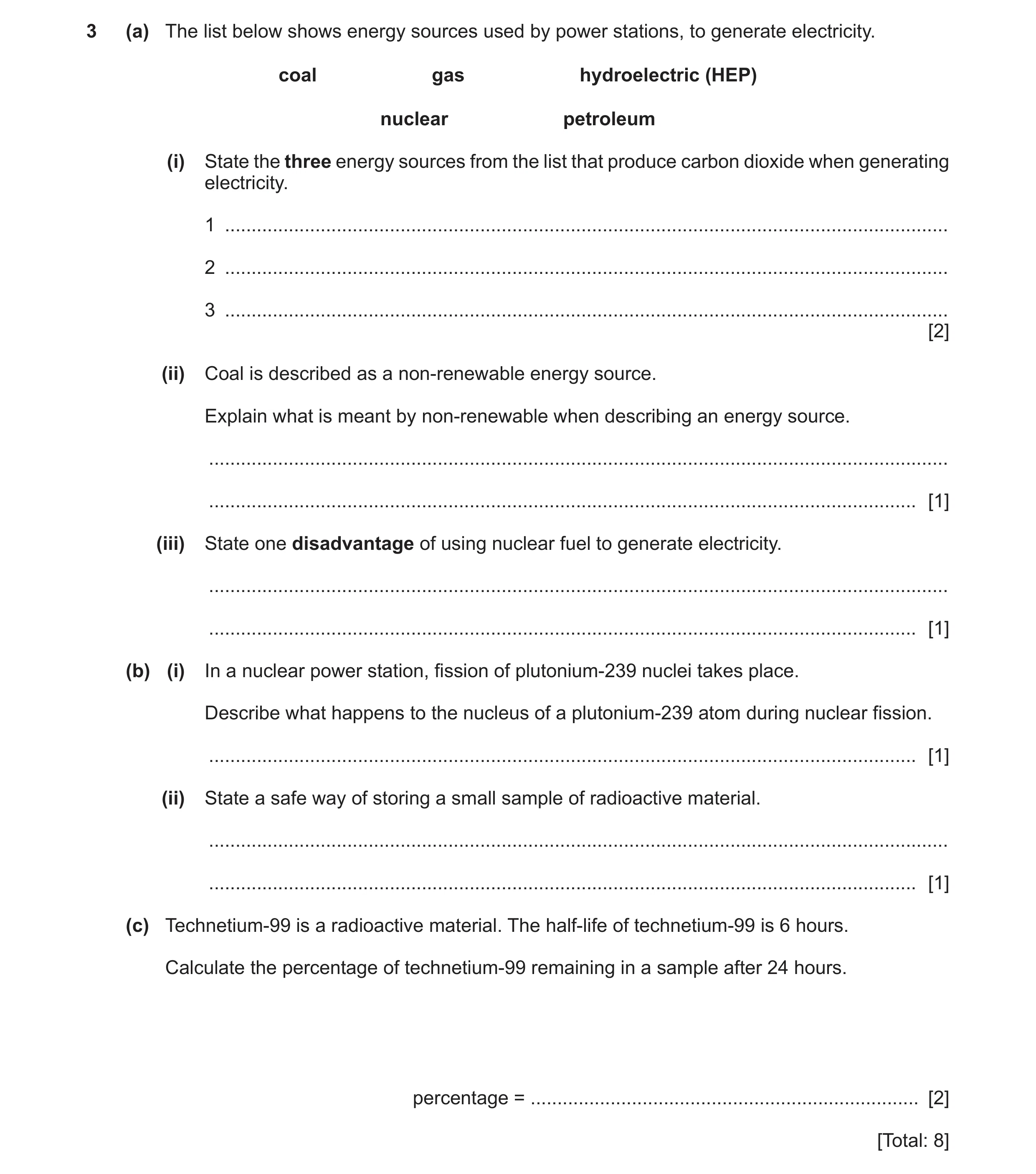 49 / 79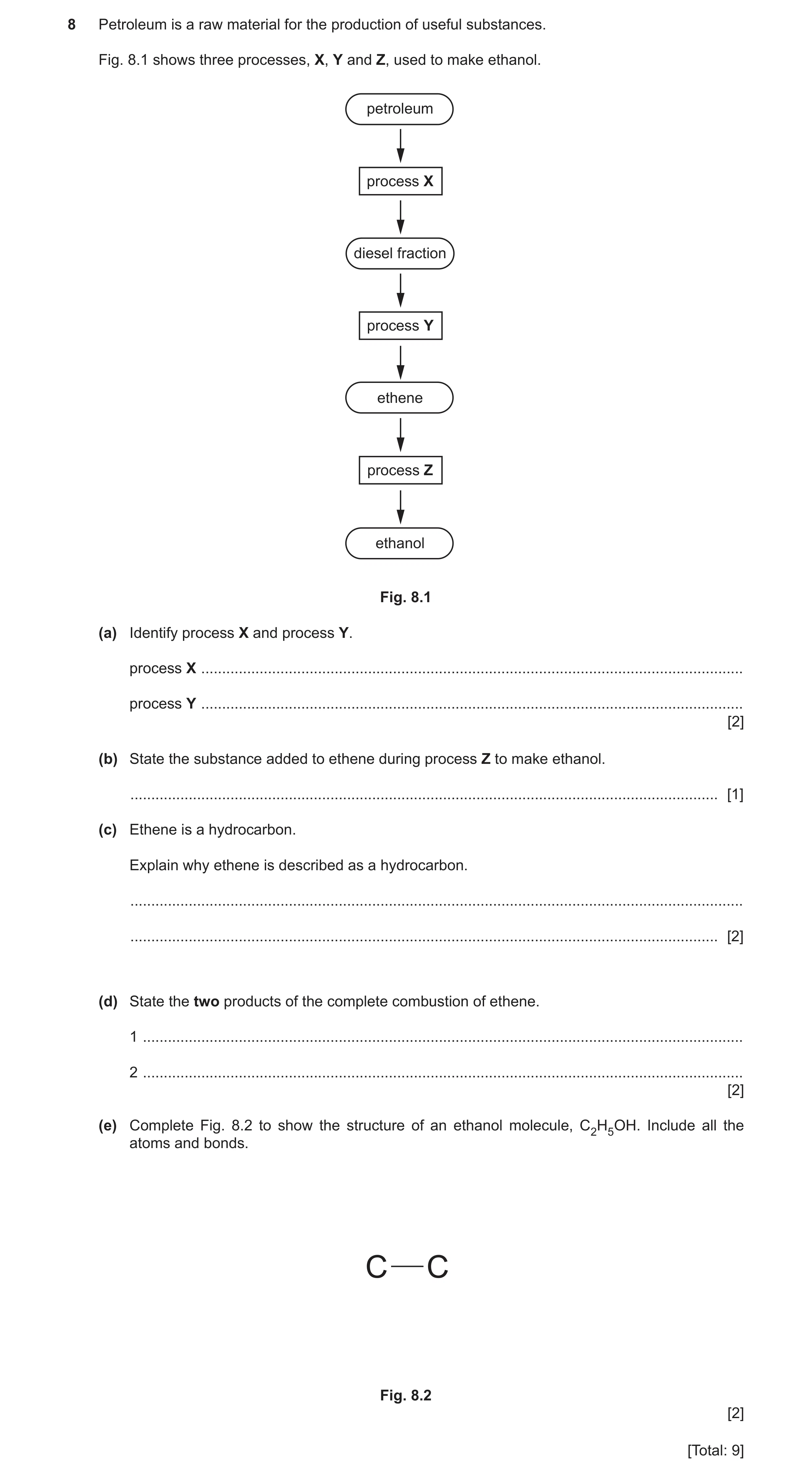
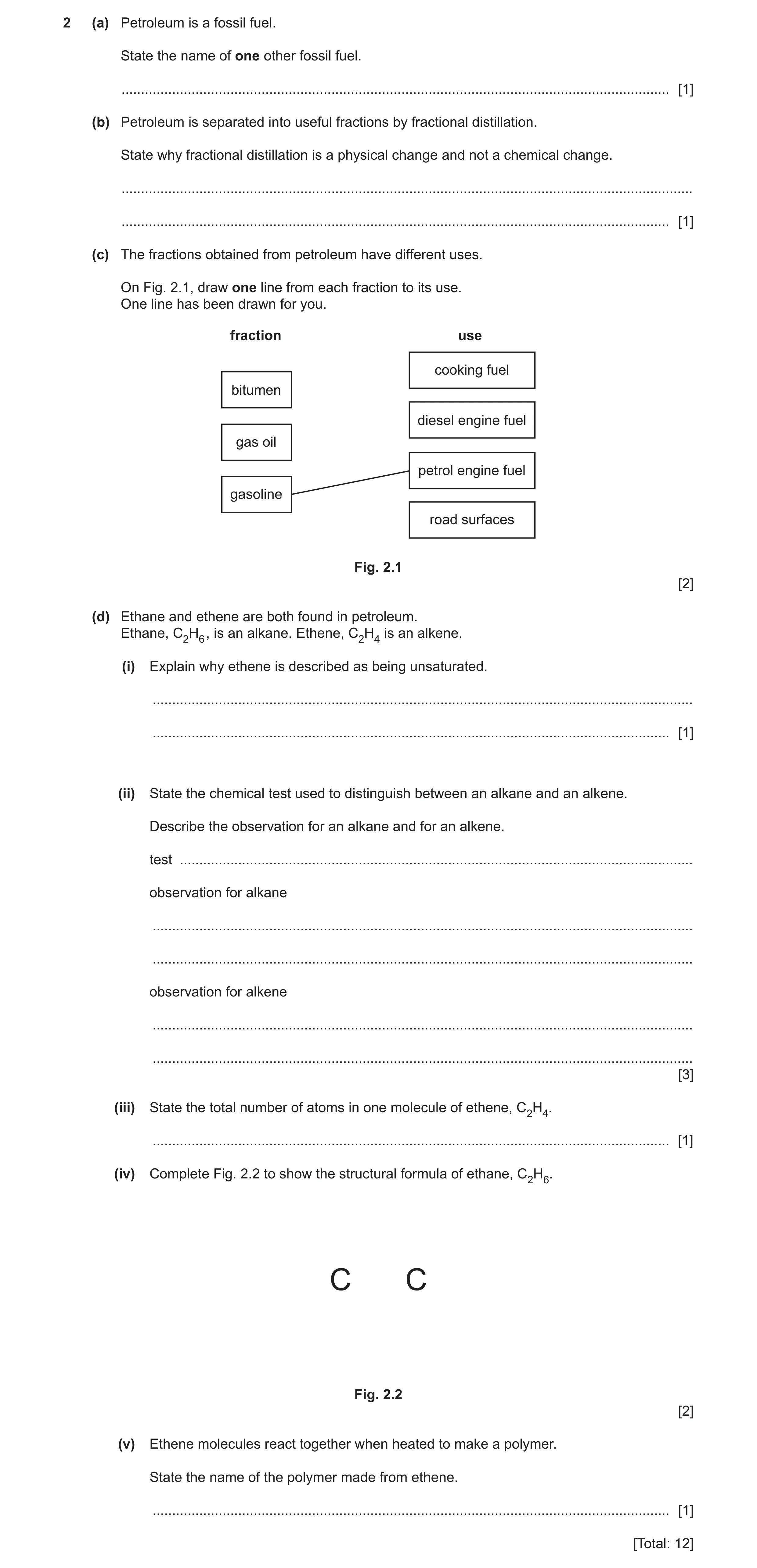
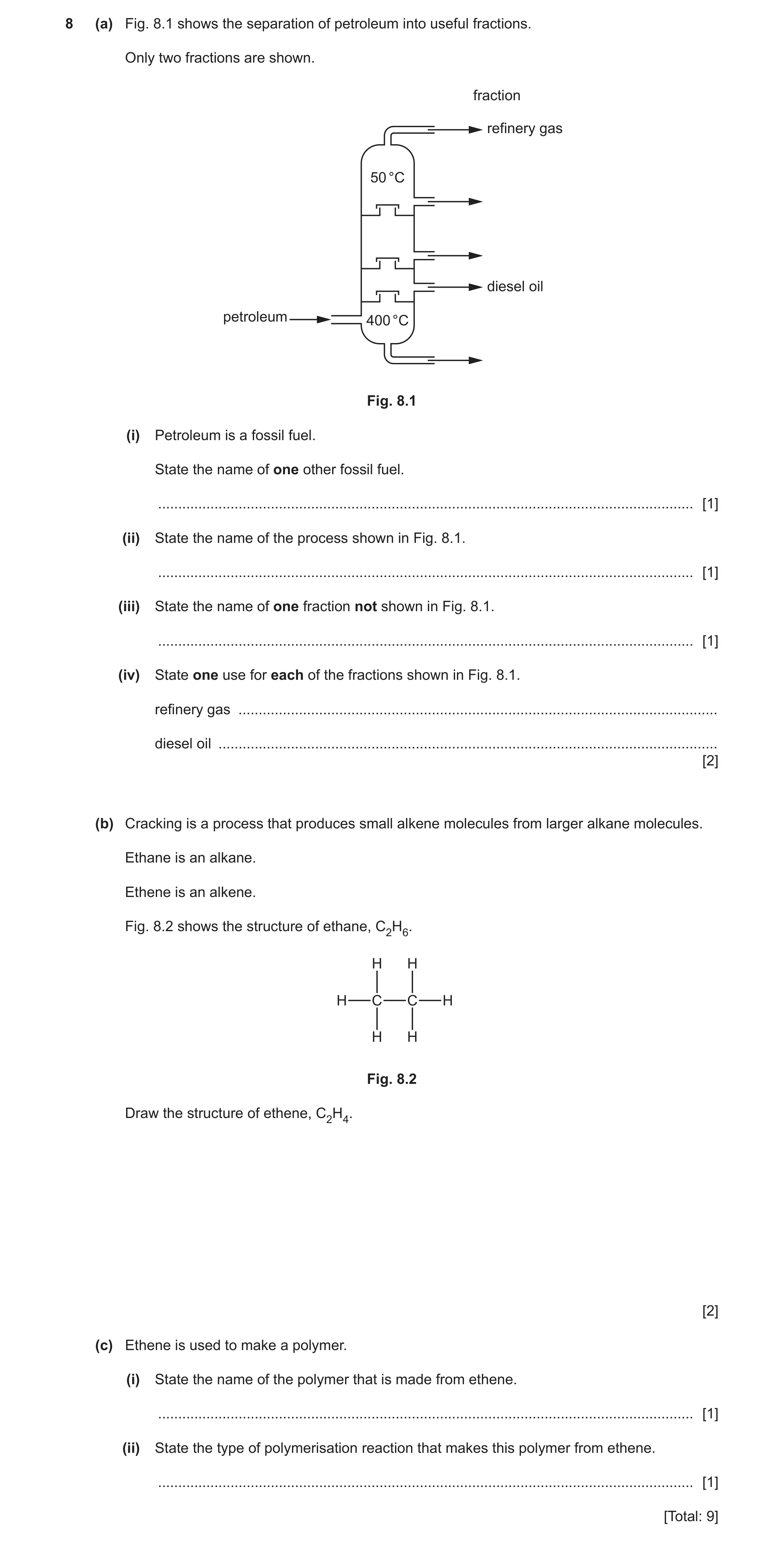
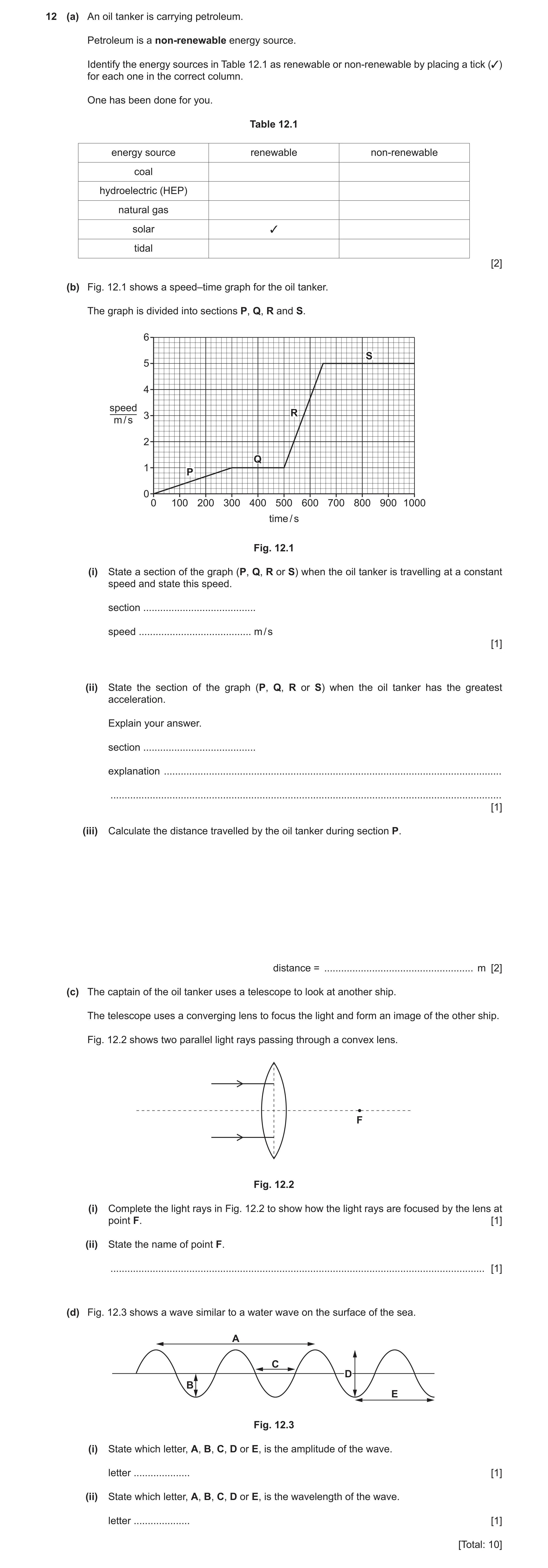
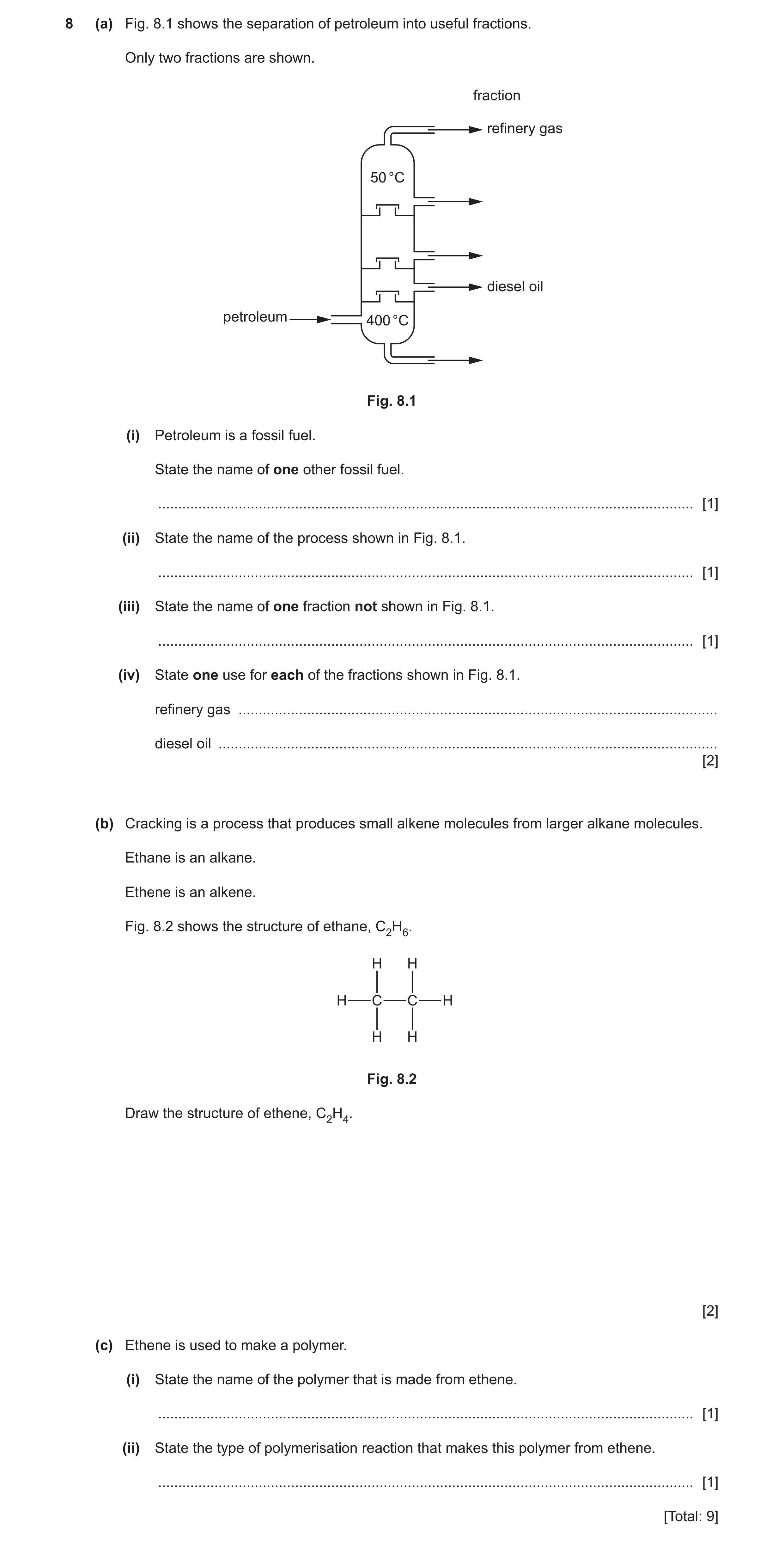
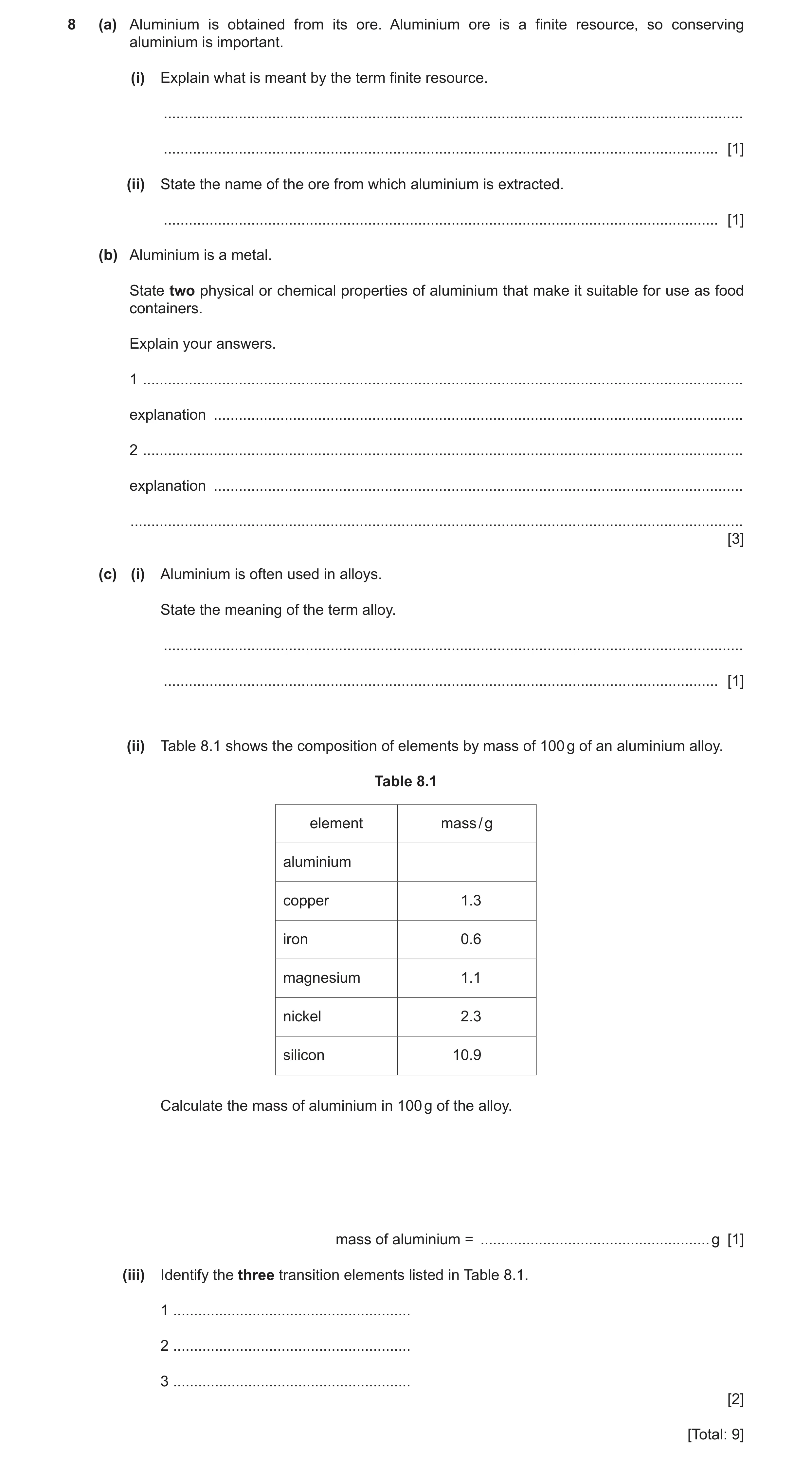
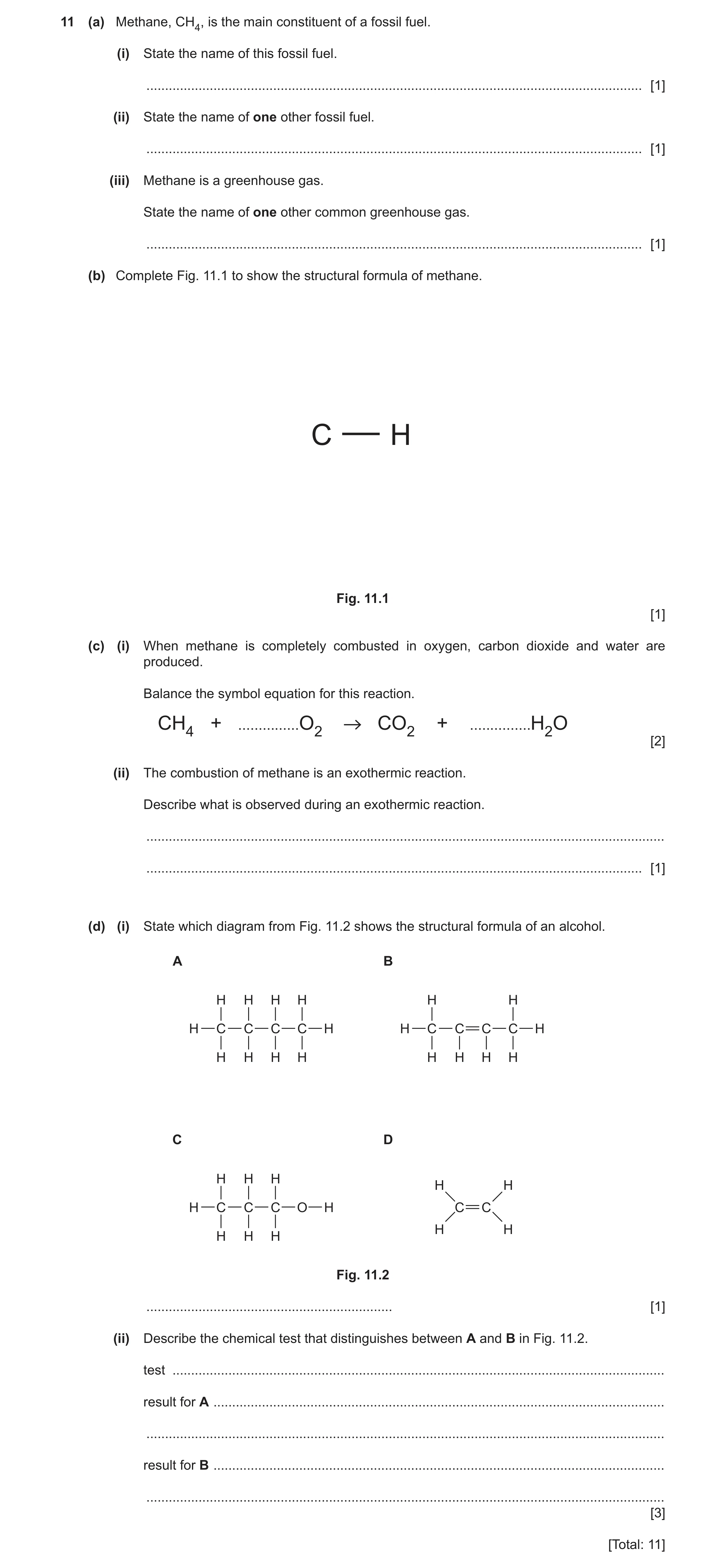
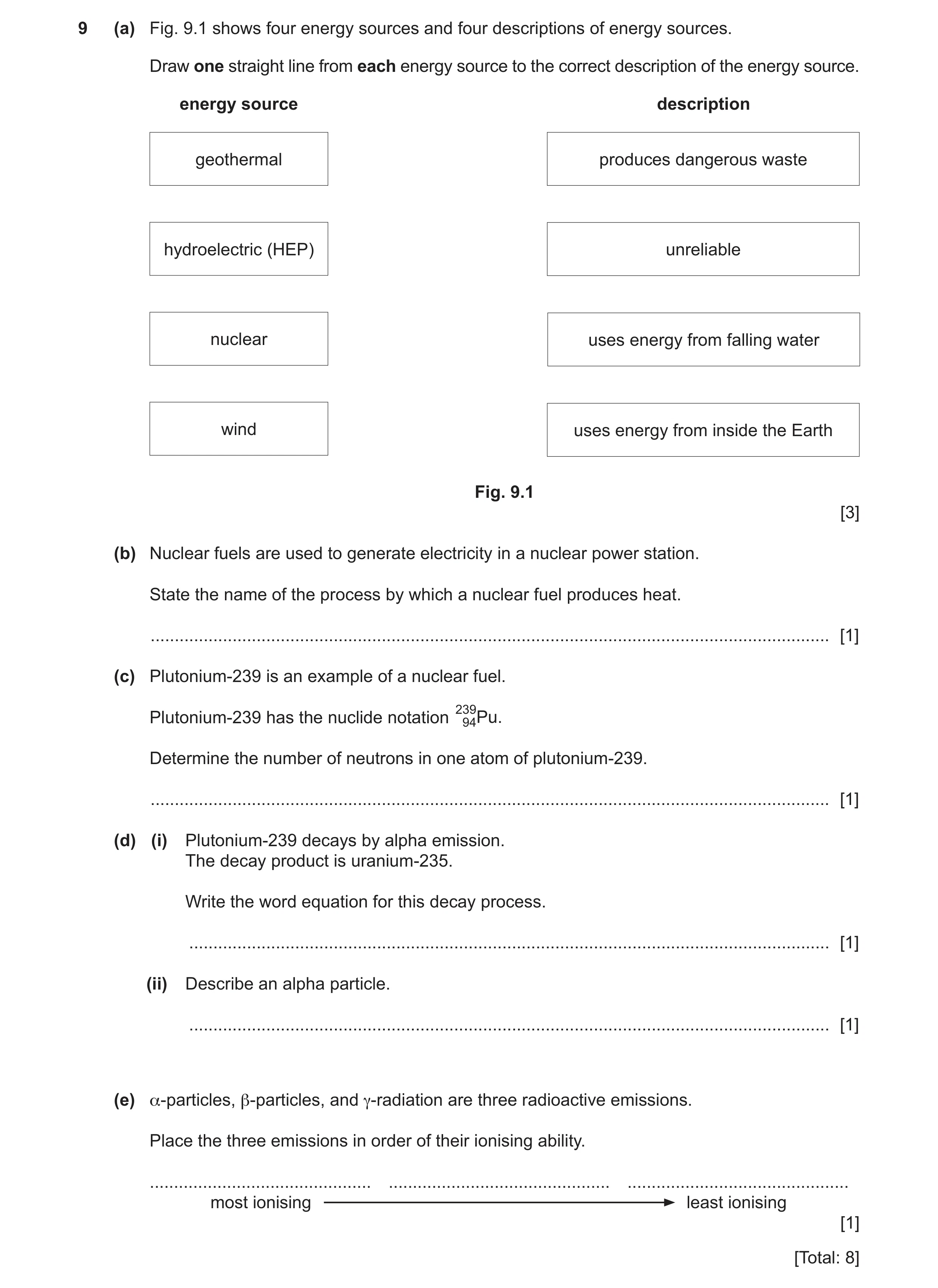 62 / 79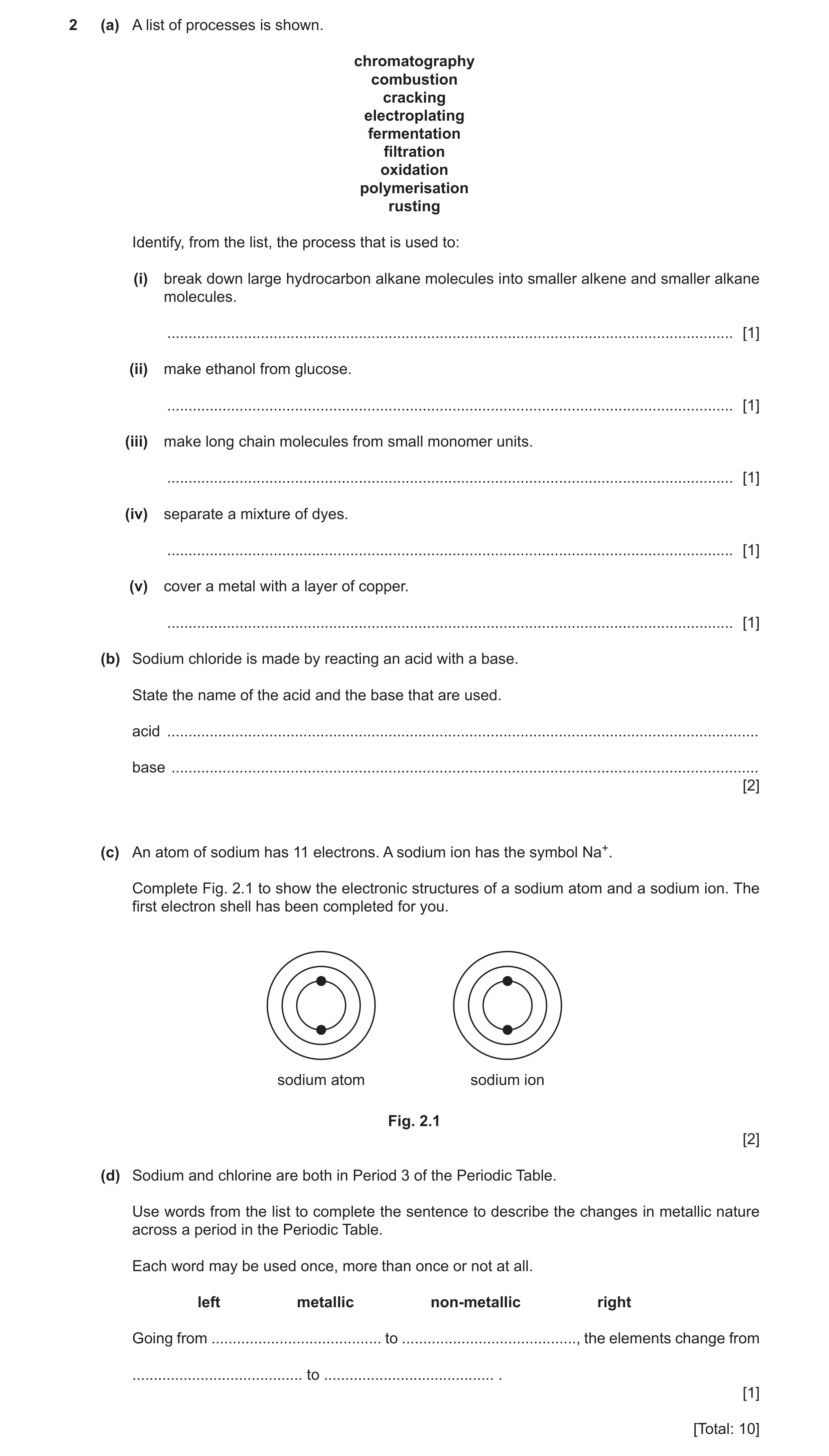
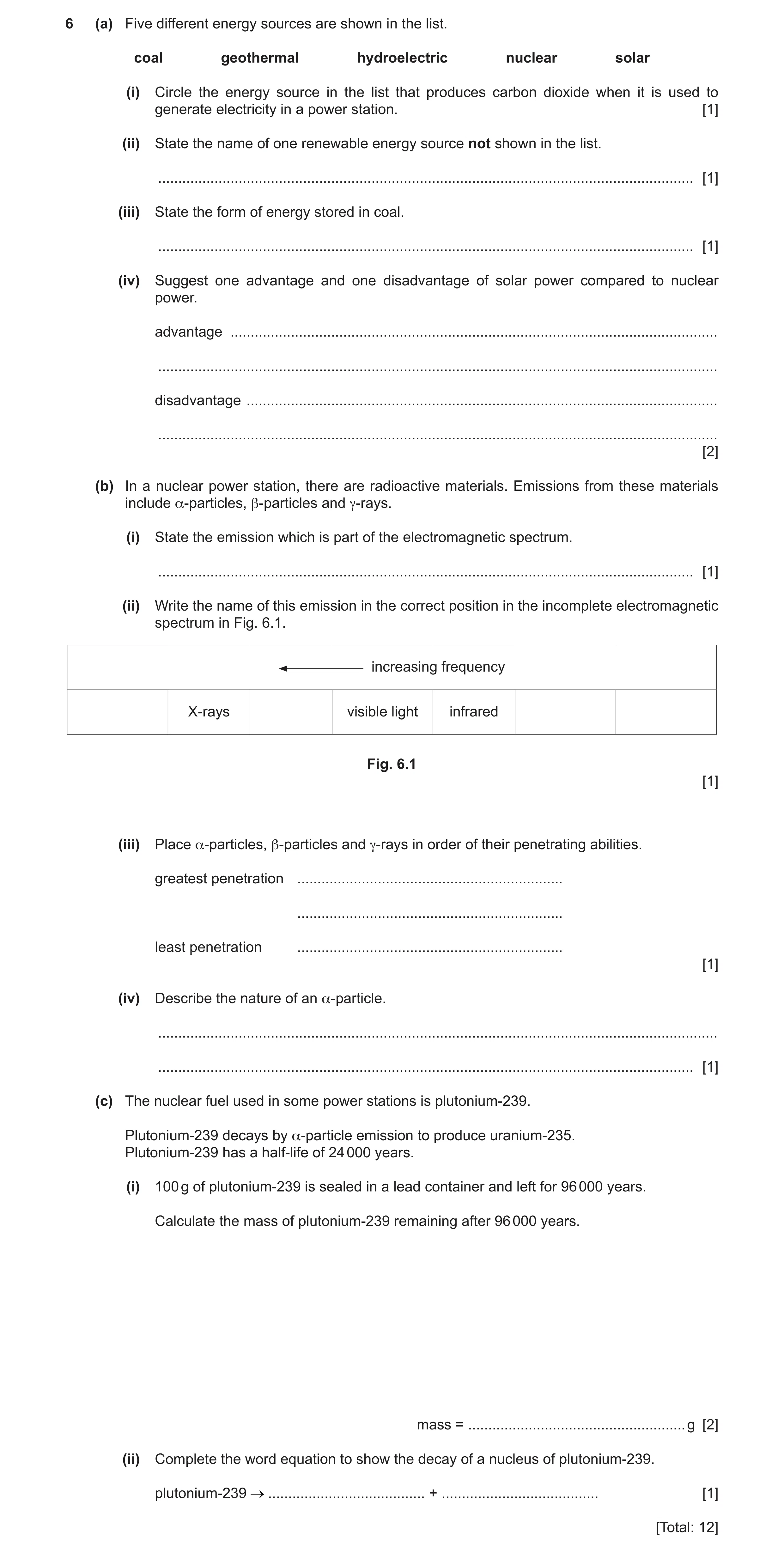
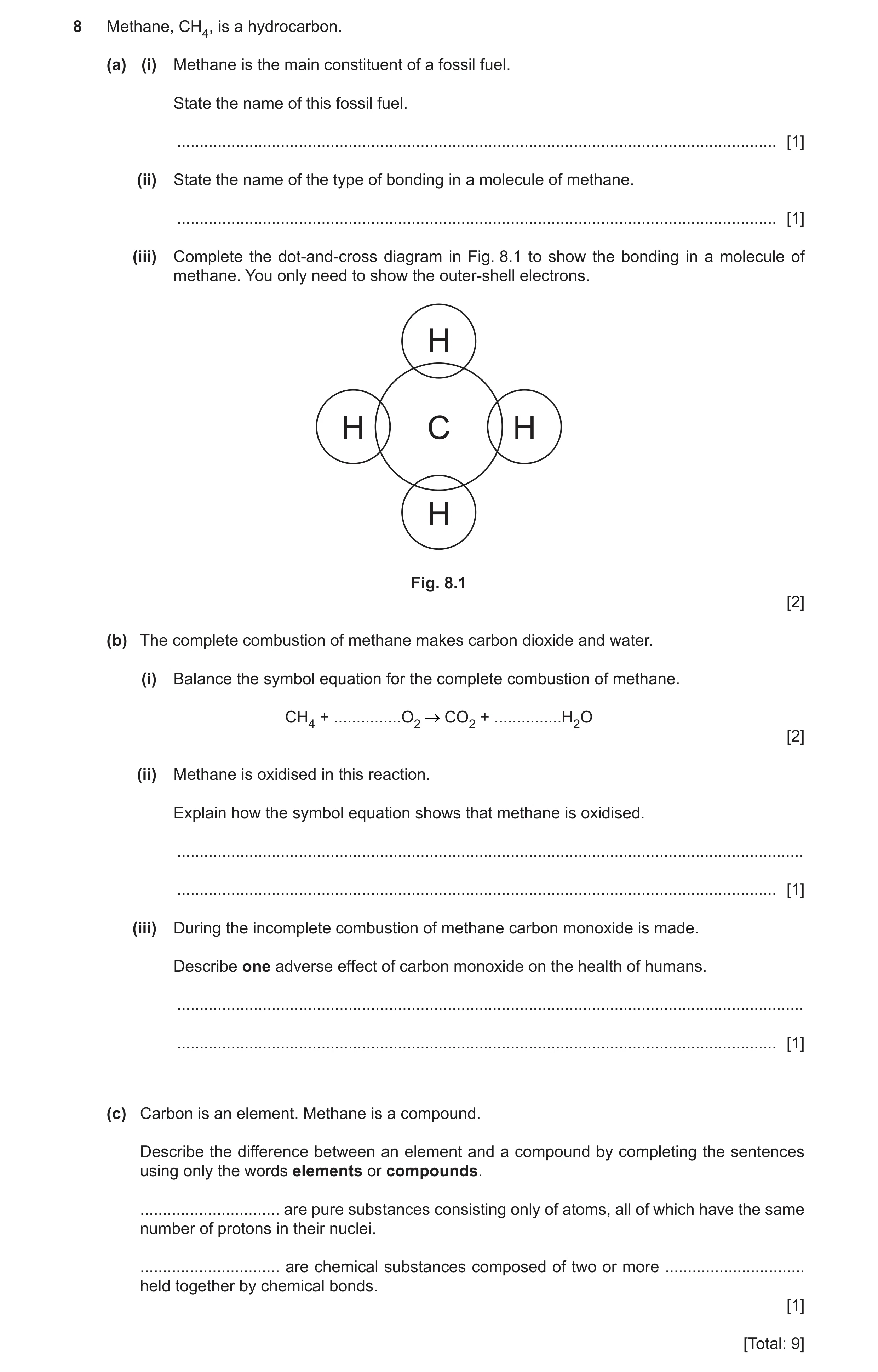
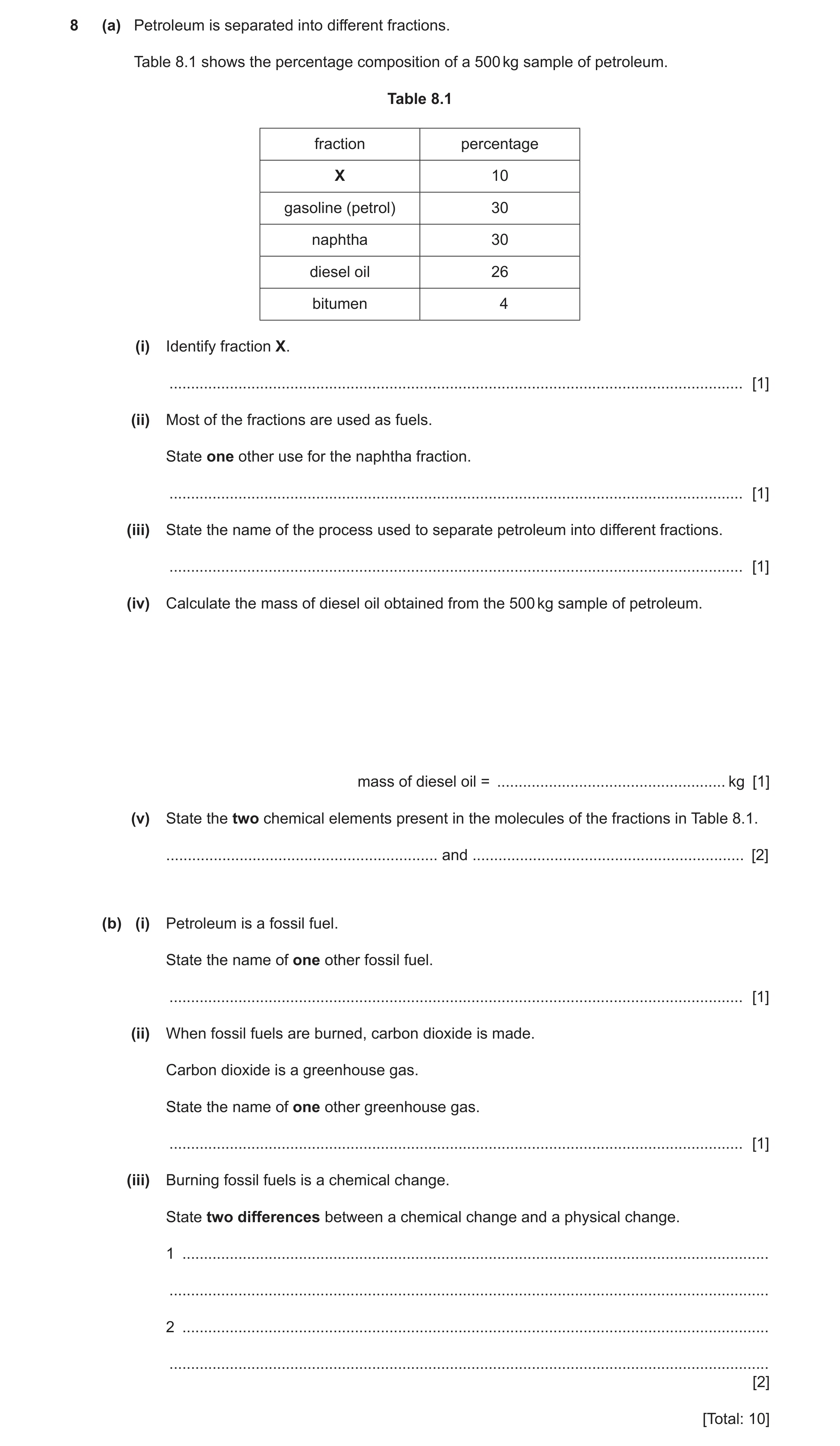
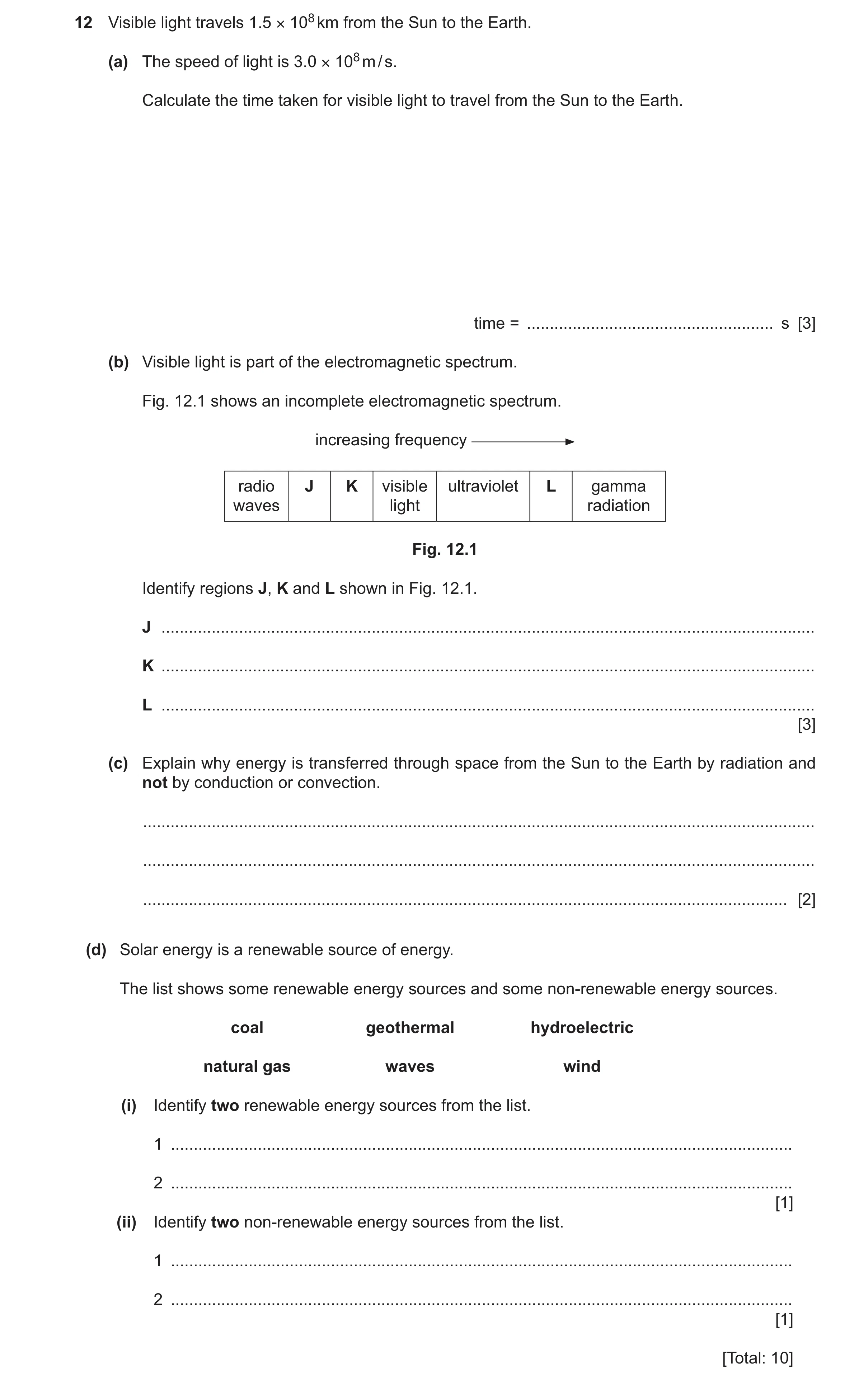
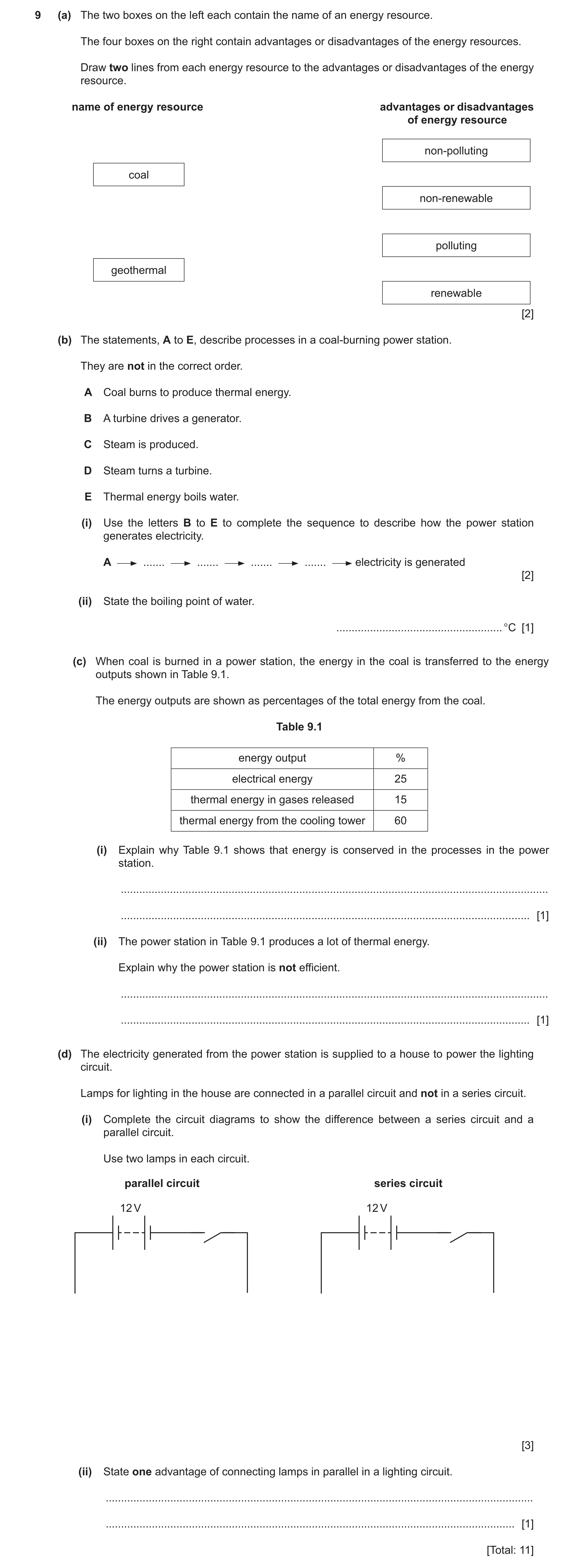
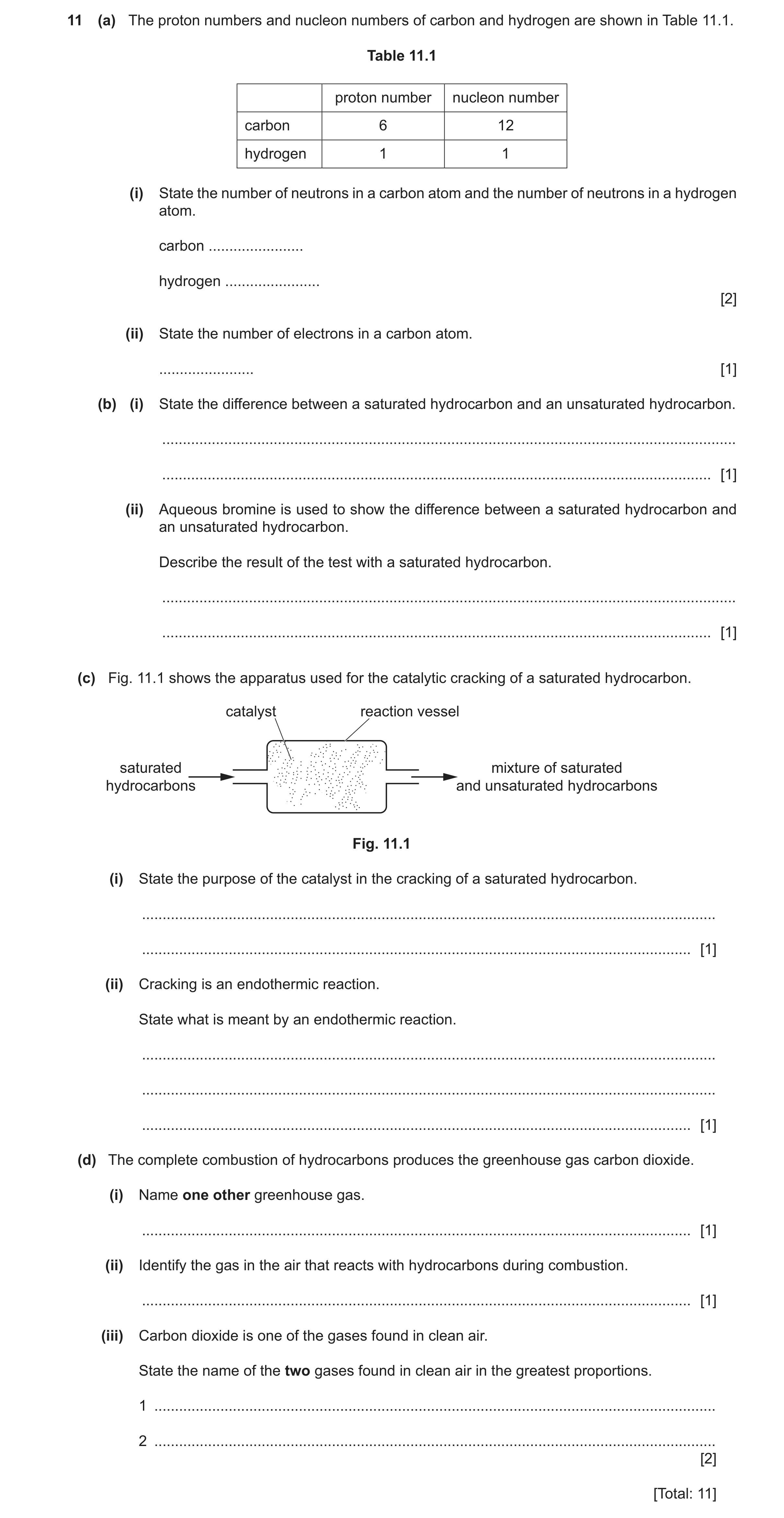
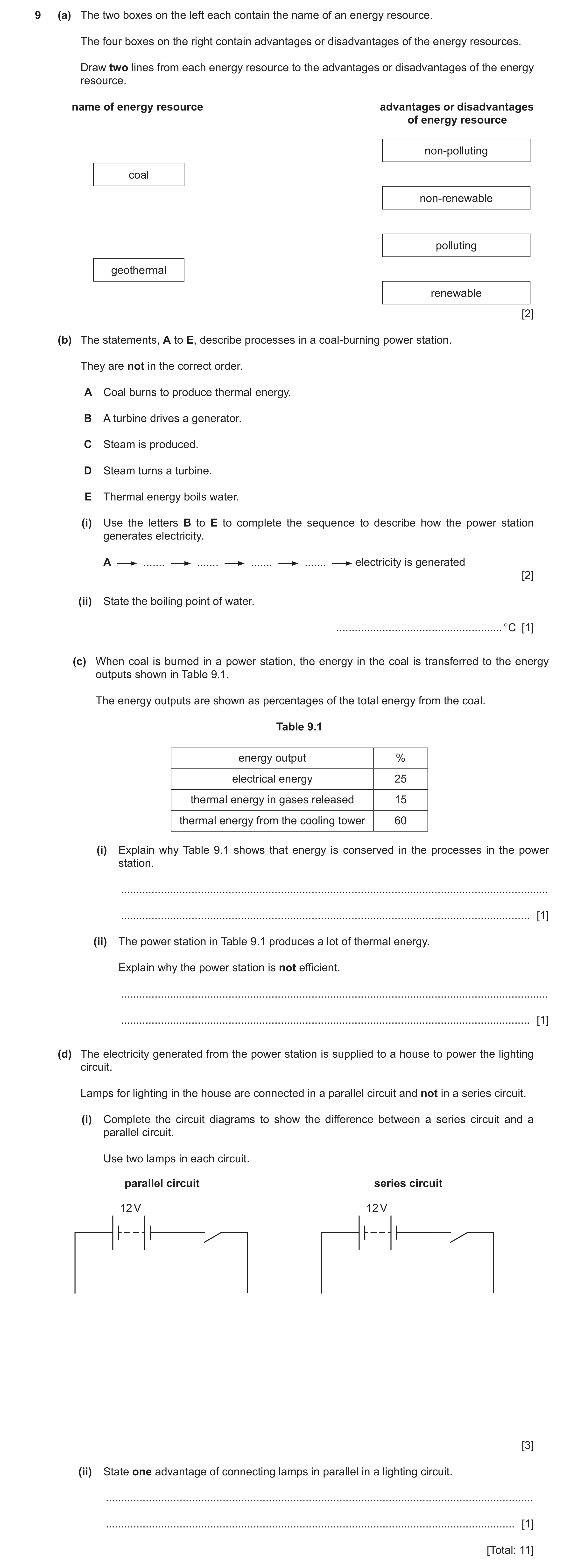
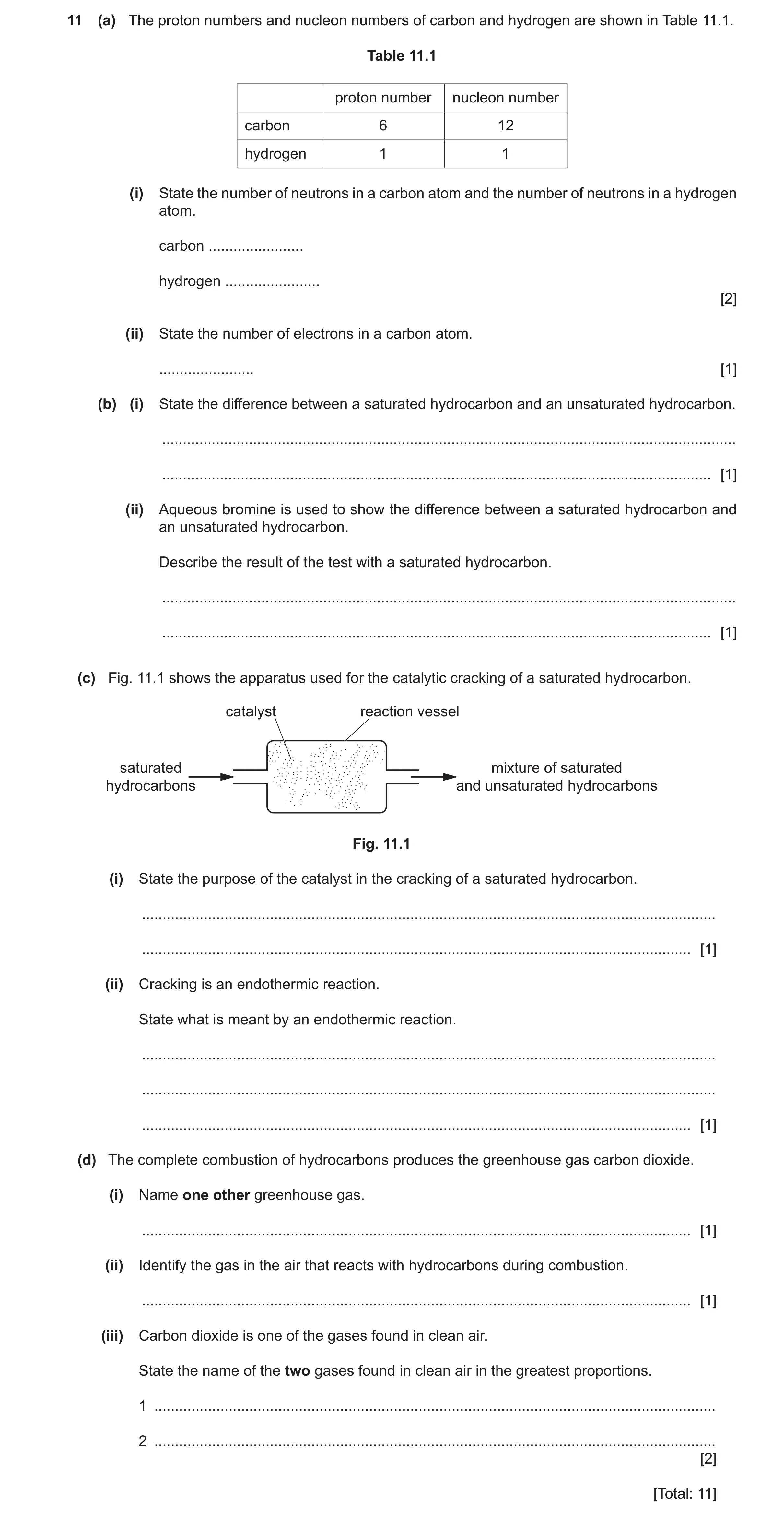
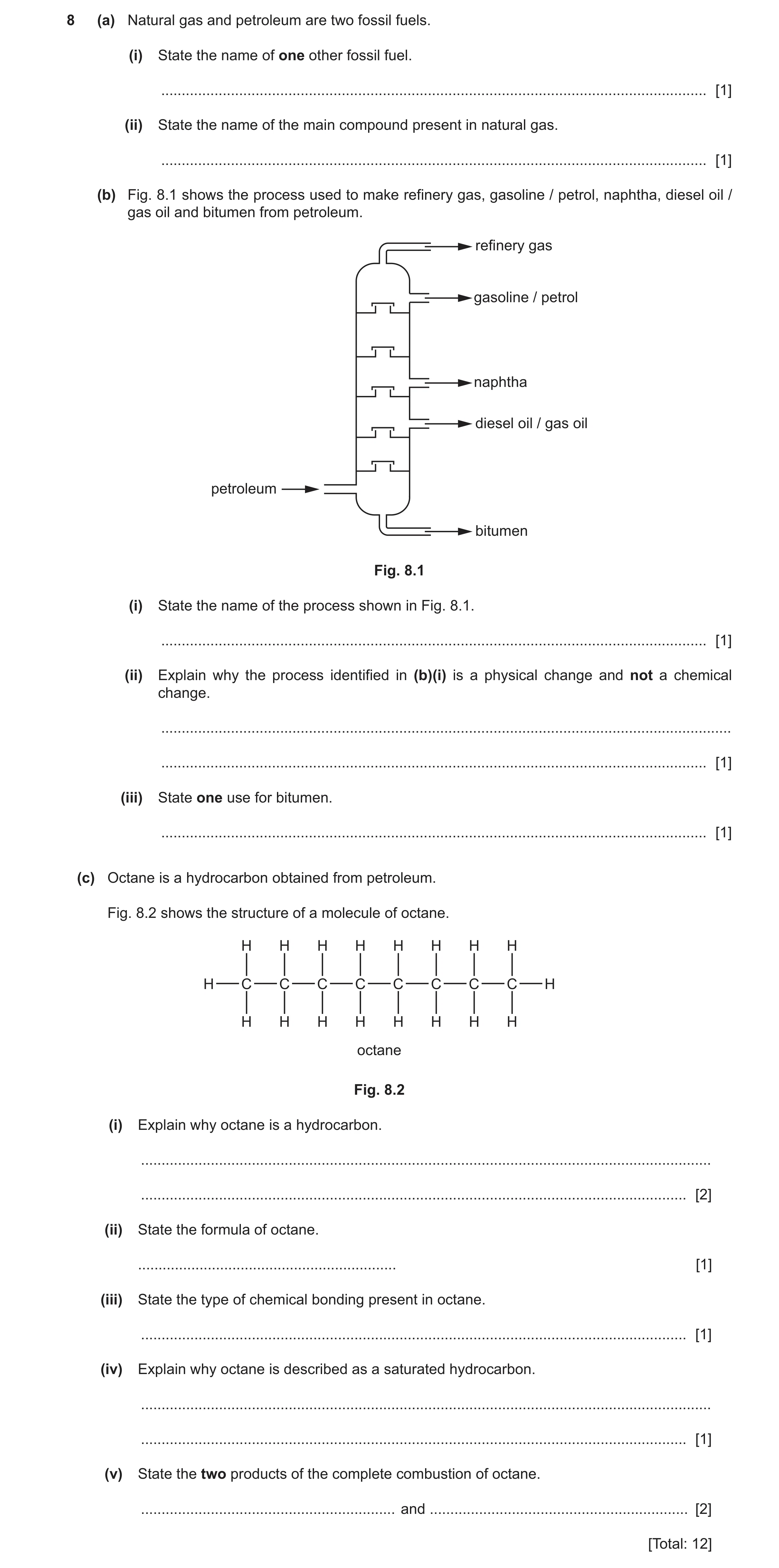
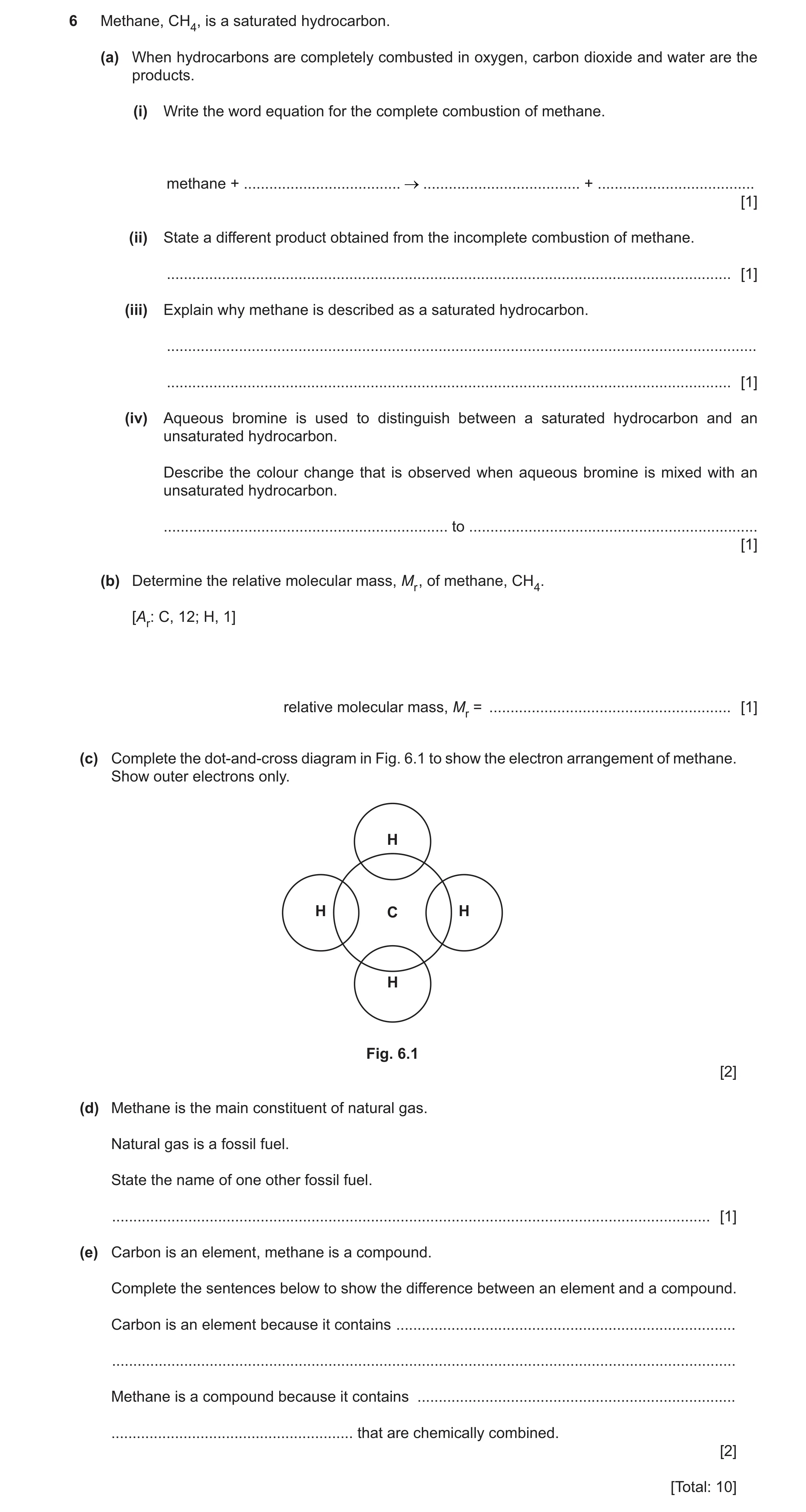
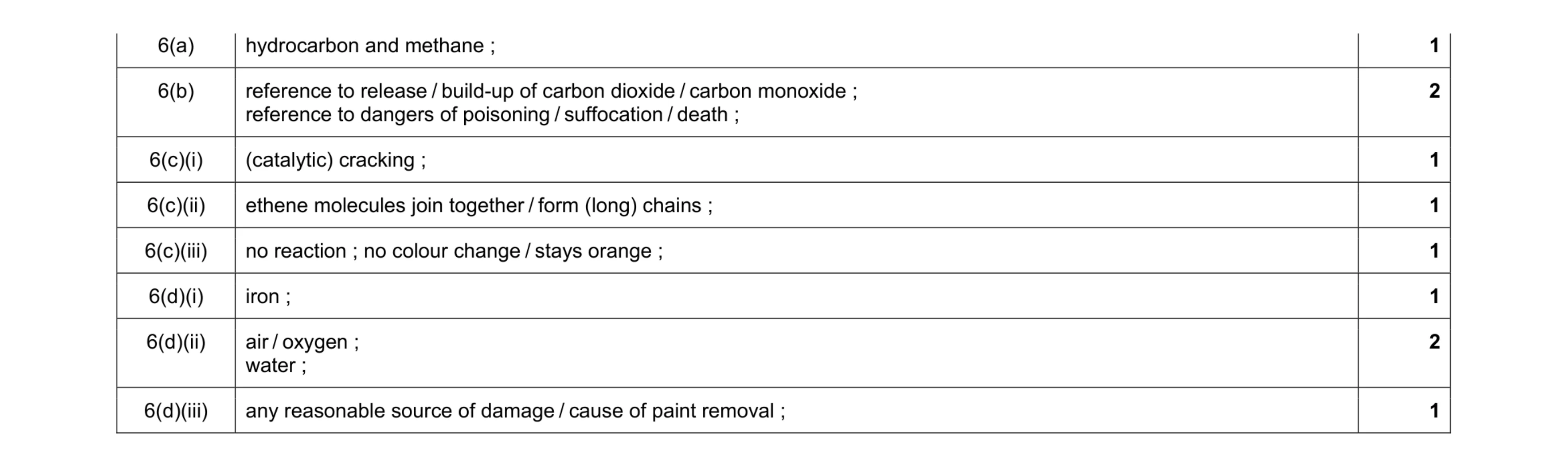 10
10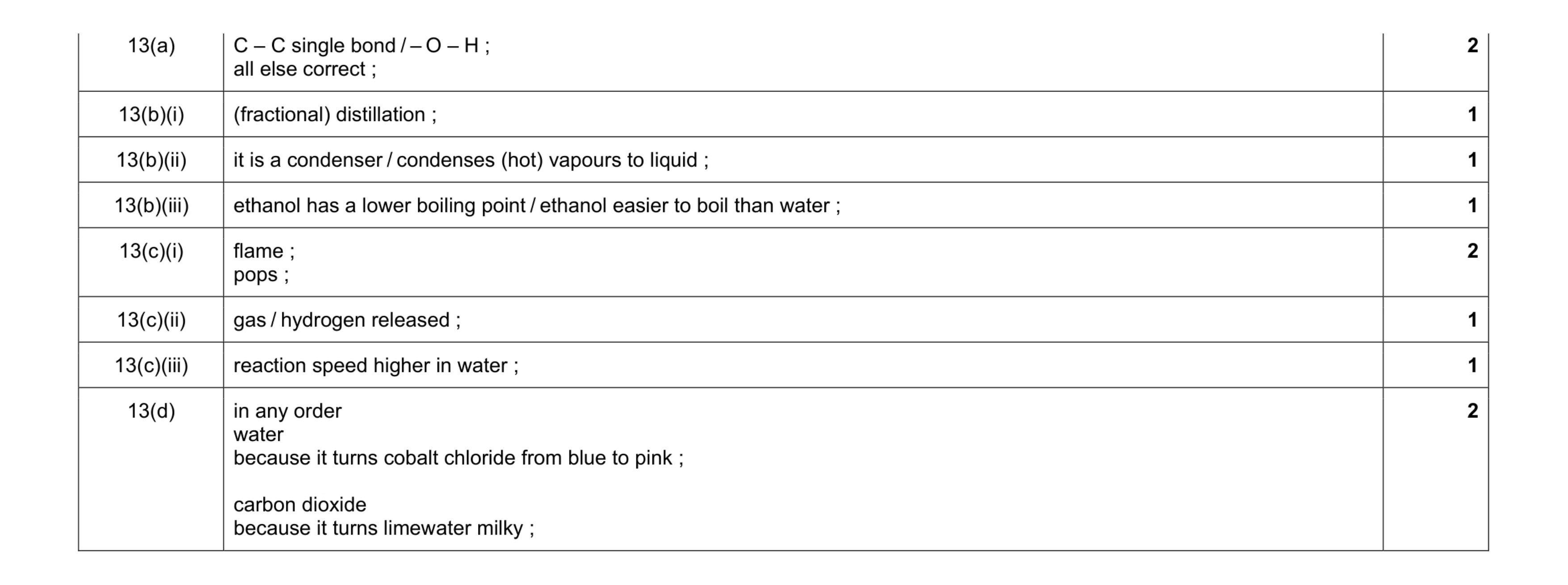 11
11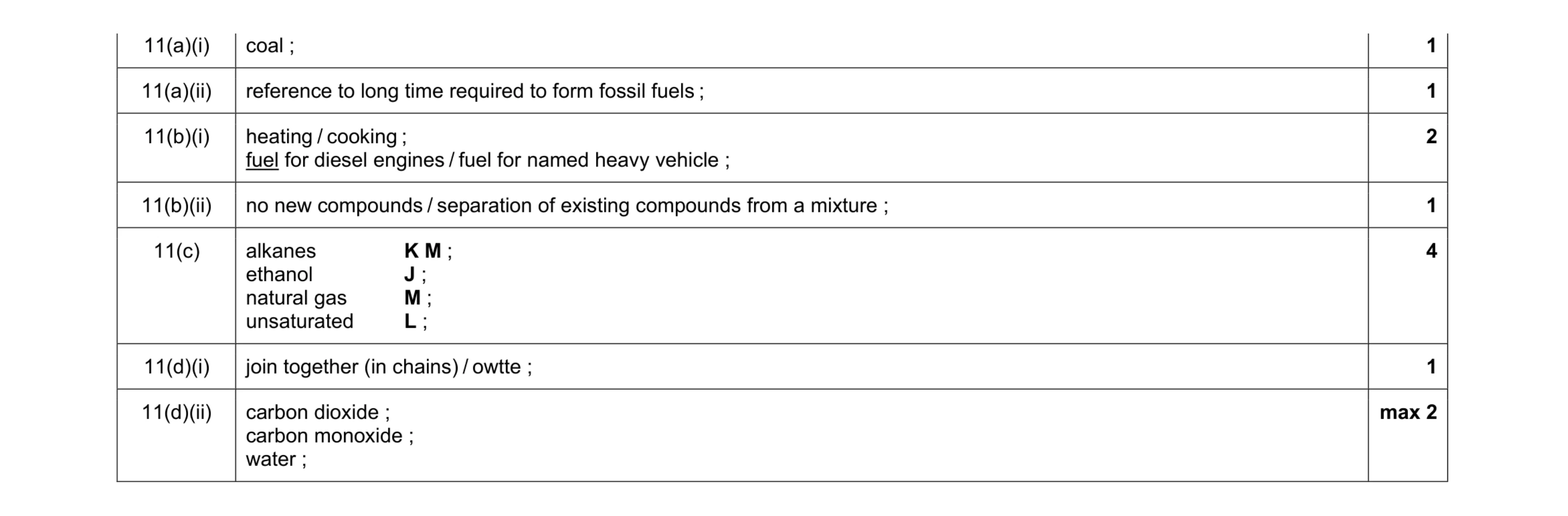 12
12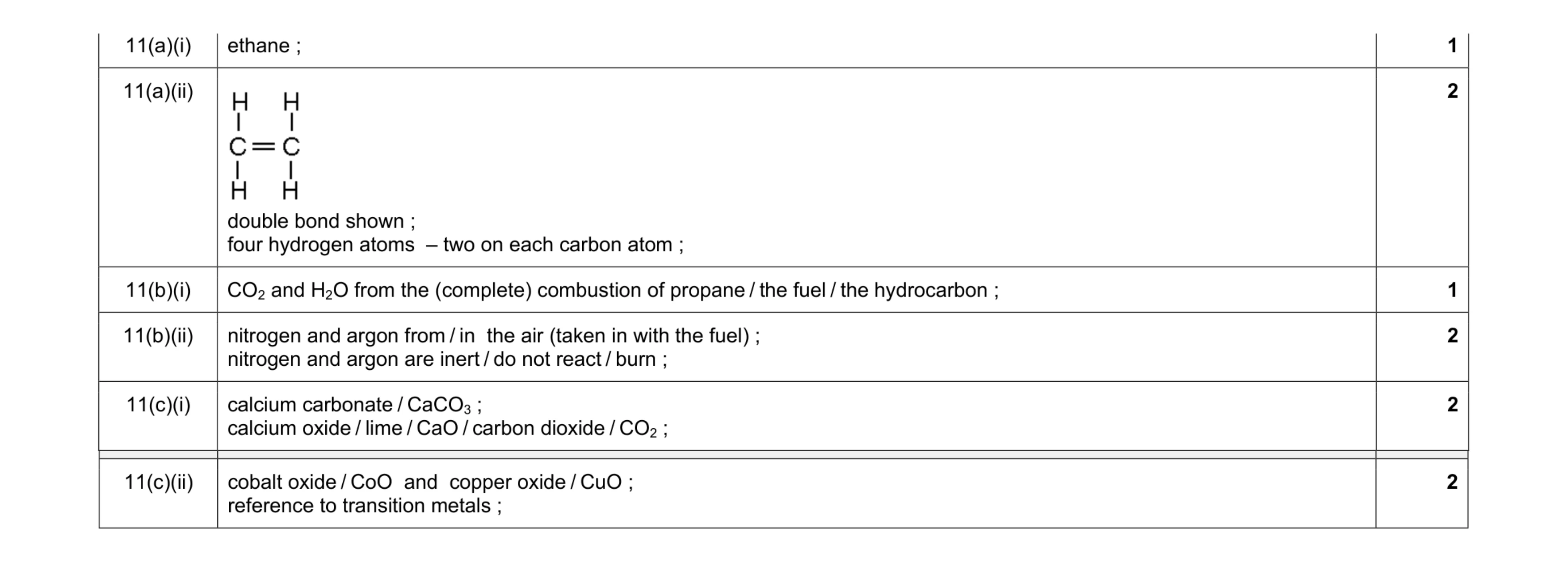 10
10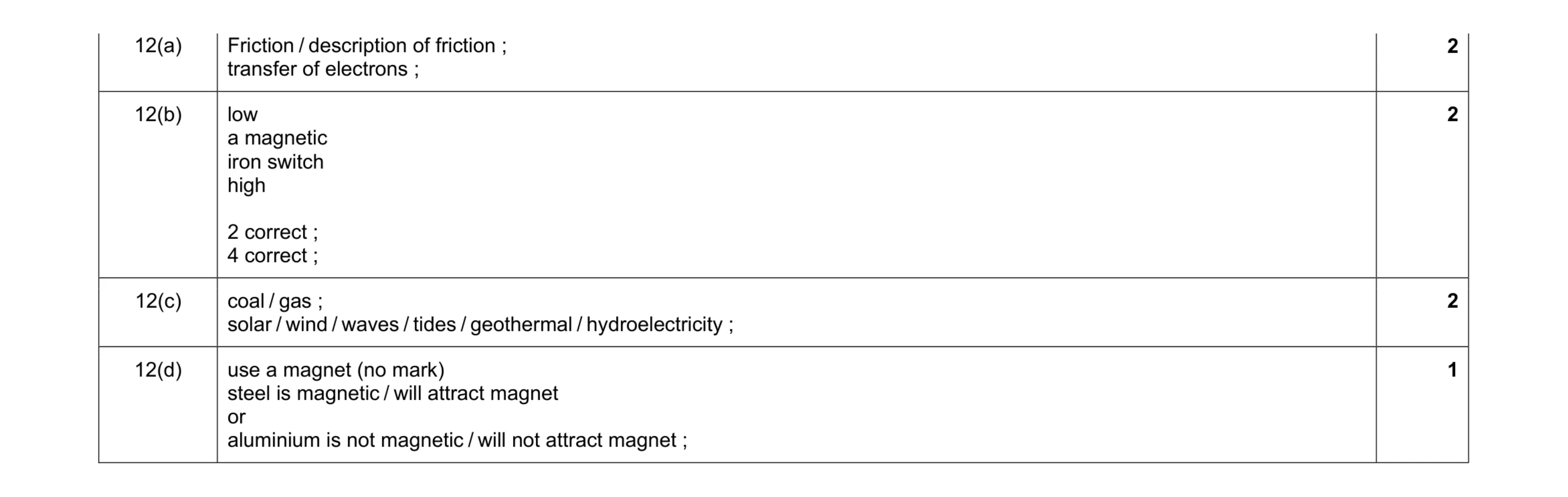 7
7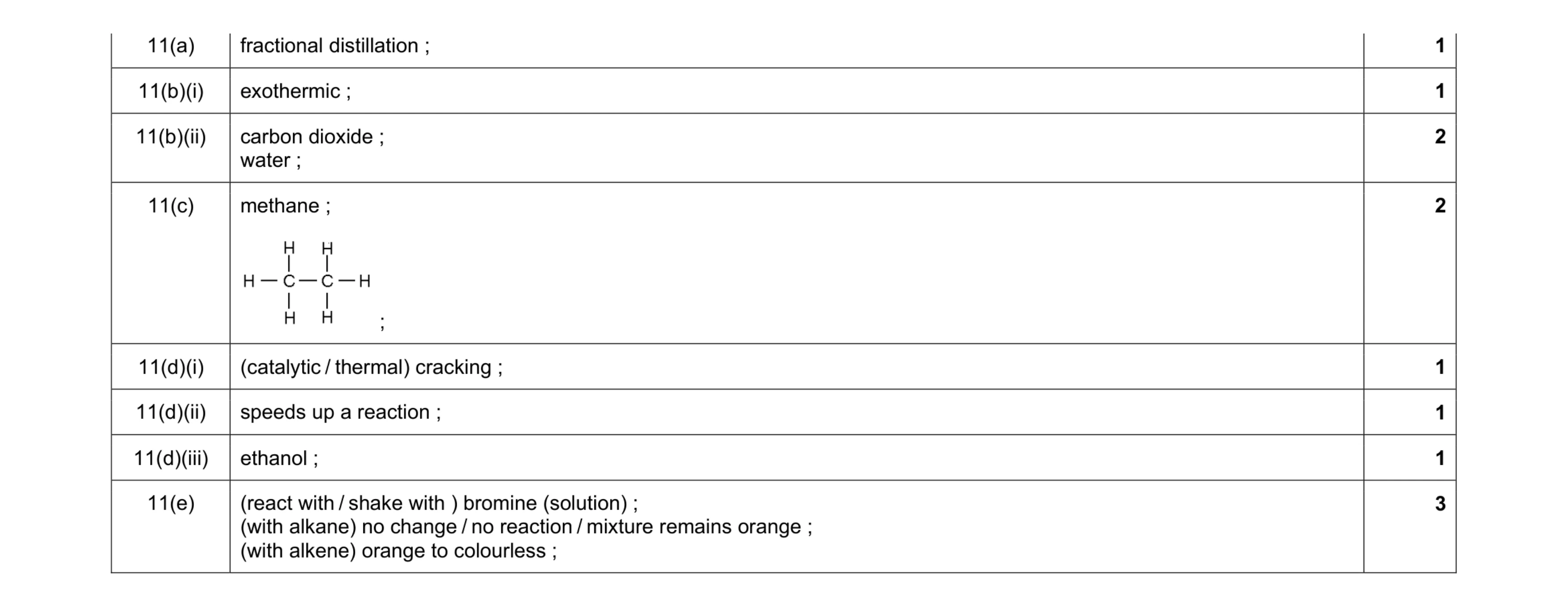 12
12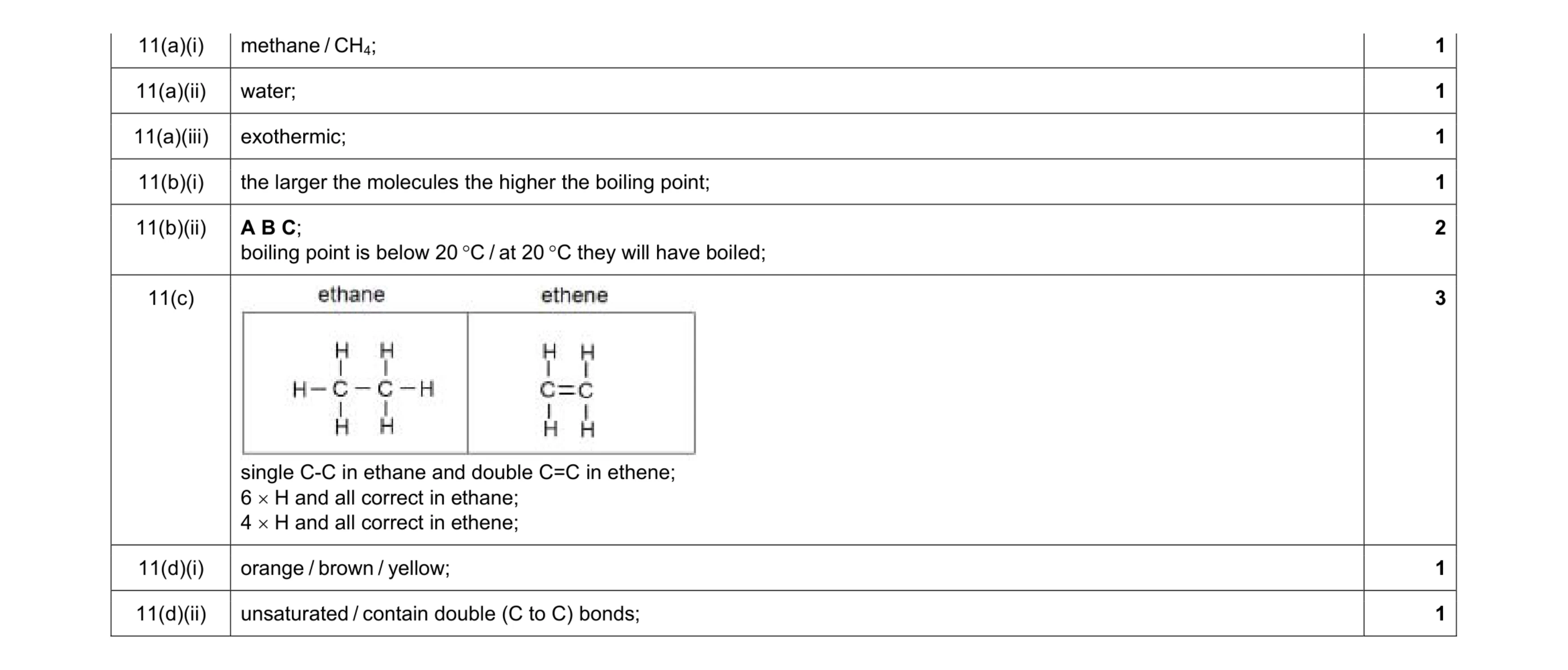 11
11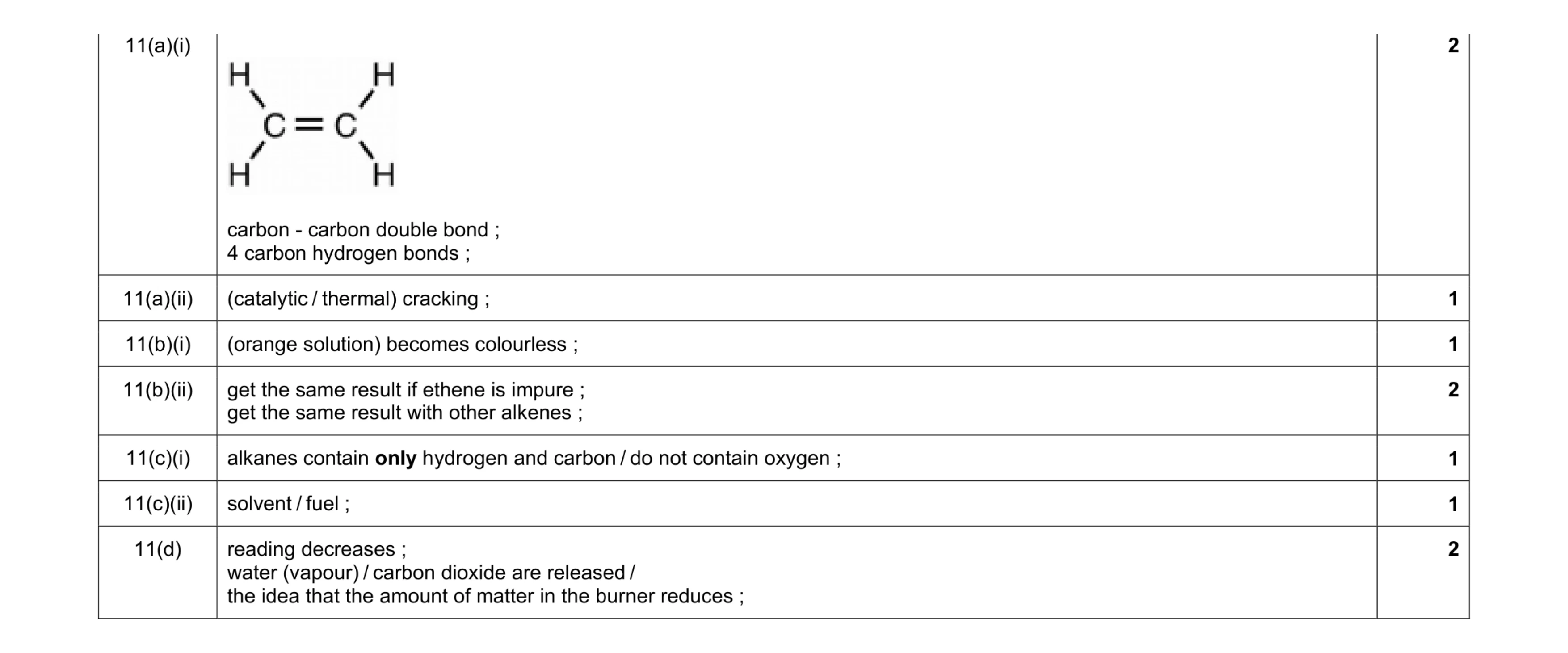 10
10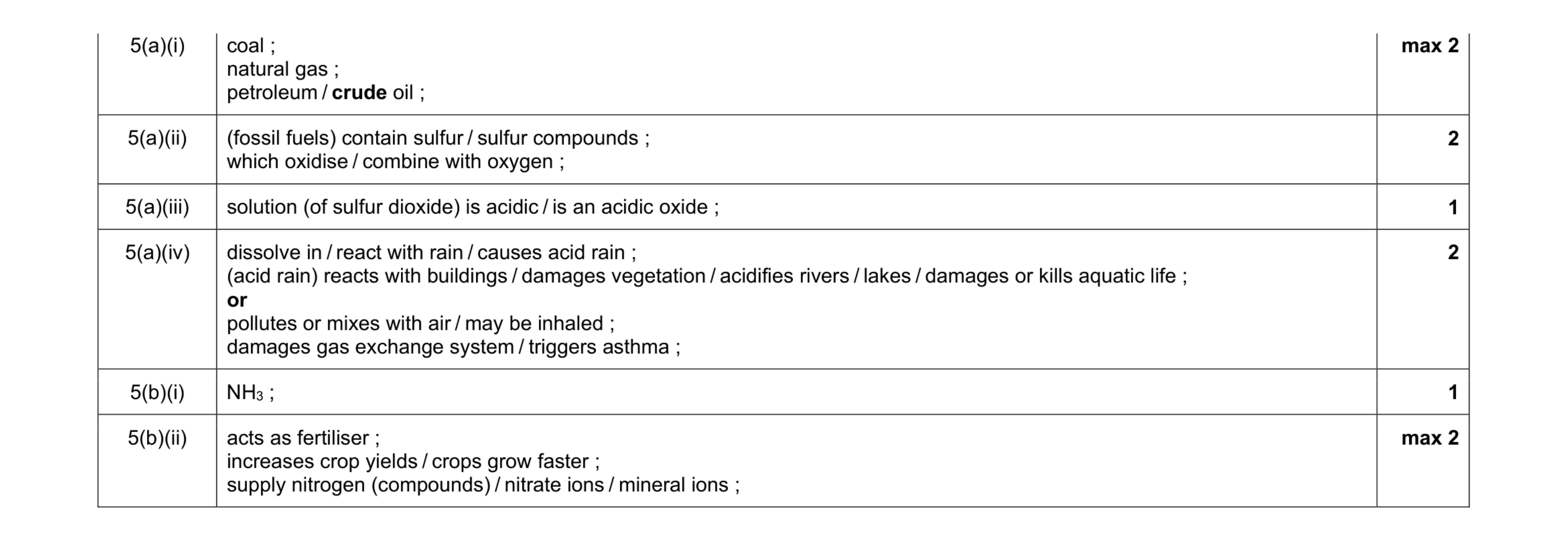 10
10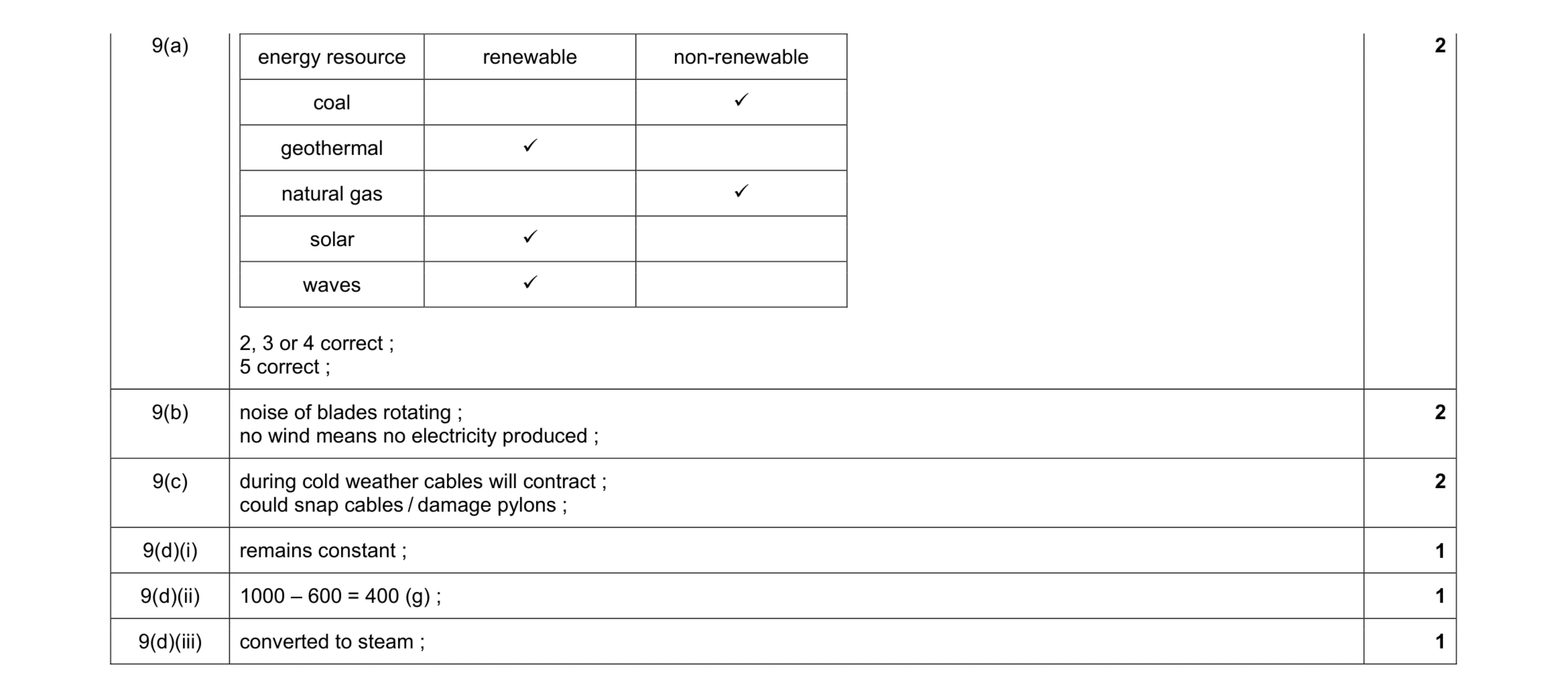 9
9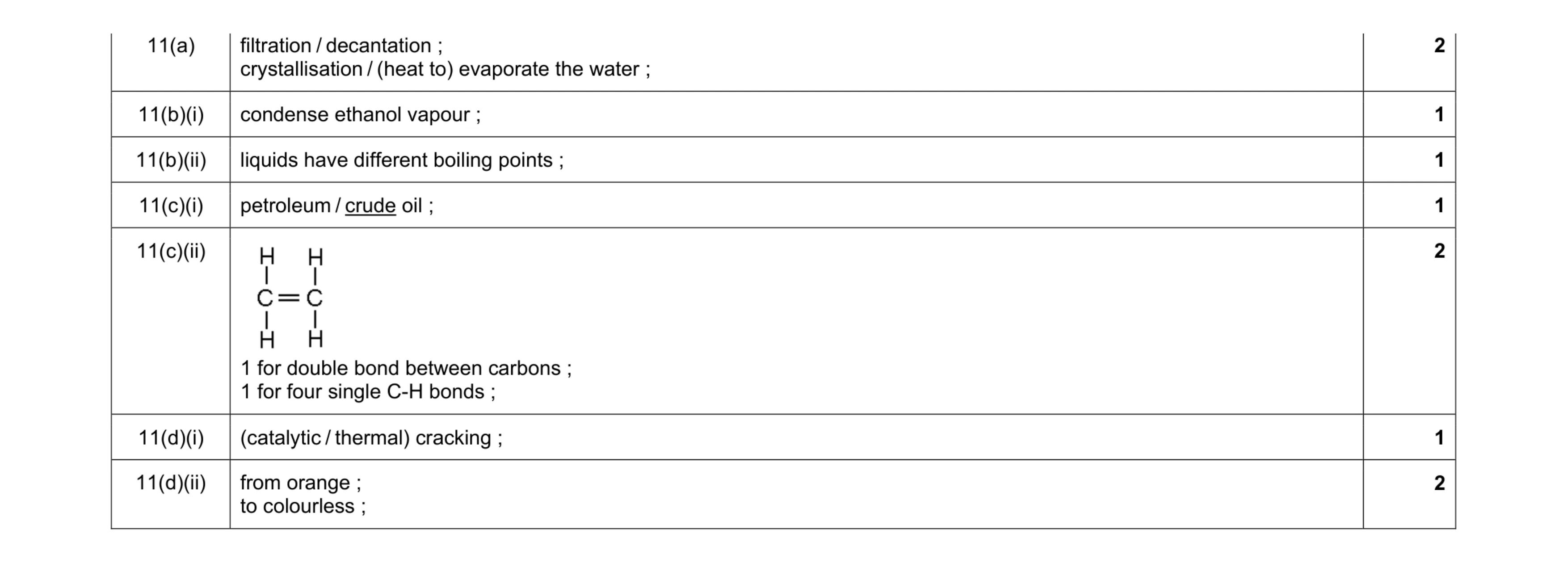 10
10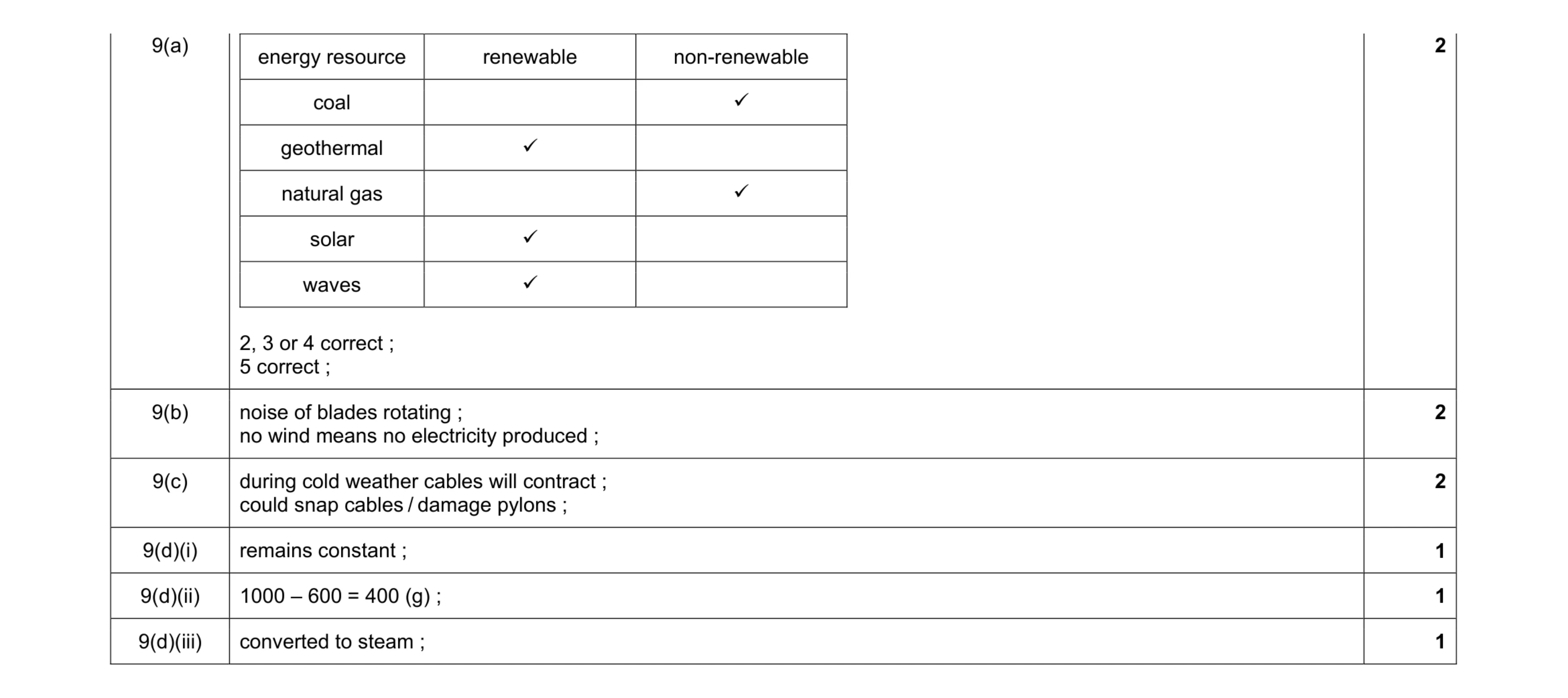 9
9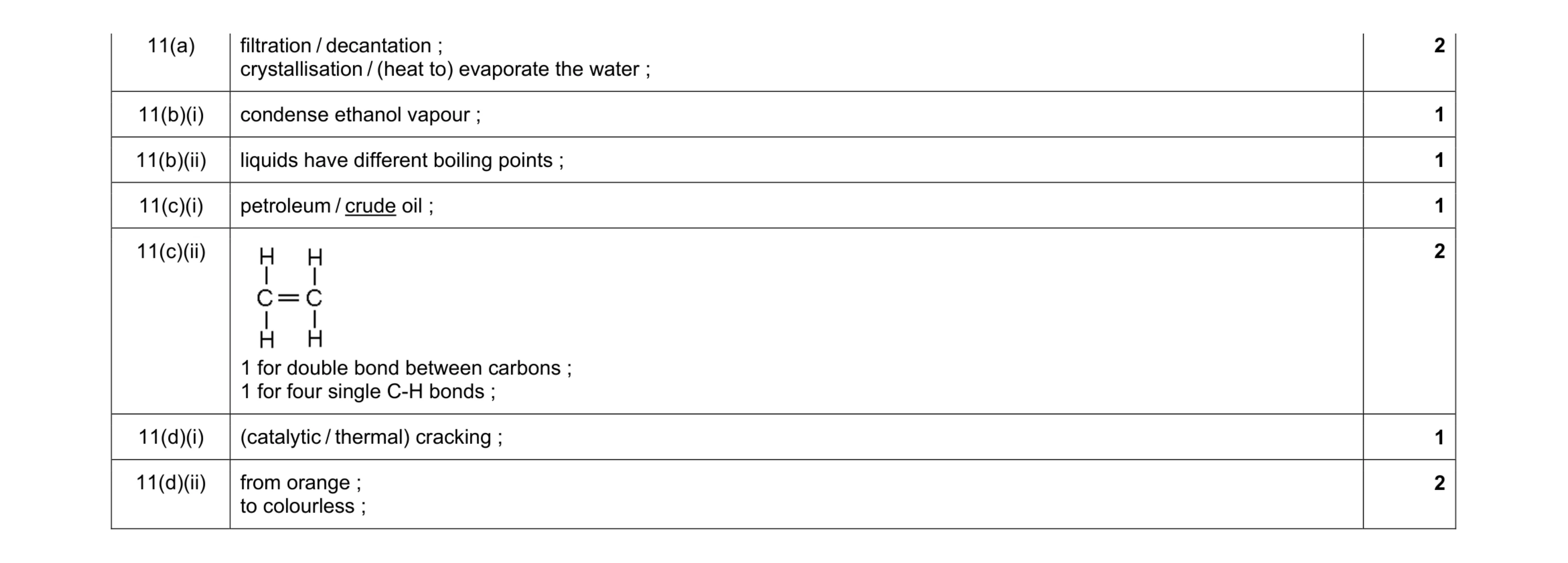 10
10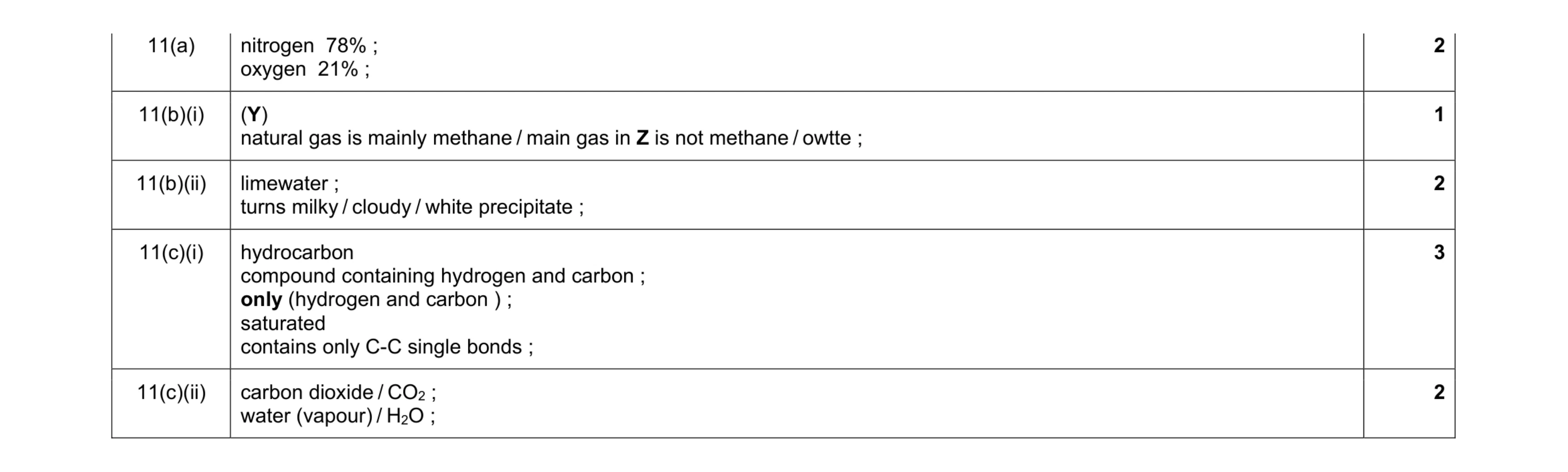 10
10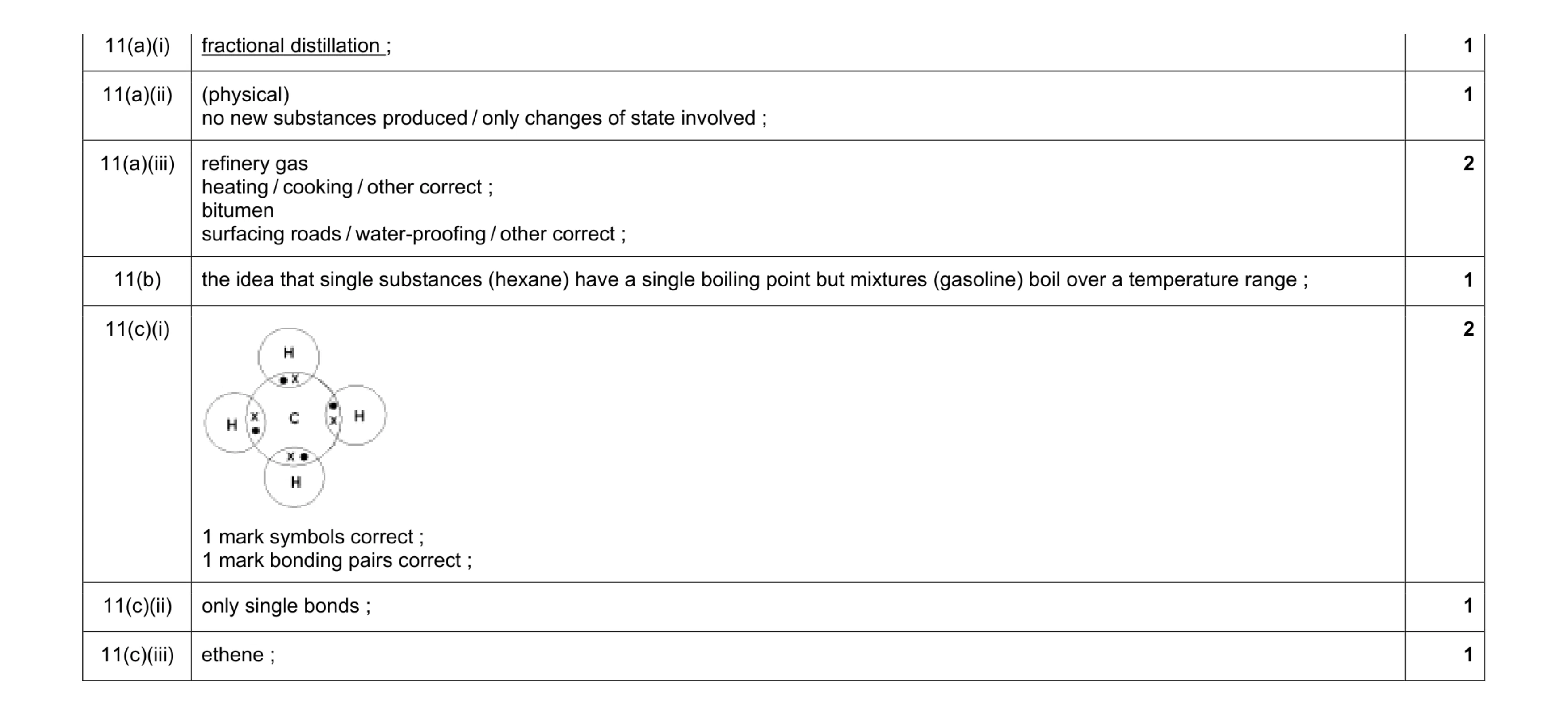 9
9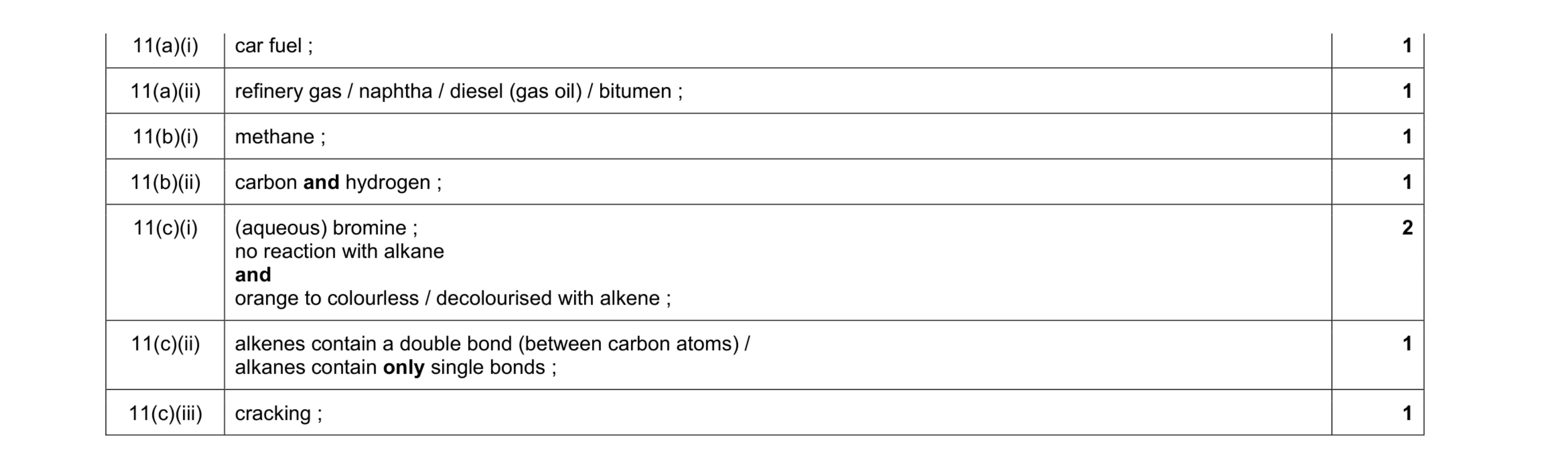 8
8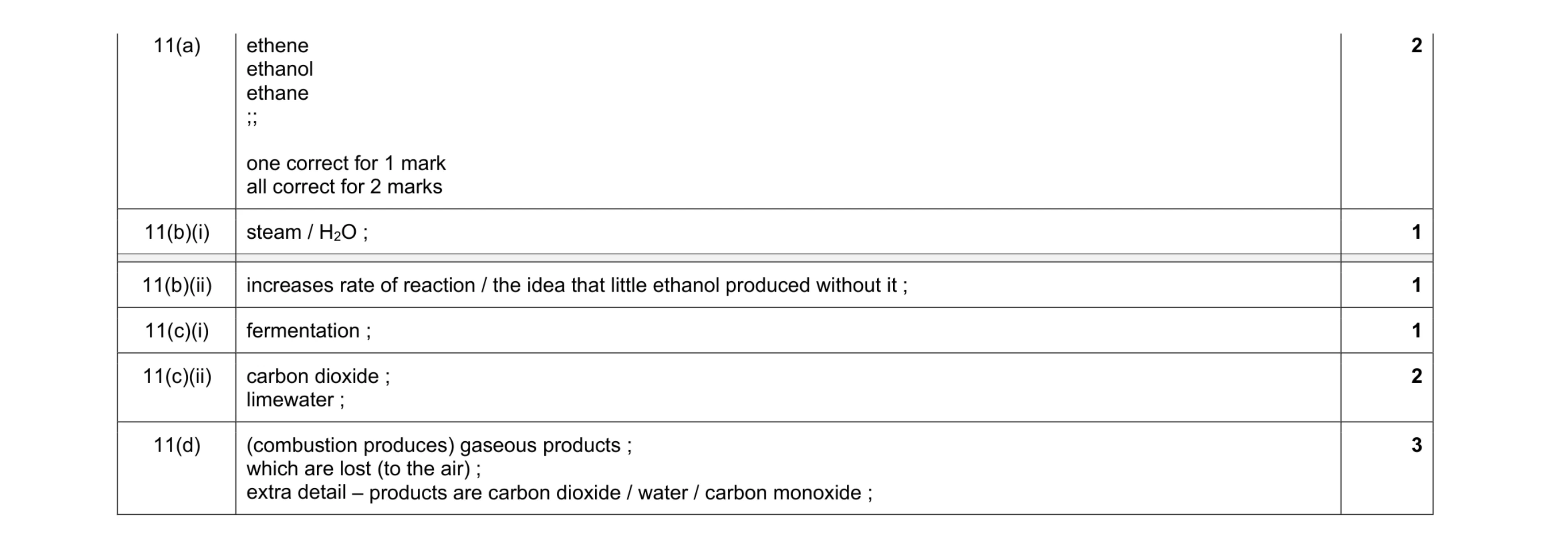 10
10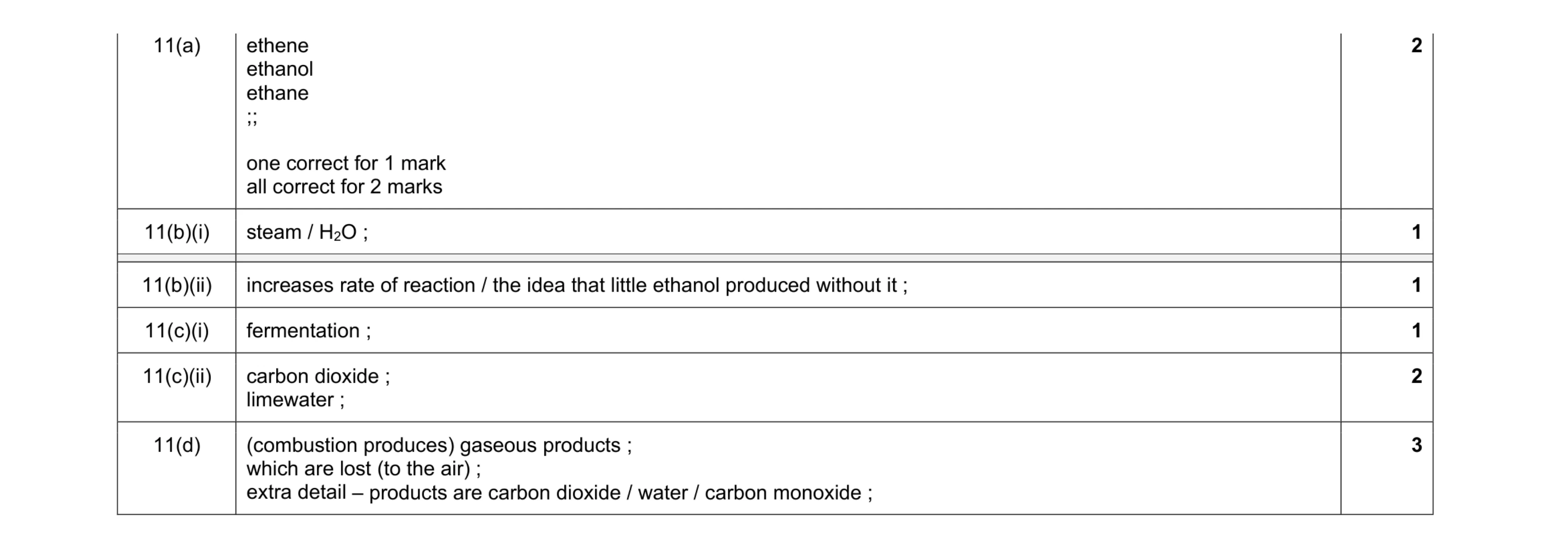 10
10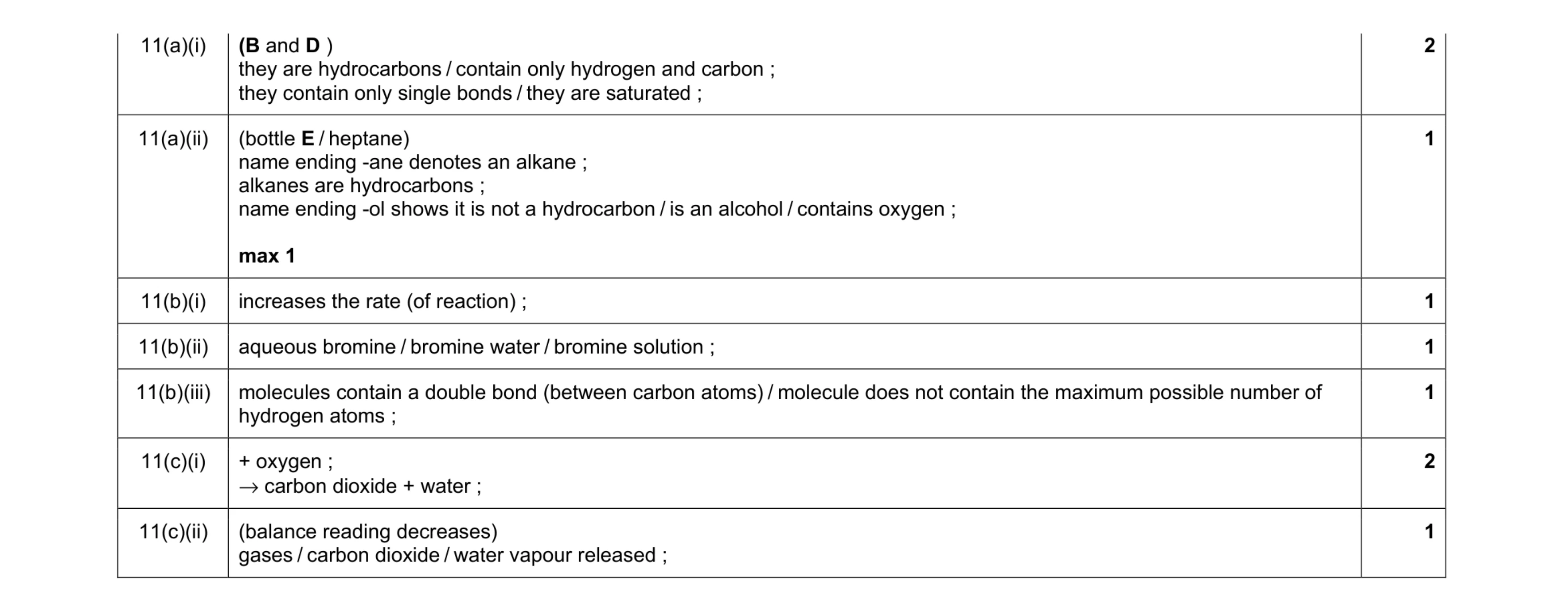 9
9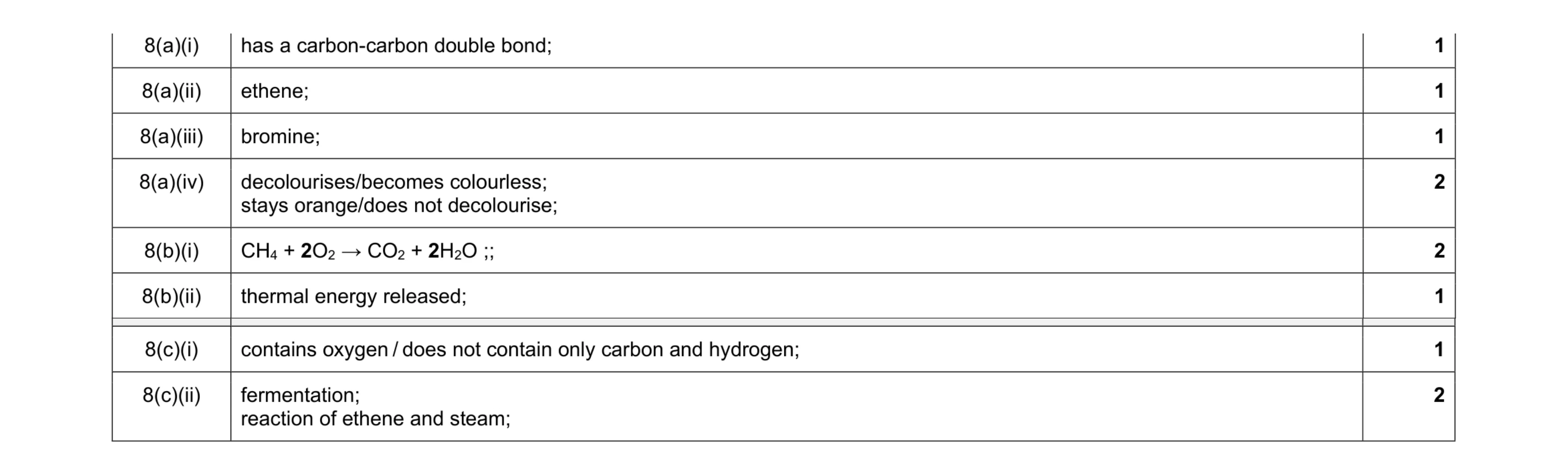 11
11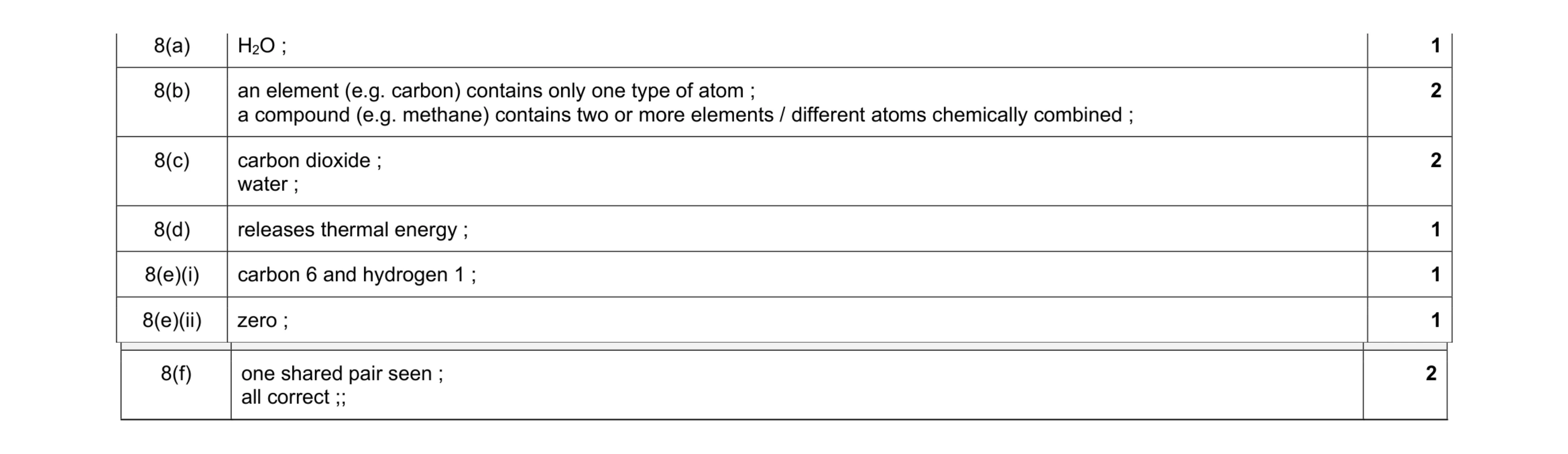 10
10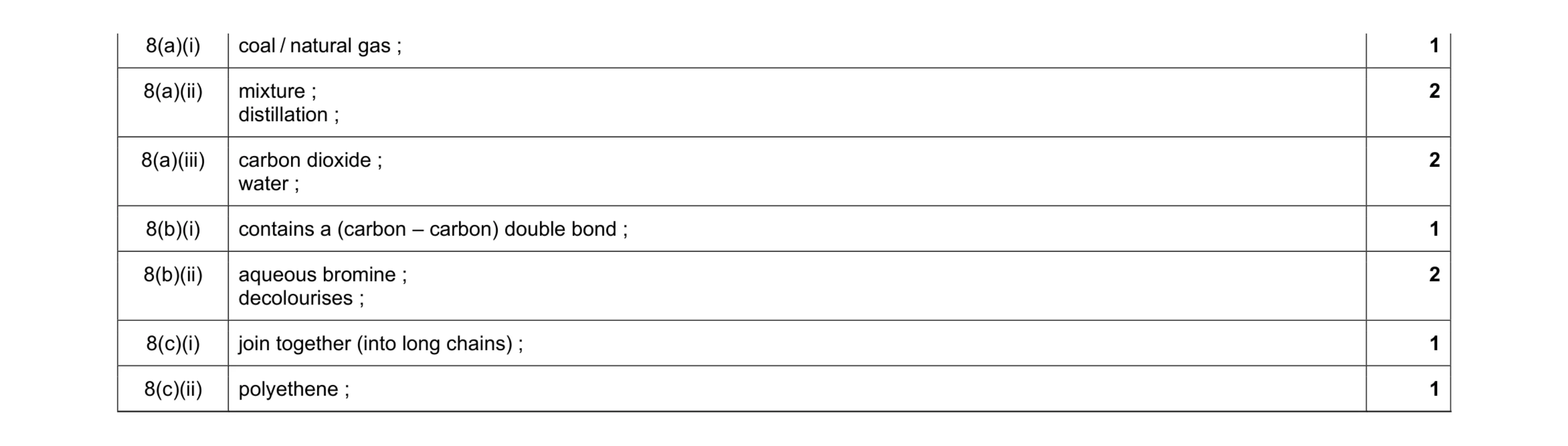 10
10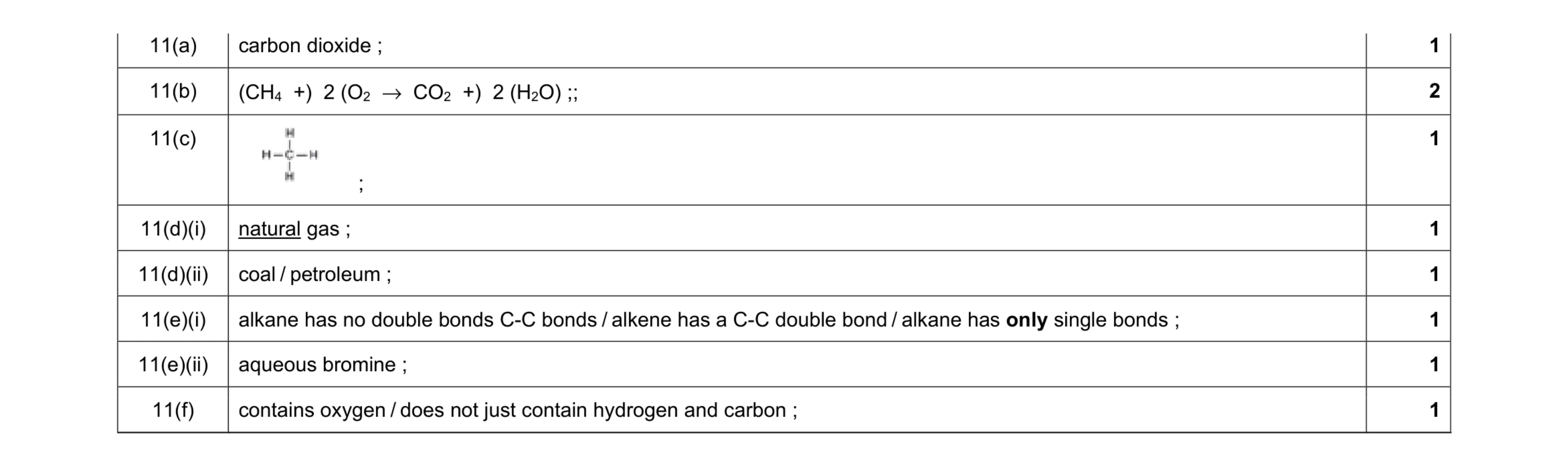 9
9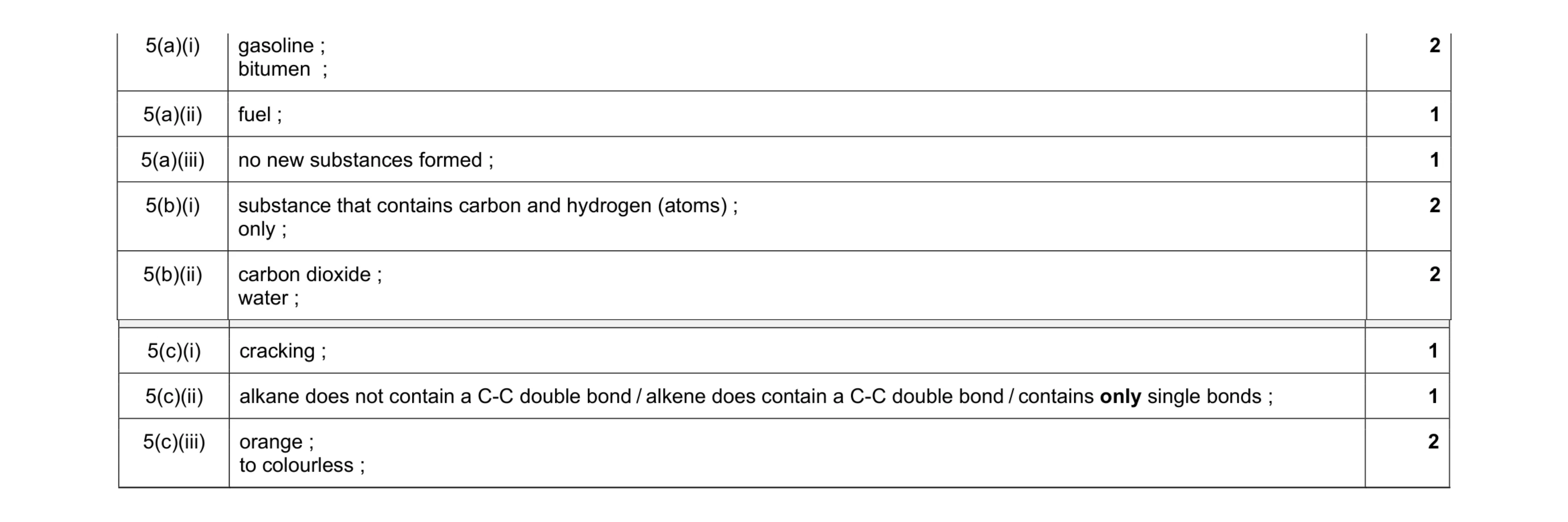 12
12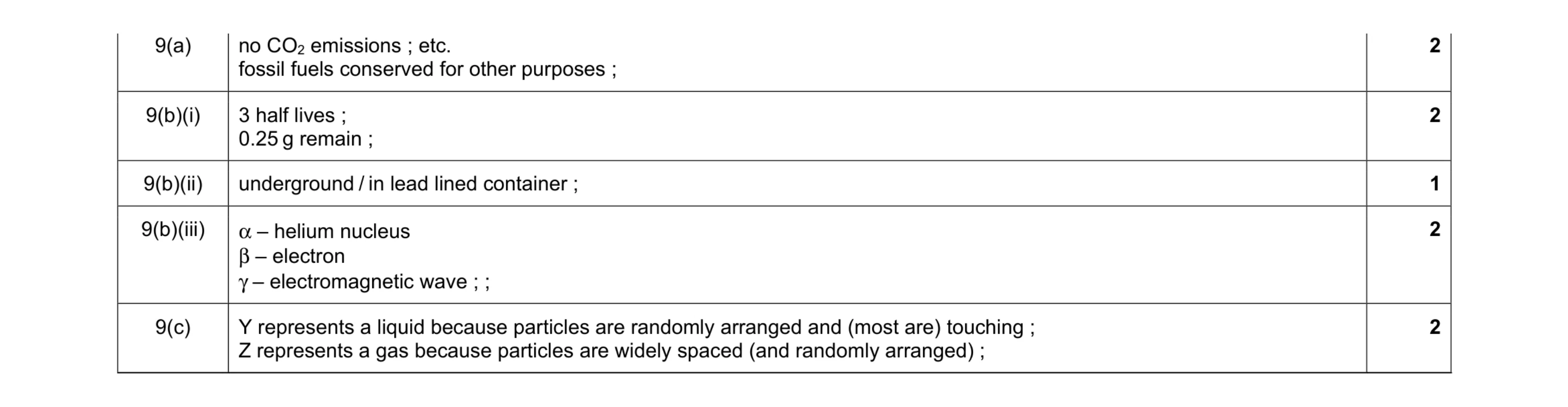 9
9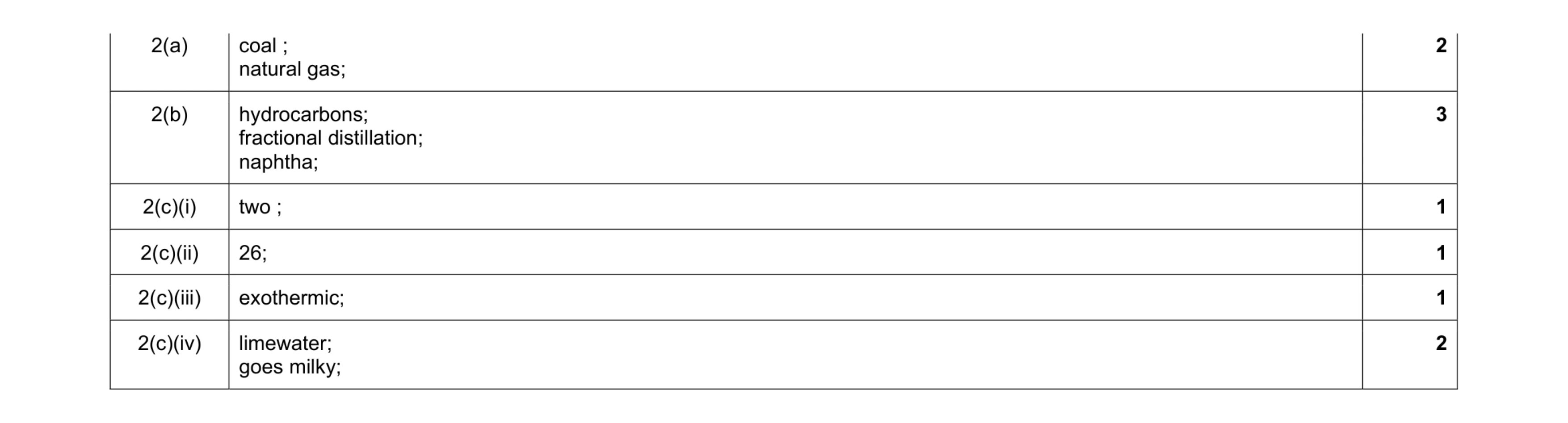 10
10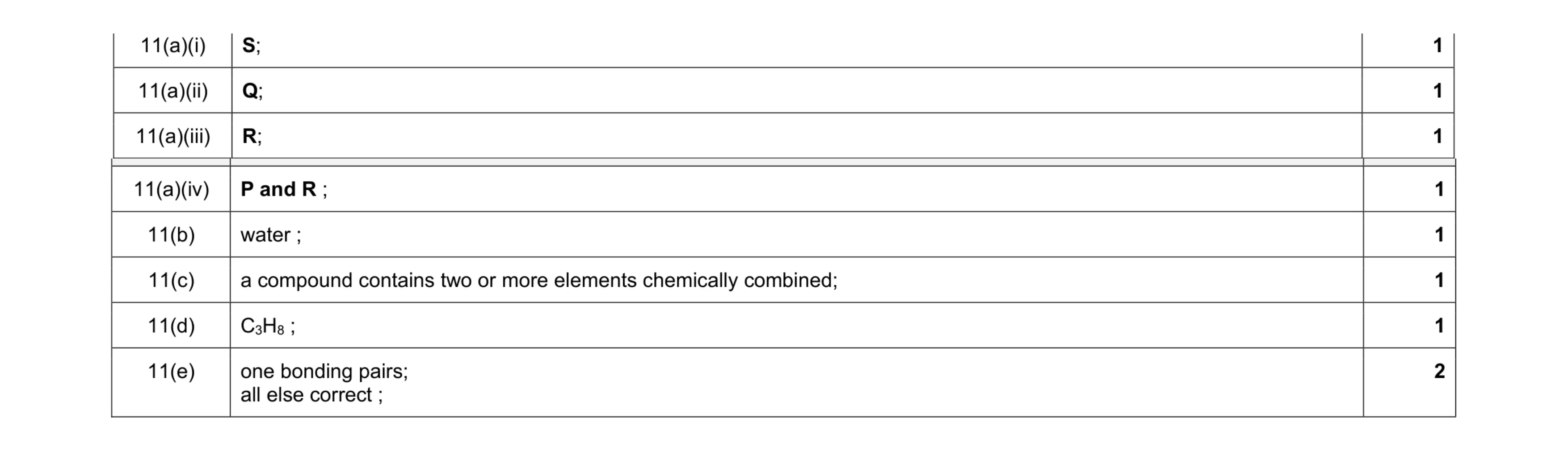 9
9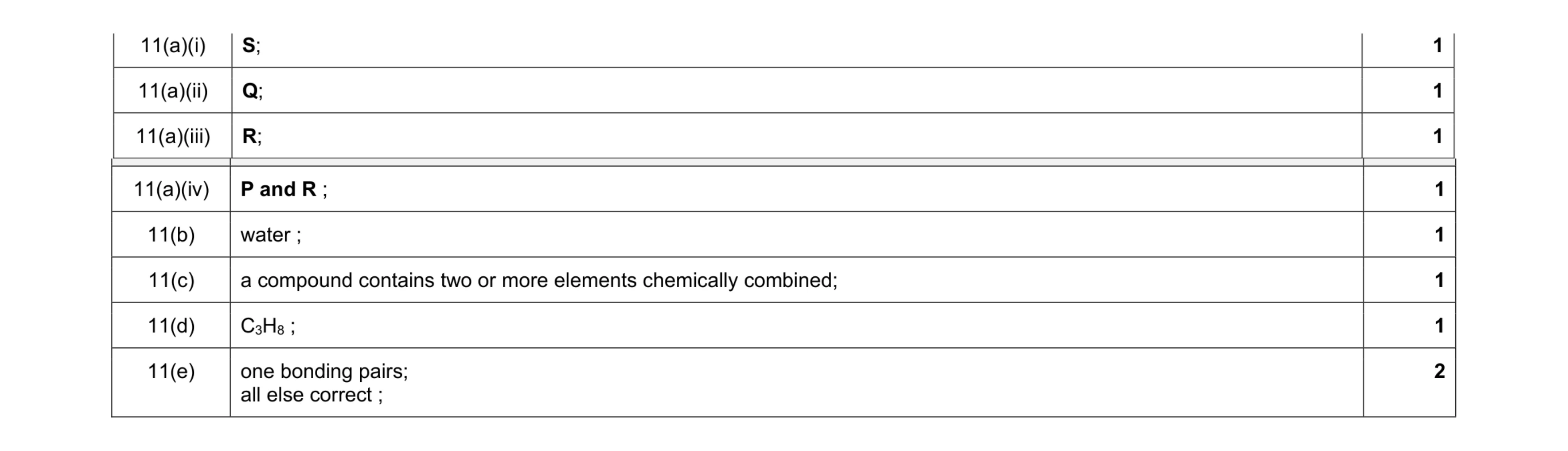 9
9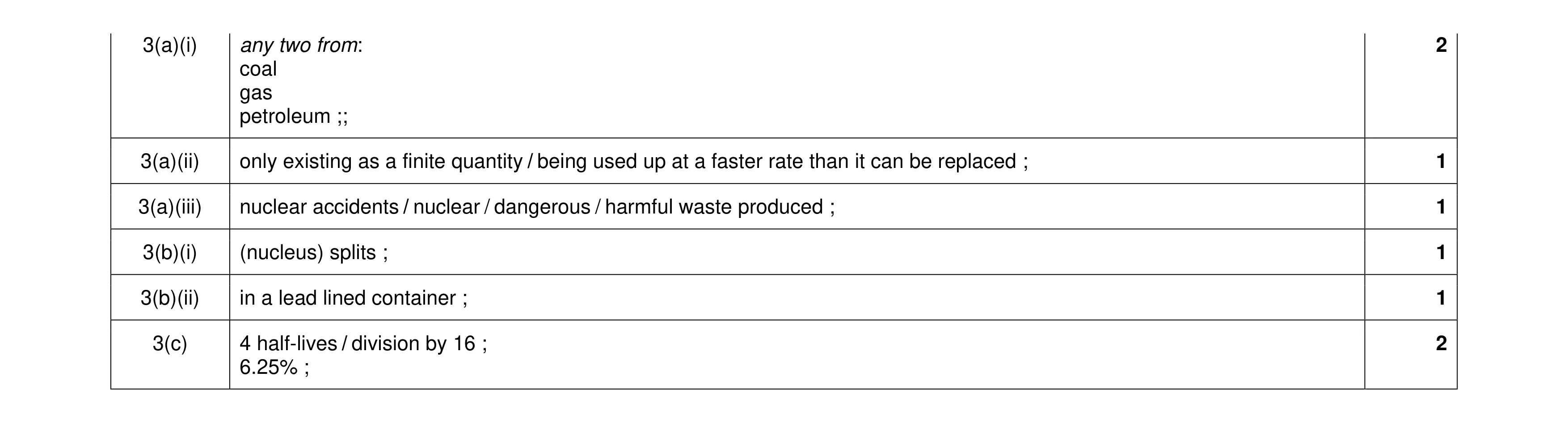 8
8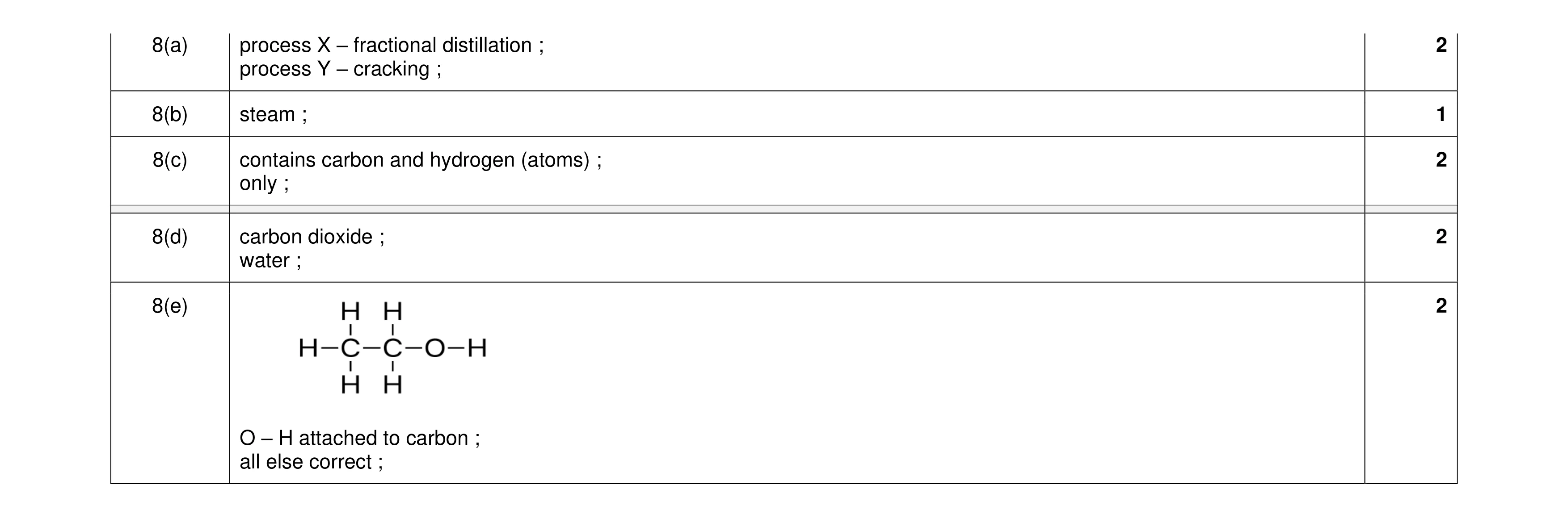 9
9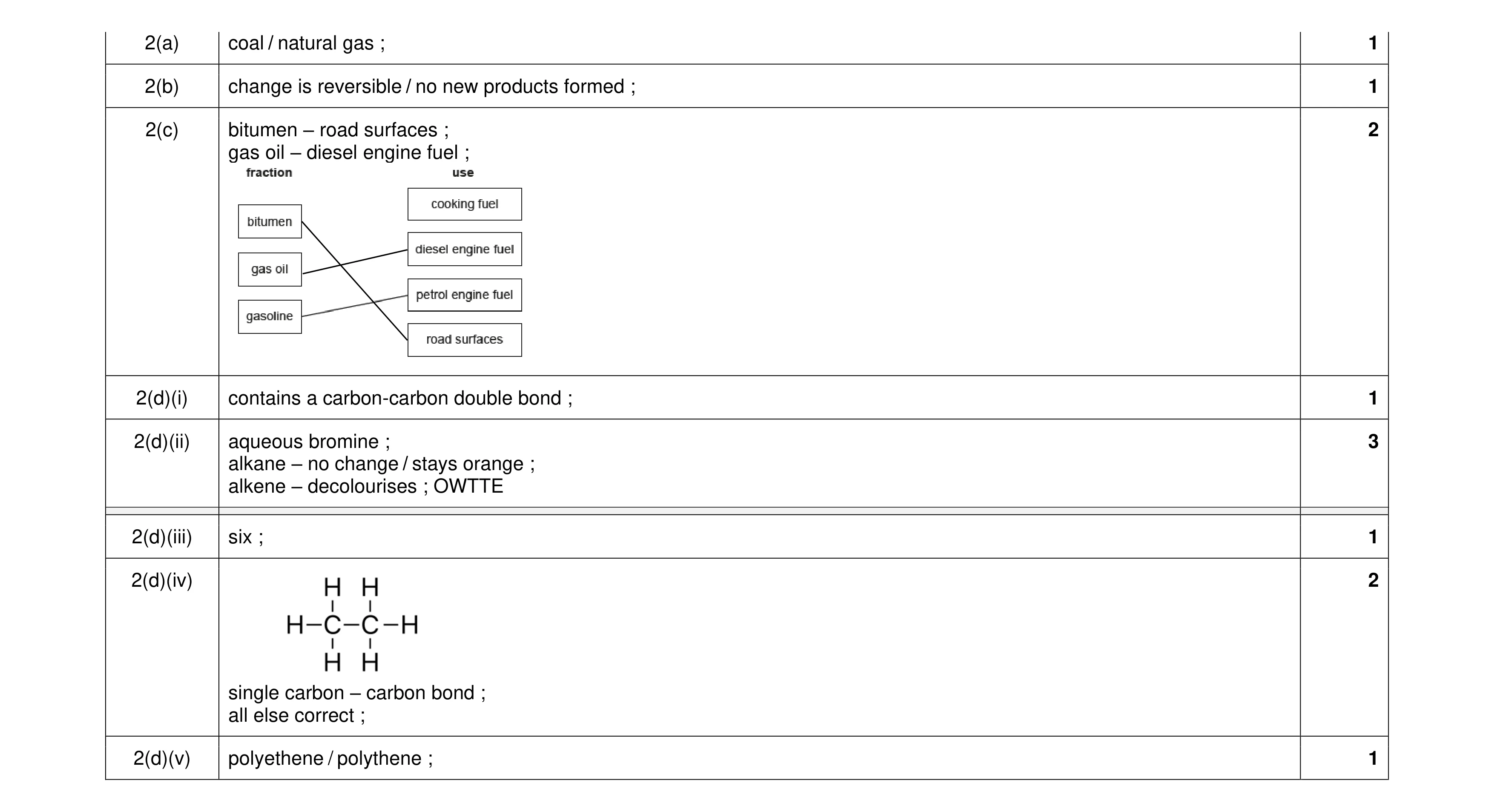 12
12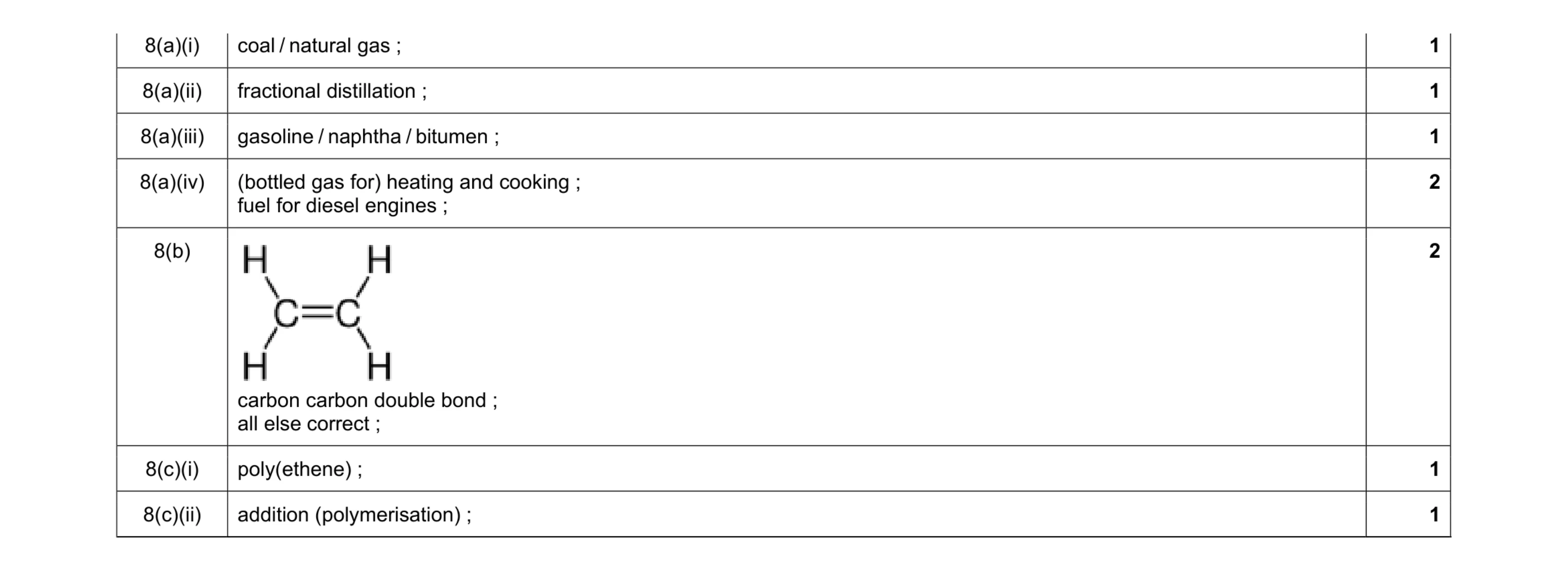 9
9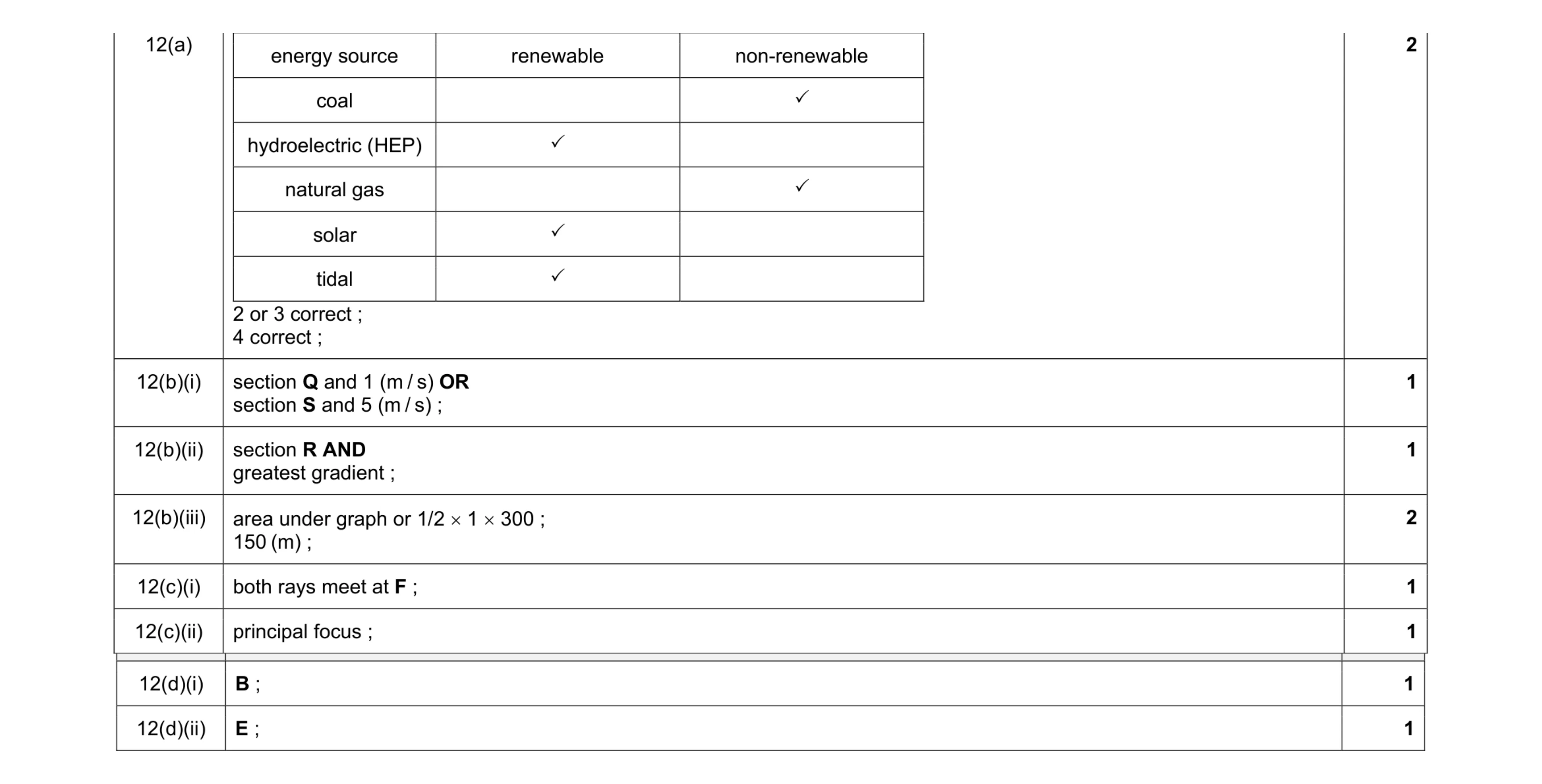 10
10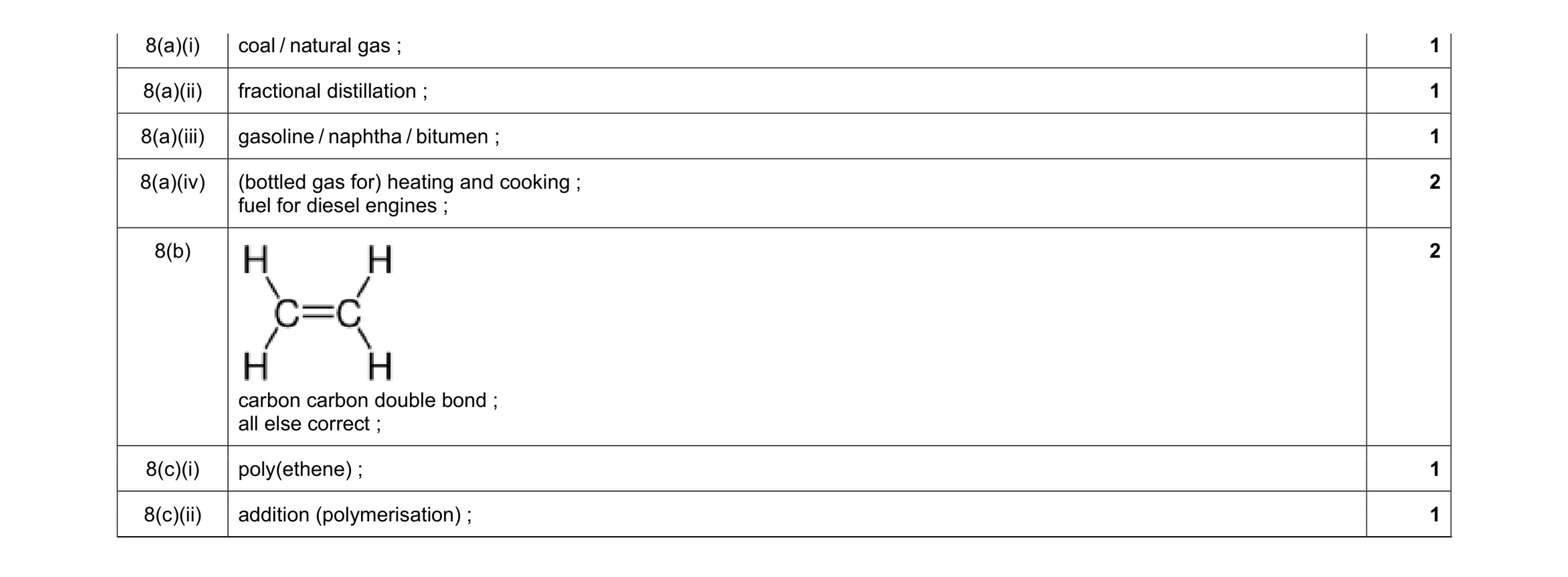 9
9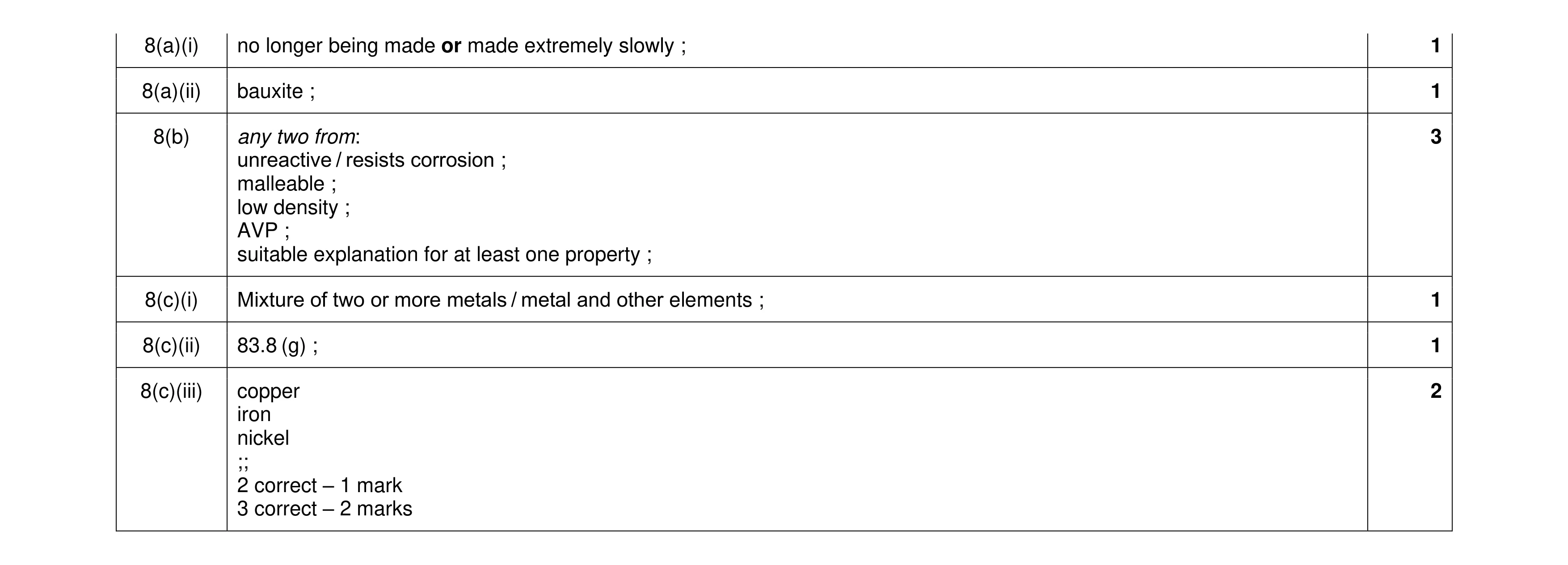 9
9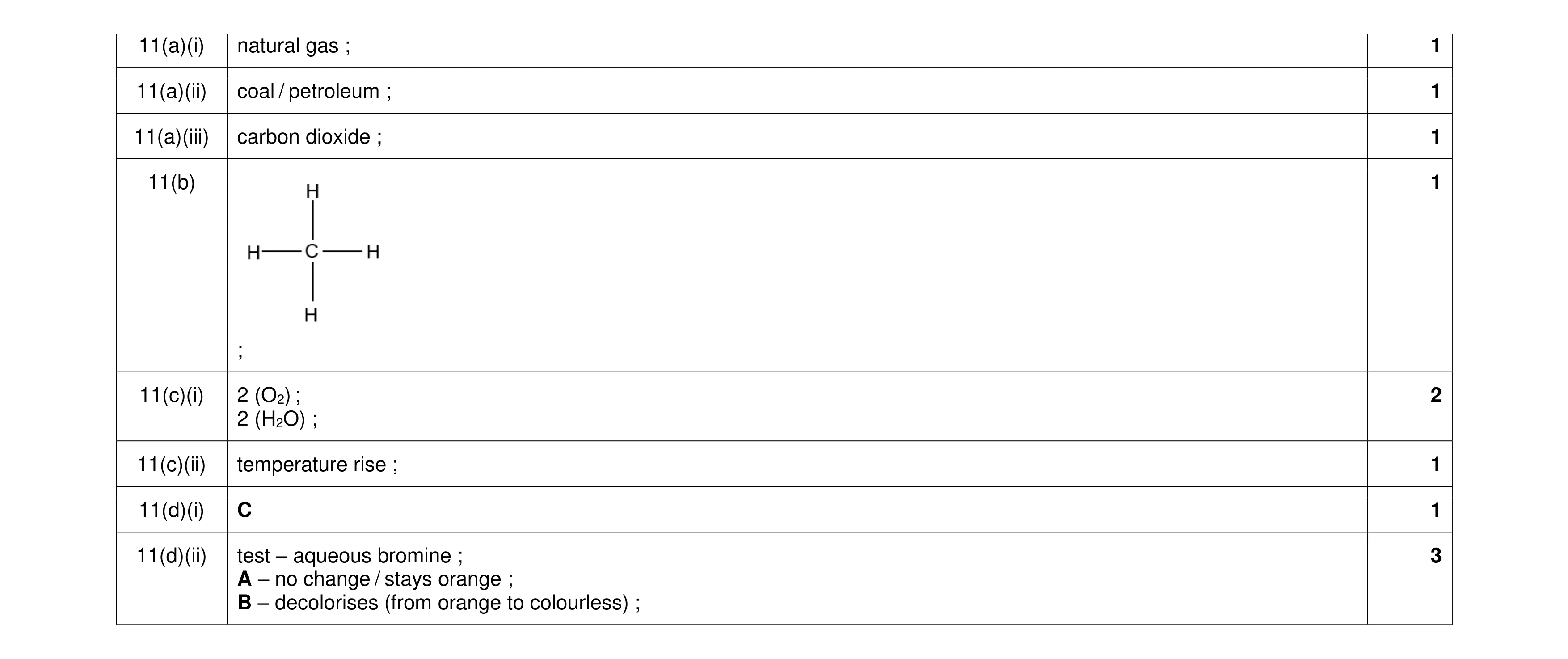 11
11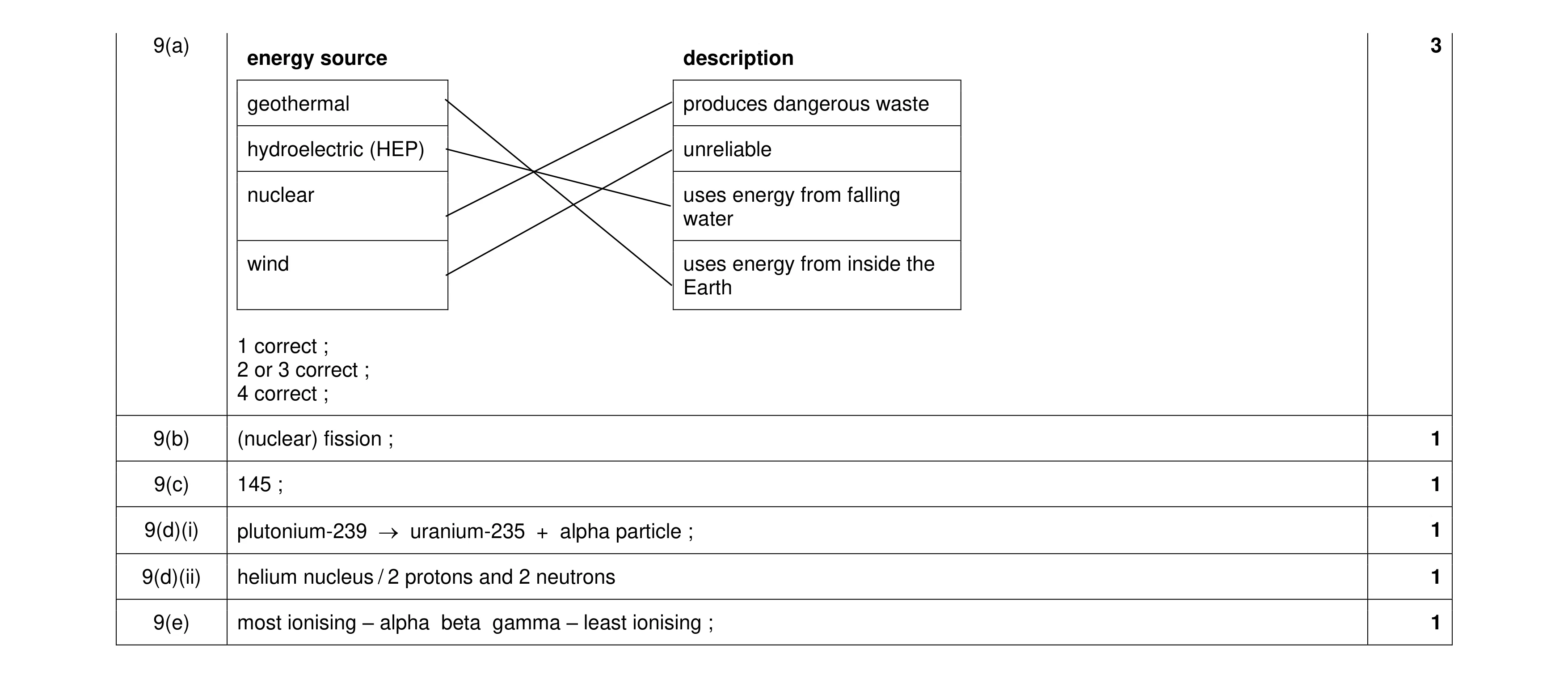 8
8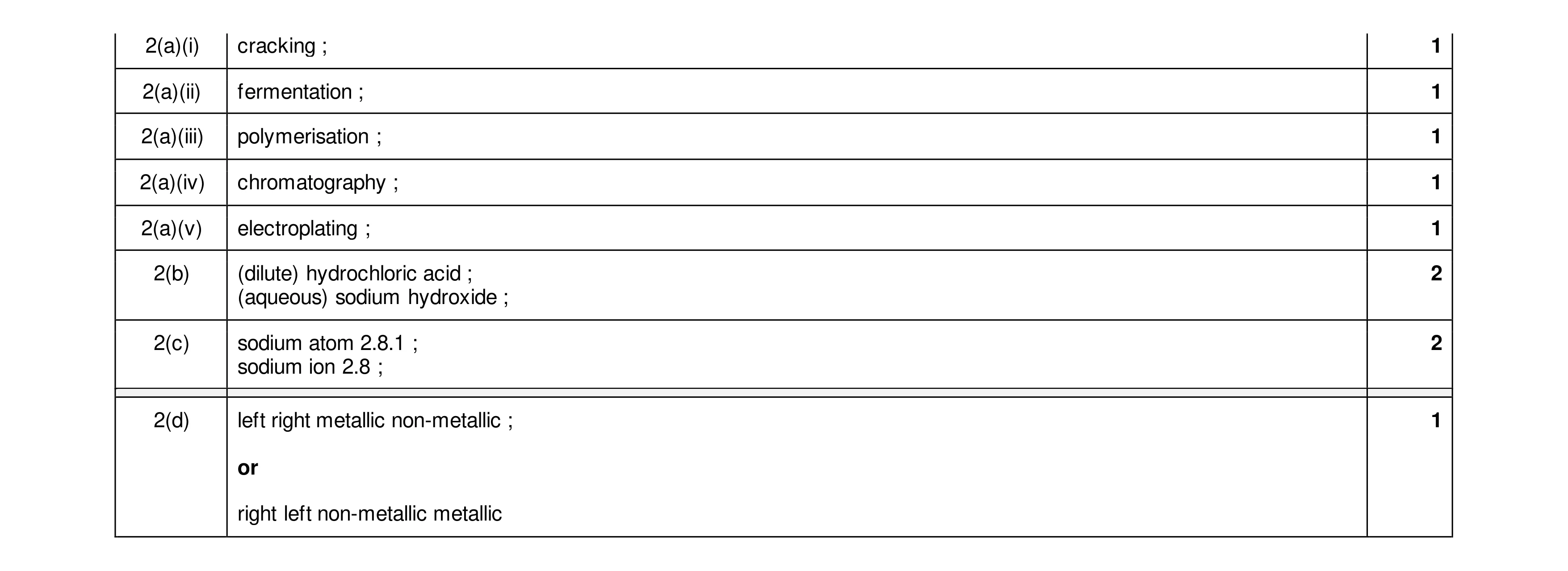 10
10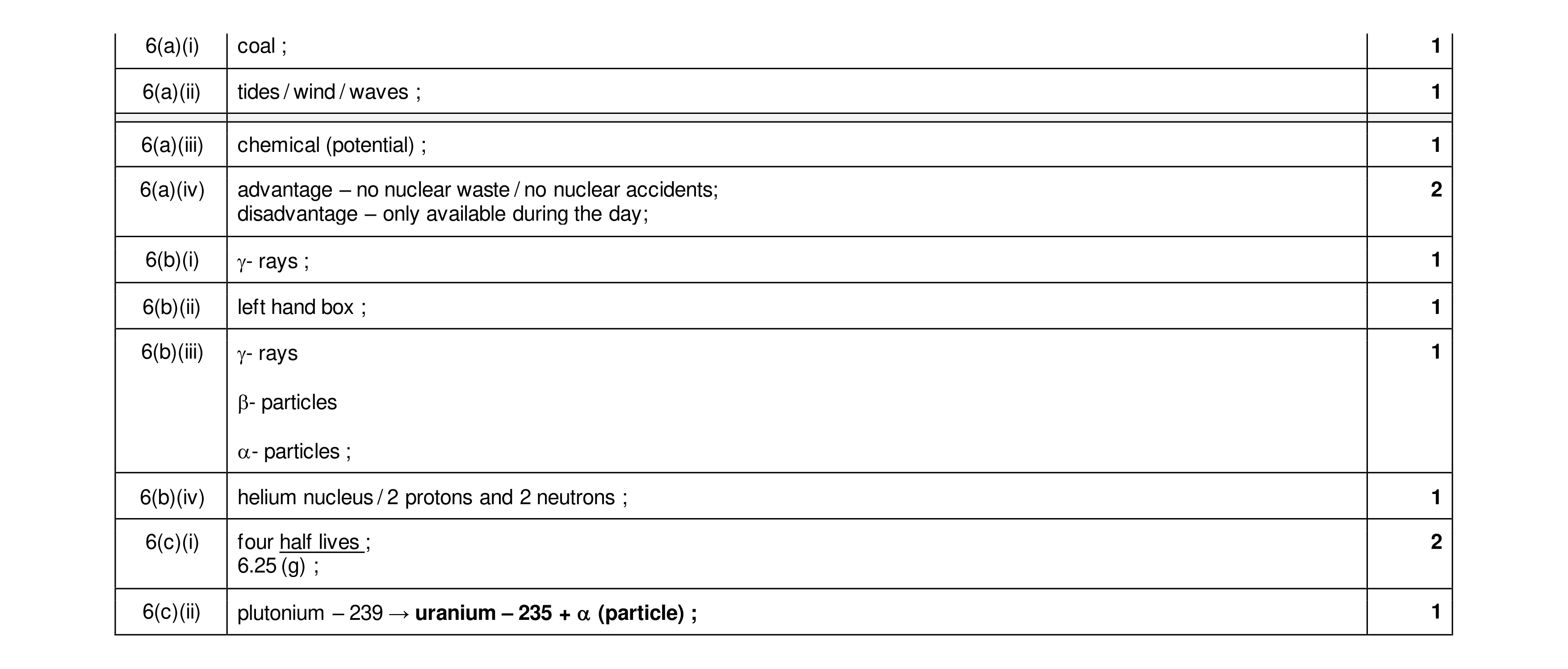 12
12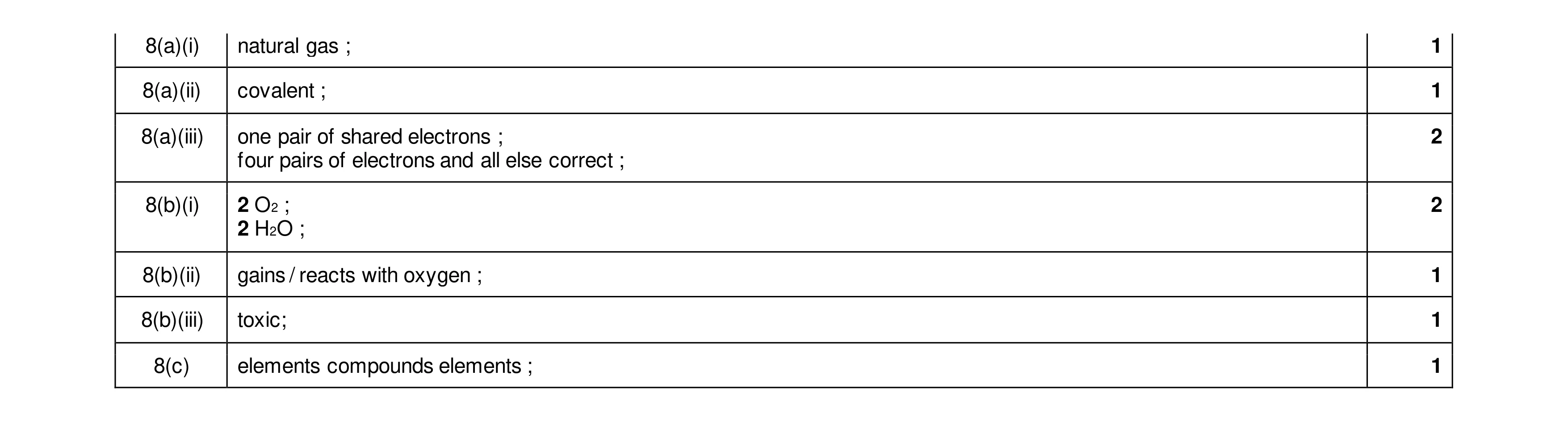 9
9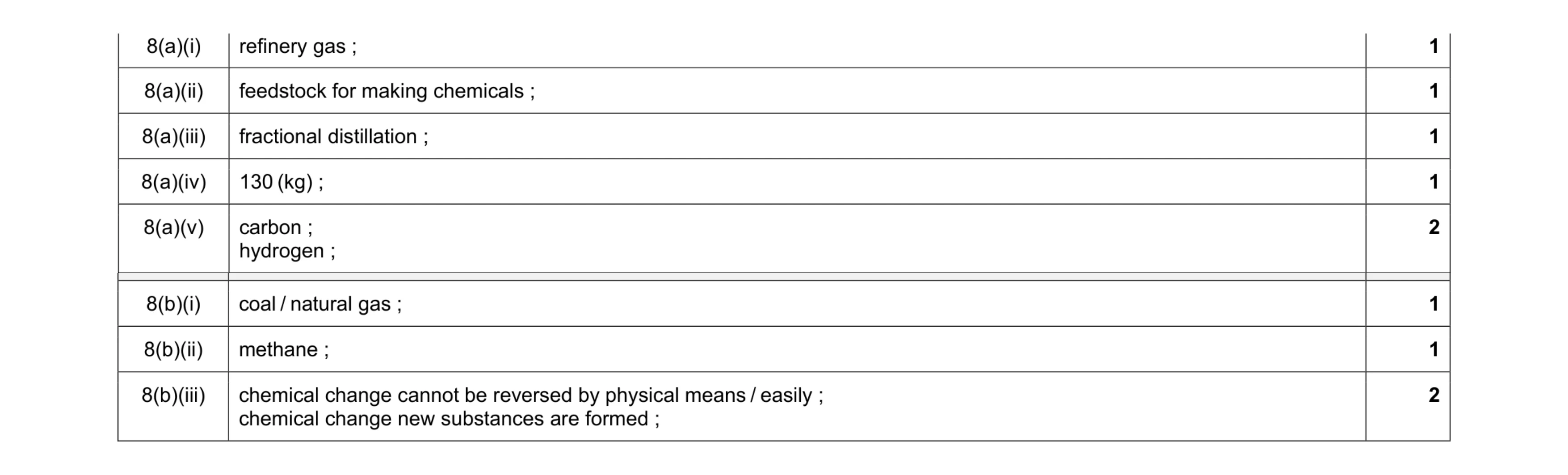 10
10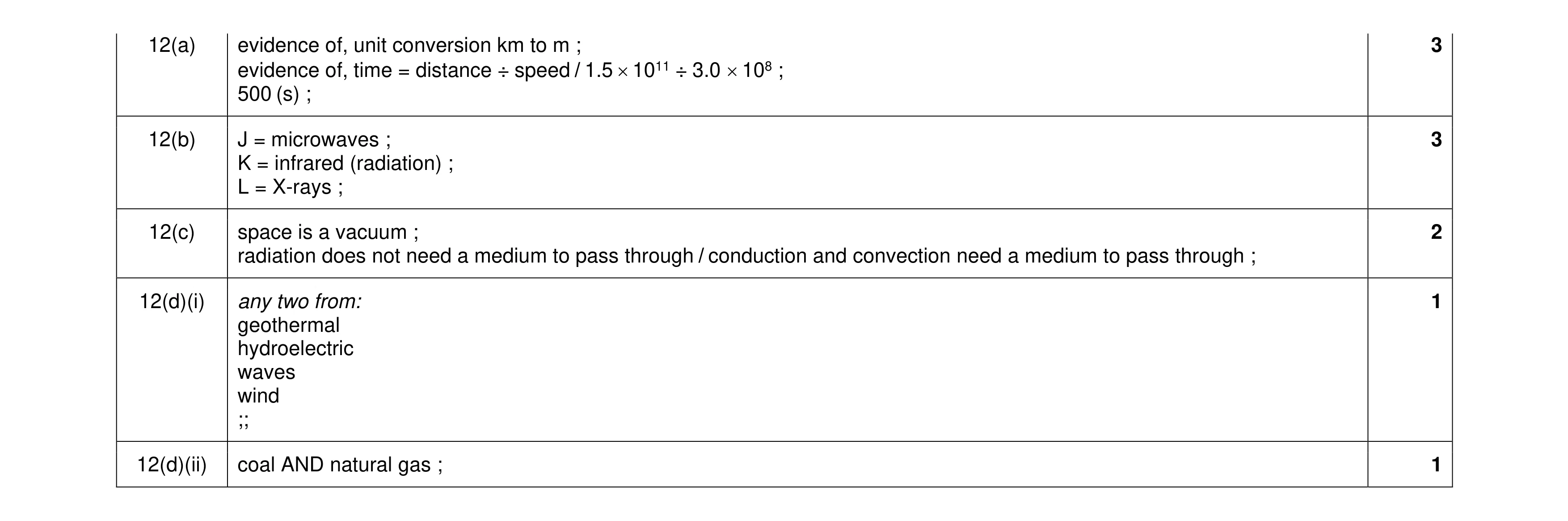 10
10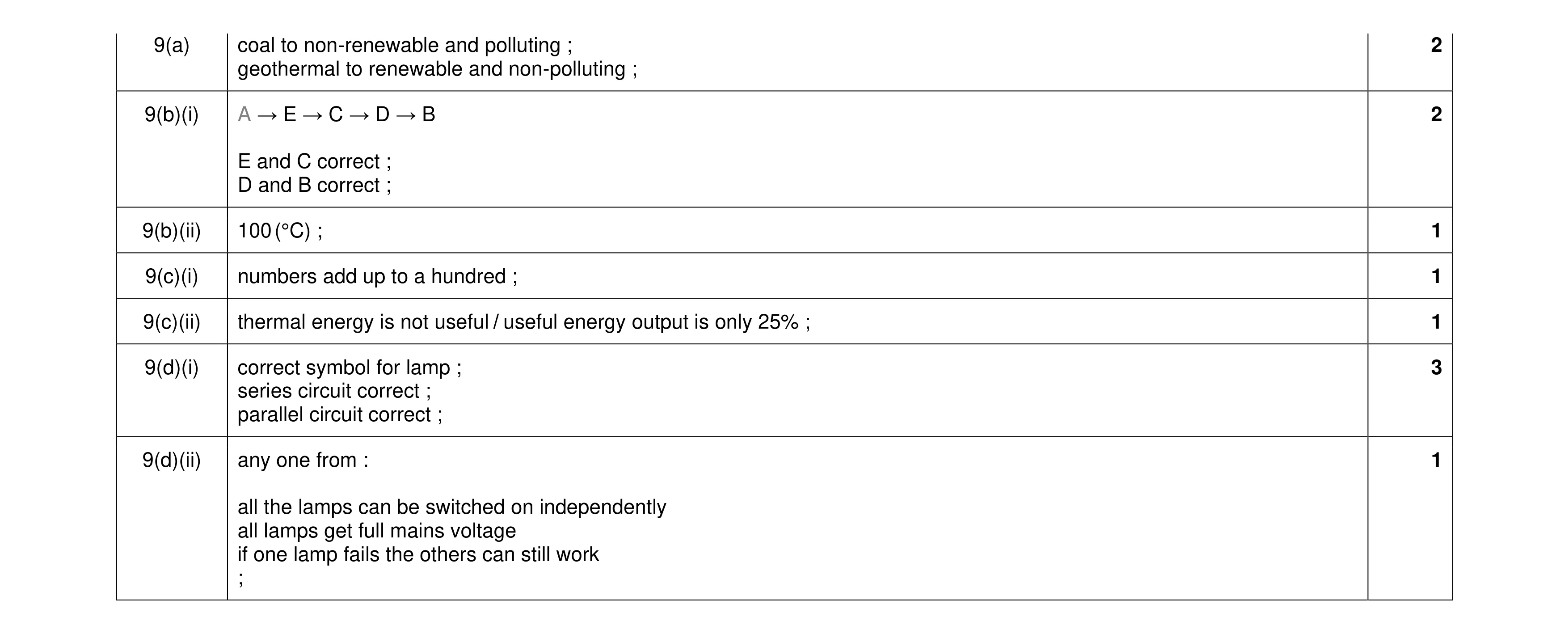 11
11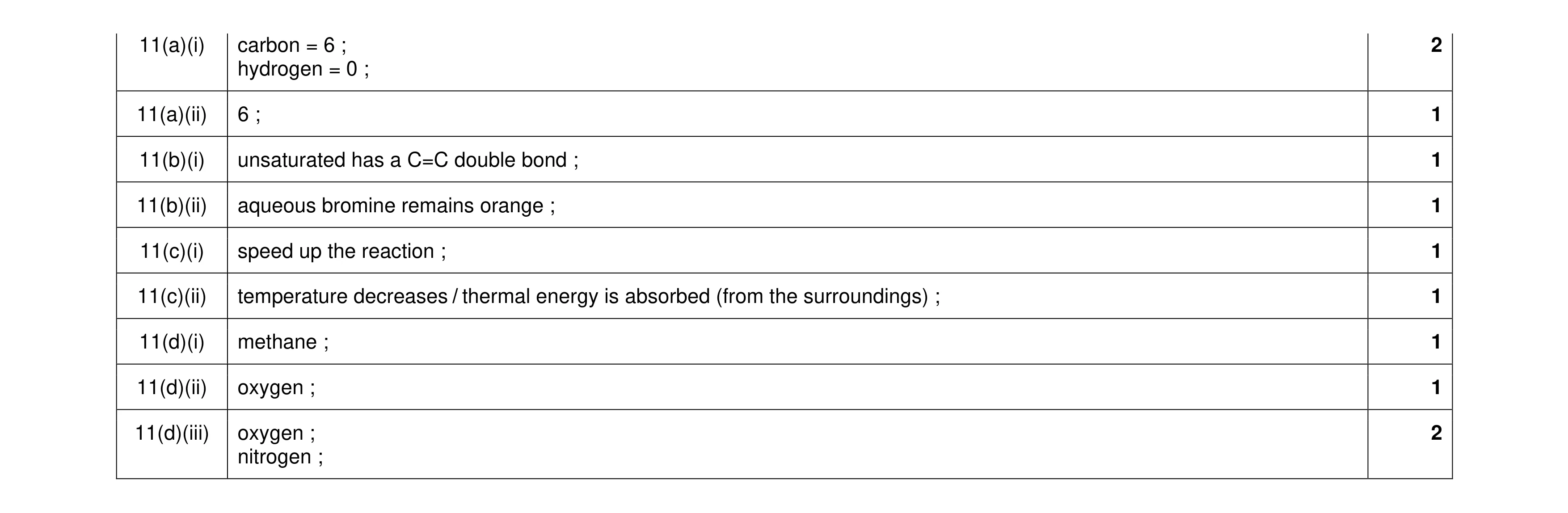 11
11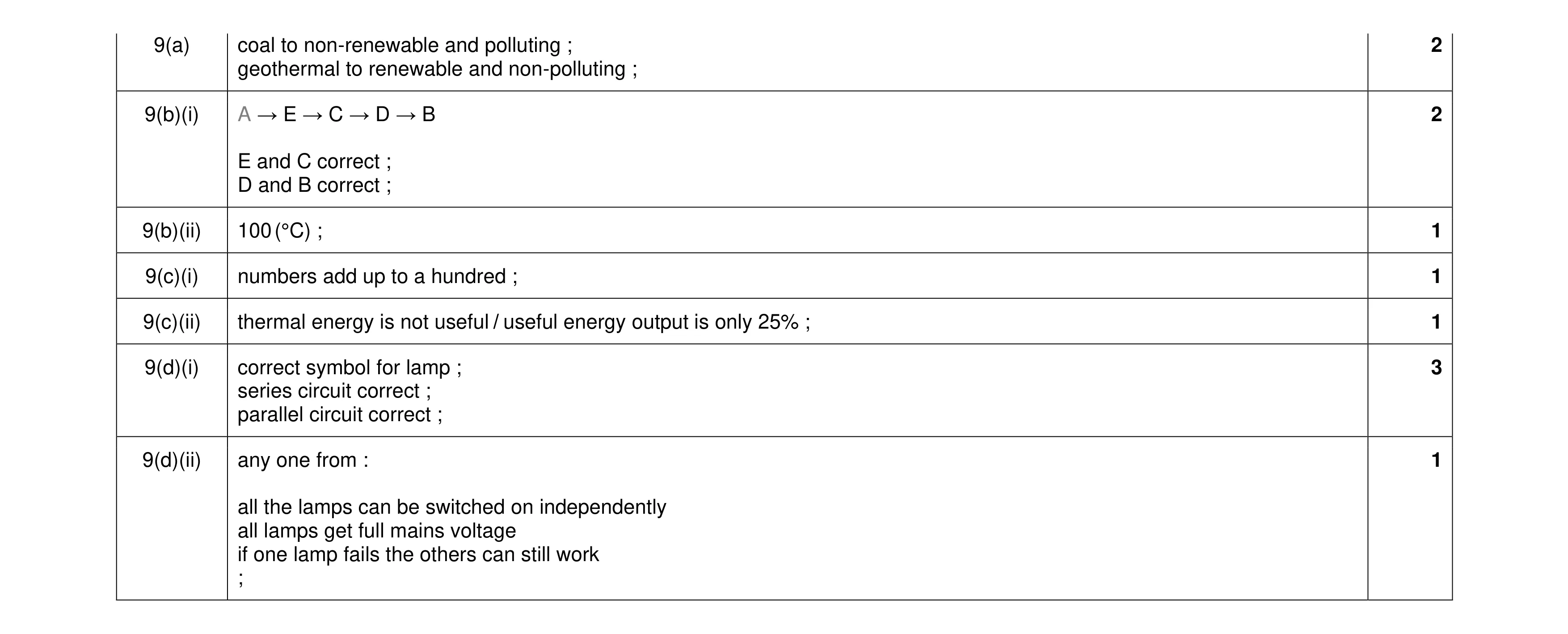 11
11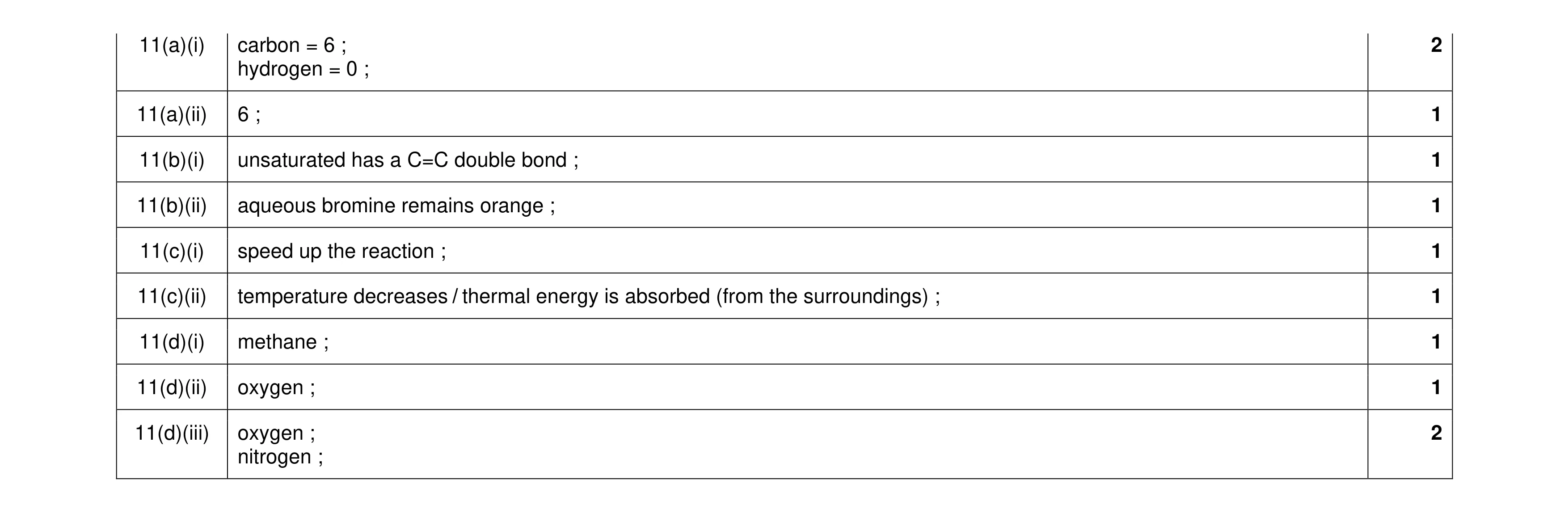 11
11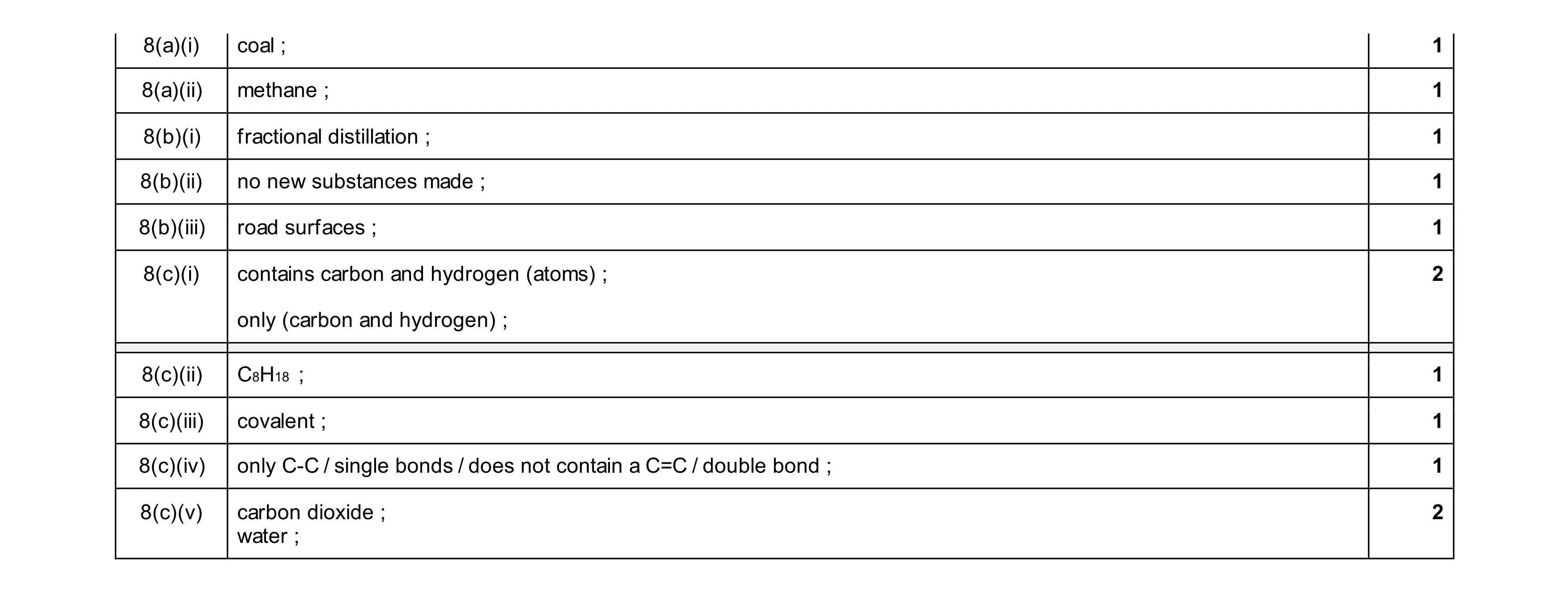 12
12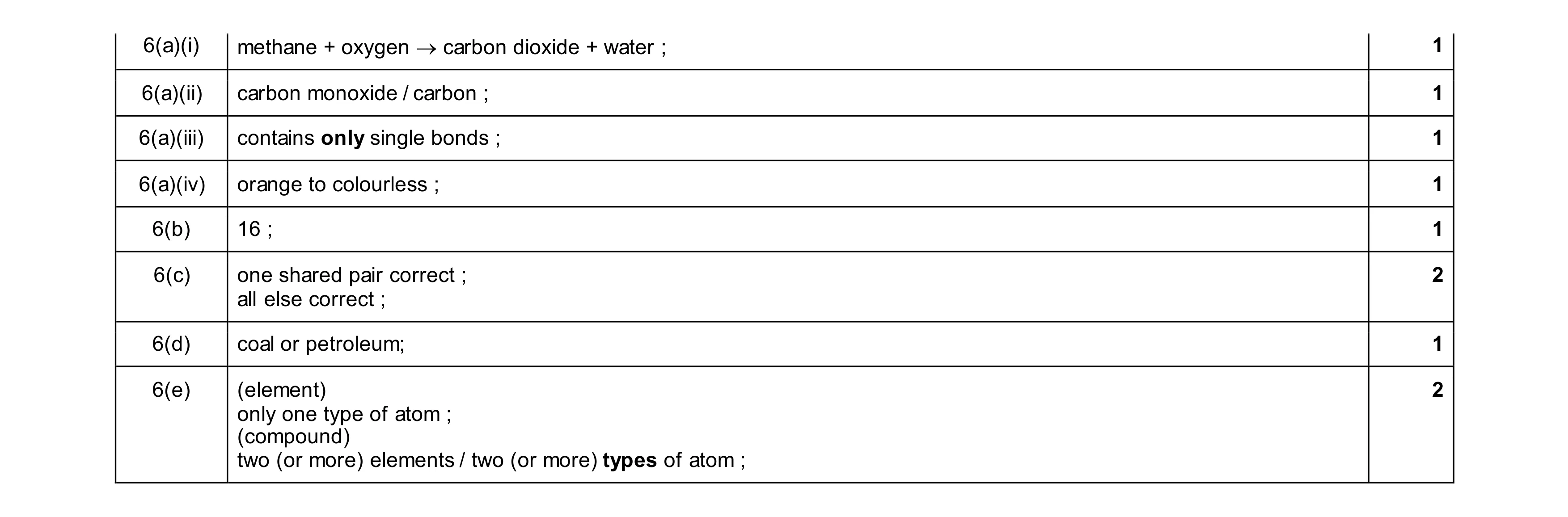 10
10