Questions as text
Q1 · Petroleum is a black liquid 0654/41 May/June 2017
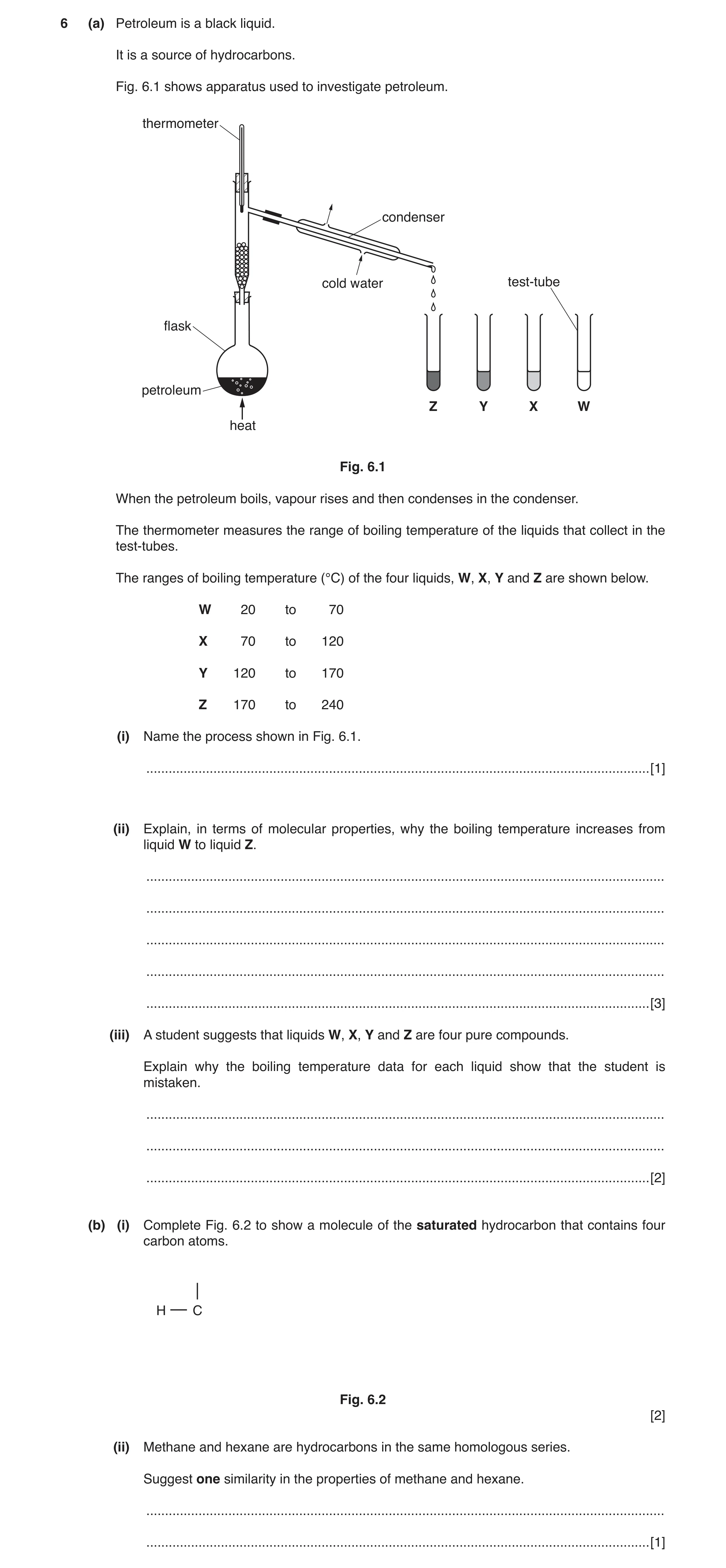
6 (a) Petroleum is a black liquid. It is a source of hydrocarbons. Fig. 6.1 shows apparatus used to investigate petroleum. thermometer condenser cold water test-tube flask petroleum Z Y X W heat Fig. 6.1 When the petroleum boils, vapour rises and then condenses in the condenser. The thermometer measures the range of boiling temperature of the liquids that collect in the test-tubes. The ranges of boiling temperature (°C) of the four liquids, W, X, Y and Z are shown below. W 20 to 70 X 70 to 120 Y 120 to 170 Z 170 to 240 (i) Name the process shown in Fig. 6.1. … [1] (ii) Explain, in terms of molecular properties, why the boiling temperature increases from liquid W to liquid Z. … … … … … [3] (iii) A student suggests that liquids W, X, Y and Z are four pure compounds. Explain why the boiling temperature data for each liquid show that the student is mistaken. … … … [2] (b) (i) Complete Fig. 6.2 to show a molecule of the saturated hydrocarbon that contains four carbon atoms. H C Fig. 6.2 [2] (ii) Methane and hexane are hydrocarbons in the same homologous series. Suggest one similarity in the properties of methane and hexane. … … [1]
9 marks
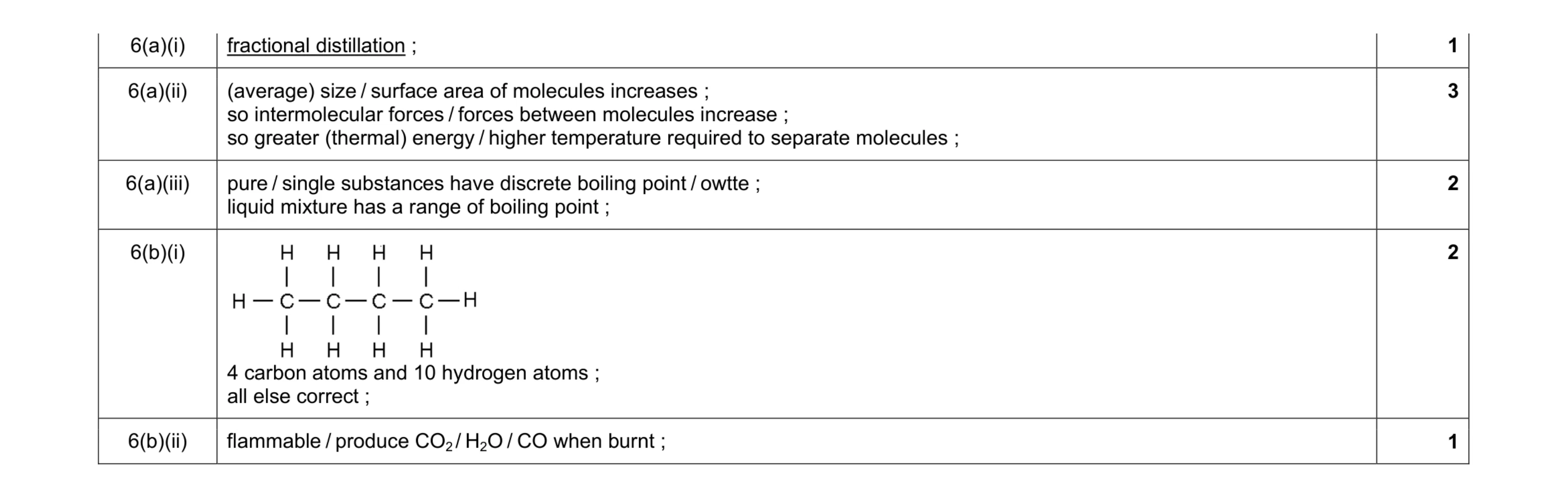
Mark scheme: 6(a)(i) fractional distillation ; 1 6(a)(ii) (average) size / surface area of molecules increases ; so intermolecular forces / forces between molecules increase ; so greater (thermal) energy / higher temperature required to separate molecules ; 3 6(a)(iii) pure / single substances have discrete boiling point / owtte ; liquid mixture has a range of boiling point ; 2 6(b)(i) 4 carbon atoms and 10 hydrogen atoms ; all else correct ; 2 6(b)(ii) flammable / produce CO2 / H2O / CO when burnt ; 1
This question in 0654/41 May/June 2017
Q2 · Petroleum is a liquid fossil fuel that is a mixture containing many different hydrocarbons 0654/41 Oct/Nov 2017
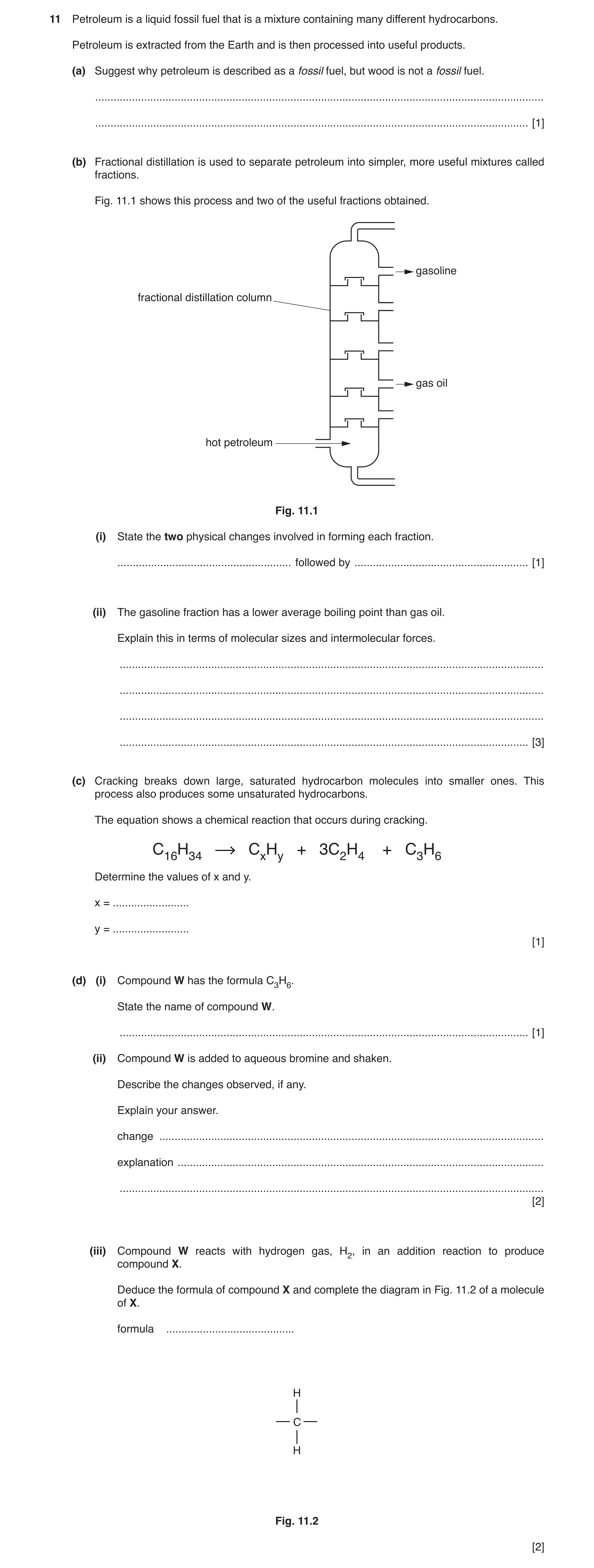
11 Petroleum is a liquid fossil fuel that is a mixture containing many different hydrocarbons. Petroleum is extracted from the Earth and is then processed into useful products. (a) Suggest why petroleum is described as a fossil fuel, but wood is not a fossil fuel. … … [1] (b) Fractional distillation is used to separate petroleum into simpler, more useful mixtures called fractions. Fig. 11.1 shows this process and two of the useful fractions obtained. gasoline fractional distillation column gas oil hot petroleum Fig. 11.1 (i) State the two physical changes involved in forming each fraction. … followed by … [1] (ii) The gasoline fraction has a lower average boiling point than gas oil. Explain this in terms of molecular sizes and intermolecular forces. … … … … [3] (c) Cracking breaks down large, saturated hydrocarbon molecules into smaller ones. This process also produces some unsaturated hydrocarbons. The equation shows a chemical reaction that occurs during cracking. C16H34 CxHy + 3C2H4 + C3H6 Determine the values of x and y. x = … y = … [1] (d) (i) Compound W has the formula C3H6. State the name of compound W. … [1] (ii) Compound W is added to aqueous bromine and shaken. Describe the changes observed, if any. Explain your answer. change … explanation … … [2] (iii) Compound W reacts with hydrogen gas, H2, in an addition reaction to produce compound X. Deduce the formula of compound X and complete the diagram in Fig. 11.2 of a molecule of X. formula … H C H Fig. 11.2 [2]
11 marks
Mark scheme: 11(a) reference to long time required to form fossil fuels / AVP ; 1 11(b)(i) evaporation followed by condensation ; 1 11(b)(ii) (average) size / surface area of molecules in gasoline is lower ; intermolecular forces / forces between molecules are lower ; lower (thermal) energy / lower temperature required to separate molecules / overcome forces ; 3 11(c) x = 7 and y = 16 ; 1 11(d) propene ; 1 11(d)(ii) bromine decolourised / orange to colourless ; propene is an alkene / is unsaturated / double bond ; 2 11(d)(iii) C3H8 ; same number of C and H as in formula and correctly bonded ; 2
This question in 0654/41 Oct/Nov 2017
Question 3 0654/41 Oct/Nov 2018
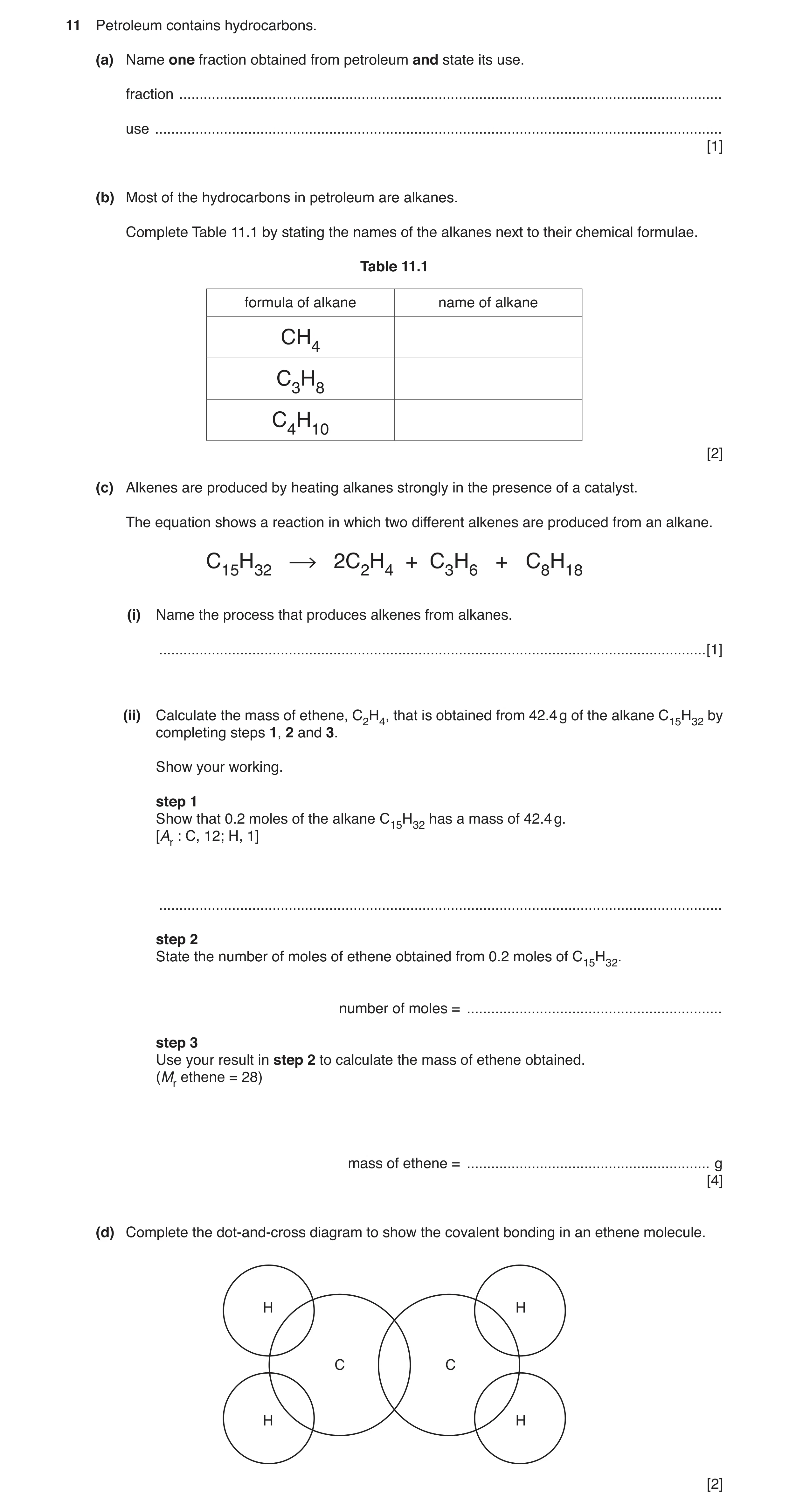
11 Petroleum contains hydrocarbons. (a) Name one fraction obtained from petroleum and state its use. fraction … use … [1] (b) Most of the hydrocarbons in petroleum are alkanes. Complete Table 11.1 by stating the names of the alkanes next to their chemical formulae. Table 11.1 formula of alkane name of alkane CH4 C3H8 C4H10 [2] (c) Alkenes are produced by heating alkanes strongly in the presence of a catalyst. The equation shows a reaction in which two different alkenes are produced from an alkane. C15H32 2C2H4 + C3H6 + C8H18 (i) Name the process that produces alkenes from alkanes. … [1] (ii) Calculate the mass of ethene, C2H4, that is obtained from 42.4 g of the alkane C15H32 by completing steps 1, 2 and 3. Show your working. step 1 Show that 0.2 moles of the alkane C15H32 has a mass of 42.4 g. [Ar : C, 12; H, 1] … step 2 State the number of moles of ethene obtained from 0.2 moles of C15H32. number of moles = … step 3 Use your result in step 2 to calculate the mass of ethene obtained. (Mr ethene = 28) mass of ethene = … g [4] (d) Complete the dot-and-cross diagram to show the covalent bonding in an ethene molecule. H H C C H H [2]
10 marks
Mark scheme: 11(a) refinery gas / gasoline / diesel / gas oil for fuel ; 1 11(b) methane propane butane 2 correct ; 3 correct ; 2 11(c)(i) (catalytic / thermal) cracking ; 1 11(c)(ii) step 1 calculate Mr (12 × 15) + (1 × 32) OR 212 ; moles = 42.4 ÷ 212 (= 0.2) / 0.2 × 212 (= 42.4) ; step 2 0.2 × 2 OR 0.4 ; step 3 0.4 × 28 = 1.2 (g) ; 4 11(d) two shared pairs between carbons ; four shared pairs between carbon and hydrogens ; 2
This question in 0654/41 Oct/Nov 2018
Q4 · A petrol engine in a car uses a mixture of air and gasoline 0654/41 Oct/Nov 2019
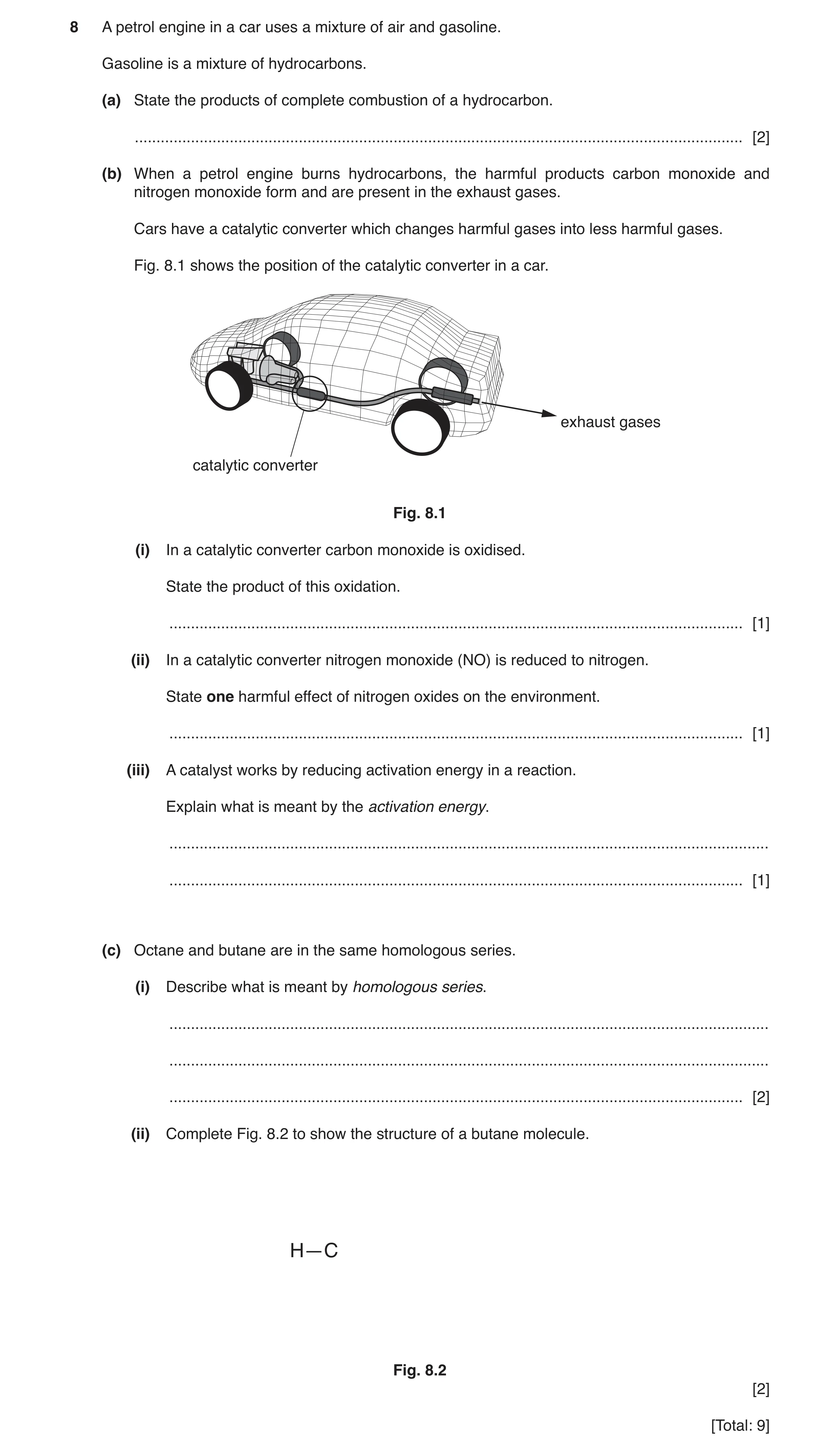
8 A petrol engine in a car uses a mixture of air and gasoline. Gasoline is a mixture of hydrocarbons. (a) State the products of complete combustion of a hydrocarbon. … [2] (b) When a petrol engine burns hydrocarbons, the harmful products carbon monoxide and nitrogen monoxide form and are present in the exhaust gases. Cars have a catalytic converter which changes harmful gases into less harmful gases. Fig. 8.1 shows the position of the catalytic converter in a car. exhaust gases catalytic converter Fig. 8.1 (i) In a catalytic converter carbon monoxide is oxidised. State the product of this oxidation. … [1] (ii) In a catalytic converter nitrogen monoxide (NO) is reduced to nitrogen. State one harmful effect of nitrogen oxides on the environment. … [1] (iii) A catalyst works by reducing activation energy in a reaction. Explain what is meant by the activation energy. … … [1] (c) Octane and butane are in the same homologous series. (i) Describe what is meant by homologous series. … … … [2] (ii) Complete Fig. 8.2 to show the structure of a butane molecule. H—C Fig. 8.2 [2] [Total: 9]
9 marks
Mark scheme: 8(a) carbon dioxide ; water ; 2 8(b)(i) carbon dioxide ; 1 8(b)(ii) acid rain / named effect of acid rain / respiratory disease ; 1 8(b)(iii) minimum energy for particles / reactants to react ; 1 8(c)(i) same general formula ; similar chemical properties ; 2 8(c)(ii) H H H H | | | | H – C – C – C – C – H | | | | H H H H chain of 4 C ; all else correct ; 2
This question in 0654/41 Oct/Nov 2019
Q5 · Petroleum is separated into useful chemicals by fractional distillation 0654/41 May/June 2020
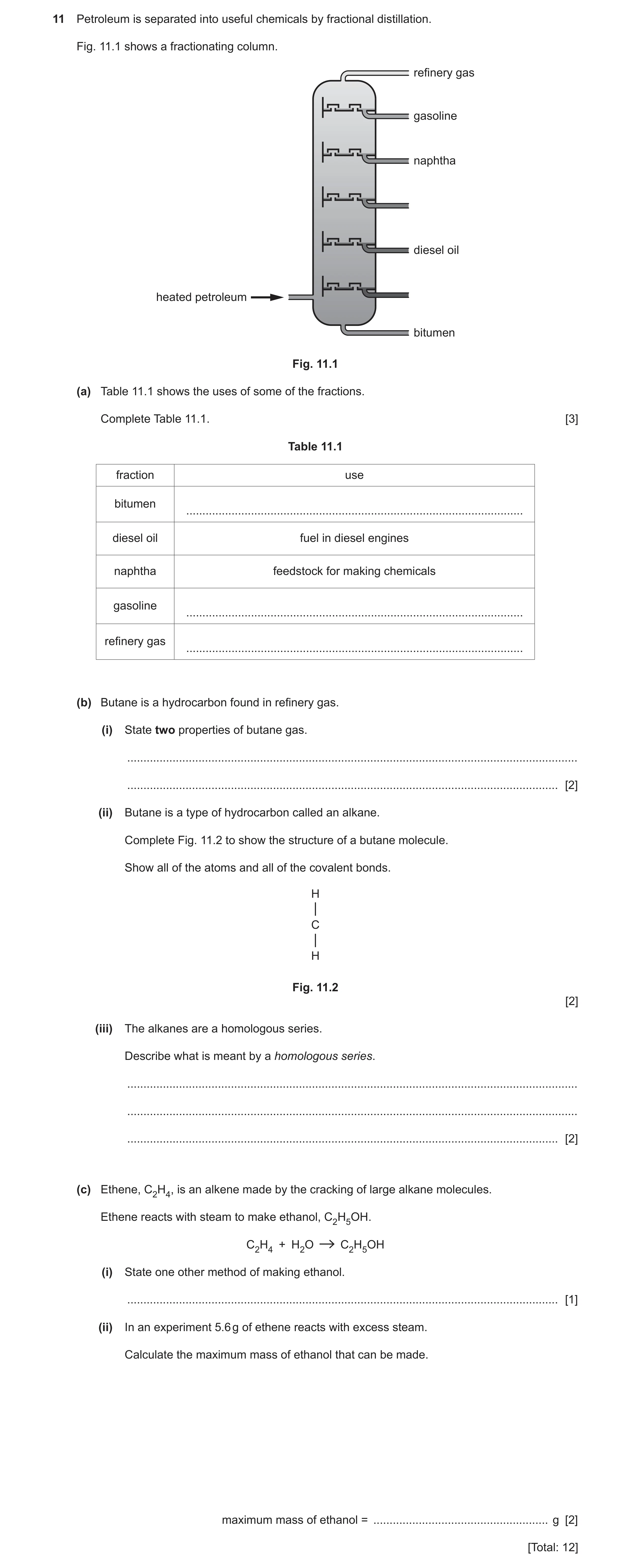
11 Petroleum is separated into useful chemicals by fractional distillation. Fig. 11.1 shows a fractionating column. refinery gas gasoline naphtha diesel oil heated petroleum bitumen Fig. 11.1 (a) Table 11.1 shows the uses of some of the fractions. Complete Table 11.1. [3] Table 11.1 fraction use bitumen … diesel oil fuel in diesel engines naphtha feedstock for making chemicals gasoline … refinery gas … (b) Butane is a hydrocarbon found in refinery gas. (i) State two properties of butane gas. … … [2] (ii) Butane is a type of hydrocarbon called an alkane. Complete Fig. 11.2 to show the structure of a butane molecule. Show all of the atoms and all of the covalent bonds. H C H Fig. 11.2 [2] (iii) The alkanes are a homologous series. Describe what is meant by a homologous series. … … … [2] (c) Ethene, C2H4, is an alkene made by the cracking of large alkane molecules. Ethene reacts with steam to make ethanol, C2H5OH. C2H4 + H2O C2H5OH (i) State one other method of making ethanol. … [1] (ii) In an experiment 5.6 g of ethene reacts with excess steam. Calculate the maximum mass of ethanol that can be made. maximum mass of ethanol = … g [2] [Total: 12]
12 marks
Mark scheme: 11(a) bitumen – road surfaces ; gasoline – fuel in cars ; refinery gas – bottled gas for heating or cooking or camping ; 3 Question Answer Marks 11(b)(i) low boiling point colourless ignites easily unreactive any general property of a gas ;; max 2 11(b)(ii) 1 mark for structure with 4 carbon atoms ; 1 mark for the rest of the structure correctly drawn ; 2 11(b)(iii) (family of compounds with) same general formula ; similar chemical properties ; 2 11(c)(i) fermentation 1 11(c)(ii) relative molecular mass of C2H4 =28 and of C2H5OH = 46 or (46 × 5.6) ÷ 28 ; = 9.2 ; 2
This question in 0654/41 May/June 2020
Q6 · Ammonium sulfate is used as a fertiliser 0654/42 May/June 2020
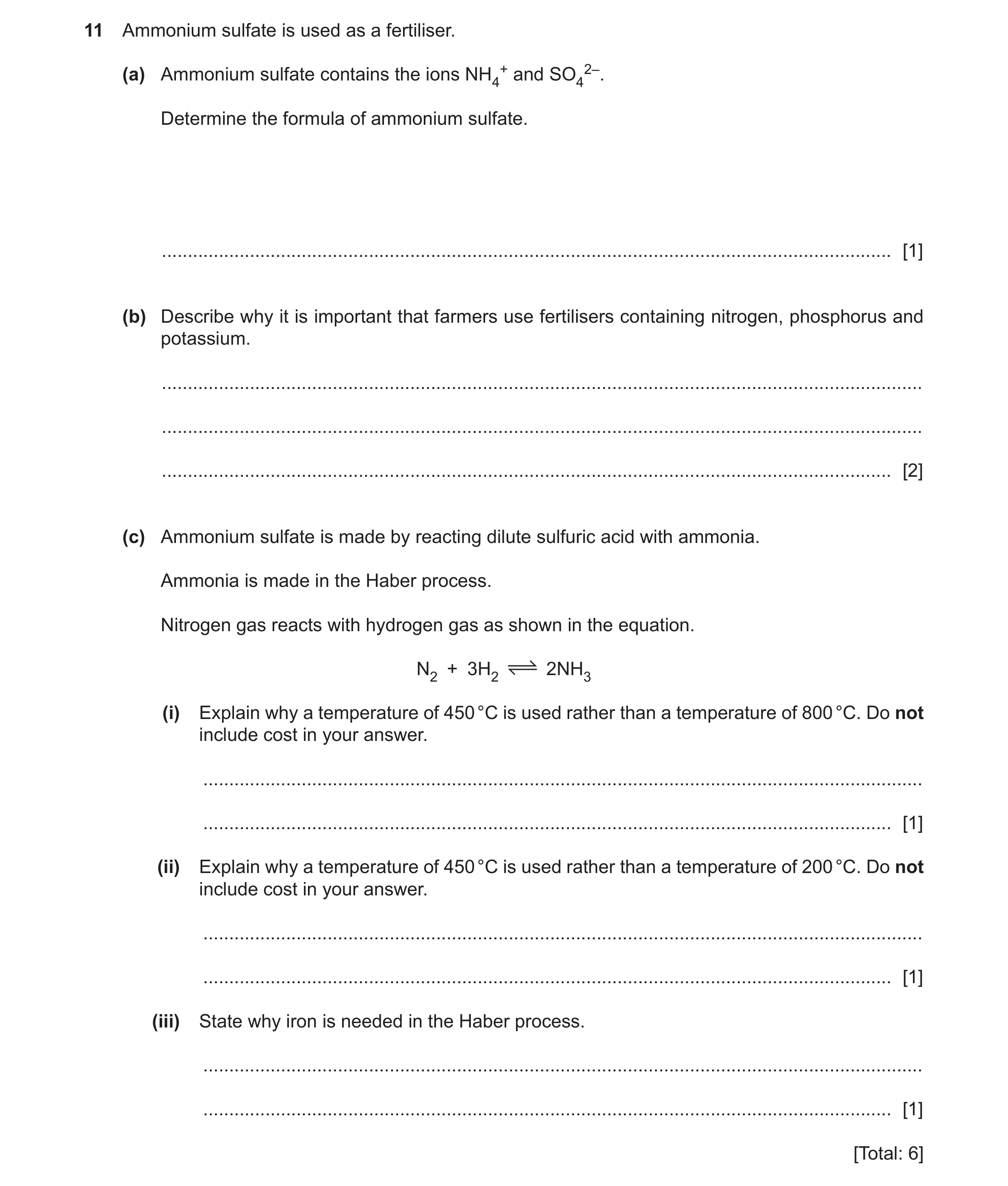
11 Ammonium sulfate is used as a fertiliser. (a) Ammonium sulfate contains the ions NH4+ and SO42–. Determine the formula of ammonium sulfate. … [1] (b) Describe why it is important that farmers use fertilisers containing nitrogen, phosphorus and potassium. … … … [2] (c) Ammonium sulfate is made by reacting dilute sulfuric acid with ammonia. Ammonia is made in the Haber process. Nitrogen gas reacts with hydrogen gas as shown in the equation. N2 + 3H2 2NH3 (i) Explain why a temperature of 450 °C is used rather than a temperature of 800 °C. Do not include cost in your answer. … … [1] (ii) Explain why a temperature of 450 °C is used rather than a temperature of 200 °C. Do not include cost in your answer. … … [1] (iii) State why iron is needed in the Haber process. … … [1] [Total: 6]
6 marks
Mark scheme: 11(a) (NH4)2SO4 ; 1 11(b) to improve crop yield / idea of producing better quality crops ; fertilisers provide the essential elements for plant growth / owtte ; plants remove NPK (from soil), which needs to be replaced / owtte ; max 2 11(c)(i) idea that 450°C gives higher yield (than 800°C) / ORA ; 1 11(c)(ii) idea that rate of reaction is faster at 450°C (than at 200°C) / ORA ; 1 11(c)(iii) iron is a catalyst / iron increases the rate of the reaction ; 1
This question in 0654/42 May/June 2020
Q7 · Propane and propene are both hydrocarbons 0654/42 Oct/Nov 2020
11 Propane and propene are both hydrocarbons. Fig. 11.1 shows the structure of a propene molecule. H H H C H C C H H Fig. 11.1 (a) Draw the structure of a propane molecule. [1] (b) Aqueous bromine is used to tell the difference between propane and propene. Describe the colour change, if any, that is seen when aqueous bromine is added to propane and to propene. propane … propene … [2] (c) Cracking is used to make propene. Describe cracking. Include what happens to the large hydrocarbon molecules during cracking, and the conditions needed for cracking. … … … … … … [4] (d) Fig. 11.2 shows the structure of a chloropropene molecule. Cl H C C H CH3 Fig. 11.2 Chloropropene is used to make the polymer poly(chloropropene). Draw the structure of poly(chloropropene). [1] [Total: 8]
8 marks
Mark scheme: 11(a) ; 1 11(b) bromine water remains orange (with propane) / bromine water is not decolourised (with propane) ; bromine water is decolourised (with propene) / bromine water changes from orange to colourless (with propene) ; 2 11(c) large hydrocarbon molecules are broken down / split up (into smaller molecules) ; to make, alkenes / named alkene other than propene ; plus any two from: high temperature / 300 to 600 °C ; catalyst / correctly named catalyst e.g. zeolite or porcelain ; high pressure / 50 to 200 atmospheres ; max 4 11(d) n ; 1
This question in 0654/42 Oct/Nov 2020
Q8 · Petroleum is a fossil fuel 0654/42 Feb/March 2021
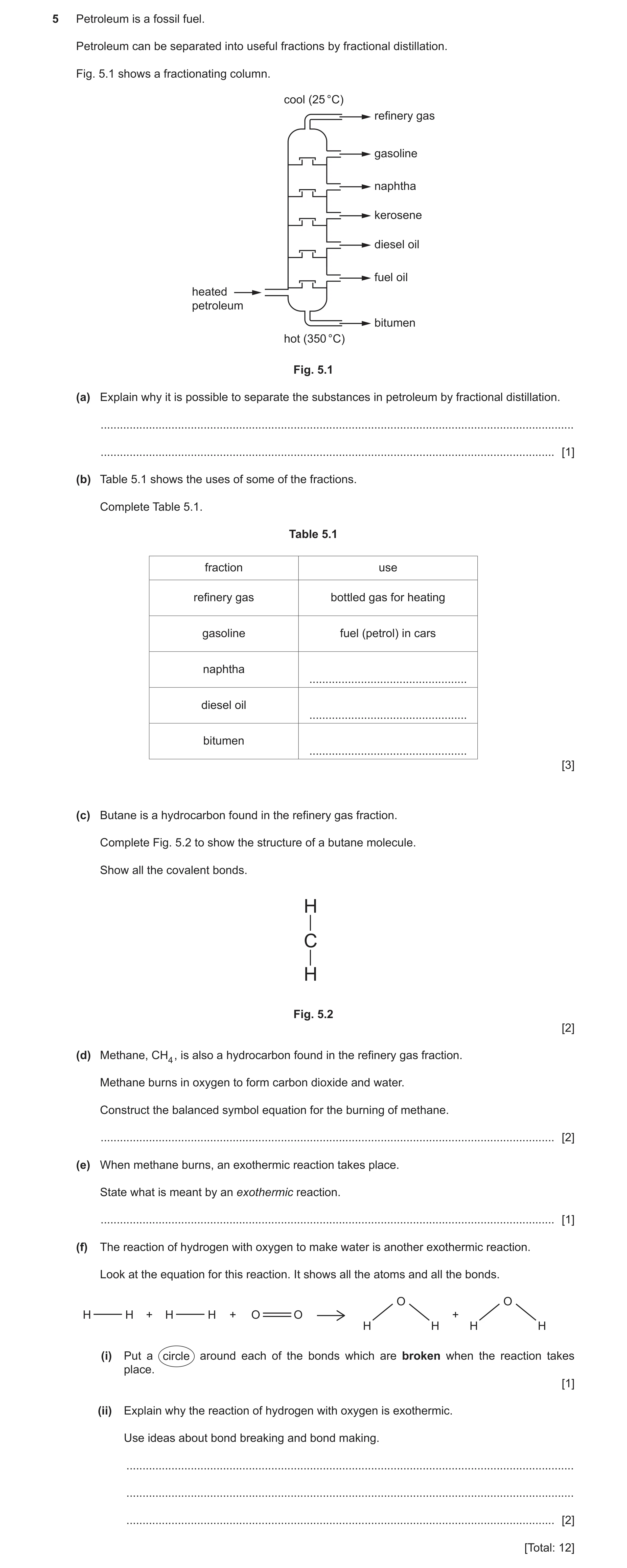
5 Petroleum is a fossil fuel. Petroleum can be separated into useful fractions by fractional distillation. Fig. 5.1 shows a fractionating column. cool (25 °C) refinery gas gasoline naphtha kerosene diesel oil fuel oil heated petroleum bitumen hot (350 °C) Fig. 5.1 (a) Explain why it is possible to separate the substances in petroleum by fractional distillation. … … [1] (b) Table 5.1 shows the uses of some of the fractions. Complete Table 5.1. Table 5.1 fraction use refinery gas bottled gas for heating gasoline fuel (petrol) in cars naphtha … diesel oil … bitumen … [3] (c) Butane is a hydrocarbon found in the refinery gas fraction. Complete Fig. 5.2 to show the structure of a butane molecule. Show all the covalent bonds. H C H Fig. 5.2 [2] (d) Methane, CH4 , is also a hydrocarbon found in the refinery gas fraction. Methane burns in oxygen to form carbon dioxide and water. Construct the balanced symbol equation for the burning of methane. … [2] (e) When methane burns, an exothermic reaction takes place. State what is meant by an exothermic reaction. … [1] (f) The reaction of hydrogen with oxygen to make water is another exothermic reaction. Look at the equation for this reaction. It shows all the atoms and all the bonds. O O H H + H H + O O + H H H H (i) Put a circle around each of the bonds which are broken when the reaction takes place. [1] (ii) Explain why the reaction of hydrogen with oxygen is exothermic. Use ideas about bond breaking and bond making. … … … [2] [Total: 12]
12 marks
Mark scheme: 5(a) substances have different boiling points ; 1 5(b) fraction use refinery gas bottled gas for heating gasoline fuel (petrol) in cars naphtha feedstock for making chemicals ; diesel oil fuel in diesel engines ; bitumen road surfaces ; 3 Question Answer Marks 5(c) ;; 2 5(d) CH4 + 2O2 → CO2 + 2H2O ;; 2 5(e) reaction in which thermal energy is given out ; 1 5(f)(i) + → ; 1 5(f)(ii) bond breaking is endothermic / owtte AND bond making is exothermic / owtte ; more energy is given out in bond making than is taken in in bond breaking ; 2
This question in 0654/42 Feb/March 2021
Q9 · Ethene and propene are both members of the homologous series called the alkenes 0654/41 May/June 2021
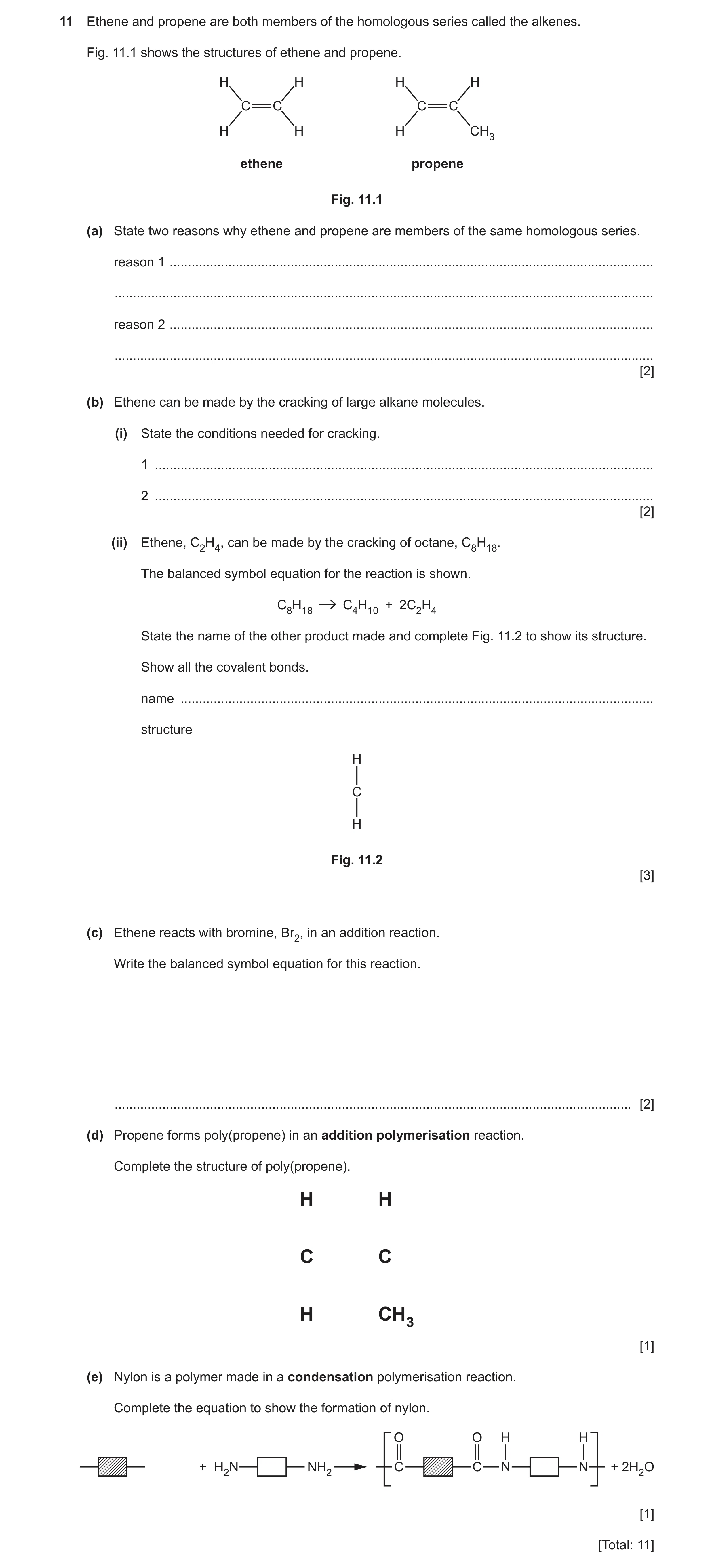
11 Ethene and propene are both members of the homologous series called the alkenes. Fig. 11.1 shows the structures of ethene and propene. H H H H C C C C H H H CH3 ethene propene Fig. 11.1 (a) State two reasons why ethene and propene are members of the same homologous series. reason 1 … … reason 2 … … [2] (b) Ethene can be made by the cracking of large alkane molecules. (i) State the conditions needed for cracking. 1 … 2 … [2] (ii) Ethene, C2H4, can be made by the cracking of octane, C8H18. The balanced symbol equation for the reaction is shown. C8H18 C4H10 + 2C2H4 State the name of the other product made and complete Fig. 11.2 to show its structure. Show all the covalent bonds. name … structure H C H Fig. 11.2 [3] (c) Ethene reacts with bromine, Br2, in an addition reaction. Write the balanced symbol equation for this reaction. … [2] (d) Propene forms poly(propene) in an addition polymerisation reaction. Complete the structure of poly(propene). H H C C H CH3 [1] (e) Nylon is a polymer made in a condensation polymerisation reaction. Complete the equation to show the formation of nylon. O O H H + H2N NH2 C C N N + 2H2O [1] [Total: 11]
11 marks
Mark scheme: 11(a) both have same functional group / both have (carbon to carbon) double bond ; both have same general formula / CnH2n ; both have similar (chemical) reactions ; trend in / similar, physical properties ; max 2 11(b)(i) high temperature / specified elevated temperature ; high pressure / specified elevated pressure ; catalyst / named catalyst ; AVP ; max 2 2 11(b)(ii) butane ; ;; 3 11(c) C2H4 + Br2 → C2H4Br2 C2H4Br2 ; then all else correct ; 2 Question Answer Marks 11(d) ; 1 11(e) ; 1
This question in 0654/41 May/June 2021
Q10 · Ammonia, NH3, is made in factories by the Haber process 0654/42 May/June 2021
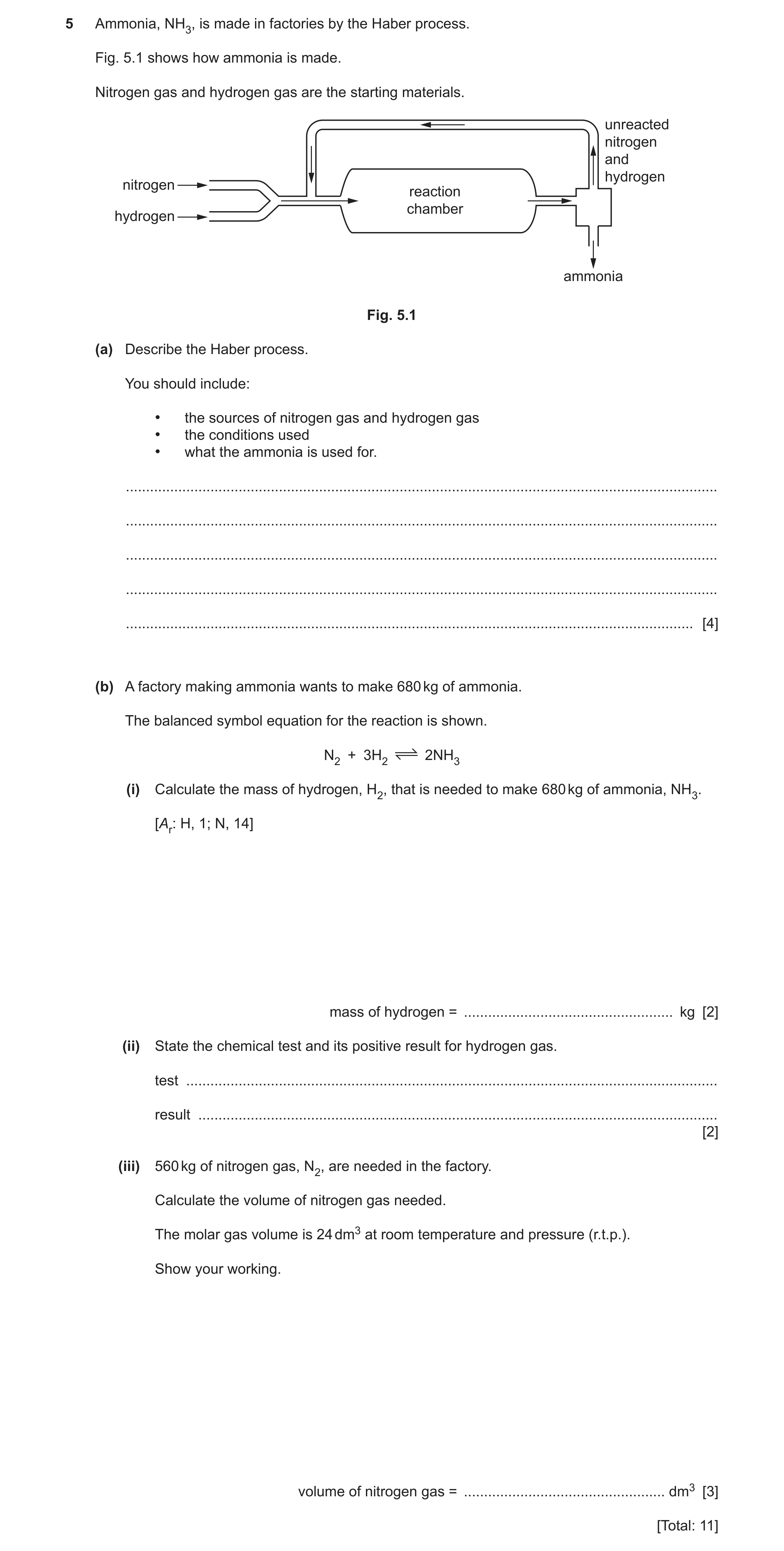
5 Ammonia, NH3, is made in factories by the Haber process. Fig. 5.1 shows how ammonia is made. Nitrogen gas and hydrogen gas are the starting materials. unreacted nitrogen and hydrogen nitrogen reaction chamber hydrogen ammonia Fig. 5.1 (a) Describe the Haber process. You should include: • the sources of nitrogen gas and hydrogen gas • the conditions used • what the ammonia is used for. … … … … … [4] (b) A factory making ammonia wants to make 680 kg of ammonia. The balanced symbol equation for the reaction is shown. N2 + 3H2 2NH3 (i) Calculate the mass of hydrogen, H2, that is needed to make 680 kg of ammonia, NH3. [Ar: H, 1; N, 14] mass of hydrogen = … kg [2] (ii) State the chemical test and its positive result for hydrogen gas. test … result … [2] (iii) 560 kg of nitrogen gas, N2, are needed in the factory. Calculate the volume of nitrogen gas needed. The molar gas volume is 24 dm3 at room temperature and pressure (r.t.p.). Show your working. volume of nitrogen gas = … dm3 [3] [Total: 11]
11 marks
Mark scheme: 5(a) source of nitrogen – air ; source of hydrogen – natural gas / cracking ; 200 atmospheres pressure / 450°C / iron catalyst ; ammonia is used for making fertilisers ; 4 5(b)(i) relative molecular mass of H2 = 2 and of NH3 = 17 or relative molecular mass of 3H2 = 6 and of 2NH3 = 34 ; (6 × 680 / 34 =) 120 (kg) ; 2 5(b)(ii) test – lighted splint / ignite gas ; result – (squeaky) pop ; 2 5(b)(iii) Mr of N2 = 28 ; moles of N2 = 560 000 ÷ 28 = 20 000 ; volume of N2 = 20 000 × 24 = 480 000 (dm³) ; 3
This question in 0654/42 May/June 2021
Q11 · The fractional distillation of petroleum makes useful fractions 0654/43 May/June 2021
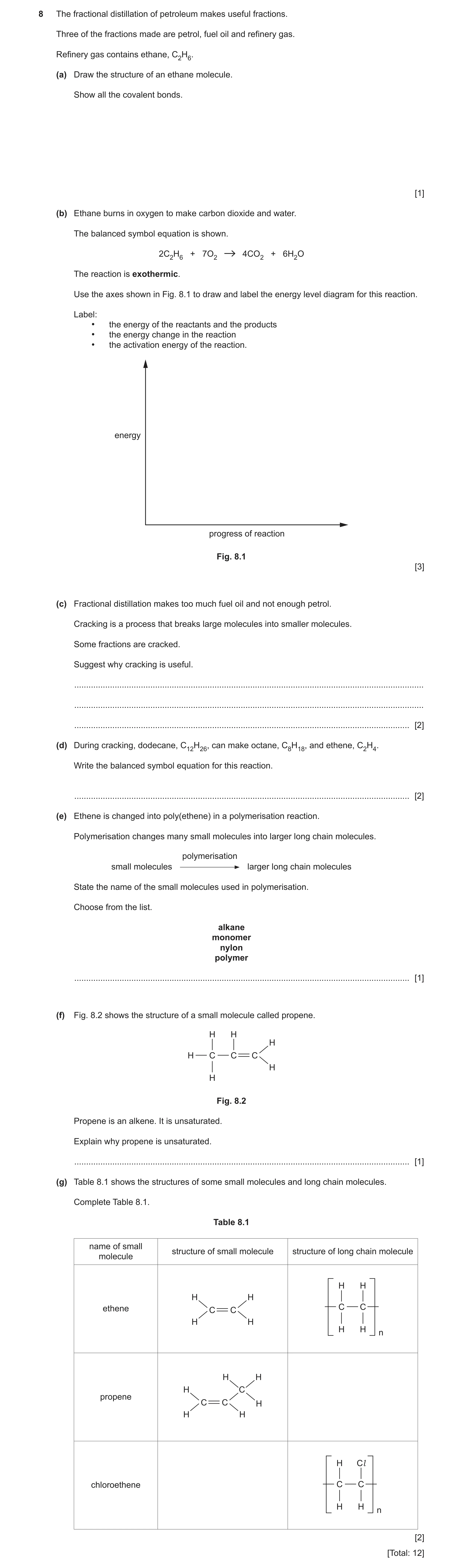
8 The fractional distillation of petroleum makes useful fractions. Three of the fractions made are petrol, fuel oil and refinery gas. Refinery gas contains ethane, C2H6. (a) Draw the structure of an ethane molecule. Show all the covalent bonds. [1] (b) Ethane burns in oxygen to make carbon dioxide and water. The balanced symbol equation is shown. 2C2H6 + 7O2 4CO2 + 6H2O The reaction is exothermic. Use the axes shown in Fig. 8.1 to draw and label the energy level diagram for this reaction. Label: • the energy of the reactants and the products • the energy change in the reaction • the activation energy of the reaction. energy progress of reaction Fig. 8.1 [3] (c) Fractional distillation makes too much fuel oil and not enough petrol. Cracking is a process that breaks large molecules into smaller molecules. Some fractions are cracked. Suggest why cracking is useful. … … … [2] (d) During cracking, dodecane, C12H26, can make octane, C8H18, and ethene, C2H4. Write the balanced symbol equation for this reaction. … [2] (e) Ethene is changed into poly(ethene) in a polymerisation reaction. Polymerisation changes many small molecules into larger long chain molecules. polymerisation small molecules larger long chain molecules State the name of the small molecules used in polymerisation. Choose from the list. alkane monomer nylon polymer … [1] (f) Fig. 8.2 shows the structure of a small molecule called propene. H H H H C C C H H Fig. 8.2 Propene is an alkene. It is unsaturated. Explain why propene is unsaturated. … [1] (g) Table 8.1 shows the structures of some small molecules and long chain molecules. Complete Table 8.1. Table 8.1 name of small structure of small molecule structure of long chain molecule molecule H H H H ethene C C C C H H H H n H H H C propene C C H H H H Cl chloroethene C C H H n [2] [Total: 12]
12 marks
Mark scheme: 8(a) ; 8(b) products shown below reactants ; energy change or correctly labelled ; activation energy correctly labelled ; 3 8(c) cracking makes more petrol / matches supply with demand ; cracking makes alkanes which can be used as fuels ; cracking makes alkenes which can be used to make plastics / alcohol / ethanol ; max 2 2 Activation Energy Energy Energy Change Question Answer Marks 8(d) C12H26 → C8H18 + 2C2H4 formulae ; balancing ; 2 8(e) monomer ; 1 8(f) (propene contains) a (carbon to carbon) double bond ; 1 8(g) (propene) (chloroethene) 2
This question in 0654/43 May/June 2021
Q12 · Large hydrocarbon molecules can be cracked to make smaller molecules 0654/42 Oct/Nov 2021
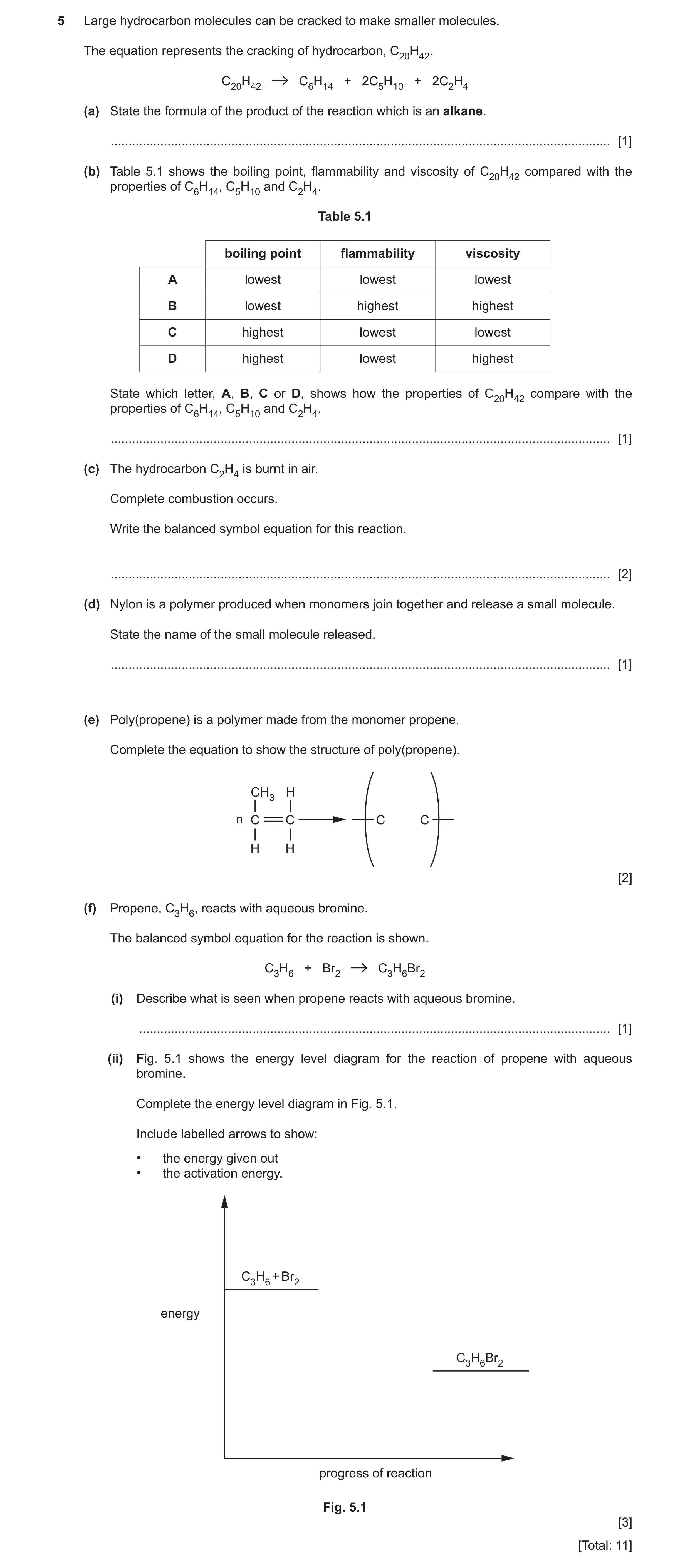
5 Large hydrocarbon molecules can be cracked to make smaller molecules. The equation represents the cracking of hydrocarbon, C20H42. C20H42 C6H14 + 2C5H10 + 2C2H4 (a) State the formula of the product of the reaction which is an alkane. … [1] (b) Table 5.1 shows the boiling point, flammability and viscosity of C20H42 compared with the properties of C6H14, C5H10 and C2H4. Table 5.1 boiling point flammability viscosity A lowest lowest lowest B lowest highest highest C highest lowest lowest D highest lowest highest State which letter, A, B, C or D, shows how the properties of C20H42 compare with the properties of C6H14, C5H10 and C2H4. … [1] (c) The hydrocarbon C2H4 is burnt in air. Complete combustion occurs. Write the balanced symbol equation for this reaction. … [2] (d) Nylon is a polymer produced when monomers join together and release a small molecule. State the name of the small molecule released. … [1] (e) Poly(propene) is a polymer made from the monomer propene. Complete the equation to show the structure of poly(propene). CH3 H n C C C C H H [2] (f) Propene, C3H6, reacts with aqueous bromine. The balanced symbol equation for the reaction is shown. C3H6 + Br2 C3H6Br2 (i) Describe what is seen when propene reacts with aqueous bromine. … [1] (ii) Fig. 5.1 shows the energy level diagram for the reaction of propene with aqueous bromine. Complete the energy level diagram in Fig. 5.1. Include labelled arrows to show: • the energy given out • the activation energy. C3H6 + Br2 energy C3H6Br2 progress of reaction Fig. 5.1 [3] [Total: 11]
11 marks
Mark scheme: 5(a) C6H14 ; 1 5(b) D ; 1 5(c) C2H4 + 3O2 → 2 CO2 + 2H2O ;; 2 5(d) water ; 1 5(e) ;; 2 5(f)(i) (aqueous bromine is) decolourised / changes from orange or yellow to colourless ; 1 5(f)(ii) ;;; 3 activation energy energy given out
This question in 0654/42 Oct/Nov 2021
Q13 · Fractional distillation of petroleum makes useful fractions 0654/42 May/June 2022
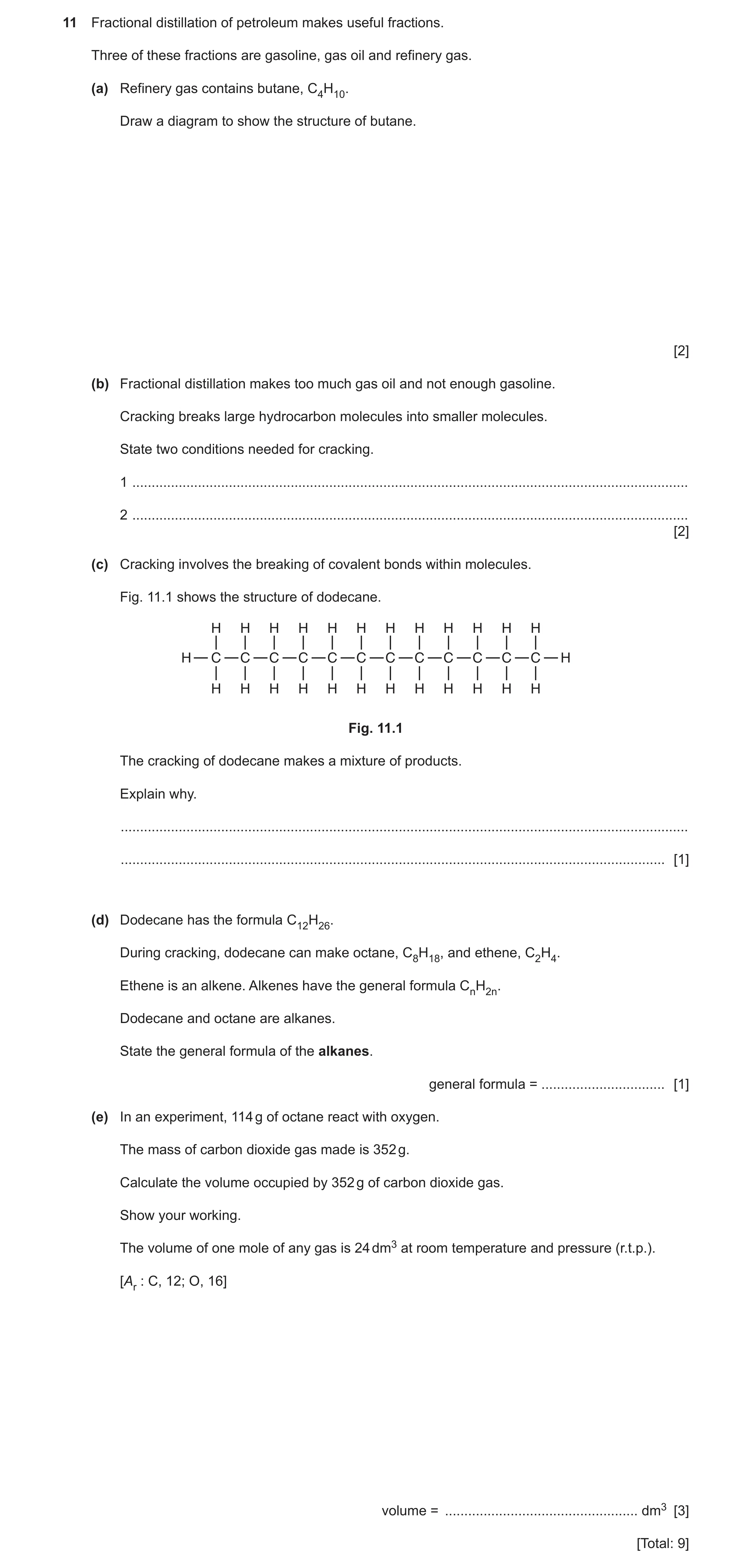
11 Fractional distillation of petroleum makes useful fractions. Three of these fractions are gasoline, gas oil and refinery gas. (a) Refinery gas contains butane, C4H10. Draw a diagram to show the structure of butane. [2] (b) Fractional distillation makes too much gas oil and not enough gasoline. Cracking breaks large hydrocarbon molecules into smaller molecules. State two conditions needed for cracking. 1 … 2 … [2] (c) Cracking involves the breaking of covalent bonds within molecules. Fig. 11.1 shows the structure of dodecane. H H H H H H H H H H H H H C C C C C C C C C C C C H H H H H H H H H H H H H Fig. 11.1 The cracking of dodecane makes a mixture of products. Explain why. … … [1] (d) Dodecane has the formula C12H26. During cracking, dodecane can make octane, C8H18, and ethene, C2H4. Ethene is an alkene. Alkenes have the general formula CnH2n. Dodecane and octane are alkanes. State the general formula of the alkanes. general formula = … [1] (e) In an experiment, 114 g of octane react with oxygen. The mass of carbon dioxide gas made is 352 g. Calculate the volume occupied by 352 g of carbon dioxide gas. Show your working. The volume of one mole of any gas is 24 dm3 at room temperature and pressure (r.t.p.). [Ar : C, 12; O, 16] volume = … dm3 [3] [Total: 9]
9 marks
Mark scheme: 11(a) ;; 2 11(b) any two from: (named) catalyst ; high temperature ; high pressure ; 2 11(c) idea that any bond within the molecule can break ; 1 11(d) CnH2n+2 ; 1 11(e) Mr of CO2 = 44 ; Moles of CO2 = 352 ÷ 44 = 8 ; Volume of CO2 = 8 24 = 192 dm³ ; 3
This question in 0654/42 May/June 2022
Q14 · Petroleum is a fossil fuel 0654/43 May/June 2022
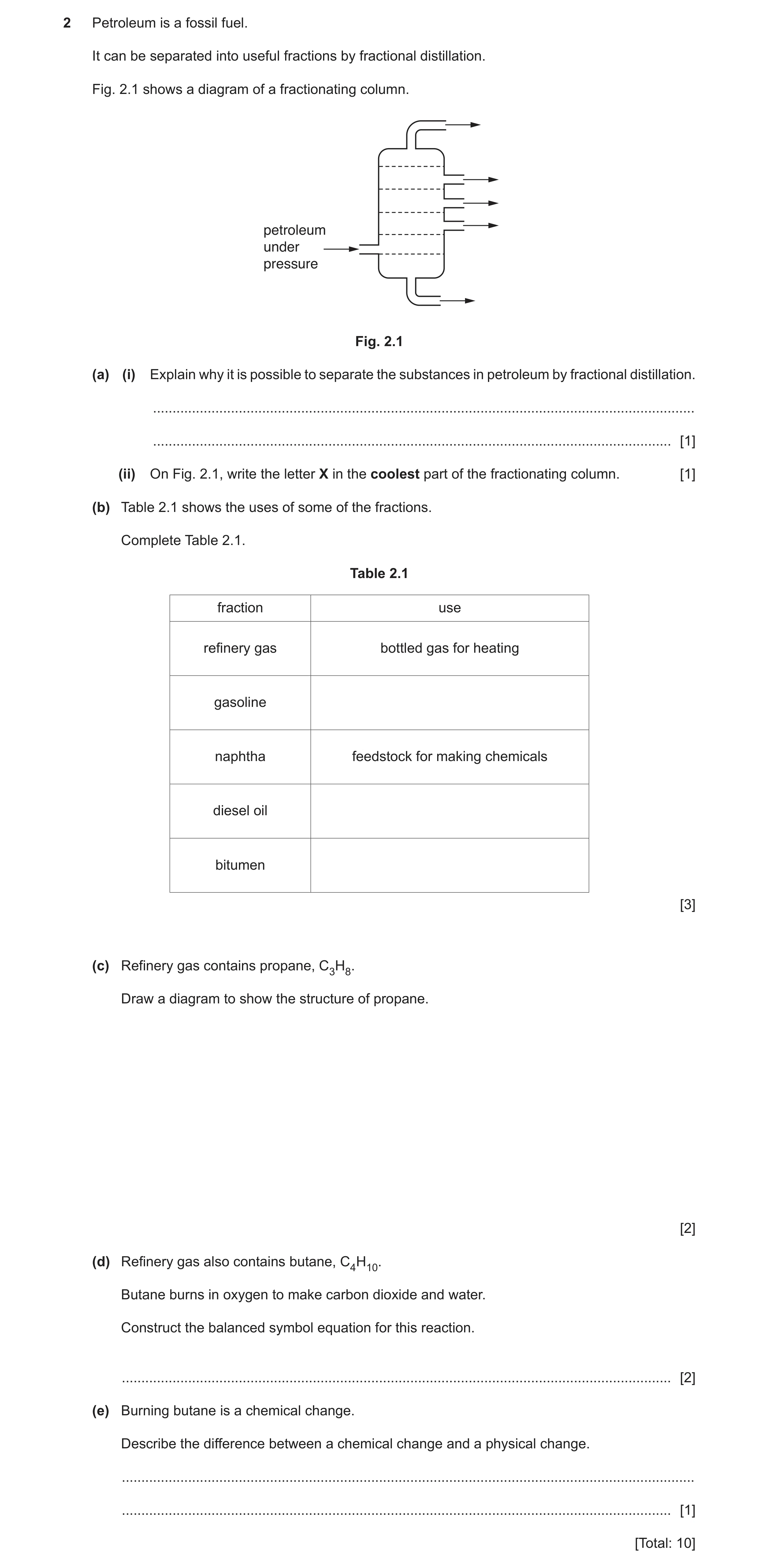
2 Petroleum is a fossil fuel. It can be separated into useful fractions by fractional distillation. Fig. 2.1 shows a diagram of a fractionating column. petroleum under pressure Fig. 2.1 (a) (i) Explain why it is possible to separate the substances in petroleum by fractional distillation. … … [1] (ii) On Fig. 2.1, write the letter X in the coolest part of the fractionating column. [1] (b) Table 2.1 shows the uses of some of the fractions. Complete Table 2.1. Table 2.1 fraction use refinery gas bottled gas for heating gasoline naphtha feedstock for making chemicals diesel oil bitumen [3] (c) Refinery gas contains propane, C3H8. Draw a diagram to show the structure of propane. [2] (d) Refinery gas also contains butane, C4H10. Butane burns in oxygen to make carbon dioxide and water. Construct the balanced symbol equation for this reaction. … [2] (e) Burning butane is a chemical change. Describe the difference between a chemical change and a physical change. … … [1] [Total: 10]
10 marks
Mark scheme: 2(a)(i) (fractions have) different boiling points ; 1 2(a)(ii) X marked inside the top of the column, above the top dotted line ; 1 Question Answer Marks 2(b) fraction use refinery gas bottled gas for heating gasoline fuel in cars ; naphtha feedstock for making chemicals diesel oil fuel in diesel engines ; bitumen road surfaces ; 3 2(c) ;; 2 2(d) 2C4H10 + 13O2 8CO2 + 10H2O correct formulae ; correct balancing ; 2 2(e) (in a chemical change) a new substance is made / owtte ; 1
This question in 0654/43 May/June 2022
Q15 · Burning coal can be used to generate electricity 0654/42 Oct/Nov 2022
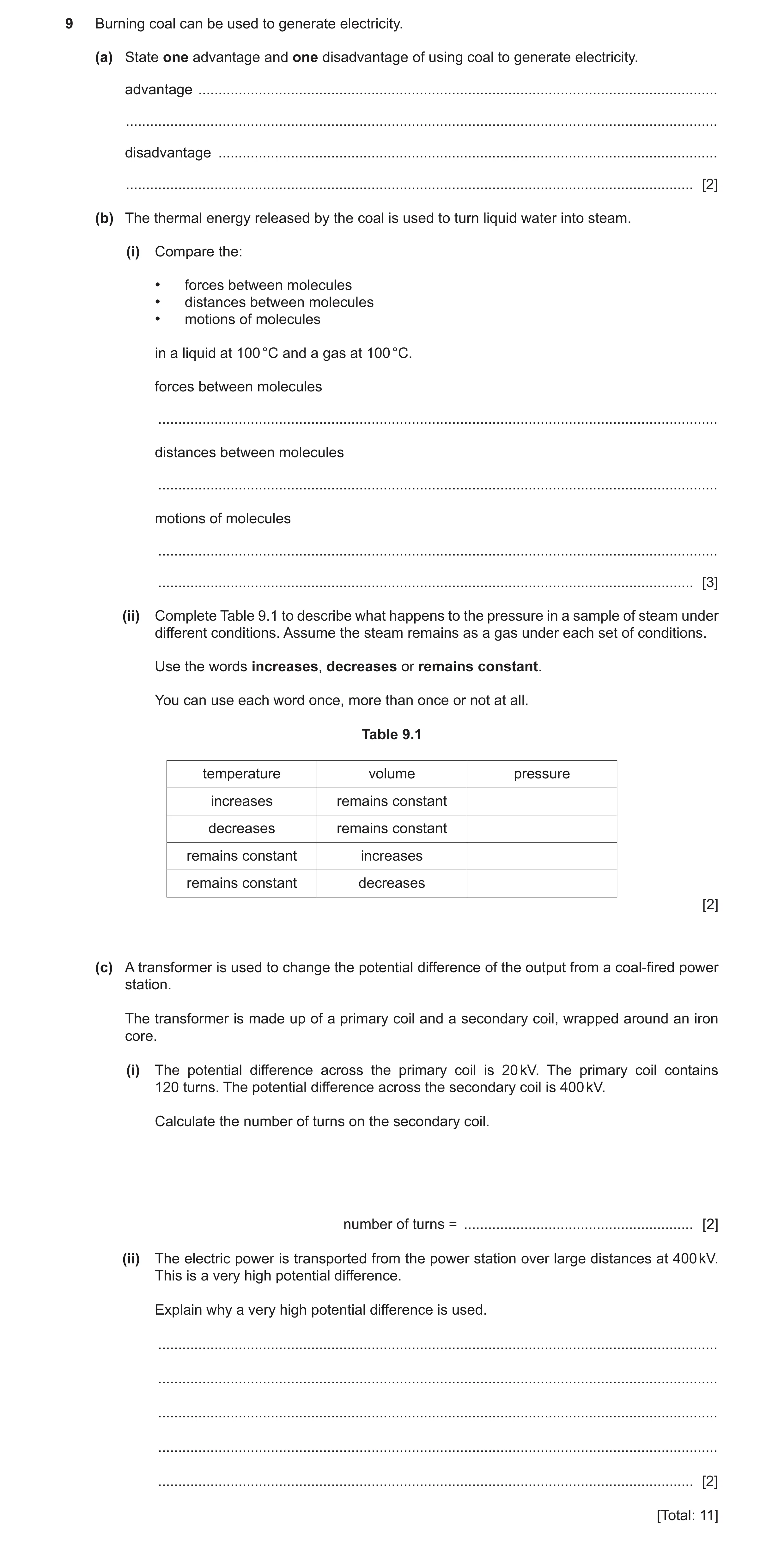
9 Burning coal can be used to generate electricity. (a) State one advantage and one disadvantage of using coal to generate electricity. advantage … … disadvantage … … [2] (b) The thermal energy released by the coal is used to turn liquid water into steam. (i) Compare the: • forces between molecules • distances between molecules • motions of molecules in a liquid at 100 °C and a gas at 100 °C. forces between molecules … distances between molecules … motions of molecules … … [3] (ii) Complete Table 9.1 to describe what happens to the pressure in a sample of steam under different conditions. Assume the steam remains as a gas under each set of conditions. Use the words increases, decreases or remains constant. You can use each word once, more than once or not at all. Table 9.1 temperature volume pressure increases remains constant decreases remains constant remains constant increases remains constant decreases [2] (c) A transformer is used to change the potential difference of the output from a coal-fired power station. The transformer is made up of a primary coil and a secondary coil, wrapped around an iron core. (i) The potential difference across the primary coil is 20 kV. The primary coil contains 120 turns. The potential difference across the secondary coil is 400 kV. Calculate the number of turns on the secondary coil. number of turns = … [2] (ii) The electric power is transported from the power station over large distances at 400 kV. This is a very high potential difference. Explain why a very high potential difference is used. … … … … … [2] [Total: 11]
11 marks
Mark scheme: 9(a) (advantage) 2 high energy density / fast start up of power stations / abundant / easily available / easy to transport or store / reliable / easily combustible / AVP ; (disadvantage) releases CO2 / causes global warming / climate change / finite or non-renewable resource / releases SO2 / causes acid rain / pollution from particulates / AVP ; 9(b)(i) (forces) stronger in liquid / ORA ; 3 (distance) closer in liquid / ORA ; (motion) molecules are freer to move in gas / ORA ; 9(b)(ii) increases 2 decreases ; decreases increases ; 9(c)(i) use of Vp / Vs = Np / Ns ; 2 2400 ; 9(c)(ii) reduces current ; 2 reduces, power or energy losses / less heat generated ;
This question in 0654/42 Oct/Nov 2022
Q16 · Petroleum is separated into different fractions 0654/43 May/June 2023
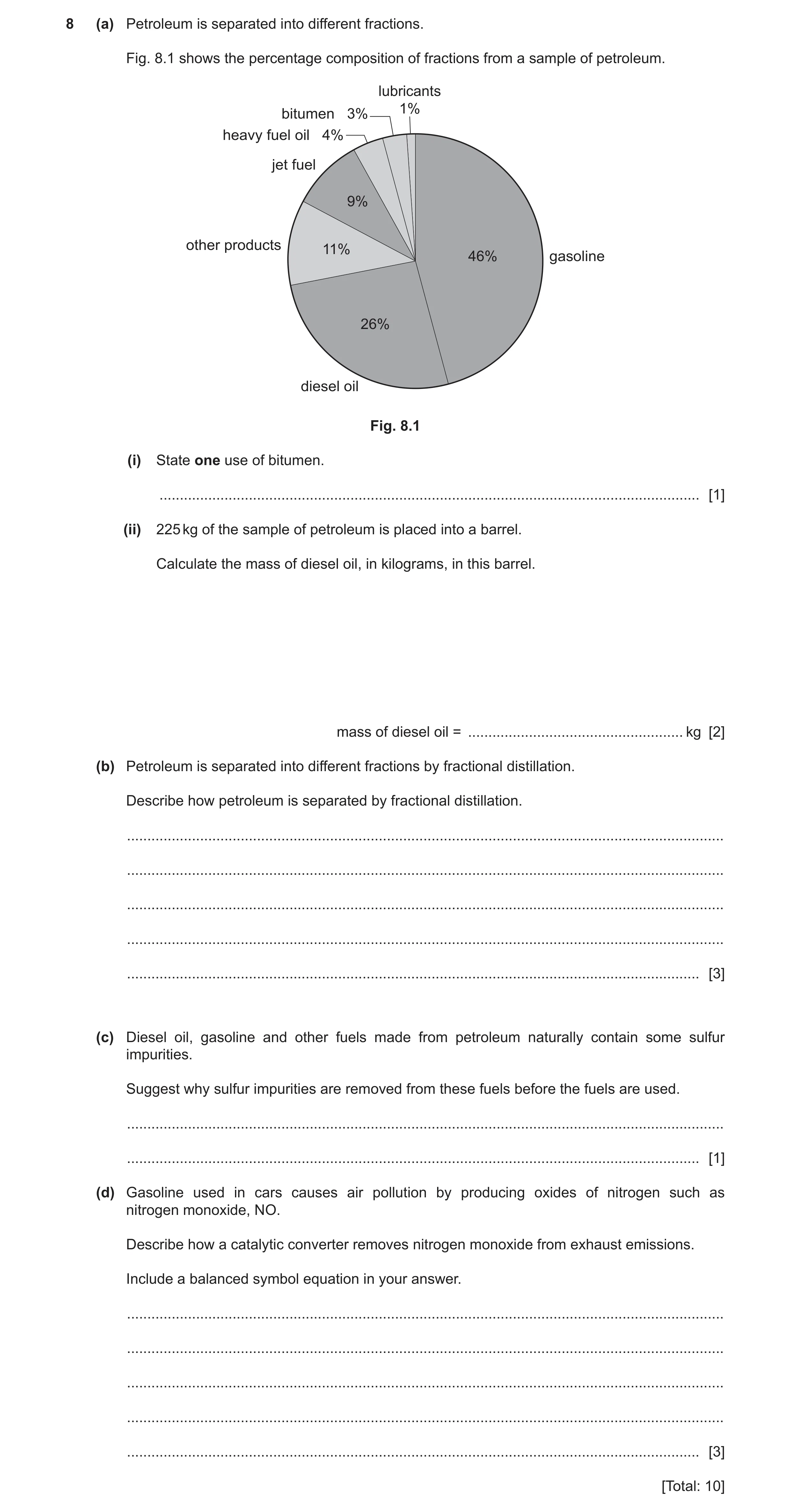
8 (a) Petroleum is separated into different fractions. Fig. 8.1 shows the percentage composition of fractions from a sample of petroleum. lubricants 1% bitumen 3% heavy fuel oil 4% jet fuel 9% other products 11% 46% gasoline 26% diesel oil Fig. 8.1 (i) State one use of bitumen. … [1] (ii) 225 kg of the sample of petroleum is placed into a barrel. Calculate the mass of diesel oil, in kilograms, in this barrel. mass of diesel oil = … kg [2] (b) Petroleum is separated into different fractions by fractional distillation. Describe how petroleum is separated by fractional distillation. … … … … … [3] (c) Diesel oil, gasoline and other fuels made from petroleum naturally contain some sulfur impurities. Suggest why sulfur impurities are removed from these fuels before the fuels are used. … … [1] (d) Gasoline used in cars causes air pollution by producing oxides of nitrogen such as nitrogen monoxide, NO. Describe how a catalytic converter removes nitrogen monoxide from exhaust emissions. Include a balanced symbol equation in your answer. … … … … … [3] [Total: 10]
10 marks
Mark scheme: 8(a)(i) road surfaces ; 1 8(a)(ii) 225 26 100 ; = 59 (kg) ; 2 8(b) fractions are separated according to their boiling point ; petroleum is heated AND idea that vapours rise (and cool) ; idea that vapours condense when they become cool enough ; 3 8(c) idea that sulfur impurities cause acid rain ; 1 Question Answer Marks 8(d) idea that nitrogen monoxide is removed from exhaust emissions by reaction over a hot catalyst / at high temperature ; AND ONE EQUATION FROM 2NO + 2CO N2 + 2CO2 or 2NO N2 + O2 correct formulae ; correct balancing ; 3
This question in 0654/43 May/June 2023
Q17 · Ammonia is manufactured in the Haber process 0654/42 Feb/March 2024
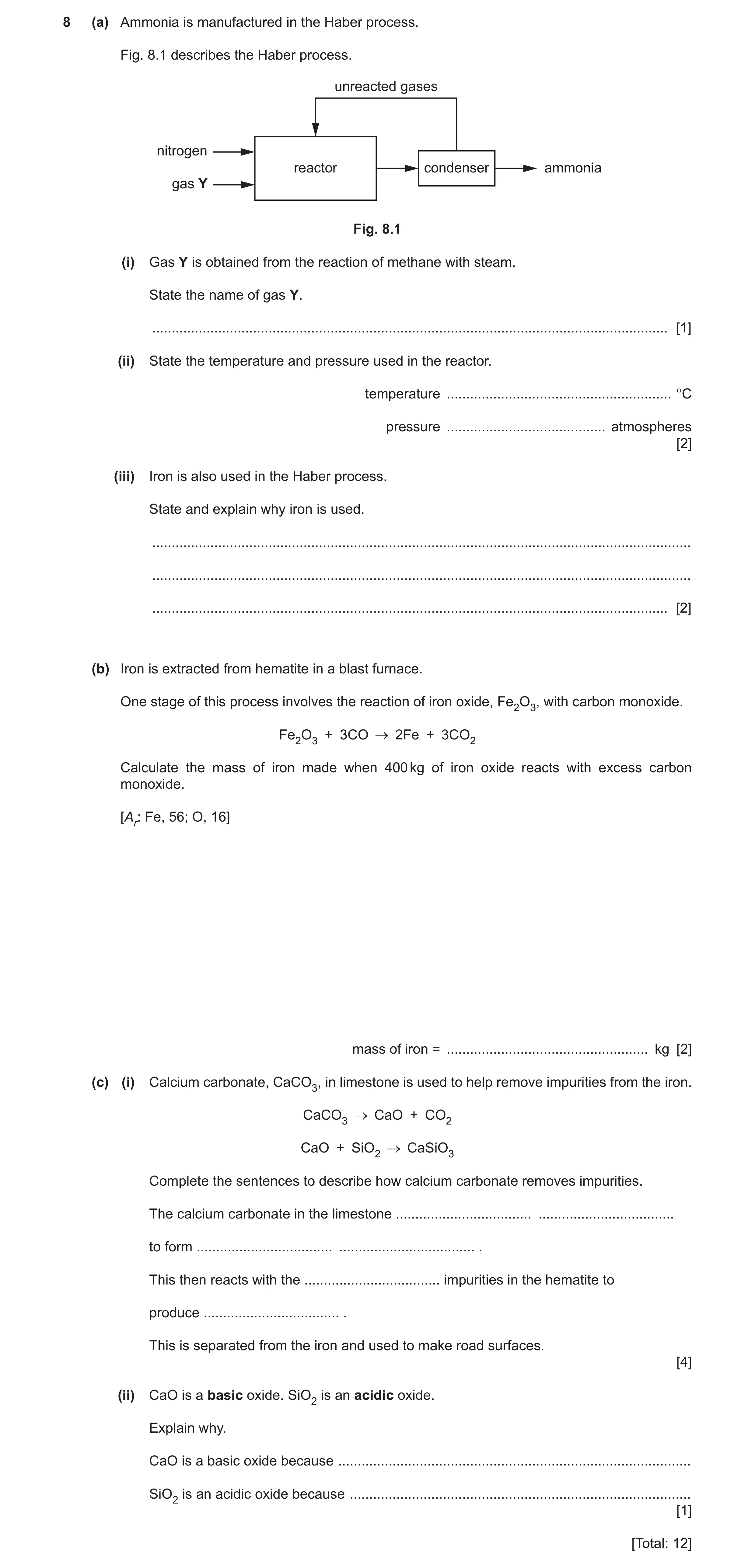
8 (a) Ammonia is manufactured in the Haber process. Fig. 8.1 describes the Haber process. unreacted gases nitrogen reactor condenser ammonia gas Y Fig. 8.1 (i) Gas Y is obtained from the reaction of methane with steam. State the name of gas Y. … [1] (ii) State the temperature and pressure used in the reactor. temperature … °C pressure … atmospheres [2] (iii) Iron is also used in the Haber process. State and explain why iron is used. … … … [2] (b) Iron is extracted from hematite in a blast furnace. One stage of this process involves the reaction of iron oxide, Fe2O3, with carbon monoxide. Fe2O3 + 3CO 2Fe + 3CO2 Calculate the mass of iron made when 400 kg of iron oxide reacts with excess carbon monoxide. [Ar: Fe, 56; O, 16] mass of iron = … kg [2] (c) (i) Calcium carbonate, CaCO3, in limestone is used to help remove impurities from the iron. CaCO3 CaO + CO2 CaO + SiO2 CaSiO3 Complete the sentences to describe how calcium carbonate removes impurities. The calcium carbonate in the limestone … … to form … … . This then reacts with the … impurities in the hematite to produce … . This is separated from the iron and used to make road surfaces. [4] (ii) CaO is a basic oxide. SiO2 is an acidic oxide. Explain why. CaO is a basic oxide because … SiO2 is an acidic oxide because … [1] [Total: 12]
12 marks
Mark scheme: 8(a)(i) hydrogen ; 1 8(a)(ii) temperature – 450 °C ; 2 pressure – 200 atmospheres ; 8(a)(iii) catalyst ; 2 to speed up the (rate of) reaction / lower activation energy ; 8(b) relative molecular mass of Fe2O3 = 160 ; 2 112 400 = 280 ; 160 8(c)(i) thermally decomposes ; 4 calcium oxide. ; acidic / silica / sand ; slag / calcium silicate. ; 8(c)(ii) (CaO is a basic oxide because) Ca / calcium is a metal 1 (SiO2 is an acidic oxide because) Si is a non-metal ;
This question in 0654/42 Feb/March 2024
Q18 · Petroleum is a mixture of hydrocarbons 0654/43 May/June 2024
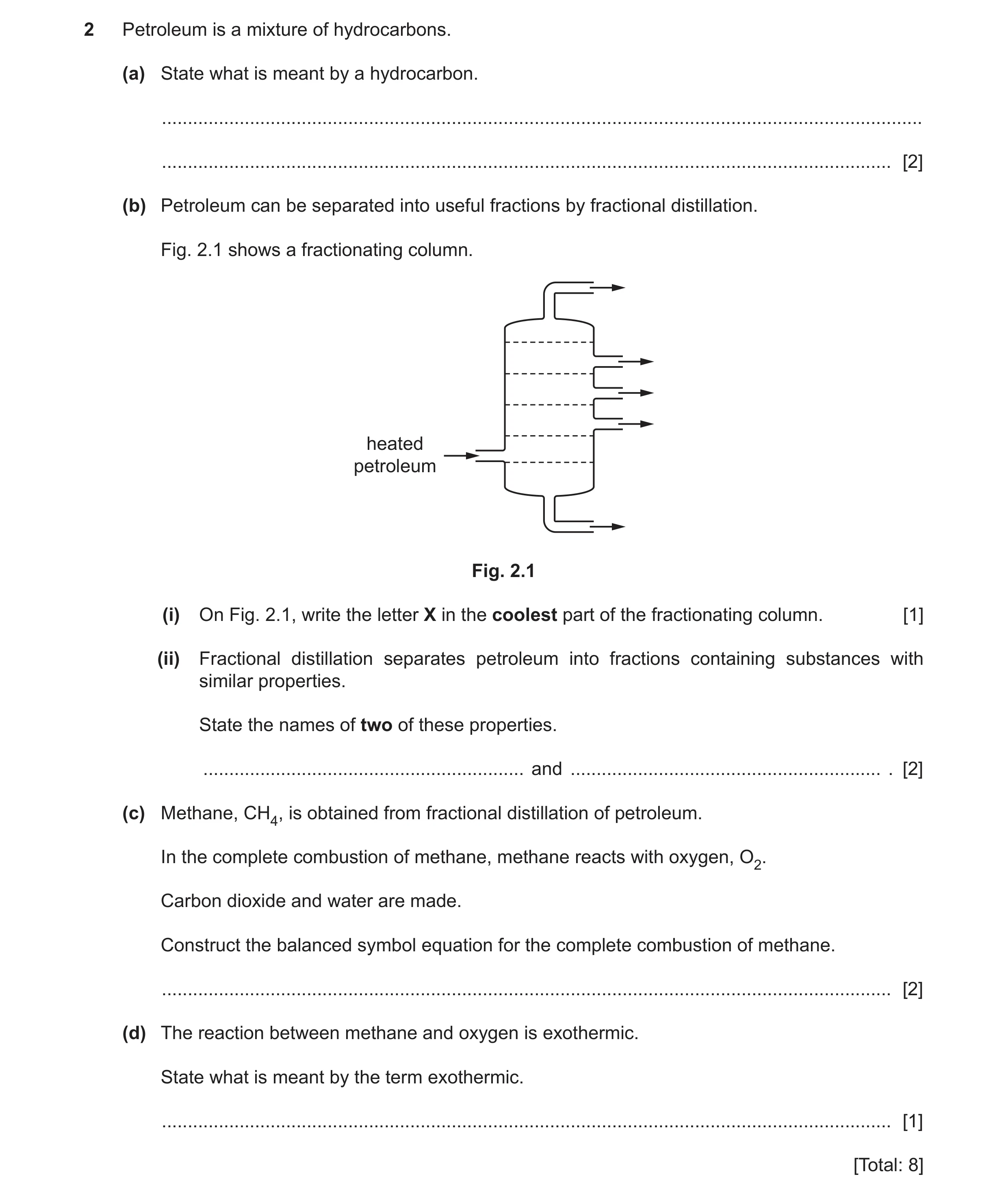
2 Petroleum is a mixture of hydrocarbons. (a) State what is meant by a hydrocarbon. … … [2] (b) Petroleum can be separated into useful fractions by fractional distillation. Fig. 2.1 shows a fractionating column. heated petroleum Fig. 2.1 (i) On Fig. 2.1, write the letter X in the coolest part of the fractionating column. [1] (ii) Fractional distillation separates petroleum into fractions containing substances with similar properties. State the names of two of these properties. … and … . [2] (c) Methane, CH4, is obtained from fractional distillation of petroleum. In the complete combustion of methane, methane reacts with oxygen, O2. Carbon dioxide and water are made. Construct the balanced symbol equation for the complete combustion of methane. … [2] (d) The reaction between methane and oxygen is exothermic. State what is meant by the term exothermic. … [1] [Total: 8]
8 marks
Mark scheme: 2(a) (compound containing) carbon and hydrogen (atoms) ; only ; 2 2(b)(i) X inside the column, either inside the pipe or anywhere above the top dotted line ; e.g. 1 2(b)(ii) Any two from: boiling point / volatility / viscosity / flammability / density ;; 2 2(c) CH4 + 2O2 CO2 + 2H2O ;; 2 2(d) Idea of thermal energy given out ; 1
This question in 0654/43 May/June 2024
Q19 · A wind turbine used to generate electricity 0654/42 Oct/Nov 2024
3 Fig. 3.1 shows a wind turbine used to generate electricity. Fig. 3.1 (a) State one advantage of generating electricity using wind turbines. … … [1] (b) The wind turbine contains an alternating current (a.c.) generator. On Fig. 3.2, sketch a graph of output voltage against time for the a.c. generator when the wind turbine is turning at a constant speed. output voltage time Fig. 3.2 [2] (c) A step-up transformer is used to increase the voltage from the generator. Describe the construction of a basic step-up transformer. You may include a labelled diagram to aid your description. … … … … … [3] (d) The wind exerts a pressure of 7200 Pa on each blade of the wind turbine. Each blade has a surface area of 90 m2. Calculate the force exerted by the wind on each turbine blade. force = … N [2] (e) The wind turbines produce a low-pitch sound when they turn. (i) State the minimum frequency of sound which can be heard by a healthy human ear. frequency = … Hz [1] (ii) Sound waves are longitudinal waves. Describe, in terms of oscillations and energy transfer, what is meant by a longitudinal wave. … … … [1] [Total: 10]
10 marks
Mark scheme: 3(a) does not release CO2 / does not release greenhouse gases / does not contribute to global warming / climate change / no 1 fuel costs / renewable / AVP ; 3(b) sinusoidal waveform ; 2 constant time period and amplitude ; 3(c) (soft) iron core ; 3 two coils wrapped around the same core ; number of turns on primary less than secondary / number of turns on secondary more than primary ; 3(d) evidence of F = P A or 7200 90 ; 2 650 000 (N) ; 3(e)(i) 20 (Hz) ; 1 3(e)(ii) (direction of) oscillations are parallel to direction of energy transfer ; 1
This question in 0654/42 Oct/Nov 2024
Q20 · The displayed formulae of some carbon compounds 0654/43 Oct/Nov 2024
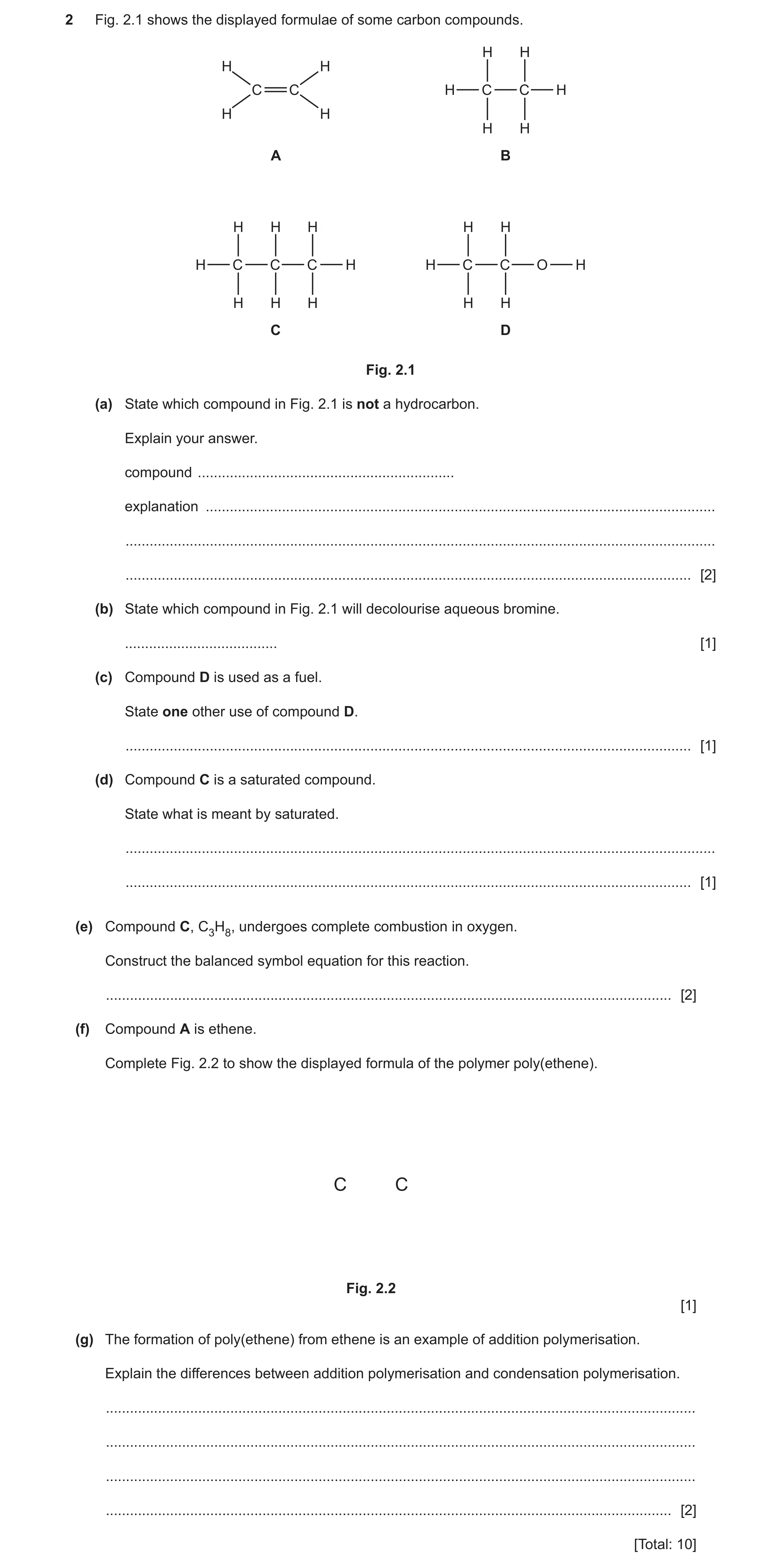
2 Fig. 2.1 shows the displayed formulae of some carbon compounds. H H H H C C H C C H H H H H A B H H H H H H C C C H H C C O H H H H H H C D Fig. 2.1 (a) State which compound in Fig. 2.1 is not a hydrocarbon. Explain your answer. compound … explanation … … … [2] (b) State which compound in Fig. 2.1 will decolourise aqueous bromine. … [1] (c) Compound D is used as a fuel. State one other use of compound D. … [1] (d) Compound C is a saturated compound. State what is meant by saturated. … … [1] (e) Compound C, C3H8, undergoes complete combustion in oxygen. Construct the balanced symbol equation for this reaction. … [2] (f) Compound A is ethene. Complete Fig. 2.2 to show the displayed formula of the polymer poly(ethene). C C Fig. 2.2 [1] (g) The formation of poly(ethene) from ethene is an example of addition polymerisation. Explain the differences between addition polymerisation and condensation polymerisation. … … … … [2] [Total: 10]
10 marks
Mark scheme: 2(a) D ; 2 contains oxygen / does not contain only carbon and hydrogen ; 2(b) A ; 1 2(c) solvent ; 1 2(d) contains only C-C single bonds ; 1 2(e) C3H8 + 5O2 → 3CO2 + 4H2O 2 correct formulae (reactants in either order and products in either order) ; balanced correctly ; 2(f) 1 2(g) addition polymerisation 2 only occurs in unsaturated monomers or monomers that contain C=C bonds / idea that involves the addition of many (identical) monomers (to make a long chained polymer) / monomers have one functional group / forms the polymer molecule only ; condensation polymerisation idea that two different monomers join together / (forms the polymer molecule and one) water molecule (per linkage) / monomers have two functional groups (one at each end) ;
This question in 0654/43 Oct/Nov 2024
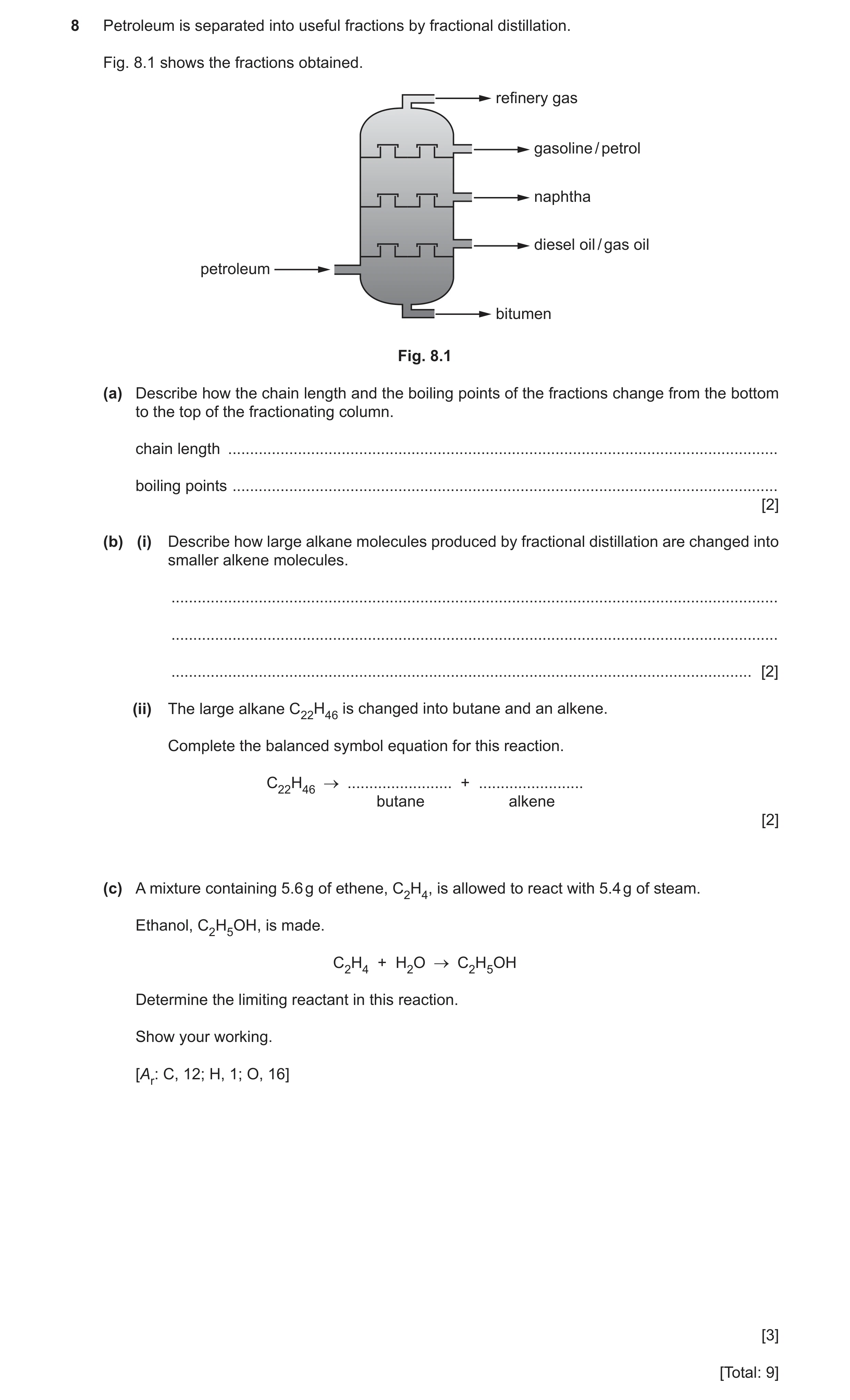
Q21 · Petroleum is separated into useful fractions by fractional distillation 0654/41 May/June 2025
8 Petroleum is separated into useful fractions by fractional distillation. Fig. 8.1 shows the fractions obtained. refinery gas gasoline / petrol naphtha diesel oil / gas oil petroleum bitumen Fig. 8.1 (a) Describe how the chain length and the boiling points of the fractions change from the bottom to the top of the fractionating column. chain length … boiling points … [2] (b) (i) Describe how large alkane molecules produced by fractional distillation are changed into smaller alkene molecules. … … … [2] (ii) The large alkane C22H46 is changed into butane and an alkene. Complete the balanced symbol equation for this reaction. C22H46 … + … butane alkene [2] (c) A mixture containing 5.6 g of ethene, C2H4, is allowed to react with 5.4 g of steam. Ethanol, C2H5OH, is made. C2H4 + H2O C2H5OH Determine the limiting reactant in this reaction. Show your working. [Ar: C, 12; H, 1; O, 16] [3] [Total: 9]
9 marks
Mark scheme: 8(a) (chain length) decreases / AW ; 2 (boiling point) decreases / AW ; 8(b)(i) cracking ; 2 (use of a) high temperature / catalyst ; 8(b)(ii) C4H10 ; 2 C18H36 ; 8(c) moles of ethene = 5.6 28 = 0.2 (mol) ; 3 moles of steam = 5.4 18 = 0.3 (mol) ; (there are less moles of ethene) so ethene is the limiting reactant ;
This question in 0654/41 May/June 2025
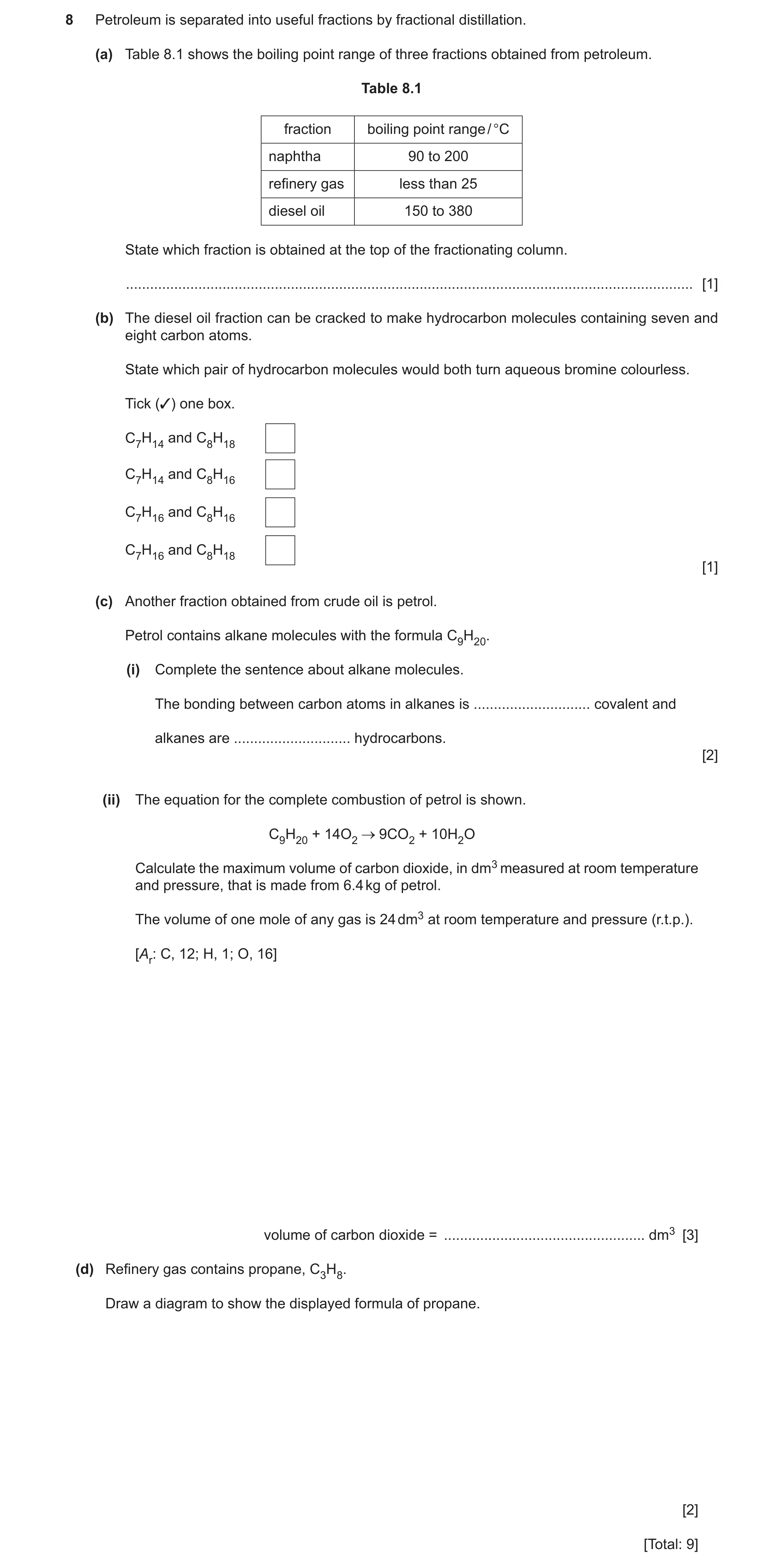
Q22 · Petroleum is separated into useful fractions by fractional distillation 0654/41 Oct/Nov 2025
8 Petroleum is separated into useful fractions by fractional distillation. (a) Table 8.1 shows the boiling point range of three fractions obtained from petroleum. Table 8.1 fraction boiling point range / °C naphtha 90 to 200 refinery gas less than 25 diesel oil 150 to 380 State which fraction is obtained at the top of the fractionating column. … [1] (b) The diesel oil fraction can be cracked to make hydrocarbon molecules containing seven and eight carbon atoms. State which pair of hydrocarbon molecules would both turn aqueous bromine colourless. Tick (✓) one box. C7H14 and C8H18 C7H14 and C8H16 C7H16 and C8H16 C7H16 and C8H18 [1] (c) Another fraction obtained from crude oil is petrol. Petrol contains alkane molecules with the formula C9H20. (i) Complete the sentence about alkane molecules. The bonding between carbon atoms in alkanes is … covalent and alkanes are … hydrocarbons. [2] (ii) The equation for the complete combustion of petrol is shown. C9H20 + 14O2 9CO2 + 10H2O Calculate the maximum volume of carbon dioxide, in dm3 measured at room temperature and pressure, that is made from 6.4 kg of petrol. The volume of one mole of any gas is 24 dm3 at room temperature and pressure (r.t.p.). [Ar: C, 12; H, 1; O, 16] volume of carbon dioxide = … dm3 [3] (d) Refinery gas contains propane, C3H8. Draw a diagram to show the displayed formula of propane. [2] [Total: 9]
9 marks
Mark scheme: 8(a) refinery gas ; 1 8(b) C7H14 and C8H16 ; 1 8(c)(i) single ; 2 saturated ; 8(c)(ii) (moles of C9H20 = 6400 ÷ 128 =) 50 ; 3 (moles of CO2 = 9 50 =) 450 ; (volume of CO2 = 450 24 =) 10 800 (dm³) ; OR (mass of CO2 = (396 ÷ 128) 6400 =) 19 800 (g); (moles of CO2 = 19 800 ÷ 44 =) 450 ; (volume of CO2 = 450 24 =) 10 800 (dm³) ; 8(d) 2 chain of three carbons each joined by a single bond = 1 mark eight hydrogens joined to carbons by single bonds = 1 mark
This question in 0654/41 Oct/Nov 2025
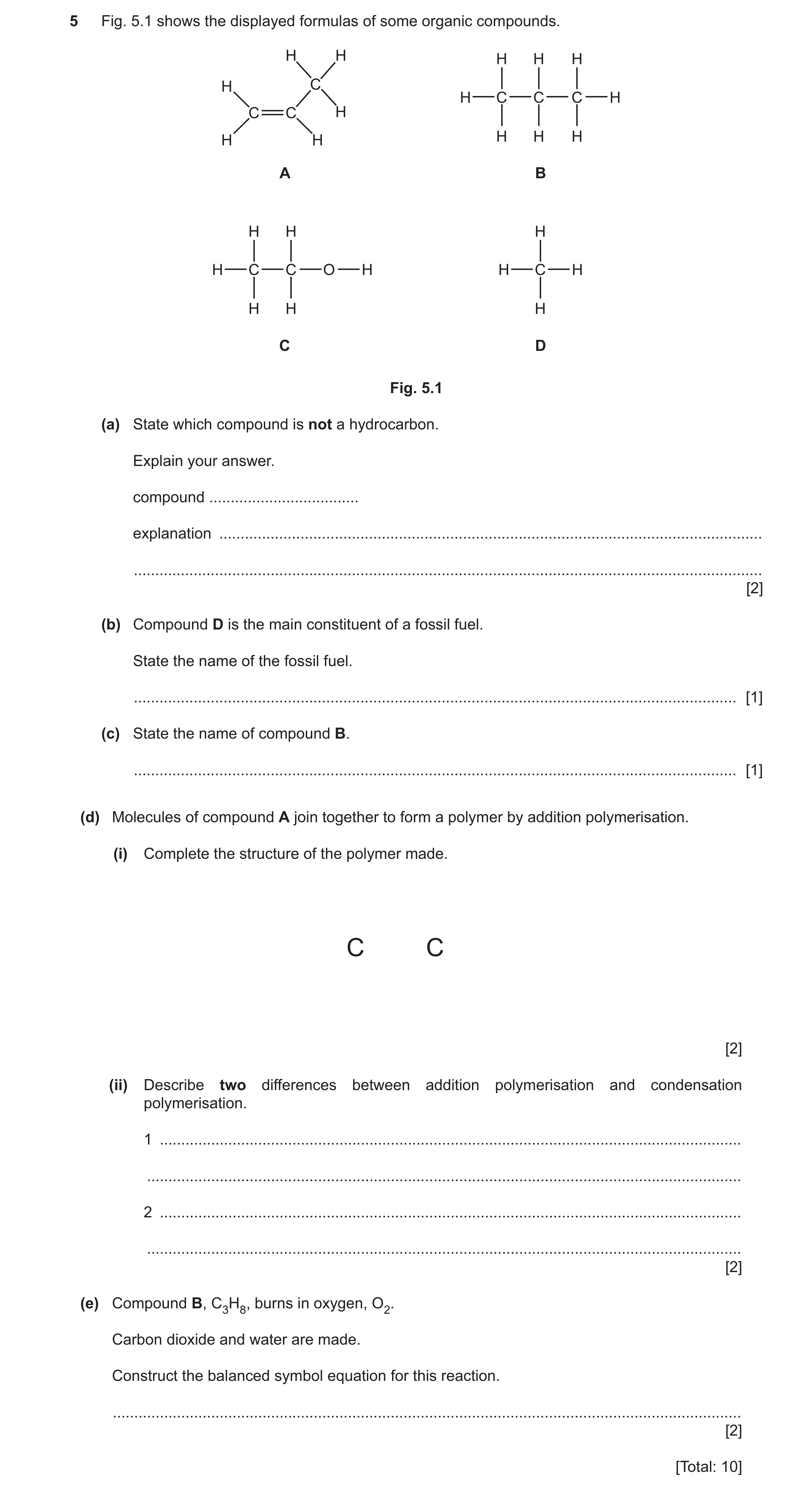
Q23 · The displayed formulas of some organic compounds 0654/43 Oct/Nov 2025
5 Fig. 5.1 shows the displayed formulas of some organic compounds. H H H H H H C H C C C H C C H H H H H H A B H H H H C C O H H C H H H H C D Fig. 5.1 (a) State which compound is not a hydrocarbon. Explain your answer. compound … explanation … … [2] (b) Compound D is the main constituent of a fossil fuel. State the name of the fossil fuel. … [1] (c) State the name of compound B. … [1] (d) Molecules of compound A join together to form a polymer by addition polymerisation. (i) Complete the structure of the polymer made. C C [2] (ii) Describe two differences between addition polymerisation and condensation polymerisation. 1 … … 2 … … [2] (e) Compound B, C3H8, burns in oxygen, O2. Carbon dioxide and water are made. Construct the balanced symbol equation for this reaction. … [2] [Total: 10]
10 marks
Mark scheme: 5(a) C ; 2 (C) contains oxygen / (C) does not contain only carbon and hydrogen / hydrocarbons only contains hydrogen and carbon ; 5(b) natural gas ; 1 5(c) propane ; 1 5(d)(i) 2 1 mark for single bond between carbon atoms 1 mark for rest of structure correct 5(d)(ii) any two from: 2 addition polymerisation • only occurs in unsaturated monomers / monomers that contain C = C bonds ; • idea that it involves the same type of monomer/unit ; • only forms the polymer molecule ; condensation polymerisation • idea that it involves different types of monomers / units ; • forms (the polymer molecule and one) water (molecule per linkage) ; 5(e) C3H8 + 5O2 → 3CO2 + 4H2O ;; 2 1 mark for correct formulae 1 mark for correct balanced equation
This question in 0654/43 Oct/Nov 2025
 10 / 38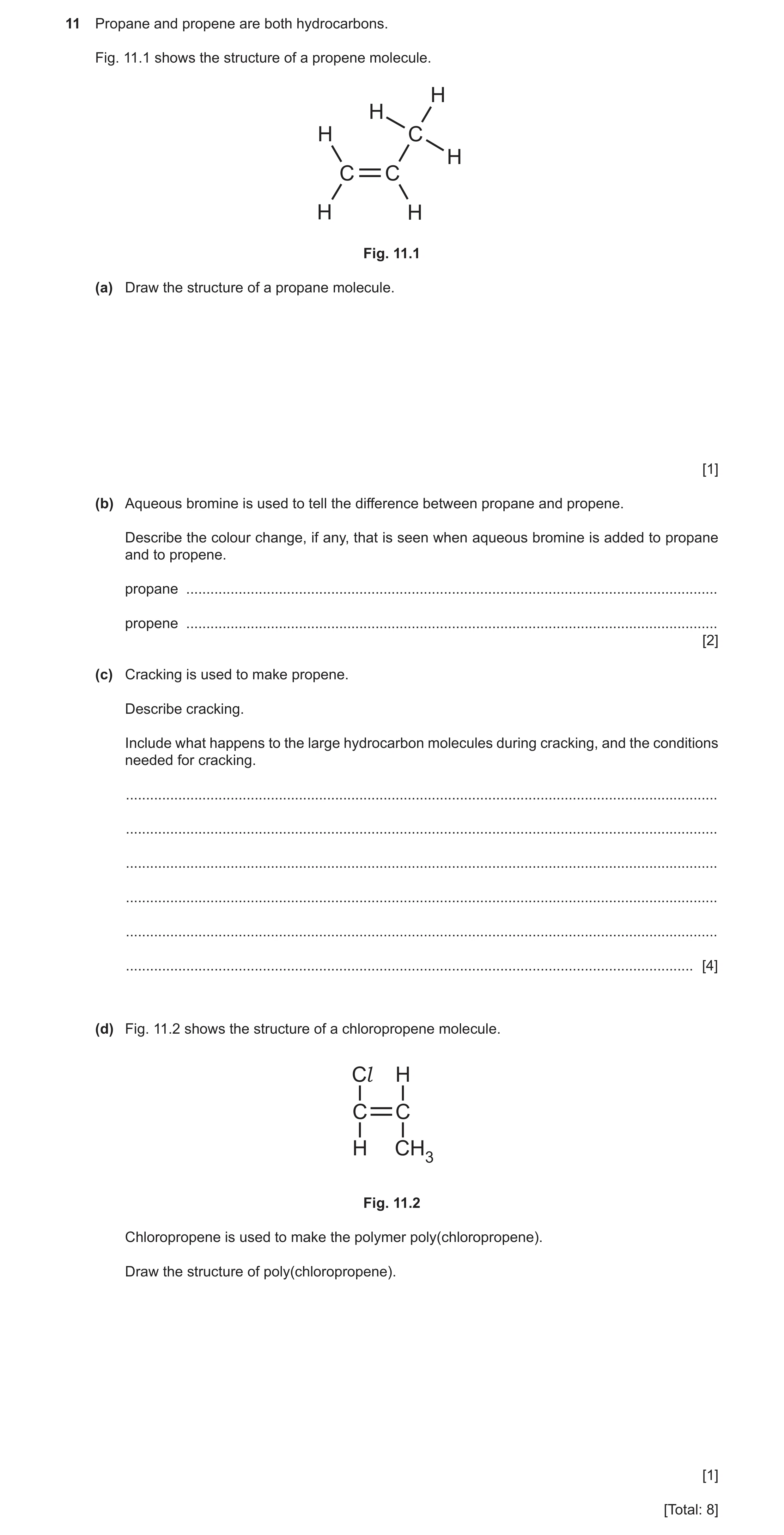
 30 / 38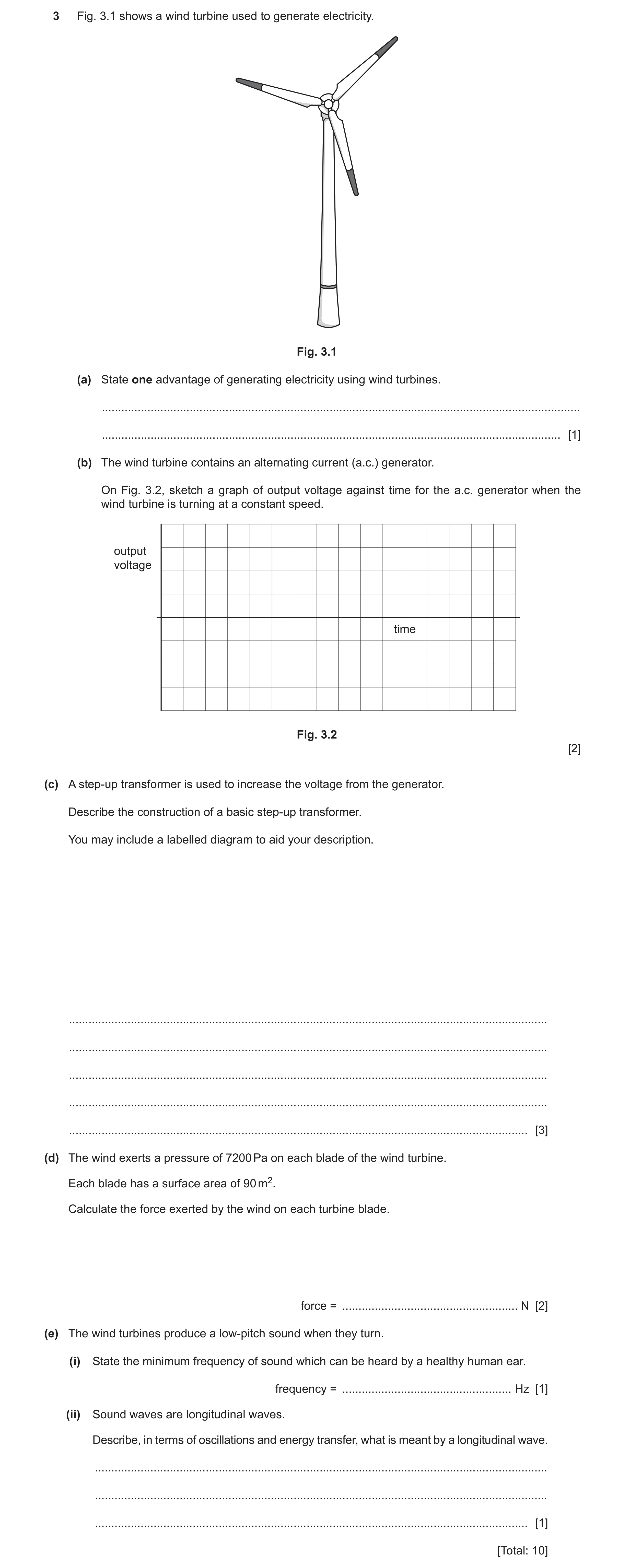
 9
9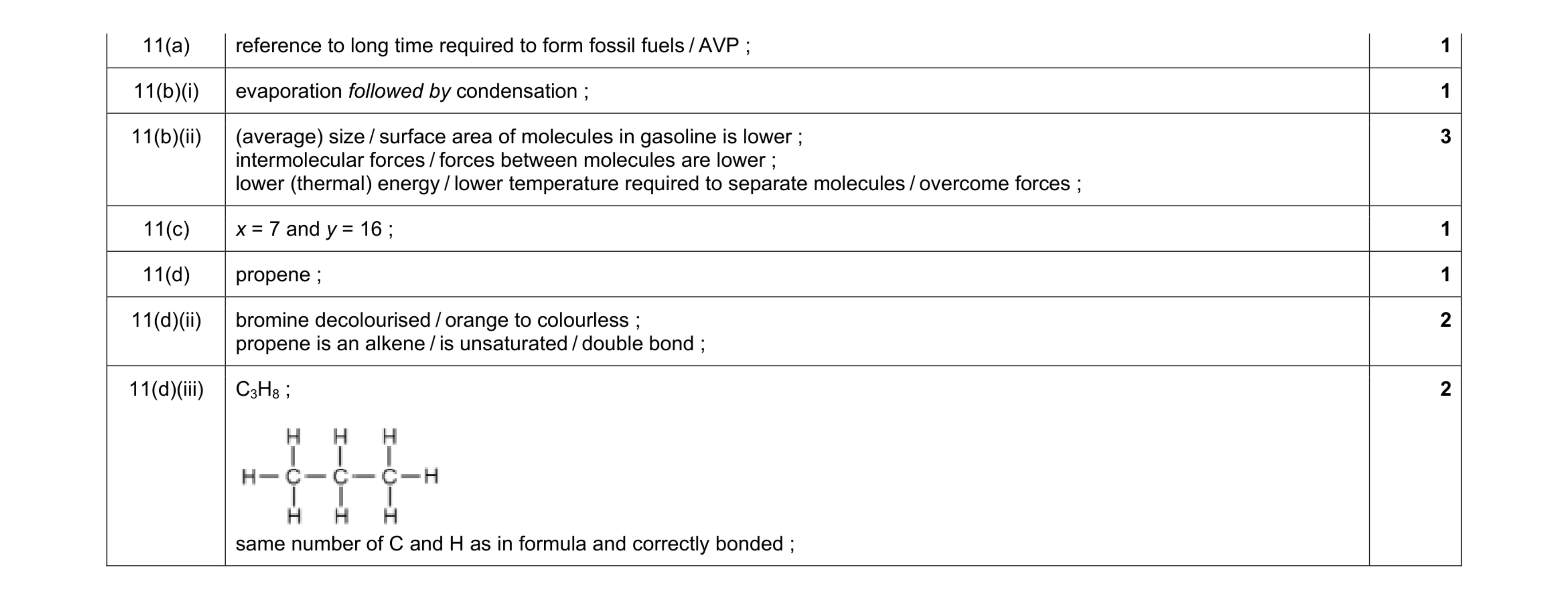 11
11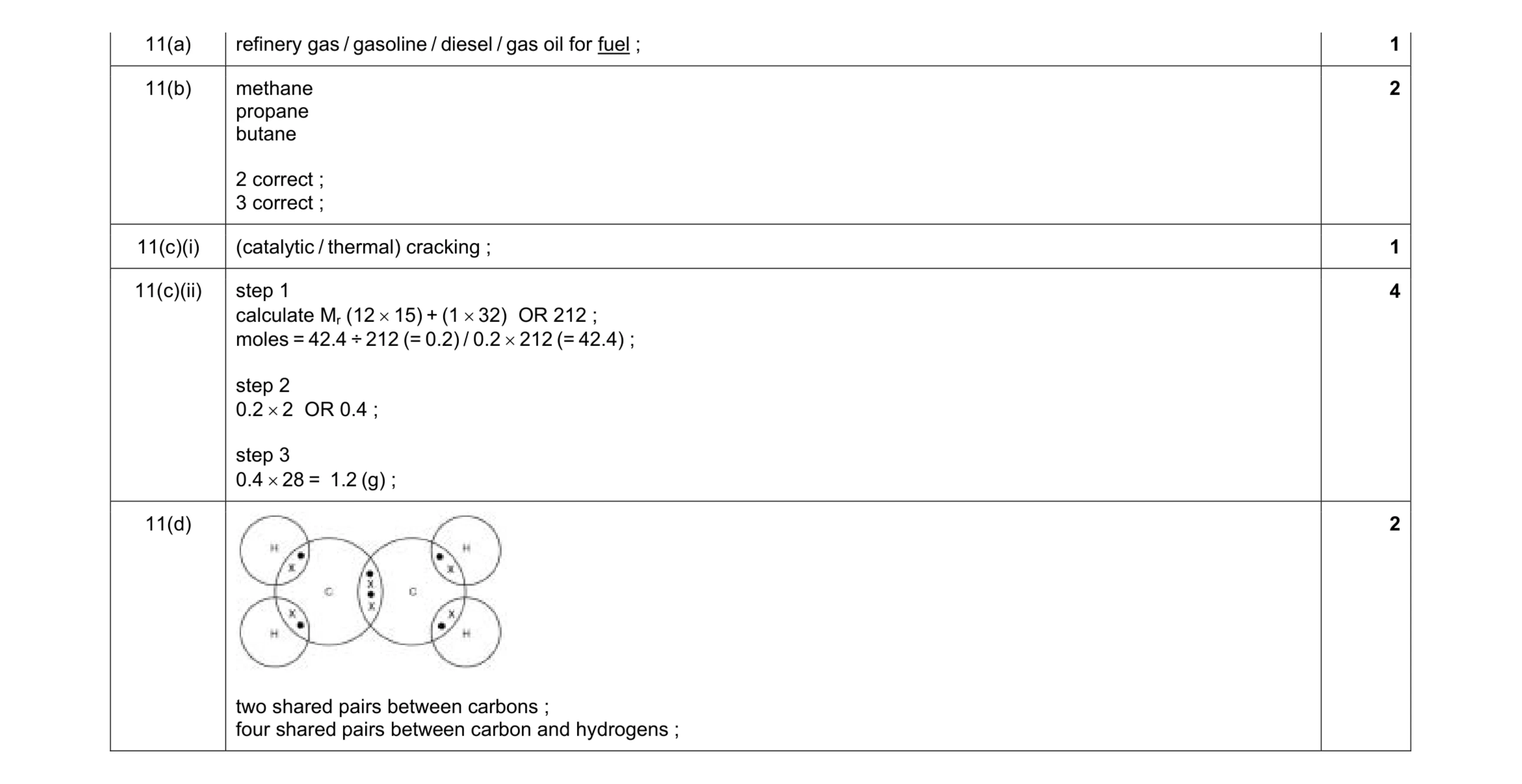 10
10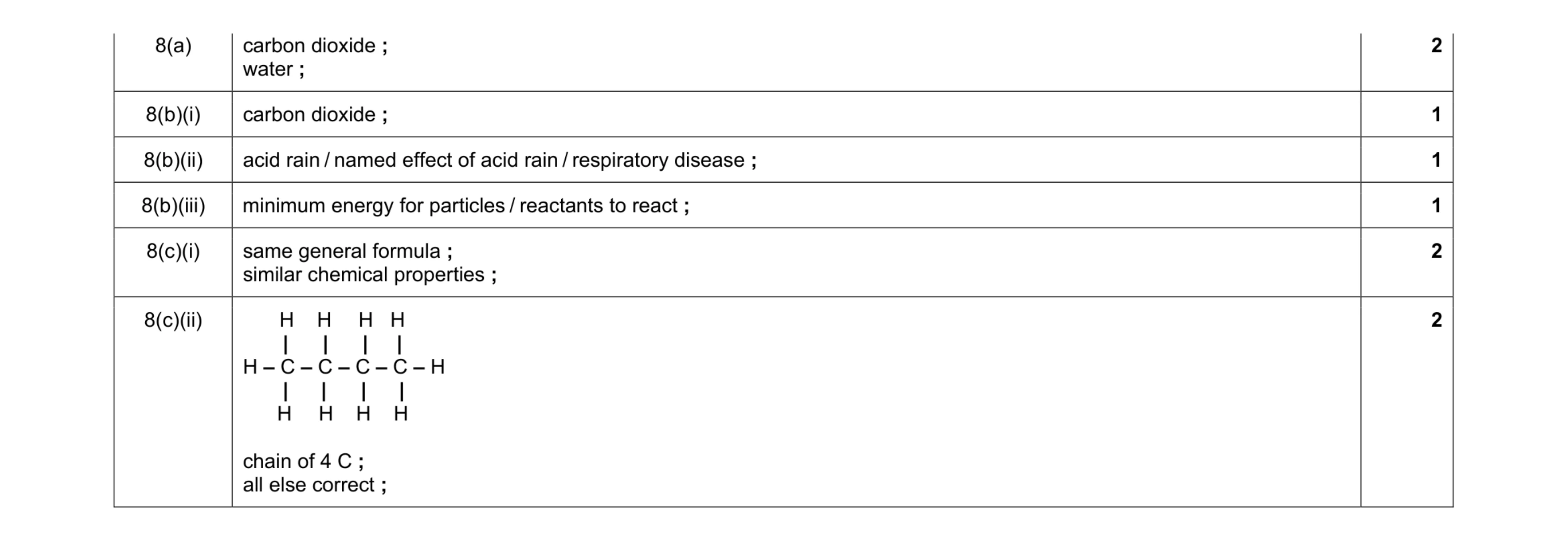 9
9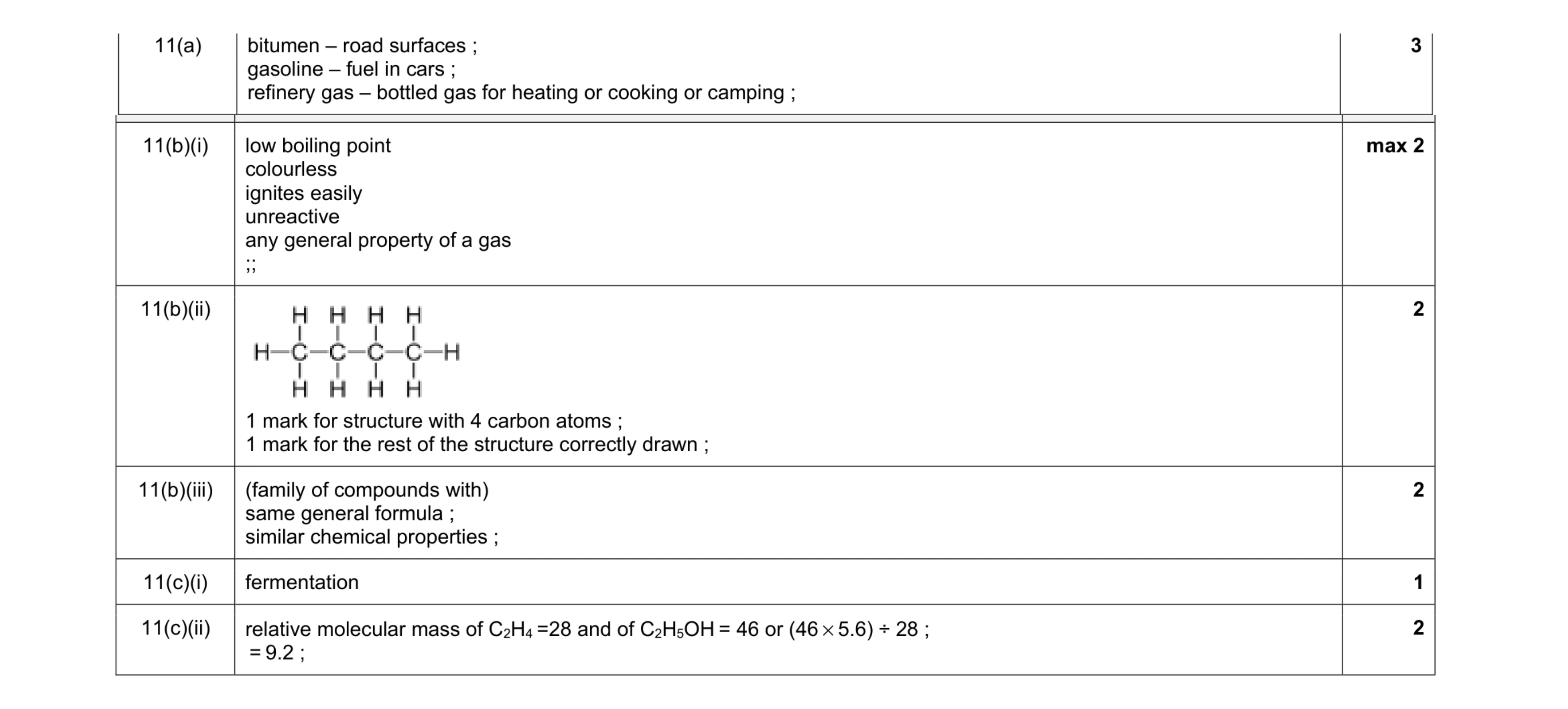 12
12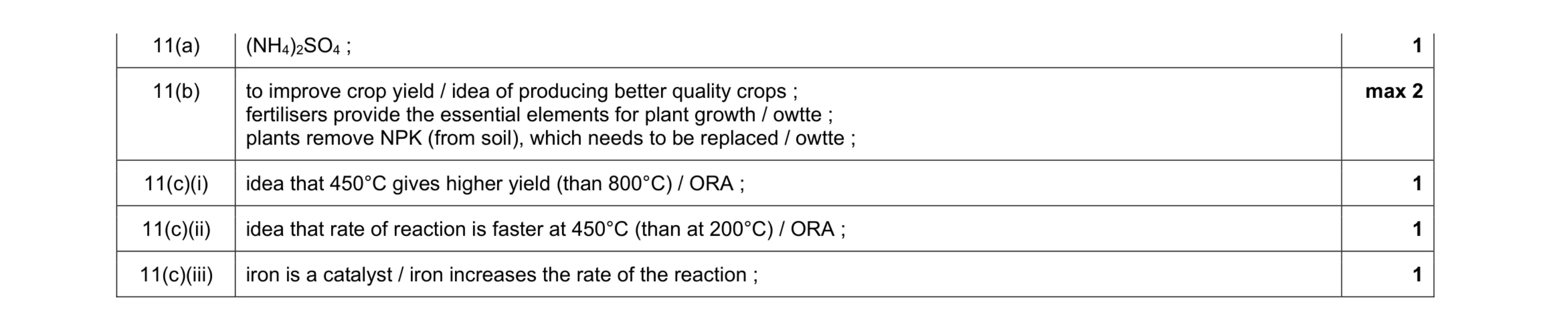 6
6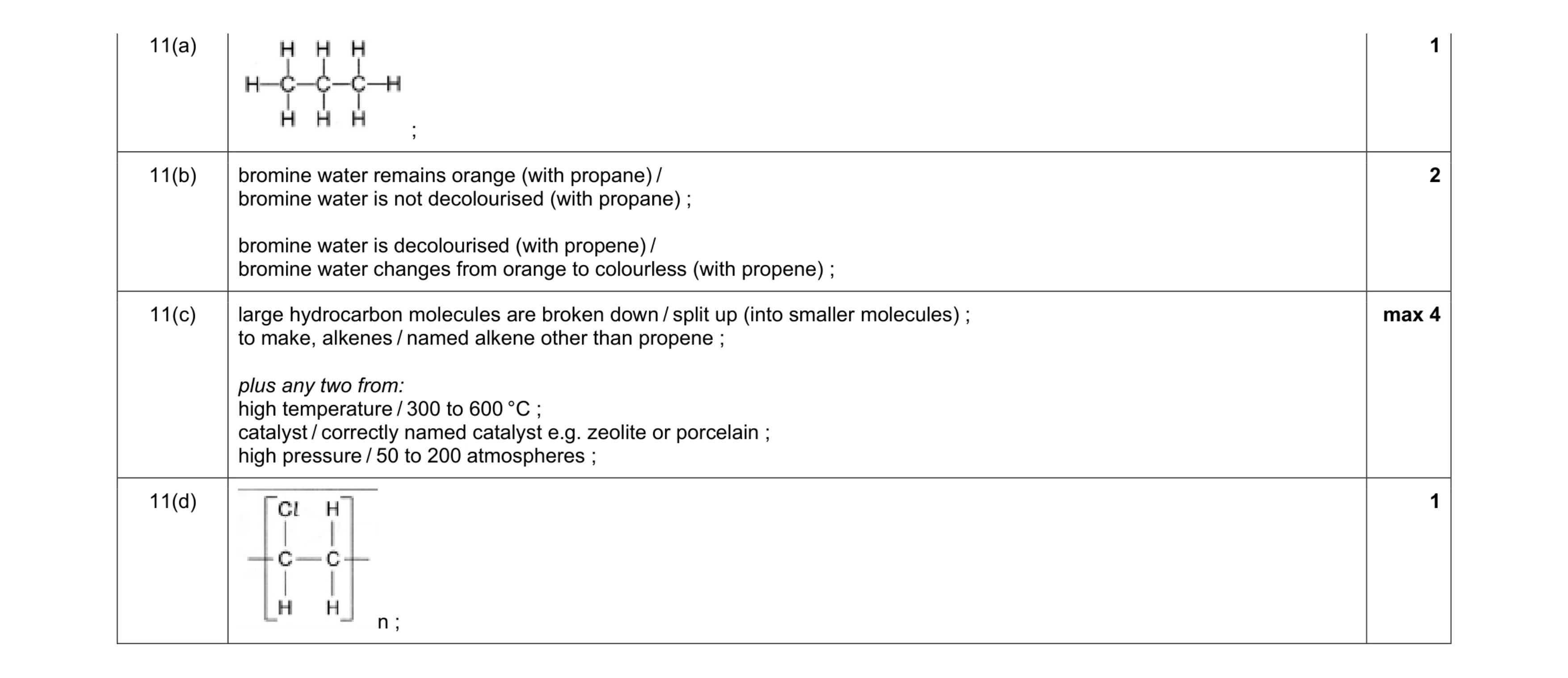 8
8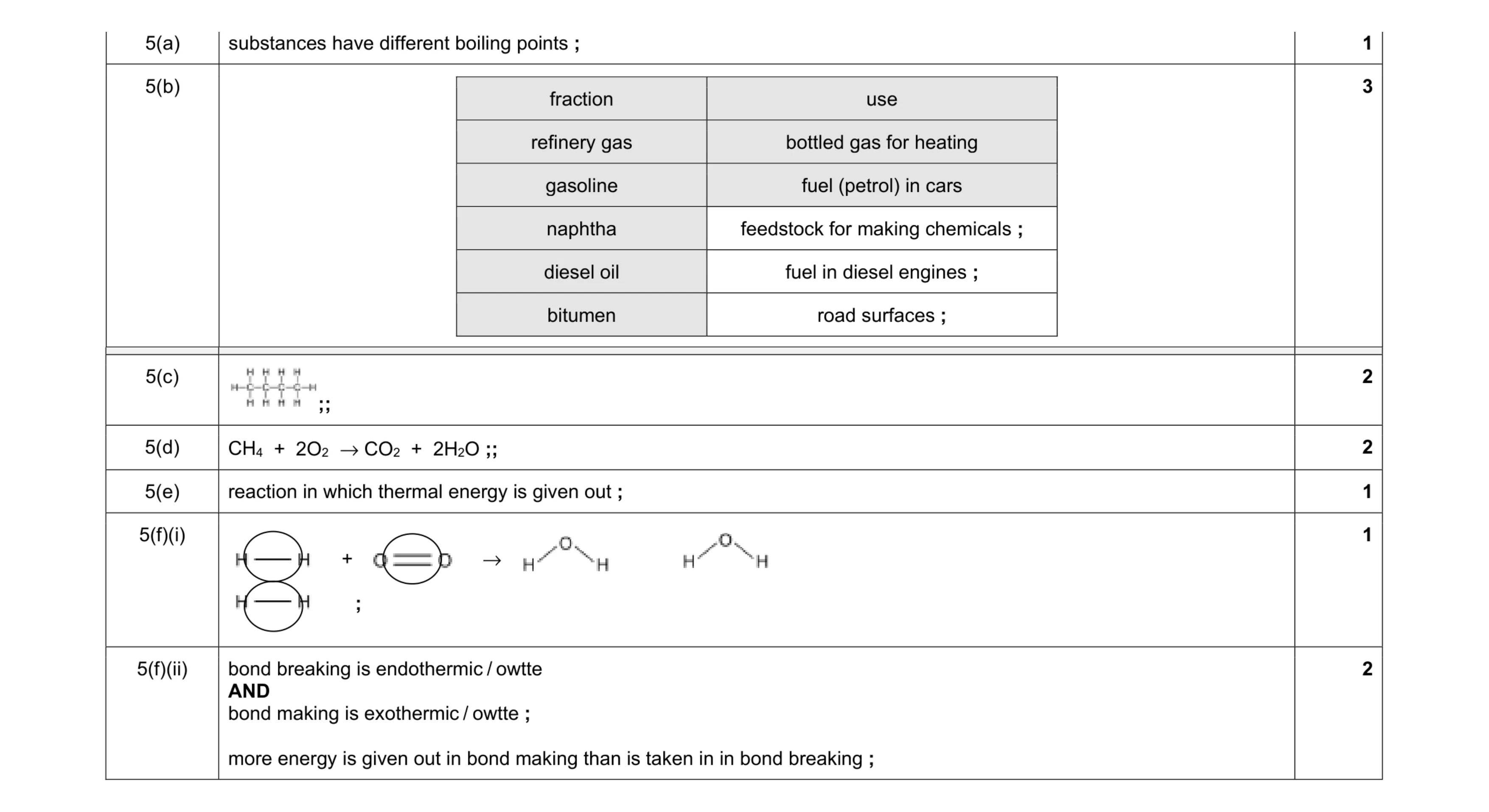 12
12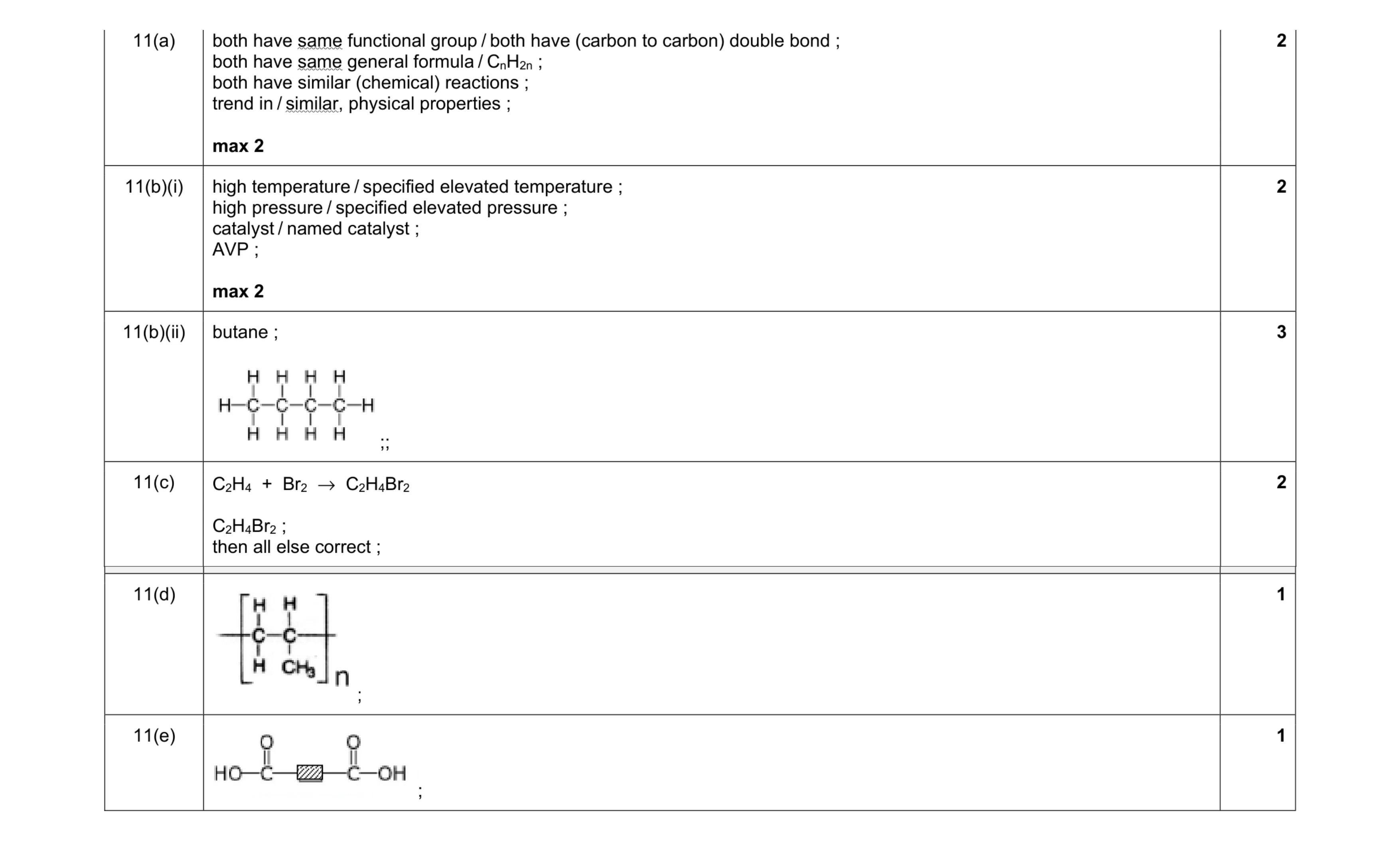 11
11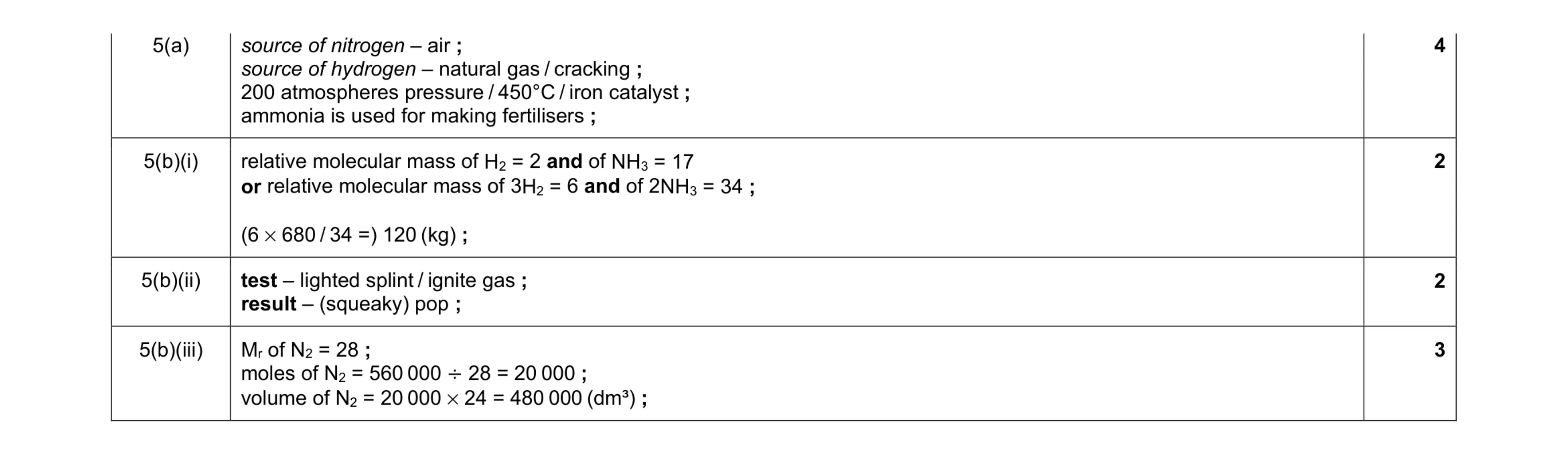 11
11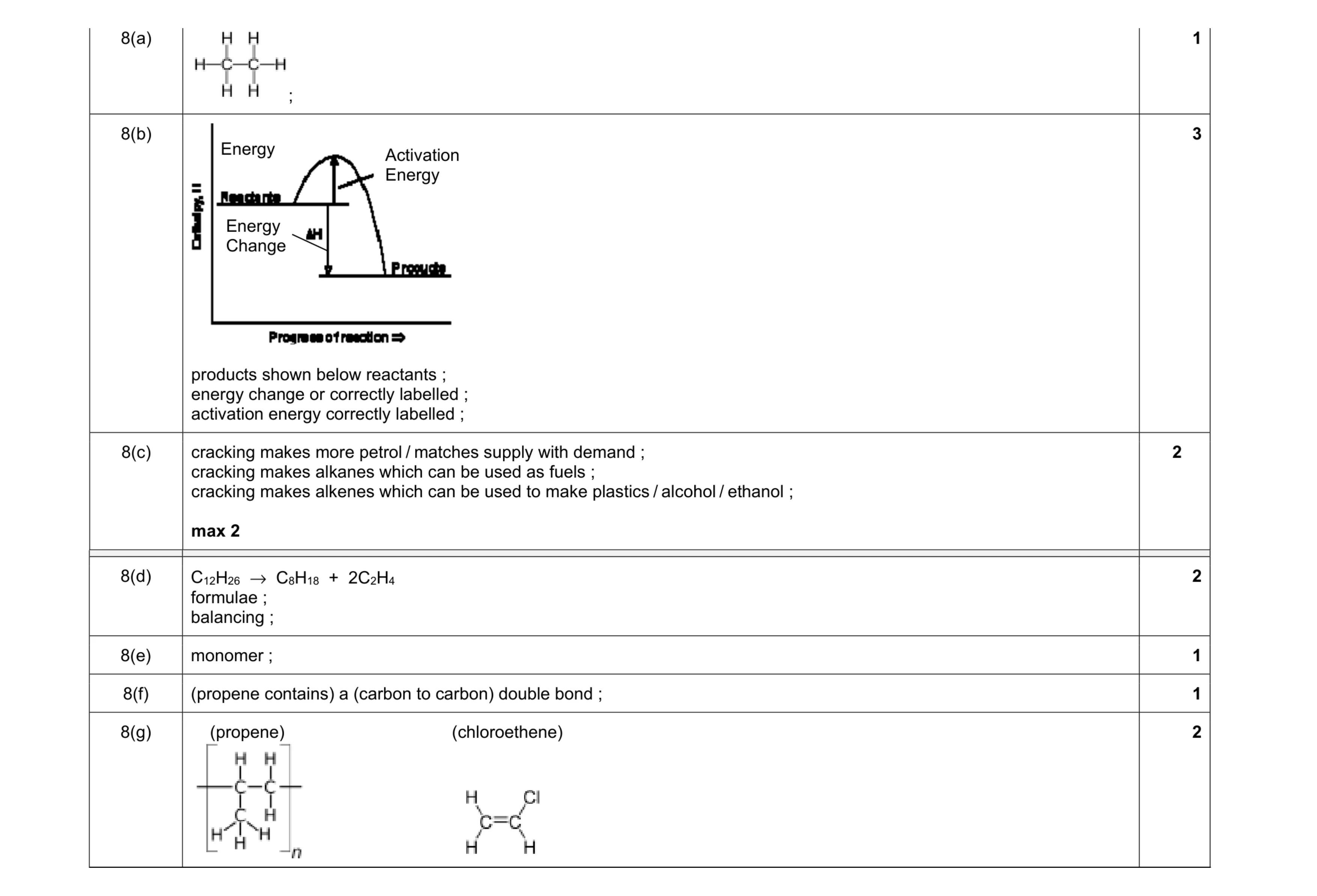 12
12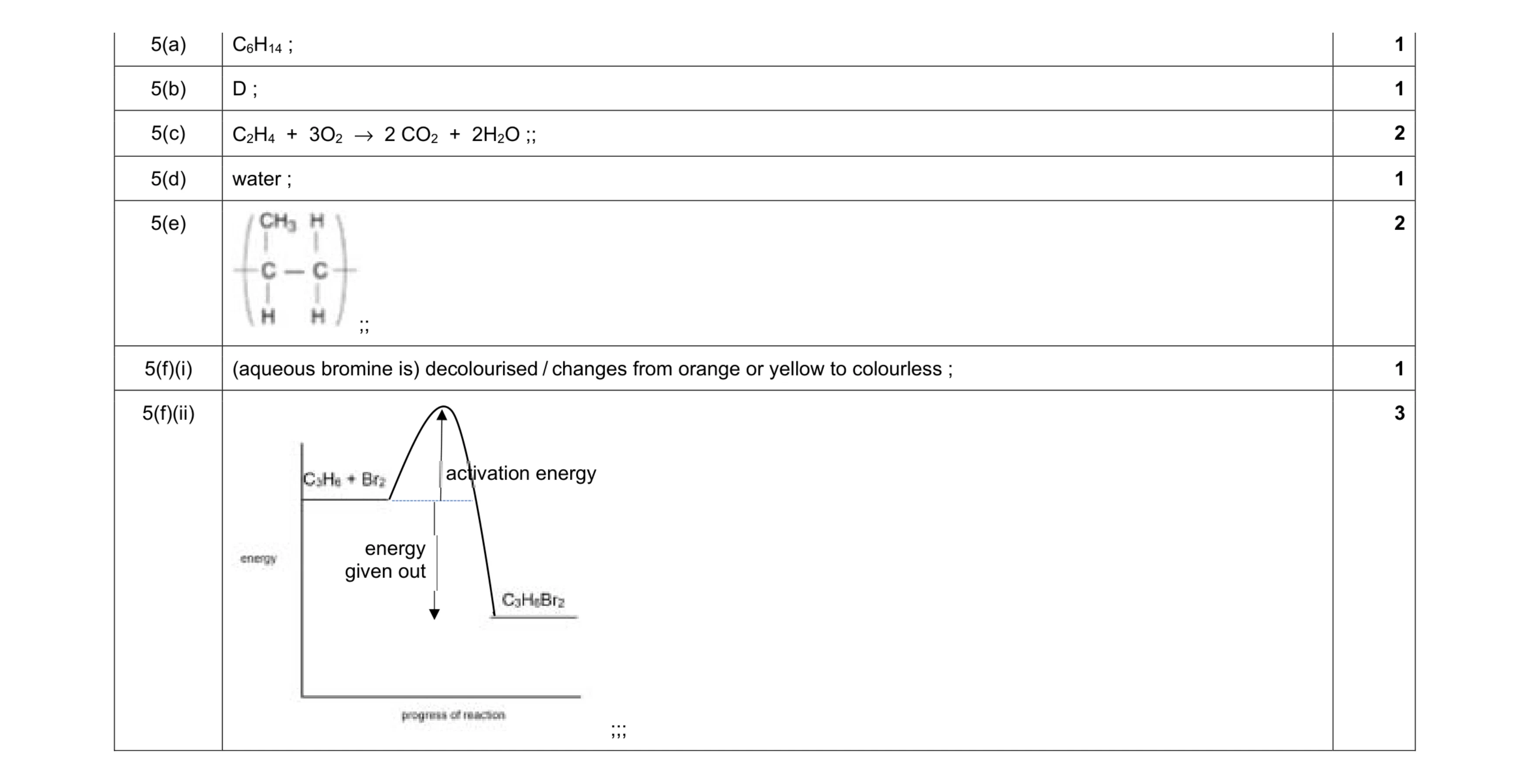 11
11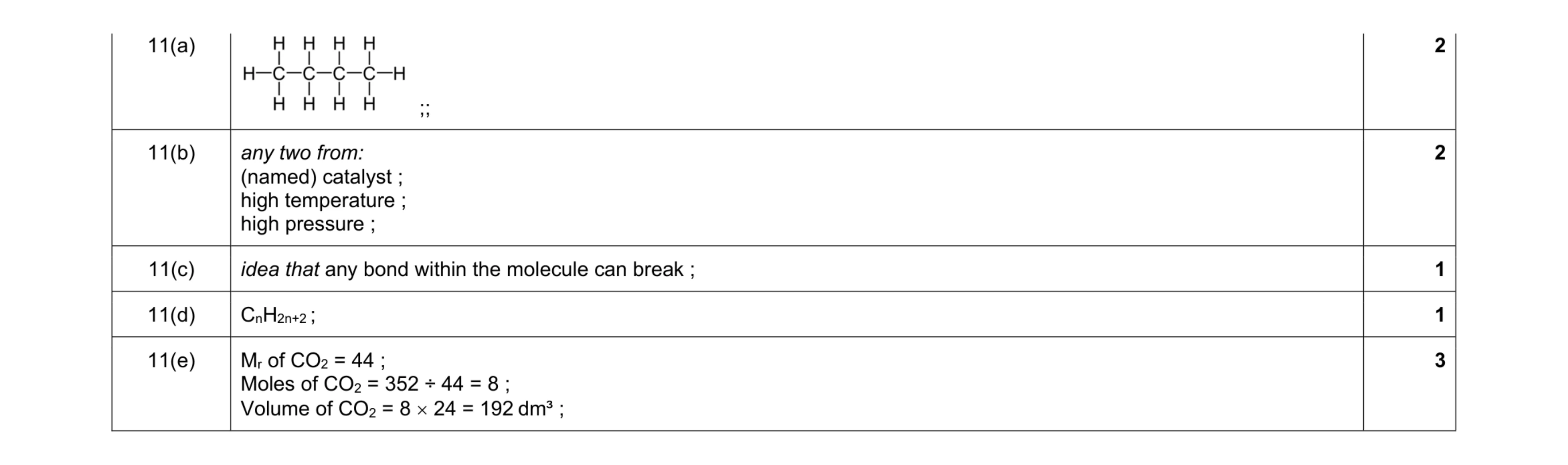 9
9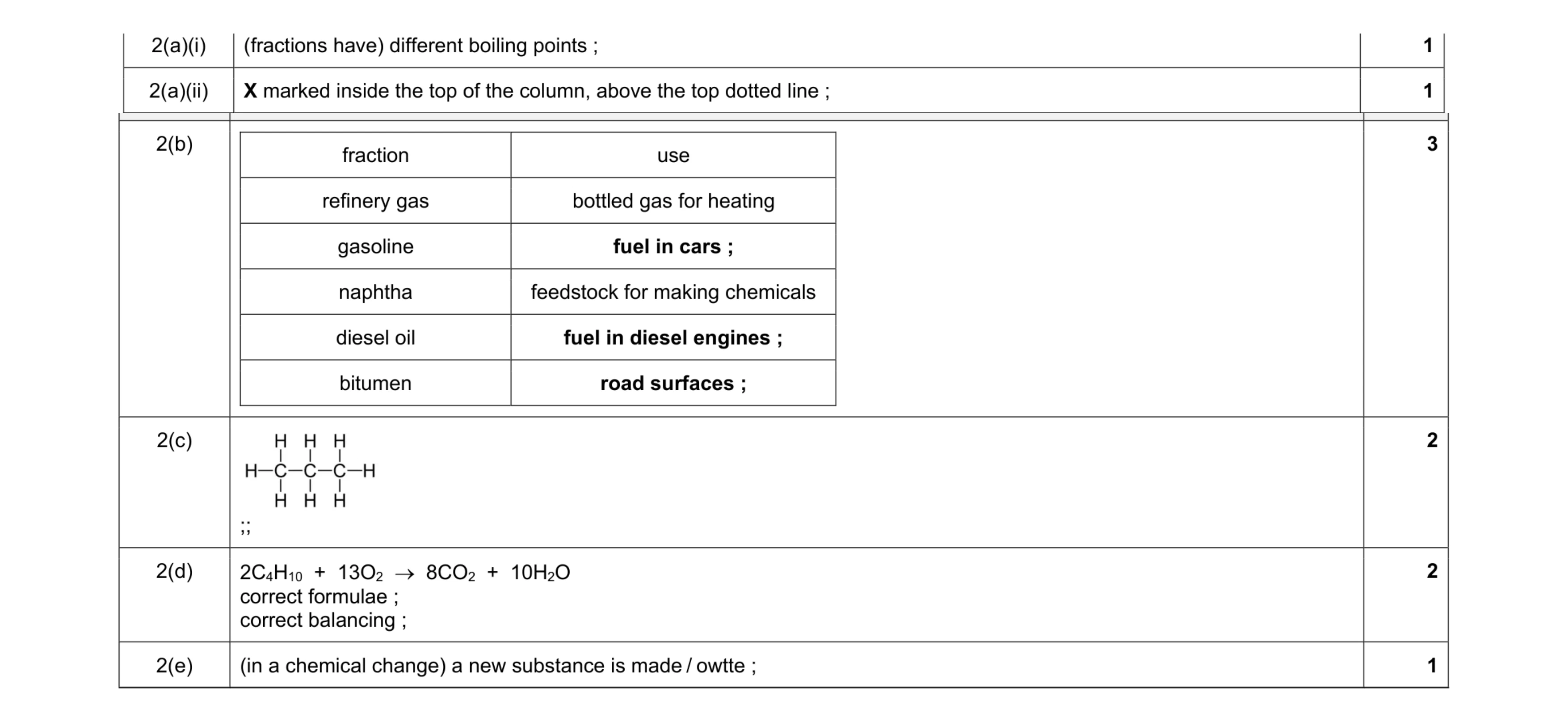 10
10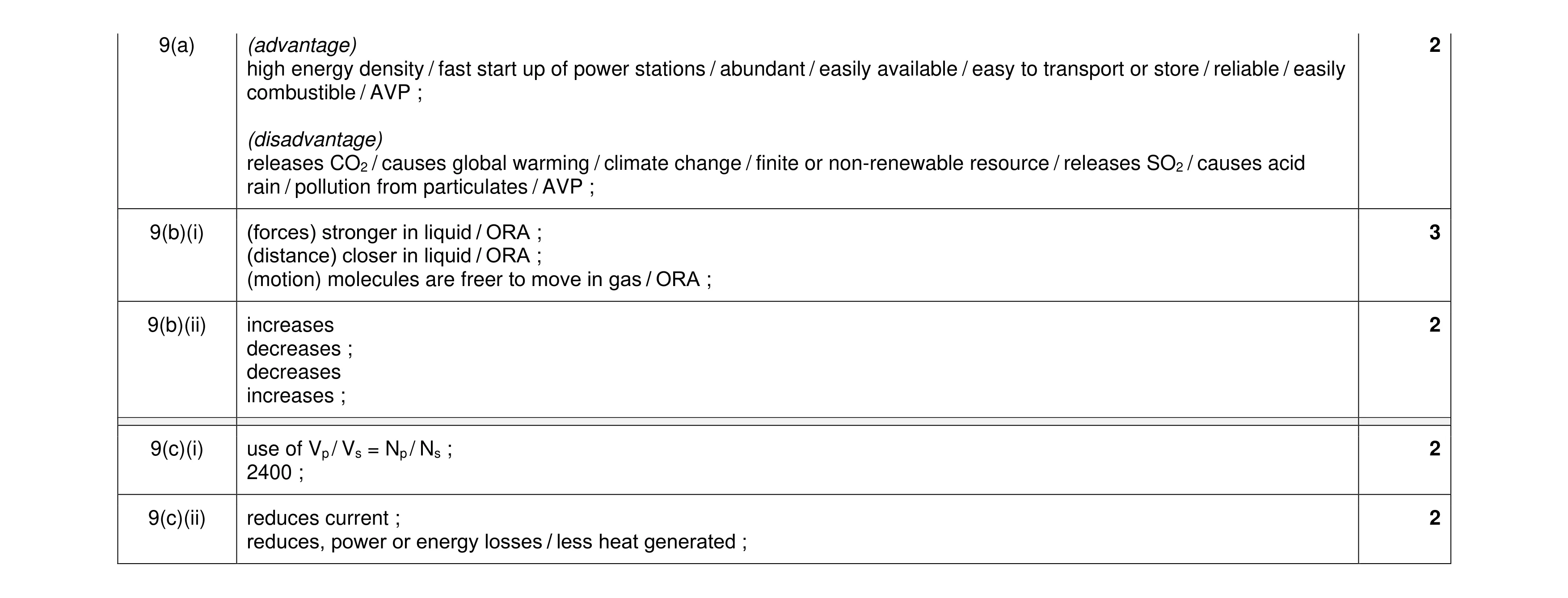 11
11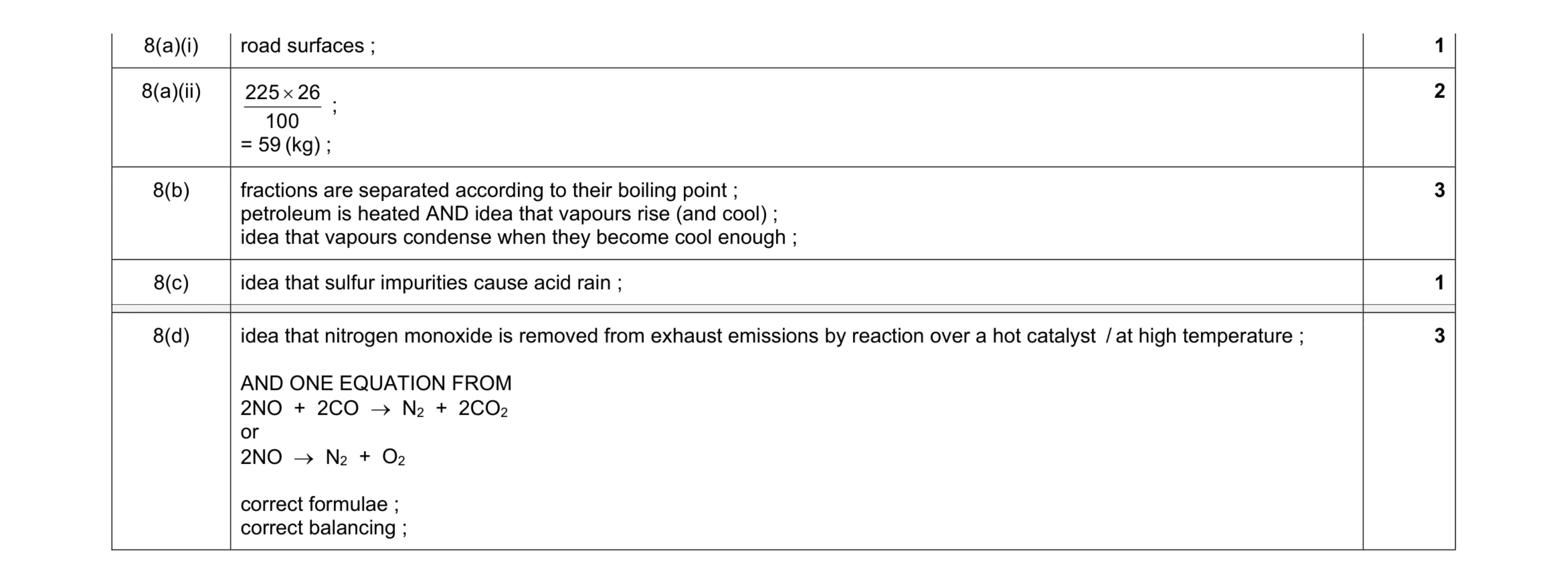 10
10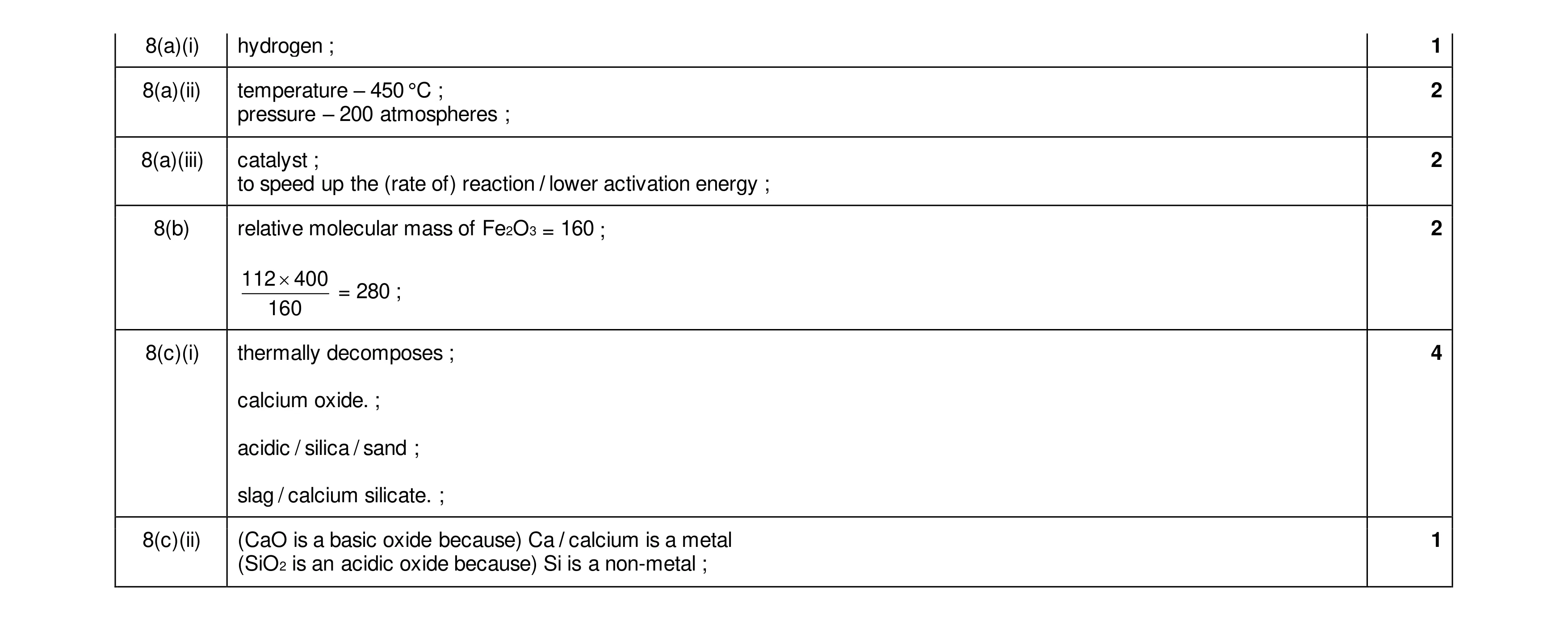 12
12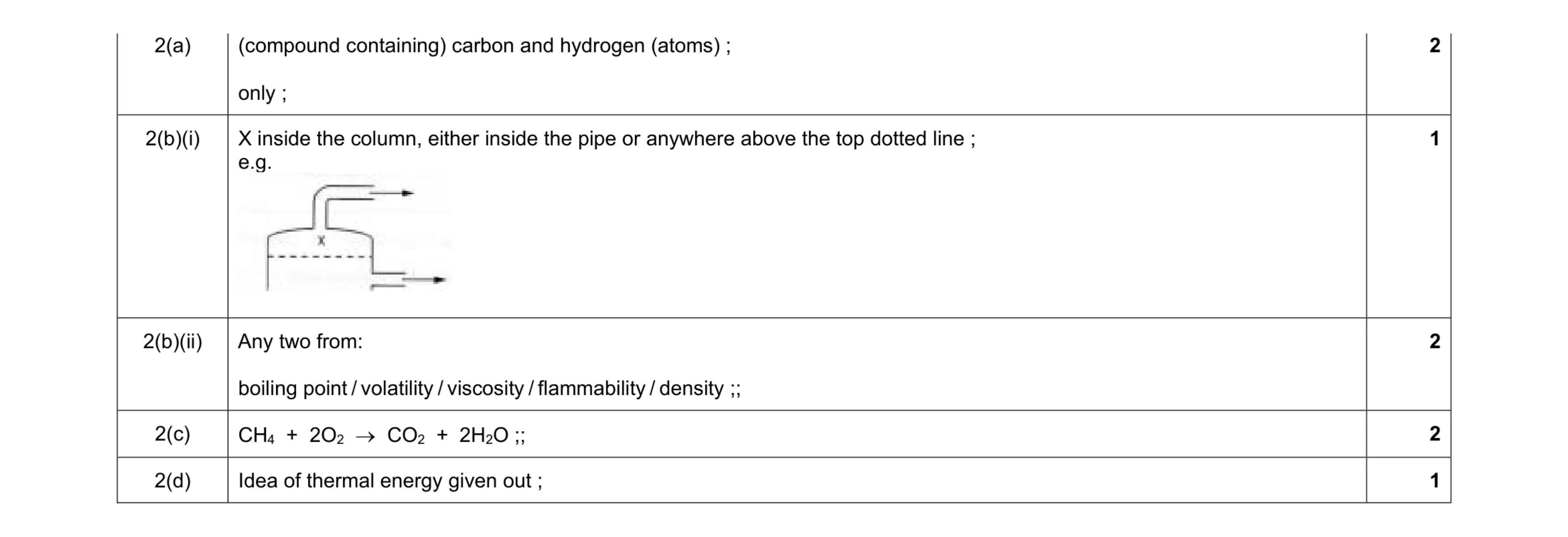 8
8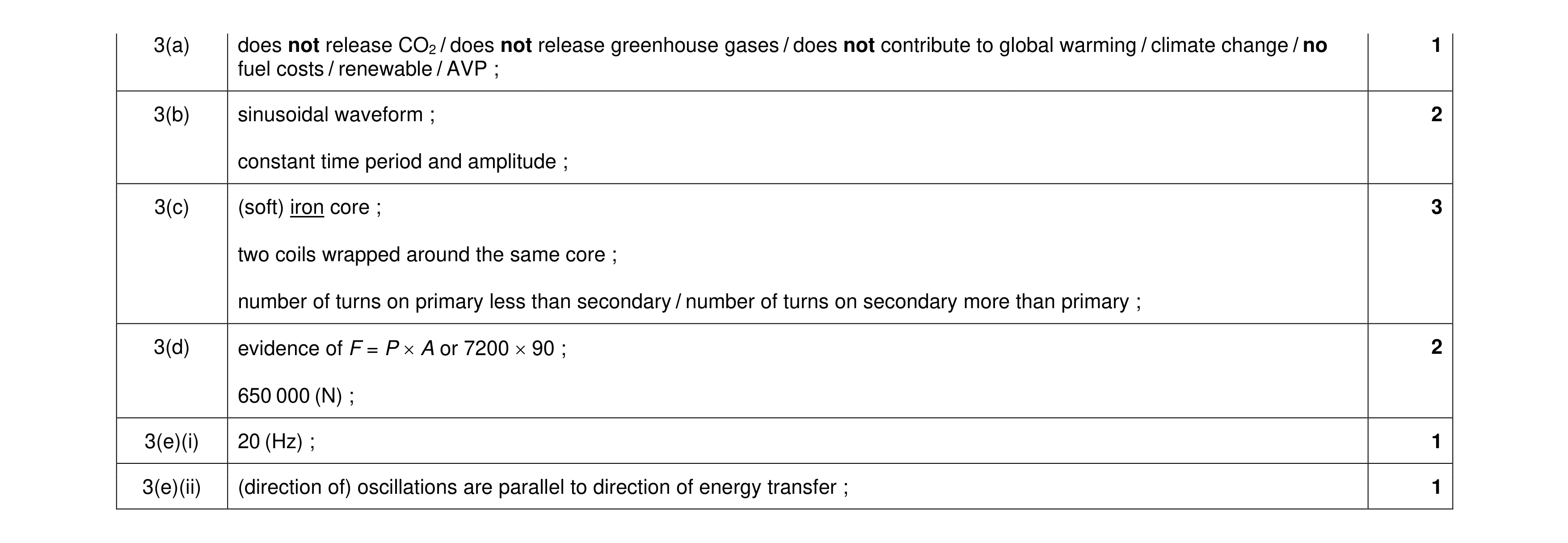 10
10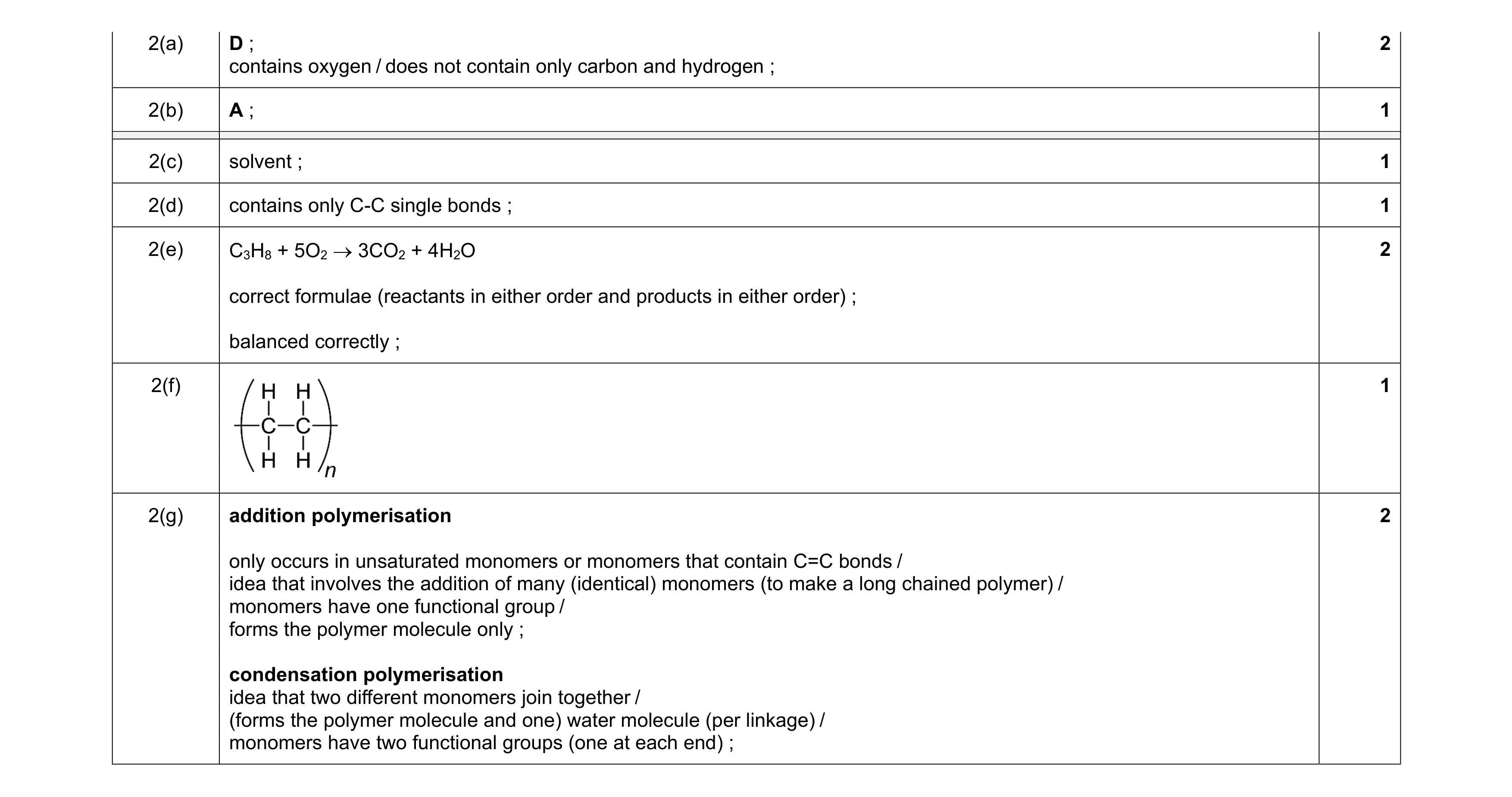 10
10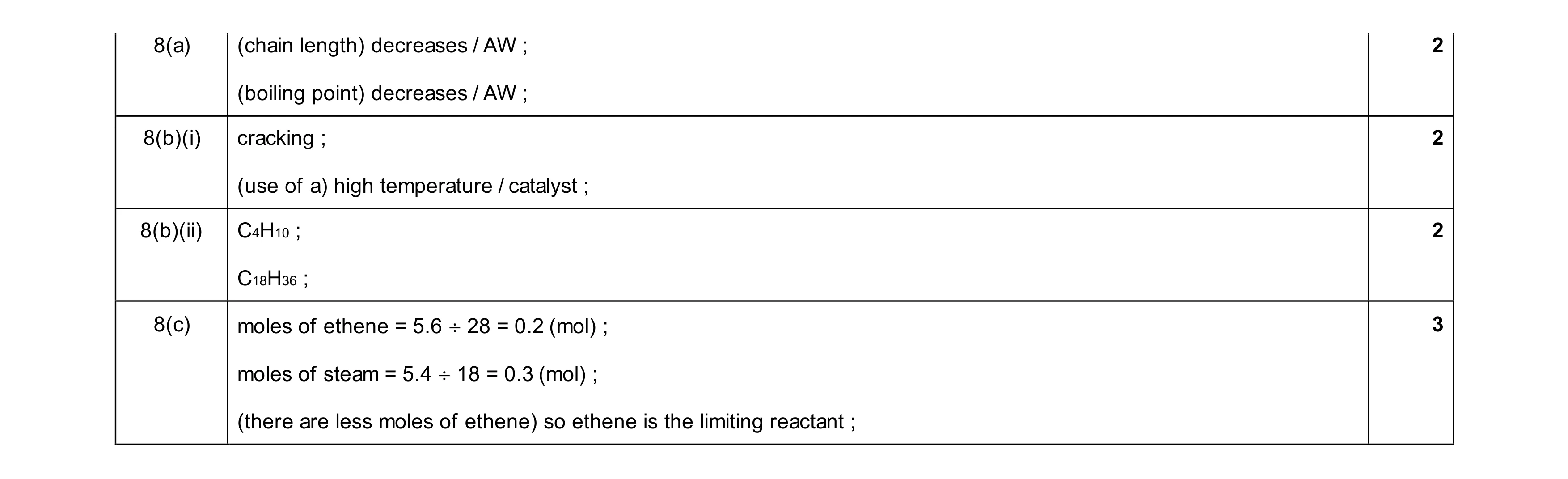 9
9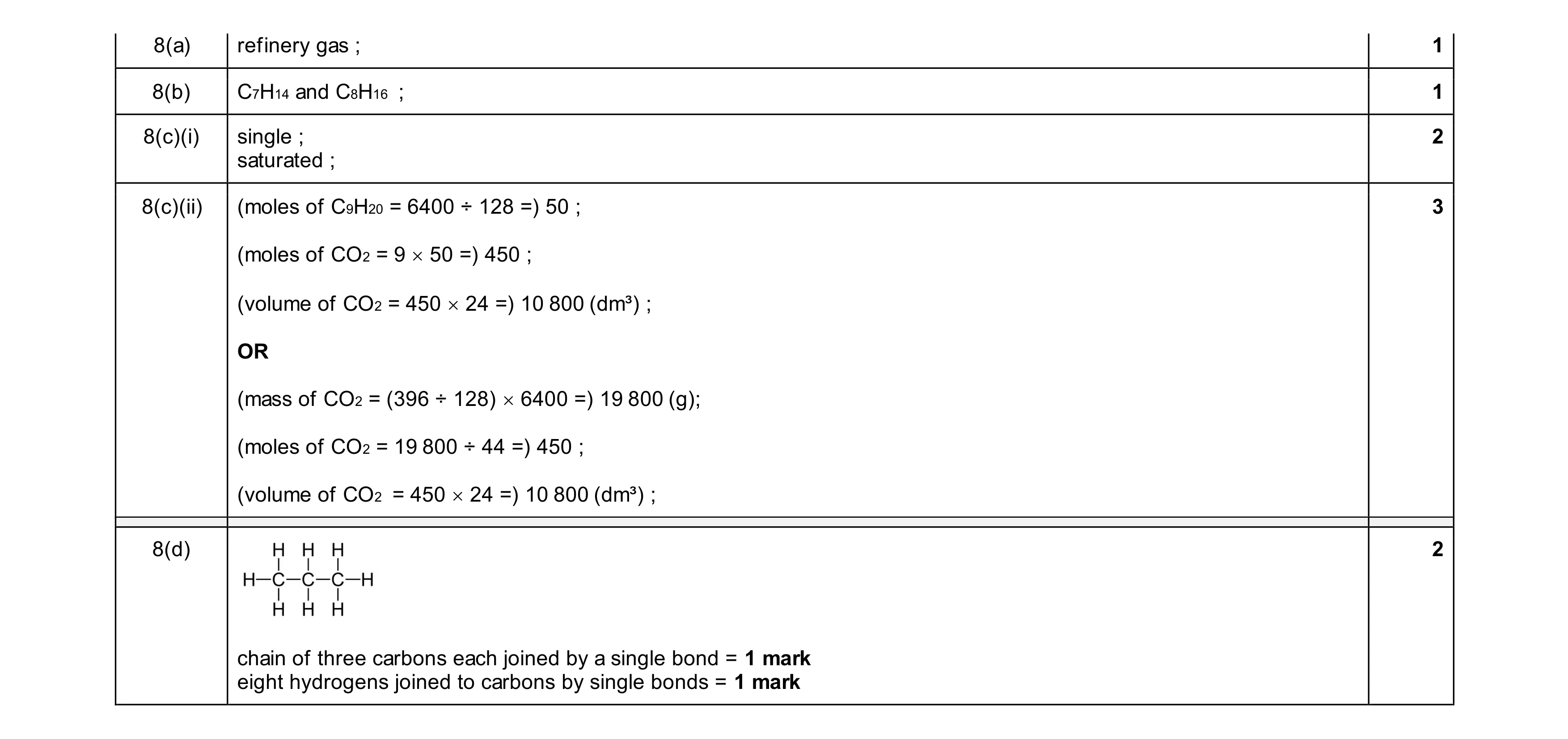 9
9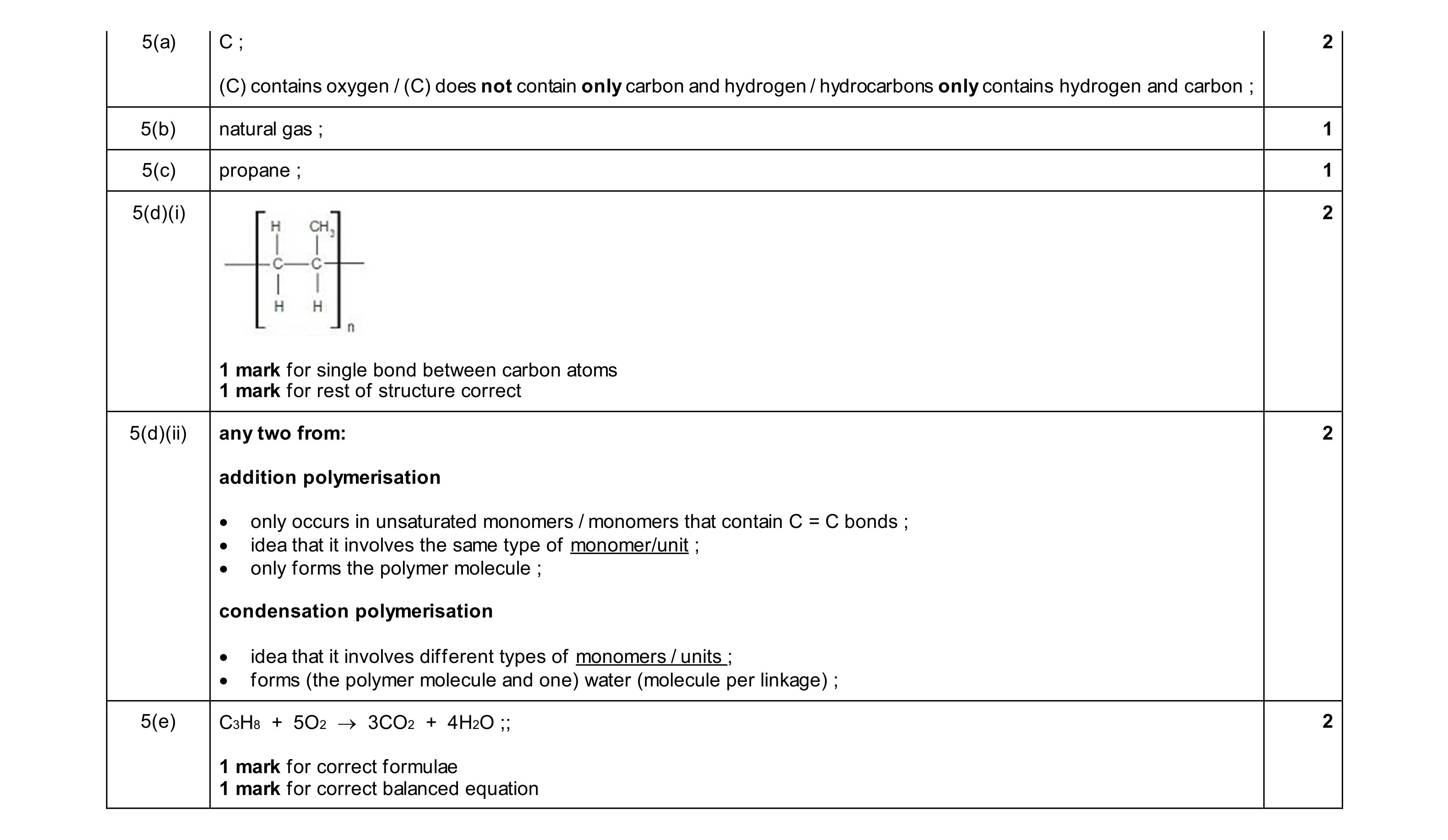 10
10