Questions as text
Q1 · Which statement about the products of the fractional distillation of petroleum is not… 0654/23 May/June 2017
26 Which statement about the products of the fractional distillation of petroleum is not correct? A Fractions obtained from high up the fractional distillation column contain small molecules. B Fractions obtained from low down the fractional distillation column have low boiling points. C Large molecules have large intermolecular attractive forces. D Refinery gas is used for cooking and heating.
1 marks
Answer: B
This question in 0654/23 May/June 2017
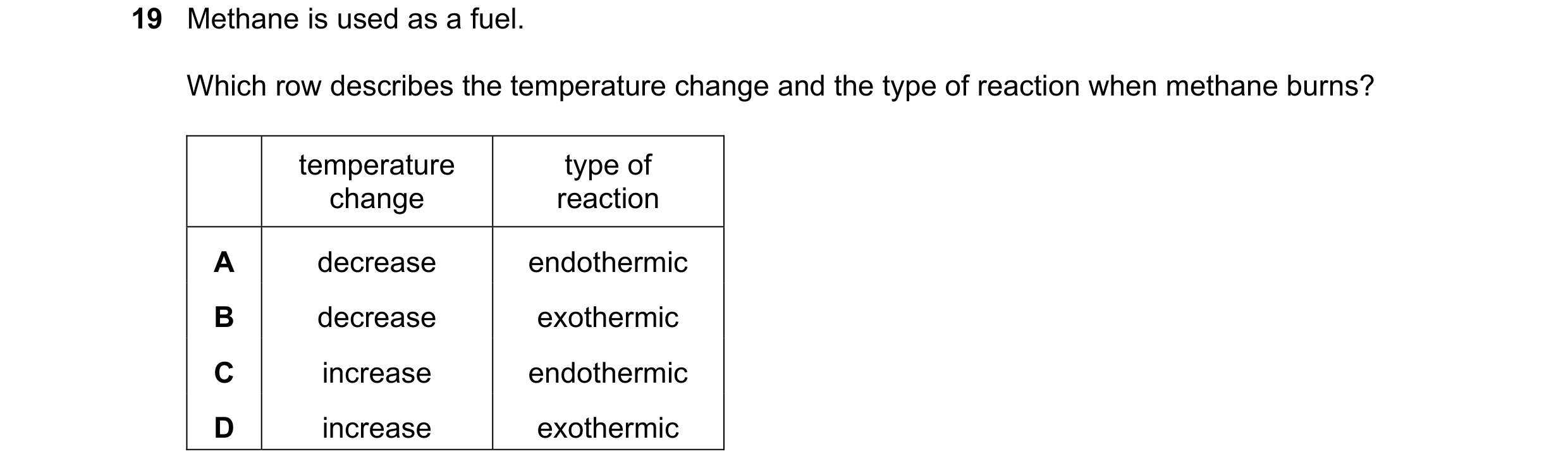
Q2 · Methane is used as a fuel 0654/21 Oct/Nov 2018
19 Methane is used as a fuel. Which row describes the temperature change and the type of reaction when methane burns? temperature type of change reaction A decrease endothermic B decrease exothermic C increase endothermic D increase exothermic
1 marks
Answer: D
This question in 0654/21 Oct/Nov 2018
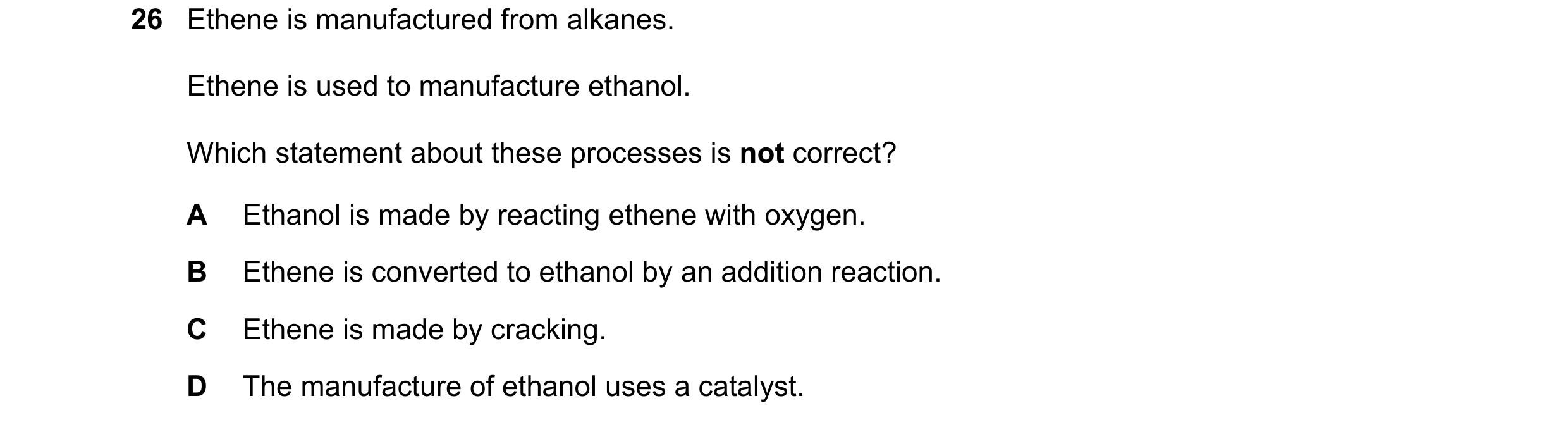
Q3 · Ethene is manufactured from alkanes 0654/23 Oct/Nov 2018
26 Ethene is manufactured from alkanes. Ethene is used to manufacture ethanol. Which statement about these processes is not correct? A Ethanol is made by reacting ethene with oxygen. B Ethene is converted to ethanol by an addition reaction. C Ethene is made by cracking. D The manufacture of ethanol uses a catalyst.
1 marks
Answer: A
This question in 0654/23 Oct/Nov 2018
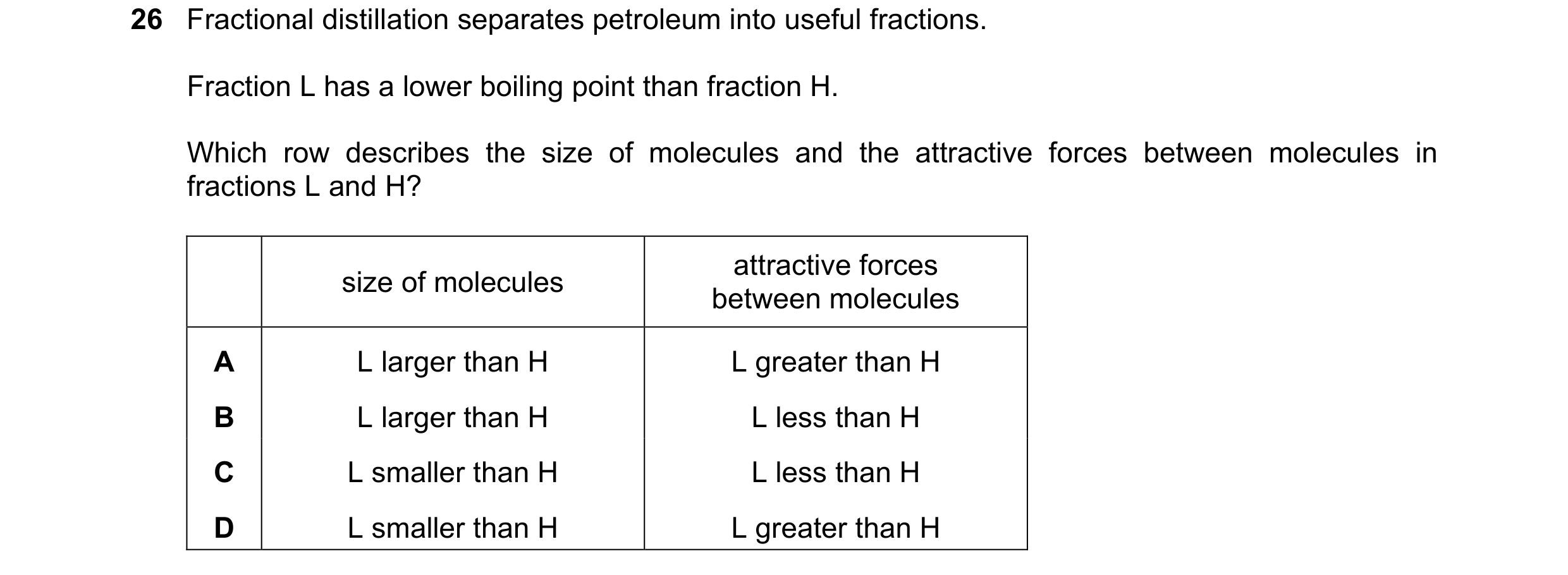
Q4 · Fractional distillation separates petroleum into useful fractions 0654/22 May/June 2019
26 Fractional distillation separates petroleum into useful fractions. Fraction L has a lower boiling point than fraction H. Which row describes the size of molecules and the attractive forces between molecules in fractions L and H? attractive forces size of molecules between molecules A L larger than H L greater than H B L larger than H L less than H C L smaller than H L less than H D L smaller than H L greater than H
1 marks
Answer: C
This question in 0654/22 May/June 2019
Q5 · What are the uses of the fractions obtained from petroleum? 0654/23 May/June 2020
26 What are the uses of the fractions obtained from petroleum? gas oil gasoline refinery gas A cooking petrol fuel diesel fuel B diesel fuel heating petrol fuel C diesel fuel petrol fuel cooking D petrol fuel diesel fuel heating
1 marks
Answer: C
This question in 0654/23 May/June 2020
Q6 · Ethene is produced when decane, a large hydrocarbon, is heated with a catalyst 0654/23 May/June 2020
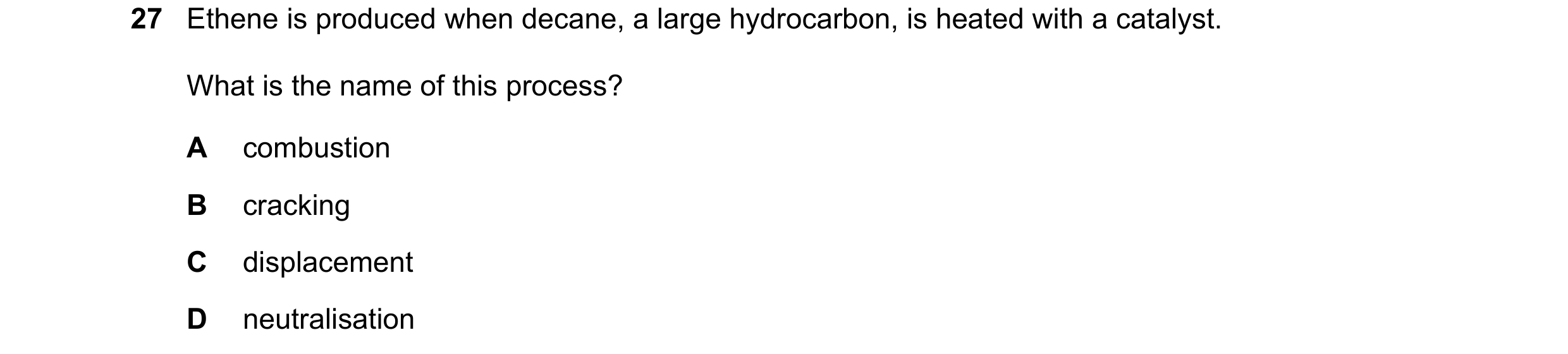
27 Ethene is produced when decane, a large hydrocarbon, is heated with a catalyst. What is the name of this process? A combustion B cracking C displacement D neutralisation
1 marks
Answer: B
This question in 0654/23 May/June 2020
Q7 · In the Haber process, ammonia is manufactured using hydrogen and nitrogen 0654/22 Oct/Nov 2020
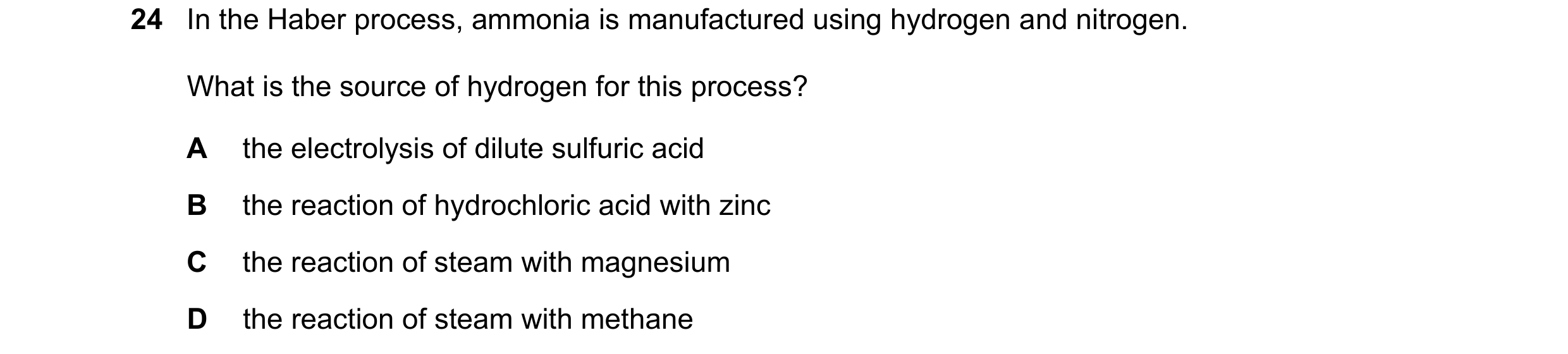
24 In the Haber process, ammonia is manufactured using hydrogen and nitrogen. What is the source of hydrogen for this process? A the electrolysis of dilute sulfuric acid B the reaction of hydrochloric acid with zinc C the reaction of steam with magnesium D the reaction of steam with methane
1 marks
Answer: D
This question in 0654/22 Oct/Nov 2020
Q8 · Naphtha is obtained from petroleum 0654/22 Feb/March 2021
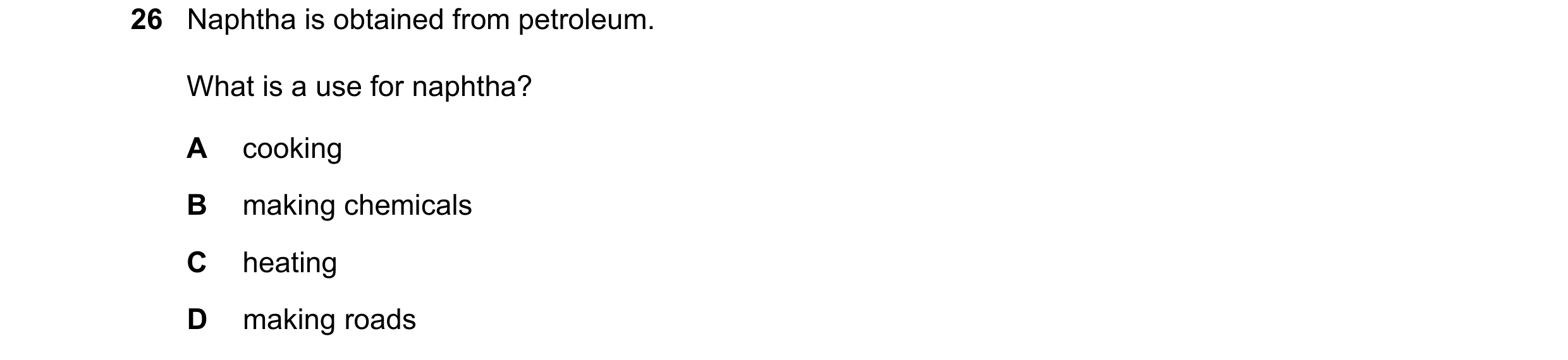
26 Naphtha is obtained from petroleum. What is a use for naphtha? A cooking B making chemicals C heating D making roads
1 marks
Answer: B
This question in 0654/22 Feb/March 2021
Q9 · Ammonia is manufactured by the Haber process from nitrogen and hydrogen 0654/22 Oct/Nov 2021
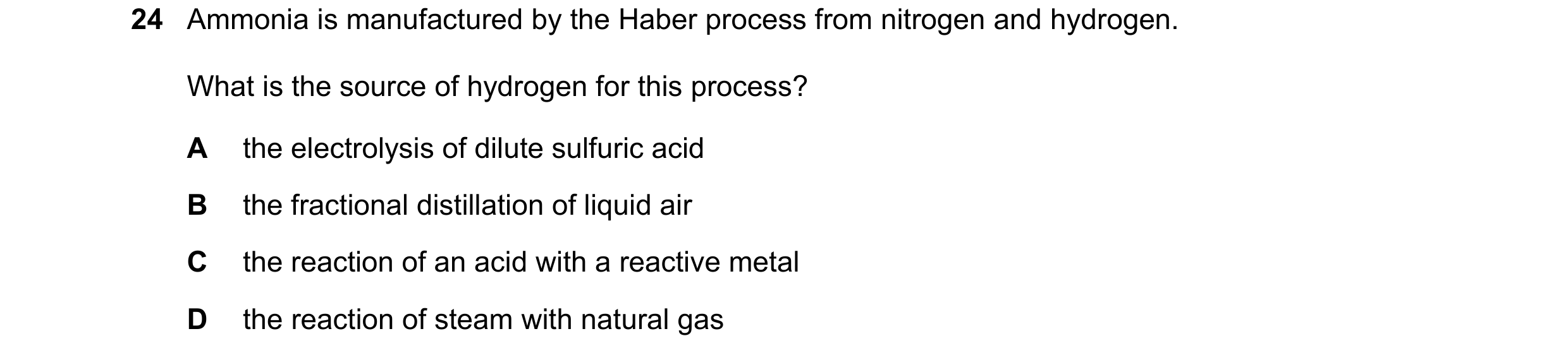
24 Ammonia is manufactured by the Haber process from nitrogen and hydrogen. What is the source of hydrogen for this process? A the electrolysis of dilute sulfuric acid B the fractional distillation of liquid air C the reaction of an acid with a reactive metal D the reaction of steam with natural gas
1 marks
Answer: D
This question in 0654/22 Oct/Nov 2021
Q10 · Which row describes how hydrogen and nitrogen are obtained for use in the Haber process? 0654/21 May/June 2023
23 Which row describes how hydrogen and nitrogen are obtained for use in the Haber process? hydrogen nitrogen A electrolysis of sulfuric acid catalytic reduction of nitrogen oxides B electrolysis of sulfuric acid distillation of air C reaction of methane and steam catalytic reduction of nitrogen oxides D reaction of methane and steam distillation of air
1 marks
Answer: D
This question in 0654/21 May/June 2023
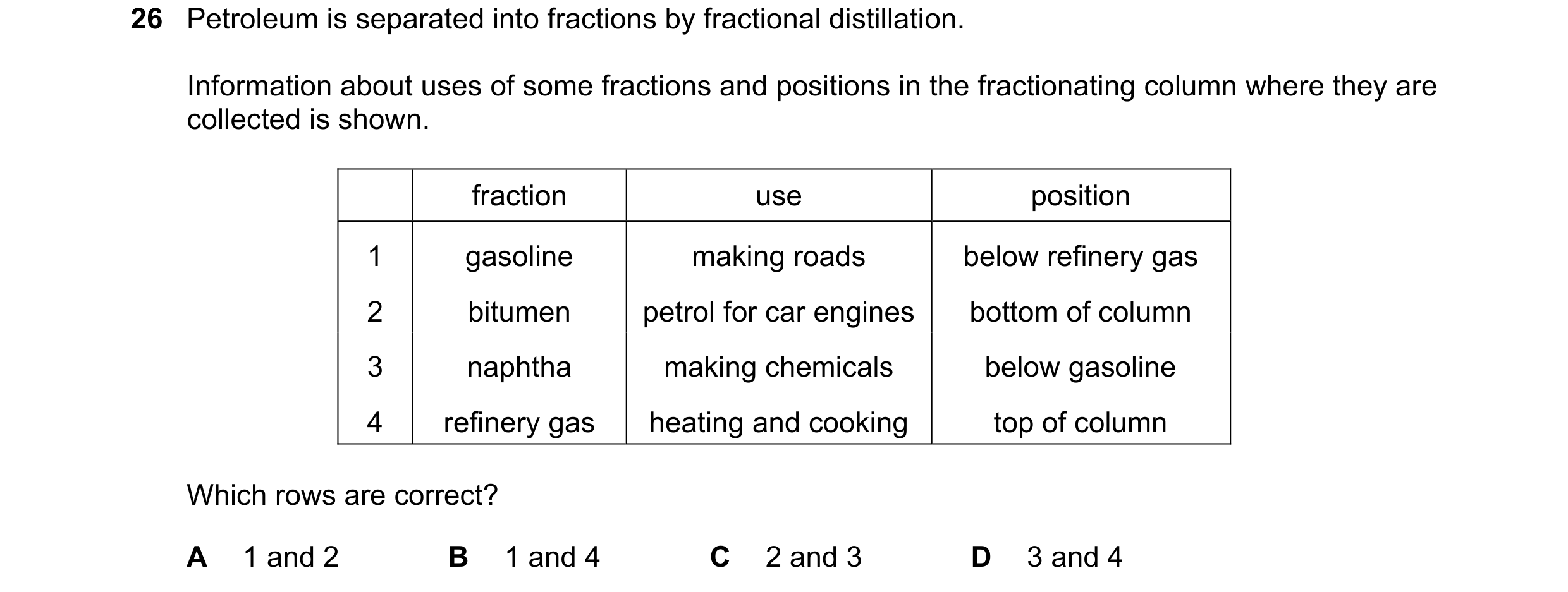
Q11 · Petroleum is separated into fractions by fractional distillation 0654/21 May/June 2023
26 Petroleum is separated into fractions by fractional distillation. Information about uses of some fractions and positions in the fractionating column where they are collected is shown. fraction use position 1 gasoline making roads below refinery gas 2 bitumen petrol for car engines bottom of column 3 naphtha making chemicals below gasoline 4 refinery gas heating and cooking top of column Which rows are correct? A 1 and 2 B 1 and 4 C 2 and 3 D 3 and 4
1 marks
Answer: D
This question in 0654/21 May/June 2023
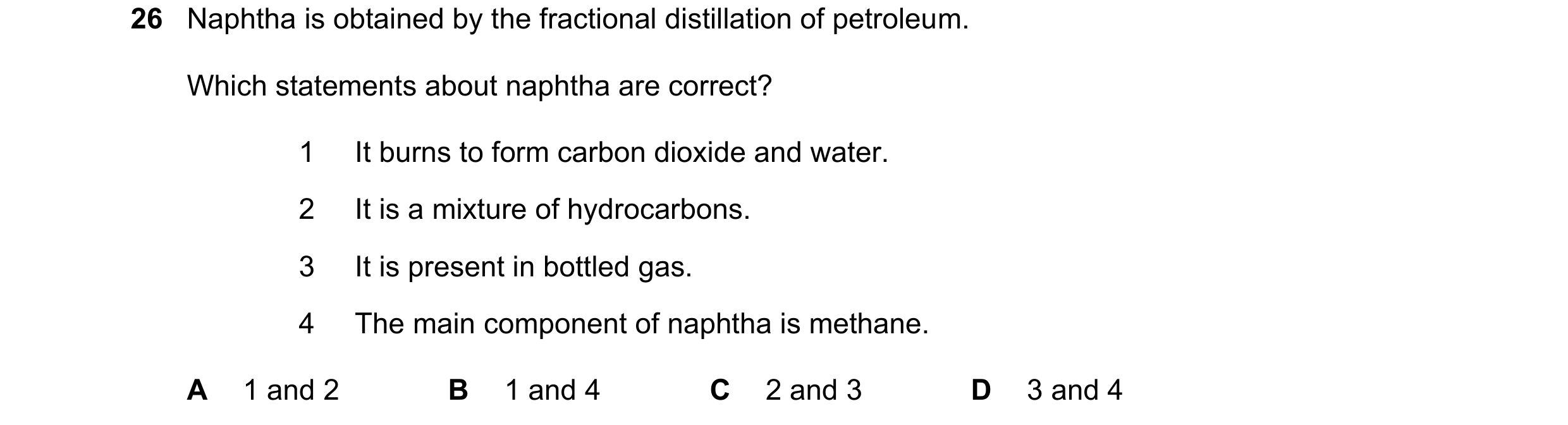
Q12 · Naphtha is obtained by the fractional distillation of petroleum 0654/22 May/June 2023
26 Naphtha is obtained by the fractional distillation of petroleum. Which statements about naphtha are correct? 1 It burns to form carbon dioxide and water. 2 It is a mixture of hydrocarbons. 3 It is present in bottled gas. 4 The main component of naphtha is methane. A 1 and 2 B 1 and 4 C 2 and 3 D 3 and 4
1 marks
Answer: A
This question in 0654/22 May/June 2023
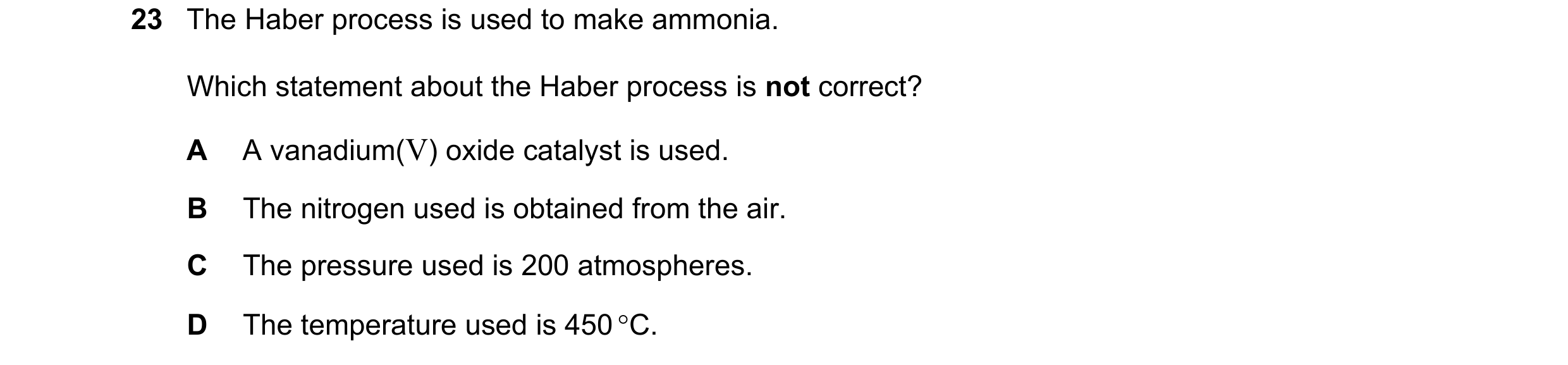
Q13 · The Haber process is used to make ammonia 0654/23 May/June 2023
23 The Haber process is used to make ammonia. Which statement about the Haber process is not correct? A A vanadium(V) oxide catalyst is used. B The nitrogen used is obtained from the air. C The pressure used is 200 atmospheres. D The temperature used is 450 C.
1 marks
Answer: A
This question in 0654/23 May/June 2023
Q14 · Which fraction obtained from petroleum is used as a feedstock for making chemicals? 0654/23 May/June 2023
26 Which fraction obtained from petroleum is used as a feedstock for making chemicals? A bitumen B gasoline C naphtha D refinery gas
1 marks
Answer: C
This question in 0654/23 May/June 2023
Q15 · What is the main constituent of clean air and of natural gas? 0654/23 May/June 2024
26 What is the main constituent of clean air and of natural gas? clean air natural gas A nitrogen ethane B nitrogen methane C oxygen ethane D oxygen methane
1 marks
Answer: B
This question in 0654/23 May/June 2024
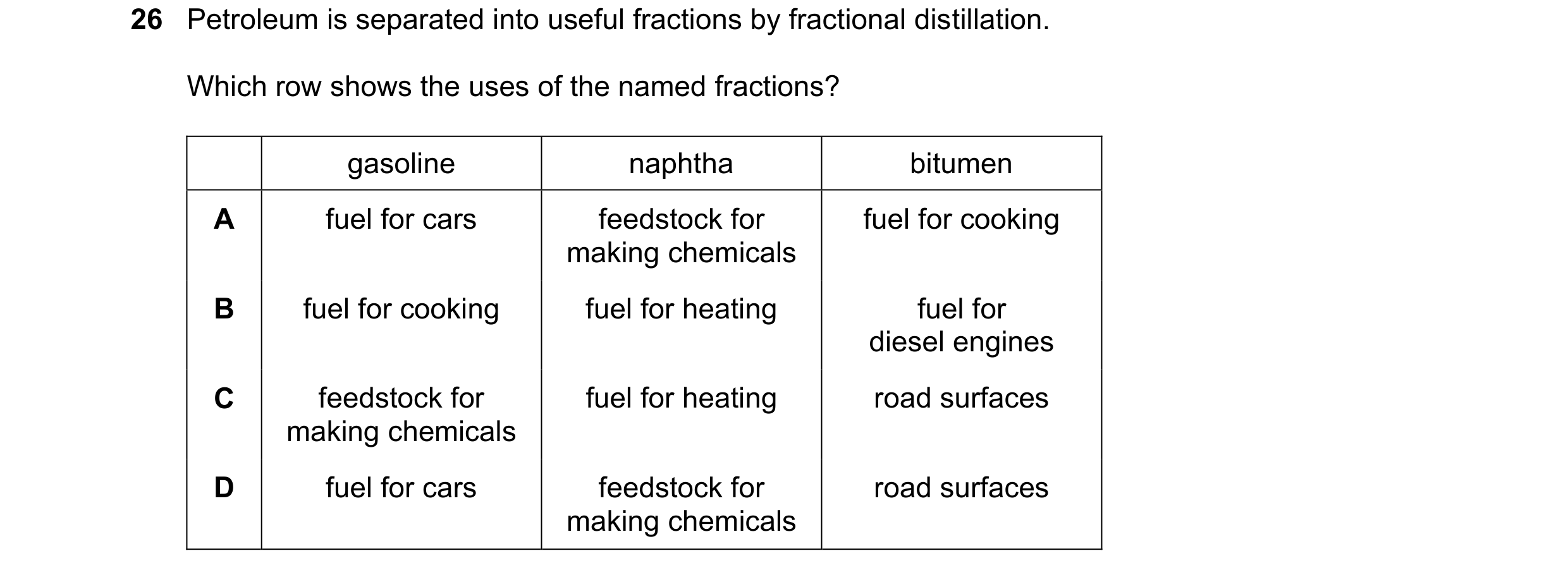
Q16 · Petroleum is separated into useful fractions by fractional distillation 0654/22 Oct/Nov 2024
26 Petroleum is separated into useful fractions by fractional distillation. Which row shows the uses of the named fractions? gasoline naphtha bitumen A fuel for cars feedstock for fuel for cooking making chemicals B fuel for cooking fuel for heating fuel for diesel engines C feedstock for fuel for heating road surfaces making chemicals D fuel for cars feedstock for road surfaces making chemicals
1 marks
Answer: D
This question in 0654/22 Oct/Nov 2024
Q17 · What is the main constituent of natural gas? 0654/22 Feb/March 2025
25 What is the main constituent of natural gas? A ethane B ethene C methane D nitrogen
1 marks
Answer: C
This question in 0654/22 Feb/March 2025
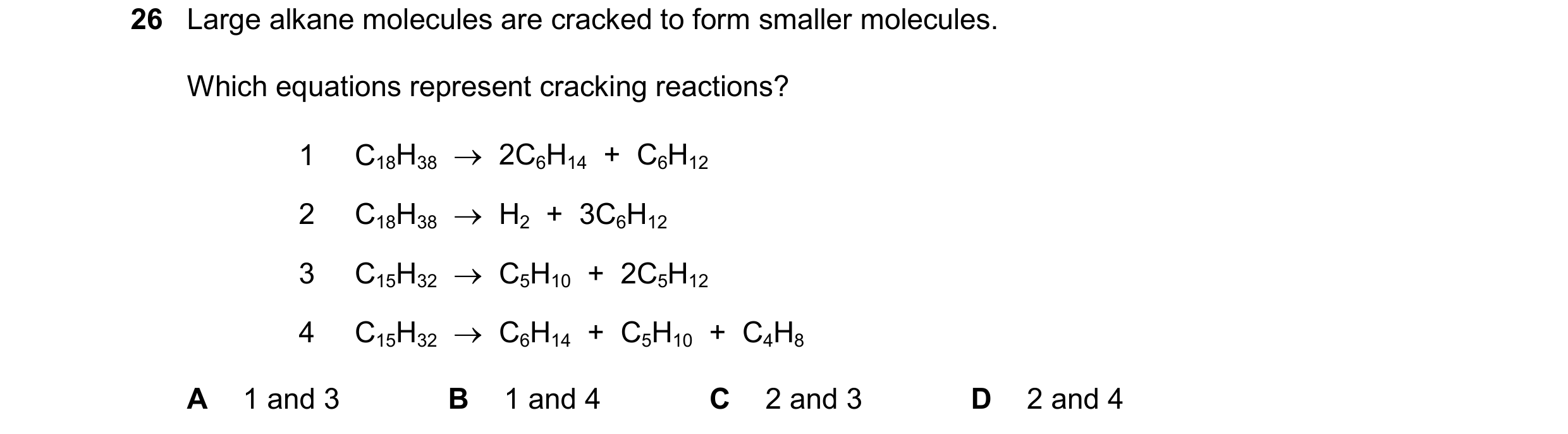
Q18 · Large alkane molecules are cracked to form smaller molecules 0654/22 May/June 2025
26 Large alkane molecules are cracked to form smaller molecules. Which equations represent cracking reactions? 1 C18H38 2C6H14 + C6H12 2 C18H38 H2 + 3C6H12 3 C15H32 C5H10 + 2C5H12 4 C15H32 C6H14 + C5H10 + C4H8 A 1 and 3 B 1 and 4 C 2 and 3 D 2 and 4
1 marks
Answer: D
This question in 0654/22 May/June 2025
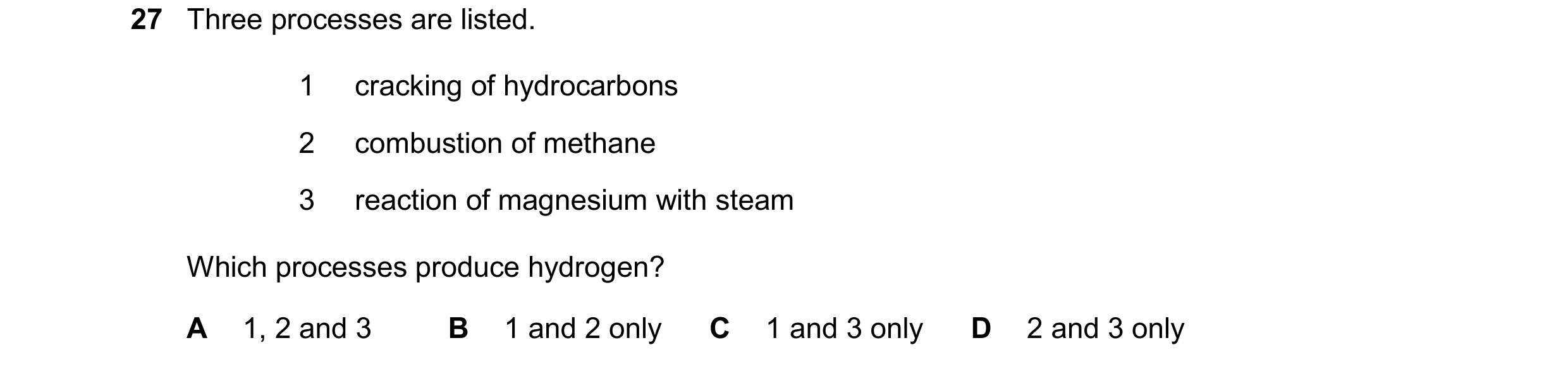
Q19 · Three processes are listed 0654/23 May/June 2025
27 Three processes are listed. 1 cracking of hydrocarbons 2 combustion of methane 3 reaction of magnesium with steam Which processes produce hydrogen? A 1, 2 and 3 B 1 and 2 only C 1 and 3 only D 2 and 3 only
1 marks
Answer: C
This question in 0654/23 May/June 2025
Q20 · Gasoline and diesel oil are fractions obtained by the fractional distillation of petroleum 0654/21 Oct/Nov 2025
23 Gasoline and diesel oil are fractions obtained by the fractional distillation of petroleum. Which row about gasoline and diesel oil is correct? temperature at which size of molecules the fraction is collected in the fraction A gasoline higher than diesel oil gasoline larger than diesel oil B gasoline higher than diesel oil gasoline smaller than diesel oil C diesel oil higher than gasoline diesel oil larger than gasoline D diesel oil higher than gasoline diesel oil smaller than gasoline
1 marks
Answer: C
This question in 0654/21 Oct/Nov 2025

 1 / 5
1 / 5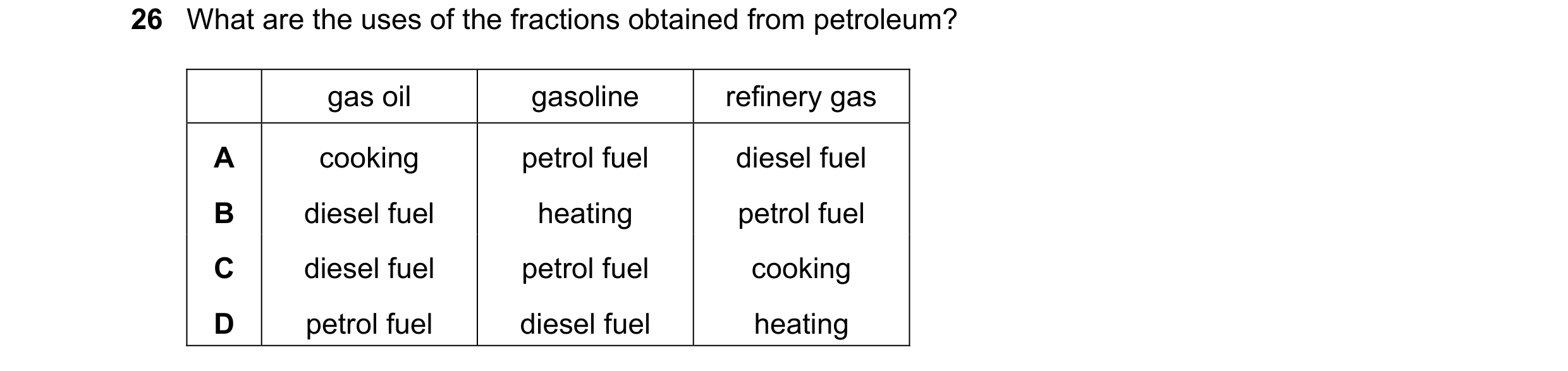
 2 / 5
2 / 5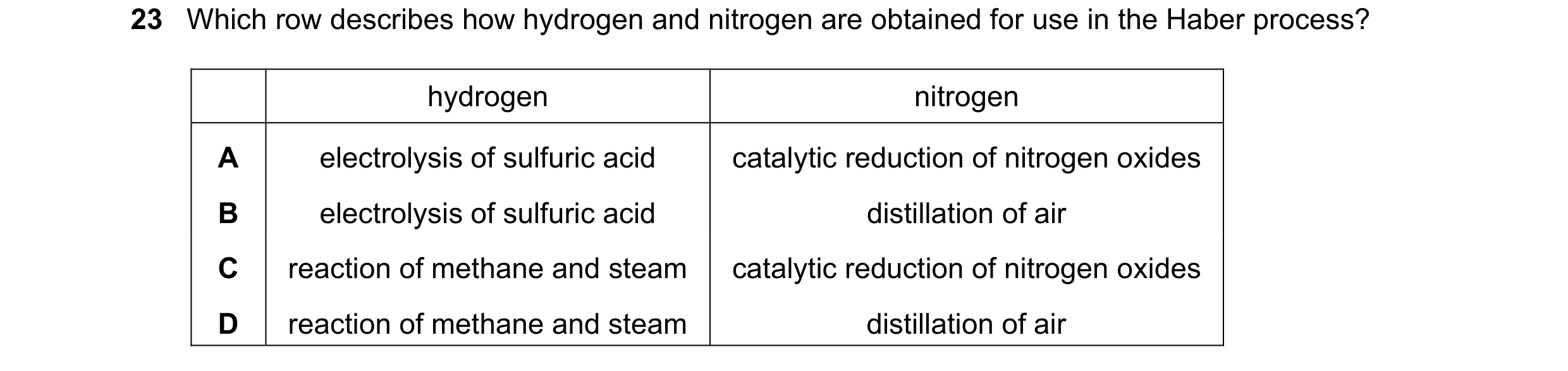
 3 / 5
3 / 5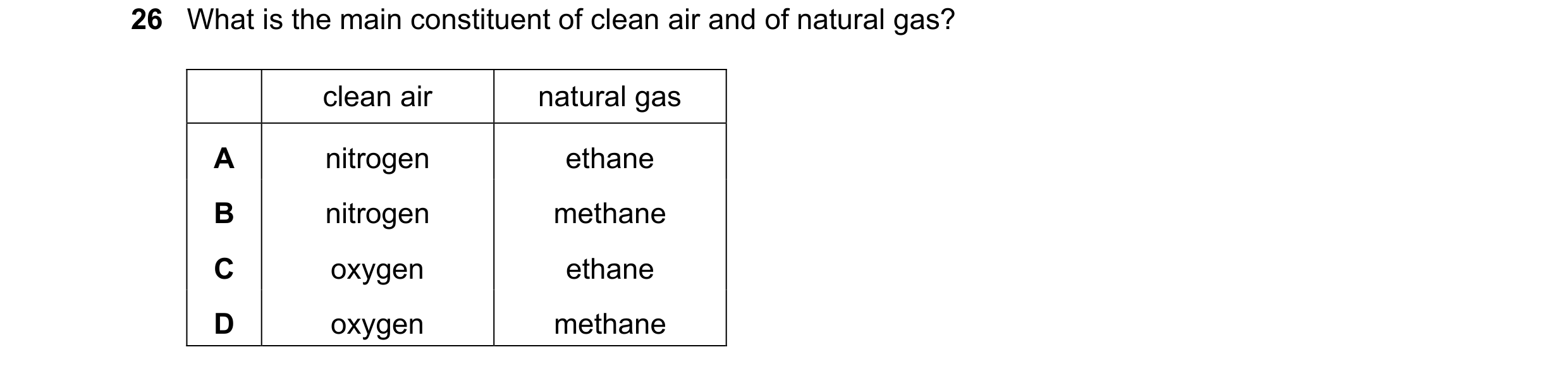

 4 / 5
4 / 5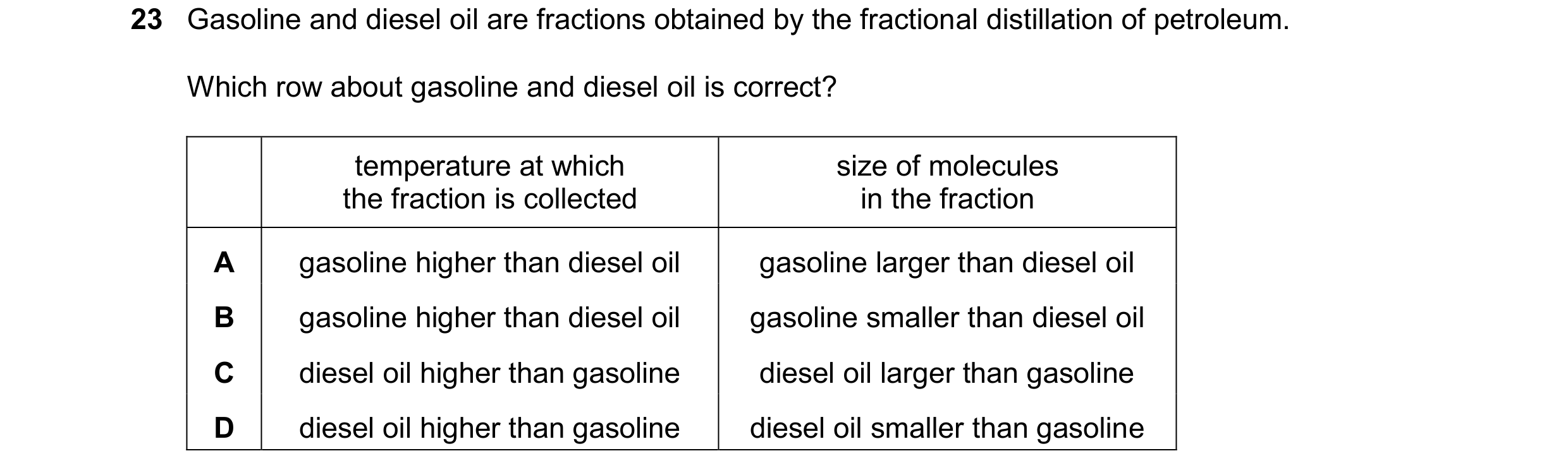 5 / 5
5 / 5