Questions as text
Q1 · Which fuel burns to form only one product? 0653/11 Oct/Nov 2006
25 Which fuel burns to form only one product? A coal B hydrogen C methane D petrol
1 marks
Answer: B
This question in 0653/11 Oct/Nov 2006
Q2 · Why is water often used to extinguish fires? 0653/11 Oct/Nov 2006
26 Why is water often used to extinguish fires? A Water is a compound. B Water is neutral. C Water reacts with most fuels. D Water removes heat from the fire.
1 marks
Answer: D
This question in 0653/11 Oct/Nov 2006
Q3 · Which method of separation can be used to obtain pure water from aqueous potassium… 0653/11 May/June 2008
14 Which method of separation can be used to obtain pure water from aqueous potassium chloride? A chromatography B crystallisation C distillation D filtration
1 marks
Answer: C
This question in 0653/11 May/June 2008
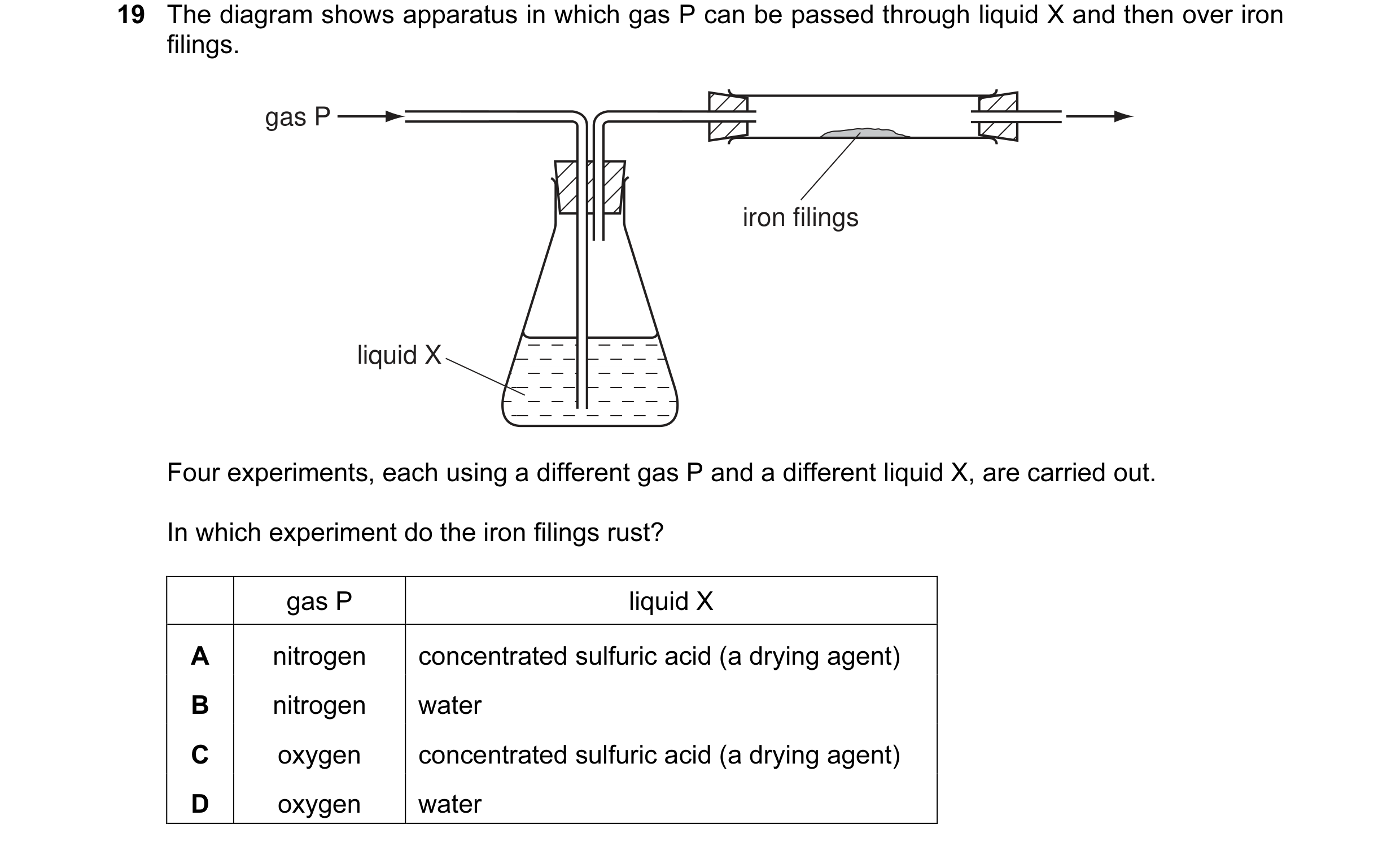
Q4 · The diagram shows apparatus in which gas P can be passed through liquid X and then over… 0653/11 May/June 2009
19 The diagram shows apparatus in which gas P can be passed through liquid X and then over iron filings. gas P iron filings liquid X Four experiments, each using a different gas P and a different liquid X, are carried out. In which experiment do the iron filings rust? gas P liquid X A nitrogen concentrated sulfuric acid (a drying agent) B nitrogen water C oxygen concentrated sulfuric acid (a drying agent) D oxygen water
1 marks
Answer: D
This question in 0653/11 May/June 2009
Q5 · Which processes are used to purify the drinking water from reservoirs? 0653/11 May/June 2010
19 Which processes are used to purify the drinking water from reservoirs?
chlorination distillation filtration
0 aO WwW D>
~ KOK
KS
<< x
1 marks
Answer: C
This question in 0653/11 May/June 2010
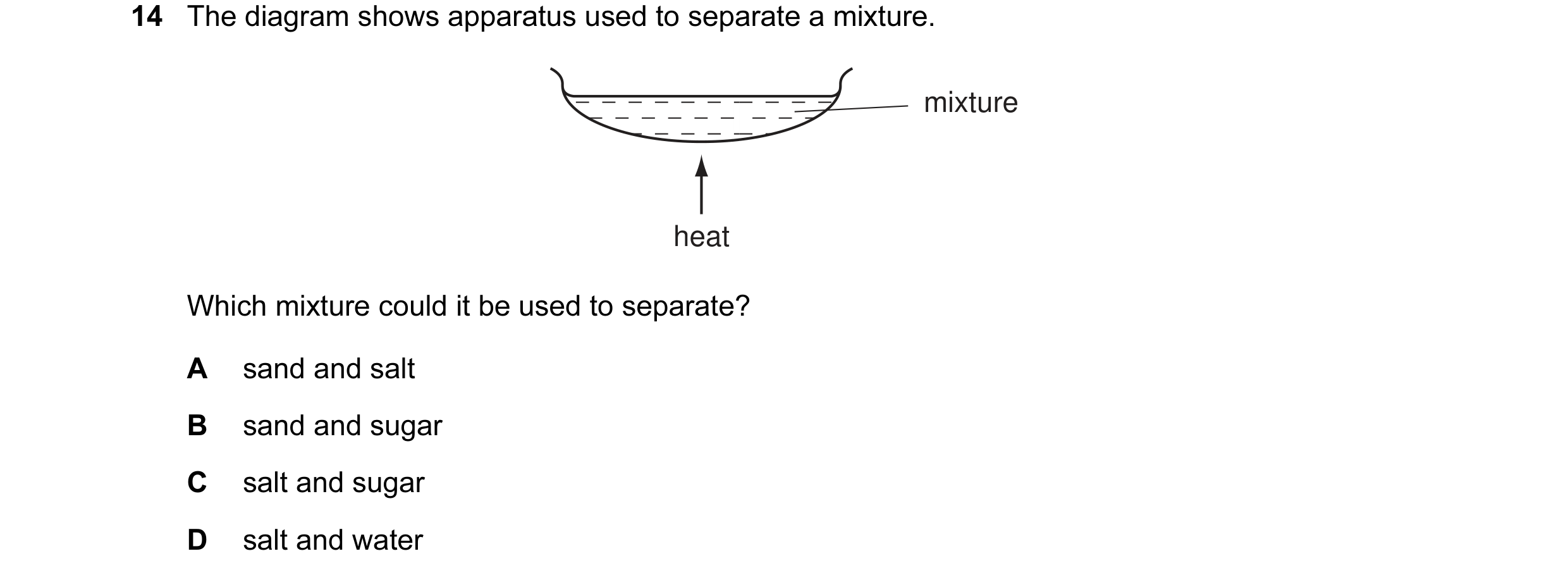
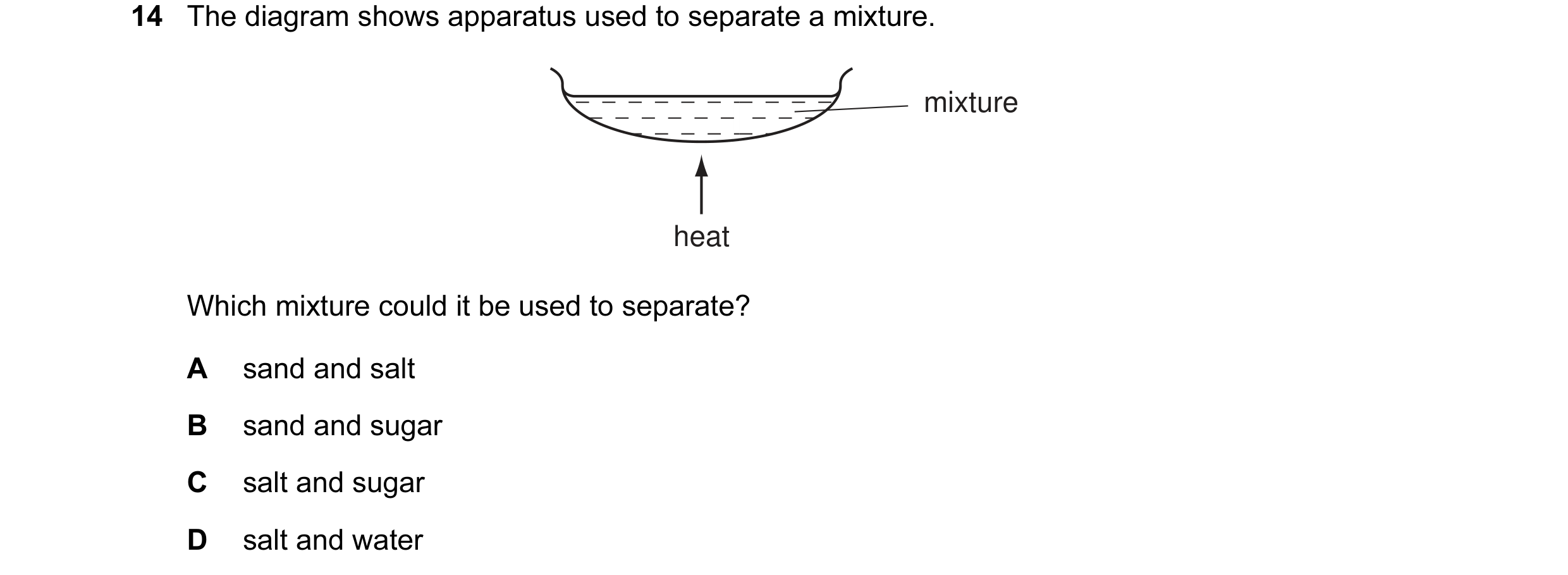
Q6 · The diagram shows apparatus used to separate a mixture 0653/12 May/June 2010
14 The diagram shows apparatus used to separate a mixture. mixture heat Which mixture could it be used to separate? A sand and salt B sand and sugar C salt and sugar D salt and water
1 marks
Answer: D
This question in 0653/12 May/June 2010
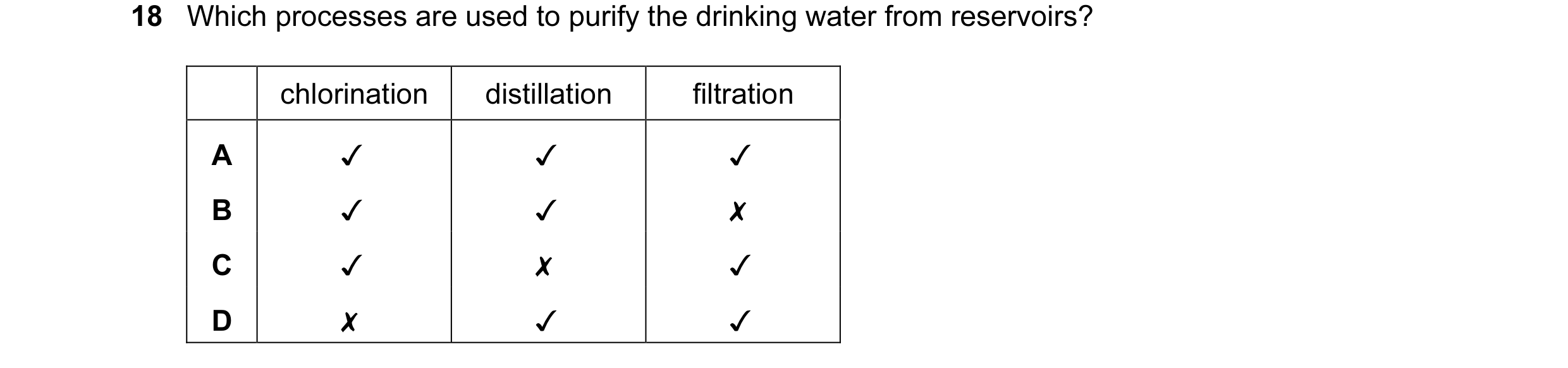
Q7 · Which processes are used to purify the drinking water from reservoirs? 0653/12 May/June 2010
18 Which processes are used to purify the drinking water from reservoirs?
chlorination distillation filtration
0 aO WwW D>
~ KOK
KS
<< x
1 marks
Answer: C
This question in 0653/12 May/June 2010
Q8 · The diagram shows apparatus used to separate a mixture 0653/13 May/June 2010
14 The diagram shows apparatus used to separate a mixture. mixture heat Which mixture could it be used to separate? A sand and salt B sand and sugar C salt and sugar D salt and water
1 marks
Answer: D
This question in 0653/13 May/June 2010
Q9 · Which processes are used to purify the drinking water from reservoirs? 0653/13 May/June 2010
18 Which processes are used to purify the drinking water from reservoirs?
chlorination distillation filtration
0 aO WwW D>
~ KOK
KS
<< x
1 marks
Answer: C
This question in 0653/13 May/June 2010
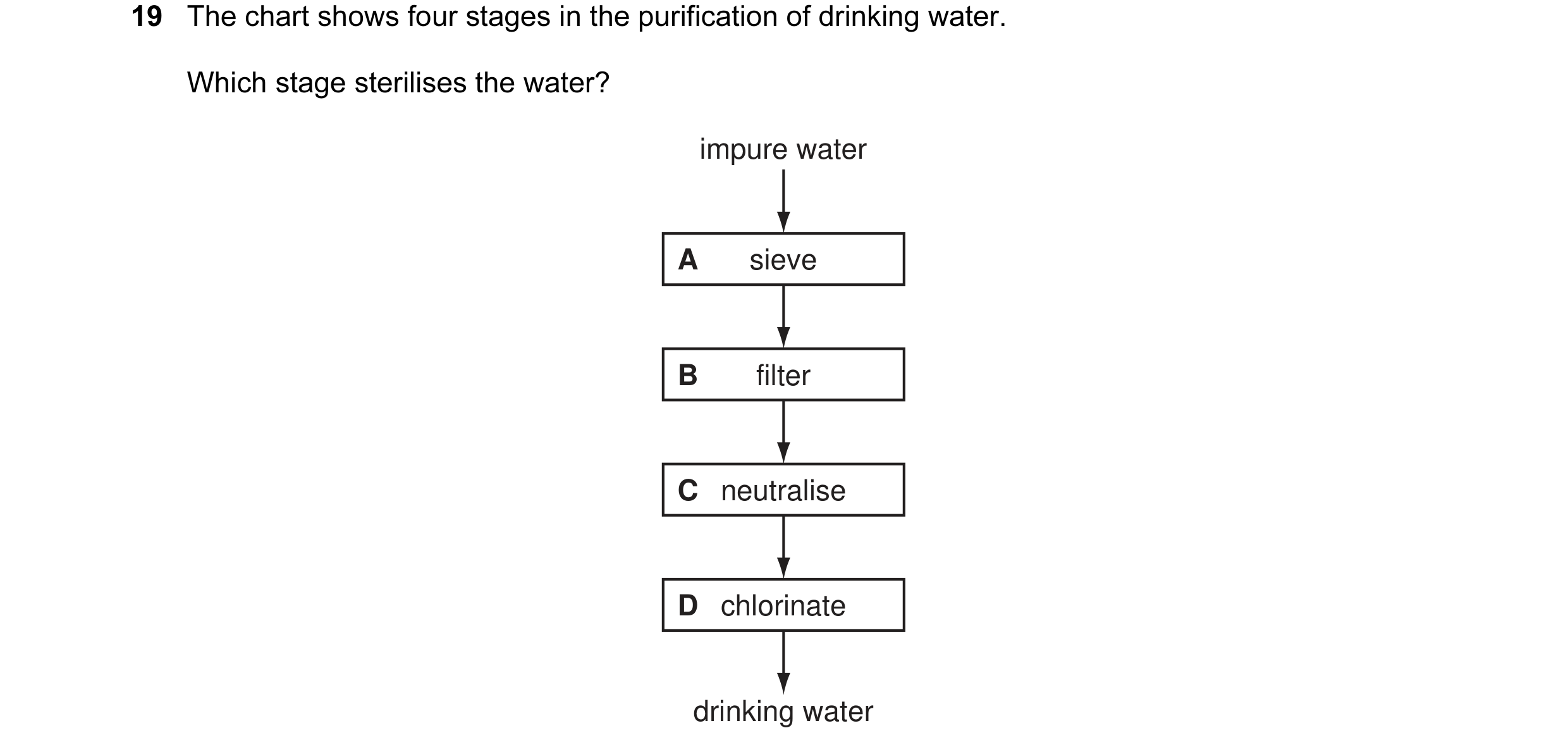
Q10 · The chart shows four stages in the purification of drinking water 0653/11 Oct/Nov 2010
19 The chart shows four stages in the purification of drinking water. Which stage sterilises the water? impure water A sieve B filter C neutralise D chlorinate drinking water
1 marks
Answer: D
This question in 0653/11 Oct/Nov 2010
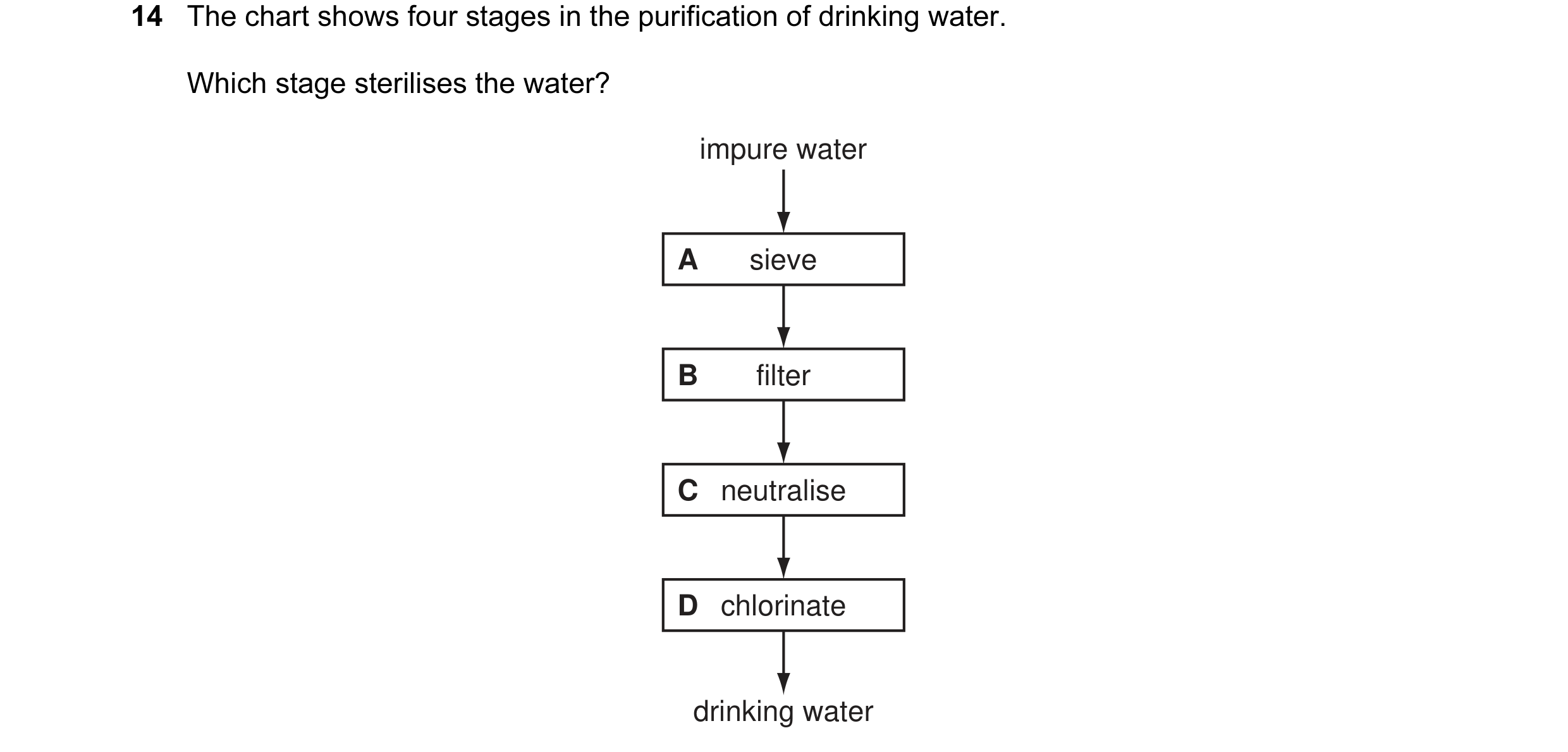
Q11 · The chart shows four stages in the purification of drinking water 0653/12 Oct/Nov 2010
14 The chart shows four stages in the purification of drinking water. Which stage sterilises the water? impure water A sieve B filter C neutralise D chlorinate drinking water
1 marks
Answer: A
This question in 0653/12 Oct/Nov 2010
Q12 · The chart shows four stages in the purification of drinking water 0653/13 Oct/Nov 2010
13 The chart shows four stages in the purification of drinking water. Which stage sterilises the water? impure water A sieve B filter C neutralise D chlorinate drinking water
1 marks
Answer: D
This question in 0653/13 Oct/Nov 2010
Q13 · The diagrams show two techniques used in school chemistry laboratories for separating… 0653/12 May/June 2013
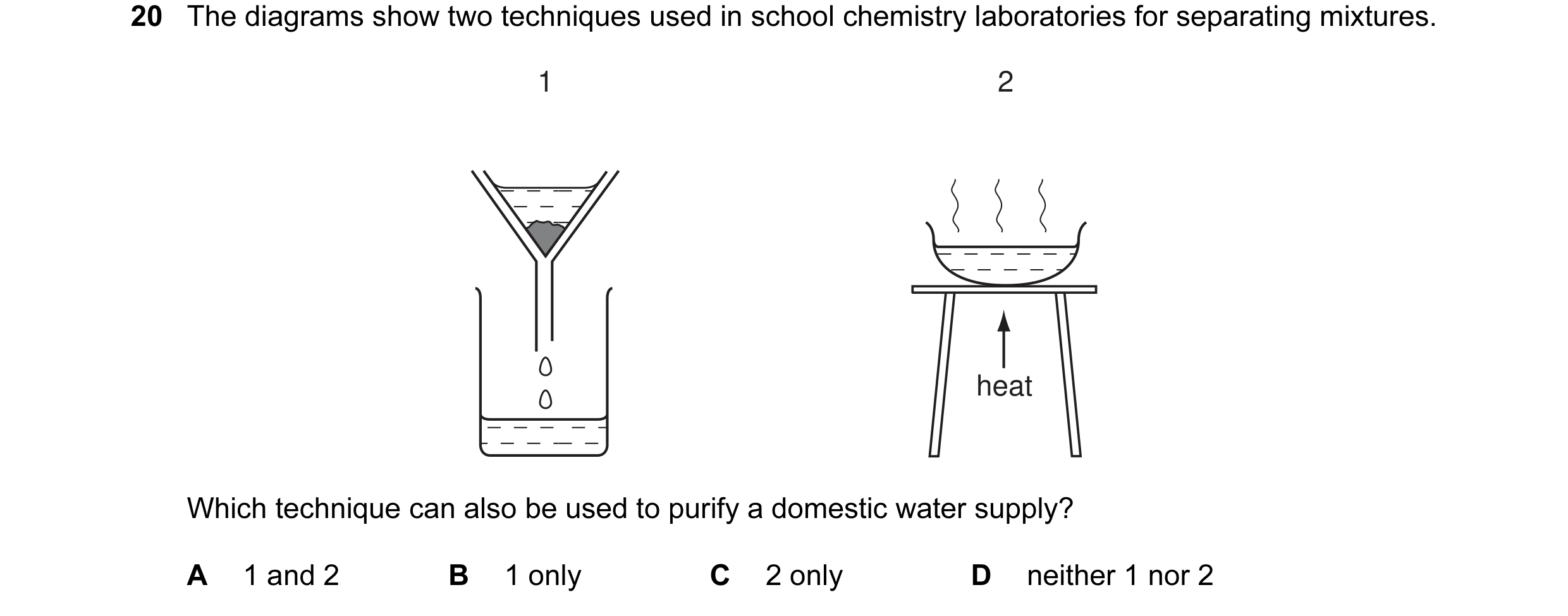
20 The diagrams show two techniques used in school chemistry laboratories for separating mixtures. 1 2 heat Which technique can also be used to purify a domestic water supply? A 1 and 2 B 1 only C 2 only D neither 1 nor 2
1 marks
Answer: B
This question in 0653/12 May/June 2013
Q14 · Which chemical test shows the presence of water? 0653/12 May/June 2013
25 Which chemical test shows the presence of water? A Water has a boiling point of 100 °C. B Water has a freezing point of 0 °C. C Water turns anhydrous cobalt chloride from blue to pink. D Water turns anhydrous copper sulfate from blue to white.
1 marks
Answer: C
This question in 0653/12 May/June 2013
Q15 · Which method of separation can be used to obtain pure water from aqueous potassium… 0653/13 Oct/Nov 2013
14 Which method of separation can be used to obtain pure water from aqueous potassium chloride? A chromatography B crystallisation C distillation D filtration
1 marks
Answer: C
This question in 0653/13 Oct/Nov 2013
Q16 · When water is purified it is passed through large tanks of sand 0653/12 Oct/Nov 2015
26 When water is purified it is passed through large tanks of sand. What is the purpose of the sand? A to remove all harmful bacteria B to remove coloured soluble impurities C to remove small insoluble particles D to remove tree branches and other large objects
1 marks
Answer: C
This question in 0653/12 Oct/Nov 2015
Q17 · A colourless liquid is tested with blue cobalt chloride paper 0653/11 May/June 2016
25 A colourless liquid is tested with blue cobalt chloride paper. The paper turns pink. Which statement about the liquid must be correct? A It contains water. B It is acidic. C It is anhydrous. D It is pure water.
1 marks
Answer: A
This question in 0653/11 May/June 2016
Q18 · Which processes are used in the purification of the water supply? 0653/13 May/June 2016
25 Which processes are used in the purification of the water supply? A fractional distillation and chlorination B fractional distillation and crystallisation C filtration and chlorination D filtration and crystallisation
1 marks
Answer: C
This question in 0653/13 May/June 2016
Q19 · Why is drinking water treated with chlorine? 0653/12 Feb/March 2018
25 Why is drinking water treated with chlorine? A to improve the taste B to kill bacteria C to remove colour D to remove insoluble impurities
1 marks
Answer: B
This question in 0653/12 Feb/March 2018
Q20 · What is a chemical test for water? 0653/11 Oct/Nov 2018
25 What is a chemical test for water? A It has a boiling point of 100 °C. B It has a density of 1 g / cm3. C It turns anhydrous copper sulfate from white to blue. D It turns pink cobalt chloride paper to blue.
1 marks
Answer: C
This question in 0653/11 Oct/Nov 2018
Q21 · What is a chemical test for water? 0653/12 Oct/Nov 2018
26 What is a chemical test for water? A Add blue cobalt chloride paper. B Add blue copper sulfate crystals. C Measure the density. D Measure the melting point.
1 marks
Answer: A
This question in 0653/12 Oct/Nov 2018
Q22 · Copper sulfate crystals dissolve in water 0653/11 May/June 2019
15 Copper sulfate crystals dissolve in water. Which word describes the role of the water? A filtrate B solute C solution D solvent
1 marks
Answer: D
This question in 0653/11 May/June 2019
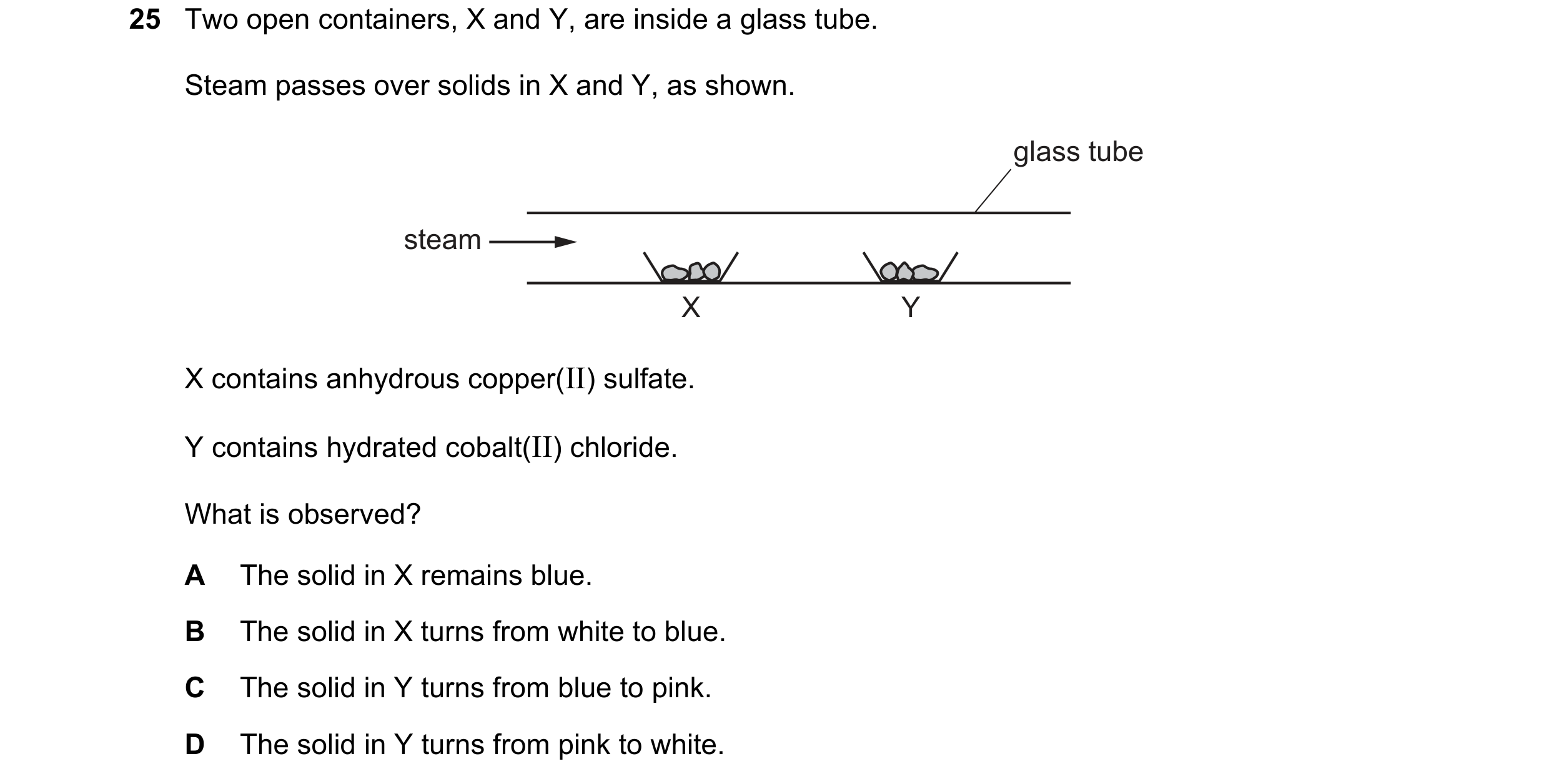
Q23 · Two open containers, X and Y, are inside a glass tube 0653/11 May/June 2019
25 Two open containers, X and Y, are inside a glass tube. Steam passes over solids in X and Y, as shown. glass tube steam X Y X contains anhydrous copper(II) sulfate. Y contains hydrated cobalt(II) chloride. What is observed? A The solid in X remains blue. B The solid in X turns from white to blue. C The solid in Y turns from blue to pink. D The solid in Y turns from pink to white.
1 marks
Answer: B
This question in 0653/11 May/June 2019
Q24 · Why is chlorine added to water during its purification for drinking? 0653/13 May/June 2019
25 Why is chlorine added to water during its purification for drinking? A to dissolve solid impurities B to kill microorganisms C to remove halide ions D to remove soluble impurities
1 marks
Answer: B
This question in 0653/13 May/June 2019
Q25 · A water supply contains small insoluble impurities 0653/12 Feb/March 2020
25 A water supply contains small insoluble impurities. It also contains bacteria. Which statement describes how the insoluble impurities are removed and how the bacteria are killed? A The water supply is filtered. B The water supply is filtered and treated with chloride ions. C The water supply is filtered and treated with chlorine. D The water supply is treated with chlorine and chloride ions.
1 marks
Answer: C
This question in 0653/12 Feb/March 2020
Q26 · Which processes are used in water treatment? 0653/12 Oct/Nov 2020
26 Which processes are used in water treatment? 1 chlorination 2 cracking 3 filtration A 1 and 2 only B 1 and 3 only C 2 and 3 only D 1, 2 and 3
1 marks
Answer: B
This question in 0653/12 Oct/Nov 2020
Q27 · Which change shows the presence of water? 0653/12 Feb/March 2021
24 Which change shows the presence of water? A Anhydrous copper(II) sulfate turns white. B Anhydrous copper(II) sulfate turns pink. C Cobalt(II) chloride paper turns pink. D Cobalt(II) chloride paper turns blue.
1 marks
Answer: C
This question in 0653/12 Feb/March 2021
Q28 · Which statement about a chemical test for water is correct? 0653/11 May/June 2022
26 Which statement about a chemical test for water is correct? A Anhydrous cobalt(II) chloride turns blue. B Anhydrous cobalt(II) chloride turns white. C Anhydrous copper(II) sulfate turns blue. D Anhydrous copper(II) sulfate turns white.
1 marks
Answer: C
This question in 0653/11 May/June 2022
Q29 · Which colour change is seen when water is added to anhydrous cobalt(II) chloride? 0653/12 May/June 2022
26 Which colour change is seen when water is added to anhydrous cobalt(II) chloride? A blue to pink B blue to white C pink to blue D white to blue
1 marks
Answer: A
This question in 0653/12 May/June 2022
Q30 · Which statement about the treatment of the water supply is correct? 0653/13 May/June 2022
25 Which statement about the treatment of the water supply is correct? A After filtration and chlorination, the water contains no impurities. B Chlorine is added to remove dissolved impurities. C Water is filtered and chlorinated to remove solids and kill bacteria. D Water is filtered to remove dissolved impurities.
1 marks
Answer: C
This question in 0653/13 May/June 2022
Q31 · Damp air is passed through a tube containing blue copper(II) sulfate and blue cobalt(II)… 0653/11 Oct/Nov 2022
25 Damp air is passed through a tube containing blue copper(II) sulfate and blue cobalt(II) chloride. damp air blue blue copper(II) sulfate cobalt(II) chloride What is observed? copper(II) sulfate cobalt(II) chloride A turns white turns pink B turns white no change C no change turns pink D no change no change
1 marks
Answer: C
This question in 0653/11 Oct/Nov 2022
Q32 · A few drops of liquid X are added to a white solid 0653/12 Oct/Nov 2022
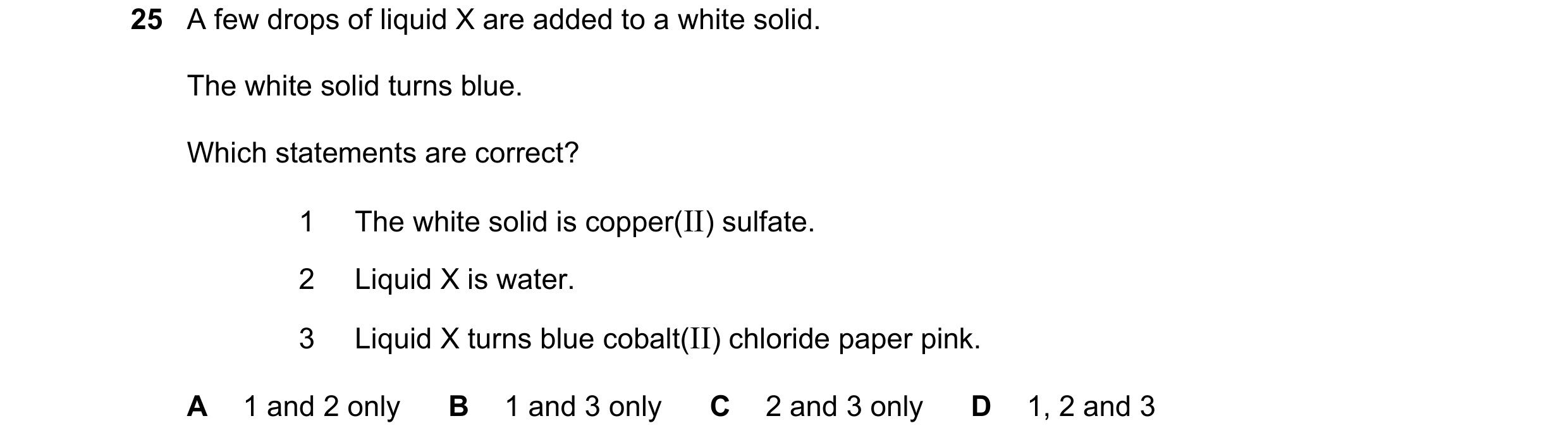
25 A few drops of liquid X are added to a white solid. The white solid turns blue. Which statements are correct? 1 The white solid is copper(II) sulfate. 2 Liquid X is water. 3 Liquid X turns blue cobalt(II) chloride paper pink. A 1 and 2 only B 1 and 3 only C 2 and 3 only D 1, 2 and 3
1 marks
Answer: D
This question in 0653/12 Oct/Nov 2022
Q33 · A few drops of liquid X are added to a white solid 0653/13 Oct/Nov 2022
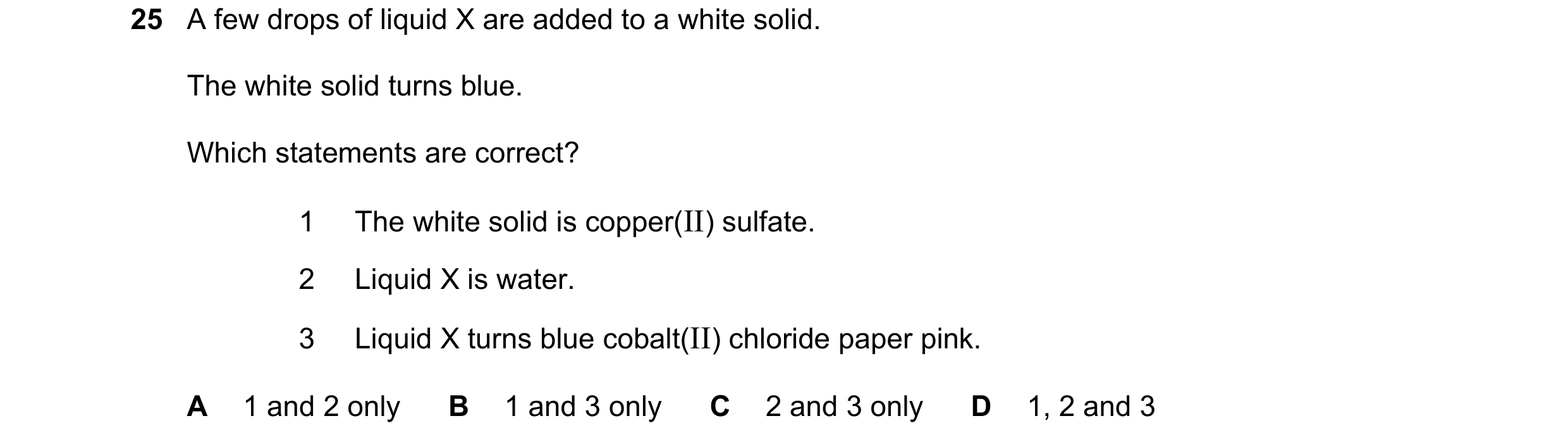
25 A few drops of liquid X are added to a white solid. The white solid turns blue. Which statements are correct? 1 The white solid is copper(II) sulfate. 2 Liquid X is water. 3 Liquid X turns blue cobalt(II) chloride paper pink. A 1 and 2 only B 1 and 3 only C 2 and 3 only D 1, 2 and 3
1 marks
Answer: D
This question in 0653/13 Oct/Nov 2022
Q34 · Water is added separately to anhydrous copper(II) sulfate and to anhydrous cobalt(II)… 0653/11 May/June 2023
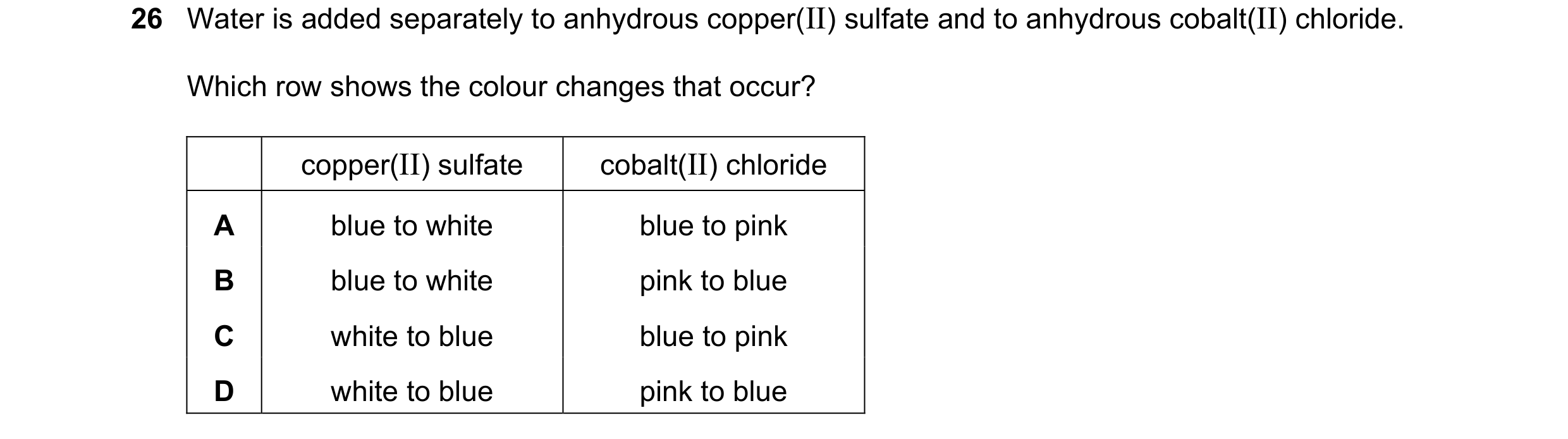
26 Water is added separately to anhydrous copper(II) sulfate and to anhydrous cobalt(II) chloride. Which row shows the colour changes that occur? copper(II) sulfate cobalt(II) chloride A blue to white blue to pink B blue to white pink to blue C white to blue blue to pink D white to blue pink to blue
1 marks
Answer: C
This question in 0653/11 May/June 2023
Q35 · Which processes are used in water treatment? 0653/11 May/June 2024
24 Which processes are used in water treatment? 1 chlorination 2 cracking 3 filtration A 1, 2 and 3 B 1 and 2 only C 1 and 3 only D 2 and 3 only
1 marks
Answer: C
This question in 0653/11 May/June 2024
Q36 · Which statements about water are correct? 0653/12 May/June 2024
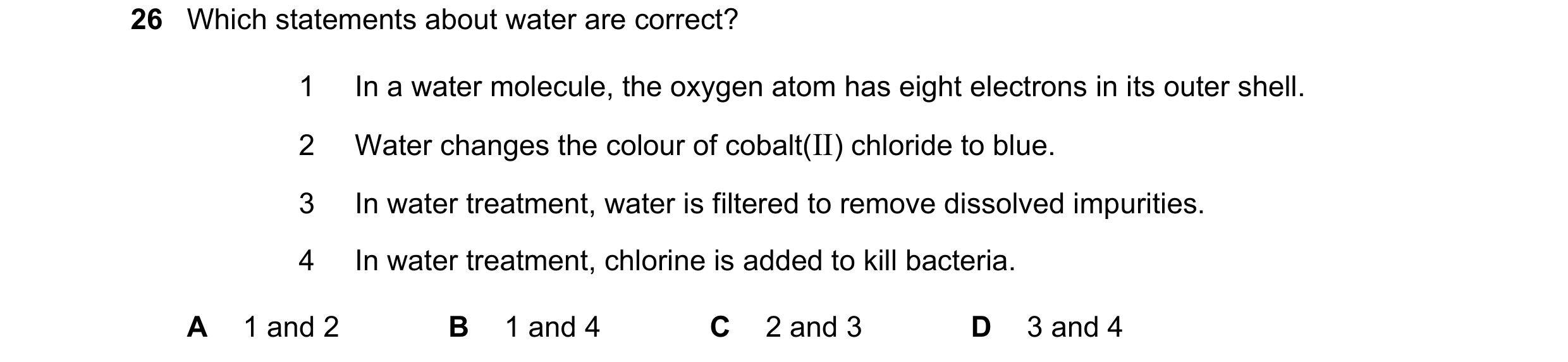
26 Which statements about water are correct? 1 In a water molecule, the oxygen atom has eight electrons in its outer shell. 2 Water changes the colour of cobalt(II) chloride to blue. 3 In water treatment, water is filtered to remove dissolved impurities. 4 In water treatment, chlorine is added to kill bacteria. A 1 and 2 B 1 and 4 C 2 and 3 D 3 and 4
1 marks
Answer: B
This question in 0653/12 May/June 2024
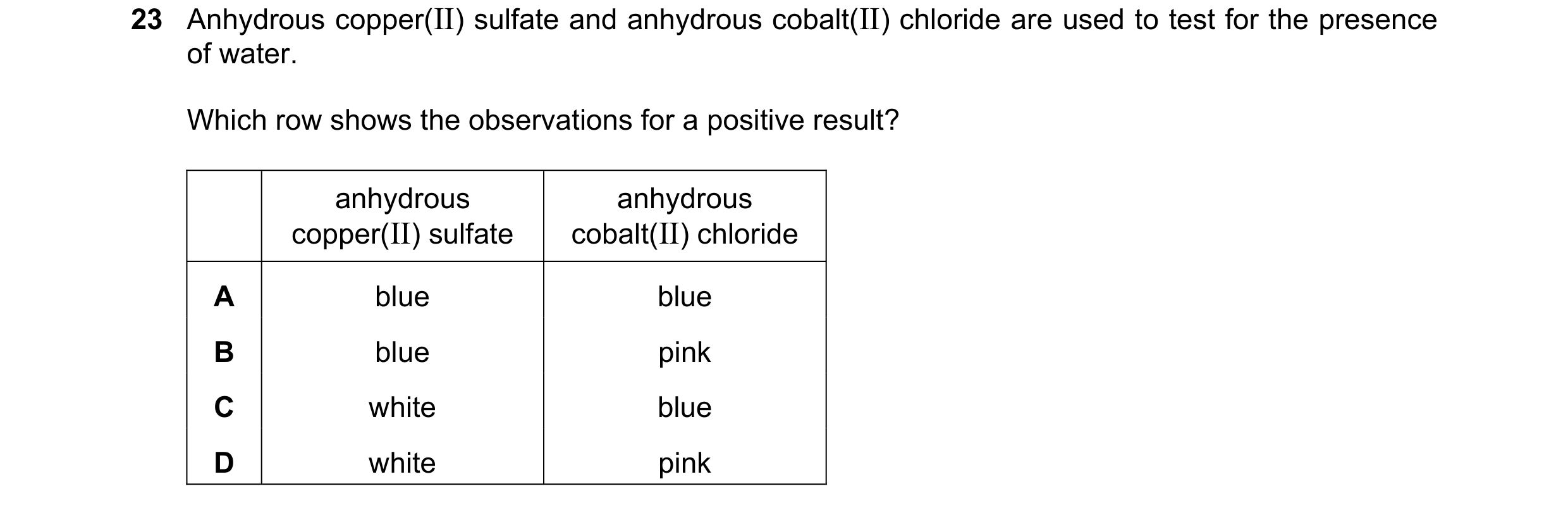
Q37 · Anhydrous copper(II) sulfate and anhydrous cobalt(II) chloride are used to test for the… 0653/12 Feb/March 2025
23 Anhydrous copper(II) sulfate and anhydrous cobalt(II) chloride are used to test for the presence of water. Which row shows the observations for a positive result? anhydrous anhydrous copper(II) sulfate cobalt(II) chloride A blue blue B blue pink C white blue D white pink
1 marks
Answer: B
This question in 0653/12 Feb/March 2025
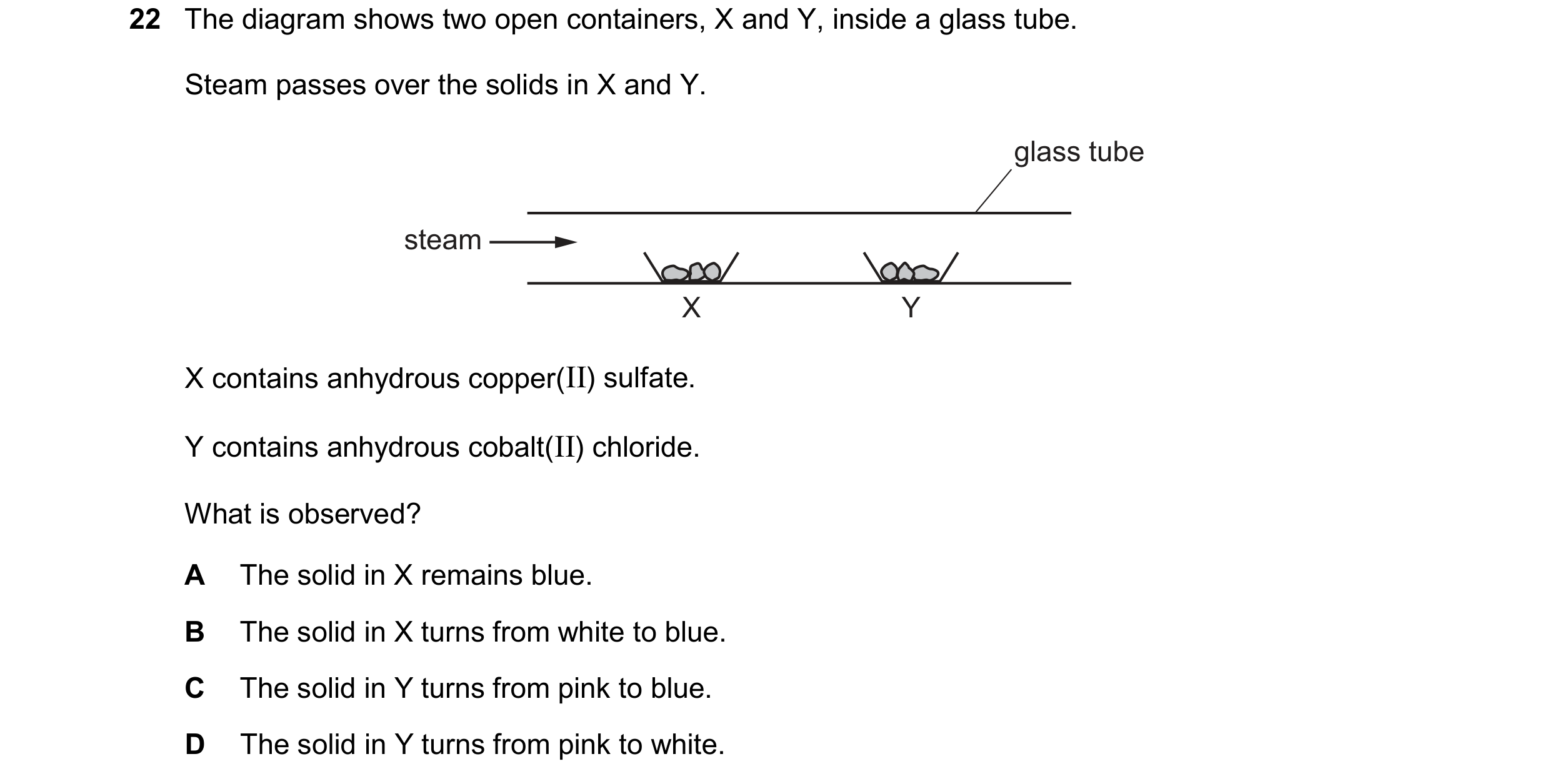
Q38 · The diagram shows two open containers, X and Y, inside a glass tube 0653/11 Oct/Nov 2025
22 The diagram shows two open containers, X and Y, inside a glass tube. Steam passes over the solids in X and Y. glass tube steam X Y X contains anhydrous copper(II) sulfate. Y contains anhydrous cobalt(II) chloride. What is observed? A The solid in X remains blue. B The solid in X turns from white to blue. C The solid in Y turns from pink to blue. D The solid in Y turns from pink to white.
1 marks
Answer: B
This question in 0653/11 Oct/Nov 2025
Q39 · Anhydrous copper(II) sulfate is used to test for water 0653/12 Oct/Nov 2025
22 Anhydrous copper(II) sulfate is used to test for water. Which colour does it turn in the presence of water? A white B pink C green D blue
1 marks
Answer: D
This question in 0653/12 Oct/Nov 2025
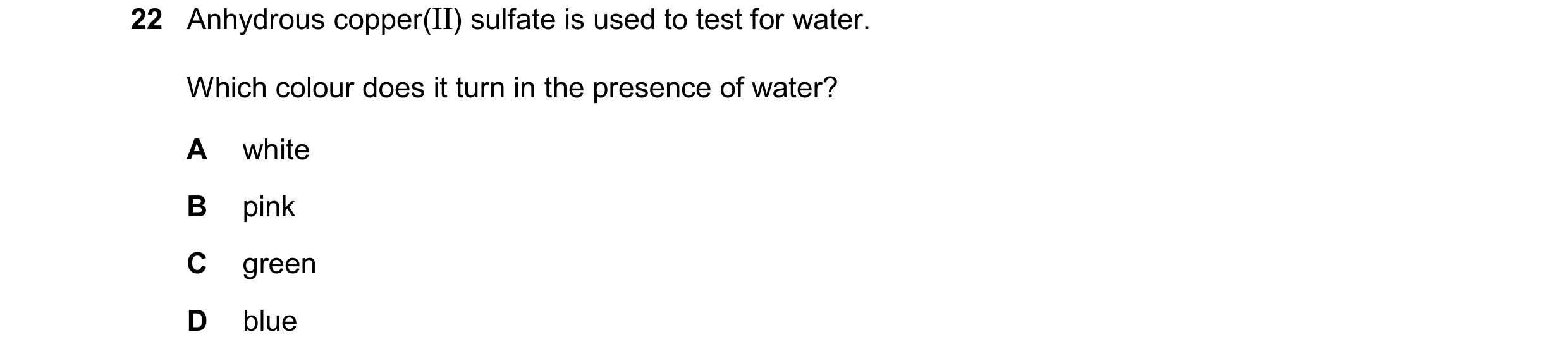
Q40 · Anhydrous copper(II) sulfate is used to test for water 0653/13 Oct/Nov 2025
22 Anhydrous copper(II) sulfate is used to test for water. Which colour does it turn in the presence of water? A white B pink C green D blue
1 marks
Answer: D
This question in 0653/13 Oct/Nov 2025



 1 / 10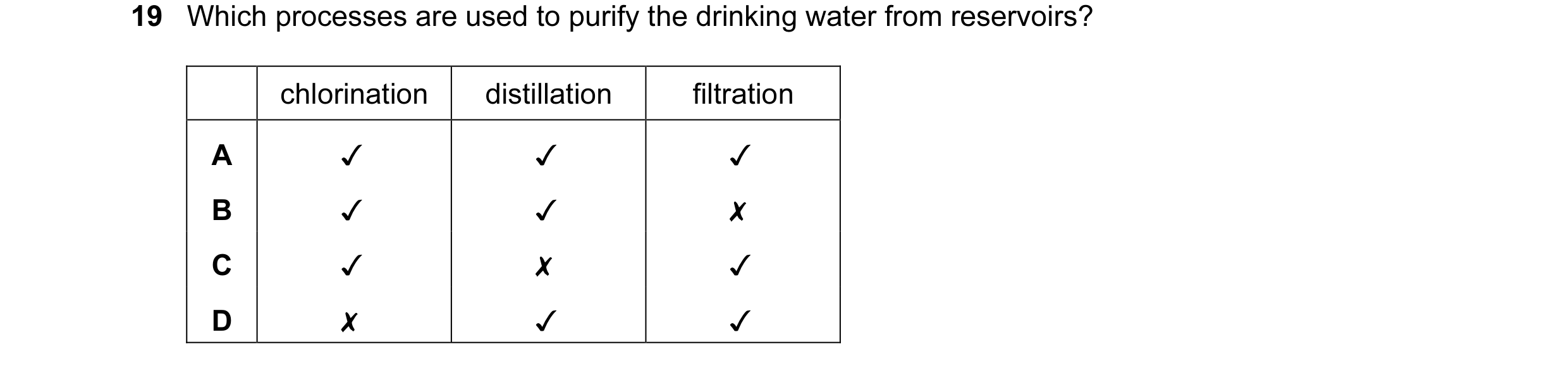
 2 / 10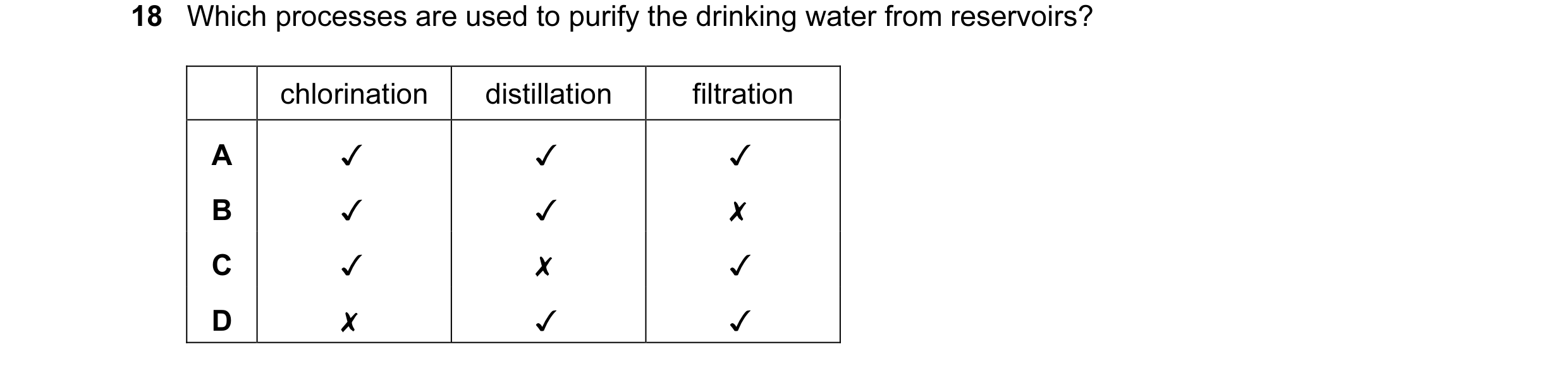
 3 / 10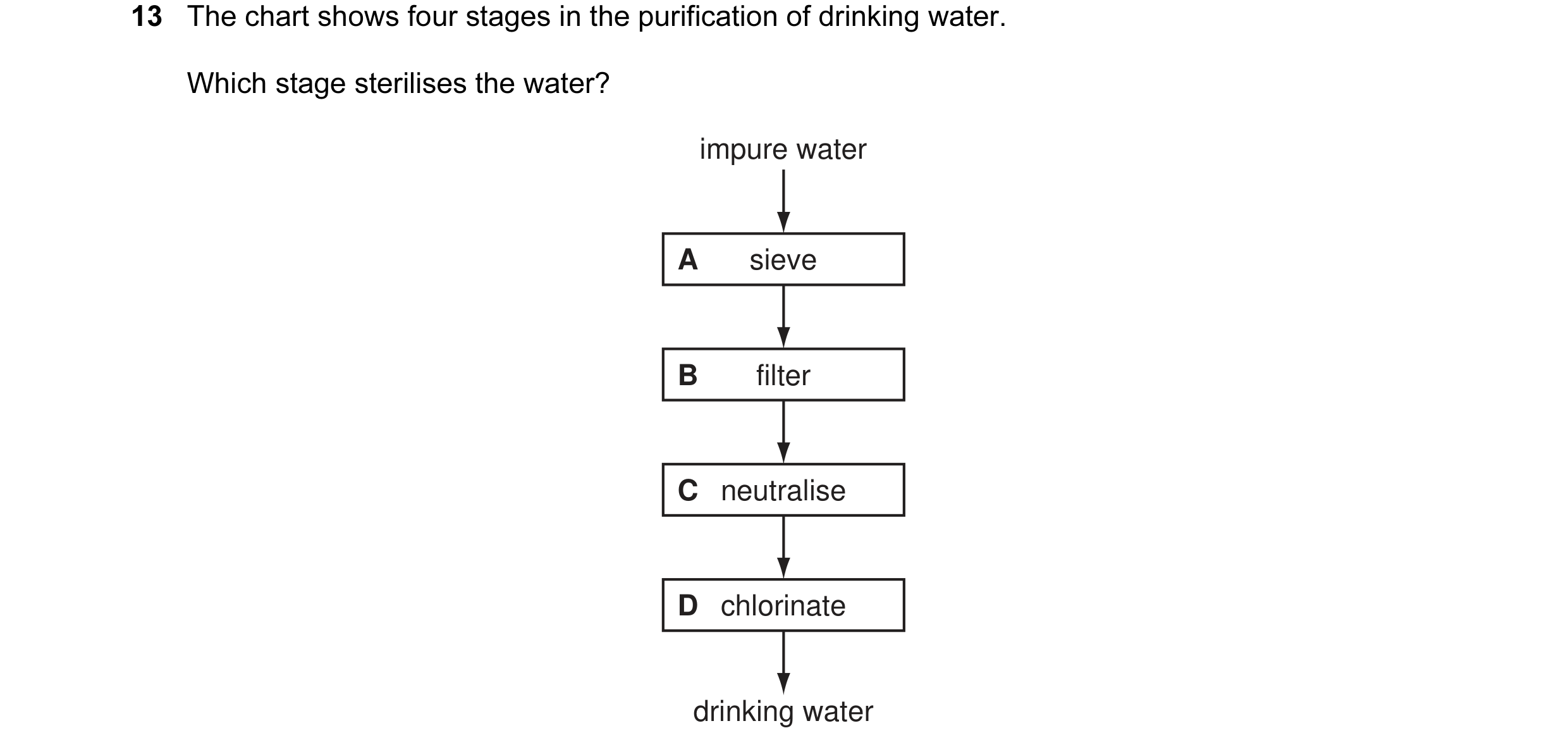

 4 / 10



 5 / 10

 6 / 10



 7 / 10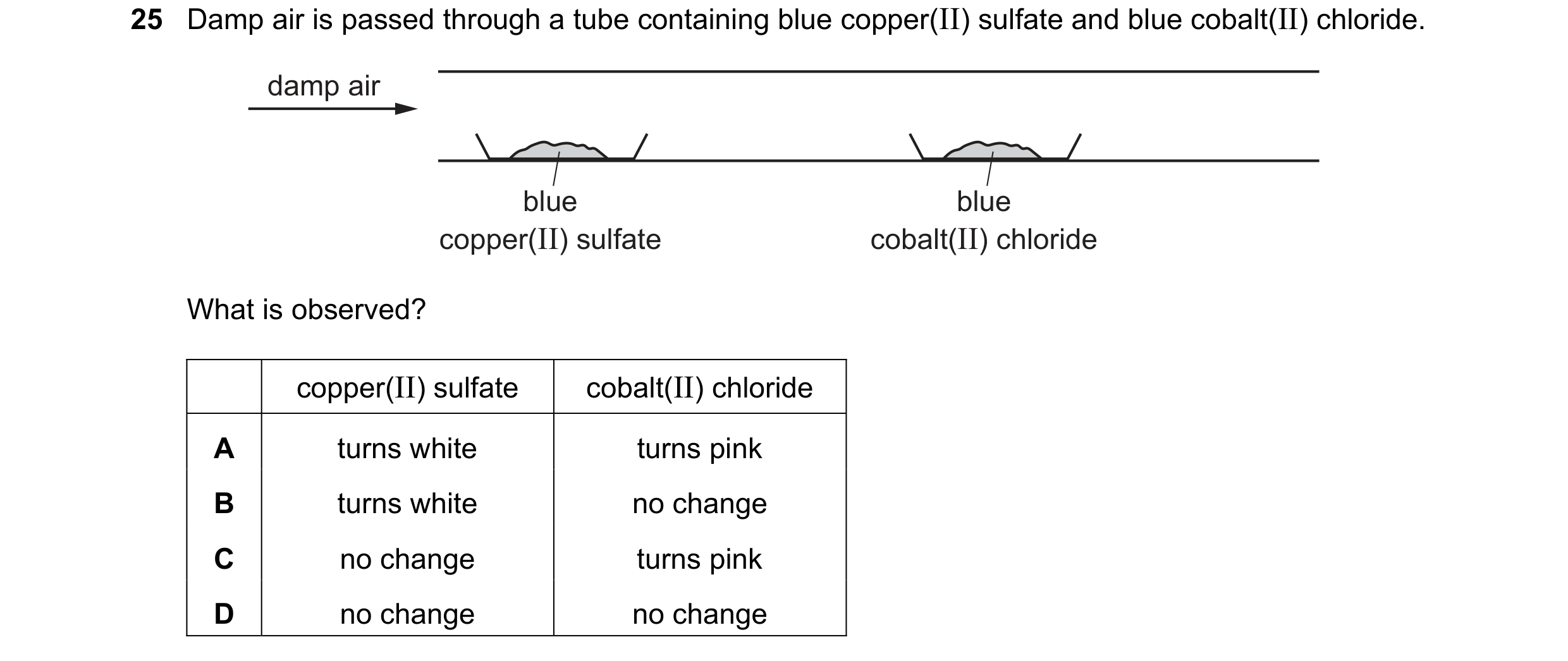
 8 / 10
 9 / 10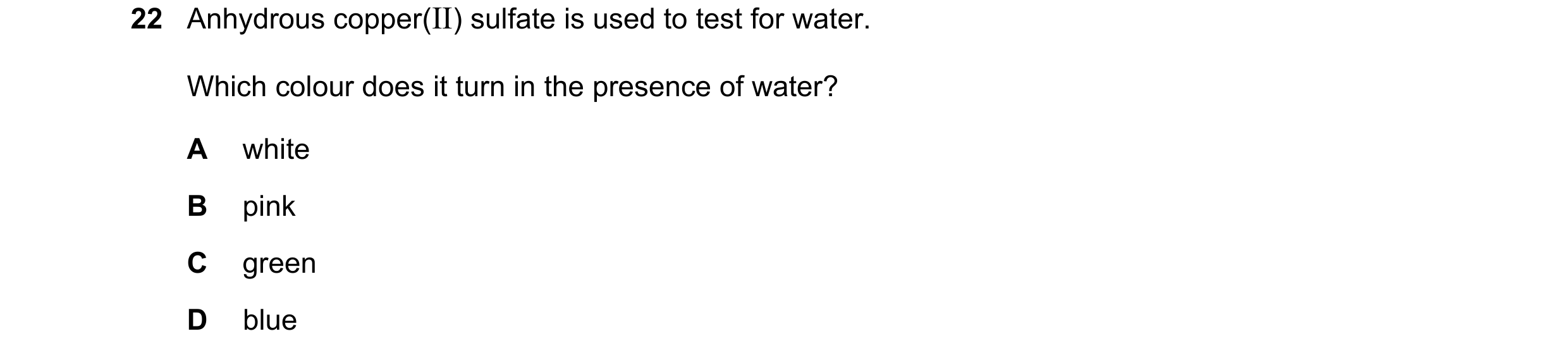
 10 / 10