Questions as text
Q1 · Water is extracted from a river and then treated to make it suitable for people to use 0653/32 May/June 2017
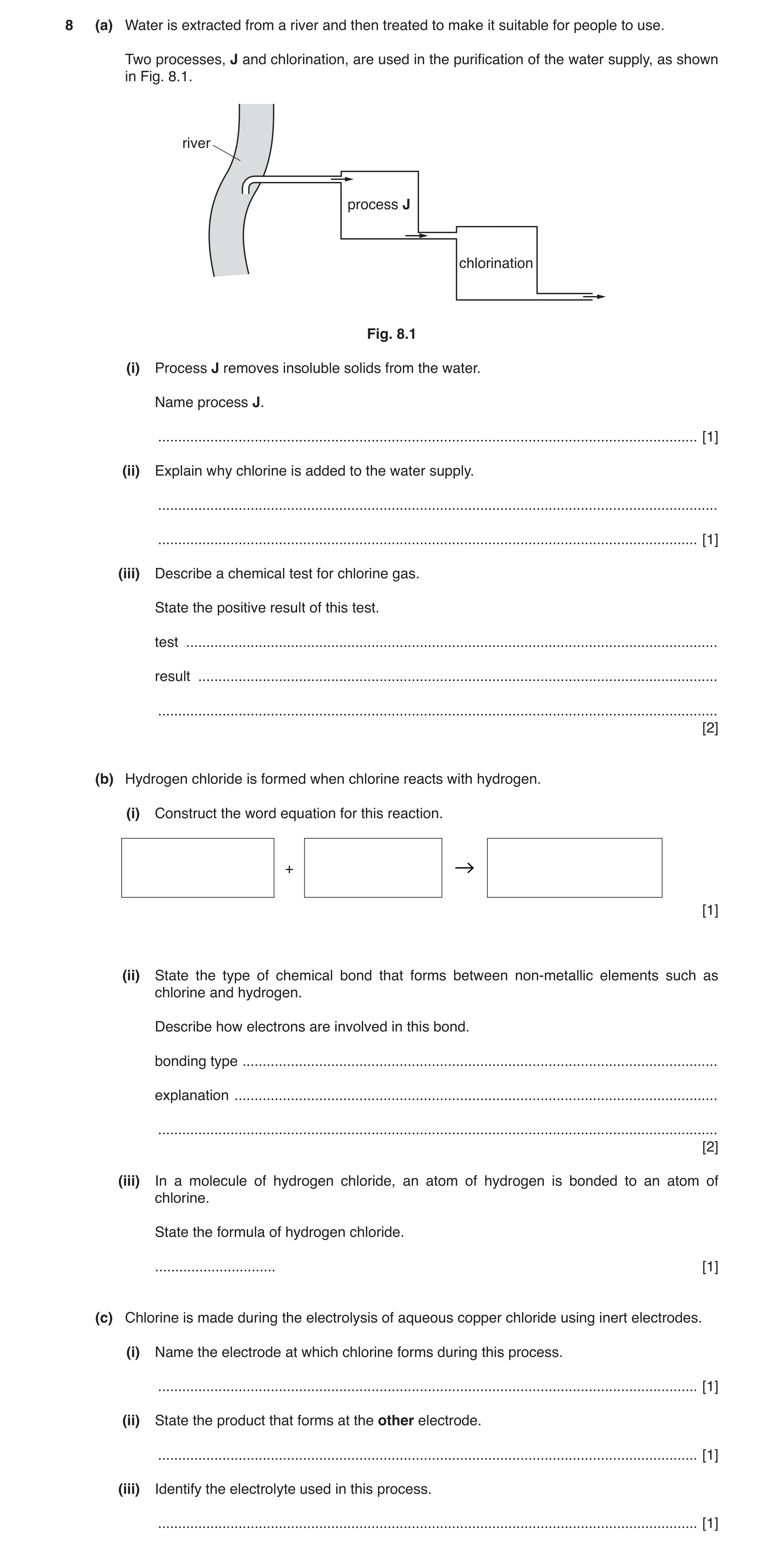
8 (a) Water is extracted from a river and then treated to make it suitable for people to use. Two processes, J and chlorination, are used in the purification of the water supply, as shown in Fig. 8.1. river process J chlorination Fig. 8.1 (i) Process J removes insoluble solids from the water. Name process J. … [1] (ii) Explain why chlorine is added to the water supply. … … [1] (iii) Describe a chemical test for chlorine gas. State the positive result of this test. test … result … … [2] (b) Hydrogen chloride is formed when chlorine reacts with hydrogen. (i) Construct the word equation for this reaction. + [1] (ii) State the type of chemical bond that forms between non-metallic elements such as chlorine and hydrogen. Describe how electrons are involved in this bond. bonding type … explanation … … [2] (iii) In a molecule of hydrogen chloride, an atom of hydrogen is bonded to an atom of chlorine. State the formula of hydrogen chloride. … [1] (c) Chlorine is made during the electrolysis of aqueous copper chloride using inert electrodes. (i) Name the electrode at which chlorine forms during this process. … [1] (ii) State the product that forms at the other electrode. … [1] (iii) Identify the electrolyte used in this process. … [1]
11 marks
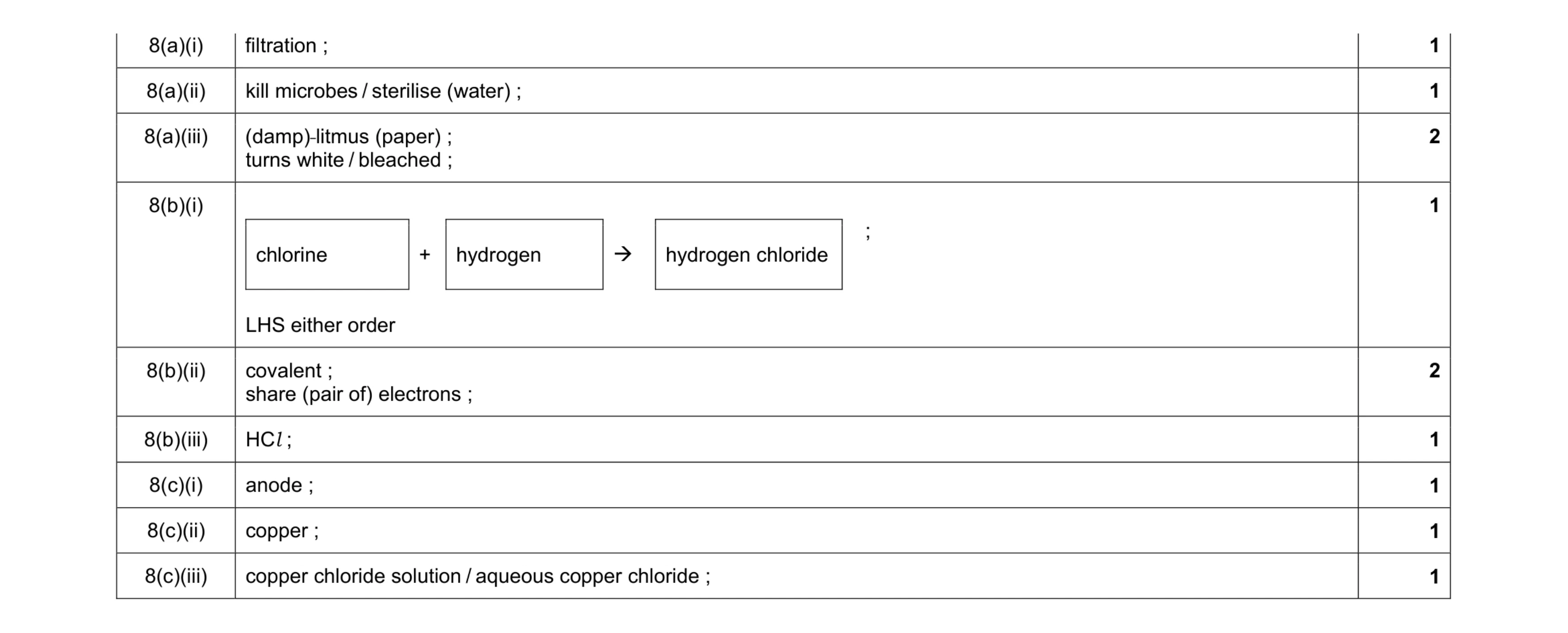
Mark scheme: 8(a)(i) filtration ; 1 8(a)(ii) kill microbes / sterilise (water) ; 1 8(a)(iii) (damp) litmus (paper) ; turns white / bleached ; 2 8(b)(i) ; LHS either order chlorine + hydrogen Æ hydrogen chloride 1 8(b)(ii) covalent ; share (pair of) electrons ; 2 8(b)(iii) HCl ; 1 8(c)(i) anode ; 1 8(c)(ii) copper ; 1 8(c)(iii) copper chloride solution / aqueous copper chloride ; 1
This question in 0653/32 May/June 2017
Q2 · Water is extracted from a river and then treated to make it suitable for people to use 0653/33 May/June 2017
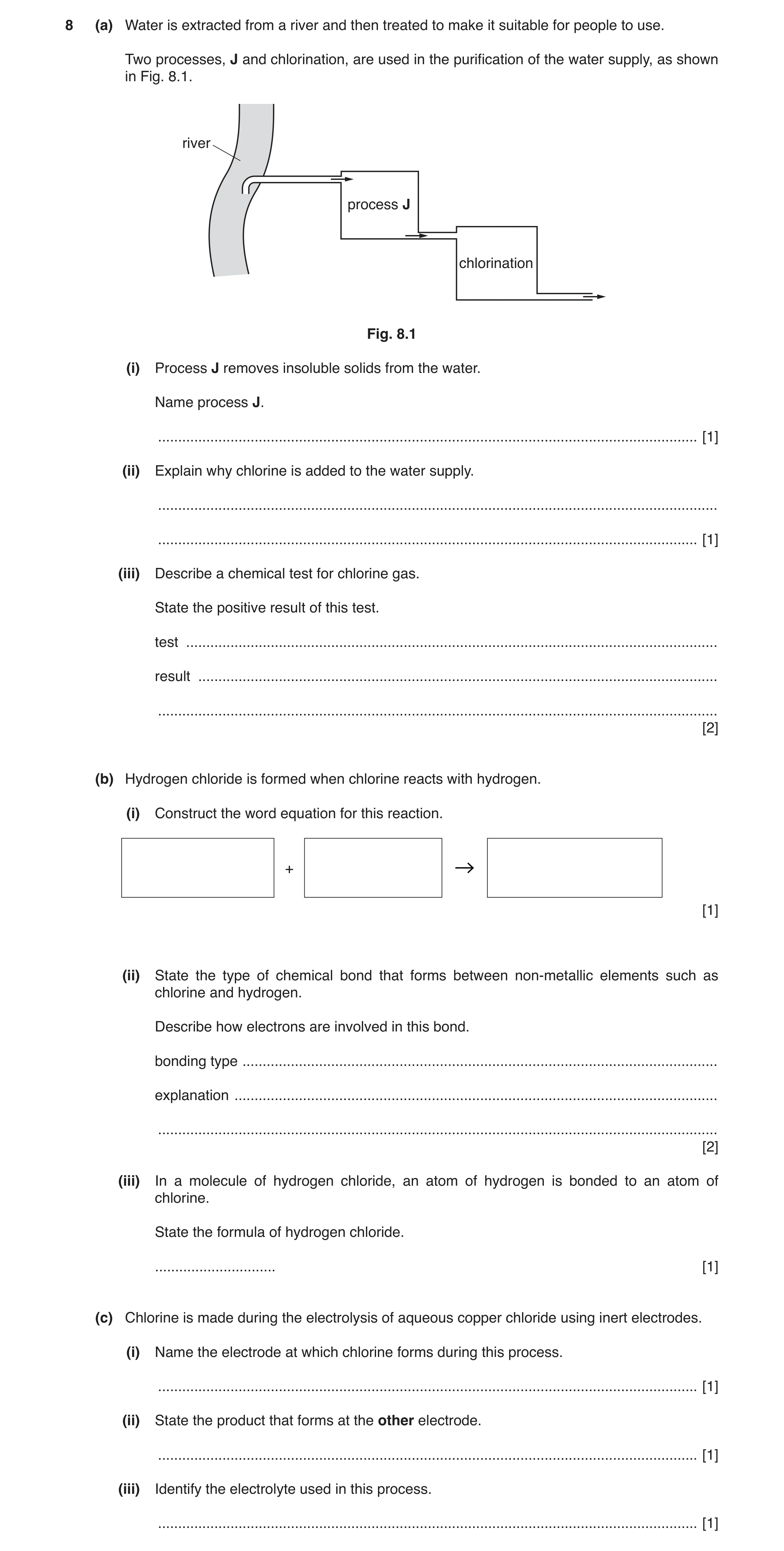
8 (a) Water is extracted from a river and then treated to make it suitable for people to use. Two processes, J and chlorination, are used in the purification of the water supply, as shown in Fig. 8.1. river process J chlorination Fig. 8.1 (i) Process J removes insoluble solids from the water. Name process J. … [1] (ii) Explain why chlorine is added to the water supply. … … [1] (iii) Describe a chemical test for chlorine gas. State the positive result of this test. test … result … … [2] (b) Hydrogen chloride is formed when chlorine reacts with hydrogen. (i) Construct the word equation for this reaction. + [1] (ii) State the type of chemical bond that forms between non-metallic elements such as chlorine and hydrogen. Describe how electrons are involved in this bond. bonding type … explanation … … [2] (iii) In a molecule of hydrogen chloride, an atom of hydrogen is bonded to an atom of chlorine. State the formula of hydrogen chloride. … [1] (c) Chlorine is made during the electrolysis of aqueous copper chloride using inert electrodes. (i) Name the electrode at which chlorine forms during this process. … [1] (ii) State the product that forms at the other electrode. … [1] (iii) Identify the electrolyte used in this process. … [1]
11 marks
Mark scheme: 8(a)(i) filtration ; 1 8(a)(ii) kill microbes / sterilise (water) ; 1 8(a)(iii) (damp) litmus (paper) ; turns white / bleached ; 2 8(b)(i) ; LHS either order chlorine + hydrogen Æ hydrogen chloride 1 8(b)(ii) covalent ; share (pair of) electrons ; 2 8(b)(iii) HCl ; 1 8(c)(i) anode ; 1 8(c)(ii) copper ; 1 8(c)(iii) copper chloride solution / aqueous copper chloride ; 1
This question in 0653/33 May/June 2017
Q3 · Pure water can be separated from sea water using the apparatus shown in Fig 0653/33 Oct/Nov 2017
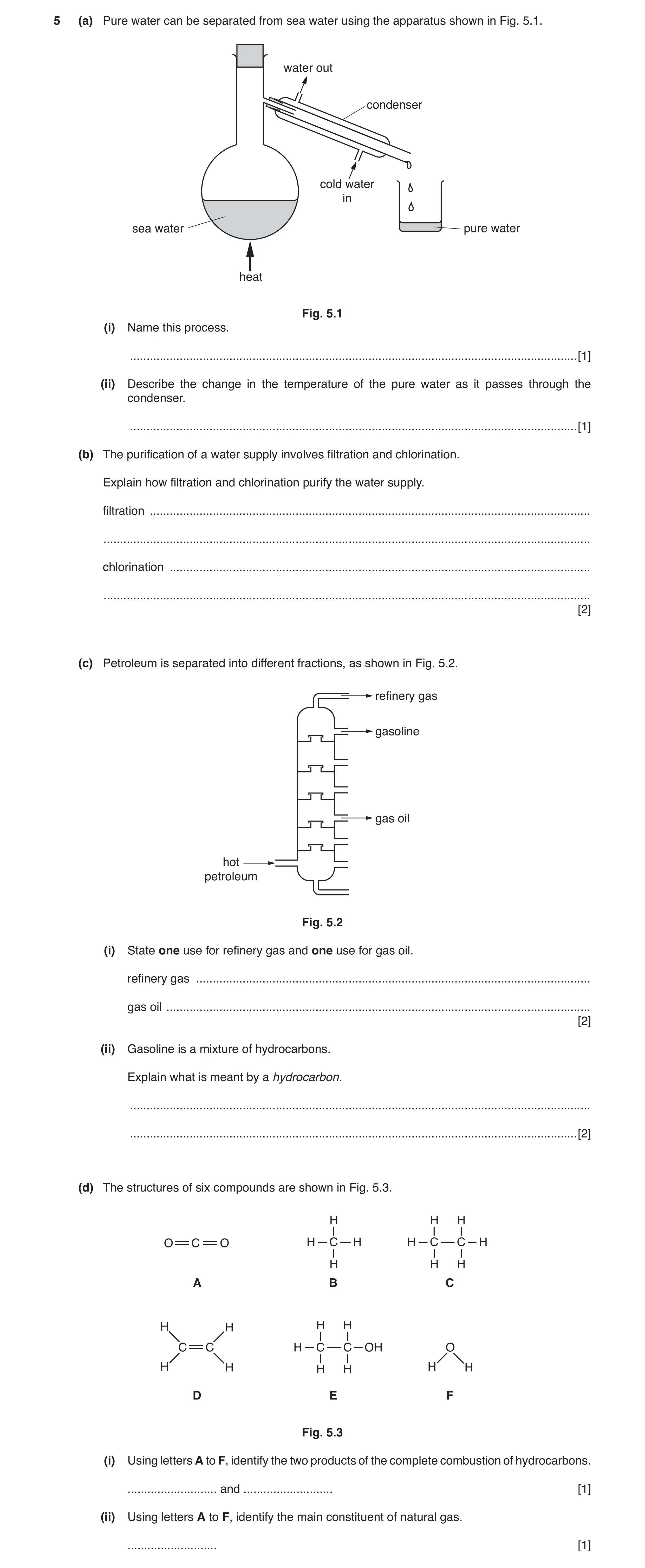
5 (a) Pure water can be separated from sea water using the apparatus shown in Fig. 5.1. water out condenser cold water in sea water pure water heat Fig. 5.1 (i) Name this process. … [1] (ii) Describe the change in the temperature of the pure water as it passes through the condenser. … [1] (b) The purification of a water supply involves filtration and chlorination. Explain how filtration and chlorination purify the water supply. filtration … … chlorination … … [2] (c) Petroleum is separated into different fractions, as shown in Fig. 5.2. refinery gas gasoline gas oil hot petroleum Fig. 5.2 (i) State one use for refinery gas and one use for gas oil. refinery gas … gas oil … [2] (ii) Gasoline is a mixture of hydrocarbons. Explain what is meant by a hydrocarbon. … … [2] (d) The structures of six compounds are shown in Fig. 5.3. H H H O C O H C H H C C H H H H A B C H H H H C C H C C OH O H H H H H H D E F Fig. 5.3 (i) Using letters A to F, identify the two products of the complete combustion of hydrocarbons. … and … [1] (ii) Using letters A to F, identify the main constituent of natural gas. … [1]
10 marks
Mark scheme: 5(a)(i) distillation ; 1 5(a)(ii) decrease ; 1 5(b) (filtration) remove (named) solids ; (chlorination) kill microbes / bacteria / sterilizes ; 2 5(c)(i) (refinery gas) bottled gas / heating / cooking ; (gas oil) diesel fuel / diesel engines / diesel vehicles ; 2 5(c)(ii) compound / molecule containing hydrogen and carbon ; only (C and H); 2 5(d)(i) A F ; 1 5(d)(ii) B ; 1
This question in 0653/33 Oct/Nov 2017
Q4 · Period 3 of the Periodic Table contains the elements from sodium to argon 0653/32 May/June 2018
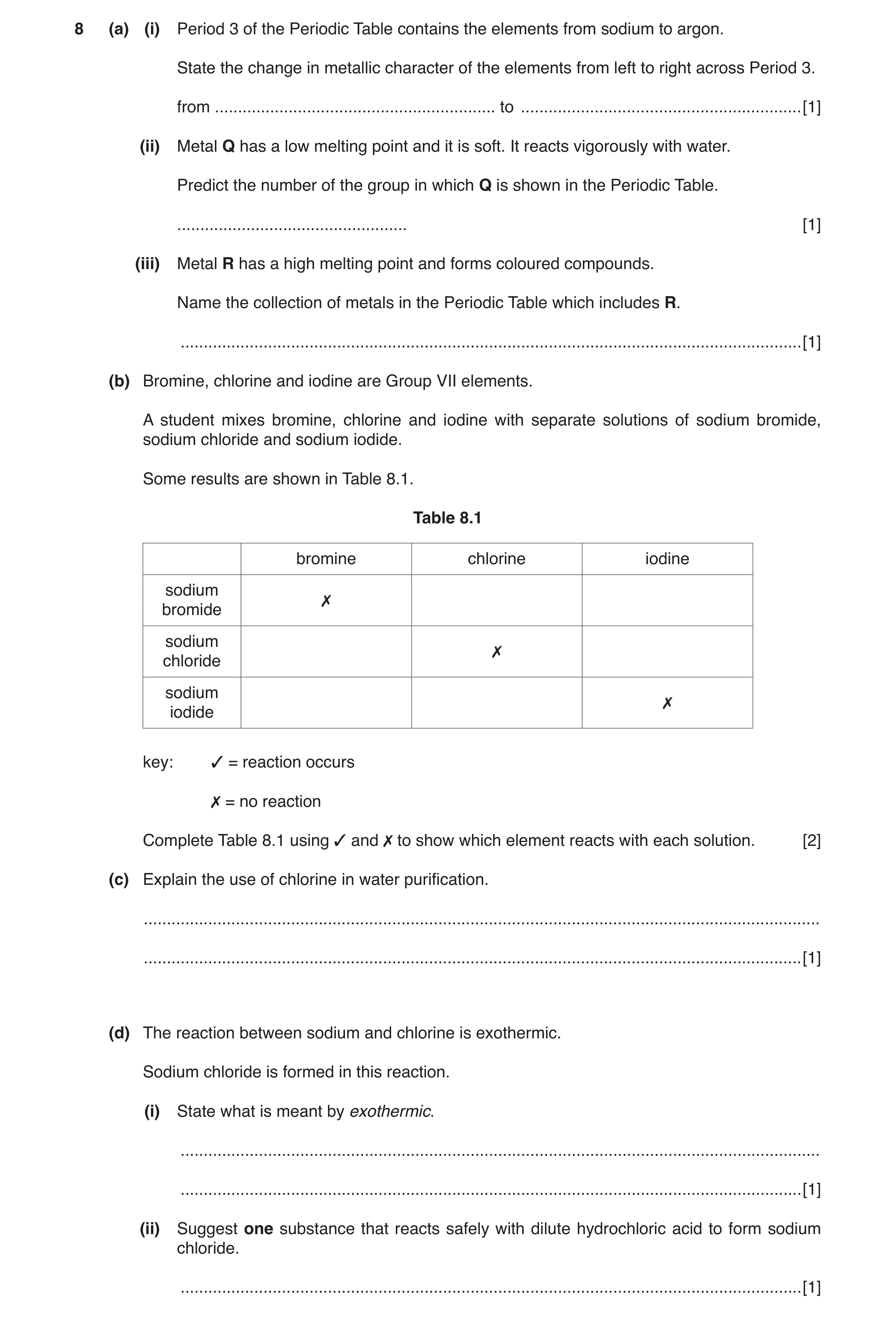
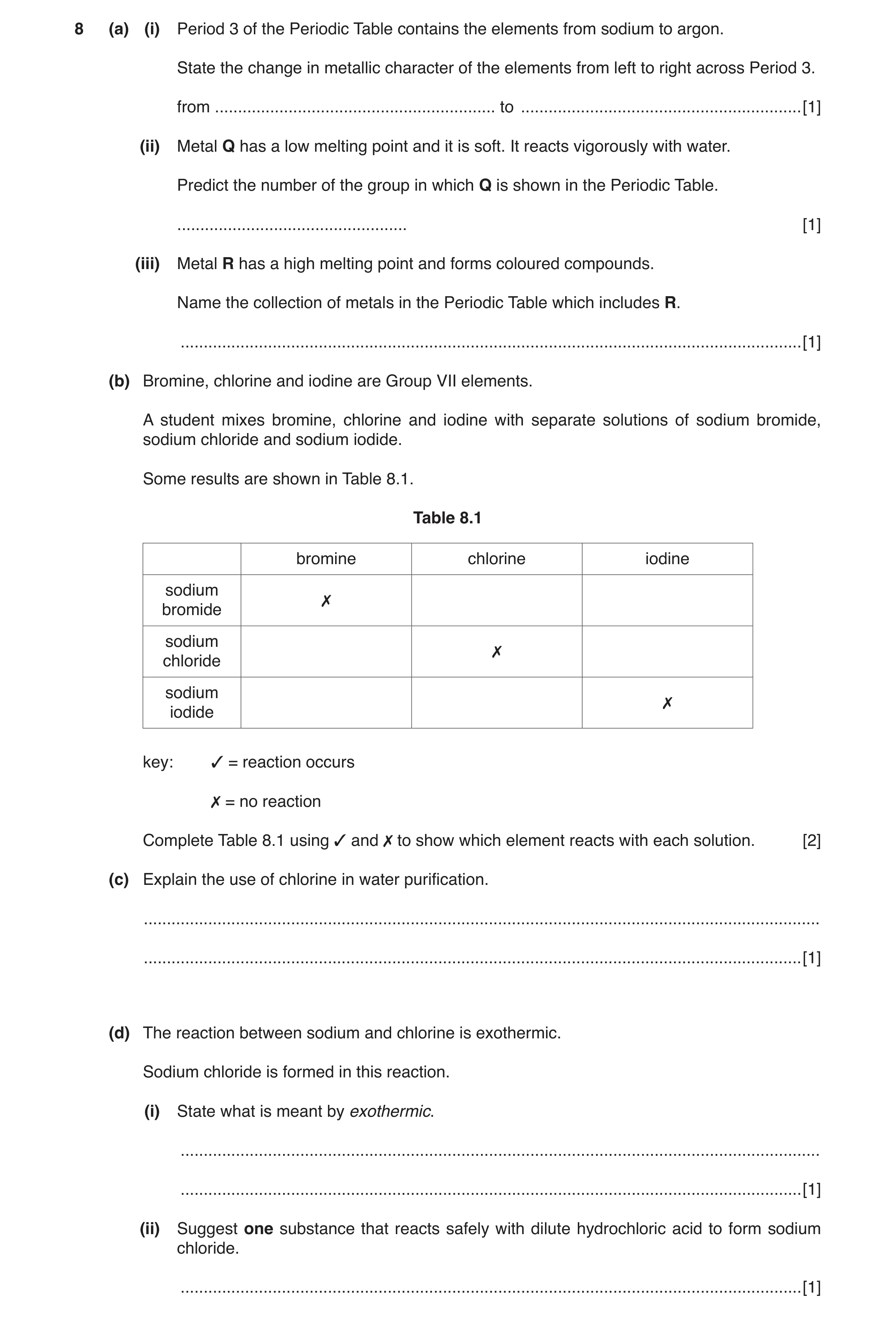
8 (a) (i) Period 3 of the Periodic Table contains the elements from sodium to argon. State the change in metallic character of the elements from left to right across Period 3. from … to … [1] (ii) Metal Q has a low melting point and it is soft. It reacts vigorously with water. Predict the number of the group in which Q is shown in the Periodic Table. … [1] (iii) Metal R has a high melting point and forms coloured compounds. Name the collection of metals in the Periodic Table which includes R. … [1] (b) Bromine, chlorine and iodine are Group VII elements. A student mixes bromine, chlorine and iodine with separate solutions of sodium bromide, sodium chloride and sodium iodide. Some results are shown in Table 8.1. Table 8.1 bromine chlorine iodine sodium ✗ bromide sodium ✗ chloride sodium ✗ iodide key: ✓ = reaction occurs ✗ = no reaction Complete Table 8.1 using ✓ and ✗ to show which element reacts with each solution. [2] (c) Explain the use of chlorine in water purification. … … [1] (d) The reaction between sodium and chlorine is exothermic. Sodium chloride is formed in this reaction. (i) State what is meant by exothermic. … … [1] (ii) Suggest one substance that reacts safely with dilute hydrochloric acid to form sodium chloride. … [1]
8 marks
Mark scheme: 8(a)(i) (left) metal(lic) and (right) non-metal(lic) ; 1 8(a)(ii) (Group) I / 1 / one ; 1 8(a)(iii) transition ; 1 8(b) (bromine) (chlorine) (iodine) (sodium bromide) (✗) 9 ✗ (sodium chloride) ✗ (✗) ✗ (sodium iodide) 9 9 (✗) Three correct 9 ; Three correct ✗ ; 2 8(c) kills / destroys bacteria / microbes / microorganisms / viruses ; 1 8(d)(i) releases heat / thermal energy / temperature increases ; 1 8(d)(ii) sodium hydroxide / NaOH / sodium carbonate / Na2CO3 / sodium hydrogen carbonate / sodium bicarbonate / NaHCO3 / sodium oxide / Na2O ; 1
This question in 0653/32 May/June 2018
Q5 · Period 3 of the Periodic Table contains the elements from sodium to argon 0653/33 May/June 2018
8 (a) (i) Period 3 of the Periodic Table contains the elements from sodium to argon. State the change in metallic character of the elements from left to right across Period 3. from … to … [1] (ii) Metal Q has a low melting point and it is soft. It reacts vigorously with water. Predict the number of the group in which Q is shown in the Periodic Table. … [1] (iii) Metal R has a high melting point and forms coloured compounds. Name the collection of metals in the Periodic Table which includes R. … [1] (b) Bromine, chlorine and iodine are Group VII elements. A student mixes bromine, chlorine and iodine with separate solutions of sodium bromide, sodium chloride and sodium iodide. Some results are shown in Table 8.1. Table 8.1 bromine chlorine iodine sodium ✗ bromide sodium ✗ chloride sodium ✗ iodide key: ✓ = reaction occurs ✗ = no reaction Complete Table 8.1 using ✓ and ✗ to show which element reacts with each solution. [2] (c) Explain the use of chlorine in water purification. … … [1] (d) The reaction between sodium and chlorine is exothermic. Sodium chloride is formed in this reaction. (i) State what is meant by exothermic. … … [1] (ii) Suggest one substance that reacts safely with dilute hydrochloric acid to form sodium chloride. … [1]
8 marks
Mark scheme: 8(a)(i) (left) metal(lic) and (right) non-metal(lic) ; 1 8(a)(ii) (Group) I / 1 / one ; 1 8(a)(iii) transition ; 1 8(b) (bromine) (chlorine) (iodine) (sodium bromide) (✗) 9 ✗ (sodium chloride) ✗ (✗) ✗ (sodium iodide) 9 9 (✗) Three correct 9 ; Three correct ✗ ; 2 8(c) kills / destroys bacteria / microbes / microorganisms / viruses ; 1 8(d)(i) releases heat / thermal energy / temperature increases ; 1 8(d)(ii) sodium hydroxide / NaOH / sodium carbonate / Na2CO3 / sodium hydrogen carbonate / sodium bicarbonate / NaHCO3 / sodium oxide / Na2O ; 1
This question in 0653/33 May/June 2018
Q6 · The composition of clean air is shown in Fig 0653/31 May/June 2019
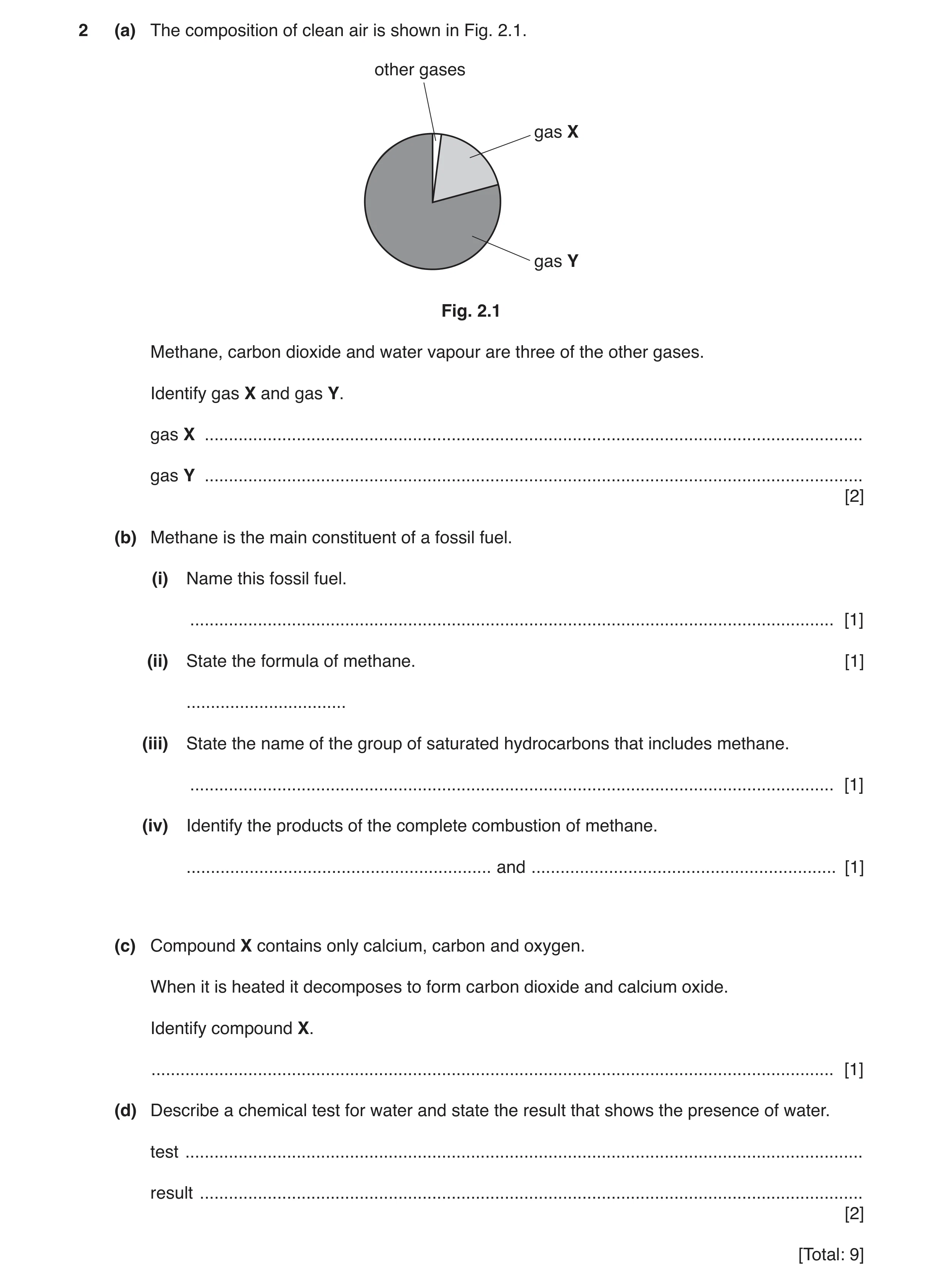
2 (a) The composition of clean air is shown in Fig. 2.1. other gases gas X gas Y Fig. 2.1 Methane, carbon dioxide and water vapour are three of the other gases. Identify gas X and gas Y. gas X … gas Y … [2] (b) Methane is the main constituent of a fossil fuel. (i) Name this fossil fuel. … [1] (ii) State the formula of methane. [1] … (iii) State the name of the group of saturated hydrocarbons that includes methane. … [1] (iv) Identify the products of the complete combustion of methane. … and … [1] (c) Compound X contains only calcium, carbon and oxygen. When it is heated it decomposes to form carbon dioxide and calcium oxide. Identify compound X. … [1] (d) Describe a chemical test for water and state the result that shows the presence of water. test … result … [2] [Total: 9]
9 marks
Mark scheme: 2(a) (gas X) oxygen / O2 ; (gas Y) nitrogen / N2 ; 2 2(b)(i) natural gas ; 1 2(b)(ii) CH4 ; 1 2(b)(iii) alkane ; 1 2(b)(iv) carbon dioxide / CO2 and water / H2O ; 1 Question Answer Marks 2(c) calcium carbonate / CaCO3 ; 1 2(d) (test) (anhydrous) copper ((II)) sulfate ; (result) turns (from white to) blue ; or (test) (anhydrous) cobalt ((II)) chloride ; (result) turns (from blue to) pink / red ; 2
This question in 0653/31 May/June 2019
Q7 · Air is a mixture of different gases 0653/31 Oct/Nov 2020
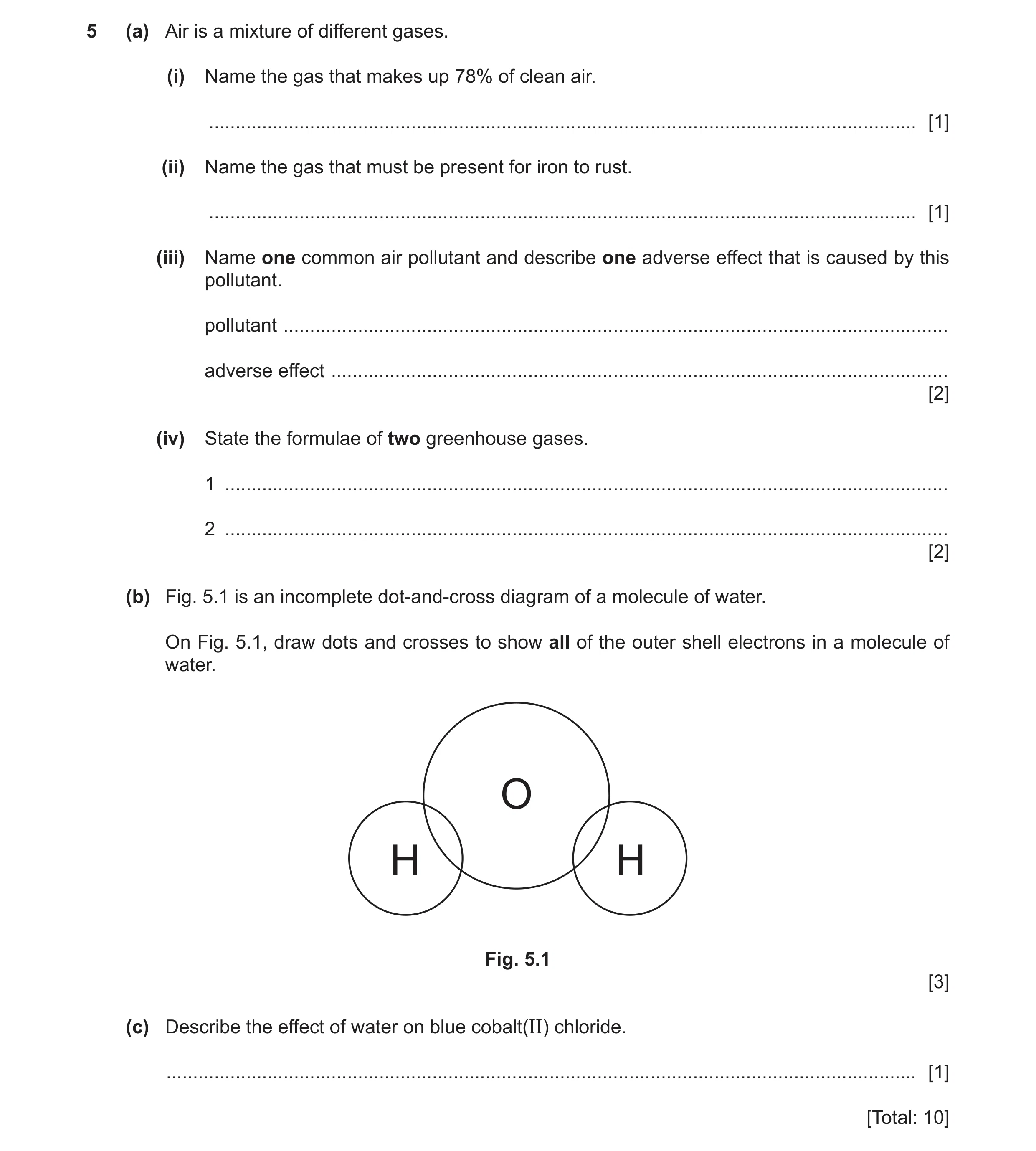
5 (a) Air is a mixture of different gases. (i) Name the gas that makes up 78% of clean air. … [1] (ii) Name the gas that must be present for iron to rust. … [1] (iii) Name one common air pollutant and describe one adverse effect that is caused by this pollutant. pollutant … adverse effect … [2] (iv) State the formulae of two greenhouse gases. 1 … 2 … [2] (b) Fig. 5.1 is an incomplete dot-and-cross diagram of a molecule of water. On Fig. 5.1, draw dots and crosses to show all of the outer shell electrons in a molecule of water. O H H Fig. 5.1 [3] (c) Describe the effect of water on blue cobalt(II) chloride. … [1] [Total: 10]
10 marks
Mark scheme: 5(a)(i) nitrogen ; 1 5(a)(ii) oxygen ; 1 5(a)(iii) (pollutant) carbon monoxide / CO ; (effect) suffocation / less oxygen absorbed/transported ; OR (pollutant) sulfur dioxide / SO2 ; (effect) damages buildings / asthma / acid rain ; OR (pollutant) oxides of nitrogen / NO / NO2 ; (effect) damages buildings / asthma / acid rain ; 2 5(a)(iv) CO2 ; CH4 ; 2 5(b) one hydrogen oxygen bond correct ; 4 electrons on oxygen outside bonds ; all else correct ; 3 5(c) (turns to) pink; 1
This question in 0653/31 Oct/Nov 2020
Q8 · In the box in Fig 0653/33 Oct/Nov 2020
9 (a) In the box in Fig. 9.1, draw the arrangement of particles in a gas. One particle has been drawn for you. Draw 6 more particles. particle Fig. 9.1 [1] (b) Fig. 9.2 shows an extractor fan in the wall of a bathroom. The extractor fan has a small lamp to show when it is switched on. small lamp extractor fan bath Fig. 9.2 The extractor fan is used to remove damp (wet) air from the bathroom. (i) Hot water in the bath makes the air in the bathroom damp. Name the process that occurs at the surface of the water in the bath to make the air in the bathroom damp. … [1] (ii) Explain why this process cools the remaining water in the bath. … … … [2] (c) The circuit for the extractor fan contains: • an electric motor to turn the fan • the small lamp connected in parallel with the electric motor • one switch to control both the electric motor and the small lamp • one fuse to protect both the electric motor and the small lamp. Fig. 9.3 shows an incomplete circuit diagram for the extractor fan. M electric motor Fig. 9.3 On Fig. 9.3, complete the circuit diagram with: • the small lamp • the fuse. [4] (d) The resistance of the electric motor is 3000 Ω. The current in the motor is 0.08 A. Calculate the potential difference across the motor. State the unit of your answer. potential difference = … unit … [3] [Total: 11]
11 marks
Mark scheme: 9(a) random arrangement of 6 additional particles, far apart ; 1 9(b)(i) evaporation ; 1 9(b)(ii) faster / more-energetic, water molecules escape ; remaining molecules have less energy (so water is cooler) ; 2 9(c) correct symbol for lamp ; correct symbol for fuse ; lamp in parallel with motor ; fuse in main circuit ; 4 9(c) V = IR in any form / 0.080 × 3000 ; 240 ; V / volts ; 3
This question in 0653/33 Oct/Nov 2020
Q9 · A thermometer in a solution of salt in water 0653/31 May/June 2021
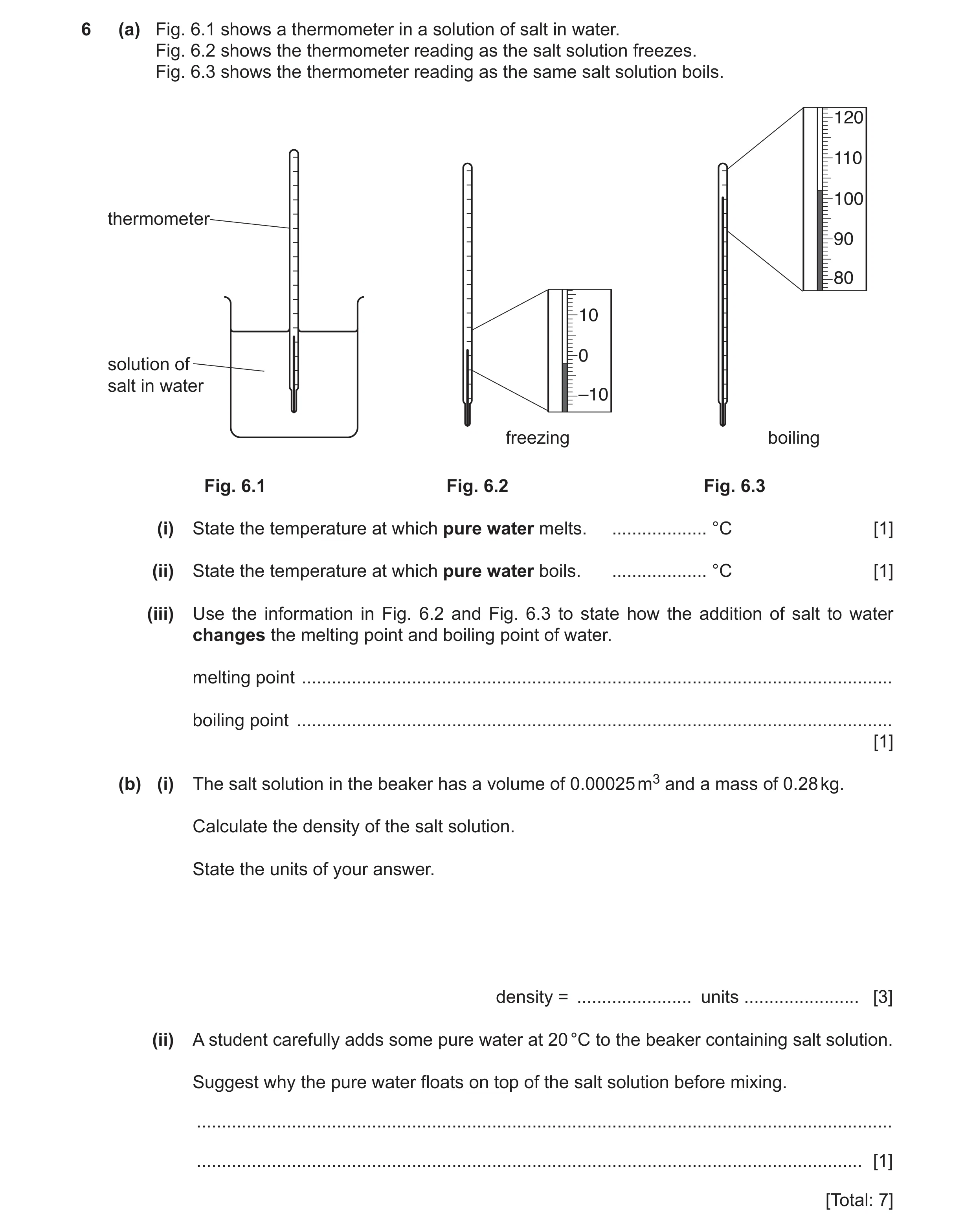
6 (a) Fig. 6.1 shows a thermometer in a solution of salt in water. Fig. 6.2 shows the thermometer reading as the salt solution freezes. Fig. 6.3 shows the thermometer reading as the same salt solution boils. 120 110 100 thermometer 90 80 10 0 solution of salt in water –10 freezing boiling Fig. 6.1 Fig. 6.2 Fig. 6.3 (i) State the temperature at which pure water melts. … °C [1] (ii) State the temperature at which pure water boils. … °C [1] (iii) Use the information in Fig. 6.2 and Fig. 6.3 to state how the addition of salt to water changes the melting point and boiling point of water. melting point … boiling point … [1] (b) (i) The salt solution in the beaker has a volume of 0.00025 m3 and a mass of 0.28 kg. Calculate the density of the salt solution. State the units of your answer. density = … units … [3] (ii) A student carefully adds some pure water at 20 °C to the beaker containing salt solution. Suggest why the pure water floats on top of the salt solution before mixing. … … [1] [Total: 7]
7 marks
Mark scheme: 6(a)(i) 0 (°C) ; 1 6(a)(ii) 100 (°C) ; 1 6(a)(iii) melting point: (–2°C means salt) lowers melting point (of water) AND boiling point: (102°C means salt) raises boiling point (of water) ; 1 6(b)(i) density = m/V = 0.28 / 0.00025 ; (density =) 1120 OR 1100 ; (units) kg / m3 ; 3 6(b)(ii) (pure water / it is) less dense / has lower density (than salt solution) ; 1
This question in 0653/31 May/June 2021
Q10 · Thermal energy being transferred to a beaker full of water 0653/32 May/June 2021
9 Fig. 9.1 shows thermal energy being transferred to a beaker full of water. thermometer Fig. 9.1 (a) A student measures the temperature of the water every five minutes. Explain why the level of the liquid in the thermometer changes as the temperature increases. … … [1] (b) Table 9.1 shows the results. Table 9.1 time / min temperature / °C 0 20 5 40 10 60 15 80 20 100 25 100 (i) Name the process taking place as the water is heated between 20 and 25 minutes. … [1] (ii) Describe the changes in the separation and motion of the water molecules between 5 minutes and 10 minutes. separation … motion … [2] (c) The student puts the thermometer in a cup of water. When the student looks down into the cup, the thermometer appears to bend as it goes into the water. Fig. 9.2 shows what the student can see. Fig. 9.2 Name the property of light demonstrated by this observation. … [1] (d) The student sends a message containing the results of the experiment by mobile phone (cell phone) to a friend. (i) State the type of electromagnetic waves used by the mobile phone to send the message. … [1] (ii) Fig. 9.3 shows an incomplete electromagnetic spectrum. visible X-rays infrared light Fig. 9.3 On Fig. 9.3 write your answer to (d)(i) in the correct position in the electromagnetic spectrum. [1] [Total: 7]
7 marks
Mark scheme: 9(a) liquids expand / volume increases (with temperature rise) ; 1 9(b)(i) boiling ; 1 9(b)(ii) separation: (molecules) further apart ; motion: (molecules) move faster ; 2 9(c) refraction ; 1 9(d)(i) radio waves / microwaves ; 1 9(d)(ii) gamma X-rays ultraviolet visible light infrared microwaves radio waves stated waves in (d)(i) in correct position ; 1
This question in 0653/32 May/June 2021
Q11 · A gas flame being used to heat a metal kettle of water until the water boils 0653/31 Oct/Nov 2021
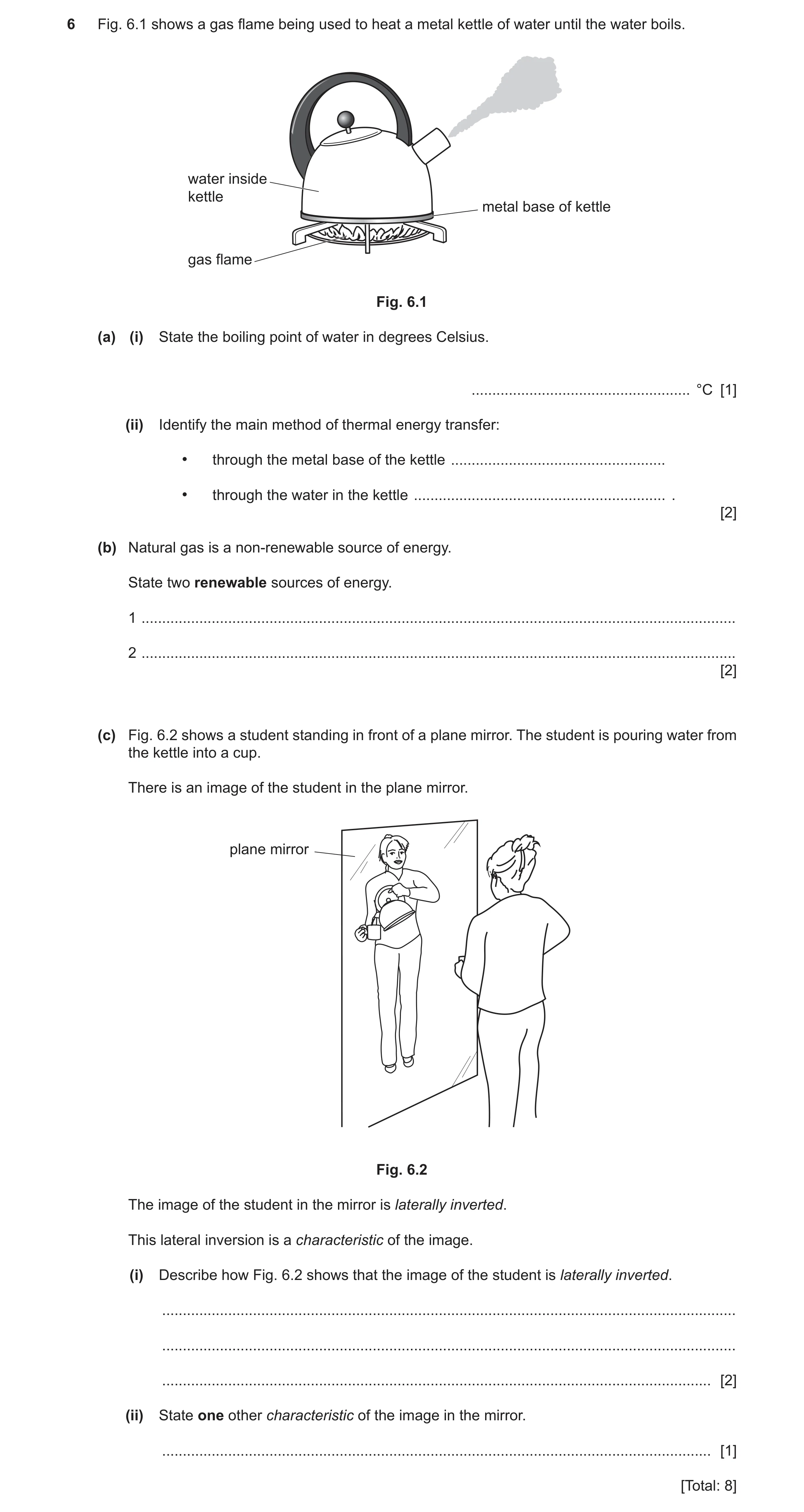
6 Fig. 6.1 shows a gas flame being used to heat a metal kettle of water until the water boils. water inside kettle metal base of kettle gas flame Fig. 6.1 (a) (i) State the boiling point of water in degrees Celsius. … °C [1] (ii) Identify the main method of thermal energy transfer: • through the metal base of the kettle … • through the water in the kettle … . [2] (b) Natural gas is a non-renewable source of energy. State two renewable sources of energy. 1 … 2 … [2] (c) Fig. 6.2 shows a student standing in front of a plane mirror. The student is pouring water from the kettle into a cup. There is an image of the student in the plane mirror. plane mirror Fig. 6.2 The image of the student in the mirror is laterally inverted. This lateral inversion is a characteristic of the image. (i) Describe how Fig. 6.2 shows that the image of the student is laterally inverted. … … … [2] (ii) State one other characteristic of the image in the mirror. … [1] [Total: 8]
8 marks
Mark scheme: 6(a)(i) 100 (°C) ; 1 6(a)(ii) conduction ; convection ; 2 6(b) any two from: solar ; wind ; hydroelectric ; tidal ; wave ; geothermal ; 2 6(c)(i) the student is holding the kettle in her right hand / AW ; mirror image is holding the kettle in her left hand / AW ; 2 6(c)(ii) any one from: upright ; virtual ; same size (as object) ; distance of image from mirror equal to distance of object from mirror ; 1
This question in 0653/31 Oct/Nov 2021
Q12 · A student investigates the gases in air 0653/33 May/June 2022
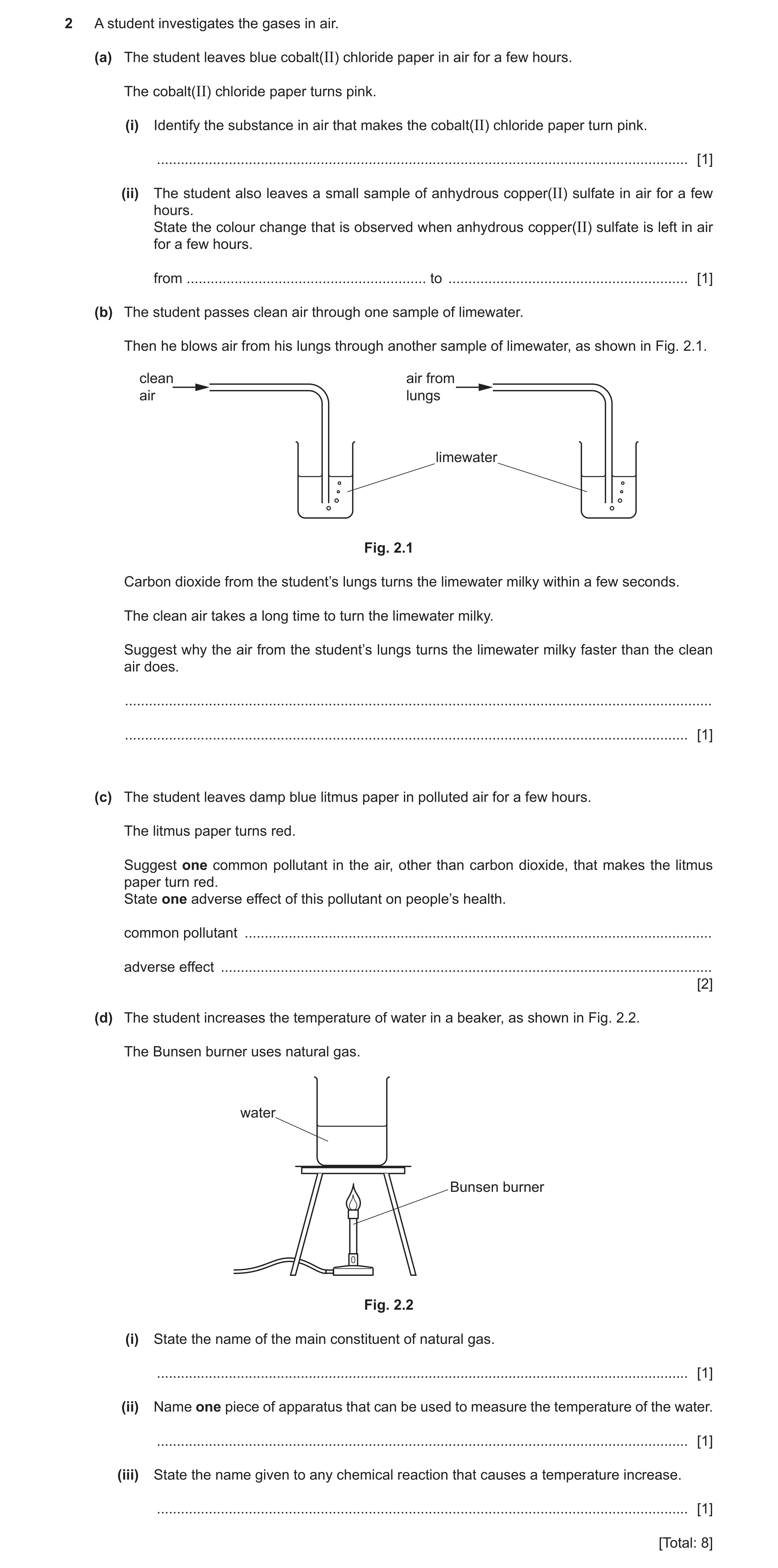
2 A student investigates the gases in air. (a) The student leaves blue cobalt(II) chloride paper in air for a few hours. The cobalt(II) chloride paper turns pink. (i) Identify the substance in air that makes the cobalt(II) chloride paper turn pink. … [1] (ii) The student also leaves a small sample of anhydrous copper(II) sulfate in air for a few hours. State the colour change that is observed when anhydrous copper(II) sulfate is left in air for a few hours. from … to … [1] (b) The student passes clean air through one sample of limewater. Then he blows air from his lungs through another sample of limewater, as shown in Fig. 2.1. clean air from air lungs limewater Fig. 2.1 Carbon dioxide from the student’s lungs turns the limewater milky within a few seconds. The clean air takes a long time to turn the limewater milky. Suggest why the air from the student’s lungs turns the limewater milky faster than the clean air does. … … [1] (c) The student leaves damp blue litmus paper in polluted air for a few hours. The litmus paper turns red. Suggest one common pollutant in the air, other than carbon dioxide, that makes the litmus paper turn red. State one adverse effect of this pollutant on people’s health. common pollutant … adverse effect … [2] (d) The student increases the temperature of water in a beaker, as shown in Fig. 2.2. The Bunsen burner uses natural gas. water Bunsen burner Fig. 2.2 (i) State the name of the main constituent of natural gas. … [1] (ii) Name one piece of apparatus that can be used to measure the temperature of the water. … [1] (iii) State the name given to any chemical reaction that causes a temperature increase. … [1] [Total: 8]
8 marks
Mark scheme: 2(a)(i) water (vapour) / H2O ; 1 2(a)(ii) (from) white (to) blue ; 1 2(b) (air from lungs has) higher concentration of carbon dioxide ; 1 2(c) common pollutant: sulfur dioxide / SO2 OR oxide of nitrogen / NOx ; adverse effect: causes, inflammation/irritation of the respiratory system/eyes/nose/throat / causes asthma / breathing problems / causes skin irritation ; 2 2(d)(i) methane ; 1 2(d)(ii) thermometer ; 1 2(d)(iii) exothermic ; 1
This question in 0653/33 May/June 2022
Q13 · Describe a chemical test for water and state the positive result 0653/31 Oct/Nov 2022
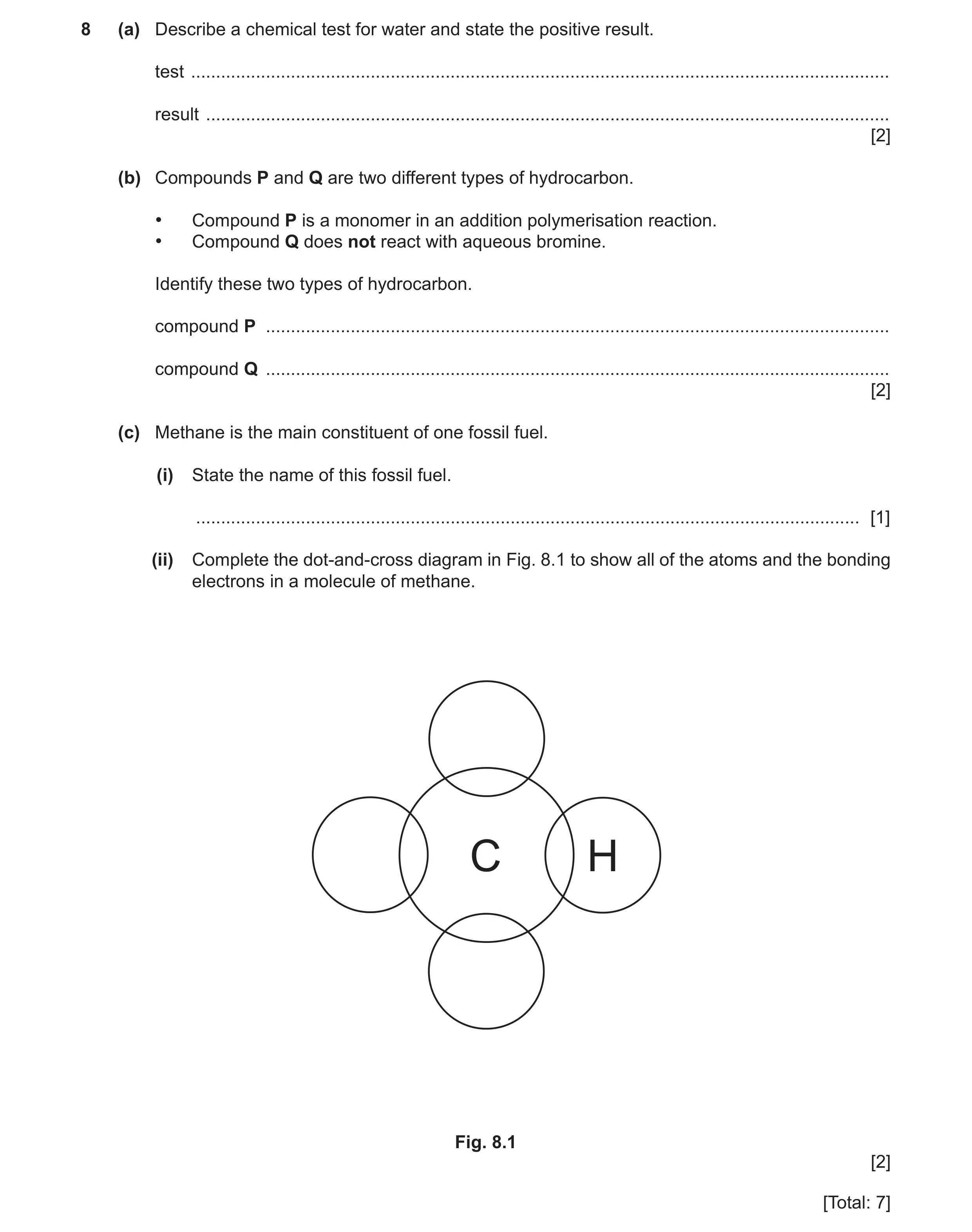
8 (a) Describe a chemical test for water and state the positive result. test … result … [2] (b) Compounds P and Q are two different types of hydrocarbon. • Compound P is a monomer in an addition polymerisation reaction. • Compound Q does not react with aqueous bromine. Identify these two types of hydrocarbon. compound P … compound Q … [2] (c) Methane is the main constituent of one fossil fuel. (i) State the name of this fossil fuel. … [1] (ii) Complete the dot-and-cross diagram in Fig. 8.1 to show all of the atoms and the bonding electrons in a molecule of methane. C H Fig. 8.1 [2] [Total: 7]
7 marks
Mark scheme: 8(a) test copper(II) sulfate ; 2 result turns (white to) blue ; OR test cobalt(II) chloride ; result turns (blue to) pink ; 8(b) compound P alkene / unsaturated ; 2 compound Q alkane / saturated ; 8(c)(i) natural gas ; 1 8(c)(ii) one pair of electrons correct ; 2 everything else correct ;
This question in 0653/31 Oct/Nov 2022
Q14 · A beaker contains a mixture of sodium chloride dissolved in water and iron filings, as… 0653/32 Oct/Nov 2022
2 (a) A beaker contains a mixture of sodium chloride dissolved in water and iron filings, as shown in Fig. 2.1. sodium chloride dissolved in water iron filings Fig. 2.1 (i) Identify the solute and the solvent in this mixture. solute … solvent … [2] (ii) Identify one compound in the mixture. … [1] (iii) State one method of removing the iron filings from the mixture. … [1] (b) When a dilute solution of sodium chloride dissolved in water is heated, evaporation occurs and the solution becomes more concentrated. State what is meant by more concentrated. Use ideas about particles in your answer. … … [1] (c) State the products at the anode and at the cathode when concentrated aqueous sodium chloride is electrolysed using inert electrodes. anode … cathode … [2] (d) An atom of iron is represented as shown. 5626Fe Deduce the number of electrons, protons and neutrons in this atom. electrons … protons … neutrons … [2] [Total: 9]
9 marks
Mark scheme: 2(a)(i) solute sodium chloride / salt / NaCl ; 2 solvent water / H2O; 2(a)(ii) water / H2O / sodium chloride / NaCl ; 1 2(a)(iii) filtration / filter / magnet; 1 2(b) a greater number of (sodium chloride) particles per unit volume ; 1 2(c) anode chlorine (gas) / Cl2 ; 2 cathode hydrogen (gas) / H2 ; 2(d) electrons 26 AND 2 protons 26 ; neutrons 30 ;
This question in 0653/32 Oct/Nov 2022
Q15 · A beaker contains a mixture of sodium chloride dissolved in water and iron filings, as… 0653/33 Oct/Nov 2022
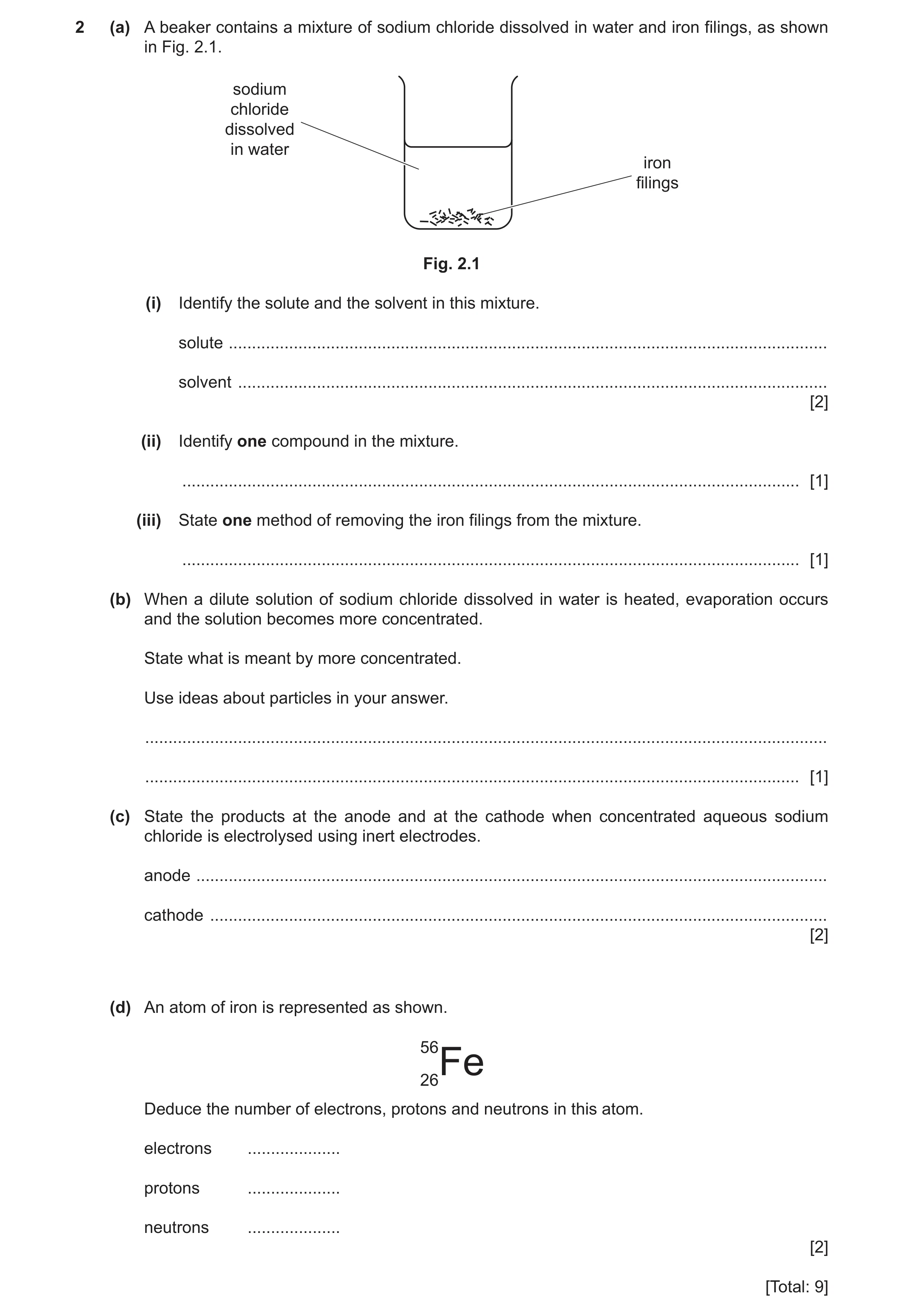
2 (a) A beaker contains a mixture of sodium chloride dissolved in water and iron filings, as shown in Fig. 2.1. sodium chloride dissolved in water iron filings Fig. 2.1 (i) Identify the solute and the solvent in this mixture. solute … solvent … [2] (ii) Identify one compound in the mixture. … [1] (iii) State one method of removing the iron filings from the mixture. … [1] (b) When a dilute solution of sodium chloride dissolved in water is heated, evaporation occurs and the solution becomes more concentrated. State what is meant by more concentrated. Use ideas about particles in your answer. … … [1] (c) State the products at the anode and at the cathode when concentrated aqueous sodium chloride is electrolysed using inert electrodes. anode … cathode … [2] (d) An atom of iron is represented as shown. 5626Fe Deduce the number of electrons, protons and neutrons in this atom. electrons … protons … neutrons … [2] [Total: 9]
9 marks
Mark scheme: 2(a)(i) solute sodium chloride / salt / NaCl ; 2 solvent water / H2O; 2(a)(ii) water / H2O / sodium chloride / NaCl ; 1 2(a)(iii) filtration / filter / magnet; 1 2(b) a greater number of (sodium chloride) particles per unit volume ; 1 2(c) anode chlorine (gas) / Cl2 ; 2 cathode hydrogen (gas) / H2 ; 2(d) electrons 26 AND 2 protons 26 ; neutrons 30 ;
This question in 0653/33 Oct/Nov 2022
Q16 · A student dissolves sodium carbonate, Na2CO3, in water to form aqueous sodium carbonate 0653/31 Oct/Nov 2023
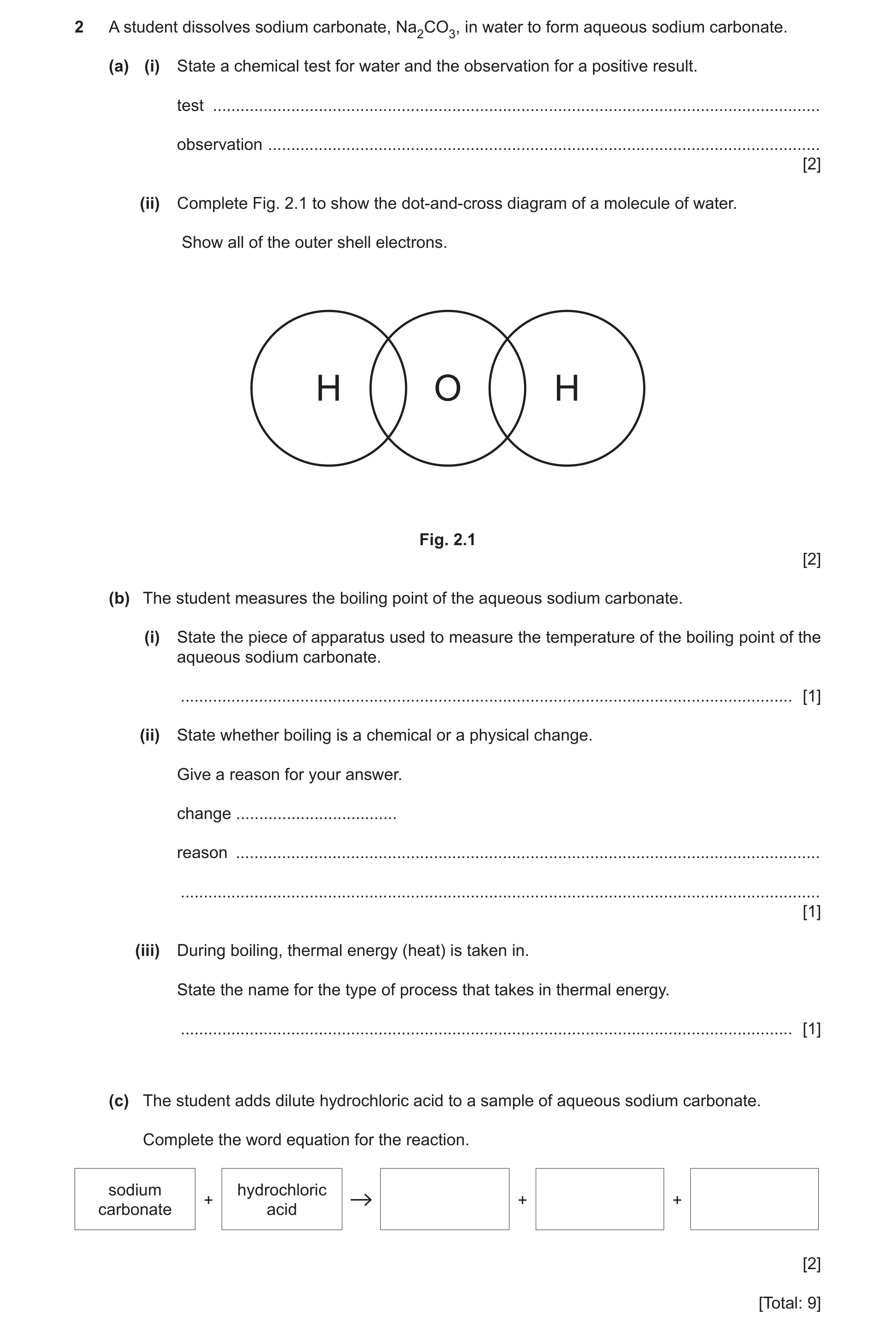
2 A student dissolves sodium carbonate, Na2CO3, in water to form aqueous sodium carbonate. (a) (i) State a chemical test for water and the observation for a positive result. test … observation … [2] (ii) Complete Fig. 2.1 to show the dot-and-cross diagram of a molecule of water. Show all of the outer shell electrons. H O H Fig. 2.1 [2] (b) The student measures the boiling point of the aqueous sodium carbonate. (i) State the piece of apparatus used to measure the temperature of the boiling point of the aqueous sodium carbonate. … [1] (ii) State whether boiling is a chemical or a physical change. Give a reason for your answer. change … reason … … [1] (iii) During boiling, thermal energy (heat) is taken in. State the name for the type of process that takes in thermal energy. … [1] (c) The student adds dilute hydrochloric acid to a sample of aqueous sodium carbonate. Complete the word equation for the reaction. sodium hydrochloric + + +carbonate acid [2] [Total: 9]
9 marks
Mark scheme: 2(a)(i) test (anhydrous) copper sulfate ; 2 observation (white to) blue ; OR test (anhydrous) cobalt chloride ; observation (blue to) pink ; 2(a)(ii) one bond pair between each H atom and O atom ; 2 two lone pairs on O atom and all else correct ; 2(b)(i) thermometer ; 1 2(b)(ii) change physical AND 1 explanation no new substance is made ; 2(b)(iii) endothermic ; 1 2(c) 2 sodium chloride correct / carbon dioxide and water correct ; all three correct ;
This question in 0653/31 Oct/Nov 2023
Q17 · Chlorine is in Group VII of the Periodic Table 0653/31 Oct/Nov 2023
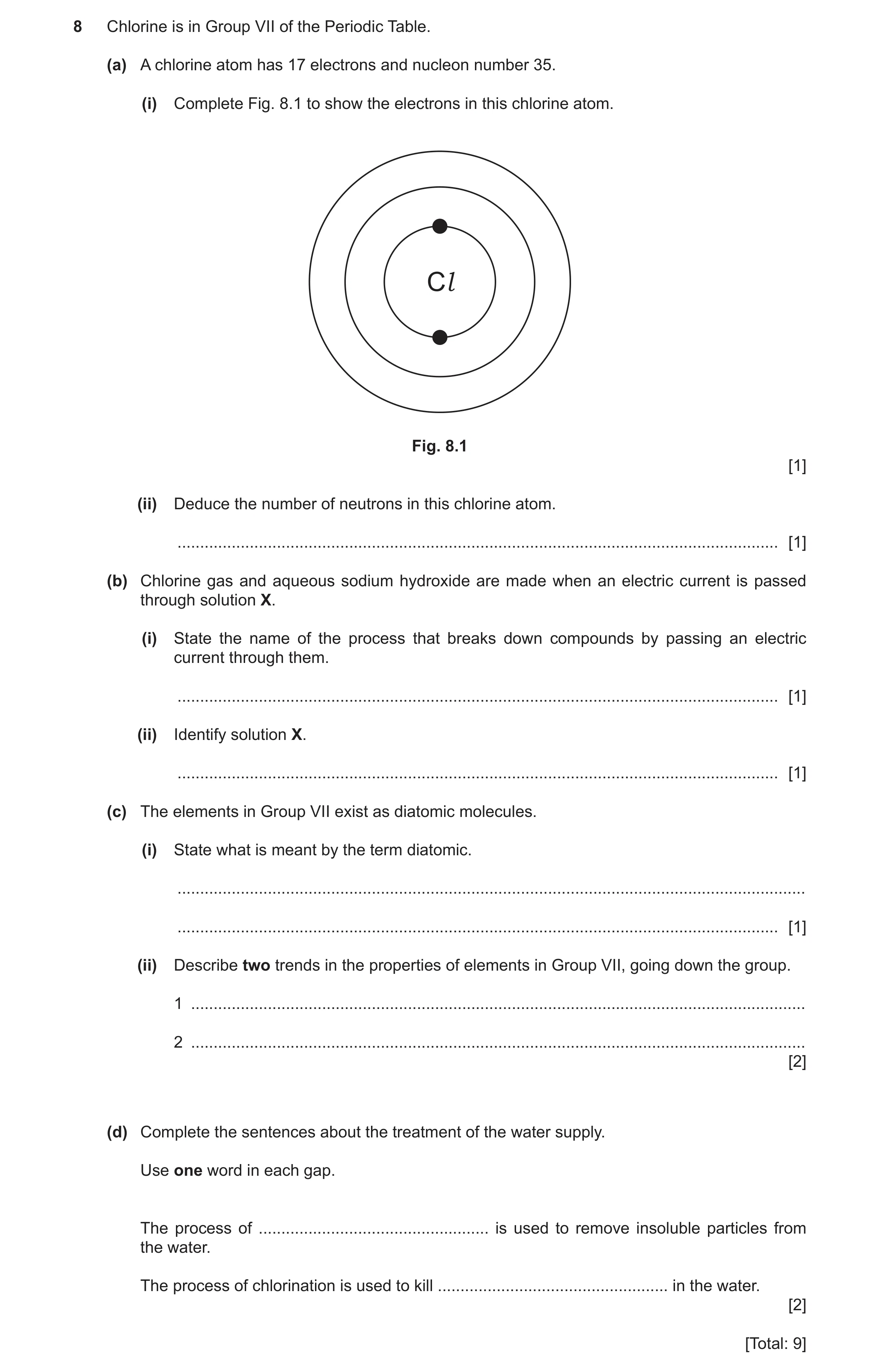
8 Chlorine is in Group VII of the Periodic Table. (a) A chlorine atom has 17 electrons and nucleon number 35. (i) Complete Fig. 8.1 to show the electrons in this chlorine atom. Cl Fig. 8.1 [1] (ii) Deduce the number of neutrons in this chlorine atom. … [1] (b) Chlorine gas and aqueous sodium hydroxide are made when an electric current is passed through solution X. (i) State the name of the process that breaks down compounds by passing an electric current through them. … [1] (ii) Identify solution X. … [1] (c) The elements in Group VII exist as diatomic molecules. (i) State what is meant by the term diatomic. … … [1] (ii) Describe two trends in the properties of elements in Group VII, going down the group. 1 … 2 … [2] (d) Complete the sentences about the treatment of the water supply. Use one word in each gap. The process of … is used to remove insoluble particles from the water. The process of chlorination is used to kill … in the water. [2] [Total: 9]
9 marks
Mark scheme: 8(a)(i) (2,) 8, 7 ; 1 8(a)(ii) 18 ; 1 8(b)(i) electrolysis ; 1 8(b)(ii) (concentrated, aqueous) sodium chloride / NaCl ; 1 8(c)(i) (consisting of) two atoms ; 1 8(c)(ii) (become) darker in colour ; 2 change from gas to liquid to solid ; 8(d) filtration ; 2 bacteria / microorganisms / microbes ;
This question in 0653/31 Oct/Nov 2023
Q18 · Chlorine exists as diatomic molecules 0653/32 Oct/Nov 2023
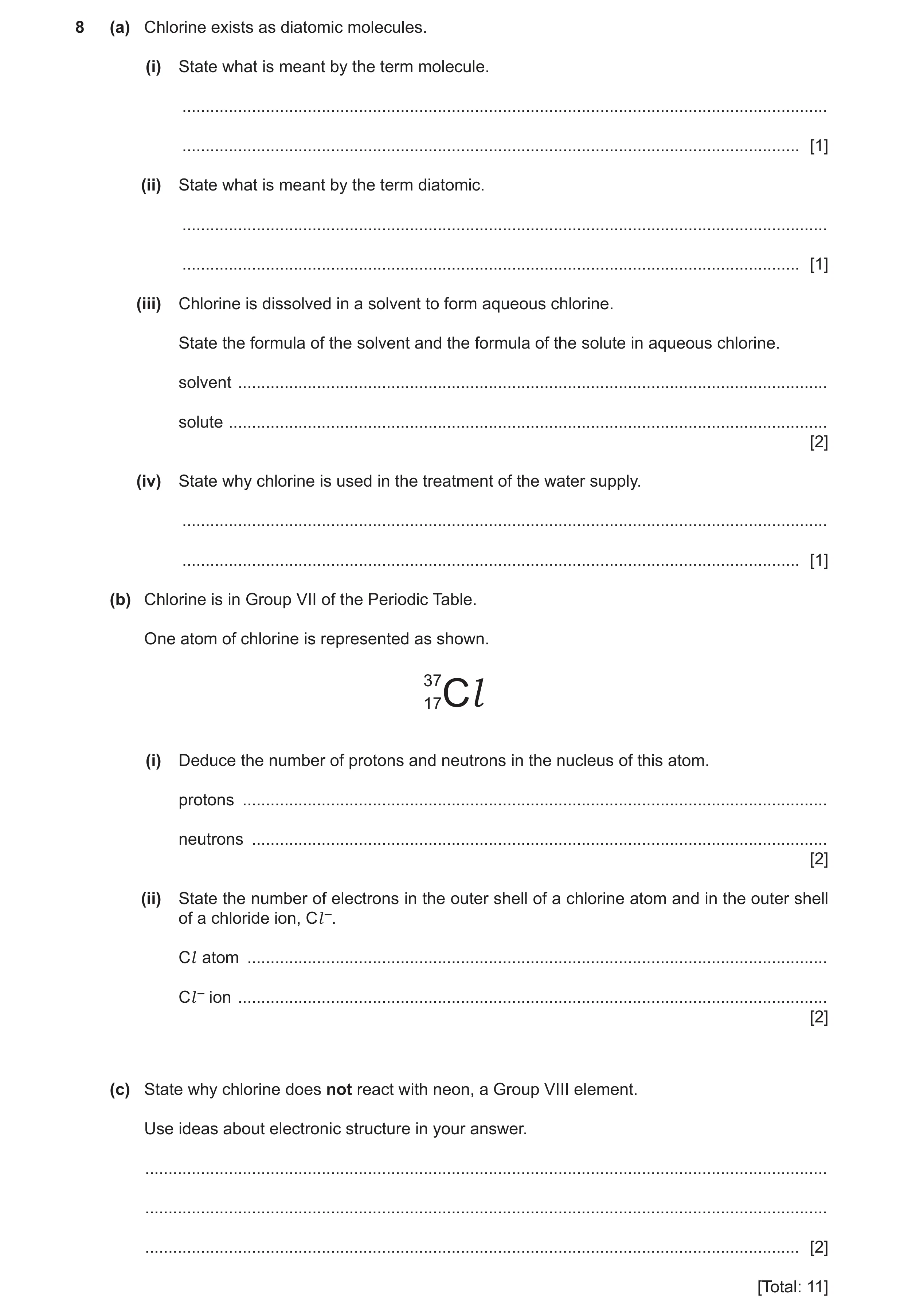
8 (a) Chlorine exists as diatomic molecules. (i) State what is meant by the term molecule. … … [1] (ii) State what is meant by the term diatomic. … … [1] (iii) Chlorine is dissolved in a solvent to form aqueous chlorine. State the formula of the solvent and the formula of the solute in aqueous chlorine. solvent … solute … [2] (iv) State why chlorine is used in the treatment of the water supply. … … [1] (b) Chlorine is in Group VII of the Periodic Table. One atom of chlorine is represented as shown. 3717Cl (i) Deduce the number of protons and neutrons in the nucleus of this atom. protons … neutrons … [2] (ii) State the number of electrons in the outer shell of a chlorine atom and in the outer shell of a chloride ion, Cl –. Cl atom … Cl – ion … [2] (c) State why chlorine does not react with neon, a Group VIII element. Use ideas about electronic structure in your answer. … … … [2] [Total: 11]
11 marks
Mark scheme: 8(a)(i) contains (two or more) atoms, bonded / chemically joined ; 1 8(a)(ii) (consisting of) two atoms ; 1 8(a)(iii) solvent: H2O ; 2 solute: Cl 2 ; 8(a)(iv) (chlorine) kills, bacteria / microbes / microorganisms ; 1 8(b)(i) protons: 17 ; 2 neutrons: 20 ; 8(b)(ii) Cl atom: 7 ; 2 Cl – ion: 8 ; 8(c) neon / Group VIII / noble gases, are unreactive ; 2 because they have, full outer shells / 8 outer shell electrons ;
This question in 0653/32 Oct/Nov 2023
Q19 · Chlorine exists as diatomic molecules 0653/33 Oct/Nov 2023
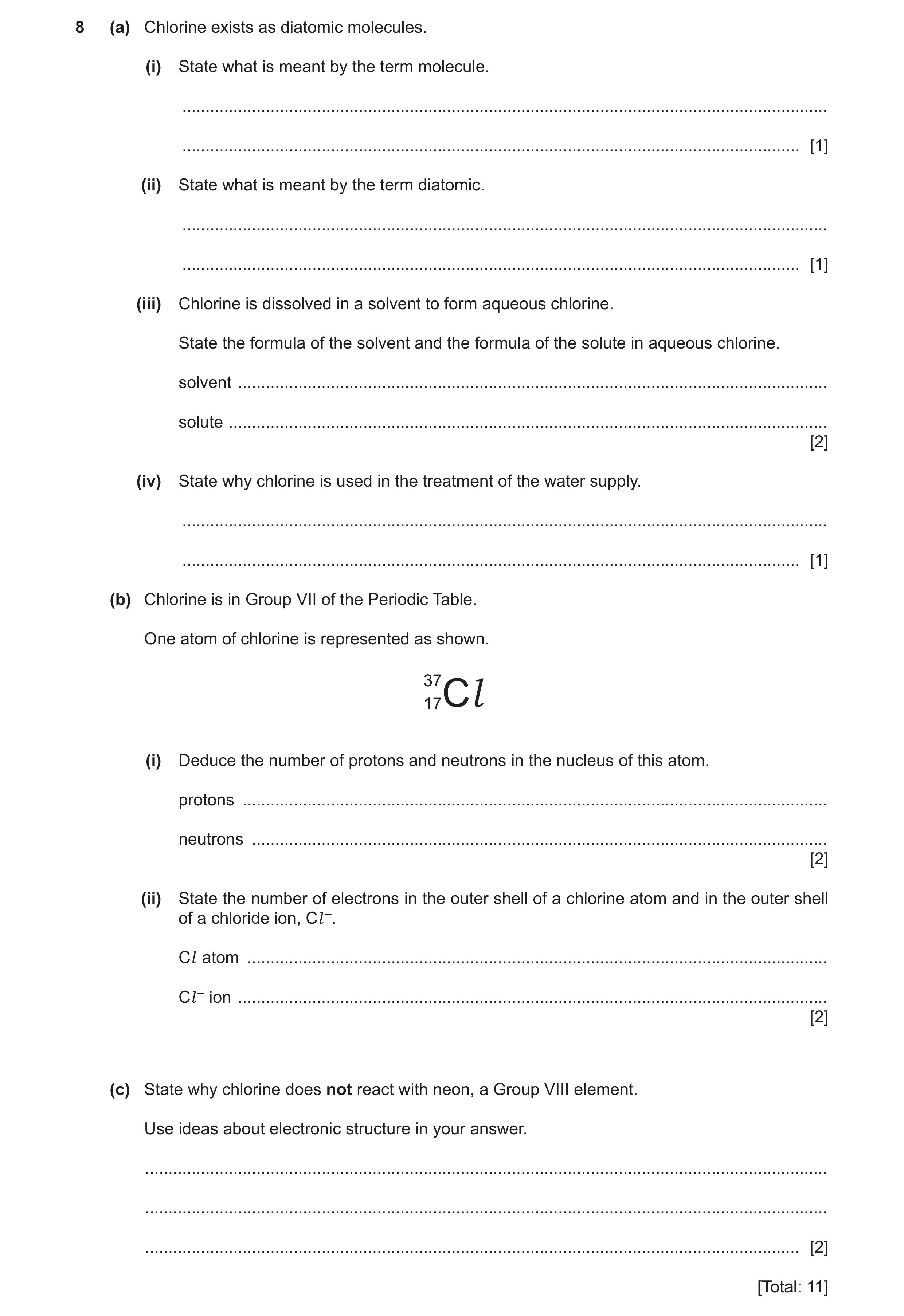
8 (a) Chlorine exists as diatomic molecules. (i) State what is meant by the term molecule. … … [1] (ii) State what is meant by the term diatomic. … … [1] (iii) Chlorine is dissolved in a solvent to form aqueous chlorine. State the formula of the solvent and the formula of the solute in aqueous chlorine. solvent … solute … [2] (iv) State why chlorine is used in the treatment of the water supply. … … [1] (b) Chlorine is in Group VII of the Periodic Table. One atom of chlorine is represented as shown. 3717Cl (i) Deduce the number of protons and neutrons in the nucleus of this atom. protons … neutrons … [2] (ii) State the number of electrons in the outer shell of a chlorine atom and in the outer shell of a chloride ion, Cl –. Cl atom … Cl – ion … [2] (c) State why chlorine does not react with neon, a Group VIII element. Use ideas about electronic structure in your answer. … … … [2] [Total: 11]
11 marks
Mark scheme: 8(a)(i) contains (two or more) atoms, bonded / chemically joined ; 1 8(a)(ii) (consisting of) two atoms ; 1 8(a)(iii) solvent: H2O ; 2 solute: Cl 2 ; 8(a)(iv) (chlorine) kills, bacteria / microbes / microorganisms ; 1 8(b)(i) protons: 17 ; 2 neutrons: 20 ; 8(b)(ii) Cl atom: 7 ; 2 Cl – ion: 8 ; 8(c) neon / Group VIII / noble gases, are unreactive ; 2 because they have, full outer shells / 8 outer shell electrons ;
This question in 0653/33 Oct/Nov 2023
Q20 · An old‑fashioned room heater made of iron 0653/32 May/June 2024
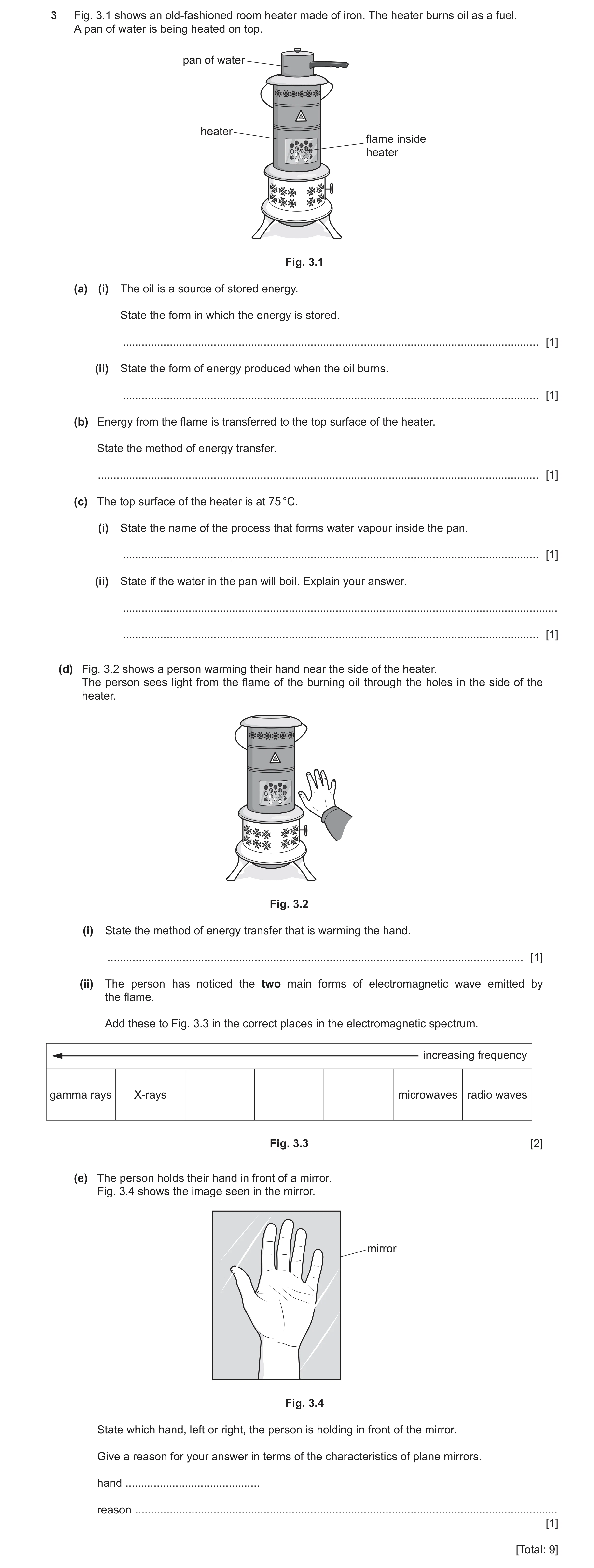
3 Fig. 3.1 shows an old‑fashioned room heater made of iron. The heater burns oil as a fuel. A pan of water is being heated on top. pan of water heater flame inside heater Fig. 3.1 (a) (i) The oil is a source of stored energy. State the form in which the energy is stored. … [1] (ii) State the form of energy produced when the oil burns. … [1] (b) Energy from the flame is transferred to the top surface of the heater. State the method of energy transfer. … [1] (c) The top surface of the heater is at 75 °C. (i) State the name of the process that forms water vapour inside the pan. … [1] (ii) State if the water in the pan will boil. Explain your answer. … … [1] (d) Fig. 3.2 shows a person warming their hand near the side of the heater. The person sees light from the flame of the burning oil through the holes in the side of the heater. Fig. 3.2 (i) State the method of energy transfer that is warming the hand. … [1] (ii) The person has noticed the two main forms of electromagnetic wave emitted by the flame. Add these to Fig. 3.3 in the correct places in the electromagnetic spectrum. increasing frequency gamma rays X-rays microwaves radio waves Fig. 3.3 [2] (e) The person holds their hand in front of a mirror. Fig. 3.4 shows the image seen in the mirror. mirror Fig. 3.4 State which hand, left or right, the person is holding in front of the mirror. Give a reason for your answer in terms of the characteristics of plane mirrors. hand … reason … [1] [Total: 9]
9 marks
Mark scheme: 3(a)(i) chemical (potential) ; 1 3(a)(ii) thermal ; 1 3(b) convection ; 1 3(c)(i) evaporation ; 1 3(c)(ii) no (no mark) has not / does not, reach 100 °C / does not reach boiling point of water ; 1 3(d)(i) radiation ; 1 3(d)(ii) visible(light) infra-red visible (light) and infrared identified (only) ; in correct positions with first box left empty ; 2 3(e) right hand (no mark) lateral inversion ; 1
This question in 0653/32 May/June 2024
Q21 · Hydrogen peroxide, H2O2, decomposes into water and oxygen when a catalyst is added 0653/32 May/June 2025
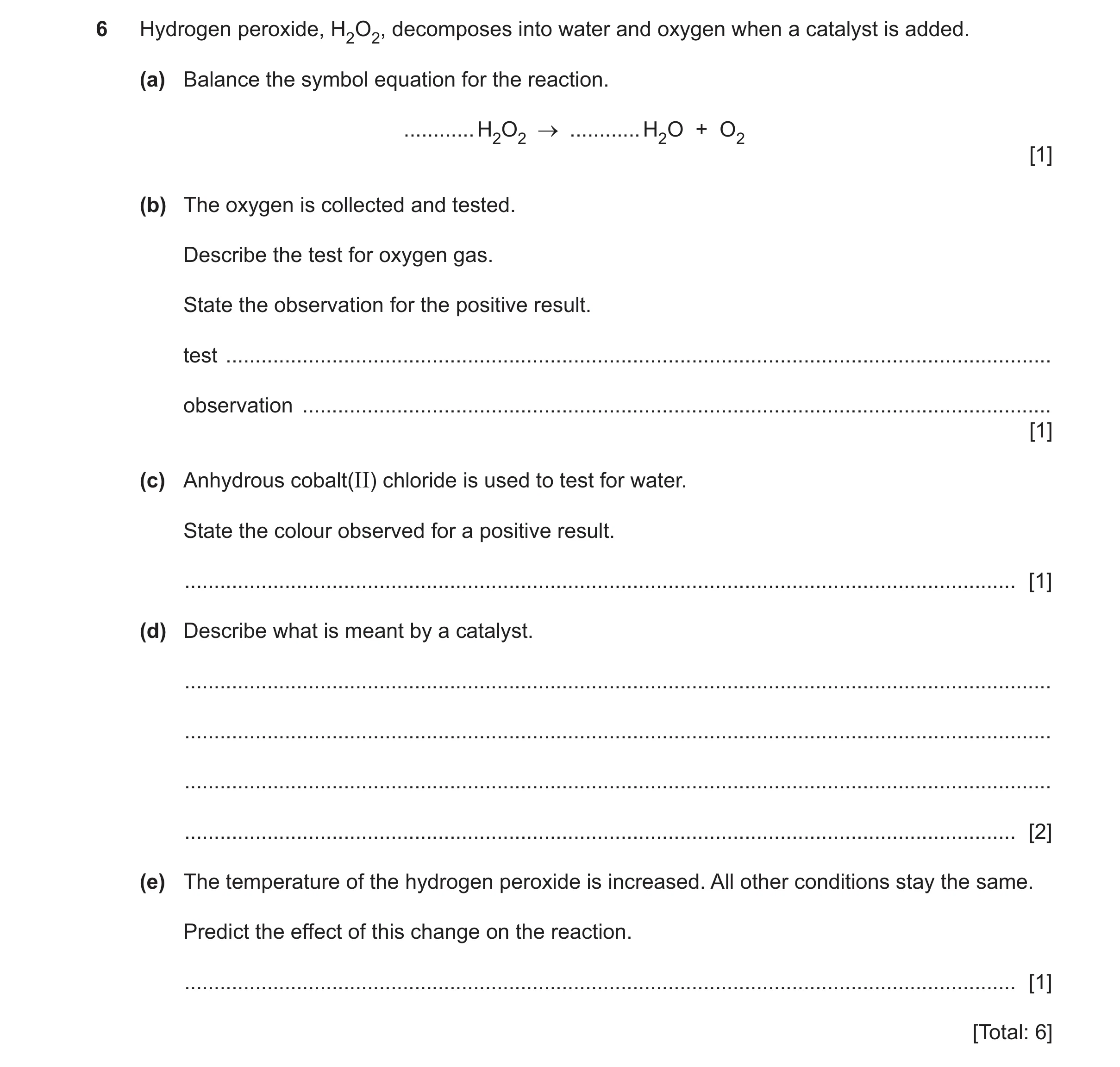
6 Hydrogen peroxide, H2O2, decomposes into water and oxygen when a catalyst is added. (a) Balance the symbol equation for the reaction. … H2O2 … H2O + O2 [1] (b) The oxygen is collected and tested. Describe the test for oxygen gas. State the observation for the positive result. test … observation … [1] (c) Anhydrous cobalt(II) chloride is used to test for water. State the colour observed for a positive result. … [1] (d) Describe what is meant by a catalyst. … … … … [2] (e) The temperature of the hydrogen peroxide is increased. All other conditions stay the same. Predict the effect of this change on the reaction. … [1] [Total: 6]
6 marks
Mark scheme: 6(a) 2 and 2 ; 1 6(b) glowing splint and relights ; 1 6(c) pink ; 1 6(d) (a substance that) increases rate of reaction ; 2 is unchanged at end of a reaction ; 6(e) increases the rate (of reaction) ; 1
This question in 0653/32 May/June 2025
 9 / 29
 10 / 29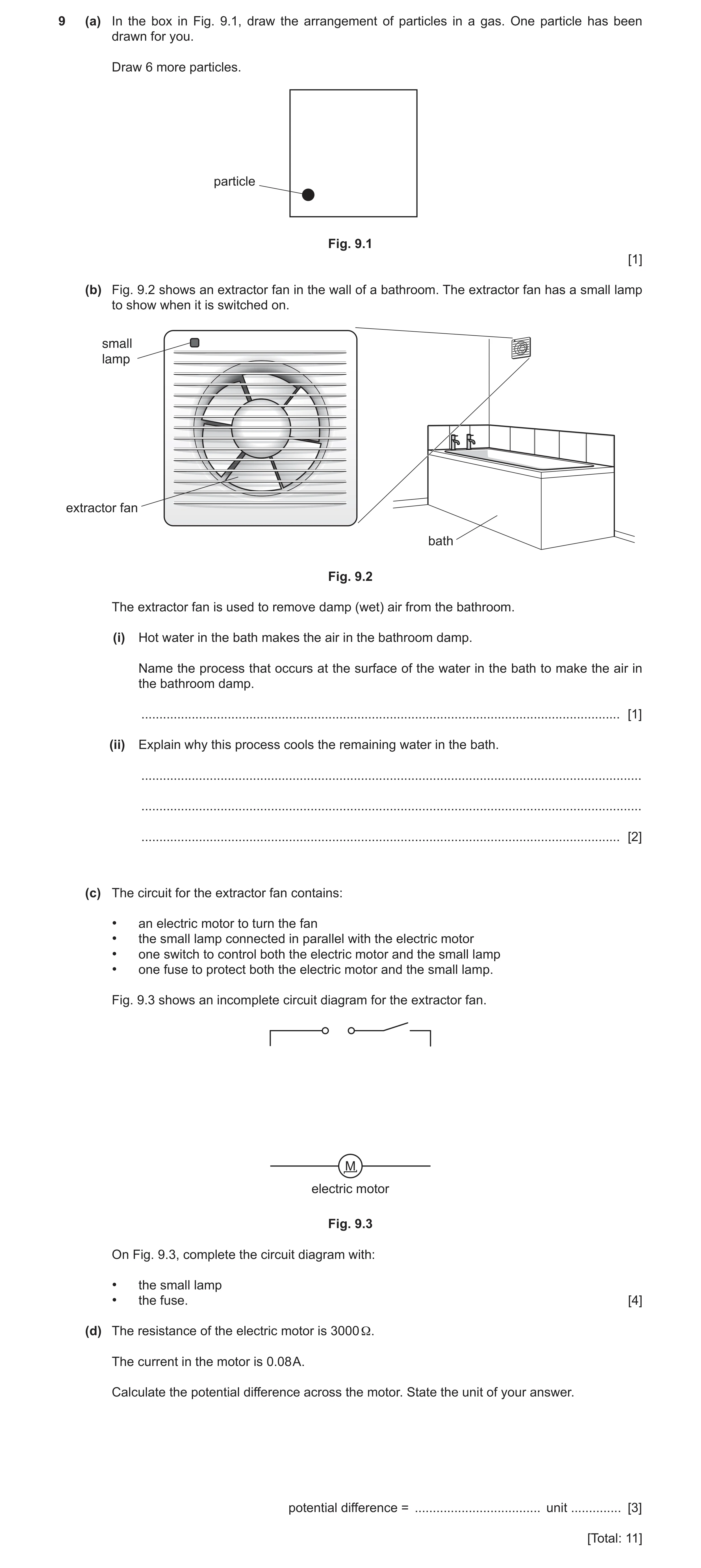
 13 / 29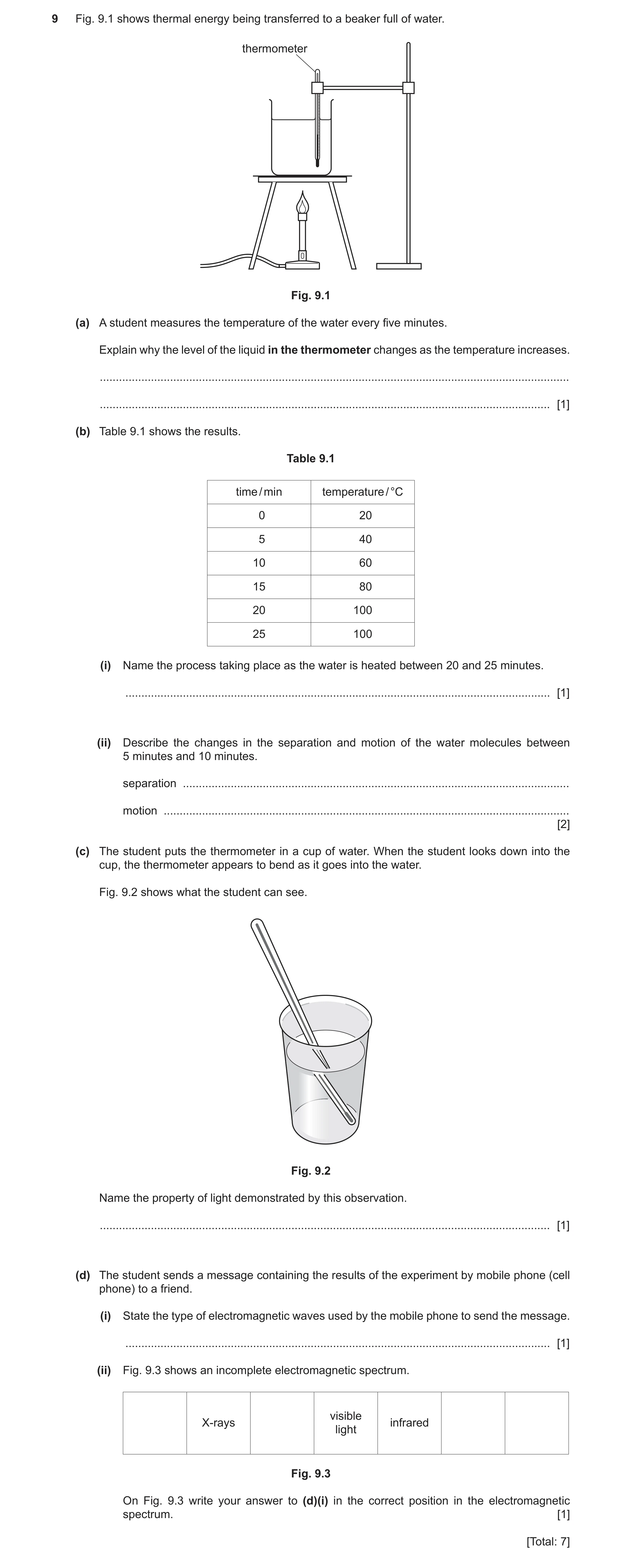
 19 / 29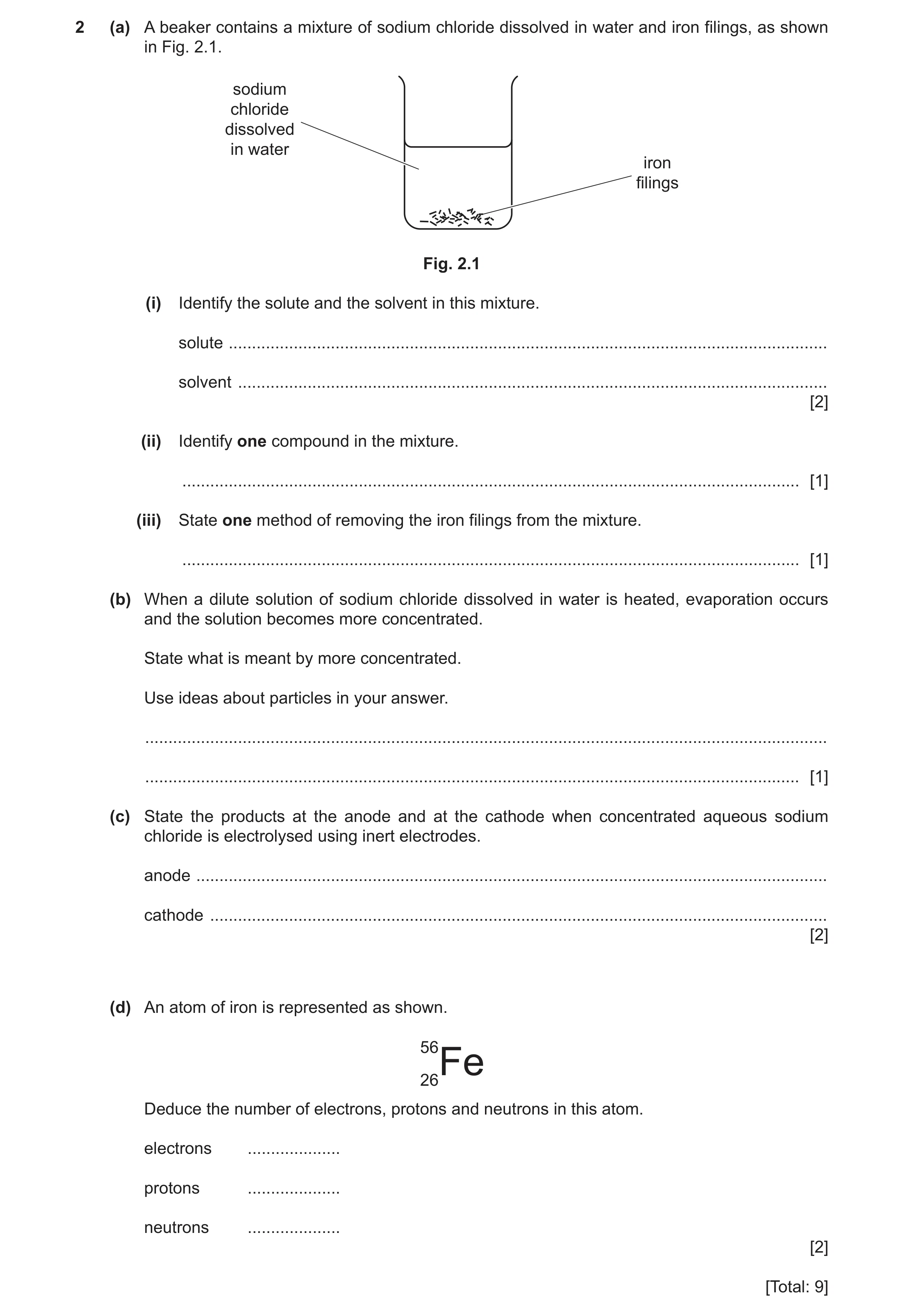
 29 / 29
 11
11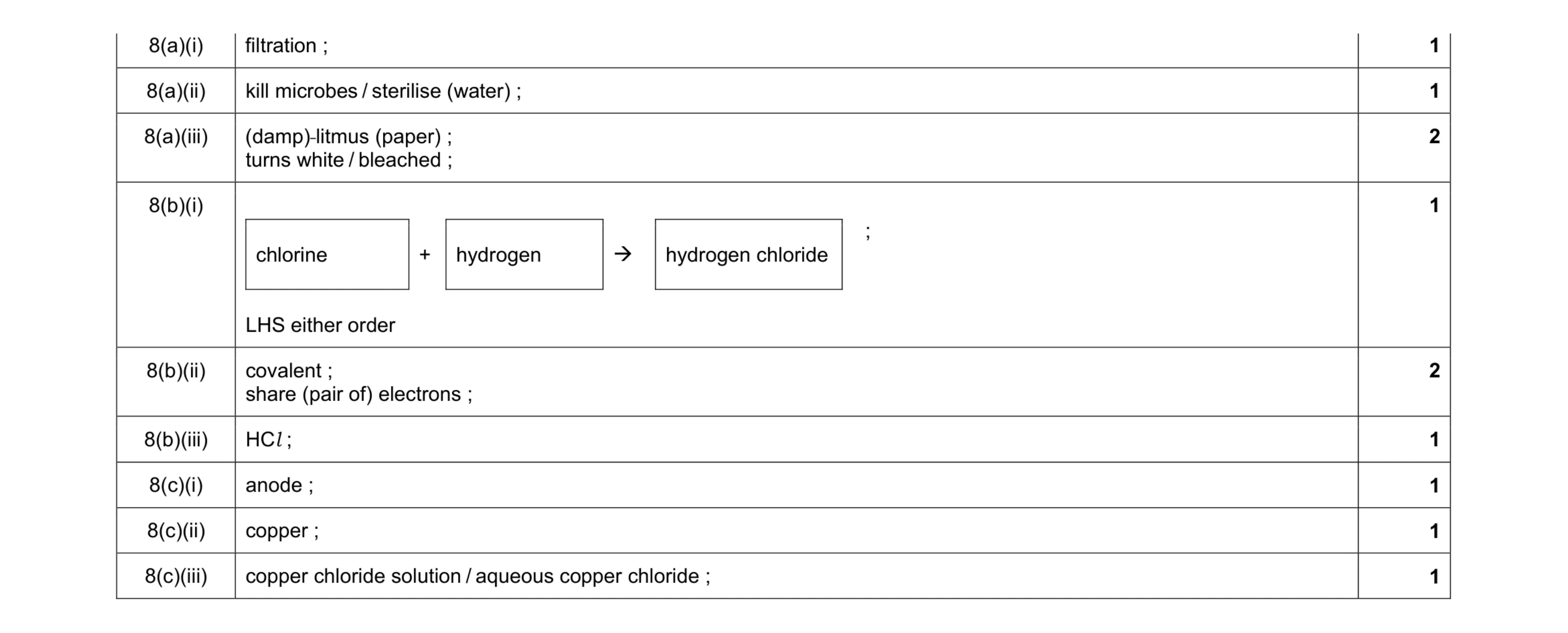 11
11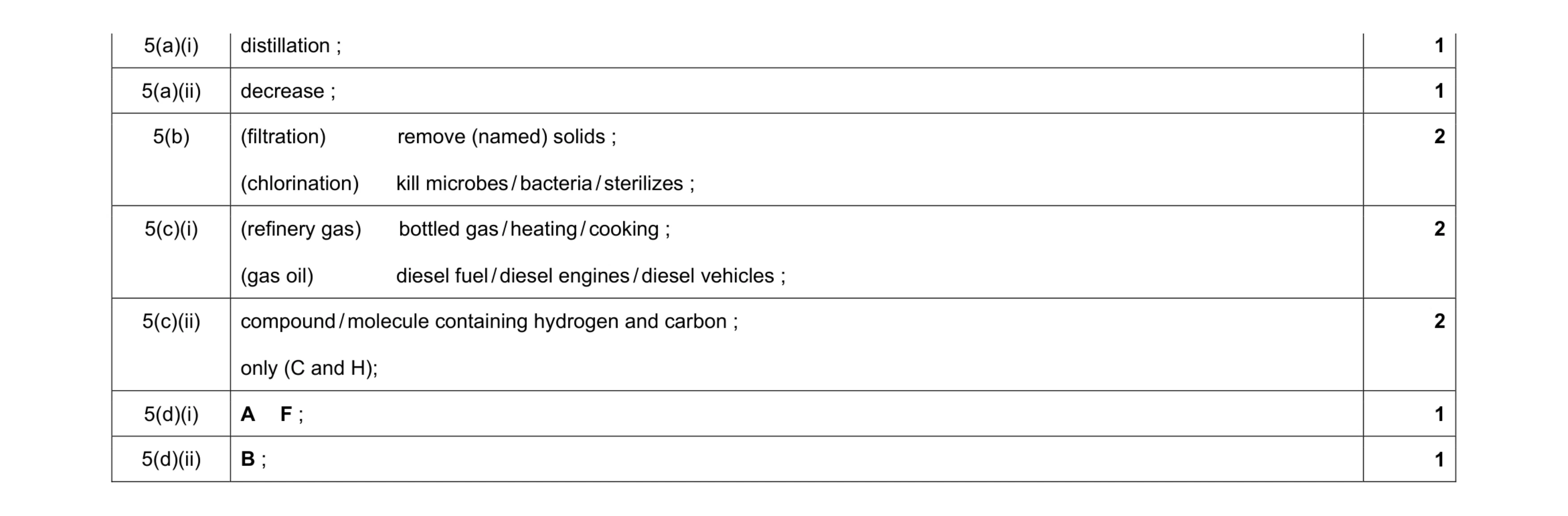 10
10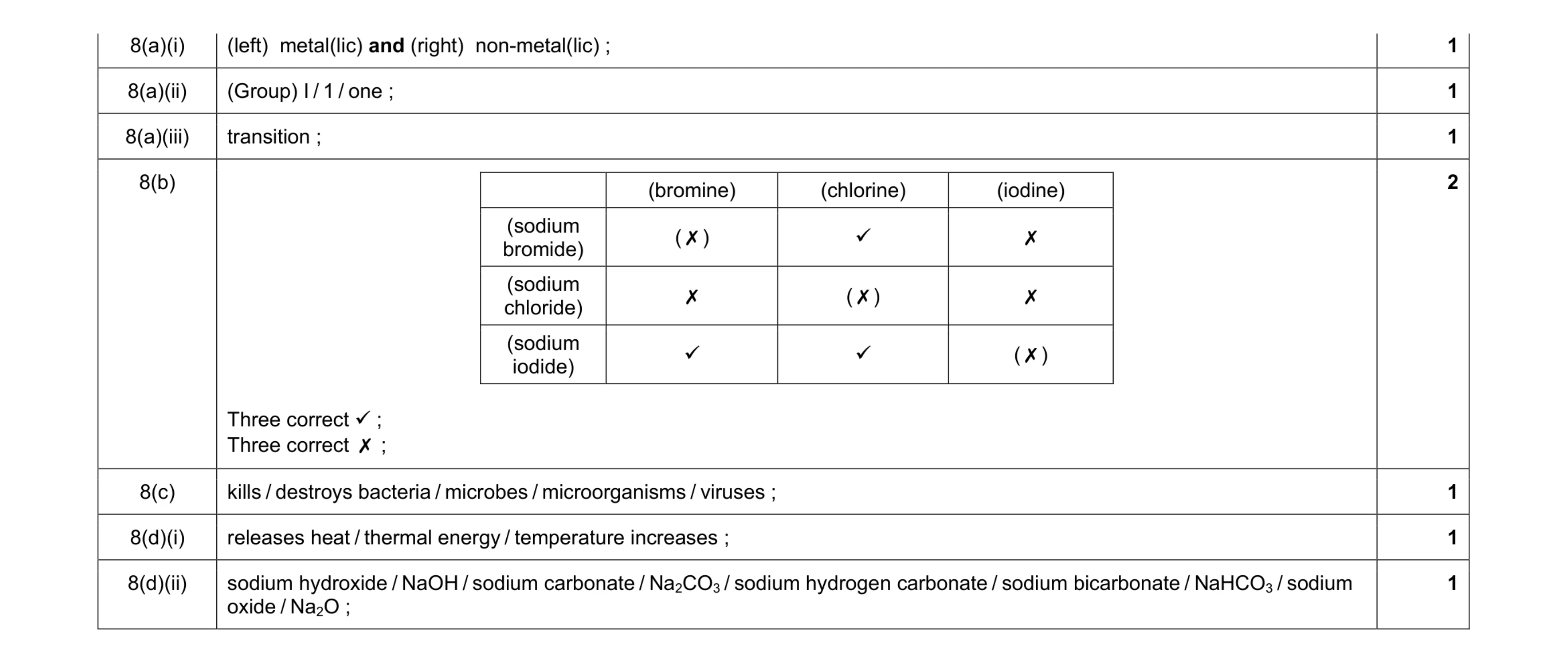 8
8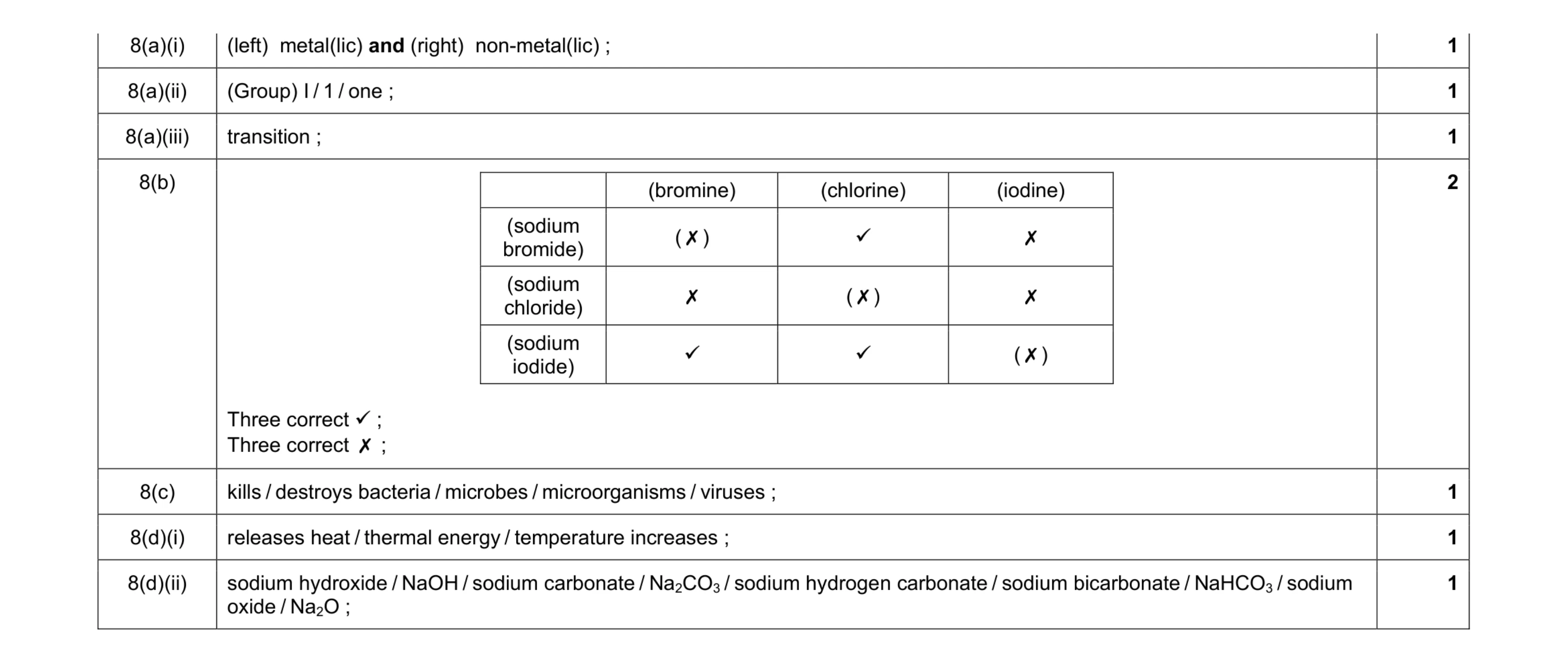 8
8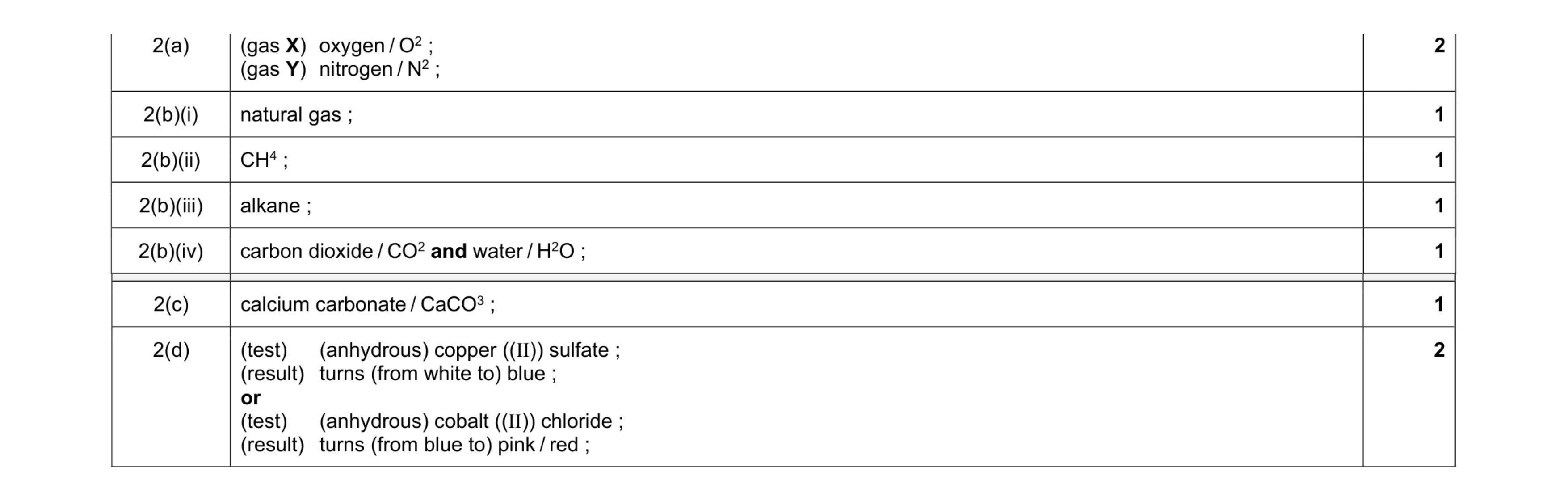 9
9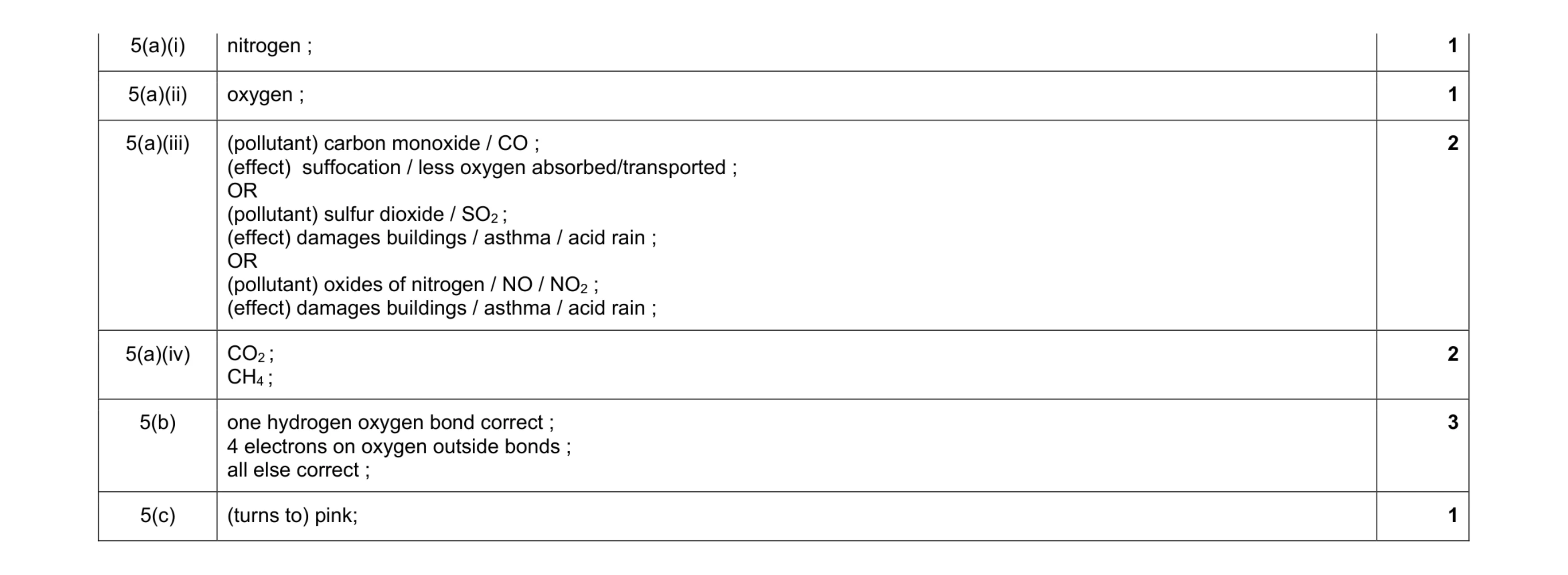 10
10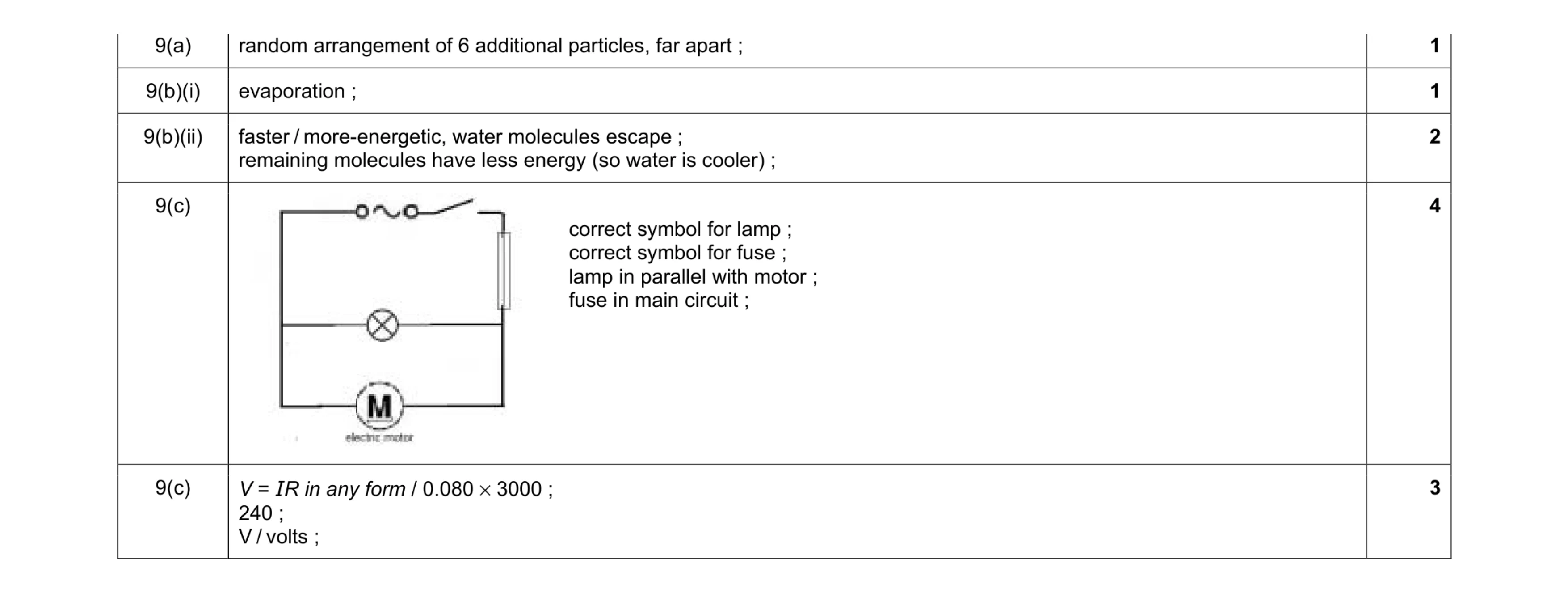 11
11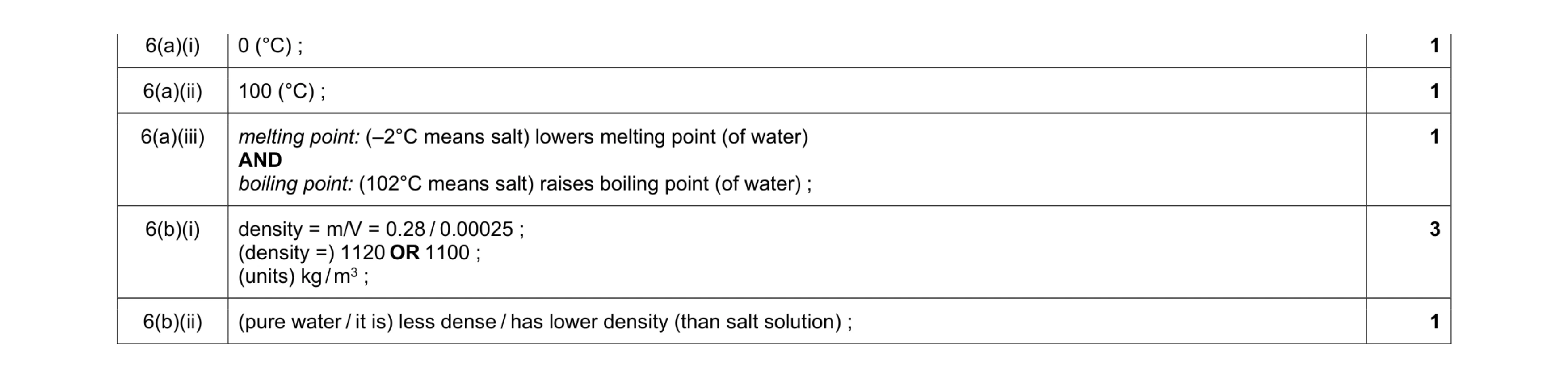 7
7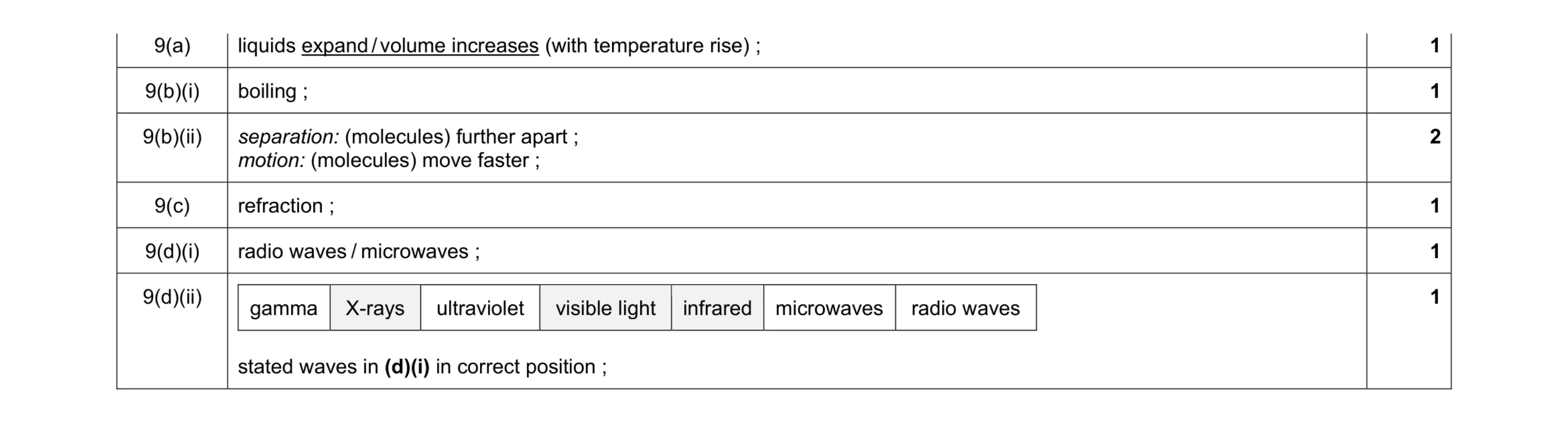 7
7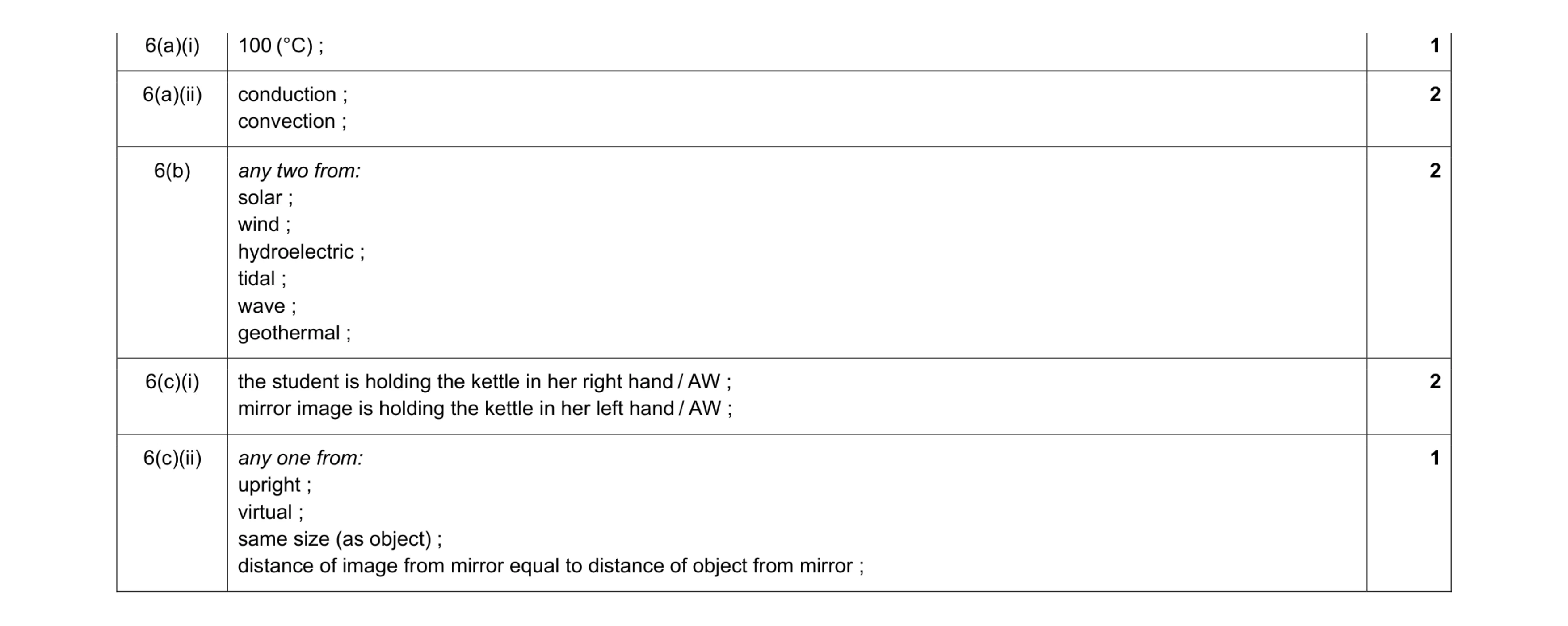 8
8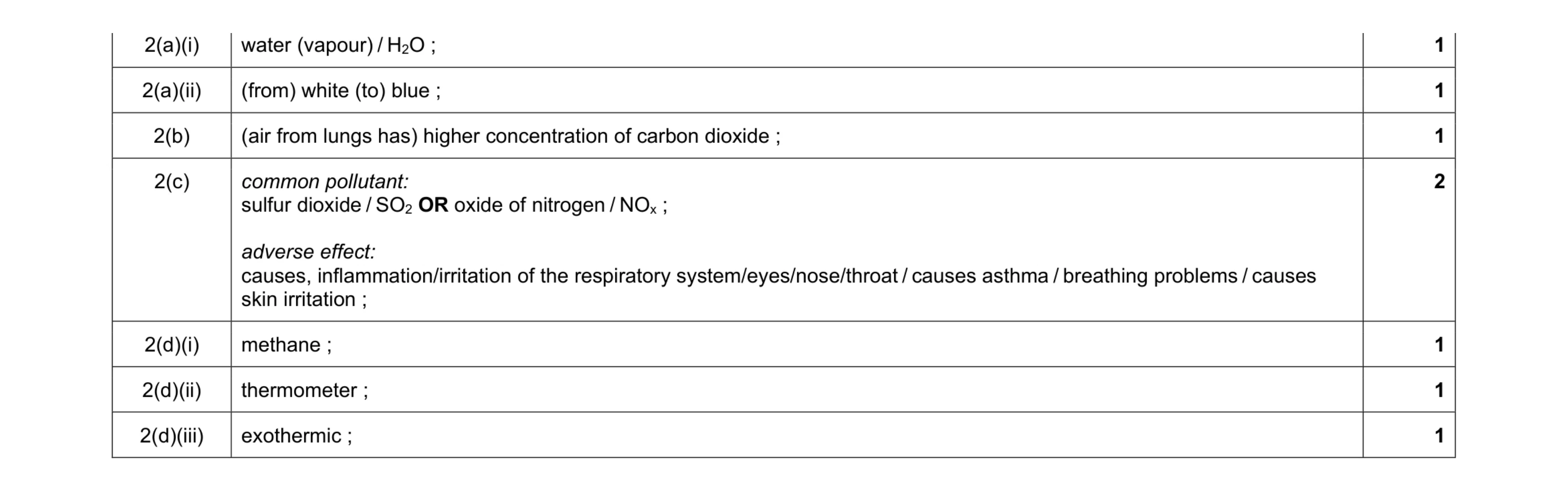 8
8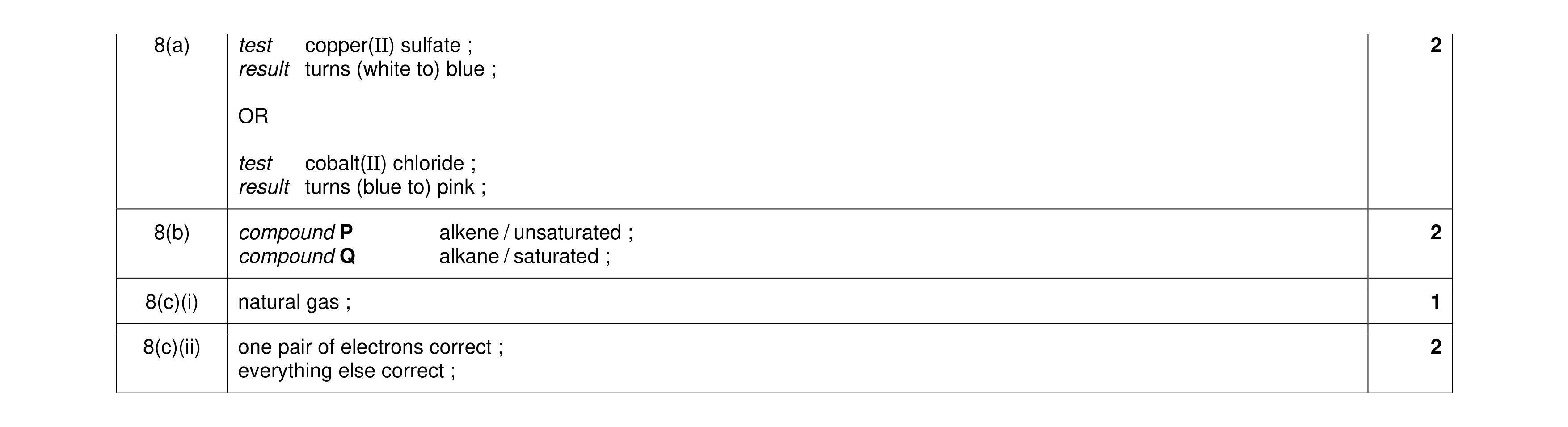 7
7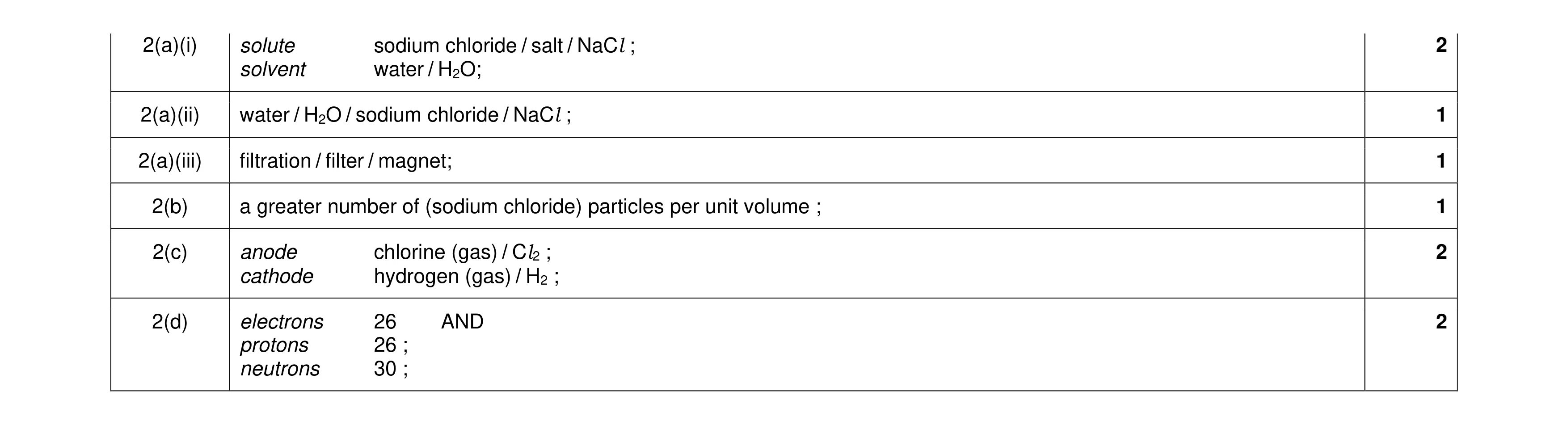 9
9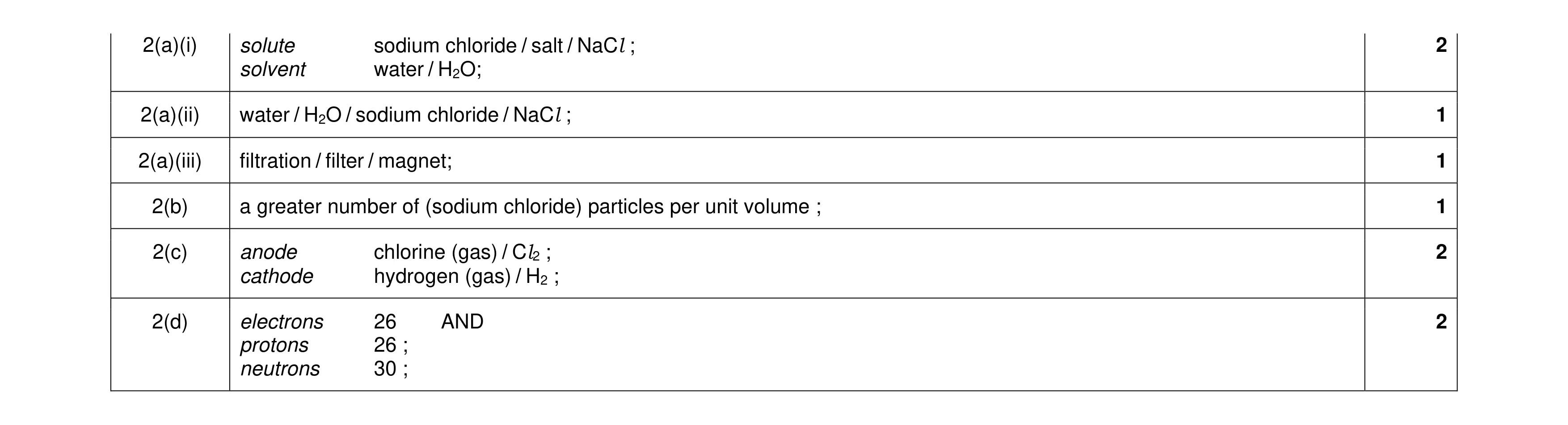 9
9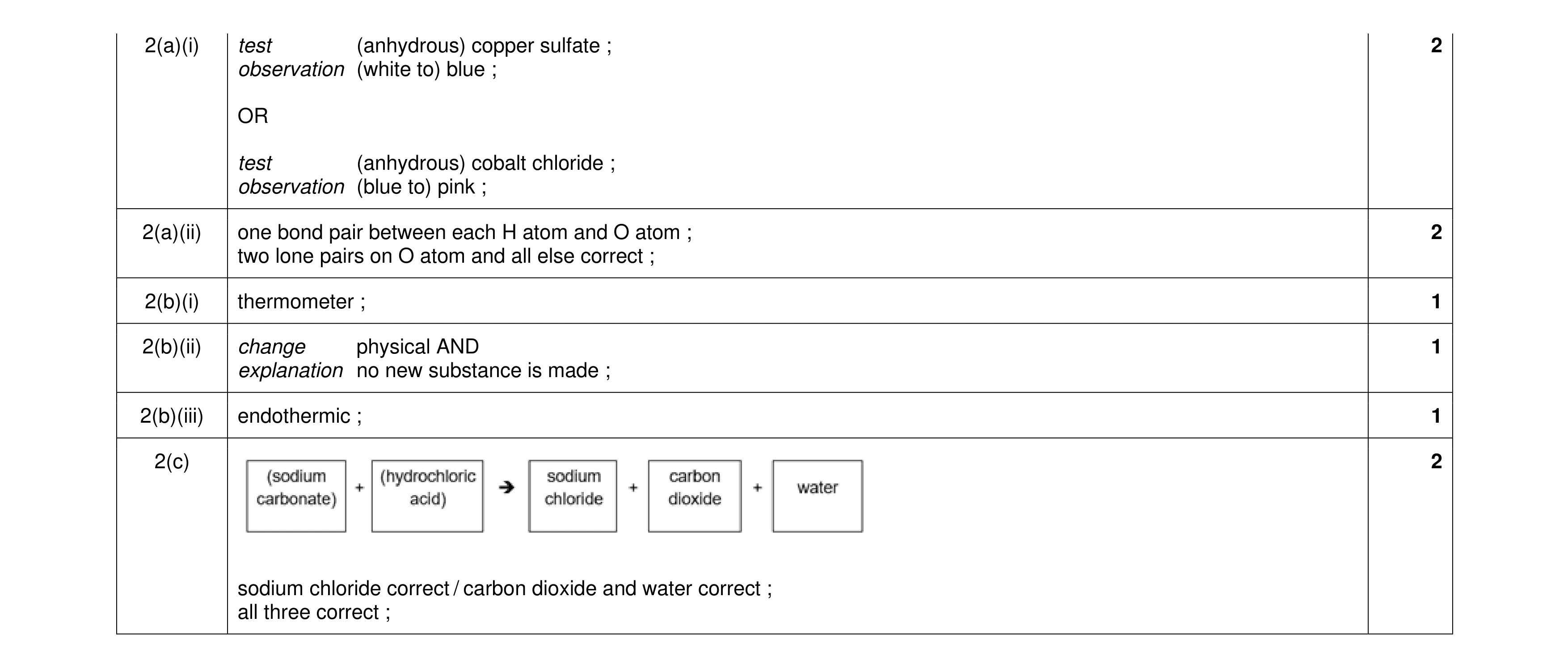 9
9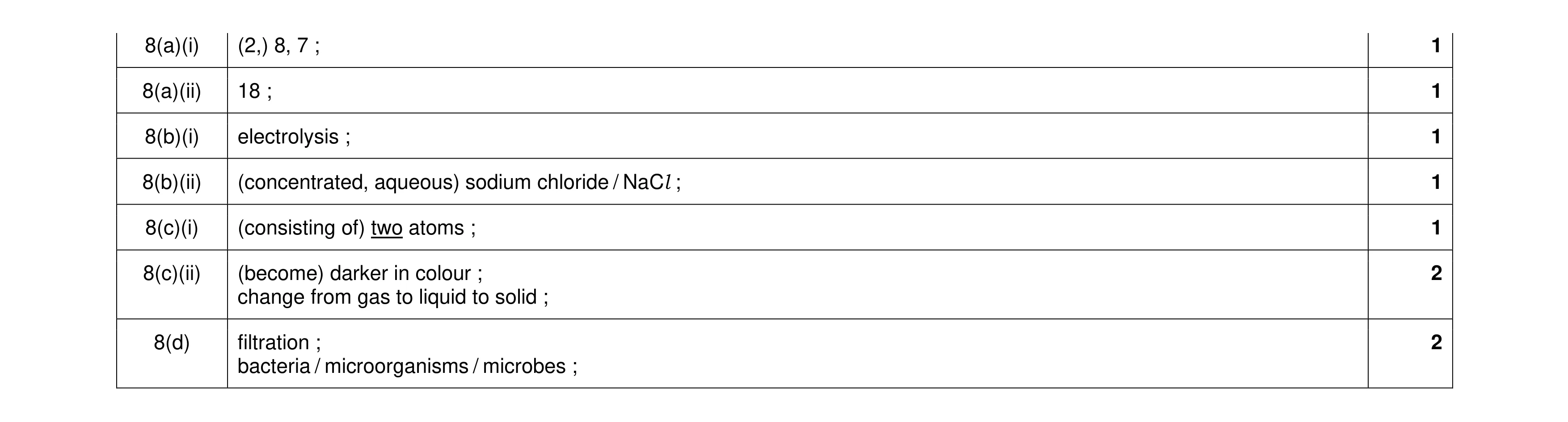 9
9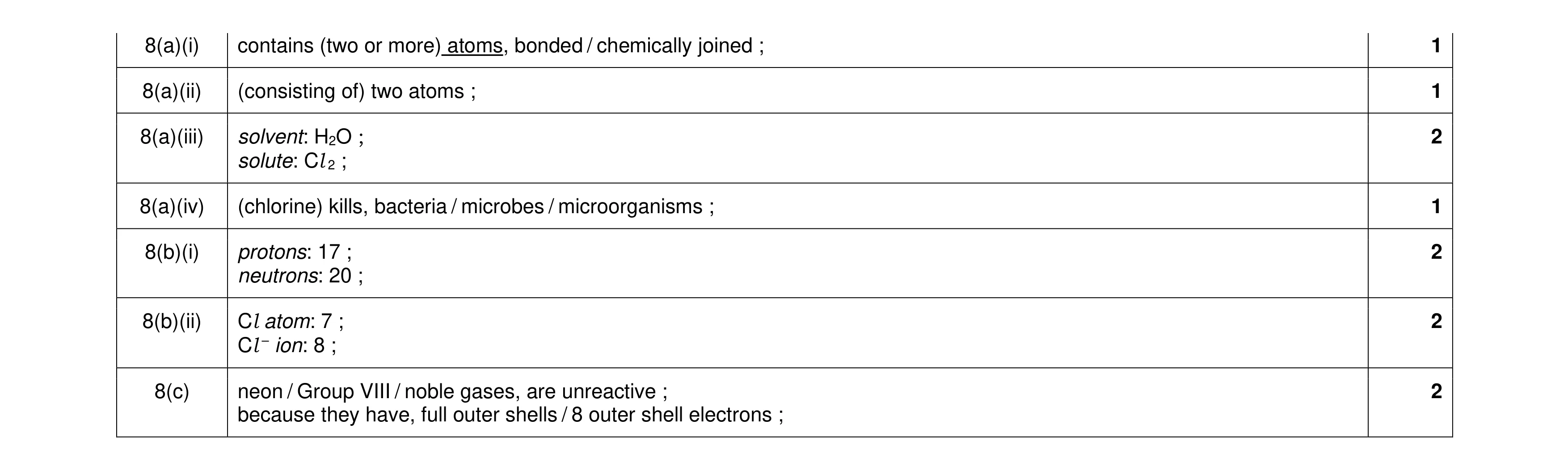 11
11 11
11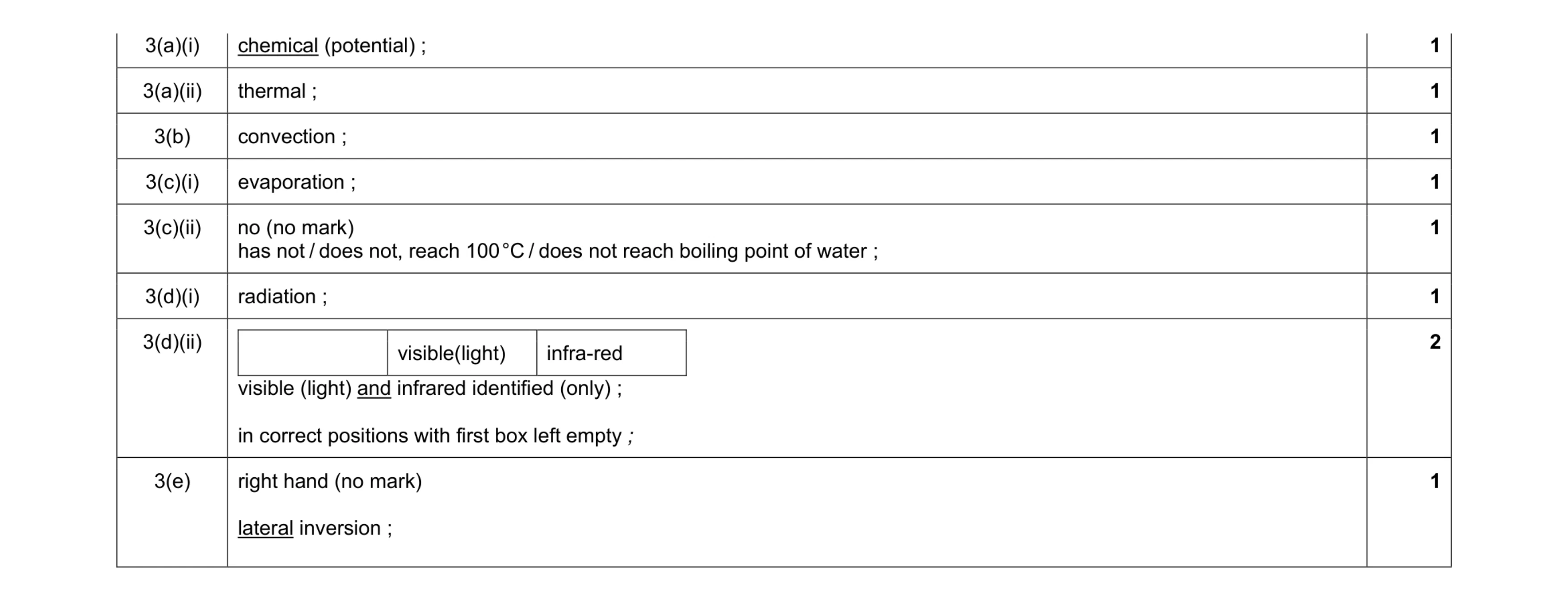 9
9 6
6