Questions as text
Q1 · Which chemical test shows the presence of water? 0653/22 Feb/March 2017
26 Which chemical test shows the presence of water? A Water has a boiling point of 100 °C. B Water has a freezing point of 0 °C. C Water turns anhydrous cobalt chloride from blue to pink. D Water turns anhydrous copper sulfate from blue to white.
1 marks
Answer: C
This question in 0653/22 Feb/March 2017
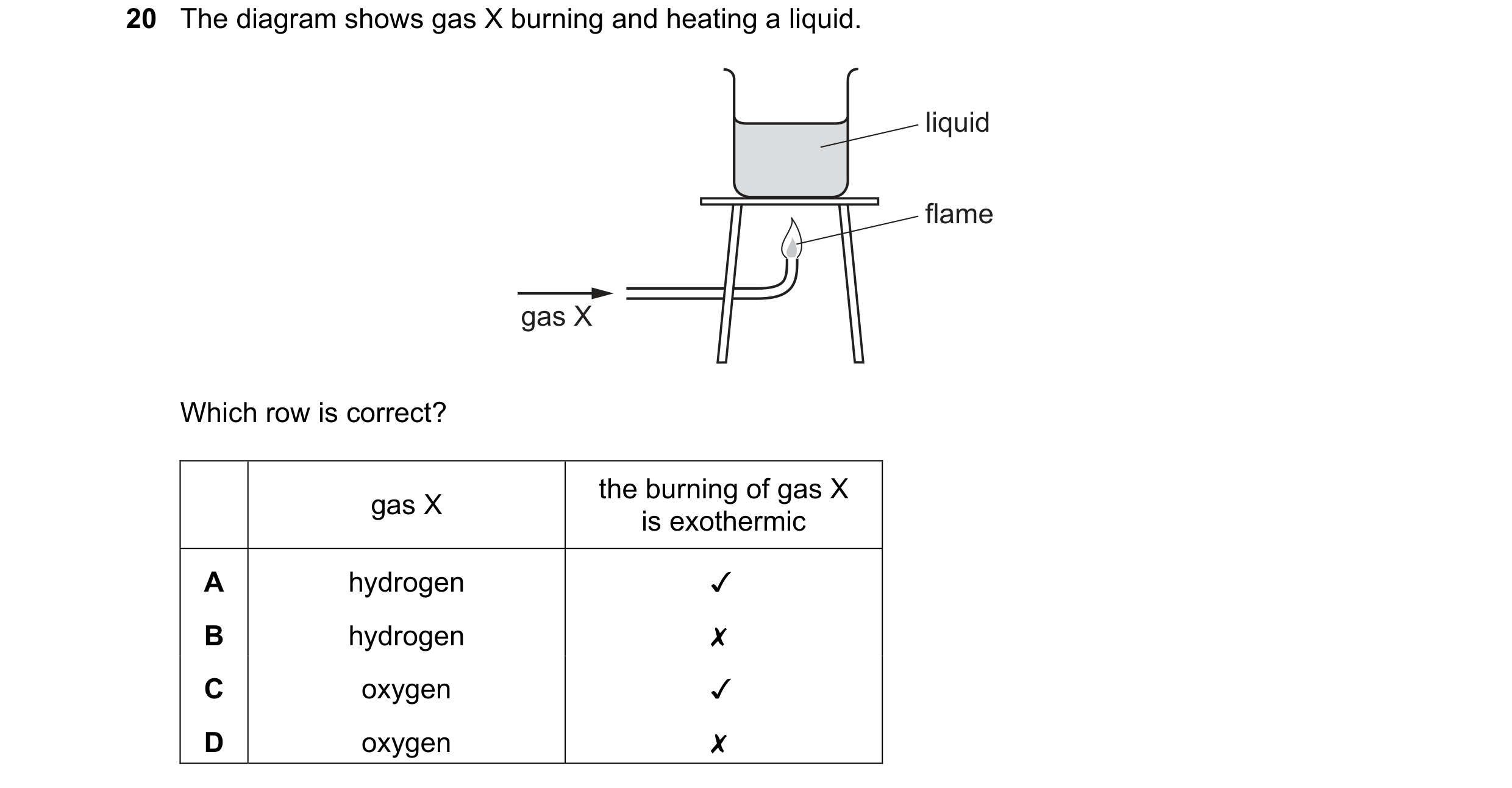
Q2 · The diagram shows gas X burning and heating a liquid 0653/23 Oct/Nov 2017
20 The diagram shows gas X burning and heating a liquid.
Which row is correct?
gas X
A hydrogen v
B hydrogen x
Cc oxygen v
D oxygen x
liquid
flame
1 marks
Answer: A
This question in 0653/23 Oct/Nov 2017
Q3 · Why is drinking water treated with chlorine? 0653/22 Feb/March 2018
25 Why is drinking water treated with chlorine? A to improve the taste B to kill bacteria C to remove colour D to remove insoluble impurities
1 marks
Answer: B
This question in 0653/22 Feb/March 2018
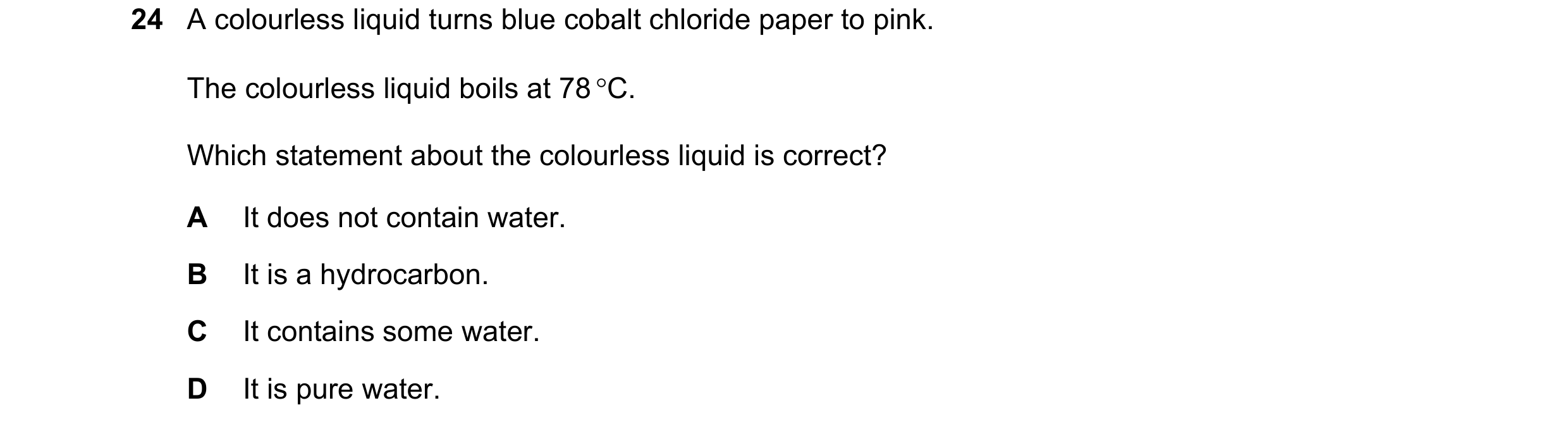
Q4 · A colourless liquid turns blue cobalt chloride paper to pink 0653/22 Feb/March 2019
24 A colourless liquid turns blue cobalt chloride paper to pink. The colourless liquid boils at 78 °C. Which statement about the colourless liquid is correct? A It does not contain water. B It is a hydrocarbon. C It contains some water. D It is pure water.
1 marks
Answer: C
This question in 0653/22 Feb/March 2019
Q5 · Copper sulfate crystals dissolve in water 0653/21 May/June 2019
15 Copper sulfate crystals dissolve in water. Which word describes the role of the water? A filtrate B solute C solution D solvent
1 marks
Answer: D
This question in 0653/21 May/June 2019
Q6 · Which statement about water is not correct? 0653/21 May/June 2019
24 Which statement about water is not correct? A A water molecule consists of three atoms covalently bonded together. B The water supply is treated with chlorine to kill the bacteria in it. C Water changes the colour of cobalt chloride paper from blue to pink. D Water has a low melting point because covalent bonds are weak.
1 marks
Answer: D
This question in 0653/21 May/June 2019
Q7 · Which statement about water is not correct? 0653/22 May/June 2019
24 Which statement about water is not correct? A A water molecule consists of three atoms covalently bonded together. B The water supply is treated with chlorine to kill the bacteria in it. C Water changes the colour of cobalt chloride paper from blue to pink. D Water has a low melting point because covalent bonds are weak.
1 marks
Answer: D
This question in 0653/22 May/June 2019
Q8 · Which statement about water is not correct? 0653/23 May/June 2019
24 Which statement about water is not correct? A A water molecule consists of three atoms covalently bonded together. B The water supply is treated with chlorine to kill the bacteria in it. C Water changes the colour of cobalt chloride paper from blue to pink. D Water has a low melting point because covalent bonds are weak.
1 marks
Answer: D
This question in 0653/23 May/June 2019
Q9 · Which statement about a chemical test for water is correct? 0653/21 May/June 2022
24 Which statement about a chemical test for water is correct? A Anhydrous cobalt(II) chloride turns blue. B Anhydrous cobalt(II) chloride turns white. C Anhydrous copper(II) sulfate turns blue. D Anhydrous copper(II) sulfate turns white.
1 marks
Answer: C
This question in 0653/21 May/June 2022
Q10 · Which colour change is seen when water is added to anhydrous cobalt(II) chloride? 0653/22 May/June 2022
24 Which colour change is seen when water is added to anhydrous cobalt(II) chloride? A blue to pink B blue to white C pink to blue D white to blue
1 marks
Answer: A
This question in 0653/22 May/June 2022
Q11 · Which statement about the treatment of the water supply is correct? 0653/23 May/June 2022
24 Which statement about the treatment of the water supply is correct? A After filtration and chlorination, the water contains no impurities. B Chlorine is added to remove dissolved impurities. C Water is filtered and chlorinated to remove solids and kill bacteria. D Water is filtered to remove dissolved impurities.
1 marks
Answer: C
This question in 0653/23 May/June 2022
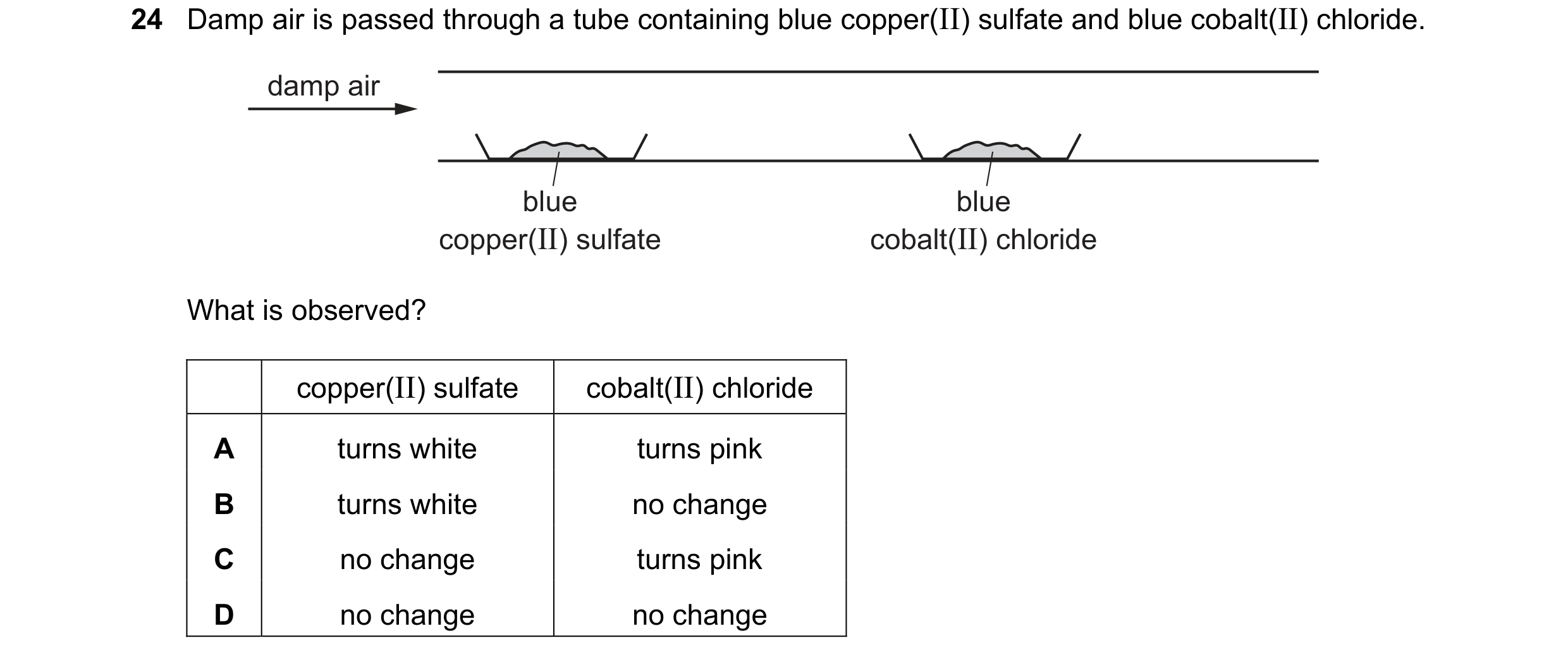
Q12 · Damp air is passed through a tube containing blue copper(II) sulfate and blue cobalt(II)… 0653/21 Oct/Nov 2022
24 Damp air is passed through a tube containing blue copper(II) sulfate and blue cobalt(II) chloride. damp air blue blue copper(II) sulfate cobalt(II) chloride What is observed? copper(II) sulfate cobalt(II) chloride A turns white turns pink B turns white no change C no change turns pink D no change no change
1 marks
Answer: C
This question in 0653/21 Oct/Nov 2022
Q13 · Which statement about tap water is correct? 0653/22 Oct/Nov 2023
15 Which statement about tap water is correct? A It is a compound. B It is a mixture of elements. C It is a pure substance. D It is a solution.
1 marks
Answer: D
This question in 0653/22 Oct/Nov 2023
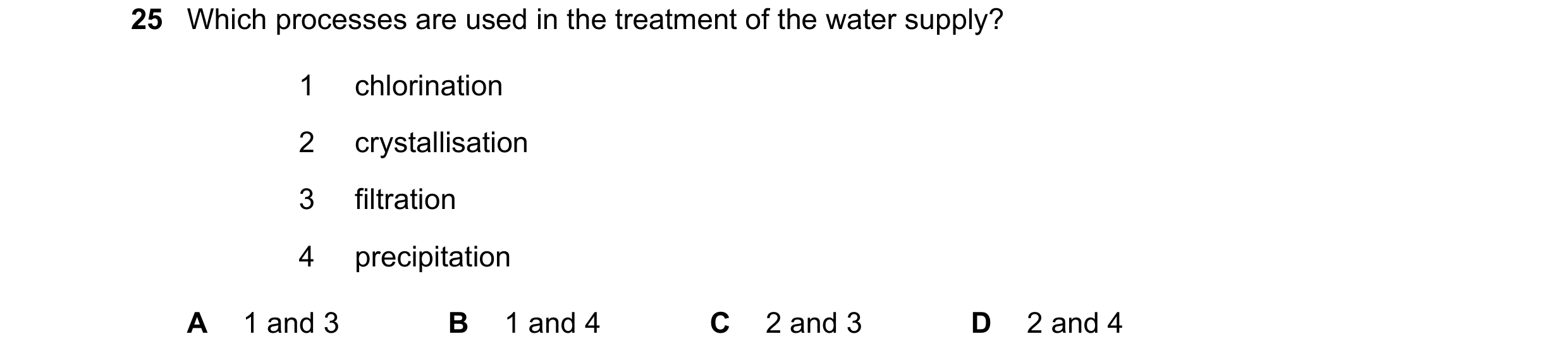
Q14 · Which processes are used in the treatment of the water supply? 0653/22 Feb/March 2024
25 Which processes are used in the treatment of the water supply? 1 chlorination 2 crystallisation 3 filtration 4 precipitation A 1 and 3 B 1 and 4 C 2 and 3 D 2 and 4
1 marks
Answer: A
This question in 0653/22 Feb/March 2024
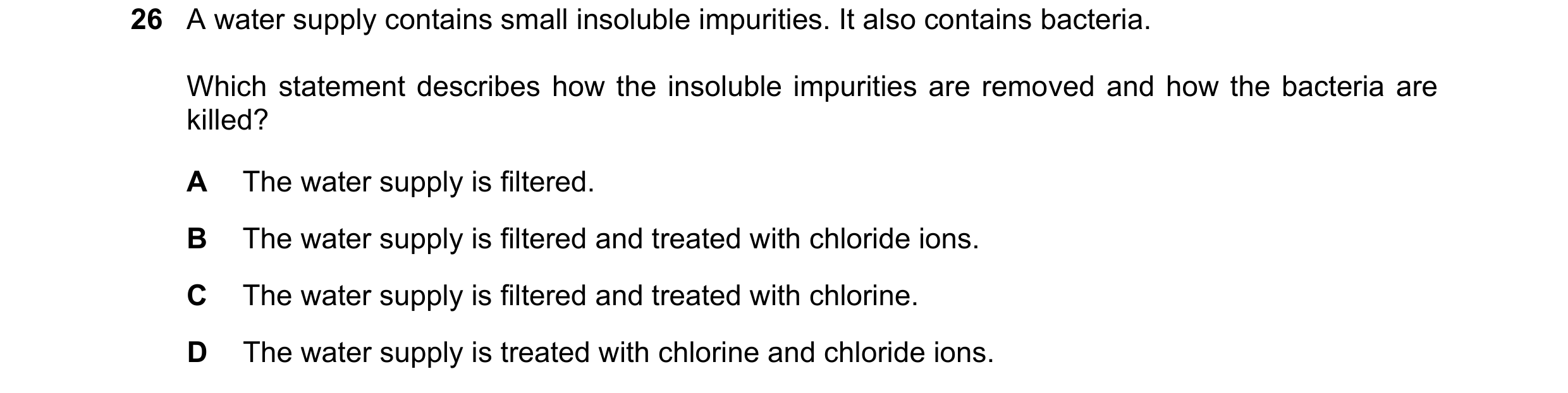
Q15 · A water supply contains small insoluble impurities 0653/21 May/June 2024
26 A water supply contains small insoluble impurities. It also contains bacteria. Which statement describes how the insoluble impurities are removed and how the bacteria are killed? A The water supply is filtered. B The water supply is filtered and treated with chloride ions. C The water supply is filtered and treated with chlorine. D The water supply is treated with chlorine and chloride ions.
1 marks
Answer: C
This question in 0653/21 May/June 2024
Q16 · Which statement describes a chemical test for water? 0653/22 Feb/March 2025
23 Which statement describes a chemical test for water? A Water boils at 100 °C. B Water turns blue cobalt(II) chloride pink. C Water turns blue copper(II) sulfate white. D Water turns red litmus paper blue.
1 marks
Answer: B
This question in 0653/22 Feb/March 2025
Q17 · What is the reason for the treatment of the domestic water supply with chlorine? 0653/21 Oct/Nov 2025
20 What is the reason for the treatment of the domestic water supply with chlorine? A to improve the taste B to kill microbes C to remove odours D to remove insoluble impurities
1 marks
Answer: B
This question in 0653/21 Oct/Nov 2025


 1 / 4
1 / 4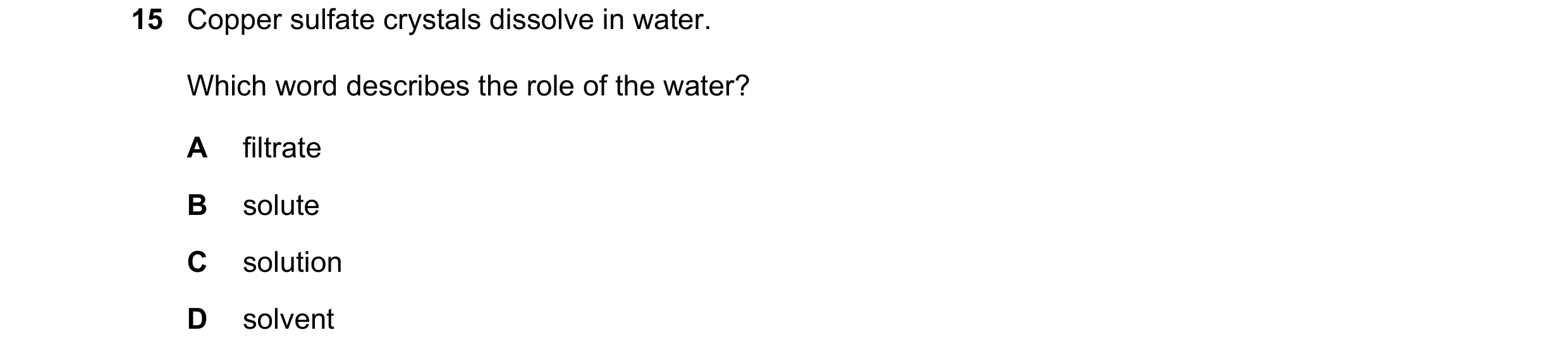




 2 / 4
2 / 4

 3 / 4
3 / 4
 4 / 4
4 / 4