Questions as text
Q1 · Which statement explains why cars are often repaired by small garages? 0455/11 May/June 2008
21 Which statement explains why cars are often repaired by small garages? A bulk buying of spare parts can take place B car-repair jobs are varied C entry to the car-repair industry is restricted D expensive machinery is required
1 marks
Answer: B
This question in 0455/11 May/June 2008
Q2 · What can a small firm do more easily than a large firm? 0455/11 Oct/Nov 2008
23 What can a small firm do more easily than a large firm? A adapt to changing fashions B have specialised managers C raise finance D undertake research and development
1 marks
Answer: A
This question in 0455/11 Oct/Nov 2008
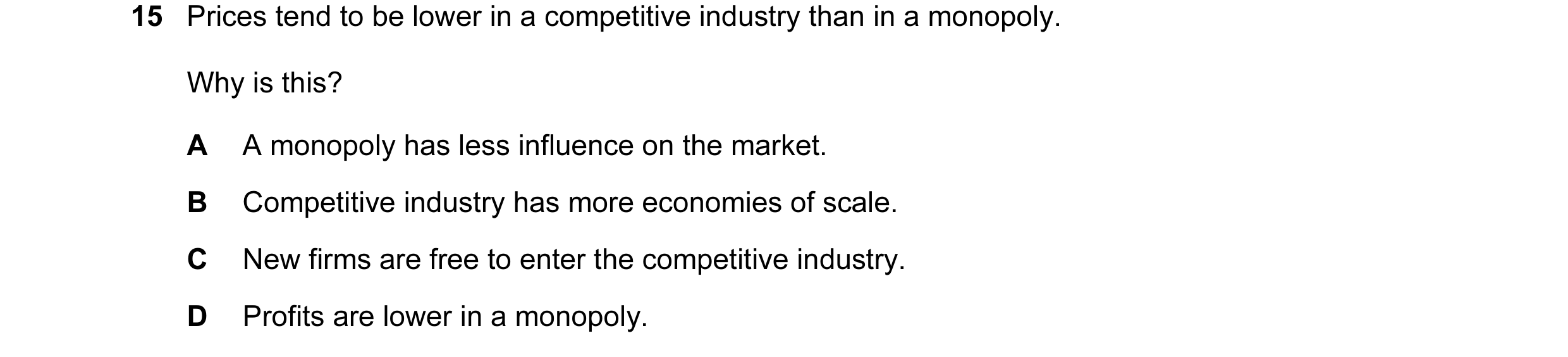
Q3 · Prices tend to be lower in a competitive industry than in a monopoly 0455/11 Oct/Nov 2009
15 Prices tend to be lower in a competitive industry than in a monopoly. Why is this? A A monopoly has less influence on the market. B Competitive industry has more economies of scale. C New firms are free to enter the competitive industry. D Profits are lower in a monopoly.
1 marks
Answer: C
This question in 0455/11 Oct/Nov 2009
Q4 · What is correct about a monopoly? 0455/11 May/June 2010
15 What is correct about a monopoly? A It may benefit from economies of scale. B It must be privately not state owned. C Its costs are always higher than those of a firm in perfect competition. D It sells only one product.
1 marks
Answer: A
This question in 0455/11 May/June 2010
Q5 · What is correct about a monopoly? 0455/12 May/June 2010
18 What is correct about a monopoly? A It may benefit from economies of scale. B It must be privately not state owned. C Its costs are always higher than those of a firm in perfect competition. D It sells only one product.
1 marks
Answer: A
This question in 0455/12 May/June 2010
Q6 · In 2008, XL, the UK’s third largest tour operator went out of business 0455/11 Oct/Nov 2010
16 In 2008, XL, the UK’s third largest tour operator went out of business. What would have been the effect of this on the level of competition in the industry, the external economies of scale experienced by the remaining firms and the level of business confidence in the UK? external economies UK business level of competition of scale confidence A increase increase reduce B increase reduce increase C reduce increase increase D reduce reduce reduce
1 marks
Answer: D
This question in 0455/11 Oct/Nov 2010
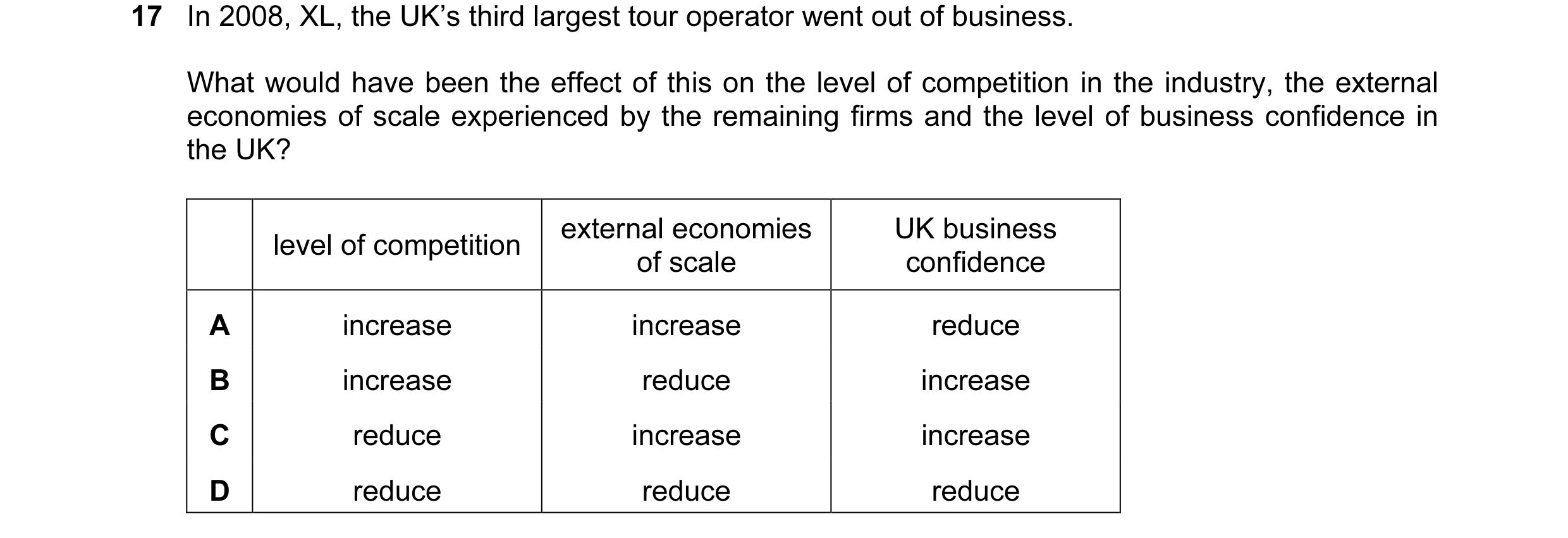
Q7 · In 2008, XL, the UK’s third largest tour operator went out of business 0455/12 Oct/Nov 2010
17 In 2008, XL, the UK’s third largest tour operator went out of business. What would have been the effect of this on the level of competition in the industry, the external economies of scale experienced by the remaining firms and the level of business confidence in the UK? external economies UK business level of competition of scale confidence A increase increase reduce B increase reduce increase C reduce increase increase D reduce reduce reduce
1 marks
Answer: D
This question in 0455/12 Oct/Nov 2010
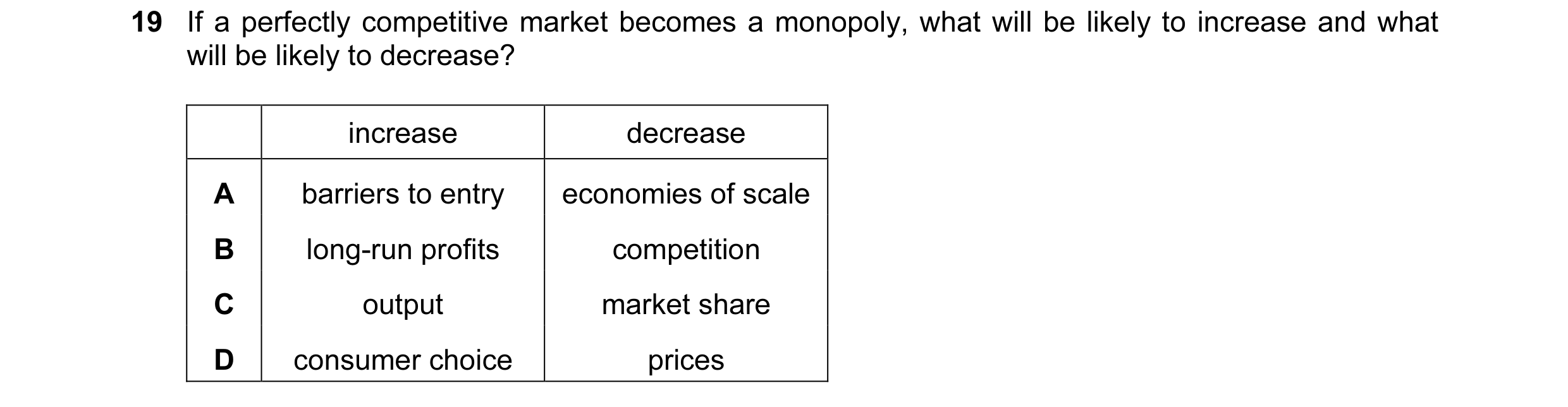
Q8 · If a perfectly competitive market becomes a monopoly, what will be likely to increase and… 0455/11 May/June 2012
19 If a perfectly competitive market becomes a monopoly, what will be likely to increase and what will be likely to decrease? increase decrease A barriers to entry economies of scale B long-run profits competition C output market share D consumer choice prices
1 marks
Answer: B
This question in 0455/11 May/June 2012
Q9 · A monopoly takes over an industry from competitive firms 0455/12 May/June 2012
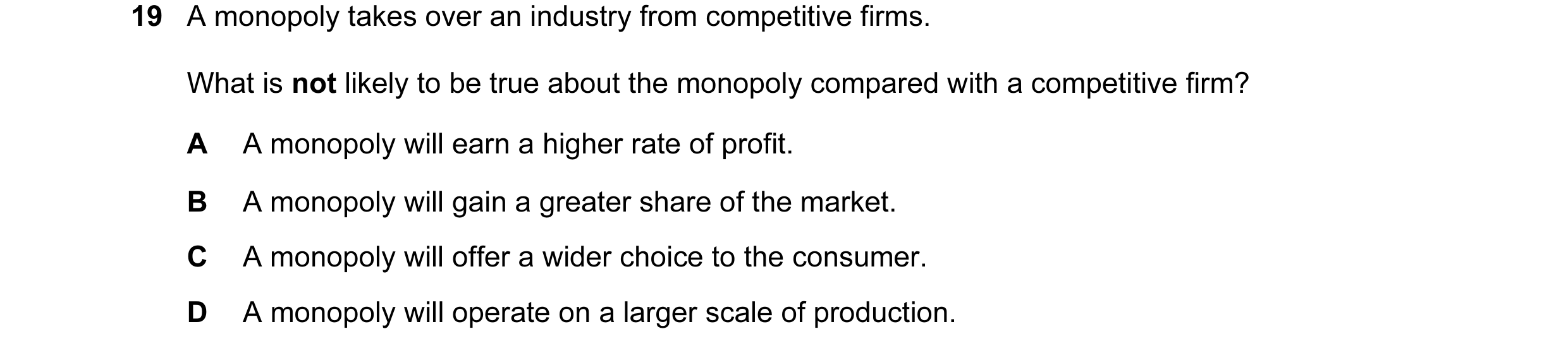
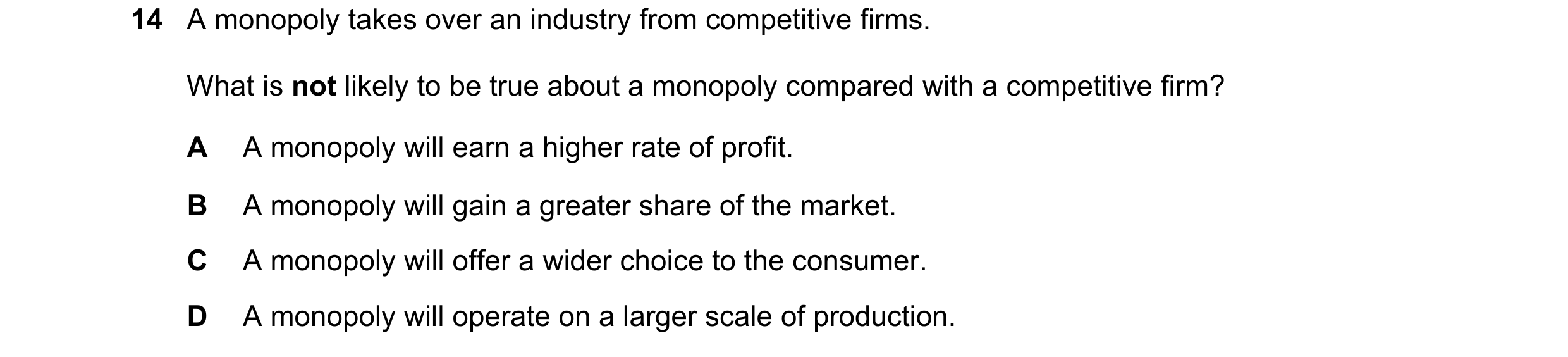
19 A monopoly takes over an industry from competitive firms. What is not likely to be true about the monopoly compared with a competitive firm? A A monopoly will earn a higher rate of profit. B A monopoly will gain a greater share of the market. C A monopoly will offer a wider choice to the consumer. D A monopoly will operate on a larger scale of production.
1 marks
Answer: C
This question in 0455/12 May/June 2012
Q10 · What is an example of market failure? 0455/13 May/June 2012
8 What is an example of market failure? A a monopoly making abnormal profit B prices charged to cover social cost C the closure of small, independent shops in a rural area D the inability of a car producer to achieve economies of scale
1 marks
Answer: A
This question in 0455/13 May/June 2012
Q11 · A monopoly takes over an industry from competitive firms 0455/13 May/June 2012
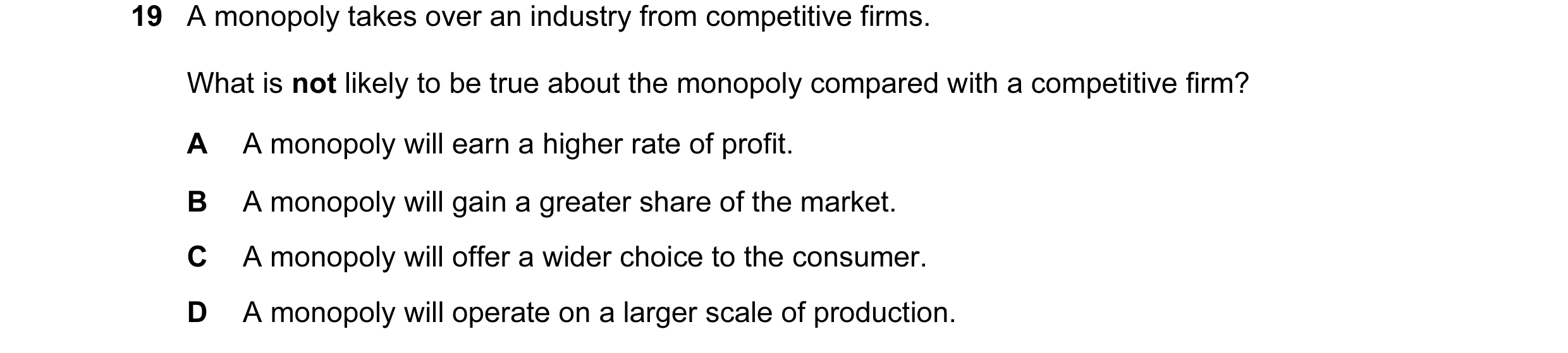
19 A monopoly takes over an industry from competitive firms. What is not likely to be true about the monopoly compared with a competitive firm? A A monopoly will earn a higher rate of profit. B A monopoly will gain a greater share of the market. C A monopoly will offer a wider choice to the consumer. D A monopoly will operate on a larger scale of production.
1 marks
Answer: C
This question in 0455/13 May/June 2012
Q12 · What is a possible advantage to the consumer of a monopoly supplier in a market? 0455/11 Oct/Nov 2012
10 What is a possible advantage to the consumer of a monopoly supplier in a market? A It achieves average costs which are lower than if there were many suppliers. B It achieves profits which are higher than if there were many suppliers. C It conducts advertising campaigns to discourage competition. D It decides which retail outlets may sell and distribute its goods.
1 marks
Answer: A
This question in 0455/11 Oct/Nov 2012
Q13 · What is a possible advantage to the consumer of a monopoly supplier in a market? 0455/12 Oct/Nov 2012
19 What is a possible advantage to the consumer of a monopoly supplier in a market? A It achieves average costs which are lower than if there were many suppliers. B It achieves profits which are higher than if there were many suppliers. C It conducts advertising campaigns to discourage competition. D It decides which retail outlets may sell and distribute its goods.
1 marks
Answer: A
This question in 0455/12 Oct/Nov 2012
Q14 · Machu Picchu is Peru’s most popular tourist destination 0455/13 Oct/Nov 2012
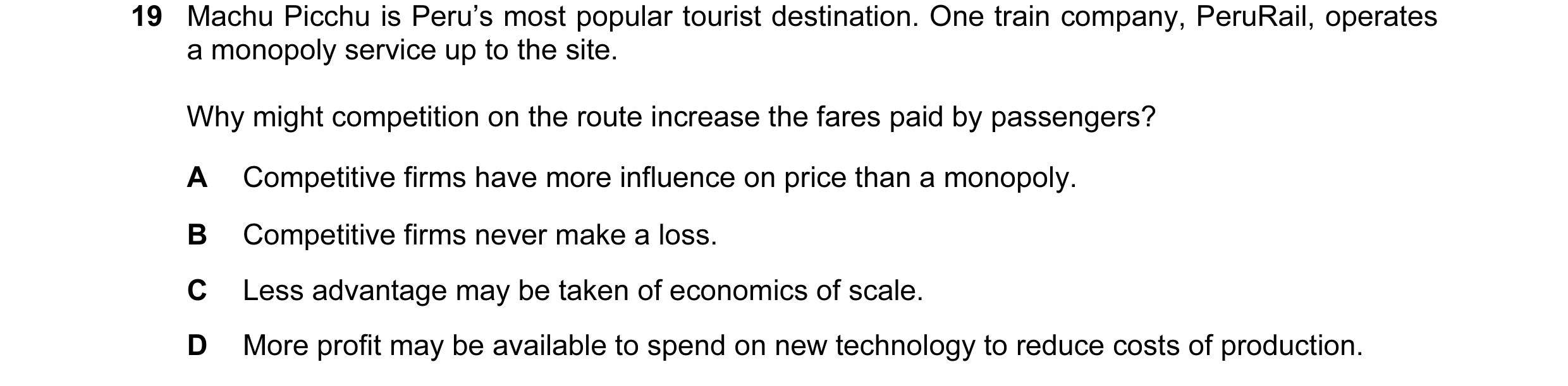
19 Machu Picchu is Peru’s most popular tourist destination. One train company, PeruRail, operates a monopoly service up to the site. Why might competition on the route increase the fares paid by passengers? A Competitive firms have more influence on price than a monopoly. B Competitive firms never make a loss. C Less advantage may be taken of economics of scale. D More profit may be available to spend on new technology to reduce costs of production.
1 marks
Answer: C
This question in 0455/13 Oct/Nov 2012
Q15 · Which characteristic relates to perfect competition and which to monopoly? 0455/11 May/June 2013
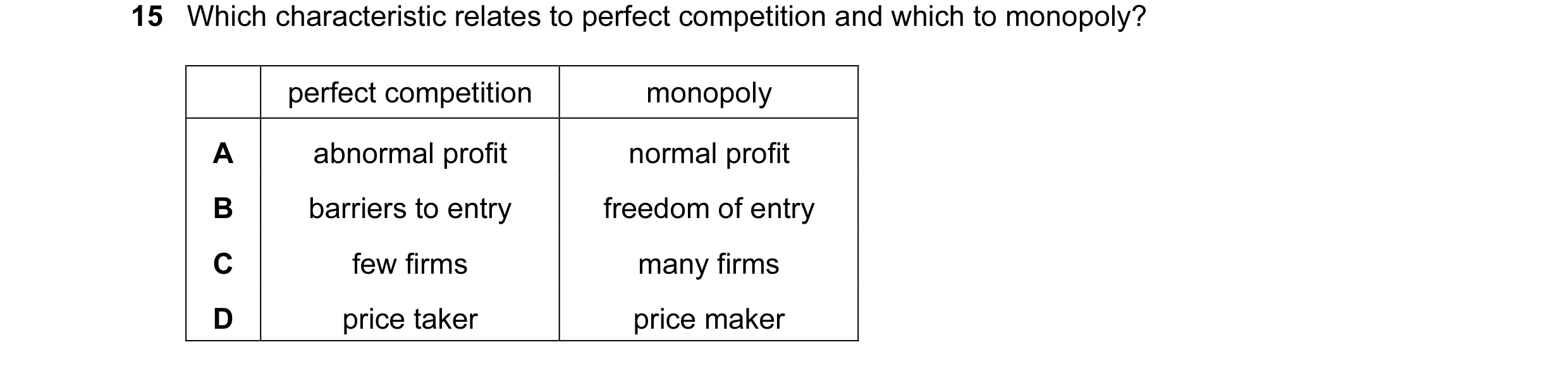
15 Which characteristic relates to perfect competition and which to monopoly? perfect competition monopoly A abnormal profit normal profit B barriers to entry freedom of entry C few firms many firms D price taker price maker
1 marks
Answer: D
This question in 0455/11 May/June 2013
Q16 · In a city, both large and small shops sell clothes 0455/12 May/June 2013
18 In a city, both large and small shops sell clothes. Why do large and small shops exist together? A Large clothing shops create barriers to entry. B Small shops always sell clothes at lower prices. C The market for clothing operates under perfect competition. D There is demand from consumers for a range of fashions.
1 marks
Answer: D
This question in 0455/12 May/June 2013
Q17 · Which characteristic relates to perfect competition and which to monopoly? 0455/13 May/June 2013
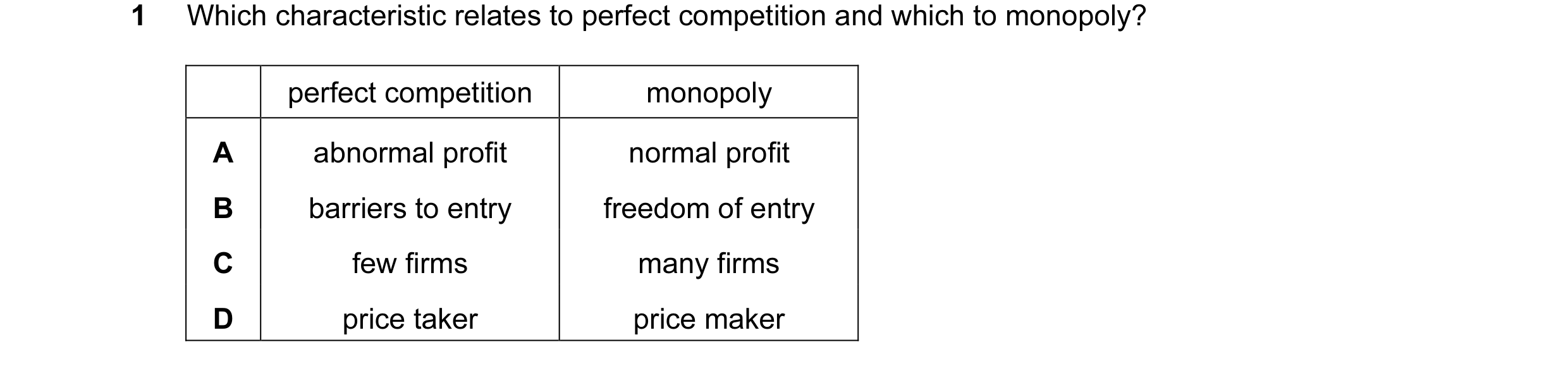
1 Which characteristic relates to perfect competition and which to monopoly? perfect competition monopoly A abnormal profit normal profit B barriers to entry freedom of entry C few firms many firms D price taker price maker
1 marks
Answer: D
This question in 0455/13 May/June 2013
Q18 · What is a difference between a monopoly and a perfectly competitive firm? 0455/11 Oct/Nov 2013
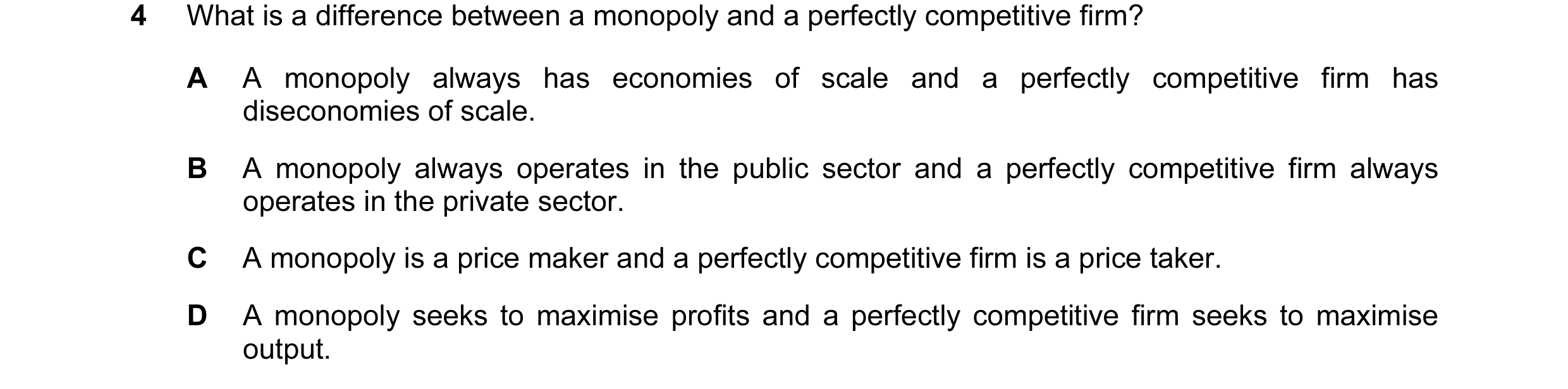
4 What is a difference between a monopoly and a perfectly competitive firm? A A monopoly always has economies of scale and a perfectly competitive firm has diseconomies of scale. B A monopoly always operates in the public sector and a perfectly competitive firm always operates in the private sector. C A monopoly is a price maker and a perfectly competitive firm is a price taker. D A monopoly seeks to maximise profits and a perfectly competitive firm seeks to maximise output.
1 marks
Answer: C
This question in 0455/11 Oct/Nov 2013
Q19 · Why might a government encourage a monopoly? 0455/11 Oct/Nov 2013
7 Why might a government encourage a monopoly? A It can have high average costs. B It can compete against foreign firms. C It can prevent innovation. D It can make excessive profits.
1 marks
Answer: B
This question in 0455/11 Oct/Nov 2013
Q20 · To achieve horizontal integration a record company producing compact discs (CDs) could… 0455/12 Oct/Nov 2013
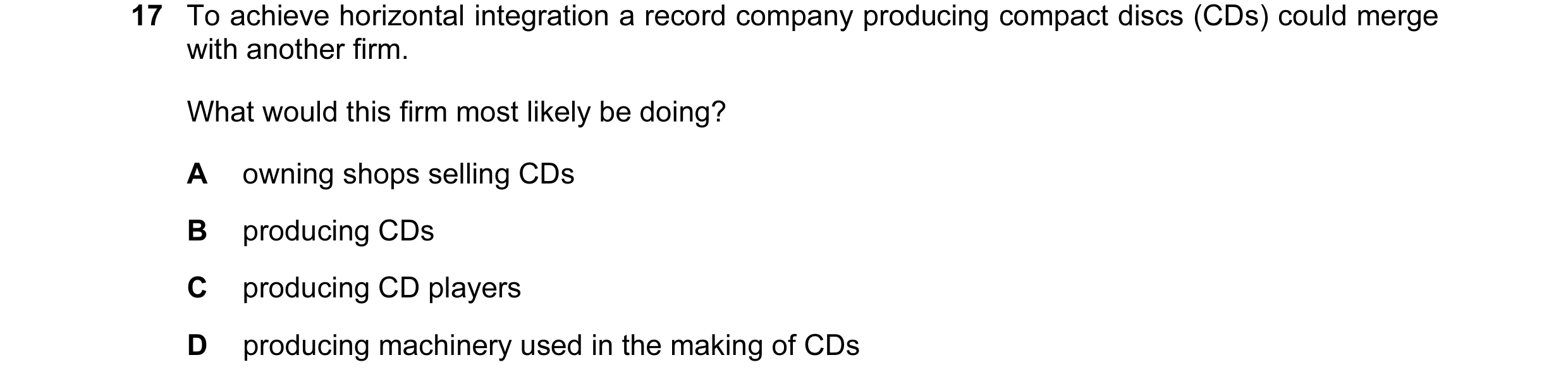
17 To achieve horizontal integration a record company producing compact discs (CDs) could merge with another firm. What would this firm most likely be doing? A owning shops selling CDs B producing CDs C producing CD players D producing machinery used in the making of CDs
1 marks
Answer: B
This question in 0455/12 Oct/Nov 2013
Q21 · What is a difference between a monopoly and a perfectly competitive firm? 0455/12 Oct/Nov 2013
18 What is a difference between a monopoly and a perfectly competitive firm? A A monopoly always has economies of scale and a perfectly competitive firm has diseconomies of scale. B A monopoly always operates in the public sector and a perfectly competitive firm always operates in the private sector. C A monopoly is a price maker and a perfectly competitive firm is a price taker. D A monopoly seeks to maximise profits and a perfectly competitive firm seeks to maximise output.
1 marks
Answer: C
This question in 0455/12 Oct/Nov 2013
Q22 · Why might a government encourage a monopoly? 0455/12 Oct/Nov 2013
21 Why might a government encourage a monopoly? A It can have high average costs. B It can compete against foreign firms. C It can prevent innovation. D It can make excessive profits.
1 marks
Answer: B
This question in 0455/12 Oct/Nov 2013
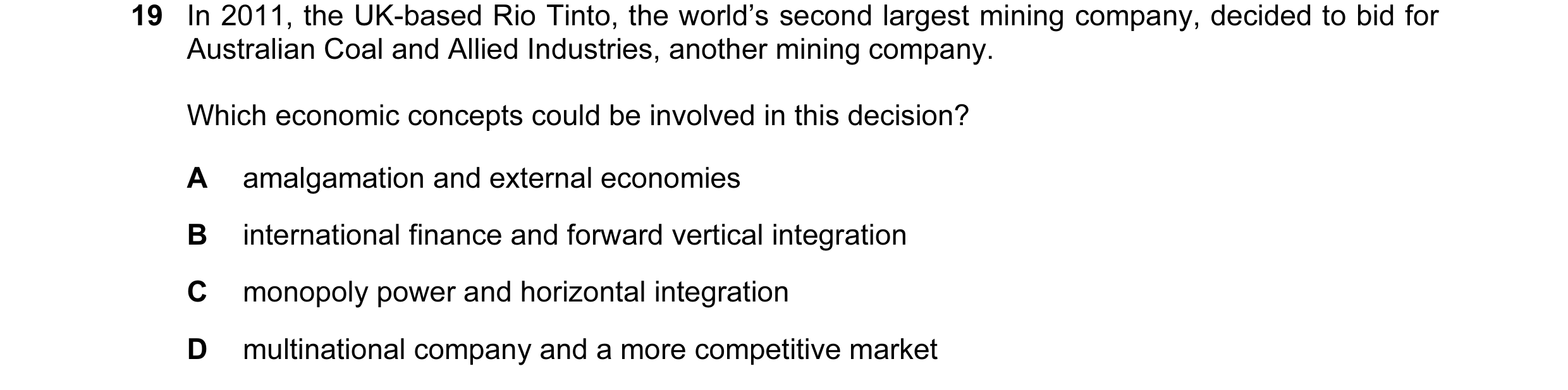
Q23 · In 2011, the UK-based Rio Tinto, the world’s second largest mining company, decided to… 0455/13 Oct/Nov 2013
19 In 2011, the UK-based Rio Tinto, the world’s second largest mining company, decided to bid for Australian Coal and Allied Industries, another mining company. Which economic concepts could be involved in this decision? A amalgamation and external economies B international finance and forward vertical integration C monopoly power and horizontal integration D multinational company and a more competitive market
1 marks
Answer: C
This question in 0455/13 Oct/Nov 2013
Q24 · Why might a government encourage a monopoly? 0455/13 Oct/Nov 2013
21 Why might a government encourage a monopoly? A It can have high average costs. B It can compete against foreign firms. C It can prevent innovation. D It can make excessive profits.
1 marks
Answer: B
This question in 0455/13 Oct/Nov 2013
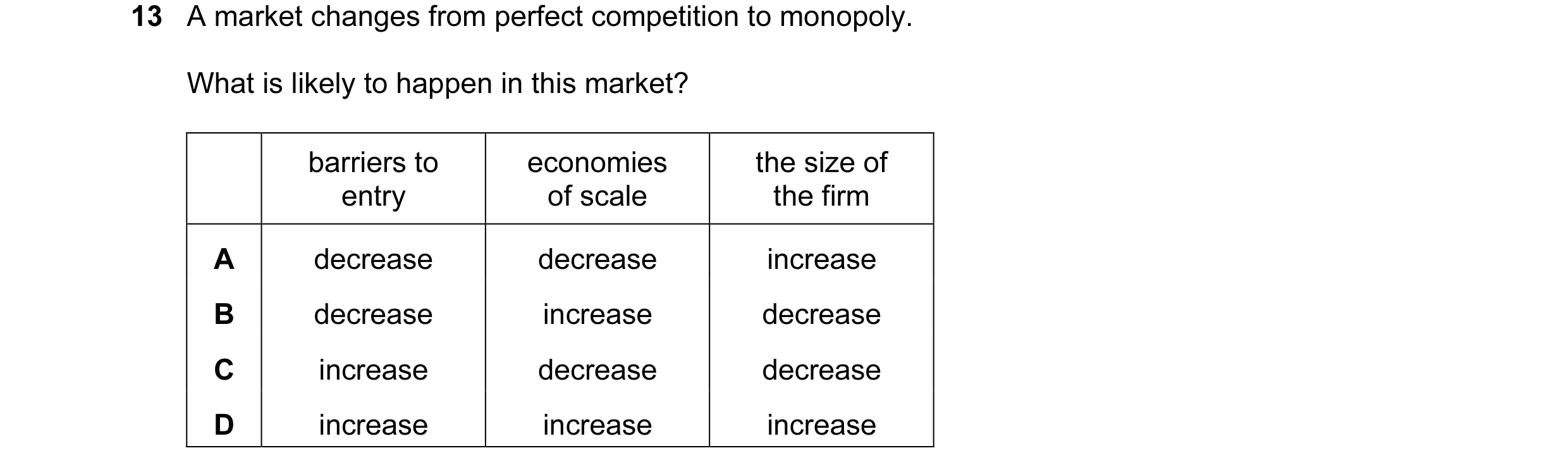
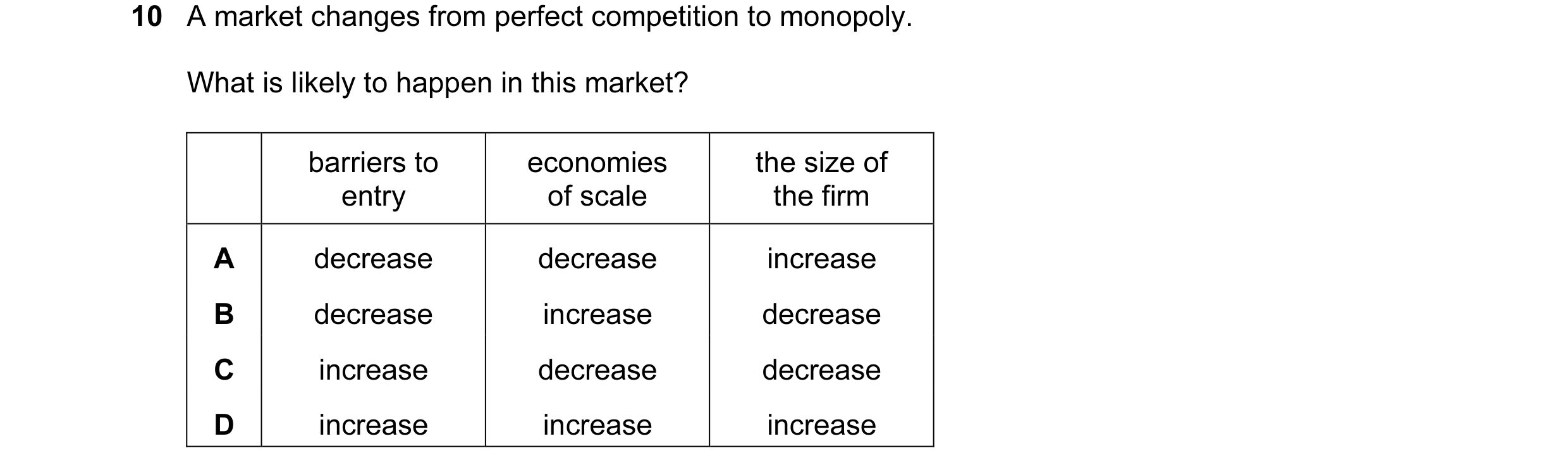
Q25 · A market changes from perfect competition to monopoly 0455/11 May/June 2014
13 A market changes from perfect competition to monopoly. What is likely to happen in this market? barriers to economies the size of entry of scale the firm A decrease decrease increase B decrease increase decrease C increase decrease decrease D increase increase increase
1 marks
Answer: D
This question in 0455/11 May/June 2014
Q26 · Which market conditions apply to firms that operate in perfect competition and which to a… 0455/12 May/June 2014
13 Which market conditions apply to firms that operate in perfect competition and which to a monopoly? perfect competition monopoly A demand influenced by advertising demand not influenced by advertising B many barriers to entry no barriers to entry C no influence on price strong influence on price D sales of branded products sales of unique products
1 marks
Answer: C
This question in 0455/12 May/June 2014
Q27 · A market changes from perfect competition to monopoly 0455/13 May/June 2014
10 A market changes from perfect competition to monopoly. What is likely to happen in this market? barriers to economies the size of entry of scale the firm A decrease decrease increase B decrease increase decrease C increase decrease decrease D increase increase increase
1 marks
Answer: D
This question in 0455/13 May/June 2014
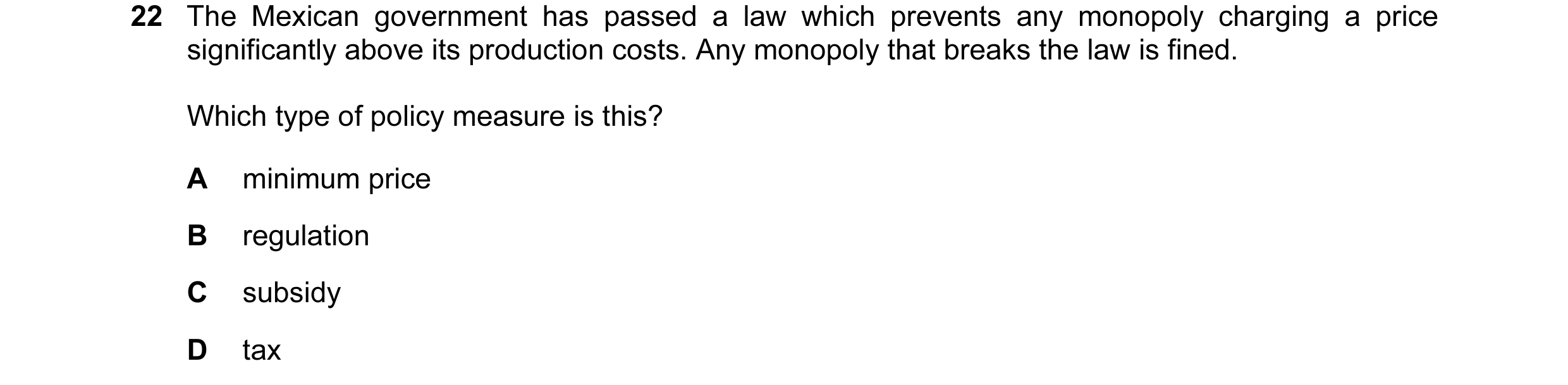
Q28 · The Mexican government has passed a law which prevents any monopoly charging a price… 0455/13 May/June 2014
22 The Mexican government has passed a law which prevents any monopoly charging a price significantly above its production costs. Any monopoly that breaks the law is fined. Which type of policy measure is this? A minimum price B regulation C subsidy D tax
1 marks
Answer: B
This question in 0455/13 May/June 2014
Q29 · What may exist in perfect competition but not in monopoly? 0455/11 Oct/Nov 2014
14 What may exist in perfect competition but not in monopoly? A barriers to entry B economies of scale C many sellers D product differentiation
1 marks
Answer: C
This question in 0455/11 Oct/Nov 2014
Q30 · What may exist in perfect competition but not in monopoly? 0455/12 Oct/Nov 2014
13 What may exist in perfect competition but not in monopoly? A barriers to entry B economies of scale C many sellers D product differentiation
1 marks
Answer: C
This question in 0455/12 Oct/Nov 2014
Q31 · What is correct for a private monopoly but is not correct for a firm in perfect… 0455/13 Oct/Nov 2014
12 What is correct for a private monopoly but is not correct for a firm in perfect competition? A It aims to maximise its profits. B It can make losses. C It can restrict the level of competition. D It is run by an entrepreneur.
1 marks
Answer: C
This question in 0455/13 Oct/Nov 2014
Q32 · What may exist in monopoly but not in perfect competition? 0455/12 May/June 2015
12 What may exist in monopoly but not in perfect competition? A barriers to entry B identical products C market price D perfect knowledge
1 marks
Answer: A
This question in 0455/12 May/June 2015
Q33 · What is not usually associated with the existence of a monopoly? 0455/13 May/June 2015
12 What is not usually associated with the existence of a monopoly? A barriers to entry B perfect knowledge C profit maximisation D small firms
1 marks
Answer: D
This question in 0455/13 May/June 2015
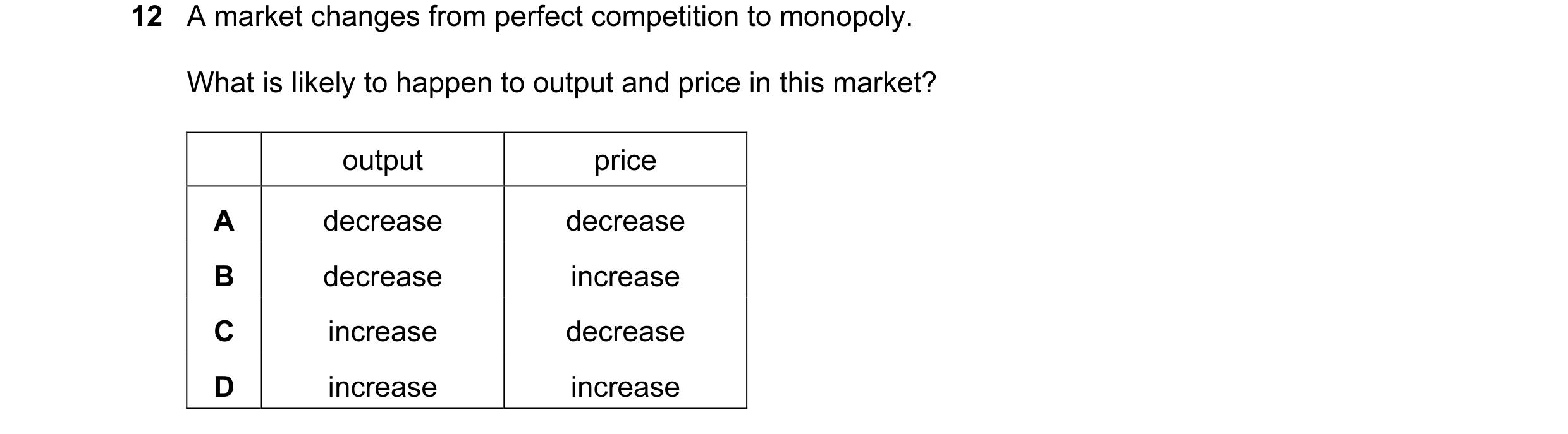
Q34 · A market changes from perfect competition to monopoly 0455/11 Oct/Nov 2015
12 A market changes from perfect competition to monopoly. What is likely to happen to output and price in this market? output price A decrease decrease B decrease increase C increase decrease D increase increase
1 marks
Answer: B
This question in 0455/11 Oct/Nov 2015
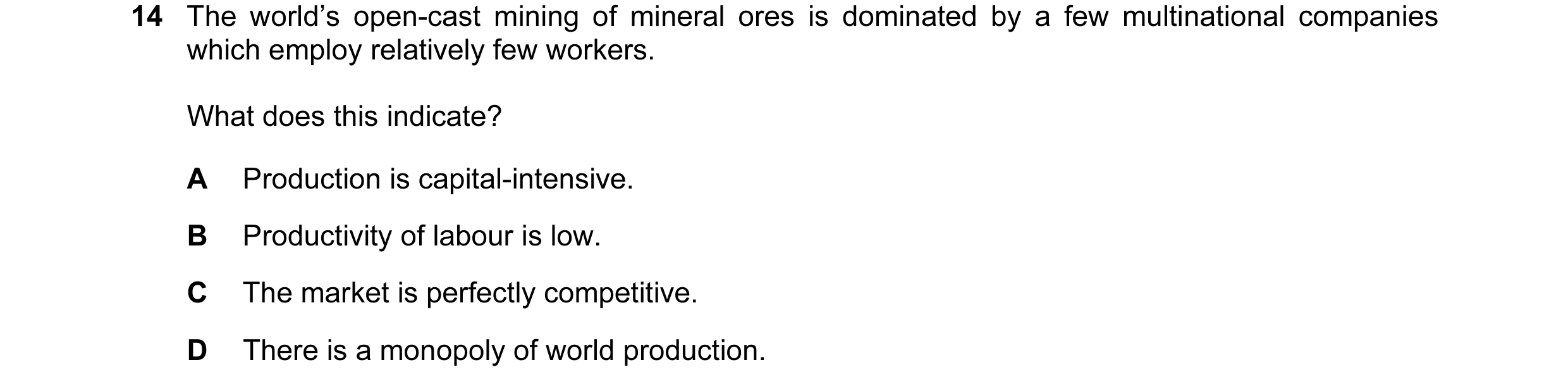
Q35 · The world’s open-cast mining of mineral ores is dominated by a few multinational… 0455/11 Oct/Nov 2015
14 The world’s open-cast mining of mineral ores is dominated by a few multinational companies which employ relatively few workers. What does this indicate? A Production is capital-intensive. B Productivity of labour is low. C The market is perfectly competitive. D There is a monopoly of world production.
1 marks
Answer: A
This question in 0455/11 Oct/Nov 2015
Q36 · What characteristics are found in a monopoly? 0455/12 Oct/Nov 2015
12 What characteristics are found in a monopoly? A freedom of entry to the market and a single seller B freedom of entry to the market and many sellers C many buyers and a single seller D many buyers and many sellers
1 marks
Answer: C
This question in 0455/12 Oct/Nov 2015
Q37 · Sohrab bought shares in a French telecommunications company operating in many countries 0455/12 Feb/March 2016
13 Sohrab bought shares in a French telecommunications company operating in many countries. Joel owns and runs a mobile telephone accessories and repair shop. What is not identified above? A multinational company B partnership C public company D sole proprietor
1 marks
Answer: B
This question in 0455/12 Feb/March 2016
Q38 · Which characteristic does a firm in perfect competition have in common with a monopoly? 0455/11 May/June 2016
13 Which characteristic does a firm in perfect competition have in common with a monopoly? A the ability to exclude rivals B the benefit of internal economies of scale C the problem of diseconomies of scale D the wish to maximise profits
1 marks
Answer: D
This question in 0455/11 May/June 2016
Q39 · What is true when comparing a monopoly to a perfectly competitive firm? 0455/13 May/June 2016
13 What is true when comparing a monopoly to a perfectly competitive firm? A Monopolies will have perfect knowledge of their market. B Monopoly costs are always lower owing to economies of scale. C Monopoly price is likely to be higher. D The products that monopolies produce have more limited demand.
1 marks
Answer: C
This question in 0455/13 May/June 2016
Q40 · Why is a firm in perfect competition a price taker? 0455/13 Oct/Nov 2016
13 Why is a firm in perfect competition a price taker? A It has no information about market price. B Its output is too small to have any effect on market equilibrium. C There are few barriers to entry. D There are only a few firms in the industry.
1 marks
Answer: B
This question in 0455/13 Oct/Nov 2016
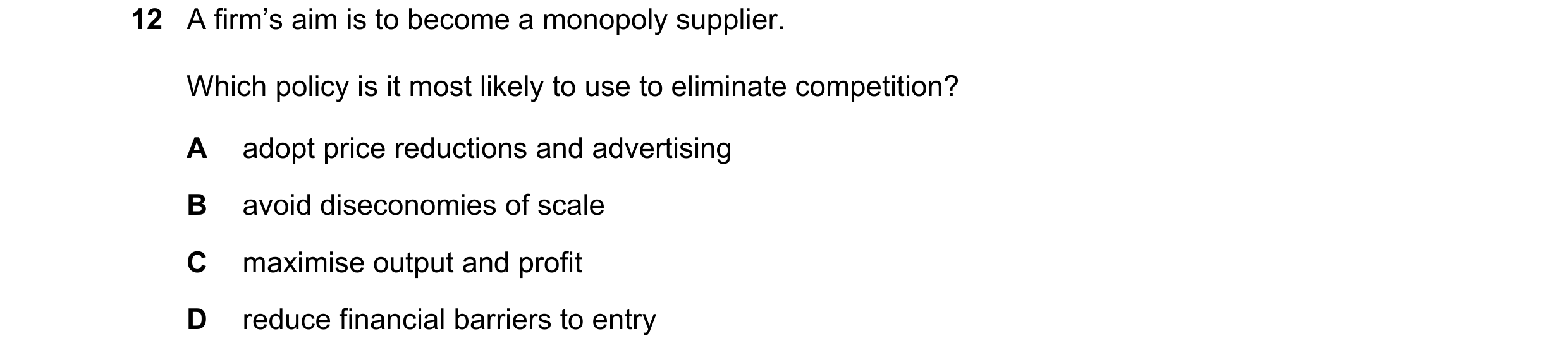
Q41 · A firm’s aim is to become a monopoly supplier 0455/12 Feb/March 2017
12 A firm’s aim is to become a monopoly supplier. Which policy is it most likely to use to eliminate competition? A adopt price reductions and advertising B avoid diseconomies of scale C maximise output and profit D reduce financial barriers to entry
1 marks
Answer: A
This question in 0455/12 Feb/March 2017
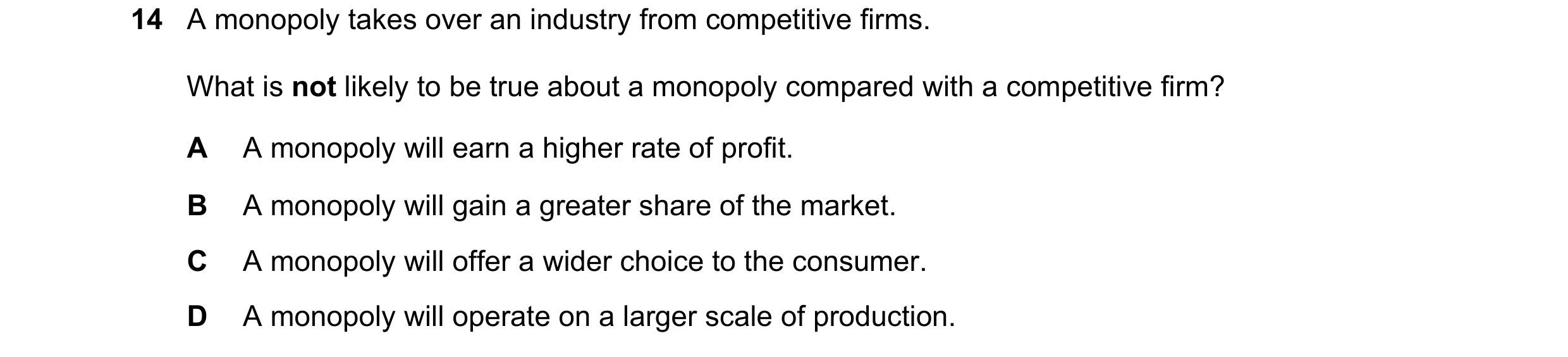
Q42 · A monopoly takes over an industry from competitive firms 0455/11 May/June 2017
14 A monopoly takes over an industry from competitive firms. What is not likely to be true about a monopoly compared with a competitive firm? A A monopoly will earn a higher rate of profit. B A monopoly will gain a greater share of the market. C A monopoly will offer a wider choice to the consumer. D A monopoly will operate on a larger scale of production.
1 marks
Answer: C
This question in 0455/11 May/June 2017
Q43 · A monopoly takes over an industry from competitive firms 0455/12 May/June 2017
14 A monopoly takes over an industry from competitive firms. What is not likely to be true about a monopoly compared with a competitive firm? A A monopoly will earn a higher rate of profit. B A monopoly will gain a greater share of the market. C A monopoly will offer a wider choice to the consumer. D A monopoly will operate on a larger scale of production.
1 marks
Answer: C
This question in 0455/12 May/June 2017
Q44 · A monopoly takes over an industry from competitive firms 0455/13 May/June 2017
14 A monopoly takes over an industry from competitive firms. What is not likely to be true about a monopoly compared with a competitive firm? A A monopoly will earn a higher rate of profit. B A monopoly will gain a greater share of the market. C A monopoly will offer a wider choice to the consumer. D A monopoly will operate on a larger scale of production.
1 marks
Answer: C
This question in 0455/13 May/June 2017
Q45 · What is not likely in an industry with many small firms? 0455/11 Oct/Nov 2017
13 What is not likely in an industry with many small firms? A high capital costs B high level of competition C low barriers to entry D low research expenditure
1 marks
Answer: A
This question in 0455/11 Oct/Nov 2017
Q46 · Which characteristic can exist both in monopoly and in perfect competition? 0455/11 May/June 2018
12 Which characteristic can exist both in monopoly and in perfect competition? A freedom of entry B many buyers C many sellers D perfectly elastic demand curve
1 marks
Answer: B
This question in 0455/11 May/June 2018
Q47 · What is a characteristic of a perfectly competitive firm? 0455/12 May/June 2018
12 What is a characteristic of a perfectly competitive firm? A absence of competitors B non-price competition C one dominant firm D price taker
1 marks
Answer: D
This question in 0455/12 May/June 2018
Q48 · What is a characteristic of perfect competition? 0455/13 May/June 2018
12 What is a characteristic of perfect competition? A Firms sell an identical product. B New firms cannot enter the market. C The market is controlled by one firm. D There is a high degree of market concentration.
1 marks
Answer: A
This question in 0455/13 May/June 2018
Q49 · Which situation involving the building industry is most likely to be investigated by a… 0455/13 May/June 2018
19 Which situation involving the building industry is most likely to be investigated by a government body set up to control restrictive practices? A a builder purchasing a plot of land for development of housing B groups of suppliers of building materials agreeing to fix prices C several builders bidding for the same contracts D several builders using different sources of supply
1 marks
Answer: B
This question in 0455/13 May/June 2018
Q50 · Which international market is closest to the model of perfect competition? 0455/11 Oct/Nov 2018
12 Which international market is closest to the model of perfect competition? A diamonds B foreign currency C petrol (fuel) D washing machines
1 marks
Answer: B
This question in 0455/11 Oct/Nov 2018
Q51 · What is correct for firms in perfect competition? 0455/12 Oct/Nov 2018
12 What is correct for firms in perfect competition? A They achieve economies of scale. B They are price takers. C They make use of non-price competition. D They produce differentiated products.
1 marks
Answer: B
This question in 0455/12 Oct/Nov 2018
Q52 · The table shows characteristics of a market 0455/13 Oct/Nov 2018
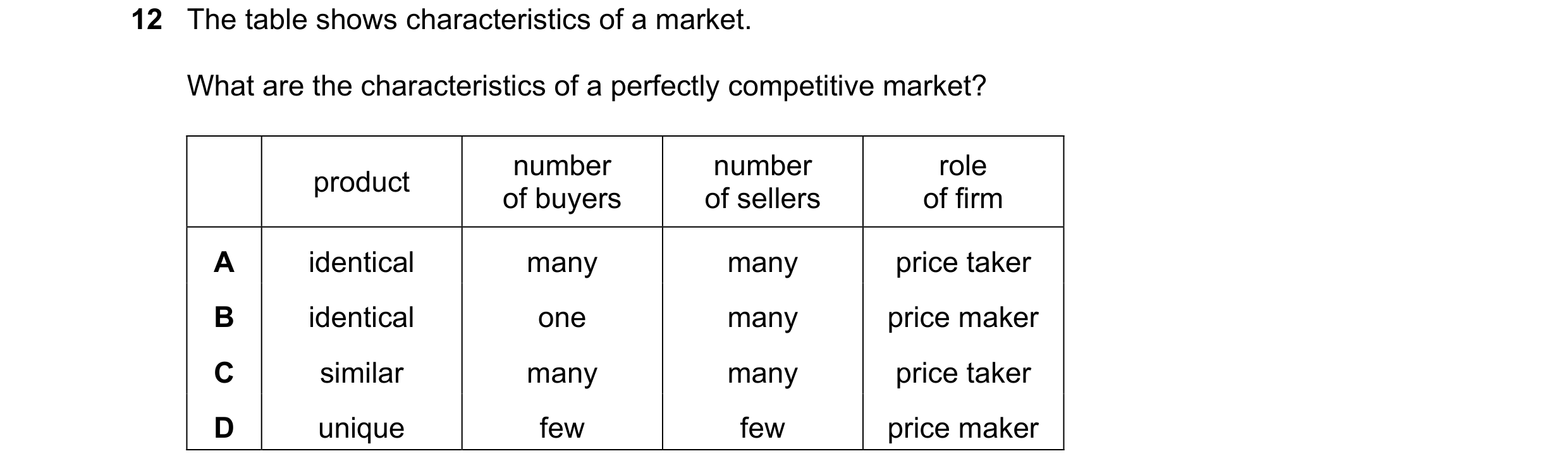
12 The table shows characteristics of a market. What are the characteristics of a perfectly competitive market? number number role product of buyers of sellers of firm A identical many many price taker B identical one many price maker C similar many many price taker D unique few few price maker
1 marks
Answer: A
This question in 0455/13 Oct/Nov 2018
Q53 · Why is the energy supply industry dominated by very large firms in many economies? 0455/11 May/June 2019
13 Why is the energy supply industry dominated by very large firms in many economies? A Government controls prevent the exploitation of consumers. B High fixed capital costs exist. C Labour-intensive production techniques are used. D Non-price advertising increases competition.
1 marks
Answer: B
This question in 0455/11 May/June 2019
Q54 · Sometimes the government regulates the market to protect the interests of consumers 0455/13 May/June 2019
18 Sometimes the government regulates the market to protect the interests of consumers. Which kind of regulation would achieve this protection? A discouraging economies of scale that lead to lower costs B preventing mergers which result in high monopoly prices C reducing shop opening hours D reducing the range of products supplied to the market
1 marks
Answer: B
This question in 0455/13 May/June 2019
Q55 · What is characteristic of a monopoly market structure? 0455/11 Oct/Nov 2019
13 What is characteristic of a monopoly market structure? A A monopolist may determine the price of its product. B A monopolist’s product has many substitutes. C There are no external costs. D There is easy entry into the market.
1 marks
Answer: A
This question in 0455/11 Oct/Nov 2019
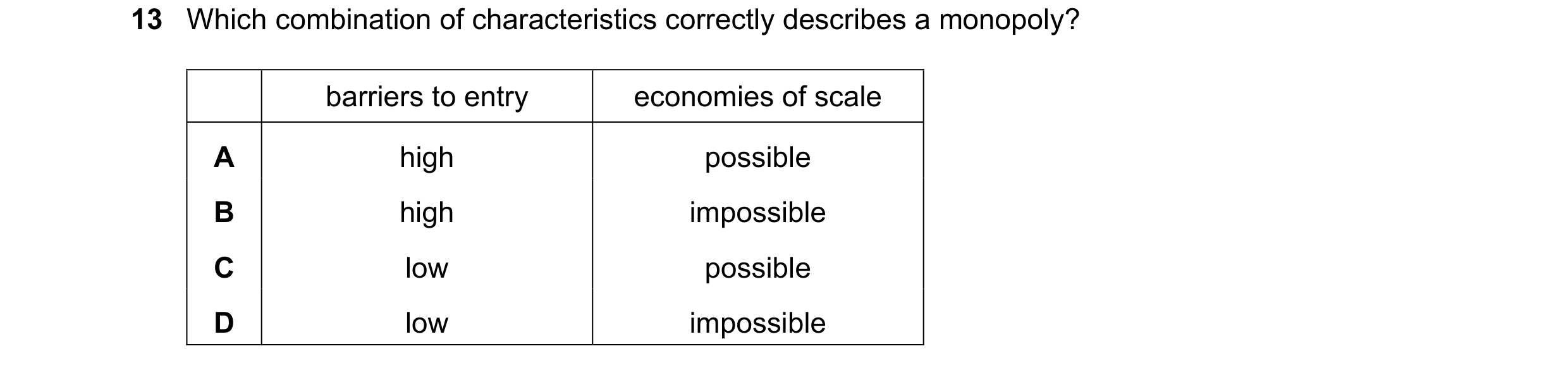
Q56 · Which combination of characteristics correctly describes a monopoly? 0455/12 Oct/Nov 2019
13 Which combination of characteristics correctly describes a monopoly? barriers to entry economies of scale A high possible B high impossible C low possible D low impossible
1 marks
Answer: A
This question in 0455/12 Oct/Nov 2019
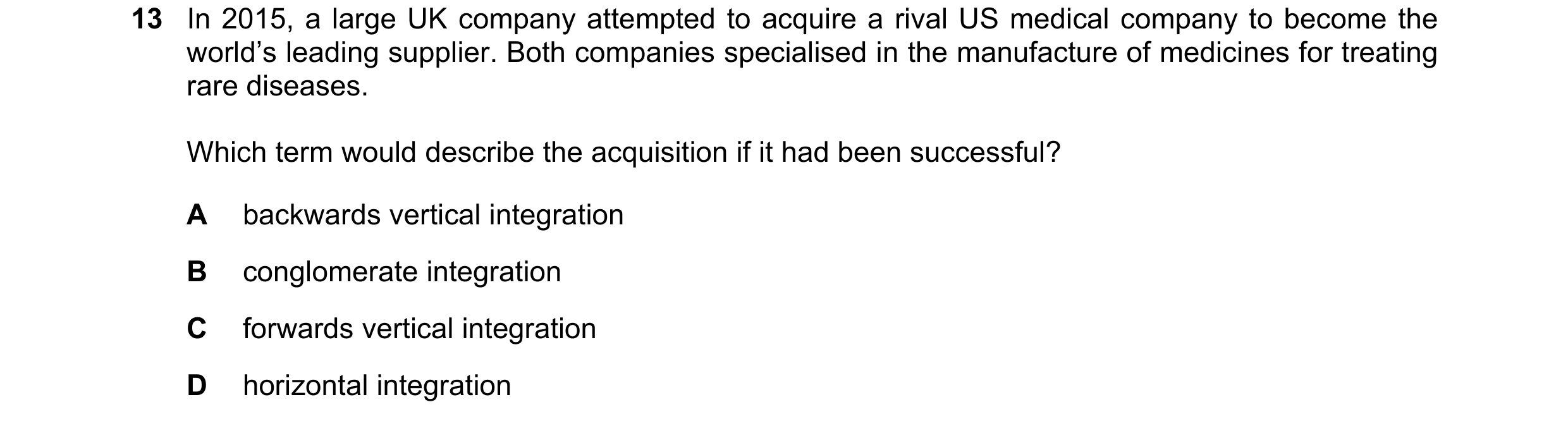
Q57 · In 2015, a large UK company attempted to acquire a rival US medical company to become the… 0455/13 Oct/Nov 2019
13 In 2015, a large UK company attempted to acquire a rival US medical company to become the world’s leading supplier. Both companies specialised in the manufacture of medicines for treating rare diseases. Which term would describe the acquisition if it had been successful? A backwards vertical integration B conglomerate integration C forwards vertical integration D horizontal integration
1 marks
Answer: D
This question in 0455/13 Oct/Nov 2019
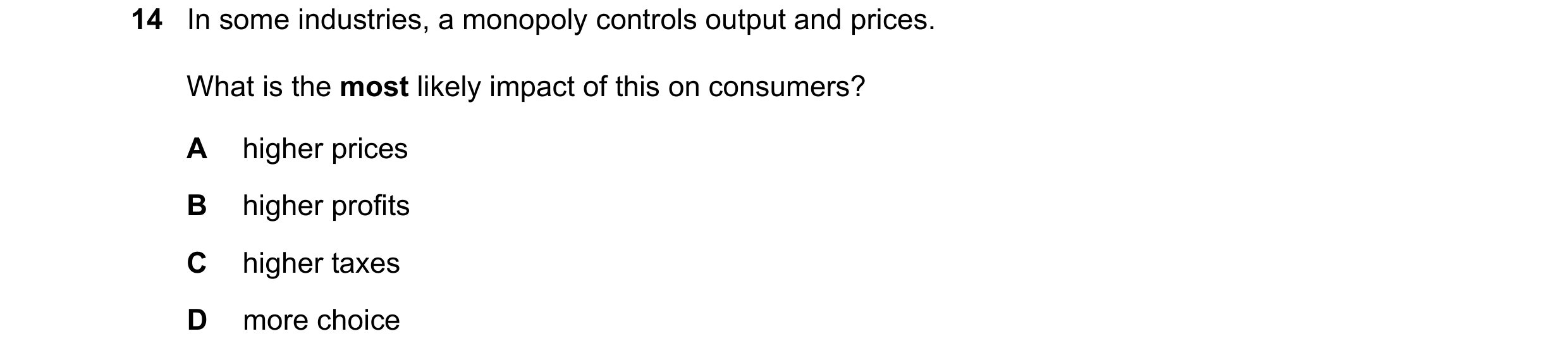
Q58 · In some industries, a monopoly controls output and prices 0455/12 Feb/March 2020
14 In some industries, a monopoly controls output and prices. What is the most likely impact of this on consumers? A higher prices B higher profits C higher taxes D more choice
1 marks
This question in 0455/12 Feb/March 2020
Q59 · How is a government most likely to prevent the growth of monopolies? 0455/11 May/June 2020
15 How is a government most likely to prevent the growth of monopolies? A by encouraging mergers in the private sector B by establishing nationalised industries C by promoting the benefits of economies of scale D by reducing barriers to entry into an industry
1 marks
Answer: D
This question in 0455/11 May/June 2020
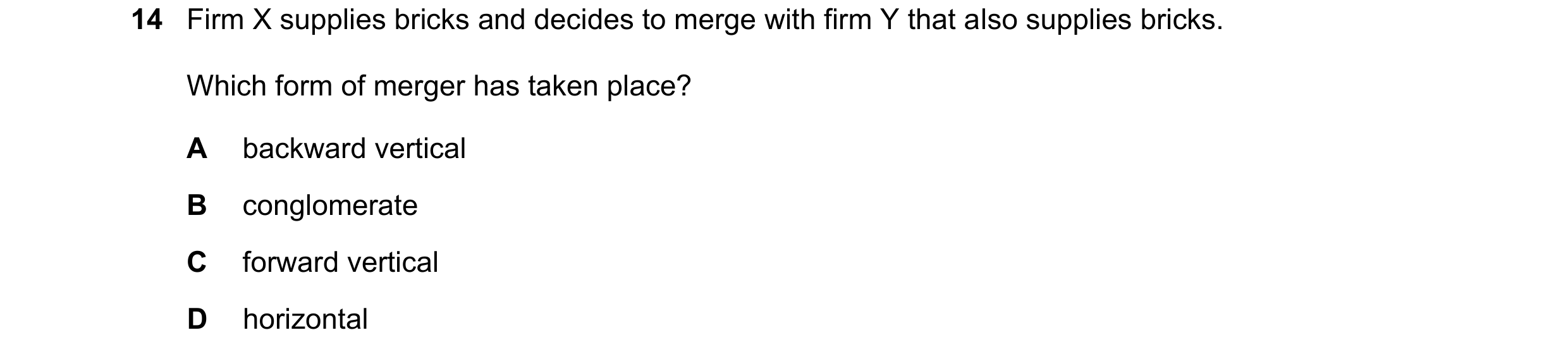
Q60 · Firm X supplies bricks and decides to merge with firm Y that also supplies bricks 0455/12 Oct/Nov 2020
14 Firm X supplies bricks and decides to merge with firm Y that also supplies bricks. Which form of merger has taken place? A backward vertical B conglomerate C forward vertical D horizontal
1 marks
Answer: D
This question in 0455/12 Oct/Nov 2020
Q61 · Which combination is usually found in a monopoly? 0455/13 Oct/Nov 2020
14 Which combination is usually found in a monopoly? A many buyers and many sellers B many buyers and single seller C single buyer and many sellers D single buyer and single seller
1 marks
Answer: B
This question in 0455/13 Oct/Nov 2020
Q62 · What will occur when there is a conglomerate merger? 0455/12 Feb/March 2021
13 What will occur when there is a conglomerate merger? A increased control over supply of raw materials B increased risk-bearing economies of scale C reduced marketing economies of scale D reduced technical economies of scale
1 marks
Answer: B
This question in 0455/12 Feb/March 2021
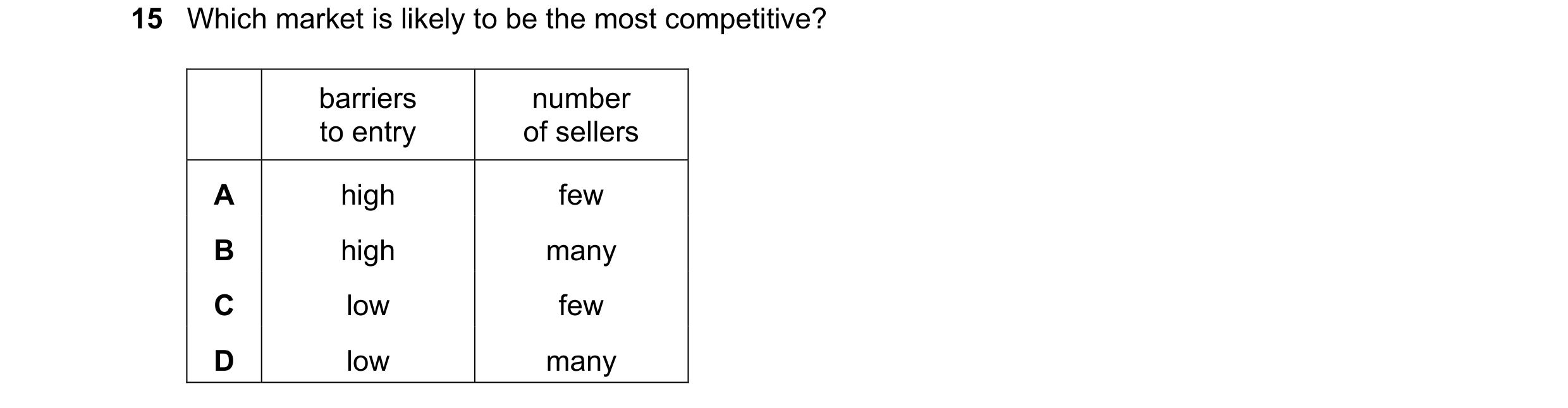
Q63 · Which market is likely to be the most competitive? 0455/11 May/June 2021
15 Which market is likely to be the most competitive? barriers number to entry of sellers A high few B high many C low few D low many
1 marks
Answer: D
This question in 0455/11 May/June 2021
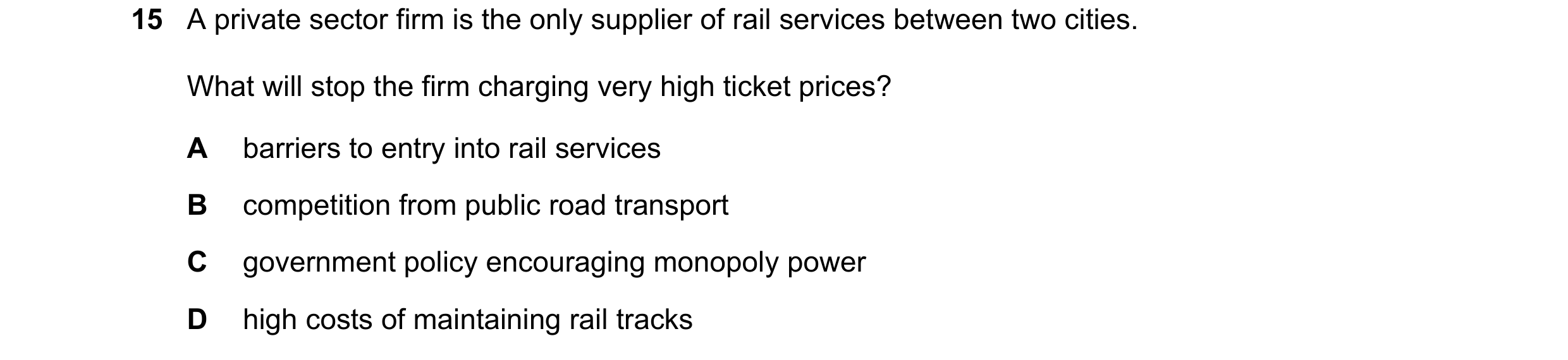
Q64 · A private sector firm is the only supplier of rail services between two cities 0455/12 May/June 2021
15 A private sector firm is the only supplier of rail services between two cities. What will stop the firm charging very high ticket prices? A barriers to entry into rail services B competition from public road transport C government policy encouraging monopoly power D high costs of maintaining rail tracks
1 marks
Answer: B
This question in 0455/12 May/June 2021
Q65 · What is a major advantage of a horizontal merger compared with a conglomerate merger? 0455/11 Oct/Nov 2021
15 What is a major advantage of a horizontal merger compared with a conglomerate merger? A It causes more motivation of the workforce. B It gains financial economies of scale with cheaper borrowing from banks. C It leads to a diversification making the firm less vulnerable. D It reduces competition and increases the merged firm’s market share.
1 marks
Answer: D
This question in 0455/11 Oct/Nov 2021
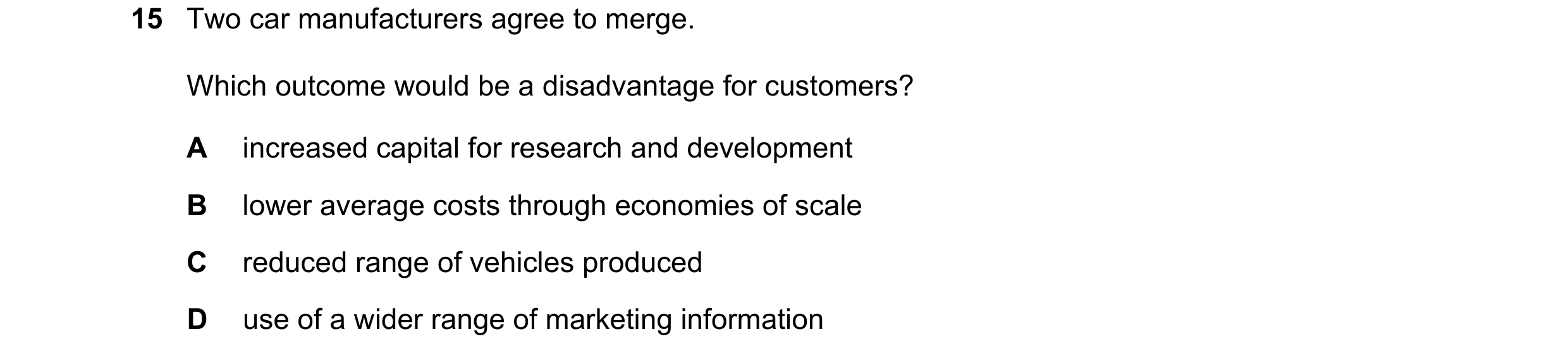
Q66 · Two car manufacturers agree to merge 0455/12 Oct/Nov 2021
15 Two car manufacturers agree to merge. Which outcome would be a disadvantage for customers? A increased capital for research and development B lower average costs through economies of scale C reduced range of vehicles produced D use of a wider range of marketing information
1 marks
Answer: C
This question in 0455/12 Oct/Nov 2021
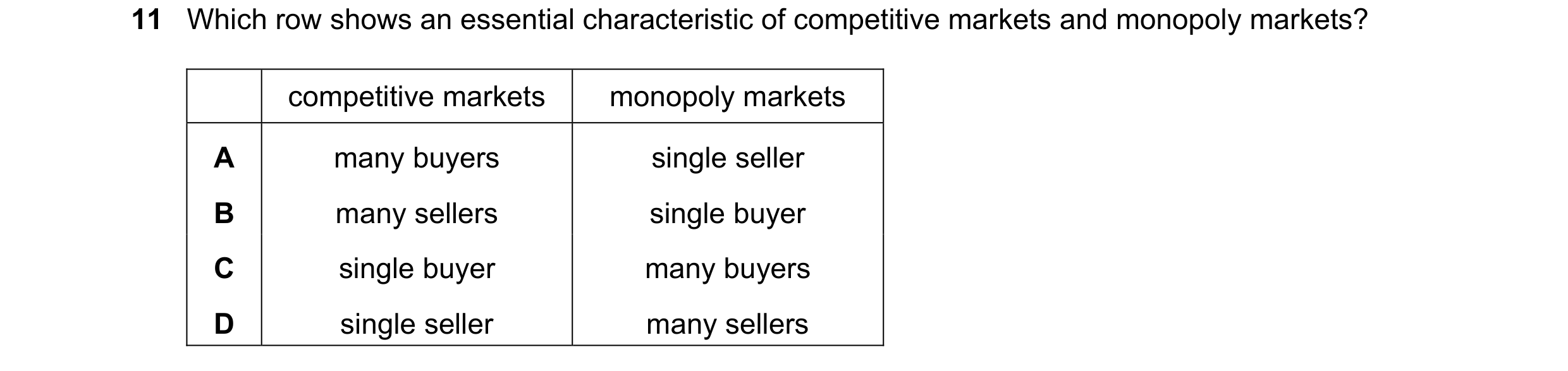
Q67 · Which row shows an essential characteristic of competitive markets and monopoly markets? 0455/11 May/June 2022
11 Which row shows an essential characteristic of competitive markets and monopoly markets? competitive markets monopoly markets A many buyers single seller B many sellers single buyer C single buyer many buyers D single seller many sellers
1 marks
Answer: A
This question in 0455/11 May/June 2022
Q68 · What could cause profits to be high in a monopoly market? 0455/12 May/June 2022
10 What could cause profits to be high in a monopoly market? A barriers to entry B diseconomies of scale C elastic demand for the product D high number of substitutes for the product
1 marks
Answer: A
This question in 0455/12 May/June 2022
Q69 · What is an outcome of a competitive market? 0455/13 May/June 2022
11 What is an outcome of a competitive market? A high prices and low quality B low prices and large choice C high profits and low quality D low profits and little choice
1 marks
Answer: B
This question in 0455/13 May/June 2022
Q70 · Two large-scale firms involved in chemical manufacturing wish to merge 0455/11 Oct/Nov 2022
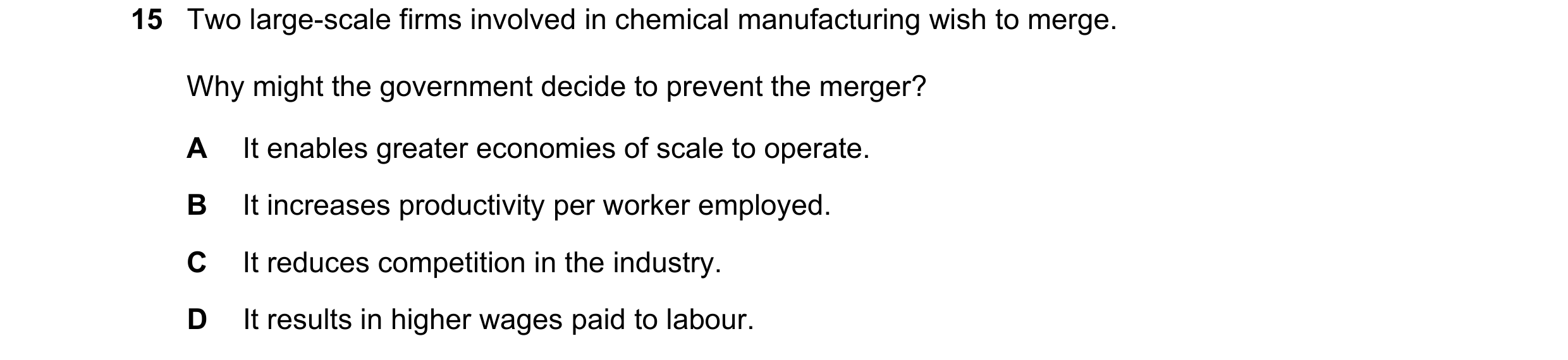
15 Two large-scale firms involved in chemical manufacturing wish to merge. Why might the government decide to prevent the merger? A It enables greater economies of scale to operate. B It increases productivity per worker employed. C It reduces competition in the industry. D It results in higher wages paid to labour.
1 marks
Answer: C
This question in 0455/11 Oct/Nov 2022
Q71 · Which statement is correct when comparing small firms with large firms? 0455/12 Oct/Nov 2022
15 Which statement is correct when comparing small firms with large firms? A Small firms are more able to adapt to changes in market conditions. B Small firms are more able to reduce competition through barriers to entry. C Small firms benefit from lower cost per unit from economies of scale. D Small firms have higher total fixed costs and lower average fixed costs.
1 marks
Answer: A
This question in 0455/12 Oct/Nov 2022
Q72 · Which characteristics are found in a monopoly? 0455/12 Feb/March 2023
17 Which characteristics are found in a monopoly? A freedom of entry to the market and a single seller B freedom of entry to the market and many sellers C many buyers and a single seller D many buyers and many sellers
1 marks
Answer: C
This question in 0455/12 Feb/March 2023
Q73 · A large privately owned firm is the sole supplier of electricity to a city 0455/11 Oct/Nov 2023
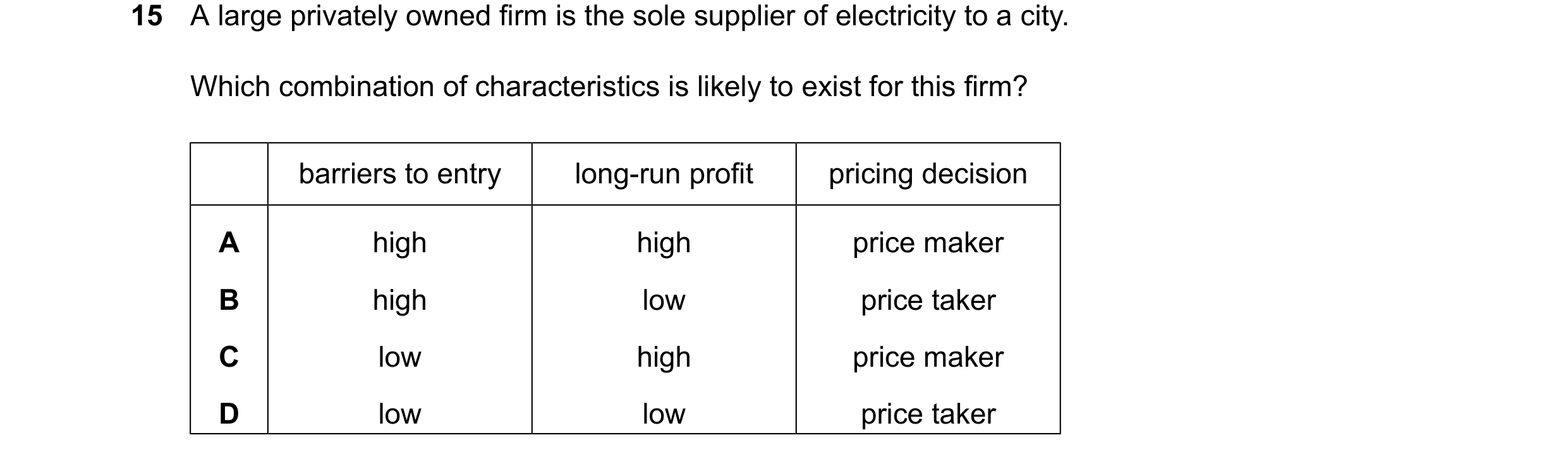
15 A large privately owned firm is the sole supplier of electricity to a city. Which combination of characteristics is likely to exist for this firm? barriers to entry long-run profit pricing decision A high high price maker B high low price taker C low high price maker D low low price taker
1 marks
Answer: A
This question in 0455/11 Oct/Nov 2023
Q74 · In which type of industry is a firm most likely to make a large profit in the short run… 0455/12 Oct/Nov 2023
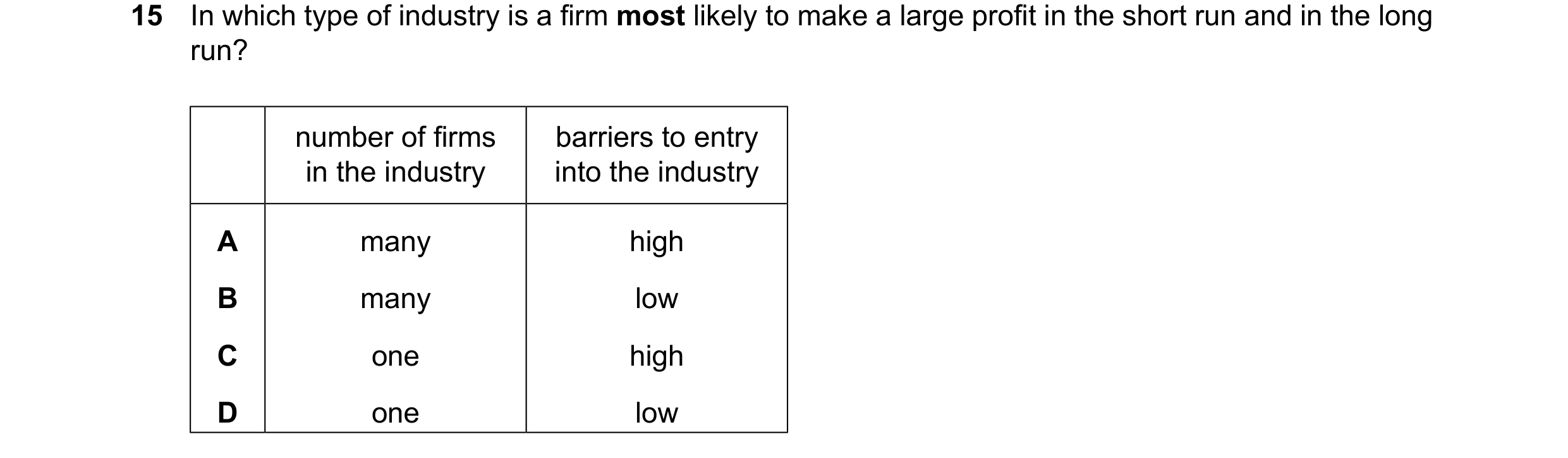
15 In which type of industry is a firm most likely to make a large profit in the short run and in the long run? number of firms barriers to entry in the industry into the industry A many high B many low C one high D one low
1 marks
Answer: C
This question in 0455/12 Oct/Nov 2023
Q75 · Many small energy providers have closed down due to rising costs 0455/13 Oct/Nov 2023
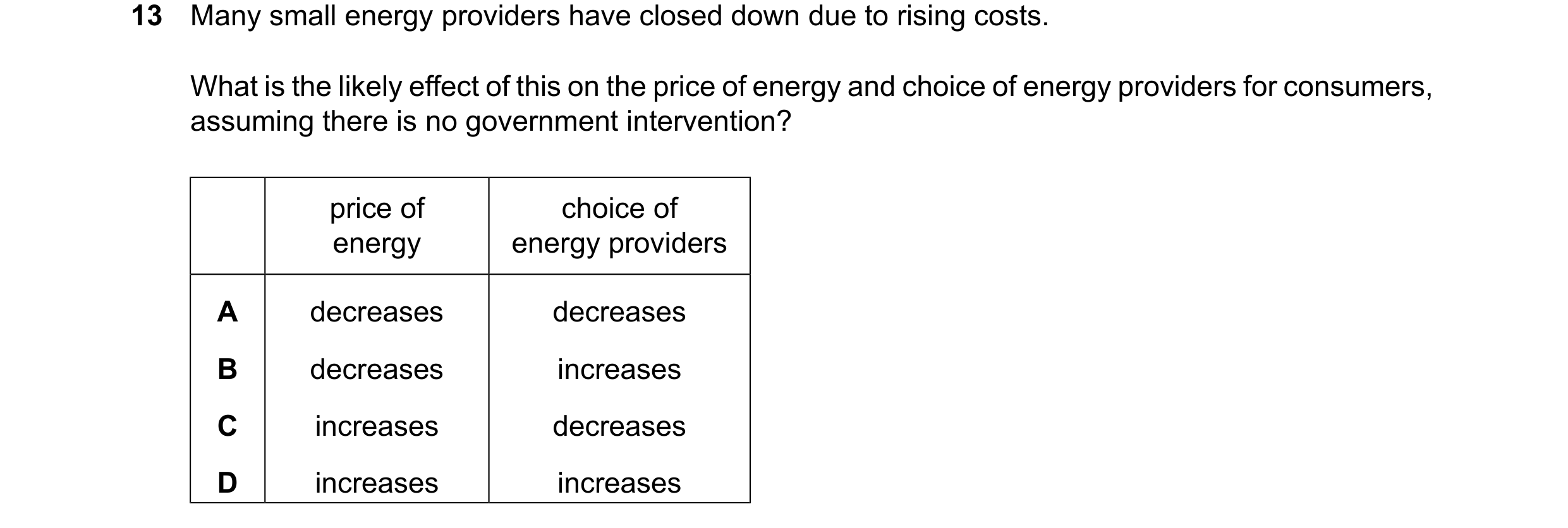
13 Many small energy providers have closed down due to rising costs. What is the likely effect of this on the price of energy and choice of energy providers for consumers, assuming there is no government intervention? price of choice of energy energy providers A decreases decreases B decreases increases C increases decreases D increases increases
1 marks
Answer: C
This question in 0455/13 Oct/Nov 2023
Q76 · Some governments allow monopoly markets to exist 0455/13 Oct/Nov 2023
15 Some governments allow monopoly markets to exist. What is a reason for this? A to attract entry into the market B to fund research and development C to increase prices for consumers D to maximise monopoly profits
1 marks
Answer: B
This question in 0455/13 Oct/Nov 2023
Q77 · A monopoly firm can often earn greater profits than a firm in a competitive market 0455/12 Feb/March 2024
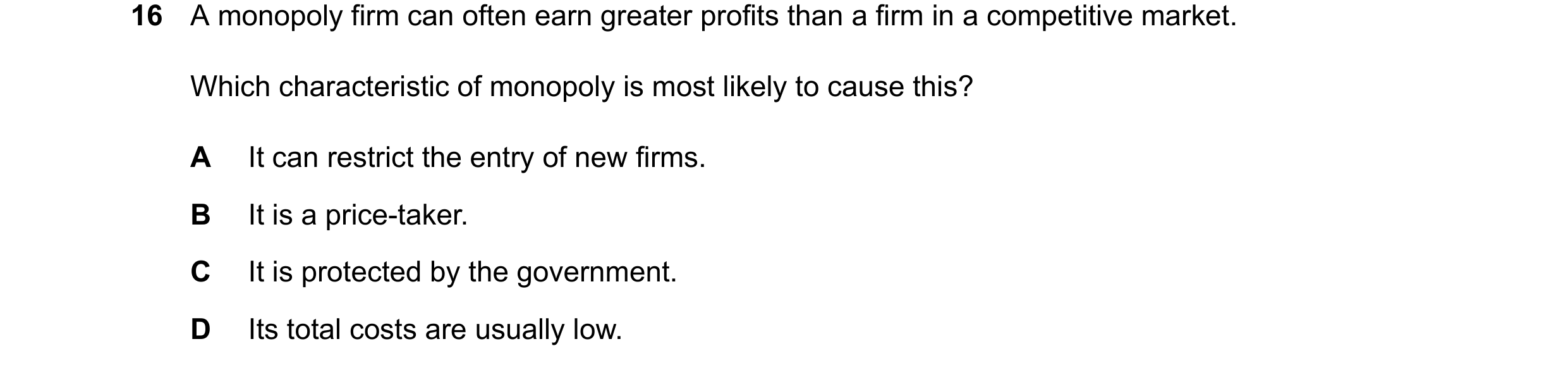
16 A monopoly firm can often earn greater profits than a firm in a competitive market. Which characteristic of monopoly is most likely to cause this? A It can restrict the entry of new firms. B It is a price-taker. C It is protected by the government. D Its total costs are usually low.
1 marks
Answer: A
This question in 0455/12 Feb/March 2024
Q78 · What are the features of a highly competitive market when compared with a monopoly market? 0455/12 May/June 2024
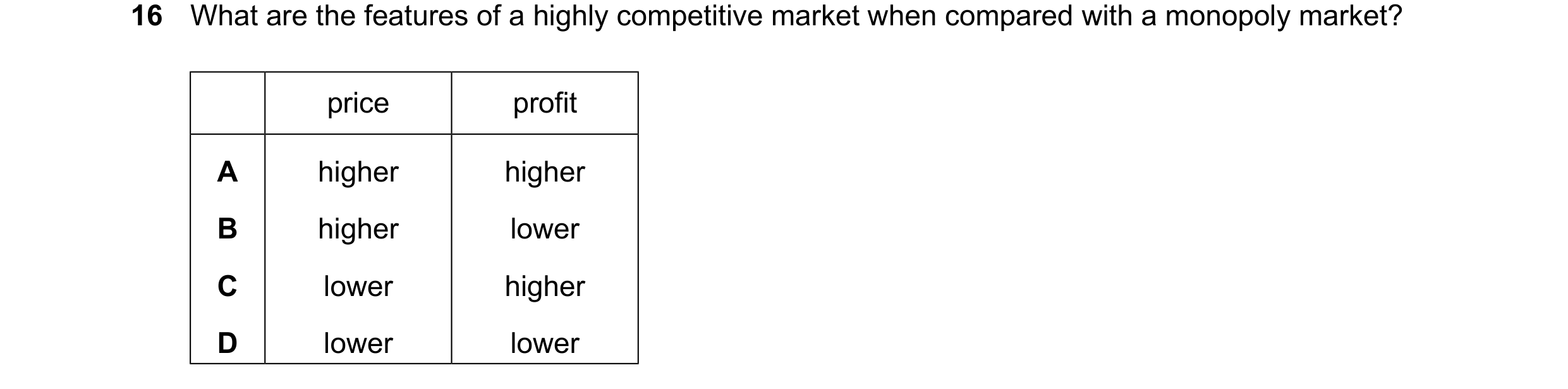
16 What are the features of a highly competitive market when compared with a monopoly market? price profit A higher higher B higher lower C lower higher D lower lower
1 marks
Answer: D
This question in 0455/12 May/June 2024
Q79 · A clothes retailer borrows money to finance the opening of another clothes shop 0455/11 Oct/Nov 2024
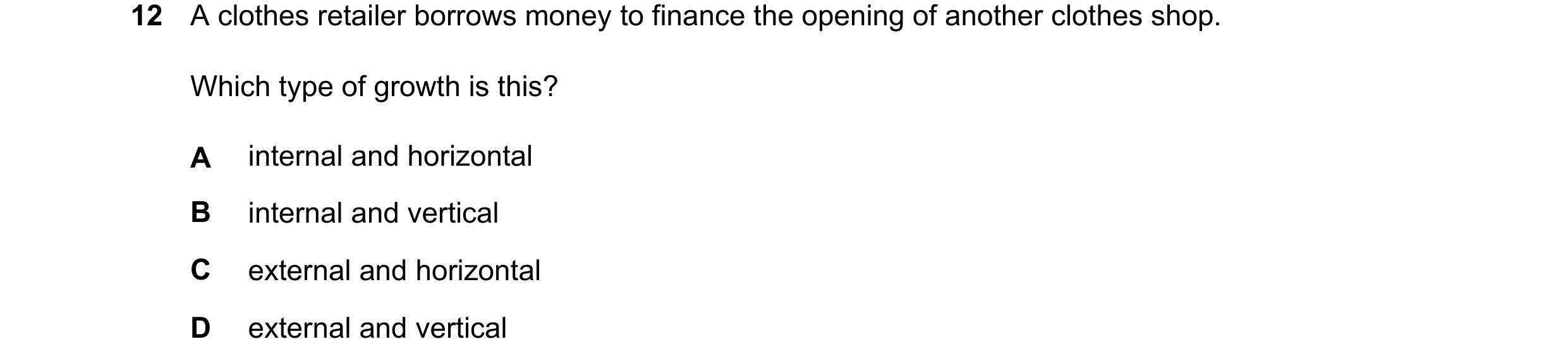
12 A clothes retailer borrows money to finance the opening of another clothes shop. Which type of growth is this? A internal and horizontal B internal and vertical C external and horizontal D external and vertical
1 marks
Answer: A
This question in 0455/11 Oct/Nov 2024
Q80 · A competitive industry becomes a monopoly 0455/12 Oct/Nov 2024
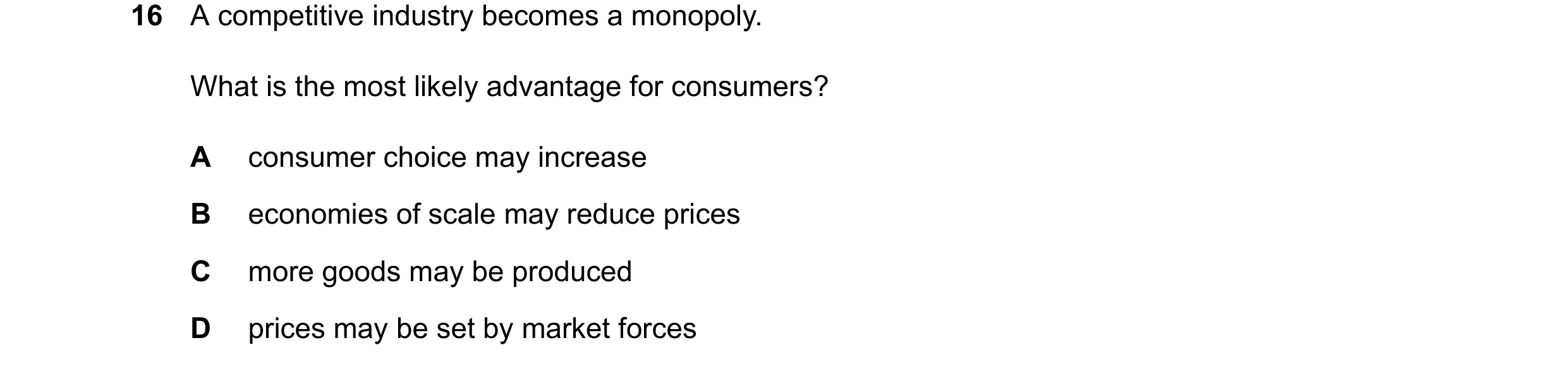
16 A competitive industry becomes a monopoly. What is the most likely advantage for consumers? A consumer choice may increase B economies of scale may reduce prices C more goods may be produced D prices may be set by market forces
1 marks
Answer: B
This question in 0455/12 Oct/Nov 2024
Q81 · There is a number of cafés selling snacks and drinks in a city centre 0455/13 Oct/Nov 2024
16 There is a number of cafés selling snacks and drinks in a city centre. Several of these cafés close due to their owners retiring. What is the likely effect on the prices and profits of the remaining cafés? prices profits A decrease decrease B decrease increase C increase decrease D increase increase
1 marks
Answer: D
This question in 0455/13 Oct/Nov 2024
Q82 · If a very competitive market becomes a monopoly, what will be likely to increase and what… 0455/12 May/June 2025
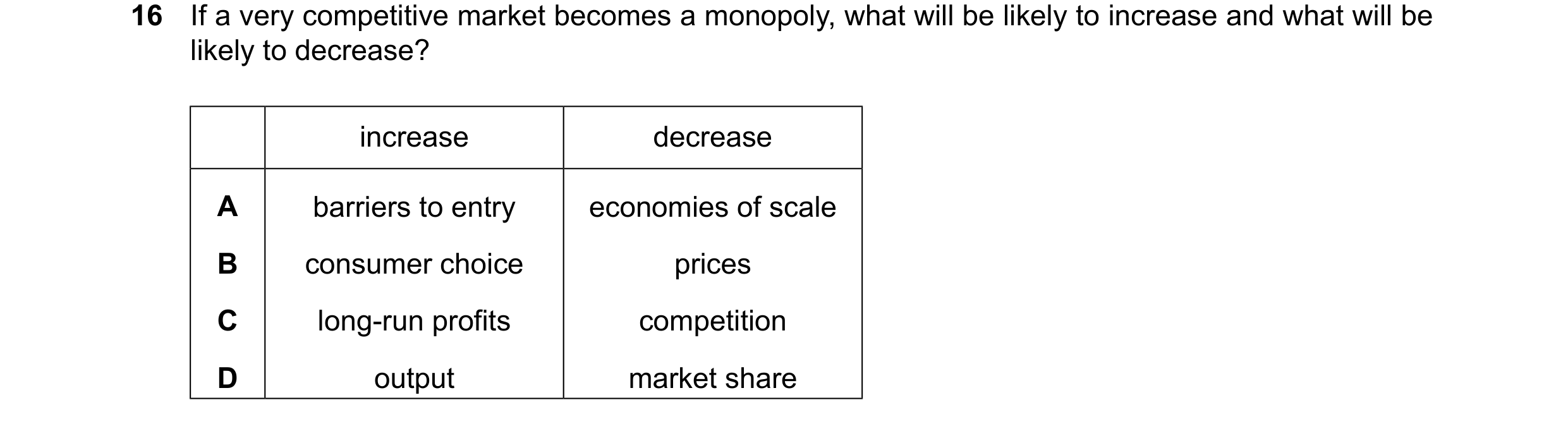
16 If a very competitive market becomes a monopoly, what will be likely to increase and what will be likely to decrease? increase decrease A barriers to entry economies of scale B consumer choice prices C long-run profits competition D output market share
1 marks
Answer: C
This question in 0455/12 May/June 2025
Q83 · A market changes from being very competitive to being a monopoly 0455/13 May/June 2025
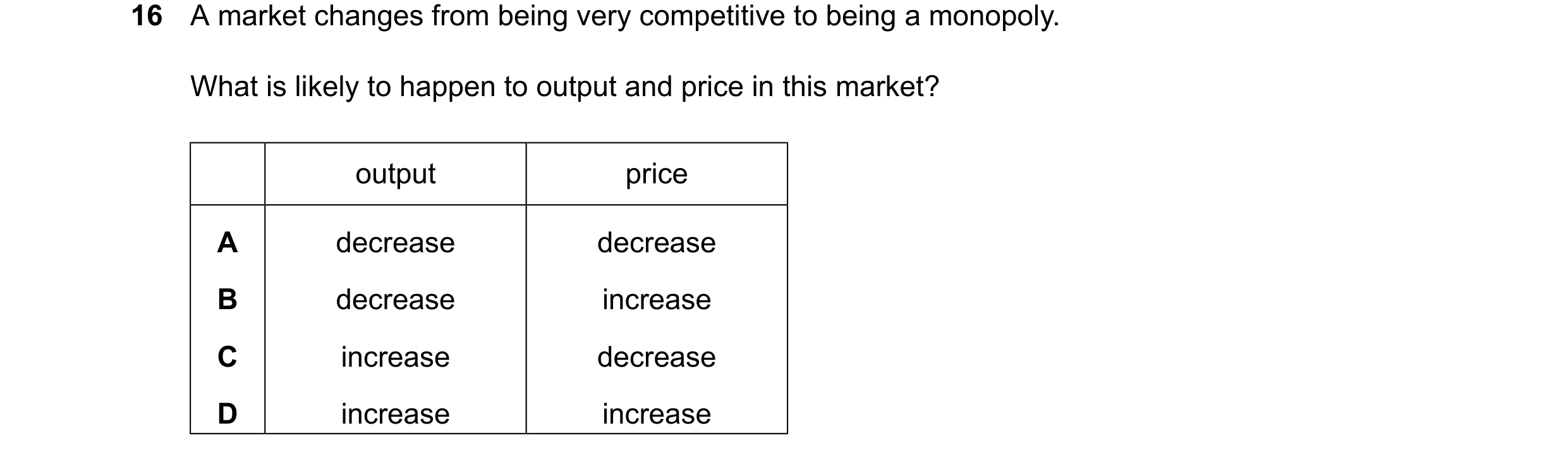
16 A market changes from being very competitive to being a monopoly. What is likely to happen to output and price in this market? output price A decrease decrease B decrease increase C increase decrease D increase increase
1 marks
Answer: B
This question in 0455/13 May/June 2025
Q84 · What is likely to be found when there are many small firms in an industry? 0455/12 Oct/Nov 2025
16 What is likely to be found when there are many small firms in an industry? A There are few barriers to entry. B There is high expenditure on research and development. C There is little competition. D Very large capital costs are needed to establish a firm.
1 marks
Answer: A
This question in 0455/12 Oct/Nov 2025
Q85 · What would make the existence of a monopoly market more likely? 0455/13 Oct/Nov 2025
16 What would make the existence of a monopoly market more likely? A consumers prefer a variety of choice in products B significant economies of scale can be achieved C there are low barriers to entry and exit for firms D there are no restrictions on international trade
1 marks
Answer: B
This question in 0455/13 Oct/Nov 2025



 1 / 16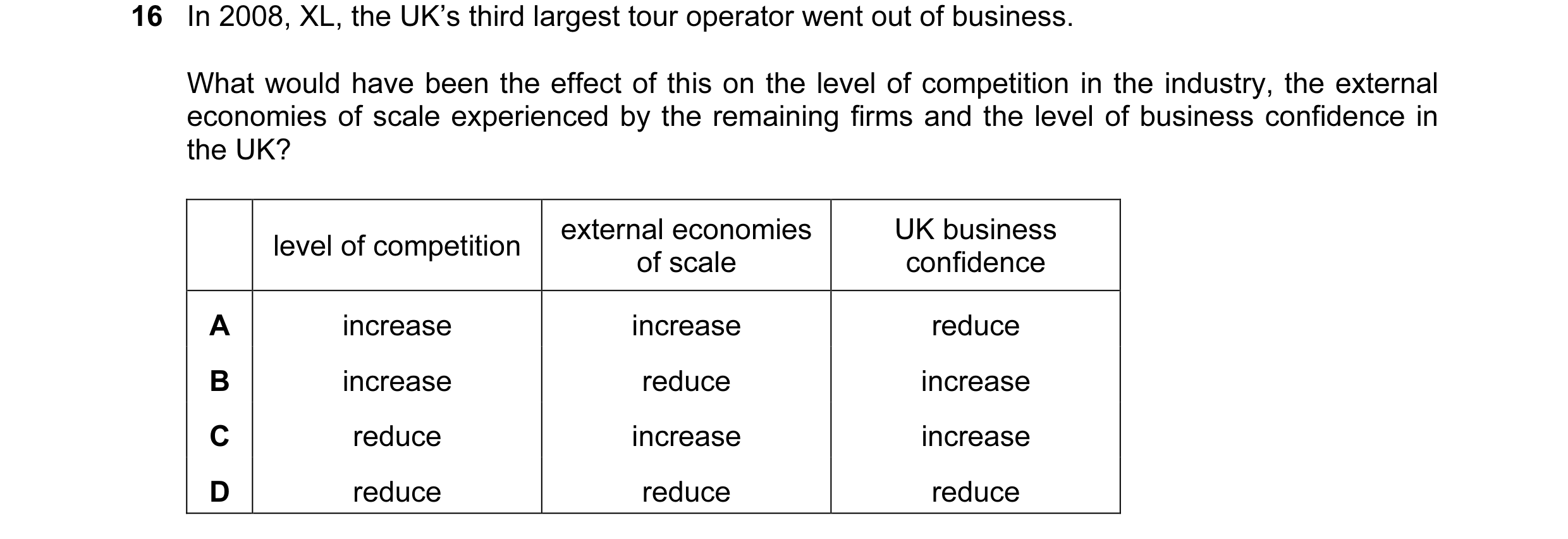
 2 / 16


 3 / 16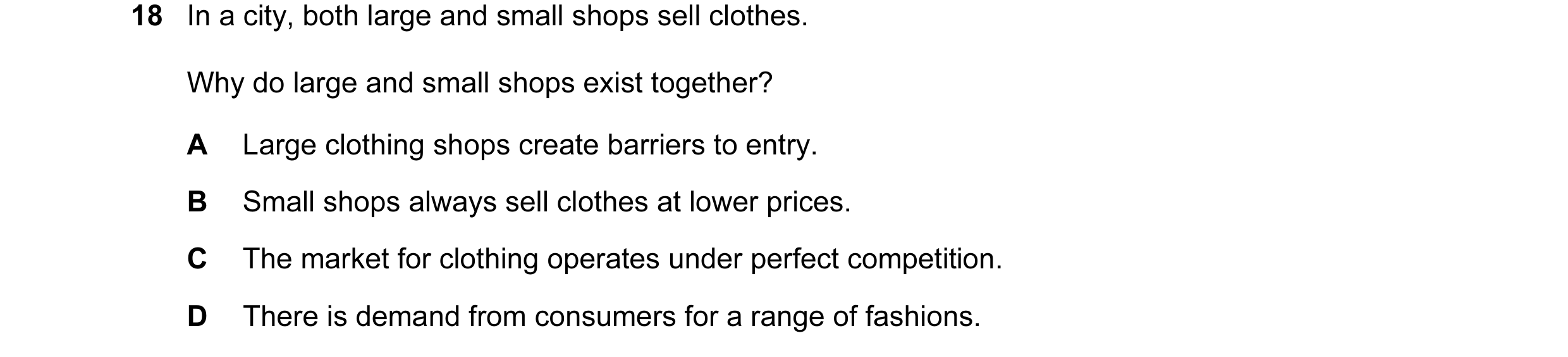

 4 / 16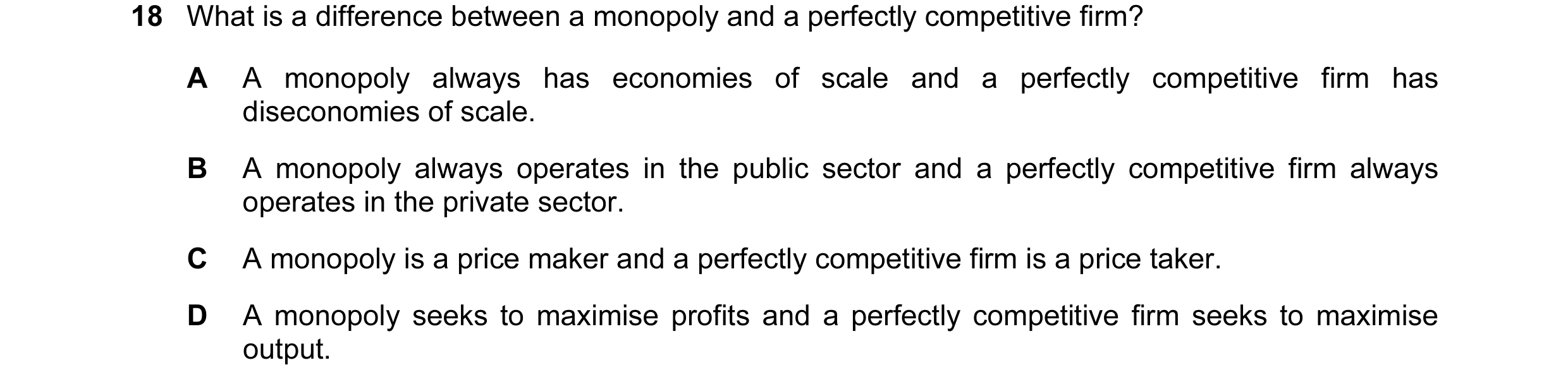


 5 / 16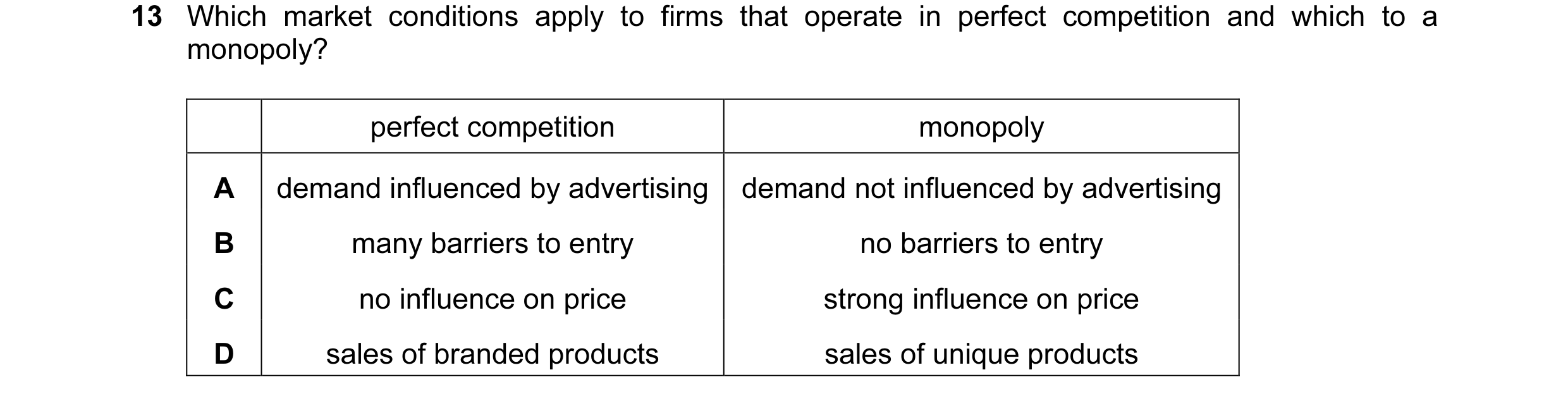

 6 / 16


 7 / 16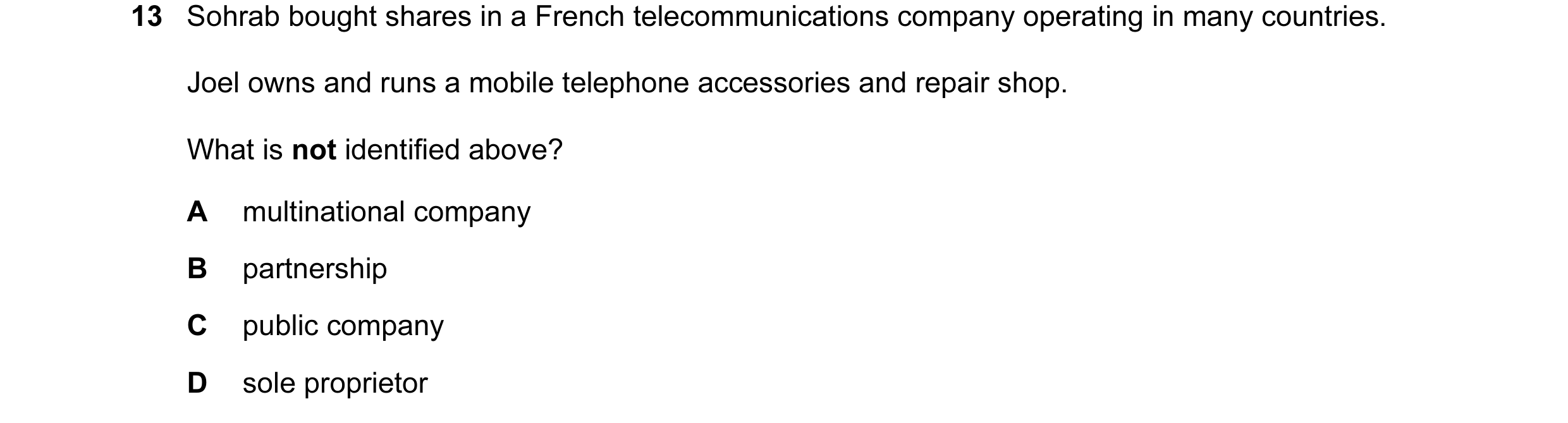



 8 / 16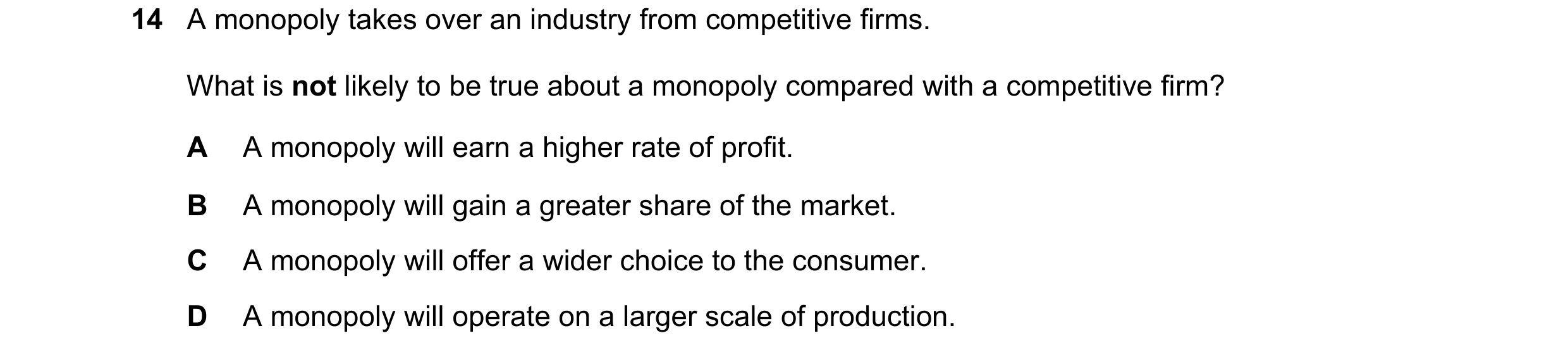



 9 / 16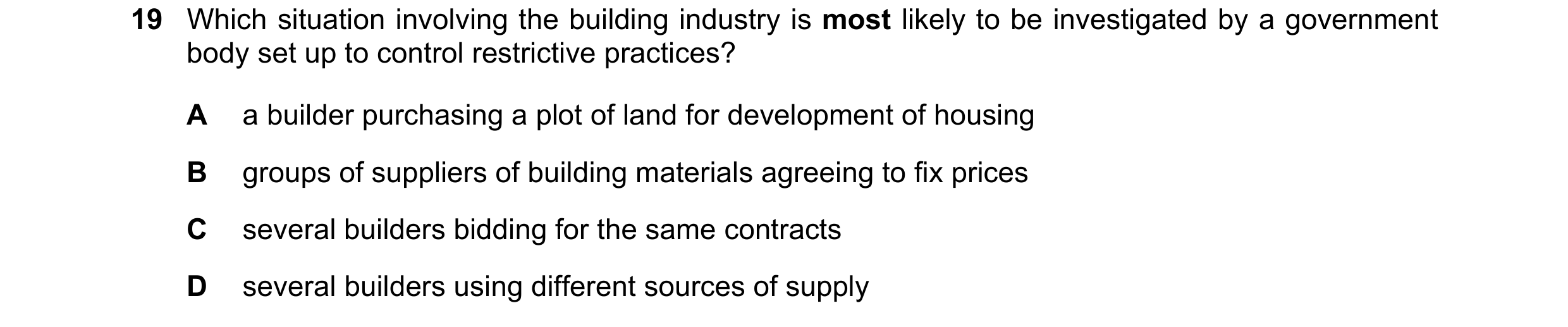


 10 / 16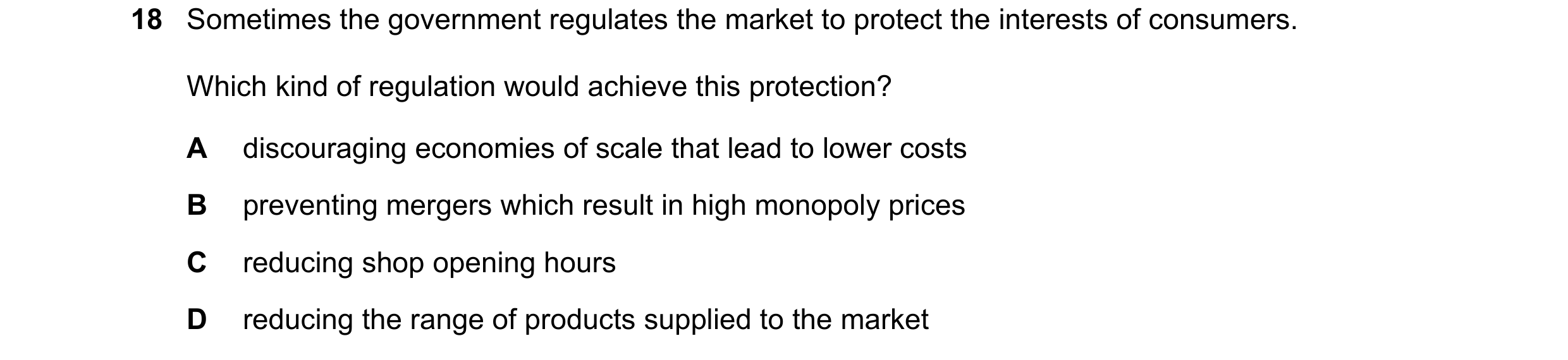

 11 / 16


 12 / 16


 13 / 16

 14 / 16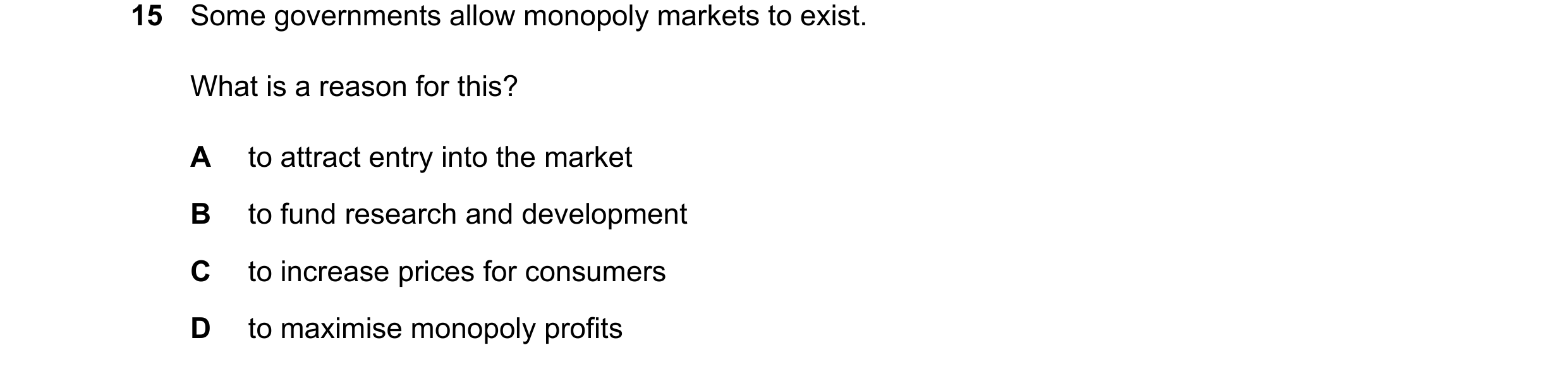
 15 / 16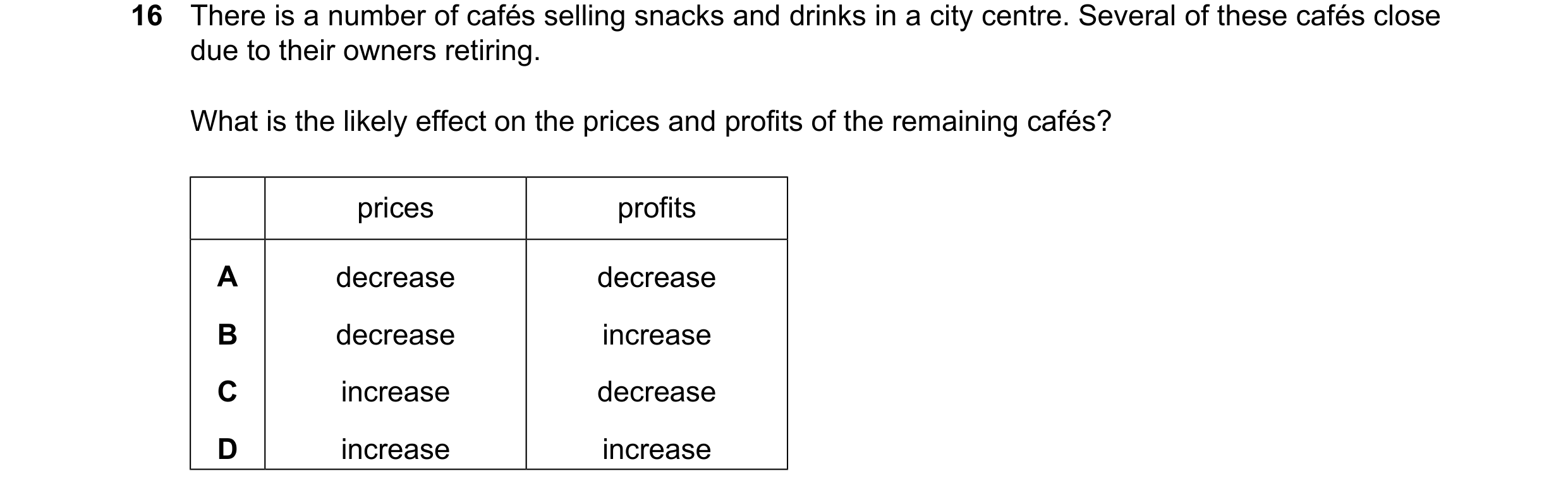

 16 / 16