Questions as text
Q1 · Relative to an origin O, the position vectors of the points A and B are given by 4 3 −−→… 9709/11 May/June 2007
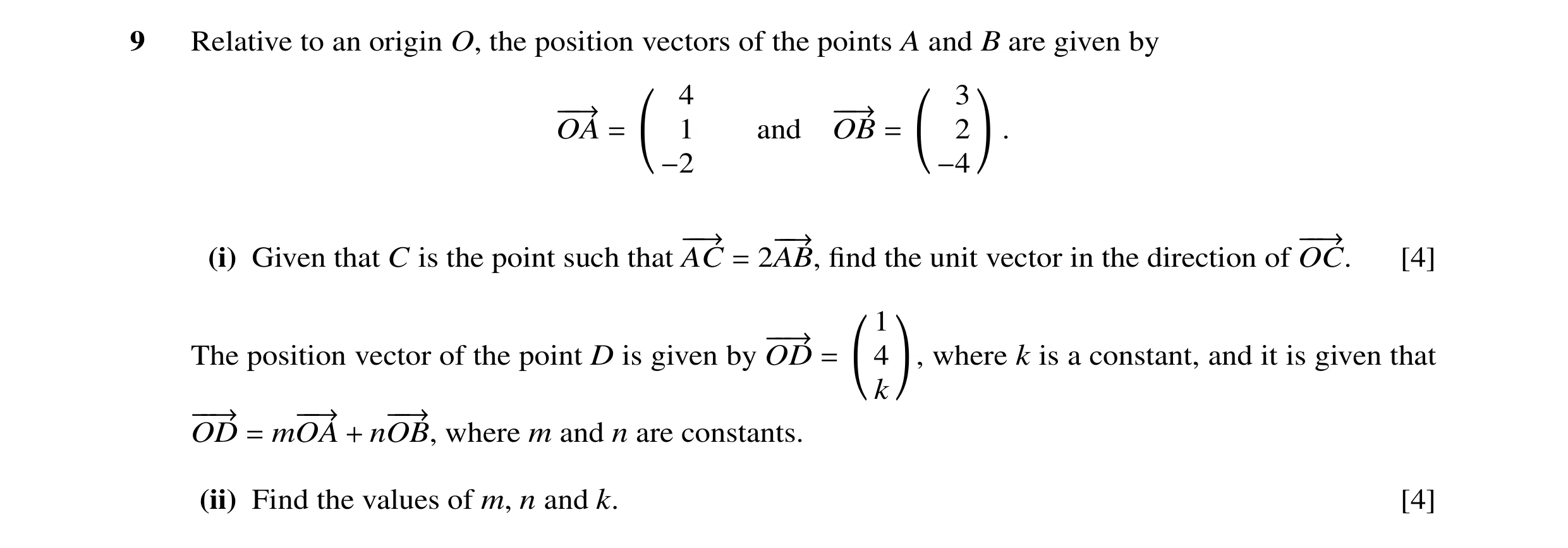
9 Relative to an origin O, the position vectors of the points A and B are given by 4 3 −−→ −−→ OA = 1 and OB = 2 . −2 −4 −−→ −−→ (i) Given that C is the point such that AC = 2−−→AB, find the unit vector in the direction of OC. [4] 1 −−→ The position vector of the point D is given by OD = 4 , where k is a constant, and it is given that k −−→ OD = m−−→OA + n−−→OB, where m and n are constants. (ii) Find the values of m, n and k. [4]
8 marks
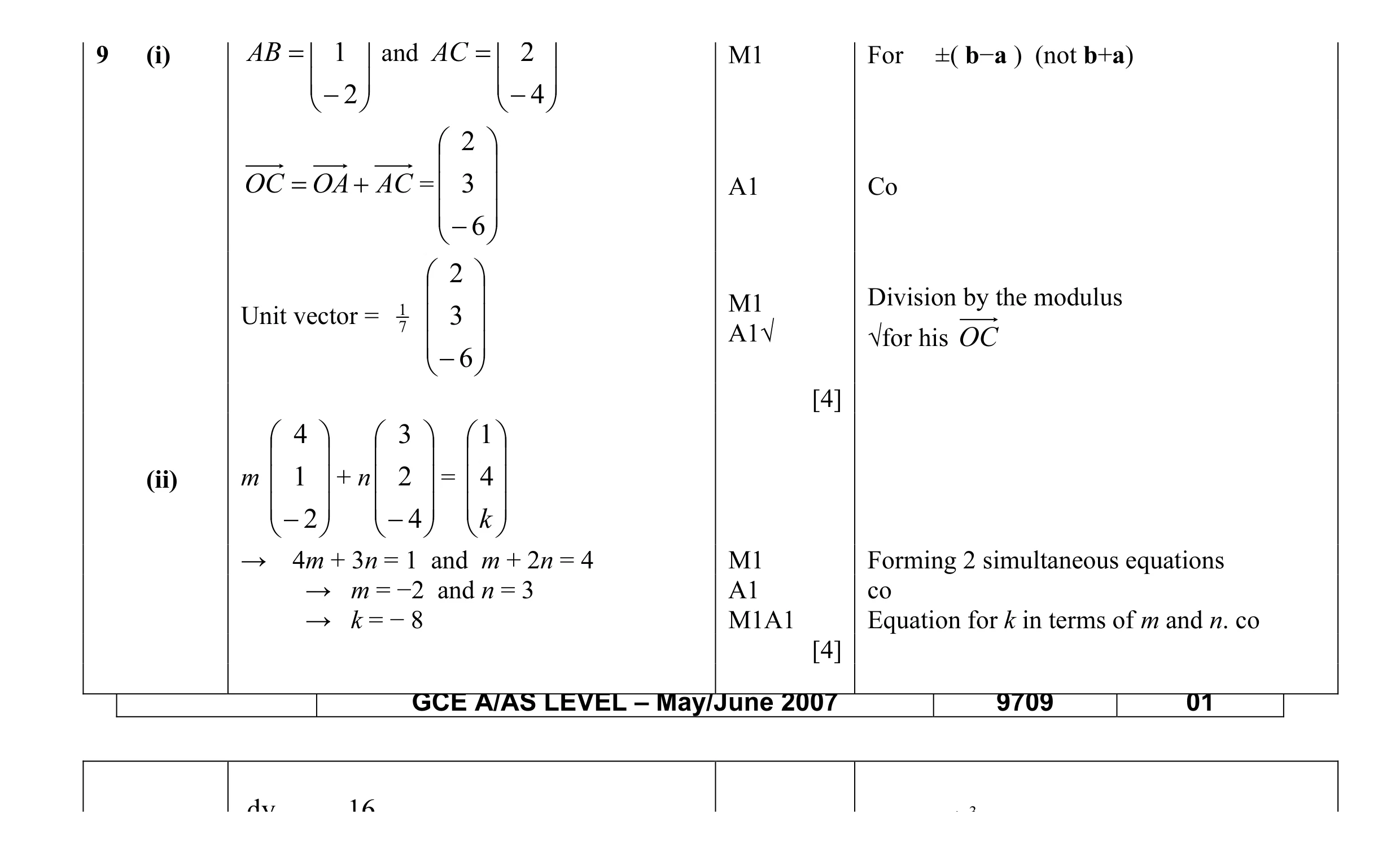
Mark scheme: 9 (i) AB = 1 and AC = 2 M1 For ±( b−a ) (not b+a) − 2 − 4 2 OC = OA + AC = 3 A1 Co −6 2 M1 Division by the modulus 1 Unit vector = 7 3 A1√ √for his OC −6 [4] 4 3 1 m (ii) 1 + n 2 = 4 −2 −4 k → 4m + 3n = 1 and m + 2n = 4 M1 Forming 2 simultaneous equations → m = −2 and n = 3 A1 co → k = − 8 M1A1 Equation for k in terms of m and n. co [4] GCE A/AS LEVEL – May/June 2007 9709 01 dy 16 3 /
This question in 9709/11 May/June 2007
Q2 · Relative to an origin O, the position vectors of the points A and B are given by −−→ −−→… 9709/11 May/June 2009
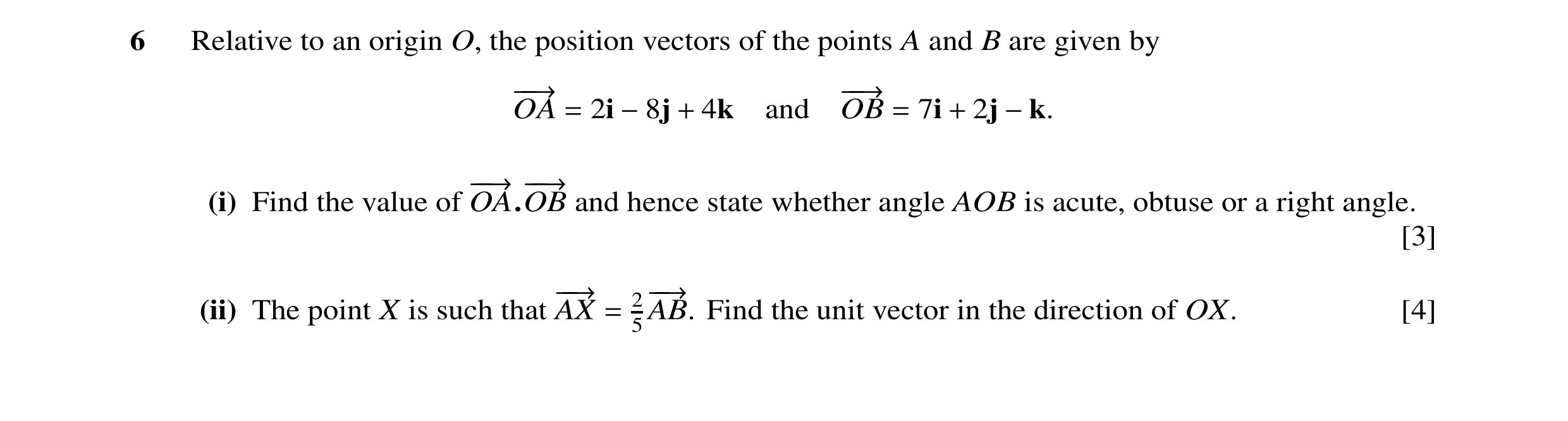
6 Relative to an origin O, the position vectors of the points A and B are given by −−→ −−→ OA = 2i −8j + 4k and OB = 7i + 2j −k. −−→ (i) Find the value of OA.−−→OB and hence state whether angle AOB is acute, obtuse or a right angle. [3] −−→ 2 −−→ (ii) The point X is such that AX = AB. Find the unit vector in the direction of OX. [4] 5
7 marks
Mark scheme: 6 (i) OA.OB = 14 − 16 − 4 = −6 M1 A1 Must be scalar from correct method. This is −ve → Obtuse angle. B1√ co. Correct deduction from his scalar. [3] (ii) AB = 5i + 10j − 5k AX = 2 (AB) 5 OX = OA + AX M1 Needs AB and OX attempting. OX = 4i − 4j + 2k A1 co Divides by the modulus M1 Must finish with a vector, not a scalar. Unit vector = 1 (4i − 4j + 2k) A1√ Correct for his OX. 6 [4]
This question in 9709/11 May/June 2009
Q3 · G F Q D E C B k j P O A i In the diagram, OABCDEFG is a cube in which each side has… 9709/12 Oct/Nov 2009
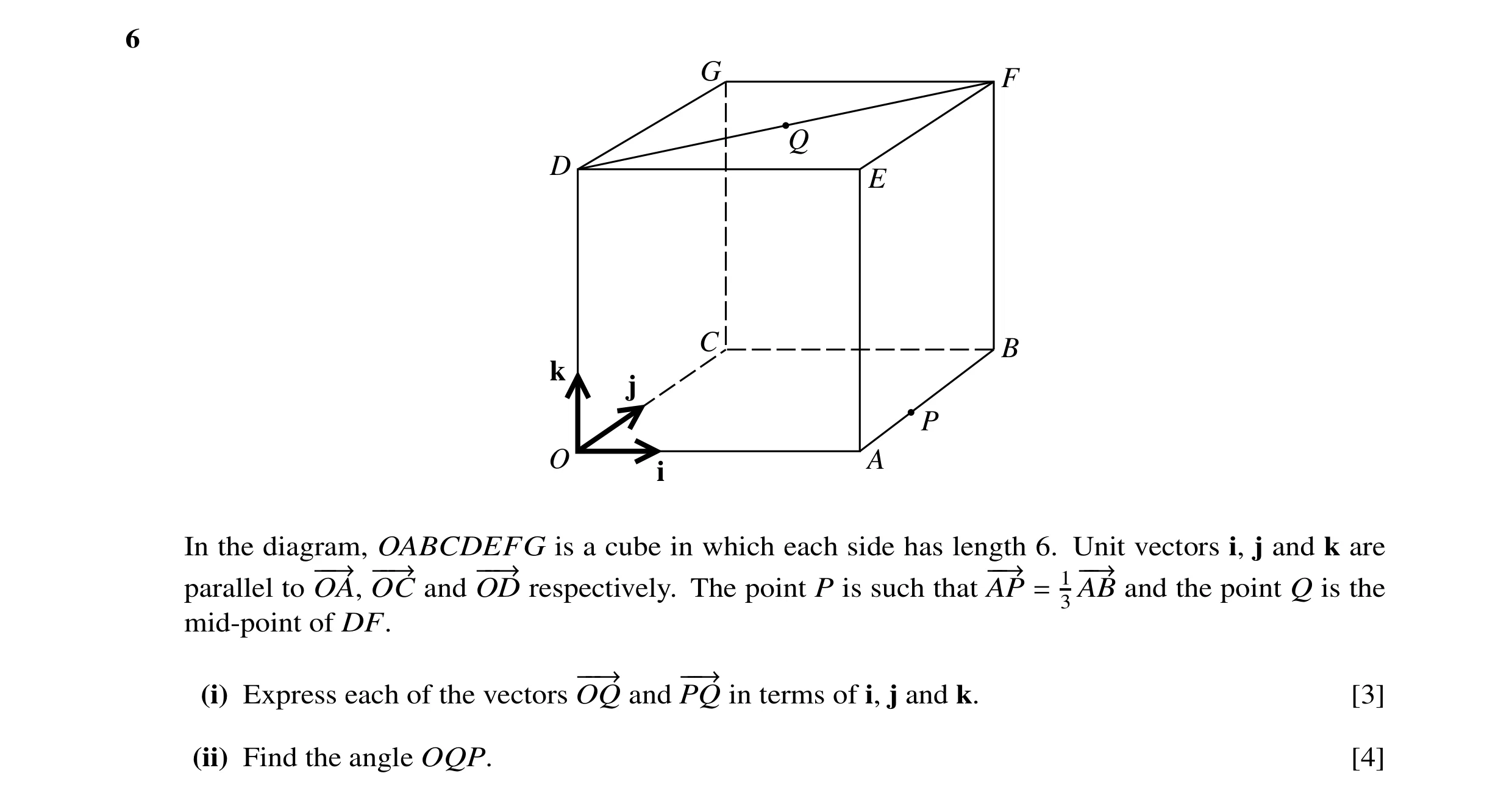
6 G F Q D E C B k j P O A i In the diagram, OABCDEFG is a cube in which each side has length 6. Unit vectors i, j and k are parallel to −−→OA, −−→OC and −−→OD respectively. The point P is such that −−→AP 1 −−→AB and the point Q is the = 3 mid-point of DF. (i) Express each of the vectors −−→OQ and −−→PQ in terms of i, j and k. [3] (ii) Find the angle OQP. [4]
7 marks
Mark scheme: 6 (i) OQ = 3i + 3j + 6k B1 co PQ = −3i + j + 6k B2, 1 Loses one for each error. [3] (ii) (3i + 3j + 6k).( −3i + j + 6k) = −9 + 3 + 36 = 30 M1 Use of x1x2 + y1y2 + z1z2 co. 30 = √54√46cosθ M1 Correct method for modulus (once) and all θ = 53.0º M1A1 correctly linked. co. [4] Cosine rule M1 modulus nb QO .QP can gain 4/4. M1 attempt at 3 sides but OQ . PO can only gain 3/4. M1 A1 answer. Use of other vectors (e.g. OP .OQ ) M3 ok.
This question in 9709/12 Oct/Nov 2009
Q4 · Relative to an origin O, the position vectors of the points A and B are given by −2 4 −−→… 9709/12 May/June 2010
5 Relative to an origin O, the position vectors of the points A and B are given by −2 4 −−→ −−→ OA = 3 and OB = 1 . 1 ! p ! −−→ −−→ (i) Find the value of p for which OA is perpendicular to OB. [2] −−→ (ii) Find the values of p for which the magnitude of AB is 7. [4]
6 marks
Mark scheme: g : x a 5 x + 3 . (i) Turning point at x = 1. M1 Calculus or completing the square etc. Range is Y 2. A1 Condone < instead of Y. [2] (ii) gf(x) = 5( 4 x −x2 2 ) + 3 B1 For putting f into g. = k and use of b 2 − 4 ac M1 Setting to k, using b 2 − 4 ac → k = 13 A1 co [3] 4 Gradient of L1 is 13 . Equation of L1 is y − 3 = 13 ( x + )1 M1 A1 M1 for equation for his m. A1 co. Gradient of AB is − 12 . Perp = 2. M1 Use of m1 m2 = −1 Equation of L2 is y − 1 = 2 ( x − 3) . A1 co
This question in 9709/12 May/June 2010
Q5 · Relative to an origin O, the position vectors of the points A, B and C are given by −−→OA… 9709/13 May/June 2010
6 Relative to an origin O, the position vectors of the points A, B and C are given by −−→OA i 4k, −−→OB 3i 2j 8k, −−→OC 10k. = −2j + = + + = −i −2j + (i) Use a scalar product to find angle ABC. [6] (ii) Find the perimeter of triangle ABC, giving your answer correct to 2 decimal places. [2]
8 marks
Mark scheme: 6 OA = i – 2j + 4k, OB = 3i + 2j + 8k, OC = –i – 2j + 10k (i) (±) 2i + 4j + 4k B1 co (±) 4i + 4j – 2k B1 co M1 Needs to be scalar. AB.CB = 16 M1 For product of 2 moduli and cosine AB.CB = 36 36 cos θ θ = 63 6. ° M1 A1 All correct. [6] (ii) Perimeter = 6 + 6 + 40 M1 Correct overall method for perimeter. or 6 + 6 + 6 sin 318.° × 2 → 18.32 A1 co [2] 6
This question in 9709/13 May/June 2010
Q6 · P G F 10 cm 6 cm 6 cm D C E B a cm k j 10 cm O i 10 cm A The diagram shows a pyramid… 9709/12 Oct/Nov 2010
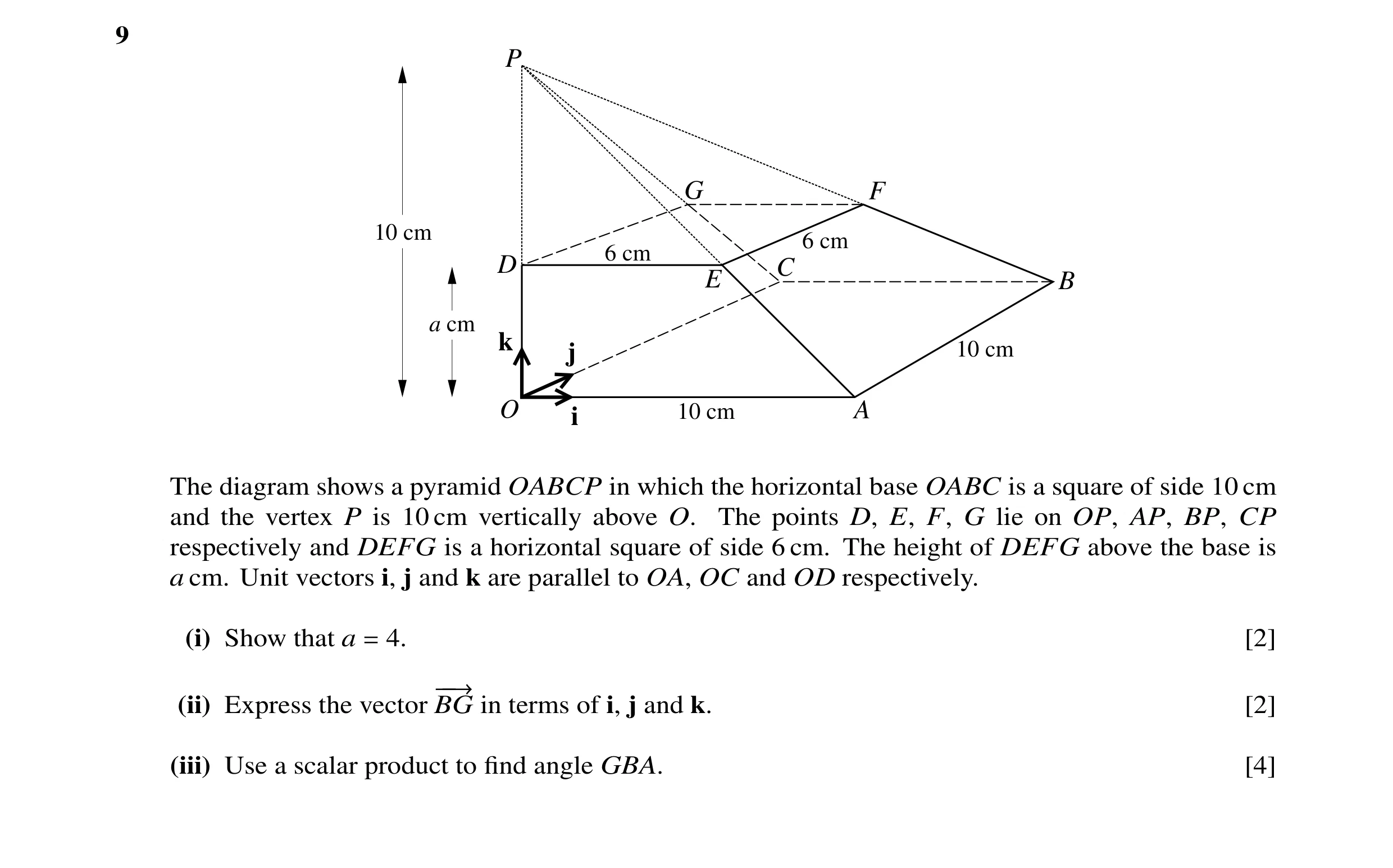
9 P G F 10 cm 6 cm 6 cm D C E B a cm k j 10 cm O i 10 cm A The diagram shows a pyramid OABCP in which the horizontal base OABC is a square of side 10 cm and the vertex P is 10 cm vertically above O. The points D, E, F, G lie on OP, AP, BP, CP respectively and DEFG is a horizontal square of side 6 cm. The height of DEFG above the base is a cm. Unit vectors i, j and k are parallel to OA, OC and OD respectively. (i) Show that a = 4. [2] (ii) Express the vector −−→BG in terms of i, j and k. [2] (iii) Use a scalar product to find angle GBA. [4]
8 marks
Mark scheme: 10 a 6 9 (i) = oe M1 or PDE is isos hence PD = 6 (M1) 10 10 a = 4 A1 AG [2] (ii) BG = –10j – 10i + 4k + 6j B2,1 Any acceptable notation. Loses 1 for = –10i – 4j + 4k each error. [2] (iii) BG.BA = 40 M1 Use of x1 x 2 + y1 y 2 + z1 z 2 40 cos GBA = M1 Modulus worked correctly for either 132 100 DM1 All ok – must be using ± BG . ± AB . GBA = 69.6° A1 Must be the acute angle [4] GCE AS/A LEVEL – October/November 2010 9709 12 8
This question in 9709/12 Oct/Nov 2010
Q7 · B A C O The diagram shows triangle OAB, in which the position vectors of A and B with… 9709/13 Oct/Nov 2010
10 B A C O The diagram shows triangle OAB, in which the position vectors of A and B with respect to O are given by −−→ −−→ OA = 2i + j −3k and OB = −3i + 2j −4k. −−→ C is a point on OA such that OC = p−−→OA, where p is a constant. (i) Find angle AOB. [4] −−→ (ii) Find BC in terms of p and vectors i, j and k. [1] (iii) Find the value of p given that BC is perpendicular to OA. [4]
9 marks
Mark scheme: 10 (i) OA.OB = –6 + 2 + 12 = 8 M1 Use of x1x2 + y1y2 + z1z2 8 cos AOB = M1 Mod worked correctly for either one 14 29 M1 Division of “8” by product of mods AOB = 66.6° A1 [4] (ii) 3i – 2j + 4k + p(2i + j – 3k) B1 In any unsimplified form [1] (iii) BC = i(3 + 2p) + j(–2 + p) + k(4 – 3p) M1 Their BC .[2i + j – 3k] = 0 M1 Scalar product = 0 used 2(3 + 2p) + (p – 2) – 3(4 – 3p) = 0 A1√ ft from their BC p = 4/7 0.571 A1 cao [4] 3 8
This question in 9709/13 Oct/Nov 2010
Q8 · Q B R S 5 cm P C 6 cm k 2 cm j A D i 6 cm The diagram shows a prism ABCDPQRS with a… 9709/11 May/June 2011
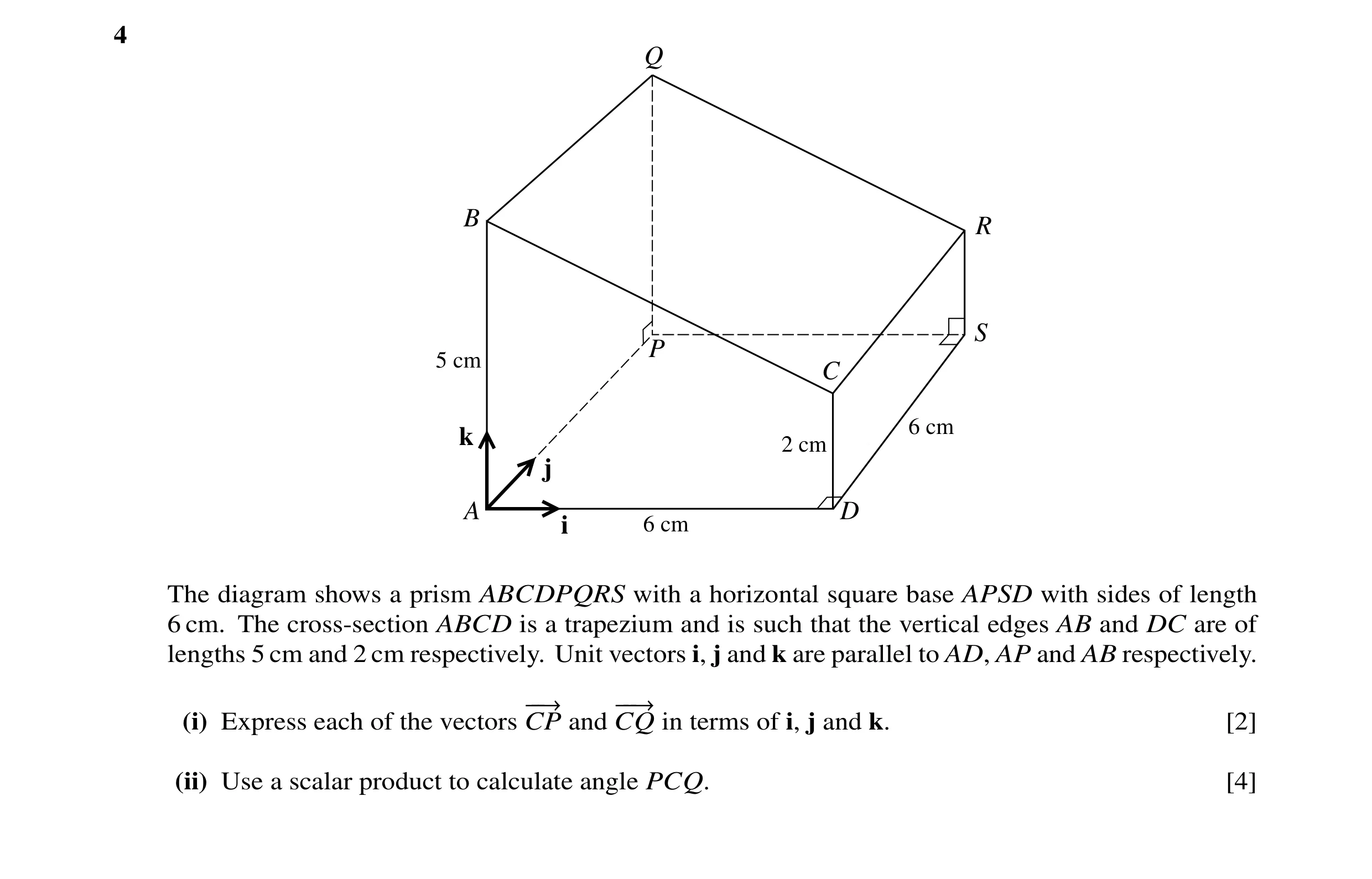
4 Q B R S 5 cm P C 6 cm k 2 cm j A D i 6 cm The diagram shows a prism ABCDPQRS with a horizontal square base APSD with sides of length 6 cm. The cross-section ABCD is a trapezium and is such that the vertical edges AB and DC are of lengths 5 cm and 2 cm respectively. Unit vectors i, j and k are parallel to AD, AP and AB respectively. (i) Express each of the vectors −−→CP and −−→CQ in terms of i, j and k. [2] (ii) Use a scalar product to calculate angle PCQ. [4]
6 marks
Mark scheme: B14 (i) CP = ‒6i + 6j ‒2k CQ = ‒6i + 6j + 3k B1 [2] (ii) Scalar product = 36 + 36 ‒ 6 M1 Use of x1 x 2 + y1 y 2 + z1 z 2 66 = |CP | |CQ | cos θ M1 Linking everything correctly |CP | = 76 , |CQ | = 81 M1 Correct magnitude for either Angle PCQ = 32.7° (or 0.571 rad) A1 cao 147.3° converted to 32.7° gets A0 [4] GCE AS/A LEVEL – May/June 2011 9709 11 2 sin 2 θ sin 2 θ M1 E ti f ti f i θ
This question in 9709/11 May/June 2011
Q9 · Relative to an origin O, the point A has position vector 4i + 7j −pk and the point B has… 9709/11 Oct/Nov 2011
8 Relative to an origin O, the point A has position vector 4i + 7j −pk and the point B has position vector 8i −j −pk, where p is a constant. (i) Find −−→OA.−−→OB. [2] (ii) Hence show that there are no real values of p for which OA and OB are perpendicular to each other. [1] (iii) Find the values of p for which angle AOB = 60◦. [4]
7 marks
Mark scheme: x1 x 2 + y1 y 2 + z1 z 2 28 (i) (4i + 7 j − pk ). (8i − j − pk ) = 25 + p M1A1 [2] 2 (Not 25 + (− p ) ) 2 Ft provided equation has no real (ii) 25 + p = 0 ⇒ no real solutions B1√ [1] solutions OA.OB (iii) cos 60 = used M1 OA.OB must be scalar OA OB Not 65 − p 2 OA = 65 + p 2 or OB = 65 + p 2 M1 unless follows 65 + (− p ) 2 25 + p 2 1 his scalar (i ) 1 Scalar product = 25 + p 2 can score = or = A1√ 2 2 65 + p 2 65 + p 2 here if not scored in part (i) p = ± .387 or ± 15 A1 [4] 2 2 ( )
This question in 9709/11 Oct/Nov 2011
Q10 · Relative to an origin O, the position vectors of points A and B are given by −−→OA 5i j… 9709/12 Oct/Nov 2011
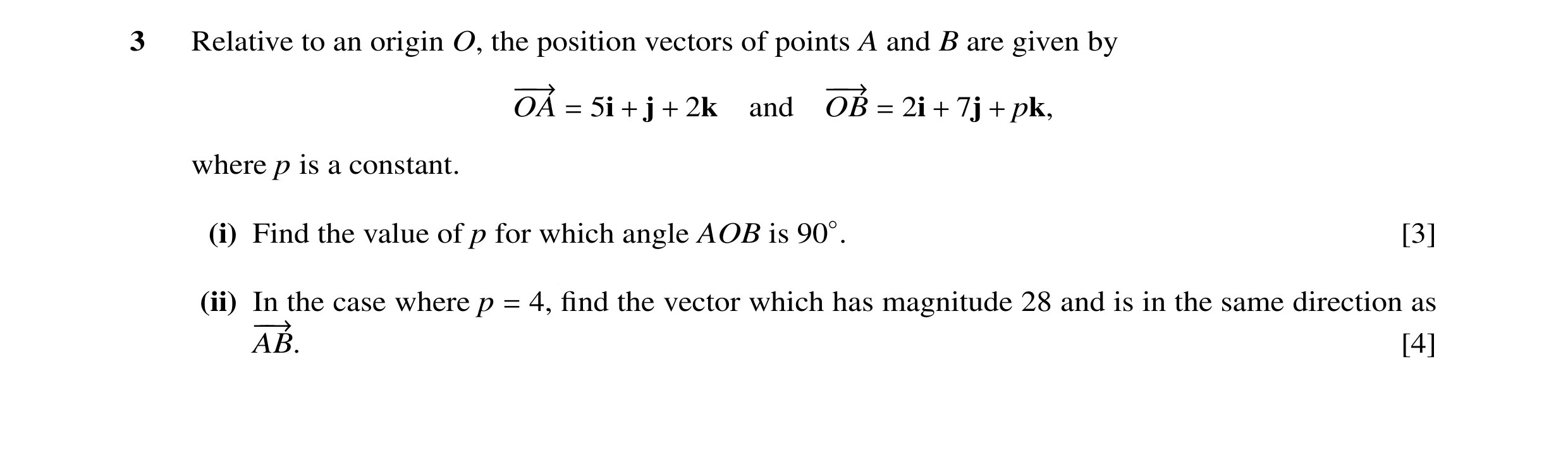
3 Relative to an origin O, the position vectors of points A and B are given by −−→OA 5i j 2k and −−→OB 2i 7j pk, = + + = + + where p is a constant. (i) Find the value of p for which angle AOB is 90◦. [3] (ii) In the case where p = 4, find the vector which has magnitude 28 and is in the same direction as −−→AB. [4]
7 marks
Mark scheme: 3 OA = 5i + j + 2k , OB = 2 i + 7 j + pk M1 Use of x1x2 + y1y2 + z1z2 (i) OA. OB = 10 + 7 + 2p DM1 … =0 = 0 → p = − 8½ A1 co [3] (ii) AB = −3i + 6j + 2k B1 co (accept negative) Modulus = √(9+36+4) M1 For modulus Magnitude 28 → 28 ×unit vector M1 Scales by ×28 ÷ modulus. → −12i + 24j + 8k. A1 Co – could leave as “4 × …”. [4]
This question in 9709/12 Oct/Nov 2011
Q11 · Relative to an origin O, the position vectors of points A and B are 3i + 4j −k and 5i −2j… 9709/13 Oct/Nov 2011
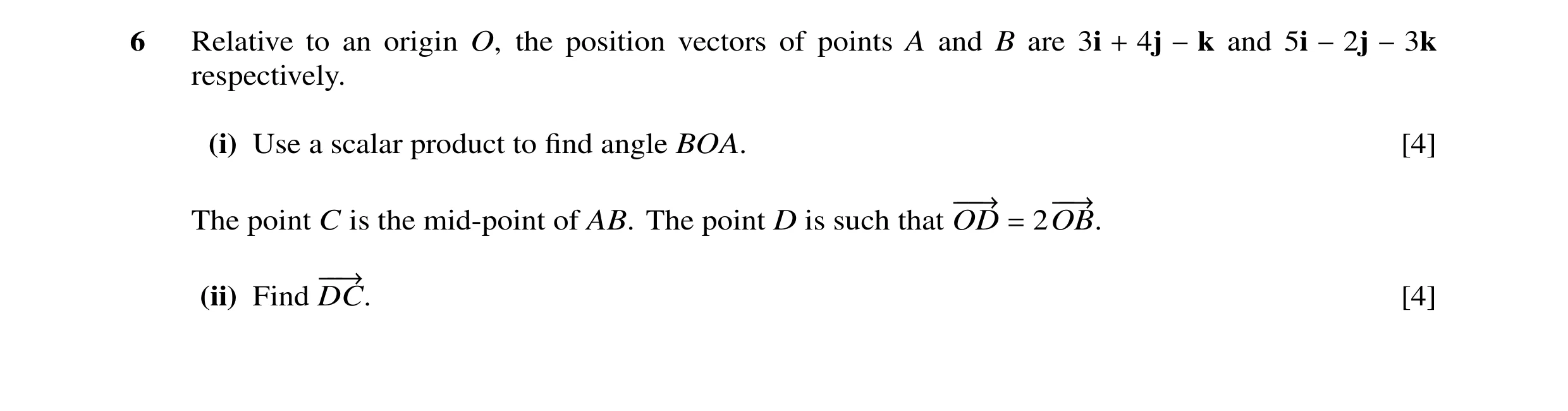
6 Relative to an origin O, the position vectors of points A and B are 3i + 4j −k and 5i −2j −3k respectively. (i) Use a scalar product to find angle BOA. [4] The point C is the mid-point of AB. The point D is such that −−−→OD 2−−→OB. = (ii) Find −−→DC. [4]
8 marks
Mark scheme: 6 (i) Scalar product = 15‒8+3 M1 Use of x1x2 + y1y2 + z1z2 10 = |OA| |OB| cos θ M1 Correct magnitude for either |OA| = √26, |OB| = √38 M1 Linking everything correctly Angle BOA = 71.4 or 71.5 A1 cao or 1.25 radians [4] (ii) a+½(b–a) or b+½(a–b) or ½(a+b) M1 –2b + their c oe M1 –6i + 5j + 4k A2,1,0 [4]
This question in 9709/13 Oct/Nov 2011
Q12 · P 2 6 Two vectors u and v are such that u and v p where p is a constant 9709/11 May/June 2012
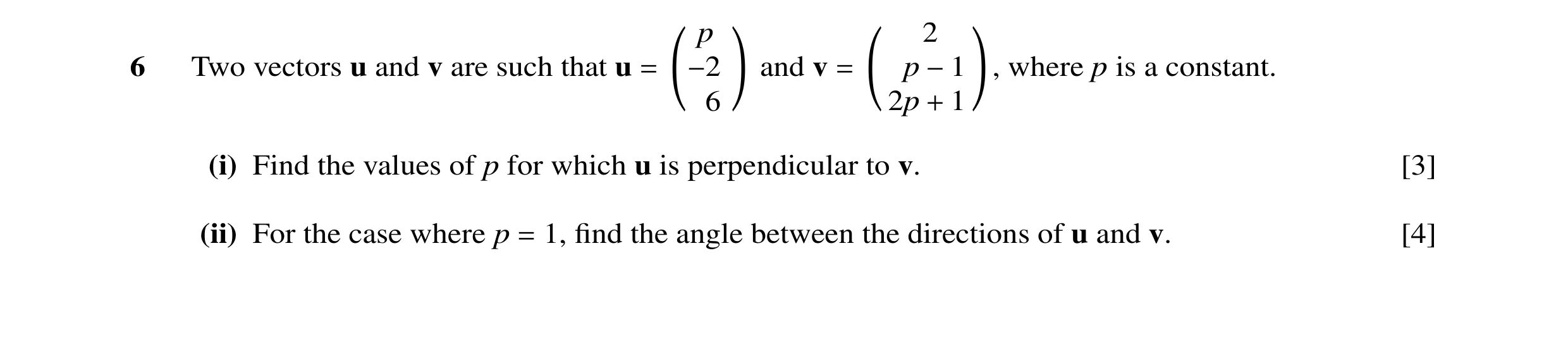
p 2 6 Two vectors u and v are such that u and v p where p is a constant. = −26 ! = 2p −11 !, + (i) Find the values of p for which u is perpendicular to v. [3] (ii) For the case where p 1, find the angle between the directions of u and v. [4] =
7 marks
Mark scheme: 6 (i) 2 p 2 − 2 p + 2 + 12 p + 6 → 2 p 2 + 10 p + 8 M1 Correct method for scalar product u.v = 0 B1 Scalar product = 0 ( p + 1)( p + 4 ) = 0 → p = −1 or p = −4 A1 cao Both solutions required [3] (ii) u.v = 2 + 0 + 18 = 20 M1 Use of x1 x 2 + y1 y 2 + z1 z 2 │u│ = 41 or │v│ = 13 M1 Correct method for moduli 20 = 41 × 13 × cos θ oe M1 All connected correctly θ = 300.° or 0.523 rads A1 cao [4] 10
This question in 9709/11 May/June 2012
Q13 · Find the angle between the vectors 3i and 2i 3j [4] −4k + −6k 9709/12 May/June 2012
8 (i) Find the angle between the vectors 3i and 2i 3j [4] −4k + −6k. The vector −−→OA has a magnitude of 15 units and is in the same direction as the vector 3i The −4k. vector −−→OB has a magnitude of 14 units and is in the same direction as the vector 2i 3j + −6k. (ii) Express −−→OA and −−→OB in terms of i, j and k. [3] (iii) Find the unit vector in the direction of −−→AB. [3] [Questions 9 and 10 are printed on the next page.]
10 marks
Mark scheme: 8 (i) 3i − 4k, 2i + 3j − 6k. Dot product = 6 + 24 = 30 M1 Uses x1x2 + y1y2 + z1z2 = 25 × 49 cos θ M1 Method for modulus → angle = 31º or 0.54(1) radians. M1 A1 Links everything correctly. co [4] (ii) OA = (3i − 4k) × (15 ÷ 5) → 9i − 12k M1 A1 M mark for ×(15 ÷ 5) or ×(14 ÷ 7) OB = (2i + 3j − 6k) × (14 ÷ 7) A1 for OA → 4i + 6j − 12k. A1 A1 for OB [3] (iii) AB = b − a = −5i + 6j M1 Correct use for either AB or BA → Magnitude of 61 or 7.81 M1 Complete method for unit vector. A1 co → Unit vector of (−5i + 6j) ÷ 61 [3] 2
This question in 9709/12 May/June 2012
Q14 · The position vectors of the points A and B, relative to an origin O, are given by 1 k −−→… 9709/12 Oct/Nov 2012
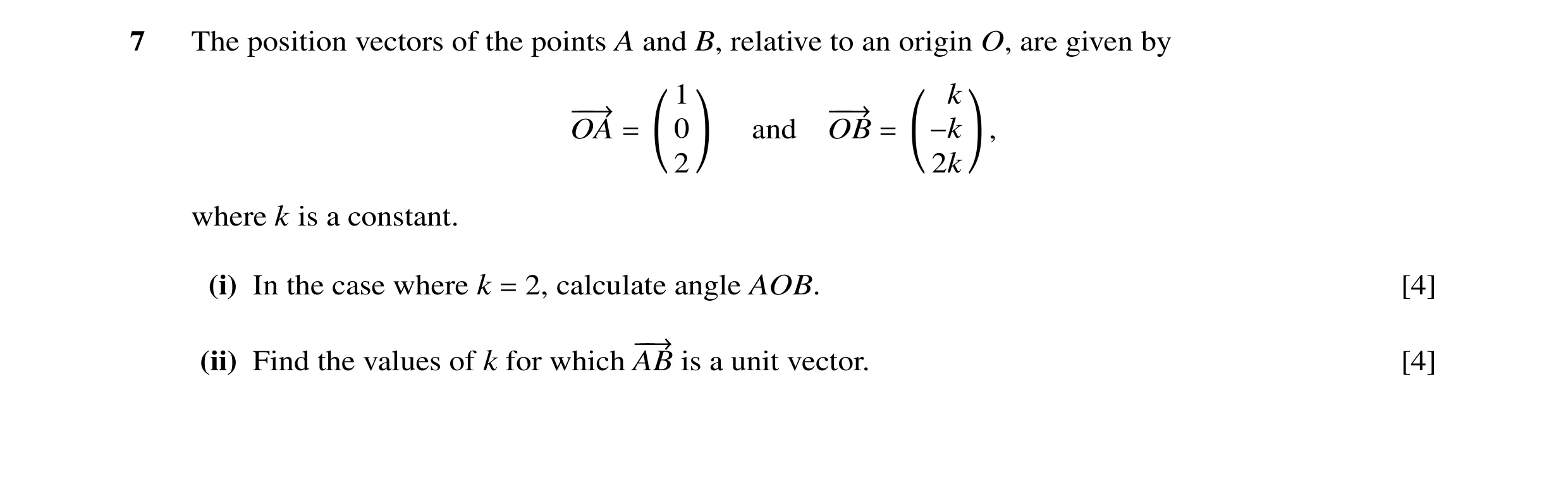
7 The position vectors of the points A and B, relative to an origin O, are given by 1 k −−→ −−→ OA = 0 ! and OB = −k !, 2 2k where k is a constant. (i) In the case where k = 2, calculate angle AOB. [4] −−→ (ii) Find the values of k for which AB is a unit vector. [4]
8 marks
Mark scheme: 1 7 2 a x −x Term in x5 is 7C3 × (x²)4 × (−a/x)³ B1 Allow on own or in an expansion. This term isolated M1 Correct term in x5 selected. Equated to −280 → a = 2. A1 Equated to −280 [3] 2 x + 3 (i) f(x) = + 1 , for x ≥ −3 2 M1 Attempt at x as subject and removes +1 Make x the subject or interchanges x,y M1 Squares both sides and deals with "+3" 2
This question in 9709/12 Oct/Nov 2012
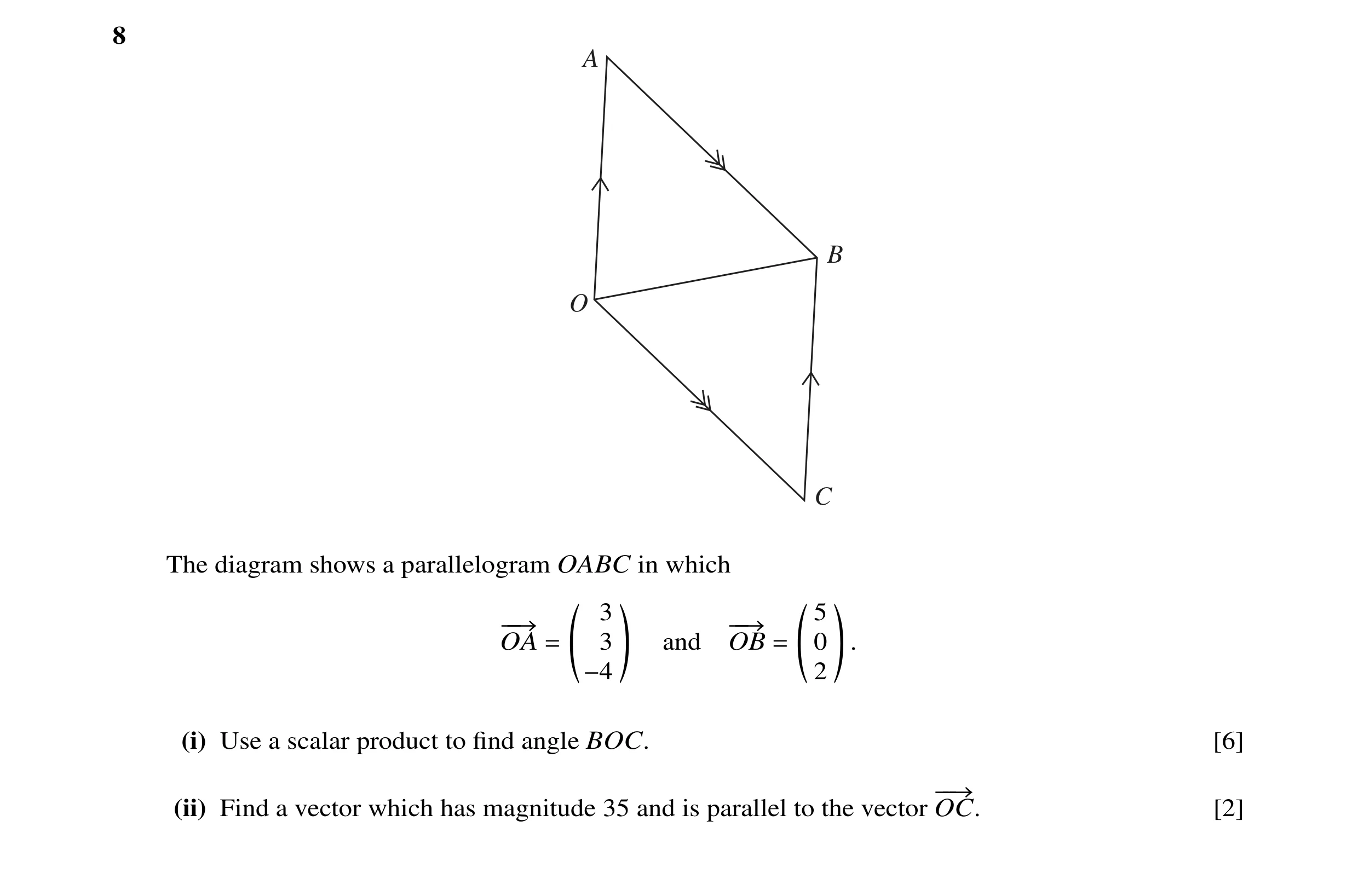
Q15 · A B O C The diagram shows a parallelogram OABC in which ` a ` a 3 5 −−→ −−→ OA = 3 and OB… 9709/13 May/June 2013
8 A B O C The diagram shows a parallelogram OABC in which ` a ` a 3 5 −−→ −−→ OA = 3 and OB = 0 . −4 2 (i) Use a scalar product to find angle BOC. [6] −−→ (ii) Find a vector which has magnitude 35 and is parallel to the vector OC. [2]
8 marks
Mark scheme: 8 3 5 OA = 3 and OB = 0 . − 4 2 2 (i) OC = AB = b − a = − 3 M1 Knowing how to find OC 6 Uses OC and OB B1 Using OC.OB or CO.BO OC.OB = 22 = 7 × √29 cos BOC M1 M1 M1 Use of x1x2 + ... M1 for modulus → Angle BOC = 54.3⁰ (or 0.948 rad) M1 A1 M1 everything linked. (nb uses BO.OC loses B1 A1) (nb uses other vectors – max [6] M1M1) GCE AS/A LEVEL – May/June 2013 9709 13 (ii) Modulus of OC = 7 M1 Knows to scale by factor of 35 ÷ Vector = 35 ÷ 7 × OC Mod 2 A1√ For their OC. → ± 5 − 3 6 [2]
This question in 9709/13 May/June 2013
Q16 · D 3 C B k E j 4 O i 6 A The diagram shows a pyramid OABCD in which the vertical edge OD… 9709/11 Oct/Nov 2013
3 D 3 C B k E j 4 O i 6 A The diagram shows a pyramid OABCD in which the vertical edge OD is 3 units in length. The point E is the centre of the horizontal rectangular base OABC. The sides OA and AB have lengths of 6 units −−→ −−→ −−→ and 4 units respectively. The unit vectors i, j and k are parallel to OA, OC and OD respectively. −−→ −−→ (i) Express each of the vectors DB and DE in terms of i, j and k. [2] (ii) Use a scalar product to find angle BDE. [4]
6 marks
Mark scheme: 3 (i) DB = 6i + 4j – 3k cao B1 DE = 3i +2j – 3k cao B1 [2] (ii) DB.DE = 18 + 8 + 9 = 35 M1 Use of x1 x 2 + y1 y 2 + z1 z 2 │DB│= √61 or │DE│= √22 M1 Correct method for moduli 35 = 61 × 22 × cos θ oe M1 All connected correctly θ = 17 2. ° (0.300 rad) cao A1 Use of e.g. BD. DE can score M [4] marks (leads to obtuse angle) 2 2 2 ( )
This question in 9709/11 Oct/Nov 2013
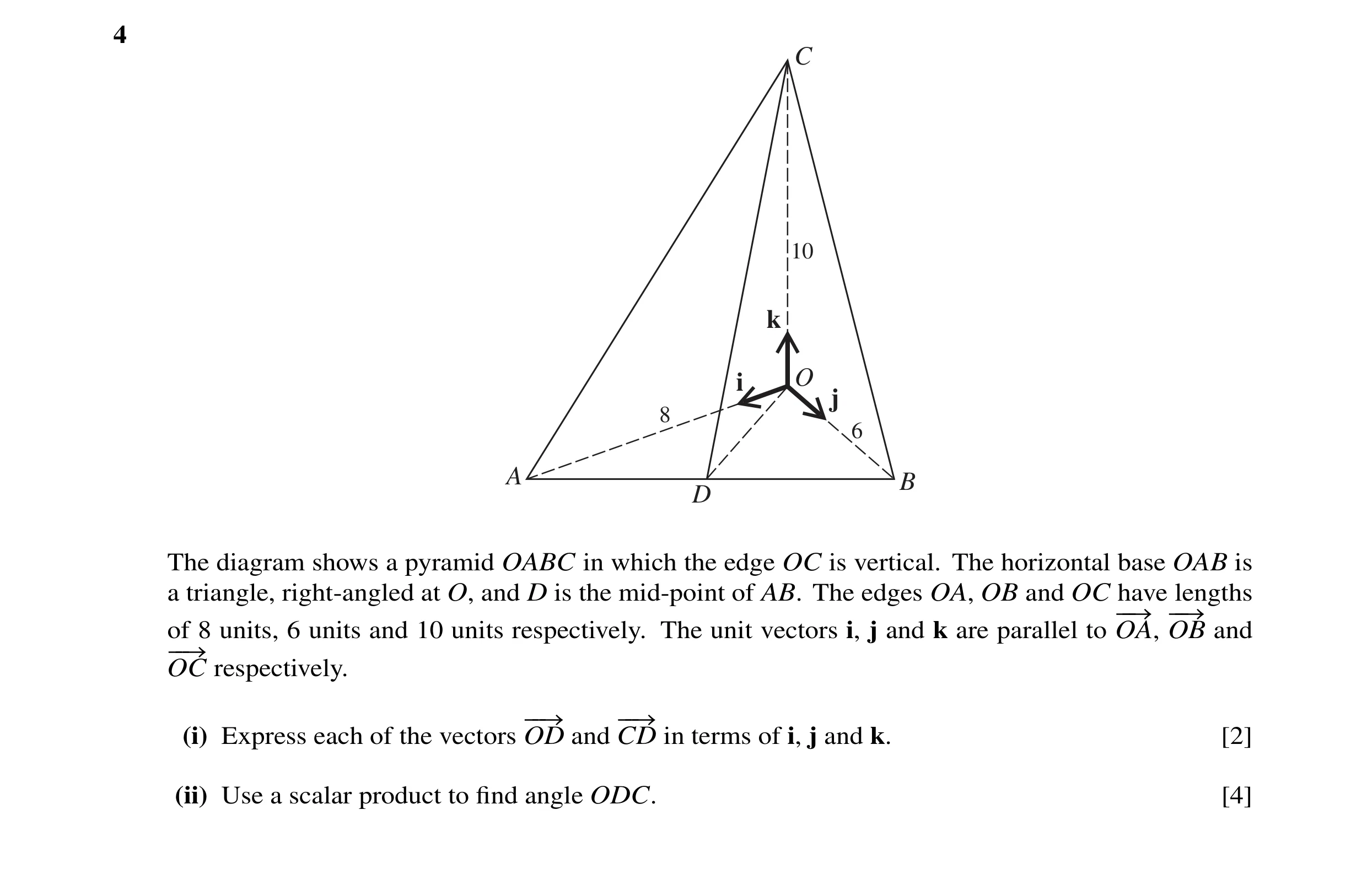
Q17 · C 10 k i O j 8 6 A B D The diagram shows a pyramid OABC in which the edge OC is vertical 9709/13 Oct/Nov 2013
4 C 10 k i O j 8 6 A B D The diagram shows a pyramid OABC in which the edge OC is vertical. The horizontal base OAB is a triangle, right-angled at O, and D is the mid-point of AB. The edges OA, OB and OC have lengths −−→ −−→ of 8 units, 6 units and 10 units respectively. The unit vectors i, j and k are parallel to OA, OB and −−→ OC respectively. −−→ −−→ (i) Express each of the vectors OD and CD in terms of i, j and k. [2] (ii) Use a scalar product to find angle ODC. [4]
6 marks
Mark scheme: 4 (i) OD = 4i + 3j B1 CD = 4i + 3j ‒10k B1 for OD – 10k [2] (ii) OD.CD = 9 + 16 = 25 M1 Use of x1 x2 + y1y2 + z1z2 │OD│= √25 or │CD│= √125 M1 Correct method for moduli 25 = 25 × 125 × cos θ oe M1 All connected correctly ODC = 63.4˚ (or 1.11 rads) A1 cao [4] a
This question in 9709/13 Oct/Nov 2013
Q18 · Relative to an origin O, the position vectors of points A and B are given by ` a ` a 3p… 9709/11 May/June 2014
8 Relative to an origin O, the position vectors of points A and B are given by ` a ` a 3p −p −−→ −−→ OA = 4 and OB = −1 . p2 p2 (i) Find the values of p for which angle AOB is 90Å. [3] −−→ (ii) For the case where p = 3, find the unit vector in the direction of BA. [3]
6 marks
Mark scheme: 8 (i) OA.OB = –3p2 – 4 + p4 soi M1 (p2 + 1)(p2 – 4) = 0 oe e.g. with substitution M1 Put = 0 (soi) and attempt to solve p = ±2 and no other real solutions A1 [3] 9 − 3 12 (ii) BA = 4 − − 1 = 5 M1 Reversed subtraction can score M1M1A0 9 9 0 BA = 12 2 + 5 2 = 13 and division by their 13 M1 12 1 Unit vector = 5 cao A1 13 0 [3] sin2 θ − (1 − cos θ )
This question in 9709/11 May/June 2014
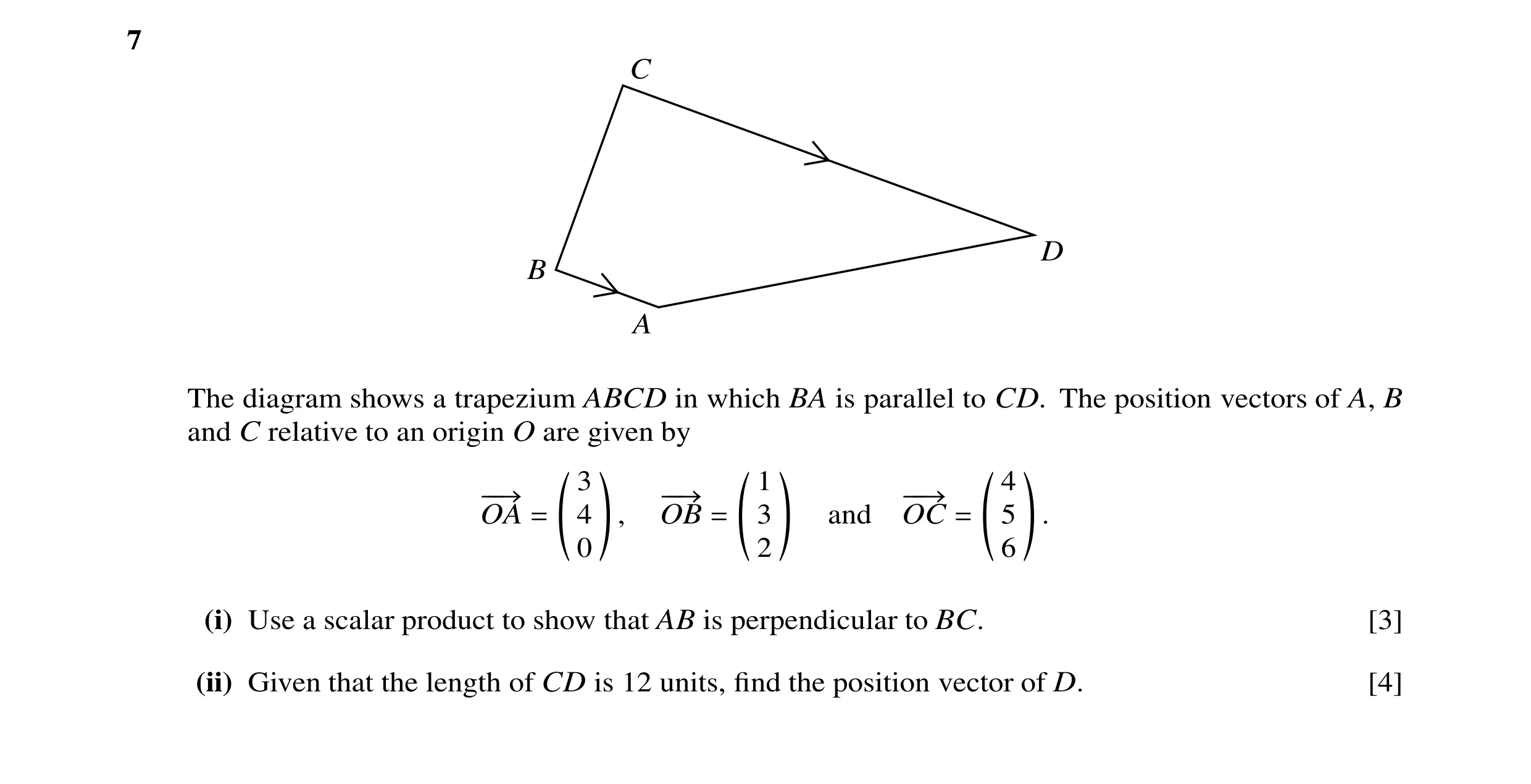
Q19 · C D B A The diagram shows a trapezium ABCD in which BA is parallel to CD 9709/12 May/June 2014
7 C D B A The diagram shows a trapezium ABCD in which BA is parallel to CD. The position vectors of A, B and C relative to an origin O are given by ` a ` a ` a −−→OA 34 , −−→OB 13 and −−→OC 45 . = = = 0 2 6 (i) Use a scalar product to show that AB is perpendicular to BC. [3] (ii) Given that the length of CD is 12 units, find the position vector of D. [4]
7 marks
Mark scheme: 7 (i) (b − a).(b − c) = − 1 . 2 M1 AB = b − a once (a – b is ok) M1 Use of x1x2... with AB and CB 2 4 → −6 − 2 + 8 = 0 → 90° A1 All correct [3] 2 (ii) Unit vector = ⅓ 1 M1 Method for unit vector. −2 8 CD = 12 × unit vector = ± 4 M1 Knows to multiply by 12 or ±4BA −8 12 OD = OC + CD = 9 M1 A1 Correct method. co [4] −2 d2 y
This question in 9709/12 May/June 2014
Q20 · The position vectors of points A, B and C relative to an origin O are given by ` a ` a `… 9709/13 May/June 2014
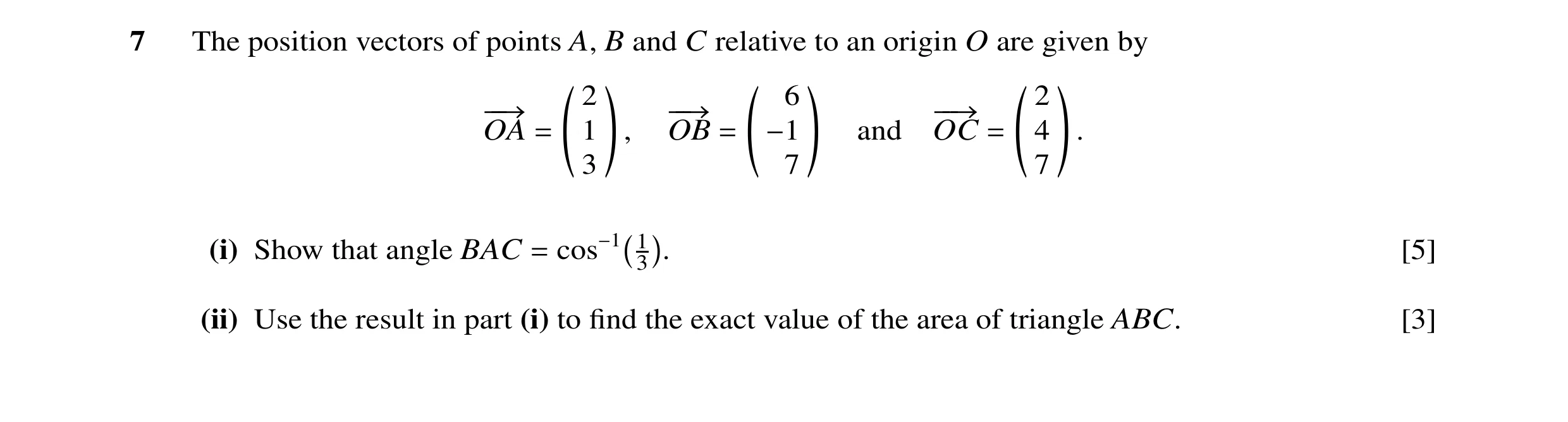
7 The position vectors of points A, B and C relative to an origin O are given by ` a ` a ` a 2 6 2 −−→ −−→ −−→ OA = 1 , OB = −1 and OC = 4 . 3 7 7 (i) Show that angle BAC = cos−1 1 . [5] 3 (ii) Use the result in part (i) to find the exact value of the area of triangle ABC. [3]
8 marks
Mark scheme: 7 (i) Angle BAC needs sides AB,AC or BA,CA AB.AC = (b − a).(c − a) Ignore their labels: 4 0 B1 One of AB, BA, AC, CA correct − 2 3 = . = 10 M1 Use of x₁x₂ + y₁y₂, etc. 4 4 = √36 × √25 cos BAC M1M1 M1 prod of moduli. M1 all linked → BAC = cos−1 1 AG A1 If e.g. BA.OC max B1M1M1. If both 3 vectors wrong 0 / 5. If e.g. BA.AC 1 final mark A0 used → cos–1 −3 [5] 1 (ii) sinBAC = 1− B1 Use of s² + c² = 1 − not decimals 9 1 8 Area = × 6 × 5 × = 5√8 oe M1 A1 Correct formula for area. Decimals seen A0 2 9 [3] 2 2
This question in 9709/13 May/June 2014
Q21 · Relative to an origin O, the position vector of A is 3i + 2j −k and the position vector… 9709/11 Oct/Nov 2014
6 Relative to an origin O, the position vector of A is 3i + 2j −k and the position vector of B is 7i −3j + k. (i) Show that angle OAB is a right angle. [4] (ii) Find the area of triangle OAB. [3]
7 marks
Mark scheme: 6 (i) AB or BA = ±[(7i − 3j + k) – (3i + 2j – k)]= M1A1 May be seen in part (ii) ±(4i − 5j + 2k) (AO.AB) = ±(12 – 10 – 2) [allow as column if total DM1 OR AB 2 = 45, AO 2 = 14, OB 2 = 59 given] = 0 hence OAB = 90° A1 Hence AB 2 + AO 2 = OB 2 [4] Hence OAB = 90º (ii) OA = 9 + 4 + 1 = 14 , AB = 16 + 25 + 4 = 45 B1 At least one magnitude correct in (i) or (ii) 3 70 Accept 12.6, oe 2 Area ∆ = 1 14 ( 45 ) = 12 5. M1A1 2 [3] a a a S 3 S A l 3 S
This question in 9709/11 Oct/Nov 2014
Q22 · X M 10 C B k D j 8 O i A The diagram shows a pyramid OABCX 9709/12 Oct/Nov 2014
7 X M 10 C B k D j 8 O i A The diagram shows a pyramid OABCX. The horizontal square base OABC has side 8 units and the centre of the base is D. The top of the pyramid, X, is vertically above D and XD = 10 units. The −−→ −−→ mid-point of OX is M. The unit vectors i and j are parallel to OA and OC respectively and the unit vector k is vertically upwards. −−→ −−→ (i) Express the vectors AM and AC in terms of i, j and k. [3] (ii) Use a scalar product to find angle MAC. [4]
7 marks
Mark scheme: 7 (i) AM = −6i + 2j + 5k B2,1 co −1 each error AC = −8i + 8j B1 co [3] (ii) AM.AC = 48 + 16 = 64 M1 Use of x1y1 + etc. with suitable vectors 64 = √128√65cosθ M1 M1 Product of moduli. Correct link. → θ = 45.4° A1 co [4]
This question in 9709/12 Oct/Nov 2014
Q23 · −−→ −−→ 7 Three points, O, A and B, are such that OA = i + 3j + pk and OB = −7i + 1 −p j… 9709/13 Oct/Nov 2014
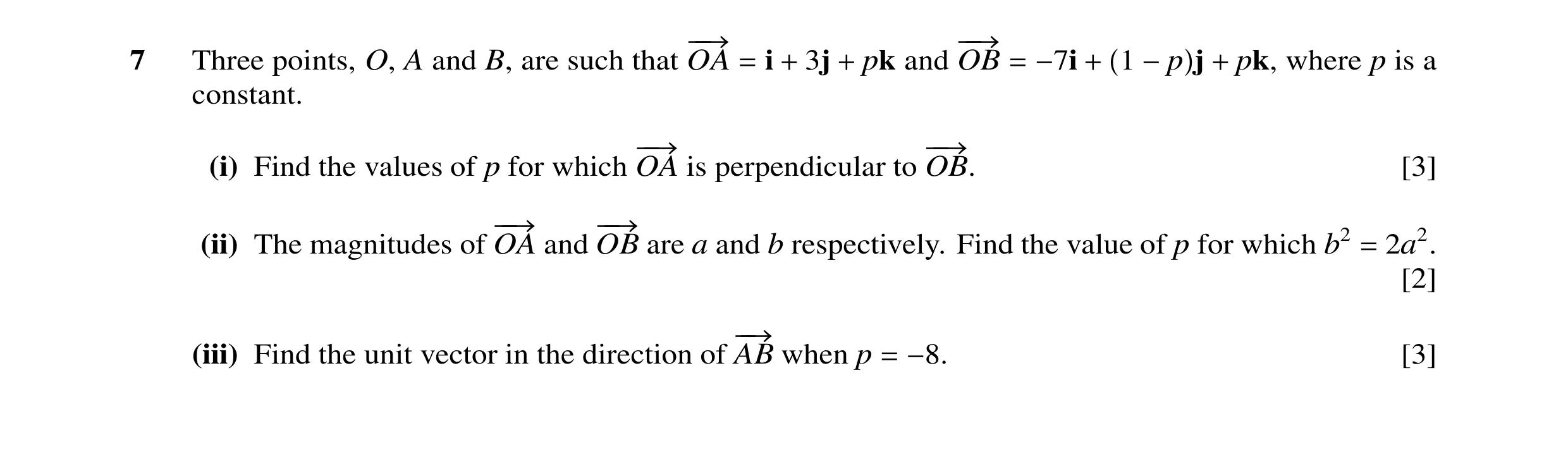
−−→ −−→ 7 Three points, O, A and B, are such that OA = i + 3j + pk and OB = −7i + 1 −p j + pk, where p is a constant. −−→ −−→ (i) Find the values of p for which OA is perpendicular to OB. [3] −−→ −−→ (ii) The magnitudes of OA and OB are a and b respectively. Find the value of p for which b2 = 2a2. [2] −−→ (iii) Find the unit vector in the direction of AB when p = −8. [3]
8 marks
Mark scheme: 7 (i) OA.OB = − 7 + 3 − 3 p + p 2 M1 Correct method for scalar product ( p + 1)( p − 4 ) = 0 DM1 Equate to zero & attempt to factorise/solve p = −1 or 4 A1 ‘= 0’ implied by answers [3] 2 2 (ii) 49 + (1 − p ) + p 2 = 2 (1 + 9 + p ) M1 Scalar result required p = 15 A1 [2] (iii) AB = −8i + 6j B1 p = 15 used – treat as MR Divide AB by│AB│ = (− 8 ) 2 + 6 2 = 10 soi − 8 M1 1 → − 17 1 Unit vector = (− 8i + 6 )j oe cao A1 353 0 10 [3]
This question in 9709/13 Oct/Nov 2014
Q24 · Relative to the origin O, the position vectors of points A and B are given by ` a ` a 3 6… 9709/11 May/June 2015
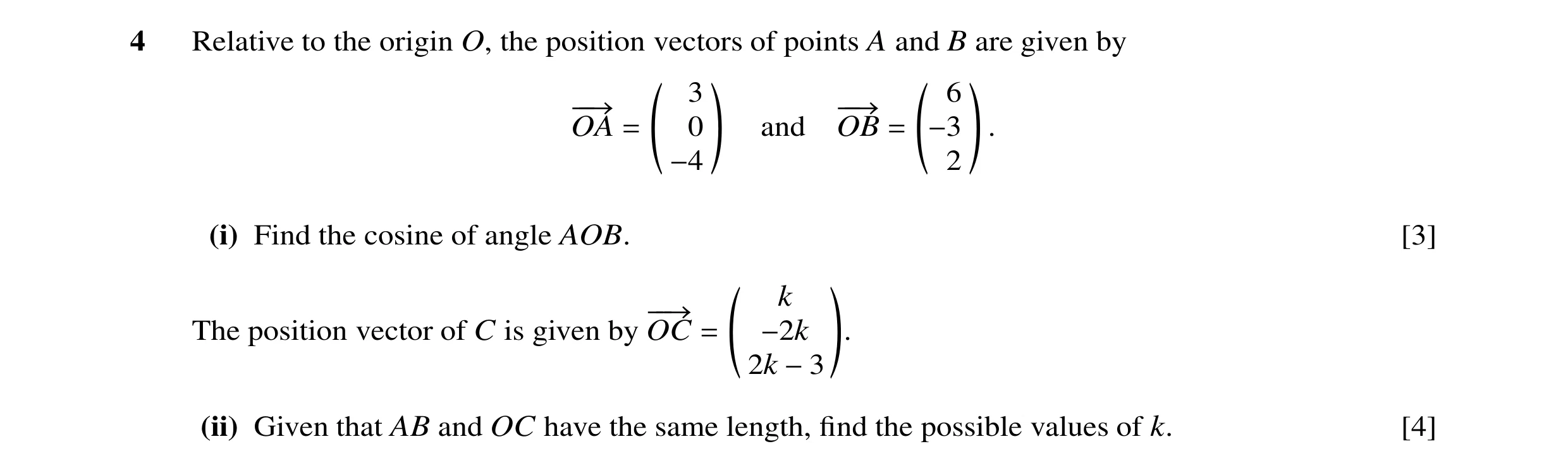
4 Relative to the origin O, the position vectors of points A and B are given by ` a ` a 3 6 −−→ −−→ OA = 0 and OB = −3 . −4 2 (i) Find the cosine of angle AOB. [3] ` a k −−→ The position vector of C is given by OC = −2k . 2k −3 (ii) Given that AB and OC have the same length, find the possible values of k. [4]
7 marks
Mark scheme: 2 p 4 p 3 At , →−2p –ve Maximum A1 −
This question in 9709/11 May/June 2015
Q25 · Relative to an origin O, the position vectors of the points A, B and C are given by ` a `… 9709/13 May/June 2015
5 Relative to an origin O, the position vectors of the points A, B and C are given by ` a ` a ` a 3 5 6 −−→ −−→ −−→ OA = 2 , OB = −1 and OC = 1 . −3 −2 2 (i) Show that angle ABC is 90Å. [4] (ii) Find the area of triangle ABC, giving your answer correct to 1 decimal place. [3]
7 marks
Mark scheme: 5 (i) AB = − 1 − 2 = − 3 B1 Or BA, CB . Allow any combination. Ignore labels. 2 3 1 − − 6 5 1 BC = 1 − − 1 = 2 B1 2 − 2 4 AB. BC = 2 − 6 + 4 oe must be seen = 0 M1 Could be part of calculation for angle ABC hence ABC = 90º A1 AG Alt methods Pythag, Cosine Rule [4] (ii) AB = 14 , BC = 21 oe B1 At least one correct 1 Area = 14 21 M1 Reasonable attempt at vectors and their 2 magnitudes 8.6 oe A1 7 6 [3] Allow 2 1 1
This question in 9709/13 May/June 2015
Q26 · Relative to an origin O, the position vectors of the points A and B are given by ` a ` a… 9709/13 Oct/Nov 2015
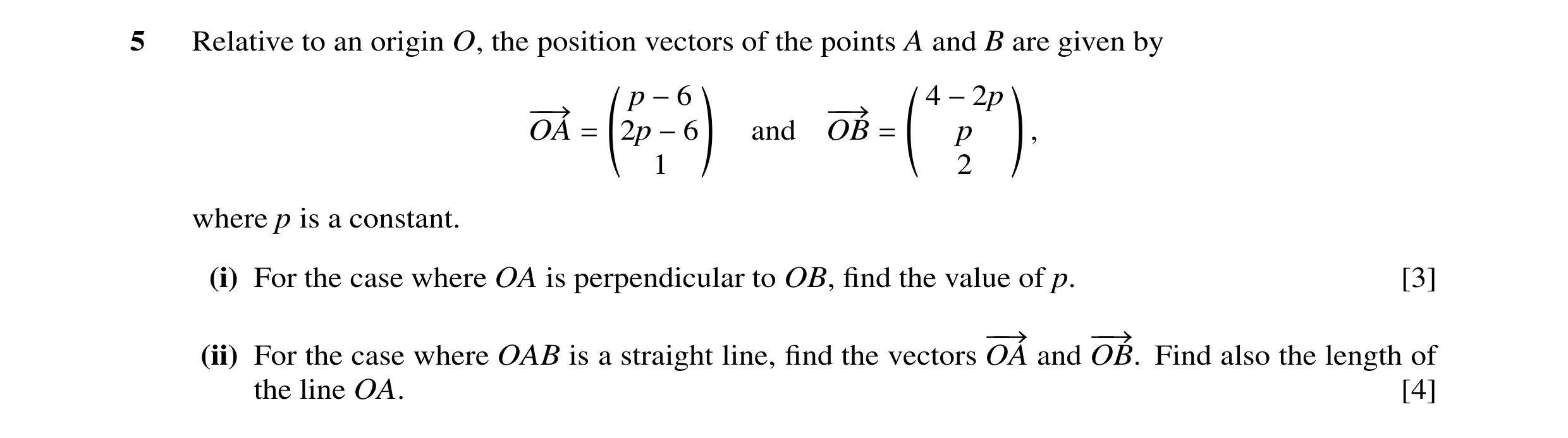
5 Relative to an origin O, the position vectors of the points A and B are given by ` a ` a p −6 4 −2p −−→ −−→ OA = 2p −6 and OB = p , 1 2 where p is a constant. (i) For the case where OA is perpendicular to OB, find the value of p. [3] −−→ −−→ (ii) For the case where OAB is a straight line, find the vectors OA and OB. Find also the length of the line OA. [4]
7 marks
Mark scheme: 5 (i) − 2 p 2 + 16 p − 24 + 2 p 2 − 6 p + 2 M1 Good attempt at scalar product Set scalar product = 0 and attempt solution DM1 p = 2.2 A1 [3] (ii) 4 − 2 p = 2 ( p − 6 ) or p = 2 ( 2 p − 6 ) M1 − 2 − 4 p = 4 → OA = 2 OB = 4 A1 At least one of OA and OB correct 1 2 2 O A = ( − 2 ) 2 + 2 2 + 1 = 3 M1A1 For M1 accept a numerical p [4] ALT 1 Compare AB with OA → 10 − 3 p = p − 6 or 6 − p = 2 p − 6 . Similarly cf AB with OB M1 ALT 2 (OA.OB)/(|OA|×|OB|) = 1 or –1 → 10 p − 22 = 5 p 2 − 36 p + M1 73 5 p 2 − 16 p + 20 → 125 p 4 − 260 p 3 + 941 p 2 − 1448 p + . Similarly 976 = 0 → p = 4 with OA.AB or OB.AB. ALT 3 OA & OB have equal unit vectors. (Similarly with OA & AB or OB & AB.) Hence p − 6 1 2 p − 6 5 p 2 − 36 p + 73 1 −4 2 p 1 = p 5 p 2 − 16 p + 20 2 M1 1 2 → = 5 p 2 − 36 p + 73 5 p 2 − 16 p + 20 → 15 p 2 − 128 p + 272 = 0 → ( p − 4)(15 p − 68) = 0 → p = 4( or 68 / 15)
This question in 9709/13 Oct/Nov 2015
Q27 · C 3 3 P B k 2.4 j i O A 4 The diagram shows a pyramid OABC with a horizontal triangular… 9709/12 Feb/March 2016
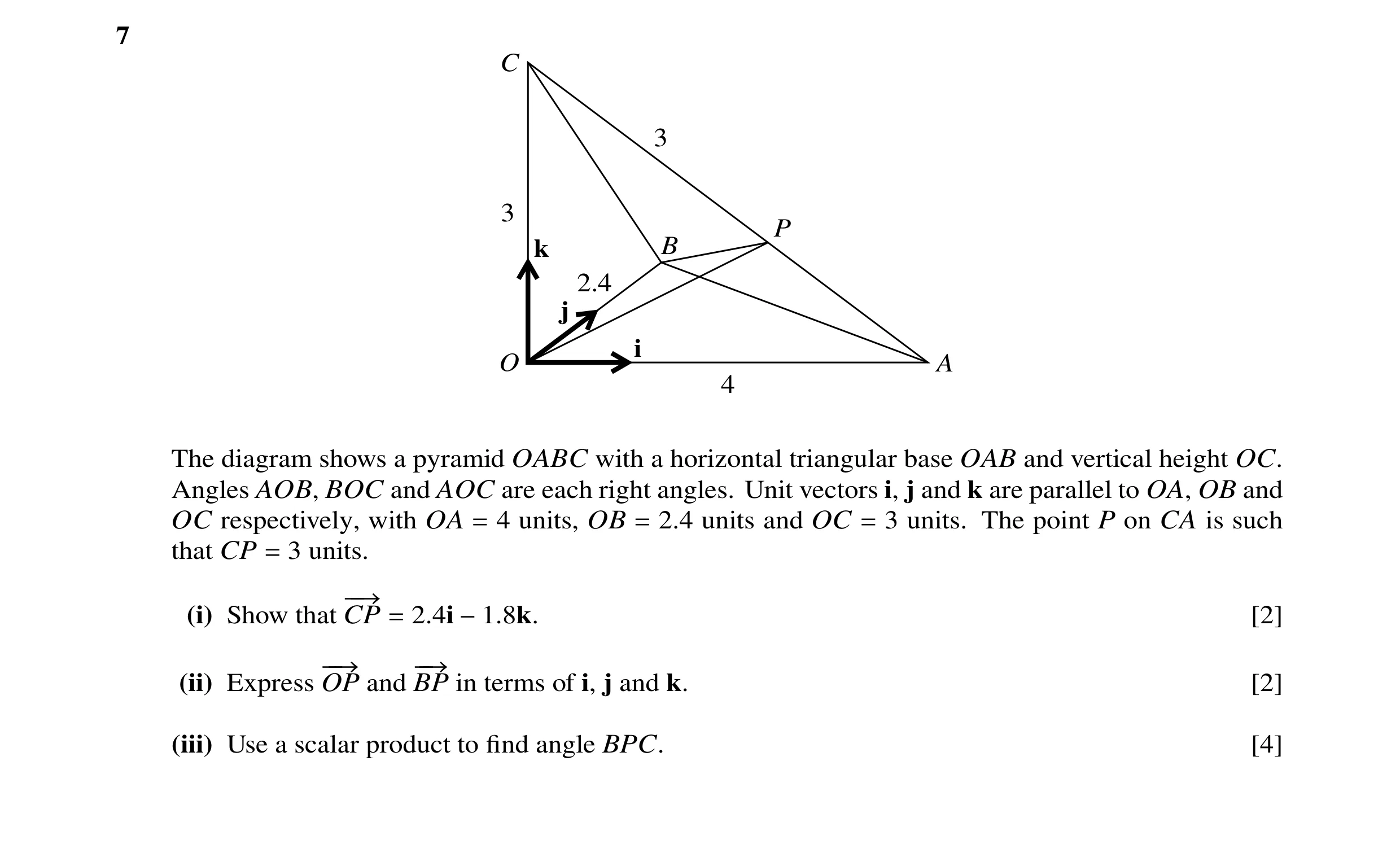
7 C 3 3 P B k 2.4 j i O A 4 The diagram shows a pyramid OABC with a horizontal triangular base OAB and vertical height OC. Angles AOB, BOC and AOC are each right angles. Unit vectors i, j and k are parallel to OA, OB and OC respectively, with OA = 4 units, OB = 2.4 units and OC = 3 units. The point P on CA is such that CP = 3 units. −−→ (i) Show that CP = 2.4i −1.8k. [2] −−→ −−→ (ii) Express OP and BP in terms of i, j and k. [2] (iii) Use a scalar product to find angle BPC. [4]
8 marks
Mark scheme: 3 7 (i) CP = CA soi M1 5 3 CP = (4i – 3k) = 2.4i – 1.8k AG A1 5 [2] (ii) OP = 2.4i + 1.2k B1 BP = 2.4i −2.4j + 1.2k B1 [2] (iii) BP.CP = 5.76 – 2.16 = 3.6 M1 Use of x1 x2 + y1 y 2 + z1 z 2 │BP││CP│= 2.4 2 + 2.4 2 + 1.2 2 2.4 2 + 1.8 2 M1 Product of moduli 3.6 1 cos BPC = = M1 All linked correctly 12.96 9 3 Angle BPC = 70.5° (or 1.23 rads) cao A1 [4]
This question in 9709/12 Feb/March 2016
Q28 · The position vectors of A, B and C relative to an origin O are given by ` a ` a ` a 2 1 5… 9709/13 May/June 2016
9 The position vectors of A, B and C relative to an origin O are given by ` a ` a ` a 2 1 5 −−→ −−→ −−→ OA = 3 , OB = 5 and OC = 0 , −4 p 2 where p is a constant. (i) Find the value of p for which the lengths of AB and CB are equal. [4] (ii) For the case where p = 1, use a scalar product to find angle ABC. [4] [Questions 10 and 11 are printed on the next page.]
8 marks
Mark scheme: 9 (i) AB = OB – OA = 2 B1 Ignore labels. Allow BA or BC p + 4 −4 CB = OB – OC = 5 B1 p − 2 2 2 1 + 4 + ( p + 4 ) = 16 + 25 + ( p − 2 ) M1 p = 2 A1 [4] (ii) AB.CB = 4+10−5 = 9 M1 Use of x1 x2 + y1 y2 + z1 z 2 │AB│= 1 + 4 + 25 = √30, │CB│ = 16 + 25 + 1 =√42 M1 Product of moduli 9 9 cos ABC = or M1 Allow one of AB, CB reversed - but 30 42 6 35 award A0 ABC = 75.3˚ or 1.31rads (ignore reflex angle 285˚) A1 [4] ( 2 ) 2
This question in 9709/13 May/June 2016
Q29 · Relative to an origin O, the position vectors of the points A, B and C are given by ` a a… 9709/12 Oct/Nov 2016
9 Relative to an origin O, the position vectors of the points A, B and C are given by ` a a ` a 2 `−2 2 −−→ −−→ −−→ OA = −2 , OB = 3 and OC = 6 . −1 6 5 (i) Use a scalar product to find angle AOB. [4] −−→ (ii) Find the vector which is in the same direction as AC and of magnitude 15 units. [3] −−→ −−→ (iii) Find the value of the constant p for which p−−→OA + OC is perpendicular to OB. [3]
10 marks
Mark scheme: JJJG JJJG 9 (i) −4 – 6 – 6 = −16 M1 Use of x1x2 + y1y2 + z1z2 on their OA & OB JJJG JJJG x12 + y12 + z12 or x22 + y 22 + z 22 M1 Modulus once on either their OA or OB JJJG JJJG 3 × 7 × cos θ = − 16 M1 All linked using their OA & OB → θ = 139.6º or 2.44c or 0.776π A1 [4] 0 JJJG (ii) AC = c – a = 8 B1 6 Magnitude = 10 0 0 15 Scaling → × 8 = 12 M1 For 15 × their unit vector. their10 A1 6 9 [3] 2 + 2 p (iii) 6 − 2 p B1 Single vector soi by scalar product. 5 − p JJJG JJJG JJJG → –2(2 +2p) + 3(6 – 2p) +6(5 – p)= 0 M1 Dot product of (p OA + OC ) and OB = 0. → p =2¾ A1 [3]
This question in 9709/12 Oct/Nov 2016
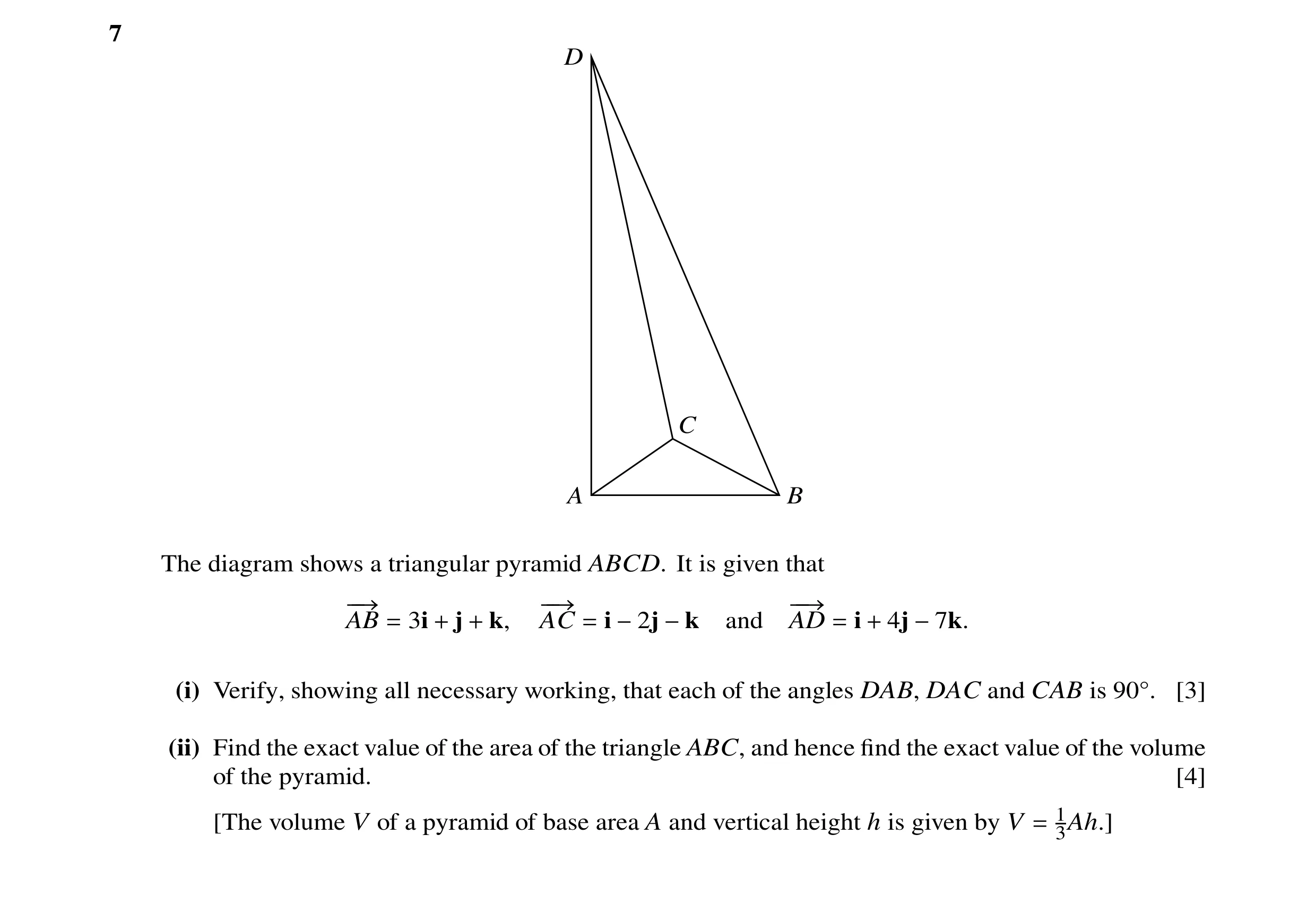
Q30 · D C A B The diagram shows a triangular pyramid ABCD 9709/13 Oct/Nov 2016
7 D C A B The diagram shows a triangular pyramid ABCD. It is given that −−→ −−→ −−→ AB = 3i + j + k, AC = i −2j −k and AD = i + 4j −7k. (i) Verify, showing all necessary working, that each of the angles DAB, DAC and CAB is 90Å. [3] (ii) Find the exact value of the area of the triangle ABC, and hence find the exact value of the volume of the pyramid. [4] [The volume V of a pyramid of base area A and vertical height h is given by V = 13Ah.]
7 marks
Mark scheme: 7 (i) AB.AC = 3 − 2 −=1 0 hence perpendicular or 90˚ B1 3 ‒ 2 ‒ 1 or sum of prods etc must be seen AB.AD = 3 + 4 − 7 = 0 hence perpendicular or 90˚ B1 Or single statement: mutually AC.AD = 1 − 8 + 7 = 0 hence perpendicular or 90˚ AG B1 perpendicular or 90˚ seen at least [3] once . (ii) Area ABC = ( ½ ) 3 2 + 12 + 12 × 12 + ( − 2 ) 2 + ( − 1) 2 M1 = ½ 11 × 6 A1 Expect ½ 66 Vol. = ⅓× their ∆ ABC × 12 + 4 2 + ( − 7 ) 2 M1 1 = 66 × 66 = 11 A1 Not 11.0 6 [4] 2
This question in 9709/13 Oct/Nov 2016
Q31 · Relative to an origin O, the position vectors of the points A and B are given by −−→ −−→… 9709/12 Feb/March 2017
6 Relative to an origin O, the position vectors of the points A and B are given by −−→ −−→ OA = 2i + 3j + 5k and OB = 7i + 4j + 3k. (i) Use a scalar product to find angle OAB. [5] … … … … … … … … … … … … … … … … … … … … … … … (ii) Find the area of triangle OAB. [2] … … … … … … … … … … … … … … … … … … … … … … … … …
7 marks
Mark scheme: 6(i) BA = OA ‒ OB = ‒5i ‒ j + 2k B1 Allow vector reversed. Ignore label BA or AB OA.BA = ‒10 ‒ 3 + 10 = ‒3 M1 soi by ±3 |OA|×|BA| = 2 2 2 2 2 2 2 3 5 5 1 2 + + × + + M1 Prod. of mods for at least 1 correct vector or reverse. / 3 cos 38 30 OAB + − = × M1 OAB = 95.1º (or c 1.66 ) A1 Total: 5 6(ii) ∆ OAB = 1 38 30 sin95.1 2 × . Allow ½ 38 74sin39.4 × M1 Allow their moduli product from (i) = 16.8 A1 cao but NOT from sin 84.9 (1.482c) Total: 2
This question in 9709/12 Feb/March 2017
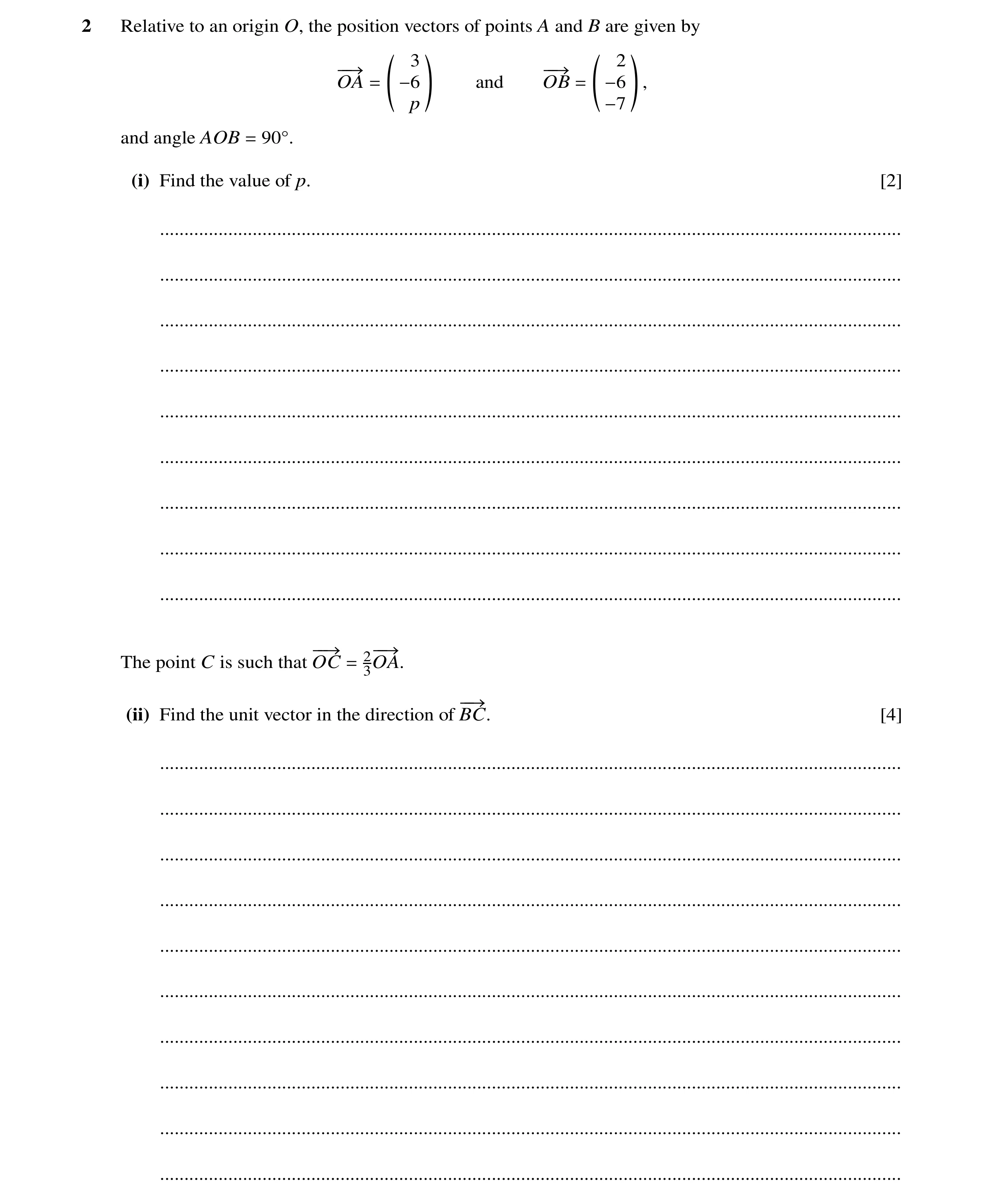
Q32 · Relative to an origin O, the position vectors of points A and B are given by ` a ` a 3 2… 9709/11 May/June 2017
2 Relative to an origin O, the position vectors of points A and B are given by ` a ` a 3 2 −−→ −−→ OA = −6 and OB = −6 , p −7 and angle AOB = 90Å. (i) Find the value of p. [2] … … … … … … … … … −−→ −−→ The point C is such that OC = 2 OA. 3 −−→ (ii) Find the unit vector in the direction of BC. [4] … … … … … … … … … …
6 marks
Mark scheme: 2 3 6 OA p = − uuur and 2 6 7 OB = − − uuur 2(i) Angle AOB = 90° → 6 + 36 −7p = 0 M1 Use of x1x2 + y1y2 + z1z2 = 0 or Pythagoras → p = 6 A1 Total: 2 Question Answer Marks Guidance 2(ii) 3 2 6 3 OC p = − uuur = 2 4 4 − B1 FT CAO FT on their value of p BC uuur = c – b = 0 2 11 ; magnitude = √125 M1 M1 Use of c – b. Allow magnitude of b + c or b – c Allow first M1 in terms of p Unit vector = 0 1 2 125 11 A1 OE Allow ± and decimal equivalent θ θ +
This question in 9709/11 May/June 2017
Q33 · Relative to an origin O, the position vectors of three points A, B and C are given by −−→… 9709/12 May/June 2017
8 Relative to an origin O, the position vectors of three points A, B and C are given by −−→ −−→ −−→ OA = 3i + pj −2pk, OB = 6i + p + 4 j + 3k and OC = p −1 i + 2j + qk, where p and q are constants. (i) In the case where p = 2, use a scalar product to find angle AOB. [4] … … … … … … … … … … … … … … … … … … … … … … −−→ −−→ (ii) In the case where AB is parallel to OC, find the values of p and q. [4] … … … … … … … … … … … … … … … … … … … … … … … … …
8 marks
Mark scheme: 8(i) Uses scalar product correctly: 3 × 6 + 2 × 6 + (−4) × 3 = 18 M1 Use of dot product with or OA AO & or OB BO only. uuuur OA = 29 , uuuur OB = 9 M1 Correct method for any one of uuur OA , uuur AO , uuur OB or . uuur BO 29 × 9 × cos AOB = 18 M1 All linked correctly. → AOB = 68.2° or 1.19ᶜ A1 Multiples of π are acceptable (e.g. 0.379πᶜ) Total: 4 8(ii) = uuur AB 3i + 4j +(3+2p)k *M1 For use of − uuur uuur OB OA , allow with p = 2 Comparing “j” DM1 For comparing, uuur OC must contain p & q. Can be implied by = uuur AB 2 uuur OC . → p = 2½ and q = 4 A1 A1 Accuracy marks only available if uuur AB is correct. Total: 4
This question in 9709/12 May/June 2017
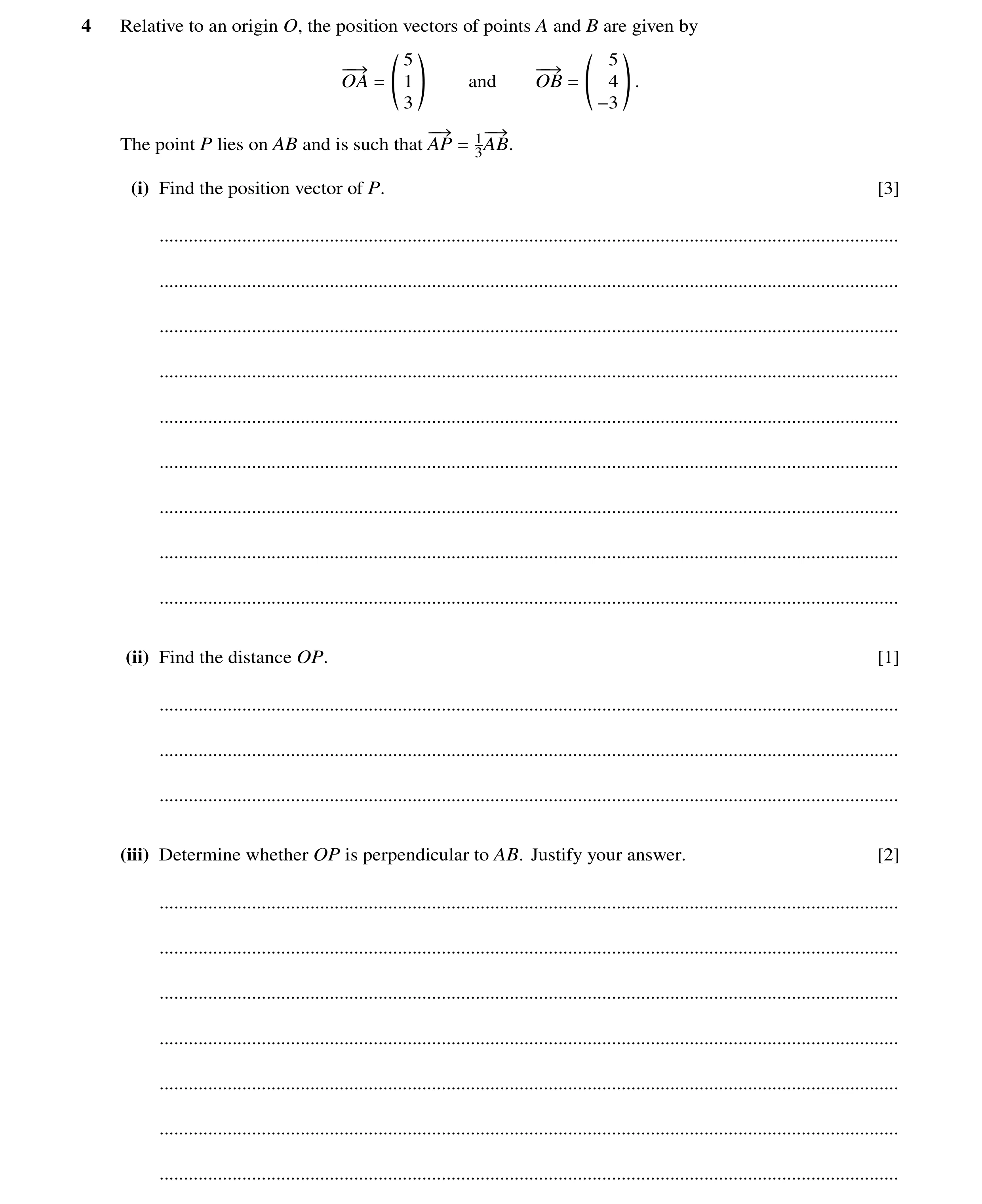
Q34 · Relative to an origin O, the position vectors of points A and B are given by ` a ` a −−→… 9709/13 May/June 2017
4 Relative to an origin O, the position vectors of points A and B are given by ` a ` a −−→ 5 −−→ 5 OA = 1 and OB = 4 . 3 −3 −−→ −−→ The point P lies on AB and is such that AP = 1 AB. 3 (i) Find the position vector of P. [3] … … … … … … … … … (ii) Find the distance OP. [1] … … … (iii) Determine whether OP is perpendicular to AB. Justify your answer. [2] … … … … … … …
6 marks
Mark scheme: 4(i) ( ) 5 5 0 4 1 3 3 3 6 OB OA AB − = = − = − − uuur uuur uuur B1 5 0 5 1 1 3 2 3 3 6 1 OP = + = − uuur M1 A1 If OP uuur not scored in (i) can score SR B1 if seen correct in (ii). Other equivalent methods possible Total: 3 4(ii) Distance OP = 2 2 2 5 2 1 + + = 30 or 5.48 B1 FT FT on their OP uuur from (i) Total: 1 4(iii) Attempt . . AB OP uuur uuur Can score as part of ( )( ) . cos AB OP AB OP θ = uuur uuur Rare ALT: Pythagoras 2 2 2 5 30 OP AP OA + = + = uuur uuur uuur M1 Allow any combination of . AB PO uuur uuur etc. and also if AP uuur or used PB uuur instead of AB uuur giving 2‒2 = 0 & 4‒4 = 0 respectively. Allow notation × instead of . . (0 + 6 ‒ 6) = 0 hence perpendicular. (Accept 90º) A1 FT If result not zero then 'Not perpendicular' can score A1FT if value is 'correct' for their values of , AB OP uuur uuur etc. from (i). Total: 2
This question in 9709/13 May/June 2017
Q35 · Relative to an origin O, the position vectors of two points P and Q are p and q… 9709/11 Oct/Nov 2017
8 (a) Relative to an origin O, the position vectors of two points P and Q are p and q respectively. The point R is such that PQR is a straight line with Q the mid-point of PR. Find the position vector of R in terms of p and q, simplifying your answer. [3] … … … … … … … … … … … … … … … … … … … … … … … … (b) The vector 6i + aj + bk has magnitude 21 and is perpendicular to 3i + 2j + 2k. Find the possible values of a and b, showing all necessary working. [6] … … … … … … … … … … … … … … … … … … … … … … … … …
9 marks
Mark scheme: 8(a) EITHER: ( ) 2 2 = = − JJJG JJJG PR PQ q p (B1 JJJG OR =p+2q‒2p = 2q‒p M1A1) OR: = JJJG JJJG QR PQ = q ‒ p (B1 JJJG OR = + JJJG JJJG OQ QR =q+q‒p=2q‒p M1A1) Or other valid method 3 8(b) 2 2 2 2 6 21 + + = a b SOI B1 18 2 2 0 + + = a b B1 ( ) 2 2 9 405 + −− = a a M1 Correct method for elimination of a variable. (Or same equation in b) ( )( )( ) 2 2 9 162 0 + − = a a A1 Or same equation in b 9 or 18 = − a A1 18 or 9 = − b A1 6
This question in 9709/11 Oct/Nov 2017
Q36 · A O B C The diagram shows a trapezium OABC in which OA is parallel to CB 9709/12 Oct/Nov 2017
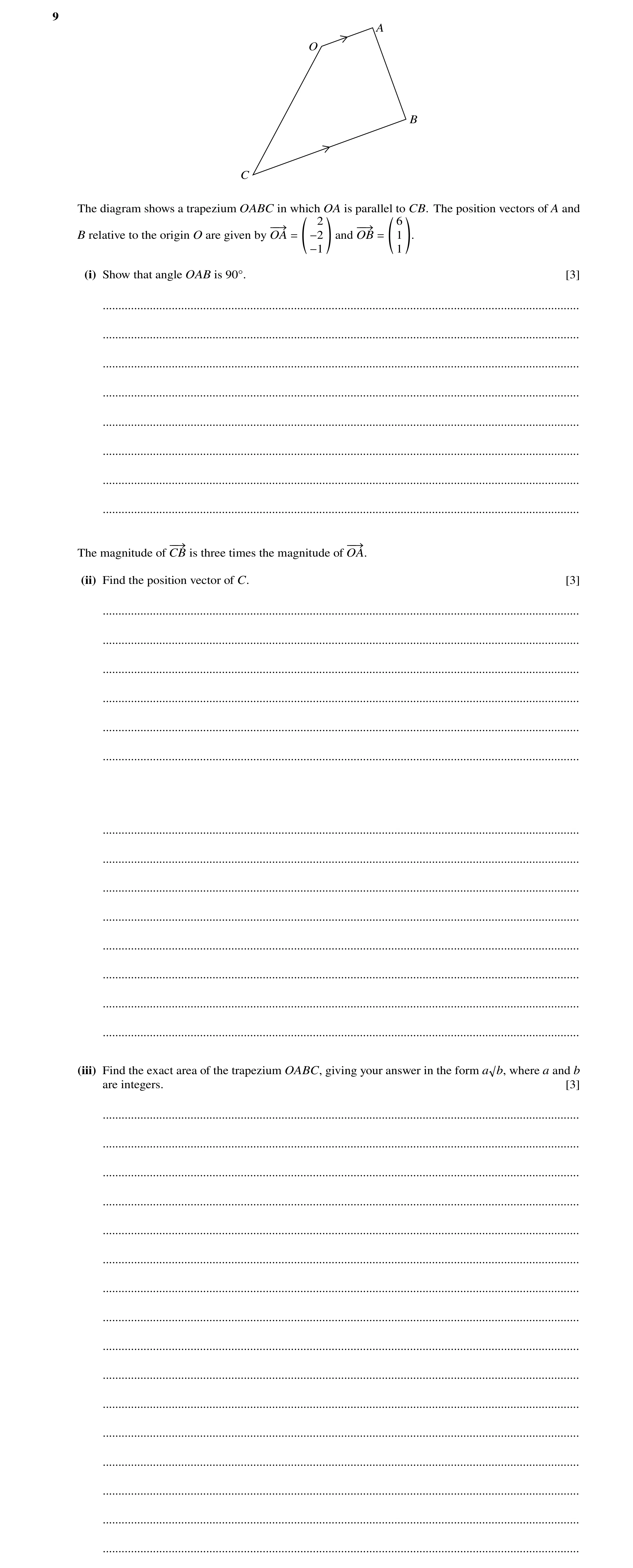
9 A O B C The diagram shows a trapezium OABC in which OA is parallel to CB. The position vectors of A and ` a ` a 2 6 −−→ −−→ B relative to the origin O are given by OA = −2 and OB = 1 . −1 1 (i) Show that angle OAB is 90Å. [3] … … … … … … … … −−→ −−→ The magnitude of CB is three times the magnitude of OA. (ii) Find the position vector of C. [3] … … … … … … … … … … … … … … (iii) Find the exact area of the trapezium OABC, giving your answer in the form a b, where a and b are integers. [3] … … … … … … … … … … … … … … … …
9 marks
Mark scheme: 9(i) JJJG AB = 4 3 2 or 4 3 2 − = − − JJJG BA e.g. JJJG AO . JJJG AB =− 8 + 6 + 2 = 0 → ˆ OAB = 90° AG OR 3, 38 , 29 = = = JJJG JJJG JJJG OA OB AB OA2 + AB2 = OB2 → ˆ OAB = 90° AG M1 A1 Use of dot product with either & AOorOA either AB or BA JJJG JJJG JJJJG JJJG . Must see 3 component products OR Correct use of Pythagoras. In both methods must state angle or Ө 90 ° = or similar for A1 3 9(ii) JJJG CB = 6 6 3 − − or 6 6 3 − = JJJG BC B1 Must correctly identify the vector. JJJG OC = JJJG OB + JJJG BC (or − JJJG CB ) = 0 7 4 M1 A1 Correct link leading to JJJG OC 3 Question Answer Marks Guidance 9(iii) 3, 9, 29 = = = JJJG JJJG JJJG OA BC AB (5.39 ) B1 For any one of these Area = ½(3 + 9) 29 or 3 29 + 3 29 M1 Correct formula(e) used for trapezium or (rectangle + triangle) or two triangles using their lengths. = 6 29 (1 1044,2 261 3 116) or A1 Exact answer in correct form. 3
This question in 9709/12 Oct/Nov 2017
Q37 · Relative to an origin O, the position vectors of the points A, B and C are given by ` a `… 9709/13 Oct/Nov 2017
9 Relative to an origin O, the position vectors of the points A, B and C are given by ` a ` a ` a 8 −10 2 −−→ −−→ −−→ OA = −6 , OB = 3 and OC = −3 . 5 −13 −1 −−→ −−→ −−→ A fourth point, D, is such that the magnitudes AB , BC and CD are the first, second and third terms respectively of a geometric progression. −−→ −−→ −−→ (i) Find the magnitudes AB , BC and CD . [5] … … … … … … … … … … … … … … … … … … … … … (ii) Given that D is a point lying on the line through B and C, find the two possible position vectors of the point D. [4] … … … … … … … … … … … … … … … … … … … … … … … … …
9 marks
Mark scheme: 9(i) 18 12 / 9 , / 6 , 18 12 AB BC − = + − = + −− − JJJG JJJG 27, 18 AB BC = = JJJG JJJG B1 FT B1 FT FT on their AB JJJG , theirOD JJJG . 18 18 27 CD = × JJJG OR 2 18 27 × 27 = 12 B1 5 9(ii) ( ) 18 27 CD their their = ± × JJJG BC JJJG SOI M1 Expect ( ) 8 4 8 ± − . ( ) 2 12 10 6 18 3 6 7 , 1 27 1 12 7 9 OD their − = − ± − = − − − JJJG M1 A1 A1 Other methods possible for OD JJJG , e.g. OB JJJG + 5 2 CD JJJG , OB JJJG + 1 2 CD JJJG (One soln M2A1, 2nd soln A1) OR OB JJJG + 5 3 BC JJJG , OB JJJG + 1 3 BC JJJG (One soln M2A1, 2nd soln A1) 4
This question in 9709/13 Oct/Nov 2017
Q38 · E 8 4 C 3 B 1 D C B 3 D k 2 j O 7 A O i A Fig 9709/12 Feb/March 2018
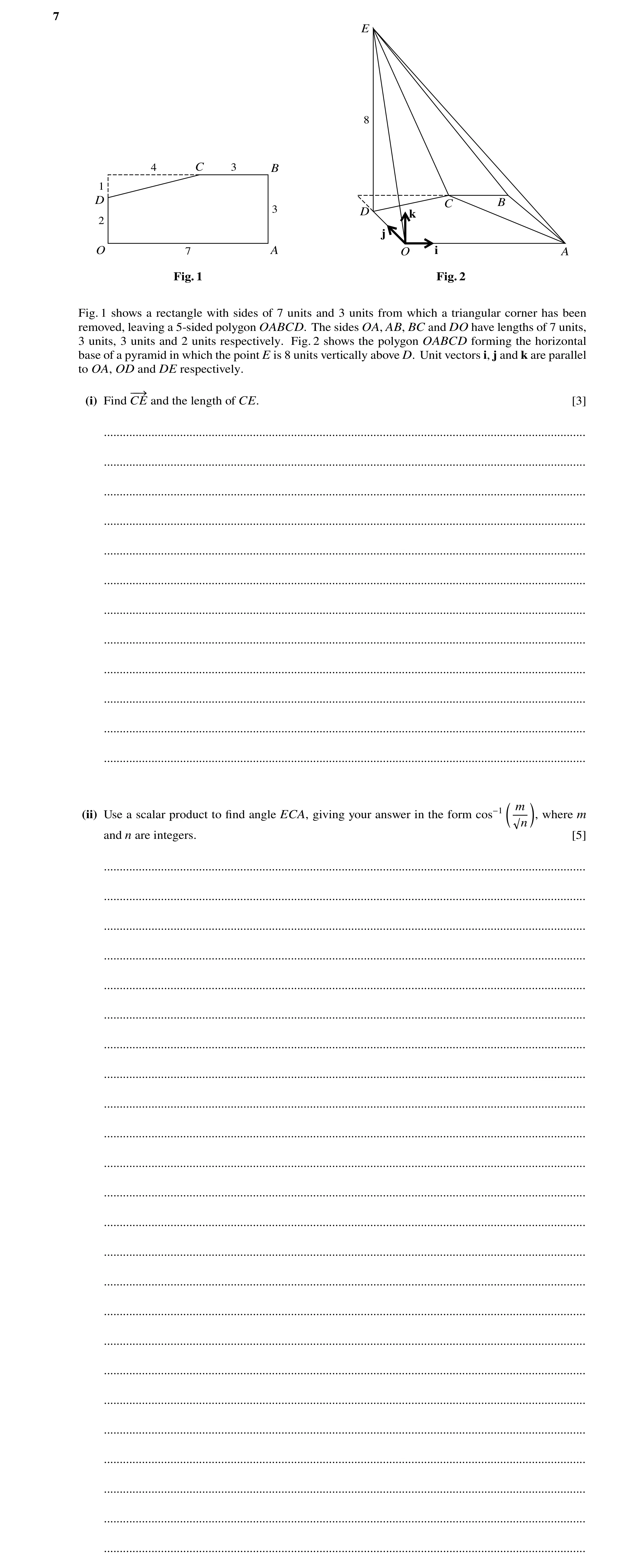
7 E 8 4 C 3 B 1 D C B 3 D k 2 j O 7 A O i A Fig. 1 Fig. 2 Fig. 1 shows a rectangle with sides of 7 units and 3 units from which a triangular corner has been removed, leaving a 5-sided polygon OABCD. The sides OA, AB, BC and DO have lengths of 7 units, 3 units, 3 units and 2 units respectively. Fig. 2 shows the polygon OABCD forming the horizontal base of a pyramid in which the point E is 8 units vertically above D. Unit vectors i, j and k are parallel to OA, OD and DE respectively. (i) Find −−→CE and the length of CE. [3] … … … … … … … … … … … … @ A m(ii) Use a scalar product to find angle ECA, giving your answer in the form cos−1 , where m n and n are integers. [5] … … … … … … … … … … … … … … … … … … … … … … … …
8 marks
Mark scheme: 7(i) CE = ‒4i ‒ j + 8k | JJJG CE | = ( ) ( ) ( ) 2 2 2 ( 4 1 8 9 their their their − + − + = M1A1 Could use Pythagoras’ theorem on triangle CDE 3 7(ii) JJJG CA = 3i ‒ 3j or JJJG AC = –3i + 3j B1 JJJG CE . JJJG CA = (‒4i ‒ j + 8k).(3i ‒ 3j) = ‒12 + 3 (Both vectors reversed ok) M1 Scalar product of their JJJG CE , JJJG CA . One vector reversed ok for all M marks | JJJG CE |×| JJJG CA | = 16 1 64 + + × 9 9 + M1 Product of moduli of their JJJG CE , JJJG CA 1 1 12 3 1 cos cos 9 18 18 − − − + − = 1 1 3 9 or e.g. cos , cos 162 1458 − − − − etc. A1A1 A1 for any correct expression, A1 for required form Equivalent answers must be in required form m/√n (m, n integers) 5
This question in 9709/12 Feb/March 2018
Q39 · Relative to an origin O, the position vectors of the points A, B and C are given by ` a `… 9709/11 May/June 2018
7 Relative to an origin O, the position vectors of the points A, B and C are given by ` a ` a ` a 1 −1 3 −−→ −−→ −−→ OA = −3 , OB = 3 and OC = 1 . 2 5 −2 −−→ (i) Find AC. [1] … … … … … −−−→ (ii) The point M is the mid-point of AC. Find the unit vector in the direction of OM. [3] … … … … … … … … … … … … … … … −−→ −−→ (iii) Evaluate AB. AC and hence find angle BAC. [4] … … … … … … … … … … … … … … … … … … … … … … … … …
8 marks
Mark scheme: 7 1 3 2 OA = − JJJG , 1 3 5 OB − = JJJG and 3 1 2 OC = − JJJG 7(i) 2 4 4 AC = − JJJG B1 B1 for AC JJJG . 1 Question Answer Marks Guidance 7(ii) 2 1 0 OM OA AM = + = − JJJJG JJJG JJJJG or 1[ 2 1 3 3 1 2 2 − + − ] M1 M1 for their OM OA AM = + JJJJG JJJG JJJJG oe Unit vector in direction of 1 5 OM = √ JJJJG ( ) OM JJJJG M1 A1 M1 for dividing their OM JJJJG by their modulus 3 7(iii) 2 6 3 AB − = JJJG , Allow ± B1 | AB JJJG |=7, | AC JJJG |=6 2 6 3 − . 2 4 4 − = −4 + 24 – 12 = 8 M1 M1 Product of both moduli, Scalar product of ± their AB and AC 7 × 6 cos θ = 8 → θ = 79.(0)º A1 1.38 radians ok 4
This question in 9709/11 May/June 2018
Q40 · C D B k j O i A The diagram shows a three-dimensional shape 9709/12 May/June 2018
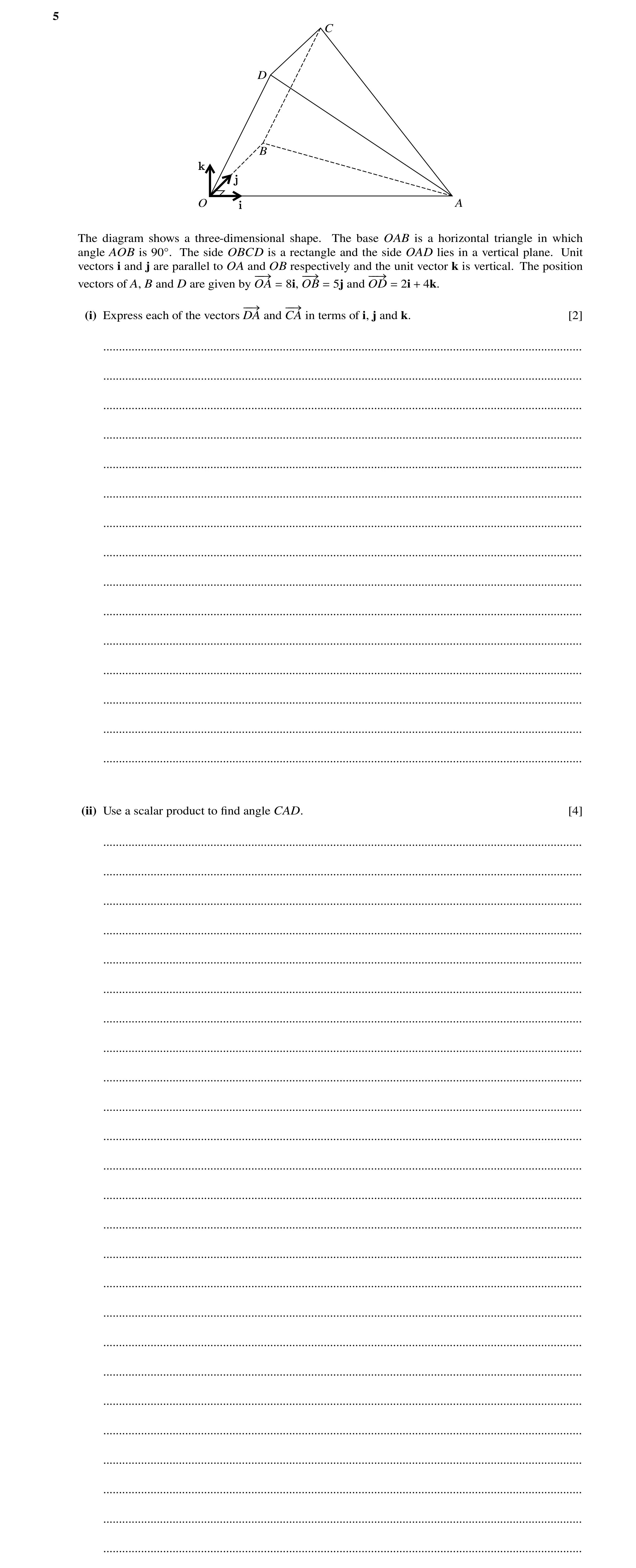
5 C D B k j O i A The diagram shows a three-dimensional shape. The base OAB is a horizontal triangle in which angle AOB is 90Å. The side OBCD is a rectangle and the side OAD lies in a vertical plane. Unit vectors i and j are parallel to OA and OB respectively and the unit vector k is vertical. The position −−→ −−→ −−→ vectors of A, B and D are given by OA = 8i, OB = 5j and OD = 2i + 4k. −−→ −−→ (i) Express each of the vectors DA and CA in terms of i, j and k. [2] … … … … … … … … … … … … … … … (ii) Use a scalar product to find angle CAD. [4] … … … … … … … … … … … … … … … … … … … … … … … … …
6 marks
Mark scheme: 5(i) 6 –4 DA = i k 6 –5 –4 CA = i j k JJJG B1 2 5(ii) Method marks awarded only for their vectors ± CA JJJG & ± DA JJJG Full marks can be obtained using AC JJJG & AD JJJG CA JJJG . DA JJJG = 36 + 16 ( = 52) M1 Using x1x2+y1y2+z1z2 52 DA = JJJG , 77 CA = JJJG M1 Uses modulus twice 52 = √77√52cos ˆ CAD oe M1 All linked correctly Cos ˆ CAD = 0.82178..→ ˆ CAD = 34.7º or 0.606ᶜ awrt A1 Answer must come from +ve cosine ratio 4
This question in 9709/12 May/June 2018
Q41 · D 7 C B 6 k j E 2 O i 8 A The diagram shows a pyramid OABCD with a horizontal rectangular… 9709/13 May/June 2018
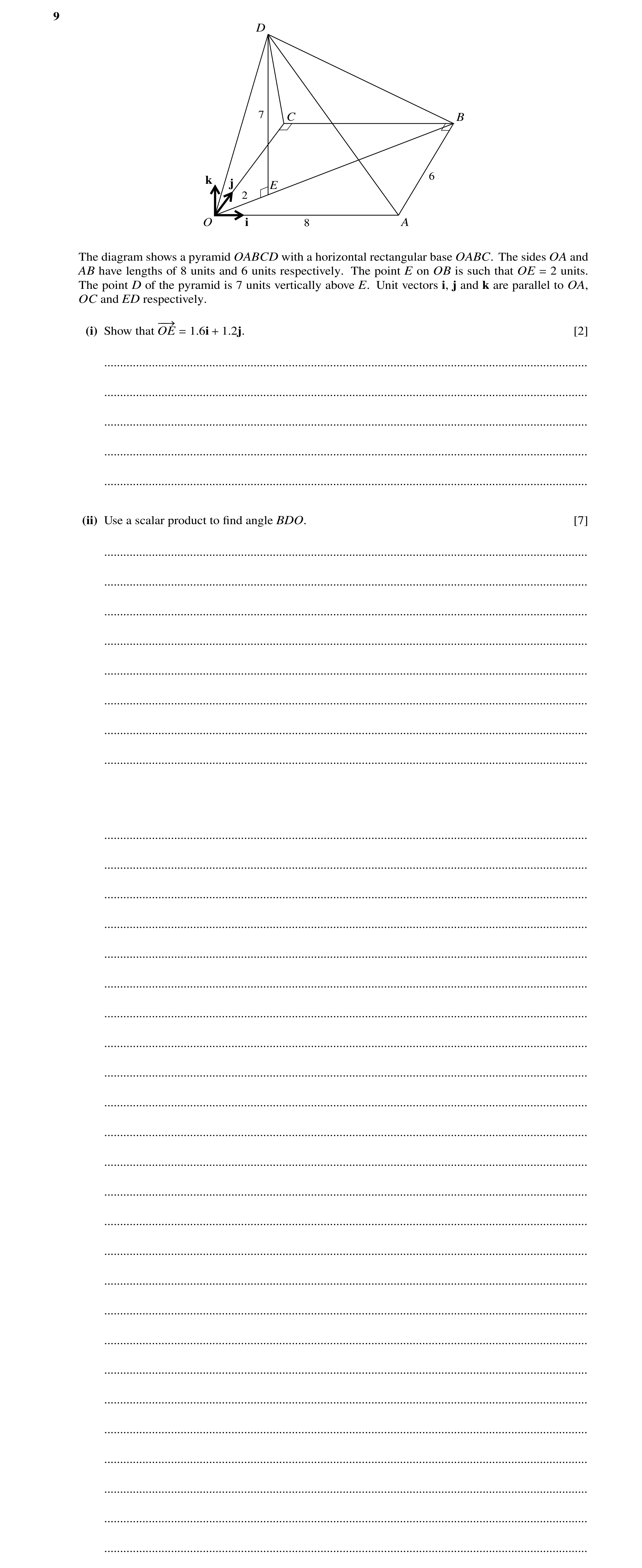
9 D 7 C B 6 k j E 2 O i 8 A The diagram shows a pyramid OABCD with a horizontal rectangular base OABC. The sides OA and AB have lengths of 8 units and 6 units respectively. The point E on OB is such that OE = 2 units. The point D of the pyramid is 7 units vertically above E. Unit vectors i, j and k are parallel to OA, OC and ED respectively. −−→ (i) Show that OE = 1.6i + 1.2j. [2] … … … … … (ii) Use a scalar product to find angle BDO. [7] … … … … … … … … … … … … … … … … … … … … … … … … … … … … … … … … …
9 marks
Mark scheme: 9(i) OE = 2 10 (8i + 6j) = 1.6i + 1.2j AG required 2 9(ii) OD = 1.6i + 1.2j + 7k B1 Allow reversal of one or both of OD, BD. BD = ‒8i ‒ 6j + 1.6i + 1.2j + 7k OE = ‒6.4i ‒4.8j + 7k M1A1 For M mark allow sign errors. Also if 2 out of 3 components correct Correct method for ±OD.±BD (using their answers) M1 Expect 1.6 × ‒6.4 + 1.2 × ‒4.8 + 49 = 33 or 825 25 825 / 25. Correct method for |OD| or |BD| (using their answers) M1 Expect 2 2 2 2 2 2 1.6 1.2 7 or 6.4 4.8 7 + + + + = √53 or √113 Cos BDO = their . × OD BD OD BD DM1 Expect 33 77.4 . Dep. on all previous M marks and either B1 or A1 64.8º Allow 1.13(rad) A1 Can’t score A1 if 1 vector only is reversed unless explained well 7
This question in 9709/13 May/June 2018
Q42 · F E D 6 4 4 C B k j 3 O i 6 A The diagram shows a solid figure OABCDEF having a horizontal… 9709/11 Oct/Nov 2018
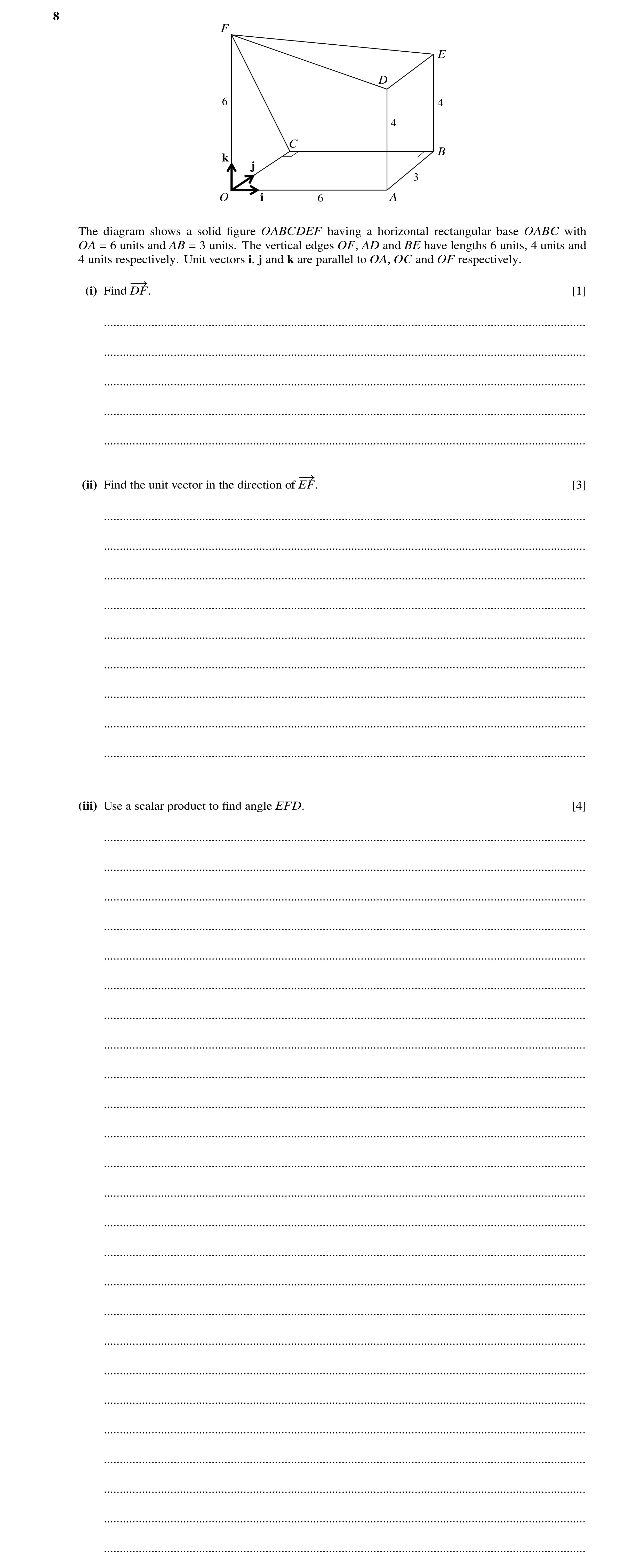
8 F E D 6 4 4 C B k j 3 O i 6 A The diagram shows a solid figure OABCDEF having a horizontal rectangular base OABC with OA = 6 units and AB = 3 units. The vertical edges OF, AD and BE have lengths 6 units, 4 units and 4 units respectively. Unit vectors i, j and k are parallel to OA, OC and OF respectively. −−→ (i) Find DF. [1] … … … … … −−→ (ii) Find the unit vector in the direction of EF. [3] … … … … … … … … … (iii) Use a scalar product to find angle EFD. [4] … … … … … … … … … … … … … … … … … … … … … … … … …
8 marks
Mark scheme: 8(i) 6 2 = − + DF i k B1 1 8(ii) 6 3 2 = − − + JJJG EF i j k B1 | ( ) ( ) 2 2 2 | 6 3 2 = − + − + JJJG EF M1 Must use their JJJG EF Unit vector = ( ) 1 6 3 2 7 − − + i j k A1 3 8(iii) . JJJG JJJG DF EF = (‒6i + 2k).(‒6i ‒ 3j + 2k) = 36 + 4 = 40 M1 | JJJG DF | = √40, | JJJG EF | =7 M1 cosEFD = 40 7 40 oe M1 EFD = 25.4º A1 Special case: use of cosine rule M1(must evaluate lengths using correct method) A1 only 4
This question in 9709/11 Oct/Nov 2018
Q43 · R P Q M 12 N C 4 k j A B 4 O i The diagram shows a solid cylinder standing on a… 9709/12 Oct/Nov 2018
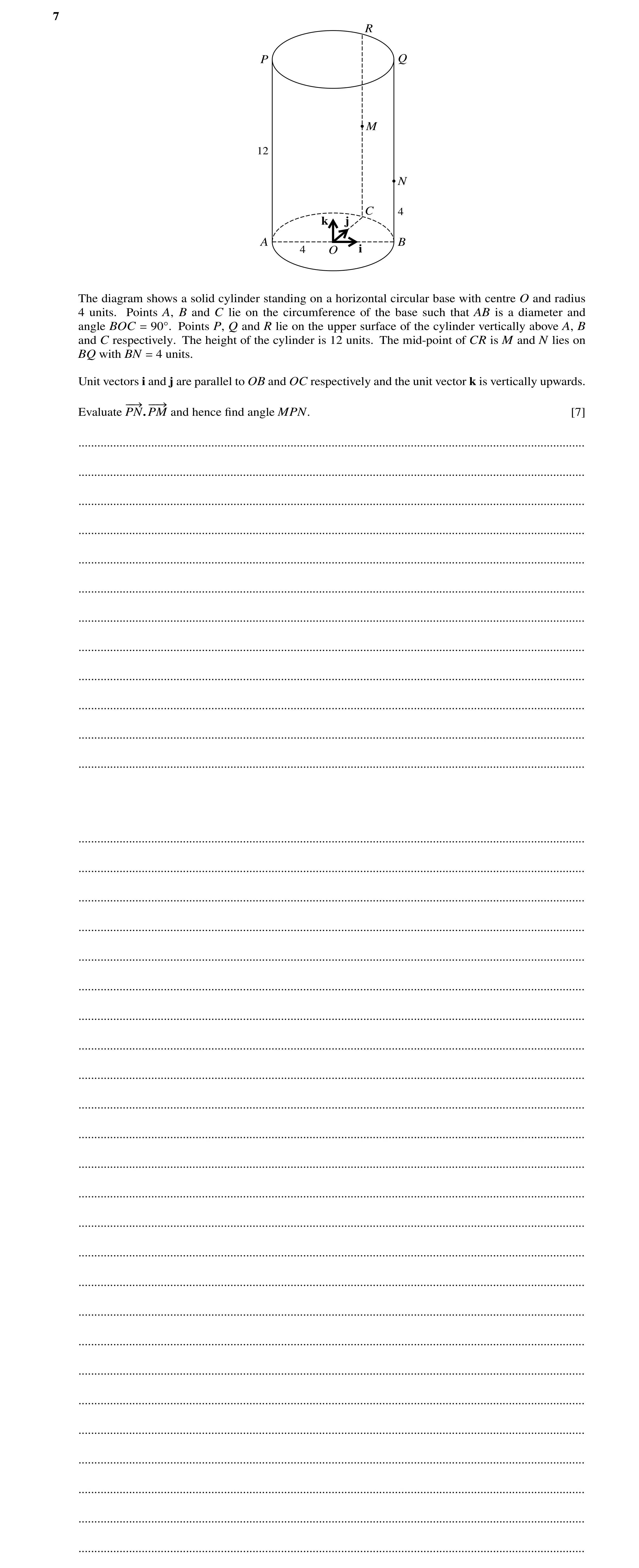
7 R P Q M 12 N C 4 k j A B 4 O i The diagram shows a solid cylinder standing on a horizontal circular base with centre O and radius 4 units. Points A, B and C lie on the circumference of the base such that AB is a diameter and angle BOC Points P, Q and R lie on the upper surface of the cylinder vertically above A, B and C respectively.= 90Å. The height of the cylinder is 12 units. The mid-point of CR is M and N lies on BQ with BN 4 units. = Unit vectors i and j are parallel to OB and OC respectively and the unit vector k is vertically upwards. Evaluate PN. PM and hence find angle MPN. [7] −−→ −−→ … … … … … … … … … … … … … … … … … … … … … … … … … … … … … … … … … … … … …
7 marks
Mark scheme: 7 PN = 8i – 8k B1 PM JJJJG = 4i + 4j – 6k B2,1,0 Loses 1 mark for each component incorrect SC: PN JJJG = – 8i + 8k and PM JJJJG = – 4i – 4j +6k scores 2/3. . PN PM JJJG JJJJG = 32 + 0 + 48 = 80 M1 Evaluates x1x2 +y1y2+z1z2 for correct vectors or one or both reversed. PN PM × = √128 × √68 (= 16 34 ) M1 Product of their moduli – may be seen in cosine rule √128 × √68 cos M ˆP N = 80 M1 All linked correctly. Angle M ˆP N = 31.0◦ awrt A1 Answer must come directly from +ve cosine ratio. Cosine rule not accepted as a complete method. Allow 0.540c awrt. Note: Correct answer from incorrect vectors scores A0 (XP) 7
This question in 9709/12 Oct/Nov 2018
Q44 · F G 2 E D 4 7 B C 6 k j A 8 O i The diagram shows a solid figure OABCDEFG with a… 9709/13 Oct/Nov 2018
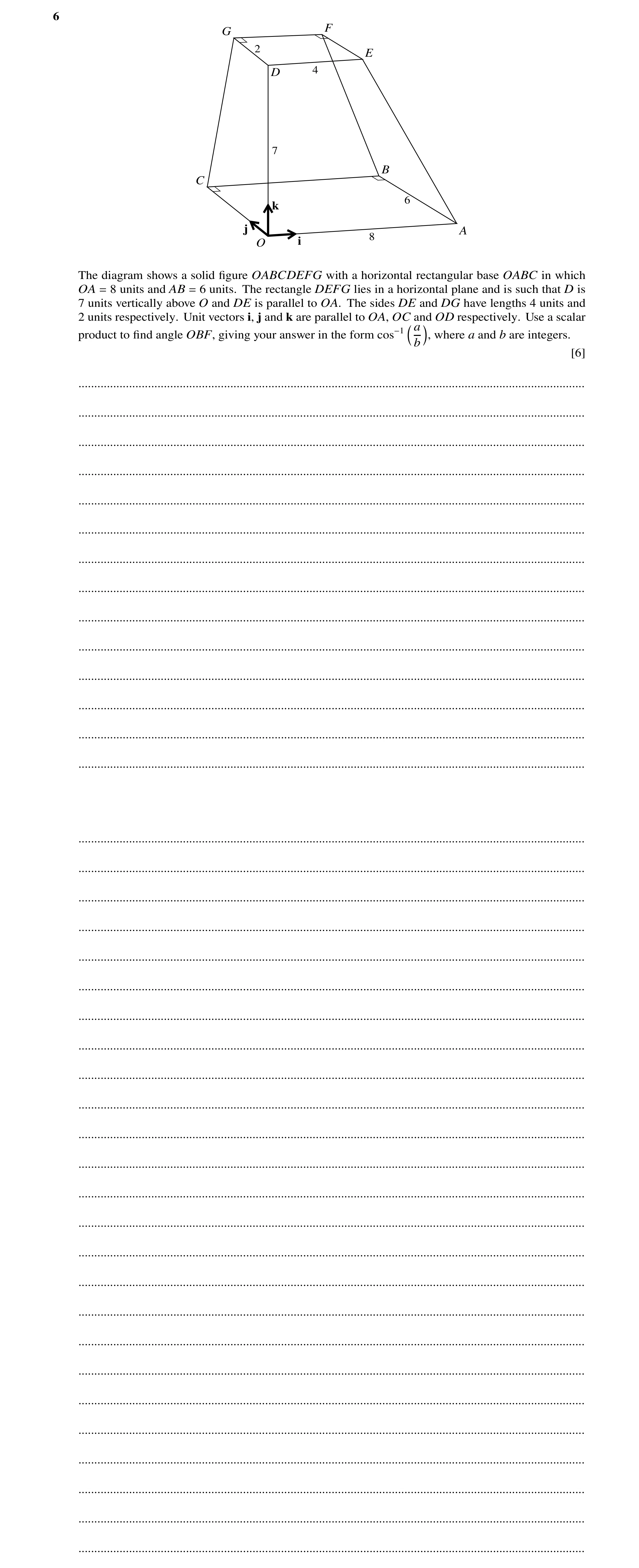
6 F G 2 E D 4 7 B C 6 k j A 8 O i The diagram shows a solid figure OABCDEFG with a horizontal rectangular base OABC in which OA = 8 units and AB = 6 units. The rectangle DEFG lies in a horizontal plane and is such that D is 7 units vertically above O and DE is parallel to OA. The sides DE and DG have lengths 4 units and 2 units respectively. Unit vectors i, j and k are parallel to OA, OC and OD respectively. Use a scalar 0a 1 product to find angle OBF, giving your answer in the form cos−1 , where a and b are integers. b [6] … … … … … … … … … … … … … … … … … … … … … … … … … … … … … … … … … … … … … … …
6 marks
Mark scheme: 6 8 6 = − − BO i j ( ) 6 8 7 4 2 4 4 7 = − − + + + = − − + BF j i k i j i j k B1 OR (FB) = 4i + 4j ‒ 7k ( ) ( )( ) ( )( ) . 4 8 4 6 = − − + − − BF BO M1 OR (FB.OB) Expect 56. Accept one reversed but award final A0 2 2 2 2 2 4 4 7 8 6 × = + + × + BF BO M1 Expect 90. At least one magnitude methodically correct Angle OBF 1 1 1 56 56 28 cos cos or cos 90 90 45 their their − − − = = DM1A1 Or equivalent ‘integer’ fractions. All M marks dependent on use of (±)BO and (±)BF. 3rd M mark dep on both preceding M marks 6
This question in 9709/13 Oct/Nov 2018
Q45 · Two vectors, u and v, are such that ` a ` a q 8 u = 2 and v = q −1 , 6 q2 −7 where q is a… 9709/12 Feb/March 2019
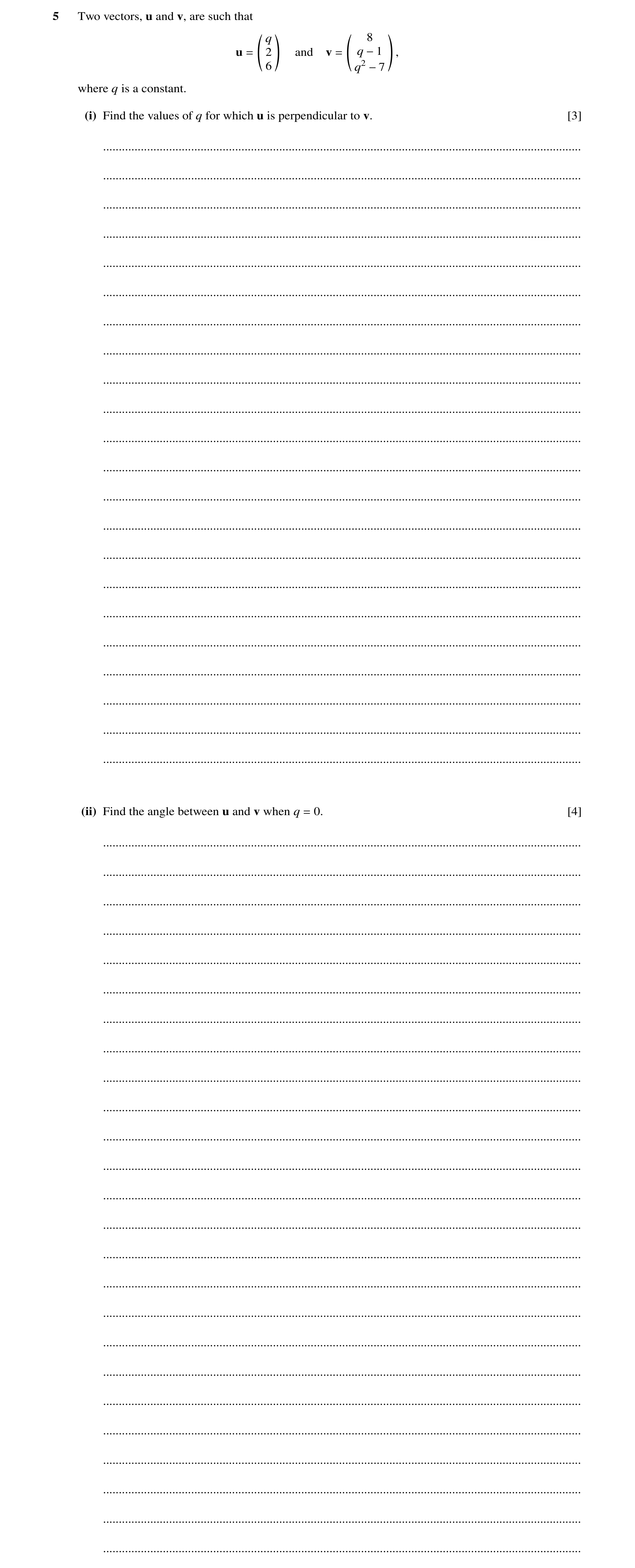
5 Two vectors, u and v, are such that ` a ` a q 8 u = 2 and v = q −1 , 6 q2 −7 where q is a constant. (i) Find the values of q for which u is perpendicular to v. [3] … … … … … … … … … … … … … … … … … … … … … … (ii) Find the angle between u and v when q = 0. [4] … … … … … … … … … … … … … … … … … … … … … … … … …
7 marks
Mark scheme: 5(i) u.v = 2 8 2 2 6 42 + − + − q q q B1 2 6 10 44 0 + − = q q oe M1 Simplify, set to zero and attempt to solve q = 2, ‒11/3 A1 Both required. Accept ‒3.67 3 Question Answer Marks Guidance 5(ii) u = 0 2 6 v = 8 1 7 − − u.v = ‒2 ‒ 42 M1 Correct method for scalar product |u| × |v| = 2 2 2 2 2 2 6 8 1 7 + × + + M1 Prod of mods. At least one methodically correct. 44 44 4 cos 11 40 114 4 285 θ − − − = = = √ × M1 All linked correctly and inverse cos used correctly 130.7 θ = ° or 2.28(05) rads A1 No other angles between 0° and 180° 4
This question in 9709/12 Feb/March 2019
Q46 · G F D E M C B k j O i A The diagram shows a three-dimensional shape in which the base… 9709/11 May/June 2019
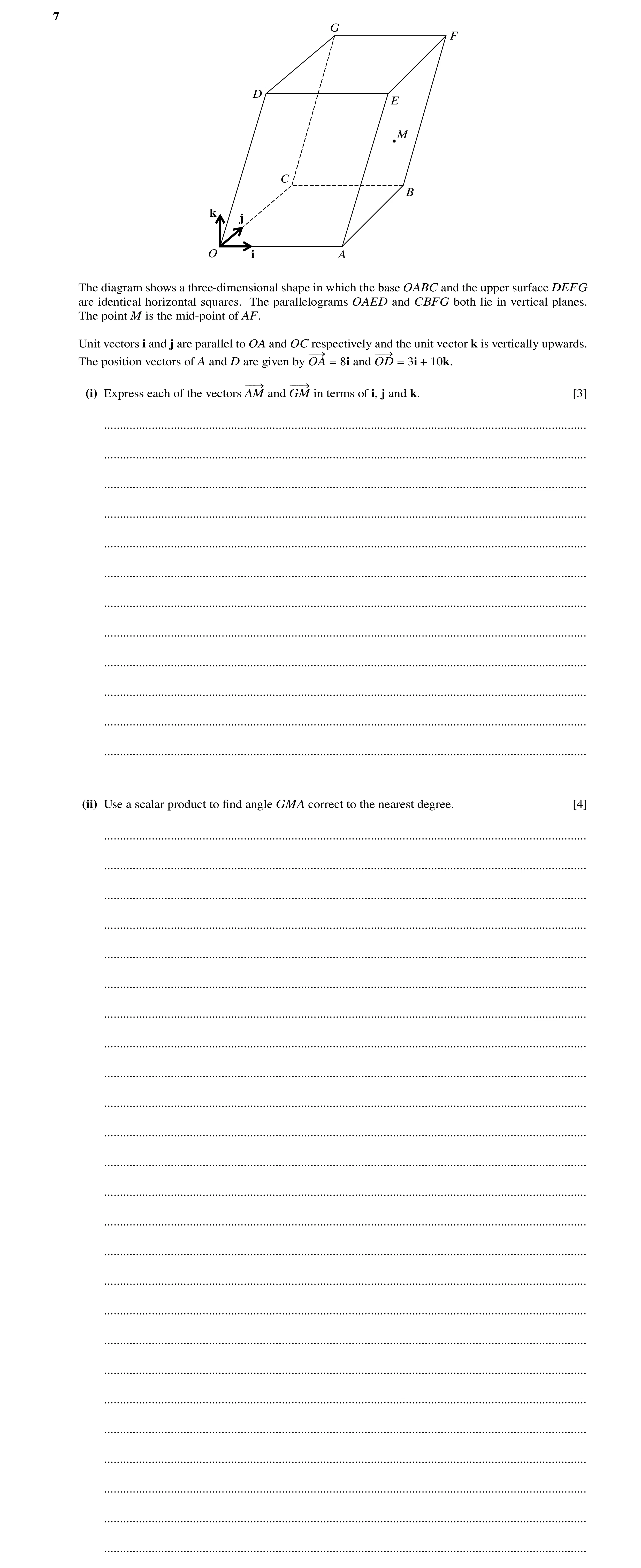
7 G F D E M C B k j O i A The diagram shows a three-dimensional shape in which the base OABC and the upper surface DEFG are identical horizontal squares. The parallelograms OAED and CBFG both lie in vertical planes. The point M is the mid-point of AF. Unit vectors i and j are parallel to OA and OC respectively and the unit vector k is vertically upwards. −−→ −−→ The position vectors of A and D are given by OA = 8i and OD = 3i + 10k. −−→ −−−→ (i) Express each of the vectors AM and GM in terms of i, j and k. [3] … … … … … … … … … … … … (ii) Use a scalar product to find angle GMA correct to the nearest degree. [4] … … … … … … … … … … … … … … … … … … … … … … … … …
7 marks
Mark scheme: 7(i) AM = 1.5i + 4j + 5k GM JJJJG = 6.5i – 4j − 5k 3 7(ii) AM JJJJG . GM JJJJG = 9.75 −16 – 25 = −31.25 M1 Use of 1 2 1 2 1 2 x x y y z z + + on AM and GM AM JJJJG . GM JJJJG = √(1.5²+4²+5²) × √( 6.5²+4²+5²) cos GMA M1 M1 M1 for product of 2 modulii M1 all correctly connected Equating → Angle GMA = 121° A1 4
This question in 9709/11 May/June 2019
Q47 · The position vectors of points A and B, relative to an origin O, are given by ` a ` a… 9709/12 May/June 2019
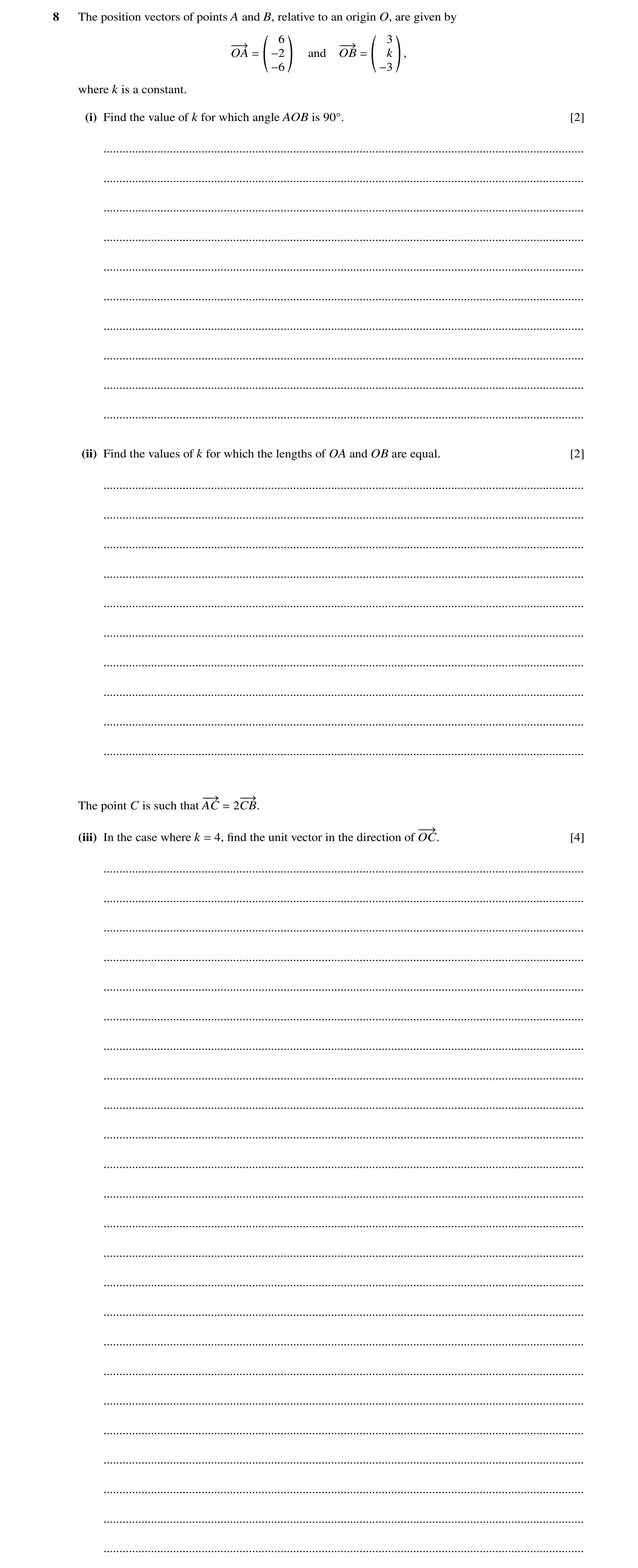
8 The position vectors of points A and B, relative to an origin O, are given by ` a ` a −−→OA 6 and −−→OB 3k , = −2 = −6 −3 where k is a constant. (i) Find the value of k for which angle AOB is [2] 90Å. … … … … … … … … … … (ii) Find the values of k for which the lengths of OA and OB are equal. [2] … … … … … … … … … … The point C is such that −−→AC 2−−→CB. = (iii) In the case where k 4, find the unit vector in the direction of −−→OC. [4] = … … … … … … … … … … … … … … … … … … … … … … … …
8 marks
Mark scheme: 8(i) 6×3+-2×k+-6×-3 = 0 (18 – 2k + 18 = 0) M1 Could be JJJG AO . JJJG OB , JJJG AO . JJJG BO or JJJG OA . JJJG BO k = 18 A1 Alternative method for question 8(i) 76 + 18 + k2 = 18 + (k + 2)2 M1 Use of Pythagoras with appropriate lengths. k = 18 A1 2 8(ii) 36 + 4 + 36 = 9 +k² + 9 M1 Use of modulus leading to an equation and solve to k= or k2 = k = ±√58 or ±7.62 A1 Accept exact or decimal answers. Allow decimals to greater accuracy. 2 Question Answer Marks Guidance 8(iii) JJJG AB = 3 6 3 − → 2 4 2 − = JJJG AC then + JJJG JJJG OA AC M1 Complete method using JJJG AC = ± ⅔ JJJG AB And then + JJJG JJJG OA their AC = JJJG OC 4 2 4 − A1 ÷ ( ) ( ) ( ) 2 2 2 4 2 4 + + − their their their M1 Divides by modulus of their JJJG OC = 4 1 2 6 4 − or 1 6 (4i + 2j – 4k) A1 Alternative method for question 8(iii) Let JJJG OC = p q r → 6 2 & 6 − = + + JJJG JJJG p AC q CB r = 3 4 3 − − −− p q r M1 Correct method. Equates coefficients leading to values for p, q, r p – 6 = 2(3 – p); q+2 = 2(4 – q); r + 6 = 2 (–3 – r) →p=4, q=2 & r= – 4 A1 ÷ ( ) ( ) ( ) 2 2 2 4 2 4 + + − their their their M1 Divides by modulus of their JJJG OC = 4 1 2 6 4 − or 1 6 (4i + 2j – 4k) A1 Question Answer Marks Guidance 8(iii) Alternative method for question 8(iii) JJJG CB = − JJJG JJJG OB OC ( ) 2 ∴ − JJJG JJJG OB OC = JJJG OC – JJJG OA →2 JJJG OB + JJJG OA = 3 ∴ JJJG OC 3 JJJG OC = 12 6 12 − M1 Correct method. Gets to a numerical expression for k JJJG OC from & JJJG JJJG OA OB . JJJG OC = 4 2 4 − A1 ÷ ( ) ( ) ( ) 2 2 2 4 2 4 + + − their their their M1 Divides by modulus of their JJJG OC = 4 1 2 6 4 − or 1 6 (4i + 2j – 4k) A1 4
This question in 9709/12 May/June 2019
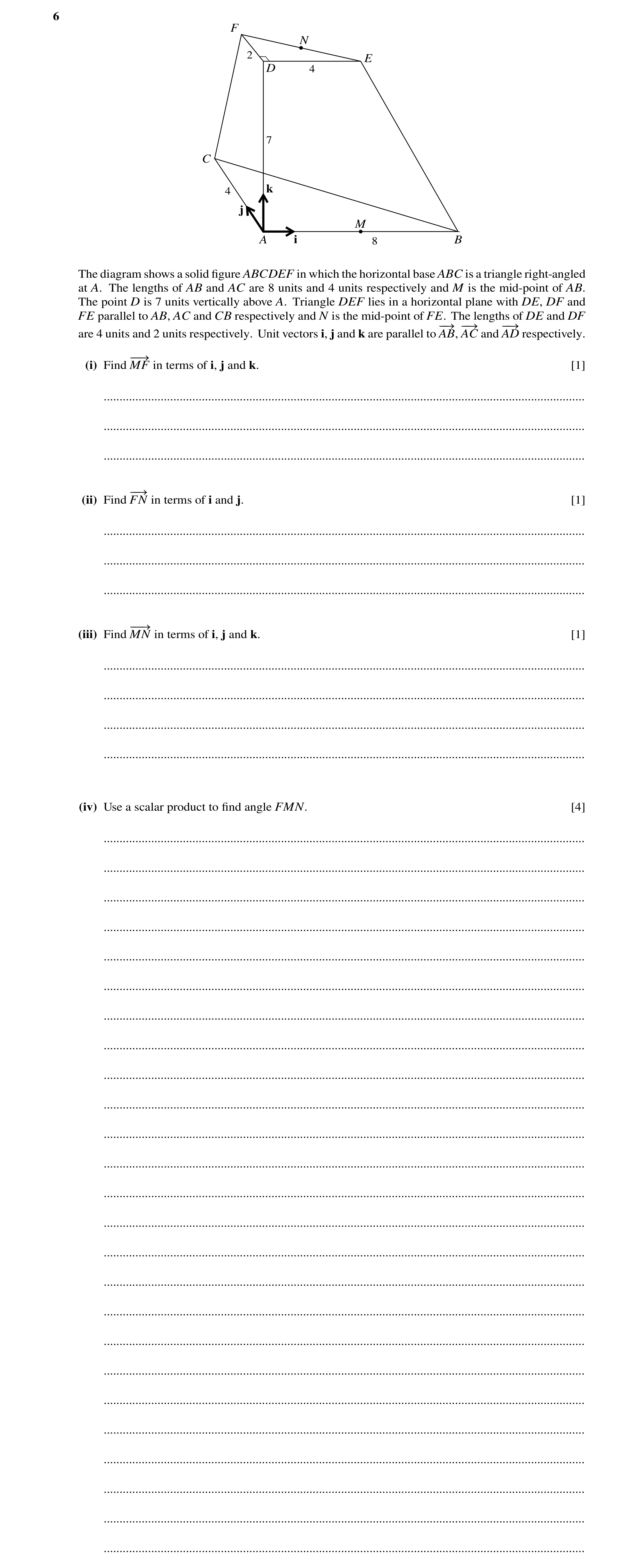
Q48 · F N 2 E D 4 7 C 4 k j M A i 8 B The diagram shows a solid figure ABCDEF in which the… 9709/13 May/June 2019
6 F N 2 E D 4 7 C 4 k j M A i 8 B The diagram shows a solid figure ABCDEF in which the horizontal base ABC is a triangle right-angled at A. The lengths of AB and AC are 8 units and 4 units respectively and M is the mid-point of AB. The point D is 7 units vertically above A. Triangle DEF lies in a horizontal plane with DE, DF and FE parallel to AB, AC and CB respectively and N is the mid-point of FE. The lengths of DE and DF −−→ −−→ −−→ are 4 units and 2 units respectively. Unit vectors i, j and k are parallel to AB, AC and AD respectively. −−−→ (i) Find MF in terms of i, j and k. [1] … … … −−→ (ii) Find FN in terms of i and j. [1] … … … −−−→ (iii) Find MN in terms of i, j and k. [1] … … … … (iv) Use a scalar product to find angle FMN. [4] … … … … … … … … … … … … … … … … … … … … … … … … …
7 marks
Mark scheme: 6(i) B1 1 6(ii) FN = 2i ‒ j B1 1 6(iii) MN = ‒2i + j + 7k B1 FT on their (MF + FN) 1 Question Answer Marks Guidance 6(iv) MF.MN = 8 + 2 + 49 = 59 *M1 MF.MN or FM.NM but allow if one is reversed (implied by ‒59) |MF| × |MN| = 2 2 2 2 2 2 4 2 7 2 1 7 + + × + + *DM1 Product of modulus. At least one methodically correct / 59 cos 69 54 FMN + − = × DM1 All linked correctly. Note 69 54 × = 9 46 FMN = 14.9° or 0.259 A1 Do not allow if exactly 1 vector is reversed – even if adjusted finally 4
This question in 9709/13 May/June 2019
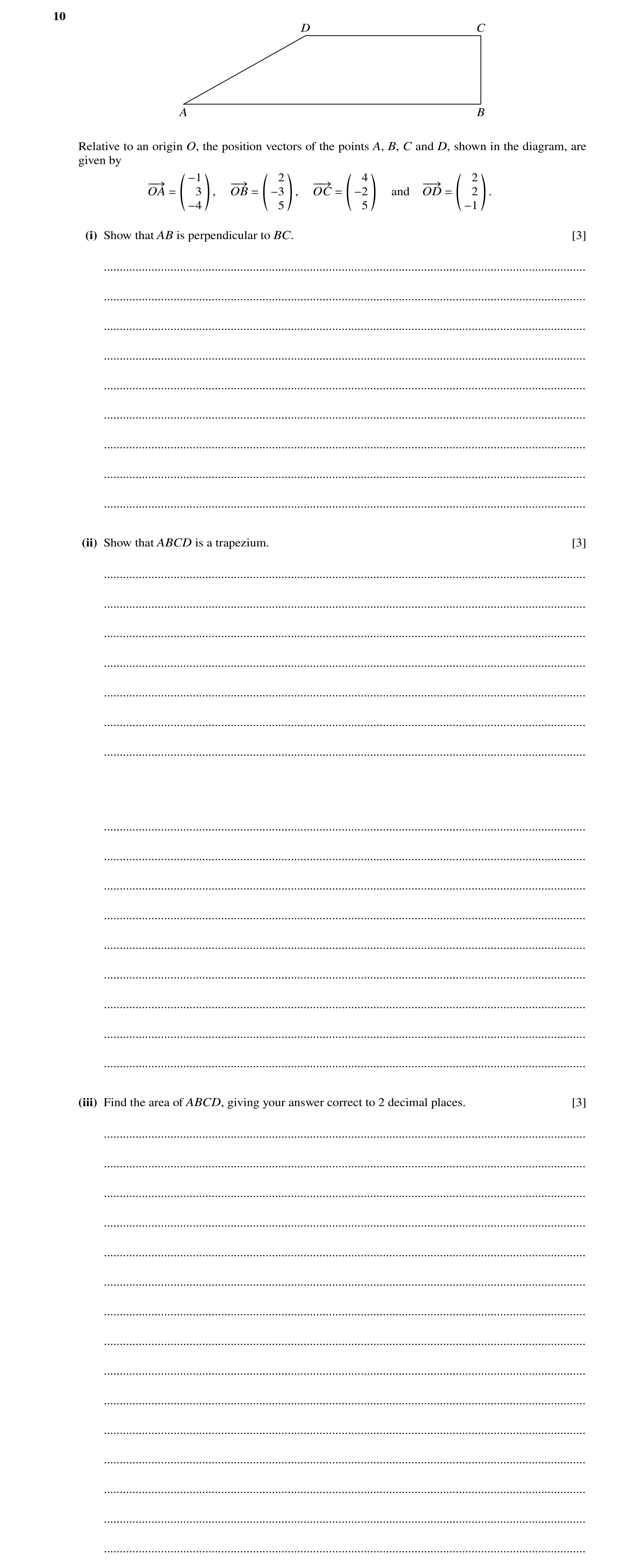
Q49 · D C A B Relative to an origin O, the position vectors of the points A, B, C and D, shown… 9709/11 Oct/Nov 2019
10 D C A B Relative to an origin O, the position vectors of the points A, B, C and D, shown in the diagram, are given by ` a ` a ` a ` a −1 2 4 2 −−→ −−→ −−→ −−→ OA = 3 , OB = −3 , OC = −2 and OD = 2 . −4 5 5 −1 (i) Show that AB is perpendicular to BC. [3] … … … … … … … … … (ii) Show that ABCD is a trapezium. [3] … … … … … … … … … … … … … … … … (iii) Find the area of ABCD, giving your answer correct to 2 decimal places. [3] … … … … … … … … … … … … … … …
9 marks
Mark scheme: 10(i) 2 1 3 4 2 2 3 3 6 , 2 3 1 5 4 9 5 5 0 − = − − = − = − −− = − AB BC AB.BC = 6 ‒ 6 → = 0 (hence perpendicular) B1 AG 10(ii) 4 2 2 2 2 4 5 1 6 = − − = − − DC B1 Or: CD 2 4 6 − = − AB = kDC M1 OE Expect k = 3 2 Or: DC.BC = 4 ‒ 4 = 0 hence BC is also perpendicular to DC Or: AB.DC = 1 or AB.CD = –1, angle between lines is 0 or 180 AB is parallel to DC, hence ABCD is a trapezium A1 10(iii) |AB| = 9 36 81 126 11.22 + + = = |DC| = 4 16 36 56 7.483 + + = = |BC| = 4 1 0 5 2.236 + + = = M1 Method for finding at least 2 magnitudes Area = 1 2 ( ) + × theirAB theirDC theirBC = 20.92 M1A1 OE
This question in 9709/11 Oct/Nov 2019
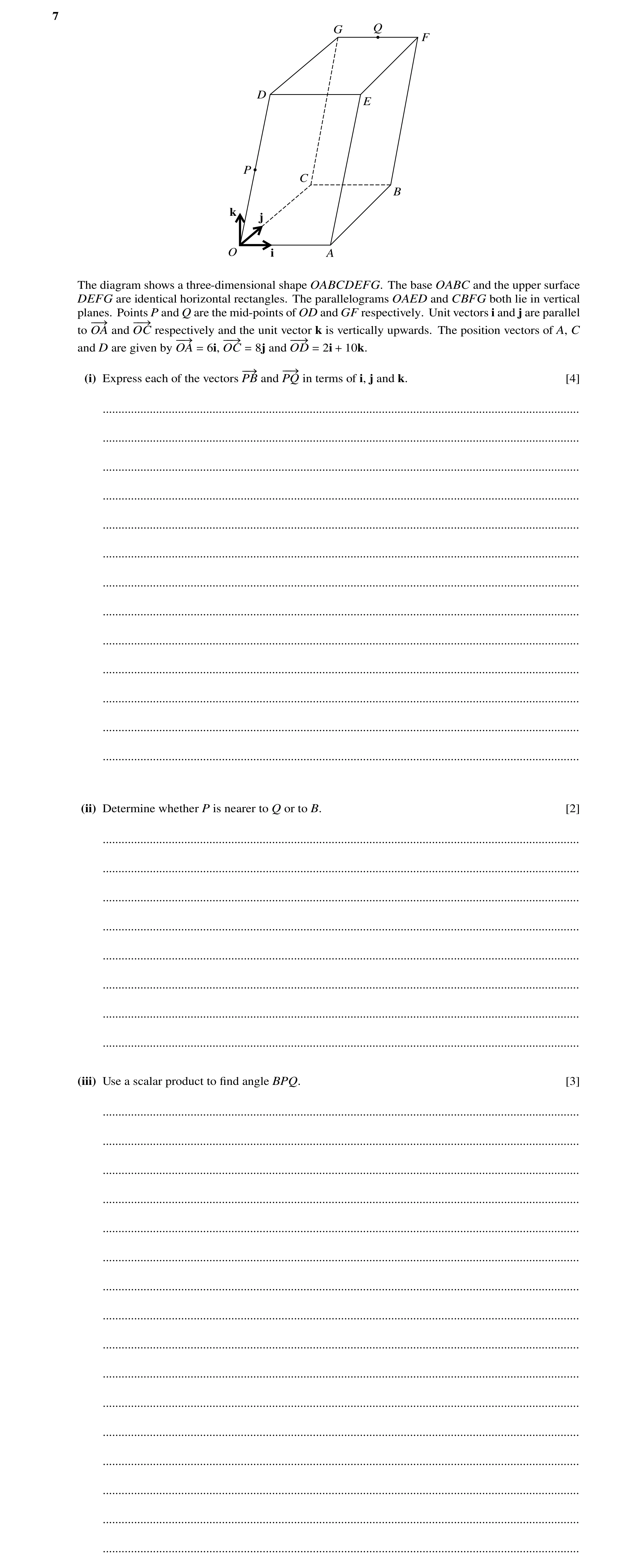
Q50 · G Q F D E P C B k j O i A The diagram shows a three-dimensional shape OABCDEFG 9709/12 Oct/Nov 2019
7 G Q F D E P C B k j O i A The diagram shows a three-dimensional shape OABCDEFG. The base OABC and the upper surface DEFG are identical horizontal rectangles. The parallelograms OAED and CBFG both lie in vertical planes. Points P and Q are the mid-points of OD and GF respectively. Unit vectors i and j are parallel to −−→OA and −−→OC respectively and the unit vector k is vertically upwards. The position vectors of A, C and D are given by −−→OA 6i, −−→OC 8j and −−→OD 2i 10k. = = = + (i) Express each of the vectors −−→PB and −−→PQ in terms of i, j and k. [4] … … … … … … … … … … … … … (ii) Determine whether P is nearer to Q or to B. [2] … … … … … … … … (iii) Use a scalar product to find angle BPQ. [3] … … … … … … … … … … … … … … … …
9 marks
Mark scheme: 7(i) PB = 5i + 8j – 5k ( ) JJJG PQ = 4i + 8j + 5k B2,1,0 B2 all correct, B1 for two correct components. Accept column vectors. SC B1 for each vector if all components multiplied by –1. 4 7(ii) (Length of PB =) ( ) 2 2 2 5 8 5 + + = ( 114 ≈ 10.7) (Length of PQ =) ( ) 2 2 2 8 5 4 + + = ( 105 ≈ 10.2) M1 Evaluation of both lengths. Other valid complete comparisons can be accepted. P is nearer to Q. A1 WWW 2 7(iii) ( ) . JJJG JJJG PB PQ = 20 + 64 – 25 M1 Use of x1x2 + y1y2 + z1z2 on their JJJG PB and JJJG PQ ( 114)( 105)cos ( 59) = Their their BPQ their M1 All elements present and in correct places. BPQ = 57.4(°) or 1.00 (rad) A1 AWRT Calculating the obtuse angle and then subtracting gets A0. 3
This question in 9709/12 Oct/Nov 2019
Q51 · Relative to an origin O, the position vectors of the points A, B and X are given by ` a `… 9709/13 Oct/Nov 2019
10 Relative to an origin O, the position vectors of the points A, B and X are given by ` a ` a ` a −8 10 −2 −−→ −−→ −−→ OA = −4 , OB = 2 and OX = −2 . 2 11 5 −−→ (i) Find AX and show that AXB is a straight line. [3] … … … … … … … … … … … … … … … … … … … … … … ` a 1 −−→ The position vector of a point C is given by OC = −8 . 3 (ii) Show that CX is perpendicular to AX. [3] … … … … … … … … … … … (iii) Find the area of triangle ABC. [3] … … … … … … … … … … …
9 marks
Mark scheme: 10(i) 6 18 12 12 2 , and one of 6 , 4 , 4 3 9 6 6 − = = = = − − AX AB XB BX B1B1 State 3 = AB AX ( 3 or 2 or 2 = = XB AX AB XB etc) hence straight line OR . AX AB AX AB = 1 ( θ → = 0) or . AX BX AX BX = –1 ( θ → = 180) hence straight line B1 WWW A conclusion (i.e. a straight line) is required. 3 10(ii) 3 6 2 − = CX B1 . 18 12 6 = − + + CX AX M1 = 0 (hence CX is perpendicular to AX) A1 3 10(iii) 2 2 2 2 2 2 3 6 2 , 18 6 9 = + + = + + CX AB Both attempted M1 Area ∆ ABC = 1 2 × their 21 × their 7 = 73 1 2 M1A1 Accept answers which round to 73.5 3
This question in 9709/13 Oct/Nov 2019
 1 / 47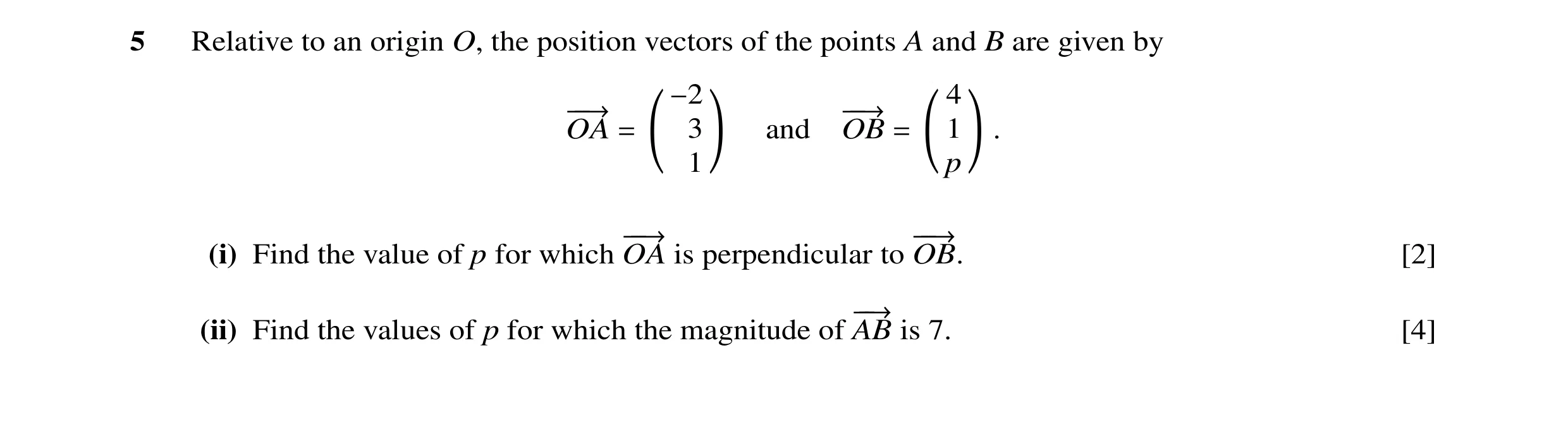

 2 / 47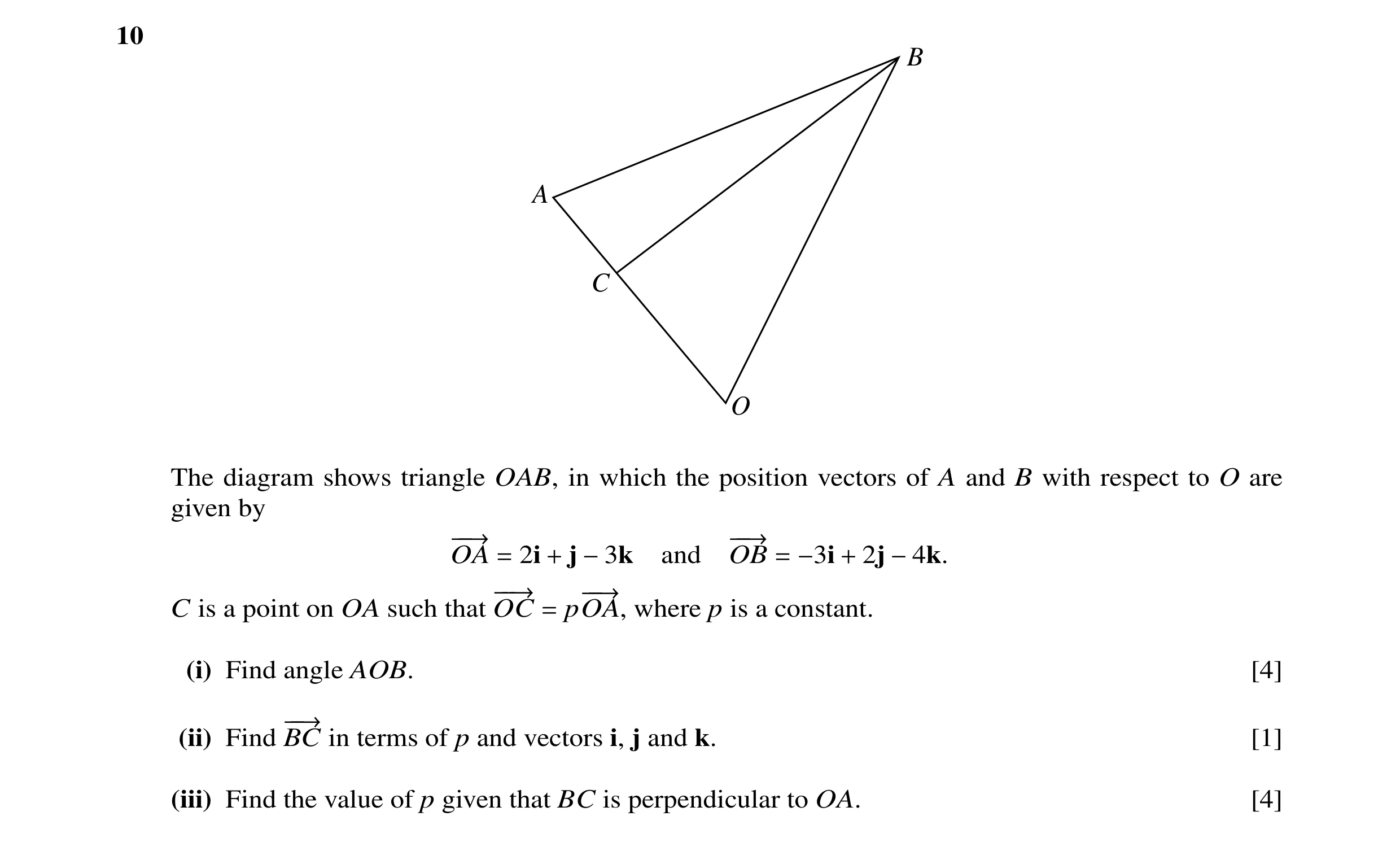
 3 / 47
 4 / 47
![Question 13: (i) Find the angle between the vectors 3i and 2i 3j [4] −4k + −6k. The vector −−→OA has a magnitude of 15 units and is in the same directio…](https://img.pastlit.com/crops/8c52c895-e4f4-40fc-b338-c5fd214c4ae0/q8.webp)
 5 / 47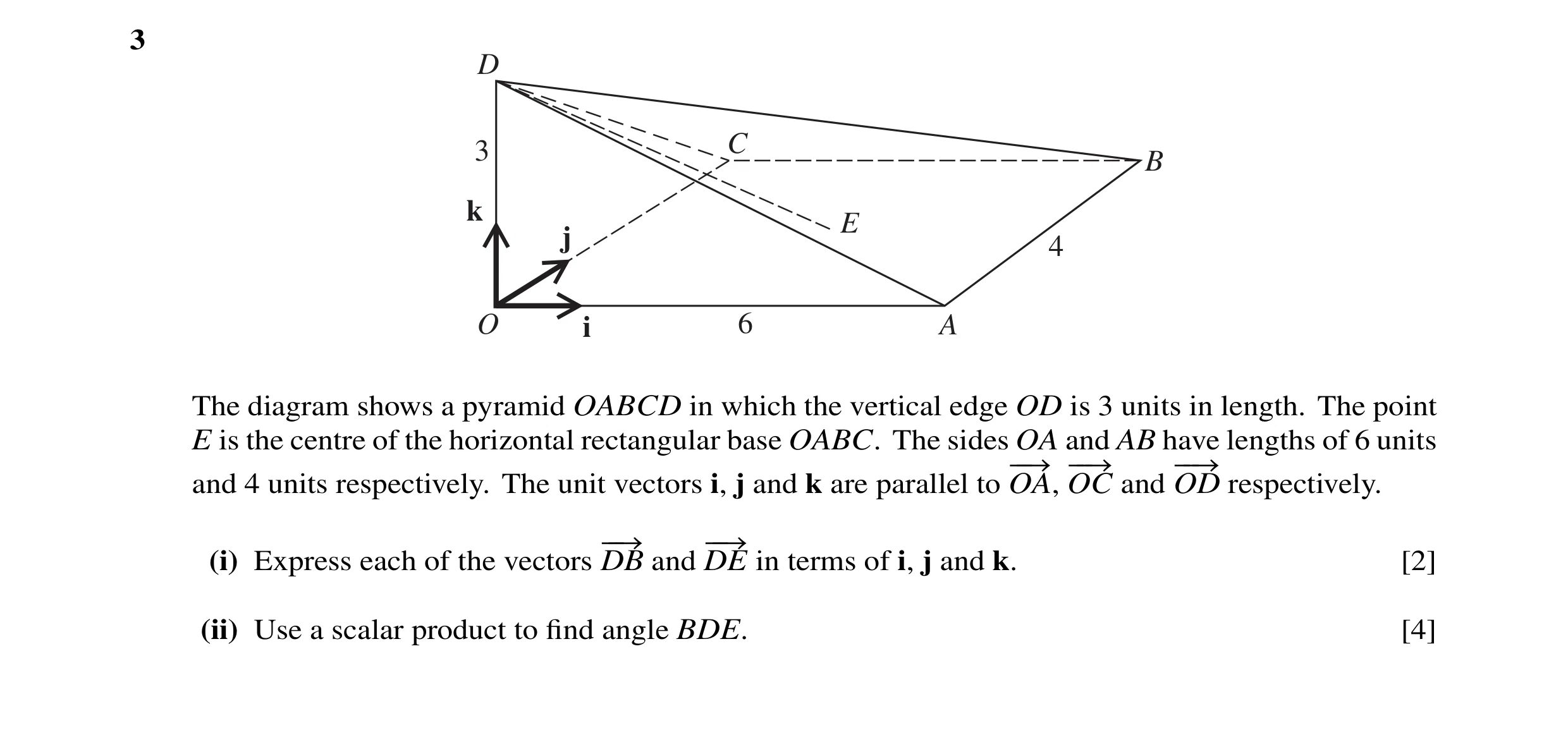
 6 / 47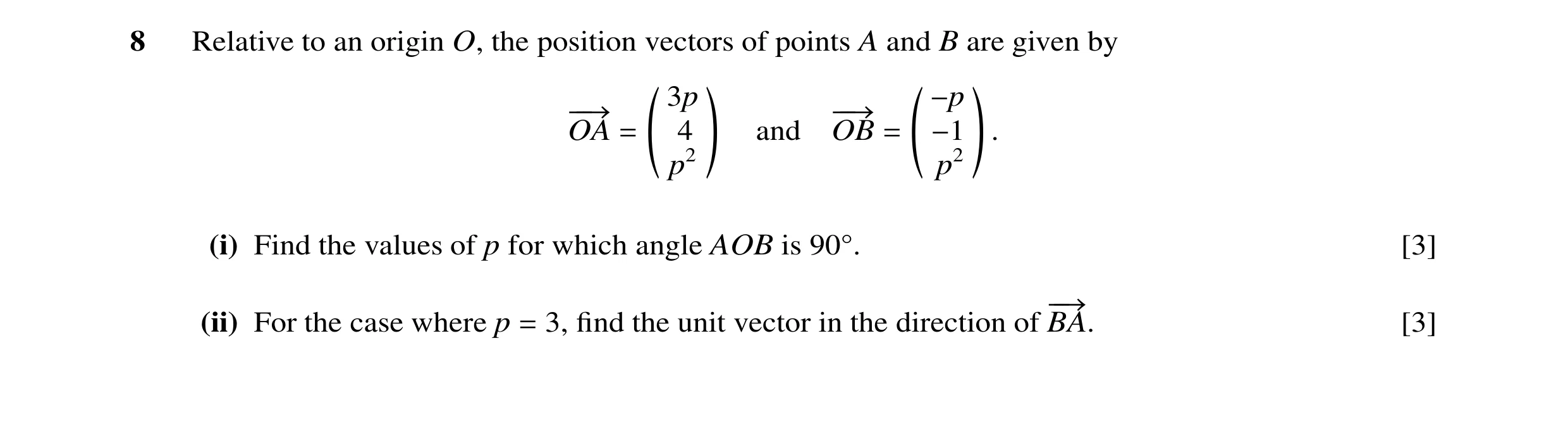
 7 / 47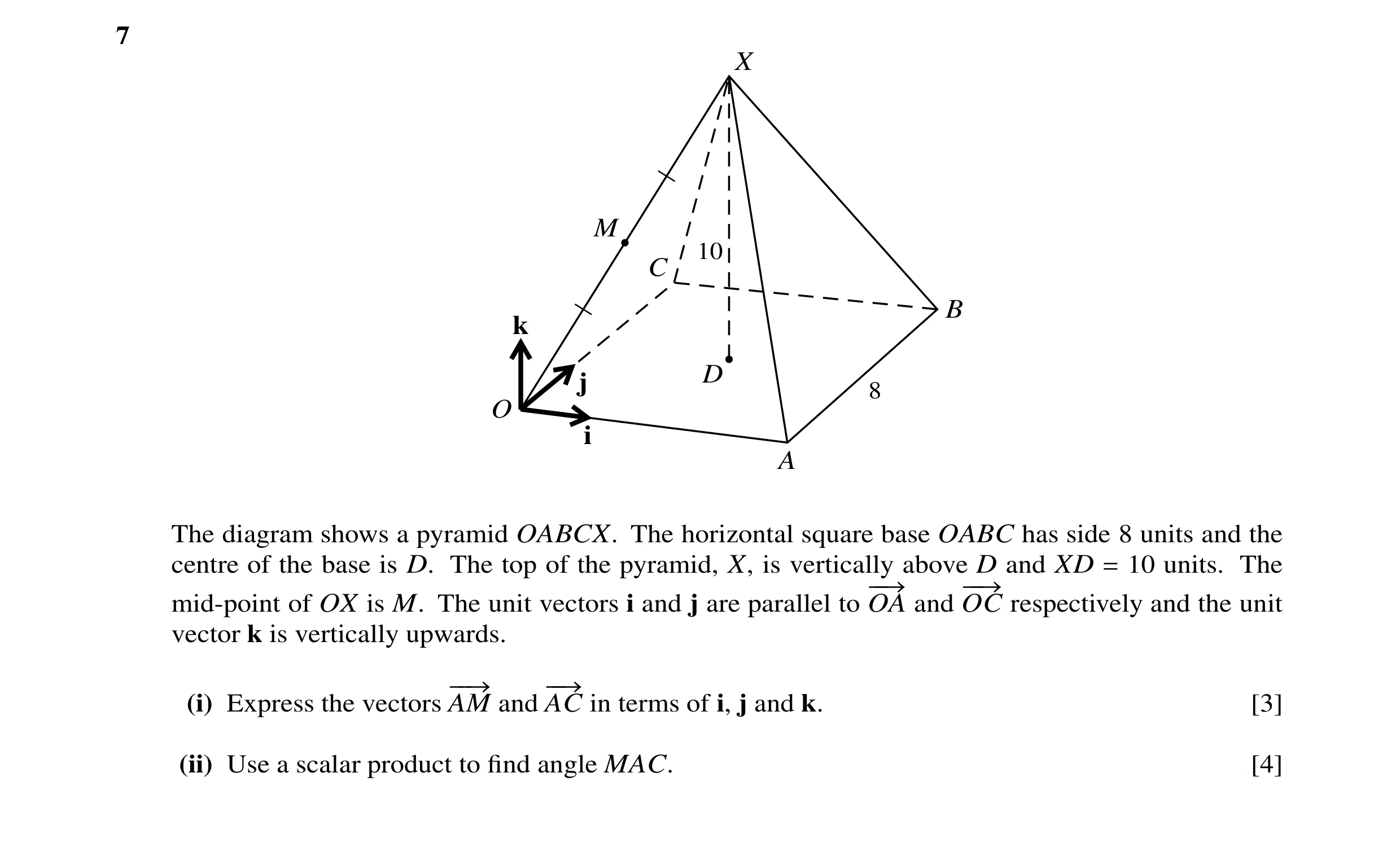
 8 / 47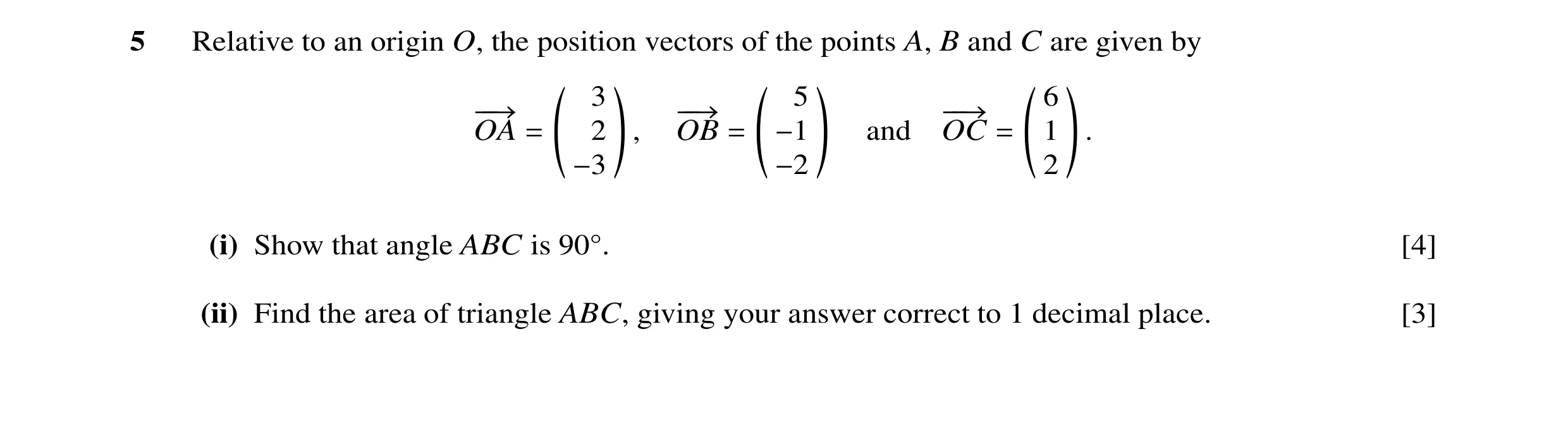
 9 / 47
 10 / 47
 11 / 47
 14 / 47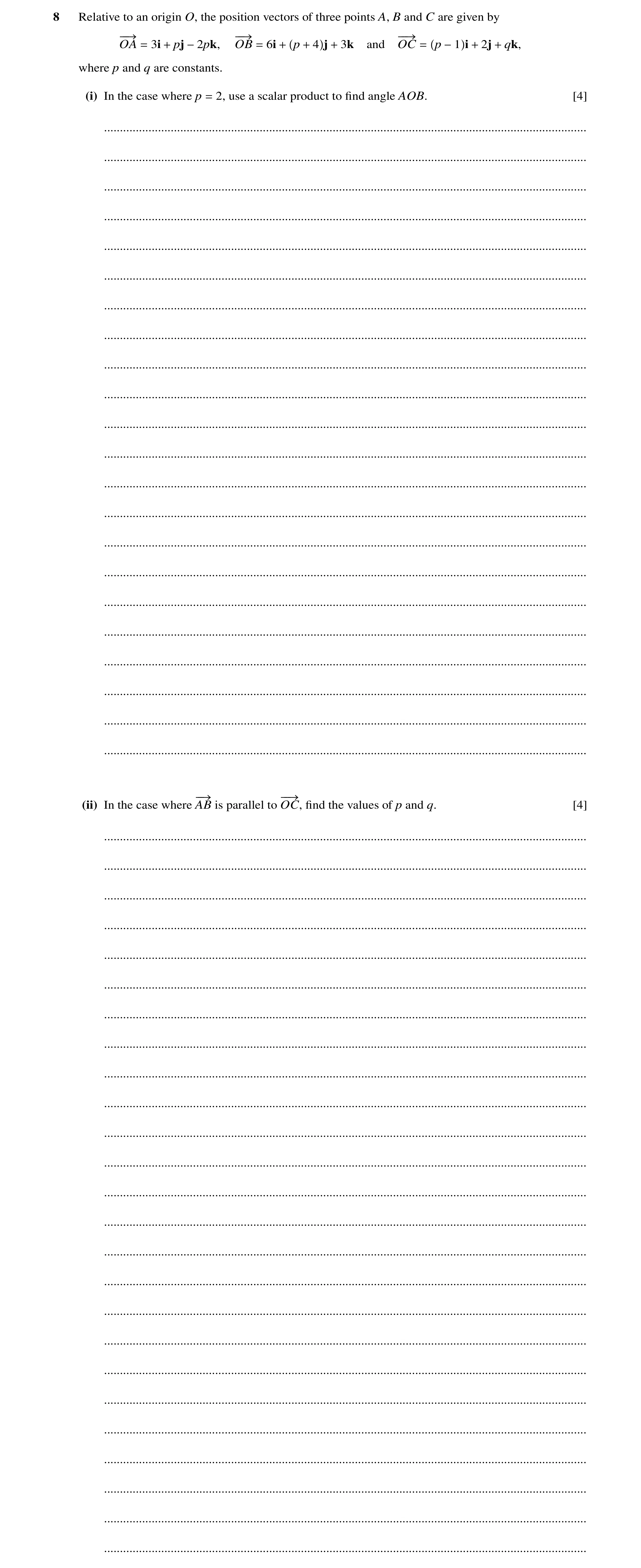
 17 / 47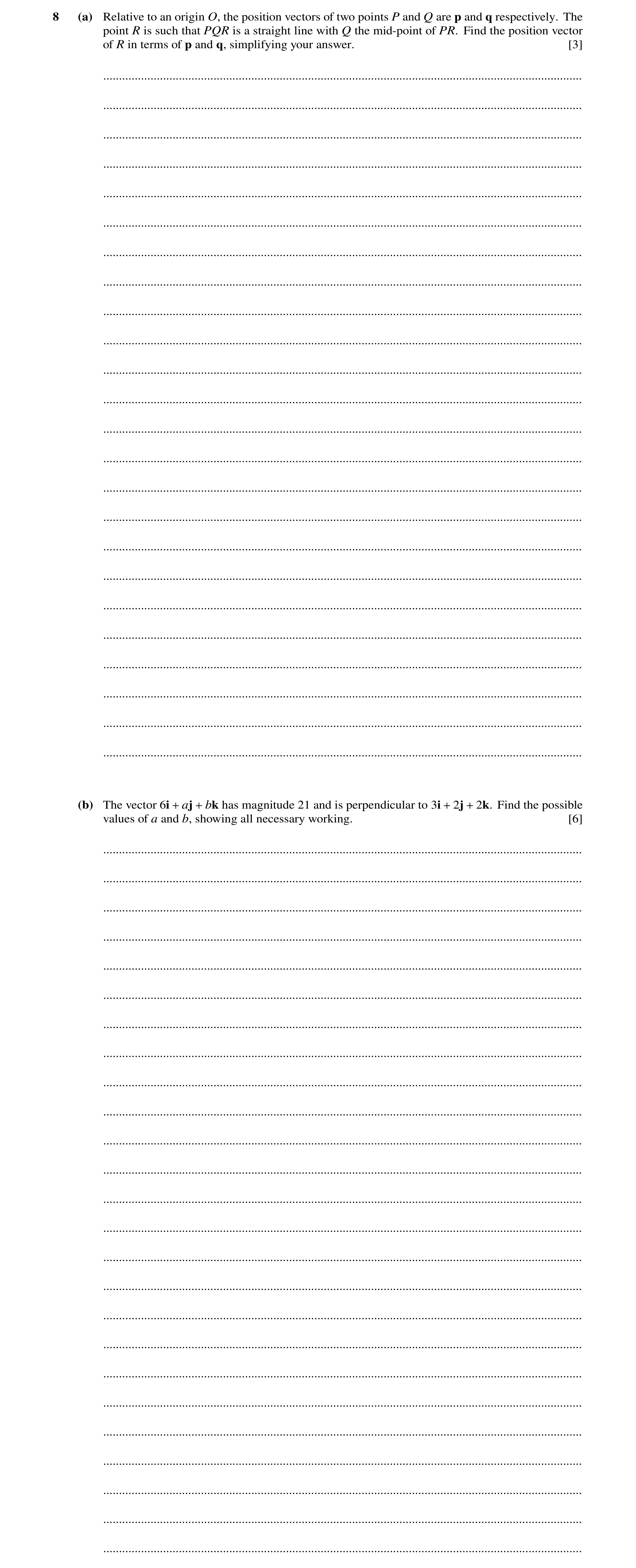
 8
8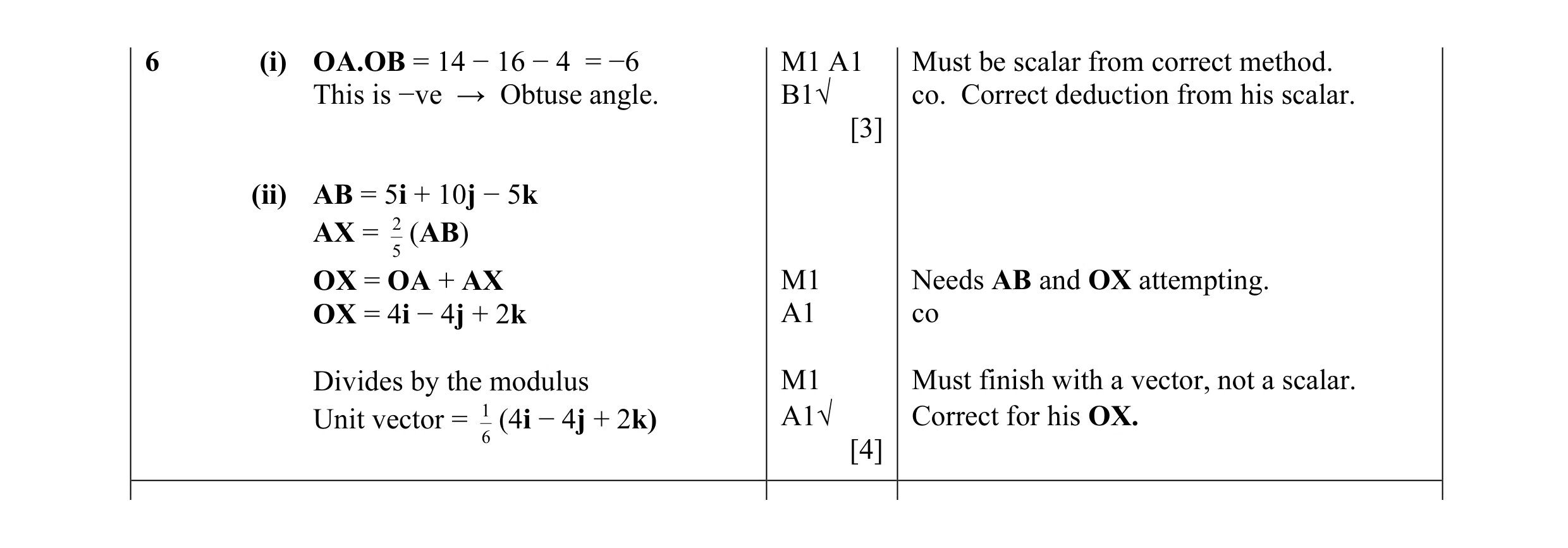 7
7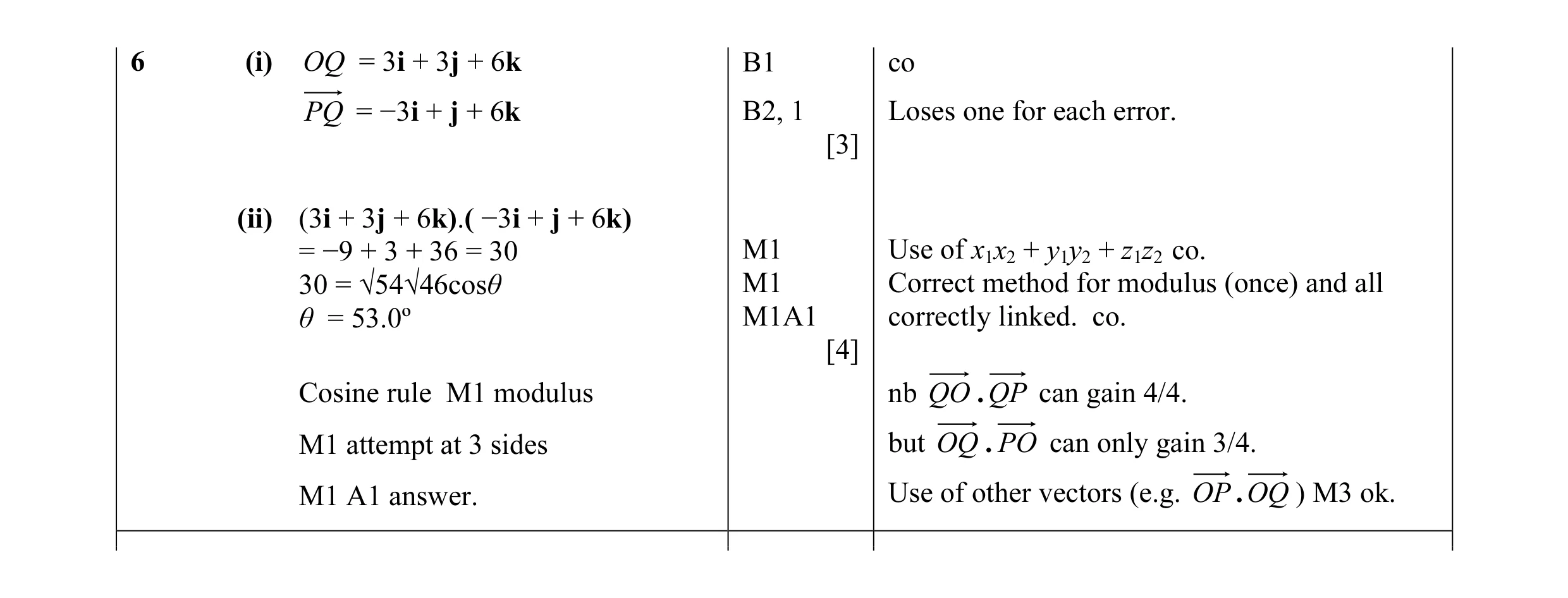 7
7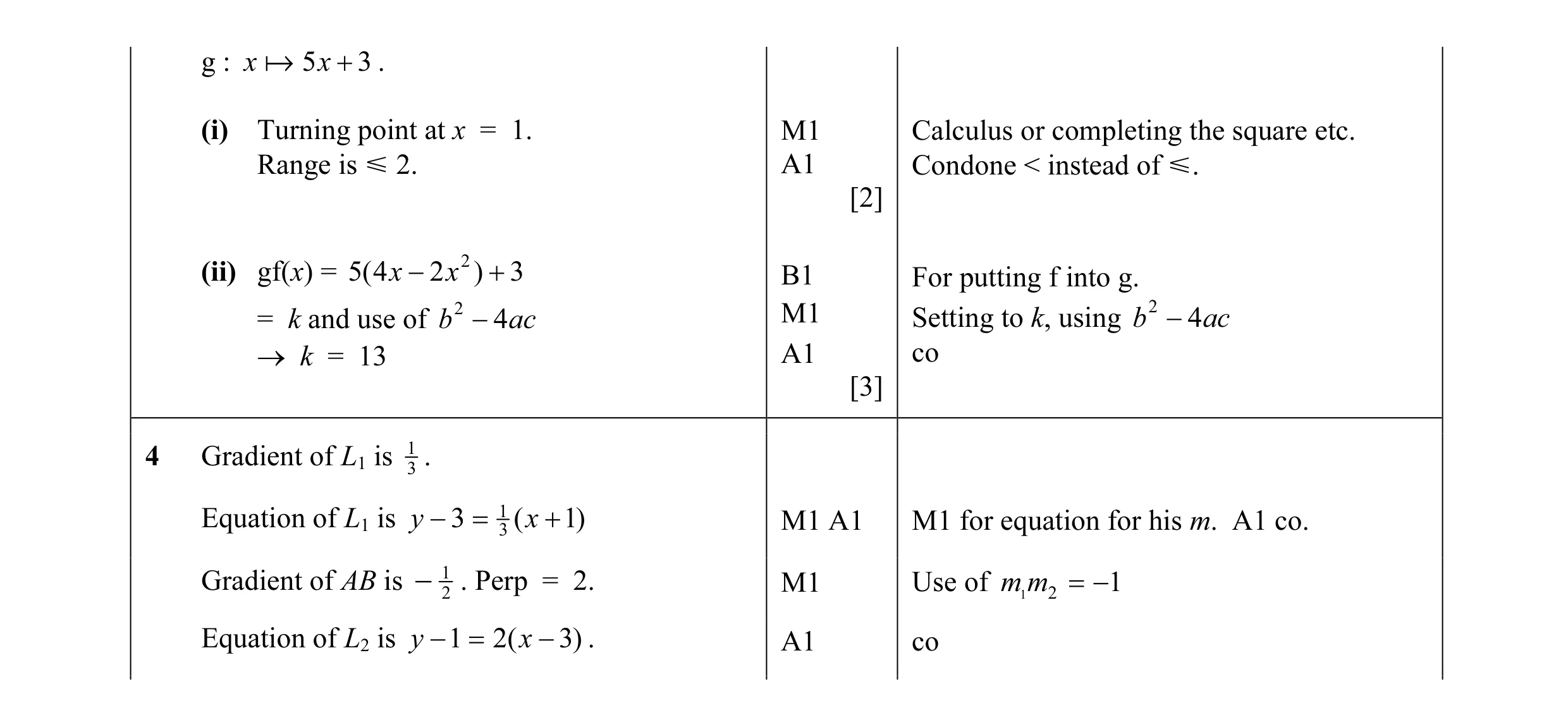 6
6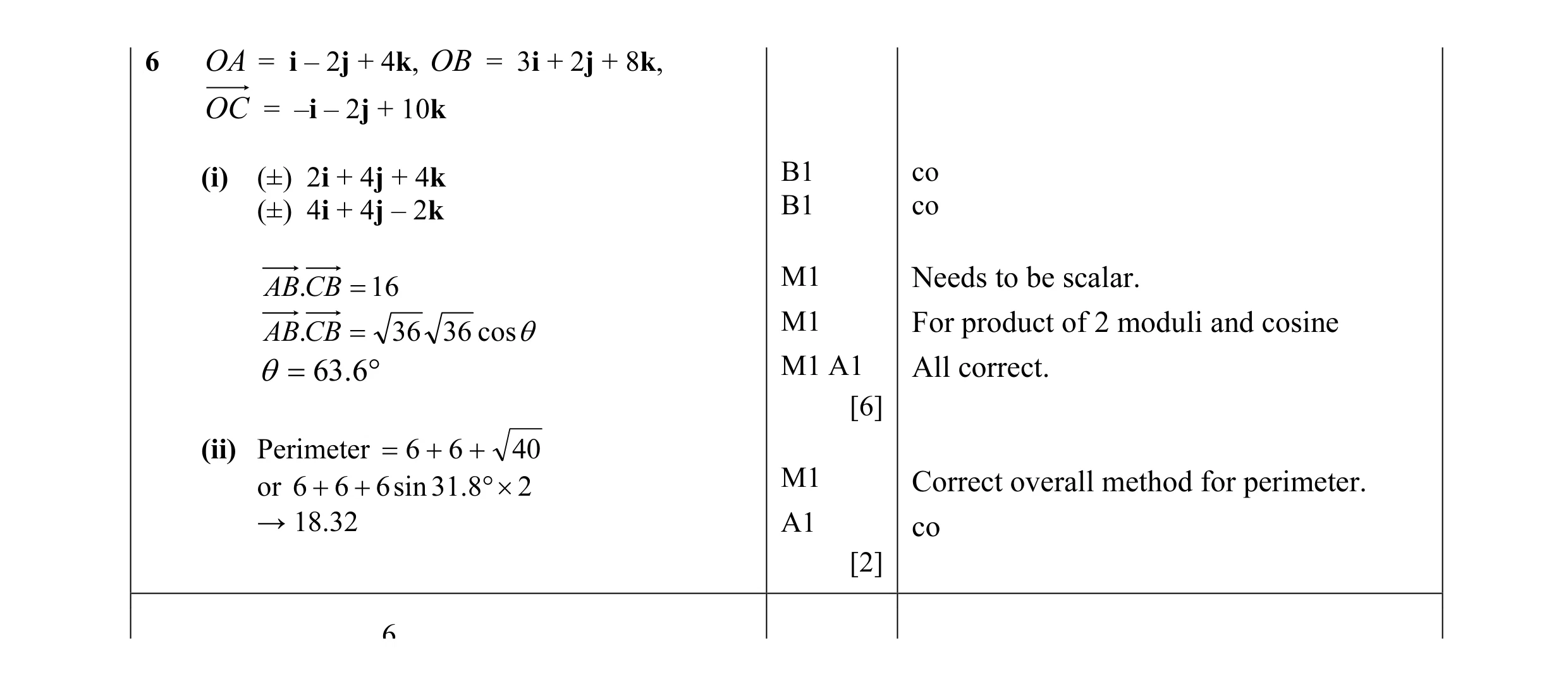 8
8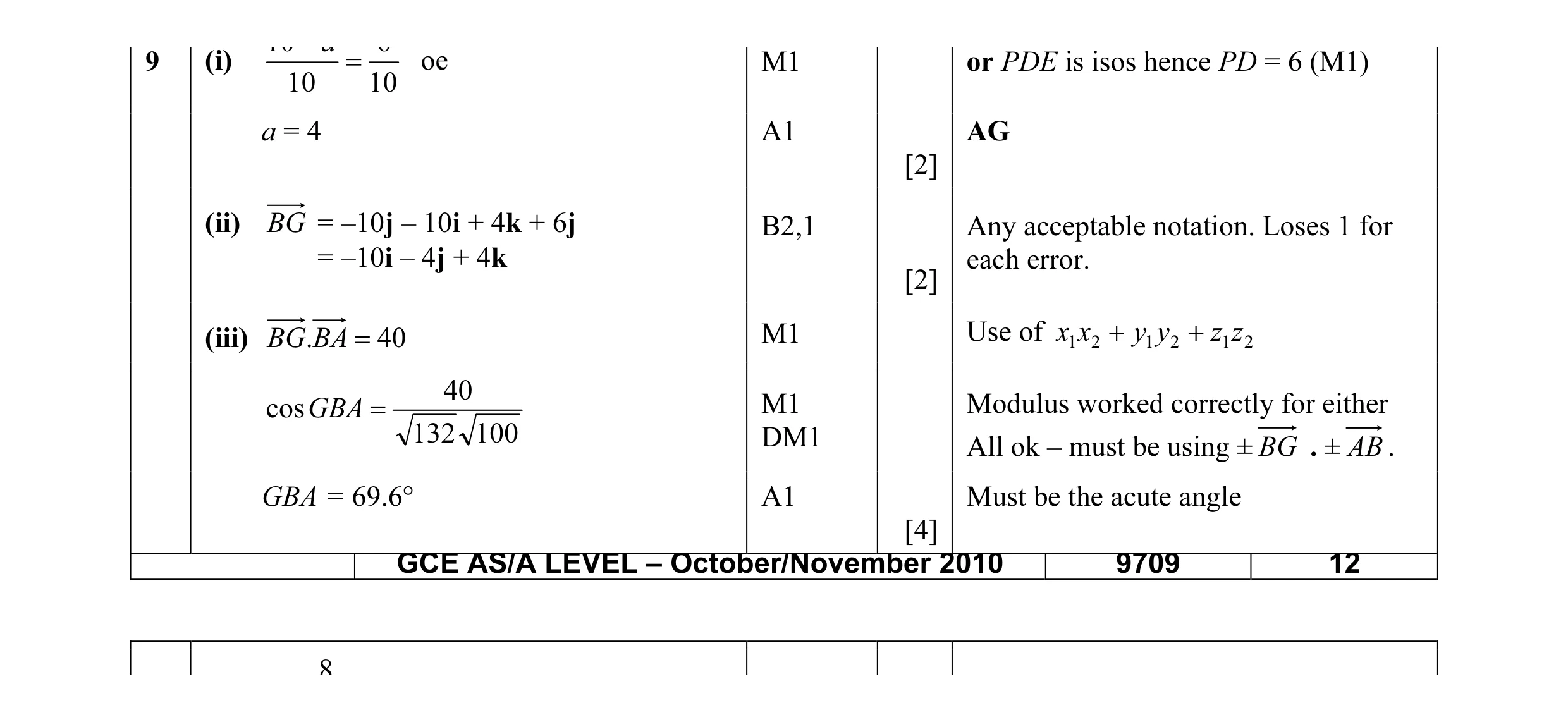 8
8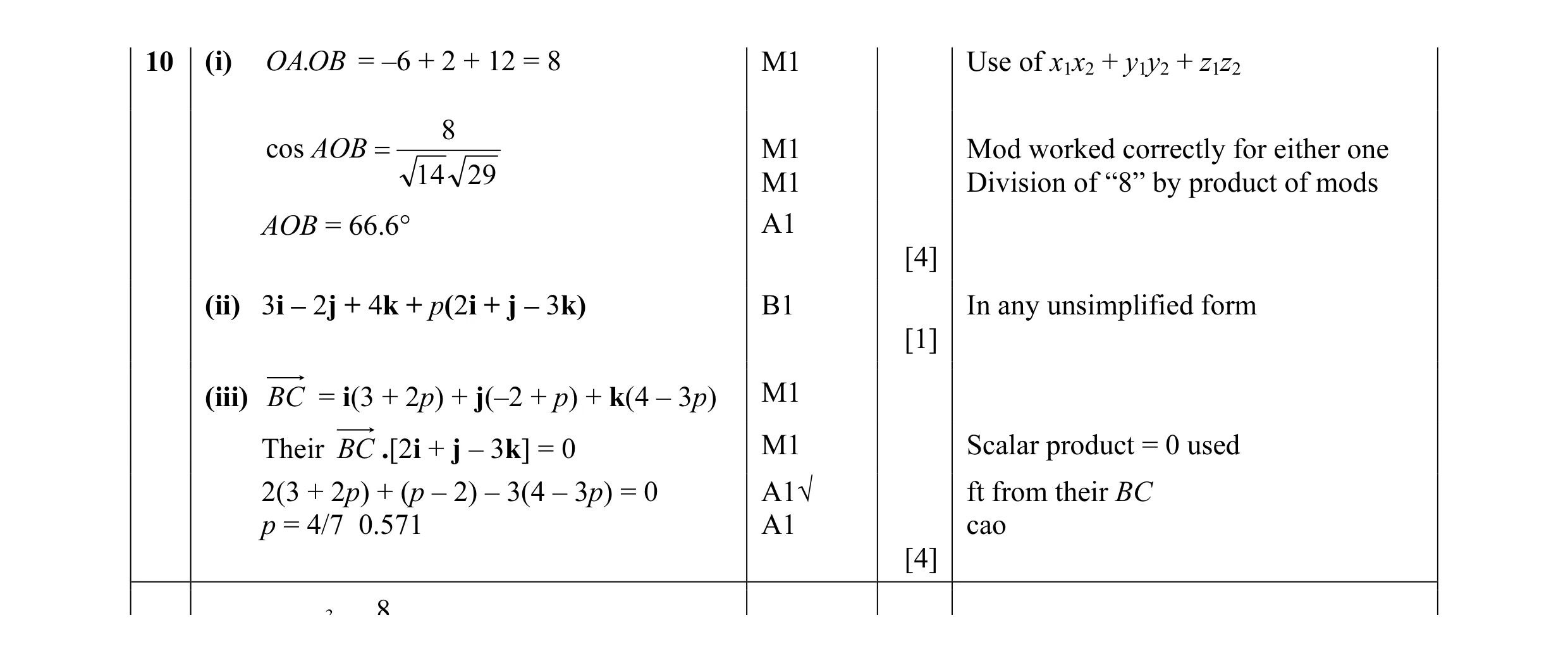 9
9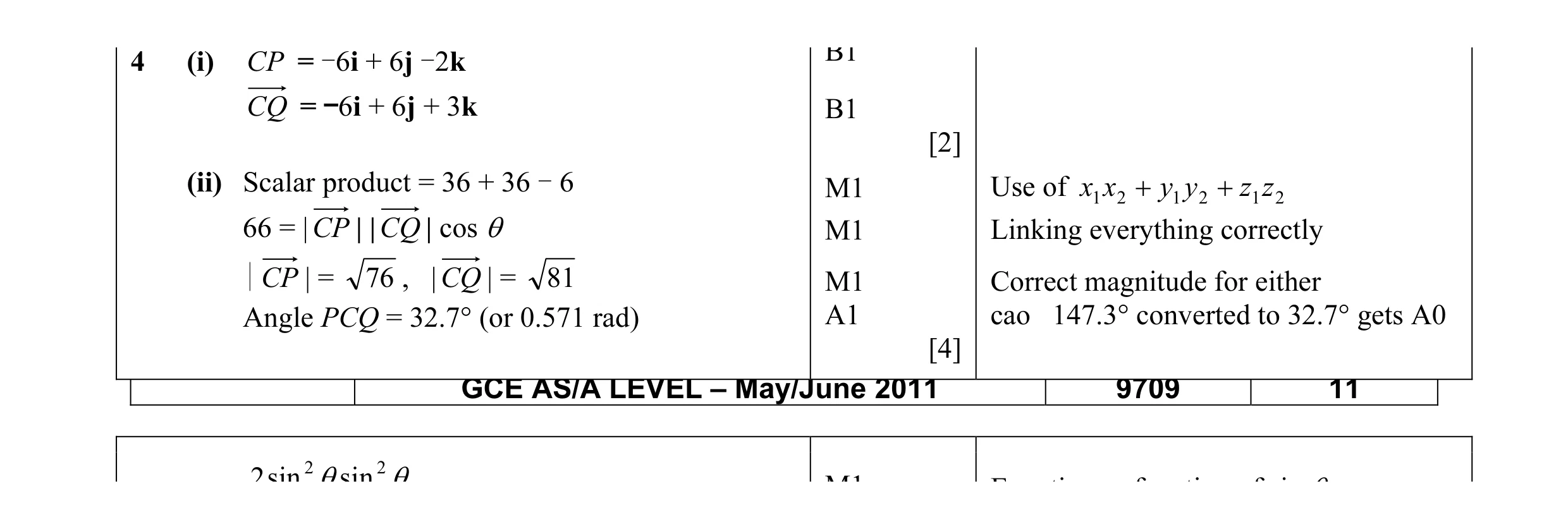 6
6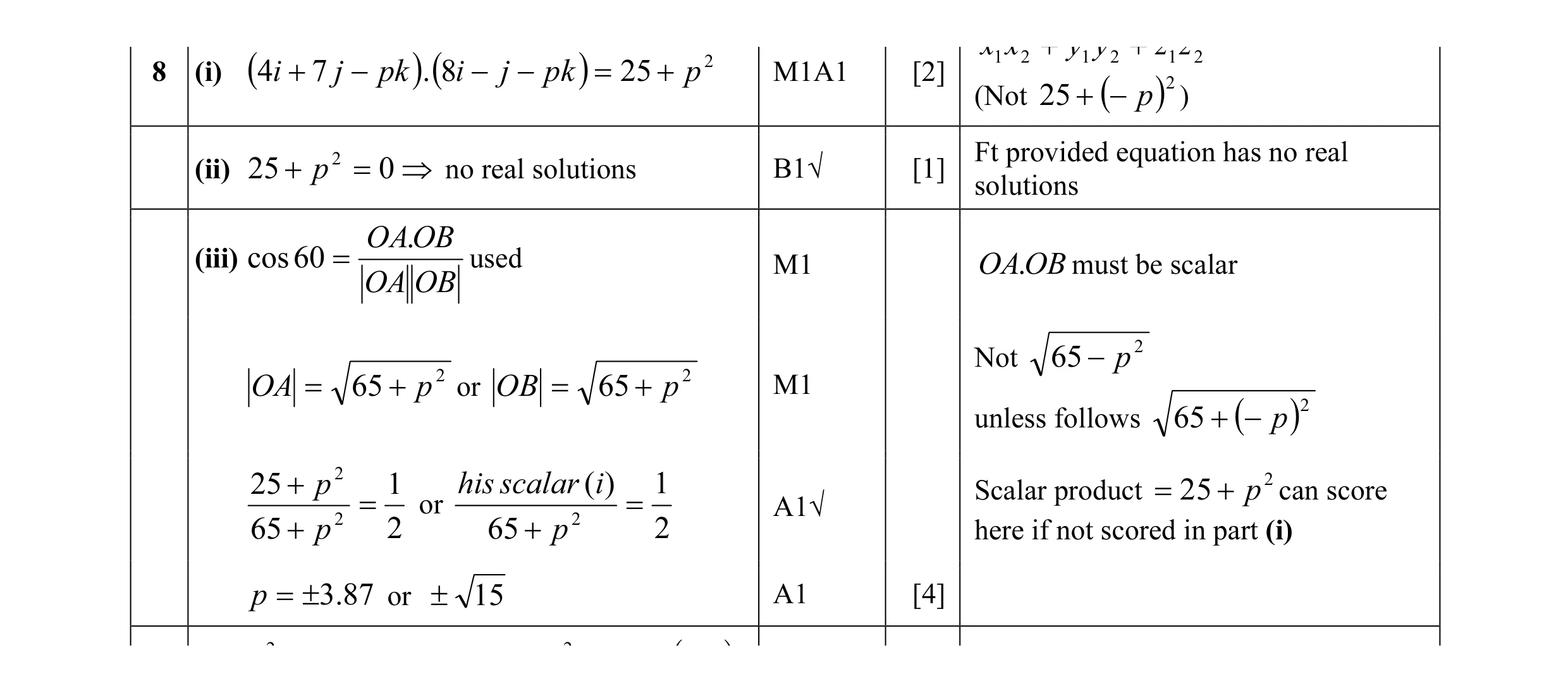 7
7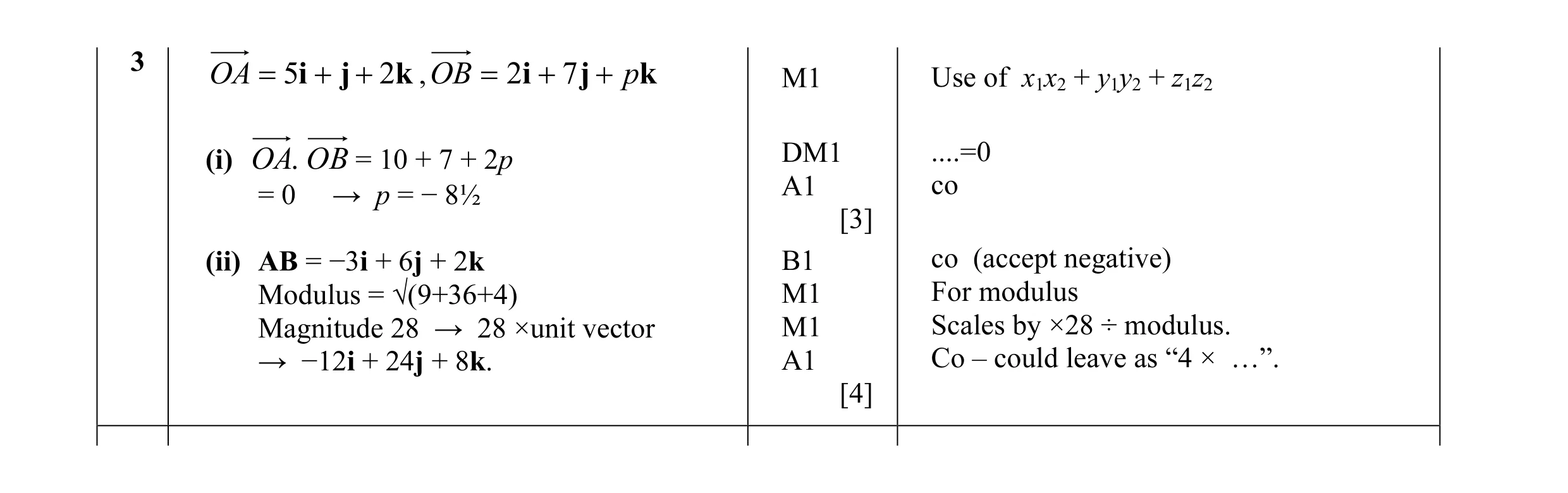 7
7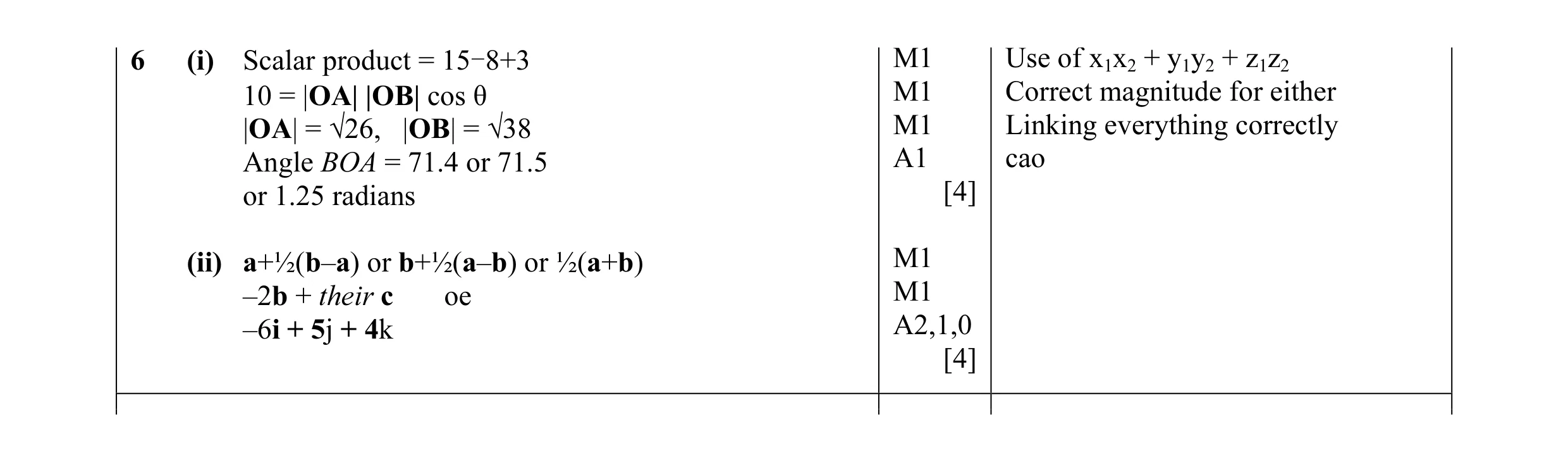 8
8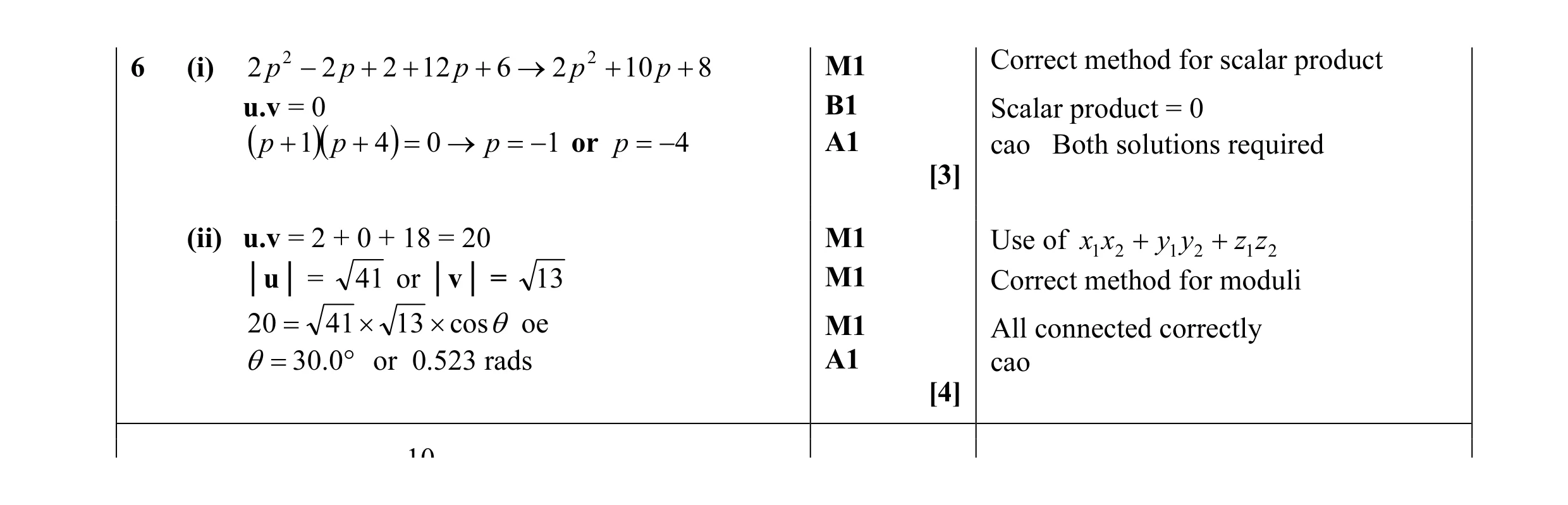 7
7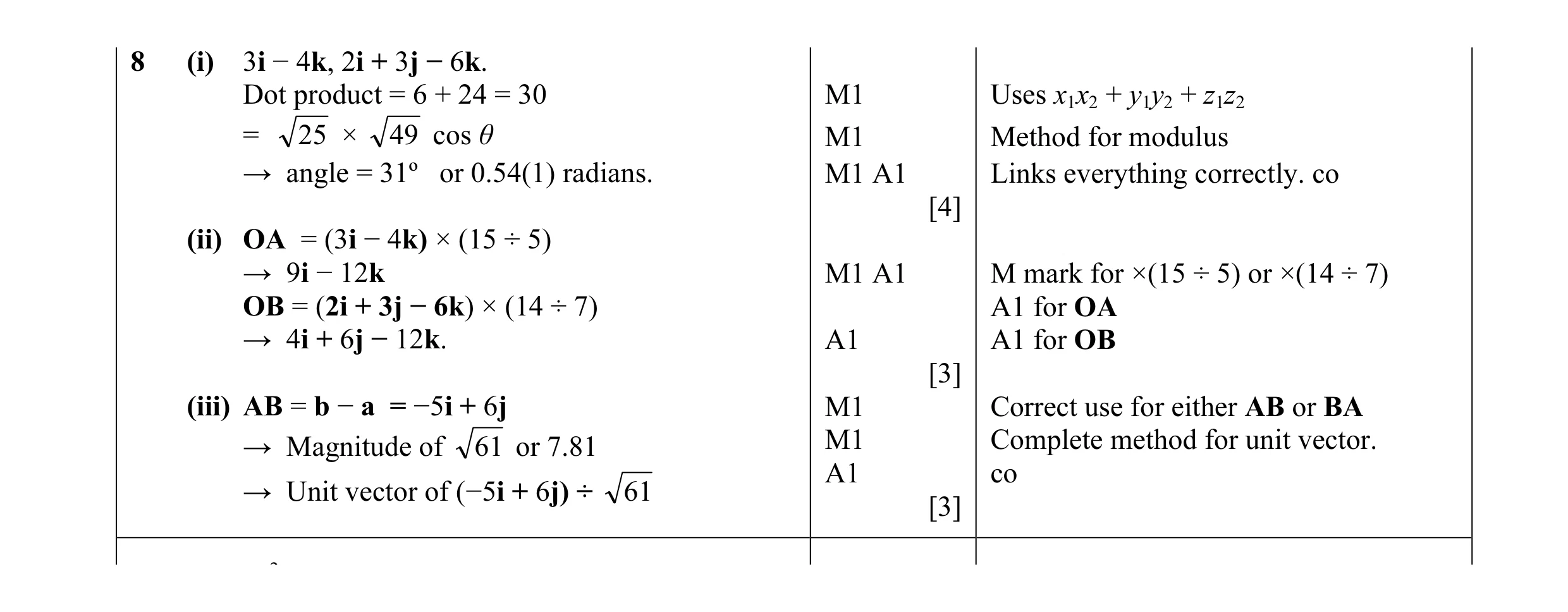 10
10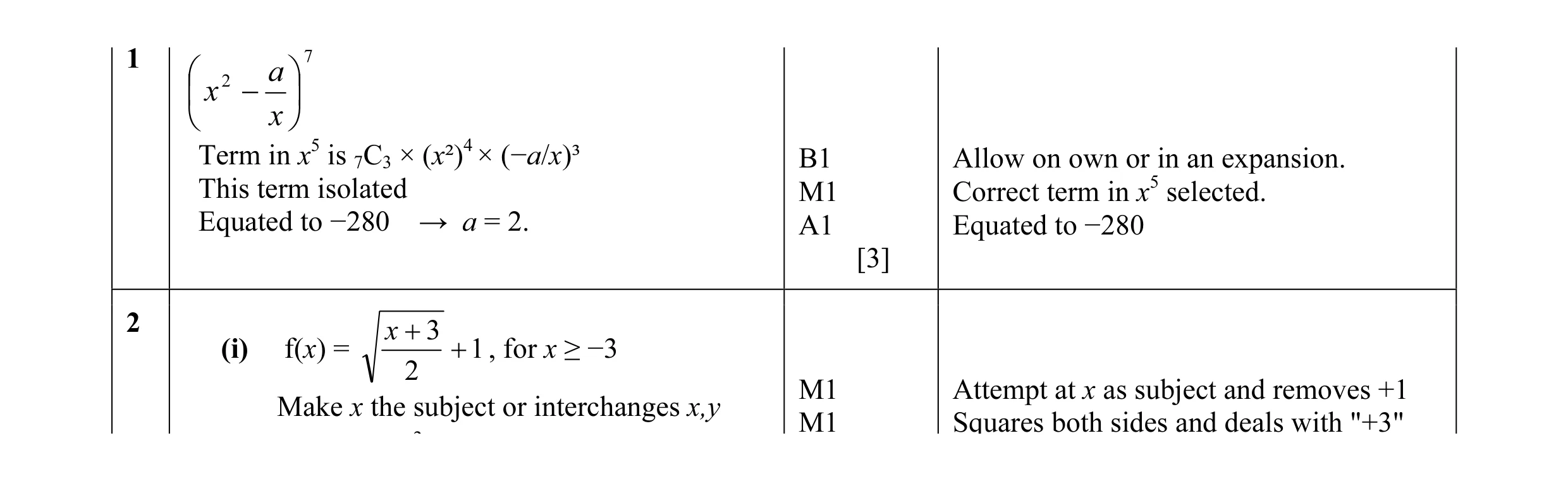 8
8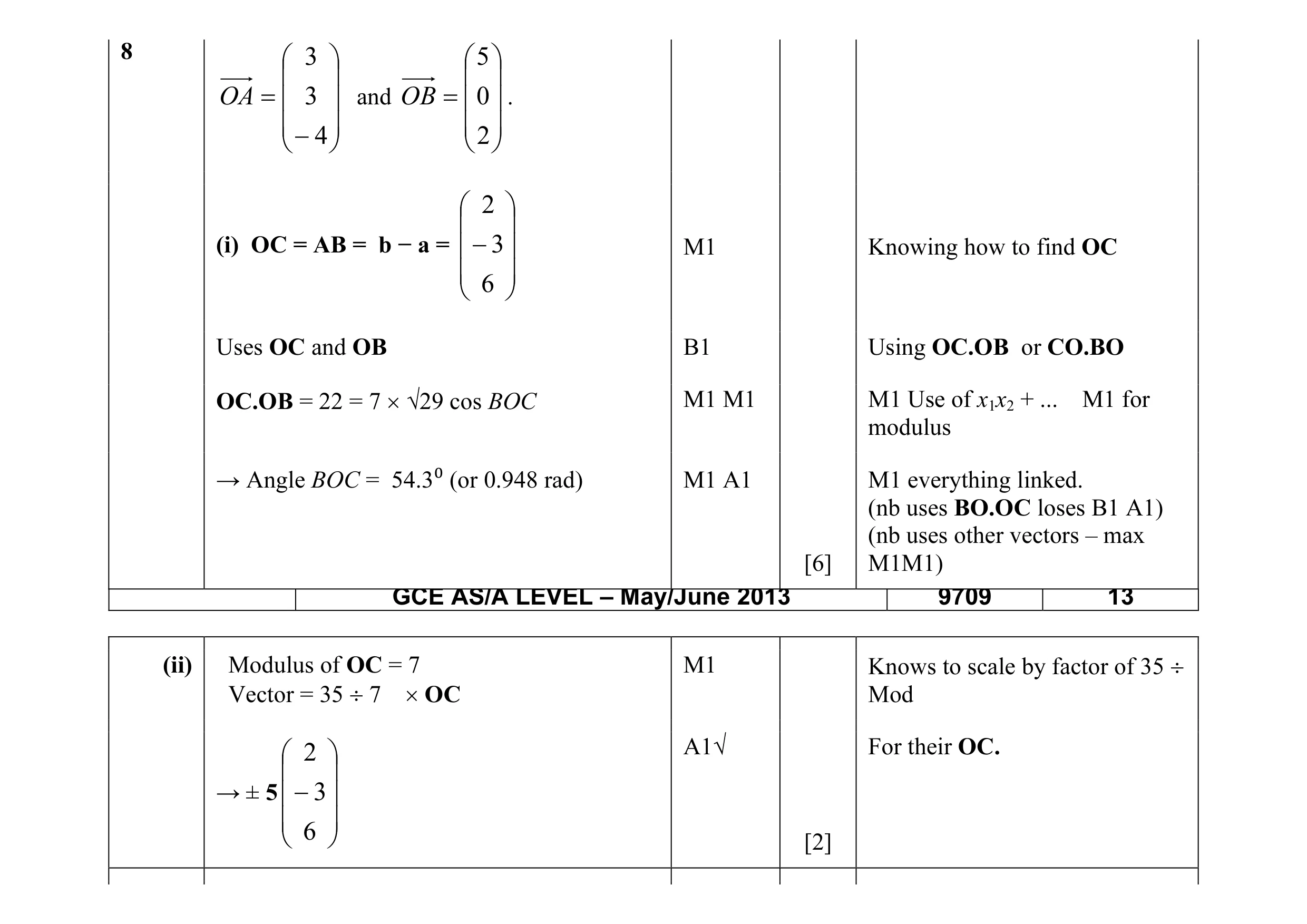 8
8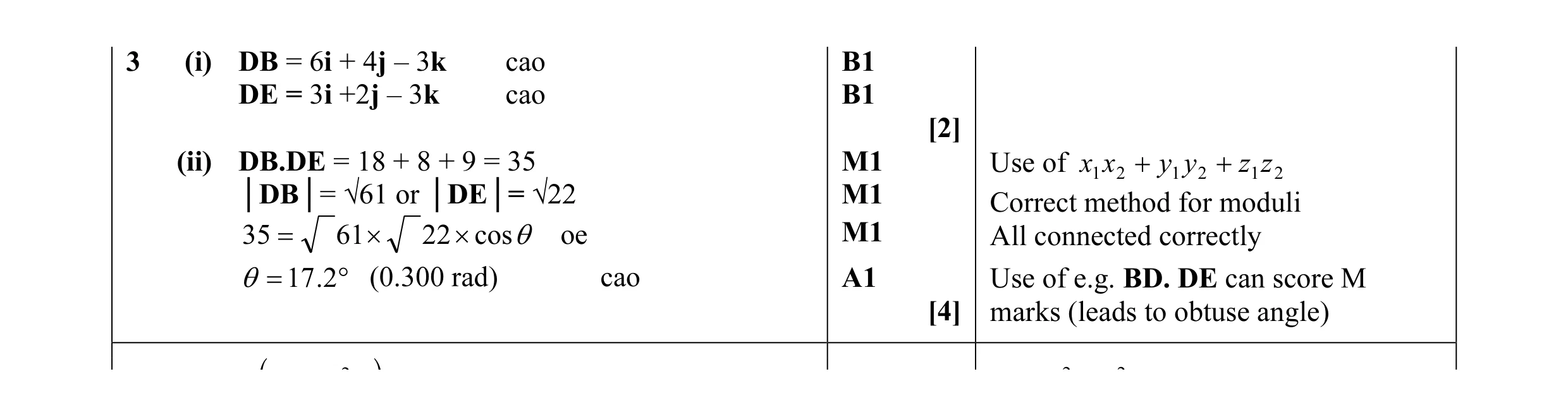 6
6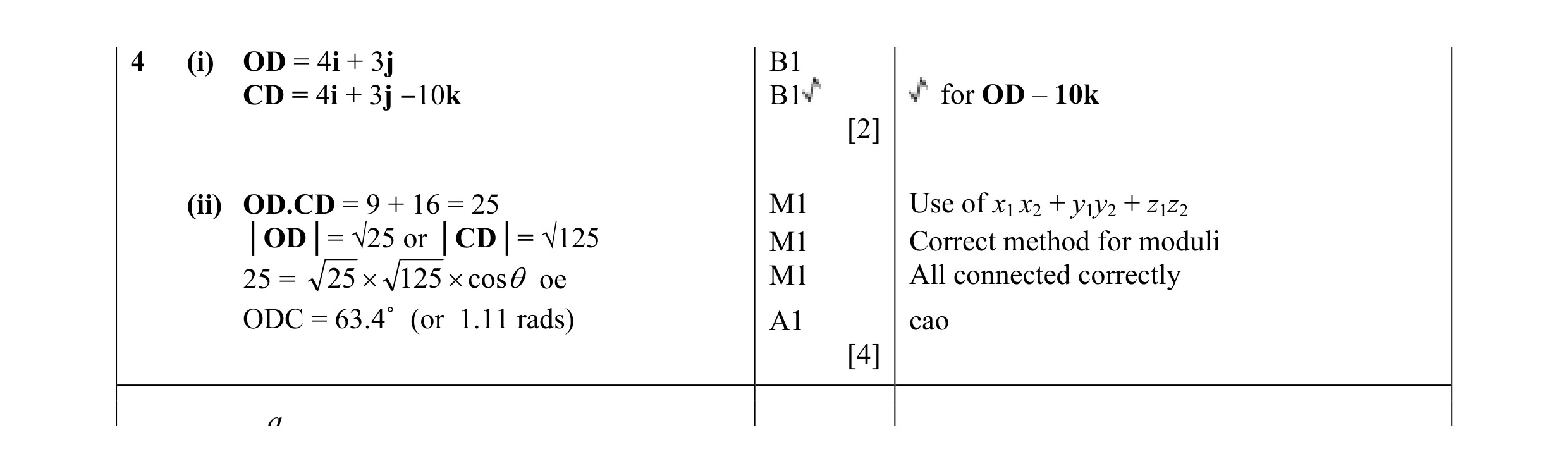 6
6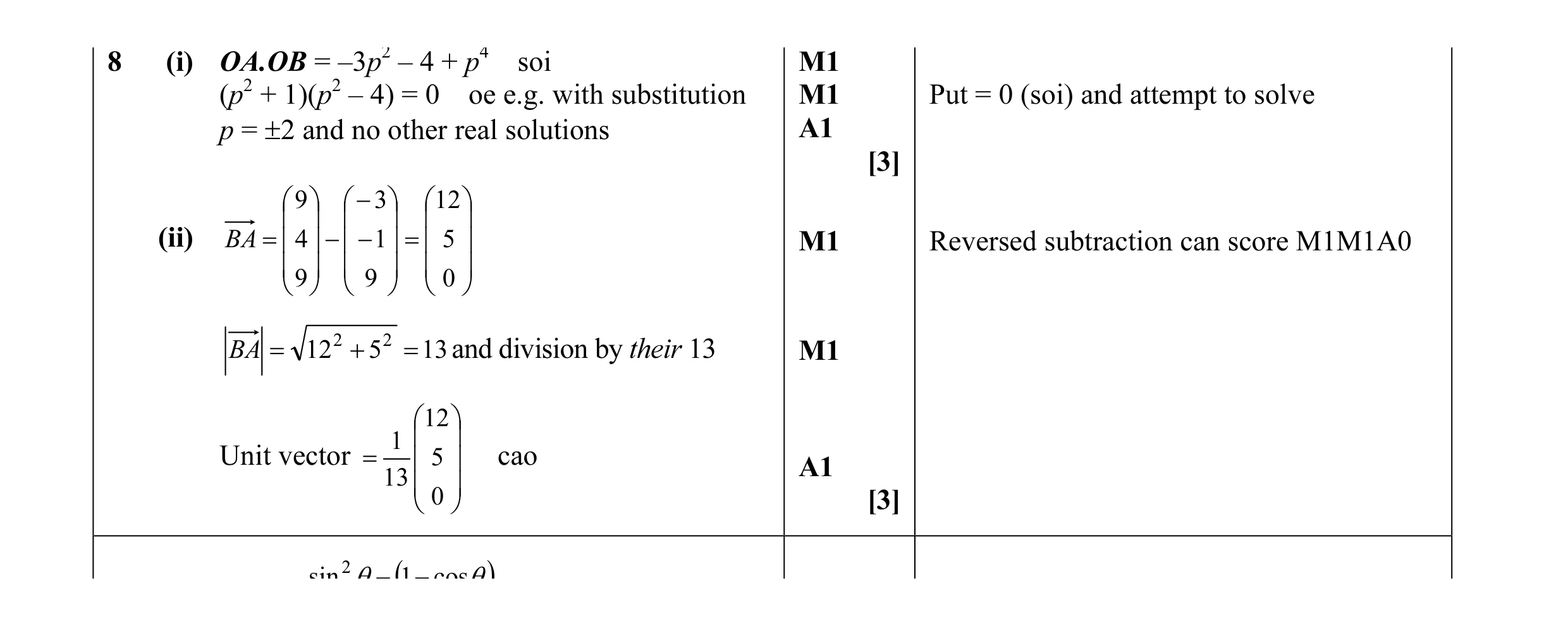 6
6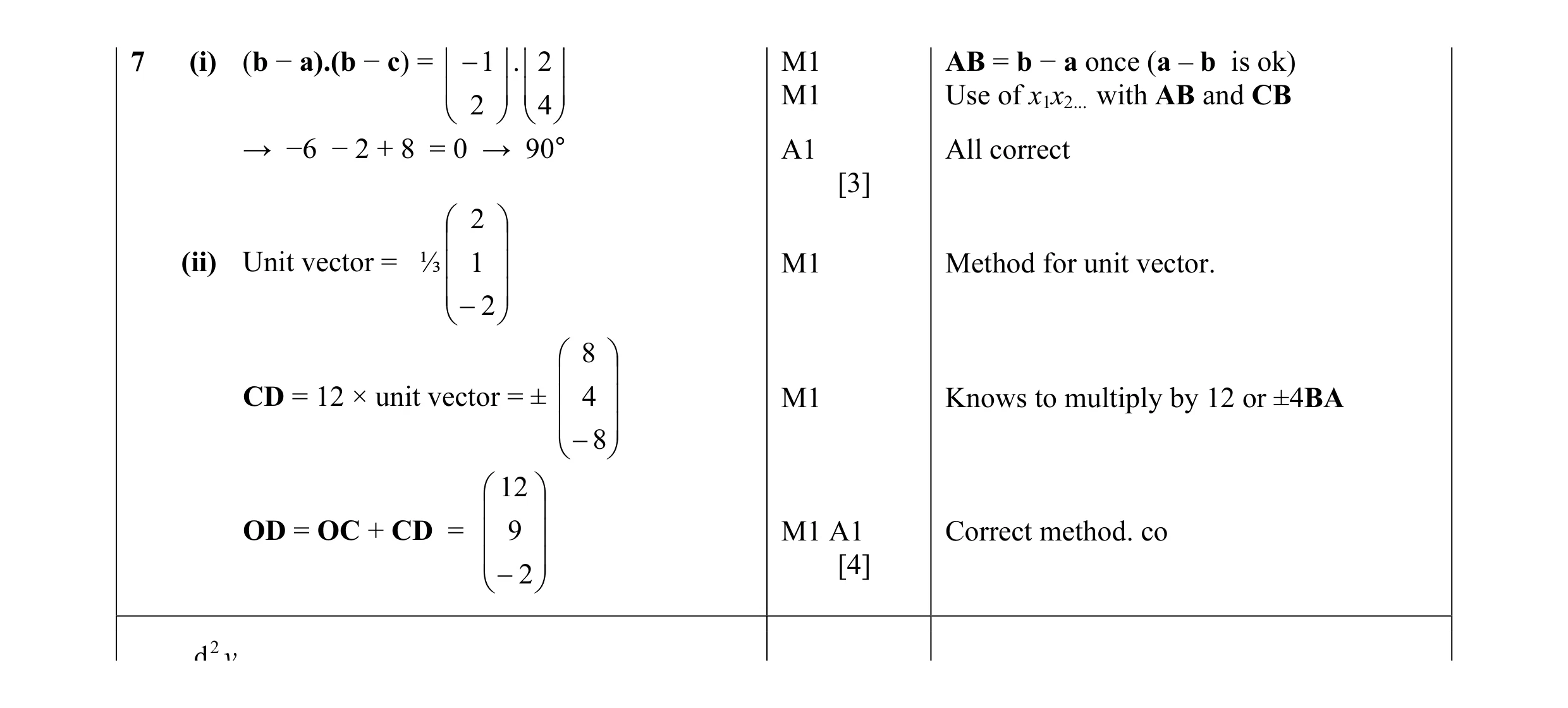 7
7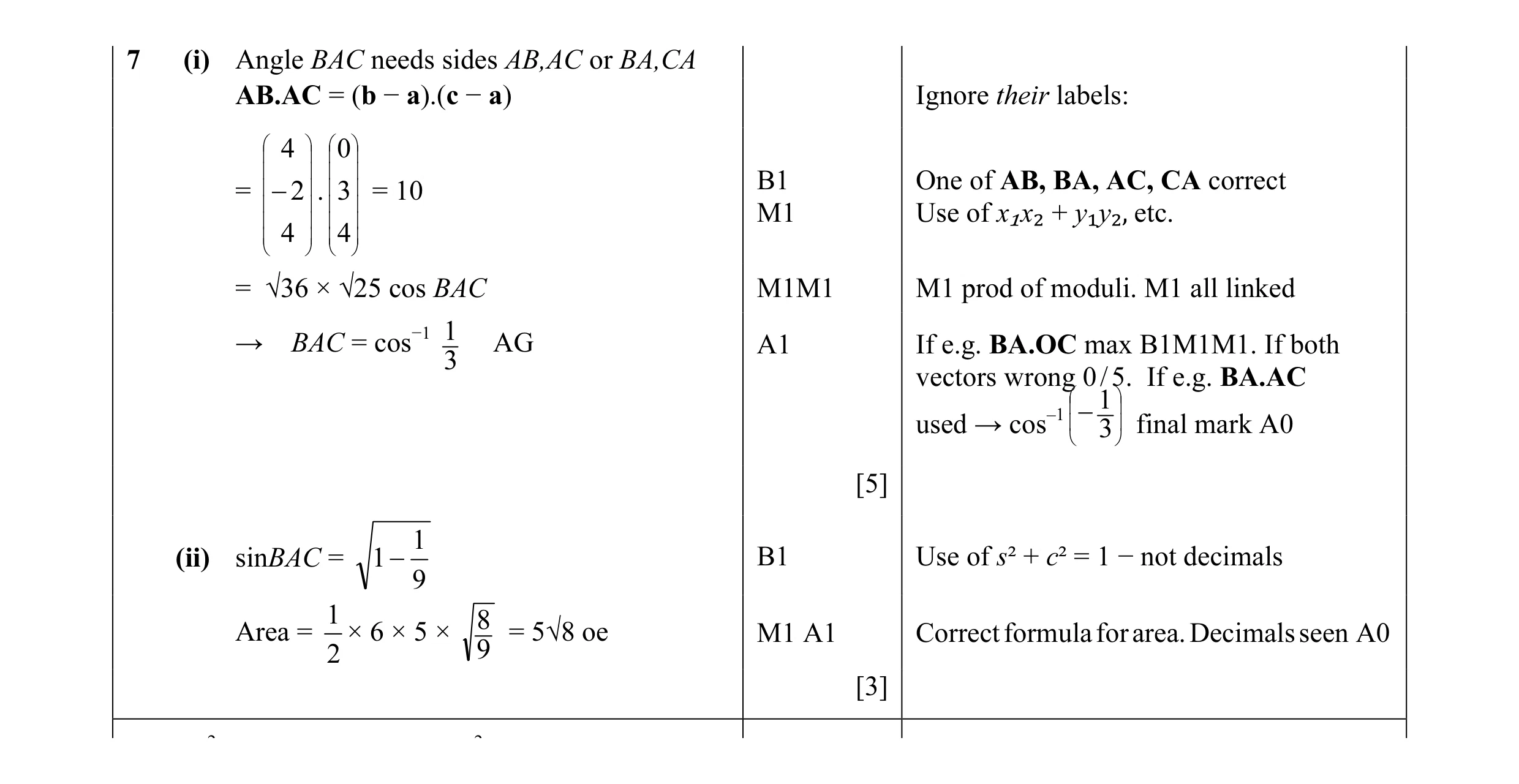 8
8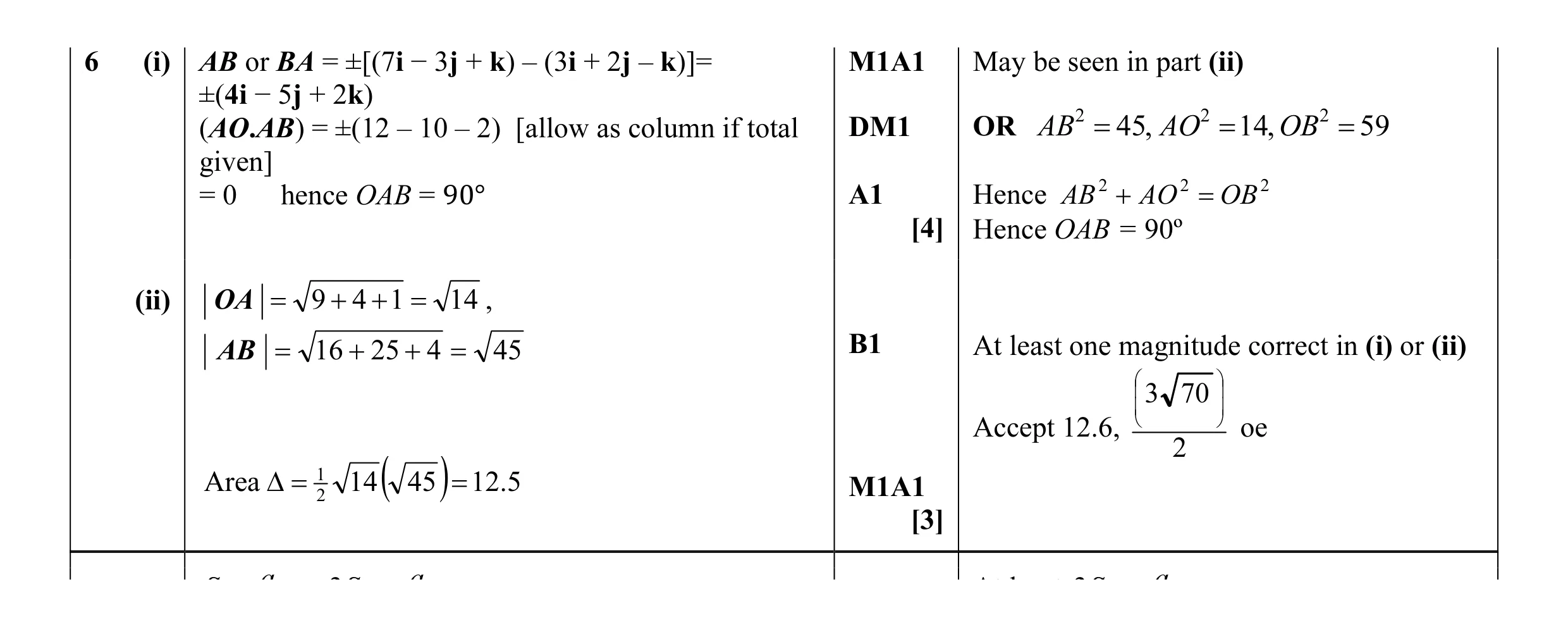 7
7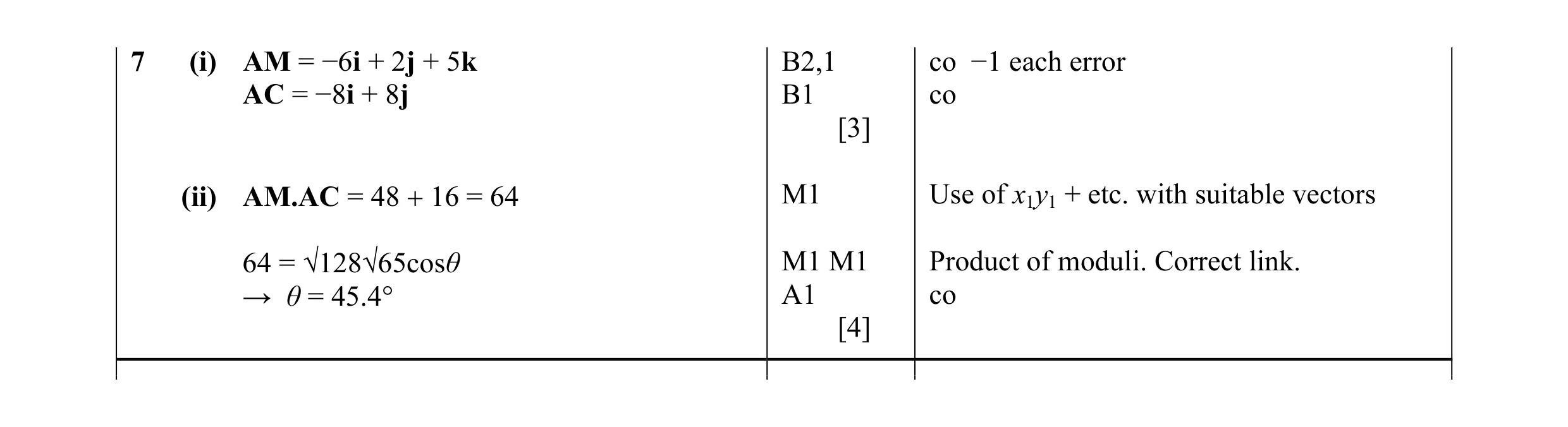 7
7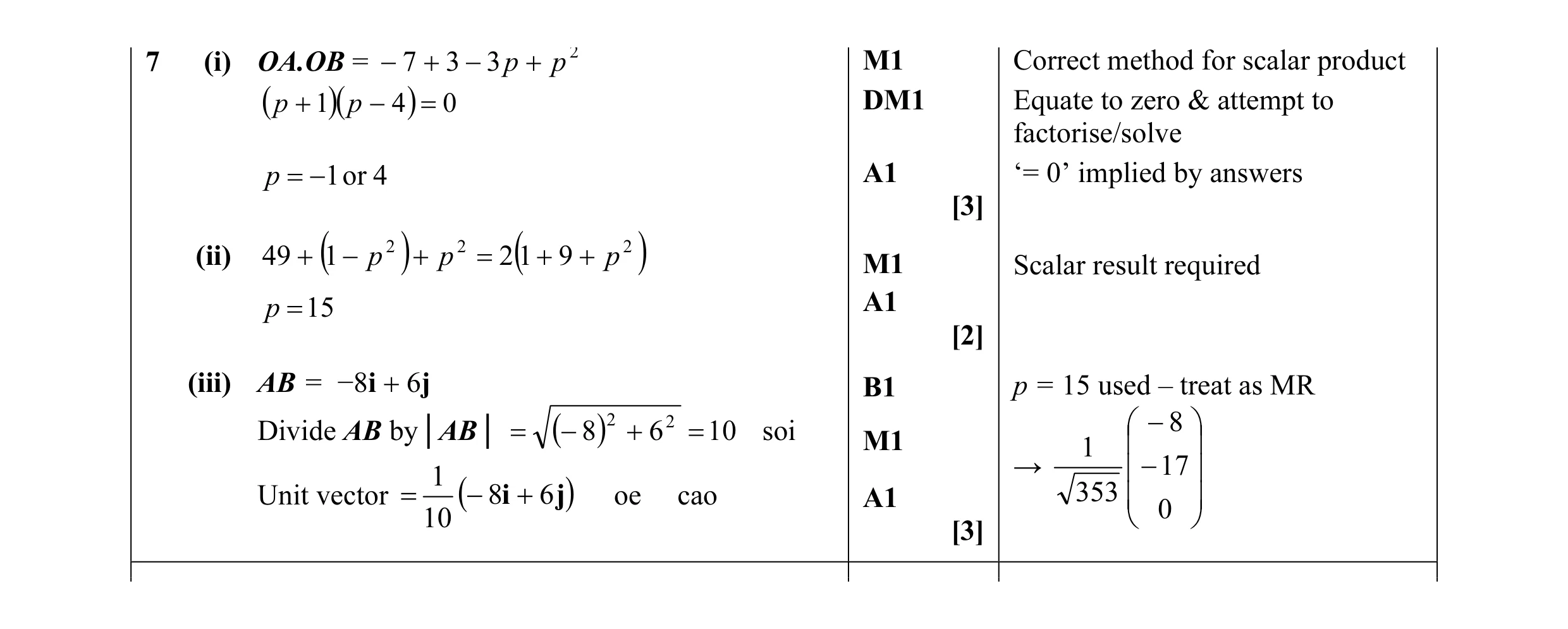 8
8 7
7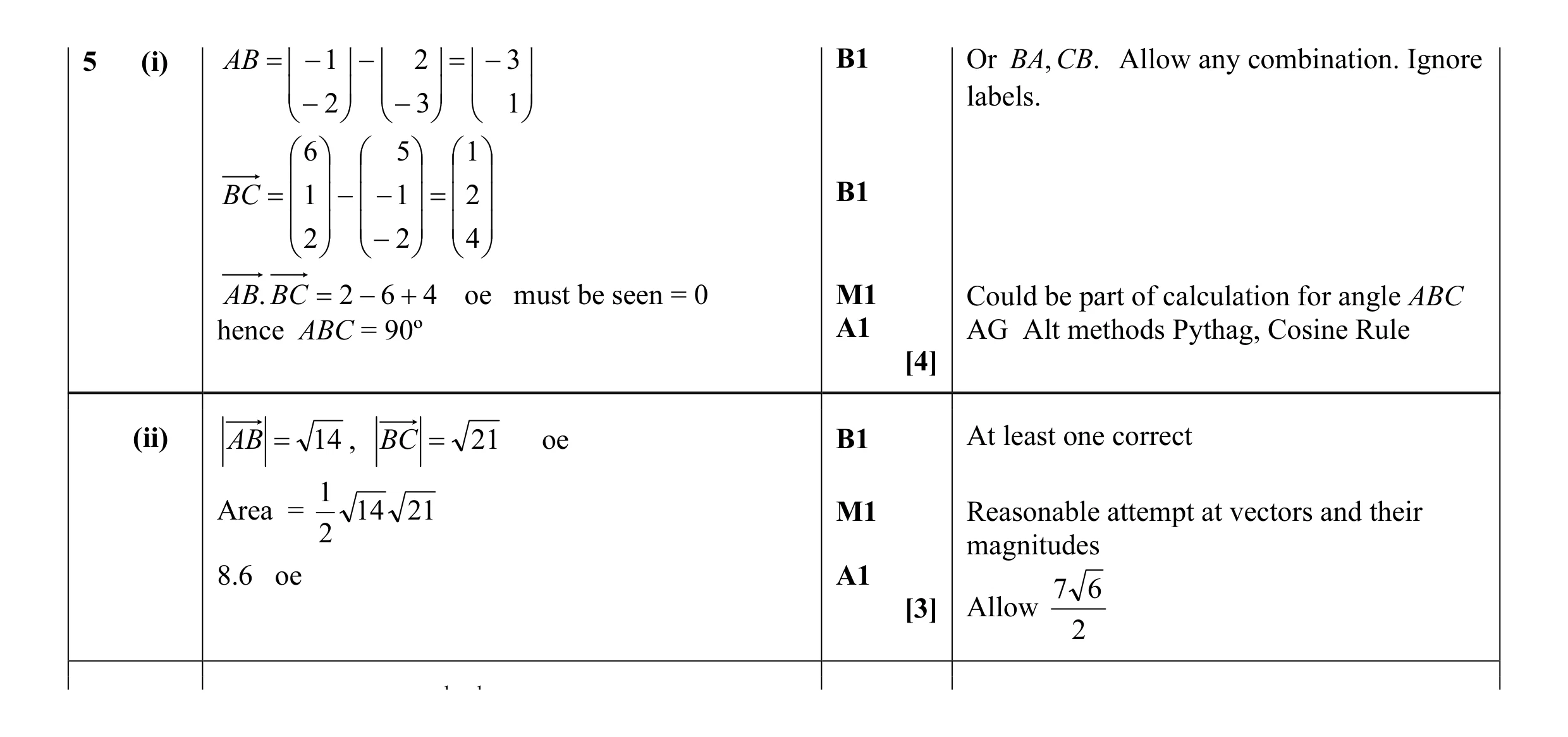 7
7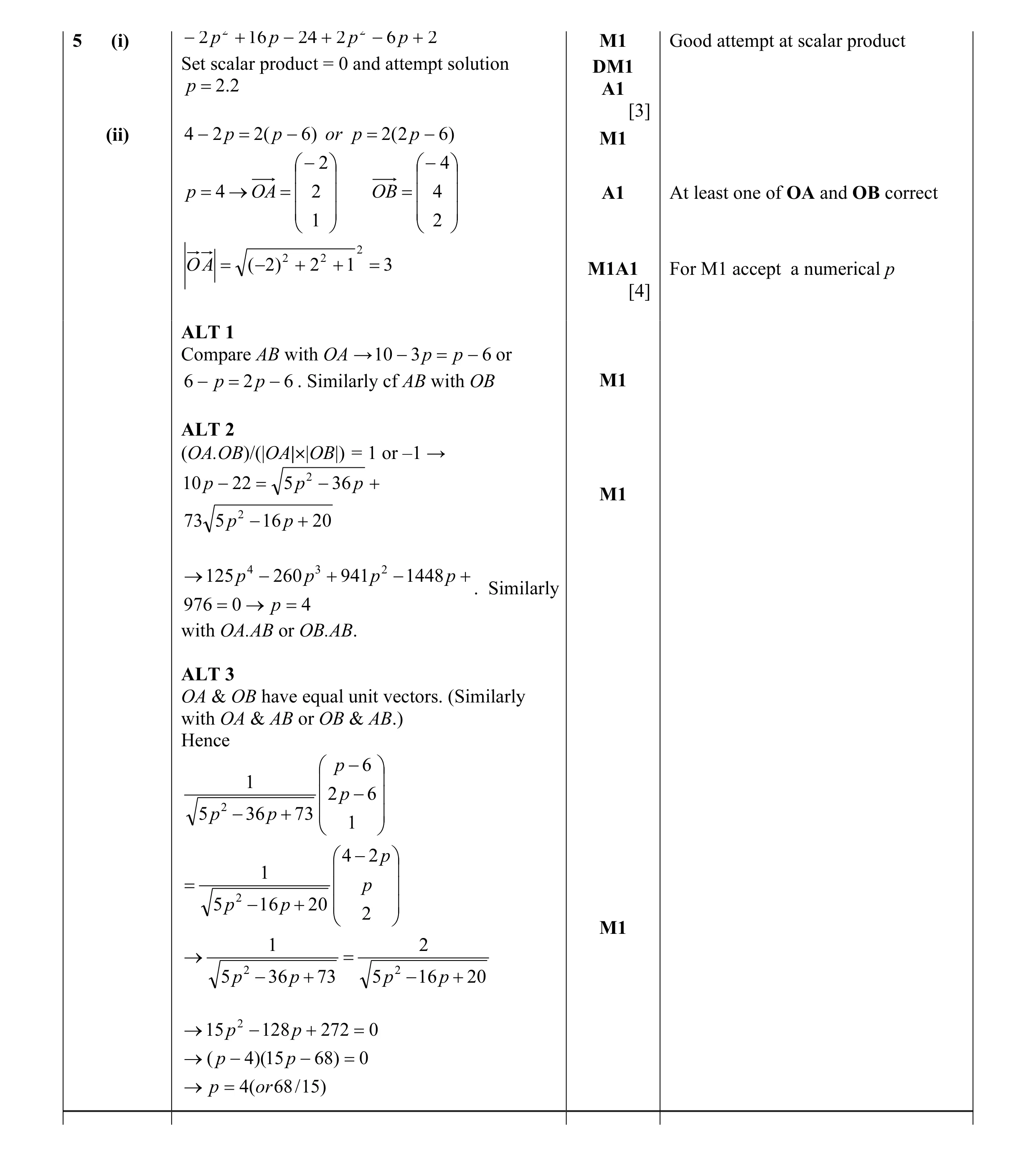 7
7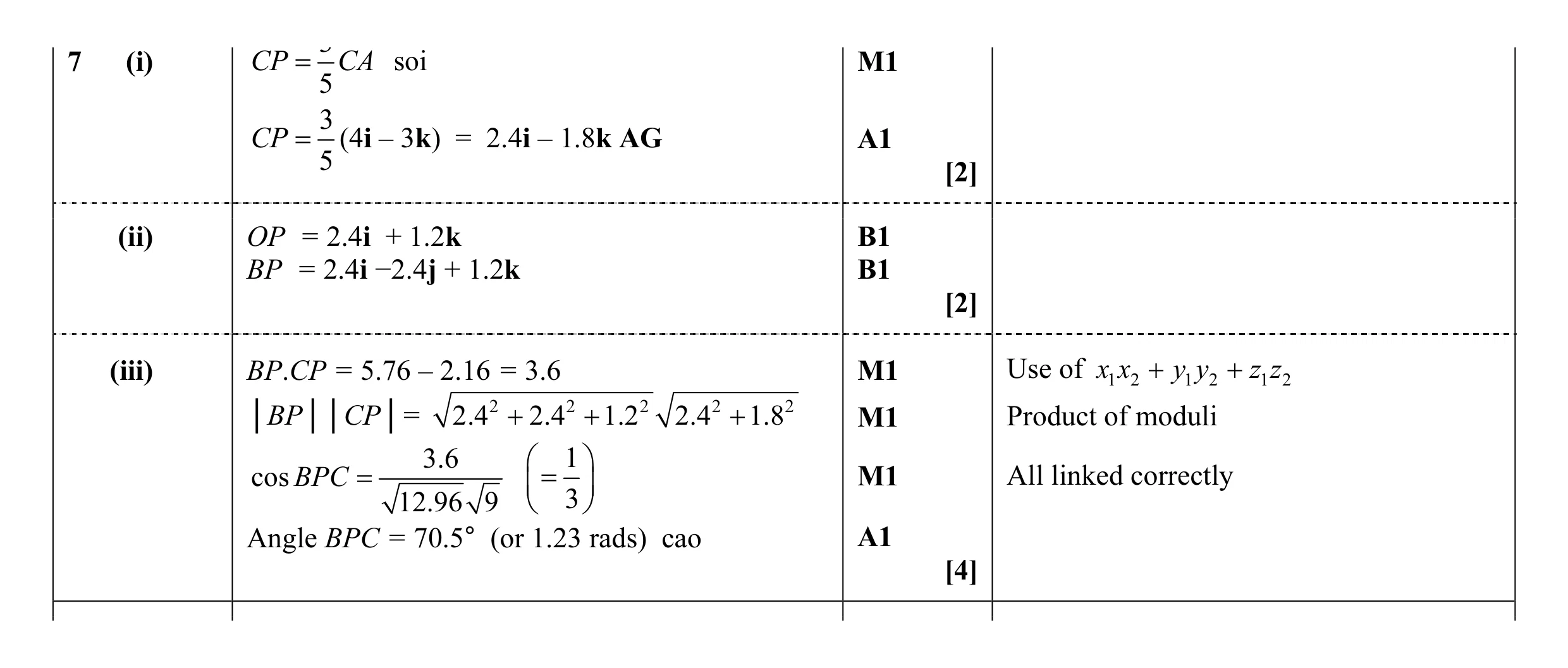 8
8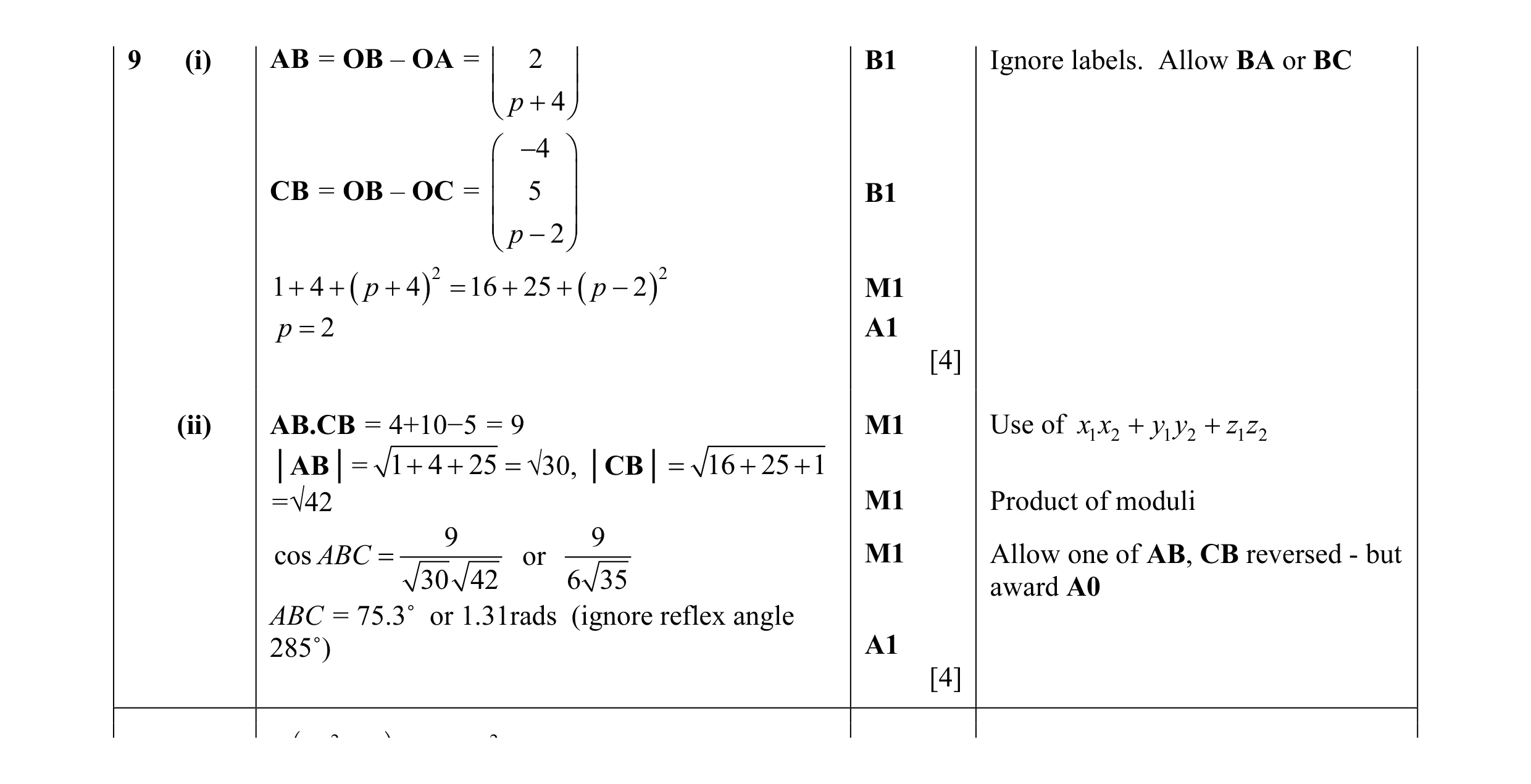 8
8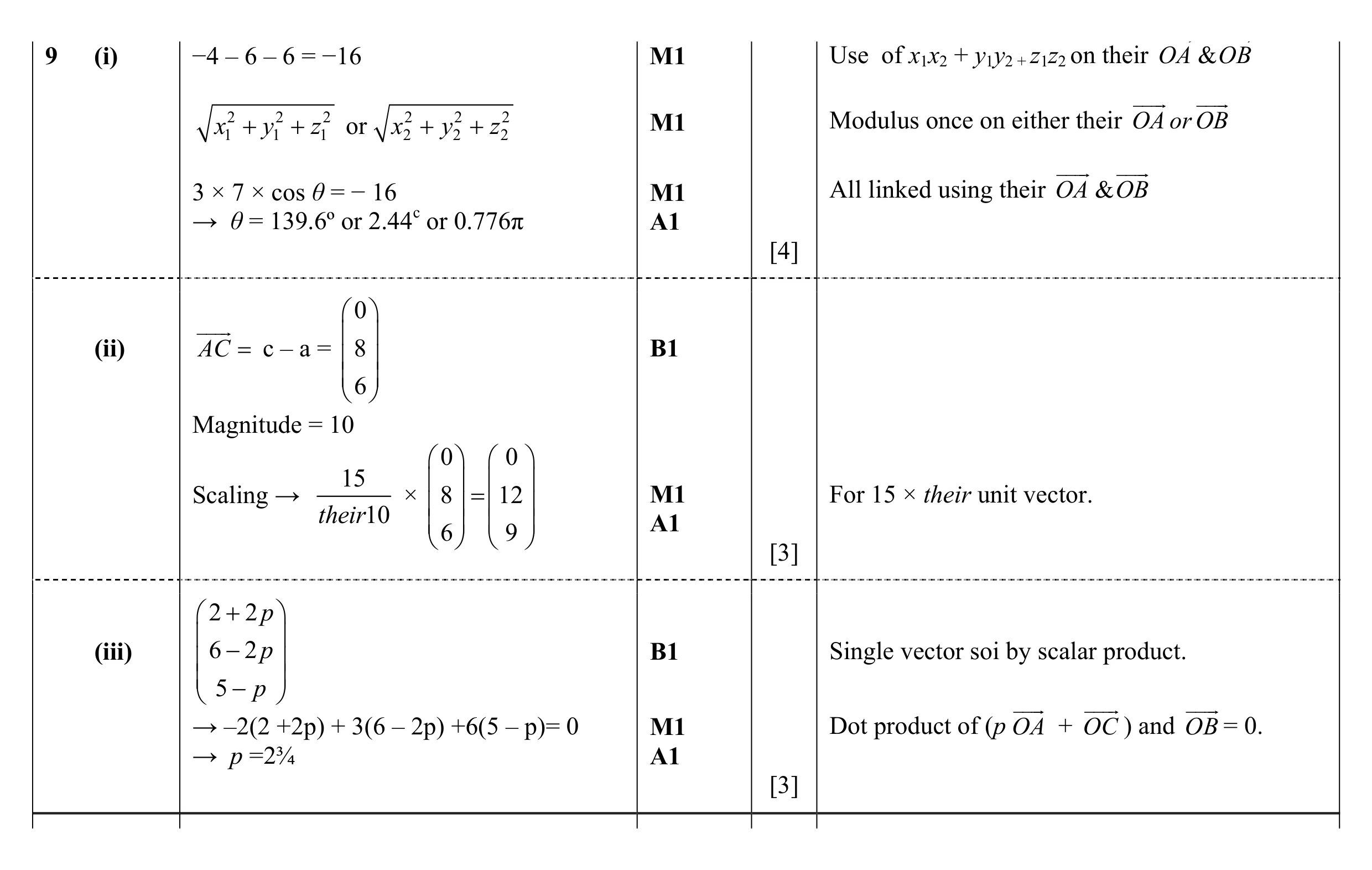 10
10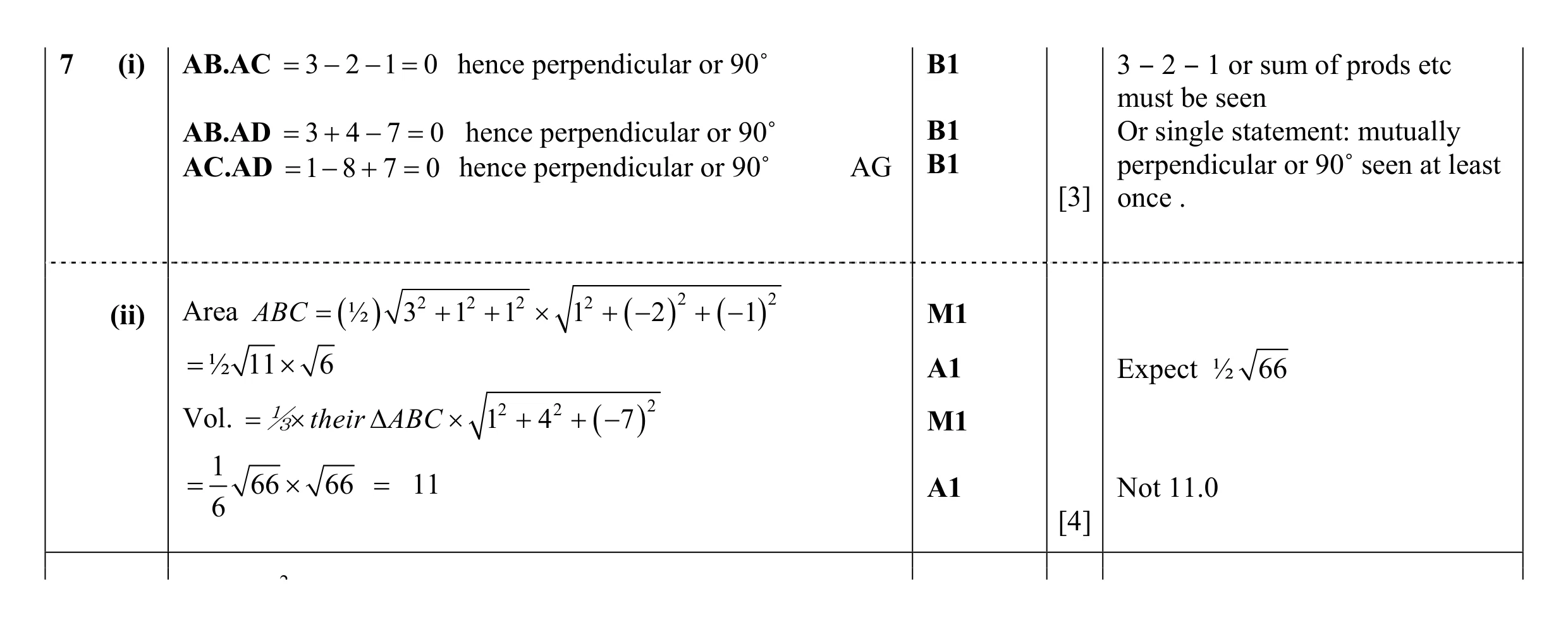 7
7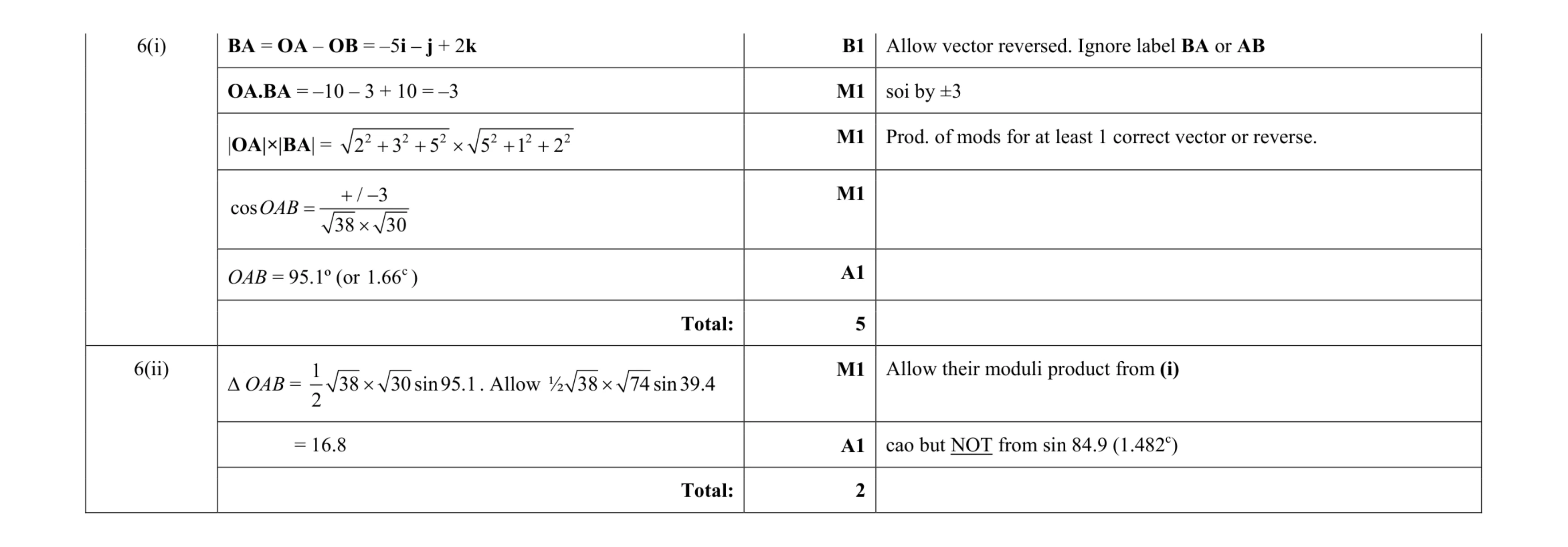 7
7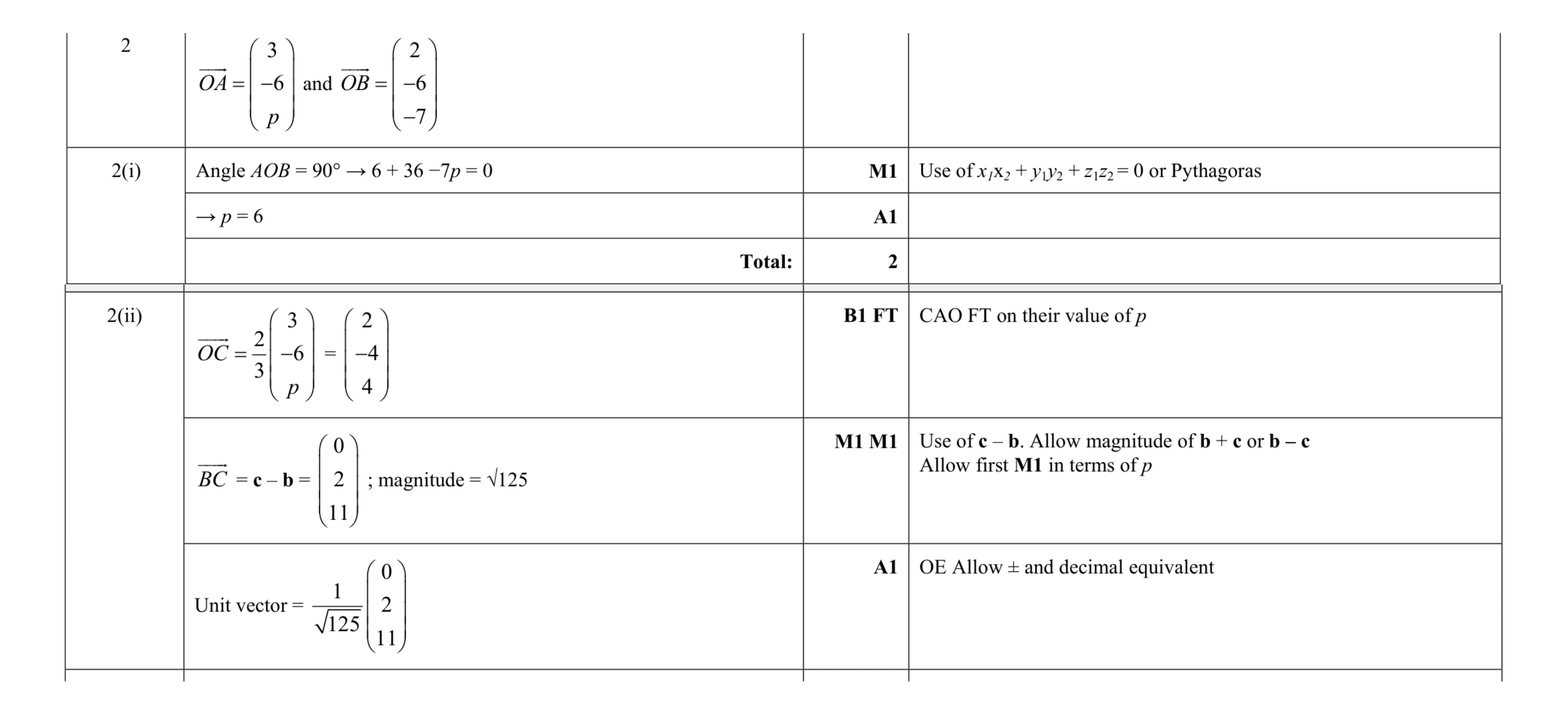 6
6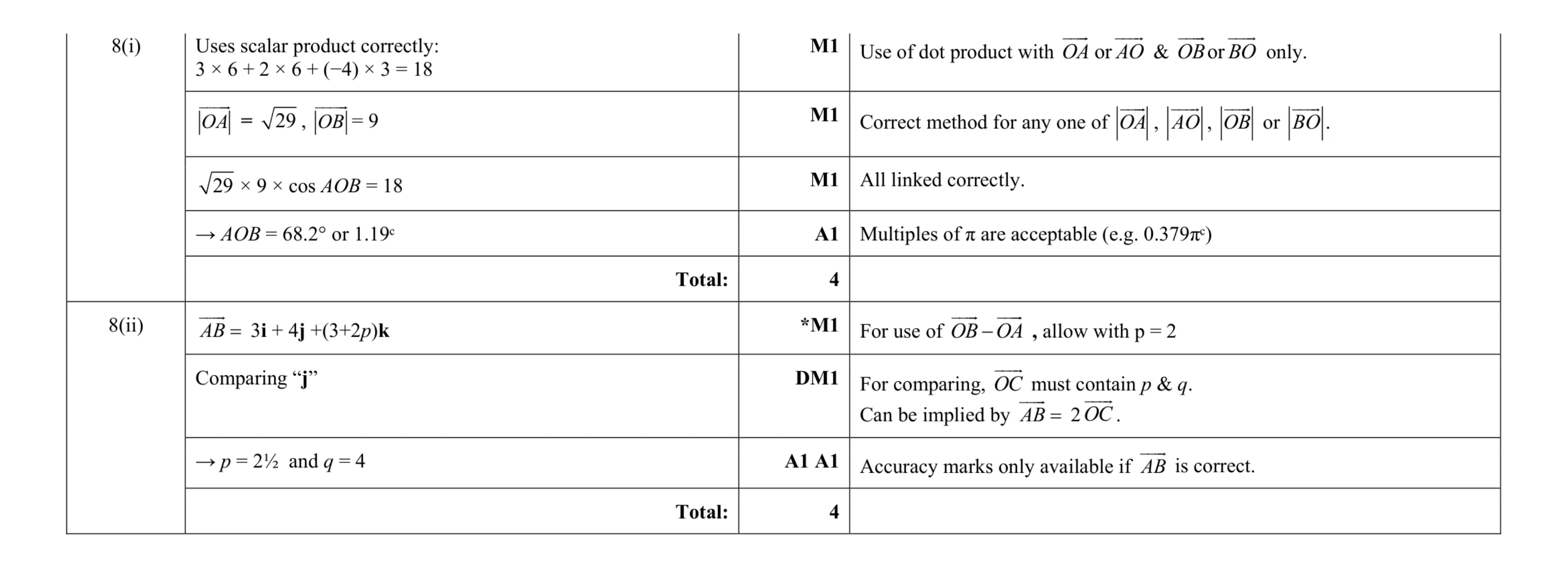 8
8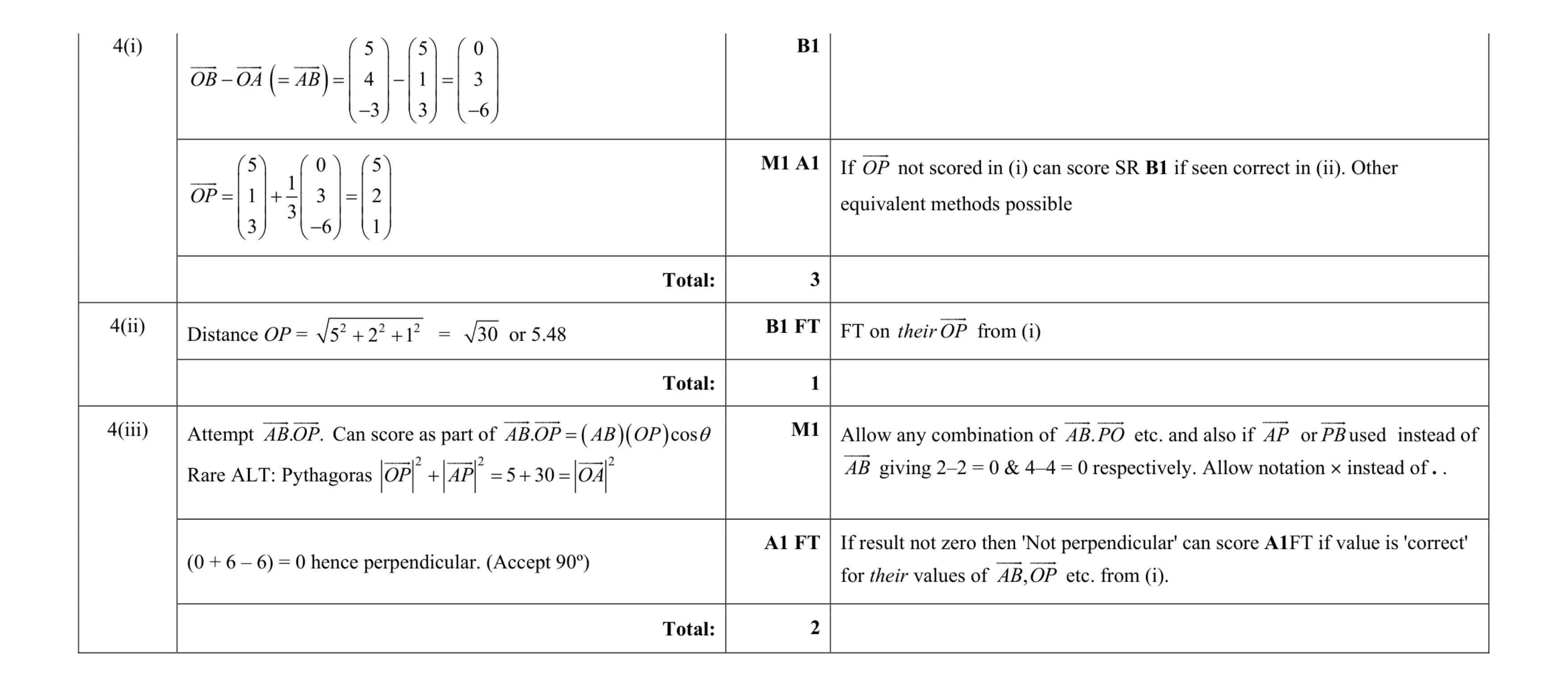 6
6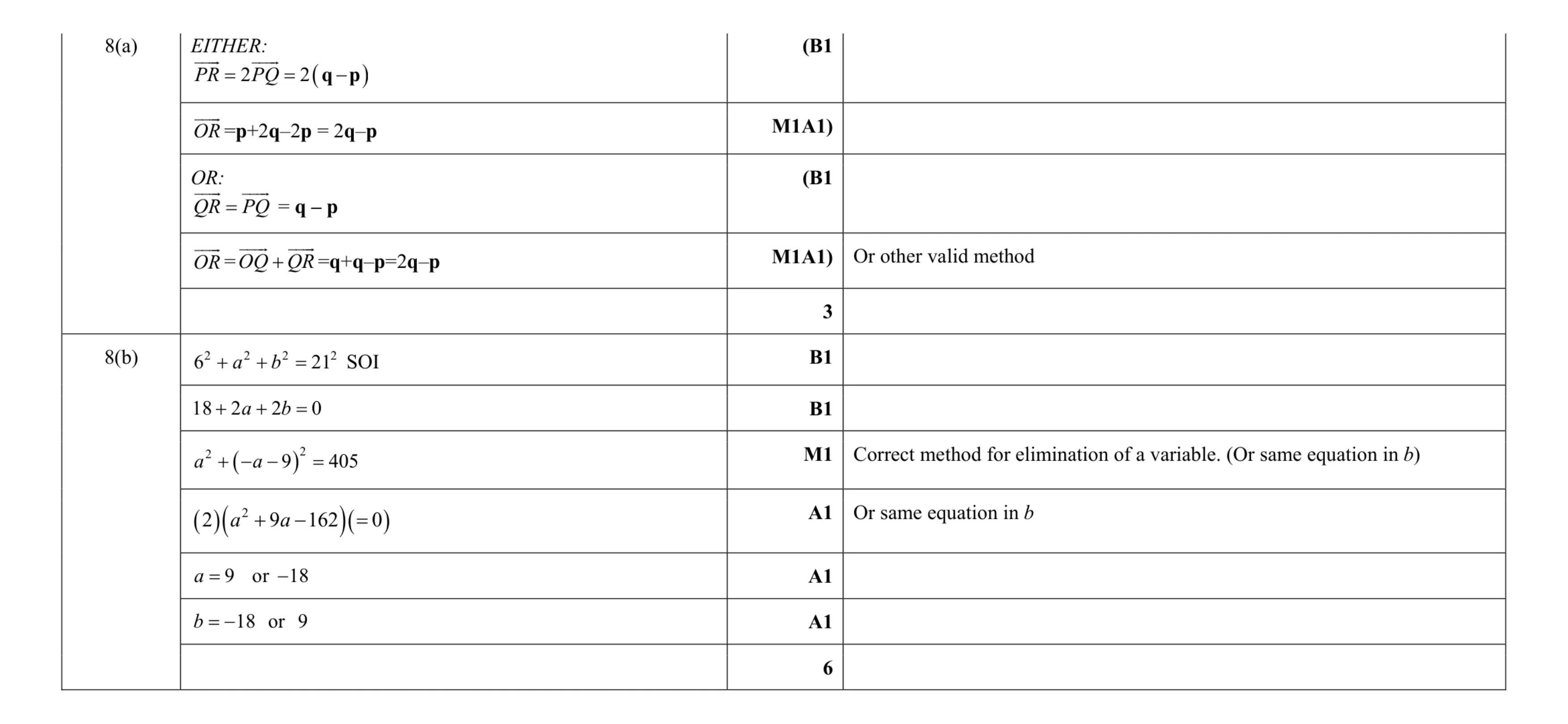 9
9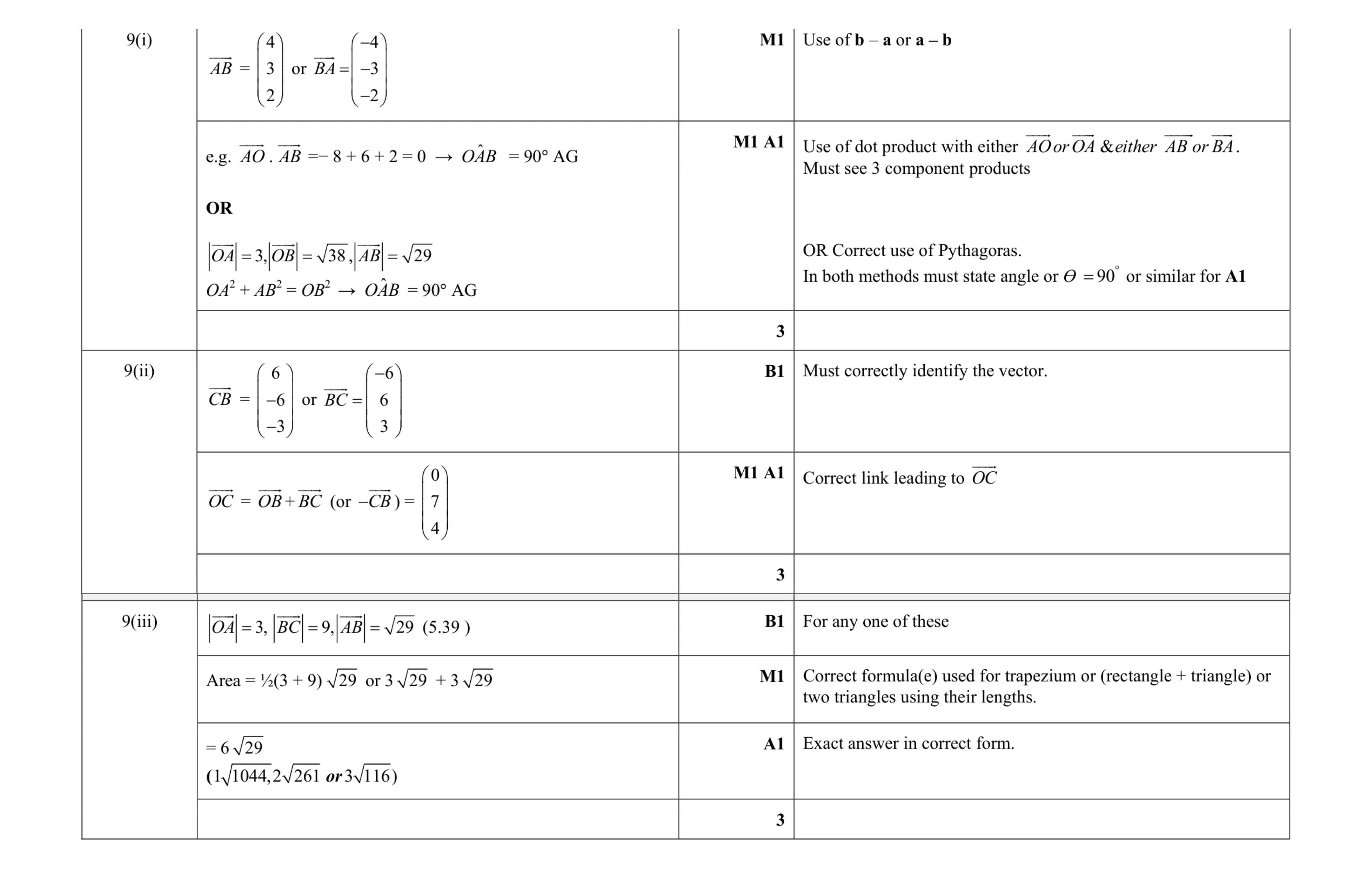 9
9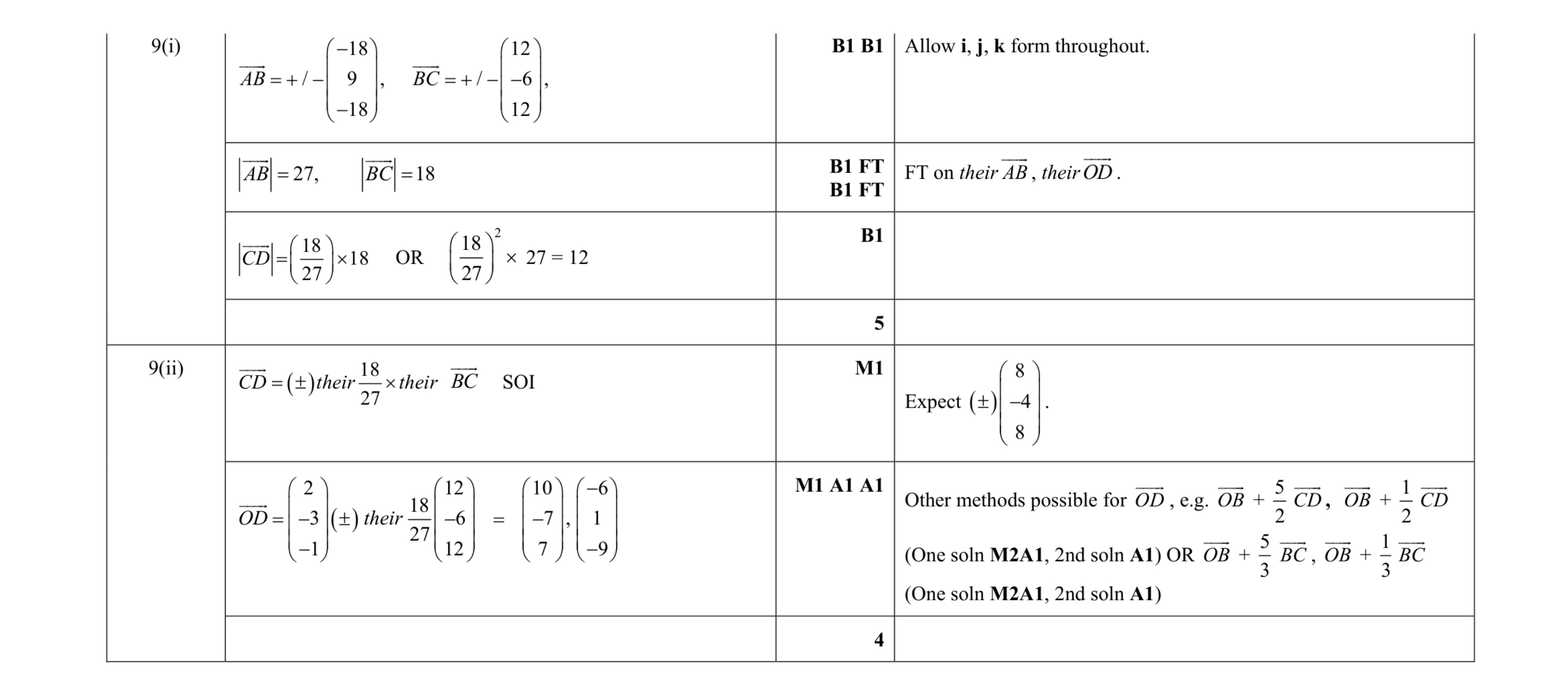 9
9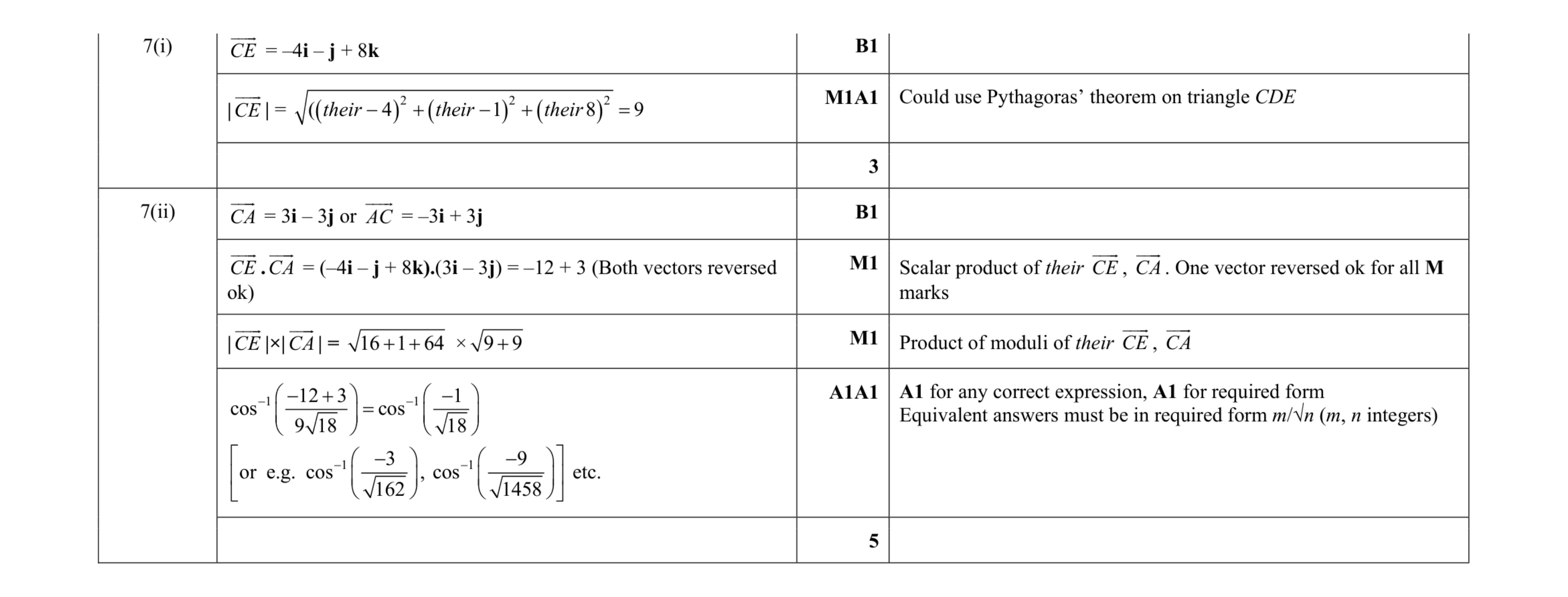 8
8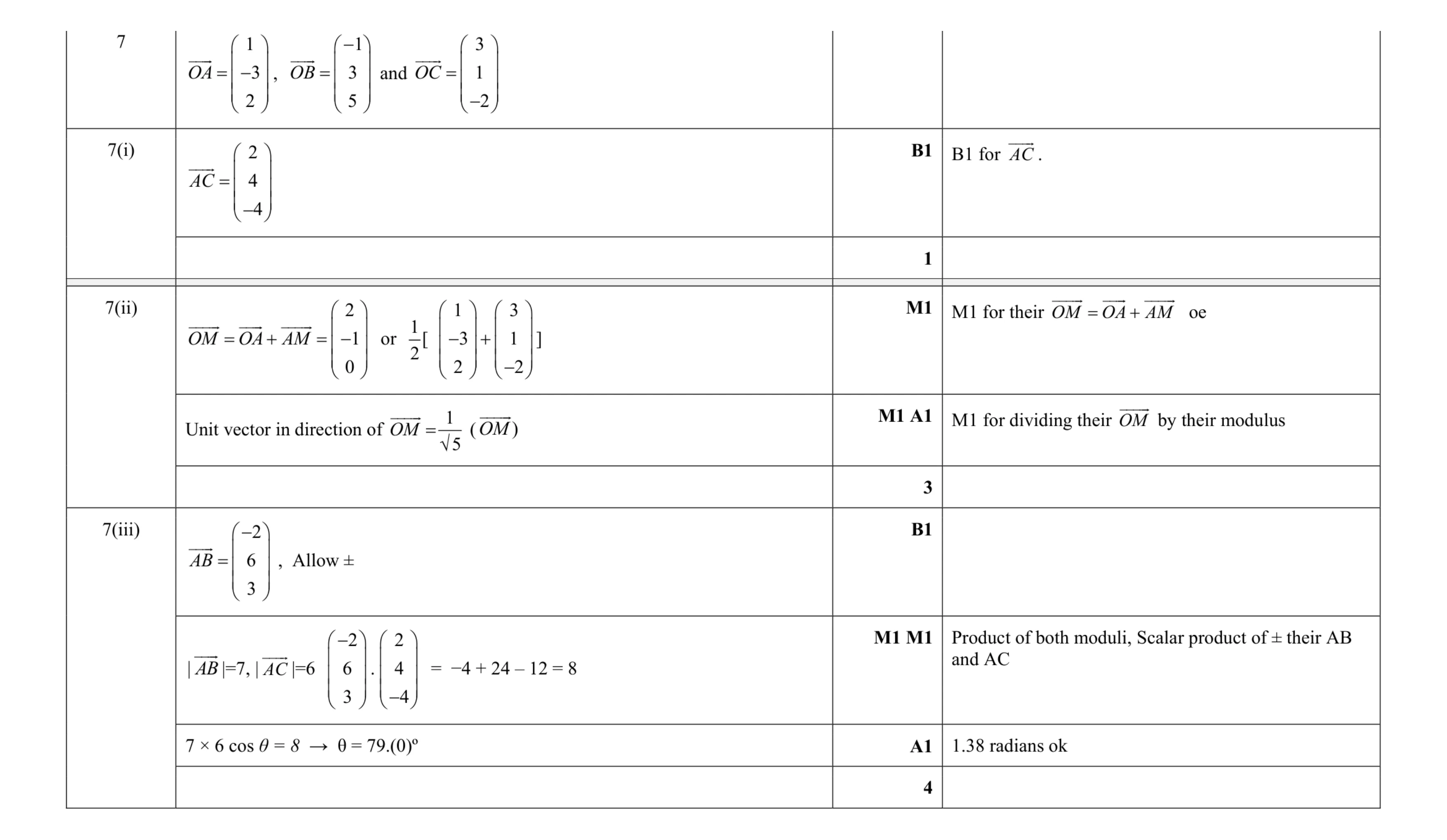 8
8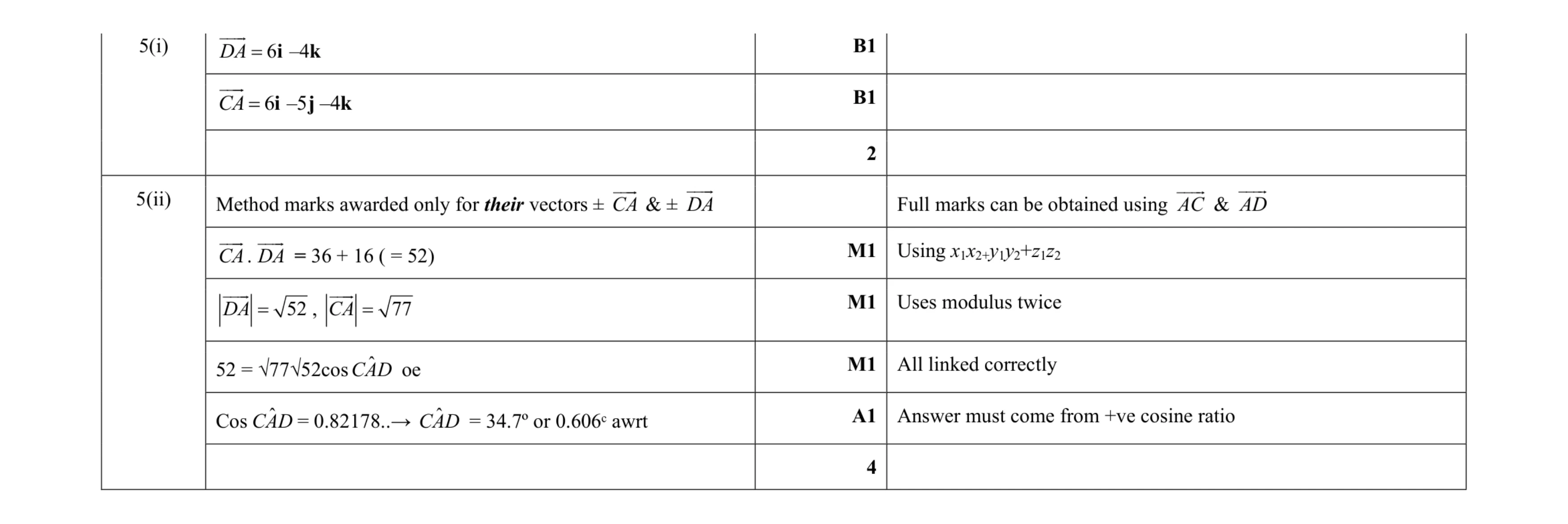 6
6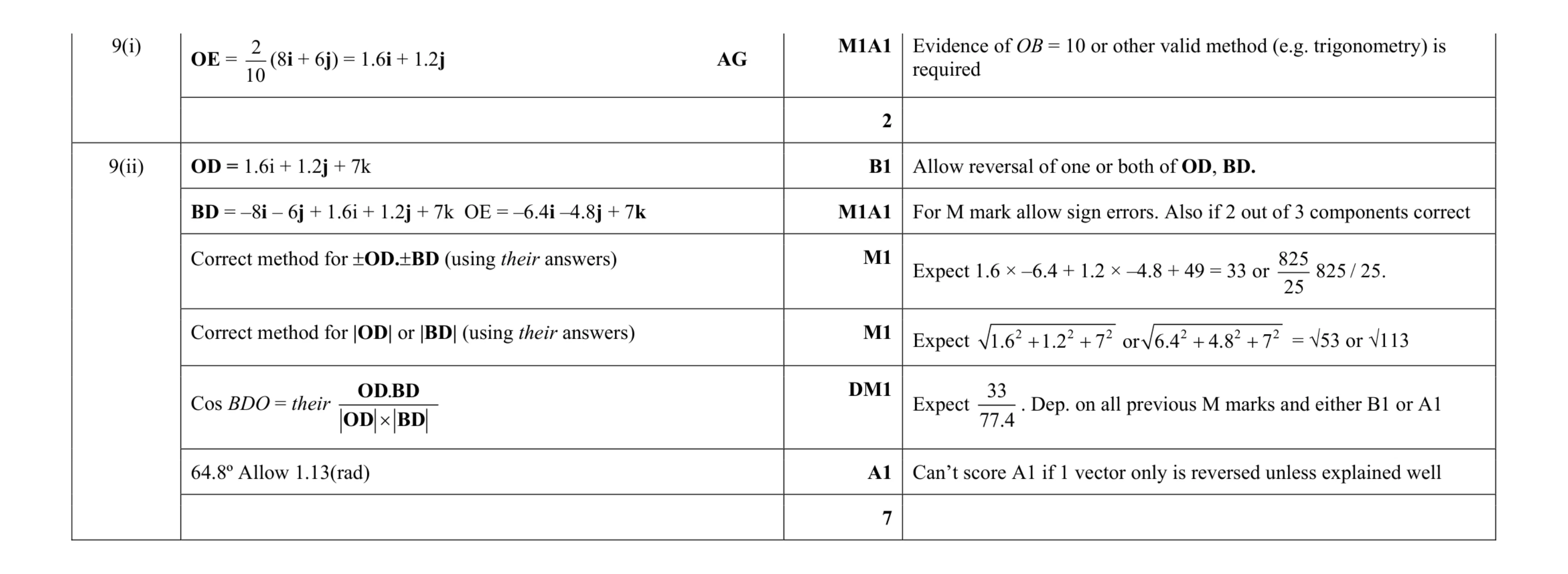 9
9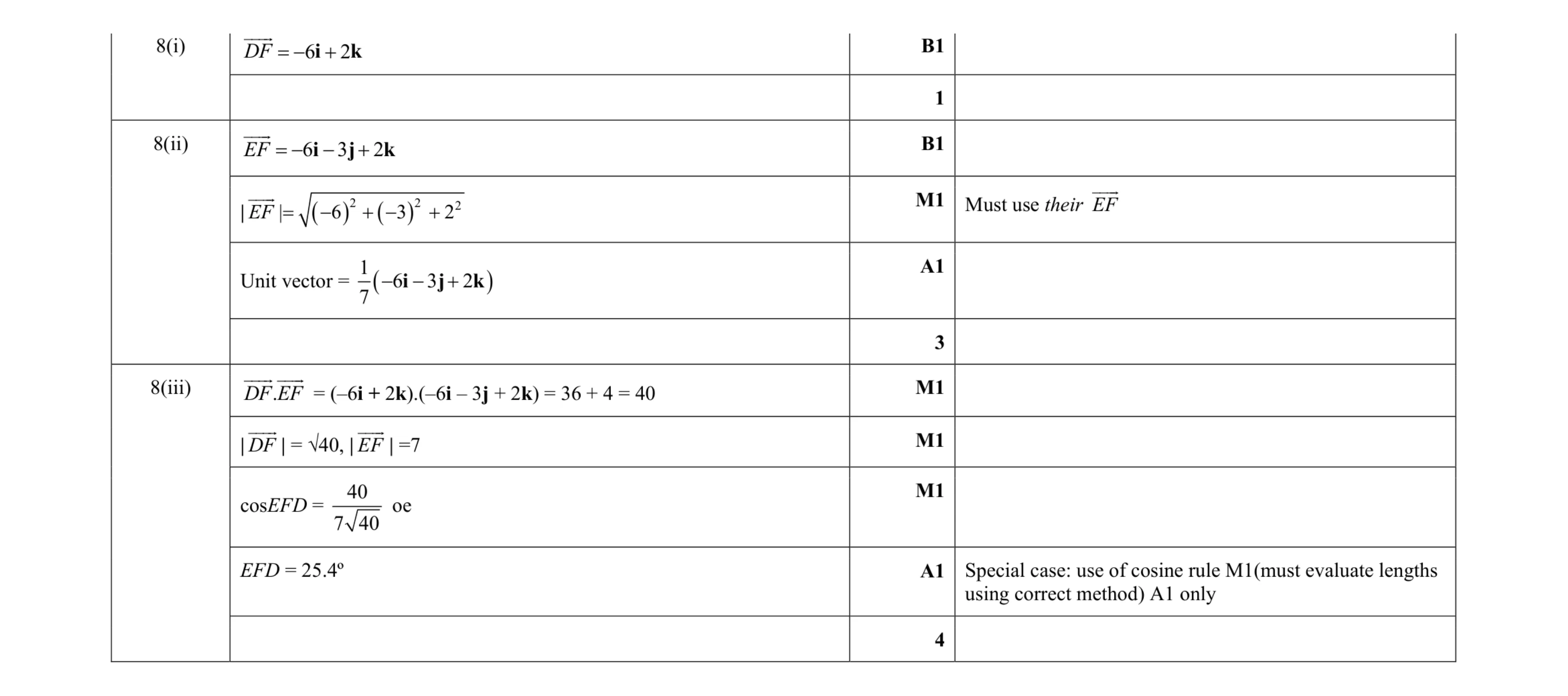 8
8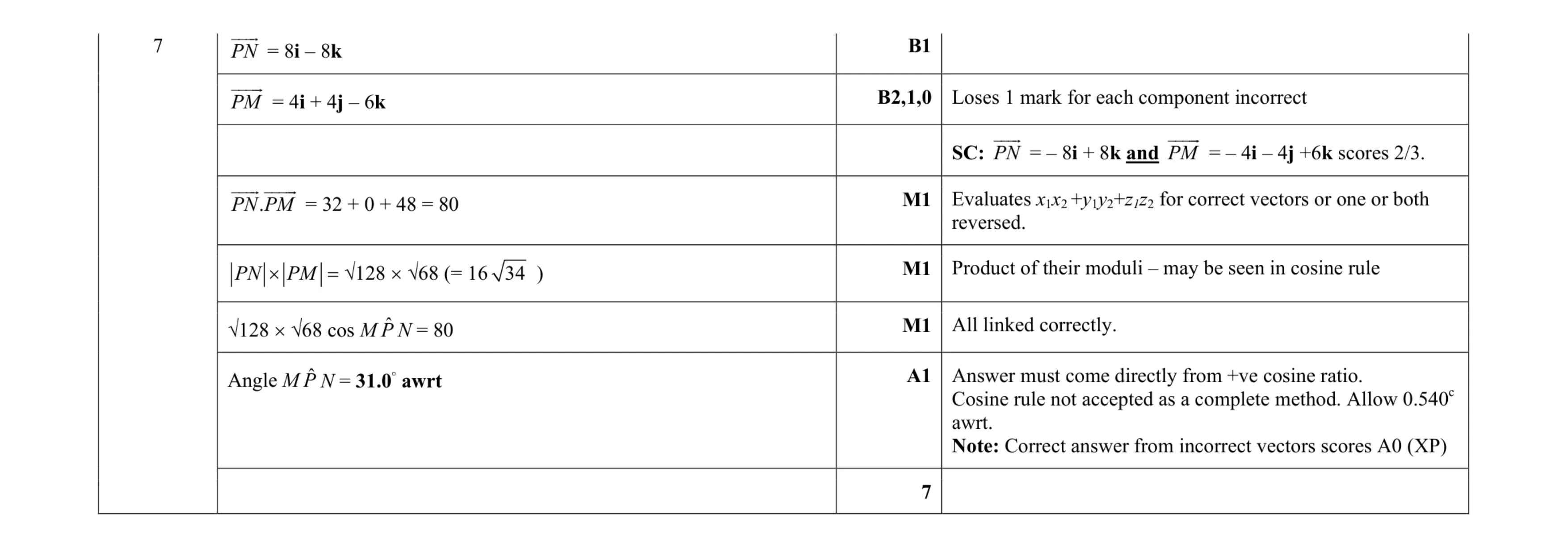 7
7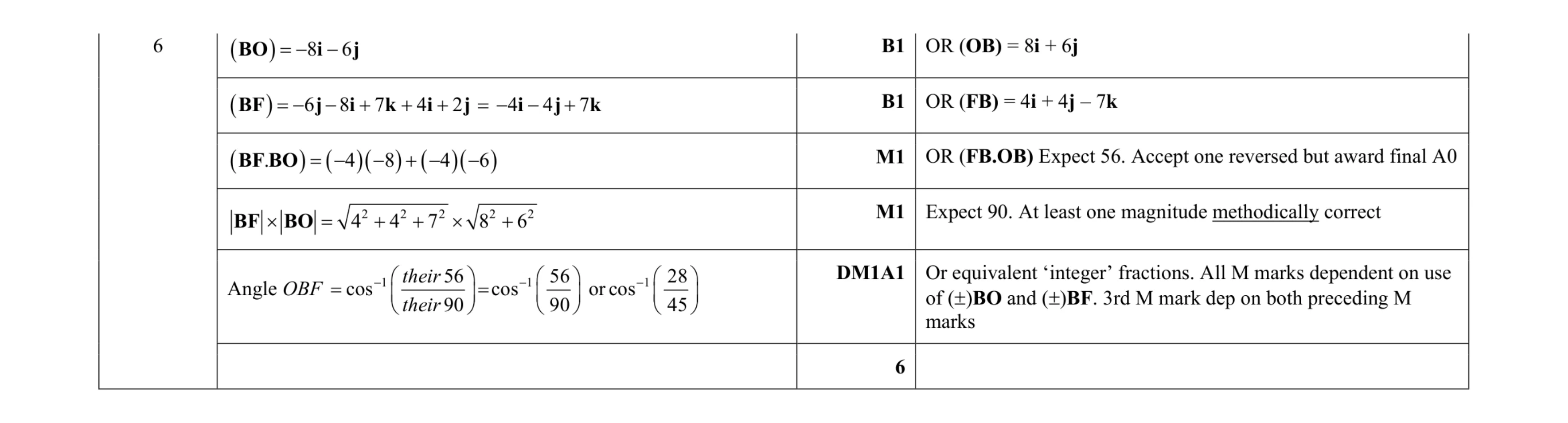 6
6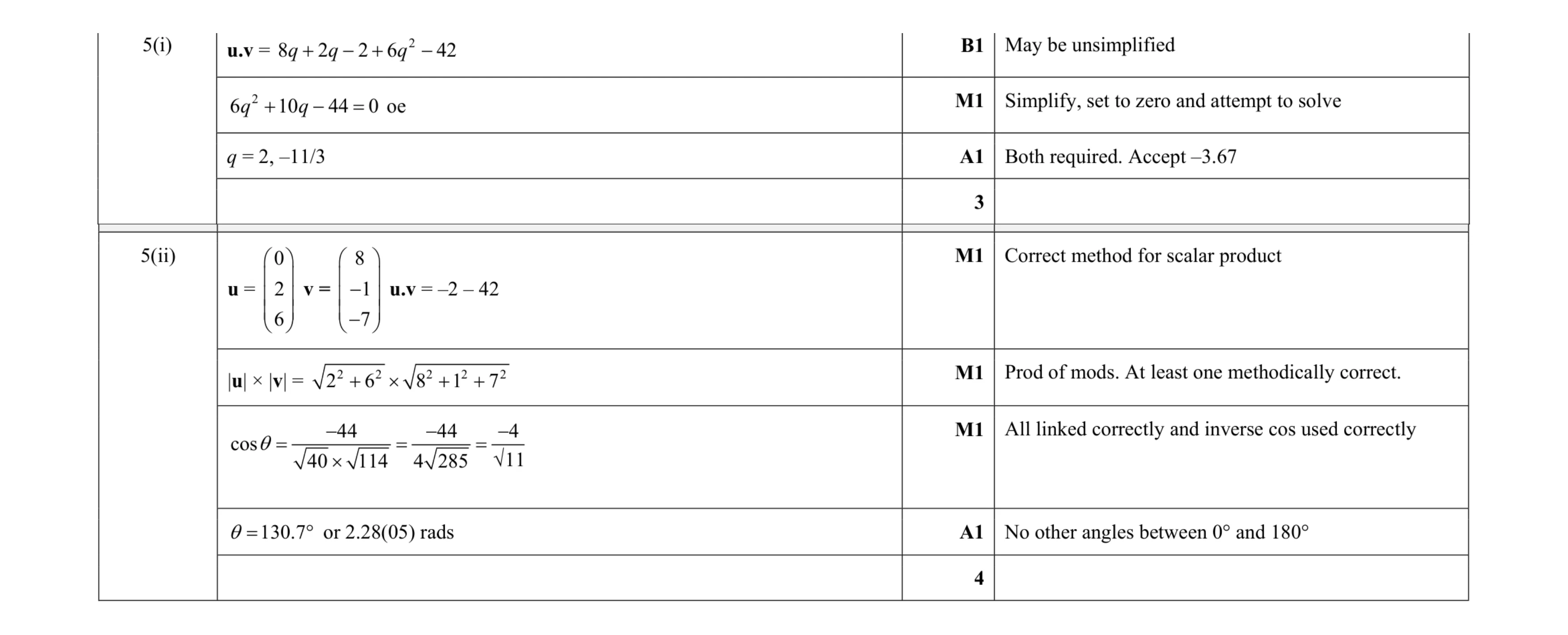 7
7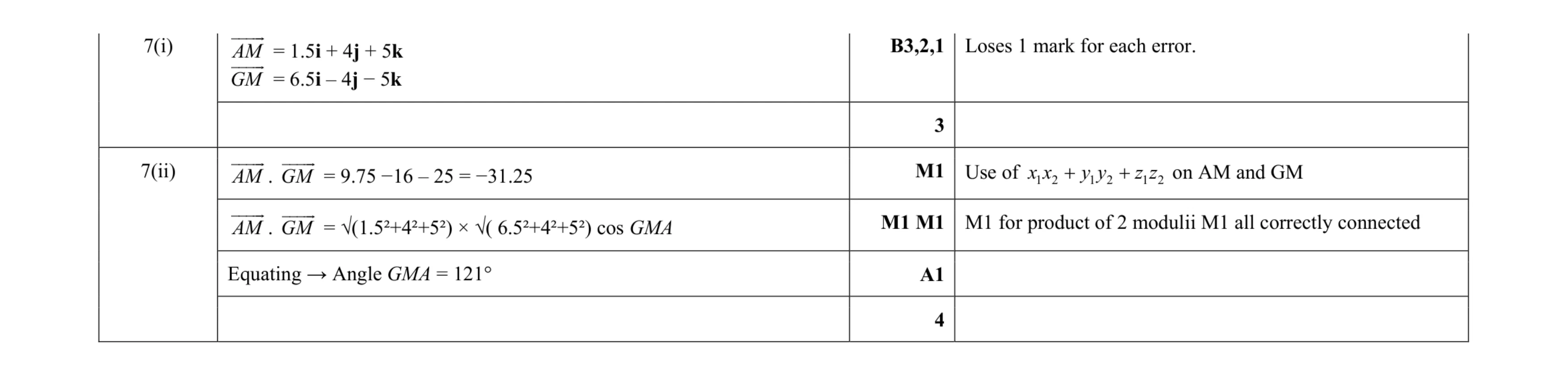 7
7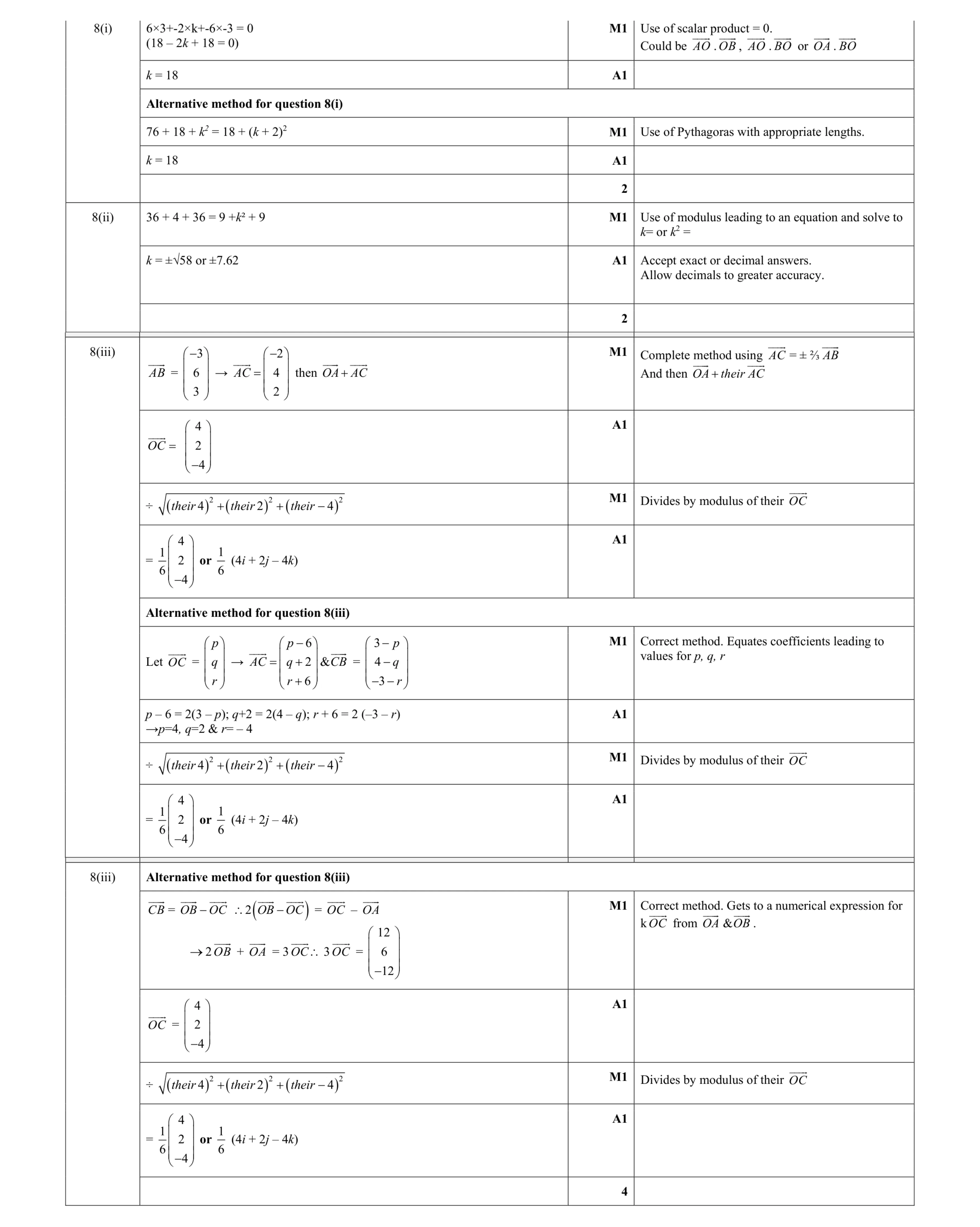 8
8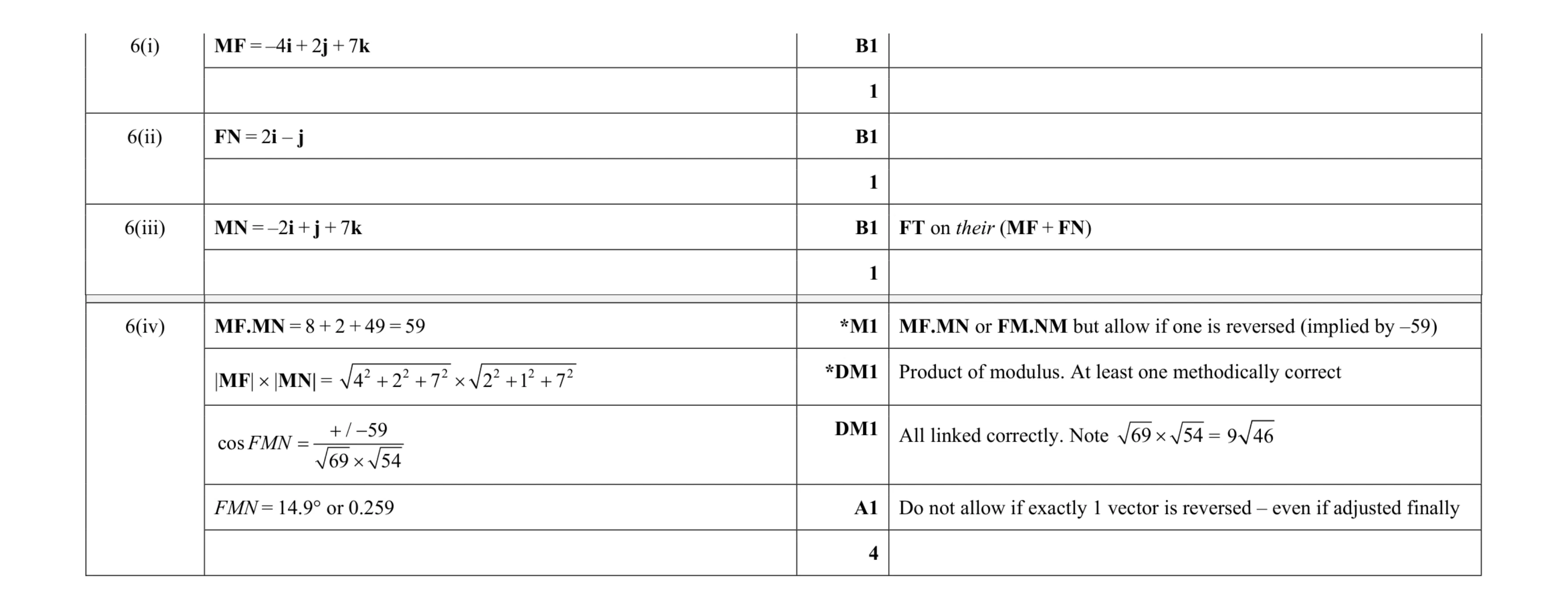 7
7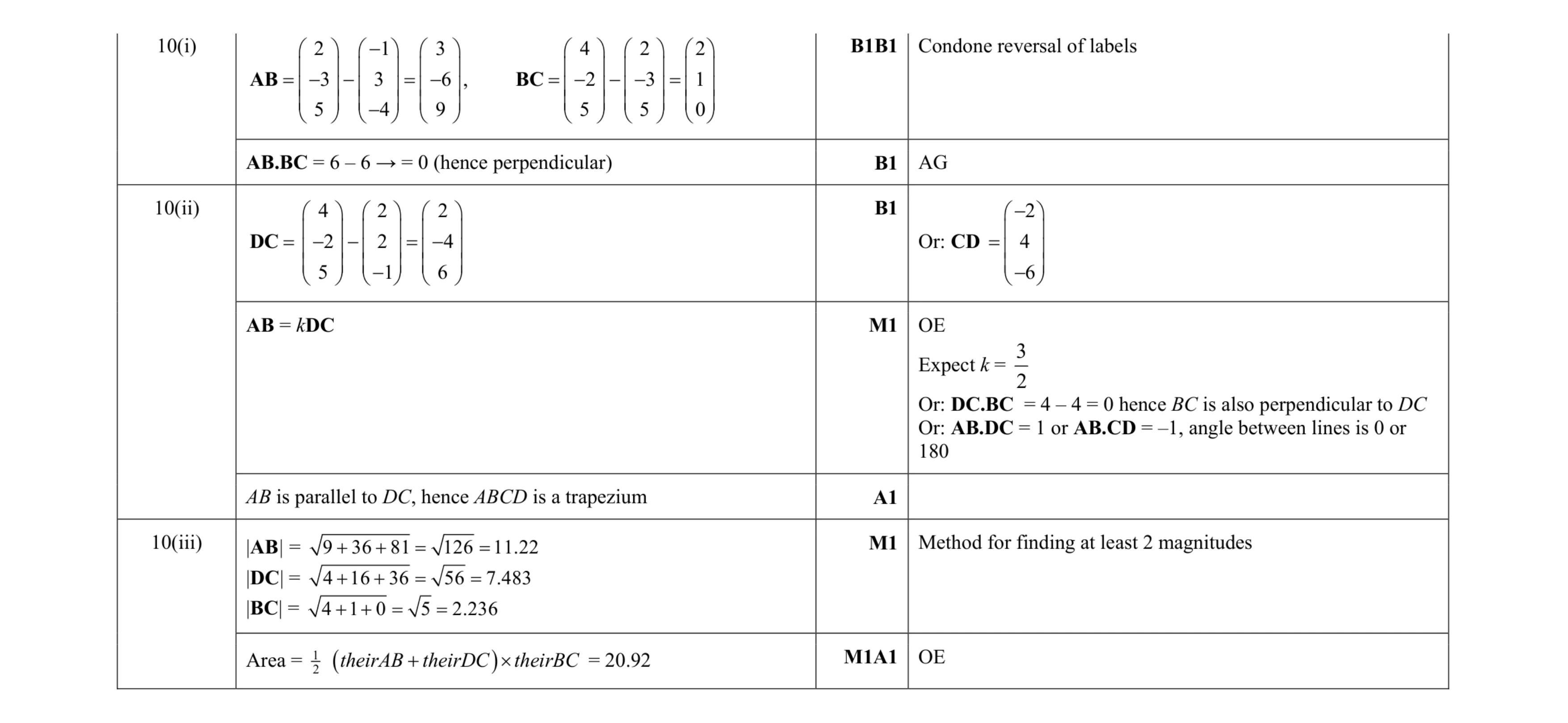 9
9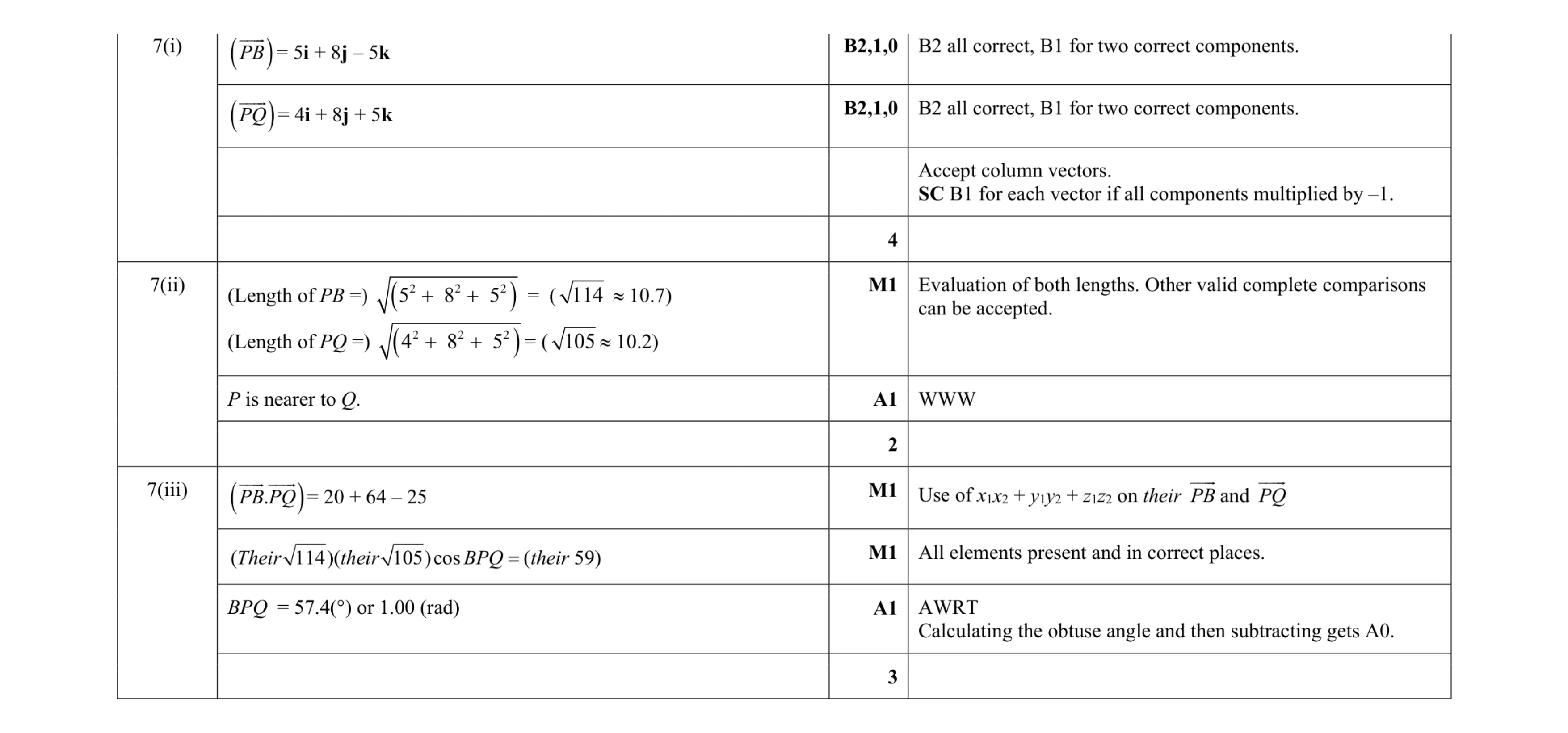 9
9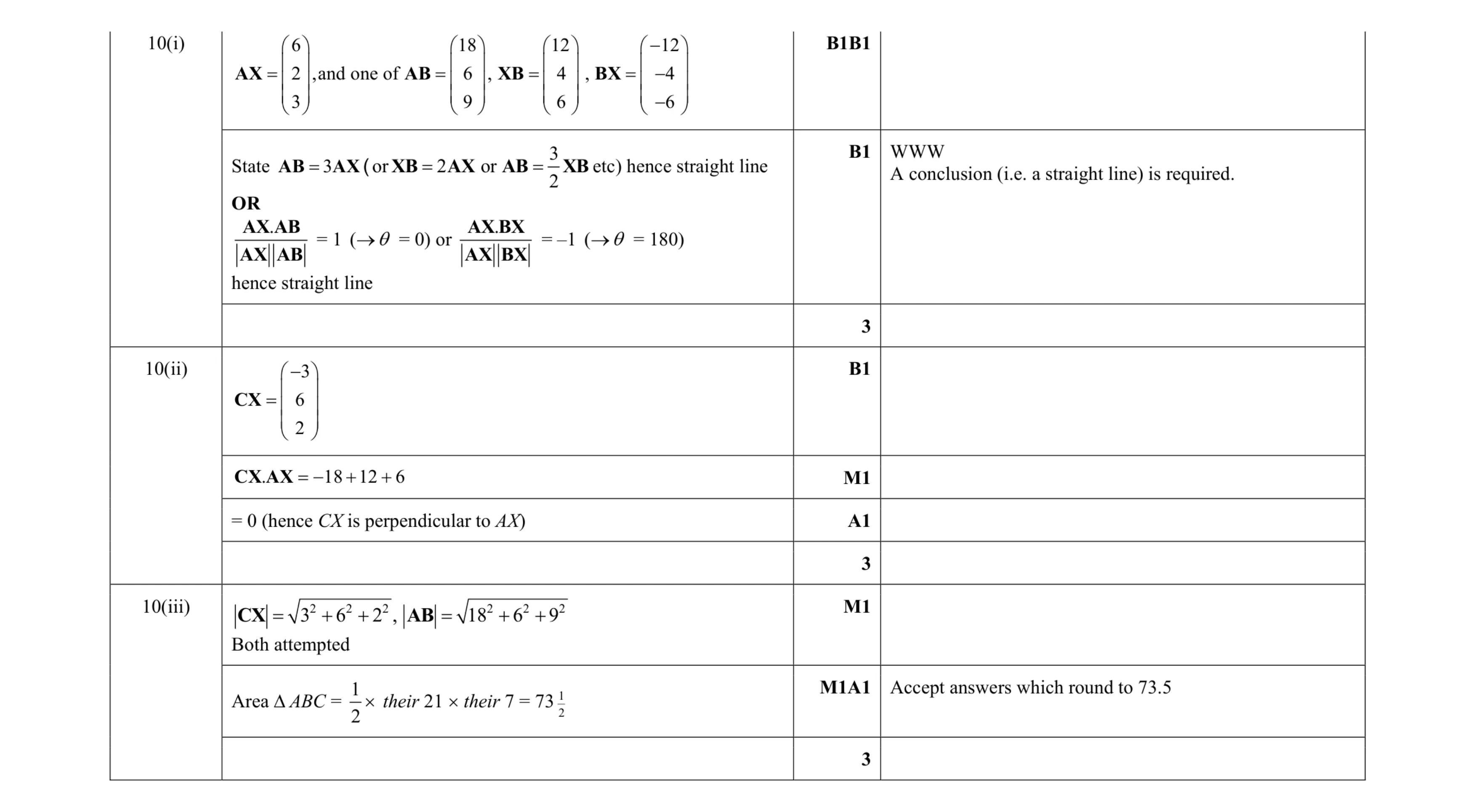 9
9