Cambridge A Level Mathematics 9709 — 2016 Feb/March Paper 1 · Variant 2
9709/12/F/M/16 · 5 questions · 75 marks · ≈84 min
The question paper and its mark scheme, free to read here and free to download. This is Cambridge’s own paper, exactly as it was sat.
Question paper8 pages
Mark scheme6 pages
Answers below. Sit the paper first if you are practising.
Questions as text
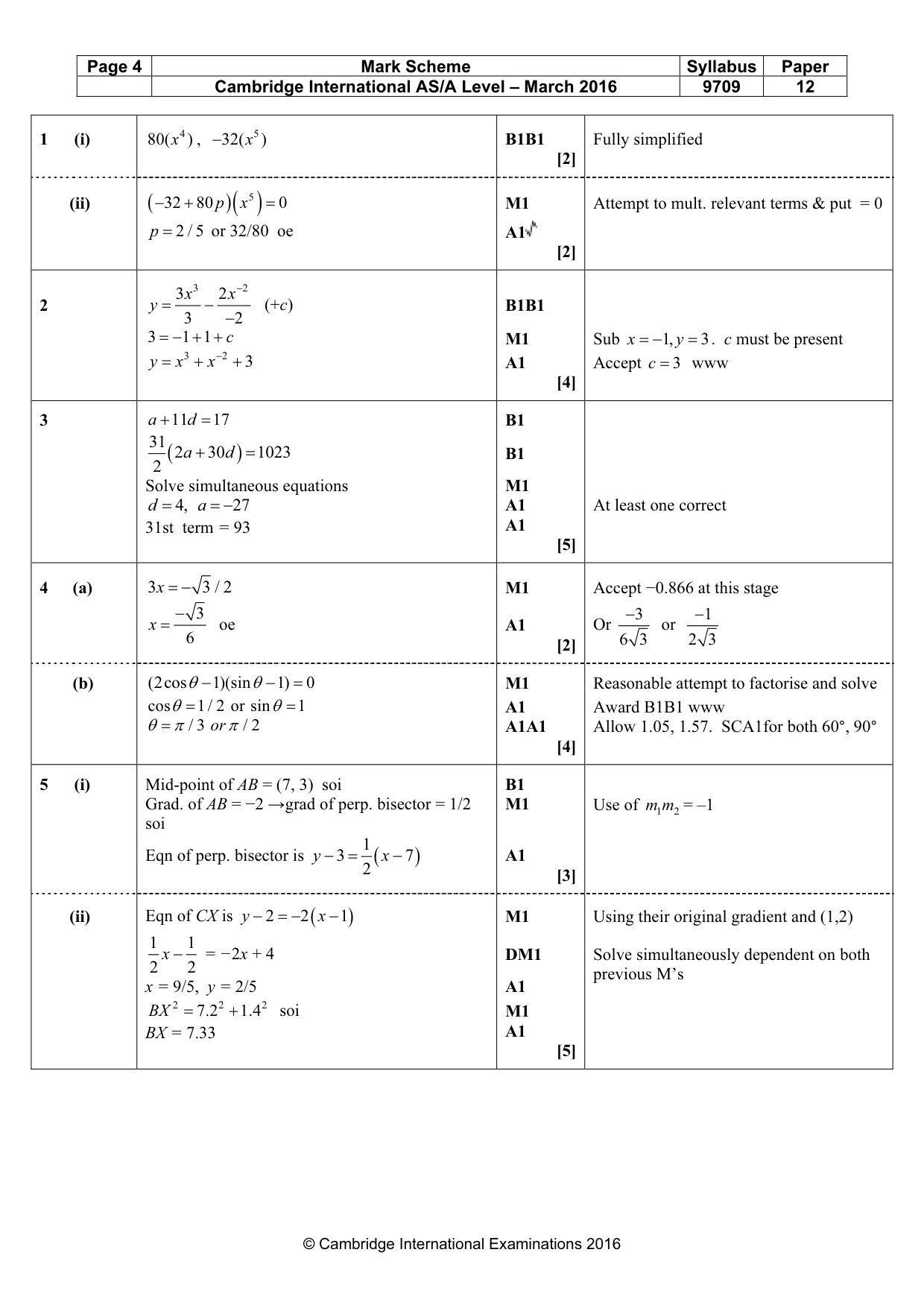
Q3 · The 12th term of an arithmetic progression is 17 and the sum of the first 31 terms is 1023
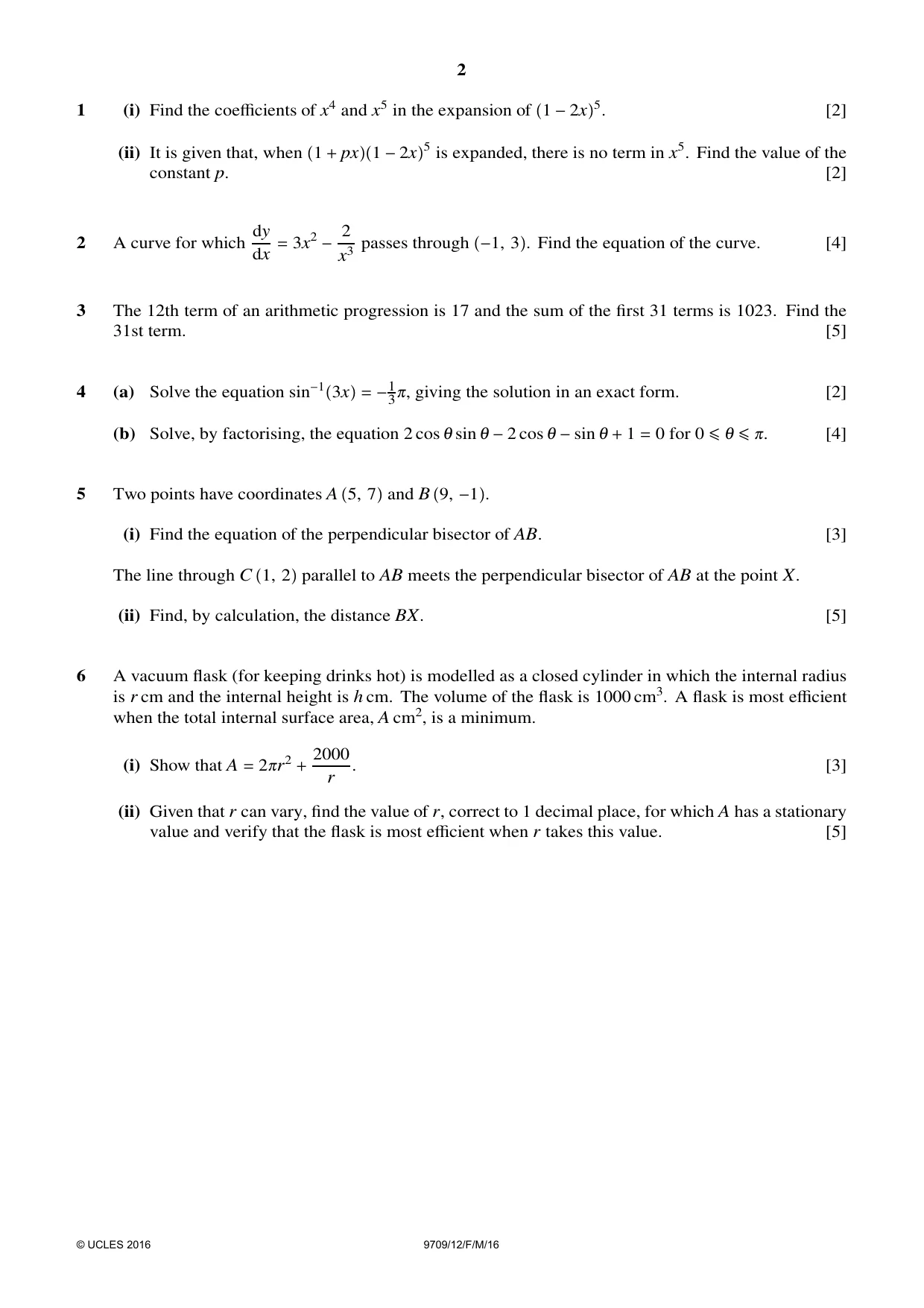
3 The 12th term of an arithmetic progression is 17 and the sum of the first 31 terms is 1023. Find the 31st term. [5]
Mark scheme: 3 a + 11d = 17 B1 31 ( 2 a + 30 d ) = 1023 B1 2 Solve simultaneous equations M1 d = 4, a = −27 A1 At least one correct 31st term = 93 A1 [5]
Q6 · A vacuum flask (for keeping drinks hot) is modelled as a closed cylinder in which the…
6 A vacuum flask (for keeping drinks hot) is modelled as a closed cylinder in which the internal radius is r cm and the internal height is h cm. The volume of the flask is 1000 cm3. A flask is most efficient when the total internal surface area, A cm2, is a minimum. 2000 (i) Show that A = 20r2 + . [3] r (ii) Given that r can vary, find the value of r, correct to 1 decimal place, for which A has a stationary value and verify that the flask is most efficient when r takes this value. [5]
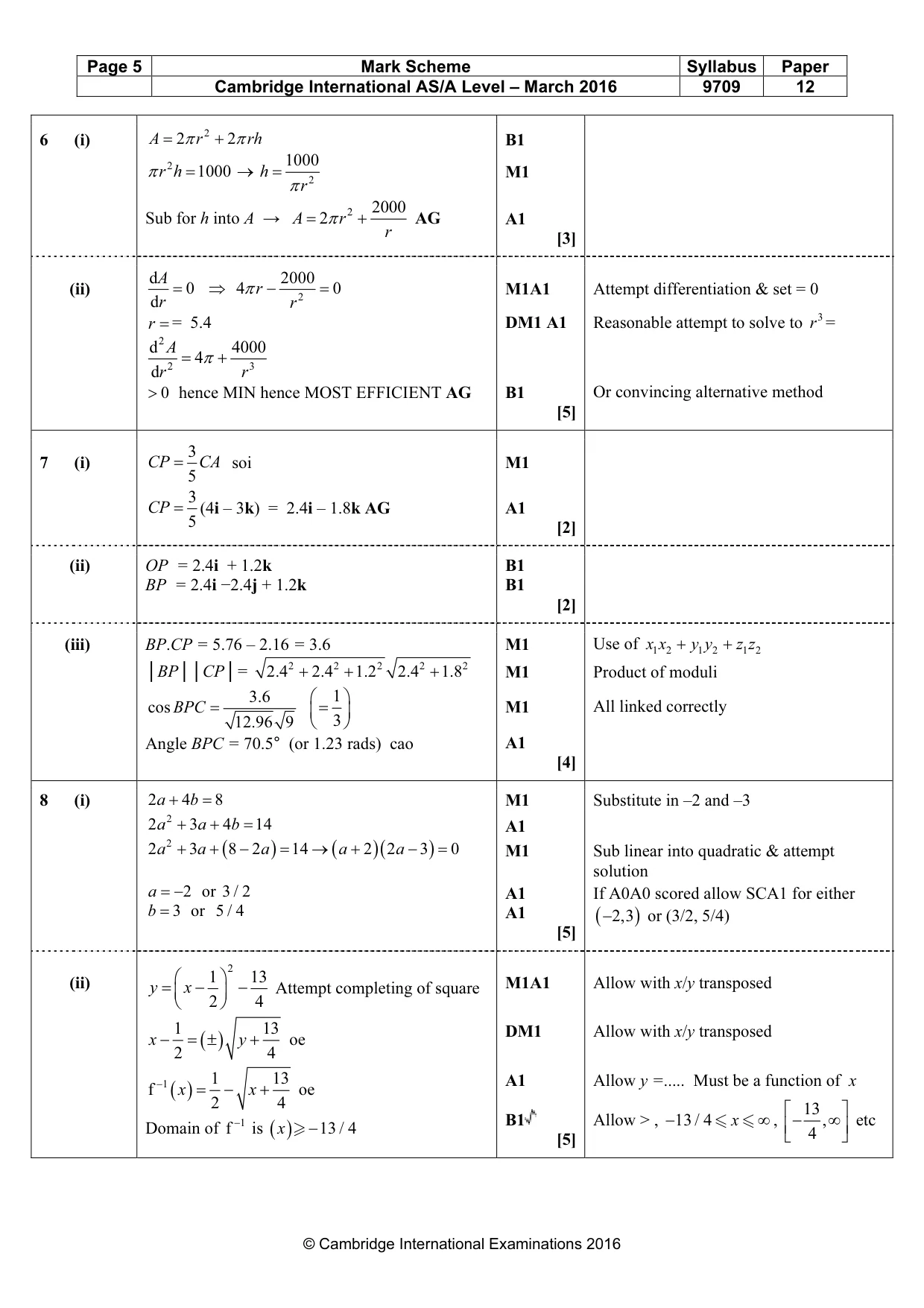
Mark scheme: 6 (i) A = 2π r 2 + 2π rh B1 2 1000 π r h = 1000 → h = 2 M1 π r 2 2000 Sub for h into A → A = 2π r + AG A1 r [3] d A 2000 (ii) = 0 ⇒ 4π r − 2 = 0 M1A1 Attempt differentiation & set = 0 d r r r = = 5.4 DM1 A1 Reasonable attempt to solve to 3r = d 2 A 4000 = 4π + dr 2 r 3 > 0 hence MIN hence MOST EFFICIENT AG B1 Or convincing alternative method [5] 3
Q7 · C 3 3 P B k 2.4 j i O A 4 The diagram shows a pyramid OABC with a horizontal triangular…
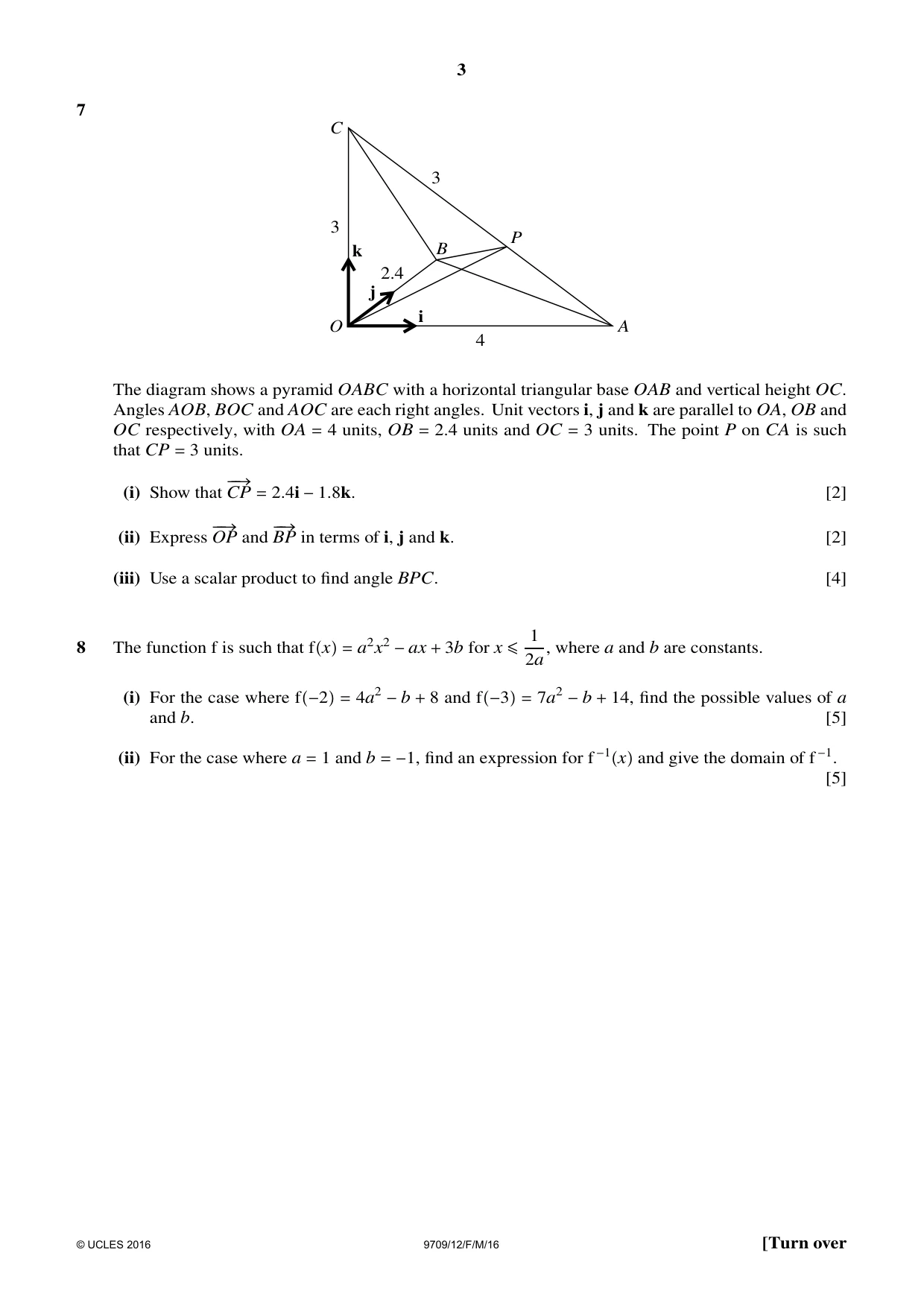
7 C 3 3 P B k 2.4 j i O A 4 The diagram shows a pyramid OABC with a horizontal triangular base OAB and vertical height OC. Angles AOB, BOC and AOC are each right angles. Unit vectors i, j and k are parallel to OA, OB and OC respectively, with OA = 4 units, OB = 2.4 units and OC = 3 units. The point P on CA is such that CP = 3 units. −−→ (i) Show that CP = 2.4i −1.8k. [2] −−→ −−→ (ii) Express OP and BP in terms of i, j and k. [2] (iii) Use a scalar product to find angle BPC. [4]
Mark scheme: 3 7 (i) CP = CA soi M1 5 3 CP = (4i – 3k) = 2.4i – 1.8k AG A1 5 [2] (ii) OP = 2.4i + 1.2k B1 BP = 2.4i −2.4j + 1.2k B1 [2] (iii) BP.CP = 5.76 – 2.16 = 3.6 M1 Use of x1 x2 + y1 y 2 + z1 z 2 │BP││CP│= 2.4 2 + 2.4 2 + 1.2 2 2.4 2 + 1.8 2 M1 Product of moduli 3.6 1 cos BPC = = M1 All linked correctly 12.96 9 3 Angle BPC = 70.5° (or 1.23 rads) cao A1 [4]
Question 9
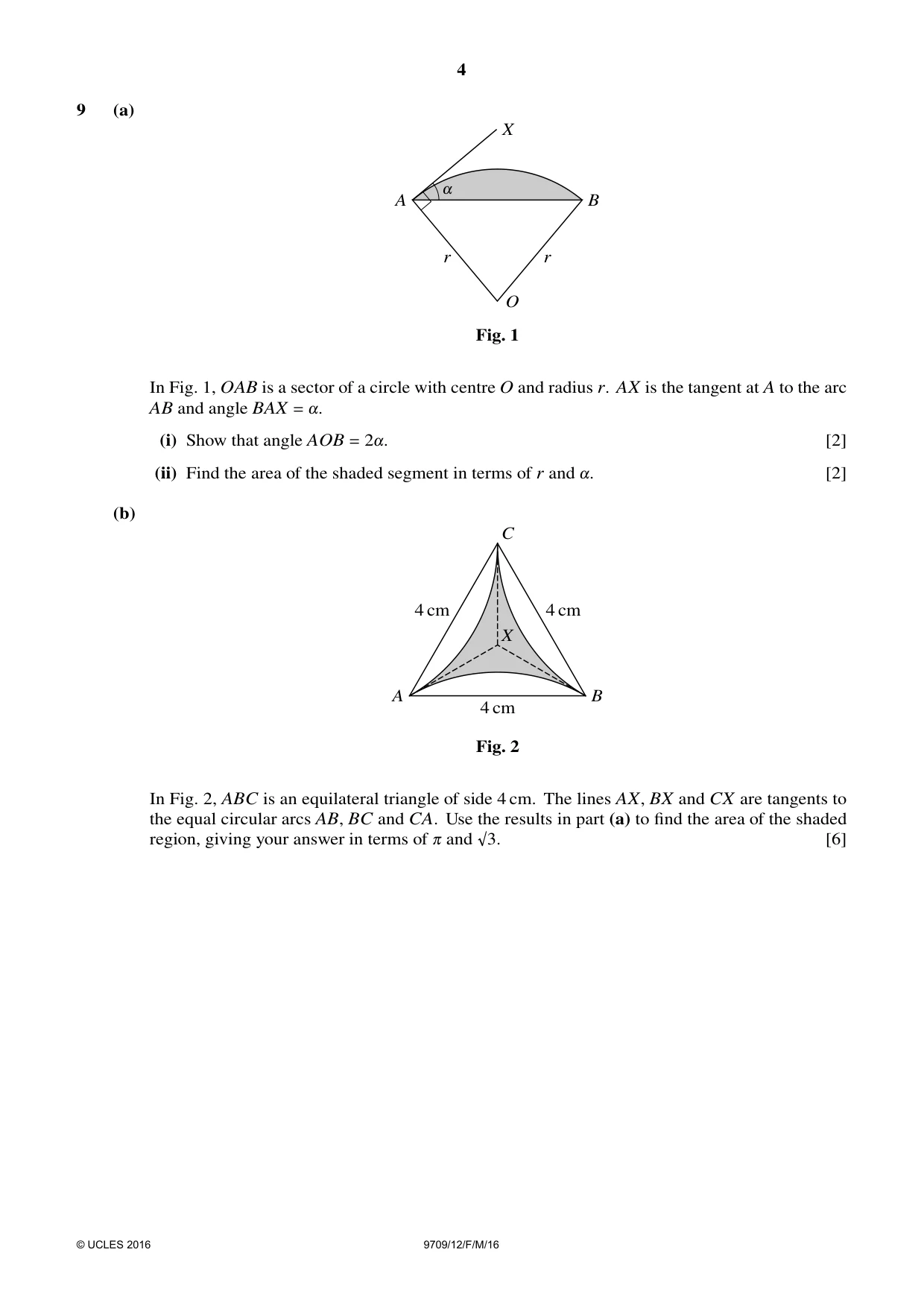
9 (a) X ! A B r r O Fig. 1 In Fig. 1, OAB is a sector of a circle with centre O and radius r. AX is the tangent at A to the arc AB and angle BAX = !. (i) Show that angle AOB = 2!. [2] (ii) Find the area of the shaded segment in terms of r and !. [2] (b) C 4 cm 4 cm X A B 4 cm Fig. 2 In Fig. 2, ABC is an equilateral triangle of side 4 cm. The lines AX, BX and CX are tangents to the equal circular arcs AB, BC and CA. Use the results in part (a) to find the area of the shaded region, giving your answer in terms of 0 and ï3. [6]
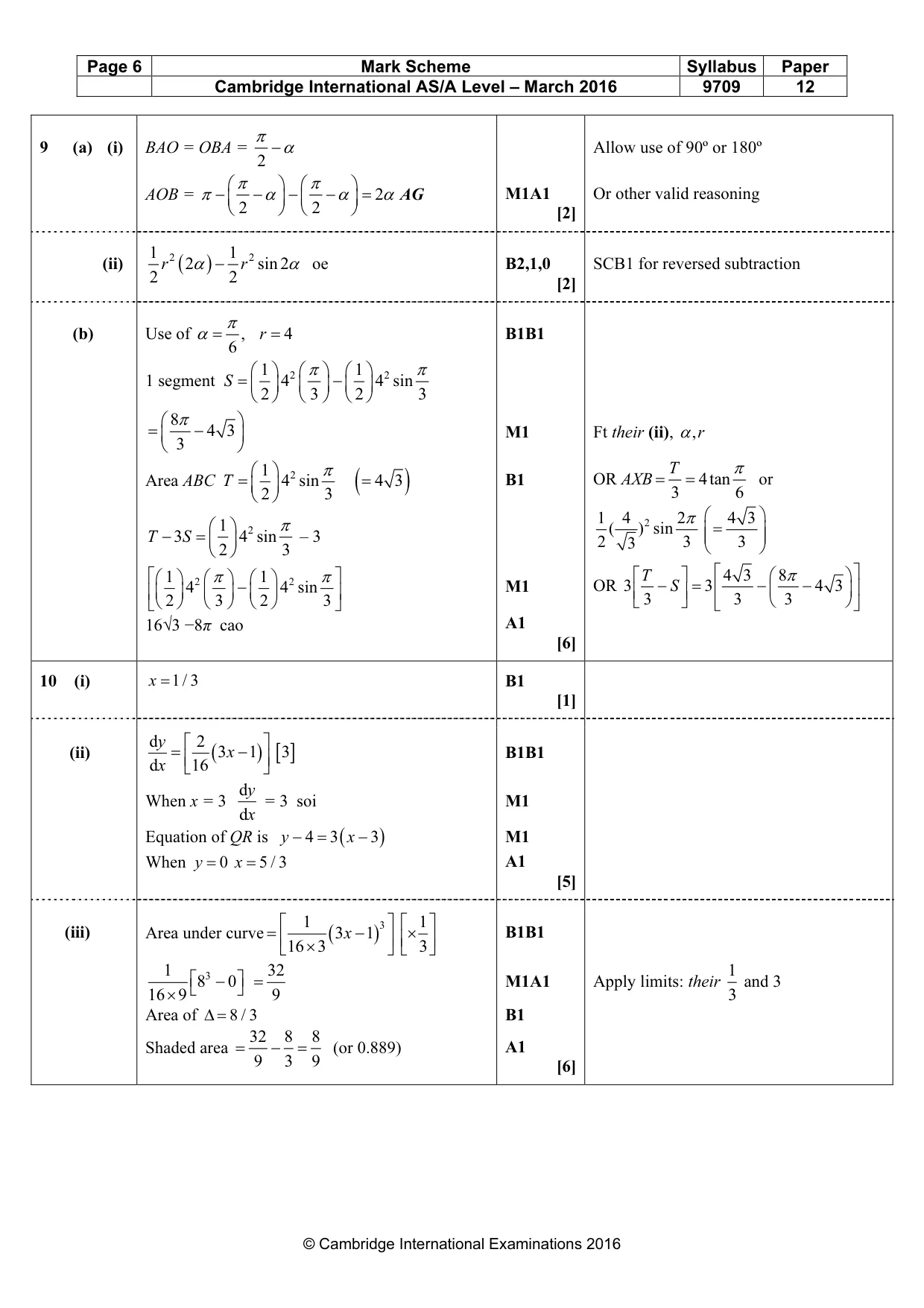
Mark scheme: π 9 (a) (i) BAO = OBA = − α Allow use of 90º or 180º 2 π π AOB = π − − α − − α = 2α AG M1A1 Or other valid reasoning 2 2 [2] 1 2 1 2 (ii) r ( 2α ) − r sin 2α oe B2,1,0 SCB1 for reversed subtraction 2 2 [2] π (b) Use of α = , r = 4 B1B1 6 1 2 π 1 2 π 1 segment S = 4 − 4 sin 2 3 2 3 8π = − 4 3 M1 Ft their (ii), α , r 3 1 2 π T π B1 OR AXB = = 4tan or = 4 3 Area ABC T = 4 sin ( ) 2 3 3 6 1 4 2 2π 4 3 1 2 π ( ) sin = 4 sin T − 3S = – 3 3 2 3 3 3 2 1 2 π 1 2 π T 4 3 8π 4 − 4 sin M1 OR 3 − S = 3 − − 4 3 2 3 2 3 3 3 3 16√3 −8π cao A1 [6]
Q10 · Y Q 3, 4 y = 161 3x −1 2 x O P R The diagram shows part of the curve y = 1 3x −1 2, which…
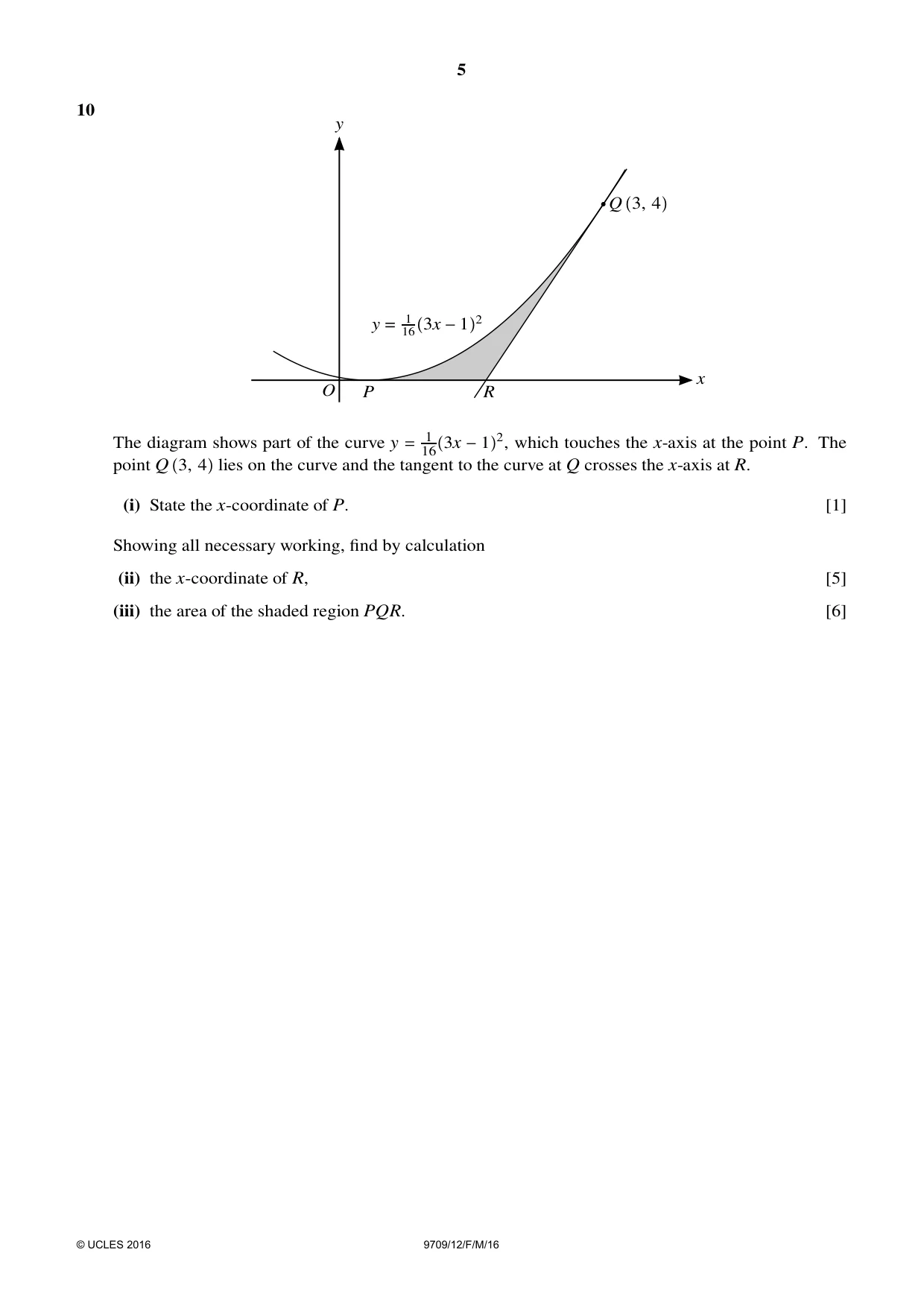
10 y Q 3, 4 y = 161 3x −1 2 x O P R The diagram shows part of the curve y = 1 3x −1 2, which touches the x-axis at the point P. The 16 point Q 3, 4 lies on the curve and the tangent to the curve at Q crosses the x-axis at R. (i) State the x-coordinate of P. [1] Showing all necessary working, find by calculation (ii) the x-coordinate of R, [5] (iii) the area of the shaded region PQR. [6]
Mark scheme: 10 (i) x = 1/ 3 B1 [1] dy 2 = (ii) [ 3] B1B1 ( 3 x − 1) 16 dx dy When x = 3 = 3 soi M1 dx Equation of QR is y − 4 = 3 ( x − 3 ) M1 When y = 0 x = 5 / 3 A1 [5] 1 3 1 (iii) Area under curve = ( 3 x − 1) × B1B1 16 × 3 3 1 3 32 1 8 − 0 = M1A1 Apply limits: their and 3 16 × 9 9 3 Area of ∆= 8 / 3 B1 32 8 8 Shaded area = − = (or 0.889) A1 9 3 9 [6]
What was in this paper
The subtopics covered by these 5 questions, and how many questions each got. Open one in a new tab to see every Cambridge question on it.
What you needed in this session
Cambridge’s own grade thresholds for 2016 Feb/March, Paper 1 · Variant 2. A higher threshold means an easier paper — the bar moves with how the cohort did.