Cambridge A Level Mathematics 9709 — 2016 Oct/Nov Paper 1 · Variant 3
9709/13/O/N/16 · 2 questions · 75 marks · ≈84 min
The question paper and its mark scheme, free to read here and free to download. This is Cambridge’s own paper, exactly as it was sat.
Question paper4 pages
Mark scheme7 pages
Answers below. Sit the paper first if you are practising.
Questions as text
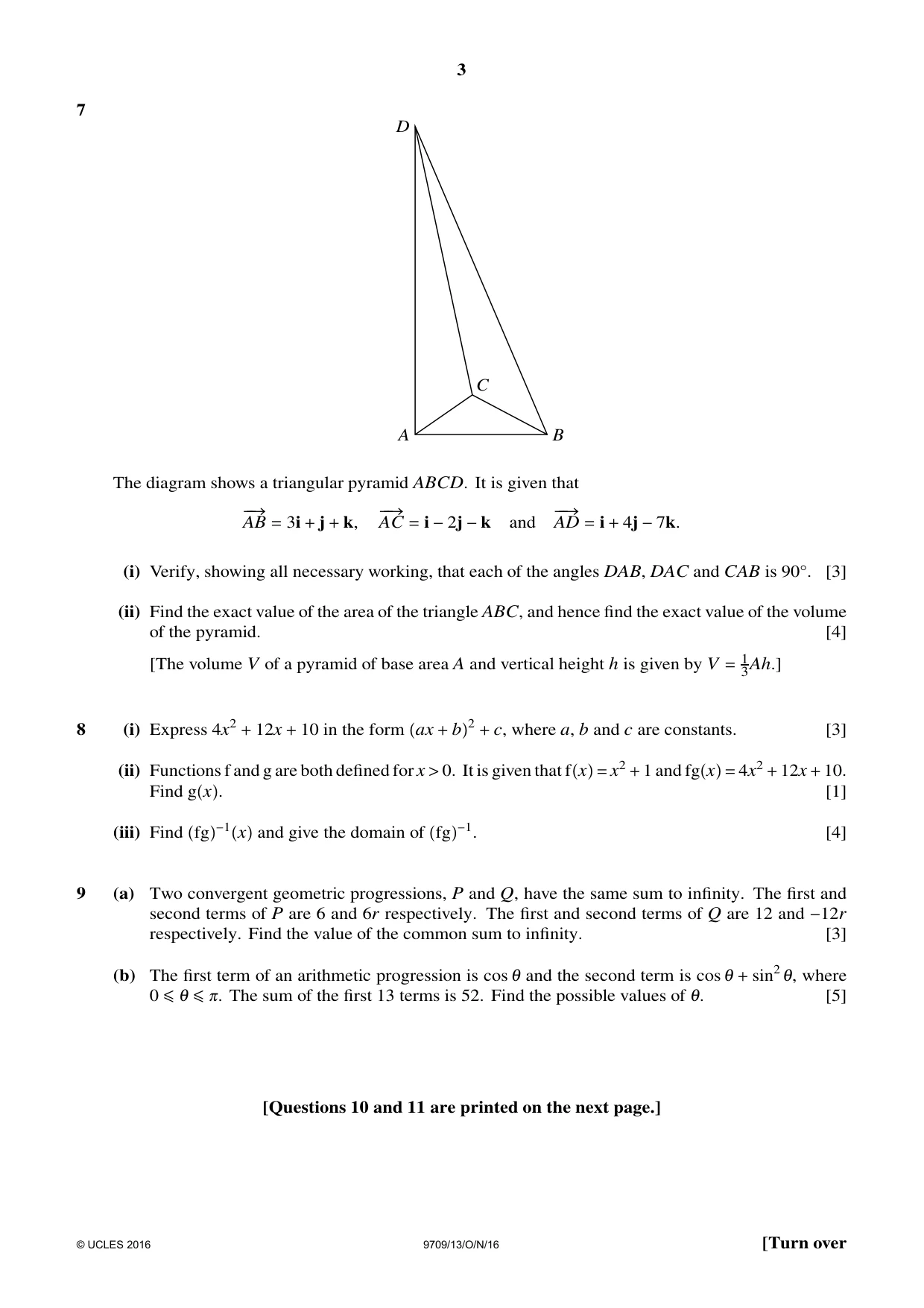
Q7 · D C A B The diagram shows a triangular pyramid ABCD
7 D C A B The diagram shows a triangular pyramid ABCD. It is given that −−→ −−→ −−→ AB = 3i + j + k, AC = i −2j −k and AD = i + 4j −7k. (i) Verify, showing all necessary working, that each of the angles DAB, DAC and CAB is 90Å. [3] (ii) Find the exact value of the area of the triangle ABC, and hence find the exact value of the volume of the pyramid. [4] [The volume V of a pyramid of base area A and vertical height h is given by V = 13Ah.]
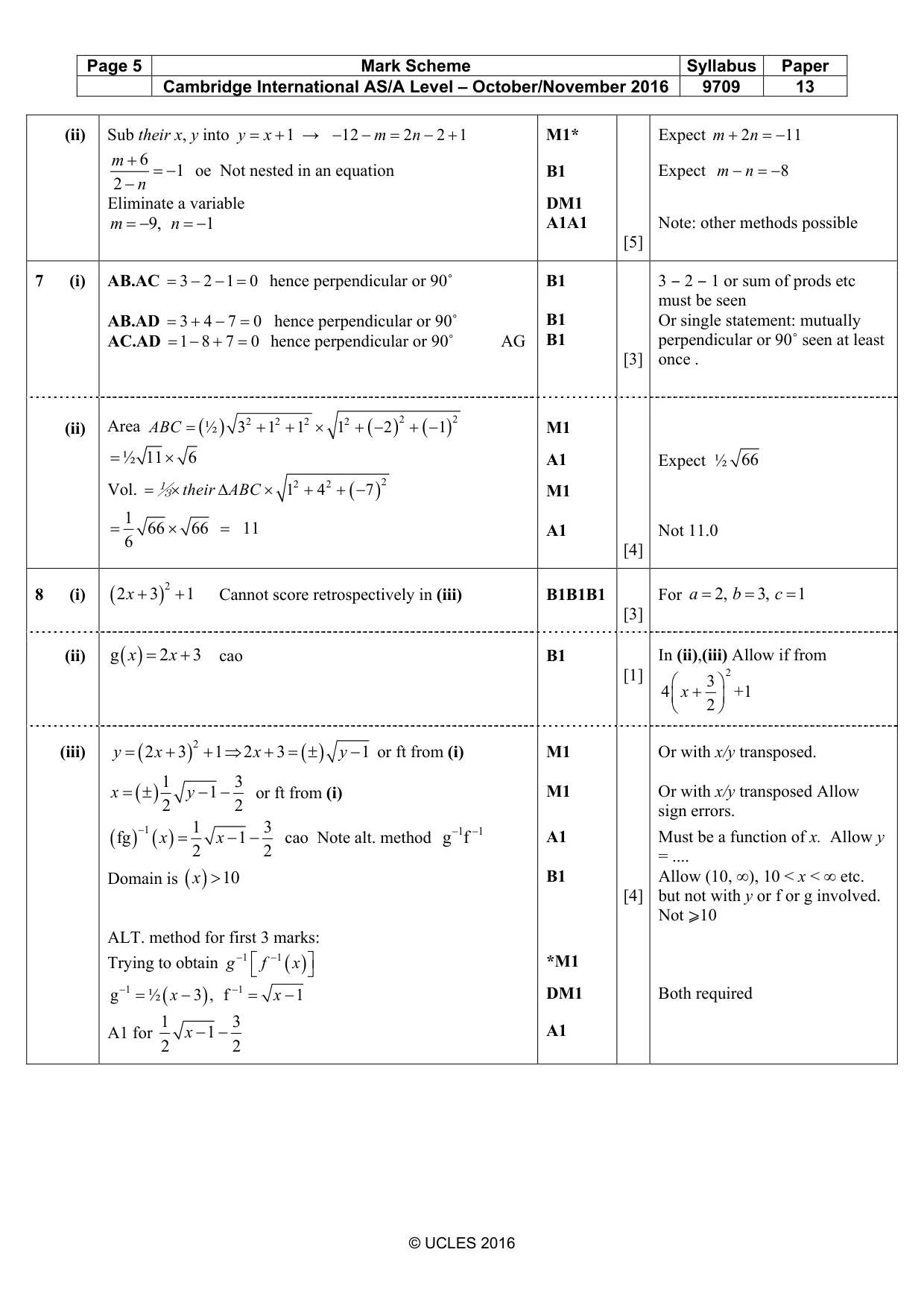
Mark scheme: 7 (i) AB.AC = 3 − 2 −=1 0 hence perpendicular or 90˚ B1 3 ‒ 2 ‒ 1 or sum of prods etc must be seen AB.AD = 3 + 4 − 7 = 0 hence perpendicular or 90˚ B1 Or single statement: mutually AC.AD = 1 − 8 + 7 = 0 hence perpendicular or 90˚ AG B1 perpendicular or 90˚ seen at least [3] once . (ii) Area ABC = ( ½ ) 3 2 + 12 + 12 × 12 + ( − 2 ) 2 + ( − 1) 2 M1 = ½ 11 × 6 A1 Expect ½ 66 Vol. = ⅓× their ∆ ABC × 12 + 4 2 + ( − 7 ) 2 M1 1 = 66 × 66 = 11 A1 Not 11.0 6 [4] 2
Q9 · Two convergent geometric progressions, P and Q, have the same sum to infinity
9 (a) Two convergent geometric progressions, P and Q, have the same sum to infinity. The first and second terms of P are 6 and 6r respectively. The first and second terms of Q are 12 and −12r respectively. Find the value of the common sum to infinity. [3] (b) The first term of an arithmetic progression is cos 1 and the second term is cos 1 + sin21, where 0 ≤1 ≤0. The sum of the first 13 terms is 52. Find the possible values of 1. [5] [Questions 10 and 11 are printed on the next page.]
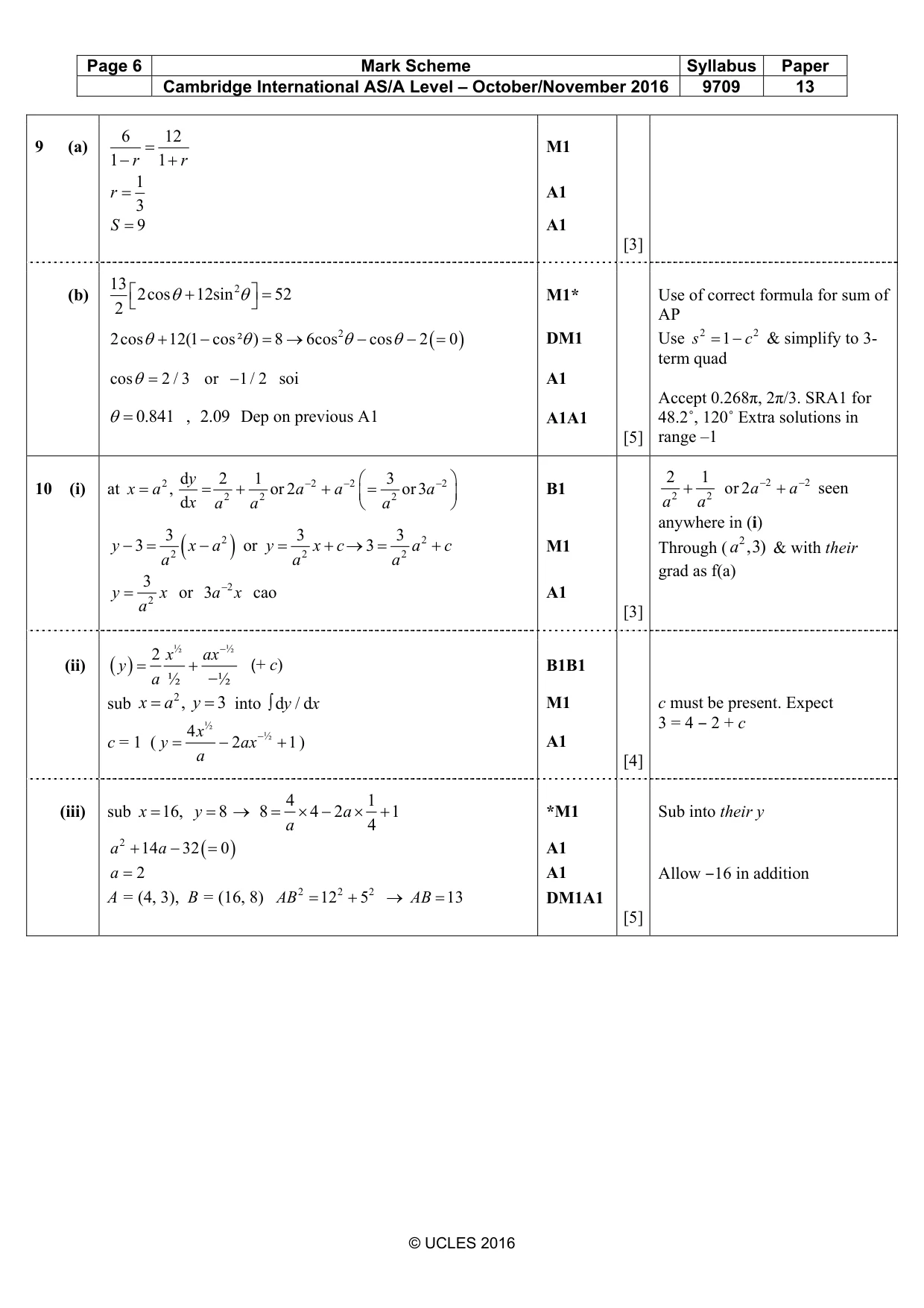
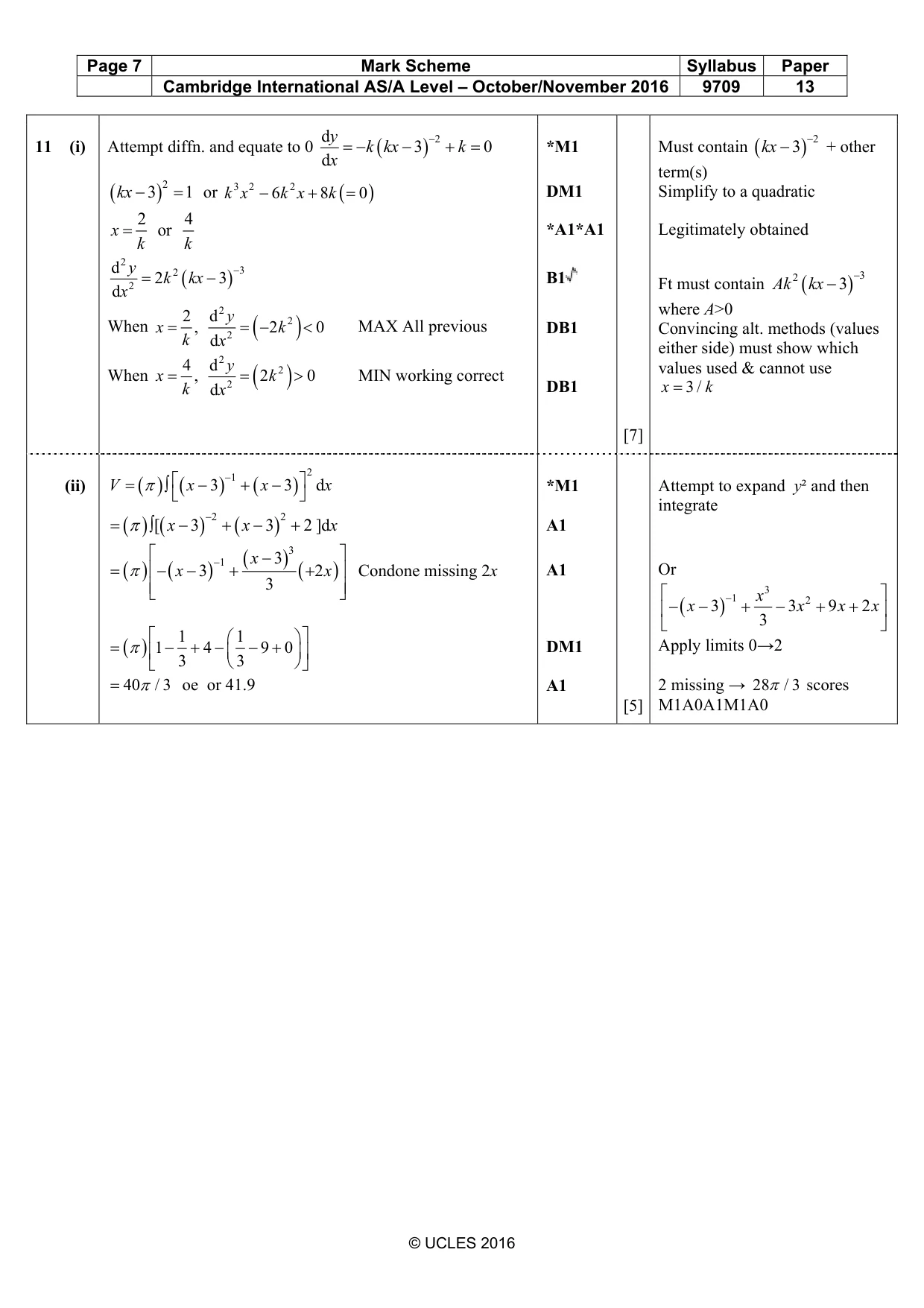
Mark scheme: 6 12 9 (a) = M1 1 − r 1 + r 1 r = A1 3 S = 9 A1 [3] 13 2 (b) 2cosθ+ 12sin θ = 52 M1* Use of correct formula for sum of 2 AP 2cosθ+ 12(1 − cos²θ) = 8 → 6cos 2θ− cosθ− 2 ( = 0 ) DM1 Use s 2 = 1 − c 2 & simplify to 3- term quad cosθ = 2 / 3 or − 1/ 2 soi A1 Accept 0.268π, 2π/3. SRA1 for θ= 0.841 , 2.09 Dep on previous A1 A1A1 48.2˚, 120˚ Extra solutions in [5] range –1 d y 2 1 3 2 1 2 2
What was in this paper
The subtopics covered by these 2 questions, and how many questions each got. Open one in a new tab to see every Cambridge question on it.
What you needed in this session
Cambridge’s own grade thresholds for 2016 Oct/Nov, Paper 1 · Variant 3. A higher threshold means an easier paper — the bar moves with how the cohort did.