Cambridge A Level Mathematics 9709 — 2014 May/June Paper 1 · Variant 2
9709/12/M/J/14 · 3 questions · 75 marks · ≈84 min
The question paper and its mark scheme, free to read here and free to download. This is Cambridge’s own paper, exactly as it was sat.
Question paper4 pages
Mark scheme6 pages
Answers below. Sit the paper first if you are practising.
Questions as text
Q6 · The 1st, 2nd and 3rd terms of a geometric progression are the 1st, 9th and 21st terms…
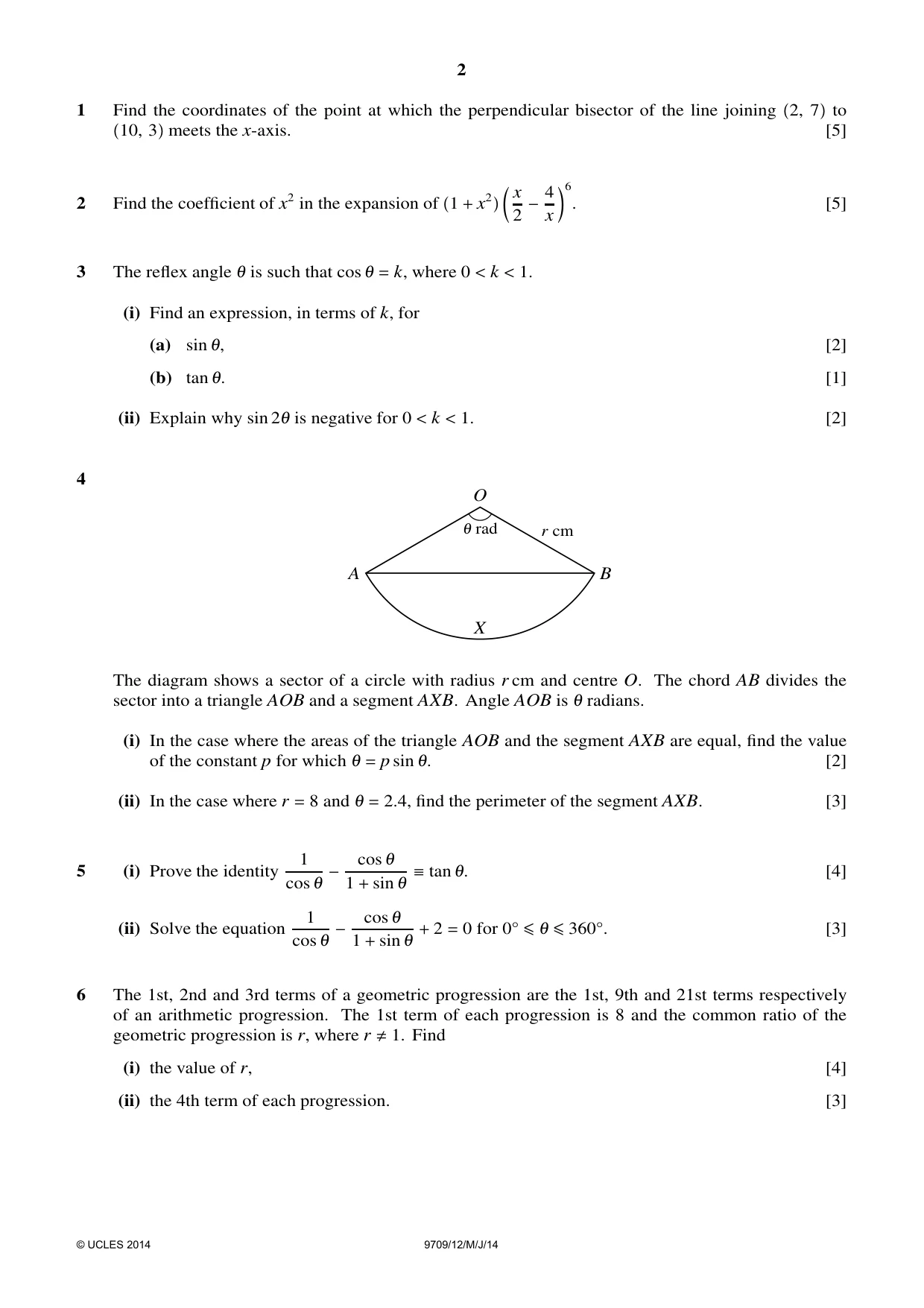
6 The 1st, 2nd and 3rd terms of a geometric progression are the 1st, 9th and 21st terms respectively of an arithmetic progression. The 1st term of each progression is 8 and the common ratio of the geometric progression is r, where r Find ≠1. (i) the value of r, [4] (ii) the 4th term of each progression. [3]
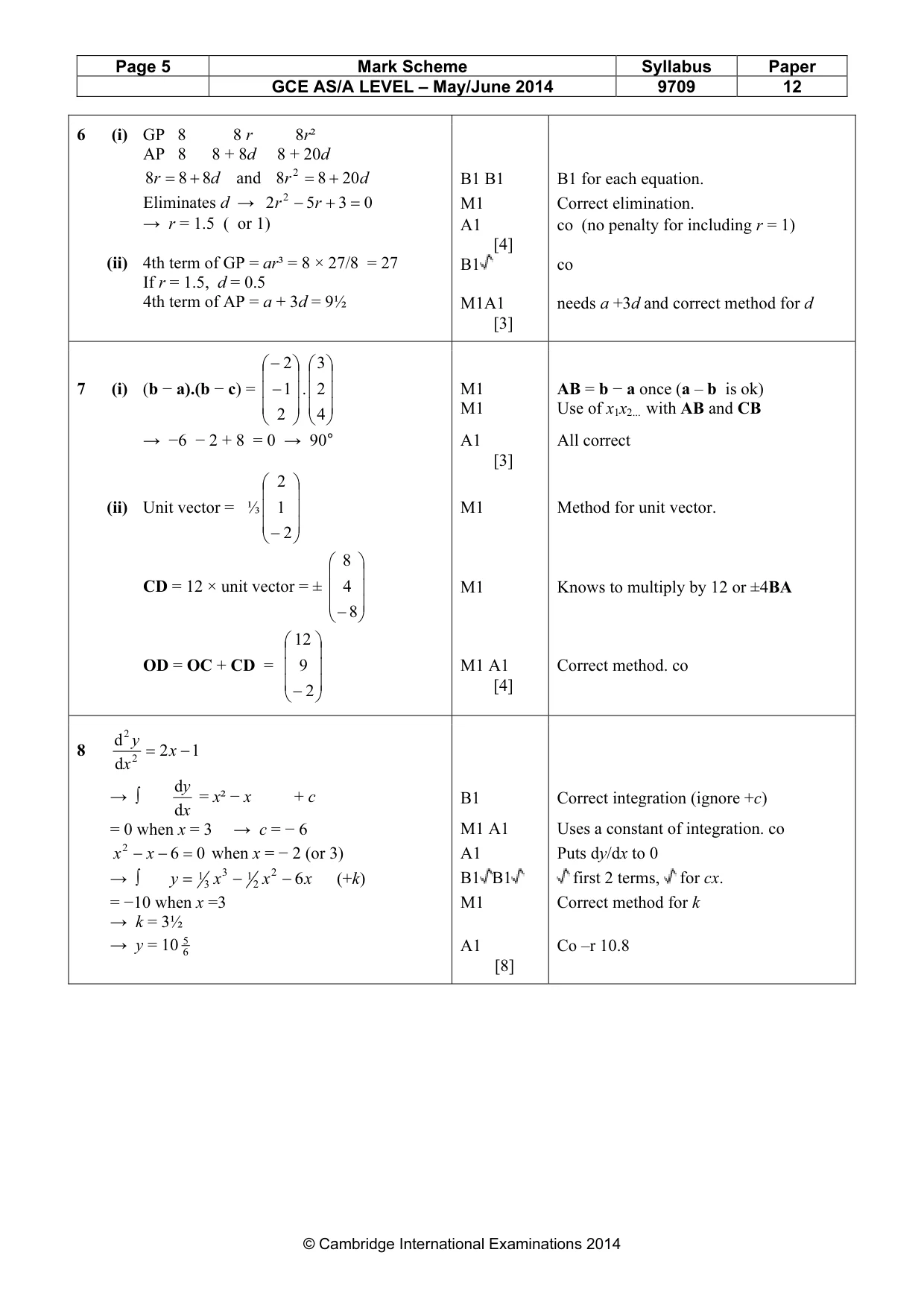
Mark scheme: 6 (i) GP 8 8 r 8r² AP 8 8 + 8d 8 + 20d 8r = 8 + 8d and 8 r 2 = 8 + 20 d B1 B1 B1 for each equation. Eliminates d → 2 r 2 −r5 + 3 = 0 M1 Correct elimination. → r = 1.5 ( or 1) A1 co (no penalty for including r = 1) [4] (ii) 4th term of GP = ar³ = 8 × 27/8 = 27 B1 co If r = 1.5, d = 0.5 4th term of AP = a + 3d = 9½ M1A1 needs a +3d and correct method for d [3] − 2 3
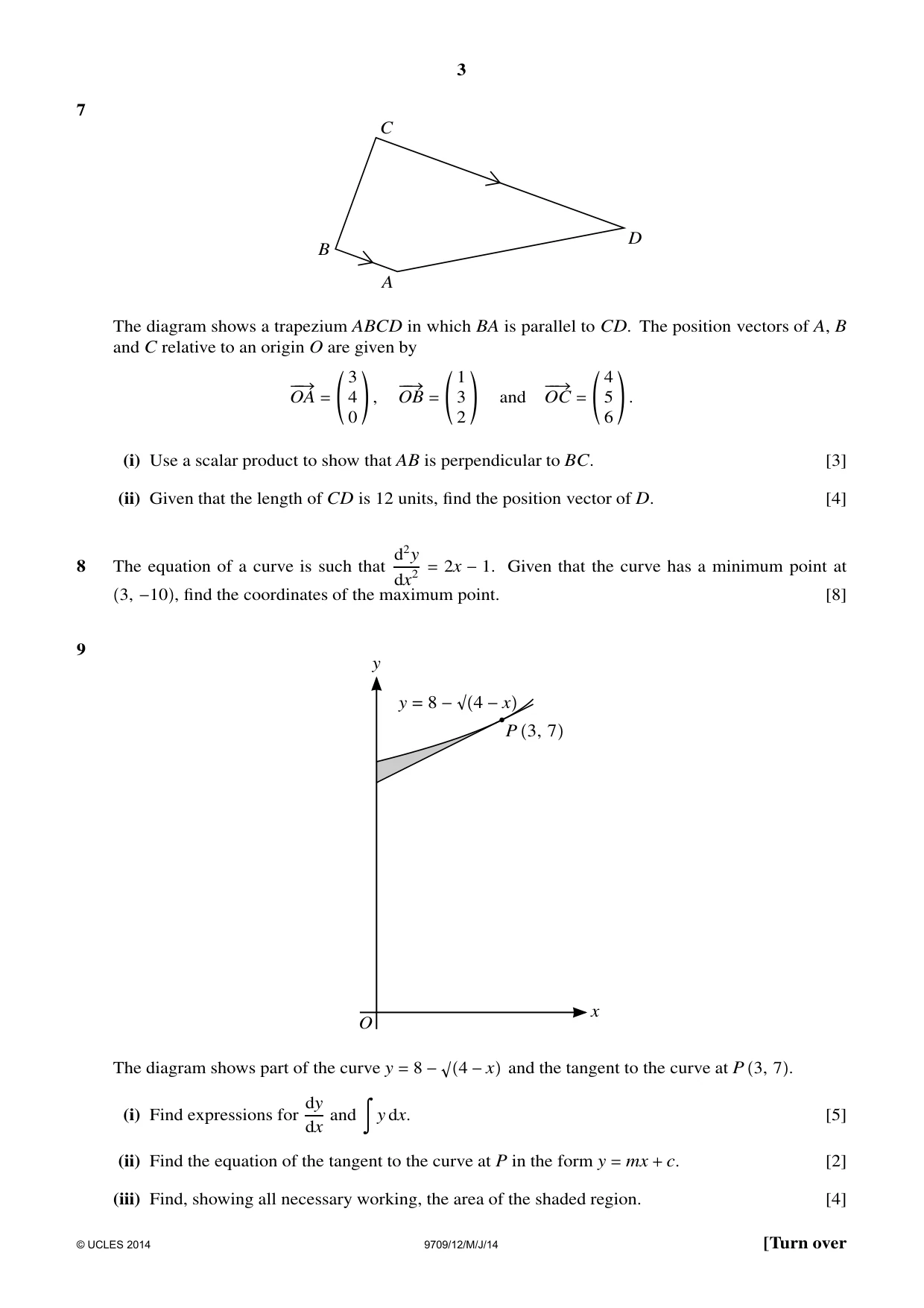
Q7 · C D B A The diagram shows a trapezium ABCD in which BA is parallel to CD
7 C D B A The diagram shows a trapezium ABCD in which BA is parallel to CD. The position vectors of A, B and C relative to an origin O are given by ` a ` a ` a −−→OA 34 , −−→OB 13 and −−→OC 45 . = = = 0 2 6 (i) Use a scalar product to show that AB is perpendicular to BC. [3] (ii) Given that the length of CD is 12 units, find the position vector of D. [4]
Mark scheme: 7 (i) (b − a).(b − c) = − 1 . 2 M1 AB = b − a once (a – b is ok) M1 Use of x1x2... with AB and CB 2 4 → −6 − 2 + 8 = 0 → 90° A1 All correct [3] 2 (ii) Unit vector = ⅓ 1 M1 Method for unit vector. −2 8 CD = 12 × unit vector = ± 4 M1 Knows to multiply by 12 or ±4BA −8 12 OD = OC + CD = 9 M1 A1 Correct method. co [4] −2 d2 y
Q9 · Y y = 8 −ï 4 −x P 3, 7 x O The diagram shows part of the curve y 8 4 and the tangent to…
9 y y = 8 −ï 4 −x P 3, 7 x O The diagram shows part of the curve y 8 4 and the tangent to the curve at P 3, 7 . = − −x dy (i) Find expressions for and y dx. [5] dx Ó (ii) Find the equation of the tangent to the curve at P in the form y mx c. [2] = + (iii) Find, showing all necessary working, the area of the shaded region. [4]
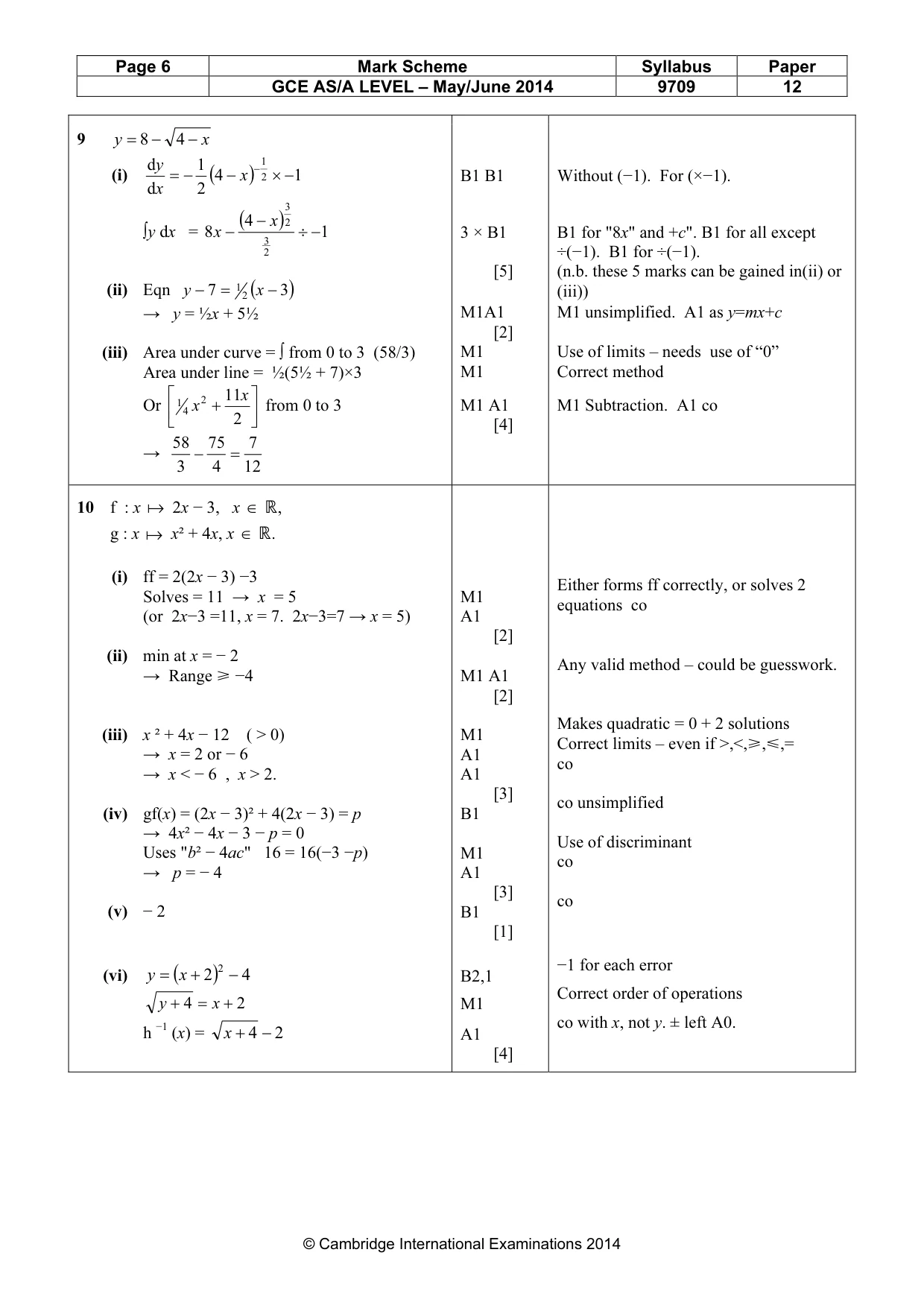
Mark scheme: 9 y = 8 − 4 − x d y 1 − 1 (i) = − (4 − x ) 2 × −1 B1 B1 Without (−1). For (×−1). d x 2 3 (4 − x ) 2 ∫y dx = 8 x − ÷ −1 3 × B1 B1 for "8x" and +c". B1 for all except 3 2 ÷(−1). B1 for ÷(−1). [5] (n.b. these 5 marks can be gained in(ii) or (ii) Eqn y − 7 = 1 2 ( x − 3 ) (iii)) → y = ½x + 5½ M1A1 M1 unsimplified. A1 as y=mx+c [2] (iii) Area under curve = ∫ from 0 to 3 (58/3) M1 Use of limits – needs use of “0” Area under line = ½(5½ + 7)×3 M1 Correct method 1 2 11x Or 4 x + from 0 to 3 M1 A1 M1 Subtraction. A1 co 2 [4] 58 75 7 → − = 3 4 12
What was in this paper
The subtopics covered by these 3 questions, and how many questions each got. Open one in a new tab to see every Cambridge question on it.
What you needed in this session
Cambridge’s own grade thresholds for 2014 May/June, Paper 1 · Variant 2. A higher threshold means an easier paper — the bar moves with how the cohort did.