Cambridge A Level Mathematics 9709 — 2011 Oct/Nov Paper 1 · Variant 3
9709/13/O/N/11 · 5 questions · 75 marks · ≈84 min
The question paper and its mark scheme, free to read here and free to download. This is Cambridge’s own paper, exactly as it was sat.
Question paper4 pages
Mark scheme8 pages
Answers below. Sit the paper first if you are practising.
Questions as text
Q2 · The first and second terms of a progression are 4 and 8 respectively
2 The first and second terms of a progression are 4 and 8 respectively. Find the sum of the first 10 terms given that the progression is (i) an arithmetic progression, [2] (ii) a geometric progression. [2]
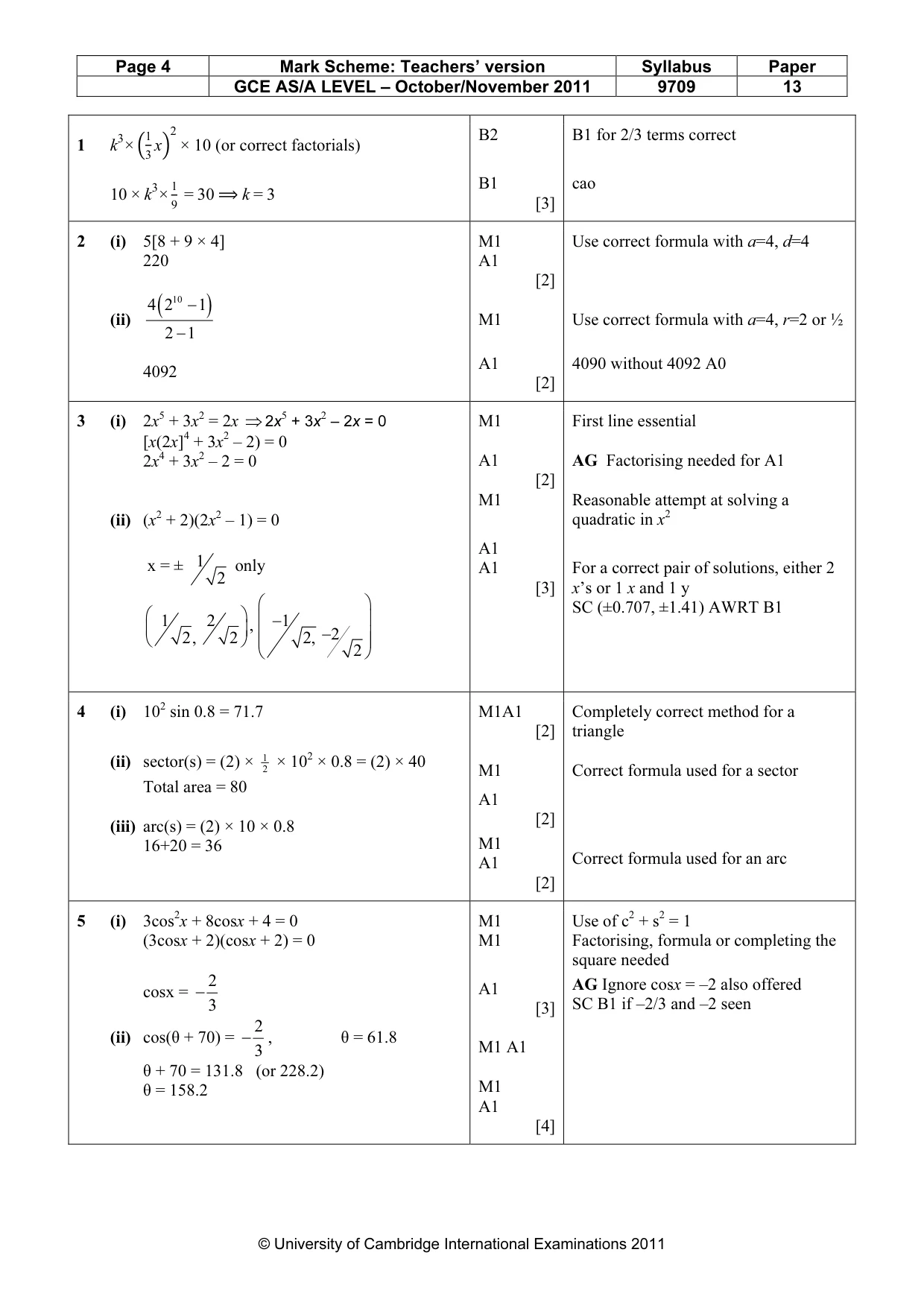
Mark scheme: 2 (i) 5[8 + 9 × 4] M1 Use correct formula with a=4, d=4 220 A1 [2] 4 ( 210 − 1) (ii) M1 Use correct formula with a=4, r=2 or ½ 2 − 1 A1 4090 without 4092 A0 4092 [2] 5 2 5 2
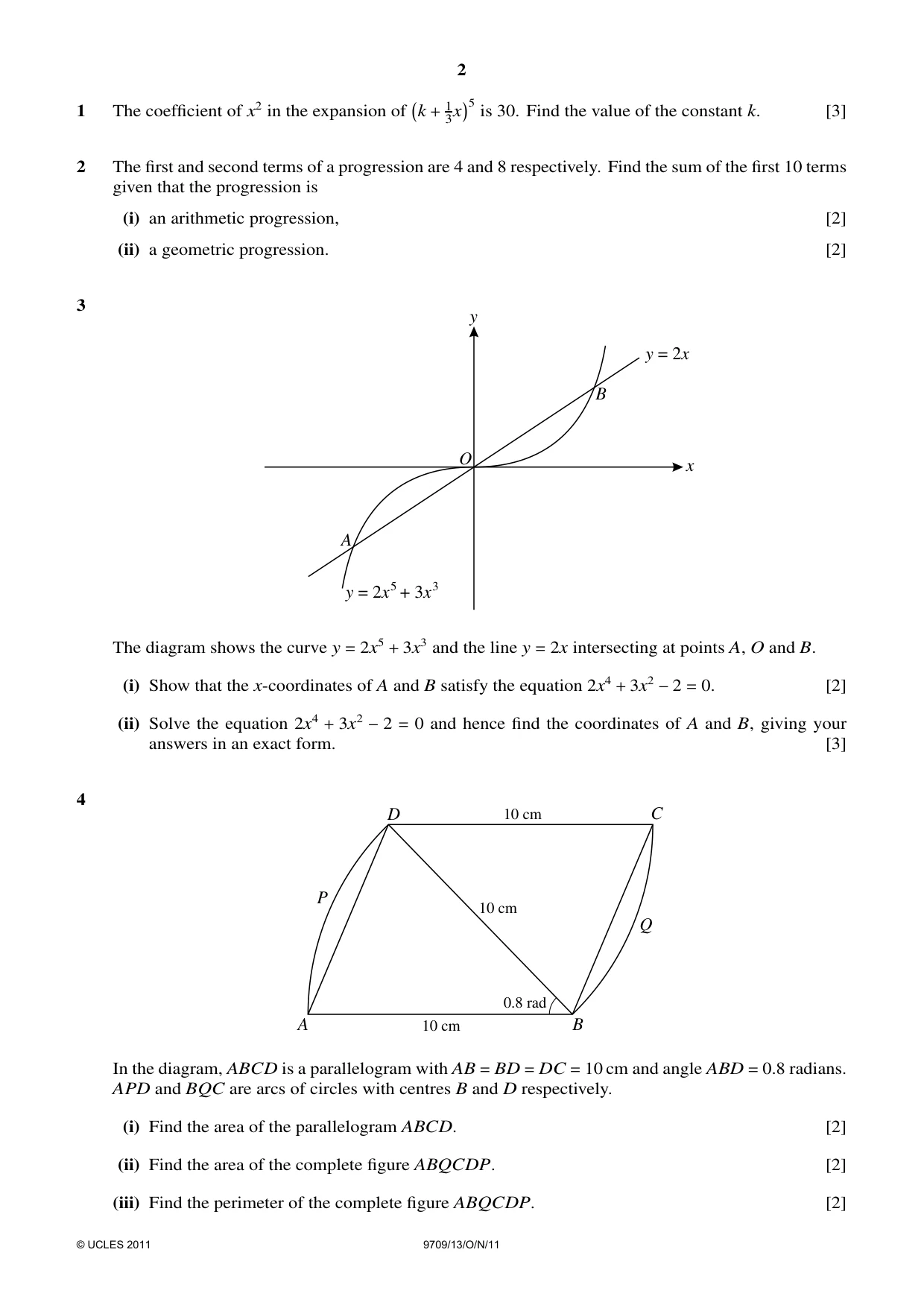
Q3 · Y y = 2x B O x A y = 2 x 5 + 3 x 3 The diagram shows the curve y = 2x5 + 3x3 and the line…
3 y y = 2x B O x A y = 2 x 5 + 3 x 3 The diagram shows the curve y = 2x5 + 3x3 and the line y = 2x intersecting at points A, O and B. (i) Show that the x-coordinates of A and B satisfy the equation 2x4 + 3x2 −2 = 0. [2] (ii) Solve the equation 2x4 + 3x2 −2 = 0 and hence find the coordinates of A and B, giving your answers in an exact form. [3]
Mark scheme: 3 (i) 2x5 + 3x2 = 2x ⇒2x5 + 3x2 – 2x = 0 M1 First line essential [x(2x]4 + 3x2 – 2) = 0 2x4 + 3x2 – 2 = 0 A1 AG Factorising needed for A1 [2] M1 Reasonable attempt at solving a (ii) (x2 + 2)(2x2 – 1) = 0 quadratic in x2 A1 1 x = ± only A1 For a correct pair of solutions, either 2 2 [3] x’s or 1 x and 1 y SC (±0.707, ±1.41) AWRT B1 1 2 , −1 2, 2 2, −2 2 2
Q4 · D 10 cm C P 10 cm Q 0.8 rad A 10 cm B In the diagram, ABCD is a parallelogram with AB =…
4 D 10 cm C P 10 cm Q 0.8 rad A 10 cm B In the diagram, ABCD is a parallelogram with AB = BD = DC = 10 cm and angle ABD = 0.8 radians. APD and BQC are arcs of circles with centres B and D respectively. (i) Find the area of the parallelogram ABCD. [2] (ii) Find the area of the complete figure ABQCDP. [2] (iii) Find the perimeter of the complete figure ABQCDP. [2]
Mark scheme: 4 (i) 102 sin 0.8 = 71.7 M1A1 Completely correct method for a [2] triangle (ii) sector(s) = (2) × 12 × 102 × 0.8 = (2) × 40 M1 Correct formula used for a sector Total area = 80 A1 [2] (iii) arc(s) = (2) × 10 × 0.8 16+20 = 36 M1 Correct formula used for an arc A1 [2] 2 2 2
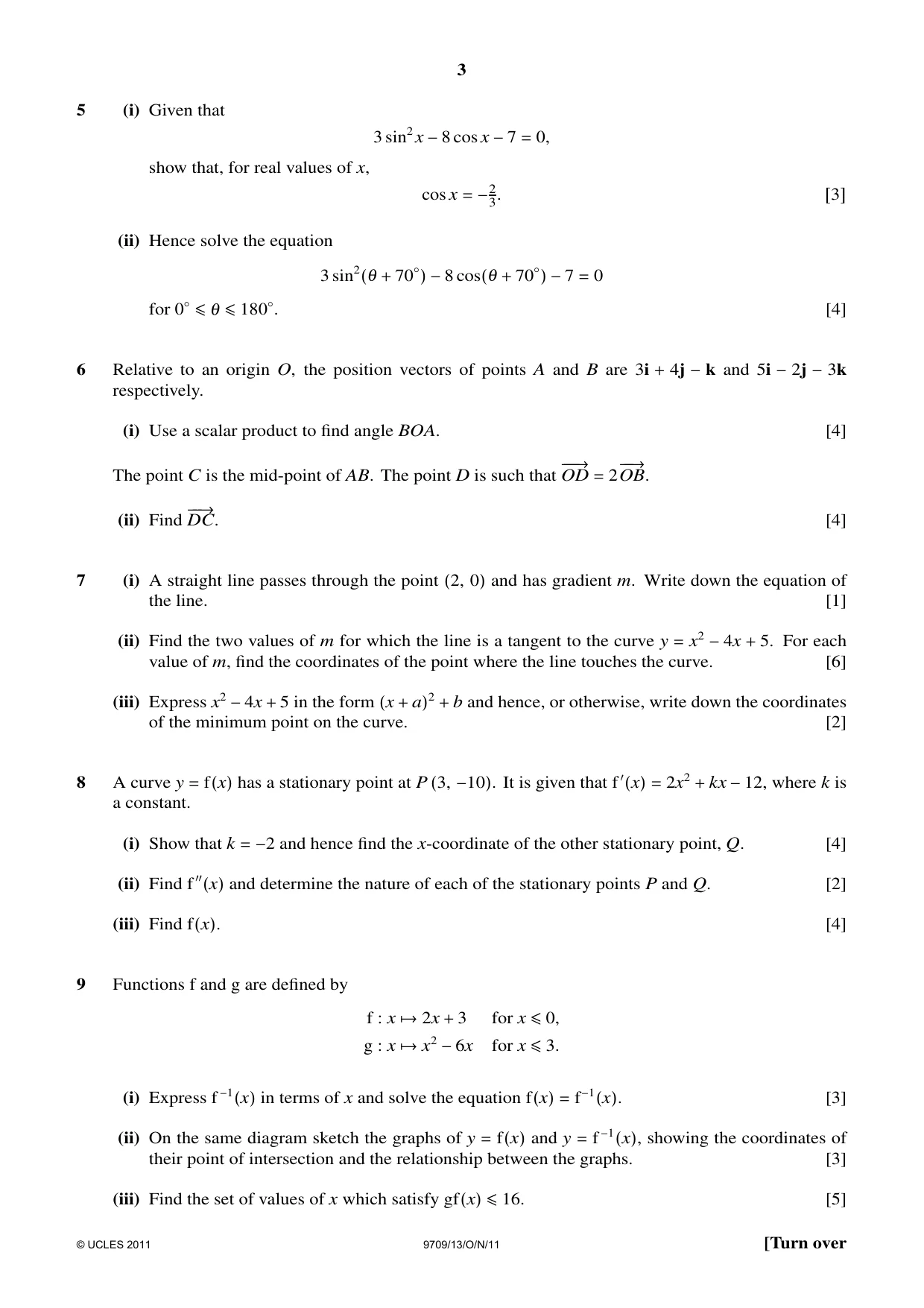
Q5 · Given that 3 sin2x −8 cos x −7 = 0, show that, for real values of x, cos x = −23
5 (i) Given that 3 sin2x −8 cos x −7 = 0, show that, for real values of x, cos x = −23. [3] (ii) Hence solve the equation 3 sin2(θ + 70◦) −8 cos(θ + 70◦) −7 = 0 for 0◦≤θ ≤180◦. [4]
Mark scheme: 5 (i) 3cos2x + 8cosx + 4 = 0 M1 Use of c2 + s2 = 1 (3cosx + 2)(cosx + 2) = 0 M1 Factorising, formula or completing the square needed 2 A1 AG Ignore cosx = –2 also offered cosx = − 3 [3] SC B1 if –2/3 and –2 seen 2 (ii) cos(θ + 70) = − , θ = 61.8 3 M1 A1 θ + 70 = 131.8 (or 228.2) θ = 158.2 M1 A1 [4] GCE AS/A LEVEL – October/November 2011 9709 13 f
Q6 · Relative to an origin O, the position vectors of points A and B are 3i + 4j −k and 5i −2j…
6 Relative to an origin O, the position vectors of points A and B are 3i + 4j −k and 5i −2j −3k respectively. (i) Use a scalar product to find angle BOA. [4] The point C is the mid-point of AB. The point D is such that −−−→OD 2−−→OB. = (ii) Find −−→DC. [4]
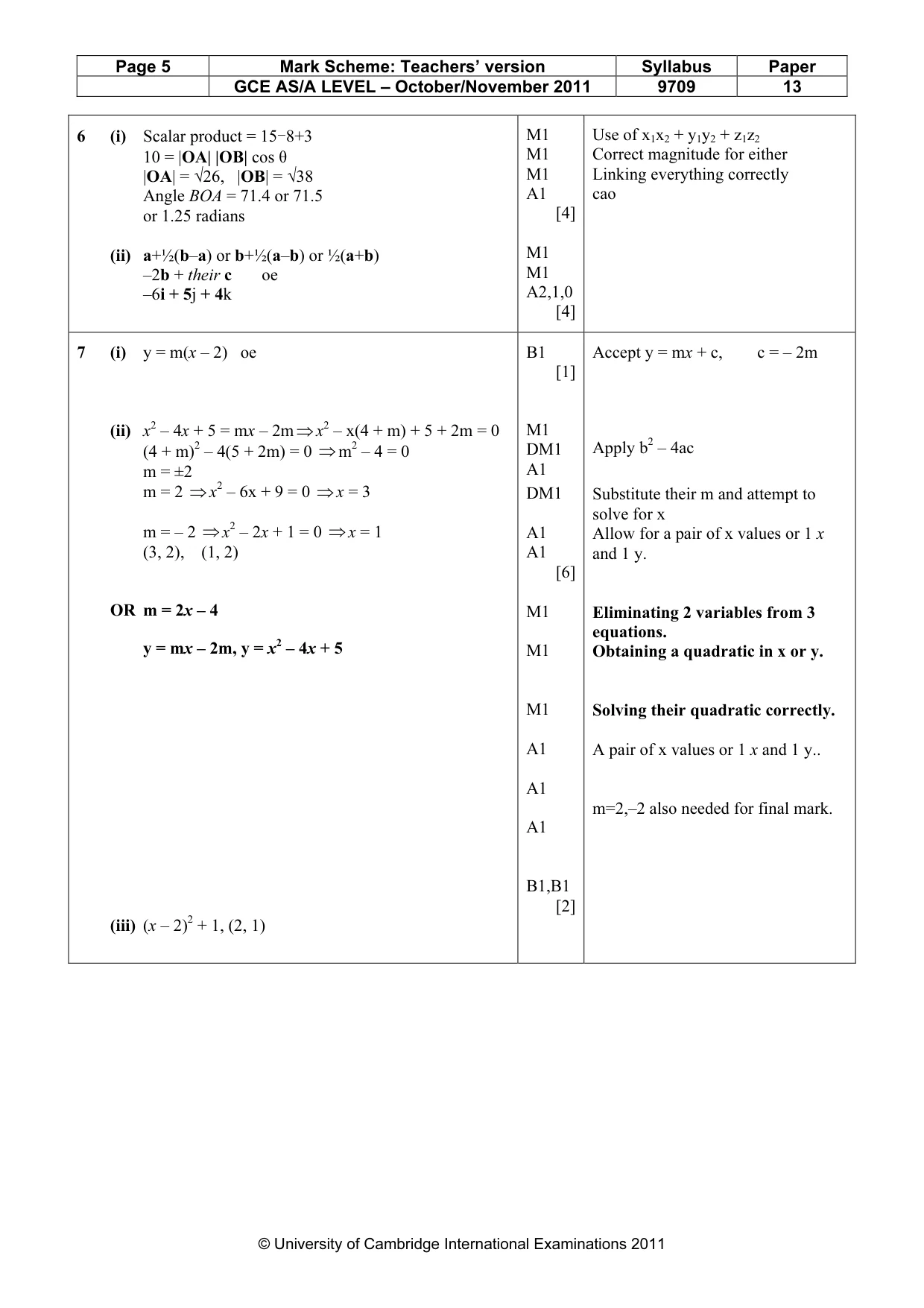
Mark scheme: 6 (i) Scalar product = 15‒8+3 M1 Use of x1x2 + y1y2 + z1z2 10 = |OA| |OB| cos θ M1 Correct magnitude for either |OA| = √26, |OB| = √38 M1 Linking everything correctly Angle BOA = 71.4 or 71.5 A1 cao or 1.25 radians [4] (ii) a+½(b–a) or b+½(a–b) or ½(a+b) M1 –2b + their c oe M1 –6i + 5j + 4k A2,1,0 [4]
What was in this paper
The subtopics covered by these 5 questions, and how many questions each got. Open one in a new tab to see every Cambridge question on it.
What you needed in this session
Cambridge’s own grade thresholds for 2011 Oct/Nov, Paper 1 · Variant 3. A higher threshold means an easier paper — the bar moves with how the cohort did.