Cambridge A Level Mathematics 9709 — 2014 May/June Paper 1 · Variant 3
9709/13/M/J/14 · 8 questions · 75 marks · ≈84 min
The question paper and its mark scheme, free to read here and free to download. This is Cambridge’s own paper, exactly as it was sat.
Question paper4 pages
Mark scheme7 pages
Answers below. Sit the paper first if you are practising.
Questions as text
Q1 · Find the coefficient of x in the expansion of x2 −2 5
1 Find the coefficient of x in the expansion of x2 −2 5 . [3] x
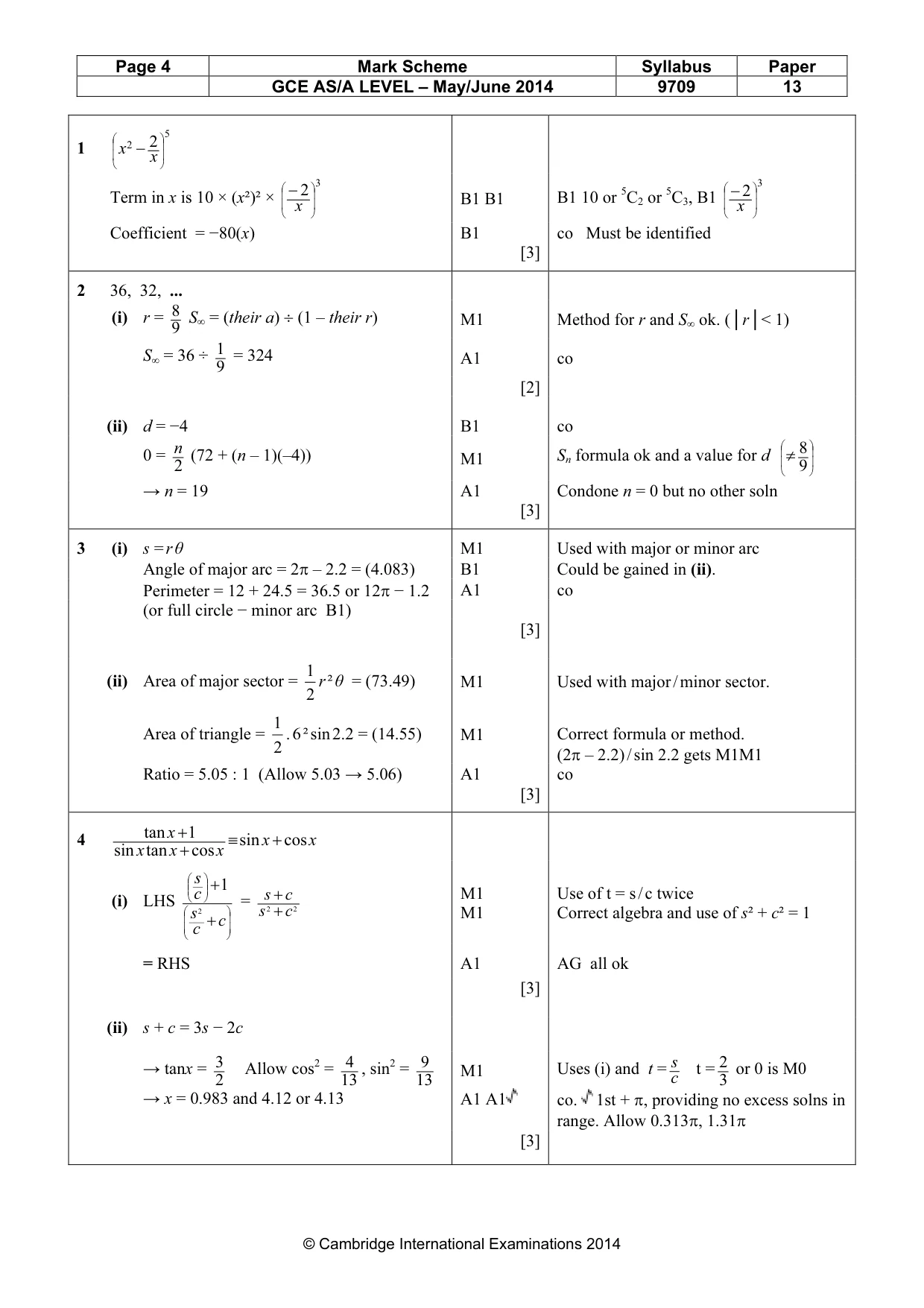
Mark scheme: 2 2 1 x −x 3 3 2 2 Term in x is 10 × (x²)² × − B1 B1 B1 10 or 5C2 or 5C3, B1 − x x Coefficient = −80(x) B1 co Must be identified [3]
Q2 · The first term in a progression is 36 and the second term is 32
2 The first term in a progression is 36 and the second term is 32. (i) Given that the progression is geometric, find the sum to infinity. [2] (ii) Given instead that the progression is arithmetic, find the number of terms in the progression if the sum of all the terms is 0. [3]
Mark scheme: 2 36, 32, ... (i) r = 8 S∞ = (their a) ÷ (1 – their r) M1 Method for r and S∞ ok. (│r│< 1) 9 S∞ = 36 ÷ 1 = 324 A1 co 9 [2] (ii) d = −4 B1 co n 0 = (72 + (n – 1)(–4)) M1 Sn formula ok and a value for d 8 2 ≠9 → n = 19 A1 Condone n = 0 but no other soln [3]
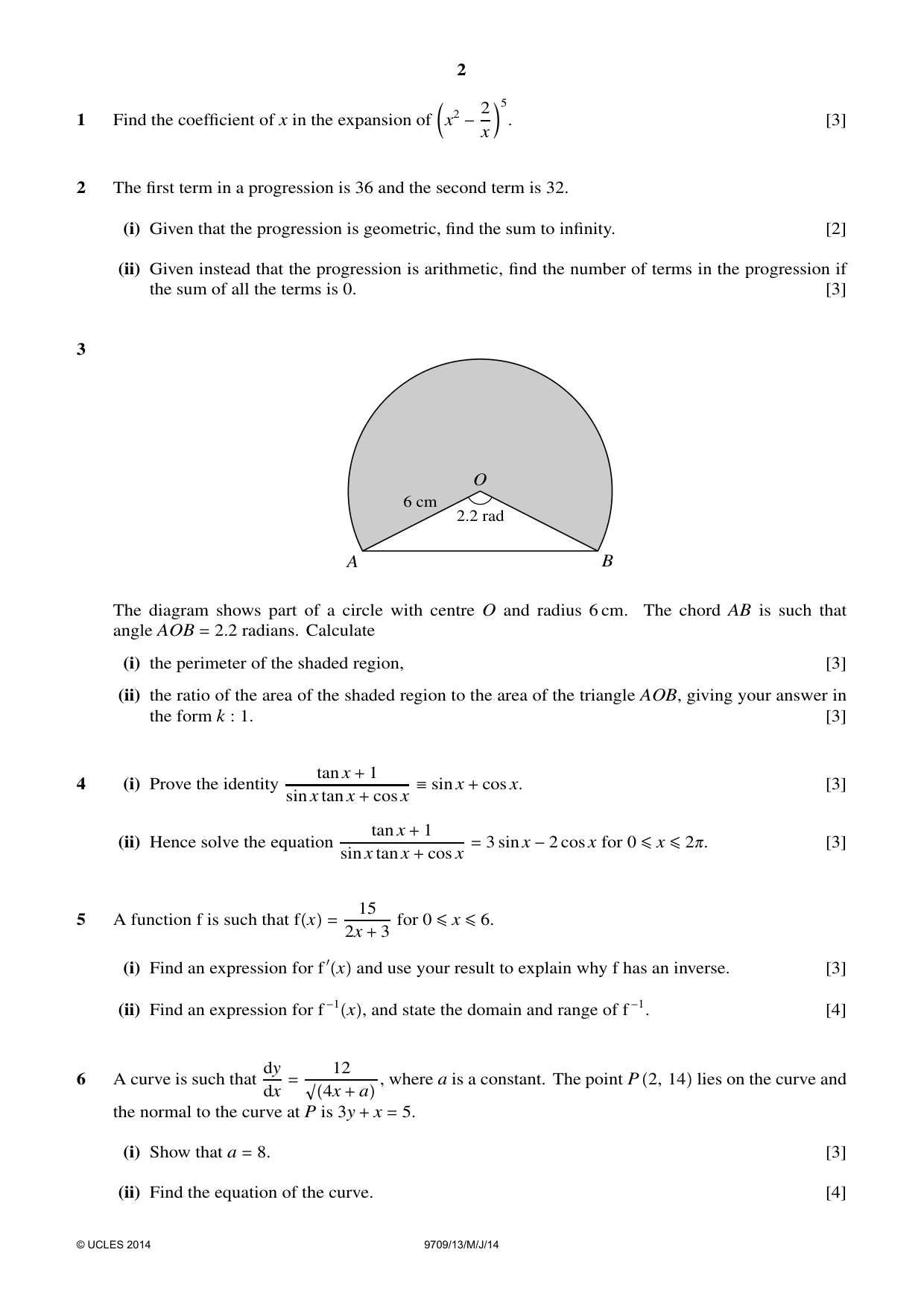
Q3 · O 6 cm 2.2 rad A B The diagram shows part of a circle with centre O and radius 6 cm
3 O 6 cm 2.2 rad A B The diagram shows part of a circle with centre O and radius 6 cm. The chord AB is such that angle AOB = 2.2 radians. Calculate (i) the perimeter of the shaded region, [3] (ii) the ratio of the area of the shaded region to the area of the triangle AOB, giving your answer in the form k : 1. [3]
Mark scheme: 3 (i) s = r θ M1 Used with major or minor arc Angle of major arc = 2π – 2.2 = (4.083) B1 Could be gained in (ii). Perimeter = 12 + 24.5 = 36.5 or 12π − 1.2 A1 co (or full circle − minor arc B1) [3] 1 (ii) Area of major sector = r ² θ = (73.49) M1 Used with major / minor sector. 2 1 Area of triangle = . 6 ² sin 2.2 = (14.55) M1 Correct formula or method. 2 (2π – 2.2) / sin 2.2 gets M1M1 Ratio = 5.05 : 1 (Allow 5.03 → 5.06) A1 co [3] tan x + 1
Q4 · Tan x + 1 4 (i) Prove the identity sin x + cos x
tan x + 1 4 (i) Prove the identity sin x + cos x. [3] sin x tan x + cosx tan x + 1 (ii) Hence solve the equation = 3 sin x −2 cosx for 0 ≤x ≤20. [3] sin x tan x + cos x
Mark scheme: tan x + 14 ≡ sin x + cos x sin x tan x + cos x s + 1 c s + c M1 Use of t = s / c twice (i) LHS = s 2 + c 2 M1 Correct algebra and use of s² + c² = 1 s 2 + c c = RHS A1 AG all ok [3] (ii) s + c = 3s − 2c → tanx = 3 Allow cos2 = 4 , sin2 = 9 M1 Uses (i) and t = s t = 2 or 0 is M0 2 13 13 c 3 → x = 0.983 and 4.12 or 4.13 A1 A1 co. 1st + π, providing no excess solns in range. Allow 0.313π, 1.31π [3] GCE AS/A LEVEL – May/June 2014 9709 13 15
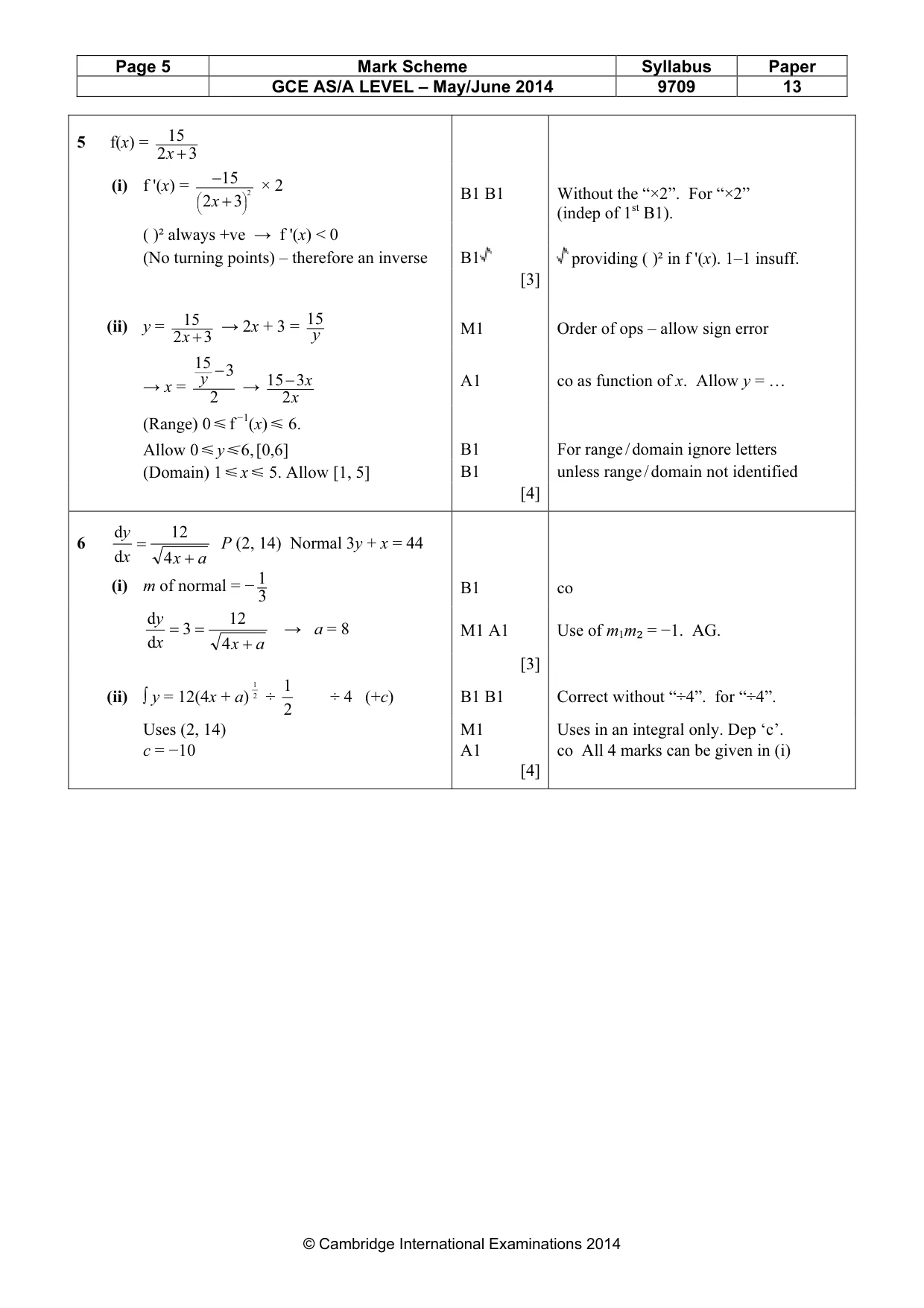
Q6 · Dy 12 6 A curve is such that = , where a is a constant
dy 12 6 A curve is such that = , where a is a constant. The point P 2, 14 lies on the curve and dx 4x + a the normal to the curve at P is 3y + x = 5. (i) Show that a = 8. [3] (ii) Find the equation of the curve. [4]
Mark scheme: dy 12 6 = P (2, 14) Normal 3y + x = 44 dx 4 x + a (i) m of normal = 1 B1 co −3 dy 12 = 3 = → a = 8 M1 A1 Use of m1m₂ = −1. AG. dx 4 x + a [3] 1 1 (ii) ∫ y = 12(4x + a) 2 ÷ ÷ 4 (+c) B1 B1 Correct without “÷4”. for “÷4”. 2 Uses (2, 14) M1 Uses in an integral only. Dep ‘c’. c = −10 A1 co All 4 marks can be given in (i) [4] GCE AS/A LEVEL – May/June 2014 9709 13
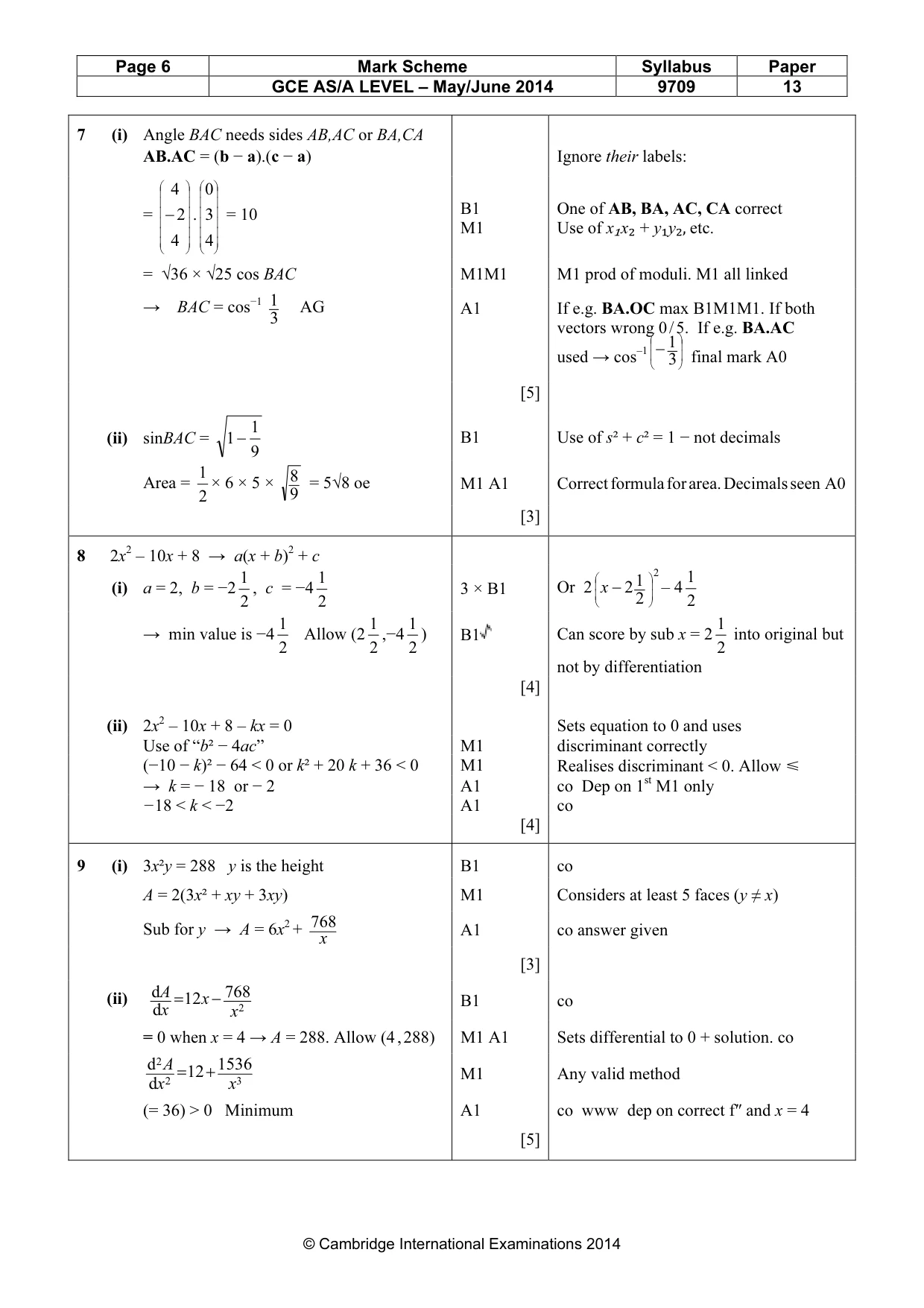
Q7 · The position vectors of points A, B and C relative to an origin O are given by ` a ` a `…
7 The position vectors of points A, B and C relative to an origin O are given by ` a ` a ` a 2 6 2 −−→ −−→ −−→ OA = 1 , OB = −1 and OC = 4 . 3 7 7 (i) Show that angle BAC = cos−1 1 . [5] 3 (ii) Use the result in part (i) to find the exact value of the area of triangle ABC. [3]
Mark scheme: 7 (i) Angle BAC needs sides AB,AC or BA,CA AB.AC = (b − a).(c − a) Ignore their labels: 4 0 B1 One of AB, BA, AC, CA correct − 2 3 = . = 10 M1 Use of x₁x₂ + y₁y₂, etc. 4 4 = √36 × √25 cos BAC M1M1 M1 prod of moduli. M1 all linked → BAC = cos−1 1 AG A1 If e.g. BA.OC max B1M1M1. If both 3 vectors wrong 0 / 5. If e.g. BA.AC 1 final mark A0 used → cos–1 −3 [5] 1 (ii) sinBAC = 1− B1 Use of s² + c² = 1 − not decimals 9 1 8 Area = × 6 × 5 × = 5√8 oe M1 A1 Correct formula for area. Decimals seen A0 2 9 [3] 2 2
Q9 · The base of a cuboid has sides of length x cm and 3x cm
9 The base of a cuboid has sides of length x cm and 3x cm. The volume of the cuboid is 288 cm3. (i) Show that the total surface area of the cuboid, A cm2, is given by 768 A = 6x2 + . x (ii) Given that x can vary, find the stationary value of A and determine its nature. [5]
Mark scheme: 9 (i) 3x²y = 288 y is the height B1 co A = 2(3x² + xy + 3xy) M1 Considers at least 5 faces (y ≠ x) Sub for y → A = 6x2 + 768 A1 co answer given x [3] d 768 A = 12 x − (ii) B1 co d x x 2 = 0 when x = 4 → A = 288. Allow (4 , 288) M1 A1 Sets differential to 0 + solution. co 2 d 1536 A = 12 + M1 Any valid method 2 d x x 3 (= 36) > 0 Minimum A1 co www dep on correct f″ and x = 4 [5] GCE AS/A LEVEL – May/June 2014 9709 13
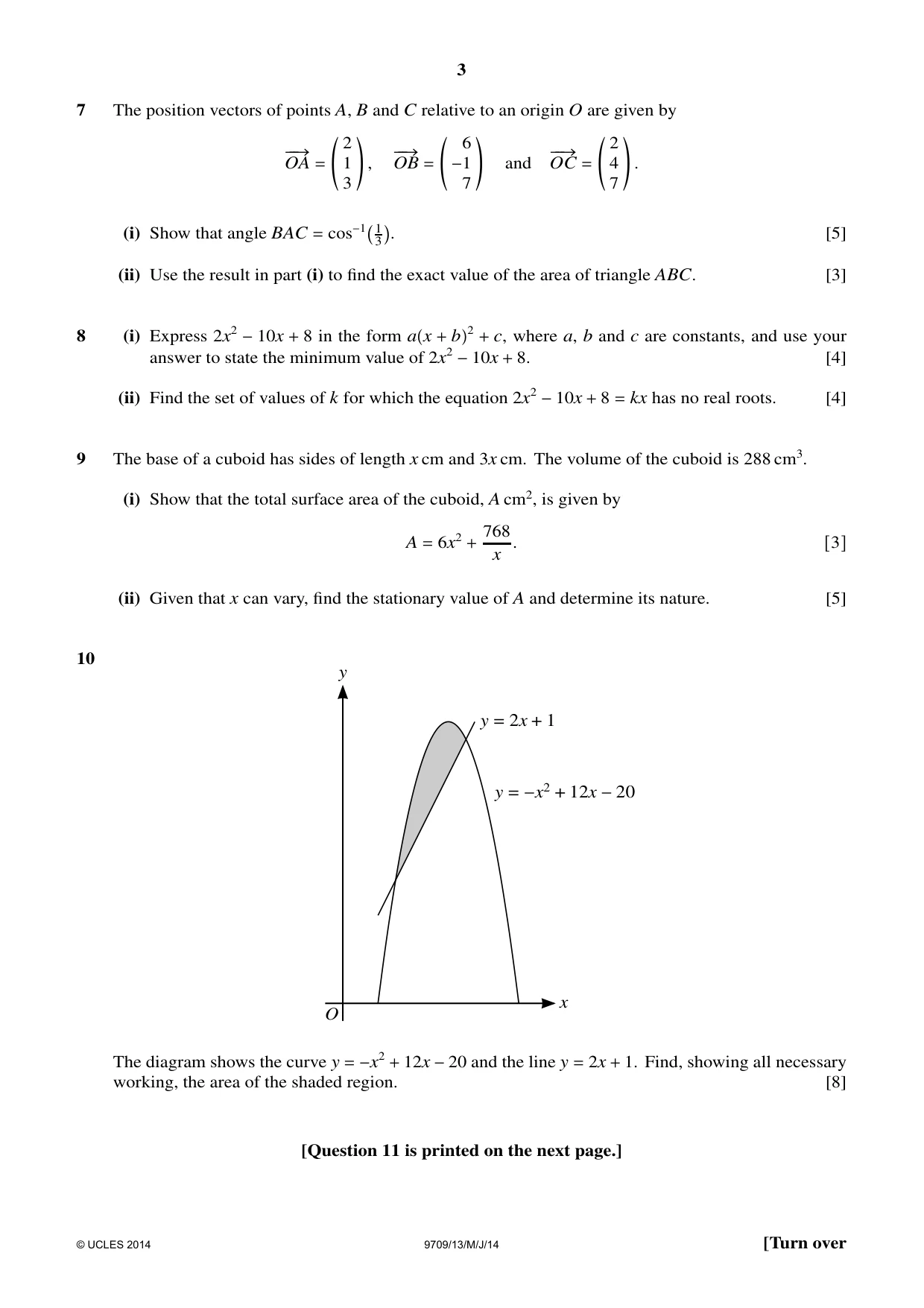
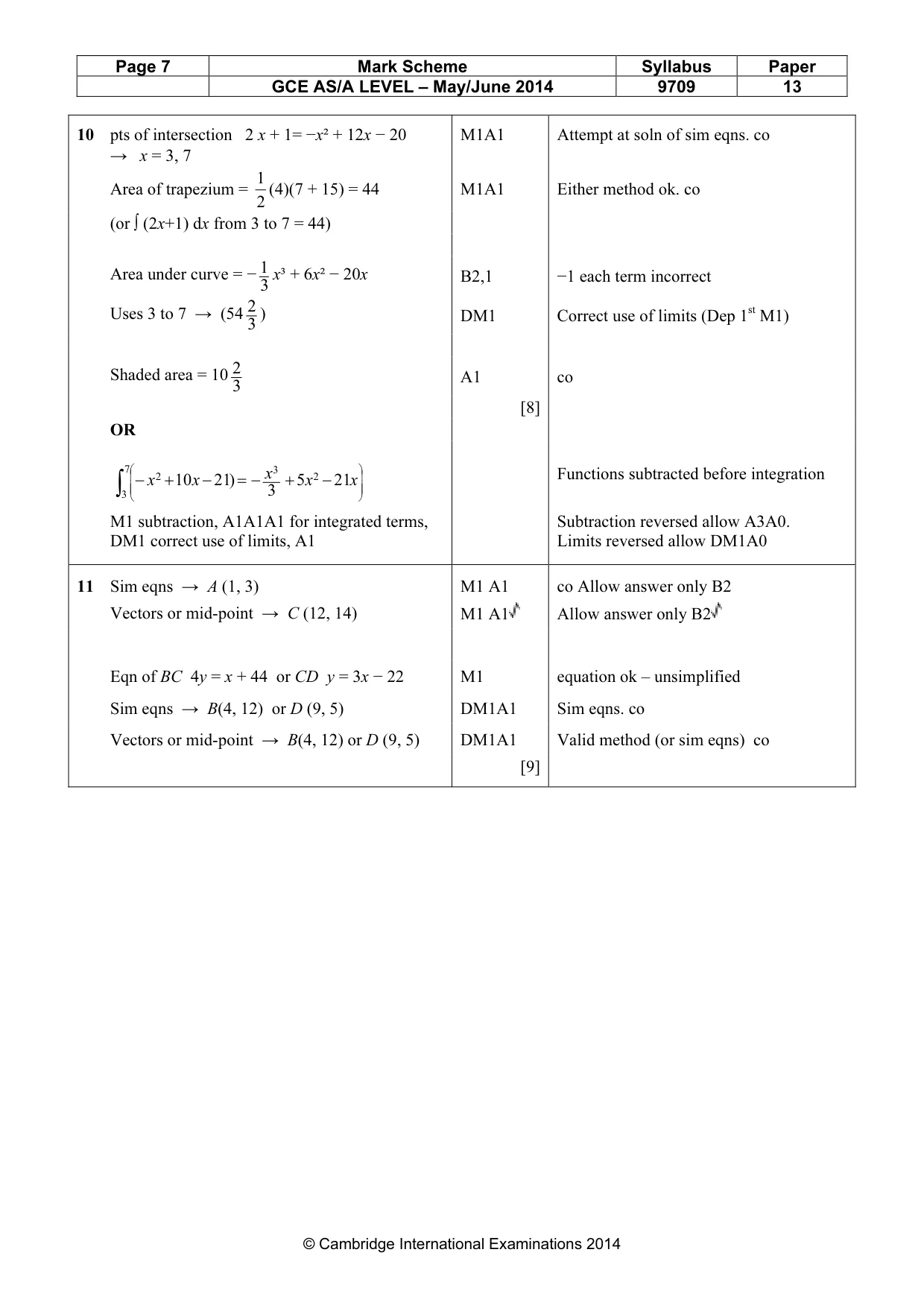
Q10 · Y y = 2x + 1 y = −x2 + 12x −20 x O The diagram shows the curve y = −x2 + 12x −20 and the…
10 y y = 2x + 1 y = −x2 + 12x −20 x O The diagram shows the curve y = −x2 + 12x −20 and the line y = 2x + 1. Find, showing all necessary working, the area of the shaded region. [8] [Question 11 is printed on the next page.]
Mark scheme: 10 pts of intersection 2 x + 1= −x² + 12x − 20 M1A1 Attempt at soln of sim eqns. co → x = 3, 7 1 Area of trapezium = (4)(7 + 15) = 44 M1A1 Either method ok. co 2 (or ∫ (2x+1) dx from 3 to 7 = 44) 1 B2,1 −1 each term incorrect Area under curve = −3 x³ + 6x² − 20x 2 Uses 3 to 7 → (54 ) DM1 Correct use of limits (Dep 1st M1) 3 2 Shaded area = 10 A1 co 3 [8] OR 7 2 x 3 2 Functions subtracted before integration ∫ 3 − x + 10 x − 21) = − 3 + 5 x − 21x M1 subtraction, A1A1A1 for integrated terms, Subtraction reversed allow A3A0. DM1 correct use of limits, A1 Limits reversed allow DM1A0
What was in this paper
The subtopics covered by these 8 questions, and how many questions each got. Open one in a new tab to see every Cambridge question on it.
What you needed in this session
Cambridge’s own grade thresholds for 2014 May/June, Paper 1 · Variant 3. A higher threshold means an easier paper — the bar moves with how the cohort did.