Questions as text
Q1 · In the diagram AS1 is an economy’s long-run aggregate supply curve 9708/11 Oct/Nov 2014
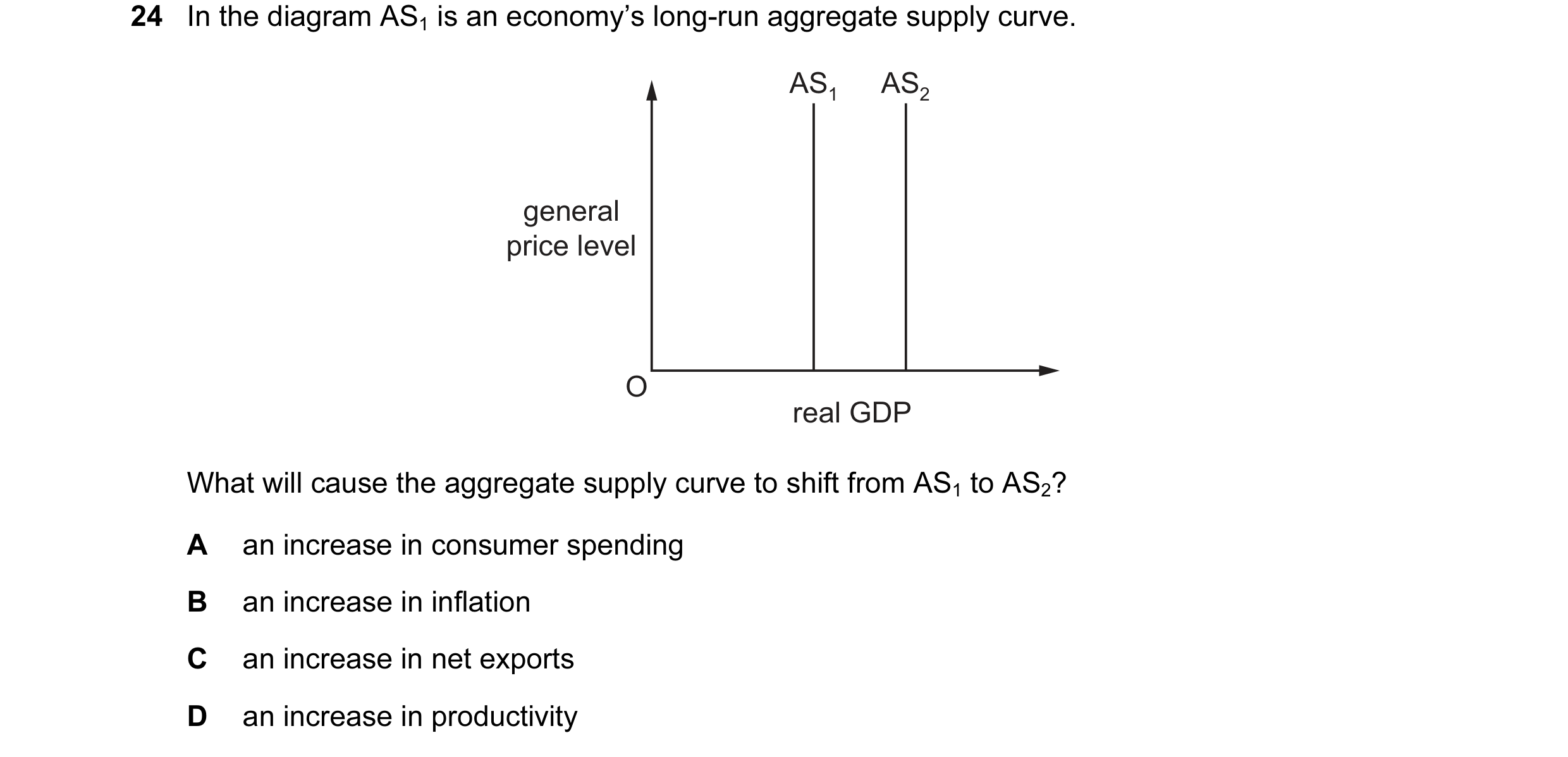
24 In the diagram AS1 is an economy’s long-run aggregate supply curve. AS1 AS2 general price level O real GDP What will cause the aggregate supply curve to shift from AS1 to AS2? A an increase in consumer spending B an increase in inflation C an increase in net exports D an increase in productivity
1 marks
This question in 9708/11 Oct/Nov 2014
Q2 · People in an economy become more optimistic about the future 9708/13 Oct/Nov 2014
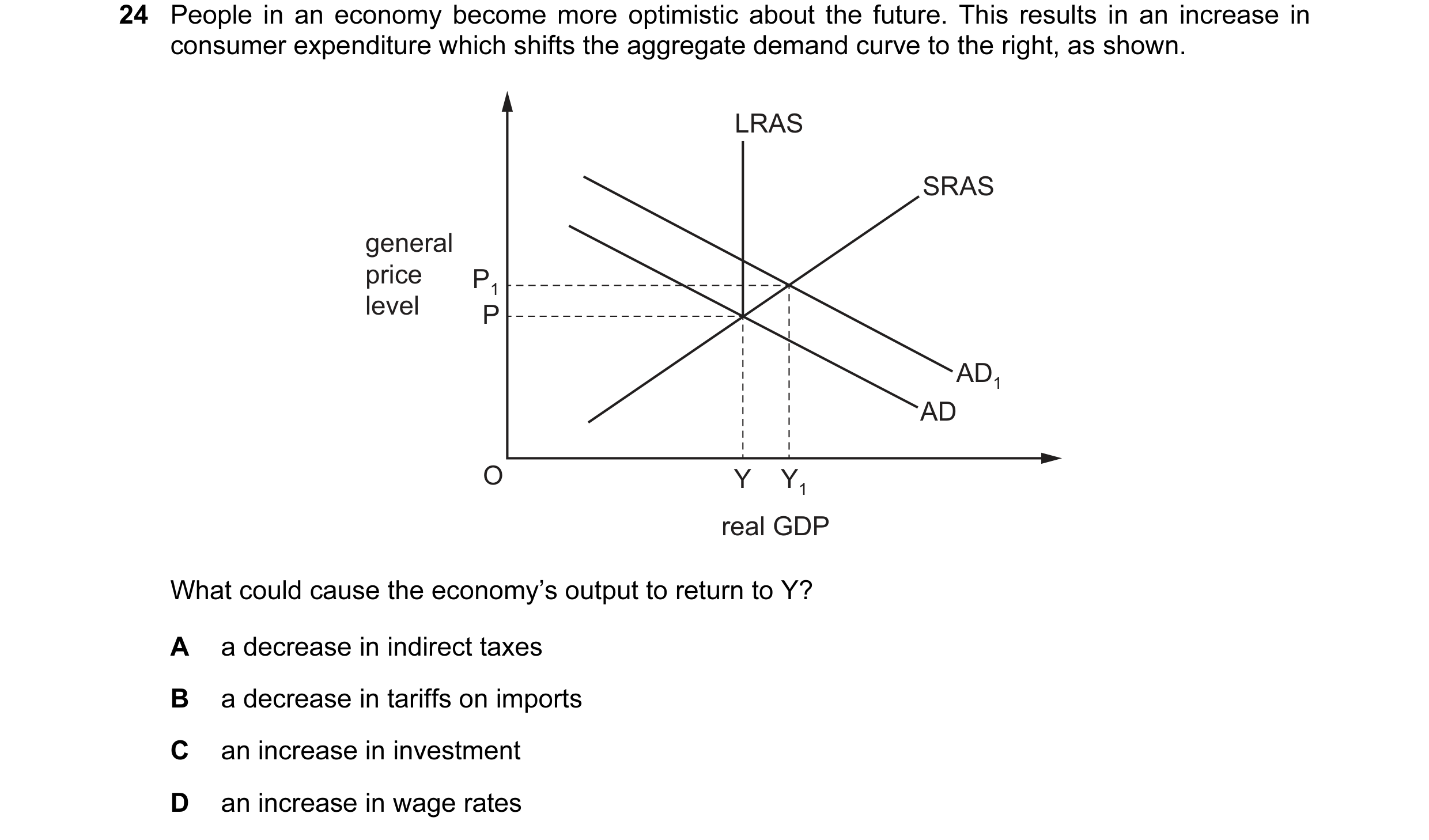
24 People in an economy become more optimistic about the future. This results in an increase in consumer expenditure which shifts the aggregate demand curve to the right, as shown. LRAS SRAS general price P1 level P AD1 AD O Y Y1 real GDP What could cause the economy’s output to return to Y? A a decrease in indirect taxes B a decrease in tariffs on imports C an increase in investment D an increase in wage rates
1 marks
Answer: D
This question in 9708/13 Oct/Nov 2014
Q3 · Which supply-side measure is most likely to produce short-run growth in a country’s… 9708/12 Oct/Nov 2015
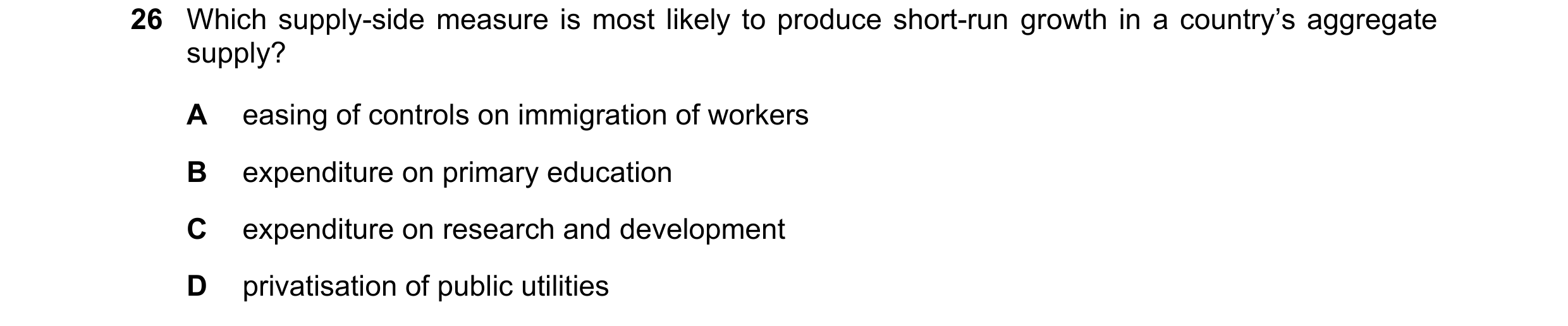
24 Which supply-side measure is most likely to produce short-run growth in a country’s aggregate supply? A easing of controls on immigration of workers B expenditure on primary education C expenditure on research and development D privatisation of public utilities
1 marks
Answer: A
This question in 9708/12 Oct/Nov 2015
Q4 · In a time of recession, a government decided to sell a loss-making state-owned industry… 9708/12 Oct/Nov 2015
30 In a time of recession, a government decided to sell a loss-making state-owned industry to a foreign private company. What is the most likely immediate result? A an improvement in the financial account of the balance of payments B an improvement in the level of unemployment C an improvement in the rate of inflation D an improvement in the trade account of the balance of payments
1 marks
Answer: A
This question in 9708/12 Oct/Nov 2015
Q5 · The diagram shows the original aggregate demand curve, AD1, and the original aggregate… 9708/13 Oct/Nov 2015
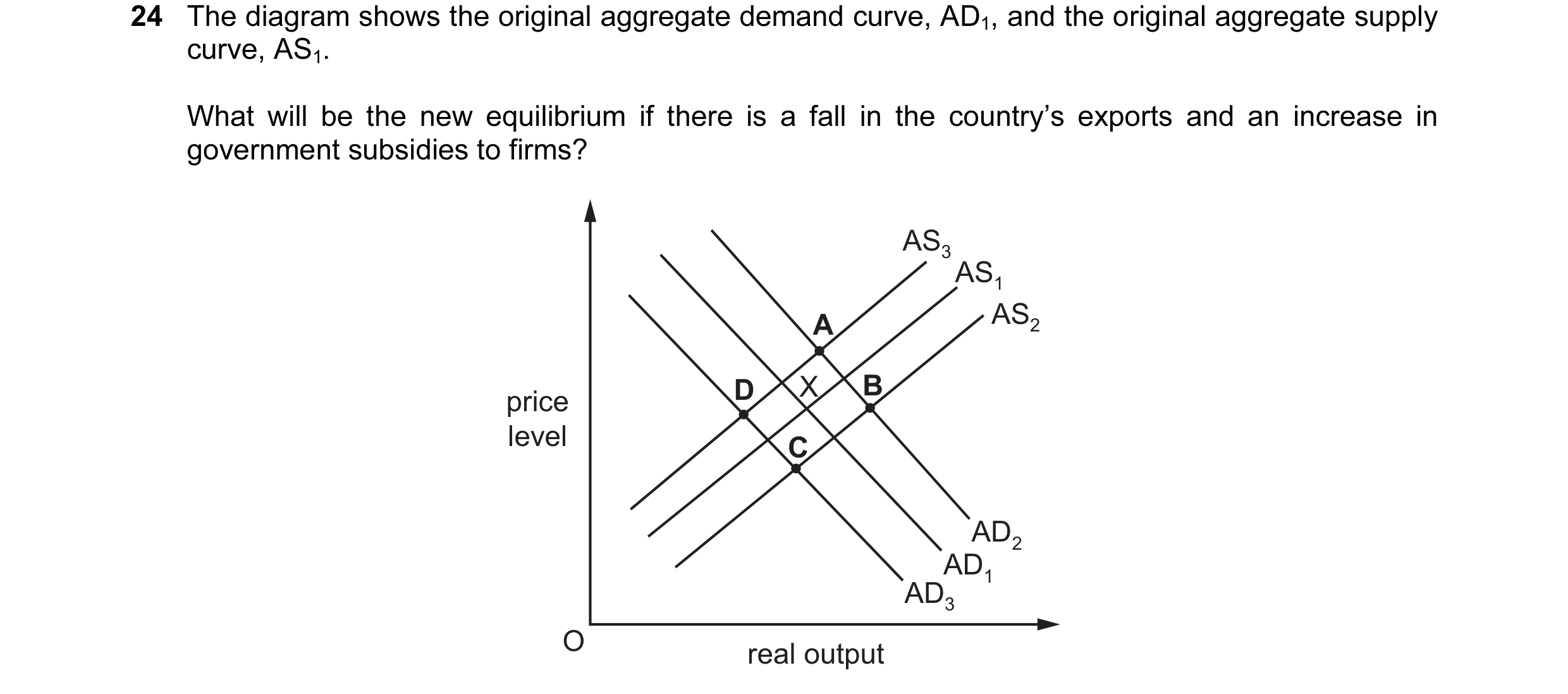
24 The diagram shows the original aggregate demand curve, AD1, and the original aggregate supply curve, AS1. What will be the new equilibrium if there is a fall in the country’s exports and an increase in government subsidies to firms? AS3 AS1 A AS2 D X B price level C AD2 AD1 AD3 O real output
1 marks
Answer: C
This question in 9708/13 Oct/Nov 2015
Q6 · What would be classified as a supply-side policy measure? 9708/11 May/June 2016
28 What would be classified as a supply-side policy measure? A a law to alter the power of trade unions B a reduction in the government’s fiscal deficit C an open market sale of securities D the imposition of a tariff on imported goods
1 marks
Answer: A
This question in 9708/11 May/June 2016
Q7 · An economy is initially in equilibrium at point X in the diagram 9708/12 May/June 2016
20 An economy is initially in equilibrium at point X in the diagram. AD1 AS1 AS AD Z P1 price level X P AS1 AD1 AD AS O Y Y1 real GDP The government then introduces a supply-side policy measure which causes the economy to move to point Z. Which supply-side policy and reaction could explain this change? A a cut in income tax to increase the incentive to work but which results in workers increasing their leisure time B a cut in unemployment benefit which results in more applications for training courses C a rise in government spending on education which increases labour productivity D privatisation of key industries which results in an increase in economic efficiency
1 marks
Answer: A
This question in 9708/12 May/June 2016
Q8 · In 2009 the Chinese government faced decreased demand in export markets and wished to… 9708/13 May/June 2016
15 In 2009 the Chinese government faced decreased demand in export markets and wished to increase the sales of electrical goods made in China. Which policy would have achieved this aim? A increasing income tax B increasing the restrictions on the manufacture of electrical goods C removing a tariff on imported products D subsidising the sales of electrical goods in China’s poorer rural areas
1 marks
Answer: D
This question in 9708/13 May/June 2016
Q9 · What can be considered an expansionary supply-side policy? 9708/13 May/June 2016
28 What can be considered an expansionary supply-side policy? A an increase in government expenditure on training B an increase in sales tax C an increase in the rate of interest D an increase (revaluation) of the exchange rate
1 marks
Answer: A
This question in 9708/13 May/June 2016
Q10 · A government plans to increase spending on education and training every year 9708/12 Oct/Nov 2016
19 A government plans to increase spending on education and training every year. Which diagram shows the likely effect of this increase on the economy’s long-run output and price level? A B LRAS1 LRAS1 LRAS2 price price level P2 level P1 P1 P2 AD1 AD2 AD1 O Y1 O Y1 Y2 real output real output C D LRAS1 LRAS2 LRAS2 LRAS1 price price level level P2 P1 P1 P2 AD1 AD2 AD2 AD1 O Y1 Y2 O Y2 Y1 real output real output
1 marks
Answer: C
This question in 9708/12 Oct/Nov 2016
Q11 · A newly-built public sector engineering training college received poor inspection reports 9708/12 Oct/Nov 2016
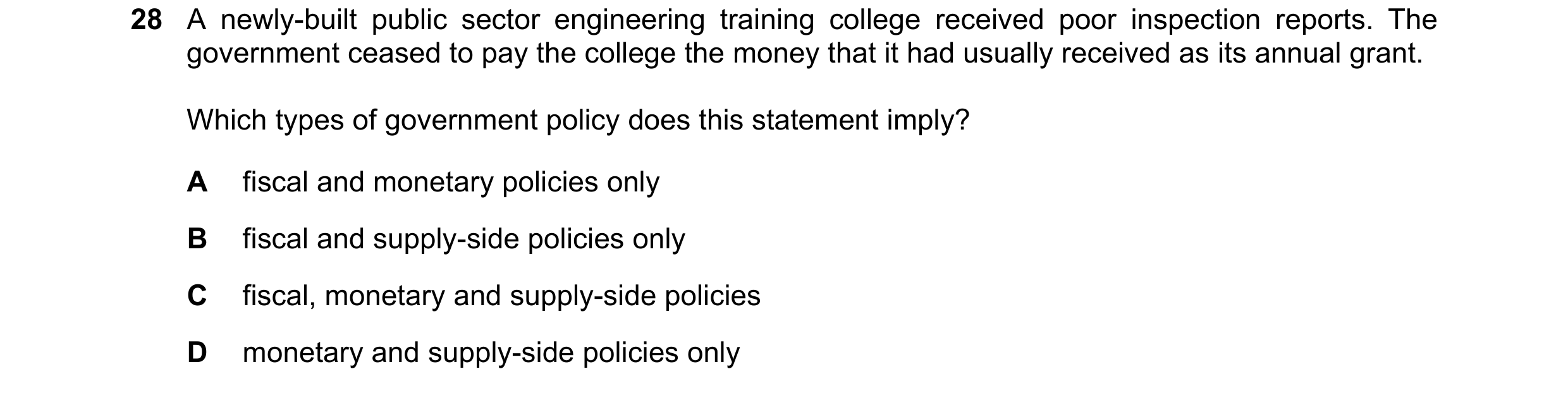
28 A newly-built public sector engineering training college received poor inspection reports. The government ceased to pay the college the money that it had usually received as its annual grant. Which types of government policy does this statement imply? A fiscal and monetary policies only B fiscal and supply-side policies only C fiscal, monetary and supply-side policies D monetary and supply-side policies only
1 marks
Answer: B
This question in 9708/12 Oct/Nov 2016
Q12 · A government is faced with rising inflation 9708/12 Oct/Nov 2016
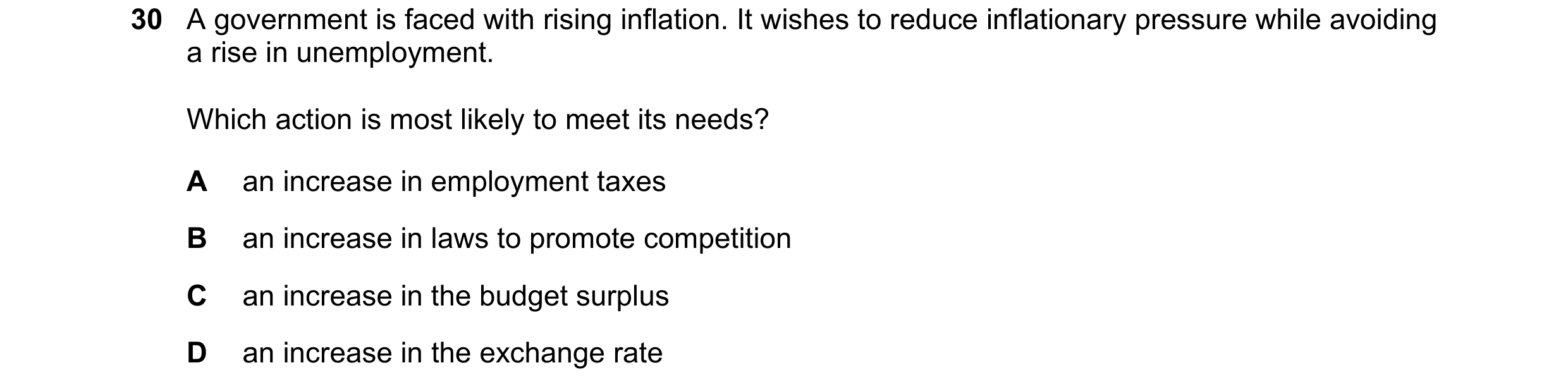
30 A government is faced with rising inflation. It wishes to reduce inflationary pressure while avoiding a rise in unemployment. Which action is most likely to meet its needs? A an increase in employment taxes B an increase in laws to promote competition C an increase in the budget surplus D an increase in the exchange rate
1 marks
Answer: B
This question in 9708/12 Oct/Nov 2016
Q13 · The diagram shows the original aggregate demand AD1 and aggregate supply LRAS1 for an… 9708/13 Oct/Nov 2016
19 The diagram shows the original aggregate demand AD1 and aggregate supply LRAS1 for an economy. LRAS1 LRAS2 price level AD2 AD1 O real GDP What could explain the shifts in aggregate demand to AD2 and aggregate supply to LRAS2? A an increase in government expenditure on health and education B an increase in government expenditure on pensions C an increase in income tax D an increase in interest rates
1 marks
Answer: A
This question in 9708/13 Oct/Nov 2016
Q14 · Which combination of policies is most likely to reduce inflation when an economy is close… 9708/13 Oct/Nov 2016
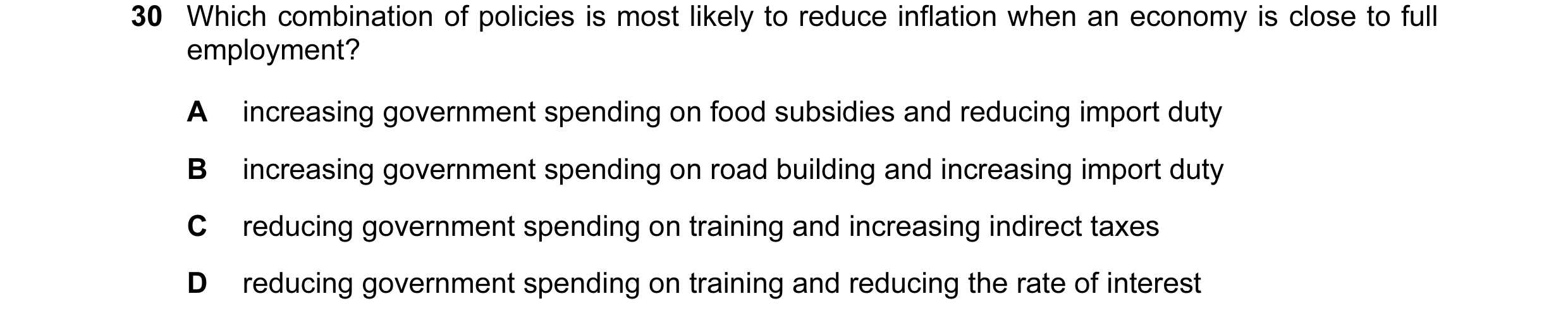
30 Which combination of policies is most likely to reduce inflation when an economy is close to full employment? A increasing government spending on food subsidies and reducing import duty B increasing government spending on road building and increasing import duty C reducing government spending on training and increasing indirect taxes D reducing government spending on training and reducing the rate of interest
1 marks
Answer: A
This question in 9708/13 Oct/Nov 2016
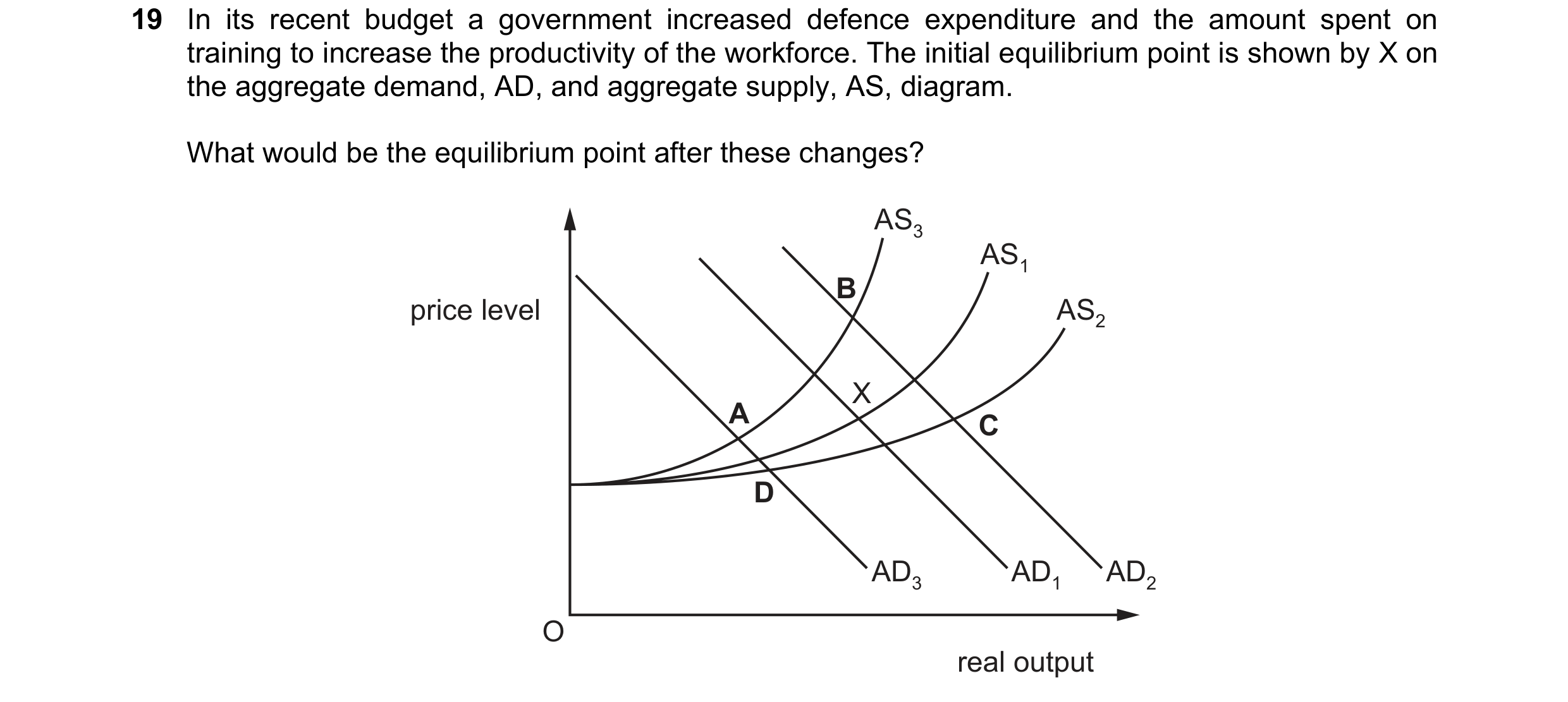
Q15 · In its recent budget a government increased defence expenditure and the amount spent on… 9708/11 Oct/Nov 2017
19 In its recent budget a government increased defence expenditure and the amount spent on training to increase the productivity of the workforce. The initial equilibrium point is shown by X on the aggregate demand, AD, and aggregate supply, AS, diagram. What would be the equilibrium point after these changes? AS3 AS1 B price level AS2 X A C D AD3 AD1 AD2 O real output
1 marks
Answer: C
This question in 9708/11 Oct/Nov 2017
Q16 · In its recent budget a government reduced total expenditure while increasing the amount… 9708/12 Oct/Nov 2017
19 In its recent budget a government reduced total expenditure while increasing the amount spent on training to increase the productivity of the workforce. The initial equilibrium point is shown by X on the aggregate demand (AD) and aggregate supply (AS) diagram. What would be the equilibrium point after these changes? AS3 AS1 price level C AS2 X B D A AD3 AD1 AD2 O real output
1 marks
Answer: A
This question in 9708/12 Oct/Nov 2017
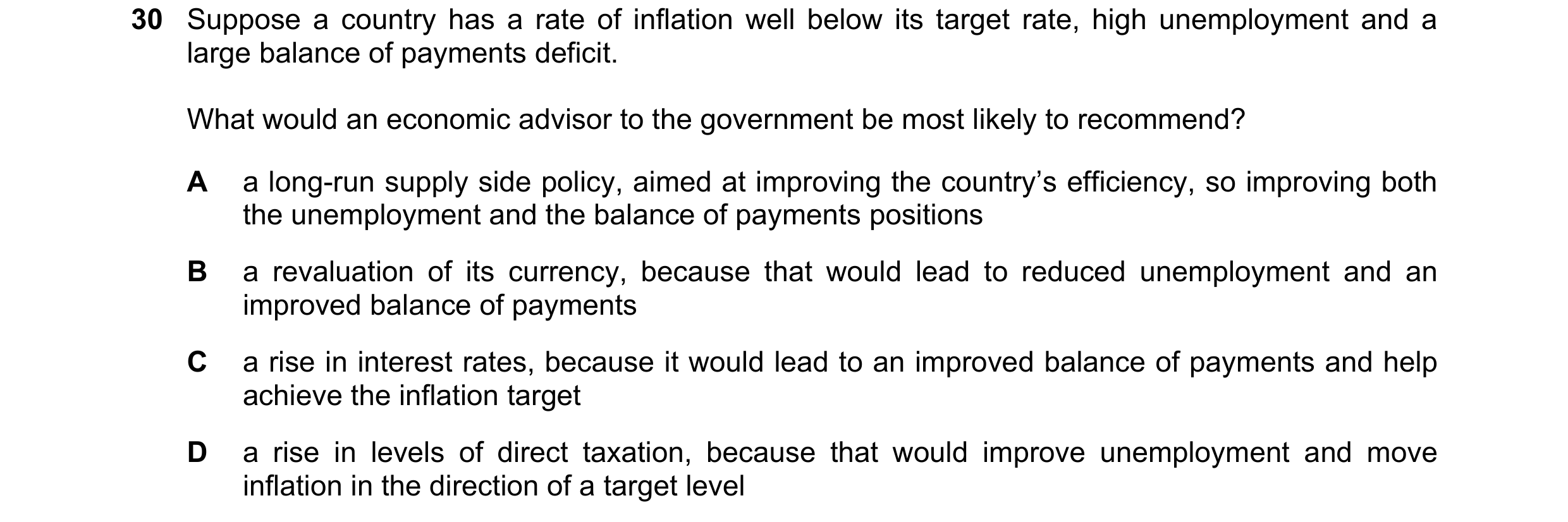
Q17 · Suppose a country has a rate of inflation well below its target rate, high unemployment… 9708/13 Oct/Nov 2017
30 Suppose a country has a rate of inflation well below its target rate, high unemployment and a large balance of payments deficit. What would an economic advisor to the government be most likely to recommend? A a long-run supply side policy, aimed at improving the country’s efficiency, so improving both the unemployment and the balance of payments positions B a revaluation of its currency, because that would lead to reduced unemployment and an improved balance of payments C a rise in interest rates, because it would lead to an improved balance of payments and help achieve the inflation target D a rise in levels of direct taxation, because that would improve unemployment and move inflation in the direction of a target level
1 marks
Answer: A
This question in 9708/13 Oct/Nov 2017
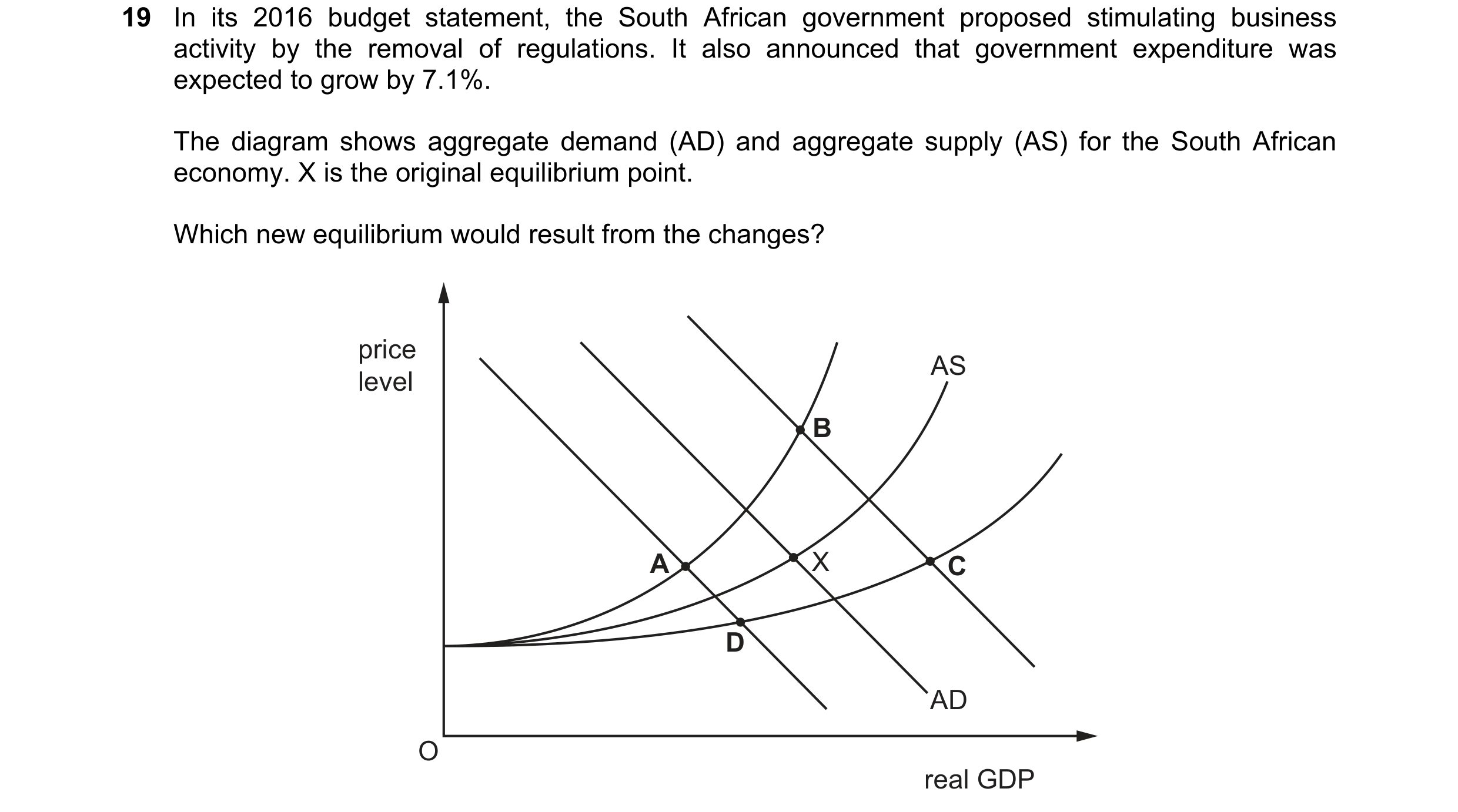
Q18 · In its 2016 budget statement, the South African government proposed stimulating business… 9708/11 May/June 2018
19 In its 2016 budget statement, the South African government proposed stimulating business activity by the removal of regulations. It also announced that government expenditure was expected to grow by 7.1%. The diagram shows aggregate demand (AD) and aggregate supply (AS) for the South African economy. X is the original equilibrium point. Which new equilibrium would result from the changes? price AS level B A X C D AD O real GDP
1 marks
Answer: C
This question in 9708/11 May/June 2018
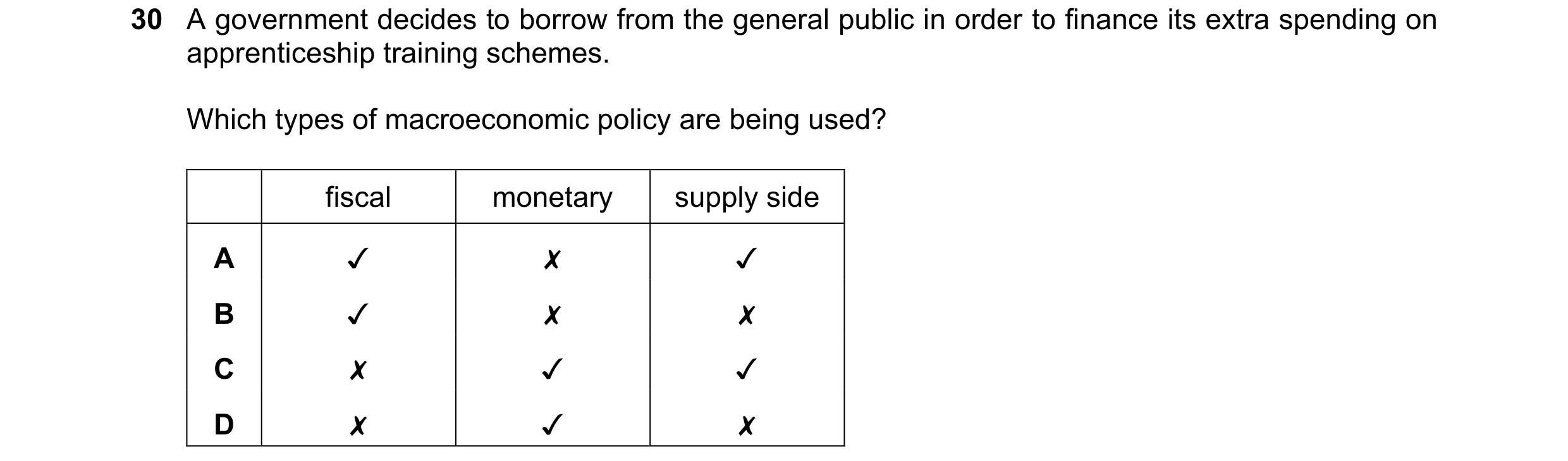
Q19 · A government decides to borrow from the general public in order to finance its extra… 9708/11 May/June 2018
28 A government decides to borrow from the general public in order to finance its extra spending on
apprenticeship training schemes.
Which types of macroeconomic policy are being used?
fiscal monetary supply side
A J x J key
B v x x / = used
Cc x v v X = not used
D x Jv x
1 marks
Answer: A
This question in 9708/11 May/June 2018
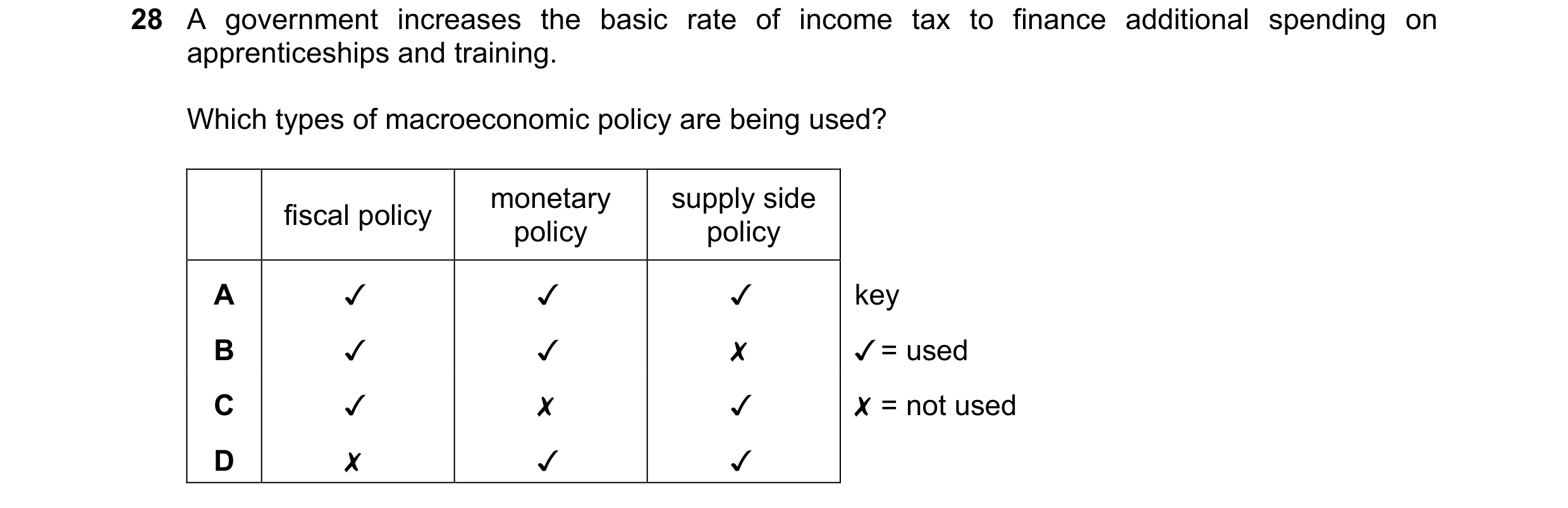
Q20 · A government increases the basic rate of income tax to finance additional spending on… 9708/13 May/June 2018
28 A government increases the basic rate of income tax to finance additional spending on
apprenticeships and training.
Which types of macroeconomic policy are being used?
fiscal policy
0 OO WwW PY
~*~ QS 4K OK
monetary
policy
Ke 4
supply side
policy
<< x
key
J¥ = used
X = not used
1 marks
Answer: C
This question in 9708/13 May/June 2018
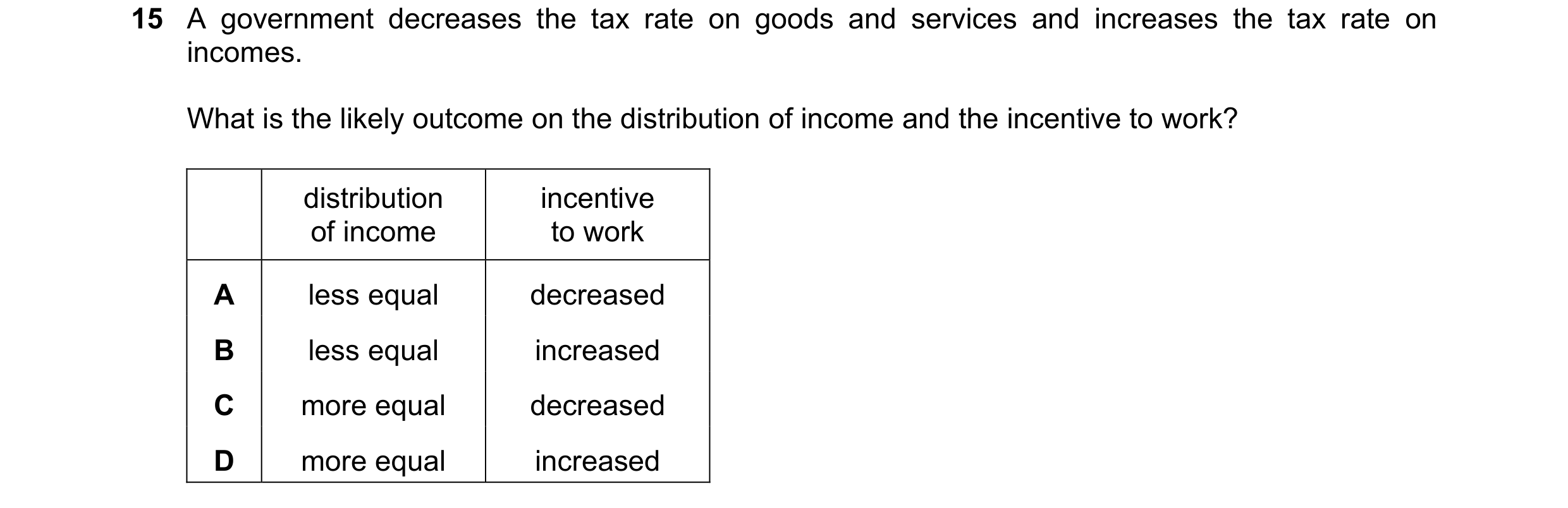
Q21 · A government decreases the tax rate on goods and services and increases the tax rate on… 9708/11 Oct/Nov 2018
15 A government decreases the tax rate on goods and services and increases the tax rate on incomes. What is the likely outcome on the distribution of income and the incentive to work? distribution incentive of income to work A less equal decreased B less equal increased C more equal decreased D more equal increased
1 marks
Answer: C
This question in 9708/11 Oct/Nov 2018
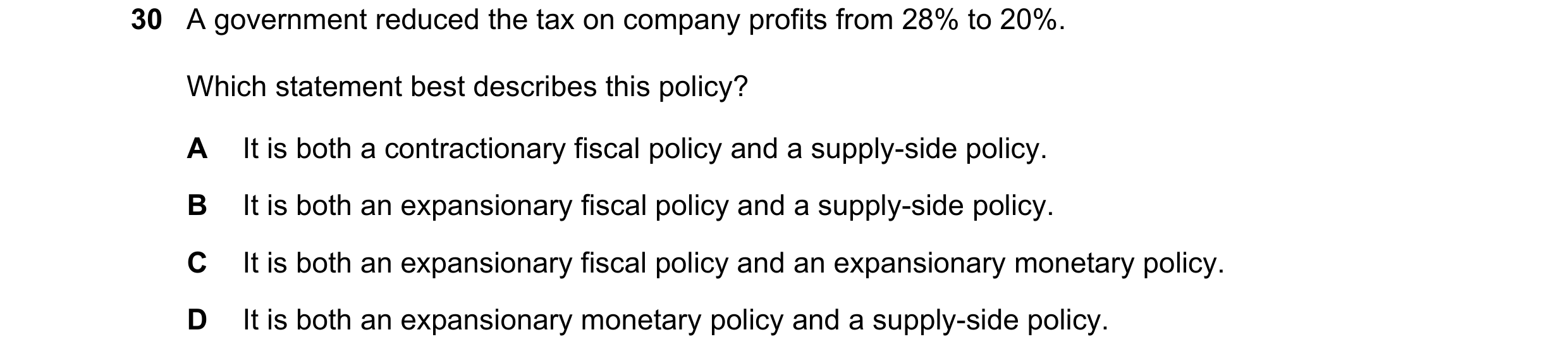
Q22 · A government reduced the tax on company profits from 28% to 20% 9708/11 Oct/Nov 2018
30 A government reduced the tax on company profits from 28% to 20%. Which statement best describes this policy? A It is both a contractionary fiscal policy and a supply-side policy. B It is both an expansionary fiscal policy and a supply-side policy. C It is both an expansionary fiscal policy and an expansionary monetary policy. D It is both an expansionary monetary policy and a supply-side policy.
1 marks
Answer: B
This question in 9708/11 Oct/Nov 2018
Q23 · What is an example of a supply-side policy? 9708/12 Oct/Nov 2018
28 What is an example of a supply-side policy? A an import quota to restrict the supply of goods B a rise in interest rates to encourage the supply of savings C a specific tax on the supply of goods to raise revenue D a subsidy to businesses to promote the supply of training courses
1 marks
Answer: D
This question in 9708/12 Oct/Nov 2018
Q24 · Which government policy is most likely to focus on an increase in the quantity of skilled… 9708/13 Oct/Nov 2018
28 Which government policy is most likely to focus on an increase in the quantity of skilled labour? A exchange rate policy B fiscal policy C monetary policy D supply-side policy
1 marks
Answer: D
This question in 9708/13 Oct/Nov 2018
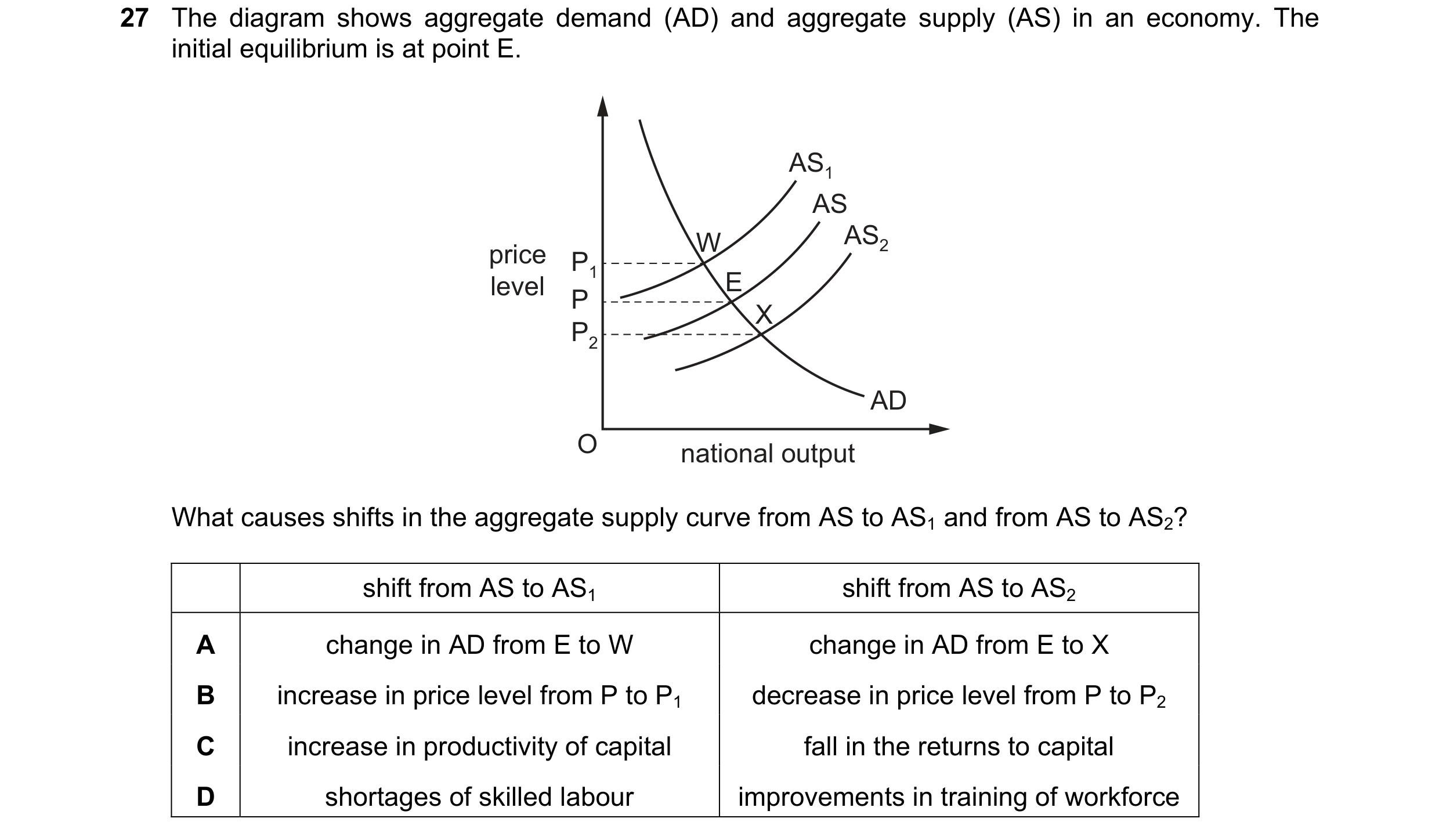
Q25 · The diagram shows aggregate demand (AD) and aggregate supply (AS) in an economy 9708/12 Feb/March 2019
27 The diagram shows aggregate demand (AD) and aggregate supply (AS) in an economy. The initial equilibrium is at point E. AS1 AS W AS2 price P1 level E P X P2 AD O national output What causes shifts in the aggregate supply curve from AS to AS1 and from AS to AS2? shift from AS to AS1 shift from AS to AS2 A change in AD from E to W change in AD from E to X B increase in price level from P to P1 decrease in price level from P to P2 C increase in productivity of capital fall in the returns to capital D shortages of skilled labour improvements in training of workforce
1 marks
Answer: D
This question in 9708/12 Feb/March 2019
Q26 · A government is faced with rising inflation 9708/12 Feb/March 2019
29 A government is faced with rising inflation. It wishes to reduce inflationary pressure while avoiding a fall in output. Which action is most likely to meet its needs? A an increase in laws to promote competition B an increase in taxation C an increase in the budget surplus D an increase in the exchange rate
1 marks
Answer: A
This question in 9708/12 Feb/March 2019
Q27 · To encourage people to work, a government increases the minimum income level at which… 9708/11 May/June 2019
29 To encourage people to work, a government increases the minimum income level at which
people start to pay income tax.
Which types of macroeconomic policy are being followed here?
fiscal monetary supply side
policy policy policy
A J x J
B x J J
Cc J J J
D J J x
1 marks
Answer: A
This question in 9708/11 May/June 2019
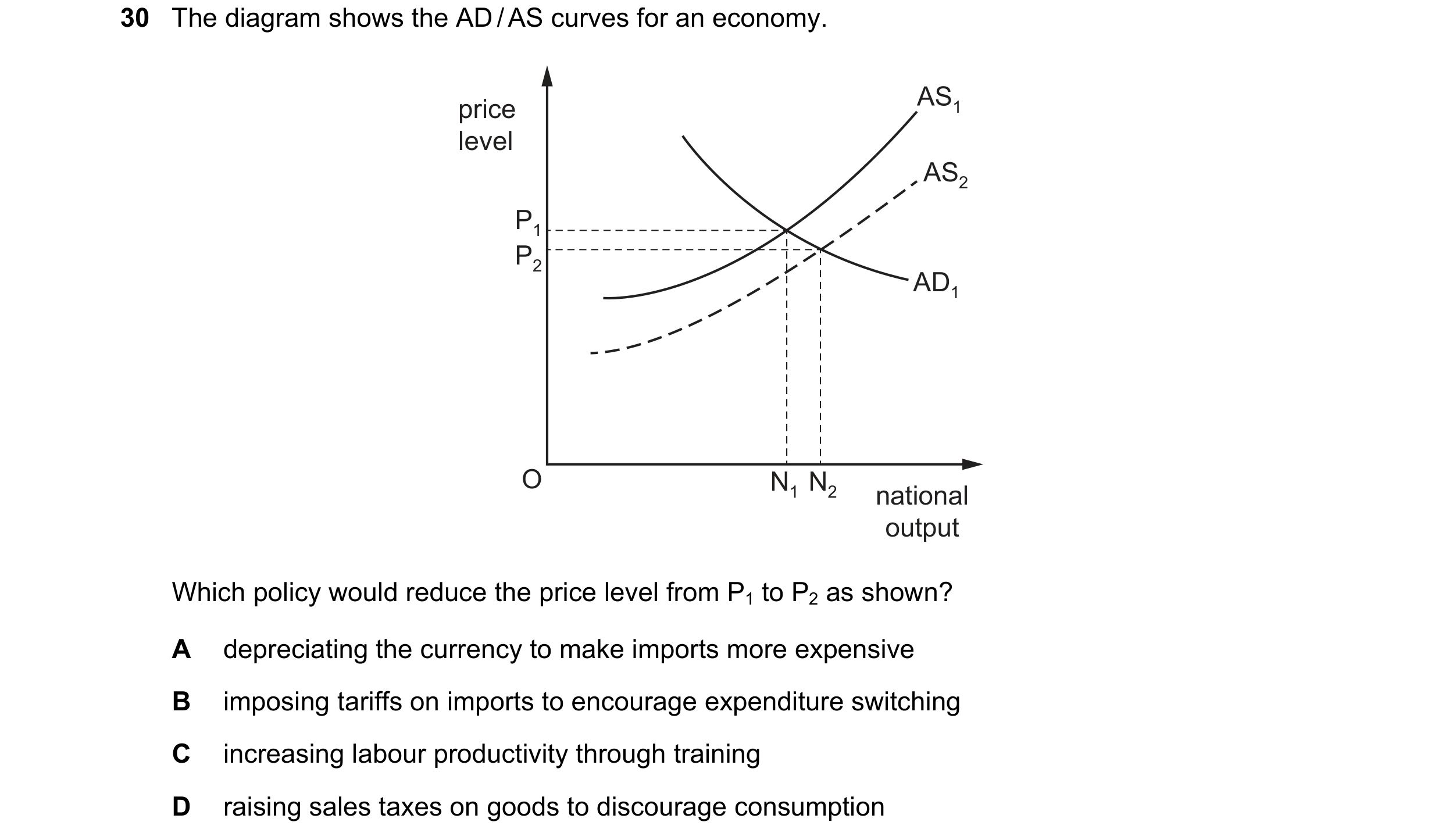
Q28 · The diagram shows the AD / AS curves for an economy 9708/12 May/June 2019
30 The diagram shows the AD / AS curves for an economy. AS1 price level AS2 P1 P2 AD1 O N1 N2 national output Which policy would reduce the price level from P1 to P2 as shown? A depreciating the currency to make imports more expensive B imposing tariffs on imports to encourage expenditure switching C increasing labour productivity through training D raising sales taxes on goods to discourage consumption
1 marks
Answer: C
This question in 9708/12 May/June 2019
Q29 · What is the best example of an expansionary supply-side policy? 9708/13 May/June 2019
30 What is the best example of an expansionary supply-side policy? A the Argentinian central bank’s decision to cut the interest rate in 2018 B the US president’s plan to cut income tax rates in 2017 C the UK government’s plan to build 500 new schools by 2020 D the Chinese government’s decision to devalue their currency by almost 7% in 2016
1 marks
Answer: C
This question in 9708/13 May/June 2019
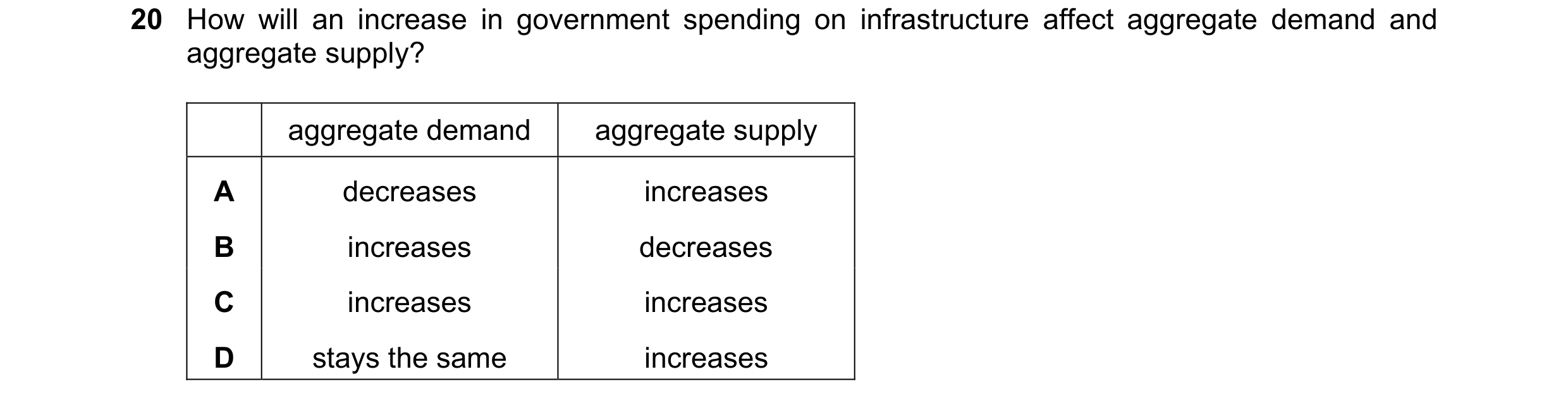
Q30 · How will an increase in government spending on infrastructure affect aggregate demand and… 9708/11 Oct/Nov 2019
20 How will an increase in government spending on infrastructure affect aggregate demand and aggregate supply? aggregate demand aggregate supply A decreases increases B increases decreases C increases increases D stays the same increases
1 marks
Answer: C
This question in 9708/11 Oct/Nov 2019
Q31 · The diagrams show a country’s aggregate demand (AD1) and aggregate supply (AS1) curves 9708/11 Oct/Nov 2019
24 The diagrams show a country’s aggregate demand (AD1) and aggregate supply (AS1) curves. Since the world economic downturn (2007–2008) some governments have reduced labour costs and ensured interest rates remained unchanged. How would this most likely be shown on a diagram? A B AS1 AS1 price price AS2 level level P1 P1 P2 P2 AD1 AD1 AD2 O real GDP O real GDP C D AS2 AS1 price price AS1 level level P2 P2 P1 P1 AD1 AD2 AD1 O real GDP O real GDP
1 marks
Answer: A
This question in 9708/11 Oct/Nov 2019
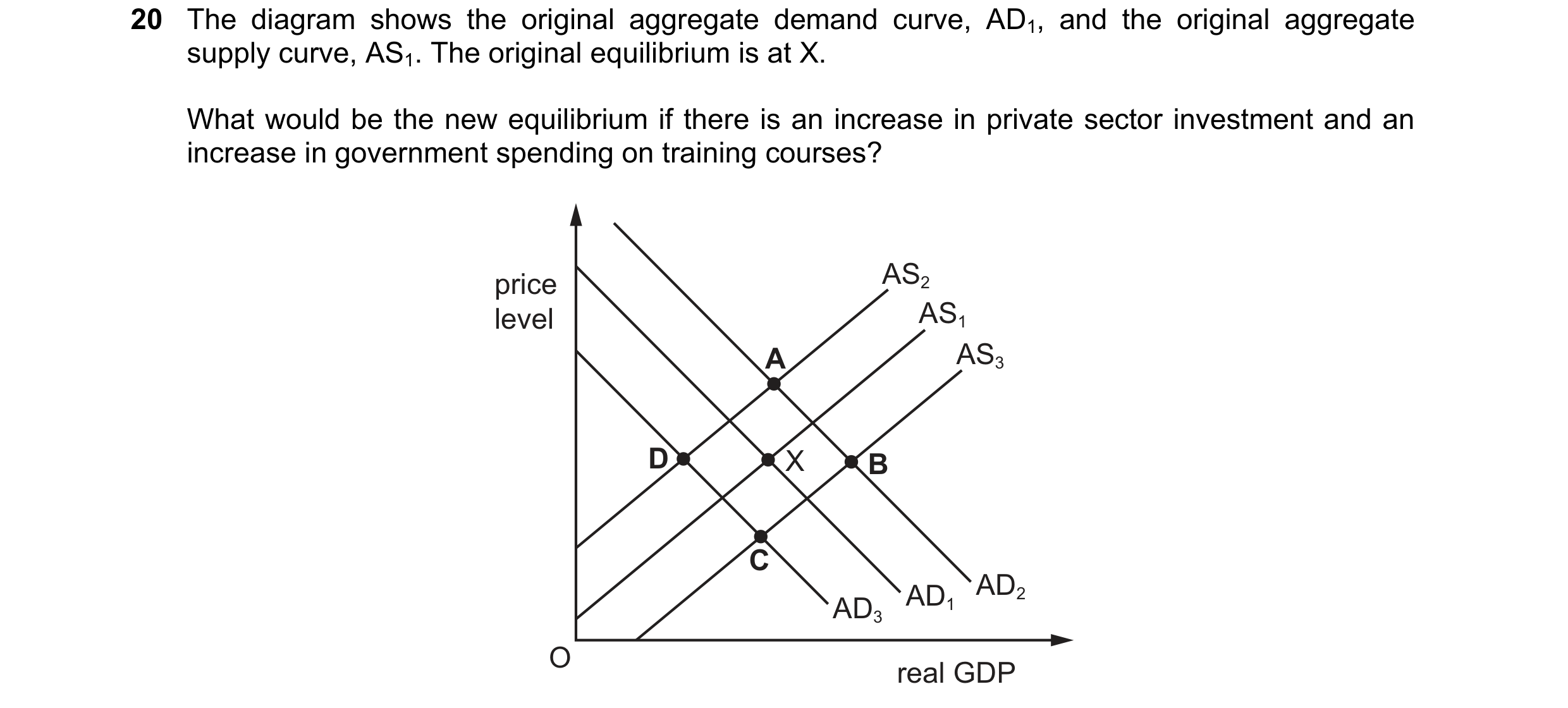
Q32 · The diagram shows the original aggregate demand curve, AD1, and the original aggregate… 9708/13 Oct/Nov 2019
20 The diagram shows the original aggregate demand curve, AD1, and the original aggregate supply curve, AS1. The original equilibrium is at X. What would be the new equilibrium if there is an increase in private sector investment and an increase in government spending on training courses? price AS2 level AS1 A AS3 D X B C AD1 AD2 AD3 O real GDP
1 marks
Answer: B
This question in 9708/13 Oct/Nov 2019
Q33 · An economy experiences cost-push inflation 9708/13 Oct/Nov 2019
28 An economy experiences cost-push inflation. Which combination of policies would be best for the economy to use to reduce cost-push inflation? exchange rate supply-side policy A appreciate lower minimum wage B appreciate raise minimum wage C depreciate lower minimum wage D depreciate raise minimum wage
1 marks
Answer: A
This question in 9708/13 Oct/Nov 2019
Q34 · A government reduces the rate of tax firms are charged on their land and buildings 9708/13 Oct/Nov 2019
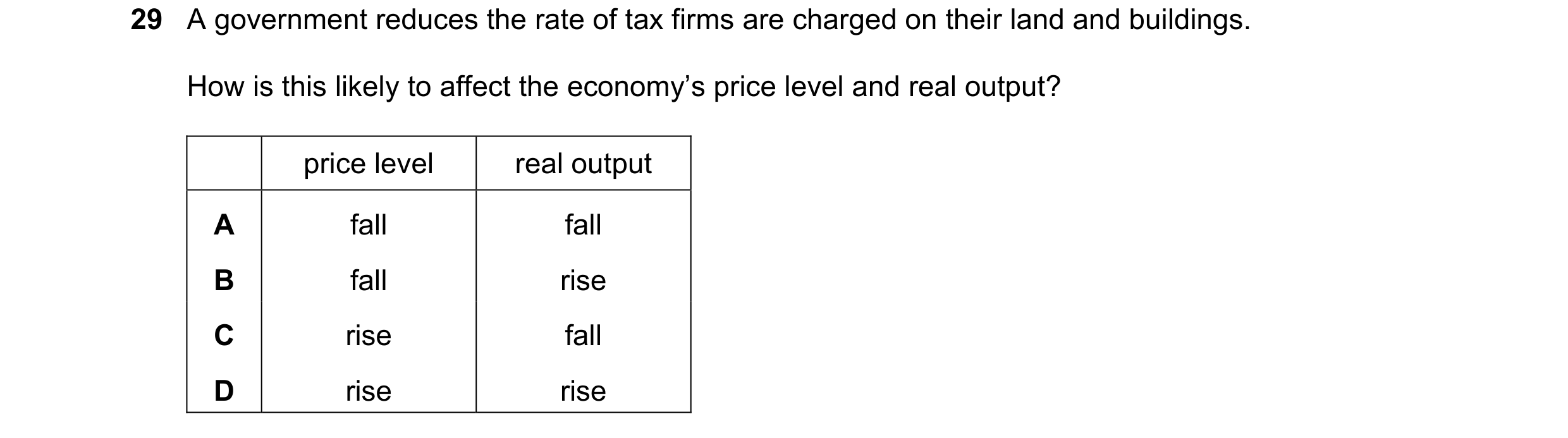
29 A government reduces the rate of tax firms are charged on their land and buildings. How is this likely to affect the economy’s price level and real output? price level real output A fall fall B fall rise C rise fall D rise rise
1 marks
Answer: B
This question in 9708/13 Oct/Nov 2019
Q35 · The diagram shows the aggregate demand (AD) and aggregate supply (AS) for an economy 9708/11 May/June 2020
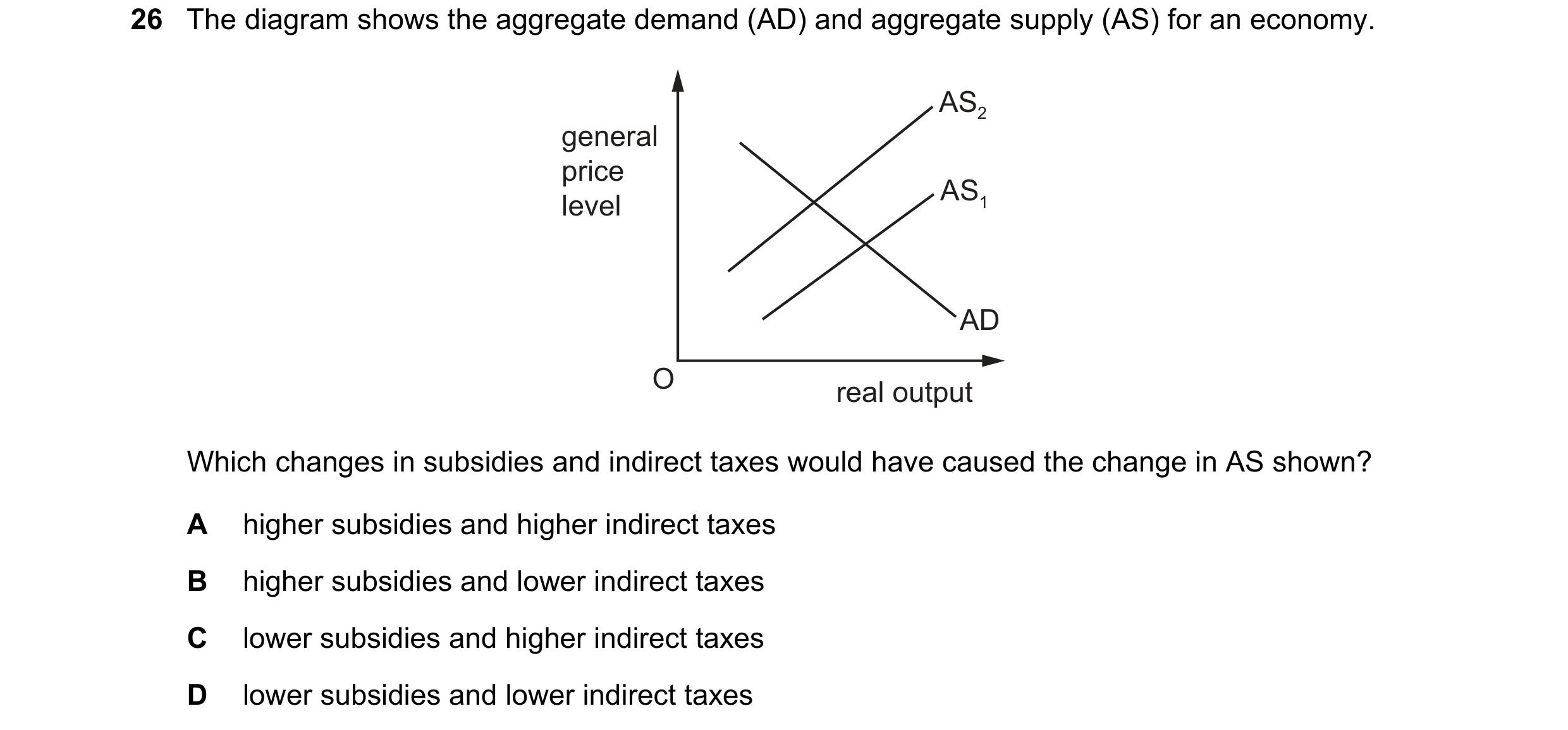
26 The diagram shows the aggregate demand (AD) and aggregate supply (AS) for an economy. AS2 general price AS1 level AD O real output Which changes in subsidies and indirect taxes would have caused the change in AS shown? A higher subsidies and higher indirect taxes B higher subsidies and lower indirect taxes C lower subsidies and higher indirect taxes D lower subsidies and lower indirect taxes
1 marks
Answer: C
This question in 9708/11 May/June 2020
Q36 · In its recent budget a government increased defence expenditure and also the amount spent… 9708/11 May/June 2020
27 In its recent budget a government increased defence expenditure and also the amount spent on training that increased the productivity of the workforce. The initial equilibrium point is shown by X on the aggregate demand (AD) and aggregate supply (AS) diagram. What would be the equilibrium point after these changes? AS3 AS1 general B price level AS2 X A C D AD3 AD1 AD2 O real output
1 marks
Answer: C
This question in 9708/11 May/June 2020
Q37 · What would be classified as a supply-side policy measure? 9708/11 Oct/Nov 2020
30 What would be classified as a supply-side policy measure? A a law to reduce the power of trade unions B a reduction in the government’s fiscal deficit C an open market sale of securities D the imposition of a tariff on imported goods
1 marks
Answer: A
This question in 9708/11 Oct/Nov 2020
Q38 · A country has a persistent balance of payments deficit 9708/13 Oct/Nov 2020
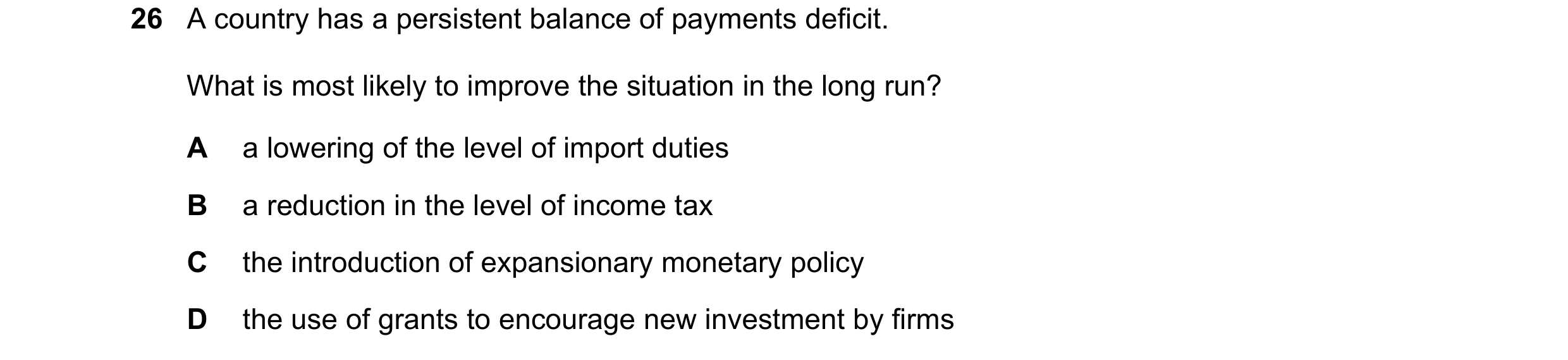
26 A country has a persistent balance of payments deficit. What is most likely to improve the situation in the long run? A a lowering of the level of import duties B a reduction in the level of income tax C the introduction of expansionary monetary policy D the use of grants to encourage new investment by firms
1 marks
Answer: D
This question in 9708/13 Oct/Nov 2020
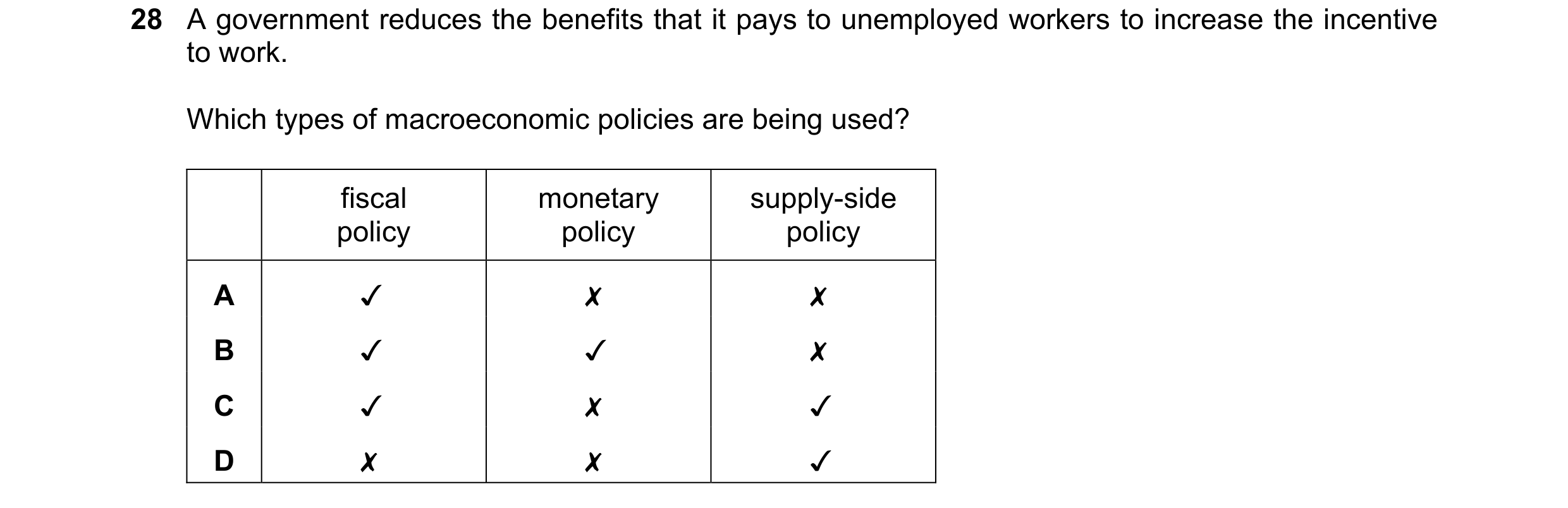
Q39 · A government reduces the benefits that it pays to unemployed workers to increase the… 9708/13 Oct/Nov 2020
28 A government reduces the benefits that it pays to unemployed workers to increase the incentive
to work.
Which types of macroeconomic policies are being used?
fiscal monetary supply-side
policy policy policy
v
0 OW >
x « < x
\ <x x
v
v
x
1 marks
Answer: C
This question in 9708/13 Oct/Nov 2020
Q40 · Suppose a country has a rate of inflation well below its target rate, high unemployment… 9708/13 Oct/Nov 2020
29 Suppose a country has a rate of inflation well below its target rate, high unemployment and a large balance of payments deficit. What would an economic advisor to the government be most likely to recommend? A a long-run supply-side policy, aimed at improving the country’s efficiency, so improving both the unemployment and the balance of payments positions B a revaluation of its currency, because that would lead to reduced unemployment and an improved balance of payments C a rise in interest rates, because it would lead to an improved balance of payments and help achieve the inflation target D a rise in levels of direct taxation, because that would improve unemployment and move inflation in the direction of a target level
1 marks
Answer: A
This question in 9708/13 Oct/Nov 2020
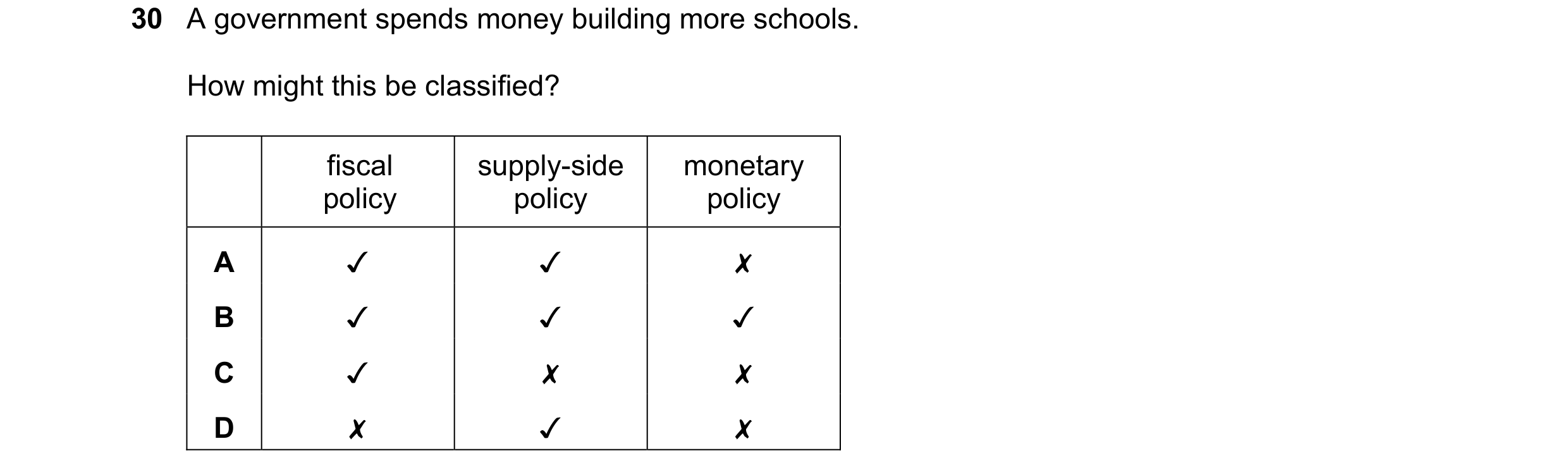
Q41 · A government spends money building more schools 9708/12 Feb/March 2021
30 A government spends money building more schools.
How might this be classified?
fiscal supply-side monetary
policy policy policy
A J J x
B J J Jv
Cc J x x
D x Jv x
1 marks
Answer: A
This question in 9708/12 Feb/March 2021
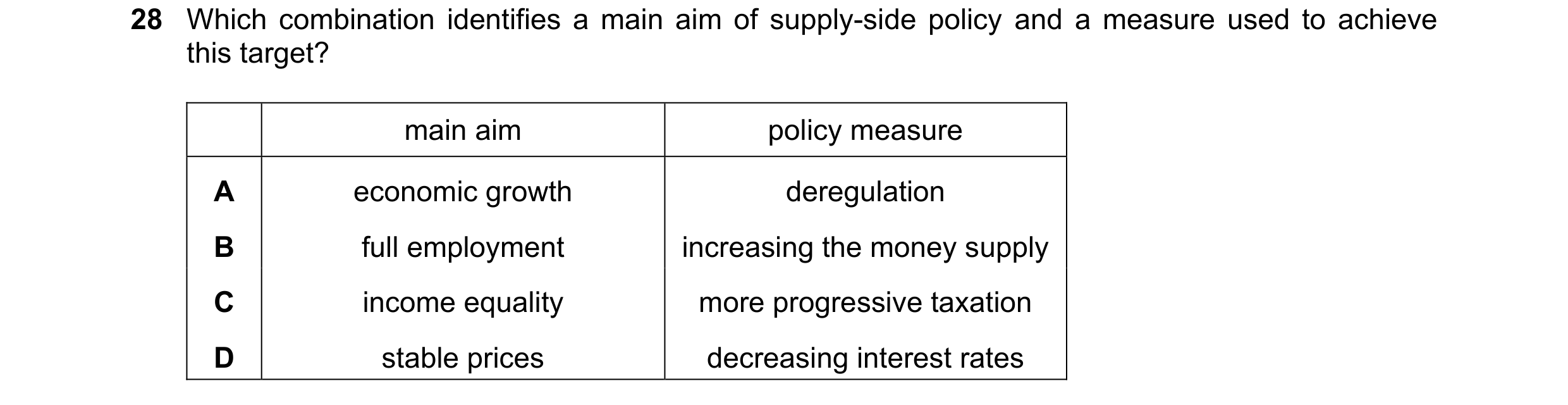
Q42 · Which combination identifies a main aim of supply-side policy and a measure used to… 9708/13 May/June 2021
28 Which combination identifies a main aim of supply-side policy and a measure used to achieve this target? main aim policy measure A economic growth deregulation B full employment increasing the money supply C income equality more progressive taxation D stable prices decreasing interest rates
1 marks
Answer: A
This question in 9708/13 May/June 2021
Q43 · A government plans to increase spending on education and training every year 9708/11 Oct/Nov 2021
19 A government plans to increase spending on education and training every year. Which diagram shows the likely effect of this increase on the economy’s long-run output and price level? A B LRAS1 LRAS1 LRAS2 price price level level P2 P1 P1 P2 AD1 AD2 AD1 O Y1 O Y1 Y2 real output real output C D LRAS1 LRAS2 LRAS2 LRAS1 price price level level P2 P1 P1 P2 AD1 AD2 AD2 AD1 O Y1 Y2 O Y2 Y1 real output real output
1 marks
Answer: C
This question in 9708/11 Oct/Nov 2021
Q44 · A government reduces the rate of direct income tax and devalues its currency 9708/11 Oct/Nov 2021
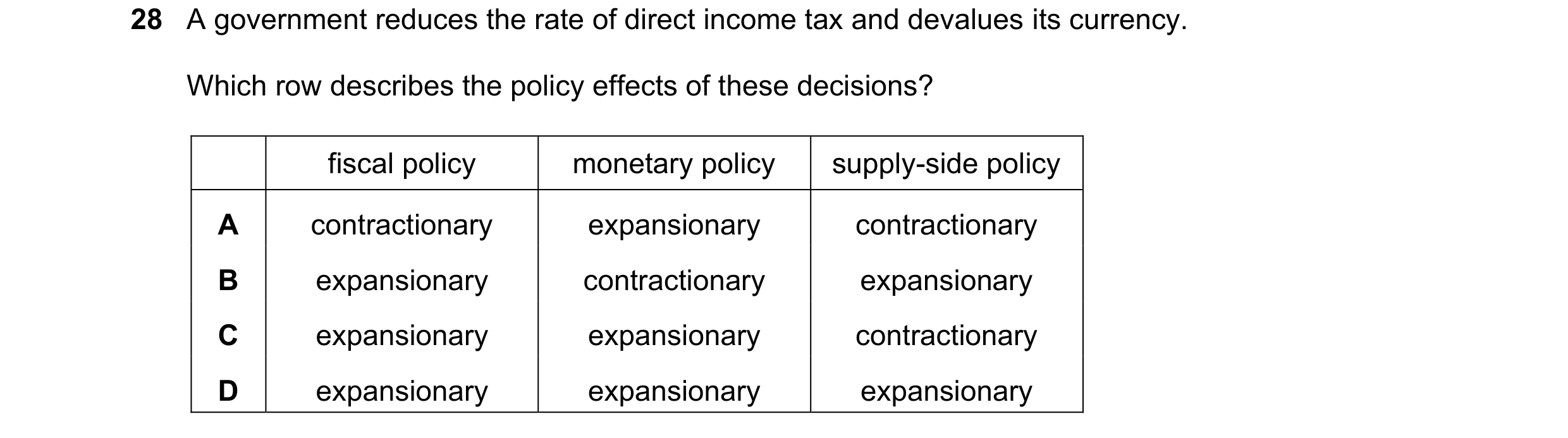
28 A government reduces the rate of direct income tax and devalues its currency. Which row describes the policy effects of these decisions? fiscal policy monetary policy supply-side policy A contractionary expansionary contractionary B expansionary contractionary expansionary C expansionary expansionary contractionary D expansionary expansionary expansionary
1 marks
Answer: D
This question in 9708/11 Oct/Nov 2021
Q45 · The government wishes to increase aggregate demand 9708/11 Oct/Nov 2021
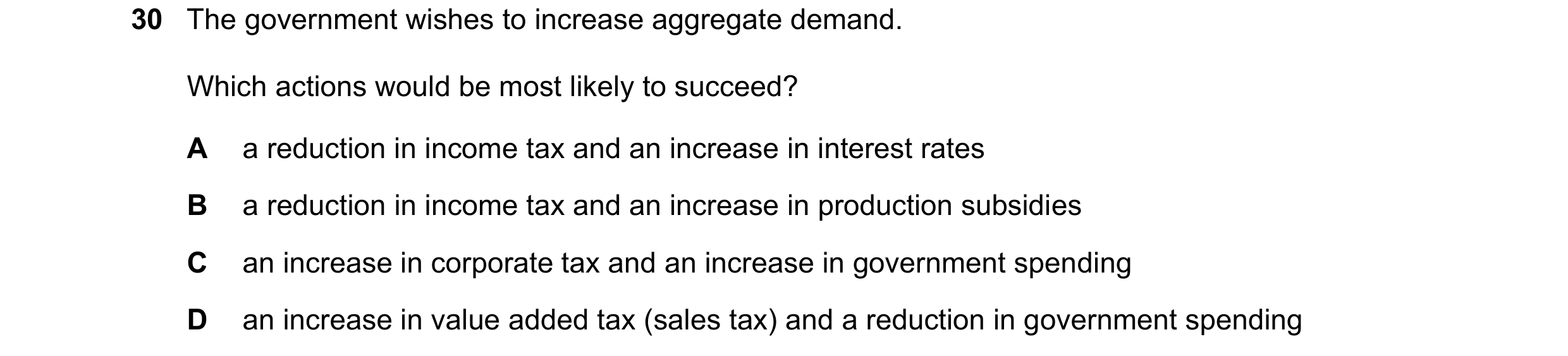
30 The government wishes to increase aggregate demand. Which actions would be most likely to succeed? A a reduction in income tax and an increase in interest rates B a reduction in income tax and an increase in production subsidies C an increase in corporate tax and an increase in government spending D an increase in value added tax (sales tax) and a reduction in government spending
1 marks
Answer: B
This question in 9708/11 Oct/Nov 2021
Q46 · The diagram shows aggregate demand (AD) and aggregate supply (AS) for an economy 9708/13 Oct/Nov 2021
23 The diagram shows aggregate demand (AD) and aggregate supply (AS) for an economy. AS1 AS2 price level P1 P2 AD O Y1 Y2 real output What is most likely to cause the shift from AS1 to AS2? A a decrease in the exchange rate B a decrease in the price level C a fall in immigration D a fall in the average level of wages
1 marks
Answer: D
This question in 9708/13 Oct/Nov 2021
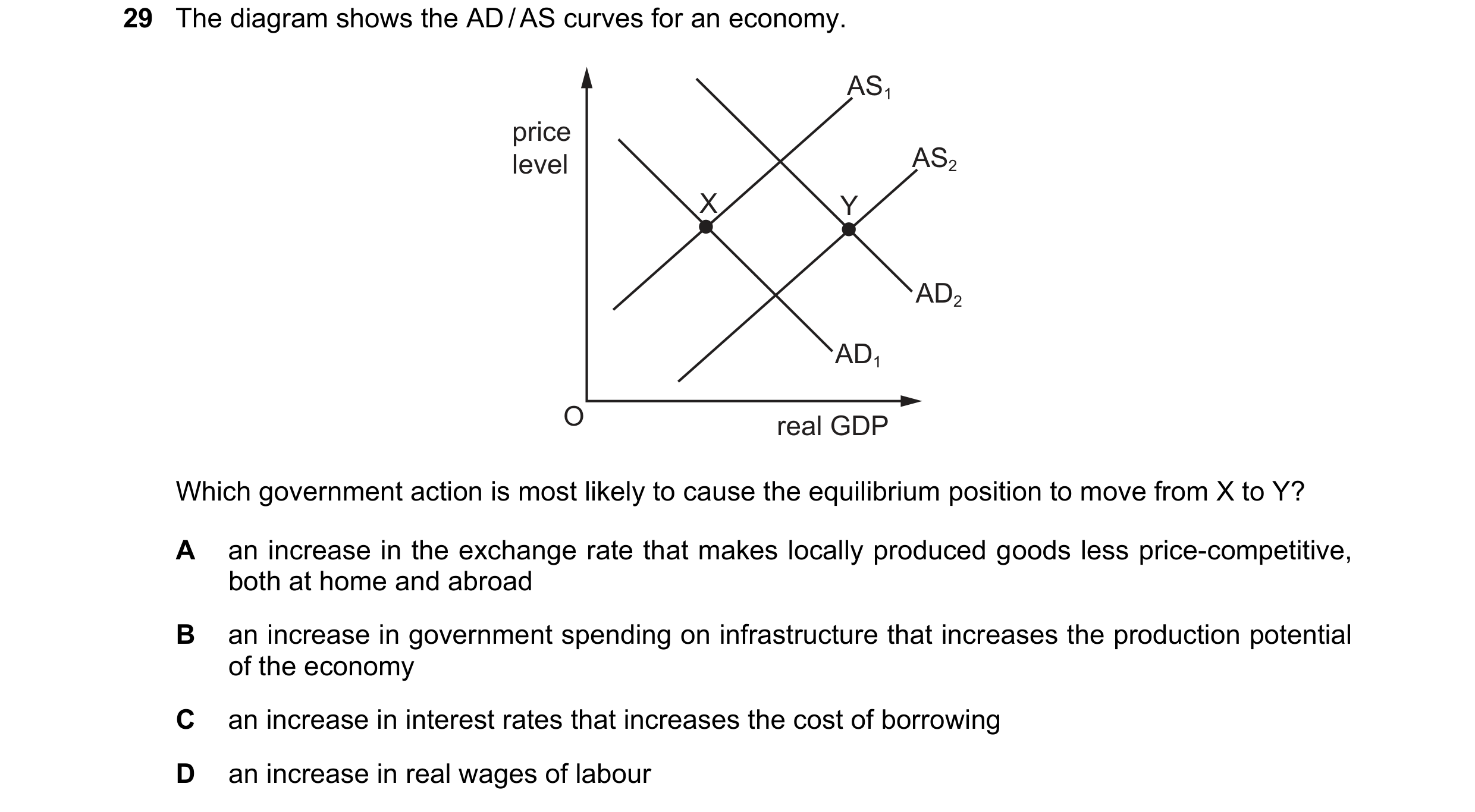
Q47 · The diagram shows the AD / AS curves for an economy 9708/13 May/June 2022
29 The diagram shows the AD / AS curves for an economy. AS1 price level AS2 X Y AD2 AD1 O real GDP Which government action is most likely to cause the equilibrium position to move from X to Y? A an increase in the exchange rate that makes locally produced goods less price-competitive, both at home and abroad B an increase in government spending on infrastructure that increases the production potential of the economy C an increase in interest rates that increases the cost of borrowing D an increase in real wages of labour
1 marks
Answer: B
This question in 9708/13 May/June 2022
Q48 · A government decides to borrow from the general public in order to finance its extra… 9708/14 May/June 2022
30 A government decides to borrow from the general public in order to finance its extra spending on
apprenticeship training schemes.
Which types of macroeconomic policy are being used?
fiscal monetary supply side
v x v
0 0O WwW D>
v x x
x v v
x v x
1 marks
Answer: A
This question in 9708/14 May/June 2022
Q49 · To encourage people to work, a government increases the minimum income level at which… 9708/11 Oct/Nov 2022
28 To encourage people to work, a government increases the minimum income level at which
people start to pay income tax.
Which types of macroeconomic policy are being followed?
fiscal monetary supply side
policy policy policy
A J x J
B x J J
Cc J J J
D J J x
1 marks
Answer: A
This question in 9708/11 Oct/Nov 2022
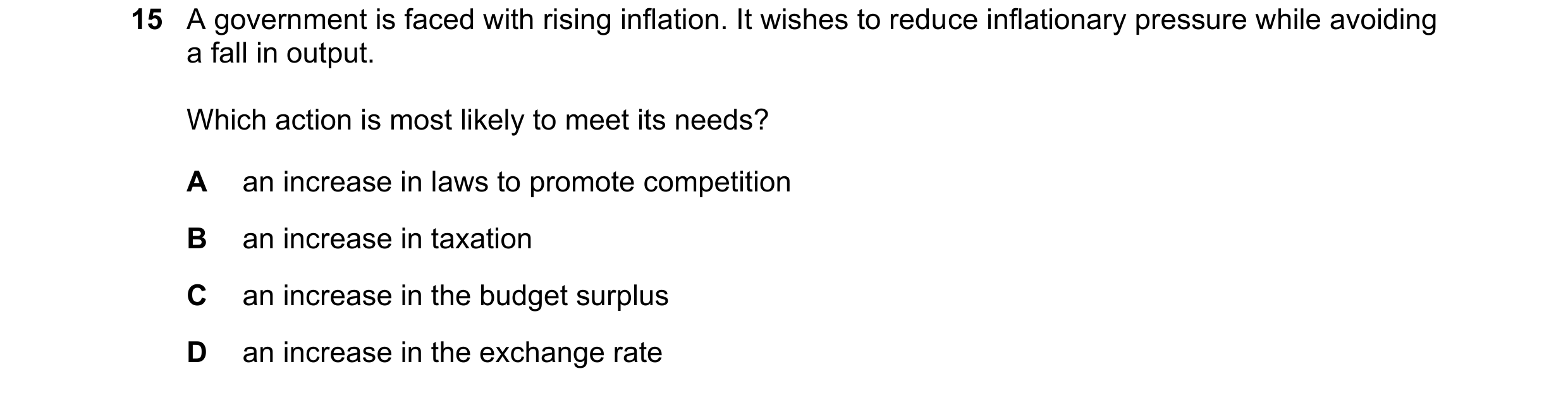
Q50 · A government is faced with rising inflation 9708/12 Feb/March 2023
15 A government is faced with rising inflation. It wishes to reduce inflationary pressure while avoiding a fall in output. Which action is most likely to meet its needs? A an increase in laws to promote competition B an increase in taxation C an increase in the budget surplus D an increase in the exchange rate
1 marks
Answer: A
This question in 9708/12 Feb/March 2023
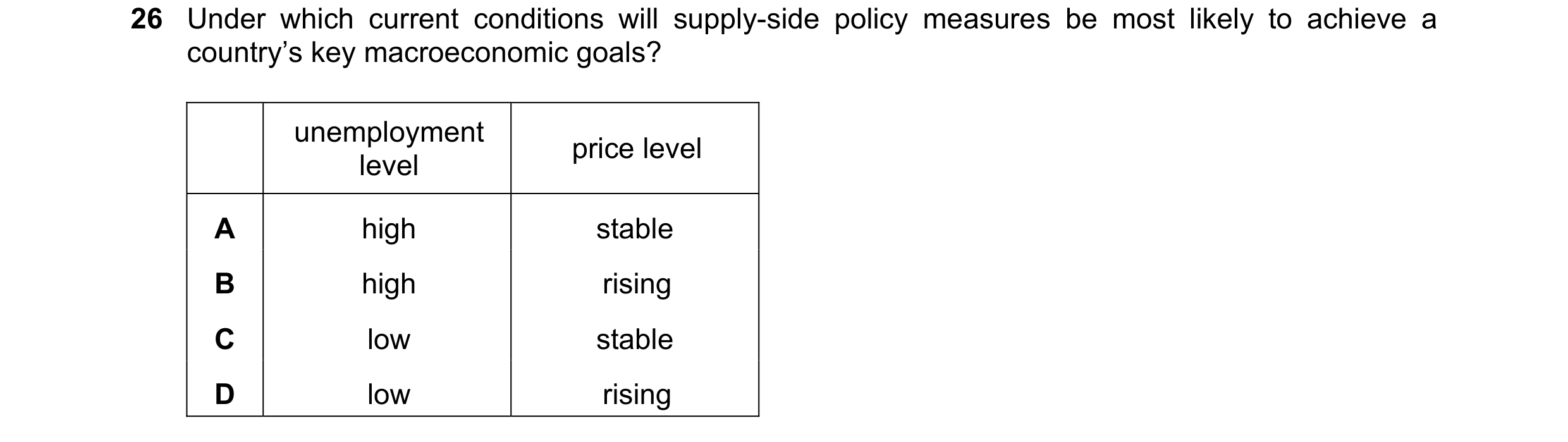
Q51 · Under which current conditions will supply-side policy measures be most likely to achieve… 9708/12 Feb/March 2023
26 Under which current conditions will supply-side policy measures be most likely to achieve a country’s key macroeconomic goals? unemployment price level level A high stable B high rising C low stable D low rising
1 marks
Answer: B
This question in 9708/12 Feb/March 2023
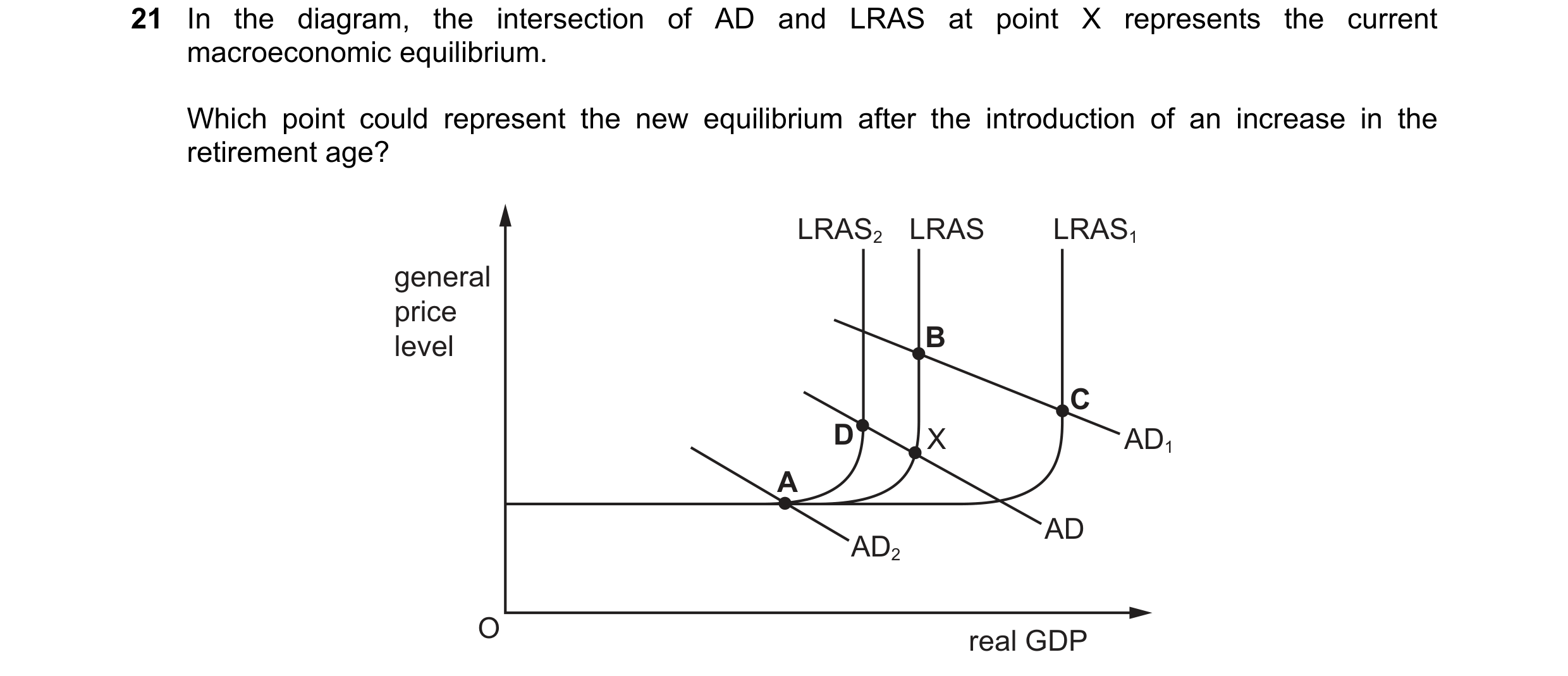
Q52 · In the diagram, the intersection of AD and LRAS at point X represents the current… 9708/11 May/June 2023
21 In the diagram, the intersection of AD and LRAS at point X represents the current macroeconomic equilibrium. Which point could represent the new equilibrium after the introduction of an increase in the retirement age? LRAS2 LRAS LRAS1 general price level B C D X AD1 A AD AD2 O real GDP
1 marks
Answer: C
This question in 9708/11 May/June 2023
Q53 · What would be classified as a supply-side policy measure? 9708/11 May/June 2023
27 What would be classified as a supply-side policy measure? A a law to reduce the power of trade unions B a reduction in the government’s fiscal deficit C an open market sale of securities D the imposition of a tariff on imported goods
1 marks
Answer: A
This question in 9708/11 May/June 2023
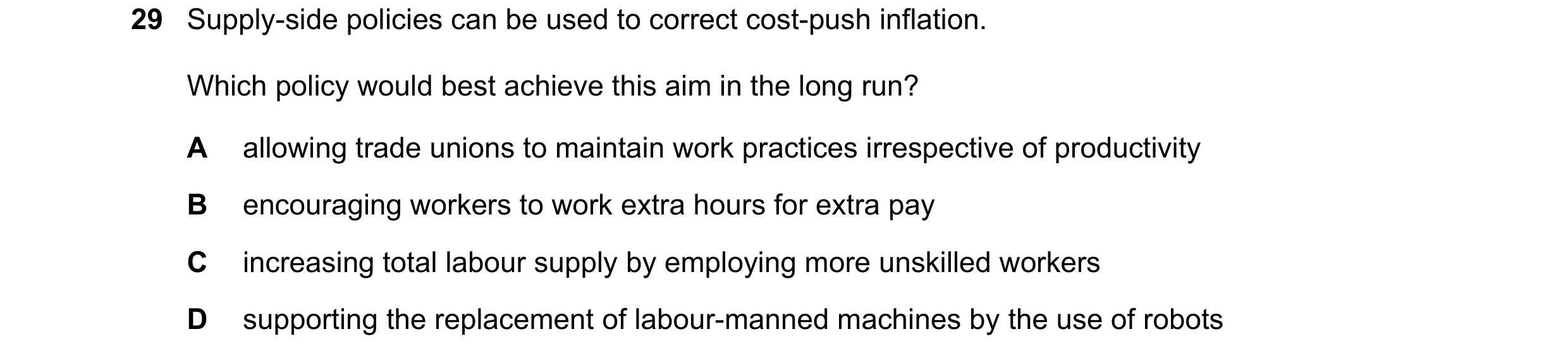
Q54 · Supply-side policies can be used to correct cost-push inflation 9708/12 May/June 2023
29 Supply-side policies can be used to correct cost-push inflation. Which policy would best achieve this aim in the long run? A allowing trade unions to maintain work practices irrespective of productivity B encouraging workers to work extra hours for extra pay C increasing total labour supply by employing more unskilled workers D supporting the replacement of labour-manned machines by the use of robots
1 marks
Answer: D
This question in 9708/12 May/June 2023
Q55 · Which government action is least likely to prevent a fall in economic growth? 9708/13 May/June 2023
24 Which government action is least likely to prevent a fall in economic growth? A additional controls on commercial banks’ lending B relaxation of rules for immigration of adult population C removal of trade barriers on import of raw materials D training and education of workforce
1 marks
Answer: A
This question in 9708/13 May/June 2023
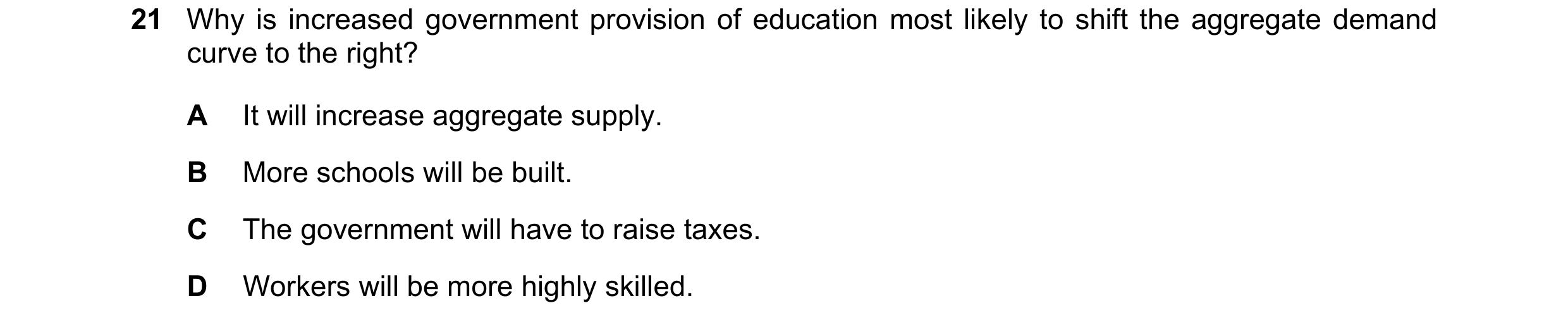
Q56 · Why is increased government provision of education most likely to shift the aggregate… 9708/11 Oct/Nov 2023
21 Why is increased government provision of education most likely to shift the aggregate demand curve to the right? A It will increase aggregate supply. B More schools will be built. C The government will have to raise taxes. D Workers will be more highly skilled.
1 marks
Answer: B
This question in 9708/11 Oct/Nov 2023
Q57 · Which supply-side measure is most likely to produce short-run growth in a country’s… 9708/12 Oct/Nov 2023
26 Which supply-side measure is most likely to produce short-run growth in a country’s aggregate supply? A easing of controls on immigration of workers B expenditure on primary education C expenditure on research and development D privatisation of public utilities
1 marks
Answer: A
This question in 9708/12 Oct/Nov 2023
Q58 · A government reduces the rate of tax firms are charged on their land and buildings 9708/12 Oct/Nov 2023
30 A government reduces the rate of tax firms are charged on their land and buildings. How is this likely to affect the economy’s price level and real output? price level real output A fall fall B fall rise C rise fall D rise rise
1 marks
Answer: B
This question in 9708/12 Oct/Nov 2023
Q59 · The government undertakes a policy of financing training and retraining for unemployed… 9708/13 Oct/Nov 2023
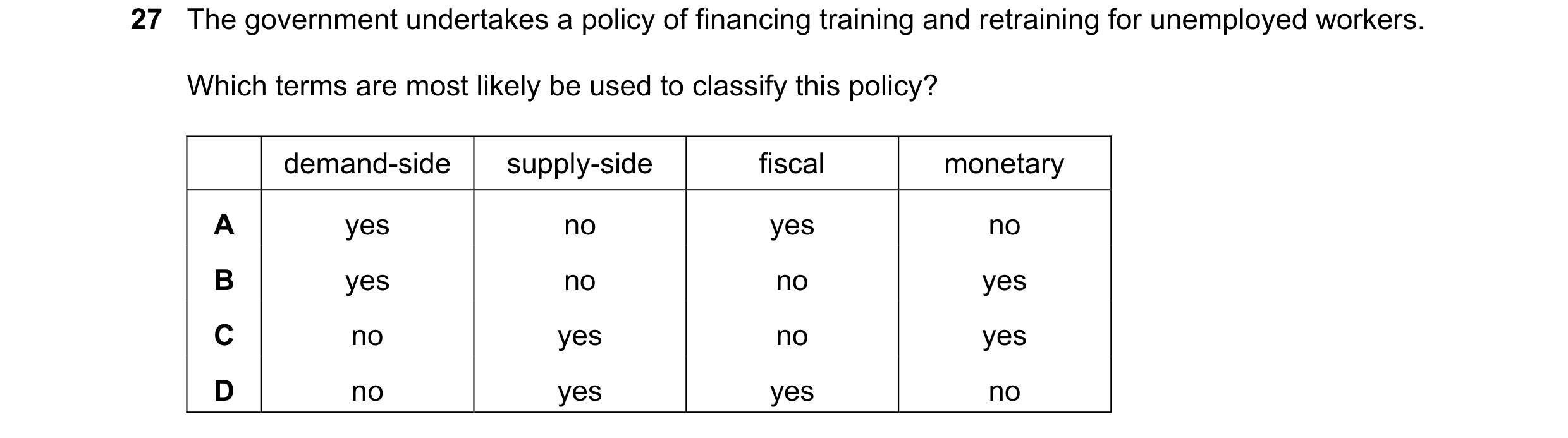
27 The government undertakes a policy of financing training and retraining for unemployed workers. Which terms are most likely be used to classify this policy? demand-side supply-side fiscal monetary A yes no yes no B yes no no yes C no yes no yes D no yes yes no
1 marks
Answer: D
This question in 9708/13 Oct/Nov 2023
Q60 · Which combination of initial equilibrium and supply-side policy is likely to be least… 9708/13 Oct/Nov 2023
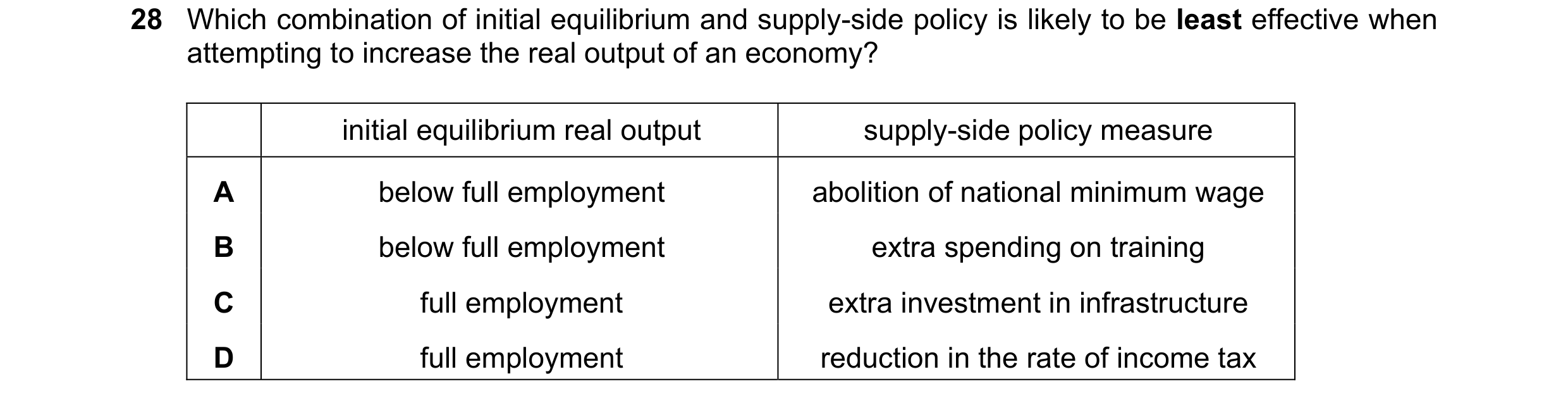
28 Which combination of initial equilibrium and supply-side policy is likely to be least effective when attempting to increase the real output of an economy? initial equilibrium real output supply-side policy measure A below full employment abolition of national minimum wage B below full employment extra spending on training C full employment extra investment in infrastructure D full employment reduction in the rate of income tax
1 marks
Answer: A
This question in 9708/13 Oct/Nov 2023
Q61 · What can be considered an expansionary supply-side policy? 9708/12 Feb/March 2024
23 What can be considered an expansionary supply-side policy? A an increase in government expenditure on training B an increase in sales tax C an increase in the rate of interest D an increase of the exchange rate
1 marks
Answer: A
This question in 9708/12 Feb/March 2024
Q62 · The diagrams show a country’s aggregate demand (AD1) and aggregate supply (AS1) curves 9708/13 May/June 2024
15 The diagrams show a country’s aggregate demand (AD1) and aggregate supply (AS1) curves. Since the world economic downturn (2007–2008), some governments have reduced labour costs and ensured interest rates remained unchanged. How would this most likely be shown on a diagram? A B AS1 AS1 price price AS2 level level P1 P1 P2 P2 AD1 AD1 AD2 O real GDP O real GDP C D AS2 AS1 price price AS1 level level P2 P2 P1 P1 AD1 AD2 AD1 O real GDP O real GDP
1 marks
Answer: A
This question in 9708/13 May/June 2024
Q63 · What is not a supply-side policy? 9708/13 May/June 2024
22 What is not a supply-side policy? A increasing government expenditure on infrastructure B increasing research and development expenditure C increasing subsidies for education and training D increasing the supply of money
1 marks
Answer: D
This question in 9708/13 May/June 2024
Q64 · Which supply-side policy is most likely to decrease a government’s budget deficit? 9708/11 Oct/Nov 2024
21 Which supply-side policy is most likely to decrease a government’s budget deficit? A cutting tax rates on company profits B cutting unemployment benefits C raising spending on education and training D raising tax-free income tax allowances
1 marks
Answer: B
This question in 9708/11 Oct/Nov 2024
Q65 · A government subsidises training to improve the skills of workers in the industrial… 9708/11 Oct/Nov 2024
25 A government subsidises training to improve the skills of workers in the industrial sector of an economy. What is the most likely effect on the current account of the balance of payments? A exports fall B exports rise C imports fall D imports rise
1 marks
Answer: B
This question in 9708/11 Oct/Nov 2024
Q66 · Which supply-side policy is likely to lower real output before raising it? 9708/12 Oct/Nov 2024
21 Which supply-side policy is likely to lower real output before raising it? A increased spending on early years education B increased spending on infrastructure C reduced import barriers D subsidies to exporters
1 marks
Answer: C
This question in 9708/12 Oct/Nov 2024
Q67 · Supply-side policy often has fiscal consequences 9708/13 Oct/Nov 2024
21 Supply-side policy often has fiscal consequences. Which statement is not correct? A Increased government spending supporting technical progress has beneficial long-term supply-side effects but may have short-term inflationary consequences. B Increased government expenditure on training increases a country’s long-run aggregate supply (LRAS) and also has an expansionary effect on aggregate demand (AD). C Reduced government infrastructure spending reduces an economy’s LRAS and has a short-term expansionary effect on AD. D Reduced rates of tax on higher incomes increases an economy’s LRAS and has an expansionary effect on AD.
1 marks
Answer: C
This question in 9708/13 Oct/Nov 2024
Q68 · A government cuts income tax 9708/12 Feb/March 2025
21 A government cuts income tax. Why might this be seen as an example of a supply-side policy? A Real incomes are increased. B The costs of businesses are reduced. C The opportunity cost of unemployment has increased. D The standard of living has improved.
1 marks
Answer: C
This question in 9708/12 Feb/March 2025
Q69 · A government decides to use supply-side policy to increase long-run aggregate supply… 9708/12 Feb/March 2025
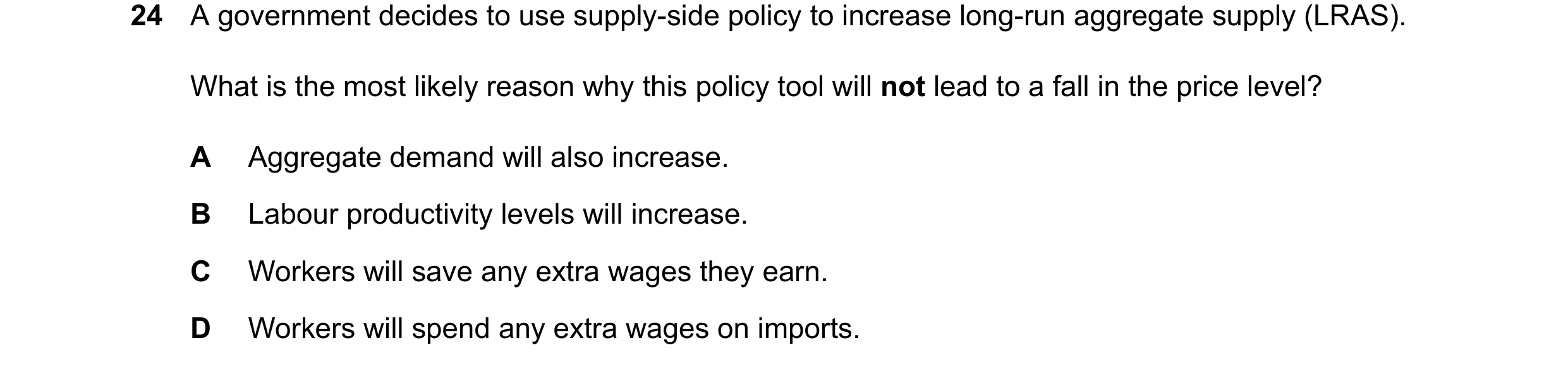
24 A government decides to use supply-side policy to increase long-run aggregate supply (LRAS). What is the most likely reason why this policy tool will not lead to a fall in the price level? A Aggregate demand will also increase. B Labour productivity levels will increase. C Workers will save any extra wages they earn. D Workers will spend any extra wages on imports.
1 marks
Answer: A
This question in 9708/12 Feb/March 2025
Q70 · What is not an example of an expansionary supply-side policy? 9708/11 May/June 2025
24 What is not an example of an expansionary supply-side policy? A a reduction in government spending on training B an increase in support for technological improvement C a reduction in payments to the unemployed D an increase in privatisation of industry
1 marks
Answer: A
This question in 9708/11 May/June 2025
Q71 · A country has a persistent deficit on the current account of its balance of payments 9708/11 May/June 2025
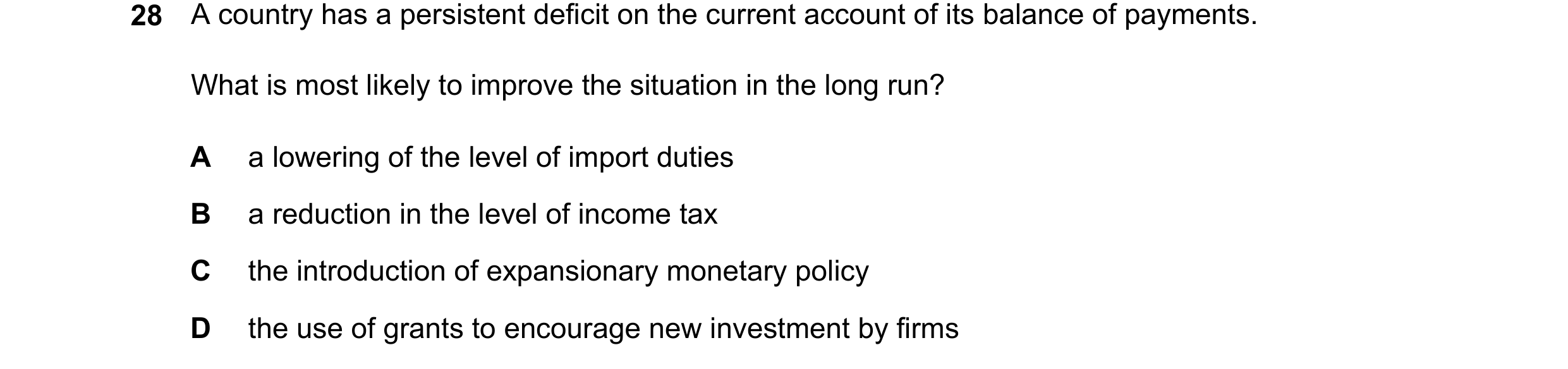
28 A country has a persistent deficit on the current account of its balance of payments. What is most likely to improve the situation in the long run? A a lowering of the level of import duties B a reduction in the level of income tax C the introduction of expansionary monetary policy D the use of grants to encourage new investment by firms
1 marks
Answer: D
This question in 9708/11 May/June 2025
Q72 · A country increases its spending on education and training 9708/12 May/June 2025
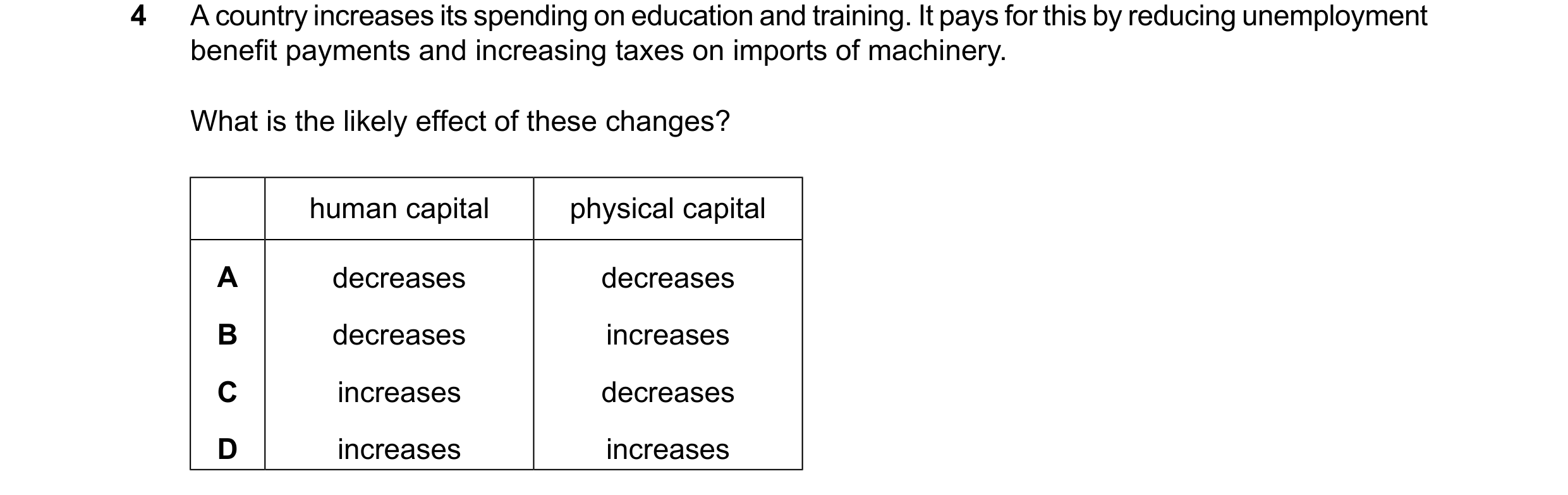
4 A country increases its spending on education and training. It pays for this by reducing unemployment benefit payments and increasing taxes on imports of machinery. What is the likely effect of these changes? human capital physical capital A decreases decreases B decreases increases C increases decreases D increases increases
1 marks
Answer: C
This question in 9708/12 May/June 2025
Q73 · Which supply-side policy will encourage new entrepreneurs? 9708/12 May/June 2025
24 Which supply-side policy will encourage new entrepreneurs? A an increase in government subsidy to small firms B an increase in the national minimum wage C an increase in the power of trade unions D an increase in the tax on business profits
1 marks
Answer: A
This question in 9708/12 May/June 2025
Q74 · Which statement about supply-side policies is correct? 9708/13 May/June 2025
24 Which statement about supply-side policies is correct? A They solve the problem of demand deficient unemployment. B They do not involve an opportunity cost. C They reduce unemployment but do not affect the price level. D They may reduce regional unemployment.
1 marks
Answer: D
This question in 9708/13 May/June 2025
Q75 · A government reduces its expenditure on workplace training, increases the level of… 9708/11 Oct/Nov 2025
24 A government reduces its expenditure on workplace training, increases the level of indirect taxes and reduces the rate of interest it pays on government debt. How would these government macroeconomic policies be categorised? supply-side fiscal monetary A con con exp key B exp con con con = contractionary C con exp exp exp = expansionary D exp exp con
1 marks
Answer: A
This question in 9708/11 Oct/Nov 2025
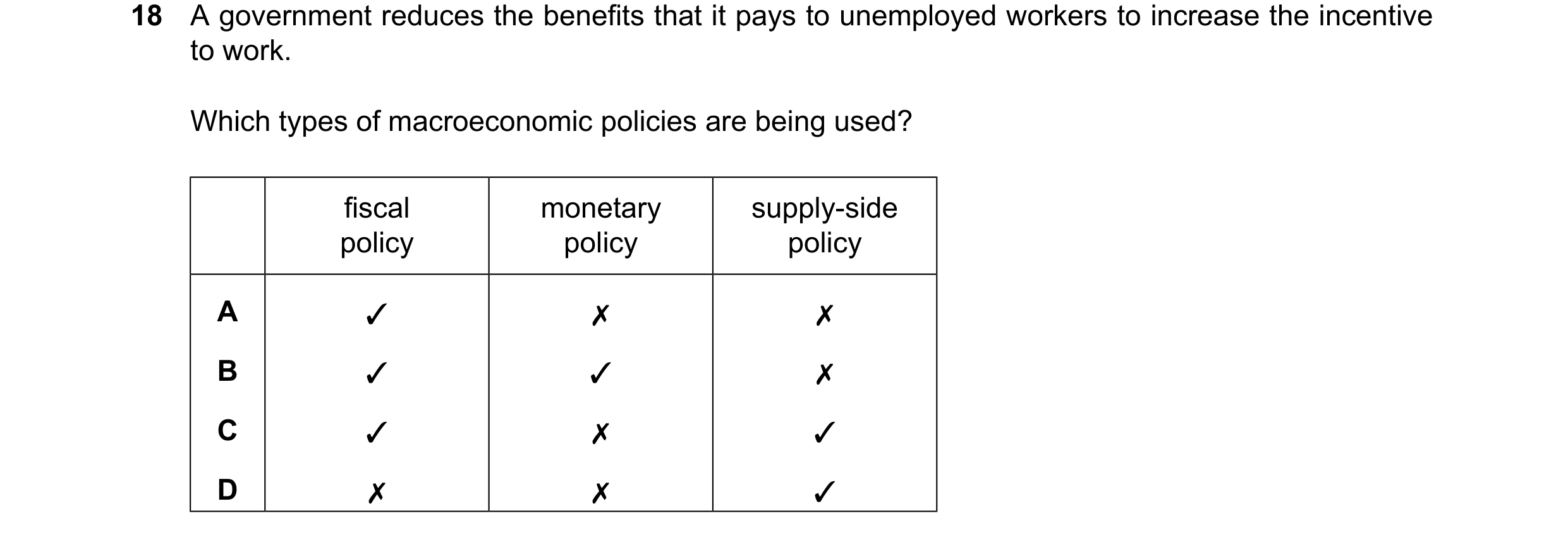
Q76 · A government reduces the benefits that it pays to unemployed workers to increase the… 9708/12 Oct/Nov 2025
18 A government reduces the benefits that it pays to unemployed workers to increase the incentive to work. Which types of macroeconomic policies are being used? fiscal monetary supply-side policy policy policy A ✓ ✗ ✗ B ✓ ✓ ✗ C ✓ ✗ ✓ D ✗ ✗ ✓
1 marks
Answer: C
This question in 9708/12 Oct/Nov 2025
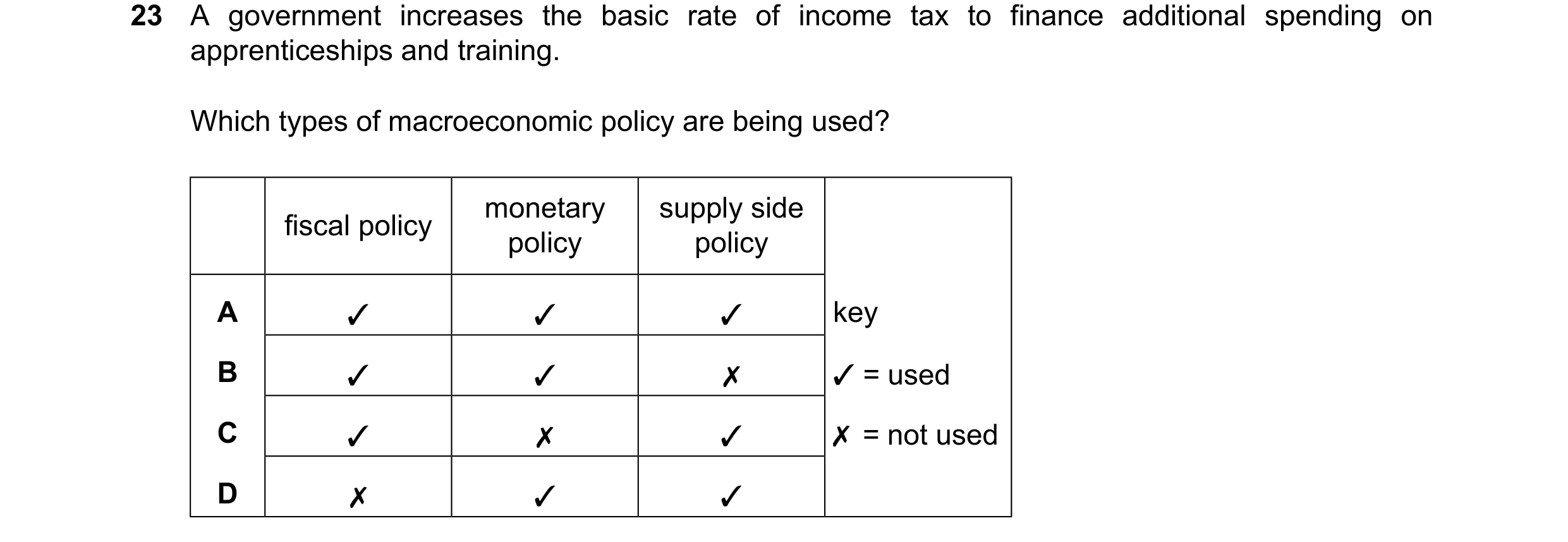
Q77 · A government increases the basic rate of income tax to finance additional spending on… 9708/13 Oct/Nov 2025
23 A government increases the basic rate of income tax to finance additional spending on apprenticeships and training. Which types of macroeconomic policy are being used? monetary supply side fiscal policy policy policy A ✓ ✓ ✓ key B ✓ ✓ ✗ ✓= used C ✓ ✗ ✓ ✗= not used D ✗ ✓ ✓
1 marks
Answer: C
This question in 9708/13 Oct/Nov 2025
Q78 · The diagram shows an economy in equilibrium with a real output of Y and a price level of P 9708/13 Oct/Nov 2025
24 The diagram shows an economy in equilibrium with a real output of Y and a price level of P. The government aims to raise real output from Y to full employment (YFE) without increasing the price level in the long run. LRAS price level P AD O Y YFE real output Which fiscal policy change is most likely to achieve this aim? A decreasing the rate of income tax B decreasing spending on education C increasing the level of sales tax D increasing welfare benefit payments
1 marks
Answer: A
This question in 9708/13 Oct/Nov 2025
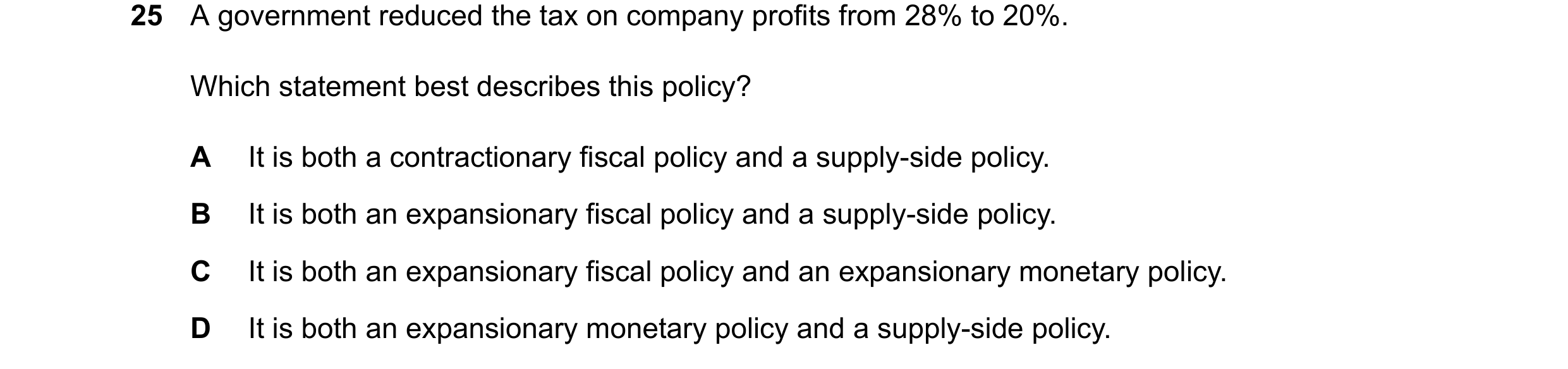
Q79 · A government reduced the tax on company profits from 28% to 20% 9708/13 Oct/Nov 2025
25 A government reduced the tax on company profits from 28% to 20%. Which statement best describes this policy? A It is both a contractionary fiscal policy and a supply-side policy. B It is both an expansionary fiscal policy and a supply-side policy. C It is both an expansionary fiscal policy and an expansionary monetary policy. D It is both an expansionary monetary policy and a supply-side policy.
1 marks
Answer: B
This question in 9708/13 Oct/Nov 2025
 1 / 23
 2 / 23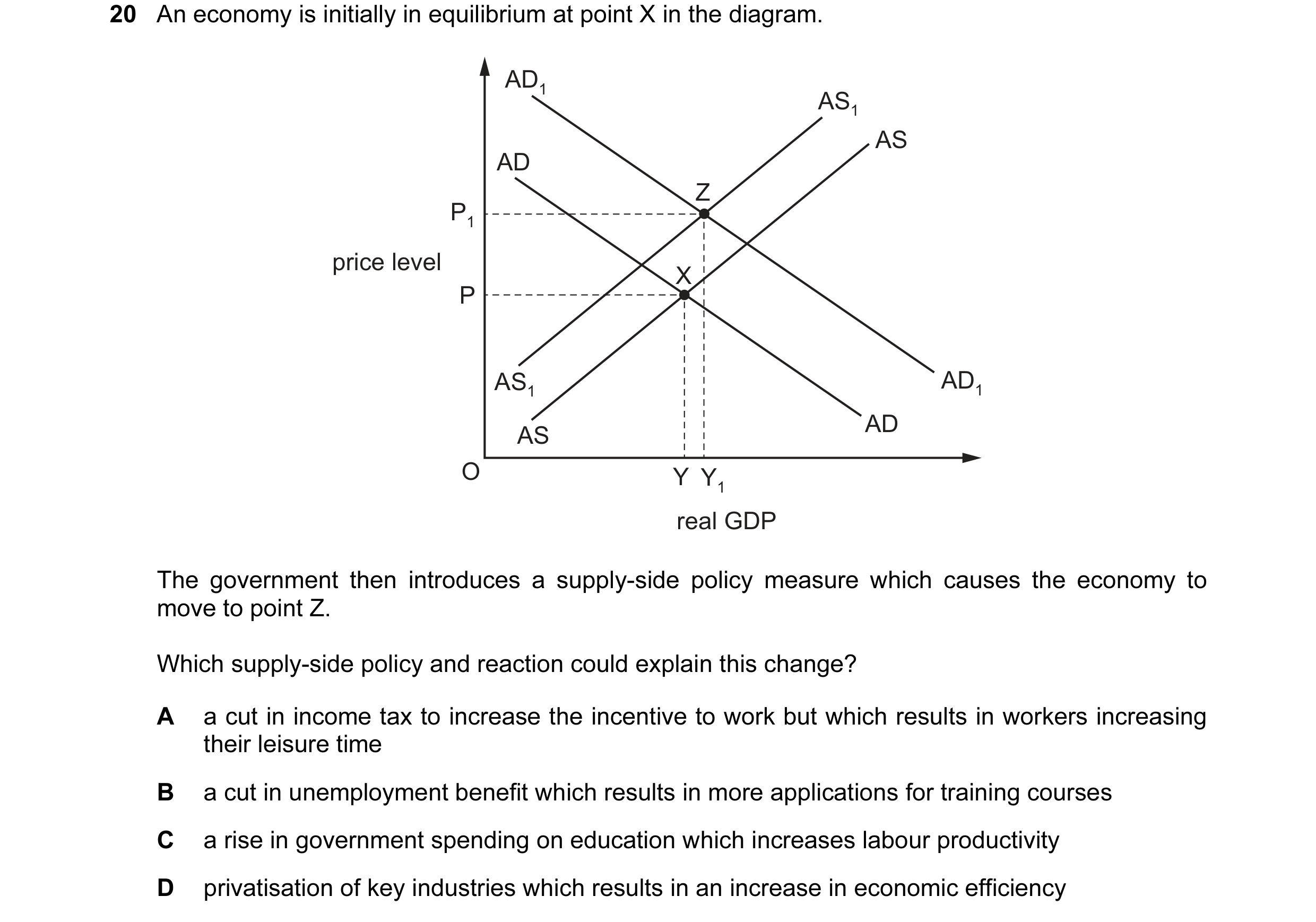
 3 / 23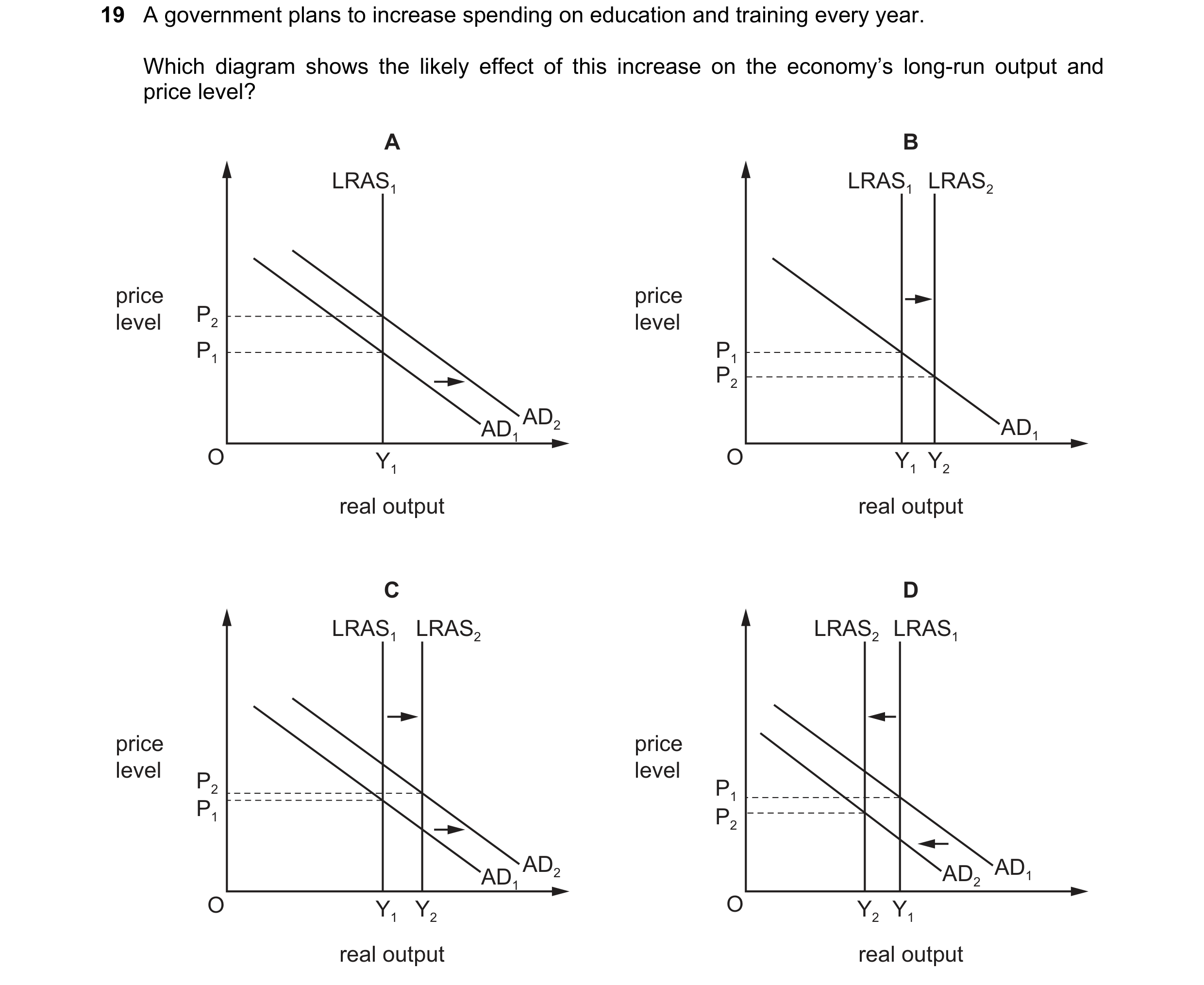
 4 / 23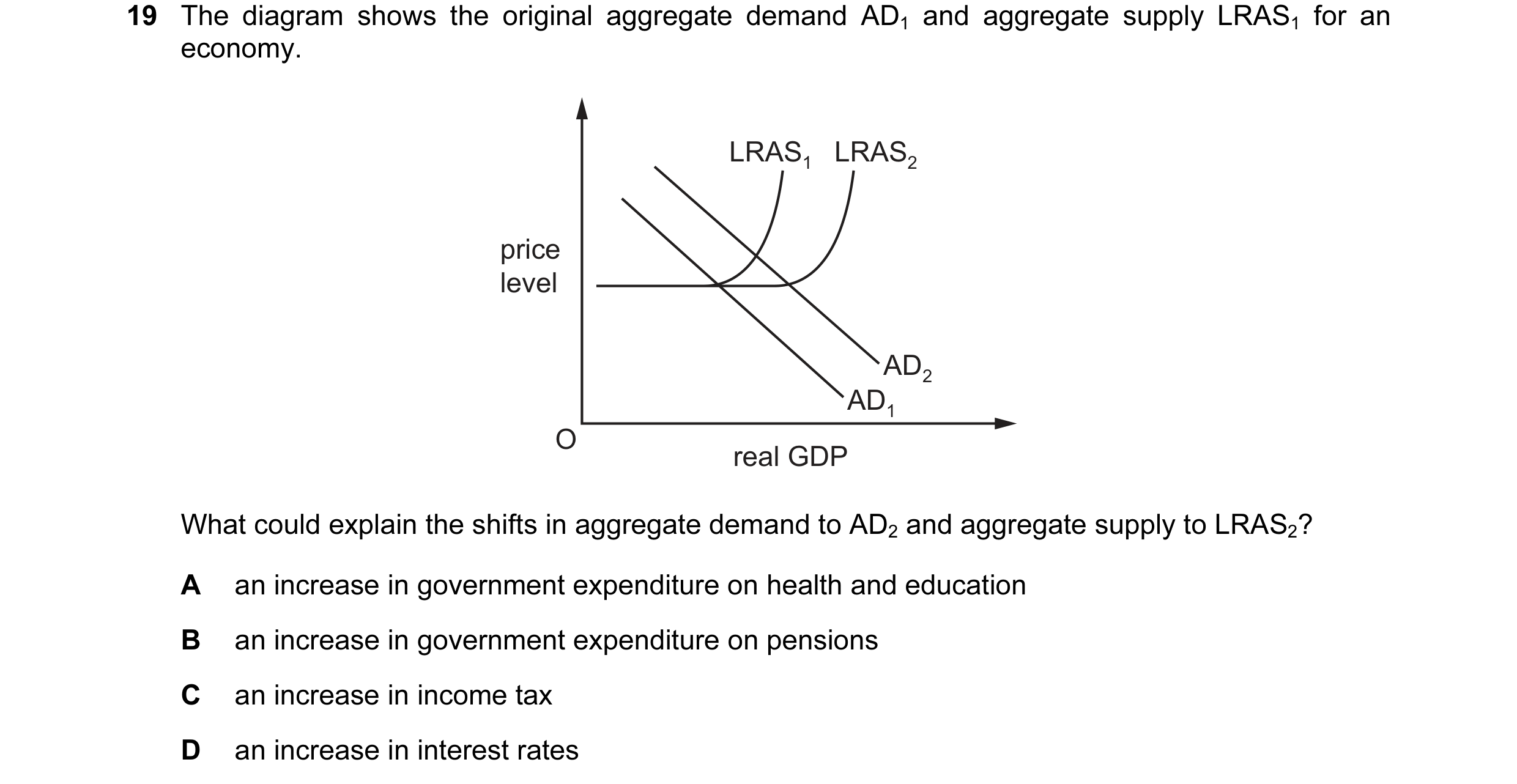
 5 / 23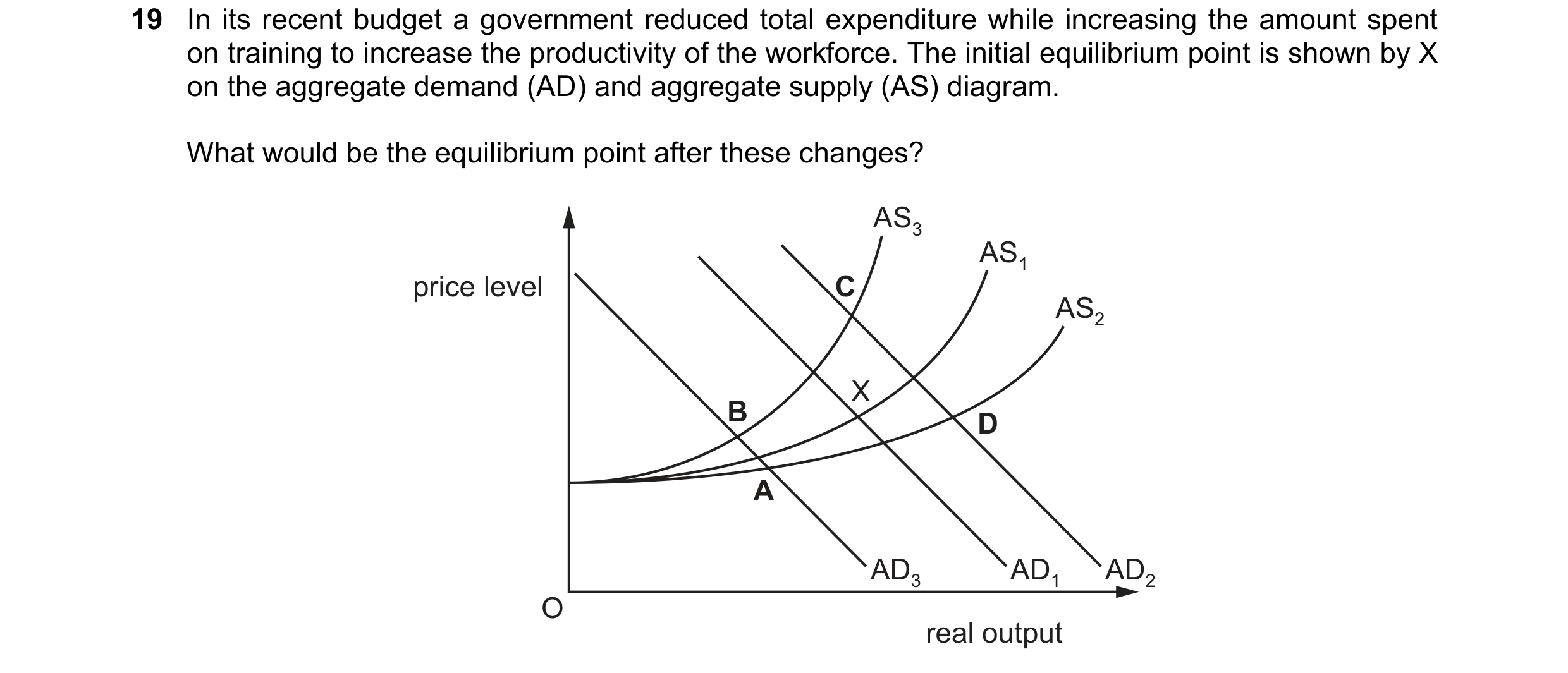
 6 / 23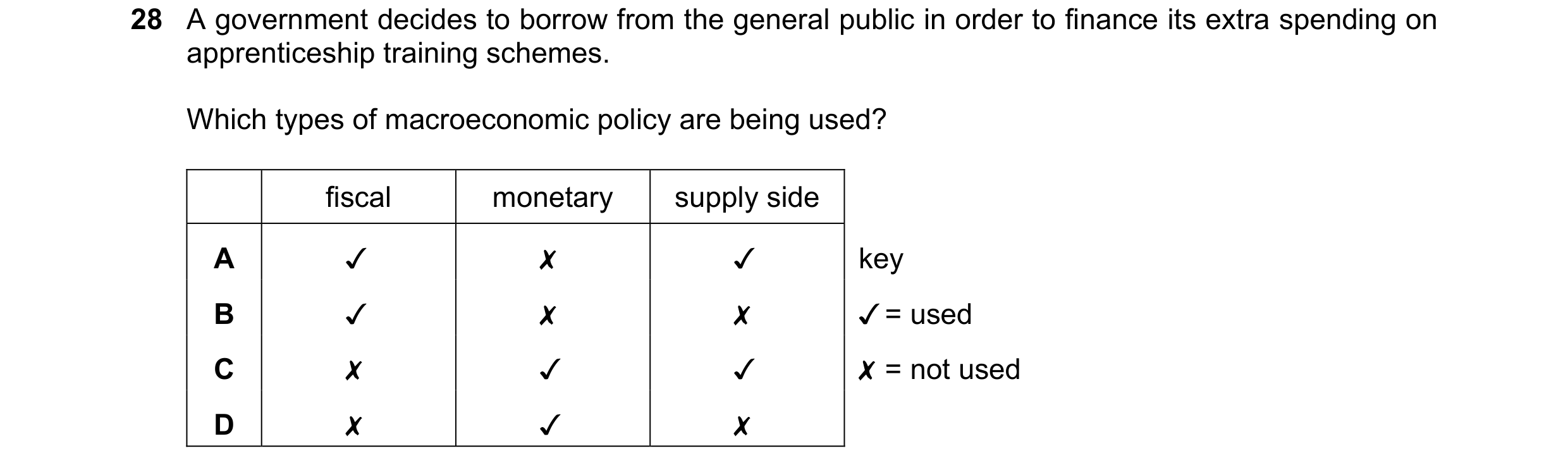
 7 / 23

 8 / 23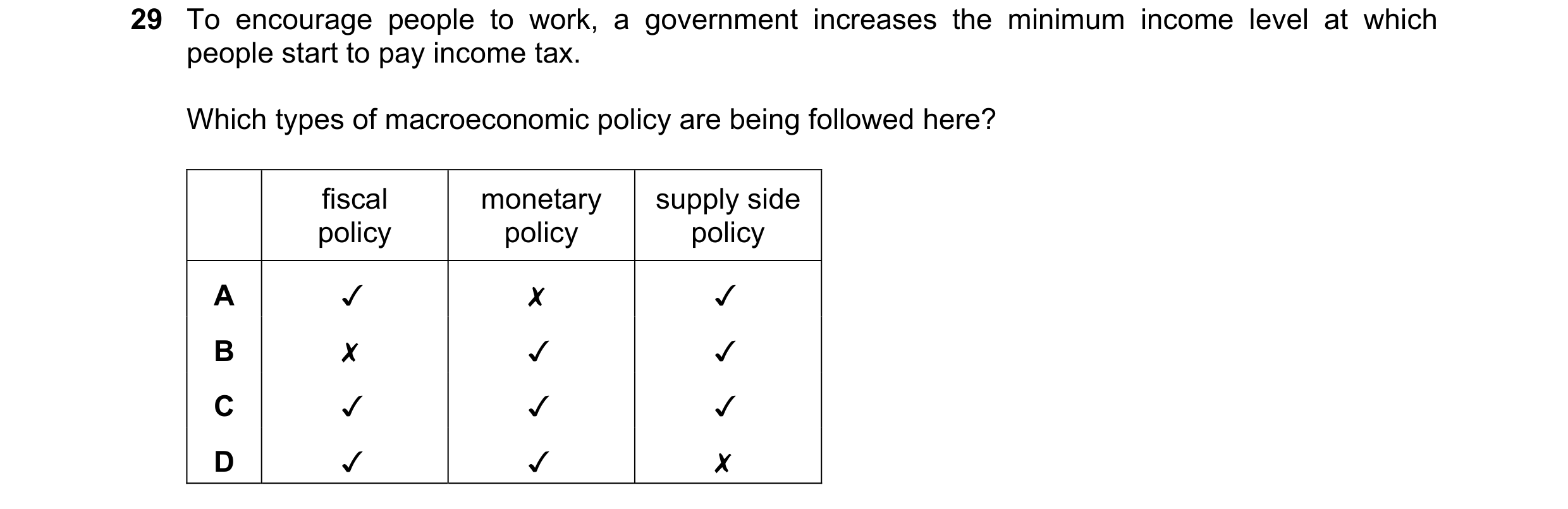

 9 / 23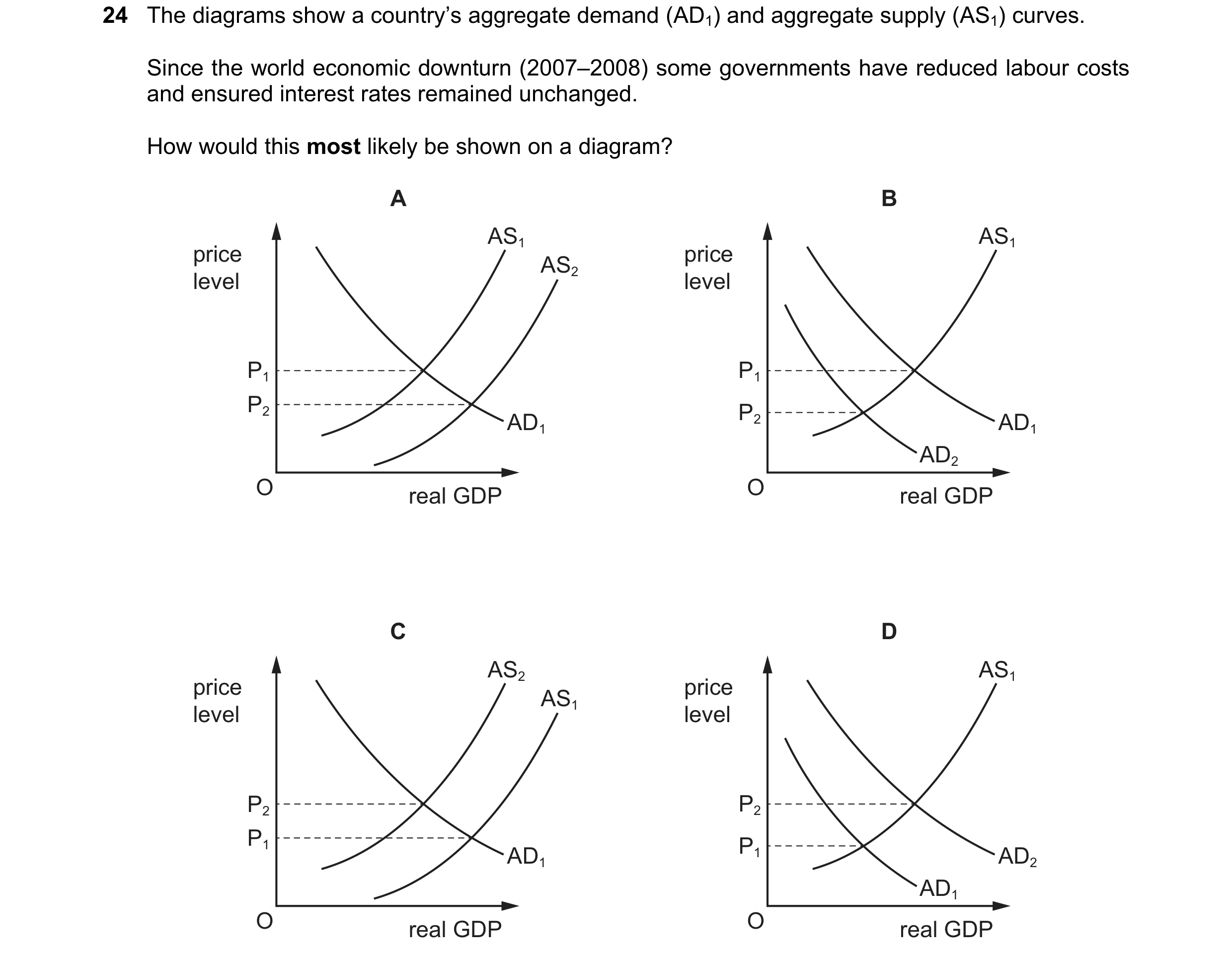
 10 / 23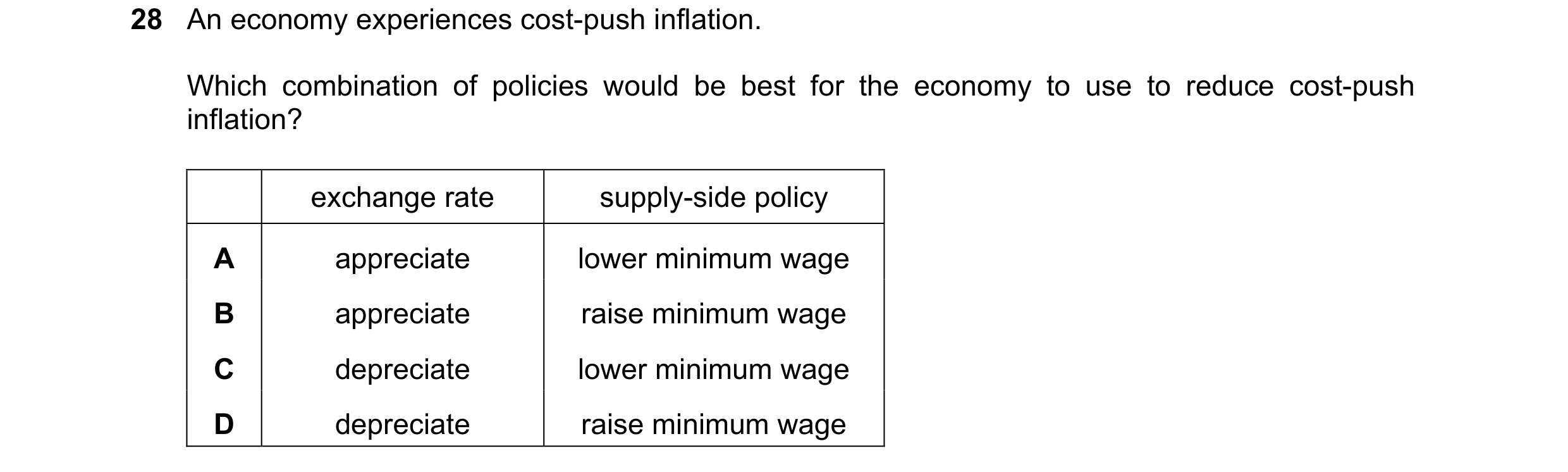
 11 / 23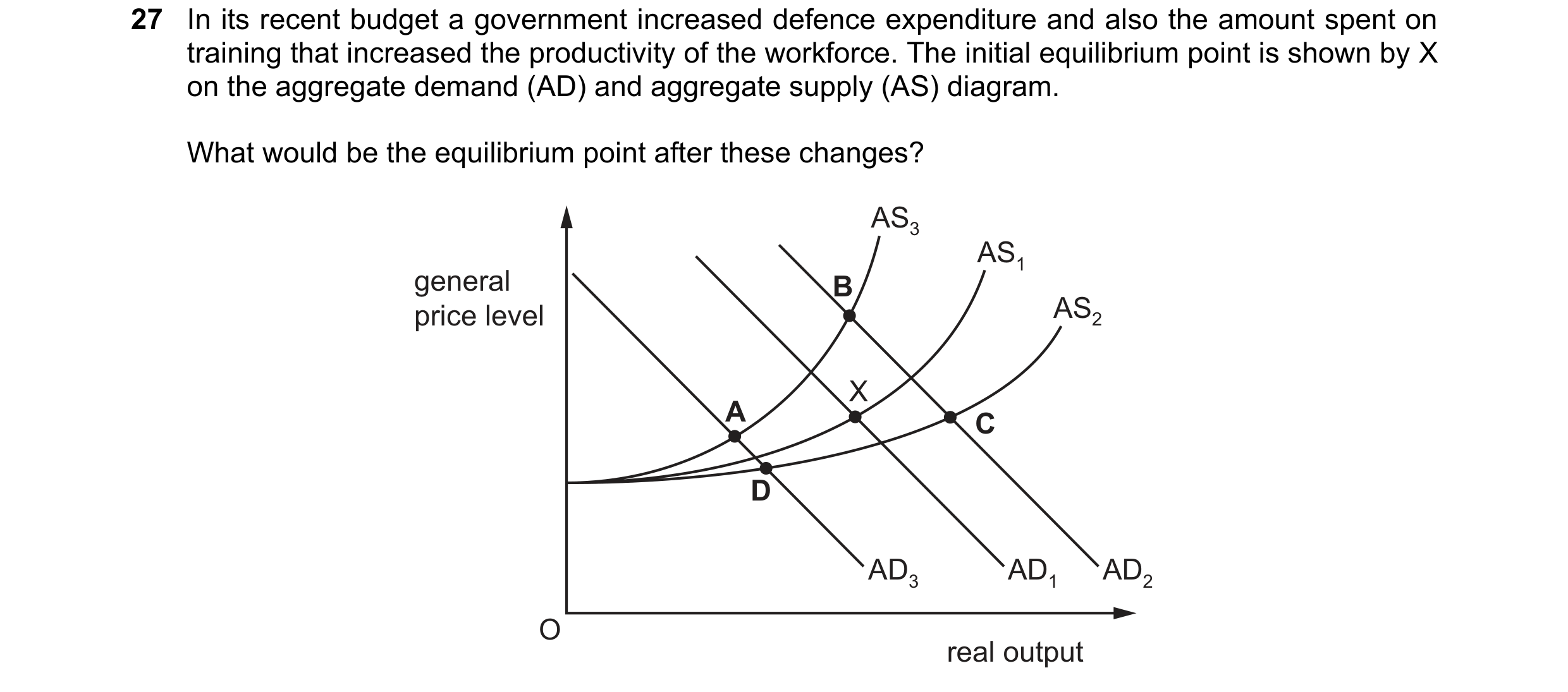

 12 / 23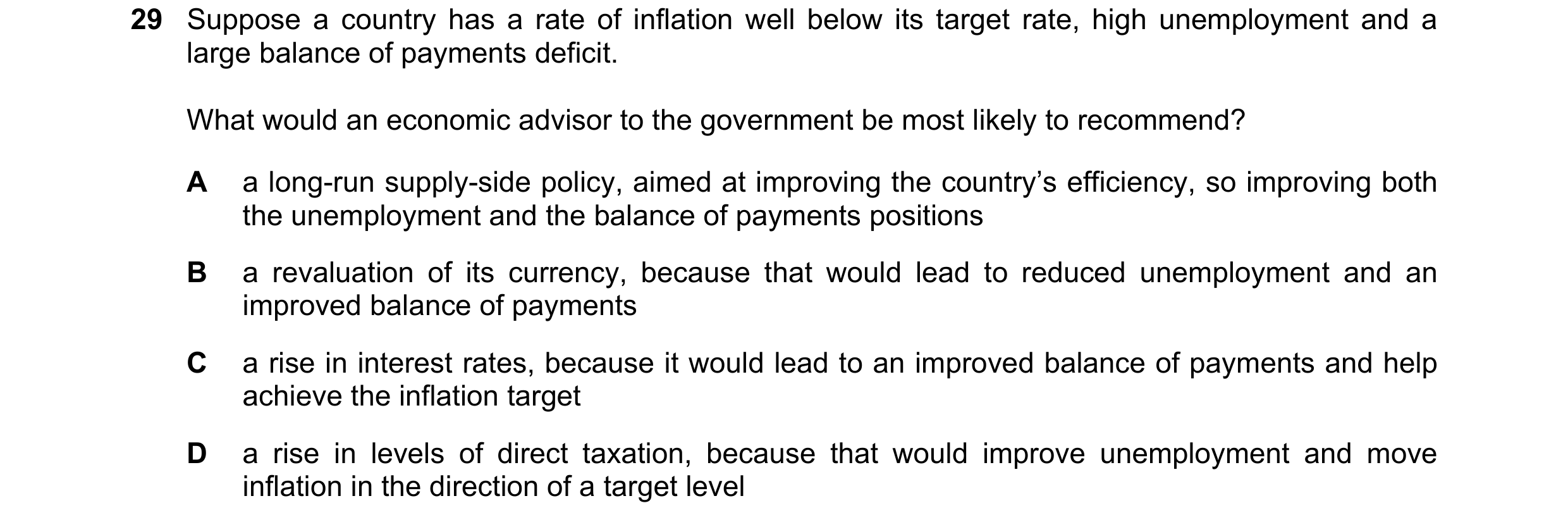
 13 / 23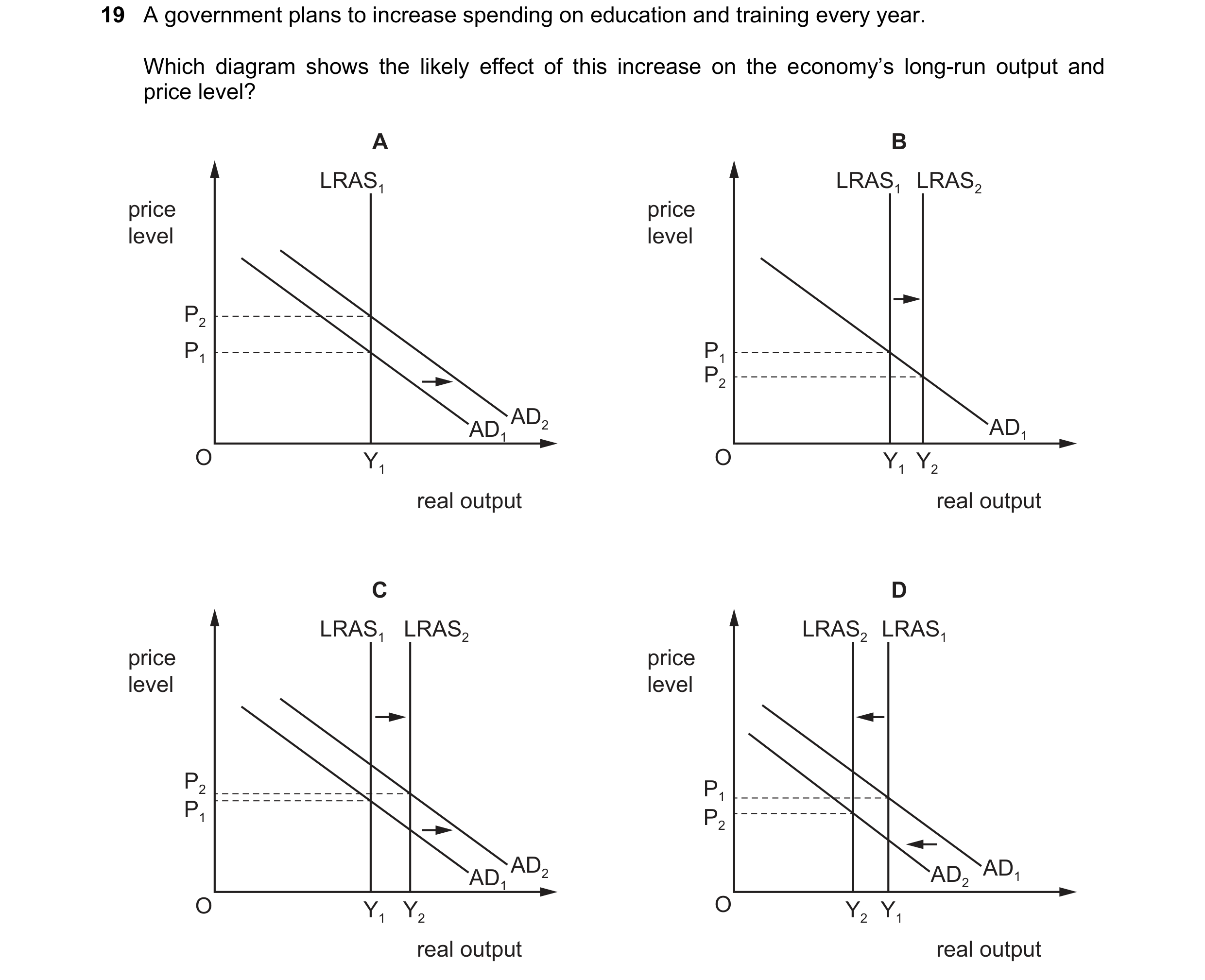
 14 / 23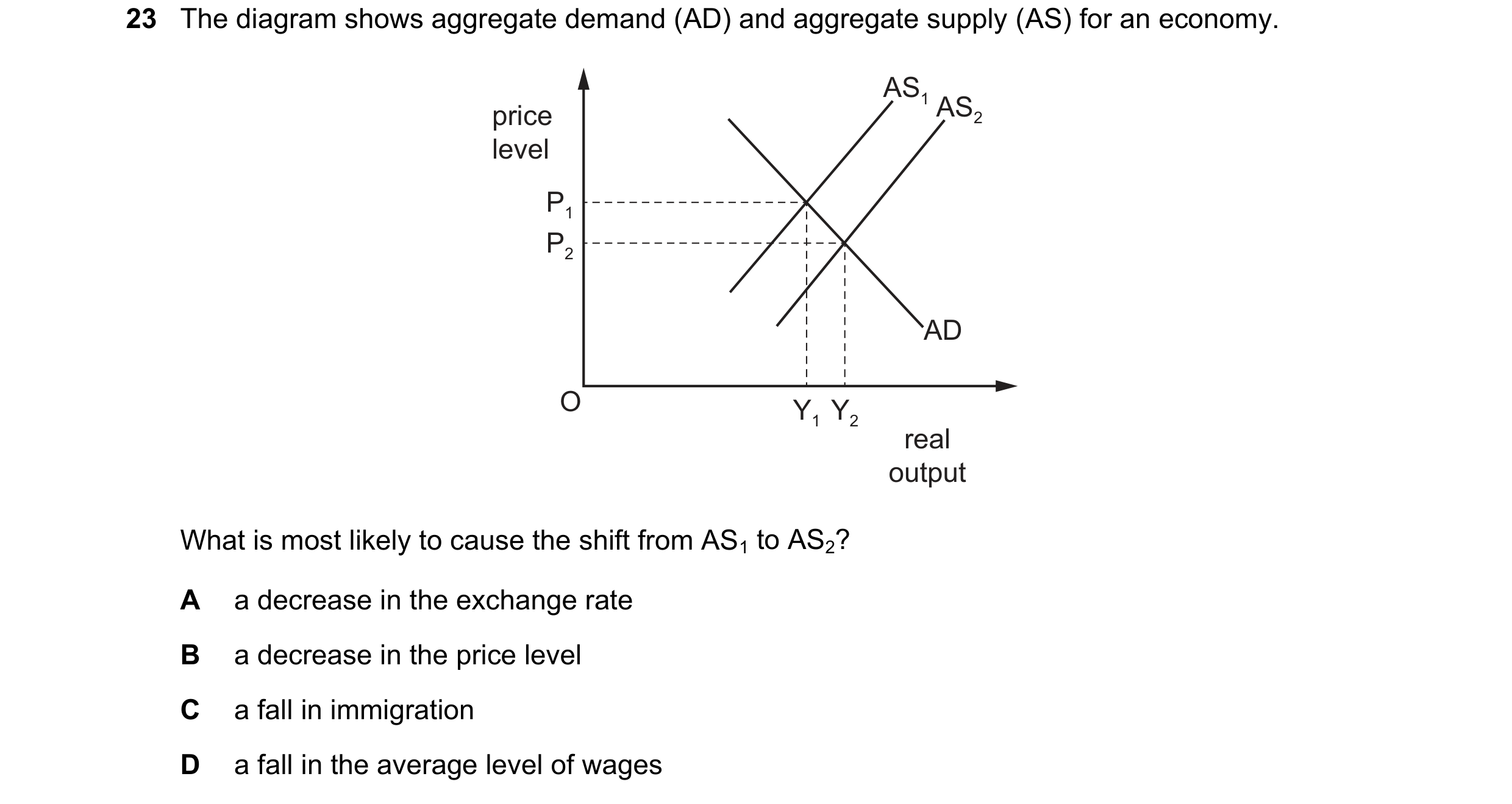
 15 / 23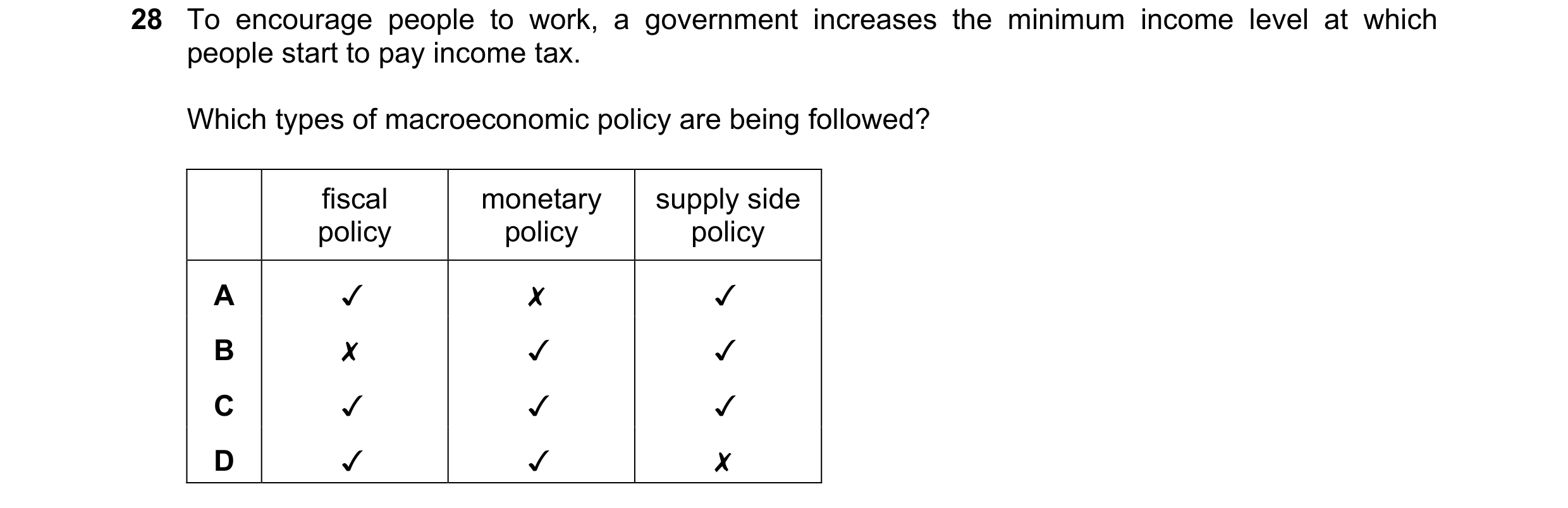
 16 / 23

 17 / 23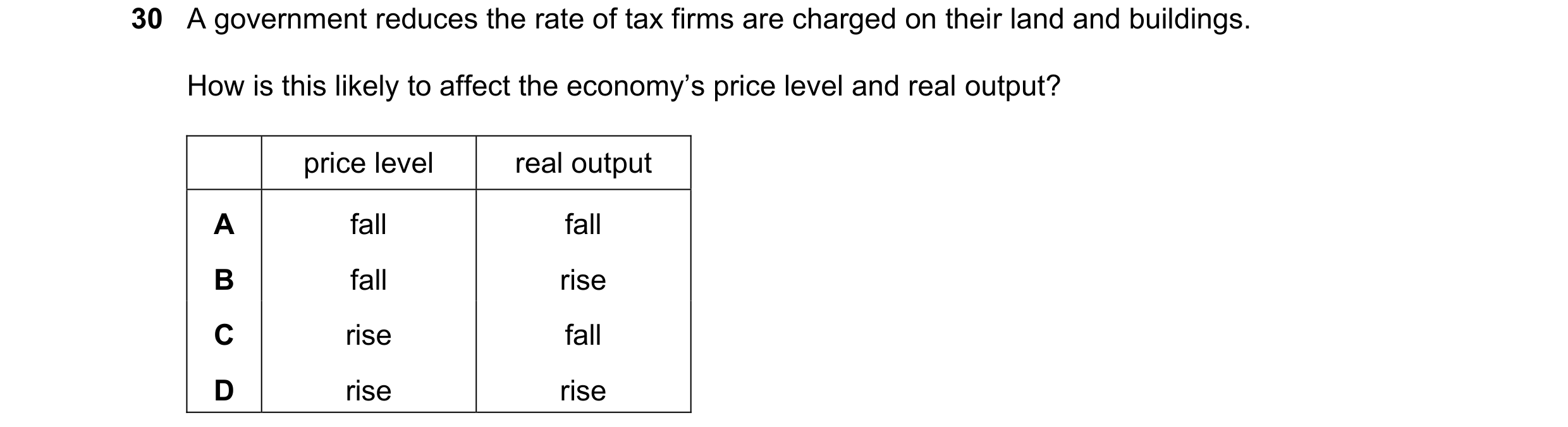
 18 / 23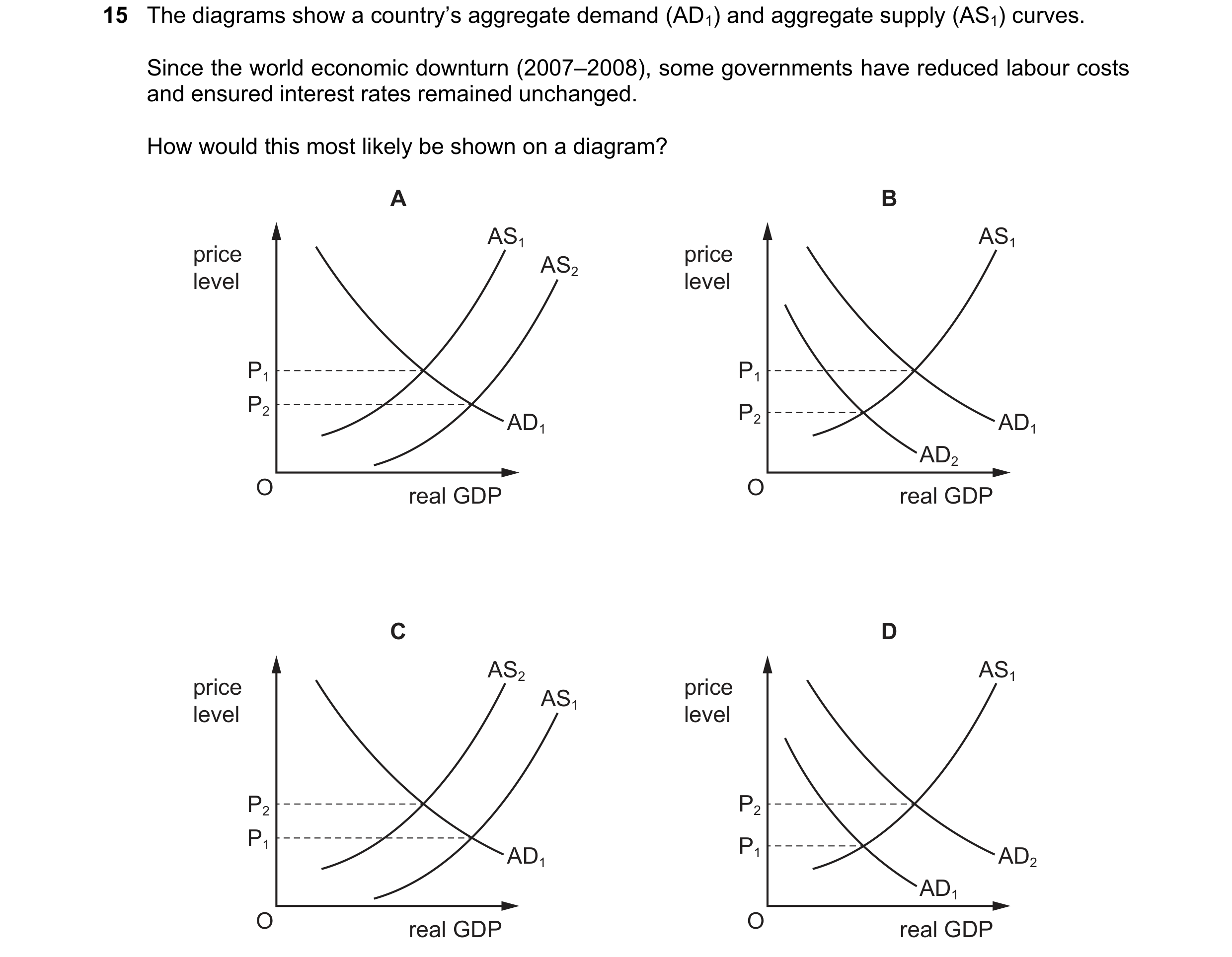

 19 / 23

 20 / 23

 21 / 23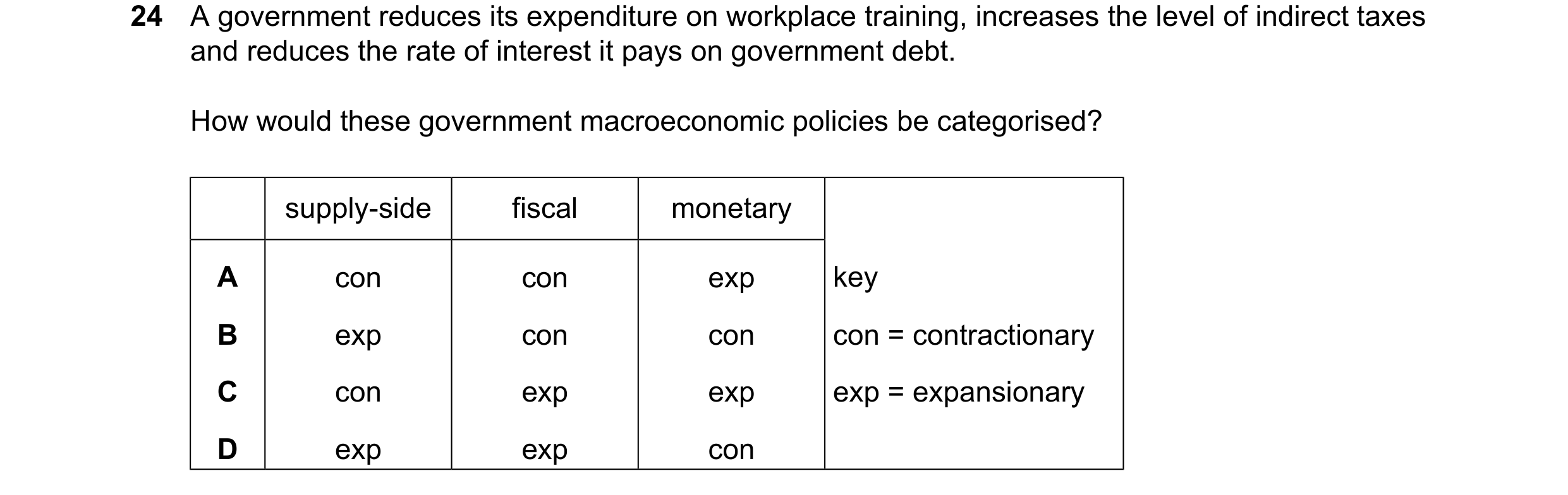
 22 / 23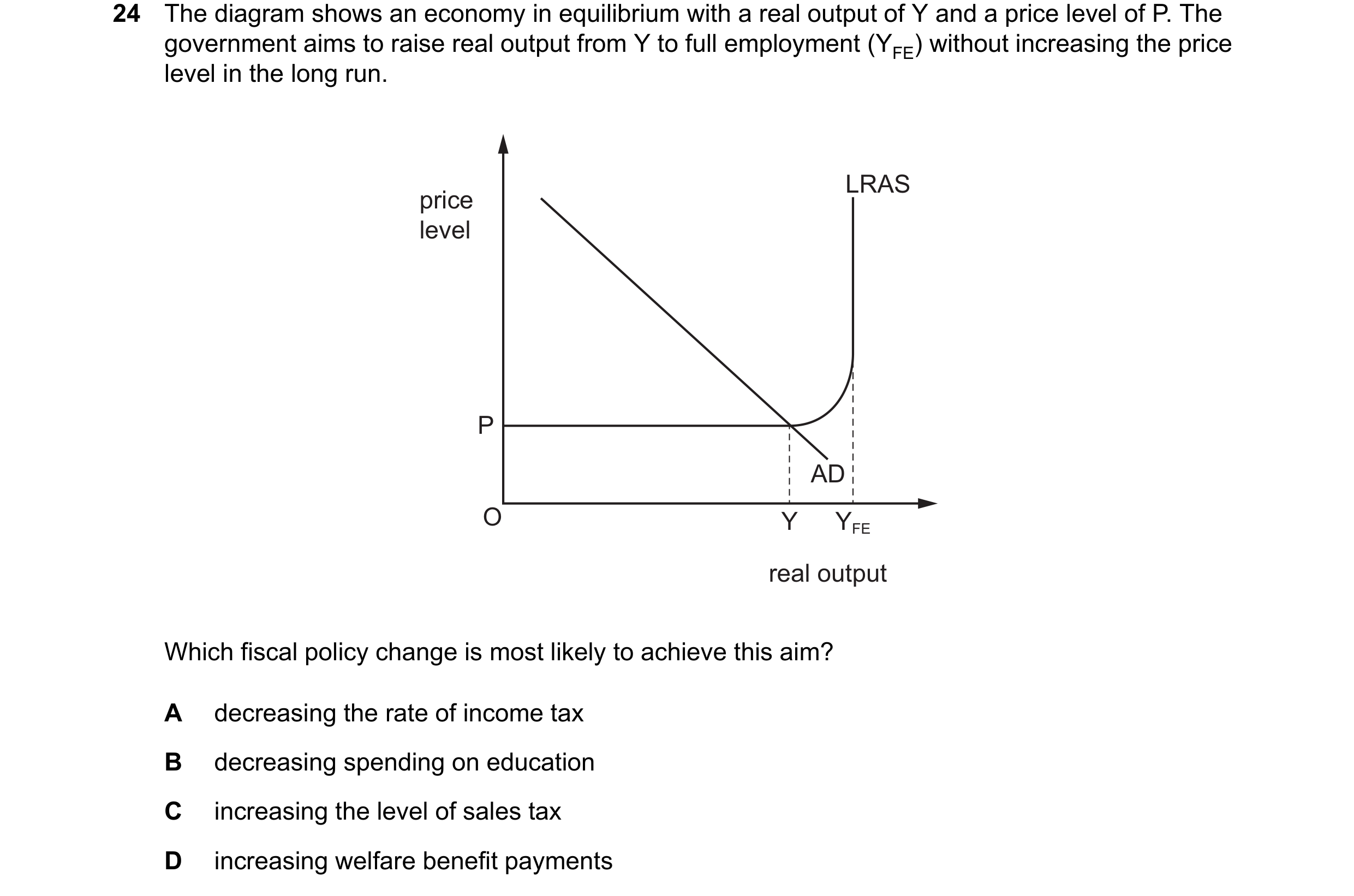
 23 / 23