Questions as text
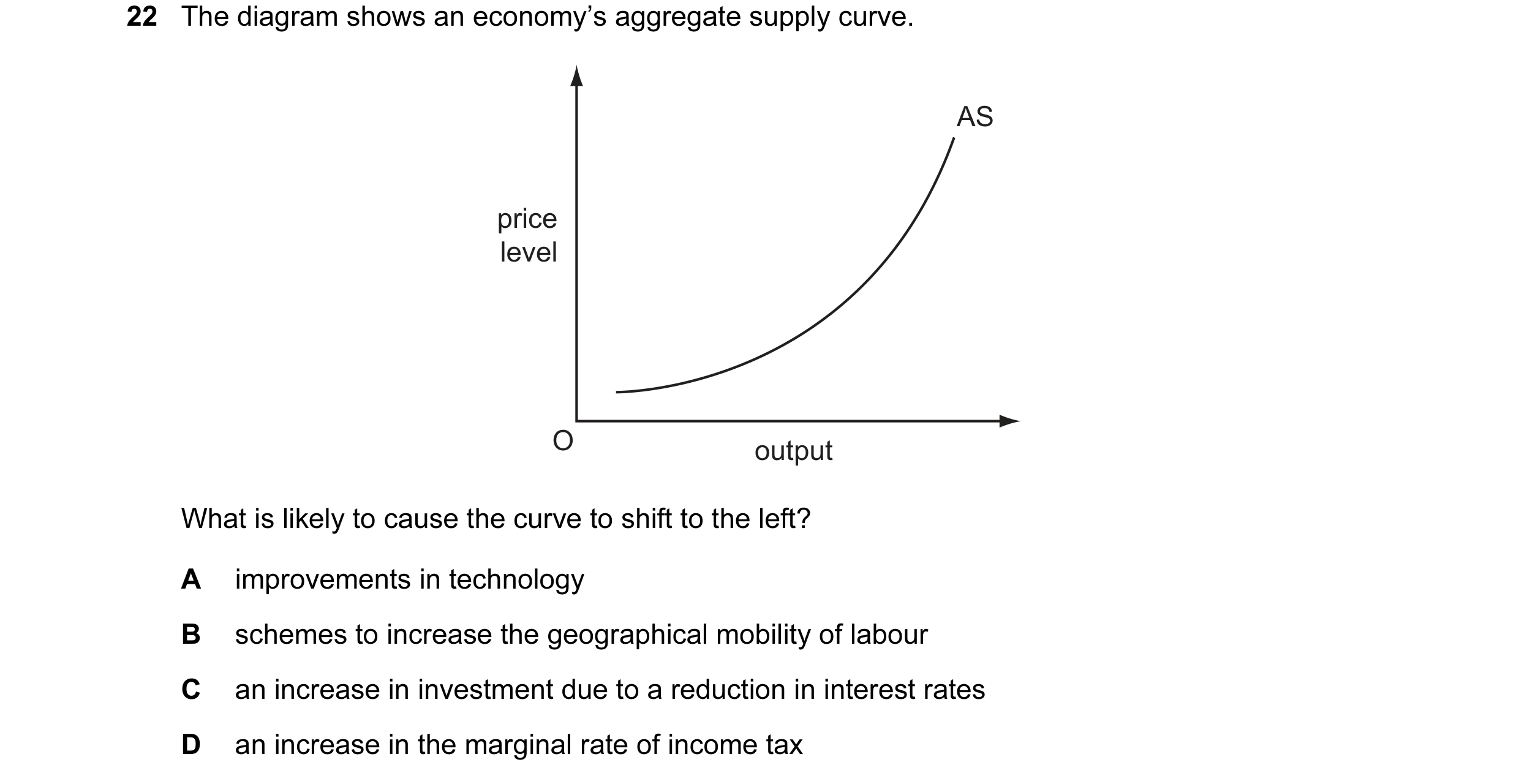
Q1 · The diagram shows an economy’s aggregate supply curve 9708/31 Oct/Nov 2009
22 The diagram shows an economy’s aggregate supply curve. AS price level O output What is likely to cause the curve to shift to the left? A improvements in technology B schemes to increase the geographical mobility of labour C an increase in investment due to a reduction in interest rates D an increase in the marginal rate of income tax
1 marks
Answer: D
This question in 9708/31 Oct/Nov 2009
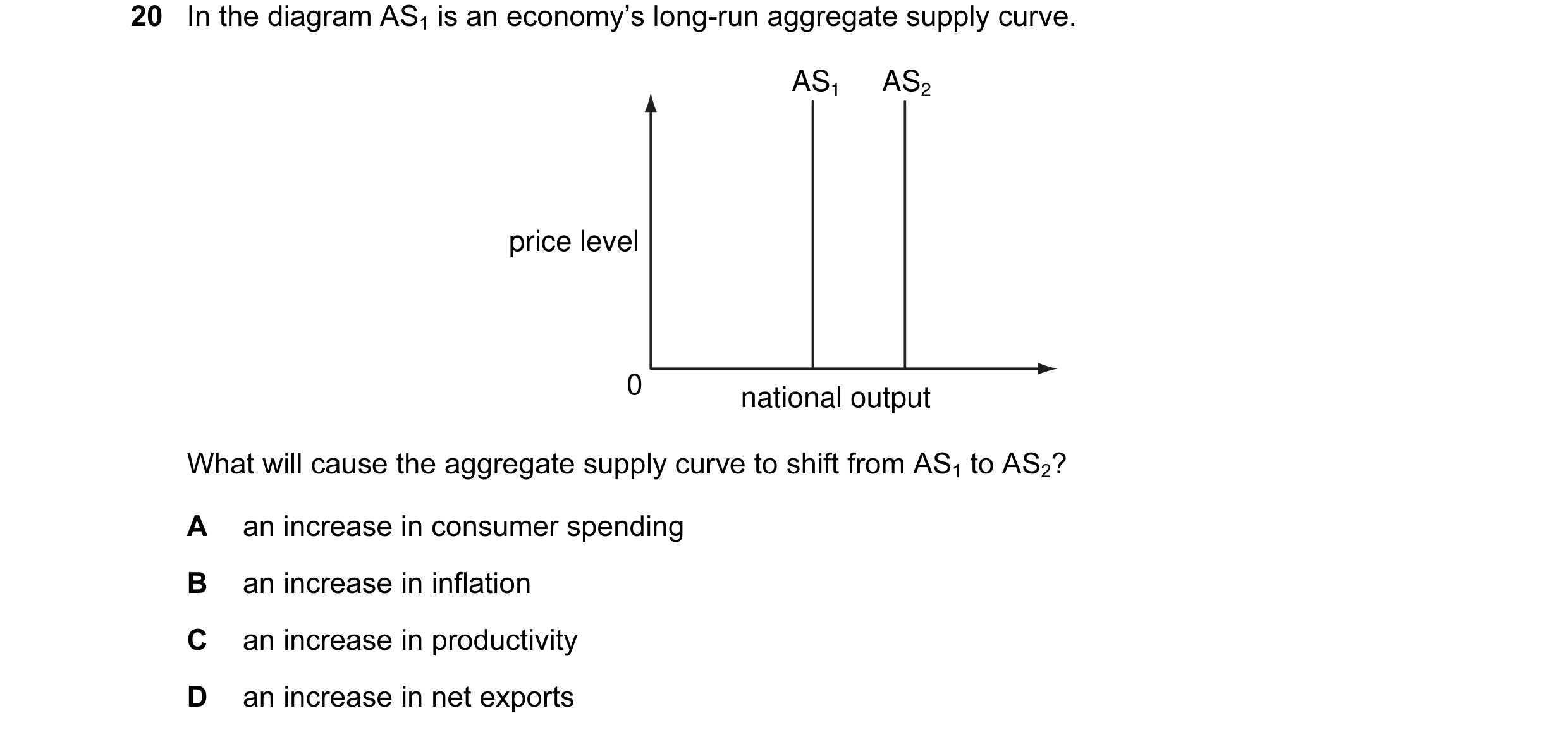
Q2 · In the diagram AS1 is an economy’s long-run aggregate supply curve 9708/32 May/June 2010
20 In the diagram AS1 is an economy’s long-run aggregate supply curve. AS1 AS2 price level 0 national output What will cause the aggregate supply curve to shift from AS1 to AS2? A an increase in consumer spending B an increase in inflation C an increase in productivity D an increase in net exports
1 marks
Answer: C
This question in 9708/32 May/June 2010
Q3 · In the diagram AS1 is an economy’s long-run aggregate supply curve 9708/33 May/June 2010
20 In the diagram AS1 is an economy’s long-run aggregate supply curve. AS1 AS2 price level 0 national output What will cause the aggregate supply curve to shift from AS1 to AS2? A an increase in consumer spending B an increase in inflation C an increase in productivity D an increase in net exports
1 marks
Answer: C
This question in 9708/33 May/June 2010
Q4 · What would be classified as a supply side policy measure? 9708/31 May/June 2011
28 What would be classified as a supply side policy measure? A additional legislation to restrict the power of trade unions B a reduction in the government’s fiscal deficit C an open market sale of securities D the imposition of a tariff on imported goods
1 marks
Answer: A
This question in 9708/31 May/June 2011
Q5 · What would be classified as a supply side policy measure? 9708/32 May/June 2011
27 What would be classified as a supply side policy measure? A additional legislation to restrict the power of trade unions B a reduction in the government’s fiscal deficit C an open market sale of securities D the imposition of a tariff on imported goods
1 marks
Answer: A
This question in 9708/32 May/June 2011
Q6 · What would be classified as a supply side policy measure? 9708/33 May/June 2011
27 What would be classified as a supply side policy measure? A additional legislation to restrict the power of trade unions B a reduction in the government’s fiscal deficit C an open market sale of securities D the imposition of a tariff on imported goods
1 marks
Answer: A
This question in 9708/33 May/June 2011
Q7 · What is likely to increase a country’s actual output in the short run but may reduce its… 9708/33 Oct/Nov 2011
20 What is likely to increase a country’s actual output in the short run but may reduce its long-run rate of growth of potential output? A an increase in the size of the government’s budget deficit B an increase in the size of the labour force C increased female participation in the labour force D increased government spending on education
1 marks
Answer: A
This question in 9708/33 Oct/Nov 2011
Q8 · A government’s priority is to reduce the natural rate of unemployment (NAIRU) 9708/31 May/June 2012
27 A government’s priority is to reduce the natural rate of unemployment (NAIRU). Which policy would be most likely to help it achieve this objective? A an increase in interest rates B an increase in rates of unemployment benefit C the introduction of minimum wage rates D the introduction of subsidised travel for unemployed workers to search for jobs
1 marks
Answer: D
This question in 9708/31 May/June 2012
Q9 · The government of Lesotho introduces a programme to promote exports and to encourage… 9708/31 May/June 2012
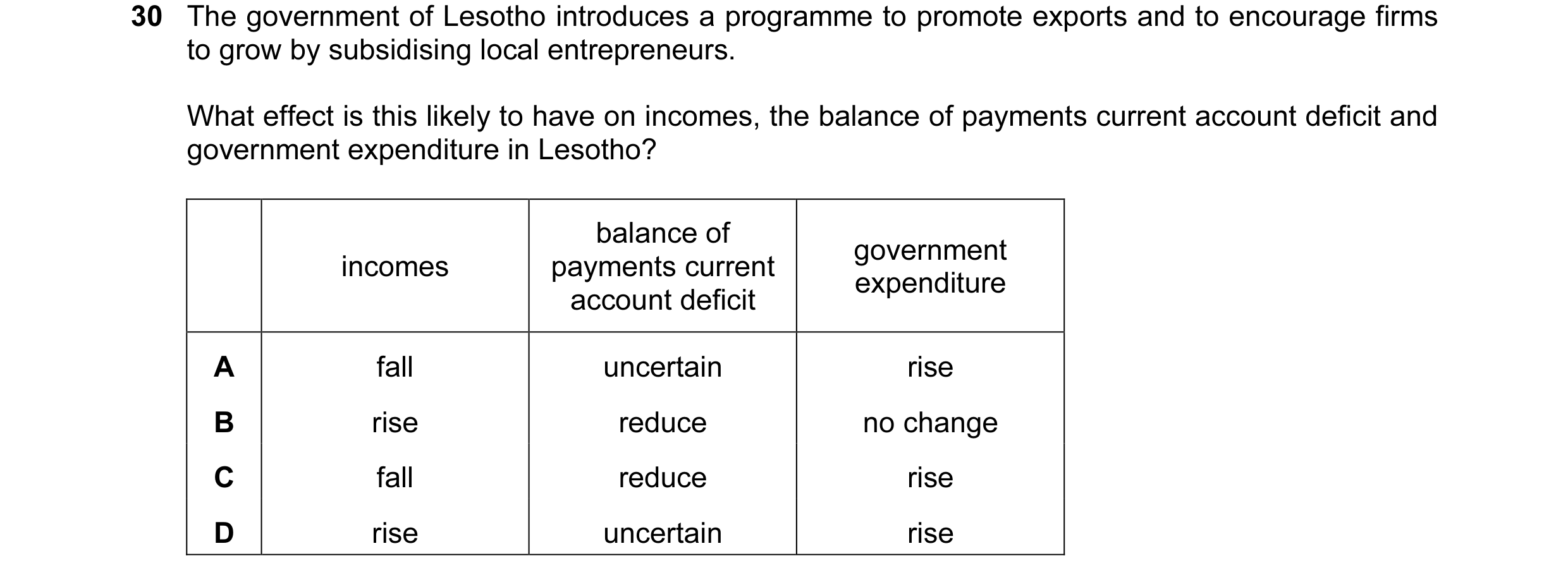
30 The government of Lesotho introduces a programme to promote exports and to encourage firms to grow by subsidising local entrepreneurs. What effect is this likely to have on incomes, the balance of payments current account deficit and government expenditure in Lesotho? balance of government incomes payments current expenditure account deficit A fall uncertain rise B rise reduce no change C fall reduce rise D rise uncertain rise
1 marks
Answer: D
This question in 9708/31 May/June 2012
Q10 · What will be most likely to decrease a country’s national output in the short run but to… 9708/32 May/June 2012
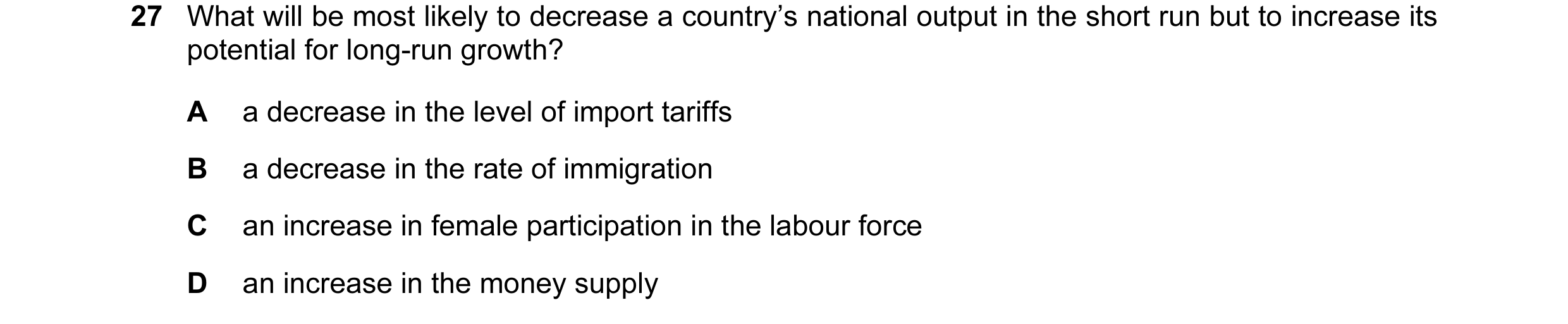
27 What will be most likely to decrease a country’s national output in the short run but to increase its potential for long-run growth? A a decrease in the level of import tariffs B a decrease in the rate of immigration C an increase in female participation in the labour force D an increase in the money supply
1 marks
Answer: A
This question in 9708/32 May/June 2012
Q11 · A government’s priority is to reduce the natural rate of unemployment (NAIRU) 9708/33 May/June 2012
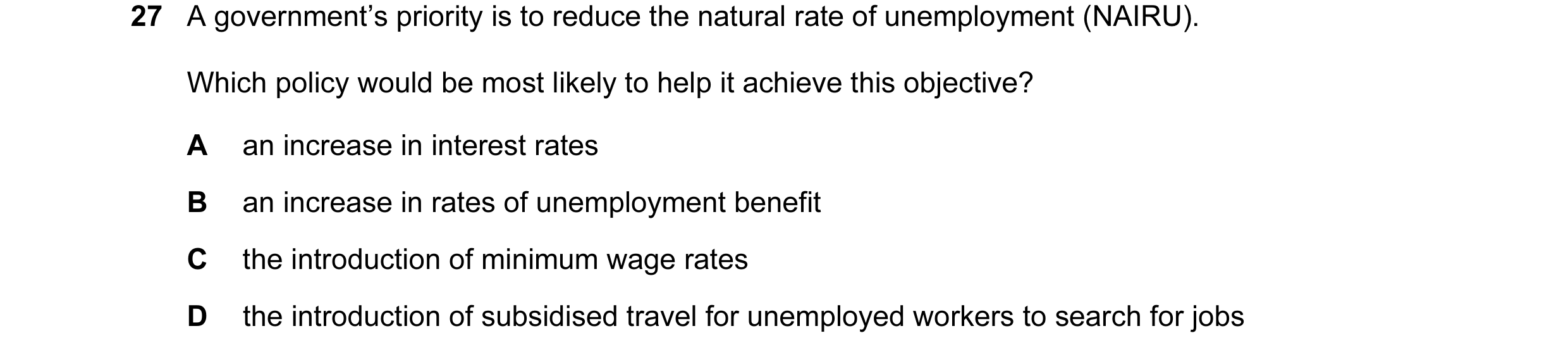
27 A government’s priority is to reduce the natural rate of unemployment (NAIRU). Which policy would be most likely to help it achieve this objective? A an increase in interest rates B an increase in rates of unemployment benefit C the introduction of minimum wage rates D the introduction of subsidised travel for unemployed workers to search for jobs
1 marks
Answer: D
This question in 9708/33 May/June 2012
Q12 · What is most likely to lead to an increase in the natural rate of unemployment? 9708/32 Oct/Nov 2012
24 What is most likely to lead to an increase in the natural rate of unemployment? A more rapid technological and structural change B a widening in regional wage differentials C a narrowing in regional house price differentials D a decrease in trade union membership
1 marks
Answer: A
This question in 9708/32 Oct/Nov 2012
Q13 · What will assist a country’s potential growth in national output? 9708/32 Oct/Nov 2012
26 What will assist a country’s potential growth in national output? A an increase in cyclical unemployment B an increase in the rate of inflation C an increase in the government's budget deficit D increased participation in the labour force
1 marks
Answer: D
This question in 9708/32 Oct/Nov 2012
Q14 · What is the most effective policy a government could introduce to reduce frictional… 9708/33 Oct/Nov 2012
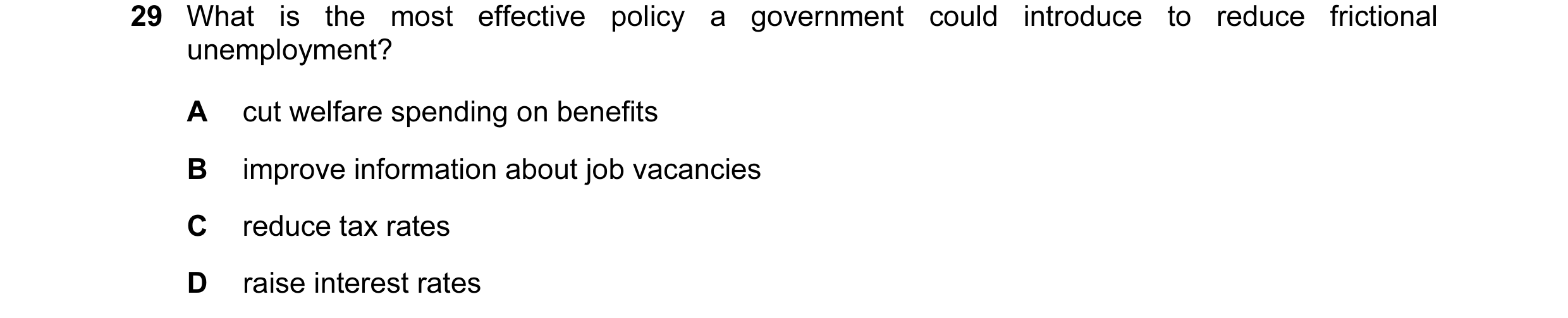
29 What is the most effective policy a government could introduce to reduce frictional unemployment? A cut welfare spending on benefits B improve information about job vacancies C reduce tax rates D raise interest rates
1 marks
This question in 9708/33 Oct/Nov 2012
Q15 · The diagram shows the short-run trade-off between a country’s inflation rate and its… 9708/31 May/June 2013
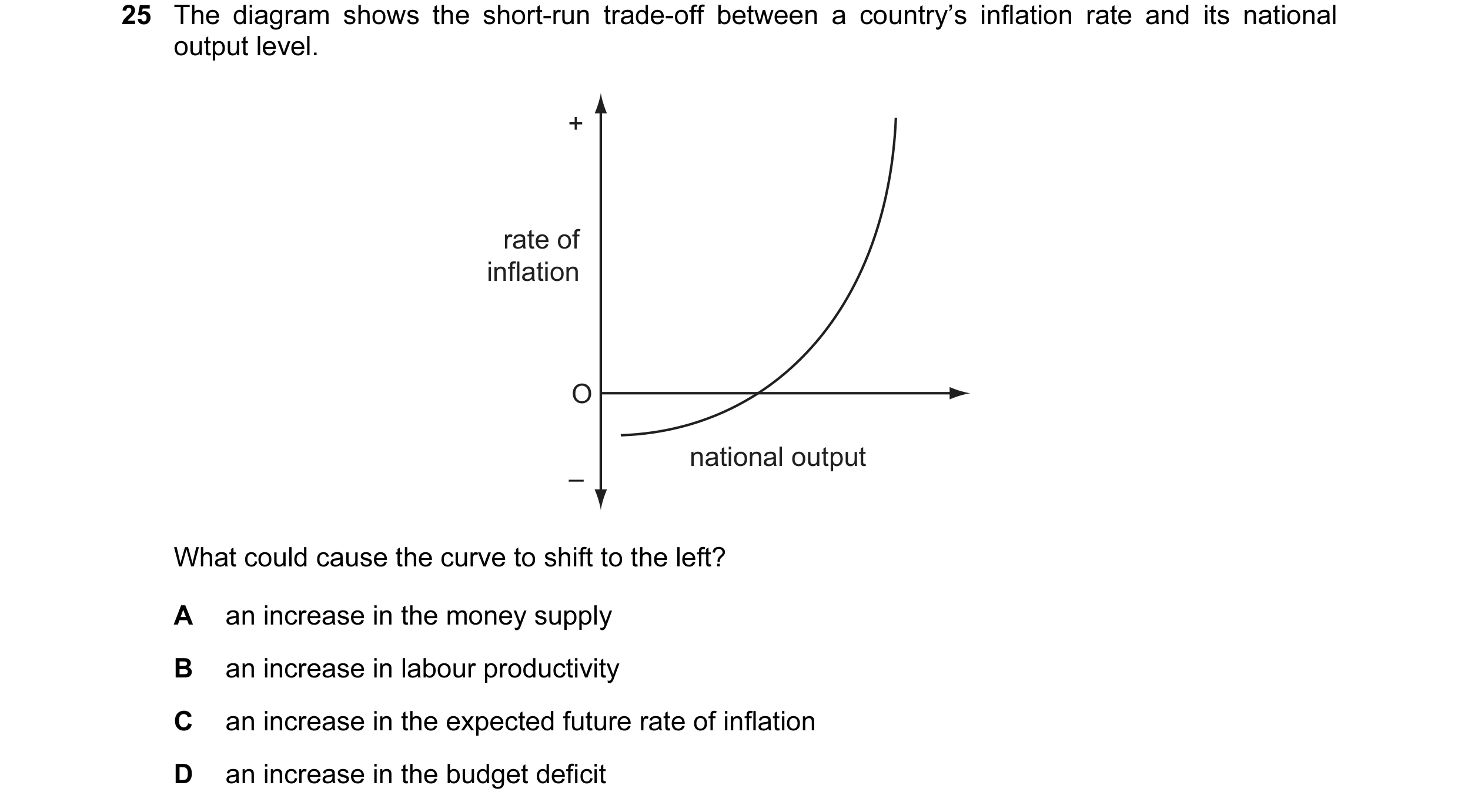
25 The diagram shows the short-run trade-off between a country’s inflation rate and its national output level. + rate of inflation O national output – What could cause the curve to shift to the left? A an increase in the money supply B an increase in labour productivity C an increase in the expected future rate of inflation D an increase in the budget deficit
1 marks
Answer: C
This question in 9708/31 May/June 2013
Q16 · Legal reforms to reduce the power of trade unions have in many countries reduced… 9708/31 May/June 2013
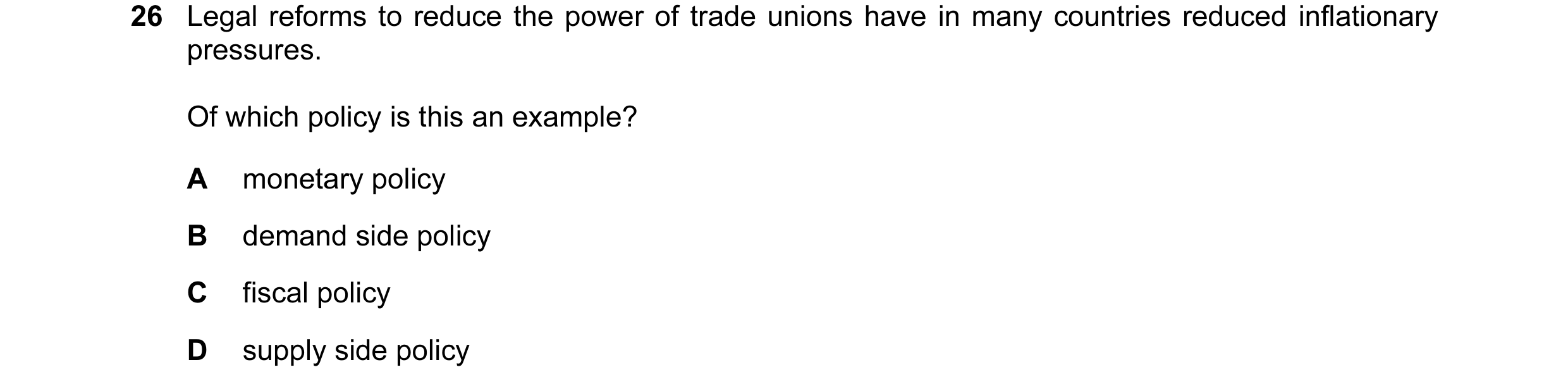
26 Legal reforms to reduce the power of trade unions have in many countries reduced inflationary pressures. Of which policy is this an example? A monetary policy B demand side policy C fiscal policy D supply side policy
1 marks
Answer: D
This question in 9708/31 May/June 2013
Q17 · Which policy is specifically designed to reduce the level of structural unemployment? 9708/32 May/June 2013
24 Which policy is specifically designed to reduce the level of structural unemployment? A an increase in the level of state benefits paid to the unemployed B a reduction in interest rates C a reduction in the level of direct taxation D the provision of retraining schemes
1 marks
Answer: D
This question in 9708/32 May/June 2013
Q18 · What would be most likely to stimulate long-run growth in an economy? 9708/32 May/June 2013
25 What would be most likely to stimulate long-run growth in an economy? A employment protection legislation B government policy to raise aggregate demand C technical innovations by firms D the development of trade unions
1 marks
Answer: C
This question in 9708/32 May/June 2013
Q19 · What is the main objective of supply side policies? 9708/32 May/June 2013
28 What is the main objective of supply side policies? A to bring a country’s potential output up to the level of its actual output B to ensure a budget surplus C to ensure that the composition of output matches the pattern of demand D to increase potential output by increasing efficiency
1 marks
Answer: D
This question in 9708/32 May/June 2013
Q20 · The diagram shows the short-run trade-off between a country’s inflation rate and its… 9708/33 May/June 2013
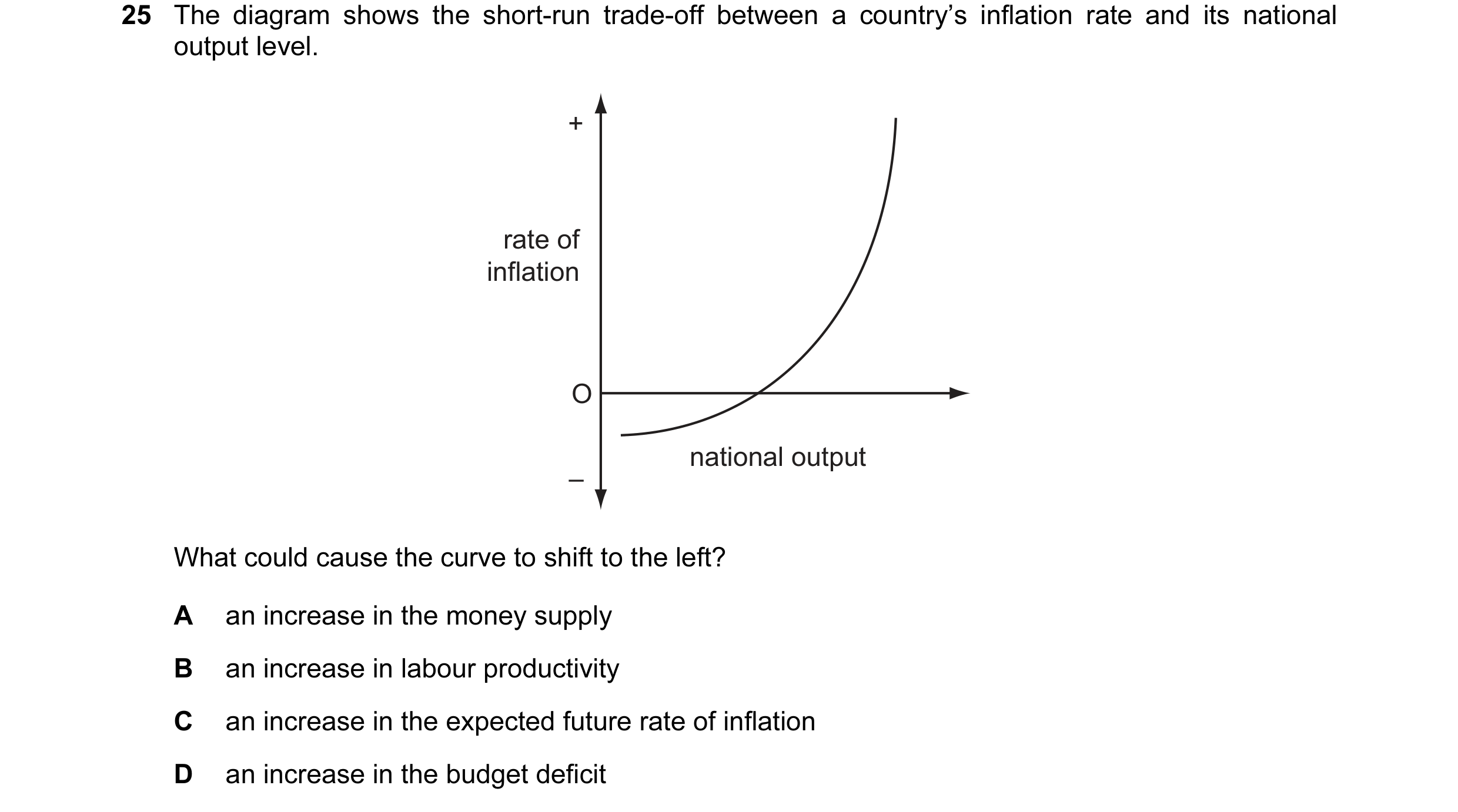
25 The diagram shows the short-run trade-off between a country’s inflation rate and its national output level. + rate of inflation O national output – What could cause the curve to shift to the left? A an increase in the money supply B an increase in labour productivity C an increase in the expected future rate of inflation D an increase in the budget deficit
1 marks
Answer: C
This question in 9708/33 May/June 2013
Q21 · Legal reforms to reduce the power of trade unions have in many countries reduced… 9708/33 May/June 2013
26 Legal reforms to reduce the power of trade unions have in many countries reduced inflationary pressures. Of which policy is this an example? A monetary policy B demand side policy C fiscal policy D supply side policy
1 marks
Answer: D
This question in 9708/33 May/June 2013
Q22 · What is not a supply-side policy measure? 9708/31 Oct/Nov 2013
28 What is not a supply-side policy measure? A deregulating industry to encourage more competitive markets B linking unemployment benefits to the obligation to look for work C tackling cyclical unemployment by lowering interest rates D tackling structural unemployment by giving grants for labour mobility
1 marks
Answer: C
This question in 9708/31 Oct/Nov 2013
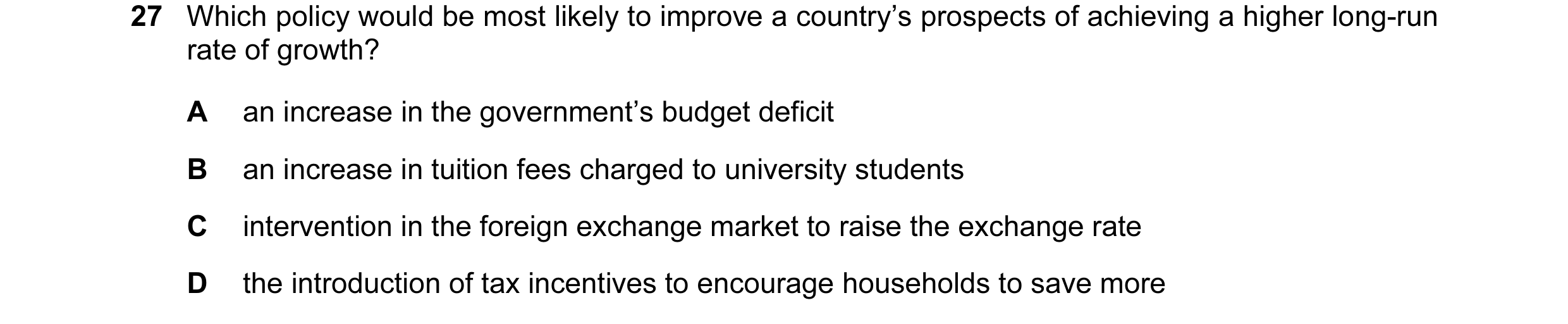
Q23 · Which policy would be most likely to improve a country’s prospects of achieving a higher… 9708/33 Oct/Nov 2013
27 Which policy would be most likely to improve a country’s prospects of achieving a higher long-run rate of growth? A an increase in the government’s budget deficit B an increase in tuition fees charged to university students C intervention in the foreign exchange market to raise the exchange rate D the introduction of tax incentives to encourage households to save more
1 marks
Answer: D
This question in 9708/33 Oct/Nov 2013
Q24 · What would be most likely to increase a country’s long-run trend rate of growth? 9708/31 Oct/Nov 2014
24 What would be most likely to increase a country’s long-run trend rate of growth? A an appreciation of the currency B an increase in import tariffs C an increase in the money supply D a reduction in the ratio of Government Debt to GDP
1 marks
Answer: D
This question in 9708/31 Oct/Nov 2014
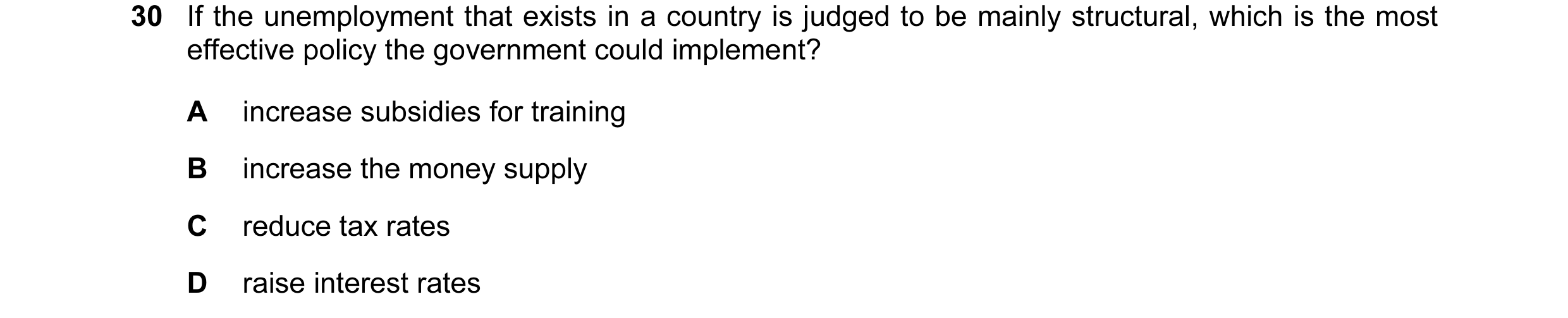
Q25 · If the unemployment that exists in a country is judged to be mainly structural, which is… 9708/31 Oct/Nov 2014
30 If the unemployment that exists in a country is judged to be mainly structural, which is the most effective policy the government could implement? A increase subsidies for training B increase the money supply C reduce tax rates D raise interest rates
1 marks
Answer: A
This question in 9708/31 Oct/Nov 2014
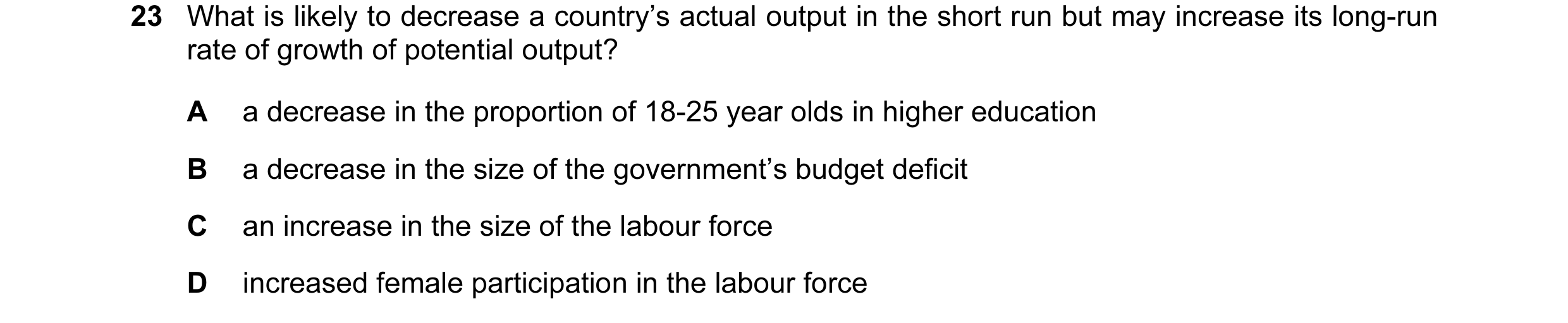
Q26 · What is likely to decrease a country’s actual output in the short run but may increase… 9708/33 Oct/Nov 2015
23 What is likely to decrease a country’s actual output in the short run but may increase its long-run rate of growth of potential output? A a decrease in the proportion of 18-25 year olds in higher education B a decrease in the size of the government’s budget deficit C an increase in the size of the labour force D increased female participation in the labour force
1 marks
Answer: B
This question in 9708/33 Oct/Nov 2015
Q27 · What is the main objective of supply-side policies? 9708/33 May/June 2016
30 What is the main objective of supply-side policies? A to bring a country’s potential output up to the level of its actual output B to ensure a budget surplus C to ensure that the composition of output matches the pattern of demand D to increase potential output by increasing efficiency
1 marks
Answer: D
This question in 9708/33 May/June 2016
Q28 · Which policy is specifically designed to reduce the level of structural unemployment? 9708/32 May/June 2017
19 Which policy is specifically designed to reduce the level of structural unemployment? A an increase in the level of state benefits paid to the unemployed B a reduction in interest rates C a reduction in the level of direct taxation D the provision of retraining schemes
1 marks
Answer: D
This question in 9708/32 May/June 2017
Q29 · In 1979 in the UK the marginal rate of income tax imposed on the highest earners was 83%… 9708/33 May/June 2017
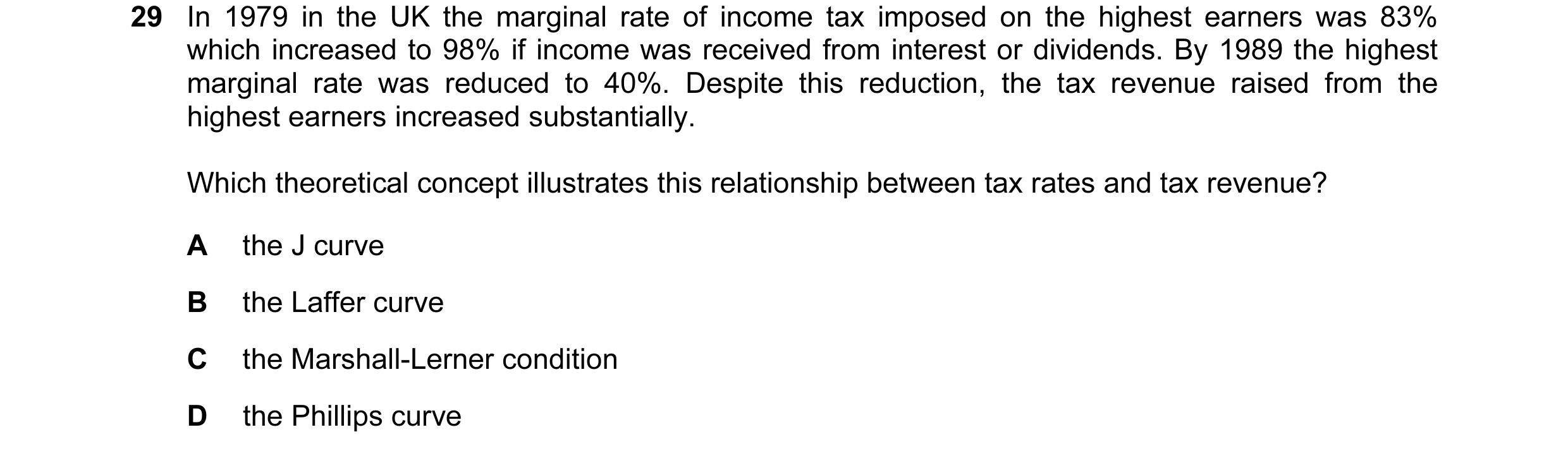
29 In 1979 in the UK the marginal rate of income tax imposed on the highest earners was 83% which increased to 98% if income was received from interest or dividends. By 1989 the highest marginal rate was reduced to 40%. Despite this reduction, the tax revenue raised from the highest earners increased substantially. Which theoretical concept illustrates this relationship between tax rates and tax revenue? A the J curve B the Laffer curve C the Marshall-Lerner condition D the Phillips curve
1 marks
Answer: B
This question in 9708/33 May/June 2017
Q30 · Which macroeconomic policy is most likely to be used as a long-run means of reducing… 9708/32 Feb/March 2020
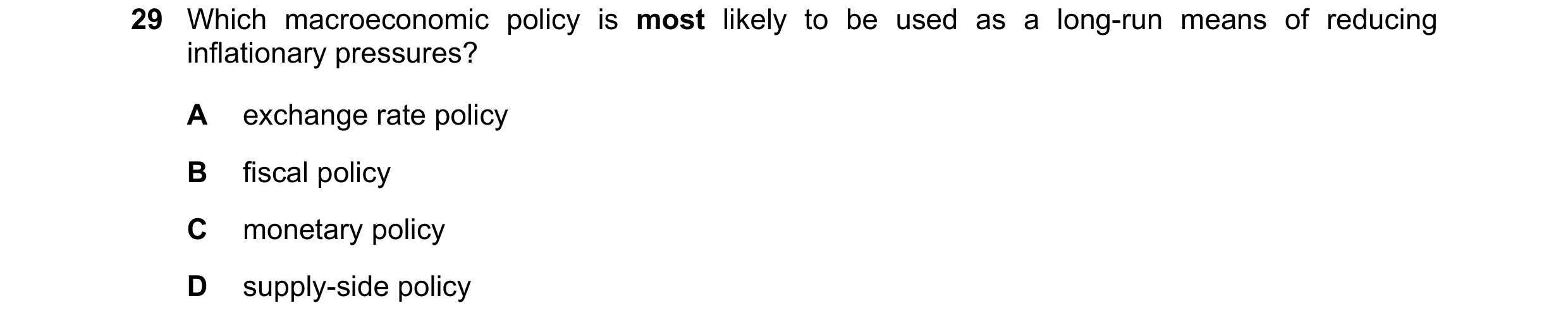
29 Which macroeconomic policy is most likely to be used as a long-run means of reducing inflationary pressures? A exchange rate policy B fiscal policy C monetary policy D supply-side policy
1 marks
Answer: D
This question in 9708/32 Feb/March 2020
Q31 · Which combination of macroeconomic policies will most likely be successful if the aim… 9708/32 Oct/Nov 2020
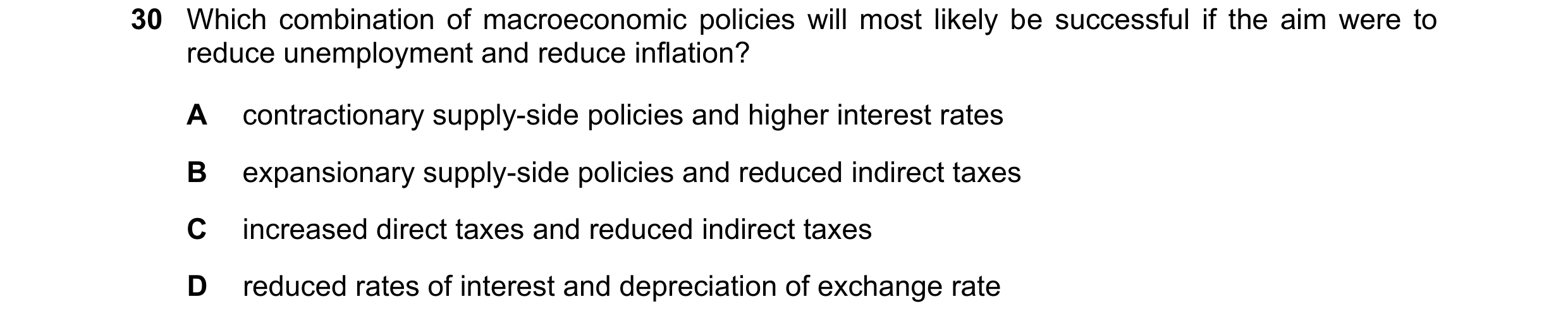
30 Which combination of macroeconomic policies will most likely be successful if the aim were to reduce unemployment and reduce inflation? A contractionary supply-side policies and higher interest rates B expansionary supply-side policies and reduced indirect taxes C increased direct taxes and reduced indirect taxes D reduced rates of interest and depreciation of exchange rate
1 marks
Answer: B
This question in 9708/32 Oct/Nov 2020
Q32 · The diagram shows Lorenz curves for a developed economy 9708/32 Feb/March 2021
20 The diagram shows Lorenz curves for a developed economy. 100 cumulative % of income Y X 0 100 cumulative % of households Which combination of supply-side policies would shift the Lorenz curve from X to Y? top rate of national education income tax minimum wage A increase free increase B increase students pay abolish C reduce free abolish D reduce students pay increase
1 marks
Answer: A
This question in 9708/32 Feb/March 2021
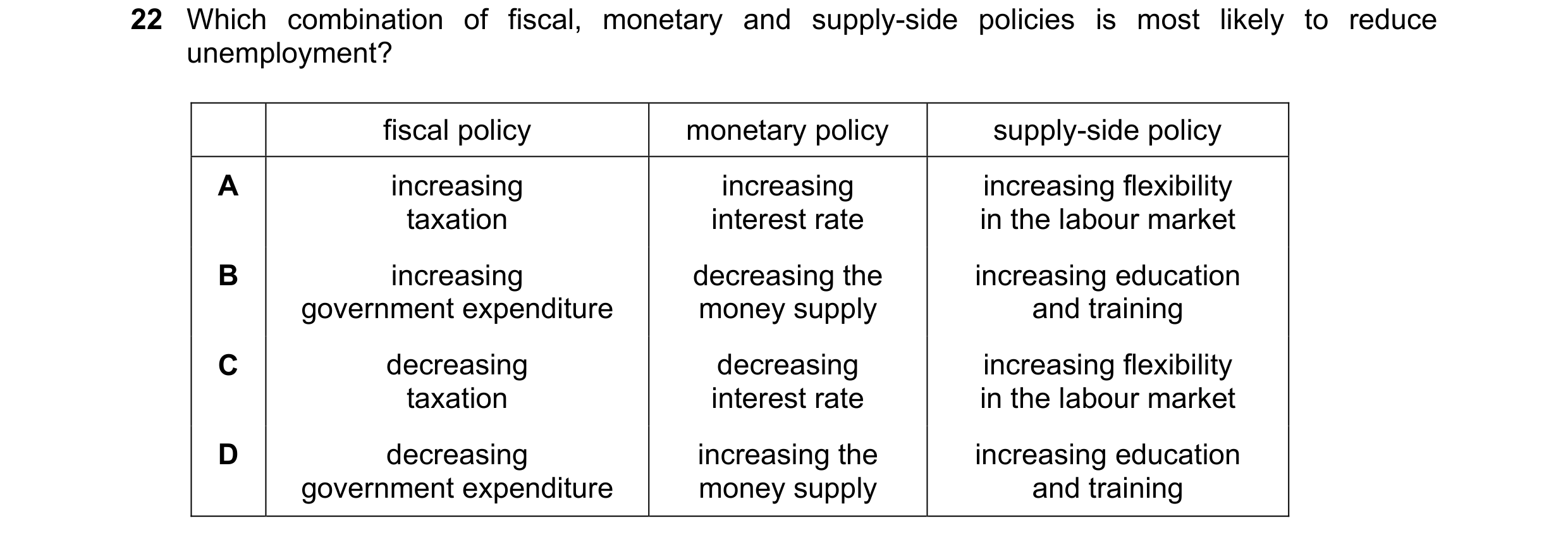
Q33 · Which combination of fiscal, monetary and supply-side policies is most likely to reduce… 9708/32 Feb/March 2021
22 Which combination of fiscal, monetary and supply-side policies is most likely to reduce unemployment? fiscal policy monetary policy supply-side policy A increasing increasing increasing flexibility taxation interest rate in the labour market B increasing decreasing the increasing education government expenditure money supply and training C decreasing decreasing increasing flexibility taxation interest rate in the labour market D decreasing increasing the increasing education government expenditure money supply and training
1 marks
Answer: C
This question in 9708/32 Feb/March 2021
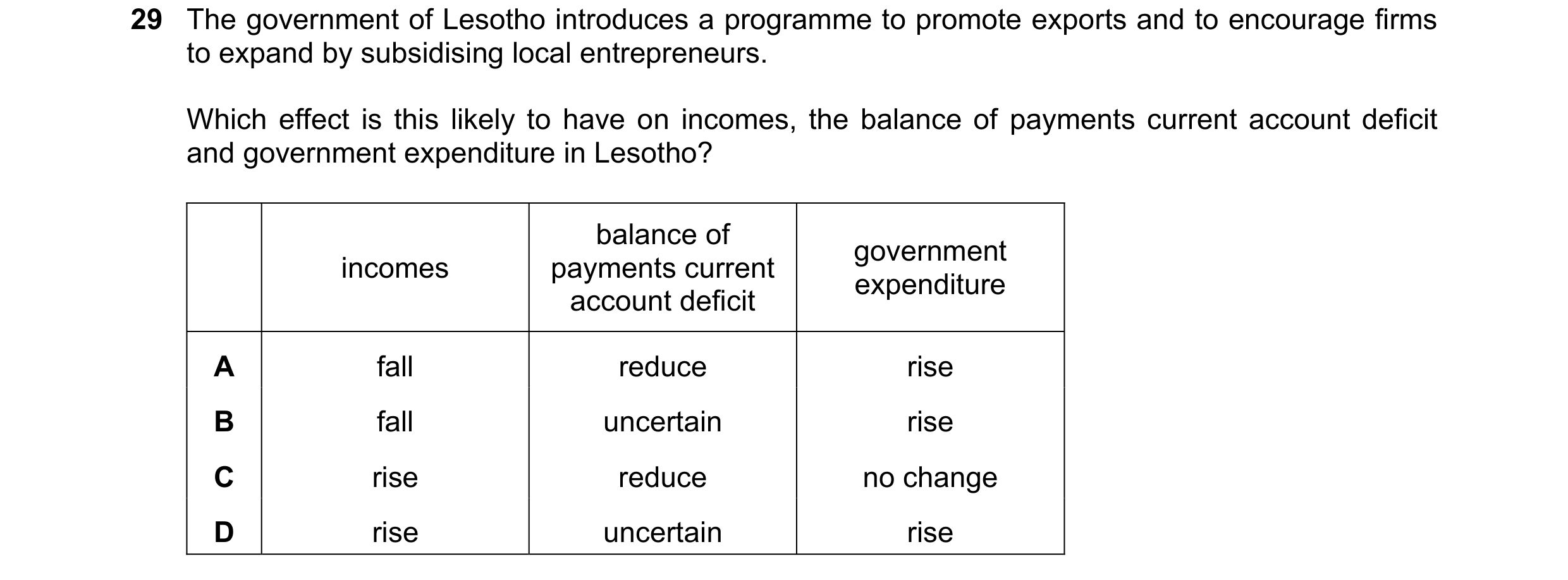
Q34 · The government of Lesotho introduces a programme to promote exports and to encourage… 9708/32 May/June 2021
29 The government of Lesotho introduces a programme to promote exports and to encourage firms to expand by subsidising local entrepreneurs. Which effect is this likely to have on incomes, the balance of payments current account deficit and government expenditure in Lesotho? balance of government incomes payments current expenditure account deficit A fall reduce rise B fall uncertain rise C rise reduce no change D rise uncertain rise
1 marks
Answer: D
This question in 9708/32 May/June 2021
Q35 · Low income countries that approached the IMF for loan assistance were usually required to… 9708/31 Oct/Nov 2021
23 Low income countries that approached the IMF for loan assistance were usually required to introduce structural adjustment programmes (SAPs) which involve policies to promote a free-market economy. Which action would have been included in a SAP? A deregulation of agricultural markets B extension of food subsidies C nationalisation of water supply D restrictions and regulations on the flow of international capital
1 marks
Answer: A
This question in 9708/31 Oct/Nov 2021
Q36 · What would encourage industrial expansion in a region of high unemployment? 9708/32 Oct/Nov 2021
22 What would encourage industrial expansion in a region of high unemployment? A a rationing system for building development in that region B an increase in taxes on investment C a requirement that only local labour may be employed D an end to nationally negotiated wage rates
1 marks
Answer: D
This question in 9708/32 Oct/Nov 2021
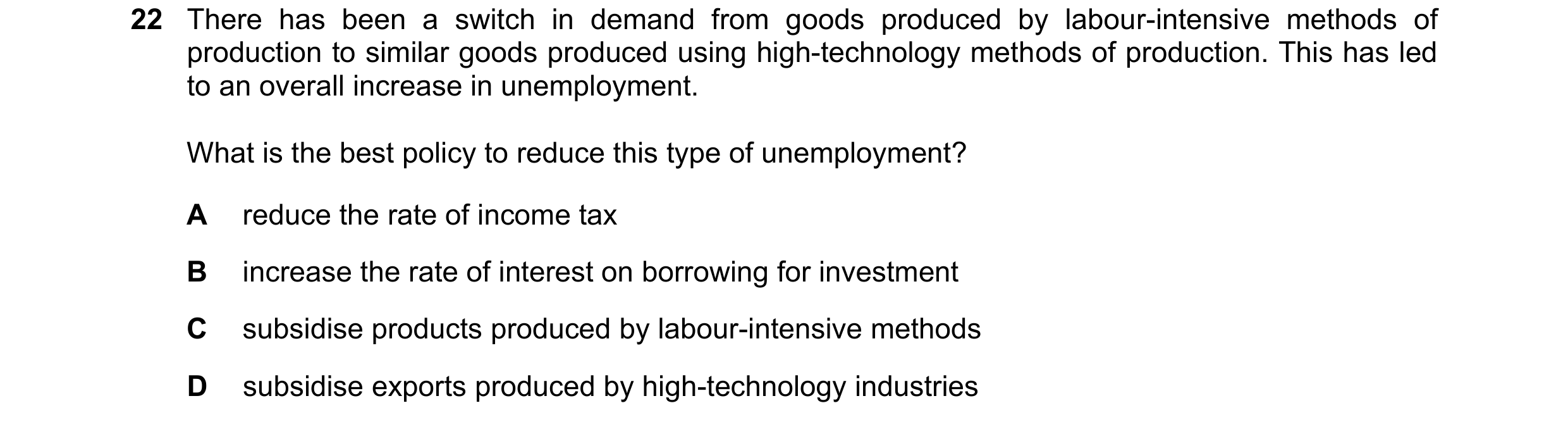
Q37 · There has been a switch in demand from goods produced by labour-intensive methods of… 9708/31 May/June 2022
22 There has been a switch in demand from goods produced by labour-intensive methods of production to similar goods produced using high-technology methods of production. This has led to an overall increase in unemployment. What is the best policy to reduce this type of unemployment? A reduce the rate of income tax B increase the rate of interest on borrowing for investment C subsidise products produced by labour-intensive methods D subsidise exports produced by high-technology industries
1 marks
Answer: C
This question in 9708/31 May/June 2022
Q38 · There has been a switch in demand from goods produced by labour-intensive methods of… 9708/33 May/June 2022
22 There has been a switch in demand from goods produced by labour-intensive methods of production to similar goods produced using high-technology methods of production. This has led to an overall increase in unemployment. What is the best policy to reduce this type of unemployment? A reduce the rate of income tax B increase the rate of interest on borrowing for investment C subsidise products produced by labour-intensive methods D subsidise exports produced by high-technology industries
1 marks
Answer: C
This question in 9708/33 May/June 2022
Q39 · An economy is operating at full employment 9708/31 Oct/Nov 2022
30 An economy is operating at full employment. Which policy is most likely to lead to an increase in real national output without an increase in the rate of inflation in the short term? A additional spending on subsidies to increase export earnings B the central bank introduces quantitative easing C labour market reforms result in increased output per hour worked D the government reduces income tax rates
1 marks
Answer: C
This question in 9708/31 Oct/Nov 2022
Q40 · A country with an income tax rate X decides to increase its tax rate 9708/32 Oct/Nov 2022
29 A country with an income tax rate X decides to increase its tax rate. The diagram shows tax revenue will fall. tax revenue O X tax rate Why would this happen? A Fewer goods will be produced. B People will work fewer hours to maintain incomes. C Prices will rise. D There will be an increase in tax avoidance.
1 marks
Answer: D
This question in 9708/32 Oct/Nov 2022
Q41 · What would reduce the effectiveness of a supply-side stimulus to the economy? 9708/31 May/June 2023
25 What would reduce the effectiveness of a supply-side stimulus to the economy? A an imposition of maximum hours in a working week B an increase in public sector spending C the provision of new training schemes D the relaxation of import controls on raw materials
1 marks
Answer: A
This question in 9708/31 May/June 2023
Q42 · What would reduce the effectiveness of a supply-side stimulus to the economy? 9708/33 May/June 2023
25 What would reduce the effectiveness of a supply-side stimulus to the economy? A an imposition of maximum hours in a working week B an increase in public sector spending C the provision of new training schemes D the relaxation of import controls on raw materials
1 marks
Answer: A
This question in 9708/33 May/June 2023
Q43 · In all major towns in a country, a government adopts a policy of opening centres where… 9708/31 Oct/Nov 2023
21 In all major towns in a country, a government adopts a policy of opening centres where job vacancies are advertised. Which type of unemployment is the government aiming to reduce with this policy? A cyclical B frictional C regional D seasonal
1 marks
Answer: B
This question in 9708/31 Oct/Nov 2023
Q44 · Singapore has one of the highest population densities in the world 9708/31 May/June 2024
24 Singapore has one of the highest population densities in the world. It discourages car use through a high tax on second cars. Which additional policy would help to relieve road congestion in the short run? A limiting the total number of car licences issued B encouraging restrictions on the size of families C improving infrastructure by building new roads D replacing diesel cars by electric cars
1 marks
Answer: A
This question in 9708/31 May/June 2024
Q45 · Which policy may increase economic growth without causing inflation? 9708/32 Feb/March 2025
21 Which policy may increase economic growth without causing inflation? A giving subsidies to producers B increasing government spending C lowering direct taxes D lowering interest rates
1 marks
Answer: A
This question in 9708/32 Feb/March 2025
 1 / 11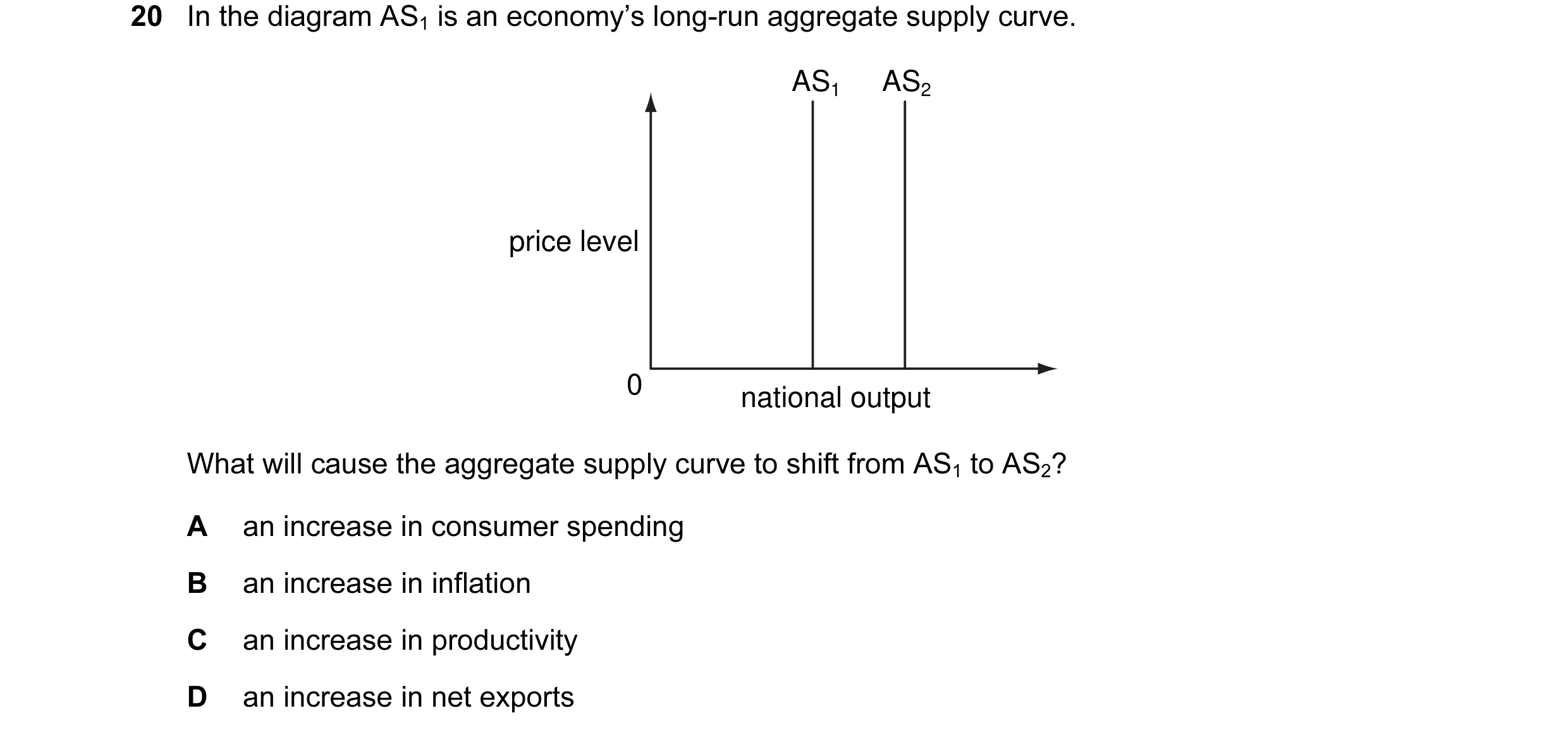



 2 / 11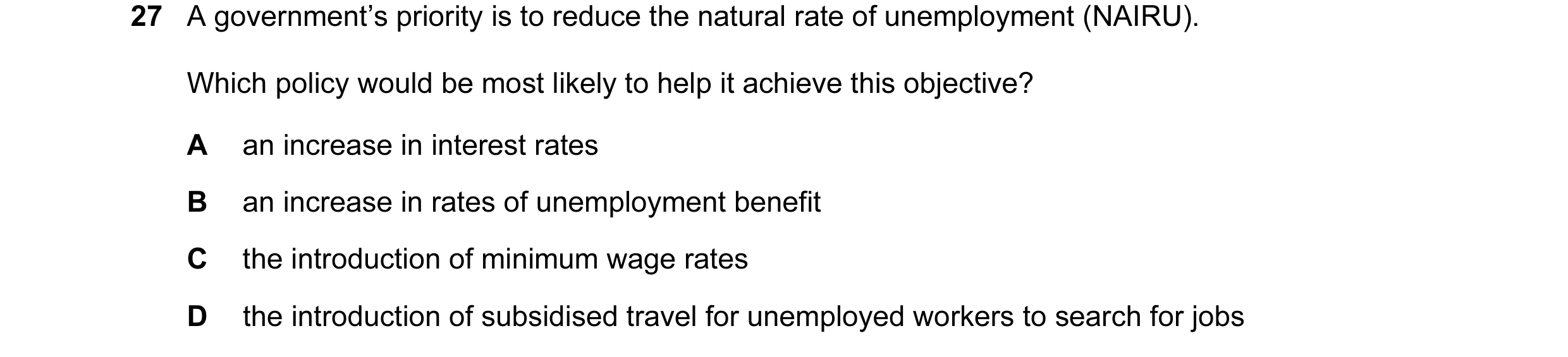
 3 / 11
 4 / 11


 5 / 11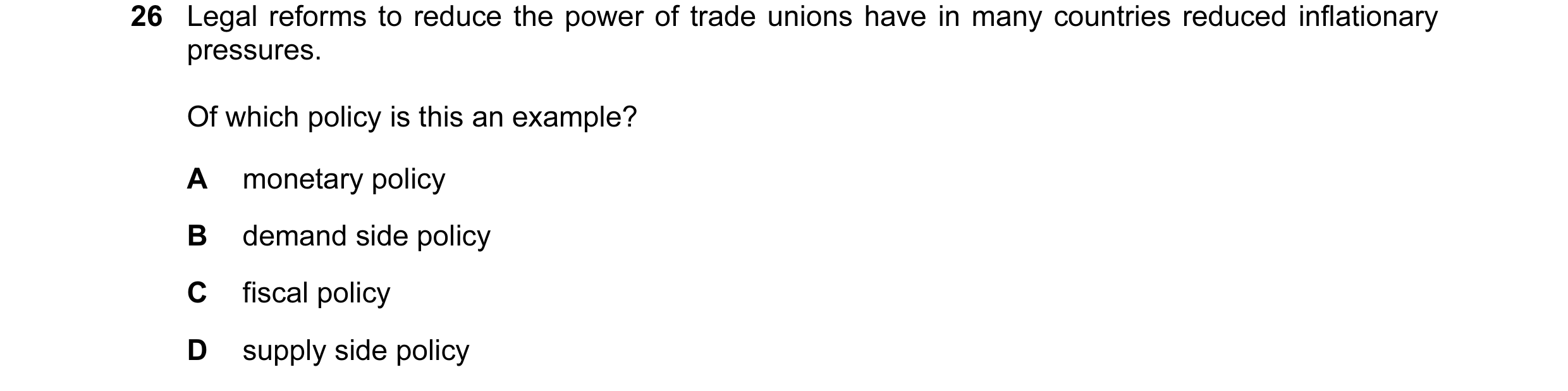


 6 / 11

 7 / 11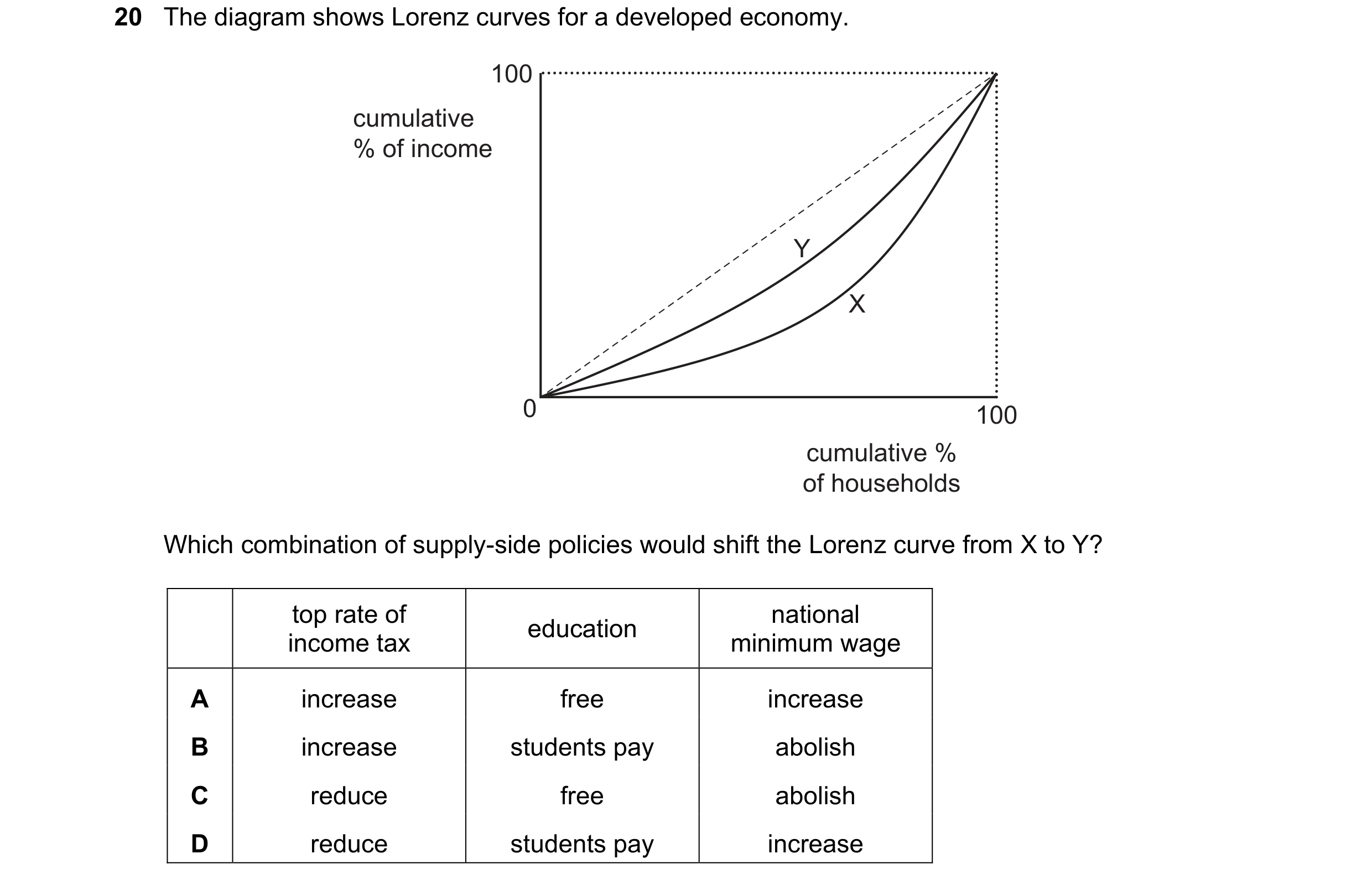
 8 / 11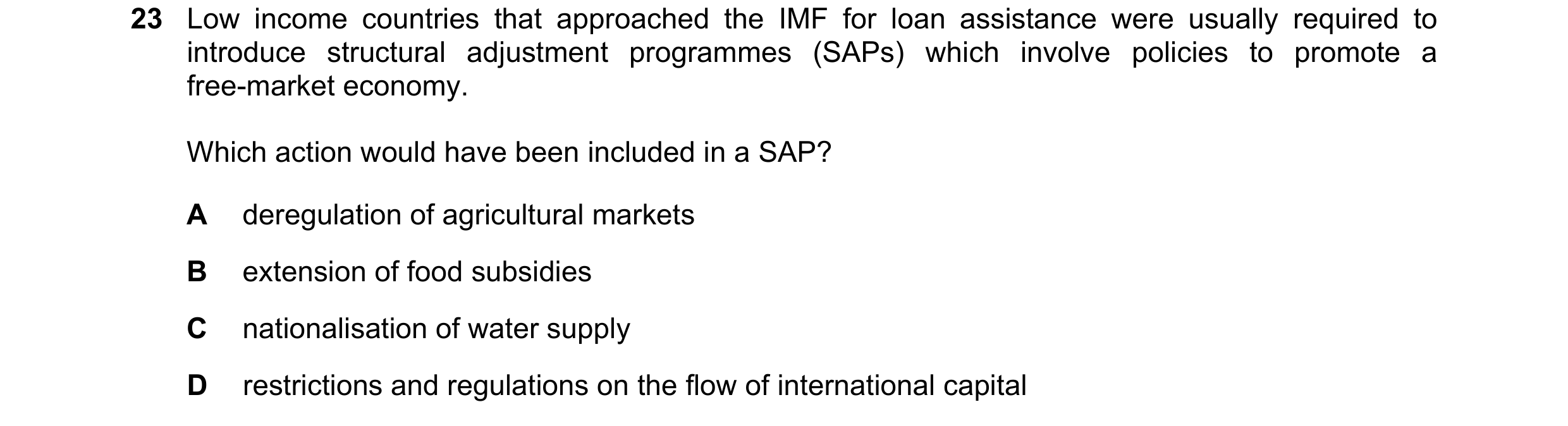

 9 / 11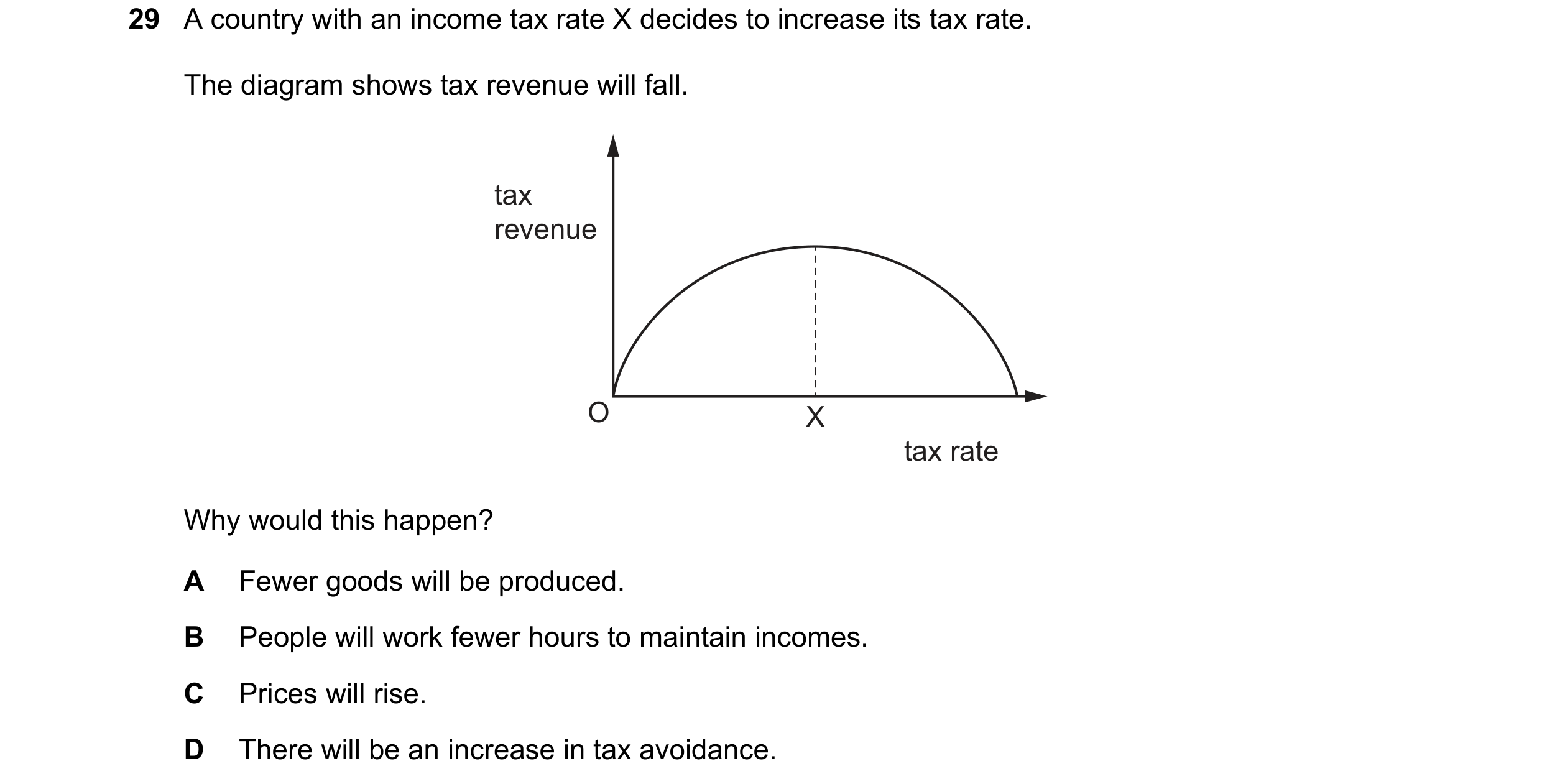


 10 / 11
 11 / 11