Questions as text
Q1 · In 2009 the Australian government made a payment of $900 to those who earned less than… 9708/12 Feb/March 2016
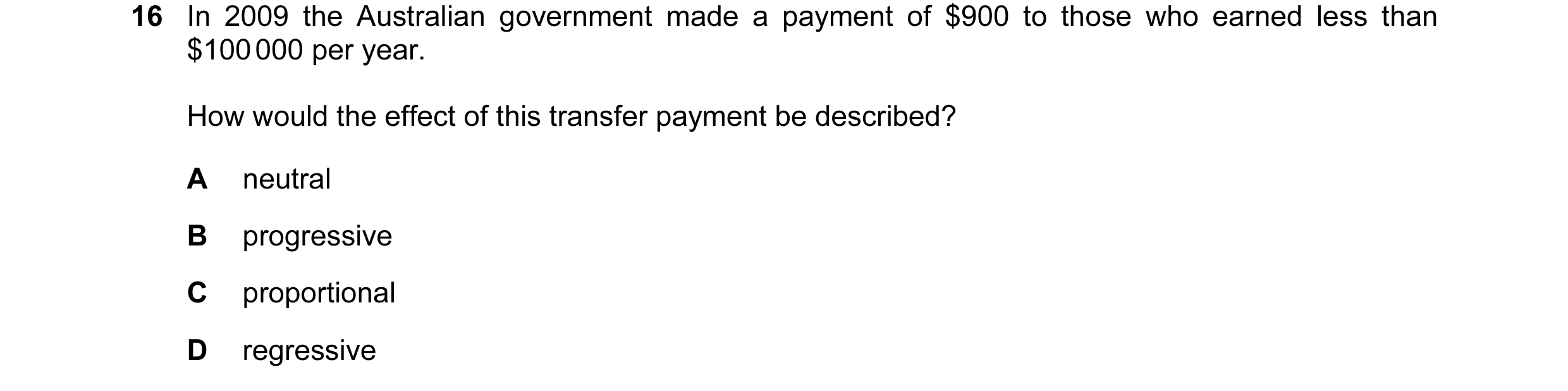
16 In 2009 the Australian government made a payment of $900 to those who earned less than $100 000 per year. How would the effect of this transfer payment be described? A neutral B progressive C proportional D regressive
1 marks
Answer: B
This question in 9708/12 Feb/March 2016
Q2 · Which statement best describes a transfer payment? 9708/11 May/June 2016
17 Which statement best describes a transfer payment? A It is a loan from the government to help firms. B It is a payment to individuals not linked to economic activity. C It is the redistribution of income from government to individuals for work done. D It is the redistribution of income from households to firms for goods purchased.
1 marks
Answer: B
This question in 9708/11 May/June 2016
Q3 · A country uses an income tax under which the first $10 000 of income is tax-free, the… 9708/12 May/June 2016
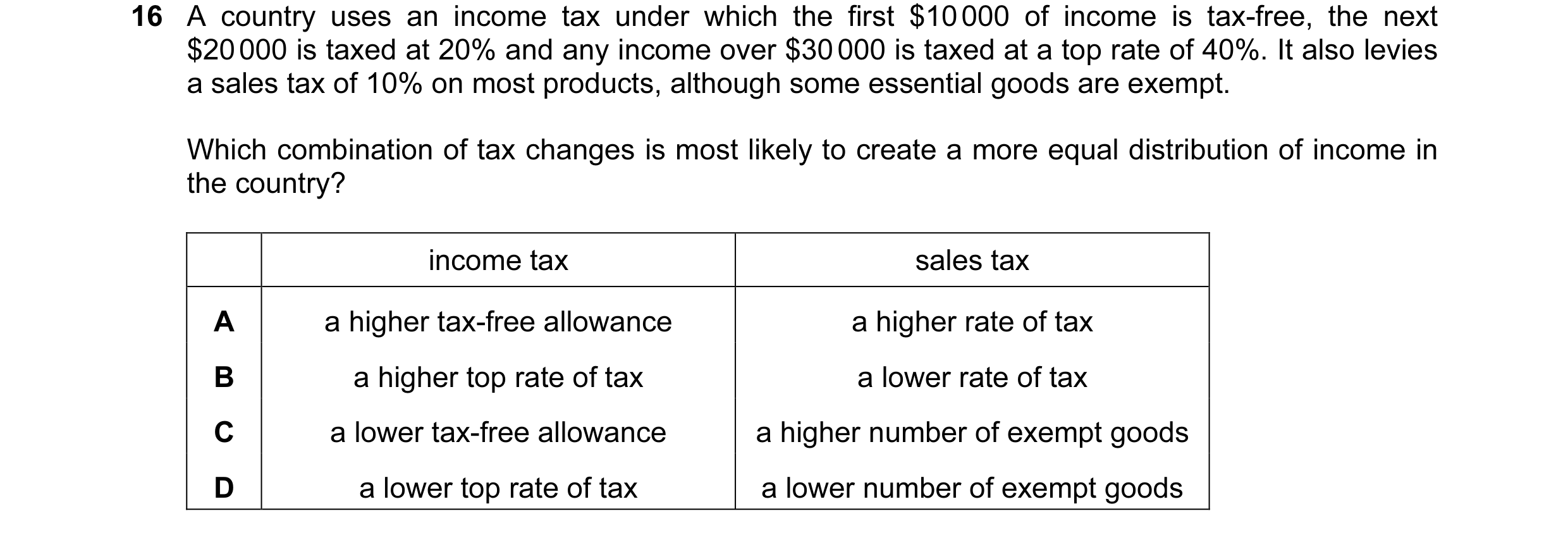
16 A country uses an income tax under which the first $10 000 of income is tax-free, the next $20 000 is taxed at 20% and any income over $30 000 is taxed at a top rate of 40%. It also levies a sales tax of 10% on most products, although some essential goods are exempt. Which combination of tax changes is most likely to create a more equal distribution of income in the country? income tax sales tax A a higher tax-free allowance a higher rate of tax B a higher top rate of tax a lower rate of tax C a lower tax-free allowance a higher number of exempt goods D a lower top rate of tax a lower number of exempt goods
1 marks
Answer: B
This question in 9708/12 May/June 2016
Q4 · In a country, the standard rate of sales tax is 10%, but food is not taxed and luxury… 9708/13 May/June 2016
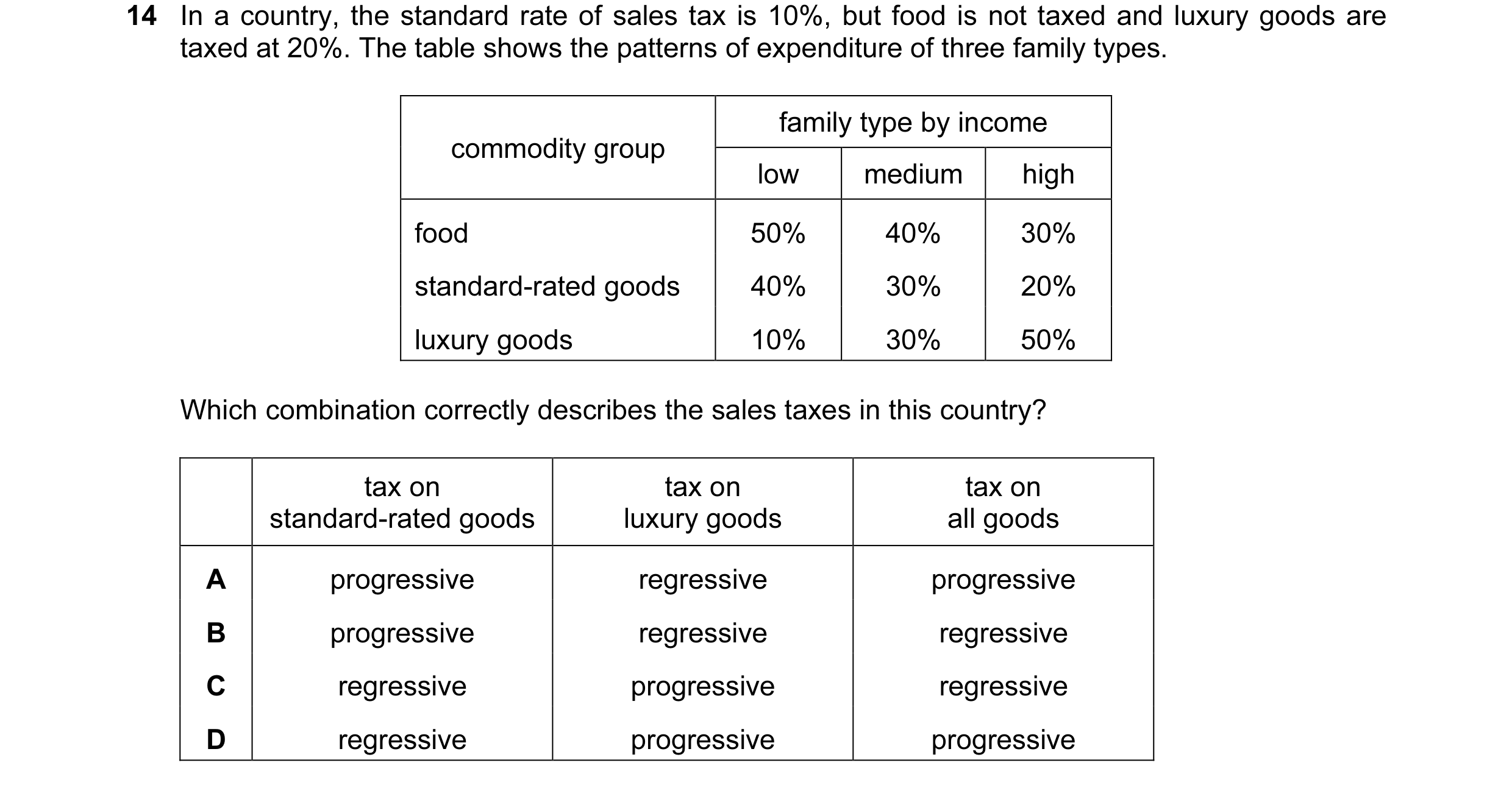
14 In a country, the standard rate of sales tax is 10%, but food is not taxed and luxury goods are taxed at 20%. The table shows the patterns of expenditure of three family types. family type by income commodity group low medium high food 50% 40% 30% standard-rated goods 40% 30% 20% luxury goods 10% 30% 50% Which combination correctly describes the sales taxes in this country? tax on tax on tax on standard-rated goods luxury goods all goods A progressive regressive progressive B progressive regressive regressive C regressive progressive regressive D regressive progressive progressive
1 marks
Answer: D
This question in 9708/13 May/June 2016
Q5 · A simple income tax system would be one in which income under $10 000 is not taxed 9708/11 Oct/Nov 2016
15 A simple income tax system would be one in which income under $10 000 is not taxed. Above $10 000 an income tax rate of 30% is applied to all additional income. What is correct for people earning more than $10 000? average rate of tax marginal rate of tax A increases as incomes increase increases as incomes increase B increases as incomes increase remains constant as incomes increase C remains constant as incomes increase increases as incomes increase D remains constant as incomes increase remains constant as incomes increase
1 marks
Answer: B
This question in 9708/11 Oct/Nov 2016
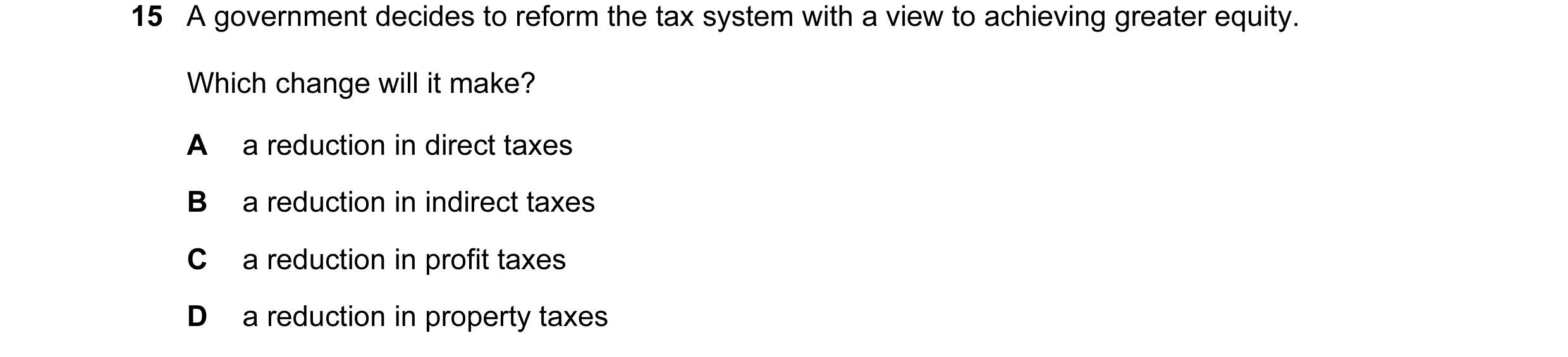
Q6 · A government decides to reform the tax system with a view to achieving greater equity 9708/13 Oct/Nov 2016
15 A government decides to reform the tax system with a view to achieving greater equity. Which change will it make? A a reduction in direct taxes B a reduction in indirect taxes C a reduction in profit taxes D a reduction in property taxes
1 marks
Answer: B
This question in 9708/13 Oct/Nov 2016
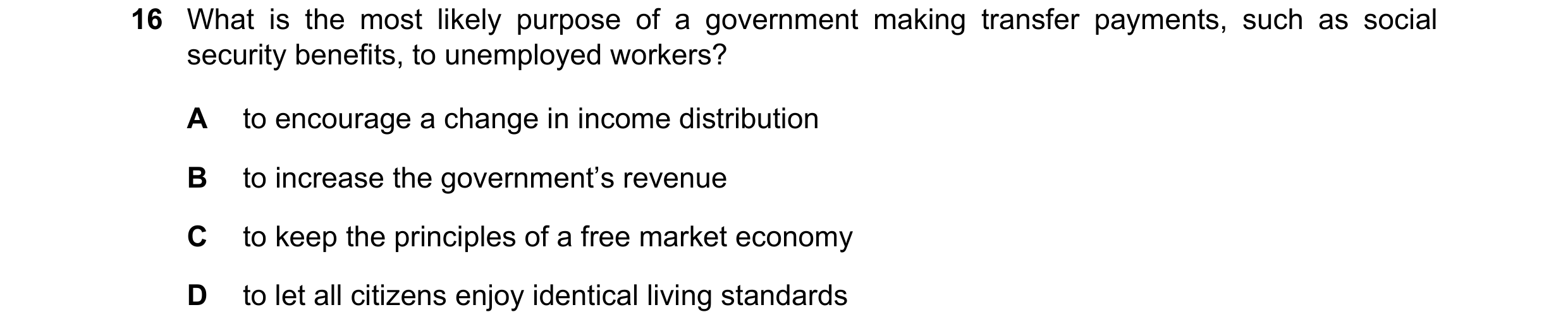
Q7 · What is the most likely purpose of a government making transfer payments, such as social… 9708/12 Feb/March 2017
16 What is the most likely purpose of a government making transfer payments, such as social security benefits, to unemployed workers? A to encourage a change in income distribution B to increase the government’s revenue C to keep the principles of a free market economy D to let all citizens enjoy identical living standards
1 marks
Answer: A
This question in 9708/12 Feb/March 2017
Q8 · Which is a transfer payment? 9708/12 May/June 2017
16 Which is a transfer payment? A an annual allowance paid by an individual to a grandchild B a one-off bonus paid to an employee for a special contribution to a firm’s profits C a payment made by a parent to a regular child-minder D the monthly salary of an employee of a local authority
1 marks
Answer: A
This question in 9708/12 May/June 2017
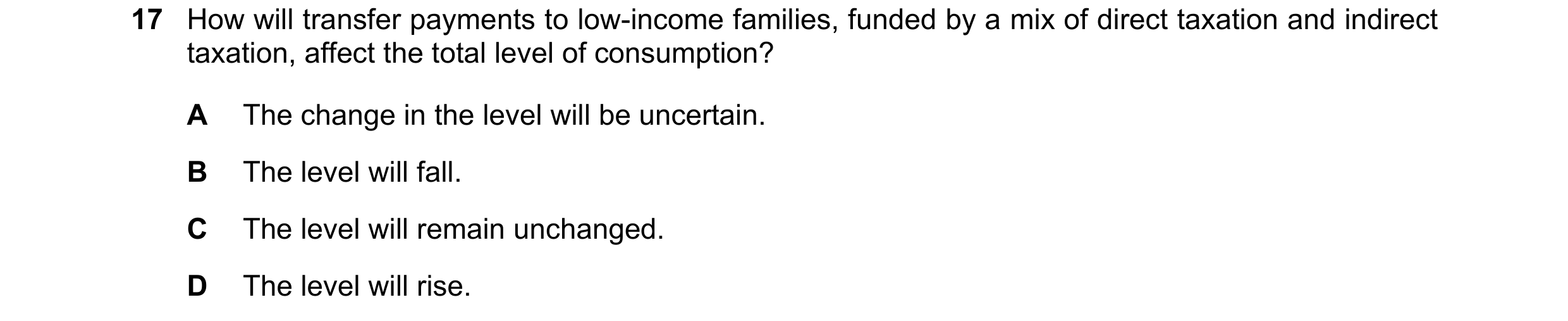
Q9 · How will transfer payments to low-income families, funded by a mix of direct taxation and… 9708/11 Oct/Nov 2017
17 How will transfer payments to low-income families, funded by a mix of direct taxation and indirect taxation, affect the total level of consumption? A The change in the level will be uncertain. B The level will fall. C The level will remain unchanged. D The level will rise.
1 marks
Answer: A
This question in 9708/11 Oct/Nov 2017
Q10 · Which benefit is most likely to result from a rise in the minimum price of labour (wage… 9708/12 Feb/March 2018
14 Which benefit is most likely to result from a rise in the minimum price of labour (wage rate)? A a reduction in costs of production B a reduction in income inequality C a reduction in the level of unemployment D a reduction in the rate of inflation
1 marks
Answer: B
This question in 9708/12 Feb/March 2018
Q11 · Which statement about transfer payments is correct? 9708/12 Feb/March 2018
17 Which statement about transfer payments is correct? A Transfer payments are intended to reward productive economic activity. B Transfer payments are only financed by government. C Transfer payments may result in a disincentive to work. D Transfer payments will include the sales of new cars.
1 marks
Answer: C
This question in 9708/12 Feb/March 2018
Q12 · Why are the pensions paid to retired citizens an example of a transfer payment? 9708/11 May/June 2018
16 Why are the pensions paid to retired citizens an example of a transfer payment? A Retired citizens pay no tax on their pensions. B Retired citizens produce no output for their pensions. C Retired citizens save some of their pensions. D Retired citizens spend all of their pensions.
1 marks
Answer: B
This question in 9708/11 May/June 2018
Q13 · What is not an example of a transfer payment? 9708/12 May/June 2018
16 What is not an example of a transfer payment? A pocket money from parents B private donations to charities C salary paid to a teacher in a government school D unemployment benefit
1 marks
Answer: C
This question in 9708/12 May/June 2018
Q14 · Which element of a tax and benefits system is regressive? 9708/13 May/June 2018
15 Which element of a tax and benefits system is regressive? A rent subsidies to tenants of publicly owned housing B specific taxes on beer and tobacco C the payment of child benefits to families D the taxation of capital gains
1 marks
Answer: B
This question in 9708/13 May/June 2018
Q15 · What is not a transfer payment? 9708/13 May/June 2018
17 What is not a transfer payment? A benefit payments by governments to families who have children B disability benefits paid to soldiers who were injured while on military service C loans made by a government to students who are studying at university D payments by a firm to compensate employees for undertaking dangerous work
1 marks
Answer: D
This question in 9708/13 May/June 2018
Q16 · A government decreases the tax rate on goods and services and increases the tax rate on… 9708/11 Oct/Nov 2018
15 A government decreases the tax rate on goods and services and increases the tax rate on incomes. What is the likely outcome on the distribution of income and the incentive to work? distribution incentive of income to work A less equal decreased B less equal increased C more equal decreased D more equal increased
1 marks
Answer: C
This question in 9708/11 Oct/Nov 2018
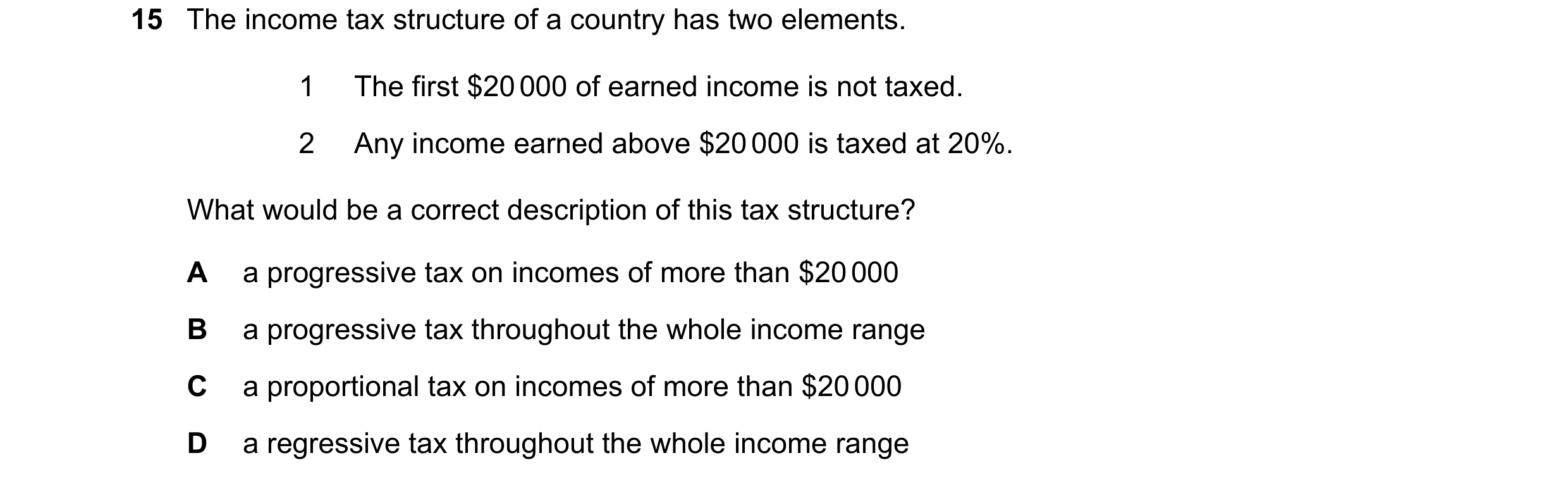
Q17 · The income tax structure of a country has two elements 9708/12 Oct/Nov 2018
15 The income tax structure of a country has two elements. 1 The first $20 000 of earned income is not taxed. 2 Any income earned above $20 000 is taxed at 20%. What would be a correct description of this tax structure? A a progressive tax on incomes of more than $20 000 B a progressive tax throughout the whole income range C a proportional tax on incomes of more than $20 000 D a regressive tax throughout the whole income range
1 marks
Answer: A
This question in 9708/12 Oct/Nov 2018
Q18 · What is an aim of a transfer payment? 9708/12 Oct/Nov 2018
17 What is an aim of a transfer payment? A It allows the government to alter the final distribution of income. B It provides a ceiling for levels of income across the economy. C It removes the need for state subsidies. D It rewards the activity of a factor of production.
1 marks
Answer: A
This question in 9708/12 Oct/Nov 2018
Q19 · Which is a transfer payment? 9708/13 Oct/Nov 2018
16 Which is a transfer payment? A dividends paid to private shareholders B income paid to civil servants C pensions paid to retired people D rent paid to landlords
1 marks
Answer: C
This question in 9708/13 Oct/Nov 2018
Q20 · Which of the following is a transfer payment? 9708/12 May/June 2019
14 Which of the following is a transfer payment? A the advertising expenditure of a firm B the allowance given by a parent to their child while at school C the rent paid to a land owner by a tenant farmer D the wage paid to a worker in the government service
1 marks
Answer: B
This question in 9708/12 May/June 2019
Q21 · What describes a regressive tax? 9708/12 May/June 2019
18 What describes a regressive tax? A All taxpayers pay the same proportion of income in taxes. B High-income earners pay a lower proportion of income in taxes than low-income earners. C High-income earners pay less in taxes than low-income earners. D High-income earners pay more in taxes than low-income earners.
1 marks
Answer: B
This question in 9708/12 May/June 2019
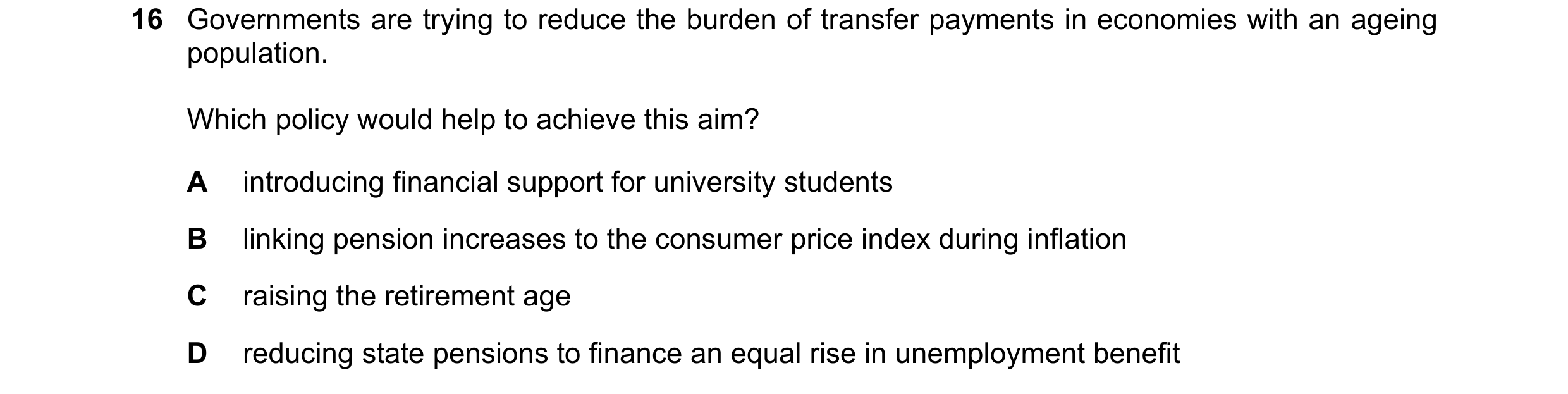
Q22 · Governments are trying to reduce the burden of transfer payments in economies with an… 9708/13 May/June 2019
16 Governments are trying to reduce the burden of transfer payments in economies with an ageing population. Which policy would help to achieve this aim? A introducing financial support for university students B linking pension increases to the consumer price index during inflation C raising the retirement age D reducing state pensions to finance an equal rise in unemployment benefit
1 marks
Answer: C
This question in 9708/13 May/June 2019
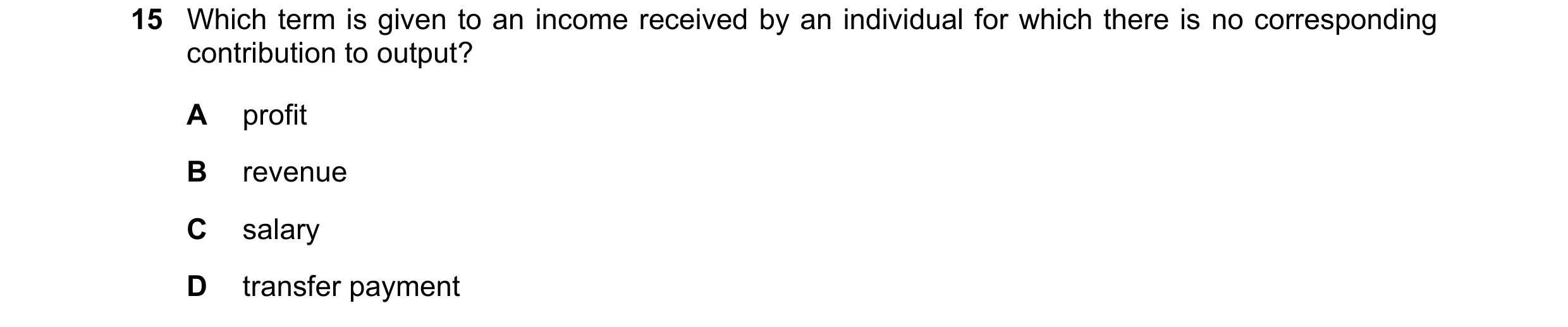
Q23 · Which term is given to an income received by an individual for which there is no… 9708/11 Oct/Nov 2019
15 Which term is given to an income received by an individual for which there is no corresponding contribution to output? A profit B revenue C salary D transfer payment
1 marks
Answer: D
This question in 9708/11 Oct/Nov 2019
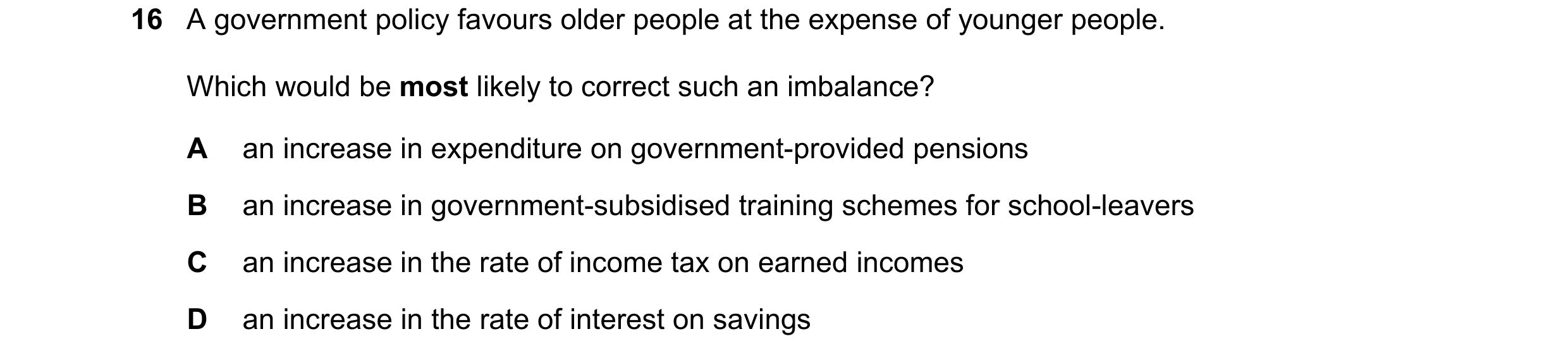
Q24 · A government policy favours older people at the expense of younger people 9708/11 Oct/Nov 2019
16 A government policy favours older people at the expense of younger people. Which would be most likely to correct such an imbalance? A an increase in expenditure on government-provided pensions B an increase in government-subsidised training schemes for school-leavers C an increase in the rate of income tax on earned incomes D an increase in the rate of interest on savings
1 marks
Answer: B
This question in 9708/11 Oct/Nov 2019
Q25 · The diagram shows three possible tax schemes 9708/12 Oct/Nov 2019
15 The diagram shows three possible tax schemes. X tax paid Y Z O personal income What can be concluded about these tax schemes? A X is more progressive than Z. B X, Y and Z are all proportional. C Y is the only proportional tax. D Z is more regressive than Y.
1 marks
Answer: B
This question in 9708/12 Oct/Nov 2019
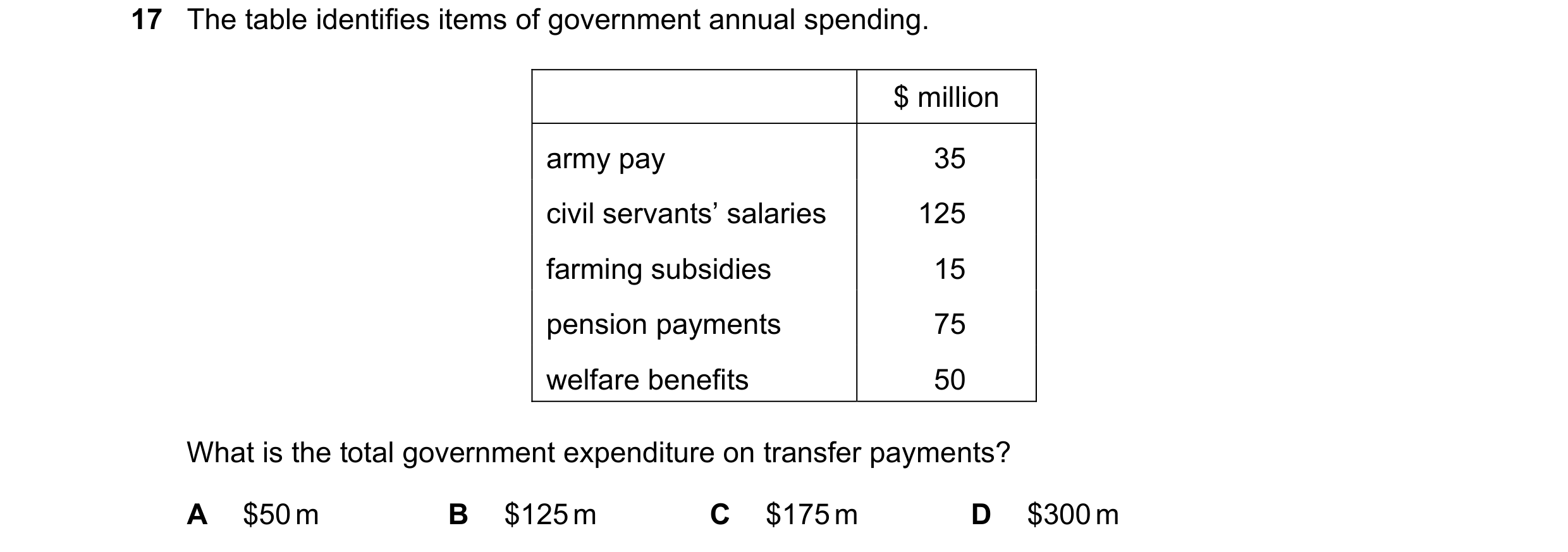
Q26 · The table identifies items of government annual spending 9708/12 Oct/Nov 2019
17 The table identifies items of government annual spending. $ million army pay 35 civil servants’ salaries 125 farming subsidies 15 pension payments 75 welfare benefits 50 What is the total government expenditure on transfer payments? A $50 m B $125 m C $175 m D $300 m
1 marks
Answer: B
This question in 9708/12 Oct/Nov 2019
Q27 · The diagram shows the income tax system adopted by a country 9708/13 Oct/Nov 2019
12 The diagram shows the income tax system adopted by a country. tax paid ($) O Y1 Y2 personal income ($) What are the average and marginal rates of tax as incomes rise from Y1 towards Y2? average rate marginal rate of tax of tax A constant constant B constant decreasing C decreasing constant D decreasing decreasing
1 marks
Answer: C
This question in 9708/13 Oct/Nov 2019
Q28 · Which statement is not correct? 9708/13 Oct/Nov 2019
17 Which statement is not correct? A A progressive tax usually improves the distribution of income. B A regressive tax benefits the rich more than the poor. C An ad valorem tax causes a parallel shift left of the supply curve. D Some consumers can avoid paying indirect tax.
1 marks
Answer: C
This question in 9708/13 Oct/Nov 2019
Q29 · What is an example of a transfer payment? 9708/12 Feb/March 2020
18 What is an example of a transfer payment? A a household moving savings from one bank account to another B a monthly repayment on a loan used to buy a new cooker C the amount paid to transport goods from one city to another D the payment of student grants by the government
1 marks
Answer: D
This question in 9708/12 Feb/March 2020
Q30 · Which statement best describes a transfer payment? 9708/11 Oct/Nov 2020
14 Which statement best describes a transfer payment? A It is a loan from the government to help firms. B It is a payment to individuals not linked to economic activity. C It is the redistribution of income from government to individuals for work done. D It is the redistribution of income from households to firms for goods purchased.
1 marks
Answer: B
This question in 9708/11 Oct/Nov 2020
Q31 · A government imposes an income tax on individuals 9708/11 Oct/Nov 2020
18 A government imposes an income tax on individuals. The first $100 000 of earned income is taxed at a rate of 20%, and all further earned income above $100 000 is taxed at a marginal rate of 50%. Which statement is not valid? A The average income tax rate is 20% at an income of $80 000 and 35% at an income of $200 000. B The tax is a direct tax for incomes above $100 000. C The tax is a proportional tax for incomes between $20 000 and $40 000. D The tax is regressive when incomes change from below to above $100 000.
1 marks
Answer: D
This question in 9708/11 Oct/Nov 2020
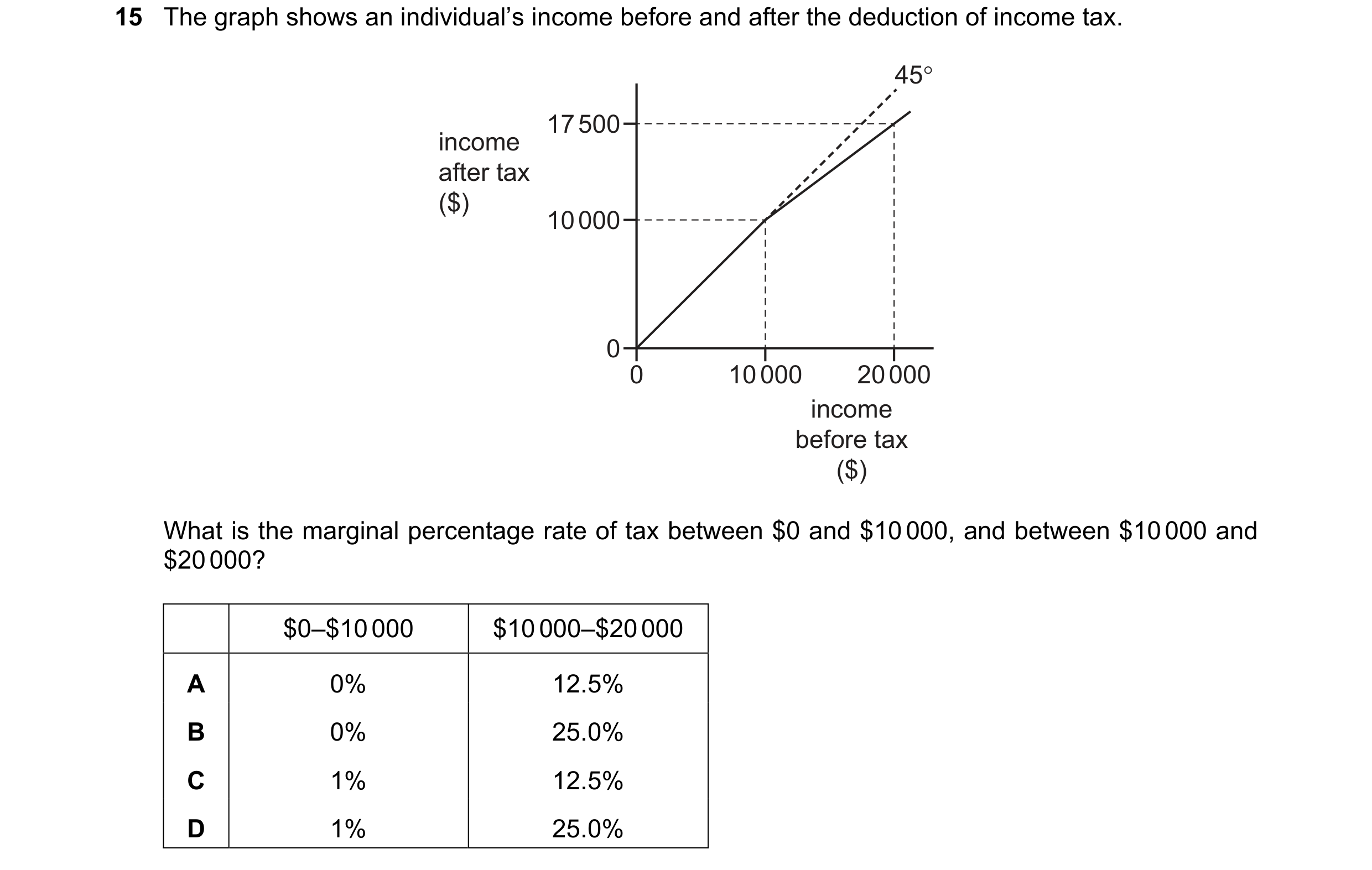
Q32 · The graph shows an individual’s income before and after the deduction of income tax 9708/12 Oct/Nov 2020
15 The graph shows an individual’s income before and after the deduction of income tax. 45° 17 500 income after tax ($) 10 000 0 0 10 000 20 000 income before tax ($) What is the marginal percentage rate of tax between $0 and $10 000, and between $10 000 and $20 000? $0–$10 000 $10 000–$20 000 A 0% 12.5% B 0% 25.0% C 1% 12.5% D 1% 25.0%
1 marks
Answer: B
This question in 9708/12 Oct/Nov 2020
Q33 · What is necessary for an action to be classed as a transfer payment? 9708/12 Oct/Nov 2020
17 What is necessary for an action to be classed as a transfer payment? A It must include a cash payment. B It must involve a banking transaction. C It must originate from government activity. D It must relate to a non-productive activity.
1 marks
Answer: D
This question in 9708/12 Oct/Nov 2020
Q34 · What would be a transfer payment? 9708/12 Feb/March 2021
15 What would be a transfer payment? A the payment made by a company to its shareholders out of its profits B the payment made for a legal document to transfer ownership of a house C the payment made to a retired person in the form of a pension D the payment made to a professional sports team for the transfer of a player
1 marks
Answer: C
This question in 9708/12 Feb/March 2021
Q35 · The government redistributes income by raising the top rate of income tax and using the… 9708/12 Feb/March 2021
16 The government redistributes income by raising the top rate of income tax and using the money raised to finance additional benefits to students and the unemployed. Under which conditions will total spending in the economy increase the most? income elasticity income elasticity of demand of top of demand of rate income students and the taxpayers unemployed A > 1 > 1 B > 1 < 1 C < 1 > 1 D < 1 < 1
1 marks
Answer: C
This question in 9708/12 Feb/March 2021
Q36 · What is a distinguishing feature of a progressive income tax? 9708/12 Oct/Nov 2021
15 What is a distinguishing feature of a progressive income tax? A High earners pay a higher proportion of their income in tax than low earners. B High earners pay a lower proportion of their income in tax than low earners. C High earners pay the same proportion of their income in tax as low earners. D Low earners pay more tax than high earners.
1 marks
Answer: A
This question in 9708/12 Oct/Nov 2021
Q37 · What is an example of a transfer payment? 9708/11 May/June 2022
18 What is an example of a transfer payment? A government spending on hospitals B government spending on motorways C minimum wage D welfare benefits
1 marks
Answer: D
This question in 9708/11 May/June 2022
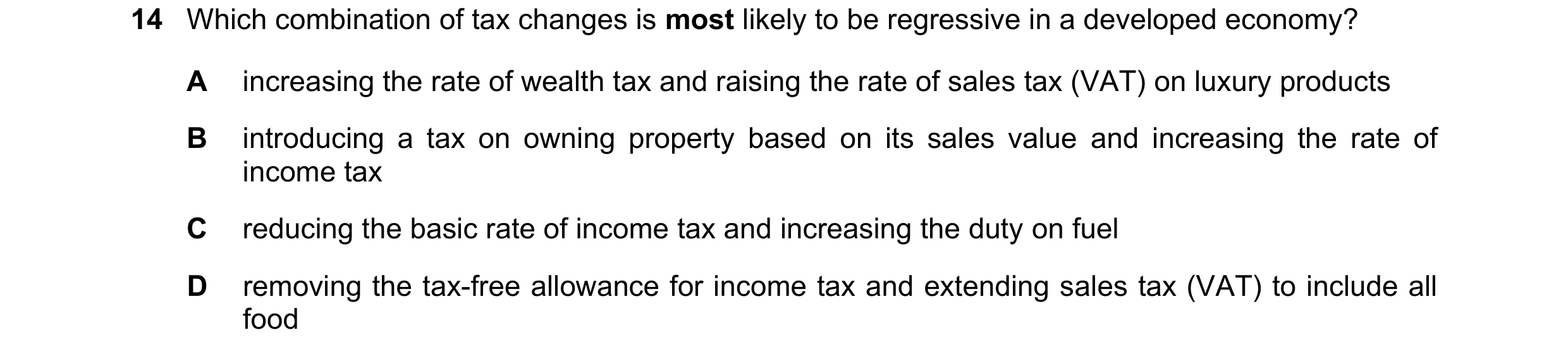
Q38 · Which combination of tax changes is most likely to be regressive in a developed economy? 9708/12 May/June 2022
14 Which combination of tax changes is most likely to be regressive in a developed economy? A increasing the rate of wealth tax and raising the rate of sales tax (VAT) on luxury products B introducing a tax on owning property based on its sales value and increasing the rate of income tax C reducing the basic rate of income tax and increasing the duty on fuel D removing the tax-free allowance for income tax and extending sales tax (VAT) to include all food
1 marks
Answer: D
This question in 9708/12 May/June 2022
Q39 · What is definitely not involved when a transfer payment is made? 9708/12 May/June 2022
17 What is definitely not involved when a transfer payment is made? A bank deposits B cash C government D production
1 marks
Answer: D
This question in 9708/12 May/June 2022
Q40 · The table shows the amount of direct taxes that different households in the UK paid in… 9708/13 May/June 2022
2 The table shows the amount of direct taxes that different households in the UK paid in 2017–2018. bottom second middle fourth top 20% of 20% of 20% of 20% of 20% of households households households households households average 15 300 25 000 34 600 47 600 90 600 income (£) direct tax 2 000 3 500 6 000 9 500 21 200 paid (£) Which positive economic statement can be made from the table? A Direct tax is unfair on the richer households in the UK. B Direct tax in the UK is a proportional tax. C Poorer households do not pay enough direct tax in the UK. D Rich households pay more direct tax than poor households in the UK.
1 marks
Answer: D
This question in 9708/13 May/June 2022
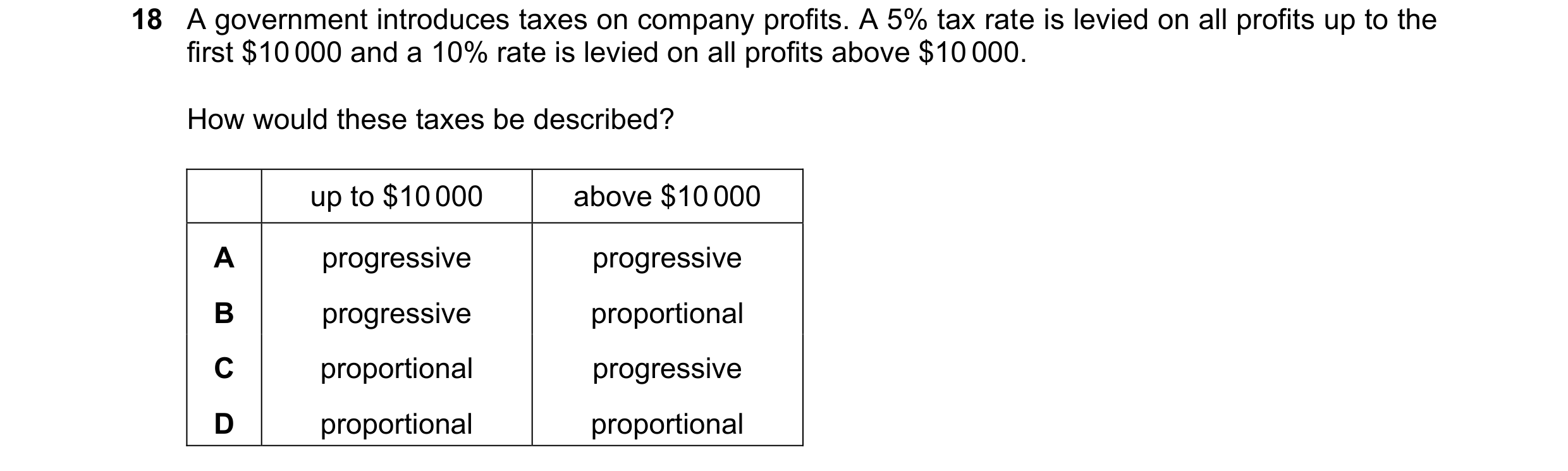
Q41 · A government introduces taxes on company profits 9708/14 May/June 2022
18 A government introduces taxes on company profits. A 5% tax rate is levied on all profits up to the first $10 000 and a 10% rate is levied on all profits above $10 000. How would these taxes be described? up to $10 000 above $10 000 A progressive progressive B progressive proportional C proportional progressive D proportional proportional
1 marks
Answer: D
This question in 9708/14 May/June 2022
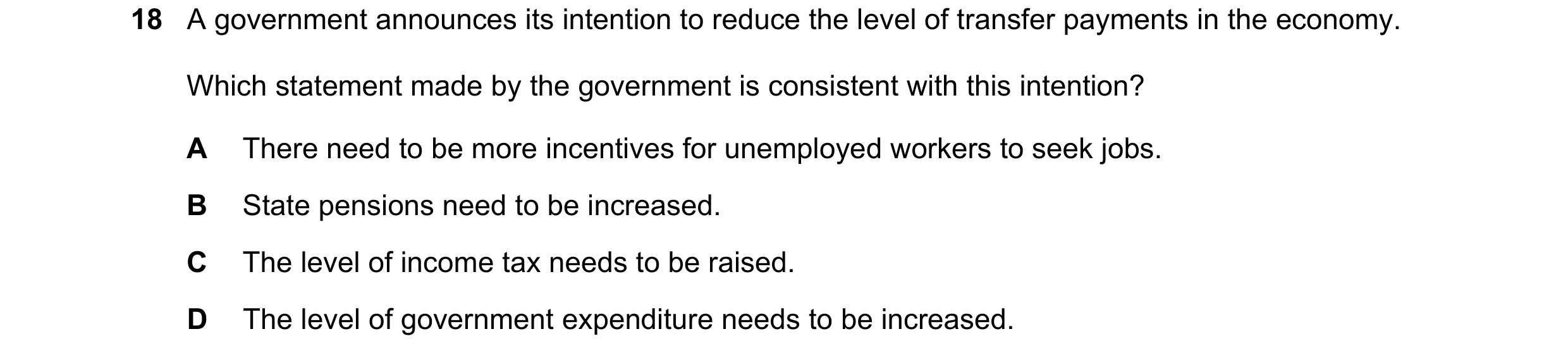
Q42 · A government announces its intention to reduce the level of transfer payments in the… 9708/11 Oct/Nov 2022
18 A government announces its intention to reduce the level of transfer payments in the economy. Which statement made by the government is consistent with this intention? A There need to be more incentives for unemployed workers to seek jobs. B State pensions need to be increased. C The level of income tax needs to be raised. D The level of government expenditure needs to be increased.
1 marks
Answer: A
This question in 9708/11 Oct/Nov 2022
Q43 · What defines a progressive tax? 9708/12 Oct/Nov 2022
19 What defines a progressive tax? A Low-income earners pay the same proportion of income in taxes as high-income earners. B Low-income earners pay a lower proportion of income in taxes than high-income earners. C Low-income earners pay less in taxes than high-income earners. D Low-income earners pay more in taxes than high-income earners.
1 marks
Answer: B
This question in 9708/12 Oct/Nov 2022
Q44 · Which type of economic policy is likely to be considered the most effective by a… 9708/12 Oct/Nov 2022
29 Which type of economic policy is likely to be considered the most effective by a government that has greater income equality as its primary aim? A fiscal policy B international trade policy C monetary policy D supply side policy
1 marks
Answer: A
This question in 9708/12 Oct/Nov 2022
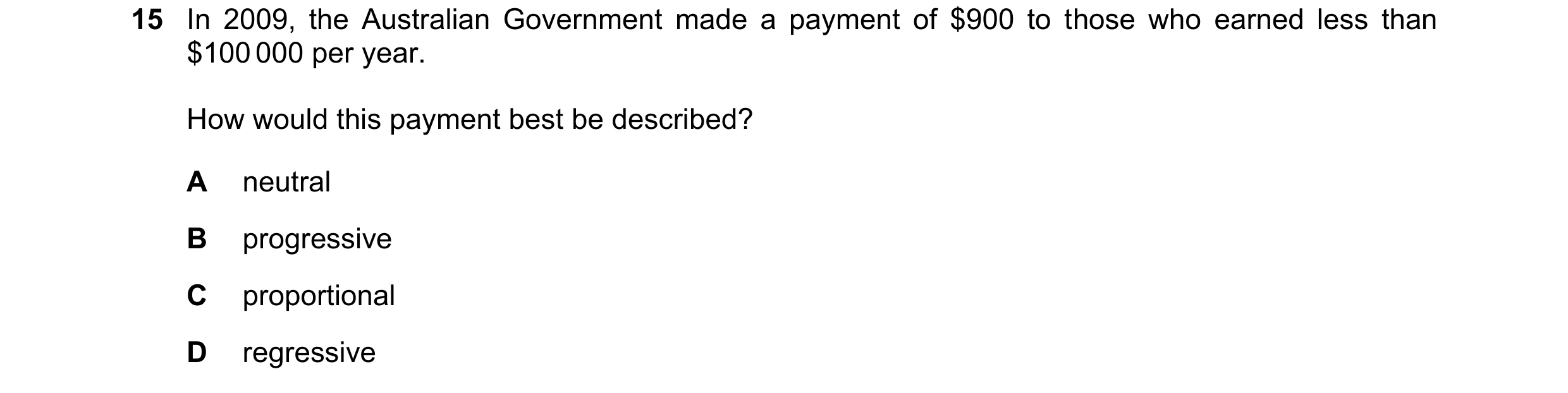
Q45 · In 2009, the Australian Government made a payment of $900 to those who earned less than… 9708/13 Oct/Nov 2022
15 In 2009, the Australian Government made a payment of $900 to those who earned less than $100 000 per year. How would this payment best be described? A neutral B progressive C proportional D regressive
1 marks
Answer: B
This question in 9708/13 Oct/Nov 2022
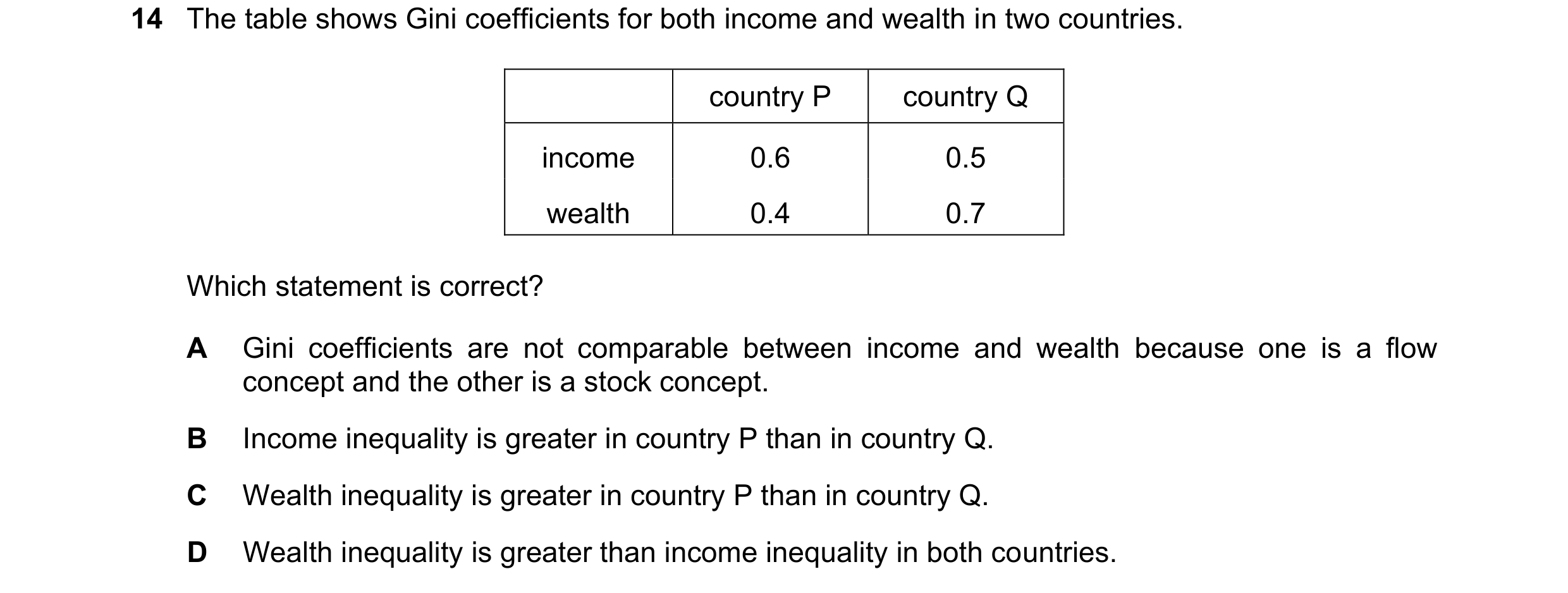
Q46 · The table shows Gini coefficients for both income and wealth in two countries 9708/12 Feb/March 2023
14 The table shows Gini coefficients for both income and wealth in two countries. country P country Q income 0.6 0.5 wealth 0.4 0.7 Which statement is correct? A Gini coefficients are not comparable between income and wealth because one is a flow concept and the other is a stock concept. B Income inequality is greater in country P than in country Q. C Wealth inequality is greater in country P than in country Q. D Wealth inequality is greater than income inequality in both countries.
1 marks
Answer: B
This question in 9708/12 Feb/March 2023
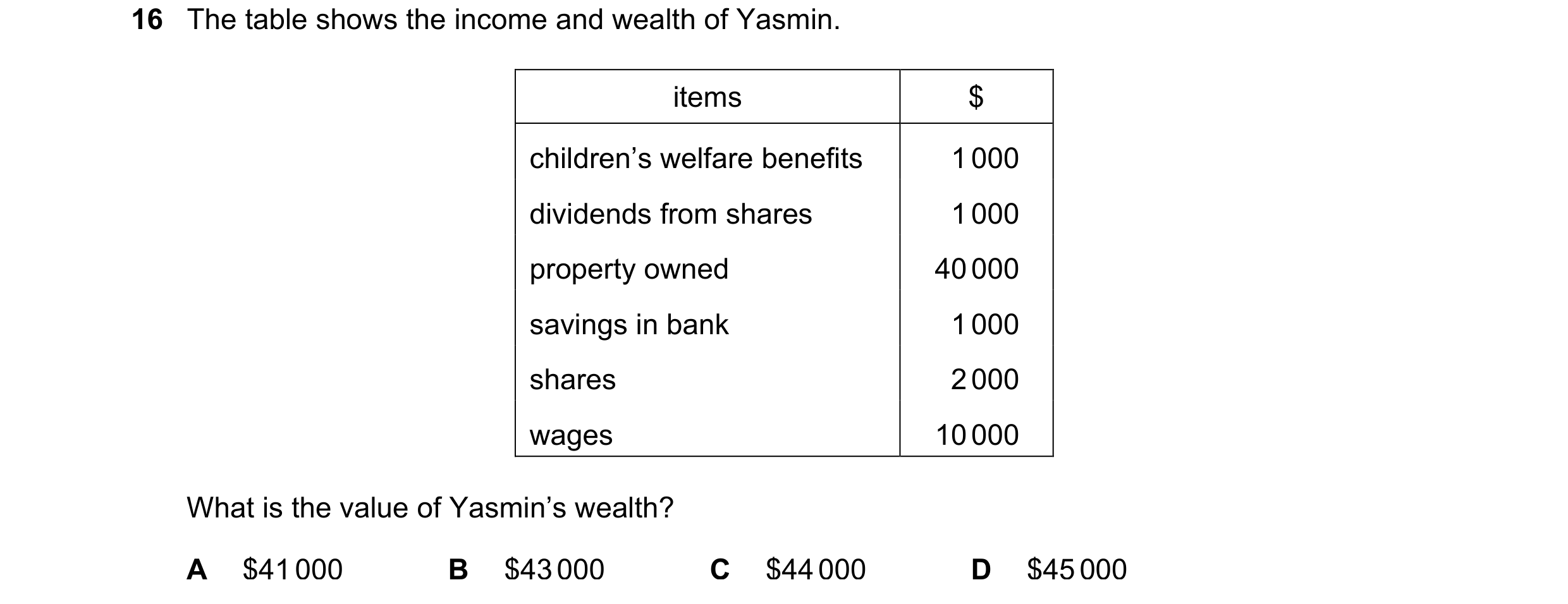
Q47 · The table shows the income and wealth of Yasmin 9708/11 May/June 2023
16 The table shows the income and wealth of Yasmin. items $ children’s welfare benefits 1 000 dividends from shares 1 000 property owned 40 000 savings in bank 1 000 shares 2 000 wages 10 000 What is the value of Yasmin’s wealth? A $41 000 B $43 000 C $44 000 D $45 000
1 marks
Answer: B
This question in 9708/11 May/June 2023
Q48 · A government has a policy aim of reducing income inequality 9708/13 May/June 2023
16 A government has a policy aim of reducing income inequality. It considers three policies. Which combination of policies would be most effective? a subsidy on an increase in the an increase in the battery-powered marginal rate of tax minimum wage cars which cost from 40% to 50% over $40 000 A yes no no B yes yes no C yes no yes D no yes no
1 marks
Answer: B
This question in 9708/13 May/June 2023
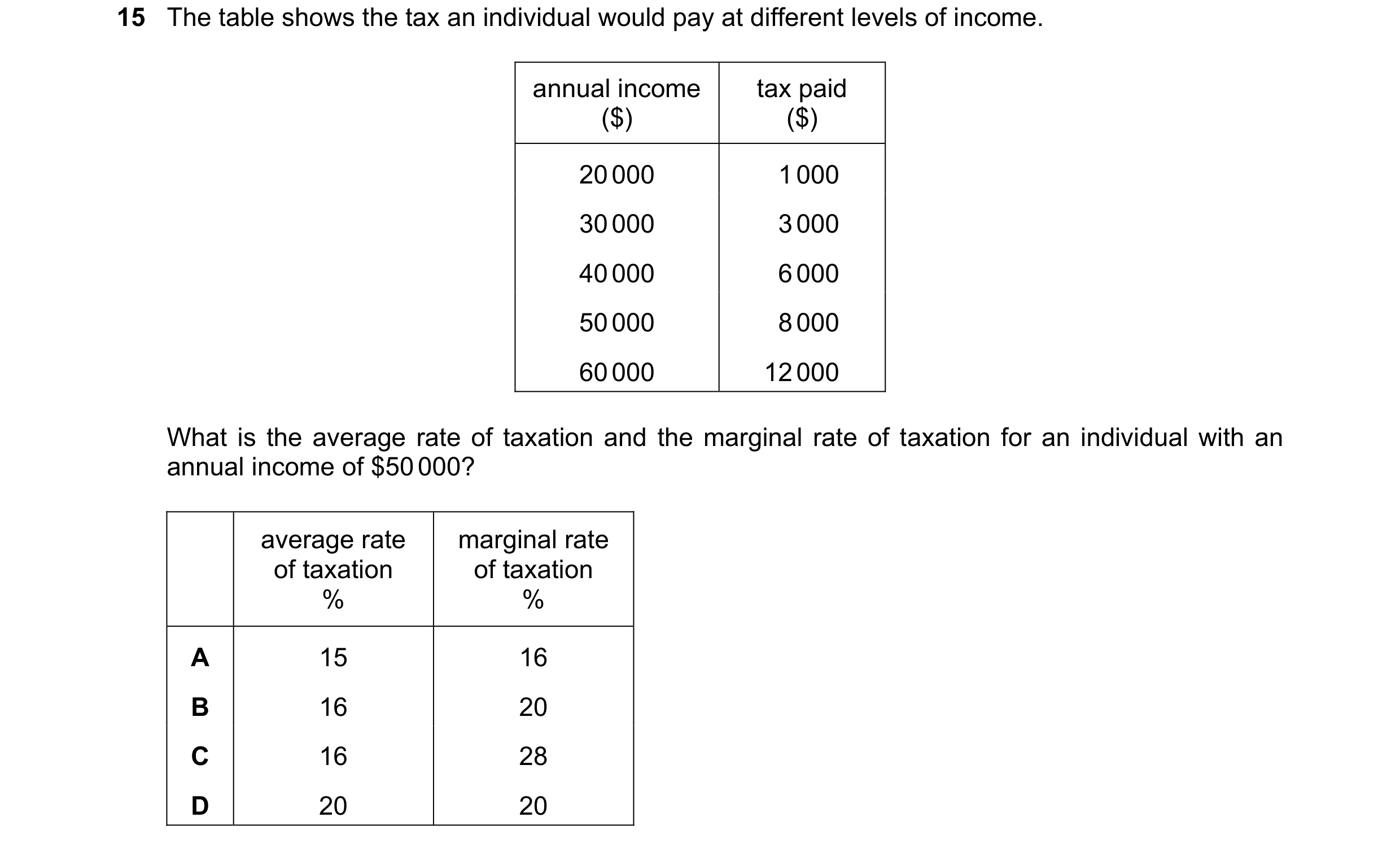
Q49 · The table shows the tax an individual would pay at different levels of income 9708/11 Oct/Nov 2023
15 The table shows the tax an individual would pay at different levels of income. annual income tax paid ($) ($) 20 000 1 000 30 000 3 000 40 000 6 000 50 000 8 000 60 000 12 000 What is the average rate of taxation and the marginal rate of taxation for an individual with an annual income of $50 000? average rate marginal rate of taxation of taxation % % A 15 16 B 16 20 C 16 28 D 20 20
1 marks
Answer: B
This question in 9708/11 Oct/Nov 2023
Q50 · What is most likely to be regressive? 9708/12 Oct/Nov 2023
14 What is most likely to be regressive? A corporate profit taxes B state pension benefits C specific tax on cigarettes D unemployment benefits
1 marks
Answer: C
This question in 9708/12 Oct/Nov 2023
Q51 · Which tax may a government use to reduce inequality? 9708/12 Oct/Nov 2023
27 Which tax may a government use to reduce inequality? A progressive income tax B proportionate income tax C proportionate indirect tax D specific indirect tax
1 marks
Answer: A
This question in 9708/12 Oct/Nov 2023
Q52 · What is a likely disadvantage of a government’s provision of transfer payments to the… 9708/13 Oct/Nov 2023
15 What is a likely disadvantage of a government’s provision of transfer payments to the unemployed? A decrease in the standard of living B disincentive to accept paid work C increase in inequality D increase in poverty
1 marks
Answer: B
This question in 9708/13 Oct/Nov 2023
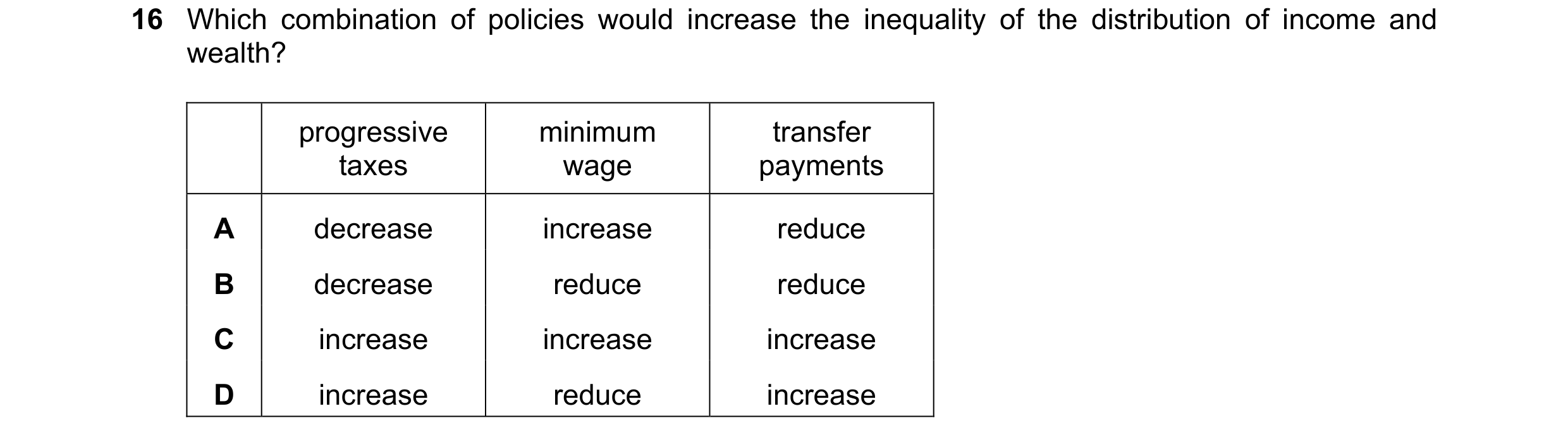
Q53 · Which combination of policies would increase the inequality of the distribution of income… 9708/13 Oct/Nov 2023
16 Which combination of policies would increase the inequality of the distribution of income and wealth? progressive minimum transfer taxes wage payments A decrease increase reduce B decrease reduce reduce C increase increase increase D increase reduce increase
1 marks
Answer: B
This question in 9708/13 Oct/Nov 2023
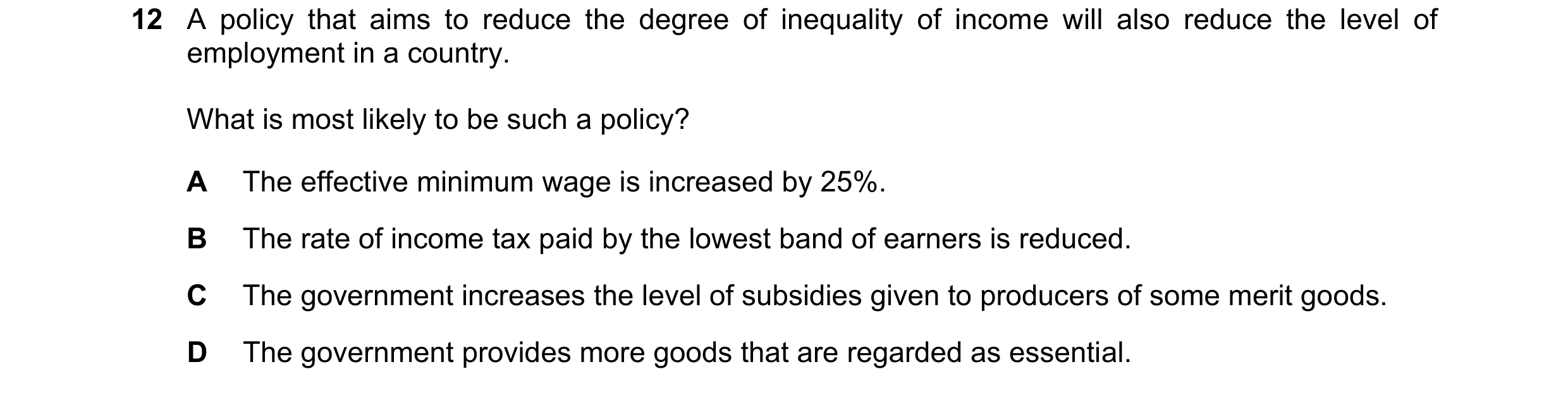
Q54 · A policy that aims to reduce the degree of inequality of income will also reduce the… 9708/12 Feb/March 2024
12 A policy that aims to reduce the degree of inequality of income will also reduce the level of employment in a country. What is most likely to be such a policy? A The effective minimum wage is increased by 25%. B The rate of income tax paid by the lowest band of earners is reduced. C The government increases the level of subsidies given to producers of some merit goods. D The government provides more goods that are regarded as essential.
1 marks
Answer: A
This question in 9708/12 Feb/March 2024
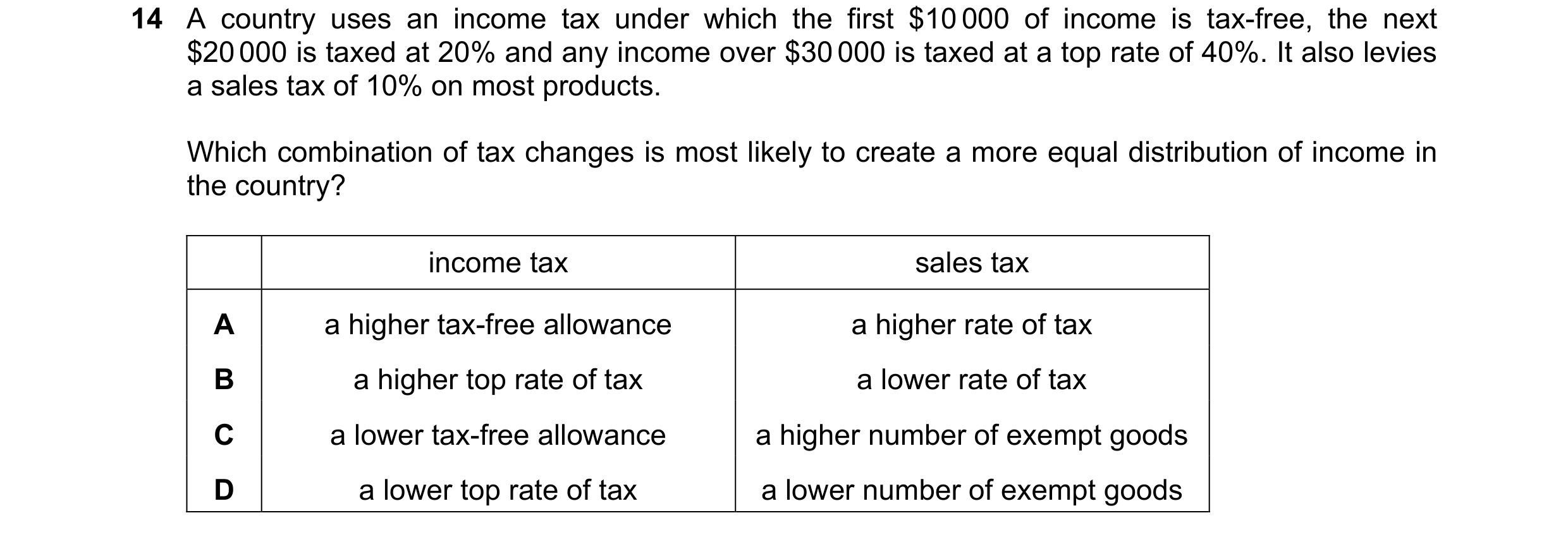
Q55 · A country uses an income tax under which the first $10 000 of income is tax-free, the… 9708/12 Feb/March 2024
14 A country uses an income tax under which the first $10 000 of income is tax-free, the next $20 000 is taxed at 20% and any income over $30 000 is taxed at a top rate of 40%. It also levies a sales tax of 10% on most products. Which combination of tax changes is most likely to create a more equal distribution of income in the country? income tax sales tax A a higher tax-free allowance a higher rate of tax B a higher top rate of tax a lower rate of tax C a lower tax-free allowance a higher number of exempt goods D a lower top rate of tax a lower number of exempt goods
1 marks
Answer: B
This question in 9708/12 Feb/March 2024
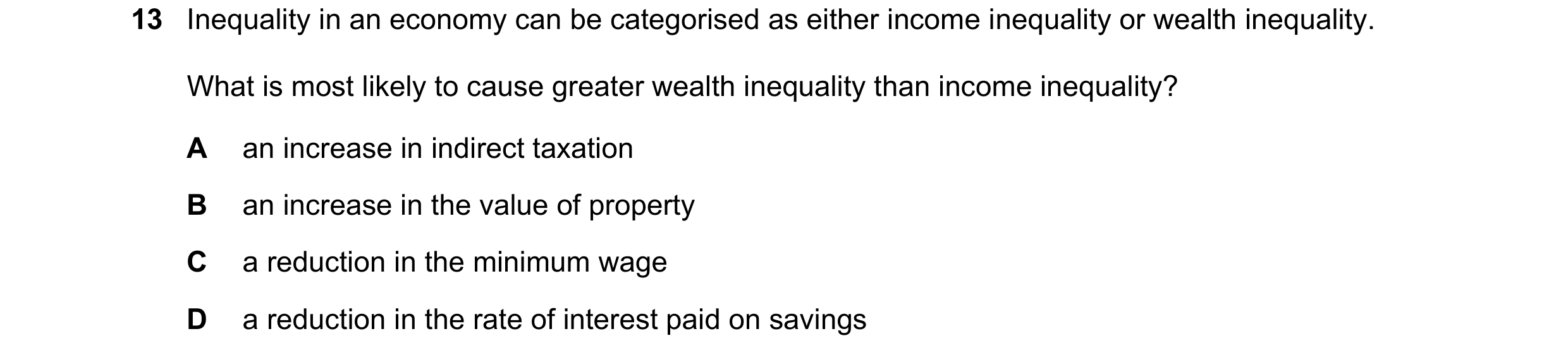
Q56 · Inequality in an economy can be categorised as either income inequality or wealth… 9708/12 Oct/Nov 2024
13 Inequality in an economy can be categorised as either income inequality or wealth inequality. What is most likely to cause greater wealth inequality than income inequality? A an increase in indirect taxation B an increase in the value of property C a reduction in the minimum wage D a reduction in the rate of interest paid on savings
1 marks
Answer: B
This question in 9708/12 Oct/Nov 2024
Q57 · Very low interest rates in an economy encourage economic growth and cause a large… 9708/13 Oct/Nov 2024
13 Very low interest rates in an economy encourage economic growth and cause a large increase in house prices. Which group of people is most likely to experience a fall in income and an increase in wealth as a result of these changes? A retired people living in rented houses B retired people who own their houses C young people buying their own houses D young people living with their parents
1 marks
Answer: B
This question in 9708/13 Oct/Nov 2024
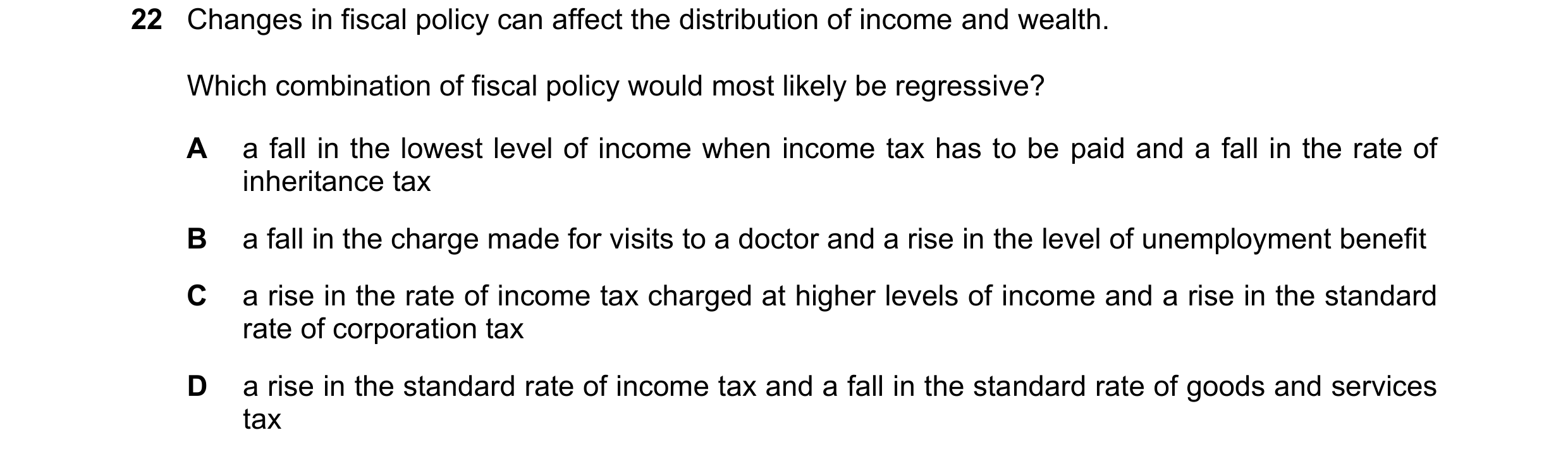
Q58 · Changes in fiscal policy can affect the distribution of income and wealth 9708/13 Oct/Nov 2024
22 Changes in fiscal policy can affect the distribution of income and wealth. Which combination of fiscal policy would most likely be regressive? A a fall in the lowest level of income when income tax has to be paid and a fall in the rate of inheritance tax B a fall in the charge made for visits to a doctor and a rise in the level of unemployment benefit C a rise in the rate of income tax charged at higher levels of income and a rise in the standard rate of corporation tax D a rise in the standard rate of income tax and a fall in the standard rate of goods and services tax
1 marks
Answer: A
This question in 9708/13 Oct/Nov 2024
Q59 · Why is it more difficult to quantify the wealth of an individual rather than their income? 9708/12 Feb/March 2025
14 Why is it more difficult to quantify the wealth of an individual rather than their income? A A skilled artist may keep a painting in stock whose value increases after their death. B Individuals can choose to spend all available income, leaving wealth unchanged. C Not every form of individual wealth can be traded for money in a market. D Wealth is a stock which cannot be broken down into an individual’s different assets.
1 marks
Answer: C
This question in 9708/12 Feb/March 2025
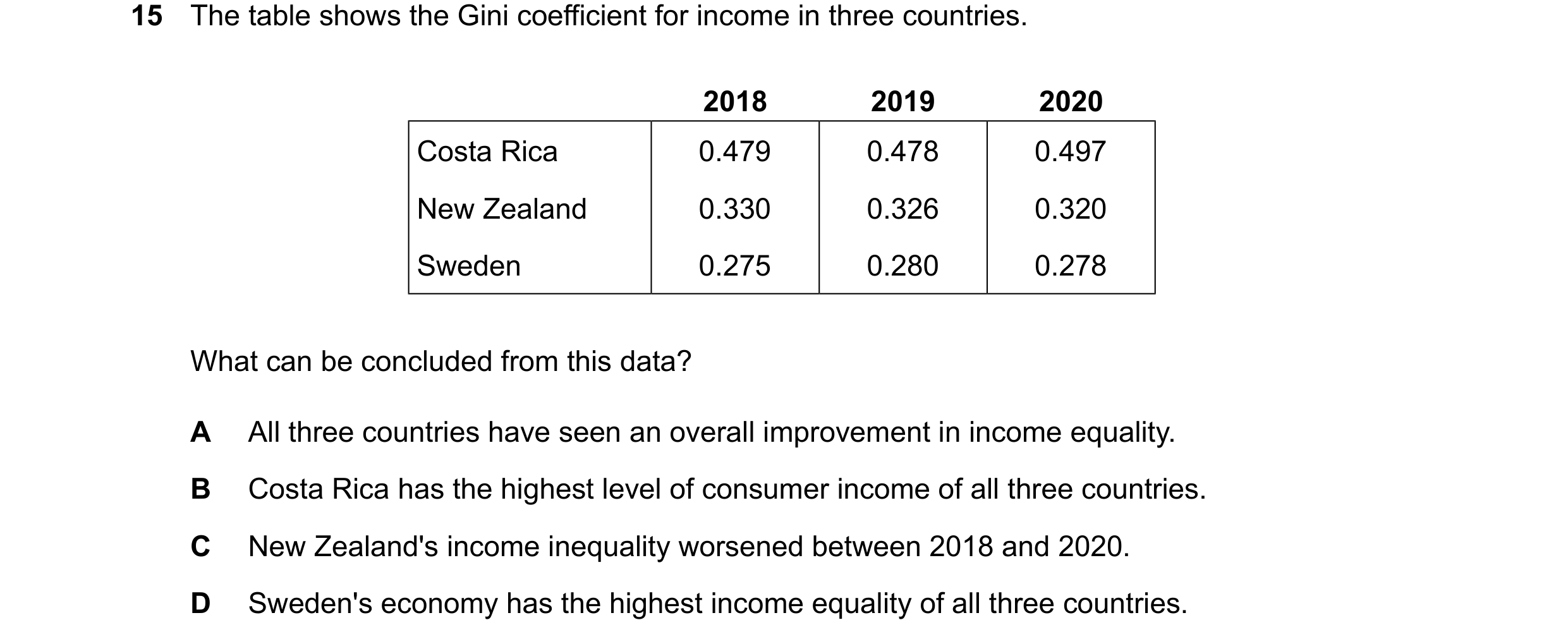
Q60 · The table shows the Gini coefficient for income in three countries 9708/12 Feb/March 2025
15 The table shows the Gini coefficient for income in three countries. 2018 2019 2020 Costa Rica 0.479 0.478 0.497 New Zealand 0.330 0.326 0.320 Sweden 0.275 0.280 0.278 What can be concluded from this data? A All three countries have seen an overall improvement in income equality. B Costa Rica has the highest level of consumer income of all three countries. C New Zealand's income inequality worsened between 2018 and 2020. D Sweden's economy has the highest income equality of all three countries.
1 marks
Answer: D
This question in 9708/12 Feb/March 2025
Q61 · Which combination of fiscal policy measures will reduce both the inflation rate and… 9708/12 Feb/March 2025
22 Which combination of fiscal policy measures will reduce both the inflation rate and income inequality? subsidies on food and direct taxes indirect taxes public transport A decrease decrease increase B decrease increase increase C increase decrease increase D increase increase decrease
1 marks
Answer: C
This question in 9708/12 Feb/March 2025
Q62 · What defines a progressive tax? 9708/12 Feb/March 2025
25 What defines a progressive tax? A All taxpayers pay the same proportion of income in taxes. B Low-income earners pay a lower proportion of income in taxes than high-income earners. C Low-income earners pay less in taxes than high-income earners. D Low-income earners pay more in taxes than high-income earners.
1 marks
Answer: B
This question in 9708/12 Feb/March 2025
Q63 · What is an example of wealth? 9708/11 May/June 2025
11 What is an example of wealth? A interest received B profits C property D incomes
1 marks
Answer: C
This question in 9708/11 May/June 2025
Q64 · What is an example of a transfer payment? 9708/11 May/June 2025
15 What is an example of a transfer payment? A a household moving savings from one bank account to another B a monthly repayment on a loan used to buy a new cooker C the amount paid to transport goods from one city to another D grants paid to students by the government
1 marks
Answer: D
This question in 9708/11 May/June 2025
Q65 · What would not be included in the calculation of an individual’s wealth? 9708/12 May/June 2025
12 What would not be included in the calculation of an individual’s wealth? A the house owned by the individual B the savings in the individual’s bank account C the stocks and shares owned by the individual D the wages earned by the individual
1 marks
Answer: D
This question in 9708/12 May/June 2025
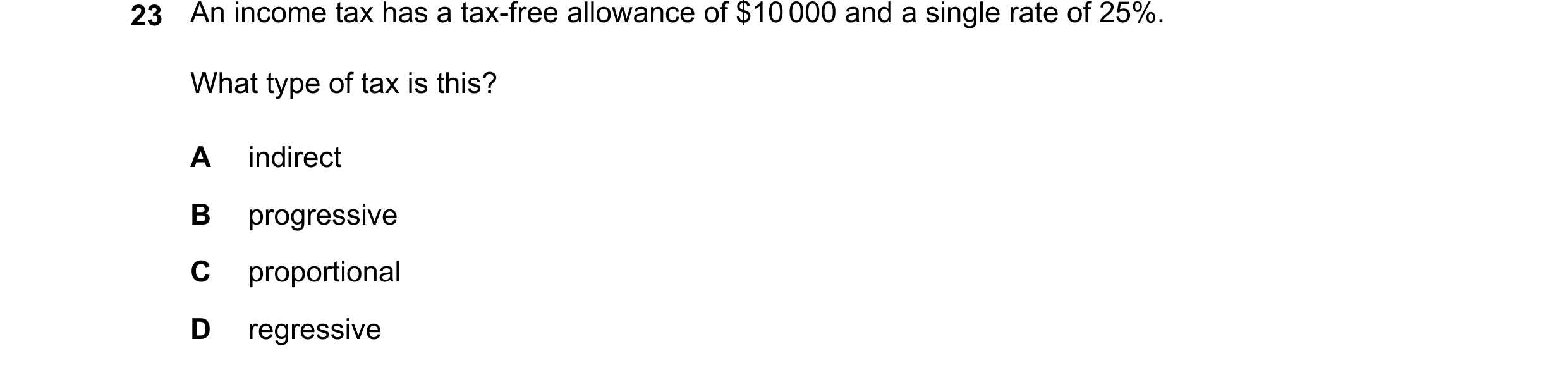
Q66 · What type of tax is this? 9708/12 May/June 2025
23 What type of tax is this? A indirect B progressive C proportional D regressive
1 marks
Answer: B
This question in 9708/12 May/June 2025
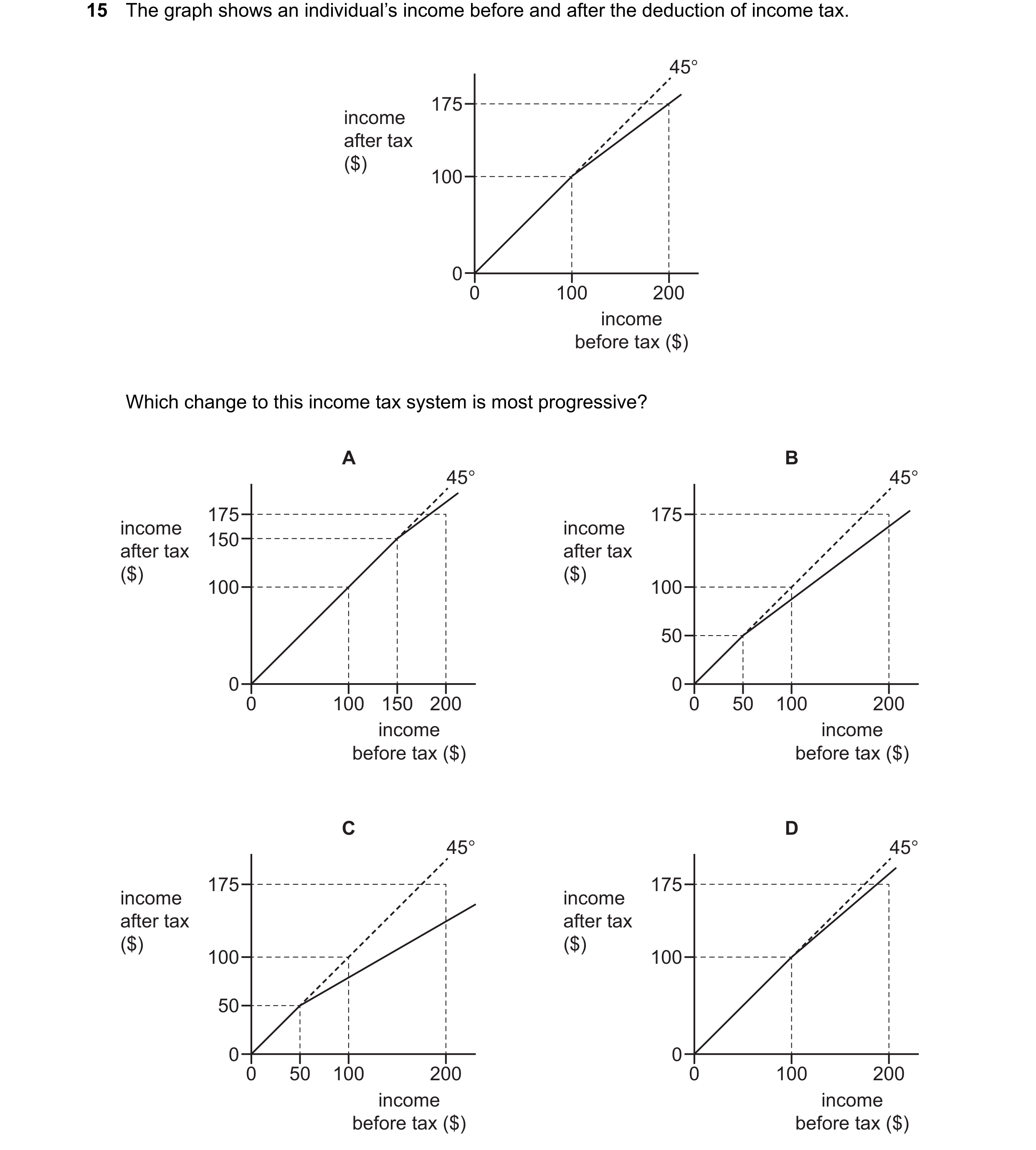
Q67 · The graph shows an individual’s income before and after the deduction of income tax 9708/13 May/June 2025
15 The graph shows an individual’s income before and after the deduction of income tax. 45° 175 income after tax ($) 100 0 0 100 200 income before tax ($) Which change to this income tax system is most progressive? A B 45° 45° 175 175 income income 150 after tax after tax ($) ($) 100 100 50 0 0 0 100 150 200 0 50 100 200 income income before tax ($) before tax ($) C D 45° 45° 175 175 income income after tax after tax ($) ($) 100 100 50 0 0 0 50 100 200 0 100 200 income income before tax ($) before tax ($)
1 marks
Answer: C
This question in 9708/13 May/June 2025
Q68 · A country with a market economy changes to a mixed economy 9708/11 Oct/Nov 2025
2 A country with a market economy changes to a mixed economy. When is this change likely to achieve the largest improvement in resource allocation? number of demerit Gini coefficient goods in the value for the country country A many 0.4 B many 0.7 C few 0.4 D few 0.7
1 marks
Answer: B
This question in 9708/11 Oct/Nov 2025
Q69 · What would be included in a measure of wealth? 9708/11 Oct/Nov 2025
13 What would be included in a measure of wealth? A annual income B benefits and pensions C interest earned on savings D savings held in bank accounts
1 marks
Answer: D
This question in 9708/11 Oct/Nov 2025
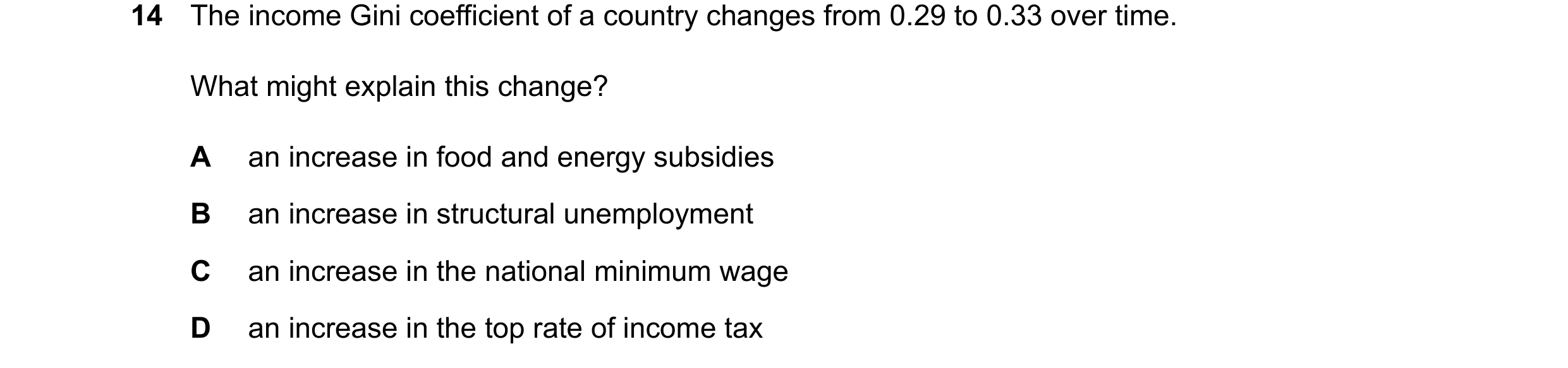
Q70 · The income Gini coefficient of a country changes from 0.29 to 0.33 over time 9708/12 Oct/Nov 2025
14 The income Gini coefficient of a country changes from 0.29 to 0.33 over time. What might explain this change? A an increase in food and energy subsidies B an increase in structural unemployment C an increase in the national minimum wage D an increase in the top rate of income tax
1 marks
Answer: B
This question in 9708/12 Oct/Nov 2025
Q71 · What is the most likely reason for a government to introduce a progressive tax? 9708/12 Oct/Nov 2025
24 What is the most likely reason for a government to introduce a progressive tax? A to discourage the consumption of a particular good B to distribute disposable income more evenly C to increase the disposable income of households D to reduce demand for healthcare services
1 marks
Answer: B
This question in 9708/12 Oct/Nov 2025
Q72 · Which area of government spending is a transfer payment? 9708/13 Oct/Nov 2025
14 Which area of government spending is a transfer payment? A spending on new road building B spending on pensions to the elderly C spending on buying new police cars D spending on wages of teachers
1 marks
Answer: B
This question in 9708/13 Oct/Nov 2025

 1 / 17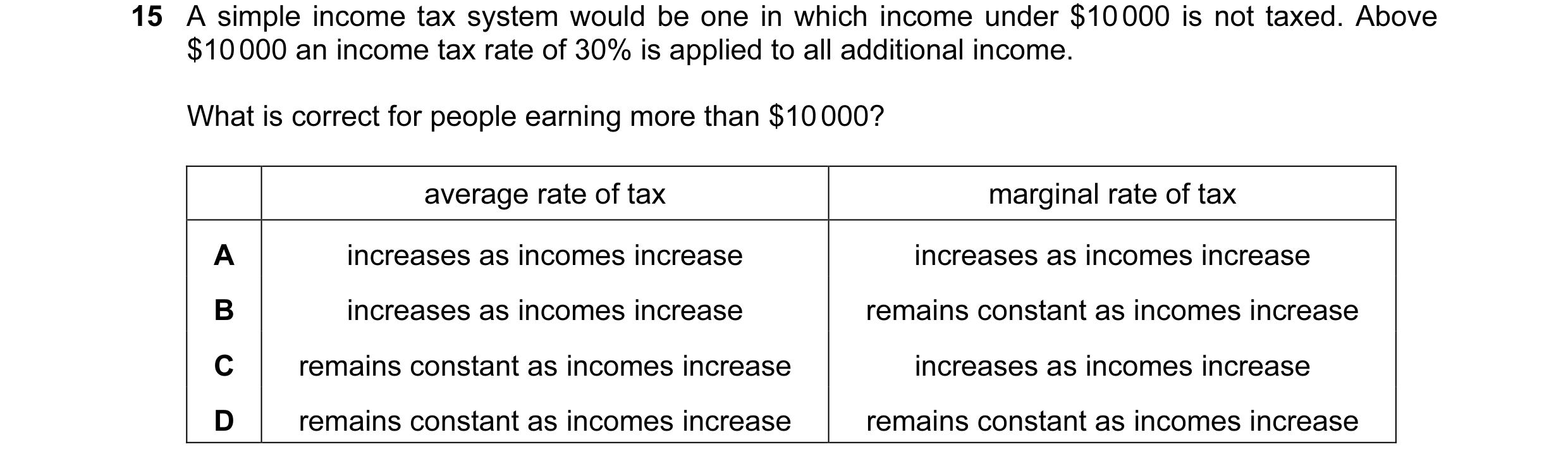

 2 / 17




 3 / 17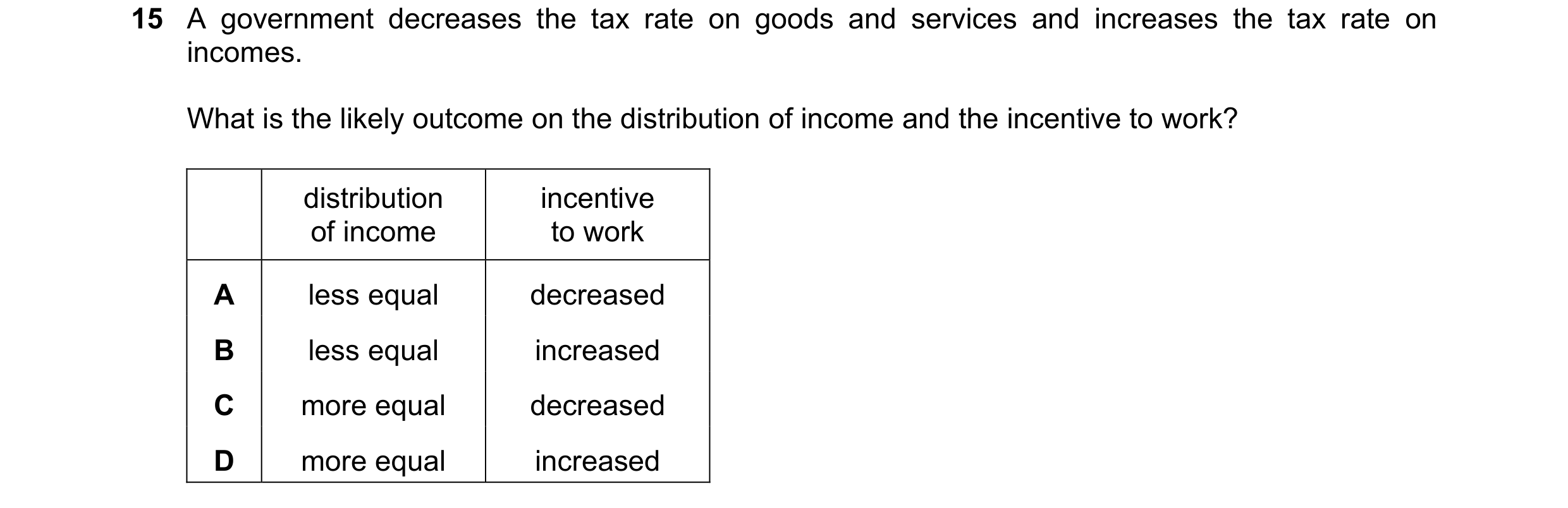


 4 / 17
 5 / 17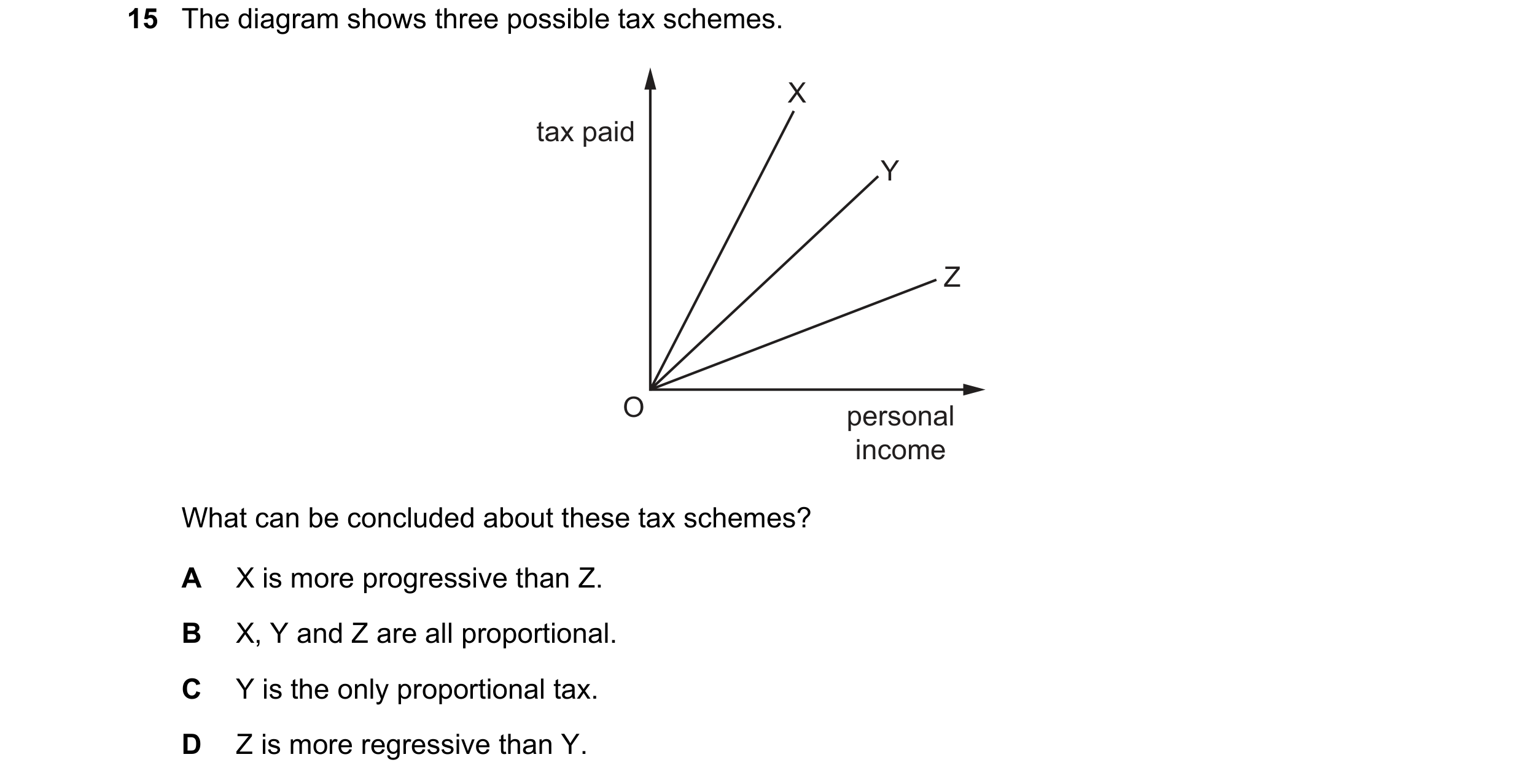
 6 / 17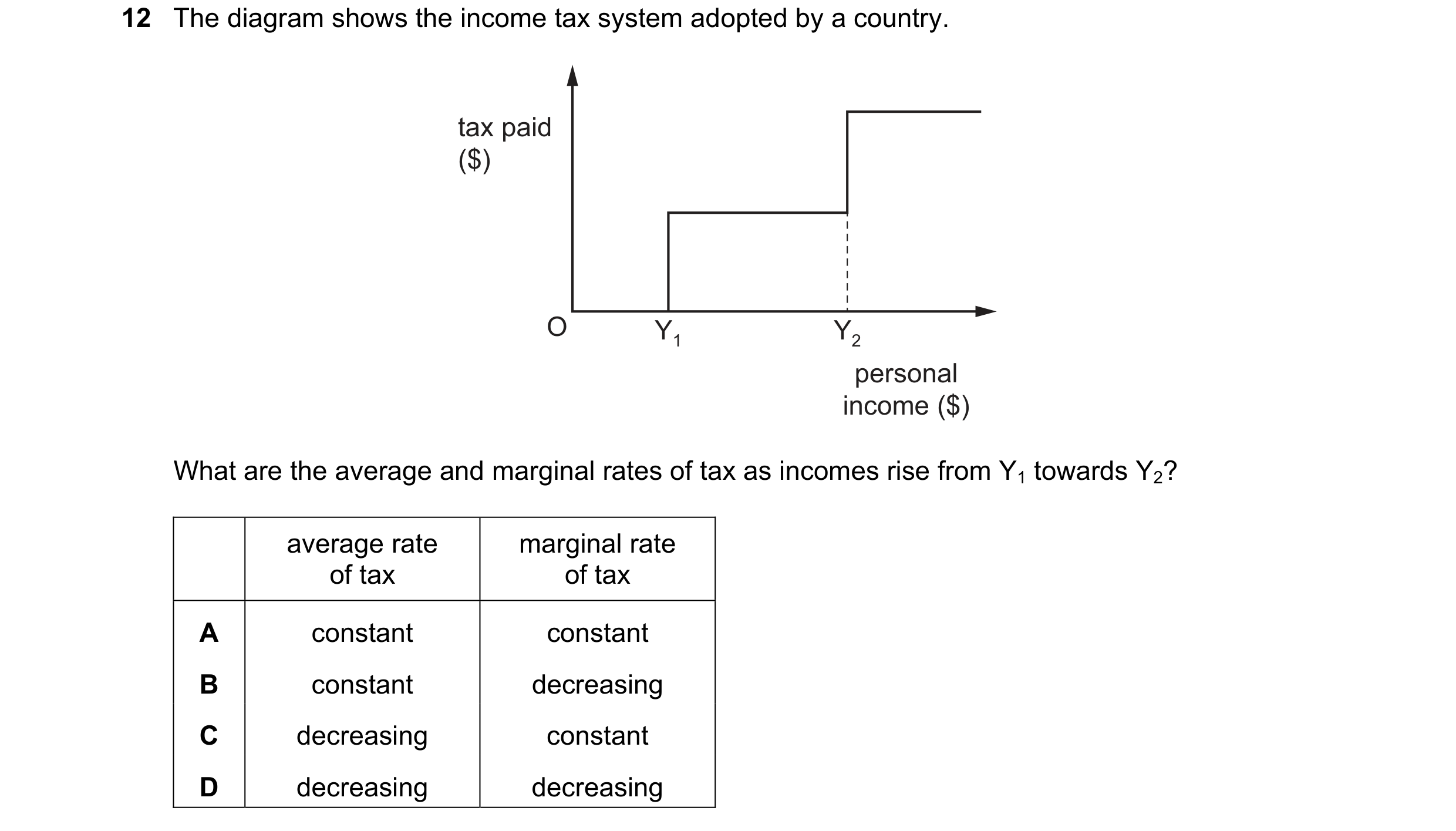


 7 / 17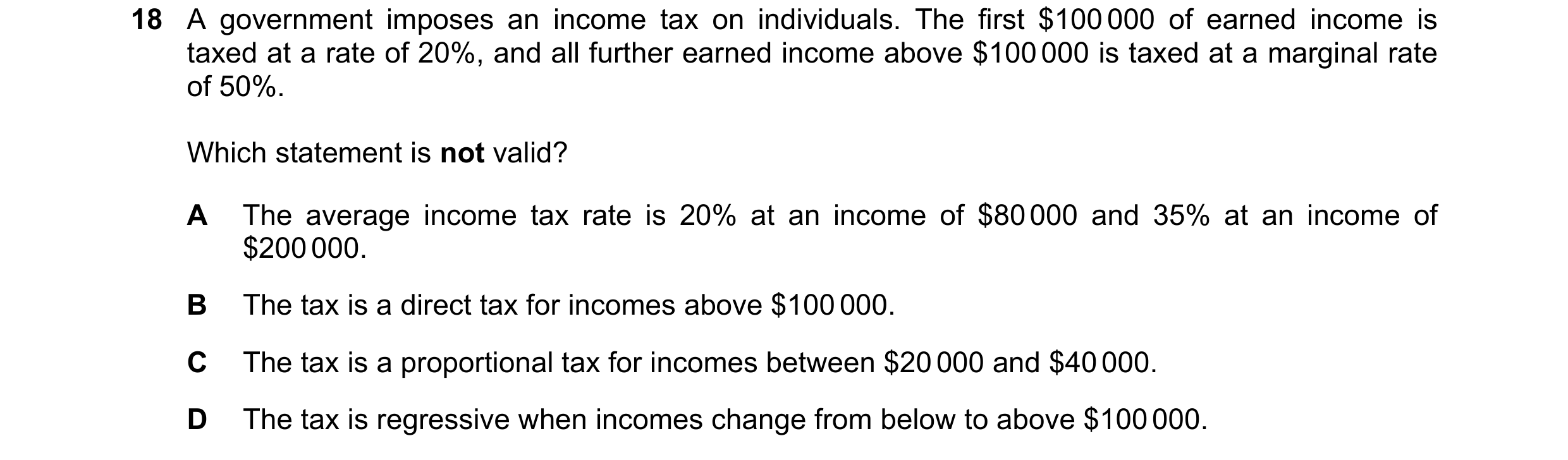

 8 / 17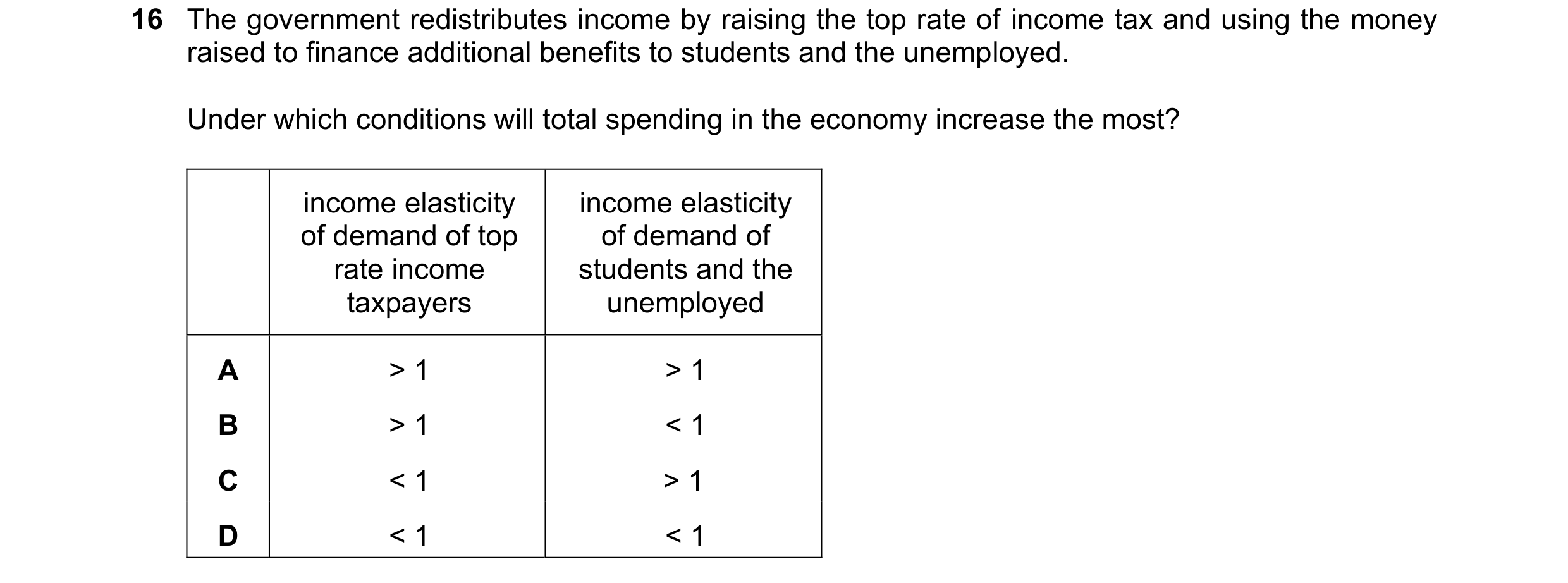


 9 / 17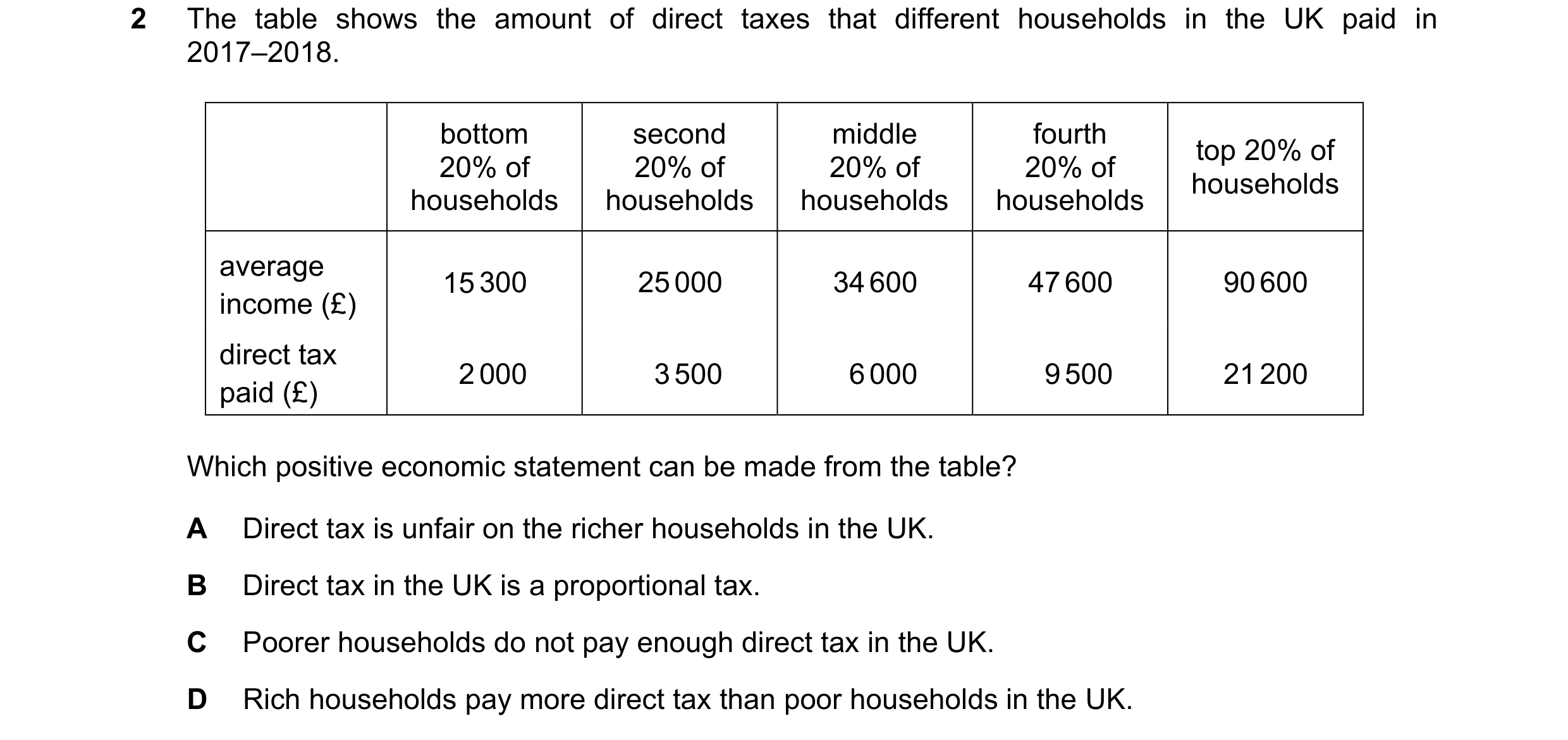
 10 / 17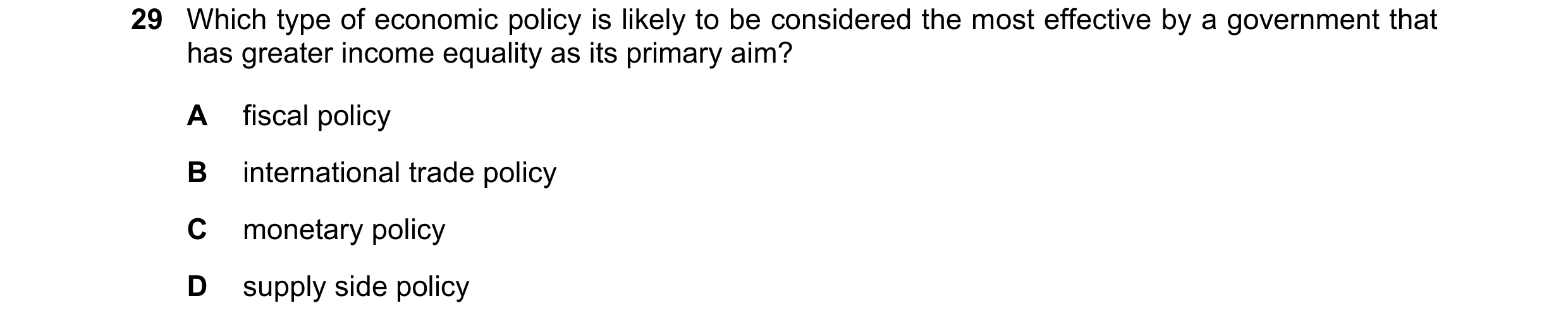
 11 / 17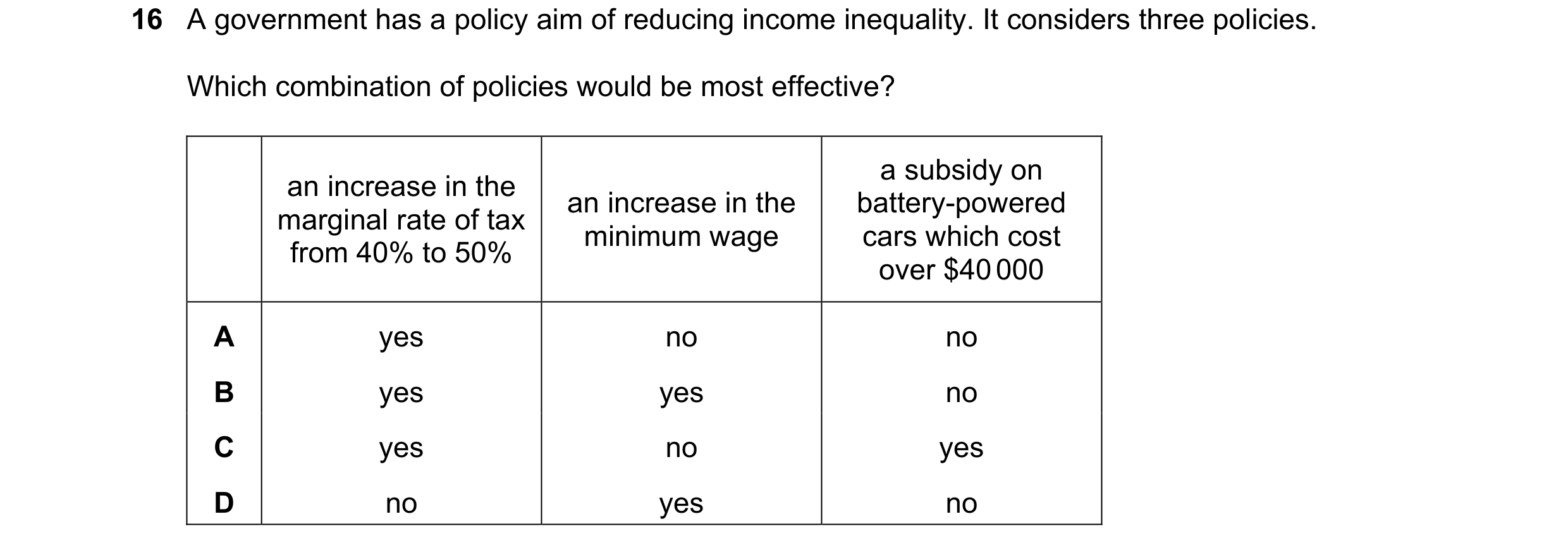

 12 / 17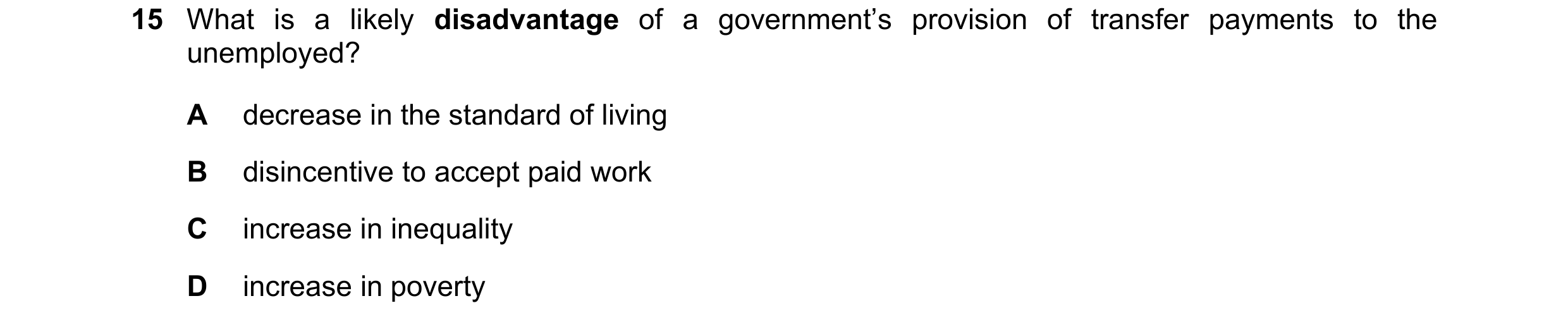
 13 / 17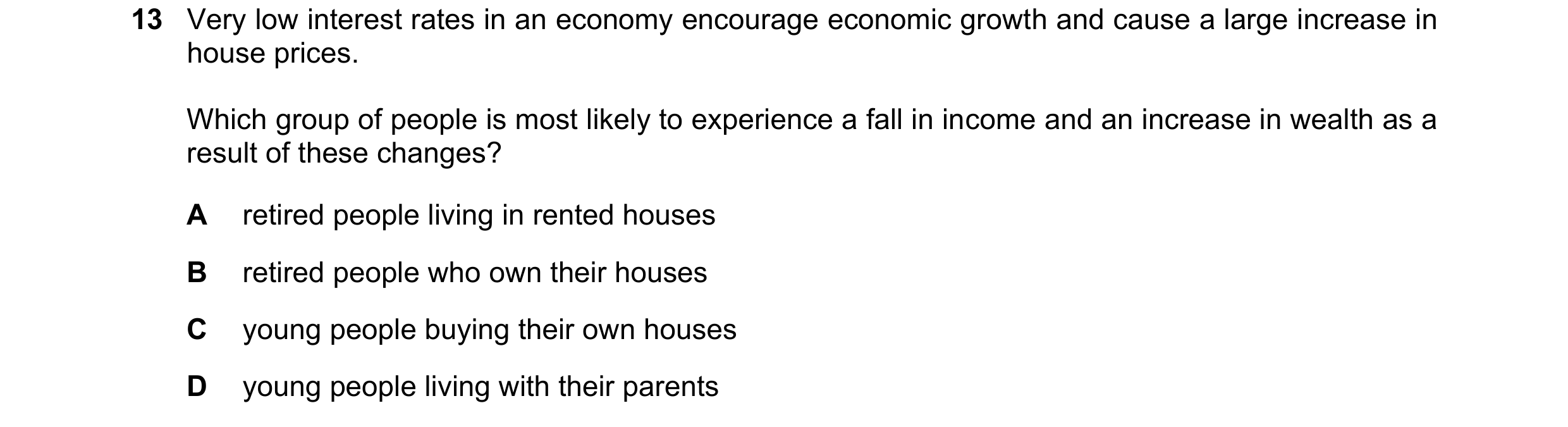

 14 / 17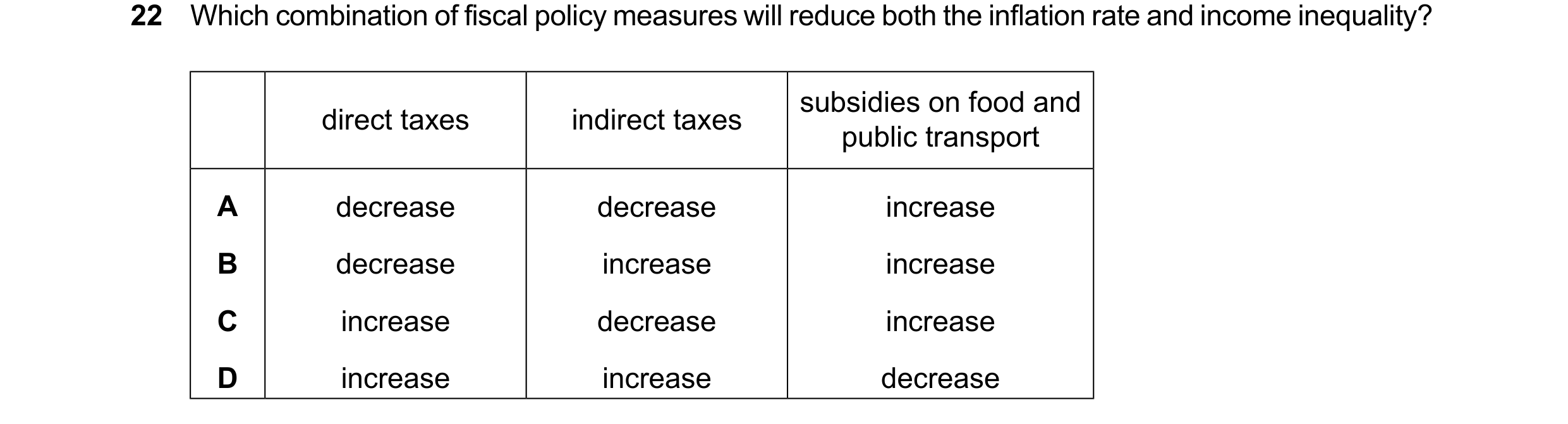




 15 / 17
 16 / 17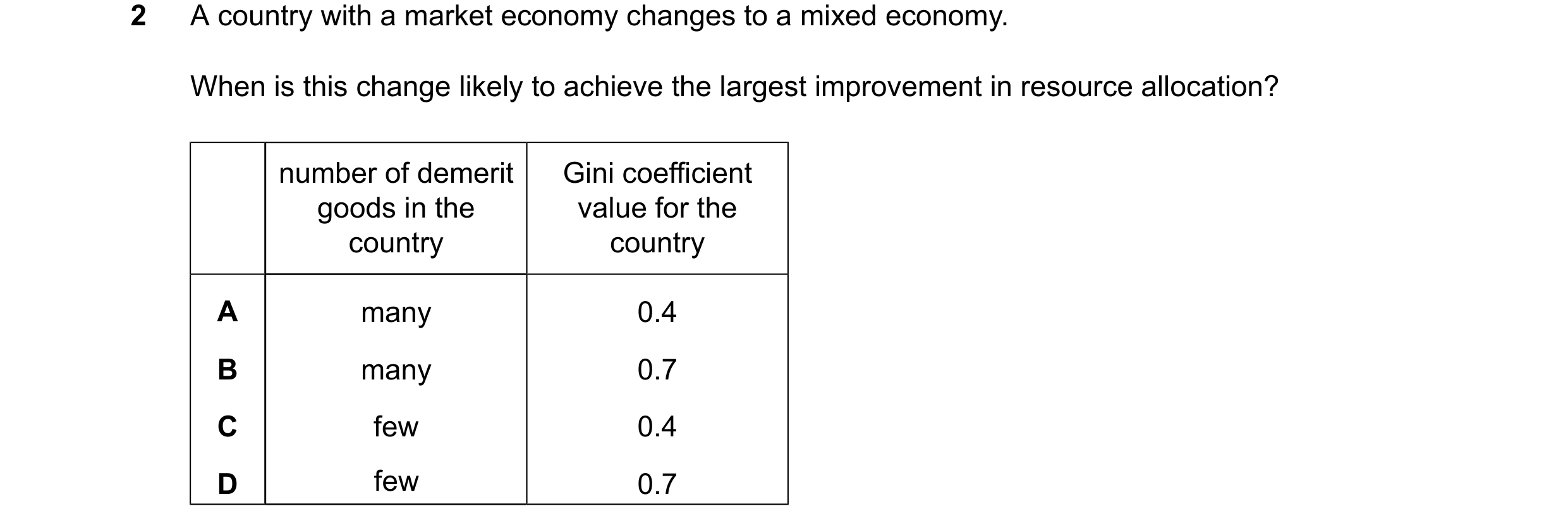


 17 / 17