Questions as text
Q1 · Which tax is most likely to be regressive? 9708/31 May/June 2011
26 Which tax is most likely to be regressive? A an inheritance tax B a property tax C a sales tax D income tax
1 marks
Answer: C
This question in 9708/31 May/June 2011
Q2 · Which commodities should a government tax if it wishes to make the tax system more… 9708/33 Oct/Nov 2011
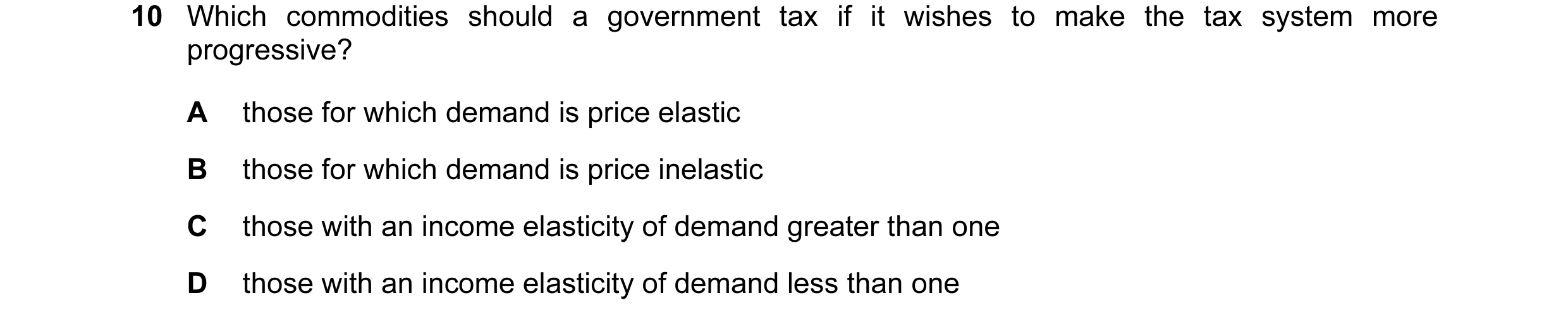
10 Which commodities should a government tax if it wishes to make the tax system more progressive? A those for which demand is price elastic B those for which demand is price inelastic C those with an income elasticity of demand greater than one D those with an income elasticity of demand less than one
1 marks
Answer: C
This question in 9708/33 Oct/Nov 2011
Q3 · A regressive tax is defined as one where A all taxpayers pay the same absolute amount of… 9708/33 Oct/Nov 2011
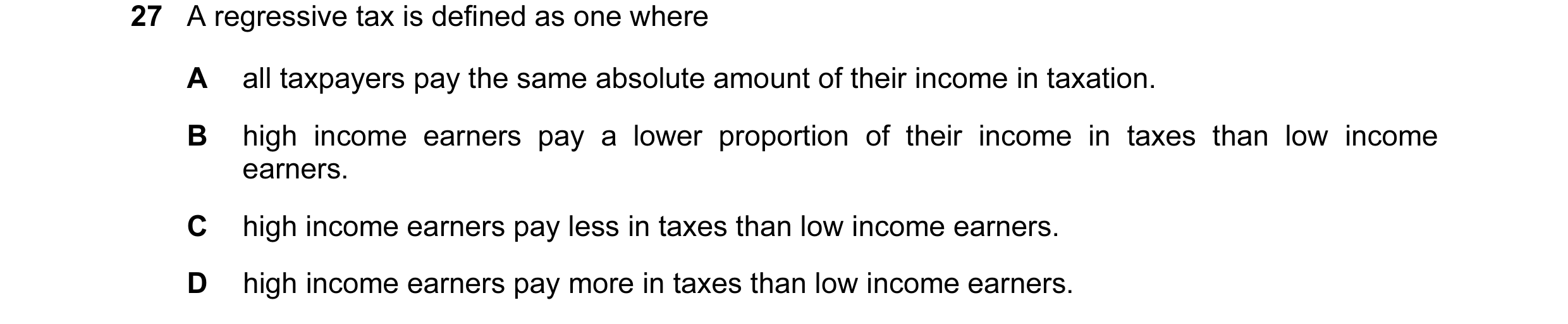
27 A regressive tax is defined as one where A all taxpayers pay the same absolute amount of their income in taxation. B high income earners pay a lower proportion of their income in taxes than low income earners. C high income earners pay less in taxes than low income earners. D high income earners pay more in taxes than low income earners.
1 marks
Answer: B
This question in 9708/33 Oct/Nov 2011
Q4 · Which combination of government interventions would be intended to support the lower… 9708/31 Oct/Nov 2014
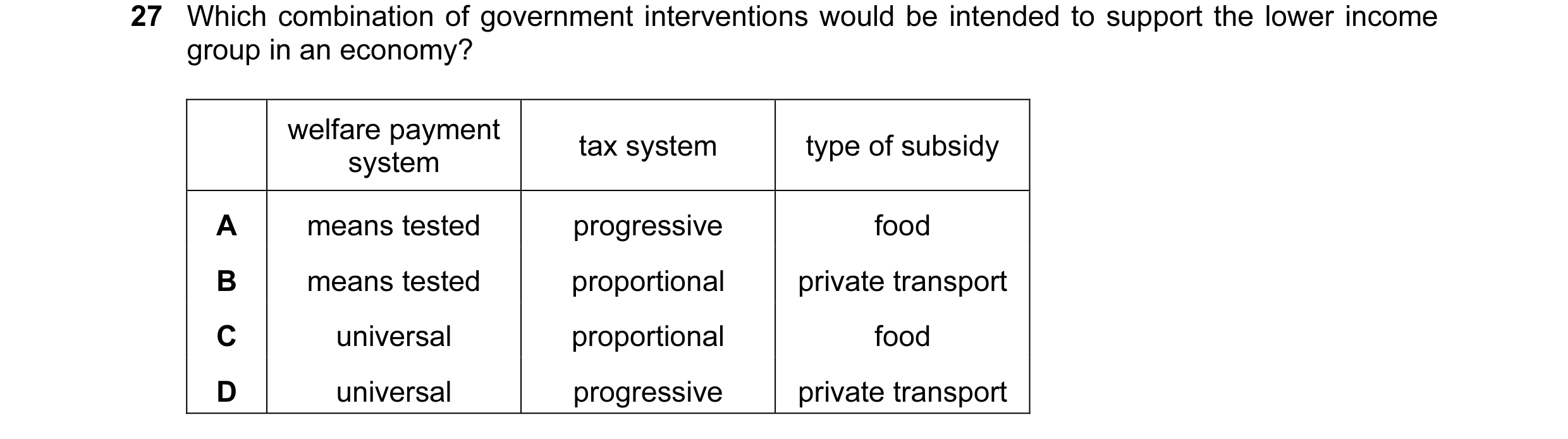
27 Which combination of government interventions would be intended to support the lower income group in an economy? welfare payment tax system type of subsidy system A means tested progressive food B means tested proportional private transport C universal proportional food D universal progressive private transport
1 marks
Answer: A
This question in 9708/31 Oct/Nov 2014
Q5 · A country has a negative income tax 9708/32 Oct/Nov 2015
17 A country has a negative income tax. In the diagram, the curve NT shows the country’s initial tax schedule. + NT1 tax NT 0 income – What could cause the tax schedule to shift to NT1? A a higher marginal tax rate B a more equal distribution of income C an increase in household disposable income D an increase in the marginal propensity to consume
1 marks
Answer: A
This question in 9708/32 Oct/Nov 2015
Q6 · Which policy would be most effective in achieving a more equal distribution of disposable… 9708/32 May/June 2016
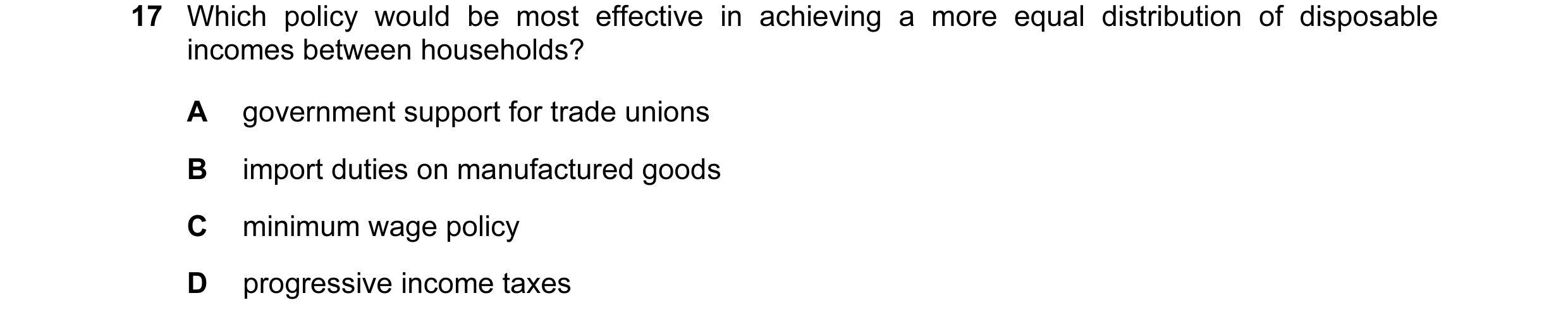
17 Which policy would be most effective in achieving a more equal distribution of disposable incomes between households? A government support for trade unions B import duties on manufactured goods C minimum wage policy D progressive income taxes
1 marks
Answer: D
This question in 9708/32 May/June 2016
Q7 · Which statement is most likely to explain why a government decides to increase the… 9708/32 May/June 2017
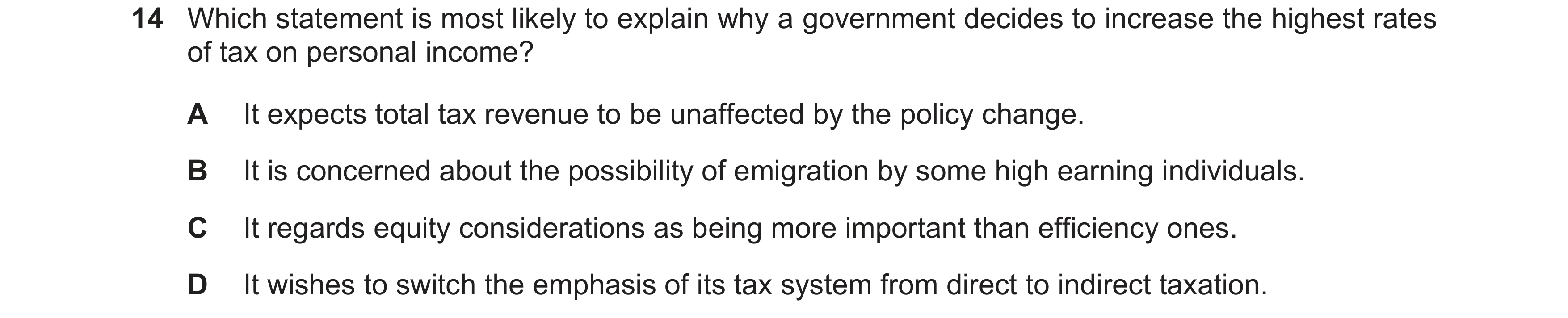
14 Which statement is most likely to explain why a government decides to increase the highest rates of tax on personal income? A It expects total tax revenue to be unaffected by the policy change. B It is concerned about the possibility of emigration by some high earning individuals. C It regards equity considerations as being more important than efficiency ones. D It wishes to switch the emphasis of its tax system from direct to indirect taxation.
1 marks
Answer: C
This question in 9708/32 May/June 2017
Q8 · The Lorenz curves in the diagram show different distributions of income and of wealth 9708/32 May/June 2017
15 The Lorenz curves in the diagram show different distributions of income and of wealth. 100 % of income or % of wealth 1 2 4 3 0 0 100 % of households Income in a country is more equally distributed than wealth. In a period the distribution of income becomes more unequal but the distribution of wealth becomes more equal. Which movement would show the effects of these changes on the distribution of income and wealth within the country? distribution of income distribution of wealth A shift from curve 1 to curve 2 shift from curve 4 to curve 3 B shift from curve 2 to curve 1 shift from curve 3 to curve 4 C shift from curve 3 to curve 4 shift from curve 2 to curve 1 D shift from curve 4 to curve 3 shift from curve 1 to curve 2
1 marks
Answer: A
This question in 9708/32 May/June 2017
Q9 · The government of a country wants to achieve a more equitable distribution of income 9708/33 May/June 2017
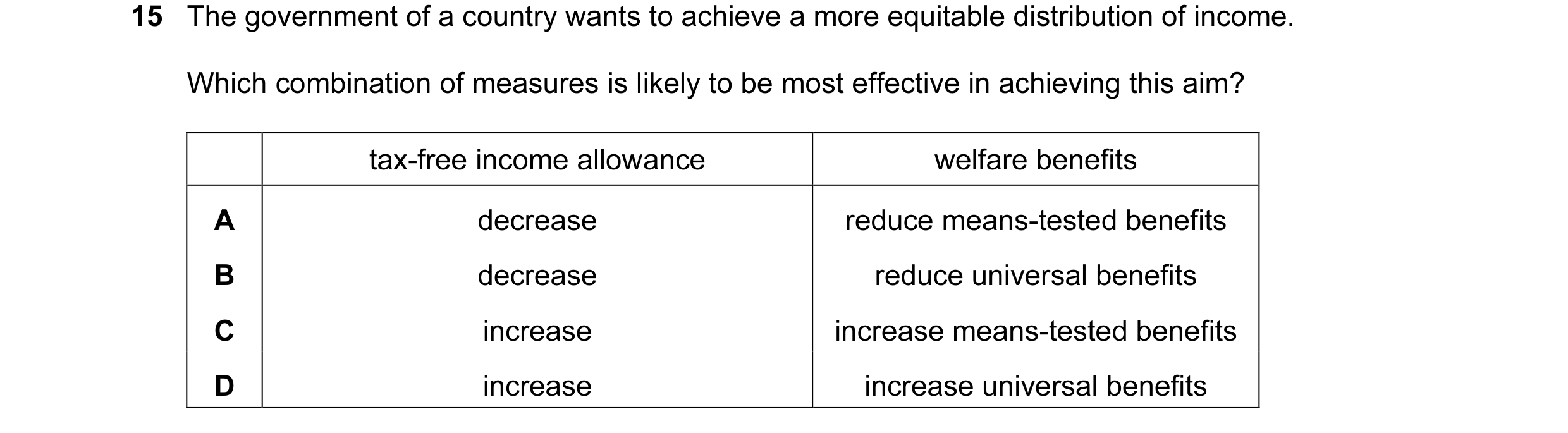
15 The government of a country wants to achieve a more equitable distribution of income. Which combination of measures is likely to be most effective in achieving this aim? tax-free income allowance welfare benefits A decrease reduce means-tested benefits B decrease reduce universal benefits C increase increase means-tested benefits D increase increase universal benefits
1 marks
Answer: C
This question in 9708/33 May/June 2017
Q10 · What would help to explain why there was a reduction in wage inequality in a country… 9708/32 Oct/Nov 2018
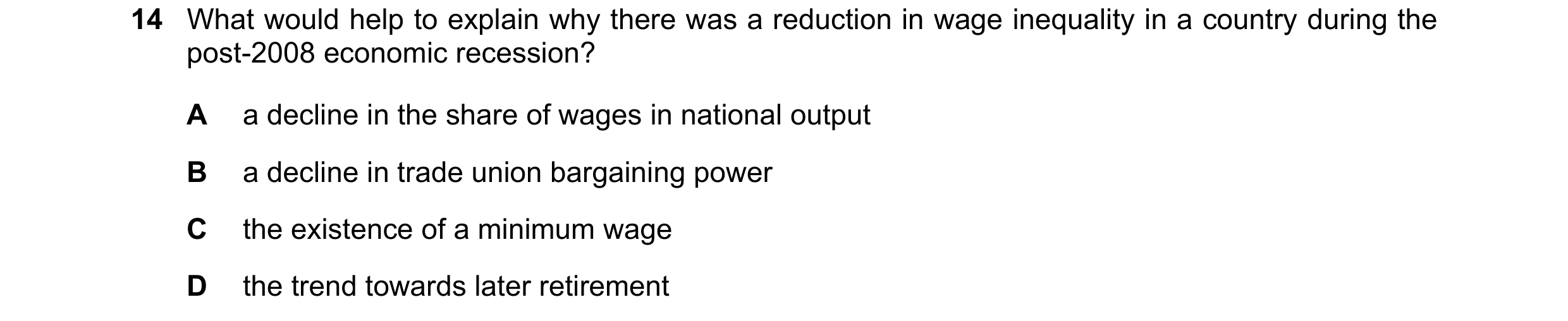
14 What would help to explain why there was a reduction in wage inequality in a country during the post-2008 economic recession? A a decline in the share of wages in national output B a decline in trade union bargaining power C the existence of a minimum wage D the trend towards later retirement
1 marks
Answer: C
This question in 9708/32 Oct/Nov 2018
Q11 · The Gini coefficient of a country is 0.40 9708/31 May/June 2021
15 The Gini coefficient of a country is 0.40. The poorest income earners in this country pay no income tax. The government increases the tax rate on the highest income earners, which results in a more even distribution of income. What could be concluded from this? A The Gini coefficient falls and the income tax system becomes more progressive. B The Gini coefficient falls and the income tax system becomes more regressive. C The Gini coefficient rises and the income tax system becomes more progressive. D The Gini coefficient rises and the income tax system becomes more regressive.
1 marks
Answer: A
This question in 9708/31 May/June 2021
Q12 · A government is committed to reducing the Gini coefficient 9708/32 May/June 2021
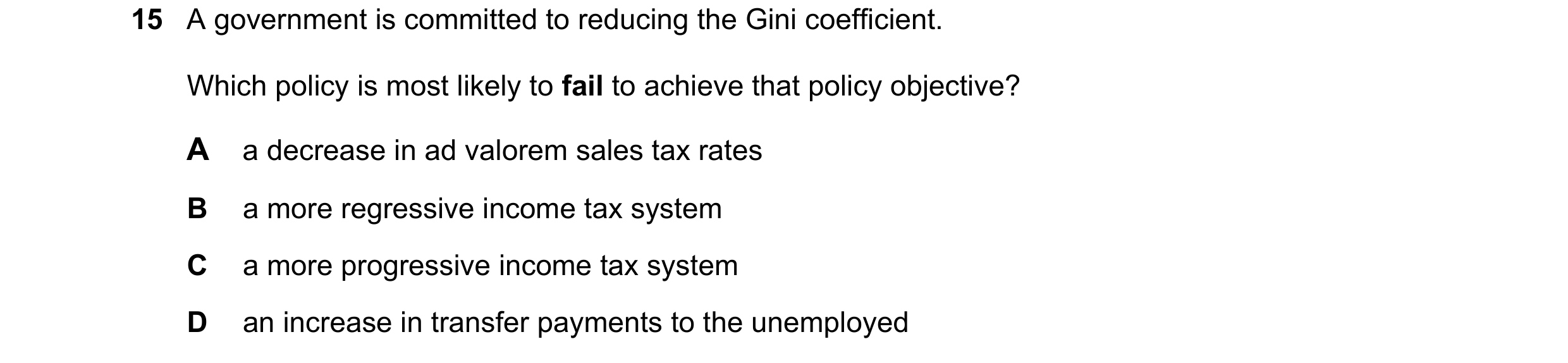
15 A government is committed to reducing the Gini coefficient. Which policy is most likely to fail to achieve that policy objective? A a decrease in ad valorem sales tax rates B a more regressive income tax system C a more progressive income tax system D an increase in transfer payments to the unemployed
1 marks
Answer: B
This question in 9708/32 May/June 2021
Q13 · The Gini coefficient of a country is 0.40 9708/33 May/June 2021
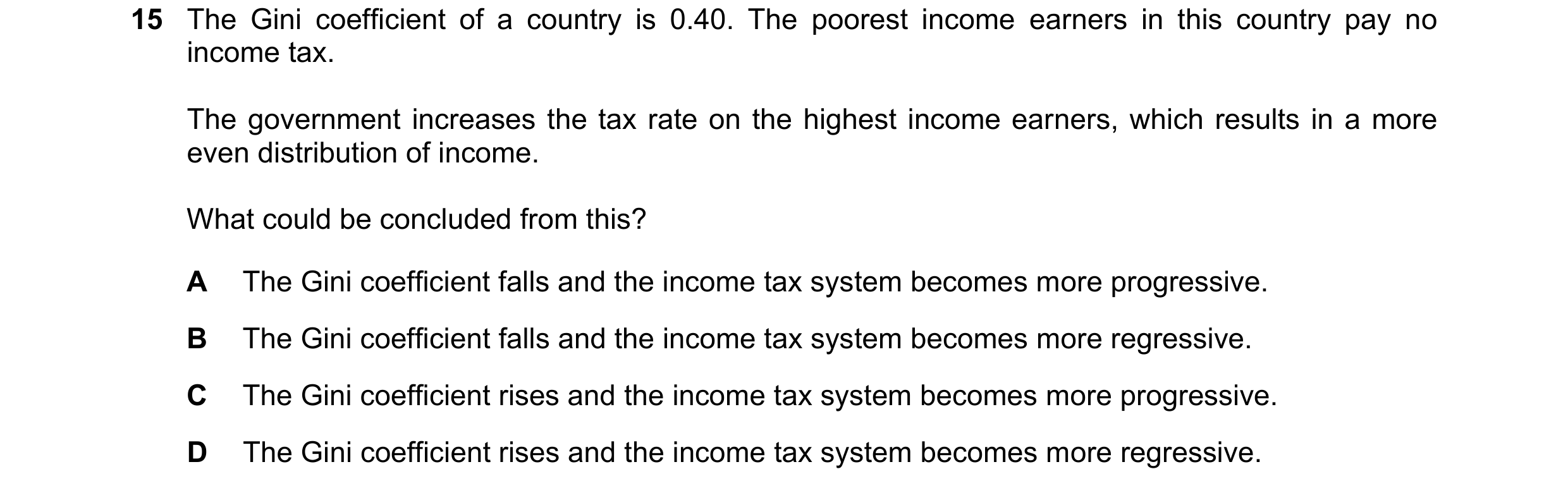
15 The Gini coefficient of a country is 0.40. The poorest income earners in this country pay no income tax. The government increases the tax rate on the highest income earners, which results in a more even distribution of income. What could be concluded from this? A The Gini coefficient falls and the income tax system becomes more progressive. B The Gini coefficient falls and the income tax system becomes more regressive. C The Gini coefficient rises and the income tax system becomes more progressive. D The Gini coefficient rises and the income tax system becomes more regressive.
1 marks
Answer: A
This question in 9708/33 May/June 2021
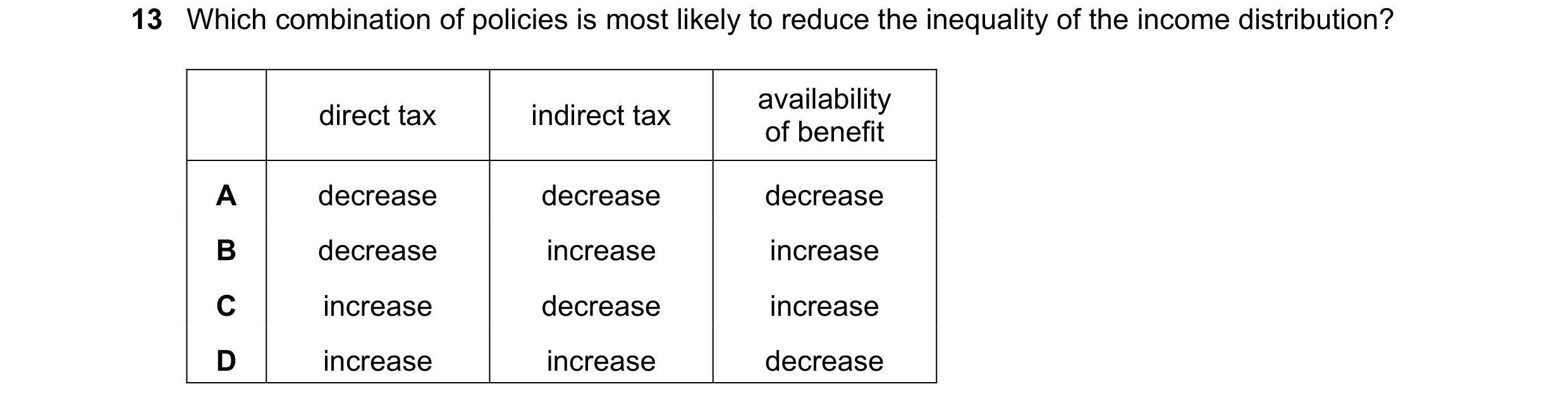
Q14 · Which combination of policies is most likely to reduce the inequality of the income… 9708/31 Oct/Nov 2021
13 Which combination of policies is most likely to reduce the inequality of the income distribution? availability direct tax indirect tax of benefit A decrease decrease decrease B decrease increase increase C increase decrease increase D increase increase decrease
1 marks
Answer: C
This question in 9708/31 Oct/Nov 2021
Q15 · What changes are most likely to reduce the level of income inequality in an economy? 9708/32 Oct/Nov 2021
20 What changes are most likely to reduce the level of income inequality in an economy? A additional government regulation of product and factor markets B increased progressive direct taxation and decreased indirect taxation C increased trade union power and reduced labour market flexibility D reduced welfare benefits and increased rate of interest
1 marks
Answer: B
This question in 9708/32 Oct/Nov 2021
Q16 · Governments often aim to reduce income inequalities 9708/32 Oct/Nov 2022
14 Governments often aim to reduce income inequalities. The diagram shows the effects of using taxation and benefits to try to achieve this aim. 100 000 average income per household 80 000 key ($ per year) original income 60 000 disposable income final income 40 000 20 000 0 bottom 2nd 3rd 4th top 20% 20% 20% 20% 20% household income What can be concluded from the diagram about the effects of taxes and benefits? A All income groups are better off except those originally earning more than $40 000 per year. B Benefits paid to the lower income groups are not a burden because they are not paid out of tax revenues. C The average final income of the top 20% exceeds the combined final incomes of the other groups. D The progressive taxation system still favours the top 20% over the bottom 20% of households.
1 marks
Answer: A
This question in 9708/32 Oct/Nov 2022
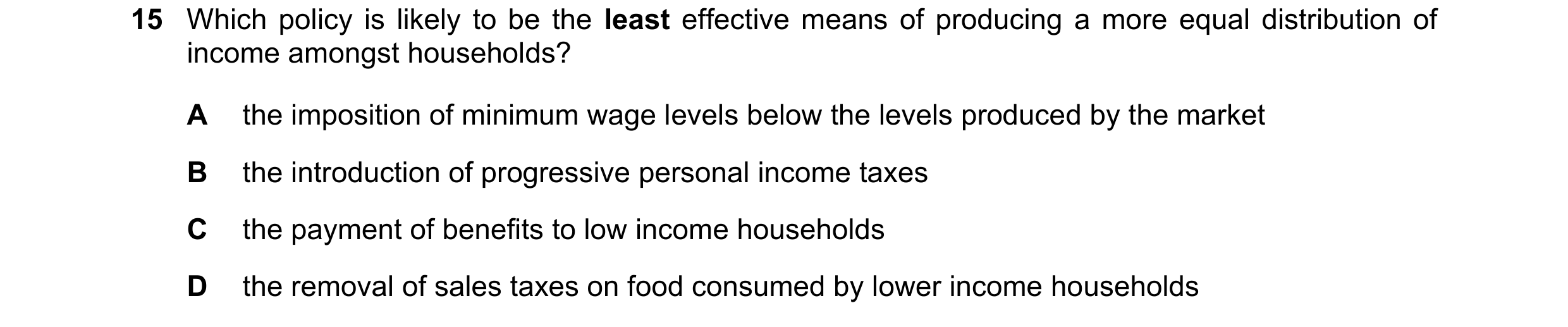
Q17 · Which policy is likely to be the least effective means of producing a more equal… 9708/32 Oct/Nov 2022
15 Which policy is likely to be the least effective means of producing a more equal distribution of income amongst households? A the imposition of minimum wage levels below the levels produced by the market B the introduction of progressive personal income taxes C the payment of benefits to low income households D the removal of sales taxes on food consumed by lower income households
1 marks
Answer: A
This question in 9708/32 Oct/Nov 2022

 1 / 5
1 / 5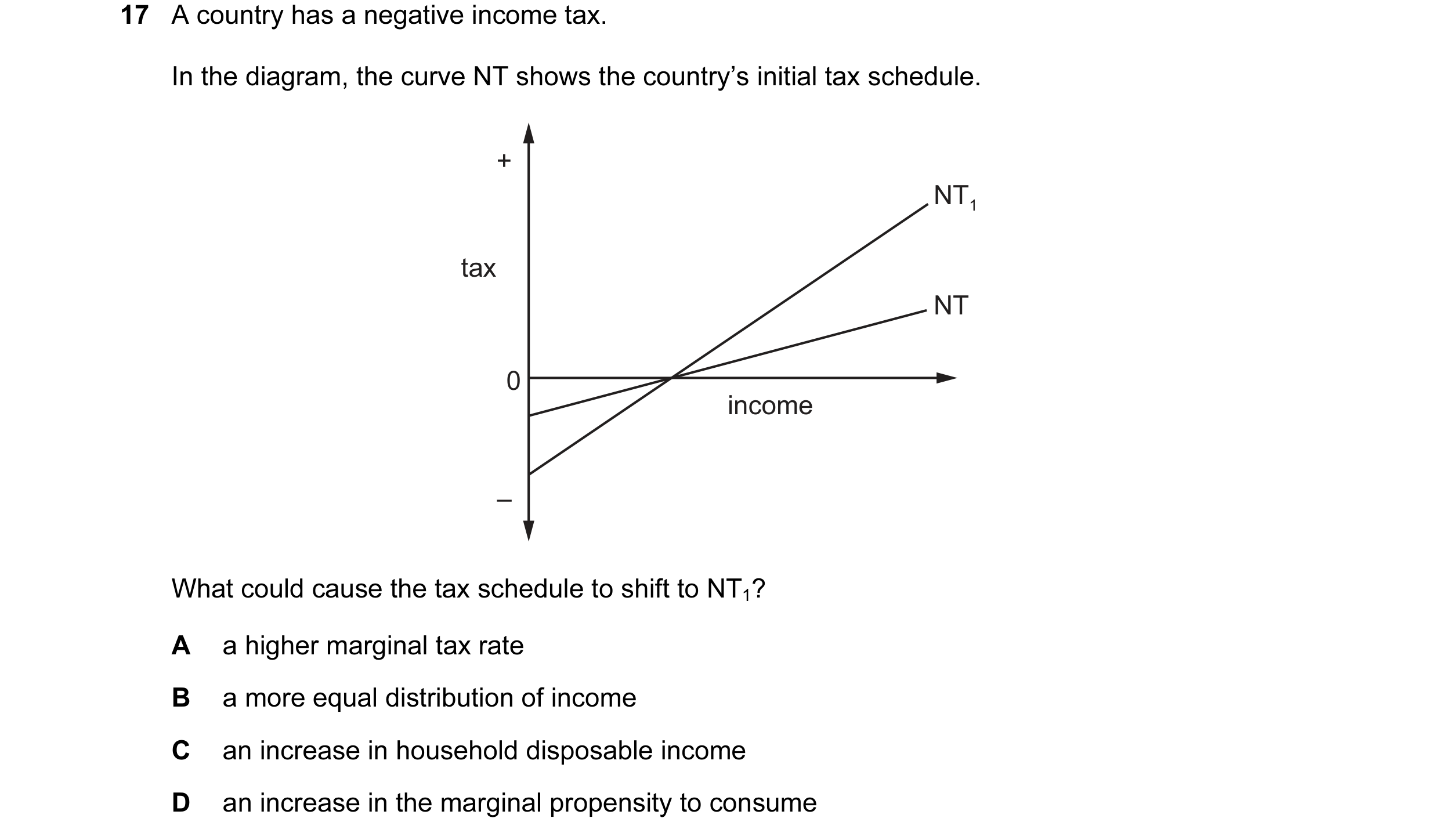
 2 / 5
2 / 5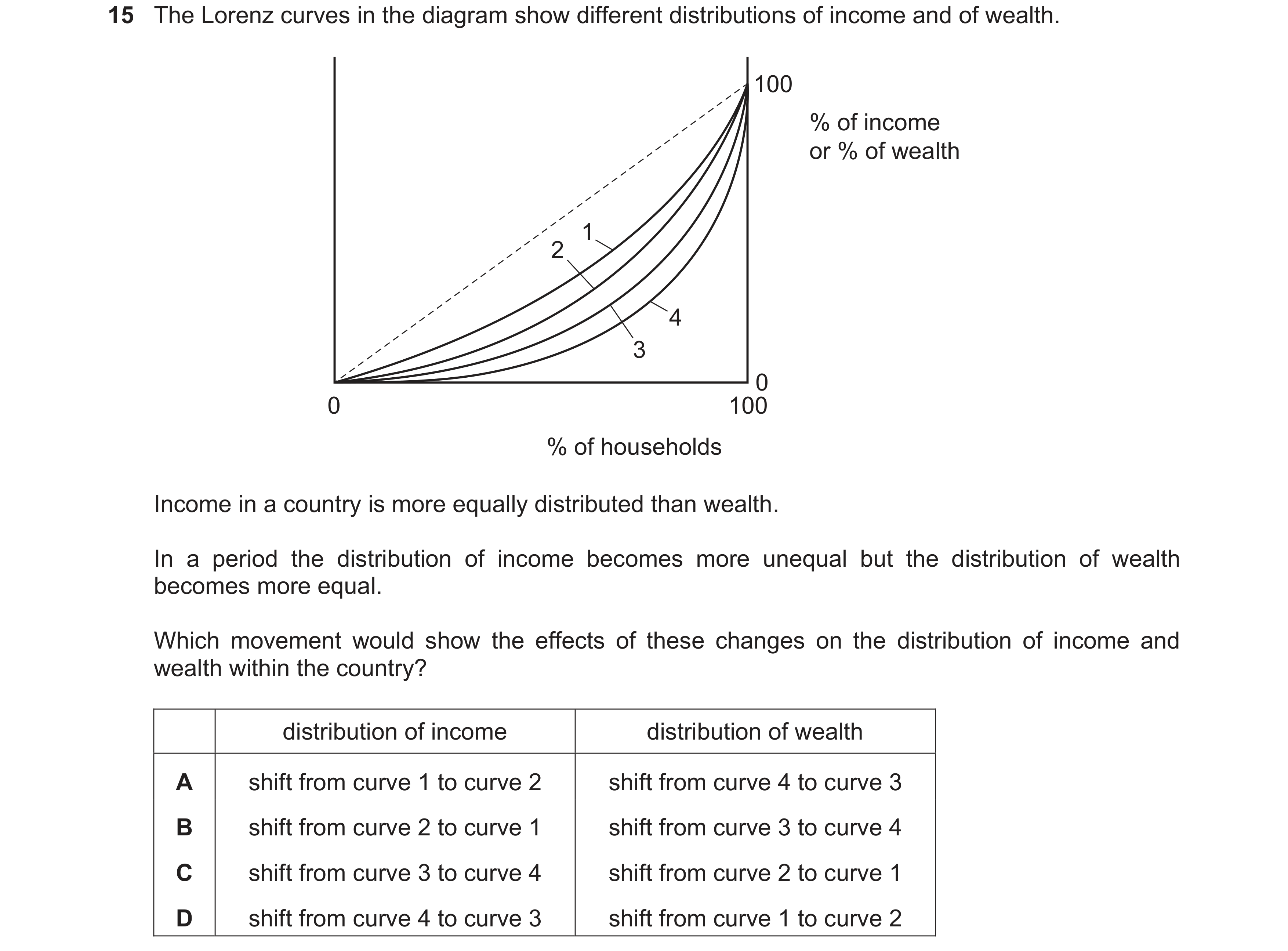
 3 / 5
3 / 5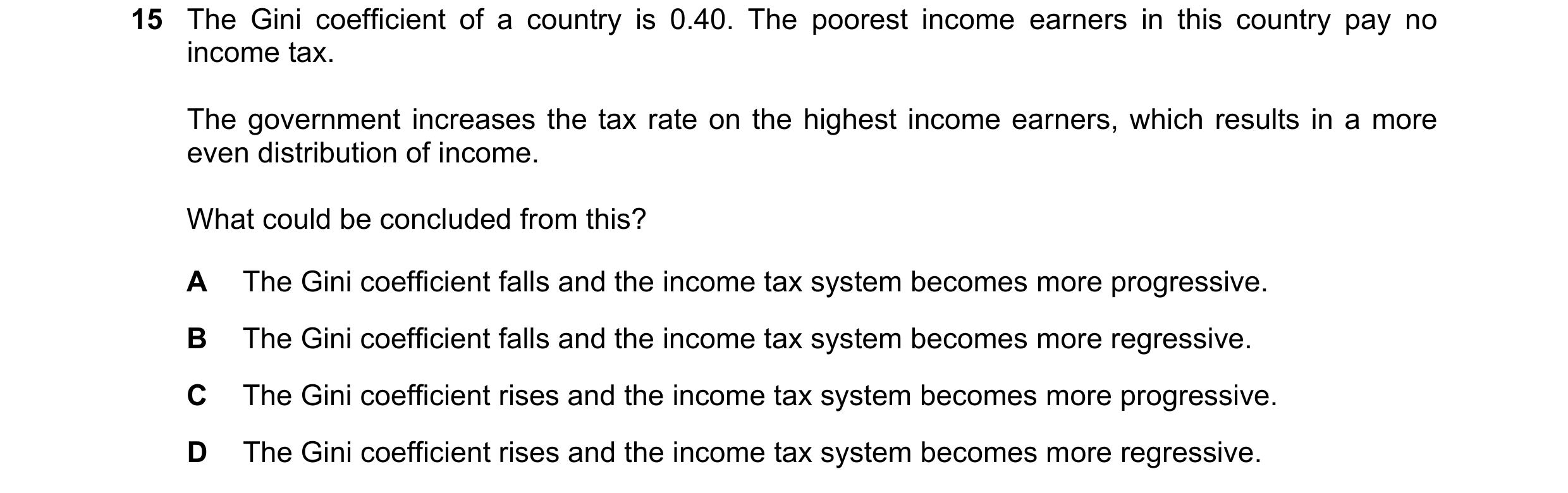
 4 / 5
4 / 5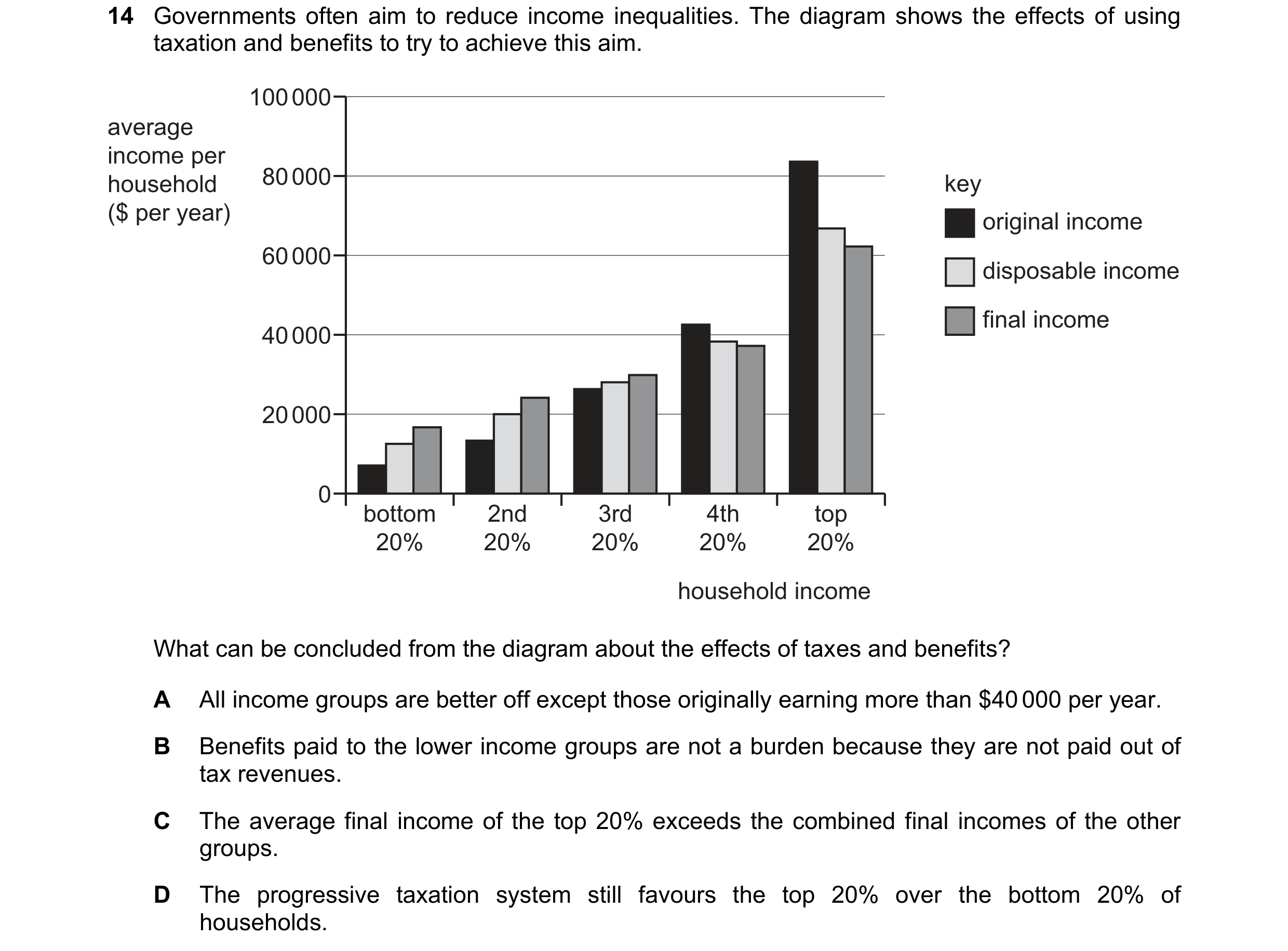
 5 / 5
5 / 5