Questions as text
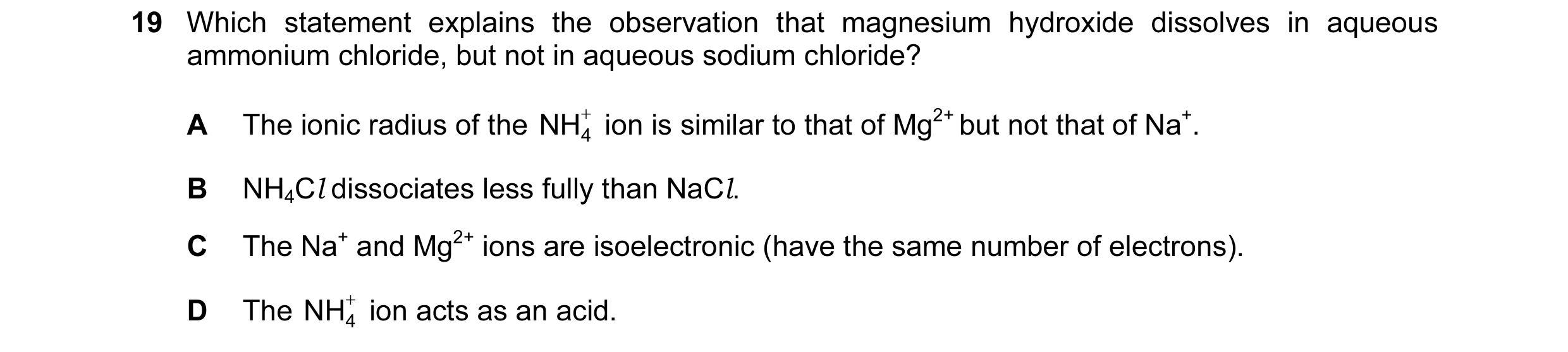
Q1 · Which statement explains the observation that magnesium hydroxide dissolves in aqueous… 9701/11 Oct/Nov 2008
19 Which statement explains the observation that magnesium hydroxide dissolves in aqueous ammonium chloride, but not in aqueous sodium chloride? A The ionic radius of the NH ion is similar to that of Mg2+ but not that of Na+. + 4 B NH4Cl dissociates less fully than NaCl. C The Na+ and Mg2+ ions are isoelectronic (have the same number of electrons). D The NH ion acts as an acid. + 4
1 marks
Answer: D
This question in 9701/11 Oct/Nov 2008
Q2 · Which of the following can act as a Bronsted-Lowry acid? 9701/11 Oct/Nov 2008
32 Which of the following can act as a Bronsted-Lowry acid? 1 H3O+ 2 NH + 4 3 H2O
1 marks
Answer: A
This question in 9701/11 Oct/Nov 2008
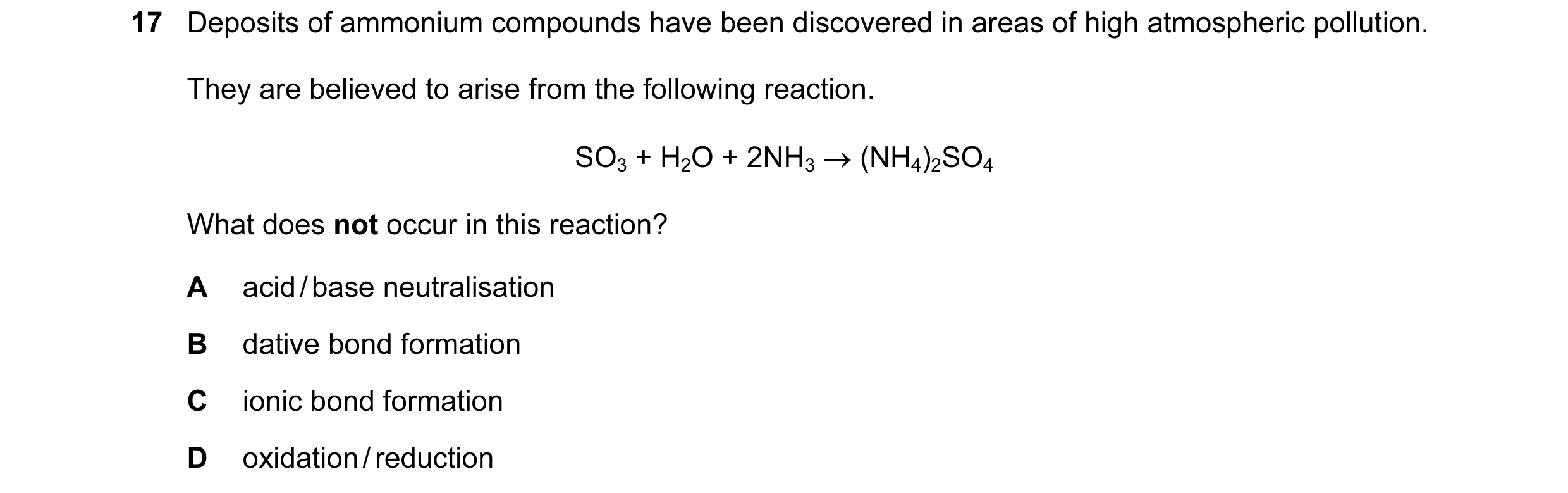
Q3 · Deposits of ammonium compounds have been discovered in areas of high atmospheric pollution 9701/11 May/June 2009
17 Deposits of ammonium compounds have been discovered in areas of high atmospheric pollution. They are believed to arise from the following reaction. SO3 + H2O + 2NH3 → (NH4)2SO4 What does not occur in this reaction? A acid / base neutralisation B dative bond formation C ionic bond formation D oxidation / reduction
1 marks
Answer: D
This question in 9701/11 May/June 2009
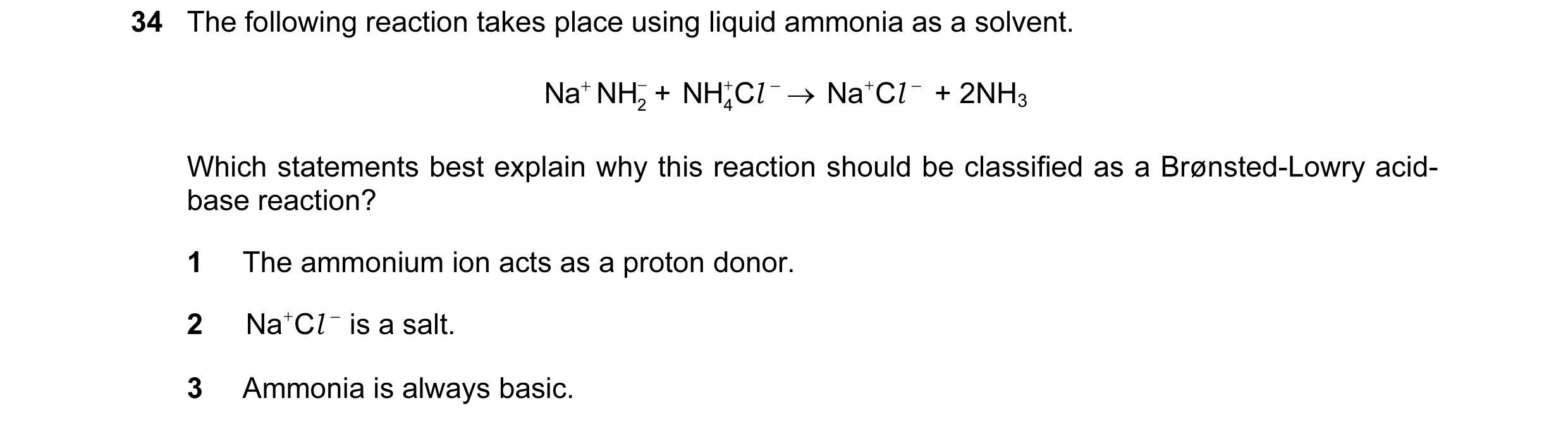
Q4 · The following reaction takes place using liquid ammonia as a solvent 9701/11 May/June 2009
34 The following reaction takes place using liquid ammonia as a solvent. Na NH− + + NH C + l − → Na C + l + 2NH3 − 2 4 Which statements best explain why this reaction should be classified as a Brønsted-Lowry acid- base reaction? 1 The ammonium ion acts as a proton donor. 2 Na C + l − is a salt. 3 Ammonia is always basic.
1 marks
Answer: D
This question in 9701/11 May/June 2009
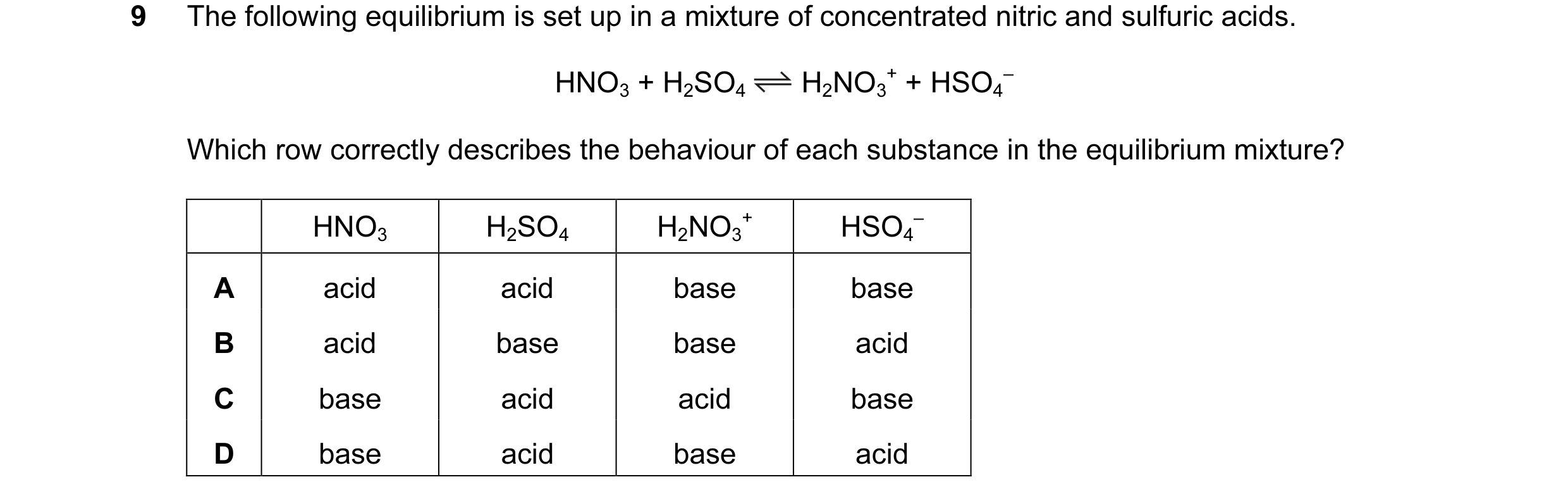
Q5 · The following equilibrium is set up in a mixture of concentrated nitric and sulfuric acids 9701/12 Oct/Nov 2010
9 The following equilibrium is set up in a mixture of concentrated nitric and sulfuric acids. HNO3 + H2SO4 H2NO3 + + HSO4 – Which row correctly describes the behaviour of each substance in the equilibrium mixture? HNO3 H2SO4 H2NO3 + HSO4 – A acid acid base base B acid base base acid C base acid acid base D base acid base acid
1 marks
Answer: C
This question in 9701/12 Oct/Nov 2010
Q6 · Which statement explains the observation that magnesium hydroxide dissolves in aqueous… 9701/12 Oct/Nov 2010
15 Which statement explains the observation that magnesium hydroxide dissolves in aqueous ammonium chloride, but not in aqueous sodium chloride? A The ionic radius of the NH4 + ion is similar to that of Mg2+ but not that of Na+. B NH4Cl dissociates less fully than NaCl. C The Na+ and Mg2+ ions are isoelectronic (have the same number of electrons). D The NH4 + ion can donate a proton.
1 marks
Answer: D
This question in 9701/12 Oct/Nov 2010
Q7 · Which statements are correct in terms of the Brønsted-Lowry theory of acids and bases? 9701/11 May/June 2011
31 Which statements are correct in terms of the Brønsted-Lowry theory of acids and bases? 1 Water can act as either an acid or a base. 2 Sulfuric acid, H2SO4, does not behave as an acid when dissolved in ethanol, C2H5OH. 3 The ammonium ion acts as a base when dissolved in liquid ammonia.
1 marks
Answer: D
This question in 9701/11 May/June 2011
Q8 · Which statements are correct in terms of the Brønsted-Lowry theory of acids and bases? 9701/13 May/June 2011
33 Which statements are correct in terms of the Brønsted-Lowry theory of acids and bases? 1 Water can act as either an acid or a base. 2 Sulfuric acid, H2SO4, does not behave as an acid when dissolved in ethanol, C2H5OH. 3 The ammonium ion acts as a base when dissolved in liquid ammonia.
1 marks
Answer: D
This question in 9701/13 May/June 2011
Q9 · Sulfur dioxide is used as a preservative in wine making 9701/11 Oct/Nov 2011
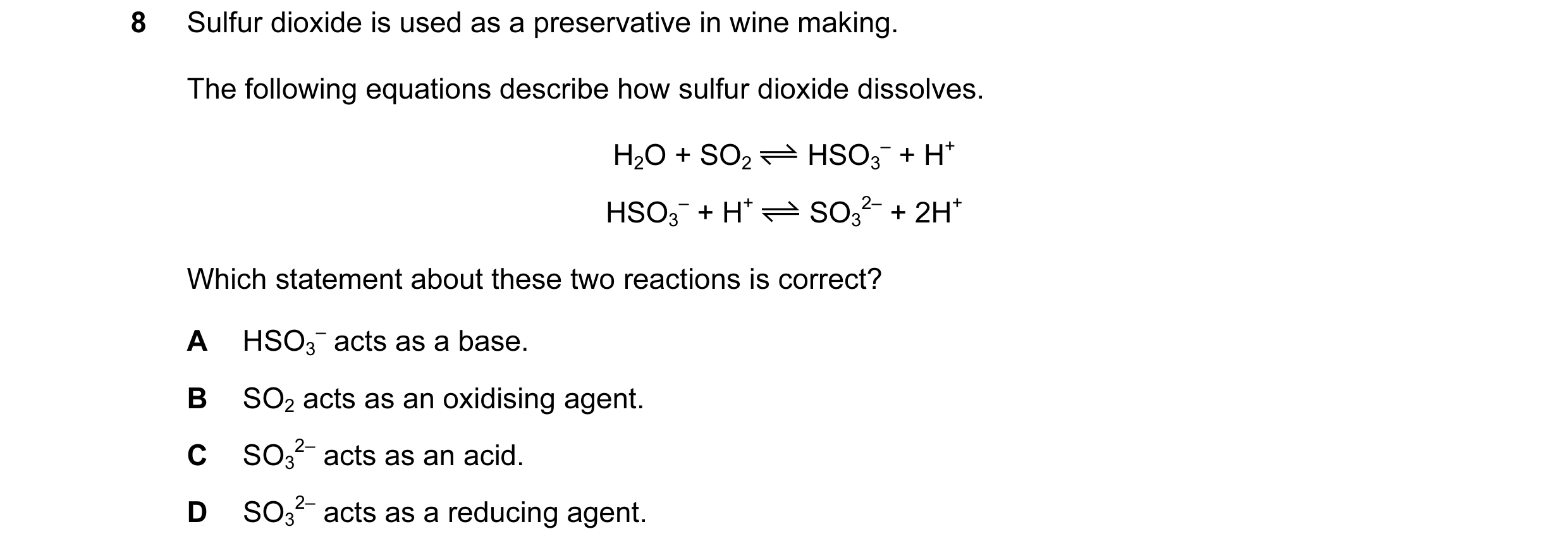
8 Sulfur dioxide is used as a preservative in wine making. The following equations describe how sulfur dioxide dissolves. H2O + SO2 HSO3 – + H+ HSO3 – + H+ SO3 2– + 2H+ Which statement about these two reactions is correct? A HSO3 – acts as a base. B SO2 acts as an oxidising agent. C SO3 2– acts as an acid. D SO3 2– acts as a reducing agent.
1 marks
Answer: A
This question in 9701/11 Oct/Nov 2011
Q10 · Ammonia and chlorine react in the gas phase 9701/13 May/June 2012
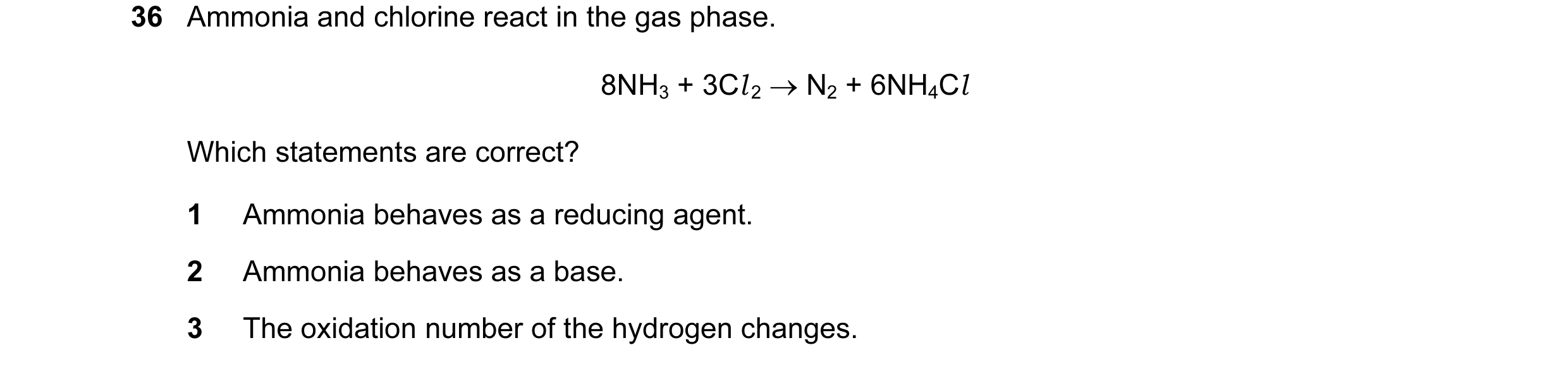
36 Ammonia and chlorine react in the gas phase. 8NH3 + 3Cl 2 → N2 + 6NH4Cl Which statements are correct? 1 Ammonia behaves as a reducing agent. 2 Ammonia behaves as a base. 3 The oxidation number of the hydrogen changes.
1 marks
Answer: B
This question in 9701/13 May/June 2012
Q11 · The Brønsted-Lowry theory describes acid and base character 9701/11 May/June 2014
34 The Brønsted-Lowry theory describes acid and base character. When concentrated sulfuric acid and concentrated nitric acid are mixed, the following reactions occur. H2SO4 + HNO3 HSO4 – + H2NO3 + H2NO3 + H2O + NO2 + H2O + H2SO4 HSO4 – + H3O+ Which species are bases in these reactions? 1 HSO4 – 2 HNO3 3 NO2 +
1 marks
Answer: B
This question in 9701/11 May/June 2014
Q12 · Sulfuric acid is a Brønsted-Lowry acid 9701/12 May/June 2014
34 Sulfuric acid is a Brønsted-Lowry acid. In which reactions is sulfuric acid behaving as an acid? 1 H2SO4 + HNO3 → H2NO3 + + HSO4 – 2 H2SO4 + CO3 2– → CO2 + H2O + SO4 2– 3 H2SO4 + MgO → MgSO4 + H2O
1 marks
Answer: A
This question in 9701/12 May/June 2014
Q13 · Silver chloride dissolves in aqueous ammonia 9701/12 May/June 2014
35 Silver chloride dissolves in aqueous ammonia. What happens in this process? 1 Ammonia forms a complex with the Ag+ ion. 2 Ammonia acts as a Brønsted-Lowry base. 3 A redox reaction occurs.
1 marks
Answer: D
This question in 9701/12 May/June 2014
Q14 · In which reaction is the underlined substance acting as a base? 9701/11 May/June 2015
8 In which reaction is the underlined substance acting as a base? A HNO3 + H2SO4 → H2NO3 + + HSO4 – B HSiO3 – + HCN → CN– + H2O + SiO2 C HNO2 + HCO3 – → H2O + CO2 + NO2 – D C6H5O– + CH2Cl CO2H → C6H5OH + CH2Cl CO2 –
1 marks
Answer: C
This question in 9701/11 May/June 2015
Q15 · Which statement about the ammonia molecule and/or the ammonium ion is correct? 9701/11 May/June 2016
18 Which statement about the ammonia molecule and/or the ammonium ion is correct? A Ammonia molecules are basic because they can donate H+ ions. B Ammonium ions are basic because they can accept H+ ions. C If ammonium ions are heated with NaOH(aq), ammonia molecules are formed. D The bond angle in NH4 + is 2.5° less than the bond angle in NH3.
1 marks
Answer: C
This question in 9701/11 May/June 2016
Q16 · Sulfur dioxide is used as a preservative in wine making 9701/13 May/June 2016
10 Sulfur dioxide is used as a preservative in wine making. The following equations describe the reactions that occur when sulfur dioxide dissolves in water. H2O + SO2 HSO3 – + H+ HSO3 – + H+ SO3 2– + 2H+ Which statement about these two reactions is correct? A HSO3 – acts as a base. B SO2 acts as an oxidising agent. C SO3 2– acts as an acid. D SO3 2– acts as a reducing agent.
1 marks
Answer: A
This question in 9701/13 May/June 2016
Q17 · Ammonia is a colourless gas that is produced by the Haber process 9701/13 May/June 2016
36 Ammonia is a colourless gas that is produced by the Haber process. Which statements about ammonia are correct? 1 An ammonia molecule has three bond pairs and one lone pair of electrons. 2 If ammonia is bubbled into water the pH of the solution will increase. 3 Ammonia gas can be made by warming ammonium sulfate with aqueous hydrochloric acid.
1 marks
Answer: B
This question in 9701/13 May/June 2016
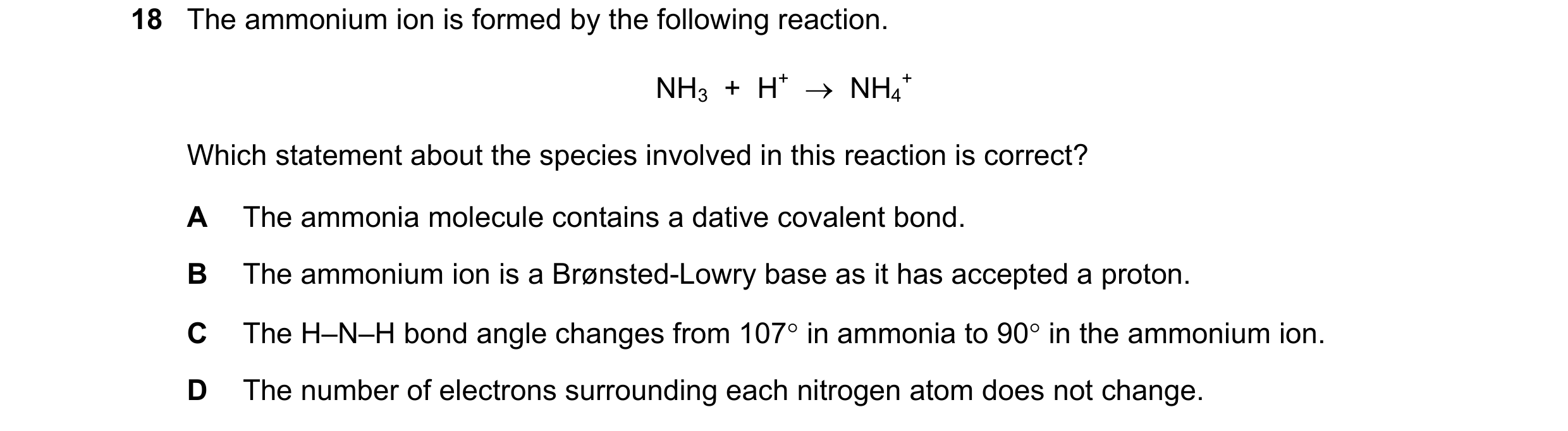
Q18 · The ammonium ion is formed by the following reaction 9701/12 May/June 2017
18 The ammonium ion is formed by the following reaction. NH3 + H+ → NH4 + Which statement about the species involved in this reaction is correct? A The ammonia molecule contains a dative covalent bond. B The ammonium ion is a Brønsted-Lowry base as it has accepted a proton. C The H–N–H bond angle changes from 107° in ammonia to 90° in the ammonium ion. D The number of electrons surrounding each nitrogen atom does not change.
1 marks
Answer: D
This question in 9701/12 May/June 2017
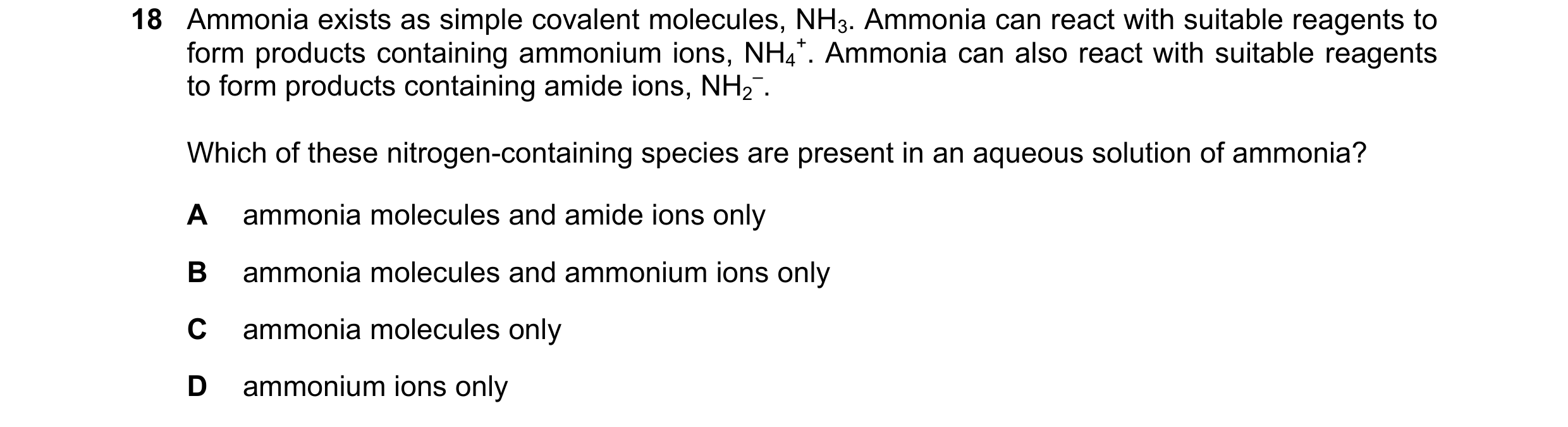
Q19 · Ammonia exists as simple covalent molecules, NH3 9701/13 May/June 2017
18 Ammonia exists as simple covalent molecules, NH3. Ammonia can react with suitable reagents to form products containing ammonium ions, NH4 +. Ammonia can also react with suitable reagents to form products containing amide ions, NH2 –. Which of these nitrogen-containing species are present in an aqueous solution of ammonia? A ammonia molecules and amide ions only B ammonia molecules and ammonium ions only C ammonia molecules only D ammonium ions only
1 marks
Answer: B
This question in 9701/13 May/June 2017
Q20 · The following reaction takes place in a suitable solvent 9701/11 Oct/Nov 2017
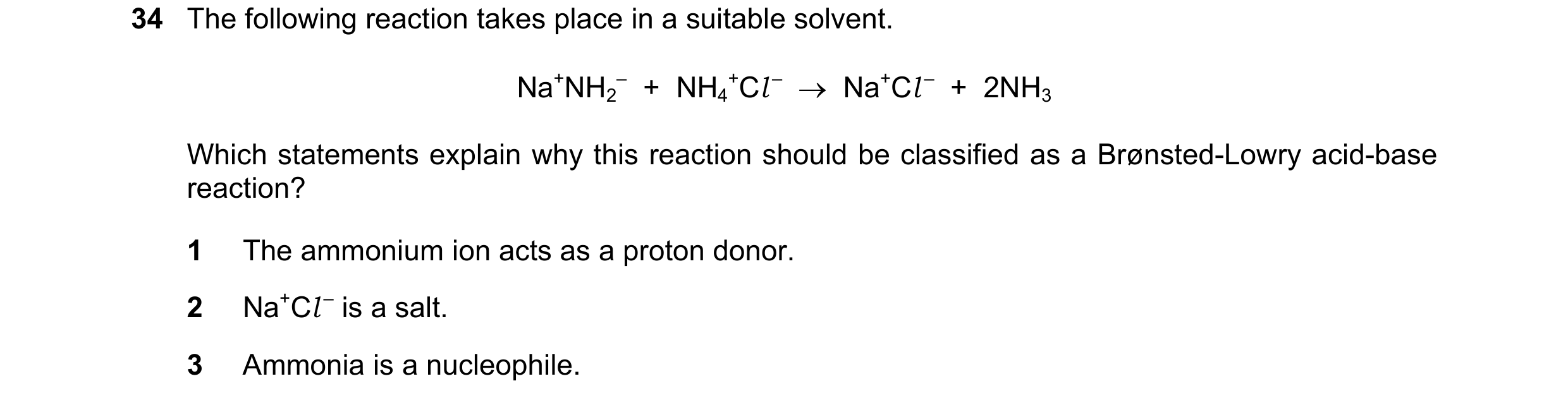
34 The following reaction takes place in a suitable solvent. Na+NH2 – + NH4 +Cl – → Na+Cl – + 2NH3 Which statements explain why this reaction should be classified as a Brønsted-Lowry acid-base reaction? 1 The ammonium ion acts as a proton donor. 2 Na+Cl – is a salt. 3 Ammonia is a nucleophile.
1 marks
Answer: D
This question in 9701/11 Oct/Nov 2017
Q21 · Methanoic acid, HCO2H, and hydrocyanic acid, HCN, can both behave as acids 9701/12 Oct/Nov 2017
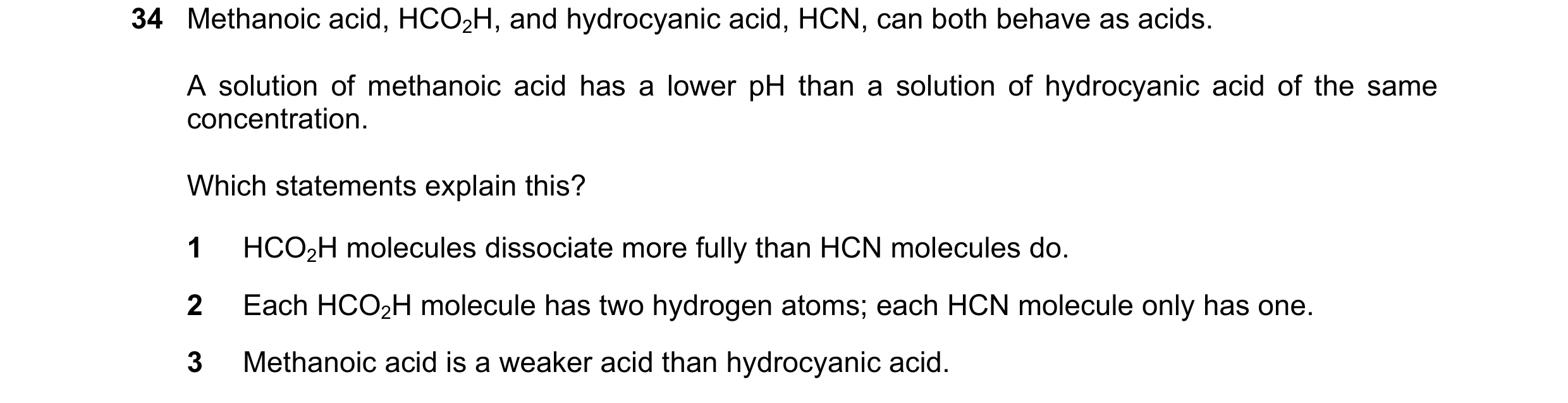
34 Methanoic acid, HCO2H, and hydrocyanic acid, HCN, can both behave as acids. A solution of methanoic acid has a lower pH than a solution of hydrocyanic acid of the same concentration. Which statements explain this? 1 HCO2H molecules dissociate more fully than HCN molecules do. 2 Each HCO2H molecule has two hydrogen atoms; each HCN molecule only has one. 3 Methanoic acid is a weaker acid than hydrocyanic acid.
1 marks
Answer: D
This question in 9701/12 Oct/Nov 2017
Q22 · The following reaction takes place in a suitable solvent 9701/13 Oct/Nov 2017
34 The following reaction takes place in a suitable solvent. Na+NH2 – + NH4 +Cl – → Na+Cl – + 2NH3 Which statements explain why this reaction should be classified as a Brønsted-Lowry acid-base reaction? 1 The ammonium ion acts as a proton donor. 2 Na+Cl – is a salt. 3 Ammonia is a nucleophile.
1 marks
Answer: D
This question in 9701/13 Oct/Nov 2017
Q23 · Ammonia and chlorine react together in the gas phase 9701/12 Feb/March 2018
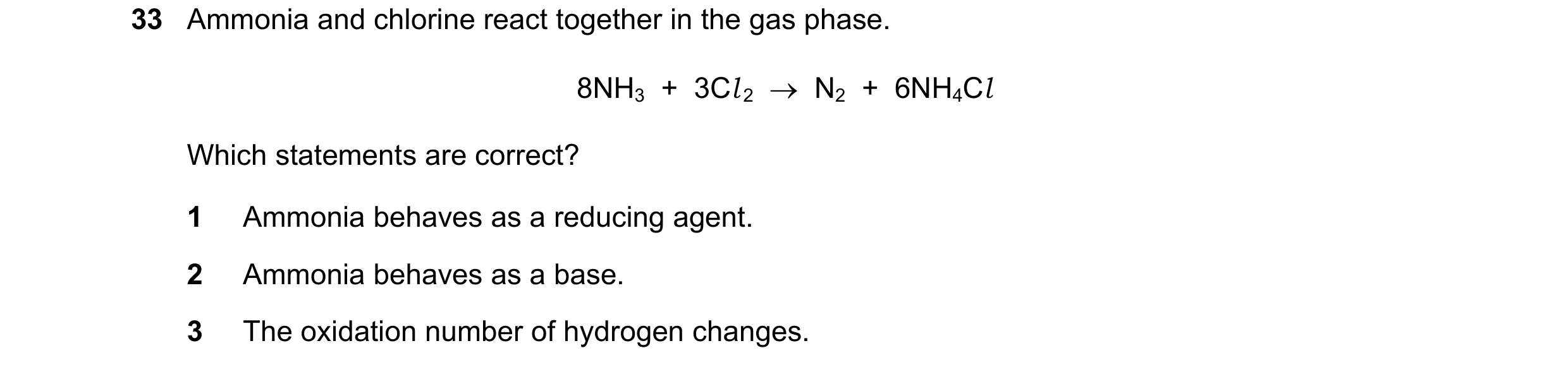
33 Ammonia and chlorine react together in the gas phase. 8NH3 + 3Cl 2 → N2 + 6NH4Cl Which statements are correct? 1 Ammonia behaves as a reducing agent. 2 Ammonia behaves as a base. 3 The oxidation number of hydrogen changes.
1 marks
Answer: B
This question in 9701/12 Feb/March 2018
Q24 · In which reactions does NH3 behave as a Brønsted-Lowry acid? 9701/12 Feb/March 2018
34 In which reactions does NH3 behave as a Brønsted-Lowry acid? 1 2NH3 → NH2 – + NH4 + 2 HSO4 – + NH3 → SO4 2– + NH4 + 3 Ag+ + 2NH3 → [Ag(NH3)2]+
1 marks
Answer: D
This question in 9701/12 Feb/March 2018
Q25 · In which reaction does ammonia behave as a Brønsted-Lowry base? 9701/11 May/June 2018
15 In which reaction does ammonia behave as a Brønsted-Lowry base? A NH3 + CH3CH2Br → CH3CH2NH2 + HBr B NH3 + H2O + CO2 → (NH4)HCO3 C 2NH3 + 2Na → 2NaNH2 + H2 D 4NH3 + 3O2 → 2N2 + 6H2O
1 marks
Answer: B
This question in 9701/11 May/June 2018
Q26 · Which statement about the ammonium ion is correct? 9701/13 May/June 2019
18 Which statement about the ammonium ion is correct? A It can act as a Brønsted-Lowry base. B It can react with OH– to give ammonia. C It is pyramidal with bond angles of 107°. D The nitrogen atom is sp2 hybridised.
1 marks
Answer: B
This question in 9701/13 May/June 2019
Q27 · Solid ammonium nitrate is put into a test-tube and solution X is added to it 9701/12 Feb/March 2020
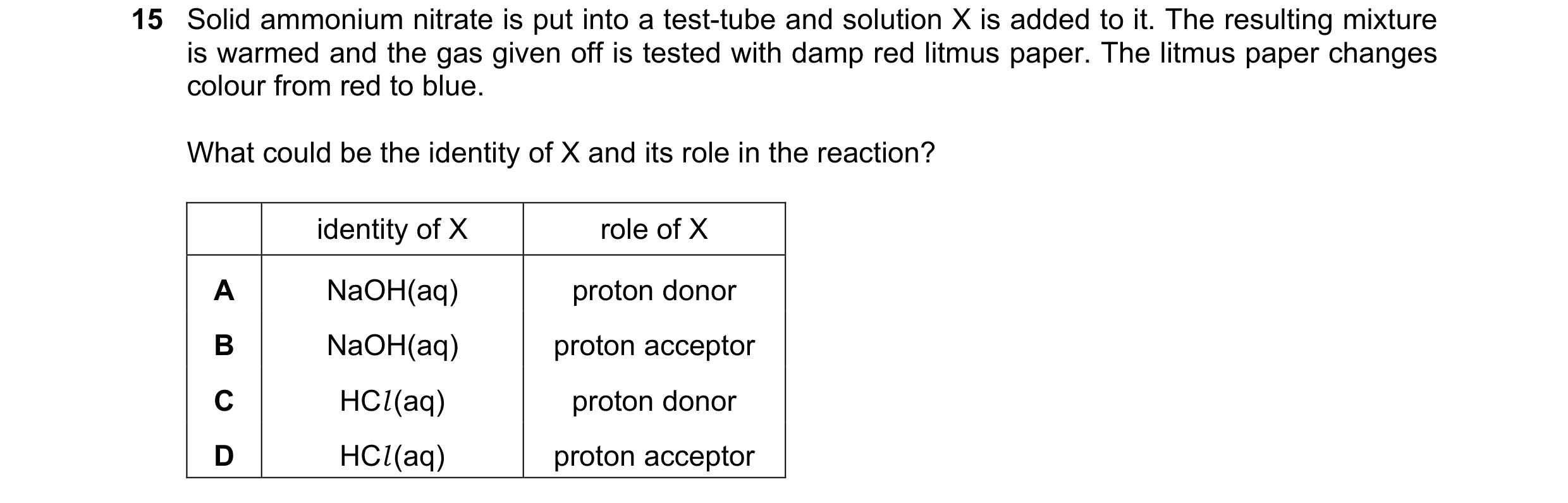
15 Solid ammonium nitrate is put into a test-tube and solution X is added to it. The resulting mixture is warmed and the gas given off is tested with damp red litmus paper. The litmus paper changes colour from red to blue. What could be the identity of X and its role in the reaction? identity of X role of X A NaOH(aq) proton donor B NaOH(aq) proton acceptor C HCl (aq) proton donor D HCl (aq) proton acceptor
1 marks
Answer: B
This question in 9701/12 Feb/March 2020
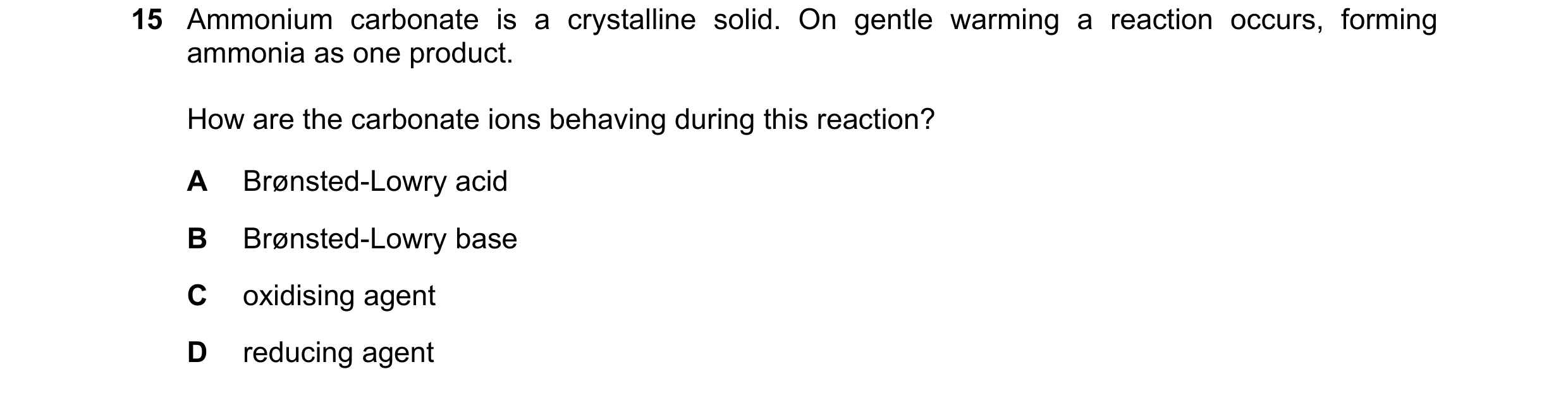
Q28 · Ammonium carbonate is a crystalline solid 9701/12 May/June 2020
15 Ammonium carbonate is a crystalline solid. On gentle warming a reaction occurs, forming ammonia as one product. How are the carbonate ions behaving during this reaction? A Brønsted-Lowry acid B Brønsted-Lowry base C oxidising agent D reducing agent
1 marks
Answer: B
This question in 9701/12 May/June 2020
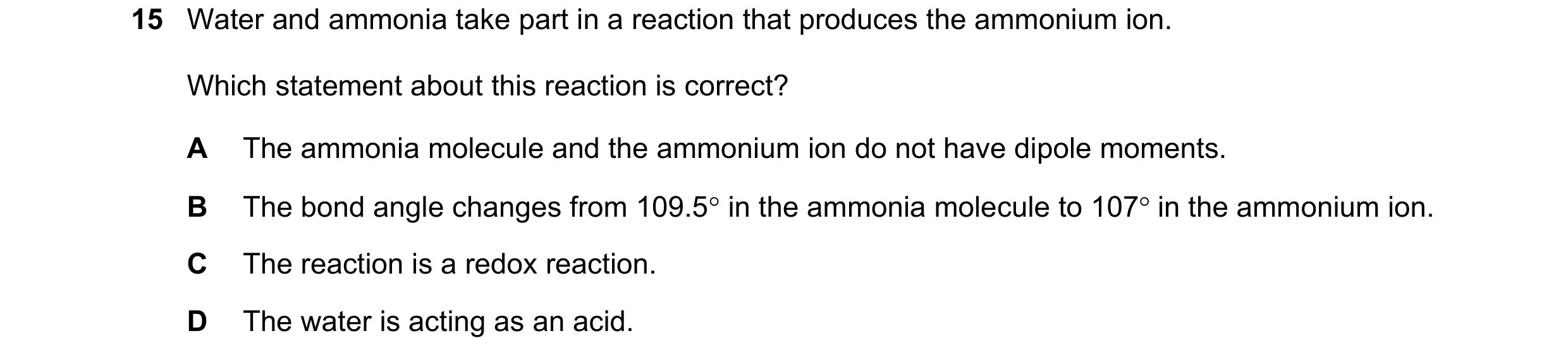
Q29 · Water and ammonia take part in a reaction that produces the ammonium ion 9701/12 Oct/Nov 2020
15 Water and ammonia take part in a reaction that produces the ammonium ion. Which statement about this reaction is correct? A The ammonia molecule and the ammonium ion do not have dipole moments. B The bond angle changes from 109.5° in the ammonia molecule to 107° in the ammonium ion. C The reaction is a redox reaction. D The water is acting as an acid.
1 marks
Answer: D
This question in 9701/12 Oct/Nov 2020
Q30 · In which reaction is water behaving as a Brønsted–Lowry base? 9701/12 Feb/March 2021
9 In which reaction is water behaving as a Brønsted–Lowry base? A H2O + Na NaOH + 1 H 2 2 B H2O + H3PO4 H3O+ + H2PO4 – C H2O + CaO Ca(OH)2 D NH3 + [Cu(H2O)6]2+ NH4 + + [Cu(H2O)5(OH)]+
1 marks
Answer: B
This question in 9701/12 Feb/March 2021
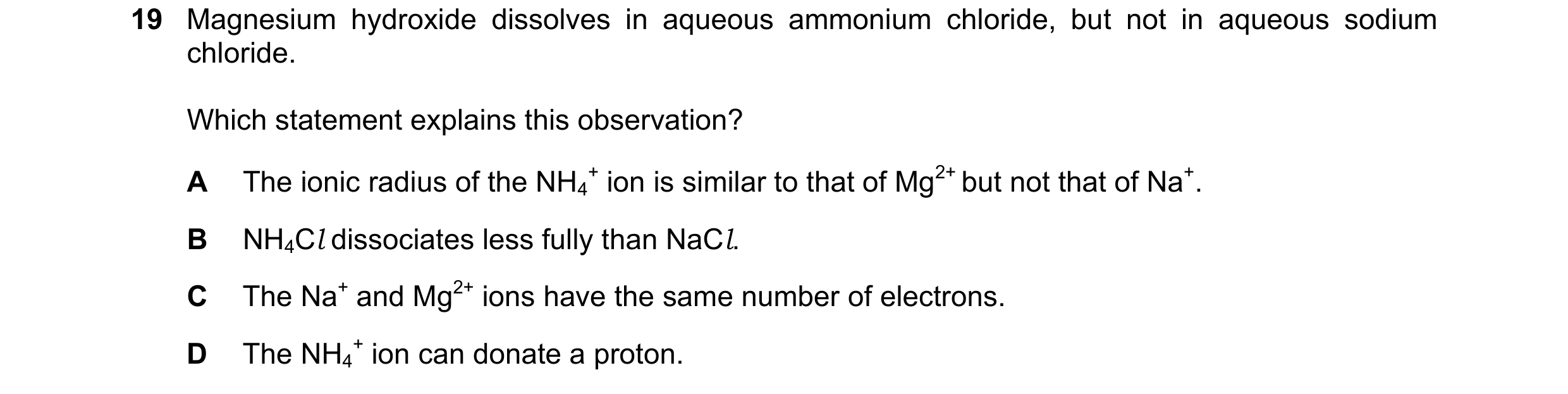
Q31 · Magnesium hydroxide dissolves in aqueous ammonium chloride, but not in aqueous sodium… 9701/12 Oct/Nov 2021
19 Magnesium hydroxide dissolves in aqueous ammonium chloride, but not in aqueous sodium chloride. Which statement explains this observation? A The ionic radius of the NH4 + ion is similar to that of Mg2+ but not that of Na+. B NH4Cl dissociates less fully than NaCl. C The Na+ and Mg2+ ions have the same number of electrons. D The NH4 + ion can donate a proton.
1 marks
Answer: D
This question in 9701/12 Oct/Nov 2021
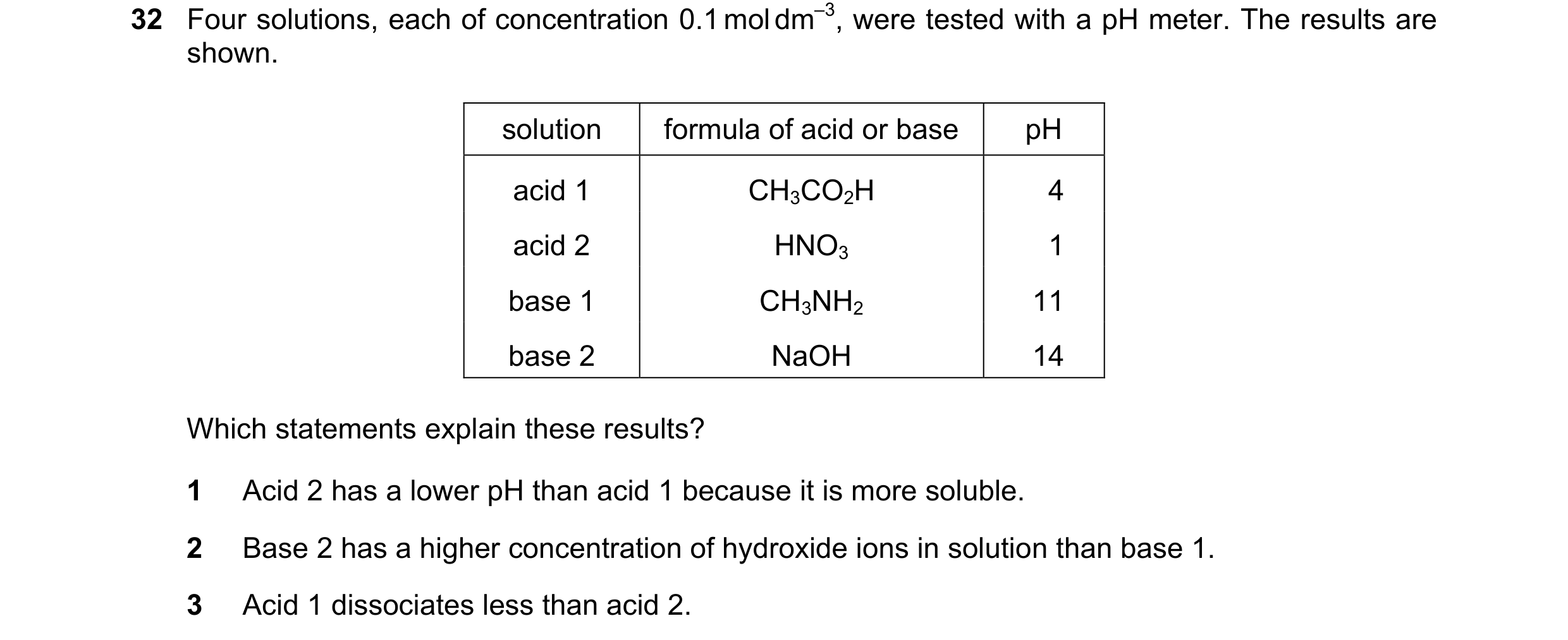
Q32 · Four solutions, each of concentration 0.1 mol dm–3, were tested with a pH meter 9701/12 Oct/Nov 2021
32 Four solutions, each of concentration 0.1 mol dm–3, were tested with a pH meter. The results are shown. solution formula of acid or base pH acid 1 CH3CO2H 4 acid 2 HNO3 1 base 1 CH3NH2 11 base 2 NaOH 14 Which statements explain these results? 1 Acid 2 has a lower pH than acid 1 because it is more soluble. 2 Base 2 has a higher concentration of hydroxide ions in solution than base 1. 3 Acid 1 dissociates less than acid 2.
1 marks
Answer: C
This question in 9701/12 Oct/Nov 2021
Q33 · Which statement about acids and bases is always correct? 9701/13 May/June 2022
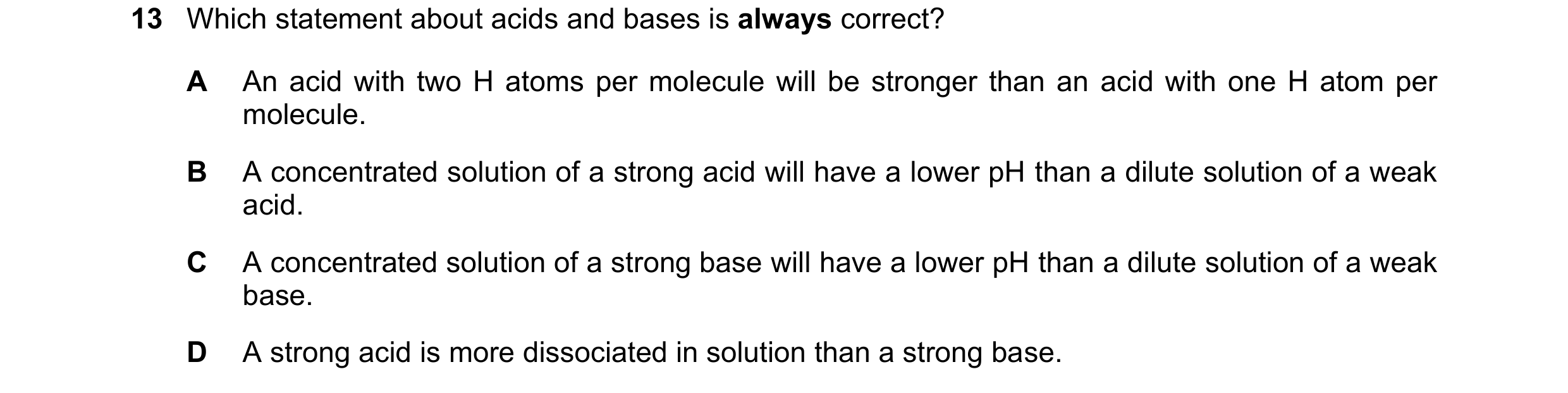
13 Which statement about acids and bases is always correct? A An acid with two H atoms per molecule will be stronger than an acid with one H atom per molecule. B A concentrated solution of a strong acid will have a lower pH than a dilute solution of a weak acid. C A concentrated solution of a strong base will have a lower pH than a dilute solution of a weak base. D A strong acid is more dissociated in solution than a strong base.
1 marks
Answer: B
This question in 9701/13 May/June 2022
Q34 · NaOH(aq) is added to NH4Cl(aq) 9701/12 Oct/Nov 2023
26 NaOH(aq) is added to NH4Cl(aq). The mixture is warmed. The gas that is produced turns damp red litmus paper blue. Which row is correct? behaviour of the ammonium behaviour of the water present ion in NH4Cl on the litmus paper A Brønsted–Lowry acid Brønsted–Lowry base B Brønsted–Lowry acid Brønsted–Lowry acid C Brønsted–Lowry base Brønsted–Lowry acid D Brønsted–Lowry base Brønsted–Lowry base
1 marks
Answer: B
This question in 9701/12 Oct/Nov 2023
Q35 · Which statement describes a property of an ammonium ion? 9701/12 May/June 2024
22 Which statement describes a property of an ammonium ion? A An aqueous ammonium ion is a weak Brønsted–Lowry base. B Aqueous ammonium sulfate reacts with dilute hydrochloric acid to make ammonia gas. C An ammonium ion has a pyramidal shape with an H–N–H bond angle of 107. D The four N–H covalent bonds in an ammonium ion are identical to each other.
1 marks
Answer: D
This question in 9701/12 May/June 2024
Q36 · Three statements about ammonia molecules and ammonium ions are given 9701/11 Oct/Nov 2024
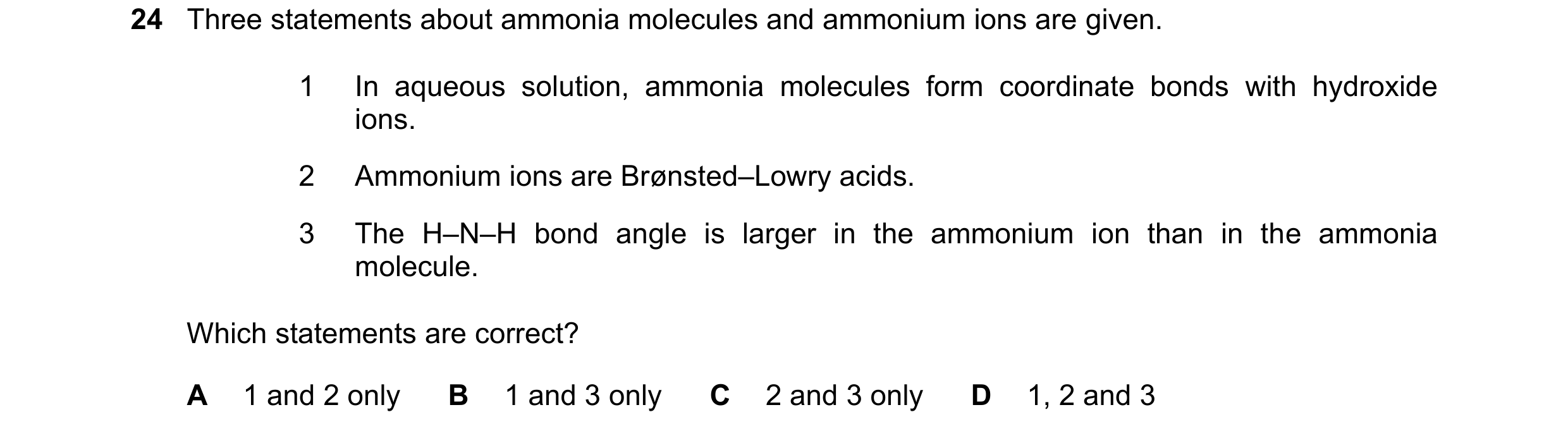
24 Three statements about ammonia molecules and ammonium ions are given. 1 In aqueous solution, ammonia molecules form coordinate bonds with hydroxide ions. 2 Ammonium ions are Brønsted–Lowry acids. 3 The H–N–H bond angle is larger in the ammonium ion than in the ammonia molecule. Which statements are correct? A 1 and 2 only B 1 and 3 only C 2 and 3 only D 1, 2 and 3
1 marks
Answer: C
This question in 9701/11 Oct/Nov 2024
Q37 · Three statements about ammonia molecules and ammonium ions are given 9701/13 Oct/Nov 2024
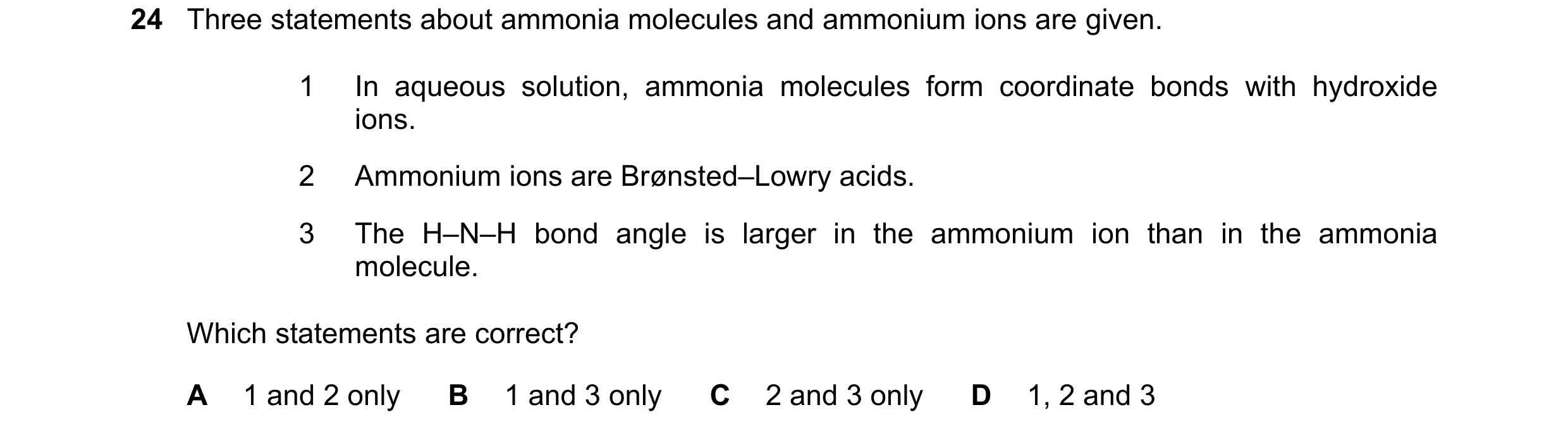
24 Three statements about ammonia molecules and ammonium ions are given. 1 In aqueous solution, ammonia molecules form coordinate bonds with hydroxide ions. 2 Ammonium ions are Brønsted–Lowry acids. 3 The H–N–H bond angle is larger in the ammonium ion than in the ammonia molecule. Which statements are correct? A 1 and 2 only B 1 and 3 only C 2 and 3 only D 1, 2 and 3
1 marks
Answer: C
This question in 9701/13 Oct/Nov 2024
Q38 · An aqueous solution X contains substance HQ which behaves as a weak acid 9701/11 May/June 2025
9 An aqueous solution X contains substance HQ which behaves as a weak acid. HQ(aq) H+(aq) + Q–(aq) The soluble salt NaQ is added to X. What happens to the [H+(aq)] and the pH in X? [H+(aq)] pH A decreases decreases B decreases increases C increases decreases D increases increases
1 marks
Answer: B
This question in 9701/11 May/June 2025
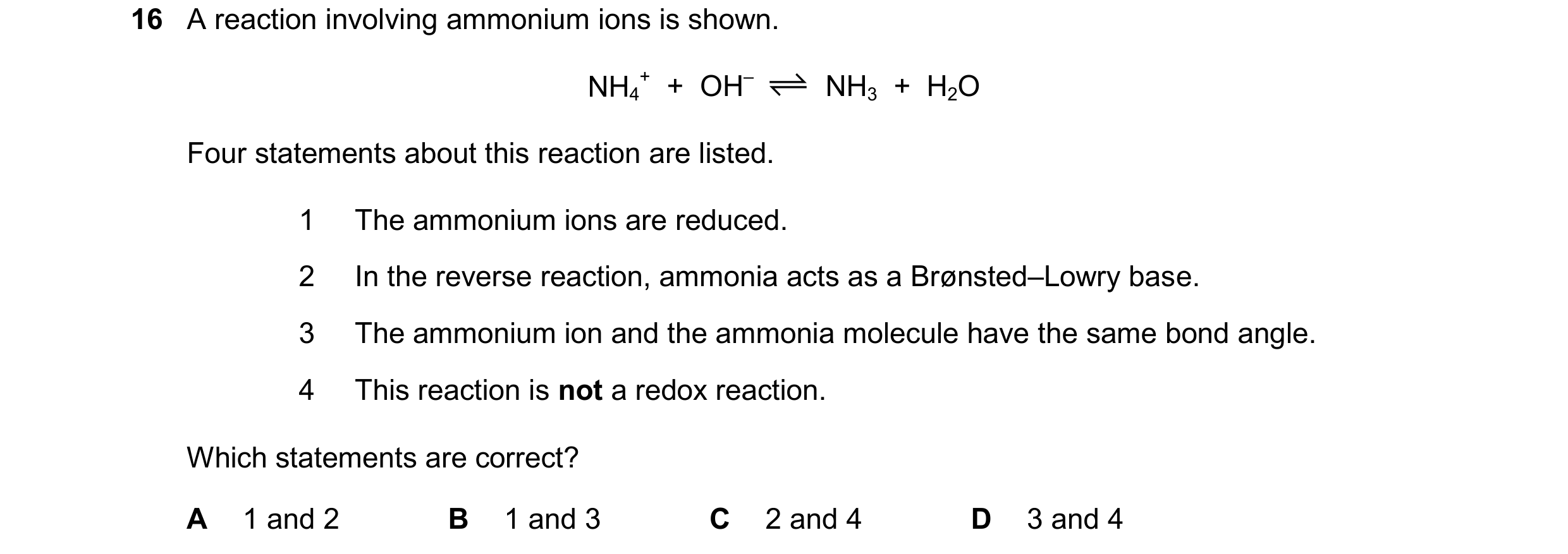
Q39 · A reaction involving ammonium ions is shown 9701/11 May/June 2025
16 A reaction involving ammonium ions is shown. NH4 + + OH– NH3 + H2O Four statements about this reaction are listed. 1 The ammonium ions are reduced. 2 In the reverse reaction, ammonia acts as a Brønsted–Lowry base. 3 The ammonium ion and the ammonia molecule have the same bond angle. 4 This reaction is not a redox reaction. Which statements are correct? A 1 and 2 B 1 and 3 C 2 and 4 D 3 and 4
1 marks
Answer: C
This question in 9701/11 May/June 2025
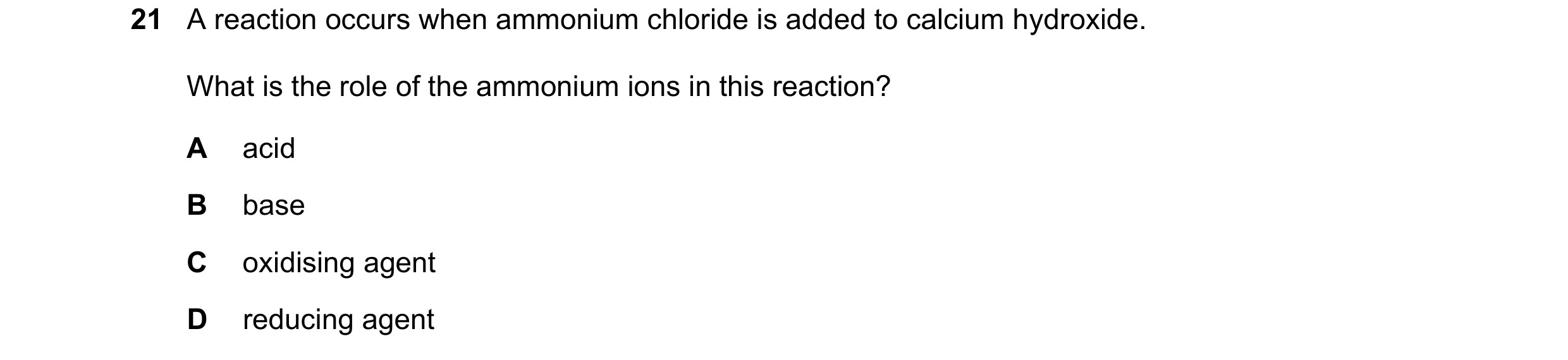
Q40 · A reaction occurs when ammonium chloride is added to calcium hydroxide 9701/12 May/June 2025
21 A reaction occurs when ammonium chloride is added to calcium hydroxide. What is the role of the ammonium ions in this reaction? A acid B base C oxidising agent D reducing agent
1 marks
Answer: A
This question in 9701/12 May/June 2025
Q41 · The equation shows the overall reaction between an amine and an acid chloride 9701/13 May/June 2025
3 The equation shows the overall reaction between an amine and an acid chloride.
2CH3CH2NH2 + CH3sCH2,COCI — CH3CH2zCONHCH2CH; + CH3CH2NH;3Cl
The four steps in the mechanism are as follows.
H
H,NCH,CH,
H—N*—CH,CH,
1 CH,CH,C—Cl >
CH,CH,C—Cl
bo |
Om
H
H
H—N*—CH,CH,
2 LA + CH,CH,C—N*—CH,CH, + Cl-
CH,CH,C—Cl | |
O 4H
Com
r™,
HH &
CH,CH,C—-N—CH,CH, + HCI
3 CH,CH,C—N*—CH,CH, > | |
| | OH
Her
4 CH,CH,NH, —> CH,CH,NH,C/
Which steps are Br@nsted—Lowry acid—base reactions?
A 1and3 B 3and4 C 3only D 4only
1 marks
Answer: B
This question in 9701/13 May/June 2025
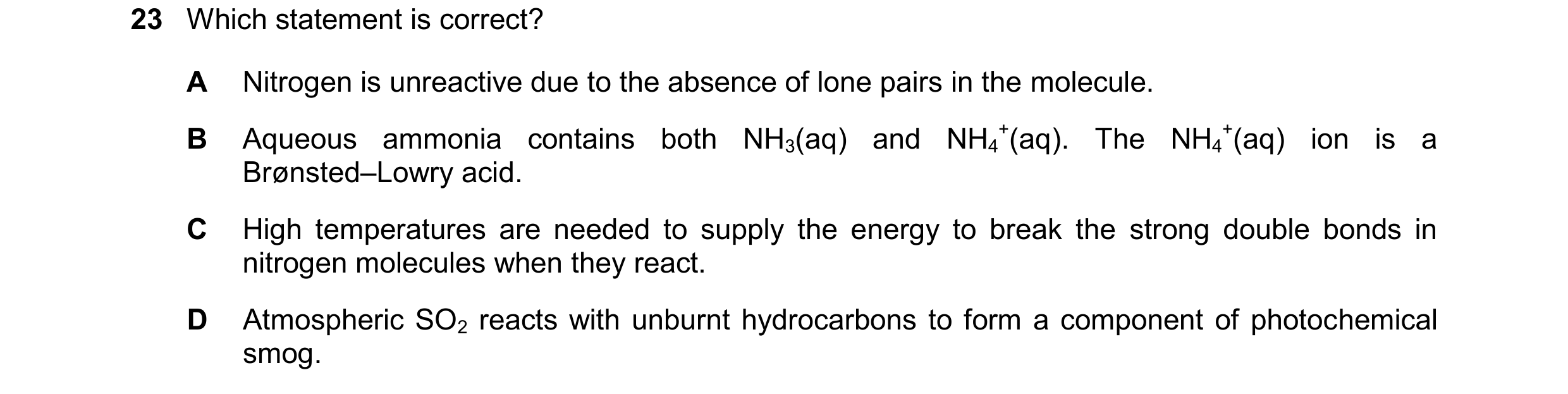
Q42 · Which statement is correct? 9701/11 Oct/Nov 2025
23 Which statement is correct? A Nitrogen is unreactive due to the absence of lone pairs in the molecule. B Aqueous ammonia contains both NH3(aq) and NH4 +(aq). The NH4 +(aq) ion is a Brønsted–Lowry acid. C High temperatures are needed to supply the energy to break the strong double bonds in nitrogen molecules when they react. D Atmospheric SO2 reacts with unburnt hydrocarbons to form a component of photochemical smog.
1 marks
Answer: B
This question in 9701/11 Oct/Nov 2025
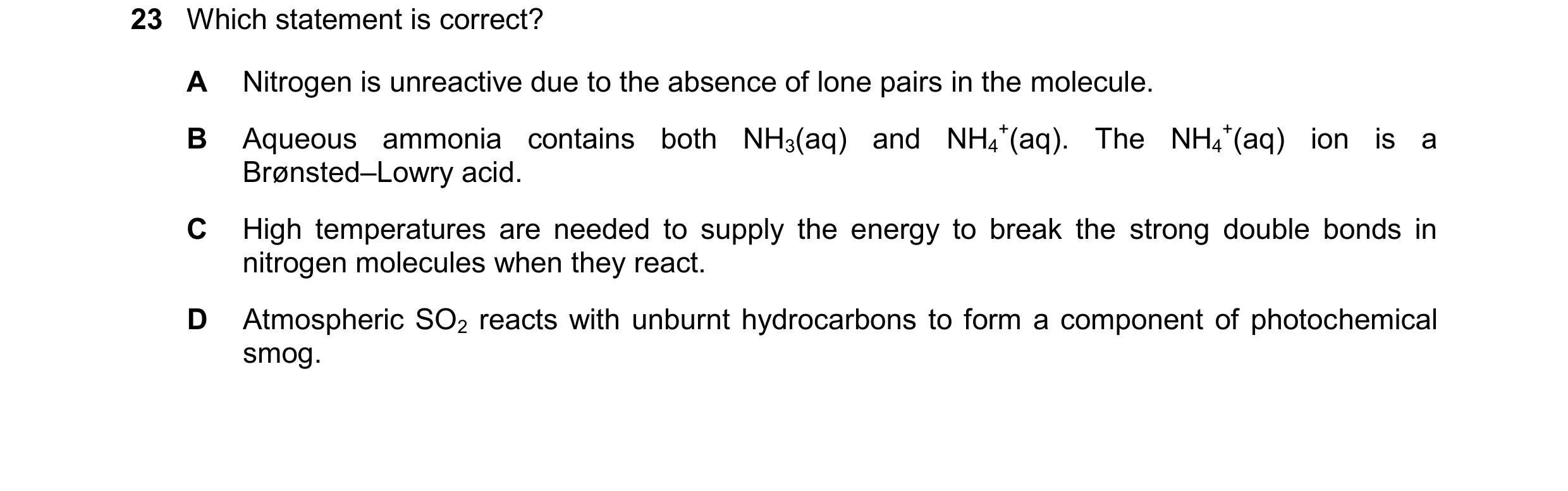
Q43 · Which statement is correct? 9701/13 Oct/Nov 2025
23 Which statement is correct? A Nitrogen is unreactive due to the absence of lone pairs in the molecule. B Aqueous ammonia contains both NH3(aq) and NH4 +(aq). The NH4 +(aq) ion is a Brønsted–Lowry acid. C High temperatures are needed to supply the energy to break the strong double bonds in nitrogen molecules when they react. D Atmospheric SO2 reacts with unburnt hydrocarbons to form a component of photochemical smog.
1 marks
Answer: B
This question in 9701/13 Oct/Nov 2025

 1 / 11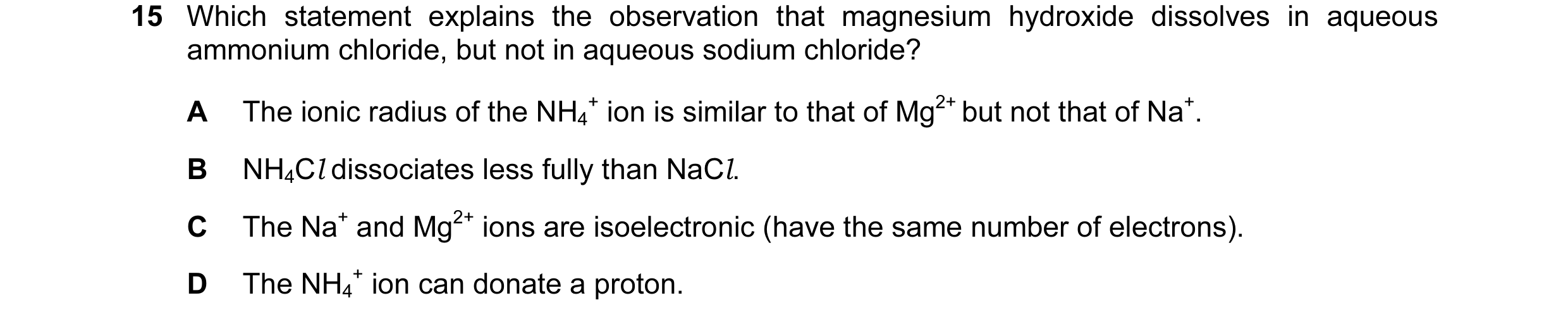


 2 / 11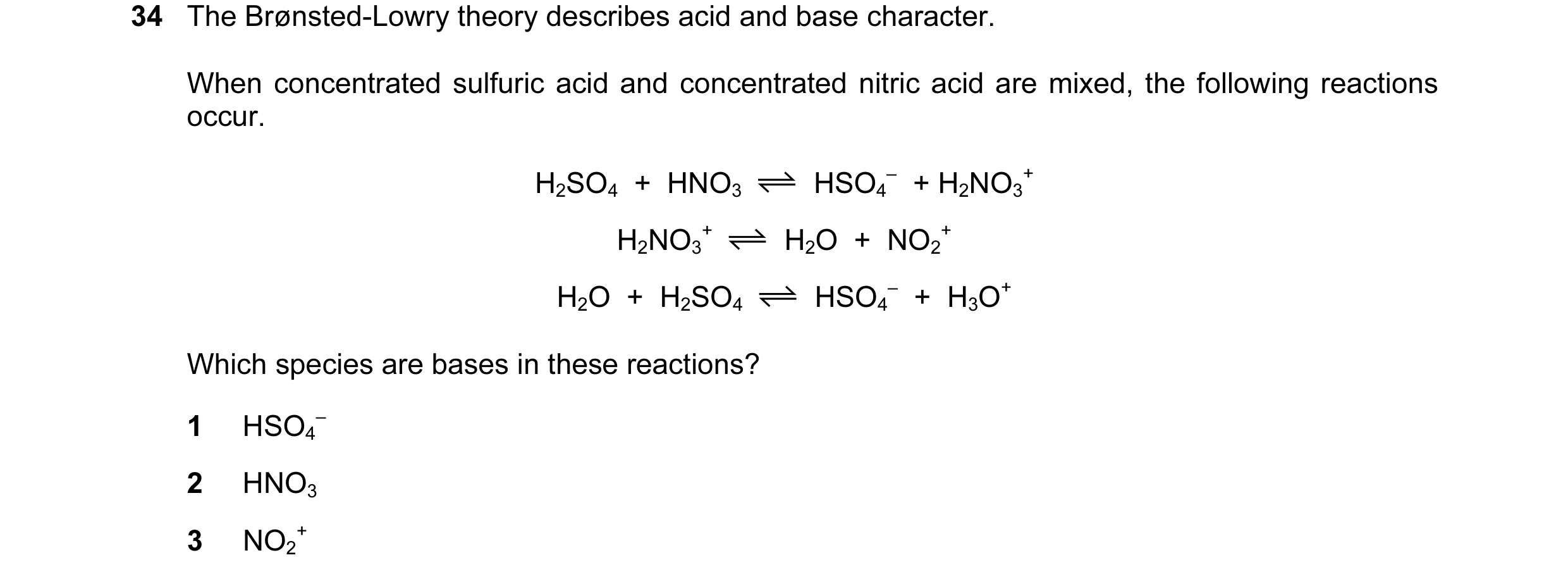



 3 / 11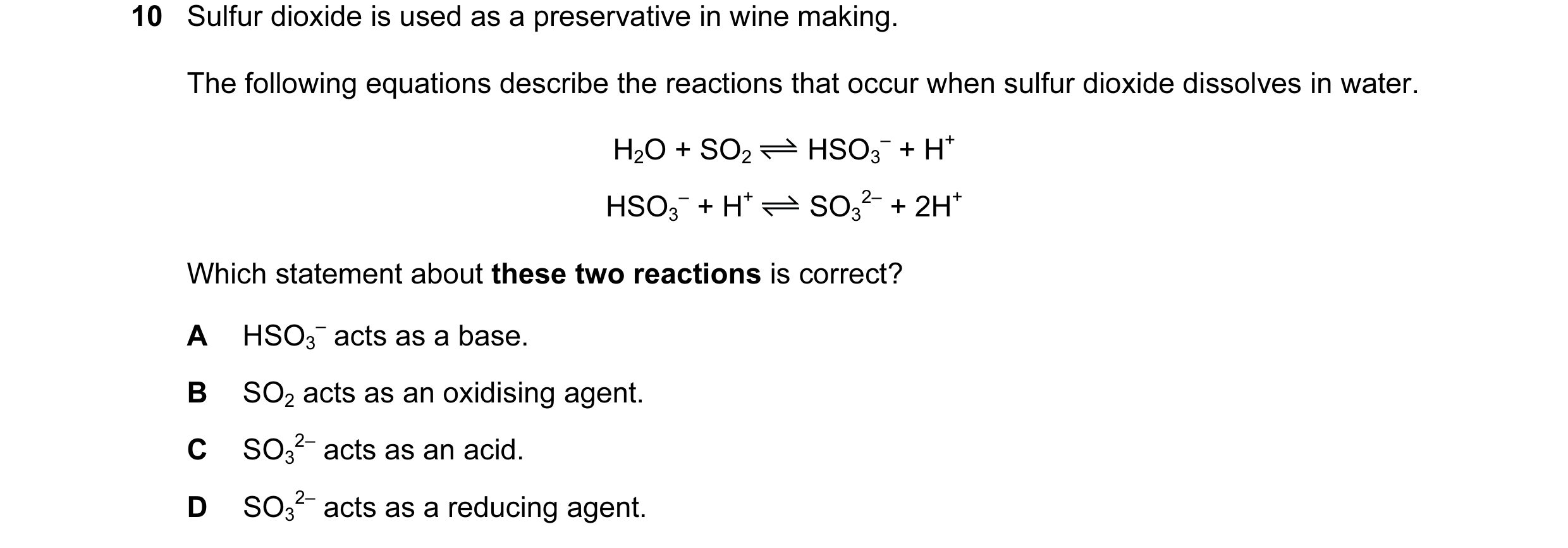

 4 / 11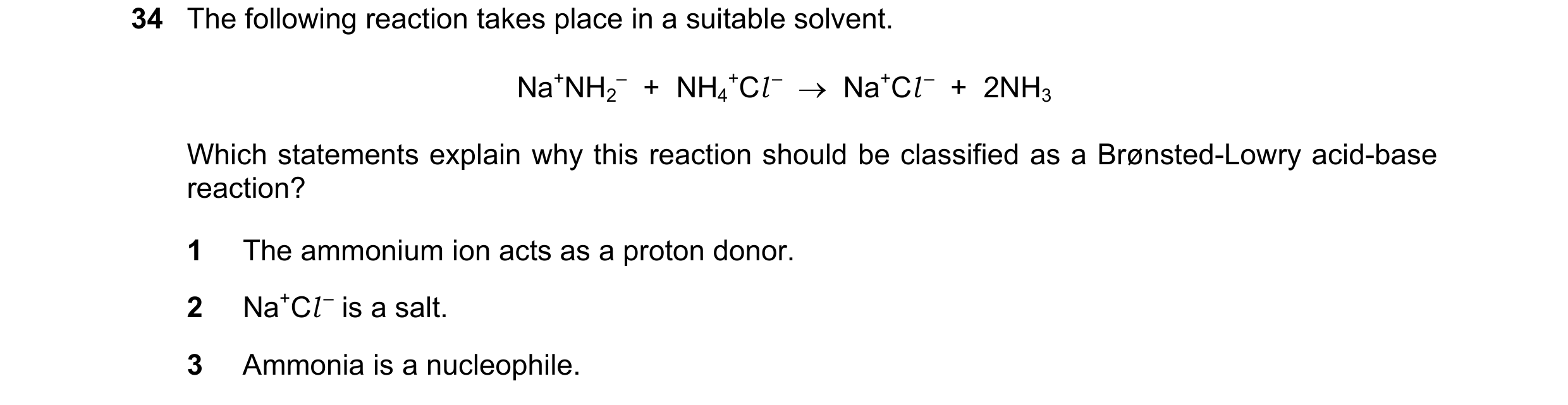
 5 / 11

 6 / 11
 7 / 11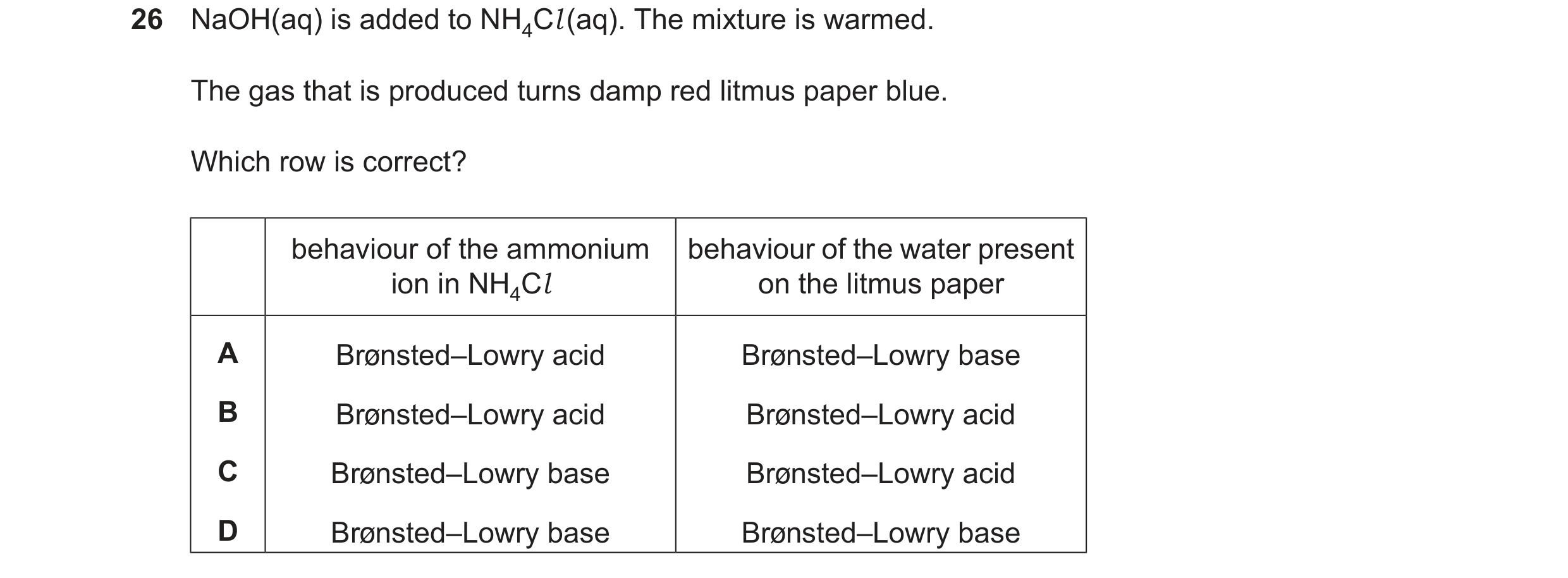

 8 / 11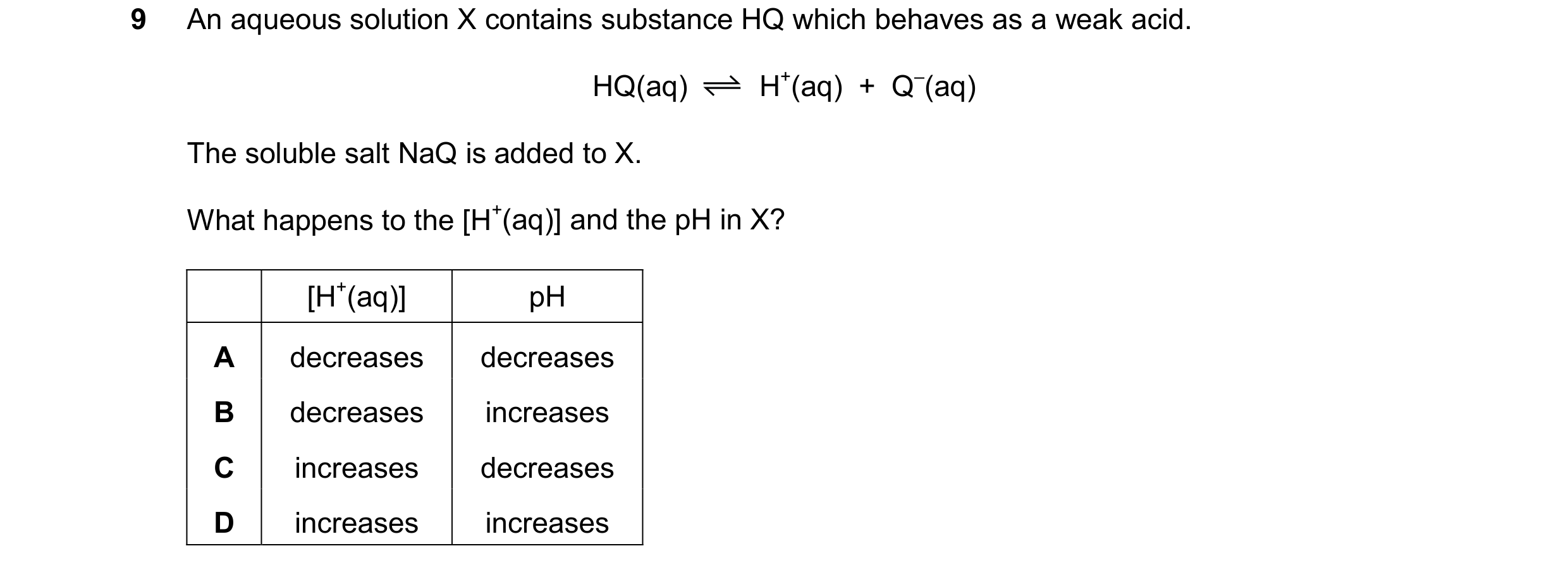
 9 / 11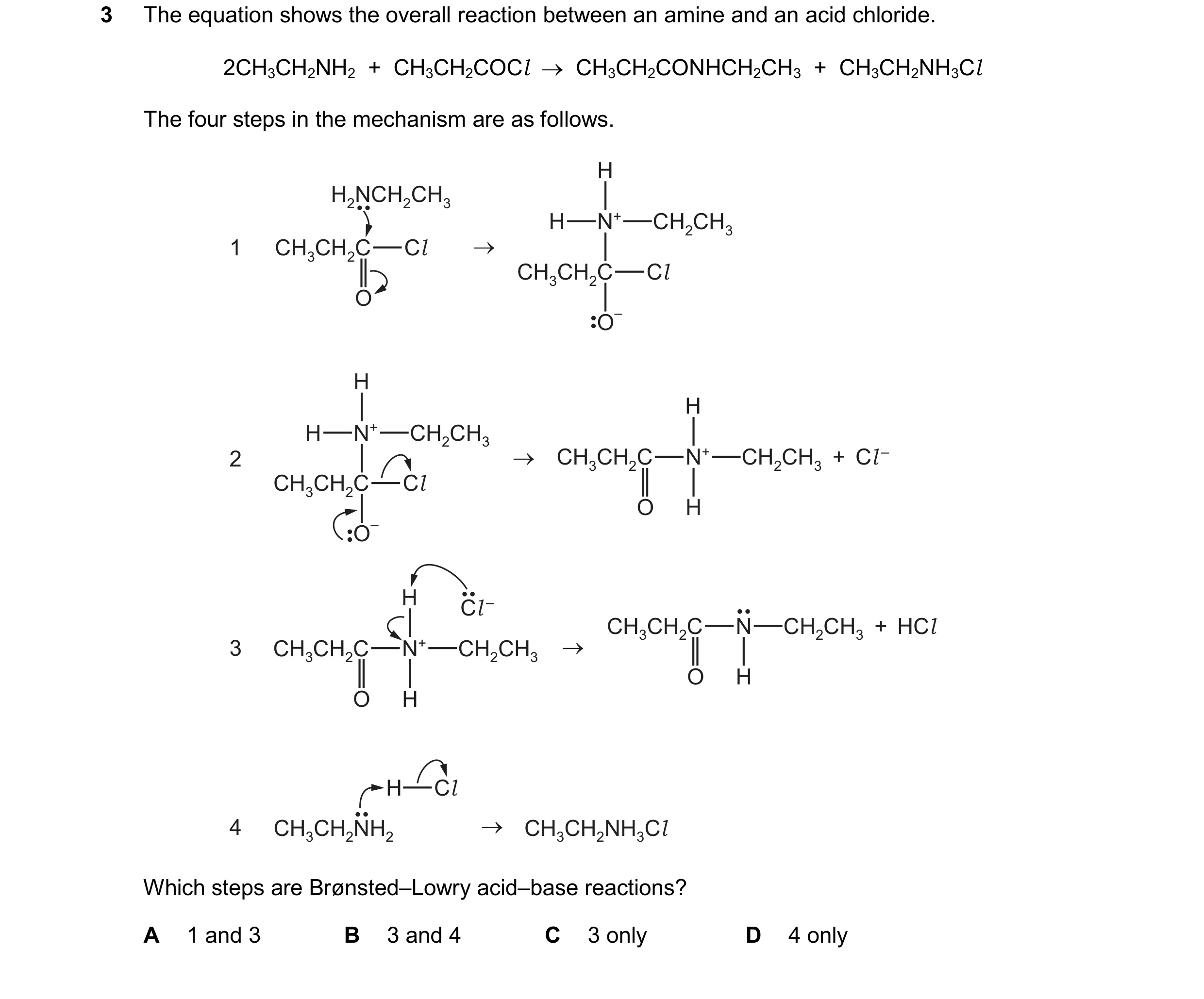
 10 / 11
 11 / 11