Questions as text
Q1 · For the reaction (CH3)3SiCl + C2H5O– → (CH3)3SiOC2H5 + Cl – which statements are likely… 9701/11 Oct/Nov 2005
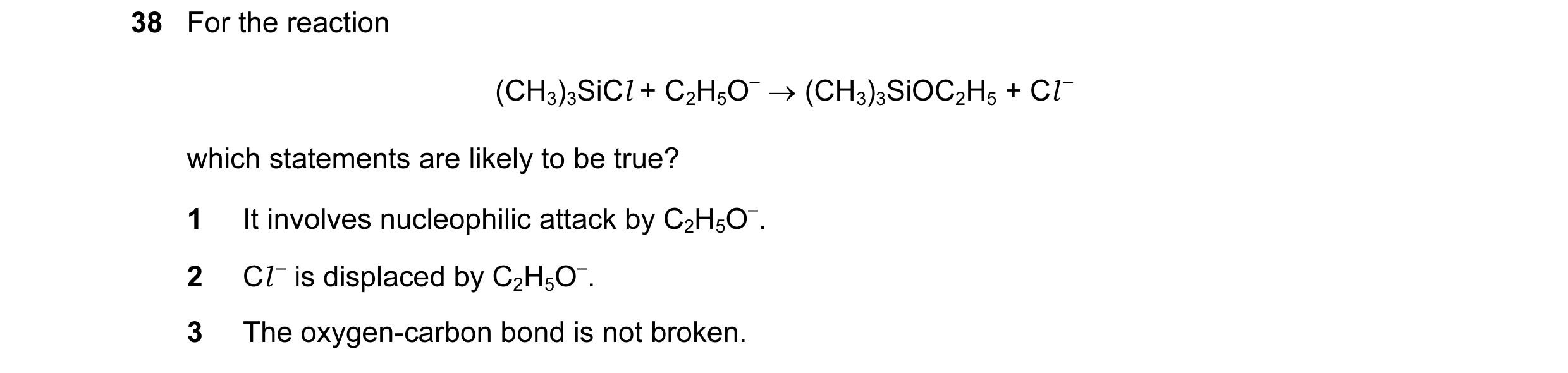
38 For the reaction (CH3)3SiCl + C2H5O– → (CH3)3SiOC2H5 + Cl – which statements are likely to be true? 1 It involves nucleophilic attack by C2H5O–. 2 Cl – is displaced by C2H5O–. 3 The oxygen-carbon bond is not broken.
1 marks
Answer: A
This question in 9701/11 Oct/Nov 2005
Q2 · Which are properties of fluoroalkanes? 9701/11 Oct/Nov 2006
38 Which are properties of fluoroalkanes? 1 They are less reactive than the corresponding chloroalkanes. 2 They are non-flammable. 3 The C-F bond is stronger than a C-Cl bond.
1 marks
Answer: A
This question in 9701/11 Oct/Nov 2006
Q3 · Which of the following would be suitable for use in a fire extinguisher? 9701/11 Oct/Nov 2008
38 Which of the following would be suitable for use in a fire extinguisher? 1 CBrF3 2 CH3(CH2)5CH2Br 3 HCl
1 marks
Answer: D
This question in 9701/11 Oct/Nov 2008
Q4 · Many different compounds have been used in aerosol sprays, refrigerators and in making… 9701/11 Oct/Nov 2011
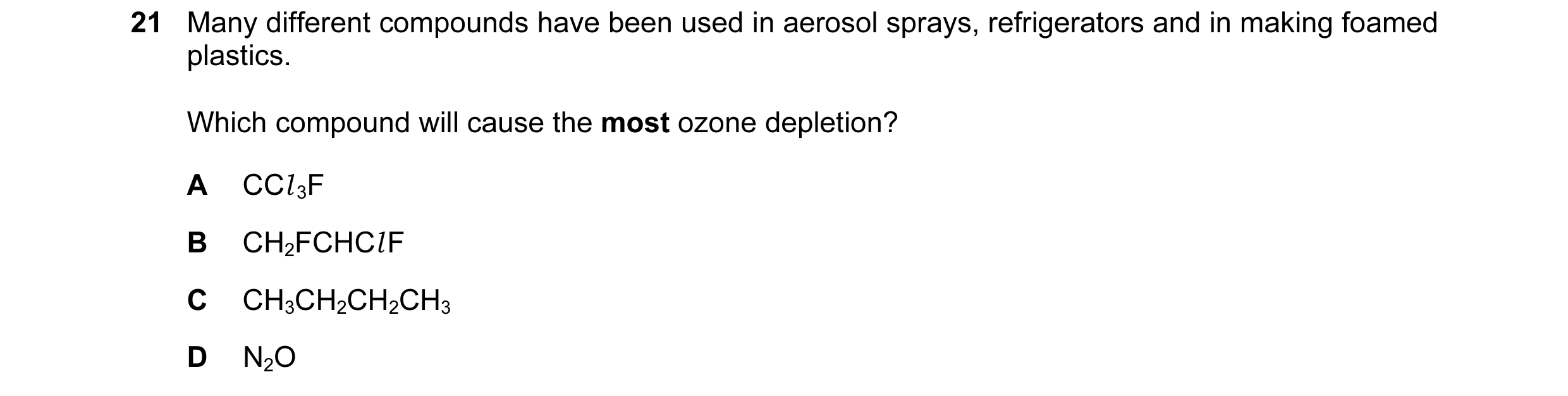
21 Many different compounds have been used in aerosol sprays, refrigerators and in making foamed plastics. Which compound will cause the most ozone depletion? A CCl 3F B CH2FCHCl F C CH3CH2CH2CH3 D N2O
1 marks
Answer: A
This question in 9701/11 Oct/Nov 2011
Q5 · X is an organic compound 9701/11 Oct/Nov 2011
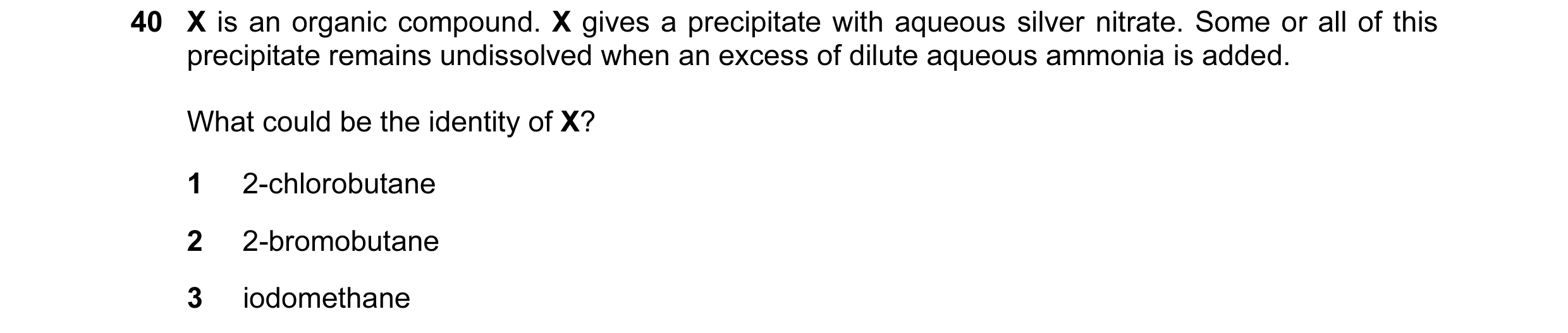
40 X is an organic compound. X gives a precipitate with aqueous silver nitrate. Some or all of this precipitate remains undissolved when an excess of dilute aqueous ammonia is added. What could be the identity of X? 1 2-chlorobutane 2 2-bromobutane 3 iodomethane
1 marks
Answer: C
This question in 9701/11 Oct/Nov 2011
Q6 · Y is an organic compound 9701/12 Oct/Nov 2011
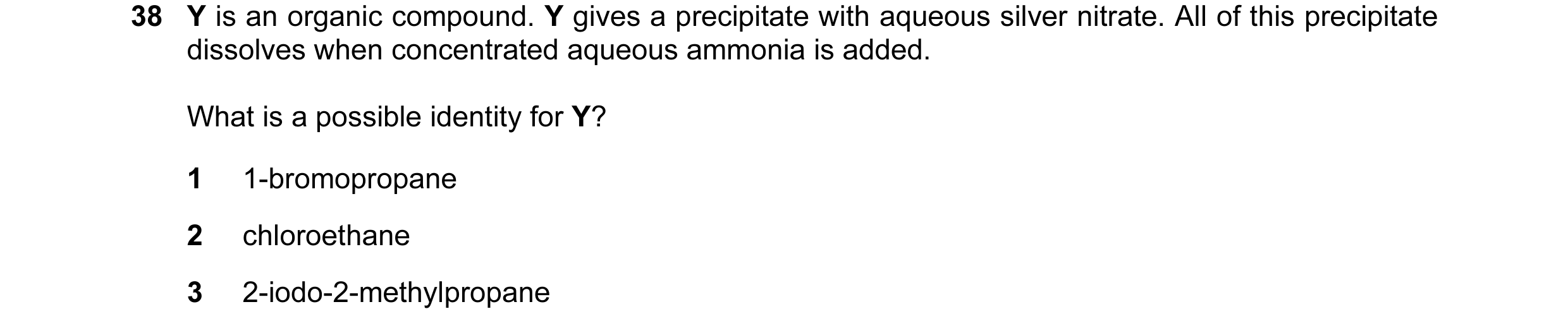
38 Y is an organic compound. Y gives a precipitate with aqueous silver nitrate. All of this precipitate dissolves when concentrated aqueous ammonia is added. What is a possible identity for Y? 1 1-bromopropane 2 chloroethane 3 2-iodo-2-methylpropane
1 marks
This question in 9701/12 Oct/Nov 2011
Q7 · X is an organic compound 9701/13 Oct/Nov 2011
37 X is an organic compound. X gives a precipitate with aqueous silver nitrate. Some or all of this precipitate remains undissolved when an excess of dilute aqueous ammonia is added. What could be the identity of X? 1 2-chlorobutane 2 2-bromobutane 3 iodomethane
1 marks
Answer: C
This question in 9701/13 Oct/Nov 2011
Q8 · Many, but not all, organic reactions need to be heated before reaction occurs 9701/11 Oct/Nov 2012
29 Many, but not all, organic reactions need to be heated before reaction occurs. Which reaction occurs at a good rate at room temperature (20 °C)? A CH3OH + PCl 5 → CH3Cl + POCl 3 + HCl B CH3CH2Br + KCN → CH3CH2CN + KBr C CH3CH2OH → C2H4 + H2O D CH3CH2CN + 2H2O → CH3CH2CO2H + NH3
1 marks
Answer: A
This question in 9701/11 Oct/Nov 2012
Q9 · Chloroethane can be formed from bromoethane in two steps 9701/13 Oct/Nov 2012
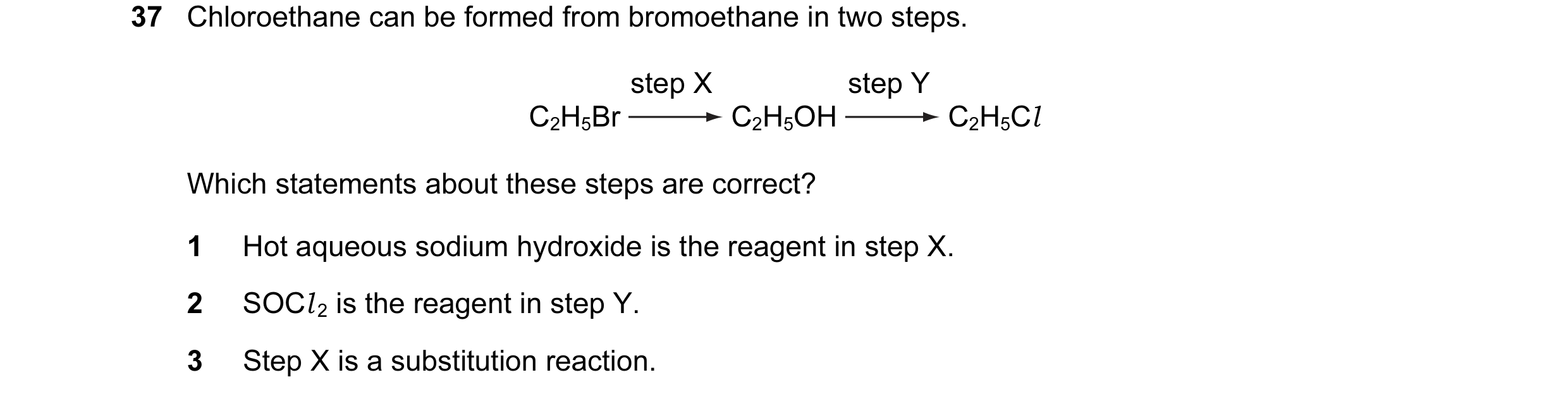
37 Chloroethane can be formed from bromoethane in two steps. step X step Y C2H5Br C2H5OH C2H5Cl Which statements about these steps are correct? 1 Hot aqueous sodium hydroxide is the reagent in step X. 2 SOCl 2 is the reagent in step Y. 3 Step X is a substitution reaction.
1 marks
Answer: A
This question in 9701/13 Oct/Nov 2012
Q10 · CCl 2FCCl F2 can be converted into CH2FCF3 by the following route 9701/13 May/June 2013
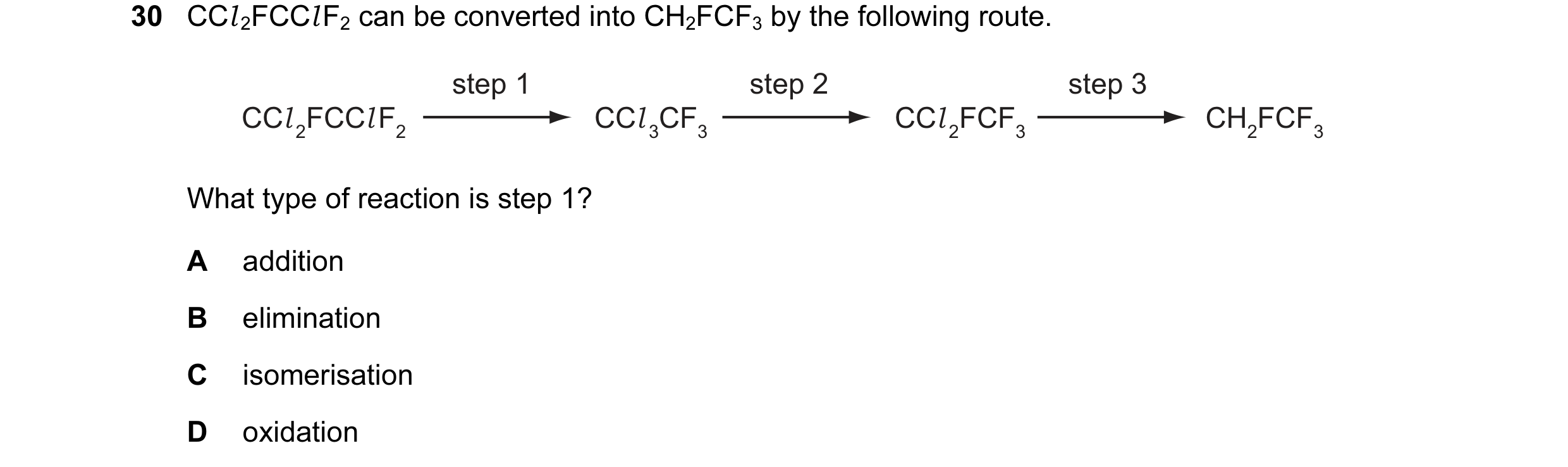
30 CCl 2FCCl F2 can be converted into CH2FCF3 by the following route. step 1 step 2 step 3 CCl 2FCCl F2 CCl 3CF3 CCl 2FCF3 CH2FCF3 What type of reaction is step 1? A addition B elimination C isomerisation D oxidation
1 marks
Answer: C
This question in 9701/13 May/June 2013
Q11 · The organic compound X gives a precipitate when warmed with aqueous silver nitrate 9701/12 Oct/Nov 2013
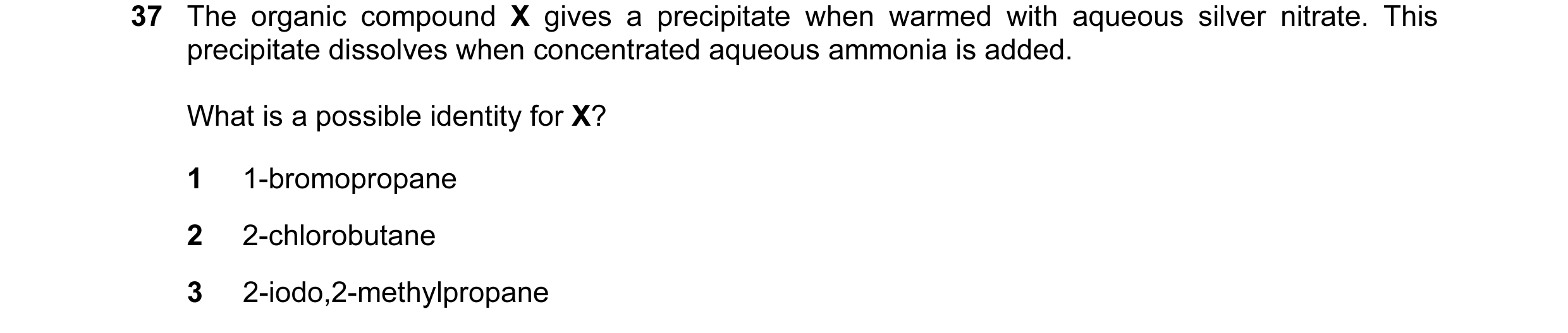
37 The organic compound X gives a precipitate when warmed with aqueous silver nitrate. This precipitate dissolves when concentrated aqueous ammonia is added. What is a possible identity for X? 1 1-bromopropane 2 2-chlorobutane 3 2-iodo,2-methylpropane
1 marks
Answer: B
This question in 9701/12 Oct/Nov 2013
Q12 · Dichlorodifluoromethane, CCl 2F2, has been used in aerosol propellants and as a… 9701/12 May/June 2014
27 Dichlorodifluoromethane, CCl 2F2, has been used in aerosol propellants and as a refrigerant. Which statement helps to explain why dichlorodifluoromethane is chemically inert? A All fluorine compounds are non-flammable. B Fluorine is highly electronegative. C The carbon-fluorine bond energy is large. D The carbon-fluorine bond has a low polarity.
1 marks
Answer: C
This question in 9701/12 May/June 2014
Q13 · X is an organic compound that gives a precipitate with aqueous silver nitrate 9701/11 Oct/Nov 2014
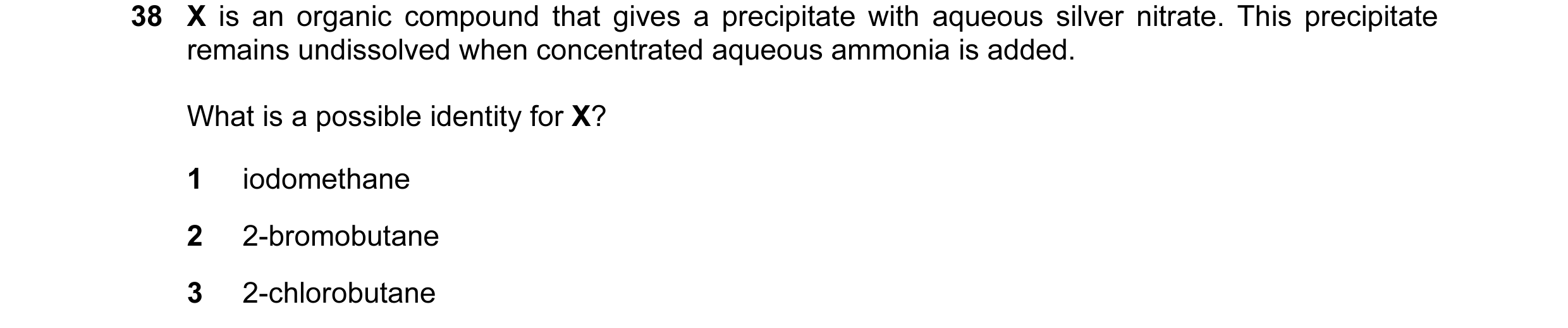
38 X is an organic compound that gives a precipitate with aqueous silver nitrate. This precipitate remains undissolved when concentrated aqueous ammonia is added. What is a possible identity for X? 1 iodomethane 2 2-bromobutane 3 2-chlorobutane
1 marks
Answer: D
This question in 9701/11 Oct/Nov 2014
Q14 · X is an organic compound that gives a precipitate with aqueous silver nitrate 9701/12 Oct/Nov 2014
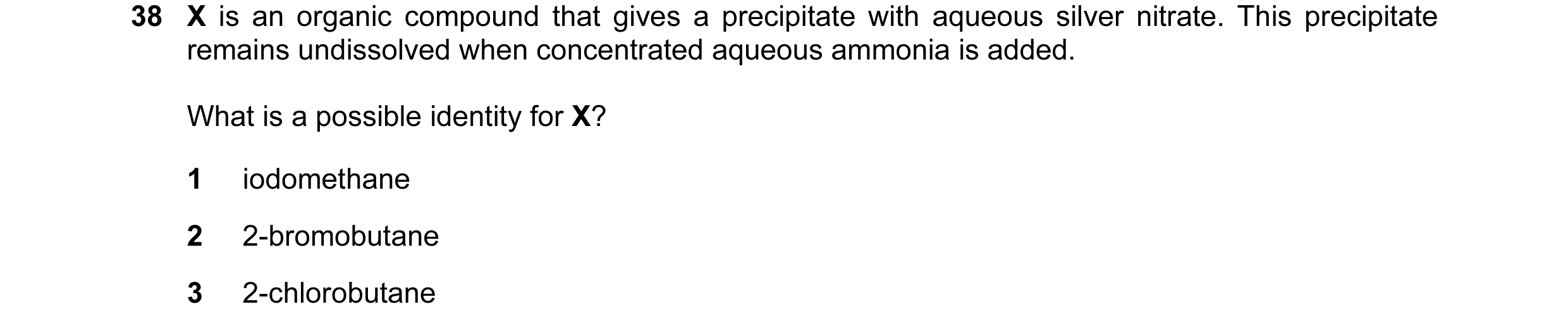
38 X is an organic compound that gives a precipitate with aqueous silver nitrate. This precipitate remains undissolved when concentrated aqueous ammonia is added. What is a possible identity for X? 1 iodomethane 2 2-bromobutane 3 2-chlorobutane
1 marks
Answer: D
This question in 9701/12 Oct/Nov 2014
Q15 · Coniine is the major constituent of the poison ‘oil of hemlock’ 9701/11 May/June 2015
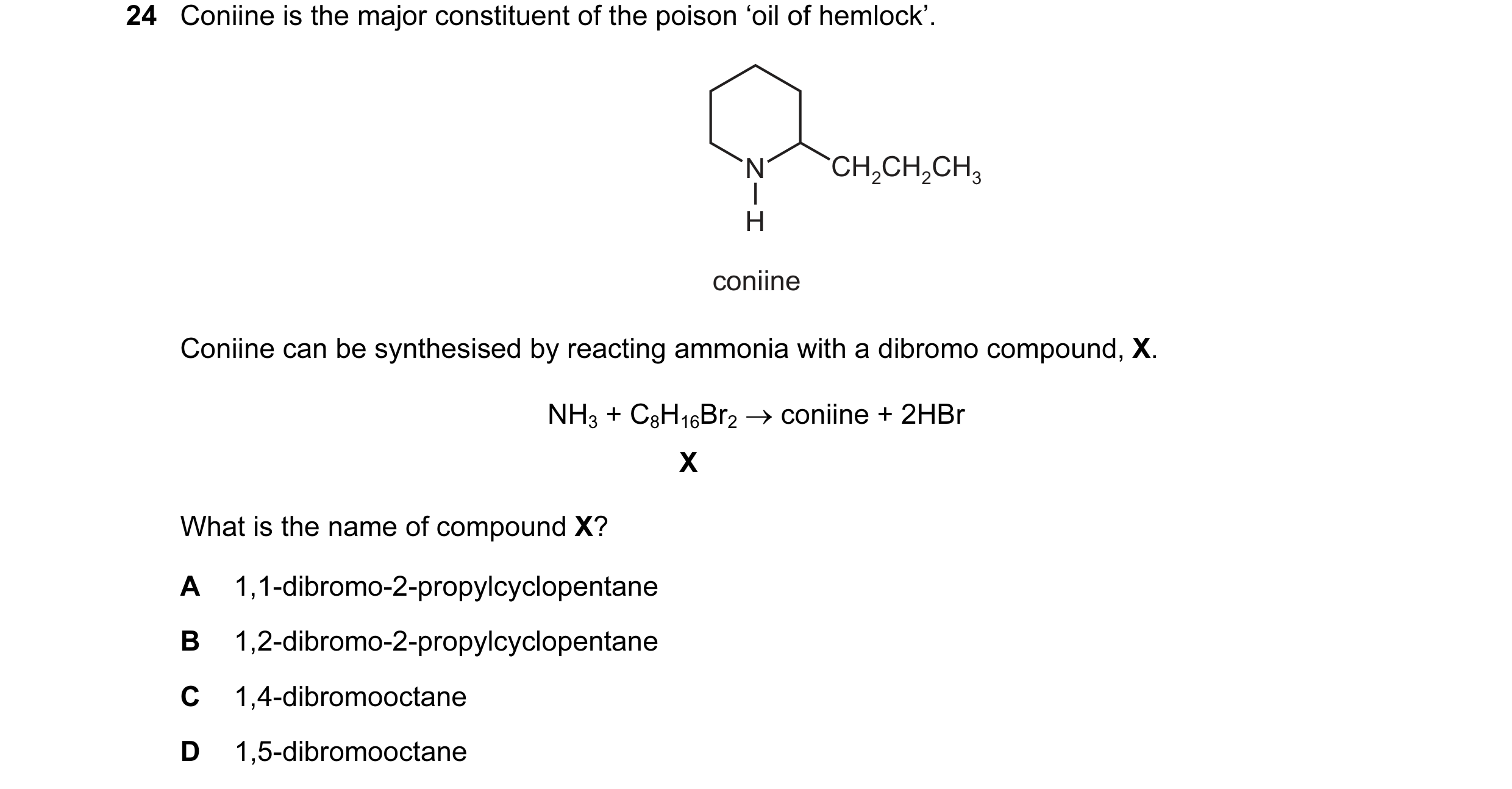
24 Coniine is the major constituent of the poison ‘oil of hemlock’. N CH2CH2CH3 H coniine Coniine can be synthesised by reacting ammonia with a dibromo compound, X. NH3 + C8H16Br2 → coniine + 2HBr X What is the name of compound X? A 1,1-dibromo-2-propylcyclopentane B 1,2-dibromo-2-propylcyclopentane C 1,4-dibromooctane D 1,5-dibromooctane
1 marks
Answer: D
This question in 9701/11 May/June 2015
Q16 · The presence of a halogen in an organic compound may be detected by warming the organic… 9701/11 May/June 2015
26 The presence of a halogen in an organic compound may be detected by warming the organic compound with aqueous silver nitrate. Which compound would be the quickest to produce a precipitate? A B C D Cl F F Cl Cl Cl F Br Cl F I F
1 marks
Answer: C
This question in 9701/11 May/June 2015
Q17 · Compound X has been investigated for use as an artificial sweetener 9701/12 Oct/Nov 2015
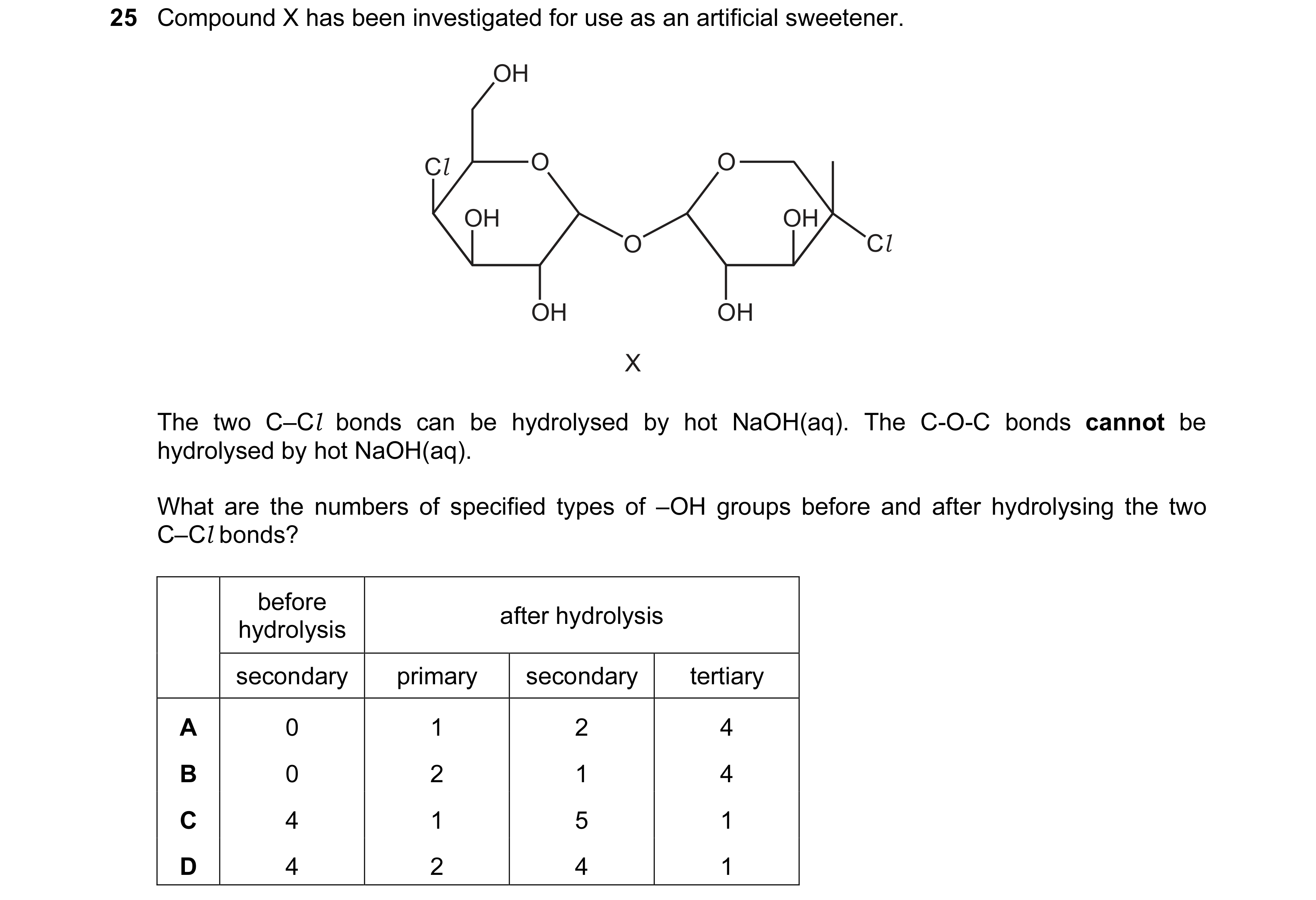
25 Compound X has been investigated for use as an artificial sweetener. OH Cl O O OH OH O Cl OH OH X The two C–Cl bonds can be hydrolysed by hot NaOH(aq). The C-O-C bonds cannot be hydrolysed by hot NaOH(aq). What are the numbers of specified types of –OH groups before and after hydrolysing the two C–Cl bonds? before after hydrolysis hydrolysis secondary primary secondary tertiary A 0 1 2 4 B 0 2 1 4 C 4 1 5 1 D 4 2 4 1
1 marks
This question in 9701/12 Oct/Nov 2015
Q18 · X is an organic compound 9701/12 Oct/Nov 2015
38 X is an organic compound. X gives a precipitate with aqueous silver nitrate. Some or all of this precipitate remains undissolved when excess dilute aqueous ammonia is added. What could be the identity of X? 1 2-chlorobutane 2 2-bromobutane 3 iodomethane
1 marks
This question in 9701/12 Oct/Nov 2015
Q19 · Which compounds, on heating with ethanolic NaOH, produce more than one product with… 9701/13 May/June 2017
38 Which compounds, on heating with ethanolic NaOH, produce more than one product with molecular formula C4H8? 1 2-bromobutane 2 2-bromo-2-methylpropane 3 1-bromo-2-methylpropane
1 marks
Answer: D
This question in 9701/13 May/June 2017
Q20 · Organic compound X gives a precipitate when warmed with aqueous silver nitrate 9701/12 Feb/March 2018
38 Organic compound X gives a precipitate when warmed with aqueous silver nitrate. This precipitate dissolves when concentrated aqueous ammonia is added. What could X be? 1 1-bromopropane 2 2-chlorobutane 3 2-iodo-2-methylpropane
1 marks
Answer: B
This question in 9701/12 Feb/March 2018
Q21 · Chlorofluoroalkanes have been used as the refrigerant in refrigerators but care has to be… 9701/11 May/June 2018
39 Chlorofluoroalkanes have been used as the refrigerant in refrigerators but care has to be taken in disposing of old refrigerators. Which statements about chlorofluoroalkanes are correct? 1 C–Cl bonds more readily undergo homolytic fission than C–F bonds. 2 Care is taken in the disposal of old refrigerators because of possible ozone depletion. 3 C2H4Cl F is more volatile than C2H6.
1 marks
Answer: B
This question in 9701/11 May/June 2018
Q22 · The halogenoalkanes listed below all react with NaOH(aq) 9701/11 Oct/Nov 2018
38 The halogenoalkanes listed below all react with NaOH(aq). Which reactions proceed mainly by an SN1 mechanism? 1 1-iodopropane 2 2-iodo-2-methylpropane 3 2-bromo-2-methylbutane
1 marks
Answer: C
This question in 9701/11 Oct/Nov 2018
Q23 · Halogenoalkanes can undergo reaction with hydroxide ions 9701/12 Oct/Nov 2018
38 Halogenoalkanes can undergo reaction with hydroxide ions. RBr + OH– → ROH + Br – The reaction of some halogenoalkanes proceeds by the SN1 mechanism. Which statements about the SN1 mechanism are correct? 1 A carbocation is formed which is stabilised by the inductive effect of the alkyl groups present. 2 Only tertiary halogenoalkanes are hydrolysed in this way. 3 The intermediate formed includes a carbon atom with five bonds attached to it.
1 marks
Answer: D
This question in 9701/12 Oct/Nov 2018
Q24 · Chlorofluoroalkanes that diffuse into the stratosphere are broken down by ultraviolet… 9701/11 May/June 2020
39 Chlorofluoroalkanes that diffuse into the stratosphere are broken down by ultraviolet radiation. Radicals are generated that cause depletion of ozone. What are these radicals? 1 chlorine radicals 2 fluorine radicals 3 alkyl radicals
1 marks
Answer: D
This question in 9701/11 May/June 2020
Q25 · Which observations are made when a sample of silicon chloride, SiCl 4, is added to a… 9701/12 Feb/March 2021
12 Which observations are made when a sample of silicon chloride, SiCl 4, is added to a beaker of water? A No visible change is observed. B Steamy fumes and a precipitate are both observed. C The appearance of a precipitate is the only observation. D The appearance of steamy fumes is the only observation.
1 marks
Answer: B
This question in 9701/12 Feb/March 2021
Q26 · Which statements are correct? 9701/11 May/June 2021
37 Which statements are correct? 1 1,1-difluoroethane is less reactive than 1,1-dichloroethane. 2 1,1-difluoroethane is polar. 3 The C–F bond is stronger than the C–Cl bond.
1 marks
Answer: A
This question in 9701/11 May/June 2021
Q27 · Which statements about chlorofluoroalkanes are correct? 9701/13 Oct/Nov 2021
39 Which statements about chlorofluoroalkanes are correct? 1 Both the C–Cl and C–F bonds are readily dissociated by ultra-violet light. 2 They have caused ozone depletion. 3 They are relatively chemically inert.
1 marks
Answer: C
This question in 9701/13 Oct/Nov 2021
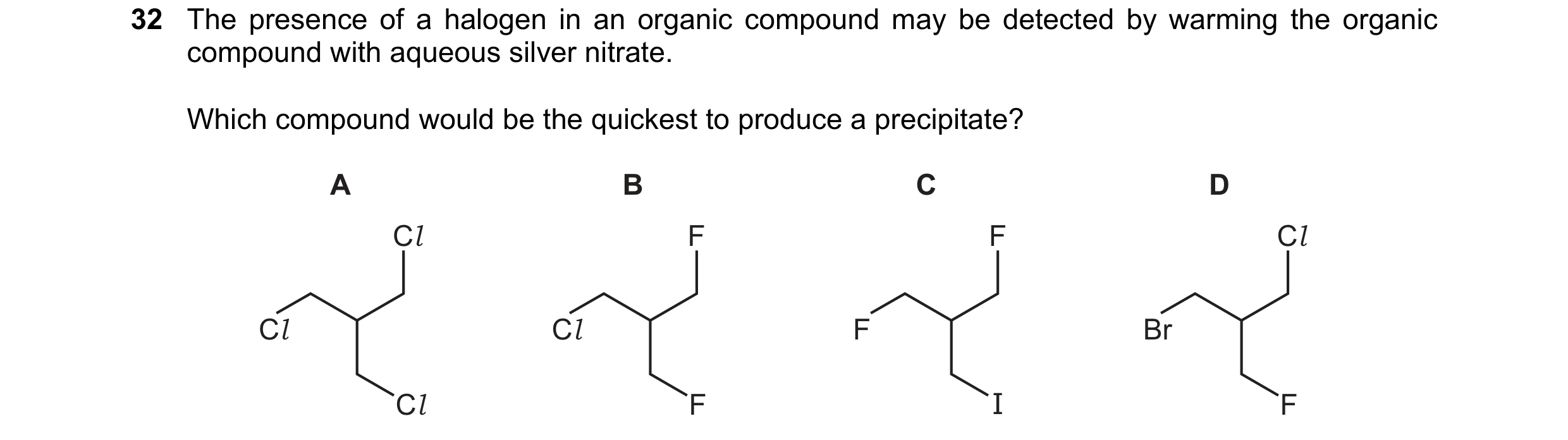
Q28 · The presence of a halogen in an organic compound may be detected by warming the organic… 9701/11 May/June 2022
32 The presence of a halogen in an organic compound may be detected by warming the organic compound with aqueous silver nitrate. Which compound would be the quickest to produce a precipitate? A B C D Cl F F Cl Cl Cl F Br Cl F I F
1 marks
Answer: C
This question in 9701/11 May/June 2022
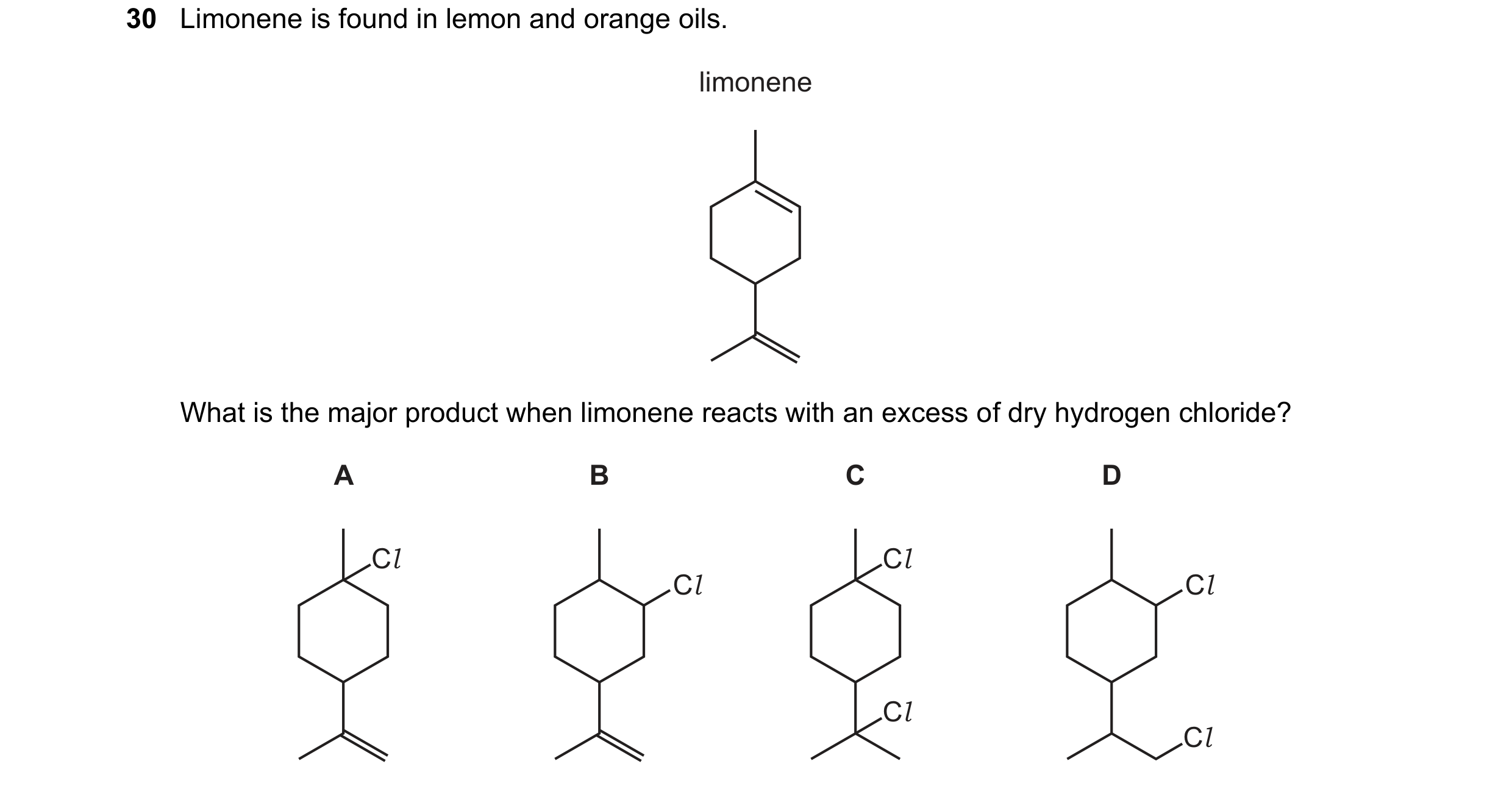
Q29 · Limonene is found in lemon and orange oils 9701/13 May/June 2022
30 Limonene is found in lemon and orange oils. limonene What is the major product when limonene reacts with an excess of dry hydrogen chloride? A B C D Cl Cl Cl Cl Cl Cl
1 marks
Answer: C
This question in 9701/13 May/June 2022
Q30 · Compound J, C15H23Br2Cl , is reacted with an excess of a hot concentrated solution of… 9701/13 May/June 2022
32 Compound J, C15H23Br2Cl , is reacted with an excess of a hot concentrated solution of sodium hydroxide in ethanol. One of the products is X. compound J excess NaOH Cl Br in ethanol X Br What could be the skeletal formula of X? A B C D
1 marks
Answer: A
This question in 9701/13 May/June 2022
Q31 · Compound V polymerises to form polymer W 9701/12 Oct/Nov 2022
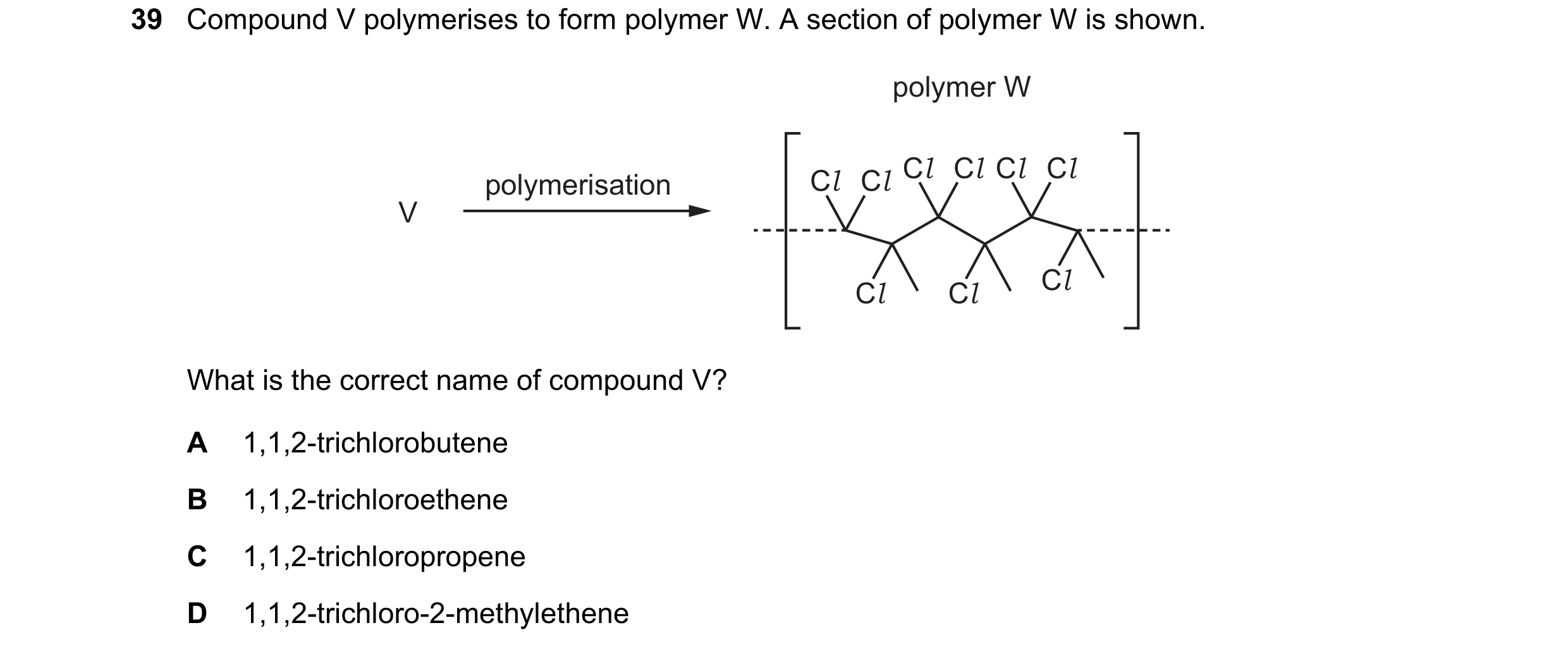
39 Compound V polymerises to form polymer W. A section of polymer W is shown. polymer W Cl Cl Cl Cl Cl Cl polymerisation V Cl Cl Cl What is the correct name of compound V? A 1,1,2-trichlorobutene B 1,1,2-trichloroethene C 1,1,2-trichloropropene D 1,1,2-trichloro-2-methylethene
1 marks
Answer: C
This question in 9701/12 Oct/Nov 2022
Q32 · Which compound reacts most rapidly with aqueous silver nitrate by an SN1 mechanism? 9701/12 Feb/March 2023
31 Which compound reacts most rapidly with aqueous silver nitrate by an SN1 mechanism? A 1-chloromethylpropane B 2-chloromethylpropane C 1-iodomethylpropane D 2-iodomethylpropane
1 marks
Answer: D
This question in 9701/12 Feb/March 2023
Q33 · 1,1-dichloropropane reacts with aqueous sodium hydroxide in a series of steps to give… 9701/11 Oct/Nov 2023
31 1,1-dichloropropane reacts with aqueous sodium hydroxide in a series of steps to give propanal. NaOH(aq) CH3CH2CHCl 2 CH3CH2CHO Which term describes the first step of this reaction? A addition B elimination C oxidation D substitution
1 marks
Answer: D
This question in 9701/11 Oct/Nov 2023
Q34 · 1-chloro-2-methylpropane and 2-bromo-2-methylbutane react separately with aqueous silver… 9701/12 Feb/March 2025
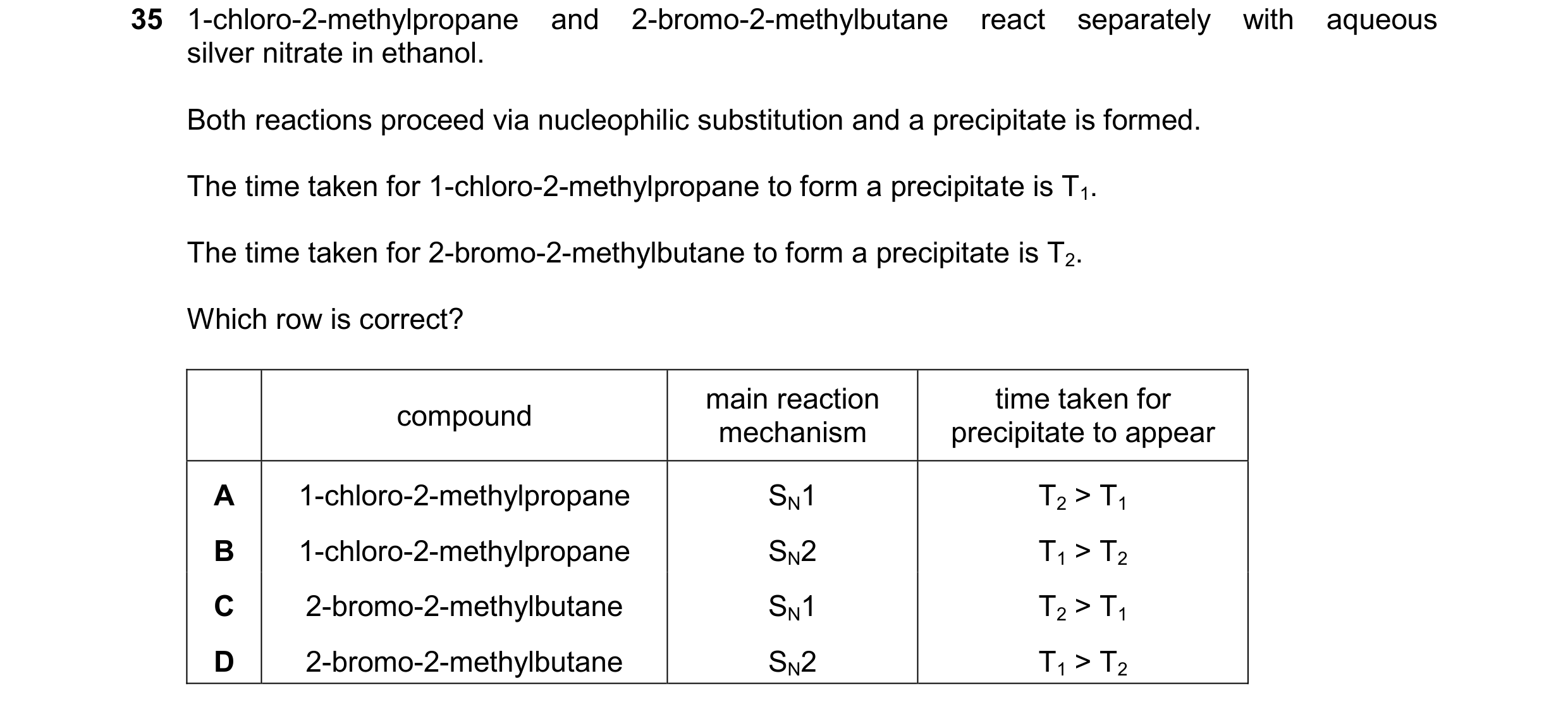
35 1-chloro-2-methylpropane and 2-bromo-2-methylbutane react separately with aqueous silver nitrate in ethanol. Both reactions proceed via nucleophilic substitution and a precipitate is formed. The time taken for 1-chloro-2-methylpropane to form a precipitate is T1. The time taken for 2-bromo-2-methylbutane to form a precipitate is T2. Which row is correct? main reaction time taken for compound mechanism precipitate to appear A 1-chloro-2-methylpropane SN1 T2 > T1 B 1-chloro-2-methylpropane SN2 T1 > T2 C 2-bromo-2-methylbutane SN1 T2 > T1 D 2-bromo-2-methylbutane SN2 T1 > T2
1 marks
Answer: B
This question in 9701/12 Feb/March 2025
Q35 · Four drops of 1-chlorobutane, 1-bromobutane and 1-iodobutane are put separately into… 9701/12 May/June 2025
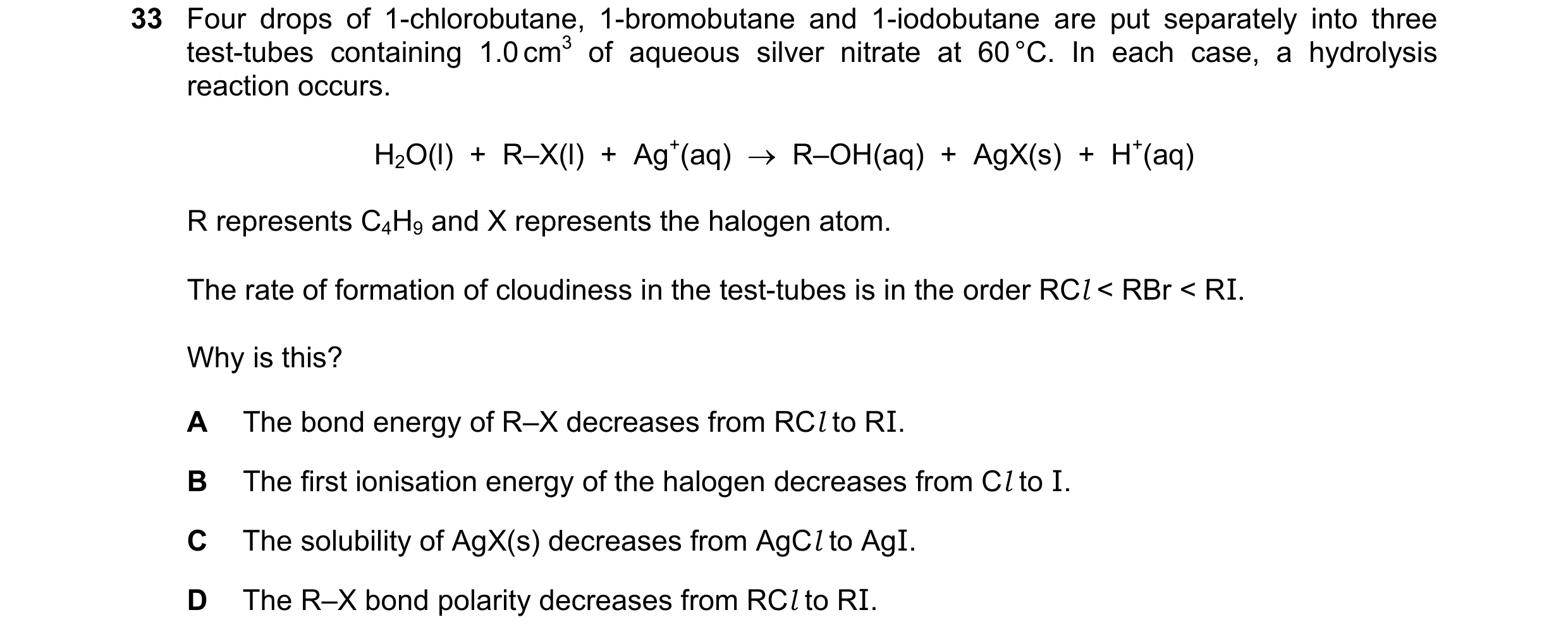
33 Four drops of 1-chlorobutane, 1-bromobutane and 1-iodobutane are put separately into three test-tubes containing 1.0 cm3 of aqueous silver nitrate at 60 °C. In each case, a hydrolysis reaction occurs. H2O(l) + R–X(l) + Ag+(aq) R–OH(aq) + AgX(s) + H+(aq) R represents C4H9 and X represents the halogen atom. The rate of formation of cloudiness in the test-tubes is in the order RCl < RBr < RI. Why is this? A The bond energy of R–X decreases from RCl to RI. B The first ionisation energy of the halogen decreases from Cl to I. C The solubility of AgX(s) decreases from AgCl to AgI. D The R–X bond polarity decreases from RCl to RI.
1 marks
Answer: A
This question in 9701/12 May/June 2025
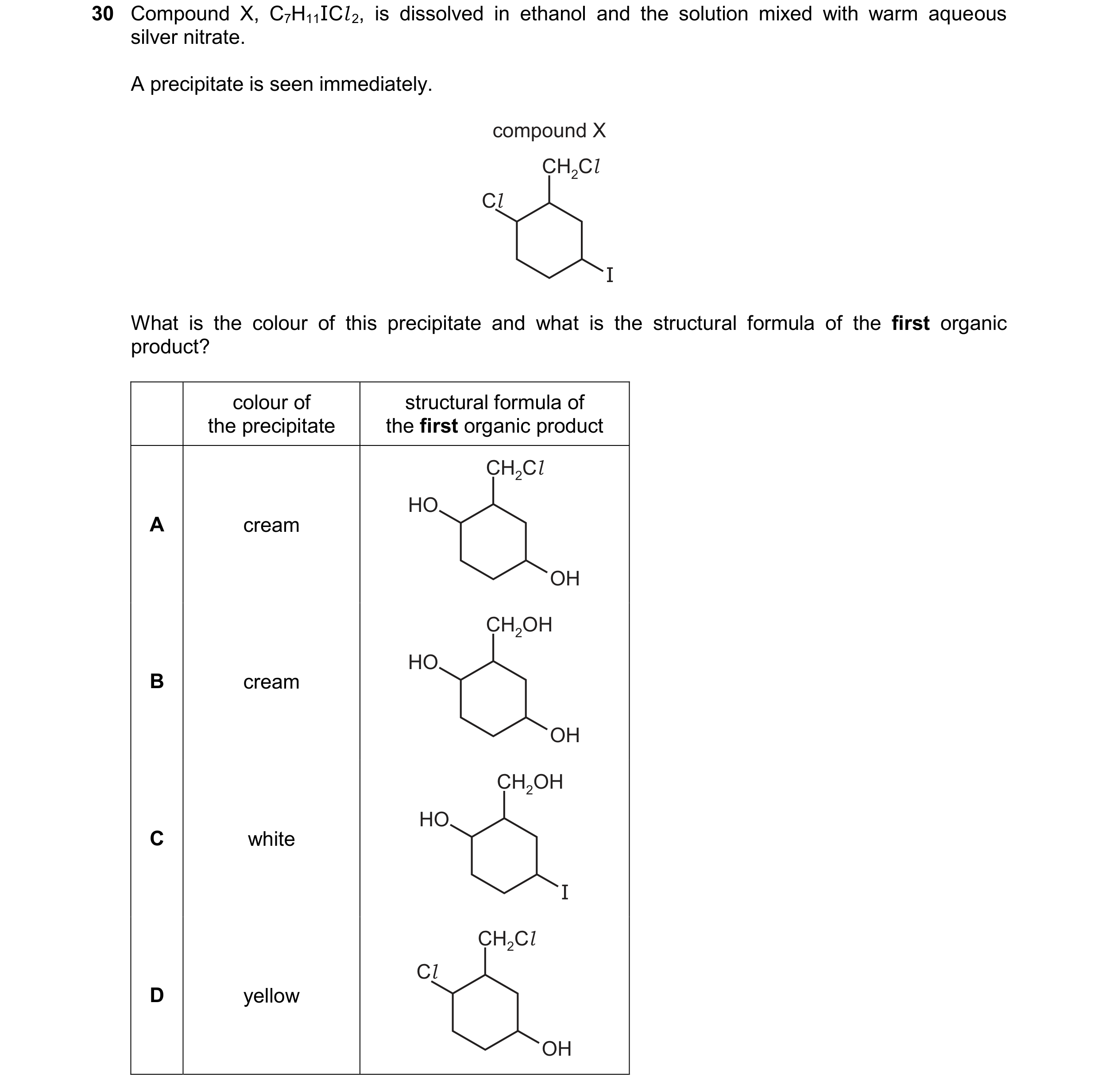
Q36 · Compound X, C7H11ICl2, is dissolved in ethanol and the solution mixed with warm aqueous… 9701/11 Oct/Nov 2025
30 Compound X, C7H11ICl2, is dissolved in ethanol and the solution mixed with warm aqueous silver nitrate. A precipitate is seen immediately. CH2Cl Cl I compound X What is the colour of this precipitate and what is the structural formula of the first organic product? colour of the precipitate structural formula of the first organic product A cream CH2Cl HO OH B cream CH2OH HO OH C white CH2OH HO I D yellow CH2Cl Cl OH
1 marks
Answer: D
This question in 9701/11 Oct/Nov 2025
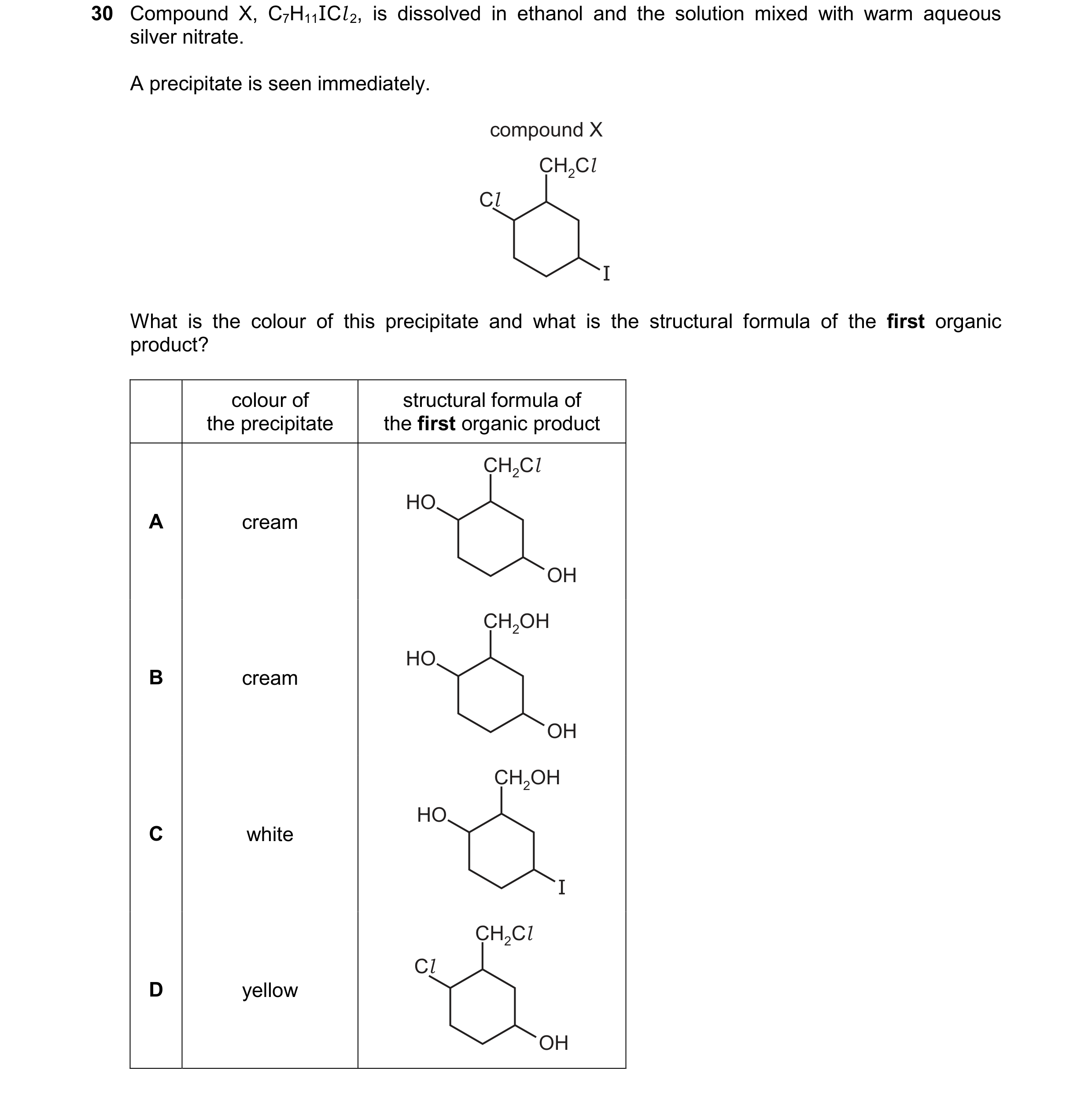
Q37 · Compound X, C7H11ICl2, is dissolved in ethanol and the solution mixed with warm aqueous… 9701/13 Oct/Nov 2025
30 Compound X, C7H11ICl2, is dissolved in ethanol and the solution mixed with warm aqueous silver nitrate. A precipitate is seen immediately. CH2Cl Cl I compound X What is the colour of this precipitate and what is the structural formula of the first organic product? colour of the precipitate structural formula of the first organic product A cream CH2Cl HO OH B cream CH2OH HO OH C white CH2OH HO I D yellow CH2Cl Cl OH
1 marks
Answer: D
This question in 9701/13 Oct/Nov 2025


 1 / 10
 2 / 10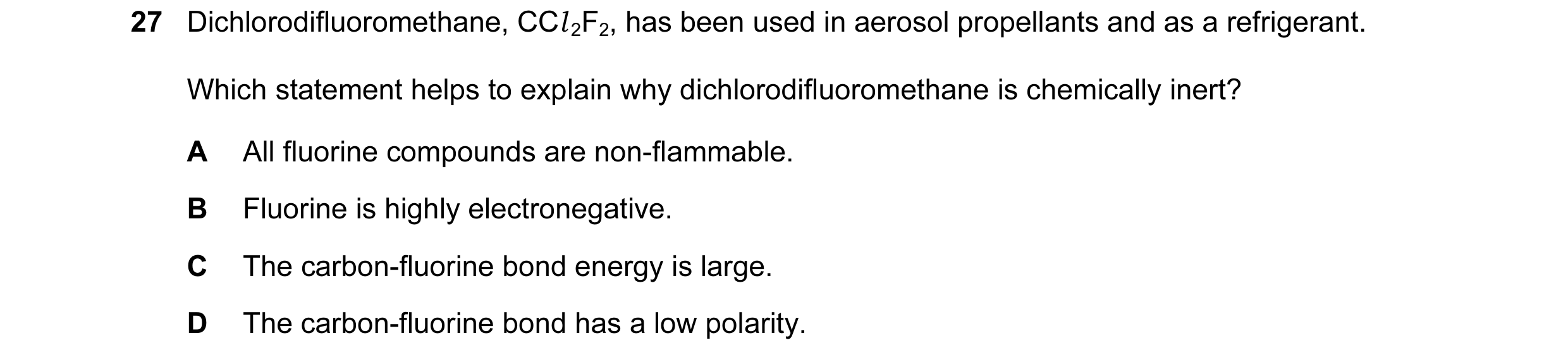
 3 / 10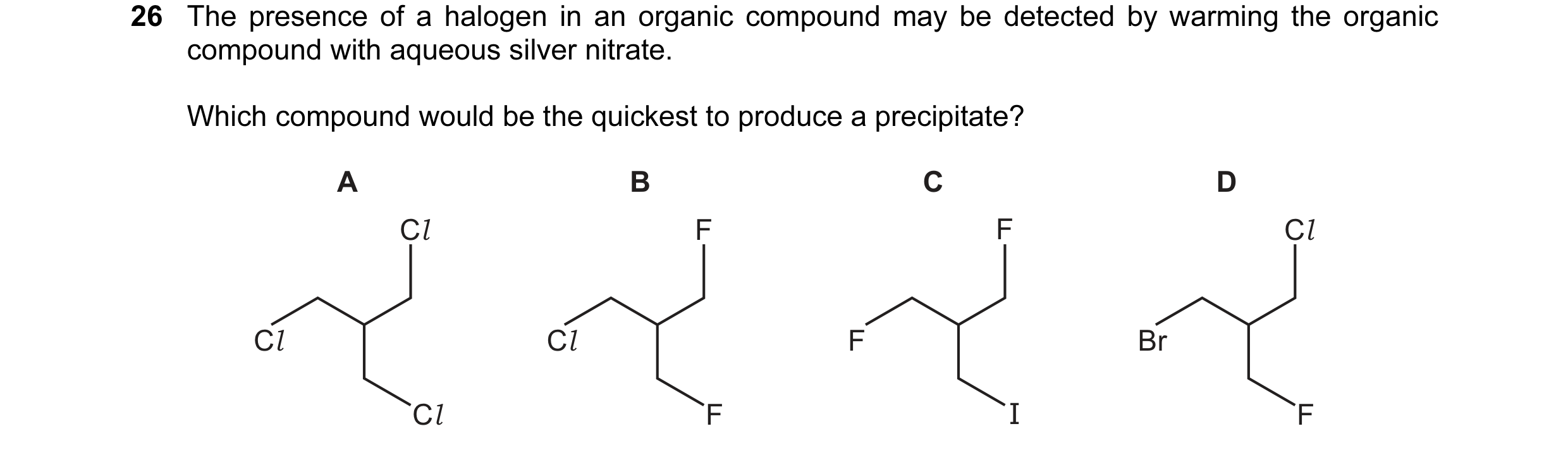
 4 / 10

 5 / 10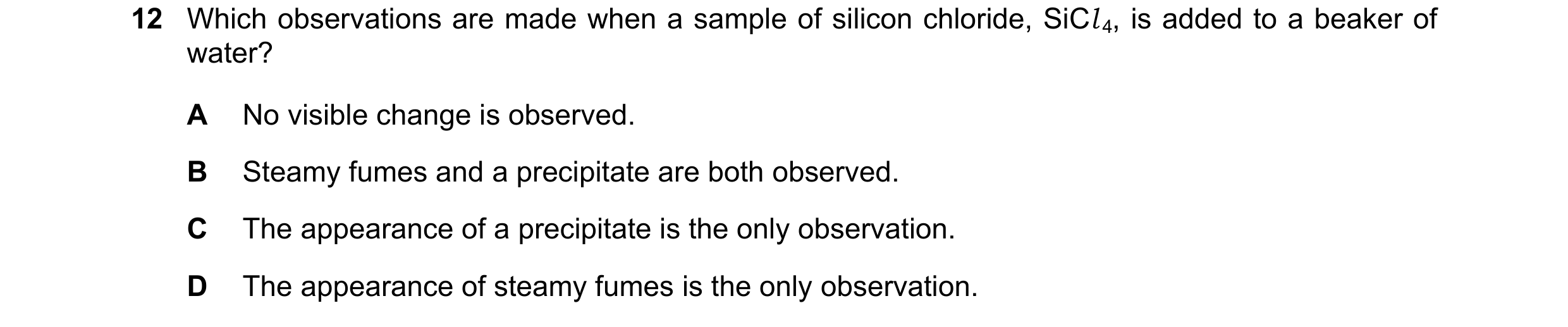


 6 / 10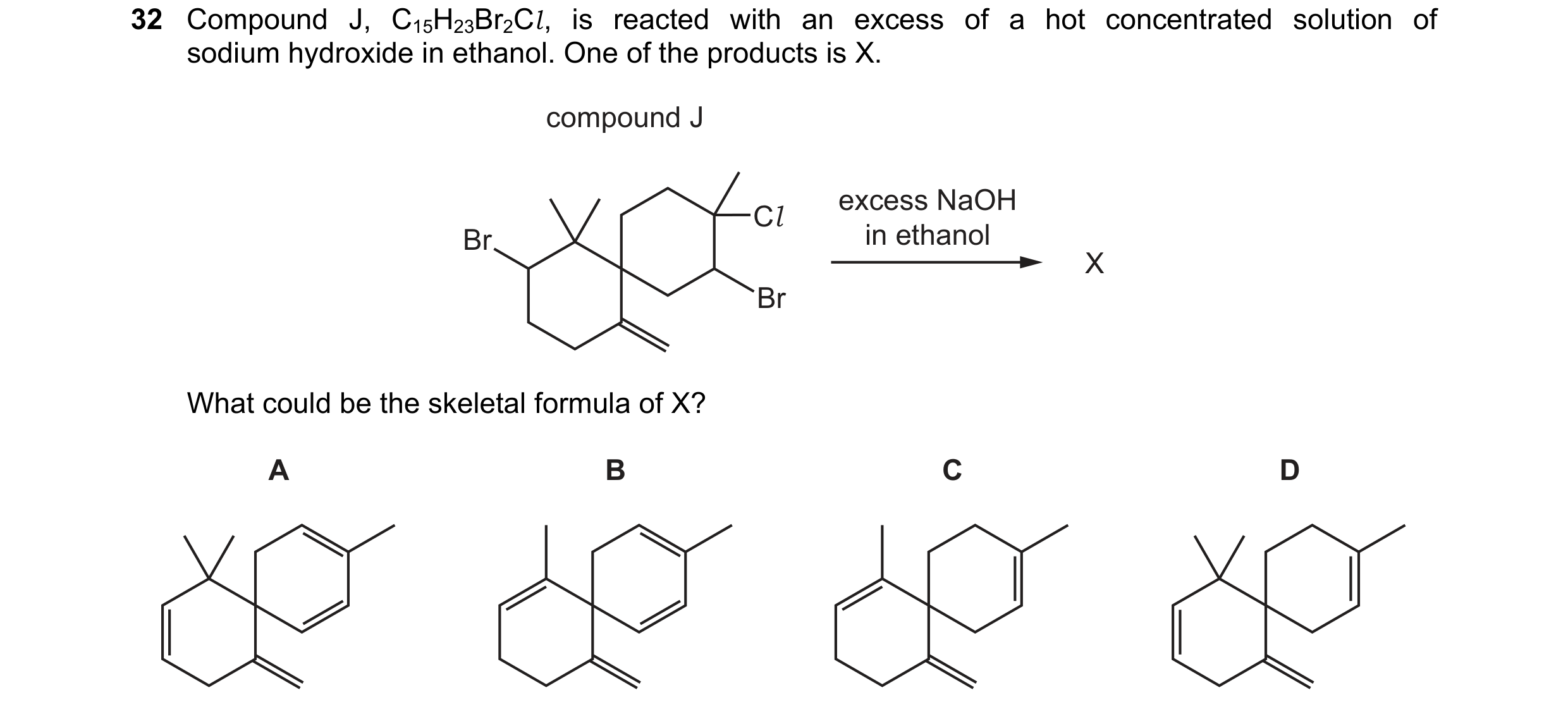
 7 / 10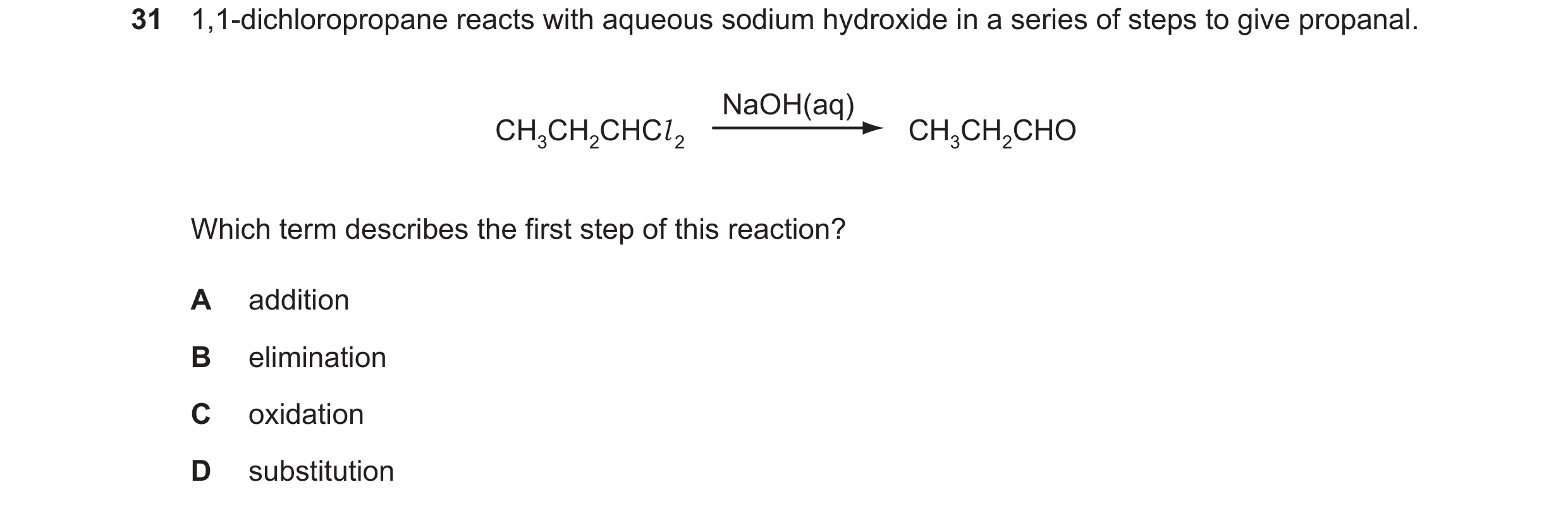
 8 / 10
 9 / 10
 10 / 10