Questions as text
Q1 · Use lines to connect the box on the left to different boxes on the right to make correct… 0653/31 May/June 2017
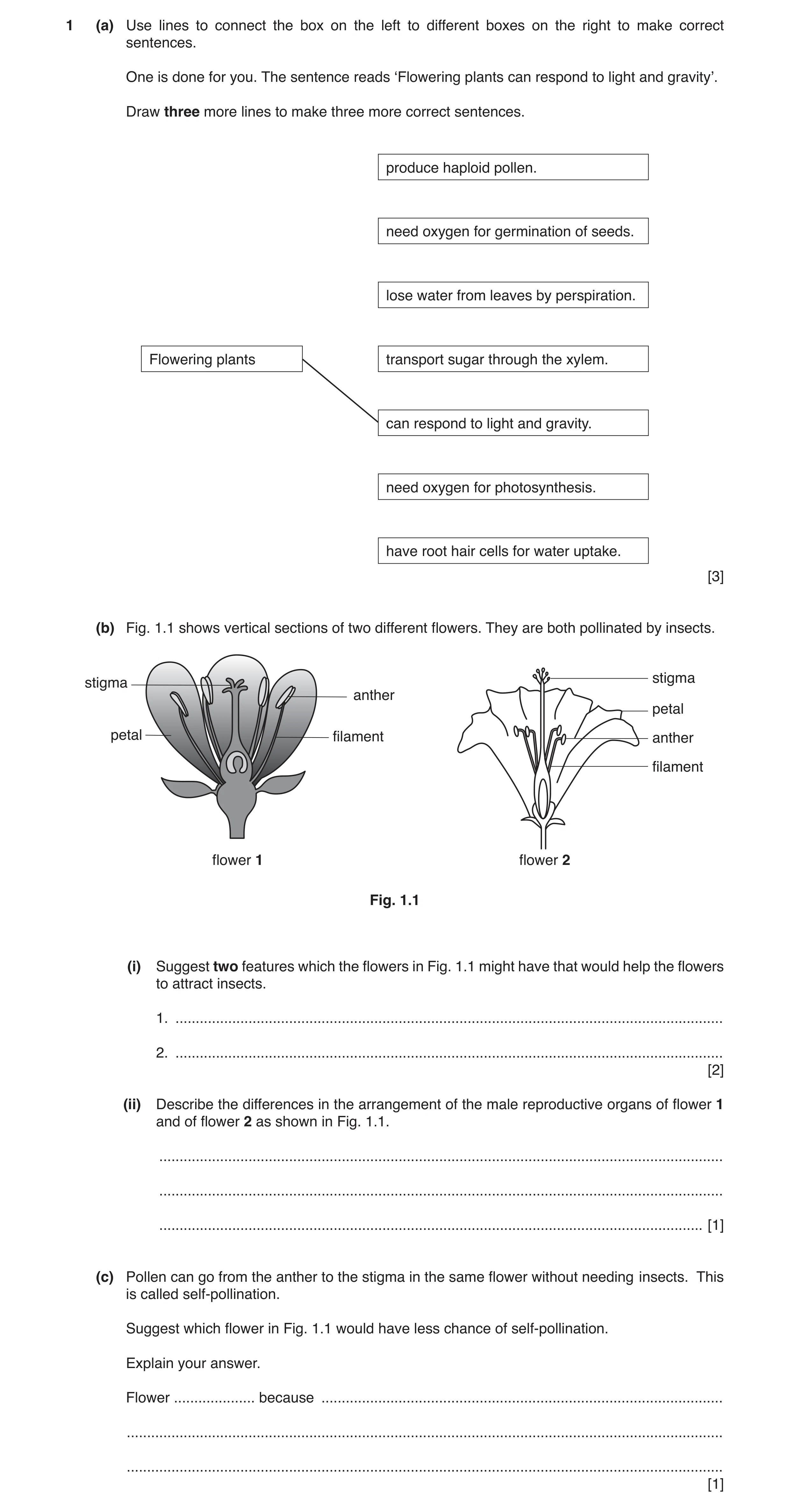
1 (a) Use lines to connect the box on the left to different boxes on the right to make correct sentences. One is done for you. The sentence reads ‘Flowering plants can respond to light and gravity’. Draw three more lines to make three more correct sentences. produce haploid pollen. need oxygen for germination of seeds. lose water from leaves by perspiration. Flowering plants transport sugar through the xylem. can respond to light and gravity. need oxygen for photosynthesis. have root hair cells for water uptake. [3] (b) Fig. 1.1 shows vertical sections of two different flowers. They are both pollinated by insects. stigma stigma anther petal petal filament anther filament flower 1 flower 2 Fig. 1.1 (i) Suggest two features which the flowers in Fig. 1.1 might have that would help the flowers to attract insects. 1. … 2. … [2] (ii) Describe the differences in the arrangement of the male reproductive organs of flower 1 and of flower 2 as shown in Fig. 1.1. … … … [1] (c) Pollen can go from the anther to the stigma in the same flower without needing insects. This is called self-pollination. Suggest which flower in Fig. 1.1 would have less chance of self-pollination. Explain your answer. Flower … because … … … [1]
7 marks
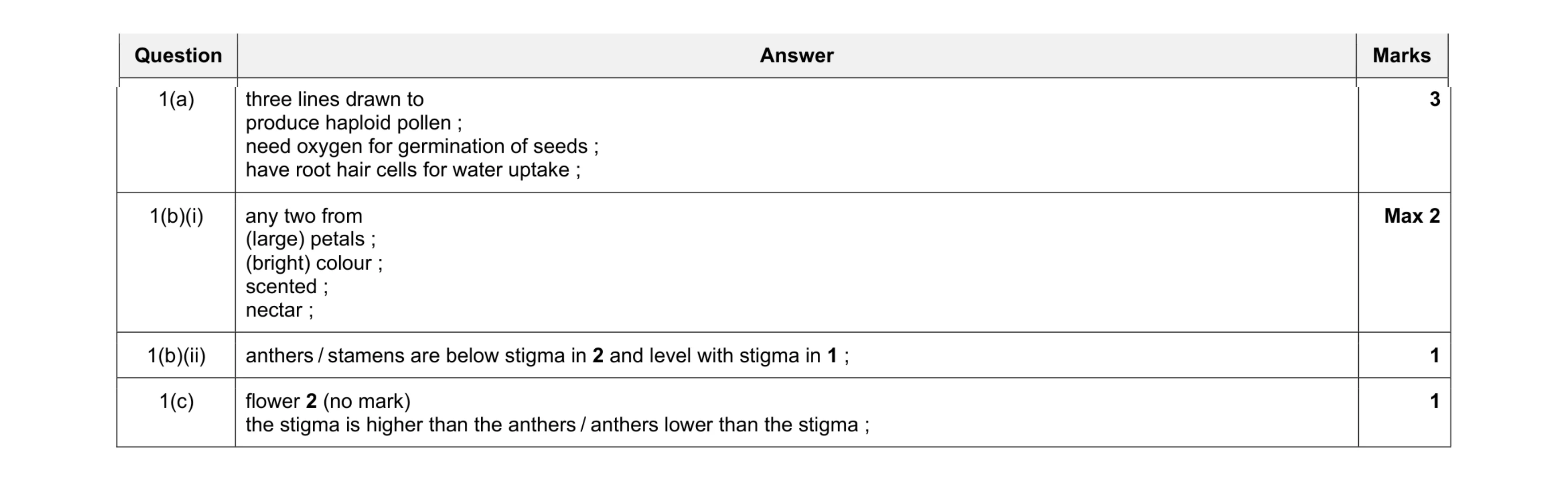
Mark scheme: 1(a) three lines drawn to produce haploid pollen ; need oxygen for germination of seeds ; have root hair cells for water uptake ; 3 1(b)(i) any two from (large) petals ; (bright) colour ; scented ; nectar ; Max 2 1(b)(ii) anthers / stamens are below stigma in 2 and level with stigma in 1 ; 1 1(c) flower 2 (no mark) the stigma is higher than the anthers / anthers lower than the stigma ; 1
This question in 0653/31 May/June 2017
Q2 · Diagrams of primrose flowers 0653/31 Oct/Nov 2017
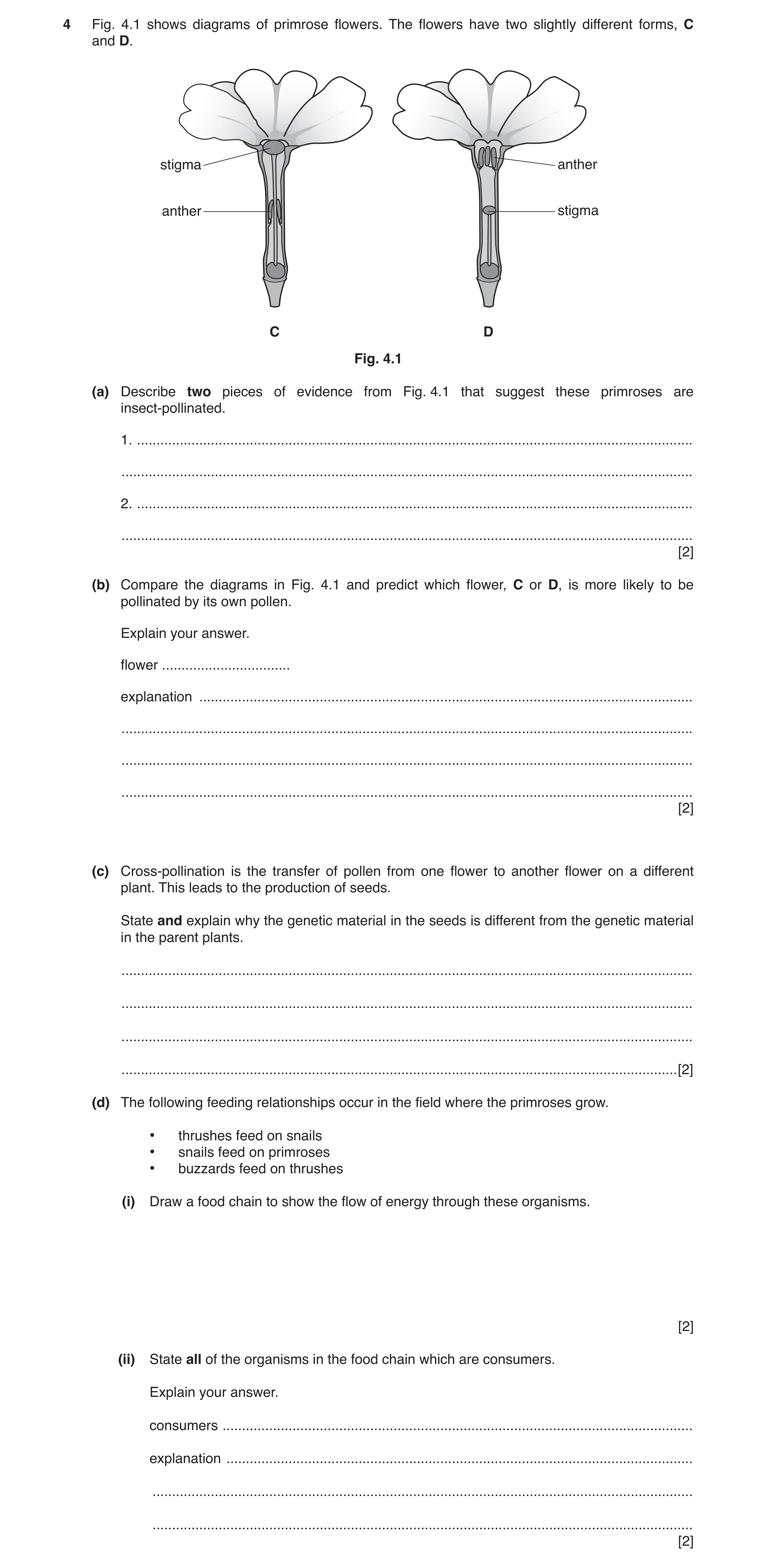
4 Fig. 4.1 shows diagrams of primrose flowers. The flowers have two slightly different forms, C and D. stigma anther anther stigma C D Fig. 4.1 (a) Describe two pieces of evidence from Fig. 4.1 that suggest these primroses are insect-pollinated. 1. … … 2. … … [2] (b) Compare the diagrams in Fig. 4.1 and predict which flower, C or D, is more likely to be pollinated by its own pollen. Explain your answer. flower … explanation … … … … [2] (c) Cross-pollination is the transfer of pollen from one flower to another flower on a different plant. This leads to the production of seeds. State and explain why the genetic material in the seeds is different from the genetic material in the parent plants. … … … … [2] (d) The following feeding relationships occur in the field where the primroses grow. • thrushes feed on snails • snails feed on primroses • buzzards feed on thrushes (i) Draw a food chain to show the flow of energy through these organisms. [2] (ii) State all of the organisms in the food chain which are consumers. Explain your answer. consumers … explanation … … … [2]
10 marks
Mark scheme: 4(a) Any two from (large) petals ; anther(s) / are inside the flower ; stigma / is inside the flower ; max 2 4(b) (flower) D AND any two from anther is higher than stigma ; anther produces pollen ; pollen is more likely to fall on it ; max 2 4(c) sexual reproduction ; from different parents / different genetic material ; (seeds contain) some (genetic material) from each parent ; max 2 Question Answer Marks 4(d)(i) primroses → snails → thrushes → buzzards correct order ; correct arrows ; 2 4(d)(ii) snails, thrushes, buzzards ; (get their energy by) feeding on other organisms ; 2
This question in 0653/31 Oct/Nov 2017
Q3 · A diagram of the female reproductive system and some of the events that take place before… 0653/32 Feb/March 2018
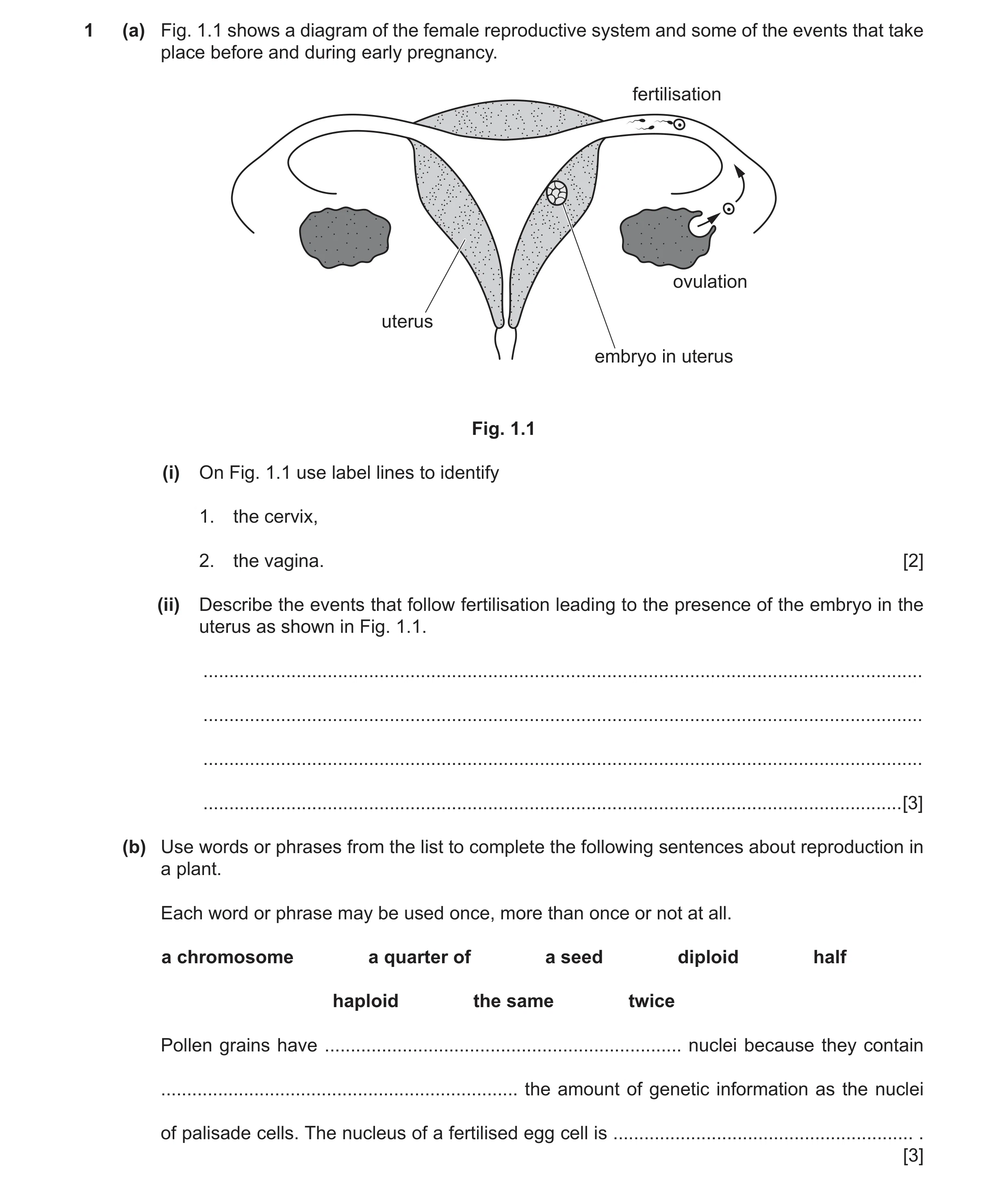
1 (a) Fig. 1.1 shows a diagram of the female reproductive system and some of the events that take place before and during early pregnancy. fertilisation ovulation uterus embryo in uterus Fig. 1.1 (i) On Fig. 1.1 use label lines to identify 1. the cervix, 2. the vagina. [2] (ii) Describe the events that follow fertilisation leading to the presence of the embryo in the uterus as shown in Fig. 1.1. … … … … [3] (b) Use words or phrases from the list to complete the following sentences about reproduction in a plant. Each word or phrase may be used once, more than once or not at all. a chromosome a quarter of a seed diploid half haploid the same twice Pollen grains have … nuclei because they contain … the amount of genetic information as the nuclei of palisade cells. The nucleus of a fertilised egg cell is … . [3]
8 marks
Mark scheme: 1(a)(i) cervix correctly labelled ; vagina correctly labelled ; 2 1(a)(ii) zygote results from fertilisation ; cells divide / ball of cells forms ; (ball of cells / embryo) becomes implanted ; in wall of uterus / uterus lining ; max 3 1(b) haploid ; half ; diploid ; 3
This question in 0653/32 Feb/March 2018
Q4 · Gardeners can increase the numbers of plants by splitting a parent plant in two… 0653/32 May/June 2018
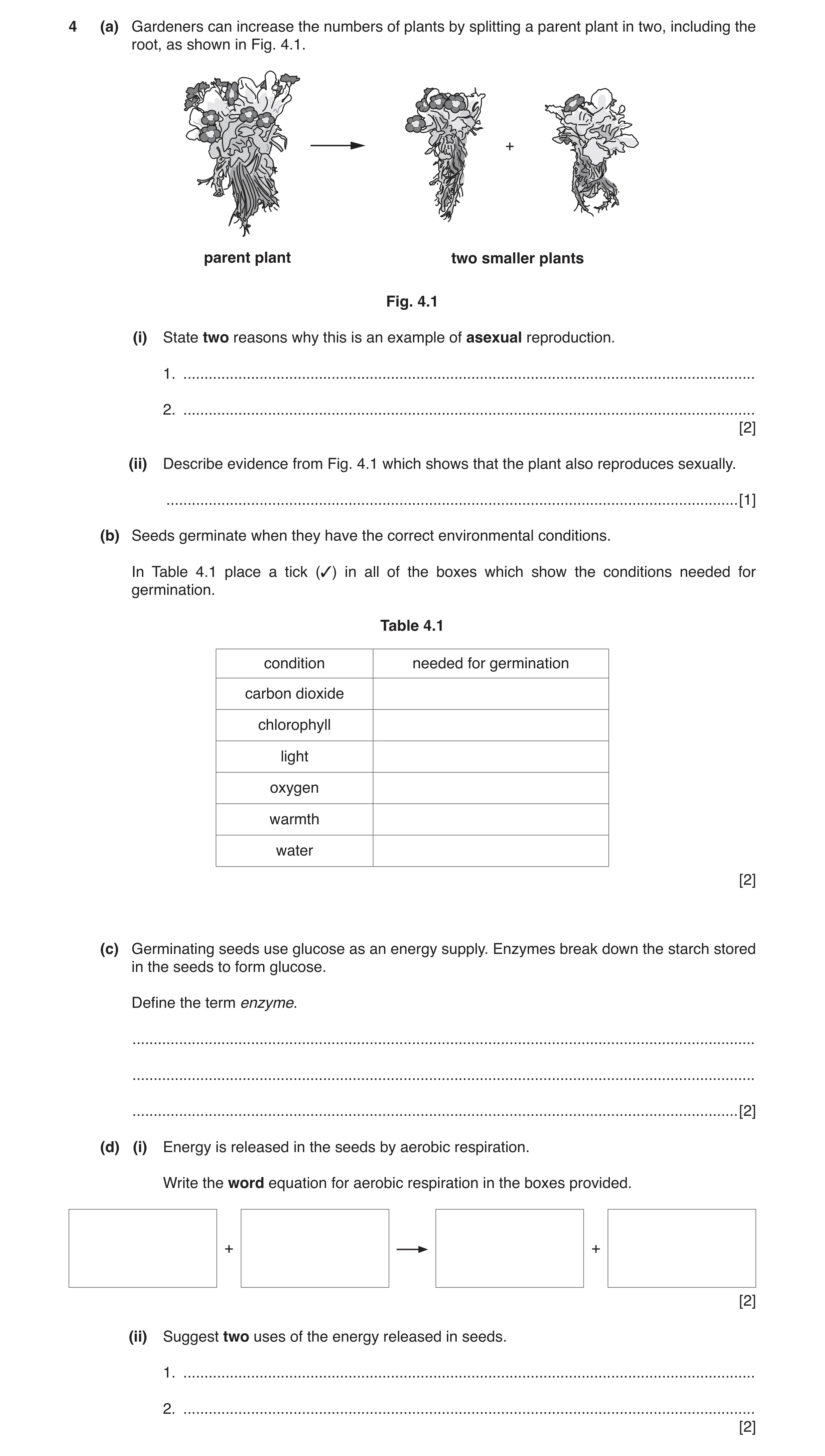
4 (a) Gardeners can increase the numbers of plants by splitting a parent plant in two, including the root, as shown in Fig. 4.1. + parent plant two smaller plants Fig. 4.1 (i) State two reasons why this is an example of asexual reproduction. 1. … 2. … [2] (ii) Describe evidence from Fig. 4.1 which shows that the plant also reproduces sexually. … [1] (b) Seeds germinate when they have the correct environmental conditions. In Table 4.1 place a tick (✓) in all of the boxes which show the conditions needed for germination. Table 4.1 condition needed for germination carbon dioxide chlorophyll light oxygen warmth water [2] (c) Germinating seeds use glucose as an energy supply. Enzymes break down the starch stored in the seeds to form glucose. Define the term enzyme. … … … [2] (d) (i) Energy is released in the seeds by aerobic respiration. Write the word equation for aerobic respiration in the boxes provided. + + [2] (ii) Suggest two uses of the energy released in seeds. 1. … 2. … [2]
11 marks
Mark scheme: 4(a)(i) only one parent involved ; offspring (genetically) identical ; 2 4(a)(ii) it has flowers ; 1 4(b) ticks in three boxes as shown ;; 2 marks all 3 correct 1 mark for 1 or 2 correct condition needed for germination () carbon dioxide chlorophyll light oxygen 9 water 9 warmth 9 2 Question Answer Marks 4(c) a protein ; (that functions as) a (biological) catalyst ; 2 4(d)(i) glucose, oxygen ; – either order carbon dioxide, water ; – either order 2 4(d)(ii) any two of protein synthesis ; cell division ; growth ; 2
This question in 0653/32 May/June 2018
Q5 · Gardeners can increase the numbers of plants by splitting a parent plant in two… 0653/33 May/June 2018
4 (a) Gardeners can increase the numbers of plants by splitting a parent plant in two, including the root, as shown in Fig. 4.1. + parent plant two smaller plants Fig. 4.1 (i) State two reasons why this is an example of asexual reproduction. 1. … 2. … [2] (ii) Describe evidence from Fig. 4.1 which shows that the plant also reproduces sexually. … [1] (b) Seeds germinate when they have the correct environmental conditions. In Table 4.1 place a tick (✓) in all of the boxes which show the conditions needed for germination. Table 4.1 condition needed for germination carbon dioxide chlorophyll light oxygen warmth water [2] (c) Germinating seeds use glucose as an energy supply. Enzymes break down the starch stored in the seeds to form glucose. Define the term enzyme. … … … [2] (d) (i) Energy is released in the seeds by aerobic respiration. Write the word equation for aerobic respiration in the boxes provided. + + [2] (ii) Suggest two uses of the energy released in seeds. 1. … 2. … [2]
11 marks
Mark scheme: 4(a)(i) only one parent involved ; offspring (genetically) identical ; 2 4(a)(ii) it has flowers ; 1 4(b) ticks in three boxes as shown ;; 2 marks all 3 correct 1 mark for 1 or 2 correct condition needed for germination () carbon dioxide chlorophyll light oxygen 9 water 9 warmth 9 2 Question Answer Marks 4(c) a protein ; (that functions as) a (biological) catalyst ; 2 4(d)(i) glucose, oxygen ; – either order carbon dioxide, water ; – either order 2 4(d)(ii) any two of protein synthesis ; cell division ; growth ; 2
This question in 0653/33 May/June 2018
Q6 · A flowering plant and some functions carried out by the plant 0653/33 Oct/Nov 2018
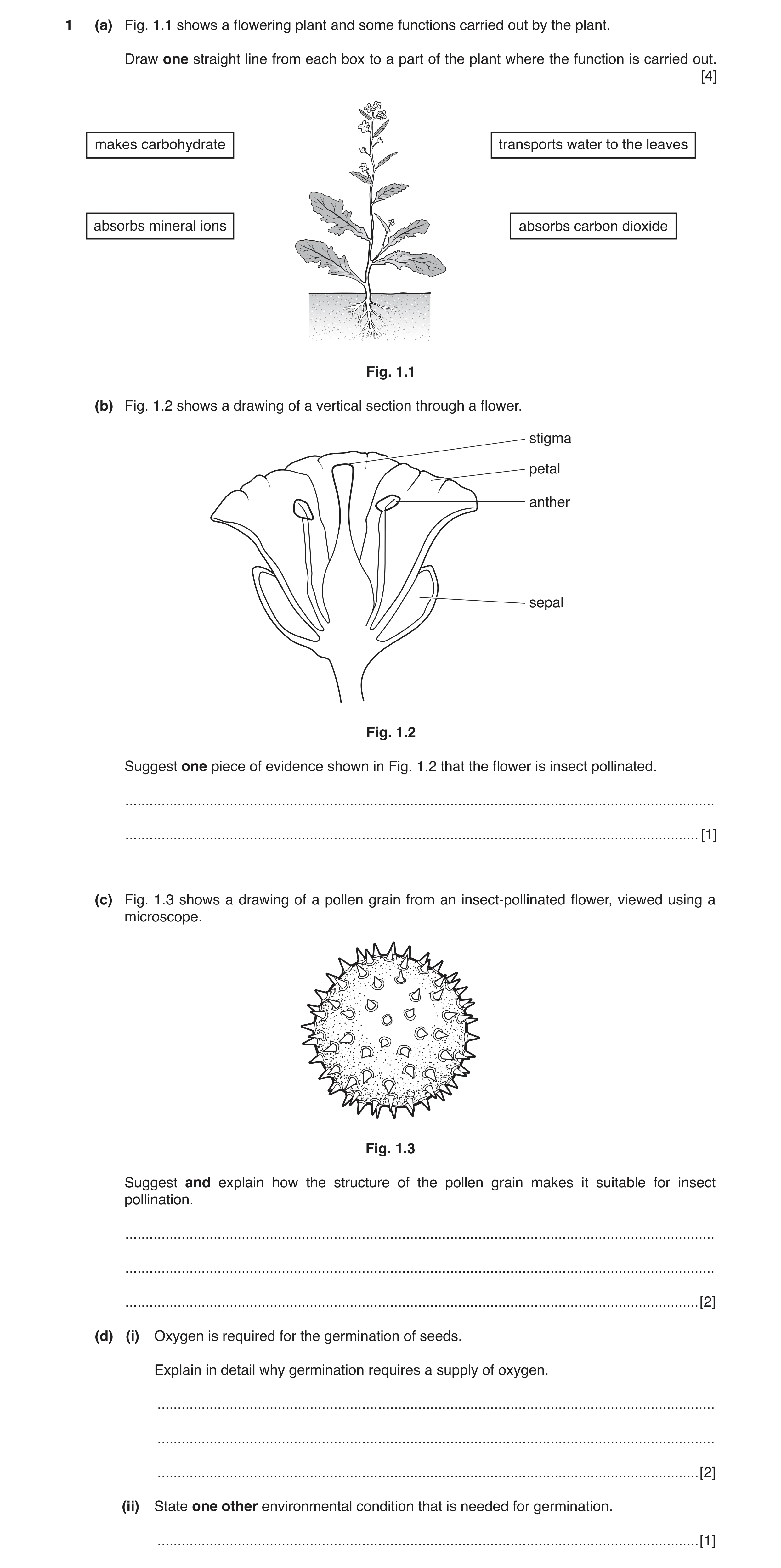
1 (a) Fig. 1.1 shows a flowering plant and some functions carried out by the plant. Draw one straight line from each box to a part of the plant where the function is carried out. [4] makes carbohydrate transports water to the leaves absorbs mineral ions absorbs carbon dioxide Fig. 1.1 (b) Fig. 1.2 shows a drawing of a vertical section through a flower. stigma petal anther sepal Fig. 1.2 Suggest one piece of evidence shown in Fig. 1.2 that the flower is insect pollinated. … … [1] (c) Fig. 1.3 shows a drawing of a pollen grain from an insect-pollinated flower, viewed using a microscope. Fig. 1.3 Suggest and explain how the structure of the pollen grain makes it suitable for insect pollination. … … … [2] (d) (i) Oxygen is required for the germination of seeds. Explain in detail why germination requires a supply of oxygen. … … … [2] (ii) State one other environmental condition that is needed for germination. … [1]
10 marks
Mark scheme: 1(a) Line drawn from: absorbs mineral ions to any part of the root ; makes carbohydrate to any leaf ; transports water to the leaves to any part of the stem ; absorbs carbon dioxide to any leaf ; 4 1(b) large petals ; or anther / stigma inside the flower ; 1 1(c) Spiky / irregular surface ; sticks well to insects’ bodies / stigma ; 2 1(d)(i) for respiration ; and one of to release energy ; for growth ; building up large molecules ; cell division ; Max 2 2 1(d)(ii) warmth / water ; 1
This question in 0653/33 Oct/Nov 2018
Q7 · Two diagrams of insect-pollinated flowers of the same species 0653/32 Feb/March 2019
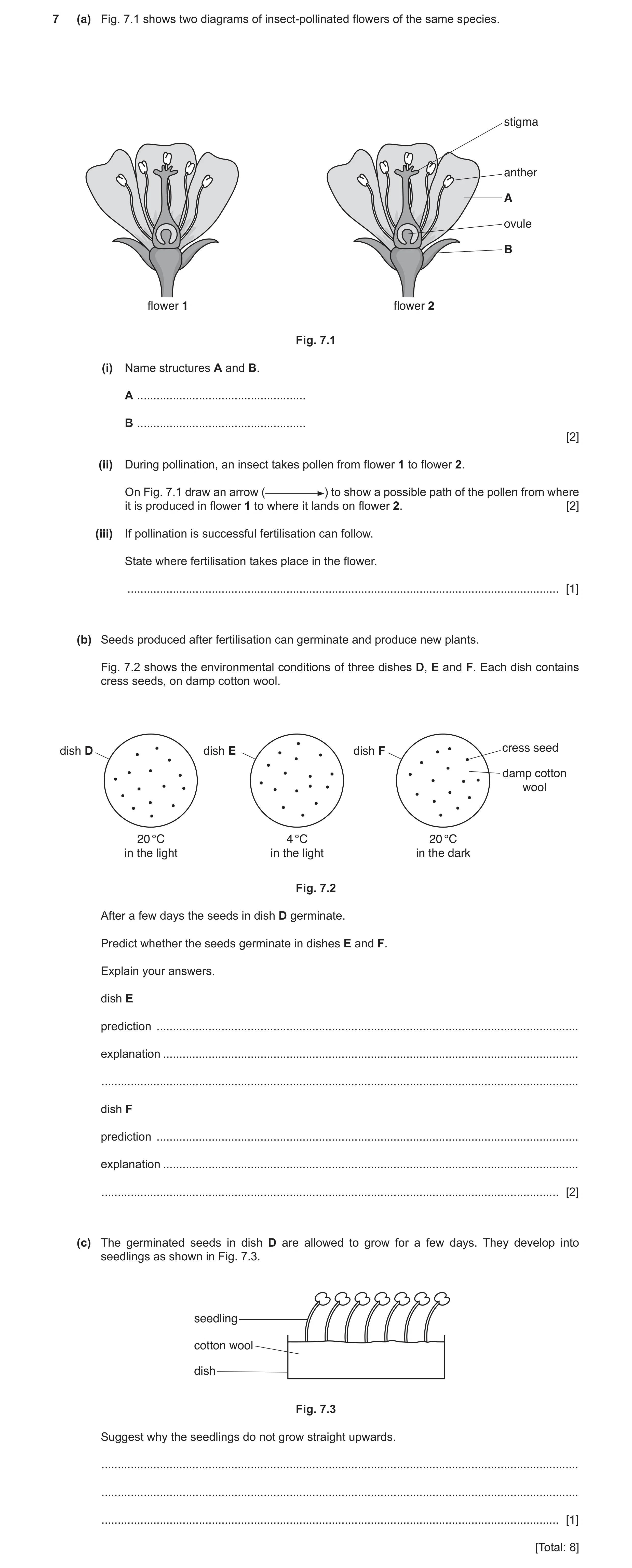
7 (a) Fig. 7.1 shows two diagrams of insect-pollinated flowers of the same species. stigma anther A ovule B flower 1 flower 2 Fig. 7.1 (i) Name structures A and B. A … B … [2] (ii) During pollination, an insect takes pollen from flower 1 to flower 2. On Fig. 7.1 draw an arrow ( ) to show a possible path of the pollen from where it is produced in flower 1 to where it lands on flower 2. [2] (iii) If pollination is successful fertilisation can follow. State where fertilisation takes place in the flower. … [1] (b) Seeds produced after fertilisation can germinate and produce new plants. Fig. 7.2 shows the environmental conditions of three dishes D, E and F. Each dish contains cress seeds, on damp cotton wool. dish D dish E dish F cress seed damp cotton wool 20 °C 4 °C 20 °C in the light in the light in the dark Fig. 7.2 After a few days the seeds in dish D germinate. Predict whether the seeds germinate in dishes E and F. Explain your answers. dish E prediction … explanation … … dish F prediction … explanation … … [2] (c) The germinated seeds in dish D are allowed to grow for a few days. They develop into seedlings as shown in Fig. 7.3. seedling cotton wool dish Fig. 7.3 Suggest why the seedlings do not grow straight upwards. … … … [1] [Total: 8]
8 marks
Mark scheme: 7(a)(i) A petal ; B sepal ; 2 7(a)(ii) arrow drawn from anther ; to stigma ; 2 7(a)(iii) in the ovule ; 1 7(b) E no germination – no mark too cold (for germination) ; F yes germination happens – no mark has all the conditions needed for germination owtte / light not needed for germination ; 2 7(c) light is coming from one side / from the right / seedlings grow towards the light / seedlings are showing photo trophic response ; 1
This question in 0653/32 Feb/March 2019
Q8 · A diagram of an insect‑pollinated flower 0653/32 Oct/Nov 2019
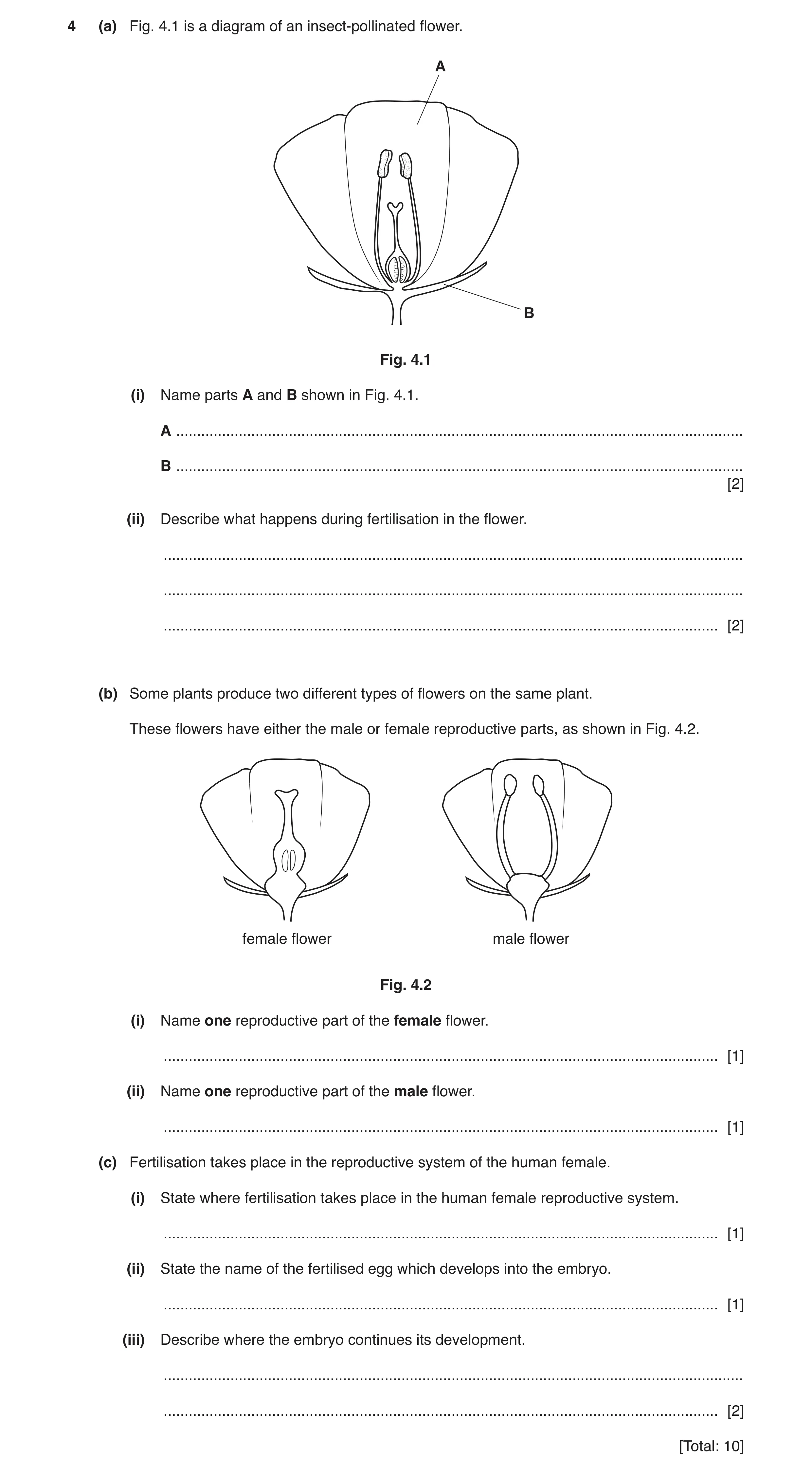
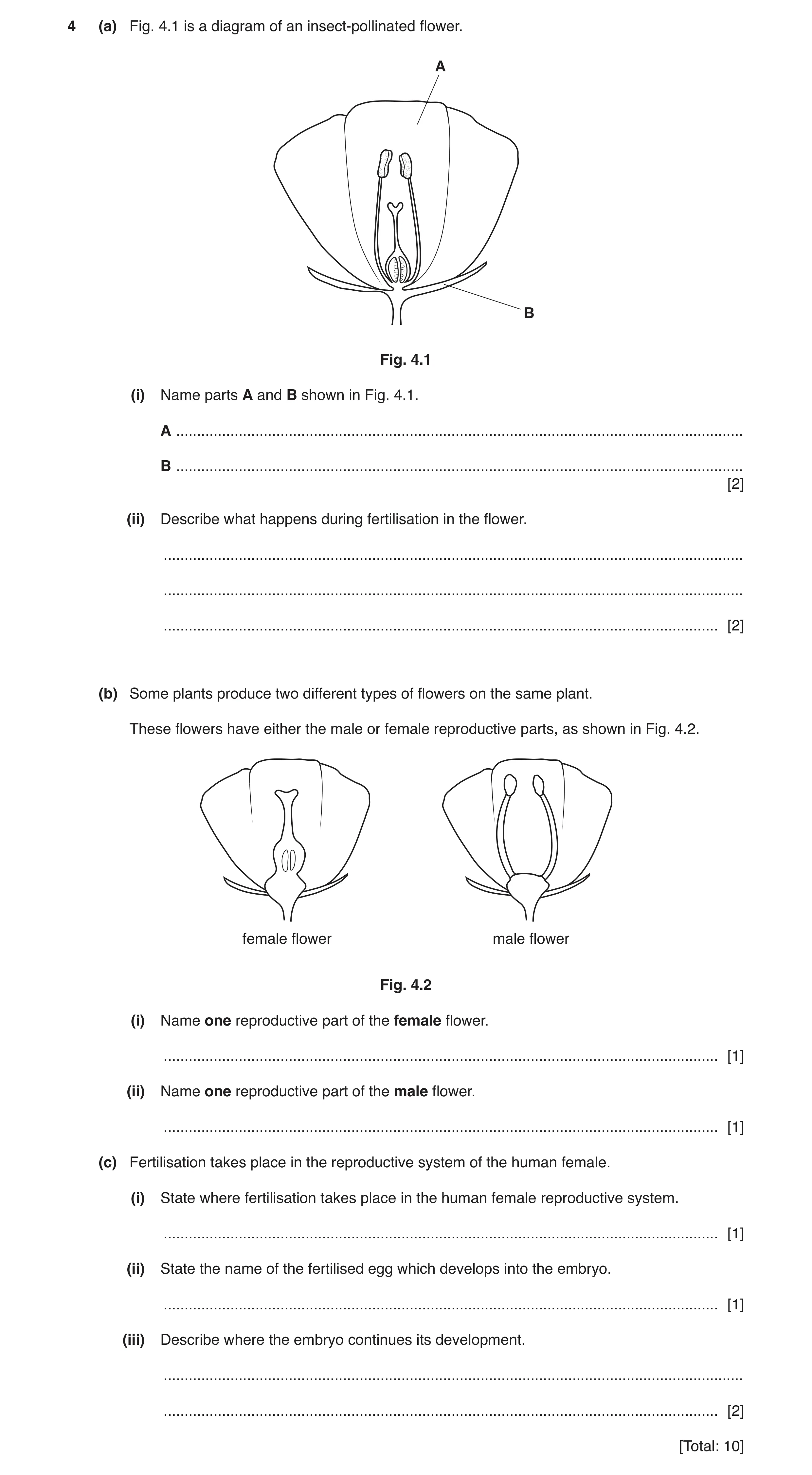
4 (a) Fig. 4.1 is a diagram of an insect‑pollinated flower. A B Fig. 4.1 (i) Name parts A and B shown in Fig. 4.1. A … B … [2] (ii) Describe what happens during fertilisation in the flower. … … … [2] (b) Some plants produce two different types of flowers on the same plant. These flowers have either the male or female reproductive parts, as shown in Fig. 4.2. female flower male flower Fig. 4.2 (i) Name one reproductive part of the female flower. … [1] (ii) Name one reproductive part of the male flower. … [1] (c) Fertilisation takes place in the reproductive system of the human female. (i) State where fertilisation takes place in the human female reproductive system. … [1] (ii) State the name of the fertilised egg which develops into the embryo. … [1] (iii) Describe where the embryo continues its development. … … [2] [Total: 10]
10 marks
Mark scheme: 4(a)(i) A petal ; B sepal ; 2 4(a)(ii) pollen nucleus fuses ; with a nucleus in the ovule ; 2 4(b)(i) stigma / carpel / style / ovary ; 1 4(b)(ii) anthers / stamen ; 1 4(c)(i) oviduct ; 1 Question Answer Marks 4(c)(ii) zygote ; 1 4(c)(iii) wall / lining ; of the uterus ; 2
This question in 0653/32 Oct/Nov 2019
Q9 · A diagram of an insect‑pollinated flower 0653/33 Oct/Nov 2019
4 (a) Fig. 4.1 is a diagram of an insect‑pollinated flower. A B Fig. 4.1 (i) Name parts A and B shown in Fig. 4.1. A … B … [2] (ii) Describe what happens during fertilisation in the flower. … … … [2] (b) Some plants produce two different types of flowers on the same plant. These flowers have either the male or female reproductive parts, as shown in Fig. 4.2. female flower male flower Fig. 4.2 (i) Name one reproductive part of the female flower. … [1] (ii) Name one reproductive part of the male flower. … [1] (c) Fertilisation takes place in the reproductive system of the human female. (i) State where fertilisation takes place in the human female reproductive system. … [1] (ii) State the name of the fertilised egg which develops into the embryo. … [1] (iii) Describe where the embryo continues its development. … … [2] [Total: 10]
10 marks
Mark scheme: 4(a)(i) A petal ; B sepal ; 2 4(a)(ii) pollen nucleus fuses ; with a nucleus in the ovule ; 2 4(b)(i) stigma / carpel / style / ovary ; 1 4(b)(ii) anthers / stamen ; 1 4(c)(i) oviduct ; 1 Question Answer Marks 4(c)(ii) zygote ; 1 4(c)(iii) wall / lining ; of the uterus ; 2
This question in 0653/33 Oct/Nov 2019
Question 10 0653/31 May/June 2020
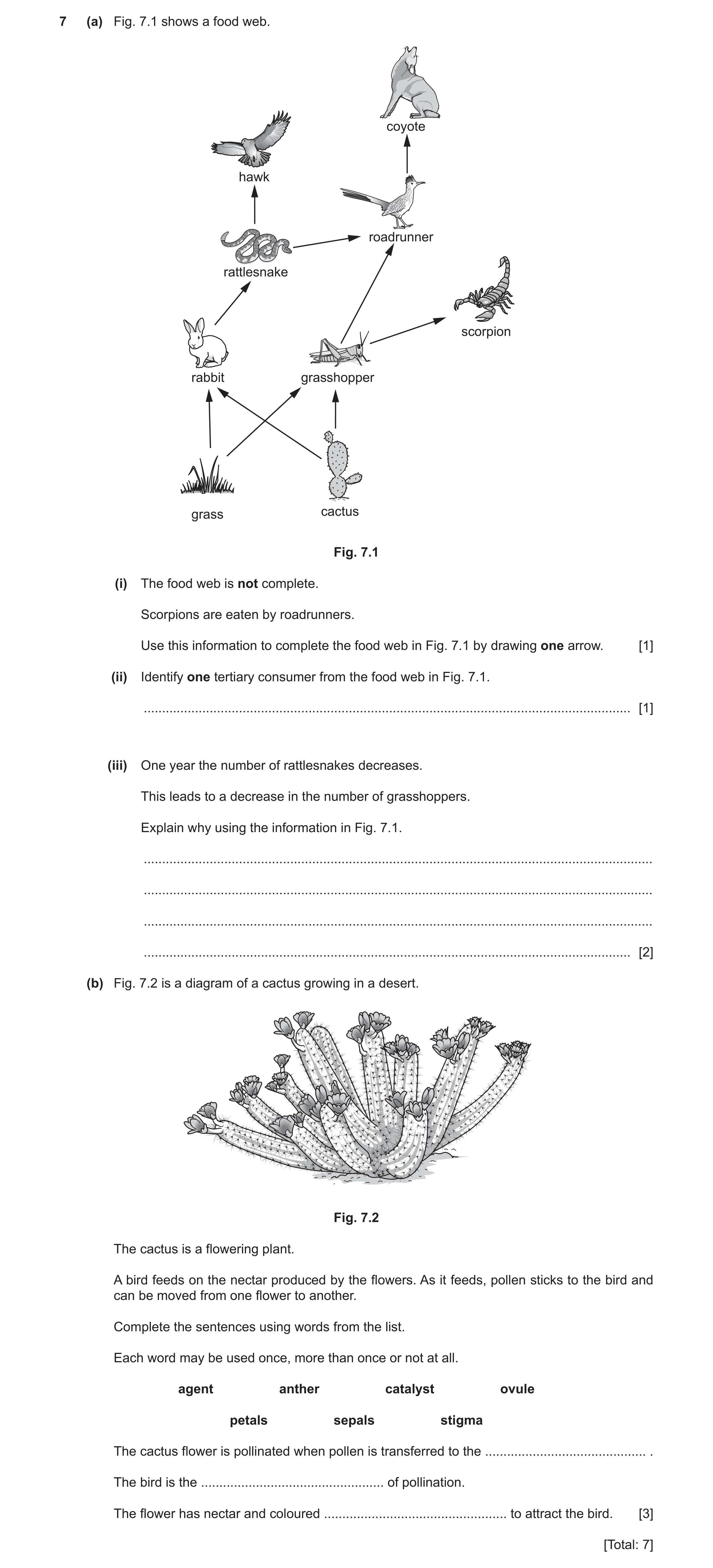
7 (a) Fig. 7.1 shows a food web. coyote hawk roadrunner rattlesnake scorpion rabbit grasshopper grass cactus Fig. 7.1 (i) The food web is not complete. Scorpions are eaten by roadrunners. Use this information to complete the food web in Fig. 7.1 by drawing one arrow. [1] (ii) Identify one tertiary consumer from the food web in Fig. 7.1. … [1] (iii) One year the number of rattlesnakes decreases. This leads to a decrease in the number of grasshoppers. Explain why using the information in Fig. 7.1. … … … … [2] (b) Fig. 7.2 is a diagram of a cactus growing in a desert. Fig. 7.2 The cactus is a flowering plant. A bird feeds on the nectar produced by the flowers. As it feeds, pollen sticks to the bird and can be moved from one flower to another. Complete the sentences using words from the list. Each word may be used once, more than once or not at all. agent anther catalyst ovule petals sepals stigma The cactus flower is pollinated when pollen is transferred to the … . The bird is the … of pollination. The flower has nectar and coloured … to attract the bird. [3] [Total: 7]
7 marks
Mark scheme: 7(a)(i) arrow drawn from scorpion to roadrunner ; 1 7(a)(ii) any one from: roadrunner ; hawk ; coyote ; max 1 7(a)(iii) roadrunners will have less rattlesnakes to eat ; roadrunners will need to eat more grasshoppers ; or less rabbits eaten ; rabbits eat more grass / less grass for grasshoppers ; 2 7(b) stigma ; agent ; petals ; 3
This question in 0653/31 May/June 2020
Q11 · A cross-section of a plant stem as seen under a microscope 0653/32 Oct/Nov 2020
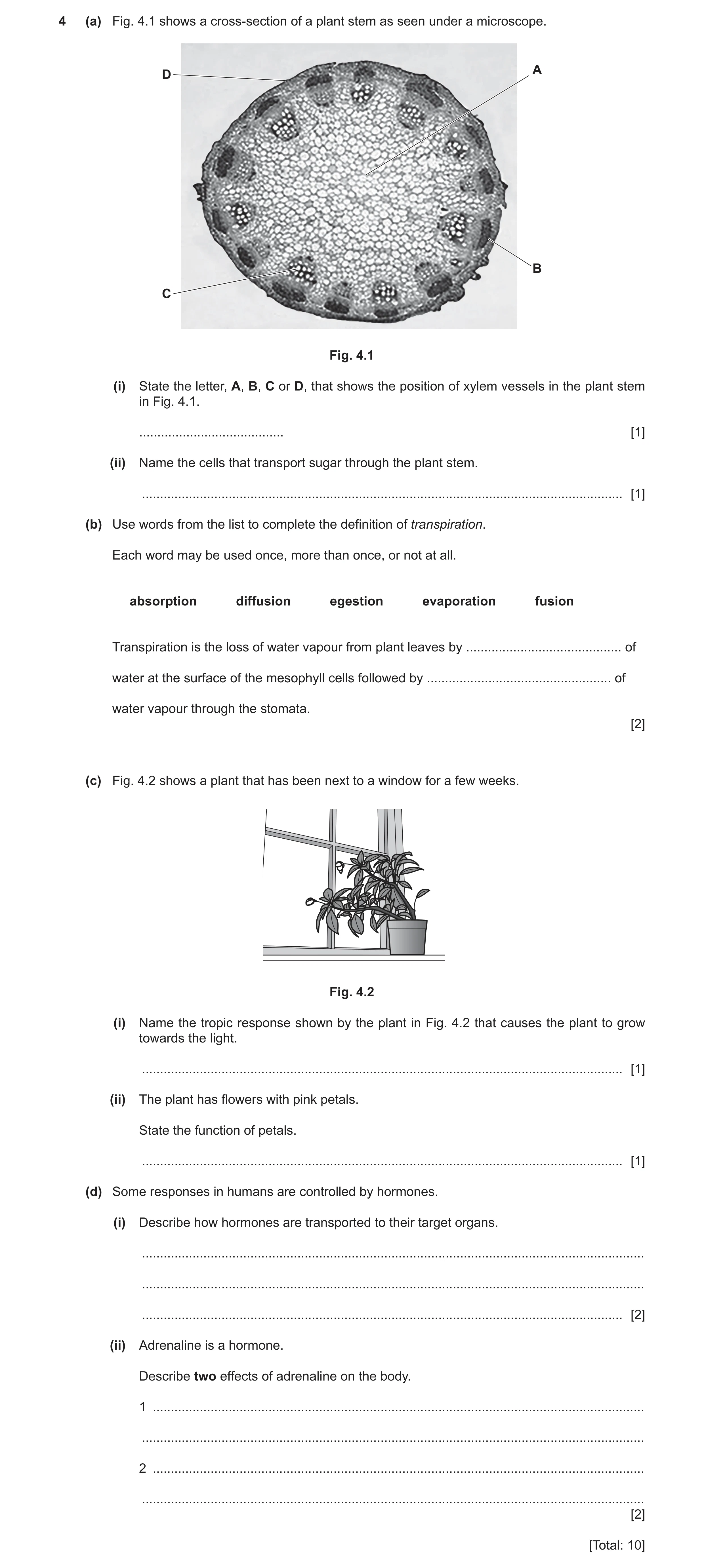
4 (a) Fig. 4.1 shows a cross-section of a plant stem as seen under a microscope. A D B C Fig. 4.1 (i) State the letter, A, B, C or D, that shows the position of xylem vessels in the plant stem in Fig. 4.1. … [1] (ii) Name the cells that transport sugar through the plant stem. … [1] (b) Use words from the list to complete the definition of transpiration. Each word may be used once, more than once, or not at all. absorption diffusion egestion evaporation fusion Transpiration is the loss of water vapour from plant leaves by … of water at the surface of the mesophyll cells followed by … of water vapour through the stomata. [2] (c) Fig. 4.2 shows a plant that has been next to a window for a few weeks. Fig. 4.2 (i) Name the tropic response shown by the plant in Fig. 4.2 that causes the plant to grow towards the light. … [1] (ii) The plant has flowers with pink petals. State the function of petals. … [1] (d) Some responses in humans are controlled by hormones. (i) Describe how hormones are transported to their target organs. … … … [2] (ii) Adrenaline is a hormone. Describe two effects of adrenaline on the body. 1 … … 2 … … [2] [Total: 10]
10 marks
Mark scheme: 4(a)(i) C ; 1 4(a)(ii) phloem ; 1 4(b) evaporation ; diffusion ; 2 4(c)(i) phototropism ; 1 4(c)(ii) to attract insects ; 1 Question Answer Marks 4(d)(i) any two from: in the blood ; in the plasma ; through, the circulatory system / (blood) vessels ; 2 4(d)(ii) any two from: increased, breathing rate / depth of breathing ; increased, pulse rate / heart rate ; widened pupils ; 2
This question in 0653/32 Oct/Nov 2020
Q12 · Plant cells as seen with a microscope 0653/33 Oct/Nov 2020
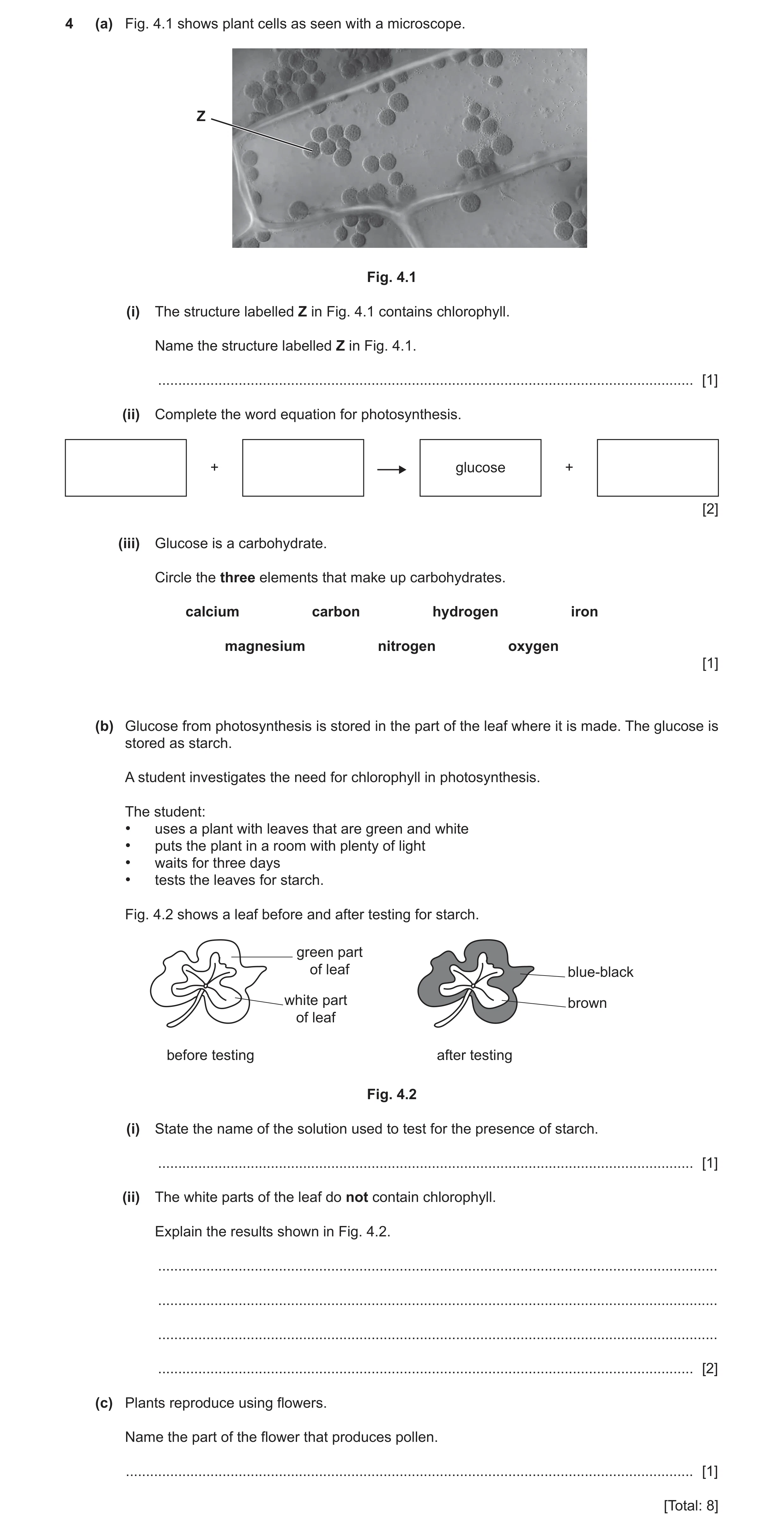
4 (a) Fig. 4.1 shows plant cells as seen with a microscope. Z Fig. 4.1 (i) The structure labelled Z in Fig. 4.1 contains chlorophyll. Name the structure labelled Z in Fig. 4.1. … [1] (ii) Complete the word equation for photosynthesis. + glucose + [2] (iii) Glucose is a carbohydrate. Circle the three elements that make up carbohydrates. calcium carbon hydrogen iron magnesium nitrogen oxygen [1] (b) Glucose from photosynthesis is stored in the part of the leaf where it is made. The glucose is stored as starch. A student investigates the need for chlorophyll in photosynthesis. The student: • uses a plant with leaves that are green and white • puts the plant in a room with plenty of light • waits for three days • tests the leaves for starch. Fig. 4.2 shows a leaf before and after testing for starch. green part of leaf blue-black white part brown of leaf before testing after testing Fig. 4.2 (i) State the name of the solution used to test for the presence of starch. … [1] (ii) The white parts of the leaf do not contain chlorophyll. Explain the results shown in Fig. 4.2. … … … … [2] (c) Plants reproduce using flowers. Name the part of the flower that produces pollen. … [1] [Total: 8]
8 marks
Mark scheme: 4(a)(i) chloroplast ; 1 4(a)(ii) (LHS) carbon dioxide + water ; (RHS) (glucose) + oxygen ; 2 4(a)(iii) carbon AND hydrogen AND oxygen ; 1 4(b)(i) iodine (solution) ; 1 4(b)(ii) no starch in white area OR iodine stays brown so no starch / ORA ; no photosynthesis takes place in white area / ORA OR chlorophyll is needed for photosynthesis ; 2 4(c) anther ; 1
This question in 0653/33 Oct/Nov 2020
Q13 · Reproduction is one of the characteristics of living organisms 0653/32 May/June 2021
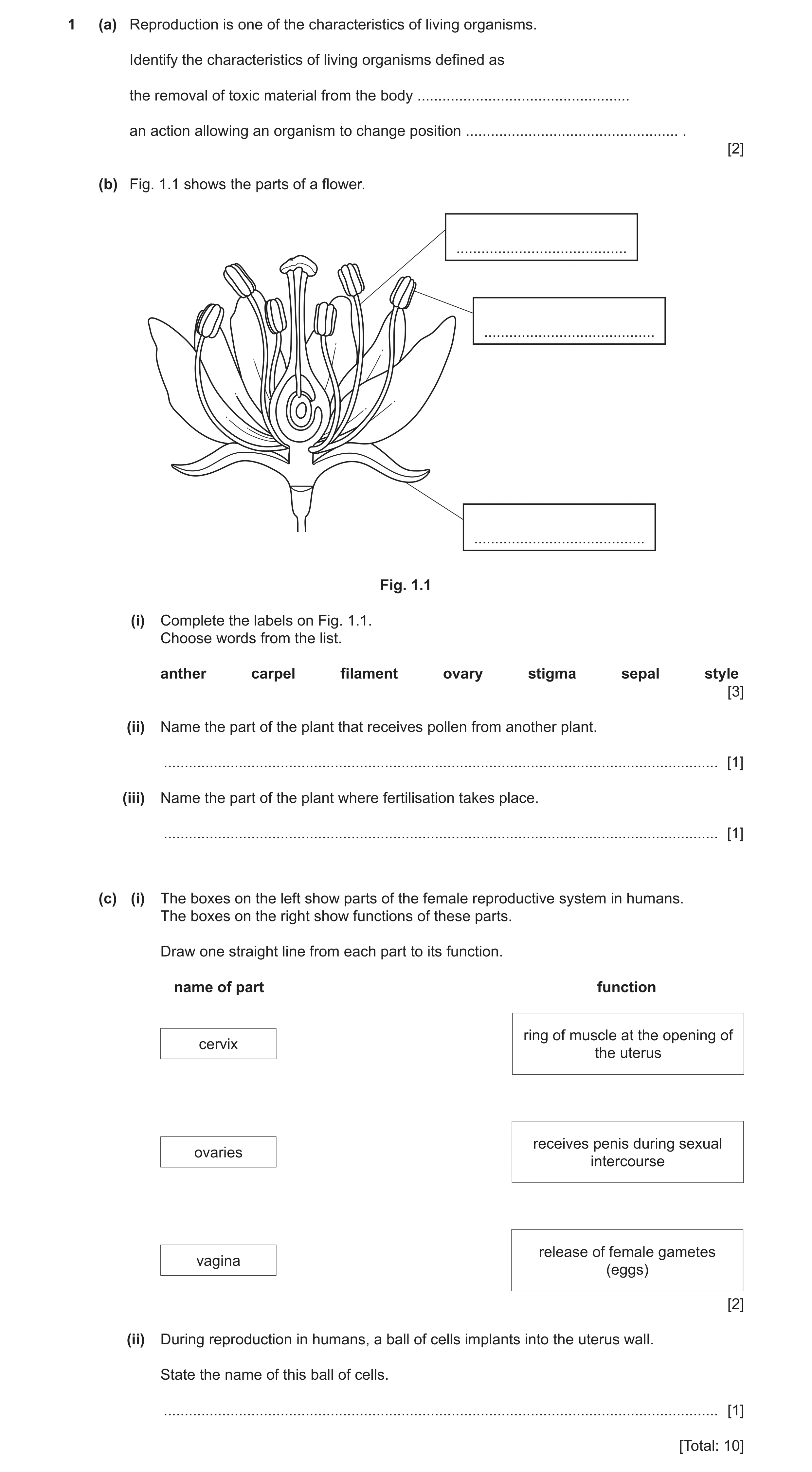
1 (a) Reproduction is one of the characteristics of living organisms. Identify the characteristics of living organisms defined as the removal of toxic material from the body … an action allowing an organism to change position … . [2] (b) Fig. 1.1 shows the parts of a flower. … … … Fig. 1.1 (i) Complete the labels on Fig. 1.1. Choose words from the list. anther carpel filament ovary stigma sepal style [3] (ii) Name the part of the plant that receives pollen from another plant. … [1] (iii) Name the part of the plant where fertilisation takes place. … [1] (c) (i) The boxes on the left show parts of the female reproductive system in humans. The boxes on the right show functions of these parts. Draw one straight line from each part to its function. name of part function ring of muscle at the opening of cervix the uterus receives penis during sexual ovaries intercourse release of female gametes vagina (eggs) [2] (ii) During reproduction in humans, a ball of cells implants into the uterus wall. State the name of this ball of cells. … [1] [Total: 10]
10 marks
Mark scheme: 1(a) excretion ; movement ; 2 1(b)(i) filament ; anther ; sepal ; 3 1(b)(ii) stigma ; 1 1(b)(iii) ovule ; 1 1(c)(i) cervix ring of muscle at the opening of the uterus ovaries receives penis during sexual intercourse vagina release of female gametes (eggs) ;; all three correct = 2 marks one or two correct = 1 mark 2 1(c)(ii) embryo ; 1
This question in 0653/32 May/June 2021
Q14 · The life cycle of a plant 0653/31 Oct/Nov 2021
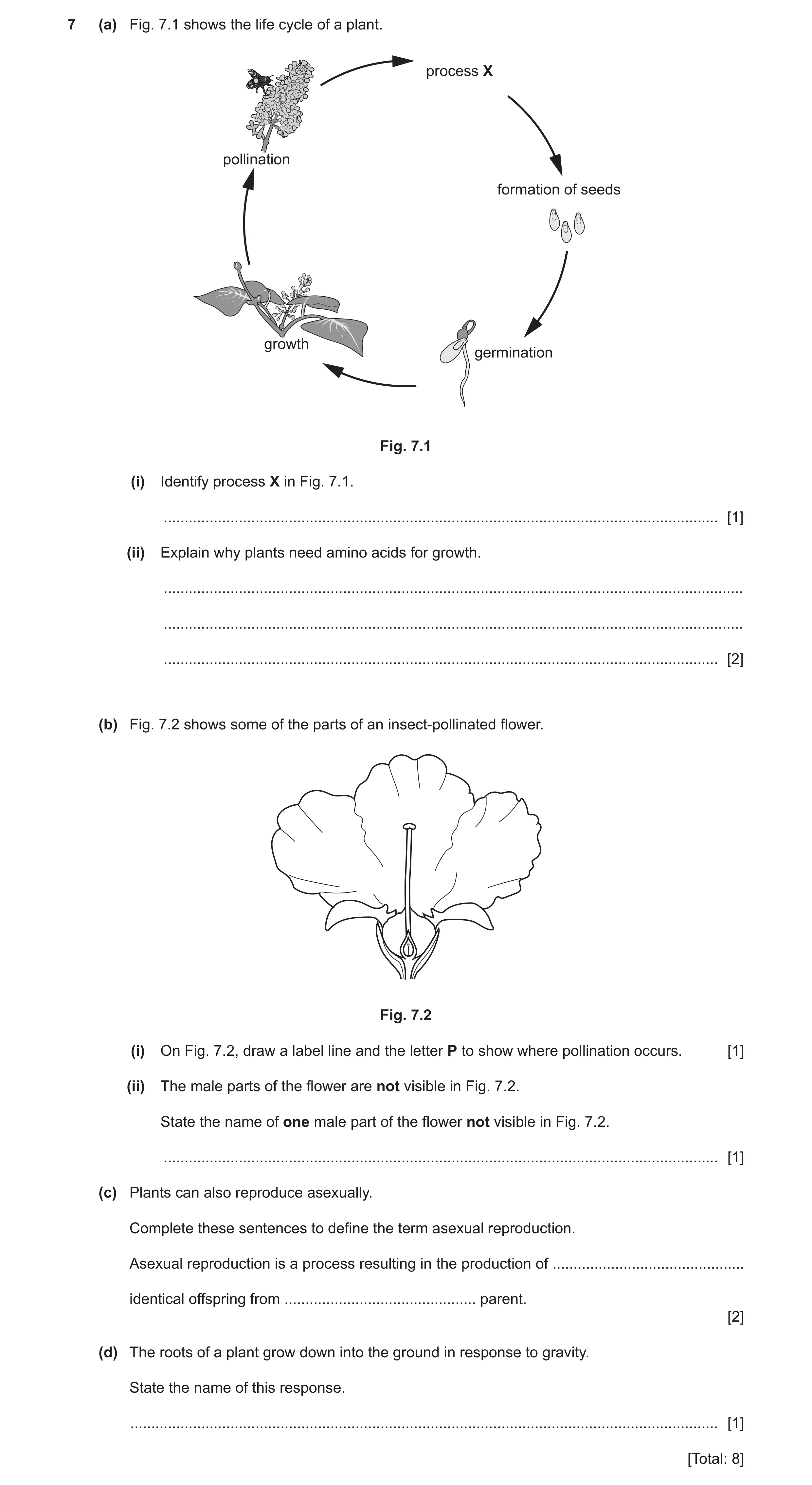
7 (a) Fig. 7.1 shows the life cycle of a plant. process X pollination formation of seeds growth germination Fig. 7.1 (i) Identify process X in Fig. 7.1. … [1] (ii) Explain why plants need amino acids for growth. … … … [2] (b) Fig. 7.2 shows some of the parts of an insect-pollinated flower. Fig. 7.2 (i) On Fig. 7.2, draw a label line and the letter P to show where pollination occurs. [1] (ii) The male parts of the flower are not visible in Fig. 7.2. State the name of one male part of the flower not visible in Fig. 7.2. … [1] (c) Plants can also reproduce asexually. Complete these sentences to define the term asexual reproduction. Asexual reproduction is a process resulting in the production of … identical offspring from … parent. [2] (d) The roots of a plant grow down into the ground in response to gravity. State the name of this response. … [1] [Total: 8]
8 marks
Mark scheme: 7(a)(i) fertilisation ; 1 7(a)(ii) (amino acids are used) to make proteins ; proteins are needed for growth ; 2 7(b)(i) label line on stigma ; 1 7(b)(ii) anther / filament / stamen ; 1 7(c) genetically ; one / a single ; 2 7(d) gravitropism ; 1 Question Answer Marks
This question in 0653/31 Oct/Nov 2021
Q15 · A photograph of a butterfly feeding on a lavender flower 0653/32 Feb/March 2022
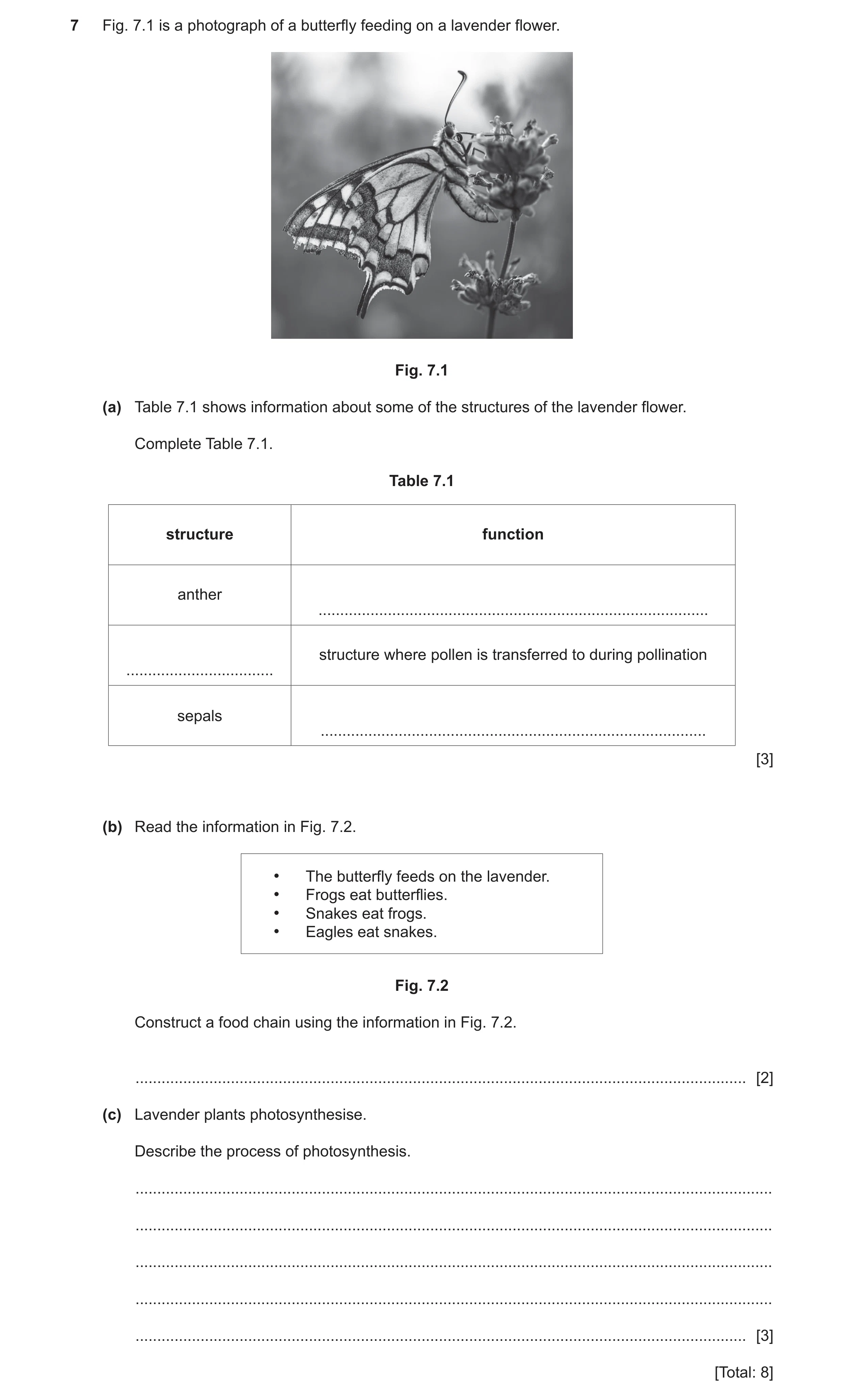
7 Fig. 7.1 is a photograph of a butterfly feeding on a lavender flower. Fig. 7.1 (a) Table 7.1 shows information about some of the structures of the lavender flower. Complete Table 7.1. Table 7.1 structure function anther … structure where pollen is transferred to during pollination … sepals … [3] (b) Read the information in Fig. 7.2. • The butterfly feeds on the lavender. • Frogs eat butterflies. • Snakes eat frogs. • Eagles eat snakes. Fig. 7.2 Construct a food chain using the information in Fig. 7.2. … [2] (c) Lavender plants photosynthesise. Describe the process of photosynthesis. … … … … … [3] [Total: 8]
8 marks
Mark scheme: 7(a) (anther) – produce pollen ; stigma ; (sepals) – protect (developing) flower / bud ; 3 Question Answer Marks 7(b) lavender → butterfly → frog → snake → eagle ;; one mark for correct order one mark for arrows in correct direction 2 7(c) uses water and carbon dioxide ; makes glucose / makes carbohydrates and oxygen ; needs light and chlorophyll ; 3
This question in 0653/32 Feb/March 2022
Q16 · The boxes on the left show different parts of the male and female reproductive system in… 0653/33 May/June 2022
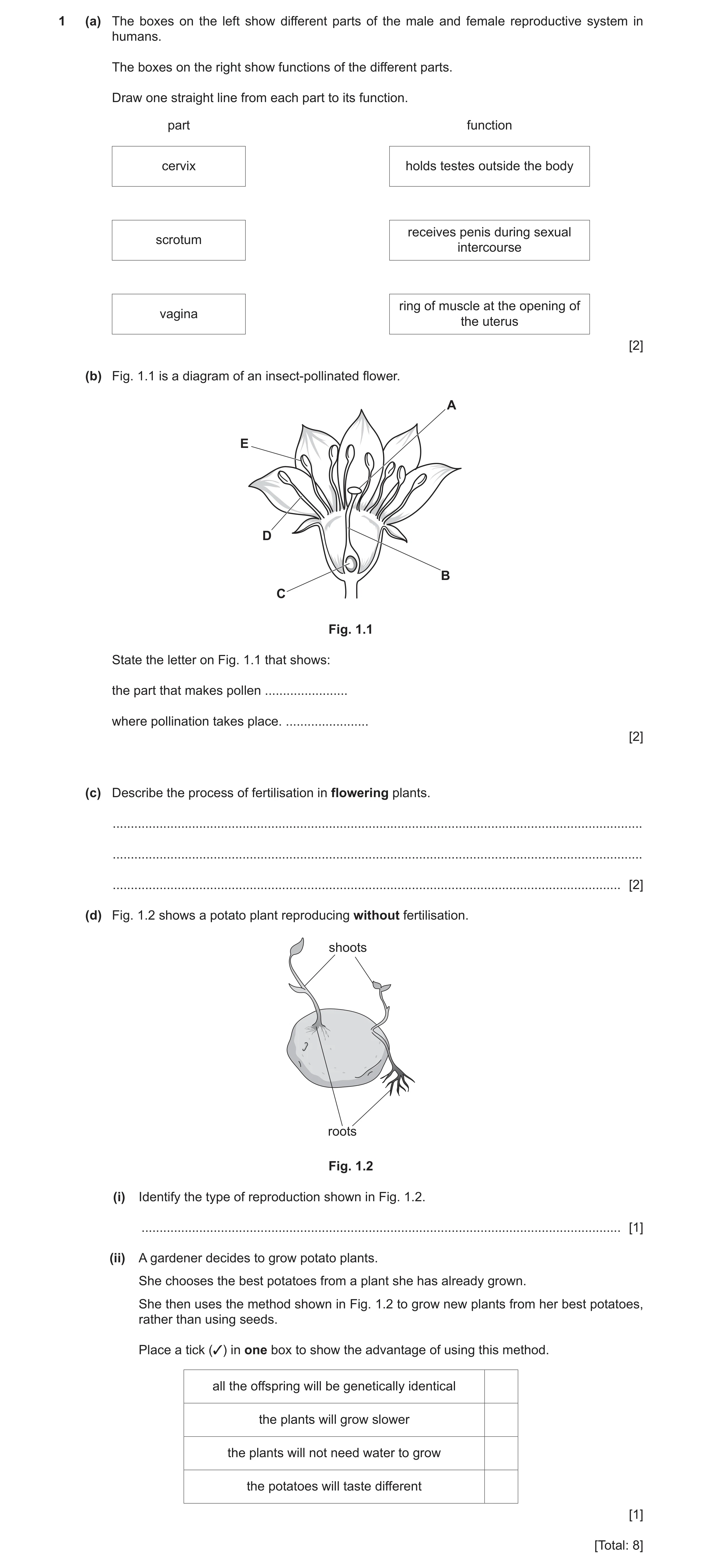
1 (a) The boxes on the left show different parts of the male and female reproductive system in humans. The boxes on the right show functions of the different parts. Draw one straight line from each part to its function. part function cervix holds testes outside the body receives penis during sexual scrotum intercourse ring of muscle at the opening of vagina the uterus [2] (b) Fig. 1.1 is a diagram of an insect‑pollinated flower. A E D B C Fig. 1.1 State the letter on Fig. 1.1 that shows: the part that makes pollen … where pollination takes place. … [2] (c) Describe the process of fertilisation in flowering plants. … … … [2] (d) Fig. 1.2 shows a potato plant reproducing without fertilisation. shoots roots Fig. 1.2 (i) Identify the type of reproduction shown in Fig. 1.2. … [1] (ii) A gardener decides to grow potato plants. She chooses the best potatoes from a plant she has already grown. She then uses the method shown in Fig. 1.2 to grow new plants from her best potatoes, rather than using seeds. Place a tick (✓) in one box to show the advantage of using this method. all the offspring will be genetically identical the plants will grow slower the plants will not need water to grow the potatoes will taste different [1] [Total: 8]
8 marks
Mark scheme: 1(a) cervix holds testes outside the body scrotum receives penis during sexual intercourse vagina ring of muscle at opening to uterus all three correct = 2 marks one or two correct = 1 mark 2 1(b) E ; A ; 2 1(c) fusion of pollen and ovule ; correct ref to nuclei ; 2 1(d)(i) asexual ; 1 1(d)(ii) all the offspring will be genetically identical ; plants will grow slower the plants will not need water to grow the potatoes will taste different 1
This question in 0653/33 May/June 2022
Q17 · A photograph of an insect‑pollinated flower 0653/32 Oct/Nov 2022
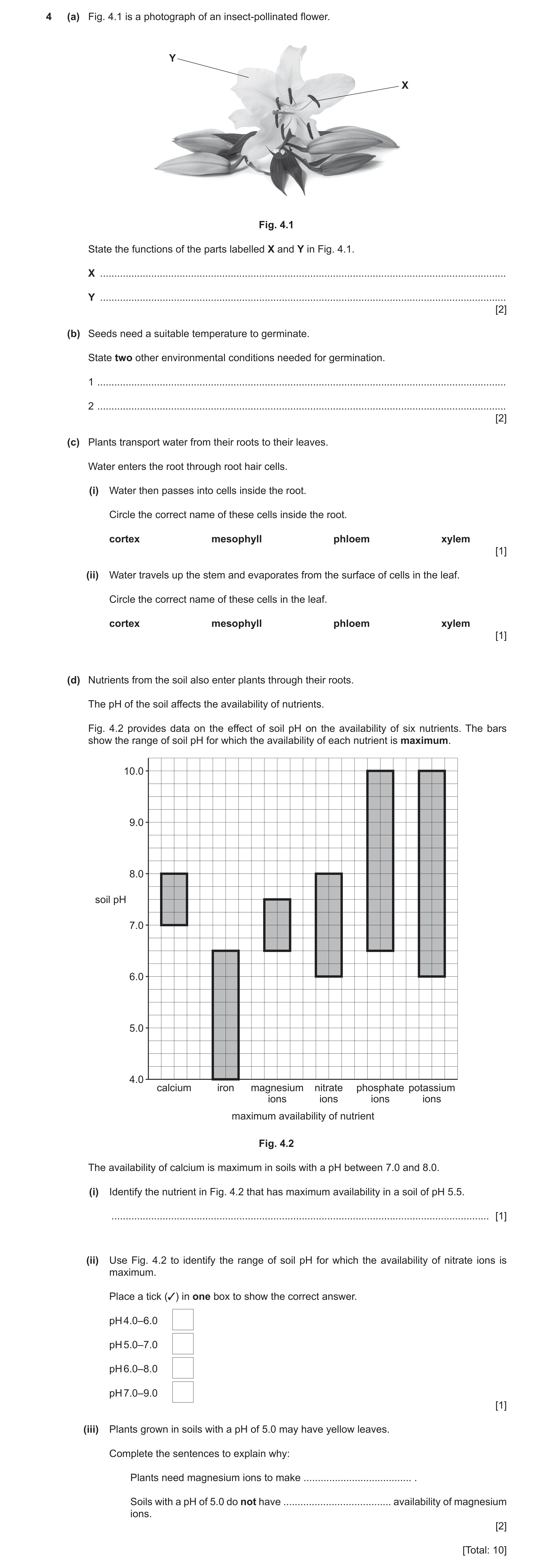
4 (a) Fig. 4.1 is a photograph of an insect‑pollinated flower. Y X Fig. 4.1 State the functions of the parts labelled X and Y in Fig. 4.1. X … Y … [2] (b) Seeds need a suitable temperature to germinate. State two other environmental conditions needed for germination. 1 … 2 … [2] (c) Plants transport water from their roots to their leaves. Water enters the root through root hair cells. (i) Water then passes into cells inside the root. Circle the correct name of these cells inside the root. cortex mesophyll phloem xylem [1] (ii) Water travels up the stem and evaporates from the surface of cells in the leaf. Circle the correct name of these cells in the leaf. cortex mesophyll phloem xylem [1] (d) Nutrients from the soil also enter plants through their roots. The pH of the soil affects the availability of nutrients. Fig. 4.2 provides data on the effect of soil pH on the availability of six nutrients. The bars show the range of soil pH for which the availability of each nutrient is maximum. 10.0 9.0 8.0 soil pH 7.0 6.0 5.0 4.0 calcium iron magnesium nitrate phosphate potassium ions ions ions ions maximum availability of nutrient Fig. 4.2 The availability of calcium is maximum in soils with a pH between 7.0 and 8.0. (i) Identify the nutrient in Fig. 4.2 that has maximum availability in a soil of pH 5.5. … [1] (ii) Use Fig. 4.2 to identify the range of soil pH for which the availability of nitrate ions is maximum. Place a tick (✓) in one box to show the correct answer. pH 4.0–6.0 pH 5.0–7.0 pH 6.0–8.0 pH 7.0–9.0 [1] (iii) Plants grown in soils with a pH of 5.0 may have yellow leaves. Complete the sentences to explain why: Plants need magnesium ions to make … . Soils with a pH of 5.0 do not have … availability of magnesium ions. [2] [Total: 10]
10 marks
Mark scheme: 4(a) X produce / release, pollen ; 2 Y attract insects (for pollination) ; 4(b) (presence of) water ; 2 (presence of) oxygen ; 4(c)(i) cortex ; 1 4(c)(ii) mesophyll ; 1 4(d)(i) iron ; 1 4(d)(ii) pH 6.0–8.0 ; 1 4(d)(iii) chlorophyll ; 2 maximum ;
This question in 0653/32 Oct/Nov 2022
Q18 · A photograph of an insect‑pollinated flower 0653/33 Oct/Nov 2022
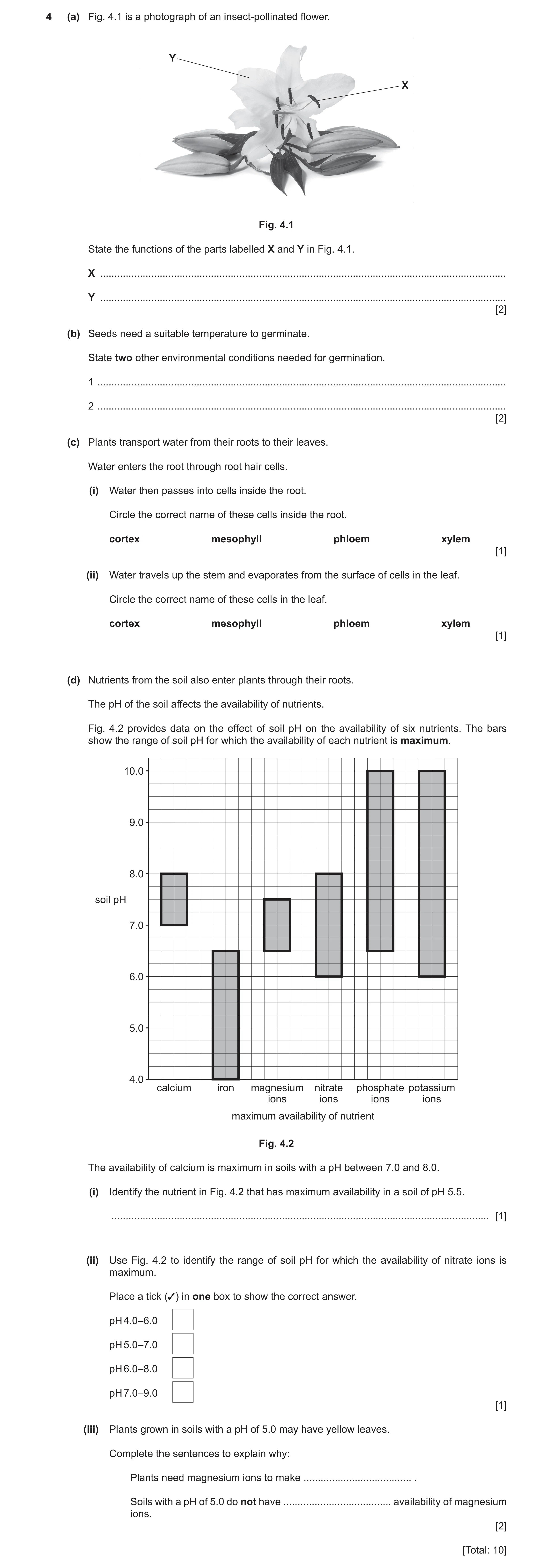
4 (a) Fig. 4.1 is a photograph of an insect‑pollinated flower. Y X Fig. 4.1 State the functions of the parts labelled X and Y in Fig. 4.1. X … Y … [2] (b) Seeds need a suitable temperature to germinate. State two other environmental conditions needed for germination. 1 … 2 … [2] (c) Plants transport water from their roots to their leaves. Water enters the root through root hair cells. (i) Water then passes into cells inside the root. Circle the correct name of these cells inside the root. cortex mesophyll phloem xylem [1] (ii) Water travels up the stem and evaporates from the surface of cells in the leaf. Circle the correct name of these cells in the leaf. cortex mesophyll phloem xylem [1] (d) Nutrients from the soil also enter plants through their roots. The pH of the soil affects the availability of nutrients. Fig. 4.2 provides data on the effect of soil pH on the availability of six nutrients. The bars show the range of soil pH for which the availability of each nutrient is maximum. 10.0 9.0 8.0 soil pH 7.0 6.0 5.0 4.0 calcium iron magnesium nitrate phosphate potassium ions ions ions ions maximum availability of nutrient Fig. 4.2 The availability of calcium is maximum in soils with a pH between 7.0 and 8.0. (i) Identify the nutrient in Fig. 4.2 that has maximum availability in a soil of pH 5.5. … [1] (ii) Use Fig. 4.2 to identify the range of soil pH for which the availability of nitrate ions is maximum. Place a tick (✓) in one box to show the correct answer. pH 4.0–6.0 pH 5.0–7.0 pH 6.0–8.0 pH 7.0–9.0 [1] (iii) Plants grown in soils with a pH of 5.0 may have yellow leaves. Complete the sentences to explain why: Plants need magnesium ions to make … . Soils with a pH of 5.0 do not have … availability of magnesium ions. [2] [Total: 10]
10 marks
Mark scheme: 4(a) X produce / release, pollen ; 2 Y attract insects (for pollination) ; 4(b) (presence of) water ; 2 (presence of) oxygen ; 4(c)(i) cortex ; 1 4(c)(ii) mesophyll ; 1 4(d)(i) iron ; 1 4(d)(ii) pH 6.0–8.0 ; 1 4(d)(iii) chlorophyll ; 2 maximum ;
This question in 0653/33 Oct/Nov 2022
Q19 · The parts of an insect-pollinated flower 0653/31 May/June 2023
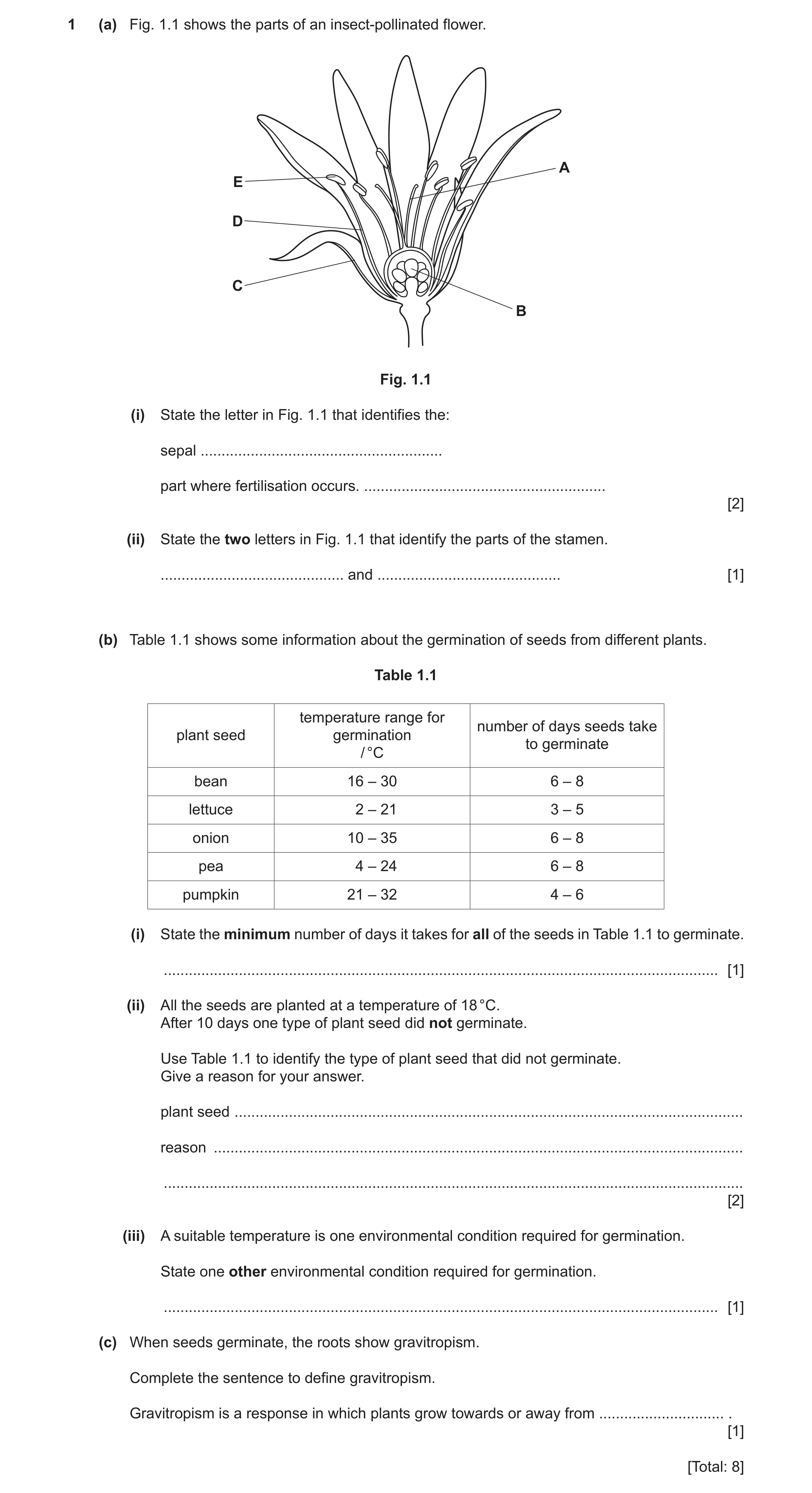
1 (a) Fig. 1.1 shows the parts of an insect-pollinated flower. A E D C B Fig. 1.1 (i) State the letter in Fig. 1.1 that identifies the: sepal … part where fertilisation occurs. … [2] (ii) State the two letters in Fig. 1.1 that identify the parts of the stamen. … and … [1] (b) Table 1.1 shows some information about the germination of seeds from different plants. Table 1.1 temperature range for number of days seeds take plant seed germination to germinate / °C bean 16 – 30 6 – 8 lettuce 2 – 21 3 – 5 onion 10 – 35 6 – 8 pea 4 – 24 6 – 8 pumpkin 21 – 32 4 – 6 (i) State the minimum number of days it takes for all of the seeds in Table 1.1 to germinate. … [1] (ii) All the seeds are planted at a temperature of 18 °C. After 10 days one type of plant seed did not germinate. Use Table 1.1 to identify the type of plant seed that did not germinate. Give a reason for your answer. plant seed … reason … … [2] (iii) A suitable temperature is one environmental condition required for germination. State one other environmental condition required for germination. … [1] (c) When seeds germinate, the roots show gravitropism. Complete the sentence to define gravitropism. Gravitropism is a response in which plants grow towards or away from … . [1] [Total: 8]
8 marks
Mark scheme: 1(a)(i) C ; B ; 2 1(a)(ii) D and E ; 1 1(b)(i) 6 / six ; 1 1(b)(ii) (plant seed) pumpkin ; (reason) needs at least 21 °C (to germinate) ; 2 1(b)(iii) water / oxygen ; 1 1(c) gravity ; 1
This question in 0653/31 May/June 2023
Q20 · An incomplete food web 0653/32 May/June 2023
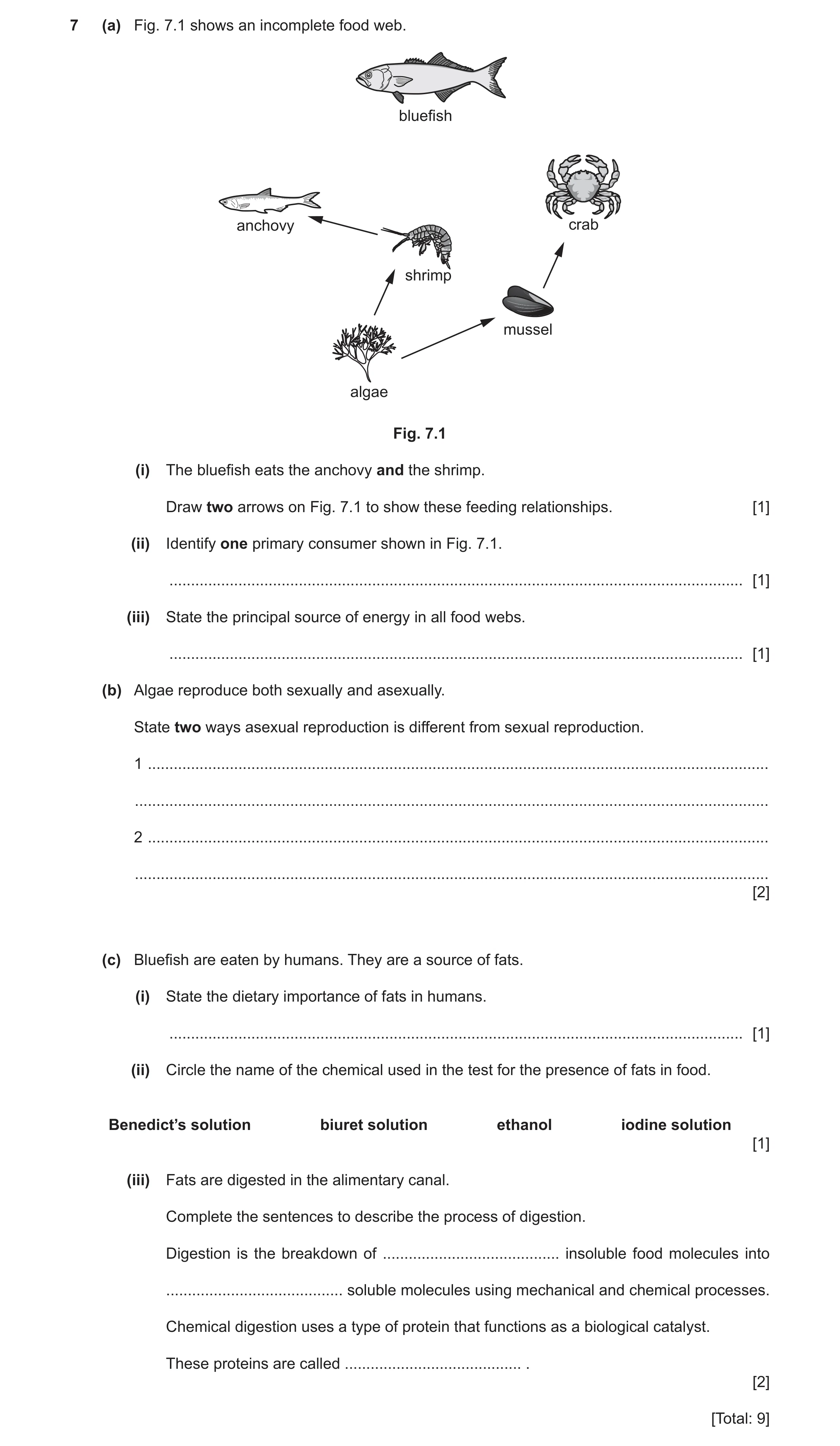
7 (a) Fig. 7.1 shows an incomplete food web. bluefish anchovy crab shrimp mussel algae Fig. 7.1 (i) The bluefish eats the anchovy and the shrimp. Draw two arrows on Fig. 7.1 to show these feeding relationships. [1] (ii) Identify one primary consumer shown in Fig. 7.1. … [1] (iii) State the principal source of energy in all food webs. … [1] (b) Algae reproduce both sexually and asexually. State two ways asexual reproduction is different from sexual reproduction. 1 … … 2 … … [2] (c) Bluefish are eaten by humans. They are a source of fats. (i) State the dietary importance of fats in humans. … [1] (ii) Circle the name of the chemical used in the test for the presence of fats in food. Benedict’s solution biuret solution ethanol iodine solution [1] (iii) Fats are digested in the alimentary canal. Complete the sentences to describe the process of digestion. Digestion is the breakdown of … insoluble food molecules into … soluble molecules using mechanical and chemical processes. Chemical digestion uses a type of protein that functions as a biological catalyst. These proteins are called … . [2] [Total: 9]
9 marks
Mark scheme: 7(a)(i) arrow from anchovy to bluefish AND from shrimp to bluefish ; 1 7(a)(ii) shrimp / mussel ; 1 Question Answer Marks 7(a)(iii) the Sun ; 1 7(b) any two from: genetically identical offspring ; one parent / does not need two parents / does not need male and female parents ; no fertilisation / no fusion of nuclei / no fusion of gametes / no gametes involved ; 2 7(c)(i) for insulation / energy store / energy source ; 1 7(c)(ii) ethanol ; 1 7(c)(iii) (gap one) large AND (gap two) small ; enzymes ; 2
This question in 0653/32 May/June 2023
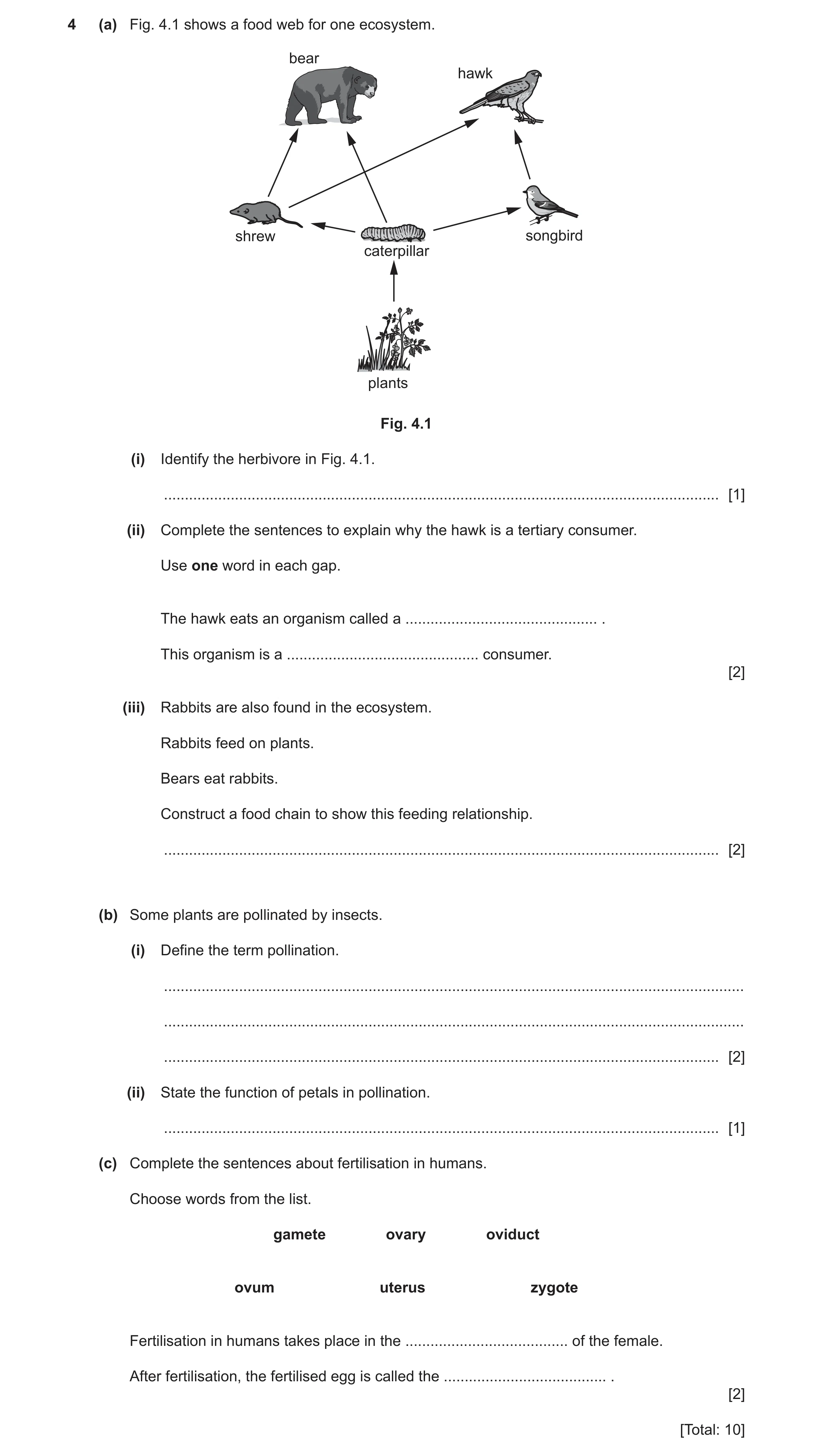
Q21 · A food web for one ecosystem 0653/32 Oct/Nov 2023
4 (a) Fig. 4.1 shows a food web for one ecosystem. bear hawk shrew songbird caterpillar plants Fig. 4.1 (i) Identify the herbivore in Fig. 4.1. … [1] (ii) Complete the sentences to explain why the hawk is a tertiary consumer. Use one word in each gap. The hawk eats an organism called a … . This organism is a … consumer. [2] (iii) Rabbits are also found in the ecosystem. Rabbits feed on plants. Bears eat rabbits. Construct a food chain to show this feeding relationship. … [2] (b) Some plants are pollinated by insects. (i) Define the term pollination. … … … [2] (ii) State the function of petals in pollination. … [1] (c) Complete the sentences about fertilisation in humans. Choose words from the list. gamete ovary oviduct ovum uterus zygote Fertilisation in humans takes place in the … of the female. After fertilisation, the fertilised egg is called the … . [2] [Total: 10]
10 marks
Mark scheme: 4(a)(i) caterpillar ; 1 4(a)(ii) songbird / shrew ; 2 secondary ; 4(a)(iii) plants → rabbits → bears 2 correct order ; correct arrows ; 4(b)(i) transfer of pollen (grains) ; 2 from anther to stigma ; 4(b)(ii) (petals) attract insects ; 1 4(c) oviduct ; 2 zygote ;
This question in 0653/32 Oct/Nov 2023
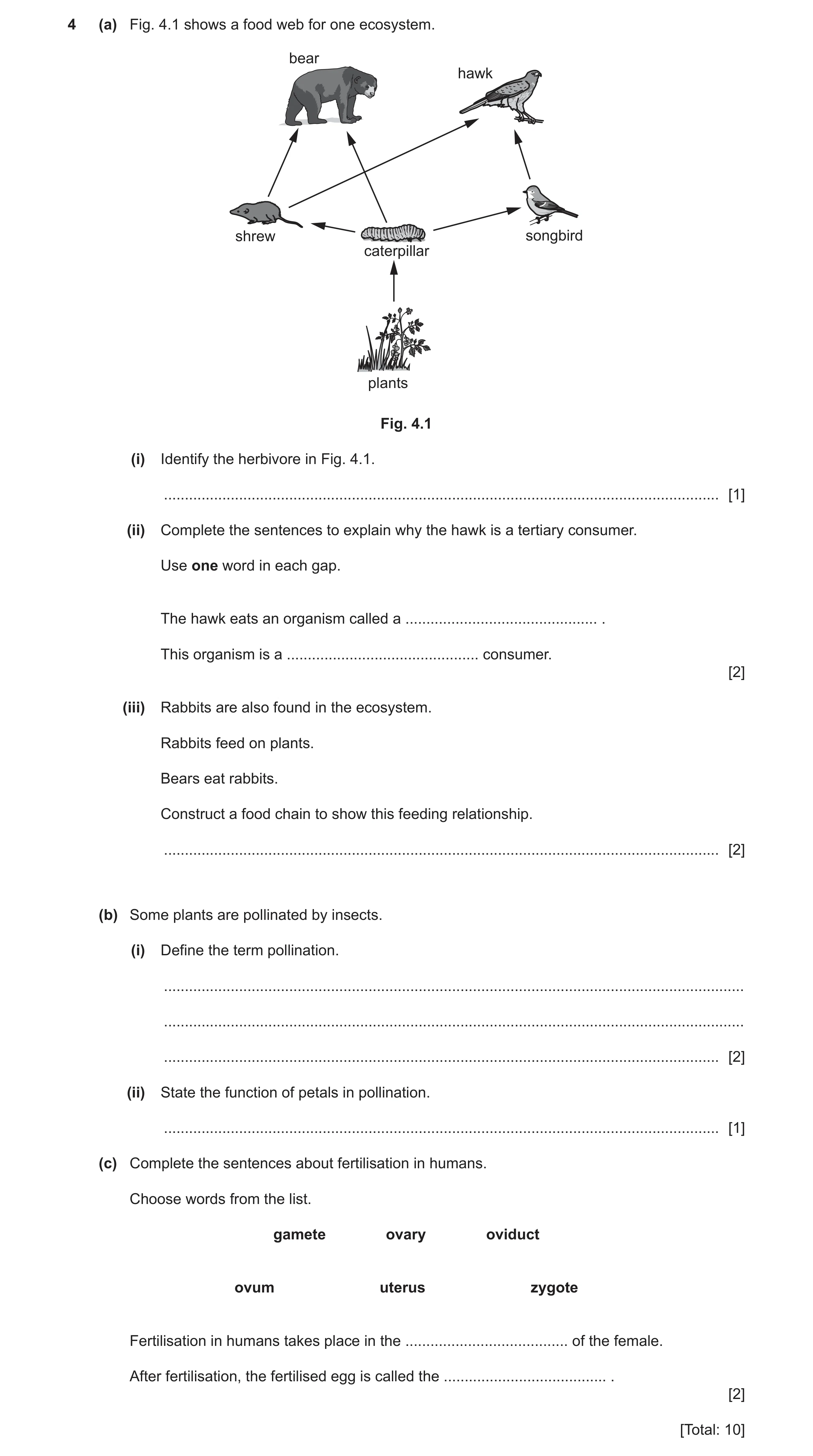
Q22 · A food web for one ecosystem 0653/33 Oct/Nov 2023
4 (a) Fig. 4.1 shows a food web for one ecosystem. bear hawk shrew songbird caterpillar plants Fig. 4.1 (i) Identify the herbivore in Fig. 4.1. … [1] (ii) Complete the sentences to explain why the hawk is a tertiary consumer. Use one word in each gap. The hawk eats an organism called a … . This organism is a … consumer. [2] (iii) Rabbits are also found in the ecosystem. Rabbits feed on plants. Bears eat rabbits. Construct a food chain to show this feeding relationship. … [2] (b) Some plants are pollinated by insects. (i) Define the term pollination. … … … [2] (ii) State the function of petals in pollination. … [1] (c) Complete the sentences about fertilisation in humans. Choose words from the list. gamete ovary oviduct ovum uterus zygote Fertilisation in humans takes place in the … of the female. After fertilisation, the fertilised egg is called the … . [2] [Total: 10]
10 marks
Mark scheme: 4(a)(i) caterpillar ; 1 4(a)(ii) songbird / shrew ; 2 secondary ; 4(a)(iii) plants → rabbits → bears 2 correct order ; correct arrows ; 4(b)(i) transfer of pollen (grains) ; 2 from anther to stigma ; 4(b)(ii) (petals) attract insects ; 1 4(c) oviduct ; 2 zygote ;
This question in 0653/33 Oct/Nov 2023
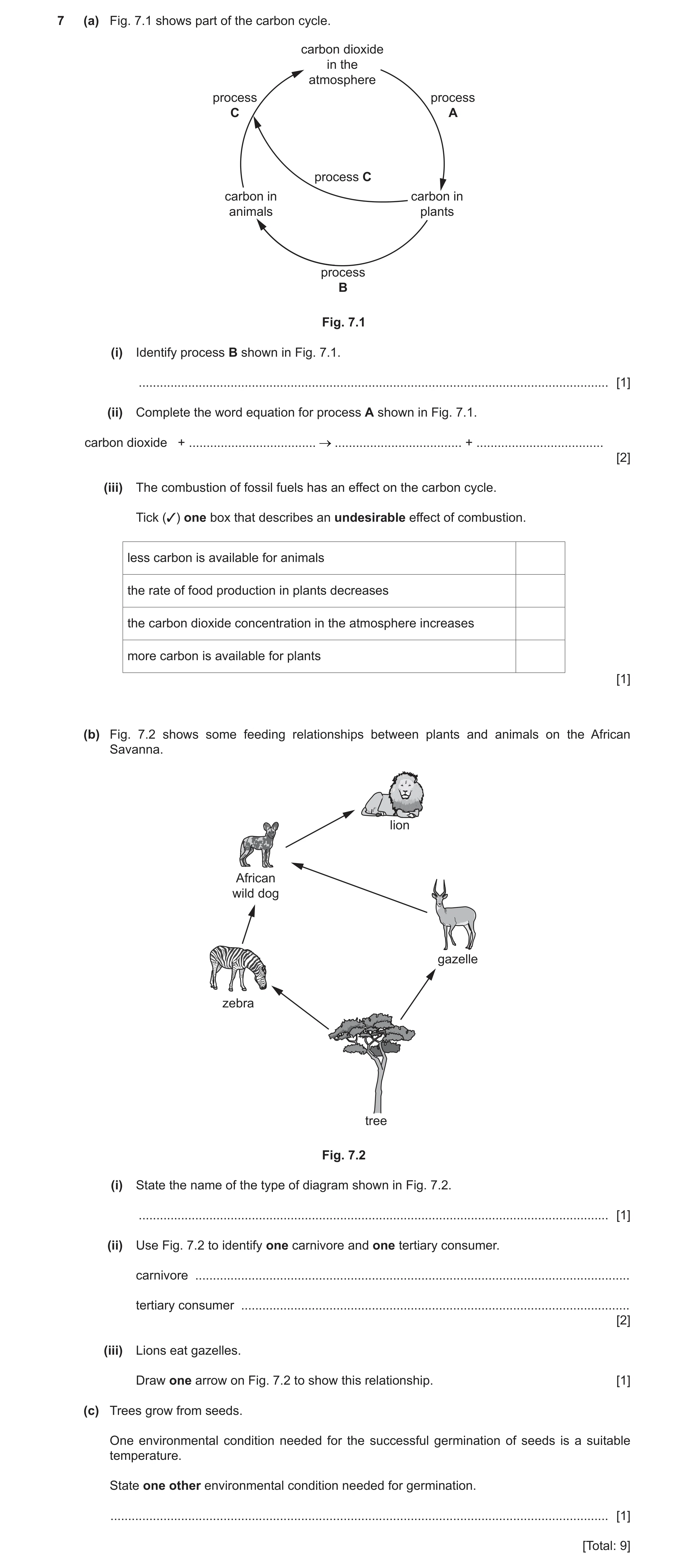
Q23 · Part of the carbon cycle 0653/32 Feb/March 2024
7 (a) Fig. 7.1 shows part of the carbon cycle. carbon dioxide in the atmosphere process process C A process C carbon in carbon in animals plants process B Fig. 7.1 (i) Identify process B shown in Fig. 7.1. … [1] (ii) Complete the word equation for process A shown in Fig. 7.1. carbon dioxide + … … + … [2] (iii) The combustion of fossil fuels has an effect on the carbon cycle. Tick (3) one box that describes an undesirable effect of combustion. less carbon is available for animals the rate of food production in plants decreases the carbon dioxide concentration in the atmosphere increases more carbon is available for plants [1] (b) Fig. 7.2 shows some feeding relationships between plants and animals on the African Savanna. lion African wild dog gazelle zebra tree Fig. 7.2 (i) State the name of the type of diagram shown in Fig. 7.2. … [1] (ii) Use Fig. 7.2 to identify one carnivore and one tertiary consumer. carnivore … tertiary consumer … [2] (iii) Lions eat gazelles. Draw one arrow on Fig. 7.2 to show this relationship. [1] (c) Trees grow from seeds. One environmental condition needed for the successful germination of seeds is a suitable temperature. State one other environmental condition needed for germination. … [1] [Total: 9]
9 marks
Mark scheme: 7(a)(i) feeding ; 1 7(a)(ii) water ; 2 glucose + oxygen ; 7(a)(iii) 1 less carbon is available for animals the rate of food production in plants decreases the carbon dioxide concentration in the atmosphere increases ✓ ; more carbon is available for plants 7(b)(i) food web ; 1 7(b)(ii) carnivore: (African wild) dog / lion ; 2 tertiary consumer: lion ; 7(b)(iii) arrow drawn from gazelle pointing towards lion ; 1 7(c) oxygen / water / moisture ; 1
This question in 0653/32 Feb/March 2024
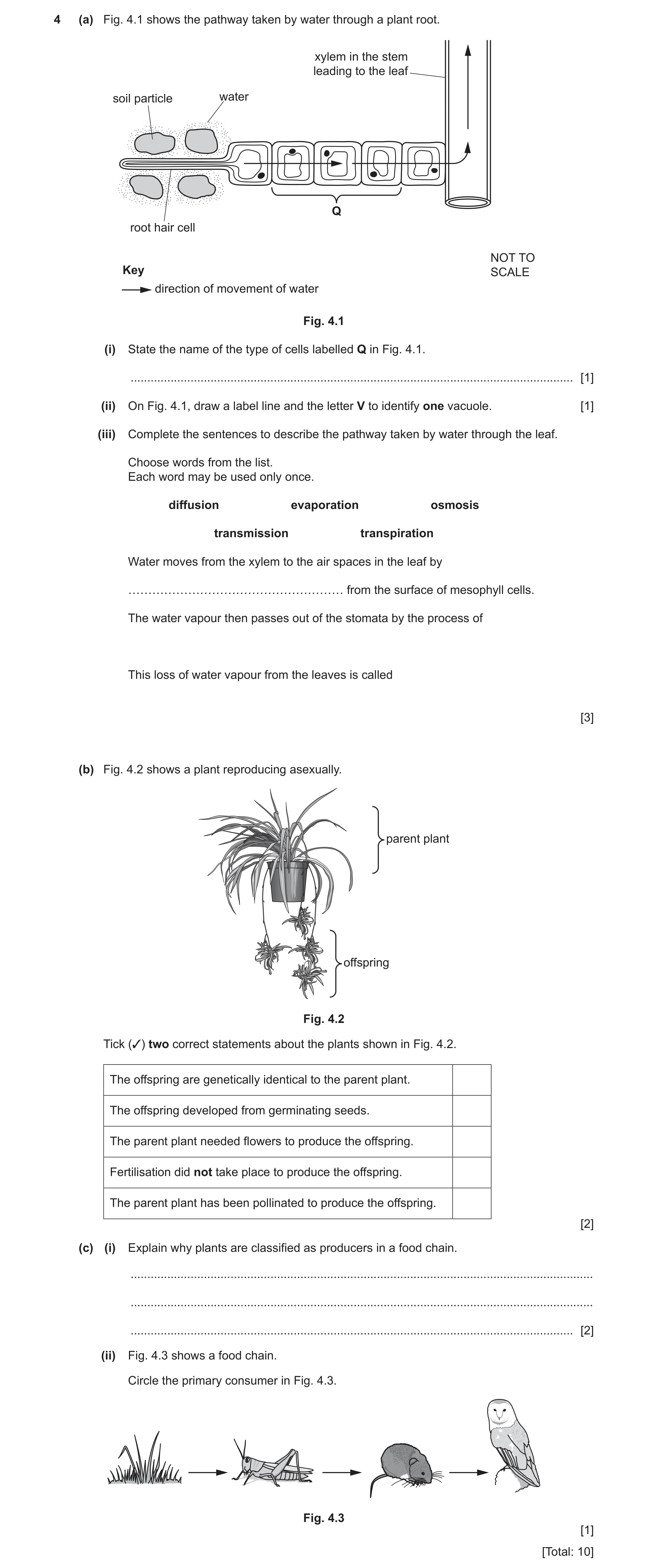
Q24 · The pathway taken by water through a plant root 0653/31 May/June 2024
4 (a) Fig. 4.1 shows the pathway taken by water through a plant root. xylem in the stem leading to the leaf soil particle water Q root hair cell NOT TO Key SCALE direction of movement of water Fig. 4.1 (i) State the name of the type of cells labelled Q in Fig. 4.1. … [1] (ii) On Fig. 4.1, draw a label line and the letter V to identify one vacuole. [1] (iii) Complete the sentences to describe the pathway taken by water through the leaf. Choose words from the list. Each word may be used only once. diffusion evaporation osmosis transmission transpiration Water moves from the xylem to the air spaces in the leaf by ……………………………………………… from the surface of mesophyll cells. The water vapour then passes out of the stomata by the process of This loss of water vapour from the leaves is called [3] (b) Fig. 4.2 shows a plant reproducing asexually. parent plant offspring Fig. 4.2 Tick (✓) two correct statements about the plants shown in Fig. 4.2. The offspring are genetically identical to the parent plant. The offspring developed from germinating seeds. The parent plant needed flowers to produce the offspring. Fertilisation did not take place to produce the offspring. The parent plant has been pollinated to produce the offspring. [2] (c) (i) Explain why plants are classified as producers in a food chain. … … … [2] (ii) Fig. 4.3 shows a food chain. Circle the primary consumer in Fig. 4.3. Fig. 4.3 [1] [Total: 10]
10 marks
Mark scheme: 4(a)(i) (root) cortex ; 1 4(a)(ii) one vacuole labelled in any cell ; 1 4(a)(iii) evaporation ; diffusion ; transpiration ; 3 4(b) The offspring are genetically identical to the parent plant. ; Fertilisation did not take place to produce the offspring. ; three ticks two correct = 1 mark three ticks one correct = 0 marks more than three ticks = 0 2 Question Answer Marks 4(c)(i) (plants) make their own, food / glucose / sugar ; by photosynthesis / using the energy from (sun)light / using light energy ; 2 4(c)(ii) grasshopper (circled) ; 1
This question in 0653/31 May/June 2024
Q25 · A diagram of the male reproductive system in humans 0653/32 May/June 2024
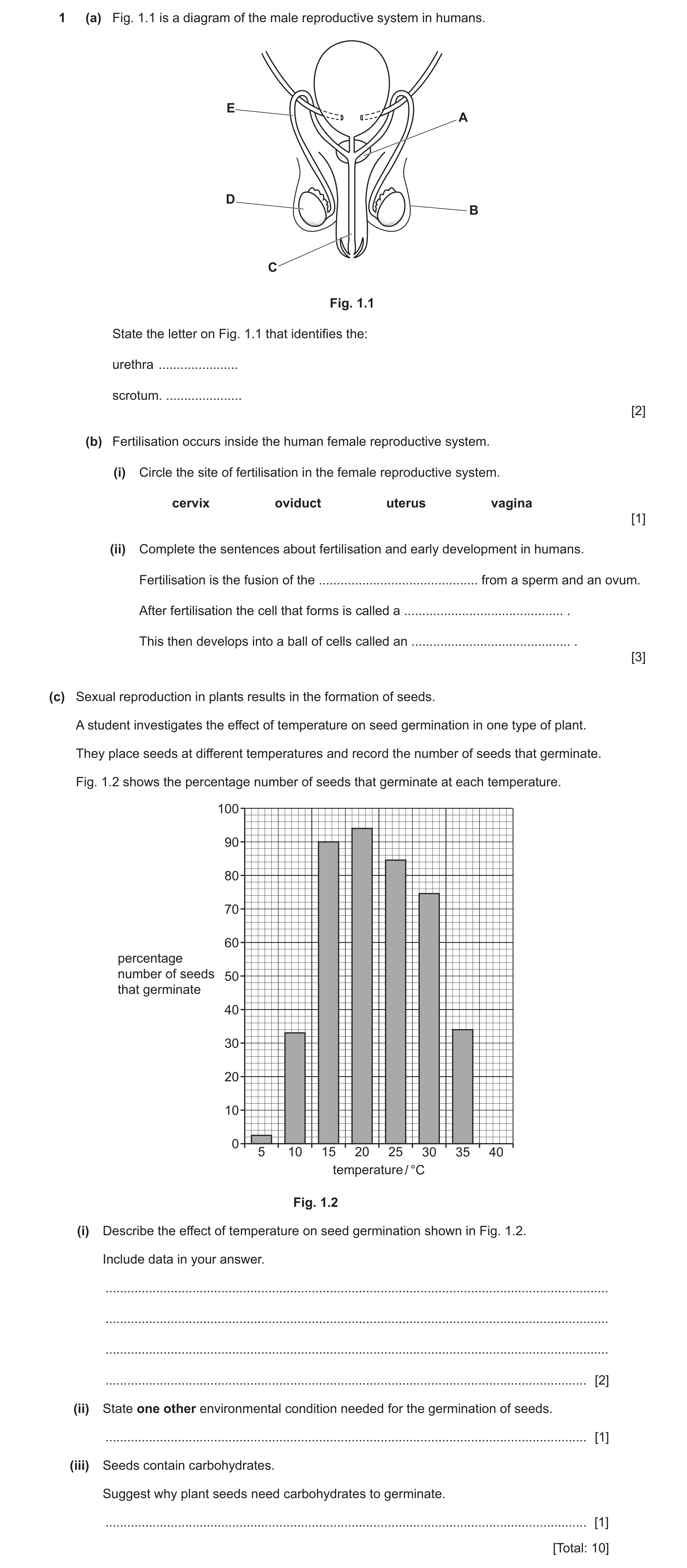
1 (a) Fig. 1.1 is a diagram of the male reproductive system in humans. E A D B C Fig. 1.1 State the letter on Fig. 1.1 that identifies the: urethra … scrotum. … [2] (b) Fertilisation occurs inside the human female reproductive system. (i) Circle the site of fertilisation in the female reproductive system. cervix oviduct uterus vagina [1] (ii) Complete the sentences about fertilisation and early development in humans. Fertilisation is the fusion of the … from a sperm and an ovum. After fertilisation the cell that forms is called a … . This then develops into a ball of cells called an … . [3] (c) Sexual reproduction in plants results in the formation of seeds. A student investigates the effect of temperature on seed germination in one type of plant. They place seeds at different temperatures and record the number of seeds that germinate. Fig. 1.2 shows the percentage number of seeds that germinate at each temperature. 100 90 80 70 60 percentage number of seeds 50 that germinate 40 30 20 10 0 5 10 15 20 25 30 35 40 temperature / °C Fig. 1.2 (i) Describe the effect of temperature on seed germination shown in Fig. 1.2. Include data in your answer. … … … … [2] (ii) State one other environmental condition needed for the germination of seeds. … [1] (iii) Seeds contain carbohydrates. Suggest why plant seeds need carbohydrates to germinate. … [1] [Total: 10]
10 marks
Mark scheme: 1(a) C ; B ; 2 1(b)(i) oviduct ; 1 1(b)(ii) nuclei / nucleus ; zygote ; embryo ; 3 1(c)(i) as temperature increases percentage germination increases then decreases ; maximum germination / optimum temperature at 20 °C ; 2 1(c)(ii) water / moisture / oxygen ; 1 1(c)(iii) energy / respiration ; 1
This question in 0653/32 May/June 2024
Q26 · Some of the parts of an insect-pollinated flower 0653/33 May/June 2024
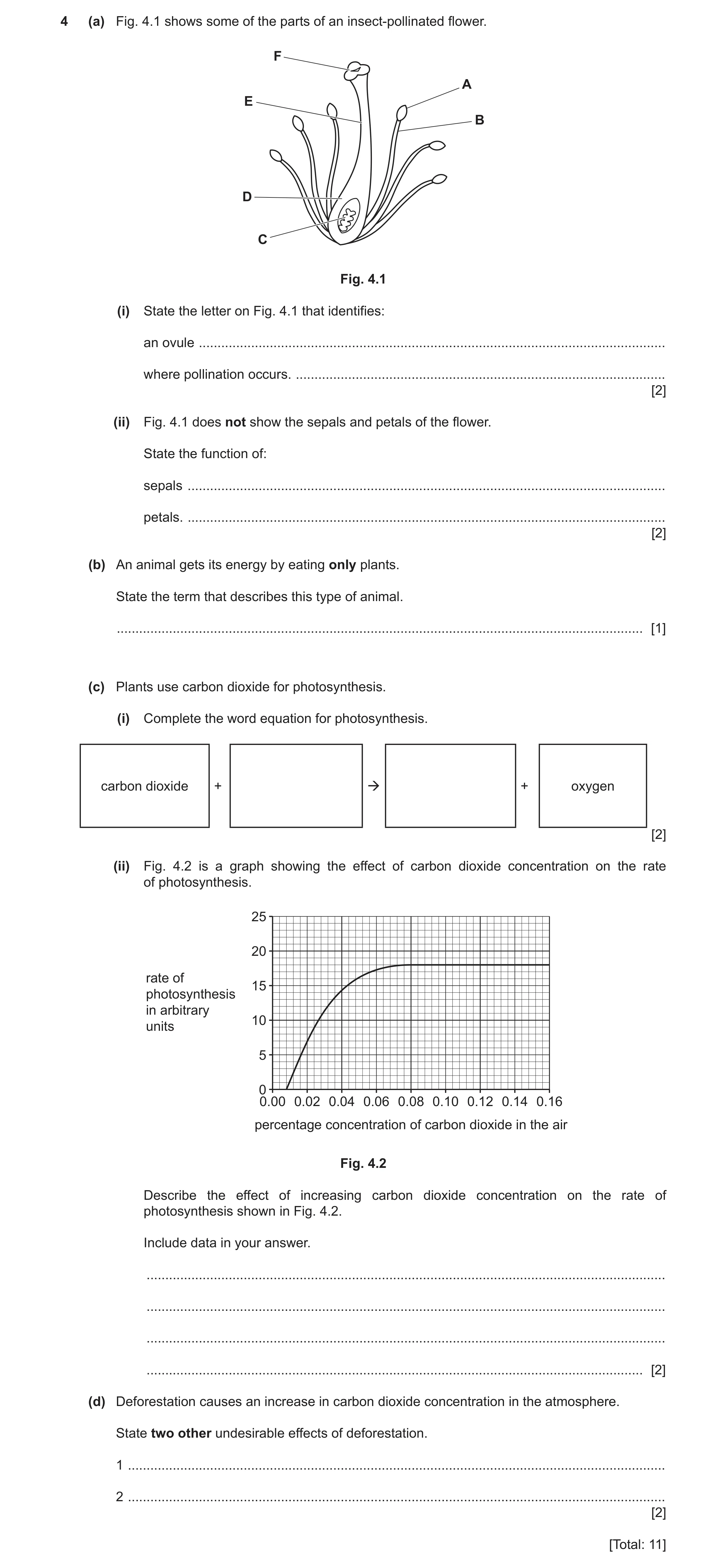
4 (a) Fig. 4.1 shows some of the parts of an insect-pollinated flower. F A E B D C Fig. 4.1 (i) State the letter on Fig. 4.1 that identifies: an ovule … where pollination occurs. … [2] (ii) Fig. 4.1 does not show the sepals and petals of the flower. State the function of: sepals … petals. … [2] (b) An animal gets its energy by eating only plants. State the term that describes this type of animal. … [1] (c) Plants use carbon dioxide for photosynthesis. (i) Complete the word equation for photosynthesis. carbon dioxide + + oxygen [2] (ii) Fig. 4.2 is a graph showing the effect of carbon dioxide concentration on the rate of photosynthesis. 25 20 rate of 15 photosynthesis in arbitrary 10 units 5 0 0.00 0.02 0.04 0.06 0.08 0.10 0.12 0.14 0.16 percentage concentration of carbon dioxide in the air Fig. 4.2 Describe the effect of increasing carbon dioxide concentration on the rate of photosynthesis shown in Fig. 4.2. Include data in your answer. … … … … [2] (d) Deforestation causes an increase in carbon dioxide concentration in the atmosphere. State two other undesirable effects of deforestation. 1 … 2 … [2] [Total: 11]
11 marks
Mark scheme: 4(a)(i) C ; F ; 2 4(a)(ii) protect, bud / flower ; attract, insects / pollinators ; 2 4(b) herbivore ; 1 4(c)(i) water ; glucose ; 2 4(c)(ii) (rate of photosynthesis) increases then levels off ; use of data, e.g. maximum rate = 18 (arbitrary units) / stops increasing at 0.07 (%) ; 2 Question Answer Marks 4(d) any two from: habitat destruction ; disrupts food chain ; extinction ; loss of soil ; flooding ; 2
This question in 0653/33 May/June 2024
Q27 · The flower of a plant 0653/31 Oct/Nov 2024
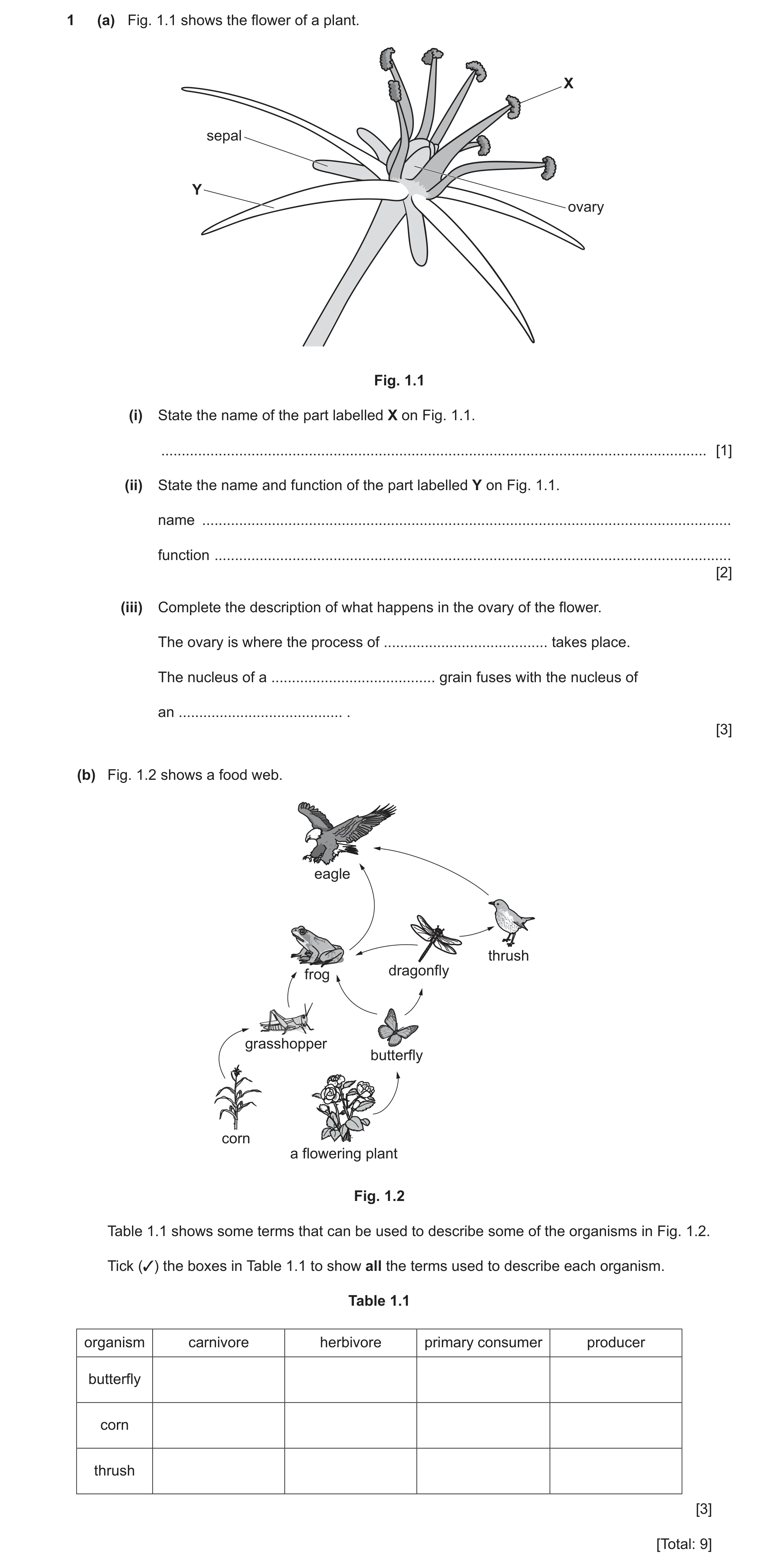
1 (a) Fig. 1.1 shows the flower of a plant. X sepal Y ovary Fig. 1.1 (i) State the name of the part labelled X on Fig. 1.1. … [1] (ii) State the name and function of the part labelled Y on Fig. 1.1. name … function … [2] (iii) Complete the description of what happens in the ovary of the flower. The ovary is where the process of … takes place. The nucleus of a … grain fuses with the nucleus of an … . [3] (b) Fig. 1.2 shows a food web. eagle thrush frog dragonfly grasshopper butterfly corn a flowering plant Fig. 1.2 Table 1.1 shows some terms that can be used to describe some of the organisms in Fig. 1.2. Tick (✓) the boxes in Table 1.1 to show all the terms used to describe each organism. Table 1.1 organism carnivore herbivore primary consumer producer butterfly corn thrush [3] [Total: 9]
9 marks
Mark scheme: Question Answer Marks 1(a)(i) anther ; 1 1(a)(ii) petal ; 2 attract (named) pollinators ; 1(a)(iii) fertilisation ; 3 pollen ; ovule ; 1(b) 3 organism carnivore herbivore primary consumer producer butterfly ✓ ✓ corn ✓ thrush ✓ butterfly row correct ; corn row correct ; thrush row correct ;
This question in 0653/31 Oct/Nov 2024
Q28 · The structure of an insect-pollinated flower 0653/32 Feb/March 2025
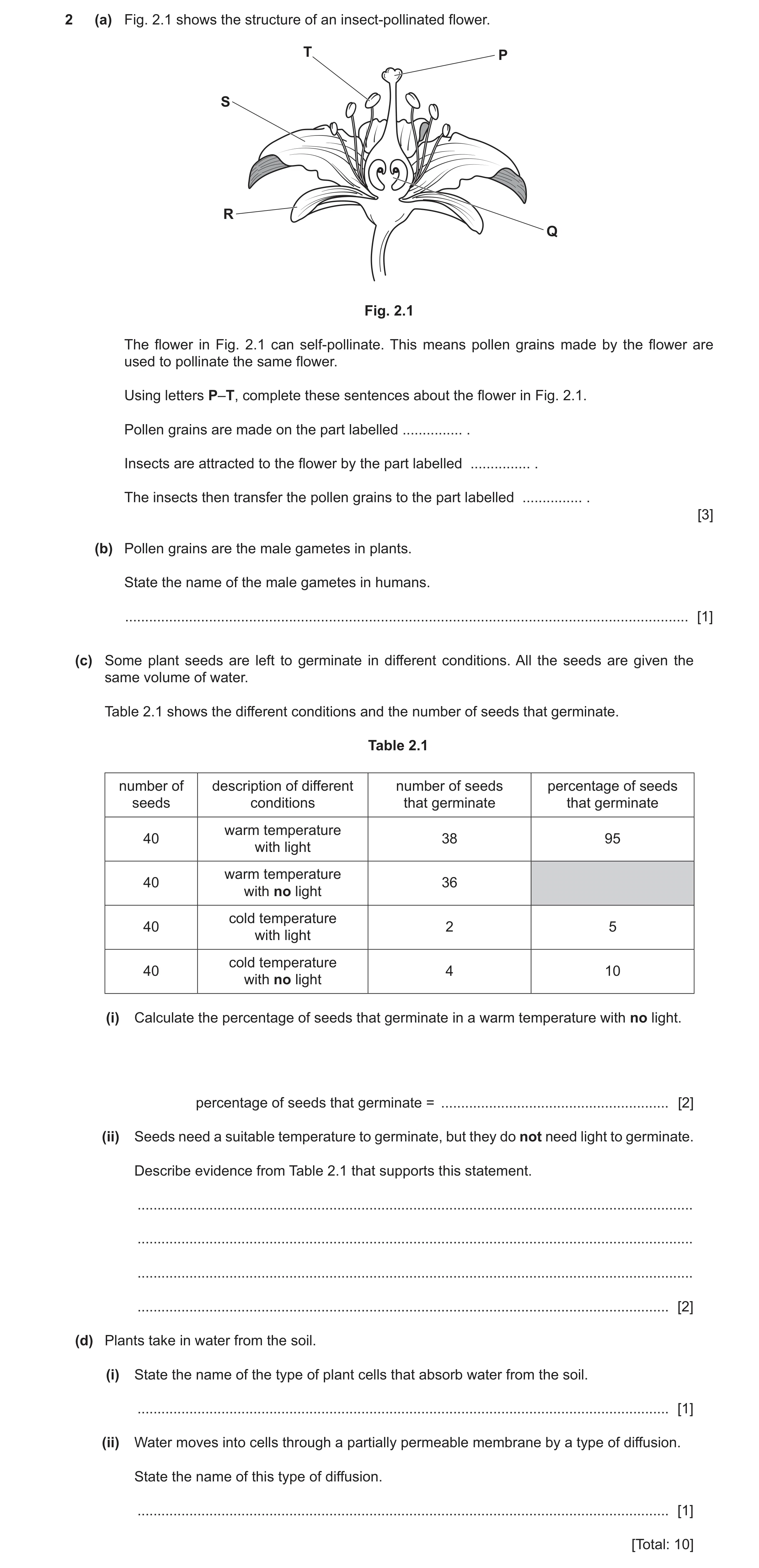
2 (a) Fig. 2.1 shows the structure of an insect-pollinated flower. T P S R Q Fig. 2.1 The flower in Fig. 2.1 can self-pollinate. This means pollen grains made by the flower are used to pollinate the same flower. Using letters P–T, complete these sentences about the flower in Fig. 2.1. Pollen grains are made on the part labelled … . Insects are attracted to the flower by the part labelled … . The insects then transfer the pollen grains to the part labelled … . [3] (b) Pollen grains are the male gametes in plants. State the name of the male gametes in humans. … [1] (c) Some plant seeds are left to germinate in different conditions. All the seeds are given the same volume of water. Table 2.1 shows the different conditions and the number of seeds that germinate. Table 2.1 number of description of different number of seeds percentage of seeds seeds conditions that germinate that germinate warm temperature 40 38 95 with light warm temperature 40 36 with no light cold temperature 40 2 5 with light cold temperature 40 4 10 with no light (i) Calculate the percentage of seeds that germinate in a warm temperature with no light. percentage of seeds that germinate = … [2] (ii) Seeds need a suitable temperature to germinate, but they do not need light to germinate. Describe evidence from Table 2.1 that supports this statement. … … … … [2] (d) Plants take in water from the soil. (i) State the name of the type of plant cells that absorb water from the soil. … [1] (ii) Water moves into cells through a partially permeable membrane by a type of diffusion. State the name of this type of diffusion. … [1] [Total: 10]
10 marks
Mark scheme: 2(a) T ; 3 S ; P ; 2(b) sperm ; 1 2(c)(i) 36 ÷ 40 100 ; 2 90 (%) ; 2(c)(ii) more seeds germinated in warm conditions / less germination in cold ; 2 seeds germinated without light (in warm / cold conditions) ; 2(d)(i) root hair (cells) ; 1 2(d)(ii) osmosis ; 1
This question in 0653/32 Feb/March 2025
Q29 · Nutrition is one of the characteristics of living organisms 0653/31 May/June 2025
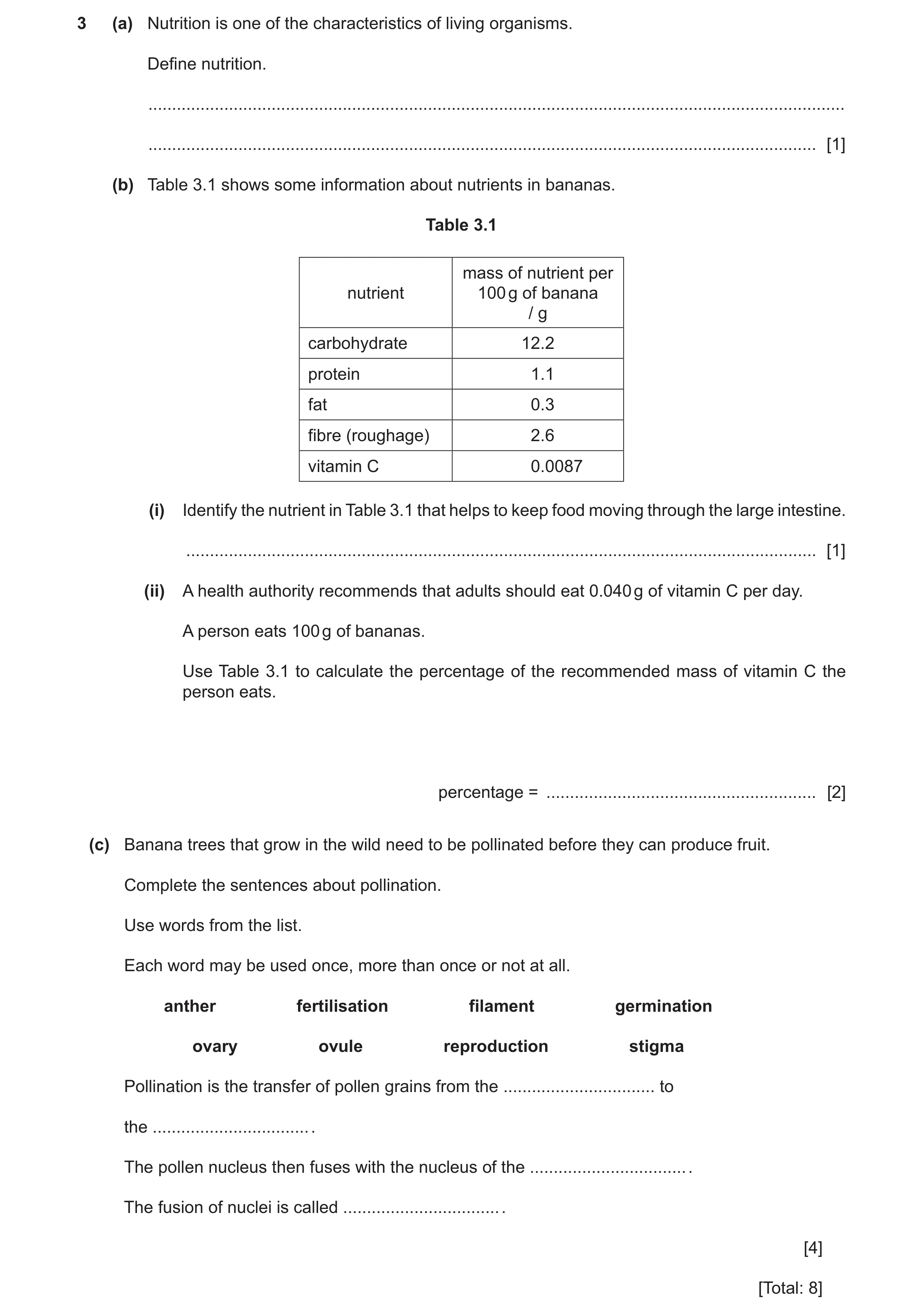
3 (a) Nutrition is one of the characteristics of living organisms. Define nutrition. … … [1] (b) Table 3.1 shows some information about nutrients in bananas. Table 3.1 mass of nutrient per nutrient 100 g of banana / g carbohydrate 12.2 protein 1.1 fat 0.3 fibre (roughage) 2.6 vitamin C 0.0087 (i) Identify the nutrient in Table 3.1 that helps to keep food moving through the large intestine. … [1] (ii) A health authority recommends that adults should eat 0.040 g of vitamin C per day. A person eats 100 g of bananas. Use Table 3.1 to calculate the percentage of the recommended mass of vitamin C the person eats. percentage = … [2] (c) Banana trees that grow in the wild need to be pollinated before they can produce fruit. Complete the sentences about pollination. Use words from the list. Each word may be used once, more than once or not at all. anther fertilisation filament germination ovary ovule reproduction stigma Pollination is the transfer of pollen grains from the … to the … . The pollen nucleus then fuses with the nucleus of the … . The fusion of nuclei is called … . [4] [Total: 8]
8 marks
Mark scheme: 3(a) the taking in of materials for, energy / growth / development ; 1 3(b)(i) fibre / roughage ; 1 3(b)(ii) 0.0087 100 ÷ 0.040 ; 2 22 (%) ; 3(c) anther ; 4 stigma ; ovule ; fertilisation ;
This question in 0653/31 May/June 2025
Q30 · A diagram of the female reproductive system 0653/33 May/June 2025
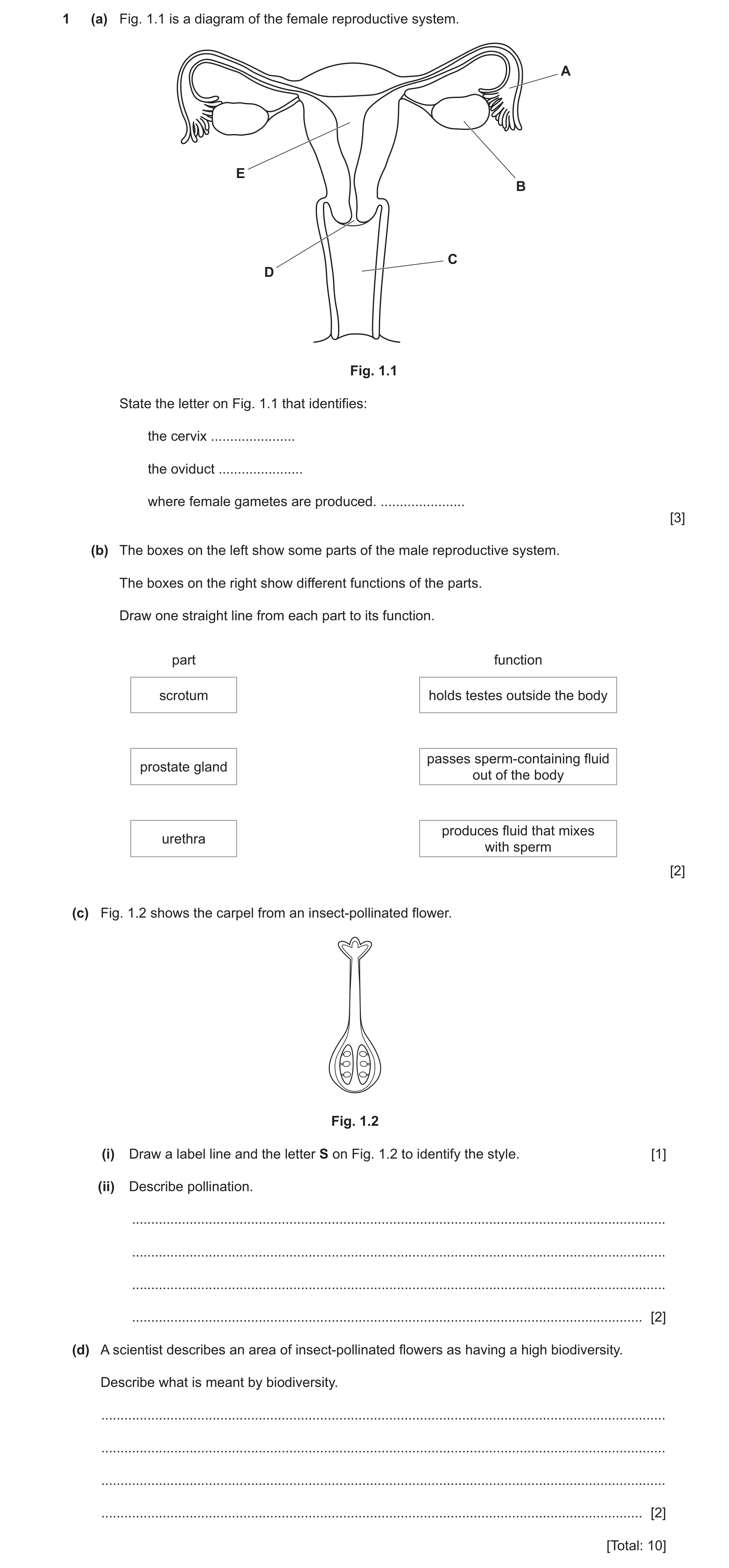
1 (a) Fig. 1.1 is a diagram of the female reproductive system. A E B C D Fig. 1.1 State the letter on Fig. 1.1 that identifies: the cervix … the oviduct … where female gametes are produced. … [3] (b) The boxes on the left show some parts of the male reproductive system. The boxes on the right show different functions of the parts. Draw one straight line from each part to its function. part function scrotum holds testes outside the body passes sperm-containing fluid prostate gland out of the body produces fluid that mixes urethra with sperm [2] (c) Fig. 1.2 shows the carpel from an insect-pollinated flower. Fig. 1.2 (i) Draw a label line and the letter S on Fig. 1.2 to identify the style. [1] (ii) Describe pollination. … … … … [2] (d) A scientist describes an area of insect-pollinated flowers as having a high biodiversity. Describe what is meant by biodiversity. … … … … [2] [Total: 10]
10 marks
Mark scheme: Question Answer Marks 1(a) D ; 3 A ; B ; 1(b) 2 part function scrotum holds testes outside the body prostate gland passes sperm-containing fluid out of the body urethra produces fluid that mixes with sperm ;; all three correct = 2 marks one or two correct = 1 mark 1(c)(i) label line touching style labelled S ; 1 1(c)(ii) transfer of pollen ; 2 from anther to stigma ; 1(d) number of different species ; 2 living in, an area/habitat ;
This question in 0653/33 May/June 2025
 4 / 48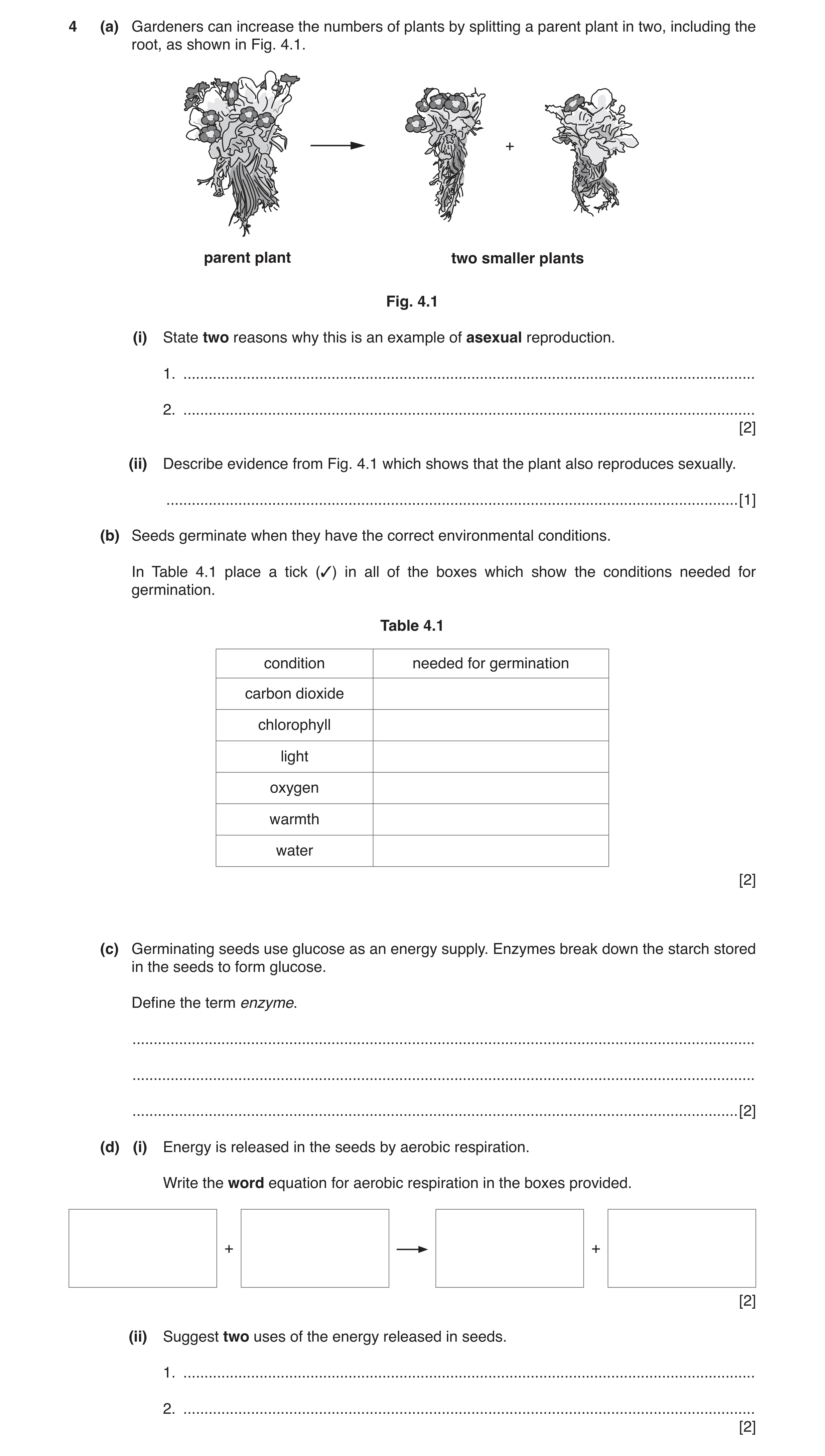
 7
7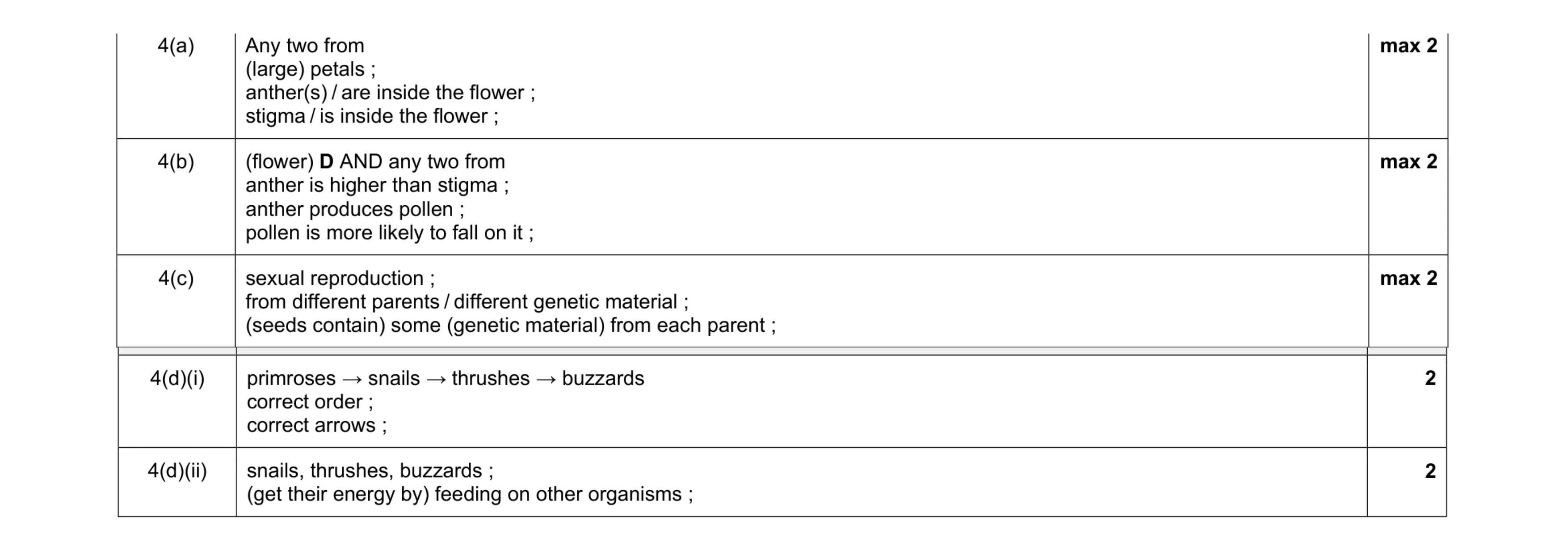 10
10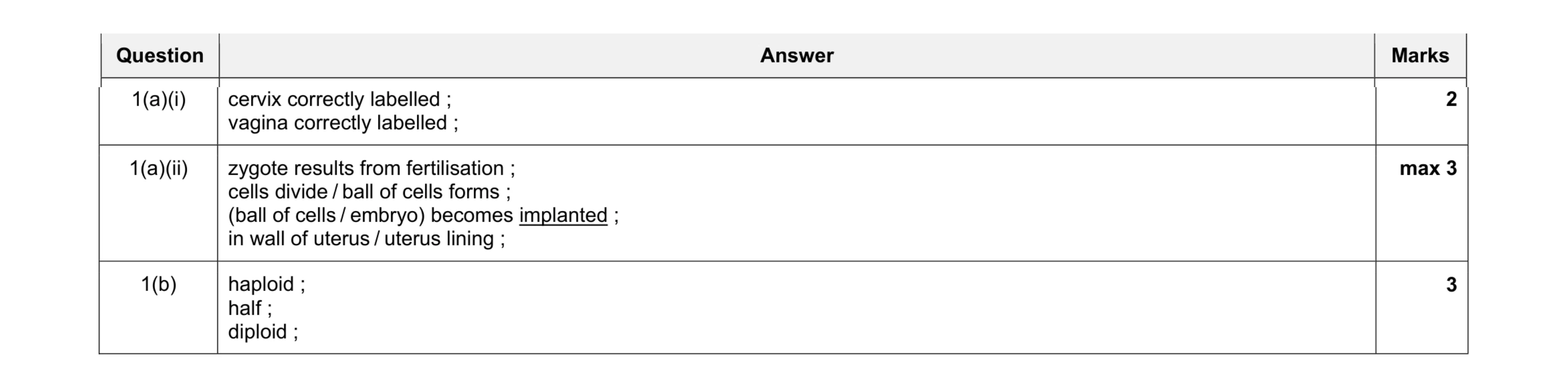 8
8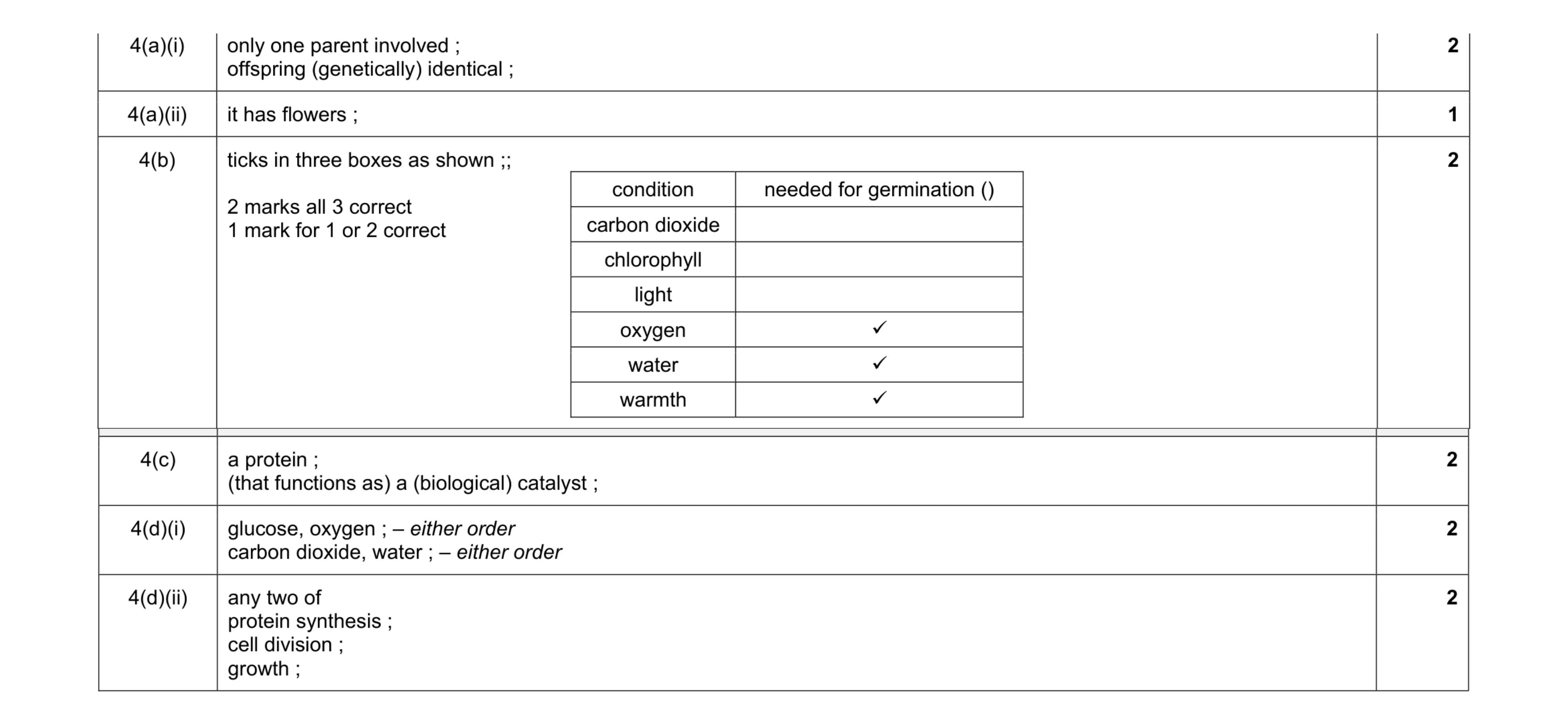 11
11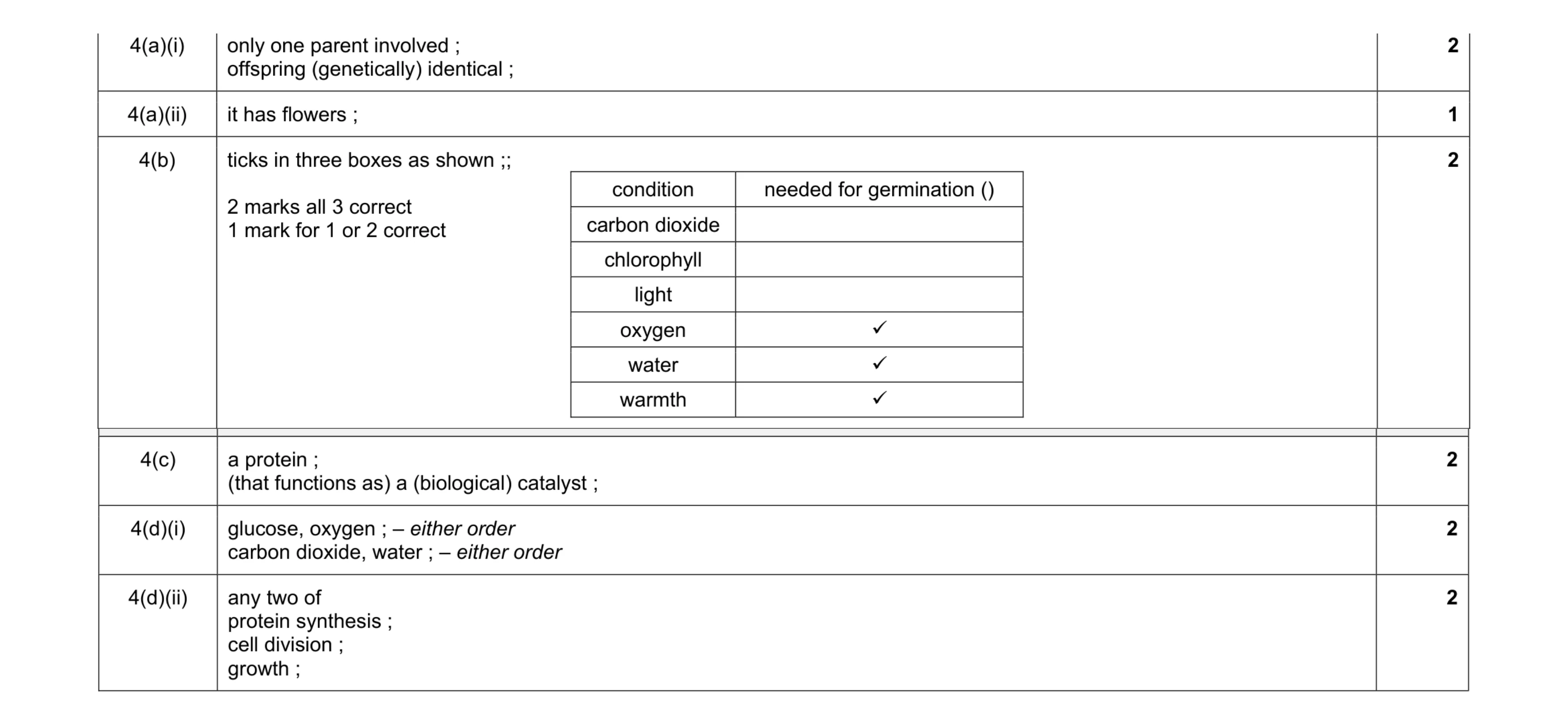 11
11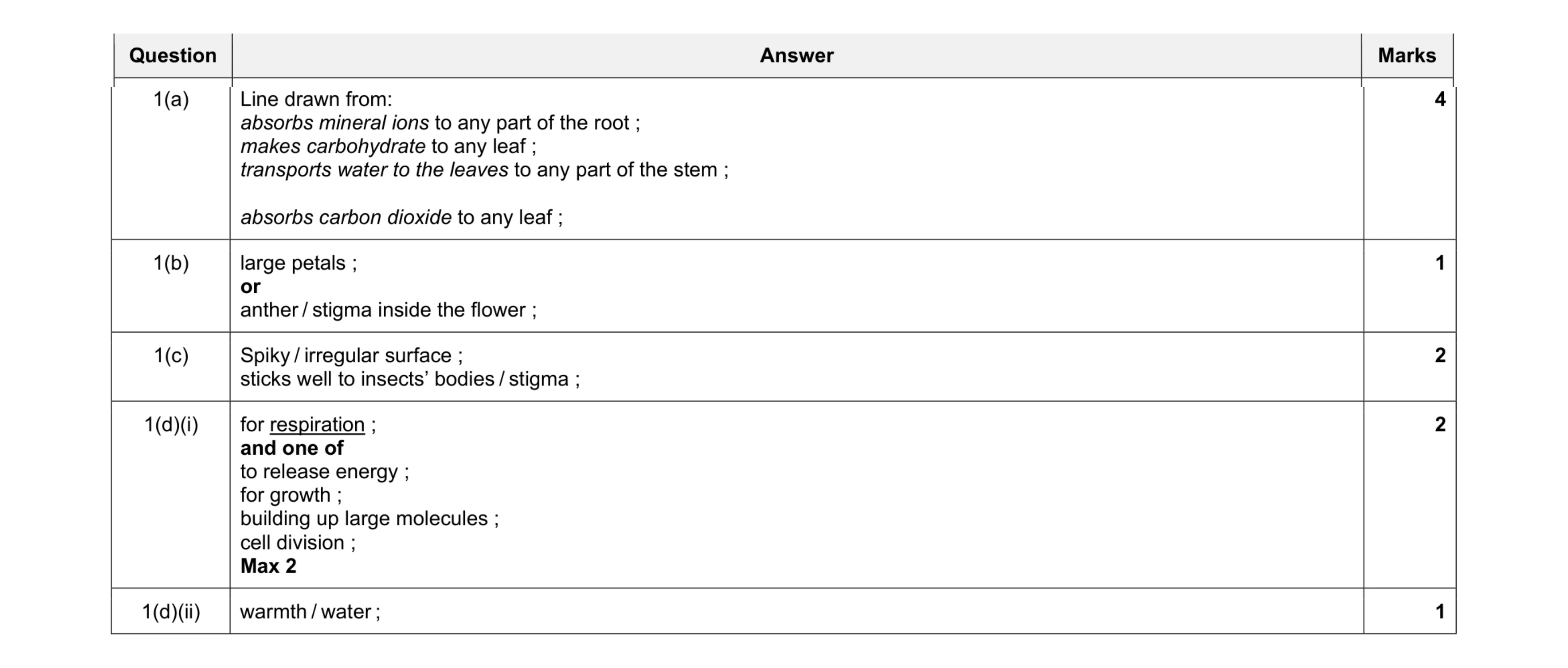 10
10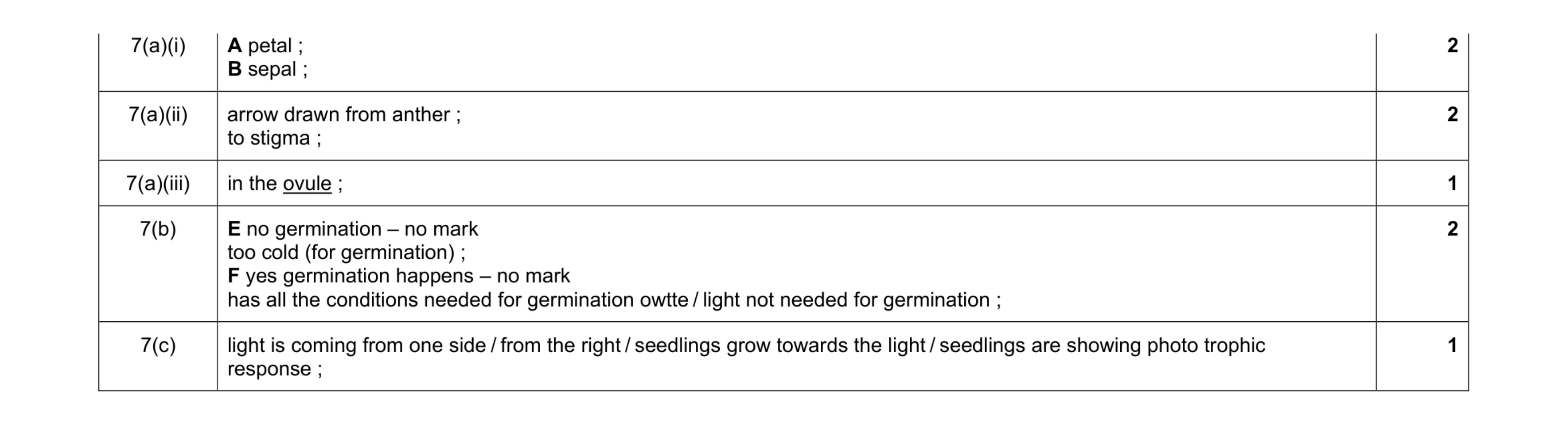 8
8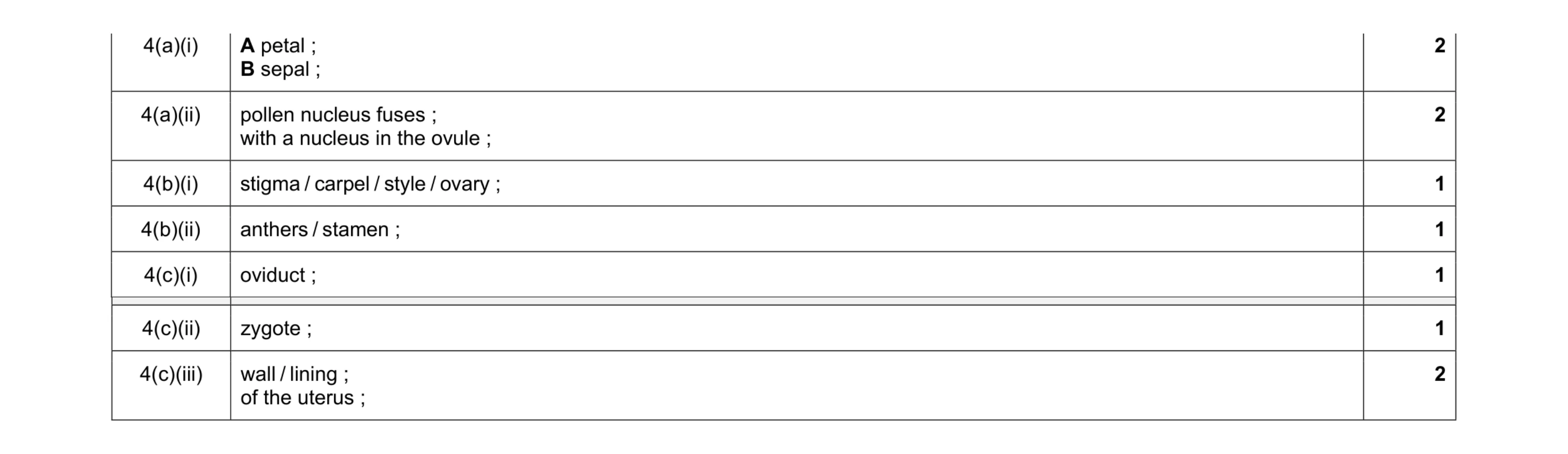 10
10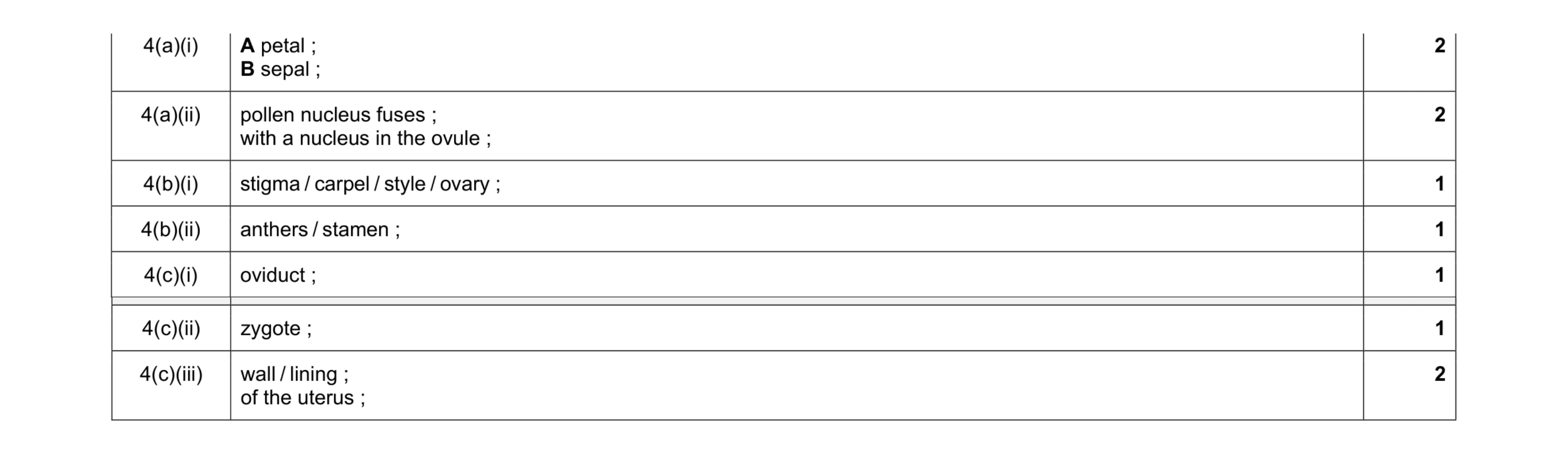 10
10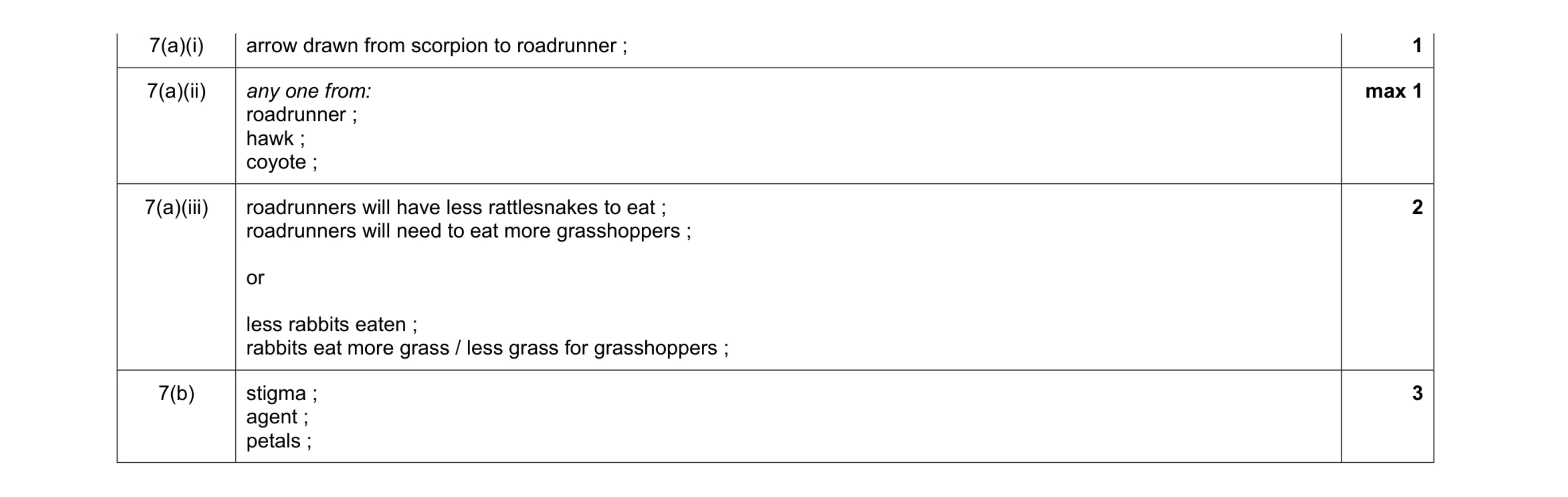 7
7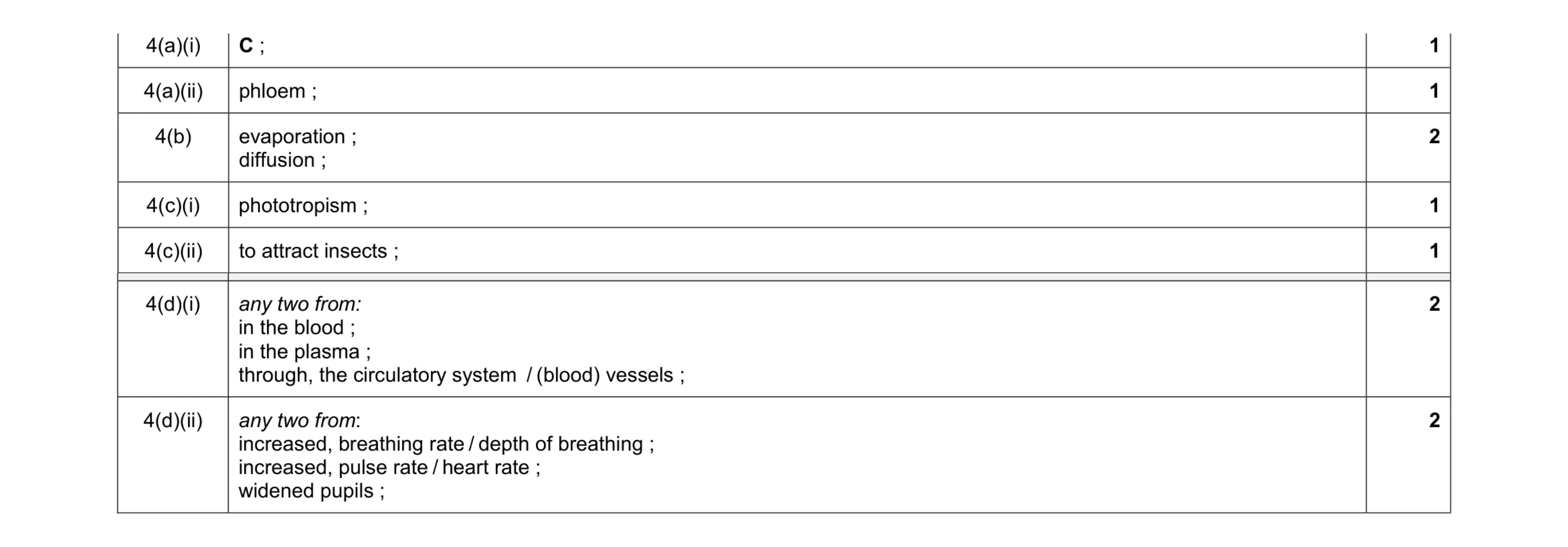 10
10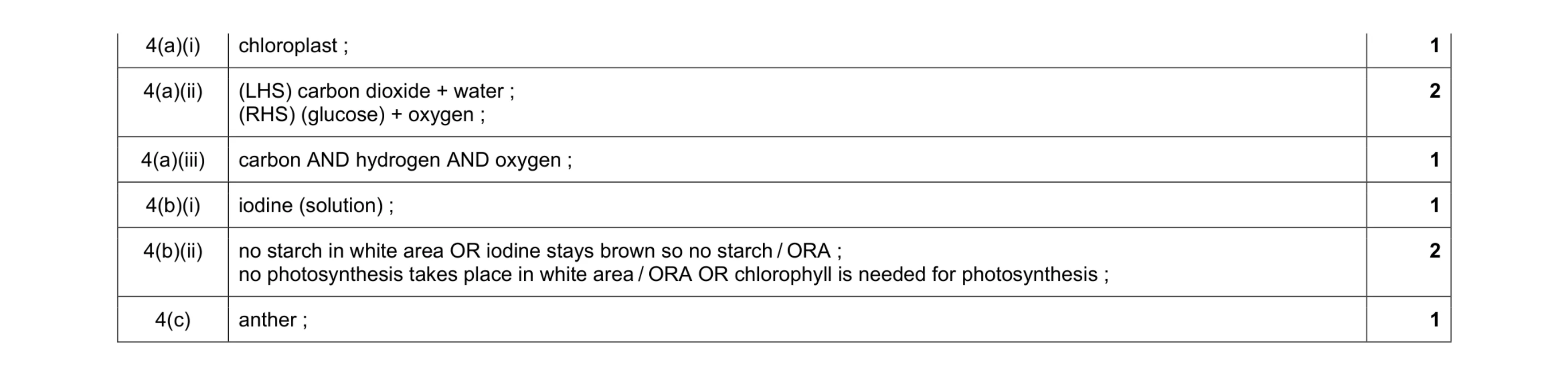 8
8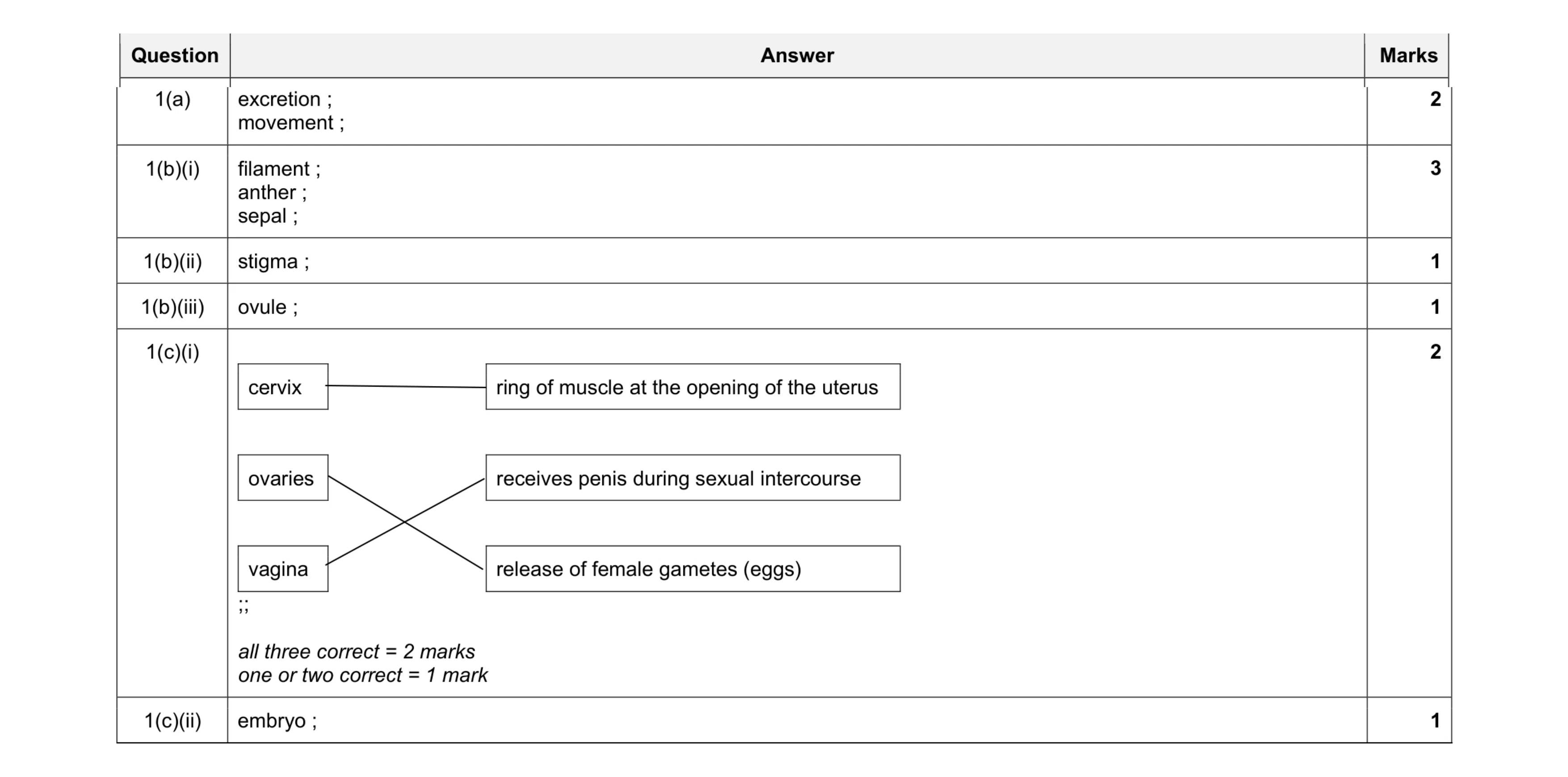 10
10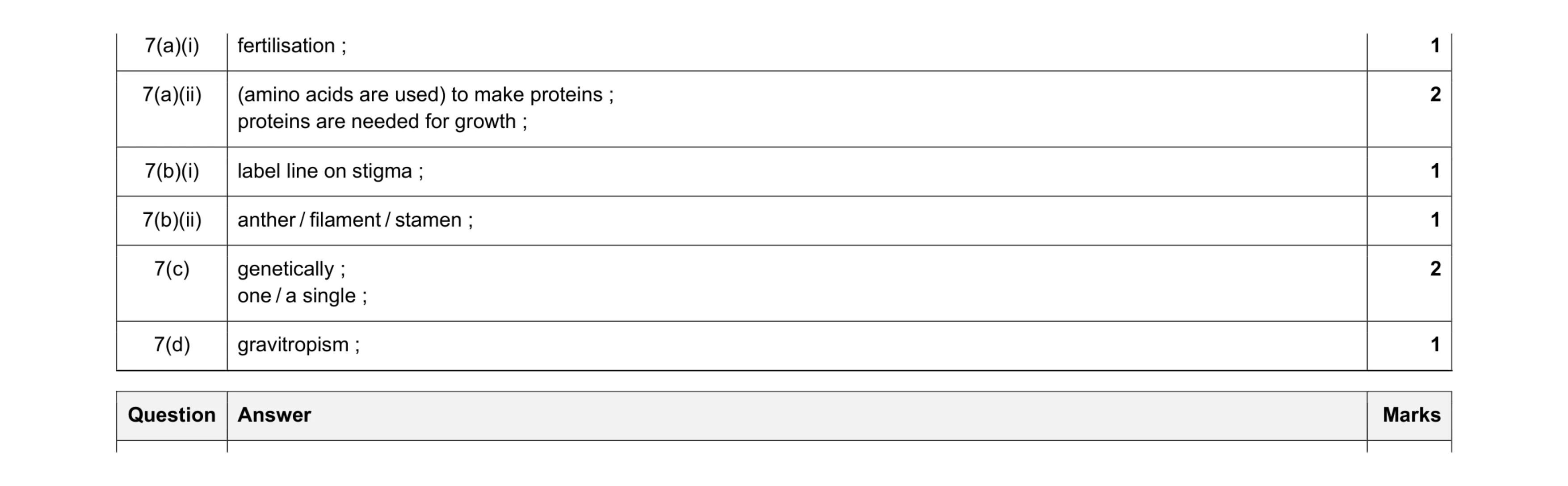 8
8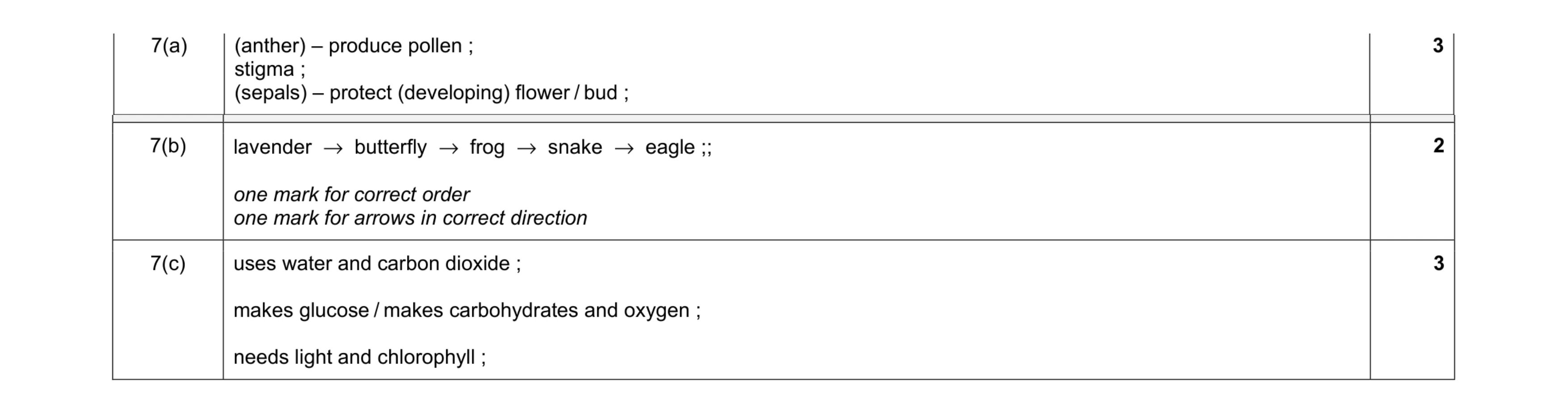 8
8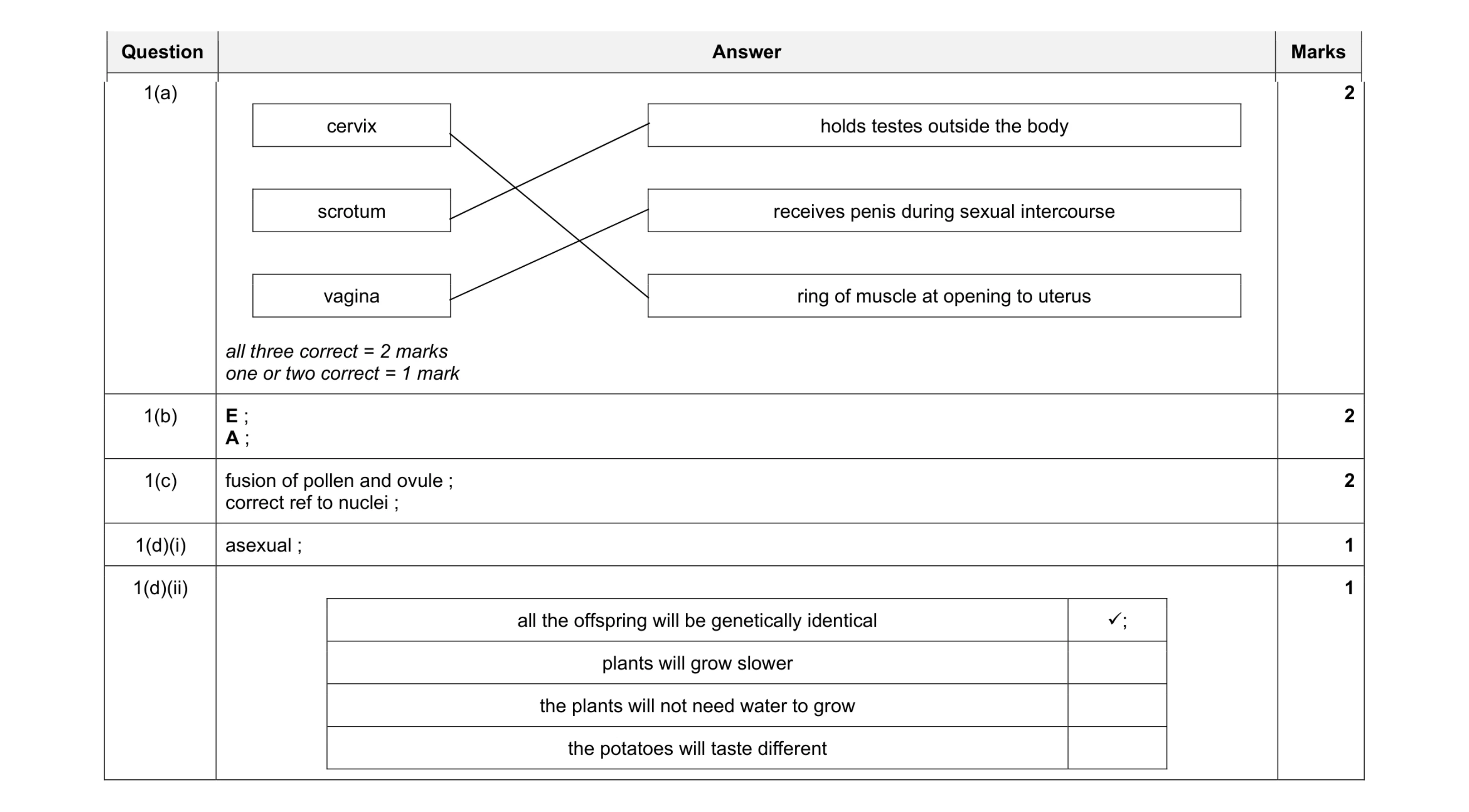 8
8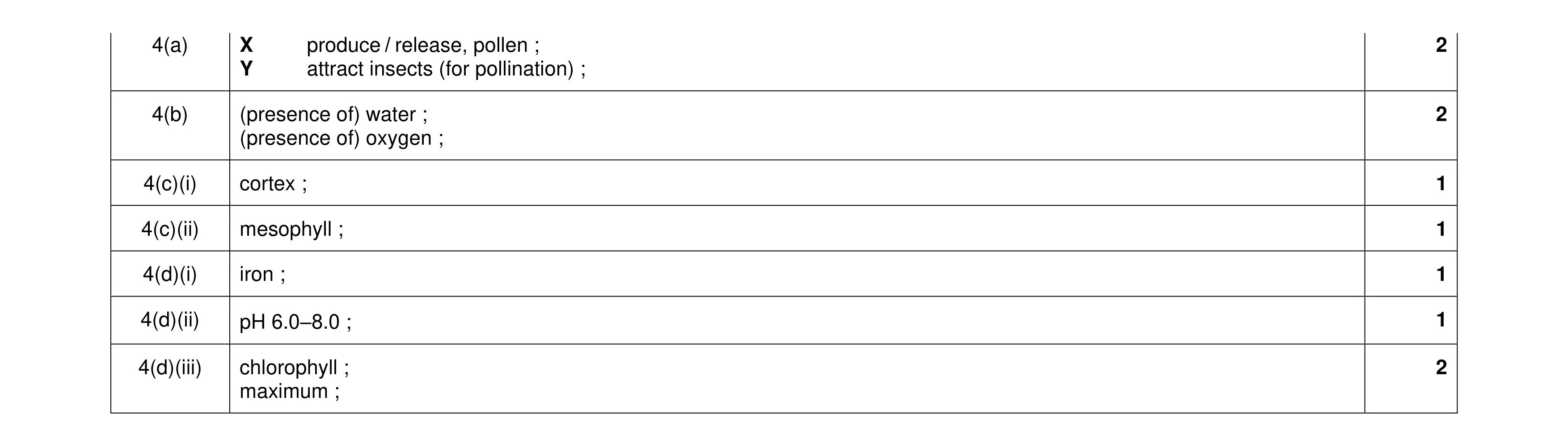 10
10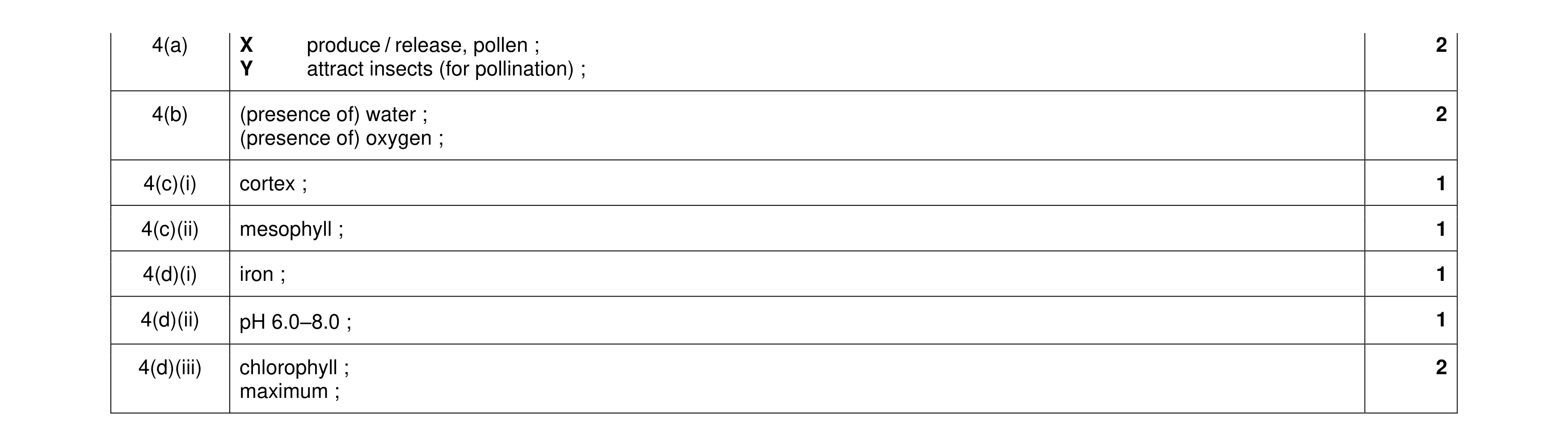 10
10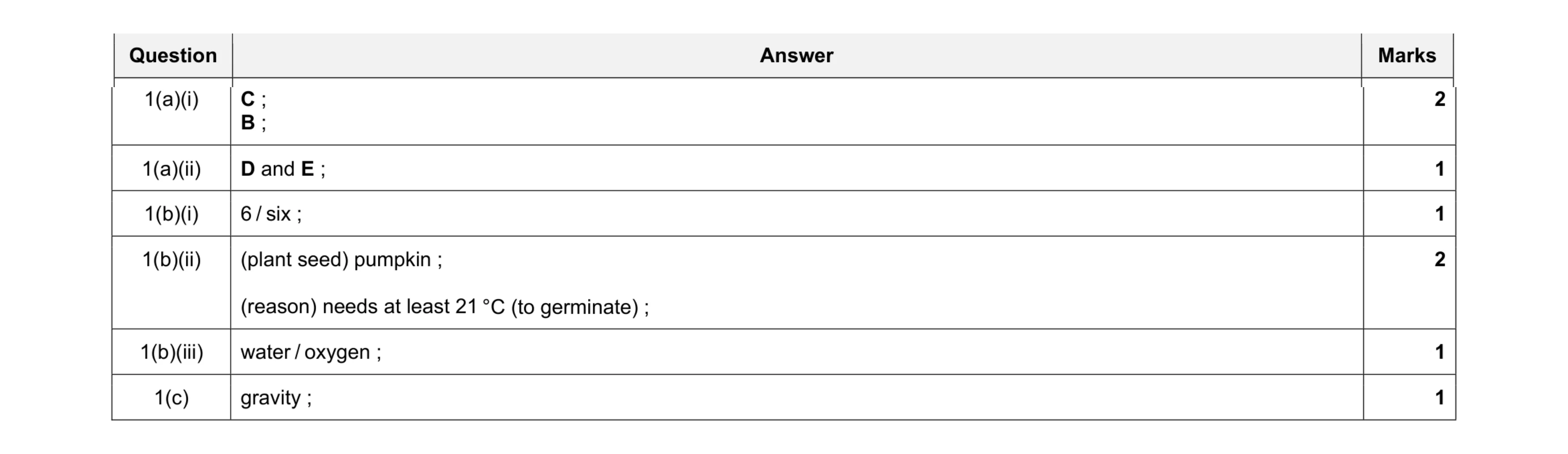 8
8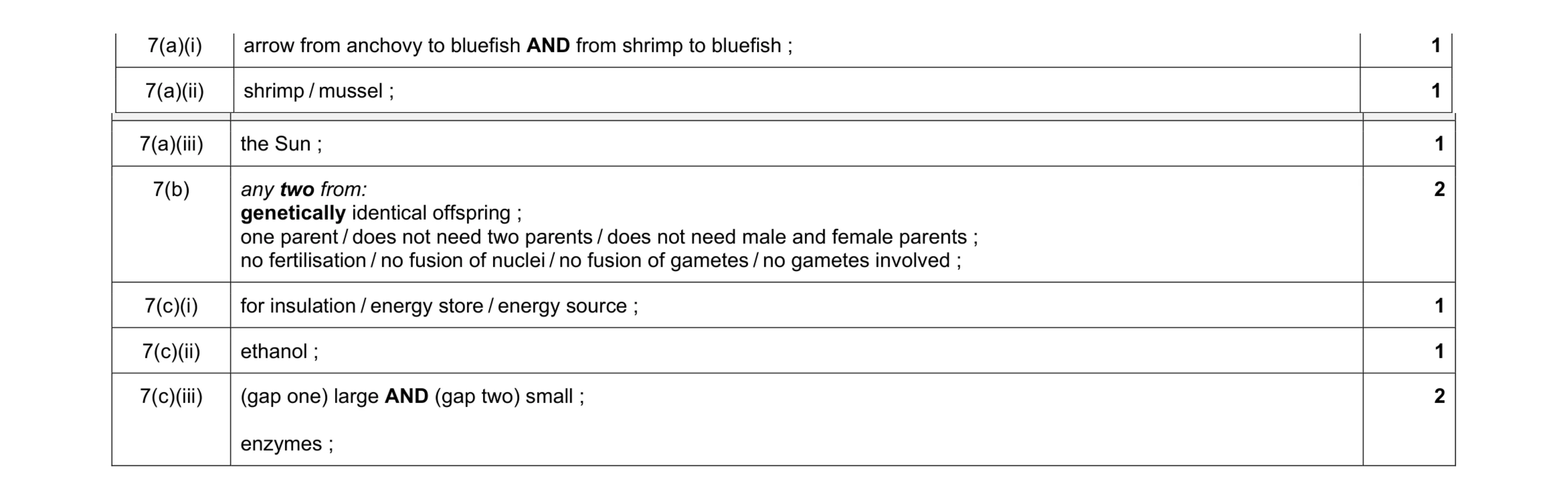 9
9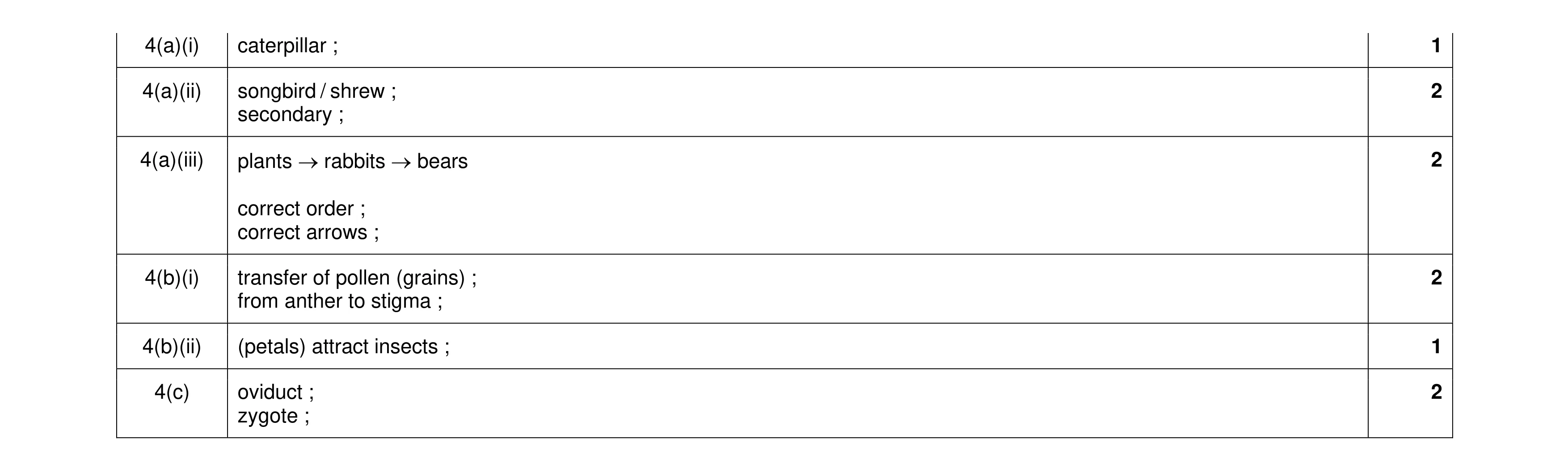 10
10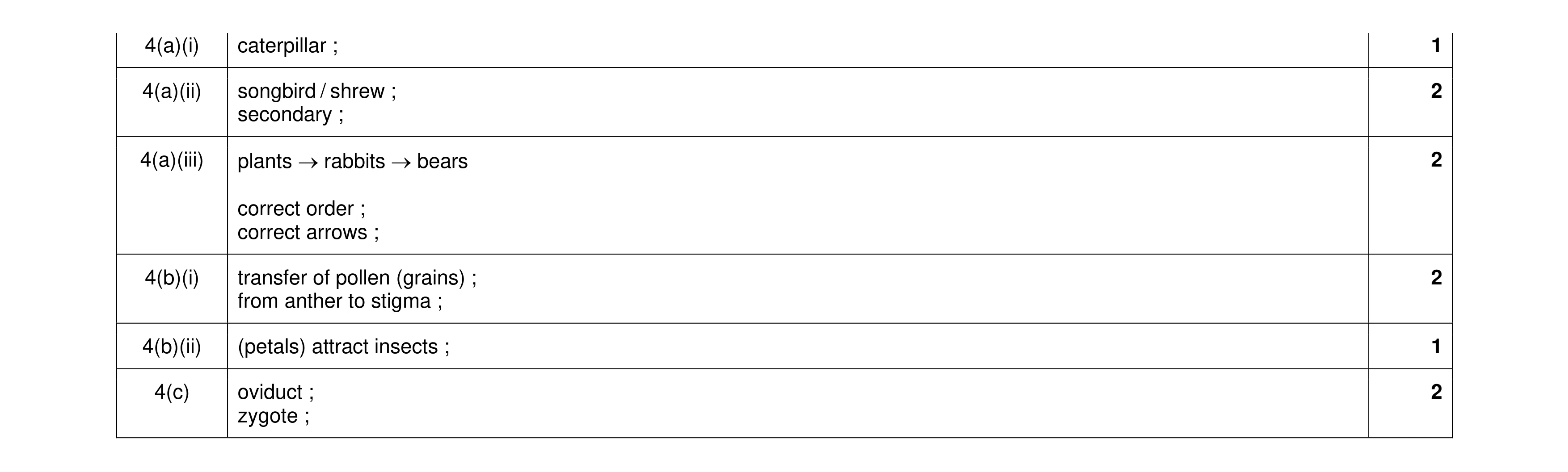 10
10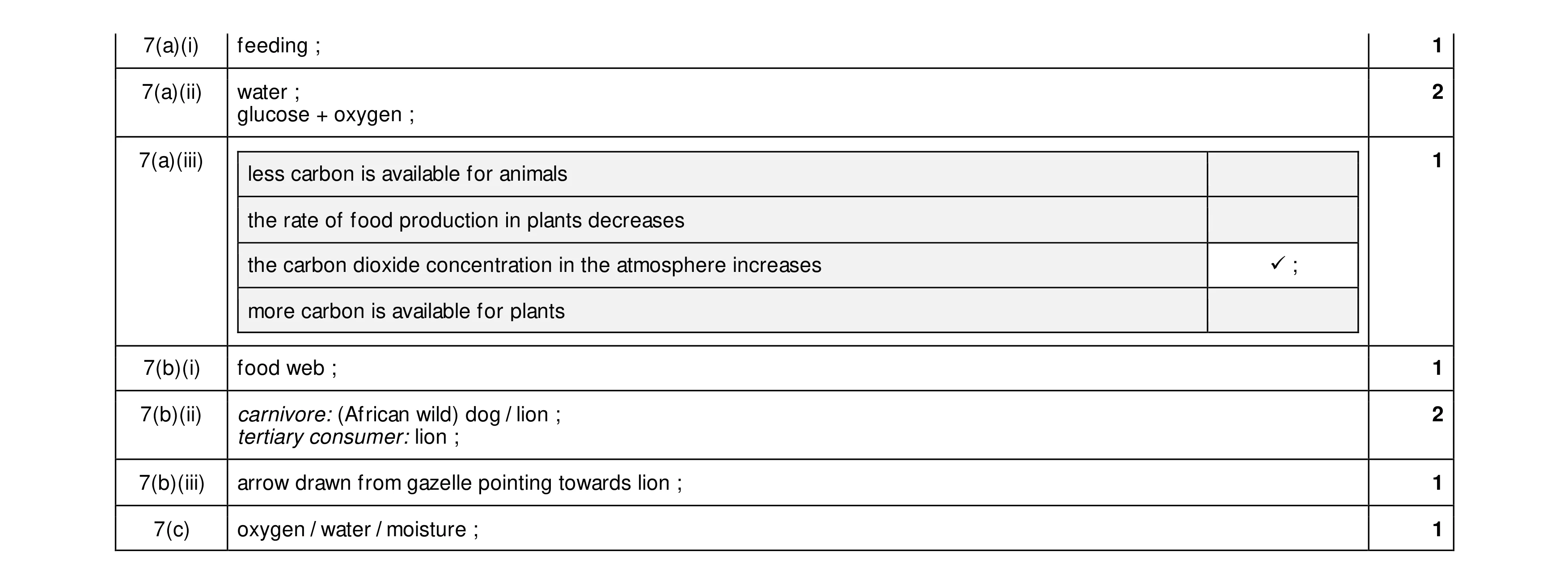 9
9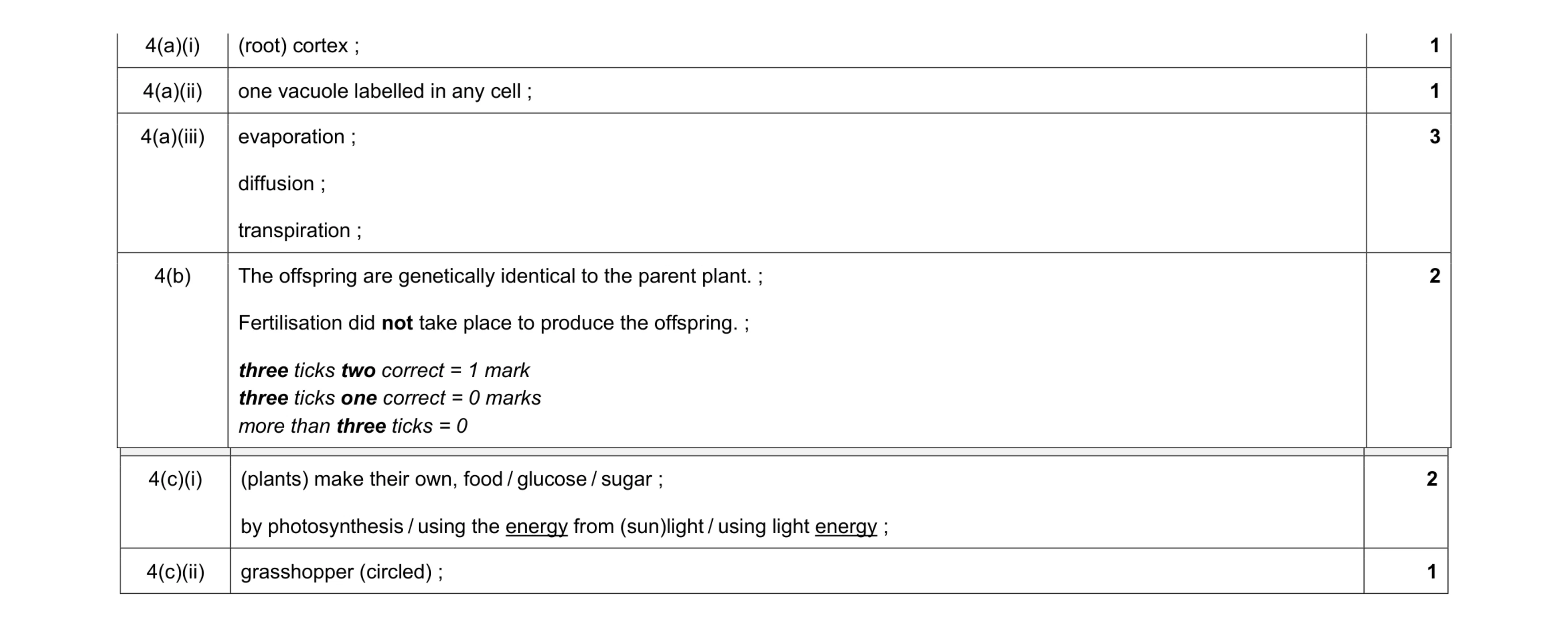 10
10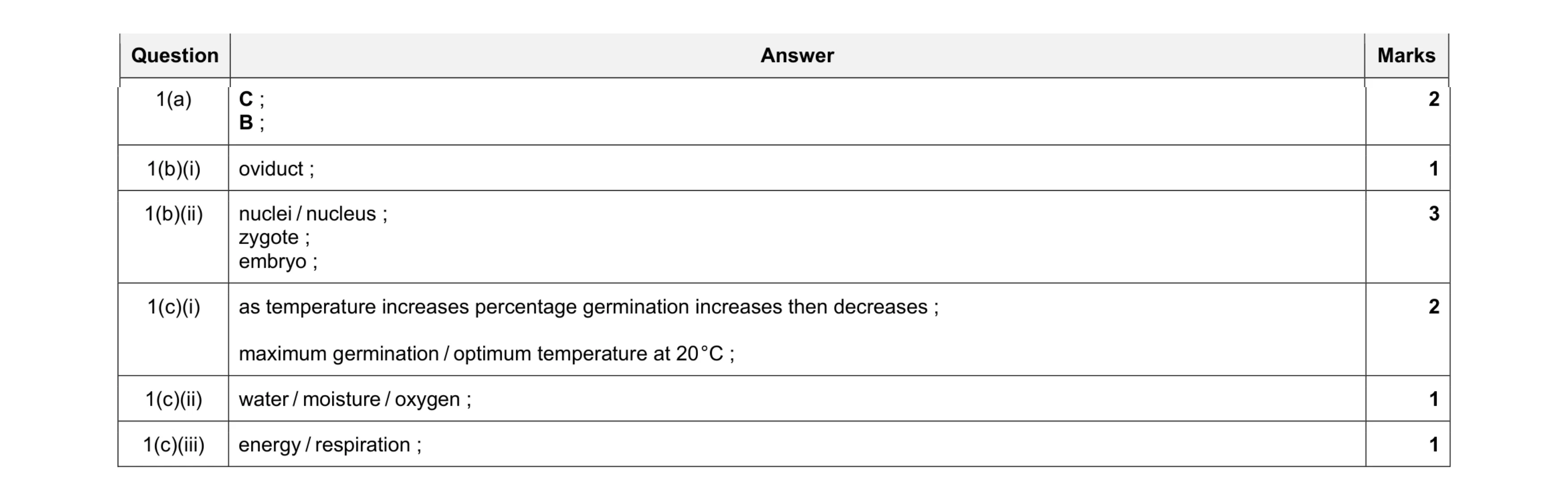 10
10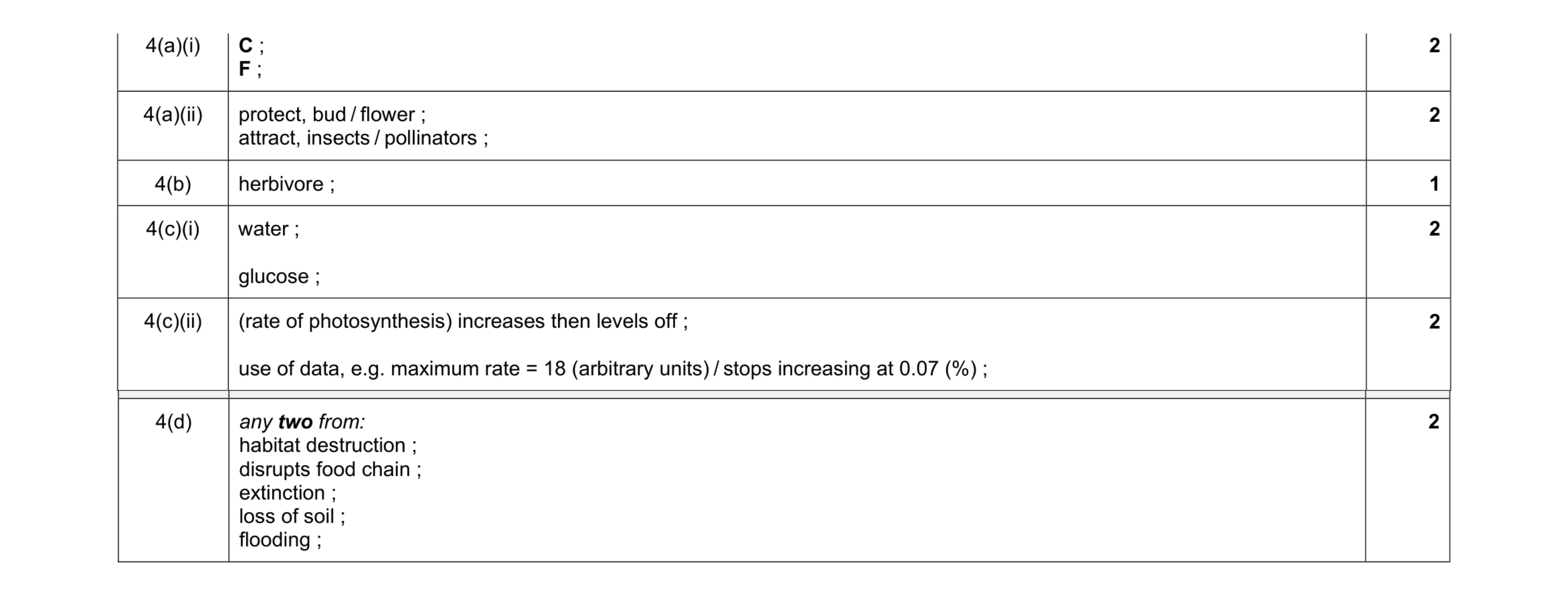 11
11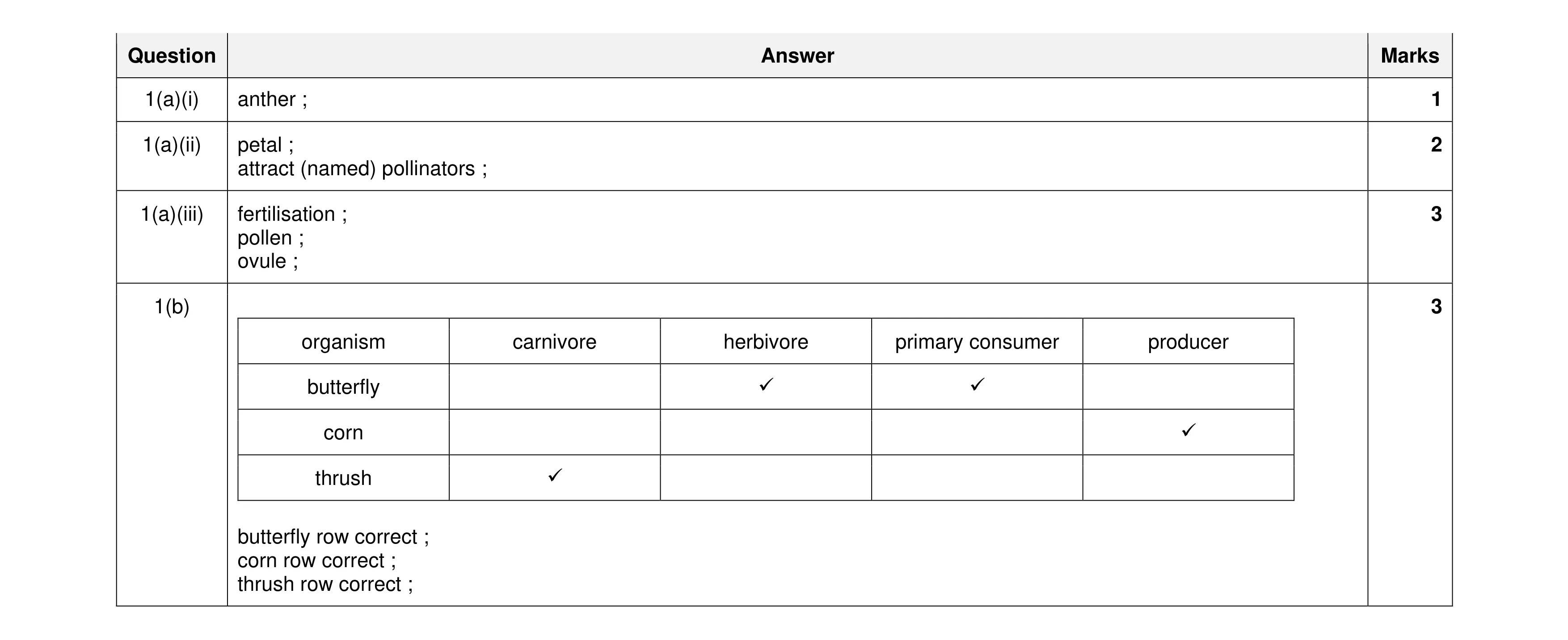 9
9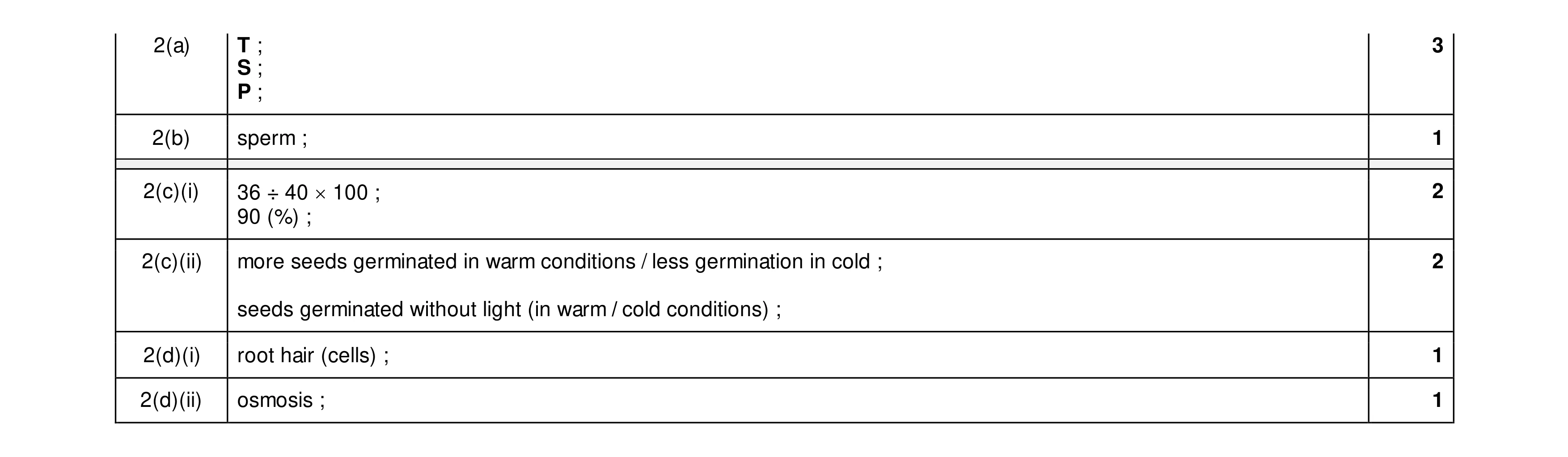 10
10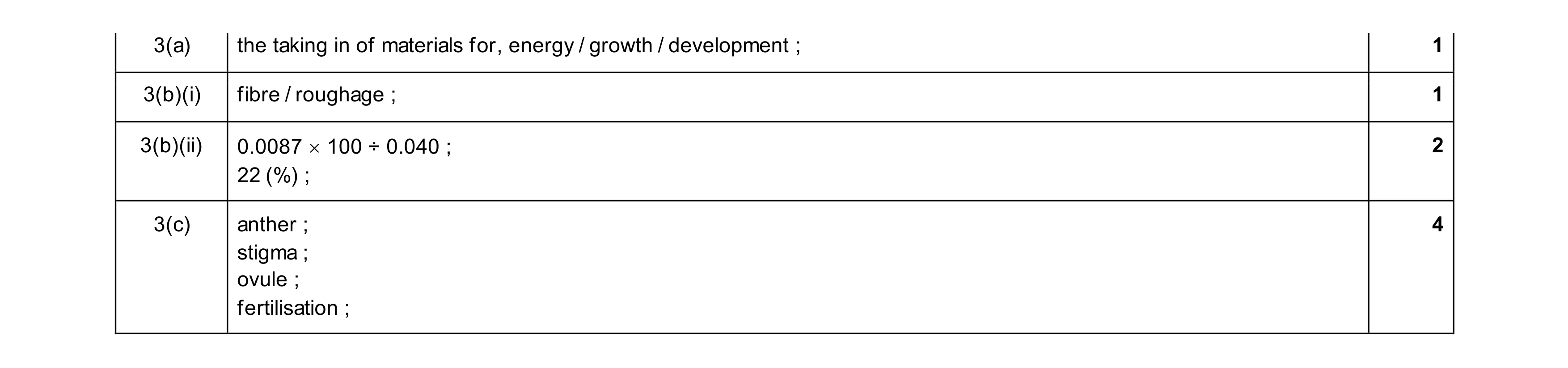 8
8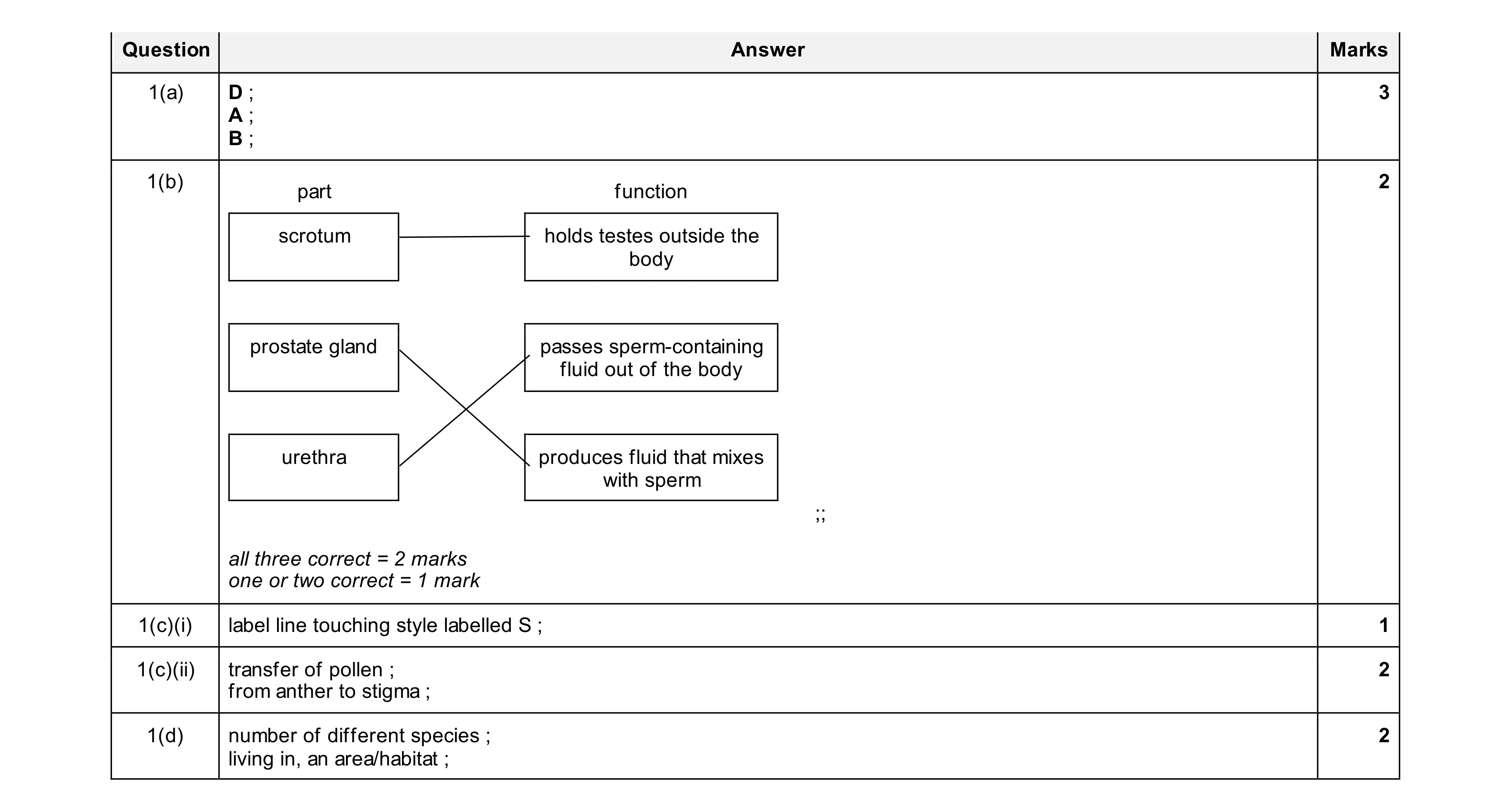 10
10