Questions as text
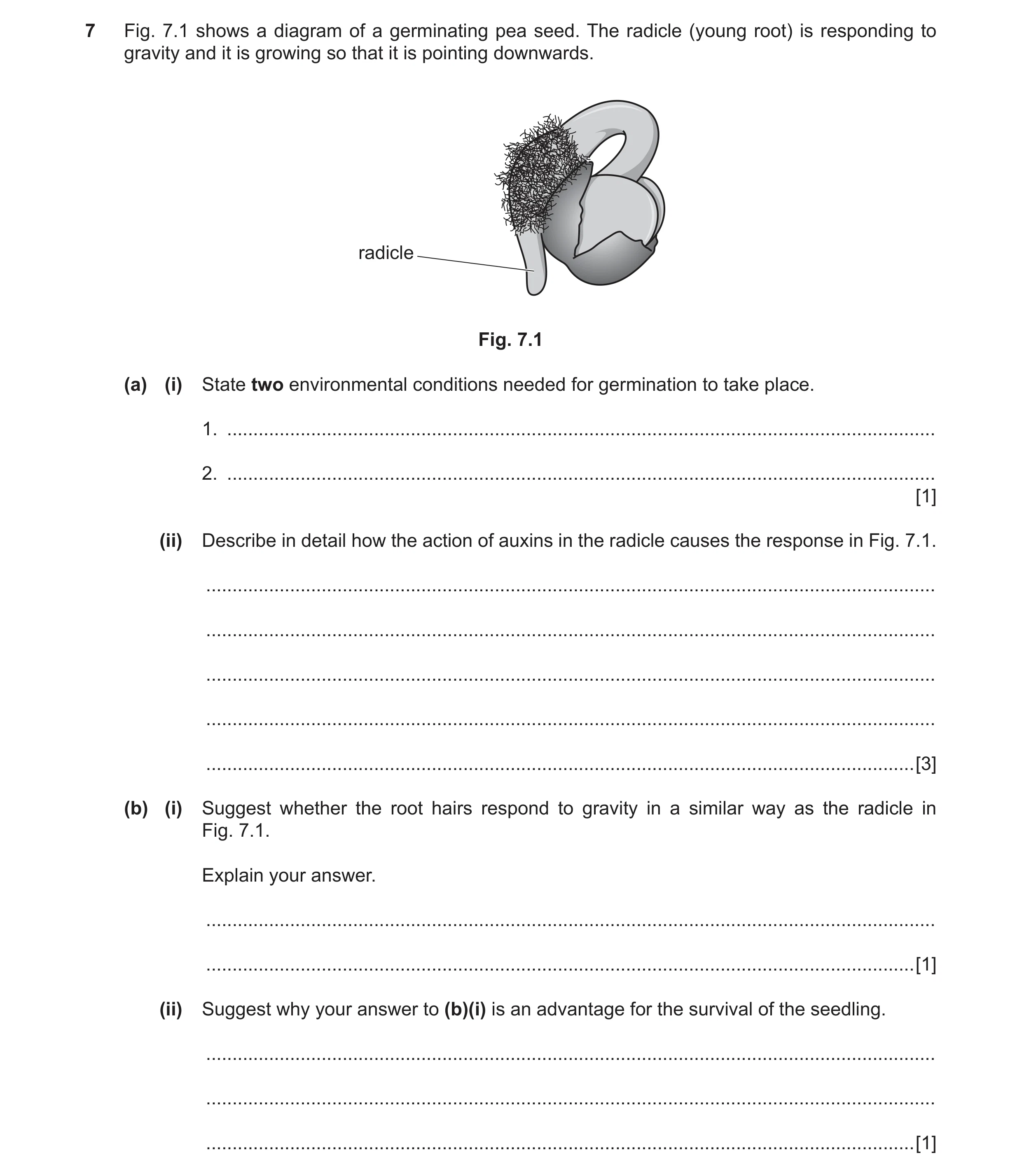
Q1 · A diagram of a germinating pea seed 0653/42 Feb/March 2017
7 Fig. 7.1 shows a diagram of a germinating pea seed. The radicle (young root) is responding to gravity and it is growing so that it is pointing downwards. radicle Fig. 7.1 (a) (i) State two environmental conditions needed for germination to take place. 1. … 2. … [1] (ii) Describe in detail how the action of auxins in the radicle causes the response in Fig. 7.1. … … … … … [3] (b) (i) Suggest whether the root hairs respond to gravity in a similar way as the radicle in Fig. 7.1. Explain your answer. … … [1] (ii) Suggest why your answer to (b)(i) is an advantage for the survival of the seedling. … … … [1]
6 marks
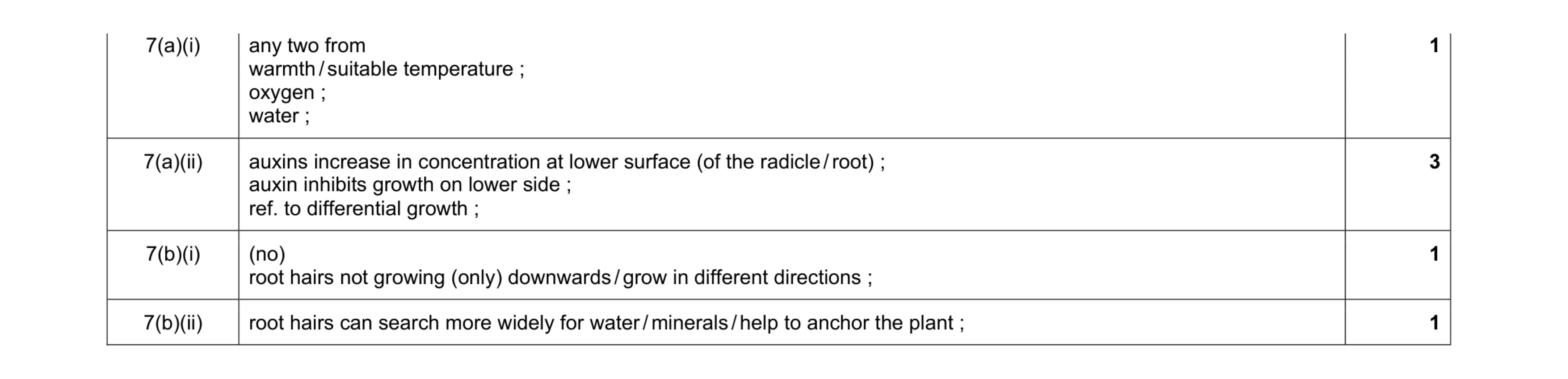
Mark scheme: 7(a)(i) any two from warmth / suitable temperature ; oxygen ; water ; 1 7(a)(ii) auxins increase in concentration at lower surface (of the radicle / root) ; auxin inhibits growth on lower side ; ref. to differential growth ; 3 7(b)(i) (no) root hairs not growing (only) downwards / grow in different directions ; 1 7(b)(ii) root hairs can search more widely for water / minerals / help to anchor the plant ; 1
This question in 0653/42 Feb/March 2017
Q2 · Use lines to connect the box on the left to different boxes on the right to make correct… 0653/41 May/June 2017
1 (a) Use lines to connect the box on the left to different boxes on the right to make correct sentences. One is done for you. The sentence reads ‘Flowering plants need oxygen for germination of seeds’. Draw three more lines to make three more correct sentences. produce haploid pollen. need oxygen for germination of seeds. lose water from leaves by perspiration. Flowering plants transport sugar through the xylem. use auxins to respond to light. need oxygen for photosynthesis. have root hair cells which increase water uptake. [3] (b) Fig. 1.1 is a diagram of a wind-pollinated flower. anther stigma Fig. 1.1 (i) Describe how the following structures make the flower in Fig. 1.1 suitable for wind-pollination. the anthers … … … the stigmas … … … [2] (ii) Suggest one reason why wind-pollinated crops are grown close together by farmers. … … [1] (c) The growth of crops can be reduced by acid rain. (i) Describe how burning fossil fuels can lead to acid rain. … … … … [2] (ii) Suggest how acid rain reduces the rate of growth of crops. … … [1]
9 marks
Mark scheme: 1(a) lines drawn from Flowering plants to produce haploid pollen ; use auxins to respond to light ; have root hair cells which increase water uptake ; 3 1(b)(i) (anthers) hang outside the flower so pollen is easily picked up by wind ; (stigmas) feathery / large surface area to collect pollen ; 2 1(b)(ii) to increase the chances of pollination between plants ; 1 1(c)(i) the idea that fossil fuels contain sulfur / sulfur compounds ; sulfur dioxide produced ; dissolves in water in the air ; Max 2 1(c)(ii) reduces activity / denatures enzymes present in the plants ; 1
This question in 0653/41 May/June 2017
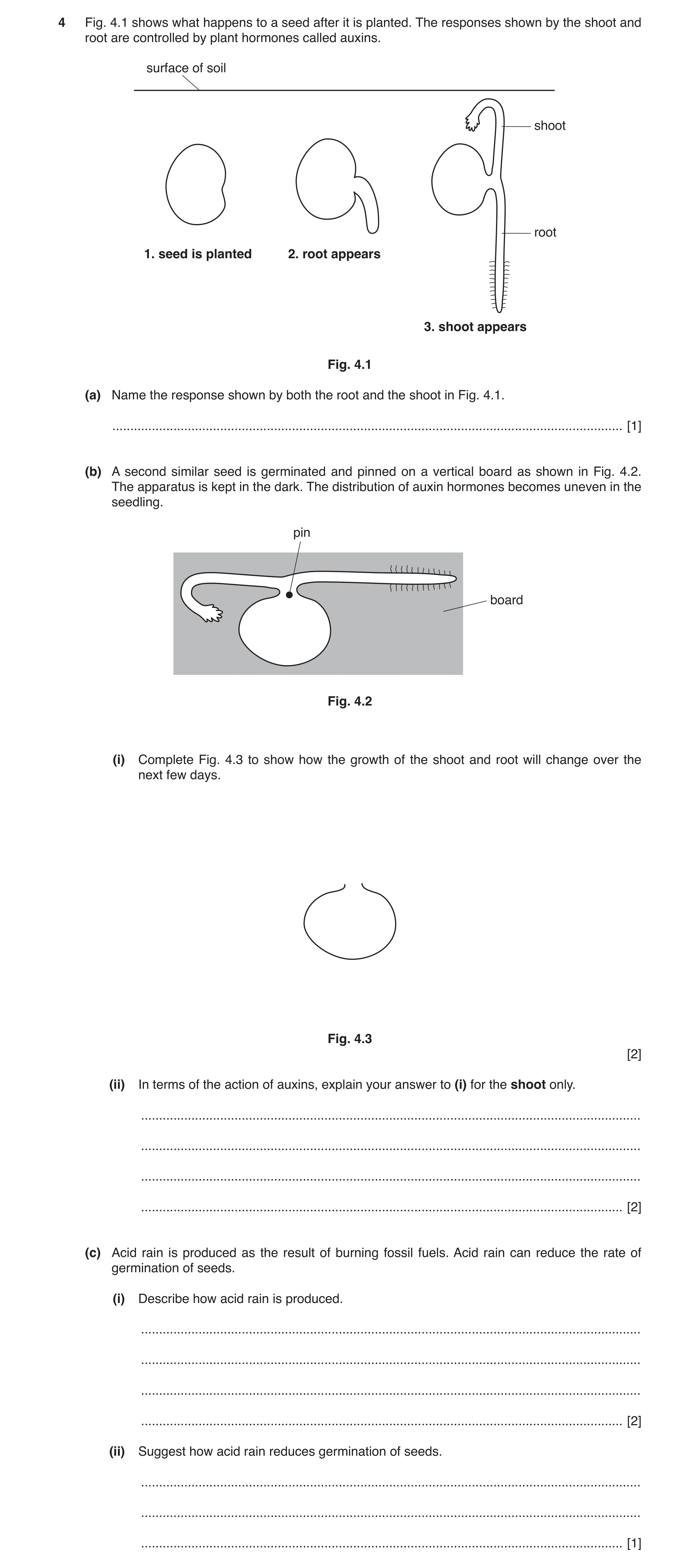
Q3 · What happens to a seed after it is planted 0653/43 May/June 2017
4 Fig. 4.1 shows what happens to a seed after it is planted. The responses shown by the shoot and root are controlled by plant hormones called auxins. surface of soil shoot root 1. seed is planted 2. root appears 3. shoot appears Fig. 4.1 (a) Name the response shown by both the root and the shoot in Fig. 4.1. … [1] (b) A second similar seed is germinated and pinned on a vertical board as shown in Fig. 4.2. The apparatus is kept in the dark. The distribution of auxin hormones becomes uneven in the seedling. pin board Fig. 4.2 (i) Complete Fig. 4.3 to show how the growth of the shoot and root will change over the next few days. Fig. 4.3 [2] (ii) In terms of the action of auxins, explain your answer to (i) for the shoot only. … … … … [2] (c) Acid rain is produced as the result of burning fossil fuels. Acid rain can reduce the rate of germination of seeds. (i) Describe how acid rain is produced. … … … … [2] (ii) Suggest how acid rain reduces germination of seeds. … … … [1]
8 marks
Mark scheme: 4(a) geotropism / gravitropism ; 1 4(b)(i) drawing with shoot bending upwards ; root bending downwards ; 2 4(b)(ii) auxins become more concentrated on lower surface ; cause more growth / cell elongation ; 2 4(c)(i) sulfur dioxide ; dissolves in rain water ; 2 4(c)(ii) denatures the enzymes / makes the enzymes less active ; 1
This question in 0653/43 May/June 2017
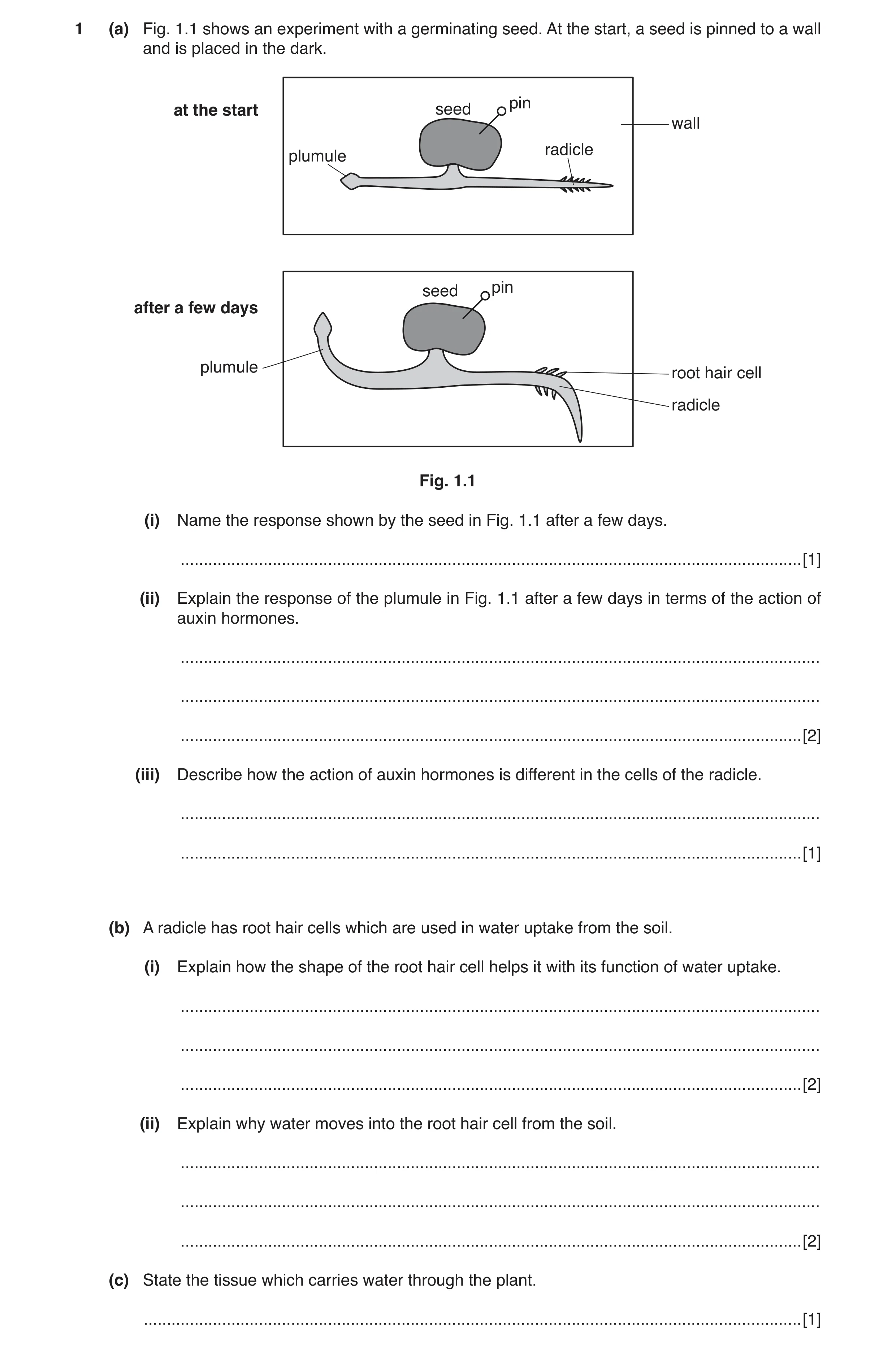
Q4 · An experiment with a germinating seed 0653/42 May/June 2018
1 (a) Fig. 1.1 shows an experiment with a germinating seed. At the start, a seed is pinned to a wall and is placed in the dark. pin at the start seed wall radicle plumule seed pin after a few days plumule root hair cell radicle Fig. 1.1 (i) Name the response shown by the seed in Fig. 1.1 after a few days. … [1] (ii) Explain the response of the plumule in Fig. 1.1 after a few days in terms of the action of auxin hormones. … … … [2] (iii) Describe how the action of auxin hormones is different in the cells of the radicle. … … [1] (b) A radicle has root hair cells which are used in water uptake from the soil. (i) Explain how the shape of the root hair cell helps it with its function of water uptake. … … … [2] (ii) Explain why water moves into the root hair cell from the soil. … … … [2] (c) State the tissue which carries water through the plant. … [1]
9 marks
Mark scheme: 1(a)(i) geotropism ; 1 1(a)(ii) auxin moves to lower surface ; causes more elongation / growth ; 2 1(a)(iii) causes retardation of elongation / growth (on lower surface) ; 1 1(b)(i) has large projection / is long / large surface area ; the idea of increased rate of water uptake / of diffusion ; 2 1(b)(ii) higher concentration of water / water potential in soil / ora / there is a concentration gradient between the soil water and the cell water ; water moves from high to low concentration (of water) / down the concentration gradient ; 2 1(c) xylem ; 1
This question in 0653/42 May/June 2018
Question 5 0653/43 May/June 2018
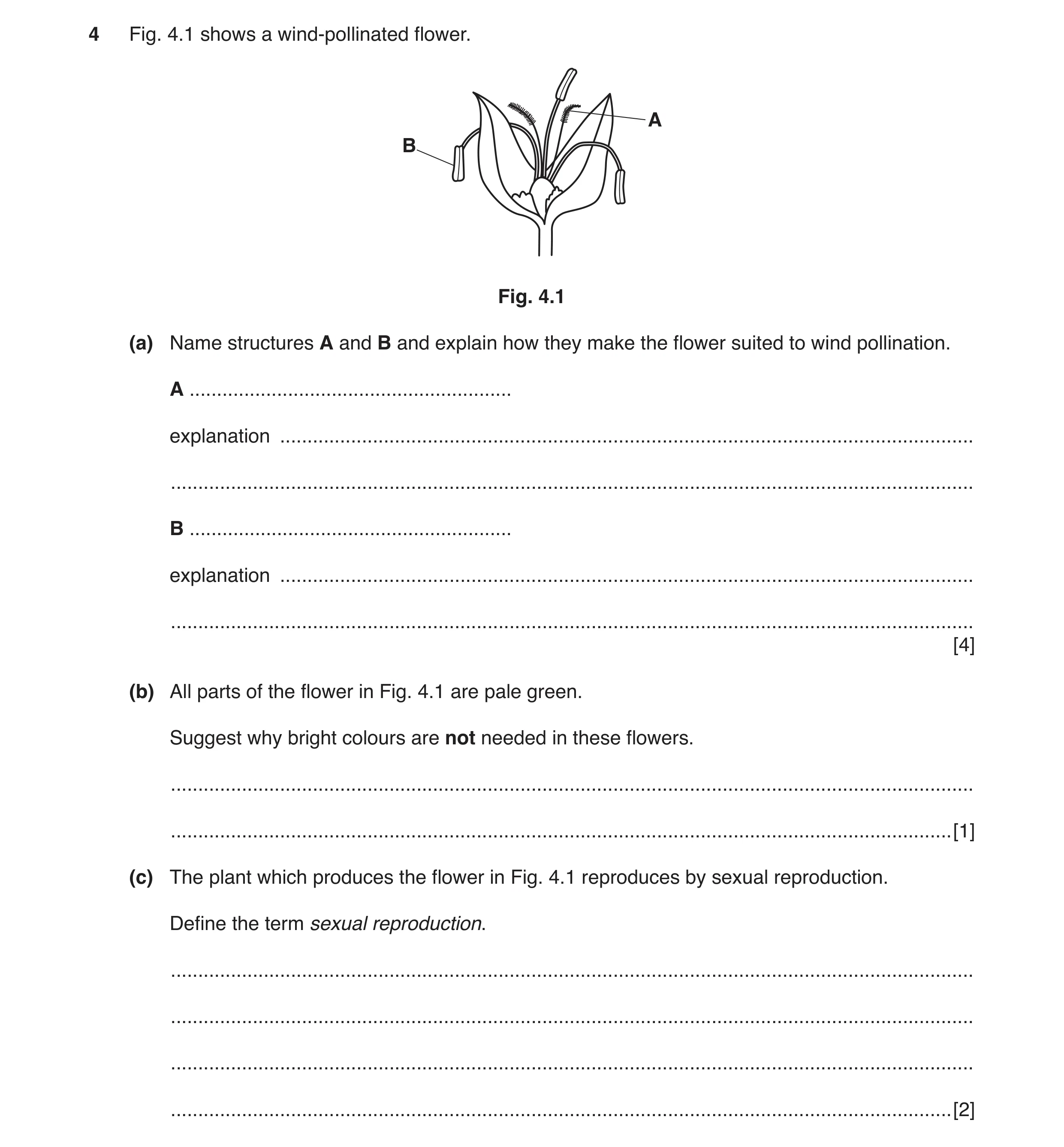
4 Fig. 4.1 shows a wind-pollinated flower. A B Fig. 4.1 (a) Name structures A and B and explain how they make the flower suited to wind pollination. A … explanation … … B … explanation … … [4] (b) All parts of the flower in Fig. 4.1 are pale green. Suggest why bright colours are not needed in these flowers. … … [1] (c) The plant which produces the flower in Fig. 4.1 reproduces by sexual reproduction. Define the term sexual reproduction. … … … … [2]
7 marks
Mark scheme: 4(a) A stigma ; feathery structure / large area to trap pollen ; B anther ; hangs outside the flower to (allow the wind) disperse pollen ; 4 4(b) no need to attract insects ; 1 4(c) haploid nuclei fuse / join ; to form a diploid zygote ; genetically dissimilar offspring ; max 2
This question in 0653/43 May/June 2018
Q6 · Pollen is used by flowering plants to reproduce by sexual reproduction 0653/42 Oct/Nov 2018
3 Pollen is used by flowering plants to reproduce by sexual reproduction. (a) Pollen has a haploid nucleus. State what is meant by the terms 1. haploid, … … 2. nucleus. … … [2] (b) Table 3.1 shows some statements about flowers. Put a tick (3) next to all statements that are characteristics of wind-pollinated flowers. Table 3.1 statement tick (3) if correct small green or brown flowers produce nectar anthers inside the flower stigma outside the flower light, smooth pollen grains produce scent [3] (c) The apparatus shown in Fig. 3.1 is used to compare the transpiration rates of twigs (small branches) from two different species of trees, A and B. The twigs are of a similar size and they have the same number of leaves. not to scale twig mm 90 80 70 scale 60 marked 50 in mm capillary tubing 40 containing water 30 leaf from tree A leaf from tree B 20 meniscus 10 air Fig. 3.1 As water vapour is lost from the leaves by transpiration, water is drawn up the tube and the meniscus (the bottom of the column of water) moves upwards. Readings are taken of the position of the meniscus every minute for five minutes. Fig. 3.2 shows a graph of the results for tree A and for tree B. 60 A 50 40 B meniscus reading 30 / mm 20 10 0 0 1 2 3 4 5 time / minutes Fig. 3.2 Suggest two differences between the leaves of trees A and B that could explain the difference in the rate of transpiration. 1. … … 2. … … [2] (d) The experiment is repeated with the twig from tree B later on in the day when the humidity of the air has increased. (i) On Fig. 3.2 draw a line to show a possible graph of the results. Label this line C. [1] (ii) Explain your response to (d)(i). … … [1]
9 marks
Mark scheme: 3(a) contains half the full number of chromosomes / half the full amount of genetic material ; the controlling centre of the cell / contains genetic material ; 2 3(b) tick next to small green or brown flowers ; stigma outside the flowers ; light, smooth pollen grains ; 3 3(c) any two of A might have a larger (overall) leaf area than B ; A might have more stomata (per leaf) than B ; B might have a thicker / waxy cuticle ; Max 2 2 3(d)(i) similar line to B drawn below it with a gentler gradient ; 1 3(d)(ii) rate of transpiration is reduced when the humidity increases ; 1
This question in 0653/42 Oct/Nov 2018
Q7 · A diagram of a cell which lines the human airway 0653/43 Oct/Nov 2018
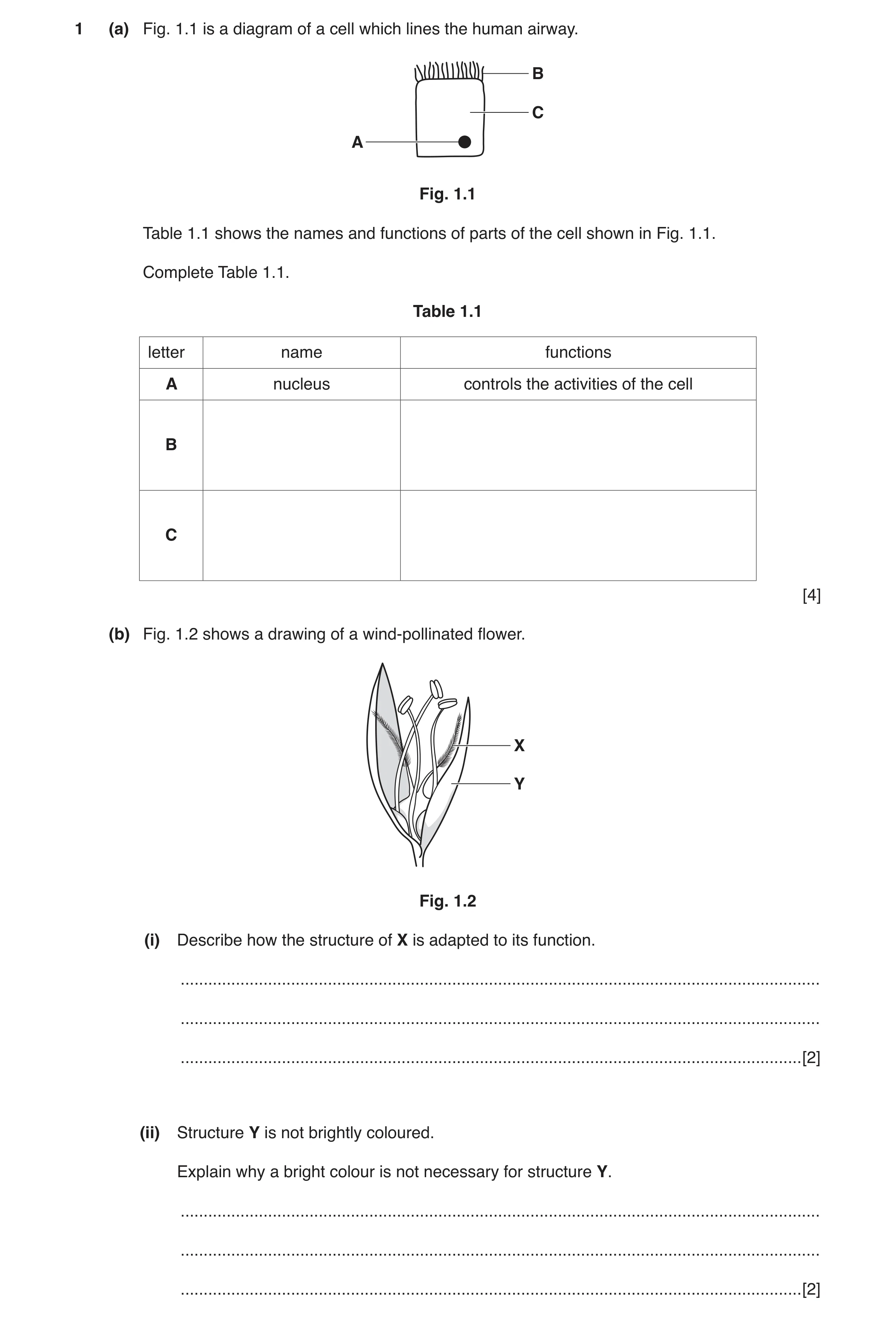
1 (a) Fig. 1.1 is a diagram of a cell which lines the human airway. B C A Fig. 1.1 Table 1.1 shows the names and functions of parts of the cell shown in Fig. 1.1. Complete Table 1.1. Table 1.1 letter name functions A nucleus controls the activities of the cell B C [4] (b) Fig. 1.2 shows a drawing of a wind-pollinated flower. X Y Fig. 1.2 (i) Describe how the structure of X is adapted to its function. … … … [2] (ii) Structure Y is not brightly coloured. Explain why a bright colour is not necessary for structure Y. … … … [2]
8 marks
Mark scheme: 1(a) (B) cilia ; removes mucus from airway ; (C) cytoplasm ; place where chemical reactions / respiration takes place ; 4 1(b)(i) feathery / large surface area ; for collecting pollen ; 2 1(b)(ii) no need to attract insects ; because they are not needed for pollination / pollination is by wind / not by insects ; 2
This question in 0653/43 Oct/Nov 2018
Q8 · A diagram of a wind-pollinated flower 0653/42 Feb/March 2019
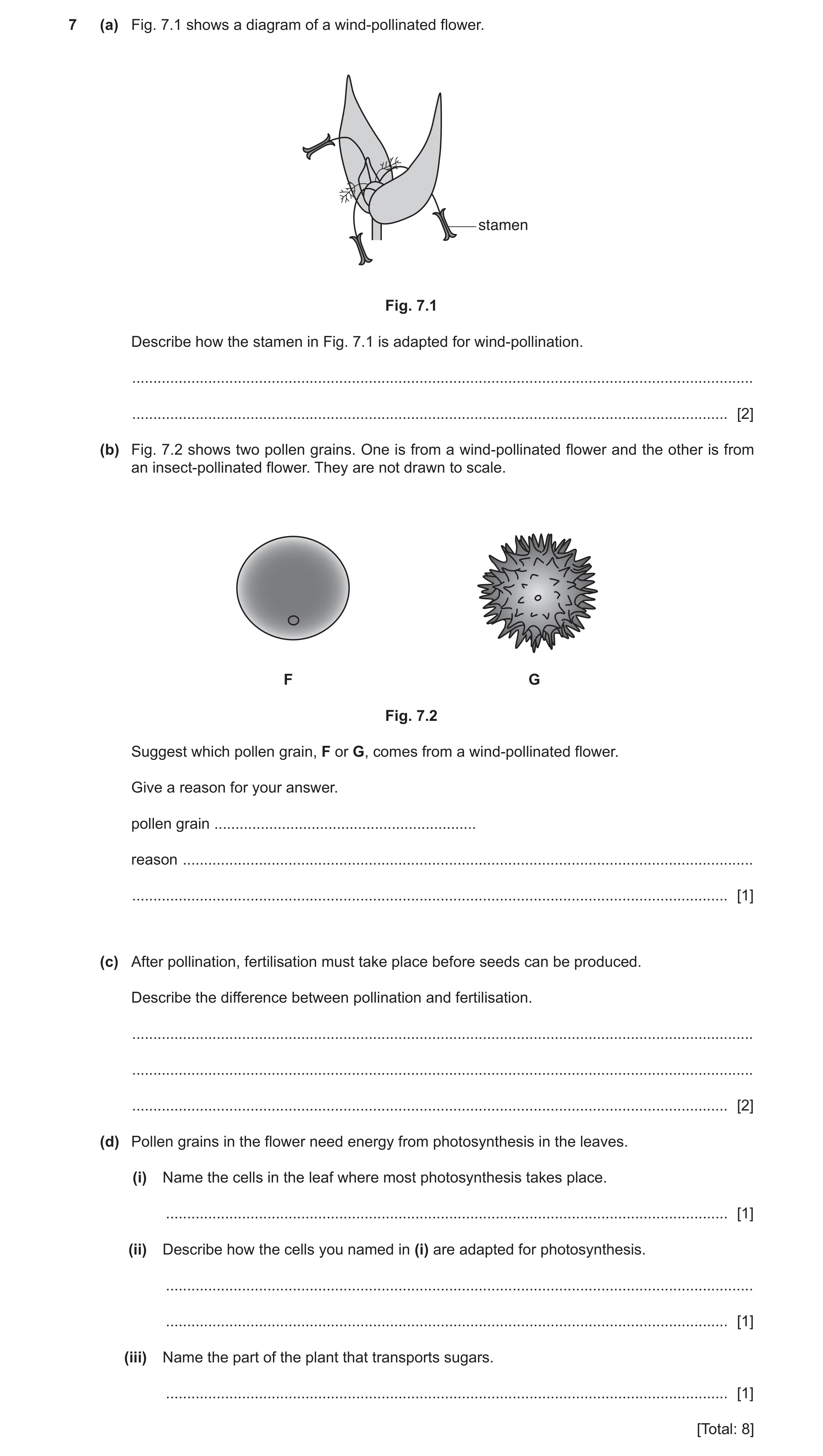
7 (a) Fig. 7.1 shows a diagram of a wind-pollinated flower. stamen Fig. 7.1 Describe how the stamen in Fig. 7.1 is adapted for wind-pollination. … … [2] (b) Fig. 7.2 shows two pollen grains. One is from a wind-pollinated flower and the other is from an insect-pollinated flower. They are not drawn to scale. F G Fig. 7.2 Suggest which pollen grain, F or G, comes from a wind-pollinated flower. Give a reason for your answer. pollen grain … reason … … [1] (c) After pollination, fertilisation must take place before seeds can be produced. Describe the difference between pollination and fertilisation. … … … [2] (d) Pollen grains in the flower need energy from photosynthesis in the leaves. (i) Name the cells in the leaf where most photosynthesis takes place. … [1] (ii) Describe how the cells you named in (i) are adapted for photosynthesis. … … [1] (iii) Name the part of the plant that transports sugars. … [1] [Total: 8]
8 marks
Mark scheme: 7(a) hangs outside (of flower) ; so wind can reach it ; 2 7(b) F wind-pollinated – grain is smooth so it travels through the air easily / with less friction ; 1 7(c) pollination – transfer of pollen (from anther to stigma) ; fertilisation – fusion of nuclei ; 2 7(d)(i) palisade (cells) ; 1 7(d)(ii) contain chloroplasts / chlorophyll ; 1 7(d)(iii) in the phloem ; 1
This question in 0653/42 Feb/March 2019
Q9 · If the light shining on a shoot tip is more intense on one side, the shoot shows a growth… 0653/41 May/June 2020
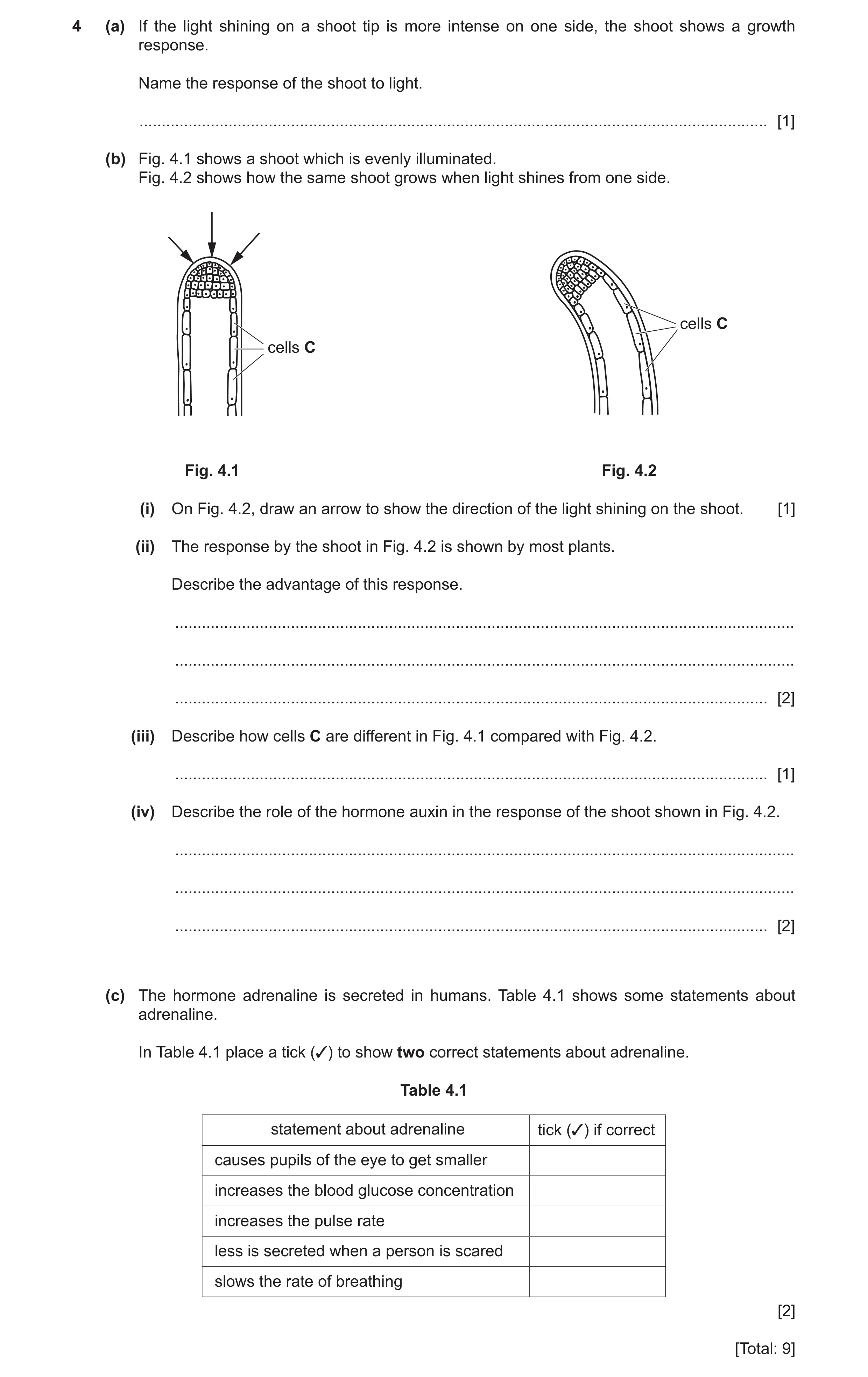
4 (a) If the light shining on a shoot tip is more intense on one side, the shoot shows a growth response. Name the response of the shoot to light. … [1] (b) Fig. 4.1 shows a shoot which is evenly illuminated. Fig. 4.2 shows how the same shoot grows when light shines from one side. cells C cells C Fig. 4.1 Fig. 4.2 (i) On Fig. 4.2, draw an arrow to show the direction of the light shining on the shoot. [1] (ii) The response by the shoot in Fig. 4.2 is shown by most plants. Describe the advantage of this response. … … … [2] (iii) Describe how cells C are different in Fig. 4.1 compared with Fig. 4.2. … [1] (iv) Describe the role of the hormone auxin in the response of the shoot shown in Fig. 4.2. … … … [2] (c) The hormone adrenaline is secreted in humans. Table 4.1 shows some statements about adrenaline. In Table 4.1 place a tick (3) to show two correct statements about adrenaline. Table 4.1 statement about adrenaline tick (3) if correct causes pupils of the eye to get smaller increases the blood glucose concentration increases the pulse rate less is secreted when a person is scared slows the rate of breathing [2] [Total: 9]
9 marks
Mark scheme: 4(a) phototropism ; 1 4(b)(i) arrow drawn coming from the left towards the top of the shoot ; 1 4(b)(ii) increases light intensity on shoot ; for photosynthesis ; 2 4(b)(iii) cells C are, longer / elongated, in Fig. 4.2 ; 1 4(b)(iv) more auxin present, in cells on the dark side / in cells C, in Fig. 4.2 ; auxin stimulates cell elongation ; 2 4(c) ticks placed in boxes next to: increases the blood glucose concentration ; increases the pulse rate ; 2
This question in 0653/41 May/June 2020
Q10 · During sexual reproduction in flowering plants, both pollination and fertilisation take… 0653/41 Oct/Nov 2020
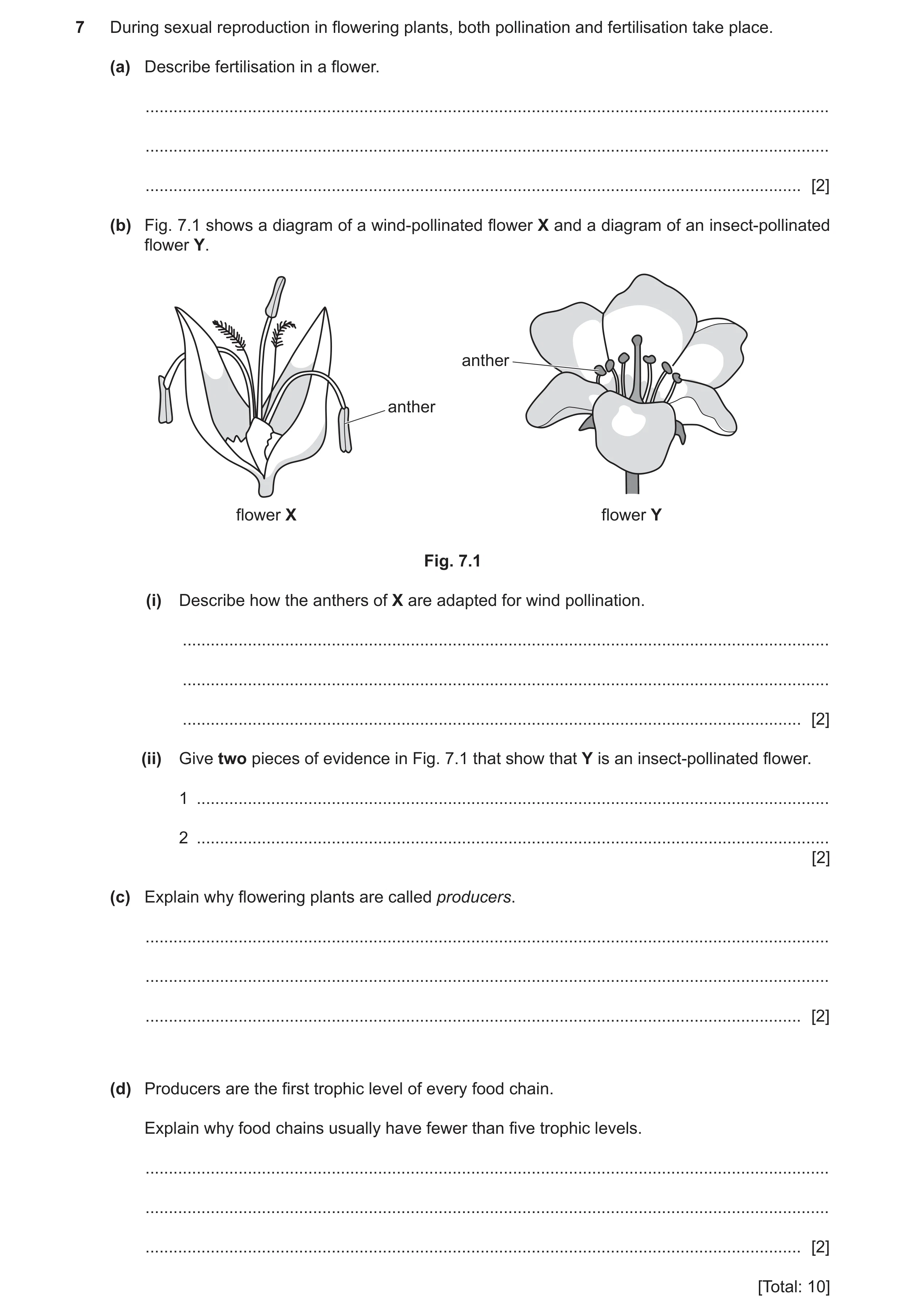
7 During sexual reproduction in flowering plants, both pollination and fertilisation take place. (a) Describe fertilisation in a flower. … … … [2] (b) Fig. 7.1 shows a diagram of a wind-pollinated flower X and a diagram of an insect-pollinated flower Y. anther anther flower X flower Y Fig. 7.1 (i) Describe how the anthers of X are adapted for wind pollination. … … … [2] (ii) Give two pieces of evidence in Fig. 7.1 that show that Y is an insect-pollinated flower. 1 … 2 … [2] (c) Explain why flowering plants are called producers. … … … [2] (d) Producers are the first trophic level of every food chain. Explain why food chains usually have fewer than five trophic levels. … … … [2] [Total: 10]
10 marks
Mark scheme: 7(a) correct reference to, fusion / joining / combining ; of nuclei of pollen and ovule ; 2 7(b)(i) (anthers) are long ; hang outside the flower ; 2 Question Answer Marks 7(b)(ii) any two from: the reproductive organs / anther (and stigma), are inside the flower ; large petals ; the stigma is above the anther ; 2 7(c) (they are) organisms that make (their own) nutrients ; using light energy / by photosynthesis ; 2 7(d) any two from: energy is lost / wasted, throughout the food chain ; not enough energy to support many higher levels ; further detail, e.g. by respiration (heat), excretion, death ; 2
This question in 0653/41 Oct/Nov 2020
Q11 · The flowers of a wind-pollinated plant 0653/42 May/June 2021
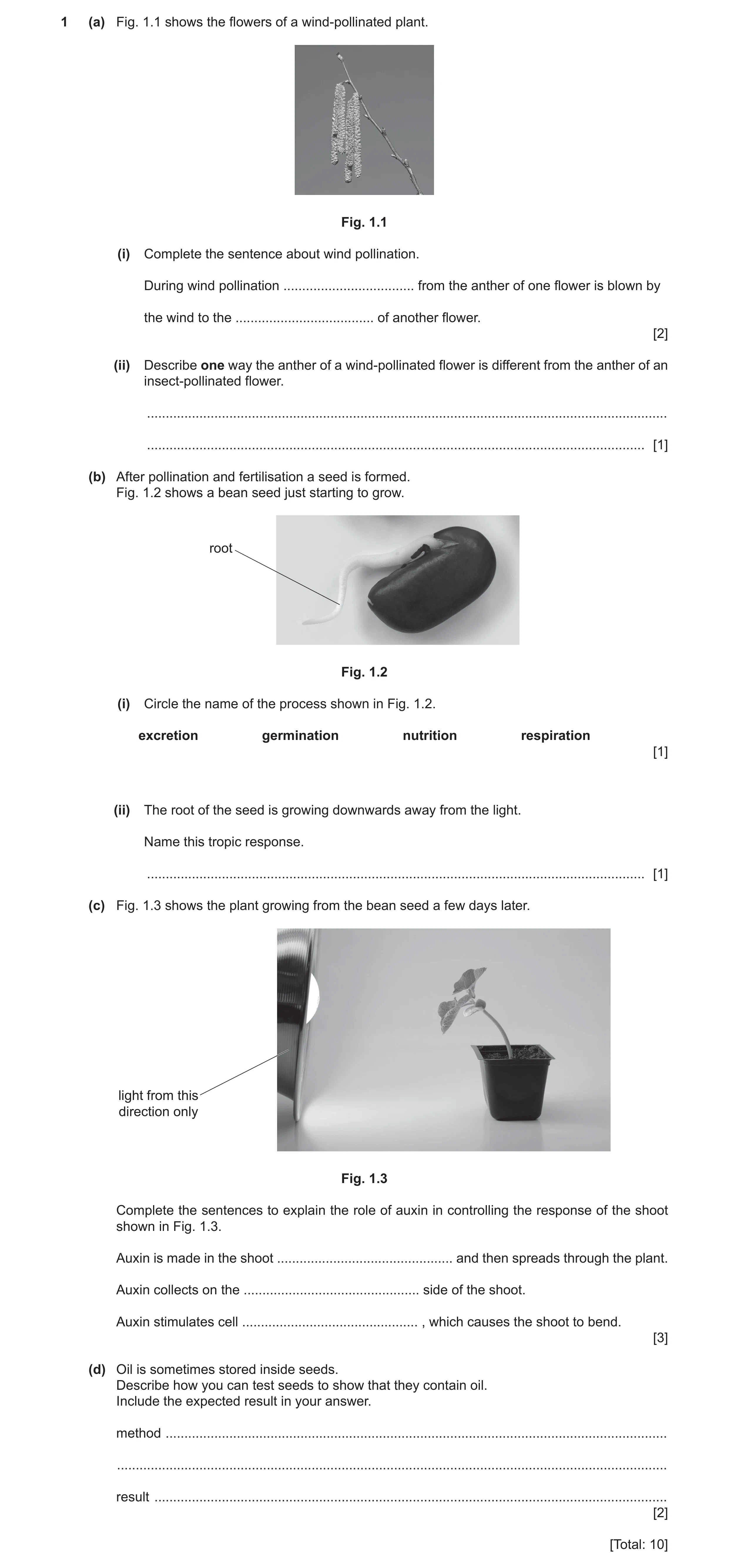
1 (a) Fig. 1.1 shows the flowers of a wind-pollinated plant. Fig. 1.1 (i) Complete the sentence about wind pollination. During wind pollination … from the anther of one flower is blown by the wind to the … of another flower. [2] (ii) Describe one way the anther of a wind-pollinated flower is different from the anther of an insect-pollinated flower. … … [1] (b) After pollination and fertilisation a seed is formed. Fig. 1.2 shows a bean seed just starting to grow. root Fig. 1.2 (i) Circle the name of the process shown in Fig. 1.2. excretion germination nutrition respiration [1] (ii) The root of the seed is growing downwards away from the light. Name this tropic response. … [1] (c) Fig. 1.3 shows the plant growing from the bean seed a few days later. light from this direction only Fig. 1.3 Complete the sentences to explain the role of auxin in controlling the response of the shoot shown in Fig. 1.3. Auxin is made in the shoot … and then spreads through the plant. Auxin collects on the … side of the shoot. Auxin stimulates cell … , which causes the shoot to bend. [3] (d) Oil is sometimes stored inside seeds. Describe how you can test seeds to show that they contain oil. Include the expected result in your answer. method … … result … [2] [Total: 10]
10 marks
Mark scheme: 1(a)(i) pollen ; stigma ; 2 1(a)(ii) (anthers are) outside flower / (anthers are) on longer filaments ; 1 1(b)(i) germination ; 1 1(b)(ii) phototropism ; 1 1(c) tip ; shaded / dark ; elongation ; 3 1(d) add (crushed) seed to ethanol and pour into water ; white emulsion formed ; 2
This question in 0653/42 May/June 2021
Q12 · The flowers of a wind-pollinated plant 0653/43 May/June 2021
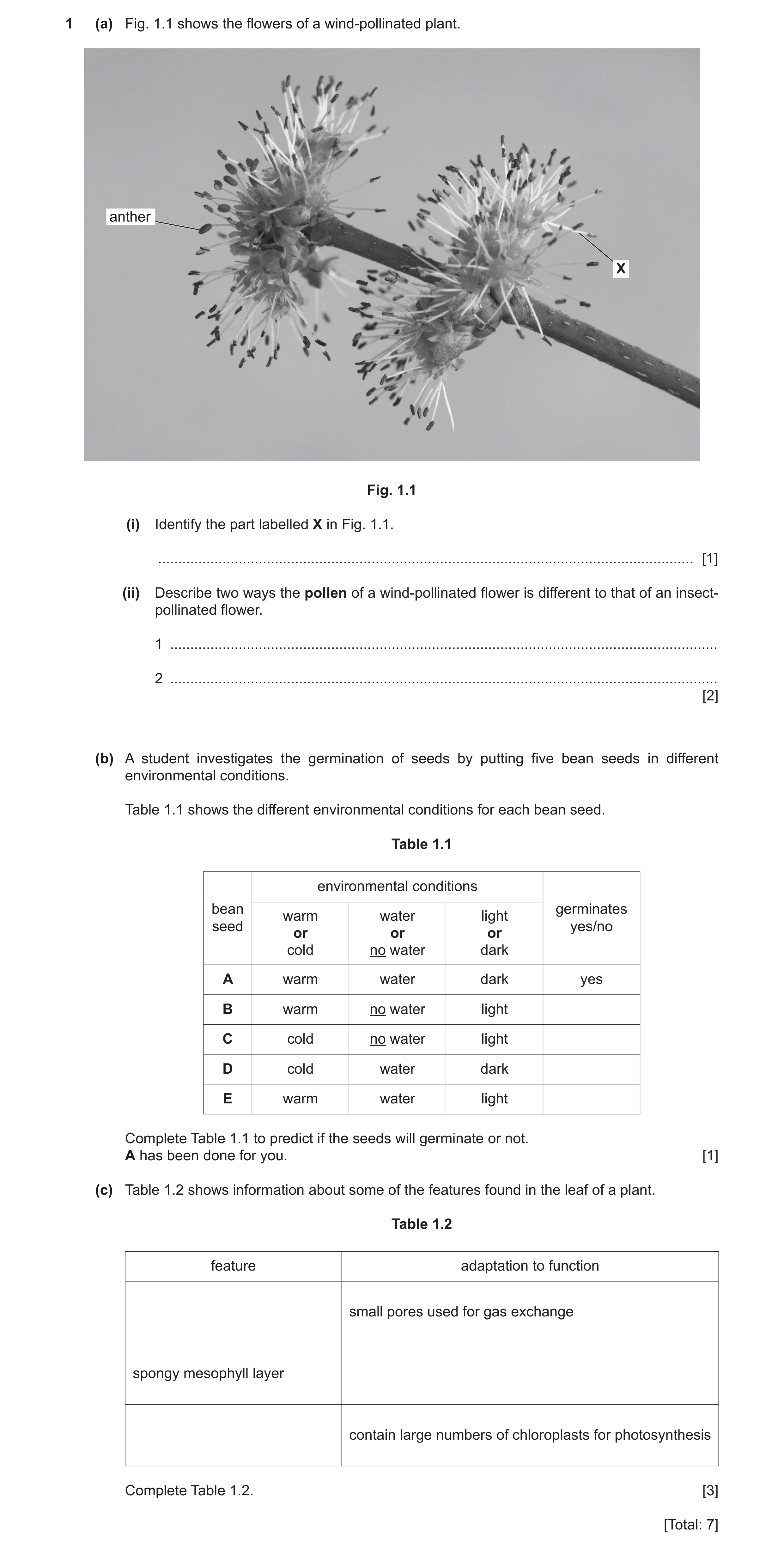
1 (a) Fig. 1.1 shows the flowers of a wind-pollinated plant. antheranther X Fig. 1.1 (i) Identify the part labelled X in Fig. 1.1. … [1] (ii) Describe two ways the pollen of a wind-pollinated flower is different to that of an insect- pollinated flower. 1 … 2 … [2] (b) A student investigates the germination of seeds by putting five bean seeds in different environmental conditions. Table 1.1 shows the different environmental conditions for each bean seed. Table 1.1 environmental conditions bean germinates warm water light seed yes/no or or or cold no water dark A warm water dark yes B warm no water light C cold no water light D cold water dark E warm water light Complete Table 1.1 to predict if the seeds will germinate or not. A has been done for you. [1] (c) Table 1.2 shows information about some of the features found in the leaf of a plant. Table 1.2 feature adaptation to function small pores used for gas exchange spongy mesophyll layer contain large numbers of chloroplasts for photosynthesis Complete Table 1.2. [3] [Total: 7]
7 marks
Mark scheme: 1(a)(i) filament ; 1 1(a)(ii) any two from: smaller ; lighter ; smooth / not spiky ; 2 1(b) germinates yes / no (yes) no no no yes ; all needed for 1 mark 1 1(c) feature adaptation to function stomata (small pores used for gas exchange) (spongy mesophyll layer) air spaces for gas exchange palisade (mesophyll cells) (contain large numbers of chloroplasts for photosynthesis) ;;; 3
This question in 0653/43 May/June 2021
Q13 · A diagram of a wind-pollinated flower 0653/41 May/June 2022
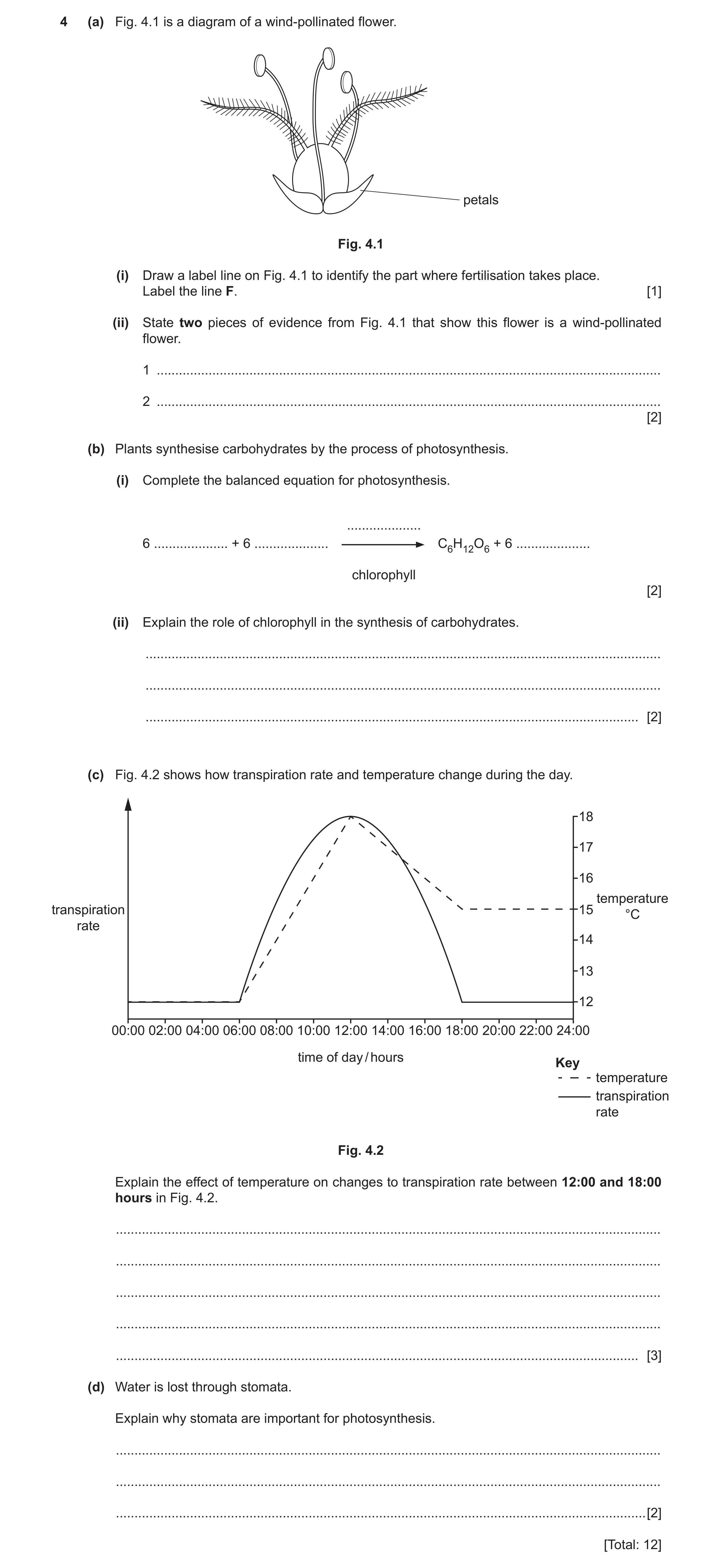
4 (a) Fig. 4.1 is a diagram of a wind-pollinated flower. petals Fig. 4.1 (i) Draw a label line on Fig. 4.1 to identify the part where fertilisation takes place. Label the line F. [1] (ii) State two pieces of evidence from Fig. 4.1 that show this flower is a wind-pollinated flower. 1 … 2 … [2] (b) Plants synthesise carbohydrates by the process of photosynthesis. (i) Complete the balanced equation for photosynthesis. … 6 … + 6 … C6H12O6 + 6 … chlorophyll [2] (ii) Explain the role of chlorophyll in the synthesis of carbohydrates. … … … [2] (c) Fig. 4.2 shows how transpiration rate and temperature change during the day. 18 17 16 temperature transpiration 15 °C rate 14 13 12 00:00 02:00 04:00 06:00 08:00 10:00 12:00 14:00 16:00 18:00 20:00 22:00 24:00 time of day / hours Key temperature transpiration rate Fig. 4.2 Explain the effect of temperature on changes to transpiration rate between 12:00 and 18:00 hours in Fig. 4.2. … … … … … [3] (d) Water is lost through stomata. Explain why stomata are important for photosynthesis. … … … [2] [Total: 12]
12 marks
Mark scheme: 4(a)(i) ovary labelled ; 1 4(a)(ii) any two from: small petals ; feathery stigma ; pollen / anther / filaments / stamens / stigma outside (flower) ; 2 4(b)(i) (6) CO2 + (6) H2O ; light and (6) O2 ; 2 4(b)(ii) absorbs / traps / uses light energy ; (light energy is) transferred / converted to chemical energy ; 2 4(c) any three from: (as temperature decreases) transpiration rate decreases ; so less water lost ; correct reference to evaporation from (mesophyll) cells ; correct reference to diffusion (of water vapour) from stomata ; 3 4(d) carbon dioxide enters leaf through stomata ; carbon dioxide is needed for photosynthesis ; 2
This question in 0653/41 May/June 2022
Q14 · A diagram of a wind‑pollinated flower 0653/42 May/June 2022
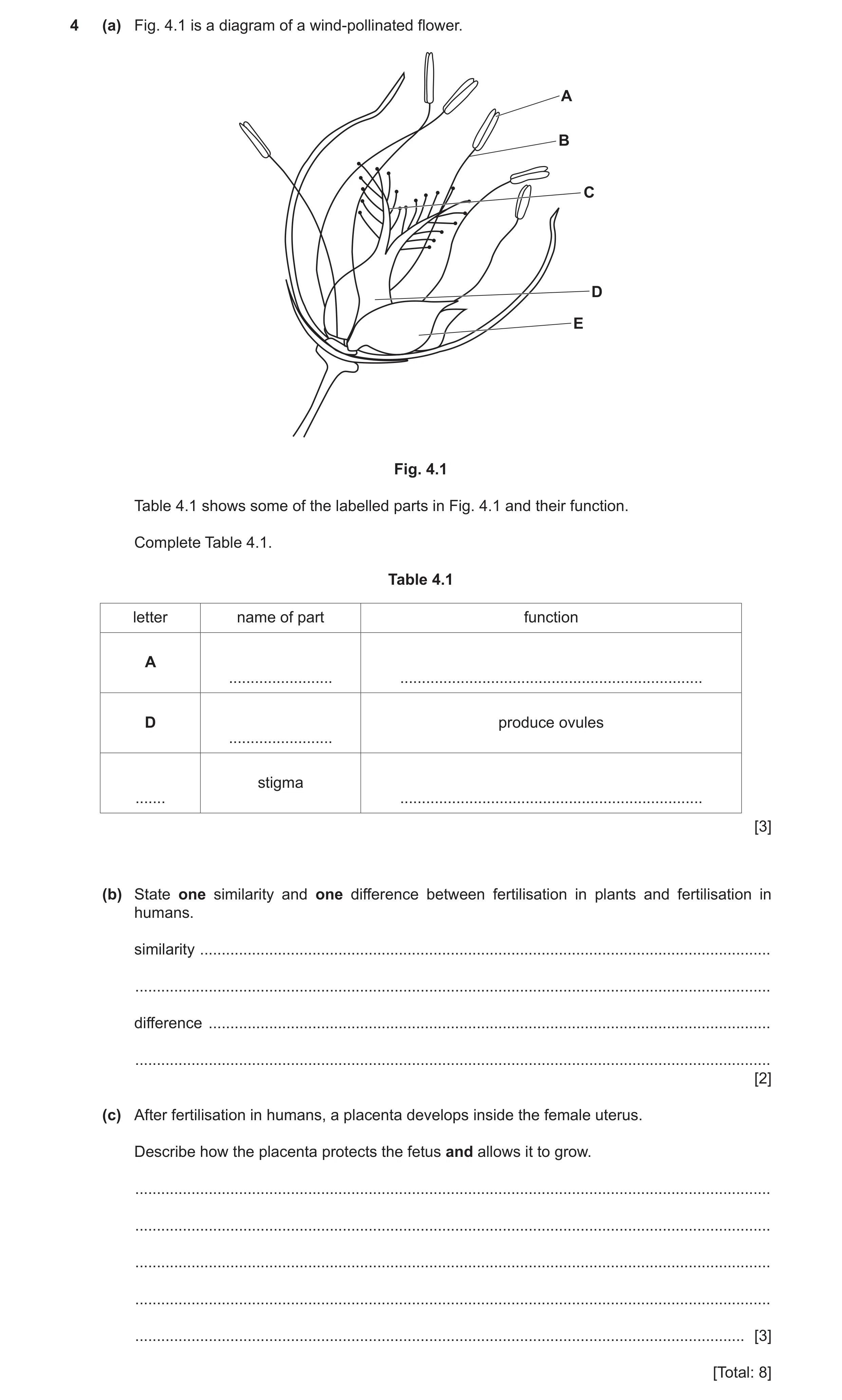
4 (a) Fig. 4.1 is a diagram of a wind‑pollinated flower. A B C D E Fig. 4.1 Table 4.1 shows some of the labelled parts in Fig. 4.1 and their function. Complete Table 4.1. Table 4.1 letter name of part function A … … D produce ovules … stigma … … [3] (b) State one similarity and one difference between fertilisation in plants and fertilisation in humans. similarity … … difference … … [2] (c) After fertilisation in humans, a placenta develops inside the female uterus. Describe how the placenta protects the fetus and allows it to grow. … … … … … [3] [Total: 8]
8 marks
Mark scheme: 4(a) letter name of part function (A) anther / stamen produce, pollen / male gamete (D) ovary (produce ovules) C (stigma) receives pollen / AW ;;; 4(b) similarity – fusion of nuclei ; difference – pollen used instead of sperm / takes place in ovary not oviduct ; 2 4(c) acts as a barrier against, toxins / poisons ; then any two from: provides nutrients ; provides oxygen ; removes waste products ; 3
This question in 0653/42 May/June 2022
Q15 · Water moves from the roots of a plant through the stem to the leaves 0653/42 Oct/Nov 2022
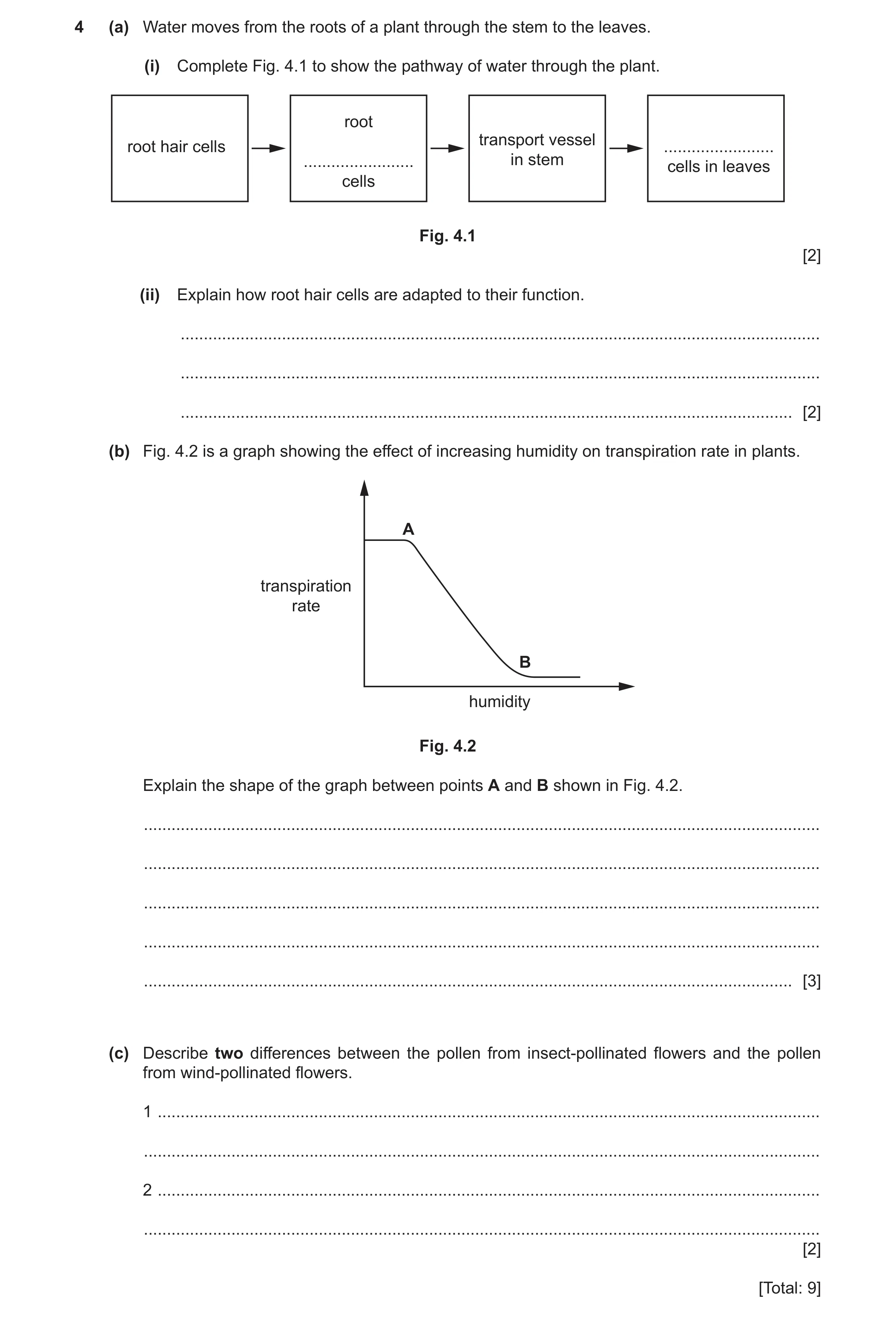
4 (a) Water moves from the roots of a plant through the stem to the leaves. (i) Complete Fig. 4.1 to show the pathway of water through the plant. root transport vessel root hair cells … … in stem cells in leaves cells Fig. 4.1 [2] (ii) Explain how root hair cells are adapted to their function. … … … [2] (b) Fig. 4.2 is a graph showing the effect of increasing humidity on transpiration rate in plants. A transpiration rate B humidity Fig. 4.2 Explain the shape of the graph between points A and B shown in Fig. 4.2. … … … … … [3] (c) Describe two differences between the pollen from insect‑pollinated flowers and the pollen from wind‑pollinated flowers. 1 … … 2 … … [2] [Total: 9]
9 marks
Mark scheme: 4(a)(i) cortex ; 2 (spongy / palisade) mesophyll ; 4(a)(ii) large surface area ; 2 increases rate of absorption (of water) ; 4(b) at higher humidity there is more water vapour in the air ; 3 diffusion / concentration gradient, decreases (as humidity increases) ; less evaporation / less diffusion ; 4(c) any two from: 2 (pollen from) • insect-pollinated flowers is, sticky / covered in spikes ; • insect-pollinated flowers is produced in smaller quantities ; • wind-pollinated flowers is lighter ;
This question in 0653/42 Oct/Nov 2022
Q16 · A diagram of a wind-pollinated flower 0653/43 Oct/Nov 2022
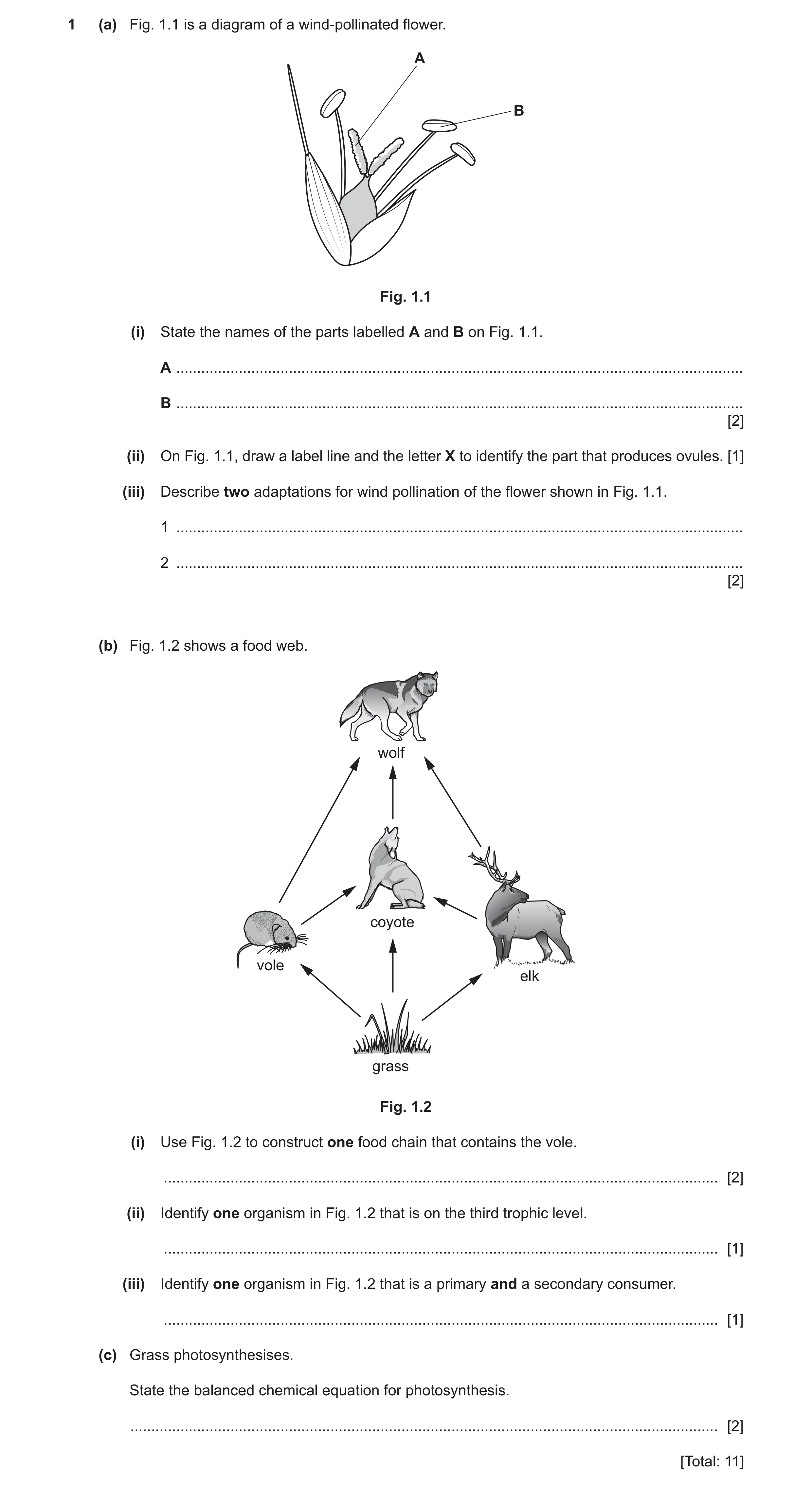
1 (a) Fig. 1.1 is a diagram of a wind-pollinated flower. A B Fig. 1.1 (i) State the names of the parts labelled A and B on Fig. 1.1. A … B … [2] (ii) On Fig. 1.1, draw a label line and the letter X to identify the part that produces ovules. [1] (iii) Describe two adaptations for wind pollination of the flower shown in Fig. 1.1. 1 … 2 … [2] (b) Fig. 1.2 shows a food web. wolf coyote vole elk grass Fig. 1.2 (i) Use Fig. 1.2 to construct one food chain that contains the vole. … [2] (ii) Identify one organism in Fig. 1.2 that is on the third trophic level. … [1] (iii) Identify one organism in Fig. 1.2 that is a primary and a secondary consumer. … [1] (c) Grass photosynthesises. State the balanced chemical equation for photosynthesis. … [2] [Total: 11]
11 marks
Mark scheme: Question Answer Marks 1(a)(i) A stigma ; 2 B anther ; 1(a)(ii) ovary labelled ; 1 1(a)(iii) any two from: 2 stigma feathery ; anther outside (flower) ; no petals ; 1(b)(i) grass → vole (→ coyote) → wolf 2 correct order of organisms ; arrows in correct direction ; 1(b)(ii) coyote / wolf ; 1 1(b)(iii) coyote ; 1 1(c) 6H2O + 6CO2 → C6H12O6 + 6O2 2 correct substrates (in either order) ; correct products (in either order) ;
This question in 0653/43 Oct/Nov 2022
Q17 · An insect-pollinated flower cut open to show the internal structures 0653/42 Feb/March 2023
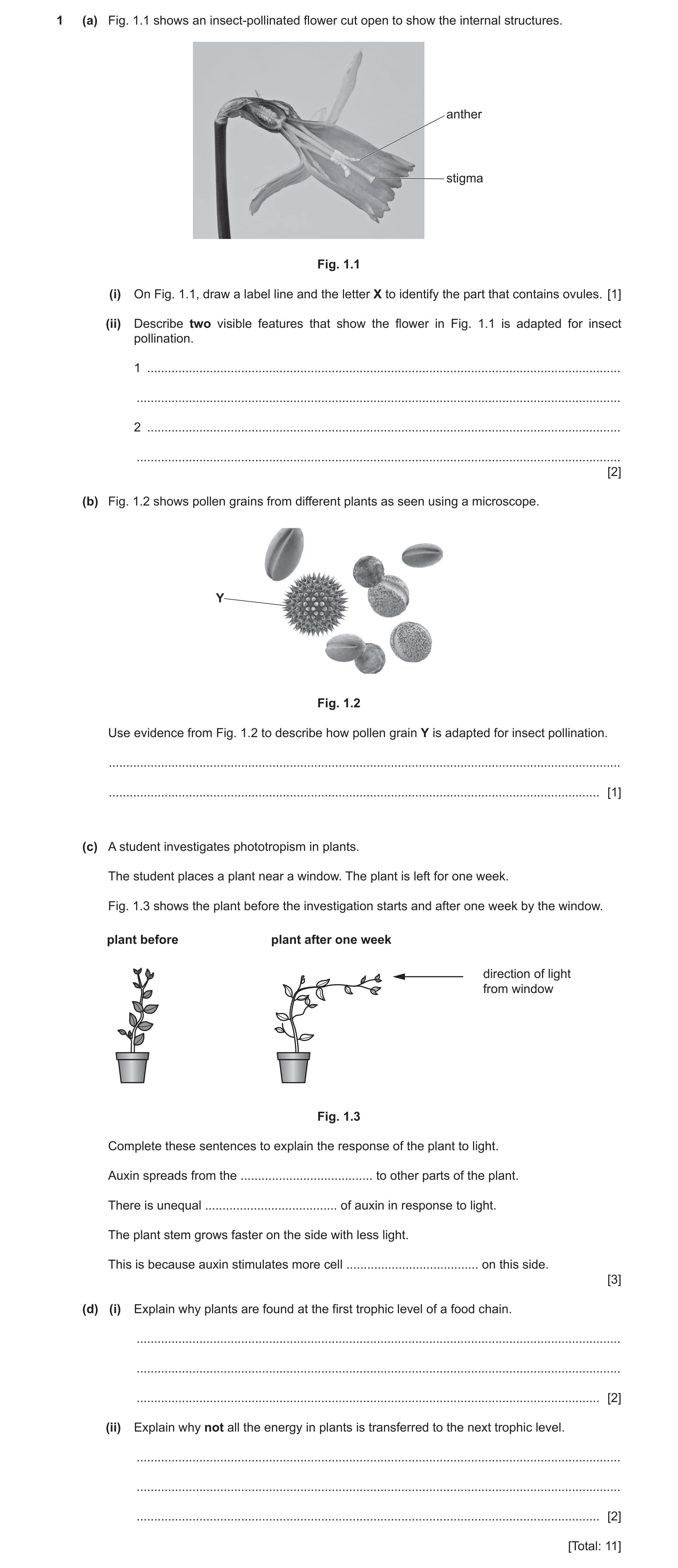
1 (a) Fig. 1.1 shows an insect-pollinated flower cut open to show the internal structures. anther stigma Fig. 1.1 (i) On Fig. 1.1, draw a label line and the letter X to identify the part that contains ovules. [1] (ii) Describe two visible features that show the flower in Fig. 1.1 is adapted for insect pollination. 1 … … 2 … … [2] (b) Fig. 1.2 shows pollen grains from different plants as seen using a microscope. Y Fig. 1.2 Use evidence from Fig. 1.2 to describe how pollen grain Y is adapted for insect pollination. … … [1] (c) A student investigates phototropism in plants. The student places a plant near a window. The plant is left for one week. Fig. 1.3 shows the plant before the investigation starts and after one week by the window. plant before plant after one week direction of light from window Fig. 1.3 Complete these sentences to explain the response of the plant to light. Auxin spreads from the … to other parts of the plant. There is unequal … of auxin in response to light. The plant stem grows faster on the side with less light. This is because auxin stimulates more cell … on this side. [3] (d) (i) Explain why plants are found at the first trophic level of a food chain. … … … [2] (ii) Explain why not all the energy in plants is transferred to the next trophic level. … … … [2] [Total: 11]
11 marks
Mark scheme: Question Answer Marks 1(a)(i) ovary labelled ; 1 1(a)(ii) anther inside flower / stigma / reproductive organs inside flower ; 2 large / long, petals ; 1(b) spikes (to stick to insect) ; 1 1(c) shoot tip ; 3 distribution / spread ; elongation ; 1(d)(i) any two from: 2 producers ; make their own food ; reference to photosynthesis ; do not consume other life forms ; 1(d)(ii) any two from: 2 lost as heat / respiration ; not all (parts of) plant are eaten ; not all is digested / energy remnants in faeces ;
This question in 0653/42 Feb/March 2023
Q18 · Part of a food web 0653/41 May/June 2023
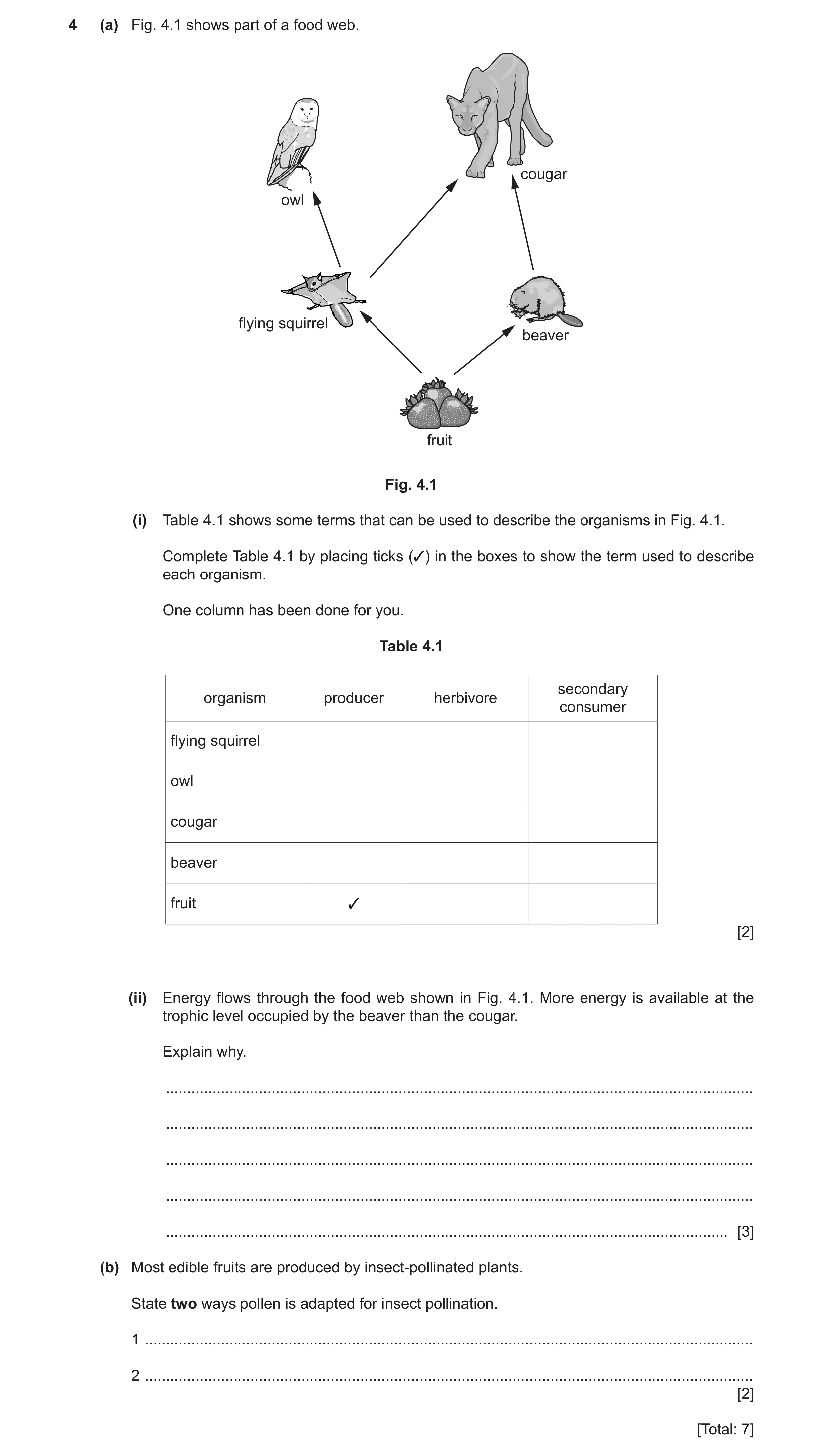
4 (a) Fig. 4.1 shows part of a food web. cougar owl flying squirrel beaver fruit Fig. 4.1 (i) Table 4.1 shows some terms that can be used to describe the organisms in Fig. 4.1. Complete Table 4.1 by placing ticks (3) in the boxes to show the term used to describe each organism. One column has been done for you. Table 4.1 secondary organism producer herbivore consumer flying squirrel owl cougar beaver fruit 3 [2] (ii) Energy flows through the food web shown in Fig. 4.1. More energy is available at the trophic level occupied by the beaver than the cougar. Explain why. … … … … … [3] (b) Most edible fruits are produced by insect-pollinated plants. State two ways pollen is adapted for insect pollination. 1 … 2 … [2] [Total: 7]
7 marks
Mark scheme: 4(a)(i) organism producer herbivore secondary consumer flying squirrel owl cougar beaver fruit () ;; one mark for each correct column 4(a)(ii) cougar is in a higher trophic level / beaver is in lower trophic level ; energy lost (between levels) ; example of energy loss, e.g. respiration / heat / waste / incomplete digestion ; 3 4(b) any two from : large / heavy (compared to wind pollinated) ; has spikes ; sticky ; 2
This question in 0653/41 May/June 2023
Question 19 0653/41 Oct/Nov 2023
7 (a) Fig. 7.1 shows an insect-pollinated flower. Fig. 7.1 (i) Draw a label line and the letter C to identify a carpel in Fig. 7.1. [1] (ii) State two pieces of evidence that show the flower in Fig. 7.1 is insect-pollinated. 1 … 2 … [2] (b) Complete the sentence about the role of chlorophyll in a plant. Chlorophyll transfers … into … energy for the … of the carbohydrate glucose. [2] (c) In plants, glucose is converted into the sugar sucrose for transport. Glucose is also converted into a carbohydrate for storage. (i) State the name of the structure in plants used to transport the sugar sucrose. … [1] (ii) State the name of the carbohydrate used for storage. … [1] (d) Fig. 7.2 shows cells from a plant before and after being immersed in a concentrated sugar solution. cytoplasm fills cell cytoplasm shrinks away from cell wall before after Fig. 7.2 The change seen in Fig. 7.2 is due to movement of water. Explain the change in the cells shown in Fig. 7.2. Use the term water potential in your answer. … … … … … [4] [Total: 11]
11 marks
Mark scheme: 7(a)(i) carpel labelled ; 1 7(a)(ii) any two from: 2 (large) petals ; stigma inside flower ; anther inside flower ; 7(b) light (energy) AND chemical ; 2 synthesis ; 7(c)(i) phloem ; 1 7(c)(ii) starch ; 1 7(d) concentrated sugar solution has a lower water potential / cells have a higher water potential ; 4 water moves out of, the cells / plant ; by osmosis ; through partially permeable membranes ;
This question in 0653/41 Oct/Nov 2023
Q20 · The transfer of pollen from flower A to flower B 0653/42 Oct/Nov 2023
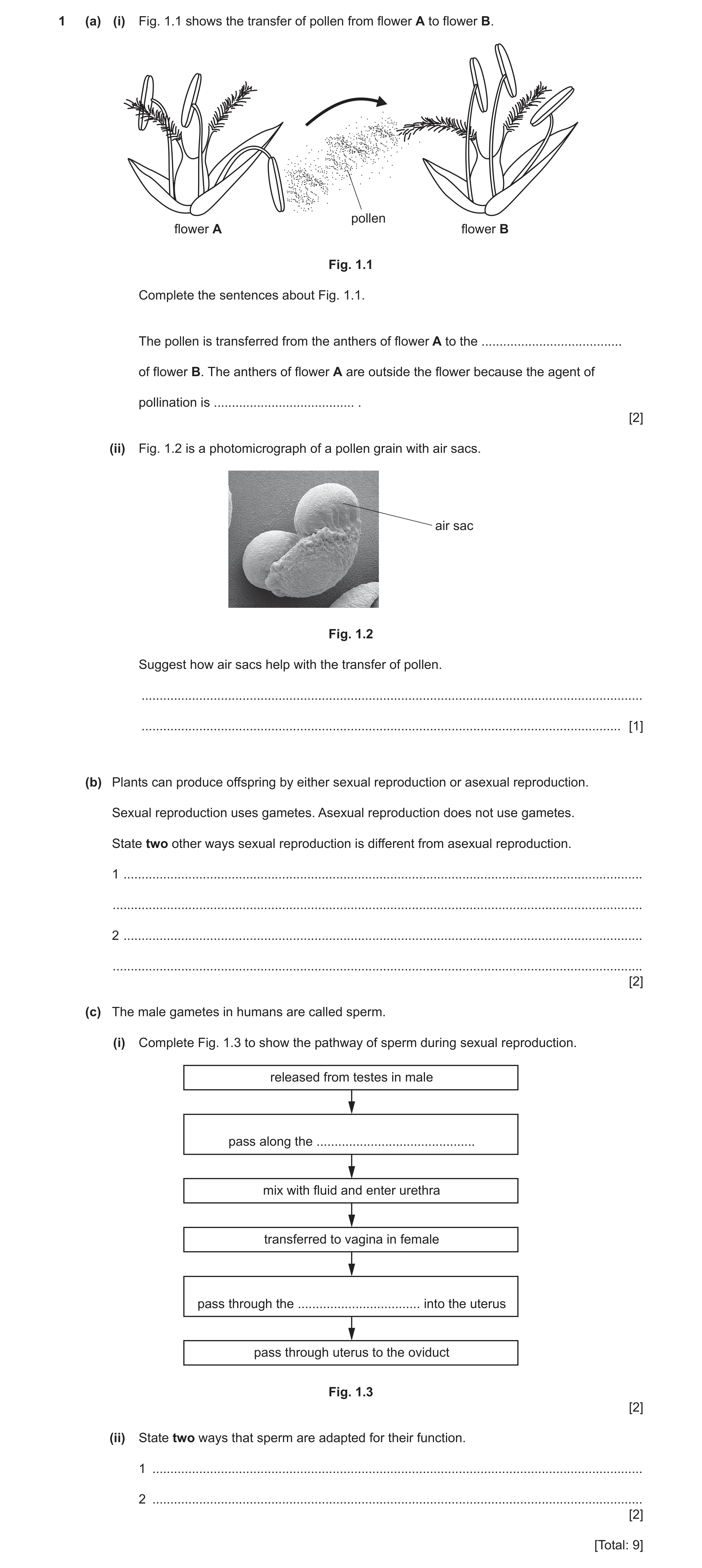
1 (a) (i) Fig. 1.1 shows the transfer of pollen from flower A to flower B. pollen flower A flower B Fig. 1.1 Complete the sentences about Fig. 1.1. The pollen is transferred from the anthers of flower A to the … of flower B. The anthers of flower A are outside the flower because the agent of pollination is … . [2] (ii) Fig. 1.2 is a photomicrograph of a pollen grain with air sacs. air sac Fig. 1.2 Suggest how air sacs help with the transfer of pollen. … … [1] (b) Plants can produce offspring by either sexual reproduction or asexual reproduction. Sexual reproduction uses gametes. Asexual reproduction does not use gametes. State two other ways sexual reproduction is different from asexual reproduction. 1 … … 2 … … [2] (c) The male gametes in humans are called sperm. (i) Complete Fig. 1.3 to show the pathway of sperm during sexual reproduction. released from testes in male pass along the … mix with fluid and enter urethra transferred to vagina in female pass through the … into the uterus pass through uterus to the oviduct Fig. 1.3 [2] (ii) State two ways that sperm are adapted for their function. 1 … 2 … [2] [Total: 9]
9 marks
Mark scheme: Question Answer Marks 1(a)(i) stigma(s) ; 2 wind ; 1(a)(ii) idea that air sacs, increase the time in the air / increase air resistance / increase surface area / provide a sail effect / reduce 1 density ; 1(b) any two from: 2 sexual reproduction ORA, (usually) requires two parents (not one) ; requires, fertilisation / fusion, of (nuclei) of gametes ; produces offspring that are not genetically identical ; leads to a zygote forming ; 1(c)(i) sperm duct ; 2 cervix ; 1(c)(ii) any two from: 2 have a flagellum ; contain enzymes ; AVP;
This question in 0653/42 Oct/Nov 2023
Question 21 0653/43 May/June 2024
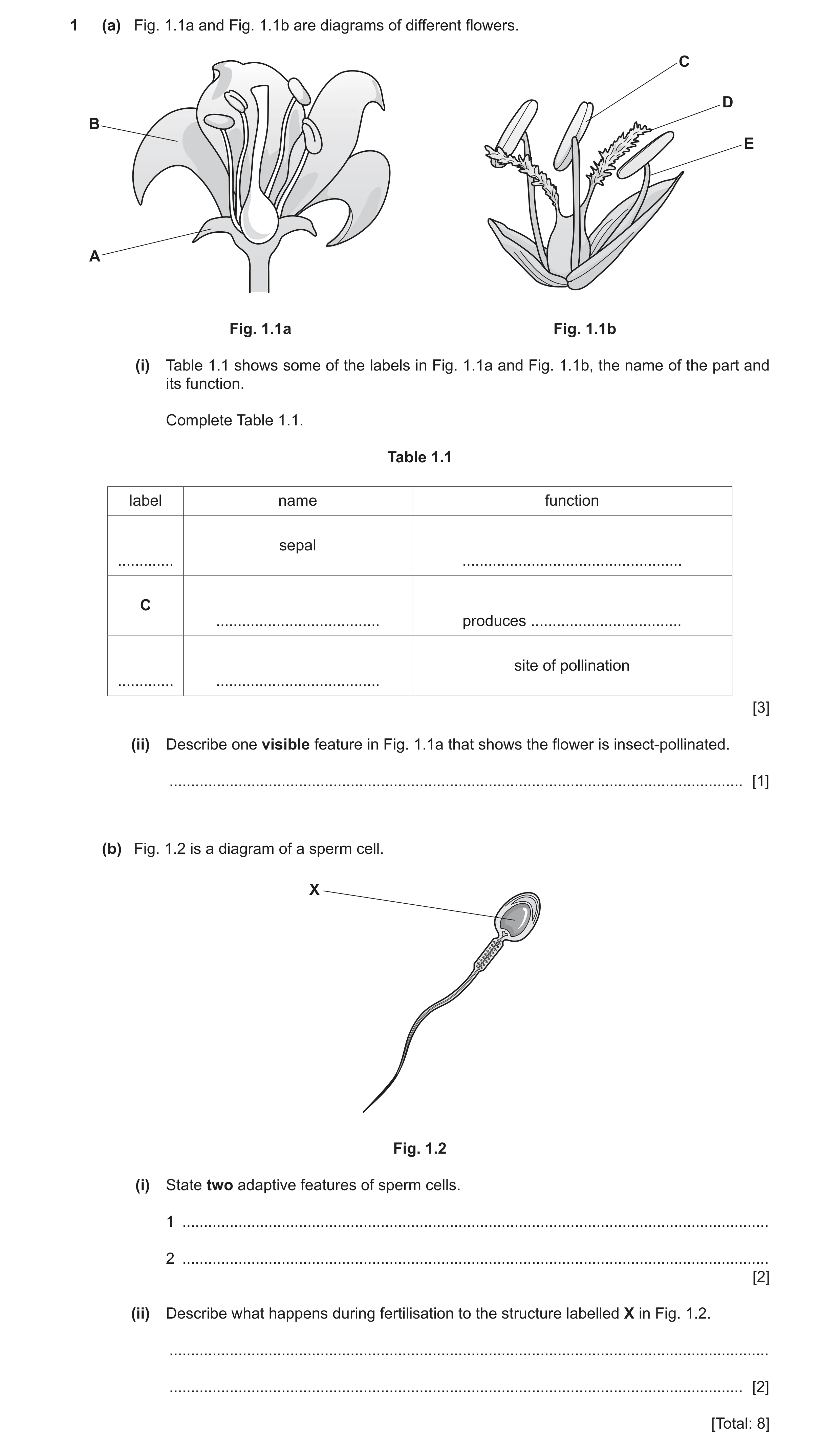
1 (a) Fig. 1.1a and Fig. 1.1b are diagrams of different flowers. C D B E A Fig. 1.1a Fig. 1.1b (i) Table 1.1 shows some of the labels in Fig. 1.1a and Fig. 1.1b, the name of the part and its function. Complete Table 1.1. Table 1.1 label name function sepal … … C … produces … site of pollination … … [3] (ii) Describe one visible feature in Fig. 1.1a that shows the flower is insect‑pollinated. … [1] (b) Fig. 1.2 is a diagram of a sperm cell. X Fig. 1.2 (i) State two adaptive features of sperm cells. 1 … 2 … [2] (ii) Describe what happens during fertilisation to the structure labelled X in Fig. 1.2. … … [2] [Total: 8]
8 marks
Mark scheme: 1(a)(i) label name function A (sepal) to protect / to support (the flower / bud / ovary) (C) anther (produces) pollen / male gamete D stigma (site of pollination) ;;; one mark for each correct row 3 1(a)(ii) any one from: (large) petals ; anther inside (petals / flower) ; stigma inside (petals / flower) ; 1 1(b)(i) any two from: flagellum ; enzymes ; AVP ; 2 1(b)(ii) (nucleus of sperm cell) fuses / joins ; with nucleus of, ovum / egg ; 2
This question in 0653/43 May/June 2024
Q22 · A diagram of a cross‑section through a leaf 0653/43 May/June 2024
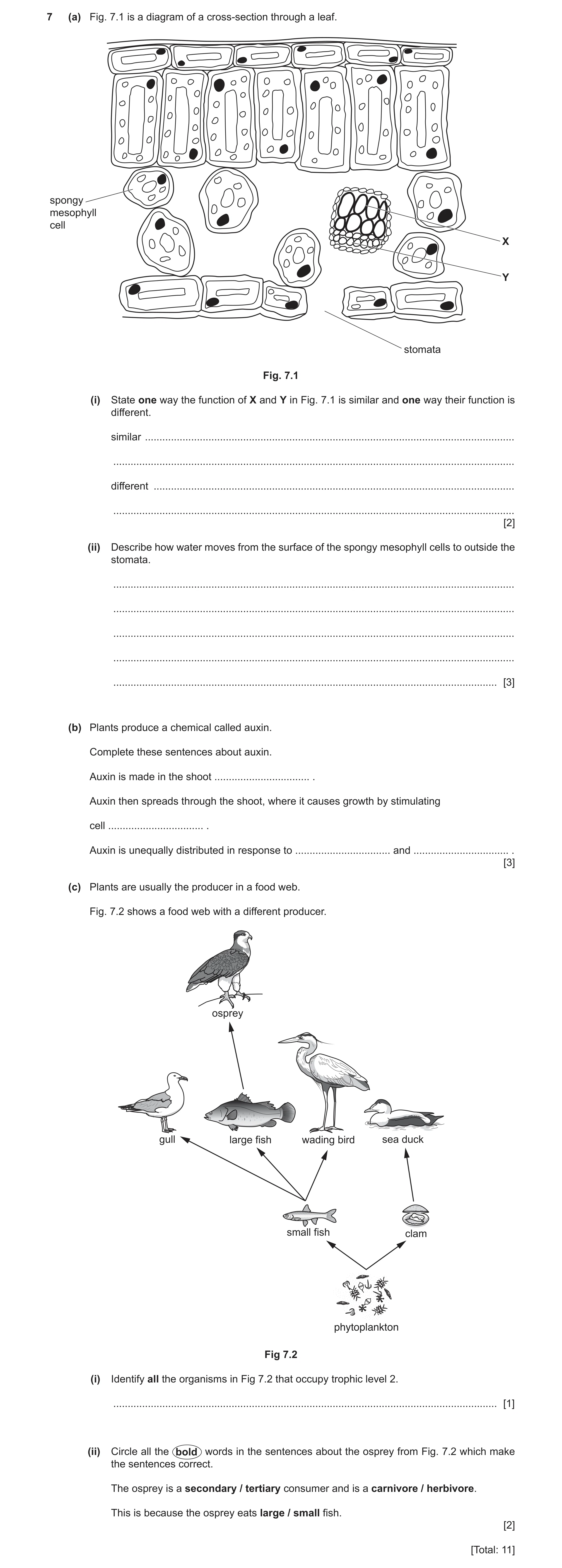
7 (a) Fig. 7.1 is a diagram of a cross‑section through a leaf. spongy mesophyll cell X Y stomata Fig. 7.1 (i) State one way the function of X and Y in Fig. 7.1 is similar and one way their function is different. similar … … different … … [2] (ii) Describe how water moves from the surface of the spongy mesophyll cells to outside the stomata. … … … … … [3] (b) Plants produce a chemical called auxin. Complete these sentences about auxin. Auxin is made in the shoot … . Auxin then spreads through the shoot, where it causes growth by stimulating cell … . Auxin is unequally distributed in response to … and … . [3] (c) Plants are usually the producer in a food web. Fig. 7.2 shows a food web with a different producer. osprey gull large fish wading bird sea duck small fish clam phytoplankton Fig 7.2 (i) Identify all the organisms in Fig 7.2 that occupy trophic level 2. … [1] (ii) Circle all the bold words in the sentences about the osprey from Fig. 7.2 which make the sentences correct. The osprey is a secondary / tertiary consumer and is a carnivore / herbivore. This is because the osprey eats large / small fish. [2] [Total: 11]
11 marks
Mark scheme: 7(a)(i) both / they, transport (substances) ; and either xylem / X, also provides support / transports mineral ions / transports up the stem ; or phloem / Y, transports sugars / amino acids / transports up and down the stem ; Question Answer Marks 7(a)(ii) by evaporation (from the surface) ; water vapour moves to / out of, stomata ; (water vapour passes through stomata) by diffusion ; 3 7(b) tip ; elongation ; gravity and light ; 3 7(c)(i) small fish and clam ; 1 7(c)(ii) tertiary carnivore large ;; all correct = 2 marks two correct = 1 mark 2
This question in 0653/43 May/June 2024
Q23 · The female human reproductive system 0653/41 Oct/Nov 2024
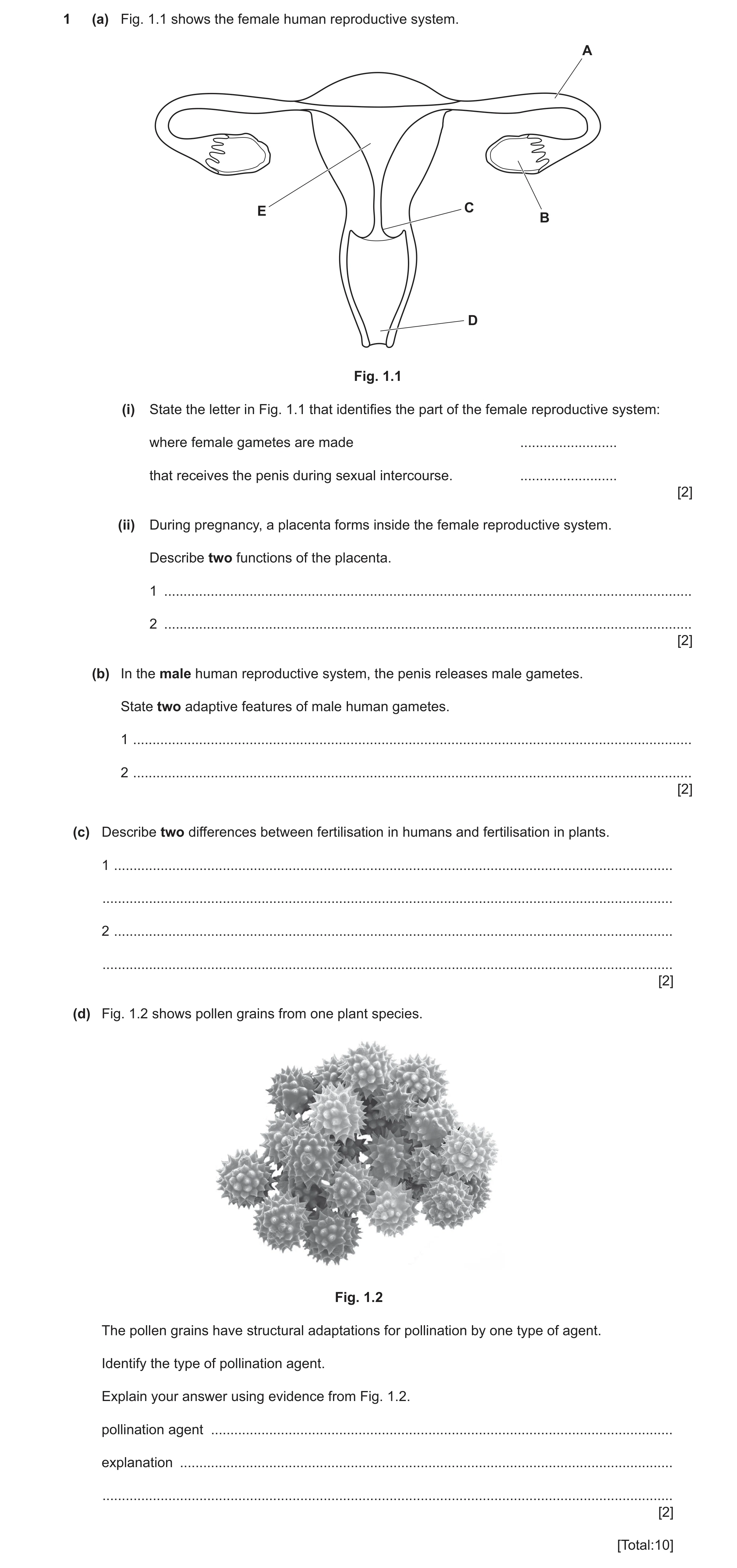
1 (a) Fig. 1.1 shows the female human reproductive system. A E C B D Fig. 1.1 (i) State the letter in Fig. 1.1 that identifies the part of the female reproductive system: where female gametes are made … that receives the penis during sexual intercourse. … [2] (ii) During pregnancy, a placenta forms inside the female reproductive system. Describe two functions of the placenta. 1 … 2 … [2] (b) In the male human reproductive system, the penis releases male gametes. State two adaptive features of male human gametes. 1 … 2 … [2] (c) Describe two differences between fertilisation in humans and fertilisation in plants. 1 … … 2 … … [2] (d) Fig. 1.2 shows pollen grains from one plant species. Fig. 1.2 The pollen grains have structural adaptations for pollination by one type of agent. Identify the type of pollination agent. Explain your answer using evidence from Fig. 1.2. pollination agent … explanation … … [2] [Total:10]
10 marks
Mark scheme: Question Answer Marks 1(a)(i) B ; 2 D ; 1(a)(ii) any two from: 2 exchange / transfer, of (dissolved) nutrients ; exchange / transfer, of (dissolved) gases ; transfer / removal, of excretory products ; barrier to toxins ; 1(b) flagellum ; 2 (presence of) enzymes ; 1(c) any two from: 2 humans have sperm (cells) AND plants have pollen (grains) ; humans have eggs/ova AND plants have ovules ; takes place in, oviducts in humans AND ovaries in plants ; 1(d) insect / animal / bird ; 2 spikes to help them stick (to pollinators) ;
This question in 0653/41 Oct/Nov 2024
Q24 · A graph showing the effect of humidity on the rate of transpiration in a plant 0653/41 Oct/Nov 2024
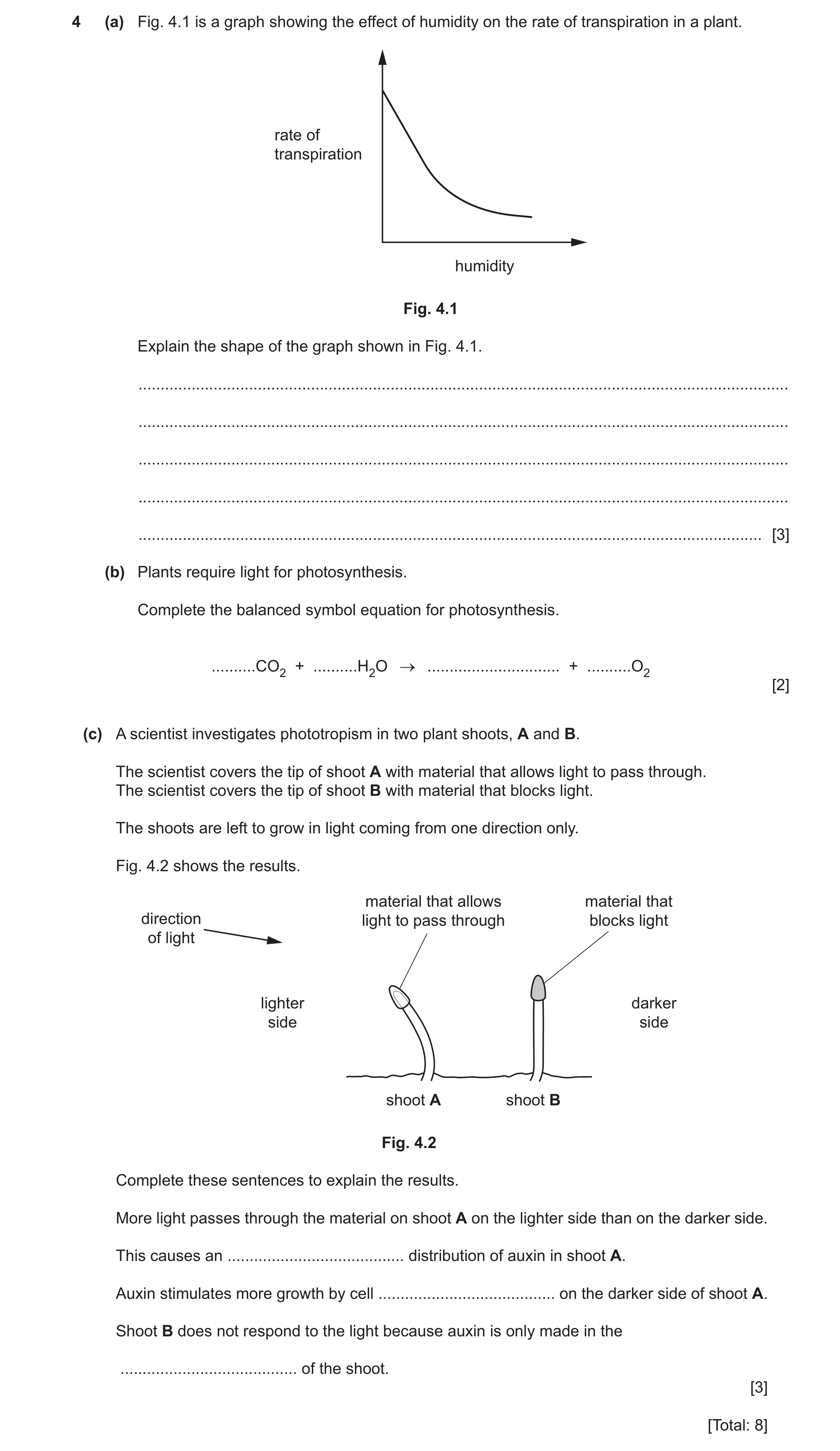
4 (a) Fig. 4.1 is a graph showing the effect of humidity on the rate of transpiration in a plant. rate of transpiration humidity Fig. 4.1 Explain the shape of the graph shown in Fig. 4.1. … … … … … [3] (b) Plants require light for photosynthesis. Complete the balanced symbol equation for photosynthesis. … CO2 + … H2O … + … O2 [2] (c) A scientist investigates phototropism in two plant shoots, A and B. The scientist covers the tip of shoot A with material that allows light to pass through. The scientist covers the tip of shoot B with material that blocks light. The shoots are left to grow in light coming from one direction only. Fig. 4.2 shows the results. material that allows material that direction light to pass through blocks light of light lighter darker side side shoot A shoot B Fig. 4.2 Complete these sentences to explain the results. More light passes through the material on shoot A on the lighter side than on the darker side. This causes an … distribution of auxin in shoot A. Auxin stimulates more growth by cell … on the darker side of shoot A. Shoot B does not respond to the light because auxin is only made in the … of the shoot. [3] [Total: 8]
8 marks
Mark scheme: 4(a) any three from: 3 increasing humidity causes decrease in transpiration rate ; concentration / percentage of water outside leaf increases ; reduces (water) concentration gradient ; reduces (rate of), diffusion / evaporation ; 4(b) 6 CO2 + 6H2O C6H12O6 + 6O2 2 correct formula for glucose ; equation correctly balanced dependent on glucose formula ; 4(c) unequal / AW ; 3 elongation ; tip / AW ;
This question in 0653/41 Oct/Nov 2024
Q25 · Sections through two different flowers, X and Y 0653/42 Oct/Nov 2024
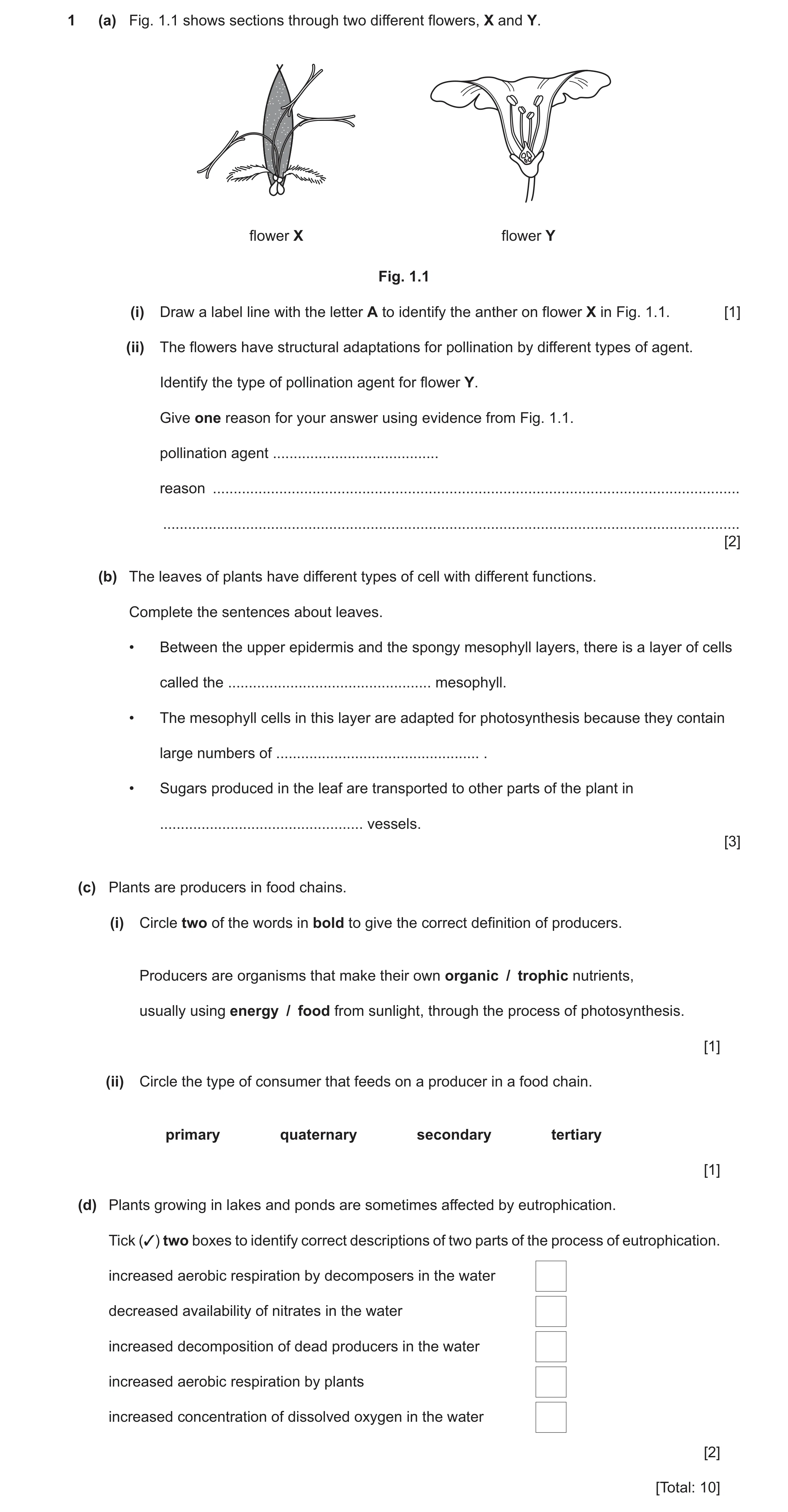
1 (a) Fig. 1.1 shows sections through two different flowers, X and Y. flower X flower Y Fig. 1.1 (i) Draw a label line with the letter A to identify the anther on flower X in Fig. 1.1. [1] (ii) The flowers have structural adaptations for pollination by different types of agent. Identify the type of pollination agent for flower Y. Give one reason for your answer using evidence from Fig. 1.1. pollination agent … reason … … [2] (b) The leaves of plants have different types of cell with different functions. Complete the sentences about leaves. • Between the upper epidermis and the spongy mesophyll layers, there is a layer of cells called the … mesophyll. • The mesophyll cells in this layer are adapted for photosynthesis because they contain large numbers of … . • Sugars produced in the leaf are transported to other parts of the plant in … vessels. [3] (c) Plants are producers in food chains. (i) Circle two of the words in bold to give the correct definition of producers. Producers are organisms that make their own organic / trophic nutrients, usually using energy / food from sunlight, through the process of photosynthesis. [1] (ii) Circle the type of consumer that feeds on a producer in a food chain. primary quaternary secondary tertiary [1] (d) Plants growing in lakes and ponds are sometimes affected by eutrophication. Tick (✓) two boxes to identify correct descriptions of two parts of the process of eutrophication. increased aerobic respiration by decomposers in the water decreased availability of nitrates in the water increased decomposition of dead producers in the water increased aerobic respiration by plants increased concentration of dissolved oxygen in the water [2] [Total: 10]
10 marks
Mark scheme: Question Answer Marks 1(a)(i) anther labelled A on flower X ; 1 1(a)(ii) insect / bird / animal ; 2 anthers inside flower / stigma inside flower ; 1(b) palisade ; 3 chloroplasts ; phloem ; 1(c)(i) organic AND energy ; 1 1(c)(ii) primary ; 1 1(d) increased aerobic respiration by decomposers in the water ; 2 increased decomposition of dead producers in the water ;
This question in 0653/42 Oct/Nov 2024
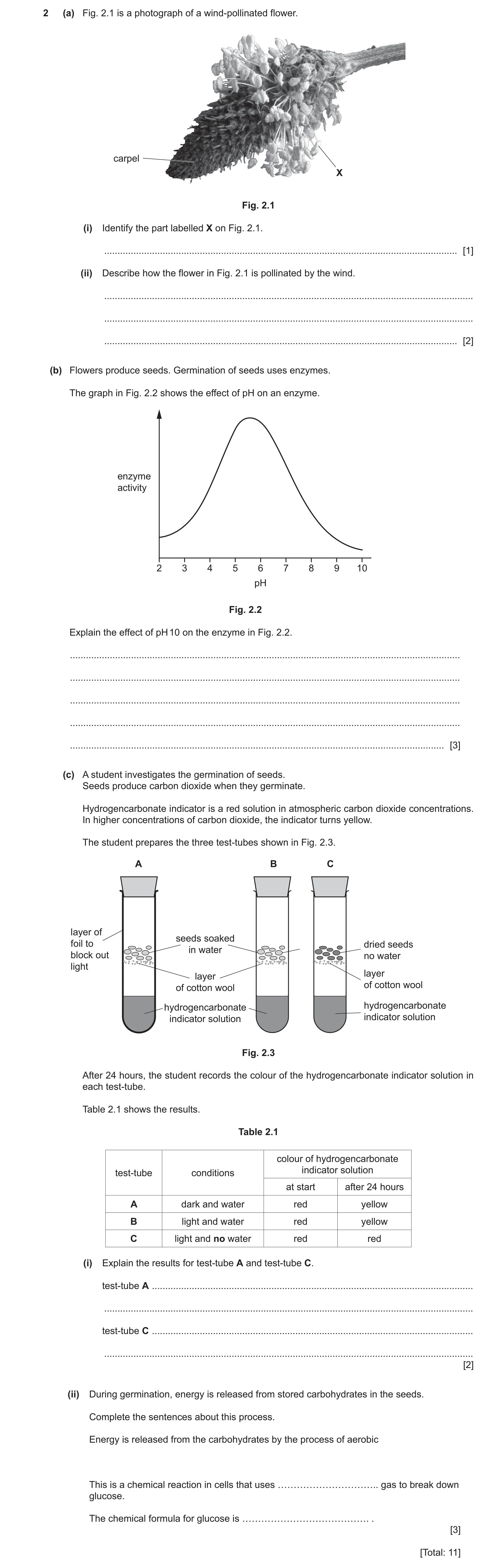
Q26 · A photograph of a wind‑pollinated flower 0653/41 May/June 2025
2 (a) Fig. 2.1 is a photograph of a wind‑pollinated flower. carpel X Fig. 2.1 (i) Identify the part labelled X on Fig. 2.1. … [1] (ii) Describe how the flower in Fig. 2.1 is pollinated by the wind. … … … [2] (b) Flowers produce seeds. Germination of seeds uses enzymes. The graph in Fig. 2.2 shows the effect of pH on an enzyme. enzyme activity 2 3 4 5 6 7 8 9 10 pH Fig. 2.2 Explain the effect of pH 10 on the enzyme in Fig. 2.2. … … … … … [3] (c) A student investigates the germination of seeds. Seeds produce carbon dioxide when they germinate. Hydrogencarbonate indicator is a red solution in atmospheric carbon dioxide concentrations. In higher concentrations of carbon dioxide, the indicator turns yellow. The student prepares the three test‑tubes shown in Fig. 2.3. A B C layer of seeds soaked foil to dried seeds in water block out no water light layer layer of cotton wool of cotton wool hydrogencarbonate hydrogencarbonate indicator solution indicator solution Fig. 2.3 After 24 hours, the student records the colour of the hydrogencarbonate indicator solution in each test‑tube. Table 2.1 shows the results. Table 2.1 colour of hydrogencarbonate indicator solution test‑tube conditions at start after 24 hours A dark and water red yellow B light and water red yellow C light and no water red red (i) Explain the results for test‑tube A and test‑tube C. test‑tube A … … test‑tube C … … [2] (ii) During germination, energy is released from stored carbohydrates in the seeds. Complete the sentences about this process. Energy is released from the carbohydrates by the process of aerobic This is a chemical reaction in cells that uses ………………………….. gas to break down glucose. The chemical formula for glucose is …………………………………. . [3] [Total: 11]
11 marks
Mark scheme: 2(a)(i) anther ; 1 2(a)(ii) pollen is transferred (by wind) ; 2 (pollen moves) from anther to stigma ; 2(b) enzyme denatures ; 3 active site changes shape ; active site no longer complementary to substrate / substrate no longer fits active site ; 2(c)(i) (tube A) light not needed for germination (so indicator turns yellow) ; 2 (tube C) water is required for germination (so indicator stays red) ; 2(c)(ii) respiration ; 3 oxygen ; C6H12O6 ;
This question in 0653/41 May/June 2025
 1 / 39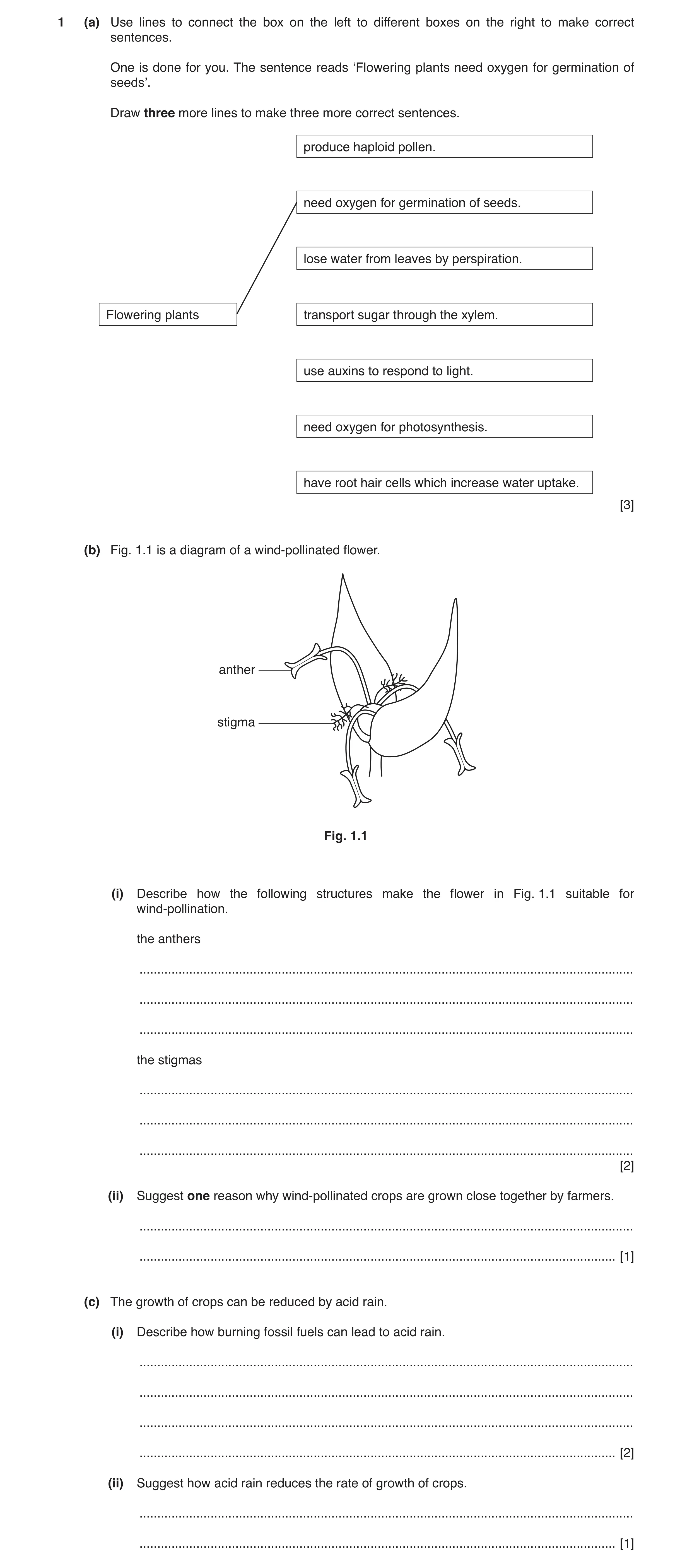
 7 / 39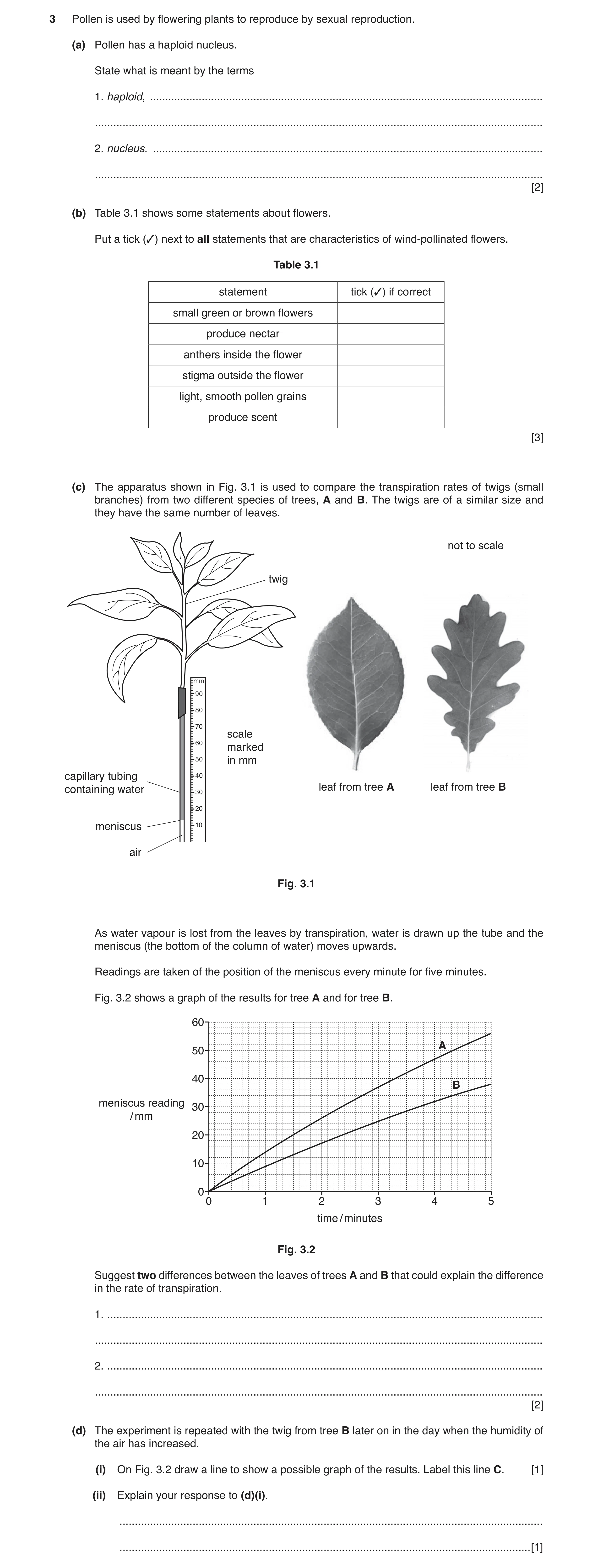
![Question 19: (a) Fig. 7.1 shows an insect-pollinated flower. Fig. 7.1 (i) Draw a label line and the letter C to identify a carpel in Fig. 7.1. [1] (ii) …](https://img.pastlit.com/crops/0c32579a-c487-4138-9410-20e823a096a4/q7.webp)
 6
6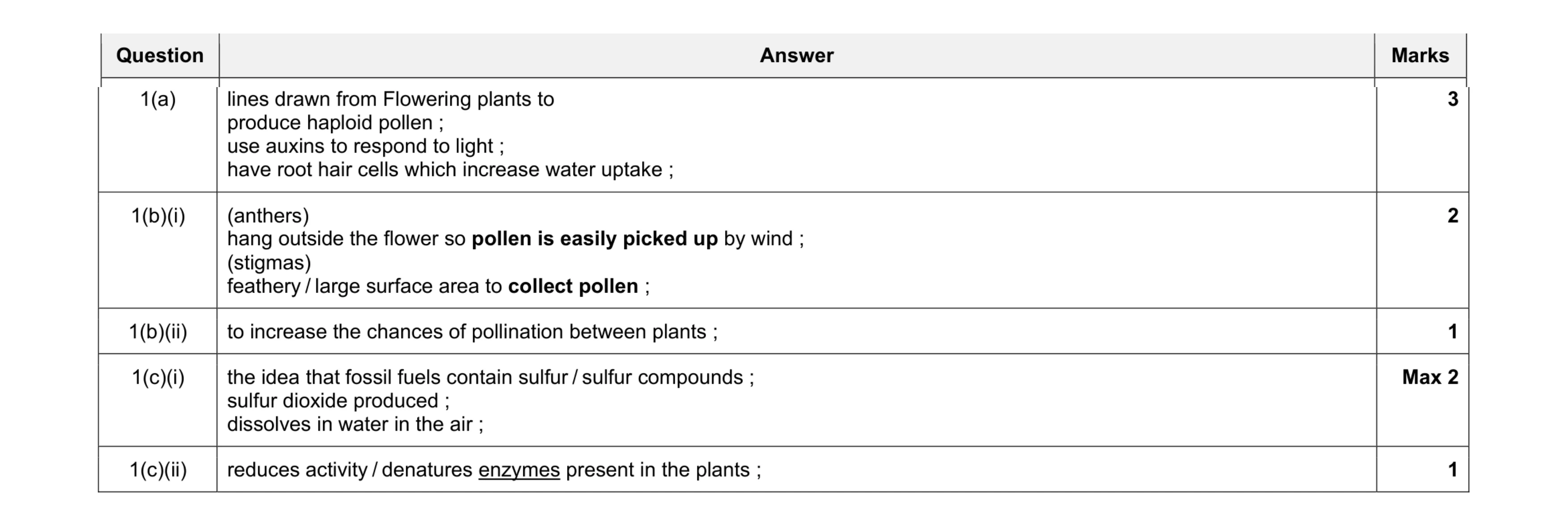 9
9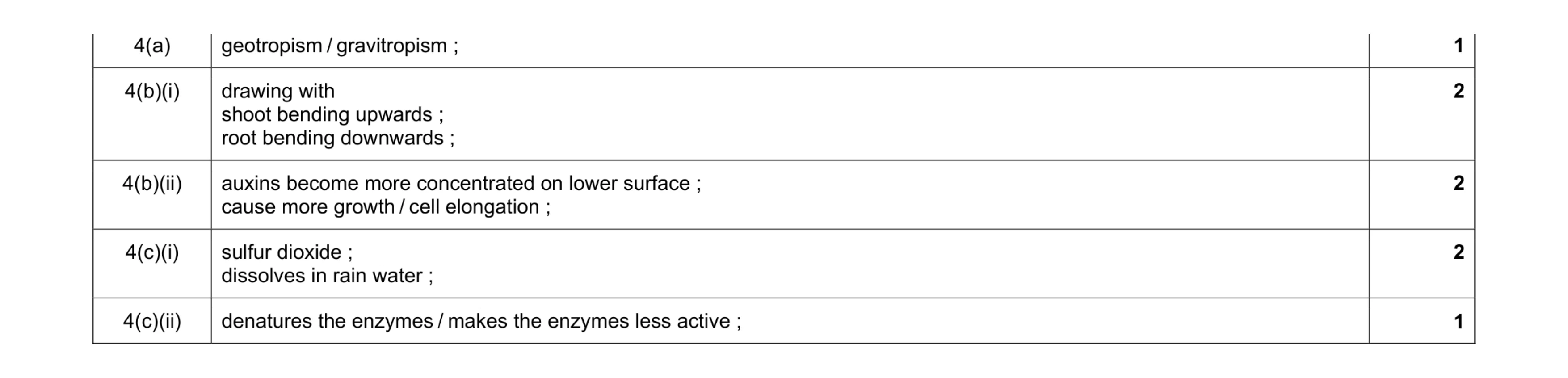 8
8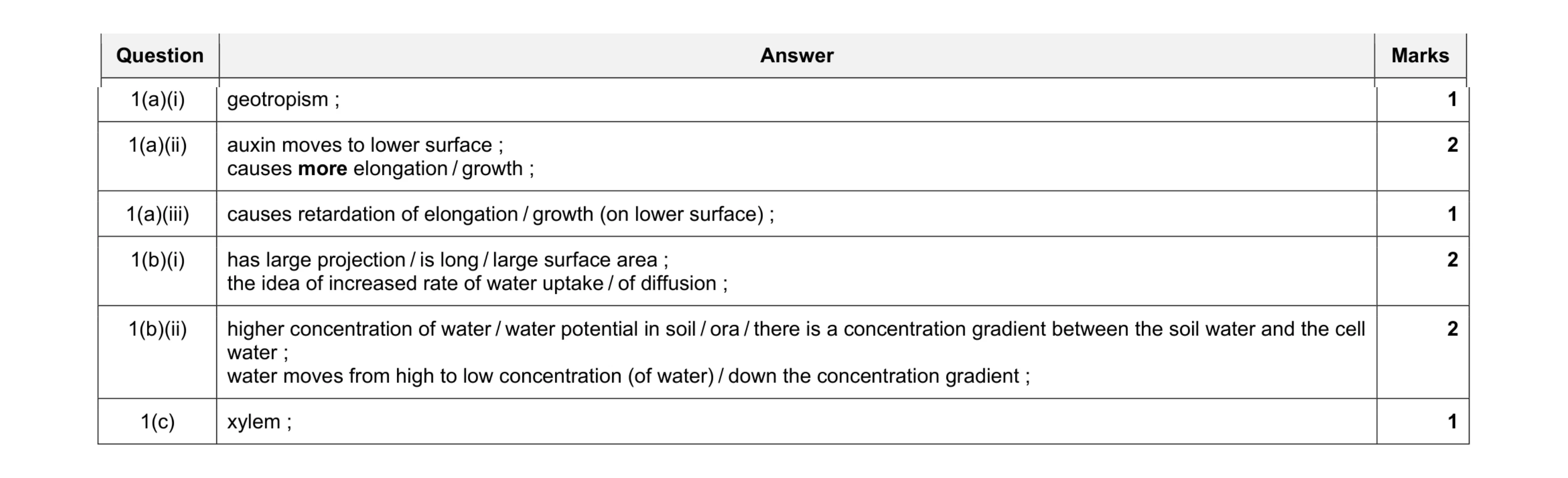 9
9 7
7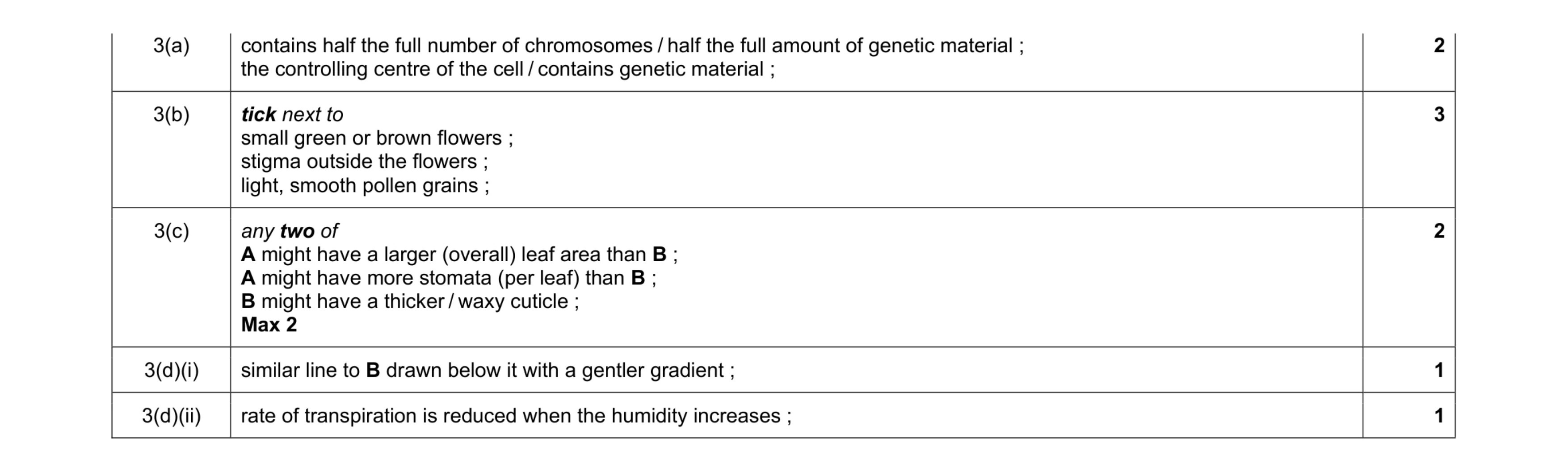 9
9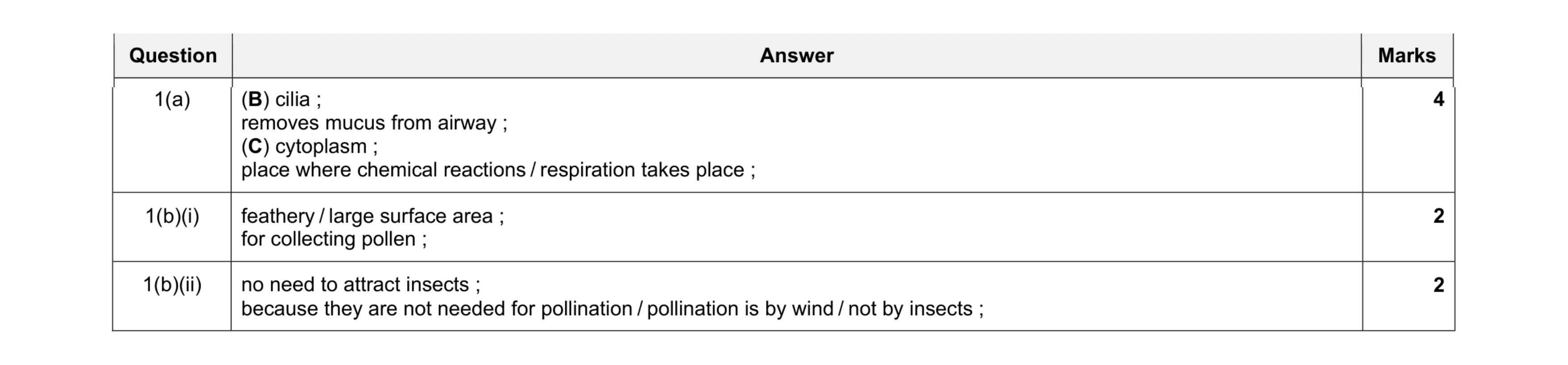 8
8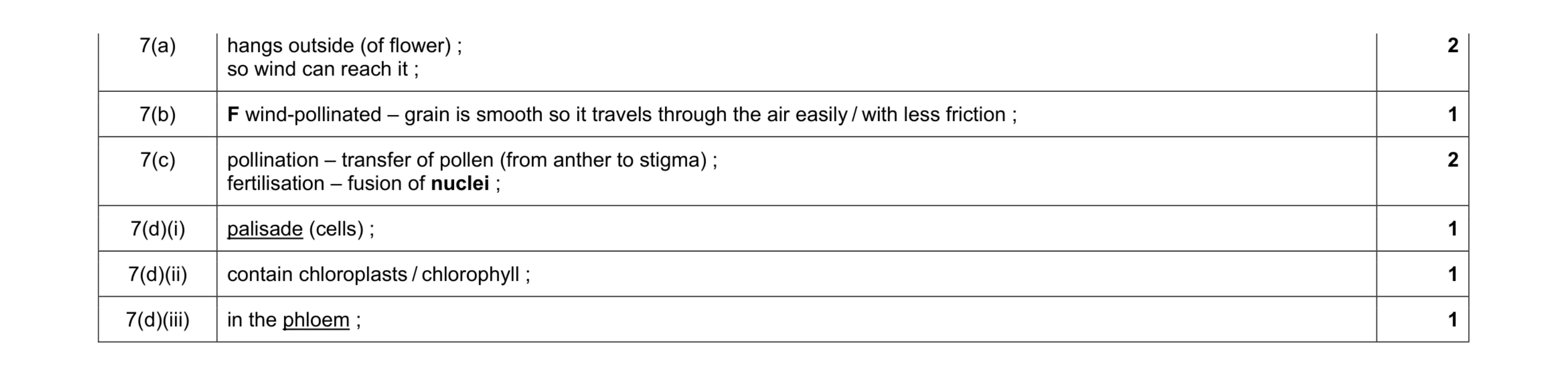 8
8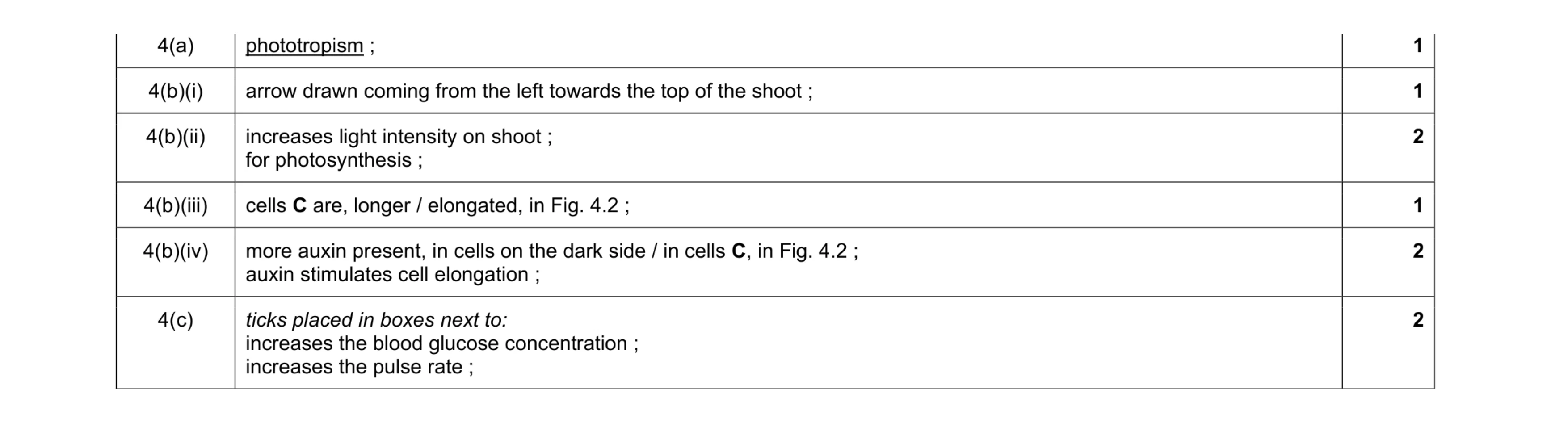 9
9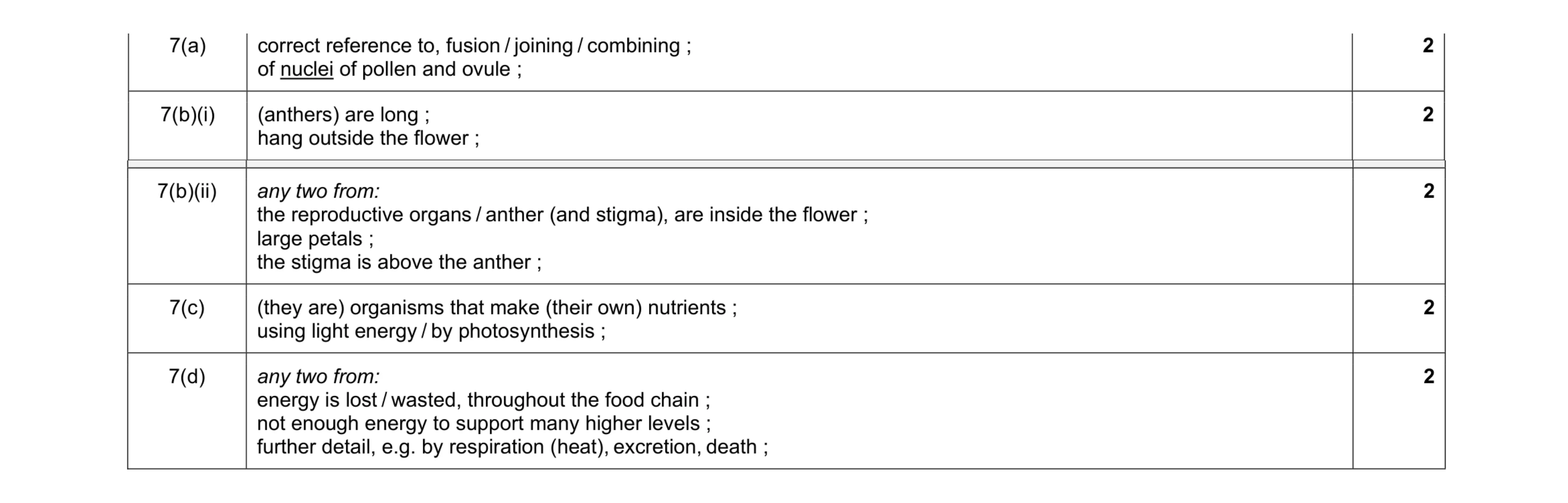 10
10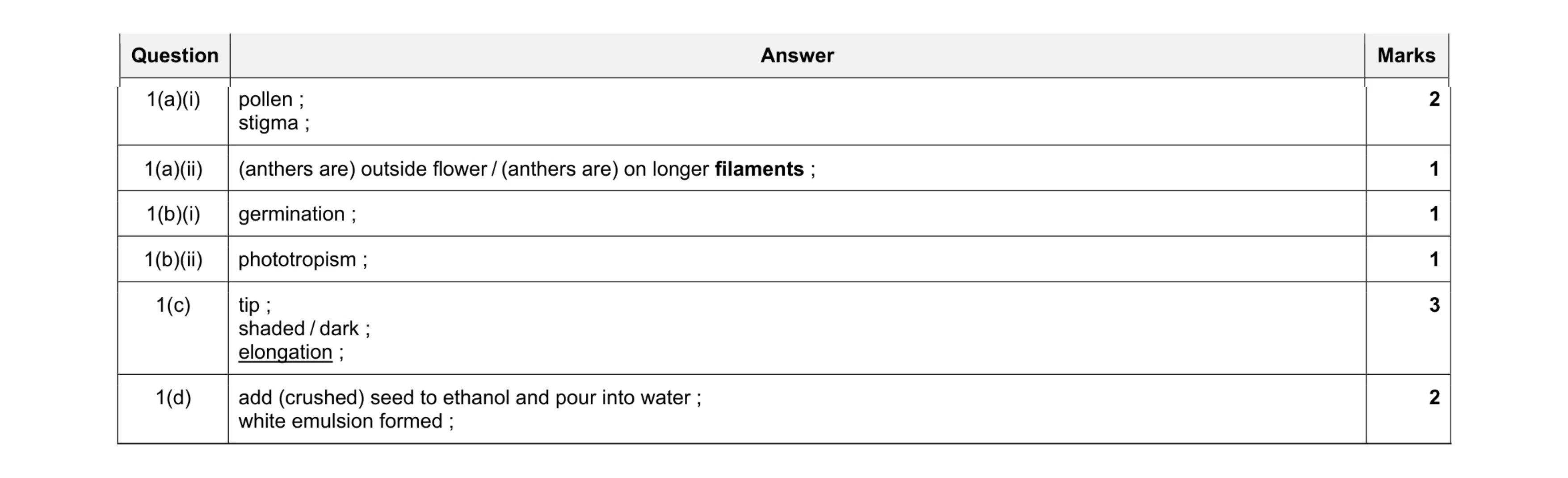 10
10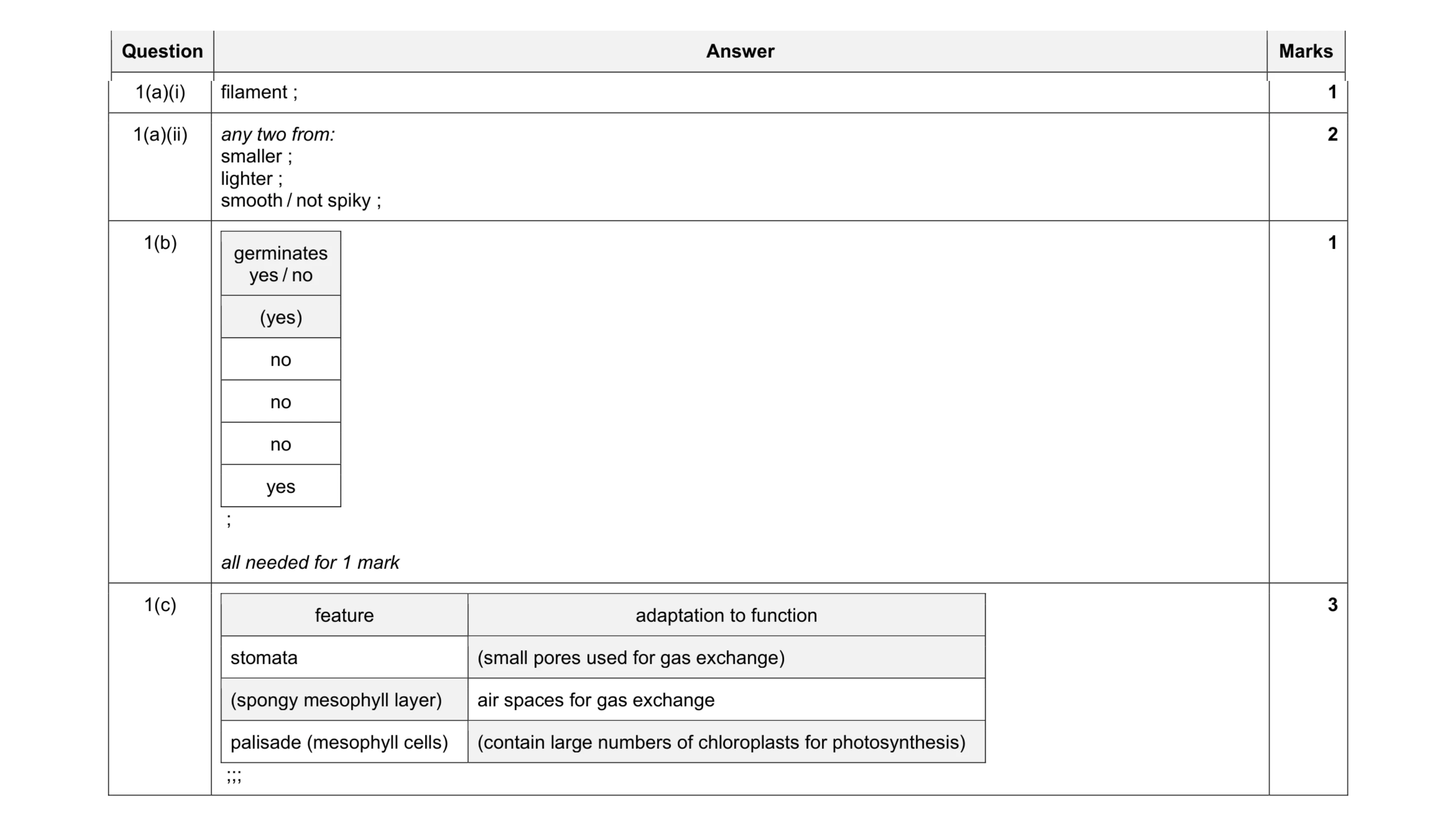 7
7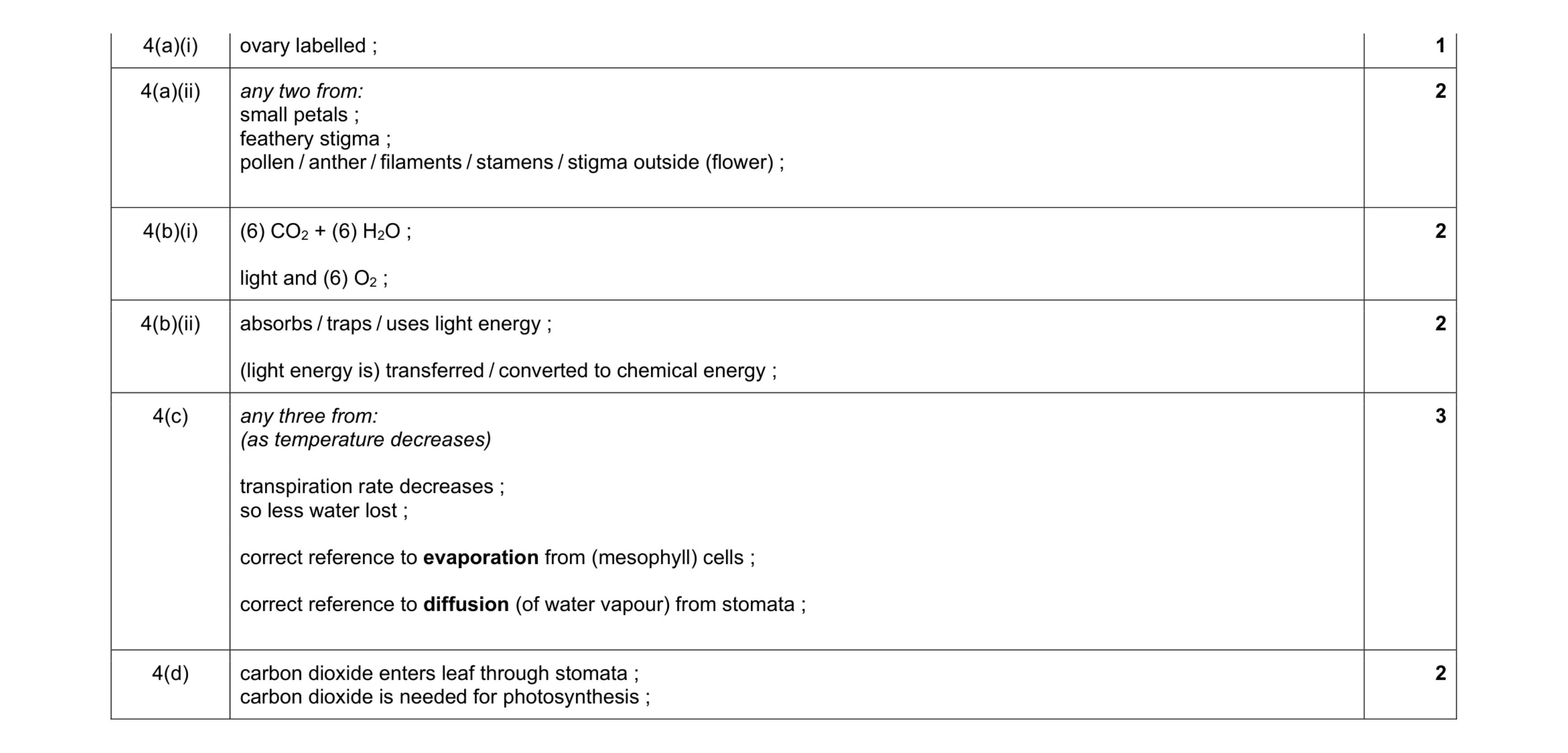 12
12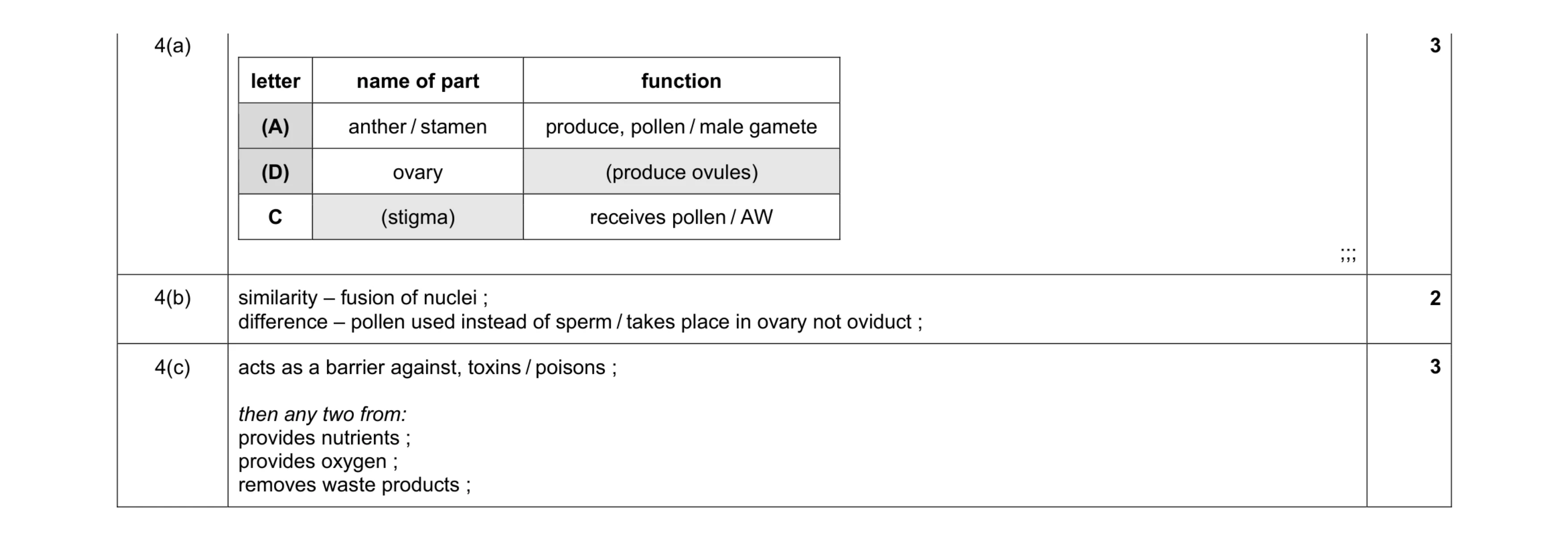 8
8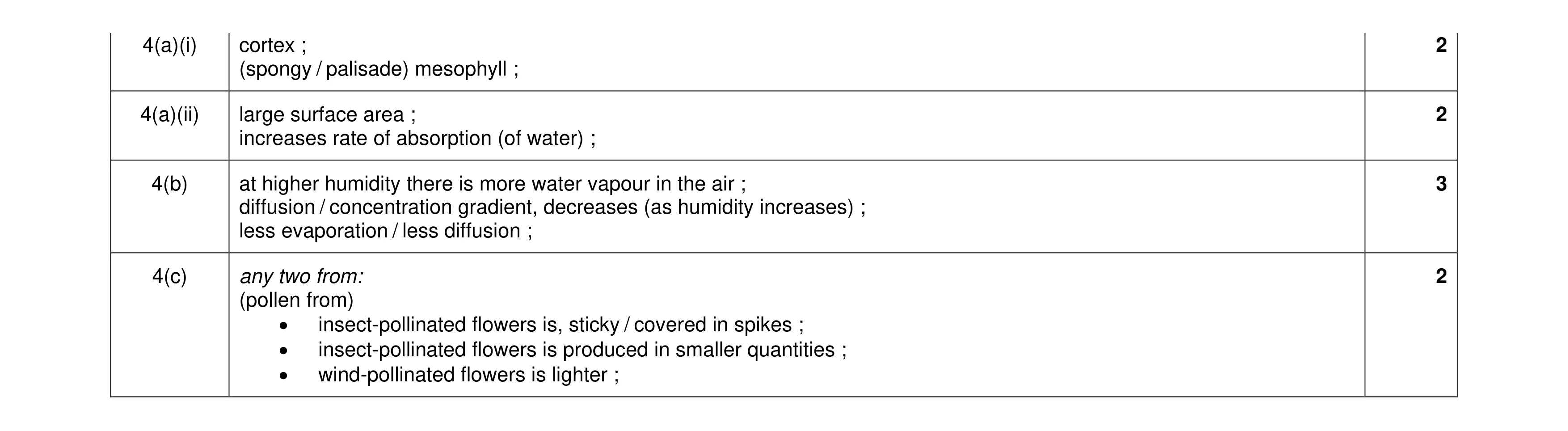 9
9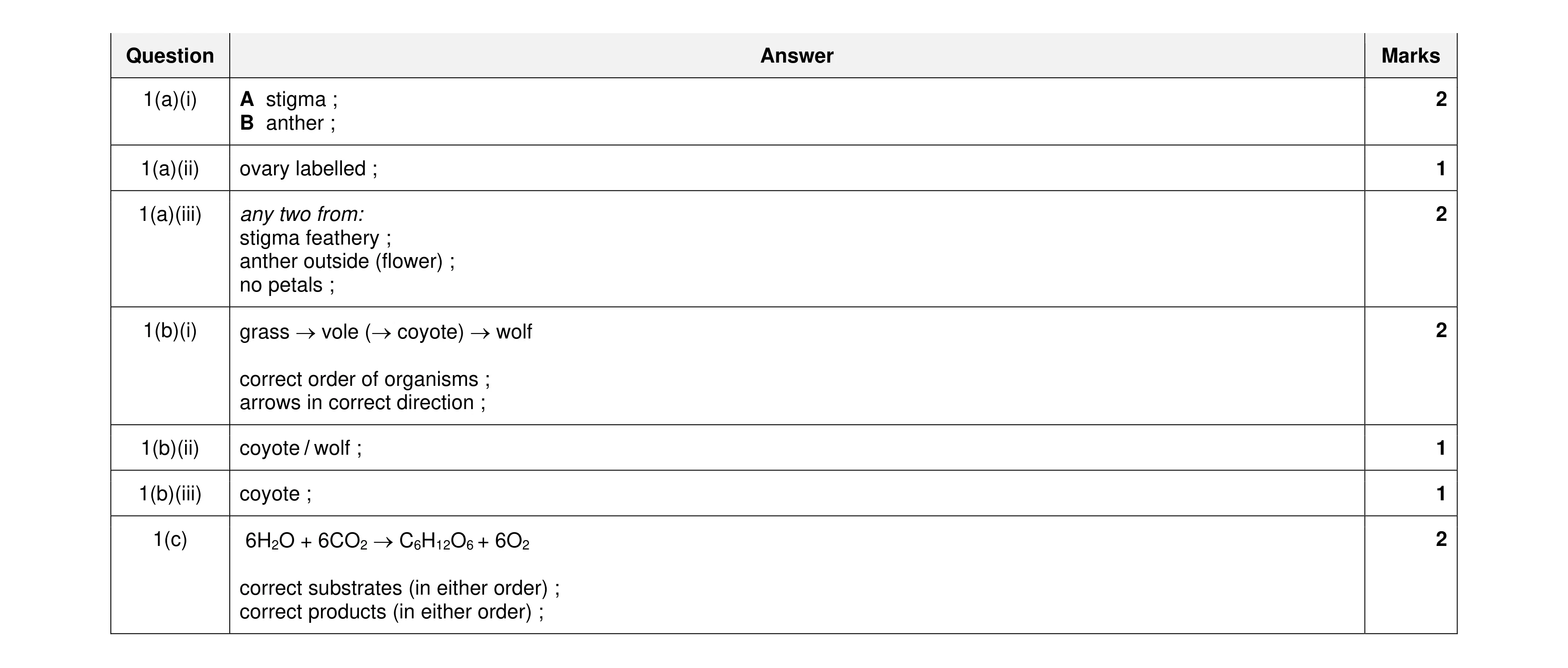 11
11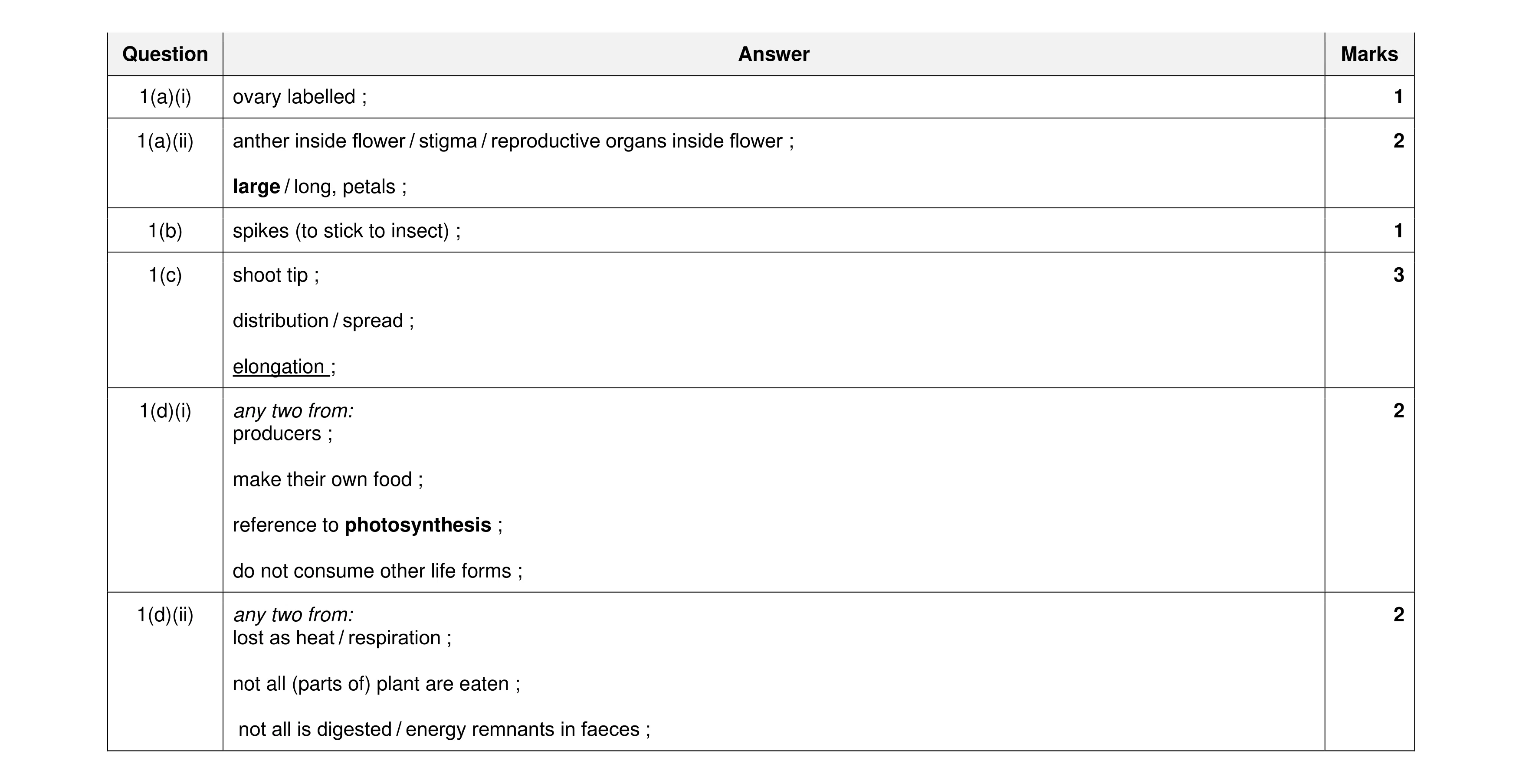 11
11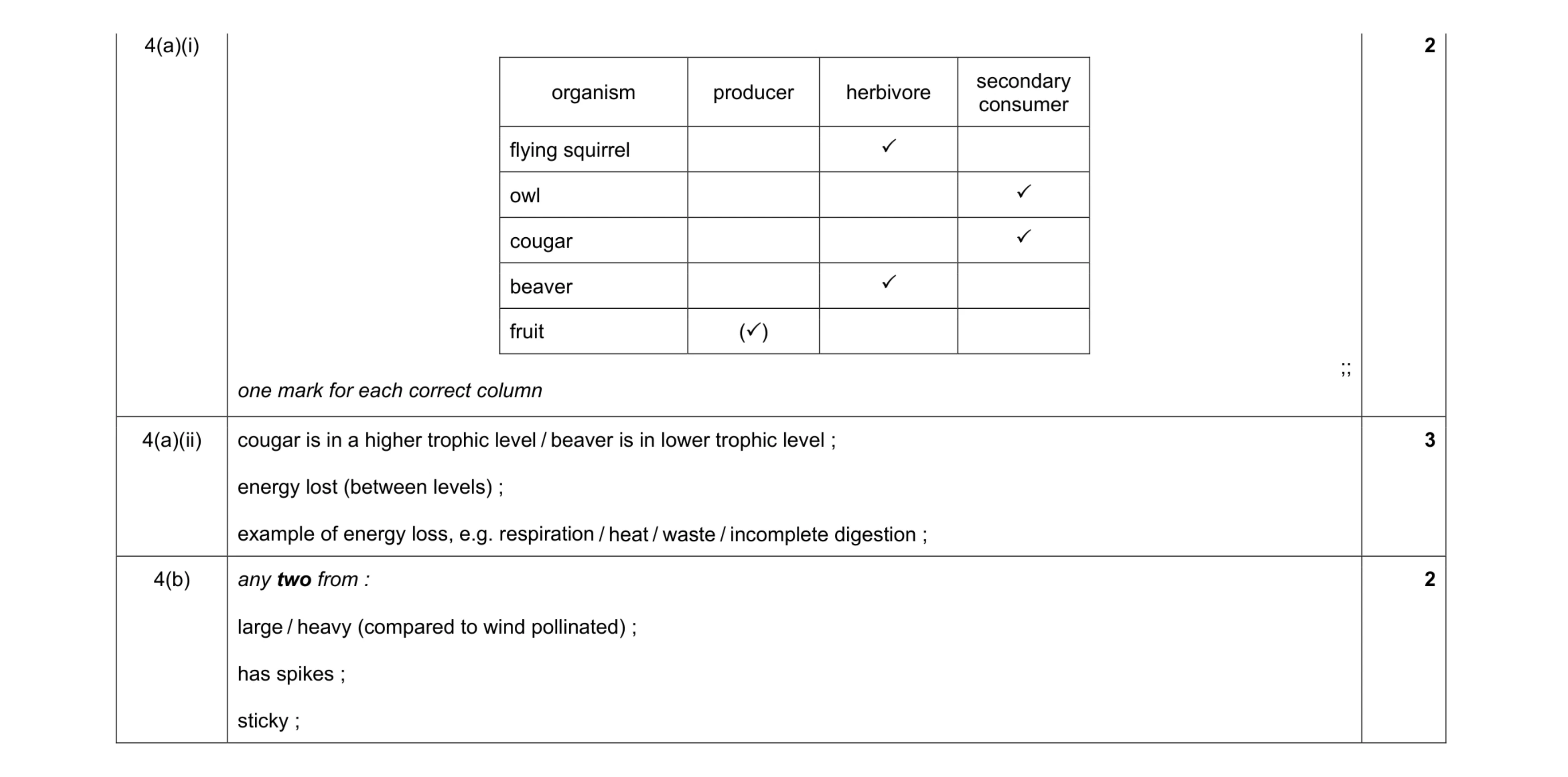 7
7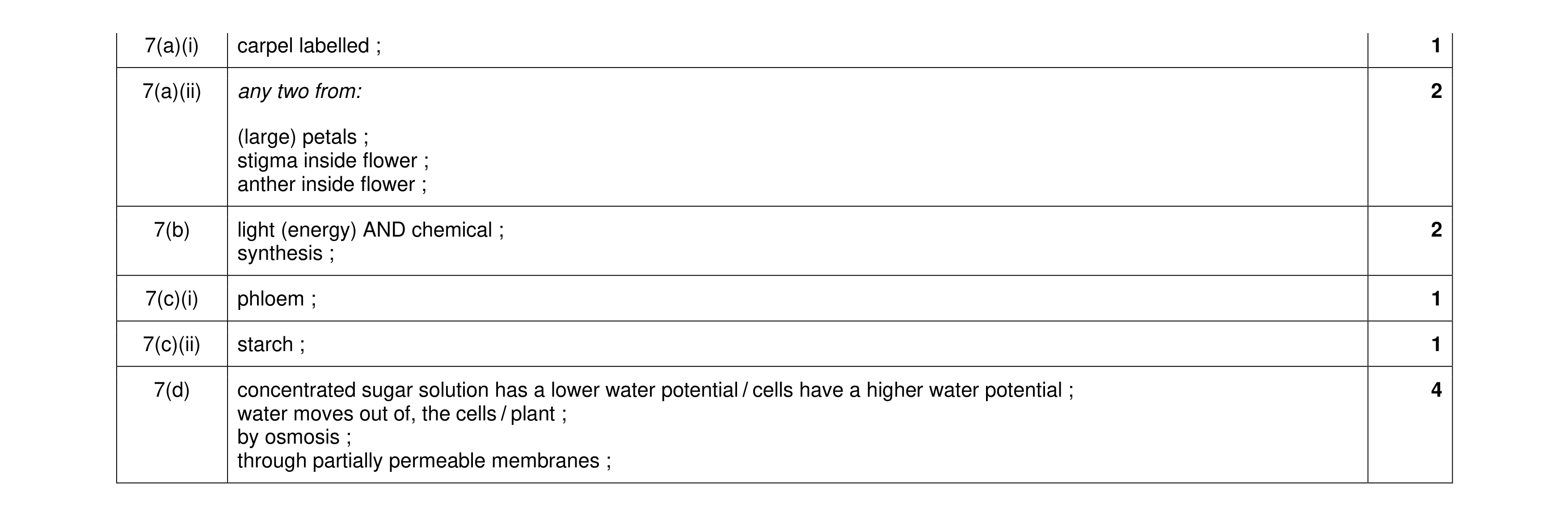 11
11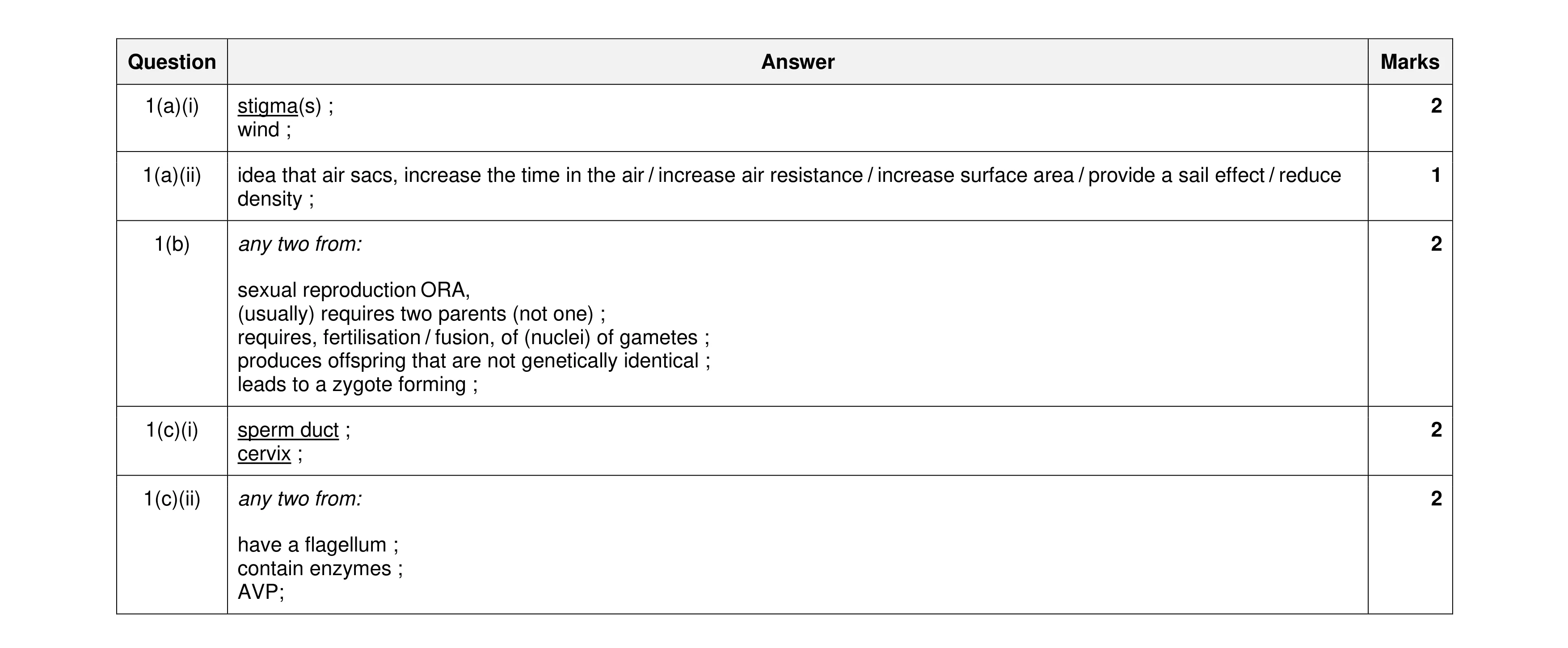 9
9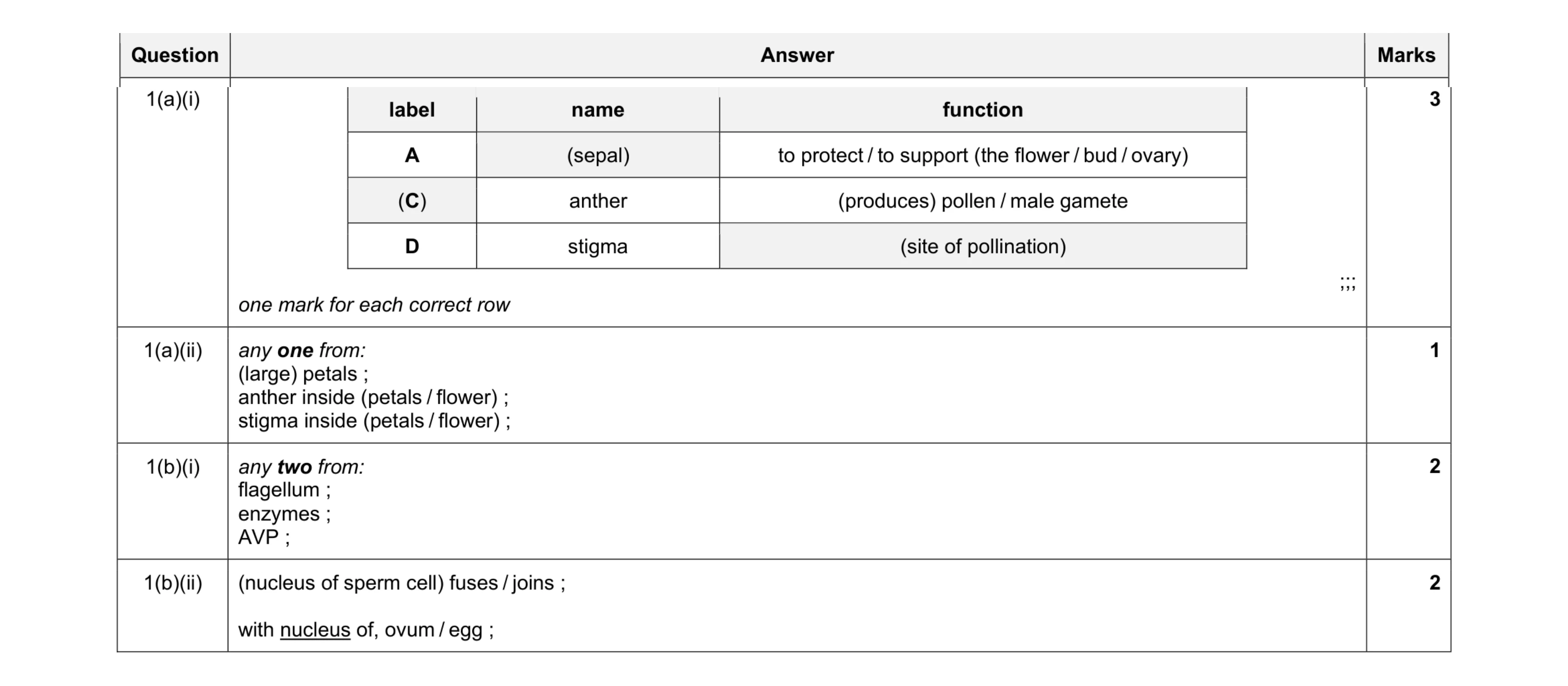 8
8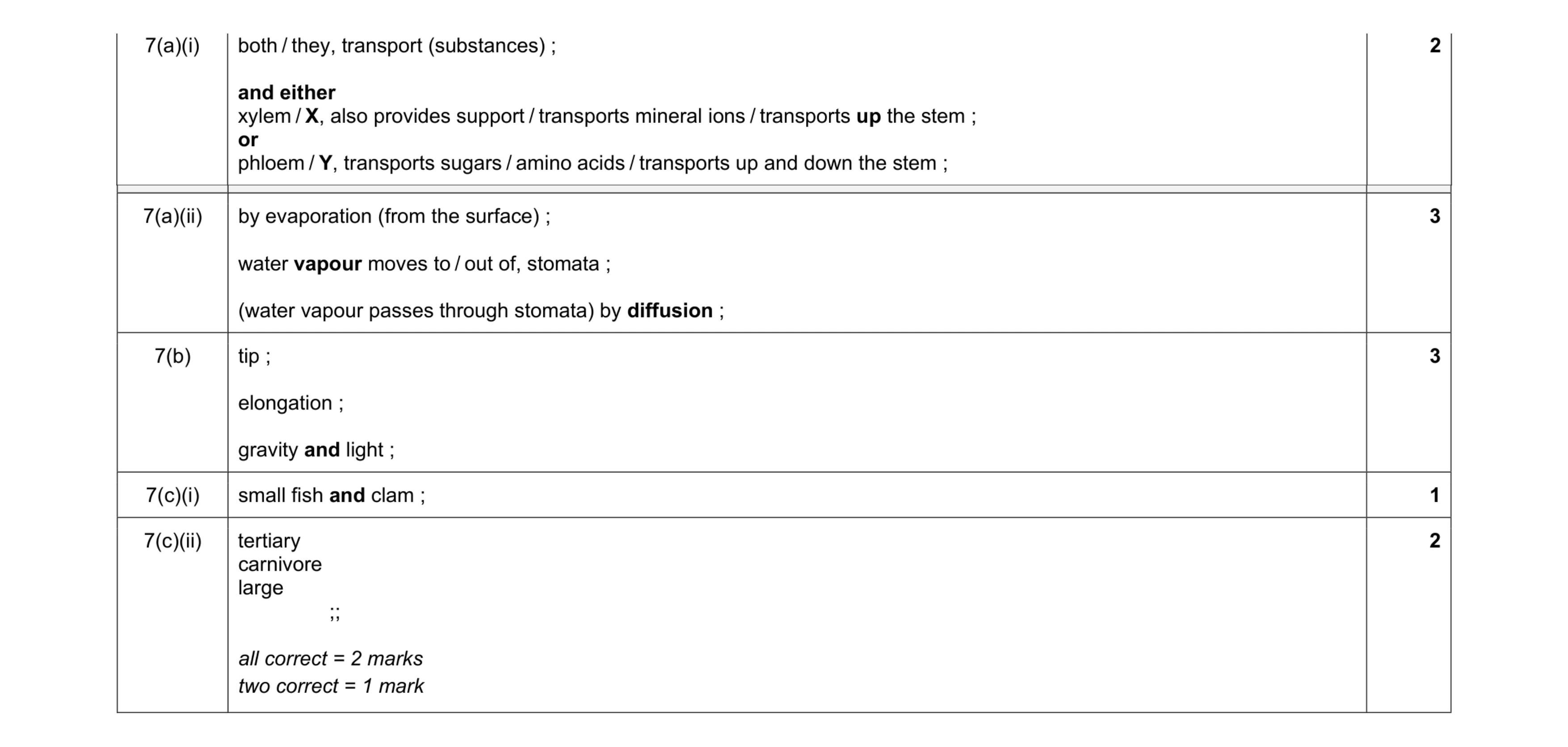 11
11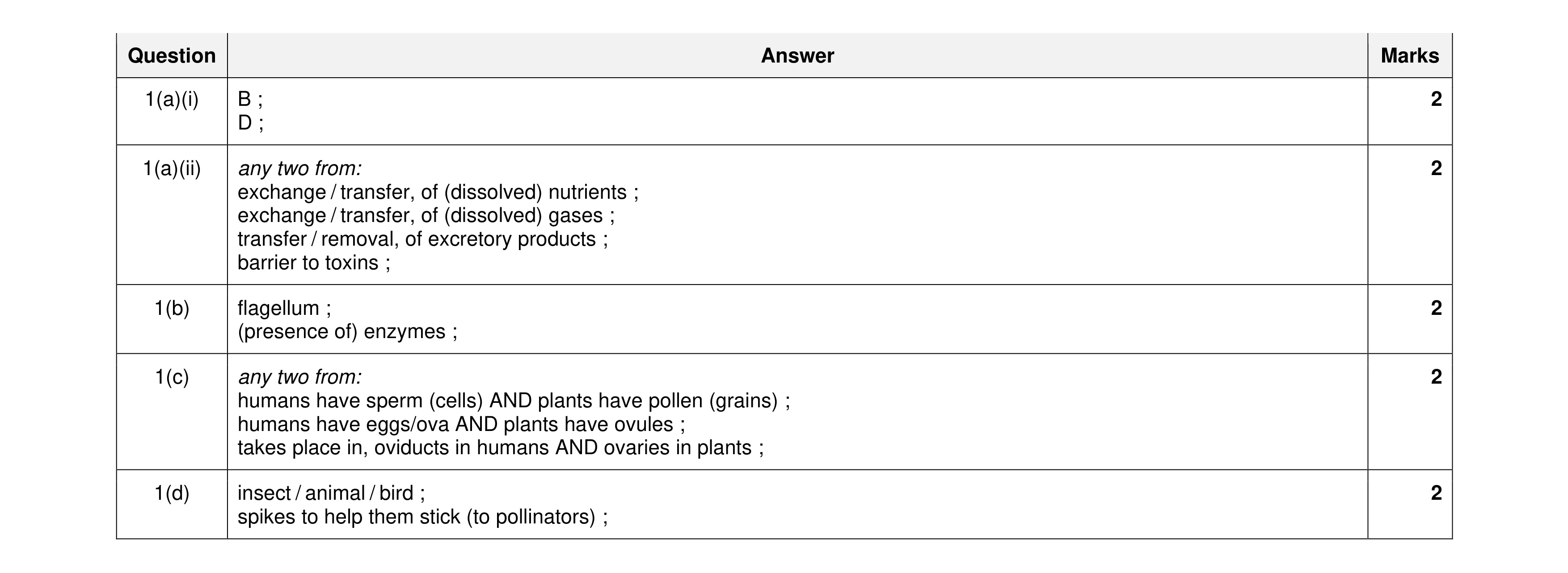 10
10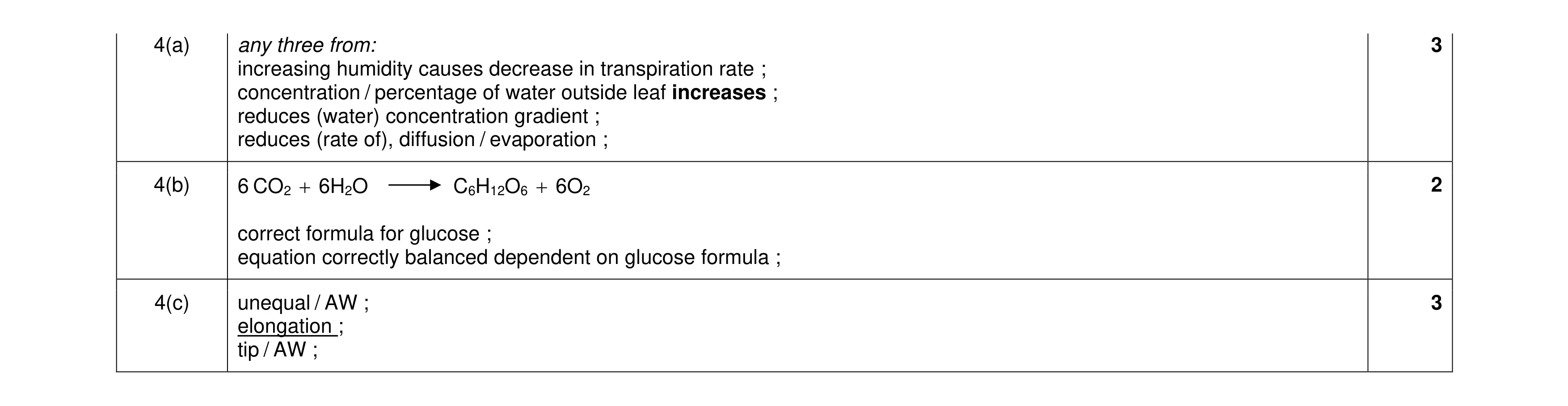 8
8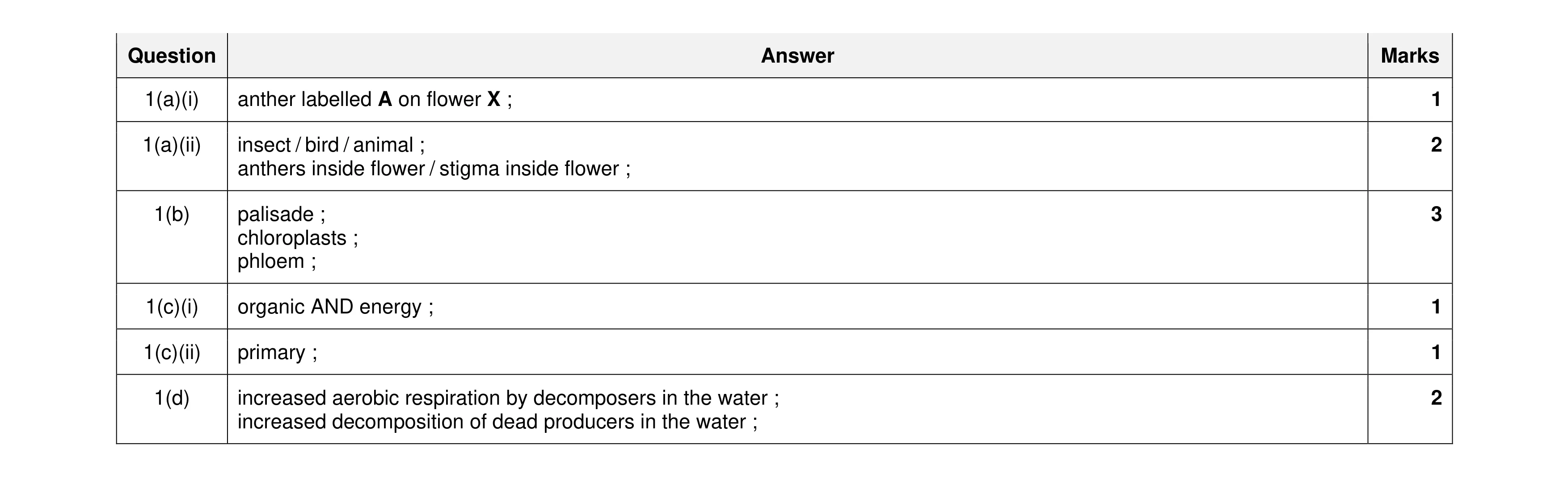 10
10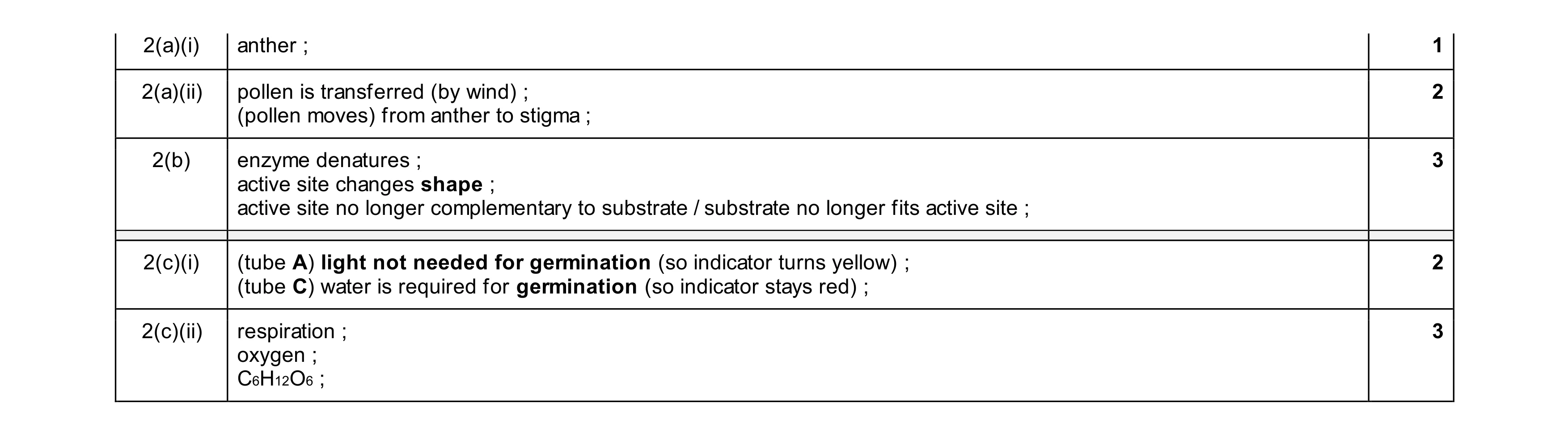 11
11